1.1.4b Methods of training
and assessing fitness
Learning objectives
To understand the different methods of training and their
effects.
To describe various fitness test that are useful to a
performer during a PEP.
1.1.4b Methods of training
and assessing fitness
Learning objectives

Understand the terms resting heart rate and
recovery rate - evaluating a graph.
Use graphs to demonstrate the use of target
zones and thresholds of training
Comparing Training Sessions
Read pages 72 and 73 of your textbook
Try to draw the key points from each of
the sessions – refer to the paragraph on
the right hand side of page 73.
Try to answer the following questions
relating to training methods and graphs.
Examiners Tip: If you are asked in an exam which athlete
uses speed the most, give the most obvious answer: in the
case of the scenario above in your textbook, the answer
would be JACK, the 100m sprinter.
Analysing Graphs and Training

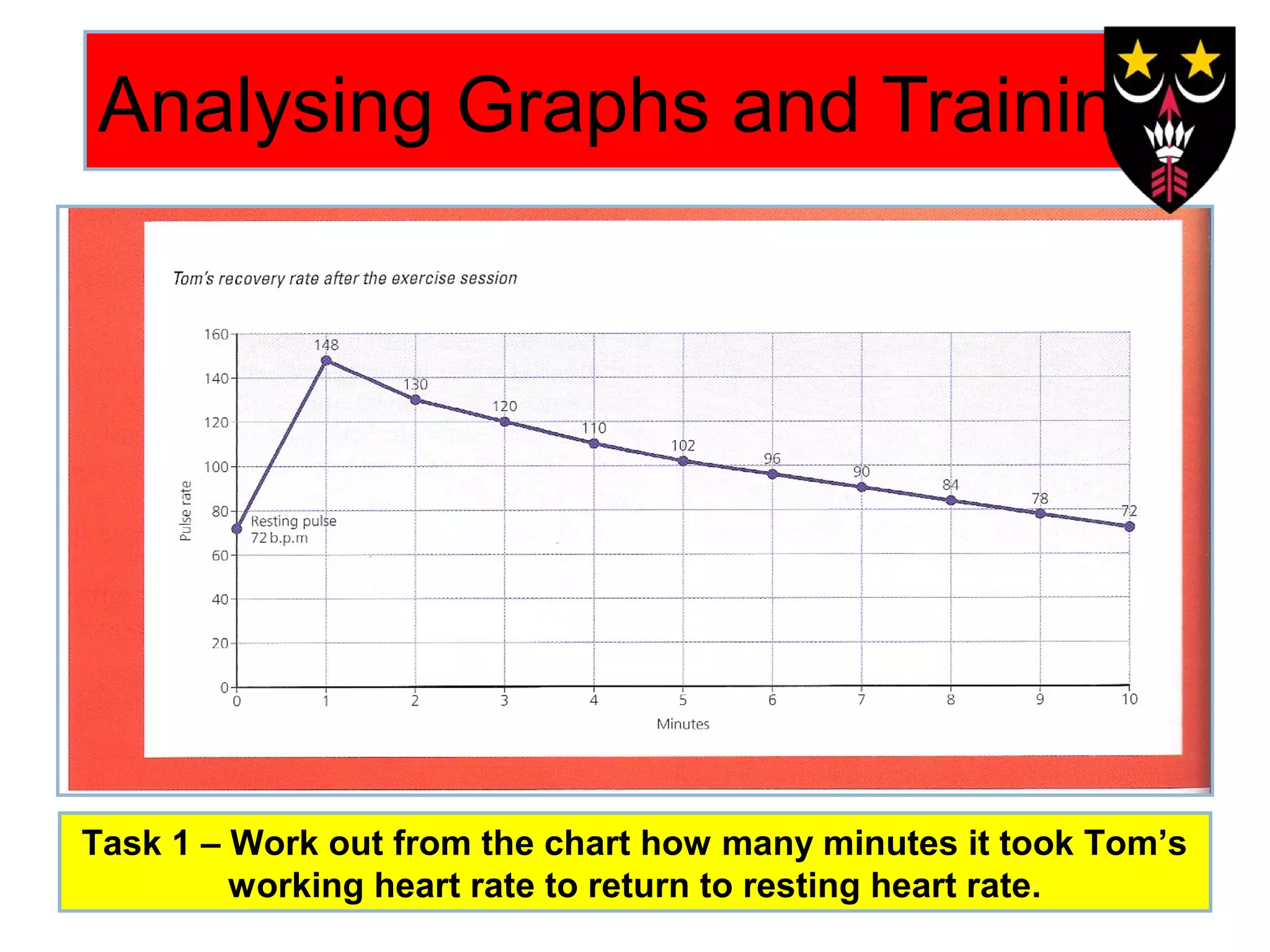
Task 1 – Work out from the chart how many minutes it took Tom’s
working heart rate to return to resting heart rate.
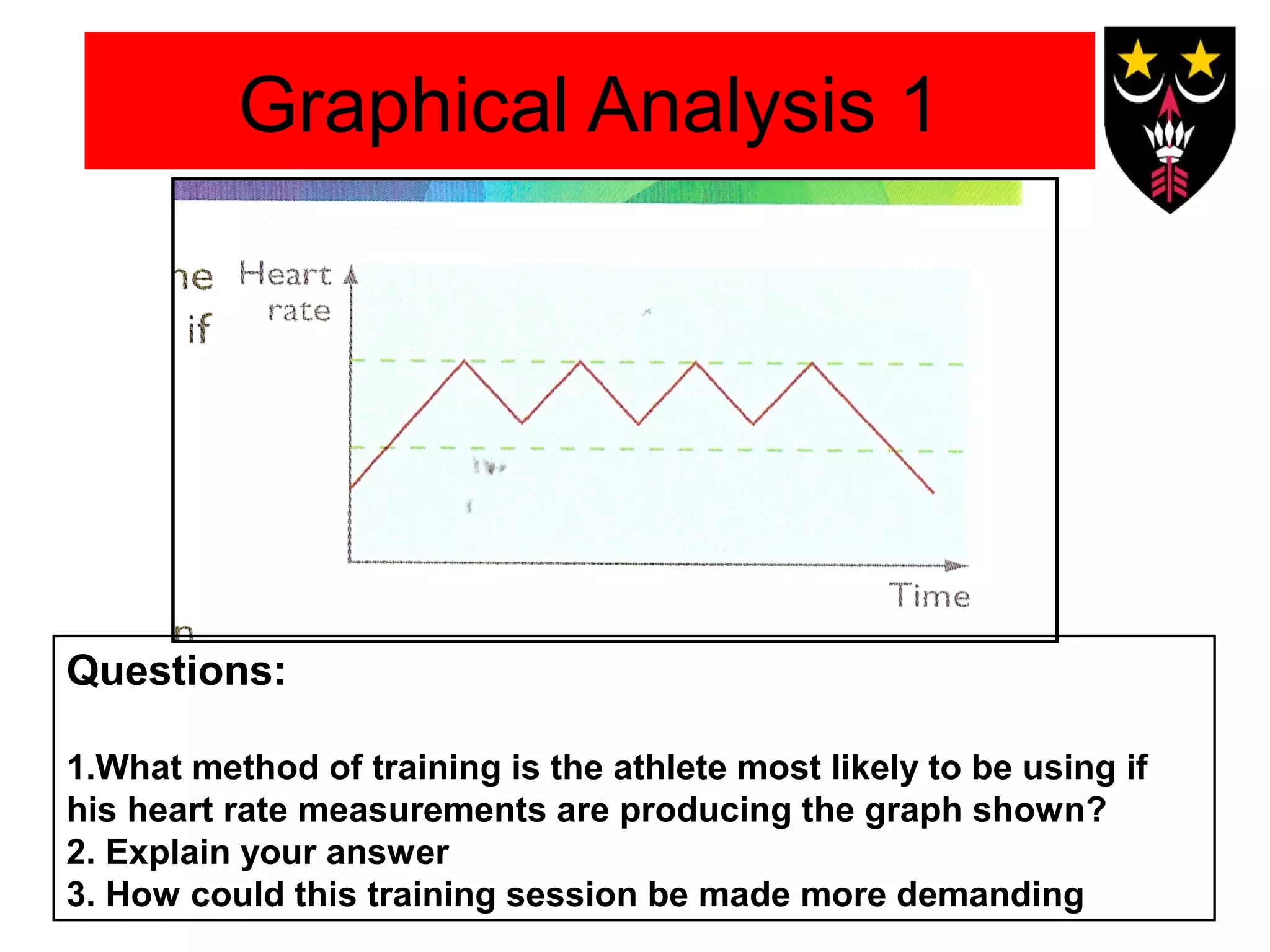
Graphical Analysis 1

Questions:
1.What method of training is the athlete most likely to be using if
his heart rate measurements are producing the graph shown?
2. Explain your answer
3. How could this training session be made more demanding
Answers to Graphical 1
Answers
Q1: Interval Training
Q2: Interval training is defined as periods of work followed
by periods of rest. The athlete exercised hard to increase the
heart rate. This was followed by a period of rest, in which
the heart rate fell. This was repeated.
Q3: By doing more sets, running up a hill, faster running or
taking shorter rest periods.
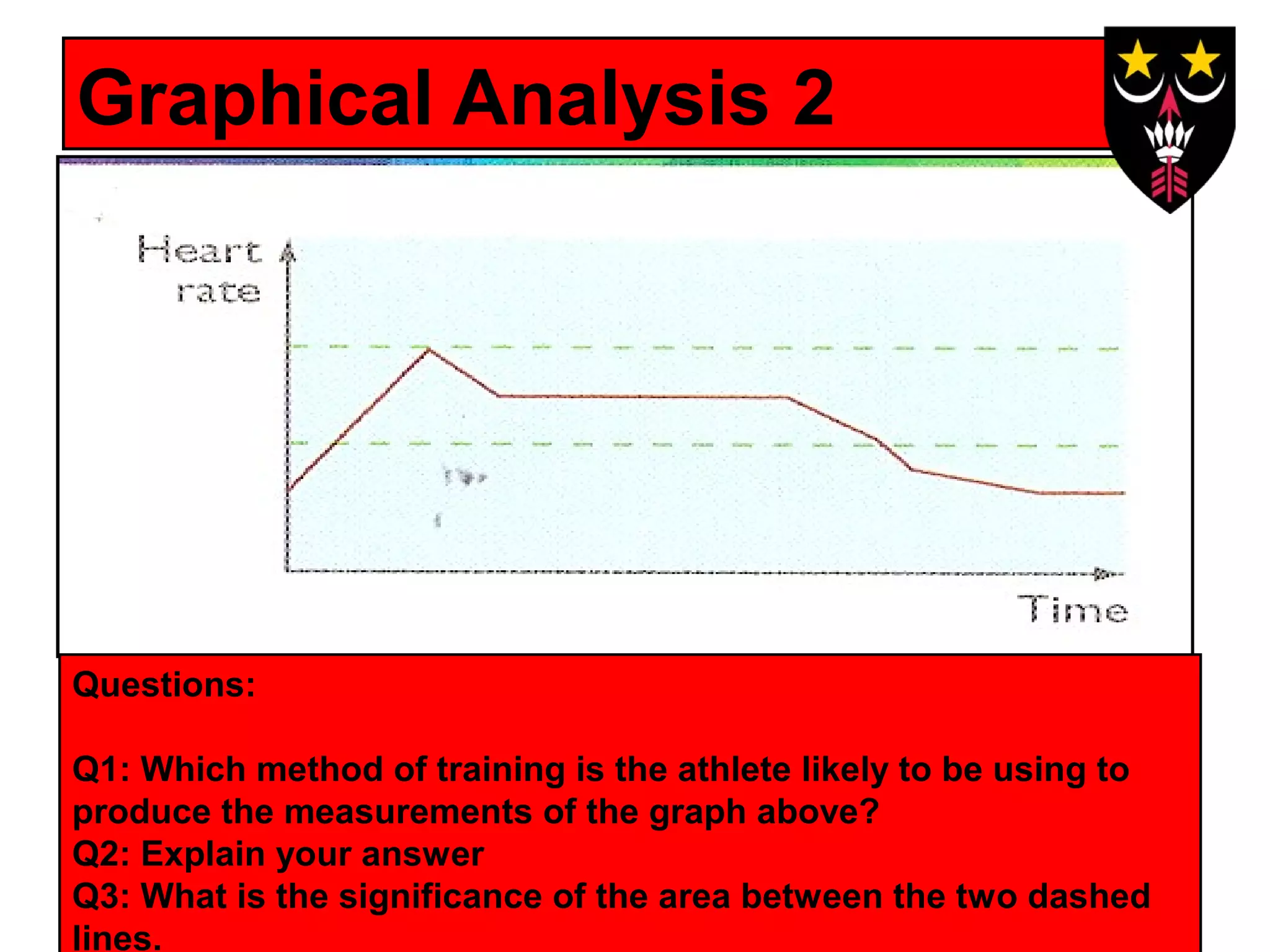
Graphical Analysis 2

Questions:
Q1: Which method of training is the athlete likely to be using to
produce the measurements of the graph above?
Q2: Explain your answer
Q3: What is the significance of the area between the two dashed
lines.
Answers to Graphical 2
Answers
Q1: Continuous Training
Q2: The heart rate rises quickly at the start of
training and then settles down and remains constant
as the athletes works at a steady pace.
Q3: The HR should fall within this zone to indicate
that the person is working hard enough to make
improvements (trainig zone)
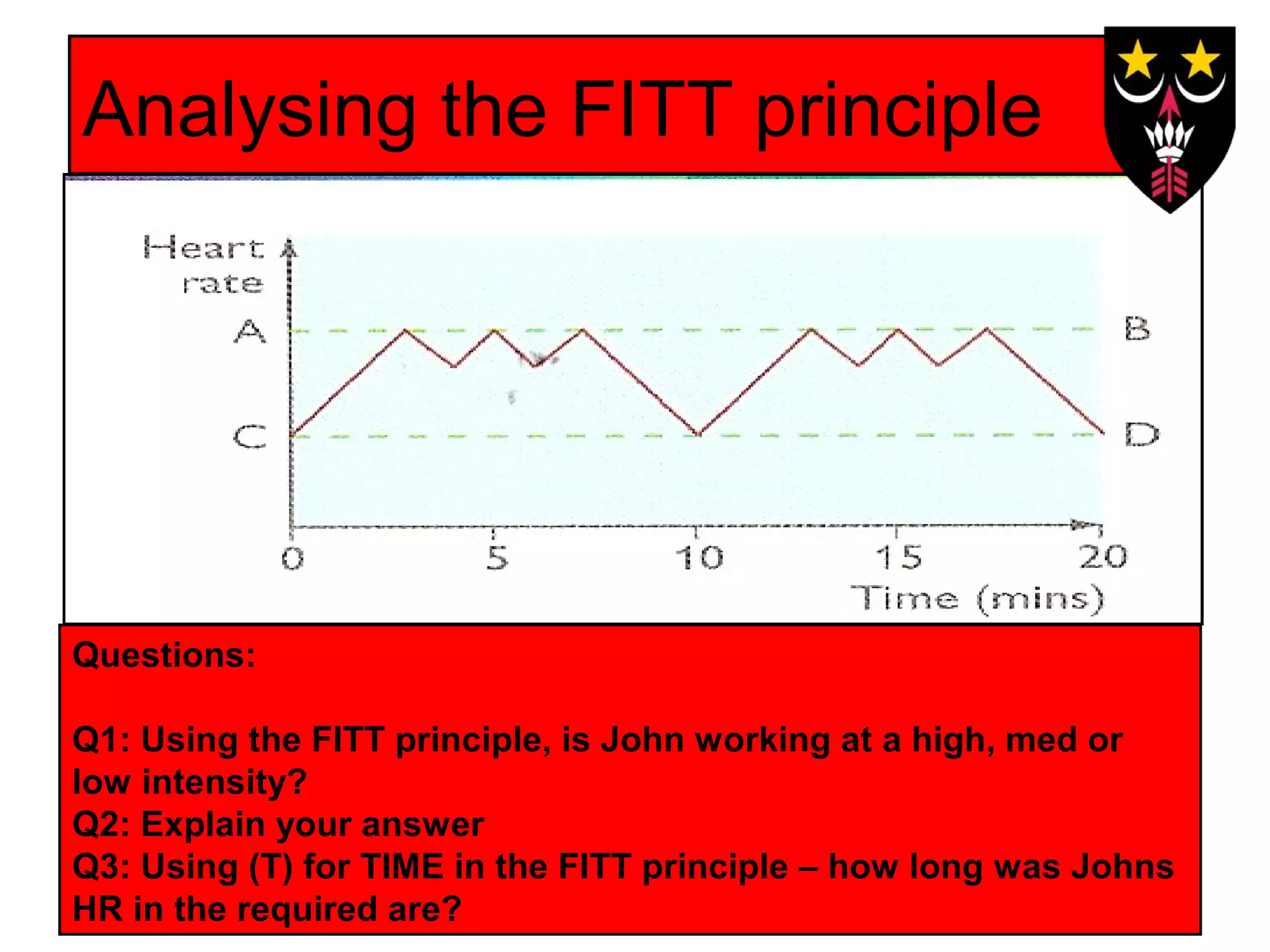
Analysing the FITT principle

Questions:
Q1: Using the FITT principle, is John working at a high, med or
low intensity?
Q2: Explain your answer
Q3: Using (T) for TIME in the FITT principle – how long was Johns
HR in the required are?
Answers to Analysing the FITT
principle
Answers
Q1: High Intensity
Q2: The line linking letters A to B represent the 80%
threshold line and Johns HR reaches this line 6x
during the session.
Q3: 20 Minutes
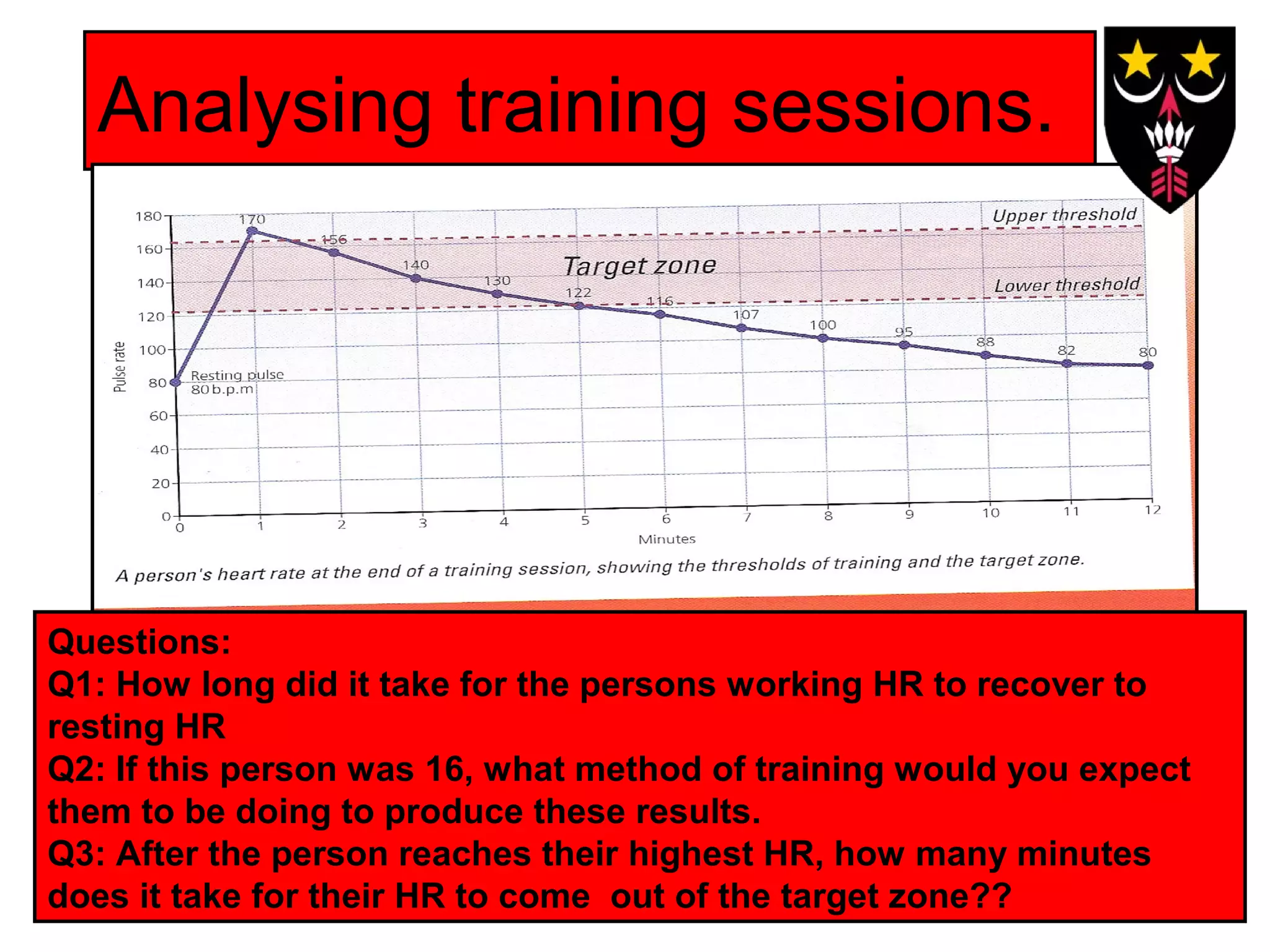
Analysing training sessions.

Questions:
Q1: How long did it take for the persons working HR to recover to
resting HR
Q2: If this person was 16, what method of training would you expect
them to be doing to produce these results.
Q3: After the person reaches their highest HR, how many minutes
does it take for their HR to come out of the target zone??
Examiners Tip
When answering a question on HR,
remember that HR is the number of times
the heart beats per minute, not the
number of times the heart beats.
Candidates lose marks for not adding the
last two words.
Par Q
Par Q stands for Physical Activity Readiness Questionnaire

This is the first step in assessing whether an individual is
suitable to do physical activity.
It asks about your health status and conditions that may
effect exercise.

Task: Discuss and complete a Par-Q questionnaire
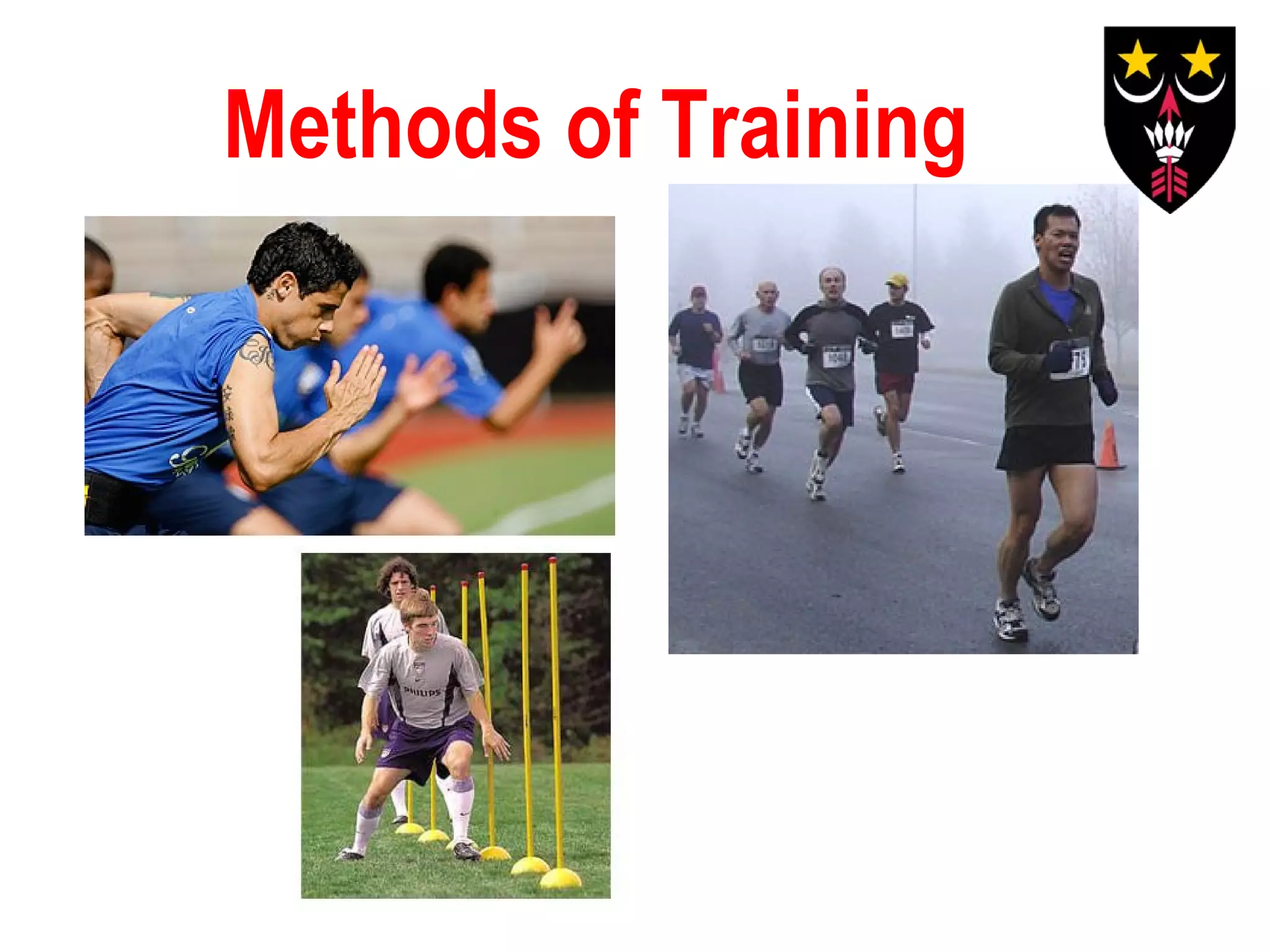
Methods of Training
Interval Training
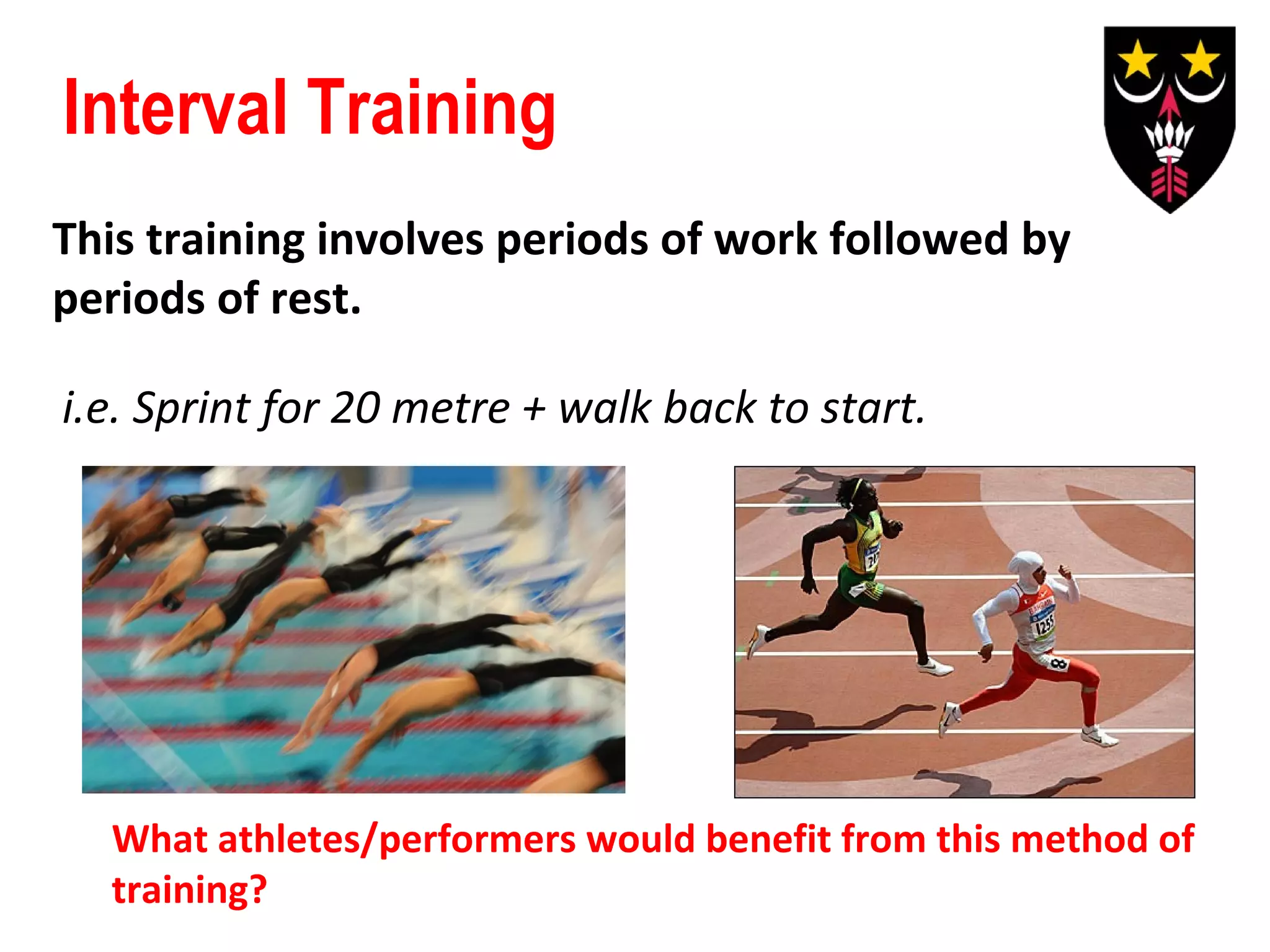
This training involves periods of work followed by
periods of rest.
i.e. Sprint for 20 metre + walk back to start.

What athletes/performers would benefit from this method of
training?
Interval Training
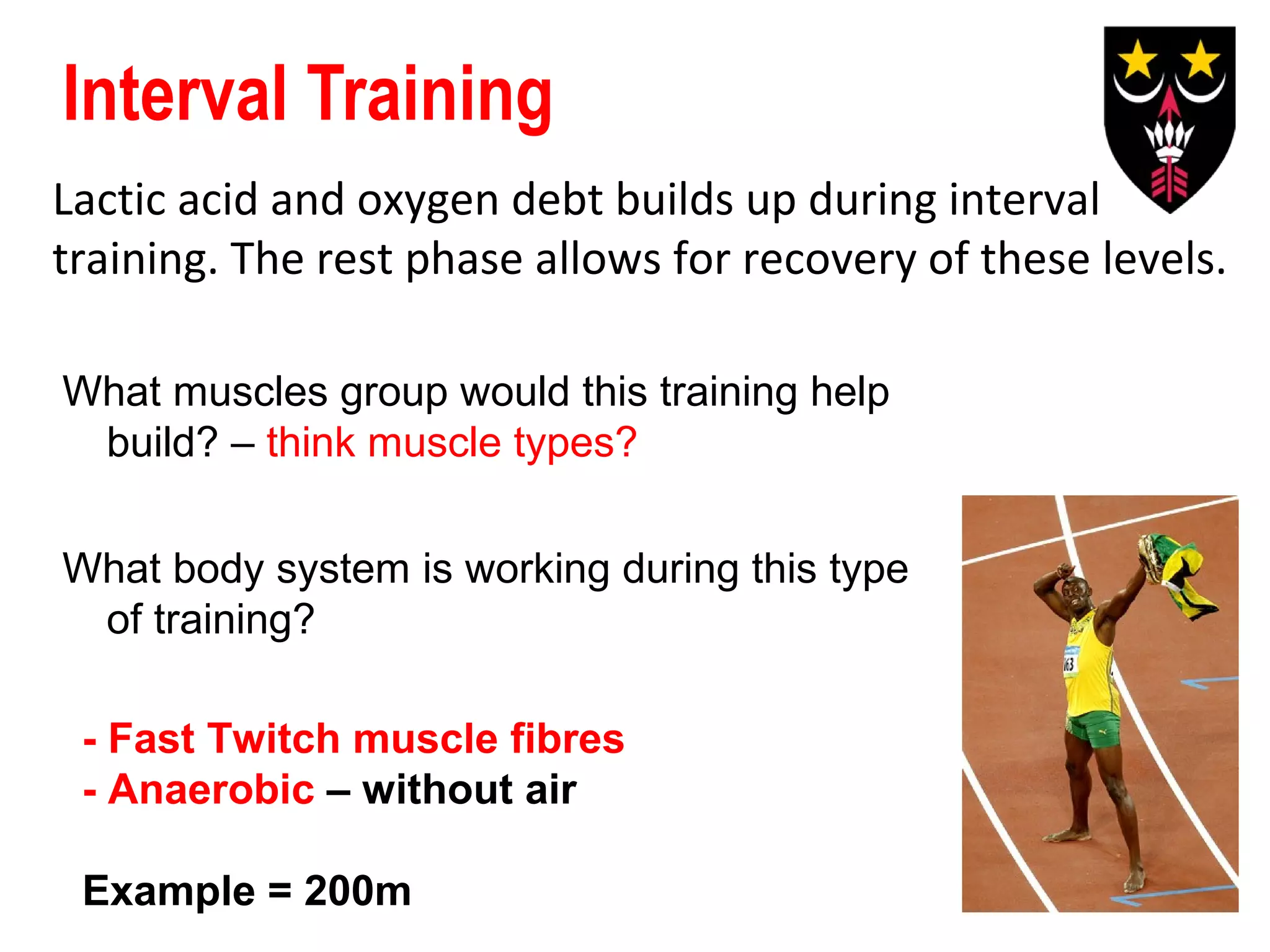
Lactic acid and oxygen debt builds up during interval
training. The rest phase allows for recovery of these levels.
What muscles group would this training help
build? – think muscle types?
What body system is working during this type
of training?
- Fast Twitch muscle fibres
- Anaerobic – without air
Example = 200m
Interval Training
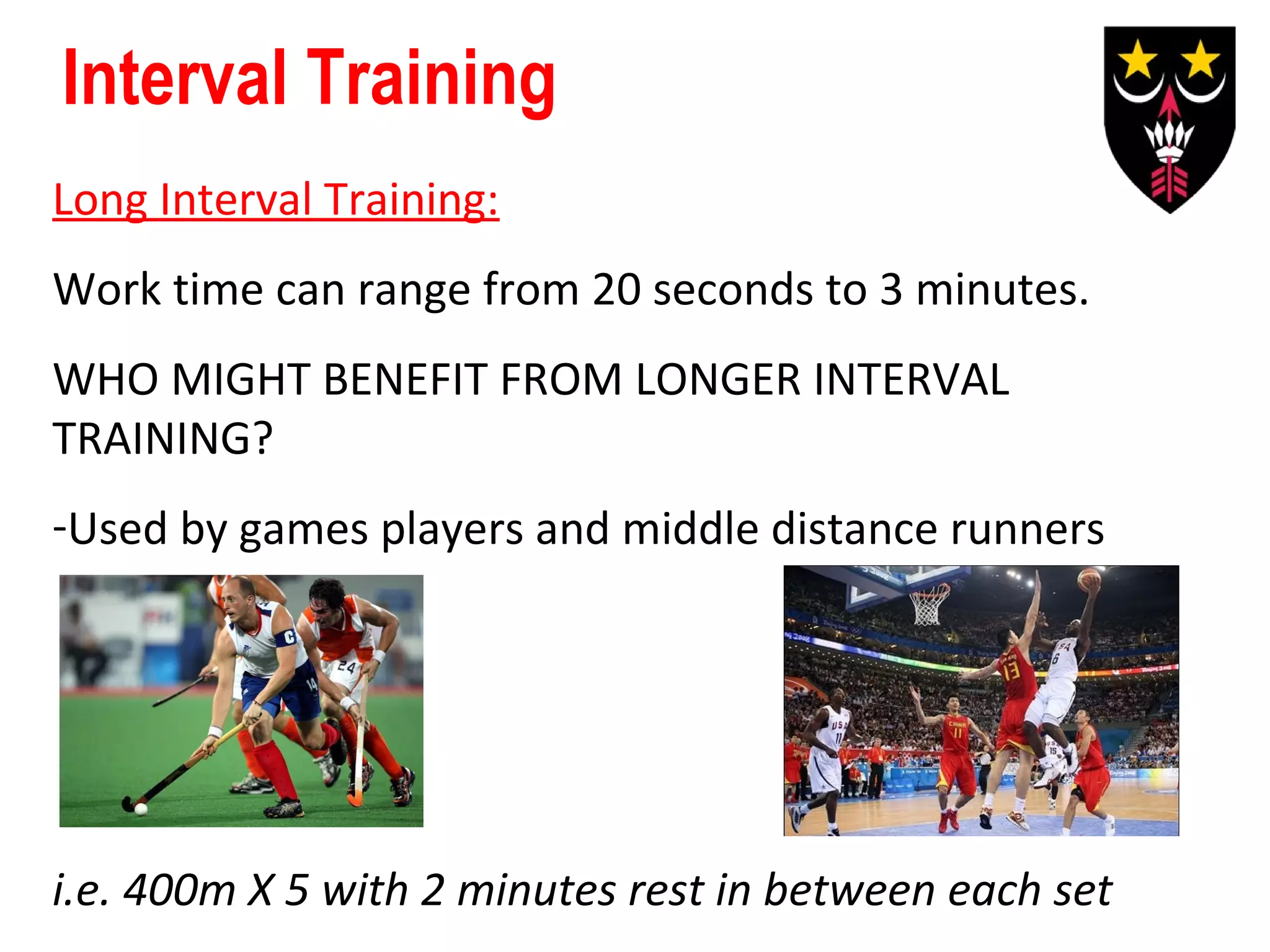
Long Interval Training:
Work time can range from 20 seconds to 3 minutes.
WHO MIGHT BENEFIT FROM LONGER INTERVAL
TRAINING?
-Used by games players and middle distance runners

i.e. 400m X 5 with 2 minutes rest in between each set
Interval Training
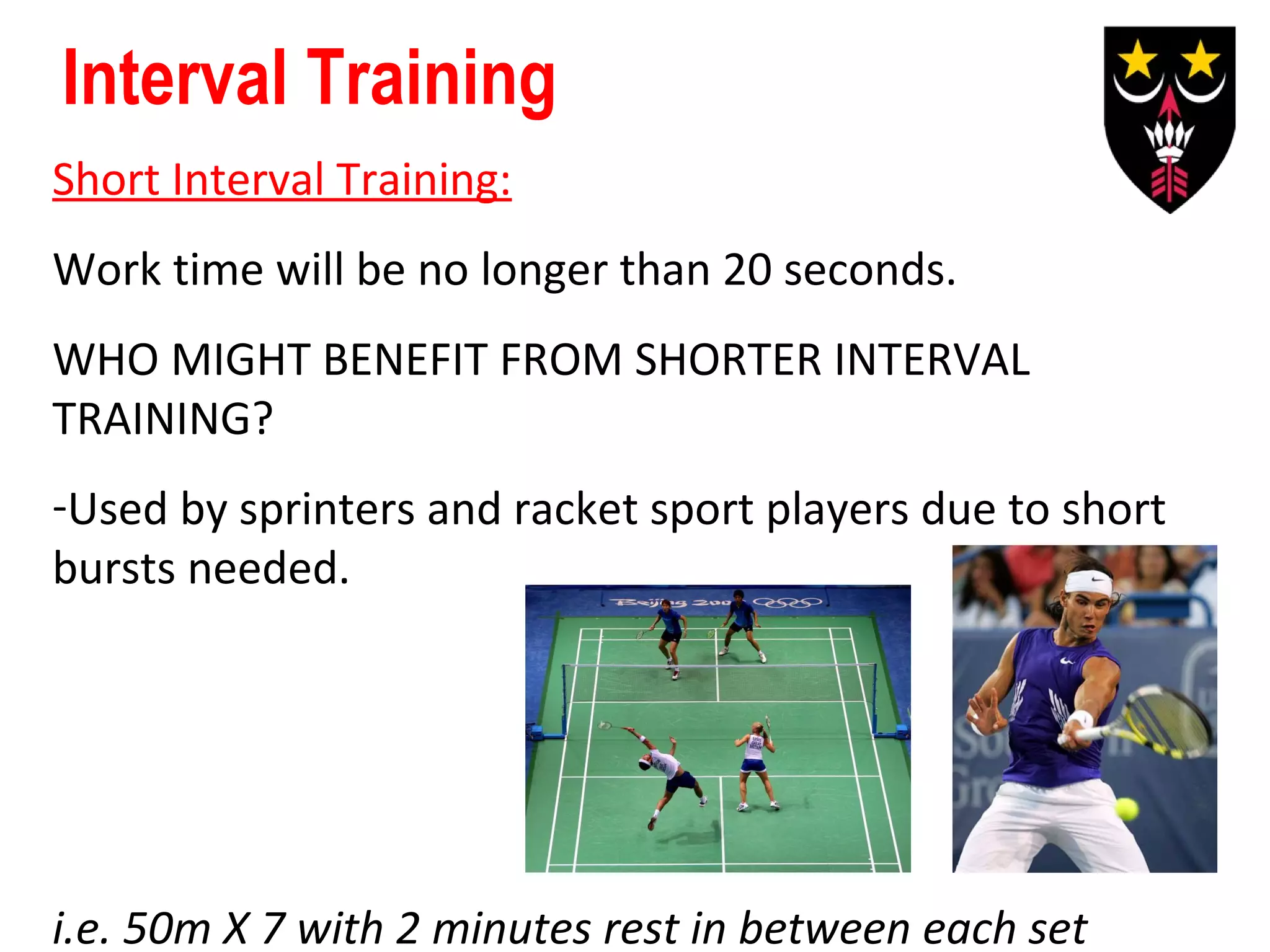
Short Interval Training:
Work time will be no longer than 20 seconds.
WHO MIGHT BENEFIT FROM SHORTER INTERVAL
TRAINING?
-Used by sprinters and racket sport players due to short
bursts needed.

i.e. 50m X 7 with 2 minutes rest in between each set
Continuous Training
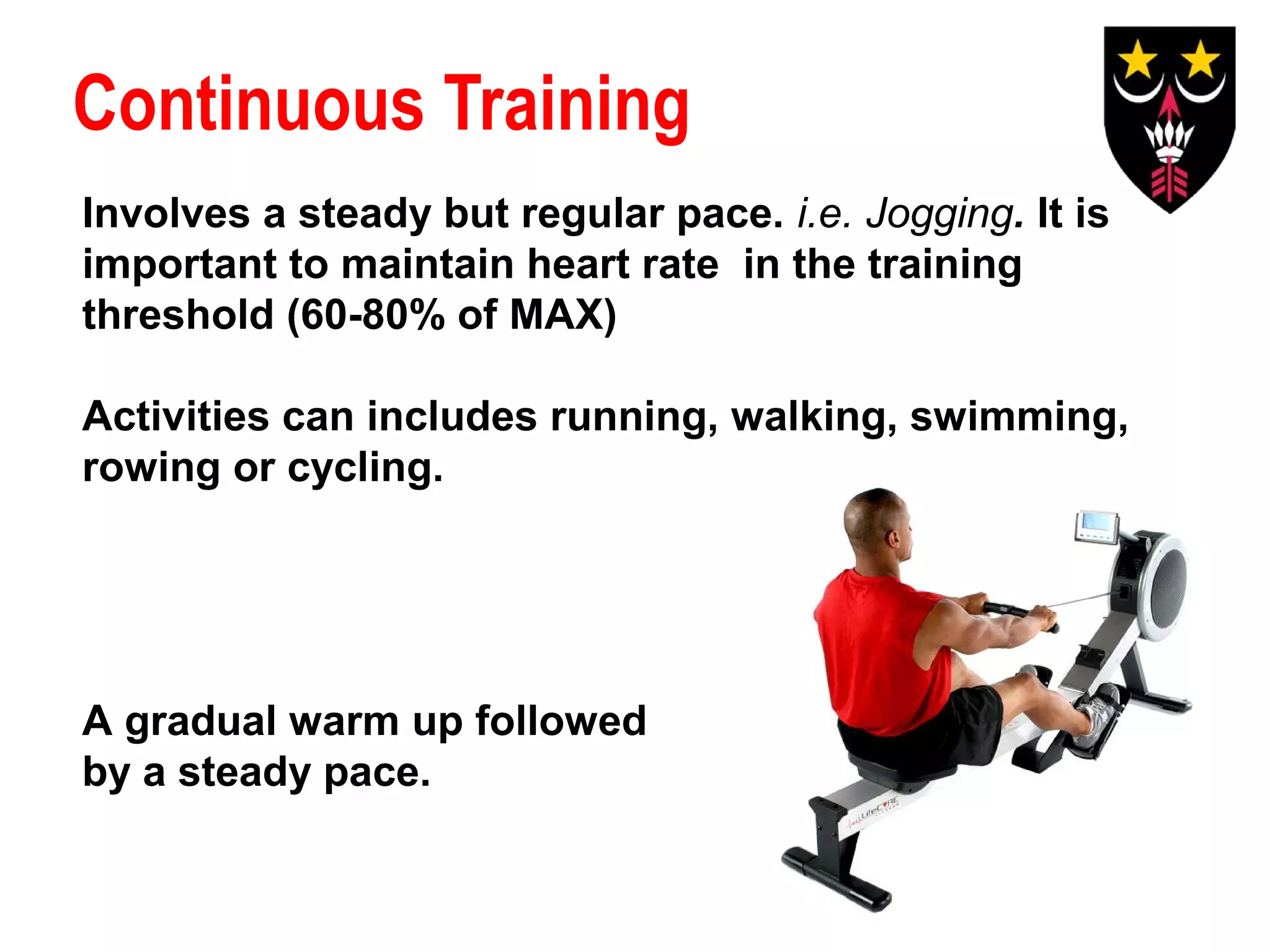
Involves a steady but regular pace. i.e. Jogging. It is
important to maintain heart rate in the training
threshold (60-80% of MAX)
Activities can includes running, walking, swimming,
rowing or cycling.

A gradual warm up followed
by a steady pace.
Continuous Training
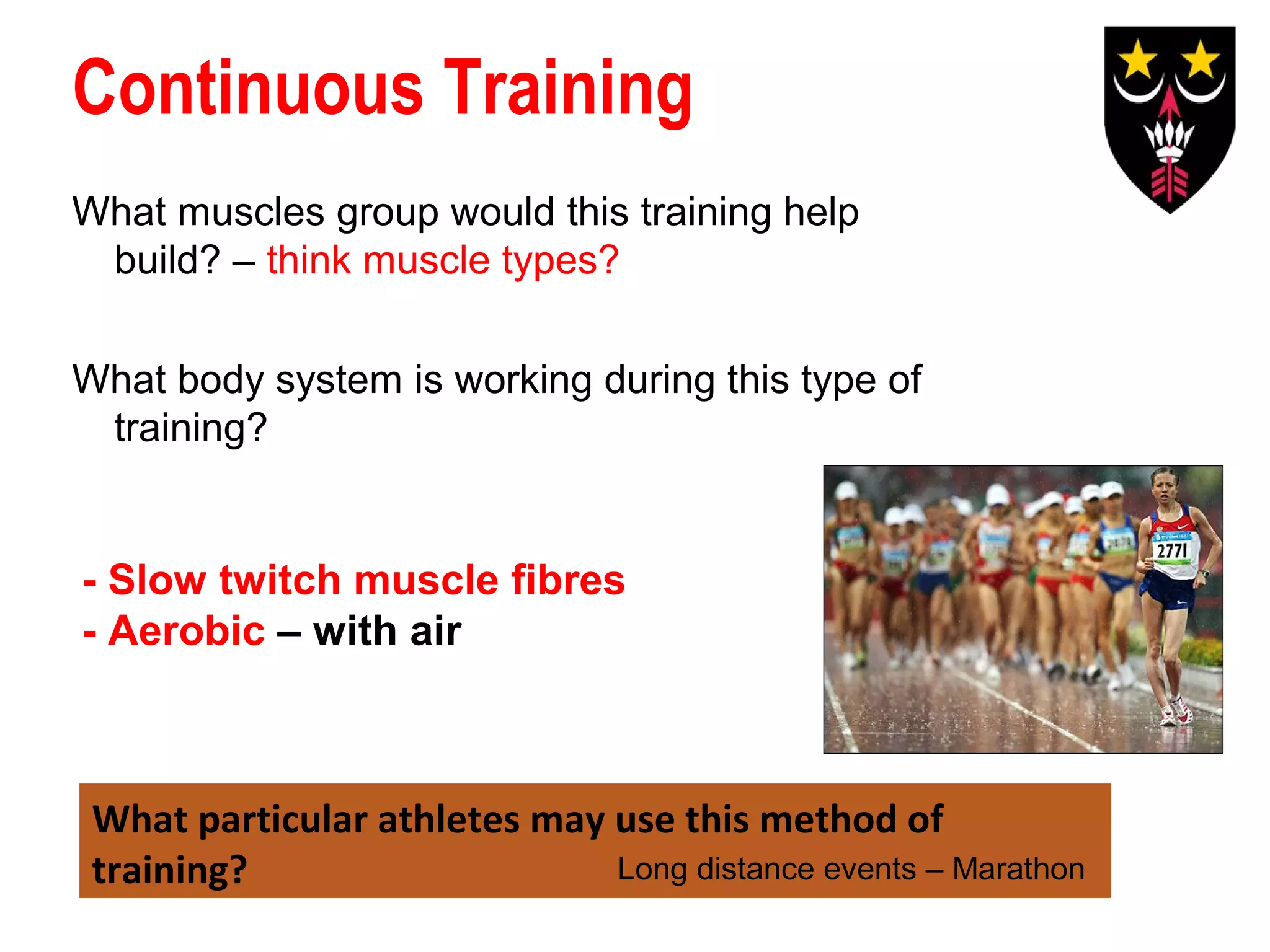
What muscles group would this training help
build? – think muscle types?
What body system is working during this type of
training?

- Slow twitch muscle fibres
- Aerobic – with air

What particular athletes may use this method of
Long distance events – Marathon
training?
Fartlek Training
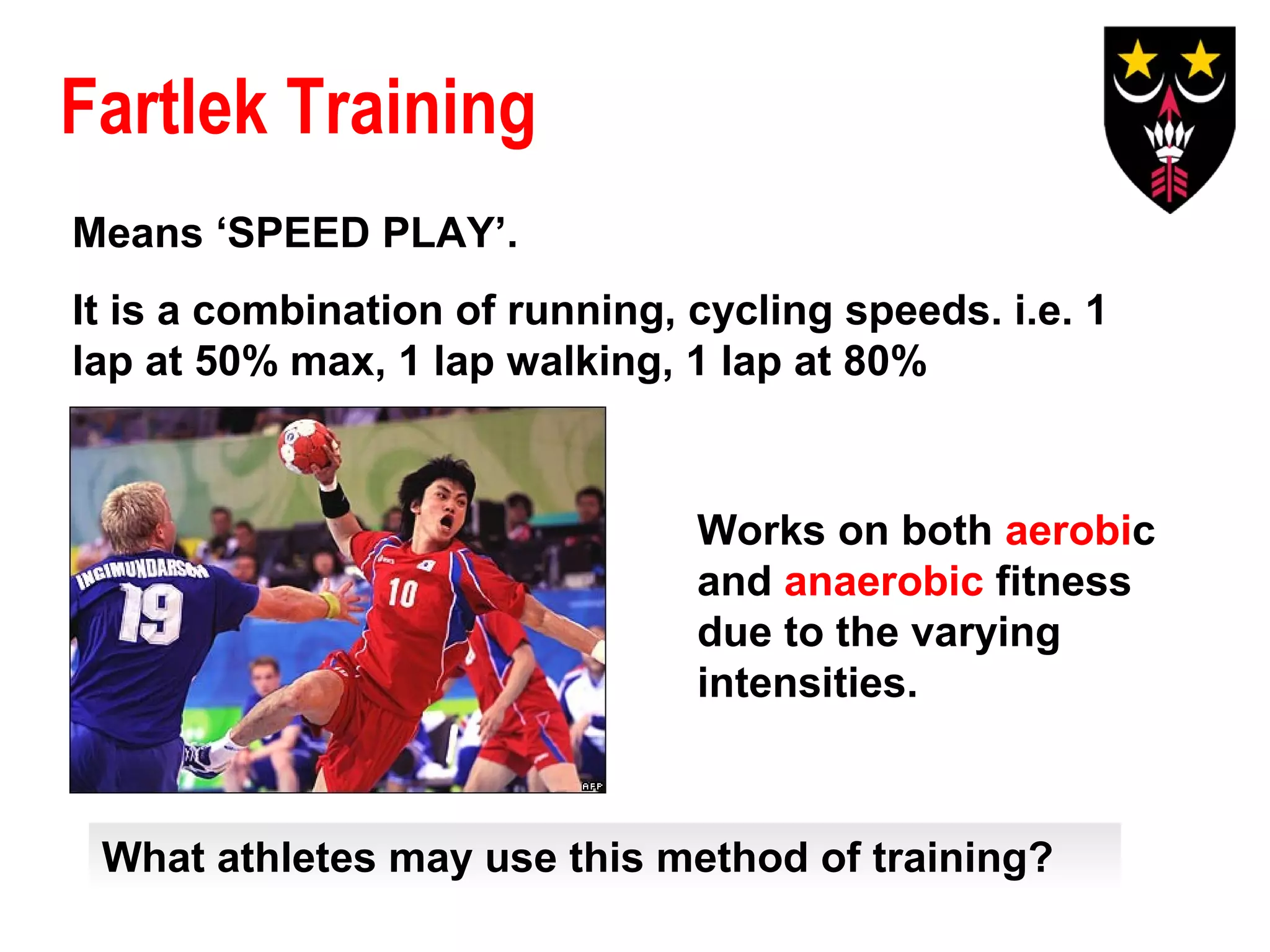
Means ‘SPEED PLAY’.
It is a combination of running, cycling speeds. i.e. 1
lap at 50% max, 1 lap walking, 1 lap at 80%

Works on both aerobic
and anaerobic fitness
due to the varying
intensities.

What athletes may use this method of training?
Fartlek Training
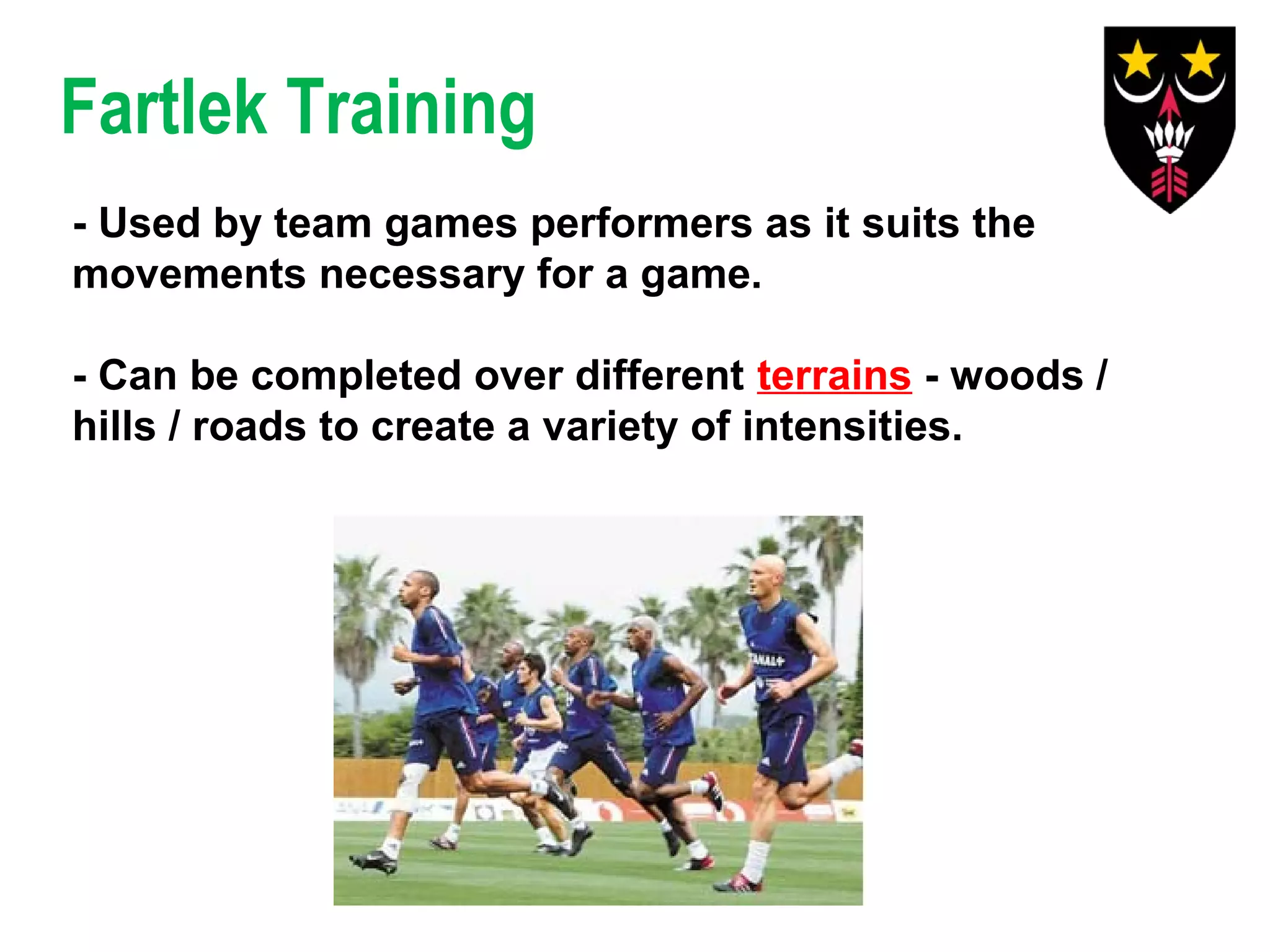
- Used by team games performers as it suits the
movements necessary for a game.
- Can be completed over different terrains - woods /
hills / roads to create a variety of intensities.
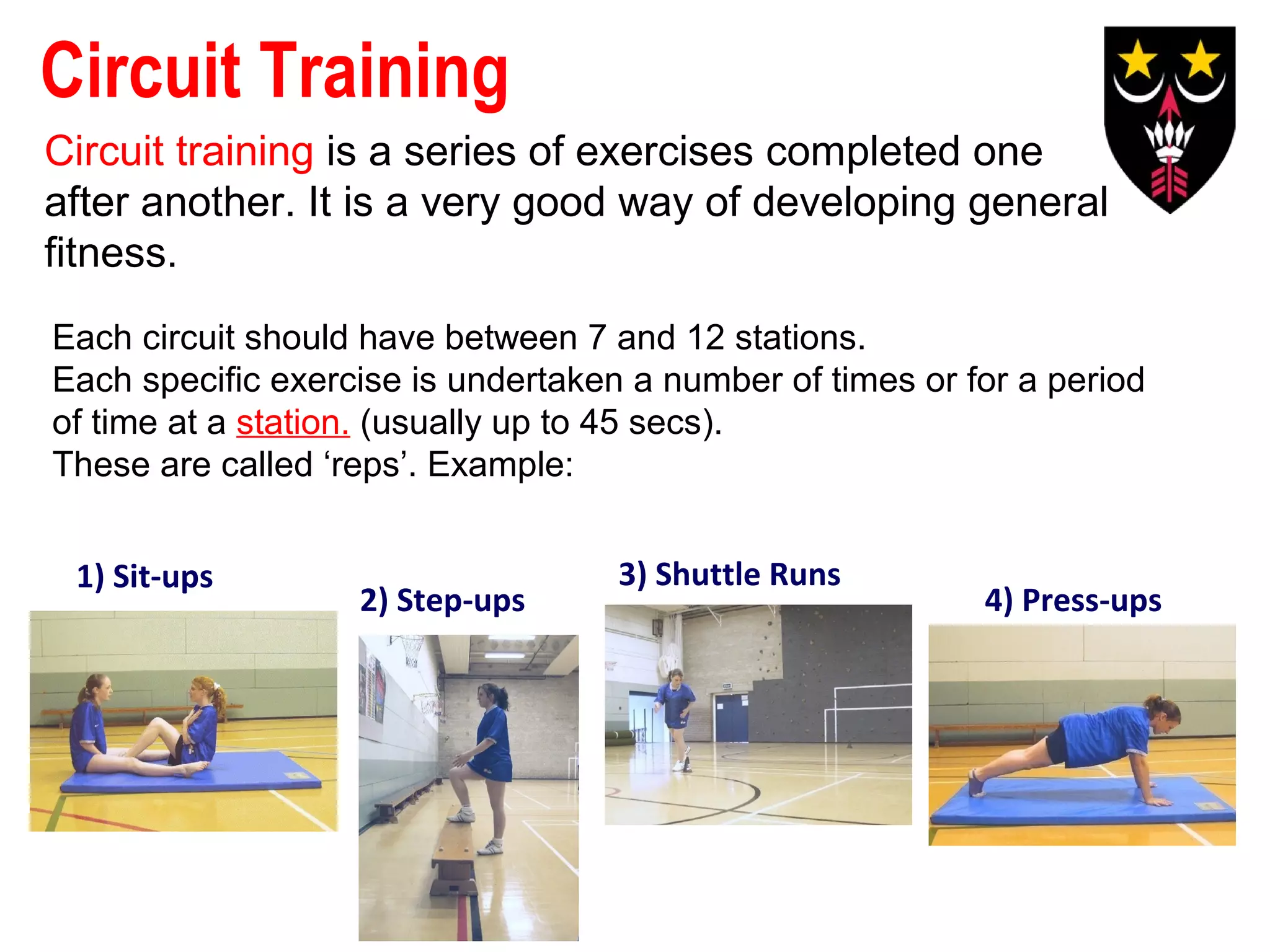
Circuit Training
Circuit training is a series of exercises completed one
after another. It is a very good way of developing general
fitness.
Each circuit should have between 7 and 12 stations.
Each specific exercise is undertaken a number of times or for a period
of time at a station. (usually up to 45 secs).
These are called ‘reps’. Example:
1) Sit-ups

2) Step-ups

3) Shuttle Runs

4) Press-ups
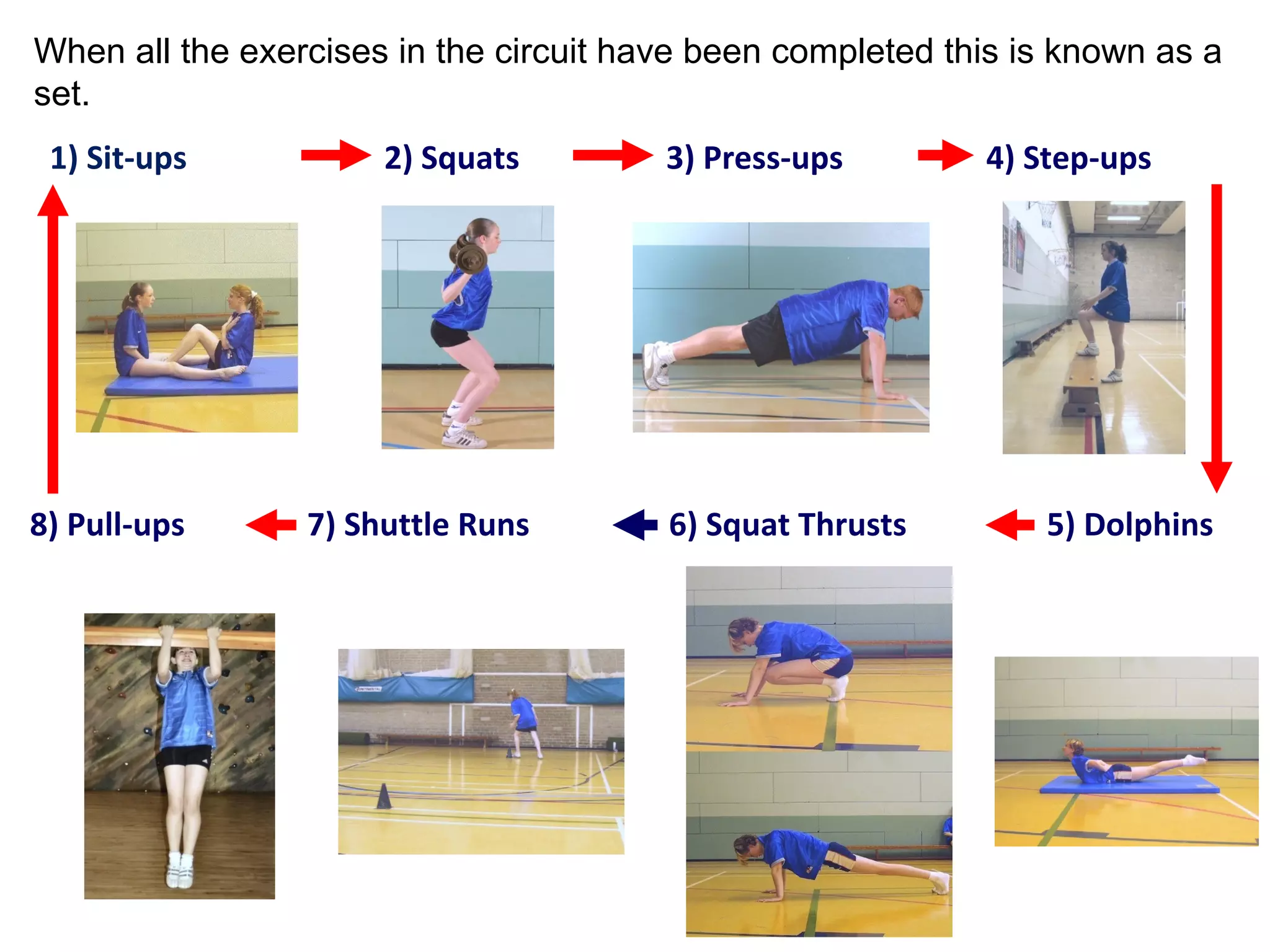
When all the exercises in the circuit have been completed this is known as a
set.
1) Sit-ups

2) Squats

8) Pull-ups

7) Shuttle Runs

3) Press-ups

6) Squat Thrusts

4) Step-ups

5) Dolphins
Circuit training can help to improve
•MUSCULAR ENDURANCE
•CARDIOVASCULAR FITNESS
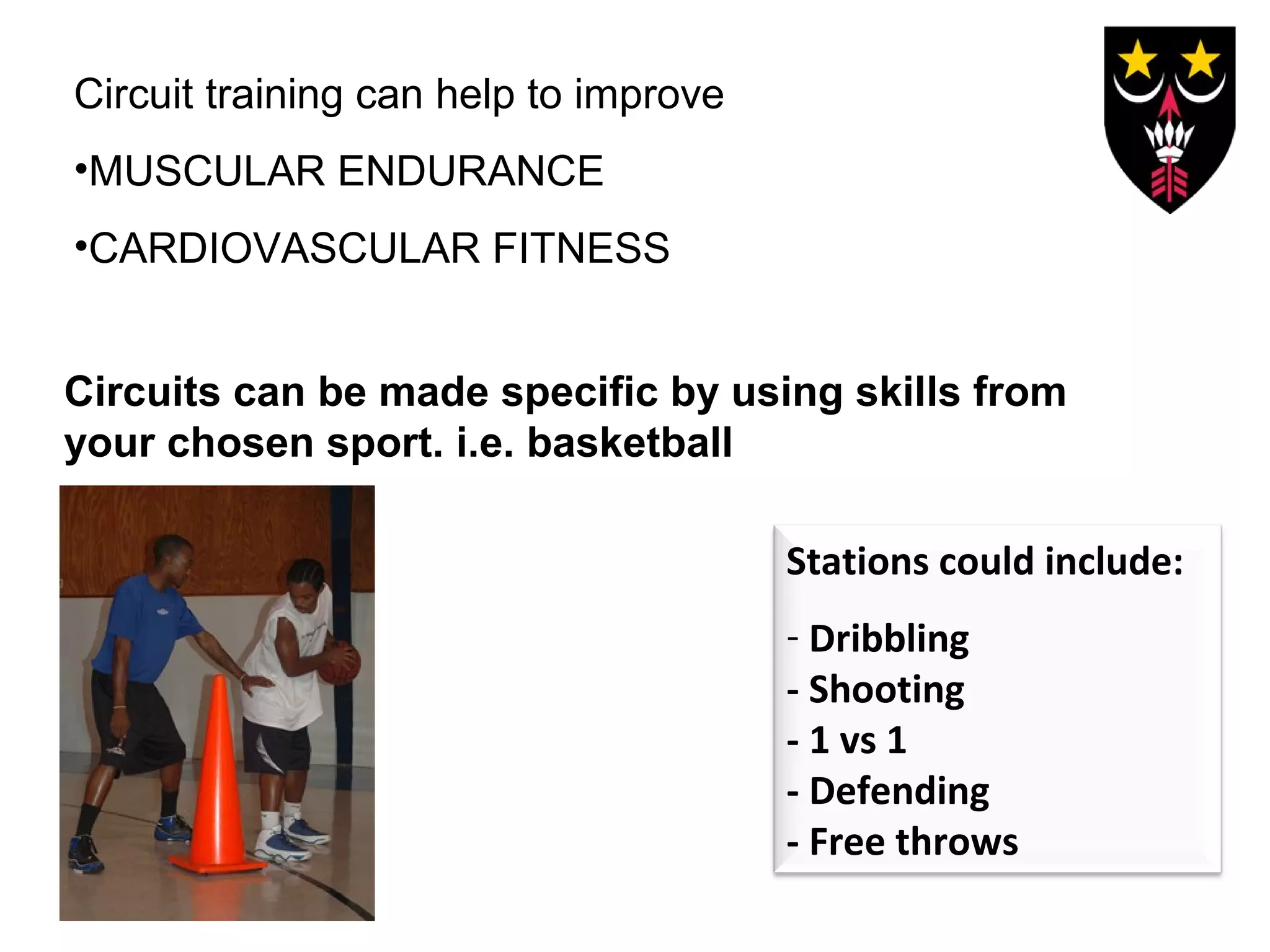
Circuits can be made specific by using skills from
your chosen sport. i.e. basketball
Stations could include:
- Dribbling
- Shooting
- 1 vs 1
- Defending
- Free throws
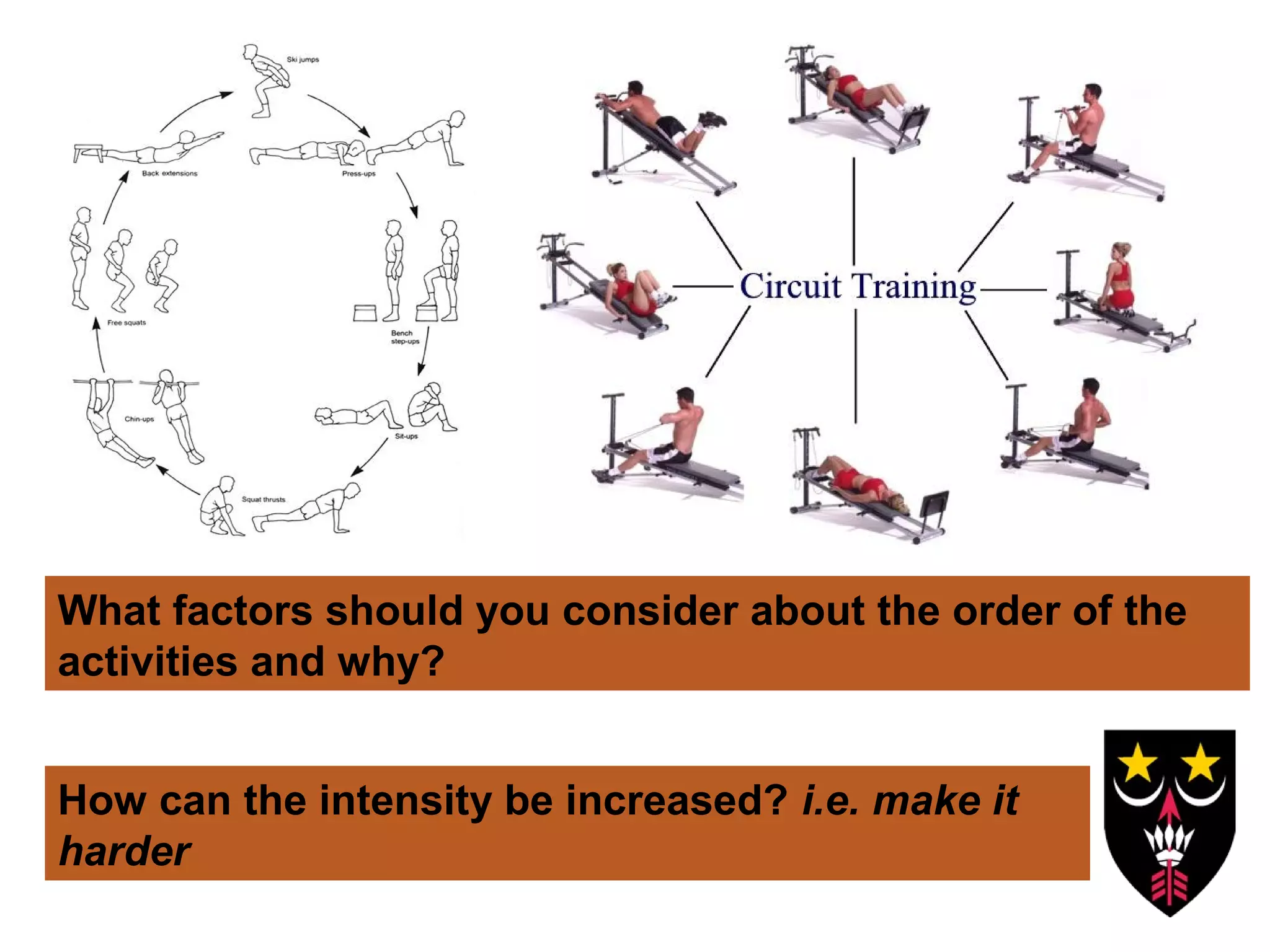
What factors should you consider about the order of the
activities and why?
How can the intensity be increased? i.e. make it
harder
Weight Training
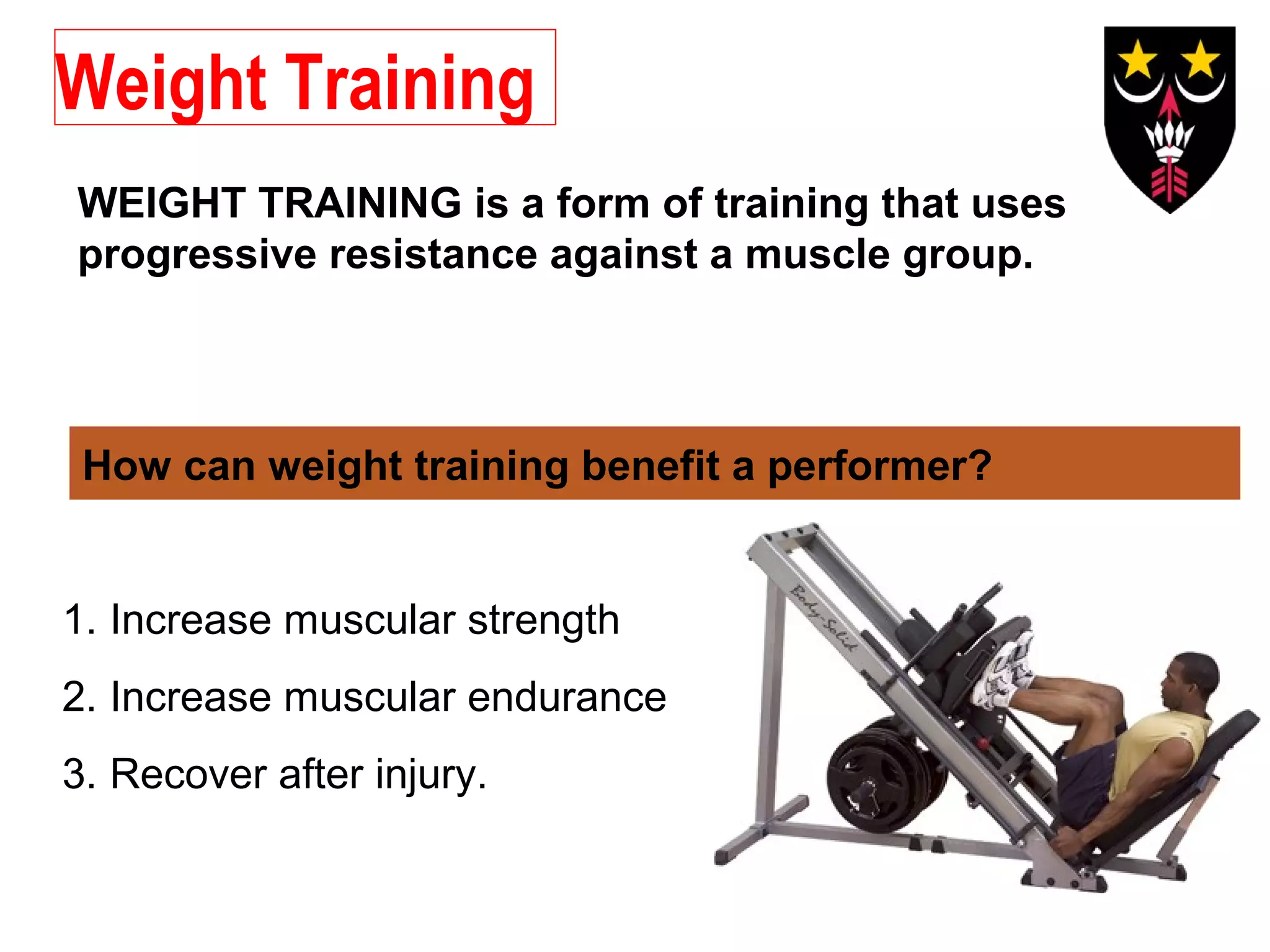
WEIGHT TRAINING is a form of training that uses
progressive resistance against a muscle group.

How can weight training benefit a performer?

1. Increase muscular strength
2. Increase muscular endurance
3. Recover after injury.
Weight Training
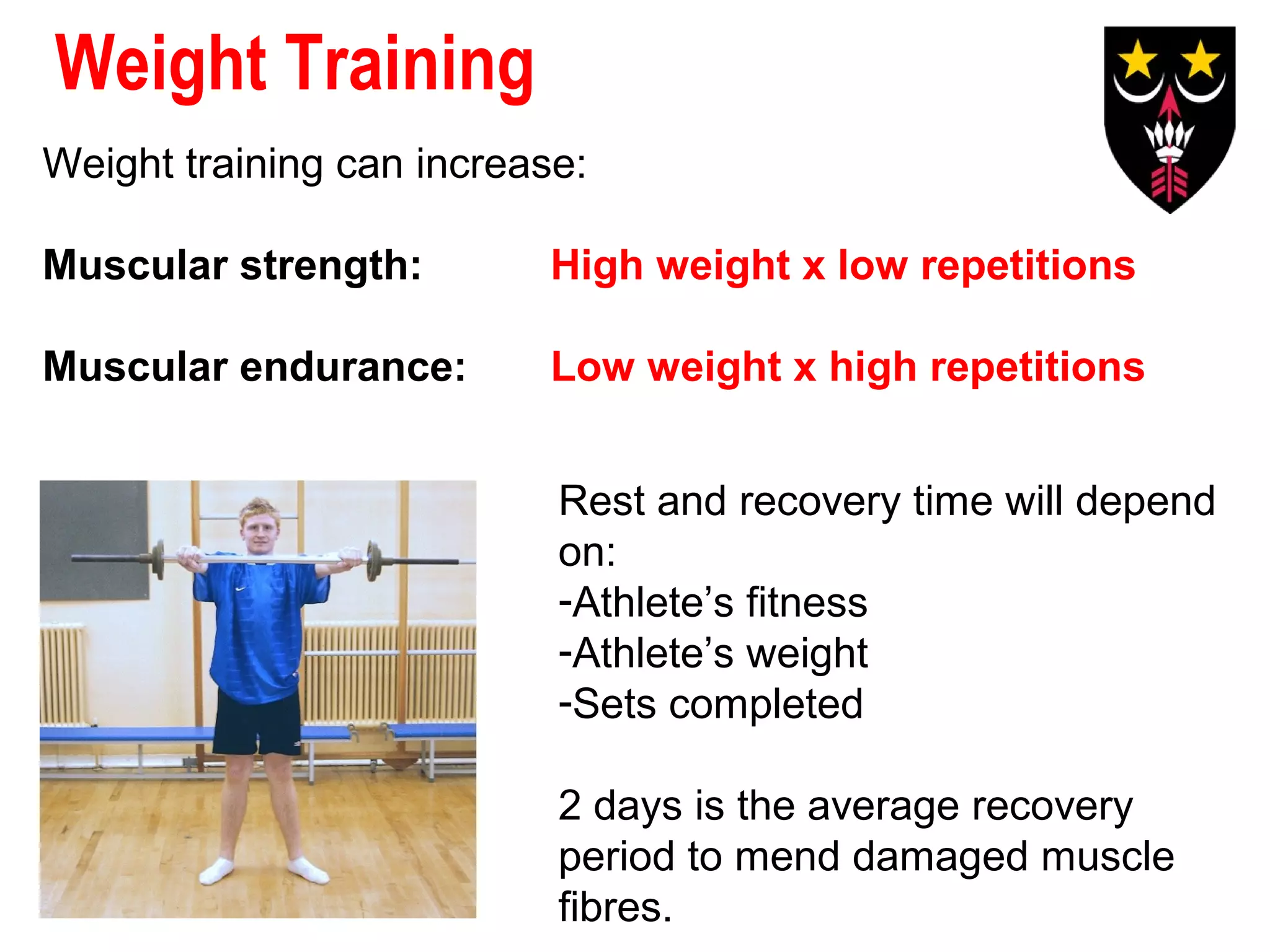
Weight training can increase:
Muscular strength:

High weight x low repetitions

Muscular endurance:

Low weight x high repetitions
Rest and recovery time will depend
on:
-Athlete’s fitness
-Athlete’s weight
-Sets completed
2 days is the average recovery
period to mend damaged muscle
fibres.
Weight Training
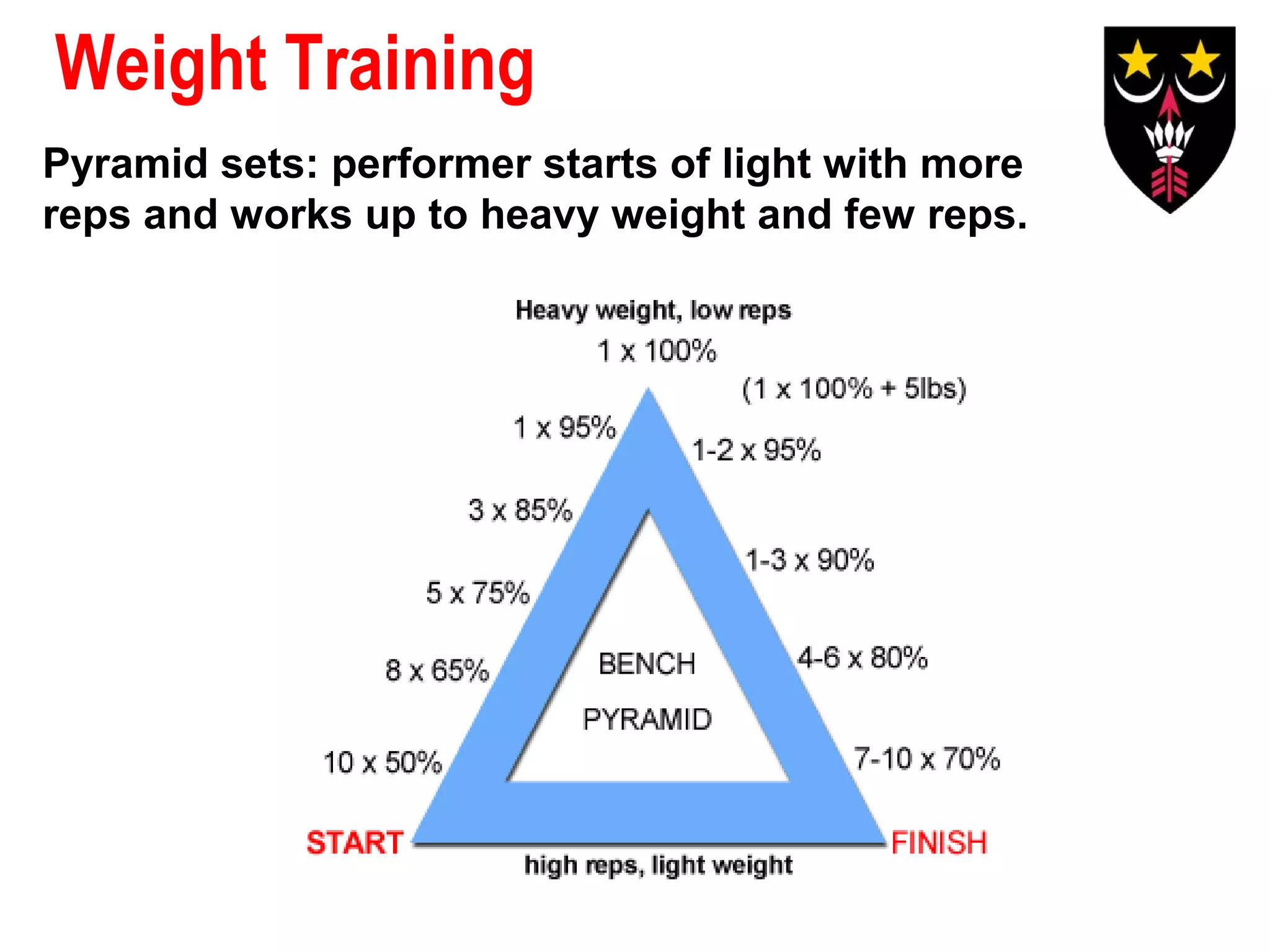
Pyramid sets: performer starts of light with more
reps and works up to heavy weight and few reps.
Weight Training
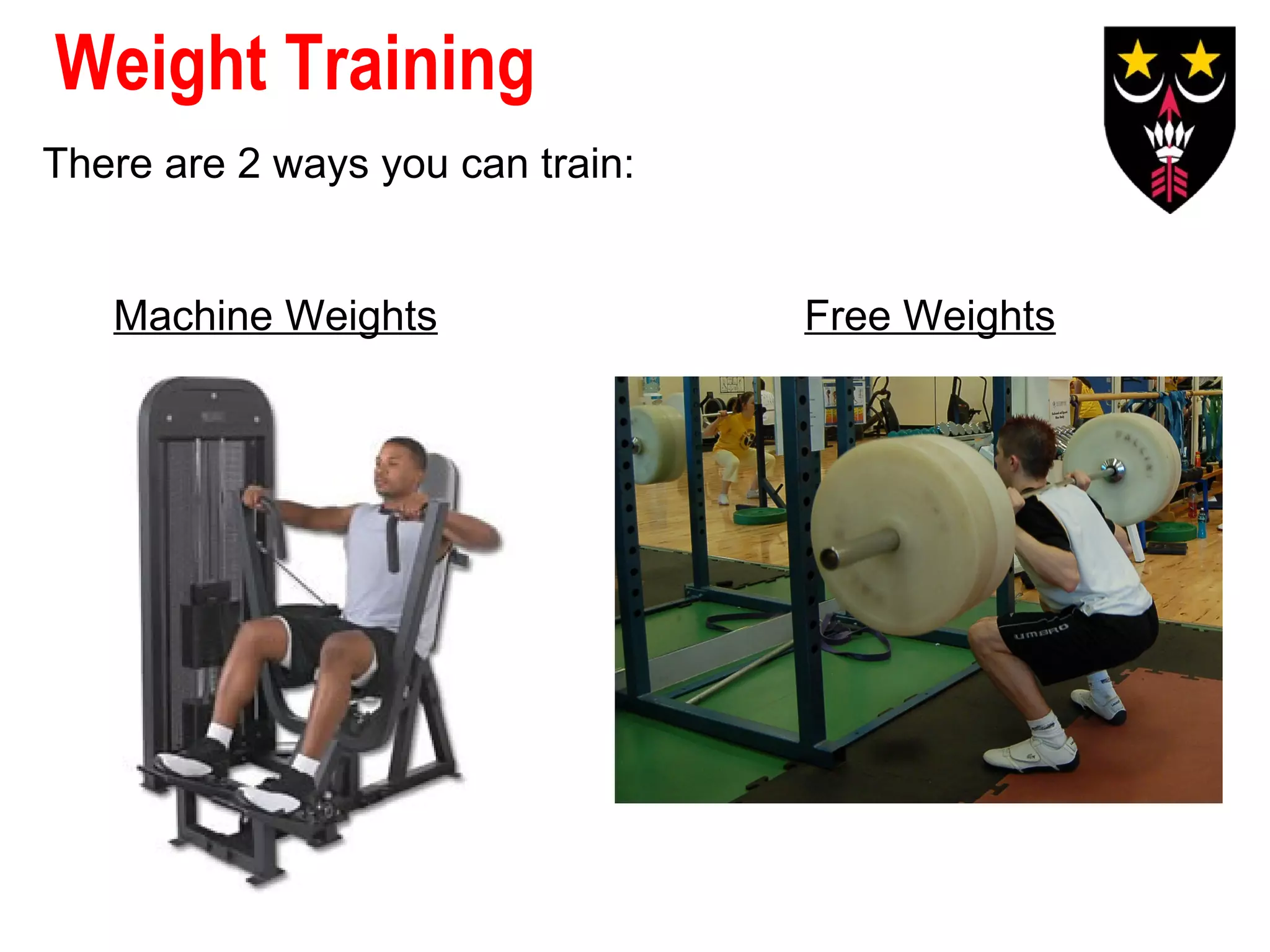
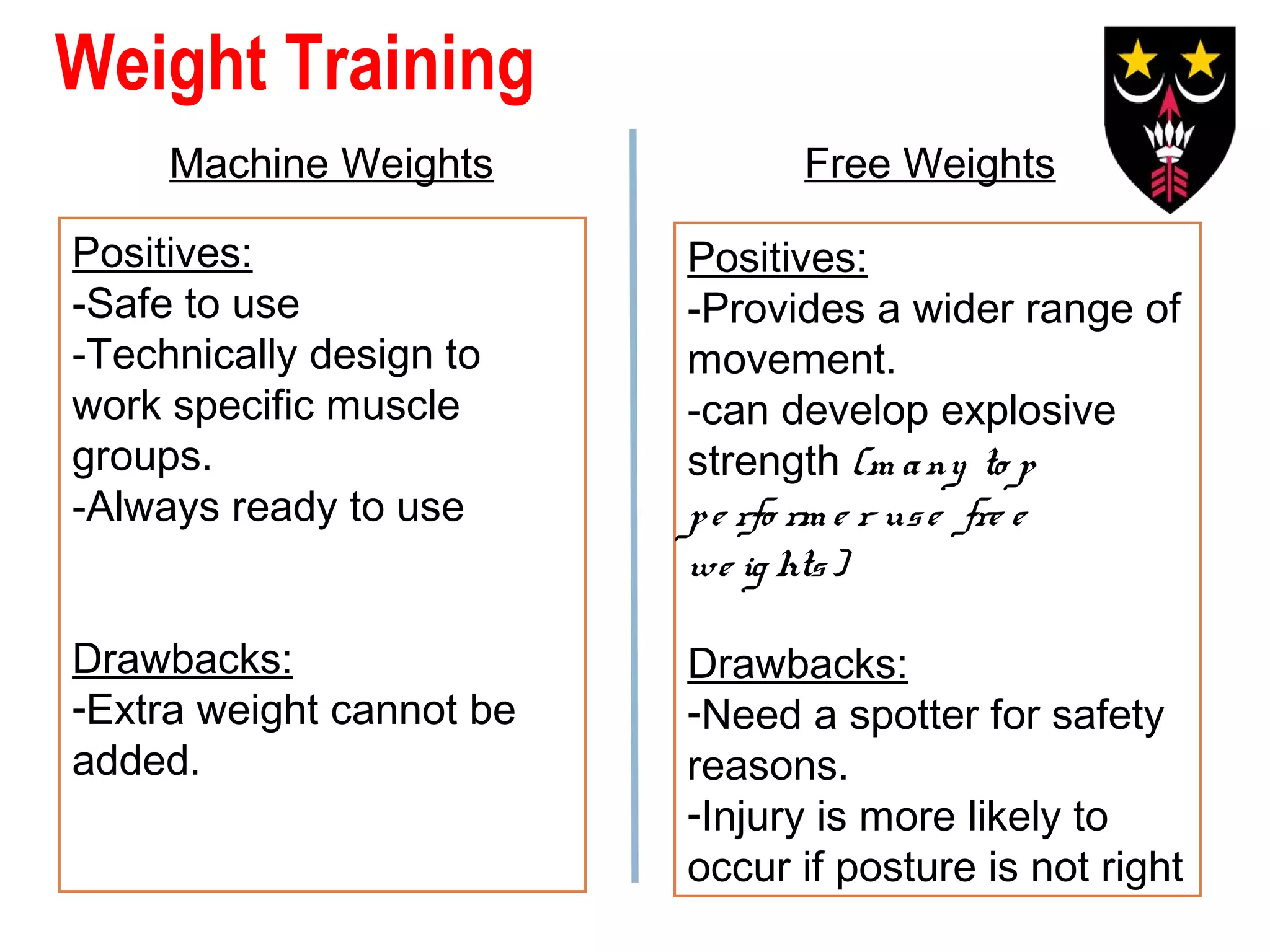
There are 2 ways you can train:
Machine Weights

Free Weights
Weight Training
Machine Weights

Free Weights

Positives:
-Safe to use
-Technically design to
work specific muscle
groups.
-Always ready to use

Positives:
-Provides a wider range of
movement.
-can develop explosive
strength (m a ny to p
p e rfo rm e r us e fre e
we ig hts )

Drawbacks:
-Extra weight cannot be
added.

Drawbacks:
-Need a spotter for safety
reasons.
-Injury is more likely to
occur if posture is not right
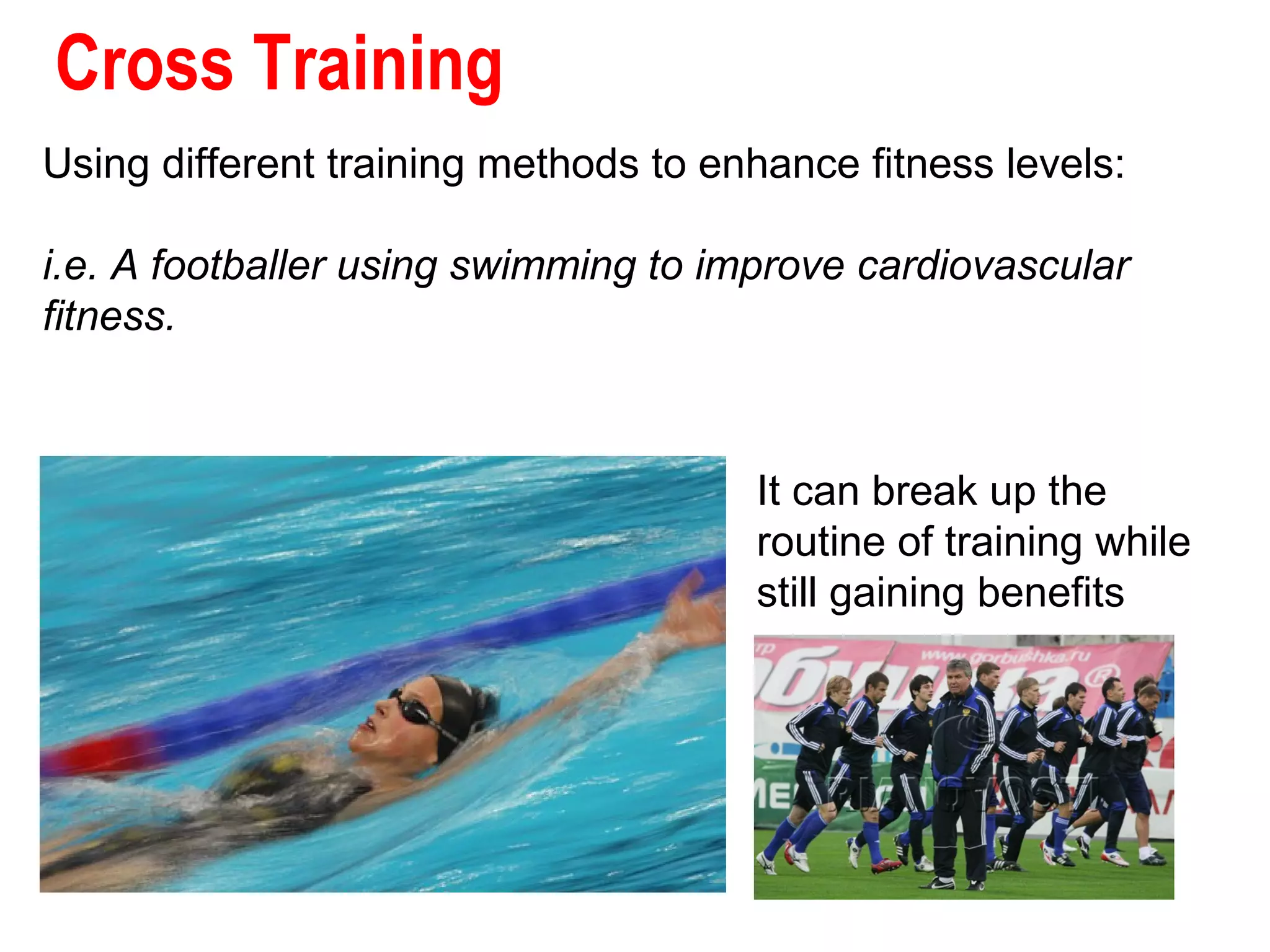
Cross Training
Using different training methods to enhance fitness levels:
i.e. A footballer using swimming to improve cardiovascular
fitness.

It can break up the
routine of training while
still gaining benefits
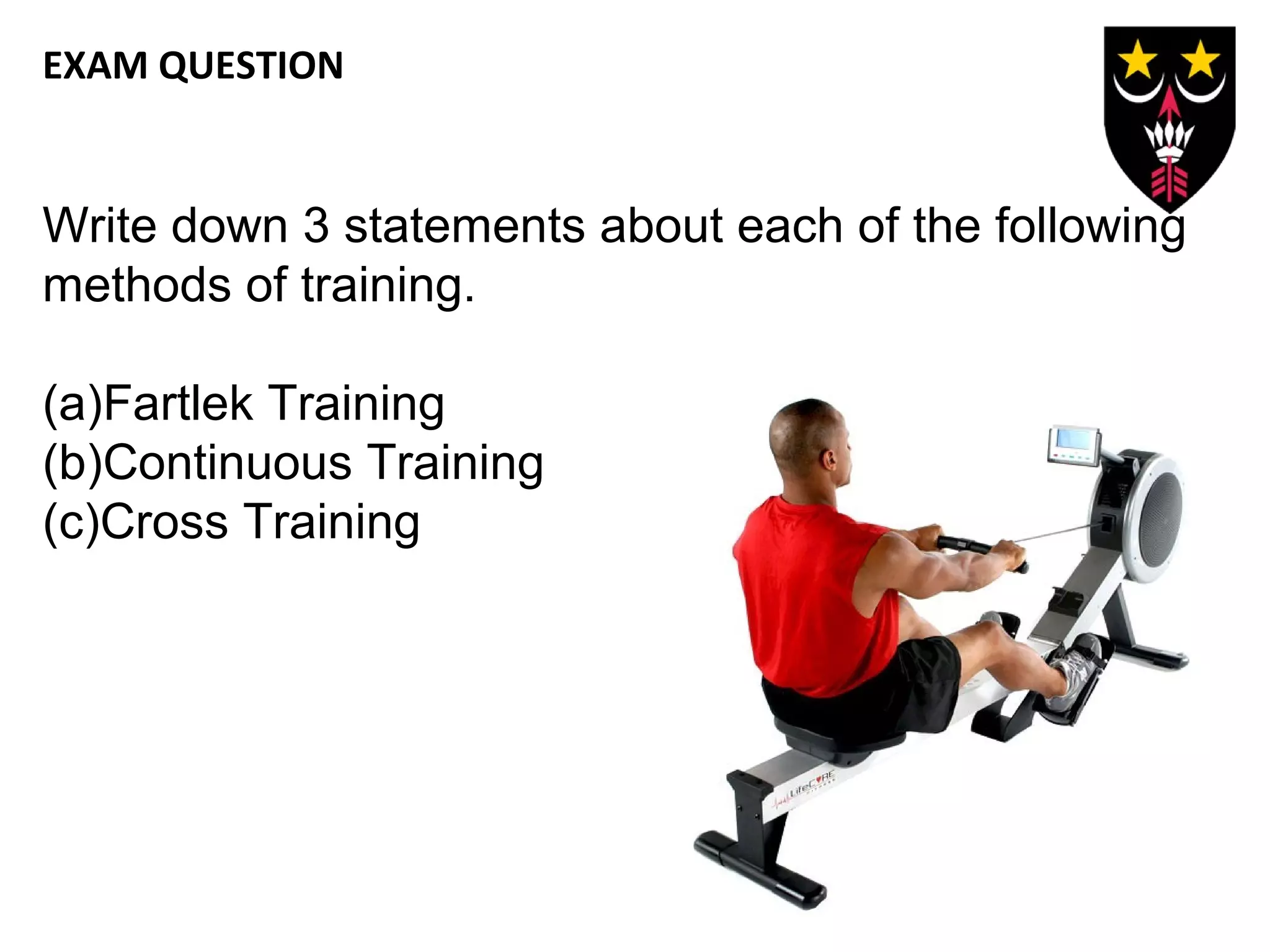
EXAM QUESTION

Write down 3 statements about each of the following
methods of training.
(a)Fartlek Training
(b)Continuous Training
(c)Cross Training
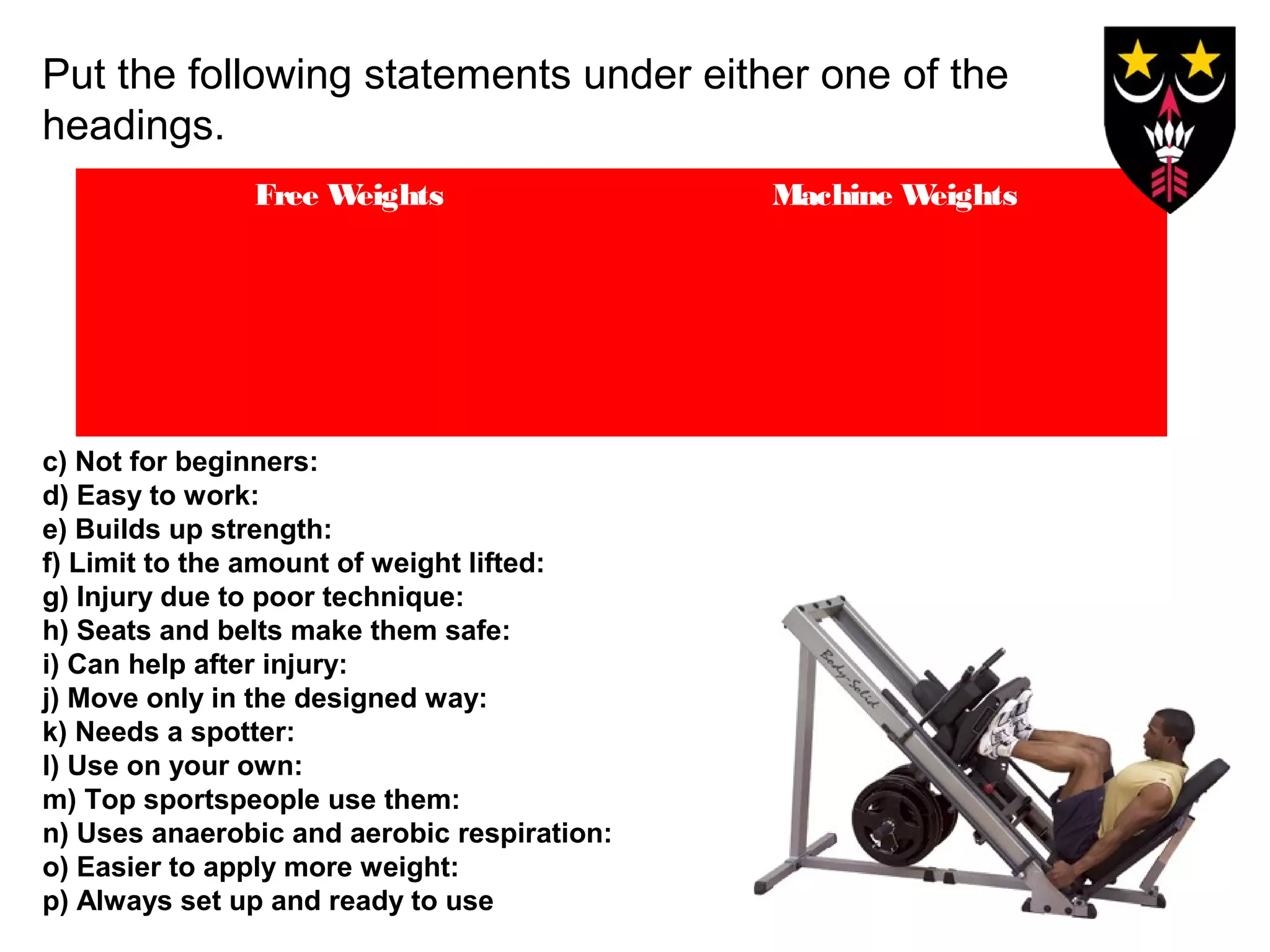
Put the following statements under either one of the
headings.
Free W
eights

c) Not for beginners:
d) Easy to work:
e) Builds up strength:
f) Limit to the amount of weight lifted:
g) Injury due to poor technique:
h) Seats and belts make them safe:
i) Can help after injury:
j) Move only in the designed way:
k) Needs a spotter:
l) Use on your own:
m) Top sportspeople use them:
n) Uses anaerobic and aerobic respiration:
o) Easier to apply more weight:
p) Always set up and ready to use
Machine W
eights

1.1.4 methods of training ktu

  • 1.
    1.1.4b Methods oftraining and assessing fitness Learning objectives To understand the different methods of training and their effects. To describe various fitness test that are useful to a performer during a PEP.
  • 2.
    1.1.4b Methods oftraining and assessing fitness Learning objectives Understand the terms resting heart rate and recovery rate - evaluating a graph. Use graphs to demonstrate the use of target zones and thresholds of training
  • 3.
    Comparing Training Sessions Readpages 72 and 73 of your textbook Try to draw the key points from each of the sessions – refer to the paragraph on the right hand side of page 73. Try to answer the following questions relating to training methods and graphs. Examiners Tip: If you are asked in an exam which athlete uses speed the most, give the most obvious answer: in the case of the scenario above in your textbook, the answer would be JACK, the 100m sprinter.
  • 4.
    Analysing Graphs andTraining Task 1 – Work out from the chart how many minutes it took Tom’s working heart rate to return to resting heart rate.
  • 5.
    Graphical Analysis 1 Questions: 1.Whatmethod of training is the athlete most likely to be using if his heart rate measurements are producing the graph shown? 2. Explain your answer 3. How could this training session be made more demanding
  • 6.
    Answers to Graphical1 Answers Q1: Interval Training Q2: Interval training is defined as periods of work followed by periods of rest. The athlete exercised hard to increase the heart rate. This was followed by a period of rest, in which the heart rate fell. This was repeated. Q3: By doing more sets, running up a hill, faster running or taking shorter rest periods.
  • 7.
    Graphical Analysis 2 Questions: Q1:Which method of training is the athlete likely to be using to produce the measurements of the graph above? Q2: Explain your answer Q3: What is the significance of the area between the two dashed lines.
  • 8.
    Answers to Graphical2 Answers Q1: Continuous Training Q2: The heart rate rises quickly at the start of training and then settles down and remains constant as the athletes works at a steady pace. Q3: The HR should fall within this zone to indicate that the person is working hard enough to make improvements (trainig zone)
  • 9.
    Analysing the FITTprinciple Questions: Q1: Using the FITT principle, is John working at a high, med or low intensity? Q2: Explain your answer Q3: Using (T) for TIME in the FITT principle – how long was Johns HR in the required are?
  • 10.
    Answers to Analysingthe FITT principle Answers Q1: High Intensity Q2: The line linking letters A to B represent the 80% threshold line and Johns HR reaches this line 6x during the session. Q3: 20 Minutes
  • 11.
    Analysing training sessions. Questions: Q1:How long did it take for the persons working HR to recover to resting HR Q2: If this person was 16, what method of training would you expect them to be doing to produce these results. Q3: After the person reaches their highest HR, how many minutes does it take for their HR to come out of the target zone??
  • 12.
    Examiners Tip When answeringa question on HR, remember that HR is the number of times the heart beats per minute, not the number of times the heart beats. Candidates lose marks for not adding the last two words.
  • 13.
    Par Q Par Qstands for Physical Activity Readiness Questionnaire This is the first step in assessing whether an individual is suitable to do physical activity. It asks about your health status and conditions that may effect exercise. Task: Discuss and complete a Par-Q questionnaire
  • 14.
  • 15.
    Interval Training This traininginvolves periods of work followed by periods of rest. i.e. Sprint for 20 metre + walk back to start. What athletes/performers would benefit from this method of training?
  • 16.
    Interval Training Lactic acidand oxygen debt builds up during interval training. The rest phase allows for recovery of these levels. What muscles group would this training help build? – think muscle types? What body system is working during this type of training? - Fast Twitch muscle fibres - Anaerobic – without air Example = 200m
  • 17.
    Interval Training Long IntervalTraining: Work time can range from 20 seconds to 3 minutes. WHO MIGHT BENEFIT FROM LONGER INTERVAL TRAINING? -Used by games players and middle distance runners i.e. 400m X 5 with 2 minutes rest in between each set
  • 18.
    Interval Training Short IntervalTraining: Work time will be no longer than 20 seconds. WHO MIGHT BENEFIT FROM SHORTER INTERVAL TRAINING? -Used by sprinters and racket sport players due to short bursts needed. i.e. 50m X 7 with 2 minutes rest in between each set
  • 19.
    Continuous Training Involves asteady but regular pace. i.e. Jogging. It is important to maintain heart rate in the training threshold (60-80% of MAX) Activities can includes running, walking, swimming, rowing or cycling. A gradual warm up followed by a steady pace.
  • 20.
    Continuous Training What musclesgroup would this training help build? – think muscle types? What body system is working during this type of training? - Slow twitch muscle fibres - Aerobic – with air What particular athletes may use this method of Long distance events – Marathon training?
  • 21.
    Fartlek Training Means ‘SPEEDPLAY’. It is a combination of running, cycling speeds. i.e. 1 lap at 50% max, 1 lap walking, 1 lap at 80% Works on both aerobic and anaerobic fitness due to the varying intensities. What athletes may use this method of training?
  • 22.
    Fartlek Training - Usedby team games performers as it suits the movements necessary for a game. - Can be completed over different terrains - woods / hills / roads to create a variety of intensities.
  • 23.
    Circuit Training Circuit trainingis a series of exercises completed one after another. It is a very good way of developing general fitness. Each circuit should have between 7 and 12 stations. Each specific exercise is undertaken a number of times or for a period of time at a station. (usually up to 45 secs). These are called ‘reps’. Example: 1) Sit-ups 2) Step-ups 3) Shuttle Runs 4) Press-ups
  • 24.
    When all theexercises in the circuit have been completed this is known as a set. 1) Sit-ups 2) Squats 8) Pull-ups 7) Shuttle Runs 3) Press-ups 6) Squat Thrusts 4) Step-ups 5) Dolphins
  • 25.
    Circuit training canhelp to improve •MUSCULAR ENDURANCE •CARDIOVASCULAR FITNESS Circuits can be made specific by using skills from your chosen sport. i.e. basketball Stations could include: - Dribbling - Shooting - 1 vs 1 - Defending - Free throws
  • 26.
    What factors shouldyou consider about the order of the activities and why? How can the intensity be increased? i.e. make it harder
  • 27.
    Weight Training WEIGHT TRAININGis a form of training that uses progressive resistance against a muscle group. How can weight training benefit a performer? 1. Increase muscular strength 2. Increase muscular endurance 3. Recover after injury.
  • 28.
    Weight Training Weight trainingcan increase: Muscular strength: High weight x low repetitions Muscular endurance: Low weight x high repetitions Rest and recovery time will depend on: -Athlete’s fitness -Athlete’s weight -Sets completed 2 days is the average recovery period to mend damaged muscle fibres.
  • 29.
    Weight Training Pyramid sets:performer starts of light with more reps and works up to heavy weight and few reps.
  • 30.
    Weight Training There are2 ways you can train: Machine Weights Free Weights
  • 31.
    Weight Training Machine Weights FreeWeights Positives: -Safe to use -Technically design to work specific muscle groups. -Always ready to use Positives: -Provides a wider range of movement. -can develop explosive strength (m a ny to p p e rfo rm e r us e fre e we ig hts ) Drawbacks: -Extra weight cannot be added. Drawbacks: -Need a spotter for safety reasons. -Injury is more likely to occur if posture is not right
  • 32.
    Cross Training Using differenttraining methods to enhance fitness levels: i.e. A footballer using swimming to improve cardiovascular fitness. It can break up the routine of training while still gaining benefits
  • 33.
    EXAM QUESTION Write down3 statements about each of the following methods of training. (a)Fartlek Training (b)Continuous Training (c)Cross Training
  • 34.
    Put the followingstatements under either one of the headings. Free W eights c) Not for beginners: d) Easy to work: e) Builds up strength: f) Limit to the amount of weight lifted: g) Injury due to poor technique: h) Seats and belts make them safe: i) Can help after injury: j) Move only in the designed way: k) Needs a spotter: l) Use on your own: m) Top sportspeople use them: n) Uses anaerobic and aerobic respiration: o) Easier to apply more weight: p) Always set up and ready to use Machine W eights