

The document discusses the basics of strength training, including key principles, aerobic vs anaerobic metabolism, muscle fiber types, and the neuromuscular connection. It also covers primary training goals, repetition and set recommendations, weekly routine types, specialized set types, and the importance of having specific goals and a program to reach them.
Strength Training BasicsPart 2 Presented By: Brian Ayers, CSCS Total Transformations, LLC www.ttfitness.com
2.
The Main Principlesin Resistance Training The Principle of Specificity Type of training done must be directly related to the specific goal of the training. This is applied to type of training as well as number of sets and reps. The Principle of Overload Simply, the stimulus provided must exceed the current capacity of the system involved to elicit an adaptation. The Principle of Variation States that in order to continue to see gains one must constantly manipulate specific variables in routine.
3.
Aerobic vs. AnaerobicAerobic Metabolism - Energy production from stored fat that occurs in the presence of oxygen. Takes place at the cellular level in the mitochondria Long-term metabolism: Fat can only be used if oxygen is available Anaerobic Metabolism - Energy production from glycogen with out the presence of oxygen. Occurs during resistance training or when aerobic activity crosses a certain level of intensity Short-term metabolism: Creates a lactic acid byproduct
4.
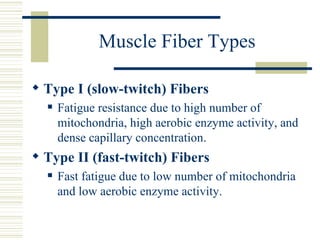
Muscle Fiber TypesType I (slow-twitch) Fibers Fatigue resistance due to high number of mitochondria, high aerobic enzyme activity, and dense capillary concentration. Type II (fast-twitch) Fibers Fast fatigue due to low number of mitochondria and low aerobic enzyme activity.
5.
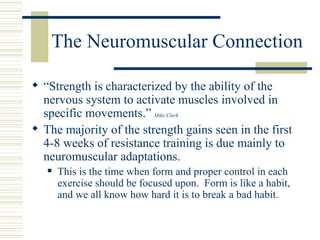
The Neuromuscular Connection“ Strength is characterized by the ability of the nervous system to activate muscles involved in specific movements.” Mike Clark The majority of the strength gains seen in the first 4-8 weeks of resistance training is due mainly to neuromuscular adaptations. This is the time when form and proper control in each exercise should be focused upon. Form is like a habit, and we all know how hard it is to break a bad habit.
6.
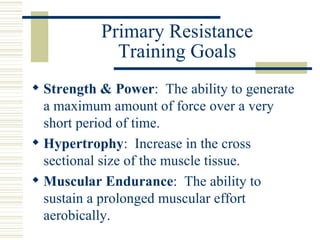
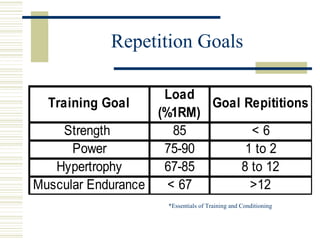
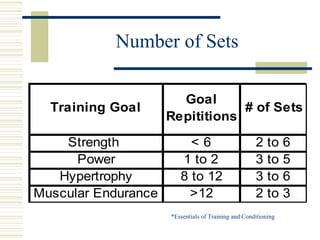
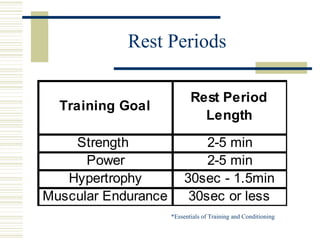
Primary Resistance TrainingGoals Strength & Power : The ability to generate a maximum amount of force over a very short period of time. Hypertrophy : Increase in the cross sectional size of the muscle tissue. Muscular Endurance : The ability to sustain a prolonged muscular effort aerobically.
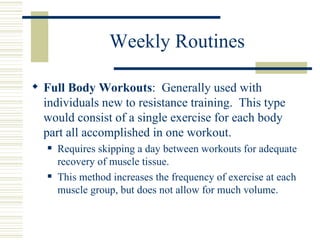
Weekly Routines FullBody Workouts : Generally used with individuals new to resistance training. This type would consist of a single exercise for each body part all accomplished in one workout. Requires skipping a day between workouts for adequate recovery of muscle tissue. This method increases the frequency of exercise at each muscle group, but does not allow for much volume.
11.
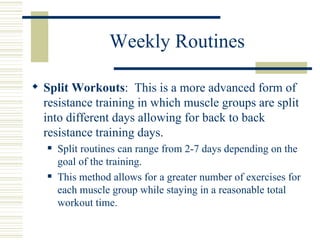
Weekly Routines SplitWorkouts : This is a more advanced form of resistance training in which muscle groups are split into different days allowing for back to back resistance training days. Split routines can range from 2-7 days depending on the goal of the training. This method allows for a greater number of exercises for each muscle group while staying in a reasonable total workout time.
12.
Types of TrainingSystems Single Sets : One set per exercise - low volume workouts for beginners Multiple Sets : 2 or more sets per body part either maintaining or increasing weight each set – increased training volume for strength, power, and muscle growth Pyramid Sets : Multiple sets in which the weight is increased for the first sets and then decreased for the last sets – the goal being to increase strength and endurance.
13.
Types of TrainingSystems Circuit Sets : Setting up a full body workout with several stations and performing this series in sequence with little to no rest between- the high volume along with the short rest time between exercises will increase the endurance requirements and cardiovascular response of the workout.
14.
Types of SpecializedSets Superset : Two exercises that work opposing muscle groups performed succession. Example- arm curls (biceps) followed immediately by arm extensions (triceps) Compound Set : Performing two exercises for the same muscle group succession. Example- shoulder press followed immediately by lateral shoulder raises Tri-sets : Performing three exercises for the same muscle group in succession. Example- bench press, chest fly, incline dumbbell press one after another without break
Taking The Steps Toward Change The first step is recognizing the difference between an exerciser and some one who is in training. The difference lies in focus and commitment. If you simply come in to the club to go on the treadmill for 20 minutes and lift a few weights twice a week, than you are an exerciser. This is better than not doing anything, but it will not impose any dramatic lasting changes. If you are in training you must have specific goals in regards to your current fitness level. Your goals must be reasonable, but at the same time they must challenge you enough to impose change on your body.
17.
Taking The StepsToward Change The second step is to is to have a program built that will take you from where you are today to where your specific goal lies. If in doubt, this is when personal training becomes a necessity. No matter what your goal is; weight loss, muscle gain, increased endurance, etc., there is a path you must follow to get there. A personal trainer has the knowledge to lead you down that path. There is little benefit to putting in the time, effort, and money into exercising if you are following a path that will not take you to your goal.
18.
Taking The StepsToward Change The third step is the execution of the program. This is where the focus and commitment of a person who is in training is displayed. In order to reach your goal you must be prepared mentally to put in the work that it takes to get there. This work happens in and out of the gym. A personal trainer can lead you through what you need to do, as well as motivate you to continue to push yourself, but the one thing that they cannot do for you is make the journey. You must travel the path that they have set for you.
19.
What steps areyou now going to take towards reaching your goals?