Fitness Testing
• The Importance of Fitness Testing
• Criteria for Choosing a Fitness Test
• Types of Testing
The Importance of
Fitness Testing
Fitness testing is essential for those interested in
sport-related fitness for several reasons:
• It identifies strengths and weaknesses
• It gives feedback about the effectiveness of
training
• It provides training incentive
• It identifies specific attributes
• Give an example of how each of these points
might apply in an individual’s Touch Training
Program
Strengths and Weaknesses
• If a touch player scores
poorly on a 30-metre
sprint test and vertical
jump test, his program
should focus on
improving his explosive
power.
Feedback
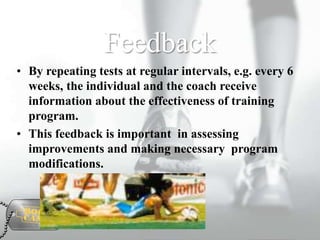
• By repeating tests at regular intervals, e.g. every 6
weeks, the individual and the coach receive
information about the effectiveness of training
program.
• This feedback is important in assessing
improvements and making necessary program
modifications.
Incentive
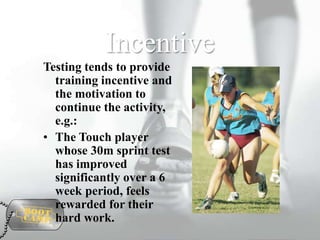
Testing tends to provide
training incentive and
the motivation to
continue the activity,
e.g.:
• The Touch player
whose 30m sprint test
has improved
significantly over a 6
week period, feels
rewarded for their
hard work.
Specific Attributes
• Fitness testing may
indicate that an athlete
has a specific attribute,
such as speed, that may
help decide on a position
or event suited to her or
his abilities.
Criteria for Choosing a
Fitness Test
When selecting a fitness test to use, there are a number of
criteria that must be met to ensure that the testing is
valid, accurate, and suited to your purposes:

•
•
•
•
•

Relevance and specificity
Quality control
Accuracy and reliability
Practicality
The provision of post-assessment counselling
Relevance and Specificity
Fitness tests should be selected for their ability to
measure the components of fitness known to
be important to your sport,e.g.:
• If the activity requires running it should be
tested with a run or treadmill test, whilst
cyclists, rowers, swimmers and kayakers
should be assessed on ergometers designed for
their sport.
Quality Control
Since test results are affected by conditions on each
testing occasion, always follow these procedures:
• Use the same warm up before beginning the tests.
• Perform the tests in the same order.
• Allow the same recovery time between tests
• Make sure the environmental conditions are the same
on each occasion.
• Carry out the tests at the same time of day.
• The person being tested should have the same fluid
and nutritional status, and not be sick or injured.
Accuracy and Reliability
• Fitness tests should be able to be repeated
without testing error, and they should test the
fitness component that each was chosen for.
Practicality
• Field tests Vs Laboratory tests.
Types of Fitness Testing
• Aerobic capacity tests
• Anaerobic capacity and
speed tests
• Muscular strength tests

•
•
•
•
•

Flexibility tests
Balance test
Coordination test
Body composition
Agility tests
Aerobic Capacity Test
1. Beep Test
• 20m shuttle runs at increasing
speeds.
• Speed/time set by tape/CD divided into levels.
• Record level reached and
compare against norms.
• For more tests see pages 264 269 of text . See also local
muscular endurance tests.
Anaerobic Capacity Test
1. 40m Sprint
• Athlete sprints 40m on
sprint track.
• Time recorded.
• Compare against
norms..
Muscular Strength Test
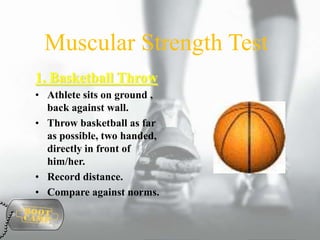
1. Basketball Throw
• Athlete sits on ground ,
back against wall.
• Throw basketball as far
as possible, two handed,
directly in front of
him/her.
• Record distance.
• Compare against norms.
Flexibility Tests
Balance Tests
Co-ordination Tests
2. fitness testing

2. fitness testing

  • 1.
    Fitness Testing • TheImportance of Fitness Testing • Criteria for Choosing a Fitness Test • Types of Testing
  • 2.
    The Importance of FitnessTesting Fitness testing is essential for those interested in sport-related fitness for several reasons: • It identifies strengths and weaknesses • It gives feedback about the effectiveness of training • It provides training incentive • It identifies specific attributes • Give an example of how each of these points might apply in an individual’s Touch Training Program
  • 3.
    Strengths and Weaknesses •If a touch player scores poorly on a 30-metre sprint test and vertical jump test, his program should focus on improving his explosive power.
  • 4.
    Feedback • By repeatingtests at regular intervals, e.g. every 6 weeks, the individual and the coach receive information about the effectiveness of training program. • This feedback is important in assessing improvements and making necessary program modifications.
  • 5.
    Incentive Testing tends toprovide training incentive and the motivation to continue the activity, e.g.: • The Touch player whose 30m sprint test has improved significantly over a 6 week period, feels rewarded for their hard work.
  • 6.
    Specific Attributes • Fitnesstesting may indicate that an athlete has a specific attribute, such as speed, that may help decide on a position or event suited to her or his abilities.
  • 7.
    Criteria for Choosinga Fitness Test When selecting a fitness test to use, there are a number of criteria that must be met to ensure that the testing is valid, accurate, and suited to your purposes: • • • • • Relevance and specificity Quality control Accuracy and reliability Practicality The provision of post-assessment counselling
  • 8.
    Relevance and Specificity Fitnesstests should be selected for their ability to measure the components of fitness known to be important to your sport,e.g.: • If the activity requires running it should be tested with a run or treadmill test, whilst cyclists, rowers, swimmers and kayakers should be assessed on ergometers designed for their sport.
  • 9.
    Quality Control Since testresults are affected by conditions on each testing occasion, always follow these procedures: • Use the same warm up before beginning the tests. • Perform the tests in the same order. • Allow the same recovery time between tests • Make sure the environmental conditions are the same on each occasion. • Carry out the tests at the same time of day. • The person being tested should have the same fluid and nutritional status, and not be sick or injured.
  • 10.
    Accuracy and Reliability •Fitness tests should be able to be repeated without testing error, and they should test the fitness component that each was chosen for.
  • 11.
    Practicality • Field testsVs Laboratory tests.
  • 12.
    Types of FitnessTesting • Aerobic capacity tests • Anaerobic capacity and speed tests • Muscular strength tests • • • • • Flexibility tests Balance test Coordination test Body composition Agility tests
  • 13.
    Aerobic Capacity Test 1.Beep Test • 20m shuttle runs at increasing speeds. • Speed/time set by tape/CD divided into levels. • Record level reached and compare against norms. • For more tests see pages 264 269 of text . See also local muscular endurance tests.
  • 14.
    Anaerobic Capacity Test 1.40m Sprint • Athlete sprints 40m on sprint track. • Time recorded. • Compare against norms..
  • 15.
    Muscular Strength Test 1.Basketball Throw • Athlete sits on ground , back against wall. • Throw basketball as far as possible, two handed, directly in front of him/her. • Record distance. • Compare against norms.
  • 16.
  • 17.
  • 18.