Chapter 6 – Training
Contents
   6.1 principles of training + 6.2 principles of training (further)
   6.3 aspects of training
   6.4 circuit training
   6.5 weight training
   6.6 further training methods


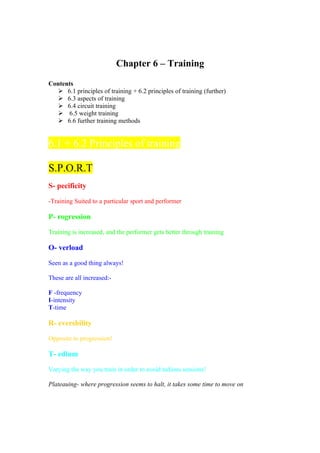
6.1 + 6.2 Principles of training

S.P.O.R.T
S- pecificity

-Training Suited to a particular sport and performer

P- rogression

Training is increased, and the performer gets better through training

O- verload

Seen as a good thing always!

These are all increased:-

F -frequency
I-intensity
T-time

R- eversbility

Opposite to progression!

T- edium

Varying the way you train in order to avoid tedious sessions!

Plateauing- where progression seems to halt, it takes some time to move on
6.3 Aspects of training
      Warm up
      Fitness or exercise phase
      Skills or team play phase
      Warm down

Warm up
– prepare body for activity and increase blood flow
– phyicologically prepared
– reduce injury chances

Warm ups must be specific, but the following should always be in a warm up

   -   pulse raiser
   -   light exercises, stretches , movement


Fitness and exercise phase

   -   Specific to sport

Skill or team play phase

   -   Practise as a team, or individually if not a team activity

Warm down

   -   warming down helps relieve pain which you may get through lactic acid
6.4 circuit training
Stations- areas within a circuit where the different activitys are perfomed

   -    easy to set up
   -    suitable for large numbers
   -    sport, skill, fitness specific
   -    done anywhere
   -    equipment limited

Types of circuit

   1-   fitness
   2-   skill
   3-   combination
   4-   timed
   5-   fixed loads
   6-   variation

6.5 Weight training
Repetitions- how many times you actually move the weights
Sets – the number of times you carry out an activity

Benefits

   -    muscle strength
            o 3 sets of 6 reps at near maximum weight
   -    muscle size
   -    muscle tone
   -    assisting recovery after injury

Muscular endurance- 20/30m reps at 40% / 60% of maximum weight ; 3 + sets

Muscle strength – three sets at 6 reps of near maximum

Muscle power- performed at speed 60%-80% of maximum weight 10 –15 reps
6.6 further training methods
Continuous training

- This is any type of training that keeps the heart rate and pulse rate high over a
sustained period achieved by-

      running
      cycling
      swimming
      aerobic sessions

Interval training

This is training with rests!

      Long interval training – work between 15 secs and 3 mins at around 80 % with
       corresponding rest periods

      Short interval training – sprinting for no more than 15 secs with around 2mins
       rest

Fartlek

It’s a form of interval training which includes-

      Walking
      Brisk walking
      Jogging
      Fast steady running

PEShare.co.uk Shared Resource

  • 1.
    Chapter 6 –Training Contents  6.1 principles of training + 6.2 principles of training (further)  6.3 aspects of training  6.4 circuit training  6.5 weight training  6.6 further training methods 6.1 + 6.2 Principles of training S.P.O.R.T S- pecificity -Training Suited to a particular sport and performer P- rogression Training is increased, and the performer gets better through training O- verload Seen as a good thing always! These are all increased:- F -frequency I-intensity T-time R- eversbility Opposite to progression! T- edium Varying the way you train in order to avoid tedious sessions! Plateauing- where progression seems to halt, it takes some time to move on
  • 2.
    6.3 Aspects oftraining  Warm up  Fitness or exercise phase  Skills or team play phase  Warm down Warm up – prepare body for activity and increase blood flow – phyicologically prepared – reduce injury chances Warm ups must be specific, but the following should always be in a warm up - pulse raiser - light exercises, stretches , movement Fitness and exercise phase - Specific to sport Skill or team play phase - Practise as a team, or individually if not a team activity Warm down - warming down helps relieve pain which you may get through lactic acid
  • 3.
    6.4 circuit training Stations-areas within a circuit where the different activitys are perfomed - easy to set up - suitable for large numbers - sport, skill, fitness specific - done anywhere - equipment limited Types of circuit 1- fitness 2- skill 3- combination 4- timed 5- fixed loads 6- variation 6.5 Weight training Repetitions- how many times you actually move the weights Sets – the number of times you carry out an activity Benefits - muscle strength o 3 sets of 6 reps at near maximum weight - muscle size - muscle tone - assisting recovery after injury Muscular endurance- 20/30m reps at 40% / 60% of maximum weight ; 3 + sets Muscle strength – three sets at 6 reps of near maximum Muscle power- performed at speed 60%-80% of maximum weight 10 –15 reps
  • 4.
    6.6 further trainingmethods Continuous training - This is any type of training that keeps the heart rate and pulse rate high over a sustained period achieved by-  running  cycling  swimming  aerobic sessions Interval training This is training with rests!  Long interval training – work between 15 secs and 3 mins at around 80 % with corresponding rest periods  Short interval training – sprinting for no more than 15 secs with around 2mins rest Fartlek It’s a form of interval training which includes-  Walking  Brisk walking  Jogging  Fast steady running