Strength Training Basics Part 1 Brian Ayers, CSCS Total Transformations, LLC www.ttfitness.com
Terms of Anatomical Position Midline: The invisible line that divides the body or a single body part in half down the center. Anterior: The surface of the body that would be considered the front. Posterior: The surface of the body that would be considered the back. Medial: The surface that is closer to the midline of the body. Lateral: The surface that is further from the midline of the body.
The Three Movement Planes Sagittal Plane  (where most basic exercises occur) Primary movements include Flexion and Extension Frontal Plane Primary movements include Abduction, Adduction, and Lateral Flexion Transverse Plane  (where only rotational exercises occur) Primary movements include Pronation, Supination, and any rotation about a vertical axis.
Basic Description of Movement Flexion : Decreasing the angle of a given joint. Extension : Returning a joint from flexion. Abduction : Movement away from the midline in the frontal plane. Adduction : Movement toward the midline in the frontal plane. Rotation : Movement counterclockwise or clockwise about a vertical axis. In the case of the forearm it is called supination and pronation.
The 6 Main Muscle Groups Chest  – Pectoralis Major/Minor Shoulders  –   Deltoid, Rotator Cuff (stabilizer), Trapezius Back  – Lats, Rhomboids Arms  – Biceps, Triceps, Forearms Trunk  – Abdominals, Obliques, Low-back Legs  – Quads, Hamstrings, Glutes, Calves
Primary Chest Movements The chest muscles only move the shoulder joint in the Sagittal plane. The two basic movements that the chest is responsible for are: Horizontal Flexion  Horizontal Adduction  Both movements can be performed at different angles to target specific areas.
Chest Exercises Horizontal flexion is accomplished through the chest press. Horizontal Adduction is accomplished through the chest fly. External resistance can be incorporated in the form of fixed machines, dumbbells, or cables. The different angles and target areas include: Incline Press/Fly: targets the upper chest Flat Press/Fly: targets the middle chest Decline Press/Fly: targets the middle & lower chest
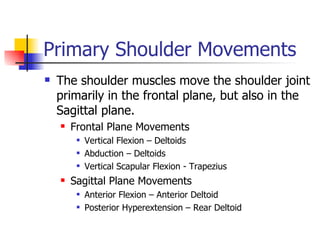
Primary Shoulder Movements The shoulder muscles move the shoulder joint primarily in the frontal plane, but also in the Sagittal plane. Frontal Plane Movements Vertical Flexion – Deltoids Abduction – Deltoids Vertical Scapular Flexion - Trapezius Sagittal Plane Movements Anterior Flexion – Anterior Deltoid Posterior Hyperextension – Rear Deltoid
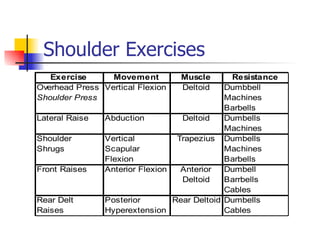
Shoulder Exercises
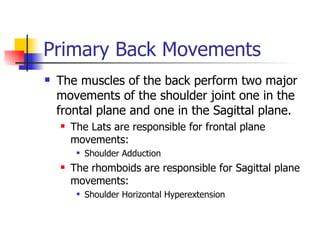
Primary Back Movements The muscles of the back perform two major movements of the shoulder joint one in the frontal plane and one in the Sagittal plane. The Lats are responsible for frontal plane movements: Shoulder Adduction  The rhomboids are responsible for Sagittal plane movements: Shoulder Horizontal Hyperextension
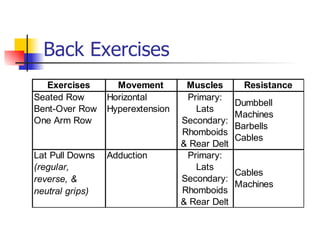
Back Exercises
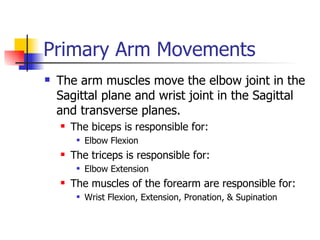
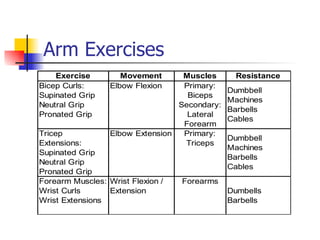
Primary Arm Movements The arm muscles move the elbow joint in the Sagittal plane and wrist joint in the Sagittal and transverse planes. The biceps is responsible for: Elbow Flexion The triceps is responsible for: Elbow Extension The muscles of the forearm are responsible for: Wrist Flexion, Extension, Pronation, & Supination
Arm Exercises
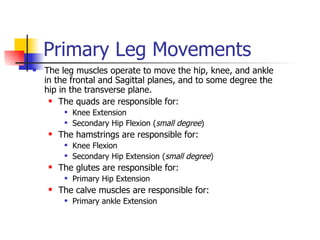
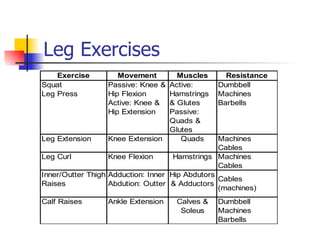
Primary Leg Movements The leg muscles operate to move the hip, knee, and ankle in the frontal and Sagittal planes, and to some degree the hip in the transverse plane. The quads are responsible for: Knee Extension Secondary Hip Flexion ( small degree ) The hamstrings are responsible for: Knee Flexion Secondary Hip Extension ( small degree ) The glutes are responsible for: Primary Hip Extension The calve muscles are responsible for: Primary ankle Extension
Leg Exercises
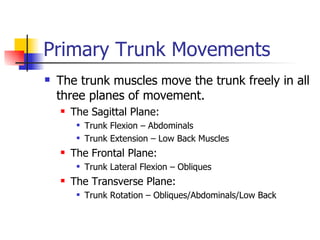
Primary Trunk Movements The trunk muscles move the trunk freely in all three planes of movement. The Sagittal Plane: Trunk Flexion – Abdominals Trunk Extension – Low Back Muscles The Frontal Plane: Trunk Lateral Flexion – Obliques The Transverse Plane: Trunk Rotation – Obliques/Abdominals/Low Back
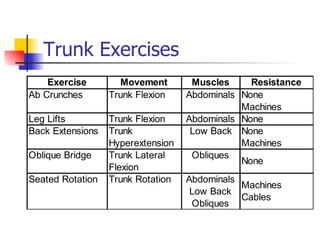
Trunk Exercises
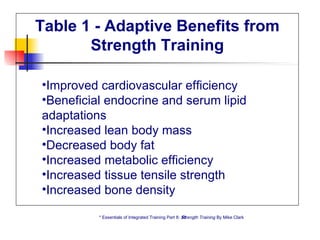
* Essentials of Integrated Training Part 8:   St rength Training   By Mike Clark    Table 1 - Adaptive Benefits from Strength Training Improved cardiovascular efficiency   Beneficial endocrine and serum lipid  adaptations   Increased lean body mass   Decreased body fat   Increased metabolic efficiency   Increased tissue tensile strength   Increased bone density 

Strength Training Basics Part 1

  • 1.
    Strength Training BasicsPart 1 Brian Ayers, CSCS Total Transformations, LLC www.ttfitness.com
  • 2.
    Terms of AnatomicalPosition Midline: The invisible line that divides the body or a single body part in half down the center. Anterior: The surface of the body that would be considered the front. Posterior: The surface of the body that would be considered the back. Medial: The surface that is closer to the midline of the body. Lateral: The surface that is further from the midline of the body.
  • 3.
    The Three MovementPlanes Sagittal Plane (where most basic exercises occur) Primary movements include Flexion and Extension Frontal Plane Primary movements include Abduction, Adduction, and Lateral Flexion Transverse Plane (where only rotational exercises occur) Primary movements include Pronation, Supination, and any rotation about a vertical axis.
  • 4.
    Basic Description ofMovement Flexion : Decreasing the angle of a given joint. Extension : Returning a joint from flexion. Abduction : Movement away from the midline in the frontal plane. Adduction : Movement toward the midline in the frontal plane. Rotation : Movement counterclockwise or clockwise about a vertical axis. In the case of the forearm it is called supination and pronation.
  • 5.
    The 6 MainMuscle Groups Chest – Pectoralis Major/Minor Shoulders – Deltoid, Rotator Cuff (stabilizer), Trapezius Back – Lats, Rhomboids Arms – Biceps, Triceps, Forearms Trunk – Abdominals, Obliques, Low-back Legs – Quads, Hamstrings, Glutes, Calves
  • 6.
    Primary Chest MovementsThe chest muscles only move the shoulder joint in the Sagittal plane. The two basic movements that the chest is responsible for are: Horizontal Flexion Horizontal Adduction Both movements can be performed at different angles to target specific areas.
  • 7.
    Chest Exercises Horizontalflexion is accomplished through the chest press. Horizontal Adduction is accomplished through the chest fly. External resistance can be incorporated in the form of fixed machines, dumbbells, or cables. The different angles and target areas include: Incline Press/Fly: targets the upper chest Flat Press/Fly: targets the middle chest Decline Press/Fly: targets the middle & lower chest
  • 8.
    Primary Shoulder MovementsThe shoulder muscles move the shoulder joint primarily in the frontal plane, but also in the Sagittal plane. Frontal Plane Movements Vertical Flexion – Deltoids Abduction – Deltoids Vertical Scapular Flexion - Trapezius Sagittal Plane Movements Anterior Flexion – Anterior Deltoid Posterior Hyperextension – Rear Deltoid
  • 9.
  • 10.
    Primary Back MovementsThe muscles of the back perform two major movements of the shoulder joint one in the frontal plane and one in the Sagittal plane. The Lats are responsible for frontal plane movements: Shoulder Adduction The rhomboids are responsible for Sagittal plane movements: Shoulder Horizontal Hyperextension
  • 11.
  • 12.
    Primary Arm MovementsThe arm muscles move the elbow joint in the Sagittal plane and wrist joint in the Sagittal and transverse planes. The biceps is responsible for: Elbow Flexion The triceps is responsible for: Elbow Extension The muscles of the forearm are responsible for: Wrist Flexion, Extension, Pronation, & Supination
  • 13.
  • 14.
    Primary Leg MovementsThe leg muscles operate to move the hip, knee, and ankle in the frontal and Sagittal planes, and to some degree the hip in the transverse plane. The quads are responsible for: Knee Extension Secondary Hip Flexion ( small degree ) The hamstrings are responsible for: Knee Flexion Secondary Hip Extension ( small degree ) The glutes are responsible for: Primary Hip Extension The calve muscles are responsible for: Primary ankle Extension
  • 15.
  • 16.
    Primary Trunk MovementsThe trunk muscles move the trunk freely in all three planes of movement. The Sagittal Plane: Trunk Flexion – Abdominals Trunk Extension – Low Back Muscles The Frontal Plane: Trunk Lateral Flexion – Obliques The Transverse Plane: Trunk Rotation – Obliques/Abdominals/Low Back
  • 17.
  • 18.
    * Essentials ofIntegrated Training Part 8: St rength Training   By Mike Clark   Table 1 - Adaptive Benefits from Strength Training Improved cardiovascular efficiency Beneficial endocrine and serum lipid adaptations Increased lean body mass Decreased body fat Increased metabolic efficiency Increased tissue tensile strength Increased bone density