Ocean currents:
Current: Continuous and directed movement of ocean water
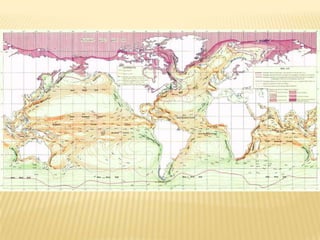
Two Types: Surface Currents Deep Water Currents
Surface Currents: 10% of water in ocean The upper 400m of the ocean
Deep water currents: 90% of water in ocean Waters move around the ocean basins by density  differences Density differences a function of different temperatures and salinity
Two Types of Forces:Primary Forces: Start the water moving:Solar HeatingWindsGravityCoriolis EffectSecondary Forces: Influence where  the current goes
Solar Heating: Causes water to expand Water is about 8 cm higher than middle latitudes, thus water wants to flow down slope
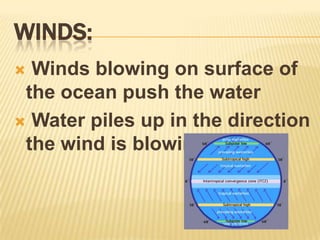
Winds: Winds blowing on surface of the ocean push the water Water piles up in the direction the wind is blowing
Gravity Will pull water “down the hill” when water mounds up
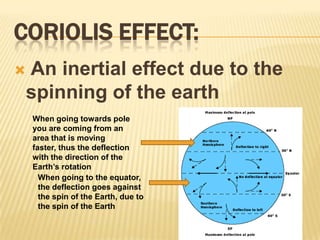
Coriolis Effect: An inertial effect due to the spinning of the earthWhen going towards pole you are coming from an area that is moving faster, thus the deflection with the direction of the Earth’s rotationWhen going to the equator, the deflection goes against the spin of the Earth, due to the spin of the Earth
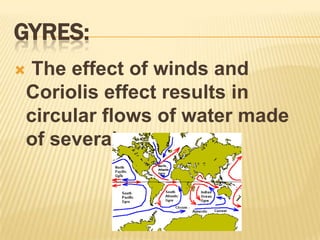
Gyres: The effect of winds and Coriolis effect results in circular flows of water made of several currents
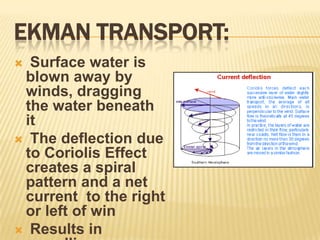
Ekman Transport: Surface water is blown away by winds, dragging the water beneath it The deflection due to Coriolis Effect creates a spiral pattern and a net current  to the right or left of win Results in upwelling
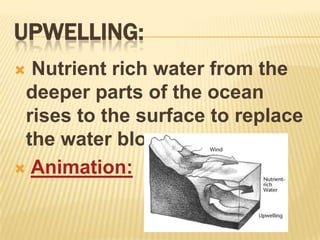
Upwelling: Nutrient rich water from the deeper parts of the ocean rises to the surface to replace the water blown awayAnimation:
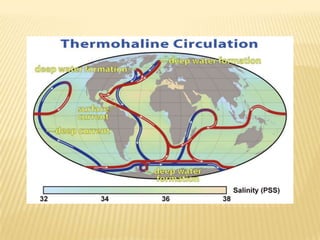
Deep Water circulation: Occur where the temperature is cold and relatively high in salinityThermohaline Circulation Thermo = heat, haline = salt
Earth Conveyor Belt Salt rich, warm water is blown north by the Gulf Stream, where is cools and sinks This provides heat to the polar regions and nutrients everywherePossibly disrupted by global warming
Local Currents: formed by a combination of tides, winds, waves, and rivers/streamsLongshore currents and rip currents
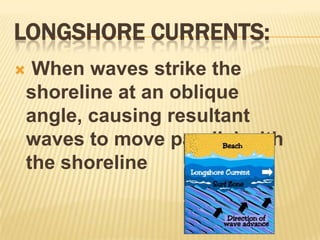
Longshore currents: When waves strike the shoreline at an oblique angle, causing resultant waves to move parallel with the shoreline
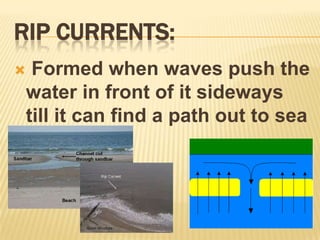
Rip Currents: Formed when waves push the water in front of it sideways till it can find a path out to sea

4. Ocean Current Notes

  • 1.
  • 2.
    Current: Continuous anddirected movement of ocean water
  • 4.
    Two Types: SurfaceCurrents Deep Water Currents
  • 5.
    Surface Currents: 10%of water in ocean The upper 400m of the ocean
  • 6.
    Deep water currents:90% of water in ocean Waters move around the ocean basins by density differences Density differences a function of different temperatures and salinity
  • 7.
    Two Types ofForces:Primary Forces: Start the water moving:Solar HeatingWindsGravityCoriolis EffectSecondary Forces: Influence where the current goes
  • 8.
    Solar Heating: Causeswater to expand Water is about 8 cm higher than middle latitudes, thus water wants to flow down slope
  • 9.
    Winds: Winds blowingon surface of the ocean push the water Water piles up in the direction the wind is blowing
  • 10.
    Gravity Will pullwater “down the hill” when water mounds up
  • 11.
    Coriolis Effect: Aninertial effect due to the spinning of the earthWhen going towards pole you are coming from an area that is moving faster, thus the deflection with the direction of the Earth’s rotationWhen going to the equator, the deflection goes against the spin of the Earth, due to the spin of the Earth
  • 12.
    Gyres: The effectof winds and Coriolis effect results in circular flows of water made of several currents
  • 13.
    Ekman Transport: Surfacewater is blown away by winds, dragging the water beneath it The deflection due to Coriolis Effect creates a spiral pattern and a net current to the right or left of win Results in upwelling
  • 14.
    Upwelling: Nutrient richwater from the deeper parts of the ocean rises to the surface to replace the water blown awayAnimation:
  • 15.
    Deep Water circulation:Occur where the temperature is cold and relatively high in salinityThermohaline Circulation Thermo = heat, haline = salt
  • 16.
    Earth Conveyor BeltSalt rich, warm water is blown north by the Gulf Stream, where is cools and sinks This provides heat to the polar regions and nutrients everywherePossibly disrupted by global warming
  • 18.
    Local Currents: formedby a combination of tides, winds, waves, and rivers/streamsLongshore currents and rip currents
  • 19.
    Longshore currents: Whenwaves strike the shoreline at an oblique angle, causing resultant waves to move parallel with the shoreline
  • 20.
    Rip Currents: Formedwhen waves push the water in front of it sideways till it can find a path out to sea