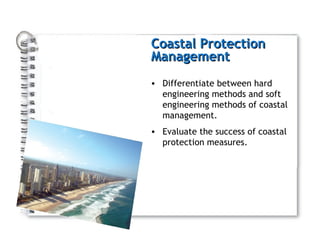
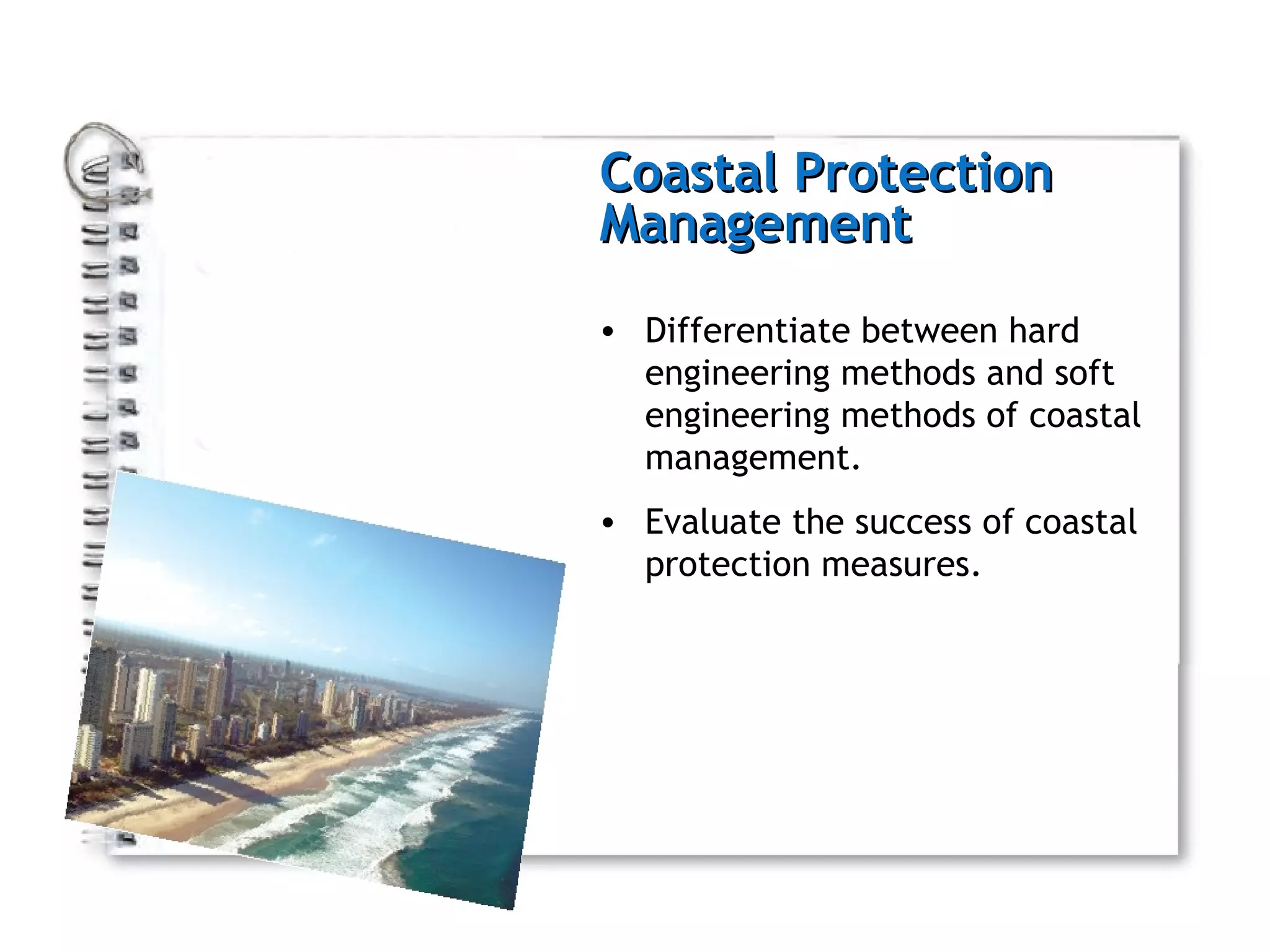
Coastal Protection Management Differentiate between hard engineering methods and soft engineering methods of coastal management. Evaluate the success of coastal protection measures.
Coastal Protection Management Types of Approaches 1. Hard engineering approach (structural approach): the construction of physical structures to defend against erosive power of waves. 2. Soft engineering approach (non-structural approach): focuses on planning and management so that both coastal areas and properties will not be damaged by erosion. aims at changing individual behaviour or attitudes towards coastal protection by encouraging minimal human interference.
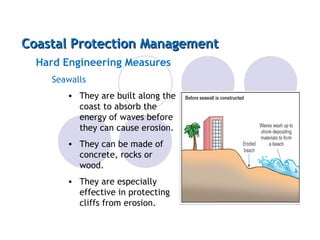
Coastal Protection Management Hard Engineering Measures Seawalls They are built along the coast to absorb the energy of waves before they can cause erosion. They can be made of concrete, rocks or wood. They are especially effective in protecting cliffs from erosion.
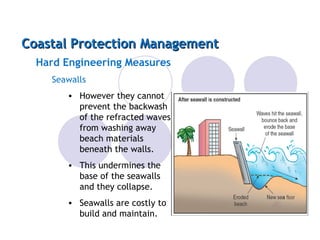
Coastal Protection Management Hard Engineering Measures Seawalls However they cannot prevent the backwash of the refracted waves from washing away beach materials beneath the walls. This undermines the base of the seawalls and they collapse. Seawalls are costly to build and maintain.
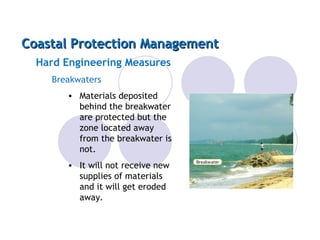
Coastal Protection Management Hard Engineering Measures Breakwaters It can be built with one end attached to the coast or away from the coast. They break the force of high energy waves before they reach the shore. When constructed offshore, it can create a zone of calm water behind them and allow deposition to occur, forming beaches.
Coastal Protection Management Hard Engineering Measures Breakwaters Materials deposited behind the breakwater are protected but the zone located away from the breakwater is not. It will not receive new supplies of materials and it will get eroded away.
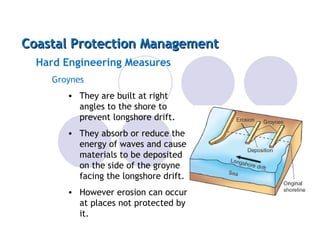
Coastal Protection Management Hard Engineering Measures Groynes They are built at right angles to the shore to prevent longshore drift. They absorb or reduce the energy of waves and cause materials to be deposited on the side of the groyne facing the longshore drift. However erosion can occur at places not protected by it.
Coastal Protection Management Hard Engineering Measures Gabions They are wired cages filled with crush rocks. They are piled up along the shore to prevent or reduce coastal erosion by weakening wave energy. It offers short-term protection (5 to 10 years). The cages require regular maintenance and are easily corroded by sea water, trampling and vandalism.
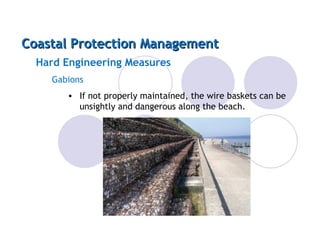
Coastal Protection Management Hard Engineering Measures Gabions If not properly maintained, the wire baskets can be unsightly and dangerous along the beach.
Coastal Protection Management Soft Engineering Measures Beach nourishment The constant replenishment of large quantities of sand to the beach system. The beach is extended seawards, which leads to the improvement of beach quality and storm protection. It is costly to transport large quantities of sand to fill up the beach and sufficient sand is needed. Sand being eroded and transported away by waves and wind and can affect wildlife e.g. coral reefs at Waikiki Beach in Hawaii.
Coastal Protection Management Soft Engineering Measures Relocation of properties No building of properties are allowed in coastal areas vulnerable to costal erosion. The east coast of England has a “green line” policy that discourage building located beyond it. With the danger of increasing sea levels due to global warming, relocation is important to future coastal management.
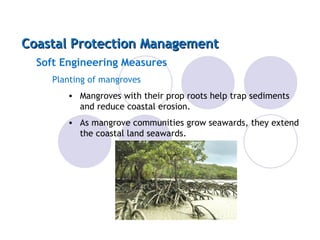
Soft Engineering Measures Planting of mangroves Mangroves with their prop roots help trap sediments and reduce coastal erosion. As mangrove communities grow seawards, they extend the coastal land seawards. Coastal Protection Management
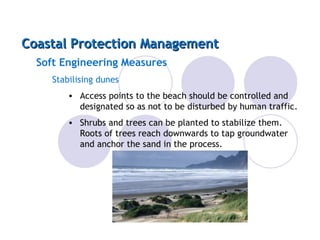
Soft Engineering Measures Stabilising dunes Access points to the beach should be controlled and designated so as not to be disturbed by human traffic. Shrubs and trees can be planted to stabilize them. Roots of trees reach downwards to tap groundwater and anchor the sand in the process. Coastal Protection Management
Coastal Protection Management Soft Engineering Measures Growth of coral reefs Artificial reefs can be created by placing environmentally friendly and long-lived materials like steel or concrete on the sea floor. Once the material is put in place, living organisms start to grow on it. Man-made reefs are as productive as natural reefs in enhancing fishing opportunities and serve as undersea barriers to reduce impact of wave energy.
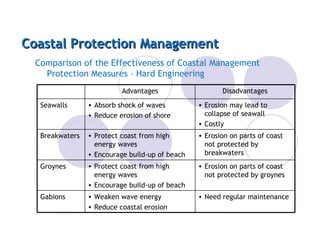
Coastal Protection Management Comparison of the Effectiveness of Coastal Management Protection Measures – Hard Engineering Need regular maintenance Weaken wave energy Reduce coastal erosion Gabions Erosion on parts of coast not protected by groynes Protect coast from high energy waves Encourage build-up of beach Groynes Erosion on parts of coast not protected by breakwaters Protect coast from high energy waves Encourage build-up of beach Breakwaters Erosion may lead to collapse of seawall Costly Absorb shock of waves Reduce erosion of shore Seawalls Disadvantages Advantages
Coastal Protection Management Comparison of the Effectiveness of Coastal Management Protection Measures – Soft Engineering Can affect the depth of coasts – implications for port activities/coastal transportation Helps trap sediments to form islands Prevents coastal erosion Planting of mangroves Affects investment opportunities in coastal areas Allows nature to take its course Avoids loss of lives and properties Relocation properties Expensive Affects marine ecosystem Requires constant supply of new sand Improves beach quality Improves storm protection Beach nourishment Disadvantages Advantages
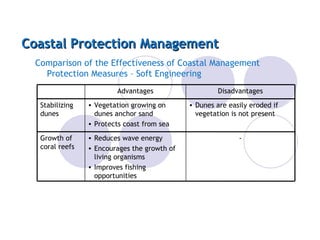
Coastal Protection Management Comparison of the Effectiveness of Coastal Management Protection Measures – Soft Engineering - Reduces wave energy Encourages the growth of living organisms Improves fishing opportunities Growth of coral reefs Dunes are easily eroded if vegetation is not present Vegetation growing on dunes anchor sand Protects coast from sea Stabilizing dunes Disadvantages Advantages
Homework Briefly describe the difference between “hard engineering approaches” and “soft engineering approaches”. Describe three hard engineering measures of coastal protection. Describe three soft engineering measures of coastal protection. With reference to examples, explain why soft engineering approaches of coastal protection may be more effective than hard engineering approaches of protection.

Sec 3 Coastal Management

  • 1.
    Coastal Protection ManagementDifferentiate between hard engineering methods and soft engineering methods of coastal management. Evaluate the success of coastal protection measures.
  • 2.
    Coastal Protection ManagementTypes of Approaches 1. Hard engineering approach (structural approach): the construction of physical structures to defend against erosive power of waves. 2. Soft engineering approach (non-structural approach): focuses on planning and management so that both coastal areas and properties will not be damaged by erosion. aims at changing individual behaviour or attitudes towards coastal protection by encouraging minimal human interference.
  • 3.
    Coastal Protection ManagementHard Engineering Measures Seawalls They are built along the coast to absorb the energy of waves before they can cause erosion. They can be made of concrete, rocks or wood. They are especially effective in protecting cliffs from erosion.
  • 4.
    Coastal Protection ManagementHard Engineering Measures Seawalls However they cannot prevent the backwash of the refracted waves from washing away beach materials beneath the walls. This undermines the base of the seawalls and they collapse. Seawalls are costly to build and maintain.
  • 5.
    Coastal Protection ManagementHard Engineering Measures Breakwaters It can be built with one end attached to the coast or away from the coast. They break the force of high energy waves before they reach the shore. When constructed offshore, it can create a zone of calm water behind them and allow deposition to occur, forming beaches.
  • 6.
    Coastal Protection ManagementHard Engineering Measures Breakwaters Materials deposited behind the breakwater are protected but the zone located away from the breakwater is not. It will not receive new supplies of materials and it will get eroded away.
  • 7.
    Coastal Protection ManagementHard Engineering Measures Groynes They are built at right angles to the shore to prevent longshore drift. They absorb or reduce the energy of waves and cause materials to be deposited on the side of the groyne facing the longshore drift. However erosion can occur at places not protected by it.
  • 8.
    Coastal Protection ManagementHard Engineering Measures Gabions They are wired cages filled with crush rocks. They are piled up along the shore to prevent or reduce coastal erosion by weakening wave energy. It offers short-term protection (5 to 10 years). The cages require regular maintenance and are easily corroded by sea water, trampling and vandalism.
  • 9.
    Coastal Protection ManagementHard Engineering Measures Gabions If not properly maintained, the wire baskets can be unsightly and dangerous along the beach.
  • 10.
    Coastal Protection ManagementSoft Engineering Measures Beach nourishment The constant replenishment of large quantities of sand to the beach system. The beach is extended seawards, which leads to the improvement of beach quality and storm protection. It is costly to transport large quantities of sand to fill up the beach and sufficient sand is needed. Sand being eroded and transported away by waves and wind and can affect wildlife e.g. coral reefs at Waikiki Beach in Hawaii.
  • 11.
    Coastal Protection ManagementSoft Engineering Measures Relocation of properties No building of properties are allowed in coastal areas vulnerable to costal erosion. The east coast of England has a “green line” policy that discourage building located beyond it. With the danger of increasing sea levels due to global warming, relocation is important to future coastal management.
  • 12.
    Soft Engineering MeasuresPlanting of mangroves Mangroves with their prop roots help trap sediments and reduce coastal erosion. As mangrove communities grow seawards, they extend the coastal land seawards. Coastal Protection Management
  • 13.
    Soft Engineering MeasuresStabilising dunes Access points to the beach should be controlled and designated so as not to be disturbed by human traffic. Shrubs and trees can be planted to stabilize them. Roots of trees reach downwards to tap groundwater and anchor the sand in the process. Coastal Protection Management
  • 14.
    Coastal Protection ManagementSoft Engineering Measures Growth of coral reefs Artificial reefs can be created by placing environmentally friendly and long-lived materials like steel or concrete on the sea floor. Once the material is put in place, living organisms start to grow on it. Man-made reefs are as productive as natural reefs in enhancing fishing opportunities and serve as undersea barriers to reduce impact of wave energy.
  • 15.
    Coastal Protection ManagementComparison of the Effectiveness of Coastal Management Protection Measures – Hard Engineering Need regular maintenance Weaken wave energy Reduce coastal erosion Gabions Erosion on parts of coast not protected by groynes Protect coast from high energy waves Encourage build-up of beach Groynes Erosion on parts of coast not protected by breakwaters Protect coast from high energy waves Encourage build-up of beach Breakwaters Erosion may lead to collapse of seawall Costly Absorb shock of waves Reduce erosion of shore Seawalls Disadvantages Advantages
  • 16.
    Coastal Protection ManagementComparison of the Effectiveness of Coastal Management Protection Measures – Soft Engineering Can affect the depth of coasts – implications for port activities/coastal transportation Helps trap sediments to form islands Prevents coastal erosion Planting of mangroves Affects investment opportunities in coastal areas Allows nature to take its course Avoids loss of lives and properties Relocation properties Expensive Affects marine ecosystem Requires constant supply of new sand Improves beach quality Improves storm protection Beach nourishment Disadvantages Advantages
  • 17.
    Coastal Protection ManagementComparison of the Effectiveness of Coastal Management Protection Measures – Soft Engineering - Reduces wave energy Encourages the growth of living organisms Improves fishing opportunities Growth of coral reefs Dunes are easily eroded if vegetation is not present Vegetation growing on dunes anchor sand Protects coast from sea Stabilizing dunes Disadvantages Advantages
  • 18.
    Homework Briefly describethe difference between “hard engineering approaches” and “soft engineering approaches”. Describe three hard engineering measures of coastal protection. Describe three soft engineering measures of coastal protection. With reference to examples, explain why soft engineering approaches of coastal protection may be more effective than hard engineering approaches of protection.