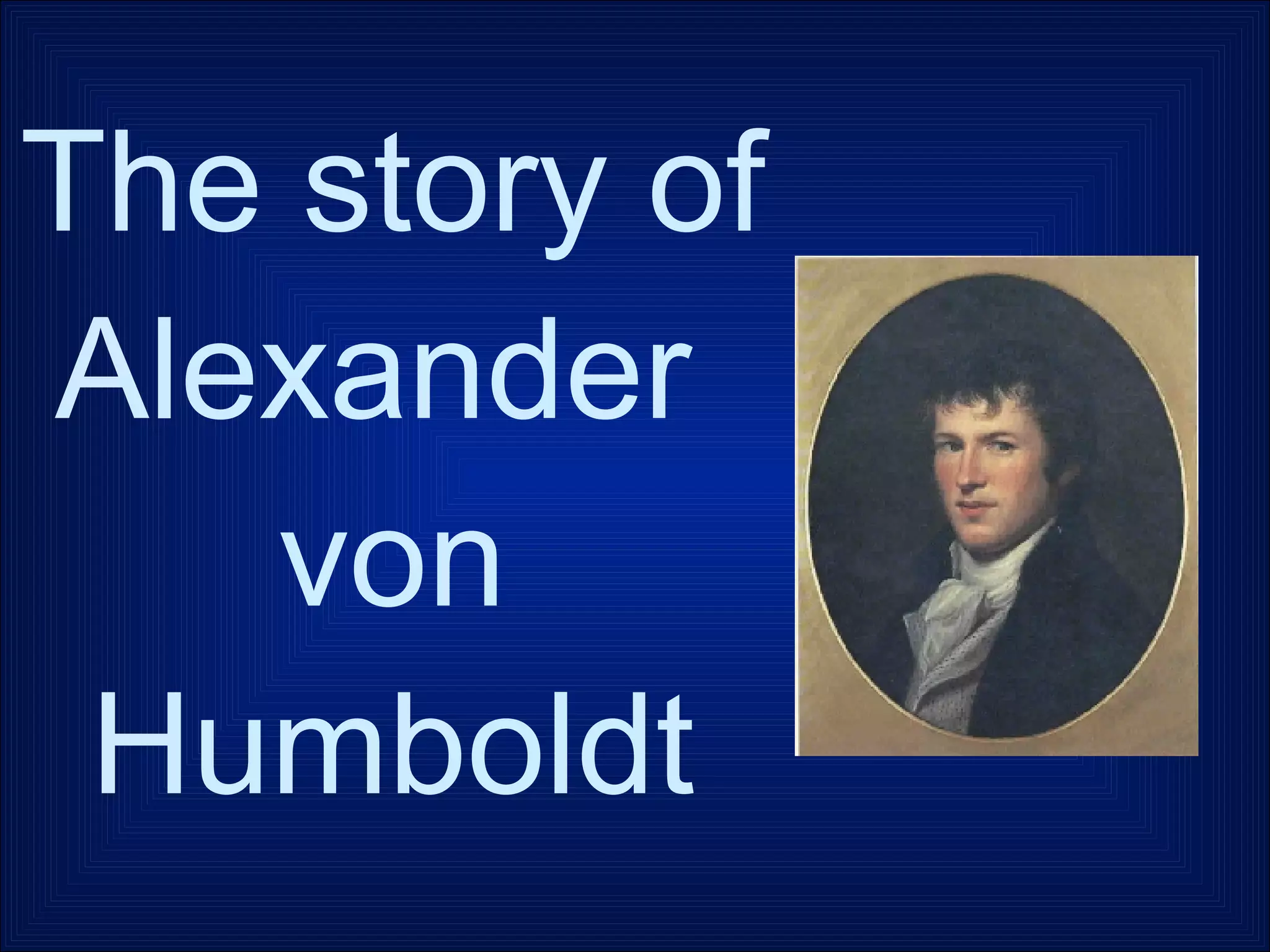
The story of Alexander  von Humboldt
The Beginning  The  Journey Climbing Later in life P.Y.P The route of Alexander von Humboldt Timeline Our little movie Contents
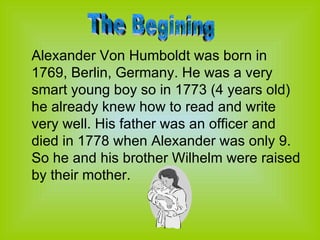
Alexander Von Humboldt was born in 1769, Berlin, Germany. He was a very smart young boy so in 1773 (4 years old) he already knew how to read and write very well. His father was an officer and died in 1778 when Alexander was only 9. So he and his brother Wilhelm were raised by their mother. The Begining
In 1792 (aged 22) he began a job as a government  mine inspector in Franconia, Prussia.  Humboldt’s Job
Humboldt set sail for South America on June 5 th , 1779, with the best scientific instruments of his time – sextants, compasses , telescopes and microscopes. He was a scientist , geologist, archaeologist, geographer, zoologist and explorer, intent on finding out about the unity of nature.   The Journey Begins
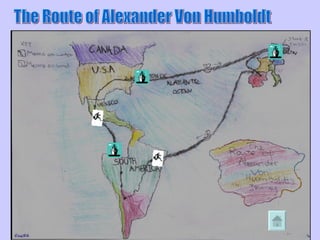
Humboldt  eventually visited the Canary Islands,  Venezuela, Brazil, Cuba, Columbia, Ecuador, Bolivia, Peru, Mexico and the Eastern United States.  He collected geological, zoological, botanical and ethnographical specimens, including 60,000 rare species of new tropical plants.
While he was there Humboldt discovered what we now call the Humboldt Current on the west coast of South America. He was investigating why the interior of Peru was so dry. The current is a cold ocean current that flows along most of the western coast of South America.  Humboldt was the first person to help preserve the Cinchona plant because it was over harvested at that time and it’s bark contains quinine which is used to cure Malaria. Humboldt was also the first person to make accurate maps of the Inca ruins in South America. The Journey Continues
Von Humboldt discovered and mapped the Casiquiare Canal, the only natural canal that connects two major rivers. He was also the first to discover the importance of guano, which is dried droppings of fish - eating birds, which is an excellent fertilizer. Von Humboldt studied electricity and is credited as  discovering the first animal that produced electricity, the electric eel.   W ater, Water, Everywhere
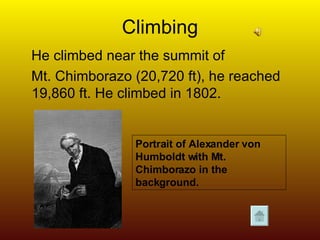
Climbing He climbed near the summit of  Mt. Chimborazo (20,720 ft), he reached 19,860 ft. He climbed in 1802. Portrait of Alexander von Humboldt with Mt. Chimborazo in the background.
Later in Life When Alexander Von Humboldt travelled to the Ural Mountains in Siberia and to Central Asia, he was at an old age of 60. He wrote books about his discoveries. One of his books, “A Personal Narrative”, inspired young Charles Darwin. His last masterpiece “Kosmos” tried to unify all  science. He died at an age of 90 leaving “Kosmos” unfinished.
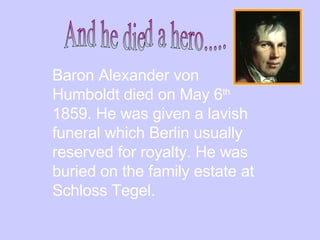
Baron Alexander von Humboldt died on May 6 th   1859. He was given a lavish funeral which Berlin usually reserved for royalty. He was buried on the family estate at Schloss Tegel.  And he died a hero.....
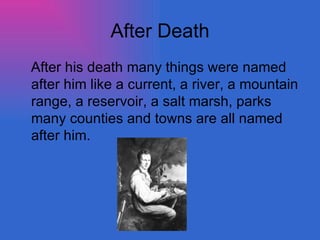
After Death After his death many things were named after him like a current, a river, a mountain range, a reservoir, a salt marsh, parks many counties and towns are all named after him.
PYP We think Alexander Von Humboldt was an  Inquirer  because he was a zoologist and he studies a lot of animals and plants. We think Alexander von Humboldt was a  Knowledgeable  person because he learned many things at a very young age. He also wrote 30 volumes of books in French when he was German.
PYP We think Alexander Von Humboldt was a very good  Communicator  because he was German and he knew how to read, write and speak French. I think Alexander Von Humboldt is a  Reflective  person Because he had to think back on what plants he found.
The Route of Alexander Von Humboldt
 
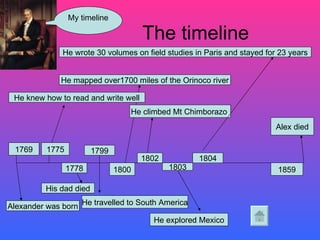
The timeline My timeline 1769 Alexander was born 1775 He knew how to read and write well 1778 His dad died 1799 He mapped over1700 miles of the Orinoco river 1800 He travelled to South America 1802 He climbed Mt Chimborazo  1803 He explored Mexico 1804 He wrote 30 volumes on field studies in Paris and stayed for 23 years Alex died 1859
What do you think?
THE END PLEASE APLAUD By Vanessa, Kirsten, Sophie, Mao and Sam
Made by Kirsten, Vanessa, Sam, Mao, Sophie Edited by Kirsten, Vanessa, Sam , Mao, Sophie Special thanks to Mr. Baron and Mr. Fennely Pictures from the internet Copyright service Credits

Humboldt

  • 1.
    The story ofAlexander von Humboldt
  • 2.
    The Beginning The Journey Climbing Later in life P.Y.P The route of Alexander von Humboldt Timeline Our little movie Contents
  • 3.
    Alexander Von Humboldtwas born in 1769, Berlin, Germany. He was a very smart young boy so in 1773 (4 years old) he already knew how to read and write very well. His father was an officer and died in 1778 when Alexander was only 9. So he and his brother Wilhelm were raised by their mother. The Begining
  • 4.
    In 1792 (aged22) he began a job as a government mine inspector in Franconia, Prussia. Humboldt’s Job
  • 5.
    Humboldt set sailfor South America on June 5 th , 1779, with the best scientific instruments of his time – sextants, compasses , telescopes and microscopes. He was a scientist , geologist, archaeologist, geographer, zoologist and explorer, intent on finding out about the unity of nature. The Journey Begins
  • 6.
    Humboldt eventuallyvisited the Canary Islands, Venezuela, Brazil, Cuba, Columbia, Ecuador, Bolivia, Peru, Mexico and the Eastern United States. He collected geological, zoological, botanical and ethnographical specimens, including 60,000 rare species of new tropical plants.
  • 7.
    While he wasthere Humboldt discovered what we now call the Humboldt Current on the west coast of South America. He was investigating why the interior of Peru was so dry. The current is a cold ocean current that flows along most of the western coast of South America. Humboldt was the first person to help preserve the Cinchona plant because it was over harvested at that time and it’s bark contains quinine which is used to cure Malaria. Humboldt was also the first person to make accurate maps of the Inca ruins in South America. The Journey Continues
  • 8.
    Von Humboldt discoveredand mapped the Casiquiare Canal, the only natural canal that connects two major rivers. He was also the first to discover the importance of guano, which is dried droppings of fish - eating birds, which is an excellent fertilizer. Von Humboldt studied electricity and is credited as discovering the first animal that produced electricity, the electric eel. W ater, Water, Everywhere
  • 9.
    Climbing He climbednear the summit of Mt. Chimborazo (20,720 ft), he reached 19,860 ft. He climbed in 1802. Portrait of Alexander von Humboldt with Mt. Chimborazo in the background.
  • 10.
    Later in LifeWhen Alexander Von Humboldt travelled to the Ural Mountains in Siberia and to Central Asia, he was at an old age of 60. He wrote books about his discoveries. One of his books, “A Personal Narrative”, inspired young Charles Darwin. His last masterpiece “Kosmos” tried to unify all science. He died at an age of 90 leaving “Kosmos” unfinished.
  • 11.
    Baron Alexander vonHumboldt died on May 6 th 1859. He was given a lavish funeral which Berlin usually reserved for royalty. He was buried on the family estate at Schloss Tegel. And he died a hero.....
  • 12.
    After Death Afterhis death many things were named after him like a current, a river, a mountain range, a reservoir, a salt marsh, parks many counties and towns are all named after him.
  • 13.
    PYP We thinkAlexander Von Humboldt was an Inquirer because he was a zoologist and he studies a lot of animals and plants. We think Alexander von Humboldt was a Knowledgeable person because he learned many things at a very young age. He also wrote 30 volumes of books in French when he was German.
  • 14.
    PYP We thinkAlexander Von Humboldt was a very good Communicator because he was German and he knew how to read, write and speak French. I think Alexander Von Humboldt is a Reflective person Because he had to think back on what plants he found.
  • 15.
    The Route ofAlexander Von Humboldt
  • 16.
  • 17.
    The timeline Mytimeline 1769 Alexander was born 1775 He knew how to read and write well 1778 His dad died 1799 He mapped over1700 miles of the Orinoco river 1800 He travelled to South America 1802 He climbed Mt Chimborazo 1803 He explored Mexico 1804 He wrote 30 volumes on field studies in Paris and stayed for 23 years Alex died 1859
  • 18.
  • 19.
    THE END PLEASEAPLAUD By Vanessa, Kirsten, Sophie, Mao and Sam
  • 20.
    Made by Kirsten,Vanessa, Sam, Mao, Sophie Edited by Kirsten, Vanessa, Sam , Mao, Sophie Special thanks to Mr. Baron and Mr. Fennely Pictures from the internet Copyright service Credits