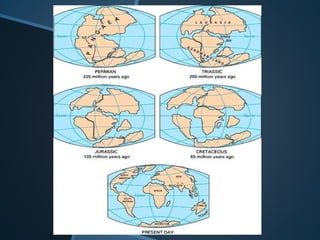
Proposed by Alfred
Wegener in 1912; the
hypothesis that state that
the continents once formed
a single landmass
(Pangea), broke up, and
drifted to their current
location
a) Shape of the continents
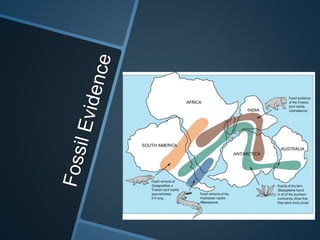
b) Fossil evidence on both
sides of the Atlantic
c) Rock formations on both
sides of the Atlantic
d) Climatic evidence (i.e.
evidence of glaciers in
Southern Africa)
He could not come up with
the mechanisms or process
that caused the continents
to move
a) Mid-Ocean Ridges – a
long undersea mountain
chain that has a steep,
narrow valley at its center,
that forms as magma rises
from the mantle, and that
creates new ocean floor as
the tectonic plates move
apart
b) Sea Floor Spreading –
the process by which new
oceanic crust forms as
magma rises to Earth’s
surface and solidifies at a
mid-ocean ridge, symmetry
of rock layers show oldest
layers are farther from the
ridge
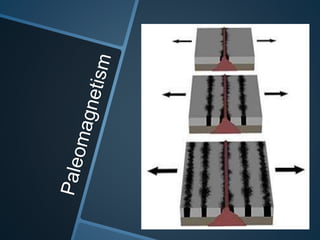
c) Paleomagnetism –
• As magma solidifies, iron
particles line up with the
Earth’s magnetic field
• Rocks show reversals in
the Earth’s Magnetism
• Rocks show symmetrical
patterns on both side of the
ridges, thus both plates
formed at the same time
The theory that explains
how large pieces of the
crust, called plates, move
and change shape
Lithosphere – solid, outer
layer of the Earth that
consists of the crust and the
rigid upper part of the
mantle
Asthenosphere – the solid,
plastic layer of the mantle
that flows slowly
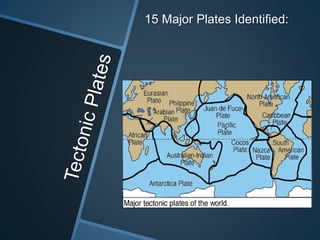
15 Major Plates Identified:
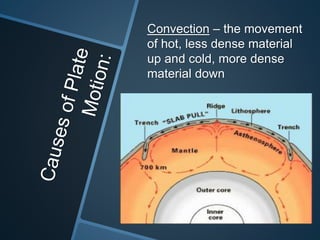
Convection – the movement
of hot, less dense material
up and cold, more dense
material down
• Interior of the Earth heats
the mantle which rises to
the surface at the Mid-
Ocean Ridges
• Cools into rock and
eventually sinks back
into the mantle where it
is melted and sinks
• This movement of the
mantle drags the plates
with it
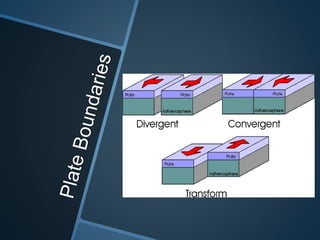
The boundary between
tectonic plates that are
moving away from each
other.
Results in: magma rises to
surface, forms mid-ocean
ridges and rift valleys
The boundary between
tectonic plates that are
moving towards each other
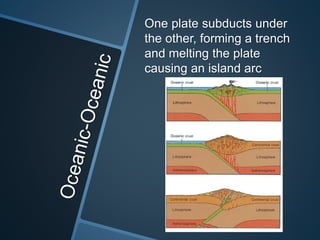
One plate subducts under
the other, forming a trench
and melting the plate
causing an island arc
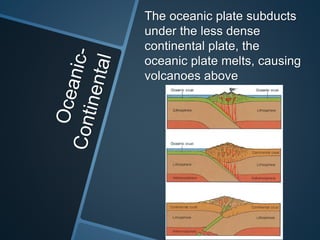
The oceanic plate subducts
under the less dense
continental plate, the
oceanic plate melts, causing
volcanoes above
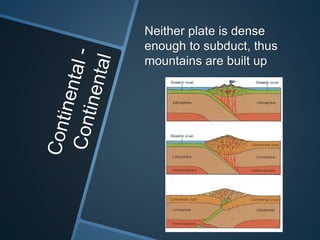
Neither plate is dense
enough to subduct, thus
mountains are built up
The boundary between two
tectonic plates that are
sliding past one another,
like the San Andreas fault

18. Plate Boundary Notes

  • 2.
    Proposed by Alfred Wegenerin 1912; the hypothesis that state that the continents once formed a single landmass (Pangea), broke up, and drifted to their current location
  • 4.
    a) Shape ofthe continents b) Fossil evidence on both sides of the Atlantic c) Rock formations on both sides of the Atlantic d) Climatic evidence (i.e. evidence of glaciers in Southern Africa)
  • 6.
    He could notcome up with the mechanisms or process that caused the continents to move
  • 7.
    a) Mid-Ocean Ridges– a long undersea mountain chain that has a steep, narrow valley at its center, that forms as magma rises from the mantle, and that creates new ocean floor as the tectonic plates move apart
  • 8.
    b) Sea FloorSpreading – the process by which new oceanic crust forms as magma rises to Earth’s surface and solidifies at a mid-ocean ridge, symmetry of rock layers show oldest layers are farther from the ridge
  • 9.
    c) Paleomagnetism – •As magma solidifies, iron particles line up with the Earth’s magnetic field • Rocks show reversals in the Earth’s Magnetism • Rocks show symmetrical patterns on both side of the ridges, thus both plates formed at the same time
  • 11.
    The theory thatexplains how large pieces of the crust, called plates, move and change shape
  • 12.
    Lithosphere – solid,outer layer of the Earth that consists of the crust and the rigid upper part of the mantle Asthenosphere – the solid, plastic layer of the mantle that flows slowly
  • 13.
    15 Major PlatesIdentified:
  • 14.
    Convection – themovement of hot, less dense material up and cold, more dense material down
  • 15.
    • Interior ofthe Earth heats the mantle which rises to the surface at the Mid- Ocean Ridges • Cools into rock and eventually sinks back into the mantle where it is melted and sinks • This movement of the mantle drags the plates with it
  • 17.
    The boundary between tectonicplates that are moving away from each other. Results in: magma rises to surface, forms mid-ocean ridges and rift valleys
  • 18.
    The boundary between tectonicplates that are moving towards each other
  • 19.
    One plate subductsunder the other, forming a trench and melting the plate causing an island arc
  • 20.
    The oceanic platesubducts under the less dense continental plate, the oceanic plate melts, causing volcanoes above
  • 21.
    Neither plate isdense enough to subduct, thus mountains are built up
  • 22.
    The boundary betweentwo tectonic plates that are sliding past one another, like the San Andreas fault