EVOLUTION
EVOLUTION:
 Any change in the genes of a population over
time
ORIGIN OF LIFE:
 Big Bang Theory:
explosion of a mass of
matter to create the
universe
 4.6 billion years ago
ORIGIN OF LIFE THEORIES
Abiogenic Molecular Evolution:
a) Organic molecules gradually assembled from
inorganic elements
b) Hildane – “Hot Dilute Soup”, combination of
Earth’s primitive atmosphere (H20, CO2,
Ammonia) and UV radiation created organic
molecules
c) Oparin – energy from the sun, lightning, and
volcanic heat formed organic molecules
EVOLUTIONARY THEORY BASICS:
1) Gradualism: slow change over time
2) First cell was probably a “protocell”
1) Membrane bound cell that reproduced
2) Heterotrophic
3) Prokaryotic
4) Originated probably four billion years ago
3) Life may have originated more than once
EVOLUTION OF EVOLUTIONARY THEORY:
1) Georges Cuvier:
Catastrophism: Only one time of creation that
populated the entire world, global catastrophe
wiped out most of them.
2) Jean Baptiste de Lamarck:
Theory of Inherited Characteristics:
environmental pressures and “internal desires”
bring about physical changes that would be
passed on to offspring
EVOLUTION OF EVOLUTIONARY THEORY:
3) Charles Lyell:
Theory of Uniformity: The same geological
processes that are occurring now, happened
in the past as well
*An issue for scientists as most people thought
the world was only six thousand years old
as noted in the Bible.
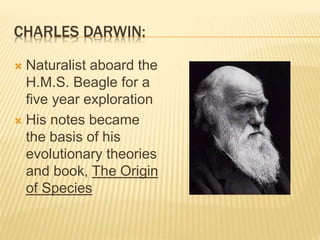
CHARLES DARWIN:
 Naturalist aboard the
H.M.S. Beagle for a
five year exploration
 His notes became
the basis of his
evolutionary theories
and book, The Origin
of Species
BEGINNING COMPONENTS OF NATURAL SELECTION:
 Used his notes on Finches, especially in
regards to their beak and diet to create his
framework
THEORY OF NATURAL SELECTION:
a) More offspring are produced than can survive
b) All members must compete for resources
c) All organisms show individual variations mostly
due to heredity
d) Some variations are better adapted to survive
e) These organisms that are more likely to survive
therefore reproduce, therefore increase
frequency of better adaptations
f) Change over long enough time results in new
species
POPULATIONS:
 Individuals do not evolve, populations over
time do
 A group of individuals of the same species
who occupy the same area
 Gene Pool: all the genes present in a
population, population shows variation
SOURCES OF VARIATION:
1. Gene mutation (produces new alleles)
2. Crossing over at meiosis (leads to new
combinations of alleles in chromosomes)
3. Independent assortment at meiosis (Anaphase
I & II, leads to mixes of maternal and fraternal
chromosomes in gametes)
4. Fertilization (puts together combinations of
alleles from two parents)
5. Changes in chromosome number or structure
(lead to loss, duplication, or alteration of
alleles)
MICROEVOLUTION:
 Changes of gene frequencies within a
population
 Caused by: mutation, genetic drift, gene flow,
and natural selection
MUTATION:
 Heritable change in DNA that can alter gene
expression
 Can be neutral, harmful, beneficial, or lethal
 Original sources of alleles and thus variation
GENETIC DRIFT:
 Random change in gene frequencies over
the generations as brought about random
events only
GENE FLOW:
 Allele/gene frequencies change as
individuals leave a population or new
individuals enter a population
 Physical movement of genes
PEPPERED MOTHS:
DEVELOPMENT OF NEW SPECIES:
 Species: A group of organisms that breed
and produce offspring that can reproduce
 Speciation: The development of a new
species from an existing species
SPECIATION:
 Reproductive Isolation:
groups of the same
species can not contact
each other and adapt to
separate environments,
and thus develop into
different species
SPECIATION:
 Adaptive Radiation: One common ancestor
develops into different species based on
competition, location, food supply, etc.
 Ex: Darwins finches
MACROEVOLUTION:
 Large evolutionary changes in which new
species emerge
 Punctuated Equilibrium: new species
suddenly emerge
 Gradualism: Gradual, slow change over
time with intermediate organisms found.
EVIDENCE FOR EVOLUTION:
1. Fossil Record:
a) Sequence of fossils
b) Rocks formed in layers with older ones on
bottom
c) Fossils in older layers are older and simpler
COMPARATIVE ANATOMY:
 Comparing anatomical structures of current
organisms with each other and past
organisms
 Vestigial Organs: have no current function;
appendix, wisdom teeth, penguin wings, little
toe
 Homologous Structures: Same structure in
two organisms but different functions
EMBRYONIC DEVELOPMENT:
 Similarities in the developmental stages of
embryos amongst different organisms

Evolution Notes

  • 1.
  • 2.
    EVOLUTION:  Any changein the genes of a population over time
  • 3.
    ORIGIN OF LIFE: Big Bang Theory: explosion of a mass of matter to create the universe  4.6 billion years ago
  • 4.
    ORIGIN OF LIFETHEORIES Abiogenic Molecular Evolution: a) Organic molecules gradually assembled from inorganic elements b) Hildane – “Hot Dilute Soup”, combination of Earth’s primitive atmosphere (H20, CO2, Ammonia) and UV radiation created organic molecules c) Oparin – energy from the sun, lightning, and volcanic heat formed organic molecules
  • 5.
    EVOLUTIONARY THEORY BASICS: 1)Gradualism: slow change over time 2) First cell was probably a “protocell” 1) Membrane bound cell that reproduced 2) Heterotrophic 3) Prokaryotic 4) Originated probably four billion years ago 3) Life may have originated more than once
  • 6.
    EVOLUTION OF EVOLUTIONARYTHEORY: 1) Georges Cuvier: Catastrophism: Only one time of creation that populated the entire world, global catastrophe wiped out most of them. 2) Jean Baptiste de Lamarck: Theory of Inherited Characteristics: environmental pressures and “internal desires” bring about physical changes that would be passed on to offspring
  • 7.
    EVOLUTION OF EVOLUTIONARYTHEORY: 3) Charles Lyell: Theory of Uniformity: The same geological processes that are occurring now, happened in the past as well *An issue for scientists as most people thought the world was only six thousand years old as noted in the Bible.
  • 8.
    CHARLES DARWIN:  Naturalistaboard the H.M.S. Beagle for a five year exploration  His notes became the basis of his evolutionary theories and book, The Origin of Species
  • 10.
    BEGINNING COMPONENTS OFNATURAL SELECTION:  Used his notes on Finches, especially in regards to their beak and diet to create his framework
  • 11.
    THEORY OF NATURALSELECTION: a) More offspring are produced than can survive b) All members must compete for resources c) All organisms show individual variations mostly due to heredity d) Some variations are better adapted to survive e) These organisms that are more likely to survive therefore reproduce, therefore increase frequency of better adaptations f) Change over long enough time results in new species
  • 12.
    POPULATIONS:  Individuals donot evolve, populations over time do  A group of individuals of the same species who occupy the same area  Gene Pool: all the genes present in a population, population shows variation
  • 13.
    SOURCES OF VARIATION: 1.Gene mutation (produces new alleles) 2. Crossing over at meiosis (leads to new combinations of alleles in chromosomes) 3. Independent assortment at meiosis (Anaphase I & II, leads to mixes of maternal and fraternal chromosomes in gametes) 4. Fertilization (puts together combinations of alleles from two parents) 5. Changes in chromosome number or structure (lead to loss, duplication, or alteration of alleles)
  • 14.
    MICROEVOLUTION:  Changes ofgene frequencies within a population  Caused by: mutation, genetic drift, gene flow, and natural selection
  • 15.
    MUTATION:  Heritable changein DNA that can alter gene expression  Can be neutral, harmful, beneficial, or lethal  Original sources of alleles and thus variation
  • 16.
    GENETIC DRIFT:  Randomchange in gene frequencies over the generations as brought about random events only
  • 17.
    GENE FLOW:  Allele/genefrequencies change as individuals leave a population or new individuals enter a population  Physical movement of genes
  • 18.
  • 19.
    DEVELOPMENT OF NEWSPECIES:  Species: A group of organisms that breed and produce offspring that can reproduce  Speciation: The development of a new species from an existing species
  • 20.
    SPECIATION:  Reproductive Isolation: groupsof the same species can not contact each other and adapt to separate environments, and thus develop into different species
  • 21.
    SPECIATION:  Adaptive Radiation:One common ancestor develops into different species based on competition, location, food supply, etc.  Ex: Darwins finches
  • 22.
    MACROEVOLUTION:  Large evolutionarychanges in which new species emerge  Punctuated Equilibrium: new species suddenly emerge  Gradualism: Gradual, slow change over time with intermediate organisms found.
  • 25.
    EVIDENCE FOR EVOLUTION: 1.Fossil Record: a) Sequence of fossils b) Rocks formed in layers with older ones on bottom c) Fossils in older layers are older and simpler
  • 27.
    COMPARATIVE ANATOMY:  Comparinganatomical structures of current organisms with each other and past organisms  Vestigial Organs: have no current function; appendix, wisdom teeth, penguin wings, little toe  Homologous Structures: Same structure in two organisms but different functions
  • 30.
    EMBRYONIC DEVELOPMENT:  Similaritiesin the developmental stages of embryos amongst different organisms