Coastal Upwelling Features
OUTLINE
 Introduction
 What is Upwelling
 Types of Upwelling
 What is the need to study the upwelling
 Which kind of models are appropriate for this study
 Upwelling Features from ROMS-Model
Introduction
(Ekman,1905) deduced the fundamental dynamics of wind
forced upwelling from looking at the deflection in the drift of
icebergs.
A balance between wind frictional forcing at the sea surface
and Coriolis forcing due to Earth’s rotation explained the
observed current deflection.
Ocean upwelling is the ascending motion of deep cold and
nutrient enriched water from subsurface layers resulting
from horizontal divergence caused by Ekman offshore
transport due to alongshore wind stress at the surface layers
and convergence below. (Smith, 1968)
Mechanisms that create ocean upwelling
 Wind
 Coriolis Effect
 Ekman Transport
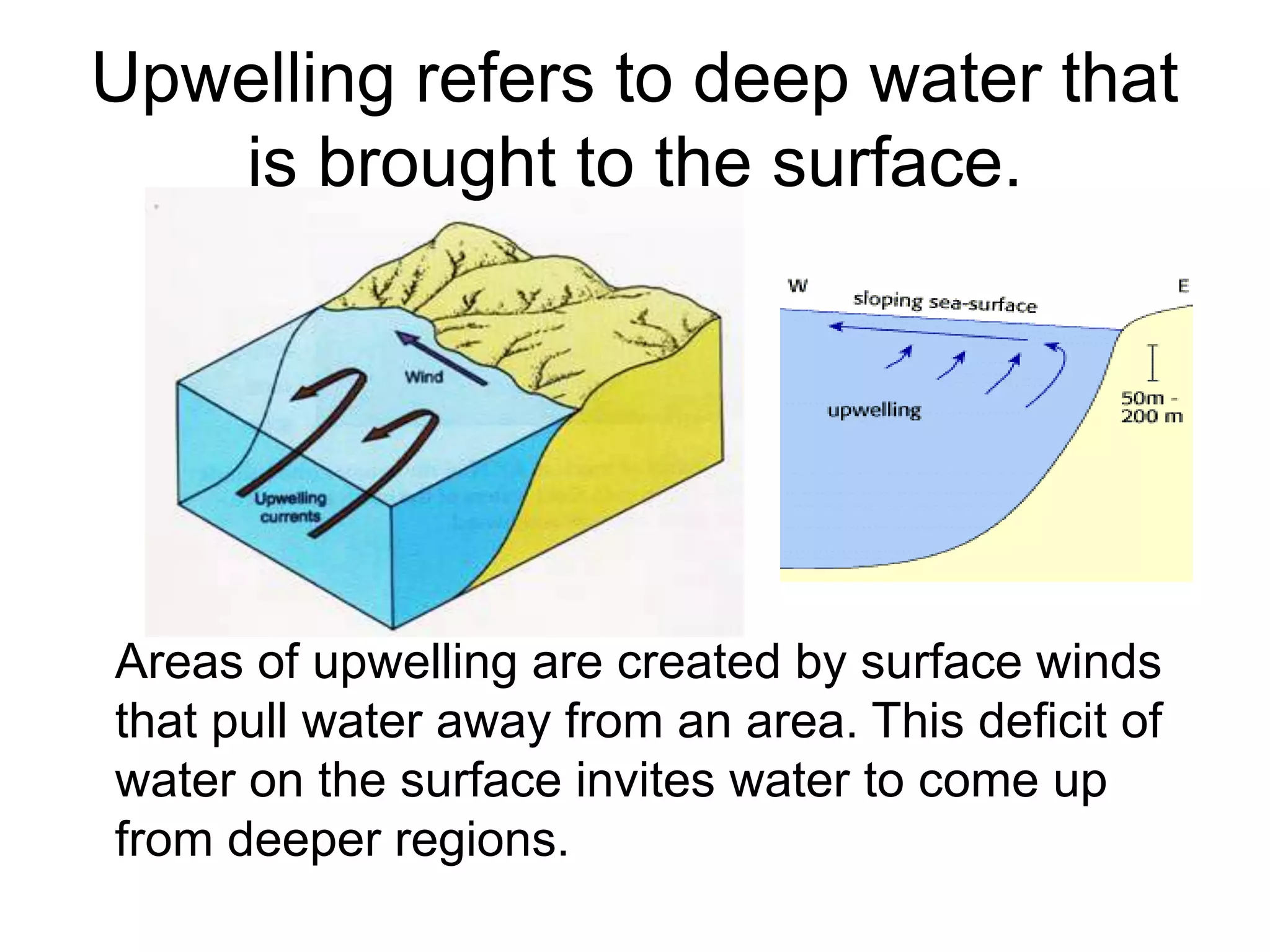
Upwelling refers to deep water that
is brought to the surface.
Areas of upwelling are created by surface winds
that pull water away from an area. This deficit of
water on the surface invites water to come up
from deeper regions.
To understand upwelling, you must be familiar with how the
Coriolis Force affects ocean surface currents.
The Coriolis Effect acts on moving water also. As water flows
over the rotating earth, it appears to deflect to the right in the
Northern Hemisphere and the left in the Southern.
Due to friction between the layers of water in the ocean and the
Coriolis Effect, the net result of wind blowing across the surface of
the water is transportation of a layer of water 90 degrees to the
direction of the wind. This is known as Ekman Transport.
Equatorial Upwelling Coastal Upwelling
Ekman Transport
Definition – term given for the 90 degree
net transport of the surface layer due to
wind forces and Coriolis Effect.
First investigated in 1902 by
Vaqn Walfrid
Ekman
. Ekman motion theory
 In the northern hemisphere this
transport is at a 90 degree angle to the
right of the direction of the wind.
 In the southern hemisphere it occurs
at a 90 degree angle to the left of the
direction of the wind.
Ekman Spiral – Model
plotting the water layers at various
directions, speed and depth
Ekman Spiral Model
Definition – upward movement of the deeper, cooler
waters toward the surface pushing surface waters away
from the shore due to the Ekman Transport.
Description
Coriolis Effect moves water at right angles slightly right
of the direction the wind is blowing resulting in surface
currents pushing the surface waters offshore.
When surface waters are pushed offshore, water from
below is drawn upward to replace them.
Upwelling
Caused by Waters Diverging away from a region.
Effects:-
Brings nutrient –rich waters to the surface
encouraging seaweed and phytoplankton growth.
Moves drifting larvae long distances from their
natural habitat affecting population stability.
Downwelling
Definition – Surface waters move toward the shore due
to Ekman Transport and sink to the bottom.
Remember: water is a fluid in constant motion; a
change in the distribution of water in one area is
accompanied by a compensating change in another
area.
Caused by a Waters Converging toward a region.
Upwelling and Downwelling
Diagram
Ekman spiral
Ekman spiral
describes the speed
and direction of flow
of surface waters at
various depths
Factors:
Wind
Coriolis effect
Ekman transport
Ekman transport
is the overall water
movement due to
Ekman spiral
Ideal transport is 90º
from the wind
Transport direction
depends on the
hemisphere
Upwelling and downwelling
Vertical movement of water ( )
Upwelling = movement of deep water to surface
Hoists cold, nutrient-rich water to surface
Produces high productivities and abundant marine life
Downwelling = movement of surface water down
Moves warm, nutrient-depleted surface water down
Not associated with high productivities or abundant marine life
Coastal upwelling and downwelling
Ekman transport moves surface water away from
shore, producing upwelling
Ekman transport moves surface water towards
shore, producing downwelling
Coastal Upwelling
• Equatorward winds along a coastline lead to
offshore Ekman transport
• Mass conservation requires these waters
replaced by cold, denser waters
• Brings nutrients into surface waters creating
bloom
Coastal Upwelling
Review
• Wind stress along coasts leads to
divergence of surface Ekman transport
• This drives to coastal upwelling and forms
a coastal jet
• This drives the productivity of eastern
boundary currents
• Important for acidification of the coastal
ocean
Upwelling Systems can be classified into 2 major categories:-
1. Wind Driven
results from divergence in surface Ekman layer of the Ocean.
2. Dynamical
results from the divergence in the upper Ocean (or) convergence
in deeper water column caused by large scale current systems.
Wind Driven Upwelling
Coastal Upwelling
Equatorial Upwelling
Seasonal & Open
Ocean Upwelling
1. Equatorial Upwelling
Upwelling
Look at the equator in the Pacific
Ocean.
2. Coastal Upwelling
(follow the black arrows)
What’s the difference between
Peru(A) and Colombia (B)?
B
A
3. Seasonal upwelling
Onshore winds pile
water up on shore,
thus surface water will
be forced downward.
This is ‘downwelling’.
Offshore winds take
water away from
shore, thus water
from depth will
upwell to the surface.
Wind Wind
The Monsoonal wind shifts in Oman
create very different conditions.
August, 1999
Offshore winds: Upwelling
April, 1999
Onshore winds: Downwelling
CAUSE – Nutrients are brought up to
surface
EFFECTS:
• Phytoplankton & zooplankton thrive
• More food for fish and larger organisms
• Strong food webs and food chains
Effects of Upwelling
Reasons to study Upwelling
 Upwelled water is cooler and saltier than the original surface
water, and typically has much greater concentrations of nutrients.
. These nutrients support the base of the food chain
phytoplankton
The increased availability in upwelling regions results in high
levels of primary productivity and thus fishery production.
Approximately 25% of the total global marine fish catches come
from five upwellings that occupy only 5% of the total ocean area
 Marine ecosystems in the ocean's eastern boundary currents
generally have large fish stocks such as sardines and anchovies,
and major populations of marine mammals and
Upwelled water also contains nutrients
(nitrate, phosphate, silicate) and dissolved
gases (oxygen and carbon dioxide) that
are not utilized at depth because of a lack
of sunlight.
Now on the surface, these nutrients and
gases help to fuel photosynthesis by small
algae called phytoplankton.
Phytoplankton photosynthesize using specialized
color pigments called chlorophyll. Thus, “Ocean
Color” maps are another way to identify areas of
upwelling. Where on this ocean color map are
high phytoplankton concentrations?
Ecological and Economic effects of
upwelling:
• Upwelling leads to more phytoplankton
• More phytoplankton leads to more fish
• More fish lead to commercial fishing jobs and
to more seafood
Phytoplankton come in many shapes
and forms. Collectively they form the
base of oceanic food webs.
Without upwelling many of the
world’s fisheries would not thrive.
Productivity (phytoplankton growth)
of an area is determined by the rate
and the duration of upwelling.
• Rate of upwelling
determines
phytoplankton cell size.
• Duration of upwelling
determines the total
amount of
phytoplankton.
few vs. manysmall vs. large
Classification of upwelling systems in terms of
rate and duration:
After Thurman, H.V. (1994)
Low Medium High
RATE
LongShort
•Moderate rates of upwelling for long
duration (8 months or longer) provide the
ultimate combination for a large fishery.
•With too low or too high a rate,
phytoplankton are small, so there is a
trophic level between the algae and the
fish….therefore the fish receive less
energy.
Upwelling and Fisheries
Using this series of Sea Surface Temperature Maps from 1999, can
you determine areas/times for possible fisheries?
(Hint: Look at Peru’s coast in January and April. Look at the northwestern tip of Africa in
July and October.)
January April
July October
NB p. 19 Upwelling in the World Ocean
Upwelling- the movement of cold,
nutrient-rich water from the deep ocean to
the surface
Upwelling refers to deep water that
is brought to the surface.
Areas of upwelling are created by surface winds
that pull water away from an area. This lack of
water on the surface invites water to come up
from deeper regions.
Identifying upwelling on
satellite-derived maps
• Sea Surface Temperature
• Ocean Color
Phytoplankton photosynthesize using specialized
color pigments called chlorophyll. Thus, “Ocean
Color” maps are another way to identify areas of
upwelling. Where on this ocean color map are
high phytoplankton concentrations?
Ecological and Economic effects of
upwelling:
• Upwelling leads to more phytoplankton
• More phytoplankton leads to more fish
• More fish lead to commercial fishing jobs and
to more seafood
Phytoplankton come in many shapes
and forms. Collectively they form the
base of oceanic food webs.
Without upwelling many of the
world’s fisheries would not thrive.
Even though upwelling areas account for only
1% of the ocean surface, they support 50% of
the world’s fisheries.
Upwelling and Fisheries
Using this series of Sea Surface Temperature Maps from 1999, can
you determine areas/times for possible fisheries?
(Hint: Look at Peru’s coast in January and April. Look at the northwestern tip of Africa in
July and October.)
January April
July October
Ekman Spiral
Surface water moves 45 to the right of prevailing
wind. Subsurface water moves at angles greater than
45. Net transport of surface layer is 90 to the right.
Coriolis force is responsible for the rightward
rotation.
Upwelling from Alongshore Winds
Ahrens Fig
7.25
Wind pushes surface water southward. Coriolis force deflects water to
the right. Cold water from below rises to surface. Fog persists over the
cold water.
Upwelled water also contains nutrients
(nitrate, phosphate, silicate) and dissolved
gases (oxygen and carbon dioxide) that are
not utilized at depth because of a lack of
sunlight.
Now on the surface, these nutrients and
gases help to fuel photosynthesis by small
algae called phytoplankton.
Ecological and Economic effects
of upwelling:
 Upwelling leads to more phytoplankton
 More phytoplankton leads to more fish
 More fish lead to commercial fishing jobs and
to more seafood

Pertemuan 05 upwelling

  • 1.
  • 2.
    OUTLINE  Introduction  Whatis Upwelling  Types of Upwelling  What is the need to study the upwelling  Which kind of models are appropriate for this study  Upwelling Features from ROMS-Model
  • 3.
    Introduction (Ekman,1905) deduced thefundamental dynamics of wind forced upwelling from looking at the deflection in the drift of icebergs. A balance between wind frictional forcing at the sea surface and Coriolis forcing due to Earth’s rotation explained the observed current deflection. Ocean upwelling is the ascending motion of deep cold and nutrient enriched water from subsurface layers resulting from horizontal divergence caused by Ekman offshore transport due to alongshore wind stress at the surface layers and convergence below. (Smith, 1968)
  • 4.
    Mechanisms that createocean upwelling  Wind  Coriolis Effect  Ekman Transport
  • 5.
    Upwelling refers todeep water that is brought to the surface. Areas of upwelling are created by surface winds that pull water away from an area. This deficit of water on the surface invites water to come up from deeper regions.
  • 6.
    To understand upwelling,you must be familiar with how the Coriolis Force affects ocean surface currents. The Coriolis Effect acts on moving water also. As water flows over the rotating earth, it appears to deflect to the right in the Northern Hemisphere and the left in the Southern.
  • 7.
    Due to frictionbetween the layers of water in the ocean and the Coriolis Effect, the net result of wind blowing across the surface of the water is transportation of a layer of water 90 degrees to the direction of the wind. This is known as Ekman Transport.
  • 9.
  • 10.
    Ekman Transport Definition –term given for the 90 degree net transport of the surface layer due to wind forces and Coriolis Effect. First investigated in 1902 by Vaqn Walfrid Ekman
  • 11.
    . Ekman motiontheory  In the northern hemisphere this transport is at a 90 degree angle to the right of the direction of the wind.  In the southern hemisphere it occurs at a 90 degree angle to the left of the direction of the wind. Ekman Spiral – Model plotting the water layers at various directions, speed and depth
  • 12.
  • 13.
    Definition – upwardmovement of the deeper, cooler waters toward the surface pushing surface waters away from the shore due to the Ekman Transport. Description Coriolis Effect moves water at right angles slightly right of the direction the wind is blowing resulting in surface currents pushing the surface waters offshore. When surface waters are pushed offshore, water from below is drawn upward to replace them. Upwelling
  • 14.
    Caused by WatersDiverging away from a region. Effects:- Brings nutrient –rich waters to the surface encouraging seaweed and phytoplankton growth. Moves drifting larvae long distances from their natural habitat affecting population stability.
  • 15.
    Downwelling Definition – Surfacewaters move toward the shore due to Ekman Transport and sink to the bottom. Remember: water is a fluid in constant motion; a change in the distribution of water in one area is accompanied by a compensating change in another area. Caused by a Waters Converging toward a region.
  • 16.
  • 17.
    Ekman spiral Ekman spiral describesthe speed and direction of flow of surface waters at various depths Factors: Wind Coriolis effect
  • 18.
    Ekman transport Ekman transport isthe overall water movement due to Ekman spiral Ideal transport is 90º from the wind Transport direction depends on the hemisphere
  • 19.
    Upwelling and downwelling Verticalmovement of water ( ) Upwelling = movement of deep water to surface Hoists cold, nutrient-rich water to surface Produces high productivities and abundant marine life Downwelling = movement of surface water down Moves warm, nutrient-depleted surface water down Not associated with high productivities or abundant marine life
  • 20.
    Coastal upwelling anddownwelling Ekman transport moves surface water away from shore, producing upwelling Ekman transport moves surface water towards shore, producing downwelling
  • 21.
    Coastal Upwelling • Equatorwardwinds along a coastline lead to offshore Ekman transport • Mass conservation requires these waters replaced by cold, denser waters • Brings nutrients into surface waters creating bloom
  • 22.
  • 23.
    Review • Wind stressalong coasts leads to divergence of surface Ekman transport • This drives to coastal upwelling and forms a coastal jet • This drives the productivity of eastern boundary currents • Important for acidification of the coastal ocean
  • 24.
    Upwelling Systems canbe classified into 2 major categories:- 1. Wind Driven results from divergence in surface Ekman layer of the Ocean. 2. Dynamical results from the divergence in the upper Ocean (or) convergence in deeper water column caused by large scale current systems. Wind Driven Upwelling Coastal Upwelling Equatorial Upwelling Seasonal & Open Ocean Upwelling
  • 25.
  • 26.
    Look at theequator in the Pacific Ocean.
  • 27.
  • 28.
    What’s the differencebetween Peru(A) and Colombia (B)? B A
  • 29.
    3. Seasonal upwelling Onshorewinds pile water up on shore, thus surface water will be forced downward. This is ‘downwelling’. Offshore winds take water away from shore, thus water from depth will upwell to the surface. Wind Wind
  • 30.
    The Monsoonal windshifts in Oman create very different conditions. August, 1999 Offshore winds: Upwelling April, 1999 Onshore winds: Downwelling
  • 35.
    CAUSE – Nutrientsare brought up to surface EFFECTS: • Phytoplankton & zooplankton thrive • More food for fish and larger organisms • Strong food webs and food chains Effects of Upwelling
  • 36.
    Reasons to studyUpwelling  Upwelled water is cooler and saltier than the original surface water, and typically has much greater concentrations of nutrients. . These nutrients support the base of the food chain phytoplankton The increased availability in upwelling regions results in high levels of primary productivity and thus fishery production. Approximately 25% of the total global marine fish catches come from five upwellings that occupy only 5% of the total ocean area  Marine ecosystems in the ocean's eastern boundary currents generally have large fish stocks such as sardines and anchovies, and major populations of marine mammals and
  • 37.
    Upwelled water alsocontains nutrients (nitrate, phosphate, silicate) and dissolved gases (oxygen and carbon dioxide) that are not utilized at depth because of a lack of sunlight. Now on the surface, these nutrients and gases help to fuel photosynthesis by small algae called phytoplankton.
  • 38.
    Phytoplankton photosynthesize usingspecialized color pigments called chlorophyll. Thus, “Ocean Color” maps are another way to identify areas of upwelling. Where on this ocean color map are high phytoplankton concentrations?
  • 39.
    Ecological and Economiceffects of upwelling: • Upwelling leads to more phytoplankton • More phytoplankton leads to more fish • More fish lead to commercial fishing jobs and to more seafood
  • 40.
    Phytoplankton come inmany shapes and forms. Collectively they form the base of oceanic food webs. Without upwelling many of the world’s fisheries would not thrive.
  • 41.
    Productivity (phytoplankton growth) ofan area is determined by the rate and the duration of upwelling. • Rate of upwelling determines phytoplankton cell size. • Duration of upwelling determines the total amount of phytoplankton. few vs. manysmall vs. large
  • 42.
    Classification of upwellingsystems in terms of rate and duration: After Thurman, H.V. (1994) Low Medium High RATE LongShort
  • 43.
    •Moderate rates ofupwelling for long duration (8 months or longer) provide the ultimate combination for a large fishery. •With too low or too high a rate, phytoplankton are small, so there is a trophic level between the algae and the fish….therefore the fish receive less energy.
  • 44.
    Upwelling and Fisheries Usingthis series of Sea Surface Temperature Maps from 1999, can you determine areas/times for possible fisheries? (Hint: Look at Peru’s coast in January and April. Look at the northwestern tip of Africa in July and October.) January April July October
  • 45.
    NB p. 19Upwelling in the World Ocean
  • 46.
    Upwelling- the movementof cold, nutrient-rich water from the deep ocean to the surface
  • 47.
    Upwelling refers todeep water that is brought to the surface. Areas of upwelling are created by surface winds that pull water away from an area. This lack of water on the surface invites water to come up from deeper regions.
  • 48.
    Identifying upwelling on satellite-derivedmaps • Sea Surface Temperature • Ocean Color
  • 49.
    Phytoplankton photosynthesize usingspecialized color pigments called chlorophyll. Thus, “Ocean Color” maps are another way to identify areas of upwelling. Where on this ocean color map are high phytoplankton concentrations?
  • 50.
    Ecological and Economiceffects of upwelling: • Upwelling leads to more phytoplankton • More phytoplankton leads to more fish • More fish lead to commercial fishing jobs and to more seafood
  • 51.
    Phytoplankton come inmany shapes and forms. Collectively they form the base of oceanic food webs. Without upwelling many of the world’s fisheries would not thrive.
  • 52.
    Even though upwellingareas account for only 1% of the ocean surface, they support 50% of the world’s fisheries.
  • 53.
    Upwelling and Fisheries Usingthis series of Sea Surface Temperature Maps from 1999, can you determine areas/times for possible fisheries? (Hint: Look at Peru’s coast in January and April. Look at the northwestern tip of Africa in July and October.) January April July October
  • 54.
    Ekman Spiral Surface watermoves 45 to the right of prevailing wind. Subsurface water moves at angles greater than 45. Net transport of surface layer is 90 to the right. Coriolis force is responsible for the rightward rotation.
  • 55.
    Upwelling from AlongshoreWinds Ahrens Fig 7.25 Wind pushes surface water southward. Coriolis force deflects water to the right. Cold water from below rises to surface. Fog persists over the cold water.
  • 57.
    Upwelled water alsocontains nutrients (nitrate, phosphate, silicate) and dissolved gases (oxygen and carbon dioxide) that are not utilized at depth because of a lack of sunlight. Now on the surface, these nutrients and gases help to fuel photosynthesis by small algae called phytoplankton.
  • 58.
    Ecological and Economiceffects of upwelling:  Upwelling leads to more phytoplankton  More phytoplankton leads to more fish  More fish lead to commercial fishing jobs and to more seafood