Presented by:
Ashish Soni
ashish.soni.2016@ieee.org
Orthogonal Frequency Division
Multiplexing
(OFDM)
Content
 Motivation
 Introduction
 Origin
 Principle
 Features
 Applications
 Problems & ResearchArea
 Conclusion
 References
Motivation
 The demand for multimedia wireless communication is
growing today at an extremely rapid pace.
 Multiplexing Schemes: FDM,TDM & CDM [1].
 Evolution of Mobile Communication [2].
Generation Standard Data Rate Features
2G GSM 10 kbps DigitalVoice,
SimpleText,
Simple News,
Feeds etc.
2G CDMA 10 kbps
2.5G GPRS 50 kbps
2.5G EDGE 200 kbps
3G WCDMA ~400 kbps DigitalVoice,
Mobile Broadband3.5G HSDPA/HSUPA 4-50 Mbps
4G LTE/WiMAX 100-200 Mbps Live HDTV,
Online Gaming,
High Speed.
4G LTE > 1 Gbps
Introduction
 OFDM is promising technique for achieving high data rate
transmission in mobile environment [3].
 It is a special form of multicarrier modulation (MCM),
where a single data stream is transmitted over a number of
subcarriers.
 It offers high spectral efficiency, multipath delay tolerance,
robustness to channel fading, immunity to impulse
interference [4].
 Therefore it has been widely deployed in many wireless
communication standards such as Digital Video Broadcasting
(DAB), Asymmetrical Digital Subscriber Line (ADSL),
DigitalTerrestrialTelevision Broadcasting etc.
Origin
 Concept of OFDM has existed since 1966.
 But in 1985, Cimini [5] proposed a cellular mobile radio
system based on OFDM.
 In 1995, Wu [4] suggested some high frequency military
systems using OFDM.
 In 1998, Fernando proposed application of OFDM to the
satellite mobile channel.
Principle
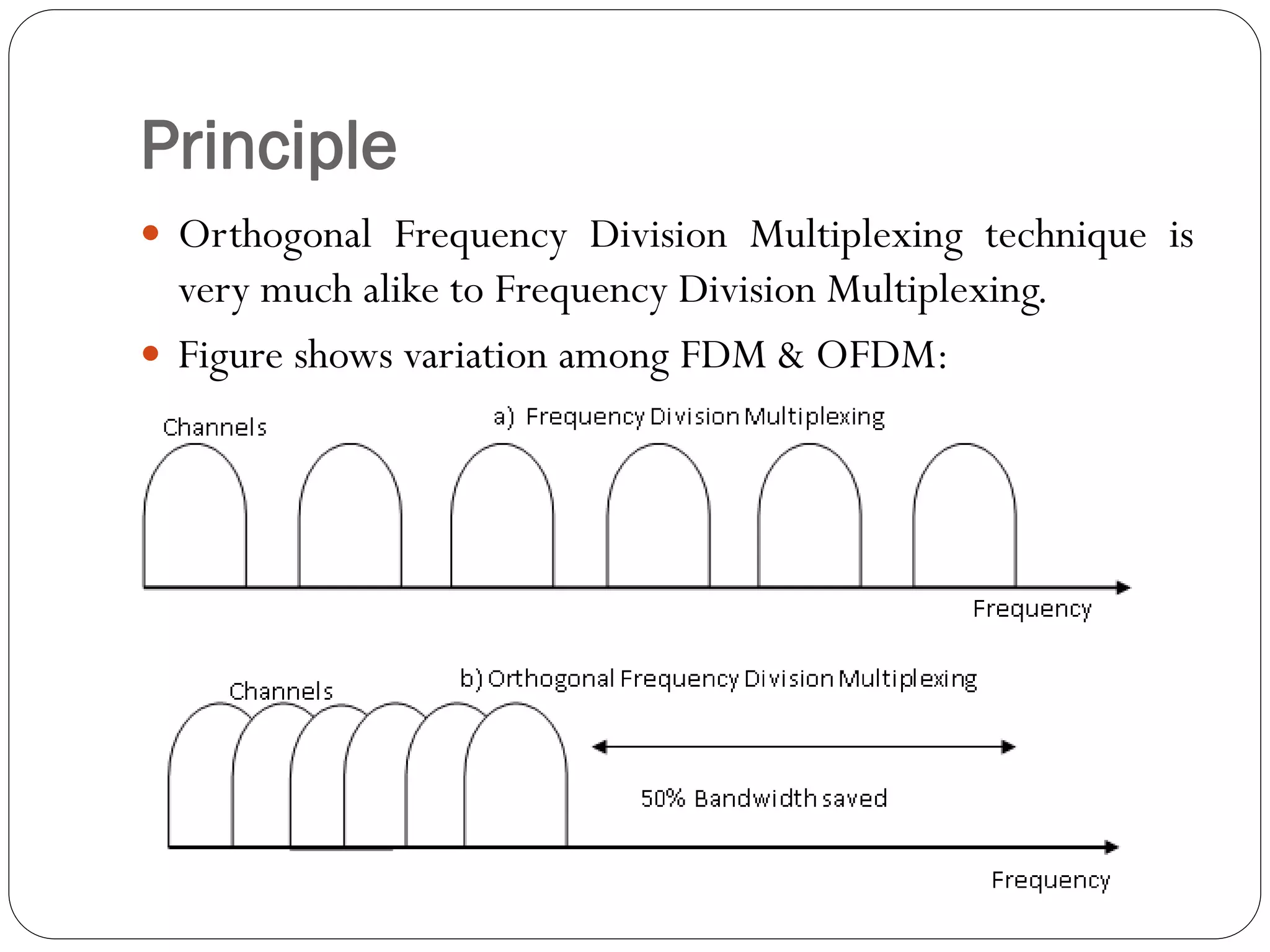
 Orthogonal Frequency Division Multiplexing technique is
very much alike to Frequency Division Multiplexing.
 Figure shows variation among FDM & OFDM:
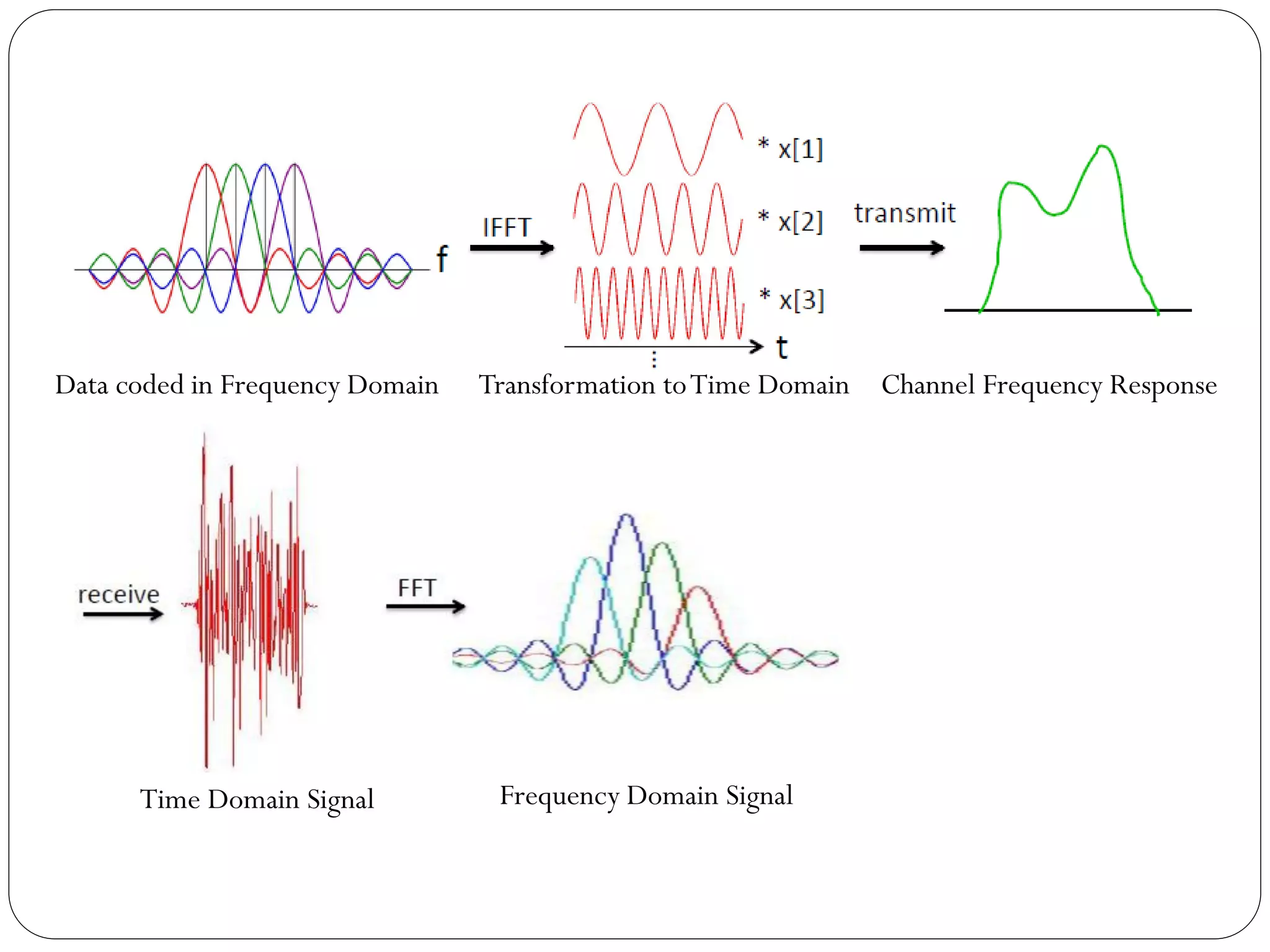
 Orthogonal sub carriers in OFDM:
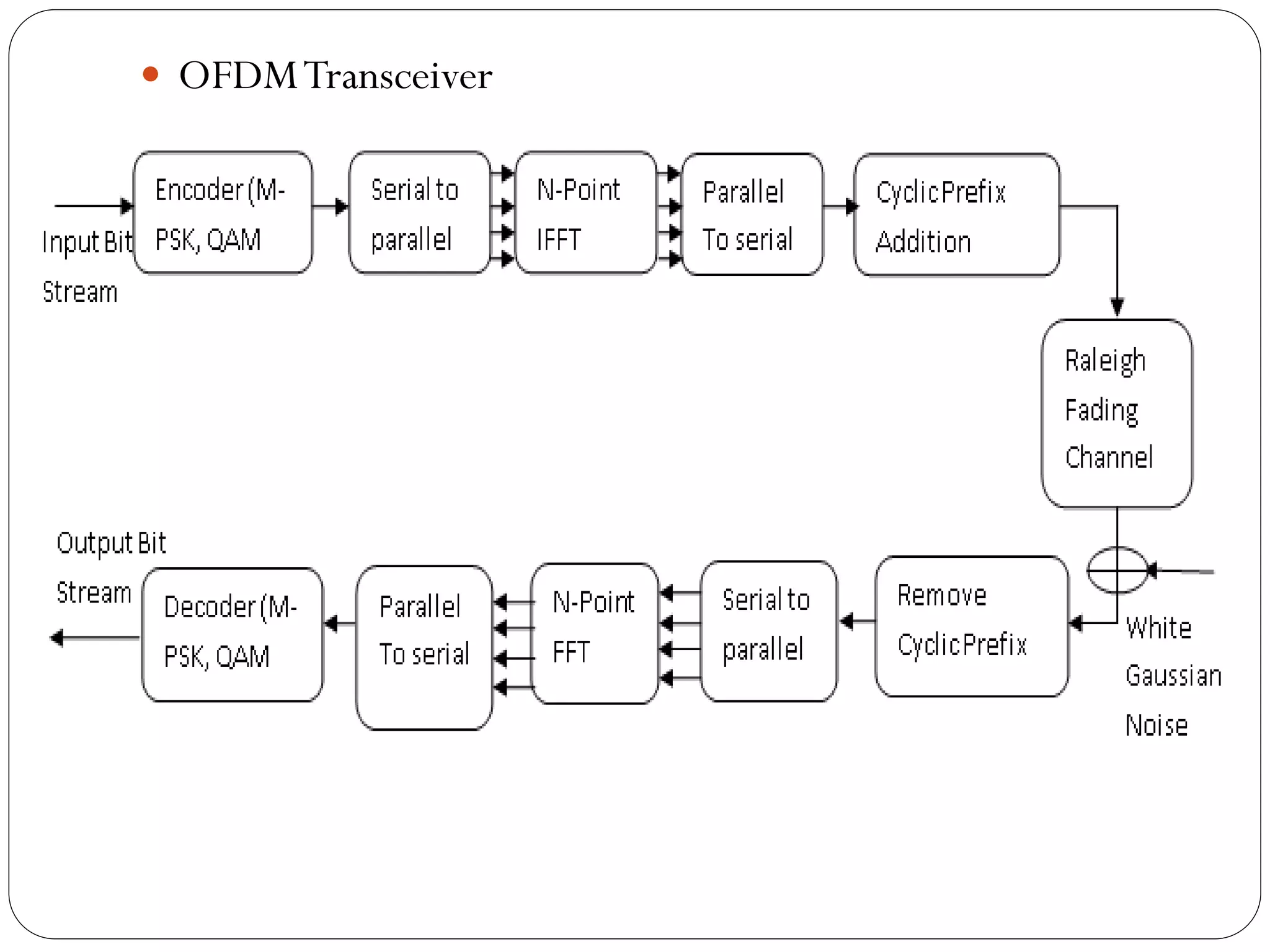
 OFDMTransceiver
Data coded in Frequency Domain Transformation toTime Domain Channel Frequency Response
Frequency Domain SignalTime Domain Signal
Features
 High spectral efficiency.
 Can be efficiently implemented using FFT.
 Low efficiency to time synchronization technique.
 OFDM has improved quality of narrowband interference.
 Can easily adapt to severe channel conditions without
complex equalization.
 Robust against inter-symbol interference (ISI) and fading
caused by multipath propagation.
 OFDM has the better resistant quality to fading.
Applications
 Digital Audio Broadcasting
 DigitalVideo Broadcasting
 IEEE 802.11 a/g
 IEEE 802.16
 IEEE 802.20 [6].
Problems
 Very sensitive to Frequency errors.
 Inter Carrier Interference: Due to Doppler Spreading
 Carrier FrequencyTiming Synchronization: Causes ICI
 Peak toAverage Power Ratio: Reduces power Efficiency.
Conclusion
 OFDM has promising Future in wireless networks and
mobile communication.
 OFDM is already playing an important role in WLAN and
will be part of MAN too.
 OFDM with the use of WiMAX and LTE advanced is the
future cellular packet data network.
References
1. GSMA Intelligence,April 2014
2. Aditya K Jagannatham, “Principles of Wireless Communication Systems”,
McGrawhill Education
3. Orthogonal Frequency Division Multiplexing (OFDM)-Applications for
Wireless Communications with Coding.
4. Y.Wu and W. Y. Zou, “Orthogonal frequency division multiplexing: A multi-
carrier modulation scheme,” IEEE Trans. Consumer Electronics, vol. 41, Aug.
1995.
5. Leonard J. Cimini, JR.,“Analysis And Simulation Of A Digital Mobile
Channel Using Orthogonal Frequency Division Multiplexing”, Ieee
Transactions On Communications,Vol. Com-33, July-1985.
6. Ramjee Prasad “OFDM for wireless communication system”, universal
personal communication.
ThankYou..

Orthogonal Frequency Division Multiplexing (OFDM)

  • 1.
  • 2.
    Content  Motivation  Introduction Origin  Principle  Features  Applications  Problems & ResearchArea  Conclusion  References
  • 3.
    Motivation  The demandfor multimedia wireless communication is growing today at an extremely rapid pace.  Multiplexing Schemes: FDM,TDM & CDM [1].
  • 4.
     Evolution ofMobile Communication [2]. Generation Standard Data Rate Features 2G GSM 10 kbps DigitalVoice, SimpleText, Simple News, Feeds etc. 2G CDMA 10 kbps 2.5G GPRS 50 kbps 2.5G EDGE 200 kbps 3G WCDMA ~400 kbps DigitalVoice, Mobile Broadband3.5G HSDPA/HSUPA 4-50 Mbps 4G LTE/WiMAX 100-200 Mbps Live HDTV, Online Gaming, High Speed. 4G LTE > 1 Gbps
  • 5.
    Introduction  OFDM ispromising technique for achieving high data rate transmission in mobile environment [3].  It is a special form of multicarrier modulation (MCM), where a single data stream is transmitted over a number of subcarriers.
  • 6.
     It offershigh spectral efficiency, multipath delay tolerance, robustness to channel fading, immunity to impulse interference [4].  Therefore it has been widely deployed in many wireless communication standards such as Digital Video Broadcasting (DAB), Asymmetrical Digital Subscriber Line (ADSL), DigitalTerrestrialTelevision Broadcasting etc.
  • 7.
    Origin  Concept ofOFDM has existed since 1966.  But in 1985, Cimini [5] proposed a cellular mobile radio system based on OFDM.  In 1995, Wu [4] suggested some high frequency military systems using OFDM.  In 1998, Fernando proposed application of OFDM to the satellite mobile channel.
  • 8.
    Principle  Orthogonal FrequencyDivision Multiplexing technique is very much alike to Frequency Division Multiplexing.  Figure shows variation among FDM & OFDM:
  • 9.
     Orthogonal subcarriers in OFDM:
  • 10.
  • 11.
    Data coded inFrequency Domain Transformation toTime Domain Channel Frequency Response Frequency Domain SignalTime Domain Signal
  • 12.
    Features  High spectralefficiency.  Can be efficiently implemented using FFT.  Low efficiency to time synchronization technique.  OFDM has improved quality of narrowband interference.  Can easily adapt to severe channel conditions without complex equalization.  Robust against inter-symbol interference (ISI) and fading caused by multipath propagation.  OFDM has the better resistant quality to fading.
  • 13.
    Applications  Digital AudioBroadcasting  DigitalVideo Broadcasting  IEEE 802.11 a/g  IEEE 802.16  IEEE 802.20 [6].
  • 14.
    Problems  Very sensitiveto Frequency errors.  Inter Carrier Interference: Due to Doppler Spreading  Carrier FrequencyTiming Synchronization: Causes ICI  Peak toAverage Power Ratio: Reduces power Efficiency.
  • 15.
    Conclusion  OFDM haspromising Future in wireless networks and mobile communication.  OFDM is already playing an important role in WLAN and will be part of MAN too.  OFDM with the use of WiMAX and LTE advanced is the future cellular packet data network.
  • 16.
    References 1. GSMA Intelligence,April2014 2. Aditya K Jagannatham, “Principles of Wireless Communication Systems”, McGrawhill Education 3. Orthogonal Frequency Division Multiplexing (OFDM)-Applications for Wireless Communications with Coding. 4. Y.Wu and W. Y. Zou, “Orthogonal frequency division multiplexing: A multi- carrier modulation scheme,” IEEE Trans. Consumer Electronics, vol. 41, Aug. 1995. 5. Leonard J. Cimini, JR.,“Analysis And Simulation Of A Digital Mobile Channel Using Orthogonal Frequency Division Multiplexing”, Ieee Transactions On Communications,Vol. Com-33, July-1985. 6. Ramjee Prasad “OFDM for wireless communication system”, universal personal communication.
  • 17.