
OFC SYSTEMS
AGENDA OF TOPICS
•ADVANTAGES
•PRINCIPLES
•ATTENUATION
•CABLE DESIGN
•COMPONANTS
•POWER BUDGET
•INSTALLATION PRACTICE
OFC SYSTEMS
What is a fiber optic cable?
A fiber optic cable is a cylindrical pipe. It may be made out of
glass or plastic or a combination of glass and plastic. It is
fabricated in such a way that this pipe can guide light from one
end of it to the other.
OFC SYSTEMS
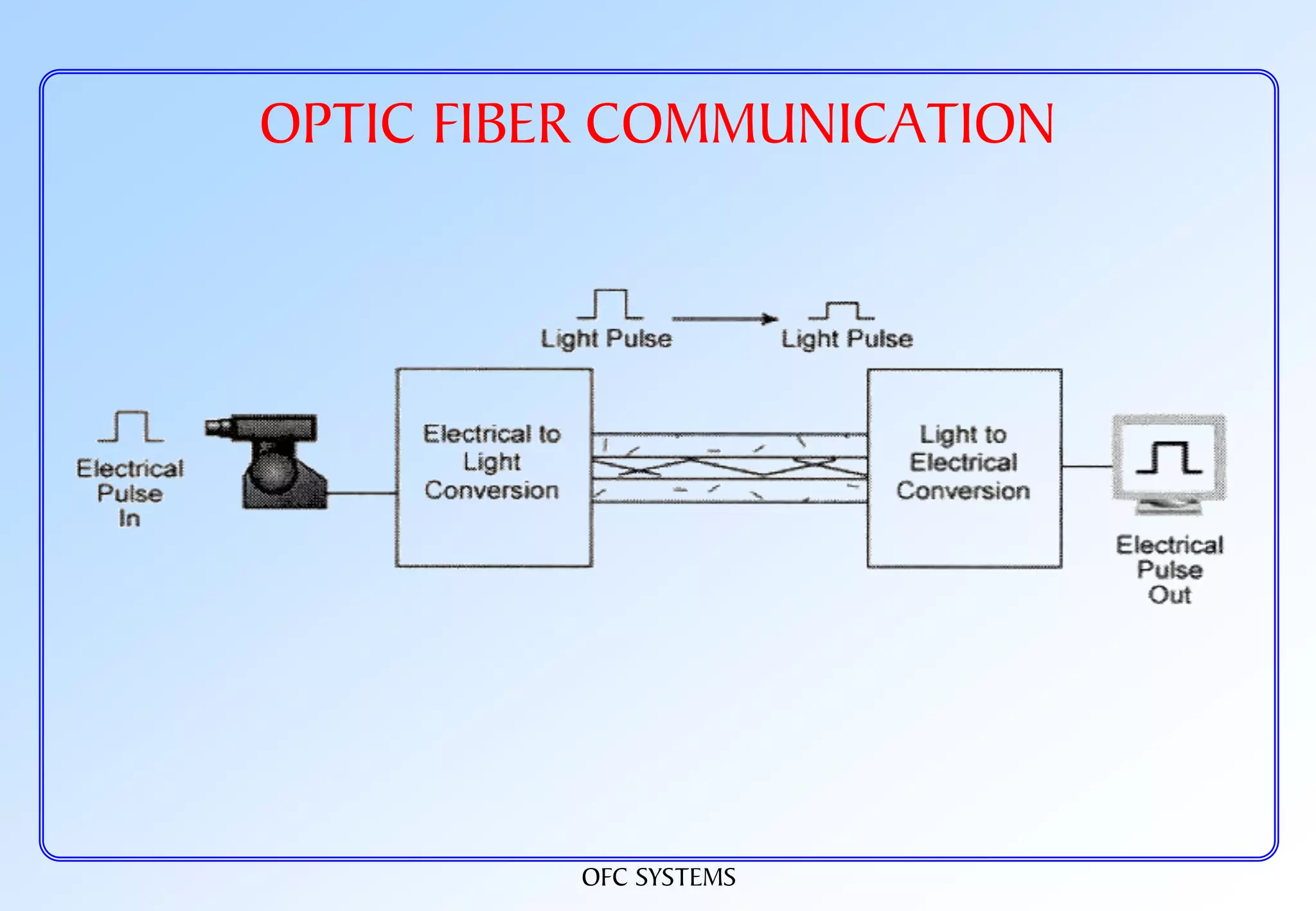
What is an Optic Fiber Communication ?
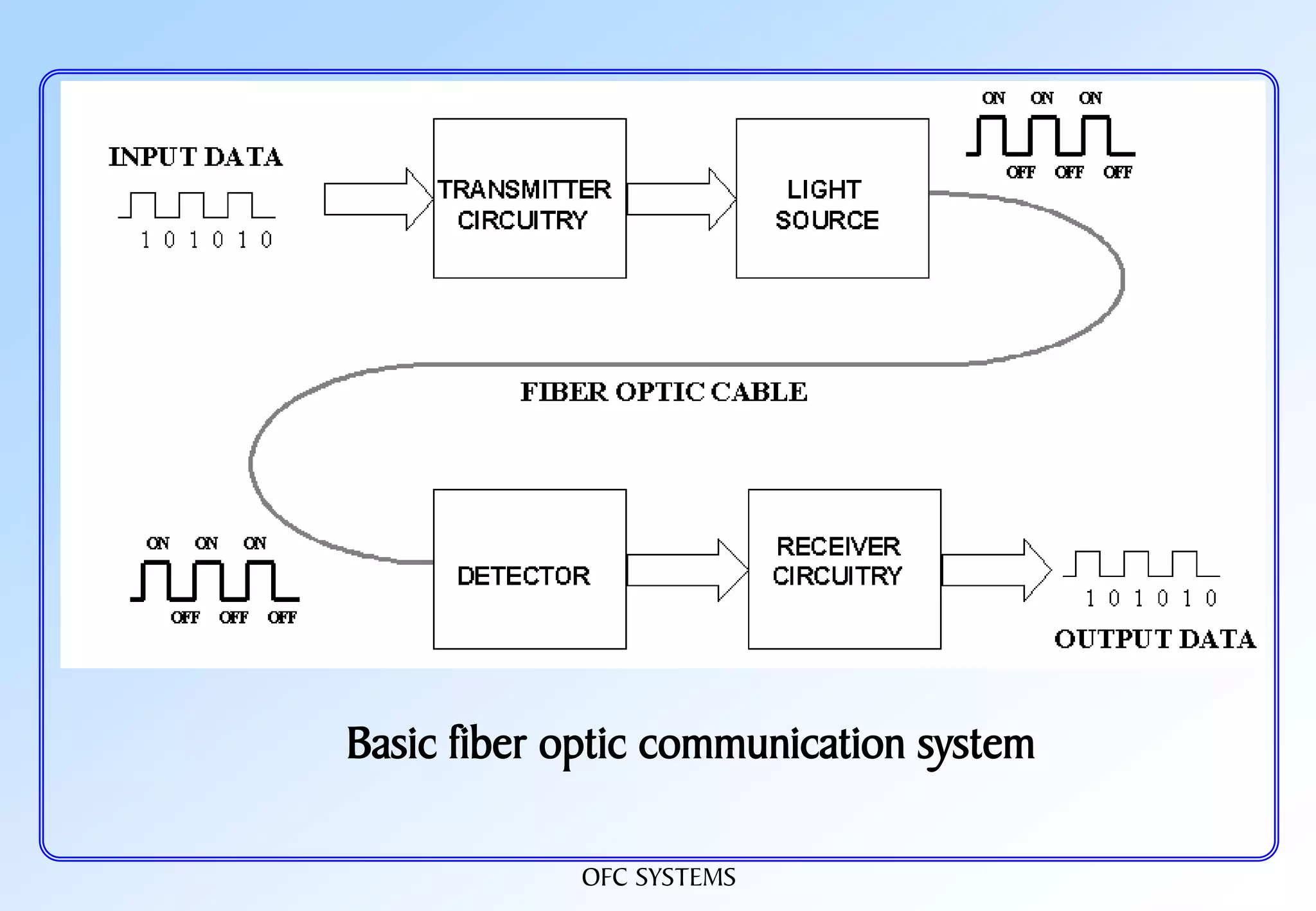
Fiber-Optic communication is a method of transmitting
information from one place to another by sending pulse of light
through an optical fiber.
The light forms an electromagnetic carrier wave that is
modulated to carry information.
Most of the optic fiber systems use infrared light between
800nm and 1600nm because glass fibers carry infrared light
more efficiently than visible light.
OPTIC FIBER COMMUNICATION
OFC SYSTEMS
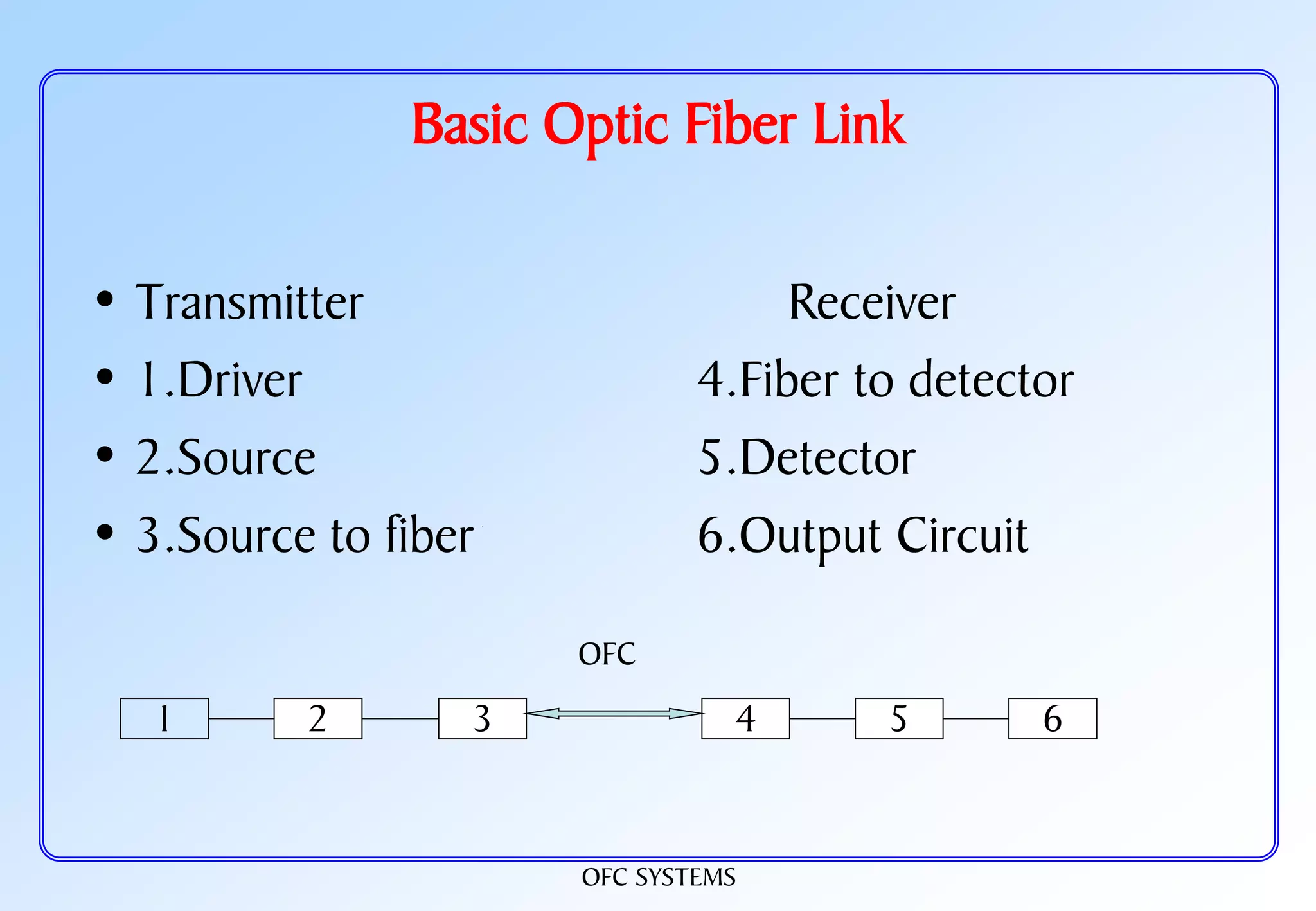
Basic Optic Fiber Link
• Transmitter Receiver
• 1.Driver 4.Fiber to detector
• 2.Source 5.Detector
• 3.Source to fiber 6.Output Circuit
2 3 4 5 61
OFC
OFC SYSTEMS
OFC SYSTEMS
ADVANTAGE OF FIBER OPTICS
Long-distance signal transmission
The low attenuation and superior signal integrity found in optical systems allow
much longer intervals of signal transmission than metallic-based systems
Large bandwidth, light weight, and small diameter
Today’s applications require an ever-increasing amount of bandwidth. The
relatively small diameter and light weight of optical cable make such installations
easy and practical, saving valuable conduit space in these environments.
More information carrying capacity 10 Gbps
( 2.5 Gbps STM-16 : Railways)
OFC SYSTEMS
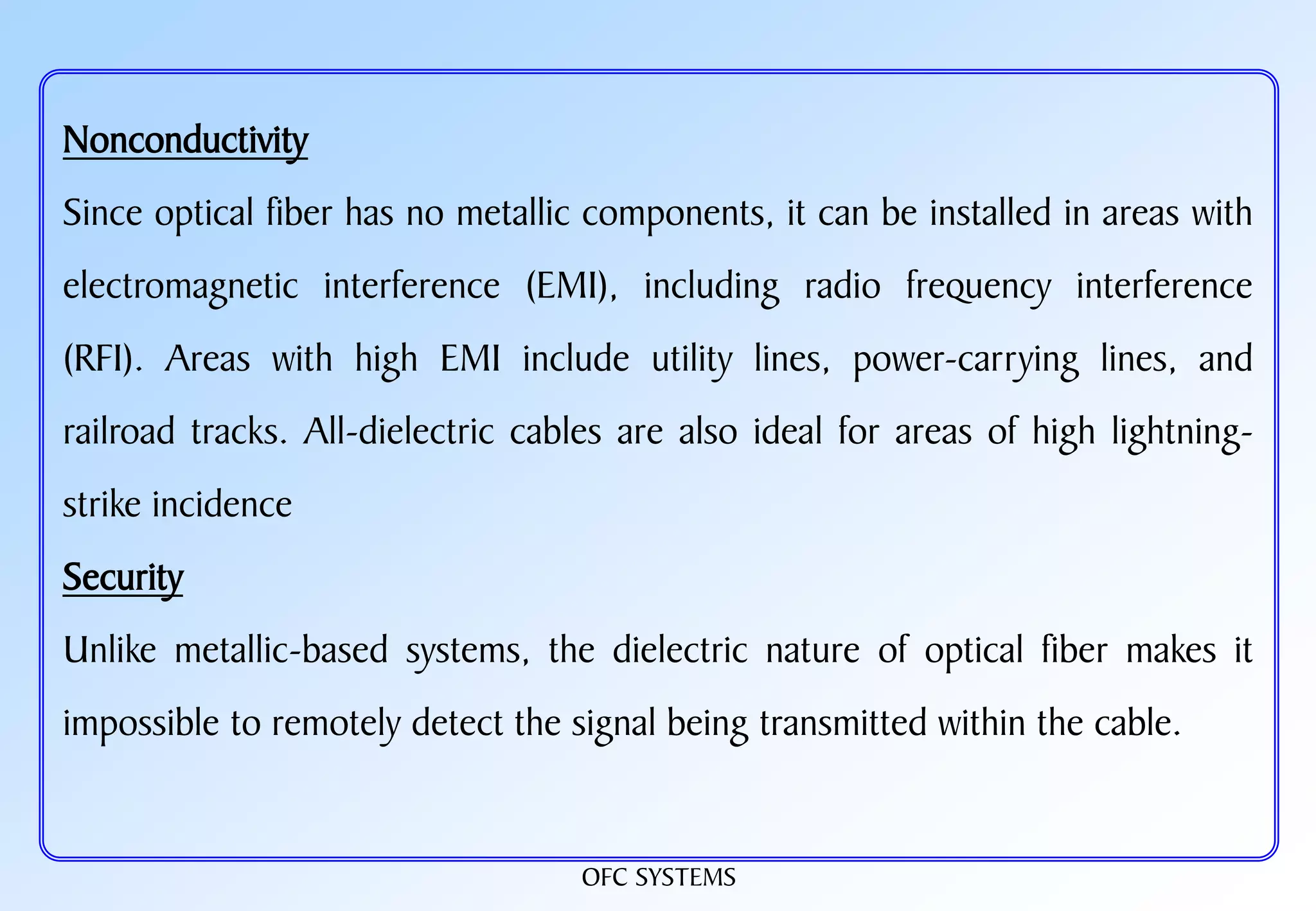
Nonconductivity
Since optical fiber has no metallic components, it can be installed in areas with
electromagnetic interference (EMI), including radio frequency interference
(RFI). Areas with high EMI include utility lines, power-carrying lines, and
railroad tracks. All-dielectric cables are also ideal for areas of high lightning-
strike incidence
Security
Unlike metallic-based systems, the dielectric nature of optical fiber makes it
impossible to remotely detect the signal being transmitted within the cable.
OFC SYSTEMS
No Cross talk
As the signal transmission is digital modulation no chance of cross talk between
channels
Designed for future applications needs
Fiber optics is affordable today, as electronics prices fall and optical cable
pricing remains low. In many cases, fiber solutions are less costly than copper.
As bandwidth demands increase rapidly with technological advances, fiber will
continue to play a vital role in the long-term success of telecommunication
Light Weight
Cable drum has 3 KMs OFC cable
OFC SYSTEMS
Basic fiber optic communication system
OFC SYSTEMS
FUNDAMENTAL DEFINITIONS
OFC SYSTEMS
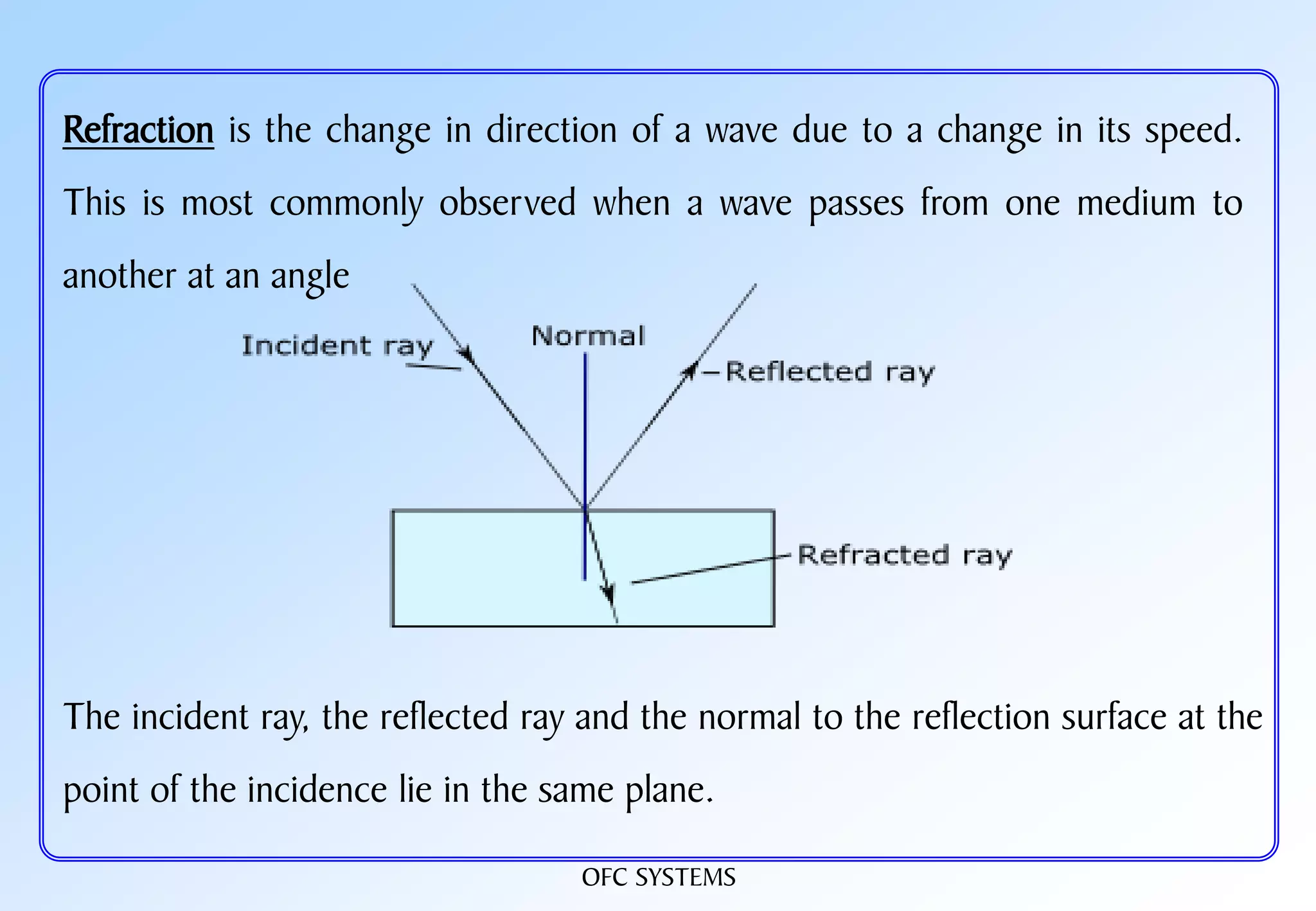
Refraction is the change in direction of a wave due to a change in its speed.
This is most commonly observed when a wave passes from one medium to
another at an angle
The incident ray, the reflected ray and the normal to the reflection surface at the
point of the incidence lie in the same plane.
OFC SYSTEMS
OFC SYSTEMS
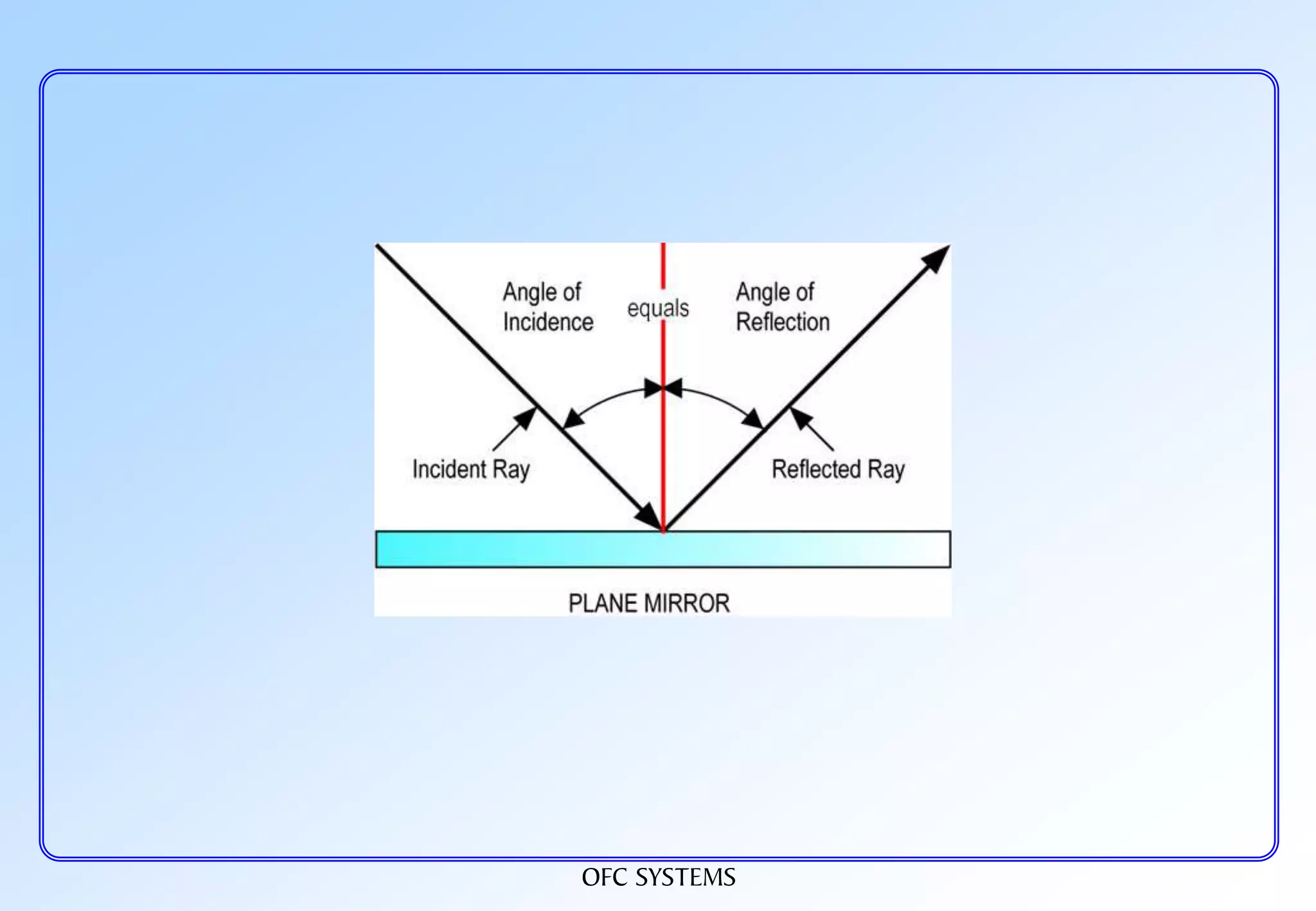
An incident ray is a ray of light that strikes a surface. The angle between this
ray and the perpendicular or normal to the surface is the angle of incidence.
The reflected ray corresponding to a given incident ray, is the ray that
represents the light reflected by the surface. The angle between the surface
normal and the reflected ray is known as the angle of reflection.
The Law of Reflection says that for a specular (non-scattering) surface, the
angle of reflection always equals the angle of incidence.
The refracted ray or transmitted ray corresponding to a given incident ray
represents the light that is transmitted through the surface. The angle between
this ray and the normal is known as the angle of refraction.
OFC SYSTEMS
When it is transmitted through a transparent object, however, light slows down
slightly.
The exact reduction is a function of the wavelength of the light and the material
of which the object is composed.
This effect is called refraction, and is measured by the index of refraction, or
refractive index of the material at a specified wavelength.
The refractive index is the ratio of the speed of light in free space divided by
the speed within the material.
For this reason, the refractive index of free space is exactly equal to 1.
OFC SYSTEMS
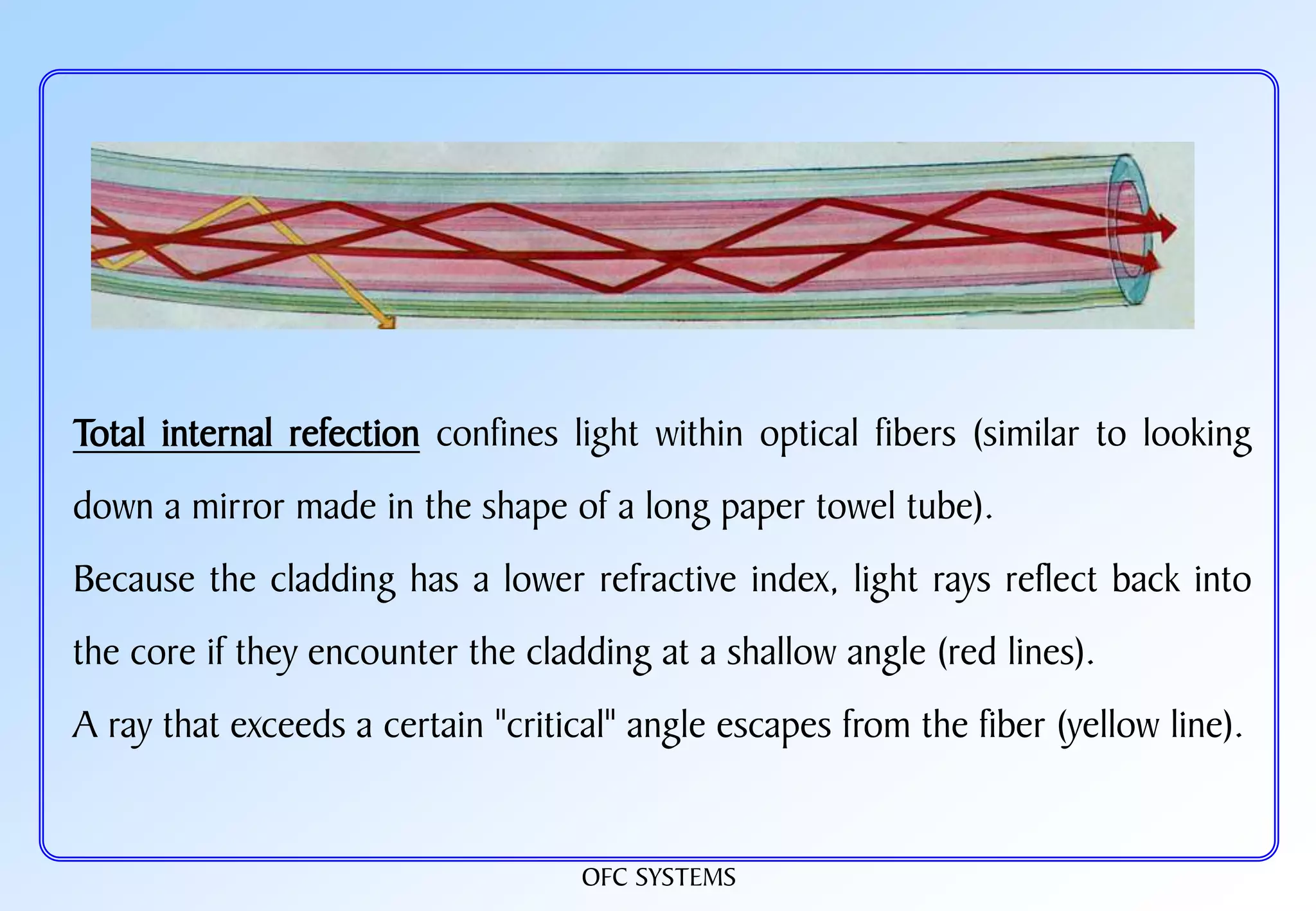
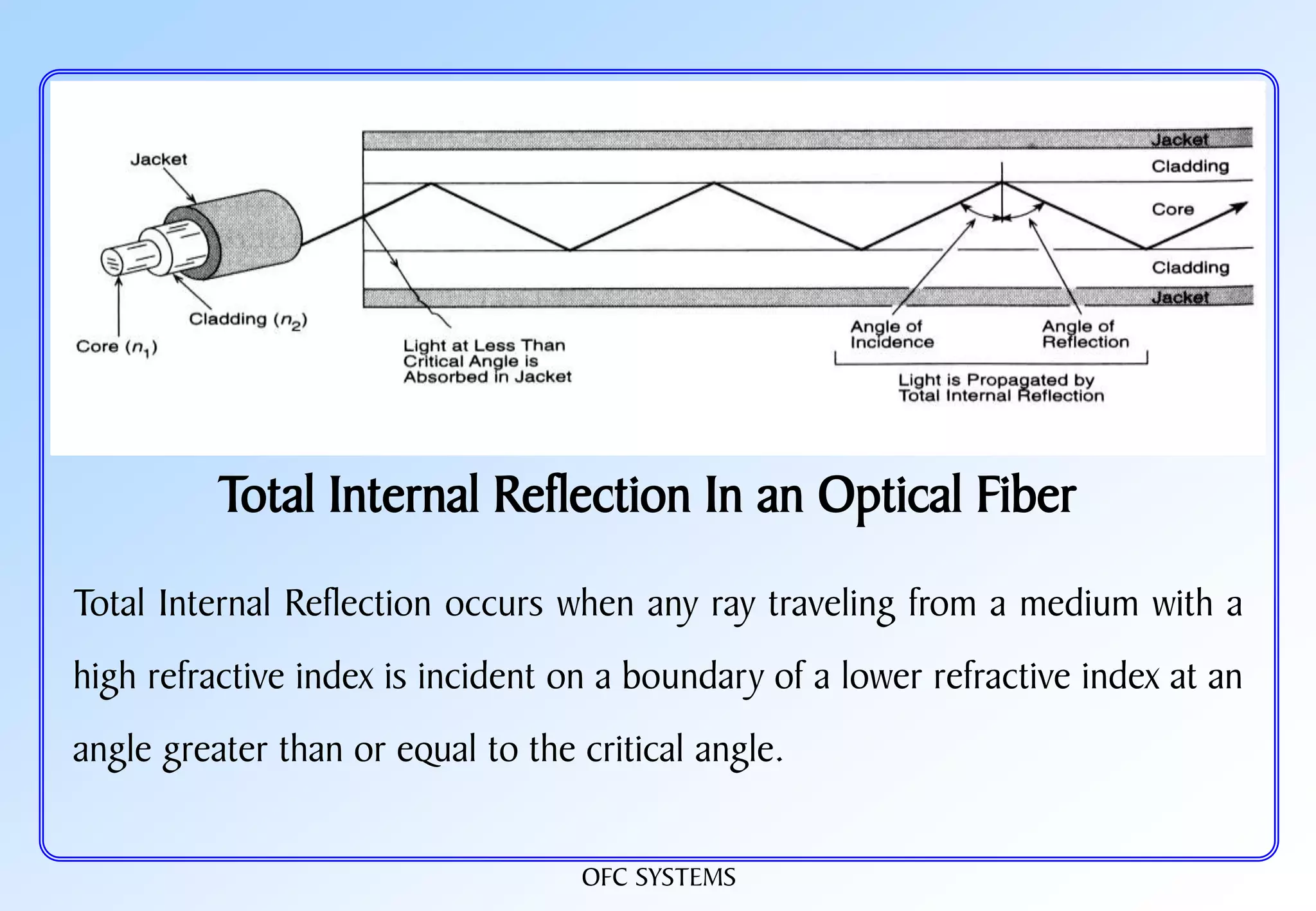
Total internal refection confines light within optical fibers (similar to looking
down a mirror made in the shape of a long paper towel tube).
Because the cladding has a lower refractive index, light rays reflect back into
the core if they encounter the cladding at a shallow angle (red lines).
A ray that exceeds a certain "critical" angle escapes from the fiber (yellow line).
OFC SYSTEMS
OFC SYSTEMS
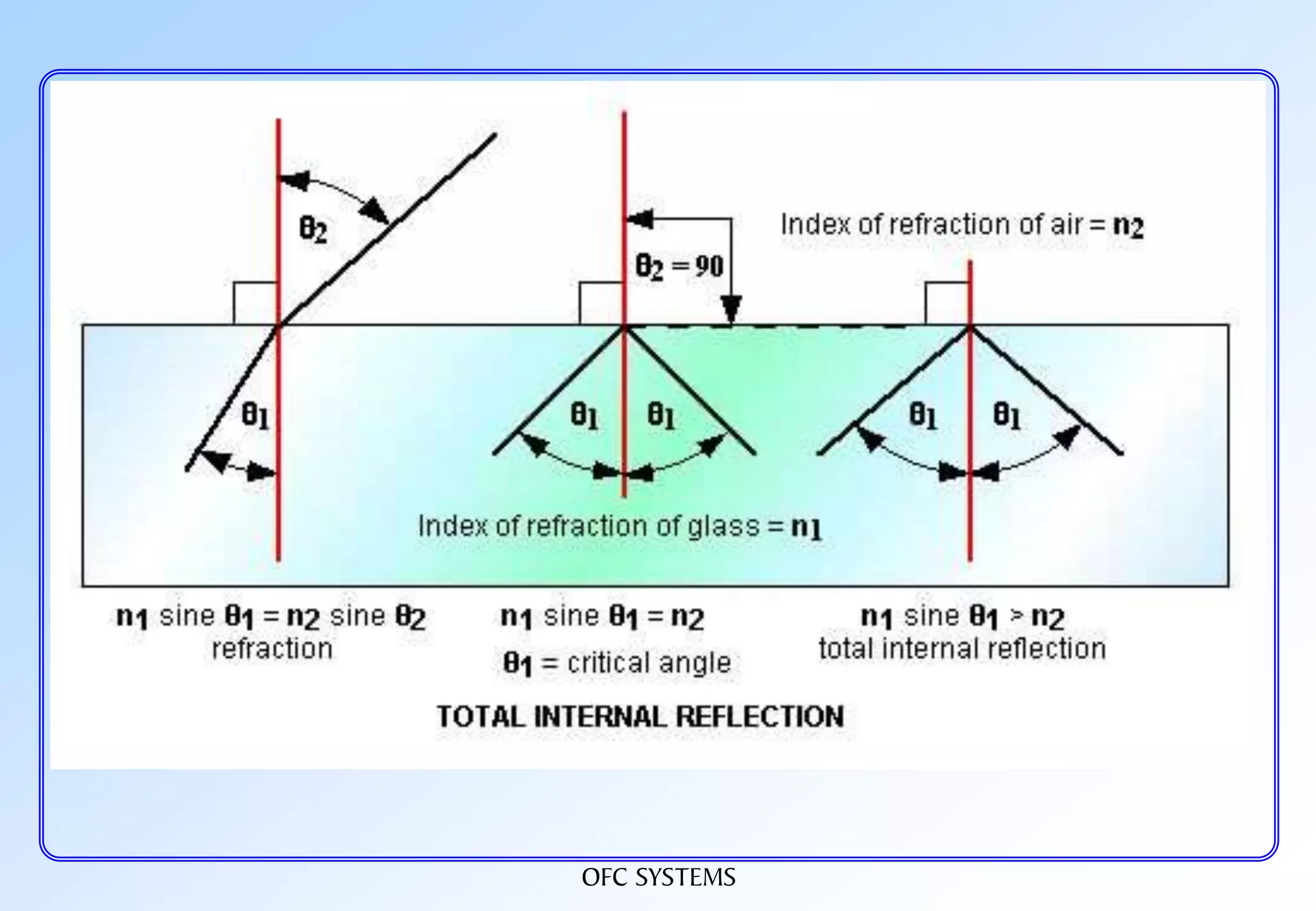
If a light ray inside a refractive material approaches the surface at or greater
than the arc sine of the ratio of the outside refractive index to the inside one,
the exit angle will be greater than or equal to 90 degrees.
This means that the ray will be bent back into the material. The smallest angle at
which this occurs is called the critical angle, and is different for different colors.
Exit angles greater than the critical angle will result in the interface surface
becoming essentially a perfect mirror, and the light ray will be reflected back
into the material
OFC SYSTEMS
Total Internal Reflection In an Optical Fiber
Total Internal Reflection occurs when any ray traveling from a medium with a
high refractive index is incident on a boundary of a lower refractive index at an
angle greater than or equal to the critical angle.
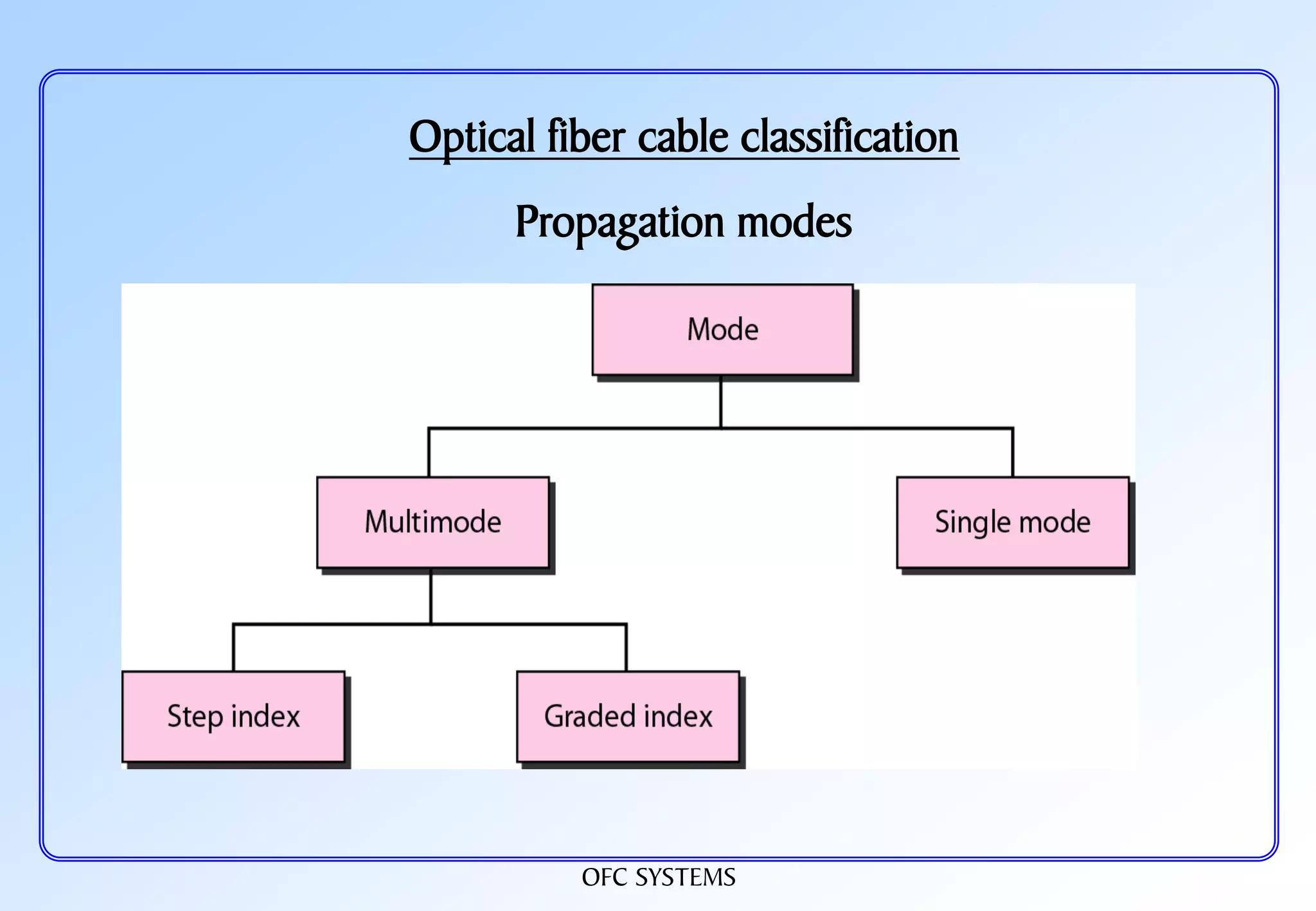
Optical fiber cable classification
Propagation modes
OFC SYSTEMS
Mode is a mathematical and physical concept describing the propagation
of electromagnetic waves through a medium.
 A mode is a defined path in which light travels
 A light signal can propagate through the core of the optical fiber
on a single path(single mode) or many paths (multi mode)
OFC SYSTEMS
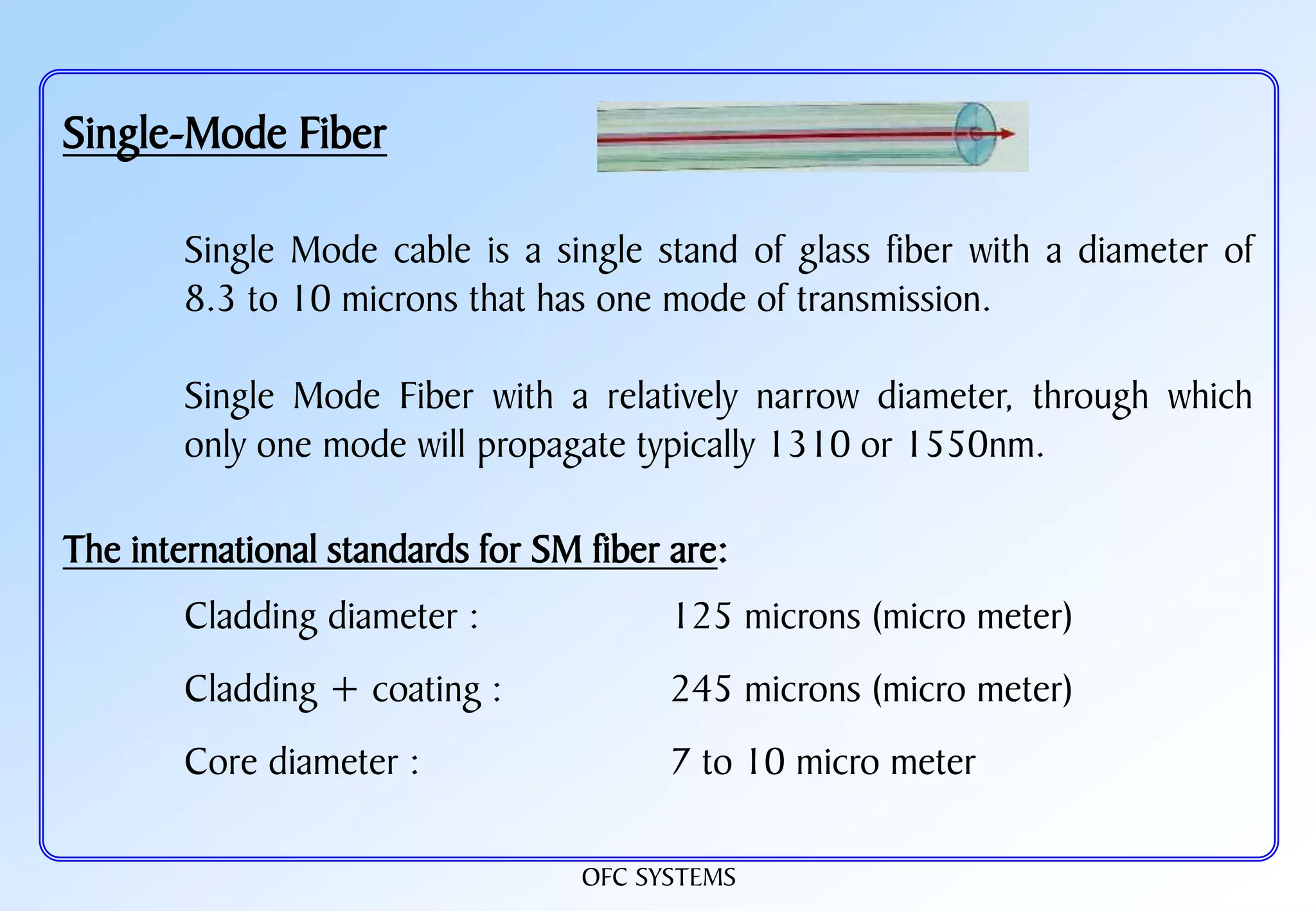
Single-Mode Fiber
Single Mode cable is a single stand of glass fiber with a diameter of
8.3 to 10 microns that has one mode of transmission.
Single Mode Fiber with a relatively narrow diameter, through which
only one mode will propagate typically 1310 or 1550nm.
The international standards for SM fiber are:
Cladding diameter : 125 microns (micro meter)
Cladding + coating : 245 microns (micro meter)
Core diameter : 7 to 10 micro meter
OFC SYSTEMS
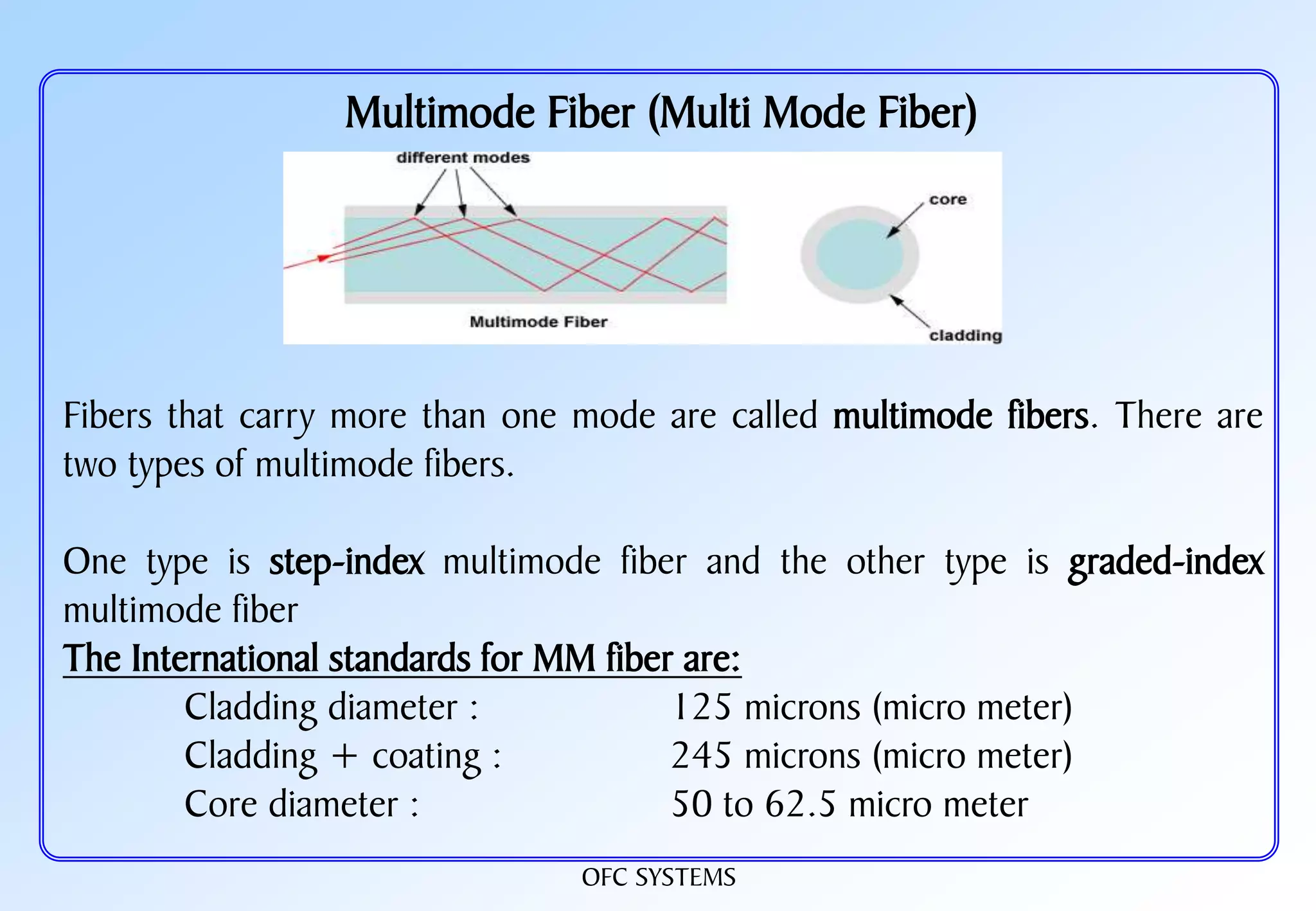
Multimode Fiber (Multi Mode Fiber)
Fibers that carry more than one mode are called multimode fibers. There are
two types of multimode fibers.
One type is step-index multimode fiber and the other type is graded-index
multimode fiber
The International standards for MM fiber are:
Cladding diameter : 125 microns (micro meter)
Cladding + coating : 245 microns (micro meter)
Core diameter : 50 to 62.5 micro meter
OFC SYSTEMS
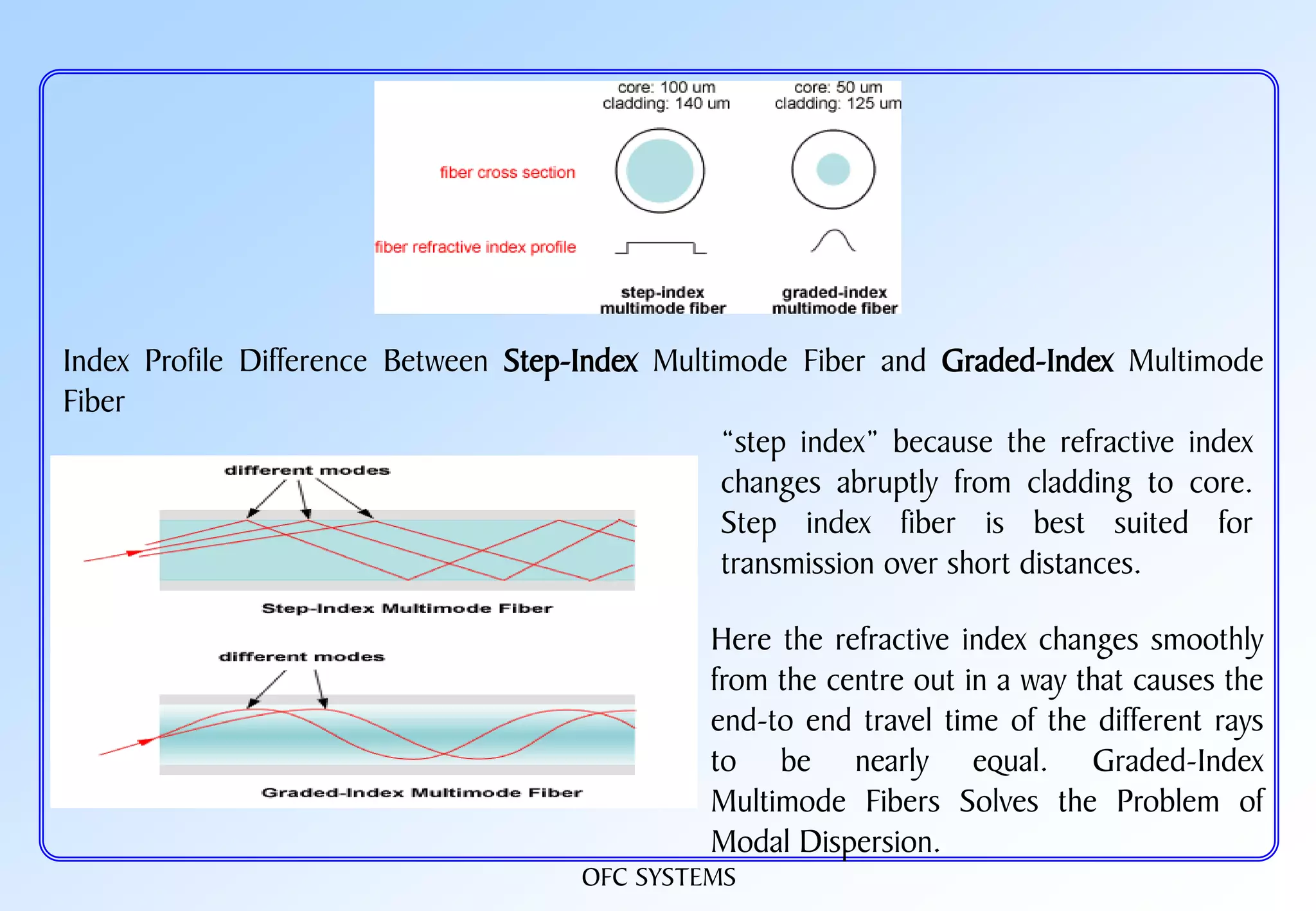
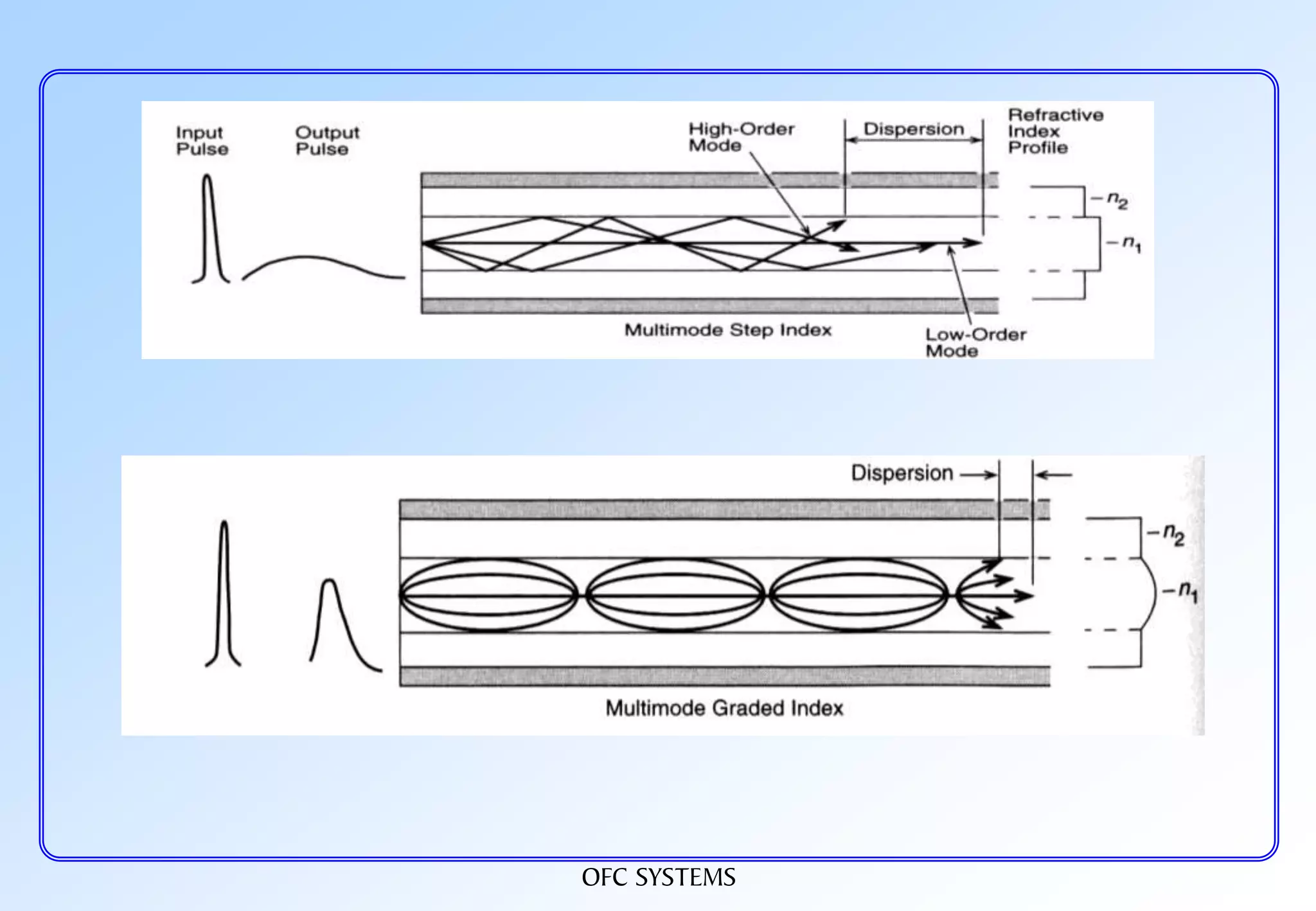
Index Profile Difference Between Step-Index Multimode Fiber and Graded-Index Multimode
Fiber
Here the refractive index changes smoothly
from the centre out in a way that causes the
end-to end travel time of the different rays
to be nearly equal. Graded-Index
Multimode Fibers Solves the Problem of
Modal Dispersion.
“step index” because the refractive index
changes abruptly from cladding to core.
Step index fiber is best suited for
transmission over short distances.
OFC SYSTEMS
OFC SYSTEMS
Single Mode Fiber Optic Cable Classified as
1. Non dispersion-shifted fiber (NDSF) G.652
used for 1310 nm. This fiber has high dispersion at 1550nm, hence
not suitable for 1550 nm systems.
2. Dispersion-shifted fiber (DSF) G.653
This has moved the zero-dispersion point to the 1550 nm region it
exhibits serious nonlinearities when multiple, closely-spaced
wavelengths in the 1550 nm were transmitted in DWDM systems.
3. Non zero-dispersion-shifted fibers (NZ-DSF) G.655
used for DWDM systems.
OFC SYSTEMS
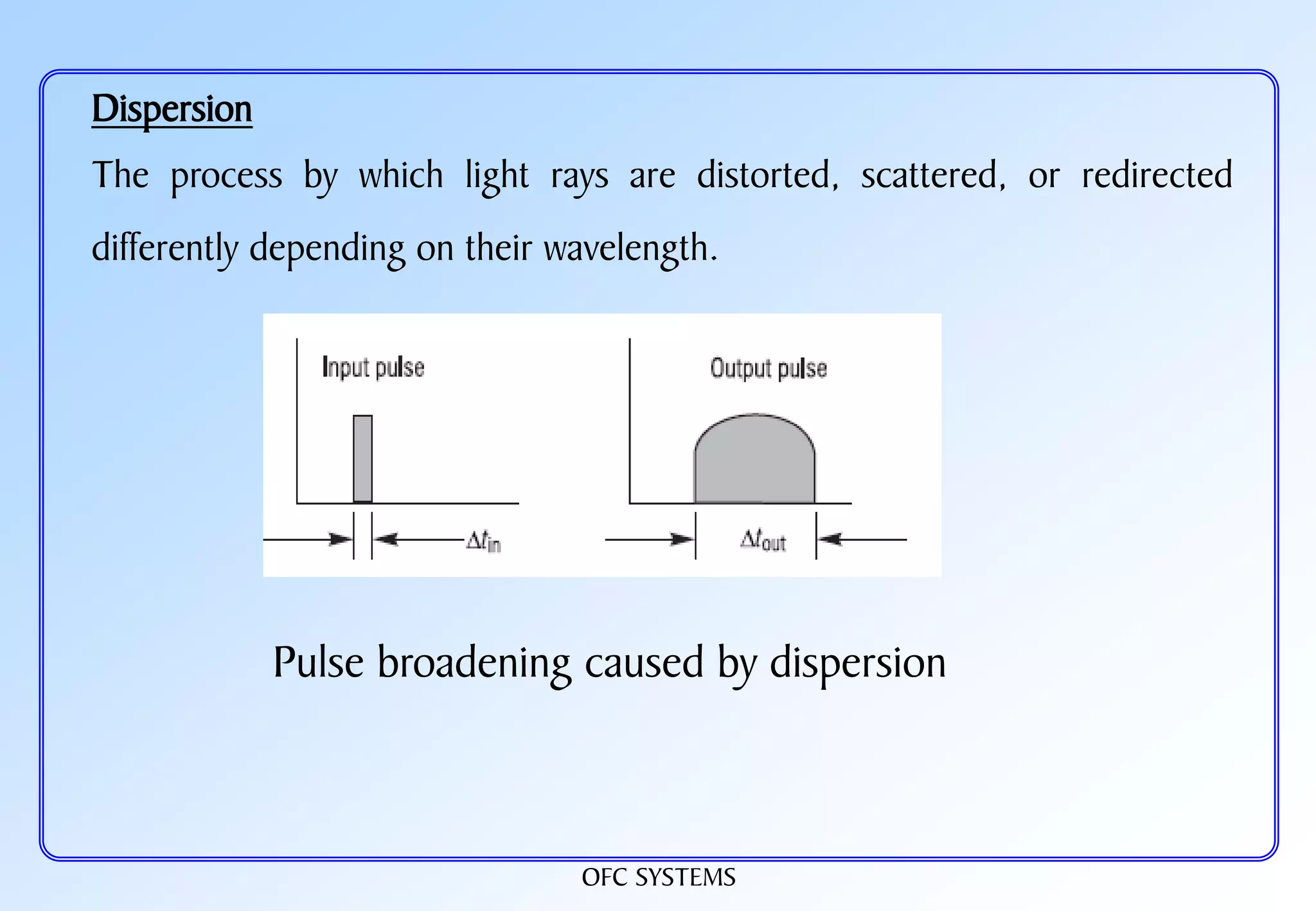
Dispersion
The process by which light rays are distorted, scattered, or redirected
differently depending on their wavelength.
OFC SYSTEMS
Pulse broadening caused by dispersion
OFC SYSTEMS
Specifically, the effect of different propagation speeds for different wavelengths of
light.
 Modal dispersion (or intermodal dispersion)
 Chromatic dispersion
 Polarization mode dispersion (PMD)
OFC SYSTEMS
Modal dispersion (or intermodal dispersion)
The arrival of different modes of the light at different times is called Modal
Dispersion.
Modal dispersion causes pulses to spread out as they travel along the fiber, the
more modes the fiber transmits, the more pulses spread out. This significantly
limits the bandwidth of step-index multimode fibers. Modal dispersion is a
major problem with multimode fibers.
OFC SYSTEMS
OFC SYSTEMS
Chromatic dispersion
The sum of material dispersion and waveguide dispersion. "Material dispersion"
is caused by the variation in refractive index of the glass in the fiber. "Waveguide
dispersion" is due to changes in the distribution of light between the core and
the cladding of a single mode fiber.
Polarization mode dispersion (PMD)
Light travels in two polarization states in single mode fibers. Over long
distances, conditions such as stress and slight irregularities in the fiber core
cause random fluctuations in how the two polarizations travel through the fiber.
As a result, they gradually spread over the square root of the distance.
OFC SYSTEMS
Attenuation
Attenuation is the reduction or loss of optical power as light travels through an
optical fiber.
The longer the fiber is and the farther the light has to travel, the more the
optical signal is attenuated. Consequently, attenuation is measured and reported
in decibels per kilometer (dB/km)
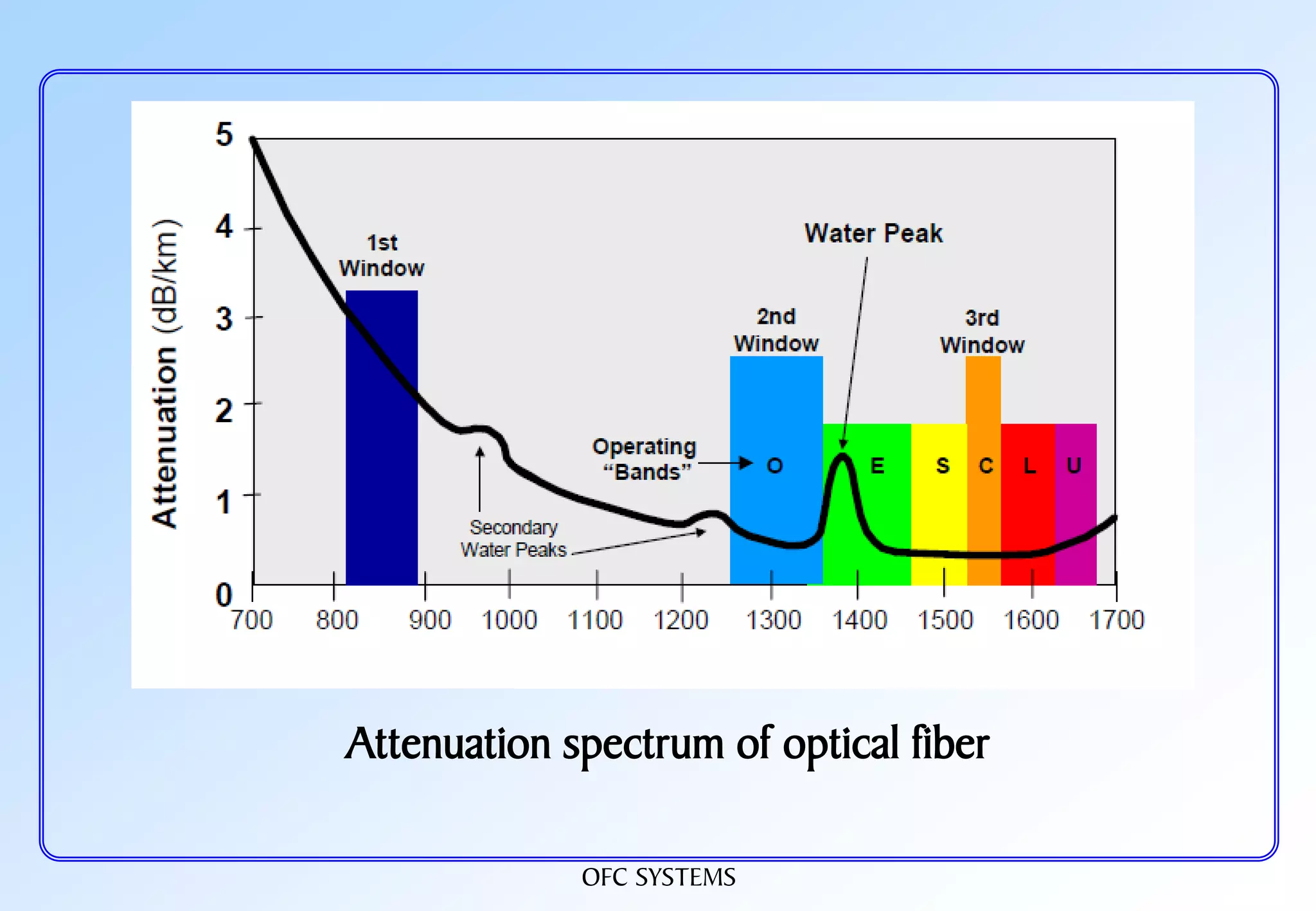
Attenuation varies depending on the fiber type and the operating wavelength
For silica-based optical fibers, single-mode fibers have lower attenuation than
multimode fibers. And generally speaking, the higher (or longer) the
wavelength, the lower the attenuation.
OFC SYSTEMS
Attenuation spectrum of optical fiber
OFC SYSTEMS
Causes of Optical Loss
Fiber attenuation is caused by scattering, absorption and bending
Scattering (often referred to as Rayleigh scattering) is the reflection of small
amounts of light in all directions as it travels down the fiber. Some of this light
escapes out of the core, while some travels back toward the source (this
backscattered light is what an Optical Time Domain Reflectometer, or OTDR,
Absorption occurs when impurities, such as metal particles or moisture, are
trapped in the glass. These cause attenuation at specific wavelengths by
absorbing the light at that wavelength and dissipating it in the form of heat
energy
OFC SYSTEMS
Moisture occurs more naturally in fiber, and accounts for the rise in attenuation
at the "water peak” found near 1385 nm. This is why fibers were traditionally
not used in this wavelength region.
Bending occurs in two forms - micro bending and macro bending.
Micro bends are microscopic distortions along the length of a fiber, typically
caused by pinching or squeezing the fiber. Micro bends deform the fiber's core
slightly, causing light to escape at these deflections.
OFC SYSTEMS
Macro bending occurs when a fiber is bent in a tight radius. The bend
curvature creates an angle that is too sharp for the light to be reflected back
into the core, and some of it escapes through the fiber cladding, causing
attenuation.
This optical power loss increases rapidly as the radius is decreased to an inch
or less. Fibers with a high numerical aperture and low core/clad ratio are least
susceptible to macro bend losses.
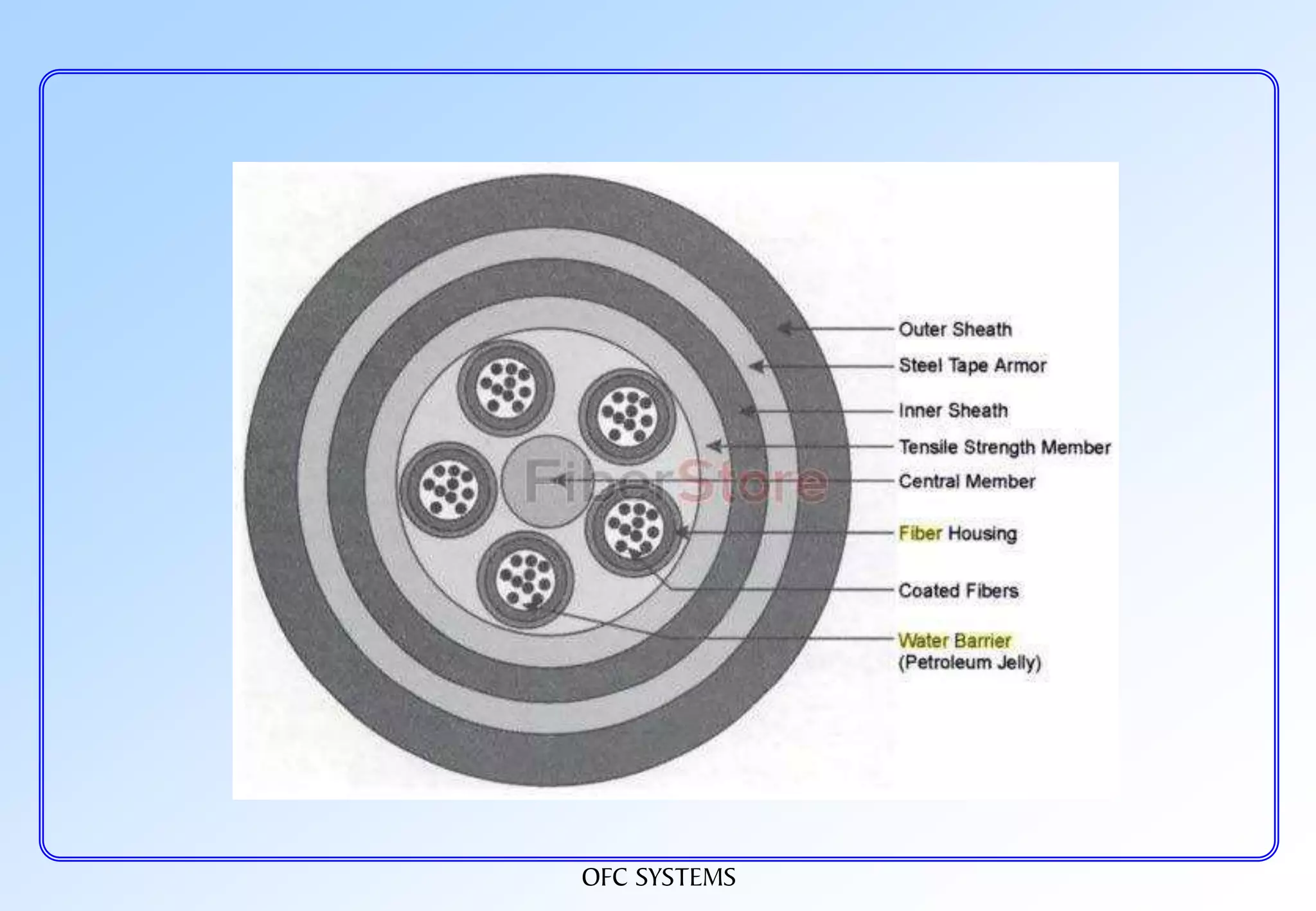
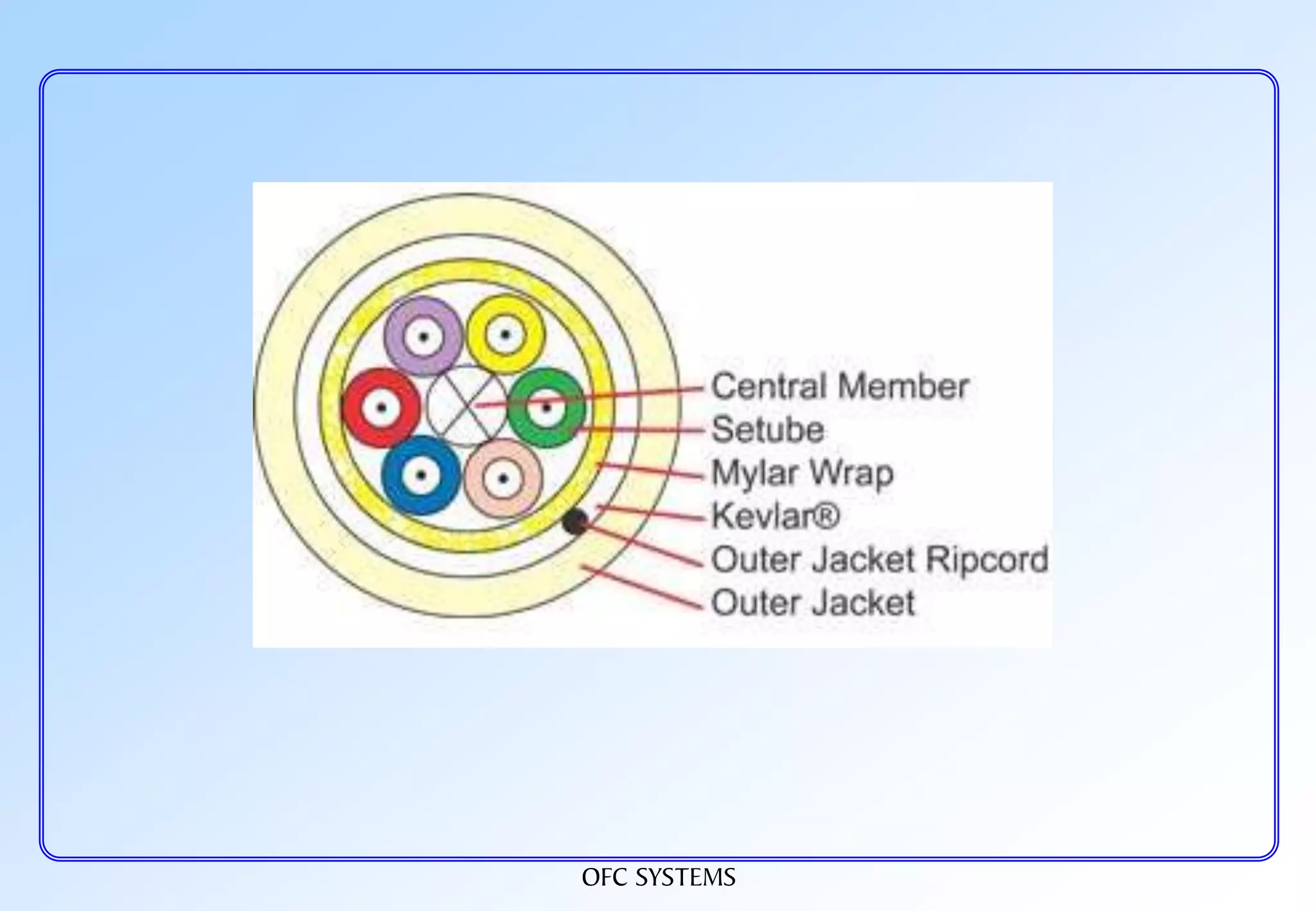
BASIC CABLE DESIGN
Two basic cable designs are:
Loose-tube cable, used in the majority of outside-plant installations, and tight-
buffered cable, primarily used inside buildings.
The modular design of loose-tube cables typically holds up to 12/24 fibers per
buffer tube. Loose-tube cables can be all-dielectric or optionally armored
Single-fiber tight-buffered cables are used as pigtails, patch cords and jumpers
to terminate loose-tube cables directly into opto-electronic transmitters,
receivers and other active and passive components.
Multi-fiber tight-buffered cables also are available and are used primarily for
alternative routing and handling flexibility and ease within buildings.
OFC SYSTEMS
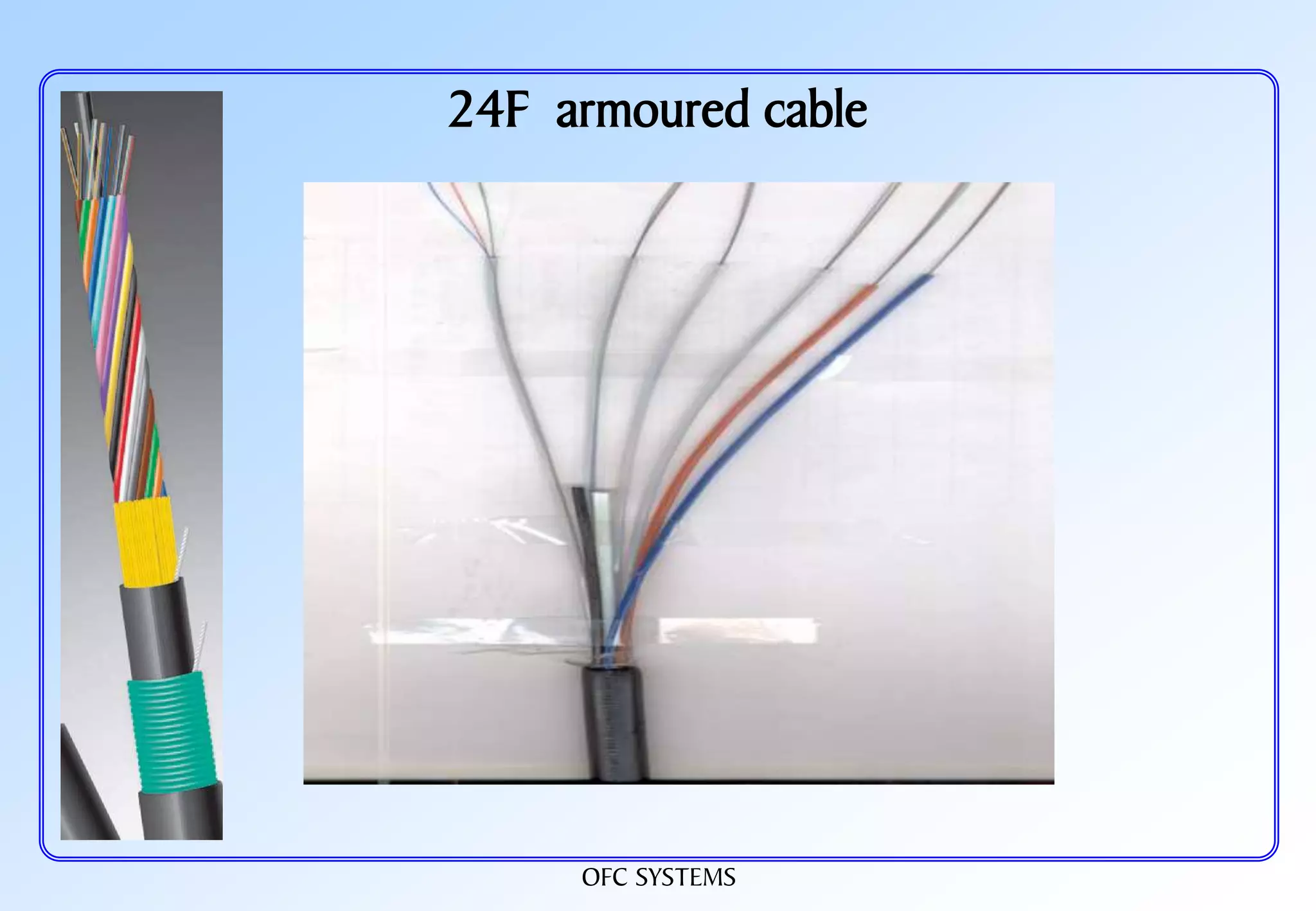
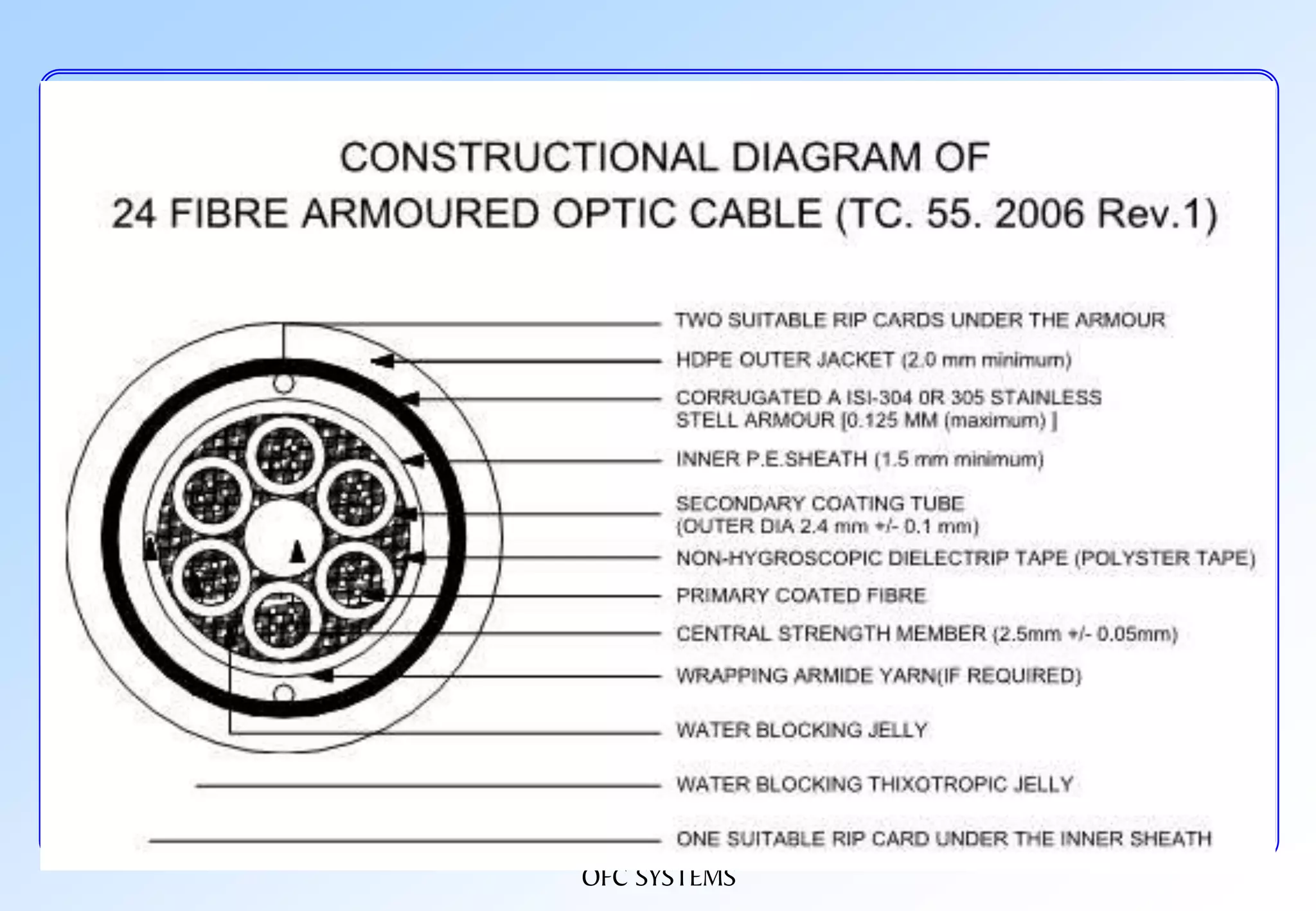
24F armoured cable
OFC SYSTEMS
• 24F armed cable
- Normally used for under ground laying
- It consists 6 loose tubes
Blue
Orange
Natural 1
Natural 2
Natural 3
Natural 4
- Each loose tube contains 4 fibers
Blue, Orange, Green, Natural
OFC SYSTEMS
OFC SYSTEMS
OFC SYSTEMS
OFC SYSTEMS
OFC SYSTEMS
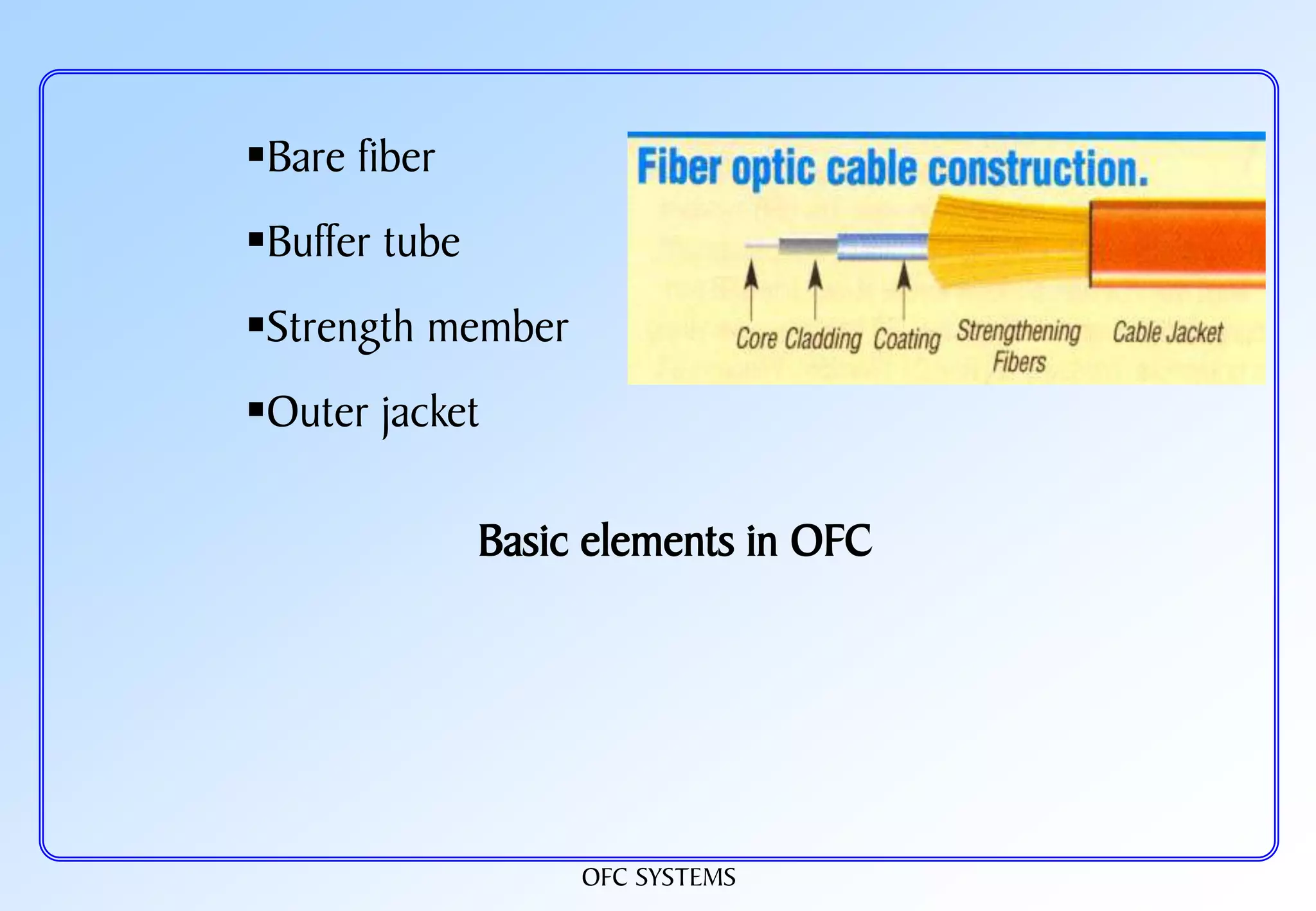
Bare fiber
Buffer tube
Strength member
Outer jacket
Basic elements in OFC
OFC SYSTEMS
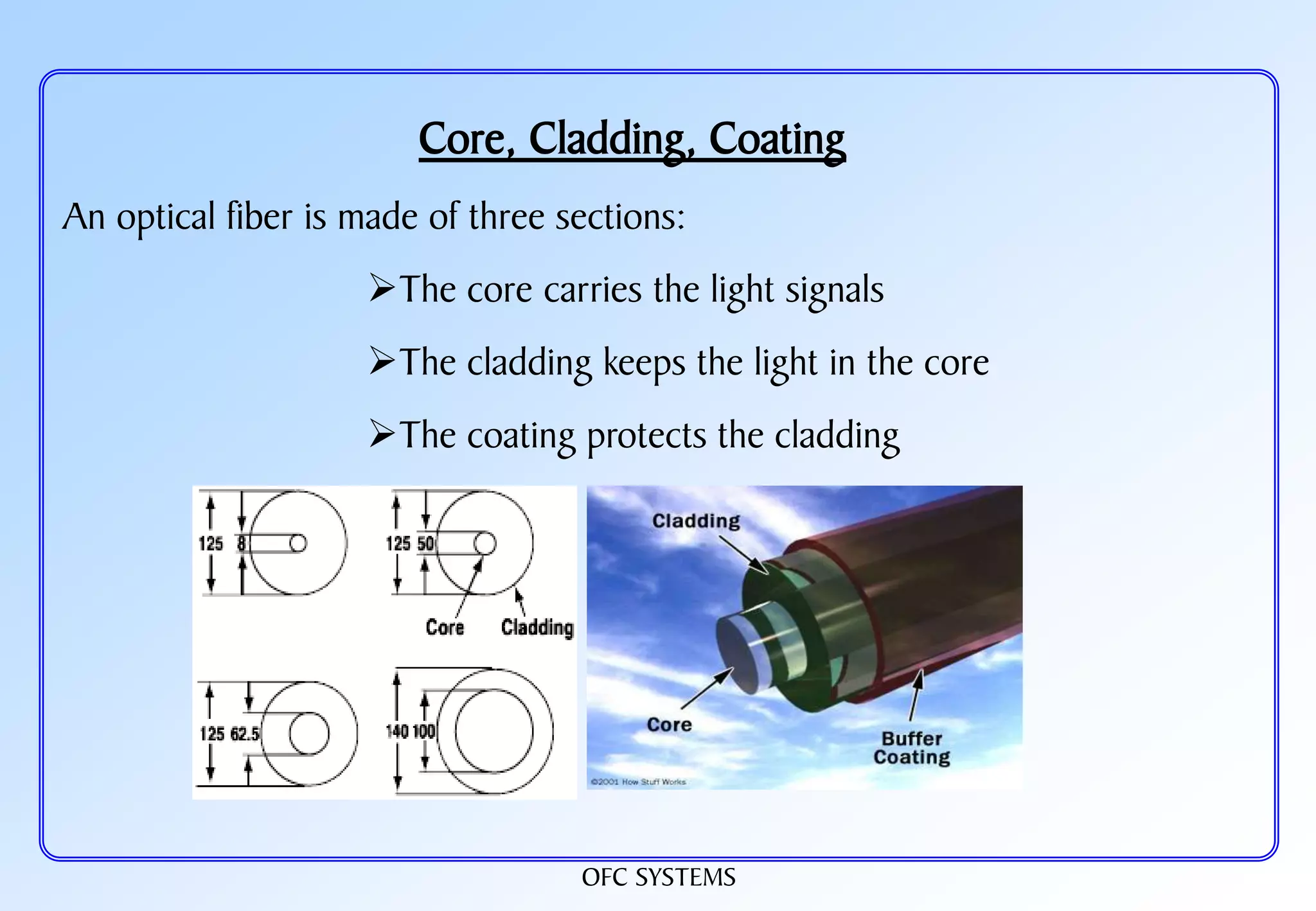
Core, Cladding, Coating
An optical fiber is made of three sections:
The core carries the light signals
The cladding keeps the light in the core
The coating protects the cladding
OFC SYSTEMS
CORE CHARACTERISTICS
1. The diameter of the light carrying region of the fiber is the "core
diameter."
2. The larger the core, the more rays of light that travel in the core.
3. The larger the core, the more optical power that can be transmitted.
4. The core has a higher index of refraction than the cladding.
5. The difference in the refractive index of the core and the cladding is known
as delta.
Buffer coating
a. Primary coating
Acrylate, silicon rubber or lecquer is applied as primary coating. It
works as mechanical protection
b. Secondary coating
An additional buffer (secondary coating) is also added during
manufacturing process.
Buffers
These are of three types, such as loose buffer, tight buffer and open channel
OFC SYSTEMS
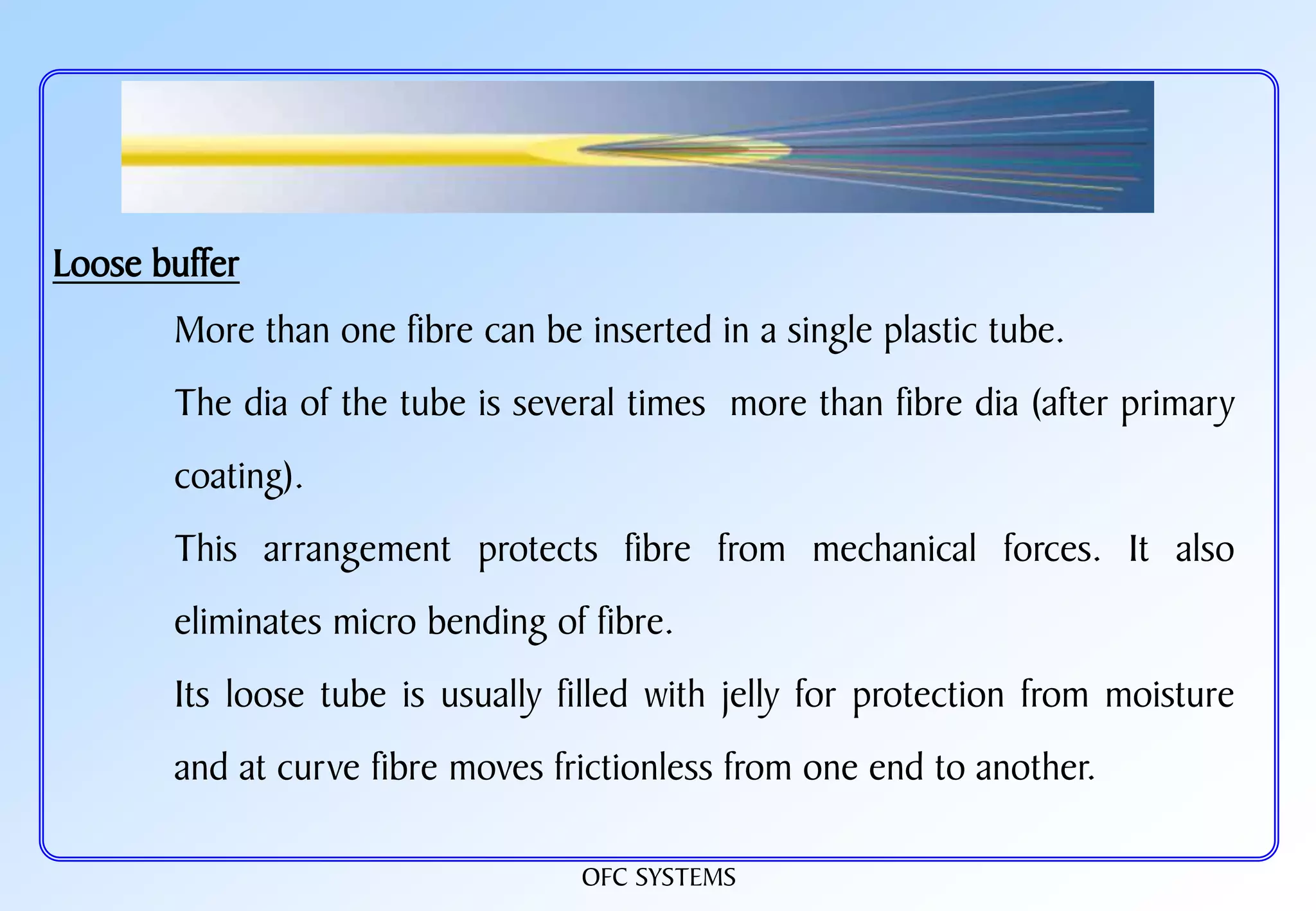
Loose buffer
More than one fibre can be inserted in a single plastic tube.
The dia of the tube is several times more than fibre dia (after primary
coating).
This arrangement protects fibre from mechanical forces. It also
eliminates micro bending of fibre.
Its loose tube is usually filled with jelly for protection from moisture
and at curve fibre moves frictionless from one end to another.
OFC SYSTEMS
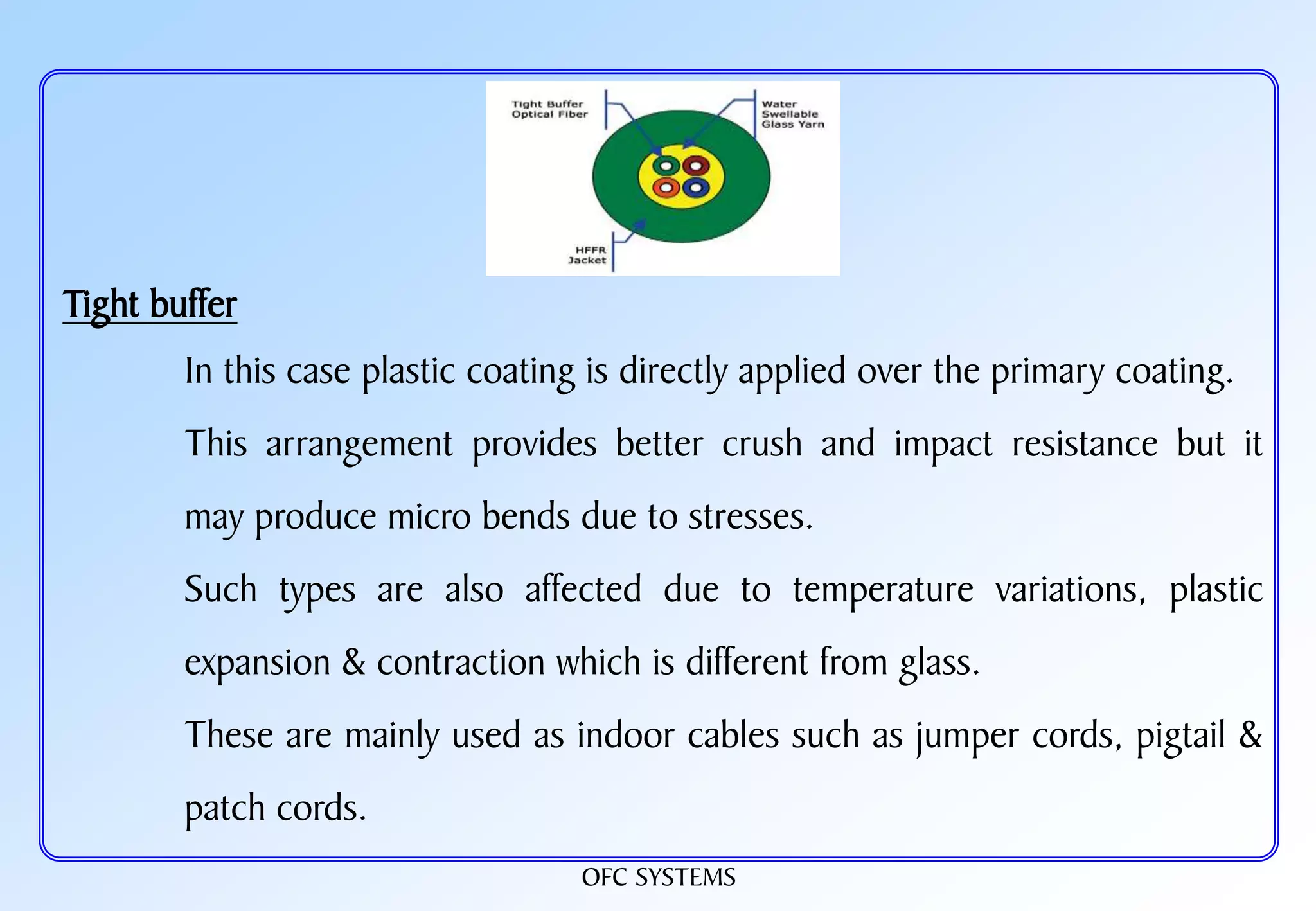
Tight buffer
In this case plastic coating is directly applied over the primary coating.
This arrangement provides better crush and impact resistance but it
may produce micro bends due to stresses.
Such types are also affected due to temperature variations, plastic
expansion & contraction which is different from glass.
These are mainly used as indoor cables such as jumper cords, pigtail &
patch cords.
OFC SYSTEMS
Open channel
In this type of cables, fibres are located in groove form in the central
strength member.
In this type fibres are free to move within the cable to avoid tensile
stress like loose tube fibres.
Fibres are protected from moisture by filling the cable with jelly or
similar.
OFC SYSTEMS
Strength Member
Optical fibres are stranded helically around the strength member.
Strength member holds the cable with low strain and provides
mechanical strength.
Strength member provided is normally of the following types:
 Steel wires
 Plastic material
 Textile fibres
 Fibre glass epoxy rods
 Filler
OFC SYSTEMS
Core Wrap
This is in the form of a tape and it holds the assembly of fibre, filler
and provides heat barrier to fibre during extrusion process of outer
sheath. Materials used are cellulose paper etc.
Cable Sheath
It protects cable from environmental damage. It makes moisture,
chemical and fire resistant.
Sheath material can be high-density polythene.
PVC sheaths are common in fibres installed for indoor application.
OFC SYSTEMS
Armour
Whenever cables are to be buried directly in the earth to protect the
cable against rodent attacks, armouring is considered essential.
Armouring can be by stainless steel wire or steel tapes.
Armouring gives extra strength and improves flexibility for easy
handling.
In case of RE area the problem of high voltage induced can be
reduced by isolating the armour at periodical interval.
The small or normal gap can be protected by applying epoxy resin etc.
OFC SYSTEMS
OFC SYSTEMS
Fiber Optic Connectors
An optical fiber connector terminates the end of an optical fiber, and enables
quicker connection and disconnection
A variety of optical fiber connectors are available. The main differences among
types of connectors are dimensions and methods of mechanical coupling
OFC SYSTEMS
Basics about connectors
• Fiber optic connector facilitates re-mateable connection i.e. disconnection /
reconnection of fiber
• Connectors are used in applications where
– Flexibility is required in routing an optical signal from lasers to receivers
– Reconfiguration is necessary
– Termination of cables is required
• Connector consists of 4 parts :
– Ferrule
– Connector body
– Cable
– Coupling device
OFC SYSTEMS
Characteristics of connectors
Insertion loss 1. Loss due to use of connector(unavoidable)
2. Manufacturers specify typical value
3. Use of strain relief boot over the junction between the cable
&connector body and attaching strength member to the
connector minimize the insertion loss
Repeatability(loss) Connector is re-useable (up to 500times). The increase in
loss shall be less than the repeatability loss
Suitability Suitable to SM / MM fiber
OFC SYSTEMS
Ferrule Connector or Fiber Channel (FC)
Screw type Coupling
Subscriber Connector or square connector or
Standard Connector (SC) (push-pull coupling)
ST connector(Straight Tip)
–twist-on mechanism, for multimode fiber optic
LAN applications
OFC SYSTEMS
Calculating Fiber Optic Loss Budget
Criteria & Calculation Factors
Fiber Loss Factor – Fiber loss generally has the greatest impact on overall
system performance. The fiber strand manufacturer provides a loss factor in
terms of dB per kilometer.
A total fiber loss calculation is made based on the distance x the loss factor.
Distance in this case the total length of the fiber cable, not just the map
distance.
OFC SYSTEMS
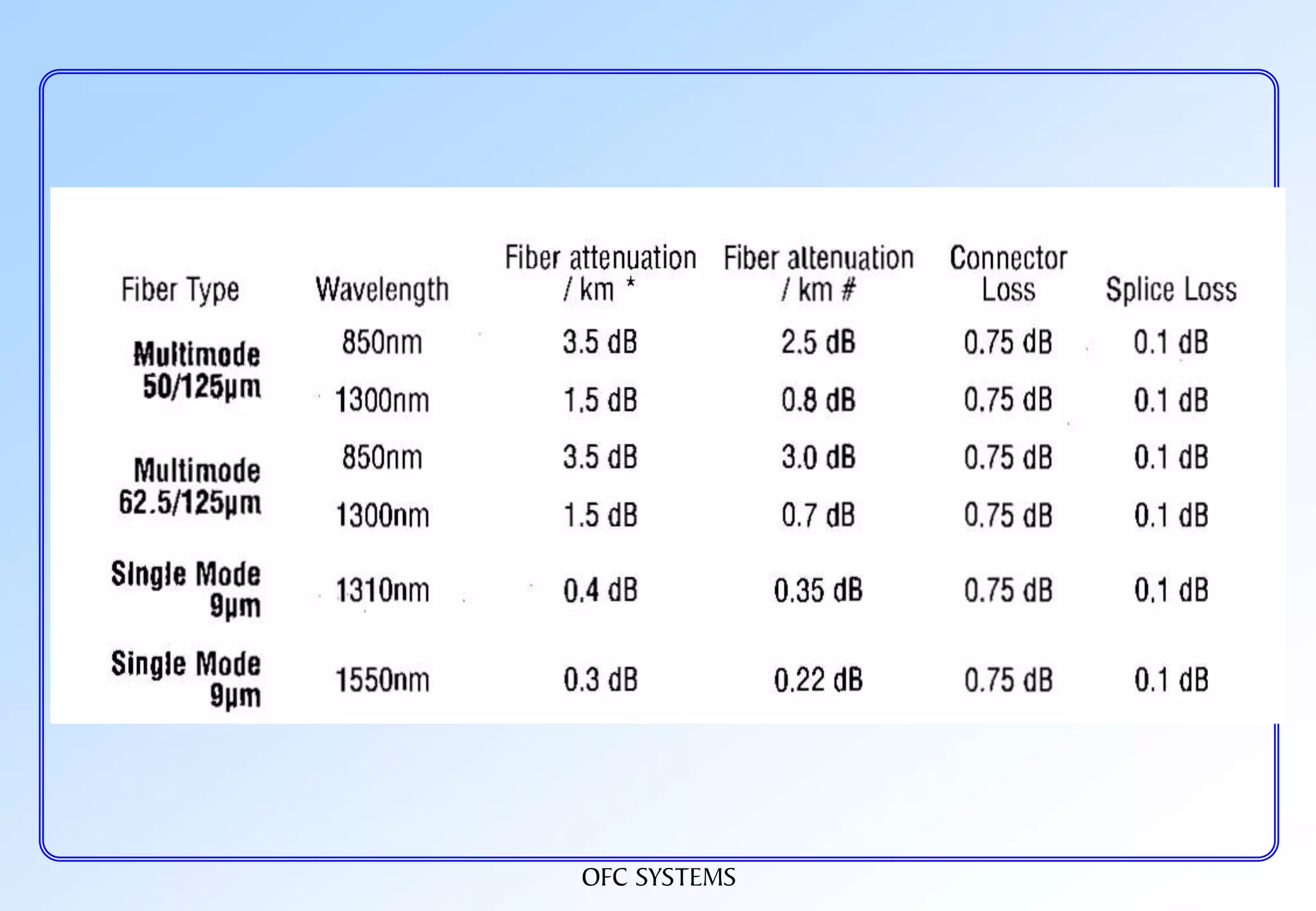
Type of fiber – Most single mode fibers have a loss factor of between 0.25 (@
1550nm) and 0.35 (@ 1310nm) dB/km.
Multimode fibers have a loss factor of about 2.5 (@ 850nm) and 0.8 (@
1300nm) dB/km. The type of fiber used is very important.
Multimode fibers are used with L.E.D. transmitters which generally don't have
enough power to travel more than 1km.
Single mode fibers are used with LASER transmitters that come in various
power outputs for "long reach" or "short reach" criteria
OFC SYSTEMS
Transmitter – There are two basic type of transmitters used in a fiber optic
systems.
LASER which come in three varieties: high, medium, and low (long reach,
medium reach and short reach). Overall system design will determine which
type is used.
L.E.D. transmitters are used with multimode fibers, however, there is a "high
power" L.E.D. which can be used with Single mode fiber. Transmitters are
rated in terms of light output at the connector, such as -5dB. A transmitter is
typically referred to as an "emitter".
OFC SYSTEMS
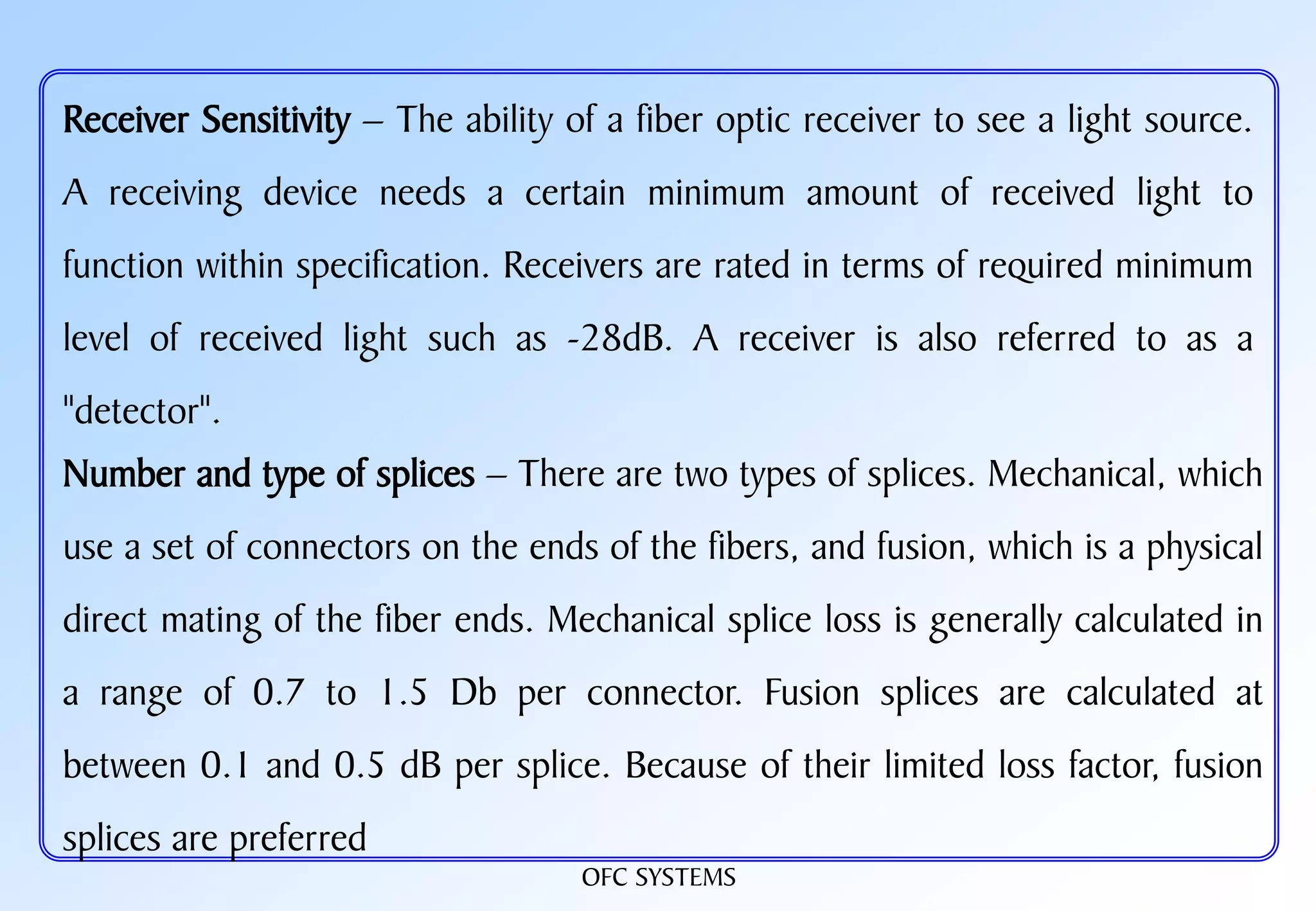
Receiver Sensitivity – The ability of a fiber optic receiver to see a light source.
A receiving device needs a certain minimum amount of received light to
function within specification. Receivers are rated in terms of required minimum
level of received light such as -28dB. A receiver is also referred to as a
"detector".
Number and type of splices – There are two types of splices. Mechanical, which
use a set of connectors on the ends of the fibers, and fusion, which is a physical
direct mating of the fiber ends. Mechanical splice loss is generally calculated in
a range of 0.7 to 1.5 Db per connector. Fusion splices are calculated at
between 0.1 and 0.5 dB per splice. Because of their limited loss factor, fusion
splices are preferred
OFC SYSTEMS
Margin – This is an important factor. A system can't be designed based on
simply reaching a receiver with the minimum amount of required light. The
light power budget margin accounts for aging of the fiber, aging of the
transmitter and receiver components, addition of devices along the cable path,
incidental twisting and bending of the fiber cable, additional splices to repair
cable breaks, etc. Most system designers will add a loss budget margin of 3 to
10 dB
OFC SYSTEMS
Attenuation on the Optical Link
OFC SYSTEMS
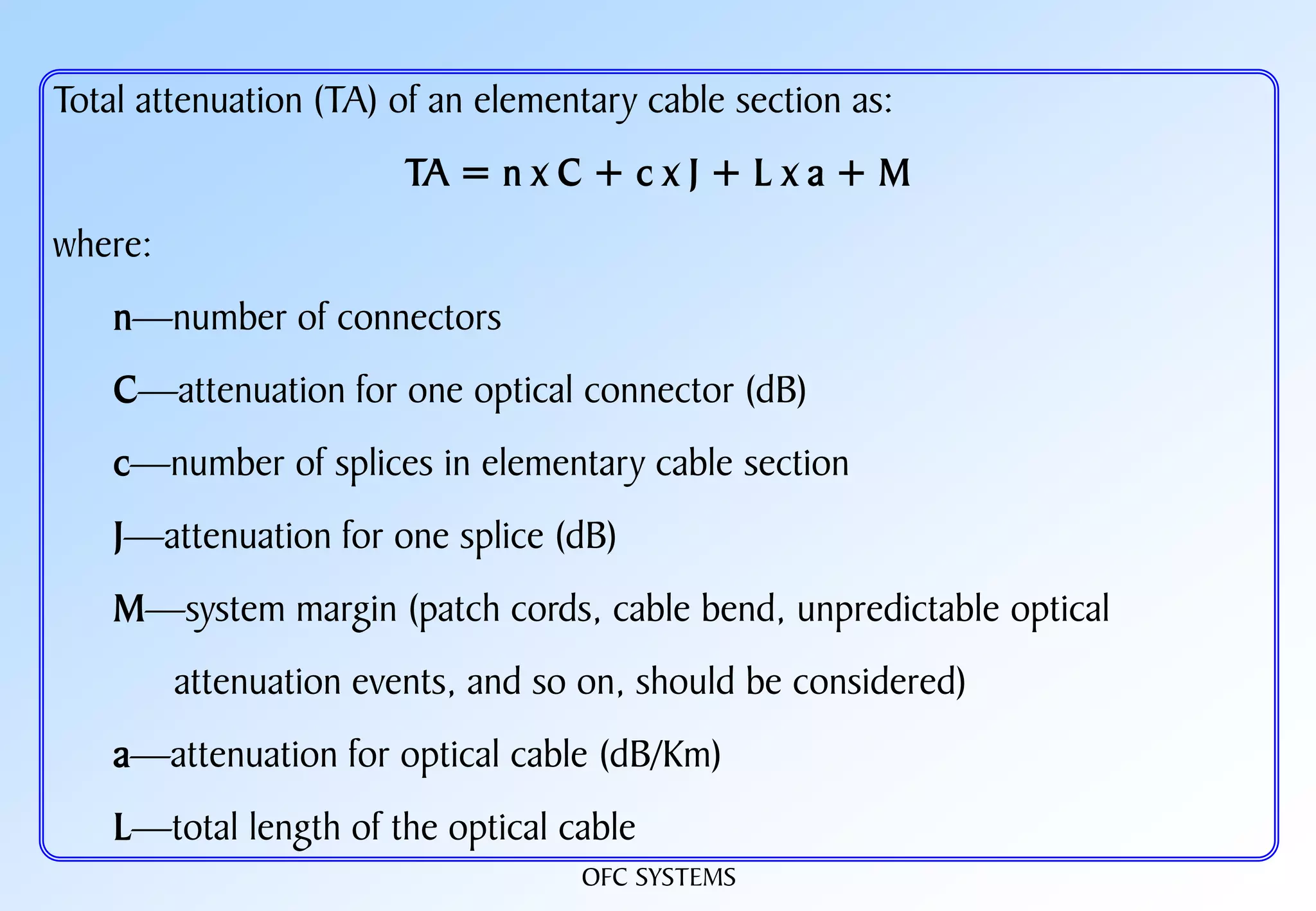
Total attenuation (TA) of an elementary cable section as:
TA = n x C + c x J + L x a + M
where:
n—number of connectors
C—attenuation for one optical connector (dB)
c—number of splices in elementary cable section
J—attenuation for one splice (dB)
M—system margin (patch cords, cable bend, unpredictable optical
attenuation events, and so on, should be considered)
a—attenuation for optical cable (dB/Km)
L—total length of the optical cable
OFC SYSTEMS
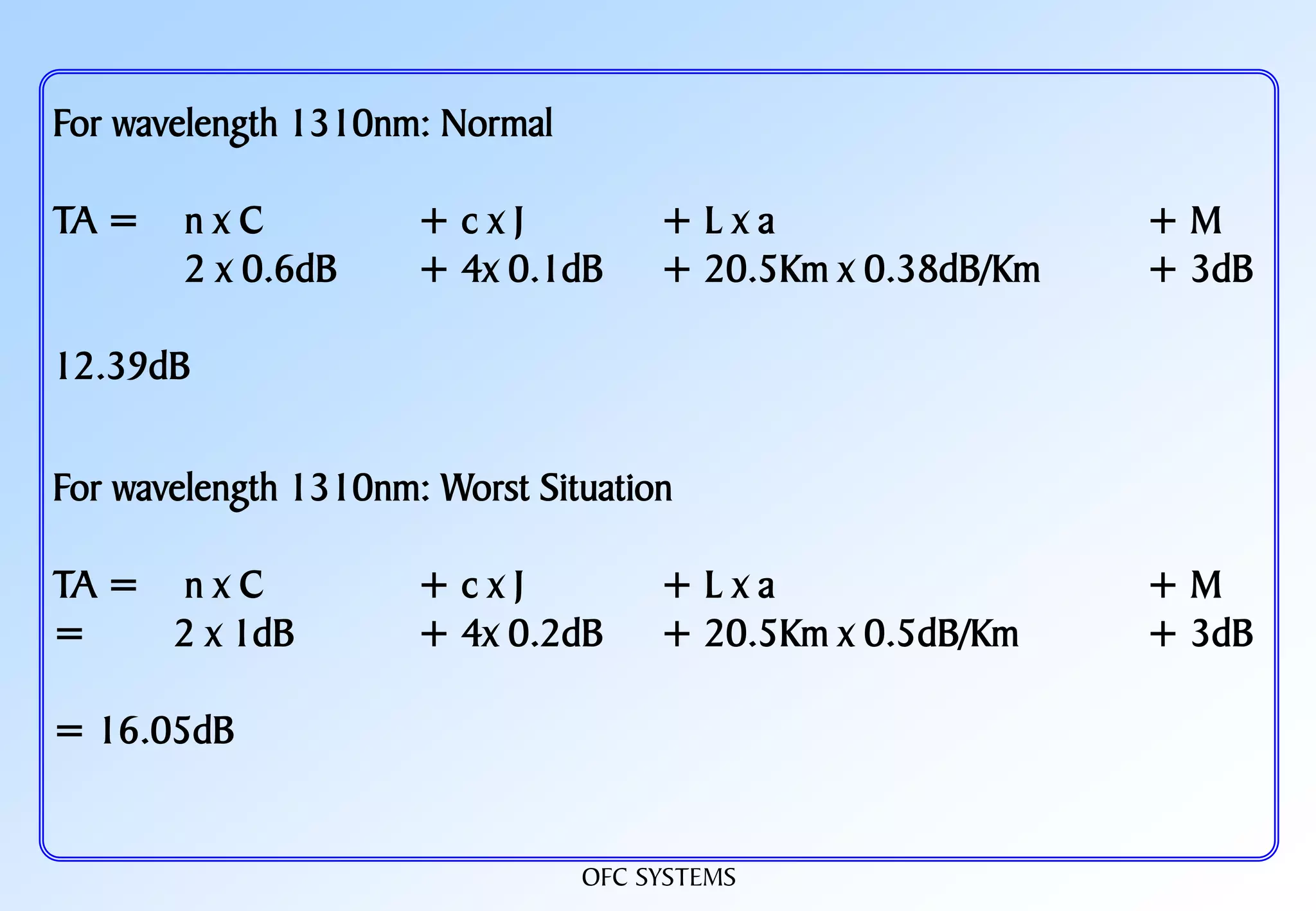
For wavelength 1310nm: Normal
TA = n x C + c x J + L x a + M
2 x 0.6dB + 4x 0.1dB + 20.5Km x 0.38dB/Km + 3dB
12.39dB
For wavelength 1310nm: Worst Situation
TA = n x C + c x J + L x a + M
= 2 x 1dB + 4x 0.2dB + 20.5Km x 0.5dB/Km + 3dB
= 16.05dB
OFC SYSTEMS
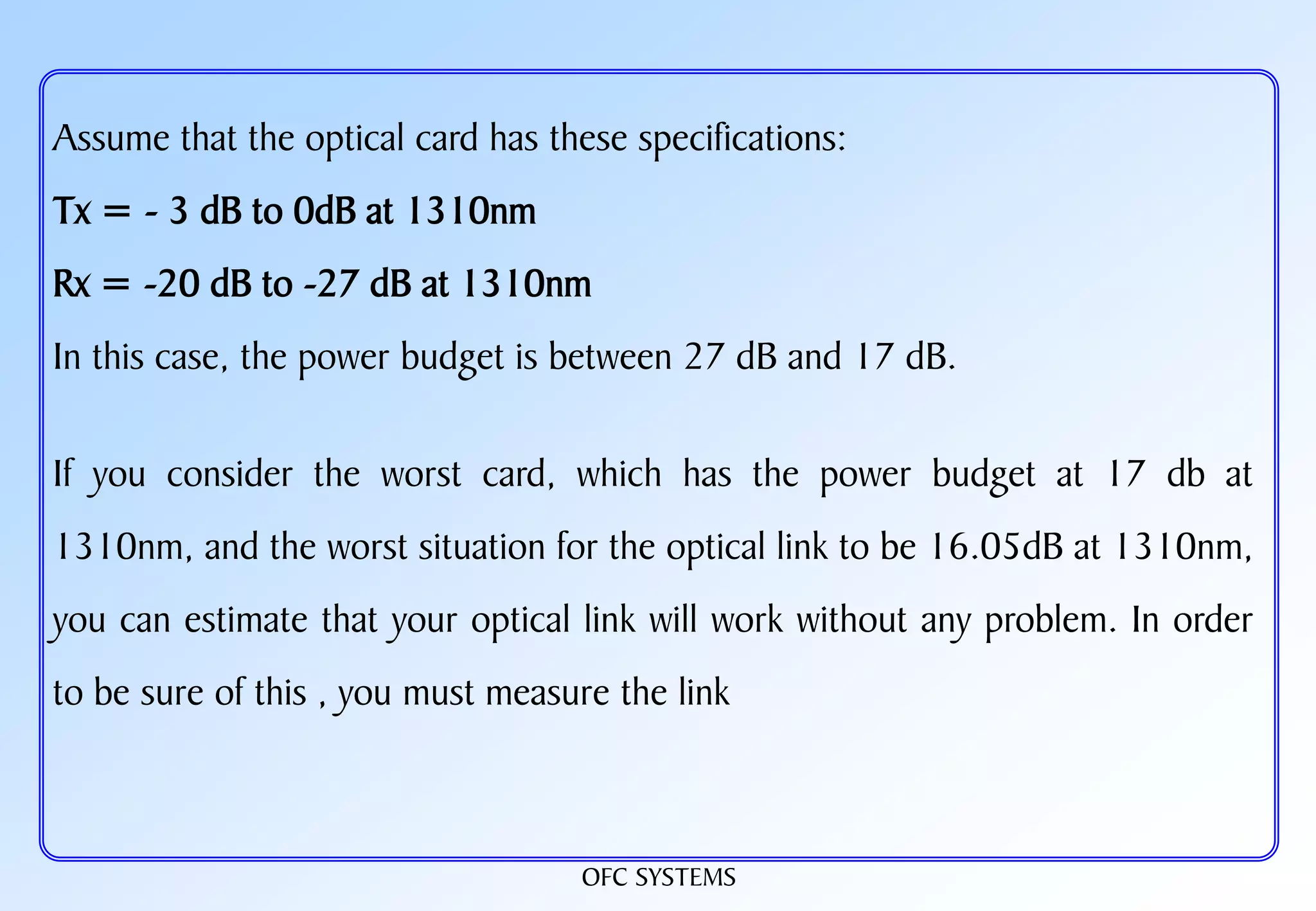
Assume that the optical card has these specifications:
Tx = - 3 dB to 0dB at 1310nm
Rx = -20 dB to -27 dB at 1310nm
In this case, the power budget is between 27 dB and 17 dB.
If you consider the worst card, which has the power budget at 17 db at
1310nm, and the worst situation for the optical link to be 16.05dB at 1310nm,
you can estimate that your optical link will work without any problem. In order
to be sure of this , you must measure the link
OFC SYSTEMS
OFC LINK LOSS
LINK LOSS = [ Fiber length (Km) X Fiber attenuation per km] + [Splice loss x
No. of splices ] + [ Connector loss x No. of connectors ] + Safety margin
Assume a 40 Km long single mode link with 1310 nm with 2 connector pairs
and 5 splices
LINK LOSS = [ 40 X 0.4] + [0.1x 5] + [ 0.75 x 2] + 3 = 21 dB
OFC SYSTEMS
Estimate Fiber length
[ Optical budget ] - [Link loss ]
Fiber length=
[ Fiber loss / Km ]
Fiber length = {[ Tx power – Rx sensitivity ]- [Splice loss x No. of
splices ]+ [ Connector loss x No. of connectors
] +( Safety margin)}÷ [ Fiber loss / Km ]
OFC SYSTEMS
OFC SYSTEMS
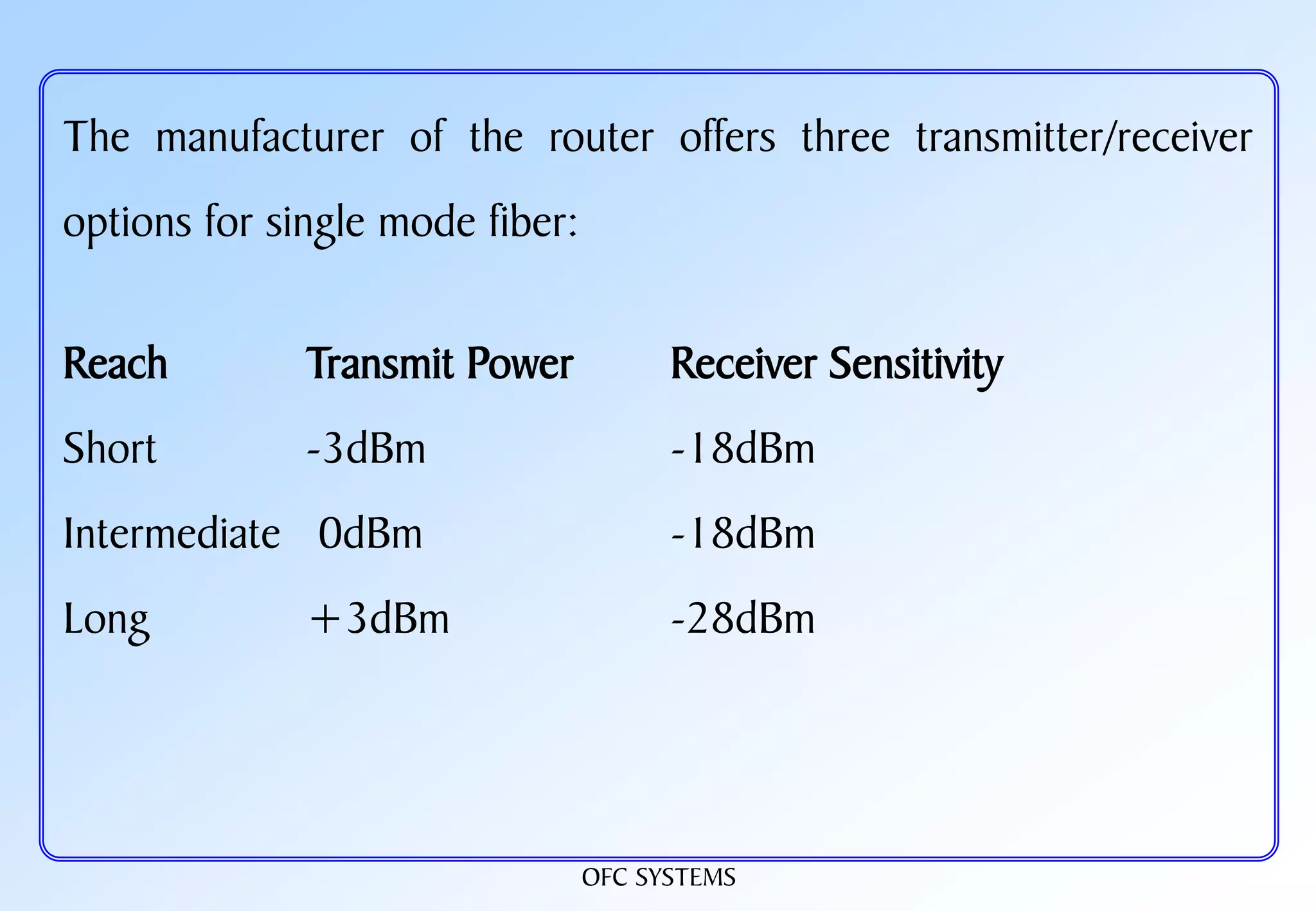
The manufacturer of the router offers three transmitter/receiver
options for single mode fiber:
Reach Transmit Power Receiver Sensitivity
Short -3dBm -18dBm
Intermediate 0dBm -18dBm
Long +3dBm -28dBm
OFC SYSTEMS
FIBER OPTIC SOURCES
Two basic light sources are used for fiber optics: laser diodes (LD)
and light-emitting diodes (LED). Each device has its own
advantages and disadvantages
Fiber optic sources must operate in the low-loss transmission
windows of glass fiber.
LEDs are typically used at the 850-nm and 1310-nm transmission
wavelengths, whereas lasers are primarily used at 1310 nm and
1550 nm.
OFC SYSTEMS
OFC SYSTEMS
Laser diodes (“Light Amplification by the Stimulated Emission of Radiation”LD)
are used in applications in which longer distances and higher data rates are
required. Because an LD has a much higher output power than an LED, it is
capable of transmitting information over longer distances. Consequently, and
given the fact that the LD has a much narrower spectral width, it can provide
high-bandwidth communication over long distances
OFC SYSTEMS
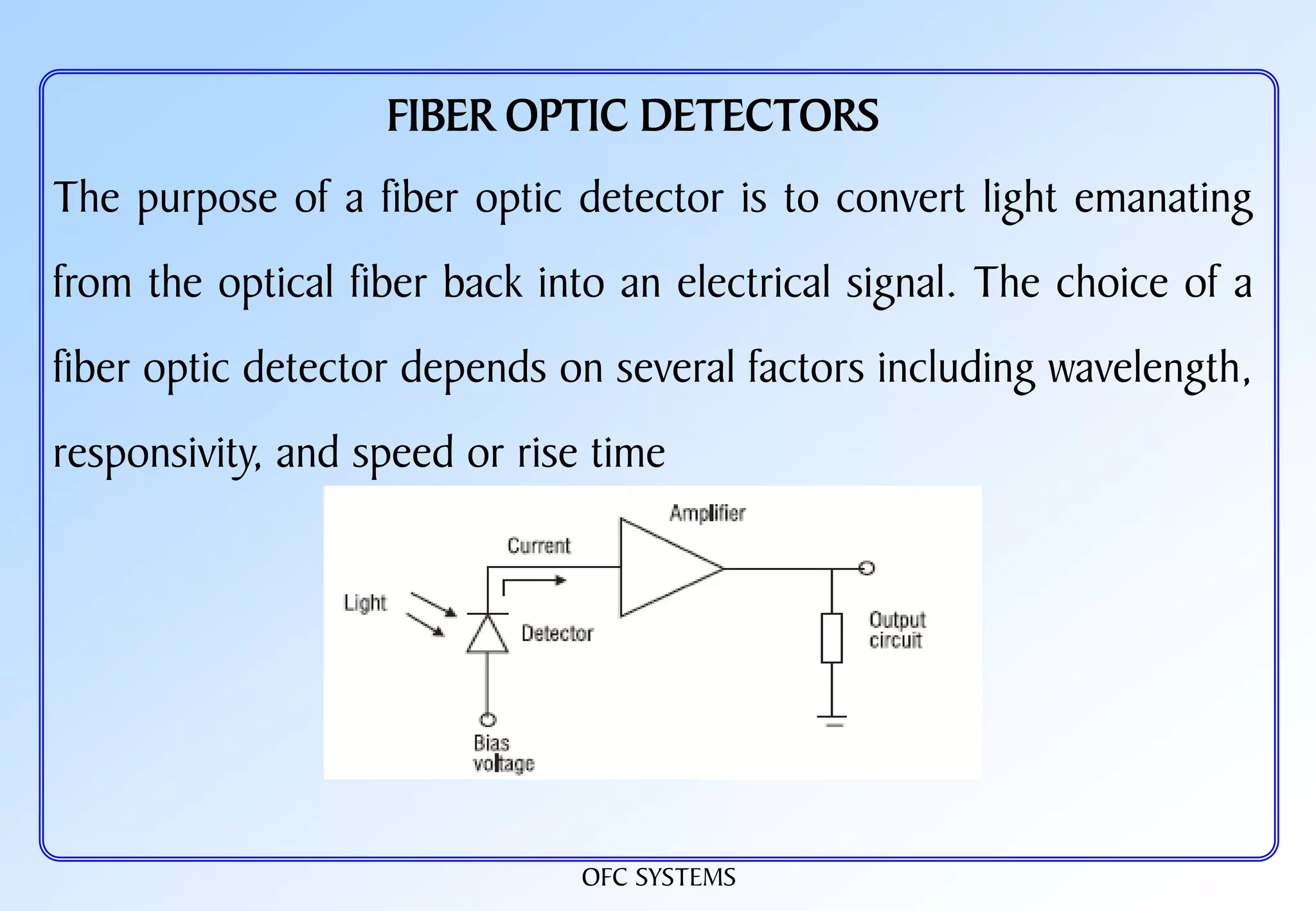
FIBER OPTIC DETECTORS
The purpose of a fiber optic detector is to convert light emanating
from the optical fiber back into an electrical signal. The choice of a
fiber optic detector depends on several factors including wavelength,
responsivity, and speed or rise time
OFC SYSTEMS
The most commonly used photo detectors are the PIN and avalanche
photodiodes (APD). The material composition of the device determines the
wavelength sensitivity. In general, silicon devices are used for detection in the
visible portion of the spectrum; In GaAs crystal are used in the near-infrared
portion of the spectrum between 1000 nm and 1700 nm, and germanium PIN
and APDs are used between 800 nm and 1500 nm
OFC SYSTEMS
Typical Photo detector Characteristics
OFC SYSTEMS
Responsivity—the ratio of the electrical power to the detector’s output optical
power.
Quantum efficiency—the ratio of the number of electrons generated by the
detector to the number of photons incident on the detector.
Quantum efficiency = (Number of electrons)/Photon
Dark current—the amount of current generated by the detector with no light
applied. Dark current increases about 10% for each temperature increase of
1°C and is much more prominent in Ge and InGaAs at longer wavelengths than
in silicon at shorter wavelengths.
OFC SYSTEMS
Noise floor—minimum detectable power that a detector can handle. The noise
floor is related to the dark current since the dark current will set the lower limit.
Noise floor = Noise (A)/Responsivity (A/W)
Response time—the time required for the detector to respond to an optical
input. The response time is related to the bandwidth of the detector by
BW = 0.35/tr
where tr is the rise time of the device. The rise time is the time required for the
detector to rise to a value equal to 63.2% of its final steady-state reading.
Noise equivalent power (NEP)—at a given modulation frequency, wavelength,
and noise bandwidth, the incident radiant power that produces a signal-to-noise
ratio of one at the output of the detector.
OFC CABLE LAYING PRACTICES
OFC SYSTEMS
Site survey and estimation
It shall be done before preparing the estimate.
The survey shall be done in THREE phases. The following
observations are recorded during the survey by engineers.
Initial or First survey
Initial/First survey by train with Engineering drawing.
Verify culverts, bridges and LC gates.
Observe nature of land i.e sand, black cotton soil, red soil, morrum
and rocky.
Prepare a chart with schedule items for rough estimation.
OFC SYSTEMS
OFC SYSTEMS
PRELIMINARY SURVEY OF OPTIC FIBRE CABLE ROUTE
Preliminary survey shall be carried out for finalizing the drawing for the route
of optical fibre cable as a part of project planning and execution.
Following main items of work shall constitute the survey.
1. Selecting the route in general.
2. Deciding the number of drop and insert locations.
3. Deciding the size and assessing the length of cable required.
4. Working out the requirement of circuits which are to be provided
in the cable.
OFC SYSTEMS
5. Working out the requirements of heavy tools and plants depending
upon the nature of the territory, availability of roads along the
tracks etc.
6. Assessing the special problems of the section such as type of soil, long
cuttings, new embankments, water logged areas, types of major
bridges, major yards.
7. Collecting details of the existing telecommunication facilities and the
additional requirements due to electrification and preparing tentative
tapping diagrams.
OFC SYSTEMS
8. Avoiding as far as possible laying of cable too close to a newly laid
track.
10. Avoiding the toe of the embankment adjacent to the cultivated Fields.
11. Avoiding burrow pits and areas prone to water logging.
12. Avoiding soil made up of cinders, coal ashes, etc.
13. Avoiding heavily fertilized soils containing acids, electrolytes and
decomposable organic materials promoting bacterial activity.
14. Avoiding proximity to chemical, paper and such other industries which
discharge chemically active affluent.
Second survey
 Second survey by trolley along with concerned CIVIL and S&T staff ,
at least one block section per day.
 Take alignment along the Rly boundary.
 Note the off sets and existing cables enroute.
 Note the places where cable requires protection with GI Pipe or RCC
Pipe
OFC SYSTEMS
Third survey
 Third survey by foot with sufficient labors.
 Do the test pit for every 200 m and note down the nature of soil
 Compile the Estimation for one block section with 10-15% extra
quantities.
 Prepare the proposed cable route drawing.
 Ensure the station yard, location boxes, signal posts, culverts and LC
gates in the drawing.
 Submit drawings for Engineering department for approval.
OFC SYSTEMS
OFC SYSTEMS
Preparation of cable route plan and tapping diagrams
The cable route plan should indicate the route with respect to the main line,
that is, whether the route along the DN main line or UP main line in case of
double line sections and whether it is on both side or right side of the main line
when facing a particular direction in case of single line section.
A tentative tapping diagram should be prepared for the section indicating the
tappings of various circuits.
OFC SYSTEMS
Selection of the Cable Route.
Generally the terrain conditions on the two sides of the track vary to such an
extent as the cable route on one side of the track has a distinct advantage
over that on the other side. While operating on the principle, it should be
borne in mind that frequent track crossings are not desirable
OFC SYSTEMS
In addition to the above, the following also need consideration :-
1. Avoiding underground structures, signalling cables, power cables, pipe
lines, etc.
2. Avoiding the laying of cable on the side of the drains in built up
areas which is generally difficult.
3. Selecting the cable route as far as possible on the opposite side where
Railway signalling cables are already existing in station yards, etc.
4. Taking the cable route preferably through the bed of small culverts
where water does not accumulate instead of taking it over the culverts.
5. Avoiding termites/rodents infected areas.
6. Preference at the side of main line away from coastal side.
OFC SYSTEMS
CABLE HANDLING TECHNIQUE FOR STOCKING & TRANSPORTATION OF
OPTIC FIBRE CABLE
Cable drum testing
• Before laying every cable drum shall be tested.
• The normal length of drum is about 3km.
• The drum number, length of the cable and running meters to be
noted.
• All fibers shall be tested with OTDR and traces to be stored.
• The cable laying is avoided if any event or break is observed
OFC SYSTEMS
The following practices are to be followed to prevent damages or deterioration
of the cable during handling and storage
1. The cable drums stored in open shall be kept on strong surface such
as released sleepers to prevent sinking.
2. The cable drums shall be stored in a manner allowing easy access
for lifting and moving and the drums shall be stored away from
other construction activities.
3. When rolling the cable drum either for unloading or transportation
to cable laying site, the drum shall always be ‘Rotated in the
direction of an arrow which is marked on the side boards of the
drums ’sometimes ‘roll this way’ arrow is indicated on the drum
flange.
OFC SYSTEMS
4. The drums shall not be rolled over objects that could cause damage to
the protective battens or the cable.
5. After transit, the drums shall be inspected for damage such as broken
battens and where possible, the outer layers of the cable should be
inspected.
6. The cable drums shall always be kept upright with the cable ends
securely tied to prevent unwrapping. All battens or coverings shall be
left in a place until the cable is unrolled from the drums during
installation.
OFC SYSTEMS
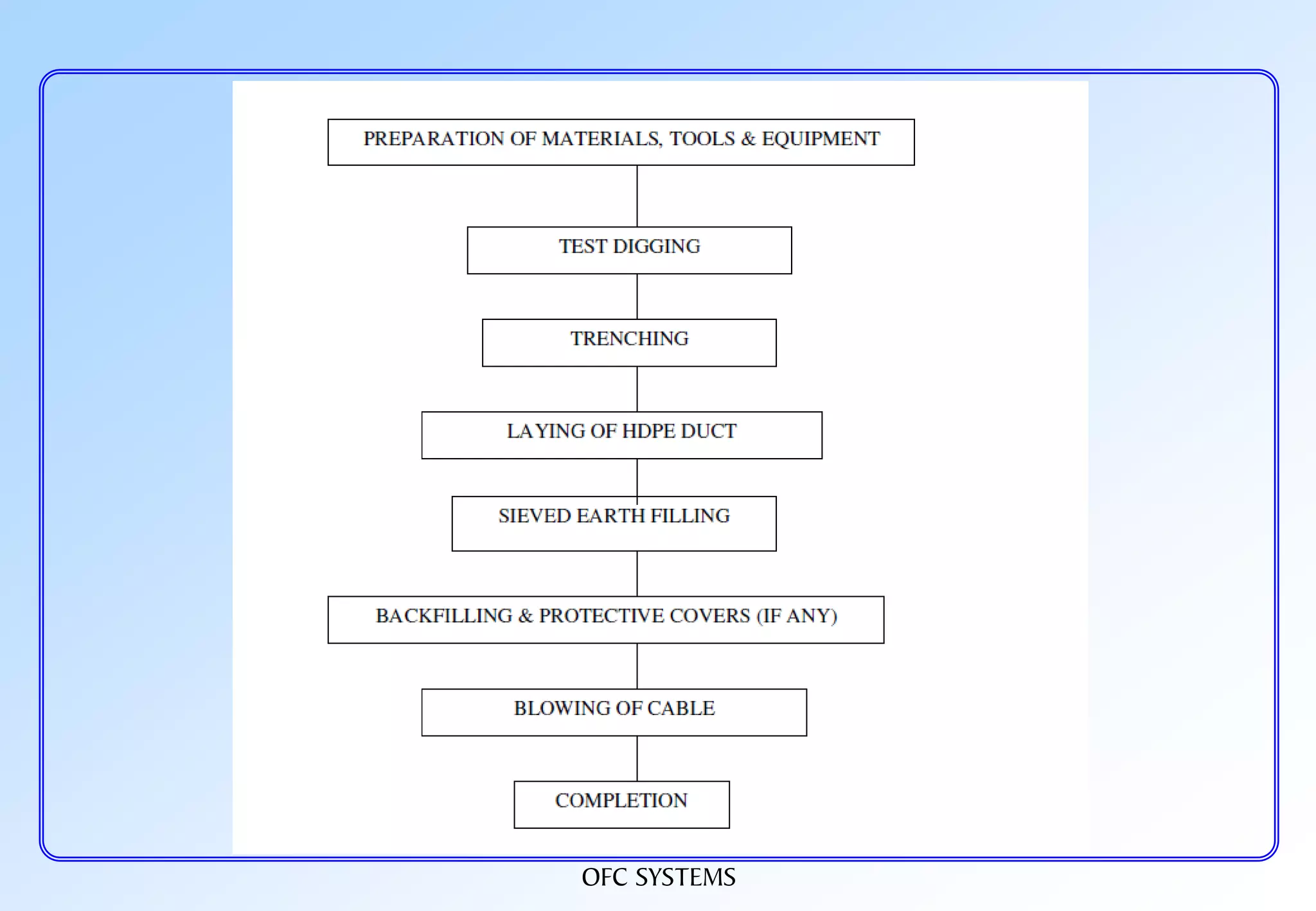
LAYING OF DUCT IN TRENCHES AND CLOWING/PULLING
OF CABLES IN DUCT
WORK FLOW DIAGRAM FOLLOWS-------------
OFC SYSTEMS
OFC SYSTEMS
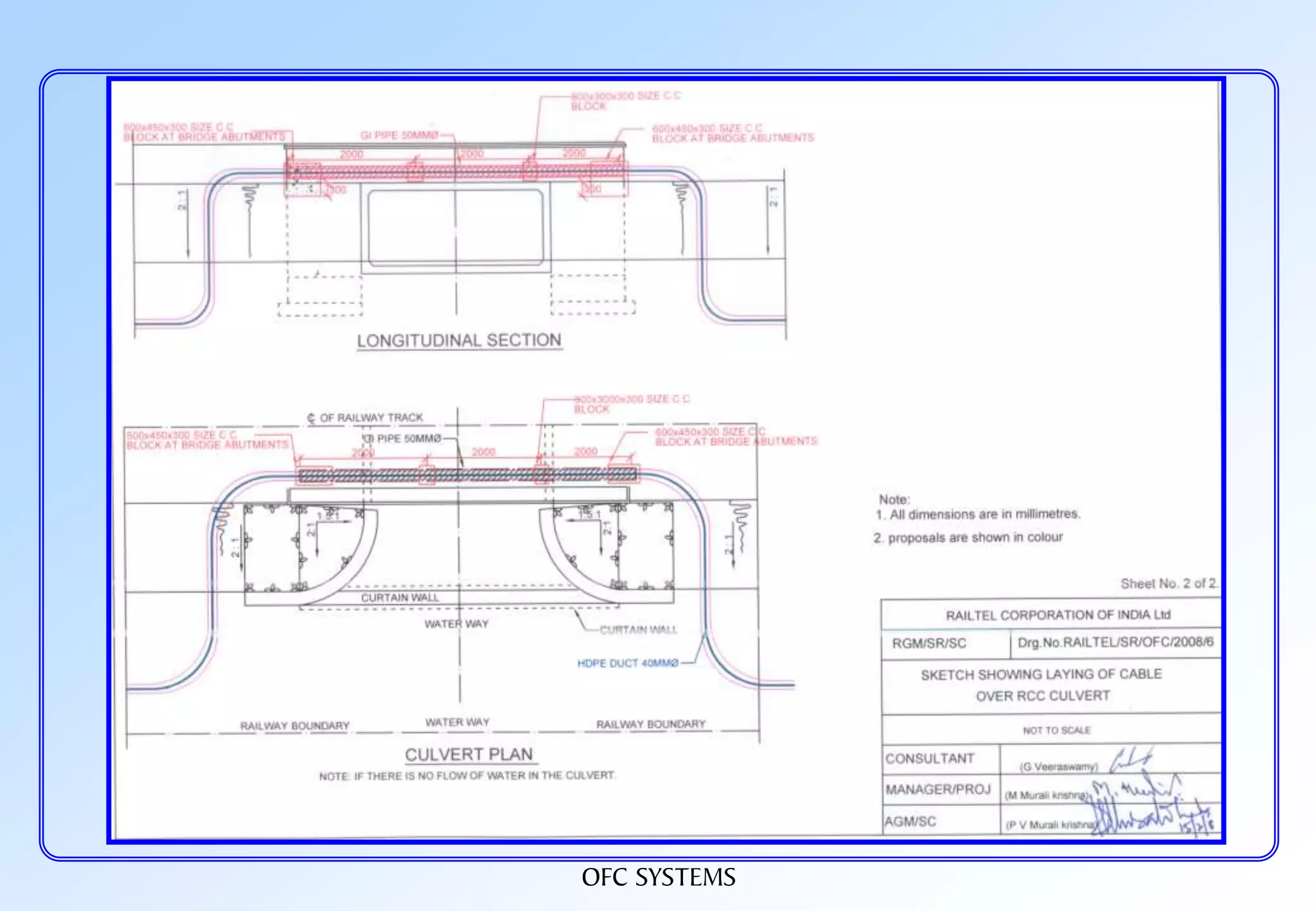
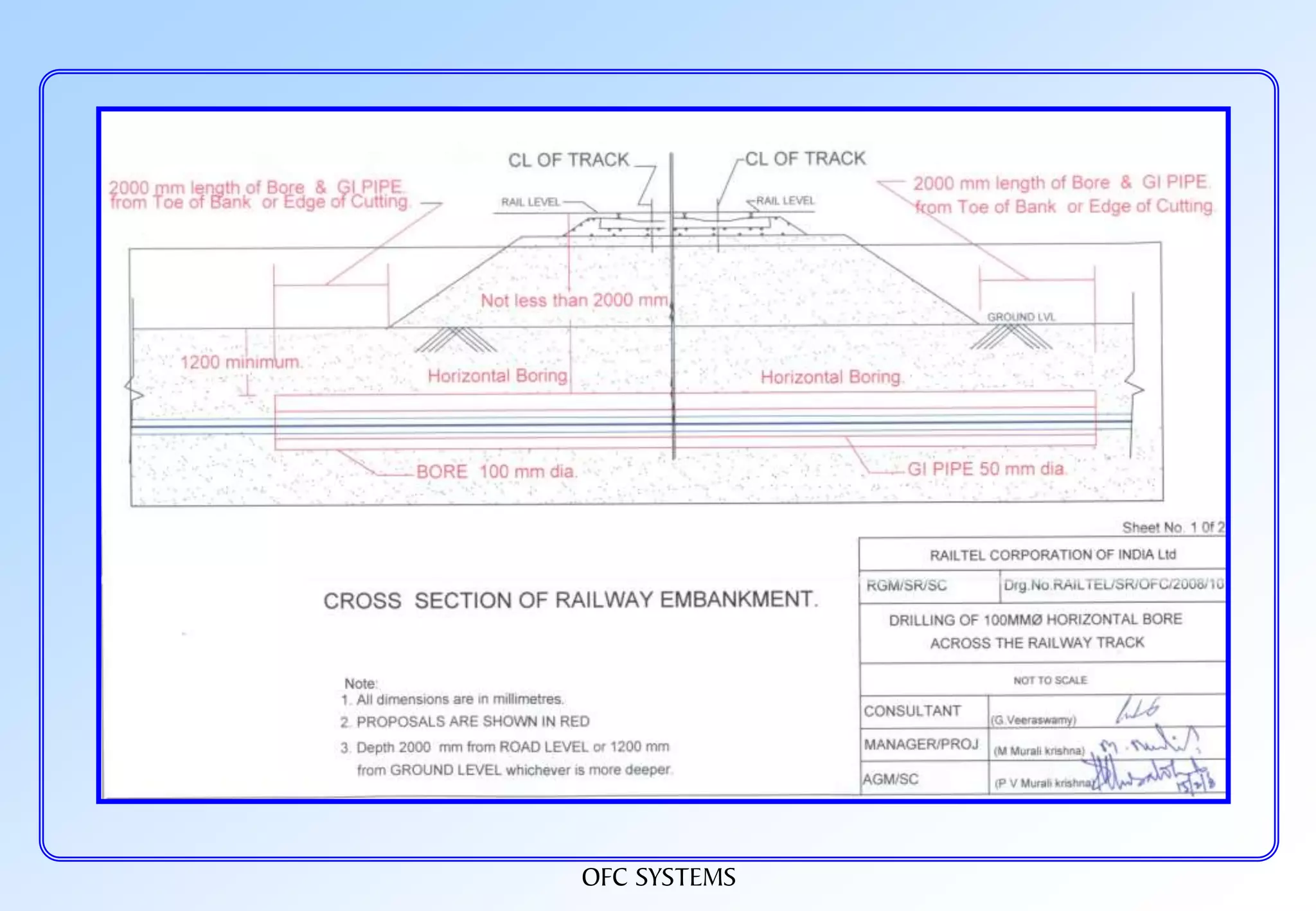
CABLE INSTALLATION AND TRENCHES – GENERAL
Armored fibre optic cable shall be blown into duct laid and suitably
aligned in the trench.
The trenching and laying method is dependent on both ground
configuration and nature of the soil at site.
OFC SYSTEMS
OFC SYSTEMS
OFC SYSTEMS
OFC SYSTEMS
OFC SYSTEMS
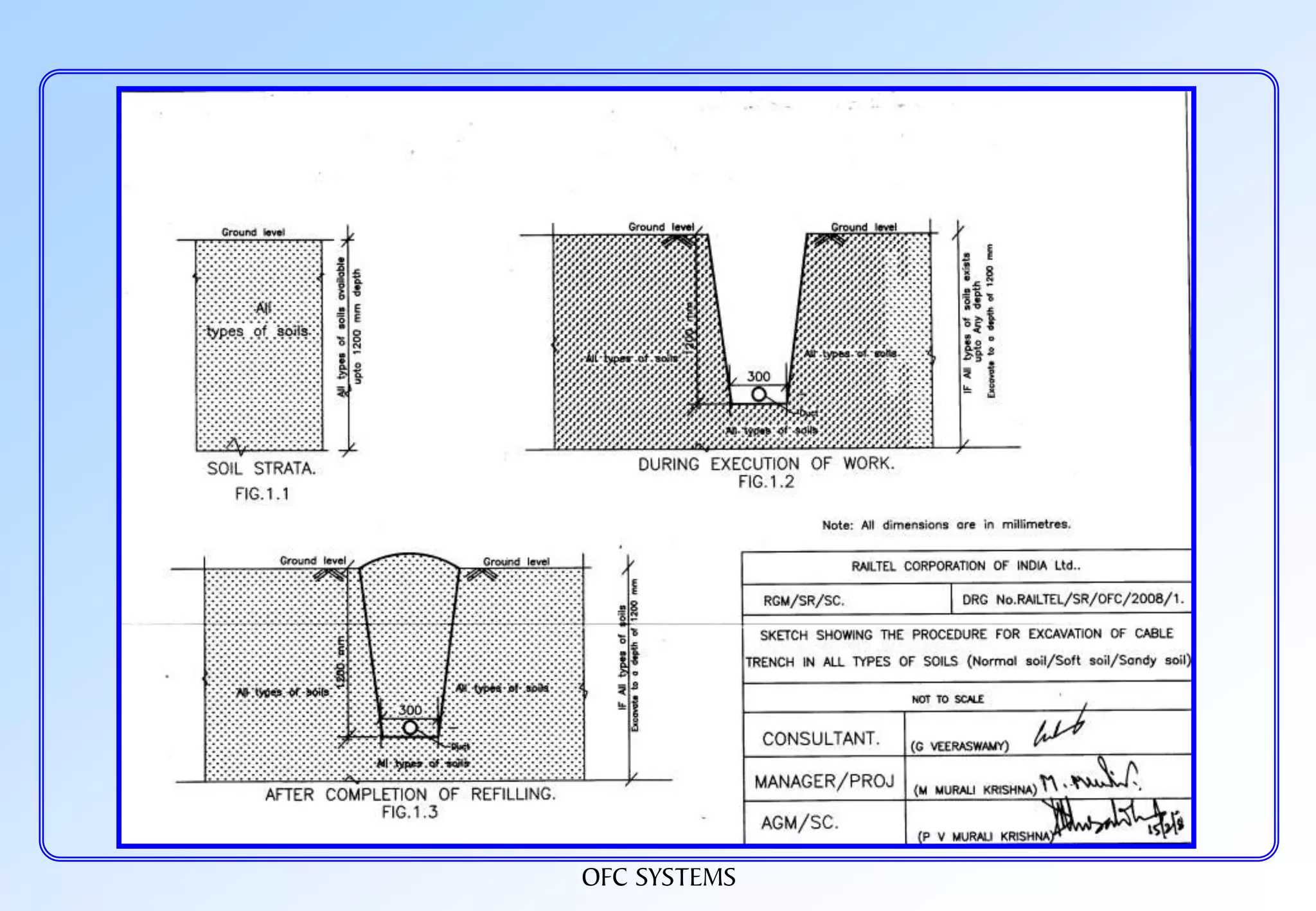
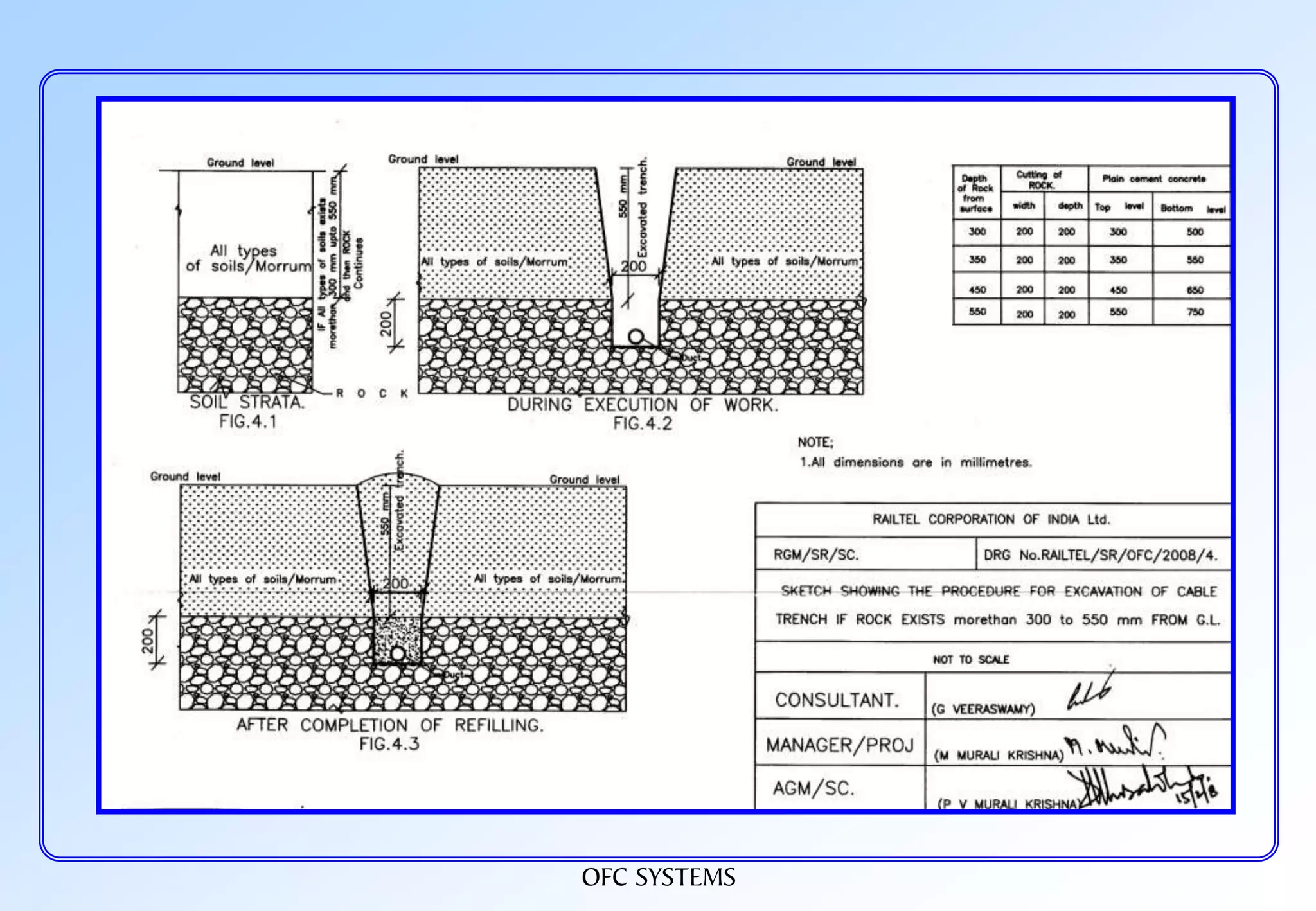
Laying of Optic fiber cable in trenches
Excavation
The excavation for trenching can be made either manually or by
mechanical means.
Manual Excavation
The depth of the trench may be measured by a rule made of pipes as
per drawing.
OFC SYSTEMS
TREATMENT OF CABLE AFTER IT IS LAID
a. After completion of cable laying check the following items :
Confirm extra jointing length as required at end.
In case cable is damaged, take necessary prevention and remedial steps
for removal of defects.
If there is any snaking or rise in cable put right.
Examine interior of the trench and remove any pebbles, etc.
Take protective step for such objects projecting the trench such as
sewer pipe etc.
OFC SYSTEMS
b. While laying one piece of cable, when part of the work is to be
put off till the following day, keep the remaining portion of cable
wound on the drum, reduce as much as possible the distance of
the drum from already laid cable considering cable bending
radius and general traffic safety and also ensure that drum is
prevented from tumbling down or rolling away. Already laid
cable shall be fully covered to avoid outside interface.
OFC SYSTEMS
Devices to connect internal equipment with OFC
OFC SYSTEMS
Zero dB couplers and 10 dB attenuators
OFC SYSTEMS
LC-FC Patch cord
OFC SYSTEMS
SC-E2000 Patch cord
OFC SYSTEMS
E2000 pigtails
OFC SYSTEMS
FDMS with E2000 couplers
OFC SYSTEMS
FDMS with SC couplers
OFC SYSTEMS
FDMS
OFC SYSTEMS
Any Questions?
OFC SYSTEMS
THANK YOU
OFC SYSTEMS

OFC

  • 1.
    OFC SYSTEMS AGENDA OFTOPICS •ADVANTAGES •PRINCIPLES •ATTENUATION •CABLE DESIGN •COMPONANTS •POWER BUDGET •INSTALLATION PRACTICE
  • 2.
    OFC SYSTEMS What isa fiber optic cable? A fiber optic cable is a cylindrical pipe. It may be made out of glass or plastic or a combination of glass and plastic. It is fabricated in such a way that this pipe can guide light from one end of it to the other.
  • 3.
    OFC SYSTEMS What isan Optic Fiber Communication ? Fiber-Optic communication is a method of transmitting information from one place to another by sending pulse of light through an optical fiber. The light forms an electromagnetic carrier wave that is modulated to carry information. Most of the optic fiber systems use infrared light between 800nm and 1600nm because glass fibers carry infrared light more efficiently than visible light.
  • 4.
  • 5.
    Basic Optic FiberLink • Transmitter Receiver • 1.Driver 4.Fiber to detector • 2.Source 5.Detector • 3.Source to fiber 6.Output Circuit 2 3 4 5 61 OFC OFC SYSTEMS
  • 6.
    OFC SYSTEMS ADVANTAGE OFFIBER OPTICS Long-distance signal transmission The low attenuation and superior signal integrity found in optical systems allow much longer intervals of signal transmission than metallic-based systems Large bandwidth, light weight, and small diameter Today’s applications require an ever-increasing amount of bandwidth. The relatively small diameter and light weight of optical cable make such installations easy and practical, saving valuable conduit space in these environments. More information carrying capacity 10 Gbps ( 2.5 Gbps STM-16 : Railways)
  • 7.
    OFC SYSTEMS Nonconductivity Since opticalfiber has no metallic components, it can be installed in areas with electromagnetic interference (EMI), including radio frequency interference (RFI). Areas with high EMI include utility lines, power-carrying lines, and railroad tracks. All-dielectric cables are also ideal for areas of high lightning- strike incidence Security Unlike metallic-based systems, the dielectric nature of optical fiber makes it impossible to remotely detect the signal being transmitted within the cable.
  • 8.
    OFC SYSTEMS No Crosstalk As the signal transmission is digital modulation no chance of cross talk between channels Designed for future applications needs Fiber optics is affordable today, as electronics prices fall and optical cable pricing remains low. In many cases, fiber solutions are less costly than copper. As bandwidth demands increase rapidly with technological advances, fiber will continue to play a vital role in the long-term success of telecommunication Light Weight Cable drum has 3 KMs OFC cable
  • 9.
    OFC SYSTEMS Basic fiberoptic communication system
  • 10.
  • 11.
    OFC SYSTEMS Refraction isthe change in direction of a wave due to a change in its speed. This is most commonly observed when a wave passes from one medium to another at an angle The incident ray, the reflected ray and the normal to the reflection surface at the point of the incidence lie in the same plane.
  • 12.
  • 13.
    OFC SYSTEMS An incidentray is a ray of light that strikes a surface. The angle between this ray and the perpendicular or normal to the surface is the angle of incidence. The reflected ray corresponding to a given incident ray, is the ray that represents the light reflected by the surface. The angle between the surface normal and the reflected ray is known as the angle of reflection. The Law of Reflection says that for a specular (non-scattering) surface, the angle of reflection always equals the angle of incidence. The refracted ray or transmitted ray corresponding to a given incident ray represents the light that is transmitted through the surface. The angle between this ray and the normal is known as the angle of refraction.
  • 14.
    OFC SYSTEMS When itis transmitted through a transparent object, however, light slows down slightly. The exact reduction is a function of the wavelength of the light and the material of which the object is composed. This effect is called refraction, and is measured by the index of refraction, or refractive index of the material at a specified wavelength. The refractive index is the ratio of the speed of light in free space divided by the speed within the material. For this reason, the refractive index of free space is exactly equal to 1.
  • 15.
    OFC SYSTEMS Total internalrefection confines light within optical fibers (similar to looking down a mirror made in the shape of a long paper towel tube). Because the cladding has a lower refractive index, light rays reflect back into the core if they encounter the cladding at a shallow angle (red lines). A ray that exceeds a certain "critical" angle escapes from the fiber (yellow line).
  • 16.
  • 17.
    OFC SYSTEMS If alight ray inside a refractive material approaches the surface at or greater than the arc sine of the ratio of the outside refractive index to the inside one, the exit angle will be greater than or equal to 90 degrees. This means that the ray will be bent back into the material. The smallest angle at which this occurs is called the critical angle, and is different for different colors. Exit angles greater than the critical angle will result in the interface surface becoming essentially a perfect mirror, and the light ray will be reflected back into the material
  • 18.
    OFC SYSTEMS Total InternalReflection In an Optical Fiber Total Internal Reflection occurs when any ray traveling from a medium with a high refractive index is incident on a boundary of a lower refractive index at an angle greater than or equal to the critical angle.
  • 19.
    Optical fiber cableclassification Propagation modes OFC SYSTEMS
  • 20.
    Mode is amathematical and physical concept describing the propagation of electromagnetic waves through a medium.  A mode is a defined path in which light travels  A light signal can propagate through the core of the optical fiber on a single path(single mode) or many paths (multi mode) OFC SYSTEMS
  • 21.
    Single-Mode Fiber Single Modecable is a single stand of glass fiber with a diameter of 8.3 to 10 microns that has one mode of transmission. Single Mode Fiber with a relatively narrow diameter, through which only one mode will propagate typically 1310 or 1550nm. The international standards for SM fiber are: Cladding diameter : 125 microns (micro meter) Cladding + coating : 245 microns (micro meter) Core diameter : 7 to 10 micro meter OFC SYSTEMS
  • 22.
    Multimode Fiber (MultiMode Fiber) Fibers that carry more than one mode are called multimode fibers. There are two types of multimode fibers. One type is step-index multimode fiber and the other type is graded-index multimode fiber The International standards for MM fiber are: Cladding diameter : 125 microns (micro meter) Cladding + coating : 245 microns (micro meter) Core diameter : 50 to 62.5 micro meter OFC SYSTEMS
  • 23.
    Index Profile DifferenceBetween Step-Index Multimode Fiber and Graded-Index Multimode Fiber Here the refractive index changes smoothly from the centre out in a way that causes the end-to end travel time of the different rays to be nearly equal. Graded-Index Multimode Fibers Solves the Problem of Modal Dispersion. “step index” because the refractive index changes abruptly from cladding to core. Step index fiber is best suited for transmission over short distances. OFC SYSTEMS
  • 24.
  • 25.
    Single Mode FiberOptic Cable Classified as 1. Non dispersion-shifted fiber (NDSF) G.652 used for 1310 nm. This fiber has high dispersion at 1550nm, hence not suitable for 1550 nm systems. 2. Dispersion-shifted fiber (DSF) G.653 This has moved the zero-dispersion point to the 1550 nm region it exhibits serious nonlinearities when multiple, closely-spaced wavelengths in the 1550 nm were transmitted in DWDM systems. 3. Non zero-dispersion-shifted fibers (NZ-DSF) G.655 used for DWDM systems. OFC SYSTEMS
  • 26.
    Dispersion The process bywhich light rays are distorted, scattered, or redirected differently depending on their wavelength. OFC SYSTEMS Pulse broadening caused by dispersion
  • 27.
    OFC SYSTEMS Specifically, theeffect of different propagation speeds for different wavelengths of light.  Modal dispersion (or intermodal dispersion)  Chromatic dispersion  Polarization mode dispersion (PMD)
  • 28.
    OFC SYSTEMS Modal dispersion(or intermodal dispersion) The arrival of different modes of the light at different times is called Modal Dispersion. Modal dispersion causes pulses to spread out as they travel along the fiber, the more modes the fiber transmits, the more pulses spread out. This significantly limits the bandwidth of step-index multimode fibers. Modal dispersion is a major problem with multimode fibers.
  • 29.
  • 30.
    OFC SYSTEMS Chromatic dispersion Thesum of material dispersion and waveguide dispersion. "Material dispersion" is caused by the variation in refractive index of the glass in the fiber. "Waveguide dispersion" is due to changes in the distribution of light between the core and the cladding of a single mode fiber. Polarization mode dispersion (PMD) Light travels in two polarization states in single mode fibers. Over long distances, conditions such as stress and slight irregularities in the fiber core cause random fluctuations in how the two polarizations travel through the fiber. As a result, they gradually spread over the square root of the distance.
  • 31.
    OFC SYSTEMS Attenuation Attenuation isthe reduction or loss of optical power as light travels through an optical fiber. The longer the fiber is and the farther the light has to travel, the more the optical signal is attenuated. Consequently, attenuation is measured and reported in decibels per kilometer (dB/km) Attenuation varies depending on the fiber type and the operating wavelength For silica-based optical fibers, single-mode fibers have lower attenuation than multimode fibers. And generally speaking, the higher (or longer) the wavelength, the lower the attenuation.
  • 32.
  • 33.
    OFC SYSTEMS Causes ofOptical Loss Fiber attenuation is caused by scattering, absorption and bending Scattering (often referred to as Rayleigh scattering) is the reflection of small amounts of light in all directions as it travels down the fiber. Some of this light escapes out of the core, while some travels back toward the source (this backscattered light is what an Optical Time Domain Reflectometer, or OTDR, Absorption occurs when impurities, such as metal particles or moisture, are trapped in the glass. These cause attenuation at specific wavelengths by absorbing the light at that wavelength and dissipating it in the form of heat energy
  • 34.
    OFC SYSTEMS Moisture occursmore naturally in fiber, and accounts for the rise in attenuation at the "water peak” found near 1385 nm. This is why fibers were traditionally not used in this wavelength region. Bending occurs in two forms - micro bending and macro bending. Micro bends are microscopic distortions along the length of a fiber, typically caused by pinching or squeezing the fiber. Micro bends deform the fiber's core slightly, causing light to escape at these deflections.
  • 35.
    OFC SYSTEMS Macro bendingoccurs when a fiber is bent in a tight radius. The bend curvature creates an angle that is too sharp for the light to be reflected back into the core, and some of it escapes through the fiber cladding, causing attenuation. This optical power loss increases rapidly as the radius is decreased to an inch or less. Fibers with a high numerical aperture and low core/clad ratio are least susceptible to macro bend losses.
  • 36.
    BASIC CABLE DESIGN Twobasic cable designs are: Loose-tube cable, used in the majority of outside-plant installations, and tight- buffered cable, primarily used inside buildings. The modular design of loose-tube cables typically holds up to 12/24 fibers per buffer tube. Loose-tube cables can be all-dielectric or optionally armored Single-fiber tight-buffered cables are used as pigtails, patch cords and jumpers to terminate loose-tube cables directly into opto-electronic transmitters, receivers and other active and passive components. Multi-fiber tight-buffered cables also are available and are used primarily for alternative routing and handling flexibility and ease within buildings. OFC SYSTEMS
  • 37.
  • 38.
    • 24F armedcable - Normally used for under ground laying - It consists 6 loose tubes Blue Orange Natural 1 Natural 2 Natural 3 Natural 4 - Each loose tube contains 4 fibers Blue, Orange, Green, Natural OFC SYSTEMS
  • 39.
  • 40.
  • 41.
  • 42.
    OFC SYSTEMS Bare fiber Buffertube Strength member Outer jacket Basic elements in OFC
  • 43.
    OFC SYSTEMS Core, Cladding,Coating An optical fiber is made of three sections: The core carries the light signals The cladding keeps the light in the core The coating protects the cladding
  • 44.
    OFC SYSTEMS CORE CHARACTERISTICS 1.The diameter of the light carrying region of the fiber is the "core diameter." 2. The larger the core, the more rays of light that travel in the core. 3. The larger the core, the more optical power that can be transmitted. 4. The core has a higher index of refraction than the cladding. 5. The difference in the refractive index of the core and the cladding is known as delta.
  • 45.
    Buffer coating a. Primarycoating Acrylate, silicon rubber or lecquer is applied as primary coating. It works as mechanical protection b. Secondary coating An additional buffer (secondary coating) is also added during manufacturing process. Buffers These are of three types, such as loose buffer, tight buffer and open channel OFC SYSTEMS
  • 46.
    Loose buffer More thanone fibre can be inserted in a single plastic tube. The dia of the tube is several times more than fibre dia (after primary coating). This arrangement protects fibre from mechanical forces. It also eliminates micro bending of fibre. Its loose tube is usually filled with jelly for protection from moisture and at curve fibre moves frictionless from one end to another. OFC SYSTEMS
  • 47.
    Tight buffer In thiscase plastic coating is directly applied over the primary coating. This arrangement provides better crush and impact resistance but it may produce micro bends due to stresses. Such types are also affected due to temperature variations, plastic expansion & contraction which is different from glass. These are mainly used as indoor cables such as jumper cords, pigtail & patch cords. OFC SYSTEMS
  • 48.
    Open channel In thistype of cables, fibres are located in groove form in the central strength member. In this type fibres are free to move within the cable to avoid tensile stress like loose tube fibres. Fibres are protected from moisture by filling the cable with jelly or similar. OFC SYSTEMS
  • 49.
    Strength Member Optical fibresare stranded helically around the strength member. Strength member holds the cable with low strain and provides mechanical strength. Strength member provided is normally of the following types:  Steel wires  Plastic material  Textile fibres  Fibre glass epoxy rods  Filler OFC SYSTEMS
  • 50.
    Core Wrap This isin the form of a tape and it holds the assembly of fibre, filler and provides heat barrier to fibre during extrusion process of outer sheath. Materials used are cellulose paper etc. Cable Sheath It protects cable from environmental damage. It makes moisture, chemical and fire resistant. Sheath material can be high-density polythene. PVC sheaths are common in fibres installed for indoor application. OFC SYSTEMS
  • 51.
    Armour Whenever cables areto be buried directly in the earth to protect the cable against rodent attacks, armouring is considered essential. Armouring can be by stainless steel wire or steel tapes. Armouring gives extra strength and improves flexibility for easy handling. In case of RE area the problem of high voltage induced can be reduced by isolating the armour at periodical interval. The small or normal gap can be protected by applying epoxy resin etc. OFC SYSTEMS
  • 52.
    OFC SYSTEMS Fiber OpticConnectors An optical fiber connector terminates the end of an optical fiber, and enables quicker connection and disconnection A variety of optical fiber connectors are available. The main differences among types of connectors are dimensions and methods of mechanical coupling
  • 53.
    OFC SYSTEMS Basics aboutconnectors • Fiber optic connector facilitates re-mateable connection i.e. disconnection / reconnection of fiber • Connectors are used in applications where – Flexibility is required in routing an optical signal from lasers to receivers – Reconfiguration is necessary – Termination of cables is required • Connector consists of 4 parts : – Ferrule – Connector body – Cable – Coupling device
  • 54.
    OFC SYSTEMS Characteristics ofconnectors Insertion loss 1. Loss due to use of connector(unavoidable) 2. Manufacturers specify typical value 3. Use of strain relief boot over the junction between the cable &connector body and attaching strength member to the connector minimize the insertion loss Repeatability(loss) Connector is re-useable (up to 500times). The increase in loss shall be less than the repeatability loss Suitability Suitable to SM / MM fiber
  • 55.
    OFC SYSTEMS Ferrule Connectoror Fiber Channel (FC) Screw type Coupling Subscriber Connector or square connector or Standard Connector (SC) (push-pull coupling) ST connector(Straight Tip) –twist-on mechanism, for multimode fiber optic LAN applications
  • 56.
    OFC SYSTEMS Calculating FiberOptic Loss Budget Criteria & Calculation Factors Fiber Loss Factor – Fiber loss generally has the greatest impact on overall system performance. The fiber strand manufacturer provides a loss factor in terms of dB per kilometer. A total fiber loss calculation is made based on the distance x the loss factor. Distance in this case the total length of the fiber cable, not just the map distance.
  • 57.
    OFC SYSTEMS Type offiber – Most single mode fibers have a loss factor of between 0.25 (@ 1550nm) and 0.35 (@ 1310nm) dB/km. Multimode fibers have a loss factor of about 2.5 (@ 850nm) and 0.8 (@ 1300nm) dB/km. The type of fiber used is very important. Multimode fibers are used with L.E.D. transmitters which generally don't have enough power to travel more than 1km. Single mode fibers are used with LASER transmitters that come in various power outputs for "long reach" or "short reach" criteria
  • 58.
    OFC SYSTEMS Transmitter –There are two basic type of transmitters used in a fiber optic systems. LASER which come in three varieties: high, medium, and low (long reach, medium reach and short reach). Overall system design will determine which type is used. L.E.D. transmitters are used with multimode fibers, however, there is a "high power" L.E.D. which can be used with Single mode fiber. Transmitters are rated in terms of light output at the connector, such as -5dB. A transmitter is typically referred to as an "emitter".
  • 59.
    OFC SYSTEMS Receiver Sensitivity– The ability of a fiber optic receiver to see a light source. A receiving device needs a certain minimum amount of received light to function within specification. Receivers are rated in terms of required minimum level of received light such as -28dB. A receiver is also referred to as a "detector". Number and type of splices – There are two types of splices. Mechanical, which use a set of connectors on the ends of the fibers, and fusion, which is a physical direct mating of the fiber ends. Mechanical splice loss is generally calculated in a range of 0.7 to 1.5 Db per connector. Fusion splices are calculated at between 0.1 and 0.5 dB per splice. Because of their limited loss factor, fusion splices are preferred
  • 60.
    OFC SYSTEMS Margin –This is an important factor. A system can't be designed based on simply reaching a receiver with the minimum amount of required light. The light power budget margin accounts for aging of the fiber, aging of the transmitter and receiver components, addition of devices along the cable path, incidental twisting and bending of the fiber cable, additional splices to repair cable breaks, etc. Most system designers will add a loss budget margin of 3 to 10 dB
  • 61.
  • 62.
    OFC SYSTEMS Total attenuation(TA) of an elementary cable section as: TA = n x C + c x J + L x a + M where: n—number of connectors C—attenuation for one optical connector (dB) c—number of splices in elementary cable section J—attenuation for one splice (dB) M—system margin (patch cords, cable bend, unpredictable optical attenuation events, and so on, should be considered) a—attenuation for optical cable (dB/Km) L—total length of the optical cable
  • 63.
    OFC SYSTEMS For wavelength1310nm: Normal TA = n x C + c x J + L x a + M 2 x 0.6dB + 4x 0.1dB + 20.5Km x 0.38dB/Km + 3dB 12.39dB For wavelength 1310nm: Worst Situation TA = n x C + c x J + L x a + M = 2 x 1dB + 4x 0.2dB + 20.5Km x 0.5dB/Km + 3dB = 16.05dB
  • 64.
    OFC SYSTEMS Assume thatthe optical card has these specifications: Tx = - 3 dB to 0dB at 1310nm Rx = -20 dB to -27 dB at 1310nm In this case, the power budget is between 27 dB and 17 dB. If you consider the worst card, which has the power budget at 17 db at 1310nm, and the worst situation for the optical link to be 16.05dB at 1310nm, you can estimate that your optical link will work without any problem. In order to be sure of this , you must measure the link
  • 65.
    OFC SYSTEMS OFC LINKLOSS LINK LOSS = [ Fiber length (Km) X Fiber attenuation per km] + [Splice loss x No. of splices ] + [ Connector loss x No. of connectors ] + Safety margin Assume a 40 Km long single mode link with 1310 nm with 2 connector pairs and 5 splices LINK LOSS = [ 40 X 0.4] + [0.1x 5] + [ 0.75 x 2] + 3 = 21 dB
  • 66.
    OFC SYSTEMS Estimate Fiberlength [ Optical budget ] - [Link loss ] Fiber length= [ Fiber loss / Km ] Fiber length = {[ Tx power – Rx sensitivity ]- [Splice loss x No. of splices ]+ [ Connector loss x No. of connectors ] +( Safety margin)}÷ [ Fiber loss / Km ]
  • 67.
  • 68.
    OFC SYSTEMS The manufacturerof the router offers three transmitter/receiver options for single mode fiber: Reach Transmit Power Receiver Sensitivity Short -3dBm -18dBm Intermediate 0dBm -18dBm Long +3dBm -28dBm
  • 69.
    OFC SYSTEMS FIBER OPTICSOURCES Two basic light sources are used for fiber optics: laser diodes (LD) and light-emitting diodes (LED). Each device has its own advantages and disadvantages Fiber optic sources must operate in the low-loss transmission windows of glass fiber. LEDs are typically used at the 850-nm and 1310-nm transmission wavelengths, whereas lasers are primarily used at 1310 nm and 1550 nm.
  • 70.
  • 71.
    OFC SYSTEMS Laser diodes(“Light Amplification by the Stimulated Emission of Radiation”LD) are used in applications in which longer distances and higher data rates are required. Because an LD has a much higher output power than an LED, it is capable of transmitting information over longer distances. Consequently, and given the fact that the LD has a much narrower spectral width, it can provide high-bandwidth communication over long distances
  • 72.
    OFC SYSTEMS FIBER OPTICDETECTORS The purpose of a fiber optic detector is to convert light emanating from the optical fiber back into an electrical signal. The choice of a fiber optic detector depends on several factors including wavelength, responsivity, and speed or rise time
  • 73.
    OFC SYSTEMS The mostcommonly used photo detectors are the PIN and avalanche photodiodes (APD). The material composition of the device determines the wavelength sensitivity. In general, silicon devices are used for detection in the visible portion of the spectrum; In GaAs crystal are used in the near-infrared portion of the spectrum between 1000 nm and 1700 nm, and germanium PIN and APDs are used between 800 nm and 1500 nm
  • 74.
    OFC SYSTEMS Typical Photodetector Characteristics
  • 75.
    OFC SYSTEMS Responsivity—the ratioof the electrical power to the detector’s output optical power. Quantum efficiency—the ratio of the number of electrons generated by the detector to the number of photons incident on the detector. Quantum efficiency = (Number of electrons)/Photon Dark current—the amount of current generated by the detector with no light applied. Dark current increases about 10% for each temperature increase of 1°C and is much more prominent in Ge and InGaAs at longer wavelengths than in silicon at shorter wavelengths.
  • 76.
    OFC SYSTEMS Noise floor—minimumdetectable power that a detector can handle. The noise floor is related to the dark current since the dark current will set the lower limit. Noise floor = Noise (A)/Responsivity (A/W) Response time—the time required for the detector to respond to an optical input. The response time is related to the bandwidth of the detector by BW = 0.35/tr where tr is the rise time of the device. The rise time is the time required for the detector to rise to a value equal to 63.2% of its final steady-state reading. Noise equivalent power (NEP)—at a given modulation frequency, wavelength, and noise bandwidth, the incident radiant power that produces a signal-to-noise ratio of one at the output of the detector.
  • 77.
    OFC CABLE LAYINGPRACTICES OFC SYSTEMS
  • 78.
    Site survey andestimation It shall be done before preparing the estimate. The survey shall be done in THREE phases. The following observations are recorded during the survey by engineers. Initial or First survey Initial/First survey by train with Engineering drawing. Verify culverts, bridges and LC gates. Observe nature of land i.e sand, black cotton soil, red soil, morrum and rocky. Prepare a chart with schedule items for rough estimation. OFC SYSTEMS
  • 79.
    OFC SYSTEMS PRELIMINARY SURVEYOF OPTIC FIBRE CABLE ROUTE Preliminary survey shall be carried out for finalizing the drawing for the route of optical fibre cable as a part of project planning and execution. Following main items of work shall constitute the survey. 1. Selecting the route in general. 2. Deciding the number of drop and insert locations. 3. Deciding the size and assessing the length of cable required. 4. Working out the requirement of circuits which are to be provided in the cable.
  • 80.
    OFC SYSTEMS 5. Workingout the requirements of heavy tools and plants depending upon the nature of the territory, availability of roads along the tracks etc. 6. Assessing the special problems of the section such as type of soil, long cuttings, new embankments, water logged areas, types of major bridges, major yards. 7. Collecting details of the existing telecommunication facilities and the additional requirements due to electrification and preparing tentative tapping diagrams.
  • 81.
    OFC SYSTEMS 8. Avoidingas far as possible laying of cable too close to a newly laid track. 10. Avoiding the toe of the embankment adjacent to the cultivated Fields. 11. Avoiding burrow pits and areas prone to water logging. 12. Avoiding soil made up of cinders, coal ashes, etc. 13. Avoiding heavily fertilized soils containing acids, electrolytes and decomposable organic materials promoting bacterial activity. 14. Avoiding proximity to chemical, paper and such other industries which discharge chemically active affluent.
  • 82.
    Second survey  Secondsurvey by trolley along with concerned CIVIL and S&T staff , at least one block section per day.  Take alignment along the Rly boundary.  Note the off sets and existing cables enroute.  Note the places where cable requires protection with GI Pipe or RCC Pipe OFC SYSTEMS
  • 83.
    Third survey  Thirdsurvey by foot with sufficient labors.  Do the test pit for every 200 m and note down the nature of soil  Compile the Estimation for one block section with 10-15% extra quantities.  Prepare the proposed cable route drawing.  Ensure the station yard, location boxes, signal posts, culverts and LC gates in the drawing.  Submit drawings for Engineering department for approval. OFC SYSTEMS
  • 84.
    OFC SYSTEMS Preparation ofcable route plan and tapping diagrams The cable route plan should indicate the route with respect to the main line, that is, whether the route along the DN main line or UP main line in case of double line sections and whether it is on both side or right side of the main line when facing a particular direction in case of single line section. A tentative tapping diagram should be prepared for the section indicating the tappings of various circuits.
  • 85.
    OFC SYSTEMS Selection ofthe Cable Route. Generally the terrain conditions on the two sides of the track vary to such an extent as the cable route on one side of the track has a distinct advantage over that on the other side. While operating on the principle, it should be borne in mind that frequent track crossings are not desirable
  • 86.
    OFC SYSTEMS In additionto the above, the following also need consideration :- 1. Avoiding underground structures, signalling cables, power cables, pipe lines, etc. 2. Avoiding the laying of cable on the side of the drains in built up areas which is generally difficult. 3. Selecting the cable route as far as possible on the opposite side where Railway signalling cables are already existing in station yards, etc. 4. Taking the cable route preferably through the bed of small culverts where water does not accumulate instead of taking it over the culverts. 5. Avoiding termites/rodents infected areas. 6. Preference at the side of main line away from coastal side.
  • 87.
    OFC SYSTEMS CABLE HANDLINGTECHNIQUE FOR STOCKING & TRANSPORTATION OF OPTIC FIBRE CABLE Cable drum testing • Before laying every cable drum shall be tested. • The normal length of drum is about 3km. • The drum number, length of the cable and running meters to be noted. • All fibers shall be tested with OTDR and traces to be stored. • The cable laying is avoided if any event or break is observed
  • 88.
    OFC SYSTEMS The followingpractices are to be followed to prevent damages or deterioration of the cable during handling and storage 1. The cable drums stored in open shall be kept on strong surface such as released sleepers to prevent sinking. 2. The cable drums shall be stored in a manner allowing easy access for lifting and moving and the drums shall be stored away from other construction activities. 3. When rolling the cable drum either for unloading or transportation to cable laying site, the drum shall always be ‘Rotated in the direction of an arrow which is marked on the side boards of the drums ’sometimes ‘roll this way’ arrow is indicated on the drum flange.
  • 89.
    OFC SYSTEMS 4. Thedrums shall not be rolled over objects that could cause damage to the protective battens or the cable. 5. After transit, the drums shall be inspected for damage such as broken battens and where possible, the outer layers of the cable should be inspected. 6. The cable drums shall always be kept upright with the cable ends securely tied to prevent unwrapping. All battens or coverings shall be left in a place until the cable is unrolled from the drums during installation.
  • 90.
    OFC SYSTEMS LAYING OFDUCT IN TRENCHES AND CLOWING/PULLING OF CABLES IN DUCT WORK FLOW DIAGRAM FOLLOWS-------------
  • 91.
  • 92.
    OFC SYSTEMS CABLE INSTALLATIONAND TRENCHES – GENERAL Armored fibre optic cable shall be blown into duct laid and suitably aligned in the trench. The trenching and laying method is dependent on both ground configuration and nature of the soil at site.
  • 93.
  • 94.
  • 95.
  • 96.
  • 97.
  • 98.
    Laying of Opticfiber cable in trenches Excavation The excavation for trenching can be made either manually or by mechanical means. Manual Excavation The depth of the trench may be measured by a rule made of pipes as per drawing. OFC SYSTEMS
  • 99.
    TREATMENT OF CABLEAFTER IT IS LAID a. After completion of cable laying check the following items : Confirm extra jointing length as required at end. In case cable is damaged, take necessary prevention and remedial steps for removal of defects. If there is any snaking or rise in cable put right. Examine interior of the trench and remove any pebbles, etc. Take protective step for such objects projecting the trench such as sewer pipe etc. OFC SYSTEMS
  • 100.
    b. While layingone piece of cable, when part of the work is to be put off till the following day, keep the remaining portion of cable wound on the drum, reduce as much as possible the distance of the drum from already laid cable considering cable bending radius and general traffic safety and also ensure that drum is prevented from tumbling down or rolling away. Already laid cable shall be fully covered to avoid outside interface. OFC SYSTEMS
  • 101.
    Devices to connectinternal equipment with OFC OFC SYSTEMS
  • 102.
    Zero dB couplersand 10 dB attenuators OFC SYSTEMS
  • 103.
  • 104.
  • 105.
  • 106.
    FDMS with E2000couplers OFC SYSTEMS
  • 107.
    FDMS with SCcouplers OFC SYSTEMS
  • 108.
  • 109.
  • 110.