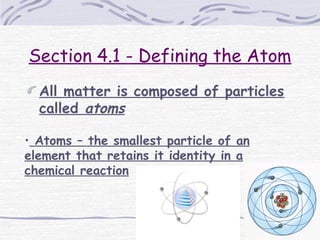
Section 4.1 -Defining the Atom
All matter is composed of particles
called atoms
• Atoms – the smallest particle of an
element that retains it identity in a
chemical reaction
3.
Democritus’s Philosophy
By usingexperimental
methods, Dalton
transformed Democritus’s
ideas on atoms into a
scientific theory
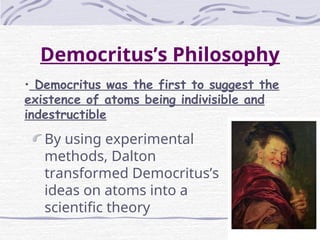
• Democritus was the first to suggest the
existence of atoms being indivisible and
indestructible
4.
Dalton’s Atomic Theory
(1.)All elements are composed of tiny indivisible
particles called atoms.
(2.) Atoms of the same element are identical. The
atoms of any one element are different from those
of any other element.
(3.) Atoms of different elements can physically mix
together or can chemically combine in simple whole-
number ratios to form compounds.
(4.) Chemical reactions occur when atoms are
separated, joined, or rearranged. Atoms of one
element, however, are never changed into atoms of
another element as a result of a chemical reaction.
5.
Section 4.2 –
TheStructure of the Atom
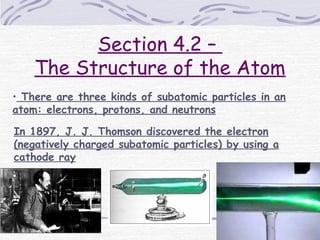
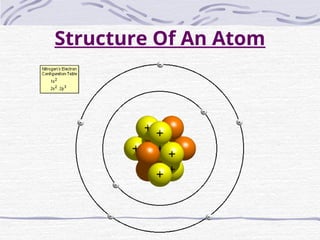
• There are three kinds of subatomic particles in an
atom: electrons, protons, and neutrons
In 1897, J. J. Thomson discovered the electron
(negatively charged subatomic particles) by using a
cathode ray
6.
Protons
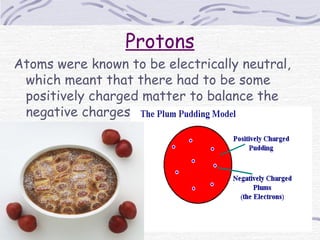
Atoms were knownto be electrically neutral,
which meant that there had to be some
positively charged matter to balance the
negative charges
7.
Rutherford’s Gold-Foil Experiment
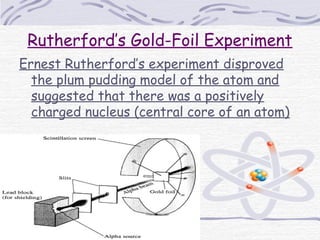
ErnestRutherford’s experiment disproved
the plum pudding model of the atom and
suggested that there was a positively
charged nucleus (central core of an atom)
8.
Conclusion of Rutherford’sExperiment
• Atoms are mostly empty space, thus explaining the
lack of deflection of most of the alpha particles
• All the positive charge and almost all the mass of
an atom are concentrated in a small region (nucleus)
• Nucleus – tiny central core of an atom composed
of protons and neutrons
• Electrons are distributed around the nucleus and
occupy almost all the volume of the atom (marble
and football stadium)
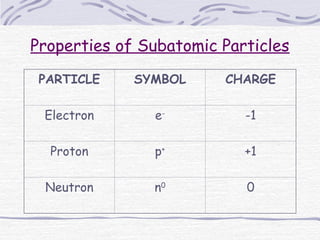
Properties of SubatomicParticles
PARTICLE SYMBOL CHARGE
Electron e-
-1
Proton p+
+1
Neutron n0
0
11.
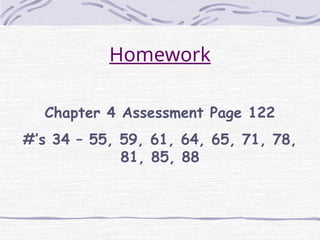
Homework
Section Assessment 4-1#’s 4,5
Section Assessment 4-2 #’s 8-14
Now on to the lab…The Mystery Box!!!
Each group will go their their home lab station and try to
determine the shape of the object inside their box by moving
the box around. After 2.5 minutes of explorations, record your
observations and move to the next lab station.
12.
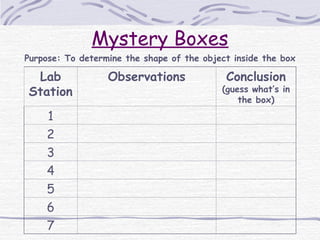
Mystery Boxes
Purpose: Todetermine the shape of the object inside the box
Lab
Station
Observations Conclusion
(guess what’s in
the box)
1
2
3
4
5
6
7
13.
Section 4.3 –
DistinguishingAmong Atoms
Elements are different because they
contain different numbers of protons.
Atomic Number - the number of protons in
the nucleus of an atom
*Remember since atoms are electrically
neutral, the number of protons equals the
number of electrons
14.
Quick Practice…
How manyprotons and electrons are in each
atom?
1. Fluorine (atomic number = 9)
2. Calcium (atomic number = 20)
3. Aluminum (atomic number = 13)
How about these?
4. Boron
5. Neon
6. Magnesium
15.
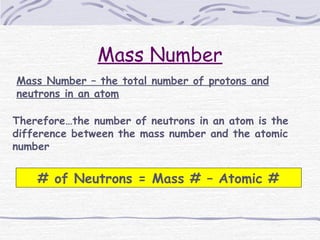
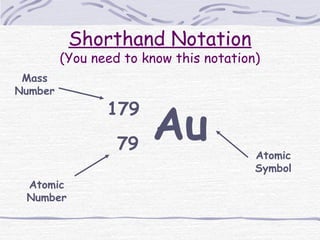
Mass Number
Mass Number– the total number of protons and
neutrons in an atom
Therefore…the number of neutrons in an atom is the
difference between the mass number and the atomic
number
# of Neutrons = Mass # – Atomic #
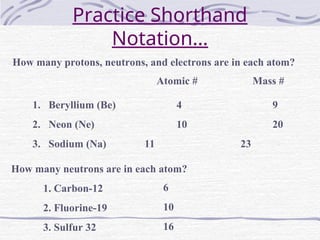
Practice Shorthand
Notation…
How manyprotons, neutrons, and electrons are in each atom?
1. Beryllium (Be) 4 9
2. Neon (Ne) 10 20
3. Sodium (Na) 11 23
Atomic # Mass #
How many neutrons are in each atom?
1. Carbon-12
2. Fluorine-19
3. Sulfur 32
6
10
16
18.
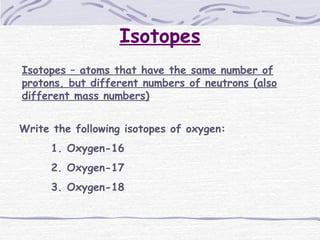
Isotopes
Isotopes – atomsthat have the same number of
protons, but different numbers of neutrons (also
different mass numbers)
Write the following isotopes of oxygen:
1. Oxygen-16
2. Oxygen-17
3. Oxygen-18
19.
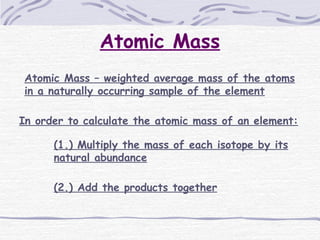
Atomic Mass
Atomic Mass– weighted average mass of the atoms
in a naturally occurring sample of the element
In order to calculate the atomic mass of an element:
(1.) Multiply the mass of each isotope by its
natural abundance
(2.) Add the products together
20.
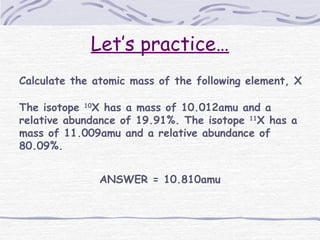
Let’s practice…
Calculate theatomic mass of the following element, X
The isotope 10
X has a mass of 10.012amu and a
relative abundance of 19.91%. The isotope 11
X has a
mass of 11.009amu and a relative abundance of
80.09%.
ANSWER = 10.810amu
21.
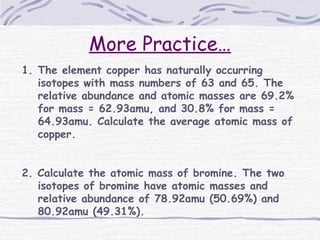
More Practice…
1. Theelement copper has naturally occurring
isotopes with mass numbers of 63 and 65. The
relative abundance and atomic masses are 69.2%
for mass = 62.93amu, and 30.8% for mass =
64.93amu. Calculate the average atomic mass of
copper.
2. Calculate the atomic mass of bromine. The two
isotopes of bromine have atomic masses and
relative abundance of 78.92amu (50.69%) and
80.92amu (49.31%).
22.
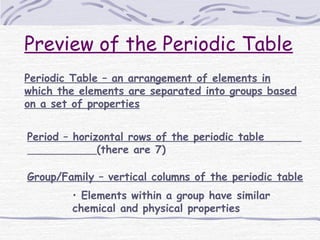
Preview of thePeriodic Table
Periodic Table – an arrangement of elements in
which the elements are separated into groups based
on a set of properties
Period – horizontal rows of the periodic table
(there are 7)
Group/Family – vertical columns of the periodic table
• Elements within a group have similar
chemical and physical properties