A t o m i c  S t r u c t u r e Part 2
 
Recap
Recap Atom is a particle which is electrically neutral No. of protons = No. of electrons An atom consists of 3 subatomic particles: 1) Protons 2) Neutrons 3) Electrons
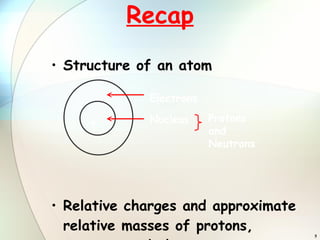
Recap Structure of an atom Relative charges and approximate relative masses of protons, neutrons and electrons + Electrons Nucleus Protons and Neutrons
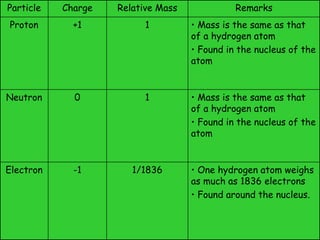
One hydrogen atom weighs as much as 1836 electrons Found around the nucleus. 1/1836 -1 Electron Mass is the same as that of a hydrogen atom Found in the nucleus of the atom 1 0 Neutron Mass is the same as that of a hydrogen atom Found in the nucleus of the atom 1 +1 Proton Remarks Relative Mass Charge Particle
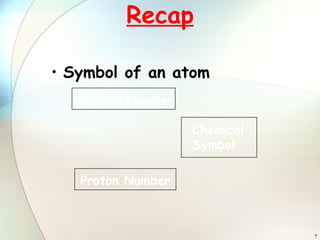
Recap Symbol of an atom Chemical Symbol Nucleon Number Proton Number
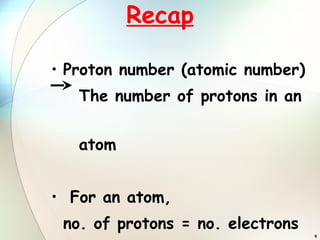
Recap Proton number (atomic number) The number of protons in an  atom For an atom,  no. of protons = no. electrons
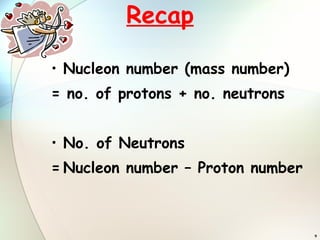
Recap Nucleon number (mass number) = no. of protons + no. neutrons No. of Neutrons = Nucleon number – Proton number
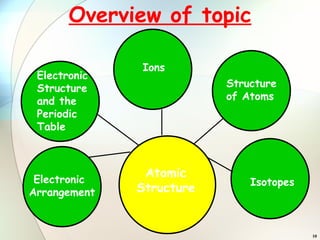
Overview of topic Structure of Atoms Isotopes Electronic Arrangement Electronic Structure and the Periodic Table Ions Atomic Structure
Today’s Menu What are isotopes Electrons arrangement in atoms Electronic structure Outermost electrons  The Periodic table
What are isotopes?
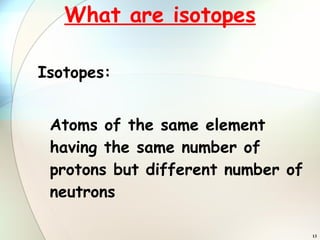
What are isotopes Isotopes: Atoms of the same element having the same number of protons but different number of neutrons
What are isotopes Isotopes: Same number of protons  (atomic number) Different number of neutrons Different number nucleon number Same number of electrons
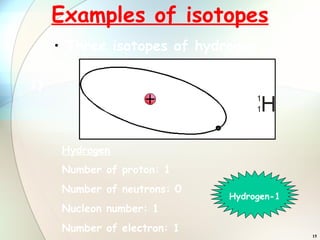
Examples of isotopes Three isotopes of hydrogen 1) Hydrogen Number of proton: 1 Number of neutrons: 0 Nucleon number: 1 Number of electron: 1 Hydrogen-1
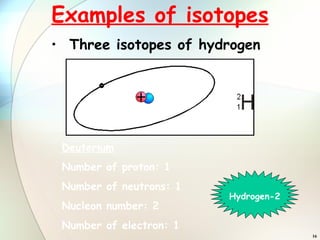
Examples of isotopes Three isotopes of hydrogen 2) Deuterium Number of proton: 1 Number of neutrons: 1 Nucleon number: 2 Number of electron: 1 Hydrogen-2
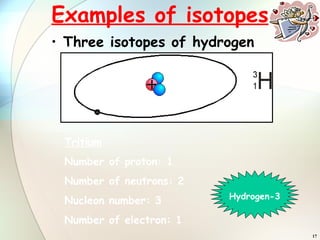
Examples of isotopes Three isotopes of hydrogen 3) Tritium Number of proton: 1 Number of neutrons: 2 Nucleon number: 3 Number of electron: 1 Hydrogen-3
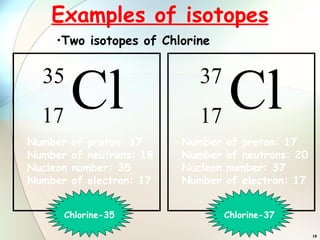
Examples of isotopes Two isotopes of Chlorine Number of proton: 17 Number of neutrons: 18 Nucleon number: 35 Number of electron: 17 Number of proton: 17 Number of neutrons: 20 Nucleon number: 37 Number of electron: 17 Chlorine-37 Chlorine-35
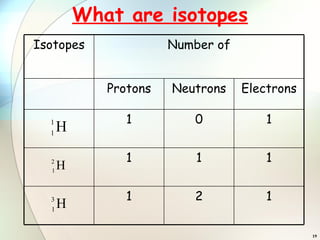
What are isotopes 1 2 1 1 1 1 1 0 1 Electrons Neutrons Protons Number of Isotopes
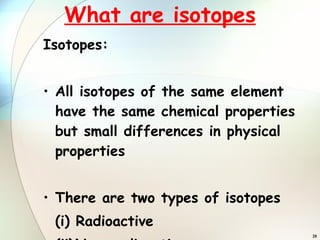
What are isotopes Isotopes: All isotopes of the same element have the same chemical properties but small differences in physical properties There are two types of isotopes (i) Radioactive (ii) Non-radioactive
Why does chlorine has a nucleon number of 35.5
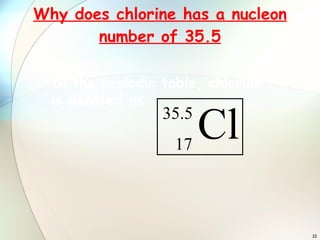
Why does chlorine has a nucleon number of 35.5 In the periodic table, chlorine is denoted as
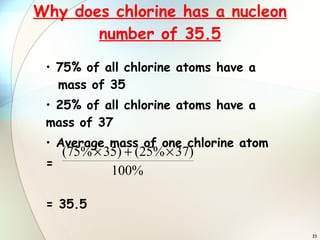
Why does chlorine has a nucleon number of 35.5 75% of all chlorine atoms have a  mass of 35 25% of all chlorine atoms have a  mass of 37 Average mass of one chlorine atom = = 35.5
Practice Time Part 3 Worksheet 2
Electrons Arrangement In Atoms
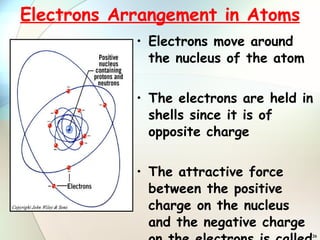
Electrons Arrangement in Atoms Electrons move around the nucleus of the atom The electrons are held in shells since it is of opposite charge The attractive force between the positive charge on the nucleus and the negative charge on the electrons is called electrostatic force.
Electronic Structure
Electronic Structure The way the electrons are arranged is called its electronic structure Electrons are arranged in shells which are numbered from the nucleus onwards Each shell is capable of holding up to a certain number of electrons
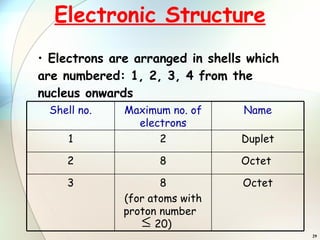
Electronic Structure Electrons are arranged in shells which  are numbered: 1, 2, 3, 4 from the  nucleus onwards Octet 8 (for atoms with proton number  20) 3 Octet  8 2 Duplet 2 1 Name Maximum no. of electrons Shell no.
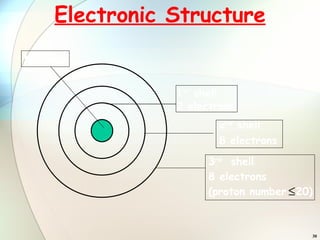
Electronic Structure 1 st  shell 2 electrons 3 rd   shell 8 electrons (proton number  20)  Nucleus 2 nd  shell 8 electrons
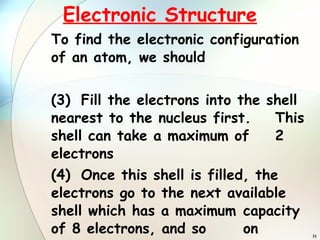
Electronic Structure To find the electronic configuration of an atom, we should Fill the electrons into the shell  nearest to the nucleus first.  This shell can take a maximum of  2 electrons Once this shell is filled, the  electrons go to the next available  shell which has a maximum  capacity of 8 electrons, and so  on
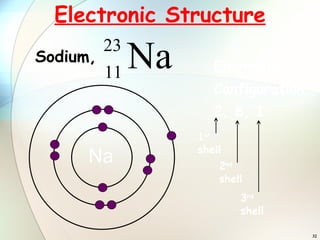
Electronic Structure Sodium, Electronic Configuration 2, 8, 1 1 st  shell 2 nd  shell 3 rd  shell Na
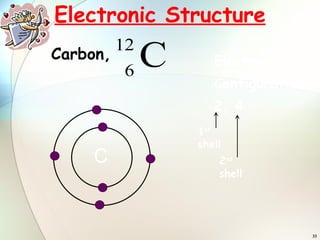
Electronic Structure Carbon, Electronic Configuration 2, 4  1 st  shell 2 nd  shell C
Electronic Structure Its important to know the electronic structure and electronic configuration of the first 20 elements of the Periodic Table
Summary
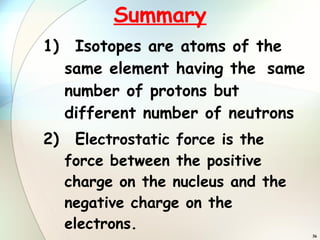
Summary 1) Isotopes are atoms of the  same element having the  same number of protons but  different number of neutrons 2) E lectrostatic force is the  force between the positive  charge on the nucleus and the  negative charge on the  electrons.
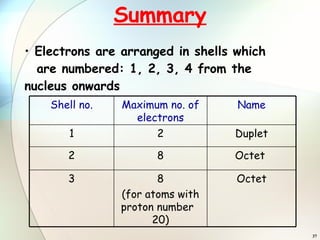
Summary Electrons are arranged in shells which  are numbered: 1, 2, 3, 4 from the  nucleus onwards Octet 8 (for atoms with proton number  20) 3 Octet  8 2 Duplet 2 1 Name Maximum no. of electrons Shell no.
Summary To find the electronic configuration of an atom, we should Fill the electrons into the shell  nearest to the nucleus first.  This shell can take a maximum of  2 electrons Once this shell is filled, the  electrons go to the next  available shell which has a  maximum capacity of 8  electrons, and so  on
Any Questions
Practice Time Part 3 Worksheet 2

Atomic Structure Part 2

  • 1.
    A t om i c S t r u c t u r e Part 2
  • 2.
  • 3.
  • 4.
    Recap Atom isa particle which is electrically neutral No. of protons = No. of electrons An atom consists of 3 subatomic particles: 1) Protons 2) Neutrons 3) Electrons
  • 5.
    Recap Structure ofan atom Relative charges and approximate relative masses of protons, neutrons and electrons + Electrons Nucleus Protons and Neutrons
  • 6.
    One hydrogen atomweighs as much as 1836 electrons Found around the nucleus. 1/1836 -1 Electron Mass is the same as that of a hydrogen atom Found in the nucleus of the atom 1 0 Neutron Mass is the same as that of a hydrogen atom Found in the nucleus of the atom 1 +1 Proton Remarks Relative Mass Charge Particle
  • 7.
    Recap Symbol ofan atom Chemical Symbol Nucleon Number Proton Number
  • 8.
    Recap Proton number(atomic number) The number of protons in an atom For an atom, no. of protons = no. electrons
  • 9.
    Recap Nucleon number(mass number) = no. of protons + no. neutrons No. of Neutrons = Nucleon number – Proton number
  • 10.
    Overview of topicStructure of Atoms Isotopes Electronic Arrangement Electronic Structure and the Periodic Table Ions Atomic Structure
  • 11.
    Today’s Menu Whatare isotopes Electrons arrangement in atoms Electronic structure Outermost electrons The Periodic table
  • 12.
  • 13.
    What are isotopesIsotopes: Atoms of the same element having the same number of protons but different number of neutrons
  • 14.
    What are isotopesIsotopes: Same number of protons (atomic number) Different number of neutrons Different number nucleon number Same number of electrons
  • 15.
    Examples of isotopesThree isotopes of hydrogen 1) Hydrogen Number of proton: 1 Number of neutrons: 0 Nucleon number: 1 Number of electron: 1 Hydrogen-1
  • 16.
    Examples of isotopesThree isotopes of hydrogen 2) Deuterium Number of proton: 1 Number of neutrons: 1 Nucleon number: 2 Number of electron: 1 Hydrogen-2
  • 17.
    Examples of isotopesThree isotopes of hydrogen 3) Tritium Number of proton: 1 Number of neutrons: 2 Nucleon number: 3 Number of electron: 1 Hydrogen-3
  • 18.
    Examples of isotopesTwo isotopes of Chlorine Number of proton: 17 Number of neutrons: 18 Nucleon number: 35 Number of electron: 17 Number of proton: 17 Number of neutrons: 20 Nucleon number: 37 Number of electron: 17 Chlorine-37 Chlorine-35
  • 19.
    What are isotopes1 2 1 1 1 1 1 0 1 Electrons Neutrons Protons Number of Isotopes
  • 20.
    What are isotopesIsotopes: All isotopes of the same element have the same chemical properties but small differences in physical properties There are two types of isotopes (i) Radioactive (ii) Non-radioactive
  • 21.
    Why does chlorinehas a nucleon number of 35.5
  • 22.
    Why does chlorinehas a nucleon number of 35.5 In the periodic table, chlorine is denoted as
  • 23.
    Why does chlorinehas a nucleon number of 35.5 75% of all chlorine atoms have a mass of 35 25% of all chlorine atoms have a mass of 37 Average mass of one chlorine atom = = 35.5
  • 24.
    Practice Time Part3 Worksheet 2
  • 25.
  • 26.
    Electrons Arrangement inAtoms Electrons move around the nucleus of the atom The electrons are held in shells since it is of opposite charge The attractive force between the positive charge on the nucleus and the negative charge on the electrons is called electrostatic force.
  • 27.
  • 28.
    Electronic Structure Theway the electrons are arranged is called its electronic structure Electrons are arranged in shells which are numbered from the nucleus onwards Each shell is capable of holding up to a certain number of electrons
  • 29.
    Electronic Structure Electronsare arranged in shells which are numbered: 1, 2, 3, 4 from the nucleus onwards Octet 8 (for atoms with proton number 20) 3 Octet 8 2 Duplet 2 1 Name Maximum no. of electrons Shell no.
  • 30.
    Electronic Structure 1st shell 2 electrons 3 rd shell 8 electrons (proton number 20) Nucleus 2 nd shell 8 electrons
  • 31.
    Electronic Structure Tofind the electronic configuration of an atom, we should Fill the electrons into the shell nearest to the nucleus first. This shell can take a maximum of 2 electrons Once this shell is filled, the electrons go to the next available shell which has a maximum capacity of 8 electrons, and so on
  • 32.
    Electronic Structure Sodium,Electronic Configuration 2, 8, 1 1 st shell 2 nd shell 3 rd shell Na
  • 33.
    Electronic Structure Carbon,Electronic Configuration 2, 4 1 st shell 2 nd shell C
  • 34.
    Electronic Structure Itsimportant to know the electronic structure and electronic configuration of the first 20 elements of the Periodic Table
  • 35.
  • 36.
    Summary 1) Isotopesare atoms of the same element having the same number of protons but different number of neutrons 2) E lectrostatic force is the force between the positive charge on the nucleus and the negative charge on the electrons.
  • 37.
    Summary Electrons arearranged in shells which are numbered: 1, 2, 3, 4 from the nucleus onwards Octet 8 (for atoms with proton number 20) 3 Octet 8 2 Duplet 2 1 Name Maximum no. of electrons Shell no.
  • 38.
    Summary To findthe electronic configuration of an atom, we should Fill the electrons into the shell nearest to the nucleus first. This shell can take a maximum of 2 electrons Once this shell is filled, the electrons go to the next available shell which has a maximum capacity of 8 electrons, and so on

  • 39.
  • 40.
    Practice Time Part3 Worksheet 2