Traumatic
Atlanto-Axial
Rotatory Subluxation
Shashank Gandhi, MD
Department of Neurosurgery
Case
64M, s/p fall down stairs while intoxicated 3
days ago. No LOC. P/w persistent neck pain &
right shoulder pain.
PMH: EtOH abuse
Neuro: AA&Ox3, FC, MAE 5/5, SILT
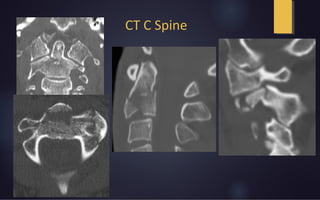
CT C Spine
Hospital Course
• CTA neg
• MRI – posterior interspinous ligament edema; non-specific fluid
in C1-2 lateral mass articulations
• Discharged home with Miami J collar for 6wks
• 4wk office f/u
• Inconsistent Miami J use
• Continued neck pain
• Neuro intact
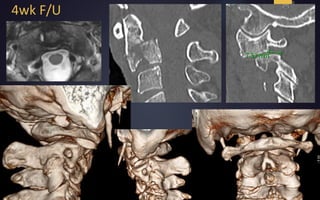
4wk F/U
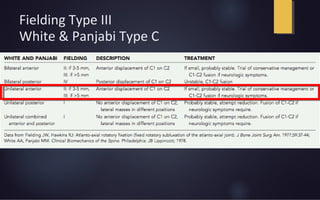
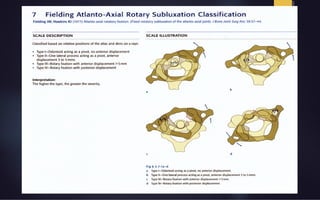
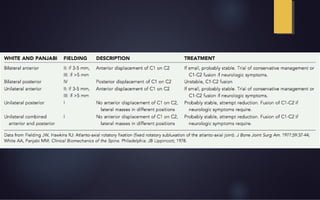
Fielding Type III
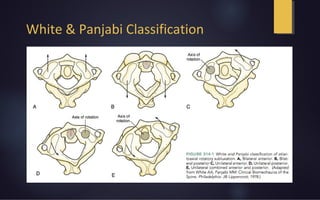
White & Panjabi Type C
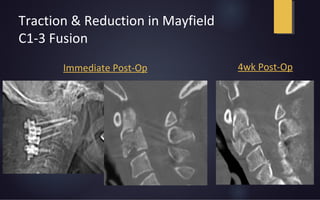
Traction & Reduction in Mayfield
C1-3 Fusion
Immediate Post-Op 4wk Post-Op
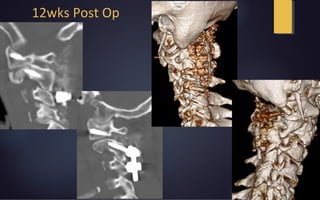
12wks Post Op
Pathology

Usually traumatic (adults) or infection/inflammation (Grisel’s Syndrome)

Mechanism: forced rotation with an element of lateral tilt

C1-2 facet is more horizontal than other levels

Other reports of rotatory deformities caused by:
− Ankylosing spondylitis
− Rheumatoid arthritis
− Metastatic tumors, eosinophilic granulomas
− Down Syndrome (25% patients)
− After sub occipital craniectomy and C1-3 laminectomy
− Klippel feil syndrome (congenital failure of segmentation of
cervical spine- short neck , low hairline and decreased motion)
− Os odonteum
Presentation

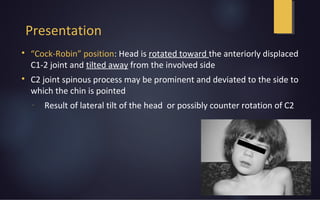
“Cock-Robin” position: Head is rotated toward the anteriorly displaced
C1-2 joint and tilted away from the involved side

C2 joint spinous process may be prominent and deviated to the side to
which the chin is pointed
- Result of lateral tilt of the head or possibly counter rotation of C2
Stability of AA joint
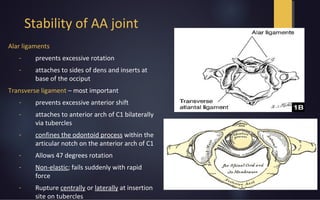
Alar ligaments
- prevents excessive rotation
- attaches to sides of dens and inserts at
base of the occiput
Transverse ligament – most important
- prevents excessive anterior shift
- attaches to anterior arch of C1 bilaterally
via tubercles
- confines the odontoid process within the
articular notch on the anterior arch of C1
- Allows 47 degrees rotation
- Non-elastic; fails suddenly with rapid
force
- Rupture centrally or laterally at insertion
site on tubercles
Steele's Rule of Thirds
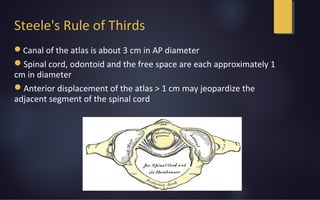
Canal of the atlas is about 3 cm in AP diameter
Spinal cord, odontoid and the free space are each approximately 1
cm in diameter
Anterior displacement of the atlas > 1 cm may jeopardize the
adjacent segment of the spinal cord
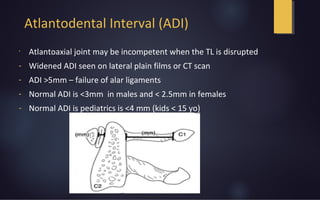
Atlantodental Interval (ADI)
•
Atlantoaxial joint may be incompetent when the TL is disrupted
- Widened ADI seen on lateral plain films or CT scan
- ADI >5mm – failure of alar ligaments
- Normal ADI is <3mm in males and < 2.5mm in females
- Normal ADI is pediatrics is <4 mm (kids < 15 yo)
Imaging

ADI

Lateral atlantoaxial space surrounding dens may be asymmetrical

Dens may be displaced in any direction

Rotational angle
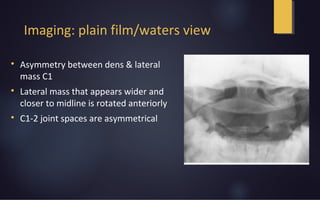
Imaging: plain film/waters view

Asymmetry between dens & lateral
mass C1

Lateral mass that appears wider and
closer to midline is rotated anteriorly

C1-2 joint spaces are asymmetrical
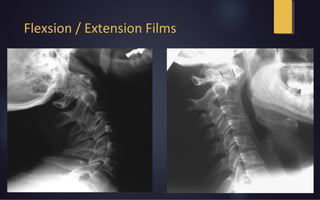
Flexsion / Extension Films
Rotation on CT scan

Able to visualizing rotation and associated fractures

Dynamic CT scans are not advocated
- Risk of inducing neurological injury secondary to instability

Standard measurement technique for rotational angle
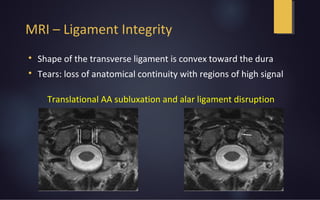
MRI – Ligament Integrity

Shape of the transverse ligament is convex toward the dura

Tears: loss of anatomical continuity with regions of high signal
Translational AA subluxation and alar ligament disruption
White & Panjabi Classification
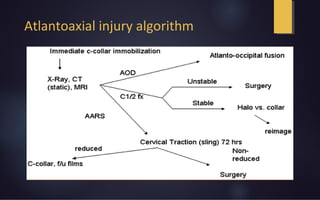
Atlantoaxial injury algorithm
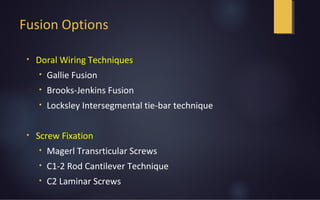
Fusion Options
• Doral Wiring Techniques
• Gallie Fusion
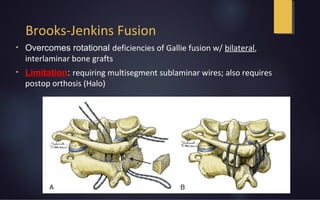
• Brooks-Jenkins Fusion
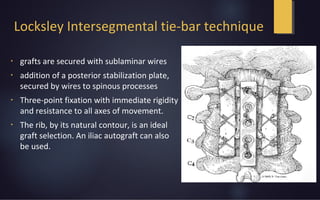
• Locksley Intersegmental tie-bar technique
• Screw Fixation
• Magerl Transrticular Screws
• C1-2 Rod Cantilever Technique
• C2 Laminar Screws
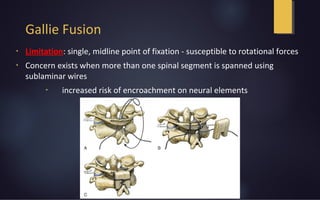
Gallie Fusion
•
Limitation: single, midline point of fixation - susceptible to rotational forces
•
Concern exists when more than one spinal segment is spanned using
sublaminar wires
•
increased risk of encroachment on neural elements
Brooks-Jenkins Fusion
• Overcomes rotational deficiencies of Gallie fusion w/ bilateral,
interlaminar bone grafts
• Limitation: requiring multisegment sublaminar wires; also requires
postop orthosis (Halo)
Locksley Intersegmental tie-bar technique
•
grafts are secured with sublaminar wires
•
addition of a posterior stabilization plate,
secured by wires to spinous processes
•
Three-point fixation with immediate rigidity
and resistance to all axes of movement.
•
The rib, by its natural contour, is an ideal
graft selection. An iliac autograft can also
be used.
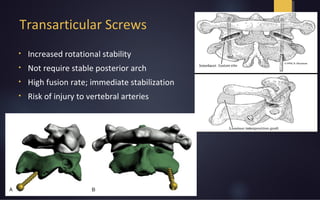
Transarticular Screws
• Increased rotational stability
• Not require stable posterior arch
• High fusion rate; immediate stabilization
• Risk of injury to vertebral arteries
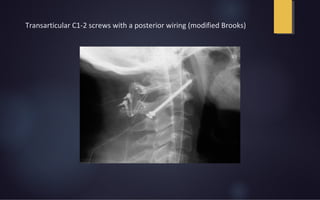
Transarticular C1-2 screws with a posterior wiring (modified Brooks)
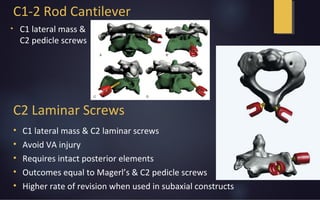
C1-2 Rod Cantilever
• C1 lateral mass &
C2 pedicle screws
C2 Laminar Screws
• C1 lateral mass & C2 laminar screws
• Avoid VA injury
• Requires intact posterior elements
• Outcomes equal to Magerl’s & C2 pedicle screws
• Higher rate of revision when used in subaxial constructs
References

The Evolution of Posterior Cervical and Occipitocervical Fusion: Atlantoaxial Fusion, John
R. Vender, MD, Andy J. Rekito, MS, Steven J. Harrison, MS, and Dennis E. Mcdonnell, MD,
Department of Neurosurgery and Medical Illustration Graduate Program, Medical College
of Georgia; and Department of Neurosurgery, Gunderson-Lutheran Clinic, La Crosse,
Wisconsin

Handboook of Neurosurgery: Greenberg

Youmans

Post-Traumatic Atlantoaxial Rotatory Fixation in an Adult: A Case Report; Yeon-Seong et al,
Spine Vol 32, Number 23, ppE682-687, 2007

Atlanto-axial subluxation

  • 1.
  • 2.
    Case 64M, s/p falldown stairs while intoxicated 3 days ago. No LOC. P/w persistent neck pain & right shoulder pain. PMH: EtOH abuse Neuro: AA&Ox3, FC, MAE 5/5, SILT
  • 3.
  • 4.
    Hospital Course • CTAneg • MRI – posterior interspinous ligament edema; non-specific fluid in C1-2 lateral mass articulations • Discharged home with Miami J collar for 6wks • 4wk office f/u • Inconsistent Miami J use • Continued neck pain • Neuro intact
  • 5.
  • 6.
    Fielding Type III White& Panjabi Type C
  • 7.
    Traction & Reductionin Mayfield C1-3 Fusion Immediate Post-Op 4wk Post-Op
  • 8.
  • 9.
    Pathology  Usually traumatic (adults)or infection/inflammation (Grisel’s Syndrome)  Mechanism: forced rotation with an element of lateral tilt  C1-2 facet is more horizontal than other levels  Other reports of rotatory deformities caused by: − Ankylosing spondylitis − Rheumatoid arthritis − Metastatic tumors, eosinophilic granulomas − Down Syndrome (25% patients) − After sub occipital craniectomy and C1-3 laminectomy − Klippel feil syndrome (congenital failure of segmentation of cervical spine- short neck , low hairline and decreased motion) − Os odonteum
  • 10.
    Presentation  “Cock-Robin” position: Headis rotated toward the anteriorly displaced C1-2 joint and tilted away from the involved side  C2 joint spinous process may be prominent and deviated to the side to which the chin is pointed - Result of lateral tilt of the head or possibly counter rotation of C2
  • 11.
    Stability of AAjoint Alar ligaments - prevents excessive rotation - attaches to sides of dens and inserts at base of the occiput Transverse ligament – most important - prevents excessive anterior shift - attaches to anterior arch of C1 bilaterally via tubercles - confines the odontoid process within the articular notch on the anterior arch of C1 - Allows 47 degrees rotation - Non-elastic; fails suddenly with rapid force - Rupture centrally or laterally at insertion site on tubercles
  • 12.
    Steele's Rule ofThirds Canal of the atlas is about 3 cm in AP diameter Spinal cord, odontoid and the free space are each approximately 1 cm in diameter Anterior displacement of the atlas > 1 cm may jeopardize the adjacent segment of the spinal cord
  • 13.
    Atlantodental Interval (ADI) • Atlantoaxialjoint may be incompetent when the TL is disrupted - Widened ADI seen on lateral plain films or CT scan - ADI >5mm – failure of alar ligaments - Normal ADI is <3mm in males and < 2.5mm in females - Normal ADI is pediatrics is <4 mm (kids < 15 yo)
  • 14.
    Imaging  ADI  Lateral atlantoaxial spacesurrounding dens may be asymmetrical  Dens may be displaced in any direction  Rotational angle
  • 15.
    Imaging: plain film/watersview  Asymmetry between dens & lateral mass C1  Lateral mass that appears wider and closer to midline is rotated anteriorly  C1-2 joint spaces are asymmetrical
  • 16.
  • 17.
    Rotation on CTscan  Able to visualizing rotation and associated fractures  Dynamic CT scans are not advocated - Risk of inducing neurological injury secondary to instability  Standard measurement technique for rotational angle
  • 18.
    MRI – LigamentIntegrity  Shape of the transverse ligament is convex toward the dura  Tears: loss of anatomical continuity with regions of high signal Translational AA subluxation and alar ligament disruption
  • 20.
    White & PanjabiClassification
  • 22.
  • 23.
    Fusion Options • DoralWiring Techniques • Gallie Fusion • Brooks-Jenkins Fusion • Locksley Intersegmental tie-bar technique • Screw Fixation • Magerl Transrticular Screws • C1-2 Rod Cantilever Technique • C2 Laminar Screws
  • 24.
    Gallie Fusion • Limitation: single,midline point of fixation - susceptible to rotational forces • Concern exists when more than one spinal segment is spanned using sublaminar wires • increased risk of encroachment on neural elements
  • 25.
    Brooks-Jenkins Fusion • Overcomesrotational deficiencies of Gallie fusion w/ bilateral, interlaminar bone grafts • Limitation: requiring multisegment sublaminar wires; also requires postop orthosis (Halo)
  • 26.
    Locksley Intersegmental tie-bartechnique • grafts are secured with sublaminar wires • addition of a posterior stabilization plate, secured by wires to spinous processes • Three-point fixation with immediate rigidity and resistance to all axes of movement. • The rib, by its natural contour, is an ideal graft selection. An iliac autograft can also be used.
  • 27.
    Transarticular Screws • Increasedrotational stability • Not require stable posterior arch • High fusion rate; immediate stabilization • Risk of injury to vertebral arteries
  • 28.
    Transarticular C1-2 screwswith a posterior wiring (modified Brooks)
  • 29.
    C1-2 Rod Cantilever •C1 lateral mass & C2 pedicle screws C2 Laminar Screws • C1 lateral mass & C2 laminar screws • Avoid VA injury • Requires intact posterior elements • Outcomes equal to Magerl’s & C2 pedicle screws • Higher rate of revision when used in subaxial constructs
  • 30.
    References  The Evolution ofPosterior Cervical and Occipitocervical Fusion: Atlantoaxial Fusion, John R. Vender, MD, Andy J. Rekito, MS, Steven J. Harrison, MS, and Dennis E. Mcdonnell, MD, Department of Neurosurgery and Medical Illustration Graduate Program, Medical College of Georgia; and Department of Neurosurgery, Gunderson-Lutheran Clinic, La Crosse, Wisconsin  Handboook of Neurosurgery: Greenberg  Youmans  Post-Traumatic Atlantoaxial Rotatory Fixation in an Adult: A Case Report; Yeon-Seong et al, Spine Vol 32, Number 23, ppE682-687, 2007