C1 C2 INJURIES
DR VIJAY KUMAR
• Occipitoatlantal Dislocation
• OAD is a consequence of complete or nearly
complete disruption of the ligamentous
structures between the occiput and upper
cervical spine
• High-speed motor vehicle crashes and the striking
of pedestrians by motor vehicles are the two
most common causes
• Primary mechanism in OADs is extreme hyper
extension of neck
• present with neurological abnormalities,
including lower cranial nerve paresis,
monoparesis, hemiparesis, quadriparesis,
respiratory dysfunction
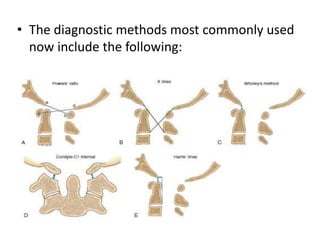
• The diagnostic methods most commonly used
now include the following:
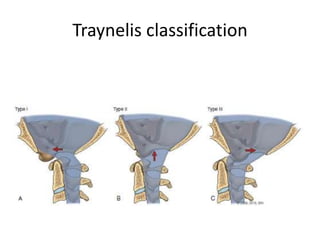
Traynelis classification
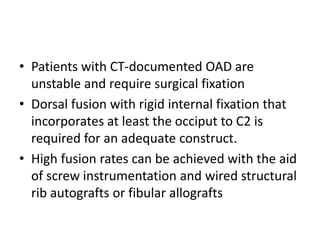
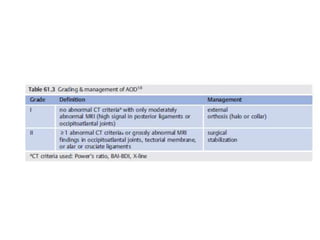
• Patients with CT-documented OAD are
unstable and require surgical fixation
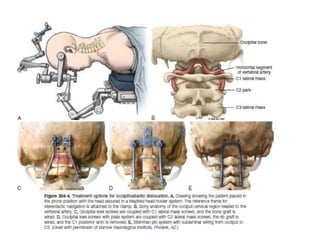
• Dorsal fusion with rigid internal fixation that
incorporates at least the occiput to C2 is
required for an adequate construct.
• High fusion rates can be achieved with the aid
of screw instrumentation and wired structural
rib autografts or fibular allografts
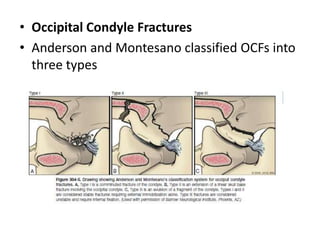
• Occipital Condyle Fractures
• Anderson and Montesano classified OCFs into
three types
• In general, types I and II are considered stable
fractures, and patients require external
immobilization of the head and cervical region
alone.
• Type III fractures are considered unstable,
with the patient potentially requiring internal
fixation of the injury because of its
ligamentous nature
AAD
• Types of atlantoaxial subluxation:
• 1. rotatory: usually seen in children after a fall
or minor trauma
• 2. anterior: more ominous
• 3. posterior: rare. Usually from erosion of
odontoid. Unstable. Requires fusion
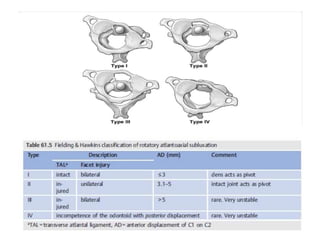
Atlantoaxial rotatary subluxation
• typically seen in children, associations:
trauma, RA, respiratory tract infections in peds
(Grisel syndrome)
• often present with cock-robin head position
(tilt, rotation, sl. flexion)
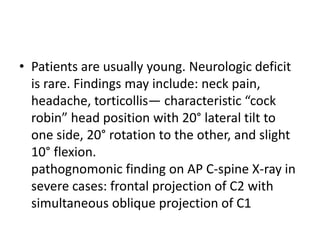
• Patients are usually young. Neurologic deficit
is rare. Findings may include: neck pain,
headache, torticollis— characteristic “cock
robin” head position with 20° lateral tilt to
one side, 20° rotation to the other, and slight
10° flexion.
pathognomonic finding on AP C-spine X-ray in
severe cases: frontal projection of C2 with
simultaneous oblique projection of C1
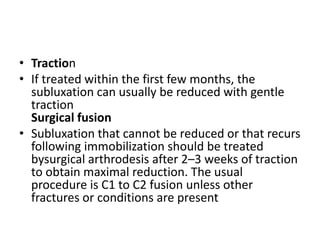
• Traction
• If treated within the first few months, the
subluxation can usually be reduced with gentle
traction
Surgical fusion
• Subluxation that cannot be reduced or that recurs
following immobilization should be treated
bysurgical arthrodesis after 2–3 weeks of traction
to obtain maximal reduction. The usual
procedure is C1 to C2 fusion unless other
fractures or conditions are present
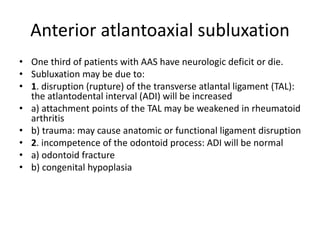
Anterior atlantoaxial subluxation
• One third of patients with AAS have neurologic deficit or die.
• Subluxation may be due to:
• 1. disruption (rupture) of the transverse atlantal ligament (TAL):
the atlantodental interval (ADI) will be increased
• a) attachment points of the TAL may be weakened in rheumatoid
arthritis
• b) trauma: may cause anatomic or functional ligament disruption
• 2. incompetence of the odontoid process: ADI will be normal
• a) odontoid fracture
• b) congenital hypoplasia
Transverse Ligament Injuries
• A distance from the posterior wall of the
anterior arch of C1 to the anterior wall of the
dens of more than 3 mm in adult patients or
more than 5 mm in pediatric patients
• The clinical relevance of C1 fractures resides
on the integrity of the transverse ligament.
• Spence and colleagues proposed the rule of
Spence, by which a more than 6.9-mm lateral
mass displacement of C1 over C2 on the open-
mouth radiograph suggests a transverse
ligament disruption
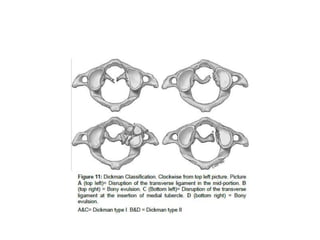
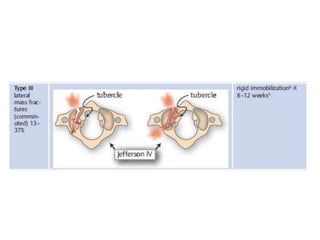
• Dickman and colleagues classified into two
categories.
• Type I are disruptions of the substance of the
transverse atlantal ligament,
• Type II are fractures or avulsions that detach
the bony tubercle that is the insertion point of
the transverse ligament at the C1 lateral mass.
• Type I injuries are incapable of healing
because the ligament integrity is disrupted,
and patients require surgical fixation of C1-2.
• In type II injuries, the ligament is intact but
detached; patients have a 74% to 80% chance
of healing satisfactorily with external orthosis
(halo vest). Surgery can be reserved for
nonunion injuries after 3 to 4 months of
attempted immobilization.4
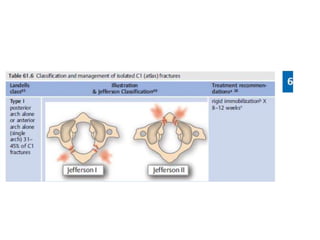
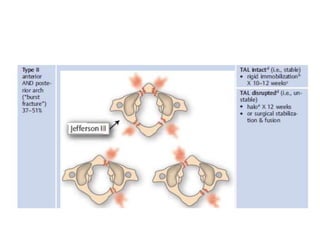
Atlas (C1) fractures
• Barrow Neurologic Institute (BNI) management guidelines for
isolated C1 fracture Evaluation: unless contraindicated, all
• patient’s are evaluated with cervical MRI to assess the integrity of
the TAL and thin-cut cervical CT to assess the fracture. Lateral mass
displacement (LMD) is measured in all cases.
• 1. Dickman Type I TAL disruption (pure ligamentous injury): surgical
fusion
• 2. the following may be treated with immobilization for 3 months
after which flexion/extension Cspine X-rays are obtained, and
surgical fusion is performed if unstable
• a) TAL intact on MRI and LMD< 7mm: cervical collar X 3 months
• b) Dickman Type II TAL disruption (bony avulsion) or LMD≥ 7mm:
halo X 3 months s
• Surgical options
1. unilateral ring or anterior C1 arch fractures:
C1–2 fusion
2. multiple ring fractures or posterior C1 arch
fractures: occipital-cervical fusion
Axis (C2) fractures
• Types of C2 fractures
• 1. odontoid fractures
• 2. hangman’s fracture
• 3. miscellaneous C2 fractures
Odontoid Fractures
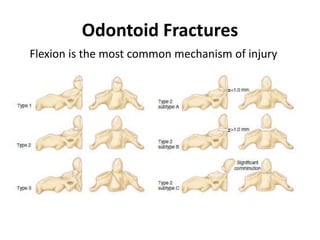
Flexion is the most common mechanism of injury
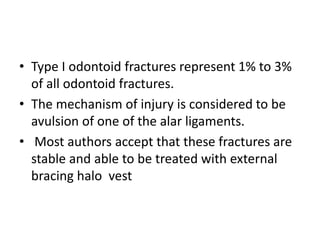
• Type I odontoid fractures represent 1% to 3%
of all odontoid fractures.
• The mechanism of injury is considered to be
avulsion of one of the alar ligaments.
• Most authors accept that these fractures are
stable and able to be treated with external
bracing halo vest
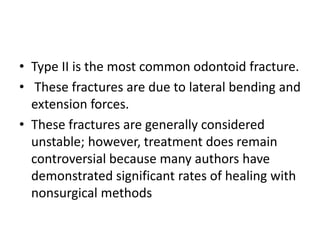
• Type II is the most common odontoid fracture.
• These fractures are due to lateral bending and
extension forces.
• These fractures are generally considered
unstable; however, treatment does remain
controversial because many authors have
demonstrated significant rates of healing with
nonsurgical methods
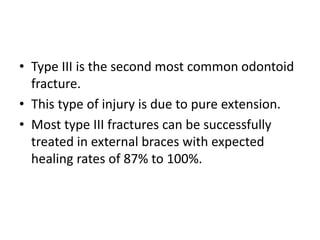
• Type III is the second most common odontoid
fracture.
• This type of injury is due to pure extension.
• Most type III fractures can be successfully
treated in external braces with expected
healing rates of 87% to 100%.
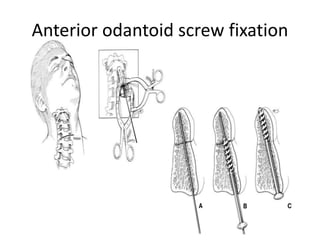
Anterior odantoid screw fixation
Hangman’s fracture
• Traumatic spondylolisthesis of the axis, is the
second most common type of axis fracture.
This injury involves bilateral fracture through
the pars interarticularis of C2 with traumatic
subluxation of C2 on C3,
• most often due to hyperextension + axial
loading most are stable with no neurologic
deficit
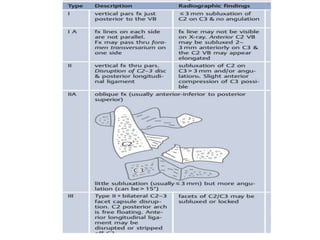
Levine/Effendi classification
• Angulation is measured as the angle between
the inferior endplates of C2 and C3.
Anterior subluxation of C2 on C3 > 3mm (Type
II) is a surrogate marker for C2–3 disc
disruption, which can be evaluated more
directly with cervical MRI
• Levine type I or Ia fractures can be treated with
collar immobilization for 3 months with high rates
of healing.
• Type II fractures usually reduce with gentle
cervical traction. Patients with these fractures
should be placed in a halo vest for 3 months.
• For fractures with more than 5 mm of
subluxation or at least 30 degrees of angulation,
surgical fixation should be strongly considered
• Levine type IIa fractures should be reduced
immediately in a halo vest with extension and
compression applied.
• Levine type III fractures require surgery for
stabilization and reduction
• hangman’s fractures may initially be managed
with external immobilization in most cases (halo
or collar)
• surgical stabilization should be considered in
cases of:
a) severe angulation of C2 on C3
b) disruption of the C2–3 disc space
c) or inability to establish or maintain alignment
with external immobilization
• Surgical options include anterior and posterior
approaches
C1–2 posterior wiring and fusion is an option only
if all the following are intact: C2–3 disc, C2–3
joint capsules and posterior arch of C1.
C1–3 fusion using C1 lateral mass screws & C3
lateral mass screws connected with rods (skipping
C2)
• An anterior C2-3 discectomy and fusion can
frequently treat these fractures.
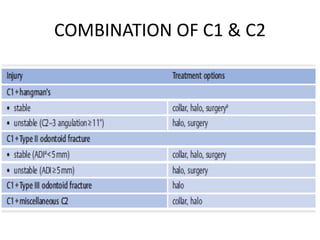
COMBINATION OF C1 & C2
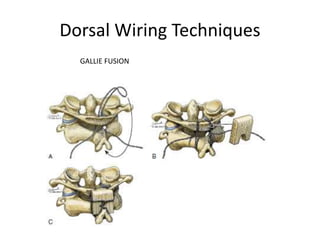
Dorsal Wiring Techniques
GALLIE FUSION
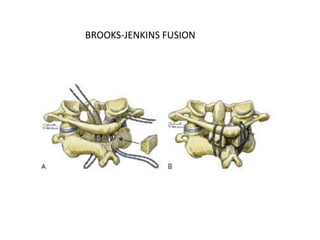
BROOKS-JENKINS FUSION
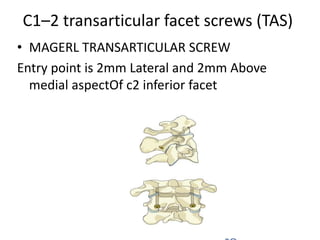
C1–2 transarticular facet screws (TAS)
• MAGERL TRANSARTICULAR SCREW
Entry point is 2mm Lateral and 2mm Above
medial aspectOf c2 inferior facet
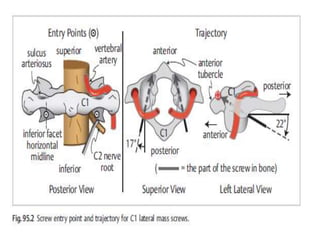
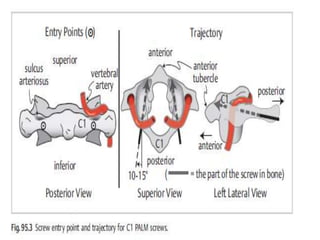
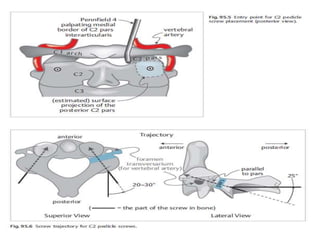
C1–2 screw fixation
• Placement of polyaxial mini screws in C1 & C2 pedicle
with rod fixation.
Advantages over C1–2 transarticular screws :
1. the more superior and medial trajectory should reduce
the risk of VA injury
2. may be used in the presence of C1–2 subluxation
3. may be usable in certain cases of aberrant VA course
4. in selected cases, this can be used for temporary
fixation without fusion (since joint spaces remain
intact) and the hardware may be removed after an
appropriate time to reclaim motion in the C1–2
articulation
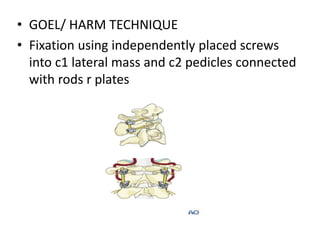
• GOEL/ HARM TECHNIQUE
• Fixation using independently placed screws
into c1 lateral mass and c2 pedicles connected
with rods r plates
C1 C2 inuries.pptx

C1 C2 inuries.pptx

  • 1.
    C1 C2 INJURIES DRVIJAY KUMAR
  • 2.
    • Occipitoatlantal Dislocation •OAD is a consequence of complete or nearly complete disruption of the ligamentous structures between the occiput and upper cervical spine • High-speed motor vehicle crashes and the striking of pedestrians by motor vehicles are the two most common causes • Primary mechanism in OADs is extreme hyper extension of neck
  • 3.
    • present withneurological abnormalities, including lower cranial nerve paresis, monoparesis, hemiparesis, quadriparesis, respiratory dysfunction
  • 4.
    • The diagnosticmethods most commonly used now include the following:
  • 5.
  • 6.
    • Patients withCT-documented OAD are unstable and require surgical fixation • Dorsal fusion with rigid internal fixation that incorporates at least the occiput to C2 is required for an adequate construct. • High fusion rates can be achieved with the aid of screw instrumentation and wired structural rib autografts or fibular allografts
  • 9.
    • Occipital CondyleFractures • Anderson and Montesano classified OCFs into three types
  • 10.
    • In general,types I and II are considered stable fractures, and patients require external immobilization of the head and cervical region alone. • Type III fractures are considered unstable, with the patient potentially requiring internal fixation of the injury because of its ligamentous nature
  • 11.
    AAD • Types ofatlantoaxial subluxation: • 1. rotatory: usually seen in children after a fall or minor trauma • 2. anterior: more ominous • 3. posterior: rare. Usually from erosion of odontoid. Unstable. Requires fusion
  • 12.
    Atlantoaxial rotatary subluxation •typically seen in children, associations: trauma, RA, respiratory tract infections in peds (Grisel syndrome) • often present with cock-robin head position (tilt, rotation, sl. flexion)
  • 14.
    • Patients areusually young. Neurologic deficit is rare. Findings may include: neck pain, headache, torticollis— characteristic “cock robin” head position with 20° lateral tilt to one side, 20° rotation to the other, and slight 10° flexion. pathognomonic finding on AP C-spine X-ray in severe cases: frontal projection of C2 with simultaneous oblique projection of C1
  • 15.
    • Traction • Iftreated within the first few months, the subluxation can usually be reduced with gentle traction Surgical fusion • Subluxation that cannot be reduced or that recurs following immobilization should be treated bysurgical arthrodesis after 2–3 weeks of traction to obtain maximal reduction. The usual procedure is C1 to C2 fusion unless other fractures or conditions are present
  • 16.
    Anterior atlantoaxial subluxation •One third of patients with AAS have neurologic deficit or die. • Subluxation may be due to: • 1. disruption (rupture) of the transverse atlantal ligament (TAL): the atlantodental interval (ADI) will be increased • a) attachment points of the TAL may be weakened in rheumatoid arthritis • b) trauma: may cause anatomic or functional ligament disruption • 2. incompetence of the odontoid process: ADI will be normal • a) odontoid fracture • b) congenital hypoplasia
  • 17.
    Transverse Ligament Injuries •A distance from the posterior wall of the anterior arch of C1 to the anterior wall of the dens of more than 3 mm in adult patients or more than 5 mm in pediatric patients
  • 18.
    • The clinicalrelevance of C1 fractures resides on the integrity of the transverse ligament. • Spence and colleagues proposed the rule of Spence, by which a more than 6.9-mm lateral mass displacement of C1 over C2 on the open- mouth radiograph suggests a transverse ligament disruption
  • 19.
    • Dickman andcolleagues classified into two categories. • Type I are disruptions of the substance of the transverse atlantal ligament, • Type II are fractures or avulsions that detach the bony tubercle that is the insertion point of the transverse ligament at the C1 lateral mass.
  • 21.
    • Type Iinjuries are incapable of healing because the ligament integrity is disrupted, and patients require surgical fixation of C1-2. • In type II injuries, the ligament is intact but detached; patients have a 74% to 80% chance of healing satisfactorily with external orthosis (halo vest). Surgery can be reserved for nonunion injuries after 3 to 4 months of attempted immobilization.4
  • 22.
  • 26.
    • Barrow NeurologicInstitute (BNI) management guidelines for isolated C1 fracture Evaluation: unless contraindicated, all • patient’s are evaluated with cervical MRI to assess the integrity of the TAL and thin-cut cervical CT to assess the fracture. Lateral mass displacement (LMD) is measured in all cases. • 1. Dickman Type I TAL disruption (pure ligamentous injury): surgical fusion • 2. the following may be treated with immobilization for 3 months after which flexion/extension Cspine X-rays are obtained, and surgical fusion is performed if unstable • a) TAL intact on MRI and LMD< 7mm: cervical collar X 3 months • b) Dickman Type II TAL disruption (bony avulsion) or LMD≥ 7mm: halo X 3 months s
  • 27.
    • Surgical options 1.unilateral ring or anterior C1 arch fractures: C1–2 fusion 2. multiple ring fractures or posterior C1 arch fractures: occipital-cervical fusion
  • 28.
    Axis (C2) fractures •Types of C2 fractures • 1. odontoid fractures • 2. hangman’s fracture • 3. miscellaneous C2 fractures
  • 29.
    Odontoid Fractures Flexion isthe most common mechanism of injury
  • 30.
    • Type Iodontoid fractures represent 1% to 3% of all odontoid fractures. • The mechanism of injury is considered to be avulsion of one of the alar ligaments. • Most authors accept that these fractures are stable and able to be treated with external bracing halo vest
  • 31.
    • Type IIis the most common odontoid fracture. • These fractures are due to lateral bending and extension forces. • These fractures are generally considered unstable; however, treatment does remain controversial because many authors have demonstrated significant rates of healing with nonsurgical methods
  • 32.
    • Type IIIis the second most common odontoid fracture. • This type of injury is due to pure extension. • Most type III fractures can be successfully treated in external braces with expected healing rates of 87% to 100%.
  • 33.
  • 34.
    Hangman’s fracture • Traumaticspondylolisthesis of the axis, is the second most common type of axis fracture. This injury involves bilateral fracture through the pars interarticularis of C2 with traumatic subluxation of C2 on C3, • most often due to hyperextension + axial loading most are stable with no neurologic deficit
  • 35.
    Levine/Effendi classification • Angulationis measured as the angle between the inferior endplates of C2 and C3. Anterior subluxation of C2 on C3 > 3mm (Type II) is a surrogate marker for C2–3 disc disruption, which can be evaluated more directly with cervical MRI
  • 37.
    • Levine typeI or Ia fractures can be treated with collar immobilization for 3 months with high rates of healing. • Type II fractures usually reduce with gentle cervical traction. Patients with these fractures should be placed in a halo vest for 3 months. • For fractures with more than 5 mm of subluxation or at least 30 degrees of angulation, surgical fixation should be strongly considered
  • 38.
    • Levine typeIIa fractures should be reduced immediately in a halo vest with extension and compression applied. • Levine type III fractures require surgery for stabilization and reduction
  • 39.
    • hangman’s fracturesmay initially be managed with external immobilization in most cases (halo or collar) • surgical stabilization should be considered in cases of: a) severe angulation of C2 on C3 b) disruption of the C2–3 disc space c) or inability to establish or maintain alignment with external immobilization
  • 40.
    • Surgical optionsinclude anterior and posterior approaches C1–2 posterior wiring and fusion is an option only if all the following are intact: C2–3 disc, C2–3 joint capsules and posterior arch of C1. C1–3 fusion using C1 lateral mass screws & C3 lateral mass screws connected with rods (skipping C2) • An anterior C2-3 discectomy and fusion can frequently treat these fractures.
  • 41.
  • 42.
  • 43.
  • 44.
    C1–2 transarticular facetscrews (TAS) • MAGERL TRANSARTICULAR SCREW Entry point is 2mm Lateral and 2mm Above medial aspectOf c2 inferior facet
  • 45.
    C1–2 screw fixation •Placement of polyaxial mini screws in C1 & C2 pedicle with rod fixation. Advantages over C1–2 transarticular screws : 1. the more superior and medial trajectory should reduce the risk of VA injury 2. may be used in the presence of C1–2 subluxation 3. may be usable in certain cases of aberrant VA course 4. in selected cases, this can be used for temporary fixation without fusion (since joint spaces remain intact) and the hardware may be removed after an appropriate time to reclaim motion in the C1–2 articulation
  • 49.
    • GOEL/ HARMTECHNIQUE • Fixation using independently placed screws into c1 lateral mass and c2 pedicles connected with rods r plates