Trigeminal Neuralgia Yury Khelemsky, MD Assistant Professor Anesthesiology and Pain Medicine The Mount Sinai Medical Center
Introduction Common cause of facial pain Sudden, usually unilateral, severe, brief, stabbing/lancinating, recurrent episodes of pain in one or more branches of the 5 th  cranial nerve.
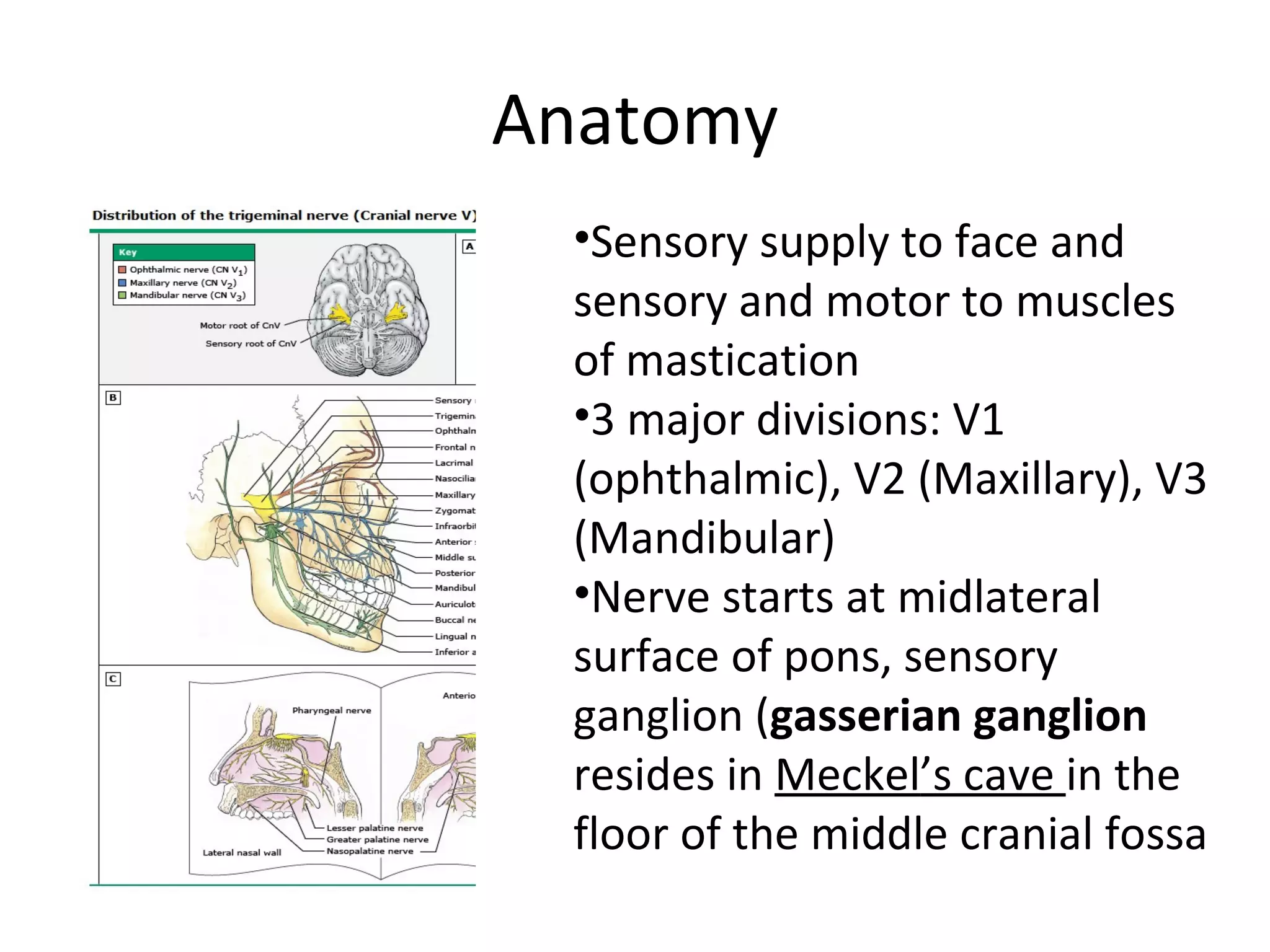
Anatomy Sensory supply to face and sensory and motor to muscles of mastication 3 major divisions: V1 (ophthalmic), V2 (Maxillary), V3 (Mandibular) Nerve starts at midlateral surface of pons, sensory ganglion ( gasserian ganglion  resides in  Meckel ’s cave  in the floor of the middle cranial fossa
Epidemiology Annual incidence 4-13/100k 15k new cases per year in US Incidence increases with age (as with PHN). Male:Female 1:1.5 Rare familial cases. Most sporadic.
Etiology Classic : Most cases (80-90%) due to compression of trigeminal nerve root by aberrant loop of artery or vein. Usually within a few mm of entry into pons. Primary TN also includes idiopathic cases Secondary: acoustic neuroma, meningioma, AVN, saccular aneurysm, multiple sclerosis.
Pathogenesis Mechanism: demyelination in area around vascular compression.  Ephaptic (occurring without neurotransmitters) crosstalk between light touch and pain fibers.  Central pain/sensitization develops
Classification International Headache Society (IHS) Classic: idiopathic (since most do not have surgery most of these are likely vascular) and vascular  Secondary: all structural lesions other than vascular compression
Clinical Features 1 Sudden, unilateral, severe, brief, stabbing, electric Maximal at or near onset May have facial muscle spasm (tix douloureux) Refractory period is common Typically does not awaken patient Unilateral, may be bilateral, but not simultaneously
Clinical Features 2 Mostly V2/3. V1<5%.  Trigger zones: in distribution of affected nerve, closer to midline, patient protect these areas, may demonstrate on physical exam Other triggers: chewing, talking, brushing teeth, cold air, smiling, grimacing Pretrigeminal neuralgia – dull aching continuous pain evolving into TN May be precipitated by dental procedures
Course Variable Episodes may last weeks – months, followed by pain free intervals.  Recurrence common, some patients have continuous pain Most often, TN waxes and wanes in severity and frequency of exacerbations
Diagnosis International Headache Society (IHS)  Classic: Paroxysmal pain in one or more division of CNV Pain has at least one: intense, sharp, superficial, or stabbing; precipitated from trigger areas or by trigger factors Attacks are stereotyped in the individual patient No clinically significant neurologic deficit Not attributable to another disorder  Secondary: demonstrable structure other than vascular compression
Neuroimaging Some obtain MRI in all TN pts Some only in: young patients, bilateral sx, trigeminal sensory loss American Academy of Neurology (AAN) and European Federation of Neurologic Societies (EFNS) review Routine imaging identified secondary cause in 15% of patients Insufficient evidence to support or refute utility of MRI to identify neurovascular compression or indicate most reliable MRI technique.
Electrophysiologic Testing Trigeminal Reflex Tests: Blink Reflex and Masseter Inhibitor Reflex. 2008 AAN/EFNS: high sensitivity (94%) and specificity (87%) for distinguishing between secondary and classic TN Trigeminal Evoked Potentials: not clinically useful
DDx Short-Lasting Unilateral Neuralgiform Headache with Conjunctival Injection and Tearing (SUNCT) Cluster-tic syndrome Jabs and jolts syndrome Other neuralgias
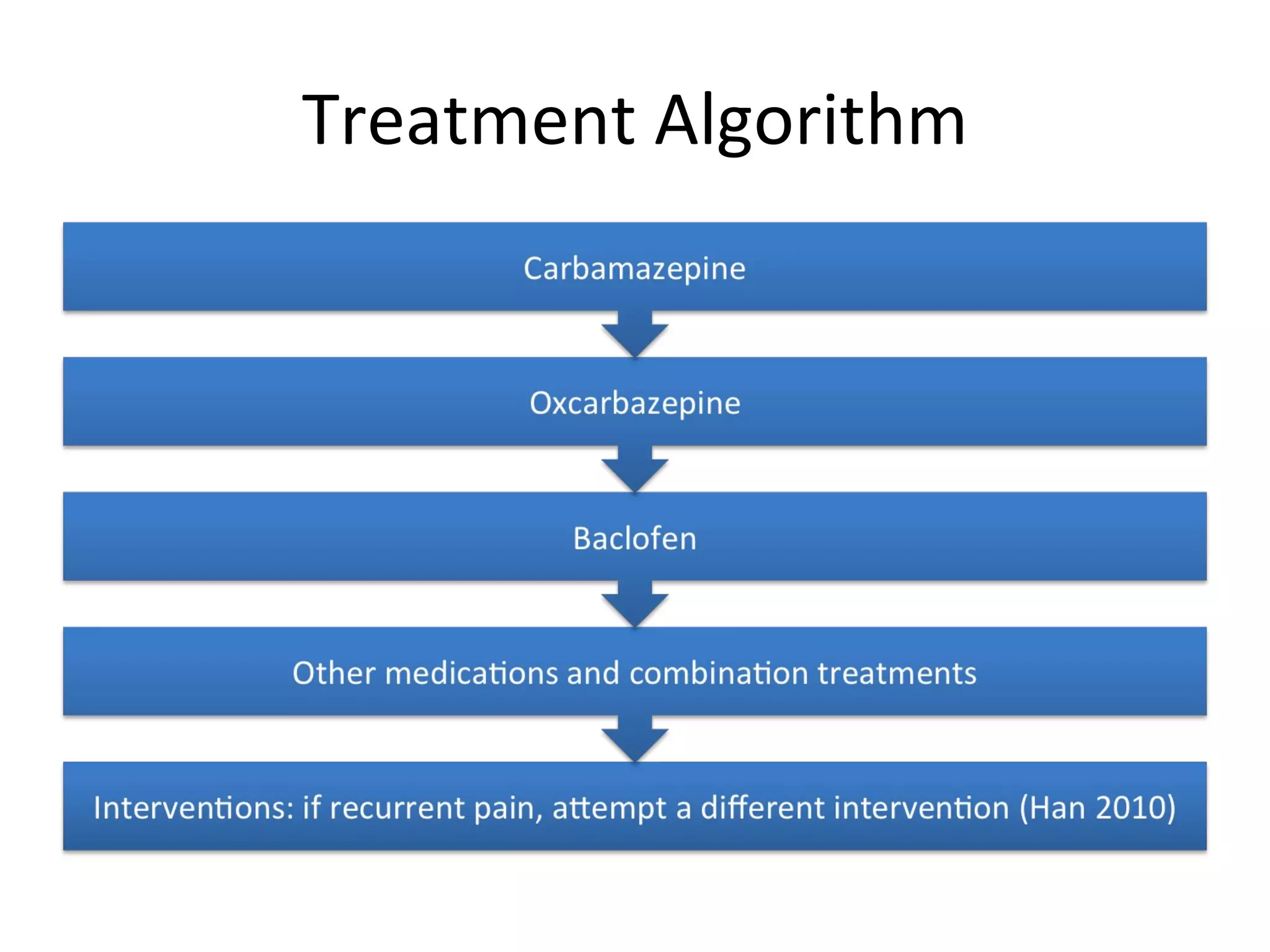
Treatment: Medical Carbamazepine  - complete or near complete pain control attained in 58 to 100 percent of patients, compared with 0 to 40 percent of patients on placebo  NNT <2 sometimes poorly tolerated, with numbers needed to harm for minor and severe adverse events of 3 and 24 respectively.
Treatment: Medical Carbamazepine The usual starting dose 100 to 200 mg Q12h. Increase by 200 mg daily as tolerated until sufficient pain relief is attained.  The typical maintenance dose is 600 to 800 mg/day, given in two divided doses for tablets and extended release capsules, or four divided doses when for oral suspension.  The maximum suggested total dose is 1200 mg daily.
Treatment: Medical Carbamazepine Adverse effects carbamazepine: drowsiness, dizziness, nausea and vomiting; slow titration may minimize these effects.  Carbamazepine-induced leukopenia is not uncommon, but it is usually benign; aplastic anemia is a rare side effect.
Treatment: Medical Carbamazepine The HLA-B*1502 allele is a genetic susceptibility marker in Asians that is associated with an increased risk of developing Stevens-Johnson syndrome and/or toxic epidermal necrolysis.  For most patients of Asian ancestry, genetic testing for the presence of this marker is recommended by the manufacturer prior to initiation
Treatment: Medical:  Oxcarbazepine equally effective as carb., decreased SE, with a >50 percent reduction of attacks achieved by 88 percent or more of patients in both treatment groups. started at a total dose of 600 mg daily, given in two divided doses.  The dose can be increased as tolerated in 300 mg increments every third day to a total dose of 1200 to 1800 mg daily.
Treatment: Medical Baclofen Limited evidence from a small double-blind crossover trial  Treatment with baclofen 40 to 80 mg daily resulted in a reduction in paroxysms in 7/10 patients with typical TN, compared with 1/10 placebo.  The starting dose 15 mg daily given in three divided doses, with gradual titration to a maintenance dose of 50 to 60 mg per day. drug should be discontinued slowly since seizures and hallucinations have been reported with upon withdrawal.
Treatment: Medical Opioids no controlled data regarding the efficacy of opioids in TN  may help make the pain bearable while other, more effective and long-term, treatments take effect.  may be effective at lower doses when combined with neuropathic agents
Treatment: Medical Other treatments Small open label studies have suggested benefit with a number of medications used for TN: phenytoin, valproic acid, gabapentin, pregabalin, clonazepam, topiramate, misoprostol (with MS) Lidocaine IV – 100-300mg over 30 minutes.  No controlled trial comparing monotherapy with combination therapy
Treatment: Interventional Overview Microvascular decompression  Ablative procedures, including: Rhizotomy with either radiofrequency thermocoagulation, mechanical balloon compression, or chemical (glycerol) injection  Gamma knife radiosurgery  Peripheral neurectomy and nerve block
Treatment: Interventional Microvascular Decompression Craniotomy Initial pain relief 90%, 1 yr. (80%, 3 yr. (75%), 5 yr. (73%) 0.2% mortality 4% major adverse events: CSF leak, infarction, hematoma 11% aseptic meningitis 10% long term hearing loss 7% sensory loss
Treatment: Interventional Rhizotomy Percutaneous procedures via foramen ovale RF thermocoagulation, mechanical balloon compression, chemical neurolysis (0.1-0.4% glycerol) 2008 AAN/EFNS: initial pain relief 90%, 1 yr. (68-85%), 3 yr. (54-64%), 5 yr. (50%) 0.2% aseptic meningitis 12 % dysesthesia (burning, aching, heavy) 50% sensory loss 4% anesthesia dolorosa 4% corneal numbness with risk of keratitis
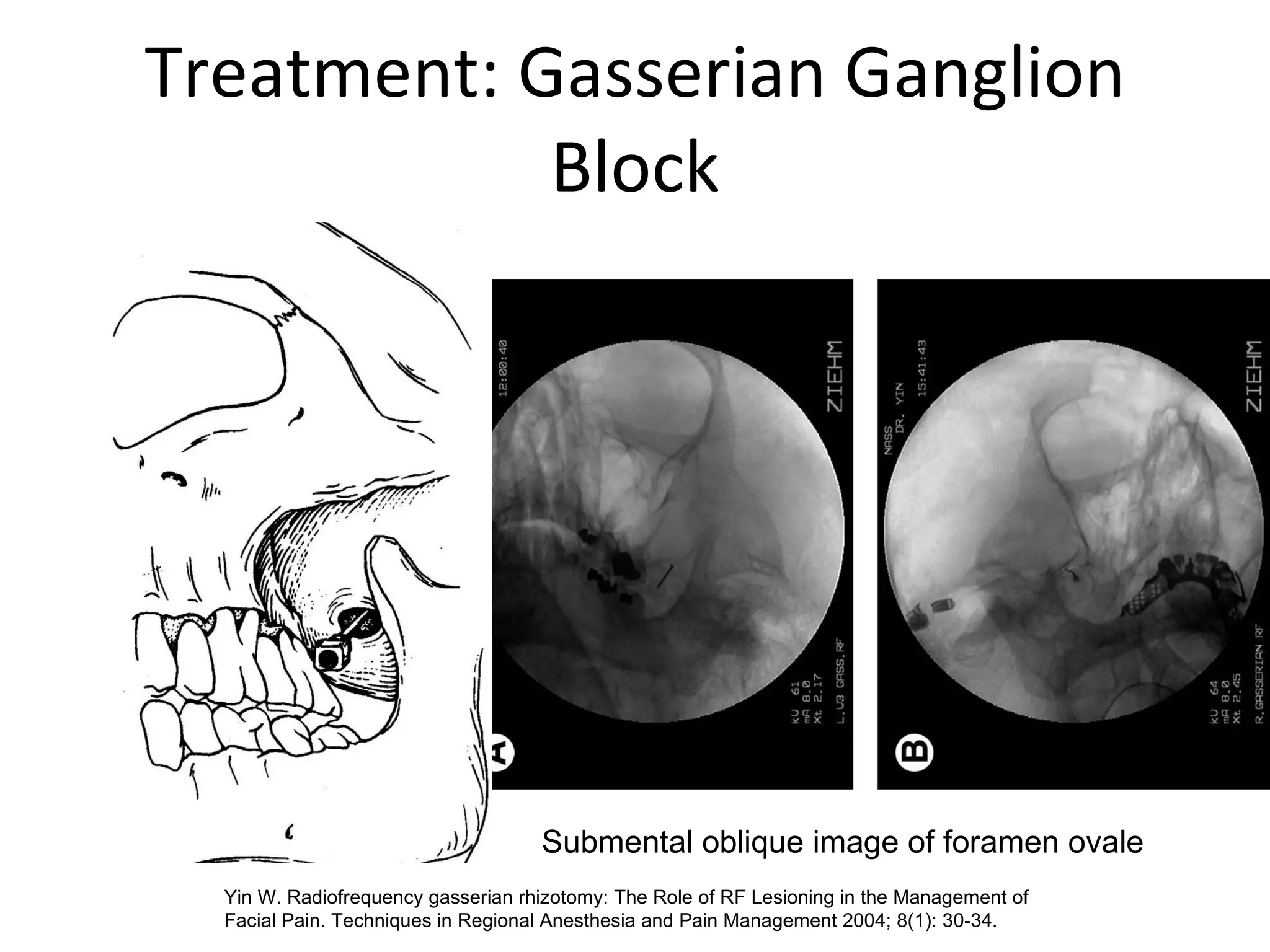
Treatment: Gasserian Ganglion Block Submental oblique image of foramen ovale Yin W. Radiofrequency gasserian rhizotomy: The Role of RF Lesioning in the Management of Facial Pain. Techniques in Regional Anesthesia and Pain Management 2004; 8(1): 30-34.
Treatment: Interventional Gamma Knife Radiosurgery Beams aimed at proximal trigeminal root causing axonal degeneration and necrosis Pain relief lags by a month 1 yr. (69%), 3 yr. (52%) 9-37% new or worsened facial sensory impairment Anesthesia dolorosa very rare May be more effective as a first intervention rather than second
Treatment: Interventional Peripheral Neurectomy Branches of trigeminal – supraorbital, infraorbital, alveolar, lingual.  Incision, alcohol, RF, cryotherapy AAN/EFNS – evidence is negative or inconclusive
Treatment Algorithm
References UpToDate 2010: Trigeminal Neuralgia Han I, Shin D, Chang J, Kim K, Chang J, Huh R, Chung Effect of Various Surgical Modalities in Recurrent or Persistent Trigeminal Neuralgia.  Stereotact Funct Neurosurg 2010;88:156-162

Trigeminal neuralgia

  • 1.
    Trigeminal Neuralgia YuryKhelemsky, MD Assistant Professor Anesthesiology and Pain Medicine The Mount Sinai Medical Center
  • 2.
    Introduction Common causeof facial pain Sudden, usually unilateral, severe, brief, stabbing/lancinating, recurrent episodes of pain in one or more branches of the 5 th cranial nerve.
  • 3.
    Anatomy Sensory supplyto face and sensory and motor to muscles of mastication 3 major divisions: V1 (ophthalmic), V2 (Maxillary), V3 (Mandibular) Nerve starts at midlateral surface of pons, sensory ganglion ( gasserian ganglion resides in Meckel ’s cave in the floor of the middle cranial fossa
  • 4.
    Epidemiology Annual incidence4-13/100k 15k new cases per year in US Incidence increases with age (as with PHN). Male:Female 1:1.5 Rare familial cases. Most sporadic.
  • 5.
    Etiology Classic :Most cases (80-90%) due to compression of trigeminal nerve root by aberrant loop of artery or vein. Usually within a few mm of entry into pons. Primary TN also includes idiopathic cases Secondary: acoustic neuroma, meningioma, AVN, saccular aneurysm, multiple sclerosis.
  • 6.
    Pathogenesis Mechanism: demyelinationin area around vascular compression. Ephaptic (occurring without neurotransmitters) crosstalk between light touch and pain fibers. Central pain/sensitization develops
  • 7.
    Classification International HeadacheSociety (IHS) Classic: idiopathic (since most do not have surgery most of these are likely vascular) and vascular Secondary: all structural lesions other than vascular compression
  • 8.
    Clinical Features 1Sudden, unilateral, severe, brief, stabbing, electric Maximal at or near onset May have facial muscle spasm (tix douloureux) Refractory period is common Typically does not awaken patient Unilateral, may be bilateral, but not simultaneously
  • 9.
    Clinical Features 2Mostly V2/3. V1<5%. Trigger zones: in distribution of affected nerve, closer to midline, patient protect these areas, may demonstrate on physical exam Other triggers: chewing, talking, brushing teeth, cold air, smiling, grimacing Pretrigeminal neuralgia – dull aching continuous pain evolving into TN May be precipitated by dental procedures
  • 10.
    Course Variable Episodesmay last weeks – months, followed by pain free intervals. Recurrence common, some patients have continuous pain Most often, TN waxes and wanes in severity and frequency of exacerbations
  • 11.
    Diagnosis International HeadacheSociety (IHS) Classic: Paroxysmal pain in one or more division of CNV Pain has at least one: intense, sharp, superficial, or stabbing; precipitated from trigger areas or by trigger factors Attacks are stereotyped in the individual patient No clinically significant neurologic deficit Not attributable to another disorder Secondary: demonstrable structure other than vascular compression
  • 12.
    Neuroimaging Some obtainMRI in all TN pts Some only in: young patients, bilateral sx, trigeminal sensory loss American Academy of Neurology (AAN) and European Federation of Neurologic Societies (EFNS) review Routine imaging identified secondary cause in 15% of patients Insufficient evidence to support or refute utility of MRI to identify neurovascular compression or indicate most reliable MRI technique.
  • 13.
    Electrophysiologic Testing TrigeminalReflex Tests: Blink Reflex and Masseter Inhibitor Reflex. 2008 AAN/EFNS: high sensitivity (94%) and specificity (87%) for distinguishing between secondary and classic TN Trigeminal Evoked Potentials: not clinically useful
  • 14.
    DDx Short-Lasting UnilateralNeuralgiform Headache with Conjunctival Injection and Tearing (SUNCT) Cluster-tic syndrome Jabs and jolts syndrome Other neuralgias
  • 15.
    Treatment: Medical Carbamazepine - complete or near complete pain control attained in 58 to 100 percent of patients, compared with 0 to 40 percent of patients on placebo NNT <2 sometimes poorly tolerated, with numbers needed to harm for minor and severe adverse events of 3 and 24 respectively.
  • 16.
    Treatment: Medical CarbamazepineThe usual starting dose 100 to 200 mg Q12h. Increase by 200 mg daily as tolerated until sufficient pain relief is attained. The typical maintenance dose is 600 to 800 mg/day, given in two divided doses for tablets and extended release capsules, or four divided doses when for oral suspension. The maximum suggested total dose is 1200 mg daily.
  • 17.
    Treatment: Medical CarbamazepineAdverse effects carbamazepine: drowsiness, dizziness, nausea and vomiting; slow titration may minimize these effects. Carbamazepine-induced leukopenia is not uncommon, but it is usually benign; aplastic anemia is a rare side effect.
  • 18.
    Treatment: Medical CarbamazepineThe HLA-B*1502 allele is a genetic susceptibility marker in Asians that is associated with an increased risk of developing Stevens-Johnson syndrome and/or toxic epidermal necrolysis. For most patients of Asian ancestry, genetic testing for the presence of this marker is recommended by the manufacturer prior to initiation
  • 19.
    Treatment: Medical: Oxcarbazepine equally effective as carb., decreased SE, with a >50 percent reduction of attacks achieved by 88 percent or more of patients in both treatment groups. started at a total dose of 600 mg daily, given in two divided doses. The dose can be increased as tolerated in 300 mg increments every third day to a total dose of 1200 to 1800 mg daily.
  • 20.
    Treatment: Medical BaclofenLimited evidence from a small double-blind crossover trial Treatment with baclofen 40 to 80 mg daily resulted in a reduction in paroxysms in 7/10 patients with typical TN, compared with 1/10 placebo. The starting dose 15 mg daily given in three divided doses, with gradual titration to a maintenance dose of 50 to 60 mg per day. drug should be discontinued slowly since seizures and hallucinations have been reported with upon withdrawal.
  • 21.
    Treatment: Medical Opioidsno controlled data regarding the efficacy of opioids in TN may help make the pain bearable while other, more effective and long-term, treatments take effect. may be effective at lower doses when combined with neuropathic agents
  • 22.
    Treatment: Medical Othertreatments Small open label studies have suggested benefit with a number of medications used for TN: phenytoin, valproic acid, gabapentin, pregabalin, clonazepam, topiramate, misoprostol (with MS) Lidocaine IV – 100-300mg over 30 minutes. No controlled trial comparing monotherapy with combination therapy
  • 23.
    Treatment: Interventional OverviewMicrovascular decompression Ablative procedures, including: Rhizotomy with either radiofrequency thermocoagulation, mechanical balloon compression, or chemical (glycerol) injection Gamma knife radiosurgery Peripheral neurectomy and nerve block
  • 24.
    Treatment: Interventional MicrovascularDecompression Craniotomy Initial pain relief 90%, 1 yr. (80%, 3 yr. (75%), 5 yr. (73%) 0.2% mortality 4% major adverse events: CSF leak, infarction, hematoma 11% aseptic meningitis 10% long term hearing loss 7% sensory loss
  • 25.
    Treatment: Interventional RhizotomyPercutaneous procedures via foramen ovale RF thermocoagulation, mechanical balloon compression, chemical neurolysis (0.1-0.4% glycerol) 2008 AAN/EFNS: initial pain relief 90%, 1 yr. (68-85%), 3 yr. (54-64%), 5 yr. (50%) 0.2% aseptic meningitis 12 % dysesthesia (burning, aching, heavy) 50% sensory loss 4% anesthesia dolorosa 4% corneal numbness with risk of keratitis
  • 26.
    Treatment: Gasserian GanglionBlock Submental oblique image of foramen ovale Yin W. Radiofrequency gasserian rhizotomy: The Role of RF Lesioning in the Management of Facial Pain. Techniques in Regional Anesthesia and Pain Management 2004; 8(1): 30-34.
  • 27.
    Treatment: Interventional GammaKnife Radiosurgery Beams aimed at proximal trigeminal root causing axonal degeneration and necrosis Pain relief lags by a month 1 yr. (69%), 3 yr. (52%) 9-37% new or worsened facial sensory impairment Anesthesia dolorosa very rare May be more effective as a first intervention rather than second
  • 28.
    Treatment: Interventional PeripheralNeurectomy Branches of trigeminal – supraorbital, infraorbital, alveolar, lingual. Incision, alcohol, RF, cryotherapy AAN/EFNS – evidence is negative or inconclusive
  • 29.
  • 30.
    References UpToDate 2010:Trigeminal Neuralgia Han I, Shin D, Chang J, Kim K, Chang J, Huh R, Chung Effect of Various Surgical Modalities in Recurrent or Persistent Trigeminal Neuralgia. Stereotact Funct Neurosurg 2010;88:156-162