CERVICAL SPINE INJURIES
PRESENTER-Dr. R P RAGHAVENDRA RAJU
ANATOMY OF CERVICAL SPINE
 Typical vertebrae [ C3- C6 ]
 Atypical vertebrae
 Atlas
 Axis
 C 7
ATLAS
 No body and spinous process, consists of 2 lateral
masses.
 Short Anterior & long posterior arches
 Transverse ligament – strong ligament, retains
the dens process.
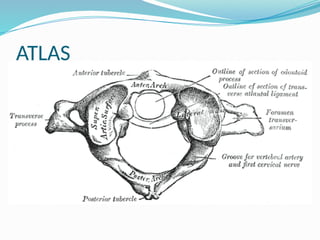
ATLAS
 Lateral mass- bears reniform sup articular facet
 Inf articular facet- circular, medial & backward
 Posterior arch- 3/5ths of circumference, sup
surface groove for vertebral A., attachment to
post atlanto-occipital membrane, inf border to lig
flavum
 Posterior tubercle- ligamentum nuchae, rectus
capitis posterior
ATLAS
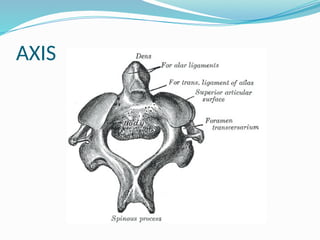
AXIS
 Salient feature is the DENS (odontoid process)
 Conical shape , mean length 15mm
 3 parts- Apex, waist & base
 Apex- pointed, apical & alar ligaments
 Ant surface- ovoid articular facet
 Post surface grooved by transverse ligament
AXIS
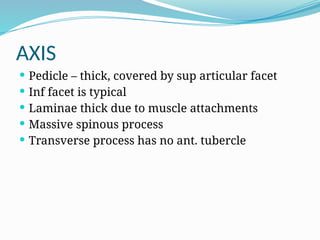
 Pedicle – thick, covered by sup articular facet
 Inf facet is typical
 Laminae thick due to muscle attachments
 Massive spinous process
 Transverse process has no ant. tubercle
AXIS
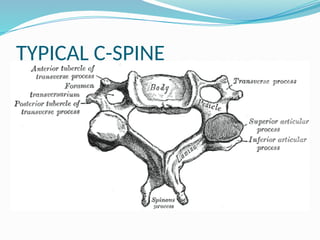
TYPICAL C-SPINE
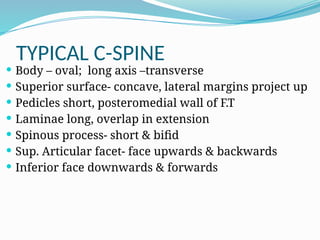
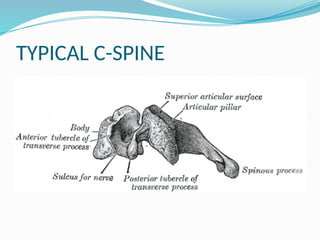
 Body – oval; long axis –transverse
 Superior surface- concave, lateral margins project up
 Pedicles short, posteromedial wall of F.T
 Laminae long, overlap in extension
 Spinous process- short & bifid
 Sup. Articular facet- face upwards & backwards
 Inferior face downwards & forwards
TYPICAL C-SPINE
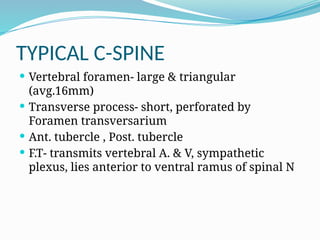
 Vertebral foramen- large & triangular
(avg.16mm)
 Transverse process- short, perforated by
Foramen transversarium
 Ant. tubercle , Post. tubercle
 F.T- transmits vertebral A. & V, sympathetic
plexus, lies anterior to ventral ramus of spinal N
TYPICAL C-SPINE
TYPICAL C-SPINE
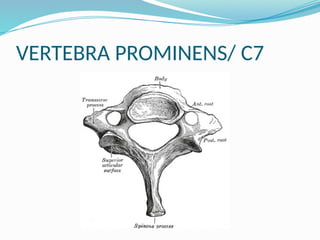
VERTEBRA PROMINENS/ C7
 Spinous process is long & non-bifid
 Attachment to trapezius, spinalis capitis,
mutifidus, interspinales
 Transverse process lacks ant tubercle
 Foramen transversarium transmits only veins
VERTEBRA PROMINENS/ C7
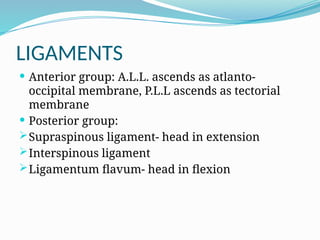
LIGAMENTS
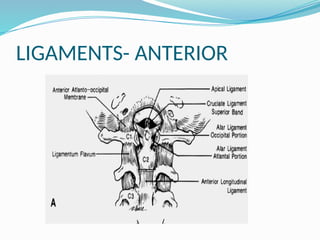
 Anterior group: A.L.L. ascends as atlanto-
occipital membrane, P.L.L ascends as tectorial
membrane
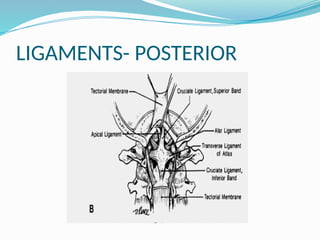
 Posterior group:
Supraspinous ligament- head in extension
Interspinous ligament
Ligamentum flavum- head in flexion
LIGAMENTS- ANTERIOR
LIGAMENTS- POSTERIOR
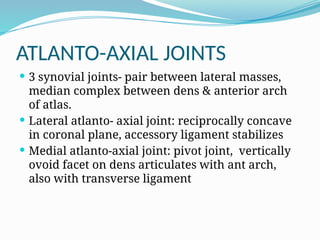
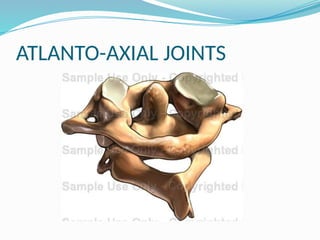
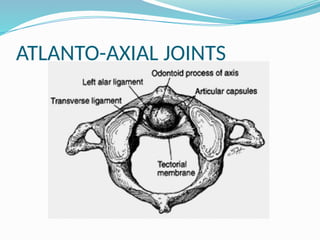
ATLANTO-AXIAL JOINTS
 3 synovial joints- pair between lateral masses,
median complex between dens & anterior arch
of atlas.
 Lateral atlanto- axial joint: reciprocally concave
in coronal plane, accessory ligament stabilizes
 Medial atlanto-axial joint: pivot joint, vertically
ovoid facet on dens articulates with ant arch,
also with transverse ligament
ATLANTO-AXIAL JOINTS
MOVEMENTS AT ATLANTO-AXIAL JOINTS
 Simultaneous at all 3 joints
 Exclusively rotation of axis
 Axis ascends into atlantal ring during rotation
ATLANTO- OCCIPITAL JOINT
 Connected by capsule, anterior & posterior
atlanto occipital membrane
 Anterior atlanto occipital membrane- connects
anterior margin of foramen magnum to upper
border of ant arch, strengthened by ALL
 Posterior atlanto occipital membrane- post
margin of foramen magnum to post arch
EPIDEMIOLOGY OF CERVICAL INJURIES
 Bimodal age distribution- adolescents/young
adults (15 to 24 years old) and middle-aged
individuals (over 55 years old).
 The upper cervical vertebrae (C1 and C2) are the
most frequent.
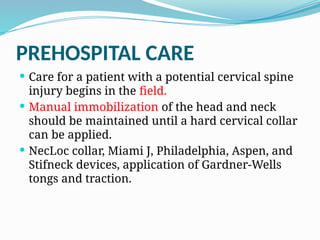
PREHOSPITAL CARE
 Care for a patient with a potential cervical spine
injury begins in the field.
 Manual immobilization of the head and neck
should be maintained until a hard cervical collar
can be applied.
 NecLoc collar, Miami J, Philadelphia, Aspen, and
Stifneck devices, application of Gardner-Wells
tongs and traction.
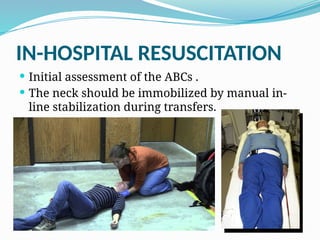
IN-HOSPITAL RESUSCITATION
 Initial assessment of the ABCs .
 The neck should be immobilized by manual in-
line stabilization during transfers.
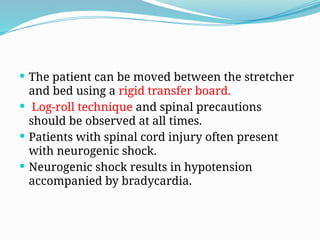
 The patient can be moved between the stretcher
and bed using a rigid transfer board.
 Log-roll technique and spinal precautions
should be observed at all times.
 Patients with spinal cord injury often present
with neurogenic shock.
 Neurogenic shock results in hypotension
accompanied by bradycardia.
 Pressure should be restored by a combination of
postural maneuvers (Trendelenburg position),
judicious fluid infusion, and vasopressor
administration.
HISTORY
 Previous injuries, the nature of the current
injury, and where he or she is feeling pain,
Concomitant distracting injuries, the direction of
impact should be asked.
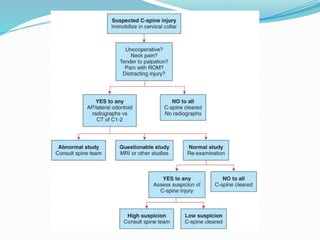
PHYSICAL EXAMINATION
 spine should be examined in a systematic
manner.
 The spinous processes should be palpated
individually, noting tenderness, crepitus, or step-
off.
 Bruising or laceration should be noted.
 Rotation of the head and neck should be noted-
unilateral facet dislocations.
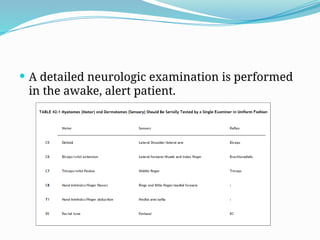
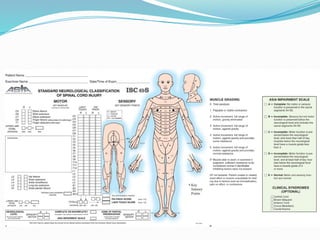
 A detailed neurologic examination is performed
in the awake, alert patient.
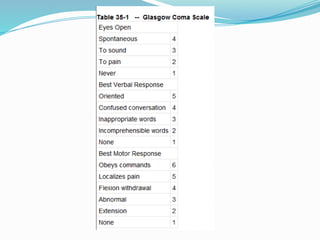
 In the nonalert patient, the neurologic
examination is limited, Key components can still
be peformed.
 Rectal tone, bulbocavernosus (BC) reflex should
also be noted and documented.
Initial Imaging Protocol
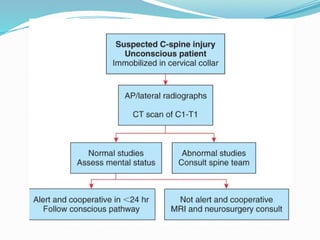
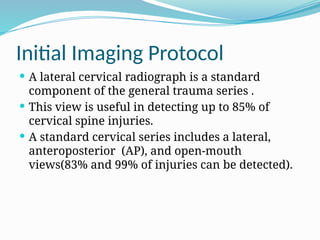
 A lateral cervical radiograph is a standard
component of the general trauma series .
 This view is useful in detecting up to 85% of
cervical spine injuries.
 A standard cervical series includes a lateral,
anteroposterior (AP), and open-mouth
views(83% and 99% of injuries can be detected).
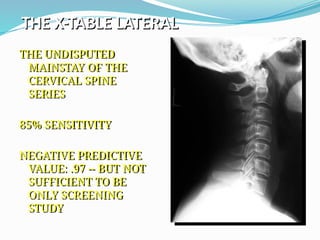
THE X-TABLE LATERAL
THE UNDISPUTED
MAINSTAY OF THE
CERVICAL SPINE
SERIES
85% SENSITIVITY
NEGATIVE PREDICTIVE
VALUE: .97 -- BUT NOT
SUFFICIENT TO BE
ONLY SCREENING
STUDY
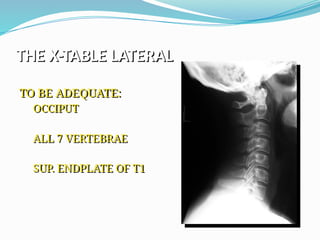
THE X-TABLE LATERAL
TO BE ADEQUATE:
OCCIPUT
ALL 7 VERTEBRAE
SUP. ENDPLATE OF T1
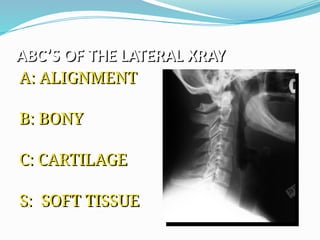
ABC’S OF THE LATERAL XRAY
A: ALIGNMENT
B: BONY
C: CARTILAGE
S: SOFT TISSUE
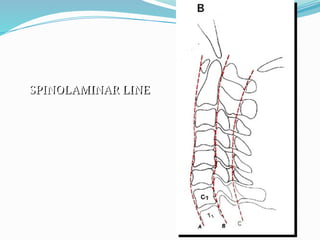
LATERAL C-SPINE:
A-ALIGNMENT
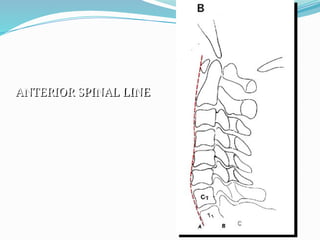
ANTERIOR SPINAL LINE
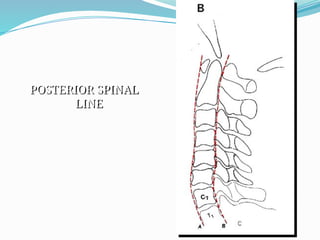
POSTERIOR SPINAL
LINE
SPINOLAMINAR LINE
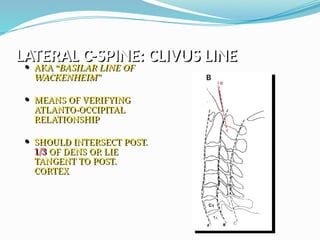
LATERAL C-SPINE: CLIVUS LINE
 AKA “BASILAR LINE OF
WACKENHEIM”
 MEANS OF VERIFYING
ATLANTO-OCCIPITAL
RELATIONSHIP
 SHOULD INTERSECT POST.
1/3 OF DENS OR LIE
TANGENT TO POST.
CORTEX
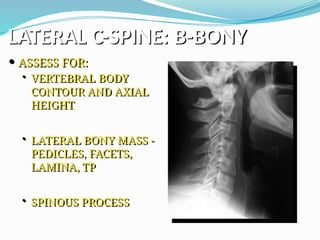
LATERAL C-SPINE: B-BONY
 ASSESS FOR:
• VERTEBRAL BODY
CONTOUR AND AXIAL
HEIGHT
• LATERAL BONY MASS -
PEDICLES, FACETS,
LAMINA, TP
• SPINOUS PROCESS
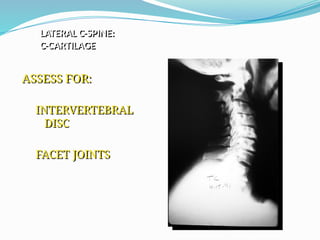
ASSESS FOR:
INTERVERTEBRAL
DISC
FACET JOINTS
LATERAL C-SPINE:
C-CARTILAGE
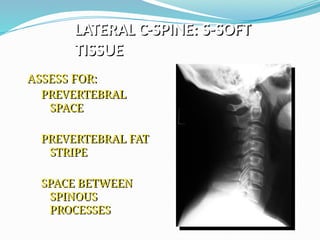
LATERAL C-SPINE: S-SOFT
TISSUE
ASSESS FOR:
PREVERTEBRAL
SPACE
PREVERTEBRAL FAT
STRIPE
SPACE BETWEEN
SPINOUS
PROCESSES
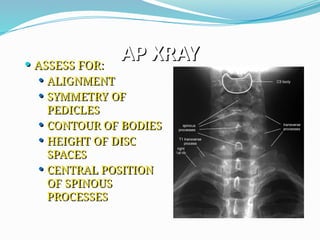
AP XRAY
 ASSESS FOR:
 ALIGNMENT
 SYMMETRY OF
PEDICLES
 CONTOUR OF BODIES
 HEIGHT OF DISC
SPACES
 CENTRAL POSITION
OF SPINOUS
PROCESSES
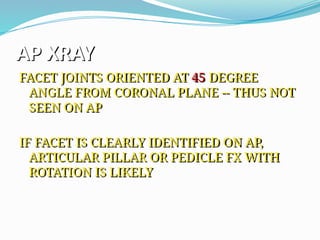
AP XRAY
FACET JOINTS ORIENTED AT 45 DEGREE
ANGLE FROM CORONAL PLANE -- THUS NOT
SEEN ON AP
IF FACET IS CLEARLY IDENTIFIED ON AP,
ARTICULAR PILLAR OR PEDICLE FX WITH
ROTATION IS LIKELY
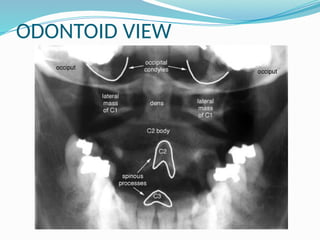
ODONTOID VIEW
CT SCAN
 Indicated in known/ suspected C spine injury
 Pedicles, laminae clearly visualized
 Best for cranio-vertebral junction
 3-D recon helps planning
MRI SCAN
 Cervical level cord injury
 Disc/ ligament injury suspected
 Assess post- traumatic cord changes
 MR angiography for vertebral artery study
OCCIPITAL CONDYLE #
 Two types of injuries
 First is axial compression causing impaction or
fracturing of the articular surface.
 Fractures within the atlanto-occipital joint may
occur when extremes of rotation cause avulsion
of articular surface by the alar ligaments.
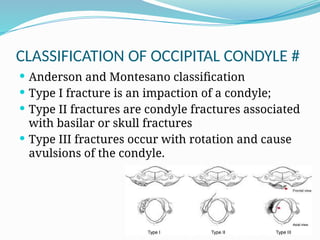
CLASSIFICATION OF OCCIPITAL CONDYLE #
 Anderson and Montesano classification
 Type I fracture is an impaction of a condyle;
 Type II fractures are condyle fractures associated
with basilar or skull fractures
 Type III fractures occur with rotation and cause
avulsions of the condyle.
TREATMENT OF OCCIPITAL CONDYLE #
 Type I & II – stable injuries- can be treated in
rigid cervical orthosis for 8 wks
 Type III- potentially unstable, avulsion of alar
ligaments, immobilization for 12 wks in halo
vest
 If unstable even after this – occipital to C2 fusion
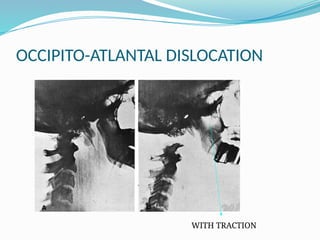
OCCIPITO-ATLANTAL DISLOCATION
 High-energy motor vehicle accidents and
usually present with multiple injuries.
 The dislocation is said to result from a
combination of hyperextension, distraction,
and rotation of the craniocervical junction.
 Severe neurologic injuries ranging from
complete C1 level flaccid quadriplegia to
mixed incomplete spinal cord syndromes such
as Brown-Séquard syndrome and cruciate
paralysis.
OCCIPITO-ATLANTAL DISLOCATION
WITH TRACTION
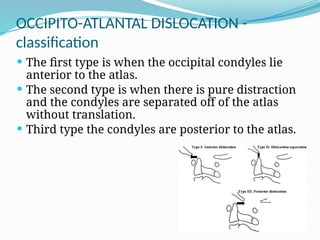
OCCIPITO-ATLANTAL DISLOCATION -
classification
 The first type is when the occipital condyles lie
anterior to the atlas.
 The second type is when there is pure distraction
and the condyles are separated off of the atlas
without translation.
 Third type the condyles are posterior to the atlas.
TREATMENT
 Careful application of the halo and placement of
the halo vest.
 Attempts of reduction should be undertaken
with great care and preferably with fluoroscopic
guidance.
 Since this injury results almost wholly from
ligamentous failure, occipitocervical fusion is
required for long-term stability.
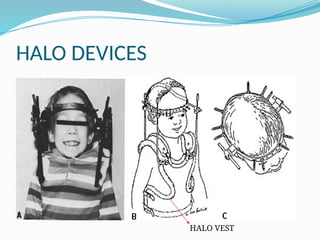
HALO DEVICES
HALO VEST
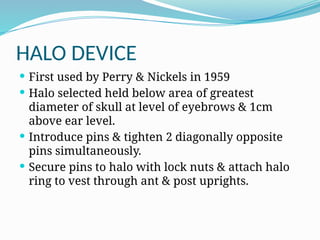
HALO DEVICE
 First used by Perry & Nickels in 1959
 Halo selected held below area of greatest
diameter of skull at level of eyebrows & 1cm
above ear level.
 Introduce pins & tighten 2 diagonally opposite
pins simultaneously.
 Secure pins to halo with lock nuts & attach halo
ring to vest through ant & post uprights.
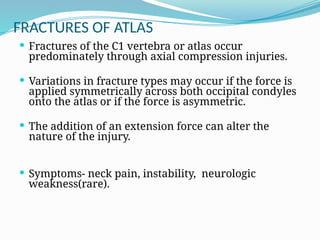
FRACTURES OF ATLAS
 Fractures of the C1 vertebra or atlas occur
predominately through axial compression injuries.
 Variations in fracture types may occur if the force is
applied symmetrically across both occipital condyles
onto the atlas or if the force is asymmetric.
 The addition of an extension force can alter the
nature of the injury.
 Symptoms- neck pain, instability, neurologic
weakness(rare).
FRACTURES OF ATLAS
 Based on mechanism of injury.- 3 types.
 Direct, symmetric axial compression, the
ring of the atlas can fracture in three or four
locations, thus forcing the lateral masses
apart. This is called a Jefferson fracture
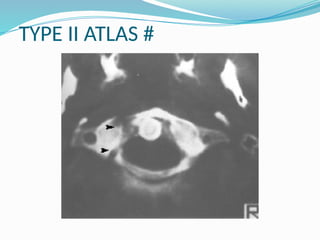
 The second type of atlas fracture occurs when
an asymmetric axial force fractures the arch
immediately anterior to and posterior to one
of the lateral masses and displaces it
 Finally, the posterior arch can fracture when
hyperextension is the major vector.
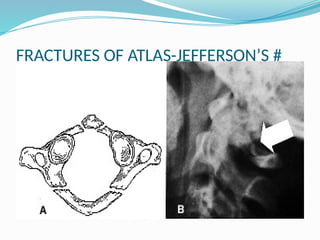
FRACTURES OF ATLAS-JEFFERSON’S #
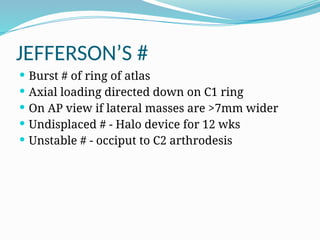
JEFFERSON’S #
 Burst # of ring of atlas
 Axial loading directed down on C1 ring
 On AP view if lateral masses are >7mm wider
 Undisplaced # - Halo device for 12 wks
 Unstable # - occiput to C2 arthrodesis
TYPE II ATLAS #
TREATMENT OF ATLAS #S
 Treatment of atlas fractures depends on the relative
stability of the fracture pattern.
 Stable fractures are either posterior arch fractures or
nondisplaced fractures involving the anterior and posterior
portion of the ring. These fractures can be treated with a
cervical orthosis.
 Type II # - can be treated by rigid immobilization
 Unstable #- occipito cervical fusion
ATLANTO-AXIAL ROTATORY SUBLUXATION
 The mechanism of injury in atlantoaxial rotatory
subluxation is unknown.
 It can occur spontaneously or after trauma.
 Patients complain of neck pain, occipital
neuralgia, and, occasionally, symptoms of
vertebrobasilar artery insufficiency.
ATLANTO-AXIAL ROTATORY SUBLUXATION
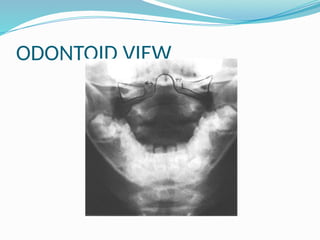
 The open-mouth odontoid view shows a lateral mass
rotated anteriorly and toward the midline .
 The joint space of the lateral mass rotated
posteriorly appears to be overlapping the one below.
 The C2 spinous process is rotated off the midline on
the anteroposterior view.
 Failure of C1 to reposition on a left-and-right
rotation
 CT also shows that the dens separates from the
anterior arch of C1 with increased rotation
ODONTOID VIEW
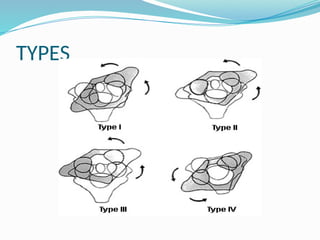
TYPES
 If the atlantodental interval is less than 3 mm, the
transverse ligament is intact; this is a type I
atlantoaxial rotatory subluxation.
 If the atlantodental interval is 3 to 5 mm, the
transverse ligament is believed to be insufficient;
this is a type II subluxation.
 A type III rotatory subluxation occurs when the
atlantodental interval exceeds 5 mm this is said to
indicate failure of the alar ligaments.
 A type IV rotatory subluxation consists of complete
posterior displacement of the atlas
TYPES
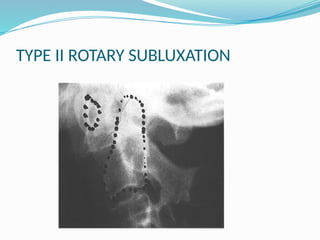
TYPE II ROTARY SUBLUXATION
C1- C2 DISLOCATION
A] Forward dislocation with trans lig rupture
B] Forward subluxation with odontoid #
C] Posterior dislocation of atlas
D] Rotary subluxation
TREATMENT
 Treatment consists of cervical halter traction in the
supine position and active rotation range-of-motion
exercises for 24 to 48 hours.
 This is followed by ambulatory orthotic
immobilization with active range-of-motion
exercises until free motion returns.
 Fixed rotation with continued symptoms and lack of
motion indicates a C1–C2 posterior fusion.
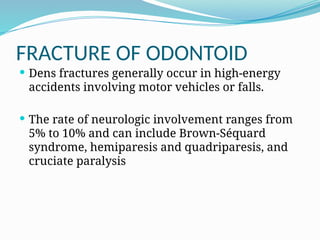
FRACTURE OF ODONTOID
 Dens fractures generally occur in high-energy
accidents involving motor vehicles or falls.
 The rate of neurologic involvement ranges from
5% to 10% and can include Brown-Séquard
syndrome, hemiparesis and quadriparesis, and
cruciate paralysis
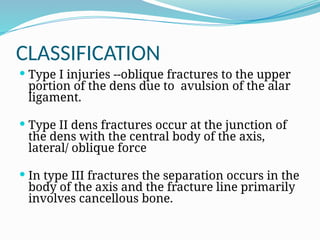
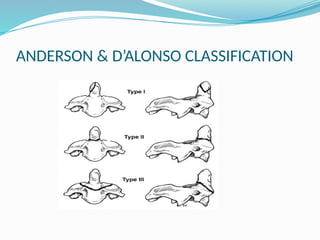
CLASSIFICATION
 Type I injuries --oblique fractures to the upper
portion of the dens due to avulsion of the alar
ligament.
 Type II dens fractures occur at the junction of
the dens with the central body of the axis,
lateral/ oblique force
 In type III fractures the separation occurs in the
body of the axis and the fracture line primarily
involves cancellous bone.
ANDERSON & D’ALONSO CLASSIFICATION
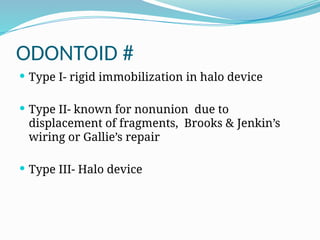
ODONTOID #
 Type I- rigid immobilization in halo device
 Type II- known for nonunion due to
displacement of fragments, Brooks & Jenkin’s
wiring or Gallie’s repair
 Type III- Halo device
HANGMAN’S #
 Traumatic spondylolisthesis of C2
 Second most common # of axis next to dens
 # through pars interarticularis of axis seperating
neural arch from body of axis
 Axial loading & hyper extension forces.
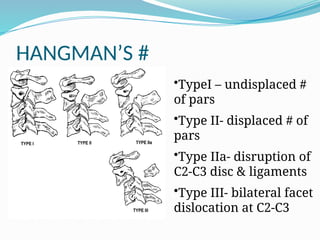
HANGMAN’S #
•TypeI – undisplaced #
of pars
•Type II- displaced # of
pars
•Type IIa- disruption of
C2-C3 disc & ligaments
•Type III- bilateral facet
dislocation at C2-C3
TREATMENT
 Type I fractures as very stable and recommended
treatment in the cervical orthosis. The time period for
these fractures need not exceed 6 weeks of
immobilization.
 Type II injuries of the arch of the axis are always
associated with some injury to either the anterior
longitudinal ligament, C2–C3 disk, or posterior
capsular structures.
 The initial radiographic assessment is critical to
determining the direction of instability.
 Patients with type II fractures should be
determined as to whether they are flexion-
extension or listhetic displacements and
attempts should be made through positioning
and traction to reduce the fractures.
 Once reduction is achieved the patient is
placed into a halo vest and the fractures
reassessed radiographically.
 If there is loss of fracture alignment, it can be
corrected by adjusting the halo. The patient
must wear the halo vest for at least 6 weeks.
TREATMENT
 Type IIa- Anterior C2- C3 stabilization with
arthrodesis
 Type III- reduce with min traction, then posterior
C2- C3 arthrodesis.
ALLEN CLASSIFICATION
 It is a mechanistic classification
 Classified as 6 m.c pattern of c-spine injuries
1.flexion compression
2.vertical compression
3.flexion distraction
4.compressive extension
5.distractive extension
6.lateral flexion
Flexion Injuries
 Simple wedge compression fracture without
posterior disruption
 Anterior subluxation
 Bilateral facet dislocation
 Flexion teardrop fracture
 Clay shoveler fracture
 Anterior atlantoaxial dislocation
Distraction Flexion
 Most common pattern
 tensile failure and lengthening of post
column with possible compression of ant
column
 ant.translation superior vertebra
 25% facet subluxation
 50% unilateral facet dislocation
 > 50% bilateral dislocation
 full body displacement
Distractive flexion Injury
 u/l facet dislocation
 b/l facet dislocation
 Postrerior ligamentous complex injury:
-manifested by widening of the interspinous
process space during flexion
-disruption of posterior ligamentous complex
may cause u/l or b/l facet dislocation
Treatment:
-healing is unlikely with external immobilization
-posterior cervical fusion with inter spinous
process wiring /oblique facet joint wiring
Lateral Flexion Injuries
 Unilateral fracture of the occipital condyle
 Lateral mass of C1
 Eccentric fracture of the superior articular
process of C2
 Combination of the above mentioned injuries
Extension Injuries
▪ Hyperextension sprain dislocation
▪ Hyperextension fracture dislocation
▪ Laminar fracture
▪ Hangman fracture
▪ Extension teardrop fracture
▪ Avulsion horizontal fracture, anterior arch of
C1
▪ Fracture of the posterior arch of C1 (posterior
neural arch fracture of C1)
▪ Posterior atlantoaxial dislocation
Flexion Rotation Injuries
 Unilateral facet dislocation
 Rotary atlantoaxial dislocation
ALLEN’S CO WORKERS
CLASSIFICATION:
1. Simple Compression #
2. Burst #
3. Tear Drop #
4. U/L, B/L Locked Facets
5. Hyper Flexion Injury
6. Clay Shoveler’s #
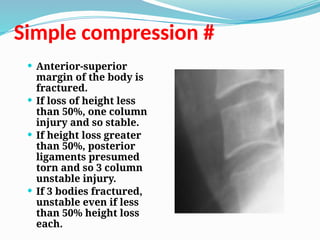
 Anterior-superior
margin of the body is
fractured.
 If loss of height less
than 50%, one column
injury and so stable.
 If height loss greater
than 50%, posterior
ligaments presumed
torn and so 3 column
unstable injury.
 If 3 bodies fractured,
unstable even if less
than 50% height loss
each.
Simple compression #
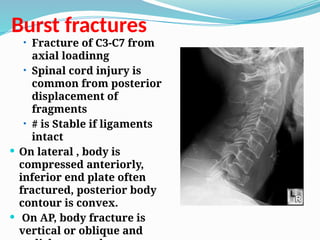
Burst fractures
• Fracture of C3-C7 from
axial loadinng
• Spinal cord injury is
common from posterior
displacement of
fragments
• # is Stable if ligaments
intact
 On lateral , body is
compressed anteriorly,
inferior end plate often
fractured, posterior body
contour is convex.
 On AP, body fracture is
vertical or oblique and
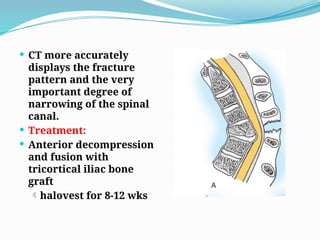
 CT more accurately
displays the fracture
pattern and the very
important degree of
narrowing of the spinal
canal.
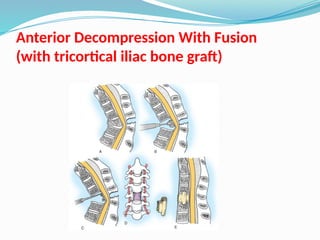
 Treatment:
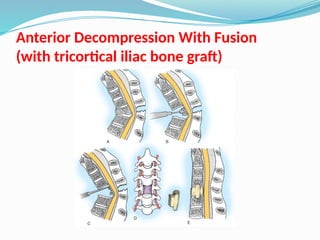
 Anterior decompression
and fusion with
tricortical iliac bone
graft
halovest for 8-12 wks
Anterior Decompression With Fusion
(with tricortical iliac bone graft)
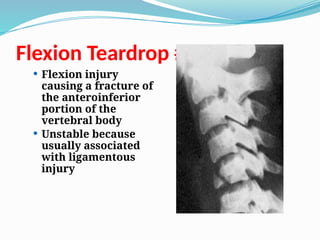
Flexion Teardrop #
 Flexion injury
causing a fracture of
the anteroinferior
portion of the
vertebral body
 Unstable because
usually associated
with ligamentous
injury
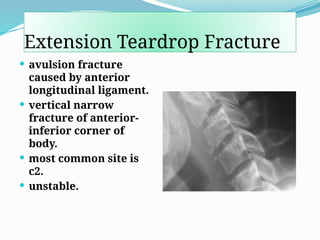
Extension Teardrop Fracture
 avulsion fracture
caused by anterior
longitudinal ligament.
 vertical narrow
fracture of anterior-
inferior corner of
body.
 most common site is
c2.
 unstable.
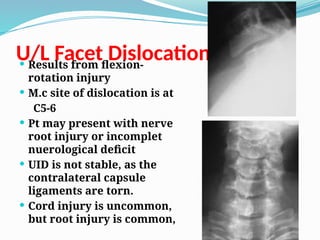
U/L Facet Dislocation
 Results from flexion-
rotation injury
 M.c site of dislocation is at
C5-6
 Pt may present with nerve
root injury or incomplet
nuerological deficit
 UID is not stable, as the
contralateral capsule
ligaments are torn.
 Cord injury is uncommon,
but root injury is common,
Treatment:
 Reduction is difficult with skeletal traction
 Closed reduction may attemted to unlock (50%)
if reduced halovest immonbilization for
3months (stability would be obtained by
spontaneous fusion )
 Open reduction internal fixation
 Open redution and posterior cervical fusion
either with triple wiring or oblique facet
wiring, post operative rigid cervical arthrosios
for 6-8 wks
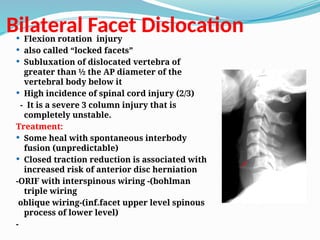
Bilateral Facet Dislocation
 Flexion rotation injury
 also called “locked facets”
 Subluxation of dislocated vertebra of
greater than ½ the AP diameter of the
vertebral body below it
 High incidence of spinal cord injury (2/3)
- It is a severe 3 column injury that is
completely unstable.
Treatment:
 Some heal with spontaneous interbody
fusion (unpredictable)
 Closed traction reduction is associated with
increased risk of anterior disc herniation
-ORIF with interspinous wiring -(bohlman
triple wiring
oblique wiring-(inf.facet upper level spinous
process of lower level)
-
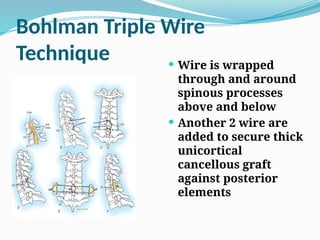
Bohlman Triple Wire
Technique  Wire is wrapped
through and around
spinous processes
above and below
 Another 2 wire are
added to secure thick
unicortical
cancellous graft
against posterior
elements
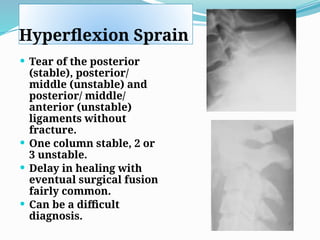
Hyperflexion Sprain
 Tear of the posterior
(stable), posterior/
middle (unstable) and
posterior/ middle/
anterior (unstable)
ligaments without
fracture.
 One column stable, 2 or
3 unstable.
 Delay in healing with
eventual surgical fusion
fairly common.
 Can be a difficult
diagnosis.
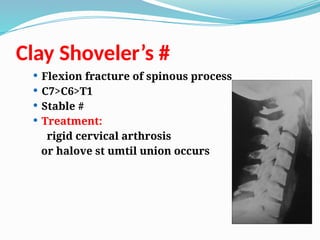
Clay Shoveler’s #
 Flexion fracture of spinous process
 C7>C6>T1
 Stable #
 Treatment:
rigid cervical arthrosis
or halove st umtil union occurs
SCIWORA
 Spinal Cord Injury With Out Radiographic Abnormolity
 12% spinal cord injury
 DEFINITION
“Objective Signs Of Myelopathy As A Result Of Trauma With No
Evidence Of Fracture Or Ligamentous Instability On Plain X-ray And
Tomography”
 Spinal cord is vulnerable to injury with out vertebral colomn
disruption
 Occur predominantly in children
 Because of inherent elasticity,Children have vertebrae that
can dislocate and quickly relocate. Cord gets damaged but
shows an aligned vertebral column.
 Cord can be transected or compressed.
 On MRI parenchymatous hemorrhage and
contusions has bad results
 finding of fracture, subluxation, or abnormal
intersegmental motion at level of neurological
injury excludes sciwora as a diagnosis
experimentally,
 osteo-cartilaginous structures in spinal column can
stretch 2 inches without disruption -- spinal cord
ruptures after 1/4 inch
 anatomically, cervical spinal cord is relatively
tethered - spinal nerves, dural attachment to
foramen magnum, and brachial plexus
DEFINITION OF INSTABILITY
 The loss of the ability of spine under
physiological load to maintain the
relationships between vertebrae In such a
way that the spinal cord or roots are not
damaged or irritated and deformity or
paindoes not developed
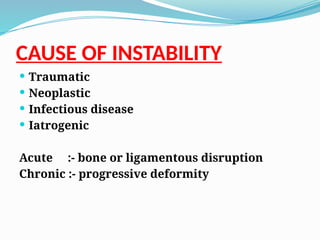
CAUSE OF INSTABILITY
 Traumatic
 Neoplastic
 Infectious disease
 Iatrogenic
Acute :- bone or ligamentous disruption
Chronic :- progressive deformity
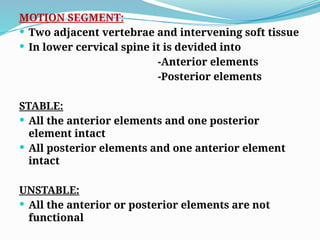
MOTION SEGMENT:
 Two adjacent vertebrae and intervening soft tissue
 In lower cervical spine it is devided into
-Anterior elements
-Posterior elements
STABLE:
 All the anterior elements and one posterior
element intact
 All posterior elements and one anterior element
intact
UNSTABLE:
 All the anterior or posterior elements are not
functional
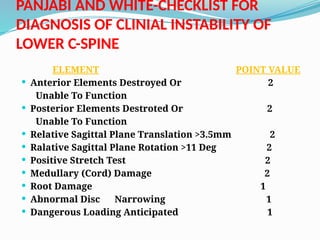
PANJABI AND WHITE-CHECKLIST FOR
DIAGNOSIS OF CLINIAL INSTABILITY OF
LOWER C-SPINE
ELEMENT POINT VALUE
 Anterior Elements Destroyed Or 2
Unable To Function
 Posterior Elements Destroted Or 2
Unable To Function
 Relative Sagittal Plane Translation >3.5mm 2
 Ralative Sagittal Plane Rotation >11 Deg 2
 Positive Stretch Test 2
 Medullary (Cord) Damage 2
 Root Damage 1
 Abnormal Disc Narrowing 1
 Dangerous Loading Anticipated 1
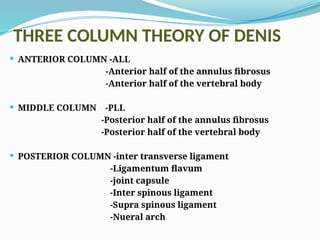
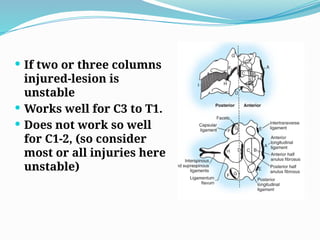
THREE COLUMN THEORY OF DENIS
 ANTERIOR COLUMN -ALL
-Anterior half of the annulus fibrosus
-Anterior half of the vertebral body
 MIDDLE COLUMN -PLL
-Posterior half of the annulus fibrosus
-Posterior half of the vertebral body
 POSTERIOR COLUMN -inter transverse ligament
-Ligamentum flavum
-joint capsule
-Inter spinous ligament
-Supra spinous ligament
-Nueral arch
 If two or three columns
injured-lesion is
unstable
 Works well for C3 to T1.
 Does not work so well
for C1-2, (so consider
most or all injuries here
unstable)
GOALS OF TREATMENT OF C-SPINE
INJURIES
1. To realign the spine
2. To prevent loss of function of undamaged
nuerological tissue
3. To improve nuerological recovery
4. To obtain and maintain spinal stability
5. To obtain early functional recovery
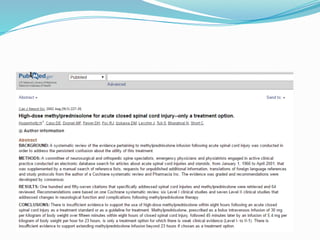
Pharmacological Management
 Methylprednisolone sodium succinate (MPSS)
 Within 3 hours 30mg/kg bolus + 5.4mg/kg/hr
infusion for 24 hours.
 During 3~8 hours  30mg/kg bolus +
5.4mg/kg/hr infusion for 48 hours.
 suppress inflammatory response and vasogenic
edema
Initial Treatment
Immobilization
 Rigid cervical collor (philadelphia collor)
 Poster braces
 Cervico thoracic arthrosis
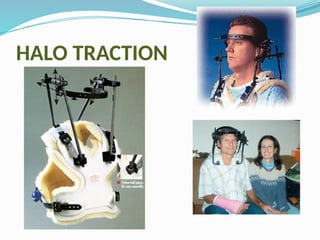
 Halo device
 In unstable injury this is inadequate,cervical
traction required
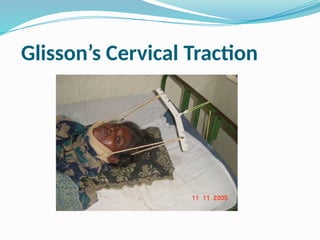
 Skin (glisson’ traction)
 Skeletal
 halo traction or gardner-wells tongs
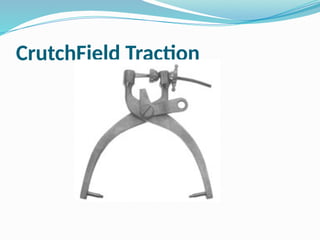
 Crutchfield tongs
Glisson’s Cervical Traction
CrutchField Traction
HALO TRACTION
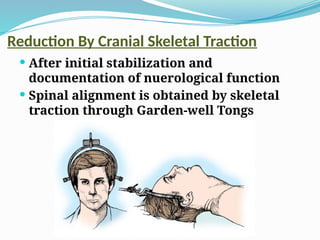
Reduction By Cranial Skeletal Traction
 After initial stabilization and
documentation of nuerological function
 Spinal alignment is obtained by skeletal
traction through Garden-well Tongs
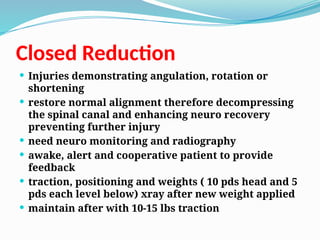
Closed Reduction
 Injuries demonstrating angulation, rotation or
shortening
 restore normal alignment therefore decompressing
the spinal canal and enhancing neuro recovery
preventing further injury
 need neuro monitoring and radiography
 awake, alert and cooperative patient to provide
feedback
 traction, positioning and weights ( 10 pds head and 5
pds each level below) xray after new weight applied
 maintain after with 10-15 lbs traction
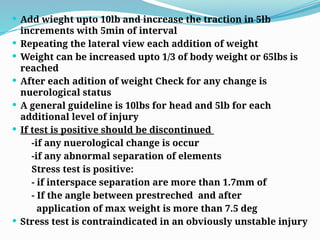
 Add wieght upto 10lb and increase the traction in 5lb
increments with 5min of interval
 Repeating the lateral view each addition of weight
 Weight can be increased upto 1/3 of body weight or 65lbs is
reached
 After each adition of weight Check for any change is
nuerological status
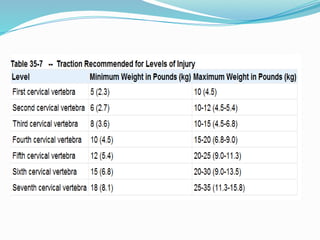
 A general guideline is 10lbs for head and 5lb for each
additional level of injury
 If test is positive should be discontinued
-if any nuerological change is occur
-if any abnormal separation of elements
Stress test is positive:
- if interspace separation are more than 1.7mm of
- If the angle between prestreched and after
application of max weight is more than 7.5 deg
 Stress test is contraindicated in an obviously unstable injury
 If spinal realignment is abtained with traction
and is documented radiographically,weight is
reduced to 50% to maintain alignment to
prevent traction on vessels
 If alignment cannot be obtained open
reduction and stabilization is usually by
posterior approach
Non Operative Management
 For stable c-spine injury with no compression of
neural elements
 Immobilization in a rigid cervical orthrosis for 8-
12 wks
-Rigid cervical brace
-halovest
 Evaluated by serial radiograph -weekly for 3
months,Then at 6wks,3 months,6months,1yr
 Second complete evaluation should be performed
with in 3wks of injury to ruleout/evaluate
SUBACUTE INSTABILITY
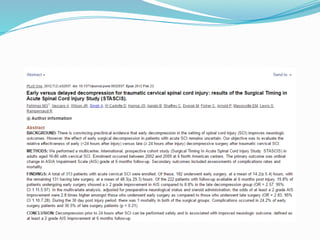
Surgical Decompression
Cervical spinal cord injury----
• During complete injury, no neurological
improvement in early or later decompression.
• During incomplete injury, controversial in
surgical decompression.
• Laminectomy may result in neurological
deterioration.
• Anterior cervical decompression may improve
function in incomplete quadriplegics
• Experimental models-- rapid decompression
better than later intervention.
• Human model— early reduction within 8 hours
brings significant recovery in one study;
however, some others against it.
• Increased risk such as pulmonary morbidity
associates early surgery.
• Anterior approach is favoured;
• posterior laminectomy has no benefit and
worse cord compression.
• the only accepted indication for emergent
surgical treatment is progressive neurological
deterioration--- such as fracture displacement,
epidural hematoma, spinal cord edema or
infarction.
 Middle and lower cervical spine m.c exposed
through anterior approach
 Anterior decompression and placement of
strut graft is safe and effective without
internal fixation
 If posterior elements are stable addition of
anterior plate fixation to structural bone
grafting reduces motion at that level
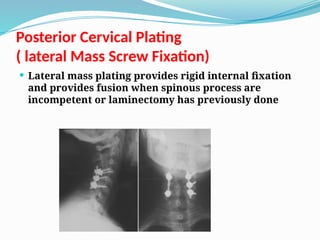
Posterior Cervical Plating
( lateral Mass Screw Fixation)
 Lateral mass plating provides rigid internal fixation
and provides fusion when spinous process are
incompetent or laminectomy has previously done
Anterior Decompression With Fusion
(with tricortical iliac bone graft)
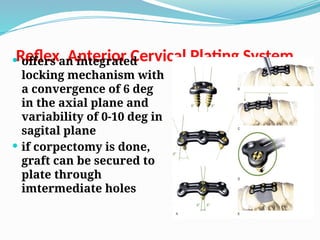
Reflex Anterior Cervical Plating System
 offers an integrated
locking mechanism with
a convergence of 6 deg
in the axial plane and
variability of 0-10 deg in
sagital plane
 if corpectomy is done,
graft can be secured to
plate through
imtermediate holes
TAKE HOME MESSAGE
 If have high enough index of suspicion to get x-rays,
then do not accept inadequate one
 know your pediatric anatomical variations
 do not forget nonskeletal injuries:
-ligamentous instability and
-sciwora
 If a spinal fracture is identified at any level, the entire
spine should be examined with antero-posterior and lateral
views to document the presence or absence of spinal
fractures at other levels
 don’t be in a hurry to clear the cervical spine - always leave
in a hard collar
 Progressive neurological deficit in cord compression needs
early surgical decompression.
 Anterior decompression is better.
 Early surgical intervention for instability prevents
deterioration
THANK YOU

c spine injuries classification management

  • 1.
  • 2.
    ANATOMY OF CERVICALSPINE  Typical vertebrae [ C3- C6 ]  Atypical vertebrae  Atlas  Axis  C 7
  • 3.
    ATLAS  No bodyand spinous process, consists of 2 lateral masses.  Short Anterior & long posterior arches  Transverse ligament – strong ligament, retains the dens process.
  • 4.
    ATLAS  Lateral mass-bears reniform sup articular facet  Inf articular facet- circular, medial & backward  Posterior arch- 3/5ths of circumference, sup surface groove for vertebral A., attachment to post atlanto-occipital membrane, inf border to lig flavum  Posterior tubercle- ligamentum nuchae, rectus capitis posterior
  • 5.
  • 6.
    AXIS  Salient featureis the DENS (odontoid process)  Conical shape , mean length 15mm  3 parts- Apex, waist & base  Apex- pointed, apical & alar ligaments  Ant surface- ovoid articular facet  Post surface grooved by transverse ligament
  • 7.
    AXIS  Pedicle –thick, covered by sup articular facet  Inf facet is typical  Laminae thick due to muscle attachments  Massive spinous process  Transverse process has no ant. tubercle
  • 8.
  • 9.
    TYPICAL C-SPINE  Body– oval; long axis –transverse  Superior surface- concave, lateral margins project up  Pedicles short, posteromedial wall of F.T  Laminae long, overlap in extension  Spinous process- short & bifid  Sup. Articular facet- face upwards & backwards  Inferior face downwards & forwards
  • 10.
    TYPICAL C-SPINE  Vertebralforamen- large & triangular (avg.16mm)  Transverse process- short, perforated by Foramen transversarium  Ant. tubercle , Post. tubercle  F.T- transmits vertebral A. & V, sympathetic plexus, lies anterior to ventral ramus of spinal N
  • 11.
  • 12.
  • 13.
    VERTEBRA PROMINENS/ C7 Spinous process is long & non-bifid  Attachment to trapezius, spinalis capitis, mutifidus, interspinales  Transverse process lacks ant tubercle  Foramen transversarium transmits only veins
  • 14.
  • 15.
    LIGAMENTS  Anterior group:A.L.L. ascends as atlanto- occipital membrane, P.L.L ascends as tectorial membrane  Posterior group: Supraspinous ligament- head in extension Interspinous ligament Ligamentum flavum- head in flexion
  • 16.
  • 17.
  • 18.
    ATLANTO-AXIAL JOINTS  3synovial joints- pair between lateral masses, median complex between dens & anterior arch of atlas.  Lateral atlanto- axial joint: reciprocally concave in coronal plane, accessory ligament stabilizes  Medial atlanto-axial joint: pivot joint, vertically ovoid facet on dens articulates with ant arch, also with transverse ligament
  • 19.
  • 20.
  • 21.
    MOVEMENTS AT ATLANTO-AXIALJOINTS  Simultaneous at all 3 joints  Exclusively rotation of axis  Axis ascends into atlantal ring during rotation
  • 22.
    ATLANTO- OCCIPITAL JOINT Connected by capsule, anterior & posterior atlanto occipital membrane  Anterior atlanto occipital membrane- connects anterior margin of foramen magnum to upper border of ant arch, strengthened by ALL  Posterior atlanto occipital membrane- post margin of foramen magnum to post arch
  • 23.
    EPIDEMIOLOGY OF CERVICALINJURIES  Bimodal age distribution- adolescents/young adults (15 to 24 years old) and middle-aged individuals (over 55 years old).  The upper cervical vertebrae (C1 and C2) are the most frequent.
  • 24.
    PREHOSPITAL CARE  Carefor a patient with a potential cervical spine injury begins in the field.  Manual immobilization of the head and neck should be maintained until a hard cervical collar can be applied.  NecLoc collar, Miami J, Philadelphia, Aspen, and Stifneck devices, application of Gardner-Wells tongs and traction.
  • 25.
    IN-HOSPITAL RESUSCITATION  Initialassessment of the ABCs .  The neck should be immobilized by manual in- line stabilization during transfers.
  • 26.
     The patientcan be moved between the stretcher and bed using a rigid transfer board.  Log-roll technique and spinal precautions should be observed at all times.  Patients with spinal cord injury often present with neurogenic shock.  Neurogenic shock results in hypotension accompanied by bradycardia.
  • 27.
     Pressure shouldbe restored by a combination of postural maneuvers (Trendelenburg position), judicious fluid infusion, and vasopressor administration.
  • 28.
    HISTORY  Previous injuries,the nature of the current injury, and where he or she is feeling pain, Concomitant distracting injuries, the direction of impact should be asked.
  • 29.
    PHYSICAL EXAMINATION  spineshould be examined in a systematic manner.  The spinous processes should be palpated individually, noting tenderness, crepitus, or step- off.  Bruising or laceration should be noted.  Rotation of the head and neck should be noted- unilateral facet dislocations.
  • 30.
     A detailedneurologic examination is performed in the awake, alert patient.
  • 31.
     In thenonalert patient, the neurologic examination is limited, Key components can still be peformed.  Rectal tone, bulbocavernosus (BC) reflex should also be noted and documented.
  • 36.
    Initial Imaging Protocol A lateral cervical radiograph is a standard component of the general trauma series .  This view is useful in detecting up to 85% of cervical spine injuries.  A standard cervical series includes a lateral, anteroposterior (AP), and open-mouth views(83% and 99% of injuries can be detected).
  • 37.
    THE X-TABLE LATERAL THEUNDISPUTED MAINSTAY OF THE CERVICAL SPINE SERIES 85% SENSITIVITY NEGATIVE PREDICTIVE VALUE: .97 -- BUT NOT SUFFICIENT TO BE ONLY SCREENING STUDY
  • 38.
    THE X-TABLE LATERAL TOBE ADEQUATE: OCCIPUT ALL 7 VERTEBRAE SUP. ENDPLATE OF T1
  • 39.
    ABC’S OF THELATERAL XRAY A: ALIGNMENT B: BONY C: CARTILAGE S: SOFT TISSUE
  • 40.
  • 41.
  • 42.
  • 43.
  • 44.
    LATERAL C-SPINE: CLIVUSLINE  AKA “BASILAR LINE OF WACKENHEIM”  MEANS OF VERIFYING ATLANTO-OCCIPITAL RELATIONSHIP  SHOULD INTERSECT POST. 1/3 OF DENS OR LIE TANGENT TO POST. CORTEX
  • 45.
    LATERAL C-SPINE: B-BONY ASSESS FOR: • VERTEBRAL BODY CONTOUR AND AXIAL HEIGHT • LATERAL BONY MASS - PEDICLES, FACETS, LAMINA, TP • SPINOUS PROCESS
  • 46.
  • 47.
    LATERAL C-SPINE: S-SOFT TISSUE ASSESSFOR: PREVERTEBRAL SPACE PREVERTEBRAL FAT STRIPE SPACE BETWEEN SPINOUS PROCESSES
  • 48.
    AP XRAY  ASSESSFOR:  ALIGNMENT  SYMMETRY OF PEDICLES  CONTOUR OF BODIES  HEIGHT OF DISC SPACES  CENTRAL POSITION OF SPINOUS PROCESSES
  • 49.
    AP XRAY FACET JOINTSORIENTED AT 45 DEGREE ANGLE FROM CORONAL PLANE -- THUS NOT SEEN ON AP IF FACET IS CLEARLY IDENTIFIED ON AP, ARTICULAR PILLAR OR PEDICLE FX WITH ROTATION IS LIKELY
  • 50.
  • 51.
    CT SCAN  Indicatedin known/ suspected C spine injury  Pedicles, laminae clearly visualized  Best for cranio-vertebral junction  3-D recon helps planning
  • 52.
    MRI SCAN  Cervicallevel cord injury  Disc/ ligament injury suspected  Assess post- traumatic cord changes  MR angiography for vertebral artery study
  • 53.
    OCCIPITAL CONDYLE # Two types of injuries  First is axial compression causing impaction or fracturing of the articular surface.  Fractures within the atlanto-occipital joint may occur when extremes of rotation cause avulsion of articular surface by the alar ligaments.
  • 54.
    CLASSIFICATION OF OCCIPITALCONDYLE #  Anderson and Montesano classification  Type I fracture is an impaction of a condyle;  Type II fractures are condyle fractures associated with basilar or skull fractures  Type III fractures occur with rotation and cause avulsions of the condyle.
  • 55.
    TREATMENT OF OCCIPITALCONDYLE #  Type I & II – stable injuries- can be treated in rigid cervical orthosis for 8 wks  Type III- potentially unstable, avulsion of alar ligaments, immobilization for 12 wks in halo vest  If unstable even after this – occipital to C2 fusion
  • 56.
    OCCIPITO-ATLANTAL DISLOCATION  High-energymotor vehicle accidents and usually present with multiple injuries.  The dislocation is said to result from a combination of hyperextension, distraction, and rotation of the craniocervical junction.  Severe neurologic injuries ranging from complete C1 level flaccid quadriplegia to mixed incomplete spinal cord syndromes such as Brown-Séquard syndrome and cruciate paralysis.
  • 57.
  • 58.
    OCCIPITO-ATLANTAL DISLOCATION - classification The first type is when the occipital condyles lie anterior to the atlas.  The second type is when there is pure distraction and the condyles are separated off of the atlas without translation.  Third type the condyles are posterior to the atlas.
  • 59.
    TREATMENT  Careful applicationof the halo and placement of the halo vest.  Attempts of reduction should be undertaken with great care and preferably with fluoroscopic guidance.  Since this injury results almost wholly from ligamentous failure, occipitocervical fusion is required for long-term stability.
  • 60.
  • 61.
    HALO DEVICE  Firstused by Perry & Nickels in 1959  Halo selected held below area of greatest diameter of skull at level of eyebrows & 1cm above ear level.  Introduce pins & tighten 2 diagonally opposite pins simultaneously.  Secure pins to halo with lock nuts & attach halo ring to vest through ant & post uprights.
  • 62.
    FRACTURES OF ATLAS Fractures of the C1 vertebra or atlas occur predominately through axial compression injuries.  Variations in fracture types may occur if the force is applied symmetrically across both occipital condyles onto the atlas or if the force is asymmetric.  The addition of an extension force can alter the nature of the injury.  Symptoms- neck pain, instability, neurologic weakness(rare).
  • 63.
    FRACTURES OF ATLAS Based on mechanism of injury.- 3 types.  Direct, symmetric axial compression, the ring of the atlas can fracture in three or four locations, thus forcing the lateral masses apart. This is called a Jefferson fracture  The second type of atlas fracture occurs when an asymmetric axial force fractures the arch immediately anterior to and posterior to one of the lateral masses and displaces it  Finally, the posterior arch can fracture when hyperextension is the major vector.
  • 64.
  • 65.
    JEFFERSON’S #  Burst# of ring of atlas  Axial loading directed down on C1 ring  On AP view if lateral masses are >7mm wider  Undisplaced # - Halo device for 12 wks  Unstable # - occiput to C2 arthrodesis
  • 66.
  • 67.
    TREATMENT OF ATLAS#S  Treatment of atlas fractures depends on the relative stability of the fracture pattern.  Stable fractures are either posterior arch fractures or nondisplaced fractures involving the anterior and posterior portion of the ring. These fractures can be treated with a cervical orthosis.  Type II # - can be treated by rigid immobilization  Unstable #- occipito cervical fusion
  • 68.
    ATLANTO-AXIAL ROTATORY SUBLUXATION The mechanism of injury in atlantoaxial rotatory subluxation is unknown.  It can occur spontaneously or after trauma.  Patients complain of neck pain, occipital neuralgia, and, occasionally, symptoms of vertebrobasilar artery insufficiency.
  • 69.
    ATLANTO-AXIAL ROTATORY SUBLUXATION The open-mouth odontoid view shows a lateral mass rotated anteriorly and toward the midline .  The joint space of the lateral mass rotated posteriorly appears to be overlapping the one below.  The C2 spinous process is rotated off the midline on the anteroposterior view.  Failure of C1 to reposition on a left-and-right rotation  CT also shows that the dens separates from the anterior arch of C1 with increased rotation
  • 70.
  • 71.
    TYPES  If theatlantodental interval is less than 3 mm, the transverse ligament is intact; this is a type I atlantoaxial rotatory subluxation.  If the atlantodental interval is 3 to 5 mm, the transverse ligament is believed to be insufficient; this is a type II subluxation.  A type III rotatory subluxation occurs when the atlantodental interval exceeds 5 mm this is said to indicate failure of the alar ligaments.  A type IV rotatory subluxation consists of complete posterior displacement of the atlas
  • 72.
  • 73.
    TYPE II ROTARYSUBLUXATION
  • 74.
    C1- C2 DISLOCATION A]Forward dislocation with trans lig rupture B] Forward subluxation with odontoid # C] Posterior dislocation of atlas D] Rotary subluxation
  • 75.
    TREATMENT  Treatment consistsof cervical halter traction in the supine position and active rotation range-of-motion exercises for 24 to 48 hours.  This is followed by ambulatory orthotic immobilization with active range-of-motion exercises until free motion returns.  Fixed rotation with continued symptoms and lack of motion indicates a C1–C2 posterior fusion.
  • 76.
    FRACTURE OF ODONTOID Dens fractures generally occur in high-energy accidents involving motor vehicles or falls.  The rate of neurologic involvement ranges from 5% to 10% and can include Brown-Séquard syndrome, hemiparesis and quadriparesis, and cruciate paralysis
  • 77.
    CLASSIFICATION  Type Iinjuries --oblique fractures to the upper portion of the dens due to avulsion of the alar ligament.  Type II dens fractures occur at the junction of the dens with the central body of the axis, lateral/ oblique force  In type III fractures the separation occurs in the body of the axis and the fracture line primarily involves cancellous bone.
  • 78.
    ANDERSON & D’ALONSOCLASSIFICATION
  • 79.
    ODONTOID #  TypeI- rigid immobilization in halo device  Type II- known for nonunion due to displacement of fragments, Brooks & Jenkin’s wiring or Gallie’s repair  Type III- Halo device
  • 80.
    HANGMAN’S #  Traumaticspondylolisthesis of C2  Second most common # of axis next to dens  # through pars interarticularis of axis seperating neural arch from body of axis  Axial loading & hyper extension forces.
  • 81.
    HANGMAN’S # •TypeI –undisplaced # of pars •Type II- displaced # of pars •Type IIa- disruption of C2-C3 disc & ligaments •Type III- bilateral facet dislocation at C2-C3
  • 82.
    TREATMENT  Type Ifractures as very stable and recommended treatment in the cervical orthosis. The time period for these fractures need not exceed 6 weeks of immobilization.  Type II injuries of the arch of the axis are always associated with some injury to either the anterior longitudinal ligament, C2–C3 disk, or posterior capsular structures.  The initial radiographic assessment is critical to determining the direction of instability.
  • 83.
     Patients withtype II fractures should be determined as to whether they are flexion- extension or listhetic displacements and attempts should be made through positioning and traction to reduce the fractures.  Once reduction is achieved the patient is placed into a halo vest and the fractures reassessed radiographically.  If there is loss of fracture alignment, it can be corrected by adjusting the halo. The patient must wear the halo vest for at least 6 weeks.
  • 84.
    TREATMENT  Type IIa-Anterior C2- C3 stabilization with arthrodesis  Type III- reduce with min traction, then posterior C2- C3 arthrodesis.
  • 85.
    ALLEN CLASSIFICATION  Itis a mechanistic classification  Classified as 6 m.c pattern of c-spine injuries 1.flexion compression 2.vertical compression 3.flexion distraction 4.compressive extension 5.distractive extension 6.lateral flexion
  • 86.
    Flexion Injuries  Simplewedge compression fracture without posterior disruption  Anterior subluxation  Bilateral facet dislocation  Flexion teardrop fracture  Clay shoveler fracture  Anterior atlantoaxial dislocation
  • 87.
    Distraction Flexion  Mostcommon pattern  tensile failure and lengthening of post column with possible compression of ant column  ant.translation superior vertebra  25% facet subluxation  50% unilateral facet dislocation  > 50% bilateral dislocation  full body displacement
  • 88.
    Distractive flexion Injury u/l facet dislocation  b/l facet dislocation  Postrerior ligamentous complex injury: -manifested by widening of the interspinous process space during flexion -disruption of posterior ligamentous complex may cause u/l or b/l facet dislocation Treatment: -healing is unlikely with external immobilization -posterior cervical fusion with inter spinous process wiring /oblique facet joint wiring
  • 89.
    Lateral Flexion Injuries Unilateral fracture of the occipital condyle  Lateral mass of C1  Eccentric fracture of the superior articular process of C2  Combination of the above mentioned injuries
  • 90.
    Extension Injuries ▪ Hyperextensionsprain dislocation ▪ Hyperextension fracture dislocation ▪ Laminar fracture ▪ Hangman fracture ▪ Extension teardrop fracture ▪ Avulsion horizontal fracture, anterior arch of C1 ▪ Fracture of the posterior arch of C1 (posterior neural arch fracture of C1) ▪ Posterior atlantoaxial dislocation
  • 91.
    Flexion Rotation Injuries Unilateral facet dislocation  Rotary atlantoaxial dislocation
  • 92.
    ALLEN’S CO WORKERS CLASSIFICATION: 1.Simple Compression # 2. Burst # 3. Tear Drop # 4. U/L, B/L Locked Facets 5. Hyper Flexion Injury 6. Clay Shoveler’s #
  • 93.
     Anterior-superior margin ofthe body is fractured.  If loss of height less than 50%, one column injury and so stable.  If height loss greater than 50%, posterior ligaments presumed torn and so 3 column unstable injury.  If 3 bodies fractured, unstable even if less than 50% height loss each. Simple compression #
  • 94.
    Burst fractures • Fractureof C3-C7 from axial loadinng • Spinal cord injury is common from posterior displacement of fragments • # is Stable if ligaments intact  On lateral , body is compressed anteriorly, inferior end plate often fractured, posterior body contour is convex.  On AP, body fracture is vertical or oblique and
  • 95.
     CT moreaccurately displays the fracture pattern and the very important degree of narrowing of the spinal canal.  Treatment:  Anterior decompression and fusion with tricortical iliac bone graft halovest for 8-12 wks
  • 96.
    Anterior Decompression WithFusion (with tricortical iliac bone graft)
  • 97.
    Flexion Teardrop # Flexion injury causing a fracture of the anteroinferior portion of the vertebral body  Unstable because usually associated with ligamentous injury
  • 98.
    Extension Teardrop Fracture avulsion fracture caused by anterior longitudinal ligament.  vertical narrow fracture of anterior- inferior corner of body.  most common site is c2.  unstable.
  • 99.
    U/L Facet Dislocation Results from flexion- rotation injury  M.c site of dislocation is at C5-6  Pt may present with nerve root injury or incomplet nuerological deficit  UID is not stable, as the contralateral capsule ligaments are torn.  Cord injury is uncommon, but root injury is common,
  • 100.
    Treatment:  Reduction isdifficult with skeletal traction  Closed reduction may attemted to unlock (50%) if reduced halovest immonbilization for 3months (stability would be obtained by spontaneous fusion )  Open reduction internal fixation  Open redution and posterior cervical fusion either with triple wiring or oblique facet wiring, post operative rigid cervical arthrosios for 6-8 wks
  • 101.
    Bilateral Facet Dislocation Flexion rotation injury  also called “locked facets”  Subluxation of dislocated vertebra of greater than ½ the AP diameter of the vertebral body below it  High incidence of spinal cord injury (2/3) - It is a severe 3 column injury that is completely unstable. Treatment:  Some heal with spontaneous interbody fusion (unpredictable)  Closed traction reduction is associated with increased risk of anterior disc herniation -ORIF with interspinous wiring -(bohlman triple wiring oblique wiring-(inf.facet upper level spinous process of lower level) -
  • 102.
    Bohlman Triple Wire Technique Wire is wrapped through and around spinous processes above and below  Another 2 wire are added to secure thick unicortical cancellous graft against posterior elements
  • 103.
    Hyperflexion Sprain  Tearof the posterior (stable), posterior/ middle (unstable) and posterior/ middle/ anterior (unstable) ligaments without fracture.  One column stable, 2 or 3 unstable.  Delay in healing with eventual surgical fusion fairly common.  Can be a difficult diagnosis.
  • 104.
    Clay Shoveler’s # Flexion fracture of spinous process  C7>C6>T1  Stable #  Treatment: rigid cervical arthrosis or halove st umtil union occurs
  • 105.
    SCIWORA  Spinal CordInjury With Out Radiographic Abnormolity  12% spinal cord injury  DEFINITION “Objective Signs Of Myelopathy As A Result Of Trauma With No Evidence Of Fracture Or Ligamentous Instability On Plain X-ray And Tomography”  Spinal cord is vulnerable to injury with out vertebral colomn disruption  Occur predominantly in children  Because of inherent elasticity,Children have vertebrae that can dislocate and quickly relocate. Cord gets damaged but shows an aligned vertebral column.  Cord can be transected or compressed.
  • 106.
     On MRIparenchymatous hemorrhage and contusions has bad results  finding of fracture, subluxation, or abnormal intersegmental motion at level of neurological injury excludes sciwora as a diagnosis experimentally,  osteo-cartilaginous structures in spinal column can stretch 2 inches without disruption -- spinal cord ruptures after 1/4 inch  anatomically, cervical spinal cord is relatively tethered - spinal nerves, dural attachment to foramen magnum, and brachial plexus
  • 107.
    DEFINITION OF INSTABILITY The loss of the ability of spine under physiological load to maintain the relationships between vertebrae In such a way that the spinal cord or roots are not damaged or irritated and deformity or paindoes not developed
  • 108.
    CAUSE OF INSTABILITY Traumatic  Neoplastic  Infectious disease  Iatrogenic Acute :- bone or ligamentous disruption Chronic :- progressive deformity
  • 109.
    MOTION SEGMENT:  Twoadjacent vertebrae and intervening soft tissue  In lower cervical spine it is devided into -Anterior elements -Posterior elements STABLE:  All the anterior elements and one posterior element intact  All posterior elements and one anterior element intact UNSTABLE:  All the anterior or posterior elements are not functional
  • 110.
    PANJABI AND WHITE-CHECKLISTFOR DIAGNOSIS OF CLINIAL INSTABILITY OF LOWER C-SPINE ELEMENT POINT VALUE  Anterior Elements Destroyed Or 2 Unable To Function  Posterior Elements Destroted Or 2 Unable To Function  Relative Sagittal Plane Translation >3.5mm 2  Ralative Sagittal Plane Rotation >11 Deg 2  Positive Stretch Test 2  Medullary (Cord) Damage 2  Root Damage 1  Abnormal Disc Narrowing 1  Dangerous Loading Anticipated 1
  • 111.
    THREE COLUMN THEORYOF DENIS  ANTERIOR COLUMN -ALL -Anterior half of the annulus fibrosus -Anterior half of the vertebral body  MIDDLE COLUMN -PLL -Posterior half of the annulus fibrosus -Posterior half of the vertebral body  POSTERIOR COLUMN -inter transverse ligament -Ligamentum flavum -joint capsule -Inter spinous ligament -Supra spinous ligament -Nueral arch
  • 112.
     If twoor three columns injured-lesion is unstable  Works well for C3 to T1.  Does not work so well for C1-2, (so consider most or all injuries here unstable)
  • 113.
    GOALS OF TREATMENTOF C-SPINE INJURIES 1. To realign the spine 2. To prevent loss of function of undamaged nuerological tissue 3. To improve nuerological recovery 4. To obtain and maintain spinal stability 5. To obtain early functional recovery
  • 114.
    Pharmacological Management  Methylprednisolonesodium succinate (MPSS)  Within 3 hours 30mg/kg bolus + 5.4mg/kg/hr infusion for 24 hours.  During 3~8 hours  30mg/kg bolus + 5.4mg/kg/hr infusion for 48 hours.  suppress inflammatory response and vasogenic edema
  • 116.
    Initial Treatment Immobilization  Rigidcervical collor (philadelphia collor)  Poster braces  Cervico thoracic arthrosis  Halo device  In unstable injury this is inadequate,cervical traction required  Skin (glisson’ traction)  Skeletal  halo traction or gardner-wells tongs  Crutchfield tongs
  • 117.
  • 118.
  • 119.
  • 121.
    Reduction By CranialSkeletal Traction  After initial stabilization and documentation of nuerological function  Spinal alignment is obtained by skeletal traction through Garden-well Tongs
  • 122.
    Closed Reduction  Injuriesdemonstrating angulation, rotation or shortening  restore normal alignment therefore decompressing the spinal canal and enhancing neuro recovery preventing further injury  need neuro monitoring and radiography  awake, alert and cooperative patient to provide feedback  traction, positioning and weights ( 10 pds head and 5 pds each level below) xray after new weight applied  maintain after with 10-15 lbs traction
  • 123.
     Add wieghtupto 10lb and increase the traction in 5lb increments with 5min of interval  Repeating the lateral view each addition of weight  Weight can be increased upto 1/3 of body weight or 65lbs is reached  After each adition of weight Check for any change is nuerological status  A general guideline is 10lbs for head and 5lb for each additional level of injury  If test is positive should be discontinued -if any nuerological change is occur -if any abnormal separation of elements Stress test is positive: - if interspace separation are more than 1.7mm of - If the angle between prestreched and after application of max weight is more than 7.5 deg  Stress test is contraindicated in an obviously unstable injury
  • 124.
     If spinalrealignment is abtained with traction and is documented radiographically,weight is reduced to 50% to maintain alignment to prevent traction on vessels  If alignment cannot be obtained open reduction and stabilization is usually by posterior approach
  • 125.
    Non Operative Management For stable c-spine injury with no compression of neural elements  Immobilization in a rigid cervical orthrosis for 8- 12 wks -Rigid cervical brace -halovest  Evaluated by serial radiograph -weekly for 3 months,Then at 6wks,3 months,6months,1yr  Second complete evaluation should be performed with in 3wks of injury to ruleout/evaluate SUBACUTE INSTABILITY
  • 126.
    Surgical Decompression Cervical spinalcord injury---- • During complete injury, no neurological improvement in early or later decompression. • During incomplete injury, controversial in surgical decompression. • Laminectomy may result in neurological deterioration. • Anterior cervical decompression may improve function in incomplete quadriplegics
  • 127.
    • Experimental models--rapid decompression better than later intervention. • Human model— early reduction within 8 hours brings significant recovery in one study; however, some others against it. • Increased risk such as pulmonary morbidity associates early surgery.
  • 128.
    • Anterior approachis favoured; • posterior laminectomy has no benefit and worse cord compression. • the only accepted indication for emergent surgical treatment is progressive neurological deterioration--- such as fracture displacement, epidural hematoma, spinal cord edema or infarction.
  • 129.
     Middle andlower cervical spine m.c exposed through anterior approach  Anterior decompression and placement of strut graft is safe and effective without internal fixation  If posterior elements are stable addition of anterior plate fixation to structural bone grafting reduces motion at that level
  • 130.
    Posterior Cervical Plating (lateral Mass Screw Fixation)  Lateral mass plating provides rigid internal fixation and provides fusion when spinous process are incompetent or laminectomy has previously done
  • 131.
    Anterior Decompression WithFusion (with tricortical iliac bone graft)
  • 132.
    Reflex Anterior CervicalPlating System  offers an integrated locking mechanism with a convergence of 6 deg in the axial plane and variability of 0-10 deg in sagital plane  if corpectomy is done, graft can be secured to plate through imtermediate holes
  • 134.
    TAKE HOME MESSAGE If have high enough index of suspicion to get x-rays, then do not accept inadequate one  know your pediatric anatomical variations  do not forget nonskeletal injuries: -ligamentous instability and -sciwora  If a spinal fracture is identified at any level, the entire spine should be examined with antero-posterior and lateral views to document the presence or absence of spinal fractures at other levels  don’t be in a hurry to clear the cervical spine - always leave in a hard collar  Progressive neurological deficit in cord compression needs early surgical decompression.  Anterior decompression is better.  Early surgical intervention for instability prevents deterioration
  • 135.