LINE DRAWING
ALGORITHM
NEHRUREVATHY
DEPARTMENT OF BCA
DDA ALGORITHM:
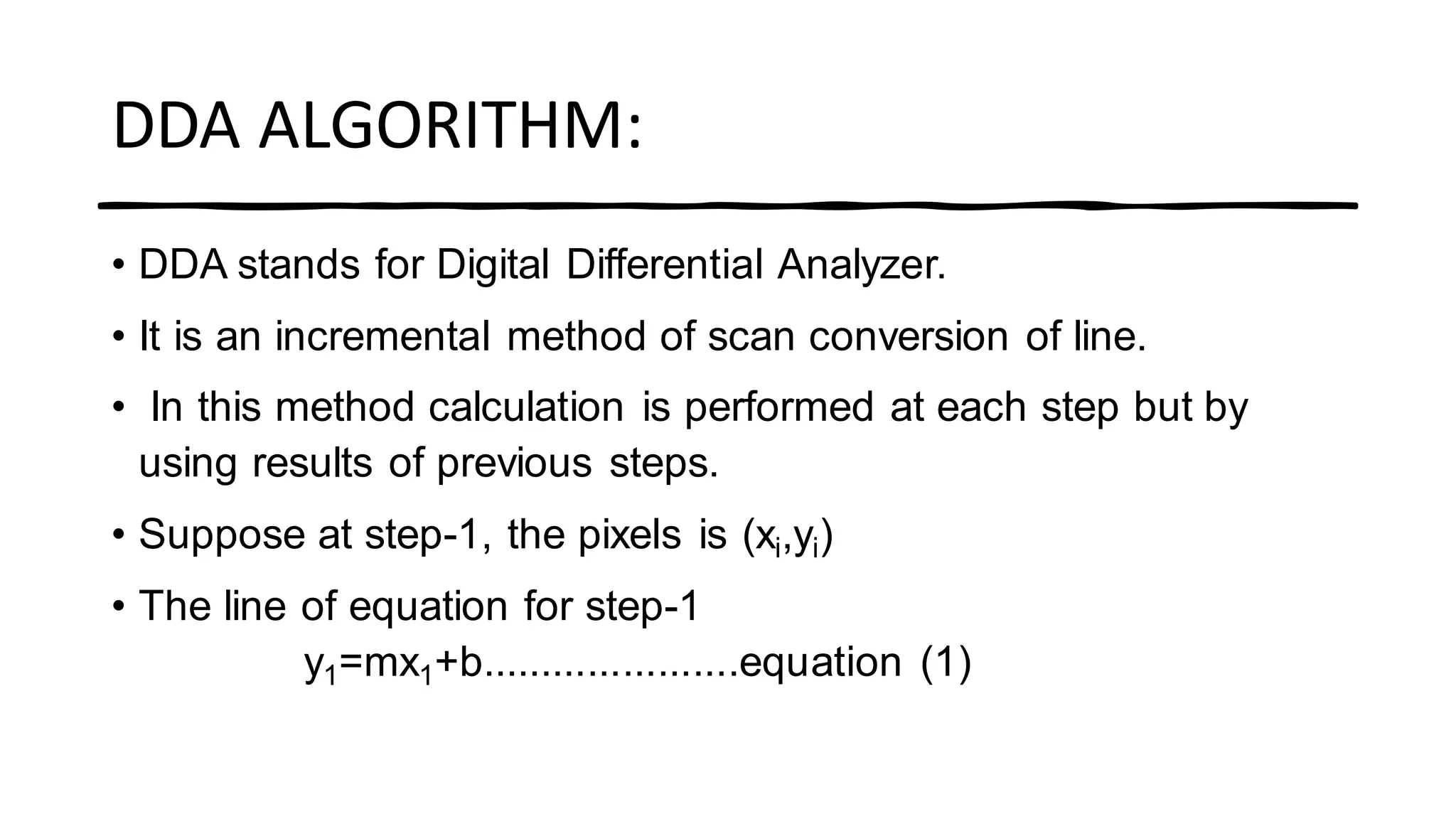
• DDA stands for Digital Differential Analyzer.
• It is an incremental method of scan conversion of line.
• In this method calculation is performed at each step but by
using results of previous steps.
• Suppose at step-1, the pixels is (xi,yi)
• The line of equation for step-1
y1=mx1+b......................equation (1)
DDA ALGORITHM:
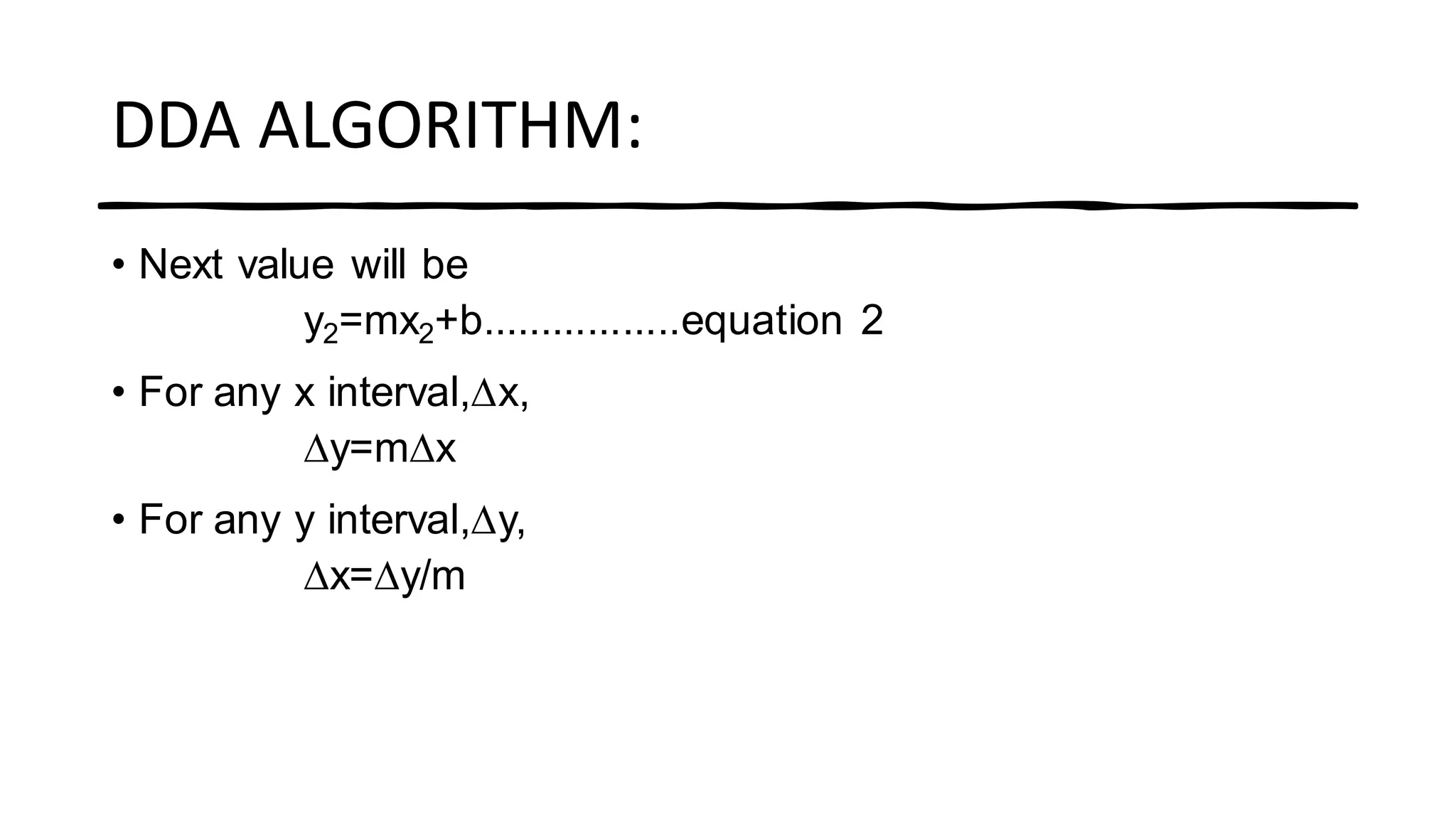
• Next value will be
y2=mx2+b.................equation 2
• For any x interval,∆x,
∆y=m∆x
• For any y interval,∆y,
∆x=∆y/m
DDA ALGORITHM:
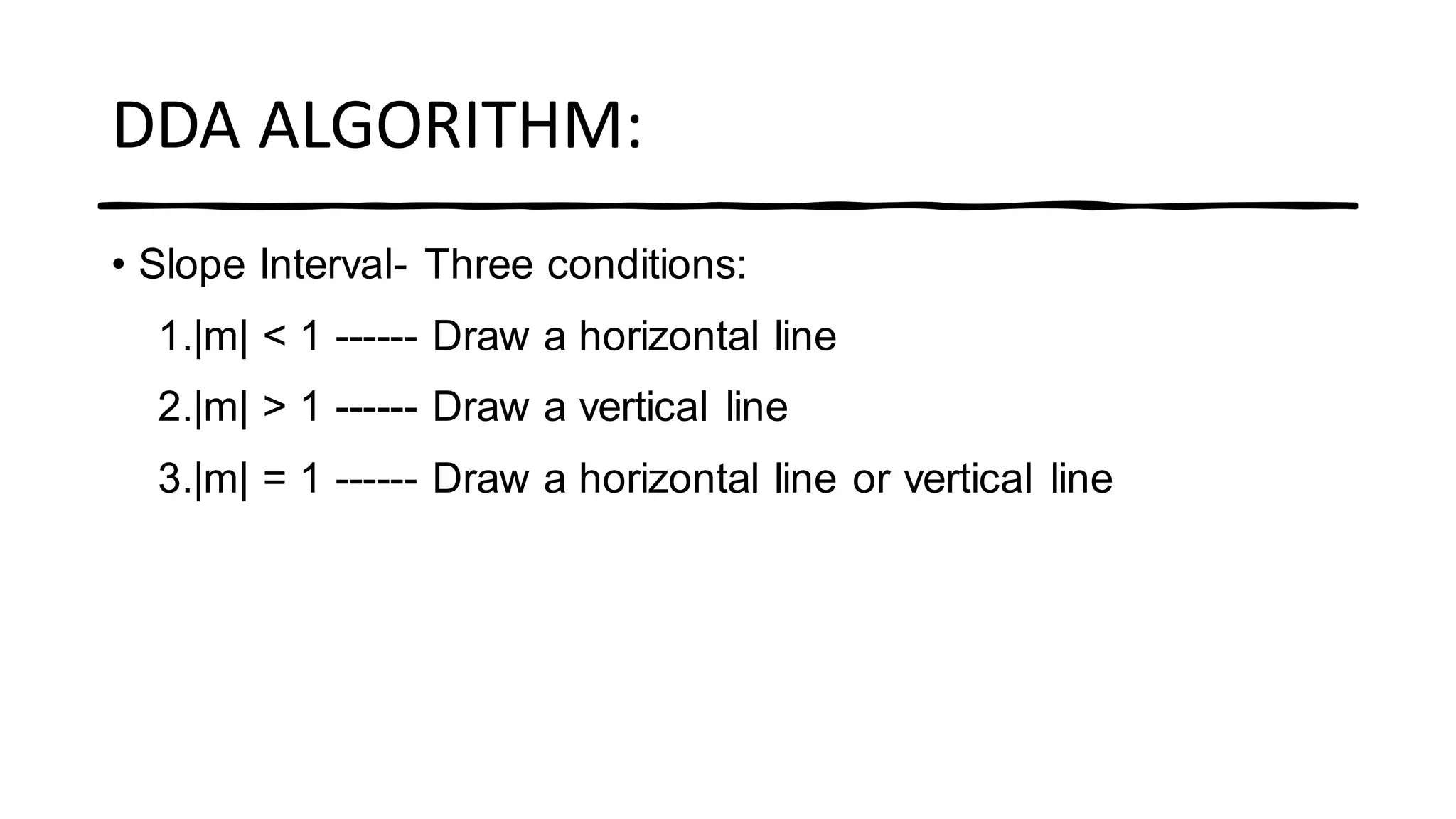
• Slope Interval- Three conditions:
1.|m| < 1 ------ Draw a horizontal line
2.|m| > 1 ------ Draw a vertical line
3.|m| = 1 ------ Draw a horizontal line or vertical line
DDA ALGORITHM:
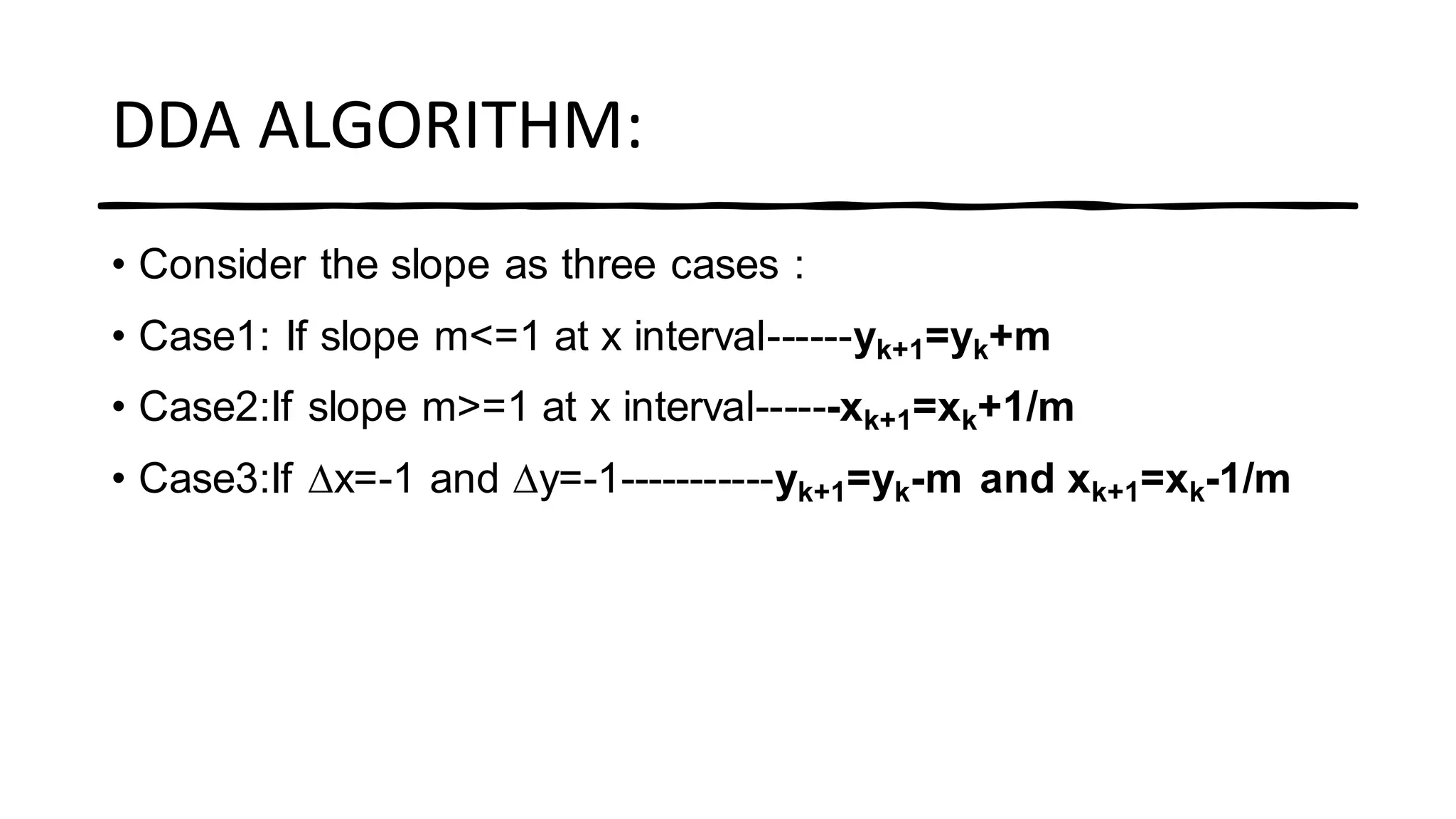
• Consider the slope as three cases :
• Case1: If slope m<=1 at x interval------yk+1=yk+m
• Case2:If slope m>=1 at x interval------xk+1=xk+1/m
• Case3:If ∆x=-1 and ∆y=-1-----------yk+1=yk-m and xk+1=xk-1/m
DDA ALGORITHM:
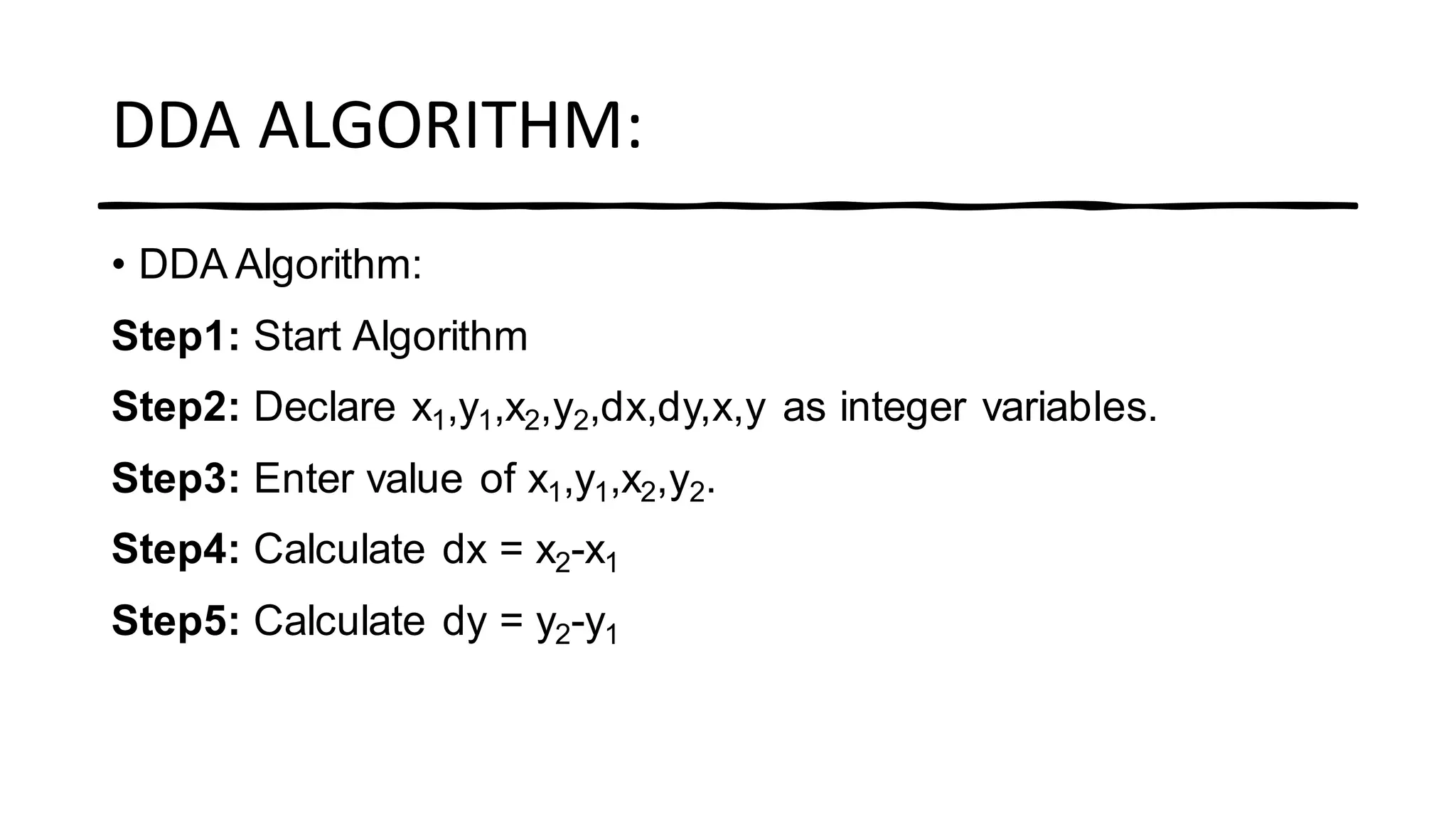
• DDA Algorithm:
Step1: Start Algorithm
Step2: Declare x1,y1,x2,y2,dx,dy,x,y as integer variables.
Step3: Enter value of x1,y1,x2,y2.
Step4: Calculate dx = x2-x1
Step5: Calculate dy = y2-y1
DDA ALGORITHM:
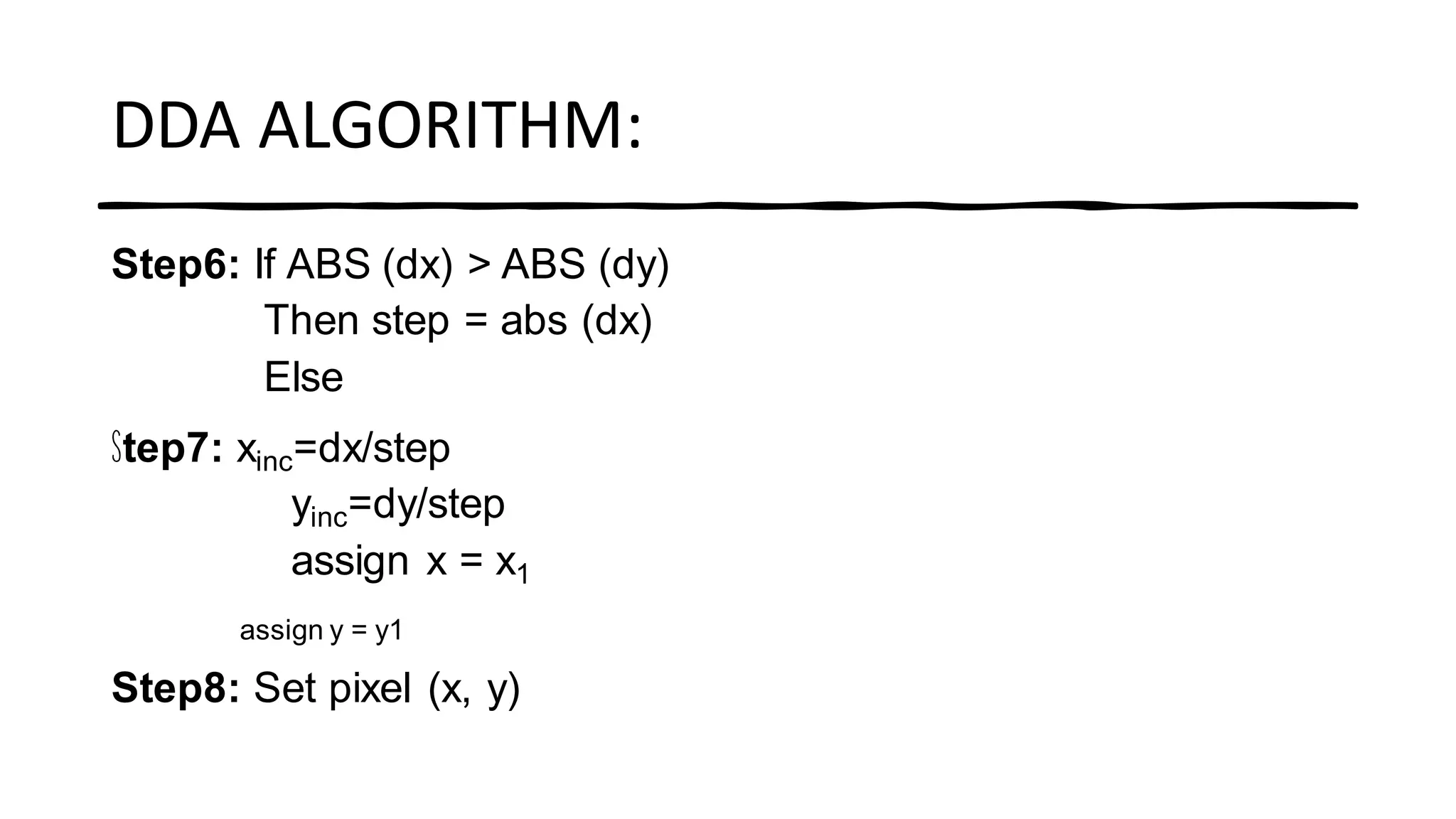
Step6: If ABS (dx) > ABS (dy)
Then step = abs (dx)
Else
Step7: xinc=dx/step
yinc=dy/step
assign x = x1
assign y = y1
Step8: Set pixel (x, y)
DDA ALGORITHM:
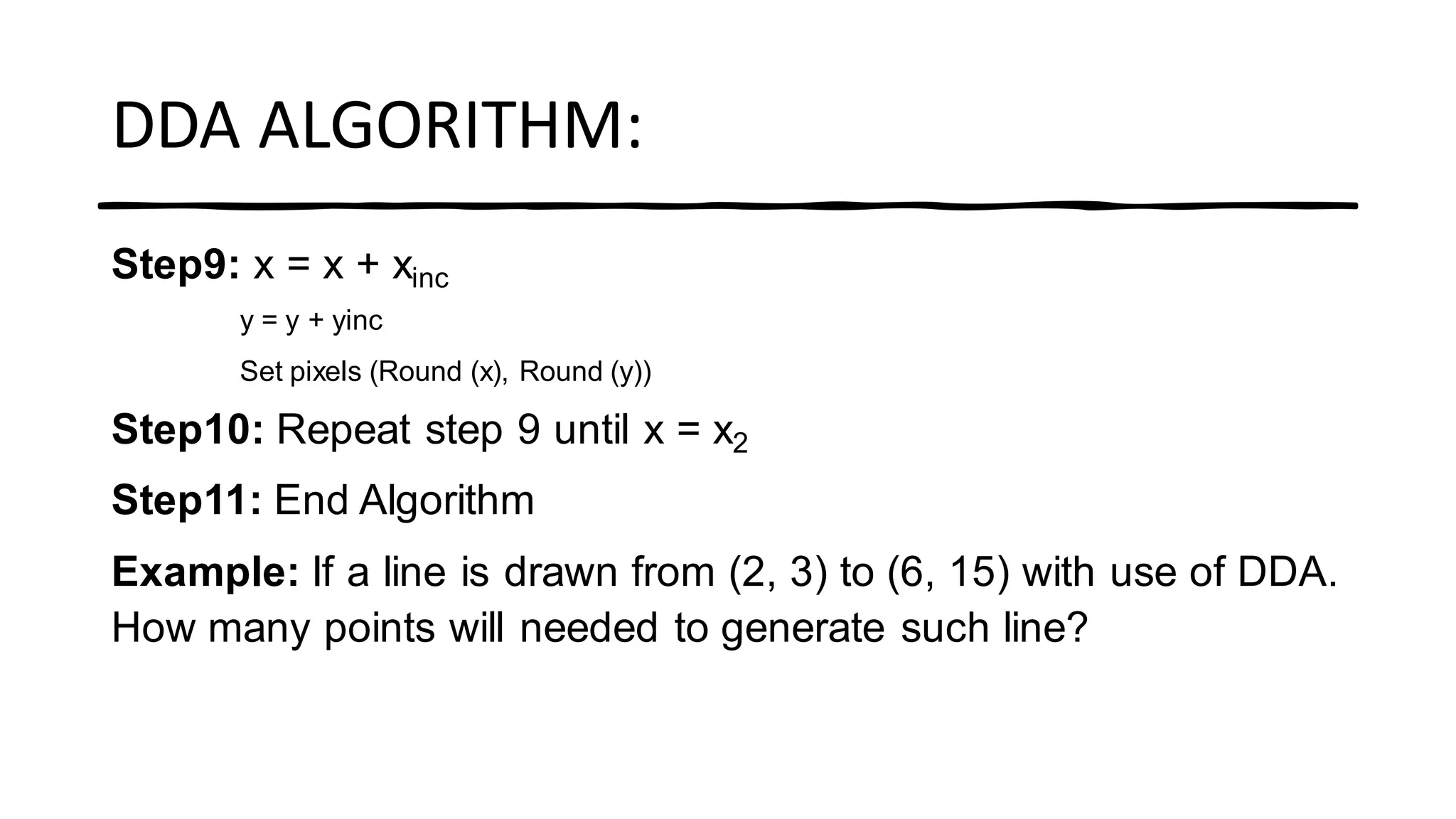
Step9: x = x + xinc
y = y + yinc
Set pixels (Round (x), Round (y))
Step10: Repeat step 9 until x = x2
Step11: End Algorithm
Example: If a line is drawn from (2, 3) to (6, 15) with use of DDA.
How many points will needed to generate such line?
DDA ALGORITHM-Example:
Solution: P1 (2,3) P2(6,15)
x1=2
y1=3
x2= 6
y2=15
dx = 6 - 2 = 4
dy = 15 - 3 = 12
m = dx/dy=12/4
DDA ALGORITHM-Example:
For calculating next value of x takes x = x + 1/m
DDA ALGORITHM-Example:
Advantage:
• It is a faster method than method of using direct use of line equation.
• This method does not use multiplication theorem.
• It allows us to detect the change in the value of x and y ,so plotting of
same point twice is not possible.
• This method gives overflow indication when a point is repositioned.
• It is an easy method because each step involves just two additions
Disadvantage:
• It involves floating point additions rounding off is done.
• Rounding off operations and floating point operations consumes
a lot of time.
• It is more suitable for generating line using the software. But it is
less suited for hardware implementation
DDA ALGORITHM
procedure DDA( x1, y1, x2, y2: integer);
var
dx, dy, steps: integer;
x_inc, y_inc, x, y: real;
begin
dx := x2 - x1; dy := y2 - y1;
if abs(dx) > abs(dy) then
steps := abs(dx); {steps is larger of dx, dy}
DDA ALGORITHM
else
steps := abs(dy);
x_inc := dx/steps; y_inc := dy/steps;
{either x_inc or y_inc = 1.0, the other is the slope}
x:=x1; y:=y1;
set_pixel(round(x), round(y));
for i := 1 to steps do
DDA ALGORITHM
begin
x := x + x_inc;
y := y + y_inc;
set_pixel(round(x), round(y));
end;
end; {DDA}

Lline Drawing Algorithm

  • 1.
  • 2.
    DDA ALGORITHM: • DDAstands for Digital Differential Analyzer. • It is an incremental method of scan conversion of line. • In this method calculation is performed at each step but by using results of previous steps. • Suppose at step-1, the pixels is (xi,yi) • The line of equation for step-1 y1=mx1+b......................equation (1)
  • 3.
    DDA ALGORITHM: • Nextvalue will be y2=mx2+b.................equation 2 • For any x interval,∆x, ∆y=m∆x • For any y interval,∆y, ∆x=∆y/m
  • 4.
    DDA ALGORITHM: • SlopeInterval- Three conditions: 1.|m| < 1 ------ Draw a horizontal line 2.|m| > 1 ------ Draw a vertical line 3.|m| = 1 ------ Draw a horizontal line or vertical line
  • 5.
    DDA ALGORITHM: • Considerthe slope as three cases : • Case1: If slope m<=1 at x interval------yk+1=yk+m • Case2:If slope m>=1 at x interval------xk+1=xk+1/m • Case3:If ∆x=-1 and ∆y=-1-----------yk+1=yk-m and xk+1=xk-1/m
  • 6.
    DDA ALGORITHM: • DDAAlgorithm: Step1: Start Algorithm Step2: Declare x1,y1,x2,y2,dx,dy,x,y as integer variables. Step3: Enter value of x1,y1,x2,y2. Step4: Calculate dx = x2-x1 Step5: Calculate dy = y2-y1
  • 7.
    DDA ALGORITHM: Step6: IfABS (dx) > ABS (dy) Then step = abs (dx) Else Step7: xinc=dx/step yinc=dy/step assign x = x1 assign y = y1 Step8: Set pixel (x, y)
  • 8.
    DDA ALGORITHM: Step9: x= x + xinc y = y + yinc Set pixels (Round (x), Round (y)) Step10: Repeat step 9 until x = x2 Step11: End Algorithm Example: If a line is drawn from (2, 3) to (6, 15) with use of DDA. How many points will needed to generate such line?
  • 9.
    DDA ALGORITHM-Example: Solution: P1(2,3) P2(6,15) x1=2 y1=3 x2= 6 y2=15 dx = 6 - 2 = 4 dy = 15 - 3 = 12 m = dx/dy=12/4
  • 10.
    DDA ALGORITHM-Example: For calculatingnext value of x takes x = x + 1/m
  • 11.
  • 12.
    Advantage: • It isa faster method than method of using direct use of line equation. • This method does not use multiplication theorem. • It allows us to detect the change in the value of x and y ,so plotting of same point twice is not possible. • This method gives overflow indication when a point is repositioned. • It is an easy method because each step involves just two additions
  • 13.
    Disadvantage: • It involvesfloating point additions rounding off is done. • Rounding off operations and floating point operations consumes a lot of time. • It is more suitable for generating line using the software. But it is less suited for hardware implementation
  • 14.
    DDA ALGORITHM procedure DDA(x1, y1, x2, y2: integer); var dx, dy, steps: integer; x_inc, y_inc, x, y: real; begin dx := x2 - x1; dy := y2 - y1; if abs(dx) > abs(dy) then steps := abs(dx); {steps is larger of dx, dy}
  • 15.
    DDA ALGORITHM else steps :=abs(dy); x_inc := dx/steps; y_inc := dy/steps; {either x_inc or y_inc = 1.0, the other is the slope} x:=x1; y:=y1; set_pixel(round(x), round(y)); for i := 1 to steps do
  • 16.
    DDA ALGORITHM begin x :=x + x_inc; y := y + y_inc; set_pixel(round(x), round(y)); end; end; {DDA}