Mucor
Presented by Irfan M
2
Classification
● Kingdom : fungi
● Division : Mycota
● Class : Zygomycota
● Order : Mucorales
● Family : Mucoraceae
● Genus : Mucor
What is Mucor?
4
“The genus Mucor (L. muceo, be moldy) is represented by
about 80 species, found throughout the world and about
17 species from India, commonly known as MOLD.”
What is Mucor’s habitant?
6
● It is grows readily on dung
of herbivorous animals like
cow, horse etc.
● They grow mostly as
saprophytes on decaying
fruits and vegetables, in soil
(Mucor strictus, M. flavus).
● Also grows on various food-
stuff-like bread, jellies, jams,
syrups.
7
Vegetative structure
● Mycelium consists of numerous, slender, freely branched filaments
called hyphae.
● The hyphae form a fluffy mass , white in color called as mycelium.
● After mycelium formation, reproductive phase starts.
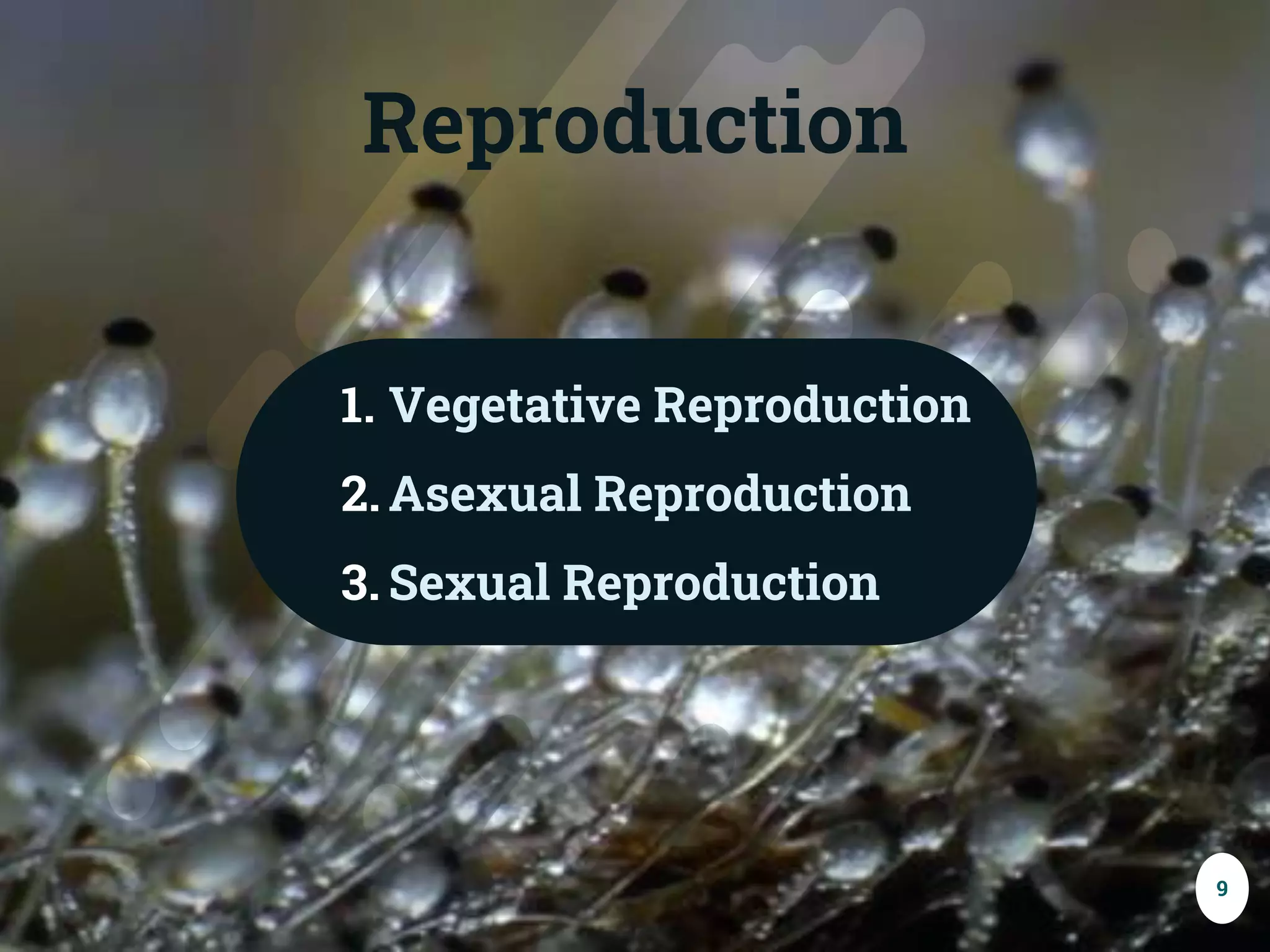
● Black pin like structures appear on mycelium called as sporangia /
Sporangium.
● The hyphae are coenocytic and aseptate.
● The hyphal wall is microfibrillar, consist mainly of chitin-chitosan.
● In addition, other substances like other polysaccharides, lipids,
purines, pyrimidines, protein, Ca and Mg are also present.
8
● Inner to the cell wall, cell membrane is
present which covers the protoplast.
● The protoplast contains many nuclei,
mitochondria, endoplasmic reticulum,
ribosome, oil droplets, small vacuoles
and other substances.
● At vegetative stage , the hyphae
consists of stolon (horizontal hyphae)
and rhizoidal hyphae.
● The rhizoidal hyphae helps in the
absorption of nutrients from the
substrate.
9
Reproduction
1. Vegetative Reproduction
2. Asexual Reproduction
3. Sexual Reproduction
10
1. Vegetative Reproduction
1a. Fragmentation:
When the separation of hyphae occurs from the aerial
portion, then these fragments are capable of producing new hyphae
, and this is called fragmentation.
1b. Chlamydospore formation:
Under unfavorable conditions , the fungus produce special
modified thick walled , resting cells, called as Chlamydospore. They
contain food and are very resistant to desiccation . When conditions
become favorable , it germinates to form new mycelium.
11
● During favourable condition, the nonmotile spores known as
sporangiospores or aplanospores are formed inside the sporangium.
● The sporangiophores develop singly and scatteredly on the upper
side of the superficial mycelium.
● After attaining a certain height, the nuclei and cytoplasm push more
and more towards the top, consequently the apex of the aerial
hyphae swells up.
● The swollen part enlarges and develops into large round
sporangium.
● Inside the sporangium the protoplast is differentiated into a thick
dense layer of multi-nucleate cytoplasm inside the sporangial wall,
called sporoplasm and a vacuolated portion with a few nuclei
towards the centre, called columellaplasm.
2. Asexual Reproduction
12
● With further development of sporoplasm and columellaplasm the
septum becomes dome-shaped and pushes its way into the
sporangium.
● Minute needle-shaped crystals of calcium oxalate are formed on the
external surface of sporangium wall.
● They imbibe water and make the wall soft.
● Consequently, the sporangiophore secretes water around the
sporangium and the unused protoplast of the sporangium absorbs
water and swells up, thereby it creates pressure.
● This pressure along with the pressure exerted by the bulging of the
columella causes the soft wall of the sporangium to rupture.
● The spores are dispersed chiefly by insect and also by wind.
13
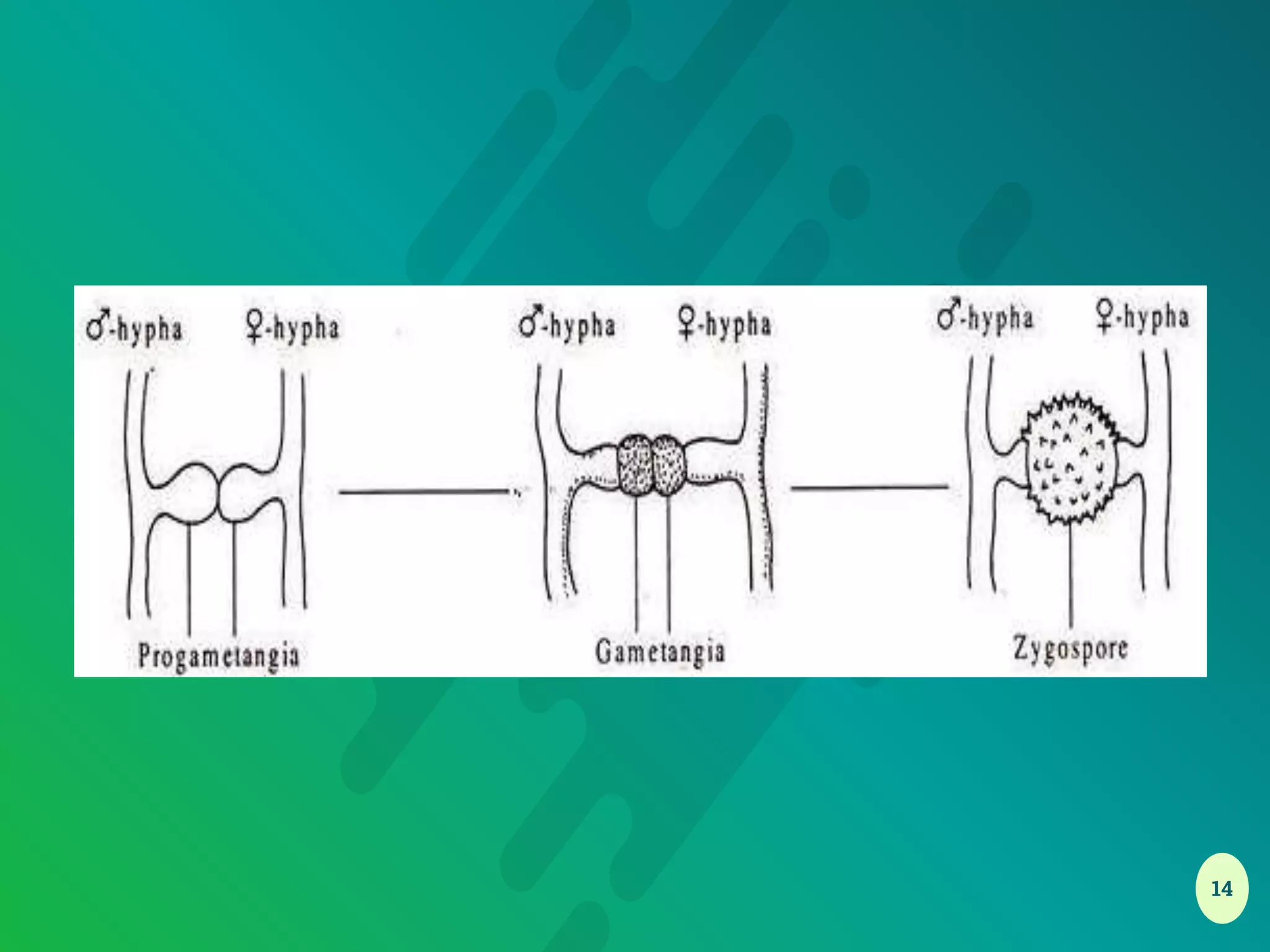
3. Sexual reproduction
● It takes place by gamentangial copulation
● The fusion gametes are multinucleated and are distinct from each
other.
● The sexual process starts with the formation of two special hyphae
called zygophores.
● They arises from near the apices of actively growing somatic hyphae of
+ve and –ve strains.
● They are chemically induced
● The zygophores meet and adhere in pairs at the tip to form fusion
septum.
● The tip swells due to flow of nuclei and cytoplasm in them , called as
progametangia.
● Progametangia combined to form prozygosporangium , containing
many diploid nuclei called as zygospore
14
15
Asexual Reproduction
16
Sexual Reproduction

Mucor fungi ppt

  • 1.
  • 2.
    2 Classification ● Kingdom :fungi ● Division : Mycota ● Class : Zygomycota ● Order : Mucorales ● Family : Mucoraceae ● Genus : Mucor
  • 3.
  • 4.
    4 “The genus Mucor(L. muceo, be moldy) is represented by about 80 species, found throughout the world and about 17 species from India, commonly known as MOLD.”
  • 5.
  • 6.
    6 ● It isgrows readily on dung of herbivorous animals like cow, horse etc. ● They grow mostly as saprophytes on decaying fruits and vegetables, in soil (Mucor strictus, M. flavus). ● Also grows on various food- stuff-like bread, jellies, jams, syrups.
  • 7.
    7 Vegetative structure ● Myceliumconsists of numerous, slender, freely branched filaments called hyphae. ● The hyphae form a fluffy mass , white in color called as mycelium. ● After mycelium formation, reproductive phase starts. ● Black pin like structures appear on mycelium called as sporangia / Sporangium. ● The hyphae are coenocytic and aseptate. ● The hyphal wall is microfibrillar, consist mainly of chitin-chitosan. ● In addition, other substances like other polysaccharides, lipids, purines, pyrimidines, protein, Ca and Mg are also present.
  • 8.
    8 ● Inner tothe cell wall, cell membrane is present which covers the protoplast. ● The protoplast contains many nuclei, mitochondria, endoplasmic reticulum, ribosome, oil droplets, small vacuoles and other substances. ● At vegetative stage , the hyphae consists of stolon (horizontal hyphae) and rhizoidal hyphae. ● The rhizoidal hyphae helps in the absorption of nutrients from the substrate.
  • 9.
    9 Reproduction 1. Vegetative Reproduction 2.Asexual Reproduction 3. Sexual Reproduction
  • 10.
    10 1. Vegetative Reproduction 1a.Fragmentation: When the separation of hyphae occurs from the aerial portion, then these fragments are capable of producing new hyphae , and this is called fragmentation. 1b. Chlamydospore formation: Under unfavorable conditions , the fungus produce special modified thick walled , resting cells, called as Chlamydospore. They contain food and are very resistant to desiccation . When conditions become favorable , it germinates to form new mycelium.
  • 11.
    11 ● During favourablecondition, the nonmotile spores known as sporangiospores or aplanospores are formed inside the sporangium. ● The sporangiophores develop singly and scatteredly on the upper side of the superficial mycelium. ● After attaining a certain height, the nuclei and cytoplasm push more and more towards the top, consequently the apex of the aerial hyphae swells up. ● The swollen part enlarges and develops into large round sporangium. ● Inside the sporangium the protoplast is differentiated into a thick dense layer of multi-nucleate cytoplasm inside the sporangial wall, called sporoplasm and a vacuolated portion with a few nuclei towards the centre, called columellaplasm. 2. Asexual Reproduction
  • 12.
    12 ● With furtherdevelopment of sporoplasm and columellaplasm the septum becomes dome-shaped and pushes its way into the sporangium. ● Minute needle-shaped crystals of calcium oxalate are formed on the external surface of sporangium wall. ● They imbibe water and make the wall soft. ● Consequently, the sporangiophore secretes water around the sporangium and the unused protoplast of the sporangium absorbs water and swells up, thereby it creates pressure. ● This pressure along with the pressure exerted by the bulging of the columella causes the soft wall of the sporangium to rupture. ● The spores are dispersed chiefly by insect and also by wind.
  • 13.
    13 3. Sexual reproduction ●It takes place by gamentangial copulation ● The fusion gametes are multinucleated and are distinct from each other. ● The sexual process starts with the formation of two special hyphae called zygophores. ● They arises from near the apices of actively growing somatic hyphae of +ve and –ve strains. ● They are chemically induced ● The zygophores meet and adhere in pairs at the tip to form fusion septum. ● The tip swells due to flow of nuclei and cytoplasm in them , called as progametangia. ● Progametangia combined to form prozygosporangium , containing many diploid nuclei called as zygospore
  • 14.
  • 15.
  • 16.