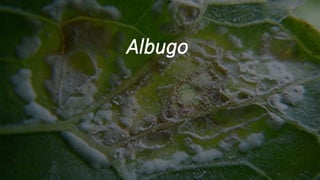
Albugo
2
Contents
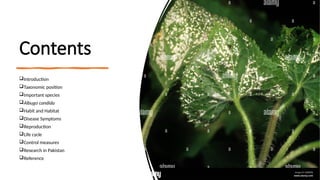
Introduction
Taxonomic position
Important species
Albugo candida
Habit and Habitat
Disease Symptoms
Reproduction
Life cycle
Control measures
Research in Pakistan
Reference
3
Introduction
 Albugo is a single genus, of
family Albuginaceae, with about
40-50 species of biotrophic
parasites of flowering plants
which cause diseases known as
white blisters or white rusts.
 Albugo is derived from latin word
that means White.
 Its older name is Cystopus.
 Albugo species an be identified
based on the host specificity,
oospore ornamentation and
conidial characteristics.
4
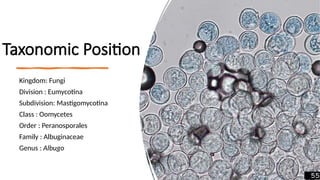
Taxonomic Position
Kingdom: Fungi
Division : Eumycotina
Subdivision: Mastigomycotina
Class : Oomycetes
Order : Peranosporales
Family : Albuginaceae
Genus : Albugo
5
Important
Species
Albugo candida: infects the crucifers/ mustard family and cause white
rust disease, a leaf spot disease in more than 300 species.
Albugo ipomae-panduranae: infects the plants belonging
to the family Convolvulaceae
Albugo bliti: infects the Amarantheceae members.
Albugo occidentale: infects spinach- (Spinacea oleracea,
phalak)
Albugo portulacea: infects Portulaca oleracea
Albugo oleracea: infects the Asteraceae members
6
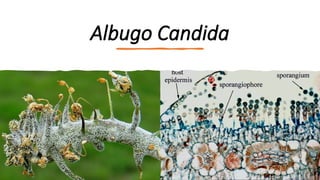
Albugo Candida
7
Habit and Habitat:
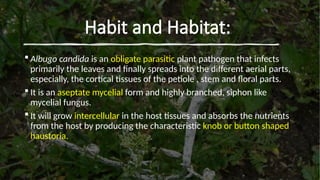
 Albugo candida is an obligate parasitic plant pathogen that infects
primarily the leaves and finally spreads into the different aerial parts,
especially, the cortical tissues of the petiole , stem and floral parts.
 It is an aseptate mycelial form and highly branched, siphon like
mycelial fungus.
 It will grow intercellular in the host tissues and absorbs the nutrients
from the host by producing the characteristic knob or button shaped
haustoria.
8
Disease Symptoms
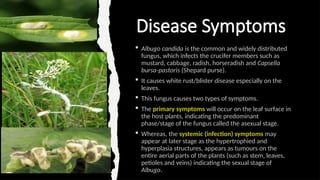
 Albugo candida is the common and widely distributed
fungus, which infects the crucifer members such as
mustard, cabbage, radish, horseradish and Capsella
bursa-pastoris (Shepard purse).
 It causes white rust/blister disease especially on the
leaves.
 This fungus causes two types of symptoms.
 The primary symptoms will occur on the leaf surface in
the host plants, indicating the predominant
phase/stage of the fungus called the asexual stage.
 Whereas, the systemic (infection) symptoms may
appear at later stage as the hypertrophied and
hyperplasia structures, appears as tumours on the
entire aerial parts of the plants (such as stem, leaves,
petioles and veins) indicating the sexual stage of
Albugo.
9
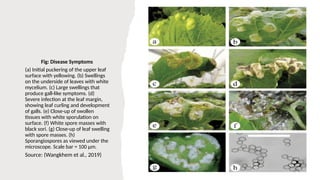
Fig: Disease Symptoms
(a) Initial puckering of the upper leaf
surface with yellowing. (b) Swellings
on the underside of leaves with white
mycelium. (c) Large swellings that
produce gall-like symptoms. (d)
Severe infection at the leaf margin,
showing leaf curling and development
of galls. (e) Close-up of swollen
tissues with white sporulation on
surface. (f) White spore masses with
black sori. (g) Close-up of leaf swelling
with spore masses. (h)
Sporangiospores as viewed under the
microscope. Scale bar = 100 μm.
Source: (Wangkhem et al., 2019)
10
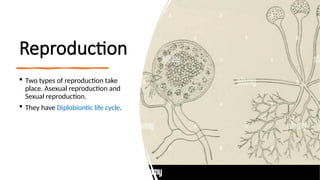
Reproduction
 Two types of reproduction take
place. Asexual reproduction and
Sexual reproduction.
 They have Diplobiontic life cycle.
11
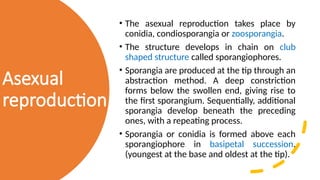
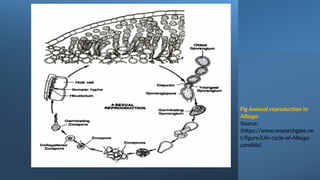
Asexual
reproduction
• The asexual reproduction takes place by
conidia, condiosporangia or zoosporangia.
• The structure develops in chain on club
shaped structure called sporangiophores.
• Sporangia are produced at the tip through an
abstraction method. A deep constriction
forms below the swollen end, giving rise to
the first sporangium. Sequentially, additional
sporangia develop beneath the preceding
ones, with a repeating process.
• Sporangia or conidia is formed above each
sporangiophore in basipetal succession.
(youngest at the base and oldest at the tip).
12
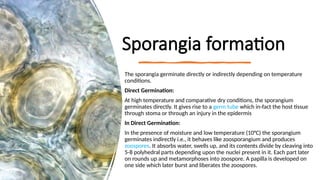
Sporangia formation
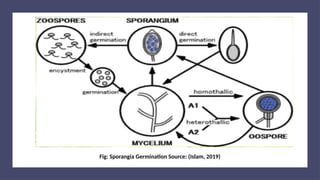
The sporangia germinate directly or indirectly depending on temperature
conditions.
Direct Germination:
At high temperature and comparative dry conditions, the sporangium
germinates directly. It gives rise to a germ tube which in-fact the host tissue
through stoma or through an injury in the epidermis
In Direct Germination:
In the presence of moisture and low temperature (10°C) the sporangium
germinates indirectly i.e., it behaves like zoosporangium and produces
zoospores. It absorbs water, swells up, and its contents divide by cleaving into
5-8 polyhedral parts depending upon the nuclei present in it. Each part later
on rounds up and metamorphoses into zoospore. A papilla is developed on
one side which later burst and liberates the zoospores.
13
Fig: Sporangia Germination Source: (Islam, 2019)
14
Zoospores
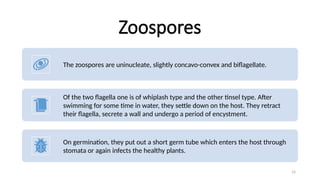
The zoospores are uninucleate, slightly concavo-convex and biflagellate.
Of the two flagella one is of whiplash type and the other tinsel type. After
swimming for some time in water, they settle down on the host. They retract
their flagella, secrete a wall and undergo a period of encystment.
On germination, they put out a short germ tube which enters the host through
stomata or again infects the healthy plants.
15
Fig Asexual reproduction in
Albugo
Source:
(https://www.researchgate.ne
t/figure/Life-cycle-of-Albugo-
candida)
16
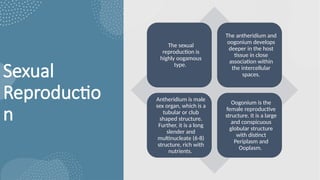
Sexual
Reproductio
n
The sexual
reproduction is
highly oogamous
type.
The antheridium and
oogonium develops
deeper in the host
tissue in close
association within
the intercellular
spaces.
Antheridium is male
sex organ, which is a
tubular or club
shaped structure.
Further, it is a long
slender and
multinucleate (6-8)
structure, rich with
nutrients.
Oogonium is the
female reproductive
structure. It is a large
and conspicuous
globular structure
with distinct
Periplasm and
Ooplasm.
17
Antheridium &
Oogonium
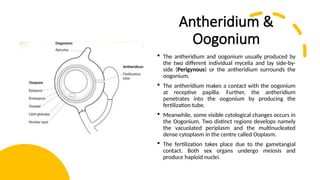
 The antheridium and oogonium usually produced by
the two different individual mycelia and lay side-by-
side (Perigynous) or the antheridium surrounds the
oogonium.
 The antheridium makes a contact with the oogonium
at receptive papilla. Further, the antheridium
penetrates into the oogonium by producing the
fertilization tube.
 Meanwhile, some visible cytological changes occurs in
the Oogonium. Two distinct regions develops namely
the vacuolated periplasm and the multinucleated
dense cytoplasm in the centre called Ooplasm.
 The fertilization takes place due to the gametangial
contact. Both sex organs undergo meiosis and
produce haploid nuclei.
18
Fertilization
The tip of the fertilization tube
ruptures and the functional
male nucleus and some
amount of cytoplasm
discharged into the oogonium.
The male nucleus fuses with
the one egg nucleus called
Oogamy and produces a diploid
oospore (zygote). The
sequential events occurring in
the sexual reproduction of
Albugo Gametangial contact.
19
Oospore
• The oospore is a diploid, resting spore
with trilayer thick wall, dark brown in
colour, spheroidal and highly resistant
structure, usually found in the soil or
infected plant debris.
• During favourable conditions each
oospore will undergo mitotic divisions
in order to produce 32 to 64 zoospores
(reniform and biflagellate).
• These spores germinate on the suitable
host plant and develops into individual
Albugo.
20
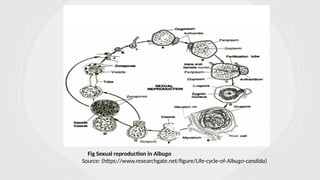
Fig Sexual reproduction in Albugo
Source: (https://www.researchgate.net/figure/Life-cycle-of-Albugo-candida)
21
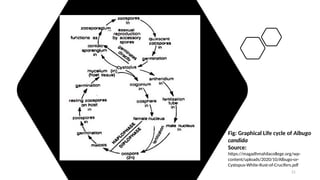
Fig: Graphical Life cycle of Albugo
candida
Source:
https://magadhmahilacollege.org/wp-
content/uploads/2020/10/Albugo-or-
Cystopus-White-Rust-of-Crucifers.pdf
22
Importance White rust can be a
devastating disease
on many important
agricultural crops
throughout the world.
Seventeen races of
white rust have been
identified worldwide,
each with a high level
of host specificity.
White rust is an
economically
important foliar
disease, causing
substantial yield
losses and eventual
death of various
crops.
Yield losses of up to
20 percent have been
recorded in canola
fields, and white rust
is considered the
most important foliar
disease
of Brassicaceae specie
s in Australia
23
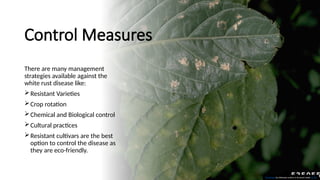
Control Measures
There are many management
strategies available against the
white rust disease like:
Resistant Varieties
Crop rotation
Chemical and Biological control
Cultural practices
Resistant cultivars are the best
option to control the disease as
they are eco-friendly.
This Photo by Unknown author is licensed under CC BY.
24
Non-host resistance(NHR) defense mechanism available in plants and the
strategies to exploit available gene pools from plant species that are non-host to
A. candida could serve as novel source of resistance. (Nirwan et al., 2023)
Efficiency of nine recommended and four new fungicides along with garlic extract
(based on pooled data of two years) in controlling the wite rust disease in vitro
and under glasshouse condition reported. (Gairola and Tewari, 2019)
Trichoderma harzianum treatment of Brassica seedling followed by A. candida
infection demonstrated on acquired resistance with an optimal disease control
(46% disease reduction). (Hasan et al., 2023)
25
Research
in Pakistan
Brassica napus (Rapeseed) affected by white rust is a
major threat in Pakistan causing 60-90% losses. (Asif
et al., 2017)
Capsella bursa-pastoris showed mixed infection of
Albugo candida during diversity study of Oomycyctes
of Bajaur Agency FATA, Pakistan. (Haq et al., 2015).
5 species of Albugo from Bajaur FATA were reported.
(Haq et al., 2015).
The candidum (candida) species of genus Albugo
causing white rust first reported by Gmelin(1972)
26
Conclusion
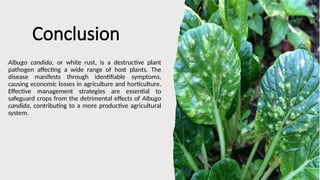
Albugo candida, or white rust, is a destructive plant
pathogen affecting a wide range of host plants. The
disease manifests through identifiable symptoms,
causing economic losses in agriculture and horticulture.
Effective management strategies are essential to
safeguard crops from the detrimental effects of Albugo
candida, contributing to a more productive agricultural
system.
27
Reference
Nirwan, S., Sharma, A. K., Tripathi, R. M., Pati, A. M., & Shrivastava, N. (2023). Resistance
strategies for defense against Albugo candida causing white rust disease. Microbiological
Research, 127317.
Gairola, K., & Tewari, A. K. (2019). Management of white rust (Albugo candida) in Indian
mustard by fungicides and garlic extract. Pesticide Research Journal, 31(1), 60-65.
Hasan, M., Hossain, M., & Jiang, D. (2023). New endophytic strains of Trichoderma promote
growth and reduce clubroot severity of rapeseed (Brassica napus). Plos one, 18(10),
e0287899.
Xiao, Z., Gong, N., Zhou, X., Zhu, L., He, X., Zheng, J., & Zhang, J. (2022). Developmental
characteristics of sporogenous hyphae: a new observation between Brassica juncea var.
tumida and Albugo candida. European Journal of Plant Pathology, 1-13.
Jouet, A., Saunders, D. G., McMullan, M., Ward, B., Furzer, O., Jupe, F., ... & Jones, J. D.
(2019). Albugo candida race diversity, ploidy and host associated microbes revealed using
‐
DNA sequence capture on diseased plants in the field. New Phytologist, 221(3), 1529-1543.
Asif, M., Atiq, M., Sahi, S. T., Ali, S., Nawaz, A., Ali, Y., ... & Saleem, A. (2017). Effective
management of white rust (Albugo candida) of rapeseed through commercially available
fungicides. Pakistan Journal of Phytopathology, 29(2), 233-237.
Haq, M. A., Shahzad, S. A. L. E. E. M., & Qamarunnisa, S. Y. E. D. A. (2015). White blister rusts
and downy mildews from Bajaur Agency Fata, with some new records from Pakistan. Pak. J.
Bot, 47(4), 1569-1574.
28
29

Albugo presentation plant pathology lecture. PPTX

  • 1.
  • 2.
    2 Contents Introduction Taxonomic position Important species Albugocandida Habit and Habitat Disease Symptoms Reproduction Life cycle Control measures Research in Pakistan Reference
  • 3.
    3 Introduction  Albugo isa single genus, of family Albuginaceae, with about 40-50 species of biotrophic parasites of flowering plants which cause diseases known as white blisters or white rusts.  Albugo is derived from latin word that means White.  Its older name is Cystopus.  Albugo species an be identified based on the host specificity, oospore ornamentation and conidial characteristics.
  • 4.
    4 Taxonomic Position Kingdom: Fungi Division: Eumycotina Subdivision: Mastigomycotina Class : Oomycetes Order : Peranosporales Family : Albuginaceae Genus : Albugo
  • 5.
    5 Important Species Albugo candida: infectsthe crucifers/ mustard family and cause white rust disease, a leaf spot disease in more than 300 species. Albugo ipomae-panduranae: infects the plants belonging to the family Convolvulaceae Albugo bliti: infects the Amarantheceae members. Albugo occidentale: infects spinach- (Spinacea oleracea, phalak) Albugo portulacea: infects Portulaca oleracea Albugo oleracea: infects the Asteraceae members
  • 6.
  • 7.
    7 Habit and Habitat: Albugo candida is an obligate parasitic plant pathogen that infects primarily the leaves and finally spreads into the different aerial parts, especially, the cortical tissues of the petiole , stem and floral parts.  It is an aseptate mycelial form and highly branched, siphon like mycelial fungus.  It will grow intercellular in the host tissues and absorbs the nutrients from the host by producing the characteristic knob or button shaped haustoria.
  • 8.
    8 Disease Symptoms  Albugocandida is the common and widely distributed fungus, which infects the crucifer members such as mustard, cabbage, radish, horseradish and Capsella bursa-pastoris (Shepard purse).  It causes white rust/blister disease especially on the leaves.  This fungus causes two types of symptoms.  The primary symptoms will occur on the leaf surface in the host plants, indicating the predominant phase/stage of the fungus called the asexual stage.  Whereas, the systemic (infection) symptoms may appear at later stage as the hypertrophied and hyperplasia structures, appears as tumours on the entire aerial parts of the plants (such as stem, leaves, petioles and veins) indicating the sexual stage of Albugo.
  • 9.
    9 Fig: Disease Symptoms (a)Initial puckering of the upper leaf surface with yellowing. (b) Swellings on the underside of leaves with white mycelium. (c) Large swellings that produce gall-like symptoms. (d) Severe infection at the leaf margin, showing leaf curling and development of galls. (e) Close-up of swollen tissues with white sporulation on surface. (f) White spore masses with black sori. (g) Close-up of leaf swelling with spore masses. (h) Sporangiospores as viewed under the microscope. Scale bar = 100 μm. Source: (Wangkhem et al., 2019)
  • 10.
    10 Reproduction  Two typesof reproduction take place. Asexual reproduction and Sexual reproduction.  They have Diplobiontic life cycle.
  • 11.
    11 Asexual reproduction • The asexualreproduction takes place by conidia, condiosporangia or zoosporangia. • The structure develops in chain on club shaped structure called sporangiophores. • Sporangia are produced at the tip through an abstraction method. A deep constriction forms below the swollen end, giving rise to the first sporangium. Sequentially, additional sporangia develop beneath the preceding ones, with a repeating process. • Sporangia or conidia is formed above each sporangiophore in basipetal succession. (youngest at the base and oldest at the tip).
  • 12.
    12 Sporangia formation The sporangiagerminate directly or indirectly depending on temperature conditions. Direct Germination: At high temperature and comparative dry conditions, the sporangium germinates directly. It gives rise to a germ tube which in-fact the host tissue through stoma or through an injury in the epidermis In Direct Germination: In the presence of moisture and low temperature (10°C) the sporangium germinates indirectly i.e., it behaves like zoosporangium and produces zoospores. It absorbs water, swells up, and its contents divide by cleaving into 5-8 polyhedral parts depending upon the nuclei present in it. Each part later on rounds up and metamorphoses into zoospore. A papilla is developed on one side which later burst and liberates the zoospores.
  • 13.
    13 Fig: Sporangia GerminationSource: (Islam, 2019)
  • 14.
    14 Zoospores The zoospores areuninucleate, slightly concavo-convex and biflagellate. Of the two flagella one is of whiplash type and the other tinsel type. After swimming for some time in water, they settle down on the host. They retract their flagella, secrete a wall and undergo a period of encystment. On germination, they put out a short germ tube which enters the host through stomata or again infects the healthy plants.
  • 15.
    15 Fig Asexual reproductionin Albugo Source: (https://www.researchgate.ne t/figure/Life-cycle-of-Albugo- candida)
  • 16.
    16 Sexual Reproductio n The sexual reproduction is highlyoogamous type. The antheridium and oogonium develops deeper in the host tissue in close association within the intercellular spaces. Antheridium is male sex organ, which is a tubular or club shaped structure. Further, it is a long slender and multinucleate (6-8) structure, rich with nutrients. Oogonium is the female reproductive structure. It is a large and conspicuous globular structure with distinct Periplasm and Ooplasm.
  • 17.
    17 Antheridium & Oogonium  Theantheridium and oogonium usually produced by the two different individual mycelia and lay side-by- side (Perigynous) or the antheridium surrounds the oogonium.  The antheridium makes a contact with the oogonium at receptive papilla. Further, the antheridium penetrates into the oogonium by producing the fertilization tube.  Meanwhile, some visible cytological changes occurs in the Oogonium. Two distinct regions develops namely the vacuolated periplasm and the multinucleated dense cytoplasm in the centre called Ooplasm.  The fertilization takes place due to the gametangial contact. Both sex organs undergo meiosis and produce haploid nuclei.
  • 18.
    18 Fertilization The tip ofthe fertilization tube ruptures and the functional male nucleus and some amount of cytoplasm discharged into the oogonium. The male nucleus fuses with the one egg nucleus called Oogamy and produces a diploid oospore (zygote). The sequential events occurring in the sexual reproduction of Albugo Gametangial contact.
  • 19.
    19 Oospore • The oosporeis a diploid, resting spore with trilayer thick wall, dark brown in colour, spheroidal and highly resistant structure, usually found in the soil or infected plant debris. • During favourable conditions each oospore will undergo mitotic divisions in order to produce 32 to 64 zoospores (reniform and biflagellate). • These spores germinate on the suitable host plant and develops into individual Albugo.
  • 20.
    20 Fig Sexual reproductionin Albugo Source: (https://www.researchgate.net/figure/Life-cycle-of-Albugo-candida)
  • 21.
    21 Fig: Graphical Lifecycle of Albugo candida Source: https://magadhmahilacollege.org/wp- content/uploads/2020/10/Albugo-or- Cystopus-White-Rust-of-Crucifers.pdf
  • 22.
    22 Importance White rustcan be a devastating disease on many important agricultural crops throughout the world. Seventeen races of white rust have been identified worldwide, each with a high level of host specificity. White rust is an economically important foliar disease, causing substantial yield losses and eventual death of various crops. Yield losses of up to 20 percent have been recorded in canola fields, and white rust is considered the most important foliar disease of Brassicaceae specie s in Australia
  • 23.
    23 Control Measures There aremany management strategies available against the white rust disease like: Resistant Varieties Crop rotation Chemical and Biological control Cultural practices Resistant cultivars are the best option to control the disease as they are eco-friendly. This Photo by Unknown author is licensed under CC BY.
  • 24.
    24 Non-host resistance(NHR) defensemechanism available in plants and the strategies to exploit available gene pools from plant species that are non-host to A. candida could serve as novel source of resistance. (Nirwan et al., 2023) Efficiency of nine recommended and four new fungicides along with garlic extract (based on pooled data of two years) in controlling the wite rust disease in vitro and under glasshouse condition reported. (Gairola and Tewari, 2019) Trichoderma harzianum treatment of Brassica seedling followed by A. candida infection demonstrated on acquired resistance with an optimal disease control (46% disease reduction). (Hasan et al., 2023)
  • 25.
    25 Research in Pakistan Brassica napus(Rapeseed) affected by white rust is a major threat in Pakistan causing 60-90% losses. (Asif et al., 2017) Capsella bursa-pastoris showed mixed infection of Albugo candida during diversity study of Oomycyctes of Bajaur Agency FATA, Pakistan. (Haq et al., 2015). 5 species of Albugo from Bajaur FATA were reported. (Haq et al., 2015). The candidum (candida) species of genus Albugo causing white rust first reported by Gmelin(1972)
  • 26.
    26 Conclusion Albugo candida, orwhite rust, is a destructive plant pathogen affecting a wide range of host plants. The disease manifests through identifiable symptoms, causing economic losses in agriculture and horticulture. Effective management strategies are essential to safeguard crops from the detrimental effects of Albugo candida, contributing to a more productive agricultural system.
  • 27.
    27 Reference Nirwan, S., Sharma,A. K., Tripathi, R. M., Pati, A. M., & Shrivastava, N. (2023). Resistance strategies for defense against Albugo candida causing white rust disease. Microbiological Research, 127317. Gairola, K., & Tewari, A. K. (2019). Management of white rust (Albugo candida) in Indian mustard by fungicides and garlic extract. Pesticide Research Journal, 31(1), 60-65. Hasan, M., Hossain, M., & Jiang, D. (2023). New endophytic strains of Trichoderma promote growth and reduce clubroot severity of rapeseed (Brassica napus). Plos one, 18(10), e0287899. Xiao, Z., Gong, N., Zhou, X., Zhu, L., He, X., Zheng, J., & Zhang, J. (2022). Developmental characteristics of sporogenous hyphae: a new observation between Brassica juncea var. tumida and Albugo candida. European Journal of Plant Pathology, 1-13. Jouet, A., Saunders, D. G., McMullan, M., Ward, B., Furzer, O., Jupe, F., ... & Jones, J. D. (2019). Albugo candida race diversity, ploidy and host associated microbes revealed using ‐ DNA sequence capture on diseased plants in the field. New Phytologist, 221(3), 1529-1543. Asif, M., Atiq, M., Sahi, S. T., Ali, S., Nawaz, A., Ali, Y., ... & Saleem, A. (2017). Effective management of white rust (Albugo candida) of rapeseed through commercially available fungicides. Pakistan Journal of Phytopathology, 29(2), 233-237. Haq, M. A., Shahzad, S. A. L. E. E. M., & Qamarunnisa, S. Y. E. D. A. (2015). White blister rusts and downy mildews from Bajaur Agency Fata, with some new records from Pakistan. Pak. J. Bot, 47(4), 1569-1574.
  • 28.
  • 29.