Work, Energy Concept


          M ad e by :Abhaygoyal
James Joule
 British physicist Jam es Joule is best known for
  his work in electricity and therm od ynam ics
  Together with the physicist William Thom son
  (later Baron K elvin), Joule found that the
  tem perature of a gas falls when it expand s
  without d oing any work. This principle, which
  becam e known as the Joule-Thom son effect,
  und erlies the operation of com m on
  refrigeration and air cond itioning system s.
 The m etric system unit of energy is the joule
  (J), after Jam es Joule.
Mechanical
 Mechanical energy is the energy which is possessed
 by an object due to its motion or its stored energy of position
   Kinetic energy : is the energy of motion
   Potential Energy : an object can store energy as the result of
    its position or elastic source
Work Concept
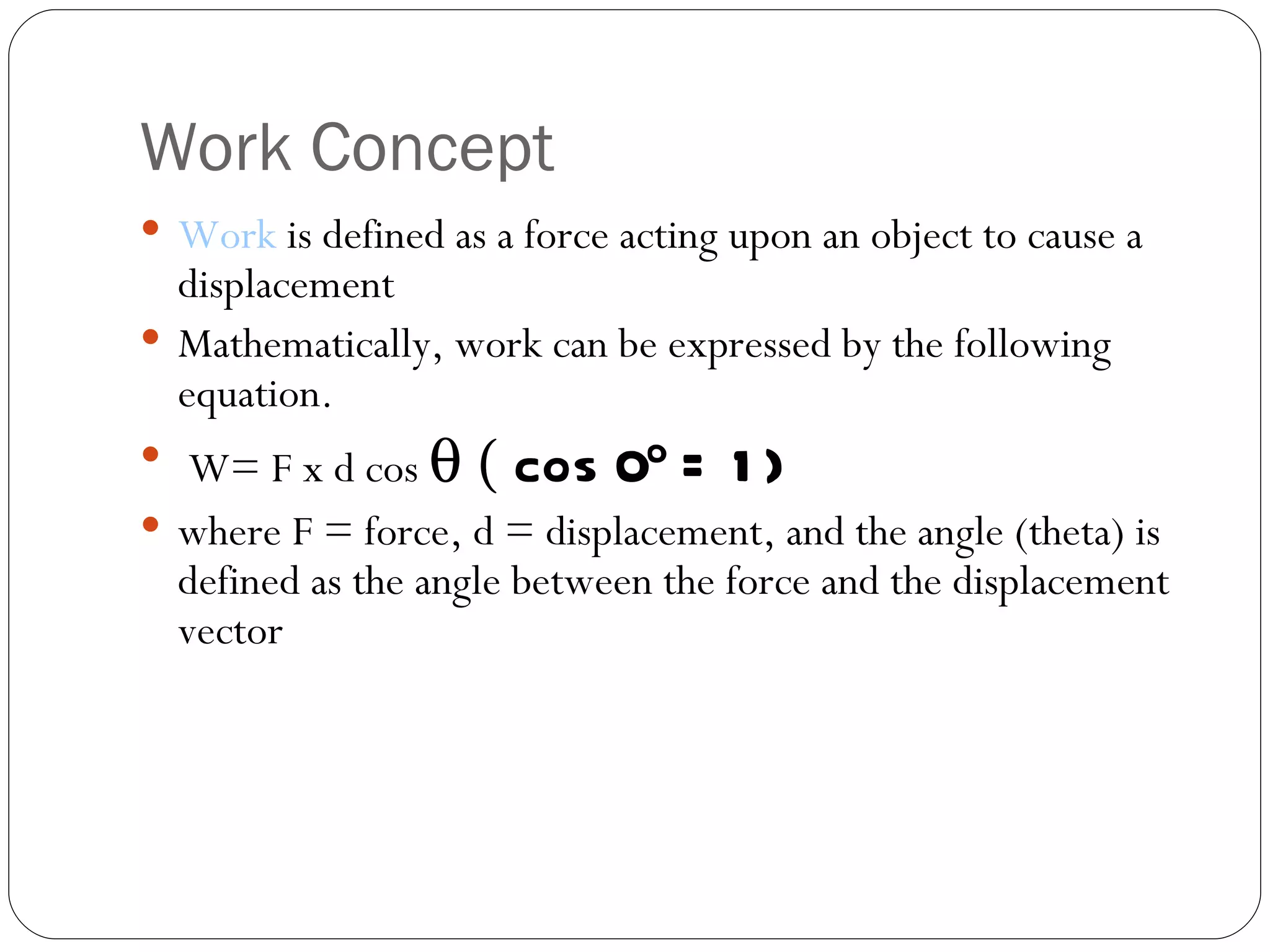
 Work is defined as a force acting upon an object to cause a
  displacement
 Mathematically, work can be expressed by the following
  equation.
 W= F x d cos   θ ( cos 0 = 1 )
                             0

 where F = force, d = displacement, and the angle (theta) is
  defined as the angle between the force and the displacement
  vector
Work Calculations


 W= F x d        W= F x d cos 300       W= F x d
  = 1 00N X 5m     = 1 00N X 5m X .87     = 1 5K g(1 0m / 2) X 5m
                                                         s
  = 500 N m          = 41 3 N m           = 750 N m
Gravitational Potential Energy

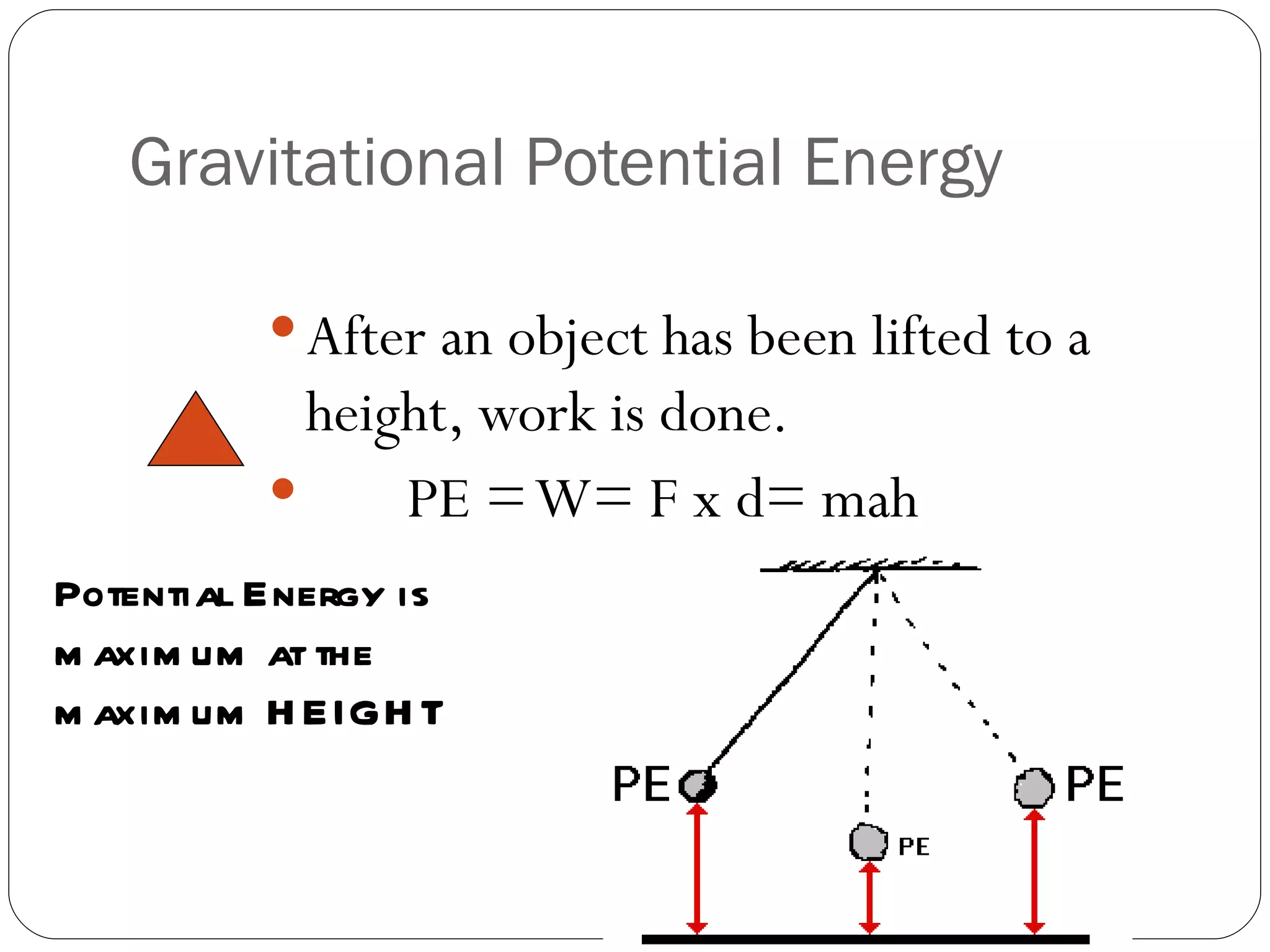
           After an object has been lifted to a
            height, work is done.
               PE = W= F x d= mah
Potential Energy is
m axim um at the
m axim um H EIGH T
Potential Energy Calculation

  How much potential energy is lost by a 5Kg object to
     kinetic energy due a decrease in height of 4.5 m
    PE = mah
    PE = (5Kg)(10 m/s2)(4.5 m)
    PE = 225 Kg m2/s2
    PE = 225 J
Kinetic Energy Calculation
 The energy of motion
 ∆KE = W= F x d= mah=1/2 mv2
 Find the kinetic energy of an 4 Kg object moving at 5m/s.
 KE = 1/2 mv2
 KE = ½ (4Kg)(5m/s) 2
 KE = 50 Kg m 2 /s 2
 KE = 50 J
Spring constant Calculation


A tired squirrel (mass of 1 kg) does push-
ups by applying a force to elevate its
center-of-mass by 5 cm. (A) Determine the
number of push-ups which a tired squirrel
must do in order to do a mere 5.0 Joules of
work. (B) Determine the squirrel’s spring
constant.
Spring Constant Calculation
 W = F x d = 10 N*(.05m)=.5 N m
 W = .5 J (each push up)
 10 pushups = 5 J
 PE = ½ k x 2
 .5 J = ½ k (.05m) 2
 .5 J = ½ k (.003m 2)
 .5 J = .0015 m 2
 333.3 J/m 2 = k
Power!
 Power is the rate that we use energy.
 Power = Work or Energy / Time
 P = W/t = F x d/t = F v
 The units for power :
   J/s
   Kg m2 / s2 /s
  Nm/s
Power Calculation
 A 5 Kg Cart is pushed by a 30 N force against friction for a
    distance of 10m in 5 seconds. Determine the Power needed
    to move the cart.
   P=Fxd/t
   P = 30 N (10 m) / 5 s
   P = 60 N m /s
   P = 60 watts
Summary
 Energy is the ability to move
 Potential is stored energy (Statics)
   Dependant on height
 Kinetic is moving energy (Dynamics)
   Dependant on velocity
 Springs store energy dependant on distance and constant

Work, energy, and power

  • 1.
    Work, Energy Concept M ad e by :Abhaygoyal
  • 2.
    James Joule  Britishphysicist Jam es Joule is best known for his work in electricity and therm od ynam ics Together with the physicist William Thom son (later Baron K elvin), Joule found that the tem perature of a gas falls when it expand s without d oing any work. This principle, which becam e known as the Joule-Thom son effect, und erlies the operation of com m on refrigeration and air cond itioning system s.  The m etric system unit of energy is the joule (J), after Jam es Joule.
  • 3.
    Mechanical  Mechanical energyis the energy which is possessed by an object due to its motion or its stored energy of position  Kinetic energy : is the energy of motion  Potential Energy : an object can store energy as the result of its position or elastic source
  • 4.
    Work Concept  Workis defined as a force acting upon an object to cause a displacement  Mathematically, work can be expressed by the following equation.  W= F x d cos θ ( cos 0 = 1 ) 0  where F = force, d = displacement, and the angle (theta) is defined as the angle between the force and the displacement vector
  • 5.
    Work Calculations W=F x d W= F x d cos 300 W= F x d = 1 00N X 5m = 1 00N X 5m X .87 = 1 5K g(1 0m / 2) X 5m s = 500 N m = 41 3 N m = 750 N m
  • 6.
    Gravitational Potential Energy  After an object has been lifted to a height, work is done.  PE = W= F x d= mah Potential Energy is m axim um at the m axim um H EIGH T
  • 7.
    Potential Energy Calculation  How much potential energy is lost by a 5Kg object to kinetic energy due a decrease in height of 4.5 m  PE = mah  PE = (5Kg)(10 m/s2)(4.5 m)  PE = 225 Kg m2/s2  PE = 225 J
  • 8.
    Kinetic Energy Calculation The energy of motion  ∆KE = W= F x d= mah=1/2 mv2  Find the kinetic energy of an 4 Kg object moving at 5m/s.  KE = 1/2 mv2  KE = ½ (4Kg)(5m/s) 2  KE = 50 Kg m 2 /s 2  KE = 50 J
  • 9.
    Spring constant Calculation Atired squirrel (mass of 1 kg) does push- ups by applying a force to elevate its center-of-mass by 5 cm. (A) Determine the number of push-ups which a tired squirrel must do in order to do a mere 5.0 Joules of work. (B) Determine the squirrel’s spring constant.
  • 10.
    Spring Constant Calculation W = F x d = 10 N*(.05m)=.5 N m  W = .5 J (each push up)  10 pushups = 5 J  PE = ½ k x 2  .5 J = ½ k (.05m) 2  .5 J = ½ k (.003m 2)  .5 J = .0015 m 2  333.3 J/m 2 = k
  • 11.
    Power!  Power isthe rate that we use energy.  Power = Work or Energy / Time  P = W/t = F x d/t = F v  The units for power :  J/s  Kg m2 / s2 /s Nm/s
  • 12.
    Power Calculation  A5 Kg Cart is pushed by a 30 N force against friction for a distance of 10m in 5 seconds. Determine the Power needed to move the cart.  P=Fxd/t  P = 30 N (10 m) / 5 s  P = 60 N m /s  P = 60 watts
  • 13.
    Summary  Energy isthe ability to move  Potential is stored energy (Statics)  Dependant on height  Kinetic is moving energy (Dynamics)  Dependant on velocity  Springs store energy dependant on distance and constant