Chapter 7
 Dynamic
 Push and pull are types of fore which
 makes an object move
 Force cannot be seen but we can see the
 effects of force
 The    effects of a force include
  (a)   force changes the shape of an object
  (b)   force changes the position of an object
  (c) force changes the speed of a moving
   object
  (d) force changes the direction of a moving
   object
 Frictional   force

 Gravitational      force

 Electrostatic   force

 Magnetic     force

 Electric   force
 Produced   when two surfaces in contact
   with each other
 It prevent an object at rest from moving
 The force of attraction that causes objects to
 falls towards the Earth
 Produced    when two different objects are rub
    against each other

   Static electric charges presence

 Object   with like charges will repel while unlike
    charges will attract
 The   push or pull force exerts by a magnet

 Like   poles repel while unlike poles attract each
 other
 Produced  electric when charges (electron) flow
  in a conductor

 Itis used to light up lamps or make electrical
  appliances work
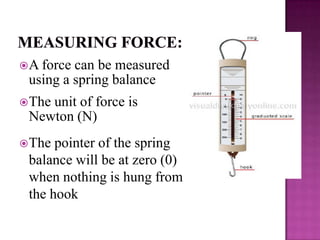
 A forcecan be measured
 using a spring balance
 The
    unit of force is
 Newton (N)
 The pointer of the spring
 balance will be at zero (0)
 when nothing is hung from
 the hook
   The weight of an object depends on the pull of
    gravity

   The force of gravity on the moon is only one-sixth of
    the force of gravity on earth

   Thus, the same object will have different
    weight on earth and the moon
   Frictional force occurs whenever two surfaces are in
    contact with each other.

   Frictional force is in opposite direction to the moving
    object and it is parallel to the surface.

   Frictional force has direction and magnitude.
• The block of wood is pulled with a spring balance on the
   surface of a table surface of table.


• When the block starts moving, the reading on the spring
   balance represents the magnitude of the friction force.
 Friction
         enables a person to walk or run
 without slipping.
 Friction
         enables a vehicles to slowed down and
 stop when the brake is apply
 Friction
         enables a ladder to lean against the
 wall and prevent it from sliding
 Friction   enables a person to hold things steady
 on hand
 Friction
        produced heat which can over heat and
 damage a machine.
 Friction   slows down movement

 Friction   wears away materials like the soles of
 shoes
 There    are some ways to reduce friction, such as
     a) Use wheel
     b) Apply lubricating oil or grease between the
       surfaces in contact
     c) Use air cushion to prevents contact between
      two surface
     d) Use the ball bearing in axles of vehicles
 The rougher the surfaces in contact, the
  greater the frictional force acts
 The heavier the object, the greater the
 frictional force acts.
 Work is the energy used to transfer an object
 from one place to another
 Workis said to be done when a force is able to
 move an object through a distance.
 Examples  for work done are
  (a) Climbing the stairs
  (b) Dragging a bag

 Examples  for work not done are
  (a) Pushing against a tree
  (b) Sleeping on a bed
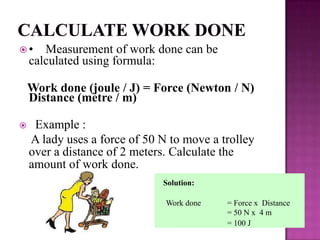
•     Measurement of work done can be
    calculated using formula:

    Work done (joule / J) = Force (Newton / N)
    Distance (metre / m)

    Example :
    A lady uses a force of 50 N to move a trolley
    over a distance of 2 meters. Calculate the
    amount of work done.
                              Solution:

                               Work done   = Force x Distance
                                           = 50 N x 4 m
                                           = 100 J
•   Power is the rate of doing work.
• Measurement of power can be calculated
 using formula:
 Example    :
   A lady uses a force of 50 N to move a trolley
    over a distance of 2 meters in 4 seconds.
   Calculate the power.
 Without  electrostatic force and electrical force,
 all electrical appliances would not be able to
 function
Without gravitational force, all objects
will be floating around the air on Earth
Without frictional force, all objects will be
moving constantly and would not be able
 to stop.
   Without magnetic force, compass an
    appliances that use motor cannot function

Chapter 7 dynamics

  • 1.
  • 2.
     Push andpull are types of fore which makes an object move  Force cannot be seen but we can see the effects of force  The effects of a force include  (a) force changes the shape of an object  (b) force changes the position of an object  (c) force changes the speed of a moving object  (d) force changes the direction of a moving object
  • 3.
     Frictional force  Gravitational force  Electrostatic force  Magnetic force  Electric force
  • 4.
     Produced when two surfaces in contact with each other  It prevent an object at rest from moving
  • 5.
     The forceof attraction that causes objects to falls towards the Earth
  • 6.
     Produced when two different objects are rub against each other  Static electric charges presence  Object with like charges will repel while unlike charges will attract
  • 7.
     The push or pull force exerts by a magnet  Like poles repel while unlike poles attract each other
  • 8.
     Produced electric when charges (electron) flow in a conductor  Itis used to light up lamps or make electrical appliances work
  • 9.
     A forcecanbe measured using a spring balance  The unit of force is Newton (N)  The pointer of the spring balance will be at zero (0) when nothing is hung from the hook
  • 10.
    The weight of an object depends on the pull of gravity  The force of gravity on the moon is only one-sixth of the force of gravity on earth  Thus, the same object will have different weight on earth and the moon
  • 12.
    Frictional force occurs whenever two surfaces are in contact with each other.  Frictional force is in opposite direction to the moving object and it is parallel to the surface.  Frictional force has direction and magnitude.
  • 13.
    • The blockof wood is pulled with a spring balance on the surface of a table surface of table. • When the block starts moving, the reading on the spring balance represents the magnitude of the friction force.
  • 14.
     Friction enables a person to walk or run without slipping.  Friction enables a vehicles to slowed down and stop when the brake is apply  Friction enables a ladder to lean against the wall and prevent it from sliding  Friction enables a person to hold things steady on hand
  • 15.
     Friction produced heat which can over heat and damage a machine.  Friction slows down movement  Friction wears away materials like the soles of shoes
  • 16.
     There are some ways to reduce friction, such as  a) Use wheel  b) Apply lubricating oil or grease between the  surfaces in contact  c) Use air cushion to prevents contact between two surface  d) Use the ball bearing in axles of vehicles
  • 17.
     The rougherthe surfaces in contact, the greater the frictional force acts  The heavier the object, the greater the frictional force acts.
  • 18.
     Work isthe energy used to transfer an object from one place to another  Workis said to be done when a force is able to move an object through a distance.  Examples for work done are  (a) Climbing the stairs  (b) Dragging a bag  Examples for work not done are  (a) Pushing against a tree  (b) Sleeping on a bed
  • 19.
    • Measurement of work done can be calculated using formula: Work done (joule / J) = Force (Newton / N) Distance (metre / m)  Example : A lady uses a force of 50 N to move a trolley over a distance of 2 meters. Calculate the amount of work done. Solution: Work done = Force x Distance = 50 N x 4 m = 100 J
  • 20.
    • Power is the rate of doing work. • Measurement of power can be calculated using formula:
  • 21.
     Example :  A lady uses a force of 50 N to move a trolley over a distance of 2 meters in 4 seconds.  Calculate the power.
  • 22.
     Without electrostatic force and electrical force, all electrical appliances would not be able to function
  • 23.
    Without gravitational force,all objects will be floating around the air on Earth
  • 24.
    Without frictional force,all objects will be moving constantly and would not be able to stop.
  • 25.
    Without magnetic force, compass an appliances that use motor cannot function