Improper Integrals
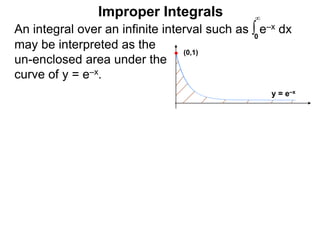
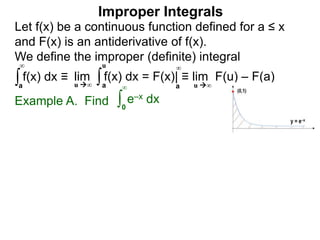
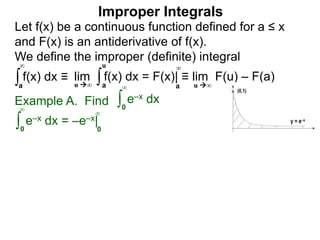
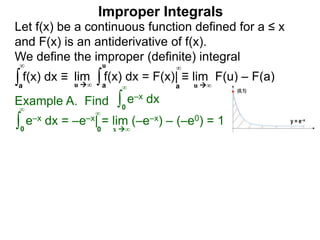
An integral over an infinite interval such as ∫ e–x dx
may be interpreted as the
un-enclosed area under the
curve of y = e–x.
0
∞
(0,1)
y = e–x
Improper Integrals
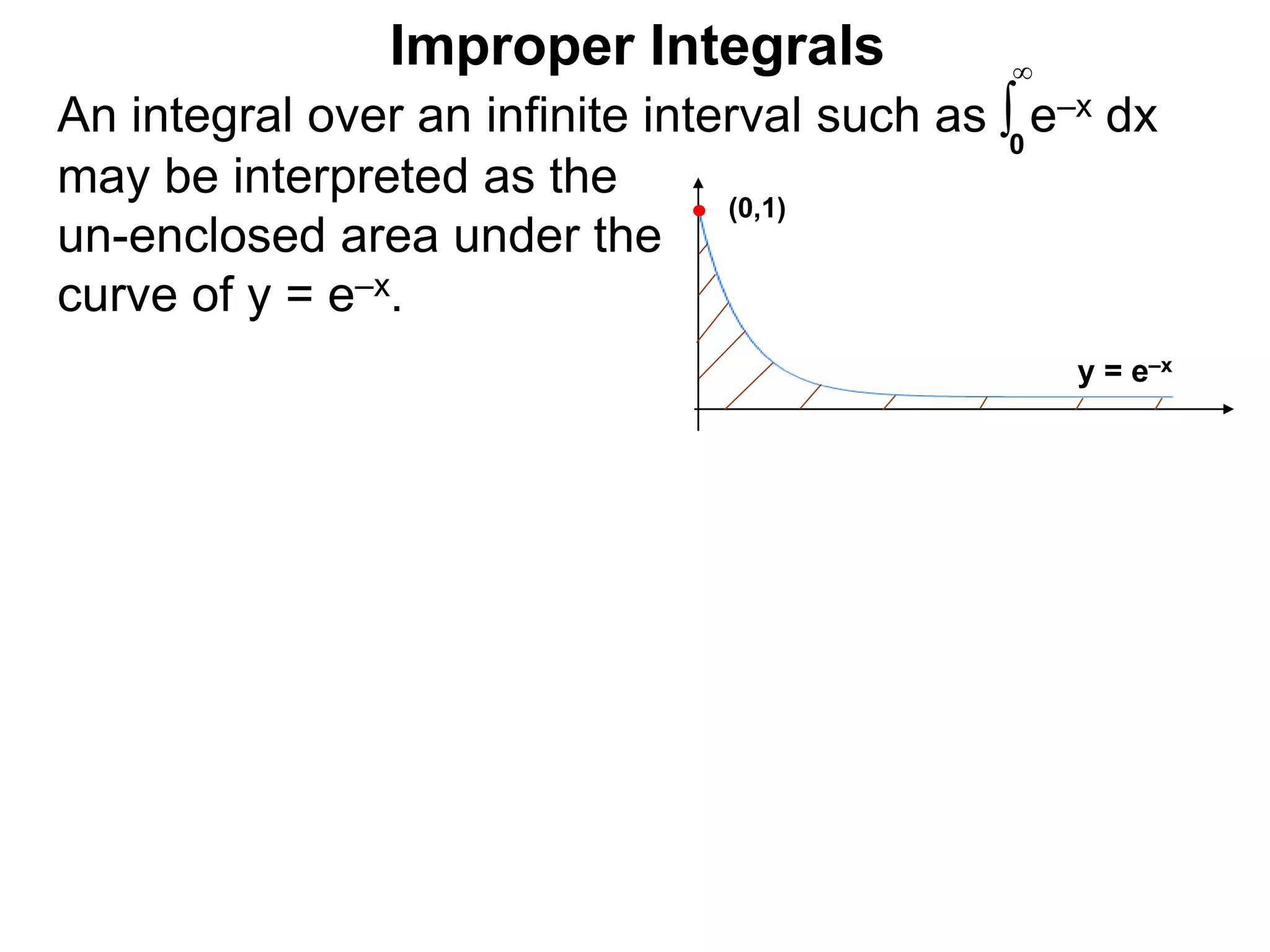
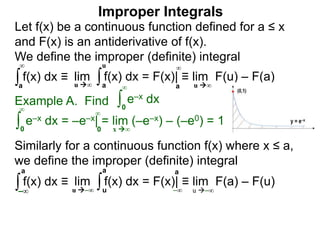
An integral over an infinite interval such as ∫ e–x dx
may be interpreted as the
un-enclosed area under the
curve of y = e–x.
0
∞
Likewise ∫ 1/x dx may be
viewed as the un-enclosed
area under the curve of y = 1/x.
0
1
(0,1)
y = e–x
y = 1/x(1,1)
Improper Integrals
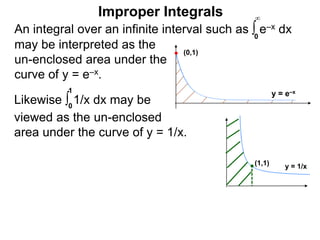
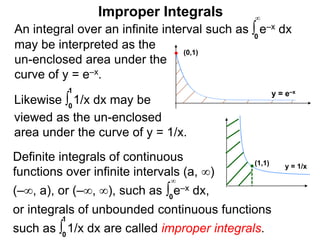
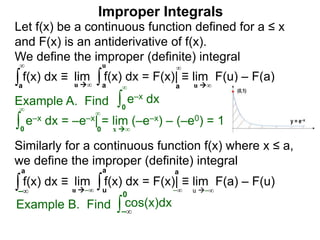
An integral over an infinite interval such as ∫ e–x dx
may be interpreted as the
un-enclosed area under the
curve of y = e–x.
0
∞
Likewise ∫ 1/x dx may be
viewed as the un-enclosed
area under the curve of y = 1/x.
0
1
(0,1)
y = e–x
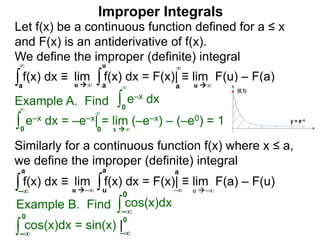
Definite integrals of continuous
functions over infinite intervals (a, ∞)
(–∞, a), or (–∞, ∞), such as ∫ e–x dx,
y = 1/x(1,1)
0
∞
or integrals of unbounded continuous functions
such as ∫ 1/x dx are called improper integrals.0
1
Improper Integrals
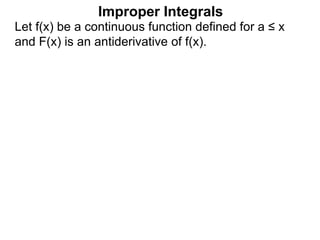
Let f(x) be a continuous function defined for a ≤ x
and F(x) is an antiderivative of f(x).
∫a
∞
lim f(x) dx = F(x)| ≡ lim F(u) – F(a)∫a
u
u ∞ u ∞a
∞
Improper Integrals
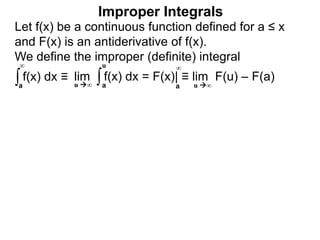
Let f(x) be a continuous function defined for a ≤ x
and F(x) is an antiderivative of f(x).
We define the improper (definite) integral
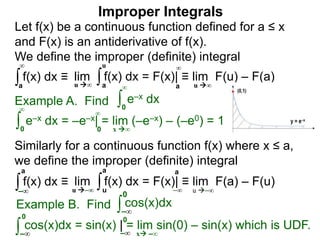
f(x) dx ≡
Example A. Find ∫0
∞
e–x dx
∫a
∞
lim f(x) dx = F(x)| ≡ lim F(u) – F(a)∫a
u
u ∞ u ∞a
∞
Improper Integrals
Let f(x) be a continuous function defined for a ≤ x
and F(x) is an antiderivative of f(x).
We define the improper (definite) integral
f(x) dx ≡
Example A. Find ∫0
∞
e–x dx
∫0
∞
e–x dx = –e–x|
0
∞
∫a
∞
lim f(x) dx = F(x)| ≡ lim F(u) – F(a)∫a
u
u ∞ u ∞a
∞
Improper Integrals
Let f(x) be a continuous function defined for a ≤ x
and F(x) is an antiderivative of f(x).
We define the improper (definite) integral
f(x) dx ≡
Example A. Find ∫0
∞
e–x dx
∫0
∞
e–x dx = –e–x| = lim (–e–x) – (–e0) = 1
x ∞0
∞
∫a
∞
lim f(x) dx = F(x)| ≡ lim F(u) – F(a)∫a
u
u ∞ u ∞a
∞
Improper Integrals
Let f(x) be a continuous function defined for a ≤ x
and F(x) is an antiderivative of f(x).
We define the improper (definite) integral
f(x) dx ≡
Example A. Find ∫0
∞
e–x dx
∫0
∞
e–x dx = –e–x| = lim (–e–x) – (–e0) = 1
x ∞0
∞
∫a
∞
lim f(x) dx = F(x)| ≡ lim F(u) – F(a)∫a
u
u ∞ u ∞a
∞
Improper Integrals
Let f(x) be a continuous function defined for a ≤ x
and F(x) is an antiderivative of f(x).
We define the improper (definite) integral
f(x) dx ≡
Similarly for a continuous function f(x) where x ≤ a,
we define the improper (definite) integral
∫–∞
lim f(x) dx = F(x)| ≡ lim F(a) – F(u)∫u
a
u –∞ u –∞
a
–∞
f(x) dx ≡
a
Example A. Find ∫0
∞
e–x dx
∫0
∞
e–x dx = –e–x| = lim (–e–x) – (–e0) = 1
x ∞0
∞
∫a
∞
lim f(x) dx = F(x)| ≡ lim F(u) – F(a)∫a
u
u ∞ u ∞a
∞
Improper Integrals
Let f(x) be a continuous function defined for a ≤ x
and F(x) is an antiderivative of f(x).
We define the improper (definite) integral
f(x) dx ≡
Similarly for a continuous function f(x) where x ≤ a,
we define the improper (definite) integral
∫–∞
lim f(x) dx = F(x)| ≡ lim F(a) – F(u)∫u
a
u –∞ u –∞
a
–∞
f(x) dx ≡
a
Example B. Find ∫ cos(x)dx
–∞
0
Example A. Find ∫0
∞
e–x dx
∫0
∞
e–x dx = –e–x| = lim (–e–x) – (–e0) = 1
x ∞0
∞
∫a
∞
lim f(x) dx = F(x)| ≡ lim F(u) – F(a)∫a
u
u ∞ u ∞a
∞
Improper Integrals
Let f(x) be a continuous function defined for a ≤ x
and F(x) is an antiderivative of f(x).
We define the improper (definite) integral
f(x) dx ≡
Similarly for a continuous function f(x) where x ≤ a,
we define the improper (definite) integral
∫–∞
lim f(x) dx = F(x)| ≡ lim F(a) – F(u)∫u
a
u –∞ u –∞
a
–∞
f(x) dx ≡
a
Example B. Find ∫ cos(x)dx
∫
0
cos(x)dx = sin(x) |
–∞
0
–∞ –∞
0
Example A. Find ∫0
∞
e–x dx
∫0
∞
e–x dx = –e–x| = lim (–e–x) – (–e0) = 1
x ∞0
∞
∫a
∞
lim f(x) dx = F(x)| ≡ lim F(u) – F(a)∫a
u
u ∞ u ∞a
∞
Improper Integrals
Let f(x) be a continuous function defined for a ≤ x
and F(x) is an antiderivative of f(x).
We define the improper (definite) integral
f(x) dx ≡
Similarly for a continuous function f(x) where x ≤ a,
we define the improper (definite) integral
∫–∞
lim f(x) dx = F(x)| ≡ lim F(a) – F(u)∫u
a
u –∞ u –∞
a
–∞
f(x) dx ≡
a
Example B. Find ∫ cos(x)dx
∫
0
cos(x)dx = sin(x) | = lim sin(0) – sin(x) which is UDF.
x –∞
–∞
0
–∞ –∞
0
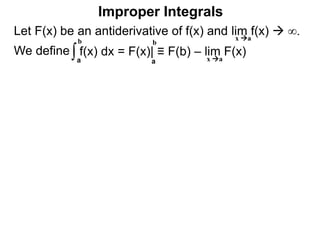
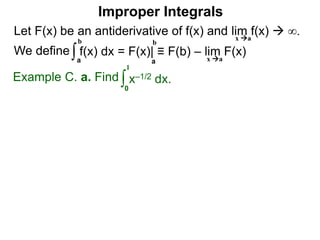
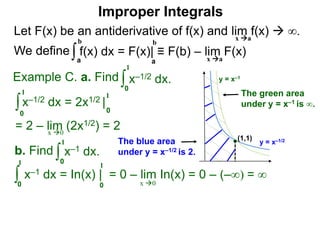
Let F(x) be an antiderivative of f(x) and lim f(x)  ∞.
We define
x a
∫a
b
f(x) dx = F(x)| ≡ F(b) – lim F(x)
a
b
Improper Integrals
x a
Let F(x) be an antiderivative of f(x) and lim f(x)  ∞.
We define
x a
∫a
b
f(x) dx = F(x)| ≡ F(b) – lim F(x)
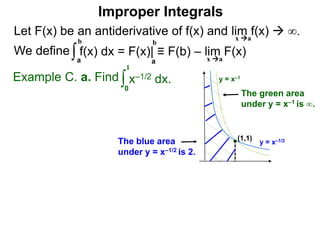
Example C. a. Find ∫0
1
x–1/2 dx.
a
b
Improper Integrals
x a
Let F(x) be an antiderivative of f(x) and lim f(x)  ∞.
We define
x a
∫a
b
f(x) dx = F(x)| ≡ F(b) – lim F(x)
Example C. a. Find ∫0
1
x–1/2 dx.
a
b
Improper Integrals
x a
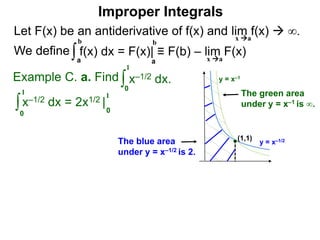
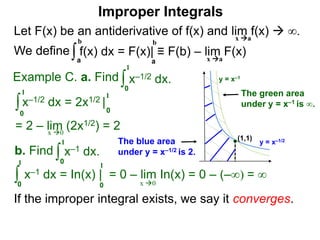
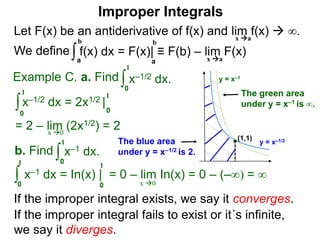
y = x–1/2
y = x–1
(1,1)
The green area
under y = x–1 is ∞.
The blue area
under y = x–1/2 is 2.
Let F(x) be an antiderivative of f(x) and lim f(x)  ∞.
We define
x a
∫a
b
f(x) dx = F(x)| ≡ F(b) – lim F(x)
Example C. a. Find ∫0
1
x–1/2 dx.
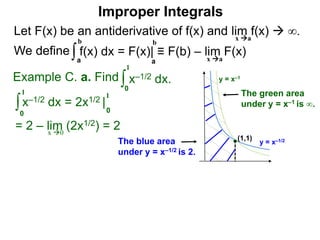
∫0
1
x–1/2 dx = 2x1/2 |
1
0
a
b
Improper Integrals
x a
y = x–1/2
y = x–1
(1,1)
The blue area
under y = x–1/2 is 2.
The green area
under y = x–1 is ∞.
Let F(x) be an antiderivative of f(x) and lim f(x)  ∞.
We define
x a
∫a
b
f(x) dx = F(x)| ≡ F(b) – lim F(x)
Example C. a. Find ∫0
1
x–1/2 dx.
∫0
1
x–1/2 dx = 2x1/2 |
1
0
x 0
a
b
Improper Integrals
x a
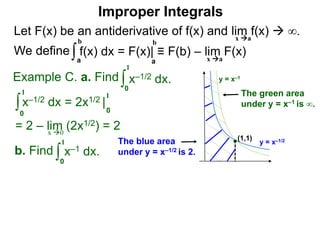
y = x–1/2
y = x–1
(1,1)
The blue area
under y = x–1/2 is 2.
The green area
under y = x–1 is ∞.
= 2 – lim (2x1/2) = 2
Let F(x) be an antiderivative of f(x) and lim f(x)  ∞.
We define
x a
∫a
b
f(x) dx = F(x)| ≡ F(b) – lim F(x)
Example C. a. Find ∫0
1
x–1/2 dx.
∫0
1
x–1/2 dx = 2x1/2 |
1
0
x 0
b. Find ∫0
1
x–1 dx.
a
b
Improper Integrals
x a
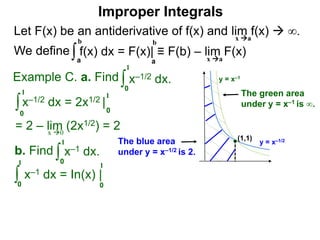
y = x–1/2
y = x–1
(1,1)
The blue area
under y = x–1/2 is 2.
The green area
under y = x–1 is ∞.
= 2 – lim (2x1/2) = 2
Let F(x) be an antiderivative of f(x) and lim f(x)  ∞.
We define
x a
∫a
b
f(x) dx = F(x)| ≡ F(b) – lim F(x)
Example C. a. Find ∫0
1
x–1/2 dx.
∫0
1
x–1/2 dx = 2x1/2 |
1
0
x 0
b. Find ∫0
1
x–1 dx.
∫0
1
x–1 dx = In(x) |
1
0
a
b
Improper Integrals
x a
y = x–1/2
y = x–1
(1,1)
The blue area
under y = x–1/2 is 2.
The green area
under y = x–1 is ∞.
= 2 – lim (2x1/2) = 2
Let F(x) be an antiderivative of f(x) and lim f(x)  ∞.
We define
x a
∫a
b
f(x) dx = F(x)| ≡ F(b) – lim F(x)
Example C. a. Find ∫0
1
x–1/2 dx.
∫0
1
x–1/2 dx = 2x1/2 |
1
0
x 0
b. Find ∫0
1
x–1 dx.
∫0
1
x–1 dx = In(x) | = 0 – lim In(x) = 0 – (–∞) = ∞
1
0 x 0
a
b
Improper Integrals
x a
y = x–1/2
y = x–1
(1,1)
The blue area
under y = x–1/2 is 2.
The green area
under y = x–1 is ∞.
= 2 – lim (2x1/2) = 2
Let F(x) be an antiderivative of f(x) and lim f(x)  ∞.
We define
x a
∫a
b
f(x) dx = F(x)| ≡ F(b) – lim F(x)
Example C. a. Find ∫0
1
x–1/2 dx.
∫0
1
x–1/2 dx = 2x1/2 |
1
0
x 0
b. Find ∫0
1
x–1 dx.
∫0
1
x–1 dx = In(x) | = 0 – lim In(x) = 0 – (–∞) = ∞
1
0 x 0
If the improper integral exists, we say it converges.
a
b
Improper Integrals
x a
y = x–1/2
y = x–1
(1,1)
The blue area
under y = x–1/2 is 2.
The green area
under y = x–1 is ∞.
= 2 – lim (2x1/2) = 2
Let F(x) be an antiderivative of f(x) and lim f(x)  ∞.
We define
x a
∫a
b
f(x) dx = F(x)| ≡ F(b) – lim F(x)
Example C. a. Find ∫0
1
x–1/2 dx.
∫0
1
x–1/2 dx = 2x1/2 |
1
0
x 0
b. Find ∫0
1
x–1 dx.
∫0
1
x–1 dx = In(x) | = 0 – lim In(x) = 0 – (–∞) = ∞
1
0 x 0
If the improper integral exists, we say it converges.
If the improper integral fails to exist or it´s infinite,
we say it diverges.
a
b
Improper Integrals
x a
y = x–1/2
y = x–1
(1,1)
The blue area
under y = x–1/2 is 2.
The green area
under y = x–1 is ∞.
= 2 – lim (2x1/2) = 2
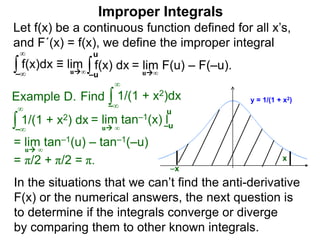
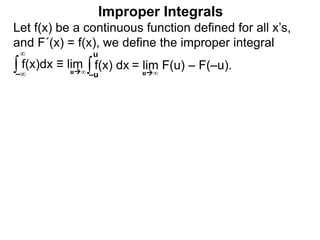
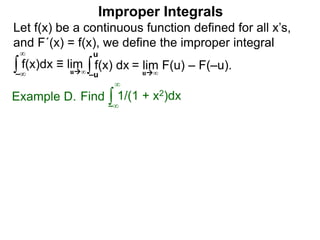
Let f(x) be a continuous function defined for all x’s,
and F´(x) = f(x), we define the improper integral
∫ f(x)dx ≡ lim
Improper Integrals
–∞
∞
∫f(x) dx
–u
u
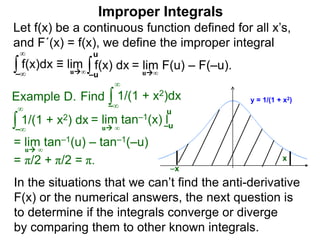
In the situations that we can’t find the anti-derivative
F(x) or the numerical answers, the next question is
to determine if the integrals converge or diverge
by comparing them to other known integrals.
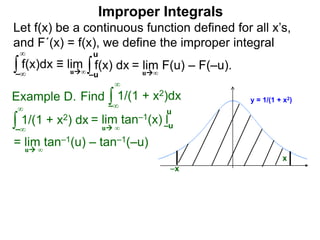
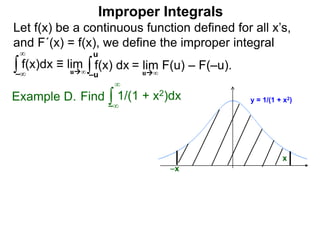
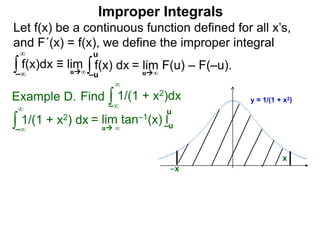
Find ∫Example D.
–∞
∞
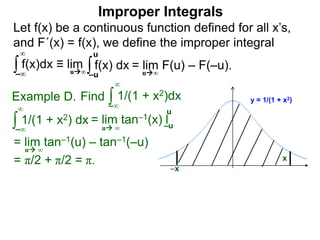
∫ 1/(1 + x2) dx
–∞
∞
= lim tan–1(u) – tan–1(–u)
= π/2 + π/2 = π.
u ∞
y = 1/(1 + x2)1/(1 + x2)dx
x
u∞
= lim F(u) – F(–u).u∞
–x
= lim tan–1(x) l–u
u
u ∞
Let f(x) be a continuous function defined for all x’s,
and F´(x) = f(x), we define the improper integral
∫ f(x)dx ≡ lim
Improper Integrals
–∞
∞
∫f(x) dx
–u
u
u∞
= lim F(u) – F(–u).u∞
Let f(x) be a continuous function defined for all x’s,
and F´(x) = f(x), we define the improper integral
∫ f(x)dx ≡ lim
Improper Integrals
–∞
∞
∫f(x) dx
–u
u
Find ∫Example D.
–∞
∞
1/(1 + x2)dx
u∞
= lim F(u) – F(–u).u∞
Let f(x) be a continuous function defined for all x’s,
and F´(x) = f(x), we define the improper integral
∫ f(x)dx ≡ lim
Improper Integrals
–∞
∞
∫f(x) dx
–u
u
Find ∫Example D.
–∞
∞
y = 1/(1 + x2)1/(1 + x2)dx
x
u∞
= lim F(u) – F(–u).u∞
–x
Let f(x) be a continuous function defined for all x’s,
and F´(x) = f(x), we define the improper integral
∫ f(x)dx ≡ lim
Improper Integrals
–∞
∞
∫f(x) dx
–u
u
Find ∫Example D.
–∞
∞
∫ 1/(1 + x2) dx
–∞
∞
u ∞
y = 1/(1 + x2)1/(1 + x2)dx
x
u∞
= lim F(u) – F(–u).u∞
–x
= lim tan–1(x) l–u
u
Let f(x) be a continuous function defined for all x’s,
and F´(x) = f(x), we define the improper integral
∫ f(x)dx ≡ lim
Improper Integrals
–∞
∞
∫f(x) dx
–u
u
Find ∫Example D.
–∞
∞
∫ 1/(1 + x2) dx
–∞
∞
= lim tan–1(u) – tan–1(–u)
u ∞
y = 1/(1 + x2)1/(1 + x2)dx
x
u∞
= lim F(u) – F(–u).u∞
–x
= lim tan–1(x) l–u
u
u ∞
Let f(x) be a continuous function defined for all x’s,
and F´(x) = f(x), we define the improper integral
∫ f(x)dx ≡ lim
Improper Integrals
–∞
∞
∫f(x) dx
–u
u
Find ∫Example D.
–∞
∞
∫ 1/(1 + x2) dx
–∞
∞
= lim tan–1(u) – tan–1(–u)
= π/2 + π/2 = π.
u ∞
y = 1/(1 + x2)1/(1 + x2)dx
x
u∞
= lim F(u) – F(–u).u∞
–x
= lim tan–1(x) l–u
u
u ∞
Let f(x) be a continuous function defined for all x’s,
and F´(x) = f(x), we define the improper integral
∫ f(x)dx ≡ lim
Improper Integrals
–∞
∞
∫f(x) dx
–u
u
In the situations that we can’t find the anti-derivative
F(x) or the numerical answers, the next question is
to determine if the integrals converge or diverge
by comparing them to other known integrals.
Find ∫Example D.
–∞
∞
∫ 1/(1 + x2) dx
–∞
∞
= lim tan–1(u) – tan–1(–u)
= π/2 + π/2 = π.
u ∞
y = 1/(1 + x2)1/(1 + x2)dx
x
u∞
= lim F(u) – F(–u).u∞
–x
= lim tan–1(x) l–u
u
u ∞
The Floor Principle
Improper Integrals
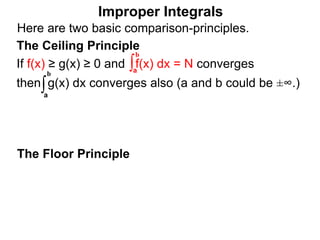
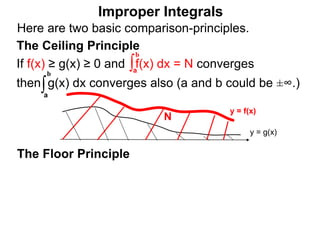
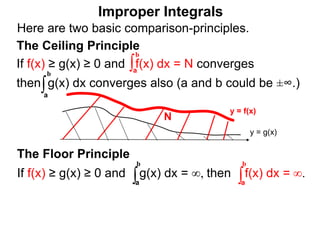
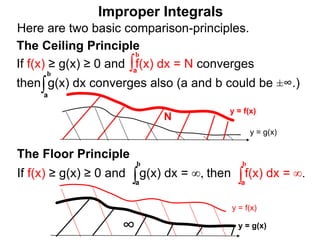
The Ceiling Principle
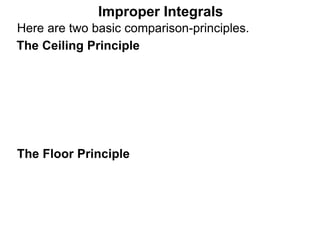
Here are two basic comparison-principles.
The Floor Principle
Improper Integrals
The Ceiling Principle
If f(x) ≥ g(x) ≥ 0 and f(x) dx = N converges
then g(x) dx converges also (a and b could be ±∞.)
∫a
b
∫a
b
Here are two basic comparison-principles.
The Floor Principle
Improper Integrals
The Ceiling Principle
If f(x) ≥ g(x) ≥ 0 and f(x) dx = N converges
then g(x) dx converges also (a and b could be ±∞.)
∫a
b
∫a
b
y = f(x)
y = g(x)
N
Here are two basic comparison-principles.
The Floor Principle
If f(x) ≥ g(x) ≥ 0 and g(x) dx = ∞, then f(x) dx = ∞.∫a
b
∫a
b
Improper Integrals
The Ceiling Principle
If f(x) ≥ g(x) ≥ 0 and f(x) dx = N converges
then g(x) dx converges also (a and b could be ±∞.)
∫a
b
∫a
b
y = f(x)
y = g(x)
N
Here are two basic comparison-principles.
The Floor Principle
If f(x) ≥ g(x) ≥ 0 and g(x) dx = ∞, then f(x) dx = ∞.∫a
b
∫a
b
y = f(x)
y = g(x)∞
Improper Integrals
The Ceiling Principle
If f(x) ≥ g(x) ≥ 0 and f(x) dx = N converges
then g(x) dx converges also (a and b could be ±∞.)
∫a
b
∫a
b
y = f(x)
y = g(x)
N
Here are two basic comparison-principles.
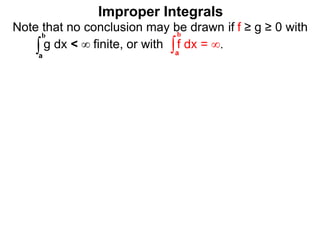
Note that no conclusion may be drawn if f ≥ g ≥ 0 with
g dx < ∞ finite, or with f dx = ∞.∫a
b
∫a
b
Improper Integrals
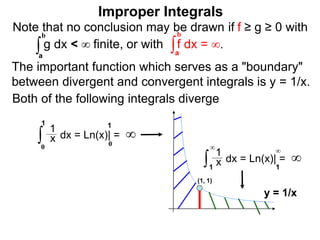
The important function which serves as a "boundary"
between divergent and convergent integrals is y = 1/x.
Note that no conclusion may be drawn if f ≥ g ≥ 0 with
g dx < ∞ finite, or with f dx = ∞.∫a
b
∫a
b
Improper Integrals
The important function which serves as a "boundary"
between divergent and convergent integrals is y = 1/x.
Note that no conclusion may be drawn if f ≥ g ≥ 0 with
g dx < ∞ finite, or with f dx = ∞.∫a
b
∫a
b
Improper Integrals
(1, 1)
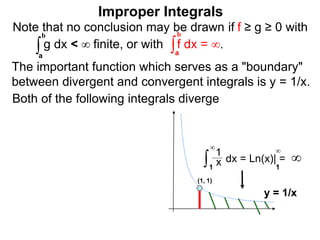
Both of the following integrals diverge
∫1
∞
x
1
dx = Ln(x)| = ∞
1
∞
y = 1/x
The important function which serves as a "boundary"
between divergent and convergent integrals is y = 1/x.
Note that no conclusion may be drawn if f ≥ g ≥ 0 with
g dx < ∞ finite, or with f dx = ∞.∫a
b
∫a
b
Improper Integrals
∫
1
0
x
1
dx = Ln(x)| = ∞
(1, 1)
Both of the following integrals diverge
∫1
∞
x
1
dx = Ln(x)| = ∞
1
∞
1
0
y = 1/x
The important function which serves as a "boundary"
between divergent and convergent integrals is y = 1/x.
Note that no conclusion may be drawn if f ≥ g ≥ 0 with
g dx < ∞ finite, or with f dx = ∞.∫a
b
∫a
b
Improper Integrals
∫
1
0
x
1
dx = Ln(x)| = ∞
(1, 1)
Both of the following integrals diverge
∫1
∞
x
1
dx = Ln(x)| = ∞
1
∞
1
0
y = 1/x
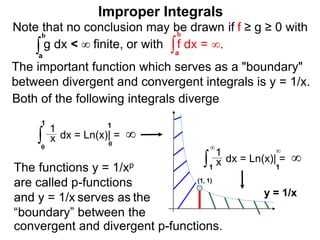
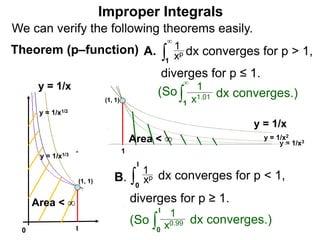
The functions y = 1/xp
are called p-functions
and y = 1/x serves as the
“boundary” between the
convergent and divergent p-functions.
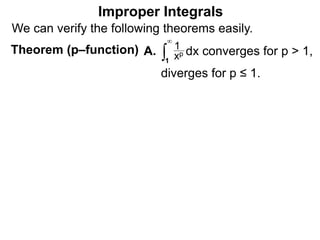
Theorem (p–function) ∫1
xp
1
∞
dx converges for p > 1,A.
Improper Integrals
diverges for p ≤ 1.
We can verify the following theorems easily.
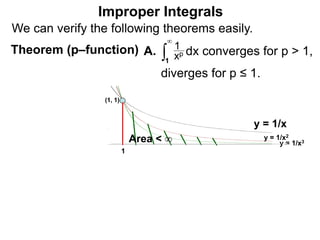
Theorem (p–function) ∫1
xp
1
∞
dx converges for p > 1,A.
Improper Integrals
(1, 1)
y = 1/x
y = 1/x2
y = 1/x3
1
Area < ∞
diverges for p ≤ 1.
We can verify the following theorems easily.
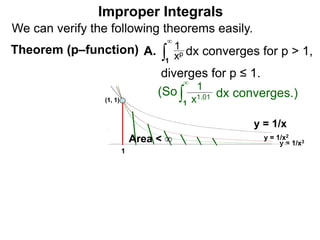
Theorem (p–function) ∫1
xp
1
∞
dx converges for p > 1,A.
Improper Integrals
(1, 1)
y = 1/x
y = 1/x2
y = 1/x3
1
Area < ∞
diverges for p ≤ 1.
We can verify the following theorems easily.
(So ∫1 x1.01
1∞
dx converges.)
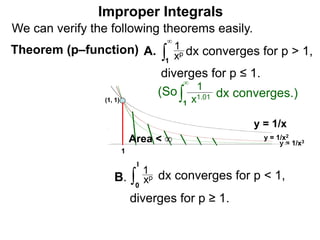
Theorem (p–function) ∫1
xp
1
∞
dx converges for p > 1,A.
Improper Integrals
(1, 1)
y = 1/x
y = 1/x2
y = 1/x3
1
Area < ∞
diverges for p ≤ 1.
We can verify the following theorems easily.
(So ∫1 x1.01
1∞
dx converges.)
∫ xp
1
dx converges for p < 1,B.
0
1
diverges for p ≥ 1.
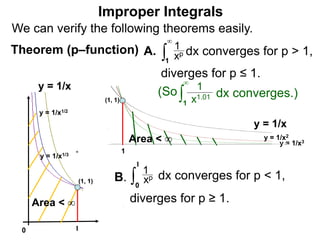
Theorem (p–function) ∫1
xp
1
∞
dx converges for p > 1,A.
Improper Integrals
0 1
(1, 1)
y = 1/x
y = 1/x2
y = 1/x3
1
Area < ∞
Area < ∞
y = 1/x1/2
y = 1/x
y = 1/x1/3
diverges for p ≤ 1.
(1, 1)
We can verify the following theorems easily.
(So ∫1 x1.01
1∞
dx converges.)
∫ xp
1
dx converges for p < 1,B.
0
1
diverges for p ≥ 1.
Theorem (p–function) ∫1
xp
1
∞
dx converges for p > 1,A.
Improper Integrals
0 1
(1, 1)
y = 1/x
y = 1/x2
y = 1/x3
1
Area < ∞
Area < ∞
y = 1/x1/2
y = 1/x
y = 1/x1/3
diverges for p ≤ 1.
(1, 1)
We can verify the following theorems easily.
(So ∫1 x1.01
1∞
dx converges.)
∫ xp
1
dx converges for p < 1,B.
0
1
diverges for p ≥ 1.
(So ∫ x0.99
1
dx converges.)
0
1
Improper Integrals
∫
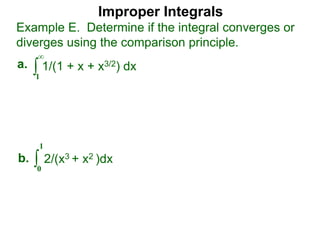
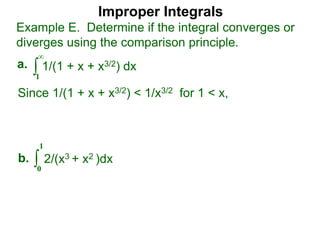
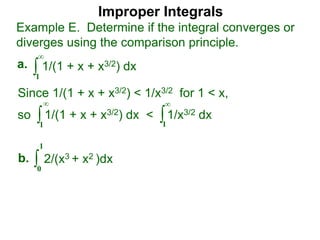
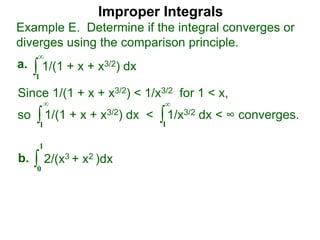
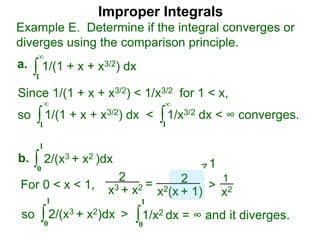
Example E. Determine if the integral converges or
diverges using the comparison principle.
∞
1
1/(1 + x + x3/2) dxa.
∫0
1
2/(x3 + x2 )dxb.
Improper Integrals
∫
Example E. Determine if the integral converges or
diverges using the comparison principle.
∞
1
1/(1 + x + x3/2) dxa.
∫0
1
2/(x3 + x2 )dxb.
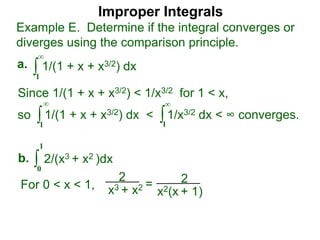
Since 1/(1 + x + x3/2) < 1/x3/2 for 1 < x,
Improper Integrals
∫
Example E. Determine if the integral converges or
diverges using the comparison principle.
∞
1
1/(1 + x + x3/2) dxa.
∫0
1
2/(x3 + x2 )dxb.
Since 1/(1 + x + x3/2) < 1/x3/2 for 1 < x,
so 1/(1 + x + x3/2) dx < 1/x3/2 dx∫
∞
1
∫
∞
1
Improper Integrals
∫
Example E. Determine if the integral converges or
diverges using the comparison principle.
∞
1
1/(1 + x + x3/2) dxa.
∫0
1
2/(x3 + x2 )dxb.
Since 1/(1 + x + x3/2) < 1/x3/2 for 1 < x,
so 1/(1 + x + x3/2) dx < 1/x3/2 dx < ∞ converges.∫
∞
1
∫
∞
1
Improper Integrals
∫
Example E. Determine if the integral converges or
diverges using the comparison principle.
∞
1
1/(1 + x + x3/2) dxa.
∫0
1
2/(x3 + x2 )dxb.
Since 1/(1 + x + x3/2) < 1/x3/2 for 1 < x,
so 1/(1 + x + x3/2) dx < 1/x3/2 dx < ∞ converges.∫
∞
1
∫
∞
1
2
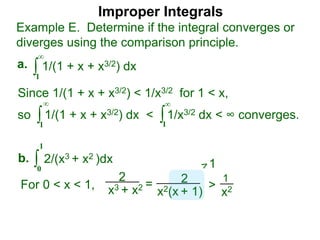
x3 + x2 = 2
x2(x + 1)
For 0 < x < 1,
Improper Integrals
∫
Example E. Determine if the integral converges or
diverges using the comparison principle.
∞
1
1/(1 + x + x3/2) dxa.
∫0
1
2/(x3 + x2 )dxb.
Since 1/(1 + x + x3/2) < 1/x3/2 for 1 < x,
so 1/(1 + x + x3/2) dx < 1/x3/2 dx < ∞ converges.∫
∞
1
∫
∞
1
2
x3 + x2 = 2
x2(x + 1)
>
1
x2For 0 < x < 1,
1
Improper Integrals
∫
Example E. Determine if the integral converges or
diverges using the comparison principle.
∞
1
1/(1 + x + x3/2) dxa.
∫0
1
2/(x3 + x2 )dxb.
Since 1/(1 + x + x3/2) < 1/x3/2 for 1 < x,
so 1/(1 + x + x3/2) dx < 1/x3/2 dx < ∞ converges.∫
∞
1
∫
∞
1
2
x3 + x2 = 2
x2(x + 1)
>
1
x2For 0 < x < 1,
1
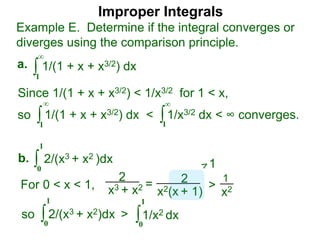
so 2/(x3 + x2)dx >∫0
1
∫0
1
1/x2 dx
Improper Integrals
∫
Example E. Determine if the integral converges or
diverges using the comparison principle.
∞
1
1/(1 + x + x3/2) dxa.
∫0
1
2/(x3 + x2 )dxb.
Since 1/(1 + x + x3/2) < 1/x3/2 for 1 < x,
so 1/(1 + x + x3/2) dx < 1/x3/2 dx < ∞ converges.∫
∞
1
∫
∞
1
2
x3 + x2 = 2
x2(x + 1)
>
1
x2For 0 < x < 1,
1
so 2/(x3 + x2)dx >∫0
1
∫0
1
1/x2 dx = ∞ and it diverges.
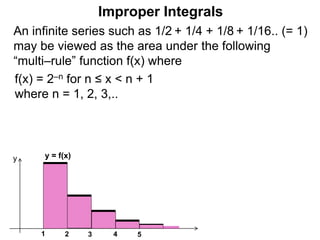
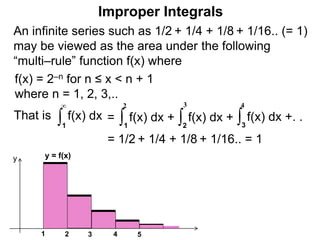
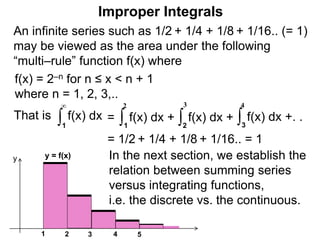
An infinite series such as 1/2 + 1/4 + 1/8 + 1/16.. (= 1)
may be viewed as the area under the following
“multi–rule” function f(x) where
f(x) = 2–n for n ≤ x < n + 1
where n = 1, 2, 3,..
1
y = f(x)
2 3 4
y
5
Improper Integrals
An infinite series such as 1/2 + 1/4 + 1/8 + 1/16.. (= 1)
may be viewed as the area under the following
“multi–rule” function f(x) where
f(x) = 2–n for n ≤ x < n + 1
where n = 1, 2, 3,..
1
y = f(x)
2 3 4
y
5
That is ∫1
∞
f(x) dx
= 1/2 + 1/4 + 1/8 + 1/16.. = 1
∫1
2
f(x) dx + ∫2
3
f(x) dx + ∫3
4
f(x) dx +. .=
Improper Integrals
An infinite series such as 1/2 + 1/4 + 1/8 + 1/16.. (= 1)
may be viewed as the area under the following
“multi–rule” function f(x) where
f(x) = 2–n for n ≤ x < n + 1
where n = 1, 2, 3,..
1
y = f(x)
2 3 4
y
5
That is ∫1
∞
f(x) dx
= 1/2 + 1/4 + 1/8 + 1/16.. = 1
∫1
2
f(x) dx + ∫2
3
f(x) dx + ∫3
4
f(x) dx +. .=
In the next section, we establish the
relation between summing series
versus integrating functions,
i.e. the discrete vs. the continuous.
Improper Integrals

23 improper integrals send-x

  • 1.
    Improper Integrals An integralover an infinite interval such as ∫ e–x dx may be interpreted as the un-enclosed area under the curve of y = e–x. 0 ∞ (0,1) y = e–x
  • 2.
    Improper Integrals An integralover an infinite interval such as ∫ e–x dx may be interpreted as the un-enclosed area under the curve of y = e–x. 0 ∞ Likewise ∫ 1/x dx may be viewed as the un-enclosed area under the curve of y = 1/x. 0 1 (0,1) y = e–x y = 1/x(1,1)
  • 3.
    Improper Integrals An integralover an infinite interval such as ∫ e–x dx may be interpreted as the un-enclosed area under the curve of y = e–x. 0 ∞ Likewise ∫ 1/x dx may be viewed as the un-enclosed area under the curve of y = 1/x. 0 1 (0,1) y = e–x Definite integrals of continuous functions over infinite intervals (a, ∞) (–∞, a), or (–∞, ∞), such as ∫ e–x dx, y = 1/x(1,1) 0 ∞ or integrals of unbounded continuous functions such as ∫ 1/x dx are called improper integrals.0 1
  • 4.
    Improper Integrals Let f(x)be a continuous function defined for a ≤ x and F(x) is an antiderivative of f(x).
  • 5.
    ∫a ∞ lim f(x) dx= F(x)| ≡ lim F(u) – F(a)∫a u u ∞ u ∞a ∞ Improper Integrals Let f(x) be a continuous function defined for a ≤ x and F(x) is an antiderivative of f(x). We define the improper (definite) integral f(x) dx ≡
  • 6.
    Example A. Find∫0 ∞ e–x dx ∫a ∞ lim f(x) dx = F(x)| ≡ lim F(u) – F(a)∫a u u ∞ u ∞a ∞ Improper Integrals Let f(x) be a continuous function defined for a ≤ x and F(x) is an antiderivative of f(x). We define the improper (definite) integral f(x) dx ≡
  • 7.
    Example A. Find∫0 ∞ e–x dx ∫0 ∞ e–x dx = –e–x| 0 ∞ ∫a ∞ lim f(x) dx = F(x)| ≡ lim F(u) – F(a)∫a u u ∞ u ∞a ∞ Improper Integrals Let f(x) be a continuous function defined for a ≤ x and F(x) is an antiderivative of f(x). We define the improper (definite) integral f(x) dx ≡
  • 8.
    Example A. Find∫0 ∞ e–x dx ∫0 ∞ e–x dx = –e–x| = lim (–e–x) – (–e0) = 1 x ∞0 ∞ ∫a ∞ lim f(x) dx = F(x)| ≡ lim F(u) – F(a)∫a u u ∞ u ∞a ∞ Improper Integrals Let f(x) be a continuous function defined for a ≤ x and F(x) is an antiderivative of f(x). We define the improper (definite) integral f(x) dx ≡
  • 9.
    Example A. Find∫0 ∞ e–x dx ∫0 ∞ e–x dx = –e–x| = lim (–e–x) – (–e0) = 1 x ∞0 ∞ ∫a ∞ lim f(x) dx = F(x)| ≡ lim F(u) – F(a)∫a u u ∞ u ∞a ∞ Improper Integrals Let f(x) be a continuous function defined for a ≤ x and F(x) is an antiderivative of f(x). We define the improper (definite) integral f(x) dx ≡ Similarly for a continuous function f(x) where x ≤ a, we define the improper (definite) integral ∫–∞ lim f(x) dx = F(x)| ≡ lim F(a) – F(u)∫u a u –∞ u –∞ a –∞ f(x) dx ≡ a
  • 10.
    Example A. Find∫0 ∞ e–x dx ∫0 ∞ e–x dx = –e–x| = lim (–e–x) – (–e0) = 1 x ∞0 ∞ ∫a ∞ lim f(x) dx = F(x)| ≡ lim F(u) – F(a)∫a u u ∞ u ∞a ∞ Improper Integrals Let f(x) be a continuous function defined for a ≤ x and F(x) is an antiderivative of f(x). We define the improper (definite) integral f(x) dx ≡ Similarly for a continuous function f(x) where x ≤ a, we define the improper (definite) integral ∫–∞ lim f(x) dx = F(x)| ≡ lim F(a) – F(u)∫u a u –∞ u –∞ a –∞ f(x) dx ≡ a Example B. Find ∫ cos(x)dx –∞ 0
  • 11.
    Example A. Find∫0 ∞ e–x dx ∫0 ∞ e–x dx = –e–x| = lim (–e–x) – (–e0) = 1 x ∞0 ∞ ∫a ∞ lim f(x) dx = F(x)| ≡ lim F(u) – F(a)∫a u u ∞ u ∞a ∞ Improper Integrals Let f(x) be a continuous function defined for a ≤ x and F(x) is an antiderivative of f(x). We define the improper (definite) integral f(x) dx ≡ Similarly for a continuous function f(x) where x ≤ a, we define the improper (definite) integral ∫–∞ lim f(x) dx = F(x)| ≡ lim F(a) – F(u)∫u a u –∞ u –∞ a –∞ f(x) dx ≡ a Example B. Find ∫ cos(x)dx ∫ 0 cos(x)dx = sin(x) | –∞ 0 –∞ –∞ 0
  • 12.
    Example A. Find∫0 ∞ e–x dx ∫0 ∞ e–x dx = –e–x| = lim (–e–x) – (–e0) = 1 x ∞0 ∞ ∫a ∞ lim f(x) dx = F(x)| ≡ lim F(u) – F(a)∫a u u ∞ u ∞a ∞ Improper Integrals Let f(x) be a continuous function defined for a ≤ x and F(x) is an antiderivative of f(x). We define the improper (definite) integral f(x) dx ≡ Similarly for a continuous function f(x) where x ≤ a, we define the improper (definite) integral ∫–∞ lim f(x) dx = F(x)| ≡ lim F(a) – F(u)∫u a u –∞ u –∞ a –∞ f(x) dx ≡ a Example B. Find ∫ cos(x)dx ∫ 0 cos(x)dx = sin(x) | = lim sin(0) – sin(x) which is UDF. x –∞ –∞ 0 –∞ –∞ 0
  • 13.
    Let F(x) bean antiderivative of f(x) and lim f(x)  ∞. We define x a ∫a b f(x) dx = F(x)| ≡ F(b) – lim F(x) a b Improper Integrals x a
  • 14.
    Let F(x) bean antiderivative of f(x) and lim f(x)  ∞. We define x a ∫a b f(x) dx = F(x)| ≡ F(b) – lim F(x) Example C. a. Find ∫0 1 x–1/2 dx. a b Improper Integrals x a
  • 15.
    Let F(x) bean antiderivative of f(x) and lim f(x)  ∞. We define x a ∫a b f(x) dx = F(x)| ≡ F(b) – lim F(x) Example C. a. Find ∫0 1 x–1/2 dx. a b Improper Integrals x a y = x–1/2 y = x–1 (1,1) The green area under y = x–1 is ∞. The blue area under y = x–1/2 is 2.
  • 16.
    Let F(x) bean antiderivative of f(x) and lim f(x)  ∞. We define x a ∫a b f(x) dx = F(x)| ≡ F(b) – lim F(x) Example C. a. Find ∫0 1 x–1/2 dx. ∫0 1 x–1/2 dx = 2x1/2 | 1 0 a b Improper Integrals x a y = x–1/2 y = x–1 (1,1) The blue area under y = x–1/2 is 2. The green area under y = x–1 is ∞.
  • 17.
    Let F(x) bean antiderivative of f(x) and lim f(x)  ∞. We define x a ∫a b f(x) dx = F(x)| ≡ F(b) – lim F(x) Example C. a. Find ∫0 1 x–1/2 dx. ∫0 1 x–1/2 dx = 2x1/2 | 1 0 x 0 a b Improper Integrals x a y = x–1/2 y = x–1 (1,1) The blue area under y = x–1/2 is 2. The green area under y = x–1 is ∞. = 2 – lim (2x1/2) = 2
  • 18.
    Let F(x) bean antiderivative of f(x) and lim f(x)  ∞. We define x a ∫a b f(x) dx = F(x)| ≡ F(b) – lim F(x) Example C. a. Find ∫0 1 x–1/2 dx. ∫0 1 x–1/2 dx = 2x1/2 | 1 0 x 0 b. Find ∫0 1 x–1 dx. a b Improper Integrals x a y = x–1/2 y = x–1 (1,1) The blue area under y = x–1/2 is 2. The green area under y = x–1 is ∞. = 2 – lim (2x1/2) = 2
  • 19.
    Let F(x) bean antiderivative of f(x) and lim f(x)  ∞. We define x a ∫a b f(x) dx = F(x)| ≡ F(b) – lim F(x) Example C. a. Find ∫0 1 x–1/2 dx. ∫0 1 x–1/2 dx = 2x1/2 | 1 0 x 0 b. Find ∫0 1 x–1 dx. ∫0 1 x–1 dx = In(x) | 1 0 a b Improper Integrals x a y = x–1/2 y = x–1 (1,1) The blue area under y = x–1/2 is 2. The green area under y = x–1 is ∞. = 2 – lim (2x1/2) = 2
  • 20.
    Let F(x) bean antiderivative of f(x) and lim f(x)  ∞. We define x a ∫a b f(x) dx = F(x)| ≡ F(b) – lim F(x) Example C. a. Find ∫0 1 x–1/2 dx. ∫0 1 x–1/2 dx = 2x1/2 | 1 0 x 0 b. Find ∫0 1 x–1 dx. ∫0 1 x–1 dx = In(x) | = 0 – lim In(x) = 0 – (–∞) = ∞ 1 0 x 0 a b Improper Integrals x a y = x–1/2 y = x–1 (1,1) The blue area under y = x–1/2 is 2. The green area under y = x–1 is ∞. = 2 – lim (2x1/2) = 2
  • 21.
    Let F(x) bean antiderivative of f(x) and lim f(x)  ∞. We define x a ∫a b f(x) dx = F(x)| ≡ F(b) – lim F(x) Example C. a. Find ∫0 1 x–1/2 dx. ∫0 1 x–1/2 dx = 2x1/2 | 1 0 x 0 b. Find ∫0 1 x–1 dx. ∫0 1 x–1 dx = In(x) | = 0 – lim In(x) = 0 – (–∞) = ∞ 1 0 x 0 If the improper integral exists, we say it converges. a b Improper Integrals x a y = x–1/2 y = x–1 (1,1) The blue area under y = x–1/2 is 2. The green area under y = x–1 is ∞. = 2 – lim (2x1/2) = 2
  • 22.
    Let F(x) bean antiderivative of f(x) and lim f(x)  ∞. We define x a ∫a b f(x) dx = F(x)| ≡ F(b) – lim F(x) Example C. a. Find ∫0 1 x–1/2 dx. ∫0 1 x–1/2 dx = 2x1/2 | 1 0 x 0 b. Find ∫0 1 x–1 dx. ∫0 1 x–1 dx = In(x) | = 0 – lim In(x) = 0 – (–∞) = ∞ 1 0 x 0 If the improper integral exists, we say it converges. If the improper integral fails to exist or it´s infinite, we say it diverges. a b Improper Integrals x a y = x–1/2 y = x–1 (1,1) The blue area under y = x–1/2 is 2. The green area under y = x–1 is ∞. = 2 – lim (2x1/2) = 2
  • 23.
    Let f(x) bea continuous function defined for all x’s, and F´(x) = f(x), we define the improper integral ∫ f(x)dx ≡ lim Improper Integrals –∞ ∞ ∫f(x) dx –u u In the situations that we can’t find the anti-derivative F(x) or the numerical answers, the next question is to determine if the integrals converge or diverge by comparing them to other known integrals. Find ∫Example D. –∞ ∞ ∫ 1/(1 + x2) dx –∞ ∞ = lim tan–1(u) – tan–1(–u) = π/2 + π/2 = π. u ∞ y = 1/(1 + x2)1/(1 + x2)dx x u∞ = lim F(u) – F(–u).u∞ –x = lim tan–1(x) l–u u u ∞
  • 24.
    Let f(x) bea continuous function defined for all x’s, and F´(x) = f(x), we define the improper integral ∫ f(x)dx ≡ lim Improper Integrals –∞ ∞ ∫f(x) dx –u u u∞ = lim F(u) – F(–u).u∞
  • 25.
    Let f(x) bea continuous function defined for all x’s, and F´(x) = f(x), we define the improper integral ∫ f(x)dx ≡ lim Improper Integrals –∞ ∞ ∫f(x) dx –u u Find ∫Example D. –∞ ∞ 1/(1 + x2)dx u∞ = lim F(u) – F(–u).u∞
  • 26.
    Let f(x) bea continuous function defined for all x’s, and F´(x) = f(x), we define the improper integral ∫ f(x)dx ≡ lim Improper Integrals –∞ ∞ ∫f(x) dx –u u Find ∫Example D. –∞ ∞ y = 1/(1 + x2)1/(1 + x2)dx x u∞ = lim F(u) – F(–u).u∞ –x
  • 27.
    Let f(x) bea continuous function defined for all x’s, and F´(x) = f(x), we define the improper integral ∫ f(x)dx ≡ lim Improper Integrals –∞ ∞ ∫f(x) dx –u u Find ∫Example D. –∞ ∞ ∫ 1/(1 + x2) dx –∞ ∞ u ∞ y = 1/(1 + x2)1/(1 + x2)dx x u∞ = lim F(u) – F(–u).u∞ –x = lim tan–1(x) l–u u
  • 28.
    Let f(x) bea continuous function defined for all x’s, and F´(x) = f(x), we define the improper integral ∫ f(x)dx ≡ lim Improper Integrals –∞ ∞ ∫f(x) dx –u u Find ∫Example D. –∞ ∞ ∫ 1/(1 + x2) dx –∞ ∞ = lim tan–1(u) – tan–1(–u) u ∞ y = 1/(1 + x2)1/(1 + x2)dx x u∞ = lim F(u) – F(–u).u∞ –x = lim tan–1(x) l–u u u ∞
  • 29.
    Let f(x) bea continuous function defined for all x’s, and F´(x) = f(x), we define the improper integral ∫ f(x)dx ≡ lim Improper Integrals –∞ ∞ ∫f(x) dx –u u Find ∫Example D. –∞ ∞ ∫ 1/(1 + x2) dx –∞ ∞ = lim tan–1(u) – tan–1(–u) = π/2 + π/2 = π. u ∞ y = 1/(1 + x2)1/(1 + x2)dx x u∞ = lim F(u) – F(–u).u∞ –x = lim tan–1(x) l–u u u ∞
  • 30.
    Let f(x) bea continuous function defined for all x’s, and F´(x) = f(x), we define the improper integral ∫ f(x)dx ≡ lim Improper Integrals –∞ ∞ ∫f(x) dx –u u In the situations that we can’t find the anti-derivative F(x) or the numerical answers, the next question is to determine if the integrals converge or diverge by comparing them to other known integrals. Find ∫Example D. –∞ ∞ ∫ 1/(1 + x2) dx –∞ ∞ = lim tan–1(u) – tan–1(–u) = π/2 + π/2 = π. u ∞ y = 1/(1 + x2)1/(1 + x2)dx x u∞ = lim F(u) – F(–u).u∞ –x = lim tan–1(x) l–u u u ∞
  • 31.
    The Floor Principle ImproperIntegrals The Ceiling Principle Here are two basic comparison-principles.
  • 32.
    The Floor Principle ImproperIntegrals The Ceiling Principle If f(x) ≥ g(x) ≥ 0 and f(x) dx = N converges then g(x) dx converges also (a and b could be ±∞.) ∫a b ∫a b Here are two basic comparison-principles.
  • 33.
    The Floor Principle ImproperIntegrals The Ceiling Principle If f(x) ≥ g(x) ≥ 0 and f(x) dx = N converges then g(x) dx converges also (a and b could be ±∞.) ∫a b ∫a b y = f(x) y = g(x) N Here are two basic comparison-principles.
  • 34.
    The Floor Principle Iff(x) ≥ g(x) ≥ 0 and g(x) dx = ∞, then f(x) dx = ∞.∫a b ∫a b Improper Integrals The Ceiling Principle If f(x) ≥ g(x) ≥ 0 and f(x) dx = N converges then g(x) dx converges also (a and b could be ±∞.) ∫a b ∫a b y = f(x) y = g(x) N Here are two basic comparison-principles.
  • 35.
    The Floor Principle Iff(x) ≥ g(x) ≥ 0 and g(x) dx = ∞, then f(x) dx = ∞.∫a b ∫a b y = f(x) y = g(x)∞ Improper Integrals The Ceiling Principle If f(x) ≥ g(x) ≥ 0 and f(x) dx = N converges then g(x) dx converges also (a and b could be ±∞.) ∫a b ∫a b y = f(x) y = g(x) N Here are two basic comparison-principles.
  • 36.
    Note that noconclusion may be drawn if f ≥ g ≥ 0 with g dx < ∞ finite, or with f dx = ∞.∫a b ∫a b Improper Integrals
  • 37.
    The important functionwhich serves as a "boundary" between divergent and convergent integrals is y = 1/x. Note that no conclusion may be drawn if f ≥ g ≥ 0 with g dx < ∞ finite, or with f dx = ∞.∫a b ∫a b Improper Integrals
  • 38.
    The important functionwhich serves as a "boundary" between divergent and convergent integrals is y = 1/x. Note that no conclusion may be drawn if f ≥ g ≥ 0 with g dx < ∞ finite, or with f dx = ∞.∫a b ∫a b Improper Integrals (1, 1) Both of the following integrals diverge ∫1 ∞ x 1 dx = Ln(x)| = ∞ 1 ∞ y = 1/x
  • 39.
    The important functionwhich serves as a "boundary" between divergent and convergent integrals is y = 1/x. Note that no conclusion may be drawn if f ≥ g ≥ 0 with g dx < ∞ finite, or with f dx = ∞.∫a b ∫a b Improper Integrals ∫ 1 0 x 1 dx = Ln(x)| = ∞ (1, 1) Both of the following integrals diverge ∫1 ∞ x 1 dx = Ln(x)| = ∞ 1 ∞ 1 0 y = 1/x
  • 40.
    The important functionwhich serves as a "boundary" between divergent and convergent integrals is y = 1/x. Note that no conclusion may be drawn if f ≥ g ≥ 0 with g dx < ∞ finite, or with f dx = ∞.∫a b ∫a b Improper Integrals ∫ 1 0 x 1 dx = Ln(x)| = ∞ (1, 1) Both of the following integrals diverge ∫1 ∞ x 1 dx = Ln(x)| = ∞ 1 ∞ 1 0 y = 1/x The functions y = 1/xp are called p-functions and y = 1/x serves as the “boundary” between the convergent and divergent p-functions.
  • 41.
    Theorem (p–function) ∫1 xp 1 ∞ dxconverges for p > 1,A. Improper Integrals diverges for p ≤ 1. We can verify the following theorems easily.
  • 42.
    Theorem (p–function) ∫1 xp 1 ∞ dxconverges for p > 1,A. Improper Integrals (1, 1) y = 1/x y = 1/x2 y = 1/x3 1 Area < ∞ diverges for p ≤ 1. We can verify the following theorems easily.
  • 43.
    Theorem (p–function) ∫1 xp 1 ∞ dxconverges for p > 1,A. Improper Integrals (1, 1) y = 1/x y = 1/x2 y = 1/x3 1 Area < ∞ diverges for p ≤ 1. We can verify the following theorems easily. (So ∫1 x1.01 1∞ dx converges.)
  • 44.
    Theorem (p–function) ∫1 xp 1 ∞ dxconverges for p > 1,A. Improper Integrals (1, 1) y = 1/x y = 1/x2 y = 1/x3 1 Area < ∞ diverges for p ≤ 1. We can verify the following theorems easily. (So ∫1 x1.01 1∞ dx converges.) ∫ xp 1 dx converges for p < 1,B. 0 1 diverges for p ≥ 1.
  • 45.
    Theorem (p–function) ∫1 xp 1 ∞ dxconverges for p > 1,A. Improper Integrals 0 1 (1, 1) y = 1/x y = 1/x2 y = 1/x3 1 Area < ∞ Area < ∞ y = 1/x1/2 y = 1/x y = 1/x1/3 diverges for p ≤ 1. (1, 1) We can verify the following theorems easily. (So ∫1 x1.01 1∞ dx converges.) ∫ xp 1 dx converges for p < 1,B. 0 1 diverges for p ≥ 1.
  • 46.
    Theorem (p–function) ∫1 xp 1 ∞ dxconverges for p > 1,A. Improper Integrals 0 1 (1, 1) y = 1/x y = 1/x2 y = 1/x3 1 Area < ∞ Area < ∞ y = 1/x1/2 y = 1/x y = 1/x1/3 diverges for p ≤ 1. (1, 1) We can verify the following theorems easily. (So ∫1 x1.01 1∞ dx converges.) ∫ xp 1 dx converges for p < 1,B. 0 1 diverges for p ≥ 1. (So ∫ x0.99 1 dx converges.) 0 1
  • 47.
    Improper Integrals ∫ Example E.Determine if the integral converges or diverges using the comparison principle. ∞ 1 1/(1 + x + x3/2) dxa. ∫0 1 2/(x3 + x2 )dxb.
  • 48.
    Improper Integrals ∫ Example E.Determine if the integral converges or diverges using the comparison principle. ∞ 1 1/(1 + x + x3/2) dxa. ∫0 1 2/(x3 + x2 )dxb. Since 1/(1 + x + x3/2) < 1/x3/2 for 1 < x,
  • 49.
    Improper Integrals ∫ Example E.Determine if the integral converges or diverges using the comparison principle. ∞ 1 1/(1 + x + x3/2) dxa. ∫0 1 2/(x3 + x2 )dxb. Since 1/(1 + x + x3/2) < 1/x3/2 for 1 < x, so 1/(1 + x + x3/2) dx < 1/x3/2 dx∫ ∞ 1 ∫ ∞ 1
  • 50.
    Improper Integrals ∫ Example E.Determine if the integral converges or diverges using the comparison principle. ∞ 1 1/(1 + x + x3/2) dxa. ∫0 1 2/(x3 + x2 )dxb. Since 1/(1 + x + x3/2) < 1/x3/2 for 1 < x, so 1/(1 + x + x3/2) dx < 1/x3/2 dx < ∞ converges.∫ ∞ 1 ∫ ∞ 1
  • 51.
    Improper Integrals ∫ Example E.Determine if the integral converges or diverges using the comparison principle. ∞ 1 1/(1 + x + x3/2) dxa. ∫0 1 2/(x3 + x2 )dxb. Since 1/(1 + x + x3/2) < 1/x3/2 for 1 < x, so 1/(1 + x + x3/2) dx < 1/x3/2 dx < ∞ converges.∫ ∞ 1 ∫ ∞ 1 2 x3 + x2 = 2 x2(x + 1) For 0 < x < 1,
  • 52.
    Improper Integrals ∫ Example E.Determine if the integral converges or diverges using the comparison principle. ∞ 1 1/(1 + x + x3/2) dxa. ∫0 1 2/(x3 + x2 )dxb. Since 1/(1 + x + x3/2) < 1/x3/2 for 1 < x, so 1/(1 + x + x3/2) dx < 1/x3/2 dx < ∞ converges.∫ ∞ 1 ∫ ∞ 1 2 x3 + x2 = 2 x2(x + 1) > 1 x2For 0 < x < 1, 1
  • 53.
    Improper Integrals ∫ Example E.Determine if the integral converges or diverges using the comparison principle. ∞ 1 1/(1 + x + x3/2) dxa. ∫0 1 2/(x3 + x2 )dxb. Since 1/(1 + x + x3/2) < 1/x3/2 for 1 < x, so 1/(1 + x + x3/2) dx < 1/x3/2 dx < ∞ converges.∫ ∞ 1 ∫ ∞ 1 2 x3 + x2 = 2 x2(x + 1) > 1 x2For 0 < x < 1, 1 so 2/(x3 + x2)dx >∫0 1 ∫0 1 1/x2 dx
  • 54.
    Improper Integrals ∫ Example E.Determine if the integral converges or diverges using the comparison principle. ∞ 1 1/(1 + x + x3/2) dxa. ∫0 1 2/(x3 + x2 )dxb. Since 1/(1 + x + x3/2) < 1/x3/2 for 1 < x, so 1/(1 + x + x3/2) dx < 1/x3/2 dx < ∞ converges.∫ ∞ 1 ∫ ∞ 1 2 x3 + x2 = 2 x2(x + 1) > 1 x2For 0 < x < 1, 1 so 2/(x3 + x2)dx >∫0 1 ∫0 1 1/x2 dx = ∞ and it diverges.
  • 55.
    An infinite seriessuch as 1/2 + 1/4 + 1/8 + 1/16.. (= 1) may be viewed as the area under the following “multi–rule” function f(x) where f(x) = 2–n for n ≤ x < n + 1 where n = 1, 2, 3,.. 1 y = f(x) 2 3 4 y 5 Improper Integrals
  • 56.
    An infinite seriessuch as 1/2 + 1/4 + 1/8 + 1/16.. (= 1) may be viewed as the area under the following “multi–rule” function f(x) where f(x) = 2–n for n ≤ x < n + 1 where n = 1, 2, 3,.. 1 y = f(x) 2 3 4 y 5 That is ∫1 ∞ f(x) dx = 1/2 + 1/4 + 1/8 + 1/16.. = 1 ∫1 2 f(x) dx + ∫2 3 f(x) dx + ∫3 4 f(x) dx +. .= Improper Integrals
  • 57.
    An infinite seriessuch as 1/2 + 1/4 + 1/8 + 1/16.. (= 1) may be viewed as the area under the following “multi–rule” function f(x) where f(x) = 2–n for n ≤ x < n + 1 where n = 1, 2, 3,.. 1 y = f(x) 2 3 4 y 5 That is ∫1 ∞ f(x) dx = 1/2 + 1/4 + 1/8 + 1/16.. = 1 ∫1 2 f(x) dx + ∫2 3 f(x) dx + ∫3 4 f(x) dx +. .= In the next section, we establish the relation between summing series versus integrating functions, i.e. the discrete vs. the continuous. Improper Integrals