Arthur CHARPENTIER - Multi-attribute Utility & Copulas
Multi-Attribute Utility & Copulas
(based on Ali E. Abbas contributions)
A. Charpentier (Université de Rennes 1 & UQàM)
Université de Rennes 1 Workshop, April 2016.
http://freakonometrics.hypotheses.org
@freakonometrics 1
Arthur CHARPENTIER - Multi-attribute Utility & Copulas
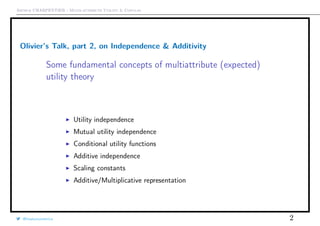
Olivier’s Talk, part 2, on Independence & Additivity
@freakonometrics 2
Arthur CHARPENTIER - Multi-attribute Utility & Copulas
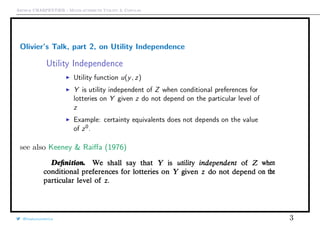
Olivier’s Talk, part 2, on Utility Independence
see also Keeney & Raiffa (1976)
@freakonometrics 3
Arthur CHARPENTIER - Multi-attribute Utility & Copulas
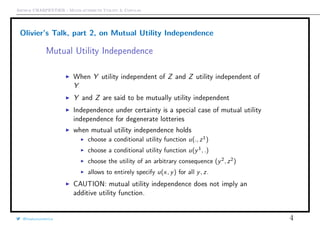
Olivier’s Talk, part 2, on Mutual Utility Independence
@freakonometrics 4
Arthur CHARPENTIER - Multi-attribute Utility & Copulas
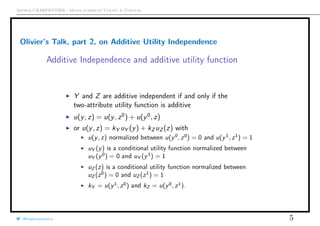
Olivier’s Talk, part 2, on Additive Utility Independence
@freakonometrics 5
Arthur CHARPENTIER - Multi-attribute Utility & Copulas
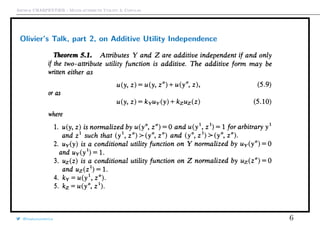
Olivier’s Talk, part 2, on Additive Utility Independence
@freakonometrics 6
Arthur CHARPENTIER - Multi-attribute Utility & Copulas
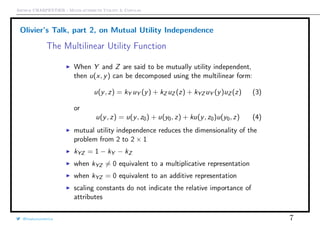
Olivier’s Talk, part 2, on Mutual Utility Independence
@freakonometrics 7
Arthur CHARPENTIER - Multi-attribute Utility & Copulas
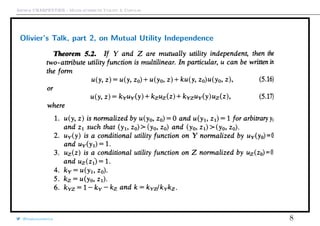
Olivier’s Talk, part 2, on Mutual Utility Independence
@freakonometrics 8
Arthur CHARPENTIER - Multi-attribute Utility & Copulas
What are we looking for?
See Sklar (1959) for cumulative distribution function for random vector X ∈ Rn
,
F(x1, · · · , xn) = C[F1(x), · · · , Fn(xn)]
where F(x) = P[X ≤ x] and Fi(xi) = P[Xi ≤ xi].
@freakonometrics 9
Arthur CHARPENTIER - Multi-attribute Utility & Copulas
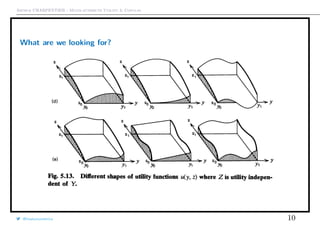
What are we looking for?
@freakonometrics 10
Arthur CHARPENTIER - Multi-attribute Utility & Copulas
Historical Perspective
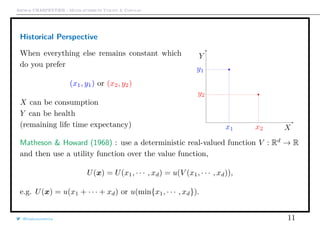
When everything else remains constant which
do you prefer
(x1, y1) or (x2, y2)
X can be consumption
Y can be health
(remaining life time expectancy)
Matheson & Howard (1968) : use a deterministic real-valued function V : Rd
→ R
and then use a utility function over the value function,
U(x) = U(x1, · · · , xd) = u(V (x1, · · · , xd)),
e.g. U(x) = u(x1 + · · · + xd) or u(min{x1, · · · , xd}).
@freakonometrics 11
Arthur CHARPENTIER - Multi-attribute Utility & Copulas
Historical Perspective
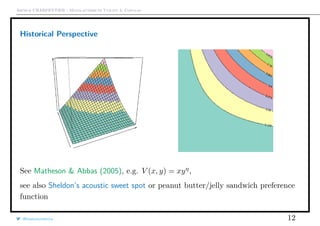
See Matheson & Abbas (2005), e.g. V (x, y) = xyη
,
see also Sheldon’s acoustic sweet spot or peanut butter/jelly sandwich preference
function
@freakonometrics 12
Arthur CHARPENTIER - Multi-attribute Utility & Copulas
Historical Perspective
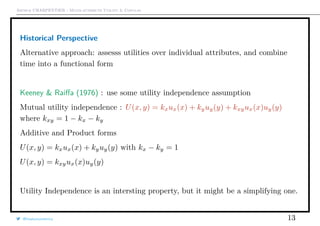
Alternative approach: assesss utilities over individual attributes, and combine
time into a functional form
Keeney & Raiffa (1976) : use some utility independence assumption
Mutual utility independence : U(x, y) = kxux(x) + kyuy(y) + kxyux(x)uy(y)
where kxy = 1 − kx − ky
Additive and Product forms
U(x, y) = kxux(x) + kyuy(y) with kx − ky = 1
U(x, y) = kxyux(x)uy(y)
Utility Independence is an intersting property, but it might be a simplifying one.
@freakonometrics 13
Arthur CHARPENTIER - Multi-attribute Utility & Copulas
How to Construct Multi-Attribute Utility Functions
From Abbas & Howard (2005), in dimension d = 2,
U(x, y) ∈ [0, 1] (normalization )
U(x, y) = U(x, y) = 0 (attribute dominance condition)
@freakonometrics 14
Arthur CHARPENTIER - Multi-attribute Utility & Copulas
How to Construct Multi-Attribute Utility Functions
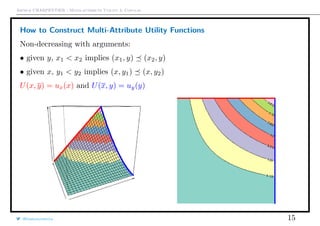
Non-decreasing with arguments:
• given y, x1 < x2 implies (x1, y) (x2, y)
• given x, y1 < y2 implies (x, y1) (x, y2)
U(x, y) = ux(x) and U(x, y) = uy(y)
@freakonometrics 15
Arthur CHARPENTIER - Multi-attribute Utility & Copulas
Conditional Utility
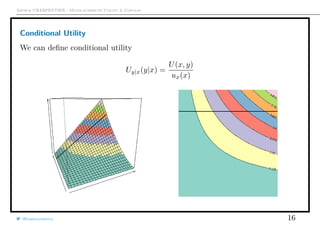
We can define conditional utility
Uy|x(y|x) =
U(x, y)
ux(x)
@freakonometrics 16
Arthur CHARPENTIER - Multi-attribute Utility & Copulas
Conditional Utility
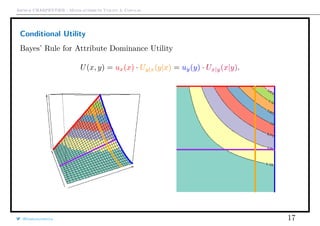
Bayes’ Rule for Attribute Dominance Utility
U(x, y) = ux(x) · Uy|x(y|x) = uy(y) · Ux|y(x|y).
@freakonometrics 17
Arthur CHARPENTIER - Multi-attribute Utility & Copulas
Copula Structures for Attribute Dominance Utility
With two attributes, consider U(x, y) = C(ux(x), uy(y))
Since copulas are related to probability measures, function C are 2-increasing.
C is the cumulative didstribution function of some U, and
P(U ∈ [a, b]) ≥ 0
implies positive mixed partial derivatives,
∂2
C(u, v)
∂u∂v
≥ 0 (weaker condition exist).
Not a necessary condition for attribute dominance utility theory...
@freakonometrics 18
Arthur CHARPENTIER - Multi-attribute Utility & Copulas
Understanding the Two Attribute Framework
C might be on a normalized domain, with a normalized range C : [0, 1]2
→ [0, 1],
with C(0, 0) = 0 and C(1, 1) = 1.
From Keeney & Raiffa (1976)
X independent of Y (preferences for lotteries over x do not depend on y)
U(x, y) = k2(y)U(x, y0) + d2(y)
Y independent of X (preferences for lotteries over y do not depend on x)
U(x, y) = k1(x)U(x0, y) + d1(x)
C should satisfy some marginal property: there are u0 and v0 such that
C(u0, v) = αu0
v + βu0
and C(u, v0) = αv0
u + βv0
.
Margins are non decreasing,
∂C(u, v)
∂u
> 0 and
∂C(u, v)
∂v
> 0.
@freakonometrics 19
Arthur CHARPENTIER - Multi-attribute Utility & Copulas
Understanding the Two Attribute Framework
Abbas & Howard (2005) defined some Class 1 Multiattribute Utility Copulas such
that
C(1, v) = αu0 v + βu0 and C(u, 1) = αv0 u + βv0 .
Proposition Any multi-attribute utility function U(x1, · · · , xn) that is
continuous, bounded and strictly increasing in each argument can be expressed in
terms of its marginal utility functions u1(x1), · · · , un(xn) and some class 1
multiattribute utility copula
U(x1, · · · , xn) = C[u1(x1), · · · , un(xn)].
@freakonometrics 20
Arthur CHARPENTIER - Multi-attribute Utility & Copulas
Archimedean Copulas
On probability cumulative distribution functions
C(u1, · · · , ud) = φ−1
(φ(u1) + · · · + φ(ud)) = φ−1


n
j=1
φ(uj)


with φ : [0, 1] → R+ an additive generator, or with ψ = φ−1
completely monotone
C(u1, · · · , ud) = ψ(ψ−1
(u1) + · · · + ψ−1
(ud)) = ψ


n
j=1
ψ−1
(uj)


One can define some mutiplicative generator, λ(t) = e−φ(t)
C(u1, · · · , ud) = λ−1
(λ(u1) × · · · × λ(ud)) = λ−1


n
j=1
λ−1
(uj)


E.g. φ(t) = − log(t) or λ(t) = t, independent copula, C = Π = C⊥
@freakonometrics 21
Arthur CHARPENTIER - Multi-attribute Utility & Copulas
Archimedean Utility Copulas
In the context of utility functions,
C(v1, · · · , vd) = αψ−1
d
i=1
ψ(γi + [1 − γi]vi) + [1 − α]
with γi ∈ [0, 1], and such that a = ψ−1
d
i=1
ψ(γi)
−1
.
ψ continuous strictly increasing, ψ(0) = 0 and ψ(1) = 1.
E.g. ψ(t) = t, then
C(v1, v2) = α[γ1 + (1 − γ1)v1][γ2 + (1 − γ2)v2] + (1 − α)
i.e. multiplicative form of mutual independence.
@freakonometrics 22
Arthur CHARPENTIER - Multi-attribute Utility & Copulas
Alternative to this Two Attribute Framework
By relaxing the condition of ‘attribute dominance’, Abbas & Howard (2005)
defined some Class 2 Multiattribute Utility Copulas such that
C(0, v) = αu0
v + βu0
and C(u, 0) = αv0
u + βv0
.
Define a multiattribute utility copula C as a multivariate function of d variables
satisfying C : [0, 1]d
→ [0, 1], with C(0) = 0, C(1) = 1, the following marginal
property
C(0, · · · , 0, vi, 0, · · · , 0) = αivi + βi, with αi > 0
and with ∂C(v)/∂vi > 0
@freakonometrics 23
Arthur CHARPENTIER - Multi-attribute Utility & Copulas
Alternative to this Two Attribute Framework
To define some Class 2 Archimedean utility copulas, let h be continuous on [0, d],
strictly increasing, with h(0) = 1 and h(1)d
≤ h(d). Then set
C(v1, · · · , vd) =
h−1 d
j=1 h(ωjvj)
h−1 d
j=1 h(ωj)
, with 0 ≤ ωj ≤ 1.
E.g. h(t) = et
, then C(U1(x1), · · · , Ud(xd)) = ω1U1(x1) + · · · + ωdUd(xd), where
ωj = ωj/[ω1 + · · · + ωd], i.e. additive form of utility independence.
@freakonometrics 24
Arthur CHARPENTIER - Multi-attribute Utility & Copulas
One-Switch Utility Independence
Introduced in Abbas & Bell (2011)
Consider two attributes x and y, utility function U(x, y).
x is one-switch independent of y if and only if the ordering of any two lotteries
over x switches at most once as y increases
Proposition x is one-switch independent of y if and only if
U(x, y) = g0(y) + g1(y)[f1(x) + f2(x) · ϕ(y)]
where g1 has a constant sign, and ϕ is monotone.
@freakonometrics 25
Arthur CHARPENTIER - Multi-attribute Utility & Copulas
One-Switch Utility Independence
U(x, y) = g0(y) + g1(y)[f1(x) + f2(x)ϕ(y)]
It is possible to express those function in terms of utility
- g0(y) = U(x, y)
- g1(y) = [U(x, y) − U(x, y)]
- f1(x) = U(x|y)
- f2(x) = [U(x|y) − U(x|y)]
ϕ(y) =
U(x|y) − U(x|y)
U(x|y) − U(x|y)
@freakonometrics 26
Arthur CHARPENTIER - Multi-attribute Utility & Copulas
Utility Trees and Bidirectional Utility Diagrams
From Abbas (2011), let x = (xi, x(i))
Condister the normalized conditional utility for xi at x,
U(xi|x(i)) =
U(xi, x(i)) − U(xi, x(i))
Note that
U(xi, x(i)) = U(xi, x(i)) · U(xi|x(i)) + U(xi, x(i)) · [1 − U(xi|x(i))]
Thus, for two attributes
U(x, y) = U(x, y) · U(x|y) + U(x, y) · [1 − U(x|y)]
@freakonometrics 27
Arthur CHARPENTIER - Multi-attribute Utility & Copulas
Utility Trees and Bidirectional Utility Diagrams
U(x, y) = U(x, y) · U(x|y) + U(x, y) · [1 − U(x|y)]
But it is also possible to expand it
U(x, y) = U(x, y)
=U(y|x)·U(x,y)
+[1−U(y|x)]·U(x,y)
U(x|y) + U(x, y)
=U(y|x)·U(x,y)
+[1−U(y|x)]·U(x,y)
[1 − U(x|y)]
which give four terms.
Simplified version can be obtained with additional assumptions:
Utility independence, U(x|y) = U(x|y) = U(x|y) ∀y
Boundary independence, U(x|y) = U(x|y)
@freakonometrics 28
Arthur CHARPENTIER - Multi-attribute Utility & Copulas
Utility Trees and Bidirectional Utility Diagrams
U(x, y) = U(x, y)
=U(y|x)·U(x,y)
+[1−U(y|x)]·U(x,y)
U(x|y) + U(x, y)
=U(y|x)·U(x,y)
+[1−U(y|x)]·U(x,y)
[1 − U(x|y)]
@freakonometrics 29
Arthur CHARPENTIER - Multi-attribute Utility & Copulas
Utility Trees and Bidirectional Utility Diagrams
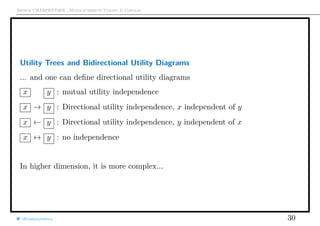
... and one can define directional utility diagrams
x ↔ y : mutual utility independence
x → y : Directional utility independence, x independent of y
x ← y : Directional utility independence, y independent of x
x ↔ y : no independence
In higher dimension, it is more complex...
@freakonometrics 30
Arthur CHARPENTIER - Multi-attribute Utility & Copulas
Abbas, A. E, R. A. Howard. 2005. Attribute Dominance Utility. Decisions Analysis, 2 (4)
Abbas, A. E and D. E. Bell. 2011. One-Switch Independence for Multiattribute Utility
Functions, Operations Research, 59(3) 764-771.
Abbas, A. E. 2009. Multiattribute Utility Copulas. Operations Research, 57 (6), 1367-1383.
Abbas, A. E. 2013. Utility Copula Functions Matching all Boundary Assessments. Operations
Research, 61(2), 359-371.
Abbas, A. E. 2011. General Decompositions of Multiattribute Utility Functions. J.
Multicriteria Decision Analysis, 17 (1, 2), 37–59.
Abbas, A.E and D.E. Bell. 2011. One-Switch Independence for Multiattribute Utility
Functions. Operations Research, 59 (3) 764-771.
Abbas, A.E. 2011. The Multiattribute Utility Tree. Decision Analysis, 8 (3), 165-169 .
Abbas, A.E. 2011. Decomposing the Cross-Derivatives of a Multiattribute Utility Function into
Risk Attitude and Value. Decision Analysis, 8 (2) 103-116.
Clemen, R.T. and T. Reilly. 1999. Correlations and Copulas for Decision and Risk Analysis.
Management Science, Vol 45, No. 2.
Keeney, R.L., H. Raiffa. 1976. Decisions with Multiple Objectives. Wiley
Matheson, J.E., R.A. Howard. 1968. An Introduction to Decision Analysis in The Principles
and Applications of Decision Analysis.
@freakonometrics 31

Multiattribute utility copula

  • 1.
    Arthur CHARPENTIER -Multi-attribute Utility & Copulas Multi-Attribute Utility & Copulas (based on Ali E. Abbas contributions) A. Charpentier (Université de Rennes 1 & UQàM) Université de Rennes 1 Workshop, April 2016. http://freakonometrics.hypotheses.org @freakonometrics 1
  • 2.
    Arthur CHARPENTIER -Multi-attribute Utility & Copulas Olivier’s Talk, part 2, on Independence & Additivity @freakonometrics 2
  • 3.
    Arthur CHARPENTIER -Multi-attribute Utility & Copulas Olivier’s Talk, part 2, on Utility Independence see also Keeney & Raiffa (1976) @freakonometrics 3
  • 4.
    Arthur CHARPENTIER -Multi-attribute Utility & Copulas Olivier’s Talk, part 2, on Mutual Utility Independence @freakonometrics 4
  • 5.
    Arthur CHARPENTIER -Multi-attribute Utility & Copulas Olivier’s Talk, part 2, on Additive Utility Independence @freakonometrics 5
  • 6.
    Arthur CHARPENTIER -Multi-attribute Utility & Copulas Olivier’s Talk, part 2, on Additive Utility Independence @freakonometrics 6
  • 7.
    Arthur CHARPENTIER -Multi-attribute Utility & Copulas Olivier’s Talk, part 2, on Mutual Utility Independence @freakonometrics 7
  • 8.
    Arthur CHARPENTIER -Multi-attribute Utility & Copulas Olivier’s Talk, part 2, on Mutual Utility Independence @freakonometrics 8
  • 9.
    Arthur CHARPENTIER -Multi-attribute Utility & Copulas What are we looking for? See Sklar (1959) for cumulative distribution function for random vector X ∈ Rn , F(x1, · · · , xn) = C[F1(x), · · · , Fn(xn)] where F(x) = P[X ≤ x] and Fi(xi) = P[Xi ≤ xi]. @freakonometrics 9
  • 10.
    Arthur CHARPENTIER -Multi-attribute Utility & Copulas What are we looking for? @freakonometrics 10
  • 11.
    Arthur CHARPENTIER -Multi-attribute Utility & Copulas Historical Perspective When everything else remains constant which do you prefer (x1, y1) or (x2, y2) X can be consumption Y can be health (remaining life time expectancy) Matheson & Howard (1968) : use a deterministic real-valued function V : Rd → R and then use a utility function over the value function, U(x) = U(x1, · · · , xd) = u(V (x1, · · · , xd)), e.g. U(x) = u(x1 + · · · + xd) or u(min{x1, · · · , xd}). @freakonometrics 11
  • 12.
    Arthur CHARPENTIER -Multi-attribute Utility & Copulas Historical Perspective See Matheson & Abbas (2005), e.g. V (x, y) = xyη , see also Sheldon’s acoustic sweet spot or peanut butter/jelly sandwich preference function @freakonometrics 12
  • 13.
    Arthur CHARPENTIER -Multi-attribute Utility & Copulas Historical Perspective Alternative approach: assesss utilities over individual attributes, and combine time into a functional form Keeney & Raiffa (1976) : use some utility independence assumption Mutual utility independence : U(x, y) = kxux(x) + kyuy(y) + kxyux(x)uy(y) where kxy = 1 − kx − ky Additive and Product forms U(x, y) = kxux(x) + kyuy(y) with kx − ky = 1 U(x, y) = kxyux(x)uy(y) Utility Independence is an intersting property, but it might be a simplifying one. @freakonometrics 13
  • 14.
    Arthur CHARPENTIER -Multi-attribute Utility & Copulas How to Construct Multi-Attribute Utility Functions From Abbas & Howard (2005), in dimension d = 2, U(x, y) ∈ [0, 1] (normalization ) U(x, y) = U(x, y) = 0 (attribute dominance condition) @freakonometrics 14
  • 15.
    Arthur CHARPENTIER -Multi-attribute Utility & Copulas How to Construct Multi-Attribute Utility Functions Non-decreasing with arguments: • given y, x1 < x2 implies (x1, y) (x2, y) • given x, y1 < y2 implies (x, y1) (x, y2) U(x, y) = ux(x) and U(x, y) = uy(y) @freakonometrics 15
  • 16.
    Arthur CHARPENTIER -Multi-attribute Utility & Copulas Conditional Utility We can define conditional utility Uy|x(y|x) = U(x, y) ux(x) @freakonometrics 16
  • 17.
    Arthur CHARPENTIER -Multi-attribute Utility & Copulas Conditional Utility Bayes’ Rule for Attribute Dominance Utility U(x, y) = ux(x) · Uy|x(y|x) = uy(y) · Ux|y(x|y). @freakonometrics 17
  • 18.
    Arthur CHARPENTIER -Multi-attribute Utility & Copulas Copula Structures for Attribute Dominance Utility With two attributes, consider U(x, y) = C(ux(x), uy(y)) Since copulas are related to probability measures, function C are 2-increasing. C is the cumulative didstribution function of some U, and P(U ∈ [a, b]) ≥ 0 implies positive mixed partial derivatives, ∂2 C(u, v) ∂u∂v ≥ 0 (weaker condition exist). Not a necessary condition for attribute dominance utility theory... @freakonometrics 18
  • 19.
    Arthur CHARPENTIER -Multi-attribute Utility & Copulas Understanding the Two Attribute Framework C might be on a normalized domain, with a normalized range C : [0, 1]2 → [0, 1], with C(0, 0) = 0 and C(1, 1) = 1. From Keeney & Raiffa (1976) X independent of Y (preferences for lotteries over x do not depend on y) U(x, y) = k2(y)U(x, y0) + d2(y) Y independent of X (preferences for lotteries over y do not depend on x) U(x, y) = k1(x)U(x0, y) + d1(x) C should satisfy some marginal property: there are u0 and v0 such that C(u0, v) = αu0 v + βu0 and C(u, v0) = αv0 u + βv0 . Margins are non decreasing, ∂C(u, v) ∂u > 0 and ∂C(u, v) ∂v > 0. @freakonometrics 19
  • 20.
    Arthur CHARPENTIER -Multi-attribute Utility & Copulas Understanding the Two Attribute Framework Abbas & Howard (2005) defined some Class 1 Multiattribute Utility Copulas such that C(1, v) = αu0 v + βu0 and C(u, 1) = αv0 u + βv0 . Proposition Any multi-attribute utility function U(x1, · · · , xn) that is continuous, bounded and strictly increasing in each argument can be expressed in terms of its marginal utility functions u1(x1), · · · , un(xn) and some class 1 multiattribute utility copula U(x1, · · · , xn) = C[u1(x1), · · · , un(xn)]. @freakonometrics 20
  • 21.
    Arthur CHARPENTIER -Multi-attribute Utility & Copulas Archimedean Copulas On probability cumulative distribution functions C(u1, · · · , ud) = φ−1 (φ(u1) + · · · + φ(ud)) = φ−1   n j=1 φ(uj)   with φ : [0, 1] → R+ an additive generator, or with ψ = φ−1 completely monotone C(u1, · · · , ud) = ψ(ψ−1 (u1) + · · · + ψ−1 (ud)) = ψ   n j=1 ψ−1 (uj)   One can define some mutiplicative generator, λ(t) = e−φ(t) C(u1, · · · , ud) = λ−1 (λ(u1) × · · · × λ(ud)) = λ−1   n j=1 λ−1 (uj)   E.g. φ(t) = − log(t) or λ(t) = t, independent copula, C = Π = C⊥ @freakonometrics 21
  • 22.
    Arthur CHARPENTIER -Multi-attribute Utility & Copulas Archimedean Utility Copulas In the context of utility functions, C(v1, · · · , vd) = αψ−1 d i=1 ψ(γi + [1 − γi]vi) + [1 − α] with γi ∈ [0, 1], and such that a = ψ−1 d i=1 ψ(γi) −1 . ψ continuous strictly increasing, ψ(0) = 0 and ψ(1) = 1. E.g. ψ(t) = t, then C(v1, v2) = α[γ1 + (1 − γ1)v1][γ2 + (1 − γ2)v2] + (1 − α) i.e. multiplicative form of mutual independence. @freakonometrics 22
  • 23.
    Arthur CHARPENTIER -Multi-attribute Utility & Copulas Alternative to this Two Attribute Framework By relaxing the condition of ‘attribute dominance’, Abbas & Howard (2005) defined some Class 2 Multiattribute Utility Copulas such that C(0, v) = αu0 v + βu0 and C(u, 0) = αv0 u + βv0 . Define a multiattribute utility copula C as a multivariate function of d variables satisfying C : [0, 1]d → [0, 1], with C(0) = 0, C(1) = 1, the following marginal property C(0, · · · , 0, vi, 0, · · · , 0) = αivi + βi, with αi > 0 and with ∂C(v)/∂vi > 0 @freakonometrics 23
  • 24.
    Arthur CHARPENTIER -Multi-attribute Utility & Copulas Alternative to this Two Attribute Framework To define some Class 2 Archimedean utility copulas, let h be continuous on [0, d], strictly increasing, with h(0) = 1 and h(1)d ≤ h(d). Then set C(v1, · · · , vd) = h−1 d j=1 h(ωjvj) h−1 d j=1 h(ωj) , with 0 ≤ ωj ≤ 1. E.g. h(t) = et , then C(U1(x1), · · · , Ud(xd)) = ω1U1(x1) + · · · + ωdUd(xd), where ωj = ωj/[ω1 + · · · + ωd], i.e. additive form of utility independence. @freakonometrics 24
  • 25.
    Arthur CHARPENTIER -Multi-attribute Utility & Copulas One-Switch Utility Independence Introduced in Abbas & Bell (2011) Consider two attributes x and y, utility function U(x, y). x is one-switch independent of y if and only if the ordering of any two lotteries over x switches at most once as y increases Proposition x is one-switch independent of y if and only if U(x, y) = g0(y) + g1(y)[f1(x) + f2(x) · ϕ(y)] where g1 has a constant sign, and ϕ is monotone. @freakonometrics 25
  • 26.
    Arthur CHARPENTIER -Multi-attribute Utility & Copulas One-Switch Utility Independence U(x, y) = g0(y) + g1(y)[f1(x) + f2(x)ϕ(y)] It is possible to express those function in terms of utility - g0(y) = U(x, y) - g1(y) = [U(x, y) − U(x, y)] - f1(x) = U(x|y) - f2(x) = [U(x|y) − U(x|y)] ϕ(y) = U(x|y) − U(x|y) U(x|y) − U(x|y) @freakonometrics 26
  • 27.
    Arthur CHARPENTIER -Multi-attribute Utility & Copulas Utility Trees and Bidirectional Utility Diagrams From Abbas (2011), let x = (xi, x(i)) Condister the normalized conditional utility for xi at x, U(xi|x(i)) = U(xi, x(i)) − U(xi, x(i)) U(xi, x(i)) − U(xi, x(i)) Note that U(xi, x(i)) = U(xi, x(i)) · U(xi|x(i)) + U(xi, x(i)) · [1 − U(xi|x(i))] Thus, for two attributes U(x, y) = U(x, y) · U(x|y) + U(x, y) · [1 − U(x|y)] @freakonometrics 27
  • 28.
    Arthur CHARPENTIER -Multi-attribute Utility & Copulas Utility Trees and Bidirectional Utility Diagrams U(x, y) = U(x, y) · U(x|y) + U(x, y) · [1 − U(x|y)] But it is also possible to expand it U(x, y) = U(x, y) =U(y|x)·U(x,y) +[1−U(y|x)]·U(x,y) U(x|y) + U(x, y) =U(y|x)·U(x,y) +[1−U(y|x)]·U(x,y) [1 − U(x|y)] which give four terms. Simplified version can be obtained with additional assumptions: Utility independence, U(x|y) = U(x|y) = U(x|y) ∀y Boundary independence, U(x|y) = U(x|y) @freakonometrics 28
  • 29.
    Arthur CHARPENTIER -Multi-attribute Utility & Copulas Utility Trees and Bidirectional Utility Diagrams U(x, y) = U(x, y) =U(y|x)·U(x,y) +[1−U(y|x)]·U(x,y) U(x|y) + U(x, y) =U(y|x)·U(x,y) +[1−U(y|x)]·U(x,y) [1 − U(x|y)] @freakonometrics 29
  • 30.
    Arthur CHARPENTIER -Multi-attribute Utility & Copulas Utility Trees and Bidirectional Utility Diagrams ... and one can define directional utility diagrams x ↔ y : mutual utility independence x → y : Directional utility independence, x independent of y x ← y : Directional utility independence, y independent of x x ↔ y : no independence In higher dimension, it is more complex... @freakonometrics 30
  • 31.
    Arthur CHARPENTIER -Multi-attribute Utility & Copulas Abbas, A. E, R. A. Howard. 2005. Attribute Dominance Utility. Decisions Analysis, 2 (4) Abbas, A. E and D. E. Bell. 2011. One-Switch Independence for Multiattribute Utility Functions, Operations Research, 59(3) 764-771. Abbas, A. E. 2009. Multiattribute Utility Copulas. Operations Research, 57 (6), 1367-1383. Abbas, A. E. 2013. Utility Copula Functions Matching all Boundary Assessments. Operations Research, 61(2), 359-371. Abbas, A. E. 2011. General Decompositions of Multiattribute Utility Functions. J. Multicriteria Decision Analysis, 17 (1, 2), 37–59. Abbas, A.E and D.E. Bell. 2011. One-Switch Independence for Multiattribute Utility Functions. Operations Research, 59 (3) 764-771. Abbas, A.E. 2011. The Multiattribute Utility Tree. Decision Analysis, 8 (3), 165-169 . Abbas, A.E. 2011. Decomposing the Cross-Derivatives of a Multiattribute Utility Function into Risk Attitude and Value. Decision Analysis, 8 (2) 103-116. Clemen, R.T. and T. Reilly. 1999. Correlations and Copulas for Decision and Risk Analysis. Management Science, Vol 45, No. 2. Keeney, R.L., H. Raiffa. 1976. Decisions with Multiple Objectives. Wiley Matheson, J.E., R.A. Howard. 1968. An Introduction to Decision Analysis in The Principles and Applications of Decision Analysis. @freakonometrics 31