IMPROPER
INTEGRALS
NEIL JOSHUA B. BURLAS
IMPROPER INTEGRALS
The definition of a definite integral requires that
the interval [a, b] be finite. Furthermore, the
Fundamental Theorem of Calculus, by which you have
been evaluating definite integrals, requires that the
function be continuous on [a, b]. In this topic, you will
study a procedure for evaluating integrals that do not
satisfy these requirements.
IMPROPER INTEGRALS
An Improper Integral is a definite integral in which:
a.One or both of the limits of integration are infinite; or
b.The given function has an infinite discontinuity on the
interval [a,b]
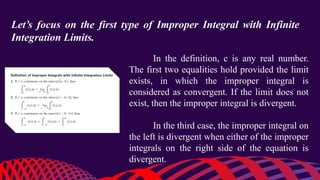
Let’s focus on the first type of Improper Integral with Infinite
Integration Limits.
Let’s focus on the first type of Improper Integral with Infinite
Integration Limits.
In the definition, c is any real number.
The first two equalities hold provided the limit
exists, in which the improper integral is
considered as convergent. If the limit does not
exist, then the improper integral is divergent.
In the third case, the improper integral on
the left is divergent when either of the improper
integrals on the right side of the equation is
divergent.
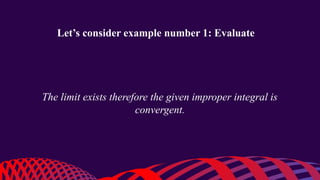
Let’s consider example number 1: Evaluate
The limit exists therefore the given improper integral is
convergent.
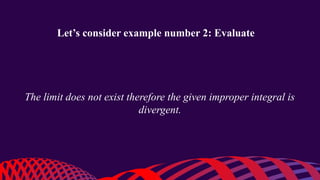
Let’s consider example number 2: Evaluate
The limit does not exist therefore the given improper integral is
divergent.
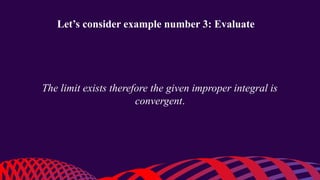
Let’s consider example number 3: Evaluate
The limit exists therefore the given improper integral is
convergent.
Let’s consider example number 4: Evaluate
We can write it as:
Evaluating the first improper integral:
Evaluating the second improper integral:
Simplifying:
Since the improper integrals on the right side of the
equation are both convergent, therefore the given improper
integral on the left is convergent.
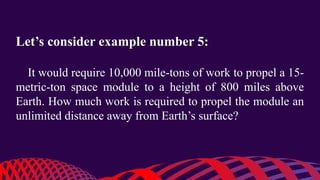
Let’s consider example number 5:
It would require 10,000 mile-tons of work to propel a 15-
metric-ton space module to a height of 800 miles above
Earth. How much work is required to propel the module an
unlimited distance away from Earth’s surface?
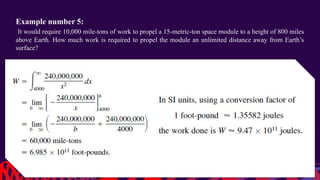
Example number 5:
It would require 10,000 mile-tons of work to propel a 15-metric-ton space module to a height of 800 miles
above Earth. How much work is required to propel the module an unlimited distance away from Earth’s
surface?
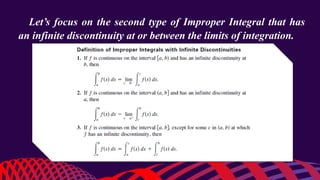
Let’s focus on the second type of Improper Integral that has
an infinite discontinuity at or between the limits of integration.
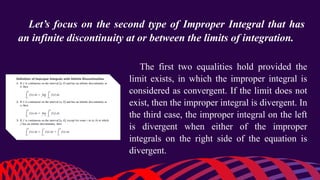
Let’s focus on the second type of Improper Integral that has
an infinite discontinuity at or between the limits of integration.
The first two equalities hold provided the
limit exists, in which the improper integral is
considered as convergent. If the limit does not
exist, then the improper integral is divergent. In
the third case, the improper integral on the left
is divergent when either of the improper
integrals on the right side of the equation is
divergent.
Let’s consider example number 1: Evaluate
The integrand has an infinite discontinuity at x=0
The limit exists therefore the given improper integral is
convergent.
Let’s consider example number 2: Evaluate
The integrand has an infinite discontinuity at x=0
The limit does not exist therefore the given improper integral is
divergent
Let’s consider example number 3: Evaluate
The integrand has an infinite discontinuity at
x=0
We can write it as:
Evaluating the first improper integral:
One of the integrals is divergent, that means the integral
that we were asked to evaluate is divergent.
THANK YOU

integral calculus-IMPROPER INTEGRALS.ppsx

  • 1.
  • 2.
    IMPROPER INTEGRALS The definitionof a definite integral requires that the interval [a, b] be finite. Furthermore, the Fundamental Theorem of Calculus, by which you have been evaluating definite integrals, requires that the function be continuous on [a, b]. In this topic, you will study a procedure for evaluating integrals that do not satisfy these requirements.
  • 3.
    IMPROPER INTEGRALS An ImproperIntegral is a definite integral in which: a.One or both of the limits of integration are infinite; or b.The given function has an infinite discontinuity on the interval [a,b]
  • 4.
    Let’s focus onthe first type of Improper Integral with Infinite Integration Limits.
  • 5.
    Let’s focus onthe first type of Improper Integral with Infinite Integration Limits. In the definition, c is any real number. The first two equalities hold provided the limit exists, in which the improper integral is considered as convergent. If the limit does not exist, then the improper integral is divergent. In the third case, the improper integral on the left is divergent when either of the improper integrals on the right side of the equation is divergent.
  • 6.
    Let’s consider examplenumber 1: Evaluate The limit exists therefore the given improper integral is convergent.
  • 7.
    Let’s consider examplenumber 2: Evaluate The limit does not exist therefore the given improper integral is divergent.
  • 8.
    Let’s consider examplenumber 3: Evaluate The limit exists therefore the given improper integral is convergent.
  • 9.
    Let’s consider examplenumber 4: Evaluate We can write it as:
  • 10.
    Evaluating the firstimproper integral: Evaluating the second improper integral:
  • 11.
    Simplifying: Since the improperintegrals on the right side of the equation are both convergent, therefore the given improper integral on the left is convergent.
  • 12.
    Let’s consider examplenumber 5: It would require 10,000 mile-tons of work to propel a 15- metric-ton space module to a height of 800 miles above Earth. How much work is required to propel the module an unlimited distance away from Earth’s surface?
  • 13.
    Example number 5: Itwould require 10,000 mile-tons of work to propel a 15-metric-ton space module to a height of 800 miles above Earth. How much work is required to propel the module an unlimited distance away from Earth’s surface?
  • 14.
    Let’s focus onthe second type of Improper Integral that has an infinite discontinuity at or between the limits of integration.
  • 15.
    Let’s focus onthe second type of Improper Integral that has an infinite discontinuity at or between the limits of integration. The first two equalities hold provided the limit exists, in which the improper integral is considered as convergent. If the limit does not exist, then the improper integral is divergent. In the third case, the improper integral on the left is divergent when either of the improper integrals on the right side of the equation is divergent.
  • 16.
    Let’s consider examplenumber 1: Evaluate The integrand has an infinite discontinuity at x=0 The limit exists therefore the given improper integral is convergent.
  • 17.
    Let’s consider examplenumber 2: Evaluate The integrand has an infinite discontinuity at x=0 The limit does not exist therefore the given improper integral is divergent
  • 18.
    Let’s consider examplenumber 3: Evaluate The integrand has an infinite discontinuity at x=0 We can write it as:
  • 19.
    Evaluating the firstimproper integral: One of the integrals is divergent, that means the integral that we were asked to evaluate is divergent.
  • 20.