 Advantages
 Improved traction and handling
 Able to transmit more power to the wheels
 Disadvantages
 Higher initial cost and weight
 Requires special service and maintenance
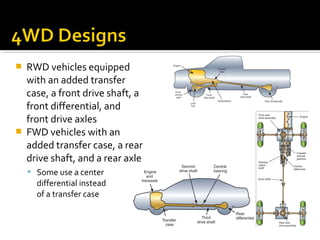
 RWD vehicles equipped
with an added transfer
case, a front drive shaft, a
front differential, and
front drive axles
 FWD vehicles with an
added transfer case, a rear
drive shaft, and a rear axle
 Some use a center
differential instead
of a transfer case
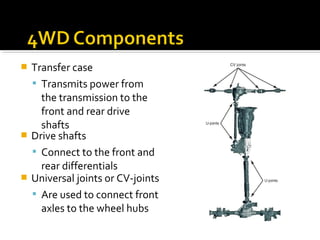
 Transfer case
 Transmits power from
the transmission to the
front and rear drive
shafts
 Drive shafts
 Connect to the front and
rear differentials
 Universal joints or CV-joints
 Are used to connect front
axles to the wheel hubs
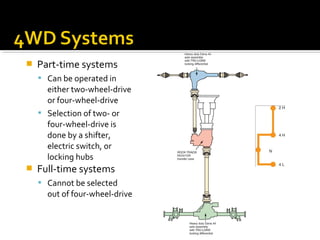
 Part-time systems
 Can be operated in
either two-wheel-drive
or four-wheel-drive
 Selection of two- or
four-wheel-drive is
done by a shifter,
electric switch, or
locking hubs
 Full-time systems
 Cannot be selected
out of four-wheel-drive
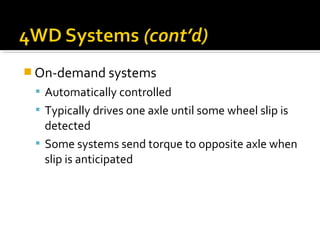
 On-demand systems
 Automatically controlled
 Typically drives one axle until some wheel slip is
detected
 Some systems send torque to opposite axle when
slip is anticipated
 Difficult to clearly define the difference
between 4WD
 Primary difference is the transfer case
 4WD offers two speed ratios: high and low
 AWD does not have a “low”
 Constantly provides power to all four wheels
 Does not give the driver the option of 2WD or
4WD
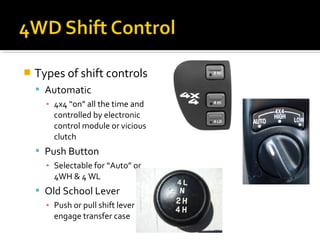
 Types of shift controls
 Automatic
▪ 4x4 “on” all the time and
controlled by electronic
control module or vicious
clutch
 Push Button
▪ Selectable for “Auto” or
4WH & 4 WL
 Old School Lever
▪ Push or pull shift lever to
engage transfer case
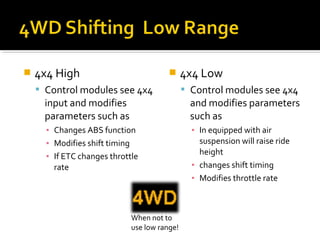
 4x4 High
 Control modules see 4x4
input and modifies
parameters such as
▪ Changes ABS function
▪ Modifies shift timing
▪ If ETC changes throttle
rate
 4x4 Low
 Control modules see 4x4
and modifies parameters
such as
▪ In equipped with air
suspension will raise ride
height
▪ changes shift timing
▪ Modifies throttle rate
When not to
use low range!
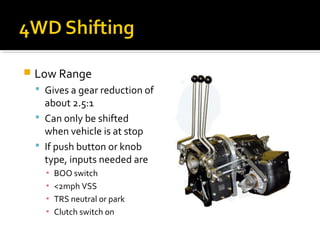
 Low Range
 Gives a gear reduction of
about 2.5:1
 Can only be shifted
when vehicle is at stop
 If push button or knob
type, inputs needed are
▪ BOO switch
▪ <2mph VSS
▪ TRS neutral or park
▪ Clutch switch on
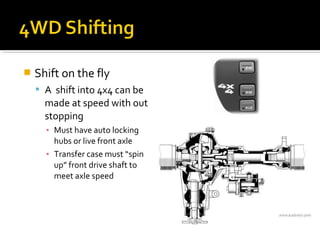
 Shift on the fly
 A shift into 4x4 can be
made at speed with out
stopping
▪ Must have auto locking
hubs or live front axle
▪ Transfer case must “spin
up” front drive shaft to
meet axle speed
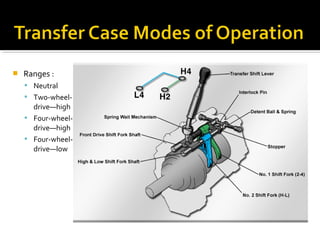
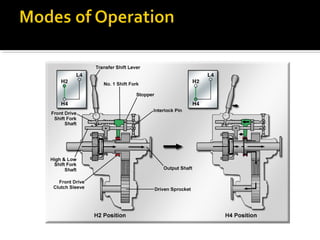
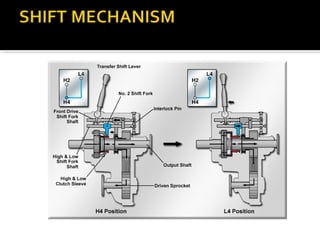
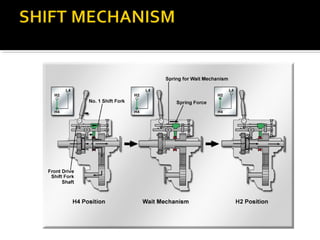
 Ranges :
 Neutral
 Two-wheel-
drive—high
 Four-wheel-
drive—high
 Four-wheel-
drive—low
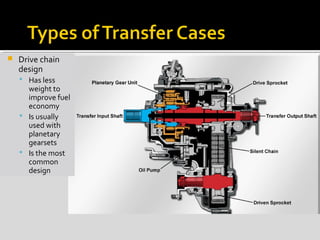
 Drive chain
design
 Has less
weight to
improve fuel
economy
 Is usually
used with
planetary
gearsets
 Is the most
common
design
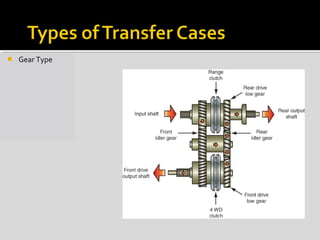
 Gear Type
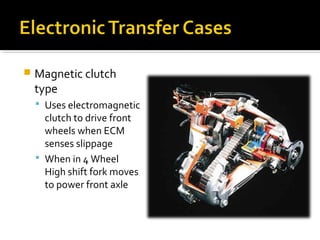
 Magnetic clutch
type
 Uses electromagnetic
clutch to drive front
wheels when ECM
senses slippage
 When in 4 Wheel
High shift fork moves
to power front axle
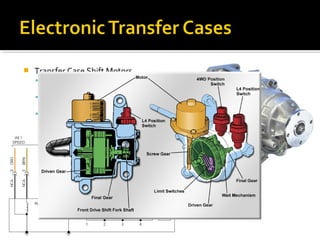
 Transfer Case Shift Motors
 Shift motor takes place of shift
lever
 Motor also has contacts to relay
position of motor
 Electronic “brake” built into motor
to prevent overrun of motor
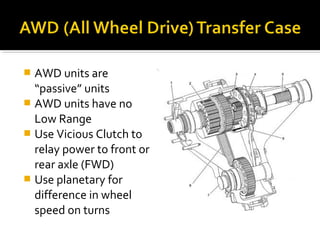
 AWD units are
“passive” units
 AWD units have no
Low Range
 Use Vicious Clutch to
relay power to front or
rear axle (FWD)
 Use planetary for
difference in wheel
speed on turns
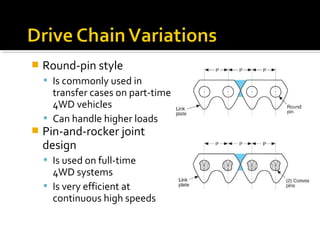
 Round-pin style
 Is commonly used in
transfer cases on part-time
4WD vehicles
 Can handle higher loads
 Pin-and-rocker joint
design
 Is used on full-time
4WD systems
 Is very efficient at
continuous high speeds
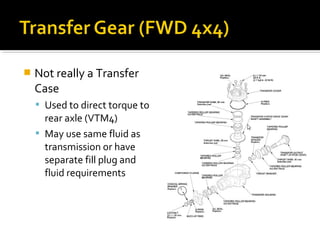
 Not really a Transfer
Case
 Used to direct torque to
rear axle (VTM4)
 May use same fluid as
transmission or have
separate fill plug and
fluid requirements
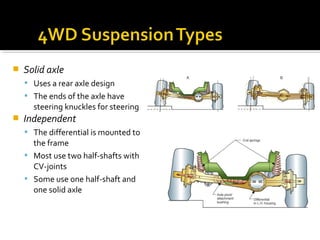
 Solid axle
 Uses a rear axle design
 The ends of the axle have
steering knuckles for steering
 Independent
 The differential is mounted to
the frame
 Most use two half-shafts with
CV-joints
 Some use one half-shaft and
one solid axle
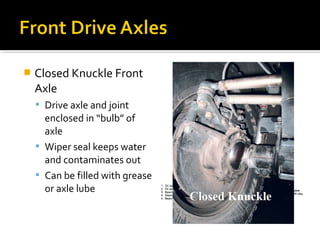
 Closed Knuckle Front
Axle
 Drive axle and joint
enclosed in “bulb” of
axle
 Wiper seal keeps water
and contaminates out
 Can be filled with grease
or axle lube
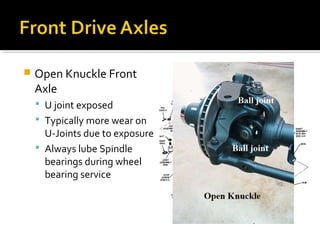
 Open Knuckle Front
Axle
 U joint exposed
 Typically more wear on
U-Joints due to exposure
 Always lube Spindle
bearings during wheel
bearing service
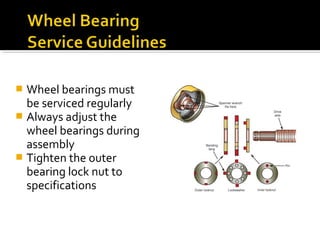
 Wheel bearings must
be serviced regularly
 Always adjust the
wheel bearings during
assembly
 Tighten the outer
bearing lock nut to
specifications
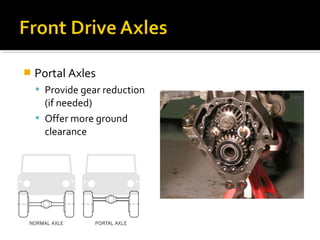
 Portal Axles
 Provide gear reduction
(if needed)
 Offer more ground
clearance
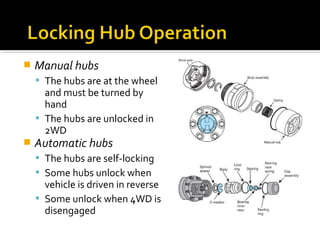
 Manual hubs
 The hubs are at the wheel
and must be turned by
hand
 The hubs are unlocked in
2WD
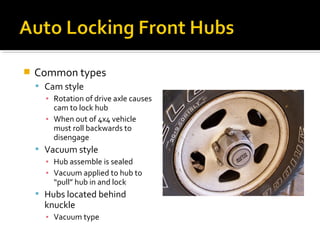
 Automatic hubs
 The hubs are self-locking
 Some hubs unlock when
vehicle is driven in reverse
 Some unlock when 4WD is
disengaged
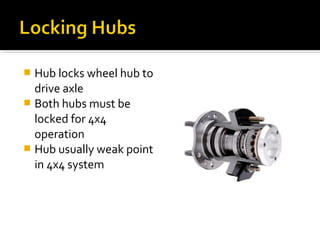
 Hub locks wheel hub to
drive axle
 Both hubs must be
locked for 4x4
operation
 Hub usually weak point
in 4x4 system
 Common types
 Cam style
▪ Rotation of drive axle causes
cam to lock hub
▪ When out of 4x4 vehicle
must roll backwards to
disengage
 Vacuum style
▪ Hub assemble is sealed
▪ Vacuum applied to hub to
“pull” hub in and lock
 Hubs located behind
knuckle
▪ Vacuum type
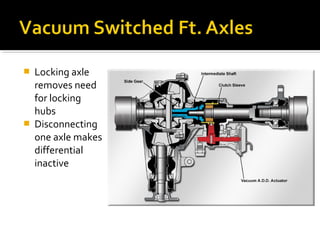
 Locking axle
removes need
for locking
hubs
 Disconnecting
one axle makes
differential
inactive
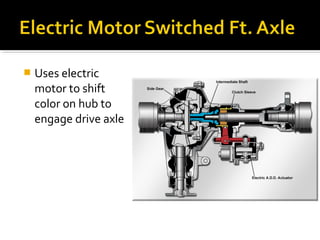
 Uses electric
motor to shift
color on hub to
engage drive axle
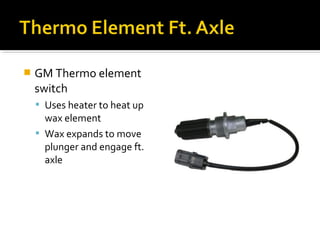
 GM Thermo element
switch
 Uses heater to heat up
wax element
 Wax expands to move
plunger and engage ft.
axle
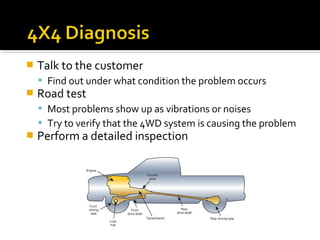
 Talk to the customer
 Find out under what condition the problem occurs
 Road test
 Most problems show up as vibrations or noises
 Try to verify that the 4WD system is causing the problem
 Perform a detailed inspection
 Noise or vibration is most noticeable at high speed
 Usually caused by a transfer case problem, bent drive
shaft, or bad wheel bearings
 Noise or vibration is most noticeable at low speed
 Usually caused by bad U-joints
 Noise or vibration is most noticeable while turning
 Usually caused by worn outboard axle joints
 Noise or vibration is most noticeable when
traveling over bumps
 Usually caused by suspension components
 Noise or vibration is most noticeable with
changes in throttle position
 Usually caused by U-joints or worn driveshaft
splines
 Common complaint on all transfer cases is
the inability to go from 4WD to 2WD
 It is common for these units to get spline-
locked
 If transfer case jumps out of gear, suspect
improperly adjusted shift linkage, loose
mounting bolts or brackets, worn front/rear
drive-shaft slip yokes, or a damaged sliding
clutch hub
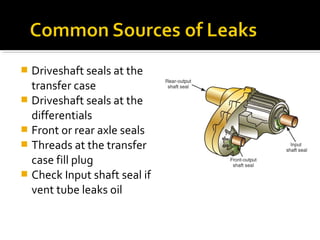
 Driveshaft seals at the
transfer case
 Driveshaft seals at the
differentials
 Front or rear axle seals
 Threads at the transfer
case fill plug
 Check Input shaft seal if
vent tube leaks oil
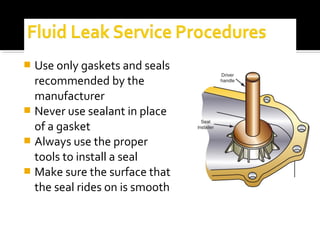
 Use only gaskets and seals
recommended by the
manufacturer
 Never use sealant in place
of a gasket
 Always use the proper
tools to install a seal
 Make sure the surface that
the seal rides on is smooth
 Vacuum-controlled transfer case
 Verify that the engine is producing at least 15 inches of
vacuum
 Mechanically-controlled transfer case
 Make sure the shift linkage is tight and lubricated
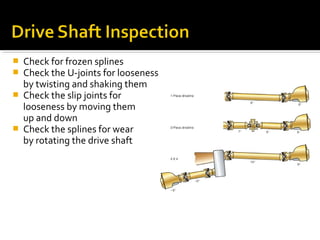
 Check for frozen splines
 Check the U-joints for looseness
by twisting and shaking them
 Check the slip joints for
looseness by moving them
up and down
 Check the splines for wear
by rotating the drive shaft
 Front hubs may make a ratcheting sound
when water or dirt has entered the hub and
contaminated the lubricant
 May indicated that the hub on the opposite
side of the axle is not disengaging
 Locking hubs can be checked by rotating the
brake drum or rotor and turning the hub
selector into the locked position
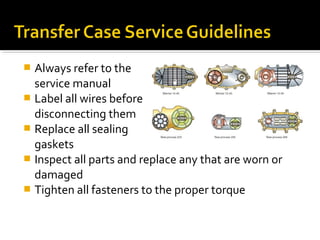
 Always refer to the
service manual
 Label all wires before
disconnecting them
 Replace all sealing
gaskets
 Inspect all parts and replace any that are worn or
damaged
 Tighten all fasteners to the proper torque
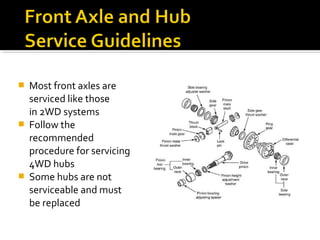
 Most front axles are
serviced like those
in 2WD systems
 Follow the
recommended
procedure for servicing
4WD hubs
 Some hubs are not
serviceable and must
be replaced
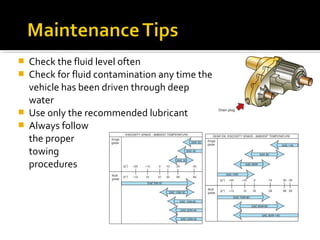
 Check the fluid level often
 Check for fluid contamination any time the
vehicle has been driven through deep
water
 Use only the recommended lubricant
 Always follow
the proper
towing
procedures
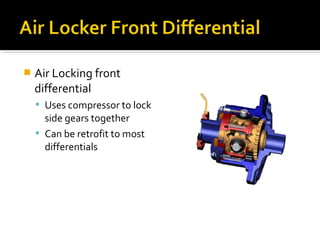
 Air Locking front
differential
 Uses compressor to lock
side gears together
 Can be retrofit to most
differentials
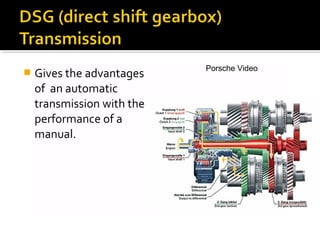
 Gives the advantages
of an automatic
transmission with the
performance of a
manual.
Porsche Video
4x4 Systems

4x4 Systems

  • 2.
     Advantages  Improvedtraction and handling  Able to transmit more power to the wheels  Disadvantages  Higher initial cost and weight  Requires special service and maintenance
  • 3.
     RWD vehiclesequipped with an added transfer case, a front drive shaft, a front differential, and front drive axles  FWD vehicles with an added transfer case, a rear drive shaft, and a rear axle  Some use a center differential instead of a transfer case
  • 4.
     Transfer case Transmits power from the transmission to the front and rear drive shafts  Drive shafts  Connect to the front and rear differentials  Universal joints or CV-joints  Are used to connect front axles to the wheel hubs
  • 5.
     Part-time systems Can be operated in either two-wheel-drive or four-wheel-drive  Selection of two- or four-wheel-drive is done by a shifter, electric switch, or locking hubs  Full-time systems  Cannot be selected out of four-wheel-drive
  • 6.
     On-demand systems Automatically controlled  Typically drives one axle until some wheel slip is detected  Some systems send torque to opposite axle when slip is anticipated
  • 7.
     Difficult toclearly define the difference between 4WD  Primary difference is the transfer case  4WD offers two speed ratios: high and low  AWD does not have a “low”  Constantly provides power to all four wheels  Does not give the driver the option of 2WD or 4WD
  • 8.
     Types ofshift controls  Automatic ▪ 4x4 “on” all the time and controlled by electronic control module or vicious clutch  Push Button ▪ Selectable for “Auto” or 4WH & 4 WL  Old School Lever ▪ Push or pull shift lever to engage transfer case
  • 9.
     4x4 High Control modules see 4x4 input and modifies parameters such as ▪ Changes ABS function ▪ Modifies shift timing ▪ If ETC changes throttle rate  4x4 Low  Control modules see 4x4 and modifies parameters such as ▪ In equipped with air suspension will raise ride height ▪ changes shift timing ▪ Modifies throttle rate When not to use low range!
  • 10.
     Low Range Gives a gear reduction of about 2.5:1  Can only be shifted when vehicle is at stop  If push button or knob type, inputs needed are ▪ BOO switch ▪ <2mph VSS ▪ TRS neutral or park ▪ Clutch switch on
  • 11.
     Shift onthe fly  A shift into 4x4 can be made at speed with out stopping ▪ Must have auto locking hubs or live front axle ▪ Transfer case must “spin up” front drive shaft to meet axle speed
  • 12.
     Ranges : Neutral  Two-wheel- drive—high  Four-wheel- drive—high  Four-wheel- drive—low
  • 16.
     Drive chain design Has less weight to improve fuel economy  Is usually used with planetary gearsets  Is the most common design
  • 17.
  • 18.
     Magnetic clutch type Uses electromagnetic clutch to drive front wheels when ECM senses slippage  When in 4 Wheel High shift fork moves to power front axle
  • 19.
     Transfer CaseShift Motors  Shift motor takes place of shift lever  Motor also has contacts to relay position of motor  Electronic “brake” built into motor to prevent overrun of motor
  • 20.
     AWD unitsare “passive” units  AWD units have no Low Range  Use Vicious Clutch to relay power to front or rear axle (FWD)  Use planetary for difference in wheel speed on turns
  • 21.
     Round-pin style Is commonly used in transfer cases on part-time 4WD vehicles  Can handle higher loads  Pin-and-rocker joint design  Is used on full-time 4WD systems  Is very efficient at continuous high speeds
  • 22.
     Not reallya Transfer Case  Used to direct torque to rear axle (VTM4)  May use same fluid as transmission or have separate fill plug and fluid requirements
  • 23.
     Solid axle Uses a rear axle design  The ends of the axle have steering knuckles for steering  Independent  The differential is mounted to the frame  Most use two half-shafts with CV-joints  Some use one half-shaft and one solid axle
  • 24.
     Closed KnuckleFront Axle  Drive axle and joint enclosed in “bulb” of axle  Wiper seal keeps water and contaminates out  Can be filled with grease or axle lube
  • 25.
     Open KnuckleFront Axle  U joint exposed  Typically more wear on U-Joints due to exposure  Always lube Spindle bearings during wheel bearing service
  • 26.
     Wheel bearingsmust be serviced regularly  Always adjust the wheel bearings during assembly  Tighten the outer bearing lock nut to specifications
  • 27.
     Portal Axles Provide gear reduction (if needed)  Offer more ground clearance
  • 28.
     Manual hubs The hubs are at the wheel and must be turned by hand  The hubs are unlocked in 2WD  Automatic hubs  The hubs are self-locking  Some hubs unlock when vehicle is driven in reverse  Some unlock when 4WD is disengaged
  • 29.
     Hub lockswheel hub to drive axle  Both hubs must be locked for 4x4 operation  Hub usually weak point in 4x4 system
  • 30.
     Common types Cam style ▪ Rotation of drive axle causes cam to lock hub ▪ When out of 4x4 vehicle must roll backwards to disengage  Vacuum style ▪ Hub assemble is sealed ▪ Vacuum applied to hub to “pull” hub in and lock  Hubs located behind knuckle ▪ Vacuum type
  • 31.
     Locking axle removesneed for locking hubs  Disconnecting one axle makes differential inactive
  • 32.
     Uses electric motorto shift color on hub to engage drive axle
  • 33.
     GM Thermoelement switch  Uses heater to heat up wax element  Wax expands to move plunger and engage ft. axle
  • 34.
     Talk tothe customer  Find out under what condition the problem occurs  Road test  Most problems show up as vibrations or noises  Try to verify that the 4WD system is causing the problem  Perform a detailed inspection
  • 35.
     Noise orvibration is most noticeable at high speed  Usually caused by a transfer case problem, bent drive shaft, or bad wheel bearings  Noise or vibration is most noticeable at low speed  Usually caused by bad U-joints  Noise or vibration is most noticeable while turning  Usually caused by worn outboard axle joints
  • 36.
     Noise orvibration is most noticeable when traveling over bumps  Usually caused by suspension components  Noise or vibration is most noticeable with changes in throttle position  Usually caused by U-joints or worn driveshaft splines
  • 37.
     Common complainton all transfer cases is the inability to go from 4WD to 2WD  It is common for these units to get spline- locked  If transfer case jumps out of gear, suspect improperly adjusted shift linkage, loose mounting bolts or brackets, worn front/rear drive-shaft slip yokes, or a damaged sliding clutch hub
  • 38.
     Driveshaft sealsat the transfer case  Driveshaft seals at the differentials  Front or rear axle seals  Threads at the transfer case fill plug  Check Input shaft seal if vent tube leaks oil
  • 39.
     Use onlygaskets and seals recommended by the manufacturer  Never use sealant in place of a gasket  Always use the proper tools to install a seal  Make sure the surface that the seal rides on is smooth
  • 40.
     Vacuum-controlled transfercase  Verify that the engine is producing at least 15 inches of vacuum  Mechanically-controlled transfer case  Make sure the shift linkage is tight and lubricated
  • 41.
     Check forfrozen splines  Check the U-joints for looseness by twisting and shaking them  Check the slip joints for looseness by moving them up and down  Check the splines for wear by rotating the drive shaft
  • 42.
     Front hubsmay make a ratcheting sound when water or dirt has entered the hub and contaminated the lubricant  May indicated that the hub on the opposite side of the axle is not disengaging  Locking hubs can be checked by rotating the brake drum or rotor and turning the hub selector into the locked position
  • 43.
     Always referto the service manual  Label all wires before disconnecting them  Replace all sealing gaskets  Inspect all parts and replace any that are worn or damaged  Tighten all fasteners to the proper torque
  • 44.
     Most frontaxles are serviced like those in 2WD systems  Follow the recommended procedure for servicing 4WD hubs  Some hubs are not serviceable and must be replaced
  • 45.
     Check thefluid level often  Check for fluid contamination any time the vehicle has been driven through deep water  Use only the recommended lubricant  Always follow the proper towing procedures
  • 46.
     Air Lockingfront differential  Uses compressor to lock side gears together  Can be retrofit to most differentials
  • 47.
     Gives theadvantages of an automatic transmission with the performance of a manual. Porsche Video