Tensor Algebra
 Tensors as Linear Mappings
Second Order Tensor


            A second Order Tensor 𝑻 is a linear mapping from a
            vector space to itself. Given 𝒖 ∈ V the mapping,
                                     𝑻: V → V
            states that ∃ 𝒘 ∈ V such that,
                                      𝑻 𝒖 = 𝒘.
            Every other definition of a second order tensor can be
            derived from this simple definition. The tensor
            character of an object can be established by observing
            its action on a vector.

Department of Systems Engineering, University of Lagos   2   oafak@unilag.edu.ng 12/30/2012
Linearity


             The mapping is linear. This means that if we have two
              runs of the process, we first input 𝒖 and later input 𝐯.
              The outcomes 𝑻(𝒖) and 𝑻(𝐯), added would have
              been the same as if we had added the inputs 𝒖 and
               𝐯 first and supplied the sum of the vectors as input.
              More compactly, this means,
                              𝑻 𝒖 + 𝐯 = 𝑻(𝒖) + 𝑻(𝐯)


Department of Systems Engineering, University of Lagos       3       oafak@unilag.edu.ng 12/30/2012
Linearity
            Linearity further means that, for any scalar 𝛼 and tensor 𝑻
                                    𝑻 𝛼𝒖 = 𝛼𝑻 𝒖
            The two properties can be added so that, given 𝛼, 𝛽 ∈ R, and
             𝒖, 𝐯 ∈ V, then
                             𝑻 𝛼𝒖 + 𝛽𝐯 = 𝛼𝑻 𝒖 + 𝛽𝑻 𝐯
            Since we can think of a tensor as a process that takes an
            input and produces an output, two tensors are equal only if
            they produce the same outputs when supplied with the same
            input. The sum of two tensors is the tensor that will give an
            output which will be the sum of the outputs of the two
            tensors when each is given that input.


Department of Systems Engineering, University of Lagos       4       oafak@unilag.edu.ng 12/30/2012
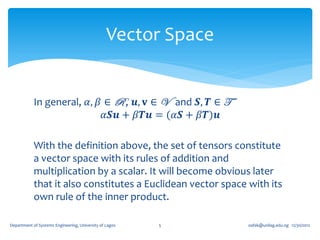
Vector Space


            In general, 𝛼, 𝛽 ∈ R , 𝒖, 𝐯 ∈ V and 𝑺, 𝑻 ∈ T
                             𝛼𝑺𝒖 + 𝛽𝑻𝒖 = (𝛼𝑺 + 𝛽𝑻)𝒖

            With the definition above, the set of tensors constitute
            a vector space with its rules of addition and
            multiplication by a scalar. It will become obvious later
            that it also constitutes a Euclidean vector space with its
            own rule of the inner product.

Department of Systems Engineering, University of Lagos   5      oafak@unilag.edu.ng 12/30/2012
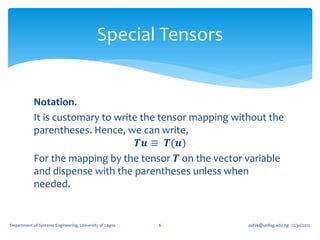
Special Tensors


            Notation.
            It is customary to write the tensor mapping without the
            parentheses. Hence, we can write,
                                    𝑻𝒖 ≡ 𝑻(𝒖)
            For the mapping by the tensor 𝑻 on the vector variable
            and dispense with the parentheses unless when
            needed.


Department of Systems Engineering, University of Lagos   6    oafak@unilag.edu.ng 12/30/2012
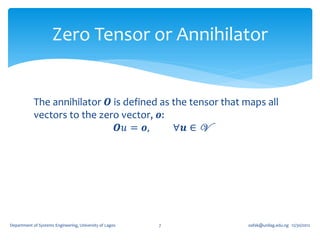
Zero Tensor or Annihilator


            The annihilator 𝑶 is defined as the tensor that maps all
            vectors to the zero vector, 𝒐:
                               𝑶𝑢 = 𝒐,      ∀𝒖 ∈ V


Department of Systems Engineering, University of Lagos   7   oafak@unilag.edu.ng 12/30/2012
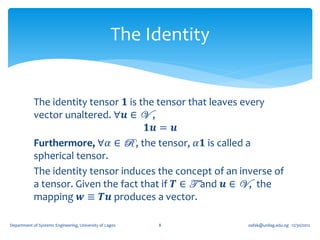
The Identity


            The identity tensor 𝟏 is the tensor that leaves every
            vector unaltered. ∀𝒖 ∈ V ,
                                       𝟏𝒖 = 𝒖
            Furthermore, ∀𝛼 ∈ R , the tensor, 𝛼𝟏 is called a
            spherical tensor.
            The identity tensor induces the concept of an inverse of
            a tensor. Given the fact that if 𝑻 ∈ T and 𝒖 ∈ V , the
            mapping 𝒘 ≡ 𝑻𝒖 produces a vector.

Department of Systems Engineering, University of Lagos   8        oafak@unilag.edu.ng 12/30/2012
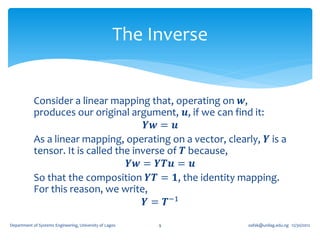
The Inverse


            Consider a linear mapping that, operating on 𝒘,
            produces our original argument, 𝒖, if we can find it:
                                        𝒀𝒘 = 𝒖
            As a linear mapping, operating on a vector, clearly, 𝒀 is a
            tensor. It is called the inverse of 𝑻 because,
                                    𝒀𝒘 = 𝒀𝑻𝒖 = 𝒖
            So that the composition 𝒀𝑻 = 𝟏, the identity mapping.
            For this reason, we write,
                                        𝒀 = 𝑻−1

Department of Systems Engineering, University of Lagos   9        oafak@unilag.edu.ng 12/30/2012
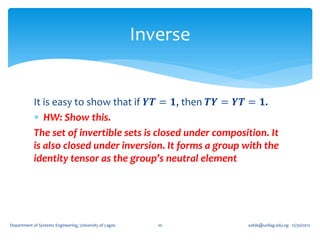
Inverse


            It is easy to show that if 𝒀𝑻 = 𝟏, then 𝑻𝒀 = 𝒀𝑻 = 𝟏.
             HW: Show this.
            The set of invertible sets is closed under composition. It
            is also closed under inversion. It forms a group with the
            identity tensor as the group’s neutral element


Department of Systems Engineering, University of Lagos      10     oafak@unilag.edu.ng 12/30/2012
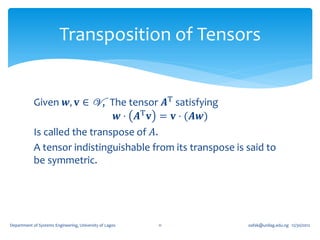
Transposition of Tensors


            Given 𝒘, 𝐯 ∈ V , The tensor 𝑨T satisfying
                                𝒘 ⋅ 𝑨T 𝐯 = 𝐯 ⋅ (𝑨𝒘)
            Is called the transpose of 𝐴.
            A tensor indistinguishable from its transpose is said to
            be symmetric.


Department of Systems Engineering, University of Lagos   11   oafak@unilag.edu.ng 12/30/2012
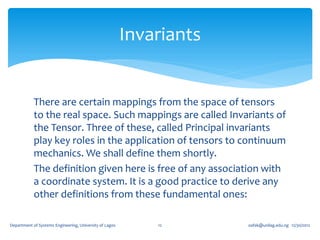
Invariants


            There are certain mappings from the space of tensors
            to the real space. Such mappings are called Invariants of
            the Tensor. Three of these, called Principal invariants
            play key roles in the application of tensors to continuum
            mechanics. We shall define them shortly.
            The definition given here is free of any association with
            a coordinate system. It is a good practice to derive any
            other definitions from these fundamental ones:

Department of Systems Engineering, University of Lagos       12       oafak@unilag.edu.ng 12/30/2012
The Trace
            If we write
                                   𝐚, 𝐛, 𝐜 ≡ 𝐚 ⋅ 𝐛 × 𝐜
             where 𝐚, 𝐛, and 𝐜 are arbitrary vectors.
            For any second order tensor 𝑻, and linearly
            independent 𝐚, 𝐛, and 𝐜, the linear mapping 𝐼1 : T → R
                                      𝑻𝐚, 𝐛, 𝐜 + 𝐚, 𝑻𝐛, 𝐜 + [𝐚, 𝐛, 𝑻𝐜]
                 𝐼1 𝑻 ≡ tr 𝑻 =
                                                 [𝐚, 𝐛, 𝐜]
            Is independent of the choice of the basis vectors 𝐚, 𝐛,
            and 𝐜. It is called the First Principal Invariant of 𝑻 or
            Trace of 𝑻 ≡ tr 𝑻 ≡ 𝐼1 (𝑻)

Department of Systems Engineering, University of Lagos       13      oafak@unilag.edu.ng 12/30/2012
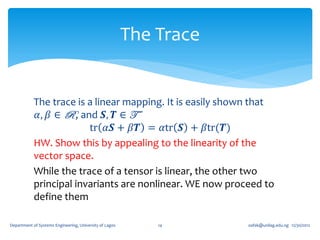
The Trace


            The trace is a linear mapping. It is easily shown that
             𝛼, 𝛽 ∈ R , and 𝑺, 𝑻 ∈ T
                          tr 𝛼𝑺 + 𝛽𝑻 = 𝛼tr 𝑺 + 𝛽tr(𝑻)
            HW. Show this by appealing to the linearity of the
            vector space.
            While the trace of a tensor is linear, the other two
            principal invariants are nonlinear. WE now proceed to
            define them

Department of Systems Engineering, University of Lagos       14      oafak@unilag.edu.ng 12/30/2012
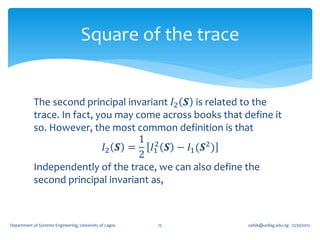
Square of the trace


            The second principal invariant 𝐼2 𝑺 is related to the
            trace. In fact, you may come across books that define it
            so. However, the most common definition is that
                                     1 2
                              𝐼2 𝑺 =   𝐼1 𝑺 − 𝐼1 (𝑺2 )
                                     2
            Independently of the trace, we can also define the
            second principal invariant as,


Department of Systems Engineering, University of Lagos   15   oafak@unilag.edu.ng 12/30/2012
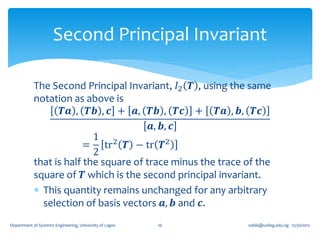
Second Principal Invariant

            The Second Principal Invariant, 𝐼2 𝑻 , using the same
            notation as above is
                   𝑻𝒂 , 𝑻𝒃 , 𝒄 + 𝒂, 𝑻𝒃 , 𝑻𝒄 + 𝑻𝒂 , 𝒃, 𝑻𝒄
                                        𝒂, 𝒃, 𝒄
                           1 2
                         = tr 𝑻 − tr 𝑻2
                           2
            that is half the square of trace minus the trace of the
            square of 𝑻 which is the second principal invariant.
             This quantity remains unchanged for any arbitrary
              selection of basis vectors 𝒂, 𝒃 and 𝒄.
Department of Systems Engineering, University of Lagos   16   oafak@unilag.edu.ng 12/30/2012
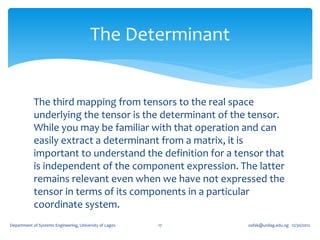
The Determinant


            The third mapping from tensors to the real space
            underlying the tensor is the determinant of the tensor.
            While you may be familiar with that operation and can
            easily extract a determinant from a matrix, it is
            important to understand the definition for a tensor that
            is independent of the component expression. The latter
            remains relevant even when we have not expressed the
            tensor in terms of its components in a particular
            coordinate system.
Department of Systems Engineering, University of Lagos   17   oafak@unilag.edu.ng 12/30/2012
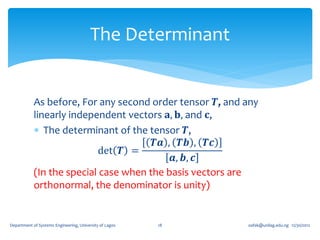
The Determinant


            As before, For any second order tensor 𝑻, and any
            linearly independent vectors 𝐚, 𝐛, and 𝐜,
             The determinant of the tensor 𝑻,
                                       𝑻𝒂 , 𝑻𝒃 , 𝑻𝒄
                           det 𝑻 =
                                           𝒂, 𝒃, 𝒄
            (In the special case when the basis vectors are
            orthonormal, the denominator is unity)


Department of Systems Engineering, University of Lagos   18   oafak@unilag.edu.ng 12/30/2012
Other Principal Invariants

             It is good to note that there are other principal
              invariants that can be defined. The ones we defined
              here are the ones you are most likely to find in other
              texts.
             An invariant is a scalar derived from a tensor that
              remains unchanged in any coordinate system.
              Mathematically, it is a mapping from the tensor space
              to the real space. Or simply a scalar valued function
              of the tensor.


Department of Systems Engineering, University of Lagos   19   oafak@unilag.edu.ng 12/30/2012
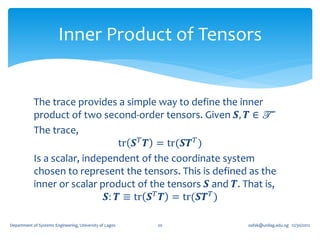
Inner Product of Tensors


            The trace provides a simple way to define the inner
            product of two second-order tensors. Given 𝑺, 𝑻 ∈ T
            The trace,
                                 tr 𝑺 𝑇 𝑻 = tr(𝑺𝑻 𝑇 )
            Is a scalar, independent of the coordinate system
            chosen to represent the tensors. This is defined as the
            inner or scalar product of the tensors 𝑺 and 𝑻. That is,
                              𝑺: 𝑻 ≡ tr 𝑺 𝑇 𝑻 = tr(𝑺𝑻 𝑇 )

Department of Systems Engineering, University of Lagos   20   oafak@unilag.edu.ng 12/30/2012
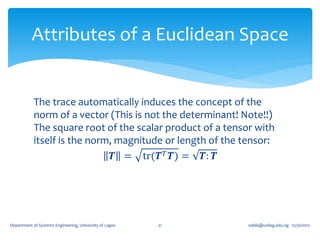
Attributes of a Euclidean Space


            The trace automatically induces the concept of the
            norm of a vector (This is not the determinant! Note!!)
            The square root of the scalar product of a tensor with
            itself is the norm, magnitude or length of the tensor:
                               𝑻 = tr(𝑻 𝑇 𝑻) = 𝑻: 𝑻


Department of Systems Engineering, University of Lagos   21   oafak@unilag.edu.ng 12/30/2012
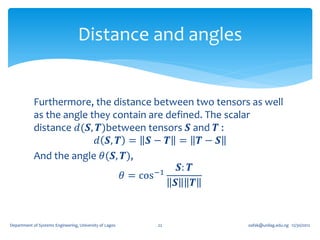
Distance and angles


            Furthermore, the distance between two tensors as well
            as the angle they contain are defined. The scalar
            distance 𝑑(𝑺, 𝑻)between tensors 𝑺 and 𝑻 :
                          𝑑 𝑺, 𝑻 = 𝑺 − 𝑻 = 𝑻 − 𝑺
            And the angle 𝜃(𝑺, 𝑻),
                                        −1
                                             𝑺: 𝑻
                                𝜃 = cos
                                            𝑺 𝑻


Department of Systems Engineering, University of Lagos   22   oafak@unilag.edu.ng 12/30/2012
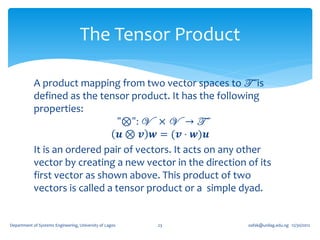
The Tensor Product

            A product mapping from two vector spaces to T is
            defined as the tensor product. It has the following
            properties:
                                 "⊗": V × V → T
                                 𝒖 ⊗ 𝒗 𝒘 = (𝒗 ⋅ 𝒘)𝒖
            It is an ordered pair of vectors. It acts on any other
            vector by creating a new vector in the direction of its
            first vector as shown above. This product of two
            vectors is called a tensor product or a simple dyad.


Department of Systems Engineering, University of Lagos   23   oafak@unilag.edu.ng 12/30/2012
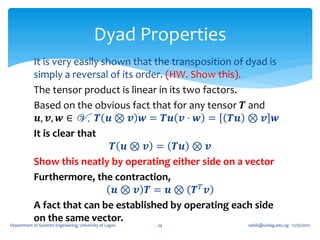
Dyad Properties
            It is very easily shown that the transposition of dyad is
            simply a reversal of its order. (HW. Show this).
            The tensor product is linear in its two factors.
            Based on the obvious fact that for any tensor 𝑻 and
             𝒖, 𝒗, 𝒘 ∈ V , 𝑻 𝒖 ⊗ 𝒗 𝒘 = 𝑻𝒖 𝒗 ⋅ 𝒘 = 𝑻𝒖 ⊗ 𝒗 𝒘
            It is clear that
                                𝑻 𝒖 ⊗ 𝒗 = 𝑻𝒖 ⊗ 𝒗
            Show this neatly by operating either side on a vector
            Furthermore, the contraction,
                                 𝒖⊗ 𝒗 𝑻= 𝒖⊗ 𝑻𝑇 𝒗
            A fact that can be established by operating each side
            on the same vector.
Department of Systems Engineering, University of Lagos   24   oafak@unilag.edu.ng 12/30/2012
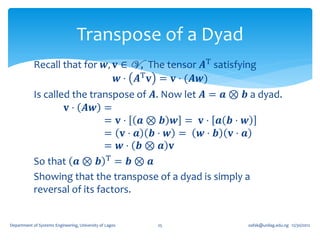
Transpose of a Dyad
            Recall that for 𝒘, 𝐯 ∈ V , The tensor 𝑨T satisfying
                                𝒘 ⋅ 𝑨T 𝐯 = 𝐯 ⋅ (𝑨𝒘)
            Is called the transpose of 𝑨. Now let 𝑨 = 𝒂 ⊗ 𝒃 a dyad.
                    𝐯 ⋅ 𝑨𝒘 =
                              = 𝐯⋅ 𝒂⊗ 𝒃 𝒘 = 𝐯⋅ 𝒂 𝒃⋅ 𝒘
                              = 𝐯⋅ 𝒂 𝒃⋅ 𝒘 = 𝒘⋅ 𝒃 𝐯⋅ 𝒂
                              = 𝒘⋅ 𝒃⊗ 𝒂 𝐯
            So that 𝒂 ⊗ 𝒃 T = 𝒃 ⊗ 𝒂
            Showing that the transpose of a dyad is simply a
            reversal of its factors.


Department of Systems Engineering, University of Lagos   25   oafak@unilag.edu.ng 12/30/2012
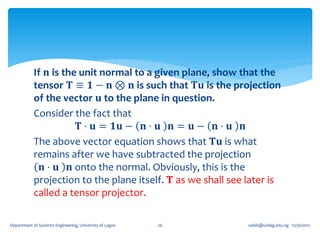
If 𝐧 is the unit normal to a given plane, show that the
            tensor 𝐓 ≡ 𝟏 − 𝐧 ⊗ 𝐧 is such that 𝐓𝐮 is the projection
            of the vector 𝐮 to the plane in question.
            Consider the fact that
                        𝐓 ⋅ 𝐮 = 𝟏𝐮 − 𝐧 ⋅ 𝐮 𝐧 = 𝐮 − 𝐧 ⋅ 𝐮 𝐧
            The above vector equation shows that 𝐓𝐮 is what
            remains after we have subtracted the projection
              𝐧 ⋅ 𝐮 𝐧 onto the normal. Obviously, this is the
            projection to the plane itself. 𝐓 as we shall see later is
            called a tensor projector.

Department of Systems Engineering, University of Lagos   26   oafak@unilag.edu.ng 12/30/2012
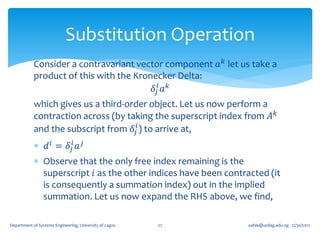
Substitution Operation
            Consider a contravariant vector component 𝑎 𝑘 let us take a
            product of this with the Kronecker Delta:
                                         𝛿 𝑗𝑖 𝑎 𝑘
            which gives us a third-order object. Let us now perform a
            contraction across (by taking the superscript index from 𝐴 𝑘
            and the subscript from 𝛿 𝑗𝑖 ) to arrive at,
             𝑑 𝑖 = 𝛿 𝑗𝑖 𝑎 𝑗
             Observe that the only free index remaining is the
              superscript 𝑖 as the other indices have been contracted (it
              is consequently a summation index) out in the implied
              summation. Let us now expand the RHS above, we find,

Department of Systems Engineering, University of Lagos   27      oafak@unilag.edu.ng 12/30/2012
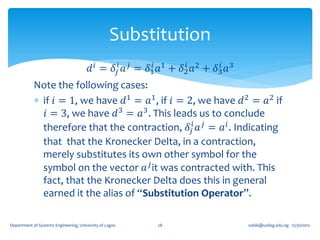
Substitution
                                        𝑑 𝑖 = 𝛿 𝑗𝑖 𝑎 𝑗 = 𝛿1𝑖 𝑎1 + 𝛿2 𝑎2 + 𝛿3 𝑎3
                                                                    𝑖       𝑖

            Note the following cases:
             if 𝑖 = 1, we have 𝑑1 = 𝑎1 , if 𝑖 = 2, we have 𝑑 2 = 𝑎2 if
               𝑖 = 3, we have 𝑑 3 = 𝑎3 . This leads us to conclude
              therefore that the contraction, 𝛿 𝑗𝑖 𝑎 𝑗 = 𝑎 𝑖 . Indicating
              that that the Kronecker Delta, in a contraction,
              merely substitutes its own other symbol for the
              symbol on the vector 𝑎 𝑗 it was contracted with. This
              fact, that the Kronecker Delta does this in general
              earned it the alias of “Substitution Operator”.

Department of Systems Engineering, University of Lagos    28                      oafak@unilag.edu.ng 12/30/2012
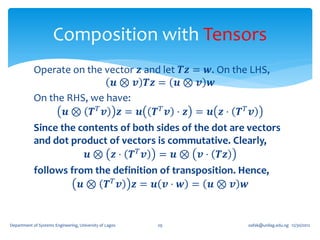
Composition with Tensors
            Operate on the vector 𝒛 and let 𝑻𝒛 = 𝒘. On the LHS,
                             𝒖 ⊗ 𝒗 𝑻𝒛 = 𝒖 ⊗ 𝒗 𝒘
            On the RHS, we have:
                   𝒖⊗ 𝑻𝑇 𝒗 𝒛= 𝒖 𝑻𝑇 𝒗 ⋅ 𝒛 = 𝒖 𝒛⋅ 𝑻𝑇 𝒗
            Since the contents of both sides of the dot are vectors
            and dot product of vectors is commutative. Clearly,
                        𝒖 ⊗ 𝒛 ⋅ 𝑻 𝑇 𝒗 = 𝒖 ⊗ 𝒗 ⋅ 𝑻𝒛
            follows from the definition of transposition. Hence,
                      𝒖⊗ 𝑻𝑇 𝒗 𝒛= 𝒖 𝒗⋅ 𝒘 = 𝒖⊗ 𝒗 𝒘


Department of Systems Engineering, University of Lagos   29   oafak@unilag.edu.ng 12/30/2012
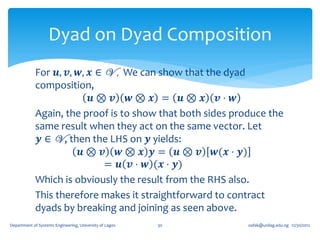
Dyad on Dyad Composition
            For 𝒖, 𝒗, 𝒘, 𝒙 ∈ V , We can show that the dyad
            composition,
                         𝒖⊗ 𝒗 𝒘⊗ 𝒙 = 𝒖⊗ 𝒙 𝒗⋅ 𝒘
            Again, the proof is to show that both sides produce the
            same result when they act on the same vector. Let
             𝒚 ∈ V , then the LHS on 𝒚 yields:
                       𝒖 ⊗ 𝒗 𝒘 ⊗ 𝒙 𝒚 = 𝒖 ⊗ 𝒗 𝒘(𝒙 ⋅ 𝒚)
                             = 𝒖 𝒗 ⋅ 𝒘 (𝒙 ⋅ 𝒚)
            Which is obviously the result from the RHS also.
            This therefore makes it straightforward to contract
            dyads by breaking and joining as seen above.
Department of Systems Engineering, University of Lagos   30   oafak@unilag.edu.ng 12/30/2012
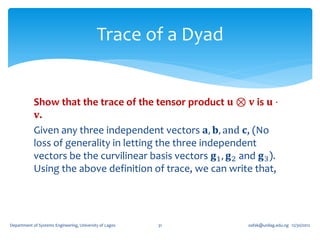
Trace of a Dyad


            Show that the trace of the tensor product 𝐮 ⊗ 𝐯 is 𝐮 ⋅
             𝐯.
            Given any three independent vectors 𝐚, 𝐛, and 𝐜, (No
            loss of generality in letting the three independent
            vectors be the curvilinear basis vectors 𝐠1 , 𝐠 2 and 𝐠 3 ).
            Using the above definition of trace, we can write that,


Department of Systems Engineering, University of Lagos   31     oafak@unilag.edu.ng 12/30/2012
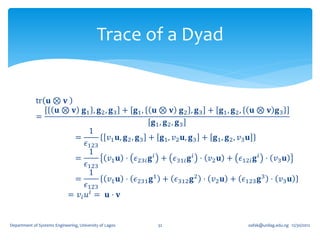
Trace of a Dyad


             tr 𝐮 ⊗ 𝐯
                  𝐮 ⊗ 𝐯 𝐠1 , 𝐠 2 , 𝐠 3 + 𝐠1 ,            𝐮 ⊗ 𝐯 𝐠 2 , 𝐠 3 + 𝐠1 , 𝐠 2 ,    𝐮 ⊗ 𝐯 𝐠3
             =
                                                         𝐠1 , 𝐠 2 , 𝐠 3
                                        1
                                 =       𝑣 𝐮, 𝐠 2 , 𝐠 3 + 𝐠1 , 𝑣2 𝐮, 𝐠 3 + 𝐠1 , 𝐠 2 , 𝑣3 𝐮
                                  𝜖123 1
                                   1
                              =          𝑣1 𝐮 ⋅ 𝜖23𝑖 𝐠 𝑖 + 𝜖31𝑖 𝐠 𝑖 ⋅ 𝑣2 𝐮 + 𝜖12𝑖 𝐠 𝑖 ⋅ 𝑣3 𝐮
                                  𝜖123
                                   1
                              =          𝑣1 𝐮 ⋅ 𝜖231 𝐠1 + 𝜖312 𝐠 2 ⋅ 𝑣2 𝐮 + 𝜖123 𝐠 3 ⋅ 𝑣3 𝐮
                                  𝜖123
                             = 𝑣𝑖 𝑢 𝑖 = 𝐮 ⋅ 𝐯


Department of Systems Engineering, University of Lagos    32                            oafak@unilag.edu.ng 12/30/2012
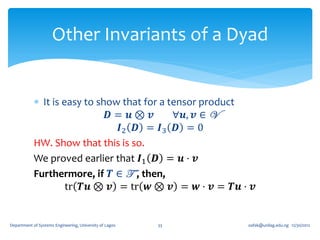
Other Invariants of a Dyad


             It is easy to show that for a tensor product
                              𝑫= 𝒖⊗ 𝒗        ∀𝒖, 𝒗 ∈ V
                                𝑰2 𝑫 = 𝑰3 𝑫 = 0
            HW. Show that this is so.
            We proved earlier that 𝑰1 𝑫 = 𝒖 ⋅ 𝒗
            Furthermore, if 𝑻 ∈ T , then,
                     tr 𝑻𝒖 ⊗ 𝒗 = tr 𝒘 ⊗ 𝒗 = 𝒘 ⋅ 𝒗 = 𝑻𝒖 ⋅ 𝒗


Department of Systems Engineering, University of Lagos   33   oafak@unilag.edu.ng 12/30/2012
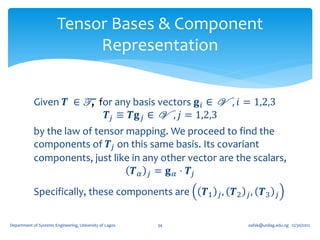
Tensor Bases & Component
                             Representation


            Given 𝑻 ∈ T , for any basis vectors 𝐠 𝑖 ∈ V , 𝑖 = 1,2,3
                            𝑻 𝑗 ≡ 𝑻𝐠 𝑗 ∈ V , 𝑗 = 1,2,3
            by the law of tensor mapping. We proceed to find the
            components of 𝑻 𝑗 on this same basis. Its covariant
            components, just like in any other vector are the scalars,
                                   𝑻 𝛼 𝑗 = 𝐠 𝛼 ⋅ 𝑻𝑗
            Specifically, these components are                𝑻1 𝑗 , 𝑻2 𝑗 , 𝑻3       𝑗


Department of Systems Engineering, University of Lagos   34             oafak@unilag.edu.ng 12/30/2012
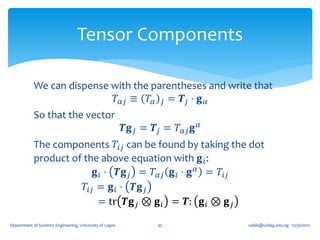
Tensor Components

            We can dispense with the parentheses and write that
                             𝑇 𝛼𝑗 ≡ 𝑇 𝛼 𝑗 = 𝑻 𝑗 ⋅ 𝐠 𝛼
            So that the vector
                                                         𝑻𝐠 𝑗 = 𝑻 𝑗 = 𝑇 𝛼𝑗 𝐠 𝛼
            The components 𝑇𝑖𝑗 can be found by taking the dot
            product of the above equation with 𝐠 𝑖 :
                          𝐠 𝑖 ⋅ 𝑻𝐠 𝑗 = 𝑇 𝛼𝑗 𝐠 𝑖 ⋅ 𝐠 𝛼 = 𝑇𝑖𝑗
                       𝑇𝑖𝑗 = 𝐠 𝑖 ⋅ 𝑻𝐠 𝑗
                           = tr 𝑻𝐠 𝑗 ⊗ 𝐠 𝑖 = 𝑻: 𝐠 𝑖 ⊗ 𝐠 𝑗

Department of Systems Engineering, University of Lagos            35             oafak@unilag.edu.ng 12/30/2012
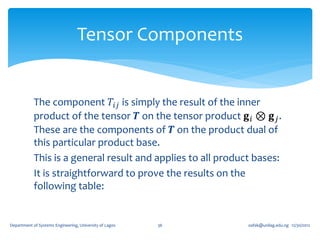
Tensor Components


            The component 𝑇𝑖𝑗 is simply the result of the inner
            product of the tensor 𝑻 on the tensor product 𝐠 𝑖 ⊗ 𝐠 𝑗 .
            These are the components of 𝑻 on the product dual of
            this particular product base.
            This is a general result and applies to all product bases:
            It is straightforward to prove the results on the
            following table:


Department of Systems Engineering, University of Lagos   36   oafak@unilag.edu.ng 12/30/2012
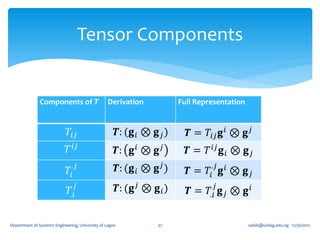
Tensor Components


               Components of 𝑻                    Derivation               Full Representation


                             𝑇𝑖𝑗                         𝑻: (𝐠 𝑖 ⊗ 𝐠 𝑗 )     𝑻 = 𝑇𝑖𝑗 𝐠 𝑖 ⊗ 𝐠 𝑗
                             𝑇 𝑖𝑗                        𝑻: 𝐠 𝑖 ⊗ 𝐠 𝑗        𝑻 = 𝑇 𝑖𝑗 𝐠 𝑖 ⊗ 𝐠 𝑗
                             𝑇𝑖
                               .𝑗                        𝑻: (𝐠 𝑖 ⊗ 𝐠 𝑗 )            .𝑗
                                                                             𝑻 = 𝑇𝑖 𝐠 𝑖 ⊗ 𝐠 𝑗
                              𝑇.𝑖
                                  𝑗                      𝑻: (𝐠 𝑗 ⊗ 𝐠 𝑖 )             𝑗
                                                                             𝑻 = 𝑇.𝑖 𝐠 𝑗 ⊗ 𝐠 𝑖


Department of Systems Engineering, University of Lagos               37                          oafak@unilag.edu.ng 12/30/2012
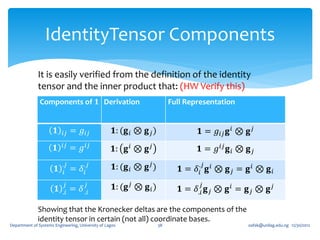
IdentityTensor Components
              It is easily verified from the definition of the identity
              tensor and the inner product that: (HW Verify this)
               Components of 𝟏 Derivation                                  Full Representation


                       𝟏   𝑖𝑗   = 𝑔 𝑖𝑗              𝟏: (𝐠 𝑖 ⊗ 𝐠 𝑗 )                 𝟏 = 𝑔 𝑖𝑗 𝐠 𝑖 ⊗ 𝐠 𝑗
                           𝑖𝑗
                      𝟏         = 𝑔 𝑖𝑗              𝟏: 𝐠 𝑖 ⊗ 𝐠 𝑗                    𝟏 = 𝑔 𝑖𝑗 𝐠 𝑖 ⊗ 𝐠 𝑗

                       𝟏
                           .𝑗
                                = 𝛿𝑖
                                      .𝑗            𝟏: (𝐠 𝑖 ⊗ 𝐠 𝑗 )                 .𝑗
                                                                              𝟏 = 𝛿𝑖 𝐠 𝑖 ⊗ 𝐠 𝑗 = 𝐠 𝑖 ⊗ 𝐠 𝑖
                           𝑖

                       𝟏
                            𝑗
                                = 𝛿 .𝑖
                                      𝑗             𝟏: (𝐠 𝑗 ⊗ 𝐠 𝑖 )                 𝑗
                                                                              𝟏 = 𝛿.𝑖 𝐠 𝑗 ⊗ 𝐠 𝑖 = 𝐠 𝑗 ⊗ 𝐠 𝑗
                           .𝑖

              Showing that the Kronecker deltas are the components of the
              identity tensor in certain (not all) coordinate bases.
Department of Systems Engineering, University of Lagos                38                            oafak@unilag.edu.ng 12/30/2012
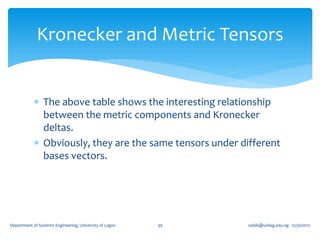
Kronecker and Metric Tensors


             The above table shows the interesting relationship
              between the metric components and Kronecker
              deltas.
             Obviously, they are the same tensors under different
              bases vectors.


Department of Systems Engineering, University of Lagos   39   oafak@unilag.edu.ng 12/30/2012
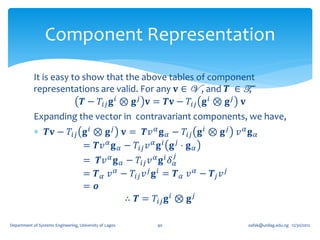
Component Representation

            It is easy to show that the above tables of component
            representations are valid. For any 𝐯 ∈ V , and 𝑻 ∈ T,
                          𝑻 − 𝑇𝑖𝑗 𝐠 𝑖 ⊗ 𝐠 𝑗 𝐯 = 𝑻𝐯 − 𝑇𝑖𝑗 𝐠 𝑖 ⊗ 𝐠 𝑗 𝐯
            Expanding the vector in contravariant components, we have,
             𝑻𝐯 − 𝑇𝑖𝑗 𝐠 𝑖 ⊗ 𝐠 𝑗 𝐯 = 𝑻𝑣 𝛼 𝐠 𝛼 − 𝑇𝑖𝑗 𝐠 𝑖 ⊗ 𝐠 𝑗                      𝑣𝛼𝐠𝛼
                       = 𝑻𝑣 𝛼 𝐠 𝛼 − 𝑇𝑖𝑗 𝑣 𝛼 𝐠 𝑖 𝐠 𝑗 ⋅ 𝐠 𝛼
                                                                𝑗
                                     = 𝑻𝑣 𝛼 𝐠 𝛼 − 𝑇𝑖𝑗 𝑣 𝛼 𝐠 𝑖 𝛿 𝛼
                                     = 𝑻 𝛼 𝑣 𝛼 − 𝑇𝑖𝑗 𝑣 𝑗 𝐠 𝑖 = 𝑻 𝛼 𝑣 𝛼 − 𝑻 𝑗 𝑣 𝑗
                                     = 𝒐
                                                ∴ 𝑻 = 𝑇𝑖𝑗 𝐠 𝑖 ⊗ 𝐠 𝑗

Department of Systems Engineering, University of Lagos     40                        oafak@unilag.edu.ng 12/30/2012
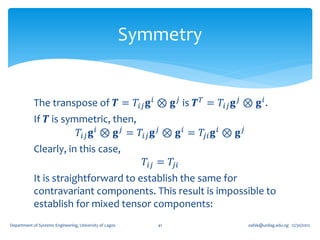
Symmetry


            The transpose of 𝑻 = 𝑇𝑖𝑗 𝐠 𝑖 ⊗ 𝐠 𝑗 is 𝑻 𝑇 = 𝑇𝑖𝑗 𝐠 𝑗 ⊗ 𝐠 𝑖 .
            If 𝑻 is symmetric, then,
                       𝑇𝑖𝑗 𝐠 𝑖 ⊗ 𝐠 𝑗 = 𝑇𝑖𝑗 𝐠 𝑗 ⊗ 𝐠 𝑖 = 𝑇𝑗𝑖 𝐠 𝑖 ⊗ 𝐠 𝑗
            Clearly, in this case,
                                                           𝑇𝑖𝑗 = 𝑇𝑗𝑖
            It is straightforward to establish the same for
            contravariant components. This result is impossible to
            establish for mixed tensor components:
Department of Systems Engineering, University of Lagos        41       oafak@unilag.edu.ng 12/30/2012
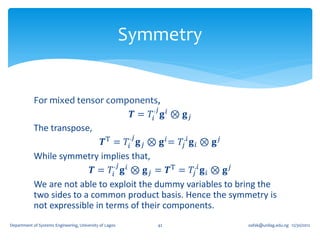
Symmetry


            For mixed tensor components,
                                             .𝑗
                                       𝑻 = 𝑇𝑖 𝐠 𝑖 ⊗ 𝐠 𝑗
            The transpose,
                                      .𝑗
                              𝑻T = 𝑇𝑖 𝐠 𝑗 ⊗ 𝐠 𝑖 = 𝑇𝑗.𝑖 𝐠 𝑖 ⊗ 𝐠 𝑗
            While symmetry implies that,
                                 .𝑗
                           𝑻 = 𝑇𝑖 𝐠 𝑖 ⊗ 𝐠 𝑗 = 𝑻T = 𝑇𝑗.𝑖 𝐠 𝑖 ⊗ 𝐠 𝑗
            We are not able to exploit the dummy variables to bring the
            two sides to a common product basis. Hence the symmetry is
            not expressible in terms of their components.
Department of Systems Engineering, University of Lagos      42      oafak@unilag.edu.ng 12/30/2012
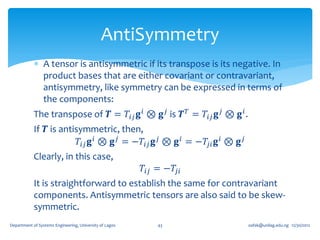
AntiSymmetry
             A tensor is antisymmetric if its transpose is its negative. In
              product bases that are either covariant or contravariant,
              antisymmetry, like symmetry can be expressed in terms of
              the components:
            The transpose of 𝑻 = 𝑇𝑖𝑗 𝐠 𝑖 ⊗ 𝐠 𝑗 is 𝑻 𝑇 = 𝑇𝑖𝑗 𝐠 𝑗 ⊗ 𝐠 𝑖 .
            If 𝑻 is antisymmetric, then,
                         𝑇𝑖𝑗 𝐠 𝑖 ⊗ 𝐠 𝑗 = −𝑇𝑖𝑗 𝐠 𝑗 ⊗ 𝐠 𝑖 = −𝑇𝑗𝑖 𝐠 𝑖 ⊗ 𝐠 𝑗
            Clearly, in this case,
                                                         𝑇𝑖𝑗 = −𝑇𝑗𝑖
            It is straightforward to establish the same for contravariant
            components. Antisymmetric tensors are also said to be skew-
            symmetric.
Department of Systems Engineering, University of Lagos       43            oafak@unilag.edu.ng 12/30/2012
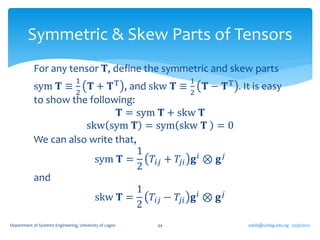
Symmetric & Skew Parts of Tensors
            For any tensor 𝐓, define the symmetric and skew parts
                                 1                            1
            sym 𝐓 ≡     𝐓+       , and skw 𝐓 ≡     𝐓T 𝐓 − 𝐓 T . It is easy
                                 2                            2
            to show the following:
                               𝐓 = sym 𝐓 + skw 𝐓
                       skw sym 𝐓 = sym skw 𝐓 = 0
            We can also write that,
                                    1
                         sym 𝐓 =        𝑇𝑖𝑗 + 𝑇𝑗𝑖 𝐠 𝑖 ⊗ 𝐠 𝑗
                                    2
            and
                                    1
                         skw 𝐓 =        𝑇𝑖𝑗 − 𝑇𝑗𝑖 𝐠 𝑖 ⊗ 𝐠 𝑗
                                    2
Department of Systems Engineering, University of Lagos   44       oafak@unilag.edu.ng 12/30/2012
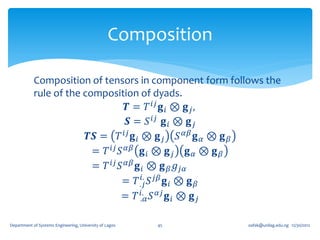
Composition

            Composition of tensors in component form follows the
            rule of the composition of dyads.
                                   𝑻 = 𝑇 𝑖𝑗 𝐠 𝑖 ⊗ 𝐠 𝑗 ,
                                   𝑺 = 𝑆 𝑖𝑗 𝐠 𝑖 ⊗ 𝐠 𝑗
                         𝑻𝑺 = 𝑇 𝑖𝑗 𝐠 𝑖 ⊗ 𝐠 𝑗 𝑆 𝛼𝛽 𝐠 𝛼 ⊗ 𝐠 𝛽
                          = 𝑇 𝑖𝑗 𝑆 𝛼𝛽 𝐠 𝑖 ⊗ 𝐠 𝑗 𝐠 𝛼 ⊗ 𝐠 𝛽
                          = 𝑇 𝑖𝑗 𝑆 𝛼𝛽 𝐠 𝑖 ⊗ 𝐠 𝛽 𝑔 𝑗𝛼
                                        𝑖.
                                  = 𝑇 .𝑗 𝑆 𝑗𝛽 𝐠 𝑖 ⊗ 𝐠 𝛽
                                  = 𝑇 𝑖. 𝑆 𝛼𝑗 𝐠 𝑖 ⊗ 𝐠 𝑗
                                       .𝛼


Department of Systems Engineering, University of Lagos   45    oafak@unilag.edu.ng 12/30/2012
Addition


             Addition of two tensors of the same order is the
              addition of their components provided they are
              refereed to the same product basis.


Department of Systems Engineering, University of Lagos      46      oafak@unilag.edu.ng 12/30/2012
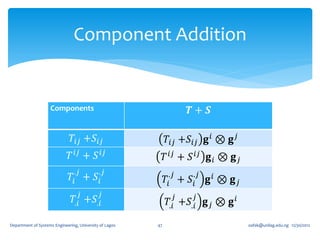
Component Addition


                    Components                                      𝑻+ 𝑺

                               𝑇𝑖𝑗 +𝑆 𝑖𝑗                      𝑇𝑖𝑗 +𝑆 𝑖𝑗 𝐠 𝑖 ⊗ 𝐠 𝑗
                              𝑇 𝑖𝑗 + 𝑆 𝑖𝑗                     𝑇 𝑖𝑗 + 𝑆 𝑖𝑗 𝐠 𝑖 ⊗ 𝐠 𝑗
                                .𝑗           .𝑗                .𝑗     .𝑗
                              𝑇𝑖 + 𝑆 𝑖                        𝑇𝑖 + 𝑆 𝑖     𝐠𝑖 ⊗ 𝐠𝑗
                                   𝑗          𝑗                 𝑗     𝑗
                                𝑇.𝑖 +𝑆.𝑖                       𝑇.𝑖 +𝑆.𝑖 𝐠 𝑗 ⊗ 𝐠 𝑖

Department of Systems Engineering, University of Lagos   47                           oafak@unilag.edu.ng 12/30/2012
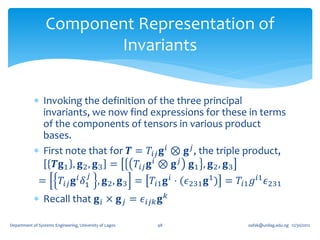
Component Representation of
                         Invariants


             Invoking the definition of the three principal
              invariants, we now find expressions for these in terms
              of the components of tensors in various product
              bases.
             First note that for 𝑻 = 𝑇𝑖𝑗 𝐠 𝑖 ⊗ 𝐠 𝑗 , the triple product,
                 𝑻𝐠1 , 𝐠 2 , 𝐠 3 =  𝑇𝑖𝑗 𝐠 𝑖 ⊗ 𝐠 𝑗 𝐠1 , 𝐠 2 , 𝐠 3
                                        𝑗
              =           𝑇𝑖𝑗 𝐠 𝑖 𝛿1 , 𝐠 2 , 𝐠 3 = 𝑇𝑖1 𝐠 𝑖 ⋅ (𝜖231 𝐠1 ) = 𝑇𝑖1 𝑔 𝑖1 𝜖231
             Recall that 𝐠 𝑖 × 𝐠 𝑗 = 𝜖 𝑖𝑗𝑘 𝐠 𝑘

Department of Systems Engineering, University of Lagos   48                  oafak@unilag.edu.ng 12/30/2012
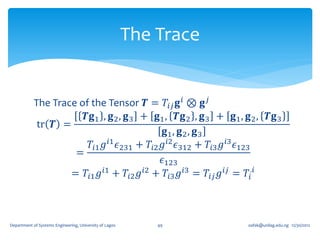
The Trace


            The Trace of the Tensor 𝑻 = 𝑇𝑖𝑗 𝐠 𝑖 ⊗ 𝐠 𝑗
                       𝑻𝐠1 , 𝐠 2 , 𝐠 3 + 𝐠1 , 𝑻𝐠 2 , 𝐠 3 + 𝐠1 , 𝐠 2 , 𝑻𝐠 3
             tr 𝑻 =
                                             𝐠1 , 𝐠 2 , 𝐠 3
                        𝑇𝑖1 𝑔 𝑖1 𝜖231 + 𝑇𝑖2 𝑔 𝑖2 𝜖312 + 𝑇𝑖3 𝑔 𝑖3 𝜖123
                     =
                                            𝜖123
                    = 𝑇𝑖1 𝑔 𝑖1 + 𝑇𝑖2 𝑔 𝑖2 + 𝑇𝑖3 𝑔 𝑖3 = 𝑇𝑖𝑗 𝑔 𝑖𝑗 = 𝑇𝑖.𝑖


Department of Systems Engineering, University of Lagos       49      oafak@unilag.edu.ng 12/30/2012
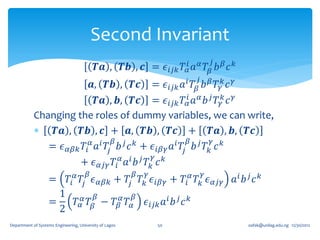
Second Invariant
                                                                                𝑗
                                           𝑻𝒂 , 𝑻𝒃 , 𝒄 = 𝜖 𝑖𝑗𝑘 𝑇 𝛼𝑖 𝑎 𝛼 𝑇 𝛽 𝑏 𝛽 𝑐 𝑘
                                                                        𝑗
                         𝒂, 𝑻𝒃 , 𝑻𝒄 = 𝜖 𝑖𝑗𝑘 𝑎 𝑖 𝑇 𝛽 𝑏 𝛽 𝑇 𝛾𝑘 𝑐 𝛾
                           𝑻𝒂 , 𝒃, 𝑻𝒄 = 𝜖 𝑖𝑗𝑘 𝑇 𝛼𝑖 𝑎 𝛼 𝑏 𝑗 𝑇 𝛾𝑘 𝑐 𝛾
            Changing the roles of dummy variables, we can write,
             𝑻𝒂 , 𝑻𝒃 , 𝒄 + 𝒂, 𝑻𝒃 , 𝑻𝒄 + 𝑻𝒂 , 𝒃, 𝑻𝒄
                         𝛼 𝑖 𝛽 𝑗 𝑘                 𝑖 𝑇 𝛽 𝑏𝑗 𝑇𝛾 𝑐𝑘
               = 𝜖 𝛼𝛽𝑘 𝑇𝑖 𝑎 𝑇𝑗 𝑏 𝑐 + 𝜖 𝑖𝛽𝛾 𝑎 𝑗               𝑘
                                              𝛾
                      + 𝜖 𝛼𝑗𝛾 𝑇𝑖 𝛼 𝑎 𝑖 𝑏 𝑗 𝑇 𝑘 𝑐 𝑘
                                       𝛽                 𝛽   𝛾              𝛾
                   =         𝑇𝑖 𝛼 𝑇𝑗 𝜖 𝛼𝛽𝑘 + 𝑇𝑗 𝑇 𝑘 𝜖 𝑖𝛽𝛾 + 𝑇𝑖 𝛼 𝑇 𝑘 𝜖 𝛼𝑗𝛾 𝑎 𝑖 𝑏 𝑗 𝑐 𝑘
                     1         𝛽          𝛽
                   =   𝑇 𝛼𝛼 𝑇 𝛽 − 𝑇 𝛽𝛼 𝑇 𝛼 𝜖 𝑖𝑗𝑘 𝑎 𝑖 𝑏 𝑗 𝑐 𝑘
                     2
Department of Systems Engineering, University of Lagos           50                   oafak@unilag.edu.ng 12/30/2012
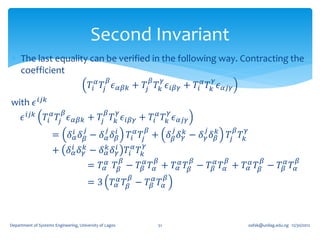
Second Invariant
 The last equality can be verified in the following way. Contracting the
  coefficient
                                                 𝛽                           𝛽       𝛾                       𝛾
                                          𝑇𝑖 𝛼 𝑇𝑗 𝜖 𝛼𝛽𝑘 + 𝑇𝑗 𝑇 𝑘 𝜖 𝑖𝛽𝛾 + 𝑇𝑖 𝛼 𝑇 𝑘 𝜖 𝛼𝑗𝛾
with 𝜖 𝑖𝑗𝑘
                           𝛽                    𝛽        𝛾                                   𝛾
      𝜖 𝑖𝑗𝑘       𝑇𝑖 𝛼 𝑇𝑗 𝜖 𝛼𝛽𝑘 + 𝑇𝑗 𝑇 𝑘 𝜖 𝑖𝛽𝛾 + 𝑇𝑖 𝛼 𝑇 𝑘 𝜖 𝛼𝑗𝛾
                                      𝑗         𝑖𝑗                       𝛽                       𝑗       𝑗           𝛽   𝛾
                     =         𝛿 𝑖𝛼 𝛿 𝛽 − 𝛿 𝛼 𝛿 𝛽                𝑇𝑖 𝛼 𝑇𝑗 + 𝛿 𝛽 𝛿 𝛾𝑘 − 𝛿 𝛾 𝛿 𝛽𝑘                   𝑇𝑗 𝑇 𝑘
                                                                     𝛾
                     + 𝛿 𝑖𝛼 𝛿 𝛾𝑘 − 𝛿 𝛼𝑘 𝛿 𝛾 𝑇𝑖 𝛼 𝑇 𝑘
                                          𝑖
                                                             𝛽                   𝛽                   𝛽           𝛽                 𝛽                𝛽
                                          = 𝑇 𝛼𝛼 𝑇 𝛽 − 𝑇 𝛽𝛼 𝑇 𝛼 + 𝑇 𝛼𝛼 𝑇 𝛽 − 𝑇 𝛽𝛼 𝑇 𝛼 + 𝑇 𝛼𝛼 𝑇 𝛽 − 𝑇 𝛽𝛼 𝑇 𝛼
                                                                 𝛽                       𝛽
                                          = 3 𝑇 𝛼𝛼 𝑇 𝛽 − 𝑇 𝛽𝛼 𝑇 𝛼


Department of Systems Engineering, University of Lagos                           51                                          oafak@unilag.edu.ng 12/30/2012
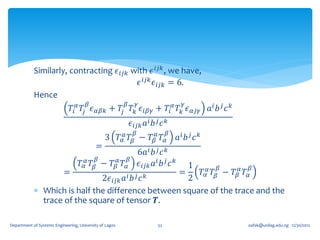
Similarly, contracting 𝜖 𝑖𝑗𝑘 with 𝜖 𝑖𝑗𝑘 , we have,
                                           𝜖 𝑖𝑗𝑘 𝜖 𝑖𝑗𝑘 = 6.
            Hence
                                       𝛽                 𝛽         𝛾                        𝛾
                               𝑇𝑖 𝛼 𝑇𝑗 𝜖 𝛼𝛽𝑘 + 𝑇𝑗 𝑇 𝑘 𝜖 𝑖𝛽𝛾 + 𝑇𝑖 𝛼 𝑇 𝑘 𝜖 𝛼𝑗𝛾 𝑎 𝑖 𝑏 𝑗 𝑐 𝑘
                                                                 𝜖 𝑖𝑗𝑘 𝑎 𝑖 𝑏 𝑗 𝑐 𝑘
                                                                  𝛽                 𝛽
                                                3 𝑇 𝛼𝛼 𝑇 𝛽 − 𝑇 𝛽𝛼 𝑇 𝛼                     𝑎𝑖 𝑏 𝑗 𝑐 𝑘
                                           =
                                                                      6𝑎 𝑖 𝑏 𝑗 𝑐 𝑘
                                           𝛽                 𝛽
                                   𝑇 𝛼𝛼 𝑇 𝛽 − 𝑇 𝛽𝛼 𝑇 𝛼
                                                    1          𝛽
                                                                      𝜖 𝑖𝑗𝑘 𝑎 𝑖 𝑏 𝑗 𝑐 𝑘
                                                                          𝛽
                    =                             =    𝑇 𝛼𝛼 𝑇 𝛽 − 𝑇 𝛽𝛼 𝑇 𝛼
                              2𝜖 𝑖𝑗𝑘 𝑎 𝑖 𝑏 𝑗 𝑐 𝑘    2
             Which is half the difference between square of the trace and the
              trace of the square of tensor 𝑻.

Department of Systems Engineering, University of Lagos                         52                      oafak@unilag.edu.ng 12/30/2012
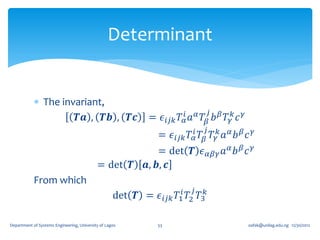
Determinant


             The invariant,
                                                                                    𝑗
                     𝑻𝒂 , 𝑻𝒃 , 𝑻𝒄                            = 𝜖 𝑖𝑗𝑘 𝑇 𝛼𝑖 𝑎 𝛼 𝑇 𝛽 𝑏 𝛽 𝑇 𝛾𝑘 𝑐 𝛾
                                                                                𝑗
                                                                = 𝜖 𝑖𝑗𝑘 𝑇 𝛼𝑖 𝑇 𝛽 𝑇 𝛾𝑘 𝑎 𝛼 𝑏 𝛽 𝑐 𝛾
                                                                = det 𝑻 𝜖 𝛼𝛽𝛾 𝑎 𝛼 𝑏 𝛽 𝑐 𝛾
                                            = det 𝑻         𝒂, 𝒃, 𝒄
            From which
                                                                            𝑗
                                                    det 𝑻 = 𝜖 𝑖𝑗𝑘 𝑇1𝑖 𝑇2 𝑇3𝑘

Department of Systems Engineering, University of Lagos          53                               oafak@unilag.edu.ng 12/30/2012
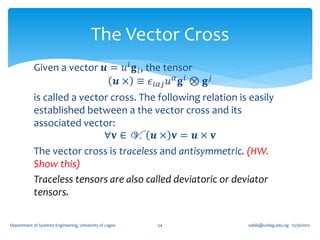
The Vector Cross
            Given a vector 𝒖 = 𝑢 𝑖 𝐠 𝑖 , the tensor
                              𝒖 × ≡ 𝜖 𝑖𝛼𝑗 𝑢 𝛼 𝐠 𝑖 ⊗ 𝐠 𝑗
            is called a vector cross. The following relation is easily
            established between a the vector cross and its
            associated vector:
                             ∀𝐯 ∈ V , 𝒖 × 𝐯 = 𝒖 × 𝐯
            The vector cross is traceless and antisymmetric. (HW.
            Show this)
            Traceless tensors are also called deviatoric or deviator
            tensors.

Department of Systems Engineering, University of Lagos   54    oafak@unilag.edu.ng 12/30/2012
Axial Vector

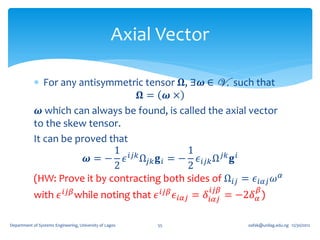
             For any antisymmetric tensor 𝛀, ∃𝝎 ∈ V , such that
                                    𝛀= 𝝎×
             𝝎 which can always be found, is called the axial vector
            to the skew tensor.
            It can be proved that
                              1 𝑖𝑗𝑘            1
                        𝝎 = − 𝜖 Ω 𝑗𝑘 𝐠 𝑖 = − 𝜖 𝑖𝑗𝑘 Ω 𝑗𝑘 𝐠 𝑖
                              2                2
            (HW: Prove it by contracting both sides of Ω 𝑖𝑗 = 𝜖 𝑖𝛼𝑗 𝜔 𝛼
                                                                  𝑖𝑗𝛽       𝛽
            with 𝜖 𝑖𝑗𝛽 while noting that 𝜖 𝑖𝑗𝛽 𝜖 𝑖𝛼𝑗 = 𝛿 𝑖𝛼𝑗 = −2𝛿 𝛼 )

Department of Systems Engineering, University of Lagos   55             oafak@unilag.edu.ng 12/30/2012
Examples
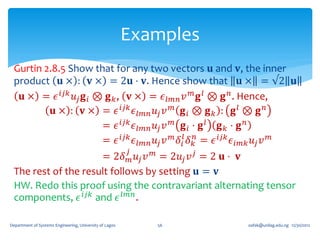
 Gurtin 2.8.5 Show that for any two vectors 𝐮 and 𝐯, the inner
 product 𝐮 × : 𝐯 × = 2𝐮 ⋅ 𝐯. Hence show that 𝐮 × = √2 𝐮
  𝐮 × = 𝜖 𝑖𝑗𝑘 𝑢 𝑗 𝐠 𝑖 ⊗ 𝐠 𝑘 , 𝐯 × = 𝜖 𝑙𝑚𝑛 𝑣 𝑚 𝐠 𝑙 ⊗ 𝐠 𝑛 . Hence,
          𝐮 × : 𝐯 × = 𝜖 𝑖𝑗𝑘 𝜖 𝑙𝑚𝑛 𝑢 𝑗 𝑣 𝑚 𝐠 𝑖 ⊗ 𝐠 𝑘 : 𝐠 𝑙 ⊗ 𝐠 𝑛
                       = 𝜖 𝑖𝑗𝑘 𝜖 𝑙𝑚𝑛 𝑢 𝑗 𝑣 𝑚 𝐠 𝑖 ⋅ 𝐠 𝑙 𝐠 𝑘 ⋅ 𝐠 𝑛
                       = 𝜖 𝑖𝑗𝑘 𝜖 𝑙𝑚𝑛 𝑢 𝑗 𝑣 𝑚 𝛿 𝑖𝑙 𝛿 𝑘𝑛 = 𝜖 𝑖𝑗𝑘 𝜖 𝑖𝑚𝑘 𝑢 𝑗 𝑣 𝑚
                                                         𝑗
                     = 2𝛿 𝑚 𝑢 𝑗 𝑣 𝑚 = 2𝑢 𝑗 𝑣 𝑗 = 2 𝐮 ⋅ 𝐯
 The rest of the result follows by setting 𝐮 = 𝐯
 HW. Redo this proof using the contravariant alternating tensor
 components, 𝜖 𝑖𝑗𝑘 and 𝜖 𝑙𝑚𝑛 .

Department of Systems Engineering, University of Lagos       56     oafak@unilag.edu.ng 12/30/2012
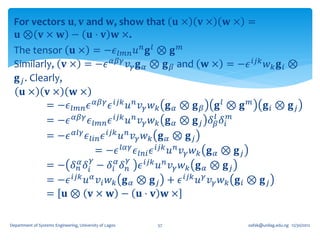
For vectors 𝐮, 𝐯 and 𝐰, show that 𝐮 × 𝐯 × 𝐰 × =
  𝐮 ⊗ 𝐯 × 𝐰 − 𝐮 ⋅ 𝐯 𝐰 ×.
 The tensor 𝐮 × = −𝜖 𝑙𝑚𝑛 𝑢 𝑛 𝐠 𝑙 ⊗ 𝐠 𝑚
 Similarly, 𝐯 × = −𝜖 𝛼𝛽𝛾 𝑣 𝛾 𝐠 𝛼 ⊗ 𝐠 𝛽 and 𝐰 × = −𝜖 𝑖𝑗𝑘 𝑤 𝑘 𝐠 𝑖 ⊗
  𝐠 𝑗 . Clearly,
    𝐮× 𝐯× 𝐰×
            = −𝜖 𝑙𝑚𝑛 𝜖 𝛼𝛽𝛾 𝜖 𝑖𝑗𝑘 𝑢 𝑛 𝑣 𝛾 𝑤 𝑘 𝐠 𝛼 ⊗ 𝐠 𝛽 𝐠 𝑙 ⊗ 𝐠 𝑚 𝐠 𝑖 ⊗ 𝐠 𝑗
                                                             𝑙
            = −𝜖 𝛼𝛽𝛾 𝜖 𝑙𝑚𝑛 𝜖 𝑖𝑗𝑘 𝑢 𝑛 𝑣 𝛾 𝑤 𝑘 𝐠 𝛼 ⊗ 𝐠 𝑗 𝛿 𝛽 𝛿 𝑖 𝑚
            = −𝜖 𝛼𝑙𝛾 𝜖 𝑙𝑖𝑛 𝜖 𝑖𝑗𝑘 𝑢 𝑛 𝑣 𝛾 𝑤 𝑘 𝐠 𝛼 ⊗ 𝐠 𝑗
                          = −𝜖 𝑙𝛼𝛾 𝜖 𝑙𝑛𝑖 𝜖 𝑖𝑗𝑘 𝑢 𝑛 𝑣 𝛾 𝑤 𝑘 𝐠 𝛼 ⊗ 𝐠 𝑗
                        𝛾          𝛾
            = − 𝛿 𝑛𝛼 𝛿 𝑖 − 𝛿 𝑖 𝛼 𝛿 𝑛 𝜖 𝑖𝑗𝑘 𝑢 𝑛 𝑣 𝛾 𝑤 𝑘 𝐠 𝛼 ⊗ 𝐠 𝑗
            = −𝜖 𝑖𝑗𝑘 𝑢 𝛼 𝑣 𝑖 𝑤 𝑘 𝐠 𝛼 ⊗ 𝐠 𝑗 + 𝜖 𝑖𝑗𝑘 𝑢 𝛾 𝑣 𝛾 𝑤 𝑘 𝐠 𝑖 ⊗ 𝐠 𝑗
            = 𝐮⊗ 𝐯× 𝐰 − 𝐮⋅ 𝐯 𝐰×

Department of Systems Engineering, University of Lagos   57   oafak@unilag.edu.ng 12/30/2012
Index Raising & Lowering


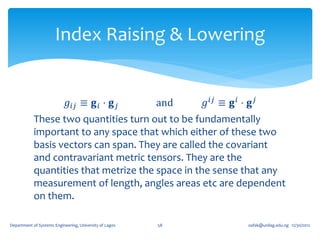
                             𝑔 𝑖𝑗 ≡ 𝐠 𝑖 ⋅ 𝐠 𝑗            and   𝑔 𝑖𝑗 ≡ 𝐠 𝑖 ⋅ 𝐠 𝑗
            These two quantities turn out to be fundamentally
            important to any space that which either of these two
            basis vectors can span. They are called the covariant
            and contravariant metric tensors. They are the
            quantities that metrize the space in the sense that any
            measurement of length, angles areas etc are dependent
            on them.

Department of Systems Engineering, University of Lagos   58                 oafak@unilag.edu.ng 12/30/2012
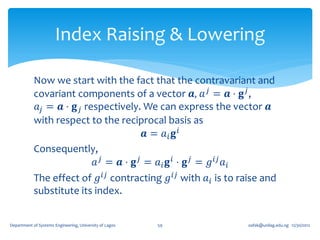
Index Raising & Lowering

            Now we start with the fact that the contravariant and
            covariant components of a vector 𝒂, 𝑎 𝑗 = 𝒂 ⋅ 𝐠 𝑗 ,
             𝑎 𝑗 = 𝒂 ⋅ 𝐠 𝑗 respectively. We can express the vector 𝒂
            with respect to the reciprocal basis as
                                           𝒂 = 𝑎𝑖 𝐠 𝑖
            Consequently,
                             𝑎 𝑗 = 𝒂 ⋅ 𝐠 𝑗 = 𝑎 𝑖 𝐠 𝑖 ⋅ 𝐠 𝑗 = 𝑔 𝑖𝑗 𝑎 𝑖
            The effect of 𝑔 𝑖𝑗 contracting 𝑔 𝑖𝑗 with 𝑎 𝑖 is to raise and
            substitute its index.


Department of Systems Engineering, University of Lagos   59      oafak@unilag.edu.ng 12/30/2012
Index Raising & Lowering


            With similar arguments, it is easily demonstrated that,
                                   𝑎 𝑖 = 𝑔 𝑖𝑗 𝑎 𝑗
            So that 𝑔 𝑖𝑗 , in a contraction, lowers and substitutes the
            index. This rule is a general one. These two components
            are able to raise or lower indices in tensors of higher
            orders as well. They are called index raising and index
            lowering operators.


Department of Systems Engineering, University of Lagos   60   oafak@unilag.edu.ng 12/30/2012
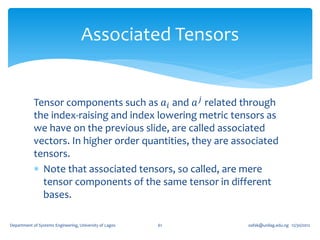
Associated Tensors


            Tensor components such as 𝑎 𝑖 and 𝑎 𝑗 related through
            the index-raising and index lowering metric tensors as
            we have on the previous slide, are called associated
            vectors. In higher order quantities, they are associated
            tensors.
             Note that associated tensors, so called, are mere
              tensor components of the same tensor in different
              bases.

Department of Systems Engineering, University of Lagos   61   oafak@unilag.edu.ng 12/30/2012
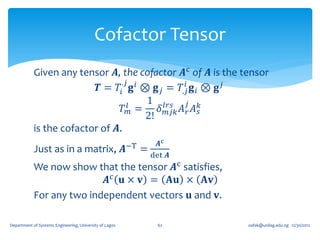
Cofactor Tensor
            Given any tensor 𝑨, the cofactor 𝑨c of 𝑨 is the tensor
                                 .𝑗               𝑖
                           𝑻 = 𝑇𝑖 𝐠 𝑖 ⊗ 𝐠 𝑗 = 𝑇.𝑗 𝐠 𝑖 ⊗ 𝐠 𝑗
                                    𝑙 =
                                        1 𝑙𝑟𝑠 𝑗 𝑘
                                 𝑇𝑚        𝛿 𝑚𝑗𝑘 𝐴 𝑟 𝐴 𝑠
                                        2!
            is the cofactor of 𝑨.
                                                         −T       𝑨c
            Just as in a matrix, 𝑨                            =
                                                                det 𝑨
            We now show that the tensor 𝑨c satisfies,
                           𝑨c 𝐮 × 𝐯 = 𝐀𝐮 × 𝐀𝐯
            For any two independent vectors 𝐮 and 𝐯.

Department of Systems Engineering, University of Lagos            62    oafak@unilag.edu.ng 12/30/2012
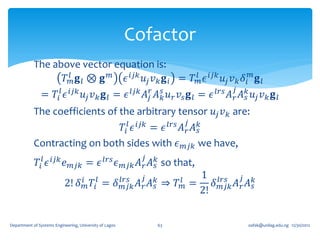
Cofactor
            The above vector equation is:
                  𝑇 𝑙𝑚 𝐠 𝑙 ⊗ 𝐠 𝑚 𝜖 𝑖𝑗𝑘 𝑢 𝑗 𝑣 𝑘 𝐠 𝑖 = 𝑇 𝑙𝑚 𝜖 𝑖𝑗𝑘 𝑢 𝑗 𝑣 𝑘 𝛿 𝑖 𝑚 𝐠 𝑙
                                                                                                         𝑗
               = 𝑇𝑖𝑙 𝜖 𝑖𝑗𝑘 𝑢 𝑗 𝑣 𝑘 𝐠 𝑙 = 𝜖 𝑙𝑗𝑘 𝐴 𝑗𝑟 𝐴 𝑠𝑘 𝑢 𝑟 𝑣 𝑠 𝐠 𝑙 = 𝜖 𝑙𝑟𝑠 𝐴 𝑟 𝐴 𝑠𝑘 𝑢 𝑗 𝑣 𝑘 𝐠 𝑙
            The coefficients of the arbitrary tensor 𝑢 𝑗 𝑣 𝑘 are:
                                                                                         𝑗
                               𝑇𝑖𝑙 𝜖 𝑖𝑗𝑘 = 𝜖 𝑙𝑟𝑠 𝐴 𝑟 𝐴 𝑠𝑘
            Contracting on both sides with 𝜖 𝑚𝑗𝑘 we have,
                                                                  𝑗
             𝑇𝑖𝑙 𝜖 𝑖𝑗𝑘 𝑒      𝑚𝑗𝑘     = 𝜖 𝑙𝑟𝑠 𝜖           𝑚𝑗𝑘    𝐴 𝑟 𝐴 𝑠𝑘 so that,
                                                                  𝑗                            1 𝑙𝑟𝑠 𝑗 𝑘
                           2!     𝛿 𝑖𝑚 𝑇𝑖𝑙     =         𝛿 𝑙𝑟𝑠
                                                           𝑚𝑗𝑘   𝐴𝑟   𝐴 𝑠𝑘    ⇒   𝑇 𝑙𝑚       =    𝛿 𝑚𝑗𝑘 𝐴 𝑟 𝐴 𝑠
                                                                                               2!


Department of Systems Engineering, University of Lagos                       63                              oafak@unilag.edu.ng 12/30/2012
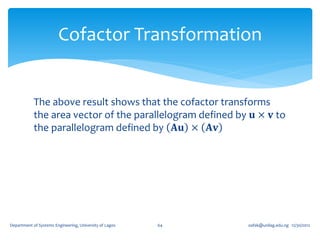
Cofactor Transformation


            The above result shows that the cofactor transforms
            the area vector of the parallelogram defined by 𝐮 × 𝐯 to
            the parallelogram defined by 𝐀𝐮 × 𝐀𝐯


Department of Systems Engineering, University of Lagos   64   oafak@unilag.edu.ng 12/30/2012
Determinants
            Show that the determinant of a product is the product of
            the determinants
                              𝑪 = 𝑨𝑩 ⇒ 𝐶𝑗𝑖 = 𝐴 𝑖 𝑚 𝐵 𝑗 𝑚
            so that the determinant of 𝑪 in component form is,
                          𝜖 𝑖𝑗𝑘 𝐶 1 𝐶𝑗2 𝐶 3 = 𝜖 𝑖𝑗𝑘 𝐴1 𝐵 𝑖𝑙 𝐴2𝑚 𝐵 𝑗 𝑚 𝐴3𝑛 𝐵 𝑘𝑛
                                  𝑖       𝑘          𝑙
                                     = 𝐴1 𝐴2𝑚 𝐴3𝑛 𝜖 𝑖𝑗𝑘 𝐵 𝑖𝑙 𝐵 𝑗 𝑚 𝐵 𝑘𝑛
                                            𝑙
                                            = 𝐴1 𝐴2𝑚 𝐴3𝑛 𝜖 𝑙𝑚𝑛 det 𝑩
                                                  𝑙
                                            = det 𝑨 × det 𝑩 .
            If 𝑨 is the inverse of 𝑩, then 𝑪 becomes the identity matrix.
            Hence the above also proves that the determinant of an
            inverse is the inverse of the determinant.


Department of Systems Engineering, University of Lagos   65           oafak@unilag.edu.ng 12/30/2012
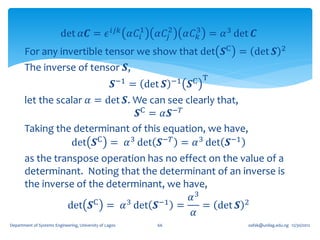
det 𝛼𝑪 = 𝜖 𝑖𝑗𝑘 𝛼𝐶 1
                                           𝑖              𝛼𝐶𝑗2      𝛼𝐶 3 = 𝛼 3 det 𝑪
                                                                       𝑘
       For any invertible tensor we show that det 𝑺C = det 𝑺                                      2

       The inverse of tensor 𝑺,
                               = det 𝑺              𝑺−1        −1   𝑺C T

       let the scalar 𝛼 = det 𝑺. We can see clearly that,
                                 𝑺C = 𝛼𝑺−𝑇
       Taking the determinant of this equation, we have,
                  det 𝑺C = 𝛼 3 det 𝑺−𝑇 = 𝛼 3 det 𝑺−1
       as the transpose operation has no effect on the value of a
       determinant. Noting that the determinant of an inverse is
       the inverse of the determinant, we have,
                                             𝛼3
                 det 𝑺C = 𝛼 3 det 𝑺−1 =         = det 𝑺 2
                                              𝛼
Department of Systems Engineering, University of Lagos    66                      oafak@unilag.edu.ng 12/30/2012
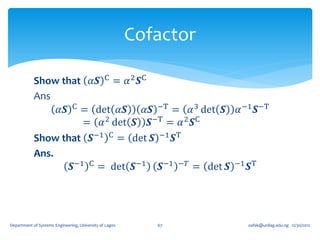
Cofactor

            Show that 𝛼𝑺 C = 𝛼 2 𝑺C
            Ans
                 𝛼𝑺 C = det 𝛼𝑺     𝛼𝑺 −T = 𝛼 3 det 𝑺 𝛼 −1 𝑺−T
                       = 𝛼 2 det 𝑺 𝑺−T = 𝛼 2 𝑺C
            Show that 𝑺−1 C = det 𝑺 −1 𝑺T
            Ans.
                    𝑺−1 C = det 𝑺−1 𝑺−1 −𝑇 = det 𝑺 −1 𝑺T


Department of Systems Engineering, University of Lagos      67      oafak@unilag.edu.ng 12/30/2012
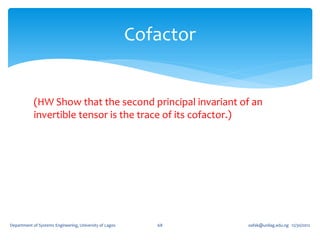
Cofactor


            (HW Show that the second principal invariant of an
            invertible tensor is the trace of its cofactor.)


Department of Systems Engineering, University of Lagos      68      oafak@unilag.edu.ng 12/30/2012
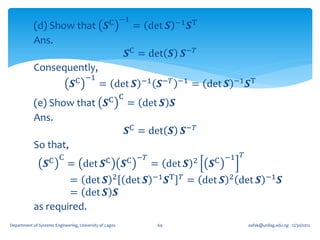
(d) Show that                        𝑺C −1        = det 𝑺        −1 𝑺T

            Ans.
                                                         𝑺C = det 𝑺 𝑺−𝑇
            Consequently,
                                 C −1                          −1
                               𝑺             = det 𝑺                 𝑺−𝑇     −1
                                                                                  = det 𝑺     −1 T
                                                                                                𝑺
            (e) Show that                       𝑺C C         = det 𝑺 𝑺
            Ans.
                                                         𝑺C = det 𝑺 𝑺−𝑇
            So that,
                                                                                           𝑇
                   C C                          C        C −𝑇                     2   C −1
                  𝑺          = det 𝑺                     𝑺       = det 𝑺              𝑺
                    = det 𝑺 2 det 𝑺                                 −1 T 𝑇
                                                                         𝑺     = det 𝑺    2
                                                                                              det 𝑺     −1
                                                                                                               𝑺
                    = det 𝑺 𝑺
            as required.
Department of Systems Engineering, University of Lagos              69                          oafak@unilag.edu.ng 12/30/2012
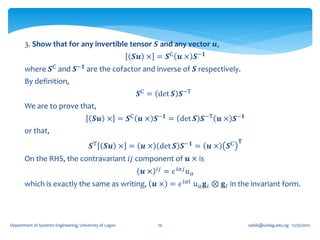
3. Show that for any invertible tensor 𝑺 and any vector 𝒖,
                                                         𝑺𝒖 × = 𝑺C 𝒖 × 𝑺−𝟏
       where 𝑺C and 𝑺−𝟏 are the cofactor and inverse of 𝑺 respectively.
       By definition,
                                                          𝑺C = det 𝑺 𝑺−T
       We are to prove that,
                                           𝑺𝒖 × = 𝑺C 𝒖 × 𝑺−𝟏 = det 𝑺 𝑺−T 𝒖 × 𝑺−𝟏
       or that,
                                                                                             𝐓
                                         𝑺T     𝑺𝒖 × =     𝒖 × det 𝑺 𝑺−𝟏 =         𝒖×   𝑺C
       On the RHS, the contravariant 𝑖𝑗 component of 𝒖 × is
                                                           𝒖×   𝑖𝑗   = 𝜖 𝑖𝛼𝑗 𝑢 𝛼
       which is exactly the same as writing, 𝒖 × = 𝜖 𝑖𝛼𝑙 𝑢 𝛼 𝐠 𝑖 ⊗ 𝐠 𝑙 in the invariant form.


Department of Systems Engineering, University of Lagos          70                               oafak@unilag.edu.ng 12/30/2012
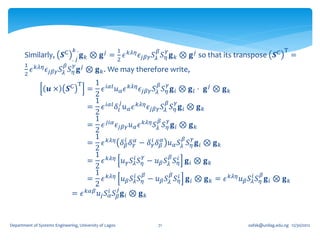
𝑘.                       1     𝛽    𝛾                                          T
       Similarly, 𝑺C           . 𝑗
                                     𝐠 𝑘 ⊗ 𝐠 𝑗 = 2 𝜖 𝑘𝜆𝜂 𝜖 𝑗𝛽𝛾 𝑆 𝜆 𝑆 𝜂 𝐠 𝑘 ⊗ 𝐠 𝑗 so that its transpose 𝑺C          =
       1       𝑘𝜆𝜂          𝛽 𝛾
           𝜖       𝜖 𝑗𝛽𝛾 𝑆 𝜆 𝑆 𝜂 𝐠 𝑗   ⊗ 𝐠 𝑘 . We may therefore write,
       2
                                T     1 𝑖𝛼𝑙                   𝛽 𝛾
                    𝒖×       𝑺C    = 𝜖 𝑢 𝛼 𝜖 𝑘𝜆𝜂 𝜖 𝑗𝛽𝛾 𝑆 𝜆 𝑆 𝜂 𝐠 𝑖 ⊗ 𝐠 𝑙 ⋅ 𝐠 𝑗 ⊗ 𝐠 𝑘
                                      2
                                      1 𝑖𝛼𝑙 𝑗                    𝛽 𝛾
                                   = 𝜖 𝛿 𝑙 𝑢 𝛼 𝜖 𝑘𝜆𝜂 𝜖 𝑗𝛽𝛾 𝑆 𝜆 𝑆 𝜂 𝐠 𝑖 ⊗ 𝐠 𝑘
                                      2
                                      1                       𝛽 𝛾
                                   = 𝜖 𝑗𝑖𝛼 𝜖 𝑗𝛽𝛾 𝑢 𝛼 𝜖 𝑘𝜆𝜂 𝑆 𝜆 𝑆 𝜂 𝐠 𝑖 ⊗ 𝐠 𝑘
                                      2
                                      1                                 𝛽 𝛾
                                   = 𝜖 𝑘𝜆𝜂 𝛿 𝛽 𝛿 𝛾𝛼 − 𝛿 𝑖𝛾 𝛿 𝛽𝛼 𝑢 𝛼 𝑆 𝜆 𝑆 𝜂 𝐠 𝑖 ⊗ 𝐠 𝑘
                                                      𝑖
                                      2
                                      1                    𝛾      𝛽 𝑖
                                   = 𝜖 𝑘𝜆𝜂 𝑢 𝛾 𝑆 𝜆𝑖 𝑆 𝜂 − 𝑢 𝛽 𝑆 𝜆 𝑆 𝜂 𝐠 𝑖 ⊗ 𝐠 𝑘
                                      2
                                      1                    𝛽       𝛽 𝑖                              𝛽
                                   = 𝜖 𝑘𝜆𝜂 𝑢 𝛽 𝑆 𝜆𝑖 𝑆 𝜂 − 𝑢 𝛽 𝑆 𝜆 𝑆 𝜂 𝐠 𝑖 ⊗ 𝐠 𝑘 = 𝜖 𝑘𝜆𝜂 𝑢 𝛽 𝑆 𝜆𝑖 𝑆 𝜂 𝐠 𝑖 ⊗ 𝐠 𝑘
                                      2
                                                  𝑗
                               = 𝜖 𝑘𝛼𝛽 𝑢 𝑗 𝑆 𝑖𝛼 𝑆 𝛽 𝐠 𝑖 ⊗ 𝐠 𝑘


Department of Systems Engineering, University of Lagos         71                             oafak@unilag.edu.ng 12/30/2012
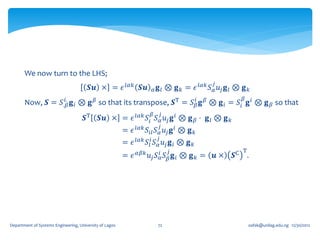
We now turn to the LHS;
                                                                                                𝑗
                                        𝑺𝒖 × = 𝜖 𝑙𝛼𝑘 𝑺𝒖               𝛼   𝐠 𝑙 ⊗ 𝐠 𝑘 = 𝜖 𝑙𝛼𝑘 𝑆 𝛼 𝑢 𝑗 𝐠 𝑙 ⊗ 𝐠 𝑘
                  𝑖.                                        𝑖                                              𝛽
       Now, 𝑺 = 𝑆.𝛽 𝐠 𝑖 ⊗ 𝐠 𝛽 so that its transpose, 𝑺T = 𝑆 𝛽 𝐠 𝛽 ⊗ 𝐠 𝑖 = 𝑆 𝑖 𝐠 𝑖 ⊗ 𝐠 𝛽 so that
                                                                      𝛽       𝑗
                                     𝑺T      𝑺𝒖 × = 𝜖 𝑙𝛼𝑘 𝑆 𝑖 𝑆 𝛼 𝑢 𝑗 𝐠 𝑖 ⊗ 𝐠 𝛽 ⋅ 𝐠 𝑙 ⊗ 𝐠 𝑘
                                                                          𝑗
                                                         = 𝜖 𝑙𝛼𝑘 𝑆 𝑖𝑙 𝑆 𝛼 𝑢 𝑗 𝐠 𝑖 ⊗ 𝐠 𝑘
                                                                          𝑗
                                                         = 𝜖 𝑙𝛼𝑘 𝑆 𝑙𝑖 𝑆 𝛼 𝑢 𝑗 𝐠 𝑖 ⊗ 𝐠 𝑘
                                                               𝛼𝛽𝑘                𝑗                        T
                                                         = 𝜖         𝑢 𝑗 𝑆 𝑖𝛼 𝑆 𝛽 𝐠 𝑖 ⊗ 𝐠 𝑘 =   𝒖×    𝑺C       .


Department of Systems Engineering, University of Lagos                    72                                   oafak@unilag.edu.ng 12/30/2012
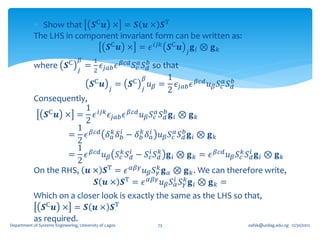
 Show that 𝑺C 𝒖 × = 𝑺 𝒖 × 𝑺T
            The LHS in component invariant form can be written as:
                              𝑺C 𝒖 × = 𝜖 𝑖𝑗𝑘 𝑺C 𝒖 𝑗 𝐠 𝑖 ⊗ 𝐠 𝑘
                                   𝛽       1
            where 𝑺           C
                                       =     𝜖           𝜖   𝛽𝑐𝑑
                                                                𝑆 𝑐𝑎 𝑆 𝑑𝑏 so that
                                   𝑗       2 𝑗𝑎𝑏
                                                                C 𝛽 𝑢 =
                                                                              1
                                           𝑺C 𝒖        =       𝑺 𝑗 𝛽            𝜖 𝑗𝑎𝑏 𝜖   𝛽𝑐𝑑   𝑢 𝛽 𝑆 𝑐𝑎 𝑆 𝑑𝑏
                                                   𝑗                          2
            Consequently,
                        1
               𝑺C 𝒖 × = 𝜖 𝑖𝑗𝑘 𝜖 𝑗𝑎𝑏 𝜖 𝛽𝑐𝑑 𝑢 𝛽 𝑆 𝑐𝑎 𝑆 𝑑𝑏 𝐠 𝑖 ⊗ 𝐠 𝑘
                        2
                      1 𝛽𝑐𝑑 𝑘 𝑖
                     = 𝜖       𝛿 𝑎 𝛿 𝑏 − 𝛿 𝑏𝑘 𝛿 𝑖𝑎 𝑢 𝛽 𝑆 𝑐𝑎 𝑆 𝑑𝑏 𝐠 𝑖 ⊗ 𝐠 𝑘
                      2
                      1 𝛽𝑐𝑑
                     = 𝜖     𝑢 𝛽 𝑆 𝑐𝑘 𝑆 𝑖𝑑 − 𝑆 𝑐𝑖 𝑆 𝑑𝑘 𝐠 𝑖 ⊗ 𝐠 𝑘 = 𝜖 𝛽𝑐𝑑 𝑢 𝛽 𝑆 𝑐𝑘 𝑆 𝑖𝑑 𝐠 𝑖 ⊗ 𝐠 𝑘
                      2
            On the RHS, 𝒖 × 𝑺T = 𝜖 𝛼𝛽𝛾 𝑢 𝛽 𝑆 𝛾𝑘 𝐠 𝛼 ⊗ 𝐠 𝑘 . We can therefore write,
                           𝑺 𝒖 × 𝑺T = 𝜖 𝛼𝛽𝛾 𝑢 𝛽 𝑆 𝑖𝛼 𝑆 𝛾𝑘 𝐠 𝑖 ⊗ 𝐠 𝑘 =
            Which on a closer look is exactly the same as the LHS so that,
               𝑺C 𝒖 × = 𝑺 𝒖 × 𝑺T
            as required.
Department of Systems Engineering, University of Lagos                   73                                     oafak@unilag.edu.ng 12/30/2012
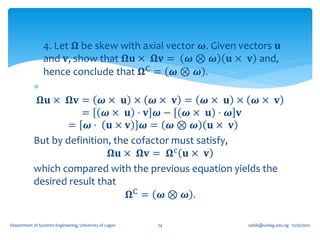
 4. Let 𝛀 be skew with axial vector 𝝎. Given vectors 𝐮
              and 𝐯, show that 𝛀𝐮 × 𝛀𝐯 = 𝝎 ⊗ 𝝎 𝐮 × 𝐯 and,
              hence conclude that 𝛀C = 𝝎 ⊗ 𝝎 .
            
              𝛀𝐮 × 𝛀𝐯 = 𝝎 × 𝐮 × 𝝎 × 𝐯 = 𝝎 × 𝐮 × 𝝎 × 𝐯
                       = 𝝎× 𝐮 ⋅ 𝐯 𝝎− 𝝎× 𝐮 ⋅ 𝝎 𝐯
                    = 𝝎⋅ 𝐮× 𝐯 𝝎= 𝝎⊗ 𝝎 𝐮× 𝐯
            But by definition, the cofactor must satisfy,
                              𝛀𝐮 × 𝛀𝐯 = 𝛀c 𝐮 × 𝐯
            which compared with the previous equation yields the
            desired result that
                                  𝛀C = 𝝎 ⊗ 𝝎 .

Department of Systems Engineering, University of Lagos   74   oafak@unilag.edu.ng 12/30/2012
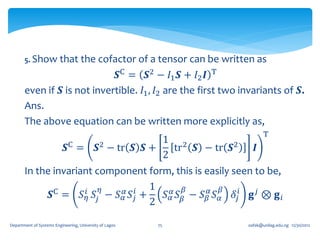
5. Show that the cofactor of a tensor can be                   written as
                            𝑺C = 𝑺2 − 𝐼1 𝑺 + 𝐼2 𝑰 T
       even if 𝑺 is not invertible. 𝐼1 , 𝐼2 are the first two invariants of 𝑺.
       Ans.
       The above equation can be written more explicitly as,
                                                                                    T
                                                            1 2
                            𝑺C   =          𝑺2   − tr 𝑺 𝑺 +   tr 𝑺 − tr 𝑺2      𝑰
                                                            2
       In the invariant component form, this is easily seen to be,
                      𝑖 𝑆 𝜂 − 𝑆 𝛼 𝑆𝑖 +
                                       1 𝛼 𝛽              𝛽
             𝑺C =    𝑆𝜂 𝑗       𝛼 𝑗      𝑆 𝛼 𝑆 𝛽 − 𝑆 𝛽𝛼 𝑆 𝛼 𝛿 𝑗𝑖 𝐠 𝑗 ⊗ 𝐠 𝑖
                                       2

Department of Systems Engineering, University of Lagos    75                 oafak@unilag.edu.ng 12/30/2012
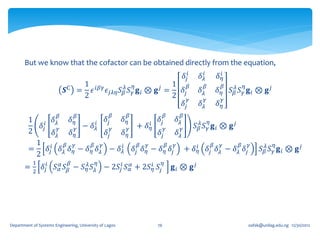
But we know that the cofactor can be obtained directly from the equation,
                                                                                           𝛿 𝑗𝑖     𝛿 𝜆𝑖           𝛿 𝑖𝜂
                                       1 𝑖𝛽𝛾          𝜆 𝜂            1 𝛽                               𝛽             𝛽         𝜂
                             C
                             𝑺        = 𝜖                         𝑗
                                             𝜖 𝑗𝜆𝜂 𝑆 𝛽 𝑆 𝛾 𝐠 𝑖 ⊗ 𝐠 =   𝛿                            𝛿𝜆             𝛿 𝜂 𝑆 𝛽𝜆 𝑆 𝛾 𝐠 𝑖 ⊗ 𝐠 𝑗
                                       2                             2 𝑗𝛾                              𝛾             𝛾
                                                                       𝛿𝑗                           𝛿𝜆             𝛿𝜂
                         𝛽           𝛽                 𝛽    𝛽                 𝛽        𝛽
         1              𝛿𝜆       𝛿𝜂               𝛿𝑗       𝛿𝜂            𝛿𝑗           𝛿𝜆                   𝜂
                 𝛿 𝑗𝑖    𝛾           𝛾   − 𝛿 𝜆𝑖        𝛾    𝛾
                                                                    𝑖
                                                                 + 𝛿𝜂         𝛾        𝛾          𝑆 𝛽𝜆 𝑆 𝛾 𝐠 𝑖 ⊗ 𝐠 𝑗
         2              𝛿𝜆       𝛿𝜂               𝛿𝑗       𝛿𝜂            𝛿𝑗           𝛿𝜆
           1 𝑖      𝛽 𝛾       𝛽 𝛾                                𝛽   𝛾        𝛽   𝛾                            𝛽     𝛾     𝛽       𝛾           𝜂
         =   𝛿 𝑗 𝛿 𝜆 𝛿 𝜂 − 𝛿 𝜂 𝛿 𝜆 − 𝛿 𝜆𝑖                       𝛿𝑗 𝛿 𝜂 − 𝛿 𝜂 𝛿𝑗            + 𝛿 𝑖𝜂 𝛿 𝑗 𝛿 𝜆 − 𝛿 𝜆 𝛿 𝑗                      𝑆 𝛽𝜆 𝑆 𝛾 𝐠 𝑖 ⊗ 𝐠 𝑗
           2
             1                   𝛽            𝜂                           𝜂
       = 2 𝛿 𝑗𝑖 𝑆 𝛼𝛼 𝑆 𝛽 − 𝑆 𝜂𝜆 𝑆 𝜆 − 2𝑆 𝑗𝑖 𝑆 𝛼𝛼 + 2𝑆 𝜂 𝑆 𝑗
                                                      𝑖                           𝐠𝑖 ⊗ 𝐠𝑗


Department of Systems Engineering, University of Lagos                   76                                                        oafak@unilag.edu.ng 12/30/2012
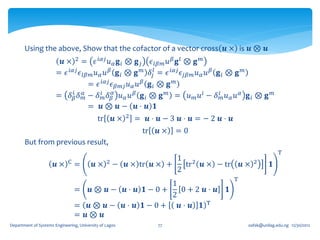
Using the above, Show that the cofactor of a vector cross 𝒖 × is 𝒖 ⊗ 𝒖
                        𝒖 × 2 = 𝜖 𝑖𝛼𝑗 𝑢 𝛼 𝐠 𝑖 ⊗ 𝐠 𝑗 𝜖 𝑙𝛽𝑚 𝑢 𝛽 𝐠 𝑙 ⊗ 𝐠 𝑚
                       = 𝜖 𝑖𝛼𝑗 𝜖 𝑙𝛽𝑚 𝑢 𝛼 𝑢 𝛽 𝐠 𝑖 ⊗ 𝐠 𝑚 𝛿 𝑗𝑙 = 𝜖 𝑖𝛼𝑗 𝜖 𝑗𝛽𝑚 𝑢 𝛼 𝑢 𝛽 𝐠 𝑖 ⊗ 𝐠 𝑚
                                   = 𝜖 𝑖𝛼𝑗 𝜖 𝛽𝑚𝑗 𝑢 𝛼 𝑢 𝛽 𝐠 𝑖 ⊗ 𝐠 𝑚
                       = 𝛿 𝛽 𝛿 𝛼 − 𝛿 𝑖𝑚 𝛿 𝛽𝛼 𝑢 𝛼 𝑢 𝛽 𝐠 𝑖 ⊗ 𝐠 𝑚 = 𝑢 𝑚 𝑢 𝑖 − 𝛿 𝑖𝑚 𝑢 𝛼 𝑢 𝛼 𝐠 𝑖 ⊗ 𝐠
                            𝑖
                                 𝑚
                                                                                                         𝑚

                                   = 𝒖⊗ 𝒖− 𝒖⋅ 𝒖 𝟏
                                                          2
                                            tr       𝒖×       = 𝒖⋅ 𝒖−3 𝒖⋅ 𝒖=−2 𝒖⋅ 𝒖
                                                               tr   𝒖×   =0
       But from previous result,
                                                                                                             T
                             C                   2
                                                                         1 2                      2
                      𝒖×         =        𝒖×         − 𝒖 × tr 𝒖 × +        tr 𝒖 × − tr       𝒖×         𝟏
                                                                         2
                                                                                         T
                                                   1
                                 = 𝒖⊗ 𝒖− 𝒖⋅ 𝒖 𝟏−0+    0+2 𝒖⋅ 𝒖                       𝟏
                                                   2
                                 = 𝒖⊗ 𝒖− 𝒖⋅ 𝒖 𝟏−0+   𝒖⋅ 𝒖 𝟏 T
                                 = 𝒖⊗ 𝒖
Department of Systems Engineering, University of Lagos              77                        oafak@unilag.edu.ng 12/30/2012
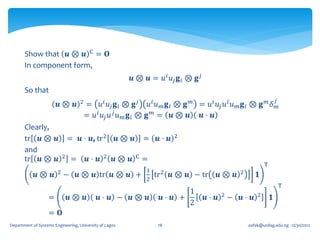
Show that 𝒖 ⊗ 𝒖 C = 𝐎
       In component form,
                                                            𝒖 ⊗ 𝒖 = 𝑢 𝑖 𝑢𝑗 𝐠 𝑖 ⊗ 𝐠 𝑗
       So that
                                     2                                                                                      𝑗
                        𝒖⊗ 𝒖             = 𝑢 𝑖 𝑢𝑗 𝐠 𝑖 ⊗ 𝐠 𝑗 𝑢 𝑙 𝑢 𝑚 𝐠 𝑙 ⊗ 𝐠 𝑚 = 𝑢 𝑖 𝑢𝑗 𝑢 𝑙 𝑢        𝑚   𝐠𝑖 ⊗ 𝐠      𝑚
                                                                                                                        𝛿   𝑚
                                         = 𝑢 𝑖 𝑢𝑗 𝑢 𝑗 𝑢 𝑚 𝐠 𝑖 ⊗ 𝐠 𝑚 = 𝒖 ⊗ 𝒖 𝒖 ⋅ 𝒖
       Clearly,
       tr 𝒖 ⊗ 𝒖                 = 𝒖 ⋅ 𝒖, tr 2            𝒖⊗ 𝒖       =   𝒖⋅ 𝒖   2

       and
       tr 𝒖 ⊗ 𝒖             2    =       𝒖⋅ 𝒖   2   𝒖⊗ 𝒖        C   =
                                                                                                                    T
                        2                                           1
            𝒖⊗ 𝒖            − 𝒖 ⊗ 𝒖 tr 𝒖 ⊗ 𝒖 +                          tr 2 𝒖 ⊗ 𝒖 − tr   𝒖⊗ 𝒖          2
                                                                                                                𝟏
                                                                    2
                                                                                                                            T
                                                                                 1            2                 2
                   =            𝒖⊗ 𝒖         𝒖⋅ 𝒖 − 𝒖⊗ 𝒖                  𝒖⋅ 𝒖 +       𝒖⋅ 𝒖       − 𝒖⋅ 𝒖                𝟏
                                                                                 2
                   = 𝐎
Department of Systems Engineering, University of Lagos                   78                                 oafak@unilag.edu.ng 12/30/2012
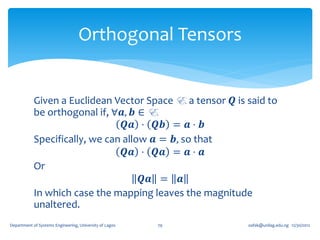
Orthogonal Tensors


            Given a Euclidean Vector Space E, a tensor 𝑸 is said to
            be orthogonal if, ∀𝒂, 𝒃 ∈ E,
                                 𝑸𝒂 ⋅ 𝑸𝒃 = 𝒂 ⋅ 𝒃
            Specifically, we can allow 𝒂 = 𝒃, so that
                                 𝑸𝒂 ⋅ 𝑸𝒂 = 𝒂 ⋅ 𝒂
            Or
                                     𝑸𝒂 = 𝒂
            In which case the mapping leaves the magnitude
            unaltered.
Department of Systems Engineering, University of Lagos   79   oafak@unilag.edu.ng 12/30/2012
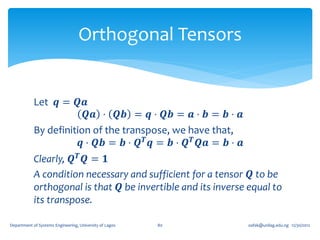
Orthogonal Tensors


            Let 𝒒 = 𝑸𝒂
                         𝑸𝒂 ⋅ 𝑸𝒃 = 𝒒 ⋅ 𝑸𝒃 = 𝒂 ⋅ 𝒃 = 𝒃 ⋅ 𝒂
            By definition of the transpose, we have that,
                       𝒒 ⋅ 𝑸𝒃 = 𝒃 ⋅ 𝑸 𝑻 𝒒 = 𝒃 ⋅ 𝑸 𝑻 𝑸𝒂 = 𝒃 ⋅ 𝒂
            Clearly, 𝑸 𝑻 𝑸 = 𝟏
            A condition necessary and sufficient for a tensor 𝑸 to be
            orthogonal is that 𝑸 be invertible and its inverse equal to
            its transpose.

Department of Systems Engineering, University of Lagos   80      oafak@unilag.edu.ng 12/30/2012
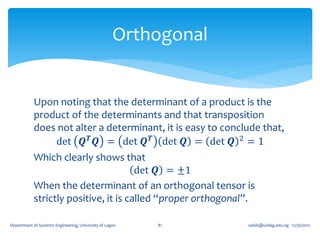
Orthogonal


            Upon noting that the determinant of a product is the
            product of the determinants and that transposition
            does not alter a determinant, it is easy to conclude that,
                  det 𝑸 𝑻 𝑸 = det 𝑸 𝑻 det 𝑸 = det 𝑸 2 = 1
            Which clearly shows that
                                       det 𝑸 = ±1
            When the determinant of an orthogonal tensor is
            strictly positive, it is called “proper orthogonal”.

Department of Systems Engineering, University of Lagos   81      oafak@unilag.edu.ng 12/30/2012
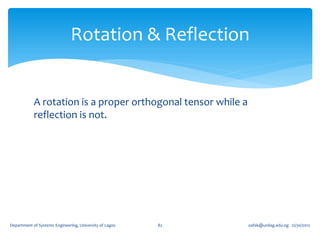
Rotation & Reflection


            A rotation is a proper orthogonal tensor while a
            reflection is not.


Department of Systems Engineering, University of Lagos   82    oafak@unilag.edu.ng 12/30/2012
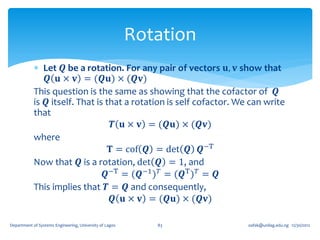
Rotation
             Let 𝑸 be a rotation. For any pair of vectors 𝐮, 𝐯 show that
               𝑸 𝐮 × 𝐯 = (𝑸𝐮) × (𝑸𝐯)
            This question is the same as showing that the cofactor of 𝑸
            is 𝑸 itself. That is that a rotation is self cofactor. We can write
            that
                                   𝑻 𝐮 × 𝐯 = (𝑸𝐮) × (𝑸𝐯)
            where
                                  𝐓 = cof 𝑸 = det 𝑸 𝑸−T
            Now that 𝑸 is a rotation, det 𝑸 = 1, and
                                 𝑸−T = (𝑸−1 ) 𝑇 = (𝑸T ) 𝑇 = 𝑸
            This implies that 𝑻 = 𝑸 and consequently,
                                   𝑸 𝐮 × 𝐯 = (𝑸𝐮) × (𝑸𝐯)

Department of Systems Engineering, University of Lagos      83       oafak@unilag.edu.ng 12/30/2012
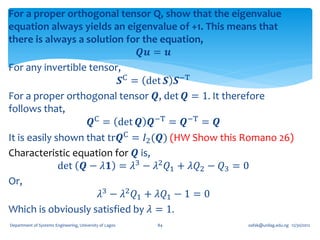
For a proper orthogonal tensor Q, show that the eigenvalue
equation always yields an eigenvalue of +1. This means that
there is always a solution for the equation,
                                𝑸𝒖 = 𝒖
For any invertible tensor,
                          𝑺C = det 𝑺 𝑺−T
For a proper orthogonal tensor 𝑸, det 𝑸 = 1. It therefore
follows that,
                    𝑸C = det 𝑸 𝑸−T = 𝑸−T = 𝑸
It is easily shown that tr𝑸C = 𝐼2 (𝑸) (HW Show this Romano 26)
Characteristic equation for 𝑸 is,
              det 𝑸 − 𝜆𝟏 = 𝜆3 − 𝜆2 𝑄1 + 𝜆𝑄2 − 𝑄3 = 0
Or,
                      𝜆3 − 𝜆2 𝑄1 + 𝜆𝑄1 − 1 = 0
Which is obviously satisfied by 𝜆 = 1.
Department of Systems Engineering, University of Lagos   84   oafak@unilag.edu.ng 12/30/2012
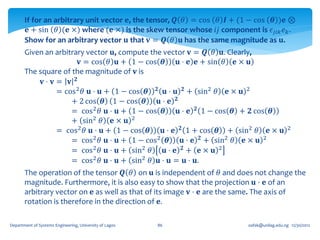
If for an arbitrary unit vector 𝐞, the tensor, 𝑸 𝜃 = cos 𝜃 𝑰 + (1 − cos 𝜽 )𝐞 ⊗
        𝐞 + sin 𝜃 (𝐞 ×) where (𝐞 ×) is the skew tensor whose 𝑖𝑗 component is 𝝐 𝒋𝒊𝒌 𝒆 𝒌 ,
       show that 𝑸 𝜃 (𝑰 − 𝐞 ⊗ 𝐞) = cos 𝜃 (𝑰 − 𝐞 ⊗ 𝐞) + sin 𝜃 (𝐞 ×).
              𝑸 𝜃       𝐞 ⊗ 𝐞 = cos 𝜃                    𝐞 ⊗ 𝐞 + (1 − cos 𝜽 )𝐞 ⊗ 𝐞 + sin 𝜃 [𝐞 × 𝐞 ⊗ 𝐞 ]
       The last term vanishes immediately on account of the fact that 𝐞 ⊗ 𝐞 is a
       symmetric tensor. We therefore have,
                         𝑸 𝜃        𝐞 ⊗ 𝐞 = cos 𝜃              𝐞 ⊗ 𝐞 + (1 − cos 𝜽 )𝐞 ⊗ 𝐞 = 𝐞 ⊗ 𝐞
       which again mean that 𝑸 𝜃 so that
            𝑸 𝜃 𝑰 − 𝐞 ⊗ 𝐞 = cos 𝜃 𝑰 + 1 − cos 𝜽 𝐞 ⊗ 𝐞 + sin 𝜃                             𝐞× − 𝐞⊗ 𝐞
                    = 𝑐os 𝜃 𝑰 − 𝐞 ⊗ 𝐞 + sin 𝜃 𝐞 ×
       as required.


Department of Systems Engineering, University of Lagos            85                      oafak@unilag.edu.ng 12/30/2012
If for an arbitrary unit vector 𝐞, the tensor, 𝑸 𝜃 = cos 𝜃 𝑰 + (1 − cos 𝜽 )𝐞 ⊗
        𝐞 + sin 𝜃 (𝐞 ×) where (𝐞 ×) is the skew tensor whose 𝑖𝑗 component is 𝜖 𝑗𝑖𝑘 𝑒 𝑘 .
       Show for an arbitrary vector 𝐮 that 𝐯 = 𝑸 𝜃 𝐮 has the same magnitude as 𝐮.
       Given an arbitrary vector 𝐮, compute the vector 𝐯 = 𝑸 𝜃 𝐮. Clearly,
                       𝐯 = cos 𝜃 𝐮 + 1 − cos 𝜽      𝐮 ⋅ 𝐞 𝐞 + sin 𝜃 𝐞 × 𝐮
       The square of the magnitude of 𝐯 is
            𝐯⋅ 𝐯= 𝐯 𝟐
                = cos 2 𝜃 𝐮 ⋅ 𝐮 + 1 − cos 𝜽 𝟐 𝐮 ⋅ 𝐮 𝟐 + sin2 𝜃 𝐞 × 𝐮 2
                     + 2 cos 𝜽 1 − cos 𝜽      𝐮⋅ 𝐞 𝟐
                     = cos2 𝜃 𝐮 ⋅ 𝐮 + 1 − cos 𝜽      𝐮 ⋅ 𝐞 𝟐 1 − cos 𝜽 + 𝟐 cos 𝜽
                     + sin2 𝜃 𝐞 × 𝐮 2
                = cos 2 𝜃 𝐮 ⋅ 𝐮 + 1 − cos 𝜽    𝐮 ⋅ 𝐞 𝟐 1 + cos 𝜽 + sin2 𝜃 𝐞 × 𝐮            2

                     = cos2 𝜃 𝐮 ⋅ 𝐮 + 1 − cos 2 𝜽      𝐮 ⋅ 𝐞 𝟐 + sin2 𝜃 𝐞 × 𝐮 2
                     = cos2 𝜃 𝐮 ⋅ 𝐮 + sin2 𝜃    𝐮⋅ 𝐞 𝟐+ 𝐞× 𝐮 2
                     = cos2 𝜃 𝐮 ⋅ 𝐮 + sin2 𝜃 𝐮 ⋅ 𝐮 = 𝐮 ⋅ 𝐮.
       The operation of the tensor 𝑸 𝜃 on 𝐮 is independent of 𝜃 and does not change the
       magnitude. Furthermore, it is also easy to show that the projection 𝐮 ⋅ 𝐞 of an
       arbitrary vector on 𝐞 as well as that of its image 𝐯 ⋅ 𝐞 are the same. The axis of
       rotation is therefore in the direction of 𝐞.

Department of Systems Engineering, University of Lagos   86              oafak@unilag.edu.ng 12/30/2012
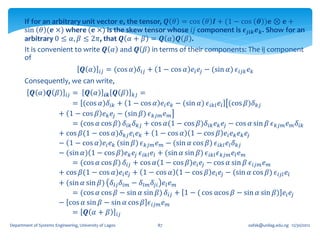
If for an arbitrary unit vector 𝐞, the tensor, 𝑸 𝜃 = cos 𝜃 𝑰 + (1 − cos 𝜽 )𝐞 ⊗ 𝐞 +
       sin 𝜃 (𝐞 ×) where (𝐞 ×) is the skew tensor whose 𝑖𝑗 component is 𝝐 𝒋𝒊𝒌 𝒆 𝒌 . Show for an
       arbitrary 0 ≤ 𝛼, 𝛽 ≤ 2𝜋, that 𝑸 𝛼 + 𝛽 = 𝑸 𝛼 𝑸 𝛽 .
       It is convenient to write 𝑸 𝛼 and 𝑸 𝛽 in terms of their components: The ij component
       of
                                     𝑸 𝛼      𝑖𝑗   = (cos 𝛼)𝛿 𝑖𝑗 + 1 − cos 𝛼 𝑒 𝑖 𝑒 𝑗 − (sin 𝛼) 𝜖 𝑖𝑗𝑘 𝑒 𝑘
       Consequently, we can write,
           𝑸 𝛼 𝑸 𝛽          = 𝑸 𝛼 𝒊𝒌 𝑸 𝛽 𝑘𝑗 =
                            𝑖𝑗
                            = (cos 𝛼)𝛿 𝑖𝑘 + 1 − cos 𝛼 𝑒 𝑖 𝑒 𝑘 − (sin 𝛼) 𝜖 𝑖𝑘𝑙 𝑒 𝑙 (cos 𝛽)𝛿 𝑘𝑗
                        + 1 − cos 𝛽 𝑒 𝑘 𝑒 𝑗 − (sin 𝛽) 𝜖 𝑘𝑗𝑚 𝑒 𝑚
                            = (cos 𝛼 cos 𝛽) 𝛿 𝑖𝑘 𝛿 𝑘𝑗 + cos 𝛼(1 − cos 𝛽)𝛿 𝑖𝑘 𝑒 𝑘 𝑒 𝑗 − cos 𝛼 sin 𝛽 𝜖 𝑘𝑗𝑚 𝑒 𝑚 𝛿 𝑖𝑘
                        + cos 𝛽(1 − cos 𝛼)𝛿 𝑘𝑗 𝑒 𝑖 𝑒 𝑘 + 1 − cos 𝛼 1 − cos 𝛽 𝑒 𝑖 𝑒 𝑘 𝑒 𝑘 𝑒 𝑗
                        − 1 − cos 𝛼 𝑒 𝑖 𝑒 𝑘 (sin 𝛽) 𝜖 𝑘𝑗𝑚 𝑒 𝑚 − (sin 𝛼 cos 𝛽) 𝜖 𝑖𝑘𝑙 𝑒 𝑙 𝛿 𝑘𝑗
                        − (sin 𝛼) 1 − cos 𝛽 𝑒 𝑘 𝑒 𝑗 𝜖 𝑖𝑘𝑙 𝑒 𝑙 + (sin 𝛼 sin 𝛽) 𝜖 𝑖𝑘𝑙 𝜖 𝑘𝑗𝑚 𝑒 𝑙 𝑒 𝑚
                            = (cos 𝛼 cos 𝛽) 𝛿 𝑖𝑗 + cos 𝛼(1 − cos 𝛽)𝑒 𝑖 𝑒 𝑗 − cos 𝛼 sin 𝛽 𝜖 𝑖𝑗𝑚 𝑒 𝑚
                        + cos 𝛽(1 − cos 𝛼)𝑒 𝑖 𝑒 𝑗 + 1 − cos 𝛼 1 − cos 𝛽 𝑒 𝑖 𝑒 𝑗 − (sin 𝛼 cos 𝛽) 𝜖 𝑖𝑗𝑙 𝑒 𝑙
                        + (sin 𝛼 sin 𝛽) 𝛿 𝑙𝑗 𝛿 𝑖𝑚 − 𝛿 𝑙𝑚 𝛿 𝑗𝑖 𝑒 𝑙 𝑒 𝑚
                            = (cos 𝛼 cos 𝛽 − sin 𝛼 sin 𝛽) 𝛿 𝑖𝑗 + 1 − ( cos αcos 𝛽 − sin 𝛼 sin 𝛽) 𝑒 𝑖 𝑒 𝑗
                        − cos 𝛼 sin 𝛽 − sin 𝛼 cos 𝛽 𝜖 𝑖𝑗𝑚 𝑒 𝑚
                            = 𝑸 𝛼 + 𝛽 𝑖𝑗
Department of Systems Engineering, University of Lagos               87                               oafak@unilag.edu.ng 12/30/2012
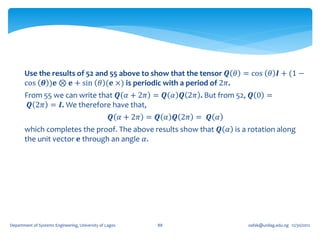
Use the results of 52 and 55 above to show that the tensor 𝑸 𝜃 = cos 𝜃 𝑰 + (1 −
       cos 𝜽 )𝐞 ⊗ 𝐞 + sin 𝜃 (𝐞 ×) is periodic with a period of 2𝜋.
       From 55 we can write that 𝑸 𝛼 + 2𝜋 = 𝑸 𝛼 𝑸 2𝜋 . But from 52, 𝑸 0 =
        𝑸 2𝜋 = 𝑰. We therefore have that,
                                                   𝑸 𝛼 + 2𝜋 = 𝑸 𝛼 𝑸 2𝜋 = 𝑸 𝛼
       which completes the proof. The above results show that 𝑸 𝛼 is a rotation along
       the unit vector 𝐞 through an angle 𝛼.


Department of Systems Engineering, University of Lagos       88                oafak@unilag.edu.ng 12/30/2012
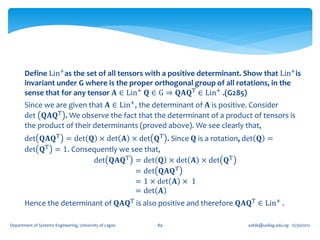
Define Lin+as the set of all tensors with a positive determinant. Show that Lin+ is
       invariant under G where is the proper orthogonal group of all rotations, in the
       sense that for any tensor 𝐀 ∈ Lin+ 𝐐 ∈ G ⇒ 𝐐𝐀𝐐T ∈ Lin+ .(G285)
       Since we are given that 𝐀 ∈ Lin+ , the determinant of 𝐀 is positive. Consider
       det 𝐐𝐀𝐐T . We observe the fact that the determinant of a product of tensors is
       the product of their determinants (proved above). We see clearly that,
       det 𝐐𝐀𝐐T = det 𝐐 × det 𝐀 × det 𝐐T . Since 𝐐 is a rotation, det 𝐐 =
       det 𝐐T = 1. Consequently we see that,
                        det 𝐐𝐀𝐐T = det 𝐐 × det 𝐀 × det 𝐐T
                                    = det 𝐐𝐀𝐐T
                                    = 1 × det 𝐀 × 1
                                    = det 𝐀
       Hence the determinant of 𝐐𝐀𝐐T is also positive and therefore 𝐐𝐀𝐐T ∈ Lin+ .

Department of Systems Engineering, University of Lagos   89               oafak@unilag.edu.ng 12/30/2012
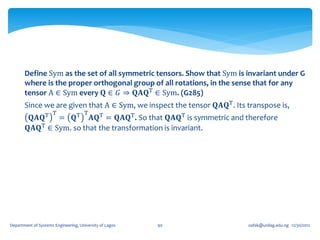
Define Sym as the set of all symmetric tensors. Show that Sym is invariant under G
       where is the proper orthogonal group of all rotations, in the sense that for any
       tensor A ∈ Sym every 𝐐 ∈ 𝐺 ⇒ 𝐐𝐀𝐐T ∈ Sym. (G285)
       Since we are given that A ∈ Sym, we inspect the tensor 𝐐𝐀𝐐T . Its transpose is,
                     T                T
         𝐐𝐀𝐐T = 𝐐T 𝐀𝐐T = 𝐐𝐀𝐐T . So that 𝐐𝐀𝐐T is symmetric and therefore
        𝐐𝐀𝐐T ∈ Sym. so that the transformation is invariant.


Department of Systems Engineering, University of Lagos   90              oafak@unilag.edu.ng 12/30/2012
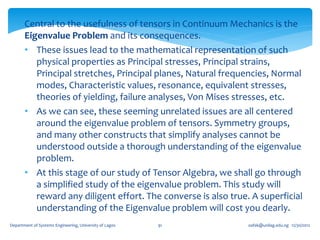
Central to the usefulness of tensors in Continuum Mechanics is the
       Eigenvalue Problem and its consequences.
       • These issues lead to the mathematical representation of such
          physical properties as Principal stresses, Principal strains,
          Principal stretches, Principal planes, Natural frequencies, Normal
          modes, Characteristic values, resonance, equivalent stresses,
          theories of yielding, failure analyses, Von Mises stresses, etc.
       • As we can see, these seeming unrelated issues are all centered
          around the eigenvalue problem of tensors. Symmetry groups,
          and many other constructs that simplify analyses cannot be
          understood outside a thorough understanding of the eigenvalue
          problem.
       • At this stage of our study of Tensor Algebra, we shall go through
          a simplified study of the eigenvalue problem. This study will
          reward any diligent effort. The converse is also true. A superficial
          understanding of the Eigenvalue problem will cost you dearly.
Department of Systems Engineering, University of Lagos   91     oafak@unilag.edu.ng 12/30/2012
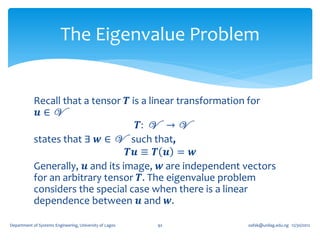
The Eigenvalue Problem


            Recall that a tensor 𝑻 is a linear transformation for
             𝒖∈V
                                     𝑻: V → V
            states that ∃ 𝒘 ∈ V such that,
                                  𝑻𝒖 ≡ 𝑻 𝒖 = 𝒘
            Generally, 𝒖 and its image, 𝒘 are independent vectors
            for an arbitrary tensor 𝑻. The eigenvalue problem
            considers the special case when there is a linear
            dependence between 𝒖 and 𝒘.

Department of Systems Engineering, University of Lagos   92   oafak@unilag.edu.ng 12/30/2012
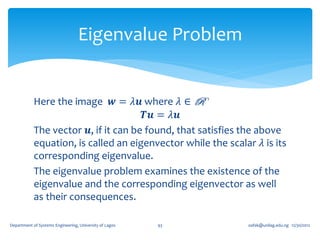
Eigenvalue Problem


            Here the image 𝒘 = 𝜆𝒖 where 𝜆 ∈ R
                                       𝑻𝒖 = 𝜆𝒖
            The vector 𝒖, if it can be found, that satisfies the above
            equation, is called an eigenvector while the scalar 𝜆 is its
            corresponding eigenvalue.
            The eigenvalue problem examines the existence of the
            eigenvalue and the corresponding eigenvector as well
            as their consequences.

Department of Systems Engineering, University of Lagos   93   oafak@unilag.edu.ng 12/30/2012
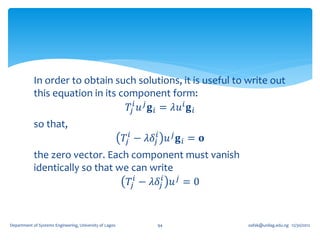
In order to obtain such solutions, it is useful to write out
            this equation in its component form:
                                   𝑇𝑗 𝑖 𝑢 𝑗 𝐠 𝑖 = 𝜆𝑢 𝑖 𝐠 𝑖
            so that,
                                                         𝑇𝑗 𝑖 − 𝜆𝛿 𝑗𝑖 𝑢 𝑗 𝐠 𝑖 = 𝐨
            the zero vector. Each component must vanish
            identically so that we can write
                                  𝑇𝑗 𝑖 − 𝜆𝛿 𝑗𝑖 𝑢 𝑗 = 0


Department of Systems Engineering, University of Lagos             94               oafak@unilag.edu.ng 12/30/2012
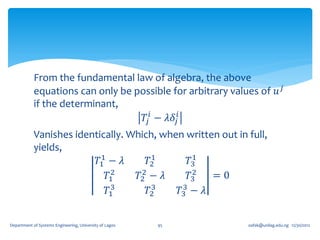
From the fundamental law of algebra, the above
            equations can only be possible for arbitrary values of 𝑢 𝑗
            if the determinant,
                                    𝑇𝑗 𝑖 − 𝜆𝛿 𝑗𝑖
            Vanishes identically. Which, when written out in full,
            yields,
                           1            1       1
                          𝑇1 − 𝜆       𝑇2      𝑇3
                              2      2          2   =0
                             𝑇1     𝑇2 − 𝜆     𝑇3
                              3         3    3
                             𝑇1        𝑇2   𝑇3 − 𝜆


Department of Systems Engineering, University of Lagos   95   oafak@unilag.edu.ng 12/30/2012
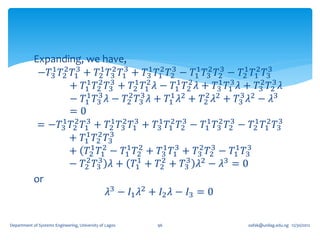
Expanding, we have,
               1 2 3       1 2 3        1 2 3       1 2 3      1 2 3
             −𝑇3 𝑇2 𝑇1 + 𝑇2 𝑇3 𝑇1 + 𝑇3 𝑇1 𝑇2 − 𝑇1 𝑇3 𝑇2 − 𝑇2 𝑇1 𝑇3
                       1 2 3        1 2        1 2       1 3      2 3
                    + 𝑇1 𝑇2 𝑇3 + 𝑇2 𝑇1 𝜆 − 𝑇1 𝑇2 𝜆 + 𝑇3 𝑇1 𝜆 + 𝑇3 𝑇2 𝜆
                       1 3        2 3        1        2       3
                    − 𝑇1 𝑇3 𝜆 − 𝑇2 𝑇3 𝜆 + 𝑇1 𝜆2 + 𝑇2 𝜆2 + 𝑇3 𝜆2 − 𝜆3
                    =0
                  1 2 3       1 2 3       1 2 3       1 2 3      1 2 3
             = −𝑇3 𝑇2 𝑇1 + 𝑇2 𝑇3 𝑇1 + 𝑇3 𝑇1 𝑇2 − 𝑇1 𝑇3 𝑇2 − 𝑇2 𝑇1 𝑇3
                       1 2 3
                   + 𝑇1 𝑇2 𝑇3
                        1 2      1 2       1 3       2 3     1 3
                   + ( 𝑇2 𝑇1 − 𝑇1 𝑇2 + 𝑇3 𝑇1 + 𝑇3 𝑇2 − 𝑇1 𝑇3
                       2 3           1     2     3
                   − 𝑇2 𝑇3 ) 𝜆 + 𝑇1 + 𝑇2 + 𝑇3 𝜆2 − 𝜆3 = 0
            or
                             𝜆3 − 𝐼1 𝜆2 + 𝐼2 𝜆 − 𝐼3 = 0

Department of Systems Engineering, University of Lagos   96   oafak@unilag.edu.ng 12/30/2012
Principal Invariants Again


             This is the characteristic equation for the tensor 𝑻.
              From here we are able, in the best cases, to find the
              three eigenvalues. Each of these can be used in to
              obtain the corresponding eigenvector.
             The above coefficients are the same invariants we
              have seen earlier!


Department of Systems Engineering, University of Lagos   97   oafak@unilag.edu.ng 12/30/2012
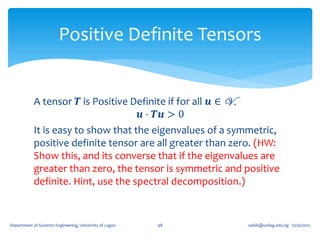
Positive Definite Tensors


            A tensor 𝑻 is Positive Definite if for all 𝒖 ∈ V ,
                                     𝒖 ⋅ 𝑻𝒖 > 0
            It is easy to show that the eigenvalues of a symmetric,
            positive definite tensor are all greater than zero. (HW:
            Show this, and its converse that if the eigenvalues are
            greater than zero, the tensor is symmetric and positive
            definite. Hint, use the spectral decomposition.)


Department of Systems Engineering, University of Lagos   98   oafak@unilag.edu.ng 12/30/2012
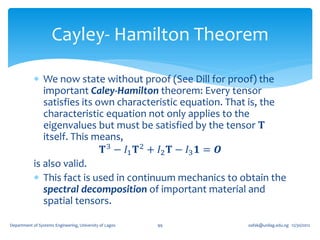
Cayley- Hamilton Theorem

             We now state without proof (See Dill for proof) the
               important Caley-Hamilton theorem: Every tensor
               satisfies its own characteristic equation. That is, the
               characteristic equation not only applies to the
               eigenvalues but must be satisfied by the tensor 𝐓
               itself. This means,
                              𝐓 3 − 𝐼1 𝐓 2 + 𝐼2 𝐓 − 𝐼3 𝟏 = 𝑶
            is also valid.
             This fact is used in continuum mechanics to obtain the
               spectral decomposition of important material and
               spatial tensors.

Department of Systems Engineering, University of Lagos   99   oafak@unilag.edu.ng 12/30/2012
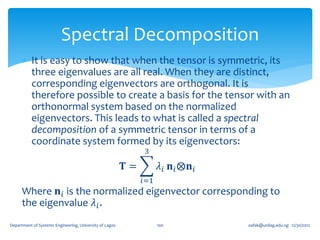
Spectral Decomposition
       It is easy to show that when the tensor is symmetric, its
        three eigenvalues are all real. When they are distinct,
        corresponding eigenvectors are orthogonal. It is
        therefore possible to create a basis for the tensor with an
        orthonormal system based on the normalized
        eigenvectors. This leads to what is called a spectral
        decomposition of a symmetric tensor in terms of a
        coordinate system formed by its eigenvectors:
                                                              3

                                                         𝐓=         𝜆 𝑖 𝐧 𝑖 ⨂𝐧 𝑖
                                                              𝑖=1
      Where 𝐧 𝑖 is the normalized eigenvector corresponding to
      the eigenvalue 𝜆 𝑖 .
Department of Systems Engineering, University of Lagos              100            oafak@unilag.edu.ng 12/30/2012
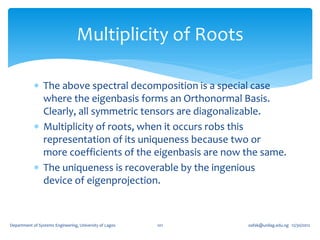
Multiplicity of Roots

             The above spectral decomposition is a special case
              where the eigenbasis forms an Orthonormal Basis.
              Clearly, all symmetric tensors are diagonalizable.
             Multiplicity of roots, when it occurs robs this
              representation of its uniqueness because two or
              more coefficients of the eigenbasis are now the same.
             The uniqueness is recoverable by the ingenious
              device of eigenprojection.


Department of Systems Engineering, University of Lagos   101   oafak@unilag.edu.ng 12/30/2012
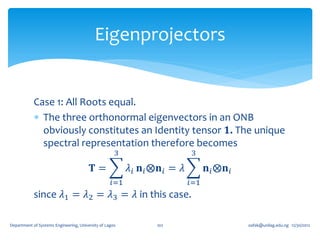
Eigenprojectors


            Case 1: All Roots equal.
             The three orthonormal eigenvectors in an ONB
              obviously constitutes an Identity tensor 𝟏. The unique
              spectral representation therefore becomes
                                                     3                      3

                                         𝐓=              𝜆 𝑖 𝐧 𝑖 ⨂𝐧 𝑖 = 𝜆         𝐧 𝑖 ⨂𝐧 𝑖
                                                   𝑖=1                      𝑖=1
            since 𝜆1 = 𝜆2 = 𝜆3 = 𝜆 in this case.

Department of Systems Engineering, University of Lagos           102                         oafak@unilag.edu.ng 12/30/2012
Eigenprojectors


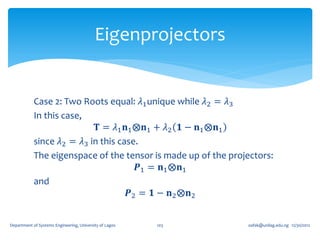
            Case 2: Two Roots equal: 𝜆1 unique while 𝜆2 = 𝜆3
            In this case,
                            𝐓 = 𝜆1 𝐧1 ⨂𝐧1 + 𝜆2 𝟏 − 𝐧1 ⨂𝐧1
            since 𝜆2 = 𝜆3 in this case.
            The eigenspace of the tensor is made up of the projectors:
                                       𝑷1 = 𝐧1 ⨂𝐧1
            and
                                    𝑷2 = 𝟏 − 𝐧2 ⨂𝐧2


Department of Systems Engineering, University of Lagos   103   oafak@unilag.edu.ng 12/30/2012
Eigenprojectors


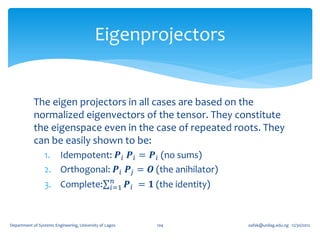
            The eigen projectors in all cases are based on the
            normalized eigenvectors of the tensor. They constitute
            the eigenspace even in the case of repeated roots. They
            can be easily shown to be:
                 1. Idempotent: 𝑷 𝑖 𝑷 𝑖 = 𝑷 𝑖 (no sums)
                 2. Orthogonal: 𝑷 𝑖 𝑷 𝑗 = 𝑶 (the anihilator)
                                                    𝑛
                 3. Complete:                      𝑖=1   𝑷 𝑖 = 𝟏 (the identity)


Department of Systems Engineering, University of Lagos          104               oafak@unilag.edu.ng 12/30/2012
Tensor Functions
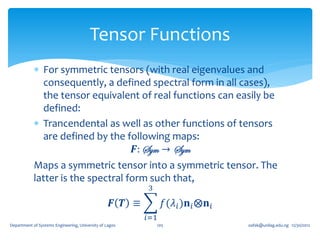
             For symmetric tensors (with real eigenvalues and
               consequently, a defined spectral form in all cases),
               the tensor equivalent of real functions can easily be
               defined:
             Trancendental as well as other functions of tensors
               are defined by the following maps:
                                     𝑭: Sym → Sym
            Maps a symmetric tensor into a symmetric tensor. The
            latter is the spectral form such that,
                                                           3

                                                   𝑭 𝑻 ≡         𝑓(𝜆 𝑖 )𝐧 𝑖 ⨂𝐧 𝑖
                                                           𝑖=1
Department of Systems Engineering, University of Lagos         105                 oafak@unilag.edu.ng 12/30/2012
Tensor functions


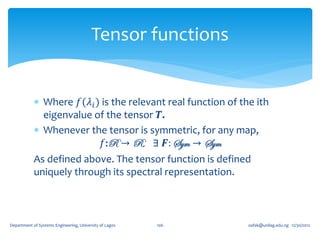
             Where 𝑓(𝜆 𝑖 ) is the relevant real function of the ith
              eigenvalue of the tensor 𝑻.
             Whenever the tensor is symmetric, for any map,
                            𝑓:R → R, ∃ 𝑭: Sym → Sym
            As defined above. The tensor function is defined
            uniquely through its spectral representation.


Department of Systems Engineering, University of Lagos   106   oafak@unilag.edu.ng 12/30/2012
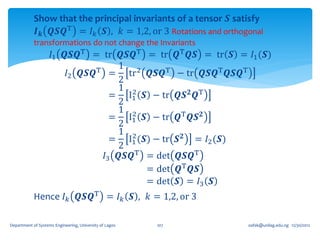
Show that the principal invariants of a tensor 𝑺 satisfy
            𝑰 𝒌 𝑸𝑺𝑸T = 𝐼 𝑘 𝑺 , 𝑘 = 1,2, or 3 Rotations and orthogonal
            transformations do not change the Invariants
                    𝐼1 𝑸𝑺𝑸T = tr 𝑸𝑺𝑸T = tr                     𝑸T 𝑸𝑺 = tr 𝑺 = 𝐼1 (𝑺)
                              T =
                                  1 2
                       𝐼2 𝑸𝑺𝑸       tr 𝑸𝑺𝑸T                    − tr 𝑸𝑺𝑸T 𝑸𝑺𝑸T
                                  2
                                  1 2
                                 = I1 𝑺 − tr                   𝑸𝑺 𝟐 𝑸T
                                  2
                                  1 2
                                 = I1 𝑺 − tr                   𝑸T 𝑸𝑺 𝟐
                                  2
                                  1 2
                                 = I1 (𝑺) − tr                 𝑺𝟐   = 𝐼2 (𝑺)
                                  2
                               𝐼3 𝑸𝑺𝑸T = det                   𝑸𝑺𝑸T
                                        = det                  𝑸T 𝑸𝑺
                                        = det                  𝑺 = 𝐼3 𝑺
            Hence 𝐼 𝑘 𝑸𝑺𝑸T = 𝐼 𝑘 𝑺 , 𝑘 = 1,2, or 3

Department of Systems Engineering, University of Lagos   107                    oafak@unilag.edu.ng 12/30/2012
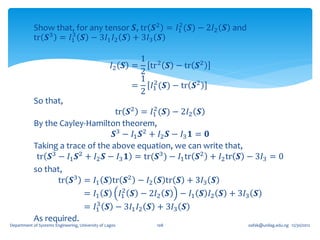
2
            Show that, for any tensor 𝑺, tr 𝑺2 = 𝐼1 (𝑺) − 2𝐼2 𝑺 and
                     3
            tr 𝑺3 = 𝐼1 𝑺 − 3𝐼1 𝐼2 𝑺 + 3𝐼3 𝑺

                                                             1 2
                                                   𝐼2    𝑺 = tr 𝑺 − tr 𝑺2
                                                             2
                                                             1 2
                                                           =   𝐼1 (𝑺) − tr 𝑺2
                                                             2
            So that,
                                               2
                                    tr 𝑺2 = 𝐼1 (𝑺) − 2𝐼2 𝑺
            By the Cayley-Hamilton theorem,
                                   𝑺3 − 𝐼1 𝑺2 + 𝐼2 𝑺 − 𝐼3 𝟏 = 𝟎
            Taking a trace of the above equation, we can write that,
             tr 𝑺3 − 𝐼1 𝑺2 + 𝐼2 𝑺 − 𝐼3 𝟏 = tr(𝑺3 ) − 𝐼1 tr 𝑺2 + 𝐼2 tr 𝑺 − 3𝐼3 = 0
            so that,
                   tr 𝑺3 = 𝐼1 𝑺 tr 𝑺2 − 𝐼2 𝑺 tr 𝑺 + 3𝐼3 𝑺
                                      2
                           = 𝐼1 𝑺 𝐼1 𝑺 − 2𝐼2 𝑺 − 𝐼1 𝑺 𝐼2 𝑺 + 3𝐼3 𝑺
                              3
                           = 𝐼1 𝑺 − 3𝐼1 𝐼2 𝑺 + 3𝐼3 𝑺
            As required.
Department of Systems Engineering, University of Lagos           108            oafak@unilag.edu.ng 12/30/2012
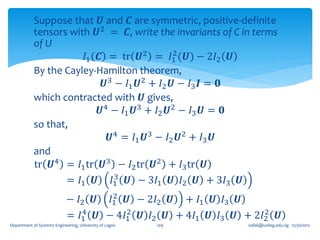
Suppose that 𝑼 and 𝑪 are symmetric, positive-definite
            tensors with 𝑼2 = 𝑪, write the invariants of C in terms
            of U
                                            2
                        𝐼1 𝑪 = tr 𝑼2 = 𝐼1 (𝑼) − 2𝐼2 𝑼
            By the Cayley-Hamilton theorem,
                            𝑼3 − 𝐼1 𝑼2 + 𝐼2 𝑼 − 𝐼3 𝑰 = 𝟎
            which contracted with 𝑼 gives,
                           𝑼4 − 𝐼1 𝑼3 + 𝐼2 𝑼2 − 𝐼3 𝑼 = 𝟎
            so that,
                             𝑼4 = 𝐼1 𝑼3 − 𝐼2 𝑼2 + 𝐼3 𝑼
            and
            tr 𝑼4 = 𝐼1 tr 𝑼3 − 𝐼2 tr 𝑼2 + 𝐼3 tr 𝑼
                               3
                    = 𝐼1 𝑼 𝐼1 𝑼 − 3𝐼1 𝑼 𝐼2 𝑼 + 3𝐼3 𝑼
                                    2
                            − 𝐼2 𝑼 𝐼1 𝑼 − 2𝐼2 𝑼 + 𝐼1 𝑼 𝐼3 𝑼
                               4       2                         2
                            = 𝐼1 𝑼 − 4𝐼1 𝑼 𝐼2 𝑼 + 4𝐼1 𝑼 𝐼3 𝑼 + 2𝐼2 𝑼
Department of Systems Engineering, University of Lagos   109   oafak@unilag.edu.ng 12/30/2012
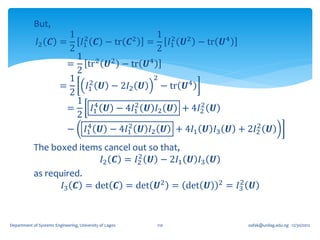
But,
                        1 2             2
                                              1 2 2
             𝐼2     𝑪 =    𝐼1 𝑪 − tr 𝑪     =     𝐼1 𝑼 − tr 𝑼4
                        2                     2
                          1 2 2
                        = tr 𝑼 − tr 𝑼4
                          2
                        1 2                  2
                      =      𝐼1 𝑼 − 2𝐼2 𝑼      − tr 𝑼4
                        2
                          1 4            2             2
                        =       𝐼1 𝑼 − 4𝐼1 𝑼 𝐼2 𝑼 + 4𝐼2 𝑼
                          2
                              4        2                      2
                        − 𝐼1 𝑼 − 4𝐼1 𝑼 𝐼2 𝑼 + 4𝐼1 𝑼 𝐼3 𝑼 + 2𝐼2 𝑼
            The boxed items cancel out so that,
                                    2
                           𝐼2 𝑪 = 𝐼2 𝑼 − 2𝐼1 𝑼 𝐼3 𝑼
            as required.
                                                      2
                   𝐼3 𝑪 = det 𝑪 = det 𝑼2 = det 𝑼 2 = 𝐼3 𝑼


Department of Systems Engineering, University of Lagos   110   oafak@unilag.edu.ng 12/30/2012

2. tensor algebra jan 2013

  • 1.
    Tensor Algebra Tensorsas Linear Mappings
  • 2.
    Second Order Tensor A second Order Tensor 𝑻 is a linear mapping from a vector space to itself. Given 𝒖 ∈ V the mapping, 𝑻: V → V states that ∃ 𝒘 ∈ V such that, 𝑻 𝒖 = 𝒘. Every other definition of a second order tensor can be derived from this simple definition. The tensor character of an object can be established by observing its action on a vector. Department of Systems Engineering, University of Lagos 2 oafak@unilag.edu.ng 12/30/2012
  • 3.
    Linearity  The mapping is linear. This means that if we have two runs of the process, we first input 𝒖 and later input 𝐯. The outcomes 𝑻(𝒖) and 𝑻(𝐯), added would have been the same as if we had added the inputs 𝒖 and 𝐯 first and supplied the sum of the vectors as input. More compactly, this means, 𝑻 𝒖 + 𝐯 = 𝑻(𝒖) + 𝑻(𝐯) Department of Systems Engineering, University of Lagos 3 oafak@unilag.edu.ng 12/30/2012
  • 4.
    Linearity Linearity further means that, for any scalar 𝛼 and tensor 𝑻 𝑻 𝛼𝒖 = 𝛼𝑻 𝒖 The two properties can be added so that, given 𝛼, 𝛽 ∈ R, and 𝒖, 𝐯 ∈ V, then 𝑻 𝛼𝒖 + 𝛽𝐯 = 𝛼𝑻 𝒖 + 𝛽𝑻 𝐯 Since we can think of a tensor as a process that takes an input and produces an output, two tensors are equal only if they produce the same outputs when supplied with the same input. The sum of two tensors is the tensor that will give an output which will be the sum of the outputs of the two tensors when each is given that input. Department of Systems Engineering, University of Lagos 4 oafak@unilag.edu.ng 12/30/2012
  • 5.
    Vector Space In general, 𝛼, 𝛽 ∈ R , 𝒖, 𝐯 ∈ V and 𝑺, 𝑻 ∈ T 𝛼𝑺𝒖 + 𝛽𝑻𝒖 = (𝛼𝑺 + 𝛽𝑻)𝒖 With the definition above, the set of tensors constitute a vector space with its rules of addition and multiplication by a scalar. It will become obvious later that it also constitutes a Euclidean vector space with its own rule of the inner product. Department of Systems Engineering, University of Lagos 5 oafak@unilag.edu.ng 12/30/2012
  • 6.
    Special Tensors Notation. It is customary to write the tensor mapping without the parentheses. Hence, we can write, 𝑻𝒖 ≡ 𝑻(𝒖) For the mapping by the tensor 𝑻 on the vector variable and dispense with the parentheses unless when needed. Department of Systems Engineering, University of Lagos 6 oafak@unilag.edu.ng 12/30/2012
  • 7.
    Zero Tensor orAnnihilator The annihilator 𝑶 is defined as the tensor that maps all vectors to the zero vector, 𝒐: 𝑶𝑢 = 𝒐, ∀𝒖 ∈ V Department of Systems Engineering, University of Lagos 7 oafak@unilag.edu.ng 12/30/2012
  • 8.
    The Identity The identity tensor 𝟏 is the tensor that leaves every vector unaltered. ∀𝒖 ∈ V , 𝟏𝒖 = 𝒖 Furthermore, ∀𝛼 ∈ R , the tensor, 𝛼𝟏 is called a spherical tensor. The identity tensor induces the concept of an inverse of a tensor. Given the fact that if 𝑻 ∈ T and 𝒖 ∈ V , the mapping 𝒘 ≡ 𝑻𝒖 produces a vector. Department of Systems Engineering, University of Lagos 8 oafak@unilag.edu.ng 12/30/2012
  • 9.
    The Inverse Consider a linear mapping that, operating on 𝒘, produces our original argument, 𝒖, if we can find it: 𝒀𝒘 = 𝒖 As a linear mapping, operating on a vector, clearly, 𝒀 is a tensor. It is called the inverse of 𝑻 because, 𝒀𝒘 = 𝒀𝑻𝒖 = 𝒖 So that the composition 𝒀𝑻 = 𝟏, the identity mapping. For this reason, we write, 𝒀 = 𝑻−1 Department of Systems Engineering, University of Lagos 9 oafak@unilag.edu.ng 12/30/2012
  • 10.
    Inverse It is easy to show that if 𝒀𝑻 = 𝟏, then 𝑻𝒀 = 𝒀𝑻 = 𝟏.  HW: Show this. The set of invertible sets is closed under composition. It is also closed under inversion. It forms a group with the identity tensor as the group’s neutral element Department of Systems Engineering, University of Lagos 10 oafak@unilag.edu.ng 12/30/2012
  • 11.
    Transposition of Tensors Given 𝒘, 𝐯 ∈ V , The tensor 𝑨T satisfying 𝒘 ⋅ 𝑨T 𝐯 = 𝐯 ⋅ (𝑨𝒘) Is called the transpose of 𝐴. A tensor indistinguishable from its transpose is said to be symmetric. Department of Systems Engineering, University of Lagos 11 oafak@unilag.edu.ng 12/30/2012
  • 12.
    Invariants There are certain mappings from the space of tensors to the real space. Such mappings are called Invariants of the Tensor. Three of these, called Principal invariants play key roles in the application of tensors to continuum mechanics. We shall define them shortly. The definition given here is free of any association with a coordinate system. It is a good practice to derive any other definitions from these fundamental ones: Department of Systems Engineering, University of Lagos 12 oafak@unilag.edu.ng 12/30/2012
  • 13.
    The Trace If we write 𝐚, 𝐛, 𝐜 ≡ 𝐚 ⋅ 𝐛 × 𝐜  where 𝐚, 𝐛, and 𝐜 are arbitrary vectors. For any second order tensor 𝑻, and linearly independent 𝐚, 𝐛, and 𝐜, the linear mapping 𝐼1 : T → R 𝑻𝐚, 𝐛, 𝐜 + 𝐚, 𝑻𝐛, 𝐜 + [𝐚, 𝐛, 𝑻𝐜] 𝐼1 𝑻 ≡ tr 𝑻 = [𝐚, 𝐛, 𝐜] Is independent of the choice of the basis vectors 𝐚, 𝐛, and 𝐜. It is called the First Principal Invariant of 𝑻 or Trace of 𝑻 ≡ tr 𝑻 ≡ 𝐼1 (𝑻) Department of Systems Engineering, University of Lagos 13 oafak@unilag.edu.ng 12/30/2012
  • 14.
    The Trace The trace is a linear mapping. It is easily shown that 𝛼, 𝛽 ∈ R , and 𝑺, 𝑻 ∈ T tr 𝛼𝑺 + 𝛽𝑻 = 𝛼tr 𝑺 + 𝛽tr(𝑻) HW. Show this by appealing to the linearity of the vector space. While the trace of a tensor is linear, the other two principal invariants are nonlinear. WE now proceed to define them Department of Systems Engineering, University of Lagos 14 oafak@unilag.edu.ng 12/30/2012
  • 15.
    Square of thetrace The second principal invariant 𝐼2 𝑺 is related to the trace. In fact, you may come across books that define it so. However, the most common definition is that 1 2 𝐼2 𝑺 = 𝐼1 𝑺 − 𝐼1 (𝑺2 ) 2 Independently of the trace, we can also define the second principal invariant as, Department of Systems Engineering, University of Lagos 15 oafak@unilag.edu.ng 12/30/2012
  • 16.
    Second Principal Invariant The Second Principal Invariant, 𝐼2 𝑻 , using the same notation as above is 𝑻𝒂 , 𝑻𝒃 , 𝒄 + 𝒂, 𝑻𝒃 , 𝑻𝒄 + 𝑻𝒂 , 𝒃, 𝑻𝒄 𝒂, 𝒃, 𝒄 1 2 = tr 𝑻 − tr 𝑻2 2 that is half the square of trace minus the trace of the square of 𝑻 which is the second principal invariant.  This quantity remains unchanged for any arbitrary selection of basis vectors 𝒂, 𝒃 and 𝒄. Department of Systems Engineering, University of Lagos 16 oafak@unilag.edu.ng 12/30/2012
  • 17.
    The Determinant The third mapping from tensors to the real space underlying the tensor is the determinant of the tensor. While you may be familiar with that operation and can easily extract a determinant from a matrix, it is important to understand the definition for a tensor that is independent of the component expression. The latter remains relevant even when we have not expressed the tensor in terms of its components in a particular coordinate system. Department of Systems Engineering, University of Lagos 17 oafak@unilag.edu.ng 12/30/2012
  • 18.
    The Determinant As before, For any second order tensor 𝑻, and any linearly independent vectors 𝐚, 𝐛, and 𝐜,  The determinant of the tensor 𝑻, 𝑻𝒂 , 𝑻𝒃 , 𝑻𝒄 det 𝑻 = 𝒂, 𝒃, 𝒄 (In the special case when the basis vectors are orthonormal, the denominator is unity) Department of Systems Engineering, University of Lagos 18 oafak@unilag.edu.ng 12/30/2012
  • 19.
    Other Principal Invariants  It is good to note that there are other principal invariants that can be defined. The ones we defined here are the ones you are most likely to find in other texts.  An invariant is a scalar derived from a tensor that remains unchanged in any coordinate system. Mathematically, it is a mapping from the tensor space to the real space. Or simply a scalar valued function of the tensor. Department of Systems Engineering, University of Lagos 19 oafak@unilag.edu.ng 12/30/2012
  • 20.
    Inner Product ofTensors The trace provides a simple way to define the inner product of two second-order tensors. Given 𝑺, 𝑻 ∈ T The trace, tr 𝑺 𝑇 𝑻 = tr(𝑺𝑻 𝑇 ) Is a scalar, independent of the coordinate system chosen to represent the tensors. This is defined as the inner or scalar product of the tensors 𝑺 and 𝑻. That is, 𝑺: 𝑻 ≡ tr 𝑺 𝑇 𝑻 = tr(𝑺𝑻 𝑇 ) Department of Systems Engineering, University of Lagos 20 oafak@unilag.edu.ng 12/30/2012
  • 21.
    Attributes of aEuclidean Space The trace automatically induces the concept of the norm of a vector (This is not the determinant! Note!!) The square root of the scalar product of a tensor with itself is the norm, magnitude or length of the tensor: 𝑻 = tr(𝑻 𝑇 𝑻) = 𝑻: 𝑻 Department of Systems Engineering, University of Lagos 21 oafak@unilag.edu.ng 12/30/2012
  • 22.
    Distance and angles Furthermore, the distance between two tensors as well as the angle they contain are defined. The scalar distance 𝑑(𝑺, 𝑻)between tensors 𝑺 and 𝑻 : 𝑑 𝑺, 𝑻 = 𝑺 − 𝑻 = 𝑻 − 𝑺 And the angle 𝜃(𝑺, 𝑻), −1 𝑺: 𝑻 𝜃 = cos 𝑺 𝑻 Department of Systems Engineering, University of Lagos 22 oafak@unilag.edu.ng 12/30/2012
  • 23.
    The Tensor Product A product mapping from two vector spaces to T is defined as the tensor product. It has the following properties: "⊗": V × V → T 𝒖 ⊗ 𝒗 𝒘 = (𝒗 ⋅ 𝒘)𝒖 It is an ordered pair of vectors. It acts on any other vector by creating a new vector in the direction of its first vector as shown above. This product of two vectors is called a tensor product or a simple dyad. Department of Systems Engineering, University of Lagos 23 oafak@unilag.edu.ng 12/30/2012
  • 24.
    Dyad Properties It is very easily shown that the transposition of dyad is simply a reversal of its order. (HW. Show this). The tensor product is linear in its two factors. Based on the obvious fact that for any tensor 𝑻 and 𝒖, 𝒗, 𝒘 ∈ V , 𝑻 𝒖 ⊗ 𝒗 𝒘 = 𝑻𝒖 𝒗 ⋅ 𝒘 = 𝑻𝒖 ⊗ 𝒗 𝒘 It is clear that 𝑻 𝒖 ⊗ 𝒗 = 𝑻𝒖 ⊗ 𝒗 Show this neatly by operating either side on a vector Furthermore, the contraction, 𝒖⊗ 𝒗 𝑻= 𝒖⊗ 𝑻𝑇 𝒗 A fact that can be established by operating each side on the same vector. Department of Systems Engineering, University of Lagos 24 oafak@unilag.edu.ng 12/30/2012
  • 25.
    Transpose of aDyad Recall that for 𝒘, 𝐯 ∈ V , The tensor 𝑨T satisfying 𝒘 ⋅ 𝑨T 𝐯 = 𝐯 ⋅ (𝑨𝒘) Is called the transpose of 𝑨. Now let 𝑨 = 𝒂 ⊗ 𝒃 a dyad. 𝐯 ⋅ 𝑨𝒘 = = 𝐯⋅ 𝒂⊗ 𝒃 𝒘 = 𝐯⋅ 𝒂 𝒃⋅ 𝒘 = 𝐯⋅ 𝒂 𝒃⋅ 𝒘 = 𝒘⋅ 𝒃 𝐯⋅ 𝒂 = 𝒘⋅ 𝒃⊗ 𝒂 𝐯 So that 𝒂 ⊗ 𝒃 T = 𝒃 ⊗ 𝒂 Showing that the transpose of a dyad is simply a reversal of its factors. Department of Systems Engineering, University of Lagos 25 oafak@unilag.edu.ng 12/30/2012
  • 26.
    If 𝐧 isthe unit normal to a given plane, show that the tensor 𝐓 ≡ 𝟏 − 𝐧 ⊗ 𝐧 is such that 𝐓𝐮 is the projection of the vector 𝐮 to the plane in question. Consider the fact that 𝐓 ⋅ 𝐮 = 𝟏𝐮 − 𝐧 ⋅ 𝐮 𝐧 = 𝐮 − 𝐧 ⋅ 𝐮 𝐧 The above vector equation shows that 𝐓𝐮 is what remains after we have subtracted the projection 𝐧 ⋅ 𝐮 𝐧 onto the normal. Obviously, this is the projection to the plane itself. 𝐓 as we shall see later is called a tensor projector. Department of Systems Engineering, University of Lagos 26 oafak@unilag.edu.ng 12/30/2012
  • 27.
    Substitution Operation Consider a contravariant vector component 𝑎 𝑘 let us take a product of this with the Kronecker Delta: 𝛿 𝑗𝑖 𝑎 𝑘 which gives us a third-order object. Let us now perform a contraction across (by taking the superscript index from 𝐴 𝑘 and the subscript from 𝛿 𝑗𝑖 ) to arrive at,  𝑑 𝑖 = 𝛿 𝑗𝑖 𝑎 𝑗  Observe that the only free index remaining is the superscript 𝑖 as the other indices have been contracted (it is consequently a summation index) out in the implied summation. Let us now expand the RHS above, we find, Department of Systems Engineering, University of Lagos 27 oafak@unilag.edu.ng 12/30/2012
  • 28.
    Substitution 𝑑 𝑖 = 𝛿 𝑗𝑖 𝑎 𝑗 = 𝛿1𝑖 𝑎1 + 𝛿2 𝑎2 + 𝛿3 𝑎3 𝑖 𝑖 Note the following cases:  if 𝑖 = 1, we have 𝑑1 = 𝑎1 , if 𝑖 = 2, we have 𝑑 2 = 𝑎2 if 𝑖 = 3, we have 𝑑 3 = 𝑎3 . This leads us to conclude therefore that the contraction, 𝛿 𝑗𝑖 𝑎 𝑗 = 𝑎 𝑖 . Indicating that that the Kronecker Delta, in a contraction, merely substitutes its own other symbol for the symbol on the vector 𝑎 𝑗 it was contracted with. This fact, that the Kronecker Delta does this in general earned it the alias of “Substitution Operator”. Department of Systems Engineering, University of Lagos 28 oafak@unilag.edu.ng 12/30/2012
  • 29.
    Composition with Tensors Operate on the vector 𝒛 and let 𝑻𝒛 = 𝒘. On the LHS, 𝒖 ⊗ 𝒗 𝑻𝒛 = 𝒖 ⊗ 𝒗 𝒘 On the RHS, we have: 𝒖⊗ 𝑻𝑇 𝒗 𝒛= 𝒖 𝑻𝑇 𝒗 ⋅ 𝒛 = 𝒖 𝒛⋅ 𝑻𝑇 𝒗 Since the contents of both sides of the dot are vectors and dot product of vectors is commutative. Clearly, 𝒖 ⊗ 𝒛 ⋅ 𝑻 𝑇 𝒗 = 𝒖 ⊗ 𝒗 ⋅ 𝑻𝒛 follows from the definition of transposition. Hence, 𝒖⊗ 𝑻𝑇 𝒗 𝒛= 𝒖 𝒗⋅ 𝒘 = 𝒖⊗ 𝒗 𝒘 Department of Systems Engineering, University of Lagos 29 oafak@unilag.edu.ng 12/30/2012
  • 30.
    Dyad on DyadComposition For 𝒖, 𝒗, 𝒘, 𝒙 ∈ V , We can show that the dyad composition, 𝒖⊗ 𝒗 𝒘⊗ 𝒙 = 𝒖⊗ 𝒙 𝒗⋅ 𝒘 Again, the proof is to show that both sides produce the same result when they act on the same vector. Let 𝒚 ∈ V , then the LHS on 𝒚 yields: 𝒖 ⊗ 𝒗 𝒘 ⊗ 𝒙 𝒚 = 𝒖 ⊗ 𝒗 𝒘(𝒙 ⋅ 𝒚) = 𝒖 𝒗 ⋅ 𝒘 (𝒙 ⋅ 𝒚) Which is obviously the result from the RHS also. This therefore makes it straightforward to contract dyads by breaking and joining as seen above. Department of Systems Engineering, University of Lagos 30 oafak@unilag.edu.ng 12/30/2012
  • 31.
    Trace of aDyad Show that the trace of the tensor product 𝐮 ⊗ 𝐯 is 𝐮 ⋅ 𝐯. Given any three independent vectors 𝐚, 𝐛, and 𝐜, (No loss of generality in letting the three independent vectors be the curvilinear basis vectors 𝐠1 , 𝐠 2 and 𝐠 3 ). Using the above definition of trace, we can write that, Department of Systems Engineering, University of Lagos 31 oafak@unilag.edu.ng 12/30/2012
  • 32.
    Trace of aDyad tr 𝐮 ⊗ 𝐯 𝐮 ⊗ 𝐯 𝐠1 , 𝐠 2 , 𝐠 3 + 𝐠1 , 𝐮 ⊗ 𝐯 𝐠 2 , 𝐠 3 + 𝐠1 , 𝐠 2 , 𝐮 ⊗ 𝐯 𝐠3 = 𝐠1 , 𝐠 2 , 𝐠 3 1 = 𝑣 𝐮, 𝐠 2 , 𝐠 3 + 𝐠1 , 𝑣2 𝐮, 𝐠 3 + 𝐠1 , 𝐠 2 , 𝑣3 𝐮 𝜖123 1 1 = 𝑣1 𝐮 ⋅ 𝜖23𝑖 𝐠 𝑖 + 𝜖31𝑖 𝐠 𝑖 ⋅ 𝑣2 𝐮 + 𝜖12𝑖 𝐠 𝑖 ⋅ 𝑣3 𝐮 𝜖123 1 = 𝑣1 𝐮 ⋅ 𝜖231 𝐠1 + 𝜖312 𝐠 2 ⋅ 𝑣2 𝐮 + 𝜖123 𝐠 3 ⋅ 𝑣3 𝐮 𝜖123 = 𝑣𝑖 𝑢 𝑖 = 𝐮 ⋅ 𝐯 Department of Systems Engineering, University of Lagos 32 oafak@unilag.edu.ng 12/30/2012
  • 33.
    Other Invariants ofa Dyad  It is easy to show that for a tensor product 𝑫= 𝒖⊗ 𝒗 ∀𝒖, 𝒗 ∈ V 𝑰2 𝑫 = 𝑰3 𝑫 = 0 HW. Show that this is so. We proved earlier that 𝑰1 𝑫 = 𝒖 ⋅ 𝒗 Furthermore, if 𝑻 ∈ T , then, tr 𝑻𝒖 ⊗ 𝒗 = tr 𝒘 ⊗ 𝒗 = 𝒘 ⋅ 𝒗 = 𝑻𝒖 ⋅ 𝒗 Department of Systems Engineering, University of Lagos 33 oafak@unilag.edu.ng 12/30/2012
  • 34.
    Tensor Bases &Component Representation Given 𝑻 ∈ T , for any basis vectors 𝐠 𝑖 ∈ V , 𝑖 = 1,2,3 𝑻 𝑗 ≡ 𝑻𝐠 𝑗 ∈ V , 𝑗 = 1,2,3 by the law of tensor mapping. We proceed to find the components of 𝑻 𝑗 on this same basis. Its covariant components, just like in any other vector are the scalars, 𝑻 𝛼 𝑗 = 𝐠 𝛼 ⋅ 𝑻𝑗 Specifically, these components are 𝑻1 𝑗 , 𝑻2 𝑗 , 𝑻3 𝑗 Department of Systems Engineering, University of Lagos 34 oafak@unilag.edu.ng 12/30/2012
  • 35.
    Tensor Components We can dispense with the parentheses and write that 𝑇 𝛼𝑗 ≡ 𝑇 𝛼 𝑗 = 𝑻 𝑗 ⋅ 𝐠 𝛼 So that the vector 𝑻𝐠 𝑗 = 𝑻 𝑗 = 𝑇 𝛼𝑗 𝐠 𝛼 The components 𝑇𝑖𝑗 can be found by taking the dot product of the above equation with 𝐠 𝑖 : 𝐠 𝑖 ⋅ 𝑻𝐠 𝑗 = 𝑇 𝛼𝑗 𝐠 𝑖 ⋅ 𝐠 𝛼 = 𝑇𝑖𝑗 𝑇𝑖𝑗 = 𝐠 𝑖 ⋅ 𝑻𝐠 𝑗 = tr 𝑻𝐠 𝑗 ⊗ 𝐠 𝑖 = 𝑻: 𝐠 𝑖 ⊗ 𝐠 𝑗 Department of Systems Engineering, University of Lagos 35 oafak@unilag.edu.ng 12/30/2012
  • 36.
    Tensor Components The component 𝑇𝑖𝑗 is simply the result of the inner product of the tensor 𝑻 on the tensor product 𝐠 𝑖 ⊗ 𝐠 𝑗 . These are the components of 𝑻 on the product dual of this particular product base. This is a general result and applies to all product bases: It is straightforward to prove the results on the following table: Department of Systems Engineering, University of Lagos 36 oafak@unilag.edu.ng 12/30/2012
  • 37.
    Tensor Components Components of 𝑻 Derivation Full Representation 𝑇𝑖𝑗 𝑻: (𝐠 𝑖 ⊗ 𝐠 𝑗 ) 𝑻 = 𝑇𝑖𝑗 𝐠 𝑖 ⊗ 𝐠 𝑗 𝑇 𝑖𝑗 𝑻: 𝐠 𝑖 ⊗ 𝐠 𝑗 𝑻 = 𝑇 𝑖𝑗 𝐠 𝑖 ⊗ 𝐠 𝑗 𝑇𝑖 .𝑗 𝑻: (𝐠 𝑖 ⊗ 𝐠 𝑗 ) .𝑗 𝑻 = 𝑇𝑖 𝐠 𝑖 ⊗ 𝐠 𝑗 𝑇.𝑖 𝑗 𝑻: (𝐠 𝑗 ⊗ 𝐠 𝑖 ) 𝑗 𝑻 = 𝑇.𝑖 𝐠 𝑗 ⊗ 𝐠 𝑖 Department of Systems Engineering, University of Lagos 37 oafak@unilag.edu.ng 12/30/2012
  • 38.
    IdentityTensor Components It is easily verified from the definition of the identity tensor and the inner product that: (HW Verify this) Components of 𝟏 Derivation Full Representation 𝟏 𝑖𝑗 = 𝑔 𝑖𝑗 𝟏: (𝐠 𝑖 ⊗ 𝐠 𝑗 ) 𝟏 = 𝑔 𝑖𝑗 𝐠 𝑖 ⊗ 𝐠 𝑗 𝑖𝑗 𝟏 = 𝑔 𝑖𝑗 𝟏: 𝐠 𝑖 ⊗ 𝐠 𝑗 𝟏 = 𝑔 𝑖𝑗 𝐠 𝑖 ⊗ 𝐠 𝑗 𝟏 .𝑗 = 𝛿𝑖 .𝑗 𝟏: (𝐠 𝑖 ⊗ 𝐠 𝑗 ) .𝑗 𝟏 = 𝛿𝑖 𝐠 𝑖 ⊗ 𝐠 𝑗 = 𝐠 𝑖 ⊗ 𝐠 𝑖 𝑖 𝟏 𝑗 = 𝛿 .𝑖 𝑗 𝟏: (𝐠 𝑗 ⊗ 𝐠 𝑖 ) 𝑗 𝟏 = 𝛿.𝑖 𝐠 𝑗 ⊗ 𝐠 𝑖 = 𝐠 𝑗 ⊗ 𝐠 𝑗 .𝑖 Showing that the Kronecker deltas are the components of the identity tensor in certain (not all) coordinate bases. Department of Systems Engineering, University of Lagos 38 oafak@unilag.edu.ng 12/30/2012
  • 39.
    Kronecker and MetricTensors  The above table shows the interesting relationship between the metric components and Kronecker deltas.  Obviously, they are the same tensors under different bases vectors. Department of Systems Engineering, University of Lagos 39 oafak@unilag.edu.ng 12/30/2012
  • 40.
    Component Representation It is easy to show that the above tables of component representations are valid. For any 𝐯 ∈ V , and 𝑻 ∈ T, 𝑻 − 𝑇𝑖𝑗 𝐠 𝑖 ⊗ 𝐠 𝑗 𝐯 = 𝑻𝐯 − 𝑇𝑖𝑗 𝐠 𝑖 ⊗ 𝐠 𝑗 𝐯 Expanding the vector in contravariant components, we have,  𝑻𝐯 − 𝑇𝑖𝑗 𝐠 𝑖 ⊗ 𝐠 𝑗 𝐯 = 𝑻𝑣 𝛼 𝐠 𝛼 − 𝑇𝑖𝑗 𝐠 𝑖 ⊗ 𝐠 𝑗 𝑣𝛼𝐠𝛼 = 𝑻𝑣 𝛼 𝐠 𝛼 − 𝑇𝑖𝑗 𝑣 𝛼 𝐠 𝑖 𝐠 𝑗 ⋅ 𝐠 𝛼 𝑗 = 𝑻𝑣 𝛼 𝐠 𝛼 − 𝑇𝑖𝑗 𝑣 𝛼 𝐠 𝑖 𝛿 𝛼 = 𝑻 𝛼 𝑣 𝛼 − 𝑇𝑖𝑗 𝑣 𝑗 𝐠 𝑖 = 𝑻 𝛼 𝑣 𝛼 − 𝑻 𝑗 𝑣 𝑗 = 𝒐 ∴ 𝑻 = 𝑇𝑖𝑗 𝐠 𝑖 ⊗ 𝐠 𝑗 Department of Systems Engineering, University of Lagos 40 oafak@unilag.edu.ng 12/30/2012
  • 41.
    Symmetry The transpose of 𝑻 = 𝑇𝑖𝑗 𝐠 𝑖 ⊗ 𝐠 𝑗 is 𝑻 𝑇 = 𝑇𝑖𝑗 𝐠 𝑗 ⊗ 𝐠 𝑖 . If 𝑻 is symmetric, then, 𝑇𝑖𝑗 𝐠 𝑖 ⊗ 𝐠 𝑗 = 𝑇𝑖𝑗 𝐠 𝑗 ⊗ 𝐠 𝑖 = 𝑇𝑗𝑖 𝐠 𝑖 ⊗ 𝐠 𝑗 Clearly, in this case, 𝑇𝑖𝑗 = 𝑇𝑗𝑖 It is straightforward to establish the same for contravariant components. This result is impossible to establish for mixed tensor components: Department of Systems Engineering, University of Lagos 41 oafak@unilag.edu.ng 12/30/2012
  • 42.
    Symmetry For mixed tensor components, .𝑗 𝑻 = 𝑇𝑖 𝐠 𝑖 ⊗ 𝐠 𝑗 The transpose, .𝑗 𝑻T = 𝑇𝑖 𝐠 𝑗 ⊗ 𝐠 𝑖 = 𝑇𝑗.𝑖 𝐠 𝑖 ⊗ 𝐠 𝑗 While symmetry implies that, .𝑗 𝑻 = 𝑇𝑖 𝐠 𝑖 ⊗ 𝐠 𝑗 = 𝑻T = 𝑇𝑗.𝑖 𝐠 𝑖 ⊗ 𝐠 𝑗 We are not able to exploit the dummy variables to bring the two sides to a common product basis. Hence the symmetry is not expressible in terms of their components. Department of Systems Engineering, University of Lagos 42 oafak@unilag.edu.ng 12/30/2012
  • 43.
    AntiSymmetry  A tensor is antisymmetric if its transpose is its negative. In product bases that are either covariant or contravariant, antisymmetry, like symmetry can be expressed in terms of the components: The transpose of 𝑻 = 𝑇𝑖𝑗 𝐠 𝑖 ⊗ 𝐠 𝑗 is 𝑻 𝑇 = 𝑇𝑖𝑗 𝐠 𝑗 ⊗ 𝐠 𝑖 . If 𝑻 is antisymmetric, then, 𝑇𝑖𝑗 𝐠 𝑖 ⊗ 𝐠 𝑗 = −𝑇𝑖𝑗 𝐠 𝑗 ⊗ 𝐠 𝑖 = −𝑇𝑗𝑖 𝐠 𝑖 ⊗ 𝐠 𝑗 Clearly, in this case, 𝑇𝑖𝑗 = −𝑇𝑗𝑖 It is straightforward to establish the same for contravariant components. Antisymmetric tensors are also said to be skew- symmetric. Department of Systems Engineering, University of Lagos 43 oafak@unilag.edu.ng 12/30/2012
  • 44.
    Symmetric & SkewParts of Tensors For any tensor 𝐓, define the symmetric and skew parts 1 1 sym 𝐓 ≡ 𝐓+ , and skw 𝐓 ≡ 𝐓T 𝐓 − 𝐓 T . It is easy 2 2 to show the following: 𝐓 = sym 𝐓 + skw 𝐓 skw sym 𝐓 = sym skw 𝐓 = 0 We can also write that, 1 sym 𝐓 = 𝑇𝑖𝑗 + 𝑇𝑗𝑖 𝐠 𝑖 ⊗ 𝐠 𝑗 2 and 1 skw 𝐓 = 𝑇𝑖𝑗 − 𝑇𝑗𝑖 𝐠 𝑖 ⊗ 𝐠 𝑗 2 Department of Systems Engineering, University of Lagos 44 oafak@unilag.edu.ng 12/30/2012
  • 45.
    Composition Composition of tensors in component form follows the rule of the composition of dyads. 𝑻 = 𝑇 𝑖𝑗 𝐠 𝑖 ⊗ 𝐠 𝑗 , 𝑺 = 𝑆 𝑖𝑗 𝐠 𝑖 ⊗ 𝐠 𝑗 𝑻𝑺 = 𝑇 𝑖𝑗 𝐠 𝑖 ⊗ 𝐠 𝑗 𝑆 𝛼𝛽 𝐠 𝛼 ⊗ 𝐠 𝛽 = 𝑇 𝑖𝑗 𝑆 𝛼𝛽 𝐠 𝑖 ⊗ 𝐠 𝑗 𝐠 𝛼 ⊗ 𝐠 𝛽 = 𝑇 𝑖𝑗 𝑆 𝛼𝛽 𝐠 𝑖 ⊗ 𝐠 𝛽 𝑔 𝑗𝛼 𝑖. = 𝑇 .𝑗 𝑆 𝑗𝛽 𝐠 𝑖 ⊗ 𝐠 𝛽 = 𝑇 𝑖. 𝑆 𝛼𝑗 𝐠 𝑖 ⊗ 𝐠 𝑗 .𝛼 Department of Systems Engineering, University of Lagos 45 oafak@unilag.edu.ng 12/30/2012
  • 46.
    Addition  Addition of two tensors of the same order is the addition of their components provided they are refereed to the same product basis. Department of Systems Engineering, University of Lagos 46 oafak@unilag.edu.ng 12/30/2012
  • 47.
    Component Addition Components 𝑻+ 𝑺 𝑇𝑖𝑗 +𝑆 𝑖𝑗 𝑇𝑖𝑗 +𝑆 𝑖𝑗 𝐠 𝑖 ⊗ 𝐠 𝑗 𝑇 𝑖𝑗 + 𝑆 𝑖𝑗 𝑇 𝑖𝑗 + 𝑆 𝑖𝑗 𝐠 𝑖 ⊗ 𝐠 𝑗 .𝑗 .𝑗 .𝑗 .𝑗 𝑇𝑖 + 𝑆 𝑖 𝑇𝑖 + 𝑆 𝑖 𝐠𝑖 ⊗ 𝐠𝑗 𝑗 𝑗 𝑗 𝑗 𝑇.𝑖 +𝑆.𝑖 𝑇.𝑖 +𝑆.𝑖 𝐠 𝑗 ⊗ 𝐠 𝑖 Department of Systems Engineering, University of Lagos 47 oafak@unilag.edu.ng 12/30/2012
  • 48.
    Component Representation of Invariants  Invoking the definition of the three principal invariants, we now find expressions for these in terms of the components of tensors in various product bases.  First note that for 𝑻 = 𝑇𝑖𝑗 𝐠 𝑖 ⊗ 𝐠 𝑗 , the triple product, 𝑻𝐠1 , 𝐠 2 , 𝐠 3 = 𝑇𝑖𝑗 𝐠 𝑖 ⊗ 𝐠 𝑗 𝐠1 , 𝐠 2 , 𝐠 3 𝑗 = 𝑇𝑖𝑗 𝐠 𝑖 𝛿1 , 𝐠 2 , 𝐠 3 = 𝑇𝑖1 𝐠 𝑖 ⋅ (𝜖231 𝐠1 ) = 𝑇𝑖1 𝑔 𝑖1 𝜖231  Recall that 𝐠 𝑖 × 𝐠 𝑗 = 𝜖 𝑖𝑗𝑘 𝐠 𝑘 Department of Systems Engineering, University of Lagos 48 oafak@unilag.edu.ng 12/30/2012
  • 49.
    The Trace The Trace of the Tensor 𝑻 = 𝑇𝑖𝑗 𝐠 𝑖 ⊗ 𝐠 𝑗 𝑻𝐠1 , 𝐠 2 , 𝐠 3 + 𝐠1 , 𝑻𝐠 2 , 𝐠 3 + 𝐠1 , 𝐠 2 , 𝑻𝐠 3 tr 𝑻 = 𝐠1 , 𝐠 2 , 𝐠 3 𝑇𝑖1 𝑔 𝑖1 𝜖231 + 𝑇𝑖2 𝑔 𝑖2 𝜖312 + 𝑇𝑖3 𝑔 𝑖3 𝜖123 = 𝜖123 = 𝑇𝑖1 𝑔 𝑖1 + 𝑇𝑖2 𝑔 𝑖2 + 𝑇𝑖3 𝑔 𝑖3 = 𝑇𝑖𝑗 𝑔 𝑖𝑗 = 𝑇𝑖.𝑖 Department of Systems Engineering, University of Lagos 49 oafak@unilag.edu.ng 12/30/2012
  • 50.
    Second Invariant 𝑗 𝑻𝒂 , 𝑻𝒃 , 𝒄 = 𝜖 𝑖𝑗𝑘 𝑇 𝛼𝑖 𝑎 𝛼 𝑇 𝛽 𝑏 𝛽 𝑐 𝑘 𝑗 𝒂, 𝑻𝒃 , 𝑻𝒄 = 𝜖 𝑖𝑗𝑘 𝑎 𝑖 𝑇 𝛽 𝑏 𝛽 𝑇 𝛾𝑘 𝑐 𝛾 𝑻𝒂 , 𝒃, 𝑻𝒄 = 𝜖 𝑖𝑗𝑘 𝑇 𝛼𝑖 𝑎 𝛼 𝑏 𝑗 𝑇 𝛾𝑘 𝑐 𝛾 Changing the roles of dummy variables, we can write,  𝑻𝒂 , 𝑻𝒃 , 𝒄 + 𝒂, 𝑻𝒃 , 𝑻𝒄 + 𝑻𝒂 , 𝒃, 𝑻𝒄 𝛼 𝑖 𝛽 𝑗 𝑘 𝑖 𝑇 𝛽 𝑏𝑗 𝑇𝛾 𝑐𝑘 = 𝜖 𝛼𝛽𝑘 𝑇𝑖 𝑎 𝑇𝑗 𝑏 𝑐 + 𝜖 𝑖𝛽𝛾 𝑎 𝑗 𝑘 𝛾 + 𝜖 𝛼𝑗𝛾 𝑇𝑖 𝛼 𝑎 𝑖 𝑏 𝑗 𝑇 𝑘 𝑐 𝑘 𝛽 𝛽 𝛾 𝛾 = 𝑇𝑖 𝛼 𝑇𝑗 𝜖 𝛼𝛽𝑘 + 𝑇𝑗 𝑇 𝑘 𝜖 𝑖𝛽𝛾 + 𝑇𝑖 𝛼 𝑇 𝑘 𝜖 𝛼𝑗𝛾 𝑎 𝑖 𝑏 𝑗 𝑐 𝑘 1 𝛽 𝛽 = 𝑇 𝛼𝛼 𝑇 𝛽 − 𝑇 𝛽𝛼 𝑇 𝛼 𝜖 𝑖𝑗𝑘 𝑎 𝑖 𝑏 𝑗 𝑐 𝑘 2 Department of Systems Engineering, University of Lagos 50 oafak@unilag.edu.ng 12/30/2012
  • 51.
    Second Invariant  Thelast equality can be verified in the following way. Contracting the coefficient 𝛽 𝛽 𝛾 𝛾 𝑇𝑖 𝛼 𝑇𝑗 𝜖 𝛼𝛽𝑘 + 𝑇𝑗 𝑇 𝑘 𝜖 𝑖𝛽𝛾 + 𝑇𝑖 𝛼 𝑇 𝑘 𝜖 𝛼𝑗𝛾 with 𝜖 𝑖𝑗𝑘 𝛽 𝛽 𝛾 𝛾 𝜖 𝑖𝑗𝑘 𝑇𝑖 𝛼 𝑇𝑗 𝜖 𝛼𝛽𝑘 + 𝑇𝑗 𝑇 𝑘 𝜖 𝑖𝛽𝛾 + 𝑇𝑖 𝛼 𝑇 𝑘 𝜖 𝛼𝑗𝛾 𝑗 𝑖𝑗 𝛽 𝑗 𝑗 𝛽 𝛾 = 𝛿 𝑖𝛼 𝛿 𝛽 − 𝛿 𝛼 𝛿 𝛽 𝑇𝑖 𝛼 𝑇𝑗 + 𝛿 𝛽 𝛿 𝛾𝑘 − 𝛿 𝛾 𝛿 𝛽𝑘 𝑇𝑗 𝑇 𝑘 𝛾 + 𝛿 𝑖𝛼 𝛿 𝛾𝑘 − 𝛿 𝛼𝑘 𝛿 𝛾 𝑇𝑖 𝛼 𝑇 𝑘 𝑖 𝛽 𝛽 𝛽 𝛽 𝛽 𝛽 = 𝑇 𝛼𝛼 𝑇 𝛽 − 𝑇 𝛽𝛼 𝑇 𝛼 + 𝑇 𝛼𝛼 𝑇 𝛽 − 𝑇 𝛽𝛼 𝑇 𝛼 + 𝑇 𝛼𝛼 𝑇 𝛽 − 𝑇 𝛽𝛼 𝑇 𝛼 𝛽 𝛽 = 3 𝑇 𝛼𝛼 𝑇 𝛽 − 𝑇 𝛽𝛼 𝑇 𝛼 Department of Systems Engineering, University of Lagos 51 oafak@unilag.edu.ng 12/30/2012
  • 52.
    Similarly, contracting 𝜖𝑖𝑗𝑘 with 𝜖 𝑖𝑗𝑘 , we have, 𝜖 𝑖𝑗𝑘 𝜖 𝑖𝑗𝑘 = 6. Hence 𝛽 𝛽 𝛾 𝛾 𝑇𝑖 𝛼 𝑇𝑗 𝜖 𝛼𝛽𝑘 + 𝑇𝑗 𝑇 𝑘 𝜖 𝑖𝛽𝛾 + 𝑇𝑖 𝛼 𝑇 𝑘 𝜖 𝛼𝑗𝛾 𝑎 𝑖 𝑏 𝑗 𝑐 𝑘 𝜖 𝑖𝑗𝑘 𝑎 𝑖 𝑏 𝑗 𝑐 𝑘 𝛽 𝛽 3 𝑇 𝛼𝛼 𝑇 𝛽 − 𝑇 𝛽𝛼 𝑇 𝛼 𝑎𝑖 𝑏 𝑗 𝑐 𝑘 = 6𝑎 𝑖 𝑏 𝑗 𝑐 𝑘 𝛽 𝛽 𝑇 𝛼𝛼 𝑇 𝛽 − 𝑇 𝛽𝛼 𝑇 𝛼 1 𝛽 𝜖 𝑖𝑗𝑘 𝑎 𝑖 𝑏 𝑗 𝑐 𝑘 𝛽 = = 𝑇 𝛼𝛼 𝑇 𝛽 − 𝑇 𝛽𝛼 𝑇 𝛼 2𝜖 𝑖𝑗𝑘 𝑎 𝑖 𝑏 𝑗 𝑐 𝑘 2  Which is half the difference between square of the trace and the trace of the square of tensor 𝑻. Department of Systems Engineering, University of Lagos 52 oafak@unilag.edu.ng 12/30/2012
  • 53.
    Determinant  The invariant, 𝑗 𝑻𝒂 , 𝑻𝒃 , 𝑻𝒄 = 𝜖 𝑖𝑗𝑘 𝑇 𝛼𝑖 𝑎 𝛼 𝑇 𝛽 𝑏 𝛽 𝑇 𝛾𝑘 𝑐 𝛾 𝑗 = 𝜖 𝑖𝑗𝑘 𝑇 𝛼𝑖 𝑇 𝛽 𝑇 𝛾𝑘 𝑎 𝛼 𝑏 𝛽 𝑐 𝛾 = det 𝑻 𝜖 𝛼𝛽𝛾 𝑎 𝛼 𝑏 𝛽 𝑐 𝛾 = det 𝑻 𝒂, 𝒃, 𝒄 From which 𝑗 det 𝑻 = 𝜖 𝑖𝑗𝑘 𝑇1𝑖 𝑇2 𝑇3𝑘 Department of Systems Engineering, University of Lagos 53 oafak@unilag.edu.ng 12/30/2012
  • 54.
    The Vector Cross Given a vector 𝒖 = 𝑢 𝑖 𝐠 𝑖 , the tensor 𝒖 × ≡ 𝜖 𝑖𝛼𝑗 𝑢 𝛼 𝐠 𝑖 ⊗ 𝐠 𝑗 is called a vector cross. The following relation is easily established between a the vector cross and its associated vector: ∀𝐯 ∈ V , 𝒖 × 𝐯 = 𝒖 × 𝐯 The vector cross is traceless and antisymmetric. (HW. Show this) Traceless tensors are also called deviatoric or deviator tensors. Department of Systems Engineering, University of Lagos 54 oafak@unilag.edu.ng 12/30/2012
  • 55.
    Axial Vector  For any antisymmetric tensor 𝛀, ∃𝝎 ∈ V , such that 𝛀= 𝝎× 𝝎 which can always be found, is called the axial vector to the skew tensor. It can be proved that 1 𝑖𝑗𝑘 1 𝝎 = − 𝜖 Ω 𝑗𝑘 𝐠 𝑖 = − 𝜖 𝑖𝑗𝑘 Ω 𝑗𝑘 𝐠 𝑖 2 2 (HW: Prove it by contracting both sides of Ω 𝑖𝑗 = 𝜖 𝑖𝛼𝑗 𝜔 𝛼 𝑖𝑗𝛽 𝛽 with 𝜖 𝑖𝑗𝛽 while noting that 𝜖 𝑖𝑗𝛽 𝜖 𝑖𝛼𝑗 = 𝛿 𝑖𝛼𝑗 = −2𝛿 𝛼 ) Department of Systems Engineering, University of Lagos 55 oafak@unilag.edu.ng 12/30/2012
  • 56.
    Examples Gurtin 2.8.5Show that for any two vectors 𝐮 and 𝐯, the inner product 𝐮 × : 𝐯 × = 2𝐮 ⋅ 𝐯. Hence show that 𝐮 × = √2 𝐮 𝐮 × = 𝜖 𝑖𝑗𝑘 𝑢 𝑗 𝐠 𝑖 ⊗ 𝐠 𝑘 , 𝐯 × = 𝜖 𝑙𝑚𝑛 𝑣 𝑚 𝐠 𝑙 ⊗ 𝐠 𝑛 . Hence, 𝐮 × : 𝐯 × = 𝜖 𝑖𝑗𝑘 𝜖 𝑙𝑚𝑛 𝑢 𝑗 𝑣 𝑚 𝐠 𝑖 ⊗ 𝐠 𝑘 : 𝐠 𝑙 ⊗ 𝐠 𝑛 = 𝜖 𝑖𝑗𝑘 𝜖 𝑙𝑚𝑛 𝑢 𝑗 𝑣 𝑚 𝐠 𝑖 ⋅ 𝐠 𝑙 𝐠 𝑘 ⋅ 𝐠 𝑛 = 𝜖 𝑖𝑗𝑘 𝜖 𝑙𝑚𝑛 𝑢 𝑗 𝑣 𝑚 𝛿 𝑖𝑙 𝛿 𝑘𝑛 = 𝜖 𝑖𝑗𝑘 𝜖 𝑖𝑚𝑘 𝑢 𝑗 𝑣 𝑚 𝑗 = 2𝛿 𝑚 𝑢 𝑗 𝑣 𝑚 = 2𝑢 𝑗 𝑣 𝑗 = 2 𝐮 ⋅ 𝐯 The rest of the result follows by setting 𝐮 = 𝐯 HW. Redo this proof using the contravariant alternating tensor components, 𝜖 𝑖𝑗𝑘 and 𝜖 𝑙𝑚𝑛 . Department of Systems Engineering, University of Lagos 56 oafak@unilag.edu.ng 12/30/2012
  • 57.
    For vectors 𝐮,𝐯 and 𝐰, show that 𝐮 × 𝐯 × 𝐰 × = 𝐮 ⊗ 𝐯 × 𝐰 − 𝐮 ⋅ 𝐯 𝐰 ×. The tensor 𝐮 × = −𝜖 𝑙𝑚𝑛 𝑢 𝑛 𝐠 𝑙 ⊗ 𝐠 𝑚 Similarly, 𝐯 × = −𝜖 𝛼𝛽𝛾 𝑣 𝛾 𝐠 𝛼 ⊗ 𝐠 𝛽 and 𝐰 × = −𝜖 𝑖𝑗𝑘 𝑤 𝑘 𝐠 𝑖 ⊗ 𝐠 𝑗 . Clearly, 𝐮× 𝐯× 𝐰× = −𝜖 𝑙𝑚𝑛 𝜖 𝛼𝛽𝛾 𝜖 𝑖𝑗𝑘 𝑢 𝑛 𝑣 𝛾 𝑤 𝑘 𝐠 𝛼 ⊗ 𝐠 𝛽 𝐠 𝑙 ⊗ 𝐠 𝑚 𝐠 𝑖 ⊗ 𝐠 𝑗 𝑙 = −𝜖 𝛼𝛽𝛾 𝜖 𝑙𝑚𝑛 𝜖 𝑖𝑗𝑘 𝑢 𝑛 𝑣 𝛾 𝑤 𝑘 𝐠 𝛼 ⊗ 𝐠 𝑗 𝛿 𝛽 𝛿 𝑖 𝑚 = −𝜖 𝛼𝑙𝛾 𝜖 𝑙𝑖𝑛 𝜖 𝑖𝑗𝑘 𝑢 𝑛 𝑣 𝛾 𝑤 𝑘 𝐠 𝛼 ⊗ 𝐠 𝑗 = −𝜖 𝑙𝛼𝛾 𝜖 𝑙𝑛𝑖 𝜖 𝑖𝑗𝑘 𝑢 𝑛 𝑣 𝛾 𝑤 𝑘 𝐠 𝛼 ⊗ 𝐠 𝑗 𝛾 𝛾 = − 𝛿 𝑛𝛼 𝛿 𝑖 − 𝛿 𝑖 𝛼 𝛿 𝑛 𝜖 𝑖𝑗𝑘 𝑢 𝑛 𝑣 𝛾 𝑤 𝑘 𝐠 𝛼 ⊗ 𝐠 𝑗 = −𝜖 𝑖𝑗𝑘 𝑢 𝛼 𝑣 𝑖 𝑤 𝑘 𝐠 𝛼 ⊗ 𝐠 𝑗 + 𝜖 𝑖𝑗𝑘 𝑢 𝛾 𝑣 𝛾 𝑤 𝑘 𝐠 𝑖 ⊗ 𝐠 𝑗 = 𝐮⊗ 𝐯× 𝐰 − 𝐮⋅ 𝐯 𝐰× Department of Systems Engineering, University of Lagos 57 oafak@unilag.edu.ng 12/30/2012
  • 58.
    Index Raising &Lowering 𝑔 𝑖𝑗 ≡ 𝐠 𝑖 ⋅ 𝐠 𝑗 and 𝑔 𝑖𝑗 ≡ 𝐠 𝑖 ⋅ 𝐠 𝑗 These two quantities turn out to be fundamentally important to any space that which either of these two basis vectors can span. They are called the covariant and contravariant metric tensors. They are the quantities that metrize the space in the sense that any measurement of length, angles areas etc are dependent on them. Department of Systems Engineering, University of Lagos 58 oafak@unilag.edu.ng 12/30/2012
  • 59.
    Index Raising &Lowering Now we start with the fact that the contravariant and covariant components of a vector 𝒂, 𝑎 𝑗 = 𝒂 ⋅ 𝐠 𝑗 , 𝑎 𝑗 = 𝒂 ⋅ 𝐠 𝑗 respectively. We can express the vector 𝒂 with respect to the reciprocal basis as 𝒂 = 𝑎𝑖 𝐠 𝑖 Consequently, 𝑎 𝑗 = 𝒂 ⋅ 𝐠 𝑗 = 𝑎 𝑖 𝐠 𝑖 ⋅ 𝐠 𝑗 = 𝑔 𝑖𝑗 𝑎 𝑖 The effect of 𝑔 𝑖𝑗 contracting 𝑔 𝑖𝑗 with 𝑎 𝑖 is to raise and substitute its index. Department of Systems Engineering, University of Lagos 59 oafak@unilag.edu.ng 12/30/2012
  • 60.
    Index Raising &Lowering With similar arguments, it is easily demonstrated that, 𝑎 𝑖 = 𝑔 𝑖𝑗 𝑎 𝑗 So that 𝑔 𝑖𝑗 , in a contraction, lowers and substitutes the index. This rule is a general one. These two components are able to raise or lower indices in tensors of higher orders as well. They are called index raising and index lowering operators. Department of Systems Engineering, University of Lagos 60 oafak@unilag.edu.ng 12/30/2012
  • 61.
    Associated Tensors Tensor components such as 𝑎 𝑖 and 𝑎 𝑗 related through the index-raising and index lowering metric tensors as we have on the previous slide, are called associated vectors. In higher order quantities, they are associated tensors.  Note that associated tensors, so called, are mere tensor components of the same tensor in different bases. Department of Systems Engineering, University of Lagos 61 oafak@unilag.edu.ng 12/30/2012
  • 62.
    Cofactor Tensor Given any tensor 𝑨, the cofactor 𝑨c of 𝑨 is the tensor .𝑗 𝑖 𝑻 = 𝑇𝑖 𝐠 𝑖 ⊗ 𝐠 𝑗 = 𝑇.𝑗 𝐠 𝑖 ⊗ 𝐠 𝑗 𝑙 = 1 𝑙𝑟𝑠 𝑗 𝑘 𝑇𝑚 𝛿 𝑚𝑗𝑘 𝐴 𝑟 𝐴 𝑠 2! is the cofactor of 𝑨. −T 𝑨c Just as in a matrix, 𝑨 = det 𝑨 We now show that the tensor 𝑨c satisfies, 𝑨c 𝐮 × 𝐯 = 𝐀𝐮 × 𝐀𝐯 For any two independent vectors 𝐮 and 𝐯. Department of Systems Engineering, University of Lagos 62 oafak@unilag.edu.ng 12/30/2012
  • 63.
    Cofactor The above vector equation is: 𝑇 𝑙𝑚 𝐠 𝑙 ⊗ 𝐠 𝑚 𝜖 𝑖𝑗𝑘 𝑢 𝑗 𝑣 𝑘 𝐠 𝑖 = 𝑇 𝑙𝑚 𝜖 𝑖𝑗𝑘 𝑢 𝑗 𝑣 𝑘 𝛿 𝑖 𝑚 𝐠 𝑙 𝑗 = 𝑇𝑖𝑙 𝜖 𝑖𝑗𝑘 𝑢 𝑗 𝑣 𝑘 𝐠 𝑙 = 𝜖 𝑙𝑗𝑘 𝐴 𝑗𝑟 𝐴 𝑠𝑘 𝑢 𝑟 𝑣 𝑠 𝐠 𝑙 = 𝜖 𝑙𝑟𝑠 𝐴 𝑟 𝐴 𝑠𝑘 𝑢 𝑗 𝑣 𝑘 𝐠 𝑙 The coefficients of the arbitrary tensor 𝑢 𝑗 𝑣 𝑘 are: 𝑗 𝑇𝑖𝑙 𝜖 𝑖𝑗𝑘 = 𝜖 𝑙𝑟𝑠 𝐴 𝑟 𝐴 𝑠𝑘 Contracting on both sides with 𝜖 𝑚𝑗𝑘 we have, 𝑗 𝑇𝑖𝑙 𝜖 𝑖𝑗𝑘 𝑒 𝑚𝑗𝑘 = 𝜖 𝑙𝑟𝑠 𝜖 𝑚𝑗𝑘 𝐴 𝑟 𝐴 𝑠𝑘 so that, 𝑗 1 𝑙𝑟𝑠 𝑗 𝑘 2! 𝛿 𝑖𝑚 𝑇𝑖𝑙 = 𝛿 𝑙𝑟𝑠 𝑚𝑗𝑘 𝐴𝑟 𝐴 𝑠𝑘 ⇒ 𝑇 𝑙𝑚 = 𝛿 𝑚𝑗𝑘 𝐴 𝑟 𝐴 𝑠 2! Department of Systems Engineering, University of Lagos 63 oafak@unilag.edu.ng 12/30/2012
  • 64.
    Cofactor Transformation The above result shows that the cofactor transforms the area vector of the parallelogram defined by 𝐮 × 𝐯 to the parallelogram defined by 𝐀𝐮 × 𝐀𝐯 Department of Systems Engineering, University of Lagos 64 oafak@unilag.edu.ng 12/30/2012
  • 65.
    Determinants Show that the determinant of a product is the product of the determinants 𝑪 = 𝑨𝑩 ⇒ 𝐶𝑗𝑖 = 𝐴 𝑖 𝑚 𝐵 𝑗 𝑚 so that the determinant of 𝑪 in component form is, 𝜖 𝑖𝑗𝑘 𝐶 1 𝐶𝑗2 𝐶 3 = 𝜖 𝑖𝑗𝑘 𝐴1 𝐵 𝑖𝑙 𝐴2𝑚 𝐵 𝑗 𝑚 𝐴3𝑛 𝐵 𝑘𝑛 𝑖 𝑘 𝑙 = 𝐴1 𝐴2𝑚 𝐴3𝑛 𝜖 𝑖𝑗𝑘 𝐵 𝑖𝑙 𝐵 𝑗 𝑚 𝐵 𝑘𝑛 𝑙 = 𝐴1 𝐴2𝑚 𝐴3𝑛 𝜖 𝑙𝑚𝑛 det 𝑩 𝑙 = det 𝑨 × det 𝑩 . If 𝑨 is the inverse of 𝑩, then 𝑪 becomes the identity matrix. Hence the above also proves that the determinant of an inverse is the inverse of the determinant. Department of Systems Engineering, University of Lagos 65 oafak@unilag.edu.ng 12/30/2012
  • 66.
    det 𝛼𝑪 =𝜖 𝑖𝑗𝑘 𝛼𝐶 1 𝑖 𝛼𝐶𝑗2 𝛼𝐶 3 = 𝛼 3 det 𝑪 𝑘 For any invertible tensor we show that det 𝑺C = det 𝑺 2 The inverse of tensor 𝑺, = det 𝑺 𝑺−1 −1 𝑺C T let the scalar 𝛼 = det 𝑺. We can see clearly that, 𝑺C = 𝛼𝑺−𝑇 Taking the determinant of this equation, we have, det 𝑺C = 𝛼 3 det 𝑺−𝑇 = 𝛼 3 det 𝑺−1 as the transpose operation has no effect on the value of a determinant. Noting that the determinant of an inverse is the inverse of the determinant, we have, 𝛼3 det 𝑺C = 𝛼 3 det 𝑺−1 = = det 𝑺 2 𝛼 Department of Systems Engineering, University of Lagos 66 oafak@unilag.edu.ng 12/30/2012
  • 67.
    Cofactor Show that 𝛼𝑺 C = 𝛼 2 𝑺C Ans 𝛼𝑺 C = det 𝛼𝑺 𝛼𝑺 −T = 𝛼 3 det 𝑺 𝛼 −1 𝑺−T = 𝛼 2 det 𝑺 𝑺−T = 𝛼 2 𝑺C Show that 𝑺−1 C = det 𝑺 −1 𝑺T Ans. 𝑺−1 C = det 𝑺−1 𝑺−1 −𝑇 = det 𝑺 −1 𝑺T Department of Systems Engineering, University of Lagos 67 oafak@unilag.edu.ng 12/30/2012
  • 68.
    Cofactor (HW Show that the second principal invariant of an invertible tensor is the trace of its cofactor.) Department of Systems Engineering, University of Lagos 68 oafak@unilag.edu.ng 12/30/2012
  • 69.
    (d) Show that 𝑺C −1 = det 𝑺 −1 𝑺T Ans. 𝑺C = det 𝑺 𝑺−𝑇 Consequently, C −1 −1 𝑺 = det 𝑺 𝑺−𝑇 −1 = det 𝑺 −1 T 𝑺 (e) Show that 𝑺C C = det 𝑺 𝑺 Ans. 𝑺C = det 𝑺 𝑺−𝑇 So that, 𝑇 C C C C −𝑇 2 C −1 𝑺 = det 𝑺 𝑺 = det 𝑺 𝑺 = det 𝑺 2 det 𝑺 −1 T 𝑇 𝑺 = det 𝑺 2 det 𝑺 −1 𝑺 = det 𝑺 𝑺 as required. Department of Systems Engineering, University of Lagos 69 oafak@unilag.edu.ng 12/30/2012
  • 70.
    3. Show thatfor any invertible tensor 𝑺 and any vector 𝒖, 𝑺𝒖 × = 𝑺C 𝒖 × 𝑺−𝟏 where 𝑺C and 𝑺−𝟏 are the cofactor and inverse of 𝑺 respectively. By definition, 𝑺C = det 𝑺 𝑺−T We are to prove that, 𝑺𝒖 × = 𝑺C 𝒖 × 𝑺−𝟏 = det 𝑺 𝑺−T 𝒖 × 𝑺−𝟏 or that, 𝐓 𝑺T 𝑺𝒖 × = 𝒖 × det 𝑺 𝑺−𝟏 = 𝒖× 𝑺C On the RHS, the contravariant 𝑖𝑗 component of 𝒖 × is 𝒖× 𝑖𝑗 = 𝜖 𝑖𝛼𝑗 𝑢 𝛼 which is exactly the same as writing, 𝒖 × = 𝜖 𝑖𝛼𝑙 𝑢 𝛼 𝐠 𝑖 ⊗ 𝐠 𝑙 in the invariant form. Department of Systems Engineering, University of Lagos 70 oafak@unilag.edu.ng 12/30/2012
  • 71.
    𝑘. 1 𝛽 𝛾 T Similarly, 𝑺C . 𝑗 𝐠 𝑘 ⊗ 𝐠 𝑗 = 2 𝜖 𝑘𝜆𝜂 𝜖 𝑗𝛽𝛾 𝑆 𝜆 𝑆 𝜂 𝐠 𝑘 ⊗ 𝐠 𝑗 so that its transpose 𝑺C = 1 𝑘𝜆𝜂 𝛽 𝛾 𝜖 𝜖 𝑗𝛽𝛾 𝑆 𝜆 𝑆 𝜂 𝐠 𝑗 ⊗ 𝐠 𝑘 . We may therefore write, 2 T 1 𝑖𝛼𝑙 𝛽 𝛾 𝒖× 𝑺C = 𝜖 𝑢 𝛼 𝜖 𝑘𝜆𝜂 𝜖 𝑗𝛽𝛾 𝑆 𝜆 𝑆 𝜂 𝐠 𝑖 ⊗ 𝐠 𝑙 ⋅ 𝐠 𝑗 ⊗ 𝐠 𝑘 2 1 𝑖𝛼𝑙 𝑗 𝛽 𝛾 = 𝜖 𝛿 𝑙 𝑢 𝛼 𝜖 𝑘𝜆𝜂 𝜖 𝑗𝛽𝛾 𝑆 𝜆 𝑆 𝜂 𝐠 𝑖 ⊗ 𝐠 𝑘 2 1 𝛽 𝛾 = 𝜖 𝑗𝑖𝛼 𝜖 𝑗𝛽𝛾 𝑢 𝛼 𝜖 𝑘𝜆𝜂 𝑆 𝜆 𝑆 𝜂 𝐠 𝑖 ⊗ 𝐠 𝑘 2 1 𝛽 𝛾 = 𝜖 𝑘𝜆𝜂 𝛿 𝛽 𝛿 𝛾𝛼 − 𝛿 𝑖𝛾 𝛿 𝛽𝛼 𝑢 𝛼 𝑆 𝜆 𝑆 𝜂 𝐠 𝑖 ⊗ 𝐠 𝑘 𝑖 2 1 𝛾 𝛽 𝑖 = 𝜖 𝑘𝜆𝜂 𝑢 𝛾 𝑆 𝜆𝑖 𝑆 𝜂 − 𝑢 𝛽 𝑆 𝜆 𝑆 𝜂 𝐠 𝑖 ⊗ 𝐠 𝑘 2 1 𝛽 𝛽 𝑖 𝛽 = 𝜖 𝑘𝜆𝜂 𝑢 𝛽 𝑆 𝜆𝑖 𝑆 𝜂 − 𝑢 𝛽 𝑆 𝜆 𝑆 𝜂 𝐠 𝑖 ⊗ 𝐠 𝑘 = 𝜖 𝑘𝜆𝜂 𝑢 𝛽 𝑆 𝜆𝑖 𝑆 𝜂 𝐠 𝑖 ⊗ 𝐠 𝑘 2 𝑗 = 𝜖 𝑘𝛼𝛽 𝑢 𝑗 𝑆 𝑖𝛼 𝑆 𝛽 𝐠 𝑖 ⊗ 𝐠 𝑘 Department of Systems Engineering, University of Lagos 71 oafak@unilag.edu.ng 12/30/2012
  • 72.
    We now turnto the LHS; 𝑗 𝑺𝒖 × = 𝜖 𝑙𝛼𝑘 𝑺𝒖 𝛼 𝐠 𝑙 ⊗ 𝐠 𝑘 = 𝜖 𝑙𝛼𝑘 𝑆 𝛼 𝑢 𝑗 𝐠 𝑙 ⊗ 𝐠 𝑘 𝑖. 𝑖 𝛽 Now, 𝑺 = 𝑆.𝛽 𝐠 𝑖 ⊗ 𝐠 𝛽 so that its transpose, 𝑺T = 𝑆 𝛽 𝐠 𝛽 ⊗ 𝐠 𝑖 = 𝑆 𝑖 𝐠 𝑖 ⊗ 𝐠 𝛽 so that 𝛽 𝑗 𝑺T 𝑺𝒖 × = 𝜖 𝑙𝛼𝑘 𝑆 𝑖 𝑆 𝛼 𝑢 𝑗 𝐠 𝑖 ⊗ 𝐠 𝛽 ⋅ 𝐠 𝑙 ⊗ 𝐠 𝑘 𝑗 = 𝜖 𝑙𝛼𝑘 𝑆 𝑖𝑙 𝑆 𝛼 𝑢 𝑗 𝐠 𝑖 ⊗ 𝐠 𝑘 𝑗 = 𝜖 𝑙𝛼𝑘 𝑆 𝑙𝑖 𝑆 𝛼 𝑢 𝑗 𝐠 𝑖 ⊗ 𝐠 𝑘 𝛼𝛽𝑘 𝑗 T = 𝜖 𝑢 𝑗 𝑆 𝑖𝛼 𝑆 𝛽 𝐠 𝑖 ⊗ 𝐠 𝑘 = 𝒖× 𝑺C . Department of Systems Engineering, University of Lagos 72 oafak@unilag.edu.ng 12/30/2012
  • 73.
     Show that𝑺C 𝒖 × = 𝑺 𝒖 × 𝑺T The LHS in component invariant form can be written as: 𝑺C 𝒖 × = 𝜖 𝑖𝑗𝑘 𝑺C 𝒖 𝑗 𝐠 𝑖 ⊗ 𝐠 𝑘 𝛽 1 where 𝑺 C = 𝜖 𝜖 𝛽𝑐𝑑 𝑆 𝑐𝑎 𝑆 𝑑𝑏 so that 𝑗 2 𝑗𝑎𝑏 C 𝛽 𝑢 = 1 𝑺C 𝒖 = 𝑺 𝑗 𝛽 𝜖 𝑗𝑎𝑏 𝜖 𝛽𝑐𝑑 𝑢 𝛽 𝑆 𝑐𝑎 𝑆 𝑑𝑏 𝑗 2 Consequently, 1 𝑺C 𝒖 × = 𝜖 𝑖𝑗𝑘 𝜖 𝑗𝑎𝑏 𝜖 𝛽𝑐𝑑 𝑢 𝛽 𝑆 𝑐𝑎 𝑆 𝑑𝑏 𝐠 𝑖 ⊗ 𝐠 𝑘 2 1 𝛽𝑐𝑑 𝑘 𝑖 = 𝜖 𝛿 𝑎 𝛿 𝑏 − 𝛿 𝑏𝑘 𝛿 𝑖𝑎 𝑢 𝛽 𝑆 𝑐𝑎 𝑆 𝑑𝑏 𝐠 𝑖 ⊗ 𝐠 𝑘 2 1 𝛽𝑐𝑑 = 𝜖 𝑢 𝛽 𝑆 𝑐𝑘 𝑆 𝑖𝑑 − 𝑆 𝑐𝑖 𝑆 𝑑𝑘 𝐠 𝑖 ⊗ 𝐠 𝑘 = 𝜖 𝛽𝑐𝑑 𝑢 𝛽 𝑆 𝑐𝑘 𝑆 𝑖𝑑 𝐠 𝑖 ⊗ 𝐠 𝑘 2 On the RHS, 𝒖 × 𝑺T = 𝜖 𝛼𝛽𝛾 𝑢 𝛽 𝑆 𝛾𝑘 𝐠 𝛼 ⊗ 𝐠 𝑘 . We can therefore write, 𝑺 𝒖 × 𝑺T = 𝜖 𝛼𝛽𝛾 𝑢 𝛽 𝑆 𝑖𝛼 𝑆 𝛾𝑘 𝐠 𝑖 ⊗ 𝐠 𝑘 = Which on a closer look is exactly the same as the LHS so that, 𝑺C 𝒖 × = 𝑺 𝒖 × 𝑺T as required. Department of Systems Engineering, University of Lagos 73 oafak@unilag.edu.ng 12/30/2012
  • 74.
     4. Let𝛀 be skew with axial vector 𝝎. Given vectors 𝐮 and 𝐯, show that 𝛀𝐮 × 𝛀𝐯 = 𝝎 ⊗ 𝝎 𝐮 × 𝐯 and, hence conclude that 𝛀C = 𝝎 ⊗ 𝝎 .  𝛀𝐮 × 𝛀𝐯 = 𝝎 × 𝐮 × 𝝎 × 𝐯 = 𝝎 × 𝐮 × 𝝎 × 𝐯 = 𝝎× 𝐮 ⋅ 𝐯 𝝎− 𝝎× 𝐮 ⋅ 𝝎 𝐯 = 𝝎⋅ 𝐮× 𝐯 𝝎= 𝝎⊗ 𝝎 𝐮× 𝐯 But by definition, the cofactor must satisfy, 𝛀𝐮 × 𝛀𝐯 = 𝛀c 𝐮 × 𝐯 which compared with the previous equation yields the desired result that 𝛀C = 𝝎 ⊗ 𝝎 . Department of Systems Engineering, University of Lagos 74 oafak@unilag.edu.ng 12/30/2012
  • 75.
    5. Show thatthe cofactor of a tensor can be written as 𝑺C = 𝑺2 − 𝐼1 𝑺 + 𝐼2 𝑰 T even if 𝑺 is not invertible. 𝐼1 , 𝐼2 are the first two invariants of 𝑺. Ans. The above equation can be written more explicitly as, T 1 2 𝑺C = 𝑺2 − tr 𝑺 𝑺 + tr 𝑺 − tr 𝑺2 𝑰 2 In the invariant component form, this is easily seen to be, 𝑖 𝑆 𝜂 − 𝑆 𝛼 𝑆𝑖 + 1 𝛼 𝛽 𝛽 𝑺C = 𝑆𝜂 𝑗 𝛼 𝑗 𝑆 𝛼 𝑆 𝛽 − 𝑆 𝛽𝛼 𝑆 𝛼 𝛿 𝑗𝑖 𝐠 𝑗 ⊗ 𝐠 𝑖 2 Department of Systems Engineering, University of Lagos 75 oafak@unilag.edu.ng 12/30/2012
  • 76.
    But we knowthat the cofactor can be obtained directly from the equation, 𝛿 𝑗𝑖 𝛿 𝜆𝑖 𝛿 𝑖𝜂 1 𝑖𝛽𝛾 𝜆 𝜂 1 𝛽 𝛽 𝛽 𝜂 C 𝑺 = 𝜖 𝑗 𝜖 𝑗𝜆𝜂 𝑆 𝛽 𝑆 𝛾 𝐠 𝑖 ⊗ 𝐠 = 𝛿 𝛿𝜆 𝛿 𝜂 𝑆 𝛽𝜆 𝑆 𝛾 𝐠 𝑖 ⊗ 𝐠 𝑗 2 2 𝑗𝛾 𝛾 𝛾 𝛿𝑗 𝛿𝜆 𝛿𝜂 𝛽 𝛽 𝛽 𝛽 𝛽 𝛽 1 𝛿𝜆 𝛿𝜂 𝛿𝑗 𝛿𝜂 𝛿𝑗 𝛿𝜆 𝜂 𝛿 𝑗𝑖 𝛾 𝛾 − 𝛿 𝜆𝑖 𝛾 𝛾 𝑖 + 𝛿𝜂 𝛾 𝛾 𝑆 𝛽𝜆 𝑆 𝛾 𝐠 𝑖 ⊗ 𝐠 𝑗 2 𝛿𝜆 𝛿𝜂 𝛿𝑗 𝛿𝜂 𝛿𝑗 𝛿𝜆 1 𝑖 𝛽 𝛾 𝛽 𝛾 𝛽 𝛾 𝛽 𝛾 𝛽 𝛾 𝛽 𝛾 𝜂 = 𝛿 𝑗 𝛿 𝜆 𝛿 𝜂 − 𝛿 𝜂 𝛿 𝜆 − 𝛿 𝜆𝑖 𝛿𝑗 𝛿 𝜂 − 𝛿 𝜂 𝛿𝑗 + 𝛿 𝑖𝜂 𝛿 𝑗 𝛿 𝜆 − 𝛿 𝜆 𝛿 𝑗 𝑆 𝛽𝜆 𝑆 𝛾 𝐠 𝑖 ⊗ 𝐠 𝑗 2 1 𝛽 𝜂 𝜂 = 2 𝛿 𝑗𝑖 𝑆 𝛼𝛼 𝑆 𝛽 − 𝑆 𝜂𝜆 𝑆 𝜆 − 2𝑆 𝑗𝑖 𝑆 𝛼𝛼 + 2𝑆 𝜂 𝑆 𝑗 𝑖 𝐠𝑖 ⊗ 𝐠𝑗 Department of Systems Engineering, University of Lagos 76 oafak@unilag.edu.ng 12/30/2012
  • 77.
    Using the above,Show that the cofactor of a vector cross 𝒖 × is 𝒖 ⊗ 𝒖 𝒖 × 2 = 𝜖 𝑖𝛼𝑗 𝑢 𝛼 𝐠 𝑖 ⊗ 𝐠 𝑗 𝜖 𝑙𝛽𝑚 𝑢 𝛽 𝐠 𝑙 ⊗ 𝐠 𝑚 = 𝜖 𝑖𝛼𝑗 𝜖 𝑙𝛽𝑚 𝑢 𝛼 𝑢 𝛽 𝐠 𝑖 ⊗ 𝐠 𝑚 𝛿 𝑗𝑙 = 𝜖 𝑖𝛼𝑗 𝜖 𝑗𝛽𝑚 𝑢 𝛼 𝑢 𝛽 𝐠 𝑖 ⊗ 𝐠 𝑚 = 𝜖 𝑖𝛼𝑗 𝜖 𝛽𝑚𝑗 𝑢 𝛼 𝑢 𝛽 𝐠 𝑖 ⊗ 𝐠 𝑚 = 𝛿 𝛽 𝛿 𝛼 − 𝛿 𝑖𝑚 𝛿 𝛽𝛼 𝑢 𝛼 𝑢 𝛽 𝐠 𝑖 ⊗ 𝐠 𝑚 = 𝑢 𝑚 𝑢 𝑖 − 𝛿 𝑖𝑚 𝑢 𝛼 𝑢 𝛼 𝐠 𝑖 ⊗ 𝐠 𝑖 𝑚 𝑚 = 𝒖⊗ 𝒖− 𝒖⋅ 𝒖 𝟏 2 tr 𝒖× = 𝒖⋅ 𝒖−3 𝒖⋅ 𝒖=−2 𝒖⋅ 𝒖 tr 𝒖× =0 But from previous result, T C 2 1 2 2 𝒖× = 𝒖× − 𝒖 × tr 𝒖 × + tr 𝒖 × − tr 𝒖× 𝟏 2 T 1 = 𝒖⊗ 𝒖− 𝒖⋅ 𝒖 𝟏−0+ 0+2 𝒖⋅ 𝒖 𝟏 2 = 𝒖⊗ 𝒖− 𝒖⋅ 𝒖 𝟏−0+ 𝒖⋅ 𝒖 𝟏 T = 𝒖⊗ 𝒖 Department of Systems Engineering, University of Lagos 77 oafak@unilag.edu.ng 12/30/2012
  • 78.
    Show that 𝒖⊗ 𝒖 C = 𝐎 In component form, 𝒖 ⊗ 𝒖 = 𝑢 𝑖 𝑢𝑗 𝐠 𝑖 ⊗ 𝐠 𝑗 So that 2 𝑗 𝒖⊗ 𝒖 = 𝑢 𝑖 𝑢𝑗 𝐠 𝑖 ⊗ 𝐠 𝑗 𝑢 𝑙 𝑢 𝑚 𝐠 𝑙 ⊗ 𝐠 𝑚 = 𝑢 𝑖 𝑢𝑗 𝑢 𝑙 𝑢 𝑚 𝐠𝑖 ⊗ 𝐠 𝑚 𝛿 𝑚 = 𝑢 𝑖 𝑢𝑗 𝑢 𝑗 𝑢 𝑚 𝐠 𝑖 ⊗ 𝐠 𝑚 = 𝒖 ⊗ 𝒖 𝒖 ⋅ 𝒖 Clearly, tr 𝒖 ⊗ 𝒖 = 𝒖 ⋅ 𝒖, tr 2 𝒖⊗ 𝒖 = 𝒖⋅ 𝒖 2 and tr 𝒖 ⊗ 𝒖 2 = 𝒖⋅ 𝒖 2 𝒖⊗ 𝒖 C = T 2 1 𝒖⊗ 𝒖 − 𝒖 ⊗ 𝒖 tr 𝒖 ⊗ 𝒖 + tr 2 𝒖 ⊗ 𝒖 − tr 𝒖⊗ 𝒖 2 𝟏 2 T 1 2 2 = 𝒖⊗ 𝒖 𝒖⋅ 𝒖 − 𝒖⊗ 𝒖 𝒖⋅ 𝒖 + 𝒖⋅ 𝒖 − 𝒖⋅ 𝒖 𝟏 2 = 𝐎 Department of Systems Engineering, University of Lagos 78 oafak@unilag.edu.ng 12/30/2012
  • 79.
    Orthogonal Tensors Given a Euclidean Vector Space E, a tensor 𝑸 is said to be orthogonal if, ∀𝒂, 𝒃 ∈ E, 𝑸𝒂 ⋅ 𝑸𝒃 = 𝒂 ⋅ 𝒃 Specifically, we can allow 𝒂 = 𝒃, so that 𝑸𝒂 ⋅ 𝑸𝒂 = 𝒂 ⋅ 𝒂 Or 𝑸𝒂 = 𝒂 In which case the mapping leaves the magnitude unaltered. Department of Systems Engineering, University of Lagos 79 oafak@unilag.edu.ng 12/30/2012
  • 80.
    Orthogonal Tensors Let 𝒒 = 𝑸𝒂 𝑸𝒂 ⋅ 𝑸𝒃 = 𝒒 ⋅ 𝑸𝒃 = 𝒂 ⋅ 𝒃 = 𝒃 ⋅ 𝒂 By definition of the transpose, we have that, 𝒒 ⋅ 𝑸𝒃 = 𝒃 ⋅ 𝑸 𝑻 𝒒 = 𝒃 ⋅ 𝑸 𝑻 𝑸𝒂 = 𝒃 ⋅ 𝒂 Clearly, 𝑸 𝑻 𝑸 = 𝟏 A condition necessary and sufficient for a tensor 𝑸 to be orthogonal is that 𝑸 be invertible and its inverse equal to its transpose. Department of Systems Engineering, University of Lagos 80 oafak@unilag.edu.ng 12/30/2012
  • 81.
    Orthogonal Upon noting that the determinant of a product is the product of the determinants and that transposition does not alter a determinant, it is easy to conclude that, det 𝑸 𝑻 𝑸 = det 𝑸 𝑻 det 𝑸 = det 𝑸 2 = 1 Which clearly shows that det 𝑸 = ±1 When the determinant of an orthogonal tensor is strictly positive, it is called “proper orthogonal”. Department of Systems Engineering, University of Lagos 81 oafak@unilag.edu.ng 12/30/2012
  • 82.
    Rotation & Reflection A rotation is a proper orthogonal tensor while a reflection is not. Department of Systems Engineering, University of Lagos 82 oafak@unilag.edu.ng 12/30/2012
  • 83.
    Rotation  Let 𝑸 be a rotation. For any pair of vectors 𝐮, 𝐯 show that 𝑸 𝐮 × 𝐯 = (𝑸𝐮) × (𝑸𝐯) This question is the same as showing that the cofactor of 𝑸 is 𝑸 itself. That is that a rotation is self cofactor. We can write that 𝑻 𝐮 × 𝐯 = (𝑸𝐮) × (𝑸𝐯) where 𝐓 = cof 𝑸 = det 𝑸 𝑸−T Now that 𝑸 is a rotation, det 𝑸 = 1, and 𝑸−T = (𝑸−1 ) 𝑇 = (𝑸T ) 𝑇 = 𝑸 This implies that 𝑻 = 𝑸 and consequently, 𝑸 𝐮 × 𝐯 = (𝑸𝐮) × (𝑸𝐯) Department of Systems Engineering, University of Lagos 83 oafak@unilag.edu.ng 12/30/2012
  • 84.
    For a properorthogonal tensor Q, show that the eigenvalue equation always yields an eigenvalue of +1. This means that there is always a solution for the equation, 𝑸𝒖 = 𝒖 For any invertible tensor, 𝑺C = det 𝑺 𝑺−T For a proper orthogonal tensor 𝑸, det 𝑸 = 1. It therefore follows that, 𝑸C = det 𝑸 𝑸−T = 𝑸−T = 𝑸 It is easily shown that tr𝑸C = 𝐼2 (𝑸) (HW Show this Romano 26) Characteristic equation for 𝑸 is, det 𝑸 − 𝜆𝟏 = 𝜆3 − 𝜆2 𝑄1 + 𝜆𝑄2 − 𝑄3 = 0 Or, 𝜆3 − 𝜆2 𝑄1 + 𝜆𝑄1 − 1 = 0 Which is obviously satisfied by 𝜆 = 1. Department of Systems Engineering, University of Lagos 84 oafak@unilag.edu.ng 12/30/2012
  • 85.
    If for anarbitrary unit vector 𝐞, the tensor, 𝑸 𝜃 = cos 𝜃 𝑰 + (1 − cos 𝜽 )𝐞 ⊗ 𝐞 + sin 𝜃 (𝐞 ×) where (𝐞 ×) is the skew tensor whose 𝑖𝑗 component is 𝝐 𝒋𝒊𝒌 𝒆 𝒌 , show that 𝑸 𝜃 (𝑰 − 𝐞 ⊗ 𝐞) = cos 𝜃 (𝑰 − 𝐞 ⊗ 𝐞) + sin 𝜃 (𝐞 ×). 𝑸 𝜃 𝐞 ⊗ 𝐞 = cos 𝜃 𝐞 ⊗ 𝐞 + (1 − cos 𝜽 )𝐞 ⊗ 𝐞 + sin 𝜃 [𝐞 × 𝐞 ⊗ 𝐞 ] The last term vanishes immediately on account of the fact that 𝐞 ⊗ 𝐞 is a symmetric tensor. We therefore have, 𝑸 𝜃 𝐞 ⊗ 𝐞 = cos 𝜃 𝐞 ⊗ 𝐞 + (1 − cos 𝜽 )𝐞 ⊗ 𝐞 = 𝐞 ⊗ 𝐞 which again mean that 𝑸 𝜃 so that 𝑸 𝜃 𝑰 − 𝐞 ⊗ 𝐞 = cos 𝜃 𝑰 + 1 − cos 𝜽 𝐞 ⊗ 𝐞 + sin 𝜃 𝐞× − 𝐞⊗ 𝐞 = 𝑐os 𝜃 𝑰 − 𝐞 ⊗ 𝐞 + sin 𝜃 𝐞 × as required. Department of Systems Engineering, University of Lagos 85 oafak@unilag.edu.ng 12/30/2012
  • 86.
    If for anarbitrary unit vector 𝐞, the tensor, 𝑸 𝜃 = cos 𝜃 𝑰 + (1 − cos 𝜽 )𝐞 ⊗ 𝐞 + sin 𝜃 (𝐞 ×) where (𝐞 ×) is the skew tensor whose 𝑖𝑗 component is 𝜖 𝑗𝑖𝑘 𝑒 𝑘 . Show for an arbitrary vector 𝐮 that 𝐯 = 𝑸 𝜃 𝐮 has the same magnitude as 𝐮. Given an arbitrary vector 𝐮, compute the vector 𝐯 = 𝑸 𝜃 𝐮. Clearly, 𝐯 = cos 𝜃 𝐮 + 1 − cos 𝜽 𝐮 ⋅ 𝐞 𝐞 + sin 𝜃 𝐞 × 𝐮 The square of the magnitude of 𝐯 is 𝐯⋅ 𝐯= 𝐯 𝟐 = cos 2 𝜃 𝐮 ⋅ 𝐮 + 1 − cos 𝜽 𝟐 𝐮 ⋅ 𝐮 𝟐 + sin2 𝜃 𝐞 × 𝐮 2 + 2 cos 𝜽 1 − cos 𝜽 𝐮⋅ 𝐞 𝟐 = cos2 𝜃 𝐮 ⋅ 𝐮 + 1 − cos 𝜽 𝐮 ⋅ 𝐞 𝟐 1 − cos 𝜽 + 𝟐 cos 𝜽 + sin2 𝜃 𝐞 × 𝐮 2 = cos 2 𝜃 𝐮 ⋅ 𝐮 + 1 − cos 𝜽 𝐮 ⋅ 𝐞 𝟐 1 + cos 𝜽 + sin2 𝜃 𝐞 × 𝐮 2 = cos2 𝜃 𝐮 ⋅ 𝐮 + 1 − cos 2 𝜽 𝐮 ⋅ 𝐞 𝟐 + sin2 𝜃 𝐞 × 𝐮 2 = cos2 𝜃 𝐮 ⋅ 𝐮 + sin2 𝜃 𝐮⋅ 𝐞 𝟐+ 𝐞× 𝐮 2 = cos2 𝜃 𝐮 ⋅ 𝐮 + sin2 𝜃 𝐮 ⋅ 𝐮 = 𝐮 ⋅ 𝐮. The operation of the tensor 𝑸 𝜃 on 𝐮 is independent of 𝜃 and does not change the magnitude. Furthermore, it is also easy to show that the projection 𝐮 ⋅ 𝐞 of an arbitrary vector on 𝐞 as well as that of its image 𝐯 ⋅ 𝐞 are the same. The axis of rotation is therefore in the direction of 𝐞. Department of Systems Engineering, University of Lagos 86 oafak@unilag.edu.ng 12/30/2012
  • 87.
    If for anarbitrary unit vector 𝐞, the tensor, 𝑸 𝜃 = cos 𝜃 𝑰 + (1 − cos 𝜽 )𝐞 ⊗ 𝐞 + sin 𝜃 (𝐞 ×) where (𝐞 ×) is the skew tensor whose 𝑖𝑗 component is 𝝐 𝒋𝒊𝒌 𝒆 𝒌 . Show for an arbitrary 0 ≤ 𝛼, 𝛽 ≤ 2𝜋, that 𝑸 𝛼 + 𝛽 = 𝑸 𝛼 𝑸 𝛽 . It is convenient to write 𝑸 𝛼 and 𝑸 𝛽 in terms of their components: The ij component of 𝑸 𝛼 𝑖𝑗 = (cos 𝛼)𝛿 𝑖𝑗 + 1 − cos 𝛼 𝑒 𝑖 𝑒 𝑗 − (sin 𝛼) 𝜖 𝑖𝑗𝑘 𝑒 𝑘 Consequently, we can write, 𝑸 𝛼 𝑸 𝛽 = 𝑸 𝛼 𝒊𝒌 𝑸 𝛽 𝑘𝑗 = 𝑖𝑗 = (cos 𝛼)𝛿 𝑖𝑘 + 1 − cos 𝛼 𝑒 𝑖 𝑒 𝑘 − (sin 𝛼) 𝜖 𝑖𝑘𝑙 𝑒 𝑙 (cos 𝛽)𝛿 𝑘𝑗 + 1 − cos 𝛽 𝑒 𝑘 𝑒 𝑗 − (sin 𝛽) 𝜖 𝑘𝑗𝑚 𝑒 𝑚 = (cos 𝛼 cos 𝛽) 𝛿 𝑖𝑘 𝛿 𝑘𝑗 + cos 𝛼(1 − cos 𝛽)𝛿 𝑖𝑘 𝑒 𝑘 𝑒 𝑗 − cos 𝛼 sin 𝛽 𝜖 𝑘𝑗𝑚 𝑒 𝑚 𝛿 𝑖𝑘 + cos 𝛽(1 − cos 𝛼)𝛿 𝑘𝑗 𝑒 𝑖 𝑒 𝑘 + 1 − cos 𝛼 1 − cos 𝛽 𝑒 𝑖 𝑒 𝑘 𝑒 𝑘 𝑒 𝑗 − 1 − cos 𝛼 𝑒 𝑖 𝑒 𝑘 (sin 𝛽) 𝜖 𝑘𝑗𝑚 𝑒 𝑚 − (sin 𝛼 cos 𝛽) 𝜖 𝑖𝑘𝑙 𝑒 𝑙 𝛿 𝑘𝑗 − (sin 𝛼) 1 − cos 𝛽 𝑒 𝑘 𝑒 𝑗 𝜖 𝑖𝑘𝑙 𝑒 𝑙 + (sin 𝛼 sin 𝛽) 𝜖 𝑖𝑘𝑙 𝜖 𝑘𝑗𝑚 𝑒 𝑙 𝑒 𝑚 = (cos 𝛼 cos 𝛽) 𝛿 𝑖𝑗 + cos 𝛼(1 − cos 𝛽)𝑒 𝑖 𝑒 𝑗 − cos 𝛼 sin 𝛽 𝜖 𝑖𝑗𝑚 𝑒 𝑚 + cos 𝛽(1 − cos 𝛼)𝑒 𝑖 𝑒 𝑗 + 1 − cos 𝛼 1 − cos 𝛽 𝑒 𝑖 𝑒 𝑗 − (sin 𝛼 cos 𝛽) 𝜖 𝑖𝑗𝑙 𝑒 𝑙 + (sin 𝛼 sin 𝛽) 𝛿 𝑙𝑗 𝛿 𝑖𝑚 − 𝛿 𝑙𝑚 𝛿 𝑗𝑖 𝑒 𝑙 𝑒 𝑚 = (cos 𝛼 cos 𝛽 − sin 𝛼 sin 𝛽) 𝛿 𝑖𝑗 + 1 − ( cos αcos 𝛽 − sin 𝛼 sin 𝛽) 𝑒 𝑖 𝑒 𝑗 − cos 𝛼 sin 𝛽 − sin 𝛼 cos 𝛽 𝜖 𝑖𝑗𝑚 𝑒 𝑚 = 𝑸 𝛼 + 𝛽 𝑖𝑗 Department of Systems Engineering, University of Lagos 87 oafak@unilag.edu.ng 12/30/2012
  • 88.
    Use the resultsof 52 and 55 above to show that the tensor 𝑸 𝜃 = cos 𝜃 𝑰 + (1 − cos 𝜽 )𝐞 ⊗ 𝐞 + sin 𝜃 (𝐞 ×) is periodic with a period of 2𝜋. From 55 we can write that 𝑸 𝛼 + 2𝜋 = 𝑸 𝛼 𝑸 2𝜋 . But from 52, 𝑸 0 = 𝑸 2𝜋 = 𝑰. We therefore have that, 𝑸 𝛼 + 2𝜋 = 𝑸 𝛼 𝑸 2𝜋 = 𝑸 𝛼 which completes the proof. The above results show that 𝑸 𝛼 is a rotation along the unit vector 𝐞 through an angle 𝛼. Department of Systems Engineering, University of Lagos 88 oafak@unilag.edu.ng 12/30/2012
  • 89.
    Define Lin+as theset of all tensors with a positive determinant. Show that Lin+ is invariant under G where is the proper orthogonal group of all rotations, in the sense that for any tensor 𝐀 ∈ Lin+ 𝐐 ∈ G ⇒ 𝐐𝐀𝐐T ∈ Lin+ .(G285) Since we are given that 𝐀 ∈ Lin+ , the determinant of 𝐀 is positive. Consider det 𝐐𝐀𝐐T . We observe the fact that the determinant of a product of tensors is the product of their determinants (proved above). We see clearly that, det 𝐐𝐀𝐐T = det 𝐐 × det 𝐀 × det 𝐐T . Since 𝐐 is a rotation, det 𝐐 = det 𝐐T = 1. Consequently we see that, det 𝐐𝐀𝐐T = det 𝐐 × det 𝐀 × det 𝐐T = det 𝐐𝐀𝐐T = 1 × det 𝐀 × 1 = det 𝐀 Hence the determinant of 𝐐𝐀𝐐T is also positive and therefore 𝐐𝐀𝐐T ∈ Lin+ . Department of Systems Engineering, University of Lagos 89 oafak@unilag.edu.ng 12/30/2012
  • 90.
    Define Sym asthe set of all symmetric tensors. Show that Sym is invariant under G where is the proper orthogonal group of all rotations, in the sense that for any tensor A ∈ Sym every 𝐐 ∈ 𝐺 ⇒ 𝐐𝐀𝐐T ∈ Sym. (G285) Since we are given that A ∈ Sym, we inspect the tensor 𝐐𝐀𝐐T . Its transpose is, T T 𝐐𝐀𝐐T = 𝐐T 𝐀𝐐T = 𝐐𝐀𝐐T . So that 𝐐𝐀𝐐T is symmetric and therefore 𝐐𝐀𝐐T ∈ Sym. so that the transformation is invariant. Department of Systems Engineering, University of Lagos 90 oafak@unilag.edu.ng 12/30/2012
  • 91.
    Central to theusefulness of tensors in Continuum Mechanics is the Eigenvalue Problem and its consequences. • These issues lead to the mathematical representation of such physical properties as Principal stresses, Principal strains, Principal stretches, Principal planes, Natural frequencies, Normal modes, Characteristic values, resonance, equivalent stresses, theories of yielding, failure analyses, Von Mises stresses, etc. • As we can see, these seeming unrelated issues are all centered around the eigenvalue problem of tensors. Symmetry groups, and many other constructs that simplify analyses cannot be understood outside a thorough understanding of the eigenvalue problem. • At this stage of our study of Tensor Algebra, we shall go through a simplified study of the eigenvalue problem. This study will reward any diligent effort. The converse is also true. A superficial understanding of the Eigenvalue problem will cost you dearly. Department of Systems Engineering, University of Lagos 91 oafak@unilag.edu.ng 12/30/2012
  • 92.
    The Eigenvalue Problem Recall that a tensor 𝑻 is a linear transformation for 𝒖∈V 𝑻: V → V states that ∃ 𝒘 ∈ V such that, 𝑻𝒖 ≡ 𝑻 𝒖 = 𝒘 Generally, 𝒖 and its image, 𝒘 are independent vectors for an arbitrary tensor 𝑻. The eigenvalue problem considers the special case when there is a linear dependence between 𝒖 and 𝒘. Department of Systems Engineering, University of Lagos 92 oafak@unilag.edu.ng 12/30/2012
  • 93.
    Eigenvalue Problem Here the image 𝒘 = 𝜆𝒖 where 𝜆 ∈ R 𝑻𝒖 = 𝜆𝒖 The vector 𝒖, if it can be found, that satisfies the above equation, is called an eigenvector while the scalar 𝜆 is its corresponding eigenvalue. The eigenvalue problem examines the existence of the eigenvalue and the corresponding eigenvector as well as their consequences. Department of Systems Engineering, University of Lagos 93 oafak@unilag.edu.ng 12/30/2012
  • 94.
    In order toobtain such solutions, it is useful to write out this equation in its component form: 𝑇𝑗 𝑖 𝑢 𝑗 𝐠 𝑖 = 𝜆𝑢 𝑖 𝐠 𝑖 so that, 𝑇𝑗 𝑖 − 𝜆𝛿 𝑗𝑖 𝑢 𝑗 𝐠 𝑖 = 𝐨 the zero vector. Each component must vanish identically so that we can write 𝑇𝑗 𝑖 − 𝜆𝛿 𝑗𝑖 𝑢 𝑗 = 0 Department of Systems Engineering, University of Lagos 94 oafak@unilag.edu.ng 12/30/2012
  • 95.
    From the fundamentallaw of algebra, the above equations can only be possible for arbitrary values of 𝑢 𝑗 if the determinant, 𝑇𝑗 𝑖 − 𝜆𝛿 𝑗𝑖 Vanishes identically. Which, when written out in full, yields, 1 1 1 𝑇1 − 𝜆 𝑇2 𝑇3 2 2 2 =0 𝑇1 𝑇2 − 𝜆 𝑇3 3 3 3 𝑇1 𝑇2 𝑇3 − 𝜆 Department of Systems Engineering, University of Lagos 95 oafak@unilag.edu.ng 12/30/2012
  • 96.
    Expanding, we have, 1 2 3 1 2 3 1 2 3 1 2 3 1 2 3 −𝑇3 𝑇2 𝑇1 + 𝑇2 𝑇3 𝑇1 + 𝑇3 𝑇1 𝑇2 − 𝑇1 𝑇3 𝑇2 − 𝑇2 𝑇1 𝑇3 1 2 3 1 2 1 2 1 3 2 3 + 𝑇1 𝑇2 𝑇3 + 𝑇2 𝑇1 𝜆 − 𝑇1 𝑇2 𝜆 + 𝑇3 𝑇1 𝜆 + 𝑇3 𝑇2 𝜆 1 3 2 3 1 2 3 − 𝑇1 𝑇3 𝜆 − 𝑇2 𝑇3 𝜆 + 𝑇1 𝜆2 + 𝑇2 𝜆2 + 𝑇3 𝜆2 − 𝜆3 =0 1 2 3 1 2 3 1 2 3 1 2 3 1 2 3 = −𝑇3 𝑇2 𝑇1 + 𝑇2 𝑇3 𝑇1 + 𝑇3 𝑇1 𝑇2 − 𝑇1 𝑇3 𝑇2 − 𝑇2 𝑇1 𝑇3 1 2 3 + 𝑇1 𝑇2 𝑇3 1 2 1 2 1 3 2 3 1 3 + ( 𝑇2 𝑇1 − 𝑇1 𝑇2 + 𝑇3 𝑇1 + 𝑇3 𝑇2 − 𝑇1 𝑇3 2 3 1 2 3 − 𝑇2 𝑇3 ) 𝜆 + 𝑇1 + 𝑇2 + 𝑇3 𝜆2 − 𝜆3 = 0 or 𝜆3 − 𝐼1 𝜆2 + 𝐼2 𝜆 − 𝐼3 = 0 Department of Systems Engineering, University of Lagos 96 oafak@unilag.edu.ng 12/30/2012
  • 97.
    Principal Invariants Again  This is the characteristic equation for the tensor 𝑻. From here we are able, in the best cases, to find the three eigenvalues. Each of these can be used in to obtain the corresponding eigenvector.  The above coefficients are the same invariants we have seen earlier! Department of Systems Engineering, University of Lagos 97 oafak@unilag.edu.ng 12/30/2012
  • 98.
    Positive Definite Tensors A tensor 𝑻 is Positive Definite if for all 𝒖 ∈ V , 𝒖 ⋅ 𝑻𝒖 > 0 It is easy to show that the eigenvalues of a symmetric, positive definite tensor are all greater than zero. (HW: Show this, and its converse that if the eigenvalues are greater than zero, the tensor is symmetric and positive definite. Hint, use the spectral decomposition.) Department of Systems Engineering, University of Lagos 98 oafak@unilag.edu.ng 12/30/2012
  • 99.
    Cayley- Hamilton Theorem  We now state without proof (See Dill for proof) the important Caley-Hamilton theorem: Every tensor satisfies its own characteristic equation. That is, the characteristic equation not only applies to the eigenvalues but must be satisfied by the tensor 𝐓 itself. This means, 𝐓 3 − 𝐼1 𝐓 2 + 𝐼2 𝐓 − 𝐼3 𝟏 = 𝑶 is also valid.  This fact is used in continuum mechanics to obtain the spectral decomposition of important material and spatial tensors. Department of Systems Engineering, University of Lagos 99 oafak@unilag.edu.ng 12/30/2012
  • 100.
    Spectral Decomposition  It is easy to show that when the tensor is symmetric, its three eigenvalues are all real. When they are distinct, corresponding eigenvectors are orthogonal. It is therefore possible to create a basis for the tensor with an orthonormal system based on the normalized eigenvectors. This leads to what is called a spectral decomposition of a symmetric tensor in terms of a coordinate system formed by its eigenvectors: 3 𝐓= 𝜆 𝑖 𝐧 𝑖 ⨂𝐧 𝑖 𝑖=1 Where 𝐧 𝑖 is the normalized eigenvector corresponding to the eigenvalue 𝜆 𝑖 . Department of Systems Engineering, University of Lagos 100 oafak@unilag.edu.ng 12/30/2012
  • 101.
    Multiplicity of Roots  The above spectral decomposition is a special case where the eigenbasis forms an Orthonormal Basis. Clearly, all symmetric tensors are diagonalizable.  Multiplicity of roots, when it occurs robs this representation of its uniqueness because two or more coefficients of the eigenbasis are now the same.  The uniqueness is recoverable by the ingenious device of eigenprojection. Department of Systems Engineering, University of Lagos 101 oafak@unilag.edu.ng 12/30/2012
  • 102.
    Eigenprojectors Case 1: All Roots equal.  The three orthonormal eigenvectors in an ONB obviously constitutes an Identity tensor 𝟏. The unique spectral representation therefore becomes 3 3 𝐓= 𝜆 𝑖 𝐧 𝑖 ⨂𝐧 𝑖 = 𝜆 𝐧 𝑖 ⨂𝐧 𝑖 𝑖=1 𝑖=1 since 𝜆1 = 𝜆2 = 𝜆3 = 𝜆 in this case. Department of Systems Engineering, University of Lagos 102 oafak@unilag.edu.ng 12/30/2012
  • 103.
    Eigenprojectors Case 2: Two Roots equal: 𝜆1 unique while 𝜆2 = 𝜆3 In this case, 𝐓 = 𝜆1 𝐧1 ⨂𝐧1 + 𝜆2 𝟏 − 𝐧1 ⨂𝐧1 since 𝜆2 = 𝜆3 in this case. The eigenspace of the tensor is made up of the projectors: 𝑷1 = 𝐧1 ⨂𝐧1 and 𝑷2 = 𝟏 − 𝐧2 ⨂𝐧2 Department of Systems Engineering, University of Lagos 103 oafak@unilag.edu.ng 12/30/2012
  • 104.
    Eigenprojectors The eigen projectors in all cases are based on the normalized eigenvectors of the tensor. They constitute the eigenspace even in the case of repeated roots. They can be easily shown to be: 1. Idempotent: 𝑷 𝑖 𝑷 𝑖 = 𝑷 𝑖 (no sums) 2. Orthogonal: 𝑷 𝑖 𝑷 𝑗 = 𝑶 (the anihilator) 𝑛 3. Complete: 𝑖=1 𝑷 𝑖 = 𝟏 (the identity) Department of Systems Engineering, University of Lagos 104 oafak@unilag.edu.ng 12/30/2012
  • 105.
    Tensor Functions  For symmetric tensors (with real eigenvalues and consequently, a defined spectral form in all cases), the tensor equivalent of real functions can easily be defined:  Trancendental as well as other functions of tensors are defined by the following maps: 𝑭: Sym → Sym Maps a symmetric tensor into a symmetric tensor. The latter is the spectral form such that, 3 𝑭 𝑻 ≡ 𝑓(𝜆 𝑖 )𝐧 𝑖 ⨂𝐧 𝑖 𝑖=1 Department of Systems Engineering, University of Lagos 105 oafak@unilag.edu.ng 12/30/2012
  • 106.
    Tensor functions  Where 𝑓(𝜆 𝑖 ) is the relevant real function of the ith eigenvalue of the tensor 𝑻.  Whenever the tensor is symmetric, for any map, 𝑓:R → R, ∃ 𝑭: Sym → Sym As defined above. The tensor function is defined uniquely through its spectral representation. Department of Systems Engineering, University of Lagos 106 oafak@unilag.edu.ng 12/30/2012
  • 107.
    Show that theprincipal invariants of a tensor 𝑺 satisfy 𝑰 𝒌 𝑸𝑺𝑸T = 𝐼 𝑘 𝑺 , 𝑘 = 1,2, or 3 Rotations and orthogonal transformations do not change the Invariants 𝐼1 𝑸𝑺𝑸T = tr 𝑸𝑺𝑸T = tr 𝑸T 𝑸𝑺 = tr 𝑺 = 𝐼1 (𝑺) T = 1 2 𝐼2 𝑸𝑺𝑸 tr 𝑸𝑺𝑸T − tr 𝑸𝑺𝑸T 𝑸𝑺𝑸T 2 1 2 = I1 𝑺 − tr 𝑸𝑺 𝟐 𝑸T 2 1 2 = I1 𝑺 − tr 𝑸T 𝑸𝑺 𝟐 2 1 2 = I1 (𝑺) − tr 𝑺𝟐 = 𝐼2 (𝑺) 2 𝐼3 𝑸𝑺𝑸T = det 𝑸𝑺𝑸T = det 𝑸T 𝑸𝑺 = det 𝑺 = 𝐼3 𝑺 Hence 𝐼 𝑘 𝑸𝑺𝑸T = 𝐼 𝑘 𝑺 , 𝑘 = 1,2, or 3 Department of Systems Engineering, University of Lagos 107 oafak@unilag.edu.ng 12/30/2012
  • 108.
    2 Show that, for any tensor 𝑺, tr 𝑺2 = 𝐼1 (𝑺) − 2𝐼2 𝑺 and 3 tr 𝑺3 = 𝐼1 𝑺 − 3𝐼1 𝐼2 𝑺 + 3𝐼3 𝑺 1 2 𝐼2 𝑺 = tr 𝑺 − tr 𝑺2 2 1 2 = 𝐼1 (𝑺) − tr 𝑺2 2 So that, 2 tr 𝑺2 = 𝐼1 (𝑺) − 2𝐼2 𝑺 By the Cayley-Hamilton theorem, 𝑺3 − 𝐼1 𝑺2 + 𝐼2 𝑺 − 𝐼3 𝟏 = 𝟎 Taking a trace of the above equation, we can write that, tr 𝑺3 − 𝐼1 𝑺2 + 𝐼2 𝑺 − 𝐼3 𝟏 = tr(𝑺3 ) − 𝐼1 tr 𝑺2 + 𝐼2 tr 𝑺 − 3𝐼3 = 0 so that, tr 𝑺3 = 𝐼1 𝑺 tr 𝑺2 − 𝐼2 𝑺 tr 𝑺 + 3𝐼3 𝑺 2 = 𝐼1 𝑺 𝐼1 𝑺 − 2𝐼2 𝑺 − 𝐼1 𝑺 𝐼2 𝑺 + 3𝐼3 𝑺 3 = 𝐼1 𝑺 − 3𝐼1 𝐼2 𝑺 + 3𝐼3 𝑺 As required. Department of Systems Engineering, University of Lagos 108 oafak@unilag.edu.ng 12/30/2012
  • 109.
    Suppose that 𝑼and 𝑪 are symmetric, positive-definite tensors with 𝑼2 = 𝑪, write the invariants of C in terms of U 2 𝐼1 𝑪 = tr 𝑼2 = 𝐼1 (𝑼) − 2𝐼2 𝑼 By the Cayley-Hamilton theorem, 𝑼3 − 𝐼1 𝑼2 + 𝐼2 𝑼 − 𝐼3 𝑰 = 𝟎 which contracted with 𝑼 gives, 𝑼4 − 𝐼1 𝑼3 + 𝐼2 𝑼2 − 𝐼3 𝑼 = 𝟎 so that, 𝑼4 = 𝐼1 𝑼3 − 𝐼2 𝑼2 + 𝐼3 𝑼 and tr 𝑼4 = 𝐼1 tr 𝑼3 − 𝐼2 tr 𝑼2 + 𝐼3 tr 𝑼 3 = 𝐼1 𝑼 𝐼1 𝑼 − 3𝐼1 𝑼 𝐼2 𝑼 + 3𝐼3 𝑼 2 − 𝐼2 𝑼 𝐼1 𝑼 − 2𝐼2 𝑼 + 𝐼1 𝑼 𝐼3 𝑼 4 2 2 = 𝐼1 𝑼 − 4𝐼1 𝑼 𝐼2 𝑼 + 4𝐼1 𝑼 𝐼3 𝑼 + 2𝐼2 𝑼 Department of Systems Engineering, University of Lagos 109 oafak@unilag.edu.ng 12/30/2012
  • 110.
    But, 1 2 2 1 2 2 𝐼2 𝑪 = 𝐼1 𝑪 − tr 𝑪 = 𝐼1 𝑼 − tr 𝑼4 2 2 1 2 2 = tr 𝑼 − tr 𝑼4 2 1 2 2 = 𝐼1 𝑼 − 2𝐼2 𝑼 − tr 𝑼4 2 1 4 2 2 = 𝐼1 𝑼 − 4𝐼1 𝑼 𝐼2 𝑼 + 4𝐼2 𝑼 2 4 2 2 − 𝐼1 𝑼 − 4𝐼1 𝑼 𝐼2 𝑼 + 4𝐼1 𝑼 𝐼3 𝑼 + 2𝐼2 𝑼 The boxed items cancel out so that, 2 𝐼2 𝑪 = 𝐼2 𝑼 − 2𝐼1 𝑼 𝐼3 𝑼 as required. 2 𝐼3 𝑪 = det 𝑪 = det 𝑼2 = det 𝑼 2 = 𝐼3 𝑼 Department of Systems Engineering, University of Lagos 110 oafak@unilag.edu.ng 12/30/2012