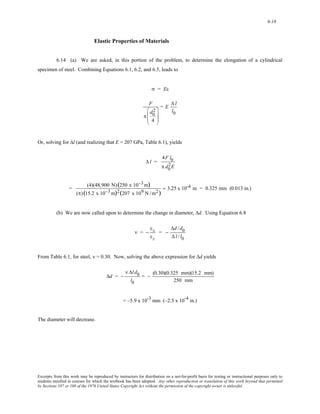
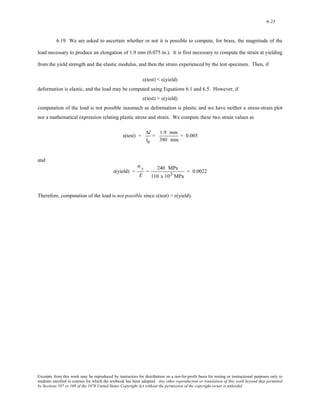
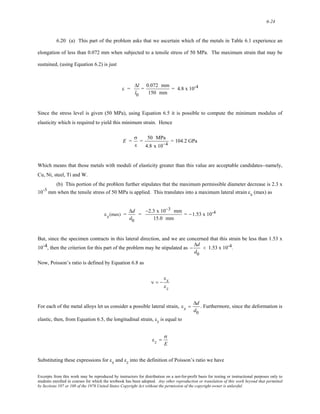
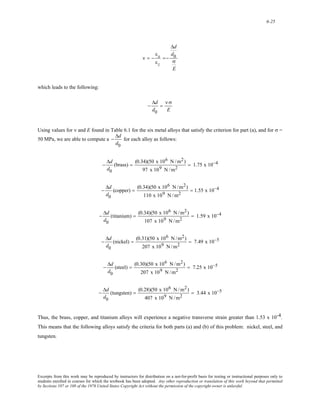
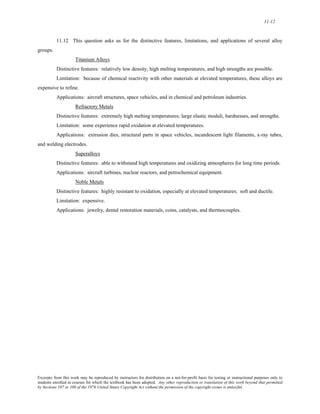
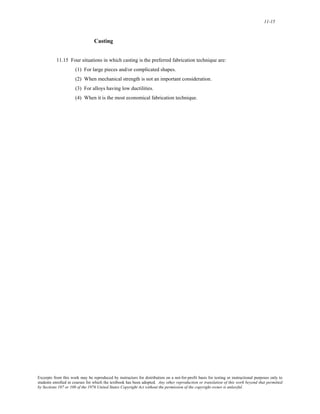
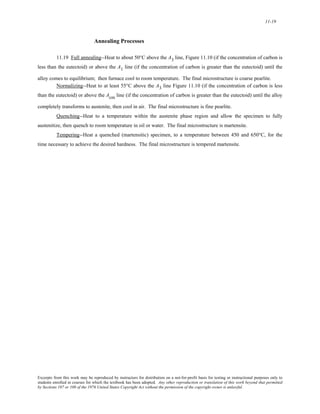
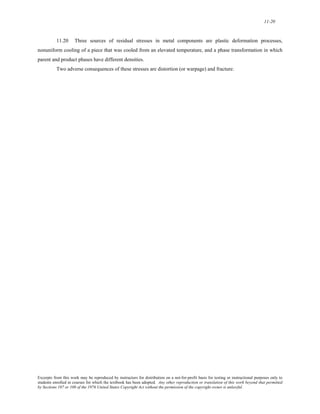
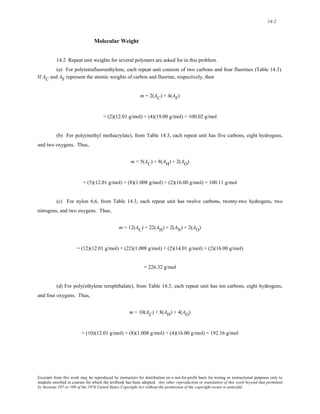
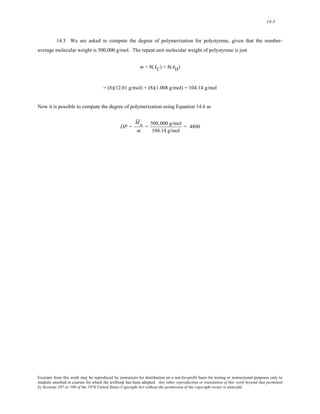
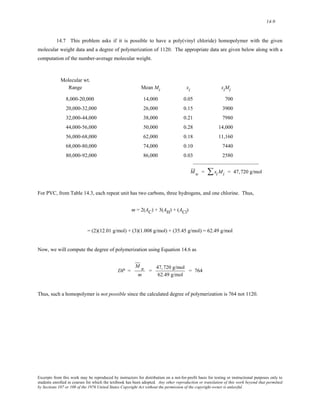
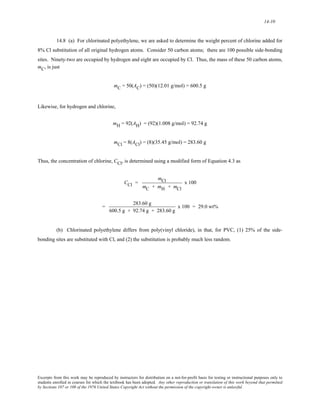
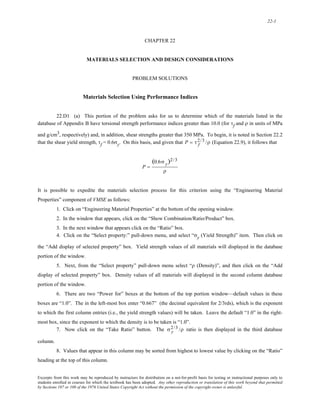
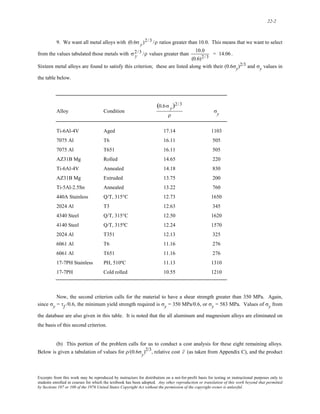
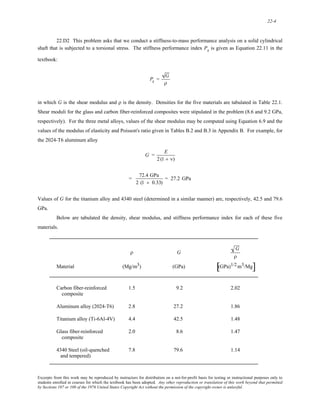
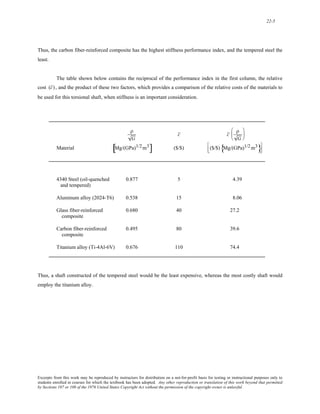
2-1 
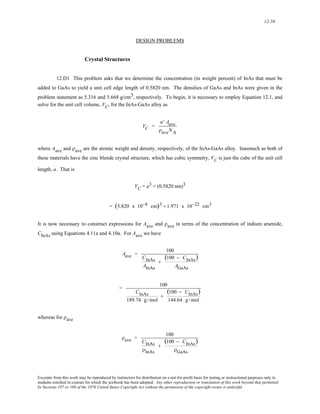
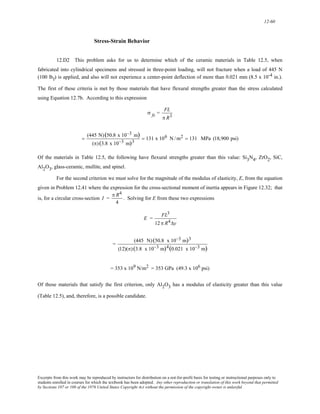
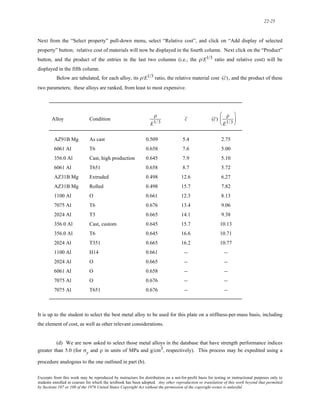
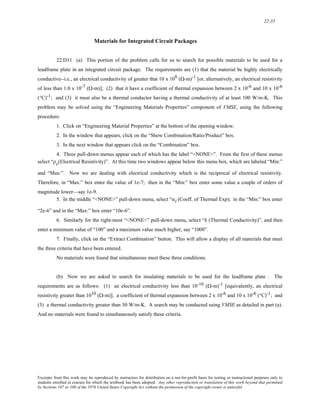
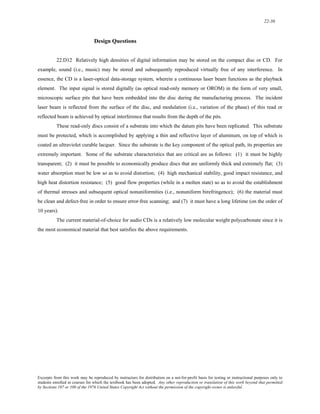
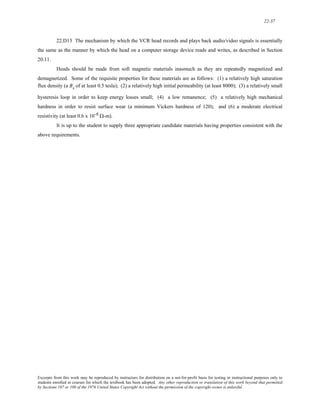
CHAPTER 2 
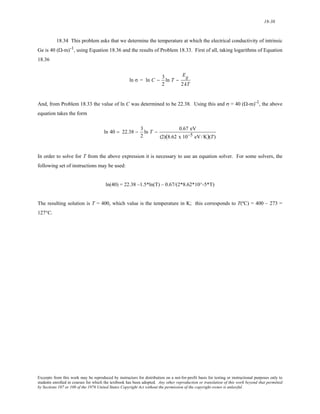
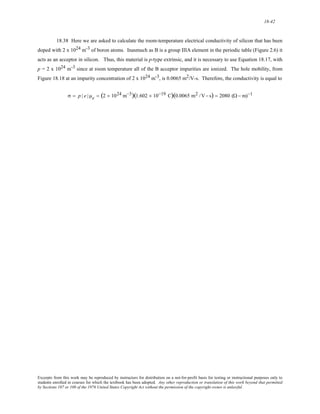
ATOMIC STRUCTURE AND INTERATOMIC BONDING 
PROBLEM SOLUTIONS 
Fundamental Concepts 
Electrons in Atoms 
2.1 Atomic mass is the mass of an individual atom, whereas atomic weight is the average (weighted) of the 
atomic masses of an atom's naturally occurring isotopes. 
Excerpts from this work may be reproduced by instructors for distribution on a not-for-profit basis for testing or instructional purposes only to 
students enrolled in courses for which the textbook has been adopted. Any other reproduction or translation of this work beyond that permitted 
by Sections 107 or 108 of the 1976 United States Copyright Act without the permission of the copyright owner is unlawful.
2-2 
2.2 The average atomic weight of silicon (A Si) is computed by adding fraction-of-occurrence/atomic 
weight products for the three isotopes. Thus 
A Si = f28Si 
A28Si 
+ f29Si 
A29Si 
+ f30Si 
A30Si 
= (0.9223)(27.9769) + (0.0468)(28.9765) + (0.0309)(29.9738) = 28.0854 
Excerpts from this work may be reproduced by instructors for distribution on a not-for-profit basis for testing or instructional purposes only to 
students enrolled in courses for which the textbook has been adopted. Any other reproduction or translation of this work beyond that permitted 
by Sections 107 or 108 of the 1976 United States Copyright Act without the permission of the copyright owner is unlawful.
2-3 
2.3 (a) In order to determine the number of grams in one amu of material, appropriate manipulation of the 
amu/atom, g/mol, and atom/mol relationships is all that is necessary, as 
# g/amu = 1 mol 
6.023 x 10²³ atoms 
⎛ 
⎜ 
⎝ 
⎞ 
⎟ 
⎠ 
1 g /mol 
1 amu /atom 
⎛ 
⎜ 
⎝ 
⎞ 
⎟ 
⎠ 
= 1.66 x 10⁻²⁴ g/amu 
(b) Since there are 453.6 g/lbm, 
1 lb - mol = (453.6 g/lbm) (6.023 x 10 23 atoms/g - mol) 
= 2.73 x 1026 atoms/lb-mol 
Excerpts from this work may be reproduced by instructors for distribution on a not-for-profit basis for testing or instructional purposes only to 
students enrolled in courses for which the textbook has been adopted. Any other reproduction or translation of this work beyond that permitted 
by Sections 107 or 108 of the 1976 United States Copyright Act without the permission of the copyright owner is unlawful.
2-4 
2.4 (a) Two important quantum-mechanical concepts associated with the Bohr model of the atom are (1) that 
electrons are particles moving in discrete orbitals, and (2) electron energy is quantized into shells. 
(b) Two important refinements resulting from the wave-mechanical atomic model are (1) that electron 
position is described in terms of a probability distribution, and (2) electron energy is quantized into both shells and 
subshells--each electron is characterized by four quantum numbers. 
Excerpts from this work may be reproduced by instructors for distribution on a not-for-profit basis for testing or instructional purposes only to 
students enrolled in courses for which the textbook has been adopted. Any other reproduction or translation of this work beyond that permitted 
by Sections 107 or 108 of the 1976 United States Copyright Act without the permission of the copyright owner is unlawful.
2-5 
2.5 The n quantum number designates the electron shell. 
The l quantum number designates the electron subshell. 
The ml quantum number designates the number of electron states in each electron subshell. 
The ms quantum number designates the spin moment on each electron. 
Excerpts from this work may be reproduced by instructors for distribution on a not-for-profit basis for testing or instructional purposes only to 
students enrolled in courses for which the textbook has been adopted. Any other reproduction or translation of this work beyond that permitted 
by Sections 107 or 108 of the 1976 United States Copyright Act without the permission of the copyright owner is unlawful.
2-6 
2.6 For the L state, n = 2, and eight electron states are possible. Possible l values are 0 and 1, while possible 
ml values are 0 and ±1; and possible ms values are ± 1 
2 . Therefore, for the s states, the quantum numbers are 
200(1 
2 
) and 200(− 1 
2 
). For the p states, the quantum numbers are 210(1 
2 
), 210(− 1 
2 
), 211(1 
2 
) , 211(− 1 
2 
) , 
21(−1)(1 
2 
), and 21(−1)(− 1 
2 
). 
For the M state, n = 3, and 18 states are possible. Possible l values are 0, 1, and 2; possible ml values are 
0, ±1, and ±2; and possible ms values are ± 
1 
2 
. Therefore, for the s states, the quantum numbers are 300(1 
2 
), 
300(− 1 
2 
), for the p states they are 310(1 
2 
), 310(− 1 
2 
), 311(1 
2 
) , 311(− 1 
2 
) , 31(−1)(1 
2 
), and 31(−1)(− 1 
2 
); for the d 
states they are 320(1 
2 
), 320(− 1 
2 
), 321(1 
2 
) , 321(− 1 
2 
) , 32 (−1)(1 
2 
), 32 (−1) (− 1 
2 
), 322(1 
2 
), 322(− 1 
2 
), 32 (−2)(1 
2 
), 
and 32 (−2) (− 1 
2 
) . 
Excerpts from this work may be reproduced by instructors for distribution on a not-for-profit basis for testing or instructional purposes only to 
students enrolled in courses for which the textbook has been adopted. Any other reproduction or translation of this work beyond that permitted 
by Sections 107 or 108 of the 1976 United States Copyright Act without the permission of the copyright owner is unlawful.
2-7 
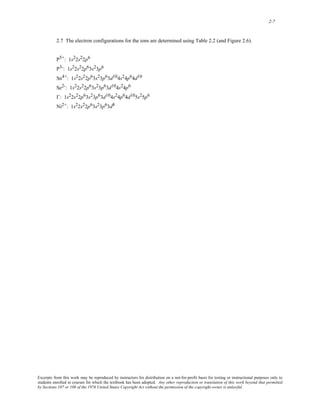
2.7 The electron configurations for the ions are determined using Table 2.2 (and Figure 2.6). 
P5+: 1s22s22p6 
P3-: 1s22s22p63s23p6 
Sn4+: 1s22s22p63s23p63d104s24p64d10 
Se2-: 1s22s22p63s23p63d104s24p6 
I-: 1s22s22p63s23p63d104s24p64d105s25p6 
Ni2+: 1s22s22p63s23p63d8 
Excerpts from this work may be reproduced by instructors for distribution on a not-for-profit basis for testing or instructional purposes only to 
students enrolled in courses for which the textbook has been adopted. Any other reproduction or translation of this work beyond that permitted 
by Sections 107 or 108 of the 1976 United States Copyright Act without the permission of the copyright owner is unlawful.
2-8 
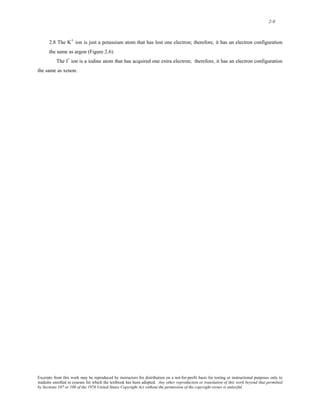
2.8 The K+ ion is just a potassium atom that has lost one electron; therefore, it has an electron configuration 
the same as argon (Figure 2.6). 
The I- ion is a iodine atom that has acquired one extra electron; therefore, it has an electron configuration 
the same as xenon. 
Excerpts from this work may be reproduced by instructors for distribution on a not-for-profit basis for testing or instructional purposes only to 
students enrolled in courses for which the textbook has been adopted. Any other reproduction or translation of this work beyond that permitted 
by Sections 107 or 108 of the 1976 United States Copyright Act without the permission of the copyright owner is unlawful.
2-9 
The Periodic Table 
2.9 Each of the elements in Group IIA has two s electrons. 
Excerpts from this work may be reproduced by instructors for distribution on a not-for-profit basis for testing or instructional purposes only to 
students enrolled in courses for which the textbook has been adopted. Any other reproduction or translation of this work beyond that permitted 
by Sections 107 or 108 of the 1976 United States Copyright Act without the permission of the copyright owner is unlawful.
2-10 
2.10 From the periodic table (Figure 2.6) the element having atomic number 112 would belong to group 
IIB. According to Figure 2.6, Ds, having an atomic number of 110 lies below Pt in the periodic table and in the 
right-most column of group VIII. Moving two columns to the right puts element 112 under Hg and in group IIB. 
Excerpts from this work may be reproduced by instructors for distribution on a not-for-profit basis for testing or instructional purposes only to 
students enrolled in courses for which the textbook has been adopted. Any other reproduction or translation of this work beyond that permitted 
by Sections 107 or 108 of the 1976 United States Copyright Act without the permission of the copyright owner is unlawful.
2-11 
2.11 (a) The 1s22s22p63s23p5 electron configuration is that of a halogen because it is one electron 
deficient from having a filled p subshell. 
(b) The 1s22s22p63s23p63d74s2 electron configuration is that of a transition metal because of an 
incomplete d subshell. 
(c) The 1s22s22p63s23p63d104s24p6 electron configuration is that of an inert gas because of filled 4s and 
4p subshells. 
(d) The 1s22s22p63s23p64s1 electron configuration is that of an alkali metal because of a single s electron. 
(e) The 1s22s22p63s23p63d104s24p64d55s2 electron configuration is that of a transition metal because of 
an incomplete d subshell. 
(f) The 1s22s22p63s2 electron configuration is that of an alkaline earth metal because of two s electrons. 
Excerpts from this work may be reproduced by instructors for distribution on a not-for-profit basis for testing or instructional purposes only to 
students enrolled in courses for which the textbook has been adopted. Any other reproduction or translation of this work beyond that permitted 
by Sections 107 or 108 of the 1976 United States Copyright Act without the permission of the copyright owner is unlawful.
2-12 
2.12 (a) The 4f subshell is being filled for the rare earth series of elements. 
(b) The 5f subshell is being filled for the actinide series of elements. 
Excerpts from this work may be reproduced by instructors for distribution on a not-for-profit basis for testing or instructional purposes only to 
students enrolled in courses for which the textbook has been adopted. Any other reproduction or translation of this work beyond that permitted 
by Sections 107 or 108 of the 1976 United States Copyright Act without the permission of the copyright owner is unlawful.
2-13 
Bonding Forces and Energies 
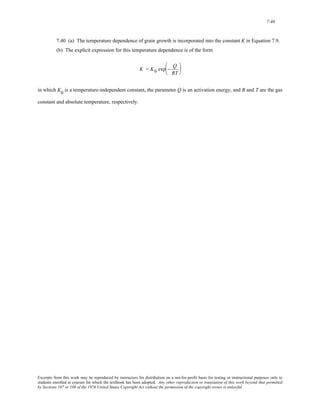
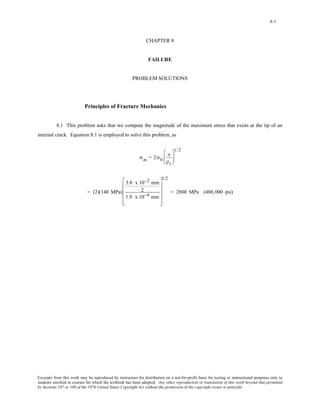
2.13 The attractive force between two ions FA is just the derivative with respect to the interatomic 
separation of the attractive energy expression, Equation 2.8, which is just 
FA = 
dEA 
dr 
= 
d − A 
r 
⎛ 
⎜ 
⎝ 
⎞ 
⎟ 
⎠ 
dr 
= A 
r 2 
The constant A in this expression is defined in footnote 3. Since the valences of the Ca2+ and O2- ions (Z1 and Z2) 
are both 2, then 
FA = 
(Z1e) (Z2e) 
4πε0r2 
= (2)(2)(1.6 x 10⁻¹⁹ C)2 
(4)(π) (8.85 x 10⁻¹² F /m) (1.25 x 10⁻⁹ m)2 
= 5.89 x 10⁻¹⁰ N 
Excerpts from this work may be reproduced by instructors for distribution on a not-for-profit basis for testing or instructional purposes only to 
students enrolled in courses for which the textbook has been adopted. Any other reproduction or translation of this work beyond that permitted 
by Sections 107 or 108 of the 1976 United States Copyright Act without the permission of the copyright owner is unlawful.
2-14 
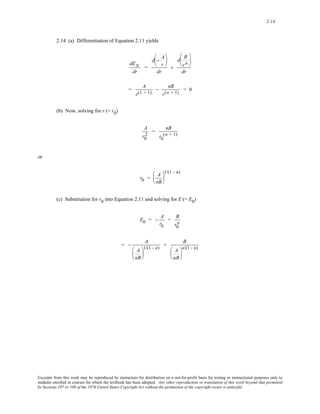
2.14 (a) Differentiation of Equation 2.11 yields 
dEN 
dr 
= 
d − A 
r 
⎛ 
⎜ 
⎝ 
⎞ 
⎟ 
⎠ 
dr 
+ 
⎛ 
⎝ 
d B 
⎜ 
r n 
⎞ 
⎟ 
⎠ 
dr 
= A 
r(1 + 1) 
− nB 
r(n + 1) = 0 
(b) Now, solving for r (= r0) 
2 = nB 
A 
r0 
(n + 1) 
r0 
or 
r0 = A 
nB 
⎛ 
⎜ 
⎝ 
1/(1 - n) 
⎞ 
⎟ 
⎠ 
(c) Substitution for r0 into Equation 2.11 and solving for E (= E0) 
E0 = − A 
r0 
+ B 
r0 
n 
= − A 
A 
nB 
⎛ 
⎜ 
⎝ 
1/(1 - n) + B 
⎞ 
⎟ 
⎠ 
A 
nB 
⎛ 
⎜ 
⎝ 
⎞ 
⎟ 
⎠ 
n/(1 - n) 
Excerpts from this work may be reproduced by instructors for distribution on a not-for-profit basis for testing or instructional purposes only to 
students enrolled in courses for which the textbook has been adopted. Any other reproduction or translation of this work beyond that permitted 
by Sections 107 or 108 of the 1976 United States Copyright Act without the permission of the copyright owner is unlawful.
2-15 
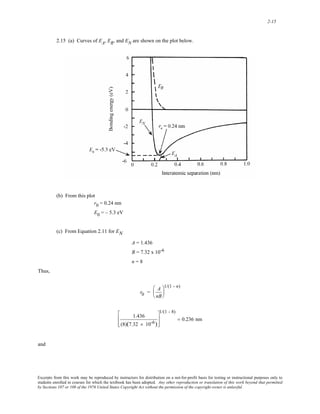
2.15 (a) Curves of EA, ER, and EN are shown on the plot below. 
(b) From this plot 
r0 = 0.24 nm 
E0 = – 5.3 eV 
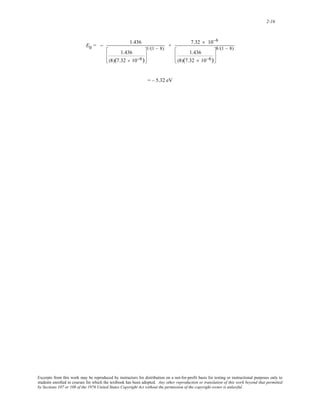
(c) From Equation 2.11 for EN 
A = 1.436 
B = 7.32 x 10⁻⁶ 
n = 8 
Thus, 
r0 = A 
nB 
⎛ 
⎜ 
⎝ 
1/(1 - n) 
⎞ 
⎟ 
⎠ 
1.436 
(8)(7.32 × 10⁻⁶) 
⎡ 
⎢ 
⎣ 
⎢ 
1/(1 - 8) 
⎤ 
⎥ 
⎦ 
⎥ 
= 0.236 nm 
and 
Excerpts from this work may be reproduced by instructors for distribution on a not-for-profit basis for testing or instructional purposes only to 
students enrolled in courses for which the textbook has been adopted. Any other reproduction or translation of this work beyond that permitted 
by Sections 107 or 108 of the 1976 United States Copyright Act without the permission of the copyright owner is unlawful.
2-16 
E0 = − 1.436 
1.436 
(8)(7.32 × 10⁻⁶) 
⎡ 
⎢ 
⎣ 
⎢ 
1/(1 − 8) + 7.32 × 10⁻⁶ 
⎤ 
⎥ 
⎦ 
⎥ 
1.436 
(8)(7.32 × 10⁻⁶) 
⎡ 
⎢ 
⎣ 
⎢ 
⎤ 
⎥ 
⎦ 
⎥ 
8/(1 − 8) 
= – 5.32 eV 
Excerpts from this work may be reproduced by instructors for distribution on a not-for-profit basis for testing or instructional purposes only to 
students enrolled in courses for which the textbook has been adopted. Any other reproduction or translation of this work beyond that permitted 
by Sections 107 or 108 of the 1976 United States Copyright Act without the permission of the copyright owner is unlawful.
2-17 
2.16 This problem gives us, for a hypothetical X+-Y- ion pair, values for r0 (0.38 nm), E0 (– 5.37 eV), 
and n (8), and asks that we determine explicit expressions for attractive and repulsive energies of Equations 2.8 and 
2.9. In essence, it is necessary to compute the values of A and B in these equations. Expressions for r0 and E0 in 
terms of n, A, and B were determined in Problem 2.14, which are as follows: 
r0 = A 
nB 
⎛ 
⎜ 
⎝ 
1/(1 - n) 
⎞ 
⎟ 
⎠ 
E0 = − A 
A 
nB 
⎛ 
⎜ 
⎝ 
1/(1 - n) + B 
⎞ 
⎟ 
⎠ 
A 
nB 
⎛ 
⎜ 
⎝ 
⎞ 
⎟ 
⎠ 
n/(1 - n) 
Thus, we have two simultaneous equations with two unknowns (viz. A and B). Upon substitution of values for r0 
and E0 in terms of n, these equations take the forms 
0.38 nm = A 
8B 
⎛ 
⎜ 
⎝ 
1/(1 - 8) 
⎞ 
⎟ 
⎠ 
= 
A 
8B 
⎛ 
⎜ 
⎝ 
-1/7 
⎞ 
⎟ 
⎠ 
and 
−5.37 eV = − A 
A 
8B 
⎛ 
⎜ 
⎝ 
1/(1 − 8) + B 
⎞ 
⎟ 
⎠ 
A 
8 B 
⎛ 
⎜ 
⎝ 
⎞ 
⎟ 
⎠ 
8/(1 − 8) 
= − A 
A 
8B 
⎛ 
⎜ 
⎝ 
−1/7 + B 
⎞ 
⎟ 
⎠ 
A 
10B 
⎛ 
⎜ 
⎝ 
−8/7 
⎞ 
⎟ 
⎠ 
We now want to solve these two equations simultaneously for values of A and B. From the first of these two 
equations, solving for A/8B leads to 
A 
8B 
= (0.38 nm)-7 
Furthermore, from the above equation the A is equal to 
A = 8B(0.38 nm)-7 
Excerpts from this work may be reproduced by instructors for distribution on a not-for-profit basis for testing or instructional purposes only to 
students enrolled in courses for which the textbook has been adopted. Any other reproduction or translation of this work beyond that permitted 
by Sections 107 or 108 of the 1976 United States Copyright Act without the permission of the copyright owner is unlawful.
2-18 
When the above two expressions for A/8B and A are substituted into the above expression for E0 (- 5.37 eV), the 
following results 
−5.37 eV = = − A 
A 
8B 
⎛ 
⎜ 
⎝ 
−1/7 + B 
⎞ 
⎟ 
⎠ 
A 
10B 
⎛ 
⎜ 
⎝ 
−8/7 
⎞ 
⎟ 
⎠ 
= − 8B(0.38 nm)-7 
[(0.38 nm)-7]−1/7 + B 
[(0.38 nm)-7]−8/7 
= − 8B(0.38 nm)-7 
0.38 nm 
+ B 
(0.38 nm)8 
Or 
−5.37 eV = = − 8B 
(0.38 nm)8 + B 
(0.38 nm)8 = − 7B 
(0.38 nm)8 
Solving for B from this equation yields 
B = 3.34 × 10⁻⁴ eV- nm8 
Furthermore, the value of A is determined from one of the previous equations, as follows: 
A = 8B(0.38 nm)-7 = (8)(3.34 × 10⁻⁴ eV - nm8 )(0.38 nm)-7 
= 2.34 eV- nm 
Thus, Equations 2.8 and 2.9 become 
EA = − 2.34 
r 
ER = 3.34 x 10⁻⁴ 
r8 
Of course these expressions are valid for r and E in units of nanometers and electron volts, respectively. 
Excerpts from this work may be reproduced by instructors for distribution on a not-for-profit basis for testing or instructional purposes only to 
students enrolled in courses for which the textbook has been adopted. Any other reproduction or translation of this work beyond that permitted 
by Sections 107 or 108 of the 1976 United States Copyright Act without the permission of the copyright owner is unlawful.
2-19 
2.17 (a) Differentiating Equation 2.12 with respect to r yields 
dE 
dr 
= 
d − C 
r 
⎛ 
⎜ 
⎝ 
⎞ 
⎟ 
⎠ 
dr 
− 
d D exp − r 
ρ 
⎛ 
⎜ 
⎝ 
⎞ 
⎟ 
⎠ 
⎡ 
⎢ 
⎣ 
⎤ 
⎥ 
⎦ 
dr 
= C 
r2 
− De−r /ρ 
ρ 
At r = r0, dE/dr = 0, and 
2 = De−(r0/ρ) 
C 
r0 
ρ 
(2.12b) 
Solving for C and substitution into Equation 2.12 yields an expression for E0 as 
E0 = De− (r0/ρ) 1 − 
r0 
ρ 
⎛ 
⎜ 
⎝ 
⎞ 
⎟ 
⎠ 
(b) Now solving for D from Equation 2.12b above yields 
D = Cρ e (r0/ρ) 
2 
r0 
Substitution of this expression for D into Equation 2.12 yields an expression for E0 as 
E0 = C 
r0 
ρ 
r0 
− 1 
⎛ 
⎜⎜ 
⎝ 
⎞ 
⎟⎟ 
⎠ 
Excerpts from this work may be reproduced by instructors for distribution on a not-for-profit basis for testing or instructional purposes only to 
students enrolled in courses for which the textbook has been adopted. Any other reproduction or translation of this work beyond that permitted 
by Sections 107 or 108 of the 1976 United States Copyright Act without the permission of the copyright owner is unlawful.
2-20 
Primary Interatomic Bonds 
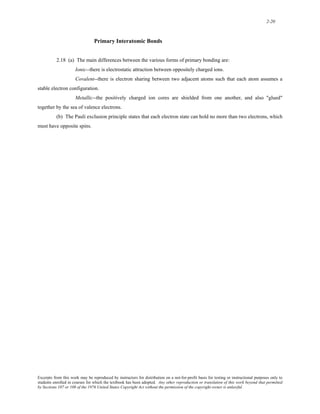
2.18 (a) The main differences between the various forms of primary bonding are: 
Ionic--there is electrostatic attraction between oppositely charged ions. 
Covalent--there is electron sharing between two adjacent atoms such that each atom assumes a 
stable electron configuration. 
Metallic--the positively charged ion cores are shielded from one another, and also "glued" 
together by the sea of valence electrons. 
(b) The Pauli exclusion principle states that each electron state can hold no more than two electrons, which 
must have opposite spins. 
Excerpts from this work may be reproduced by instructors for distribution on a not-for-profit basis for testing or instructional purposes only to 
students enrolled in courses for which the textbook has been adopted. Any other reproduction or translation of this work beyond that permitted 
by Sections 107 or 108 of the 1976 United States Copyright Act without the permission of the copyright owner is unlawful.
2-21 
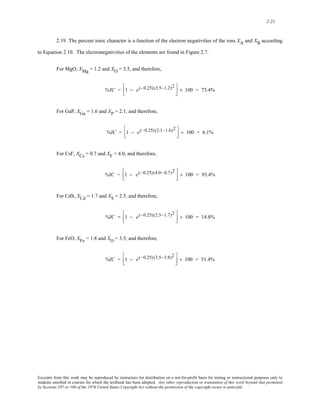
2.19 The percent ionic character is a function of the electron negativities of the ions XA and XB according 
to Equation 2.10. The electronegativities of the elements are found in Figure 2.7. 
For MgO, XMg = 1.2 and XO = 3.5, and therefore, 
%IC = 1 − e ⎡ (−0.25) (3.5−1.2)2 
⎢⎣ 
⎤ 
⎥⎦ × 100 = 73.4% 
For GaP, XGa = 1.6 and XP = 2.1, and therefore, 
%IC = 1 − e(−0.25)(2.1−1.6)2 ⎡ 
⎢⎣ 
⎤ 
⎥⎦ × 100 = 6.1% 
For CsF, XCs = 0.7 and XF = 4.0, and therefore, 
%IC = 1 − e(−0.25)(4.0−0.7)2 ⎡ 
⎢⎣ 
⎤ 
⎥⎦ × 100 = 93.4% 
For CdS, XCd = 1.7 and XS = 2.5, and therefore, 
%IC = 1 − e(−0.25) (2.5−1.7)2 ⎡ 
⎢⎣ 
⎤ 
⎥⎦ × 100 = 14.8% 
For FeO, XFe = 1.8 and XO = 3.5, and therefore, 
%IC = 1 − e(−0.25) (3.5−1.8)2 ⎡ 
⎢⎣ 
⎤ 
⎥⎦ × 100 = 51.4% 
Excerpts from this work may be reproduced by instructors for distribution on a not-for-profit basis for testing or instructional purposes only to 
students enrolled in courses for which the textbook has been adopted. Any other reproduction or translation of this work beyond that permitted 
by Sections 107 or 108 of the 1976 United States Copyright Act without the permission of the copyright owner is unlawful.
2-22 
2.20 Below is plotted the bonding energy versus melting temperature for these four metals. From this plot, 
the bonding energy for molybdenum (melting temperature of 2617°C) should be approximately 7.0 eV. The 
experimental value is 6.8 eV. 
Excerpts from this work may be reproduced by instructors for distribution on a not-for-profit basis for testing or instructional purposes only to 
students enrolled in courses for which the textbook has been adopted. Any other reproduction or translation of this work beyond that permitted 
by Sections 107 or 108 of the 1976 United States Copyright Act without the permission of the copyright owner is unlawful.
2-23 
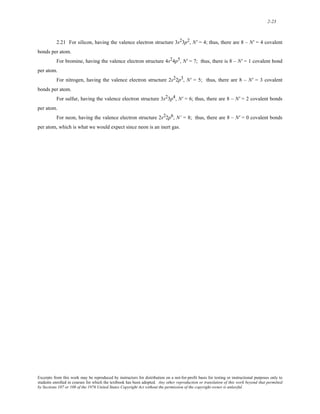
2.21 For silicon, having the valence electron structure 3s23p2, N' = 4; thus, there are 8 – N' = 4 covalent 
bonds per atom. 
For bromine, having the valence electron structure 4s24p5, N' = 7; thus, there is 8 – N' = 1 covalent bond 
per atom. 
For nitrogen, having the valence electron structure 2s22p3, N' = 5; thus, there are 8 – N' = 3 covalent 
bonds per atom. 
For sulfur, having the valence electron structure 3s23p4, N' = 6; thus, there are 8 – N' = 2 covalent bonds 
per atom. 
For neon, having the valence electron structure 2s22p6, N’ = 8; thus, there are 8 – N' = 0 covalent bonds 
per atom, which is what we would expect since neon is an inert gas. 
Excerpts from this work may be reproduced by instructors for distribution on a not-for-profit basis for testing or instructional purposes only to 
students enrolled in courses for which the textbook has been adopted. Any other reproduction or translation of this work beyond that permitted 
by Sections 107 or 108 of the 1976 United States Copyright Act without the permission of the copyright owner is unlawful.
2-24 
2.22 For solid xenon, the bonding is van der Waals since xenon is an inert gas. 
For CaF2, the bonding is predominantly ionic (but with some slight covalent character) on the basis of the 
relative positions of Ca and F in the periodic table. 
For bronze, the bonding is metallic since it is a metal alloy (composed of copper and tin). 
For CdTe, the bonding is predominantly covalent (with some slight ionic character) on the basis of the 
relative positions of Cd and Te in the periodic table. 
For rubber, the bonding is covalent with some van der Waals. (Rubber is composed primarily of carbon 
and hydrogen atoms.) 
For tungsten, the bonding is metallic since it is a metallic element from the periodic table. 
Excerpts from this work may be reproduced by instructors for distribution on a not-for-profit basis for testing or instructional purposes only to 
students enrolled in courses for which the textbook has been adopted. Any other reproduction or translation of this work beyond that permitted 
by Sections 107 or 108 of the 1976 United States Copyright Act without the permission of the copyright owner is unlawful.
2-25 
Secondary Bonding or van der Waals Bonding 
2.23 The intermolecular bonding for HF is hydrogen, whereas for HCl, the intermolecular bonding is van 
der Waals. Since the hydrogen bond is stronger than van der Waals, HF will have a higher melting temperature. 
Excerpts from this work may be reproduced by instructors for distribution on a not-for-profit basis for testing or instructional purposes only to 
students enrolled in courses for which the textbook has been adopted. Any other reproduction or translation of this work beyond that permitted 
by Sections 107 or 108 of the 1976 United States Copyright Act without the permission of the copyright owner is unlawful.
3-1 
CHAPTER 3 
THE STRUCTURE OF CRYSTALLINE SOLIDS 
PROBLEM SOLUTIONS 
Fundamental Concepts 
3.1 Atomic structure relates to the number of protons and neutrons in the nucleus of an atom, as well as 
the number and probability distributions of the constituent electrons. On the other hand, crystal structure pertains to 
the arrangement of atoms in the crystalline solid material. 
Excerpts from this work may be reproduced by instructors for distribution on a not-for-profit basis for testing or instructional purposes only to 
students enrolled in courses for which the textbook has been adopted. Any other reproduction or translation of this work beyond that permitted 
by Sections 107 or 108 of the 1976 United States Copyright Act without the permission of the copyright owner is unlawful.
3-2 
Unit Cells 
Metallic Crystal Structures 
3.2 For this problem, we are asked to calculate the volume of a unit cell of lead. Lead has an FCC crystal 
structure (Table 3.1). The FCC unit cell volume may be computed from Equation 3.4 as 
V C = 16R3 2 = (16) (0.175 × 10⁻⁹ m)3( 2) = 1.213 × 10⁻²⁸ m3 
Excerpts from this work may be reproduced by instructors for distribution on a not-for-profit basis for testing or instructional purposes only to 
students enrolled in courses for which the textbook has been adopted. Any other reproduction or translation of this work beyond that permitted 
by Sections 107 or 108 of the 1976 United States Copyright Act without the permission of the copyright owner is unlawful.
3-3 
3.3 This problem calls for a demonstration of the relationship 
a = 4R 
3 
for BCC. Consider the BCC unit 
cell shown below 
Using the triangle NOP 
(NP)2 = a2 + a2 = 2a2 
And then for triangle NPQ, 
(NQ)2= (QP)2 + (NP)2 
But NQ = 4R, R being the atomic radius. Also, QP = a. Therefore, 
(4R)2 = a2 + 2a2 
or 
a = 4R 
3 
Excerpts from this work may be reproduced by instructors for distribution on a not-for-profit basis for testing or instructional purposes only to 
students enrolled in courses for which the textbook has been adopted. Any other reproduction or translation of this work beyond that permitted 
by Sections 107 or 108 of the 1976 United States Copyright Act without the permission of the copyright owner is unlawful.
3-4 
3.4 We are asked to show that the ideal c/a ratio for HCP is 1.633. A sketch of one-third of an HCP unit 
cell is shown below. 
Consider the tetrahedron labeled as JKLM, which is reconstructed as 
The atom at point M is midway between the top and bottom faces of the unit cell--that is MH = c/2. And, since 
atoms at points J, K, and M, all touch one another, 
JM = JK = 2R = a 
where R is the atomic radius. Furthermore, from triangle JHM, 
(JM)2 = (JH)2 + (MH)2 
or 
a2 = (JH )2 + c 
2 
⎛ 
⎜ 
⎝ 
⎞ 
⎟ 
⎠ 
2 
Excerpts from this work may be reproduced by instructors for distribution on a not-for-profit basis for testing or instructional purposes only to 
students enrolled in courses for which the textbook has been adopted. Any other reproduction or translation of this work beyond that permitted 
by Sections 107 or 108 of the 1976 United States Copyright Act without the permission of the copyright owner is unlawful.
3-5 
Now, we can determine the JH length by consideration of triangle JKL, which is an equilateral triangle, 
cos 30° = a /2 
JH 
= 3 
2 
and 
JH = a 
3 
Substituting this value for JH in the above expression yields 
a2 = a 
3 
⎛ 
⎜ 
⎝ 
⎞ 
⎟ 
⎠ 
2 
+ c 
2 
⎛ 
⎜ 
⎝ 
⎞ 
⎟ 
⎠ 
2 
= a2 
3 
+ c2 
4 
and, solving for c/a 
c 
a 
= 8 
3 
= 1.633 
Excerpts from this work may be reproduced by instructors for distribution on a not-for-profit basis for testing or instructional purposes only to 
students enrolled in courses for which the textbook has been adopted. Any other reproduction or translation of this work beyond that permitted 
by Sections 107 or 108 of the 1976 United States Copyright Act without the permission of the copyright owner is unlawful.
3-6 
3.5 We are asked to show that the atomic packing factor for BCC is 0.68. The atomic packing factor is 
defined as the ratio of sphere volume to the total unit cell volume, or 
APF = 
VS 
VC 
Since there are two spheres associated with each unit cell for BCC 
VS = 2(sphere volume) = 2 4πR3 
3 
⎛ 
⎜⎜ 
⎝ 
⎞ 
⎠ 
⎟⎟ = 8πR3 
3 
Also, the unit cell has cubic symmetry, that is VC = a3. But a depends on R according to Equation 3.3, and 
VC = 4R 
3 
⎛ 
⎜ 
⎝ 
⎞ 
⎟ 
⎠ 
3 
= 64R3 
3 3 
Thus, 
APF = 
VS 
VC 
= 8π R3 /3 
64R3 /3 3 
= 0.68 
Excerpts from this work may be reproduced by instructors for distribution on a not-for-profit basis for testing or instructional purposes only to 
students enrolled in courses for which the textbook has been adopted. Any other reproduction or translation of this work beyond that permitted 
by Sections 107 or 108 of the 1976 United States Copyright Act without the permission of the copyright owner is unlawful.
3-7 
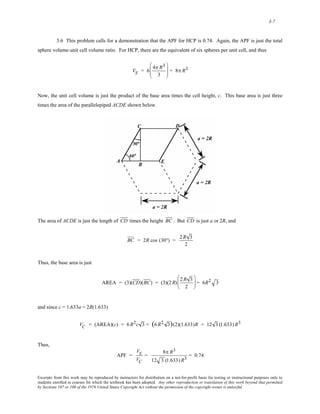
3.6 This problem calls for a demonstration that the APF for HCP is 0.74. Again, the APF is just the total 
sphere volume-unit cell volume ratio. For HCP, there are the equivalent of six spheres per unit cell, and thus 
VS = 6 4π R3 
3 
⎛ 
⎜⎜ 
⎝ 
⎞ 
⎠ 
⎟⎟ = 8π R3 
Now, the unit cell volume is just the product of the base area times the cell height, c. This base area is just three 
times the area of the parallelepiped ACDE shown below. 
The area of ACDE is just the length of CD times the height BC . But CD is just a or 2R, and 
BC = 2R cos (30°) = 2R 3 
2 
Thus, the base area is just 
AREA = (3)(CD)(BC) = (3)(2R) 2R 3 
2 
⎛ 
⎜ 
⎝ 
⎞ 
⎠ 
⎟ = 6R2 3 
and since c = 1.633a = 2R(1.633) 
V C = (AREA)(c) = 6R2c 3 = (6R2 3)(2)(1.633)R = 12 3 (1.633) R3 
Thus, 
APF = 
VS 
VC 
= 8π R3 
12 3 (1.633) R3 = 0.74 
Excerpts from this work may be reproduced by instructors for distribution on a not-for-profit basis for testing or instructional purposes only to 
students enrolled in courses for which the textbook has been adopted. Any other reproduction or translation of this work beyond that permitted 
by Sections 107 or 108 of the 1976 United States Copyright Act without the permission of the copyright owner is unlawful.
3-8 
Density Computations 
3.7 This problem calls for a computation of the density of molybdenum. According to Equation 3.5 
ρ = 
nAMo 
VCNA 
For BCC, n = 2 atoms/unit cell, and 
VC = 4R 
3 
⎛ 
⎜ 
⎝ 
⎞ 
⎟ 
⎠ 
3 
Thus, 
ρ = 
nAMo 
4 R 
3 
⎛ 
⎜ 
⎝ 
⎞ 
⎟ 
⎠ 
3 
NA 
= (2 atoms/unit cell)(95.94 g/mol) 
[(4) (0.1363 × 10⁻⁷ cm)3 / 3]3 
/(unit cell) (6.023 × 10²³ atoms/mol) 
= 10.21 g/cm3 
The value given inside the front cover is 10.22 g/cm3. 
Excerpts from this work may be reproduced by instructors for distribution on a not-for-profit basis for testing or instructional purposes only to 
students enrolled in courses for which the textbook has been adopted. Any other reproduction or translation of this work beyond that permitted 
by Sections 107 or 108 of the 1976 United States Copyright Act without the permission of the copyright owner is unlawful.
3-9 
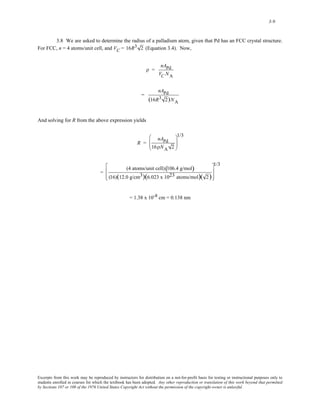
3.8 We are asked to determine the radius of a palladium atom, given that Pd has an FCC crystal structure. 
For FCC, n = 4 atoms/unit cell, and VC = 1 6R3 2 (Equation 3.4). Now, 
ρ = 
nAPd 
VC NA 
= 
nAPd 
(16R3 2)NA 
And solving for R from the above expression yields 
R = 
nAPd 
16ρNA 2 
⎛ 
⎜⎜ 
⎝ 
1/3 
⎞ 
⎟⎟ 
⎠ 
= 
(4 atoms/unit cell)(106.4 g/mol) 
(16)(12.0 g/cm3)(6.023 x 1023 atoms/mol)( 2) 
⎡ 
⎢ 
⎣ 
⎢ 
1/3 
⎤ 
⎥ 
⎦ 
⎥ 
= 1.38 x 10⁻⁸ cm = 0.138 nm 
Excerpts from this work may be reproduced by instructors for distribution on a not-for-profit basis for testing or instructional purposes only to 
students enrolled in courses for which the textbook has been adopted. Any other reproduction or translation of this work beyond that permitted 
by Sections 107 or 108 of the 1976 United States Copyright Act without the permission of the copyright owner is unlawful.
3-10 
3.9 This problem asks for us to calculate the radius of a tantalum atom. For BCC, n = 2 atoms/unit cell, 
and 
VC = 4R 
3 
⎛ 
⎜ 
⎝ 
⎞ 
⎟ 
⎠ 
3 
= 64R3 
3 3 
Since, from Equation 3.5 
ρ = 
nATa 
VC NA 
= 
nATa 
64R3 
3 3 
⎛ 
⎜⎜ 
⎝ 
⎞ 
⎠ 
⎟⎟ NA 
and solving for R the previous equation 
R = 
3 3nATa 
64ρ NA 
⎛ 
⎜⎜ 
⎝ 
1/3 
⎞ 
⎟⎟ 
⎠ 
= (3 3)(2 atoms/unit cell) (180.9 g/mol) 
(64)(16.6 g/cm3)(6.023 x 1023 atoms/mol) 
⎡ 
⎢ 
⎣ 
⎢ 
1/3 
⎤ 
⎥ 
⎦ 
⎥ 
= 1.43 x 10⁻⁸ cm = 0.143 nm 
Excerpts from this work may be reproduced by instructors for distribution on a not-for-profit basis for testing or instructional purposes only to 
students enrolled in courses for which the textbook has been adopted. Any other reproduction or translation of this work beyond that permitted 
by Sections 107 or 108 of the 1976 United States Copyright Act without the permission of the copyright owner is unlawful.
3-11 
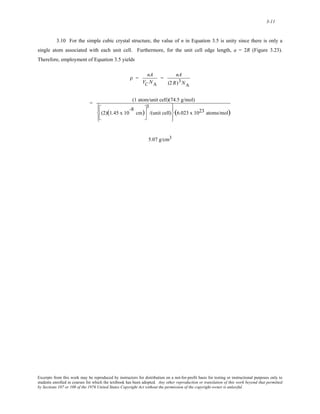
3.10 For the simple cubic crystal structure, the value of n in Equation 3.5 is unity since there is only a 
single atom associated with each unit cell. Furthermore, for the unit cell edge length, a = 2R (Figure 3.23). 
Therefore, employment of Equation 3.5 yields 
ρ = nA 
VC NA 
= nA 
(2 R)3NA 
= (1 atom/unit cell)(74.5 g/mol) 
⎡ 
-8 
⎢ 
(2)(1.45 x 10 
cm) ⎣ 
3 
/(unit cell) 
⎤ 
⎥ 
⎦ 
⎧ 
⎨ 
⎪ 
⎩⎪ 
⎫ 
⎬ 
⎪ 
⎪⎭ 
(6.023 x 10²³ atoms/mol) 
5.07 g/cm3 
Excerpts from this work may be reproduced by instructors for distribution on a not-for-profit basis for testing or instructional purposes only to 
students enrolled in courses for which the textbook has been adopted. Any other reproduction or translation of this work beyond that permitted 
by Sections 107 or 108 of the 1976 United States Copyright Act without the permission of the copyright owner is unlawful.
3-12 
3.11 (a) The volume of the Ti unit cell may be computed using Equation 3.5 as 
VC = 
nATi 
ρNA 
Now, for HCP, n = 6 atoms/unit cell, and for Ti, ATi = 47.9 g/mol. Thus, 
VC = (6 atoms/unit cell)(47.9 g/mol) 
(4.51 g/cm3)(6.023 x 1023 atoms/mol) 
= 1.058 x 10⁻²² cm3/unit cell = 1.058 x 10⁻²⁸ m3/unit cell 
(b) From part of the solution to Problem 3.6, for HCP 
V C = 6R2c 3 
But, since a = 2R, (i.e., R = a/2) then 
VC = 6 a 
2 
⎛ 
⎜ 
⎝ 
⎞ 
⎟ 
⎠ 
2 
c 3 = 
3 3a2c 
2 
but, since c = 1.58a 
VC = 3 3(1.58) a3 
2 
= 1.058 x 10⁻²² cm3/unit cell 
Now, solving for a 
a = (2)(1.058 x 10⁻²² cm3) 
(3) ( 3)(1.58) 
⎡ 
⎢ 
⎣ 
⎢ 
1/3 
⎤ 
⎥ 
⎦ 
⎥ 
= 2.96 x 10⁻⁸ cm = 0.296 nm 
And finally 
c = 1.58a = (1.58)(0.296 nm) = 0.468 nm 
Excerpts from this work may be reproduced by instructors for distribution on a not-for-profit basis for testing or instructional purposes only to 
students enrolled in courses for which the textbook has been adopted. Any other reproduction or translation of this work beyond that permitted 
by Sections 107 or 108 of the 1976 United States Copyright Act without the permission of the copyright owner is unlawful.
3-13 
3.12 This problem asks that we calculate the theoretical densities of Al, Ni, Mg, and W. 
Since Al has an FCC crystal structure, n = 4, and VC = 1 6R3 2 (Equation 3.4). Also, R = 0.143 nm (1.43 
x 10-8 cm) and AAl = 26.98 g/mol. Employment of Equation 3.5 yields 
ρ = 
nAAl 
VC NA 
= (4 atoms/unit cell)(26.98 g/mol) 
[(2)(1.43 x 10⁻⁸ cm)( 2)]3 
/(unit cell) 
⎧ 
⎨ 
⎩ 
⎫ 
⎬ 
⎭ 
(6.023 x 10²³ atoms/mol) 
= 2.71 g/cm3 
The value given in the table inside the front cover is 2.71 g/cm3. 
Nickel also has an FCC crystal structure and therefore 
ρ = (4 atoms/unit cell)(58.69 g/mol) 
[(2)(1.25 x 10⁻⁸ cm)( 2)]3 
/(unit cell ) 
⎧ 
⎨ 
⎩ 
⎫ 
⎬ 
⎭ 
(6.023 x 10²³ atoms/mol) 
= 8.82 g/cm3 
The value given in the table is 8.90 g/cm3. 
Magnesium has an HCP crystal structure, and from the solution to Problem 3.6, 
VC = 3 3a2c 
2 
and, since c = 1.624a and a = 2R = 2(1.60 x 10⁻⁸ cm) = 3.20 x 10⁻⁸ cm 
VC = (3 3)(1.624)(3.20 x 10⁻⁸ cm)3 
2 
= 1.38 x 10⁻²² cm3/unit cell 
Also, there are 6 atoms/unit cell for HCP. Therefore the theoretical density is 
ρ = 
nAMg 
VC NA 
Excerpts from this work may be reproduced by instructors for distribution on a not-for-profit basis for testing or instructional purposes only to 
students enrolled in courses for which the textbook has been adopted. Any other reproduction or translation of this work beyond that permitted 
by Sections 107 or 108 of the 1976 United States Copyright Act without the permission of the copyright owner is unlawful.
3-14 
= (6 atoms/unit cell)(24.31 g/mol) 
(1.38 x 10⁻²² cm3/unit cell)(6.023 x 10²³ atoms/mol) 
= 1.75 g/cm3 
The value given in the table is 1.74 g/cm3. 
Tungsten has a BCC crystal structure for which n = 2 and a = 
4R 
3 
(Equation 3.3); also AW = 183.85 
g/mol and R = 0.137 nm. Therefore, employment of Equation 3.5 leads to 
ρ = (2 atoms/unit cell)(183.85 g/mol) 
(4)(1.37 x 10⁻⁸ cm) 
3 
⎡ 
⎢ 
⎣ 
⎢ 
3 
/(unit cell) 
⎤ 
⎥ 
⎦ 
⎥ 
⎧ 
⎨ 
⎪ 
⎩⎪ 
⎫ 
⎬ 
⎪ 
⎪⎭ 
(6.023 x 10²³ atoms/mol) 
= 19.3 g/cm3 
The value given in the table is 19.3 g/cm3. 
Excerpts from this work may be reproduced by instructors for distribution on a not-for-profit basis for testing or instructional purposes only to 
students enrolled in courses for which the textbook has been adopted. Any other reproduction or translation of this work beyond that permitted 
by Sections 107 or 108 of the 1976 United States Copyright Act without the permission of the copyright owner is unlawful.
3-15 
3.13 In order to determine whether Nb has an FCC or a BCC crystal structure, we need to compute its 
density for each of the crystal structures. For FCC, n = 4, and a = 2R 2 (Equation 3.1). Also, from Figure 2.6, its 
atomic weight is 92.91 g/mol. Thus, for FCC (employing Equation 3.5) 
ρ = 
nANb 
a3NA 
= 
nANb 
(2R 2)3NA 
= (4 atoms/unit cell)(92.91 g/mol) 
[(2)(1.43 × 10⁻⁸ cm)( 2)]3 
/(unit cell) 
⎧ 
⎨ 
⎩ 
⎫ 
⎬ 
⎭ 
(6.023 × 10²³ atoms /mol) 
= 9.33 g/cm3 
For BCC, n = 2, and a = 
4R 
3 
(Equation 3.3), thus 
ρ = 
nANb 
4 R 
3 
⎛ 
⎜⎜ 
⎝ 
⎞ 
⎟⎟ 
⎠ 
3 
NA 
ρ = (2 atoms/unit cell)(92.91 g/mol) 
(4)(1.43 × 10⁻⁸ cm) 
3 
⎡ 
⎢ 
⎣ 
⎢ 
⎤ 
⎥ 
⎦ 
⎥ 
3 
/(unit cell) 
⎧ 
⎨ 
⎪ 
⎩⎪ 
⎫ 
⎬ 
⎪ 
⎪⎭ 
(6.023 × 10²³ atoms /mol) 
= 8.57 g/cm3 
which is the value provided in the problem statement. Therefore, Nb has a BCC crystal structure. 
Excerpts from this work may be reproduced by instructors for distribution on a not-for-profit basis for testing or instructional purposes only to 
students enrolled in courses for which the textbook has been adopted. Any other reproduction or translation of this work beyond that permitted 
by Sections 107 or 108 of the 1976 United States Copyright Act without the permission of the copyright owner is unlawful.
3-16 
3.14 For each of these three alloys we need, by trial and error, to calculate the density using Equation 3.5, 
and compare it to the value cited in the problem. For SC, BCC, and FCC crystal structures, the respective values of 
n are 1, 2, and 4, whereas the expressions for a (since VC = a3) are 2R, 2 R 2 , and 
4R 
3 
. 
For alloy A, let us calculate ρ assuming a BCC crystal structure. 
ρ = 
nAA 
VC NA 
= 
nAA 
4R 
3 
⎛ 
⎜ 
⎝ 
⎞ 
⎟ 
⎠ 
3 
NA 
= (2 atoms/unit cell)(43.1 g/mol) 
(4)(1.22 × 10⁻⁸ cm) 
3 
⎡ 
⎢ 
⎣ 
⎢ 
3 
/(unit cell) 
⎤ 
⎥ 
⎦ 
⎥ 
⎧ 
⎨ 
⎪ 
⎩⎪ 
⎫ 
⎬ 
⎪ 
⎪⎭ 
(6.023 × 10²³ atoms/mol) 
= 6.40 g/cm3 
Therefore, its crystal structure is BCC. 
For alloy B, let us calculate ρ assuming a simple cubic crystal structure. 
ρ = 
nAB 
(2a)3NA 
= (1 atom/unit cell)(184.4 g/mol) 
[(2)(1.46 × 10⁻⁸ cm)]3 
/(unit cell) 
⎧ 
⎨ 
⎩ 
⎫ 
⎬ 
⎭ 
(6.023 × 10²³ atoms/mol) 
= 12.3 g/cm3 
Therefore, its crystal structure is simple cubic. 
For alloy C, let us calculate ρ assuming a BCC crystal structure. 
Excerpts from this work may be reproduced by instructors for distribution on a not-for-profit basis for testing or instructional purposes only to 
students enrolled in courses for which the textbook has been adopted. Any other reproduction or translation of this work beyond that permitted 
by Sections 107 or 108 of the 1976 United States Copyright Act without the permission of the copyright owner is unlawful.
3-17 
ρ = 
nAC 
4R 
3 
⎛ 
⎜ 
⎝ 
⎞ 
⎟ 
⎠ 
3 
NA 
= (2 atoms/unit cell)(91.6 g/mol) 
(4)(1.37 × 10⁻⁸ cm) 
3 
⎡ 
⎢ 
⎣ 
⎢ 
3 
/(unit cell) 
⎤ 
⎥ 
⎦ 
⎥ 
⎧ 
⎨ 
⎪ 
⎩⎪ 
⎫ 
⎬ 
⎪ 
⎪⎭ 
(6.023 × 10²³ atoms/mol) 
= 9.60 g/cm3 
Therefore, its crystal structure is BCC. 
Excerpts from this work may be reproduced by instructors for distribution on a not-for-profit basis for testing or instructional purposes only to 
students enrolled in courses for which the textbook has been adopted. Any other reproduction or translation of this work beyond that permitted 
by Sections 107 or 108 of the 1976 United States Copyright Act without the permission of the copyright owner is unlawful.
3-18 
3.15 In order to determine the APF for U, we need to compute both the unit cell volume (VC) which is just 
the product of the three unit cell parameters, as well as the total sphere volume (VS) which is just the product of the 
volume of a single sphere and the number of spheres in the unit cell (n). The value of n may be calculated from 
Equation 3.5 as 
n = 
ρVC NA 
AU 
= (19.05 g/cm3)(2.86)(5.87)(4.95)(× 10-24 cm3)(6.023 × 10²³ atoms /mol) 
238.03 g/mol 
= 4.01 atoms/unit cell 
Therefore 
APF = 
VS 
VC 
= 
π R ⎛ 3 
⎝ 
(4) 4 
3 
⎜ 
⎞ 
⎟ 
⎠ 
(a)(b)(c) 
= 
(π)(1.385Źx 10-8 cm)3 ⎡ 
⎢⎣ 
(4) 4 
3 
⎤ 
⎥⎦ 
(2.86)(5.87)(4.95)(xŹ10-24 cm3) 
= 0.536 
Excerpts from this work may be reproduced by instructors for distribution on a not-for-profit basis for testing or instructional purposes only to 
students enrolled in courses for which the textbook has been adopted. Any other reproduction or translation of this work beyond that permitted 
by Sections 107 or 108 of the 1976 United States Copyright Act without the permission of the copyright owner is unlawful.
3-19 
3.16 (a) For indium, and from the definition of the APF 
APF = 
VS 
VC 
= 
π R ⎛ 3 
⎝ 
n 4 
⎜ 
3 
⎞ 
⎟ 
⎠ 
a2c 
we may solve for the number of atoms per unit cell, n, as 
n = (APF) a2c 
4 
3 
π R3 
= (0.693)(4.59)2(4.95) (10-24 cm3) 
4 
3 
π (1.625 × 10⁻⁸ cm)3 
= 4.0 atoms/unit cell 
(b) In order to compute the density, we just employ Equation 3.5 as 
ρ = 
nAIn 
a2c NA 
= (4 atoms/unit cell)(114.82 g/mol) 
[(4.59 × 10⁻⁸ cm)2 (4.95 × 10⁻⁸ cm) /unit cell](6.023 × 1023 atoms/mol) 
= 7.31 g/cm3 
Excerpts from this work may be reproduced by instructors for distribution on a not-for-profit basis for testing or instructional purposes only to 
students enrolled in courses for which the textbook has been adopted. Any other reproduction or translation of this work beyond that permitted 
by Sections 107 or 108 of the 1976 United States Copyright Act without the permission of the copyright owner is unlawful.
3-20 
3. 17 (a) We are asked to calculate the unit cell volume for Be. For HCP, from the solution to Problem 
3.6 
V C = 6R2c 3 
But, c = 1.568a, and a = 2R, or c = 3.14R, and 
V C = (6)(3.14) R3 3 
= (6)(3.14) ( 3) [0.1143 × 10⁻⁷ cm]3 
= 4.87 × 10⁻²³ cm3/unit cell 
(b) The theoretical density of Be is determined, using Equation 3.5, as follows: 
ρ = 
nABe 
VC NA 
For HCP, n = 6 atoms/unit cell, and for Be, ABe = 9.01 g/mol (as noted inside the front cover). Thus, 
ρ = (6 atoms/unit cell)(9.01 g/mol) 
(4.87 × 10⁻²³ cm3/unit cell)(6.023 × 10²³ atoms/mol) 
= 1.84 g/cm3 
The value given in the literature is 1.85 g/cm3. 
Excerpts from this work may be reproduced by instructors for distribution on a not-for-profit basis for testing or instructional purposes only to 
students enrolled in courses for which the textbook has been adopted. Any other reproduction or translation of this work beyond that permitted 
by Sections 107 or 108 of the 1976 United States Copyright Act without the permission of the copyright owner is unlawful.
3-21 
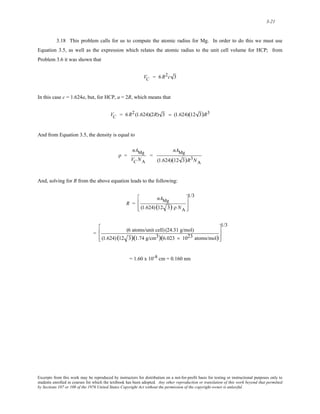
3.18 This problem calls for us to compute the atomic radius for Mg. In order to do this we must use 
Equation 3.5, as well as the expression which relates the atomic radius to the unit cell volume for HCP; from 
Problem 3.6 it was shown that 
V C = 6R2c 3 
In this case c = 1.624a, but, for HCP, a = 2R, which means that 
V C = 6R2 (1.624)(2R) 3 = (1.624)(12 3)R3 
And from Equation 3.5, the density is equal to 
ρ = 
nAMg 
VC NA 
= 
nAMg 
(1.624)(12 3)R3NA 
And, solving for R from the above equation leads to the following: 
R = 
nAMg 
(1.624) (12 3) ρ NA 
⎡ 
⎢ 
⎣ 
⎢ 
1/3 
⎤ 
⎥ 
⎦ 
⎥ 
= (6 atoms/unit cell) (24.31 g/mol) 
(1.624) (12 3)(1.74 g/cm3)(6.023 × 1023 atoms/mol) 
⎡ 
⎢ 
⎣ 
⎢ 
1/3 
⎤ 
⎥ 
⎦ 
⎥ 
= 1.60 x 10⁻⁸ cm = 0.160 nm 
Excerpts from this work may be reproduced by instructors for distribution on a not-for-profit basis for testing or instructional purposes only to 
students enrolled in courses for which the textbook has been adopted. Any other reproduction or translation of this work beyond that permitted 
by Sections 107 or 108 of the 1976 United States Copyright Act without the permission of the copyright owner is unlawful.
3-22 
3.19 This problem asks that we calculate the unit cell volume for Co which has an HCP crystal structure. 
In order to do this, it is necessary to use a result of Problem 3.6, that is 
V C = 6R2c 3 
The problem states that c = 1.623a, and a = 2R. Therefore 
V C = (1.623)(12 3) R3 
= (1.623)(12 3)(1.253 × 10⁻⁸ cm)3 = 6.64 × 10⁻²³ cm3 = 6.64 × 10⁻² nm3 
Excerpts from this work may be reproduced by instructors for distribution on a not-for-profit basis for testing or instructional purposes only to 
students enrolled in courses for which the textbook has been adopted. Any other reproduction or translation of this work beyond that permitted 
by Sections 107 or 108 of the 1976 United States Copyright Act without the permission of the copyright owner is unlawful.
3-23 
Crystal Systems 
3.20 (a) The unit cell shown in the problem statement belongs to the tetragonal crystal system since a = b 
= 0.35 nm, c = 0.45 nm, and α = β = γ = 90°. 
(b) The crystal structure would be called body-centered tetragonal. 
(c) As with BCC, n = 2 atoms/unit cell. Also, for this unit cell 
V C = (3.5 × 10⁻⁸ cm)2(4.5 × 10⁻⁸ cm) 
= 5.51 × 10⁻²³ cm3/unit cell 
Thus, using Equation 3.5, the density is equal to 
ρ = nA 
VC NA 
= (2 atoms/unit cell) (141 g/mol) 
(5.51 × 10⁻²³ cm3/unit cell)(6.023 × 10²³ atoms/mol) 
= 8.49 g/cm3 
Excerpts from this work may be reproduced by instructors for distribution on a not-for-profit basis for testing or instructional purposes only to 
students enrolled in courses for which the textbook has been adopted. Any other reproduction or translation of this work beyond that permitted 
by Sections 107 or 108 of the 1976 United States Copyright Act without the permission of the copyright owner is unlawful.
3-24 
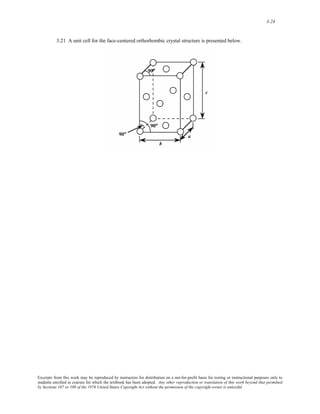
3.21 A unit cell for the face-centered orthorhombic crystal structure is presented below. 
Excerpts from this work may be reproduced by instructors for distribution on a not-for-profit basis for testing or instructional purposes only to 
students enrolled in courses for which the textbook has been adopted. Any other reproduction or translation of this work beyond that permitted 
by Sections 107 or 108 of the 1976 United States Copyright Act without the permission of the copyright owner is unlawful.
3-25 
Point Coordinates 
3.22 This problem asks that we list the point coordinates for all of the atoms that are associated with the 
FCC unit cell. From Figure 3.1b, the atom located of the origin of the unit cell has the coordinates 000. 
Coordinates for other atoms in the bottom face are 100, 110, 010, and 
1 
2 
1 
2 
0. (The z coordinate for all these points 
is zero.) 
For the top unit cell face, the coordinates are 001, 101, 111, 011, and 
1 
2 
1 
2 
1. (These coordinates are the 
same as bottom-face coordinates except that the “0” z coordinate has been replaced by a “1”.) 
Coordinates for those atoms that are positioned at the centers of both side faces, and centers of both front 
and back faces need to be specified. For the front and back-center face atoms, the coordinates are 
1 1 
2 
1 
2 
and 
0 1 
2 
1 
2 
, 
respectively. While for the left and right side center-face atoms, the respective coordinates are 
1 
2 
0 1 
2 
and 
1 
2 
1 1 
2 
. 
Excerpts from this work may be reproduced by instructors for distribution on a not-for-profit basis for testing or instructional purposes only to 
students enrolled in courses for which the textbook has been adopted. Any other reproduction or translation of this work beyond that permitted 
by Sections 107 or 108 of the 1976 United States Copyright Act without the permission of the copyright owner is unlawful.
3-26 
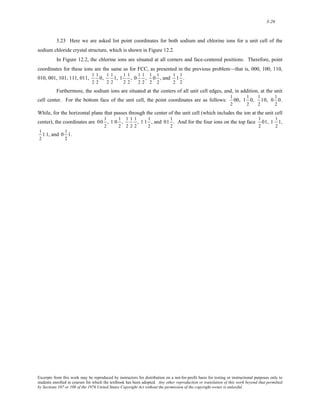
3.23 Here we are asked list point coordinates for both sodium and chlorine ions for a unit cell of the 
sodium chloride crystal structure, which is shown in Figure 12.2. 
In Figure 12.2, the chlorine ions are situated at all corners and face-centered positions. Therefore, point 
coordinates for these ions are the same as for FCC, as presented in the previous problem—that is, 000, 100, 110, 
010, 001, 101, 111, 011, 
1 
2 
1 
2 
0, 
1 
2 
1 
2 
1, 
1 1 
2 
1 
2 
, 
0 1 
2 
1 
2 
, 
1 
2 
0 1 
2 
, and 
1 
2 
1 1 
2 
. 
Furthermore, the sodium ions are situated at the centers of all unit cell edges, and, in addition, at the unit 
cell center. For the bottom face of the unit cell, the point coordinates are as follows: 
1 
2 
00, 
1 1 
2 
0, 
1 
2 
10, 
0 1 
2 
0. 
While, for the horizontal plane that passes through the center of the unit cell (which includes the ion at the unit cell 
center), the coordinates are 
00 1 
2 
, 
1 0 1 
2 
, 
1 
2 
1 
2 
1 
2 
, 
1 1 1 
2 
, and 
01 1 
2 
. And for the four ions on the top face 
1 
2 
01, 
1 1 
2 
1, 
1 
2 
1 1, and 
0 1 
2 
1. 
Excerpts from this work may be reproduced by instructors for distribution on a not-for-profit basis for testing or instructional purposes only to 
students enrolled in courses for which the textbook has been adopted. Any other reproduction or translation of this work beyond that permitted 
by Sections 107 or 108 of the 1976 United States Copyright Act without the permission of the copyright owner is unlawful.
3-27 
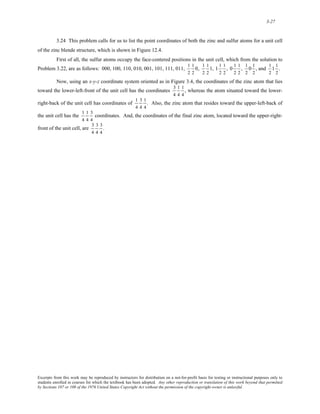
3.24 This problem calls for us to list the point coordinates of both the zinc and sulfur atoms for a unit cell 
of the zinc blende structure, which is shown in Figure 12.4. 
First of all, the sulfur atoms occupy the face-centered positions in the unit cell, which from the solution to 
Problem 3.22, are as follows: 000, 100, 110, 010, 001, 101, 111, 011, 
1 
2 
1 
2 
0, 
1 
2 
1 
2 
1, 
1 1 
2 
1 
2 
, 
0 1 
2 
1 
2 
, 
1 
2 
0 1 
2 
, and 
1 
2 
1 1 
2 
. 
Now, using an x-y-z coordinate system oriented as in Figure 3.4, the coordinates of the zinc atom that lies 
toward the lower-left-front of the unit cell has the coordinates 
3 
4 
1 
4 
1 
4 
, whereas the atom situated toward the lower-right- 
back of the unit cell has coordinates of 
1 
4 
3 
4 
1 
4 
. Also, the zinc atom that resides toward the upper-left-back of 
the unit cell has the 
1 
4 
1 
4 
3 
4 
coordinates. And, the coordinates of the final zinc atom, located toward the upper-right-front 
of the unit cell, are 
3 
4 
3 
4 
3 
4 
. 
Excerpts from this work may be reproduced by instructors for distribution on a not-for-profit basis for testing or instructional purposes only to 
students enrolled in courses for which the textbook has been adopted. Any other reproduction or translation of this work beyond that permitted 
by Sections 107 or 108 of the 1976 United States Copyright Act without the permission of the copyright owner is unlawful.
3-28 
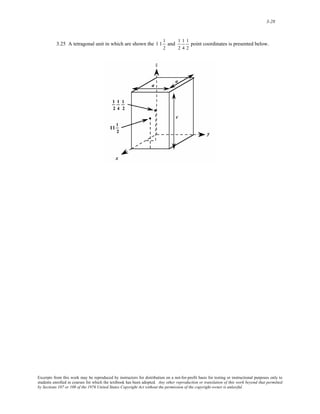
3.25 A tetragonal unit in which are shown the 
1 1 1 
2 
and 
1 
2 
1 
4 
1 
2 
point coordinates is presented below. 
Excerpts from this work may be reproduced by instructors for distribution on a not-for-profit basis for testing or instructional purposes only to 
students enrolled in courses for which the textbook has been adopted. Any other reproduction or translation of this work beyond that permitted 
by Sections 107 or 108 of the 1976 United States Copyright Act without the permission of the copyright owner is unlawful.
3-29 
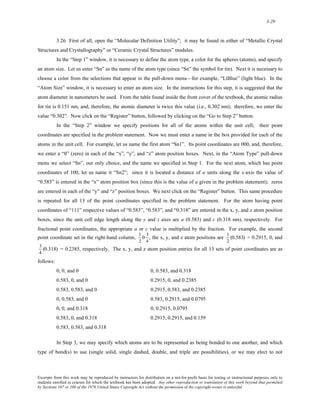
3.26 First of all, open the “Molecular Definition Utility”; it may be found in either of “Metallic Crystal 
Structures and Crystallography” or “Ceramic Crystal Structures” modules. 
In the “Step 1” window, it is necessary to define the atom type, a color for the spheres (atoms), and specify 
an atom size. Let us enter “Sn” as the name of the atom type (since “Sn” the symbol for tin). Next it is necessary to 
choose a color from the selections that appear in the pull-down menu—for example, “LtBlue” (light blue). In the 
“Atom Size” window, it is necessary to enter an atom size. In the instructions for this step, it is suggested that the 
atom diameter in nanometers be used. From the table found inside the front cover of the textbook, the atomic radius 
for tin is 0.151 nm, and, therefore, the atomic diameter is twice this value (i.e., 0.302 nm); therefore, we enter the 
value “0.302”. Now click on the “Register” button, followed by clicking on the “Go to Step 2” button. 
In the “Step 2” window we specify positions for all of the atoms within the unit cell; their point 
coordinates are specified in the problem statement. Now we must enter a name in the box provided for each of the 
atoms in the unit cell. For example, let us name the first atom “Sn1”. Its point coordinates are 000, and, therefore, 
we enter a “0” (zero) in each of the “x”, “y”, and “z” atom position boxes. Next, in the “Atom Type” pull-down 
menu we select “Sn”, our only choice, and the name we specified in Step 1. For the next atom, which has point 
coordinates of 100, let us name it “Sn2”; since it is located a distance of a units along the x-axis the value of 
“0.583” is entered in the “x” atom position box (since this is the value of a given in the problem statement); zeros 
are entered in each of the “y” and “z” position boxes. We next click on the “Register” button. This same procedure 
is repeated for all 13 of the point coordinates specified in the problem statement. For the atom having point 
coordinates of “111” respective values of “0.583”, “0.583”, and “0.318” are entered in the x, y, and z atom position 
boxes, since the unit cell edge length along the y and z axes are a (0.583) and c (0.318 nm), respectively. For 
fractional point coordinates, the appropriate a or c value is multiplied by the fraction. For example, the second 
point coordinate set in the right-hand column, 
1 
2 
0 3 
4 
, the x, y, and z atom positions are 
1 
2 
(0.583) = 0.2915, 0, and 
3 
4 
(0.318) = 0.2385, respectively. The x, y, and z atom position entries for all 13 sets of point coordinates are as 
follows: 
0, 0, and 0 0, 0.583, and 0.318 
0.583, 0, and 0 0.2915, 0, and 0.2385 
0.583, 0.583, and 0 0.2915, 0.583, and 0.2385 
0, 0.583, and 0 0.583, 0.2915, and 0.0795 
0, 0, and 0.318 0, 0.2915, 0.0795 
0.583, 0, and 0.318 0.2915, 0.2915, and 0.159 
0.583, 0.583, and 0.318 
In Step 3, we may specify which atoms are to be represented as being bonded to one another, and which 
type of bond(s) to use (single solid, single dashed, double, and triple are possibilities), or we may elect to not 
Excerpts from this work may be reproduced by instructors for distribution on a not-for-profit basis for testing or instructional purposes only to 
students enrolled in courses for which the textbook has been adopted. Any other reproduction or translation of this work beyond that permitted 
by Sections 107 or 108 of the 1976 United States Copyright Act without the permission of the copyright owner is unlawful.
3-30 
represent any bonds at all (in which case we click on the “Go to Step 4” button). If it is decided to show bonds, 
probably the best thing to do is to represent unit cell edges as bonds. 
The window in Step 4 presents all the data that have been entered; you may review these data for 
accuracy. If any changes are required, it is necessary to close out all windows back to the one in which corrections 
are to be made, and then reenter data in succeeding windows. When you are fully satisfied with your data, click on 
the “Generate” button, and the image that you have defined will be displayed. The image may then be rotated by 
using mouse click-and-drag. 
Your image should appear as 
[Note: Unfortunately, with this version of the Molecular Definition Utility, it is not possible to save either the data 
or the image that you have generated. You may use screen capture (or screen shot) software to record and store 
your image.] 
Excerpts from this work may be reproduced by instructors for distribution on a not-for-profit basis for testing or instructional purposes only to 
students enrolled in courses for which the textbook has been adopted. Any other reproduction or translation of this work beyond that permitted 
by Sections 107 or 108 of the 1976 United States Copyright Act without the permission of the copyright owner is unlawful.
3-31 
Crystallographic Directions 
3.27 This problem calls for us to draw a [ 21 1] direction within an orthorhombic unit cell (a ≠ b ≠ c, α = β 
= γ = 90°). Such a unit cell with its origin positioned at point O is shown below. We first move along the +x-axis 
2a units (from point O to point A), then parallel to the +y-axis -b units (from point A to point B). Finally, we 
proceed parallel to the z-axis c units (from point B to point C). The [ 21 1] direction is the vector from the origin 
(point O) to point C as shown. 
Excerpts from this work may be reproduced by instructors for distribution on a not-for-profit basis for testing or instructional purposes only to 
students enrolled in courses for which the textbook has been adopted. Any other reproduction or translation of this work beyond that permitted 
by Sections 107 or 108 of the 1976 United States Copyright Act without the permission of the copyright owner is unlawful.
3-32 
3.28 This problem asks that a [ 1 01] direction be drawn within a monoclinic unit cell (a ≠ b ≠ c, and α = β 
= 90º ≠ γ). One such unit cell with its origin at point O is sketched below. For this direction, we move from the 
origin along the minus x-axis a units (from point O to point P). There is no projection along the y-axis since the 
next index is zero. Since the final index is a one, we move from point P parallel to the z-axis, c units (to point Q). 
Thus, the [ 1 01] direction corresponds to the vector passing from the origin to point Q, as indicated in the figure. 
Excerpts from this work may be reproduced by instructors for distribution on a not-for-profit basis for testing or instructional purposes only to 
students enrolled in courses for which the textbook has been adopted. Any other reproduction or translation of this work beyond that permitted 
by Sections 107 or 108 of the 1976 United States Copyright Act without the permission of the copyright owner is unlawful.
3-33 
3.29 We are asked for the indices of the two directions sketched in the figure. For direction 1, the 
projection on the x-axis is a, while projections on the y- and z-axes are -b/2 and -c, respectively. This is a [ 21 2 ] 
direction as indicated in the summary below. 
x y z 
Projections a -b/2 -c 
Projections in terms of a, b, and c 1 -1/2 -1 
Reduction to integers 2 -1 -2 
Enclosure [ 21 2 ] 
Direction 2 is [102] as summarized below. 
x y z 
Projections a/2 0b c 
Projections in terms of a, b, and c 1/2 0 1 
Reduction to integers 1 0 2 
Enclosure [102] 
Excerpts from this work may be reproduced by instructors for distribution on a not-for-profit basis for testing or instructional purposes only to 
students enrolled in courses for which the textbook has been adopted. Any other reproduction or translation of this work beyond that permitted 
by Sections 107 or 108 of the 1976 United States Copyright Act without the permission of the copyright owner is unlawful.
3-34 
3.30 The directions asked for are indicated in the cubic unit cells shown below. 
Excerpts from this work may be reproduced by instructors for distribution on a not-for-profit basis for testing or instructional purposes only to 
students enrolled in courses for which the textbook has been adopted. Any other reproduction or translation of this work beyond that permitted 
by Sections 107 or 108 of the 1976 United States Copyright Act without the permission of the copyright owner is unlawful.
3-35 
3.31 Direction A is a [ 1 10]direction, which determination is summarized as follows. We first of all 
position the origin of the coordinate system at the tail of the direction vector; then in terms of this new coordinate 
system 
x y z 
Projections – a b 0c 
Projections in terms of a, b, and c –1 1 0 
Reduction to integers not necessary 
Enclosure [ 1 10] 
Direction B is a [121] direction, which determination is summarized as follows. The vector passes through 
the origin of the coordinate system and thus no translation is necessary. Therefore, 
x y z 
Projections 
a 
2 
b 
c 
2 
Projections in terms of a, b, and c 
1 
2 
1 
1 
2 
Reduction to integers 1 2 1 
Enclosure [121] 
Direction C is a [ 01 2 ] direction, which determination is summarized as follows. We first of all position 
the origin of the coordinate system at the tail of the direction vector; then in terms of this new coordinate system 
x y z 
Projections 0a 
− b 
2 
– c 
Projections in terms of a, b, and c 0 – 
1 
2 
–1 
Reduction to integers 0 –1 –2 
Enclosure [ 01 2 ] 
Direction D is a [ 12 1] direction, which determination is summarized as follows. We first of all position 
the origin of the coordinate system at the tail of the direction vector; then in terms of this new coordinate system 
x y z 
Projections 
a 
2 
–b 
c 
2 
Projections in terms of a, b, and c 
1 
2 
–1 
1 
2 
Reduction to integers 1 –2 1 
Enclosure [ 12 1] 
Excerpts from this work may be reproduced by instructors for distribution on a not-for-profit basis for testing or instructional purposes only to 
students enrolled in courses for which the textbook has been adopted. Any other reproduction or translation of this work beyond that permitted 
by Sections 107 or 108 of the 1976 United States Copyright Act without the permission of the copyright owner is unlawful.
3-36 
3.32 Direction A is a [ 331 ] direction, which determination is summarized as follows. We first of all 
position the origin of the coordinate system at the tail of the direction vector; then in terms of this new coordinate 
system 
x y z 
Projections a b – 
c 
3 
Projections in terms of a, b, and c 1 1 – 
1 
3 
Reduction to integers 3 3 –1 
Enclosure [ 331 ] 
Direction B is a [ 4 03 ] direction, which determination is summarized as follows. We first of all position 
the origin of the coordinate system at the tail of the direction vector; then in terms of this new coordinate system 
x y z 
Projections – 
2a 
3 
0b – 
c 
2 
Projections in terms of a, b, and c – 
2 
3 
0 – 
1 
2 
Reduction to integers –4 0 –3 
Enclosure [ 4 03 ] 
Direction C is a [ 3 61] direction, which determination is summarized as follows. We first of all position 
the origin of the coordinate system at the tail of the direction vector; then in terms of this new coordinate system 
x y z 
Projections – 
a 
2 
b 
c 
6 
Projections in terms of a, b, and c – 
1 
2 
1 
1 
6 
Reduction to integers –3 6 1 
Enclosure [ 3 61] 
Direction D is a [ 1 11 ] direction, which determination is summarized as follows. We first of all position 
the origin of the coordinate system at the tail of the direction vector; then in terms of this new coordinate system 
x y z 
Projections – 
a 
2 
b 
2 
– 
c 
2 
Projections in terms of a, b, and c – 
1 
2 
1 
2 
– 
1 
2 
Reduction to integers –1 1 –1 
Enclosure [ 1 11 ] 
Excerpts from this work may be reproduced by instructors for distribution on a not-for-profit basis for testing or instructional purposes only to 
students enrolled in courses for which the textbook has been adopted. Any other reproduction or translation of this work beyond that permitted 
by Sections 107 or 108 of the 1976 United States Copyright Act without the permission of the copyright owner is unlawful.
3-37 
3.33 For tetragonal crystals a = b ≠ c and α = β = γ = 90°; therefore, projections along the x and y axes are 
equivalent, which are not equivalent to projections along the z axis. 
(a) Therefore, for the [011] direction, equivalent directions are the following: [101], [ 1 01 ], [ 1 01], 
[ 101 ], [ 011 ] , [ 01 1] , and [ 01 1 ] . 
(b) Also, for the [100] direction, equivalent directions are the following: [ 1 00] , [010], and [ 01 0]. 
Excerpts from this work may be reproduced by instructors for distribution on a not-for-profit basis for testing or instructional purposes only to 
students enrolled in courses for which the textbook has been adopted. Any other reproduction or translation of this work beyond that permitted 
by Sections 107 or 108 of the 1976 United States Copyright Act without the permission of the copyright owner is unlawful.
3-38 
3.34 We are asked to convert [110] and [ 001 ] directions into the four-index Miller-Bravais scheme for 
hexagonal unit cells. For [110] 
u' = 1, 
v' = 1, 
w' = 0 
From Equations 3.6 
u = 1 
3 
(2uÕ− vÕ) = 1 
3 
[(2)(1) − 1] = 1 
3 
v = 1 
3 
(2vÕ− uÕ) = 1 
3 
[(2)(1) − 1] = 1 
3 
t = − (u + v) = − 1 
3 
+ 1 
3 
⎛ 
⎜ 
⎝ 
⎞ 
⎠ 
⎟ = − 2 
3 
w = w' = 0 
It is necessary to multiply these numbers by 3 in order to reduce them to the lowest set of integers. Thus, the 
direction is represented as [uvtw] = [ 112 0] . 
For [ 001 ] , u' = 0, v' = 0, and w' = -1; therefore, 
u = 1 
3 
[(2)(0) − 0] = 0 
v = 1 
3 
[(2)(0) − 0] = 0 
t = - (0 + 0) = 0 
w = -1 
Thus, the direction is represented as [uvtw] = [ 0001 ] . 
Excerpts from this work may be reproduced by instructors for distribution on a not-for-profit basis for testing or instructional purposes only to 
students enrolled in courses for which the textbook has been adopted. Any other reproduction or translation of this work beyond that permitted 
by Sections 107 or 108 of the 1976 United States Copyright Act without the permission of the copyright owner is unlawful.
3-39 
3.35 This problem asks for the determination of indices for several directions in a hexagonal unit cell. 
For direction A, projections on the a1, a2, and z axes are –a, –a, and c, or, in terms of a and c the 
projections are –1, –1, and 1. This means that 
u’ = –1 
v’ = –1 
w’ = 1 
Now, from Equations 3.6, the u, v, t, and w indices become 
u = 1 
3 
(2u' − v' ) = 1 
3 
[(2)(−1) − (−1)] = − 1 
3 
v = 1 
3 
(2vÕ− uÕ) = 1 
3 
[(2)(−1) − (−1)] = − 1 
3 
t = − (u + v) = − − 1 
3 
− 1 
3 
⎛ 
⎜ 
⎝ 
⎞ 
⎠ 
⎟ = 2 
3 
w = w’ = 1 
Now, in order to get the lowest set of integers, it is necessary to multiply all indices by the factor 3, with the result 
that the direction A is a [ 1 1 23] direction. 
For direction B, projections on the a1, a2, and z axes are –a, 0a, and 0c, or, in terms of a and c the 
projections are –1, 0, and 0. This means that 
u’ = –1 
v’ = 0 
w’ = 0 
Now, from Equations 3.6, the u, v, t, and w indices become 
u = 1 
3 
(2u' − v) = 1 
3 
[(2)(−1) − 0] = − 2 
3 
v = 1 
3 
(2v' − u' ) = 1 
3 
[(2)(0) − (−1)] = 1 
3 
t = − (u+ v) = − − 2 
3 
+ 1 
3 
⎛ 
⎜ 
⎝ 
⎞ 
⎠ 
⎟ = 1 
3 
w = w' = 0 
Excerpts from this work may be reproduced by instructors for distribution on a not-for-profit basis for testing or instructional purposes only to 
students enrolled in courses for which the textbook has been adopted. Any other reproduction or translation of this work beyond that permitted 
by Sections 107 or 108 of the 1976 United States Copyright Act without the permission of the copyright owner is unlawful.
3-40 
Now, in order to get the lowest set of integers, it is necessary to multiply all indices by the factor 3, with the result 
that the direction B is a [ 2 110] direction. 
For direction C projections on the a1, a2, and z axes are a, a/2, and 0c, or, in terms of a and c the 
projections are 1, 1/2, and 0, which when multiplied by the factor 2 become the smallest set of integers: 2, 1, and 0. 
This means that 
u’ = 2 
v’ = 1 
w’ = 0 
Now, from Equations 3.6, the u, v, t, and w indices become 
u = 1 
3 
(2uÕ− v) = 1 
3 
[(2)(2) −1] = 3 
3 
= 1 
v = 1 
3 
(2vÕ− uÕ) = 1 
3 
[(2)(1) − 2] = 0 
t = − (u+ v) = −(1 − 0) = −1 
w = w' = 0 
No reduction is necessary inasmuch as all the indices are integers. Therefore, direction C is a [ 101 0] . 
For direction D projections on the a1, a2, and z axes are a, 0a, and c/2, or, in terms of a and c the 
projections are 1, 0, and 1/2, which when multiplied by the factor 2 become the smallest set of integers: 2, 0, and 1. 
This means that 
u’ = 2 
v’ = 0 
w’ = 1 
Now, from Equations 3.6, the u, v, t, and w indices become 
u = 1 
3 
(2u' − v' ) = 1 
3 
[(2)(2) − 0] = 4 
3 
v = 1 
3 
(2vÕ− uÕ) = 1 
3 
[(2)(0) − (2)] =− 2 
3 
Excerpts from this work may be reproduced by instructors for distribution on a not-for-profit basis for testing or instructional purposes only to 
students enrolled in courses for which the textbook has been adopted. Any other reproduction or translation of this work beyond that permitted 
by Sections 107 or 108 of the 1976 United States Copyright Act without the permission of the copyright owner is unlawful.
3-42 
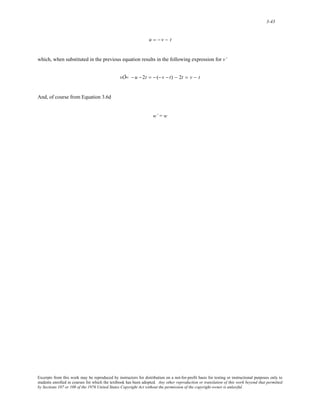
3.36 This problem asks for us to derive expressions for each of the three primed indices in terms of the 
four unprimed indices. 
It is first necessary to do an expansion of Equation 3.6a as 
u = 1 
3 
(2u' − v) = 2u' 
3 
− v' 
3 
And solving this expression for v’ yields 
v' = 2u' − 3u 
Now, substitution of this expression into Equation 3.6b gives 
v = 1 
3 
(2vÕ− uÕ) = 1 
3 
[(2)(2uÕ− 3u) − uÕ] = uÕ− 2u 
Or 
u' = v + 2u 
And, solving for v from Equation 3.6c leads to 
v = − (u + t) 
which, when substituted into the above expression for u’ yields 
u' = v + 2u = − u − t + 2u = u − t 
In solving for an expression for v’, we begin with the one of the above expressions for this parameter—i.e., 
v' = 2u' − 3u 
Now, substitution of the above expression for u’ into this equation leads to 
vÕ= 2uÕ− 3u = (2)(u − t) − 3u = − u −2t 
And solving for u from Equation 3.6c gives 
Excerpts from this work may be reproduced by instructors for distribution on a not-for-profit basis for testing or instructional purposes only to 
students enrolled in courses for which the textbook has been adopted. Any other reproduction or translation of this work beyond that permitted 
by Sections 107 or 108 of the 1976 United States Copyright Act without the permission of the copyright owner is unlawful.
3-43 
u = − v − t 
which, when substituted in the previous equation results in the following expression for v’ 
vÕ= − u −2t = − (− v − t) − 2t = v − t 
And, of course from Equation 3.6d 
w’ = w 
Excerpts from this work may be reproduced by instructors for distribution on a not-for-profit basis for testing or instructional purposes only to 
students enrolled in courses for which the textbook has been adopted. Any other reproduction or translation of this work beyond that permitted 
by Sections 107 or 108 of the 1976 United States Copyright Act without the permission of the copyright owner is unlawful.
3-44 
Crystallographic Planes 
3.37 (a) We are asked to draw a (021 ) plane within an orthorhombic unit cell. First remove the three 
indices from the parentheses, and take their reciprocals--i.e., ∞, 1/2, and -1. This means that the plane parallels the 
x-axis, intersects the y-axis at b/2, and intersects the z-axis at -c. The plane that satisfies these requirements has 
been drawn within the orthorhombic unit cell below. (For orthorhombic, a ≠ b ≠ c, and α = β = γ = 90°.) 
(b) A (200) plane is drawn within the monoclinic cell shown below. We first remove the parentheses and 
take the reciprocals of the indices; this gives 1/2, ∞, and ∞,. Thus, the (200) plane parallels both y- and z-axes, and 
intercepts the x-axis at a/2, as indicated in the drawing. (For monoclinic, a ≠ b ≠ c, and α = γ = 90° ≠ β.) 
Excerpts from this work may be reproduced by instructors for distribution on a not-for-profit basis for testing or instructional purposes only to 
students enrolled in courses for which the textbook has been adopted. Any other reproduction or translation of this work beyond that permitted 
by Sections 107 or 108 of the 1976 United States Copyright Act without the permission of the copyright owner is unlawful.
3-45 
3.38 This problem calls for specification of the indices for the two planes that are drawn in the sketch. 
Plane 1 is a (211) plane. The determination of its indices is summarized below. 
x y z 
Intercepts a/2 b c 
Intercepts in terms of a, b, and c 1/2 1 1 
Reciprocals of intercepts 2 1 1 
Enclosure (211) 
Plane 2 is a (02 0) plane, as summarized below. 
x y z 
Intercepts ∞a -b/2 ∞c 
Intercepts in terms of a, b, and c ∞ -1/2 ∞ 
Reciprocals of intercepts 0 -2 0 
Enclosure (02 0) 
Excerpts from this work may be reproduced by instructors for distribution on a not-for-profit basis for testing or instructional purposes only to 
students enrolled in courses for which the textbook has been adopted. Any other reproduction or translation of this work beyond that permitted 
by Sections 107 or 108 of the 1976 United States Copyright Act without the permission of the copyright owner is unlawful.
3-46 
3.39 The planes called for are plotted in the cubic unit cells shown below. 
Excerpts from this work may be reproduced by instructors for distribution on a not-for-profit basis for testing or instructional purposes only to 
students enrolled in courses for which the textbook has been adopted. Any other reproduction or translation of this work beyond that permitted 
by Sections 107 or 108 of the 1976 United States Copyright Act without the permission of the copyright owner is unlawful.
3-47 
3.40 For plane A we will leave the origin at the unit cell as shown. If we extend this plane back into the 
plane of the page, then it is a (111 ) plane, as summarized below. 
x y z 
Intercepts a b – c 
Intercepts in terms of a, b, and c 1 1 – 1 
Reciprocals of intercepts 1 1 – 1 
Reduction not necessary 
Enclosure (111 ) 
[Note: If we move the origin one unit cell distance parallel to the x axis and then one unit cell distance parallel to 
the y axis, the direction becomes (1 1 1) ]. 
For plane B we will leave the origin of the unit cell as shown; this is a (230) plane, as summarized below. 
x y z 
Intercepts 
a 
2 
b 
3 
∞c 
Intercepts in terms of a, b, and c 
1 
2 
1 
3 
∞ 
Reciprocals of intercepts 2 3 0 
Enclosure (230) 
Excerpts from this work may be reproduced by instructors for distribution on a not-for-profit basis for testing or instructional purposes only to 
students enrolled in courses for which the textbook has been adopted. Any other reproduction or translation of this work beyond that permitted 
by Sections 107 or 108 of the 1976 United States Copyright Act without the permission of the copyright owner is unlawful.
3-48 
3.41 For plane A we will move the origin of the coordinate system one unit cell distance to the right along 
the y axis; thus, this is a (11 0) plane, as summarized below. 
x y z 
Intercepts 
a 
2 
– 
b 
2 
∞ c 
Intercepts in terms of a, b, and c 
1 
2 
– 
1 
2 
∞ 
Reciprocals of intercepts 2 – 2 0 
Reduction 1 – 1 0 
Enclosure (11 0) 
For plane B we will leave the origin of the unit cell as shown; thus, this is a (122) plane, as summarized 
below. 
x y z 
Intercepts a 
b 
2 
c 
2 
Intercepts in terms of a, b, and c 1 
1 
2 
1 
2 
Reciprocals of intercepts 1 2 2 
Reduction not necessary 
Enclosure (122) 
Excerpts from this work may be reproduced by instructors for distribution on a not-for-profit basis for testing or instructional purposes only to 
students enrolled in courses for which the textbook has been adopted. Any other reproduction or translation of this work beyond that permitted 
by Sections 107 or 108 of the 1976 United States Copyright Act without the permission of the copyright owner is unlawful.
3-41 
t = − (u+ v) = − 4 
3 
− 2 
3 
⎛ 
⎜ 
⎝ 
⎞ 
⎠ 
⎟ = − 2 
3 
w = w' = 1 
Now, in order to get the lowest set of integers, it is necessary to multiply all indices by the factor 3, with the result 
that the direction D is a [ 42 2 3] direction. 
Excerpts from this work may be reproduced by instructors for distribution on a not-for-profit basis for testing or instructional purposes only to 
students enrolled in courses for which the textbook has been adopted. Any other reproduction or translation of this work beyond that permitted 
by Sections 107 or 108 of the 1976 United States Copyright Act without the permission of the copyright owner is unlawful.
3-49 
3.42 For plane A since the plane passes through the origin of the coordinate system as shown, we will 
move the origin of the coordinate system one unit cell distance vertically along the z axis; thus, this is a (211 ) 
plane, as summarized below. 
x y z 
Intercepts 
a 
2 
b – c 
Intercepts in terms of a, b, and c 
1 
2 
1 – 1 
Reciprocals of intercepts 2 1 – 1 
Reduction not necessary 
Enclosure (211 ) 
For plane B, since the plane passes through the origin of the coordinate system as shown, we will move the 
origin one unit cell distance vertically along the z axis; this is a (021 ) plane, as summarized below. 
x y z 
Intercepts ∞ a 
b 
2 
– c 
Intercepts in terms of a, b, and c ∞ 
1 
2 
– 1 
Reciprocals of intercepts 0 2 – 1 
Reduction not necessary 
Enclosure (021 ) 
Excerpts from this work may be reproduced by instructors for distribution on a not-for-profit basis for testing or instructional purposes only to 
students enrolled in courses for which the textbook has been adopted. Any other reproduction or translation of this work beyond that permitted 
by Sections 107 or 108 of the 1976 United States Copyright Act without the permission of the copyright owner is unlawful.
3-50 
3.43 (a) In the figure below is shown (110) and (111) planes, and, as indicated, their intersection results in a 
[ 1 10] , or equivalently, a [ 11 0] direction. 
(b) In the figure below is shown (110) and (11 0) planes, and, as indicated, their intersection results in a 
[001], or equivalently, a [ 001 ] direction. 
(c) In the figure below is shown (111 ) and (001) planes, and, as indicated, their intersection results in a 
[ 1 10] , or equivalently, a [ 11 0] direction. 
Excerpts from this work may be reproduced by instructors for distribution on a not-for-profit basis for testing or instructional purposes only to 
students enrolled in courses for which the textbook has been adopted. Any other reproduction or translation of this work beyond that permitted 
by Sections 107 or 108 of the 1976 United States Copyright Act without the permission of the copyright owner is unlawful.
3-51 
Excerpts from this work may be reproduced by instructors for distribution on a not-for-profit basis for testing or instructional purposes only to 
students enrolled in courses for which the textbook has been adopted. Any other reproduction or translation of this work beyond that permitted 
by Sections 107 or 108 of the 1976 United States Copyright Act without the permission of the copyright owner is unlawful.
3-52 
3.44 (a) The atomic packing of the (100) plane for the FCC crystal structure is called for. An FCC unit 
cell, its (100) plane, and the atomic packing of this plane are indicated below. 
(b) For this part of the problem we are to show the atomic packing of the (111) plane for the BCC crystal 
structure. A BCC unit cell, its (111) plane, and the atomic packing of this plane are indicated below. 
Excerpts from this work may be reproduced by instructors for distribution on a not-for-profit basis for testing or instructional purposes only to 
students enrolled in courses for which the textbook has been adopted. Any other reproduction or translation of this work beyond that permitted 
by Sections 107 or 108 of the 1976 United States Copyright Act without the permission of the copyright owner is unlawful.
3-53 
3.45 (a) The unit cell in Problem 3.20 is body-centered tetragonal. Of the three planes given in the 
problem statement the (100) and (01 0) are equivalent—that is, have the same atomic packing. The atomic packing 
for these two planes as well as the (001) are shown in the figure below. 
(b) Of the four planes cited in the problem statement, only (101), (011), and (1 01) are equivalent—have 
the same atomic packing. The atomic arrangement of these planes as well as the (110) are presented in the figure 
below. Note: the 0.495 nm dimension for the (110) plane comes from the relationship 
[(nm)2 (1 /2 
0.35 + 0.35 nm)2 ] . Likewise, the 0.570 nm dimension for the (101), (011), and (1 01) planes comes 
from 
[(0.35 nm)2 + (0.45 nm)2]1/2 
. 
Excerpts from this work may be reproduced by instructors for distribution on a not-for-profit basis for testing or instructional purposes only to 
students enrolled in courses for which the textbook has been adopted. Any other reproduction or translation of this work beyond that permitted 
by Sections 107 or 108 of the 1976 United States Copyright Act without the permission of the copyright owner is unlawful.
3-54 
(c) All of the (111), (11 1) , (111 ) , and (1 11 ) planes are equivalent, that is, have the same atomic packing 
as illustrated in the following figure: 
Excerpts from this work may be reproduced by instructors for distribution on a not-for-profit basis for testing or instructional purposes only to 
students enrolled in courses for which the textbook has been adopted. Any other reproduction or translation of this work beyond that permitted 
by Sections 107 or 108 of the 1976 United States Copyright Act without the permission of the copyright owner is unlawful.
3-55 
3.46 Unit cells are constructed below from the three crystallographic planes provided in the problem 
statement. 
(a) This unit cell belongs to the tetragonal system since a = b = 0.40 nm, c = 0.55 nm, and α = β = γ = 90°. 
(b) This crystal structure would be called body-centered tetragonal since the unit cell has tetragonal 
symmetry, and an atom is located at each of the corners, as well as the cell center. 
Excerpts from this work may be reproduced by instructors for distribution on a not-for-profit basis for testing or instructional purposes only to 
students enrolled in courses for which the textbook has been adopted. Any other reproduction or translation of this work beyond that permitted 
by Sections 107 or 108 of the 1976 United States Copyright Act without the permission of the copyright owner is unlawful.
3-56 
3.47 The unit cells constructed below show the three crystallographic planes that were provided in the 
problem statement. 
(a) This unit cell belongs to the orthorhombic crystal system since a = 0.25 nm, b = 0.30 nm, c = 0.20 nm, 
and α = β = γ = 90°. 
(b) This crystal structure would be called face-centered orthorhombic since the unit cell has orthorhombic 
symmetry, and an atom is located at each of the corners, as well as at each of the face centers. 
(c) In order to compute its atomic weight, we employ Equation 3.5, with n = 4; thus 
A = 
ρVC NA 
n 
= (18.91 g/cm3) (2.0)(2.5)(3.0) (× 10-24 cm3/unit cell)(6.023 × 10 23 atoms/mol) 
4 atoms/unit cell 
= 42.7 g/mol 
Excerpts from this work may be reproduced by instructors for distribution on a not-for-profit basis for testing or instructional purposes only to 
students enrolled in courses for which the textbook has been adopted. Any other reproduction or translation of this work beyond that permitted 
by Sections 107 or 108 of the 1976 United States Copyright Act without the permission of the copyright owner is unlawful.
3-57 
3.48 This problem asks that we convert (111) and (01 2) planes into the four-index Miller-Bravais 
scheme, (hkil), for hexagonal cells. For (111), h = 1, k = 1, and l = 1, and, from Equation 3.7, the value of i is equal 
to 
i = − (h + k) = − (1 + 1) = − 2 
Therefore, the (111) plane becomes (112 1) . 
Now for the (01 2) plane, h = 0, k = -1, and l = 2, and computation of i using Equation 3.7 leads to 
i = − (h + k) = −[0 + (−1)] = 1 
such that (01 2) becomes (01 12) . 
Excerpts from this work may be reproduced by instructors for distribution on a not-for-profit basis for testing or instructional purposes only to 
students enrolled in courses for which the textbook has been adopted. Any other reproduction or translation of this work beyond that permitted 
by Sections 107 or 108 of the 1976 United States Copyright Act without the permission of the copyright owner is unlawful.
3-58 
3.49 This problem asks for the determination of Bravais-Miller indices for several planes in hexagonal 
unit cells. 
(a) For this plane, intersections with the a1, a2, and z axes are ∞a, –a, and ∞c (the plane parallels both a1 
and z axes). In terms of a and c these intersections are ∞, –1, and ∞, the respective reciprocals of which are 0, –1, 
and 0. This means that 
h = 0 
k = –1 
l = 0 
Now, from Equation 3.7, the value of i is 
i = − (h + k) = −[0 + (−1)] = 1 
Hence, this is a (01 10) plane. 
(b) For this plane, intersections with the a1, a2, and z axes are –a, –a, and c/2, respectively. In terms of a 
and c these intersections are –1, –1, and 1/2, the respective reciprocals of which are –1, –1, and 2. This means that 
h = –1 
k = –1 
l = 2 
Now, from Equation 3.7, the value of i is 
i = − (h + k) = − (−1 − 1) = 2 
Hence, this is a (1 1 22) plane. 
(c) For this plane, intersections with the a1, a2, and z axes are a/2, –a, and ∞c (the plane parallels the z 
axis). In terms of a and c these intersections are 1/2, –1, and ∞, the respective reciprocals of which are 2, –1, and 0. 
This means that 
h = 2 
k = –1 
l = 0 
Now, from Equation 3.7, the value of i is 
i = − (h + k) = − (2 − 1) = −1 
Excerpts from this work may be reproduced by instructors for distribution on a not-for-profit basis for testing or instructional purposes only to 
students enrolled in courses for which the textbook has been adopted. Any other reproduction or translation of this work beyond that permitted 
by Sections 107 or 108 of the 1976 United States Copyright Act without the permission of the copyright owner is unlawful.
3-59 
Hence, this is a (21 1 0) plane. 
(d) For this plane, intersections with the a1, a2, and z axes are –a, a, and c/2, respectively. In terms of a 
and c these intersections are –1, 1, and 1/2, the respective reciprocals of which are –1, 1, and 2. This means that 
h = –1 
k = 1 
l = 2 
Now, from Equation 3.7, the value of i is 
i = − (h + k) = − (−1 + 1) = 0 
Therefore, this is a (1 102) plane. 
Excerpts from this work may be reproduced by instructors for distribution on a not-for-profit basis for testing or instructional purposes only to 
students enrolled in courses for which the textbook has been adopted. Any other reproduction or translation of this work beyond that permitted 
by Sections 107 or 108 of the 1976 United States Copyright Act without the permission of the copyright owner is unlawful.
3-60 
3.50 This problem asks that we draw (011 1) and (21 1 0) planes within hexagonal unit cells. 
For (011 1) the reciprocals of h, k, i, and l are, respectively, ∞, 1, –1, and 1; thus, this plane is parallel to 
the a1 axis, and intersects the a2 axis at a, the a3 axis at –a, and the z-axis at c. The plane having these intersections 
is shown in the figure below 
For (21 1 0) the reciprocals of h, k, i, and l are, respectively, 1/2, –1, –1, and ∞; thus, this plane is parallel 
to the c axis, and intersects the a1 axis at a/2, the a2 axis at –a, and the a3 axis at –a. The plane having these 
intersections is shown in the figure below. 
Excerpts from this work may be reproduced by instructors for distribution on a not-for-profit basis for testing or instructional purposes only to 
students enrolled in courses for which the textbook has been adopted. Any other reproduction or translation of this work beyond that permitted 
by Sections 107 or 108 of the 1976 United States Copyright Act without the permission of the copyright owner is unlawful.
3-61 
Linear and Planar Densities 
3.51 (a) In the figure below is shown a [100] direction within an FCC unit cell. 
For this [100] direction there is one atom at each of the two unit cell corners, and, thus, there is the equivalent of 1 
atom that is centered on the direction vector. The length of this direction vector is just the unit cell edge length, 
2R 2 (Equation 3.1). Therefore, the expression for the linear density of this plane is 
LD100 = number of atoms centered on [100] direction vector 
length of [100] direction vector 
= 1 atom 
2R 2 
= 1 
2R 2 
An FCC unit cell within which is drawn a [111] direction is shown below. 
For this [111] direction, the vector shown passes through only the centers of the single atom at each of its ends, and, 
thus, there is the equivalence of 1 atom that is centered on the direction vector. The length of this direction vector is 
denoted by z in this figure, which is equal to 
z = x2 + y2 
Excerpts from this work may be reproduced by instructors for distribution on a not-for-profit basis for testing or instructional purposes only to 
students enrolled in courses for which the textbook has been adopted. Any other reproduction or translation of this work beyond that permitted 
by Sections 107 or 108 of the 1976 United States Copyright Act without the permission of the copyright owner is unlawful.
3-62 
where x is the length of the bottom face diagonal, which is equal to 4R. Furthermore, y is the unit cell edge length, 
which is equal to 2R 2 (Equation 3.1). Thus, using the above equation, the length z may be calculated as follows: 
z = (4R)2 + (2R 2)2 = 24R2 = 2 R 6 
Therefore, the expression for the linear density of this direction is 
LD111 = number of atoms centered on [111] direction vector 
length of [111] direction vector 
= 1 atom 
2 R 6 
= 1 
2 R 6 
(b) From the table inside the front cover, the atomic radius for copper is 0.128 nm. Therefore, the linear 
density for the [100] direction is 
LD100 (Cu) = 1 
2 R 2 
= 1 
(2)(0.128 nm) 2 
= 2.76 nm−1 = 2.76 × 10⁹ m−1 
While for the [111] direction 
LD111(Cu) = 1 
2R 6 
= 1 
(2)(0.128 nm) 6 
= 1.59 nm−1 = 1.59 × 10⁹ m−1 
Excerpts from this work may be reproduced by instructors for distribution on a not-for-profit basis for testing or instructional purposes only to 
students enrolled in courses for which the textbook has been adopted. Any other reproduction or translation of this work beyond that permitted 
by Sections 107 or 108 of the 1976 United States Copyright Act without the permission of the copyright owner is unlawful.
3-63 
3.52 (a) In the figure below is shown a [110] direction within a BCC unit cell. 
For this [110] direction there is one atom at each of the two unit cell corners, and, thus, there is the equivalence of 1 
atom that is centered on the direction vector. The length of this direction vector is denoted by x in this figure, which 
is equal to 
x = z 2 − y2 
where y is the unit cell edge length, which, from Equation 3.3 is equal to 
4R 
3 
. Furthermore, z is the length of the 
unit cell diagonal, which is equal to 4R Thus, using the above equation, the length x may be calculated as follows: 
x = (4R)2 − 4R 
3 
⎛ 
⎜⎜ 
⎝ 
⎞ 
⎟⎟ 
⎠ 
2 
= 32R2 
3 
= 4R 2 
3 
Therefore, the expression for the linear density of this direction is 
LD110 = number of atoms centered on [110] direction vector 
length of [110] direction vector 
= 1 atom 
4R 2 
3 
= 
3 
4 R 2 
A BCC unit cell within which is drawn a [111] direction is shown below. 
Excerpts from this work may be reproduced by instructors for distribution on a not-for-profit basis for testing or instructional purposes only to 
students enrolled in courses for which the textbook has been adopted. Any other reproduction or translation of this work beyond that permitted 
by Sections 107 or 108 of the 1976 United States Copyright Act without the permission of the copyright owner is unlawful.
3-64 
For although the [111] direction vector shown passes through the centers of three atoms, there is an equivalence of 
only two atoms associated with this unit cell—one-half of each of the two atoms at the end of the vector, in addition 
to the center atom belongs entirely to the unit cell. Furthermore, the length of the vector shown is equal to 4R, since 
all of the atoms whose centers the vector passes through touch one another. Therefore, the linear density is equal to 
LD111 = number of atoms centered on [111] direction vector 
length of [111] direction vector 
= 2 atoms 
4R 
= 1 
2R 
(b) From the table inside the front cover, the atomic radius for iron is 0.124 nm. Therefore, the linear 
density for the [110] direction is 
LD110 (Fe) = 
3 
4 R 2 
= 
3 
(4)(0.124 nm) 2 
= 2.47 nm−1 = 2.47 × 10⁹ m−1 
While for the [111] direction 
LD111(Fe) = 1 
2R 
= 1 
(2)(0.124 nm) 
= 4.03 nm−1 = 4.03 × 10⁹ m−1 
Excerpts from this work may be reproduced by instructors for distribution on a not-for-profit basis for testing or instructional purposes only to 
students enrolled in courses for which the textbook has been adopted. Any other reproduction or translation of this work beyond that permitted 
by Sections 107 or 108 of the 1976 United States Copyright Act without the permission of the copyright owner is unlawful.
3-65 
3.53 (a) In the figure below is shown a (100) plane for an FCC unit cell. 
For this (100) plane there is one atom at each of the four cube corners, each of which is shared with four adjacent 
unit cells, while the center atom lies entirely within the unit cell. Thus, there is the equivalence of 2 atoms 
associated with this FCC (100) plane. The planar section represented in the above figure is a square, wherein the 
side lengths are equal to the unit cell edge length, 2R 2 (Equation 3.1); and, thus, the area of this square is just 
(2R 2)2 = 8R2. Hence, the planar density for this (100) plane is just 
PD100 = number of atoms centered on (100) plane 
area of (100) plane 
= 2 atoms 
8R2 
= 1 
4R2 
That portion of an FCC (111) plane contained within a unit cell is shown below. 
There are six atoms whose centers lie on this plane, which are labeled A through F. One-sixth of each of atoms A, 
D, and F are associated with this plane (yielding an equivalence of one-half atom), with one-half of each of atoms 
B, C, and E (or an equivalence of one and one-half atoms) for a total equivalence of two atoms. Now, the area of 
Excerpts from this work may be reproduced by instructors for distribution on a not-for-profit basis for testing or instructional purposes only to 
students enrolled in courses for which the textbook has been adopted. Any other reproduction or translation of this work beyond that permitted 
by Sections 107 or 108 of the 1976 United States Copyright Act without the permission of the copyright owner is unlawful.
3-66 
the triangle shown in the above figure is equal to one-half of the product of the base length and the height, h. If we 
consider half of the triangle, then 
(2R)2 + h2 = (4R)2 
which leads to h = 2R 3 . Thus, the area is equal to 
Area = 4R(h) 
2 
= 
(4 R) (2R 3) 
2 
= 4R2 3 
And, thus, the planar density is 
PD111 = number of atoms centered on (111) plane 
area of (111) plane 
= 2 atoms 
4R2 3 
= 1 
2R2 3 
(b) From the table inside the front cover, the atomic radius for aluminum is 0.143 nm. Therefore, the 
planar density for the (100) plane is 
PD100(Al) = 1 
4 R2 
= 1 
4 (0.143 nm)2 
= 12.23 nm−2 = 1.223 × 10¹⁹ m−2 
While for the (111) plane 
PD111(Al) = 1 
2R2 3 
= 1 
2 3(0.143 nm)2 
= 14.12 nm−2 = 1.412 × 10¹⁹ m−2 
Excerpts from this work may be reproduced by instructors for distribution on a not-for-profit basis for testing or instructional purposes only to 
students enrolled in courses for which the textbook has been adopted. Any other reproduction or translation of this work beyond that permitted 
by Sections 107 or 108 of the 1976 United States Copyright Act without the permission of the copyright owner is unlawful.
3-67 
3.54 (a) A BCC unit cell within which is drawn a (100) plane is shown below. 
For this (100) plane there is one atom at each of the four cube corners, each of which is shared with four adjacent 
unit cells. Thus, there is the equivalence of 1 atom associated with this BCC (100) plane. The planar section 
represented in the above figure is a square, wherein the side lengths are equal to the unit cell edge length, 
4R 
3 
(Equation 3.3); and, thus, the area of this square is just 
4R 
3 
⎛ 
⎜⎜ 
⎝ 
⎞ 
⎟⎟ 
⎠ 
2 
= 
16 R2 
3 
. Hence, the planar density for this (100) 
plane is just 
PD100 = number of atoms centered on (100) plane 
area of (100) plane 
= 1 atom 
16 R2 
3 
= 3 
16 R2 
A BCC unit cell within which is drawn a (110) plane is shown below. 
For this (110) plane there is one atom at each of the four cube corners through which it passes, each of which is 
shared with four adjacent unit cells, while the center atom lies entirely within the unit cell. Thus, there is the 
Excerpts from this work may be reproduced by instructors for distribution on a not-for-profit basis for testing or instructional purposes only to 
students enrolled in courses for which the textbook has been adopted. Any other reproduction or translation of this work beyond that permitted 
by Sections 107 or 108 of the 1976 United States Copyright Act without the permission of the copyright owner is unlawful.
3-68 
equivalence of 2 atoms associated with this BCC (110) plane. The planar section represented in the above figure is 
a rectangle, as noted in the figure below. 
From this figure, the area of the rectangle is the product of x and y. The length x is just the unit cell edge length, 
which for BCC (Equation 3.3) is 
4R 
3 
. Now, the diagonal length z is equal to 4R. For the triangle bounded by the 
lengths x, y, and z 
y = z2 − x2 
Or 
y = (4R)2 − 4R 
3 
⎛ 
⎜⎜ 
⎝ 
⎞ 
⎟⎟ 
⎠ 
2 
= 
4R 2 
3 
Thus, in terms of R, the area of this (110) plane is just 
Area (110) = xy = 4 R 
3 
⎛ 
⎜⎜ 
⎝ 
⎞ 
⎟⎟ 
⎠ 
4R 2 
3 
⎛ 
⎜⎜ 
⎝ 
⎞ 
⎠ 
⎟⎟ = 
16 R2 2 
3 
And, finally, the planar density for this (110) plane is just 
PD110 = number of atoms centered on (110) plane 
area of (110) plane 
= 2 atoms 
16R2 2 
3 
= 3 
8R2 2 
Excerpts from this work may be reproduced by instructors for distribution on a not-for-profit basis for testing or instructional purposes only to 
students enrolled in courses for which the textbook has been adopted. Any other reproduction or translation of this work beyond that permitted 
by Sections 107 or 108 of the 1976 United States Copyright Act without the permission of the copyright owner is unlawful.
3-69 
(b) From the table inside the front cover, the atomic radius for molybdenum is 0.136 nm. Therefore, the 
planar density for the (100) plane is 
PD100(Mo) = 3 
16 R2 
= 3 
16 (0.136 nm)2 
= 10.14 nm−2 = 1.014 × 10¹⁹ m−2 
While for the (110) plane 
PD110(Mo) = 3 
8R2 2 
= 3 
8 (0.136 nm)2 2 
= 14.34 nm−2 = 1.434 × 10¹⁹ m−2 
Excerpts from this work may be reproduced by instructors for distribution on a not-for-profit basis for testing or instructional purposes only to 
students enrolled in courses for which the textbook has been adopted. Any other reproduction or translation of this work beyond that permitted 
by Sections 107 or 108 of the 1976 United States Copyright Act without the permission of the copyright owner is unlawful.
3-70 
3.55 (a) A (0001) plane for an HCP unit cell is show below. 
Each of the 6 perimeter atoms in this plane is shared with three other unit cells, whereas the center atom is shared 
with no other unit cells; this gives rise to three equivalent atoms belonging to this plane. 
In terms of the atomic radius R, the area of each of the 6 equilateral triangles that have been drawn is 
R2 3 , or the total area of the plane shown is 6R2 3 . And the planar density for this (0001) plane is equal to 
PD0001 = number of atoms centered on (0001) plane 
area of (0001) plane 
= 3 atoms 
6R2 3 
= 1 
2R2 3 
(b) From the table inside the front cover, the atomic radius for titanium is 0.145 nm. Therefore, the planar 
density for the (0001) plane is 
PD0001(Ti) = 1 
2R2 3 
= 1 
2 3(0.145 nm)2 
= 13.73 nm−2 = 1.373 × 10¹⁹ m−2 
Excerpts from this work may be reproduced by instructors for distribution on a not-for-profit basis for testing or instructional purposes only to 
students enrolled in courses for which the textbook has been adopted. Any other reproduction or translation of this work beyond that permitted 
by Sections 107 or 108 of the 1976 United States Copyright Act without the permission of the copyright owner is unlawful.
3-71 
Polycrystalline Materials 
3.56 Although each individual grain in a polycrystalline material may be anisotropic, if the grains have 
random orientations, then the solid aggregate of the many anisotropic grains will behave isotropically. 
Excerpts from this work may be reproduced by instructors for distribution on a not-for-profit basis for testing or instructional purposes only to 
students enrolled in courses for which the textbook has been adopted. Any other reproduction or translation of this work beyond that permitted 
by Sections 107 or 108 of the 1976 United States Copyright Act without the permission of the copyright owner is unlawful.
3-72 
X-ray Diffraction: Determination of Crystal Structures 
3.57 From the Table 3.1, aluminum has an FCC crystal structure and an atomic radius of 0.1431 nm. 
Using Equation 3.1, the lattice parameter a may be computed as 
a=2R 2 = (2) (0.1431 nm) 2 = 0.4048 nm 
Now, the interplanar spacing d110 maybe determined using Equation 3.14 as 
d110 = a 
(1)2 + (1)2 + (0)2 
= 0.4048 nm 
2 
= 0.2862 nm 
Excerpts from this work may be reproduced by instructors for distribution on a not-for-profit basis for testing or instructional purposes only to 
students enrolled in courses for which the textbook has been adopted. Any other reproduction or translation of this work beyond that permitted 
by Sections 107 or 108 of the 1976 United States Copyright Act without the permission of the copyright owner is unlawful.
3-73 
3.58 We first calculate the lattice parameter using Equation 3.3 and the value of R (0.1249 nm) cited in 
Table 3.1, as follows: 
a = 4R 
3 
= (4) (0.1249 nm) 
3 
= 0.2884 nm 
Next, the interplanar spacing for the (310) set of planes may be determined using Equation 3.14 according to 
d310 = a 
(3)2 + (1)2 + (0)2 
= 0.2884 nm 
10 
= 0.0912 nm 
And finally, employment of Equation 3.13 yields the diffraction angle as 
sin θ = nλ 
2d310 
= (1)(0.0711 nm) 
(2)(0.0912 nm) 
= 0.390 
Which leads to 
θ = sin-1(0.390) = 22.94° 
And, finally 
2θ = (2)(22.94°) = 45.88° 
Excerpts from this work may be reproduced by instructors for distribution on a not-for-profit basis for testing or instructional purposes only to 
students enrolled in courses for which the textbook has been adopted. Any other reproduction or translation of this work beyond that permitted 
by Sections 107 or 108 of the 1976 United States Copyright Act without the permission of the copyright owner is unlawful.
3-74 
3.59 From the table, α-iron has a BCC crystal structure and an atomic radius of 0.1241 nm. Using 
Equation 3.3 the lattice parameter, a, may be computed as follows: 
a = 4R 
3 
= (4) (0.1241 nm) 
3 
= 0.2866 nm 
Now, the d111 interplanar spacing may be determined using Equation 3.14 as 
d111 = a 
(1)2 + (1)2 + (1)2 
= 0.2866 nm 
3 
= 0.1655 nm 
And, similarly for d211 
d211 = a 
(2)2 + (1)2 + (1)2 
= 0.2866 nm 
6 
= 0.1170 nm 
Excerpts from this work may be reproduced by instructors for distribution on a not-for-profit basis for testing or instructional purposes only to 
students enrolled in courses for which the textbook has been adopted. Any other reproduction or translation of this work beyond that permitted 
by Sections 107 or 108 of the 1976 United States Copyright Act without the permission of the copyright owner is unlawful.
3-75 
3.60 (a) From the data given in the problem, and realizing that 36.12° = 2θ, the interplanar spacing for the 
(311) set of planes for rhodium may be computed using Equation 3.13 as 
d311 = nλ 
2 sin θ 
= (1)(0.0711 nm) 
(2) sin 36.12° 
2 
⎛ 
⎜ 
⎝ 
⎞ 
⎟ 
⎠ 
= 0.1147 nm 
(b) In order to compute the atomic radius we must first determine the lattice parameter, a, using Equation 
3.14, and then R from Equation 3.1 since Rh has an FCC crystal structure. Therefore, 
a = d311 (3)2 + (1)2 + (1)2 = (0.1147 nm) ( 11) = 0.3804 nm 
And, from Equation 3.1 
R = a 
2 2 
= 0.3804 nm 
2 2 
= 0.1345 nm 
Excerpts from this work may be reproduced by instructors for distribution on a not-for-profit basis for testing or instructional purposes only to 
students enrolled in courses for which the textbook has been adopted. Any other reproduction or translation of this work beyond that permitted 
by Sections 107 or 108 of the 1976 United States Copyright Act without the permission of the copyright owner is unlawful.
3-76 
3.61 (a) From the data given in the problem, and realizing that 75.99° = 2θ, the interplanar spacing for the 
(211) set of planes for Nb may be computed using Equation 3.13 as follows: 
d211 = nλ 
2 sin θ 
= (1)(0.1659 nm) 
(2) sin 75.99° 
2 
⎛ 
⎜ 
⎝ 
⎞ 
⎟ 
⎠ 
= 0.1348 nm 
(b) In order to compute the atomic radius we must first determine the lattice parameter, a, using Equation 
3.14, and then R from Equation 3.3 since Nb has a BCC crystal structure. Therefore, 
a = d211 (2)2 + (1)2 + (1)2 = (0.1347 nm) ( 6) = 0.3300 nm 
And, from Equation 3.3 
R = 
a 3 
4 
= 
(0.3300 nm) 3 
4 
= 0.1429 nm 
Excerpts from this work may be reproduced by instructors for distribution on a not-for-profit basis for testing or instructional purposes only to 
students enrolled in courses for which the textbook has been adopted. Any other reproduction or translation of this work beyond that permitted 
by Sections 107 or 108 of the 1976 United States Copyright Act without the permission of the copyright owner is unlawful.
3-77 
3.62 The first step to solve this problem is to compute the interplanar spacing using Equation 3.13. Thus, 
dhkl = nλ 
2 sin θ 
= (1)(0.1542 nm) 
(2) sin 44.53° 
2 
⎛ 
⎜ 
⎝ 
⎞ 
⎟ 
⎠ 
= 0.2035 nm 
Now, employment of both Equations 3.14 and 3.1 (since Ni’s crystal structure is FCC), and the value of R for nickel 
from Table 3.1 (0.1246 nm) leads to 
h2 + k 2 + l2 = a 
dhkl 
= 
2R 2 
dhkl 
= 
(2)(0.1246 nm) 2 
(0.2035 nm) 
= 1.732 
This means that 
h2 + k 2 + l2 = (1.732)2 = 3.0 
By trial and error, the only three integers that are all odd or even, the sum of the squares of which equals 3.0 are 1, 
1, and 1. Therefore, the set of planes responsible for this diffraction peak is the (111) set. 
Excerpts from this work may be reproduced by instructors for distribution on a not-for-profit basis for testing or instructional purposes only to 
students enrolled in courses for which the textbook has been adopted. Any other reproduction or translation of this work beyond that permitted 
by Sections 107 or 108 of the 1976 United States Copyright Act without the permission of the copyright owner is unlawful.
3-78 
3.63 For each peak, in order to compute the interplanar spacing and the lattice parameter we must employ 
Equations 3.14 and 3.13, respectively. The first peak of Figure 3.21, which results from diffraction by the (111) set 
of planes, occurs at 2θ = 31.3°; the corresponding interplanar spacing for this set of planes, using Equation 3.13, is 
equal to 
d111 = nλ 
2 sin θ 
= (1)(0.1542 nm) 
(2) sin 31.3° 
2 
⎛ 
⎜ 
⎝ 
⎞ 
⎟ 
⎠ 
= 0.2858 nm 
And, from Equation 3.14, the lattice parameter a is determined as 
a = dhkl (h)2 + (k)2 + (l)2 = d111 (1)2 + (1)2 + (1)2 
= (0.2858 nm) 3 = 0.4950 nm 
Similar computations are made for the other peaks which results are tabulated below: 
Peak Index 2θ dhkl(nm) a (nm) 
200 36.6 0.2455 0.4910 
220 52.6 0.1740 0.4921 
311 62.5 0.1486 0.4929 
222 65.5 0.1425 0.4936 
Excerpts from this work may be reproduced by instructors for distribution on a not-for-profit basis for testing or instructional purposes only to 
students enrolled in courses for which the textbook has been adopted. Any other reproduction or translation of this work beyond that permitted 
by Sections 107 or 108 of the 1976 United States Copyright Act without the permission of the copyright owner is unlawful.
3-79 
3.64 The first four diffraction peaks that will occur for BCC consistent with h + k + l being even are (110), 
(200), (211), and (220). 
Excerpts from this work may be reproduced by instructors for distribution on a not-for-profit basis for testing or instructional purposes only to 
students enrolled in courses for which the textbook has been adopted. Any other reproduction or translation of this work beyond that permitted 
by Sections 107 or 108 of the 1976 United States Copyright Act without the permission of the copyright owner is unlawful.
3-80 
3.65 (a) Since W has a BCC crystal structure, only those peaks for which h + k + l are even will appear. 
Therefore, the first peak results by diffraction from (110) planes. 
(b) For each peak, in order to calculate the interplanar spacing we must employ Equation 3.13. For the 
first peak which occurs at 40.2° 
d110 = nλ 
2 sin θ 
= (1)(0.1542 nm) 
(2) sin 40.2° 
2 
⎛ 
⎜ 
⎝ 
⎞ 
⎟ 
⎠ 
= 0.2244 nm 
(c) Employment of Equations 3.14 and 3.3 is necessary for the computation of R for W as 
R = 
a 3 
4 
= 
(dhkl)( 3) (h)2 + (k)2 + (l)2 
4 
= 
(0.2244 nm)( 3) (1)2 + (1)2 + (0)2 
4 
= 0.1374 nm 
Similar computations are made for the other peaks which results are tabulated below: 
Peak Index 2θ dhkl(nm) R (nm) 
200 58.4 0.1580 0.1369 
211 73.3 0.1292 0.1370 
220 87.0 0.1120 0.1371 
310 100.7 0.1001 0.1371 
Excerpts from this work may be reproduced by instructors for distribution on a not-for-profit basis for testing or instructional purposes only to 
students enrolled in courses for which the textbook has been adopted. Any other reproduction or translation of this work beyond that permitted 
by Sections 107 or 108 of the 1976 United States Copyright Act without the permission of the copyright owner is unlawful.
3-81 
Noncrystalline Solids 
3.66 A material in which atomic bonding is predominantly ionic in nature is less likely to form a 
noncrystalline solid upon solidification than a covalent material because covalent bonds are directional whereas 
ionic bonds are nondirectional; it is more difficult for the atoms in a covalent material to assume positions giving 
rise to an ordered structure. 
Excerpts from this work may be reproduced by instructors for distribution on a not-for-profit basis for testing or instructional purposes only to 
students enrolled in courses for which the textbook has been adopted. Any other reproduction or translation of this work beyond that permitted 
by Sections 107 or 108 of the 1976 United States Copyright Act without the permission of the copyright owner is unlawful.
4-1 
CHAPTER 4 
IMPERFECTIONS IN SOLIDS 
PROBLEM SOLUTIONS 
Vacancies and Self-Interstitials 
4.1 In order to compute the fraction of atom sites that are vacant in copper at 1357 K, we must employ 
Equation 4.1. As stated in the problem, Qv = 0.90 eV/atom. Thus, 
Nv 
N 
= exp − 
Qv 
kT 
⎛ 
⎜ 
⎝ 
⎞ 
⎠ 
⎟ = exp − 0.90 eV/atom 
(8.62 × 10⁻⁵ eV/atom- K) (1357 K) 
⎡ 
⎢ 
⎣ 
⎢ 
⎤ 
⎥ 
⎦ 
⎥ 
= 4.56 x 10⁻⁴ 
Excerpts from this work may be reproduced by instructors for distribution on a not-for-profit basis for testing or instructional purposes only to 
students enrolled in courses for which the textbook has been adopted. Any other reproduction or translation of this work beyond that permitted 
by Sections 107 or 108 of the 1976 United States Copyright Act without the permission of the copyright owner is unlawful.
4-2 
4.2 Determination of the number of vacancies per cubic meter in gold at 900°C (1173 K) requires the 
utilization of Equations 4.1 and 4.2 as follows: 
Nv = N exp − 
Qv 
kT 
⎛ 
⎜ 
⎝ 
⎞ 
⎠ 
⎟ = 
NAρAu 
AAu 
exp − 
Qv 
kT 
⎛ 
⎜ 
⎝ 
⎞ 
⎟ 
⎠ 
= (6.023 × 10²³atoms /mol)(18.63 g /cm3) 
196.9 g /mol 
exp − 0.98 eV /atom 
(8.62 × 10⁻⁵ eV/atom− K) (1173 K) 
⎡ 
⎢ 
⎣ 
⎢ 
⎤ 
⎥ 
⎦ 
⎥ 
= 3.52 x 1018 cm-3 = 3.52 x 1024 m-3 
Excerpts from this work may be reproduced by instructors for distribution on a not-for-profit basis for testing or instructional purposes only to 
students enrolled in courses for which the textbook has been adopted. Any other reproduction or translation of this work beyond that permitted 
by Sections 107 or 108 of the 1976 United States Copyright Act without the permission of the copyright owner is unlawful.
4-3 
4.3 This problem calls for the computation of the activation energy for vacancy formation in silver. Upon 
examination of Equation 4.1, all parameters besides Qv are given except N, the total number of atomic sites. 
However, N is related to the density, (ρ), Avogadro's number (NA), and the atomic weight (A) according to 
Equation 4.2 as 
N = 
NAρPb 
APb 
= (6.023 × 10²³ atoms /mol)(9.5 g /cm3) 
107.9 g /mol 
= 5.30 x 10²² atoms/cm3 = 5.30 x 1028 atoms/m3 
Now, taking natural logarithms of both sides of Equation 4.1, 
ln Nv = lnN − 
Qv 
kT 
and, after some algebraic manipulation 
Qv = − kT ln 
Nv 
N 
⎛ 
⎜ 
⎝ 
⎞ 
⎟ 
⎠ 
= − (8.62 × 10⁻⁵ eV/atom - K)(800°C + 273 K) ln 3.60 × 10²³ m−3 
5.30 × 1028 m−3 
⎡ 
⎢ 
⎣ 
⎢ 
⎤ 
⎥ 
⎦ 
⎥ 
= 1.10 eV/atom 
Excerpts from this work may be reproduced by instructors for distribution on a not-for-profit basis for testing or instructional purposes only to 
students enrolled in courses for which the textbook has been adopted. Any other reproduction or translation of this work beyond that permitted 
by Sections 107 or 108 of the 1976 United States Copyright Act without the permission of the copyright owner is unlawful.
4-4 
Impurities in Solids 
4.4 In this problem we are asked to cite which of the elements listed form with Ni the three possible solid 
solution types. For complete substitutional solubility the following criteria must be met: 1) the difference in atomic 
radii between Ni and the other element (ΔR%) must be less than ±15%, 2) the crystal structures must be the same, 
3) the electronegativities must be similar, and 4) the valences should be the same, or nearly the same. Below are 
tabulated, for the various elements, these criteria. 
Crystal ΔElectro- 
Element ΔR% Structure negativity Valence 
Ni FCC 2+ 
C –43 
H –63 
O –52 
Ag +16 FCC +0.1 1+ 
Al +15 FCC -0.3 3+ 
Co +0.6 HCP 0 2+ 
Cr +0.2 BCC -0.2 3+ 
Fe -0.4 BCC 0 2+ 
Pt +11 FCC +0.4 2+ 
Zn +7 HCP -0.2 2+ 
(a) Pt is the only element that meets all of the criteria and thus forms a substitutional solid solution having 
complete solubility. At elevated temperatures Co and Fe experience allotropic transformations to the FCC crystal 
structure, and thus display complete solid solubility at these temperatures. 
(b) Ag, Al, Co, Cr, Fe, and Zn form substitutional solid solutions of incomplete solubility. All these metals 
have either BCC or HCP crystal structures, and/or the difference between their atomic radii and that for Ni are 
greater than ±15%, and/or have a valence different than 2+. 
(c) C, H, and O form interstitial solid solutions. These elements have atomic radii that are significantly 
smaller than the atomic radius of Ni. 
Excerpts from this work may be reproduced by instructors for distribution on a not-for-profit basis for testing or instructional purposes only to 
students enrolled in courses for which the textbook has been adopted. Any other reproduction or translation of this work beyond that permitted 
by Sections 107 or 108 of the 1976 United States Copyright Act without the permission of the copyright owner is unlawful.
4-5 
4.5 In the drawing below is shown the atoms on the (100) face of an FCC unit cell; the interstitial site is at 
the center of the edge. 
The diameter of an atom that will just fit into this site (2r) is just the difference between that unit cell edge length 
(a) and the radii of the two host atoms that are located on either side of the site (R); that is 
2r = a – 2R 
However, for FCC a is related to R according to Equation 3.1 as a = 2R 2 ; therefore, solving for r from the above 
equation gives 
r = a − 2R 
2 
= 2 R 2 − 2R 
2 
= 0.41R 
A (100) face of a BCC unit cell is shown below. 
Excerpts from this work may be reproduced by instructors for distribution on a not-for-profit basis for testing or instructional purposes only to 
students enrolled in courses for which the textbook has been adopted. Any other reproduction or translation of this work beyond that permitted 
by Sections 107 or 108 of the 1976 United States Copyright Act without the permission of the copyright owner is unlawful.
4-6 
The interstitial atom that just fits into this interstitial site is shown by the small circle. It is situated in the plane of 
this (100) face, midway between the two vertical unit cell edges, and one quarter of the distance between the bottom 
and top cell edges. From the right triangle that is defined by the three arrows we may write 
a 
2 
⎛ 
⎜ 
⎝ 
⎞ 
⎟ 
⎠ 
2 
+ a 
4 
⎛ 
⎜ 
⎝ 
⎞ 
⎟ 
⎠ 
2 
= (R + r) 2 
However, from Equation 3.3, a = 4R 
3 
, and, therefore, making this substitution, the above equation takes the form 
4R 
2 3 
⎛ 
⎜ 
⎝ 
⎞ 
⎟ 
⎠ 
2 
+ 4R 
4 3 
⎛ 
⎜ 
⎝ 
⎞ 
⎟ 
⎠ 
2 
= R2 + 2Rr + r2 
After rearrangement the following quadratic equation results: 
r2 + 2Rr − 0.667R 2 = 0 
And upon solving for r: 
r = 
−(2R) ± (2R)2 − (4)(1)(−0.667R2) 
2 
Excerpts from this work may be reproduced by instructors for distribution on a not-for-profit basis for testing or instructional purposes only to 
students enrolled in courses for which the textbook has been adopted. Any other reproduction or translation of this work beyond that permitted 
by Sections 107 or 108 of the 1976 United States Copyright Act without the permission of the copyright owner is unlawful.
4-7 
= 
−2R± 2.582R 
2 
And, finally 
r(+) = 
−2R + 2.582R 
2 
= 0.291R 
r(−) = 
−2R − 2.582R 
2 
= − 2.291R 
Of course, only the r(+) root is possible, and, therefore, r = 0.291R. 
Thus, for a host atom of radius R, the size of an interstitial site for FCC is approximately 1.4 times that for 
BCC. 
Excerpts from this work may be reproduced by instructors for distribution on a not-for-profit basis for testing or instructional purposes only to 
students enrolled in courses for which the textbook has been adopted. Any other reproduction or translation of this work beyond that permitted 
by Sections 107 or 108 of the 1976 United States Copyright Act without the permission of the copyright owner is unlawful.
4-8 
Specification of Composition 
4.6 (a) This problem asks that we derive Equation 4.7a. To begin, C1 is defined according to Equation 
4.3 as 
C1 = 
m1 
m1 + m2 
× 100 
or, equivalently 
C1 = 
m1 ' 
m1 ' 
+ m2 ' 
× 100 
where the primed m's indicate masses in grams. From Equation 4.4 we may write 
m1 ' 
= nm1 A1 
m2 ' 
= nm2 A2 
And, substitution into the C1 expression above 
C1 = 
nm1 A1 
nm1 A1 + nm2 A2 
× 100 
From Equation 4.5 it is the case that 
nm1 = 
C1 ' 
(nm1 + nm2) 
100 
nm2 = 
C2 ' 
(nm1 + nm2) 
100 
And substitution of these expressions into the above equation leads to 
Excerpts from this work may be reproduced by instructors for distribution on a not-for-profit basis for testing or instructional purposes only to 
students enrolled in courses for which the textbook has been adopted. Any other reproduction or translation of this work beyond that permitted 
by Sections 107 or 108 of the 1976 United States Copyright Act without the permission of the copyright owner is unlawful.
4-9 
C1 = 
C1 ' 
A1 
C1 ' 
A1 + C2 ' 
A2 
× 100 
which is just Equation 4.7a. 
" 
(b) This problem asks that we derive Equation 4.9a. To begin, is defined as the mass of component 1 
per unit volume of alloy, or 
C1 
" = 
C1 
m1 
V 
If we assume that the total alloy volume V is equal to the sum of the volumes of the two constituents--i.e., V = V1 + 
V2--then 
" = 
C1 
m1 
V1 + V2 
Furthermore, the volume of each constituent is related to its density and mass as 
V1 = 
m1 
ρ1 
V2 = 
m2 
ρ2 
This leads to 
" = 
C1 
m1 
m1 
+ 
ρ1 
m2 
ρ2 
From Equation 4.3, m1 and m2 may be expressed as follows: 
m1 = 
C1(m1 + m2) 
100 
Excerpts from this work may be reproduced by instructors for distribution on a not-for-profit basis for testing or instructional purposes only to 
students enrolled in courses for which the textbook has been adopted. Any other reproduction or translation of this work beyond that permitted 
by Sections 107 or 108 of the 1976 United States Copyright Act without the permission of the copyright owner is unlawful.
4-10 
m2 = 
C2 (m1 + m2) 
100 
Substitution of these equations into the preceding expression yields 
" = 
C1 
C1 (m1 + m2) 
100 
C1 (m1 + m2) 
100 
ρ1 
+ 
C2 (m1 + m2) 
100 
ρ2 
= 
C1 
C1 
+ 
ρ1 
C2 
ρ2 
If the densities ρ1 and ρ2 are given in units of g/cm3, then conversion to units of kg/m3 requires that we multiply 
this equation by 103, inasmuch as 
1 g/cm3 = 103 kg/m3 
Therefore, the previous equation takes the form 
" = 
C1 
C1 
C1 
+ 
ρ1 
C2 
ρ2 
x 103 
which is the desired expression. 
(c) Now we are asked to derive Equation 4.10a. The density of an alloy ρave is just the total alloy mass M 
divided by its volume V 
ρave = M 
V 
Or, in terms of the component elements 1 and 2 
Excerpts from this work may be reproduced by instructors for distribution on a not-for-profit basis for testing or instructional purposes only to 
students enrolled in courses for which the textbook has been adopted. Any other reproduction or translation of this work beyond that permitted 
by Sections 107 or 108 of the 1976 United States Copyright Act without the permission of the copyright owner is unlawful.
4-11 
ρave = 
m1 + m2 
V1 + V2 
[Note: here it is assumed that the total alloy volume is equal to the separate volumes of the individual components, 
which is only an approximation; normally V will not be exactly equal to (V1 + V2)]. 
Each of V1 and V2 may be expressed in terms of its mass and density as, 
V1 = 
m1 
ρ1 
V2 = 
m2 
ρ2 
When these expressions are substituted into the above equation, we get 
ρave = 
m1 + m2 
m1 
+ 
ρ1 
m2 
ρ2 
Furthermore, from Equation 4.3 
m1 = 
C1 (m1 + m2) 
100 
m2 = 
C2 (m1 + m2) 
100 
Which, when substituted into the above ρave expression yields 
ρave = 
m1 + m2 
C1 (m1 + m2) 
100 
ρ1 
+ 
C2 (m1 + m2) 
100 
ρ2 
And, finally, this equation reduces to 
= 100 
C1 
+ 
ρ1 
C2 
ρ2 
Excerpts from this work may be reproduced by instructors for distribution on a not-for-profit basis for testing or instructional purposes only to 
students enrolled in courses for which the textbook has been adopted. Any other reproduction or translation of this work beyond that permitted 
by Sections 107 or 108 of the 1976 United States Copyright Act without the permission of the copyright owner is unlawful.
4-13 
4.7 In order to compute composition, in atom percent, of a 92.5 wt% Ag-7.5 wt% Cu alloy, we employ 
Equation 4.6 as 
' = 
CAg 
CAgACu 
CAgACu +CCu AAg 
× 100 
= (92.5)(63.55 g / mol) 
(92.5)(63.55 g /mol) + (7.5)(107.87g /mol) 
× 100 
= 87.9 at% 
' = 
CCu 
CCu AAg 
CAgACu +CCu AAg 
× 100 
= (7.5)(107.87 g /mol) 
(92.5)(63.55 g /mol) + (7.5)(107.87g /mol) 
× 100 
= 12.1 at% 
Excerpts from this work may be reproduced by instructors for distribution on a not-for-profit basis for testing or instructional purposes only to 
students enrolled in courses for which the textbook has been adopted. Any other reproduction or translation of this work beyond that permitted 
by Sections 107 or 108 of the 1976 United States Copyright Act without the permission of the copyright owner is unlawful.
4-14 
4.8 In order to compute composition, in weight percent, of a 5 at% Cu-95 at% Pt alloy, we employ 
Equation 4.7 as 
CCu = 
' ACu 
CCu 
' ACu +CPt 
CCu 
' APt 
× 100 
= (5)(63.55 g / mol) 
(5)(63.55 g / mol) + (95)(195.08 g / mol) 
× 100 
= 1.68 wt% 
CPt = 
' APt 
CPt 
' ACu + CPt 
CCu 
' APt 
× 100 
= (95)(195.08 g / mol) 
(5)(63.55 g / mol) + (95)(195.08 g /mol) 
x 100 
= 98.32 wt% 
Excerpts from this work may be reproduced by instructors for distribution on a not-for-profit basis for testing or instructional purposes only to 
students enrolled in courses for which the textbook has been adopted. Any other reproduction or translation of this work beyond that permitted 
by Sections 107 or 108 of the 1976 United States Copyright Act without the permission of the copyright owner is unlawful.
4-15 
4.9 The concentration, in weight percent, of an element in an alloy may be computed using a modified 
form of Equation 4.3. For this alloy, the concentration of iron (CFe) is just 
CFe = 
mFe 
mFe + mC + mCr 
× 100 
= 105 kg 
105 kg + 0.2 kg + 1.0 kg 
× 100 = 98.87 wt% 
Similarly, for carbon 
CC= 0.2 kg 
105 kg + 0.2 kg + 1.0 kg 
× 100 = 0.19 wt% 
And for chromium 
CCr= 1.0 kg 
105 kg + 0.2 kg + 1.0 kg 
× 100 = 0.94 wt% 
Excerpts from this work may be reproduced by instructors for distribution on a not-for-profit basis for testing or instructional purposes only to 
students enrolled in courses for which the textbook has been adopted. Any other reproduction or translation of this work beyond that permitted 
by Sections 107 or 108 of the 1976 United States Copyright Act without the permission of the copyright owner is unlawful.
4-16 
4.10 The concentration of an element in an alloy, in atom percent, may be computed using Equation 4.5. 
However, it first becomes necessary to compute the number of moles of both Cu and Zn, using Equation 4.4. Thus, 
the number of moles of Cu is just 
nmCu 
= 
' 
ACu 
mCu 
= 33 g 
63.55 g /mol 
= 0.519 mol 
Likewise, for Zn 
nmZn 
= 47 g 
65.39 g /mol 
= 0.719 mol 
Now, use of Equation 4.5 yields 
' = 
CCu 
nmCu 
nmCu 
+ nmZn 
× 100 
= 0.519 mol 
0.519 mol + 0.719 mol 
× 100 = 41.9 at% 
Also, 
' = 0.719 mol 
CZn 
0.519 mol + 0.719 mol 
× 100 = 58.1 at% 
Excerpts from this work may be reproduced by instructors for distribution on a not-for-profit basis for testing or instructional purposes only to 
students enrolled in courses for which the textbook has been adopted. Any other reproduction or translation of this work beyond that permitted 
by Sections 107 or 108 of the 1976 United States Copyright Act without the permission of the copyright owner is unlawful.
4-17 
4.11 In this problem we are asked to determine the concentrations, in atom percent, of the Ag-Au-Cu 
alloy. It is first necessary to convert the amounts of Ag, Au, and Cu into grams. 
' = (44.5 lbm)(453.6 g/lbm) = 20,185 g 
mAg 
' = (83.7 lbm)(453.6 g/lbm) = 37,966 g 
mAu 
' = (5.3 lbm)(453.6 g/lbm) = 2, 404 g 
mCu 
These masses must next be converted into moles (Equation 4.4), as 
nmAg 
= 
' 
AAg 
mAg 
= 20,185 g 
107.87 g /mol 
= 187.1 mol 
nmAu 
= 37,966 g 
196.97 g /mol 
= 192.8 mol 
nmCu 
= 2,404 g 
63.55 g /mol 
= 37.8 mol 
Now, employment of a modified form of Equation 4.5, gives 
' = 
CAg 
nmAg 
nmAg 
+ nmAu 
+ nmCu 
× 100 
= 187.1 mol 
187.1 mol + 192.8 mol + 37.8 mol 
× 100 = 44.8 at% 
' = 192.8 mol 
CAu 
187.1 mol + 192.8 mol + 37.8 mol 
× 100 = 46.2 at% 
' = 37.8 mol 
CCu 
187.1 mol + 192.8 mol + 37.8 mol 
× 100 = 9.0 at% 
Excerpts from this work may be reproduced by instructors for distribution on a not-for-profit basis for testing or instructional purposes only to 
students enrolled in courses for which the textbook has been adopted. Any other reproduction or translation of this work beyond that permitted 
by Sections 107 or 108 of the 1976 United States Copyright Act without the permission of the copyright owner is unlawful.
4-18 
4.12 We are asked to compute the composition of a Pb-Sn alloy in atom percent. Employment of Equation 
4.6 leads to 
' = 
CPb 
CPb ASn 
CPb ASn + CSn APb 
× 100 
= 5.5(118.69 g /mol) 
5.5(118.69 g /mol) + 94.5(207.2 g /mol) 
× 100 
= 3.2 at% 
' = 
CSn 
CSn APb 
CSn APb + CPbASn 
× 100 
= 94.5(207.2 g /mol) 
94.5(207.2 g /mol) + 5.5(118.69 g /mol) 
× 100 
= 96.8 at% 
Excerpts from this work may be reproduced by instructors for distribution on a not-for-profit basis for testing or instructional purposes only to 
students enrolled in courses for which the textbook has been adopted. Any other reproduction or translation of this work beyond that permitted 
by Sections 107 or 108 of the 1976 United States Copyright Act without the permission of the copyright owner is unlawful.
4-19 
4.13 This problem calls for a conversion of composition in atom percent to composition in weight percent. 
The composition in atom percent for Problem 4.11 is 44.8 at% Ag, 46.2 at% Au, and 9.0 at% Cu. Modification of 
Equation 4.7 to take into account a three-component alloy leads to the following 
CAg = 
' AAg 
CAg 
' AAg + CAu 
CAg 
' AAu + CCu 
' ACu 
× 100 
= (44.8) (107.87 g / mol) 
(44.8)(107.87 g / mol) + (46.2) (196.97 g /mol) + (9.0) (63.55 g /mol) 
× 100 
= 33.3 wt% 
CAu = 
' AAu 
CAu 
' AAg + CAu 
CAg 
' AAu + CCu 
' ACu 
× 100 
= (46.2) (196.97 g / mol) 
(44.8)(107.87 g / mol) + (46.2) (196.97 g /mol) + (9.0) (63.55 g /mol) 
× 100 
= 62.7 wt% 
CCu = 
' ACu 
CCu 
' AAg + CAu 
CAg 
' AAu + CCu 
' ACu 
× 100 
= (9.0) (63.55 g /mol) 
(44.8)(107.87 g /mol) + (46.2) (196.97 g /mol) + (9.0) (63.55 g /mol) 
× 100 
= 4.0 wt% 
Excerpts from this work may be reproduced by instructors for distribution on a not-for-profit basis for testing or instructional purposes only to 
students enrolled in courses for which the textbook has been adopted. Any other reproduction or translation of this work beyond that permitted 
by Sections 107 or 108 of the 1976 United States Copyright Act without the permission of the copyright owner is unlawful.
4-20 
4.14 This problem calls for a determination of the number of atoms per cubic meter for lead. In order to 
solve this problem, one must employ Equation 4.2, 
N = 
NAρPb 
APb 
The density of Pb (from the table inside of the front cover) is 11.35 g/cm3, while its atomic weight is 207.2 g/mol. 
Thus, 
N = (6.023 x 10²³ atoms /mol)(11.35 g /cm3) 
207.2 g /mol 
= 3.30 x 10²² atoms/cm3 = 3.30 x 1028 atoms/m3 
Excerpts from this work may be reproduced by instructors for distribution on a not-for-profit basis for testing or instructional purposes only to 
students enrolled in courses for which the textbook has been adopted. Any other reproduction or translation of this work beyond that permitted 
by Sections 107 or 108 of the 1976 United States Copyright Act without the permission of the copyright owner is unlawful.
4-21 
4.15 In order to compute the concentration in kg/m3 of Si in a 0.25 wt% Si-99.75 wt% Fe alloy we must 
employ Equation 4.9 as 
" = 
CSi 
CSi 
CSi 
ρSi 
+ 
CFe 
ρFe 
× 103 
From inside the front cover, densities for silicon and iron are 2.33 and 7.87 g/cm3, respectively; and, therefore 
" = 0.25 
CSi 
0.25 
2.33 g /cm3 
+ 99.75 
7.87 g /cm3 
× 103 
= 19.6 kg/m3 
Excerpts from this work may be reproduced by instructors for distribution on a not-for-profit basis for testing or instructional purposes only to 
students enrolled in courses for which the textbook has been adopted. Any other reproduction or translation of this work beyond that permitted 
by Sections 107 or 108 of the 1976 United States Copyright Act without the permission of the copyright owner is unlawful.
4-22 
4.16 We are asked in this problem to determine the approximate density of a Ti-6Al-4V titanium alloy that 
has a composition of 90 wt% Ti, 6 wt% Al, and 4 wt% V. In order to solve this problem, Equation 4.10a is 
modified to take the following form: 
ρave = 100 
CTi 
ρTi 
+ 
CAl 
ρAl 
+ 
CV 
ρV 
And, using the density values for Ti, Al, and V—i.e., 4.51 g/cm3, 2.71 g/cm3, and 6.10 g/cm3—(as taken from 
inside the front cover of the text), the density is computed as follows: 
ρave = 100 
90 wt% 
4.51 g /cm3 
+ 6 wt% 
2.71 g /cm3 
+ 4 wt% 
6.10 g /cm3 
= 4.38 g/cm3 
Excerpts from this work may be reproduced by instructors for distribution on a not-for-profit basis for testing or instructional purposes only to 
students enrolled in courses for which the textbook has been adopted. Any other reproduction or translation of this work beyond that permitted 
by Sections 107 or 108 of the 1976 United States Copyright Act without the permission of the copyright owner is unlawful.
4-23 
4.17 This problem asks that we determine the unit cell edge length for a 80 wt% Ag-20 wt% Pd alloy. In 
order to solve this problem it is necessary to employ Equation 3.5; in this expression density and atomic weight will 
be averages for the alloy—that is 
ρave = 
nAave 
VC NA 
Inasmuch as the unit cell is cubic, then VC = a3, then 
ρave = 
nAave 
a3NA 
And solving this equation for the unit cell edge length, leads to 
a = 
nAave 
ρaveNA 
⎛ 
⎜⎜ 
⎝ 
1/3 
⎞ 
⎟⎟ 
⎠ 
Expressions for Aave and ρave are found in Equations 4.11a and 4.10a, respectively, which, when 
incorporated into the above expression yields 
a = 
⎜ 
⎜ 
⎜ 
⎜ 
⎜ 
n 100 
CAg 
+ 
AAg 
CPd 
APd 
⎛ 
⎝ 
⎞ 
⎟ 
⎟ 
⎟ 
⎟ 
⎟ 
⎠ 
100 
CAg 
ρAg 
+ 
CPd 
ρPd 
⎛ 
⎜ 
⎜ 
⎜ 
⎜ 
⎜ 
⎝ 
⎞ 
⎟ 
⎟ 
⎟ 
⎟ 
⎟ 
⎠ 
NA 
⎡ 
⎢ 
⎢ 
⎢ 
⎢ 
⎢ 
⎢ 
⎢ 
⎢ 
⎢ 
⎢ 
⎢ 
⎢ 
⎣ 
1/3 
⎤ 
⎥ 
⎥ 
⎥ 
⎥ 
⎥ 
⎥ 
⎥ 
⎥ 
⎥ 
⎥ 
⎥ 
⎥ 
⎦ 
Since the crystal structure is FCC, the value of n in the above expression is 4 atoms per unit cell. The 
atomic weights for Ag and Pd are 107.9 and 106.4 g/mol, respectively (Figure 2.6), whereas the densities for the Ag 
and Pd are 10.49 g/cm3 (inside front cover) and 12.02 g/cm3. Substitution of these, as well as the concentration 
values stipulated in the problem statement, into the above equation gives 
Excerpts from this work may be reproduced by instructors for distribution on a not-for-profit basis for testing or instructional purposes only to 
students enrolled in courses for which the textbook has been adopted. Any other reproduction or translation of this work beyond that permitted 
by Sections 107 or 108 of the 1976 United States Copyright Act without the permission of the copyright owner is unlawful.
4-24 
a = 
⎜ 
⎜ 
⎜⎜ 
(4 atoms/unit cell) 100 
80 wt% 
107.9 g/mol 
+ 20 wt% 
106.4 g/mol 
⎛ 
⎝ 
⎞ 
⎟ 
⎟ 
⎟⎟ 
⎠ 
100 
80 wt% 
10.49 g/cm3 
+ 20 wt% 
12.02 g/cm3 
⎛ 
⎜ 
⎜ 
⎜ 
⎜ 
⎝ 
⎞ 
⎟ 
⎟ 
⎟ 
⎟ 
1/3 
⎥ 
⎥ 
⎥ 
⎥ 
⎥ 
⎥ 
⎥ 
⎥ 
⎥ 
⎥ 
(6.023 × 10²³ atoms/mol) 
⎠ 
⎡ 
⎢ 
⎢ 
⎢ 
⎢ 
⎢ 
⎢ 
⎢ 
⎢ 
⎢ 
⎢ 
⎣ 
⎤ 
⎦ 
= 4.050 × 10⁻⁸ cm = 0.4050 nm 
Excerpts from this work may be reproduced by instructors for distribution on a not-for-profit basis for testing or instructional purposes only to 
students enrolled in courses for which the textbook has been adopted. Any other reproduction or translation of this work beyond that permitted 
by Sections 107 or 108 of the 1976 United States Copyright Act without the permission of the copyright owner is unlawful.
4-25 
4.18 This problem asks that we determine, for a hypothetical alloy that is composed of 25 wt% of metal A 
and 75 wt% of metal B, whether the crystal structure is simple cubic, face-centered cubic, or body-centered cubic. 
We are given the densities of the these metals (ρA = 6.17 g/cm3 and ρB = 8.00 g/cm3 for B), their atomic weights 
(AA = 171.3 g/mol and AB = 162.0 g/mol), and that the unit cell edge length is 0.332 nm (i.e., 3.32 x 10⁻⁸ cm). In 
order to solve this problem it is necessary to employ Equation 3.5; in this expression density and atomic weight will 
be averages for the alloy—that is 
ρave = 
nAave 
VC NA 
Inasmuch as for each of the possible crystal structures, the unit cell is cubic, then VC = a3, or 
ρave = 
nAave 
a3NA 
And, in order to determine the crystal structure it is necessary to solve for n, the number of atoms per unit 
cell. For n =1, the crystal structure is simple cubic, whereas for n values of 2 and 4, the crystal structure will be 
either BCC or FCC, respectively. When we solve the above expression for n the result is as follows: 
n = 
ρavea3NA 
Aave 
Expressions for Aave and ρave are found in Equations 4.11a and 4.10a, respectively, which, when incorporated into 
the above expression yields 
n = 
100 
CA 
+ 
ρA 
CB 
ρB 
⎛ 
⎜ 
⎜ 
⎜ 
⎜ 
⎝ 
⎞ 
⎟ 
⎟ 
⎟ 
⎟ 
⎠ 
a3NA 
100 
CA 
+ 
AA 
CB 
AB 
⎛ 
⎜ 
⎜ 
⎜ 
⎜ 
⎝ 
⎞ 
⎟ 
⎟ 
⎟ 
⎟ 
⎠ 
Substitution of the concentration values (i.e., CA = 25 wt% and CB = 75 wt%) as well as values for the 
other parameters given in the problem statement, into the above equation gives 
Excerpts from this work may be reproduced by instructors for distribution on a not-for-profit basis for testing or instructional purposes only to 
students enrolled in courses for which the textbook has been adopted. Any other reproduction or translation of this work beyond that permitted 
by Sections 107 or 108 of the 1976 United States Copyright Act without the permission of the copyright owner is unlawful.
4-26 
n = 
100 
25 wt% 
6.17 g/cm3 
+ 75 wt% 
8.00 g/cm3 
⎛ 
⎜ 
⎜ 
⎜ 
⎜ 
⎝ 
⎞ 
⎟ 
⎟ 
⎟ 
⎟ 
(3.32 × 10⁻⁸ nm)3(6.023 × 10²³ atoms/mol) 
⎠ 
100 
25 wt% 
171.3 g/mol 
+ 75 wt% 
162.0 g/mol 
⎛ 
⎜ 
⎜ 
⎜⎜ 
⎝ 
⎞ 
⎟ 
⎟ 
⎟⎟ 
⎠ 
= 1.00 atom/unit cell 
Therefore, on the basis of this value, the crystal structure is simple cubic. 
Excerpts from this work may be reproduced by instructors for distribution on a not-for-profit basis for testing or instructional purposes only to 
students enrolled in courses for which the textbook has been adopted. Any other reproduction or translation of this work beyond that permitted 
by Sections 107 or 108 of the 1976 United States Copyright Act without the permission of the copyright owner is unlawful.
4-27 
4.19 This problem asks that we derive Equation 4.18, using other equations given in the chapter. The 
(C1 ' 
) c1 ' 
c1 
' 
concentration of component 1 in atom percent is just 100 where is the atom fraction of component 1. 
Furthermore, c1 
' is defined as c1 
' 
= N1/N where N1 and N are, respectively, the number of atoms of component 1 
and total number of atoms per cubic centimeter. Thus, from the above discussion the following holds: 
N1 = 
' N 
100 
C1 
Substitution into this expression of the appropriate form of N from Equation 4.2 yields 
N1 = 
' NA ρave 
100 Aave 
C1 
' 
And, finally, substitution into this equation expressions for C1 
(Equation 4.6a), ρave (Equation 4.10a), Aave 
(Equation 4.11a), and realizing that C2 = (C1 – 100), and after some algebraic manipulation we obtain the desired 
expression: 
N1 = 
NAC1 
C1 A1 
ρ1 
+ 
A1 
ρ2 
(100 − C1) 
Excerpts from this work may be reproduced by instructors for distribution on a not-for-profit basis for testing or instructional purposes only to 
students enrolled in courses for which the textbook has been adopted. Any other reproduction or translation of this work beyond that permitted 
by Sections 107 or 108 of the 1976 United States Copyright Act without the permission of the copyright owner is unlawful.
4-28 
4.20 This problem asks us to determine the number of molybdenum atoms per cubic centimeter for a 16.4 
wt% Mo-83.6 wt% W solid solution. To solve this problem, employment of Equation 4.18 is necessary, using the 
following values: 
C1 = CMo = 16.4 wt% 
ρ1 = ρMo = 10.22 g/cm3 
ρ2 = ρW = 19.3 g/cm3 
A1 = AMo = 95.94 g/mol 
Thus 
NMo = 
NACMo 
CMo AMo 
ρMo 
+ 
AMo 
ρW 
(100 − CMo) 
= (6.023 × 10²³ atoms /mol) (16.4 wt%) 
(16.4 wt%)(95.94 g / mol) 
10.22 g /cm3 
+ 95.94 g /mol 
19.3 g /cm3 (100 − 16.4 wt%) 
= 1.73 x 10²² atoms/cm3 
Excerpts from this work may be reproduced by instructors for distribution on a not-for-profit basis for testing or instructional purposes only to 
students enrolled in courses for which the textbook has been adopted. Any other reproduction or translation of this work beyond that permitted 
by Sections 107 or 108 of the 1976 United States Copyright Act without the permission of the copyright owner is unlawful.
4-29 
4.21 This problem asks us to determine the number of niobium atoms per cubic centimeter for a 24 wt% 
Nb-76 wt% V solid solution. To solve this problem, employment of Equation 4.18 is necessary, using the following 
values: 
C1 = CNb = 24 wt% 
ρ1 = ρNb = 8.57 g/cm3 
ρ2 = ρV = 6.10 g/cm3 
A1 = ANb = 92.91 g/mol 
Thus 
NNb = 
NACNb 
CNbANb 
ρNb 
+ 
ANb 
ρV 
(100 − CNb) 
= (6.023 × 10²³ atoms /mol) (24 wt%) 
(24 wt%)(92.91 g /mol) 
8.57 g /cm3 
+ 92.91 g /mol 
6.10 g /cm3 (100 − 24 wt%) 
= 1.02 x 10²² atoms/cm3 
Excerpts from this work may be reproduced by instructors for distribution on a not-for-profit basis for testing or instructional purposes only to 
students enrolled in courses for which the textbook has been adopted. Any other reproduction or translation of this work beyond that permitted 
by Sections 107 or 108 of the 1976 United States Copyright Act without the permission of the copyright owner is unlawful.
4-30 
4.22 This problem asks that we derive Equation 4.19, using other equations given in the chapter. The 
(c1 ' 
number of atoms of component 1 per cubic centimeter is just equal to the atom fraction of component 1 ) 
times 
the total number of atoms per cubic centimeter in the alloy (N). Thus, using the equivalent of Equation 4.2, we may 
write 
N1 = c1 ' 
N = 
c1 ' 
NA ρave 
Aave 
Realizing that 
c1 ' 
= 
C1 ' 
100 
and 
C2 ' 
' 
= 100 − C1 
and substitution of the expressions for ρave and Aave, Equations 4.10b and 4.11b, respectively, leads to 
N1 = 
' NAρave 
Aave 
c1 
= 
' ρ1ρ2 
NAC1 
C1 ' 
ρ2A1 + (100 − C1 
' )ρ1A2 
' 
And, solving for C1 
' = 
C1 
100 N1ρ1 A2 
NAρ1ρ2 − N1ρ2 A1 + N1ρ1 A2 
' 
Substitution of this expression for into Equation C1 4.7a, which may be written in the following form 
Excerpts from this work may be reproduced by instructors for distribution on a not-for-profit basis for testing or instructional purposes only to 
students enrolled in courses for which the textbook has been adopted. Any other reproduction or translation of this work beyond that permitted 
by Sections 107 or 108 of the 1976 United States Copyright Act without the permission of the copyright owner is unlawful.
4-31 
C1 = 
' A1 
C1 
' A1 + C2 ' 
A2 
C1 
× 100 
= 
' A1 
C1 
C1 ' 
A1 + (100 − C1 
' )A2 
× 100 
yields 
C1 = 100 
1 + 
NAρ2 
N1 A1 
− 
ρ2 
ρ1 
the desired expression. 
Excerpts from this work may be reproduced by instructors for distribution on a not-for-profit basis for testing or instructional purposes only to 
students enrolled in courses for which the textbook has been adopted. Any other reproduction or translation of this work beyond that permitted 
by Sections 107 or 108 of the 1976 United States Copyright Act without the permission of the copyright owner is unlawful.
4-32 
4.23 This problem asks us to determine the weight percent of Au that must be added to Ag such that the 
resultant alloy will contain 5.5 x 10²¹ Au atoms per cubic centimeter. To solve this problem, employment of 
Equation 4.19 is necessary, using the following values: 
N1 = NAu = 5.5 x 10²¹ atoms/cm3 
ρ1 = ρAu = 19.32 g/cm3 
ρ2 = ρAg = 10.49 g/cm3 
A1 = AAu = 196.97 g/mol 
A2 = AAg = 107.87 g/mol 
Thus 
CAu = 100 
1 + 
NAρAg 
NAu AAu 
− 
ρAg 
ρAu 
= 100 
1 + (6.023 × 10²³ atoms /mol)(10.49 g /cm3) 
(5.5 × 10²¹ atoms /cm3)(196.97 g / mol) 
− 10.49 g /cm3 
19.32 g /cm3 
⎛ 
⎜⎜ 
⎝ 
⎞ 
⎟⎟ 
⎠ 
= 15.9 wt% 
Excerpts from this work may be reproduced by instructors for distribution on a not-for-profit basis for testing or instructional purposes only to 
students enrolled in courses for which the textbook has been adopted. Any other reproduction or translation of this work beyond that permitted 
by Sections 107 or 108 of the 1976 United States Copyright Act without the permission of the copyright owner is unlawful.
4-33 
4.24 This problem asks us to determine the weight percent of Ge that must be added to Si such that the 
resultant alloy will contain 2.43 x10²¹ Ge atoms per cubic centimeter. To solve this problem, employment of 
Equation 4.19 is necessary, using the following values: 
N1 = NGe = 2.43 x 10²¹ atoms/cm3 
ρ1 = ρGe = 5.32 g/cm3 
ρ2 = ρSi = 2.33 g/cm3 
A1 = AGe = 72.64 g/mol 
A2 = ASi = 28.09 g/mol 
Thus 
CGe = 100 
1 + 
NAρSi 
NGeAGe 
− 
ρSi 
ρGe 
= 100 
1 + (6.023 × 10²³ atoms /mol)(2.33 g /cm3) 
(2.43 × 10²¹ atoms /cm3) (72.64 g / mol) 
− 2.33 g /cm3 
5.32 g /cm3 
⎛ 
⎜⎜ 
⎝ 
⎞ 
⎟⎟ 
⎠ 
= 11.7 wt% 
Excerpts from this work may be reproduced by instructors for distribution on a not-for-profit basis for testing or instructional purposes only to 
students enrolled in courses for which the textbook has been adopted. Any other reproduction or translation of this work beyond that permitted 
by Sections 107 or 108 of the 1976 United States Copyright Act without the permission of the copyright owner is unlawful.
4-34 
4.25 This problems asks that we compute the unit cell edge length for a 90 wt% Fe-10 wt% V alloy. First 
of all, the atomic radii for Fe and V (using the table inside the front cover) are 0.124 and 0.132 nm, respectively. 
Also, using Equation 3.5 it is possible to compute the unit cell volume, and inasmuch as the unit cell is cubic, the 
unit cell edge length is just the cube root of the volume. However, it is first necessary to calculate the density and 
average atomic weight of this alloy using Equations 4.10a and 4.11a. Inasmuch as the densities of iron and 
vanadium are 7.87g/cm3 and 6.10 g/cm3, respectively, (as taken from inside the front cover), the average density is 
just 
ρave = 100 
CV 
ρV 
+ 
CFe 
ρFe 
= 100 
10 wt% 
6.10 g /cm3 
+ 90 wt% 
7.87 g /cm3 
= 7.65 g/cm3 
And for the average atomic weight 
Aave = 100 
CV 
AV 
+ 
CFe 
AFe 
= 100 
10 wt% 
50.94 g /mole 
+ 90 wt% 
55.85 g /mol 
= 55.32 g/mol 
Now, VC is determined from Equation 3.5 as 
VC = 
nAave 
ρaveNA 
= (2 atoms / unit cell)(55.32 g /mol) 
(7.65 g /cm3)(6.023 × 1023 atoms /mol) 
Excerpts from this work may be reproduced by instructors for distribution on a not-for-profit basis for testing or instructional purposes only to 
students enrolled in courses for which the textbook has been adopted. Any other reproduction or translation of this work beyond that permitted 
by Sections 107 or 108 of the 1976 United States Copyright Act without the permission of the copyright owner is unlawful.
4-35 
= 2.40 x 10⁻²³ cm3/unit cell 
And, finally 
a = (VC )1/3 
= (2.40 × 10 −23cm3/unit cell)1/3 
= 2.89 x 10⁻⁸ cm = 0.289 nm 
Excerpts from this work may be reproduced by instructors for distribution on a not-for-profit basis for testing or instructional purposes only to 
students enrolled in courses for which the textbook has been adopted. Any other reproduction or translation of this work beyond that permitted 
by Sections 107 or 108 of the 1976 United States Copyright Act without the permission of the copyright owner is unlawful.
4-36 
Dislocations—Linear Defects 
4.26 The Burgers vector and dislocation line are perpendicular for edge dislocations, parallel for screw 
dislocations, and neither perpendicular nor parallel for mixed dislocations. 
Excerpts from this work may be reproduced by instructors for distribution on a not-for-profit basis for testing or instructional purposes only to 
students enrolled in courses for which the textbook has been adopted. Any other reproduction or translation of this work beyond that permitted 
by Sections 107 or 108 of the 1976 United States Copyright Act without the permission of the copyright owner is unlawful.
4-37 
Interfacial Defects 
4.27 The surface energy for a crystallographic plane will depend on its packing density [i.e., the planar 
density (Section 3.11)]—that is, the higher the packing density, the greater the number of nearest-neighbor atoms, 
and the more atomic bonds in that plane that are satisfied, and, consequently, the lower the surface energy. From 
the solution to Problem 3.53, planar densities for FCC (100) and (111) planes are 1 
4R2 and 1 
2R2 3 
, respectively— 
that is 0.25 
R2 and 0.29 
R2 (where R is the atomic radius). Thus, since the planar density for (111) is greater, it will have 
the lower surface energy. 
Excerpts from this work may be reproduced by instructors for distribution on a not-for-profit basis for testing or instructional purposes only to 
students enrolled in courses for which the textbook has been adopted. Any other reproduction or translation of this work beyond that permitted 
by Sections 107 or 108 of the 1976 United States Copyright Act without the permission of the copyright owner is unlawful.
4-38 
4.28 The surface energy for a crystallographic plane will depend on its packing density [i.e., the planar 
density (Section 3.11)]—that is, the higher the packing density, the greater the number of nearest-neighbor atoms, 
and the more atomic bonds in that plane that are satisfied, and, consequently, the lower the surface energy. From 
the solution to Problem 3.54, the planar densities for BCC (100) and (110) are 3 
16R2 and 3 
8R2 2 
, respectively— 
that is 0.19 
R2 and 0.27 
R2 . Thus, since the planar density for (110) is greater, it will have the lower surface energy. 
Excerpts from this work may be reproduced by instructors for distribution on a not-for-profit basis for testing or instructional purposes only to 
students enrolled in courses for which the textbook has been adopted. Any other reproduction or translation of this work beyond that permitted 
by Sections 107 or 108 of the 1976 United States Copyright Act without the permission of the copyright owner is unlawful.
4-39 
4.29 (a) The surface energy will be greater than the grain boundary energy. For grain boundaries, some 
atoms on one side of a boundary will bond to atoms on the other side; such is not the case for surface atoms. 
Therefore, there will be fewer unsatisfied bonds along a grain boundary. 
(b) The small-angle grain boundary energy is lower than for a high-angle one because more atoms bond 
across the boundary for the small-angle, and, thus, there are fewer unsatisfied bonds. 
Excerpts from this work may be reproduced by instructors for distribution on a not-for-profit basis for testing or instructional purposes only to 
students enrolled in courses for which the textbook has been adopted. Any other reproduction or translation of this work beyond that permitted 
by Sections 107 or 108 of the 1976 United States Copyright Act without the permission of the copyright owner is unlawful.
4-40 
4.30 (a) A twin boundary is an interface such that atoms on one side are located at mirror image positions 
of those atoms situated on the other boundary side. The region on one side of this boundary is called a twin. 
(b) Mechanical twins are produced as a result of mechanical deformation and generally occur in BCC and 
HCP metals. Annealing twins form during annealing heat treatments, most often in FCC metals. 
Excerpts from this work may be reproduced by instructors for distribution on a not-for-profit basis for testing or instructional purposes only to 
students enrolled in courses for which the textbook has been adopted. Any other reproduction or translation of this work beyond that permitted 
by Sections 107 or 108 of the 1976 United States Copyright Act without the permission of the copyright owner is unlawful.
4-41 
4.31 (a) The interfacial defect that exists for this stacking sequence is a twin boundary, which occurs at 
the indicated position. 
The stacking sequence on one side of this position is mirrored on the other side. 
(b) The interfacial defect that exists within this FCC stacking sequence is a stacking fault, which occurs 
between the two lines. 
Within this region, the stacking sequence is HCP. 
Excerpts from this work may be reproduced by instructors for distribution on a not-for-profit basis for testing or instructional purposes only to 
students enrolled in courses for which the textbook has been adopted. Any other reproduction or translation of this work beyond that permitted 
by Sections 107 or 108 of the 1976 United States Copyright Act without the permission of the copyright owner is unlawful.
4-42 
Grain Size Determination 
4.32 (a) This problem calls for a determination of the average grain size of the specimen which 
microstructure is shown in Figure 4.14(b). Seven line segments were drawn across the micrograph, each of which 
was 60 mm long. The average number of grain boundary intersections for these lines was 8.7. Therefore, the 
average line length intersected is just 
60 mm 
8.7 
= 6.9 mm 
Hence, the average grain diameter, d, is 
d = ave. line length intersected 
magnification 
= 6.9 mm 
100 
= 6.9 × 10⁻² mm 
(b) This portion of the problem calls for us to estimate the ASTM grain size number for this same material. 
The average grain size number, n, is related to the number of grains per square inch, N, at a magnification of 100x 
according to Equation 4.16. Inasmuch as the magnification is 100x, the value of N is measured directly from the 
micrograph, which is approximately 12 grains. In order to solve for n in Equation 4.16, it is first necessary to take 
logarithms as 
log N = (n − 1) log 2 
From which n equals 
n = log N 
log 2 
+ 1 
= log 12 
log 2 
+ 1 = 4.6 
Excerpts from this work may be reproduced by instructors for distribution on a not-for-profit basis for testing or instructional purposes only to 
students enrolled in courses for which the textbook has been adopted. Any other reproduction or translation of this work beyond that permitted 
by Sections 107 or 108 of the 1976 United States Copyright Act without the permission of the copyright owner is unlawful.
4-43 
4.33 (a) This portion of the problem calls for a determination of the average grain size of the specimen 
which microstructure is shown in Figure 9.25(a). Seven line segments were drawn across the micrograph, each of 
which was 60 mm long. The average number of grain boundary intersections for these lines was 6.3. Therefore, the 
average line length intersected is just 
60 mm 
6.3 
= 9.5 mm 
Hence, the average grain diameter, d, is 
d = ave. line length intersected 
magnification 
= 9.5 mm 
90 
= 0.106 mm 
(b) This portion of the problem calls for us to estimate the ASTM grain size number for this same material. 
The average grain size number, n, is related to the number of grains per square inch, N, at a magnification of 100x 
according to Equation 4.16. However, the magnification of this micrograph is not 100x, but rather 90x. 
Consequently, it is necessary to use Equation 4.17 
NM 
M 
100 
⎛ 
⎜ 
⎝ 
⎞ 
⎟ 
⎠ 
2 
= 2n−1 
where NM = the number of grains per square inch at magnification M, and n is the ASTM grain size number. 
Taking logarithms of both sides of this equation leads to the following: 
log NM + 2 log M 
100 
⎛ 
⎜ 
⎝ 
⎞ 
⎠ 
⎟ = (n − 1) log 2 
Solving this expression for n gives 
n = 
log NM + 2 log M 
100 
⎛ 
⎜ 
⎝ 
⎞ 
⎟ 
⎠ 
log 2 
+ 1 
From Figure 9.25(a), NM is measured to be approximately 4, which leads to 
n = 
log 4 + 2 log 90 
100 
⎛ 
⎜ 
⎝ 
⎞ 
⎟ 
⎠ 
log 2 
+ 1 
= 2.7 
Excerpts from this work may be reproduced by instructors for distribution on a not-for-profit basis for testing or instructional purposes only to 
students enrolled in courses for which the textbook has been adopted. Any other reproduction or translation of this work beyond that permitted 
by Sections 107 or 108 of the 1976 United States Copyright Act without the permission of the copyright owner is unlawful.
4-44 
4.34 (a) This part of problem asks that we compute the number of grains per square inch for an ASTM 
grain size of 6 at a magnification of 100x. All we need do is solve for the parameter N in Equation 4.16, inasmuch 
as n = 6. Thus 
N = 2n−1 
= 26−1 = 32 grains/in.2 
(b) Now it is necessary to compute the value of N for no magnification. In order to solve this problem it is 
necessary to use Equation 4.17: 
NM 
M 
100 
⎛ 
⎜ 
⎝ 
⎞ 
⎟ 
⎠ 
2 
= 2n−1 
where NM = the number of grains per square inch at magnification M, and n is the ASTM grain size number. 
Without any magnification, M in the above equation is 1, and therefore, 
N1 
1 
100 
⎛ 
⎜ 
⎝ 
⎞ 
⎟ 
⎠ 
2 
= 26−1 = 32 
And, solving for N1, N1 = 320,000 grains/in.2. 
Excerpts from this work may be reproduced by instructors for distribution on a not-for-profit basis for testing or instructional purposes only to 
students enrolled in courses for which the textbook has been adopted. Any other reproduction or translation of this work beyond that permitted 
by Sections 107 or 108 of the 1976 United States Copyright Act without the permission of the copyright owner is unlawful.
4-45 
4.35 This problem asks that we determine the ASTM grain size number if 30 grains per square inch are 
measured at a magnification of 250. In order to solve this problem we make use of Equation 4.17: 
N M 
M 
100 
⎛ 
⎜ 
⎝ 
⎞ 
⎟ 
⎠ 
2 
= 2n −1 
where NM = the number of grains per square inch at magnification M, and n is the ASTM grain size number. 
Solving the above equation for n, and realizing that NM = 30, while M = 250, we have 
n = 
log NM + 2 log M 
100 
⎛ 
⎜ 
⎝ 
⎞ 
⎟ 
⎠ 
log 2 
+ 1 
= 
log 30 + 2 log 250 
100 
⎛ 
⎜ 
⎝ 
⎞ 
⎟ 
⎠ 
log 2 
+ 1 = 2.5 
Excerpts from this work may be reproduced by instructors for distribution on a not-for-profit basis for testing or instructional purposes only to 
students enrolled in courses for which the textbook has been adopted. Any other reproduction or translation of this work beyond that permitted 
by Sections 107 or 108 of the 1976 United States Copyright Act without the permission of the copyright owner is unlawful.
4-46 
4.36 This problem asks that we determine the ASTM grain size number if 25 grains per square inch are 
measured at a magnification of 75. In order to solve this problem we make use of Equation 4.17—viz. 
NM 
M 
100 
⎛ 
⎜ 
⎝ 
⎞ 
⎟ 
⎠ 
2 
= 2n−1 
where NM = the number of grains per square inch at magnification M, and n is the ASTM grain size number. 
Solving the above equation for n, and realizing that NM = 25, while M = 75, we have 
n = 
log NM + 2 log M 
100 
⎛ 
⎜ 
⎝ 
⎞ 
⎟ 
⎠ 
log 2 
+ 1 
= 
log 25 + 2 log 75 
100 
⎛ 
⎜ 
⎝ 
⎞ 
⎟ 
⎠ 
log 2 
+ 1 = 4.8 
Excerpts from this work may be reproduced by instructors for distribution on a not-for-profit basis for testing or instructional purposes only to 
students enrolled in courses for which the textbook has been adopted. Any other reproduction or translation of this work beyond that permitted 
by Sections 107 or 108 of the 1976 United States Copyright Act without the permission of the copyright owner is unlawful.
4-47 
DESIGN PROBLEMS 
Specification of Composition 
4.D1 This problem calls for us to compute the concentration of lithium (in wt%) that, when added to 
aluminum, will yield a density of 2.47 g/cm3. Solution of this problem requires the use of Equation 4.10a, which 
takes the form 
ρave = 100 
CLi 
ρLi 
+ 
100 − CLi 
ρAl 
inasmuch as CLi + CAl = 100. According to the table inside the front cover, the respective densities of Li and Al 
are 0.534 and 2.71 g/cm3. Upon solving for CLi from the above equation, we get 
CLi = 
100 ρLi (ρAl − ρave) 
ρave(ρAl − ρLi) 
= (100) (0.534 g /cm3)(2.71 g /cm3 − 2.47 g /cm3) 
(2.47 g /cm3)(2.71 g /cm3 − 0.534 g /cm3) 
= 2.38 wt% 
Excerpts from this work may be reproduced by instructors for distribution on a not-for-profit basis for testing or instructional purposes only to 
students enrolled in courses for which the textbook has been adopted. Any other reproduction or translation of this work beyond that permitted 
by Sections 107 or 108 of the 1976 United States Copyright Act without the permission of the copyright owner is unlawful.
4-48 
4.D2 This problem asks that we determine the concentration (in weight percent) of Cu that must be added 
to Pt so as to yield a unit cell edge length of 0.390 nm. To begin, it is necessary to employ Equation 3.5, and solve 
for the unit cell volume, VC, as 
VC = 
nAave 
ρaveNA 
where Aave and ρave are the atomic weight and density, respectively, of the Pt-Cu alloy. Inasmuch as both of these 
materials have the FCC crystal structure, which has cubic symmetry, VC is just the cube of the unit cell length, a. 
That is 
VC = a3 = (0.390 nm)3 
(3.90 × 10⁻⁸ cm)3 = 5.932 × 10⁻²³ cm3 
It is now necessary to construct expressions for Aave and ρave in terms of the concentration of vanadium, CCu, 
using Equations 4.11a and 4.10a. For Aave we have 
Aave = 100 
CCu 
ACu 
+ 
(100 − CCu) 
APt 
= 100 
CCu 
63.55 g /mol 
+ 
(100 − CCu) 
195.08 g /mol 
whereas for ρave 
ρave = 100 
CCu 
ρCu 
+ 
(100 − CCu) 
ρPt 
= 100 
CCu 
8.94 g /cm3 
+ 
(100 − CCu) 
21.45 g /cm3 
Excerpts from this work may be reproduced by instructors for distribution on a not-for-profit basis for testing or instructional purposes only to 
students enrolled in courses for which the textbook has been adopted. Any other reproduction or translation of this work beyond that permitted 
by Sections 107 or 108 of the 1976 United States Copyright Act without the permission of the copyright owner is unlawful.
4-49 
Within the FCC unit cell there are 4 equivalent atoms, and thus, the value of n in Equation 3.5 is 4; hence, this 
expression may be written in terms of the concentration of Cu in weight percent as follows: 
VC = 5.932 x 10⁻²³ cm3 
= 
nAave 
ρaveN A 
= 
⎢ 
⎢ 
⎢ 
⎢ 
(4 atoms / unit cell) 100 
CCu 
63.55 g /mol 
+ 
(100 − CCu) 
195.08 g /mol 
⎡ 
⎣ 
⎤ 
⎥ 
⎥ 
⎥ 
⎥ 
⎦ 
100 
CCu 
8.94 g /cm3 
+ 
(100 − CCu) 
21.45 g /cm3 
⎡ 
⎢ 
⎢ 
⎢ 
⎢ 
⎣ 
⎤ 
⎥ 
⎥ 
⎥ 
⎥ 
⎦ 
(6.023 × 10²³ atoms /mol) 
And solving this expression for CCu leads to CCu = 2.825 wt%. 
Excerpts from this work may be reproduced by instructors for distribution on a not-for-profit basis for testing or instructional purposes only to 
students enrolled in courses for which the textbook has been adopted. Any other reproduction or translation of this work beyond that permitted 
by Sections 107 or 108 of the 1976 United States Copyright Act without the permission of the copyright owner is unlawful.
5-1 
CHAPTER 5 
DIFFUSION 
PROBLEM SOLUTIONS 
Introduction 
5.1 Self-diffusion is atomic migration in pure metals--i.e., when all atoms exchanging positions are of the 
same type. Interdiffusion is diffusion of atoms of one metal into another metal. 
Excerpts from this work may be reproduced by instructors for distribution on a not-for-profit basis for testing or instructional purposes only to 
students enrolled in courses for which the textbook has been adopted. Any other reproduction or translation of this work beyond that permitted 
by Sections 107 or 108 of the 1976 United States Copyright Act without the permission of the copyright owner is unlawful.
5-2 
5.2 Self-diffusion may be monitored by using radioactive isotopes of the metal being studied. The motion 
of these isotopic atoms may be monitored by measurement of radioactivity level. 
Excerpts from this work may be reproduced by instructors for distribution on a not-for-profit basis for testing or instructional purposes only to 
students enrolled in courses for which the textbook has been adopted. Any other reproduction or translation of this work beyond that permitted 
by Sections 107 or 108 of the 1976 United States Copyright Act without the permission of the copyright owner is unlawful.
5-3 
Diffusion Mechanisms 
5.3 (a) With vacancy diffusion, atomic motion is from one lattice site to an adjacent vacancy. Self-diffusion 
and the diffusion of substitutional impurities proceed via this mechanism. On the other hand, atomic 
motion is from interstitial site to adjacent interstitial site for the interstitial diffusion mechanism. 
(b) Interstitial diffusion is normally more rapid than vacancy diffusion because: (1) interstitial atoms, 
being smaller, are more mobile; and (2) the probability of an empty adjacent interstitial site is greater than for a 
vacancy adjacent to a host (or substitutional impurity) atom. 
Excerpts from this work may be reproduced by instructors for distribution on a not-for-profit basis for testing or instructional purposes only to 
students enrolled in courses for which the textbook has been adopted. Any other reproduction or translation of this work beyond that permitted 
by Sections 107 or 108 of the 1976 United States Copyright Act without the permission of the copyright owner is unlawful.
5-4 
Steady-State Diffusion 
5.4 Steady-state diffusion is the situation wherein the rate of diffusion into a given system is just equal to 
the rate of diffusion out, such that there is no net accumulation or depletion of diffusing species--i.e., the diffusion 
flux is independent of time. 
Excerpts from this work may be reproduced by instructors for distribution on a not-for-profit basis for testing or instructional purposes only to 
students enrolled in courses for which the textbook has been adopted. Any other reproduction or translation of this work beyond that permitted 
by Sections 107 or 108 of the 1976 United States Copyright Act without the permission of the copyright owner is unlawful.
5-5 
5.5 (a) The driving force is that which compels a reaction to occur. 
(b) The driving force for steady-state diffusion is the concentration gradient. 
Excerpts from this work may be reproduced by instructors for distribution on a not-for-profit basis for testing or instructional purposes only to 
students enrolled in courses for which the textbook has been adopted. Any other reproduction or translation of this work beyond that permitted 
by Sections 107 or 108 of the 1976 United States Copyright Act without the permission of the copyright owner is unlawful.
5-6 
5.6 This problem calls for the mass of hydrogen, per hour, that diffuses through a Pd sheet. It first 
becomes necessary to employ both Equations 5.1a and 5.3. Combining these expressions and solving for the mass 
yields 
M = JAt = − DAt ΔC 
Δx 
= − (1.7 × 10⁻⁸ m2/s)(0.25 m2)(3600 s/h) 0.4 − 2.0 kg /m3 
6 × 10⁻³ m 
⎡ 
⎢ 
⎣ 
⎢ 
⎤ 
⎥ 
⎦ 
⎥ 
= 4.1 x 10⁻³ kg/h 
Excerpts from this work may be reproduced by instructors for distribution on a not-for-profit basis for testing or instructional purposes only to 
students enrolled in courses for which the textbook has been adopted. Any other reproduction or translation of this work beyond that permitted 
by Sections 107 or 108 of the 1976 United States Copyright Act without the permission of the copyright owner is unlawful.
5-7 
5.7 We are asked to determine the position at which the nitrogen concentration is 0.5 kg/m3. This problem 
is solved by using Equation 5.3 in the form 
J = − D 
CA − CB 
xA − xB 
If we take CA to be the point at which the concentration of nitrogen is 2 kg/m3, then it becomes necessary to solve 
for xB, as 
xB = xA + D 
CA − CB 
J 
⎡ 
⎢ 
⎣ 
⎤ 
⎥ 
⎦ 
Assume xA is zero at the surface, in which case 
xB = 0 + (1.2 × 10⁻¹⁰ m2/s) 2 kg/m3 − 0.5 kg /m3 
1.0 × 10⁻⁷ kg /m2 - s 
⎡ 
⎢ 
⎣ 
⎢ 
⎤ 
⎥ 
⎦ 
⎥ 
= 1.8 x 10⁻³ m = 1.8 mm 
Excerpts from this work may be reproduced by instructors for distribution on a not-for-profit basis for testing or instructional purposes only to 
students enrolled in courses for which the textbook has been adopted. Any other reproduction or translation of this work beyond that permitted 
by Sections 107 or 108 of the 1976 United States Copyright Act without the permission of the copyright owner is unlawful.
5-8 
5.8 This problem calls for computation of the diffusion coefficient for a steady-state diffusion situation. 
Let us first convert the carbon concentrations from weight percent to kilograms carbon per meter cubed using 
Equation 4.9a. For 0.015 wt% C 
CC " 
= 
CC 
CC 
ρC 
+ 
CFe 
ρFe 
× 103 
= 0.015 
0.015 
2.25 g /cm3 
+ 99.985 
7.87 g /cm3 
× 103 
1.18 kg C/m3 
Similarly, for 0.0068 wt% C 
CC " 
= 0.0068 
0.0068 
2.25 g /cm3 
+ 99.9932 
7.87 g /cm3 
× 103 
= 0.535 kg C/m3 
Now, using a rearranged form of Equation 5.3 
D = − J 
xA − xB 
CA − CB 
⎡ 
⎢ 
⎣ 
⎢ 
⎤ 
⎥ 
⎦ 
⎥ 
= − (7.36 × 10⁻⁹ kg/m2 - s) − 2 × 10⁻³ m 
1.18 kg /m3 − 0.535 kg /m3 
⎡ 
⎢ 
⎣ 
⎢ 
⎤ 
⎥ 
⎦ 
⎥ 
= 2.3 x 10⁻¹¹ m2/s 
Excerpts from this work may be reproduced by instructors for distribution on a not-for-profit basis for testing or instructional purposes only to 
students enrolled in courses for which the textbook has been adopted. Any other reproduction or translation of this work beyond that permitted 
by Sections 107 or 108 of the 1976 United States Copyright Act without the permission of the copyright owner is unlawful.
5-9 
5.9 This problems asks for us to compute the diffusion flux of nitrogen gas through a 1.5-mm thick plate 
of iron at 300°C when the pressures on the two sides are 0.10 and 5.0 MPa. Ultimately we will employ Equation 
5.3 to solve this problem. However, it first becomes necessary to determine the concentration of hydrogen at each 
face using Equation 5.11. At the low pressure (or B) side 
CN(B) = (4.90 × 10⁻³) 0.10 MPa exp − 37,600 J /mol 
(8.31 J /mol - K)(300 + 273 K) 
⎡ 
⎢⎣ 
⎤ 
⎥⎦ 
5.77 x 10⁻⁷ wt% 
Whereas, for the high pressure (or A) side 
CN(A) = (4.90 × 10⁻³) 5.0 MPa exp − 37,600 J /mol 
(8.31 J /mol - K)(300 + 273 K) 
⎡ 
⎢⎣ 
⎤ 
⎥⎦ 
4.08 x 10⁻⁶ wt% 
We now convert concentrations in weight percent to mass of nitrogen per unit volume of solid. At face B there are 
5.77 x 10⁻⁷ g (or 5.77 x 10⁻¹⁰ kg) of hydrogen in 100 g of Fe, which is virtually pure iron. From the density of iron 
(7.87 g/cm3), the volume iron in 100 g (VB) is just 
VB = 100 g 
7.87 g /cm3 = 12.7 cm3 = 1.27 × 10⁻⁵ m3 
'' 
Therefore, the concentration of hydrogen at the B face in kilograms of N per cubic meter of alloy [CN(B)] is just 
'' = 
CN(B) 
CN(B) 
VB 
= 5.77 × 10⁻¹⁰ kg 
1.27 × 10⁻⁵ m3 = 4.54 x 10⁻⁵ kg/m3 
At the A face the volume of iron in 100 g (VA) will also be 1.27 x 10⁻⁵ m3, and 
'' = 
CN(A) 
CN(A) 
VA 
Excerpts from this work may be reproduced by instructors for distribution on a not-for-profit basis for testing or instructional purposes only to 
students enrolled in courses for which the textbook has been adopted. Any other reproduction or translation of this work beyond that permitted 
by Sections 107 or 108 of the 1976 United States Copyright Act without the permission of the copyright owner is unlawful.
5-10 
= 4.08 × 10⁻⁹ kg 
1.27 × 10⁻⁵ m3 = 3.21 x 10⁻⁴ kg/m3 
Thus, the concentration gradient is just the difference between these concentrations of nitrogen divided by the 
thickness of the iron membrane; that is 
ΔC 
Δx 
= 
ÕÕ − CN(A) 
CN(B) 
ÕÕ 
xB − xA 
= 4.54 x 10⁻⁵ kg / m3 − 3.21 x 10⁻⁴ kg / m3 
1.5 × 10⁻³ m 
= − 0.184 kg/m4 
At this time it becomes necessary to calculate the value of the diffusion coefficient at 300°C using Equation 5.8. 
Thus, 
D = D0 exp − 
Qd 
RT 
⎛ 
⎜ 
⎝ 
⎞ 
⎟ 
⎠ 
= (3.0 × 10⁻⁷ m2 /s) exp − 76,150 J /mol 
(8.31 J /mol − K)(300 + 273 K) 
⎛ 
⎜ 
⎝ 
⎞ 
⎟ 
⎠ 
= 3.40 x 10⁻¹⁴ m2/s 
And, finally, the diffusion flux is computed using Equation 5.3 by taking the negative product of this diffusion 
coefficient and the concentration gradient, as 
J = − D ΔC 
Δx 
= − (3.40 × 10⁻¹⁴ m2/s)(− 0.184 kg/m4) = 6.26 × 10⁻¹⁵ kg/m2 - s 
Excerpts from this work may be reproduced by instructors for distribution on a not-for-profit basis for testing or instructional purposes only to 
students enrolled in courses for which the textbook has been adopted. Any other reproduction or translation of this work beyond that permitted 
by Sections 107 or 108 of the 1976 United States Copyright Act without the permission of the copyright owner is unlawful.
5-11 
Nonsteady-State Diffusion 
5.10 It can be shown that 
Cx = B 
Dt 
exp − x2 
4Dt 
⎛ 
⎜⎜ 
⎝ 
⎞ 
⎟⎟ 
⎠ 
is a solution to 
∂C 
∂t 
= D ∂2C 
∂x2 
simply by taking appropriate derivatives of the Cx expression. When this is carried out, 
∂C 
∂t 
= D ∂2C 
∂x2 = B 
2D1/2t 3/2 
x2 
2Dt 
− 1 
⎛ 
⎜⎜ 
⎝ 
⎞ 
⎠ 
⎟⎟ exp − x2 
4Dt 
⎛ 
⎜⎜ 
⎝ 
⎞ 
⎟⎟ 
⎠ 
Excerpts from this work may be reproduced by instructors for distribution on a not-for-profit basis for testing or instructional purposes only to 
students enrolled in courses for which the textbook has been adopted. Any other reproduction or translation of this work beyond that permitted 
by Sections 107 or 108 of the 1976 United States Copyright Act without the permission of the copyright owner is unlawful.
5-12 
5.11 We are asked to compute the carburizing (i.e., diffusion) time required for a specific nonsteady-state 
diffusion situation. It is first necessary to use Equation 5.5: 
Cx − C0 
Cs − C0 
= 1 − erf x 
2 Dt 
⎛ 
⎜ 
⎝ 
⎞ 
⎟ 
⎠ 
wherein, Cx = 0.30, C0 = 0.10, Cs = 0.90, and x = 4 mm = 4 x 10⁻³ m. Thus, 
Cx − C0 
Cs − C0 
= 0.30 − 0.10 
0.90 − 0.10 
= 0.2500 = 1 − erf x 
2 Dt 
⎛ 
⎜ 
⎝ 
⎞ 
⎟ 
⎠ 
or 
erf x 
2 Dt 
⎛ 
⎜ 
⎝ 
⎞ 
⎠ 
⎟ = 1 − 0.2500 = 0.7500 
By linear interpolation using data from Table 5.1 
z erf(z) 
0.80 0.7421 
z 0.7500 
0.85 0.7707 
z − 0.800 
0.850 − 0.800 
= 0.7500 − 0.7421 
0.7707 − 0.7421 
From which 
z = 0.814 = x 
2 Dt 
Now, from Table 5.2, at 1100°C (1373 K) 
D = (2.3 × 10⁻⁵ m2/s) exp − 148,000 J /mol 
(8.31 J /mol- K)(1373 K) 
⎡ 
⎢ 
⎣ 
⎤ 
⎥ 
⎦ 
= 5.35 x 10⁻¹¹ m2/s 
Excerpts from this work may be reproduced by instructors for distribution on a not-for-profit basis for testing or instructional purposes only to 
students enrolled in courses for which the textbook has been adopted. Any other reproduction or translation of this work beyond that permitted 
by Sections 107 or 108 of the 1976 United States Copyright Act without the permission of the copyright owner is unlawful.
5-13 
Thus, 
0.814 = 4 × 10⁻³ m 
(2) (5.35 × 10⁻¹¹ m2 /s) (t) 
Solving for t yields 
t = 1.13 x 10⁵ s = 31.3 h 
Excerpts from this work may be reproduced by instructors for distribution on a not-for-profit basis for testing or instructional purposes only to 
students enrolled in courses for which the textbook has been adopted. Any other reproduction or translation of this work beyond that permitted 
by Sections 107 or 108 of the 1976 United States Copyright Act without the permission of the copyright owner is unlawful.
5-14 
5.12 This problem asks that we determine the position at which the carbon concentration is 0.25 wt% after 
a 10-h heat treatment at 1325 K when C0 = 0.55 wt% C. From Equation 5.5 
Cx − C0 
Cs − C0 
= 0.25 − 0.55 
0 − 0.55 
= 0.5455 = 1 − erf x 
2 Dt 
⎛ 
⎜ 
⎝ 
⎞ 
⎟ 
⎠ 
Thus, 
erf x 
2 Dt 
⎛ 
⎜ 
⎝ 
⎞ 
⎠ 
⎟ = 0.4545 
Using data in Table 5.1 and linear interpolation 
z erf (z) 
0.40 0.4284 
z 0.4545 
0.45 0.4755 
z − 0.40 
0.45 − 0.40 
= 0.4545 − 0.4284 
0.4755 − 0.4284 
And, 
z = 0.4277 
Which means that 
x 
2 Dt 
= 0.4277 
And, finally 
x = 2(0.4277) Dt = (0.8554) (4.3 × 10⁻¹¹ m2 /s)(3.6 × 104 s) 
= 1.06 x 10⁻³ m = 1.06 mm 
Note: this problem may also be solved using the “Diffusion” module in the VMSE software. Open the “Diffusion” 
module, click on the “Diffusion Design” submodule, and then do the following: 
Excerpts from this work may be reproduced by instructors for distribution on a not-for-profit basis for testing or instructional purposes only to 
students enrolled in courses for which the textbook has been adopted. Any other reproduction or translation of this work beyond that permitted 
by Sections 107 or 108 of the 1976 United States Copyright Act without the permission of the copyright owner is unlawful.
5-15 
1. Enter the given data in left-hand window that appears. In the window below the label “D Value” enter 
the value of the diffusion coefficient—viz. “4.3e-11”. 
2. In the window just below the label “Initial, C0” enter the initial concentration—viz. “0.55”. 
3. In the window the lies below “Surface, Cs” enter the surface concentration—viz. “0”. 
4. Then in the “Diffusion Time t” window enter the time in seconds; in 10 h there are (60 s/min)(60 
min/h)(10 h) = 36,000 s—so enter the value “3.6e4”. 
5. Next, at the bottom of this window click on the button labeled “Add curve”. 
6. On the right portion of the screen will appear a concentration profile for this particular diffusion 
situation. A diamond-shaped cursor will appear at the upper left-hand corner of the resulting curve. Click and drag 
this cursor down the curve to the point at which the number below “Concentration:” reads “0.25 wt%”. Then read 
the value under the “Distance:”. For this problem, this value (the solution to the problem) is 1.05 mm. 
Excerpts from this work may be reproduced by instructors for distribution on a not-for-profit basis for testing or instructional purposes only to 
students enrolled in courses for which the textbook has been adopted. Any other reproduction or translation of this work beyond that permitted 
by Sections 107 or 108 of the 1976 United States Copyright Act without the permission of the copyright owner is unlawful.
5-16 
5.13 This problem asks us to compute the nitrogen concentration (Cx) at the 2 mm position after a 25 h 
diffusion time, when diffusion is nonsteady-state. From Equation 5.5 
Cx − C0 
Cs − C0 
= 
Cx − 0 
0.2 − 0 
= 1 − erf x 
2 Dt 
⎛ 
⎜ 
⎝ 
⎞ 
⎟ 
⎠ 
= 1 − erf 2 × 10⁻³ m 
(2) (1.9 × 10⁻¹¹ m2 /s) (25 h)(3600 s /h) 
⎡ 
⎢ 
⎢ 
⎣ 
⎤ 
⎥ 
⎥ 
⎦ 
= 1 – erf (0.765) 
Using data in Table 5.1 and linear interpolation 
z erf (z) 
0.750 0.7112 
0.765 y 
0.800 0.7421 
0.765 − 0.750 
0.800 − 0.750 
= y − 0.7112 
0.7421 − 0.7112 
from which 
y = erf (0.765) = 0.7205 
Thus, 
Cx − 0 
0.2 − 0 
= 1.0 − 0.7205 
This expression gives 
Cx = 0.056 wt% N 
Note: this problem may also be solved using the “Diffusion” module in the VMSE software. Open the “Diffusion” 
module, click on the “Diffusion Design” submodule, and then do the following: 
Excerpts from this work may be reproduced by instructors for distribution on a not-for-profit basis for testing or instructional purposes only to 
students enrolled in courses for which the textbook has been adopted. Any other reproduction or translation of this work beyond that permitted 
by Sections 107 or 108 of the 1976 United States Copyright Act without the permission of the copyright owner is unlawful.
5-17 
1. Enter the given data in left-hand window that appears. In the window below the label “D Value” enter 
the value of the diffusion coefficient—viz. “1.9e-11”. 
2. In the window just below the label “Initial, C0” enter the initial concentration—viz. “0”. 
3. In the window the lies below “Surface, Cs” enter the surface concentration—viz. “0.2”. 
4. Then in the “Diffusion Time t” window enter the time in seconds; in 25 h there are (60 s/min)(60 
min/h)(25 h) = 90,000 s—so enter the value “9e4”. 
5. Next, at the bottom of this window click on the button labeled “Add curve”. 
6. On the right portion of the screen will appear a concentration profile for this particular diffusion 
situation. A diamond-shaped cursor will appear at the upper left-hand corner of the resulting curve. Click and drag 
this cursor down the curve to the point at which the number below “Distance:” reads “2.00 mm”. Then read the 
value under the “Concentration:”. For this problem, this value (the solution to the problem) is 0.06 wt%. 
Excerpts from this work may be reproduced by instructors for distribution on a not-for-profit basis for testing or instructional purposes only to 
students enrolled in courses for which the textbook has been adopted. Any other reproduction or translation of this work beyond that permitted 
by Sections 107 or 108 of the 1976 United States Copyright Act without the permission of the copyright owner is unlawful.
5-18 
5.14 For this platinum-gold diffusion couple for which C1 = 1 wt% Au and C2 = 4 wt% Au, we are asked 
to determine the diffusion time at 1000°C that will give a composition of 2.8 wt% Au at the 10 μm position. Thus, 
for this problem, Equation 5.12 takes the form 
2.8 = 1 + 4 
2 
⎛ 
⎜ 
⎝ 
⎞ 
⎠ 
⎟ − 1 − 4 
2 
⎛ 
⎜ 
⎝ 
⎟ erf 10 × 10−6 m 
⎞ 
⎠ 
2 Dt 
⎛ 
⎜⎜ 
⎝ 
⎞ 
⎟⎟ 
⎠ 
It now becomes necessary to compute the diffusion coefficient at 1000°C (1273 K) given that D0 = 1.3 x 10⁻⁵ m2/s 
and Qd = 252,000 J/mol. From Equation 5.8 we have 
D = D0 exp − 
Qd 
RT 
⎛ 
⎜ 
⎝ 
⎞ 
⎟ 
⎠ 
= (1.3 × 10⁻⁵ m2/s) exp − 252,000 J /mol 
(8.31 J /mol − K)(1273 K) 
⎡ 
⎢ 
⎣ 
⎤ 
⎥ 
⎦ 
= 5.87 x 10⁻¹⁶ m2/s 
Substitution of this value into the above equation leads to 
2.8 = 1 + 4 
2 
⎛ 
⎜ 
⎝ 
⎞ 
⎠ 
⎟ − 1 − 4 
2 
⎛ 
⎜ 
⎝ 
⎟ erf 10 × 10−6 m 
⎞ 
⎠ 
2 (5.87 × 10⁻¹⁶ m2 /s) (t) 
⎡ 
⎢ 
⎢ 
⎣ 
⎤ 
⎥ 
⎥ 
⎦ 
This expression reduces to the following form: 
0.2000 = erf 
206.4 s 
t 
⎡ 
⎢ 
⎣ 
⎤ 
⎥ 
⎦ 
Using data in Table 5.1, it is necessary to determine the value of z for which the error function is 0.2000. We use 
linear interpolation as follows: 
z erf (z) 
0.150 0.1680 
y 0.2000 
0.200 0.2227 
Excerpts from this work may be reproduced by instructors for distribution on a not-for-profit basis for testing or instructional purposes only to 
students enrolled in courses for which the textbook has been adopted. Any other reproduction or translation of this work beyond that permitted 
by Sections 107 or 108 of the 1976 United States Copyright Act without the permission of the copyright owner is unlawful.
5-19 
y − 0.150 
0.200 − 0.150 
= 0.2000 − 0.1680 
0.2227 − 0.1680 
from which 
y = 0.1793 = 
206.4 s 
t 
And, solving for t gives 
t = 1.33 x 10⁶ s = 368 h = 15.3 days 
Excerpts from this work may be reproduced by instructors for distribution on a not-for-profit basis for testing or instructional purposes only to 
students enrolled in courses for which the textbook has been adopted. Any other reproduction or translation of this work beyond that permitted 
by Sections 107 or 108 of the 1976 United States Copyright Act without the permission of the copyright owner is unlawful.
5-20 
5.15 This problem calls for an estimate of the time necessary to achieve a carbon concentration of 0.35 
wt% at a point 6.0 mm from the surface. From Equation 5.6b, 
x2 
Dt 
= constant 
But since the temperature is constant, so also is D constant, and 
x2 
t 
= constant 
or 
2 
t1 
x1 
= 
2 
t2 
x2 
Thus, 
(2.0 mm)2 
15 h 
= (6.0 mm)2 
t2 
from which 
t2 = 135 h 
Excerpts from this work may be reproduced by instructors for distribution on a not-for-profit basis for testing or instructional purposes only to 
students enrolled in courses for which the textbook has been adopted. Any other reproduction or translation of this work beyond that permitted 
by Sections 107 or 108 of the 1976 United States Copyright Act without the permission of the copyright owner is unlawful.
5-21 
Factors That Influence Diffusion 
5.16 We are asked to compute the diffusion coefficients of C in both α and γ iron at 900°C. Using the 
data in Table 5.2, 
Dα = (6.2 × 10⁻⁷ m2/s) exp − 80,000 J /mol 
(8.31 J /mol - K)(1173 K) 
⎡ 
⎢⎣ 
⎤ 
⎥⎦ 
= 1.69 x 10⁻¹⁰ m2/s 
Dγ = (2.3 × 10⁻⁵ m2/s) exp − 148,000 J /mol 
(8.31 J /mol - K)(1173 K) 
⎡ 
⎢⎣ 
⎤ 
⎥⎦ 
= 5.86 x 10⁻¹² m2/s 
The D for diffusion of C in BCC α iron is larger, the reason being that the atomic packing factor is smaller 
than for FCC γ iron (0.68 versus 0.74—Section 3.4); this means that there is slightly more interstitial void space in 
the BCC Fe, and, therefore, the motion of the interstitial carbon atoms occurs more easily. 
Excerpts from this work may be reproduced by instructors for distribution on a not-for-profit basis for testing or instructional purposes only to 
students enrolled in courses for which the textbook has been adopted. Any other reproduction or translation of this work beyond that permitted 
by Sections 107 or 108 of the 1976 United States Copyright Act without the permission of the copyright owner is unlawful.
5-22 
5.17 This problem asks us to compute the magnitude of D for the diffusion of Mg in Al at 400°C (673 K). 
Incorporating the appropriate data from Table 5.2 into Equation 5.8 leads to 
D = (1.2 × 10⁻⁴ m2/s) exp − 131,000 J /mol 
(8.31 J /mol - K)(673 K) 
⎡ 
⎢⎣ 
⎤ 
⎥⎦ 
= 8.1 x 10⁻¹⁵ m2/s 
Note: this problem may also be solved using the “Diffusion” module in the VMSE software. Open the “Diffusion” 
module, click on the “D vs 1/T Plot” submodule, and then do the following: 
1. In the left-hand window that appears, click on the “Mg-Al” pair under the “Diffusing Species”-“Host 
Metal” headings. 
2. Next, at the bottom of this window, click the “Add Curve” button. 
3. A log D versus 1/T plot then appears, with a line for the temperature dependence of the diffusion 
coefficient for Mg in Al. At the top of this curve is a diamond-shaped cursor. Click-and-drag this cursor down the 
line to the point at which the entry under the “Temperature (T):” label reads 673 K (inasmuch as this is the Kelvin 
equivalent of 400ºC). Finally, the diffusion coefficient value at this temperature is given under the label “Diff Coeff 
(D):”. For this problem, the value is 7.8 x 10⁻¹⁵ m2/s. 
Excerpts from this work may be reproduced by instructors for distribution on a not-for-profit basis for testing or instructional purposes only to 
students enrolled in courses for which the textbook has been adopted. Any other reproduction or translation of this work beyond that permitted 
by Sections 107 or 108 of the 1976 United States Copyright Act without the permission of the copyright owner is unlawful.
5-23 
5.18 We are asked to calculate the temperature at which the diffusion coefficient for the diffusion of Zn in 
Cu has a value of 2.6 x 10⁻¹⁶ m2/s. Solving for T from Equation 5.9a 
T = − 
Qd 
R(ln D − ln D0) 
and using the data from Table 5.2 for the diffusion of Zn in Cu (i.e., D0 = 2.4 x 10⁻⁵ m2/s and Qd = 189,000 J/mol) , 
we get 
T = − 189,000 J/mol 
(8.31 J/mol - K) ln ([ 2.6 × 10 -16 m2/s) − ln (2.4 × 10 -5 m2/s) ] 
= 901 K = 628°C 
Note: this problem may also be solved using the “Diffusion” module in the VMSE software. Open the “Diffusion” 
module, click on the “D vs 1/T Plot” submodule, and then do the following: 
1. In the left-hand window that appears, there is a preset set of data for the diffusion of Zn in Cu system. 
However, the temperature range does not extend to conditions specified in the problem statement. Thus, this 
requires us specify our settings by clicking on the “Custom1” box. 
2. In the column on the right-hand side of this window enter the data for this problem. In the window 
under “D0” enter preexponential value from Table 5.2—viz. “2.4e-5”. Next just below the “Qd” window enter the 
activation energy value—viz. “189”. It is next necessary to specify a temperature range over which the data is to be 
plotted. The temperature at which D has the stipulated value is probably between 500ºC and 1000ºC, so enter “500” 
in the “T Min” box that is beside “C”; and similarly for the maximum temperature—enter “1000” in the box below 
“T Max”. 
3. Next, at the bottom of this window, click the “Add Curve” button. 
4. A log D versus 1/T plot then appears, with a line for the temperature dependence of the diffusion 
coefficient for Zn in Cu. At the top of this curve is a diamond-shaped cursor. Click-and-drag this cursor down the 
line to the point at which the entry under the “Diff Coeff (D):” label reads 2.6 x 10⁻¹⁶ m2/s. The temperature at 
which the diffusion coefficient has this value is given under the label “Temperature (T):”. For this problem, the 
value is 903 K. 
Excerpts from this work may be reproduced by instructors for distribution on a not-for-profit basis for testing or instructional purposes only to 
students enrolled in courses for which the textbook has been adopted. Any other reproduction or translation of this work beyond that permitted 
by Sections 107 or 108 of the 1976 United States Copyright Act without the permission of the copyright owner is unlawful.
5-24 
5.19 For this problem we are given D0 (1.1 x 10⁻⁴) and Qd (272,000 J/mol) for the diffusion of Cr in Ni, 
and asked to compute the temperature at which D = 1.2 x 10⁻¹⁴ m2/s. Solving for T from Equation 5.9a yields 
T = 
Qd 
R(ln D0 − ln D) 
= 272,000 J/mol 
(8.31 J/mol - K) ln ([ 1.1 × 10⁻⁴ m2/s) - ln (1.2 × 10⁻¹⁴ m2/s)] 
= 1427 K = 1154°C 
Note: this problem may also be solved using the “Diffusion” module in the VMSE software. Open the “Diffusion” 
module, click on the “D vs 1/T Plot” submodule, and then do the following: 
1. In the left-hand window that appears, click on the “Custom1” box. 
2. In the column on the right-hand side of this window enter the data for this problem. In the window 
under “D0” enter preexponential value—viz. “1.1e-4”. Next just below the “Qd” window enter the activation 
energy value—viz. “272”. It is next necessary to specify a temperature range over which the data is to be plotted. 
The temperature at which D has the stipulated value is probably between 1000ºC and 1500ºC, so enter “1000” in the 
“T Min” box that is beside “C”; and similarly for the maximum temperature—enter “1500” in the box below “T 
Max”. 
3. Next, at the bottom of this window, click the “Add Curve” button. 
4. A log D versus 1/T plot then appears, with a line for the temperature dependence of the diffusion 
coefficient for Cr in Ni. At the top of this curve is a diamond-shaped cursor. Click-and-drag this cursor down the 
line to the point at which the entry under the “Diff Coeff (D):” label reads 1.2 x 10⁻¹⁴ m2/s. The temperature at 
which the diffusion coefficient has this value is given under the label “Temperature (T):”. For this problem, the 
value is 1430 K. 
Excerpts from this work may be reproduced by instructors for distribution on a not-for-profit basis for testing or instructional purposes only to 
students enrolled in courses for which the textbook has been adopted. Any other reproduction or translation of this work beyond that permitted 
by Sections 107 or 108 of the 1976 United States Copyright Act without the permission of the copyright owner is unlawful.
5-25 
5.20 In this problem we are given Qd for the diffusion of Cu in Ag (i.e., 193,000 J/mol) and asked to 
compute D at 1200 K given that the value of D at 1000 K is 1.0 x 10⁻¹⁴ m2/s. It first becomes necessary to solve 
for D0 from Equation 5.8 as 
D0 = D exp 
Qd 
RT 
⎛ 
⎜ 
⎝ 
⎞ 
⎟ 
⎠ 
= (1.0 × 10 -14 m2/s)exp 193,000 J /mol 
(8.31 J /mol - K)(1000 K) 
⎡ 
⎢⎣ 
⎤ 
⎥⎦ 
= 1.22 x 10⁻⁴ m2/s 
Now, solving for D at 1200 K (again using Equation 5.8) gives 
D = (1.22 × 10⁻⁴ m2/s)exp − 193,000 J /mol 
(8.31 J /mol - K)(1200 K) 
⎡ 
⎢⎣ 
⎤ 
⎥⎦ 
= 4.8 x 10⁻¹³ m2/s 
Excerpts from this work may be reproduced by instructors for distribution on a not-for-profit basis for testing or instructional purposes only to 
students enrolled in courses for which the textbook has been adopted. Any other reproduction or translation of this work beyond that permitted 
by Sections 107 or 108 of the 1976 United States Copyright Act without the permission of the copyright owner is unlawful.
5-26 
5.21 (a) Using Equation 5.9a, we set up two simultaneous equations with Qd and D0 as unknowns as 
follows: 
ln D1 = lnD0 − 
Qd 
R 
1 
T1 
⎛ 
⎜⎜ 
⎝ 
⎞ 
⎟⎟ 
⎠ 
ln D2 = lnD0 − 
Qd 
R 
1 
T2 
⎛ 
⎜⎜ 
⎝ 
⎞ 
⎟⎟ 
⎠ 
Now, solving for Qd in terms of temperatures T1 and T2 (1473 K and 1673 K) and D1 and D2 (2.2 x 10⁻¹⁵ and 4.8 x 
10-14 m2/s), we get 
Qd = − R 
ln D1 − ln D2 
1 
T1 
− 1 
T2 
= − (8.31 J/mol - K) 
[ln (2.2 × 10 -15) − ln (4.8 × 10 -14)] 
1 
1473 K 
− 1 
1673 K 
= 315,700 J/mol 
Now, solving for D0 from Equation 5.8 (and using the 1473 K value of D) 
D0 = D1 exp 
Qd 
RT1 
⎛ 
⎜⎜ 
⎝ 
⎞ 
⎟⎟ 
⎠ 
= (2.2 × 10⁻¹⁵ m2/s)exp 315,700 J /mol 
(8.31 J /mol - K)(1473 K) 
⎡ 
⎢⎣ 
⎤ 
⎥⎦ 
= 3.5 x 10⁻⁴ m2/s 
(b) Using these values of D0 and Qd, D at 1573 K is just 
D = (3.5 × 10⁻⁴ m2/s)exp − 315,700 J /mol 
(8.31 J /mol - K)(1573 K) 
⎡ 
⎢⎣ 
⎤ 
⎦⎥ 
Excerpts from this work may be reproduced by instructors for distribution on a not-for-profit basis for testing or instructional purposes only to 
students enrolled in courses for which the textbook has been adopted. Any other reproduction or translation of this work beyond that permitted 
by Sections 107 or 108 of the 1976 United States Copyright Act without the permission of the copyright owner is unlawful.
5-27 
= 1.1 x 10⁻¹⁴ m2/s 
Note: this problem may also be solved using the “Diffusion” module in the VMSE software. Open the “Diffusion” 
module, click on the “D0 and Qd from Experimental Data” submodule, and then do the following: 
1. In the left-hand window that appears, enter the two temperatures from the table in the book (viz. “1473” 
and “1673”, in the first two boxes under the column labeled “T (K)”. Next, enter the corresponding diffusion 
coefficient values (viz. “2.2e-15” and “4.8e-14”). 
3. Next, at the bottom of this window, click the “Add Curve” button. 
4. A log D versus 1/T plot then appears, with a line for the temperature dependence for this diffusion 
system. At the top of this window are give values for D0 and Qd; for this specific problem these values are 3.49 x 
10-4 m2/s and 315 kJ/mol, respectively 
5. To solve the (b) part of the problem we utilize the diamond-shaped cursor that is located at the top of 
the line on this plot. Click-and-drag this cursor down the line to the point at which the entry under the “Temperature 
(T):” label reads “1573”. The value of the diffusion coefficient at this temperature is given under the label “Diff 
Coeff (D):”. For our problem, this value is 1.2 x 10⁻¹⁴ m2/s. 
Excerpts from this work may be reproduced by instructors for distribution on a not-for-profit basis for testing or instructional purposes only to 
students enrolled in courses for which the textbook has been adopted. Any other reproduction or translation of this work beyond that permitted 
by Sections 107 or 108 of the 1976 United States Copyright Act without the permission of the copyright owner is unlawful.
5-28 
5.22 (a) Using Equation 5.9a, we set up two simultaneous equations with Qd and D0 as unknowns as 
follows: 
ln D1 = lnD0 − 
Qd 
R 
1 
T1 
⎛ 
⎜⎜ 
⎝ 
⎞ 
⎟⎟ 
⎠ 
ln D2 = lnD0 − 
Qd 
R 
1 
T2 
⎛ 
⎜⎜ 
⎝ 
⎞ 
⎟⎟ 
⎠ 
Solving for Qd in terms of temperatures T1 and T2 (873 K [600°C] and 973 K [700°C]) and D1 and D2 (5.5 x 10⁻¹⁴ 
and 3.9 x 10⁻¹³ m2/s), we get 
Qd = − R 
ln D1 − ln D2 
1 
T1 
− 1 
T2 
= − 
(8.31 J/mol - K)[ln (5.5 × 10 -14) − ln (3.9 × 10 -13)] 
1 
873 K 
− 1 
973 K 
= 138,300 J/mol 
Now, solving for D0 from Equation 5.8 (and using the 600°C value of D) 
D0 = D1 exp 
Qd 
RT1 
⎛ 
⎜⎜ 
⎝ 
⎞ 
⎟⎟ 
⎠ 
= (5.5 × 10⁻¹⁴ m2/s)exp 138,300 J /mol 
(8.31 J /mol - K)(873 K) 
⎡ 
⎢⎣ 
⎤ 
⎥⎦ 
= 1.05 x 10⁻⁵ m2/s 
(b) Using these values of D0 and Qd, D at 1123 K (850°C) is just 
D = (1.05 × 10⁻⁵ m2/s)exp − 138,300 J /mol 
(8.31 J /mol - K)(1123 K) 
⎡ 
⎢⎣ 
⎤ 
⎥⎦ 
Excerpts from this work may be reproduced by instructors for distribution on a not-for-profit basis for testing or instructional purposes only to 
students enrolled in courses for which the textbook has been adopted. Any other reproduction or translation of this work beyond that permitted 
by Sections 107 or 108 of the 1976 United States Copyright Act without the permission of the copyright owner is unlawful.
5-29 
= 3.8 x 10⁻¹² m2/s 
Note: this problem may also be solved using the “Diffusion” module in the VMSE software. Open the “Diffusion” 
module, click on the “D0 and Qd from Experimental Data” submodule, and then do the following: 
1. In the left-hand window that appears, enter the two temperatures from the table in the book (converted 
from degrees Celsius to Kelvins) (viz. “873” (600ºC) and “973” (700ºC), in the first two boxes under the column 
labeled “T (K)”. Next, enter the corresponding diffusion coefficient values (viz. “5.5e-14” and “3.9e-13”). 
3. Next, at the bottom of this window, click the “Add Curve” button. 
4. A log D versus 1/T plot then appears, with a line for the temperature dependence for this diffusion 
system. At the top of this window are give values for D0 and Qd; for this specific problem these values are 1.04 x 
10-5 m2/s and 138 kJ/mol, respectively 
5. To solve the (b) part of the problem we utilize the diamond-shaped cursor that is located at the top of 
the line on this plot. Click-and-drag this cursor down the line to the point at which the entry under the “Temperature 
(T):” label reads “1123” (i.e., 850ºC). The value of the diffusion coefficient at this temperature is given under the 
label “Diff Coeff (D):”. For our problem, this value is 1.2 x 10⁻¹⁴ m2/s. 
Excerpts from this work may be reproduced by instructors for distribution on a not-for-profit basis for testing or instructional purposes only to 
students enrolled in courses for which the textbook has been adopted. Any other reproduction or translation of this work beyond that permitted 
by Sections 107 or 108 of the 1976 United States Copyright Act without the permission of the copyright owner is unlawful.
5-30 
5.23 This problem asks us to determine the values of Qd and D0 for the diffusion of Au in Ag from the 
plot of log D versus 1/T. According to Equation 5.9b the slope of this plot is equal to − 
Qd 
2.3R 
(rather than − 
Qd 
R 
since we are using log D rather than ln D) and the intercept at 1/T = 0 gives the value of log D0. The slope is equal 
to 
slope = 
Δ (log D) 
Δ 1 
T 
⎛ 
⎜ 
⎝ 
⎞ 
⎟ 
⎠ 
= 
log D1 − log D2 
1 
T1 
− 1 
T2 
Taking 1/T1 and 1/T2 as 1.0 x 10⁻³ and 0.90 x 10⁻³ K-1, respectively, then the corresponding values of log D1 and 
log D2 are –14.68 and –13.57. Therefore, 
Qd = − 2.3 R (slope) 
Qd = − 2.3 R 
log D1 − log D2 
1 
T1 
− 1 
T2 
= − (2.3)(8.31 J/mol - K) 
−14.68 − (−13.57) 
(1.0 × 10⁻³ − 0.90 × 10⁻³) K−1 
⎡ 
⎢ 
⎣ 
⎢ 
⎤ 
⎥ 
⎦ 
⎥ 
= 212,200 J/mol 
Rather than trying to make a graphical extrapolation to determine D0, a more accurate value is obtained 
analytically using Equation 5.9b taking a specific value of both D and T (from 1/T) from the plot given in the 
problem; for example, D = 1.0 x 10⁻¹⁴ m2/s at T = 1064 K (1/T = 0.94 x 10⁻³ K-1). Therefore 
D0 = D exp 
Qd 
RT 
⎛ 
⎜ 
⎝ 
⎞ 
⎟ 
⎠ 
= (1.0 × 10⁻¹⁴ m2/s)exp 212,200 J /mol 
(8.31 J /mol - K)(1064 K) 
⎡ 
⎢⎣ 
⎤ 
⎥⎦ 
= 2.65 x 10⁻⁴ m2/s 
Excerpts from this work may be reproduced by instructors for distribution on a not-for-profit basis for testing or instructional purposes only to 
students enrolled in courses for which the textbook has been adopted. Any other reproduction or translation of this work beyond that permitted 
by Sections 107 or 108 of the 1976 United States Copyright Act without the permission of the copyright owner is unlawful.
5-31 
5.24 This problem asks that we compute the temperature at which the diffusion flux is 6.3 x 10⁻¹⁰ kg/m2- 
s. Combining Equations 5.3 and 5.8 yields 
J = −D ΔC 
Δx 
= −D0 
ΔC 
Δx 
exp − 
Qd 
RT 
⎛ 
⎜ 
⎝ 
⎞ 
⎟ 
⎠ 
Solving for T from this expression leads to 
T = 
Qd 
R 
⎛ 
⎜ 
⎝ 
⎞ 
⎟ 
⎠ 
1 
ln − 
D0ΔC 
J Δx 
⎛ 
⎜ 
⎝ 
⎞ 
⎟ 
⎠ 
= 80,000 J /mol 
8.31 J /mol - K 
⎛ 
⎜ 
⎝ 
⎞ 
⎟ 
⎠ 
1 
ln (6.2 × 10⁻⁷ m2 /s)(0.85 kg /m3 − 0.40 kg /m3) 
(6.3 × 10⁻¹⁰ kg /m2 - s)(10 × 10−3 m) 
⎡ 
⎢ 
⎣ 
⎢ 
⎤ 
⎥ 
⎦ 
⎥ 
= 900 K = 627°C 
Excerpts from this work may be reproduced by instructors for distribution on a not-for-profit basis for testing or instructional purposes only to 
students enrolled in courses for which the textbook has been adopted. Any other reproduction or translation of this work beyond that permitted 
by Sections 107 or 108 of the 1976 United States Copyright Act without the permission of the copyright owner is unlawful.
5-32 
5.25 In order to solve this problem, we must first compute the value of D0 from the data given at 1200°C 
(1473 K); this requires the combining of both Equations 5.3 and 5.8 as 
J = −D ΔC 
Δx 
= −D0 
ΔC 
Δx 
exp − 
Qd 
RT 
⎛ 
⎜ 
⎝ 
⎞ 
⎟ 
⎠ 
Solving for D0 from the above expression gives 
D0 = − J 
ΔC 
Δx 
exp 
Qd 
RT 
⎛ 
⎜ 
⎝ 
⎞ 
⎟ 
⎠ 
= − 7.8 × 10⁻⁸ kg /m2 - s 
−500 kg /m4 
⎛ 
⎜⎜ 
⎝ 
⎞ 
⎠ 
⎟⎟ exp 145,000 J /mol 
(8.31 J /mol - K)(1200 + 273 K) 
⎡ 
⎢⎣ 
⎤ 
⎥⎦ 
= 2.18 x 10⁻⁵ m2/s 
The value of the diffusion flux at 1273 K may be computed using these same two equations as follows: 
J = −D0 
ΔC 
Δ x 
⎛ 
⎜ 
⎝ 
⎞ 
⎠ 
⎟ exp − 
Qd 
RT 
⎛ 
⎜ 
⎝ 
⎞ 
⎟ 
⎠ 
= − (2.18 × 10⁻⁵ m2/s)(−500 kg/m4)exp − 145,000 J /mol 
(8.31 J /mol - K)(1273 K) 
⎡ 
⎢⎣ 
⎤ 
⎥⎦ 
= 1.21 x 10⁻⁸ kg/m2-s 
Excerpts from this work may be reproduced by instructors for distribution on a not-for-profit basis for testing or instructional purposes only to 
students enrolled in courses for which the textbook has been adopted. Any other reproduction or translation of this work beyond that permitted 
by Sections 107 or 108 of the 1976 United States Copyright Act without the permission of the copyright owner is unlawful.
5-33 
5.26 To solve this problem it is necessary to employ Equation 5.7 
Dt = constant 
Which, for this problem, takes the form 
D1000t1000 = DTtT 
At 1000°C, and using the data from Table 5.2, for the diffusion of carbon in γ-iron—i.e., 
D0 = 2.3 x 10⁻⁵ m2/s 
Qd = 148,000 J/mol 
the diffusion coefficient is equal to 
D1000 = (2.3 x 10⁻⁵ m2/s)exp − 148,000 J /mol 
(8.31 J /mol - K)(1000 + 273 K) 
⎡ 
⎢ 
⎣ 
⎤ 
⎥ 
⎦ 
= 1.93 x 10⁻¹¹ m2/s 
Thus, from the above equation 
(1.93 × 10⁻¹¹ m2/s)(12 h) = DT(4 h) 
And, solving for DT 
DT = (1.93 × 10⁻¹¹ m2/s)(12 h) 
4 h 
= 5.79 x 10 -11 m2/s 
Now, solving for T from Equation 5.9a gives 
T = − 
Qd 
R(ln DT − ln D0) 
= − 148,000 J/mol 
(8.31 J/mol - K) [ln (5.79 × 10⁻¹¹ m2/s) − ln (2.3 x 10⁻⁵ m2/s)] 
= 1381 K = 1108°C 
Excerpts from this work may be reproduced by instructors for distribution on a not-for-profit basis for testing or instructional purposes only to 
students enrolled in courses for which the textbook has been adopted. Any other reproduction or translation of this work beyond that permitted 
by Sections 107 or 108 of the 1976 United States Copyright Act without the permission of the copyright owner is unlawful.
5-34 
5.27 (a) We are asked to calculate the diffusion coefficient for Mg in Al at 450°C. Using the data in 
Table 5.2 and Equation 5.8 
D = D0 exp − 
Qd 
RT 
⎛ 
⎜ 
⎝ 
⎞ 
⎟ 
⎠ 
= (1.2 × 10⁻⁴ m2/s)exp − 131,000 J /mol 
(8.31 J /mol - K)(450 + 273 K) 
⎡ 
⎢ 
⎣ 
⎤ 
⎥ 
⎦ 
= 4.08 x 10⁻¹⁴ m2/s 
(b) This portion of the problem calls for the time required at 550°C to produce the same diffusion result as 
for 15 h at 450°C. Equation 5.7 is employed as 
D450t450 = D550t550 
Now, from Equation 5.8 the value of the diffusion coefficient at 550°C is calculated as 
D550 = (1.2 × 10⁻⁴ m2/s)exp − 131,000 J /mol 
(8.31 J /mol - K)(550 + 273 K) 
⎡ 
⎢ 
⎣ 
⎤ 
⎥ 
⎦ 
= 5.76 x 10⁻¹³ m2/s 
Thus, 
t550 = 
D450t450 
D550 
= (4.08 × 10⁻¹⁴ m2 /s)(15h) 
(5.76 × 10⁻¹³m2 /s) = 1.06 h 
Excerpts from this work may be reproduced by instructors for distribution on a not-for-profit basis for testing or instructional purposes only to 
students enrolled in courses for which the textbook has been adopted. Any other reproduction or translation of this work beyond that permitted 
by Sections 107 or 108 of the 1976 United States Copyright Act without the permission of the copyright owner is unlawful.
5-35 
5.28 In order to determine the temperature to which the diffusion couple must be heated so as to produce a 
concentration of 3.0 wt% Ni at the 2.0-mm position, we must first utilize Equation 5.6b with time t being a constant. 
That is 
x2 
D 
= constant 
Or 
x1000 
2 
D1000 
= 
xT 
2 
DT 
Now, solving for DT from this equation, yields 
DT = 
2 D1000 
x1000 
xT 
2 
and incorporating the temperature dependence of D1000 utilizing Equation (5.8), yields 
DT = 
xT 
( 2)D0 exp − 
Qd 
RT 
⎛ 
⎜ 
⎝ 
⎞ 
⎟ 
⎠ 
⎡ 
⎢ 
⎣ 
⎤ 
⎥ 
⎦ 
2 
x1000 
= 
(2 mm)2 (2.7 × 10⁻⁴ m2 /s)exp − 236,000 J/mol 
(8.31 J/mol - K)(1273 K) 
⎛ 
⎜ 
⎝ 
⎞ 
⎟ 
⎠ 
⎡ 
⎢ 
⎣ 
⎢ 
⎤ 
⎥ 
⎦ 
⎥ 
(1 mm)2 
= 2.21 x 10⁻¹³ m2/s 
We now need to find the T at which D has this value. This is accomplished by rearranging Equation 5.9a and 
solving for T as 
T = 
Qd 
R (lnD0 − lnD) 
= 236,000 J/mol 
(8.31 J/mol - K)[ln (2.7 × 10⁻⁴ m2/s) − ln (2.21 × 10⁻¹³ m2/s)] 
= 1357 K = 1084°C 
Excerpts from this work may be reproduced by instructors for distribution on a not-for-profit basis for testing or instructional purposes only to 
students enrolled in courses for which the textbook has been adopted. Any other reproduction or translation of this work beyond that permitted 
by Sections 107 or 108 of the 1976 United States Copyright Act without the permission of the copyright owner is unlawful.
5-36 
5.29 In order to determine the position within the diffusion couple at which the concentration of A in B is 
2.5 wt%, we must employ Equation 5.6b with t constant. That is 
x2 
D 
= constant 
Or 
x800 
2 
D800 
= 
x1000 
2 
D1000 
It is first necessary to compute values for both D800 and D1000; this is accomplished using Equation 5.8 as follows: 
D800 = (1.5 × 10⁻⁴ m2/s)exp − 125,000 J /mol 
(8.31 J /mol - K)(800 + 273 K) 
⎡ 
⎢ 
⎣ 
⎤ 
⎥ 
⎦ 
= 1.22 x 10⁻¹⁰ m2/s 
D1000 = (1.5 × 10⁻⁴ m2/s)exp − 125,000 J /mol 
(8.31 J /mol - K)(1000 + 273 K) 
⎡ 
⎢ 
⎣ 
⎤ 
⎥ 
⎦ 
= 1.11 x 10⁻⁹ m2/s 
Now, solving the above expression for x1000 yields 
x1000 = x800 
D1000 
D800 
= (5 mm) 1.11 × 10⁻⁹ m2 /s 
1.22 × 10⁻¹⁰ m2 /s 
= 15.1 mm 
Excerpts from this work may be reproduced by instructors for distribution on a not-for-profit basis for testing or instructional purposes only to 
students enrolled in courses for which the textbook has been adopted. Any other reproduction or translation of this work beyond that permitted 
by Sections 107 or 108 of the 1976 United States Copyright Act without the permission of the copyright owner is unlawful.
5-38 
5.31 This problem asks us to compute the temperature at which a nonsteady-state 48 h diffusion anneal 
was carried out in order to give a carbon concentration of 0.30 wt% C in FCC Fe at a position 3.5 mm below the 
surface. From Equation 5.5 
Cx − C0 
Cs − C0 
= 0.30 − 0.10 
1.10 − 0.10 
= 0.2000 = 1 − erf x 
2 Dt 
⎛ 
⎜⎜ 
⎝ 
⎞ 
⎟⎟ 
⎠ 
Or 
erf x 
2 Dt 
⎛ 
⎜⎜ 
⎝ 
⎞ 
⎠ 
⎟⎟ = 0.8000 
Now it becomes necessary, using the data in Table 5.1 and linear interpolation, to determine the value of x 
2 Dt 
. 
Thus 
z erf (z) 
0.90 0.7970 
y 0.8000 
0.95 0.8209 
y − 0.90 
0.95 − 0.90 
= 0.8000 − 0.7970 
0.8209 − 0.7970 
From which 
y = 0.9063 
Thus, 
x 
2 Dt 
= 0.9063 
And since t = 48 h (172,800 s) and x = 3.5 mm (3.5 x 10⁻³ m), solving for D from the above equation yields 
D = x2 
(4t)(0.9063)2 
Excerpts from this work may be reproduced by instructors for distribution on a not-for-profit basis for testing or instructional purposes only to 
students enrolled in courses for which the textbook has been adopted. Any other reproduction or translation of this work beyond that permitted 
by Sections 107 or 108 of the 1976 United States Copyright Act without the permission of the copyright owner is unlawful.
5-39 
= (3.5 × 10⁻³ m)2 
(4)(172,800 s)(0.821) 
= 2.16 × 10⁻¹¹ m2/s 
Now, in order to determine the temperature at which D has the above value, we must employ Equation 5.9a; 
solving this equation for T yields 
T = 
Qd 
R (lnD0 − lnD) 
From Table 5.2, D0 and Qd for the diffusion of C in FCC Fe are 2.3 x 10⁻⁵ m2/s and 148,000 J/mol, respectively. 
Therefore 
T = 148,000 J/mol 
(8.31 J/mol - K) ln ([ 2.3 × 10⁻⁵ m2/s) - ln (2.16 × 10⁻¹¹ m2/s)] 
= 1283 K = 1010°C 
Excerpts from this work may be reproduced by instructors for distribution on a not-for-profit basis for testing or instructional purposes only to 
students enrolled in courses for which the textbook has been adopted. Any other reproduction or translation of this work beyond that permitted 
by Sections 107 or 108 of the 1976 United States Copyright Act without the permission of the copyright owner is unlawful.
5-37 
5.30 In order to compute the diffusion time at 900°C to produce a carbon concentration of 0.75 wt% at a 
position 0.5 mm below the surface we must employ Equation 5.6b with position constant; that is 
Dt = constant 
Or 
D600t600 = D900t900 
In addition, it is necessary to compute values for both D600 and D900 using Equation 5.8. From Table 5.2, for the 
diffusion of C in α-Fe, Qd = 80,000 J/mol and D0 = 6.2 x 10⁻⁷ m2/s. Therefore, 
D600 = (6.2 × 10⁻⁷ m2/s)exp − 80,000 J /mol 
(8.31 J /mol - K)(600 + 273 K) 
⎡ 
⎢ 
⎣ 
⎤ 
⎥ 
⎦ 
= 1.01 x 10⁻¹¹ m2/s 
D900 = (6.2 × 10⁻⁷ m2/s)exp − 80,000 J /mol 
(8.31 J /mol - K)(900 + 273 K) 
⎡ 
⎢ 
⎣ 
⎤ 
⎥ 
⎦ 
= 1.69 x 10⁻¹⁰ m2/s 
Now, solving the original equation for t900 gives 
t900 = 
D600t600 
D900 
= (1.01 × 10⁻¹¹m2 /s)(100 min) 
1.69 × 10⁻¹⁰ m2 /s 
= 5.98 min 
Excerpts from this work may be reproduced by instructors for distribution on a not-for-profit basis for testing or instructional purposes only to 
students enrolled in courses for which the textbook has been adopted. Any other reproduction or translation of this work beyond that permitted 
by Sections 107 or 108 of the 1976 United States Copyright Act without the permission of the copyright owner is unlawful.
5-40 
DESIGN PROBLEMS 
Steady-State Diffusion 
5.D1 This problem calls for us to ascertain whether or not a hydrogen-nitrogen gas mixture may be 
enriched with respect to hydrogen partial pressure by allowing the gases to diffuse through an iron sheet at an 
elevated temperature. If this is possible, the temperature and sheet thickness are to be specified; if such is not 
possible, then we are to state the reasons why. Since this situation involves steady-state diffusion, we employ Fick's 
first law, Equation 5.3. Inasmuch as the partial pressures on the high-pressure side of the sheet are the same, and 
the pressure of hydrogen on the low pressure side is five times that of nitrogen, and concentrations are proportional 
to the square root of the partial pressure, the diffusion flux of hydrogen JH is the square root of 5 times the diffusion 
flux of nitrogen JN--i.e. 
JH = 5 JN 
Thus, equating the Fick's law expressions incorporating the given equations for the diffusion coefficients and 
concentrations in terms of partial pressures leads to the following 
JH 
= 1 
Δx 
× 
(2.5 × 10−3)( 0.1013 MPa − 0.051 MPa )exp − 27.8 kJ 
RT 
⎛ 
⎜ 
⎝ 
⎞ 
⎠ 
⎟ (1.4 × 10⁻⁷ m2 /s)exp − 13.4 kJ 
RT 
⎛ 
⎜ 
⎝ 
⎞ 
⎟ 
⎠ 
= 5 JN 
= 
5 
Δx 
× 
(2.75 × 103)( 0.1013 MPa − 0.01013 MPa )exp − 37.6 kJ 
RT 
⎛ 
⎜ 
⎝ 
⎞ 
⎠ 
⎟ (3.0 × 10⁻⁷ m2 /s)exp − 76.15 kJ 
RT 
⎛ 
⎜ 
⎝ 
⎞ 
⎠ 
The Δx's cancel out, which means that the process is independent of sheet thickness. Now solving the above 
expression for the absolute temperature T gives 
T = 3467 K 
Excerpts from this work may be reproduced by instructors for distribution on a not-for-profit basis for testing or instructional purposes only to 
students enrolled in courses for which the textbook has been adopted. Any other reproduction or translation of this work beyond that permitted 
by Sections 107 or 108 of the 1976 United States Copyright Act without the permission of the copyright owner is unlawful.
5-41 
which value is extremely high (surely above the vaporization point of iron). Thus, such a diffusion process is not 
possible. 
Excerpts from this work may be reproduced by instructors for distribution on a not-for-profit basis for testing or instructional purposes only to 
students enrolled in courses for which the textbook has been adopted. Any other reproduction or translation of this work beyond that permitted 
by Sections 107 or 108 of the 1976 United States Copyright Act without the permission of the copyright owner is unlawful.
5-42 
5.D2 This problem calls for us to ascertain whether or not an A2-B2 gas mixture may be enriched with 
respect to the A partial pressure by allowing the gases to diffuse through a metal sheet at an elevated temperature. If 
this is possible, the temperature and sheet thickness are to be specified; if such is not possible, then we are to state 
the reasons why. Since this situation involves steady-state diffusion, we employ Fick's first law, Equation 5.3. 
Inasmuch as the partial pressures on the high-pressure side of the sheet are the same, and the pressure of A2 on the 
low pressure side is 2.5 times that of B2, and concentrations are proportional to the square root of the partial 
pressure, the diffusion flux of A, JA, is the square root of 2.5 times the diffusion flux of nitrogen JB--i.e. 
JA = 2.5 JB 
Thus, equating the Fick's law expressions incorporating the given equations for the diffusion coefficients and 
concentrations in terms of partial pressures leads to the following 
JA 
= 1 
Δx 
× 
(1.5 × 103)( 0.1013 MPa − 0.051 MPa )exp − 20.0 kJ 
RT 
⎛ 
⎜ 
⎝ 
⎞ 
⎠ 
⎟ (5.0 × 10⁻⁷ m2 /s)exp − 13.0 kJ 
RT 
⎛ 
⎜ 
⎝ 
⎞ 
⎟ 
⎠ 
= 2.5 JB 
= 
2.5 
Δx 
× 
(2.0 × 103)( 0.1013 MPa − 0.0203 MPa )exp − 27.0 kJ 
RT 
⎛ 
⎜ 
⎝ 
⎞ 
⎠ 
⎟ (3.0 × 10⁻⁶ m2 /s)exp − 21.0 kJ 
RT 
⎛ 
⎜ 
⎝ 
⎞ 
⎟ 
⎠ 
The Δx's cancel out, which means that the process is independent of sheet thickness. Now solving the above 
expression for the absolute temperature T gives 
T = 568 K (295°C) 
Excerpts from this work may be reproduced by instructors for distribution on a not-for-profit basis for testing or instructional purposes only to 
students enrolled in courses for which the textbook has been adopted. Any other reproduction or translation of this work beyond that permitted 
by Sections 107 or 108 of the 1976 United States Copyright Act without the permission of the copyright owner is unlawful.
5-45 
5.D4 This is a nonsteady-state diffusion situation; thus, it is necessary to employ Equation 5.5, utilizing 
values/value ranges for the following parameters: 
C0 = 0.15 wt% C 
1.2 wt% C ≤ Cs ≤ 1.4 wt% C 
Cx = 0.75 wt% C 
x = 0.65 mm 
1000ºC ≤ T ≤ 1200ºC 
Let us begin by assuming a specific value for the surface concentration within the specified range—say 1.2 wt% C. 
Therefore 
Cx − C0 
Cs − C0 
= 0.75 − 0.15 
1.20 − 0.15 
= 0.5714 = 1 − erf x 
2 Dt 
⎛ 
⎜ 
⎝ 
⎞ 
⎟ 
⎠ 
And thus 
1 − 0.5714 = 0.4286 = erf x 
2 Dt 
⎛ 
⎜ 
⎝ 
⎞ 
⎟ 
⎠ 
Using linear interpolation and the data presented in Table 5.1 
z erf (z) 
0.4000 0.4284 
y 0.4286 
0.4500 0.4755 
0.4286 − 0.4284 
0.4755 − 0.4284 
= y − 0.4000 
0.4500 − 0.4000 
From which 
y = x 
2 Dt 
= 0.4002 
Excerpts from this work may be reproduced by instructors for distribution on a not-for-profit basis for testing or instructional purposes only to 
students enrolled in courses for which the textbook has been adopted. Any other reproduction or translation of this work beyond that permitted 
by Sections 107 or 108 of the 1976 United States Copyright Act without the permission of the copyright owner is unlawful.
5-46 
The problem stipulates that x = 0.65 mm = 6.5 x 10⁻⁴ m. Therefore 
6.5 × 10⁻⁴ m 
2 Dt 
= 0.4002 
Which leads to 
Dt = 6.59 x 10⁻⁷ m2 
Furthermore, the diffusion coefficient depends on temperature according to Equation 5.8; and, as noted in Design 
Example 5.1, D0 = 2.3 x 10⁻⁵ m2/s and Qd = 148,000 J/mol. Hence 
Dt = D0 exp − 
Qd 
RT 
⎛ 
⎜ 
⎝ 
⎞ 
⎠ 
⎟ (t) = 6.59 × 10⁻⁷ m2 
(2.3 × 10⁻⁵ m2/s)exp − 148,000 J /mol 
(8.31 J /mol - K)(T) 
⎡ 
⎢⎣ 
⎤ 
⎥⎦ (t) = 6.59 × 10⁻⁷ m2 
And solving for the time t 
t (in s) = 2.86 × 10⁻² 
exp − 17,810 
T 
⎛ 
⎜ 
⎝ 
⎞ 
⎟ 
⎠ 
Thus, the required diffusion time may be computed for some specified temperature (in K). Below are tabulated t 
values for three different temperatures that lie within the range stipulated in the problem. 
Temperature Time 
(°C) s h 
1000 34,100 9.5 
1100 12,300 3.4 
1200 5,100 1.4 
Excerpts from this work may be reproduced by instructors for distribution on a not-for-profit basis for testing or instructional purposes only to 
students enrolled in courses for which the textbook has been adopted. Any other reproduction or translation of this work beyond that permitted 
by Sections 107 or 108 of the 1976 United States Copyright Act without the permission of the copyright owner is unlawful.
5-47 
Now, let us repeat the above procedure for two other values of the surface concentration, say 1.3 wt% C and 1.4 
wt% C. Below is a tabulation of the results, again using temperatures of 1000°C, 1100°C, and 1200°C. 
Cs Temperature Time 
(wt% C) (°C) s h 
1000 26,700 7.4 
1.3 1100 9,600 2.7 
1200 4,000 1.1 
1000 21,100 6.1 
1.4 1100 7,900 2.2 
1200 1,500 0.9 
Excerpts from this work may be reproduced by instructors for distribution on a not-for-profit basis for testing or instructional purposes only to 
students enrolled in courses for which the textbook has been adopted. Any other reproduction or translation of this work beyond that permitted 
by Sections 107 or 108 of the 1976 United States Copyright Act without the permission of the copyright owner is unlawful.
6-1 
CHAPTER 6 
MECHANICAL PROPERTIES OF METALS 
PROBLEM SOLUTIONS 
Concepts of Stress and Strain 
6.1 This problem asks that we derive Equations 6.4a and 6.4b, using mechanics of materials principles. In 
Figure (a) below is shown a block element of material of cross-sectional area A that is subjected to a tensile force P. 
Also represented is a plane that is oriented at an angle θ referenced to the plane perpendicular to the tensile axis; 
the area of this plane is A' = A/cos θ. In addition, and the forces normal and parallel to this plane are labeled as P' 
and V', respectively. Furthermore, on the left-hand side of this block element are shown force components that are 
tangential and perpendicular to the inclined plane. In Figure (b) are shown the orientations of the applied stress σ, 
the normal stress to this plane σ', as well as the shear stress τ' taken parallel to this inclined plane. In addition, two 
coordinate axis systems in represented in Figure (c): the primed x and y axes are referenced to the inclined plane, 
whereas the unprimed x axis is taken parallel to the applied stress. 
Normal and shear stresses are defined by Equations 6.1 and 6.3, respectively. However, we now chose to 
express these stresses in terms (i.e., general terms) of normal and shear forces (P and V) as 
σ = P 
A 
τ = V 
A 
For static equilibrium in the x' direction the following condition must be met: 
Excerpts from this work may be reproduced by instructors for distribution on a not-for-profit basis for testing or instructional purposes only to 
students enrolled in courses for which the textbook has been adopted. Any other reproduction or translation of this work beyond that permitted 
by Sections 107 or 108 of the 1976 United States Copyright Act without the permission of the copyright owner is unlawful.
6-2 
ΣF x' 
= 0 
which means that 
PÕ− P cos θ = 0 
Or that 
P' = P cos θ 
Now it is possible to write an expression for the stress σ' in terms of P' and A' using the above expression and the 
relationship between A and A' [Figure (a)]: 
σ' = PÕ 
AÕ 
= P cosθ 
A 
cosθ 
= P 
A 
cos2θ 
However, it is the case that P/A = σ; and, after making this substitution into the above expression, we have 
Equation 6.4a--that is 
σ ' = σ cos2θ 
Now, for static equilibrium in the y' direction, it is necessary that 
ΣFyÕ= 0 
= −VÕ+ Psinθ 
Or 
V ' = Psinθ 
Excerpts from this work may be reproduced by instructors for distribution on a not-for-profit basis for testing or instructional purposes only to 
students enrolled in courses for which the textbook has been adopted. Any other reproduction or translation of this work beyond that permitted 
by Sections 107 or 108 of the 1976 United States Copyright Act without the permission of the copyright owner is unlawful.
6-3 
We now write an expression for τ' as 
τÕ= VÕ 
AÕ 
And, substitution of the above equation for V' and also the expression for A' gives 
τ' = VÕ 
AÕ 
= Psinθ 
A 
cos θ 
= P 
A 
sinθ cos θ 
= σ sinθ cos θ 
which is just Equation 6.4b. 
Excerpts from this work may be reproduced by instructors for distribution on a not-for-profit basis for testing or instructional purposes only to 
students enrolled in courses for which the textbook has been adopted. Any other reproduction or translation of this work beyond that permitted 
by Sections 107 or 108 of the 1976 United States Copyright Act without the permission of the copyright owner is unlawful.
6-4 
6.2 (a) Below are plotted curves of cos2θ (for σ' ) and sin θ cos θ (for τ') versus θ. 
(b) The maximum normal stress occurs at an inclination angle of 0°. 
(c) The maximum shear stress occurs at an inclination angle of 45°. 
Excerpts from this work may be reproduced by instructors for distribution on a not-for-profit basis for testing or instructional purposes only to 
students enrolled in courses for which the textbook has been adopted. Any other reproduction or translation of this work beyond that permitted 
by Sections 107 or 108 of the 1976 United States Copyright Act without the permission of the copyright owner is unlawful.
6-5 
Stress-Strain Behavior 
6.3 This problem calls for us to calculate the elastic strain that results for a copper specimen stressed in 
tension. The cross-sectional area is just (15.2 mm) x (19.1 mm) = 290 mm2 (= 2.90 x 10⁻⁴ m2 = 0.45 in.2); also, 
the elastic modulus for Cu is given in Table 6.1 as 110 GPa (or 110 x 109 N/m2). Combining Equations 6.1 and 6.5 
and solving for the strain yields 
ε = 
σ 
E 
= F 
A0E 
= 44,500 N 
(2.90 × 10⁻⁴ m2)(110 × 109 N /m2) = 1.39 x 10⁻³ 
Excerpts from this work may be reproduced by instructors for distribution on a not-for-profit basis for testing or instructional purposes only to 
students enrolled in courses for which the textbook has been adopted. Any other reproduction or translation of this work beyond that permitted 
by Sections 107 or 108 of the 1976 United States Copyright Act without the permission of the copyright owner is unlawful.
6-6 
6.4 We are asked to compute the maximum length of a cylindrical nickel specimen (before deformation) 
that is deformed elastically in tension. For a cylindrical specimen 
A0 = π 
d0 
2 
⎛ 
⎜ 
⎝ 
⎞ 
⎟ 
⎠ 
2 
where d0 is the original diameter. Combining Equations 6.1, 6.2, and 6.5 and solving for l0 leads to 
l0 = 
Δl 
ε 
= Δl 
σ 
E 
Ź= 
Δl E 
F 
A0 
Ź = 
Δl Eπ 
d0 
2 
⎛ 
⎜ 
⎝ 
⎞ 
⎟ 
⎠ 
2 
F 
= 
2 
Δl Eπ d0 
4F 
= (0.25 × 10⁻³m)(207 × 109 N /m2) (π) (10.2 × 10⁻³m)2 
(4)(8900 N) 
= 0.475 m = 475 mm (18.7 in.) 
Excerpts from this work may be reproduced by instructors for distribution on a not-for-profit basis for testing or instructional purposes only to 
students enrolled in courses for which the textbook has been adopted. Any other reproduction or translation of this work beyond that permitted 
by Sections 107 or 108 of the 1976 United States Copyright Act without the permission of the copyright owner is unlawful.
6-7 
6.5 This problem asks us to compute the elastic modulus of aluminum. For a square cross-section, A0 = 
2 
, where b0 is b 0 the edge length. Combining Equations 6.1, 6.2, and 6.5 and solving for E, leads to 
E = 
σ 
ε 
= 
F 
A0 
Δl 
l0 
= 
Fl0 
b0 2 
Δ l 
= (66,700 N)(125 × 10−3m) 
(16.5 × 10⁻³m)2(0.43 × 10⁻³m) 
= 71.2 x 10⁹ N/m2 = 71.2 GPa (10.4 x 10⁶ psi) 
Excerpts from this work may be reproduced by instructors for distribution on a not-for-profit basis for testing or instructional purposes only to 
students enrolled in courses for which the textbook has been adopted. Any other reproduction or translation of this work beyond that permitted 
by Sections 107 or 108 of the 1976 United States Copyright Act without the permission of the copyright owner is unlawful.
6-8 
6.6 In order to compute the elongation of the Ni wire when the 300 N load is applied we must employ 
Equations 6.1, 6.2, and 6.5. Solving for Δl and realizing that for Ni, E = 207 GPa (30 x 106 psi) (Table 6.1), 
Δl = l0ε = l0 
σ 
E 
= 
l0F 
EA0 
= 
l0F 
Eπ 
d0 
2 
⎛ 
⎜ 
⎝ 
⎞ 
⎟ 
⎠ 
2 
= 
4l0F 
Eπd0 
2 
= (4)(30 m)(300 N) 
(207 × 109 N /m2)(π )(2 × 10⁻³m)2 = 0.0138 m = 13.8 mm (0.53 in.) 
Excerpts from this work may be reproduced by instructors for distribution on a not-for-profit basis for testing or instructional purposes only to 
students enrolled in courses for which the textbook has been adopted. Any other reproduction or translation of this work beyond that permitted 
by Sections 107 or 108 of the 1976 United States Copyright Act without the permission of the copyright owner is unlawful.
6-9 
6.7 (a) This portion of the problem calls for a determination of the maximum load that can be applied 
without plastic deformation (Fy). Taking the yield strength to be 345 MPa, and employment of Equation 6.1 leads 
to 
Fy = σ yA0 = (345 x 106 N/m2)(130 x 10-6 m2) 
= 44,850 N (10,000 lbf) 
(b) The maximum length to which the sample may be deformed without plastic deformation is determined 
from Equations 6.2 and 6.5 as 
li = l0 1 + 
σ 
E 
⎛ 
⎜ 
⎝ 
⎞ 
⎟ 
⎠ 
= (76 mm) 1 + 345 MPa 
103 x 103MPa 
⎡ 
⎢ 
⎣ 
⎢ 
⎤ 
⎥ 
⎦ 
⎥ 
= 76.25 mm (3.01 in.) 
Excerpts from this work may be reproduced by instructors for distribution on a not-for-profit basis for testing or instructional purposes only to 
students enrolled in courses for which the textbook has been adopted. Any other reproduction or translation of this work beyond that permitted 
by Sections 107 or 108 of the 1976 United States Copyright Act without the permission of the copyright owner is unlawful.
6-10 
6.8 This problem asks us to compute the diameter of a cylindrical specimen of steel in order to allow an 
elongation of 0.38 mm. Employing Equations 6.1, 6.2, and 6.5, assuming that deformation is entirely elastic 
σ = F 
A0 
= F 
π 
d0 2 
4 
⎛ 
⎜ 
⎜ 
⎝ 
⎞ 
⎟ 
⎟ 
⎠ 
= E 
Δ l 
l0 
Or, solving for d0 
d0 = 
4 l0F 
π E Δ l 
= (4) (500 x 10−3m) (11,100 N) 
(π) (207 x 109 N /m2)(0.38 x 10−3m) 
= 9.5 x 10⁻³ m = 9.5 mm (0.376 in.) 
Excerpts from this work may be reproduced by instructors for distribution on a not-for-profit basis for testing or instructional purposes only to 
students enrolled in courses for which the textbook has been adopted. Any other reproduction or translation of this work beyond that permitted 
by Sections 107 or 108 of the 1976 United States Copyright Act without the permission of the copyright owner is unlawful.
6-11 
6.9 This problem asks that we calculate the elongation Δl of a specimen of steel the stress-strain behavior 
of which is shown in Figure 6.21. First it becomes necessary to compute the stress when a load of 65,250 N is 
applied using Equation 6.1 as 
σ = F 
A0 
= F 
π 
d0 
2 
⎛ 
⎜ 
⎝ 
⎞ 
⎟ 
⎠ 
2 = 65,250 N 
π 8.5 x 10⁻³m 
2 
⎛ 
⎜⎜ 
⎝ 
⎞ 
⎟⎟ 
⎠ 
2 = 1150 MPa (170,000 psi) 
Referring to Figure 6.21, at this stress level we are in the elastic region on the stress-strain curve, which corresponds 
to a strain of 0.0054. Now, utilization of Equation 6.2 to compute the value of Δl 
Δ l = ε l0 = (0.0054)(80 mm) = 0.43 mm (0.017 in.) 
Excerpts from this work may be reproduced by instructors for distribution on a not-for-profit basis for testing or instructional purposes only to 
students enrolled in courses for which the textbook has been adopted. Any other reproduction or translation of this work beyond that permitted 
by Sections 107 or 108 of the 1976 United States Copyright Act without the permission of the copyright owner is unlawful.
6-12 
6.10 (a) This portion of the problem asks that the tangent modulus be determined for the gray cast iron, 
the stress-strain behavior of which is shown in Figure 6.22. In the figure below is shown a tangent draw on the 
curve at a stress of 25 MPa. 
The slope of this line (i.e., Δσ/Δε), the tangent modulus, is computed as follows: 
Δσ 
Δε 
= 57 MPs − 0 MPa 
0.0006 − 0 
= 95,000 MPa = 95 GPa (13.8 x 10⁶ psi) 
(b) The secant modulus taken from the origin is calculated by taking the slope of a secant drawn from the 
origin through the stress-strain curve at 35 MPa (5,000 psi). This secant modulus is drawn on the curve shown 
below: 
Excerpts from this work may be reproduced by instructors for distribution on a not-for-profit basis for testing or instructional purposes only to 
students enrolled in courses for which the textbook has been adopted. Any other reproduction or translation of this work beyond that permitted 
by Sections 107 or 108 of the 1976 United States Copyright Act without the permission of the copyright owner is unlawful.
6-13 
The slope of this line (i.e., Δσ/Δε), the secant modulus, is computed as follows: 
Δσ 
Δε 
= 60 MPs − 0 MPa 
0.0006 − 0 
= 100,000 MPa = 100 GPa (14.5 x 10⁶ psi) 
Excerpts from this work may be reproduced by instructors for distribution on a not-for-profit basis for testing or instructional purposes only to 
students enrolled in courses for which the textbook has been adopted. Any other reproduction or translation of this work beyond that permitted 
by Sections 107 or 108 of the 1976 United States Copyright Act without the permission of the copyright owner is unlawful.
6-14 
6.11 We are asked, using the equation given in the problem statement, to verify that the modulus of 
elasticity values along [110] directions given in Table 3.3 for aluminum, copper, and iron are correct. The α, β, and 
γ parameters in the equation correspond, respectively, to the cosines of the angles between the [110] direction and 
[100], [010] and [001] directions. Since these angles are 45°, 45°, and 90°, the values of α, β, and γ are 0.707, 
0.707, and 0, respectively. Thus, the given equation takes the form 
1 
E<110> 
= 1 
E<100> 
− 3 1 
E<100> 
− 1 
E<111> 
⎛ 
⎜⎜ 
⎝ 
⎞ 
⎠ 
⎟⎟ [(0.707)2 (0.707)2 + (0.707)2 (0)2 + (0)2 (0.707)2] 
= 1 
E<100> 
− (0.75) 1 
E<100> 
− 1 
E<111> 
⎛ 
⎜⎜ 
⎝ 
⎞ 
⎟⎟ 
⎠ 
Utilizing the values of E<100> and E<111> from Table 3.3 for Al 
1 
E<110> 
= 1 
63.7 GPa 
− (0.75) 1 
63.7 GPa 
− 1 
76.1 GPa 
⎡ 
⎢ 
⎣ 
⎤ 
⎥ 
⎦ 
Which leads to, E<110> = 72.6 GPa, the value cited in the table. 
For Cu, 
1 
E<110> 
= 1 
66.7 GPa 
− (0.75) 1 
66.7 GPa 
− 1 
191.1 GPa 
⎡ 
⎢ 
⎣ 
⎤ 
⎥ 
⎦ 
Thus, E<110> = 130.3 GPa, which is also the value cited in the table. 
Similarly, for Fe 
1 
E<110> 
= 1 
125.0 GPa 
− (0.75) 1 
125.0 GPa 
− 1 
272.7 GPa 
⎡ 
⎢ 
⎣ 
⎤ 
⎥ 
⎦ 
And E<110> = 210.5 GPa, which is also the value given in the table. 
Excerpts from this work may be reproduced by instructors for distribution on a not-for-profit basis for testing or instructional purposes only to 
students enrolled in courses for which the textbook has been adopted. Any other reproduction or translation of this work beyond that permitted 
by Sections 107 or 108 of the 1976 United States Copyright Act without the permission of the copyright owner is unlawful.
6-16 
6.12 This problem asks that we derive an expression for the dependence of the modulus of elasticity, E, on 
the parameters A, B, and n in Equation 6.25. It is first necessary to take dEN/dr in order to obtain an expression for 
the force F; this is accomplished as follows: 
F = 
dEN 
dr 
= 
d − A 
r 
⎛ 
⎜ 
⎝ 
⎞ 
⎟ 
⎠ 
dr 
+ 
⎛ 
⎝ 
d B 
⎜ 
rn 
⎞ 
⎟ 
⎠ 
dr 
= A 
r 2 
− nB 
r (n+1) 
The second step is to set this dEN/dr expression equal to zero and then solve for r (= r0). The algebra for this 
procedure is carried out in Problem 2.14, with the result that 
r0 = A 
nB 
⎛ 
⎜ 
⎝ 
1/(1 − n) 
⎞ 
⎟ 
⎠ 
Next it becomes necessary to take the derivative of the force (dF/dr), which is accomplished as follows: 
dF 
dr 
= 
⎛ 
⎝ 
d A 
⎜ 
r 2 
⎞ 
⎟ 
⎠ 
dr 
+ 
d − nB 
r (n+1) 
⎛ 
⎜ 
⎝ 
⎞ 
⎟ 
⎠ 
dr 
r3 + (n)(n + 1)B 
r(n+ 2) 
= − 2A 
Now, substitution of the above expression for r0 into this equation yields 
dF 
dr 
⎛ 
⎜ 
⎝ 
⎞ 
⎠ 
⎟ 
r0 
= − 2A 
A 
nB 
⎛ 
⎜ 
⎝ 
⎞ 
⎟ 
⎠ 
3/(1−n) + (n)(n + 1) B 
A 
nB 
⎛ 
⎜ 
⎝ 
⎞ 
⎟ 
⎠ 
(n+2)/(1−n) 
which is the expression to which the modulus of elasticity is proportional. 
Excerpts from this work may be reproduced by instructors for distribution on a not-for-profit basis for testing or instructional purposes only to 
students enrolled in courses for which the textbook has been adopted. Any other reproduction or translation of this work beyond that permitted 
by Sections 107 or 108 of the 1976 United States Copyright Act without the permission of the copyright owner is unlawful.
6-17 
6.13 This problem asks that we rank the magnitudes of the moduli of elasticity of the three hypothetical 
metals X, Y, and Z. From Problem 6.12, it was shown for materials in which the bonding energy is dependent on 
the interatomic distance r according to Equation 6.25, that the modulus of elasticity E is proportional to 
E ∝ − 2A 
A 
nB 
⎛ 
⎜ 
⎝ 
⎞ 
⎟ 
⎠ 
3/(1−n) + (n)(n + 1) B 
A 
nB 
⎛ 
⎜ 
⎝ 
⎞ 
⎟ 
⎠ 
(n+2)/(1−n) 
For metal X, A = 1.5, B = 7 x 10⁻⁶, and n = 8. Therefore, 
E ∝ − (2)(1.5) 
1.5 
(8) (7 x 10⁻⁶) 
⎡ 
⎢ 
⎣ 
⎢ 
⎤ 
⎥ 
⎦ 
⎥ 
3/(1 − 8) + (8)(8 +1) (7 x 10⁻⁶) 
1.5 
(8) (7 x 10⁻⁶) 
⎡ 
⎢ 
⎣ 
⎢ 
⎤ 
⎥ 
⎦ 
⎥ 
(8 + 2)/(1 − 8) 
= 830 
For metal Y, A = 2.0, B = 1 x 10⁻⁵, and n = 9. Hence 
E ∝ − (2)(2.0) 
2.0 
(9) (1 x 10⁻⁵) 
⎡ 
⎢ 
⎢ 
⎣ 
⎤ 
⎥ 
⎥ 
⎦ 
3/(1 − 9) + (9)(9 + 1) (1 x 10⁻⁵) 
2.0 
(9) (1 x 10⁻⁵) 
⎡ 
⎢ 
⎣ 
⎢ 
⎤ 
⎥ 
⎦ 
⎥ 
(9 + 2)/(1 − 9) 
= 683 
And, for metal Z, A = 3.5, B = 4 x 10⁻⁶, and n = 7. Thus 
E ∝ − (2)(3.5) 
3.5 
(7) (4 x 10⁻⁶) 
⎡ 
⎢ 
⎣ 
⎢ 
⎤ 
⎥ 
⎦ 
⎥ 
3/(1 − 7) + (7)(7 + 1) (4 x 10⁻⁶) 
3.5 
(7) (4x 10⁻⁶) 
⎡ 
⎢ 
⎣ 
⎢ 
⎤ 
⎥ 
⎦ 
⎥ 
(7 + 2)/(1 − 7) 
= 7425 
Therefore, metal Z has the highest modulus of elasticity. 
Excerpts from this work may be reproduced by instructors for distribution on a not-for-profit basis for testing or instructional purposes only to 
students enrolled in courses for which the textbook has been adopted. Any other reproduction or translation of this work beyond that permitted 
by Sections 107 or 108 of the 1976 United States Copyright Act without the permission of the copyright owner is unlawful.
6-18 
Elastic Properties of Materials 
6.14 (a) We are asked, in this portion of the problem, to determine the elongation of a cylindrical 
specimen of steel. Combining Equations 6.1, 6.2, and 6.5, leads to 
σ = Eε 
F 
π 
2 
4 
d0 
⎛ 
⎜ 
⎜ 
⎝ 
⎞ 
⎟ 
⎟ 
⎠ 
= E Δ l 
l0 
Or, solving for Δl (and realizing that E = 207 GPa, Table 6.1), yields 
Δ l = 
4F l0 
π d0 
2E 
= (4)(48,900 N)(250 x 10−3m) 
(π) (15.2 x 10⁻³m)2(207 x 109 N /m2) 
= 3.25 x 10⁻⁴ m = 0.325 mm (0.013 in.) 
(b) We are now called upon to determine the change in diameter, Δd. Using Equation 6.8 
ν = − 
εx 
εz 
= − 
Δd / d0 
Δ l / l0 
From Table 6.1, for steel, ν = 0.30. Now, solving the above expression for Δd yields 
Δd = − 
ν Δl d0 
l0 
= − (0.30)(0.325 mm)(15.2 mm) 
250 mm 
= –5.9 x 10⁻³ mm (–2.3 x 10⁻⁴ in.) 
The diameter will decrease. 
Excerpts from this work may be reproduced by instructors for distribution on a not-for-profit basis for testing or instructional purposes only to 
students enrolled in courses for which the textbook has been adopted. Any other reproduction or translation of this work beyond that permitted 
by Sections 107 or 108 of the 1976 United States Copyright Act without the permission of the copyright owner is unlawful.
6-19 
6.15 This problem asks that we calculate the force necessary to produce a reduction in diameter of 2.5 x 
10-3 mm for a cylindrical bar of aluminum. For a cylindrical specimen, the cross-sectional area is equal to 
A0 = 
2 
4 
π d0 
Now, combining Equations 6.1 and 6.5 leads to 
σ = F 
A0 
= F 
πd0 
2 
4 
= Eεz 
And, since from Equation 6.8 
εz = − 
εx 
ν 
= − 
Δd 
d0 
ν 
= − 
Δd 
νd0 
Substitution of this equation into the above expression gives 
F 
πd0 
2 
4 
= E − 
Δd 
νd0 
⎛ 
⎜⎜ 
⎝ 
⎞ 
⎟⎟ 
⎠ 
And, solving for F leads to 
F = − 
d0Δd π E 
4ν 
From Table 6.1, for aluminum, ν = 0.33 and E = 69 GPa. Thus, 
F = − (19 x 10−3m)(−2.5 x 10⁻⁶ m)(π) (69 x 109 N /m2) 
(4)(0.33) 
= 7,800 N (1785 lbf) 
Excerpts from this work may be reproduced by instructors for distribution on a not-for-profit basis for testing or instructional purposes only to 
students enrolled in courses for which the textbook has been adopted. Any other reproduction or translation of this work beyond that permitted 
by Sections 107 or 108 of the 1976 United States Copyright Act without the permission of the copyright owner is unlawful.
6-20 
6.16 This problem asks that we compute Poisson's ratio for the metal alloy. From Equations 6.5 and 6.1 
εz = 
σ 
E 
= F 
A0E 
= F 
π 
d0 
2 
⎛ 
⎜ 
⎝ 
⎞ 
⎟ 
⎠ 
2 
E 
= 4F 
2 E 
π d0 
Since the transverse strain εx is just 
εx = 
Δd 
d0 
and Poisson's ratio is defined by Equation 6.8, then 
ν = − 
εx 
εz 
= − 
Δd /d0 
4F 
π d0 
2E 
⎛ 
⎜ 
⎜ 
⎝ 
⎞ 
⎟ 
⎟ 
⎠ 
= − 
d0Δd π E 
4F 
= − (10 x 10−3 m)(−7 x 10⁻⁶ m) (π) (100 x 109 N /m2) 
(4)(15,000 N) 
= 0.367 
Excerpts from this work may be reproduced by instructors for distribution on a not-for-profit basis for testing or instructional purposes only to 
students enrolled in courses for which the textbook has been adopted. Any other reproduction or translation of this work beyond that permitted 
by Sections 107 or 108 of the 1976 United States Copyright Act without the permission of the copyright owner is unlawful.
6-21 
6.17 This problem asks that we compute the original length of a cylindrical specimen that is stressed in 
compression. It is first convenient to compute the lateral strain εx as 
εx = 
Δd 
d0 
= 30.04 mm− 30.00 mm 
30.00 mm 
= 1.33 x 10⁻³ 
In order to determine the longitudinal strain εz we need Poisson's ratio, which may be computed using Equation 6.9; 
solving for ν yields 
ν = E 
2G 
− 1 = 65.5 x 10³ MPa 
(2) (25.4 x 10³ MPa) 
− 1 = 0.289 
Now εz may be computed from Equation 6.8 as 
εz = − 
εx 
ν 
= − 1.33 x 10⁻³ 
0.289 
= − 4.60 x 10⁻³ 
Now solving for l0 using Equation 6.2 
l0 = 
li 
1 + εz 
= 105.20 mm 
1 − 4.60 x 10−3 = 105.69 mm 
Excerpts from this work may be reproduced by instructors for distribution on a not-for-profit basis for testing or instructional purposes only to 
students enrolled in courses for which the textbook has been adopted. Any other reproduction or translation of this work beyond that permitted 
by Sections 107 or 108 of the 1976 United States Copyright Act without the permission of the copyright owner is unlawful.
6-22 
6.18 This problem asks that we calculate the modulus of elasticity of a metal that is stressed in tension. 
Combining Equations 6.5 and 6.1 leads to 
E = 
σ 
εz 
= F 
A0εz 
= F 
εzπ 
d0 
2 
⎛ 
⎜ 
⎝ 
⎞ 
⎟ 
⎠ 
2 = 4F 
2 
εzπ d0 
From the definition of Poisson's ratio, (Equation 6.8) and realizing that for the transverse strain, εx= 
Δd 
d0 
εz = − 
εx 
ν 
= − 
Δd 
d0ν 
Therefore, substitution of this expression for εz into the above equation yields 
E = 4F 
2 = 4F ν 
εzπ d0 
π d0Δd 
= (4)(1500 N)(0.35) 
π (10 × 10−3m)(6.7 × 10⁻⁷m) = 1011 Pa = 100 GPa (14.7 x 10⁶ psi) 
Excerpts from this work may be reproduced by instructors for distribution on a not-for-profit basis for testing or instructional purposes only to 
students enrolled in courses for which the textbook has been adopted. Any other reproduction or translation of this work beyond that permitted 
by Sections 107 or 108 of the 1976 United States Copyright Act without the permission of the copyright owner is unlawful.
6-23 
6.19 We are asked to ascertain whether or not it is possible to compute, for brass, the magnitude of the 
load necessary to produce an elongation of 1.9 mm (0.075 in.). It is first necessary to compute the strain at yielding 
from the yield strength and the elastic modulus, and then the strain experienced by the test specimen. Then, if 
ε(test) < ε(yield) 
deformation is elastic, and the load may be computed using Equations 6.1 and 6.5. However, if 
ε(test) > ε(yield) 
computation of the load is not possible inasmuch as deformation is plastic and we have neither a stress-strain plot 
nor a mathematical expression relating plastic stress and strain. We compute these two strain values as 
ε(test) = 
Δl 
l0 
= 1.9 mm 
380 mm 
= 0.005 
and 
ε(yield) = 
σ y 
E 
= 240 MPa 
110 x 103 MPa 
= 0.0022 
Therefore, computation of the load is not possible since ε(test) > ε(yield). 
Excerpts from this work may be reproduced by instructors for distribution on a not-for-profit basis for testing or instructional purposes only to 
students enrolled in courses for which the textbook has been adopted. Any other reproduction or translation of this work beyond that permitted 
by Sections 107 or 108 of the 1976 United States Copyright Act without the permission of the copyright owner is unlawful.
6-24 
6.20 (a) This part of the problem asks that we ascertain which of the metals in Table 6.1 experience an 
elongation of less than 0.072 mm when subjected to a tensile stress of 50 MPa. The maximum strain that may be 
sustained, (using Equation 6.2) is just 
ε = 
Δl 
l0 
= 0.072 mm 
150 mm 
= 4.8 x 10⁻⁴ 
Since the stress level is given (50 MPa), using Equation 6.5 it is possible to compute the minimum modulus of 
elasticity which is required to yield this minimum strain. Hence 
E = 
σ 
ε 
= 50 MPa 
4.8 x 10−4 = 104.2 GPa 
Which means that those metals with moduli of elasticity greater than this value are acceptable candidates--namely, 
Cu, Ni, steel, Ti and W. 
(b) This portion of the problem further stipulates that the maximum permissible diameter decrease is 2.3 x 
10-3 mm when the tensile stress of 50 MPa is applied. This translates into a maximum lateral strain εx (max) as 
εx(max) = 
Δd 
d0 
= 
−2.3 x 10⁻³ mm 
15.0 mm 
= −1.53 x 10⁻⁴ 
But, since the specimen contracts in this lateral direction, and we are concerned that this strain be less than 1.53 x 
10-4, then the criterion for this part of the problem may be stipulated as 
− 
Δd 
d0 
< 1.53 x 10⁻⁴. 
Now, Poisson’s ratio is defined by Equation 6.8 as 
ν = − 
εx 
εz 
For each of the metal alloys let us consider a possible lateral strain, 
εx = 
Δd 
d0 
. Furthermore, since the deformation is 
elastic, then, from Equation 6.5, the longitudinal strain, εz is equal to 
εz = 
σ 
E 
Substituting these expressions for εx and εz into the definition of Poisson’s ratio we have 
Excerpts from this work may be reproduced by instructors for distribution on a not-for-profit basis for testing or instructional purposes only to 
students enrolled in courses for which the textbook has been adopted. Any other reproduction or translation of this work beyond that permitted 
by Sections 107 or 108 of the 1976 United States Copyright Act without the permission of the copyright owner is unlawful.
6-25 
ν = − 
εx 
εz 
=− 
Δd 
d0 
σ 
E 
which leads to the following: 
− 
Δd 
d0 
= 
ν σ 
E 
Using values for ν and E found in Table 6.1 for the six metal alloys that satisfy the criterion for part (a), and for σ = 
50 MPa, we are able to compute a 
− 
Δd 
d0 
for each alloy as follows: 
− 
Δd 
d0 
(brass) = (0.34)(50 x 106 N /m2) 
97 x 109 N /m2 
= 1.75 x 10⁻⁴ 
− 
Δd 
d0 
(copper) = (0.34)(50 x 106 N /m2) 
110 x 109 N /m2 
= 1.55 x 10⁻⁴ 
− 
Δd 
d0 
(titanium) = (0.34)(50 x 106 N /m2) 
107 x 109 N /m2 
= 1.59 x 10⁻⁴ 
− 
Δd 
d0 
(nickel) = (0.31)(50 x 106 N /m2) 
207 x 109 N /m2 
= 7.49 x 10⁻⁵ 
− 
Δd 
d0 
(steel) = (0.30)(50 x 106 N /m2) 
207 x 109 N /m2 
= 7.25 x 10⁻⁵ 
− 
Δd 
d0 
(tungsten) = (0.28)(50 x 106 N /m2) 
407 x 109 N /m2 
= 3.44 x 10⁻⁵ 
Thus, the brass, copper, and titanium alloys will experience a negative transverse strain greater than 1.53 x 10⁻⁴. 
This means that the following alloys satisfy the criteria for both parts (a) and (b) of this problem: nickel, steel, and 
tungsten. 
Excerpts from this work may be reproduced by instructors for distribution on a not-for-profit basis for testing or instructional purposes only to 
students enrolled in courses for which the textbook has been adopted. Any other reproduction or translation of this work beyond that permitted 
by Sections 107 or 108 of the 1976 United States Copyright Act without the permission of the copyright owner is unlawful.
6-26 
6.21 (a) This portion of the problem asks that we compute the elongation of the brass specimen. The first 
calculation necessary is that of the applied stress using Equation 6.1, as 
σ = F 
A0 
= F 
π 
d0 
2 
⎛ 
⎜ 
⎝ 
⎞ 
⎟ 
⎠ 
2 = 10,000 N 
π 10 x 10−3m 
2 
⎛ 
⎜⎜ 
⎝ 
⎞ 
⎟⎟ 
⎠ 
2 = 127 MPa (17,900 psi) 
From the stress-strain plot in Figure 6.12, this stress corresponds to a strain of about 1.5 x 10⁻³. From the definition 
of strain, Equation 6.2 
Δ l = ε l0 = (1.5 x 10⁻³)(101.6 mm) = 0.15 mm (6.0 x 10⁻³ in.) 
(b) In order to determine the reduction in diameter Δd, it is necessary to use Equation 6.8 and the 
definition of lateral strain (i.e., εx = Δd/d0) as follows 
Δ d = d0εx = − d0νεz = −(10 mm)(0.35)(1.5 x 10⁻³) 
= –5.25 x 10⁻³ mm (–2.05 x 10⁻⁴ in.) 
Excerpts from this work may be reproduced by instructors for distribution on a not-for-profit basis for testing or instructional purposes only to 
students enrolled in courses for which the textbook has been adopted. Any other reproduction or translation of this work beyond that permitted 
by Sections 107 or 108 of the 1976 United States Copyright Act without the permission of the copyright owner is unlawful.
6-27 
6.22 This problem asks that we assess the four alloys relative to the two criteria presented. The first 
criterion is that the material not experience plastic deformation when the tensile load of 35,000 N is applied; this 
means that the stress corresponding to this load not exceed the yield strength of the material. Upon computing the 
stress 
σ = F 
A0 
= F 
π 
d0 
2 
⎛ 
⎜ 
⎝ 
⎞ 
⎟ 
⎠ 
2 = 35,000 N 
π 15 x 10−3m 
2 
⎛ 
⎜⎜ 
⎝ 
⎞ 
⎟⎟ 
⎠ 
2 = 200 x 106 N/m2 = 200 MPa 
Of the alloys listed, the Al, Ti and steel alloys have yield strengths greater than 200 MPa. 
Relative to the second criterion (i.e., that Δd be less than 1.2 x 10⁻² mm), it is necessary to calculate the 
change in diameter Δd for these three alloys. From Equation 6.8 
ν = − 
εx 
εz 
= − 
Δd 
d0 
σ 
E 
= − E Δd 
σ d0 
Now, solving for Δd from this expression, 
Δd = − 
ν σ d0 
E 
For the aluminum alloy 
Δd = − (0.33)(200 MPa)(15 mm) 
70 x 103MPa 
= − 1.41 x 10⁻³ mm 
Therefore, the Al alloy is not a candidate. 
For the steel alloy 
Δd = − (0.27)(200 MPa)(15 mm) 
205 x 103MPa 
= − 0.40 x 10⁻² mm 
Therefore, the steel is a candidate. 
Excerpts from this work may be reproduced by instructors for distribution on a not-for-profit basis for testing or instructional purposes only to 
students enrolled in courses for which the textbook has been adopted. Any other reproduction or translation of this work beyond that permitted 
by Sections 107 or 108 of the 1976 United States Copyright Act without the permission of the copyright owner is unlawful.
6-28 
For the Ti alloy 
Δd = − (0.36)(200 MPa)(15 mm) 
105 x 103 MPa 
= −1.0 x 10⁻² mm 
Hence, the titanium alloy is also a candidate. 
Excerpts from this work may be reproduced by instructors for distribution on a not-for-profit basis for testing or instructional purposes only to 
students enrolled in courses for which the textbook has been adopted. Any other reproduction or translation of this work beyond that permitted 
by Sections 107 or 108 of the 1976 United States Copyright Act without the permission of the copyright owner is unlawful.
6-29 
6.23 This problem asks that we ascertain which of four metal alloys will not (1) experience plastic 
deformation, and (2) elongate more than 1.3 mm when a tensile load of 29,000 N is applied. It is first necessary to 
compute the stress using Equation 6.1; a material to be used for this application must necessarily have a yield 
strength greater than this value. Thus, 
σ = F 
A0 
= 29,000 N 
π 12.7 x 10⁻³m 
2 
⎛ 
⎜⎜ 
⎝ 
⎞ 
⎟⎟ 
⎠ 
2 = 230 MPa 
Of the metal alloys listed, aluminum, brass and steel have yield strengths greater than this stress. 
Next, we must compute the elongation produced in aluminum, brass, and steel using Equations 6.2 and 6.5 
in order to determine whether or not this elongation is less than 1.3 mm. For aluminum 
Δl = 
σ l0 
E 
= (230 MPa)(500 mm) 
70 x 103 MPa 
= 1.64 mm 
Thus, aluminum is not a candidate. 
For brass 
Δl = 
σ l0 
E 
= (230 MPa)(500 mm) 
100 x 103 MPa 
= 1.15 mm 
Thus, brass is a candidate. And, for steel 
Δl = 
σ l0 
E 
= (230 MPa)(500 mm) 
207 x 103MPa 
= 0.56 mm 
Therefore, of these four alloys, only brass and steel satisfy the stipulated criteria. 
Excerpts from this work may be reproduced by instructors for distribution on a not-for-profit basis for testing or instructional purposes only to 
students enrolled in courses for which the textbook has been adopted. Any other reproduction or translation of this work beyond that permitted 
by Sections 107 or 108 of the 1976 United States Copyright Act without the permission of the copyright owner is unlawful.
6-30 
Tensile Properties 
6.24 Using the stress-strain plot for a steel alloy (Figure 6.21), we are asked to determine several of its 
mechanical characteristics. 
(a) The elastic modulus is just the slope of the initial linear portion of the curve; or, from the inset and 
using Equation 6.10 
E = 
σ2 − σ1 
ε2 − ε1 
= (1300 − 0) MPa 
(6.25 x 10⁻³ − 0) = 210 x 103 MPa = 210 GPa ( 30.5 x 10⁶ psi) 
The value given in Table 6.1 is 207 GPa. 
(b) The proportional limit is the stress level at which linearity of the stress-strain curve ends, which is 
approximately 1370 MPa (200,000 psi). 
(c) The 0.002 strain offset line intersects the stress-strain curve at approximately 1570 MPa (228,000 psi). 
(d) The tensile strength (the maximum on the curve) is approximately 1970 MPa (285,000 psi). 
Excerpts from this work may be reproduced by instructors for distribution on a not-for-profit basis for testing or instructional purposes only to 
students enrolled in courses for which the textbook has been adopted. Any other reproduction or translation of this work beyond that permitted 
by Sections 107 or 108 of the 1976 United States Copyright Act without the permission of the copyright owner is unlawful.
6-31 
6.25 We are asked to calculate the radius of a cylindrical brass specimen in order to produce an elongation 
of 5 mm when a load of 100,000 N is applied. It first becomes necessary to compute the strain corresponding to this 
elongation using Equation 6.2 as 
ε = 
Δl 
l0 
= 5 mm 
100 mm 
= 5 x 10⁻² 
From Figure 6.12, a stress of 335 MPa (49,000 psi) corresponds to this strain. Since for a cylindrical specimen, 
stress, force, and initial radius r0 are related as 
σ = F 
2 
π r0 
then 
r0 = F 
π σ 
= 100,000 N 
π (335 x 106 N /m2) = 0.0097 m = 9.7 mm (0.38 in.) 
Excerpts from this work may be reproduced by instructors for distribution on a not-for-profit basis for testing or instructional purposes only to 
students enrolled in courses for which the textbook has been adopted. Any other reproduction or translation of this work beyond that permitted 
by Sections 107 or 108 of the 1976 United States Copyright Act without the permission of the copyright owner is unlawful.
6-32 
6.26 This problem asks us to determine the deformation characteristics of a steel specimen, the stress-strain 
behavior for which is shown in Figure 6.21. 
(a) In order to ascertain whether the deformation is elastic or plastic, we must first compute the stress, then 
locate it on the stress-strain curve, and, finally, note whether this point is on the elastic or plastic region. Thus, from 
Equation 6.1 
σ = F 
A0 
= 140,000 N 
π 10 x 10−3m 
2 
⎛ 
⎜⎜ 
⎝ 
⎞ 
⎟⎟ 
⎠ 
2 = 1782 MPa (250,000 psi) 
The 1782 MPa point is beyond the linear portion of the curve, and, therefore, the deformation will be both elastic 
and plastic. 
(b) This portion of the problem asks us to compute the increase in specimen length. From the stress-strain 
curve, the strain at 1782 MPa is approximately 0.017. Thus, from Equation 6.2 
Δl = ε l0 = (0.017)(500 mm) = 8.5 mm (0.34 in.) 
Excerpts from this work may be reproduced by instructors for distribution on a not-for-profit basis for testing or instructional purposes only to 
students enrolled in courses for which the textbook has been adopted. Any other reproduction or translation of this work beyond that permitted 
by Sections 107 or 108 of the 1976 United States Copyright Act without the permission of the copyright owner is unlawful.
6-33 
6.27 (a) We are asked to compute the magnitude of the load necessary to produce an elongation of 2.25 
mm for the steel displaying the stress-strain behavior shown in Figure 6.21. First, calculate the strain, and then the 
corresponding stress from the plot. 
ε = 
Δl 
l0 
= 2.25 mm 
375 mm 
= 0.006 
This is within the elastic region; from the inset of Figure 6.21, this corresponds to a stress of about 1250 MPa 
(180,000 psi). Now, from Equation 6.1 
F = σA0 = σb2 
in which b is the cross-section side length. Thus, 
F = (1250 x 106 N/m2)(5.5 x 10-3 m)2 = 37,800 N (8500 lbf ) 
(b) After the load is released there will be no deformation since the material was strained only elastically. 
Excerpts from this work may be reproduced by instructors for distribution on a not-for-profit basis for testing or instructional purposes only to 
students enrolled in courses for which the textbook has been adopted. Any other reproduction or translation of this work beyond that permitted 
by Sections 107 or 108 of the 1976 United States Copyright Act without the permission of the copyright owner is unlawful.
6-34 
6.28 This problem calls for us to make a stress-strain plot for stainless steel, given its tensile load-length 
data, and then to determine some of its mechanical characteristics. 
(a) The data are plotted below on two plots: the first corresponds to the entire stress-strain curve, while 
for the second, the curve extends to just beyond the elastic region of deformation. 
(b) The elastic modulus is the slope in the linear elastic region (Equation 6.10) as 
Excerpts from this work may be reproduced by instructors for distribution on a not-for-profit basis for testing or instructional purposes only to 
students enrolled in courses for which the textbook has been adopted. Any other reproduction or translation of this work beyond that permitted 
by Sections 107 or 108 of the 1976 United States Copyright Act without the permission of the copyright owner is unlawful.
6-35 
E = 
Δ σ 
Δ ε 
= 400 MPa − 0 MPa 
0.002 − 0 
= 200 x 103 MPa = 200 GPa (29 x 106 psi) 
(c) For the yield strength, the 0.002 strain offset line is drawn dashed. It intersects the stress-strain curve 
at approximately 750 MPa (112,000 psi ). 
(d) The tensile strength is approximately 1250 MPa (180,000 psi), corresponding to the maximum stress 
on the complete stress-strain plot. 
(e) The ductility, in percent elongation, is just the plastic strain at fracture, multiplied by one-hundred. 
The total fracture strain at fracture is 0.115; subtracting out the elastic strain (which is about 0.003) leaves a plastic 
strain of 0.112. Thus, the ductility is about 11.2%EL. 
(f) From Equation 6.14, the modulus of resilience is just 
Ur = 
2 
2E 
σ y 
which, using data computed above gives a value of 
Ur = (750 MPa)2 
(2) (200 x 103 MPa) = 1.40 x 10⁶ J/m3 (210 in.- lbf /in.3) 
Excerpts from this work may be reproduced by instructors for distribution on a not-for-profit basis for testing or instructional purposes only to 
students enrolled in courses for which the textbook has been adopted. Any other reproduction or translation of this work beyond that permitted 
by Sections 107 or 108 of the 1976 United States Copyright Act without the permission of the copyright owner is unlawful.
6-36 
6.29 This problem calls for us to make a stress-strain plot for a magnesium, given its tensile load-length 
data, and then to determine some of its mechanical characteristics. 
(a) The data are plotted below on two plots: the first corresponds to the entire stress-strain curve, while 
for the second, the curve extends just beyond the elastic region of deformation. 
(b) The elastic modulus is the slope in the linear elastic region (Equation 6.10) as 
Excerpts from this work may be reproduced by instructors for distribution on a not-for-profit basis for testing or instructional purposes only to 
students enrolled in courses for which the textbook has been adopted. Any other reproduction or translation of this work beyond that permitted 
by Sections 107 or 108 of the 1976 United States Copyright Act without the permission of the copyright owner is unlawful.
6-37 
E = 
Δ σ 
Δ ε 
= 50 MPa − 0 MPa 
0.001 − 0 
= 50 x 103 MPa = 50 GPa (7.3 x 10⁶ psi) 
(c) For the yield strength, the 0.002 strain offset line is drawn dashed. It intersects the stress-strain curve 
at approximately 140 MPa (20,300 psi). 
(d) The tensile strength is approximately 230 MPa (33,350 psi), corresponding to the maximum stress on 
the complete stress-strain plot. 
(e) From Equation 6.14, the modulus of resilience is just 
Ur = 
2 
2 E 
σ y 
which, using data computed above, yields a value of 
Ur = (140 x 106 N /m2)2 
(2) (50 x 109 N /m2) = 1.96 x 10⁵ J/m3 (28.4 in.- lbf /in.3) 
(f) The ductility, in percent elongation, is just the plastic strain at fracture, multiplied by one-hundred. The 
total fracture strain at fracture is 0.110; subtracting out the elastic strain (which is about 0.003) leaves a plastic 
strain of 0.107. Thus, the ductility is about 10.7%EL. 
Excerpts from this work may be reproduced by instructors for distribution on a not-for-profit basis for testing or instructional purposes only to 
students enrolled in courses for which the textbook has been adopted. Any other reproduction or translation of this work beyond that permitted 
by Sections 107 or 108 of the 1976 United States Copyright Act without the permission of the copyright owner is unlawful.
6-38 
6.30 This problem calls for the computation of ductility in both percent reduction in area and percent 
elongation. Percent reduction in area is computed using Equation 6.12 as 
%RA = 
π 
d0 
2 
⎛ 
⎜ 
⎝ 
⎞ 
⎟ 
⎠ 
2 
− π 
d f 
2 
⎛ 
⎜⎜ 
⎝ 
⎞ 
⎟⎟ 
⎠ 
2 
π 
d0 
2 
⎛ 
⎜ 
⎝ 
⎞ 
⎟ 
⎠ 
2 x 100 
in which d0 and df are, respectively, the original and fracture cross-sectional areas. Thus, 
%RA = 
π 12.8 mm 
2 
⎛ 
⎜ 
⎝ 
⎞ 
⎟ 
⎠ 
2 
− π 8.13 mm 
2 
⎛ 
⎜ 
⎝ 
⎞ 
⎟ 
⎠ 
2 
π 12.8 mm 
2 
⎛ 
⎜ 
⎝ 
⎞ 
⎟ 
⎠ 
2 x 100 = 60% 
While, for percent elongation, we use Equation 6.11 as 
%EL = 
l f − l0 
l0 
⎛ 
⎜⎜ 
⎝ 
⎞ 
⎠ 
⎟⎟ x 100 
= 74.17 mm − 50.80 mm 
50.80 mm 
x 100 = 46% 
Excerpts from this work may be reproduced by instructors for distribution on a not-for-profit basis for testing or instructional purposes only to 
students enrolled in courses for which the textbook has been adopted. Any other reproduction or translation of this work beyond that permitted 
by Sections 107 or 108 of the 1976 United States Copyright Act without the permission of the copyright owner is unlawful.
6-39 
6.31 This problem asks us to calculate the moduli of resilience for the materials having the stress-strain 
behaviors shown in Figures 6.12 and 6.21. According to Equation 6.14, the modulus of resilience Ur is a function 
of the yield strength and the modulus of elasticity as 
Ur = 
σ 2 
y 
2 E 
The values for σy and E for the brass in Figure 6.12 are determined in Example Problem 6.3 as 250 MPa (36,000 
psi) and 93.8 GPa (13.6 x 10⁶ psi), respectively. Thus 
Ur = (250 MPa)2 
(2) (93.8 x 10³MPa) = 3.32 x 10⁵ J/m3 (48.2 in.- lbf /in.3) 
Values of the corresponding parameters for the steel alloy (Figure 6.21) are determined in Problem 6.24 as 
1570 MPa (228,000 psi) and 210 GPa (30.5 x 10⁶ psi), respectively, and therefore 
Ur = (1570 MPa)2 
(2) (210 x 103 MPa) = 5.87 x 10⁶ J/m3 (867 in.- lbf /in.3) 
Excerpts from this work may be reproduced by instructors for distribution on a not-for-profit basis for testing or instructional purposes only to 
students enrolled in courses for which the textbook has been adopted. Any other reproduction or translation of this work beyond that permitted 
by Sections 107 or 108 of the 1976 United States Copyright Act without the permission of the copyright owner is unlawful.
6-40 
6.32 The moduli of resilience of the alloys listed in the table may be determined using Equation 6.14. 
Yield strength values are provided in this table, whereas the elastic moduli are tabulated in Table 6.1. 
For steel 
Ur = 
2 
2E 
σ y 
= (830 x 106 N /m2)2 
(2) (207 x 109 N /m2) = 16.6 x 10⁵ J/m3 (240 in.- lbf /in.3) 
For the brass 
Ur = (380 x 106 N /m2)2 
(2) (97 x 109 N /m2) = 7.44 x 10⁵ J/m3 (108 in.- lbf /in.3) 
For the aluminum alloy 
Ur = (275 x 106 N /m2)2 
(2) (69 x 109 N /m2) = 5.48 x 10⁵ J/m3 (80.0 in.- lbf /in.3) 
And, for the titanium alloy 
Ur = (690 x 106 N /m2)2 
(2) (107 x 109 N /m2) = 22.2 x 10⁵ J/m3 (323 in.- lbf /in.3) 
Excerpts from this work may be reproduced by instructors for distribution on a not-for-profit basis for testing or instructional purposes only to 
students enrolled in courses for which the textbook has been adopted. Any other reproduction or translation of this work beyond that permitted 
by Sections 107 or 108 of the 1976 United States Copyright Act without the permission of the copyright owner is unlawful.
6-41 
6.33 The modulus of resilience, yield strength, and elastic modulus of elasticity are related to one another 
through Equation 6.14; the value of E for steel given in Table 6.1 is 207 GPa. Solving for σy from this expression 
yields 
σ y = 2UrE = (2) (2.07 MPa) (207 x 103 MPa) 
= 925 MPa (134,000 psi) 
Excerpts from this work may be reproduced by instructors for distribution on a not-for-profit basis for testing or instructional purposes only to 
students enrolled in courses for which the textbook has been adopted. Any other reproduction or translation of this work beyond that permitted 
by Sections 107 or 108 of the 1976 United States Copyright Act without the permission of the copyright owner is unlawful.
6-42 
True Stress and Strain 
6.34 To show that Equation 6.18a is valid, we must first rearrange Equation 6.17 as 
Ai = 
A0 l0 
li 
Substituting this expression into Equation 6.15 yields 
σT = F 
Ai 
= F 
A0 
li 
l0 
⎛ 
⎜⎜ 
⎝ 
⎞ 
⎠ 
⎟⎟ = σ 
li 
l0 
⎛ 
⎜⎜ 
⎝ 
⎞ 
⎠ 
But, from Equation 6.2 
ε = 
li 
l0 
− 1 
Or 
li 
l0 
= ε + 1 
Thus, 
σT = σ 
li 
l0 
⎛ 
⎜⎜ 
⎝ 
⎞ 
⎠ 
⎟⎟ = σ(ε + 1) 
For Equation 6.18b 
εT = ln (1 + ε) 
is valid since, from Equation 6.16 
εT = ln 
li 
l0 
⎛ 
⎜⎜ 
⎝ 
⎞ 
⎟⎟ 
⎠ 
and 
Excerpts from this work may be reproduced by instructors for distribution on a not-for-profit basis for testing or instructional purposes only to 
students enrolled in courses for which the textbook has been adopted. Any other reproduction or translation of this work beyond that permitted 
by Sections 107 or 108 of the 1976 United States Copyright Act without the permission of the copyright owner is unlawful.
6-43 
li 
l0 
= ε + 1 
from above. 
Excerpts from this work may be reproduced by instructors for distribution on a not-for-profit basis for testing or instructional purposes only to 
students enrolled in courses for which the textbook has been adopted. Any other reproduction or translation of this work beyond that permitted 
by Sections 107 or 108 of the 1976 United States Copyright Act without the permission of the copyright owner is unlawful.
6-44 
6.35 This problem asks us to demonstrate that true strain may also be represented by 
εT = ln 
A0 
Ai 
⎛ 
⎜⎜ 
⎝ 
⎞ 
⎟⎟ 
⎠ 
Rearrangement of Equation 6.17 leads to 
li 
l0 
= 
A0 
Ai 
Thus, Equation 6.16 takes the form 
εT = ln 
li 
l0 
⎛ 
⎜⎜ 
⎝ 
⎞ 
⎠ 
⎟⎟ = ln 
A0 
Ai 
⎛ 
⎜⎜ 
⎝ 
⎞ 
⎟⎟ 
⎠ 
The expression 
εT = ln 
A0 
Ai 
⎛ 
⎜⎜ 
⎝ 
⎞ 
⎠ 
⎟⎟ is more valid during necking because Ai is taken as the area of the neck. 
Excerpts from this work may be reproduced by instructors for distribution on a not-for-profit basis for testing or instructional purposes only to 
students enrolled in courses for which the textbook has been adopted. Any other reproduction or translation of this work beyond that permitted 
by Sections 107 or 108 of the 1976 United States Copyright Act without the permission of the copyright owner is unlawful.
6-45 
6.36 These true stress-strain data are plotted below. 
Excerpts from this work may be reproduced by instructors for distribution on a not-for-profit basis for testing or instructional purposes only to 
students enrolled in courses for which the textbook has been adopted. Any other reproduction or translation of this work beyond that permitted 
by Sections 107 or 108 of the 1976 United States Copyright Act without the permission of the copyright owner is unlawful.
6-46 
6.37 We are asked to compute the true strain that results from the application of a true stress of 600 MPa 
(87,000 psi); other true stress-strain data are also given. It first becomes necessary to solve for n in Equation 6.19. 
Taking logarithms of this expression and after rearrangement we have 
n = 
log σT − log K 
log εT 
= log (500 MPa) − log (825 MPa) 
log (0.16) 
= 0.273 
Expressing εT as the dependent variable (Equation 6.19), and then solving for its value from the data stipulated in 
the problem statement, leads to 
εT = 
σT 
K 
⎛ 
⎜ 
⎝ 
1/n 
⎞ 
⎟ 
⎠ 
= 600 MPa 
825 MPa 
⎛ 
⎜ 
⎝ 
1/0.273 
⎞ 
⎟ 
⎠ 
= 0.311 
Excerpts from this work may be reproduced by instructors for distribution on a not-for-profit basis for testing or instructional purposes only to 
students enrolled in courses for which the textbook has been adopted. Any other reproduction or translation of this work beyond that permitted 
by Sections 107 or 108 of the 1976 United States Copyright Act without the permission of the copyright owner is unlawful.
6-47 
6.38 We are asked to compute how much elongation a metal specimen will experience when a true stress 
of 415 MPa is applied, given the value of n and that a given true stress produces a specific true strain. Solution of 
this problem requires that we utilize Equation 6.19. It is first necessary to solve for K from the given true stress and 
strain. Rearrangement of this equation yields 
K = 
σT 
(εT )n = 345 MPa 
(0.02)0.22 = 816 MPa (118,000 psi) 
Next we must solve for the true strain produced when a true stress of 415 MPa is applied, also using Equation 6.19. 
Thus 
εT = 
σT 
K 
⎛ 
⎜ 
⎝ 
1/n 
⎞ 
⎟ 
⎠ 
= 415 MPa 
816 MPa 
⎛ 
⎜ 
⎝ 
1/0.22 
⎞ 
⎟ 
⎠ 
= 0.0463 = ln 
li 
l0 
⎛ 
⎜⎜ 
⎝ 
⎞ 
⎟⎟ 
⎠ 
Now, solving for li gives 
li = l0e0.0463 = (500 mm) e0.0463 = 523.7 mm (20.948 in.) 
And finally, the elongation Δl is just 
Δl = li − l0 = 523.7 mm− 500 mm = 23.7 mm (0.948 in.) 
Excerpts from this work may be reproduced by instructors for distribution on a not-for-profit basis for testing or instructional purposes only to 
students enrolled in courses for which the textbook has been adopted. Any other reproduction or translation of this work beyond that permitted 
by Sections 107 or 108 of the 1976 United States Copyright Act without the permission of the copyright owner is unlawful.
6-48 
6.39 For this problem, we are given two values of εT and σT, from which we are asked to calculate the 
true stress which produces a true plastic strain of 0.21. Employing Equation 6.19, we may set up two simultaneous 
equations with two unknowns (the unknowns being K and n), as 
log (60, 000 psi) = log K + n log (0.15) 
log (70, 000 psi) = log K + n log (0.25) 
Solving for n from these two expressions yields 
n = log (60,000) − log (70,000) 
log (0.15) − log (0.25) 
= 0.302 
and for K 
log K = 5.027 or K = 105.027 = 106,400 psi 
Thus, for εT = 0.21 
σT = K (εT )n = (106, 400 psi)(0.21)0.302 = 66, 400 psi (460 MPa) 
Excerpts from this work may be reproduced by instructors for distribution on a not-for-profit basis for testing or instructional purposes only to 
students enrolled in courses for which the textbook has been adopted. Any other reproduction or translation of this work beyond that permitted 
by Sections 107 or 108 of the 1976 United States Copyright Act without the permission of the copyright owner is unlawful.
6-49 
6.40 For this problem we first need to convert engineering stresses and strains to true stresses and strains 
so that the constants K and n in Equation 6.19 may be determined. Since σT = σ(1 + ε) then, 
σT 1 = (315 MPa)(1 + 0.105) = 348 MPa 
σT 2 = (340 MPa)(1 + 0.220) = 415 MPa 
Similarly for strains, since εT = ln(1 + ε) then 
εT 1 = ln (1 + 0.105) = 0.09985 
εT 2 = ln (1 + 0.220) = 0.19885 
Taking logarithms of Equation 6.19, we get 
log σT = log K + n log εT 
which allows us to set up two simultaneous equations for the above pairs of true stresses and true strains, with K and 
n as unknowns. Thus 
log (348) = log K + n log (0.09985) 
log (415) = log K + n log (0.19885) 
Solving for these two expressions yields K = 628 MPa and n = 0.256. 
Now, converting ε = 0.28 to true strain 
εT = ln (1 + 0.28) = 0.247 
The corresponding σT to give this value of εT (using Equation 6.19) is just 
n = (628 MPa)(0.247)0.256 = 439 MPa 
σT = KεT 
Now converting this value of σT to an engineering stress using Equation 6.18a gives 
σ = 
σT 
1 + ε 
= 439 MPa 
1 + 0.28 
= 343 MPa 
Excerpts from this work may be reproduced by instructors for distribution on a not-for-profit basis for testing or instructional purposes only to 
students enrolled in courses for which the textbook has been adopted. Any other reproduction or translation of this work beyond that permitted 
by Sections 107 or 108 of the 1976 United States Copyright Act without the permission of the copyright owner is unlawful.
6-50 
6.41 This problem calls for us to compute the toughness (or energy to cause fracture). The easiest way to 
do this is to integrate both elastic and plastic regions, and then add them together. 
Toughness = ∫σ dε 
0.007 
∫ + Kεn d ε 
= Eεd ε 
0 
0.60 
∫ 
0.007 
= Eε2 
2 
0.007 
0 
+ K 
(n + 1) 
ε(n+1) 
0.60 
0.007 
= 103 x 109 N /m2 
2 
(0.007 )2 + 1520 x 106 N/ m2 
(1.0 + 0.15) 
[(0.60)1.15 − (0.007)1.15] 
= 7.33 x 10⁸ J/m3 (1.07 x 105 in.-lbf/in.3) 
Excerpts from this work may be reproduced by instructors for distribution on a not-for-profit basis for testing or instructional purposes only to 
students enrolled in courses for which the textbook has been adopted. Any other reproduction or translation of this work beyond that permitted 
by Sections 107 or 108 of the 1976 United States Copyright Act without the permission of the copyright owner is unlawful.
6-51 
6.42 This problem asks that we determine the value of εT for the onset of necking assuming that necking 
begins when 
d σT 
d εT 
= σT 
Let us take the derivative of Equation 6.19, set it equal to σT, and then solve for εT from the resulting expression. 
Thus 
d[K (εT )n] 
d εT 
= Kn (εT )(n−1) = σT 
However, from Equation 6.19, σT = K(εT)n, which, when substituted into the above expression, yields 
Kn (εT )(n - 1) = K(εT )n 
Now solving for εT from this equation leads to 
εT = n 
as the value of the true strain at the onset of necking. 
Excerpts from this work may be reproduced by instructors for distribution on a not-for-profit basis for testing or instructional purposes only to 
students enrolled in courses for which the textbook has been adopted. Any other reproduction or translation of this work beyond that permitted 
by Sections 107 or 108 of the 1976 United States Copyright Act without the permission of the copyright owner is unlawful.
6-52 
6.43 This problem calls for us to utilize the appropriate data from Problem 6.28 in order to determine the 
values of n and K for this material. From Equation 6.27 the slope and intercept of a log σT versus log εT plot will 
yield n and log K, respectively. However, Equation 6.19 is only valid in the region of plastic deformation to the 
point of necking; thus, only the 8th, 9th, 10th, 11th, 12th, and 13th data points may be utilized. The log-log plot 
with these data points is given below. 
The slope yields a value of 0.246 for n, whereas the intercept gives a value of 3.424 for log K, and thus K = 103.424 
= 2655 MPa. 
Excerpts from this work may be reproduced by instructors for distribution on a not-for-profit basis for testing or instructional purposes only to 
students enrolled in courses for which the textbook has been adopted. Any other reproduction or translation of this work beyond that permitted 
by Sections 107 or 108 of the 1976 United States Copyright Act without the permission of the copyright owner is unlawful.
6-53 
Elastic Recovery After Plastic Deformation 
6.44 (a) In order to determine the final length of the brass specimen when the load is released, it first 
becomes necessary to compute the applied stress using Equation 6.1; thus 
σ = F 
A0 
= F 
π 
d0 
2 
⎛ 
⎜ 
⎝ 
⎞ 
⎟ 
⎠ 
2 = 11,750 N 
π 10 x 10−3m 
2 
⎛ 
⎜⎜ 
⎝ 
⎞ 
⎟⎟ 
⎠ 
2 = 150 MPa (22,000 psi) 
Upon locating this point on the stress-strain curve (Figure 6.12), we note that it is in the linear, elastic region; 
therefore, when the load is released the specimen will return to its original length of 120 mm (4.72 in.). 
(b) In this portion of the problem we are asked to calculate the final length, after load release, when the 
load is increased to 23,500 N (5280 lbf). Again, computing the stress 
σ = 23,500 N 
π 10 x 10−3m 
2 
⎛ 
⎜⎜ 
⎝ 
⎞ 
⎟⎟ 
⎠ 
2 = 300 MPa (44,200 psi) 
The point on the stress-strain curve corresponding to this stress is in the plastic region. We are able to estimate the 
amount of permanent strain by drawing a straight line parallel to the linear elastic region; this line intersects the 
strain axis at a strain of about 0.012 which is the amount of plastic strain. The final specimen length li may be 
determined from a rearranged form of Equation 6.2 as 
li = l0(1 + ε) = (120 mm)(1 + 0.012) = 121.44 mm (4.78 in.) 
Excerpts from this work may be reproduced by instructors for distribution on a not-for-profit basis for testing or instructional purposes only to 
students enrolled in courses for which the textbook has been adopted. Any other reproduction or translation of this work beyond that permitted 
by Sections 107 or 108 of the 1976 United States Copyright Act without the permission of the copyright owner is unlawful.
6-54 
6.45 (a) We are asked to determine both the elastic and plastic strain values when a tensile force of 
110,000 N (25,000 lbf) is applied to the steel specimen and then released. First it becomes necessary to determine 
the applied stress using Equation 6.1; thus 
σ = F 
A0 
= F 
b0d0 
where b0 and d0 are cross-sectional width and depth (19 mm and 3.2 mm, respectively). Thus 
σ = 110,000 N 
(19 x 10−3m)(3.2 x 10⁻³m) = 1.810 x 10⁹ N /m2 = 1810 MPa (265,000 psi) 
From Figure 6.21, this point is in the plastic region so the specimen will be both elastic and plastic strains. The total 
strain at this point, εt, is about 0.020. We are able to estimate the amount of permanent strain recovery εe from 
Hooke's law, Equation 6.5 as 
εe = 
σ 
E 
And, since E = 207 GPa for steel (Table 6.1) 
εe = 1810 MPa 
207 x 103MPa 
= 0.0087 
The value of the plastic strain, εp is just the difference between the total and elastic strains; that is 
εp = εt – εe = 0.020 – 0.0087 = 0.0113 
(b) If the initial length is 610 mm (24.0 in.) then the final specimen length li may be determined from a 
rearranged form of Equation 6.2 using the plastic strain value as 
li = l0(1 + εp) = (610 mm)(1 + 0.0113) = 616.7 mm (24.26 in.) 
Excerpts from this work may be reproduced by instructors for distribution on a not-for-profit basis for testing or instructional purposes only to 
students enrolled in courses for which the textbook has been adopted. Any other reproduction or translation of this work beyond that permitted 
by Sections 107 or 108 of the 1976 United States Copyright Act without the permission of the copyright owner is unlawful.
6-55 
Hardness 
6.46 (a) We are asked to compute the Brinell hardness for the given indentation. It is necessary to use the 
equation in Table 6.5 for HB, where P = 1000 kg, d = 2.50 mm, and D = 10 mm. Thus, the Brinell hardness is 
computed as 
HB = 2P 
πD⎡D − D2 − d2 
⎢⎣ 
⎤ 
⎥⎦ 
= (2)(1000 kg) 
(π)(10 mm)⎡1 0 mm − (10 mm)2 − (2.50 mm)2 
⎢⎣ 
⎤ 
⎥⎦ 
= 200.5 
(b) This part of the problem calls for us to determine the indentation diameter d which will yield a 300 HB 
when P = 500 kg. Solving for d from the equation in Table 6.5 gives 
d = D2 − D − 2P 
(HB)πD 
⎡ 
⎢ 
⎣ 
⎤ 
⎥ 
⎦ 
2 
= (10 mm)2 − 10 mm − (2)(500 kg) 
(300)(π)(10 mm) 
⎡ 
⎢⎣ 
⎤ 
⎥⎦ 
2 
= 1.45 mm 
Excerpts from this work may be reproduced by instructors for distribution on a not-for-profit basis for testing or instructional purposes only to 
students enrolled in courses for which the textbook has been adopted. Any other reproduction or translation of this work beyond that permitted 
by Sections 107 or 108 of the 1976 United States Copyright Act without the permission of the copyright owner is unlawful.
6-56 
6.47 This problem calls for estimations of Brinell and Rockwell hardnesses. 
(a) For the brass specimen, the stress-strain behavior for which is shown in Figure 6.12, the tensile 
strength is 450 MPa (65,000 psi). From Figure 6.19, the hardness for brass corresponding to this tensile strength is 
about 125 HB or 70 HRB. 
(b) The steel alloy (Figure 6.21) has a tensile strength of about 1970 MPa (285,000 psi) [Problem 6.24(d)]. 
This corresponds to a hardness of about 560 HB or ~55 HRC from the line (extended) for steels in Figure 6.19. 
Excerpts from this work may be reproduced by instructors for distribution on a not-for-profit basis for testing or instructional purposes only to 
students enrolled in courses for which the textbook has been adopted. Any other reproduction or translation of this work beyond that permitted 
by Sections 107 or 108 of the 1976 United States Copyright Act without the permission of the copyright owner is unlawful.
6-57 
6.48 This problem calls for us to specify expressions similar to Equations 6.20a and 6.20b for nodular cast 
iron and brass. These equations, for a straight line, are of the form 
TS = C + (E)(HB) 
where TS is the tensile strength, HB is the Brinell hardness, and C and E are constants, which need to be 
determined. 
One way to solve for C and E is analytically--establishing two equations using TS and HB data points on 
the plot, as 
(TS)1 = C + (E)(BH)1 
(TS)2 = C + (E)(BH)2 
Solving for E from these two expressions yields 
E = 
(TS)1 − (TS)2 
(HB)2 − (HB)1 
For nodular cast iron, if we make the arbitrary choice of (HB)1 and (HB)2 as 200 and 300, respectively, then, from 
Figure 6.19, (TS)1 and (TS)2 take on values of 600 MPa (87,000 psi) and 1100 MPa (160,000 psi), respectively. 
Substituting these values into the above expression and solving for E gives 
E = 600 MPa − 1100 MPa 
200 HB − 300 HB 
= 5.0 MPa/HB (730 psi/HB) 
Now, solving for C yields 
C = (TS)1 – (E)(BH)1 
= 600 MPa - (5.0 MPa/HB)(200 HB) = – 400 MPa (– 59,000 psi) 
Thus, for nodular cast iron, these two equations take the form 
TS(MPa) = – 400 + 5.0 x HB 
TS(psi) = – 59,000 + 730 x HB 
Excerpts from this work may be reproduced by instructors for distribution on a not-for-profit basis for testing or instructional purposes only to 
students enrolled in courses for which the textbook has been adopted. Any other reproduction or translation of this work beyond that permitted 
by Sections 107 or 108 of the 1976 United States Copyright Act without the permission of the copyright owner is unlawful.
6-58 
Now for brass, we take (HB)1 and (HB)2 as 100 and 200, respectively, then, from Figure 7.31, (TS)1 and 
(TS)2 take on values of 370 MPa (54,000 psi) and 660 MPa (95,000 psi), respectively. Substituting these values 
into the above expression and solving for E gives 
E = 370 MPa − 660 MPa 
100 HB − 200 HB 
= 2.9 MPa/HB (410 psi/HB) 
Now, solving for C yields 
C = (TS)1 – (E)(BH)1 
= 370 MPa – (2.9 MPa/HB)(100 HB) = 80 MPa (13,000 psi) 
Thus, for brass these two equations take the form 
TS(MPa) = 80 + 2.9 x HB 
TS(psi) = 13,000 + 410 x HB 
Excerpts from this work may be reproduced by instructors for distribution on a not-for-profit basis for testing or instructional purposes only to 
students enrolled in courses for which the textbook has been adopted. Any other reproduction or translation of this work beyond that permitted 
by Sections 107 or 108 of the 1976 United States Copyright Act without the permission of the copyright owner is unlawful.
6-59 
Variability of Material Properties 
6.49 The five factors that lead to scatter in measured material properties are the following: (1) test 
method; (2) variation in specimen fabrication procedure; (3) operator bias; (4) apparatus calibration; and (5) 
material inhomogeneities and/or compositional differences. 
Excerpts from this work may be reproduced by instructors for distribution on a not-for-profit basis for testing or instructional purposes only to 
students enrolled in courses for which the textbook has been adopted. Any other reproduction or translation of this work beyond that permitted 
by Sections 107 or 108 of the 1976 United States Copyright Act without the permission of the copyright owner is unlawful.
6-60 
6.50 The average of the given hardness values is calculated using Equation 6.21 as 
HRG = 
HRGi 
18 
Σ 
i=1 
18 
= 47.3 + 52.1 + 45.6 . . . . + 49.7 
18 
= 48.4 
And we compute the standard deviation using Equation 6.22 as follows: 
s = 
(HRGi − HRG)2 
18 
Σ 
i=1 
18 − 1 
= (47.3 − 48.4)2 + (52.1 − 48.4)2 + . . . . + (49.7 − 48.4)2 
17 
⎡ 
⎢ 
⎣ 
⎢ 
1/2 
⎤ 
⎥ 
⎦ 
⎥ 
= 64.95 
17 
= 1.95 
Excerpts from this work may be reproduced by instructors for distribution on a not-for-profit basis for testing or instructional purposes only to 
students enrolled in courses for which the textbook has been adopted. Any other reproduction or translation of this work beyond that permitted 
by Sections 107 or 108 of the 1976 United States Copyright Act without the permission of the copyright owner is unlawful.
6-61 
Design/Safety Factors 
6.51 The criteria upon which factors of safety are based are (1) consequences of failure, (2) previous 
experience, (3) accuracy of measurement of mechanical forces and/or material properties, and (4) economics. 
Excerpts from this work may be reproduced by instructors for distribution on a not-for-profit basis for testing or instructional purposes only to 
students enrolled in courses for which the textbook has been adopted. Any other reproduction or translation of this work beyond that permitted 
by Sections 107 or 108 of the 1976 United States Copyright Act without the permission of the copyright owner is unlawful.
6-62 
6.52 The working stresses for the two alloys the stress-strain behaviors of which are shown in Figures 6.12 
and 6.21 are calculated by dividing the yield strength by a factor of safety, which we will take to be 2. For the brass 
alloy (Figure 6.12), since σy = 250 MPa (36,000 psi), the working stress is 125 MPa (18,000 psi), whereas for the 
steel alloy (Figure 6.21), σy = 1570 MPa (228,000 psi), and, therefore, σw = 785 MPa (114,000 psi). 
Excerpts from this work may be reproduced by instructors for distribution on a not-for-profit basis for testing or instructional purposes only to 
students enrolled in courses for which the textbook has been adopted. Any other reproduction or translation of this work beyond that permitted 
by Sections 107 or 108 of the 1976 United States Copyright Act without the permission of the copyright owner is unlawful.
6-63 
DESIGN PROBLEMS 
6.D1 For this problem the working stress is computed using Equation 6.24 with N = 2, as 
σw = 
σ y 
2 
= 860 MPa 
2 
= 430 MPa (62,500 psi ) 
Since the force is given, the area may be determined from Equation 6.1, and subsequently the original diameter d0 
may be calculated as 
A0 = F 
σw 
= π 
d0 
2 
⎛ 
⎜ 
⎝ 
⎞ 
⎟ 
⎠ 
2 
And 
d0 = 4F 
π σw 
= (4)(13,300 N) 
π (430 x 106 N /m2) 
= 6.3 x 10⁻³ m = 6.3 mm (0.25 in.) 
Excerpts from this work may be reproduced by instructors for distribution on a not-for-profit basis for testing or instructional purposes only to 
students enrolled in courses for which the textbook has been adopted. Any other reproduction or translation of this work beyond that permitted 
by Sections 107 or 108 of the 1976 United States Copyright Act without the permission of the copyright owner is unlawful.
6-64 
6.D2 (a) This portion of the problem asks for us to compute the wall thickness of a thin-walled cylindrical 
Ni tube at 350°C through which hydrogen gas diffuses. The inside and outside pressures are, respectively, 0.658 
and 0.0127 MPa, and the diffusion flux is to be no greater than 1.25 x 10⁻⁷ mol/m2-s. This is a steady-state 
diffusion problem, which necessitates that we employ Equation 5.3. The concentrations at the inside and outside 
wall faces may be determined using Equation 6.28, and, furthermore, the diffusion coefficient is computed using 
Equation 6.29. Solving for Δx (using Equation 5.3) 
Δx = − DΔC 
J 
= − 1 
1.25 × 10⁻⁷ mol /m2 − s 
× 
(4.76 x 10⁻⁷ ) exp − 39,560 J /mol 
(8.31 J /mol - K)(350 + 273 K) 
⎛ 
⎜ 
⎝ 
⎞ 
⎠ 
⎟ × 
(30.8)exp − 12,300 J /mol 
(8.31 J /mol - K)(350 + 273 K) 
⎛ 
⎜ 
⎝ 
⎞ 
⎠ 
⎟( 0.0127 MPa − 0.658 MPa ) 
= 0.00366 m = 3.66 mm 
(b) Now we are asked to determine the circumferential stress: 
σ = r Δp 
4 Δx 
= (0.125 m)(0.658 MPa − 0.0127 MPa) 
(4)(0.00366 m) 
= 5.50 MPa 
(c) Now we are to compare this value of stress to the yield strength of Ni at 350°C, from which it is 
possible to determine whether or not the 3.66 mm wall thickness is suitable. From the information given in the 
problem, we may write an equation for the dependence of yield strength (σy) on temperature (T) as follows: 
σ y = 100 MPa − 5 MPa 
50°C 
(T − Tr) 
where Tr is room temperature and for temperature in degrees Celsius. Thus, at 350°C 
Excerpts from this work may be reproduced by instructors for distribution on a not-for-profit basis for testing or instructional purposes only to 
students enrolled in courses for which the textbook has been adopted. Any other reproduction or translation of this work beyond that permitted 
by Sections 107 or 108 of the 1976 United States Copyright Act without the permission of the copyright owner is unlawful.
6-65 
σ y = 100 MPa − 0.1 MPa/°C (350°C− 20°C) = 67 MPa 
Inasmuch as the circumferential stress (5.50 MPa) is much less than the yield strength (67 MPa), this thickness is 
entirely suitable. 
(d) And, finally, this part of the problem asks that we specify how much this thickness may be reduced and 
still retain a safe design. Let us use a working stress by dividing the yield stress by a factor of safety, according to 
Equation 6.24. On the basis of our experience, let us use a value of 2.0 for N. Thus 
σw = 
σ y 
N 
= 67 MPa 
2 
= 33.5 MPa 
Using this value for σw and Equation 6.30, we now compute the tube thickness as 
Δx = r Δp 
4σw 
= (0.125 m)(0.658 MPa − 0.0127 MPa) 
4(33.5 MPa) 
= 0.00060 m = 0.60 mm 
Substitution of this value into Fick's first law we calculate the diffusion flux as follows: 
J = −D ΔC 
Δx 
= − (4.76 x 10⁻⁷ ) exp − 39,560 J /mol 
(8.31 J /mol - K)(350 + 273 K) 
⎡ 
⎢ 
⎣ 
⎤ 
⎦ 
⎥ × 
(30.8) exp − 12,300 J /mol 
(8.31 J /mol - K)(350 + 273 K) 
⎡ 
⎢ 
⎣ 
⎤ 
⎦ 
⎥ ( 0.0127 MPa − 0.658 MPa ) 
0.0006 m 
= 7.62 x 10⁻⁷ mol/m2-s 
Excerpts from this work may be reproduced by instructors for distribution on a not-for-profit basis for testing or instructional purposes only to 
students enrolled in courses for which the textbook has been adopted. Any other reproduction or translation of this work beyond that permitted 
by Sections 107 or 108 of the 1976 United States Copyright Act without the permission of the copyright owner is unlawful.
6-66 
Thus, the flux increases by approximately a factor of 6, from 1.25 x 10⁻⁷ to 7.62 x 10⁻⁷ mol/m2-s with this reduction 
in thickness. 
Excerpts from this work may be reproduced by instructors for distribution on a not-for-profit basis for testing or instructional purposes only to 
students enrolled in courses for which the textbook has been adopted. Any other reproduction or translation of this work beyond that permitted 
by Sections 107 or 108 of the 1976 United States Copyright Act without the permission of the copyright owner is unlawful.
6-67 
6.D3 This problem calls for the specification of a temperature and cylindrical tube wall thickness that will 
give a diffusion flux of 2.5 x 10⁻⁸ mol/m2-s for the diffusion of hydrogen in nickel; the tube radius is 0.100 m and 
the inside and outside pressures are 1.015 and 0.01015 MPa, respectively. There are probably several different 
approaches that may be used; and, of course, there is not one unique solution. Let us employ the following 
procedure to solve this problem: (1) assume some wall thickness, and, then, using Fick's first law for diffusion 
(which also employs Equations 5.3 and 6.29), compute the temperature at which the diffusion flux is that required; 
(2) compute the yield strength of the nickel at this temperature using the dependence of yield strength on 
temperature as stated in Problem 6.D2; (3) calculate the circumferential stress on the tube walls using Equation 
6.30; and (4) compare the yield strength and circumferential stress values--the yield strength should probably be at 
least twice the stress in order to make certain that no permanent deformation occurs. If this condition is not met 
then another iteration of the procedure should be conducted with a more educated choice of wall thickness. 
As a starting point, let us arbitrarily choose a wall thickness of 2 mm (2 x 10⁻³ m). The steady-state 
diffusion equation, Equation 5.3, takes the form 
J = −D ΔC 
Δx 
= 2.5 x 10⁻⁸ mol/m2-s 
= − (4.76 x 10⁻⁷ )exp − 39,560 J /mol 
(8.31 J /mol - K)(T) 
⎡ 
⎢ 
⎣ 
⎤ 
⎦ 
⎥ × 
(30.8) exp − 12,300 J /mol 
(8.31 J /mol - K)(T) 
⎡ 
⎢ 
⎣ 
⎤ 
⎦ 
⎥ ( 0.01015 MPa − 1.015 MPa ) 
0.002 m 
Solving this expression for the temperature T gives T = 500 K = 227°C; this value is satisfactory inasmuch as it is 
less than the maximum allowable value (300°C). 
The next step is to compute the stress on the wall using Equation 6.30; thus 
σ = r Δp 
4 Δx 
= (0.100 m)(1.015 MPa − 0.01015 MPa) 
(4) (2 × 10⁻³ m) 
= 12.6 MPa 
Excerpts from this work may be reproduced by instructors for distribution on a not-for-profit basis for testing or instructional purposes only to 
students enrolled in courses for which the textbook has been adopted. Any other reproduction or translation of this work beyond that permitted 
by Sections 107 or 108 of the 1976 United States Copyright Act without the permission of the copyright owner is unlawful.
6-68 
Now, the yield strength (σy) of Ni at this temperature may be computed using the expression 
σ y = 100 MPa − 5 MPa 
50°C 
(T − Tr) 
where Tr is room temperature. Thus, 
σy = 100 MPa – 0.1 MPa/°C (227°C – 20°C) = 79.3 MPa 
Inasmuch as this yield strength is greater than twice the circumferential stress, wall thickness and temperature 
values of 2 mm and 227°C are satisfactory design parameters. 
Excerpts from this work may be reproduced by instructors for distribution on a not-for-profit basis for testing or instructional purposes only to 
students enrolled in courses for which the textbook has been adopted. Any other reproduction or translation of this work beyond that permitted 
by Sections 107 or 108 of the 1976 United States Copyright Act without the permission of the copyright owner is unlawful.
7-1 
CHAPTER 7 
DISLOCATIONS AND STRENGTHENING MECHANISMS 
PROBLEM SOLUTIONS 
Basic Concepts of Dislocations 
Characteristics of Dislocations 
7.1 The dislocation density is just the total dislocation length per unit volume of material (in this case per 
cubic millimeters). Thus, the total length in 1000 mm3 of material having a density of 105 mm-2 is just 
(105 mm-2)(1000 mm3) = 108 mm = 105 m = 62 mi 
Similarly, for a dislocation density of 109 mm-2, the total length is 
(109 mm-2)(1000 mm3) = 1012 mm = 109 m = 6.2 x 10⁵ mi 
Excerpts from this work may be reproduced by instructors for distribution on a not-for-profit basis for testing or instructional purposes only to 
students enrolled in courses for which the textbook has been adopted. Any other reproduction or translation of this work beyond that permitted 
by Sections 107 or 108 of the 1976 United States Copyright Act without the permission of the copyright owner is unlawful.
7-2 
7.2 When the two edge dislocations become aligned, a planar region of vacancies will exist between the 
dislocations as: 
Excerpts from this work may be reproduced by instructors for distribution on a not-for-profit basis for testing or instructional purposes only to 
students enrolled in courses for which the textbook has been adopted. Any other reproduction or translation of this work beyond that permitted 
by Sections 107 or 108 of the 1976 United States Copyright Act without the permission of the copyright owner is unlawful.
7-3 
7.3 It is possible for two screw dislocations of opposite sign to annihilate one another if their dislocation 
lines are parallel. This is demonstrated in the figure below. 
Excerpts from this work may be reproduced by instructors for distribution on a not-for-profit basis for testing or instructional purposes only to 
students enrolled in courses for which the textbook has been adopted. Any other reproduction or translation of this work beyond that permitted 
by Sections 107 or 108 of the 1976 United States Copyright Act without the permission of the copyright owner is unlawful.
7-4 
7.4 For the various dislocation types, the relationships between the direction of the applied shear stress and 
the direction of dislocation line motion are as follows: 
edge dislocation--parallel 
screw dislocation--perpendicular 
mixed dislocation--neither parallel nor perpendicular 
Excerpts from this work may be reproduced by instructors for distribution on a not-for-profit basis for testing or instructional purposes only to 
students enrolled in courses for which the textbook has been adopted. Any other reproduction or translation of this work beyond that permitted 
by Sections 107 or 108 of the 1976 United States Copyright Act without the permission of the copyright owner is unlawful.
7-5 
Slip Systems 
7.5 (a) A slip system is a crystallographic plane, and, within that plane, a direction along which 
dislocation motion (or slip) occurs. 
(b) All metals do not have the same slip system. The reason for this is that for most metals, the slip system 
will consist of the most densely packed crystallographic plane, and within that plane the most closely packed 
direction. This plane and direction will vary from crystal structure to crystal structure. 
Excerpts from this work may be reproduced by instructors for distribution on a not-for-profit basis for testing or instructional purposes only to 
students enrolled in courses for which the textbook has been adopted. Any other reproduction or translation of this work beyond that permitted 
by Sections 107 or 108 of the 1976 United States Copyright Act without the permission of the copyright owner is unlawful.
7-6 
7.6 (a) For the FCC crystal structure, the planar density for the (110) plane is given in Equation 3.11 as 
PD110 (FCC) = 1 
4R2 2 
= 0.177 
R2 
Furthermore, the planar densities of the (100) and (111) planes are calculated in Homework Problem 3.53, 
which are as follows: 
PD100(FCC) = 1 
4R2 
= 0.25 
R2 
PD111(FCC) = 1 
2R2 3 
= 0.29 
R2 
(b) For the BCC crystal structure, the planar densities of the (100) and (110) planes were determined in 
Homework Problem 3.54, which are as follows: 
PD100(BCC) = 3 
16R2 
= 0.19 
R2 
PD110 (BCC) = 3 
8 R2 2 
= 0.27 
R2 
Below is a BCC unit cell, within which is shown a (111) plane. 
(a) 
Excerpts from this work may be reproduced by instructors for distribution on a not-for-profit basis for testing or instructional purposes only to 
students enrolled in courses for which the textbook has been adopted. Any other reproduction or translation of this work beyond that permitted 
by Sections 107 or 108 of the 1976 United States Copyright Act without the permission of the copyright owner is unlawful.
7-7 
The centers of the three corner atoms, denoted by A, B, and C lie on this plane. Furthermore, the (111) plane does 
not pass through the center of atom D, which is located at the unit cell center. The atomic packing of this plane is 
presented in the following figure; the corresponding atom positions from the Figure (a) are also noted. 
(b) 
Inasmuch as this plane does not pass through the center of atom D, it is not included in the atom count. One sixth of 
each of the three atoms labeled A, B, and C is associated with this plane, which gives an equivalence of one-half 
atom. 
In Figure (b) the triangle with A, B, and C at its corners is an equilateral triangle. And, from Figure (b), 
the area of this triangle is xy 
2 
. The triangle edge length, x, is equal to the length of a face diagonal, as indicated in 
Figure (a). And its length is related to the unit cell edge length, a, as 
x2 = a2 + a2 = 2a2 
or 
x = a 2 
For BCC, a = 4R 
3 
(Equation 3.3), and, therefore, 
x = 
4R 2 
3 
Also, from Figure (b), with respect to the length y we may write 
Excerpts from this work may be reproduced by instructors for distribution on a not-for-profit basis for testing or instructional purposes only to 
students enrolled in courses for which the textbook has been adopted. Any other reproduction or translation of this work beyond that permitted 
by Sections 107 or 108 of the 1976 United States Copyright Act without the permission of the copyright owner is unlawful.
7-9 
7.7 Below is shown the atomic packing for a BCC {110}-type plane. The arrows indicate two different 
<111> type directions. 
Excerpts from this work may be reproduced by instructors for distribution on a not-for-profit basis for testing or instructional purposes only to 
students enrolled in courses for which the textbook has been adopted. Any other reproduction or translation of this work beyond that permitted 
by Sections 107 or 108 of the 1976 United States Copyright Act without the permission of the copyright owner is unlawful.
7-10 
7.8 Below is shown the atomic packing for an HCP {0001}-type plane. The arrows indicate three 
different < 112 0 > -type directions. 
Excerpts from this work may be reproduced by instructors for distribution on a not-for-profit basis for testing or instructional purposes only to 
students enrolled in courses for which the textbook has been adopted. Any other reproduction or translation of this work beyond that permitted 
by Sections 107 or 108 of the 1976 United States Copyright Act without the permission of the copyright owner is unlawful.
7-11 
7.9 This problem asks that we compute the magnitudes of the Burgers vectors for copper and iron. For 
Cu, which has an FCC crystal structure, R = 0.1278 nm (Table 3.1) and a = 2R 2 = 0.3615 nm (Equation 3.1); 
also, from Equation 7.1a, the Burgers vector for FCC metals is 
b = a 
2 
〈110〉 
Therefore, the values for u, v, and w in Equation 7.10 are 1, 1, and 0, respectively. Hence, the magnitude of the 
Burgers vector for Cu is 
b = a 
2 
u2 + v2 + w2 
= 0.3615 nm 
2 
(1 )2 + (1 )2 + (0)2 = 0.2556 nm 
For Fe which has a BCC crystal structure, R = 0.1241 nm (Table 3.1) and a = 4R 
3 
= 0.2866 nm (Equation 
3.3); also, from Equation 7.1b, the Burgers vector for BCC metals is 
b = a 
2 
〈111〉 
Therefore, the values for u, v, and w in Equation 7.10 are 1, 1, and 1, respectively. Hence, the magnitude of the 
Burgers vector for Fe is 
b = 0.2866 nm 
2 
(1)2 + (1)2 + (1)2 = 0.2482 nm 
Excerpts from this work may be reproduced by instructors for distribution on a not-for-profit basis for testing or instructional purposes only to 
students enrolled in courses for which the textbook has been adopted. Any other reproduction or translation of this work beyond that permitted 
by Sections 107 or 108 of the 1976 United States Copyright Act without the permission of the copyright owner is unlawful.
7-12 
7.10 (a) This part of the problem asks that we specify the Burgers vector for the simple cubic crystal 
structure (and suggests that we consult the answer to Concept Check 7.1). This Concept Check asks that we select 
the slip system for simple cubic from four possibilities. The correct answer is {100} 010 . Thus, the Burgers 
vector will lie in a 010 -type direction. Also, the unit slip distance is a (i.e., the unit cell edge length, Figures 4.3 
and 7.1). Therefore, the Burgers vector for simple cubic is 
b = a 010 
Or, equivalently 
b = a 100 
(b) The magnitude of the Burgers vector, |b|, for simple cubic is 
b = a(12 + 02 + 02)1/ 2 = a 
Excerpts from this work may be reproduced by instructors for distribution on a not-for-profit basis for testing or instructional purposes only to 
students enrolled in courses for which the textbook has been adopted. Any other reproduction or translation of this work beyond that permitted 
by Sections 107 or 108 of the 1976 United States Copyright Act without the permission of the copyright owner is unlawful.
7-13 
Slip in Single Crystals 
7.11 We are asked to compute the Schmid factor for an FCC crystal oriented with its [120] direction 
parallel to the loading axis. With this scheme, slip may occur on the (111) plane and in the [011 ] direction as noted 
in the figure below. 
The angle between the [120] and [011 ] directions, λ, may be determined using Equation 7.6 
⎢ 
⎢ 
⎢ 
λ = cos−1 u1u2 + v1v2 + w1w2 
( u1 
2 + v1 
2 + w1 
2)u2 
⎥ 
⎥ 
⎥ 
( 2 + v2 
2 + w2 
2) 
⎡ 
⎣ 
⎤ 
⎦ 
where (for [120]) u1 = 1, v1 = 2, w1 = 0, and (for [011 ]) u2 = 0, v2 = 1, w2 = -1. Therefore, λ is equal to 
⎢ 
⎢ 
⎢ 
λ = cos−1 (1)(0) + (2)(1) + (0)(−1) 
⎥ 
⎥ 
⎥ 
[(1)2 + (2)2 + (0)2][(0)2 + (1)2 + (−1)2] 
⎡ 
⎣ 
⎤ 
⎦ 
= cos−1 2 
10 
⎛ 
⎜⎜ 
⎝ 
⎞ 
⎠ 
⎟⎟ = 50.8° 
Excerpts from this work may be reproduced by instructors for distribution on a not-for-profit basis for testing or instructional purposes only to 
students enrolled in courses for which the textbook has been adopted. Any other reproduction or translation of this work beyond that permitted 
by Sections 107 or 108 of the 1976 United States Copyright Act without the permission of the copyright owner is unlawful.
7-14 
Now, the angle φ is equal to the angle between the normal to the (111) plane (which is the [111] direction), and the 
[120] direction. Again from Equation 7.6, and for u1 = 1, v1 = 1, w1 = 1, u2 = 1, v2 = 2, and w2 = 0, we have 
⎢ 
⎢ 
⎢ 
φ = cos−1 (1)(1) + (1)(2) + (1)(0) 
⎥ 
⎥ 
⎥ 
[(1)2 + (1)2 + (1)2][(1)2 + (2)2 + (0)2] 
⎡ 
⎣ 
⎤ 
⎦ 
= cos−1 3 
15 
⎛ 
⎜⎜ 
⎝ 
⎞ 
⎠ 
⎟⎟ = 39.2° 
Therefore, the Schmid factor is equal to 
cos λ cos φ = cos(50.8°) cos(39.2°) = 2 
10 
⎛ 
⎜⎜ 
⎝ 
⎞ 
⎟⎟ 
⎠ 
3 
15 
⎛ 
⎜ 
⎝ 
⎞ 
⎠ 
⎟ = 0.490 
Excerpts from this work may be reproduced by instructors for distribution on a not-for-profit basis for testing or instructional purposes only to 
students enrolled in courses for which the textbook has been adopted. Any other reproduction or translation of this work beyond that permitted 
by Sections 107 or 108 of the 1976 United States Copyright Act without the permission of the copyright owner is unlawful.
7-15 
7.12 This problem calls for us to determine whether or not a metal single crystal having a specific 
orientation and of given critical resolved shear stress will yield. We are given that φ = 60°, λ = 35°, and that the 
values of the critical resolved shear stress and applied tensile stress are 6.2 MPa (900 psi) and 12 MPa (1750 psi), 
respectively. From Equation 7.2 
τR = σ cos φ cos λ = (12 MPa)(cos 60°)(cos 35°) = 4.91 MPa (717 psi) 
Since the resolved shear stress (4.91 MPa) is less that the critical resolved shear stress (6.2 MPa), the single crystal 
will not yield. 
However, from Equation 7.4, the stress at which yielding occurs is 
σ y = 
τcrss 
cos φ cos λ 
= 6.2 MPa 
(cos 60°)(cos 35°) = 15.1 MPa (2200 psi) 
Excerpts from this work may be reproduced by instructors for distribution on a not-for-profit basis for testing or instructional purposes only to 
students enrolled in courses for which the textbook has been adopted. Any other reproduction or translation of this work beyond that permitted 
by Sections 107 or 108 of the 1976 United States Copyright Act without the permission of the copyright owner is unlawful.
7-16 
7.13 We are asked to compute the critical resolved shear stress for Zn. As stipulated in the problem, φ = 
65°, while possible values for λ are 30°, 48°, and 78°. 
(a) Slip will occur along that direction for which (cos φ cos λ) is a maximum, or, in this case, for the 
largest cos λ. Cosines for the possible λ values are given below. 
cos(30°) = 0.87 
cos(48°) = 0.67 
cos(78°) = 0.21 
Thus, the slip direction is at an angle of 30° with the tensile axis. 
(b) From Equation 7.4, the critical resolved shear stress is just 
τcrss = σ y (cos φ cos λ)max 
= (2.5 MPa) [cos(65°) cos(30°)] = 0.90 MPa (130 psi) 
Excerpts from this work may be reproduced by instructors for distribution on a not-for-profit basis for testing or instructional purposes only to 
students enrolled in courses for which the textbook has been adopted. Any other reproduction or translation of this work beyond that permitted 
by Sections 107 or 108 of the 1976 United States Copyright Act without the permission of the copyright owner is unlawful.
7-17 
7.14 This problem asks that we compute the critical resolved shear stress for nickel. In order to do this, 
we must employ Equation 7.4, but first it is necessary to solve for the angles λ and φ which are shown in the sketch 
below. 
The angle λ is the angle between the tensile axis—i.e., along the [001] direction—and the slip direction—i.e., 
[1 01]. The angle λ may be determined using Equation 7.6 as 
⎢ 
⎢ 
⎢ 
λ = cos−1 u1u2 + v1v2 + w1w2 
( u1 
2 + v1 
2 + w1 
2)u2 
⎥ 
⎥ 
⎥ 
( 2 + v2 
2 + w2 
2) 
⎡ 
⎣ 
⎤ 
⎦ 
where (for [001]) u1 = 0, v1 = 0, w1 = 1, and (for [1 01]) u2 = –1, v2 = 0, w2 = 1. Therefore, λ is equal to 
⎢ 
⎢ 
⎢ 
λ = cos−1 (0)(−1) + (0)(0) + (1)(1) 
⎥ 
⎥ 
⎥ 
[(0)2 + (0)2 + (1)2][(−1)2 + (0)2 + (1)2] 
⎡ 
⎣ 
⎤ 
⎦ 
= cos−1 1 
2 
⎛ 
⎜⎜ 
⎝ 
⎞ 
⎠ 
⎟⎟ = 45° 
Furthermore, φ is the angle between the tensile axis—the [001] direction—and the normal to the slip plane—i.e., the 
(111) plane; for this case this normal is along a [111] direction. Therefore, again using Equation 7.6 
Excerpts from this work may be reproduced by instructors for distribution on a not-for-profit basis for testing or instructional purposes only to 
students enrolled in courses for which the textbook has been adopted. Any other reproduction or translation of this work beyond that permitted 
by Sections 107 or 108 of the 1976 United States Copyright Act without the permission of the copyright owner is unlawful.
7-18 
⎢ 
⎢ 
⎢ 
φ = cos−1 (0)(1) + (0)(1) + (1)(1) 
⎥ 
⎥ 
⎥ 
[(0)2 + (0)2 + (1)2][(1)2 + (1)2 + (1)2] 
⎡ 
⎣ 
⎤ 
⎦ 
= cos−1 1 
3 
⎛ 
⎜⎜ 
⎝ 
⎞ 
⎠ 
⎟⎟ = 54.7° 
And, finally, using Equation 7.4, the critical resolved shear stress is equal to 
τcrss = σ y (cos φ cos λ) 
= (13.9 MPa) [cos(54.7°) cos(45°)] = (13.9 MPa) 1 
3 
⎛ 
⎜⎜ 
⎝ 
⎞ 
⎟⎟ 
⎠ 
1 
2 
⎛ 
⎜⎜ 
⎝ 
⎞ 
⎠ 
⎟⎟ = 5.68 MPa (825 psi) 
Excerpts from this work may be reproduced by instructors for distribution on a not-for-profit basis for testing or instructional purposes only to 
students enrolled in courses for which the textbook has been adopted. Any other reproduction or translation of this work beyond that permitted 
by Sections 107 or 108 of the 1976 United States Copyright Act without the permission of the copyright owner is unlawful.
7-19 
7.15 This problem asks that, for a metal that has the FCC crystal structure, we compute the applied 
stress(s) that are required to cause slip to occur on a (111) plane in each of the [11 0 ], [101 ], and [01 1] directions. 
In order to solve this problem it is necessary to employ Equation 7.4, but first we need to solve for the for λ and φ 
angles for the three slip systems. 
For each of these three slip systems, the φ will be the same—i.e., the angle between the direction of the 
applied stress, [100] and the normal to the (111) plane, that is, the [111] direction. The angle φ may be determined 
using Equation 7.6 as 
⎢ 
⎢ 
⎢ 
φ = cos−1 u1u2 + v1v2 + w1w2 
( u1 
2 + v1 
2 + w1 
2)u2 
⎥ 
⎥ 
⎥ 
( 2 + v2 
2 + w2 
2) 
⎡ 
⎣ 
⎤ 
⎦ 
where (for [100]) u1 = 1, v1 = 0, w1 = 0, and (for [111]) u2 = 1, v2 = 1, w2 = 1. Therefore, φ is equal to 
⎢ 
⎢ 
⎢ 
φ = cos−1 (1)(1) + (0)(1) + (0)(1) 
⎥ 
⎥ 
⎥ 
[(1)2 + (0)2 + (0)2][(1)2 + (1)2 + (1)2] 
⎡ 
⎣ 
⎤ 
⎦ 
= cos−1 1 
3 
⎛ 
⎜⎜ 
⎝ 
⎞ 
⎠ 
⎟⎟ = 54.7° 
Let us now determine λ for the [11 0 ] slip direction. Again, using Equation 7.6 where u1 = 1, v1 = 0, w1 = 0 (for 
[100]), and u2 = 1, v2 = –1, w2 = 0 (for [11 0]. Therefore, λ is determined as 
⎢ 
⎢ 
⎢ 
λ[100]−[11 0] = cos−1 (1)(1) + (0)(−1) + (0)(0) 
⎥ 
⎥ 
⎥ 
[(1)2 + (0)2 + (0)2][(1)2 + (−1)2 + (0)2] 
⎡ 
⎣ 
⎤ 
⎦ 
= cos−1 1 
2 
⎛ 
⎜⎜ 
⎝ 
⎞ 
⎠ 
⎟⎟ = 45° 
Now, we solve for the yield strength for this (111)–[11 0] slip system using Equation 7.4 as 
σ y = 
τcrss 
(cosφ cos λ) 
Excerpts from this work may be reproduced by instructors for distribution on a not-for-profit basis for testing or instructional purposes only to 
students enrolled in courses for which the textbook has been adopted. Any other reproduction or translation of this work beyond that permitted 
by Sections 107 or 108 of the 1976 United States Copyright Act without the permission of the copyright owner is unlawful.
7-20 
= 0.5 MPa 
cos (54.7°) cos (45°) 
= 0.5 MPa 
(0.578) (0.707) 
= 1.22 MPa 
Now, we must determine the value of λ for the (111)–[101 ] slip system—that is, the angle between the 
[100] and [101 ] directions. Again using Equation 7.6 
⎢ 
⎢ 
⎢ 
λ[100]−[101 ] = cos−1 (1)(1) + (0)(0) + (0)(−1) 
⎥ 
⎥ 
⎥ 
[(1)2 + (0)2 + (0)2][(1)2 + (0)2 + (−1)2] 
⎡ 
⎣ 
⎤ 
⎦ 
= cos−1 1 
2 
⎛ 
⎜⎜ 
⎝ 
⎞ 
⎠ 
⎟⎟ = 45° 
Thus, since the values of φ and λ for this (111)–[101 ] slip system are the same as for (111)–[11 0] , so also will σy 
be the same—viz 1.22 MPa. 
And, finally, for the (111)–[01 1] slip system, λ is computed using Equation 7.6 as follows: 
⎢ 
⎢ 
⎢ 
λ[100]−[ 01 1] = cos−1 (1)(0) + (0)(−1) + (0)(1) 
⎥ 
⎥ 
⎥ 
[(1)2 + (0)2 + (0)2][(0)2 + (−1)2 + (1)2] 
⎡ 
⎣ 
⎤ 
⎦ 
= cos−1 (0) = 90° 
Thus, from Equation 7.4, the yield strength for this slip system is 
σ y = 
τcrss 
(cosφ cos λ) 
= 0.5 MPa 
cos (54.7°) cos (90°) 
= 0.5 MPa 
(0.578) (0) 
= ∞ 
which means that slip will not occur on this (111)–[01 1] slip system. 
Excerpts from this work may be reproduced by instructors for distribution on a not-for-profit basis for testing or instructional purposes only to 
students enrolled in courses for which the textbook has been adopted. Any other reproduction or translation of this work beyond that permitted 
by Sections 107 or 108 of the 1976 United States Copyright Act without the permission of the copyright owner is unlawful.
7-21 
7.16 (a) This part of the problem asks, for a BCC metal, that we compute the resolved shear stress in the 
[11 1] direction on each of the (110), (011), and (101 ) planes. In order to solve this problem it is necessary to 
employ Equation 7.2, which means that we first need to solve for the for angles λ and φ for the three slip systems. 
For each of these three slip systems, the λ will be the same—i.e., the angle between the direction of the 
applied stress, [100] and the slip direction, [11 1]. This angle λ may be determined using Equation 7.6 
⎢ 
⎢ 
⎢ 
λ = cos−1 u1u2 + v1v2 + w1w2 
( u1 
2 + v1 
2 + w1 
2)u2 
⎥ 
⎥ 
⎥ 
( 2 + v2 
2 + w2 
2) 
⎡ 
⎣ 
⎤ 
⎦ 
where (for [100]) u1 = 1, v1 = 0, w1 = 0, and (for [11 1]) u2 = 1, v2 = –1, w2 = 1. Therefore, λ is determined as 
⎢ 
⎢ 
⎢ 
λ = cos−1 (1)(1) + (0)(−1) + (0)(1) 
⎥ 
⎥ 
⎥ 
[(1)2 + (0)2 + (0)2][(1)2 + (−1)2 + (1)2] 
⎡ 
⎣ 
⎤ 
⎦ 
= cos−1 1 
3 
⎛ 
⎜⎜ 
⎝ 
⎞ 
⎠ 
⎟⎟ = 54.7° 
Let us now determine φ for the angle between the direction of the applied tensile stress—i.e., the [100] direction— 
and the normal to the (110) slip plane—i.e., the [110] direction. Again, using Equation 7.6 where u1 = 1, v1 = 0, w1 
= 0 (for [100]), and u2 = 1, v2 = 1, w2 = 0 (for [110]), φ is equal to 
⎢ 
⎢ 
⎢ 
φ[100]−[110] = cos−1 (1)(1) + (0)(1) + (0)(0) 
⎥ 
⎥ 
⎥ 
[(1)2 + (0)2 + (0)2][(1)2 + (1)2 + (0)2] 
⎡ 
⎣ 
⎤ 
⎦ 
= cos−1 1 
2 
⎛ 
⎜⎜ 
⎝ 
⎞ 
⎠ 
⎟⎟ = 45° 
Now, using Equation 7.2 
τR = σ cosφ cos λ 
we solve for the resolved shear stress for this slip system as 
Excerpts from this work may be reproduced by instructors for distribution on a not-for-profit basis for testing or instructional purposes only to 
students enrolled in courses for which the textbook has been adopted. Any other reproduction or translation of this work beyond that permitted 
by Sections 107 or 108 of the 1976 United States Copyright Act without the permission of the copyright owner is unlawful.
7-22 
τR(110)−[11 1] = (4.0 MPa) [cos (45°) cos (54.7°)] = (4.0 MPa) (0.707)(0.578) = 1.63 MPa 
Now, we must determine the value of φ for the (011)–[11 1] slip system—that is, the angle between the 
direction of the applied stress, [100], and the normal to the (011) plane—i.e., the [011] direction. Again using 
Equation 7.6 
⎢ 
⎢ 
⎢ 
λ[100]−[ 011] = cos−1 (1)(0) + (0)(1) + (0)(1) 
⎥ 
⎥ 
⎥ 
[(1)2 + (0)2 + (0)2][(0)2 + (1)2 + (1)2] 
⎡ 
⎣ 
⎤ 
⎦ 
= cos−1 (0) = 90° 
Thus, the resolved shear stress for this (011)–[11 1] slip system is 
τR(011)−[11 1] = = (4.0 MPa) [cos (90°) cos (54.7°)] = (4.0 MPa) (0)(0.578) = 0 MPa 
And, finally, it is necessary to determine the value of φ for the (101 )–[11 1] slip system —that is, the 
angle between the direction of the applied stress, [100], and the normal to the (101 ) plane—i.e., the [101 ] 
direction. Again using Equation 7.6 
⎢ 
⎢ 
⎢ 
λ[100]−[101 ] = cos−1 (1)(1) + (0)(0) + (0)(−1) 
⎥ 
⎥ 
⎥ 
[(1)2 + (0)2 + (0)2][(1)2 + (0)2 + (−1)2] 
⎡ 
⎣ 
⎤ 
⎦ 
= cos−1 1 
2 
⎛ 
⎜⎜ 
⎝ 
⎞ 
⎠ 
⎟⎟ = 45° 
Here, as with the (110)–[11 1] slip system above, the value of φ is 45°, which again leads to 
τR(101 )−[11 1] = (4.0 MPa) [cos (45°) cos (54.7°)] = (4.0 MPa) (0.707)(0.578) = 1.63 MPa 
(b) The most favored slip system(s) is (are) the one(s) that has (have) the largest τR value. Both (110)– 
[11 1] and (101 ) −[11 1] slip systems are most favored since they have the same τR (1.63 MPa), which is greater 
than the τR value for (011) −[11 1] (viz., 0 MPa). 
Excerpts from this work may be reproduced by instructors for distribution on a not-for-profit basis for testing or instructional purposes only to 
students enrolled in courses for which the textbook has been adopted. Any other reproduction or translation of this work beyond that permitted 
by Sections 107 or 108 of the 1976 United States Copyright Act without the permission of the copyright owner is unlawful.
7-23 
7.17 This problem asks for us to determine the tensile stress at which a BCC metal yields when the stress 
is applied along a [121] direction such that slip occurs on a (101) plane and in a [1 11] direction; the critical 
resolved shear stress for this metal is 2.4 MPa. To solve this problem we use Equation 7.4; however it is first 
necessary to determine the values of φ and λ. These determinations are possible using Equation 7.6. Now, λ is the 
angle between [121] and [1 11] directions. Therefore, relative to Equation 7.6 let us take u1 = 1, v1 = 2, and w1 = 
1, as well as u2 = –1, v2 = 1, and w2 = 1. This leads to 
⎢ 
⎢ 
⎢ 
λ = cos−1 u1u2 + v1v2 + w1w2 
( u1 
2 + v1 
2 + w1 
2)u2 
⎥ 
⎥ 
⎥ 
( 2 + v2 
2 + w2 
2) 
⎡ 
⎣ 
⎤ 
⎦ 
= cos−1 (1)(−1) + (2)(1) + (1)(1) 
[(1)2 + (2)2 + (1)2][(−1)2 + (1)2 + (1)2] 
⎧ 
⎪ 
⎨ 
⎪ 
⎩ 
⎫ 
⎪ 
⎬ 
⎪ 
⎭ 
= cos−1 2 
18 
⎛ 
⎜⎜ 
⎝ 
⎞ 
⎠ 
⎟⎟ = 61.9° 
Now for the determination of φ, the normal to the (101) slip plane is the [101] direction. Again using Equation 7.6, 
where we now take u1 = 1, v1 = 2, w1 = 1 (for [121]), and u2 = 1, v2 = 0, w2 = 1 (for [101]). Thus, 
φ = cos−1 (1)(1) + (2)(0) + (1)(1) 
[(1)2 + (2)2 + (1)2][(1)2 + (0)2 + (1)2] 
⎧ 
⎪ 
⎨ 
⎪ 
⎩ 
⎫ 
⎪ 
⎬ 
⎪ 
⎭ 
= cos−1 2 
12 
⎛ 
⎜⎜ 
⎝ 
⎞ 
⎠ 
⎟⎟ = 54.7° 
It is now possible to compute the yield stress (using Equation 7.4) as 
σ y = 
τcrss 
cosφ cos λ 
= 2.4 MPa 
2 
12 
⎛ 
⎜⎜ 
⎝ 
⎞ 
⎟⎟ 
⎠ 
2 
18 
⎛ 
⎜⎜ 
⎝ 
⎞ 
⎟⎟ 
⎠ 
= 8.82 MPa 
Excerpts from this work may be reproduced by instructors for distribution on a not-for-profit basis for testing or instructional purposes only to 
students enrolled in courses for which the textbook has been adopted. Any other reproduction or translation of this work beyond that permitted 
by Sections 107 or 108 of the 1976 United States Copyright Act without the permission of the copyright owner is unlawful.
7-24 
7.18 In order to determine the maximum possible yield strength for a single crystal of Cu pulled in tension, 
we simply employ Equation 7.5 as 
σ y = 2τcrss = (2)(0.48 MPa) = 0.96 MPa (140 psi) 
Excerpts from this work may be reproduced by instructors for distribution on a not-for-profit basis for testing or instructional purposes only to 
students enrolled in courses for which the textbook has been adopted. Any other reproduction or translation of this work beyond that permitted 
by Sections 107 or 108 of the 1976 United States Copyright Act without the permission of the copyright owner is unlawful.
7-25 
Deformation by Twinning 
7.19 Four major differences between deformation by twinning and deformation by slip are as follows: (1) 
with slip deformation there is no crystallographic reorientation, whereas with twinning there is a reorientation; (2) 
for slip, the atomic displacements occur in atomic spacing multiples, whereas for twinning, these displacements may 
be other than by atomic spacing multiples; (3) slip occurs in metals having many slip systems, whereas twinning 
occurs in metals having relatively few slip systems; and (4) normally slip results in relatively large deformations, 
whereas only small deformations result for twinning. 
Excerpts from this work may be reproduced by instructors for distribution on a not-for-profit basis for testing or instructional purposes only to 
students enrolled in courses for which the textbook has been adopted. Any other reproduction or translation of this work beyond that permitted 
by Sections 107 or 108 of the 1976 United States Copyright Act without the permission of the copyright owner is unlawful.
7-26 
Strengthening by Grain Size Reduction 
7.20 Small-angle grain boundaries are not as effective in interfering with the slip process as are high-angle 
grain boundaries because there is not as much crystallographic misalignment in the grain boundary region for small-angle, 
and therefore not as much change in slip direction. 
Excerpts from this work may be reproduced by instructors for distribution on a not-for-profit basis for testing or instructional purposes only to 
students enrolled in courses for which the textbook has been adopted. Any other reproduction or translation of this work beyond that permitted 
by Sections 107 or 108 of the 1976 United States Copyright Act without the permission of the copyright owner is unlawful.
7-27 
7.21 Hexagonal close packed metals are typically more brittle than FCC and BCC metals because there are 
fewer slip systems in HCP. 
Excerpts from this work may be reproduced by instructors for distribution on a not-for-profit basis for testing or instructional purposes only to 
students enrolled in courses for which the textbook has been adopted. Any other reproduction or translation of this work beyond that permitted 
by Sections 107 or 108 of the 1976 United States Copyright Act without the permission of the copyright owner is unlawful.
7-28 
7.22 These three strengthening mechanisms are described in Sections 7.8, 7.9, and 7.10. 
Excerpts from this work may be reproduced by instructors for distribution on a not-for-profit basis for testing or instructional purposes only to 
students enrolled in courses for which the textbook has been adopted. Any other reproduction or translation of this work beyond that permitted 
by Sections 107 or 108 of the 1976 United States Copyright Act without the permission of the copyright owner is unlawful.
7-29 
7.23 (a) Perhaps the easiest way to solve for σ0 and ky in Equation 7.7 is to pick two values each of σy 
and d-1/2 from Figure 7.15, and then solve two simultaneous equations, which may be set up. For example 
d-1/2 (mm) -1/2 σy (MPa) 
4 75 
12 175 
The two equations are thus 
75 = σ0 + 4k y 
175 = σ0 + 12k y 
Solution of these equations yield the values of 
k y = 12.5 MPa (mm)1/2 [1810 psi (mm)1/2] 
σ0 = 25 MPa (3630 psi) 
(b) When d = 2.0 x 10⁻³ mm, d-1/2 = 22.4 mm-1/2, and, using Equation 7.7, 
σ y = σ0 + k yd-1/2 
⎡ 1/2 
⎢⎣ 
= (25 MPa) + 12.5 MPa (mm) 
⎤ 
⎥⎦ (22.4 mm-1/2) = 305 MPa (44,200 psi) 
Excerpts from this work may be reproduced by instructors for distribution on a not-for-profit basis for testing or instructional purposes only to 
students enrolled in courses for which the textbook has been adopted. Any other reproduction or translation of this work beyond that permitted 
by Sections 107 or 108 of the 1976 United States Copyright Act without the permission of the copyright owner is unlawful.
7-30 
7.24 We are asked to determine the grain diameter for an iron which will give a yield strength of 310 MPa 
(45,000 psi). The best way to solve this problem is to first establish two simultaneous expressions of Equation 7.7, 
solve for σ0 and ky, and finally determine the value of d when σy = 310 MPa. The data pertaining to this problem 
may be tabulated as follows: 
σy d (mm) d-1/2 (mm)-1/2 
230 MPa 1 x 10⁻² 10.0 
275 MPa 6 x 10⁻³ 12.91 
The two equations thus become 
230 MPa = σ0 + (10.0) k y 
275 MPa = σ0 + (12.91) k y 
Which yield the values, σ0 = 75.4 MPa and ky = 15.46 MPa(mm)1/2. At a yield strength of 310 MPa 
310 MPa = 75.4 MPa + [15.46 MPa (mm)1/2]d-1/2 
or d-1/2 = 15.17 (mm)-1/2, which gives d = 4.34 x 10⁻³ mm. 
Excerpts from this work may be reproduced by instructors for distribution on a not-for-profit basis for testing or instructional purposes only to 
students enrolled in courses for which the textbook has been adopted. Any other reproduction or translation of this work beyond that permitted 
by Sections 107 or 108 of the 1976 United States Copyright Act without the permission of the copyright owner is unlawful.
7-31 
7.25 This problem asks that we determine the grain size of the brass for which is the subject of Figure 
7.19. From Figure 7.19(a), the yield strength of brass at 0%CW is approximately 175 MPa (26,000 psi). This yield 
strength from Figure 7.15 corresponds to a d-1/2 value of approximately 12.0 (mm)-1/2. Thus, d = 6.9 x 10⁻³ mm. 
Excerpts from this work may be reproduced by instructors for distribution on a not-for-profit basis for testing or instructional purposes only to 
students enrolled in courses for which the textbook has been adopted. Any other reproduction or translation of this work beyond that permitted 
by Sections 107 or 108 of the 1976 United States Copyright Act without the permission of the copyright owner is unlawful.
7-32 
Solid-Solution Strengthening 
7.26 Below is shown an edge dislocation and where an interstitial impurity atom would be located. 
Compressive lattice strains are introduced by the impurity atom. There will be a net reduction in lattice strain 
energy when these lattice strains partially cancel tensile strains associated with the edge dislocation; such tensile 
strains exist just below the bottom of the extra half-plane of atoms (Figure 7.4). 
Excerpts from this work may be reproduced by instructors for distribution on a not-for-profit basis for testing or instructional purposes only to 
students enrolled in courses for which the textbook has been adopted. Any other reproduction or translation of this work beyond that permitted 
by Sections 107 or 108 of the 1976 United States Copyright Act without the permission of the copyright owner is unlawful.
7-33 
Strain Hardening 
7.27 (a) We are asked to show, for a tensile test, that 
%CW = 
ε 
ε + 1 
⎛ 
⎜ 
⎝ 
⎞ 
⎠ 
⎟ x 100 
From Equation 7.8 
%CW = 
A0 − Ad 
A0 
⎡ 
⎢ 
⎣ 
⎢ 
⎤ 
⎥ 
⎦ 
⎥ 
x 100 = 1 − 
Ad 
A0 
⎡ 
⎢ 
⎣ 
⎢ 
⎤ 
⎥ 
⎦ 
⎥ 
x 100 
Which is also equal to 
1 − 
l0 
ld 
⎡ 
⎢ 
⎣ 
⎢ 
⎤ 
⎥ 
⎦ 
⎥ 
x 100 
since Ad/A0 = l0/ld, the conservation of volume stipulation given in the problem statement. Now, from the 
definition of engineering strain (Equation 6.2) 
ε = 
ld − l0 
l0 
= 
ld 
l0 
−1 
Or, 
l0 
ld 
= 1 
ε + 1 
Substitution for l0/ ld into the %CW expression above gives 
%CW = 1 − 
l0 
ld 
⎡ 
⎢ 
⎣ 
⎢ 
⎤ 
⎥ 
⎦ 
⎥ 
x 100 = 1 − 1 
ε + 1 
⎡ 
⎢ 
⎣ 
⎤ 
⎦ 
⎥ x 100 = 
ε 
ε + 1 
⎡ 
⎢ 
⎣ 
⎤ 
⎦ 
⎥ x 100 
(b) From Figure 6.12, a stress of 415 MPa (60,000 psi) corresponds to a strain of 0.16. Using the above 
expression 
%CW = 
ε 
ε + 1 
⎡ 
⎢ 
⎣ 
⎤ 
⎦ 
⎥ x 100 = 0.16 
0.16 + 1.00 
⎡ 
⎢ 
⎣ 
⎤ 
⎦ 
⎥ x 100 = 13.8%CW 
Excerpts from this work may be reproduced by instructors for distribution on a not-for-profit basis for testing or instructional purposes only to 
students enrolled in courses for which the textbook has been adopted. Any other reproduction or translation of this work beyond that permitted 
by Sections 107 or 108 of the 1976 United States Copyright Act without the permission of the copyright owner is unlawful.
7-34 
7.28 In order for these two cylindrical specimens to have the same deformed hardness, they must be 
deformed to the same percent cold work. For the first specimen 
%CW = 
A0 − Ad 
A0 
x 100 = 
2 − π rd 
π r0 
2 
2 x 100 
π r0 
= 
π (15 mm)2 − π (12 mm)2 
π (15 mm)2 x 100 = 36%CW 
For the second specimen, the deformed radius is computed using the above equation and solving for rd as 
rd = r0 1 − %CW 
100 
= (11 mm) 1 − 36%CW 
100 
= 8.80 mm 
Excerpts from this work may be reproduced by instructors for distribution on a not-for-profit basis for testing or instructional purposes only to 
students enrolled in courses for which the textbook has been adopted. Any other reproduction or translation of this work beyond that permitted 
by Sections 107 or 108 of the 1976 United States Copyright Act without the permission of the copyright owner is unlawful.
7-35 
7.29 We are given the original and deformed cross-sectional dimensions for two specimens of the same 
metal, and are then asked to determine which is the hardest after deformation. The hardest specimen will be the one 
that has experienced the greatest degree of cold work. Therefore, all we need do is to compute the %CW for each 
specimen using Equation 7.8. For the circular one 
%CW = 
A0 − Ad 
A0 
⎡ 
⎢ 
⎣ 
⎢ 
⎤ 
⎥ 
⎦ 
⎥ 
x 100 
= 
π r0 2 
− π rd 2 
π r0 2 
⎡ 
⎢ 
⎣ 
⎢ 
⎤ 
⎥ 
⎦ 
⎥ 
x 100 
= 
π 18.0 mm 
2 
⎛ 
⎜ 
⎝ 
⎞ 
⎟ 
⎠ 
2 
− π 15.9 mm 
2 
⎛ 
⎜ 
⎝ 
⎞ 
⎟ 
⎠ 
2 
π 18.0 mm 
2 
⎛ 
⎜ 
⎝ 
⎞ 
⎟ 
⎠ 
2 
⎡ 
⎢ 
⎢ 
⎢ 
⎢ 
⎢ 
⎣ 
⎤ 
⎥ 
⎥ 
⎥ 
⎥ 
⎥ 
⎦ 
x 100 = 22.0%CW 
For the rectangular one 
%CW = (20 mm)(50 mm) − (13.7 mm)(55.1 mm) 
(20 mm)(50 mm) 
⎡ 
⎢⎣ 
⎤ 
⎥⎦ x 100 = 24.5%CW 
Therefore, the deformed rectangular specimen will be harder. 
Excerpts from this work may be reproduced by instructors for distribution on a not-for-profit basis for testing or instructional purposes only to 
students enrolled in courses for which the textbook has been adopted. Any other reproduction or translation of this work beyond that permitted 
by Sections 107 or 108 of the 1976 United States Copyright Act without the permission of the copyright owner is unlawful.
7-36 
7.30 This problem calls for us to calculate the precold-worked radius of a cylindrical specimen of copper 
that has a cold-worked ductility of 15%EL. From Figure 7.19(c), copper that has a ductility of 15%EL will have 
experienced a deformation of about 20%CW. For a cylindrical specimen, Equation 7.8 becomes 
%CW = 
π r0 2 
− π rd 2 
π r0 2 
⎡ 
⎢ 
⎣ 
⎢ 
⎤ 
⎥ 
⎦ 
⎥ 
x 100 
Since rd = 6.4 mm (0.25 in.), solving for r0 yields 
r0 = 
rd 
1 − %CW 
100 
= 6.4 mm 
1 − 20.0 
100 
= 7.2 mm (0.280 in.) 
Excerpts from this work may be reproduced by instructors for distribution on a not-for-profit basis for testing or instructional purposes only to 
students enrolled in courses for which the textbook has been adopted. Any other reproduction or translation of this work beyond that permitted 
by Sections 107 or 108 of the 1976 United States Copyright Act without the permission of the copyright owner is unlawful.
7-37 
7.31 (a) We want to compute the ductility of a brass that has a yield strength of 345 MPa (50,000 psi). In 
order to solve this problem, it is necessary to consult Figures 7.19(a) and (c). From Figure 7.19(a), a yield strength 
of 345 MPa for brass corresponds to 20%CW. A brass that has been cold-worked 20% will have a ductility of 
about 24%EL [Figure 7.19(c)]. 
(b) This portion of the problem asks for the Brinell hardness of a 1040 steel having a yield strength of 620 
MPa (90,000 psi). From Figure 7.19(a), a yield strength of 620 MPa for a 1040 steel corresponds to about 5%CW. 
A 1040 steel that has been cold worked 5% will have a tensile strength of about 750 MPa [Figure 7.19(b)]. Finally, 
using Equation 6.20a 
HB = TS(MPa) 
3.45 
= 750 MPa 
3.45 
= 217 
Excerpts from this work may be reproduced by instructors for distribution on a not-for-profit basis for testing or instructional purposes only to 
students enrolled in courses for which the textbook has been adopted. Any other reproduction or translation of this work beyond that permitted 
by Sections 107 or 108 of the 1976 United States Copyright Act without the permission of the copyright owner is unlawful.
7-38 
7.32 We are asked in this problem to compute the critical resolved shear stress at a dislocation density of 
106 mm-2. It is first necessary to compute the value of the constant A (in the equation provided in the problem 
statement) from the one set of data as 
A = 
τcrss − τ 0 
ρD 
= 0.69 MPa − 0.069 MPa 
104 mm−2 
= 6.21 x 10⁻³ MPa − mm (0.90 psi − mm) 
Now, the critical resolved shear stress may be determined at a dislocation density of 106 mm-2 as 
τcrss = τ 0 + A ρD 
= (0.069 MPa) + (6.21 x 10⁻³ MPa - mm) 106 mm−2 = 6.28 MPa (910 psi) 
Excerpts from this work may be reproduced by instructors for distribution on a not-for-profit basis for testing or instructional purposes only to 
students enrolled in courses for which the textbook has been adopted. Any other reproduction or translation of this work beyond that permitted 
by Sections 107 or 108 of the 1976 United States Copyright Act without the permission of the copyright owner is unlawful.
7-1 
CHAPTER 7 
DISLOCATIONS AND STRENGTHENING MECHANISMS 
PROBLEM SOLUTIONS 
Basic Concepts of Dislocations 
Characteristics of Dislocations 
7.1 The dislocation density is just the total dislocation length per unit volume of material (in this case per 
cubic millimeters). Thus, the total length in 1000 mm3 of material having a density of 105 mm-2 is just 
(105 mm-2)(1000 mm3) = 108 mm = 105 m = 62 mi 
Similarly, for a dislocation density of 109 mm-2, the total length is 
(109 mm-2)(1000 mm3) = 1012 mm = 109 m = 6.2 x 10⁵ mi 
Excerpts from this work may be reproduced by instructors for distribution on a not-for-profit basis for testing or instructional purposes only to 
students enrolled in courses for which the textbook has been adopted. Any other reproduction or translation of this work beyond that permitted 
by Sections 107 or 108 of the 1976 United States Copyright Act without the permission of the copyright owner is unlawful.
7-2 
7.2 When the two edge dislocations become aligned, a planar region of vacancies will exist between the 
dislocations as: 
Excerpts from this work may be reproduced by instructors for distribution on a not-for-profit basis for testing or instructional purposes only to 
students enrolled in courses for which the textbook has been adopted. Any other reproduction or translation of this work beyond that permitted 
by Sections 107 or 108 of the 1976 United States Copyright Act without the permission of the copyright owner is unlawful.
7-3 
7.3 It is possible for two screw dislocations of opposite sign to annihilate one another if their dislocation 
lines are parallel. This is demonstrated in the figure below. 
Excerpts from this work may be reproduced by instructors for distribution on a not-for-profit basis for testing or instructional purposes only to 
students enrolled in courses for which the textbook has been adopted. Any other reproduction or translation of this work beyond that permitted 
by Sections 107 or 108 of the 1976 United States Copyright Act without the permission of the copyright owner is unlawful.
7-4 
7.4 For the various dislocation types, the relationships between the direction of the applied shear stress and 
the direction of dislocation line motion are as follows: 
edge dislocation--parallel 
screw dislocation--perpendicular 
mixed dislocation--neither parallel nor perpendicular 
Excerpts from this work may be reproduced by instructors for distribution on a not-for-profit basis for testing or instructional purposes only to 
students enrolled in courses for which the textbook has been adopted. Any other reproduction or translation of this work beyond that permitted 
by Sections 107 or 108 of the 1976 United States Copyright Act without the permission of the copyright owner is unlawful.
7-5 
Slip Systems 
7.5 (a) A slip system is a crystallographic plane, and, within that plane, a direction along which 
dislocation motion (or slip) occurs. 
(b) All metals do not have the same slip system. The reason for this is that for most metals, the slip system 
will consist of the most densely packed crystallographic plane, and within that plane the most closely packed 
direction. This plane and direction will vary from crystal structure to crystal structure. 
Excerpts from this work may be reproduced by instructors for distribution on a not-for-profit basis for testing or instructional purposes only to 
students enrolled in courses for which the textbook has been adopted. Any other reproduction or translation of this work beyond that permitted 
by Sections 107 or 108 of the 1976 United States Copyright Act without the permission of the copyright owner is unlawful.
7-6 
7.6 (a) For the FCC crystal structure, the planar density for the (110) plane is given in Equation 3.11 as 
PD110 (FCC) = 1 
4R2 2 
= 0.177 
R2 
Furthermore, the planar densities of the (100) and (111) planes are calculated in Homework Problem 3.53, 
which are as follows: 
PD100(FCC) = 1 
4R2 
= 0.25 
R2 
PD111(FCC) = 1 
2R2 3 
= 0.29 
R2 
(b) For the BCC crystal structure, the planar densities of the (100) and (110) planes were determined in 
Homework Problem 3.54, which are as follows: 
PD100(BCC) = 3 
16R2 
= 0.19 
R2 
PD110 (BCC) = 3 
8 R2 2 
= 0.27 
R2 
Below is a BCC unit cell, within which is shown a (111) plane. 
(a) 
Excerpts from this work may be reproduced by instructors for distribution on a not-for-profit basis for testing or instructional purposes only to 
students enrolled in courses for which the textbook has been adopted. Any other reproduction or translation of this work beyond that permitted 
by Sections 107 or 108 of the 1976 United States Copyright Act without the permission of the copyright owner is unlawful.
7-7 
The centers of the three corner atoms, denoted by A, B, and C lie on this plane. Furthermore, the (111) plane does 
not pass through the center of atom D, which is located at the unit cell center. The atomic packing of this plane is 
presented in the following figure; the corresponding atom positions from the Figure (a) are also noted. 
(b) 
Inasmuch as this plane does not pass through the center of atom D, it is not included in the atom count. One sixth of 
each of the three atoms labeled A, B, and C is associated with this plane, which gives an equivalence of one-half 
atom. 
In Figure (b) the triangle with A, B, and C at its corners is an equilateral triangle. And, from Figure (b), 
the area of this triangle is xy 
2 
. The triangle edge length, x, is equal to the length of a face diagonal, as indicated in 
Figure (a). And its length is related to the unit cell edge length, a, as 
x2 = a2 + a2 = 2a2 
or 
x = a 2 
For BCC, a = 4R 
3 
(Equation 3.3), and, therefore, 
x = 
4R 2 
3 
Also, from Figure (b), with respect to the length y we may write 
Excerpts from this work may be reproduced by instructors for distribution on a not-for-profit basis for testing or instructional purposes only to 
students enrolled in courses for which the textbook has been adopted. Any other reproduction or translation of this work beyond that permitted 
by Sections 107 or 108 of the 1976 United States Copyright Act without the permission of the copyright owner is unlawful.
7-8 
y2 + x 
2 
⎛ 
⎜ 
⎝ 
⎞ 
⎟ 
⎠ 
2 
= x2 
which leads to y = 
x 3 
2 
. And, substitution for the above expression for x yields 
y = 
x 3 
2 
= 4R 2 
3 
⎛ 
⎜⎜ 
⎝ 
⎞ 
⎟⎟ 
⎠ 
3 
2 
⎛ 
⎜⎜ 
⎝ 
⎞ 
⎠ 
⎟⎟ = 
4R 2 
2 
Thus, the area of this triangle is equal to 
AREA = 1 
2 
x y = 1 
2 
⎛ 
⎜ 
⎝ 
⎞ 
⎟ 
⎠ 
4 R 2 
3 
⎛ 
⎜⎜ 
⎝ 
⎞ 
⎟⎟ 
⎠ 
4R 2 
2 
⎛ 
⎜⎜ 
⎝ 
⎞ 
⎠ 
⎟⎟ = 8 R2 
3 
And, finally, the planar density for this (111) plane is 
PD111(BCC) = 0.5 atom 
8R2 
3 
= 
3 
16R2 
= 0.11 
R2 
Excerpts from this work may be reproduced by instructors for distribution on a not-for-profit basis for testing or instructional purposes only to 
students enrolled in courses for which the textbook has been adopted. Any other reproduction or translation of this work beyond that permitted 
by Sections 107 or 108 of the 1976 United States Copyright Act without the permission of the copyright owner is unlawful.
7-9 
7.7 Below is shown the atomic packing for a BCC {110}-type plane. The arrows indicate two different 
<111> type directions. 
Excerpts from this work may be reproduced by instructors for distribution on a not-for-profit basis for testing or instructional purposes only to 
students enrolled in courses for which the textbook has been adopted. Any other reproduction or translation of this work beyond that permitted 
by Sections 107 or 108 of the 1976 United States Copyright Act without the permission of the copyright owner is unlawful.
7-10 
7.8 Below is shown the atomic packing for an HCP {0001}-type plane. The arrows indicate three 
different < 112 0 > -type directions. 
Excerpts from this work may be reproduced by instructors for distribution on a not-for-profit basis for testing or instructional purposes only to 
students enrolled in courses for which the textbook has been adopted. Any other reproduction or translation of this work beyond that permitted 
by Sections 107 or 108 of the 1976 United States Copyright Act without the permission of the copyright owner is unlawful.
7-11 
7.9 This problem asks that we compute the magnitudes of the Burgers vectors for copper and iron. For 
Cu, which has an FCC crystal structure, R = 0.1278 nm (Table 3.1) and a = 2R 2 = 0.3615 nm (Equation 3.1); 
also, from Equation 7.1a, the Burgers vector for FCC metals is 
b = a 
2 
〈110〉 
Therefore, the values for u, v, and w in Equation 7.10 are 1, 1, and 0, respectively. Hence, the magnitude of the 
Burgers vector for Cu is 
b = a 
2 
u2 + v2 + w2 
= 0.3615 nm 
2 
(1 )2 + (1 )2 + (0)2 = 0.2556 nm 
For Fe which has a BCC crystal structure, R = 0.1241 nm (Table 3.1) and a = 4R 
3 
= 0.2866 nm (Equation 
3.3); also, from Equation 7.1b, the Burgers vector for BCC metals is 
b = a 
2 
〈111〉 
Therefore, the values for u, v, and w in Equation 7.10 are 1, 1, and 1, respectively. Hence, the magnitude of the 
Burgers vector for Fe is 
b = 0.2866 nm 
2 
(1)2 + (1)2 + (1)2 = 0.2482 nm 
Excerpts from this work may be reproduced by instructors for distribution on a not-for-profit basis for testing or instructional purposes only to 
students enrolled in courses for which the textbook has been adopted. Any other reproduction or translation of this work beyond that permitted 
by Sections 107 or 108 of the 1976 United States Copyright Act without the permission of the copyright owner is unlawful.
7-12 
7.10 (a) This part of the problem asks that we specify the Burgers vector for the simple cubic crystal 
structure (and suggests that we consult the answer to Concept Check 7.1). This Concept Check asks that we select 
the slip system for simple cubic from four possibilities. The correct answer is {100} 010 . Thus, the Burgers 
vector will lie in a 010 -type direction. Also, the unit slip distance is a (i.e., the unit cell edge length, Figures 4.3 
and 7.1). Therefore, the Burgers vector for simple cubic is 
b = a 010 
Or, equivalently 
b = a 100 
(b) The magnitude of the Burgers vector, |b|, for simple cubic is 
b = a(12 + 02 + 02)1/ 2 = a 
Excerpts from this work may be reproduced by instructors for distribution on a not-for-profit basis for testing or instructional purposes only to 
students enrolled in courses for which the textbook has been adopted. Any other reproduction or translation of this work beyond that permitted 
by Sections 107 or 108 of the 1976 United States Copyright Act without the permission of the copyright owner is unlawful.
7-13 
Slip in Single Crystals 
7.11 We are asked to compute the Schmid factor for an FCC crystal oriented with its [120] direction 
parallel to the loading axis. With this scheme, slip may occur on the (111) plane and in the [011 ] direction as noted 
in the figure below. 
The angle between the [120] and [011 ] directions, λ, may be determined using Equation 7.6 
⎢ 
⎢ 
⎢ 
λ = cos−1 u1u2 + v1v2 + w1w2 
( u1 
2 + v1 
2 + w1 
2)u2 
⎥ 
⎥ 
⎥ 
( 2 + v2 
2 + w2 
2) 
⎡ 
⎣ 
⎤ 
⎦ 
where (for [120]) u1 = 1, v1 = 2, w1 = 0, and (for [011 ]) u2 = 0, v2 = 1, w2 = -1. Therefore, λ is equal to 
⎢ 
⎢ 
⎢ 
λ = cos−1 (1)(0) + (2)(1) + (0)(−1) 
⎥ 
⎥ 
⎥ 
[(1)2 + (2)2 + (0)2][(0)2 + (1)2 + (−1)2] 
⎡ 
⎣ 
⎤ 
⎦ 
= cos−1 2 
10 
⎛ 
⎜⎜ 
⎝ 
⎞ 
⎠ 
⎟⎟ = 50.8° 
Excerpts from this work may be reproduced by instructors for distribution on a not-for-profit basis for testing or instructional purposes only to 
students enrolled in courses for which the textbook has been adopted. Any other reproduction or translation of this work beyond that permitted 
by Sections 107 or 108 of the 1976 United States Copyright Act without the permission of the copyright owner is unlawful.
7-14 
Now, the angle φ is equal to the angle between the normal to the (111) plane (which is the [111] direction), and the 
[120] direction. Again from Equation 7.6, and for u1 = 1, v1 = 1, w1 = 1, u2 = 1, v2 = 2, and w2 = 0, we have 
⎢ 
⎢ 
⎢ 
φ = cos−1 (1)(1) + (1)(2) + (1)(0) 
⎥ 
⎥ 
⎥ 
[(1)2 + (1)2 + (1)2][(1)2 + (2)2 + (0)2] 
⎡ 
⎣ 
⎤ 
⎦ 
= cos−1 3 
15 
⎛ 
⎜⎜ 
⎝ 
⎞ 
⎠ 
⎟⎟ = 39.2° 
Therefore, the Schmid factor is equal to 
cos λ cos φ = cos(50.8°) cos(39.2°) = 2 
10 
⎛ 
⎜⎜ 
⎝ 
⎞ 
⎟⎟ 
⎠ 
3 
15 
⎛ 
⎜ 
⎝ 
⎞ 
⎠ 
⎟ = 0.490 
Excerpts from this work may be reproduced by instructors for distribution on a not-for-profit basis for testing or instructional purposes only to 
students enrolled in courses for which the textbook has been adopted. Any other reproduction or translation of this work beyond that permitted 
by Sections 107 or 108 of the 1976 United States Copyright Act without the permission of the copyright owner is unlawful.
7-15 
7.12 This problem calls for us to determine whether or not a metal single crystal having a specific 
orientation and of given critical resolved shear stress will yield. We are given that φ = 60°, λ = 35°, and that the 
values of the critical resolved shear stress and applied tensile stress are 6.2 MPa (900 psi) and 12 MPa (1750 psi), 
respectively. From Equation 7.2 
τR = σ cos φ cos λ = (12 MPa)(cos 60°)(cos 35°) = 4.91 MPa (717 psi) 
Since the resolved shear stress (4.91 MPa) is less that the critical resolved shear stress (6.2 MPa), the single crystal 
will not yield. 
However, from Equation 7.4, the stress at which yielding occurs is 
σ y = 
τcrss 
cos φ cos λ 
= 6.2 MPa 
(cos 60°)(cos 35°) = 15.1 MPa (2200 psi) 
Excerpts from this work may be reproduced by instructors for distribution on a not-for-profit basis for testing or instructional purposes only to 
students enrolled in courses for which the textbook has been adopted. Any other reproduction or translation of this work beyond that permitted 
by Sections 107 or 108 of the 1976 United States Copyright Act without the permission of the copyright owner is unlawful.
7-16 
7.13 We are asked to compute the critical resolved shear stress for Zn. As stipulated in the problem, φ = 
65°, while possible values for λ are 30°, 48°, and 78°. 
(a) Slip will occur along that direction for which (cos φ cos λ) is a maximum, or, in this case, for the 
largest cos λ. Cosines for the possible λ values are given below. 
cos(30°) = 0.87 
cos(48°) = 0.67 
cos(78°) = 0.21 
Thus, the slip direction is at an angle of 30° with the tensile axis. 
(b) From Equation 7.4, the critical resolved shear stress is just 
τcrss = σ y (cos φ cos λ)max 
= (2.5 MPa) [cos(65°) cos(30°)] = 0.90 MPa (130 psi) 
Excerpts from this work may be reproduced by instructors for distribution on a not-for-profit basis for testing or instructional purposes only to 
students enrolled in courses for which the textbook has been adopted. Any other reproduction or translation of this work beyond that permitted 
by Sections 107 or 108 of the 1976 United States Copyright Act without the permission of the copyright owner is unlawful.
7-17 
7.14 This problem asks that we compute the critical resolved shear stress for nickel. In order to do this, 
we must employ Equation 7.4, but first it is necessary to solve for the angles λ and φ which are shown in the sketch 
below. 
The angle λ is the angle between the tensile axis—i.e., along the [001] direction—and the slip direction—i.e., 
[1 01]. The angle λ may be determined using Equation 7.6 as 
⎢ 
⎢ 
⎢ 
λ = cos−1 u1u2 + v1v2 + w1w2 
( u1 
2 + v1 
2 + w1 
2)u2 
⎥ 
⎥ 
⎥ 
( 2 + v2 
2 + w2 
2) 
⎡ 
⎣ 
⎤ 
⎦ 
where (for [001]) u1 = 0, v1 = 0, w1 = 1, and (for [1 01]) u2 = –1, v2 = 0, w2 = 1. Therefore, λ is equal to 
⎢ 
⎢ 
⎢ 
λ = cos−1 (0)(−1) + (0)(0) + (1)(1) 
⎥ 
⎥ 
⎥ 
[(0)2 + (0)2 + (1)2][(−1)2 + (0)2 + (1)2] 
⎡ 
⎣ 
⎤ 
⎦ 
= cos−1 1 
2 
⎛ 
⎜⎜ 
⎝ 
⎞ 
⎠ 
⎟⎟ = 45° 
Furthermore, φ is the angle between the tensile axis—the [001] direction—and the normal to the slip plane—i.e., the 
(111) plane; for this case this normal is along a [111] direction. Therefore, again using Equation 7.6 
Excerpts from this work may be reproduced by instructors for distribution on a not-for-profit basis for testing or instructional purposes only to 
students enrolled in courses for which the textbook has been adopted. Any other reproduction or translation of this work beyond that permitted 
by Sections 107 or 108 of the 1976 United States Copyright Act without the permission of the copyright owner is unlawful.
7-18 
⎢ 
⎢ 
⎢ 
φ = cos−1 (0)(1) + (0)(1) + (1)(1) 
⎥ 
⎥ 
⎥ 
[(0)2 + (0)2 + (1)2][(1)2 + (1)2 + (1)2] 
⎡ 
⎣ 
⎤ 
⎦ 
= cos−1 1 
3 
⎛ 
⎜⎜ 
⎝ 
⎞ 
⎠ 
⎟⎟ = 54.7° 
And, finally, using Equation 7.4, the critical resolved shear stress is equal to 
τcrss = σ y (cos φ cos λ) 
= (13.9 MPa) [cos(54.7°) cos(45°)] = (13.9 MPa) 1 
3 
⎛ 
⎜⎜ 
⎝ 
⎞ 
⎟⎟ 
⎠ 
1 
2 
⎛ 
⎜⎜ 
⎝ 
⎞ 
⎠ 
⎟⎟ = 5.68 MPa (825 psi) 
Excerpts from this work may be reproduced by instructors for distribution on a not-for-profit basis for testing or instructional purposes only to 
students enrolled in courses for which the textbook has been adopted. Any other reproduction or translation of this work beyond that permitted 
by Sections 107 or 108 of the 1976 United States Copyright Act without the permission of the copyright owner is unlawful.
7-19 
7.15 This problem asks that, for a metal that has the FCC crystal structure, we compute the applied 
stress(s) that are required to cause slip to occur on a (111) plane in each of the [11 0 ], [101 ], and [01 1] directions. 
In order to solve this problem it is necessary to employ Equation 7.4, but first we need to solve for the for λ and φ 
angles for the three slip systems. 
For each of these three slip systems, the φ will be the same—i.e., the angle between the direction of the 
applied stress, [100] and the normal to the (111) plane, that is, the [111] direction. The angle φ may be determined 
using Equation 7.6 as 
⎢ 
⎢ 
⎢ 
φ = cos−1 u1u2 + v1v2 + w1w2 
( u1 
2 + v1 
2 + w1 
2)u2 
⎥ 
⎥ 
⎥ 
( 2 + v2 
2 + w2 
2) 
⎡ 
⎣ 
⎤ 
⎦ 
where (for [100]) u1 = 1, v1 = 0, w1 = 0, and (for [111]) u2 = 1, v2 = 1, w2 = 1. Therefore, φ is equal to 
⎢ 
⎢ 
⎢ 
φ = cos−1 (1)(1) + (0)(1) + (0)(1) 
⎥ 
⎥ 
⎥ 
[(1)2 + (0)2 + (0)2][(1)2 + (1)2 + (1)2] 
⎡ 
⎣ 
⎤ 
⎦ 
= cos−1 1 
3 
⎛ 
⎜⎜ 
⎝ 
⎞ 
⎠ 
⎟⎟ = 54.7° 
Let us now determine λ for the [11 0 ] slip direction. Again, using Equation 7.6 where u1 = 1, v1 = 0, w1 = 0 (for 
[100]), and u2 = 1, v2 = –1, w2 = 0 (for [11 0]. Therefore, λ is determined as 
⎢ 
⎢ 
⎢ 
λ[100]−[11 0] = cos−1 (1)(1) + (0)(−1) + (0)(0) 
⎥ 
⎥ 
⎥ 
[(1)2 + (0)2 + (0)2][(1)2 + (−1)2 + (0)2] 
⎡ 
⎣ 
⎤ 
⎦ 
= cos−1 1 
2 
⎛ 
⎜⎜ 
⎝ 
⎞ 
⎠ 
⎟⎟ = 45° 
Now, we solve for the yield strength for this (111)–[11 0] slip system using Equation 7.4 as 
σ y = 
τcrss 
(cosφ cos λ) 
Excerpts from this work may be reproduced by instructors for distribution on a not-for-profit basis for testing or instructional purposes only to 
students enrolled in courses for which the textbook has been adopted. Any other reproduction or translation of this work beyond that permitted 
by Sections 107 or 108 of the 1976 United States Copyright Act without the permission of the copyright owner is unlawful.
7-20 
= 0.5 MPa 
cos (54.7°) cos (45°) 
= 0.5 MPa 
(0.578) (0.707) 
= 1.22 MPa 
Now, we must determine the value of λ for the (111)–[101 ] slip system—that is, the angle between the 
[100] and [101 ] directions. Again using Equation 7.6 
⎢ 
⎢ 
⎢ 
λ[100]−[101 ] = cos−1 (1)(1) + (0)(0) + (0)(−1) 
⎥ 
⎥ 
⎥ 
[(1)2 + (0)2 + (0)2][(1)2 + (0)2 + (−1)2] 
⎡ 
⎣ 
⎤ 
⎦ 
= cos−1 1 
2 
⎛ 
⎜⎜ 
⎝ 
⎞ 
⎠ 
⎟⎟ = 45° 
Thus, since the values of φ and λ for this (111)–[101 ] slip system are the same as for (111)–[11 0] , so also will σy 
be the same—viz 1.22 MPa. 
And, finally, for the (111)–[01 1] slip system, λ is computed using Equation 7.6 as follows: 
⎢ 
⎢ 
⎢ 
λ[100]−[ 01 1] = cos−1 (1)(0) + (0)(−1) + (0)(1) 
⎥ 
⎥ 
⎥ 
[(1)2 + (0)2 + (0)2][(0)2 + (−1)2 + (1)2] 
⎡ 
⎣ 
⎤ 
⎦ 
= cos−1 (0) = 90° 
Thus, from Equation 7.4, the yield strength for this slip system is 
σ y = 
τcrss 
(cosφ cos λ) 
= 0.5 MPa 
cos (54.7°) cos (90°) 
= 0.5 MPa 
(0.578) (0) 
= ∞ 
which means that slip will not occur on this (111)–[01 1] slip system. 
Excerpts from this work may be reproduced by instructors for distribution on a not-for-profit basis for testing or instructional purposes only to 
students enrolled in courses for which the textbook has been adopted. Any other reproduction or translation of this work beyond that permitted 
by Sections 107 or 108 of the 1976 United States Copyright Act without the permission of the copyright owner is unlawful.
7-21 
7.16 (a) This part of the problem asks, for a BCC metal, that we compute the resolved shear stress in the 
[11 1] direction on each of the (110), (011), and (101 ) planes. In order to solve this problem it is necessary to 
employ Equation 7.2, which means that we first need to solve for the for angles λ and φ for the three slip systems. 
For each of these three slip systems, the λ will be the same—i.e., the angle between the direction of the 
applied stress, [100] and the slip direction, [11 1]. This angle λ may be determined using Equation 7.6 
⎢ 
⎢ 
⎢ 
λ = cos−1 u1u2 + v1v2 + w1w2 
( u1 
2 + v1 
2 + w1 
2)u2 
⎥ 
⎥ 
⎥ 
( 2 + v2 
2 + w2 
2) 
⎡ 
⎣ 
⎤ 
⎦ 
where (for [100]) u1 = 1, v1 = 0, w1 = 0, and (for [11 1]) u2 = 1, v2 = –1, w2 = 1. Therefore, λ is determined as 
⎢ 
⎢ 
⎢ 
λ = cos−1 (1)(1) + (0)(−1) + (0)(1) 
⎥ 
⎥ 
⎥ 
[(1)2 + (0)2 + (0)2][(1)2 + (−1)2 + (1)2] 
⎡ 
⎣ 
⎤ 
⎦ 
= cos−1 1 
3 
⎛ 
⎜⎜ 
⎝ 
⎞ 
⎠ 
⎟⎟ = 54.7° 
Let us now determine φ for the angle between the direction of the applied tensile stress—i.e., the [100] direction— 
and the normal to the (110) slip plane—i.e., the [110] direction. Again, using Equation 7.6 where u1 = 1, v1 = 0, w1 
= 0 (for [100]), and u2 = 1, v2 = 1, w2 = 0 (for [110]), φ is equal to 
⎢ 
⎢ 
⎢ 
φ[100]−[110] = cos−1 (1)(1) + (0)(1) + (0)(0) 
⎥ 
⎥ 
⎥ 
[(1)2 + (0)2 + (0)2][(1)2 + (1)2 + (0)2] 
⎡ 
⎣ 
⎤ 
⎦ 
= cos−1 1 
2 
⎛ 
⎜⎜ 
⎝ 
⎞ 
⎠ 
⎟⎟ = 45° 
Now, using Equation 7.2 
τR = σ cosφ cos λ 
we solve for the resolved shear stress for this slip system as 
Excerpts from this work may be reproduced by instructors for distribution on a not-for-profit basis for testing or instructional purposes only to 
students enrolled in courses for which the textbook has been adopted. Any other reproduction or translation of this work beyond that permitted 
by Sections 107 or 108 of the 1976 United States Copyright Act without the permission of the copyright owner is unlawful.
7-22 
τR(110)−[11 1] = (4.0 MPa) [cos (45°) cos (54.7°)] = (4.0 MPa) (0.707)(0.578) = 1.63 MPa 
Now, we must determine the value of φ for the (011)–[11 1] slip system—that is, the angle between the 
direction of the applied stress, [100], and the normal to the (011) plane—i.e., the [011] direction. Again using 
Equation 7.6 
⎢ 
⎢ 
⎢ 
λ[100]−[ 011] = cos−1 (1)(0) + (0)(1) + (0)(1) 
⎥ 
⎥ 
⎥ 
[(1)2 + (0)2 + (0)2][(0)2 + (1)2 + (1)2] 
⎡ 
⎣ 
⎤ 
⎦ 
= cos−1 (0) = 90° 
Thus, the resolved shear stress for this (011)–[11 1] slip system is 
τR(011)−[11 1] = = (4.0 MPa) [cos (90°) cos (54.7°)] = (4.0 MPa) (0)(0.578) = 0 MPa 
And, finally, it is necessary to determine the value of φ for the (101 )–[11 1] slip system —that is, the 
angle between the direction of the applied stress, [100], and the normal to the (101 ) plane—i.e., the [101 ] 
direction. Again using Equation 7.6 
⎢ 
⎢ 
⎢ 
λ[100]−[101 ] = cos−1 (1)(1) + (0)(0) + (0)(−1) 
⎥ 
⎥ 
⎥ 
[(1)2 + (0)2 + (0)2][(1)2 + (0)2 + (−1)2] 
⎡ 
⎣ 
⎤ 
⎦ 
= cos−1 1 
2 
⎛ 
⎜⎜ 
⎝ 
⎞ 
⎠ 
⎟⎟ = 45° 
Here, as with the (110)–[11 1] slip system above, the value of φ is 45°, which again leads to 
τR(101 )−[11 1] = (4.0 MPa) [cos (45°) cos (54.7°)] = (4.0 MPa) (0.707)(0.578) = 1.63 MPa 
(b) The most favored slip system(s) is (are) the one(s) that has (have) the largest τR value. Both (110)– 
[11 1] and (101 ) −[11 1] slip systems are most favored since they have the same τR (1.63 MPa), which is greater 
than the τR value for (011) −[11 1] (viz., 0 MPa). 
Excerpts from this work may be reproduced by instructors for distribution on a not-for-profit basis for testing or instructional purposes only to 
students enrolled in courses for which the textbook has been adopted. Any other reproduction or translation of this work beyond that permitted 
by Sections 107 or 108 of the 1976 United States Copyright Act without the permission of the copyright owner is unlawful.
7-23 
7.17 This problem asks for us to determine the tensile stress at which a BCC metal yields when the stress 
is applied along a [121] direction such that slip occurs on a (101) plane and in a [1 11] direction; the critical 
resolved shear stress for this metal is 2.4 MPa. To solve this problem we use Equation 7.4; however it is first 
necessary to determine the values of φ and λ. These determinations are possible using Equation 7.6. Now, λ is the 
angle between [121] and [1 11] directions. Therefore, relative to Equation 7.6 let us take u1 = 1, v1 = 2, and w1 = 
1, as well as u2 = –1, v2 = 1, and w2 = 1. This leads to 
⎢ 
⎢ 
⎢ 
λ = cos−1 u1u2 + v1v2 + w1w2 
( u1 
2 + v1 
2 + w1 
2)u2 
⎥ 
⎥ 
⎥ 
( 2 + v2 
2 + w2 
2) 
⎡ 
⎣ 
⎤ 
⎦ 
= cos−1 (1)(−1) + (2)(1) + (1)(1) 
[(1)2 + (2)2 + (1)2][(−1)2 + (1)2 + (1)2] 
⎧ 
⎪ 
⎨ 
⎪ 
⎩ 
⎫ 
⎪ 
⎬ 
⎪ 
⎭ 
= cos−1 2 
18 
⎛ 
⎜⎜ 
⎝ 
⎞ 
⎠ 
⎟⎟ = 61.9° 
Now for the determination of φ, the normal to the (101) slip plane is the [101] direction. Again using Equation 7.6, 
where we now take u1 = 1, v1 = 2, w1 = 1 (for [121]), and u2 = 1, v2 = 0, w2 = 1 (for [101]). Thus, 
φ = cos−1 (1)(1) + (2)(0) + (1)(1) 
[(1)2 + (2)2 + (1)2][(1)2 + (0)2 + (1)2] 
⎧ 
⎪ 
⎨ 
⎪ 
⎩ 
⎫ 
⎪ 
⎬ 
⎪ 
⎭ 
= cos−1 2 
12 
⎛ 
⎜⎜ 
⎝ 
⎞ 
⎠ 
⎟⎟ = 54.7° 
It is now possible to compute the yield stress (using Equation 7.4) as 
σ y = 
τcrss 
cosφ cos λ 
= 2.4 MPa 
2 
12 
⎛ 
⎜⎜ 
⎝ 
⎞ 
⎟⎟ 
⎠ 
2 
18 
⎛ 
⎜⎜ 
⎝ 
⎞ 
⎟⎟ 
⎠ 
= 8.82 MPa 
Excerpts from this work may be reproduced by instructors for distribution on a not-for-profit basis for testing or instructional purposes only to 
students enrolled in courses for which the textbook has been adopted. Any other reproduction or translation of this work beyond that permitted 
by Sections 107 or 108 of the 1976 United States Copyright Act without the permission of the copyright owner is unlawful.
7-24 
7.18 In order to determine the maximum possible yield strength for a single crystal of Cu pulled in tension, 
we simply employ Equation 7.5 as 
σ y = 2τcrss = (2)(0.48 MPa) = 0.96 MPa (140 psi) 
Excerpts from this work may be reproduced by instructors for distribution on a not-for-profit basis for testing or instructional purposes only to 
students enrolled in courses for which the textbook has been adopted. Any other reproduction or translation of this work beyond that permitted 
by Sections 107 or 108 of the 1976 United States Copyright Act without the permission of the copyright owner is unlawful.
7-25 
Deformation by Twinning 
7.19 Four major differences between deformation by twinning and deformation by slip are as follows: (1) 
with slip deformation there is no crystallographic reorientation, whereas with twinning there is a reorientation; (2) 
for slip, the atomic displacements occur in atomic spacing multiples, whereas for twinning, these displacements may 
be other than by atomic spacing multiples; (3) slip occurs in metals having many slip systems, whereas twinning 
occurs in metals having relatively few slip systems; and (4) normally slip results in relatively large deformations, 
whereas only small deformations result for twinning. 
Excerpts from this work may be reproduced by instructors for distribution on a not-for-profit basis for testing or instructional purposes only to 
students enrolled in courses for which the textbook has been adopted. Any other reproduction or translation of this work beyond that permitted 
by Sections 107 or 108 of the 1976 United States Copyright Act without the permission of the copyright owner is unlawful.
7-26 
Strengthening by Grain Size Reduction 
7.20 Small-angle grain boundaries are not as effective in interfering with the slip process as are high-angle 
grain boundaries because there is not as much crystallographic misalignment in the grain boundary region for small-angle, 
and therefore not as much change in slip direction. 
Excerpts from this work may be reproduced by instructors for distribution on a not-for-profit basis for testing or instructional purposes only to 
students enrolled in courses for which the textbook has been adopted. Any other reproduction or translation of this work beyond that permitted 
by Sections 107 or 108 of the 1976 United States Copyright Act without the permission of the copyright owner is unlawful.
7-27 
7.21 Hexagonal close packed metals are typically more brittle than FCC and BCC metals because there are 
fewer slip systems in HCP. 
Excerpts from this work may be reproduced by instructors for distribution on a not-for-profit basis for testing or instructional purposes only to 
students enrolled in courses for which the textbook has been adopted. Any other reproduction or translation of this work beyond that permitted 
by Sections 107 or 108 of the 1976 United States Copyright Act without the permission of the copyright owner is unlawful.
7-28 
7.22 These three strengthening mechanisms are described in Sections 7.8, 7.9, and 7.10. 
Excerpts from this work may be reproduced by instructors for distribution on a not-for-profit basis for testing or instructional purposes only to 
students enrolled in courses for which the textbook has been adopted. Any other reproduction or translation of this work beyond that permitted 
by Sections 107 or 108 of the 1976 United States Copyright Act without the permission of the copyright owner is unlawful.
7-29 
7.23 (a) Perhaps the easiest way to solve for σ0 and ky in Equation 7.7 is to pick two values each of σy 
and d-1/2 from Figure 7.15, and then solve two simultaneous equations, which may be set up. For example 
d-1/2 (mm) -1/2 σy (MPa) 
4 75 
12 175 
The two equations are thus 
75 = σ0 + 4k y 
175 = σ0 + 12k y 
Solution of these equations yield the values of 
k y = 12.5 MPa (mm)1/2 [1810 psi (mm)1/2] 
σ0 = 25 MPa (3630 psi) 
(b) When d = 2.0 x 10⁻³ mm, d-1/2 = 22.4 mm-1/2, and, using Equation 7.7, 
σ y = σ0 + k yd-1/2 
⎡ 1/2 
⎢⎣ 
= (25 MPa) + 12.5 MPa (mm) 
⎤ 
⎥⎦ (22.4 mm-1/2) = 305 MPa (44,200 psi) 
Excerpts from this work may be reproduced by instructors for distribution on a not-for-profit basis for testing or instructional purposes only to 
students enrolled in courses for which the textbook has been adopted. Any other reproduction or translation of this work beyond that permitted 
by Sections 107 or 108 of the 1976 United States Copyright Act without the permission of the copyright owner is unlawful.
7-30 
7.24 We are asked to determine the grain diameter for an iron which will give a yield strength of 310 MPa 
(45,000 psi). The best way to solve this problem is to first establish two simultaneous expressions of Equation 7.7, 
solve for σ0 and ky, and finally determine the value of d when σy = 310 MPa. The data pertaining to this problem 
may be tabulated as follows: 
σy d (mm) d-1/2 (mm)-1/2 
230 MPa 1 x 10⁻² 10.0 
275 MPa 6 x 10⁻³ 12.91 
The two equations thus become 
230 MPa = σ0 + (10.0) k y 
275 MPa = σ0 + (12.91) k y 
Which yield the values, σ0 = 75.4 MPa and ky = 15.46 MPa(mm)1/2. At a yield strength of 310 MPa 
310 MPa = 75.4 MPa + [15.46 MPa (mm)1/2]d-1/2 
or d-1/2 = 15.17 (mm)-1/2, which gives d = 4.34 x 10⁻³ mm. 
Excerpts from this work may be reproduced by instructors for distribution on a not-for-profit basis for testing or instructional purposes only to 
students enrolled in courses for which the textbook has been adopted. Any other reproduction or translation of this work beyond that permitted 
by Sections 107 or 108 of the 1976 United States Copyright Act without the permission of the copyright owner is unlawful.
7-31 
7.25 This problem asks that we determine the grain size of the brass for which is the subject of Figure 
7.19. From Figure 7.19(a), the yield strength of brass at 0%CW is approximately 175 MPa (26,000 psi). This yield 
strength from Figure 7.15 corresponds to a d-1/2 value of approximately 12.0 (mm)-1/2. Thus, d = 6.9 x 10⁻³ mm. 
Excerpts from this work may be reproduced by instructors for distribution on a not-for-profit basis for testing or instructional purposes only to 
students enrolled in courses for which the textbook has been adopted. Any other reproduction or translation of this work beyond that permitted 
by Sections 107 or 108 of the 1976 United States Copyright Act without the permission of the copyright owner is unlawful.
7-32 
Solid-Solution Strengthening 
7.26 Below is shown an edge dislocation and where an interstitial impurity atom would be located. 
Compressive lattice strains are introduced by the impurity atom. There will be a net reduction in lattice strain 
energy when these lattice strains partially cancel tensile strains associated with the edge dislocation; such tensile 
strains exist just below the bottom of the extra half-plane of atoms (Figure 7.4). 
Excerpts from this work may be reproduced by instructors for distribution on a not-for-profit basis for testing or instructional purposes only to 
students enrolled in courses for which the textbook has been adopted. Any other reproduction or translation of this work beyond that permitted 
by Sections 107 or 108 of the 1976 United States Copyright Act without the permission of the copyright owner is unlawful.
7-33 
Strain Hardening 
7.27 (a) We are asked to show, for a tensile test, that 
%CW = 
ε 
ε + 1 
⎛ 
⎜ 
⎝ 
⎞ 
⎠ 
⎟ x 100 
From Equation 7.8 
%CW = 
A0 − Ad 
A0 
⎡ 
⎢ 
⎣ 
⎢ 
⎤ 
⎥ 
⎦ 
⎥ 
x 100 = 1 − 
Ad 
A0 
⎡ 
⎢ 
⎣ 
⎢ 
⎤ 
⎥ 
⎦ 
⎥ 
x 100 
Which is also equal to 
1 − 
l0 
ld 
⎡ 
⎢ 
⎣ 
⎢ 
⎤ 
⎥ 
⎦ 
⎥ 
x 100 
since Ad/A0 = l0/ld, the conservation of volume stipulation given in the problem statement. Now, from the 
definition of engineering strain (Equation 6.2) 
ε = 
ld − l0 
l0 
= 
ld 
l0 
−1 
Or, 
l0 
ld 
= 1 
ε + 1 
Substitution for l0/ ld into the %CW expression above gives 
%CW = 1 − 
l0 
ld 
⎡ 
⎢ 
⎣ 
⎢ 
⎤ 
⎥ 
⎦ 
⎥ 
x 100 = 1 − 1 
ε + 1 
⎡ 
⎢ 
⎣ 
⎤ 
⎦ 
⎥ x 100 = 
ε 
ε + 1 
⎡ 
⎢ 
⎣ 
⎤ 
⎦ 
⎥ x 100 
(b) From Figure 6.12, a stress of 415 MPa (60,000 psi) corresponds to a strain of 0.16. Using the above 
expression 
%CW = 
ε 
ε + 1 
⎡ 
⎢ 
⎣ 
⎤ 
⎦ 
⎥ x 100 = 0.16 
0.16 + 1.00 
⎡ 
⎢ 
⎣ 
⎤ 
⎦ 
⎥ x 100 = 13.8%CW 
Excerpts from this work may be reproduced by instructors for distribution on a not-for-profit basis for testing or instructional purposes only to 
students enrolled in courses for which the textbook has been adopted. Any other reproduction or translation of this work beyond that permitted 
by Sections 107 or 108 of the 1976 United States Copyright Act without the permission of the copyright owner is unlawful.
7-34 
7.28 In order for these two cylindrical specimens to have the same deformed hardness, they must be 
deformed to the same percent cold work. For the first specimen 
%CW = 
A0 − Ad 
A0 
x 100 = 
2 − π rd 
π r0 
2 
2 x 100 
π r0 
= 
π (15 mm)2 − π (12 mm)2 
π (15 mm)2 x 100 = 36%CW 
For the second specimen, the deformed radius is computed using the above equation and solving for rd as 
rd = r0 1 − %CW 
100 
= (11 mm) 1 − 36%CW 
100 
= 8.80 mm 
Excerpts from this work may be reproduced by instructors for distribution on a not-for-profit basis for testing or instructional purposes only to 
students enrolled in courses for which the textbook has been adopted. Any other reproduction or translation of this work beyond that permitted 
by Sections 107 or 108 of the 1976 United States Copyright Act without the permission of the copyright owner is unlawful.
7-35 
7.29 We are given the original and deformed cross-sectional dimensions for two specimens of the same 
metal, and are then asked to determine which is the hardest after deformation. The hardest specimen will be the one 
that has experienced the greatest degree of cold work. Therefore, all we need do is to compute the %CW for each 
specimen using Equation 7.8. For the circular one 
%CW = 
A0 − Ad 
A0 
⎡ 
⎢ 
⎣ 
⎢ 
⎤ 
⎥ 
⎦ 
⎥ 
x 100 
= 
π r0 2 
− π rd 2 
π r0 2 
⎡ 
⎢ 
⎣ 
⎢ 
⎤ 
⎥ 
⎦ 
⎥ 
x 100 
= 
π 18.0 mm 
2 
⎛ 
⎜ 
⎝ 
⎞ 
⎟ 
⎠ 
2 
− π 15.9 mm 
2 
⎛ 
⎜ 
⎝ 
⎞ 
⎟ 
⎠ 
2 
π 18.0 mm 
2 
⎛ 
⎜ 
⎝ 
⎞ 
⎟ 
⎠ 
2 
⎡ 
⎢ 
⎢ 
⎢ 
⎢ 
⎢ 
⎣ 
⎤ 
⎥ 
⎥ 
⎥ 
⎥ 
⎥ 
⎦ 
x 100 = 22.0%CW 
For the rectangular one 
%CW = (20 mm)(50 mm) − (13.7 mm)(55.1 mm) 
(20 mm)(50 mm) 
⎡ 
⎢⎣ 
⎤ 
⎥⎦ x 100 = 24.5%CW 
Therefore, the deformed rectangular specimen will be harder. 
Excerpts from this work may be reproduced by instructors for distribution on a not-for-profit basis for testing or instructional purposes only to 
students enrolled in courses for which the textbook has been adopted. Any other reproduction or translation of this work beyond that permitted 
by Sections 107 or 108 of the 1976 United States Copyright Act without the permission of the copyright owner is unlawful.
7-36 
7.30 This problem calls for us to calculate the precold-worked radius of a cylindrical specimen of copper 
that has a cold-worked ductility of 15%EL. From Figure 7.19(c), copper that has a ductility of 15%EL will have 
experienced a deformation of about 20%CW. For a cylindrical specimen, Equation 7.8 becomes 
%CW = 
π r0 2 
− π rd 2 
π r0 2 
⎡ 
⎢ 
⎣ 
⎢ 
⎤ 
⎥ 
⎦ 
⎥ 
x 100 
Since rd = 6.4 mm (0.25 in.), solving for r0 yields 
r0 = 
rd 
1 − %CW 
100 
= 6.4 mm 
1 − 20.0 
100 
= 7.2 mm (0.280 in.) 
Excerpts from this work may be reproduced by instructors for distribution on a not-for-profit basis for testing or instructional purposes only to 
students enrolled in courses for which the textbook has been adopted. Any other reproduction or translation of this work beyond that permitted 
by Sections 107 or 108 of the 1976 United States Copyright Act without the permission of the copyright owner is unlawful.
7-37 
7.31 (a) We want to compute the ductility of a brass that has a yield strength of 345 MPa (50,000 psi). In 
order to solve this problem, it is necessary to consult Figures 7.19(a) and (c). From Figure 7.19(a), a yield strength 
of 345 MPa for brass corresponds to 20%CW. A brass that has been cold-worked 20% will have a ductility of 
about 24%EL [Figure 7.19(c)]. 
(b) This portion of the problem asks for the Brinell hardness of a 1040 steel having a yield strength of 620 
MPa (90,000 psi). From Figure 7.19(a), a yield strength of 620 MPa for a 1040 steel corresponds to about 5%CW. 
A 1040 steel that has been cold worked 5% will have a tensile strength of about 750 MPa [Figure 7.19(b)]. Finally, 
using Equation 6.20a 
HB = TS(MPa) 
3.45 
= 750 MPa 
3.45 
= 217 
Excerpts from this work may be reproduced by instructors for distribution on a not-for-profit basis for testing or instructional purposes only to 
students enrolled in courses for which the textbook has been adopted. Any other reproduction or translation of this work beyond that permitted 
by Sections 107 or 108 of the 1976 United States Copyright Act without the permission of the copyright owner is unlawful.
7-38 
7.32 We are asked in this problem to compute the critical resolved shear stress at a dislocation density of 
106 mm-2. It is first necessary to compute the value of the constant A (in the equation provided in the problem 
statement) from the one set of data as 
A = 
τcrss − τ 0 
ρD 
= 0.69 MPa − 0.069 MPa 
104 mm−2 
= 6.21 x 10⁻³ MPa − mm (0.90 psi − mm) 
Now, the critical resolved shear stress may be determined at a dislocation density of 106 mm-2 as 
τcrss = τ 0 + A ρD 
= (0.069 MPa) + (6.21 x 10⁻³ MPa - mm) 106 mm−2 = 6.28 MPa (910 psi) 
Excerpts from this work may be reproduced by instructors for distribution on a not-for-profit basis for testing or instructional purposes only to 
students enrolled in courses for which the textbook has been adopted. Any other reproduction or translation of this work beyond that permitted 
by Sections 107 or 108 of the 1976 United States Copyright Act without the permission of the copyright owner is unlawful.
7-39 
Recovery 
Recrystallization 
Grain Growth 
7.33 For recovery, there is some relief of internal strain energy by dislocation motion; however, there are 
virtually no changes in either the grain structure or mechanical characteristics. During recrystallization, on the other 
hand, a new set of strain-free grains forms, and the material becomes softer and more ductile. 
Excerpts from this work may be reproduced by instructors for distribution on a not-for-profit basis for testing or instructional purposes only to 
students enrolled in courses for which the textbook has been adopted. Any other reproduction or translation of this work beyond that permitted 
by Sections 107 or 108 of the 1976 United States Copyright Act without the permission of the copyright owner is unlawful.
7-40 
7.34 We are asked to estimate the fraction of recrystallization from the photomicrograph in Figure 7.21c. 
Below is shown a square grid onto which is superimposed the recrystallized regions from the micrograph. 
Approximately 400 squares lie within the recrystallized areas, and since there are 672 total squares, the specimen is 
about 60% recrystallized. 
Excerpts from this work may be reproduced by instructors for distribution on a not-for-profit basis for testing or instructional purposes only to 
students enrolled in courses for which the textbook has been adopted. Any other reproduction or translation of this work beyond that permitted 
by Sections 107 or 108 of the 1976 United States Copyright Act without the permission of the copyright owner is unlawful.
7-41 
7.35 During cold-working, the grain structure of the metal has been distorted to accommodate the 
deformation. Recrystallization produces grains that are equiaxed and smaller than the parent grains. 
Excerpts from this work may be reproduced by instructors for distribution on a not-for-profit basis for testing or instructional purposes only to 
students enrolled in courses for which the textbook has been adopted. Any other reproduction or translation of this work beyond that permitted 
by Sections 107 or 108 of the 1976 United States Copyright Act without the permission of the copyright owner is unlawful.
7-42 
7.36 (a) The driving force for recrystallization is the difference in internal energy between the strained 
and unstrained material. 
(b) The driving force for grain growth is the reduction in grain boundary energy as the total grain 
boundary area decreases. 
Excerpts from this work may be reproduced by instructors for distribution on a not-for-profit basis for testing or instructional purposes only to 
students enrolled in courses for which the textbook has been adopted. Any other reproduction or translation of this work beyond that permitted 
by Sections 107 or 108 of the 1976 United States Copyright Act without the permission of the copyright owner is unlawful.
7-43 
7.37 In this problem, we are asked for the length of time required for the average grain size of a brass 
material to increase a specified amount using Figure 7.25. 
(a) At 600°C, the time necessary for the average grain diameter to grow to 0.03 is about 6 min; and the 
total time to grow to 0.3 mm is approximately 3000 min. Therefore, the time to grow from 0.03 to 0.3 mm is 3000 
min - 6 min, or approximately 3000 min. 
(b) At 700°C the time required for this same grain size increase is approximately 80 min. 
Excerpts from this work may be reproduced by instructors for distribution on a not-for-profit basis for testing or instructional purposes only to 
students enrolled in courses for which the textbook has been adopted. Any other reproduction or translation of this work beyond that permitted 
by Sections 107 or 108 of the 1976 United States Copyright Act without the permission of the copyright owner is unlawful.
7-44 
7.38 (a) Using the data given and Equation 7.9 (taking n = 2), we may set up two simultaneous equations 
with d0 and K as unknowns; thus 
(5.6 x 10⁻² mm)2 − d0 
2 = (40 min)K 
(8.0 x 10⁻² mm)2 − d0 
2 = (100 min)K 
Solution of these expressions yields a value for d0, the original grain diameter, of 
d0 = 0.031 mm, 
and a value for K of 5.44 x 10⁻⁵ mm2/min 
(b) At 200 min, the diameter d is computed using a rearranged form of Equation 7.9 as 
2 + Kt 
d = d0 
= (0.031 mm)2 + (5.44 x 10⁻⁵ mm2 /min)(200 min) = 0.109 mm 
Excerpts from this work may be reproduced by instructors for distribution on a not-for-profit basis for testing or instructional purposes only to 
students enrolled in courses for which the textbook has been adopted. Any other reproduction or translation of this work beyond that permitted 
by Sections 107 or 108 of the 1976 United States Copyright Act without the permission of the copyright owner is unlawful.
7-45 
7.39 Yes, it is possible to reduce the average grain diameter of an undeformed alloy specimen from 0.050 
mm to 0.020 mm. In order to do this, plastically deform the material at room temperature (i.e., cold work it), and 
then anneal at an elevated temperature in order to allow recrystallization and some grain growth to occur until the 
average grain diameter is 0.020 mm. 
Excerpts from this work may be reproduced by instructors for distribution on a not-for-profit basis for testing or instructional purposes only to 
students enrolled in courses for which the textbook has been adopted. Any other reproduction or translation of this work beyond that permitted 
by Sections 107 or 108 of the 1976 United States Copyright Act without the permission of the copyright owner is unlawful.
7-46 
7.40 (a) The temperature dependence of grain growth is incorporated into the constant K in Equation 7.9. 
(b) The explicit expression for this temperature dependence is of the form 
K = K0 exp − Q 
RT 
⎛ 
⎜ 
⎝ 
⎞ 
⎟ 
⎠ 
in which K0 is a temperature-independent constant, the parameter Q is an activation energy, and R and T are the gas 
constant and absolute temperature, respectively. 
Excerpts from this work may be reproduced by instructors for distribution on a not-for-profit basis for testing or instructional purposes only to 
students enrolled in courses for which the textbook has been adopted. Any other reproduction or translation of this work beyond that permitted 
by Sections 107 or 108 of the 1976 United States Copyright Act without the permission of the copyright owner is unlawful.
7-47 
7.41 This problem calls for us to calculate the yield strength of a brass specimen after it has been heated to 
an elevated temperature at which grain growth was allowed to occur; the yield strength (150 MPa) was given at a 
grain size of 0.01 mm. It is first necessary to calculate the constant ky in Equation 7.7 as 
k y = 
σ y − σ0 
d-1/2 
= 150 MPa − 25 MPa 
(0.01 mm)−1/2 
= 12.5 MPa − mm1/2 
Next, we must determine the average grain size after the heat treatment. From Figure 7.25 at 500°C after 1000 s 
(16.7 min) the average grain size of a brass material is about 0.016 mm. Therefore, calculating σy at this new grain 
size using Equation 7.7 we get 
σ y = σ0 + k yd-1/2 
= 25 MPa + (12.5 MPa - mm1/2)(0.016 mm)-1/2 = 124 MPa (18,000 psi) 
Excerpts from this work may be reproduced by instructors for distribution on a not-for-profit basis for testing or instructional purposes only to 
students enrolled in courses for which the textbook has been adopted. Any other reproduction or translation of this work beyond that permitted 
by Sections 107 or 108 of the 1976 United States Copyright Act without the permission of the copyright owner is unlawful.
7-48 
DESIGN PROBLEMS 
Strain Hardening 
Recrystallization 
7.D1 This problem calls for us to determine whether or not it is possible to cold work steel so as to give a 
minimum Brinell hardness of 240 and a ductility of at least 15%EL. According to Figure 6.19, a Brinell hardness of 
240 corresponds to a tensile strength of 800 MPa (116,000 psi). Furthermore, from Figure 7.19(b), in order to 
achieve a tensile strength of 800 MPa, deformation of at least 13%CW is necessary. Finally, if we cold work the 
steel to 13%CW, then the ductility is 15%EL from Figure 7.19(c). Therefore, it is possible to meet both of these 
criteria by plastically deforming the steel. 
Excerpts from this work may be reproduced by instructors for distribution on a not-for-profit basis for testing or instructional purposes only to 
students enrolled in courses for which the textbook has been adopted. Any other reproduction or translation of this work beyond that permitted 
by Sections 107 or 108 of the 1976 United States Copyright Act without the permission of the copyright owner is unlawful.
7-49 
7.D2 We are asked to determine whether or not it is possible to cold work brass so as to give a minimum 
Brinell hardness of 150 and at the same time have a ductility of at least 20%EL. According to Figure 6.19, a Brinell 
hardness of 150 corresponds to a tensile strength of 500 MPa (72,000 psi.) Furthermore, from Figure 7.19(b), in 
order to achieve a tensile strength of 500 MPa, deformation of at least 36%CW is necessary. Finally, if we are to 
achieve a ductility of at least 20%EL, then a maximum deformation of 23%CW is possible from Figure 7.19(c). 
Therefore, it is not possible to meet both of these criteria by plastically deforming brass. 
Excerpts from this work may be reproduced by instructors for distribution on a not-for-profit basis for testing or instructional purposes only to 
students enrolled in courses for which the textbook has been adopted. Any other reproduction or translation of this work beyond that permitted 
by Sections 107 or 108 of the 1976 United States Copyright Act without the permission of the copyright owner is unlawful.
7-50 
7.D3 (a) For this portion of the problem we are to determine the ductility of cold-worked steel that has a 
Brinell hardness of 240. From Figure 6.19, a Brinell hardness of 240 corresponds to a tensile strength of 820 MPa 
(120,000 psi), which, from Figure 7.19(b), requires a deformation of 17%CW. Furthermore, 17%CW yields a 
ductility of about 13%EL for steel, Figure 7.19(c). 
(b) We are now asked to determine the radius after deformation if the uncold-worked radius is 10 mm 
(0.40 in.). From Equation 7.8 and for a cylindrical specimen 
%CW = 
2 − π rd 2 
π r0 
π r0 
2 
⎡ 
⎢ 
⎣ 
⎢ 
⎤ 
⎥ 
⎦ 
⎥ 
x 100 
Now, solving for rd from this expression, we get 
rd = r0 1 − %CW 
100 
= (10 mm) 1 − 17 
100 
= 9.11 mm (0.364 in.) 
Excerpts from this work may be reproduced by instructors for distribution on a not-for-profit basis for testing or instructional purposes only to 
students enrolled in courses for which the textbook has been adopted. Any other reproduction or translation of this work beyond that permitted 
by Sections 107 or 108 of the 1976 United States Copyright Act without the permission of the copyright owner is unlawful.
7-51 
7.D4 This problem asks us to determine which of copper, brass, and a 1040 steel may be cold-worked so 
as to achieve a minimum yield strength of 310 MPa (45,000 psi) while maintaining a minimum ductility of 27%EL. 
For each of these alloys, the minimum cold work necessary to achieve the yield strength may be determined from 
Figure 7.19(a), while the maximum possible cold work for the ductility is found in Figure 7.19(c). These data are 
tabulated below. 
Yield Strength Ductility 
(> 310 MPa) (> 27%EL) 
Steel Any %CW Not possible 
Brass > 15%CW < 18%CW 
Copper > 38%CW < 10%CW 
Thus, only brass is a possible candidate since for this alloy only there is an overlap of %CW's to give the required 
minimum yield strength and ductility values. 
Excerpts from this work may be reproduced by instructors for distribution on a not-for-profit basis for testing or instructional purposes only to 
students enrolled in courses for which the textbook has been adopted. Any other reproduction or translation of this work beyond that permitted 
by Sections 107 or 108 of the 1976 United States Copyright Act without the permission of the copyright owner is unlawful.
7-52 
7.D5 This problem calls for us to explain the procedure by which a cylindrical rod of 1040 steel may be 
deformed so as to produce a given final diameter (8.9 mm), as well as a specific minimum tensile strength (825 
MPa) and minimum ductility (12%EL). First let us calculate the percent cold work and attendant tensile strength 
and ductility if the drawing is carried out without interruption. From Equation 7.8 
%CW = 
π 
d0 
2 
⎛ 
⎜ 
⎝ 
⎞ 
⎟ 
⎠ 
2 
− π 
dd 
2 
⎛ 
⎜ 
⎝ 
⎞ 
⎟ 
⎠ 
2 
π 
d0 
2 
⎛ 
⎜ 
⎝ 
⎞ 
⎟ 
⎠ 
2 x 100 
= 
π 11.4 mm 
2 
⎛ 
⎜ 
⎝ 
⎞ 
⎟ 
⎠ 
2 
− π 8.9 mm 
2 
⎛ 
⎜ 
⎝ 
⎞ 
⎟ 
⎠ 
2 
π 11.4 mm 
2 
⎛ 
⎜ 
⎝ 
⎞ 
⎟ 
⎠ 
2 x 100 = 40%CW 
At 40%CW, the steel will have a tensile strength on the order of 900 MPa (130,000 psi) [Figure 7.19(b)], which is 
adequate; however, the ductility will be less than 9%EL [Figure 7.19(c)], which is insufficient. 
Instead of performing the drawing in a single operation, let us initially draw some fraction of the total 
deformation, then anneal to recrystallize, and, finally, cold-work the material a second time in order to achieve the 
final diameter, tensile strength, and ductility. 
Reference to Figure 7.19(b) indicates that 17%CW is necessary to yield a tensile strength of 825 MPa 
(122,000 psi). Similarly, a maximum of 19%CW is possible for 12%EL [Figure 7.19(c)]. The average of these 
extremes is 18%CW. If the final diameter after the first drawing is d ' 
0 , then 
18%CW = 
π 
d0 ' 2 
⎛ 
⎜ 
⎜ 
⎝ 
⎞ 
⎟ 
⎟ 
⎠ 
2 
− π 8.9 mm 
2 
⎛ 
⎜ 
⎝ 
⎞ 
⎟ 
⎠ 
2 
π 
d0 ' 
2 
⎛ 
⎜ 
⎜ 
⎝ 
⎞ 
⎟ 
⎟ 
⎠ 
2 x 100 
And, solving for , yields d0 ' d0 ' 
= 8.9 mm 
1 − 18%CW 
100 
= 9.83 mm (0.387 in.) 
Excerpts from this work may be reproduced by instructors for distribution on a not-for-profit basis for testing or instructional purposes only to 
students enrolled in courses for which the textbook has been adopted. Any other reproduction or translation of this work beyond that permitted 
by Sections 107 or 108 of the 1976 United States Copyright Act without the permission of the copyright owner is unlawful.
7-53 
7.D6 Let us first calculate the percent cold work and attendant yield strength and ductility if the drawing is 
carried out without interruption. From Equation 7.8 
%CW = 
π 
d0 
2 
⎛ 
⎜ 
⎝ 
⎞ 
⎟ 
⎠ 
2 
− π 
dd 
2 
⎛ 
⎜ 
⎝ 
⎞ 
⎟ 
⎠ 
2 
π 
d0 
2 
⎛ 
⎜ 
⎝ 
⎞ 
⎟ 
⎠ 
2 x 100 
= 
π 10.2 mm 
2 
⎛ 
⎜ 
⎝ 
⎞ 
⎟ 
⎠ 
2 
− π 7.6 mm 
2 
⎛ 
⎜ 
⎝ 
⎞ 
⎟ 
⎠ 
2 
π 10.2 mm 
2 
⎛ 
⎜ 
⎝ 
⎞ 
⎟ 
⎠ 
2 x 100 = 44.5%CW 
At 44.5%CW, the brass will have a yield strength on the order of 420 MPa (61,000 psi), Figure 7.19(a), which is 
adequate; however, the ductility will be about 5%EL, Figure 7.19(c), which is insufficient. 
Instead of performing the drawing in a single operation, let us initially draw some fraction of the total 
deformation, then anneal to recrystallize, and, finally, cold work the material a second time in order to achieve the 
final diameter, yield strength, and ductility. 
Reference to Figure 7.19(a) indicates that 27.5%CW is necessary to give a yield strength of 380 MPa. 
Similarly, a maximum of 27.5%CW is possible for 15%EL [Figure 7.19(c)]. Thus, to achieve both the specified 
yield strength and ductility, the brass must be deformed to 27.5 %CW. If the final diameter after the first drawing is 
, then, using Equation 7.8 d0 ' 
27.5%CW = 
π 
d0 ' 2 
⎛ 
⎜ 
⎜ 
⎝ 
⎞ 
⎟ 
⎟ 
⎠ 
2 
− π 7.6 mm 
2 
⎛ 
⎜ 
⎝ 
⎞ 
⎟ 
⎠ 
2 
π 
d0 ' 
2 
⎛ 
⎜ 
⎜ 
⎝ 
⎞ 
⎟ 
⎟ 
⎠ 
2 x 100 
And, solving for yields d0 ' 
d0 ' 
= 7.6 mm 
1 − 27.5%CW 
100 
= 8.93 mm (0.351 in.) 
Excerpts from this work may be reproduced by instructors for distribution on a not-for-profit basis for testing or instructional purposes only to 
students enrolled in courses for which the textbook has been adopted. Any other reproduction or translation of this work beyond that permitted 
by Sections 107 or 108 of the 1976 United States Copyright Act without the permission of the copyright owner is unlawful.
7-54 
7.D7 This problem calls for us to cold work some brass stock that has been previously cold worked in 
order to achieve minimum tensile strength and ductility values of 450 MPa (65,000 psi) and 13%EL, respectively, 
while the final diameter must be 12.7 mm (0.50 in.). Furthermore, the material may not be deformed beyond 
65%CW. Let us start by deciding what percent coldwork is necessary for the minimum tensile strength and 
ductility values, assuming that a recrystallization heat treatment is possible. From Figure 7.19(b), at least 27%CW 
is required for a tensile strength of 450 MPa. Furthermore, according to Figure 7.19(c), 13%EL corresponds a 
maximum of 30%CW. Let us take the average of these two values (i.e., 28.5%CW), and determine what previous 
specimen diameter is required to yield a final diameter of 12.7 mm. For cylindrical specimens, Equation 7.8 takes 
the form 
%CW = 
π 
d0 
2 
⎛ 
⎜ 
⎝ 
⎞ 
⎟ 
⎠ 
2 
− π 
dd 
2 
⎛ 
⎜ 
⎝ 
⎞ 
⎟ 
⎠ 
2 
π 
d0 
2 
⎛ 
⎜ 
⎝ 
⎞ 
⎟ 
⎠ 
2 x 100 
Solving for the original diameter d0 yields 
d0 = 
dd 
1 − %CW 
100 
= 12.7 mm 
1 − 0.285 
= 15.0 mm (0.591 in.) 
Now, let us determine its undeformed diameter realizing that a diameter of 19.0 mm corresponds to 
35%CW. Again solving for d0 using the above equation and assuming dd = 19.0 mm yields 
d0 = 
dd 
1 − %CW 
100 
= 19.0 mm 
1 − 0.35 
= 23.6 mm (0.930 in.) 
At this point let us see if it is possible to deform the material from 23.6 mm to 15.0 mm without exceeding the 
65%CW limit. Again employing Equation 7.8 
%CW = 
π 23.6 mm 
2 
⎛ 
⎜ 
⎝ 
⎞ 
⎟ 
⎠ 
2 
− π 15.0 mm 
2 
⎛ 
⎜ 
⎝ 
⎞ 
⎟ 
⎠ 
2 
π 23.6 mm 
2 
⎛ 
⎜ 
⎝ 
⎞ 
⎟ 
⎠ 
2 x 100 = 59.6%CW 
Excerpts from this work may be reproduced by instructors for distribution on a not-for-profit basis for testing or instructional purposes only to 
students enrolled in courses for which the textbook has been adopted. Any other reproduction or translation of this work beyond that permitted 
by Sections 107 or 108 of the 1976 United States Copyright Act without the permission of the copyright owner is unlawful.
7-55 
In summary, the procedure which can be used to produce the desired material would be as follows: cold 
work the as-received stock to 15.0 mm (0.591 in.), heat treat it to achieve complete recrystallization, and then cold 
work the material again to 12.7 mm (0.50 in.), which will give the desired tensile strength and ductility. 
Excerpts from this work may be reproduced by instructors for distribution on a not-for-profit basis for testing or instructional purposes only to 
students enrolled in courses for which the textbook has been adopted. Any other reproduction or translation of this work beyond that permitted 
by Sections 107 or 108 of the 1976 United States Copyright Act without the permission of the copyright owner is unlawful.
7-40 
7.34 We are asked to estimate the fraction of recrystallization from the photomicrograph in Figure 7.21c. 
Below is shown a square grid onto which is superimposed the recrystallized regions from the micrograph. 
Approximately 400 squares lie within the recrystallized areas, and since there are 672 total squares, the specimen is 
about 60% recrystallized. 
Excerpts from this work may be reproduced by instructors for distribution on a not-for-profit basis for testing or instructional purposes only to 
students enrolled in courses for which the textbook has been adopted. Any other reproduction or translation of this work beyond that permitted 
by Sections 107 or 108 of the 1976 United States Copyright Act without the permission of the copyright owner is unlawful.
7-41 
7.35 During cold-working, the grain structure of the metal has been distorted to accommodate the 
deformation. Recrystallization produces grains that are equiaxed and smaller than the parent grains. 
Excerpts from this work may be reproduced by instructors for distribution on a not-for-profit basis for testing or instructional purposes only to 
students enrolled in courses for which the textbook has been adopted. Any other reproduction or translation of this work beyond that permitted 
by Sections 107 or 108 of the 1976 United States Copyright Act without the permission of the copyright owner is unlawful.
7-42 
7.36 (a) The driving force for recrystallization is the difference in internal energy between the strained 
and unstrained material. 
(b) The driving force for grain growth is the reduction in grain boundary energy as the total grain 
boundary area decreases. 
Excerpts from this work may be reproduced by instructors for distribution on a not-for-profit basis for testing or instructional purposes only to 
students enrolled in courses for which the textbook has been adopted. Any other reproduction or translation of this work beyond that permitted 
by Sections 107 or 108 of the 1976 United States Copyright Act without the permission of the copyright owner is unlawful.
7-43 
7.37 In this problem, we are asked for the length of time required for the average grain size of a brass 
material to increase a specified amount using Figure 7.25. 
(a) At 600°C, the time necessary for the average grain diameter to grow to 0.03 is about 6 min; and the 
total time to grow to 0.3 mm is approximately 3000 min. Therefore, the time to grow from 0.03 to 0.3 mm is 3000 
min - 6 min, or approximately 3000 min. 
(b) At 700°C the time required for this same grain size increase is approximately 80 min. 
Excerpts from this work may be reproduced by instructors for distribution on a not-for-profit basis for testing or instructional purposes only to 
students enrolled in courses for which the textbook has been adopted. Any other reproduction or translation of this work beyond that permitted 
by Sections 107 or 108 of the 1976 United States Copyright Act without the permission of the copyright owner is unlawful.
7-44 
7.38 (a) Using the data given and Equation 7.9 (taking n = 2), we may set up two simultaneous equations 
with d0 and K as unknowns; thus 
(5.6 x 10⁻² mm)2 − d0 
2 = (40 min)K 
(8.0 x 10⁻² mm)2 − d0 
2 = (100 min)K 
Solution of these expressions yields a value for d0, the original grain diameter, of 
d0 = 0.031 mm, 
and a value for K of 5.44 x 10⁻⁵ mm2/min 
(b) At 200 min, the diameter d is computed using a rearranged form of Equation 7.9 as 
2 + Kt 
d = d0 
= (0.031 mm)2 + (5.44 x 10⁻⁵ mm2 /min)(200 min) = 0.109 mm 
Excerpts from this work may be reproduced by instructors for distribution on a not-for-profit basis for testing or instructional purposes only to 
students enrolled in courses for which the textbook has been adopted. Any other reproduction or translation of this work beyond that permitted 
by Sections 107 or 108 of the 1976 United States Copyright Act without the permission of the copyright owner is unlawful.
7-45 
7.39 Yes, it is possible to reduce the average grain diameter of an undeformed alloy specimen from 0.050 
mm to 0.020 mm. In order to do this, plastically deform the material at room temperature (i.e., cold work it), and 
then anneal at an elevated temperature in order to allow recrystallization and some grain growth to occur until the 
average grain diameter is 0.020 mm. 
Excerpts from this work may be reproduced by instructors for distribution on a not-for-profit basis for testing or instructional purposes only to 
students enrolled in courses for which the textbook has been adopted. Any other reproduction or translation of this work beyond that permitted 
by Sections 107 or 108 of the 1976 United States Copyright Act without the permission of the copyright owner is unlawful.
7-46 
7.40 (a) The temperature dependence of grain growth is incorporated into the constant K in Equation 7.9. 
(b) The explicit expression for this temperature dependence is of the form 
K = K0 exp − Q 
RT 
⎛ 
⎜ 
⎝ 
⎞ 
⎟ 
⎠ 
in which K0 is a temperature-independent constant, the parameter Q is an activation energy, and R and T are the gas 
constant and absolute temperature, respectively. 
Excerpts from this work may be reproduced by instructors for distribution on a not-for-profit basis for testing or instructional purposes only to 
students enrolled in courses for which the textbook has been adopted. Any other reproduction or translation of this work beyond that permitted 
by Sections 107 or 108 of the 1976 United States Copyright Act without the permission of the copyright owner is unlawful.
7-47 
7.41 This problem calls for us to calculate the yield strength of a brass specimen after it has been heated to 
an elevated temperature at which grain growth was allowed to occur; the yield strength (150 MPa) was given at a 
grain size of 0.01 mm. It is first necessary to calculate the constant ky in Equation 7.7 as 
k y = 
σ y − σ0 
d-1/2 
= 150 MPa − 25 MPa 
(0.01 mm)−1/2 
= 12.5 MPa − mm1/2 
Next, we must determine the average grain size after the heat treatment. From Figure 7.25 at 500°C after 1000 s 
(16.7 min) the average grain size of a brass material is about 0.016 mm. Therefore, calculating σy at this new grain 
size using Equation 7.7 we get 
σ y = σ0 + k yd-1/2 
= 25 MPa + (12.5 MPa - mm1/2)(0.016 mm)-1/2 = 124 MPa (18,000 psi) 
Excerpts from this work may be reproduced by instructors for distribution on a not-for-profit basis for testing or instructional purposes only to 
students enrolled in courses for which the textbook has been adopted. Any other reproduction or translation of this work beyond that permitted 
by Sections 107 or 108 of the 1976 United States Copyright Act without the permission of the copyright owner is unlawful.
7-48 
DESIGN PROBLEMS 
Strain Hardening 
Recrystallization 
7.D1 This problem calls for us to determine whether or not it is possible to cold work steel so as to give a 
minimum Brinell hardness of 240 and a ductility of at least 15%EL. According to Figure 6.19, a Brinell hardness of 
240 corresponds to a tensile strength of 800 MPa (116,000 psi). Furthermore, from Figure 7.19(b), in order to 
achieve a tensile strength of 800 MPa, deformation of at least 13%CW is necessary. Finally, if we cold work the 
steel to 13%CW, then the ductility is 15%EL from Figure 7.19(c). Therefore, it is possible to meet both of these 
criteria by plastically deforming the steel. 
Excerpts from this work may be reproduced by instructors for distribution on a not-for-profit basis for testing or instructional purposes only to 
students enrolled in courses for which the textbook has been adopted. Any other reproduction or translation of this work beyond that permitted 
by Sections 107 or 108 of the 1976 United States Copyright Act without the permission of the copyright owner is unlawful.
7-49 
7.D2 We are asked to determine whether or not it is possible to cold work brass so as to give a minimum 
Brinell hardness of 150 and at the same time have a ductility of at least 20%EL. According to Figure 6.19, a Brinell 
hardness of 150 corresponds to a tensile strength of 500 MPa (72,000 psi.) Furthermore, from Figure 7.19(b), in 
order to achieve a tensile strength of 500 MPa, deformation of at least 36%CW is necessary. Finally, if we are to 
achieve a ductility of at least 20%EL, then a maximum deformation of 23%CW is possible from Figure 7.19(c). 
Therefore, it is not possible to meet both of these criteria by plastically deforming brass. 
Excerpts from this work may be reproduced by instructors for distribution on a not-for-profit basis for testing or instructional purposes only to 
students enrolled in courses for which the textbook has been adopted. Any other reproduction or translation of this work beyond that permitted 
by Sections 107 or 108 of the 1976 United States Copyright Act without the permission of the copyright owner is unlawful.
7-50 
7.D3 (a) For this portion of the problem we are to determine the ductility of cold-worked steel that has a 
Brinell hardness of 240. From Figure 6.19, a Brinell hardness of 240 corresponds to a tensile strength of 820 MPa 
(120,000 psi), which, from Figure 7.19(b), requires a deformation of 17%CW. Furthermore, 17%CW yields a 
ductility of about 13%EL for steel, Figure 7.19(c). 
(b) We are now asked to determine the radius after deformation if the uncold-worked radius is 10 mm 
(0.40 in.). From Equation 7.8 and for a cylindrical specimen 
%CW = 
2 − π rd 2 
π r0 
π r0 
2 
⎡ 
⎢ 
⎣ 
⎢ 
⎤ 
⎥ 
⎦ 
⎥ 
x 100 
Now, solving for rd from this expression, we get 
rd = r0 1 − %CW 
100 
= (10 mm) 1 − 17 
100 
= 9.11 mm (0.364 in.) 
Excerpts from this work may be reproduced by instructors for distribution on a not-for-profit basis for testing or instructional purposes only to 
students enrolled in courses for which the textbook has been adopted. Any other reproduction or translation of this work beyond that permitted 
by Sections 107 or 108 of the 1976 United States Copyright Act without the permission of the copyright owner is unlawful.
7-51 
7.D4 This problem asks us to determine which of copper, brass, and a 1040 steel may be cold-worked so 
as to achieve a minimum yield strength of 310 MPa (45,000 psi) while maintaining a minimum ductility of 27%EL. 
For each of these alloys, the minimum cold work necessary to achieve the yield strength may be determined from 
Figure 7.19(a), while the maximum possible cold work for the ductility is found in Figure 7.19(c). These data are 
tabulated below. 
Yield Strength Ductility 
(> 310 MPa) (> 27%EL) 
Steel Any %CW Not possible 
Brass > 15%CW < 18%CW 
Copper > 38%CW < 10%CW 
Thus, only brass is a possible candidate since for this alloy only there is an overlap of %CW's to give the required 
minimum yield strength and ductility values. 
Excerpts from this work may be reproduced by instructors for distribution on a not-for-profit basis for testing or instructional purposes only to 
students enrolled in courses for which the textbook has been adopted. Any other reproduction or translation of this work beyond that permitted 
by Sections 107 or 108 of the 1976 United States Copyright Act without the permission of the copyright owner is unlawful.
7-52 
7.D5 This problem calls for us to explain the procedure by which a cylindrical rod of 1040 steel may be 
deformed so as to produce a given final diameter (8.9 mm), as well as a specific minimum tensile strength (825 
MPa) and minimum ductility (12%EL). First let us calculate the percent cold work and attendant tensile strength 
and ductility if the drawing is carried out without interruption. From Equation 7.8 
%CW = 
π 
d0 
2 
⎛ 
⎜ 
⎝ 
⎞ 
⎟ 
⎠ 
2 
− π 
dd 
2 
⎛ 
⎜ 
⎝ 
⎞ 
⎟ 
⎠ 
2 
π 
d0 
2 
⎛ 
⎜ 
⎝ 
⎞ 
⎟ 
⎠ 
2 x 100 
= 
π 11.4 mm 
2 
⎛ 
⎜ 
⎝ 
⎞ 
⎟ 
⎠ 
2 
− π 8.9 mm 
2 
⎛ 
⎜ 
⎝ 
⎞ 
⎟ 
⎠ 
2 
π 11.4 mm 
2 
⎛ 
⎜ 
⎝ 
⎞ 
⎟ 
⎠ 
2 x 100 = 40%CW 
At 40%CW, the steel will have a tensile strength on the order of 900 MPa (130,000 psi) [Figure 7.19(b)], which is 
adequate; however, the ductility will be less than 9%EL [Figure 7.19(c)], which is insufficient. 
Instead of performing the drawing in a single operation, let us initially draw some fraction of the total 
deformation, then anneal to recrystallize, and, finally, cold-work the material a second time in order to achieve the 
final diameter, tensile strength, and ductility. 
Reference to Figure 7.19(b) indicates that 17%CW is necessary to yield a tensile strength of 825 MPa 
(122,000 psi). Similarly, a maximum of 19%CW is possible for 12%EL [Figure 7.19(c)]. The average of these 
extremes is 18%CW. If the final diameter after the first drawing is d ' 
0 , then 
18%CW = 
π 
d0 ' 2 
⎛ 
⎜ 
⎜ 
⎝ 
⎞ 
⎟ 
⎟ 
⎠ 
2 
− π 8.9 mm 
2 
⎛ 
⎜ 
⎝ 
⎞ 
⎟ 
⎠ 
2 
π 
d0 ' 
2 
⎛ 
⎜ 
⎜ 
⎝ 
⎞ 
⎟ 
⎟ 
⎠ 
2 x 100 
And, solving for , yields d0 ' d0 ' 
= 8.9 mm 
1 − 18%CW 
100 
= 9.83 mm (0.387 in.) 
Excerpts from this work may be reproduced by instructors for distribution on a not-for-profit basis for testing or instructional purposes only to 
students enrolled in courses for which the textbook has been adopted. Any other reproduction or translation of this work beyond that permitted 
by Sections 107 or 108 of the 1976 United States Copyright Act without the permission of the copyright owner is unlawful.
7-53 
7.D6 Let us first calculate the percent cold work and attendant yield strength and ductility if the drawing is 
carried out without interruption. From Equation 7.8 
%CW = 
π 
d0 
2 
⎛ 
⎜ 
⎝ 
⎞ 
⎟ 
⎠ 
2 
− π 
dd 
2 
⎛ 
⎜ 
⎝ 
⎞ 
⎟ 
⎠ 
2 
π 
d0 
2 
⎛ 
⎜ 
⎝ 
⎞ 
⎟ 
⎠ 
2 x 100 
= 
π 10.2 mm 
2 
⎛ 
⎜ 
⎝ 
⎞ 
⎟ 
⎠ 
2 
− π 7.6 mm 
2 
⎛ 
⎜ 
⎝ 
⎞ 
⎟ 
⎠ 
2 
π 10.2 mm 
2 
⎛ 
⎜ 
⎝ 
⎞ 
⎟ 
⎠ 
2 x 100 = 44.5%CW 
At 44.5%CW, the brass will have a yield strength on the order of 420 MPa (61,000 psi), Figure 7.19(a), which is 
adequate; however, the ductility will be about 5%EL, Figure 7.19(c), which is insufficient. 
Instead of performing the drawing in a single operation, let us initially draw some fraction of the total 
deformation, then anneal to recrystallize, and, finally, cold work the material a second time in order to achieve the 
final diameter, yield strength, and ductility. 
Reference to Figure 7.19(a) indicates that 27.5%CW is necessary to give a yield strength of 380 MPa. 
Similarly, a maximum of 27.5%CW is possible for 15%EL [Figure 7.19(c)]. Thus, to achieve both the specified 
yield strength and ductility, the brass must be deformed to 27.5 %CW. If the final diameter after the first drawing is 
, then, using Equation 7.8 d0 ' 
27.5%CW = 
π 
d0 ' 2 
⎛ 
⎜ 
⎜ 
⎝ 
⎞ 
⎟ 
⎟ 
⎠ 
2 
− π 7.6 mm 
2 
⎛ 
⎜ 
⎝ 
⎞ 
⎟ 
⎠ 
2 
π 
d0 ' 
2 
⎛ 
⎜ 
⎜ 
⎝ 
⎞ 
⎟ 
⎟ 
⎠ 
2 x 100 
And, solving for yields d0 ' 
d0 ' 
= 7.6 mm 
1 − 27.5%CW 
100 
= 8.93 mm (0.351 in.) 
Excerpts from this work may be reproduced by instructors for distribution on a not-for-profit basis for testing or instructional purposes only to 
students enrolled in courses for which the textbook has been adopted. Any other reproduction or translation of this work beyond that permitted 
by Sections 107 or 108 of the 1976 United States Copyright Act without the permission of the copyright owner is unlawful.
7-54 
7.D7 This problem calls for us to cold work some brass stock that has been previously cold worked in 
order to achieve minimum tensile strength and ductility values of 450 MPa (65,000 psi) and 13%EL, respectively, 
while the final diameter must be 12.7 mm (0.50 in.). Furthermore, the material may not be deformed beyond 
65%CW. Let us start by deciding what percent coldwork is necessary for the minimum tensile strength and 
ductility values, assuming that a recrystallization heat treatment is possible. From Figure 7.19(b), at least 27%CW 
is required for a tensile strength of 450 MPa. Furthermore, according to Figure 7.19(c), 13%EL corresponds a 
maximum of 30%CW. Let us take the average of these two values (i.e., 28.5%CW), and determine what previous 
specimen diameter is required to yield a final diameter of 12.7 mm. For cylindrical specimens, Equation 7.8 takes 
the form 
%CW = 
π 
d0 
2 
⎛ 
⎜ 
⎝ 
⎞ 
⎟ 
⎠ 
2 
− π 
dd 
2 
⎛ 
⎜ 
⎝ 
⎞ 
⎟ 
⎠ 
2 
π 
d0 
2 
⎛ 
⎜ 
⎝ 
⎞ 
⎟ 
⎠ 
2 x 100 
Solving for the original diameter d0 yields 
d0 = 
dd 
1 − %CW 
100 
= 12.7 mm 
1 − 0.285 
= 15.0 mm (0.591 in.) 
Now, let us determine its undeformed diameter realizing that a diameter of 19.0 mm corresponds to 
35%CW. Again solving for d0 using the above equation and assuming dd = 19.0 mm yields 
d0 = 
dd 
1 − %CW 
100 
= 19.0 mm 
1 − 0.35 
= 23.6 mm (0.930 in.) 
At this point let us see if it is possible to deform the material from 23.6 mm to 15.0 mm without exceeding the 
65%CW limit. Again employing Equation 7.8 
%CW = 
π 23.6 mm 
2 
⎛ 
⎜ 
⎝ 
⎞ 
⎟ 
⎠ 
2 
− π 15.0 mm 
2 
⎛ 
⎜ 
⎝ 
⎞ 
⎟ 
⎠ 
2 
π 23.6 mm 
2 
⎛ 
⎜ 
⎝ 
⎞ 
⎟ 
⎠ 
2 x 100 = 59.6%CW 
Excerpts from this work may be reproduced by instructors for distribution on a not-for-profit basis for testing or instructional purposes only to 
students enrolled in courses for which the textbook has been adopted. Any other reproduction or translation of this work beyond that permitted 
by Sections 107 or 108 of the 1976 United States Copyright Act without the permission of the copyright owner is unlawful.
7-55 
In summary, the procedure which can be used to produce the desired material would be as follows: cold 
work the as-received stock to 15.0 mm (0.591 in.), heat treat it to achieve complete recrystallization, and then cold 
work the material again to 12.7 mm (0.50 in.), which will give the desired tensile strength and ductility. 
Excerpts from this work may be reproduced by instructors for distribution on a not-for-profit basis for testing or instructional purposes only to 
students enrolled in courses for which the textbook has been adopted. Any other reproduction or translation of this work beyond that permitted 
by Sections 107 or 108 of the 1976 United States Copyright Act without the permission of the copyright owner is unlawful.
8-1 
CHAPTER 8 
FAILURE 
PROBLEM SOLUTIONS 
Principles of Fracture Mechanics 
8.1 This problem asks that we compute the magnitude of the maximum stress that exists at the tip of an 
internal crack. Equation 8.1 is employed to solve this problem, as 
σm = 2σ0 
a 
ρt 
⎛ 
⎜⎜ 
⎝ 
1/2 
⎞ 
⎟⎟ 
⎠ 
= (2)(140 MPa) 
3.8 x 10⁻² mm 
2 
1.9 x 10⁻⁴ mm 
⎡ 
⎢ 
⎢ 
⎢ 
⎢ 
⎣ 
1/2 
⎤ 
⎥ 
⎥ 
⎥ 
⎥ 
⎦ 
= 2800 MPa (400,000 psi) 
Excerpts from this work may be reproduced by instructors for distribution on a not-for-profit basis for testing or instructional purposes only to 
students enrolled in courses for which the textbook has been adopted. Any other reproduction or translation of this work beyond that permitted 
by Sections 107 or 108 of the 1976 United States Copyright Act without the permission of the copyright owner is unlawful.
8-2 
8.2 In order to estimate the theoretical fracture strength of this material it is necessary to calculate σm 
using Equation 8.1 given that σ0 = 1035 MPa, a = 0.5 mm, and ρt = 5 x 10⁻³ mm. Thus, 
σm = 2σ0 
a 
ρt 
⎛ 
⎜⎜ 
⎝ 
1/2 
⎞ 
⎟⎟ 
⎠ 
= (2)(1035 MPa) 0.5 mm 
5 x10− 
3 mm 
⎡ 
⎢ 
⎣ 
⎢ 
1/2 
⎤ 
⎥ 
⎦ 
⎥ 
= 2.07 x 10⁴ MPa = 207 GPa (3 x 10⁶ psi) 
Excerpts from this work may be reproduced by instructors for distribution on a not-for-profit basis for testing or instructional purposes only to 
students enrolled in courses for which the textbook has been adopted. Any other reproduction or translation of this work beyond that permitted 
by Sections 107 or 108 of the 1976 United States Copyright Act without the permission of the copyright owner is unlawful.
8-3 
8.3 We may determine the critical stress required for the propagation of an internal crack in aluminum 
oxide using Equation 8.3; taking the value of 393 GPa (Table 12.5) as the modulus of elasticity, we get 
σc = 
2E γs 
π a 
⎡ 
⎢ 
⎣ 
1/2 
⎤ 
⎥ 
⎦ 
⎢ 
⎢ 
⎢ 
⎢ 
⎢ 
= (2) (393 x 109 N /m2)(0.90 N /m) 
(π) 0.4 x 10⁻³ m 
2 
⎛ 
⎜⎜ 
⎝ 
⎞ 
⎟⎟ 
⎠ 
⎡ 
⎣ 
1/2 
⎤ 
⎥ 
⎥ 
⎥ 
⎥ 
⎥ 
⎦ 
= 33.6 x10⁶ N/m2 = 33.6 MPa 
Excerpts from this work may be reproduced by instructors for distribution on a not-for-profit basis for testing or instructional purposes only to 
students enrolled in courses for which the textbook has been adopted. Any other reproduction or translation of this work beyond that permitted 
by Sections 107 or 108 of the 1976 United States Copyright Act without the permission of the copyright owner is unlawful.
8-4 
8.4 The maximum allowable surface crack length for MgO may be determined using Equation 8.3; taking 
225 GPa as the modulus of elasticity (Table 12.5), and solving for a, leads to 
a = 
2 = (2) (225 x 109 N /m2)(1.0 N /m) 
2E γs 
π σc 
(π) (13.5 x 10⁶ N /m2) 2 
= 7.9 x 10⁻⁴ m = 0.79 mm (0.031 in.) 
Excerpts from this work may be reproduced by instructors for distribution on a not-for-profit basis for testing or instructional purposes only to 
students enrolled in courses for which the textbook has been adopted. Any other reproduction or translation of this work beyond that permitted 
by Sections 107 or 108 of the 1976 United States Copyright Act without the permission of the copyright owner is unlawful.
8-5 
8.5 This problem asks us to determine whether or not the 4340 steel alloy specimen will fracture when 
exposed to a stress of 1030 MPa, given the values of KIc, Y, and the largest value of a in the material. This requires 
that we solve for σc from Equation 8.6. Thus 
σc = 
KIc 
Y π a 
= 
54.8 MPa m 
(1.0) (π)(0.5 x 10⁻³ m) 
= 1380 MPa (199,500 psi) 
Therefore, fracture will not occur because this specimen will tolerate a stress of 1380 MPa (199,500 psi) before 
fracture, which is greater than the applied stress of 1030 MPa (150,000 psi). 
Excerpts from this work may be reproduced by instructors for distribution on a not-for-profit basis for testing or instructional purposes only to 
students enrolled in courses for which the textbook has been adopted. Any other reproduction or translation of this work beyond that permitted 
by Sections 107 or 108 of the 1976 United States Copyright Act without the permission of the copyright owner is unlawful.
8-6 
8.6 We are asked to determine if an aircraft component will fracture for a given fracture toughness (40 
MPa m), stress level (260 MPa), and maximum internal crack length (6.0 mm), given that fracture occurs for the 
same component using the same alloy for another stress level and internal crack length. It first becomes necessary 
to solve for the parameter Y, using Equation 8.5, for the conditions under which fracture occurred (i.e., σ = 300 
MPa and a = 4.0 mm). Therefore, 
Y = 
KIc 
σ π a 
= 
40 MPa m 
3 m 
2 
⎛ 
⎝ 
(300 MPa) (π) 4 x10− 
⎜⎜ 
⎞ 
⎟⎟ 
⎠ 
= 1.68 
Now we will solve for the product Y σ πa for the other set of conditions, so as to ascertain whether or not this 
value is greater than the KIc for the alloy. Thus, 
Y σ π a = (1.68)(260 MPa) (π) 6 x10⁻³ m 
2 
⎛ 
⎜⎜ 
⎝ 
⎞ 
⎟⎟ 
⎠ 
= 42.4 MPa m (39 ksi in.) 
Therefore, fracture will occur since this value (42.4 MPa m) is greater than the KIc of the material, 40 MPa m. 
Excerpts from this work may be reproduced by instructors for distribution on a not-for-profit basis for testing or instructional purposes only to 
students enrolled in courses for which the textbook has been adopted. Any other reproduction or translation of this work beyond that permitted 
by Sections 107 or 108 of the 1976 United States Copyright Act without the permission of the copyright owner is unlawful.
8-7 
8.7 This problem asks us to determine the stress level at which an a wing component on an aircraft will 
fracture for a given fracture toughness (26 MPa m ) and maximum internal crack length (6.0 mm), given that 
fracture occurs for the same component using the same alloy at one stress level (112 MPa) and another internal 
crack length (8.6 mm). It first becomes necessary to solve for the parameter Y for the conditions under which 
fracture occurred using Equation 8.5. Therefore, 
Y = 
KIc 
σ πa 
= 
26 MPa m 
(112 MPa) (π) 8.6 x 10⁻³ m 
2 
⎛ 
⎜⎜ 
⎝ 
⎞ 
⎟⎟ 
⎠ 
= 2.0 
Now we will solve for σc using Equation 8.6 as 
σc = 
KIc 
Y πa 
= 
26 MPa m 
(2.0) (π) 6 x10⁻³ m 
2 
⎛ 
⎜⎜ 
⎝ 
⎞ 
⎟⎟ 
⎠ 
= 134 MPa (19,300 psi) 
Excerpts from this work may be reproduced by instructors for distribution on a not-for-profit basis for testing or instructional purposes only to 
students enrolled in courses for which the textbook has been adopted. Any other reproduction or translation of this work beyond that permitted 
by Sections 107 or 108 of the 1976 United States Copyright Act without the permission of the copyright owner is unlawful.
8-8 
8.8 For this problem, we are given values of KIc (82.4 MPa m), σ (345 MPa), and Y (1.0) for a large 
plate and are asked to determine the minimum length of a surface crack that will lead to fracture. All we need do is 
to solve for ac using Equation 8.7; therefore 
ac = 1 
π 
KIc 
Y σ 
⎛ 
⎜ 
⎝ 
⎞ 
⎟ 
⎠ 
2 
= 1 
π 
82.4 MPa m 
(1.0)(345 MPa) 
⎡ 
⎢ 
⎣ 
⎤ 
⎥ 
⎦ 
2 
= 0.0182 m = 18.2 mm (0.72 in.) 
Excerpts from this work may be reproduced by instructors for distribution on a not-for-profit basis for testing or instructional purposes only to 
students enrolled in courses for which the textbook has been adopted. Any other reproduction or translation of this work beyond that permitted 
by Sections 107 or 108 of the 1976 United States Copyright Act without the permission of the copyright owner is unlawful.
8-9 
8.9 This problem asks us to calculate the maximum internal crack length allowable for the Ti-6Al-4V 
titanium alloy in Table 8.1 given that it is loaded to a stress level equal to one-half of its yield strength. For this 
alloy, KIc = 55 MPa m (50 ksi in. ); also, σ = σy/2 = (910 MPa)/2 = 455 MPa (66,000 psi). Now solving for 
2ac using Equation 8.7 yields 
2ac = 2 
π 
KIc 
Yσ 
⎛ 
⎜ 
⎝ 
⎞ 
⎟ 
⎠ 
2 
= 2 
π 
55 MPa m 
(1.5)(455 MPa) 
⎡ 
⎢ 
⎣ 
⎤ 
⎥ 
⎦ 
2 
= 0.0041 m = 4.1 mm (0.16 in.) 
Excerpts from this work may be reproduced by instructors for distribution on a not-for-profit basis for testing or instructional purposes only to 
students enrolled in courses for which the textbook has been adopted. Any other reproduction or translation of this work beyond that permitted 
by Sections 107 or 108 of the 1976 United States Copyright Act without the permission of the copyright owner is unlawful.
8-10 
8.10 This problem asks that we determine whether or not a critical flaw in a wide plate is subject to 
detection given the limit of the flaw detection apparatus (3.0 mm), the value of KIc (98.9 MPa m), the design 
stress (σy/2 in which σy = 860 MPa), and Y = 1.0. We first need to compute the value of ac using Equation 8.7; 
thus 
ac = 1 
π 
KIc 
Yσ 
⎛ 
⎜ 
⎝ 
⎞ 
⎟ 
⎠ 
2 
= 1 
π 
98.9 MPa m 
(1.0) 860 MPa 
2 
⎛ 
⎜ 
⎝ 
⎞ 
⎟ 
⎠ 
⎡ 
⎢ 
⎢ 
⎢ 
⎢ 
⎣ 
⎤ 
⎥ 
⎥ 
⎥ 
⎥ 
⎦ 
2 
= 0.0168 m = 16.8 mm (0.66 in.) 
Therefore, the critical flaw is subject to detection since this value of ac (16.8 mm) is greater than the 3.0 mm 
resolution limit. 
Excerpts from this work may be reproduced by instructors for distribution on a not-for-profit basis for testing or instructional purposes only to 
students enrolled in courses for which the textbook has been adopted. Any other reproduction or translation of this work beyond that permitted 
by Sections 107 or 108 of the 1976 United States Copyright Act without the permission of the copyright owner is unlawful.
8-11 
8.11 The student should do this problem on his/her own. 
Excerpts from this work may be reproduced by instructors for distribution on a not-for-profit basis for testing or instructional purposes only to 
students enrolled in courses for which the textbook has been adopted. Any other reproduction or translation of this work beyond that permitted 
by Sections 107 or 108 of the 1976 United States Copyright Act without the permission of the copyright owner is unlawful.
8-12 
Impact Fracture Testing 
8.12 (a) The plot of impact energy versus temperature is shown below. 
(b) The average of the maximum and minimum impact energies from the data is 
Average = 105 J + 24 J 
2 
= 64.5 J 
As indicated on the plot by the one set of dashed lines, the ductile-to-brittle transition temperature according to this 
criterion is about –100°C. 
(c) Also, as noted on the plot by the other set of dashed lines, the ductile-to-brittle transition temperature 
for an impact energy of 50 J is about –110°C. 
Excerpts from this work may be reproduced by instructors for distribution on a not-for-profit basis for testing or instructional purposes only to 
students enrolled in courses for which the textbook has been adopted. Any other reproduction or translation of this work beyond that permitted 
by Sections 107 or 108 of the 1976 United States Copyright Act without the permission of the copyright owner is unlawful.
8-13 
8.13 The plot of impact energy versus temperature is shown below. 
(b) The average of the maximum and minimum impact energies from the data is 
Average = 76 J + 1.5 J 
2 
= 38.8 J 
As indicated on the plot by the one set of dashed lines, the ductile-to-brittle transition temperature according to this 
criterion is about 10°C. 
(c) Also, as noted on the plot by the other set of dashed lines, the ductile-to-brittle transition temperature 
for an impact energy of 20 J is about –2°C. 
Excerpts from this work may be reproduced by instructors for distribution on a not-for-profit basis for testing or instructional purposes only to 
students enrolled in courses for which the textbook has been adopted. Any other reproduction or translation of this work beyond that permitted 
by Sections 107 or 108 of the 1976 United States Copyright Act without the permission of the copyright owner is unlawful.
8-14 
Cyclic Stresses (Fatigue) 
The S-N Curve 
8.14 (a) Given the values of σm (70 MPa) and σa (210 MPa) we are asked to compute σmax and σmin. 
From Equation 8.14 
σm = 
σmax + σmin 
2 
= 70 MPa 
Or, 
σmax + σmin = 140 MPa 
Furthermore, utilization of Equation 8.16 yields 
σa = 
σmax − σmin 
2 
= 210 MPa 
Or, 
σmax – σmin = 420 MPa 
Simultaneously solving these two expressions leads to 
σmax = 280 MPa (40,000 psi) 
σmin = −140 MPa (−20,000 psi) 
(b) Using Equation 8.17 the stress ratio R is determined as follows: 
R = 
σmin 
σmax 
= 
−140 MPa 
280 MPa 
= − 0.50 
(c) The magnitude of the stress range σr is determined using Equation 8.15 as 
σr = σmax − σmin = 280 MPa − (−140 MPa) = 420 MPa (60,000 psi) 
Excerpts from this work may be reproduced by instructors for distribution on a not-for-profit basis for testing or instructional purposes only to 
students enrolled in courses for which the textbook has been adopted. Any other reproduction or translation of this work beyond that permitted 
by Sections 107 or 108 of the 1976 United States Copyright Act without the permission of the copyright owner is unlawful.
8-15 
8.15 This problem asks that we determine the minimum allowable bar diameter to ensure that fatigue 
failure will not occur for a 1045 steel that is subjected to cyclic loading for a load amplitude of 66,700 N (15,000 
lbf). From Figure 8.34, the fatigue limit stress amplitude for this alloy is 310 MPa (45,000 psi). Stress is defined in 
Equation 6.1 as σ = F 
A0 
. For a cylindrical bar 
A0 = π 
d0 
2 
⎛ 
⎜ 
⎝ 
⎞ 
⎟ 
⎠ 
2 
Substitution for A0 into the Equation 6.1 leads to 
σ = F 
A0 
= F 
π 
d0 
2 
⎛ 
⎜ 
⎝ 
⎞ 
⎟ 
⎠ 
2 = 4F 
2 
πd0 
We now solve for d0, taking stress as the fatigue limit divided by the factor of safety. Thus 
d0 = 4F 
π 
σ 
N 
⎛ 
⎜ 
⎝ 
⎞ 
⎟ 
⎠ 
= (4)(66,700 N) 
(π) 310 x 106 N /m2 
2 
⎛ 
⎜⎜ 
⎝ 
⎞ 
⎟⎟ 
⎠ 
= 23.4 x 10⁻³ m = 23.4 mm (0.92 in.) 
Excerpts from this work may be reproduced by instructors for distribution on a not-for-profit basis for testing or instructional purposes only to 
students enrolled in courses for which the textbook has been adopted. Any other reproduction or translation of this work beyond that permitted 
by Sections 107 or 108 of the 1976 United States Copyright Act without the permission of the copyright owner is unlawful.
8-16 
8.16 We are asked to determine the fatigue life for a cylindrical 2014-T6 aluminum rod given its diameter 
(6.4 mm) and the maximum tensile and compressive loads (+5340 N and –5340 N, respectively). The first thing 
that is necessary is to calculate values of σmax and σmin using Equation 6.1. Thus 
σmax = 
Fmax 
A0 
= 
Fmax 
π 
d0 
2 
⎛ 
⎜ 
⎝ 
⎞ 
⎟ 
⎠ 
2 
= 5340 N 
(π) 6.4 x 10⁻³ m 
2 
⎛ 
⎜⎜ 
⎝ 
⎞ 
⎟⎟ 
⎠ 
2 = 166 x 106 N/m2 = 166 MPa (24, 400 psi) 
σmin = 
Fmin 
π 
d0 
2 
⎛ 
⎜ 
⎝ 
⎞ 
⎟ 
⎠ 
2 
= 
−5340 N 
(π) 6.4 x 10⁻³ m 
2 
⎛ 
⎜⎜ 
⎝ 
⎞ 
⎟⎟ 
⎠ 
2 = −166 x 106 N/m2 = −166 MPa (−24, 400 psi) 
Now it becomes necessary to compute the stress amplitude using Equation 8.16 as 
σa = 
σmax − σmin 
2 
= 166 MPa − (−166 MPa) 
2 
= 166 MPa (24, 400 psi) 
From Figure 8.34, for the 2014-T6 aluminum, the number of cycles to failure at this stress amplitude is about 1 x 
107 cycles. 
Excerpts from this work may be reproduced by instructors for distribution on a not-for-profit basis for testing or instructional purposes only to 
students enrolled in courses for which the textbook has been adopted. Any other reproduction or translation of this work beyond that permitted 
by Sections 107 or 108 of the 1976 United States Copyright Act without the permission of the copyright owner is unlawful.
8-17 
8.17 This problem asks that we compute the maximum and minimum loads to which a 15.2 mm (0.60 in.) 
diameter 2014-T6 aluminum alloy specimen may be subjected in order to yield a fatigue life of 1.0 x 10⁸ cycles; 
Figure 8.34 is to be used assuming that data were taken for a mean stress of 35 MPa (5,000 psi). Upon consultation 
of Figure 8.34, a fatigue life of 1.0 x 10⁸ cycles corresponds to a stress amplitude of 140 MPa (20,000 psi). Or, 
from Equation 8.16 
σmax − σmin = 2σa = (2)(140 MPa) = 280 MPa (40,000 psi) 
Since σm = 35 MPa, then from Equation 8.14 
σmax + σmin = 2σm = (2)(35 MPa) = 70 MPa (10,000 psi) 
Simultaneous solution of these two expressions for σmax and σmin yields 
σmax = +175 MPa (+25,000 psi) 
σmin = –105 MPa (–15,000 psi) 
Now, inasmuch as σ = F 
A0 
(Equation 6.1), and A0 = π 
d0 
2 
⎛ 
⎜ 
⎝ 
⎞ 
⎟ 
⎠ 
2 
then 
Fmax = 
σmaxπ d0 2 
4 
= (175 x 106 N /m2) (π) (15.2 x 10⁻³ m)2 
4 
= 31,750 N (7070 lbf ) 
Fmin = 
σminπ d0 2 
4 
= (−105 x 106 N /m2) (π) (15.2 x 10⁻³ m)2 
4 
= −19,000 N (−4240 lbf ) 
Excerpts from this work may be reproduced by instructors for distribution on a not-for-profit basis for testing or instructional purposes only to 
students enrolled in courses for which the textbook has been adopted. Any other reproduction or translation of this work beyond that permitted 
by Sections 107 or 108 of the 1976 United States Copyright Act without the permission of the copyright owner is unlawful.
8-18 
8.18 (a) The fatigue data for this alloy are plotted below. 
(b) As indicated by one set of dashed lines on the plot, the fatigue strength at 4 x 10⁶ cycles [log (4 x 10⁶) 
= 6.6] is about 100 MPa. 
(c) As noted by the other set of dashed lines, the fatigue life for 120 MPa is about 6 x 10⁵ cycles (i.e., the 
log of the lifetime is about 5.8). 
Excerpts from this work may be reproduced by instructors for distribution on a not-for-profit basis for testing or instructional purposes only to 
students enrolled in courses for which the textbook has been adopted. Any other reproduction or translation of this work beyond that permitted 
by Sections 107 or 108 of the 1976 United States Copyright Act without the permission of the copyright owner is unlawful.
8-19 
8.19 We are asked to compute the maximum torsional stress amplitude possible at each of several fatigue 
lifetimes for the brass alloy the fatigue behavior of which is given in Problem 8.18. For each lifetime, first compute 
the number of cycles, and then read the corresponding fatigue strength from the above plot. 
(a) Fatigue lifetime = (1 yr)(365 days/yr)(24 h/day)(60 min/h)(1800 cycles/min) = 9.5 x 10⁸ cycles. The 
stress amplitude corresponding to this lifetime is about 74 MPa. 
(b) Fatigue lifetime = (30 days)(24 h/day)(60 min/h)(1800 cycles/min) = 7.8 x 10⁷ cycles. The stress 
amplitude corresponding to this lifetime is about 80 MPa. 
(c) Fatigue lifetime = (24 h)(60 min/h)(1800 cycles/min) = 2.6 x 10⁶ cycles. The stress amplitude 
corresponding to this lifetime is about 103 MPa. 
(d) Fatigue lifetime = (60 min/h)(1800 cycles/min) = 108,000 cycles. The stress amplitude corresponding 
to this lifetime is about 145 MPa. 
Excerpts from this work may be reproduced by instructors for distribution on a not-for-profit basis for testing or instructional purposes only to 
students enrolled in courses for which the textbook has been adopted. Any other reproduction or translation of this work beyond that permitted 
by Sections 107 or 108 of the 1976 United States Copyright Act without the permission of the copyright owner is unlawful.
8-20 
8.20 (a) The fatigue data for this alloy are plotted below. 
(b) The fatigue limit is the stress level at which the curve becomes horizontal, which is 290 MPa (42,200 
psi). 
(c) From the plot, the fatigue lifetimes at a stress amplitude of 415 MPa (60,000 psi) is about 50,000 
cycles (log N = 4.7). At 275 MPa (40,000 psi) the fatigue lifetime is essentially an infinite number of cycles since 
this stress amplitude is below the fatigue limit. 
(d) Also from the plot, the fatigue strengths at 2 x 10⁴ cycles (log N = 4.30) and 6 x 10⁵ cycles (log N = 
5.78) are 440 MPa (64,000 psi) and 325 MPa (47,500 psi), respectively. 
Excerpts from this work may be reproduced by instructors for distribution on a not-for-profit basis for testing or instructional purposes only to 
students enrolled in courses for which the textbook has been adopted. Any other reproduction or translation of this work beyond that permitted 
by Sections 107 or 108 of the 1976 United States Copyright Act without the permission of the copyright owner is unlawful.
8-21 
8.21 This problem asks that we determine the maximum lifetimes of continuous driving that are possible at 
an average rotational velocity of 600 rpm for the alloy the fatigue data of which is provided in Problem 8.20 and at a 
variety of stress levels. 
(a) For a stress level of 450 MPa (65,000 psi), the fatigue lifetime is approximately 18,000 cycles. This 
translates into (1.8 x 10⁴ cycles)(1 min/600 cycles) = 30 min. 
(b) For a stress level of 380 MPa (55,000 psi), the fatigue lifetime is approximately 1.5 x 10⁵ cycles. This 
translates into (1.5 x 10⁵ cycles)(1 min/600 cycles) = 250 min = 4.2 h. 
(c) For a stress level of 310 MPa (45,000 psi), the fatigue lifetime is approximately 1 x 10⁶ cycles. This 
translates into (1 x 10⁶ cycles)(1 min/600 cycles) = 1667 min = 27.8 h. 
(d) For a stress level of 275 MPa (40,000 psi), the fatigue lifetime is essentially infinite since we are below 
the fatigue limit. 
Excerpts from this work may be reproduced by instructors for distribution on a not-for-profit basis for testing or instructional purposes only to 
students enrolled in courses for which the textbook has been adopted. Any other reproduction or translation of this work beyond that permitted 
by Sections 107 or 108 of the 1976 United States Copyright Act without the permission of the copyright owner is unlawful.
8-22 
8.22 For this problem we are given, for three identical fatigue specimens of the same material, σmax and 
σmin data, and are asked to rank the lifetimes from the longest to the shortest. In order to do this it is necessary to 
compute both the mean stress and stress amplitude for each specimen. Since from Equation 8.14 
σm = 
σmax + σmin 
2 
σm(A) = 450 MPa + (−150 MPa) 
2 
= 150 MPa 
σm( B) = 300 MPa + (−300 MPa) 
2 
= 0 MPa 
σm(C) = 500 MPa + (−200 MPa) 
2 
= 150 MPa 
Furthermore, using Equation 8.16 
σa = 
σmax − σmin 
2 
σa(A) = 450 MPa − (−150 MPa) 
2 
= 300 MPa 
σa(B) = 300 MPa − (−300 MPa) 
2 
= 300 MPa 
σa(C) = 500 MPa − (−200 MPa) 
2 
= 350 MPa 
On the basis of these results, the fatigue lifetime for specimen B will be greater than specimen A which in turn will 
be greater than specimen C. This conclusion is based upon the following S-N plot on which curves are plotted for 
two σm values. 
Excerpts from this work may be reproduced by instructors for distribution on a not-for-profit basis for testing or instructional purposes only to 
students enrolled in courses for which the textbook has been adopted. Any other reproduction or translation of this work beyond that permitted 
by Sections 107 or 108 of the 1976 United States Copyright Act without the permission of the copyright owner is unlawful.
8-23 
Excerpts from this work may be reproduced by instructors for distribution on a not-for-profit basis for testing or instructional purposes only to 
students enrolled in courses for which the textbook has been adopted. Any other reproduction or translation of this work beyond that permitted 
by Sections 107 or 108 of the 1976 United States Copyright Act without the permission of the copyright owner is unlawful.
8-24 
8.23 Five factors that lead to scatter in fatigue life data are (1) specimen fabrication and surface 
preparation, (2) metallurgical variables, (3) specimen alignment in the test apparatus, (4) variation in mean stress, 
and (5) variation in test cycle frequency. 
Excerpts from this work may be reproduced by instructors for distribution on a not-for-profit basis for testing or instructional purposes only to 
students enrolled in courses for which the textbook has been adopted. Any other reproduction or translation of this work beyond that permitted 
by Sections 107 or 108 of the 1976 United States Copyright Act without the permission of the copyright owner is unlawful.
8-25 
Crack Initiation and Propagation 
Factors That Affect Fatigue Life 
8.24 (a) With regard to size, beachmarks are normally of macroscopic dimensions and may be observed 
with the naked eye; fatigue striations are of microscopic size and it is necessary to observe them using electron 
microscopy. 
(b) With regard to origin, beachmarks result from interruptions in the stress cycles; each fatigue striation 
is corresponds to the advance of a fatigue crack during a single load cycle. 
Excerpts from this work may be reproduced by instructors for distribution on a not-for-profit basis for testing or instructional purposes only to 
students enrolled in courses for which the textbook has been adopted. Any other reproduction or translation of this work beyond that permitted 
by Sections 107 or 108 of the 1976 United States Copyright Act without the permission of the copyright owner is unlawful.
8-26 
8.25 Four measures that may be taken to increase the fatigue resistance of a metal alloy are: 
(1) Polish the surface to remove stress amplification sites. 
(2) Reduce the number of internal defects (pores, etc.) by means of altering processing and fabrication 
techniques. 
(3) Modify the design to eliminate notches and sudden contour changes. 
(4) Harden the outer surface of the structure by case hardening (carburizing, nitriding) or shot peening. 
Excerpts from this work may be reproduced by instructors for distribution on a not-for-profit basis for testing or instructional purposes only to 
students enrolled in courses for which the textbook has been adopted. Any other reproduction or translation of this work beyond that permitted 
by Sections 107 or 108 of the 1976 United States Copyright Act without the permission of the copyright owner is unlawful.
8-27 
Generalized Creep Behavior 
8.26 Creep becomes important at about 0.4Tm, Tm being the absolute melting temperature of the metal. 
(The melting temperatures in degrees Celsius are found inside the front cover of the book.) 
For Sn, 0.4Tm = (0.4)(232 + 273) = 202 K or -71°C (-96°F) 
For Mo, 0.4Tm = (0.4)(2617 + 273) = 1156 K or 883°C (1621°F) 
For Fe, 0.4Tm = (0.4)(1538 + 273) = 724 K or 451°C (845°F) 
For Au, 0.4Tm = (0.4)(1064 + 273) = 535 K or 262°C (504°F) 
For Zn, 0.4Tm = (0.4)(420 + 273) = 277 K or 4°C (39°F) 
For Cr, 0.4Tm = (0.4)(1875 + 273) = 859 K or 586°C (1087°F) 
Excerpts from this work may be reproduced by instructors for distribution on a not-for-profit basis for testing or instructional purposes only to 
students enrolled in courses for which the textbook has been adopted. Any other reproduction or translation of this work beyond that permitted 
by Sections 107 or 108 of the 1976 United States Copyright Act without the permission of the copyright owner is unlawful.
8-28 
8.27 These creep data are plotted below 
The steady-state creep rate (Δε/Δt) is the slope of the linear region (i.e., the straight line that has been superimposed 
on the curve) as 
Δε 
Δt 
= 1.20 − 0.25 
30 min − 0 min 
= 3.2 x 10⁻² min-1 
Excerpts from this work may be reproduced by instructors for distribution on a not-for-profit basis for testing or instructional purposes only to 
students enrolled in courses for which the textbook has been adopted. Any other reproduction or translation of this work beyond that permitted 
by Sections 107 or 108 of the 1976 United States Copyright Act without the permission of the copyright owner is unlawful.
8-29 
Stress and Temperature Effects 
8.28 This problem asks that we determine the total elongation of a low carbon-nickel alloy that is exposed 
to a tensile stress of 70 MPa (10,000 psi) at 427°C for 10,000 h; the instantaneous and primary creep elongations 
are 1.3 mm (0.05 in.). 
From the 427°C line in Figure 8.31, the steady state creep rate Ýε s is about 4.7 x 10⁻⁷ h-1 at 70 MPa. The 
steady state creep strain, εs, therefore, is just the product of Ýε s and time as 
εs = Ýε s x (time) 
= (4.7 x 10⁻⁷ h-1)(10,000 h) = 4.7 x10⁻³ 
Strain and elongation are related as in Equation 6.2; solving for the steady state elongation, Δls, leads to 
Δls = l0 εs = (1015 mm) (4.7 x 10⁻³) = 4.8 mm (0.19 in.) 
Finally, the total elongation is just the sum of this Δls and the total of both instantaneous and primary creep 
elongations [i.e., 1.3 mm (0.05 in.)]. Therefore, the total elongation is 4.8 mm + 1.3 mm = 6.1 mm (0.24 in.). 
Excerpts from this work may be reproduced by instructors for distribution on a not-for-profit basis for testing or instructional purposes only to 
students enrolled in courses for which the textbook has been adopted. Any other reproduction or translation of this work beyond that permitted 
by Sections 107 or 108 of the 1976 United States Copyright Act without the permission of the copyright owner is unlawful.
8-30 
8.29 We are asked to determine the tensile load necessary to elongate a 635 mm long low carbon-nickel 
alloy specimen 6.44 mm after 5,000 h at 538°C. It is first necessary to calculate the steady state creep rate so that 
we may utilize Figure 8.31 in order to determine the tensile stress. The steady state elongation, Δls, is just the 
difference between the total elongation and the sum of the instantaneous and primary creep elongations; that is, 
Δls = 6.44 mm − 1.8 mm = 4.64 mm (0.18 in.) 
Now the steady state creep rate, εÝ s is just 
εÝ s = 
Δε 
Δ t 
= 
Δ ls 
l0 
Δ t 
= 
4.64 mm 
635 mm 
5,000 h 
= 1.46 x 10⁻⁶ h-1 
Employing the 538°C line in Figure 8.31, a steady state creep rate of 1.46 x 10⁻⁶ h-1 corresponds to a stress σ of 
about 40 MPa (5,800 psi) [since log (1.46 x 10⁻⁶) = -5.836]. From this we may compute the tensile load using 
Equation 6.1 as 
F = σA0 = σπ 
d0 
2 
⎛ 
⎜ 
⎝ 
⎞ 
⎟ 
⎠ 
2 
= (40 x 106 N/m2)(π) 19.0 x 10⁻³ m 
2 
⎛ 
⎜⎜ 
⎝ 
⎞ 
⎟⎟ 
⎠ 
2 
= 11,300 N (2560 lbf ) 
Excerpts from this work may be reproduced by instructors for distribution on a not-for-profit basis for testing or instructional purposes only to 
students enrolled in courses for which the textbook has been adopted. Any other reproduction or translation of this work beyond that permitted 
by Sections 107 or 108 of the 1976 United States Copyright Act without the permission of the copyright owner is unlawful.
8-31 
8.30 This problem asks us to calculate the rupture lifetime of a component fabricated from a low carbon-nickel 
alloy exposed to a tensile stress of 31 MPa at 649°C. All that we need do is read from the 649°C line in 
Figure 8.30 the rupture lifetime at 31 MPa; this value is about 10,000 h. 
Excerpts from this work may be reproduced by instructors for distribution on a not-for-profit basis for testing or instructional purposes only to 
students enrolled in courses for which the textbook has been adopted. Any other reproduction or translation of this work beyond that permitted 
by Sections 107 or 108 of the 1976 United States Copyright Act without the permission of the copyright owner is unlawful.
8-32 
8.31 We are asked in this problem to determine the maximum load that may be applied to a cylindrical low 
carbon-nickel alloy component that must survive 10,000 h at 538°C. From Figure 8.30, the stress corresponding to 
104 h is about 70 MPa (10,000 psi). Since stress is defined in Equation 6.1 as σ = F/A0, and for a cylindrical 
specimen, A0 = π 
d0 
2 
⎛ 
⎜ 
⎝ 
⎞ 
⎟ 
⎠ 
2 
, then 
F = σA0 = σπ 
d0 
2 
⎛ 
⎜ 
⎝ 
⎞ 
⎟ 
⎠ 
2 
= (70 x 106 N/m2)(π) 19.1 x 10⁻³ m 
2 
⎛ 
⎜⎜ 
⎝ 
⎞ 
⎟⎟ 
⎠ 
2 
= 20,000 N (4420 lbf ) 
Excerpts from this work may be reproduced by instructors for distribution on a not-for-profit basis for testing or instructional purposes only to 
students enrolled in courses for which the textbook has been adopted. Any other reproduction or translation of this work beyond that permitted 
by Sections 107 or 108 of the 1976 United States Copyright Act without the permission of the copyright owner is unlawful.
8-33 
8.32 The slope of the line from a log Ý versus log σ plot ε s yields the value of n in Equation 8.19; that is 
n = 
Δ log Ýε s 
Δ log σ 
We are asked to determine the values of n for the creep data at the three temperatures in Figure 8.31. This is 
accomplished by taking ratios of the differences between two log Ýε s and log σ values. (Note: Figure 8.31 plots log 
σ versus log εÝ s; therefore, values of n are equal to the reciprocals of the slopes of the straight-line segments.) 
Thus for 427°C 
n = 
Δ log εÝ s 
Δ log σ 
= log (10−6) − log (10−7 ) 
log (82 MPa) − log (54 MPa) 
= 5.5 
While for 538°C 
n = 
Δ log εÝ s 
Δ log σ 
= 
log (10−5)− log (10−7 ) 
log (59 MPa) − log (22 MPa) 
= 4.7 
And at 649°C 
n = 
Δ log εÝ s 
Δ log σ 
= 
log (10−5)− log (10−7 ) 
log (15 MPa) − log (8.3 MPa) 
= 7.8 
Excerpts from this work may be reproduced by instructors for distribution on a not-for-profit basis for testing or instructional purposes only to 
students enrolled in courses for which the textbook has been adopted. Any other reproduction or translation of this work beyond that permitted 
by Sections 107 or 108 of the 1976 United States Copyright Act without the permission of the copyright owner is unlawful.
8-34 
8.33 (a) We are asked to estimate the activation energy for creep for the low carbon-nickel alloy having 
the steady-state creep behavior shown in Figure 8.31, using data taken at σ = 55 MPa (8000 psi) and temperatures 
of 427°C and 538°C. Since σ is a constant, Equation 8.20 takes the form 
εÝ s = K2σnexp − 
Qc 
RT 
⎛ 
⎜ 
⎝ 
⎞ 
⎠ 
⎟ = K2 ' 
exp − 
Qc 
RT 
⎛ 
⎜ 
⎝ 
⎞ 
⎟ 
⎠ 
K2 ' 
where is now a constant. (Note: the exponent n has about the same value at these two temperatures per 
Problem 8.32.) Taking natural logarithms of the above expression 
ln Ý ε s = ln K2 ' 
− 
Qc 
RT 
For the case in which we have creep data at two temperatures (denoted as T1 and T2) and their corresponding 
steady-state creep rates ( Ýε s1 
and Ýε s2 
), it is possible to set up two simultaneous equations of the form as above, with 
two unknowns, namely and Qc. Solving for Qc yields K2 ' 
Qc = − 
R ln εÝ s 1 
− ln εÝ s 2 
⎛ 
⎝ 
⎜ ⎟ 
⎞ 
⎠ 
1 
T1 
− 1 
T2 
⎡ 
⎢ 
⎣ 
⎢ 
⎤ 
⎥ 
⎦ 
⎥ 
Let us choose T1 as 427°C (700 K) and T2 as 538°C (811 K); then from Figure 8.31, at σ = 55 MPa, Ýε s1 
= 10-7 h-1 
and Ýε s2 
= 8 x 10⁻⁶ h-1. Substitution of these values into the above equation leads to 
Qc = − 
(8.31 J /mol - K)[ln (10−7 ) − ln (8 x 10⁻⁶)] 
1 
700 K 
− 1 
811 K 
⎡ 
⎢⎣ 
⎤ 
⎥⎦ 
= 186,200 J/mol 
(b) We are now asked to estimate Ýε s at 649°C (922 K). It is first necessary to determine the value of , 
which is accomplished using the first expression above, the value of Qc, and one value each of 
K2 ' 
Ýε s and T (say Ýε s1 
and T1). Thus, 
Excerpts from this work may be reproduced by instructors for distribution on a not-for-profit basis for testing or instructional purposes only to 
students enrolled in courses for which the textbook has been adopted. Any other reproduction or translation of this work beyond that permitted 
by Sections 107 or 108 of the 1976 United States Copyright Act without the permission of the copyright owner is unlawful.
8-35 
K2 ' 
= εÝ s 1 
exp 
Qc 
RT1 
⎛ 
⎜⎜ 
⎝ 
⎞ 
⎟⎟ 
⎠ 
= (10−7 h−1)exp 186,200 J /mol 
(8.31 J /mol - K)(700 K) 
⎡ 
⎢⎣ 
⎤ 
⎥⎦ = 8.0 x 10⁶ h-1 
Now it is possible to calculate εÝ s at 649°C (922 K) as follows: 
Ý ε s = K2 ' 
exp − 
Qc 
RT 
⎛ 
⎜ 
⎝ 
⎞ 
⎟ 
⎠ 
= (8.0 x 10⁻⁶ h−1)exp 186,200 J /mol 
(8.31 J /mol - K)(922 K) 
⎡ 
⎢⎣ 
⎤ 
⎥⎦ 
= 2.23 x 10⁻⁴ h-1 
Excerpts from this work may be reproduced by instructors for distribution on a not-for-profit basis for testing or instructional purposes only to 
students enrolled in courses for which the textbook has been adopted. Any other reproduction or translation of this work beyond that permitted 
by Sections 107 or 108 of the 1976 United States Copyright Act without the permission of the copyright owner is unlawful.
8-36 
8.34 This problem gives Ýε s values at two different stress levels and 200°C, and the activation energy for 
creep, and asks that we determine the steady-state creep rate at 250°C and 48 MPa (7000 psi). 
Taking natural logarithms of both sides of Equation 8.20 yields 
ln εÝ s = ln K2 + n ln σ − 
Qc 
RT 
With the given data there are two unknowns in this equation--namely K2 and n. Using the data provided in the 
problem statement we can set up two independent equations as follows: 
ln(2.5 x 10⁻³ h−1)= ln K2 + n ln(55 MPa) − 140,000 J /mol 
(8.31 J /mol - K)(473 K) 
ln(2.4 x 10⁻² h−1)= ln K2 + n ln(69 MPa) − 140,000 J /mol 
(8.31 J /mol - K)(473 K) 
Now, solving simultaneously for n and K2 leads to n = 9.97 and K2 = 3.27 x 10⁻⁵ h-1. Thus it is now possible to 
solve for εÝ s at 48 MPa and 523 K using Equation 8.20 as 
εÝ s = K2σnexp − 
Qc 
RT 
⎛ 
⎜ 
⎝ 
⎞ 
⎟ 
⎠ 
= (3.27 x 10⁻⁵ h−1)(48 MPa)9.97 exp − 140,000 J /mol 
(8.31 J /mol - K)(523 K) 
⎡ 
⎢⎣ 
⎤ 
⎥⎦ 
1.94 x 10⁻² h-1 
Excerpts from this work may be reproduced by instructors for distribution on a not-for-profit basis for testing or instructional purposes only to 
students enrolled in courses for which the textbook has been adopted. Any other reproduction or translation of this work beyond that permitted 
by Sections 107 or 108 of the 1976 United States Copyright Act without the permission of the copyright owner is unlawful.
8-37 
8.35 This problem gives Ýε s values at two different temperatures and 140 MPa (20,000 psi), and the value 
of the stress exponent n = 8.5, and asks that we determine the steady-state creep rate at a stress of 83 MPa (12,000 
psi) and 1300 K. 
Taking natural logarithms of both sides of Equation 8.20 yields 
ln εÝ s = lnK2 + n lnσ − 
Qc 
RT 
With the given data there are two unknowns in this equation--namely K2 and Qc. Using the data provided in the 
problem statement we can set up two independent equations as follows: 
ln(6.6 x 10⁻⁴ h−1)= ln K2 + (8.5) ln(140 MPa) − 
Qc 
(8.31 J /mol - K)(1090 K) 
ln(8.8 x 10⁻² h−1)= ln K2 + (8.5) ln(140 MPa) − 
Qc 
(8.31 J /mol - K)(1200 K) 
Now, solving simultaneously for K2 and Qc leads to K2 = 57.5 h-1 and Qc = 483,500 J/mol. Thus, it is now 
possible to solve for εÝ s at 83 MPa and 1300 K using Equation 8.20 as 
εÝ s = K2σnexp − 
Qc 
RT 
⎛ 
⎜ 
⎝ 
⎞ 
⎟ 
⎠ 
= (57.5 h−1)(83 MPa)8.5exp − 483,500 J /mol 
(8.31 J /mol - K)(1300 K) 
⎡ 
⎢⎣ 
⎤ 
⎥⎦ 
4.31 x 10⁻² h-1 
Excerpts from this work may be reproduced by instructors for distribution on a not-for-profit basis for testing or instructional purposes only to 
students enrolled in courses for which the textbook has been adopted. Any other reproduction or translation of this work beyond that permitted 
by Sections 107 or 108 of the 1976 United States Copyright Act without the permission of the copyright owner is unlawful.
8-38 
Alloys for High-Temperature Use 
8.36 Three metallurgical/processing techniques that are employed to enhance the creep resistance of metal 
alloys are (1) solid solution alloying, (2) dispersion strengthening by using an insoluble second phase, and (3) 
increasing the grain size or producing a grain structure with a preferred orientation. 
Excerpts from this work may be reproduced by instructors for distribution on a not-for-profit basis for testing or instructional purposes only to 
students enrolled in courses for which the textbook has been adopted. Any other reproduction or translation of this work beyond that permitted 
by Sections 107 or 108 of the 1976 United States Copyright Act without the permission of the copyright owner is unlawful.
8-39 
DESIGN PROBLEMS 
8.D1 Each student or group of students is to submit their own report on a failure analysis investigation that 
was conducted. 
Excerpts from this work may be reproduced by instructors for distribution on a not-for-profit basis for testing or instructional purposes only to 
students enrolled in courses for which the textbook has been adopted. Any other reproduction or translation of this work beyond that permitted 
by Sections 107 or 108 of the 1976 United States Copyright Act without the permission of the copyright owner is unlawful.
8-40 
Principles of Fracture Mechanics 
8.D2 (a) This portion of the problem calls for us to rank four polymers relative to critical crack length in 
the wall of a spherical pressure vessel. In the development of Design Example 8.1, it was noted that critical crack 
length is proportional to the square of the KIc–σy ratio. Values of KIc and σy as taken from Tables B.4 and B.5 are 
tabulated below. (Note: when a range of σy or KIc values is given, the average value is used.) 
Material KIc (MPa m) σy (MPa) 
Nylon 6,6 2.75 51.7 
Polycarbonate 2.2 62.1 
Poly(ethylene terephthlate) 5.0 59.3 
Poly(methyl methacrylate) 1.2 63.5 
On the basis of these values, the five polymers are ranked per the squares of the KIc–σy ratios as follows: 
Material 
KIc 
σ y 
⎛ 
⎜ 
⎜ 
⎝ 
⎞ 
⎟ 
⎟ 
⎠ 
2 
(mm) 
PET 7.11 
Nylon 6,6 2.83 
PC 1.26 
PMMA 0.36 
These values are smaller than those for the metal alloys given in Table 8.3, which range from 0.93 to 43.1 mm. 
2 - σ y 
(b) Relative to the leak-before-break criterion, the ratio is used. The five polymers are ranked 
according to values of this ratio as follows: 
KIc 
Material 
2 
σ y 
KIc 
(MPa - m) 
PET 0.422 
Nylon 6,6 0.146 
PC 0.078 
PMMA 0.023 
Excerpts from this work may be reproduced by instructors for distribution on a not-for-profit basis for testing or instructional purposes only to 
students enrolled in courses for which the textbook has been adopted. Any other reproduction or translation of this work beyond that permitted 
by Sections 107 or 108 of the 1976 United States Copyright Act without the permission of the copyright owner is unlawful.
8-41 
These values are all smaller than those for the metal alloys given in Table 8.4, which values range from 1.2 to 11.2 
MPa-m. 
Excerpts from this work may be reproduced by instructors for distribution on a not-for-profit basis for testing or instructional purposes only to 
students enrolled in courses for which the textbook has been adopted. Any other reproduction or translation of this work beyond that permitted 
by Sections 107 or 108 of the 1976 United States Copyright Act without the permission of the copyright owner is unlawful.
8-42 
Data Extrapolation Methods 
8.D3 This problem asks that we compute the maximum allowable stress level to give a rupture lifetime of 
20 days for an S-590 iron component at 923 K. It is first necessary to compute the value of the Larson-Miller 
parameter as follows: 
T (20 + log tr ) = (923 K){20 + log [(20 days)(24 h/day)]} 
= 20.9 x 10³ 
From the curve in Figure 8.32, this value of the Larson-Miller parameter corresponds to a stress level of about 280 
MPa (40,000 psi). 
Excerpts from this work may be reproduced by instructors for distribution on a not-for-profit basis for testing or instructional purposes only to 
students enrolled in courses for which the textbook has been adopted. Any other reproduction or translation of this work beyond that permitted 
by Sections 107 or 108 of the 1976 United States Copyright Act without the permission of the copyright owner is unlawful.
8-43 
8.D4 We are asked in this problem to calculate the temperature at which the rupture lifetime is 200 h when 
an S-590 iron component is subjected to a stress of 55 MPa (8000 psi). From the curve shown in Figure 8.32, at 55 
MPa, the value of the Larson-Miller parameter is 26.7 x 10³ (K-h). Thus, 
26.7 x 10³ (K - h) = T (20 + log tr ) 
= T [20 + log(200 h)] 
Or, solving for T yields T = 1197 K (924°C). 
Excerpts from this work may be reproduced by instructors for distribution on a not-for-profit basis for testing or instructional purposes only to 
students enrolled in courses for which the textbook has been adopted. Any other reproduction or translation of this work beyond that permitted 
by Sections 107 or 108 of the 1976 United States Copyright Act without the permission of the copyright owner is unlawful.
8-44 
8.D5 This problem asks that we determine, for an 18-8 Mo stainless steel, the time to rupture for a 
component that is subjected to a stress of 100 MPa (14,500 psi) at 600°C (873 K). From Figure 8.35, the value of 
the Larson-Miller parameter at 100 MPa is about 22.4 x 10³, for T in K and tr in h. Therefore, 
22.4 x 103 = T (20 + log tr ) 
= 873(20 + log tr ) 
And, solving for tr 
25.66 = 20 + log tr 
which leads to tr = 4.6 x 10⁵ h = 52 yr. 
Excerpts from this work may be reproduced by instructors for distribution on a not-for-profit basis for testing or instructional purposes only to 
students enrolled in courses for which the textbook has been adopted. Any other reproduction or translation of this work beyond that permitted 
by Sections 107 or 108 of the 1976 United States Copyright Act without the permission of the copyright owner is unlawful.
8-45 
8.D6 We are asked in this problem to calculate the stress levels at which the rupture lifetime will be 1 year 
and 15 years when an 18-8 Mo stainless steel component is subjected to a temperature of 650°C (923 K). It first 
becomes necessary to calculate the value of the Larson-Miller parameter for each time. The values of tr 
corresponding to 1 and 15 years are 8.76 x 10³ h and 1.31 x 10⁵ h, respectively. Hence, for a lifetime of 1 year 
T (20 + log tr ) = 923[20 + log (8.76 x 10³)]= 22.10 x 10³ 
And for tr = 15 years 
T (20 + log tr ) = 923[20 + log (1.31 x 10⁵)]= 23.18 x 10³ 
Using the curve shown in Figure 8.35, the stress values corresponding to the one- and fifteen-year lifetimes 
are approximately 110 MPa (16,000 psi) and 80 MPa (11,600 psi), respectively. 
Excerpts from this work may be reproduced by instructors for distribution on a not-for-profit basis for testing or instructional purposes only to 
students enrolled in courses for which the textbook has been adopted. Any other reproduction or translation of this work beyond that permitted 
by Sections 107 or 108 of the 1976 United States Copyright Act without the permission of the copyright owner is unlawful.
9-1 
CHAPTER 9 
PHASE DIAGRAMS 
PROBLEM SOLUTIONS 
Solubility Limit 
9.1 (a) We are asked to determine how much sugar will dissolve in 1000 g of water at 80°C. From the 
solubility limit curve in Figure 9.1, at 80°C the maximum concentration of sugar in the syrup is about 74 wt%. It is 
now possible to calculate the mass of sugar using Equation 4.3 as 
Csugar (wt%) = 
msugar 
msugar + mwater 
× 100 
74 wt% = 
msugar 
msugar + 1000 g 
× 100 
Solving for msugar yields msugar = 2846 g 
(b) Again using this same plot, at 20°C the solubility limit (or the concentration of the saturated solution) 
is about 64 wt% sugar. 
(c) The mass of sugar in this saturated solution at 20°C may also be calculated using Equation 
4.3 as follows: 
(m'sugar ) 
64 wt% = 
mÕsugar 
mÕsugar + 1000 g 
× 100 
m'sugar 
which yields a value for of 1778 g. Subtracting the latter from the former of these sugar concentrations 
yields the amount of sugar that precipitated out of the solution upon cooling ; that is 
m"sugar 
m"sugar = msugar − m'sugar = 2846 g − 1778 g = 1068 g 
Excerpts from this work may be reproduced by instructors for distribution on a not-for-profit basis for testing or instructional purposes only to 
students enrolled in courses for which the textbook has been adopted. Any other reproduction or translation of this work beyond that permitted 
by Sections 107 or 108 of the 1976 United States Copyright Act without the permission of the copyright owner is unlawful.
9-2 
9.2 (a) From Figure 9.8, the maximum solubility of Pb in Sn at 100°C corresponds to the position of the 
β–(α + β) phase boundary at this temperature, or to about 2 wt% Pb. 
(b) From this same figure, the maximum solubility of Sn in Pb corresponds to the position of the α–(α + 
β) phase boundary at this temperature, or about 5 wt% Sn. 
Excerpts from this work may be reproduced by instructors for distribution on a not-for-profit basis for testing or instructional purposes only to 
students enrolled in courses for which the textbook has been adopted. Any other reproduction or translation of this work beyond that permitted 
by Sections 107 or 108 of the 1976 United States Copyright Act without the permission of the copyright owner is unlawful.
9-3 
Microstructure 
9.3 Three variables that determine the microstructure of an alloy are (1) the alloying elements present, (2) 
the concentrations of these alloying elements, and (3) the heat treatment of the alloy. 
Excerpts from this work may be reproduced by instructors for distribution on a not-for-profit basis for testing or instructional purposes only to 
students enrolled in courses for which the textbook has been adopted. Any other reproduction or translation of this work beyond that permitted 
by Sections 107 or 108 of the 1976 United States Copyright Act without the permission of the copyright owner is unlawful.
9-4 
Phase Equilibria 
9.4 In order for a system to exist in a state of equilibrium the free energy must be a minimum for some 
specified combination of temperature, pressure, and composition. 
Excerpts from this work may be reproduced by instructors for distribution on a not-for-profit basis for testing or instructional purposes only to 
students enrolled in courses for which the textbook has been adopted. Any other reproduction or translation of this work beyond that permitted 
by Sections 107 or 108 of the 1976 United States Copyright Act without the permission of the copyright owner is unlawful.
9-5 
One-Component (or Unary) Phase Diagrams 
9.5 This problem asks us to consider a specimen of ice that is at –15°C and 10 atm pressure. 
(a) Melting occurs, (by changing pressure) as, moving vertically (upward) at this temperature, we cross the 
Ice-Liquid phase boundary of Figure 9.2. This occurs at approximately 1,000 atm; thus, the pressure of the 
specimen must be raised from 10 to 1,000 atm. 
(b) In order to determine the pressure at which sublimation occurs at this temperature, we move vertically 
downward from 10 atm until we cross the Ice-Vapor phase boundary of Figure 9.2. This intersection occurs at 
approximately 0.003 atm. 
Excerpts from this work may be reproduced by instructors for distribution on a not-for-profit basis for testing or instructional purposes only to 
students enrolled in courses for which the textbook has been adopted. Any other reproduction or translation of this work beyond that permitted 
by Sections 107 or 108 of the 1976 United States Copyright Act without the permission of the copyright owner is unlawful.
9-6 
9.6 The melting and boiling temperatures for ice at a pressure of 0.1 atm may be determined by moving 
horizontally across the pressure-temperature diagram of Figure 9.2 at this pressure. The temperature corresponding 
to the intersection of the Ice-Liquid phase boundary is the melting temperature, which is approximately 2°C. On the 
other hand, the boiling temperature is at the intersection of the horizontal line with the Liquid-Vapor phase 
boundary--approximately 70°C. 
Excerpts from this work may be reproduced by instructors for distribution on a not-for-profit basis for testing or instructional purposes only to 
students enrolled in courses for which the textbook has been adopted. Any other reproduction or translation of this work beyond that permitted 
by Sections 107 or 108 of the 1976 United States Copyright Act without the permission of the copyright owner is unlawful.
9-7 
Binary Isomorphous Systems 
9.7 The copper-gold phase diagram is constructed below. 
Excerpts from this work may be reproduced by instructors for distribution on a not-for-profit basis for testing or instructional purposes only to 
students enrolled in courses for which the textbook has been adopted. Any other reproduction or translation of this work beyond that permitted 
by Sections 107 or 108 of the 1976 United States Copyright Act without the permission of the copyright owner is unlawful.
9-8 
Interpretation of Phase Diagrams 
9.8 This problem asks that we cite the phase or phases present for several alloys at specified temperatures. 
(a) For an alloy composed of 15 wt% Sn-85 wt% Pb and at 100°C, from Figure 9.8, α and β phases are 
present, and 
Cα = 5 wt% Sn-95 wt% Pb 
Cβ = 98 wt% Sn-2 wt% Pb 
(b) For an alloy composed of 25 wt% Pb-75 wt% Mg and at 425°C, from Figure 9.20, only the α phase is 
present; its composition is 25 wt% Pb-75 wt% Mg. 
(c) For an alloy composed of 85 wt% Ag-15 wt% Cu and at 800°C, from Figure 9.7, β and liquid phases 
are present, and 
Cβ = 92 wt% Ag-8 wt% Cu 
CL = 77 wt% Ag-23 wt% Cu 
(d) For an alloy composed of 55 wt% Zn-45 wt% Cu and at 600°C, from Figure 9.19, β and γ phases are 
present, and 
Cβ = 51 wt% Zn-49 wt% Cu 
Cγ = 58 wt% Zn-42 wt% Cu 
(e) For an alloy composed of 1.25 kg Sn and 14 kg Pb and at 200°C, we must first determine the Sn and 
Pb concentrations (using Equation 4.3), as 
CSn = 1.25 kg 
1.25 kg + 14 kg 
×100 = 8.2 wt% 
CPb = 14 kg 
1.25 kg + 14 kg 
×100 = 91.8 wt% 
From Figure 9.8, only the α phase is present; its composition is 8.2 wt% Sn-91.8 wt% Pb. 
(f) For an alloy composed of 7.6 lbm Cu and 144.4 lbm Zn and at 600°C, we must first determine the Cu 
and Zn concentrations (using Equation 4.3), as 
Excerpts from this work may be reproduced by instructors for distribution on a not-for-profit basis for testing or instructional purposes only to 
students enrolled in courses for which the textbook has been adopted. Any other reproduction or translation of this work beyond that permitted 
by Sections 107 or 108 of the 1976 United States Copyright Act without the permission of the copyright owner is unlawful.
9-9 
CCu = 
7.6 lbm 
7.6 lbm + 144.4 lbm 
× 100 = 5.0 wt% 
CZn = 
144.4 lbm 
7.6 lbm + 144.4 lbm 
× 100 = 95.0 wt% 
From Figure 9.19, only the L phase is present; its composition is 95.0 wt% Zn-5.0 wt% Cu 
(g) For an alloy composed of 21.7 mol Mg and 35.4 mol Pb and at 350°C, it is necessary to determine the 
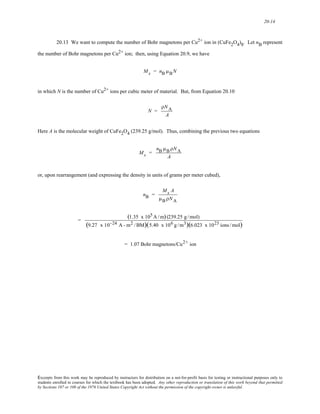
Mg and Pb concentrations in weight percent. However, we must first compute the masses of Mg and Pb (in grams) 
using a rearranged form of Equation 4.4: 
' = nmPb 
mPb 
APb = (35.4 mol)(207.2 g/mol) = 7335 g 
' = nmMg 
mMg 
AMg = (21.7 mol)(24.3 g/mol) = 527 g 
Now, using Equation 4.3, concentrations of Pb and Mg are determined as follows: 
CPb = 7335 g 
7335 g + 527 g 
×100 = 93 wt% 
CMg = 527 g 
7335 g + 527 g 
×100 = 7 wt% 
From Figure 9.20, L and Mg2Pb phases are present, and 
CL = 94 wt% Pb −6 wt% Mg 
CMg2Pb = 81 wt% Pb −19 wt% Mg 
(h) For an alloy composed of 4.2 mol Cu and 1.1 mol Ag and at 900°C, it is necessary to determine the Cu 
and Ag concentrations in weight percent. However, we must first compute the masses of Cu and Ag (in grams) 
using a rearranged form of Equation 4.4: 
Excerpts from this work may be reproduced by instructors for distribution on a not-for-profit basis for testing or instructional purposes only to 
students enrolled in courses for which the textbook has been adopted. Any other reproduction or translation of this work beyond that permitted 
by Sections 107 or 108 of the 1976 United States Copyright Act without the permission of the copyright owner is unlawful.
9-10 
' = nmCu 
mCu 
ACu = (4.2 mol)(63.55 g/mol) = 266.9 g 
' = nmAg 
mAg 
AAg = (1.1 mol)(107.87 g/mol) = 118.7 g 
Now, using Equation 4.3, concentrations of Cu and Ag are determined as follows: 
CCu = 266.9 g 
266.9 g + 118.7 g 
×100 = 69.2 wt% 
CAg = 118.7 g 
266.9 g + 118.7 g 
×100 = 30.8 wt% 
From Figure 9.7, α and liquid phases are present; and 
Cα = 8 wt% Ag-92 w% Cu 
CL = 45 wt% Ag-55 wt% Cu 
Excerpts from this work may be reproduced by instructors for distribution on a not-for-profit basis for testing or instructional purposes only to 
students enrolled in courses for which the textbook has been adopted. Any other reproduction or translation of this work beyond that permitted 
by Sections 107 or 108 of the 1976 United States Copyright Act without the permission of the copyright owner is unlawful.
9-11 
9.9 It is possible to have a Cu-Ag alloy, which at equilibrium consists of a β phase of composition 92 wt% 
Ag-8 wt% Cu and a liquid phase of composition 77 wt% Ag-23 wt% Cu. From Figure 9.7 a horizontal tie line can 
be constructed across the β + L phase region at about 800°C which intersects the L–(β + L) phase boundary at 76 
wt% Ag, and also the (β + L)–β phase boundary at 92 wt% Ag. 
Excerpts from this work may be reproduced by instructors for distribution on a not-for-profit basis for testing or instructional purposes only to 
students enrolled in courses for which the textbook has been adopted. Any other reproduction or translation of this work beyond that permitted 
by Sections 107 or 108 of the 1976 United States Copyright Act without the permission of the copyright owner is unlawful.
9-12 
9.10 It is possible to have a Cu-Ag alloy, which at equilibrium consists of an α phase of composition 4 
wt% Ag-96 wt% Cu and a β phase of composition 95 wt% Ag-5 wt% Cu. From Figure 9.7 a horizontal tie can be 
constructed across the α + β region at 690°C which intersects the α−(α + β) phase boundary at 4 wt% Ag, and also 
the (α + β)–β phase boundary at 95 wt% Ag. 
Excerpts from this work may be reproduced by instructors for distribution on a not-for-profit basis for testing or instructional purposes only to 
students enrolled in courses for which the textbook has been adopted. Any other reproduction or translation of this work beyond that permitted 
by Sections 107 or 108 of the 1976 United States Copyright Act without the permission of the copyright owner is unlawful.
9-13 
9.11 Upon heating a lead-tin alloy of composition 30 wt% Sn-70 wt% Pb from 150°C and utilizing Figure 
9.8: 
(a) The first liquid forms at the temperature at which a vertical line at this composition intersects the 
eutectic isotherm--i.e., at 183°C. 
(b) The composition of this liquid phase corresponds to the intersection with the (α + L)–L phase 
boundary, of a tie line constructed across the α + L phase region just above this eutectic isotherm--i.e., CL = 61.9 
wt% Sn. 
(c) Complete melting of the alloy occurs at the intersection of this same vertical line at 30 wt% Sn with the 
(α + L)–L phase boundary--i.e., at about 260°C. 
(d) The composition of the last solid remaining prior to complete melting corresponds to the intersection 
with α–(α + L) phase boundary, of the tie line constructed across the α + L phase region at 260°C--i.e., Cα is about 
13 wt% Sn. 
Excerpts from this work may be reproduced by instructors for distribution on a not-for-profit basis for testing or instructional purposes only to 
students enrolled in courses for which the textbook has been adopted. Any other reproduction or translation of this work beyond that permitted 
by Sections 107 or 108 of the 1976 United States Copyright Act without the permission of the copyright owner is unlawful.
9-14 
9.12 Upon cooling a 50 wt% Ni-50 wt% Cu alloy from 1400°C and utilizing Figure 9.3a: 
(a) The first solid phase forms at the temperature at which a vertical line at this composition intersects the 
L–(α + L) phase boundary--i.e., at about 1320°C. 
(b) The composition of this solid phase corresponds to the intersection with the L–(α + L) phase boundary, 
of a tie line constructed across the α + L phase region at 1320°C--i.e., Cα = 62 wt% Ni-38 wt% Cu. 
(c) Complete solidification of the alloy occurs at the intersection of this same vertical line at 50 wt% Ni 
with the (α + L)–α phase boundary--i.e., at about 1270°C. 
(d) The composition of the last liquid phase remaining prior to complete solidification corresponds to the 
intersection with the L–(α + L) boundary, of the tie line constructed across the α + L phase region at 1270°C--i.e., 
CL is about 37 wt% Ni-63 wt% Cu. 
Excerpts from this work may be reproduced by instructors for distribution on a not-for-profit basis for testing or instructional purposes only to 
students enrolled in courses for which the textbook has been adopted. Any other reproduction or translation of this work beyond that permitted 
by Sections 107 or 108 of the 1976 United States Copyright Act without the permission of the copyright owner is unlawful.
9-15 
9.13 This problem asks us to determine the phases present and their concentrations at several 
temperatures, as an alloy of composition 52 wt% Zn-48 wt% Cu is cooled. From Figure 9.19: 
At 1000°C, a liquid phase is present; WL = 1.0 
At 800°C, the β phase is present, and Wβ = 1.0 
At 500°C, β and γ phases are present, and 
Wγ = 
C0 − Cβ 
Cγ − Cβ 
= 52 − 49 
58 − 49 
= 0.33 
Wβ = 1.00 – 0.33 = 0.67 
At 300°C, the β' and γ phases are present, and 
Wβ' = 
Cγ − C0 
Cγ − Cβ' 
= 59 − 52 
59 − 50 
= 0.78 
Wγ = 1.00 – 0.78 = 0.22 
Excerpts from this work may be reproduced by instructors for distribution on a not-for-profit basis for testing or instructional purposes only to 
students enrolled in courses for which the textbook has been adopted. Any other reproduction or translation of this work beyond that permitted 
by Sections 107 or 108 of the 1976 United States Copyright Act without the permission of the copyright owner is unlawful.
9-16 
9.14 This problem asks that we determine the phase mass fractions for the alloys and temperatures in 
Problem 9.8. 
(a) 
Wα = 
Cβ − C0 
Cβ − Cα 
= 98 − 15 
98 − 5 
= 0.89 
Wβ = 
C0 − Cα 
Cβ − Cα 
= 15 − 5 
98 − 5 
= 0.11 
(b) Wα = 1.0 
(c) 
Wβ = 
C0 − CL 
Cβ − CL 
= 85 − 77 
92 − 77 
= 0.53 
WL = 
Cβ − C0 
Cβ − CL 
= 92 − 85 
92 − 77 
= 0.47 
(d) 
Wβ = 
Cγ − C0 
Cγ − Cβ 
= 58 − 55 
58 − 51 
= 0.43 
Wγ = 
C0 − Cβ 
Cγ − Cβ 
= 55 − 51 
58 − 51 
= 0.57 
(e) Wα = 1.0 
(f) WL = 1.0 
(g) 
WMg2Pb = 
CL − C0 
CL − CMg2Pb 
= 94 − 93 
94 − 81 
= 0.08 
WL = 
C0 − CMg2Pb 
CL − CMg2Pb 
= 93 − 81 
94 − 81 
= 0.92 
Excerpts from this work may be reproduced by instructors for distribution on a not-for-profit basis for testing or instructional purposes only to 
students enrolled in courses for which the textbook has been adopted. Any other reproduction or translation of this work beyond that permitted 
by Sections 107 or 108 of the 1976 United States Copyright Act without the permission of the copyright owner is unlawful.
9-17 
(h) 
Wα = 
CL − C0 
CL − Cα 
= 45 − 30.8 
45 − 8 
= 0.38 
WL = 
C0 − Cα 
CL − Cα 
= 30.8 − 8 
45 − 8 
= 0.62 
Excerpts from this work may be reproduced by instructors for distribution on a not-for-profit basis for testing or instructional purposes only to 
students enrolled in courses for which the textbook has been adopted. Any other reproduction or translation of this work beyond that permitted 
by Sections 107 or 108 of the 1976 United States Copyright Act without the permission of the copyright owner is unlawful.
9-18 
9.15 (a) This part of the problem calls for us to cite the temperature to which a 85 wt% Pb-15 wt% Sn 
alloy must be heated in order to have 50% liquid. Probably the easiest way to solve this problem is by trial and 
error--that is, on the Pb-Sn phase diagram (Figure 9.8), moving vertically at the given composition, through the α + 
L region until the tie-line lengths on both sides of the given composition are the same. This occurs at approximately 
280°C (535°F). 
(b) We can also produce a 50% liquid solution at 200°C, by adding Sn to the alloy. At 200°C and within 
the α + L phase region 
Cα = 17 wt% Sn-83 wt% Pb 
CL = 57 wt% Sn-43 wt% Pb 
Let C0 be the new alloy composition to give Wα = WL = 0.5. Then, 
Wα = 0.5 = 
CL − C0 
CL − Cα 
= 
57 − C0 
57 − 17 
And solving for C0 gives 37 wt% Sn. Now, let mSn be the mass of Sn added to the alloy to achieve this new 
composition. The amount of Sn in the original alloy is 
(0.15)(2.0 kg) = 0.30 kg 
Then, using a modified form of Equation 4.3 
0.30 kg + mSn 
2.0 kg + mSn 
⎡ 
⎢ 
⎣ 
⎢ 
⎤ 
⎥ 
⎦ 
⎥ 
×100 = 37 
And, solving for mSn (the mass of tin to be added), yields mSn = 0.698 kg. 
Excerpts from this work may be reproduced by instructors for distribution on a not-for-profit basis for testing or instructional purposes only to 
students enrolled in courses for which the textbook has been adopted. Any other reproduction or translation of this work beyond that permitted 
by Sections 107 or 108 of the 1976 United States Copyright Act without the permission of the copyright owner is unlawful.
9-19 
9.16 (a) This portion of the problem asks that we calculate, for a Pb-Mg alloy, the mass of lead in 7.5 kg 
of the solid α phase at 300°C just below the solubility limit. From Figure 9.20, the solubility limit for the α phase at 
300°C corresponds to the position (composition) of the α-α + Mg2Pb phase boundary at this temperature, which is 
about 17 wt% Pb. Therefore, the mass of Pb in the alloy is just (0.17)(7.5 kg) = 1.3 kg. 
(b) At 400°C, the solubility limit of the α phase increases to approximately 32 wt% Pb. In order to 
determine the additional amount of Pb that may be added (mPb'), we utilize a modified form of Equation 4.3 as 
CPb = 32 wt% = 
1.3 kg + mPb' 
7.5 kg + mPb' 
× 100 
Solving for mPb' yields mPb' = 1.62 kg. 
Excerpts from this work may be reproduced by instructors for distribution on a not-for-profit basis for testing or instructional purposes only to 
students enrolled in courses for which the textbook has been adopted. Any other reproduction or translation of this work beyond that permitted 
by Sections 107 or 108 of the 1976 United States Copyright Act without the permission of the copyright owner is unlawful.
9-20 
9.17 (a) In order to determine the temperature of a 65 wt% Ni-35 wt% Cu alloy for which α and liquid 
phases are present with the α phase of composition 70 wt% Ni, we need to construct a tie line across the α + L 
phase region of Figure 10.3a that intersects the solidus line at 70 wt% Ni; this is possible at about 1340°C. 
(b) The composition of the liquid phase at this temperature is determined from the intersection of this same 
tie line with liquidus line, which corresponds to about 59 wt% Ni. 
(c) The mass fractions of the two phases are determined using the lever rule, Equations 9.1 and 9.2 with 
C0 = 65 wt% Ni, CL = 59 wt% Ni, and Cα = 70 wt% Ni, as 
Wα = 
C0 − CL 
Cα − CL 
= 65 − 59 
70 − 59 
= 0.55 
WL = 
Cα − C0 
Cα − CL 
= 70 − 65 
70 − 59 
= 0.45 
Excerpts from this work may be reproduced by instructors for distribution on a not-for-profit basis for testing or instructional purposes only to 
students enrolled in courses for which the textbook has been adopted. Any other reproduction or translation of this work beyond that permitted 
by Sections 107 or 108 of the 1976 United States Copyright Act without the permission of the copyright owner is unlawful.
9-21 
9.18 (a) We are given that the mass fractions of α and liquid phases are both 0.5 for a 40 wt% Pb-60 wt% 
Mg alloy and are asked to estimate the temperature of the alloy. Using the appropriate phase diagram, Figure 9.20, 
by trial and error with a ruler, a tie line within the α + L phase region that is divided in half for an alloy of this 
composition exists at about 540°C. 
(b) We are now asked to determine the compositions of the two phases. This is accomplished by noting 
the intersections of this tie line with both the solidus and liquidus lines. From these intersections, Cα = 26 wt% Pb, 
and CL = 54 wt% Pb. 
Excerpts from this work may be reproduced by instructors for distribution on a not-for-profit basis for testing or instructional purposes only to 
students enrolled in courses for which the textbook has been adopted. Any other reproduction or translation of this work beyond that permitted 
by Sections 107 or 108 of the 1976 United States Copyright Act without the permission of the copyright owner is unlawful.
9-22 
9.19 The problem is to solve for compositions at the phase boundaries for both α and β phases (i.e., Cα 
and Cβ). We may set up two independent lever rule expressions, one for each composition, in terms of Cα and Cβ 
as follows: 
Wα1 = 0.78 = 
Cβ − C01 
Cβ − Cα 
= 
Cβ − 70 
Cβ − Cα 
Wα2 = 0.36 = 
Cβ − C02 
Cβ − Cα 
= 
Cβ − 35 
Cβ − Cα 
In these expressions, compositions are given in wt% of A. Solving for Cα and Cβ from these equations, yield 
Cα = 88.3 (or 88.3 wt% A-11.7 wt% B) 
Cβ = 5.0 (or 5.0 wt% A-95.0 wt% B) 
Excerpts from this work may be reproduced by instructors for distribution on a not-for-profit basis for testing or instructional purposes only to 
students enrolled in courses for which the textbook has been adopted. Any other reproduction or translation of this work beyond that permitted 
by Sections 107 or 108 of the 1976 United States Copyright Act without the permission of the copyright owner is unlawful.
9-23 
9.20 For this problem, we are asked to determine the composition of the β phase given that 
C0 = 40 (or 40 wt% B-60 wt% A) 
Cα = 13 (or 13 wt% B-87 wt% A) 
Wα = 0.66 
Wβ = 0.34 
If we set up the lever rule for Wα 
Wα = 0.66 = 
Cβ − C0 
Cβ − Cα 
= 
Cβ − 40 
Cβ − 13 
And solving for Cβ 
Cβ = 92.4 (or 92.4 wt% B-7.6 wt% A) 
Excerpts from this work may be reproduced by instructors for distribution on a not-for-profit basis for testing or instructional purposes only to 
students enrolled in courses for which the textbook has been adopted. Any other reproduction or translation of this work beyond that permitted 
by Sections 107 or 108 of the 1976 United States Copyright Act without the permission of the copyright owner is unlawful.
9-24 
9.21 Yes, it is possible to have a Cu-Ag alloy of composition 20 wt% Ag-80 wt% Cu which consists of 
mass fractions Wα = 0.80 and WL = 0.20. Using the appropriate phase diagram, Figure 9.7, by trial and error with a 
ruler, the tie-line segments within the α + L phase region are proportioned such that 
Wα = 0.8 = 
CL − C0 
CL − Cα 
for C0 = 20 wt% Ag. This occurs at about 800°C. 
Excerpts from this work may be reproduced by instructors for distribution on a not-for-profit basis for testing or instructional purposes only to 
students enrolled in courses for which the textbook has been adopted. Any other reproduction or translation of this work beyond that permitted 
by Sections 107 or 108 of the 1976 United States Copyright Act without the permission of the copyright owner is unlawful.
9-25 
9.22 It is not possible to have a 50 wt% Pb-50 wt% Mg alloy that has masses of 5.13 kg and 0.57 kg for 
the α and Mg2Pb phases, respectively. In order to demonstrate this, it is first necessary to determine the mass 
fraction of each phase as: 
Wα = 
mα 
mα + mMg2Pb 
= 5.13 kg 
5.13 kg + 0.57 kg 
= 0.90 
WMg2Pb = 1.00 − 0.90 = 0.10 
Now, if we apply the lever rule expression for Wα 
Wα = 
CMg2Pb − C0 
CMg2Pb − Cα 
Since the Mg2Pb phase exists only at 81 wt% Pb, and C0 = 50 wt% Pb 
Wα = 0.90 = 81 − 50 
81 − Cα 
Solving for Cα from this expression yields Cα = 46.6 wt% Pb. From Figure 9.20, the maximum concentration of 
Pb in the α phase in the α + Mg2Pb phase field is about 42 wt% Pb. Therefore, this alloy is not possible. 
Excerpts from this work may be reproduced by instructors for distribution on a not-for-profit basis for testing or instructional purposes only to 
students enrolled in courses for which the textbook has been adopted. Any other reproduction or translation of this work beyond that permitted 
by Sections 107 or 108 of the 1976 United States Copyright Act without the permission of the copyright owner is unlawful.
9-26 
9.23 This portion of the problem asks that we derive Equation 9.6a, which is used to convert from phase 
weight fraction to phase volume fraction. Volume fraction of phase α, Vα, is defined by Equation 9.5 as 
Vα = 
vα 
vα + vβ 
(9.S1) 
where vα and vβ are the volumes of the respective phases in the alloy. Furthermore, the density of each phase is 
equal to the ratio of its mass and volume, or upon rearrangement 
vα = 
mα 
ρα 
(9.S2a) 
vβ = 
mβ 
ρβ 
(9.S2b) 
Substitution of these expressions into Equation 9.S1 leads to 
Vα = 
mα 
ρα 
mα 
+ 
ρα 
mβ 
ρβ 
(9.S3) 
in which m's and ρ's denote masses and densities, respectively. Now, the mass fractions of the α and β phases (i.e., 
Wα and Wβ) are defined in terms of the phase masses as 
Wα = 
mα 
mα + mβ 
(9.S4a) 
Wβ = 
mβ 
mα + mβ 
(9.S4b) 
Which, upon rearrangement yield 
mα = Wα (mα + mβ) (9.S5a) 
mβ = Wβ (mα + mβ) (9.S5b) 
Excerpts from this work may be reproduced by instructors for distribution on a not-for-profit basis for testing or instructional purposes only to 
students enrolled in courses for which the textbook has been adopted. Any other reproduction or translation of this work beyond that permitted 
by Sections 107 or 108 of the 1976 United States Copyright Act without the permission of the copyright owner is unlawful.
9-27 
Incorporation of these relationships into Equation 9.S3 leads to 
Vα = 
Wα (mα + mβ) 
ρα 
Wα (mα + mβ) 
ρα 
+ 
Wβ (mα + mβ) 
ρβ 
Vα = 
Wα 
ρα 
Wα 
+ 
ρα 
Wβ 
ρβ 
(9.S6) 
which is the desired equation. 
For this portion of the problem we are asked to derive Equation 9.7a, which is used to convert from phase 
volume fraction to mass fraction. Mass fraction of the α phase is defined as 
Wα = 
mα 
mα + mβ 
(9.S7) 
From Equations 9.S2a and 9.S2b 
mα = vαρα (9.S8a) 
mβ = vβρβ (9.S8b) 
Substitution of these expressions into Equation 9.S7 yields 
Wα = 
vαρα 
vαρα + vβρβ 
(9.S9) 
From Equation 9.5 and its equivalent for Vβ the following may be written: 
vα = Vα(vα + vβ) (9.S10a) 
Excerpts from this work may be reproduced by instructors for distribution on a not-for-profit basis for testing or instructional purposes only to 
students enrolled in courses for which the textbook has been adopted. Any other reproduction or translation of this work beyond that permitted 
by Sections 107 or 108 of the 1976 United States Copyright Act without the permission of the copyright owner is unlawful.
9-28 
vβ = Vβ(vα + vβ) (9.S10b) 
Substitution of Equations 9.S10a and 9.S10b into Equation 9.S9 yields 
Wα = 
Vα(vα + vβ)ρα 
Vα (vα + vβ)ρα + Vβ(vα + vβ)ρβ 
Wα = 
Vαρα 
Vαρα + Vβρβ 
(9.S11) 
which is the desired expression. 
Excerpts from this work may be reproduced by instructors for distribution on a not-for-profit basis for testing or instructional purposes only to 
students enrolled in courses for which the textbook has been adopted. Any other reproduction or translation of this work beyond that permitted 
by Sections 107 or 108 of the 1976 United States Copyright Act without the permission of the copyright owner is unlawful.
9-29 
9.24 This problem asks that we determine the phase volume fractions for the alloys and temperatures in 
Problems 9.8a, b, and d. This is accomplished by using the technique illustrated in Example Problem 9.3, and also 
the results of Problems 9.8 and 9.14. 
(a) This is a Sn-Pb alloy at 100°C, wherein 
Cα = 5 wt% Sn-95 wt% Pb 
Cβ = 98 wt% Sn-2 wt% Pb 
Wα = 0.89 
Wβ = 0.11 
ρSn = 7.29 g/cm3 
ρPb = 11.27 g/cm3 
Using these data it is first necessary to compute the densities of the α and β phases using Equation 4.10a. 
Thus 
ρα = 100 
CSn(α) 
ρSn 
+ 
CPb(α) 
ρPb 
= 100 
5 
7.29 g /cm3 
+ 95 
11.27 g /cm3 
= 10.97 g/cm3 
ρβ = 100 
CSn(β) 
ρSn 
+ 
CPb(β) 
ρPb 
= 100 
98 
7.29 g /cm3 
+ 2 
11.27 g /cm3 
= 7.34 g/cm3 
Now we may determine the Vα and Vβ values using Equation 9.6. Thus, 
Excerpts from this work may be reproduced by instructors for distribution on a not-for-profit basis for testing or instructional purposes only to 
students enrolled in courses for which the textbook has been adopted. Any other reproduction or translation of this work beyond that permitted 
by Sections 107 or 108 of the 1976 United States Copyright Act without the permission of the copyright owner is unlawful.
9-30 
Vα = 
Wα 
ρα 
Wα 
+ 
ρα 
Wβ 
ρβ 
= 
0.89 
10.97 g /cm3 
0.89 
10.97 g /cm3 
+ 0.11 
7.34 g /cm3 
= 0.84 
Vβ = 
Wβ 
ρβ 
Wα 
+ 
ρα 
Wβ 
ρβ 
= 
0.11 
7.34 g /cm3 
0.89 
10.97 g /cm3 
+ 0.11 
7.34 g /cm3 
= 0.16 
(b) This is a Pb-Mg alloy at 425°C, wherein only the α phase is present. Therefore, Vα = 1.0. 
(d) This is a Zn-Cu alloy at 600°C, wherein 
Cβ = 51 wt% Zn-49 wt% Cu 
Cγ = 58 wt% Zn-42 wt% Cu 
Wβ = 0.43 
Wγ = 0.57 
ρZn = 6.67 g/cm3 
ρCu = 8.68 g/cm3 
Using these data it is first necessary to compute the densities of the β and γ phases using Equation 4.10a. Thus 
ρβ = 100 
CZn (β) 
ρZn 
+ 
CCu(β) 
ρCu 
Excerpts from this work may be reproduced by instructors for distribution on a not-for-profit basis for testing or instructional purposes only to 
students enrolled in courses for which the textbook has been adopted. Any other reproduction or translation of this work beyond that permitted 
by Sections 107 or 108 of the 1976 United States Copyright Act without the permission of the copyright owner is unlawful.
9-31 
= 100 
51 
6.67 g /cm3 
+ 49 
8.68 g /cm3 
= 7.52 g/cm3 
ργ = 100 
CZn (γ) 
ρZn 
+ 
CCu(γ) 
ρCu 
= 100 
58 
6.67 g /cm3 
+ 42 
8.68 g /cm3 
= 7.39 g/cm3 
Now we may determine the Vβ and Vγ values using Equation 9.6. Thus, 
Vβ = 
Wβ 
ρβ 
Wβ 
+ 
ρβ 
Wγ 
ργ 
= 
0.43 
7.52 g /cm3 
0.43 
7.52 g /cm3 
+ 0.57 
7.39 g /cm3 
= 0.43 
Vγ = 
Wγ 
ργ 
Wβ 
+ 
ρβ 
Wγ 
ργ 
= 
0.57 
7.39 g /cm3 
0.43 
7.52 g /cm3 
+ 0.57 
7.39 g /cm3 
= 0.57 
Excerpts from this work may be reproduced by instructors for distribution on a not-for-profit basis for testing or instructional purposes only to 
students enrolled in courses for which the textbook has been adopted. Any other reproduction or translation of this work beyond that permitted 
by Sections 107 or 108 of the 1976 United States Copyright Act without the permission of the copyright owner is unlawful.
9-32 
Development of Microstructure in Isomorphous Alloys 
9.25 (a) Coring is the phenomenon whereby concentration gradients exist across grains in polycrystalline 
alloys, with higher concentrations of the component having the lower melting temperature at the grain boundaries. 
It occurs, during solidification, as a consequence of cooling rates that are too rapid to allow for the maintenance of 
the equilibrium composition of the solid phase. 
(b) One undesirable consequence of a cored structure is that, upon heating, the grain boundary regions will 
melt first and at a temperature below the equilibrium phase boundary from the phase diagram; this melting results 
in a loss in mechanical integrity of the alloy. 
Excerpts from this work may be reproduced by instructors for distribution on a not-for-profit basis for testing or instructional purposes only to 
students enrolled in courses for which the textbook has been adopted. Any other reproduction or translation of this work beyond that permitted 
by Sections 107 or 108 of the 1976 United States Copyright Act without the permission of the copyright owner is unlawful.
9-33 
Mechanical Properties of Isomorphous Alloys 
9.26 This problem asks if a noncold-worked Cu-Ni solid solution alloy is possible having a minimum 
tensile strength of 380 MPa (55,000 psi) and also a ductility of at least 45%EL. From Figure 9.6a, a tensile strength 
greater than 380 MPa is possible for compositions between about 32 and 90 wt% Ni. On the other hand, according 
to Figure 9.6b, ductilities greater than 45%EL exist for compositions less than about 13 wt% and greater than about 
94 wt% Ni. Therefore, such an alloy is not possible inasmuch, that in order to meet the stipulated criteria: 
For a TS > 380 MPa 32 wt% < CNi < 90 wt% 
For %EL > 45% CNi < 13 wt% or CNi > 94 wt% 
Excerpts from this work may be reproduced by instructors for distribution on a not-for-profit basis for testing or instructional purposes only to 
students enrolled in courses for which the textbook has been adopted. Any other reproduction or translation of this work beyond that permitted 
by Sections 107 or 108 of the 1976 United States Copyright Act without the permission of the copyright owner is unlawful.
9-34 
Binary Eutectic Systems 
9.27 We are asked to determine the approximate temperature from which a 60 wt% Pb-40 wt% Mg alloy 
was quenched, given the mass fractions of α and Mg2Pb phases. We can write a lever-rule expression for the mass 
fraction of the α phase as 
Wα = 0.42 = 
CMg2Pb − C0 
CMg2Pb − Cα 
The value of C0 is stated as 60 wt% Pb-40 wt% Mg, and CMg2Pb is 81 wt% Pb-19 wt% Mg, which is independent 
of temperature (Figure 9.20); thus, 
0.42 = 81 − 60 
81 − Cα 
which yields 
Cα = 31.0 wt% Pb 
The temperature at which the α–(α + Mg2Pb) phase boundary (Figure 9.20) has a value of 31.0 wt% Pb is about 
400°C (750°F). 
Excerpts from this work may be reproduced by instructors for distribution on a not-for-profit basis for testing or instructional purposes only to 
students enrolled in courses for which the textbook has been adopted. Any other reproduction or translation of this work beyond that permitted 
by Sections 107 or 108 of the 1976 United States Copyright Act without the permission of the copyright owner is unlawful.
9-35 
Development of Microstructure in Eutectic Alloys 
9.28 Upon solidification, an alloy of eutectic composition forms a microstructure consisting of alternating 
layers of the two solid phases because during the solidification atomic diffusion must occur, and with this layered 
configuration the diffusion path length for the atoms is a minimum. 
Excerpts from this work may be reproduced by instructors for distribution on a not-for-profit basis for testing or instructional purposes only to 
students enrolled in courses for which the textbook has been adopted. Any other reproduction or translation of this work beyond that permitted 
by Sections 107 or 108 of the 1976 United States Copyright Act without the permission of the copyright owner is unlawful.
9-36 
9.29 A “phase” is a homogeneous portion of the system having uniform physical and chemical 
characteristics, whereas a “microconstituent” is an identifiable element of the microstructure (that may consist of 
more than one phase). 
Excerpts from this work may be reproduced by instructors for distribution on a not-for-profit basis for testing or instructional purposes only to 
students enrolled in courses for which the textbook has been adopted. Any other reproduction or translation of this work beyond that permitted 
by Sections 107 or 108 of the 1976 United States Copyright Act without the permission of the copyright owner is unlawful.
9-37 
9.30 This problem asks if it is possible to have a Mg-Pb alloy for which the mass fractions of primary α 
and total α are 0.60 and 0.85, respectively, at 460°C. In order to make this determination we need to set up the 
appropriate lever rule expression for each of these quantities. From Figure 9.20 and at 460°C, Cα = 41 wt% Pb, 
CMg = 81 wt% Pb, and Ceutectic = 67 wt% Pb. 2Pb 
For primary α 
Wα' = 
Ceutectic − C0 
Ceutectic − Cα 
= 
67 − C0 
67 − 41 
= 0.60 
Solving for C0 gives C0 = 51.4 wt% Pb. 
Now the analogous expression for total α 
Wα = 
CMg2Pb − C0 
CMg2Pb − Cα 
= 
81 − C0 
81 − 41 
= 0.85 
which yields a value of 47 wt% Pb for C0. Therefore, since these two C0 values are different, this alloy is not 
possible. 
Excerpts from this work may be reproduced by instructors for distribution on a not-for-profit basis for testing or instructional purposes only to 
students enrolled in courses for which the textbook has been adopted. Any other reproduction or translation of this work beyond that permitted 
by Sections 107 or 108 of the 1976 United States Copyright Act without the permission of the copyright owner is unlawful.
9-38 
9.31 This problem asks if it is possible to have a Pb-Sn alloy for which the masses of primary β and total β 
are 2.21 and 2.53 kg, respectively in 2.8 kg total of the alloy at 180°C. In order to make this determination we first 
need to convert these masses to mass fractions. Thus, 
Wβ' = 2.21 kg 
2.8 kg 
= 0.789 
Wβ = 2.53 kg 
2.8 kg 
= 0.904 
Next it is necessary to set up the appropriate lever rule expression for each of these quantities. From Figure 9.8 and 
at 180°C, Cα = 18.3 wt% Sn, Cβ = 97.8 wt% Sn, and Ceutectic = 61.9 wt% Sn. 
For primary β 
Wβ' = 
C0 − Ceutectic 
Cβ − Ceutectic 
= 
C0 − 61.9 
97.8 − 61.9 
= 0.789 
And solving for C0 gives C0 = 90.2 wt% Sn. 
Now the analogous expression for total β 
Wβ = 
C0 − Cα 
Cβ − Cα 
= 
C0 − 18.3 
97.8 − 18.3 
= 0.904 
And this value of C0 is also 90.2 wt% Sn. Therefore, since these two C0 values are identical, this alloy is possible. 
Excerpts from this work may be reproduced by instructors for distribution on a not-for-profit basis for testing or instructional purposes only to 
students enrolled in courses for which the textbook has been adopted. Any other reproduction or translation of this work beyond that permitted 
by Sections 107 or 108 of the 1976 United States Copyright Act without the permission of the copyright owner is unlawful.
9-39 
9.32 (a) This portion of the problem asks that we determine the mass fractions of α and β phases for an 80 
wt% Sn-20 wt% Pb alloy (at 180°C). In order to do this it is necessary to employ the lever rule using a tie line that 
extends entirely across the α + β phase field. From Figure 9.8 and at 180°C, Cα = 18.3 wt% Sn, Cβ = 97.8 wt% Sn, 
and Ceutectic = 61.9 wt% Sn. Therefore, the two lever-rule expressions are as follows: 
Wα = 
Cβ − C0 
Cβ − Cα 
= 97.8 − 80 
97.8 − 18.3 
= 0.224 
Wβ = 
C0 − Cα 
Cβ − Cα 
= 80 − 18.3 
97.8 − 18.3 
= 0.776 
(b) Now it is necessary to determine the mass fractions of primary β and eutectic microconstituents for this 
same alloy. This requires that we utilize the lever rule and a tie line that extends from the maximum solubility of Pb 
in the β phase at 180°C (i.e., 97.8 wt% Sn) to the eutectic composition (61.9 wt% Sn). Thus 
Wβ' = 
C0 − Ceutectic 
Cβ − Ceutectic 
= 80.0 − 61.9 
97.8 − 61.9 
= 0.504 
We = 
Cβ − C0 
Cβ − Ceutectic 
= 97.8 − 80.0 
97.8 − 61.9 
= 0.496 
(c) And, finally, we are asked to compute the mass fraction of eutectic β, Weβ. This quantity is simply the 
difference between the mass fractions of total β and primary β as 
Weβ = Wβ – Wβ' = 0.776 – 0.504 = 0.272 
Excerpts from this work may be reproduced by instructors for distribution on a not-for-profit basis for testing or instructional purposes only to 
students enrolled in courses for which the textbook has been adopted. Any other reproduction or translation of this work beyond that permitted 
by Sections 107 or 108 of the 1976 United States Copyright Act without the permission of the copyright owner is unlawful.
9-40 
9.33 This problem asks that we determine the composition of a Cu-Ag alloy at 775°C given that Wα' = 
0.73 and Weutectic = 0.27. Since there is a primary α microconstituent present, we know that the alloy composition, 
C0 is between 8.0 and 71.9 wt% Ag (Figure 9.7). Furthermore, this figure also indicates that Cα = 8.0 wt% Ag and 
Ceutectic = 71.9 wt% Ag. Applying the appropriate lever rule expression for Wα' 
Wα' = 
Ceutectic − C0 
Ceutectic − Cα 
= 
71.9 − C0 
71.9 − 8.0 
= 0.73 
and solving for C0 yields C0 = 25.2 wt% Ag. 
Excerpts from this work may be reproduced by instructors for distribution on a not-for-profit basis for testing or instructional purposes only to 
students enrolled in courses for which the textbook has been adopted. Any other reproduction or translation of this work beyond that permitted 
by Sections 107 or 108 of the 1976 United States Copyright Act without the permission of the copyright owner is unlawful.
9-41 
9.34 We are given a hypothetical eutectic phase diagram for which Ceutectic = 64 wt% B, Cα = 12 wt% B 
at the eutectic temperature, and also that Wβ' = 0.367 and Wβ = 0.768; from this we are asked to determine the 
composition of the alloy. Let us write lever rule expressions for Wβ' and Wβ 
Wβ = 
C0 − Cα 
Cβ − Cα 
= 
C0 − 12 
Cβ − 12 
= 0.768 
Wβ' = 
C0 − Ceutectic 
Cβ − Ceutectic 
= 
C0 − 64 
Cβ − 64 
= 0.367 
Thus, we have two simultaneous equations with C0 and Cβ as unknowns. Solving them for C0 gives C0 = 75 wt% 
B. 
Excerpts from this work may be reproduced by instructors for distribution on a not-for-profit basis for testing or instructional purposes only to 
students enrolled in courses for which the textbook has been adopted. Any other reproduction or translation of this work beyond that permitted 
by Sections 107 or 108 of the 1976 United States Copyright Act without the permission of the copyright owner is unlawful.
9-42 
9.35 Schematic sketches of the microstructures that would be observed for an 64 wt% Zn-36 wt% Cu alloy 
at temperatures of 900°C, 820°C, 750°C, and 600°C are shown below. The phase compositions are also indicated. 
(Note: it was necessary to use the Cu-Zn phase diagram, Figure 9.19, in constructing these sketches.) 
Excerpts from this work may be reproduced by instructors for distribution on a not-for-profit basis for testing or instructional purposes only to 
students enrolled in courses for which the textbook has been adopted. Any other reproduction or translation of this work beyond that permitted 
by Sections 107 or 108 of the 1976 United States Copyright Act without the permission of the copyright owner is unlawful.
9-43 
9.36 Schematic sketches of the microstructures that would be observed for a 76 wt% Pb-24 wt% Mg alloy 
at temperatures of 575°C, 500°C, 450°C, and 300°C are shown below. The phase compositions are also indicated. 
(Note: it was necessary to use the Mg-Pb phase diagram, Figure 9.20, in constructing these sketches.) 
Excerpts from this work may be reproduced by instructors for distribution on a not-for-profit basis for testing or instructional purposes only to 
students enrolled in courses for which the textbook has been adopted. Any other reproduction or translation of this work beyond that permitted 
by Sections 107 or 108 of the 1976 United States Copyright Act without the permission of the copyright owner is unlawful.
9-44 
9.37 Schematic sketches of the microstructures that would be observed for a 52 wt% Zn-48 wt% Cu alloy 
at temperatures of 950°C, 860°C, 800°C, and 600°C are shown below. The phase compositions are also indicated. 
(Note: it was necessary to use the Cu-Zn phase diagram, Figure 9.19, in constructing these sketches.) 
Excerpts from this work may be reproduced by instructors for distribution on a not-for-profit basis for testing or instructional purposes only to 
students enrolled in courses for which the textbook has been adopted. Any other reproduction or translation of this work beyond that permitted 
by Sections 107 or 108 of the 1976 United States Copyright Act without the permission of the copyright owner is unlawful.
9-45 
9.38 We are asked in this problem to estimate the composition of the Pb-Sn alloy which microstructure is 
shown in Figure 9.17. Primary α and eutectic microconstituents are present in the photomicrograph, and it is given 
that their densities are 11.2 and 8.7 g/cm3, respectively. Below is shown a square grid network onto which is 
superimposed outlines of the primary α phase areas. 
The area fraction of this primary α phase may be determined by counting squares. There are a total of 644 
squares, and of these, approximately 104 lie within the primary α phase particles. Thus, the area fraction of primary 
α is 104/644 = 0.16, which is also assumed to be the volume fraction. 
We now want to convert the volume fractions into mass fractions in order to employ the lever rule to the 
Pb-Sn phase diagram. To do this, it is necessary to utilize Equations 9.7a and 9.7b as follows: 
Wα' = 
Vα' ρα' 
Vα' ρα' + Veutectic ρeutectic 
= (0.16)(11.2 g /cm3) 
(0.16)(11.2 g /cm3) + (0.84)(8.7 g /cm3) = 0.197 
Weutectic = 
Veutectic ρeutectic 
VαÕραÕ+ Veutectic ρeutectic 
= (0.84)(8.7 g /cm3) 
(0.16)(11.2 g /cm3) + (0.84)(8.7 g /cm3) = 0.803 
Excerpts from this work may be reproduced by instructors for distribution on a not-for-profit basis for testing or instructional purposes only to 
students enrolled in courses for which the textbook has been adopted. Any other reproduction or translation of this work beyond that permitted 
by Sections 107 or 108 of the 1976 United States Copyright Act without the permission of the copyright owner is unlawful.
9-46 
From Figure 9.8, we want to use the lever rule and a tie-line that extends from the eutectic composition (61.9 wt% 
Sn) to the α–(α + β) phase boundary at 180°C (about 18.3 wt% Sn). Accordingly 
Wα' = 0.197 = 
61.9 − C0 
61.9 − 18.3 
wherein C0 is the alloy composition (in wt% Sn). Solving for C0 yields C0 = 53.3 wt% Sn. This value is in good 
agreement with the actual composition—viz. 50 wt% Sn. 
Excerpts from this work may be reproduced by instructors for distribution on a not-for-profit basis for testing or instructional purposes only to 
students enrolled in courses for which the textbook has been adopted. Any other reproduction or translation of this work beyond that permitted 
by Sections 107 or 108 of the 1976 United States Copyright Act without the permission of the copyright owner is unlawful.
9-47 
9.39 The (a) and (b) portions of the problem ask that we make schematic plots on the same graph for the 
tensile strength versus composition for copper-silver alloys at both room temperature and 600°C; such a graph is 
shown below. 
(c) Upon consultation of the Cu-Ag phase diagram (Figure 9.7) we note that silver is virtually insoluble in 
copper (i.e., there is no α-phase region at the left extremity of the phase diagram); the same may be said the 
solubility of copper in silver and for the β phase. Thus, only the α and β phase will exist for all compositions at 
room temperature; in other words, there will be no solid-solution strengthening effects at room temperature. All 
other things being equal, the tensile strength will depend (approximately) on the tensile strengths of each of the α 
and β phases as well as their phase fractions in a manner described by Equation 9.24 for the elastic modulus 
(Problem 9.64). That is, for this problem 
(TS)alloy ≅ (TS)αVα + (TS)βVβ 
in which TS and V denote tensile strength and volume fraction, respectively, and the subscripts represent the 
alloy/phases. Also, mass fractions of the α and β phases change linearly with changing composition (according to 
the lever rule). Furthermore, inasmuch as the densities of both Cu and Ag are similar, weight and volume fractions 
of the α and β phases will also be similar (see Equation 9.6). In summary, the previous discussion explains the 
linear dependence of the room temperature tensile strength on composition as represented in the above plot given 
that the TS of pure copper is greater than for pure silver (as stipulated in the problem statement). 
Excerpts from this work may be reproduced by instructors for distribution on a not-for-profit basis for testing or instructional purposes only to 
students enrolled in courses for which the textbook has been adopted. Any other reproduction or translation of this work beyond that permitted 
by Sections 107 or 108 of the 1976 United States Copyright Act without the permission of the copyright owner is unlawful.
9-48 
At 600°C, the curve will be shifted to significantly lower tensile strengths inasmuch as tensile strength 
diminishes with increasing temperature (Section 6.6, Figure 6.14). In addition, according to Figure 9.7, about 4 
wt% of silver will dissolve in copper (i.e., in the α phase), and about 4 wt% of copper will dissolve in silver (i.e., in 
the β phase). Therefore, solid-solution strengthening will occur over these compositions ranges, as noted in the 
graph shown above. Furthermore, between 4% Ag and 96% Ag, the curve will be approximately linear for the same 
reasons noted in the previous paragraph. 
Excerpts from this work may be reproduced by instructors for distribution on a not-for-profit basis for testing or instructional purposes only to 
students enrolled in courses for which the textbook has been adopted. Any other reproduction or translation of this work beyond that permitted 
by Sections 107 or 108 of the 1976 United States Copyright Act without the permission of the copyright owner is unlawful.
9-49 
Equilibrium Diagrams Having Intermediate Phases or Compounds 
9.40 This problem gives us the compositions in weight percent for the two intermetallic compounds A3B 
and AB3, and then asks us to identify element B if element A is zirconium. Probably the easiest way to solve this 
problem is to first compute the ratio of the atomic weights of these two elements using Equation 4.6a; then, since 
we know the atomic weight of zirconium (91.22 g/mol), it is possible to determine the atomic weight of element B, 
from which an identification may be made. 
First of all, consider the A3B intermetallic compound; inasmuch as it contains three times the number of A 
atoms than and B atoms, its composition in atomic percent is 75 at% A-25 at% B. Equation 4.6a may be written in 
the form: 
CB ' 
= 25 at% = 
CBAA 
CAAB + CBAA 
× 100 
where AA and AB are the atomic weights for elements A and B, and CA and CB are their compositions in weight 
percent. For this A3B compound, and making the appropriate substitutions in the above equation leads to 
25 at% B = 
(9.0 wt% B)(AA) 
(91.0 wt% A)(AB) + (9.0 wt% B)(AA) 
× 100 
Now, solving this expression yields, 
AB = 0.297 AA 
Since zirconium is element A and it has an atomic weight of 91.22 g/mol, the atomic weight of element B is just 
AB = (0.297)(91.22 g/mol) = 27.09 g/mol 
Upon consultation of the period table of the elements (Figure 2.6) we note the element that has an atomic weight 
closest to this value is aluminum (26.98 g/mol). Therefore, element B is aluminum, and the two intermetallic 
compounds are Zr3Al and ZrAl3. 
Excerpts from this work may be reproduced by instructors for distribution on a not-for-profit basis for testing or instructional purposes only to 
students enrolled in courses for which the textbook has been adopted. Any other reproduction or translation of this work beyond that permitted 
by Sections 107 or 108 of the 1976 United States Copyright Act without the permission of the copyright owner is unlawful.
9-50 
Congruent Phase Transformations 
Eutectoid and Peritectic Reactions 
9.41 The principal difference between congruent and incongruent phase transformations is that for 
congruent no compositional changes occur with any of the phases that are involved in the transformation. For 
incongruent there will be compositional alterations of the phases. 
Excerpts from this work may be reproduced by instructors for distribution on a not-for-profit basis for testing or instructional purposes only to 
students enrolled in courses for which the textbook has been adopted. Any other reproduction or translation of this work beyond that permitted 
by Sections 107 or 108 of the 1976 United States Copyright Act without the permission of the copyright owner is unlawful.
9-51 
9.42 In this problem we are asked to specify temperature-composition points for all eutectics, eutectoids, 
peritectics, and congruent phase transformations for the tin-gold system (Figure 9.36). 
There are two eutectics on this phase diagram. One exists at 10 wt% Au-90 wt% Sn and 217°C. The 
reaction upon cooling is 
L → α + β 
The other eutectic exists at 80 wt% Au-20 wt% Sn and 280°C. This reaction upon cooling is 
L → δ + ζ 
There are three peritectics. One exists at 30 wt% Au-70 wt% Sn and 252°C. Its reaction upon cooling is 
as follows: 
L + γ → β 
The second peritectic exists at 45 wt% Au-55 wt% Sn and 309°C. This reaction upon cooling is 
L + δ → γ 
The third peritectic exists at 92 wt% Au-8 wt% Sn and 490°C. This reaction upon cooling is 
L + η → ζ 
There is one congruent melting point at 62.5 wt% Au-37.5 wt% Sn and 418°C. Its reaction upon cooling is 
L → δ 
No eutectoids are present. 
Excerpts from this work may be reproduced by instructors for distribution on a not-for-profit basis for testing or instructional purposes only to 
students enrolled in courses for which the textbook has been adopted. Any other reproduction or translation of this work beyond that permitted 
by Sections 107 or 108 of the 1976 United States Copyright Act without the permission of the copyright owner is unlawful.
9-52 
9.43 In this problem we are asked to specify temperature-composition points for all eutectics, eutectoids, 
peritectics, and congruent phase transformations for a portion of the aluminum-copper phase diagram (Figure 9.37). 
There is one eutectic on this phase diagram, which exists at 8.3 wt% Al-91.7 wt% Cu and 1036°C. Its 
reaction upon cooling is 
L → α + β 
There are four eutectoids for this system. One exists at 11.8 wt% Al-88.2 wt% Cu and 565°C. This 
reaction upon cooling is 
β → α + γ2 
Another eutectoid exists at 15.4 wt% Al-84.6 wt% Cu and 964°C. For cooling the reaction is 
χ → β + γ1 
A third eutectoid exists at 15.5 wt% Al-84.5 wt% Cu and 786°C. For cooling the reaction is 
γ1 → β + γ2 
The other eutectoid exists at 23.5 wt% Al-76.5 wt% Cu and 560°C. For cooling the reaction is 
ε2 → δ + ζ1 
There are four peritectics on this phase diagram. One exists at 15.3 wt% Al-84.7 wt% Cu and 1037°C. 
The reaction upon cooling is 
β + L → χ 
Another peritectic exists at 17 wt% Al-83 wt% Cu and 1021°C. It's cooling reaction is 
χ + L → γ1 
Another peritectic exists at 20.5 wt% Al-79.5 wt% Cu and 961°C. The reaction upon cooling is 
Excerpts from this work may be reproduced by instructors for distribution on a not-for-profit basis for testing or instructional purposes only to 
students enrolled in courses for which the textbook has been adopted. Any other reproduction or translation of this work beyond that permitted 
by Sections 107 or 108 of the 1976 United States Copyright Act without the permission of the copyright owner is unlawful.
9-53 
γ1 + L → ε1 
Another peritectic exists at 28.4 wt% Al-71.6 wt% Cu and 626°C. The reaction upon cooling is 
ε2 + L → η1 
There is a single congruent melting point that exists at 12.5 wt% Al-87.5 wt% Cu and 1049°C. The 
reaction upon cooling is 
L → β 
Excerpts from this work may be reproduced by instructors for distribution on a not-for-profit basis for testing or instructional purposes only to 
students enrolled in courses for which the textbook has been adopted. Any other reproduction or translation of this work beyond that permitted 
by Sections 107 or 108 of the 1976 United States Copyright Act without the permission of the copyright owner is unlawful.
9-54 
9.44 Below is shown the phase diagram for these two A and B metals. 
Excerpts from this work may be reproduced by instructors for distribution on a not-for-profit basis for testing or instructional purposes only to 
students enrolled in courses for which the textbook has been adopted. Any other reproduction or translation of this work beyond that permitted 
by Sections 107 or 108 of the 1976 United States Copyright Act without the permission of the copyright owner is unlawful.
9-55 
The Gibbs Phase Rule 
9.45 We are asked to specify the value of F for Gibbs phase rule at points A, B, and C on the pressure-temperature 
diagram for H2O (Figure 9.38). Gibbs phase rule in general form is 
P + F = C + N 
For this system, the number of components, C, is 1, whereas N, the number of noncompositional variables, is 2--viz. 
temperature and pressure. Thus, the phase rule now becomes 
P + F = 1 + 2 = 3 
Or 
F = 3 – P 
where P is the number of phases present at equilibrium. 
At point A, only a single (liquid) phase is present (i.e., P = 1), or 
F = 3 – P = 3 – 1 = 2 
which means that both temperature and pressure are necessary to define the system. 
At point B which is on the phase boundary between liquid and vapor phases, two phases are in equilibrium 
(P = 2); hence 
F = 3 – P = 3 – 2 = 1 
Or that we need to specify the value of either temperature or pressure, which determines the value of the other 
(pressure or temperature). 
And, finally, at point C, three phases are present—viz. ice I, vapor, and liquid—and the number of degrees 
of freedom is zero since 
F = 3 – P = 3 – 3 = 0 
Thus, point C is an invariant point (in this case a triple point), and we have no choice in the selection of externally 
controllable variables in order to define the system. 
Excerpts from this work may be reproduced by instructors for distribution on a not-for-profit basis for testing or instructional purposes only to 
students enrolled in courses for which the textbook has been adopted. Any other reproduction or translation of this work beyond that permitted 
by Sections 107 or 108 of the 1976 United States Copyright Act without the permission of the copyright owner is unlawful.
9-56 
The Iron-Iron Carbide (Fe-Fe3C) Phase Diagram 
Development of Microstructure in Iron-Carbon Alloys 
9.46 This problem asks that we compute the mass fractions of α ferrite and cementite in pearlite. The 
lever-rule expression for ferrite is 
Wα = 
CFe3C − C0 
CFe3C − Cα 
and, since CFe3C = 6.70 wt% C, C0 = 0.76 wt% C, and Cα = 0.022 wt% C 
Wα = 6.70 − 0.76 
6.70 − 0.022 
= 0.89 
Similarly, for cementite 
WFe3C = 
C0 − Cα 
CFe3C − Cα 
= 0.76 − 0.022 
6.70 − 0.022 
= 0.11 
Excerpts from this work may be reproduced by instructors for distribution on a not-for-profit basis for testing or instructional purposes only to 
students enrolled in courses for which the textbook has been adopted. Any other reproduction or translation of this work beyond that permitted 
by Sections 107 or 108 of the 1976 United States Copyright Act without the permission of the copyright owner is unlawful.
9-57 
9.47 (a) A “hypoeutectoid” steel has a carbon concentration less than the eutectoid; on the other hand, a 
“hypereutectoid” steel has a carbon content greater than the eutectoid. 
(b) For a hypoeutectoid steel, the proeutectoid ferrite is a microconstituent that formed above the eutectoid 
temperature. The eutectoid ferrite is one of the constituents of pearlite that formed at a temperature below the 
eutectoid. The carbon concentration for both ferrites is 0.022 wt% C. 
Excerpts from this work may be reproduced by instructors for distribution on a not-for-profit basis for testing or instructional purposes only to 
students enrolled in courses for which the textbook has been adopted. Any other reproduction or translation of this work beyond that permitted 
by Sections 107 or 108 of the 1976 United States Copyright Act without the permission of the copyright owner is unlawful.
9-58 
9.48 This problem asks that we compute the carbon concentration of an iron-carbon alloy for which the 
fraction of total cementite is 0.10. Application of the lever rule (of the form of Equation 9.12) yields 
Wα = 0.10 = 
C0 ' 
− Cα 
CFe3C − Cα 
= 
C0 ' 
−0.022 
6.70 − 0.022 
and solving for C0 ' 
C0 ' 
= 0.69 wt% C 
Excerpts from this work may be reproduced by instructors for distribution on a not-for-profit basis for testing or instructional purposes only to 
students enrolled in courses for which the textbook has been adopted. Any other reproduction or translation of this work beyond that permitted 
by Sections 107 or 108 of the 1976 United States Copyright Act without the permission of the copyright owner is unlawful.
9-59 
9.49 In this problem we are given values of Wα and WFe3C (0.86 and 0.14, respectively) for an iron-carbon 
alloy and then are asked to specify the proeutectoid phase. Employment of the lever rule for total α leads to 
Wα = 0.86 = 
CFe3C − C0 
CFe3C − Cα 
= 
6.70 − C0 
6.70 − 0.022 
Now, solving for C0, the alloy composition, leads to C0 = 0.96 wt% C. Therefore, the proeutectoid phase is Fe3C 
since C0 is greater than 0.76 wt% C. 
Excerpts from this work may be reproduced by instructors for distribution on a not-for-profit basis for testing or instructional purposes only to 
students enrolled in courses for which the textbook has been adopted. Any other reproduction or translation of this work beyond that permitted 
by Sections 107 or 108 of the 1976 United States Copyright Act without the permission of the copyright owner is unlawful.
9-60 
9.50 This problem asks us to consider various aspects of 3.5 kg of austenite containing 0.95 wt% C that is 
cooled to below the eutectoid. 
(a) The proeutectoid phase will be Fe3C since 0.95 wt% C is greater than the eutectoid composition (0.76 
wt% C). 
(b) For this portion of the problem, we are asked to determine how much total ferrite and cementite form. 
Application of the appropriate lever rule expression yields 
Wα = 
CFe3C − C0 
CFe3C − Cα 
= 6.70 − 0.95 
6.70 − 0.022 
= 0.86 
which, when multiplied by the total mass of the alloy, gives (0.86)(3.5 kg) = 3.01 kg of total ferrite. 
Similarly, for total cementite, 
WFe3C = 
C0 − Cα 
CFe3C − Cα 
= 0.95 − 0.022 
6.70 − 0.022 
= 0.14 
And the mass of total cementite that forms is (0.14)(3.5 kg) = 0.49 kg. 
(c) Now we are asked to calculate how much pearlite and the proeutectoid phase (cementite) form. 
Applying Equation 9.22, in which = 0.95 wt% C C1 ' 
Wp = 
6.70 − C1 ' 
6.70 − 0.76 
= 6.70 − 0.95 
6.70 − 0.76 
= 0.97 
which corresponds to a mass of (0.97)(3.5 kg) = 3.4 kg. Likewise, from Equation 9.23 
WFe3C' = 
C1 '− 0.76 
5.94 
= 0.95 − 0.76 
5.94 
= 0.03 
which is equivalent to (0.03)(3.5 kg) = 0.11 kg of the total 3.5 kg mass. 
(d) Schematically, the microstructure would appear as: 
Excerpts from this work may be reproduced by instructors for distribution on a not-for-profit basis for testing or instructional purposes only to 
students enrolled in courses for which the textbook has been adopted. Any other reproduction or translation of this work beyond that permitted 
by Sections 107 or 108 of the 1976 United States Copyright Act without the permission of the copyright owner is unlawful.
9-61 
Excerpts from this work may be reproduced by instructors for distribution on a not-for-profit basis for testing or instructional purposes only to 
students enrolled in courses for which the textbook has been adopted. Any other reproduction or translation of this work beyond that permitted 
by Sections 107 or 108 of the 1976 United States Copyright Act without the permission of the copyright owner is unlawful.
9-62 
9.51 We are called upon to consider various aspects of 6.0 kg of austenite containing 0.45 wt% C, that is 
cooled to below the eutectoid. 
(a) Ferrite is the proeutectoid phase since 0.45 wt% C is less than 0.76 wt% C. 
(b) For this portion of the problem, we are asked to determine how much total ferrite and cementite form. 
For ferrite, application of the appropriate lever rule expression yields 
Wα = 
CFe3C − C0 
CFe3C − Cα 
= 6.70 − 0.45 
6.70 − 0.022 
= 0.94 
which corresponds to (0.94)(6.0 kg) = 5.64 kg of total ferrite. 
Similarly, for total cementite, 
WFe3C = 
C0 − Cα 
CFe3C − Cα 
= 0.45 − 0.022 
6.70 − 0.022 
= 0.06 
Or (0.06)(6.0 kg) = 0.36 kg of total cementite form. 
(c) Now consider the amounts of pearlite and proeutectoid ferrite. Using Equation 9.20 
Wp = 
C0 ' 
− 0.022 
0.74 
= 0.45 − 0.022 
0.74 
= 0.58 
This corresponds to (0.58)(6.0 kg) = 3.48 kg of pearlite. 
Also, from Equation 9.21, 
Wα' = 0.76 − 0.45 
0.74 
= 0.42 
Or, there are (0.42)(6.0 kg) = 2.52 kg of proeutectoid ferrite. 
(d) Schematically, the microstructure would appear as: 
Excerpts from this work may be reproduced by instructors for distribution on a not-for-profit basis for testing or instructional purposes only to 
students enrolled in courses for which the textbook has been adopted. Any other reproduction or translation of this work beyond that permitted 
by Sections 107 or 108 of the 1976 United States Copyright Act without the permission of the copyright owner is unlawful.
9-63 
Excerpts from this work may be reproduced by instructors for distribution on a not-for-profit basis for testing or instructional purposes only to 
students enrolled in courses for which the textbook has been adopted. Any other reproduction or translation of this work beyond that permitted 
by Sections 107 or 108 of the 1976 United States Copyright Act without the permission of the copyright owner is unlawful.
9-64 
9.52 The mass fractions of proeutectoid ferrite and pearlite that form in a 0.35 wt% C iron-carbon alloy 
are considered in this problem. From Equation 9.20 
Wp = 
C0 ' 
− 0.022 
0.74 
= 0.35 − 0.022 
0.74 
= 0.44 
And, from Equation 9.21 (for proeutectoid ferrite) 
Wα' = 
0.76 − C0 ' 
0.74 
= 0.76 − 0.35 
0.74 
= 0.56 
Excerpts from this work may be reproduced by instructors for distribution on a not-for-profit basis for testing or instructional purposes only to 
students enrolled in courses for which the textbook has been adopted. Any other reproduction or translation of this work beyond that permitted 
by Sections 107 or 108 of the 1976 United States Copyright Act without the permission of the copyright owner is unlawful.
9-65 
9.53 This problem asks that we determine the carbon concentration in an iron-carbon alloy, given the mass 
fractions of proeutectoid ferrite and pearlite. From Equation 9.20 
Wp = 0.826 = 
C0 ' 
− 0.022 
0.74 
which yields = 0.63 wt% C. C0 ' 
Excerpts from this work may be reproduced by instructors for distribution on a not-for-profit basis for testing or instructional purposes only to 
students enrolled in courses for which the textbook has been adopted. Any other reproduction or translation of this work beyond that permitted 
by Sections 107 or 108 of the 1976 United States Copyright Act without the permission of the copyright owner is unlawful.
9-66 
9.54 In this problem we are given values of Wα and WFe3C for an iron-carbon alloy (0.91 and 0.09, 
respectively), and then are asked to specify whether the alloy is hypoeutectoid or hypereutectoid. Employment of 
the lever rule for total α leads to 
Wα = 0.91 = 
CFe3C − C0 
CFe3C − Cα 
= 
6.70 − C0 
6.70 − 0.022 
Now, solving for C0, the alloy composition, leads to C0 = 0.62 wt% C. Therefore, the alloy is hypoeutectoid since 
C0 is less than 0.76 wt% C. 
Excerpts from this work may be reproduced by instructors for distribution on a not-for-profit basis for testing or instructional purposes only to 
students enrolled in courses for which the textbook has been adopted. Any other reproduction or translation of this work beyond that permitted 
by Sections 107 or 108 of the 1976 United States Copyright Act without the permission of the copyright owner is unlawful.
9-67 
9.55 We are asked in this problem to determine the concentration of carbon in an alloy for which 
WFe3C' 
C1 ' 
= 0.11 and Wp = 0.89. If we let equal the carbon concentration in the alloy, employment of the appropriate lever 
rule expression, Equation 9.22, leads to 
Wp = 
6.7 − C1 ' 
6.7 − 0.76 
= 0.89 
1 Solving for 1 Cyields C' 
= 1.41 wt% ' 
C. Excerpts from this work may be reproduced by instructors for distribution on a not-for-profit basis for testing or instructional purposes only to 
students enrolled in courses for which the textbook has been adopted. Any other reproduction or translation of this work beyond that permitted 
by Sections 107 or 108 of the 1976 United States Copyright Act without the permission of the copyright owner is unlawful.
9-68 
9.56 In this problem we are asked to consider 1.5 kg of a 99.7 wt% Fe-0.3 wt% C alloy that is cooled to a 
temperature below the eutectoid. 
(a) Equation 9.21 must be used in computing the amount of proeutectoid ferrite that forms. Thus, 
Wα' = 
0.76 − C0 ' 
0.74 
= 0.76 − 0.30 
0.74 
= 0.622 
Or, (0.622)(1.5 kg) = 0.933 kg of proeutectoid ferrite forms. 
(b) In order to determine the amount of eutectoid ferrite, it first becomes necessary to compute the amount 
of total ferrite using the lever rule applied entirely across the α + Fe3C phase field, as 
Wα = 
CFe3C − C0 ' 
CFe3C − Cα 
= 6.70 − 0.30 
6.70 − 0.022 
= 0.958 
which corresponds to (0.958)(1.5 kg) = 1.437 kg. Now, the amount of eutectoid ferrite is just the difference 
between total and proeutectoid ferrites, or 
1.437 kg – 0.933 kg = 0.504 kg 
(c) With regard to the amount of cementite that forms, again application of the lever rule across the 
entirety of the α + Fe3C phase field, leads to 
WFe3C = 
C0 ' 
− Cα 
CFe3C − Cα 
= 0.30 − 0.022 
6.70 − 0.022 
= 0.042 
which amounts to (0.042)(1.5 kg) = 0.063 kg cementite in the alloy. 
Excerpts from this work may be reproduced by instructors for distribution on a not-for-profit basis for testing or instructional purposes only to 
students enrolled in courses for which the textbook has been adopted. Any other reproduction or translation of this work beyond that permitted 
by Sections 107 or 108 of the 1976 United States Copyright Act without the permission of the copyright owner is unlawful.
9-69 
9.57 This problem asks that we compute the maximum mass fraction of proeutectoid cementite possible 
C1 ' 
for a hypereutectoid iron-carbon alloy. This requires that we utilize Equation 9.23 with = 2.14 wt% C, the 
maximum solubility of carbon in austenite. Thus, 
WFe3C' = 
C1 ' 
− 0.76 
5.94 
= 2.14 − 0.76 
5.94 
= 0.232 
Excerpts from this work may be reproduced by instructors for distribution on a not-for-profit basis for testing or instructional purposes only to 
students enrolled in courses for which the textbook has been adopted. Any other reproduction or translation of this work beyond that permitted 
by Sections 107 or 108 of the 1976 United States Copyright Act without the permission of the copyright owner is unlawful.
9-70 
9.58 This problem asks if it is possible to have an iron-carbon alloy for which WFe3C = 0.057 and Wα' = 
0.36. In order to make this determination, it is necessary to set up lever rule expressions for these two mass 
fractions in terms of the alloy composition, then to solve for the alloy composition of each; if both alloy 
composition values are equal, then such an alloy is possible. The lever-rule expression for the mass fraction of total 
cementite is 
WFe3C = 
C0 − Cα 
CFe3C − Cα 
= 
C0 − 0.022 
6.70 − 0.022 
= 0.057 
Solving for this C0 yields C0 = 0.40 wt% C. Now for Wα' we utilize Equation 9.21 as 
Wα' = 
0.76 − C0 ' 
0.74 
= 0.36 
0 This expression leads to C0 = 0.49 wt% C. And, since C0 and C' 
' 
are different this alloy is not possible. Excerpts from this work may be reproduced by instructors for distribution on a not-for-profit basis for testing or instructional purposes only to 
students enrolled in courses for which the textbook has been adopted. Any other reproduction or translation of this work beyond that permitted 
by Sections 107 or 108 of the 1976 United States Copyright Act without the permission of the copyright owner is unlawful.
9-71 
9.59 This problem asks if it is possible to have an iron-carbon alloy for which Wα = 0.860 and Wp = 
0.969. In order to make this determination, it is necessary to set up lever rule expressions for these two mass 
fractions in terms of the alloy composition, then to solve for the alloy composition of each; if both alloy 
composition values are equal, then such an alloy is possible. The lever-rule expression for the mass fraction of total 
ferrite is 
Wα = 
CFe3C − C0 
CFe3C − Cα 
= 
6.70 − C0 
6.70 − 0.022 
= 0.860 
Solving for this C0 yields C0 = 0.95 wt% C. Therefore, this alloy is hypereutectoid since C0 is greater than the 
eutectoid composition (0.76 wt% ). Thus, it is necessary to use Equation 9.22 for Wp as 
Wp = 
6.70 − C1 ' 
5.94 
= 0.969 
1 This expression leads to C1 = 0.95 wt% C. Since C0 = C' 
, this alloy ' 
is possible. Excerpts from this work may be reproduced by instructors for distribution on a not-for-profit basis for testing or instructional purposes only to 
students enrolled in courses for which the textbook has been adopted. Any other reproduction or translation of this work beyond that permitted 
by Sections 107 or 108 of the 1976 United States Copyright Act without the permission of the copyright owner is unlawful.
9-72 
9.60 This problem asks that we compute the mass fraction of eutectoid cementite in an iron-carbon alloy 
that contains 1.00 wt% C. In order to solve this problem it is necessary to compute mass fractions of total and 
proeutectoid cementites, and then to subtract the latter from the former. To calculate the mass fraction of total 
cementite, it is necessary to use the lever rule and a tie line that extends across the entire α + Fe3C phase field as 
WFe3C = 
C0 − Cα 
CFe3C − Cα 
= 1.00 − 0.022 
6.70 − 0.022 
= 0.146 
Now, for the mass fraction of proeutectoid cementite we use Equation 9.23 
WFe3C' = 
C1 ' 
− 0.76 
5.94 
= 1.00 − 0.76 
5.94 
= 0.040 
And, finally, the mass fraction of eutectoid cementite WFe3C'' is just 
WFe3C'' = WFe3C – WFe3C' = 0.146 –0.040 = 0.106 
Excerpts from this work may be reproduced by instructors for distribution on a not-for-profit basis for testing or instructional purposes only to 
students enrolled in courses for which the textbook has been adopted. Any other reproduction or translation of this work beyond that permitted 
by Sections 107 or 108 of the 1976 United States Copyright Act without the permission of the copyright owner is unlawful.
9-73 
9.61 This problem asks whether or not it is possible to determine the composition of an iron-carbon alloy 
for which the mass fraction of eutectoid cementite is 0.109; and if so, to calculate the composition. Yes, it is 
possible to determine the alloy composition; and, in fact, there are two possible answers. For the first, the eutectoid 
cementite exists in addition to proeutectoid cementite. For this case the mass fraction of eutectoid cementite 
(WFe3C'') is just the difference between total cementite and proeutectoid cementite mass fractions; that is 
WFe3C'' = WFe3C – WFe3C' 
Now, it is possible to write expressions for WFe3C (of the form of Equation 9.12) and WFe3C' (Equation 9.23) in 
terms of C0, the alloy composition. Thus, 
WFe3C" = 
C0 − Cα 
CFe3C − Cα 
− 
C0 − 0.76 
5.94 
= 
C0 − 0.022 
6.70 − 0.022 
− 
C0 − 0.76 
5.94 
= 0.109 
And, solving for C0 yields C0 = 0.84 wt% C. 
For the second possibility, we have a hypoeutectoid alloy wherein all of the cementite is eutectoid 
cementite. Thus, it is necessary to set up a lever rule expression wherein the mass fraction of total cementite is 
0.109. Therefore, 
WFe3C = 
C0 − Cα 
CFe3C − Cα 
= 
C0 − 0.022 
6.70 − 0.022 
= 0.109 
And, solving for C0 yields C0 = 0.75 wt% C. 
Excerpts from this work may be reproduced by instructors for distribution on a not-for-profit basis for testing or instructional purposes only to 
students enrolled in courses for which the textbook has been adopted. Any other reproduction or translation of this work beyond that permitted 
by Sections 107 or 108 of the 1976 United States Copyright Act without the permission of the copyright owner is unlawful.
9-74 
9.62 This problem asks whether or not it is possible to determine the composition of an iron-carbon alloy 
for which the mass fraction of eutectoid ferrite is 0.71; and if so, to calculate the composition. Yes, it is possible to 
determine the alloy composition; and, in fact, there are two possible answers. For the first, the eutectoid ferrite 
exists in addition to proeutectoid ferrite (for a hypoeutectoid alloy). For this case the mass fraction of eutectoid 
ferrite (Wα'') is just the difference between total ferrite and proeutectoid ferrite mass fractions; that is 
Wα'' = Wα – Wα' 
Now, it is possible to write expressions for Wα (of the form of Equation 9.12) and Wα' (Equation 9.21) in terms of 
C0, the alloy composition. Thus, 
Wα" = 
CFe3C − C0 
CFe3C − Cα 
− 
0.76 − C0 
0.74 
= 
6.70 − C0 
6.70 − 0.022 
− 
0.76 − C0 
0.74 
= 0.71 
And, solving for C0 yields C0 = 0.61 wt% C. 
For the second possibility, we have a hypereutectoid alloy wherein all of the ferrite is eutectoid ferrite. 
Thus, it is necessary to set up a lever rule expression wherein the mass fraction of total ferrite is 0.71. Therefore, 
Wα = 
CFe3C − C0 
CFe3C − Cα 
= 
6.70 − C0 
6.70 − 0.022 
= 0.71 
And, solving for C0 yields C0 = 1.96 wt% C. 
Excerpts from this work may be reproduced by instructors for distribution on a not-for-profit basis for testing or instructional purposes only to 
students enrolled in courses for which the textbook has been adopted. Any other reproduction or translation of this work beyond that permitted 
by Sections 107 or 108 of the 1976 United States Copyright Act without the permission of the copyright owner is unlawful.
9-75 
9.63 Schematic microstructures for the iron-carbon alloy of composition 3 wt% C-97 wt% Fe and at 
temperatures of 1250°C, 1145°C, and 700°C are shown below; approximate phase compositions are also indicated. 
(Note: it was necessary to use the Fe-Fe3C phase diagram, Figure 9.24, in constructing these sketches.) 
Excerpts from this work may be reproduced by instructors for distribution on a not-for-profit basis for testing or instructional purposes only to 
students enrolled in courses for which the textbook has been adopted. Any other reproduction or translation of this work beyond that permitted 
by Sections 107 or 108 of the 1976 United States Copyright Act without the permission of the copyright owner is unlawful.
9-76 
9.64 This problem asks that we determine the approximate Brinell hardness of a 99.75 wt% Fe-0.25 wt% 
C alloy, using a relationship similar to Equation 9.24. First, we compute the mass fractions of pearlite and 
proeutectoid ferrite using Equations 9.20 and 9.21, as 
Wp = 
' − 0.022 
0.74 
C 0 
= 0.25 − 0.022 
0.74 
= 0.308 
Wα' = 
' 
0.76 − C 0 
0.74 
= 0.76 − 0.25 
0.74 
= 0.689 
Now, we compute the Brinell hardness of the alloy using a modified form of Equation 9.24 as 
HBalloy = HBα'Wα' + HBpWp 
= (80)(0.689) + (280)(0.308) = 141 
Excerpts from this work may be reproduced by instructors for distribution on a not-for-profit basis for testing or instructional purposes only to 
students enrolled in courses for which the textbook has been adopted. Any other reproduction or translation of this work beyond that permitted 
by Sections 107 or 108 of the 1976 United States Copyright Act without the permission of the copyright owner is unlawful.
9-77 
The Influence of Other Alloying Elements 
9.65 This problem asks us to consider an alloy of composition 95.7 wt% Fe, 4.0 wt% W, and 0.3 wt% C. 
(a) From Figure 9.34, the eutectoid temperature for 4.0 wt% W is approximately 900°C. 
(b) From Figure 9.35, the eutectoid composition is approximately 0.21 wt% C. 
(c) Since the carbon concentration of the alloy (0.3 wt%) is greater than the eutectoid (0.21 wt% C), 
cementite is the proeutectoid phase. 
Excerpts from this work may be reproduced by instructors for distribution on a not-for-profit basis for testing or instructional purposes only to 
students enrolled in courses for which the textbook has been adopted. Any other reproduction or translation of this work beyond that permitted 
by Sections 107 or 108 of the 1976 United States Copyright Act without the permission of the copyright owner is unlawful.
9-78 
9.66 We are asked to consider a steel alloy of composition 93.65 wt% Fe, 6.0 wt% Mn, and 0.35 wt% C. 
(a) From Figure 9.34, the eutectoid temperature for 6.0 wt% Mn is approximately 700°C (1290°F). 
(b) From Figure 9.35, the eutectoid composition is approximately 0.44 wt% C. Since the carbon 
concentration in the alloy (0.35 wt%) is less than the eutectoid (0.44 wt% C), the proeutectoid phase is ferrite. 
(c) Assume that the α–(α + Fe3C) phase boundary is at a negligible carbon concentration. Modifying 
Equation 9.21 leads to 
Wα' = 
0.44 − C0 ' 
0.44 − 0 
= 0.44 − 0.35 
0.44 
= 0.20 
Likewise, using a modified Equation 9.20 
Wp = 
C0 ' 
− 0 
0.44 − 0 
= 0.35 
0.44 
= 0.80 
Excerpts from this work may be reproduced by instructors for distribution on a not-for-profit basis for testing or instructional purposes only to 
students enrolled in courses for which the textbook has been adopted. Any other reproduction or translation of this work beyond that permitted 
by Sections 107 or 108 of the 1976 United States Copyright Act without the permission of the copyright owner is unlawful.
10-1 
CHAPTER 10 
PHASE TRANSFORMATIONS IN METALS 
PROBLEM SOLUTIONS 
The Kinetics of Phase Transformations 
10.1 The two stages involved in the formation of particles of a new phase are nucleation and growth. The 
nucleation process involves the formation of normally very small particles of the new phase(s) which are stable and 
capable of continued growth. The growth stage is simply the increase in size of the new phase particles. 
Excerpts from this work may be reproduced by instructors for distribution on a not-for-profit basis for testing or instructional purposes only to 
students enrolled in courses for which the textbook has been adopted. Any other reproduction or translation of this work beyond that permitted 
by Sections 107 or 108 of the 1976 United States Copyright Act without the permission of the copyright owner is unlawful.
10-2 
10.2 (a) This problem first asks that we rewrite the expression for the total free energy change for 
nucleation (analogous to Equation 10.1) for the case of a cubic nucleus of edge length a. The volume of such a 
cubic radius is a3, whereas the total surface area is 6a2 (since there are six faces each of which has an area of a2). 
Thus, the expression for ΔG is as follows: 
ΔG = a3ΔGv + 6a2γ 
Differentiation of this expression with respect to a is as 
d ΔG 
da 
= 
d (a3ΔGv) 
da 
+ d (6a2γ) 
da 
= 3a2ΔGv + 12a γ 
If we set this expression equal to zero as 
3a2ΔGv + 12a γ = 0 
and then solve for a (= a*), we have 
a* = − 4 γ 
ΔGv 
Substitution of this expression for a in the above expression for ΔG yields an equation for ΔG* as 
ΔG* = (a*)3ΔGv + 6(a*)2 γ 
= − 4 γ 
ΔGv 
⎛ 
⎜⎜ 
⎝ 
⎞ 
⎟⎟ 
⎠ 
3 
ΔGv + 6 γ − 4 γ 
ΔGv 
⎛ 
⎜⎜ 
⎝ 
⎞ 
⎟⎟ 
⎠ 
2 
= 32 γ3 
(ΔGv)2 
Excerpts from this work may be reproduced by instructors for distribution on a not-for-profit basis for testing or instructional purposes only to 
students enrolled in courses for which the textbook has been adopted. Any other reproduction or translation of this work beyond that permitted 
by Sections 107 or 108 of the 1976 United States Copyright Act without the permission of the copyright owner is unlawful.
10-3 
(b) ΔGv for a cube—i.e., (32) 
γ3 
(ΔGv)2 
⎡ 
⎢ 
⎣ 
⎢ 
⎤ 
⎥ 
⎦ 
⎥ 
—is greater that for a sphere—i.e., 16 π 
3 
⎛ 
⎜ 
⎝ 
⎞ 
⎟ 
⎠ 
γ3 
(ΔGv)2 
⎡ 
⎢ 
⎣ 
⎢ 
⎤ 
⎥ 
⎦ 
⎥ 
= 
(16.8) 
γ3 
(ΔGv)2 
⎡ 
⎢ 
⎣ 
⎢ 
⎤ 
⎥ 
⎦ 
⎥ 
. The reason for this is that surface-to-volume ratio of a cube is greater than for a sphere. 
Excerpts from this work may be reproduced by instructors for distribution on a not-for-profit basis for testing or instructional purposes only to 
students enrolled in courses for which the textbook has been adopted. Any other reproduction or translation of this work beyond that permitted 
by Sections 107 or 108 of the 1976 United States Copyright Act without the permission of the copyright owner is unlawful.
10-4 
10.3 This problem states that ice homogeneously nucleates at –40°C, and that we are to calculate the 
critical radius given the latent heat of fusion (–3.1 x 10⁸ J/m3) and the surface free energy (25 x 10-3 J/m2). 
Solution to this problem requires the utilization of Equation 10.6 as 
⎜ 
⎜ 
r * = − 
2 γTm 
ΔH f 
⎛ 
⎝ 
⎞ 
⎟ 
⎟ 
⎠ 
1 
Tm − T 
⎛ 
⎜⎜ 
⎝ 
⎞ 
⎟⎟ 
⎠ 
= − (2)(25 x 10−3 J /m2)(273 K) 
− 3.1 x 10⁸ J /m3 
⎡ 
⎢ 
⎣ 
⎢ 
⎤ 
⎥ 
⎦ 
⎥ 
1 
40 K 
⎛ 
⎜ 
⎝ 
⎞ 
⎟ 
⎠ 
= 1.10 x 10⁻⁹ m = 1.10 nm 
Excerpts from this work may be reproduced by instructors for distribution on a not-for-profit basis for testing or instructional purposes only to 
students enrolled in courses for which the textbook has been adopted. Any other reproduction or translation of this work beyond that permitted 
by Sections 107 or 108 of the 1976 United States Copyright Act without the permission of the copyright owner is unlawful.
10-5 
10.4 (a) This portion of the problem asks that we compute r* and ΔG* for the homogeneous nucleation of 
the solidification of Ni. First of all, Equation 10.6 is used to compute the critical radius. The melting temperature 
for nickel, found inside the front cover is 1455°C; also values of ΔHf (–2.53 x 10⁹ J/m3) and γ (0.255 J/m2) are 
given in the problem statement, and the supercooling value found in Table 10.1 is 319°C (or 319 K). Thus, from 
Equation 10.6 we have 
⎜ 
⎜ 
r * = − 
2γTm 
ΔH f 
⎛ 
⎝ 
⎞ 
⎟ 
⎟ 
⎠ 
1 
Tm − T 
⎛ 
⎜⎜ 
⎝ 
⎞ 
⎟⎟ 
⎠ 
= − (2) (0.255 J /m2)(1455 + 273 K) 
−2.53 x 10⁹ J /m3 
⎡ 
⎢ 
⎣ 
⎢ 
⎤ 
⎥ 
⎦ 
⎥ 
1 
319 K 
⎛ 
⎜ 
⎝ 
⎞ 
⎟ 
⎠ 
= 1.09 x 10⁻⁹ m = 1.09 nm 
For computation of the activation free energy, Equation 10.7 is employed. Thus 
ΔG* = 
16 π γ3Tm 
2 
3ΔHf 2 
⎛ 
⎜ 
⎜ 
⎝ 
⎞ 
⎟ 
⎟ 
⎠ 
1 
(Tm − T)2 
= (16)(π) (0.255 J /m2) 3 
(1455 + 273 K)2 
(3) (−2.53 x 10⁹ J /m3)2 
⎡ 
⎢ 
⎢ 
⎣ 
⎤ 
⎥ 
⎥ 
⎦ 
1 
(319 K)2 
⎡ 
⎢ 
⎣ 
⎢ 
⎤ 
⎥ 
⎦ 
⎥ 
= 1.27 x 10⁻¹⁸ J 
(b) In order to compute the number of atoms in a nucleus of critical size (assuming a spherical nucleus of 
radius r*), it is first necessary to determine the number of unit cells, which we then multiply by the number of atoms 
per unit cell. The number of unit cells found in this critical nucleus is just the ratio of critical nucleus and unit cell 
volumes. Inasmuch as nickel has the FCC crystal structure, its unit cell volume is just a3 where a is the unit cell 
length (i.e., the lattice parameter); this value is 0.360 nm, as cited in the problem statement. Therefore, the number 
of unit cells found in a radius of critical size is just 
# unit cells / particle = 
4 
3 
πr *3 
a3 
Excerpts from this work may be reproduced by instructors for distribution on a not-for-profit basis for testing or instructional purposes only to 
students enrolled in courses for which the textbook has been adopted. Any other reproduction or translation of this work beyond that permitted 
by Sections 107 or 108 of the 1976 United States Copyright Act without the permission of the copyright owner is unlawful.
10-6 
= 
4 
3 
⎛ 
⎜ 
⎝ 
⎞ 
⎠ 
⎟ (π)(1.09 nm)3 
(0.360 nm)3 
= 116 unit cells 
Inasmuch as 4 atoms are associated with each FCC unit cell, the total number of atoms per critical nucleus is just 
(116 unit cells /critical nucleus)(4 atoms / unit cell) = 464 atoms /critical nucleus 
Excerpts from this work may be reproduced by instructors for distribution on a not-for-profit basis for testing or instructional purposes only to 
students enrolled in courses for which the textbook has been adopted. Any other reproduction or translation of this work beyond that permitted 
by Sections 107 or 108 of the 1976 United States Copyright Act without the permission of the copyright owner is unlawful.
10-7 
10.5 (a) For this part of the problem we are asked to calculate the critical radius for the solidification of 
nickel (per Problem 10.4), for 200 K and 300 K degrees of supercooling, and assuming that the there are 106 nuclei 
per meter cubed for homogeneous nucleation. In order to calculate the critical radii, we replace the Tm – T term in 
Equation 10.6 by the degree of supercooling (denoted as ΔT) cited in the problem. 
For 200 K supercooling, 
* = − 
r200 
2 γTm 
ΔH f 
⎛ 
⎜ 
⎜ 
⎝ 
⎞ 
⎟ 
⎟ 
⎠ 
1 
ΔT 
⎛ 
⎜ 
⎝ 
⎞ 
⎟ 
⎠ 
= − (2)(0.255 J /m2)(1455 + 273 K) 
−2.53 x 10 9 J /m3 
⎡ 
⎢ 
⎣ 
⎢ 
⎤ 
⎥ 
⎦ 
⎥ 
1 
200 K 
⎛ 
⎜ 
⎝ 
⎞ 
⎟ 
⎠ 
= 1.74 x 10⁻⁹ m = 1.74 nm 
For 300 K supercooling, 
* = − (2)(0.255 J /m2)(1455 + 273 K) 
r300 
− 2.53 x 10 9 J /m3 
⎡ 
⎢ 
⎣ 
⎢ 
⎤ 
⎥ 
⎦ 
⎥ 
1 
300 K 
⎛ 
⎜ 
⎝ 
⎞ 
⎟ 
⎠ 
= 1.16 x 10⁻⁹ m = 1.16 nm 
In order to compute the number of stable nuclei that exist at 200 K and 300 K degrees of supercooling, it 
is necessary to use Equation 10.8. However, we must first determine the value of K1 in Equation 10.8, which in turn 
requires that we calculate ΔG* at the homogeneous nucleation temperature using Equation 10.7; this was done in 
Problem 10.4, and yielded a value of ΔG* = 1.27 x 10⁻¹⁸ J. Now for the computation of K1, using the value of n* 
for at the homogenous nucleation temperature (106 nuclei/m3): 
K1 = n * 
exp − 
ΔG* 
kT 
⎛ 
⎜ 
⎝ 
⎞ 
⎟ 
⎠ 
= 106 nuclei /m3 
exp − 1.27 x 10⁻¹⁸ J 
(1.38 × 10⁻²³ J /atom− K)(1455 K − 319 K) 
⎡ 
⎢ 
⎣ 
⎢ 
⎤ 
⎦ 
⎥ 
⎥ 
= 1.52 x 1041 nuclei/m3 
Excerpts from this work may be reproduced by instructors for distribution on a not-for-profit basis for testing or instructional purposes only to 
students enrolled in courses for which the textbook has been adopted. Any other reproduction or translation of this work beyond that permitted 
by Sections 107 or 108 of the 1976 United States Copyright Act without the permission of the copyright owner is unlawful.
10-8 
Now for 200 K supercooling, it is first necessary to recalculate the value ΔG* of using Equation 10.7, where, again, 
the Tm – T term is replaced by the number of degrees of supercooling, denoted as ΔT, which in this case is 200 K. 
Thus 
* = 
ΔG200 
16 π γ3Tm 
2 
3ΔHf 2 
⎛ 
⎜ 
⎜ 
⎝ 
⎞ 
⎟ 
⎟ 
⎠ 
1 
(ΔT)2 
= (16)(π)(0.255 J /m2)3 (1455 + 273 K)2 
(3) (−2.53 x 10⁹ J /m3)2 
⎡ 
⎢ 
⎣ 
⎢ 
⎤ 
⎥ 
⎦ 
⎥ 
1 
(200 K)2 
⎡ 
⎢ 
⎣ 
⎢ 
⎤ 
⎦ 
⎥ 
⎥ 
= 3.24 x 10⁻¹⁸ J 
And, from Equation 10.8, the value of n* is 
* = K1 exp − 
n200 
* 
kT 
ΔG200 
⎛ 
⎜ 
⎜ 
⎝ 
⎞ 
⎟ 
⎟ 
⎠ 
= (1.52 x 1041 nuclei /m3)exp − 3.24 x10⁻¹⁸ J 
(1.38 x 10⁻²³ J /atom− K) (1455 K − 200 K) 
⎡ 
⎢ 
⎣ 
⎢ 
⎤ 
⎥ 
⎦ 
⎥ 
= 8.60 x 10-41 stable nuclei 
Now, for 300 K supercooling the value of ΔG* is equal to 
* = (16)(π) (0.255 J /m2)3 (1455 + 273 K)2 
ΔG300 
(3)(−2.53 x 10⁹ J /m3)2 
⎡ 
⎢ 
⎣ 
⎢ 
⎤ 
⎥ 
⎦ 
⎥ 
1 
(300 K)2 
⎡ 
⎢ 
⎣ 
⎢ 
⎤ 
⎥ 
⎦ 
⎥ 
= 1.44 x 10⁻¹⁸ J 
from which we compute the number of stable nuclei at 300 K of supercooling as 
* = K1 exp − 
n300 
* 
kT 
ΔG300 
⎛ 
⎜ 
⎜ 
⎝ 
⎞ 
⎟ 
⎟ 
⎠ 
Excerpts from this work may be reproduced by instructors for distribution on a not-for-profit basis for testing or instructional purposes only to 
students enrolled in courses for which the textbook has been adopted. Any other reproduction or translation of this work beyond that permitted 
by Sections 107 or 108 of the 1976 United States Copyright Act without the permission of the copyright owner is unlawful.
10-9 
n* = (1.52 x 1041 nuclei /m3)exp − 1.44 x10⁻¹⁸ J 
(1.38 x 10⁻²³ J /atom− K) (1455 K − 300 K) 
⎡ 
⎢ 
⎣ 
⎢ 
⎤ 
⎥ 
⎦ 
⎥ 
= 88 stable nuclei 
(b) Relative to critical radius, r* for 300 K supercooling is slightly smaller that for 200 K (1.16 nm versus 
1.74 nm). [From Problem 10.4, the value of r* at the homogeneous nucleation temperature (319 K) was 1.09 nm.] 
More significant, however, are the values of n* at these two degrees of supercooling, which are dramatically 
different—8.60 x 10-41 stable nuclei at ΔT = 200 K, versus 88 stable nuclei at ΔT = 300 K! 
Excerpts from this work may be reproduced by instructors for distribution on a not-for-profit basis for testing or instructional purposes only to 
students enrolled in courses for which the textbook has been adopted. Any other reproduction or translation of this work beyond that permitted 
by Sections 107 or 108 of the 1976 United States Copyright Act without the permission of the copyright owner is unlawful.
10-10 
10.6 This problem calls for us to compute the length of time required for a reaction to go to 90% 
completion. It first becomes necessary to solve for the parameter k in Equation 10.17. It is first necessary to 
manipulate this equation such that k is the dependent variable. We first rearrange Equation 10.17 as 
exp(− kt n) = 1 − y 
and then take natural logarithms of both sides: 
− kt n = ln (1 − y) 
Now solving for k gives 
k = − ln (1 − y) 
t n 
And, from the problem statement, for y = 0.25 when t = 125 s and given that n = 1.5, the value of k is equal to 
k = − ln (1 − 0.25) 
(125 s)1.5 = 2.06 x 10⁻⁴ 
We now want to manipulate Equation 10.17 such that t is the dependent variable. The above equation may be 
written in the form: 
t n = − 
ln (1 − y) 
k 
And solving this expression for t leads to 
t = − 
ln (1 − y) 
k 
⎡ 
⎢⎣ 
⎤ 
⎥⎦ 
1/n 
Now, using this equation and the value of k determined above, the time to 90% transformation completion is equal 
to 
t = − ln (1 − 0.90) 
2.06 x 10⁻⁴ 
⎡ 
⎢ 
⎣ 
⎢ 
1/1.5 
⎤ 
⎥ 
⎦ 
⎥ 
= 500 s 
Excerpts from this work may be reproduced by instructors for distribution on a not-for-profit basis for testing or instructional purposes only to 
students enrolled in courses for which the textbook has been adopted. Any other reproduction or translation of this work beyond that permitted 
by Sections 107 or 108 of the 1976 United States Copyright Act without the permission of the copyright owner is unlawful.
10-11 
10.7 This problem asks that we compute the rate of some reaction given the values of n and k in Equation 
10.17. Since the reaction rate is defined by Equation 10.18, it is first necessary to determine t0.5, or the time 
necessary for the reaction to reach y = 0.5. We must first manipulate Equation 10.17 such that t is the dependent 
variable. We first rearrange Equation 10.17 as 
exp(− kt n) = 1 − y 
and then take natural logarithms of both sides: 
− ktn = ln (1 − y) 
which my be rearranged so as to read 
t n = − ln (1 − y) 
k 
Now, solving for t from this expression leads to 
t = − ln (1 − y) 
k 
⎡ 
⎢⎣ 
1/n 
⎤ 
⎥⎦ 
For t0.5 this equation takes the form 
t0.5 = − ln (1 − 0.5) 
k 
⎡ 
⎢⎣ 
1/n 
⎤ 
⎥⎦ 
And, incorporation of values for n and k given in the problem statement (2.0 and 5 x 10⁻⁴, respectively), then 
t0.5 = − ln (1 − 0.5) 
4 
5 x10− 
⎡ 
⎢ 
⎣ 
⎢ 
1/2 
⎤ 
⎥ 
⎦ 
⎥ 
= 37.23 s 
Now, the rate is computed using Equation 10.18 as 
rate = 1 
t0.5 
= 1 
37.23 s 
= 2.69 x 10⁻² s-1 
Excerpts from this work may be reproduced by instructors for distribution on a not-for-profit basis for testing or instructional purposes only to 
students enrolled in courses for which the textbook has been adopted. Any other reproduction or translation of this work beyond that permitted 
by Sections 107 or 108 of the 1976 United States Copyright Act without the permission of the copyright owner is unlawful.
10-12 
10.8 This problem gives us the value of y (0.30) at some time t (100 min), and also the value of n (5.0) for 
the recrystallization of an alloy at some temperature, and then asks that we determine the rate of recrystallization at 
this same temperature. It is first necessary to calculate the value of k. We first rearrange Equation 10.17 as 
exp(− kt n) = 1 − y 
and then take natural logarithms of both sides: 
− ktn = ln (1 − y) 
Now solving for k gives 
k = − ln (1 − y) 
t n 
which, using the values cited above for y, n, and t yields 
k = − ln (1 − 0.30) 
(100 min)5 = 3.57 ×10⁻¹¹ 
At this point we want to compute t0.5, the value of t for y = 0.5, which means that it is necessary to establish a form 
of Equation 10.17 in which t is the dependent variable. From one of the above equations 
t n = − ln (1 − y) 
k 
And solving this expression for t leads to 
t = − ln (1 − y) 
k 
⎡ 
⎢⎣ 
1/n 
⎤ 
⎥⎦ 
For t0.5, this equation takes the form 
t0.5 = − ln (1 − 0.5) 
k 
⎡ 
⎢⎣ 
1/n 
⎤ 
⎥⎦ 
Excerpts from this work may be reproduced by instructors for distribution on a not-for-profit basis for testing or instructional purposes only to 
students enrolled in courses for which the textbook has been adopted. Any other reproduction or translation of this work beyond that permitted 
by Sections 107 or 108 of the 1976 United States Copyright Act without the permission of the copyright owner is unlawful.
10-13 
and incorporation of the value of k determined above, as well as the value of n cited in the problem statement (5.0), 
then t0.5 is equal to 
t0.5 = − ln (1 − 0.5) 
3.57 x 10⁻¹¹ 
⎡ 
⎢ 
⎣ 
⎢ 
1/5 
⎤ 
⎥ 
⎦ 
⎥ 
= 114.2 min 
Therefore, from Equation 10.18, the rate is just 
rate = 1 
t0.5 
= 1 
114.2 min 
= 8.76 x 10⁻³ (min)-1 
Excerpts from this work may be reproduced by instructors for distribution on a not-for-profit basis for testing or instructional purposes only to 
students enrolled in courses for which the textbook has been adopted. Any other reproduction or translation of this work beyond that permitted 
by Sections 107 or 108 of the 1976 United States Copyright Act without the permission of the copyright owner is unlawful.
10-14 
10.9 For this problem, we are given, for the austenite-to-pearlite transformation, two values of y and two 
values of the corresponding times, and are asked to determine the time required for 95% of the austenite to 
transform to pearlite. 
The first thing necessary is to set up two expressions of the form of Equation 10.17, and then to solve 
simultaneously for the values of n and k. In order to expedite this process, we will rearrange and do some algebraic 
manipulation of Equation 10.17. First of all, we rearrange as follows: 
1 − y = exp (− kt n) 
Now taking natural logarithms 
ln (1 − y) = − kt n 
Or 
− ln (1 − y) = kt n 
which may also be expressed as 
ln 1 
1 − y 
⎛ 
⎜ 
⎝ 
⎞ 
⎠ 
⎟ = kt n 
Now taking natural logarithms again, leads to 
ln ln 1 
1 − y 
⎛ 
⎜ 
⎝ 
⎞ 
⎟ 
⎠ 
⎡ 
⎢ 
⎣ 
⎤ 
⎦ 
⎥ = ln k + n ln t 
which is the form of the equation that we will now use. Using values cited in the problem statement, the two 
equations are thus 
ln ln 1 
1 − 0.2 
⎡ 
⎢ 
⎣ 
⎤ 
⎥ 
⎦ 
⎧ 
⎨ 
⎩ 
⎫ 
⎬ 
⎭ 
= ln k + n ln(280 s) 
ln ln 1 
1 − 0.6 
⎡ 
⎢ 
⎣ 
⎤ 
⎥ 
⎦ 
⎧ 
⎨ 
⎩ 
⎫ 
⎬ 
⎭ 
= ln k + n ln(425 s) 
Excerpts from this work may be reproduced by instructors for distribution on a not-for-profit basis for testing or instructional purposes only to 
students enrolled in courses for which the textbook has been adopted. Any other reproduction or translation of this work beyond that permitted 
by Sections 107 or 108 of the 1976 United States Copyright Act without the permission of the copyright owner is unlawful.
10-15 
Solving these two expressions simultaneously for n and k yields n = 3.385 and k = 1.162 x 10⁻⁹. 
Now it becomes necessary to solve for the value of t at which y = 0.95. One of the above equations—viz 
− ln (1 − y) = kt n 
may be rewritten as 
t n = − ln (1 − y) 
k 
And solving for t leads to 
t = − ln (1 − y) 
k 
⎡ 
⎢⎣ 
1/n 
⎤ 
⎥⎦ 
Now incorporating into this expression values for n and k determined above, the time required for 95% austenite 
transformation is equal to 
t = − ln (1 − 0.95) 
1.162 x 10⁻⁹ 
⎡ 
⎢ 
⎣ 
⎢ 
1/3.385 
⎤ 
⎥ 
⎦ 
⎥ 
= 603 s 
Excerpts from this work may be reproduced by instructors for distribution on a not-for-profit basis for testing or instructional purposes only to 
students enrolled in courses for which the textbook has been adopted. Any other reproduction or translation of this work beyond that permitted 
by Sections 107 or 108 of the 1976 United States Copyright Act without the permission of the copyright owner is unlawful.
10-16 
10.10 For this problem, we are given, for the recrystallization of aluminum, two values of y and two 
values of the corresponding times, and are asked to determine the fraction recrystallized after a total time of 116.8 
min. 
The first thing necessary is to set up two expressions of the form of Equation 10.17, and then to solve 
simultaneously for the values of n and k. In order to expedite this process, we will rearrange and do some algebraic 
manipulation of Equation 10.17. First of all, we rearrange as follows: 
1 − y = exp (− kt n) 
Now taking natural logarithms 
ln (1 − y) = − kt n 
Or 
− ln (1 − y) = kt n 
which may also be expressed as 
ln 1 
1 − y 
⎛ 
⎜ 
⎝ 
⎞ 
⎠ 
⎟ = kt n 
Now taking natural logarithms again, leads to 
ln ln 1 
1 − y 
⎛ 
⎜ 
⎝ 
⎞ 
⎟ 
⎠ 
⎡ 
⎢ 
⎣ 
⎤ 
⎦ 
⎥ = ln k + n ln t 
which is the form of the equation that we will now use. The two equations are thus 
ln ln 1 
1 − 0.30 
⎡ 
⎢ 
⎣ 
⎤ 
⎥ 
⎦ 
⎧ 
⎨ 
⎩ 
⎫ 
⎬ 
⎭ 
= ln k + n ln(95.2 min) 
ln ln 1 
1 − 0.80 
⎡ 
⎢ 
⎣ 
⎤ 
⎥ 
⎦ 
⎧ 
⎨ 
⎩ 
⎫ 
⎬ 
⎭ 
= ln k + n ln(126.6 min) 
Excerpts from this work may be reproduced by instructors for distribution on a not-for-profit basis for testing or instructional purposes only to 
students enrolled in courses for which the textbook has been adopted. Any other reproduction or translation of this work beyond that permitted 
by Sections 107 or 108 of the 1976 United States Copyright Act without the permission of the copyright owner is unlawful.
10-17 
Solving these two expressions simultaneously for n and k yields n = 5.286 and k = 1.239 x 10⁻¹¹. 
Now it becomes necessary to solve for y when t = 116.8 min. Application of Equation 10.17 leads to 
y = 1 − exp(−kt n) 
= 1 − exp[− (1.239 x 10⁻¹¹)(116.8 min)5.286]= 0.65 
Excerpts from this work may be reproduced by instructors for distribution on a not-for-profit basis for testing or instructional purposes only to 
students enrolled in courses for which the textbook has been adopted. Any other reproduction or translation of this work beyond that permitted 
by Sections 107 or 108 of the 1976 United States Copyright Act without the permission of the copyright owner is unlawful.
10-18 
10.11 This problem asks us to consider the percent recrystallized versus logarithm of time curves for 
copper shown in Figure 10.11. 
(a) The rates at the different temperatures are determined using Equation 10.18, which rates are tabulated 
below: 
Temperature (°C) Rate (min)-1 
135 0.105 
119 4.4 x 10⁻² 
113 2.9 x 10⁻² 
102 1.25 x 10⁻² 
88 4.2 x 10⁻³ 
43 3.8 x 10⁻⁵ 
(b) These data are plotted below. 
The activation energy, Q, is related to the slope of the line drawn through the data points as 
Q = − Slope (R) 
where R is the gas constant. The slope of this line is equal to 
Excerpts from this work may be reproduced by instructors for distribution on a not-for-profit basis for testing or instructional purposes only to 
students enrolled in courses for which the textbook has been adopted. Any other reproduction or translation of this work beyond that permitted 
by Sections 107 or 108 of the 1976 United States Copyright Act without the permission of the copyright owner is unlawful.
10-19 
Slope = 
Δ ln rate 
Δ 1 
T 
⎛ 
⎜ 
⎝ 
⎞ 
⎟ 
⎠ 
= 
ln rate1 − ln rate2 
1 
T1 
− 1 
T2 
Let us take 1/T1 = 0.0025 K-1 and 1/T2 = 0.0031 K-1; the corresponding ln rate values are ln rate1 = -2.6 and ln 
rate2 = -9.4. Thus, using these values, the slope is equal to 
Slope = 
−2.6 − (−9.4) 
0.0025 K-1 − 0.0031 K-1 
= −1.133 x 10⁴ K 
And, finally the activation energy is 
Q = − (Slope)(R) = − (−1.133 x 10⁴ K-1)(8.31 J/mol - K) 
= 94,150 J/mol 
(c) At room temperature (20°C), 1/T = 1/(20 + 273 K) = 3.41 x 10⁻³ K-1. Extrapolation of the data in the 
plot to this 1/T value gives 
ln (rate) ≅ −12.8 
which leads to 
rate ≅ exp (−12.8) = 2.76 x 10⁻⁶ (min)-1 
But since 
rate = 1 
t0.5 
t0.5 = 1 
rate 
= 1 
2.76 x 10⁻⁶ (min)−1 
= 3.62 x 10⁵ min = 250 days 
Excerpts from this work may be reproduced by instructors for distribution on a not-for-profit basis for testing or instructional purposes only to 
students enrolled in courses for which the textbook has been adopted. Any other reproduction or translation of this work beyond that permitted 
by Sections 107 or 108 of the 1976 United States Copyright Act without the permission of the copyright owner is unlawful.
10-20 
10.12 In this problem we are asked to determine, from Figure 10.11, the values of the constants n and k 
(Equation 10.17) for the recrystallization of copper at 119°C. One way to solve this problem is to take two values 
of percent recrystallization (which is just 100y, Equation 10.17) and their corresponding time values, then set up 
two simultaneous equations, from which n and k may be determined. In order to expedite this process, we will 
rearrange and do some algebraic manipulation of Equation 10.17. First of all, we rearrange as follows: 
1 − y = exp (− kt n) 
Now taking natural logarithms 
ln (1 − y) = − kt n 
Or 
− ln (1 − y) = kt n 
which may also be expressed as 
ln 1 
1 − y 
⎛ 
⎜ 
⎝ 
⎞ 
⎠ 
⎟ = kt n 
Now taking natural logarithms again, leads to 
ln ln 1 
1 − y 
⎛ 
⎜ 
⎝ 
⎞ 
⎟ 
⎠ 
⎡ 
⎢ 
⎣ 
⎤ 
⎦ 
⎥ = ln k + n ln t 
which is the form of the equation that we will now use. From the 119°C curve of Figure 10.11, let us arbitrarily 
choose two percent recrystallized values, 20% and 80% (i.e., y1 = 0.20 and y2 = 0.80). Their corresponding time 
values are t1 = 16.1 min and t2 = 30.4 min (realizing that the time axis is scaled logarithmically). Thus, our two 
simultaneous equations become 
ln ln 1 
1 − 0.2 
⎛ 
⎜ 
⎝ 
⎞ 
⎟ 
⎠ 
⎡ 
⎢ 
⎣ 
⎤ 
⎦ 
⎥ = ln k + n ln (16.1) 
Excerpts from this work may be reproduced by instructors for distribution on a not-for-profit basis for testing or instructional purposes only to 
students enrolled in courses for which the textbook has been adopted. Any other reproduction or translation of this work beyond that permitted 
by Sections 107 or 108 of the 1976 United States Copyright Act without the permission of the copyright owner is unlawful.
10-21 
ln ln 1 
1 − 0.8 
⎛ 
⎜ 
⎝ 
⎞ 
⎟ 
⎠ 
⎡ 
⎢ 
⎣ 
⎤ 
⎦ 
⎥ = ln k + n ln (30.4) 
from which we obtain the values n = 3.11 and k = 3.9 x 10⁻⁵. 
Excerpts from this work may be reproduced by instructors for distribution on a not-for-profit basis for testing or instructional purposes only to 
students enrolled in courses for which the textbook has been adopted. Any other reproduction or translation of this work beyond that permitted 
by Sections 107 or 108 of the 1976 United States Copyright Act without the permission of the copyright owner is unlawful.
10-22 
Metastable Versus Equilibrium States 
10.13 Two limitations of the iron-iron carbide phase diagram are: 
(1) The nonequilibrium martensite does not appear on the diagram; and 
(2) The diagram provides no indication as to the time-temperature relationships for the formation of 
pearlite, bainite, and spheroidite, all of which are composed of the equilibrium ferrite and cementite phases. 
Excerpts from this work may be reproduced by instructors for distribution on a not-for-profit basis for testing or instructional purposes only to 
students enrolled in courses for which the textbook has been adopted. Any other reproduction or translation of this work beyond that permitted 
by Sections 107 or 108 of the 1976 United States Copyright Act without the permission of the copyright owner is unlawful.
10-23 
10.14 (a) Superheating and supercooling correspond, respectively, to heating or cooling above or below a 
phase transition temperature without the occurrence of the transformation. 
(b) These phenomena occur because right at the phase transition temperature, the driving force is not 
sufficient to cause the transformation to occur. The driving force is enhanced during superheating or supercooling. 
Excerpts from this work may be reproduced by instructors for distribution on a not-for-profit basis for testing or instructional purposes only to 
students enrolled in courses for which the textbook has been adopted. Any other reproduction or translation of this work beyond that permitted 
by Sections 107 or 108 of the 1976 United States Copyright Act without the permission of the copyright owner is unlawful.
10-24 
Isothermal Transformation Diagrams 
10.15 We are called upon to consider the isothermal transformation of an iron-carbon alloy of eutectoid 
composition. 
(a) From Figure 10.22, a horizontal line at 675°C intersects the 50% and reaction completion curves at 
about 80 and 300 seconds, respectively; these are the times asked for in the problem statement. 
(b) The pearlite formed will be coarse pearlite. From Figure 10.30(a), the hardness of an alloy of 
composition 0.76 wt% C that consists of coarse pearlite is about 205 HB (93 HRB). 
Excerpts from this work may be reproduced by instructors for distribution on a not-for-profit basis for testing or instructional purposes only to 
students enrolled in courses for which the textbook has been adopted. Any other reproduction or translation of this work beyond that permitted 
by Sections 107 or 108 of the 1976 United States Copyright Act without the permission of the copyright owner is unlawful.
10-25 
10.16 The microstructures of pearlite, bainite, and spheroidite all consist of α-ferrite and cementite phases. 
For pearlite, the two phases exist as layers which alternate with one another. Bainite consists of very fine and 
parallel needle-shaped particles of cementite that are surrounded an α-ferrite matrix. For spheroidite, the matrix is 
ferrite, and the cementite phase is in the shape of sphere-shaped particles. 
Bainite is harder and stronger than pearlite, which, in turn, is harder and stronger than spheroidite. 
Excerpts from this work may be reproduced by instructors for distribution on a not-for-profit basis for testing or instructional purposes only to 
students enrolled in courses for which the textbook has been adopted. Any other reproduction or translation of this work beyond that permitted 
by Sections 107 or 108 of the 1976 United States Copyright Act without the permission of the copyright owner is unlawful.
10-26 
10.17 The driving force for the formation of spheroidite is the net reduction in ferrite-cementite phase 
boundary area. 
Excerpts from this work may be reproduced by instructors for distribution on a not-for-profit basis for testing or instructional purposes only to 
students enrolled in courses for which the textbook has been adopted. Any other reproduction or translation of this work beyond that permitted 
by Sections 107 or 108 of the 1976 United States Copyright Act without the permission of the copyright owner is unlawful.
10-27 
10.18 This problem asks us to determine the nature of the final microstructure of an iron-carbon alloy of 
eutectoid composition, that has been subjected to various isothermal heat treatments. Figure 10.22 is used in these 
determinations. 
(a) 100% bainite 
(b) 50% medium pearlite and 50% martensite 
(c) 50% fine pearlite, 25% bainite, and 25% martensite 
(d) 100% spheroidite 
(e) 100% tempered martensite 
(f) 100% coarse pearlite 
(g) 100% fine pearlite 
(h) 50% bainite and 50% martensite 
Excerpts from this work may be reproduced by instructors for distribution on a not-for-profit basis for testing or instructional purposes only to 
students enrolled in courses for which the textbook has been adopted. Any other reproduction or translation of this work beyond that permitted 
by Sections 107 or 108 of the 1976 United States Copyright Act without the permission of the copyright owner is unlawful.
10-28 
10.19 Below is shown the isothermal transformation diagram for a eutectoid iron-carbon alloy, with time-temperature 
paths that will yield (a) 100% coarse pearlite; (b) 50% martensite and 50% austenite; and (c) 50% 
coarse pearlite, 25% bainite, and 25% martensite. 
Excerpts from this work may be reproduced by instructors for distribution on a not-for-profit basis for testing or instructional purposes only to 
students enrolled in courses for which the textbook has been adopted. Any other reproduction or translation of this work beyond that permitted 
by Sections 107 or 108 of the 1976 United States Copyright Act without the permission of the copyright owner is unlawful.
10-29 
10.20 We are asked to determine which microconstituents are present in a 1.13 wt% C iron-carbon alloy 
that has been subjected to various isothermal heat treatments. These microconstituents are as follows: 
(a) Martensite 
(b) Proeutectoid cementite and martensite 
(c) Bainite 
(d) Spheroidite 
(e) Cementite, medium pearlite, bainite, and martensite 
(f) Bainite and martensite 
(g) Proeutectoid cementite, pearlite, and martensite 
(h) Proeutectoid cementite and fine pearlite 
Excerpts from this work may be reproduced by instructors for distribution on a not-for-profit basis for testing or instructional purposes only to 
students enrolled in courses for which the textbook has been adopted. Any other reproduction or translation of this work beyond that permitted 
by Sections 107 or 108 of the 1976 United States Copyright Act without the permission of the copyright owner is unlawful.
10-30 
10.21 This problem asks us to determine the approximate percentages of the microconstituents that form 
for five of the heat treatments described in Problem 10.20. 
(a) 100% martensite 
(c) 100% bainite 
(d) 100% spheroidite 
(f) 60% bainite and 40% martensite 
(h) After holding for 7 s at 600°C, the specimen has completely transformed to proeutectoid cementite and 
fine pearlite; no further reaction will occur at 450°C. Therefore, we can calculate the mass fractions using the 
appropriate lever rule expressions, Equations 9.22 and 9.23, as follows: 
WFe3C' = 
C1 ' 
− 0.76 
5.94 
= 1.13 − 0.76 
5.94 
= 0.062 or 6.2% 
Wp = 
6.70 − C1 ' 
5.94 
= 6.70 − 1.13 
5.94 
= 0.938 or 93.8% 
Excerpts from this work may be reproduced by instructors for distribution on a not-for-profit basis for testing or instructional purposes only to 
students enrolled in courses for which the textbook has been adopted. Any other reproduction or translation of this work beyond that permitted 
by Sections 107 or 108 of the 1976 United States Copyright Act without the permission of the copyright owner is unlawful.
10-31 
10.22 Below is shown an isothermal transformation diagram for a 1.13 wt% C iron-carbon alloy, with 
time-temperature paths that will produce (a) 6.2% proeutectoid cementite and 93.8% coarse pearlite; (b) 50% fine 
pearlite and 50% bainite; (c) 100% martensite; and (d) 100% tempered martensite. 
Excerpts from this work may be reproduced by instructors for distribution on a not-for-profit basis for testing or instructional purposes only to 
students enrolled in courses for which the textbook has been adopted. Any other reproduction or translation of this work beyond that permitted 
by Sections 107 or 108 of the 1976 United States Copyright Act without the permission of the copyright owner is unlawful.
10-32 
Continuous Cooling Transformation Diagrams 
10.23 We are called upon to name the microstructural products that form for specimens of an iron-carbon 
alloy of eutectoid composition that are continuously cooled to room temperature at a variety of rates. Figure 10.27 
is used in these determinations. 
(a) At a rate of 1°C/s, coarse pearlite forms. 
(b) At a rate of 20°C/s, fine pearlite forms. 
(c) At a rate of 50°C/s, fine pearlite and martensite form. 
(d) At a rate of 175ºC/s, martensite forms. 
Excerpts from this work may be reproduced by instructors for distribution on a not-for-profit basis for testing or instructional purposes only to 
students enrolled in courses for which the textbook has been adopted. Any other reproduction or translation of this work beyond that permitted 
by Sections 107 or 108 of the 1976 United States Copyright Act without the permission of the copyright owner is unlawful.
10-33 
10.24 Below is shown a continuous cooling transformation diagram for a 0.35 wt% C iron-carbon alloy, 
with continuous cooling paths that will produce (a) fine pearlite and proeutectoid ferrite; (b) martensite; (c) 
martensite and proeutectoid ferrite; (d) coarse pearlite and proeutectoid ferrite; and (e) martensite, fine pearlite, 
and proeutectoid ferrite. 
Excerpts from this work may be reproduced by instructors for distribution on a not-for-profit basis for testing or instructional purposes only to 
students enrolled in courses for which the textbook has been adopted. Any other reproduction or translation of this work beyond that permitted 
by Sections 107 or 108 of the 1976 United States Copyright Act without the permission of the copyright owner is unlawful.
10-34 
10.25 Two important differences between continuous cooling transformation diagrams for plain carbon 
and alloy steels are: (1) for an alloy steel, a bainite nose will be present, which nose will be absent for plain carbon 
alloys; and (2) the pearlite-proeutectoid noses for plain carbon steel alloys are positioned at shorter times than for 
the alloy steels. 
Excerpts from this work may be reproduced by instructors for distribution on a not-for-profit basis for testing or instructional purposes only to 
students enrolled in courses for which the textbook has been adopted. Any other reproduction or translation of this work beyond that permitted 
by Sections 107 or 108 of the 1976 United States Copyright Act without the permission of the copyright owner is unlawful.
11-1 
CHAPTER 11 
APPLICATIONS AND PROCESSING OF METAL ALLOYS 
PROBLEM SOLUTIONS 
Ferrous Alloys 
11.1 This question asks that we list four classifications of steels, and, for each, to describe properties and 
cite typical applications. 
Low Carbon Steels 
Properties: nonresponsive to heat treatments; relatively soft and weak; machinable and weldable. 
Typical applications: automobile bodies, structural shapes, pipelines, buildings, bridges, and tin cans. 
Medium Carbon Steels 
Properties: heat treatable, relatively large combinations of mechanical characteristics. 
Typical applications: railway wheels and tracks, gears, crankshafts, and machine parts. 
High Carbon Steels 
Properties: hard, strong, and relatively brittle. 
Typical applications: chisels, hammers, knives, and hacksaw blades. 
High Alloy Steels (Stainless and Tool) 
Properties: hard and wear resistant; resistant to corrosion in a large variety of environments. 
Typical applications: cutting tools, drills, cutlery, food processing, and surgical tools. 
Excerpts from this work may be reproduced by instructors for distribution on a not-for-profit basis for testing or instructional purposes only to 
students enrolled in courses for which the textbook has been adopted. Any other reproduction or translation of this work beyond that permitted 
by Sections 107 or 108 of the 1976 United States Copyright Act without the permission of the copyright owner is unlawful.
11-2 
11.2 (a) Ferrous alloys are used extensively because: 
(1) Iron ores exist in abundant quantities. 
(2) Economical extraction, refining, and fabrication techniques are available. 
(3) The alloys may be tailored to have a wide range of properties. 
(b) Disadvantages of ferrous alloys are: 
(1) They are susceptible to corrosion. 
(2) They have a relatively high density. 
(3) They have relatively low electrical conductivities. 
Excerpts from this work may be reproduced by instructors for distribution on a not-for-profit basis for testing or instructional purposes only to 
students enrolled in courses for which the textbook has been adopted. Any other reproduction or translation of this work beyond that permitted 
by Sections 107 or 108 of the 1976 United States Copyright Act without the permission of the copyright owner is unlawful.
11-3 
11.3 The alloying elements in tool steels (e.g., Cr, V, W, and Mo) combine with the carbon to form very 
hard and wear-resistant carbide compounds. 
Excerpts from this work may be reproduced by instructors for distribution on a not-for-profit basis for testing or instructional purposes only to 
students enrolled in courses for which the textbook has been adopted. Any other reproduction or translation of this work beyond that permitted 
by Sections 107 or 108 of the 1976 United States Copyright Act without the permission of the copyright owner is unlawful.
11-4 
11.4 We are asked to compute the volume percent graphite in a 2.5 wt% C cast iron. It first becomes 
necessary to compute mass fractions using the lever rule. From the iron-carbon phase diagram (Figure 11.2), the 
tie-line in the α and graphite phase field extends from essentially 0 wt% C to 100 wt% C. Thus, for a 2.5 wt% C 
cast iron 
Wα = 
CGr − C0 
CGr − Cα 
= 100 − 2.5 
100 − 0 
= 0.975 
WGr = 
C0 − Cα 
CGr − Cα 
= 2.5 − 0 
100 − 0 
= 0.025 
Conversion from weight fraction to volume fraction of graphite is possible using Equation 9.6a as 
VGr = 
WGr 
ρGr 
Wα 
+ 
ρα 
WGr 
ρGr 
= 
0.025 
2.3 g /cm3 
0.975 
7.9 g /cm3 
+ 0.025 
2.3 g /cm3 
= 0.081 or 8.1 vol% 
Excerpts from this work may be reproduced by instructors for distribution on a not-for-profit basis for testing or instructional purposes only to 
students enrolled in courses for which the textbook has been adopted. Any other reproduction or translation of this work beyond that permitted 
by Sections 107 or 108 of the 1976 United States Copyright Act without the permission of the copyright owner is unlawful.
11-5 
11.5 Gray iron is weak and brittle in tension because the tips of the graphite flakes act as points of stress 
concentration. 
Excerpts from this work may be reproduced by instructors for distribution on a not-for-profit basis for testing or instructional purposes only to 
students enrolled in courses for which the textbook has been adopted. Any other reproduction or translation of this work beyond that permitted 
by Sections 107 or 108 of the 1976 United States Copyright Act without the permission of the copyright owner is unlawful.
11-6 
11.6 This question asks us to compare various aspects of gray and malleable cast irons. 
(a) With respect to composition and heat treatment: 
Gray iron--2.5 to 4.0 wt% C and 1.0 to 3.0 wt% Si. For most gray irons there is no heat treatment 
after solidification. 
Malleable iron--2.5 to 4.0 wt% C and less than 1.0 wt% Si. White iron is heated in a 
nonoxidizing atmosphere and at a temperature between 800 and 900°C for an extended time period. 
(b) With respect to microstructure: 
Gray iron--Graphite flakes are embedded in a ferrite or pearlite matrix. 
Malleable iron--Graphite clusters are embedded in a ferrite or pearlite matrix. 
(c) With respect to mechanical characteristics: 
Gray iron--Relatively weak and brittle in tension; good capacity for damping vibrations. 
Malleable iron--Moderate strength and ductility. 
Excerpts from this work may be reproduced by instructors for distribution on a not-for-profit basis for testing or instructional purposes only to 
students enrolled in courses for which the textbook has been adopted. Any other reproduction or translation of this work beyond that permitted 
by Sections 107 or 108 of the 1976 United States Copyright Act without the permission of the copyright owner is unlawful.
11-7 
11.7 This question asks us to compare white and nodular cast irons. 
(a) With regard to composition and heat treatment: 
White iron--2.5 to 4.0 wt% C and less than 1.0 wt% Si. No heat treatment; however, cooling is 
rapid during solidification. 
Nodular cast iron--2.5 to 4.0 wt% C, 1.0 to 3.0 wt% Si, and a small amount of Mg or Ce. A heat 
treatment at about 700°C may be necessary to produce a ferritic matrix. 
(b) With regard to microstructure: 
White iron--There are regions of cementite interspersed within pearlite. 
Nodular cast iron--Nodules of graphite are embedded in a ferrite or pearlite matrix. 
(c) With respect to mechanical characteristics: 
White iron--Extremely hard and brittle. 
Nodular cast iron--Moderate strength and ductility. 
Excerpts from this work may be reproduced by instructors for distribution on a not-for-profit basis for testing or instructional purposes only to 
students enrolled in courses for which the textbook has been adopted. Any other reproduction or translation of this work beyond that permitted 
by Sections 107 or 108 of the 1976 United States Copyright Act without the permission of the copyright owner is unlawful.
11-8 
11.8 It is not possible to produce malleable iron in pieces having large cross-sectional dimensions. White 
cast iron is the precursor of malleable iron, and a rapid cooling rate is necessary for the formation of white iron, 
which may not be accomplished at interior regions of thick cross-sections. 
Excerpts from this work may be reproduced by instructors for distribution on a not-for-profit basis for testing or instructional purposes only to 
students enrolled in courses for which the textbook has been adopted. Any other reproduction or translation of this work beyond that permitted 
by Sections 107 or 108 of the 1976 United States Copyright Act without the permission of the copyright owner is unlawful.
11-9 
Nonferrous Alloys 
11.9 The principal difference between wrought and cast alloys is as follows: wrought alloys are ductile 
enough so as to be hot or cold worked during fabrication, whereas cast alloys are brittle to the degree that shaping 
by deformation is not possible and they must be fabricated by casting. 
Excerpts from this work may be reproduced by instructors for distribution on a not-for-profit basis for testing or instructional purposes only to 
students enrolled in courses for which the textbook has been adopted. Any other reproduction or translation of this work beyond that permitted 
by Sections 107 or 108 of the 1976 United States Copyright Act without the permission of the copyright owner is unlawful.
11-10 
11.10 Rivets of a 2017 aluminum alloy must be refrigerated before they are used because, after being 
solution heat treated, they precipitation harden at room temperature. Once precipitation hardened, they are too 
strong and brittle to be driven. 
Excerpts from this work may be reproduced by instructors for distribution on a not-for-profit basis for testing or instructional purposes only to 
students enrolled in courses for which the textbook has been adopted. Any other reproduction or translation of this work beyond that permitted 
by Sections 107 or 108 of the 1976 United States Copyright Act without the permission of the copyright owner is unlawful.
11-11 
11.11 The chief difference between heat-treatable and nonheat-treatable alloys is that heat-treatable alloys 
may be strengthened by a heat treatment wherein a precipitate phase is formed (precipitation hardening) or a 
martensitic transformation occurs. Nonheat-treatable alloys are not amenable to strengthening by such treatments. 
Excerpts from this work may be reproduced by instructors for distribution on a not-for-profit basis for testing or instructional purposes only to 
students enrolled in courses for which the textbook has been adopted. Any other reproduction or translation of this work beyond that permitted 
by Sections 107 or 108 of the 1976 United States Copyright Act without the permission of the copyright owner is unlawful.
11-12 
11.12 This question asks us for the distinctive features, limitations, and applications of several alloy 
groups. 
Titanium Alloys 
Distinctive features: relatively low density, high melting temperatures, and high strengths are possible. 
Limitation: because of chemical reactivity with other materials at elevated temperatures, these alloys are 
expensive to refine. 
Applications: aircraft structures, space vehicles, and in chemical and petroleum industries. 
Refractory Metals 
Distinctive features: extremely high melting temperatures; large elastic moduli, hardnesses, and strengths. 
Limitation: some experience rapid oxidation at elevated temperatures. 
Applications: extrusion dies, structural parts in space vehicles, incandescent light filaments, x-ray tubes, 
and welding electrodes. 
Superalloys 
Distinctive features: able to withstand high temperatures and oxidizing atmospheres for long time periods. 
Applications: aircraft turbines, nuclear reactors, and petrochemical equipment. 
Noble Metals 
Distinctive features: highly resistant to oxidation, especially at elevated temperatures; soft and ductile. 
Limitation: expensive. 
Applications: jewelry, dental restoration materials, coins, catalysts, and thermocouples. 
Excerpts from this work may be reproduced by instructors for distribution on a not-for-profit basis for testing or instructional purposes only to 
students enrolled in courses for which the textbook has been adopted. Any other reproduction or translation of this work beyond that permitted 
by Sections 107 or 108 of the 1976 United States Copyright Act without the permission of the copyright owner is unlawful.
11-13 
Forming Operations 
11.13 The advantages of cold working are: 
(1) A high quality surface finish. 
(2) The mechanical properties may be varied. 
(3) Close dimensional tolerances. 
The disadvantages of cold working are: 
(1) High deformation energy requirements. 
(2) Large deformations must be accomplished in steps, which may be expensive. 
(3) A loss of ductility. 
The advantages of hot working are: 
(1) Large deformations are possible, which may be repeated. 
(2) Deformation energy requirements are relatively low. 
The disadvantages of hot working are: 
(1) A poor surface finish. 
(2) A variety of mechanical properties is not possible. 
Excerpts from this work may be reproduced by instructors for distribution on a not-for-profit basis for testing or instructional purposes only to 
students enrolled in courses for which the textbook has been adopted. Any other reproduction or translation of this work beyond that permitted 
by Sections 107 or 108 of the 1976 United States Copyright Act without the permission of the copyright owner is unlawful.
11-14 
11.14 (a) The advantages of extrusion as opposed to rolling are as follows: 
(1) Pieces having more complicated cross-sectional geometries may be formed. 
(2) Seamless tubing may be produced. 
(b) The disadvantages of extrusion over rolling are as follows: 
(1) Nonuniform deformation over the cross-section. 
(2) A variation in properties may result over a cross-section of an extruded piece. 
Excerpts from this work may be reproduced by instructors for distribution on a not-for-profit basis for testing or instructional purposes only to 
students enrolled in courses for which the textbook has been adopted. Any other reproduction or translation of this work beyond that permitted 
by Sections 107 or 108 of the 1976 United States Copyright Act without the permission of the copyright owner is unlawful.
11-15 
Casting 
11.15 Four situations in which casting is the preferred fabrication technique are: 
(1) For large pieces and/or complicated shapes. 
(2) When mechanical strength is not an important consideration. 
(3) For alloys having low ductilities. 
(4) When it is the most economical fabrication technique. 
Excerpts from this work may be reproduced by instructors for distribution on a not-for-profit basis for testing or instructional purposes only to 
students enrolled in courses for which the textbook has been adopted. Any other reproduction or translation of this work beyond that permitted 
by Sections 107 or 108 of the 1976 United States Copyright Act without the permission of the copyright owner is unlawful.
11-16 
11.16 This question asks us to compare sand, die, investment, lost foam, and continuous casting 
techniques. 
For sand casting, sand is the mold material, a two-piece mold is used, ordinarily the surface finish is not an 
important consideration, the sand may be reused (but the mold may not), casting rates are low, and large pieces are 
usually cast. 
For die casting, a permanent mold is used, casting rates are high, the molten metal is forced into the mold 
under pressure, a two-piece mold is used, and small pieces are normally cast. 
For investment casting, a single-piece mold is used, which is not reusable; it results in high dimensional 
accuracy, good reproduction of detail, and a fine surface finish; and casting rates are low. 
For lost foam casting, the pattern is polystyrene foam, whereas the mold material is sand. Complex 
geometries and tight tolerances are possible. Casting rates are higher than for investment, and there are few 
environmental wastes. 
For continuous casting, at the conclusion of the extraction process, the molten metal is cast into a 
continuous strand having either a rectangular or circular cross-section; these shapes are desirable for subsequent 
secondary metal-forming operations. The chemical composition and mechanical properties are relatively uniform 
throughout the cross-section. 
Excerpts from this work may be reproduced by instructors for distribution on a not-for-profit basis for testing or instructional purposes only to 
students enrolled in courses for which the textbook has been adopted. Any other reproduction or translation of this work beyond that permitted 
by Sections 107 or 108 of the 1976 United States Copyright Act without the permission of the copyright owner is unlawful.
11-17 
Miscellaneous Techniques 
11.17 This problem asks that we specify and compare the microstructures and mechanical properties in the 
heat-affected weld zones for 1080 and 4340 alloys assuming that the average cooling rate is 10°C/s. Figure 10.27 
shows the continuous cooling transformation diagram for an iron-carbon alloy of eutectoid composition (1080), and, 
in addition, cooling curves that delineate changes in microstructure. For a cooling rate of 10°C/s (which is less than 
35°C/s) the resulting microstructure will be totally pearlite--probably a reasonably fine pearlite. On the other hand, 
in Figure 10.28 is shown the CCT diagram for a 4340 steel. From this diagram it may be noted that a cooling rate of 
10°C/s produces a totally martensitic structure. Pearlite is softer and more ductile than martensite, and, therefore, is 
most likely more desirable. 
Excerpts from this work may be reproduced by instructors for distribution on a not-for-profit basis for testing or instructional purposes only to 
students enrolled in courses for which the textbook has been adopted. Any other reproduction or translation of this work beyond that permitted 
by Sections 107 or 108 of the 1976 United States Copyright Act without the permission of the copyright owner is unlawful.
11-18 
11.18 If a steel weld is cooled very rapidly, martensite may form, which is very brittle. In some situations, 
cracks may form in the weld region as it cools. 
Excerpts from this work may be reproduced by instructors for distribution on a not-for-profit basis for testing or instructional purposes only to 
students enrolled in courses for which the textbook has been adopted. Any other reproduction or translation of this work beyond that permitted 
by Sections 107 or 108 of the 1976 United States Copyright Act without the permission of the copyright owner is unlawful.
11-19 
Annealing Processes 
11.19 Full annealing--Heat to about 50°C above the A3 line, Figure 11.10 (if the concentration of carbon is 
less than the eutectoid) or above the A1 line (if the concentration of carbon is greater than the eutectoid) until the 
alloy comes to equilibrium; then furnace cool to room temperature. The final microstructure is coarse pearlite. 
Normalizing--Heat to at least 55°C above the A3 line Figure 11.10 (if the concentration of carbon is less 
than the eutectoid) or above the Acm line (if the concentration of carbon is greater than the eutectoid) until the alloy 
completely transforms to austenite, then cool in air. The final microstructure is fine pearlite. 
Quenching--Heat to a temperature within the austenite phase region and allow the specimen to fully 
austenitize, then quench to room temperature in oil or water. The final microstructure is martensite. 
Tempering--Heat a quenched (martensitic) specimen, to a temperature between 450 and 650°C, for the 
time necessary to achieve the desired hardness. The final microstructure is tempered martensite. 
Excerpts from this work may be reproduced by instructors for distribution on a not-for-profit basis for testing or instructional purposes only to 
students enrolled in courses for which the textbook has been adopted. Any other reproduction or translation of this work beyond that permitted 
by Sections 107 or 108 of the 1976 United States Copyright Act without the permission of the copyright owner is unlawful.
11-20 
11.20 Three sources of residual stresses in metal components are plastic deformation processes, 
nonuniform cooling of a piece that was cooled from an elevated temperature, and a phase transformation in which 
parent and product phases have different densities. 
Two adverse consequences of these stresses are distortion (or warpage) and fracture. 
Excerpts from this work may be reproduced by instructors for distribution on a not-for-profit basis for testing or instructional purposes only to 
students enrolled in courses for which the textbook has been adopted. Any other reproduction or translation of this work beyond that permitted 
by Sections 107 or 108 of the 1976 United States Copyright Act without the permission of the copyright owner is unlawful.
11-21 
11.21 This question asks that we cite the approximate minimum temperature at which it is desirable to 
austenitize several iron-carbon alloys during a normalizing heat treatment. 
(a) For 0.15 wt% C, heat to at least 915°C (1680°F) since the A3 temperature is 860°C (1580°F). 
(b) For 0.50 wt% C, heat to at least 825°C (1520°F) since the A3 temperature is 770°C (1420°F). 
(c) For 1.10 wt% C, heat to at least 900°C (1655°F) since the Acm temperature is 845°C (1555°F). 
Excerpts from this work may be reproduced by instructors for distribution on a not-for-profit basis for testing or instructional purposes only to 
students enrolled in courses for which the textbook has been adopted. Any other reproduction or translation of this work beyond that permitted 
by Sections 107 or 108 of the 1976 United States Copyright Act without the permission of the copyright owner is unlawful.
11-22 
11.22 We are asked for the approximate temperature at which several iron-carbon alloys should be 
austenitized during a full-anneal heat treatment. 
(a) For 0.20 wt% C, heat to about 890°C (1635°F) since the A3 temperature is 840°C (1545°F). 
(b) For 0.60 wt% C, heat to about 800°C (1470°F) since the A3 temperature is 750°C (1380°F). 
(c) For 0.76 wt% C, heat to about 777°C (1430°F) since the A1 temperature is 727°C (1340°F). 
(d) For 0.95 wt% C, heat to about 777°C (1430°F) since the A1 temperature is 727°C (1340°F). 
Excerpts from this work may be reproduced by instructors for distribution on a not-for-profit basis for testing or instructional purposes only to 
students enrolled in courses for which the textbook has been adopted. Any other reproduction or translation of this work beyond that permitted 
by Sections 107 or 108 of the 1976 United States Copyright Act without the permission of the copyright owner is unlawful.
11-23 
11.23 The purpose of a spheroidizing heat treatment is to produce a very soft and ductile steel alloy having 
a spheroiditic microstructure. It is normally used on medium- and high-carbon steels, which, by virtue of carbon 
content, are relatively hard and strong. 
Excerpts from this work may be reproduced by instructors for distribution on a not-for-profit basis for testing or instructional purposes only to 
students enrolled in courses for which the textbook has been adopted. Any other reproduction or translation of this work beyond that permitted 
by Sections 107 or 108 of the 1976 United States Copyright Act without the permission of the copyright owner is unlawful.
11-24 
Heat Treatment of Steels 
11.24 Hardness is a measure of a material's resistance to localized surface deformation, whereas 
hardenability is a measure of the depth to which a ferrous alloy may be hardened by the formation of martensite. 
Hardenability is determined from hardness tests. 
Excerpts from this work may be reproduced by instructors for distribution on a not-for-profit basis for testing or instructional purposes only to 
students enrolled in courses for which the textbook has been adopted. Any other reproduction or translation of this work beyond that permitted 
by Sections 107 or 108 of the 1976 United States Copyright Act without the permission of the copyright owner is unlawful.
11-25 
11.25 The presence of alloying elements (other than carbon) causes a much more gradual decrease in 
hardness with position from the quenched end for a hardenability curve. The reason for this effect is that alloying 
elements retard the formation of pearlitic and bainitic structures which are not as hard as martensite. 
Excerpts from this work may be reproduced by instructors for distribution on a not-for-profit basis for testing or instructional purposes only to 
students enrolled in courses for which the textbook has been adopted. Any other reproduction or translation of this work beyond that permitted 
by Sections 107 or 108 of the 1976 United States Copyright Act without the permission of the copyright owner is unlawful.
11-26 
11.26 A decrease of austenite grain size will decrease the hardenability. Pearlite normally nucleates at 
grain boundaries, and the smaller the grain size, the greater the grain boundary area, and, consequently, the easier it 
is for pearlite to form. 
Excerpts from this work may be reproduced by instructors for distribution on a not-for-profit basis for testing or instructional purposes only to 
students enrolled in courses for which the textbook has been adopted. Any other reproduction or translation of this work beyond that permitted 
by Sections 107 or 108 of the 1976 United States Copyright Act without the permission of the copyright owner is unlawful.
11-27 
11.27 The two thermal properties of a liquid medium that influence its quenching effectiveness are thermal 
conductivity and heat capacity. 
Excerpts from this work may be reproduced by instructors for distribution on a not-for-profit basis for testing or instructional purposes only to 
students enrolled in courses for which the textbook has been adopted. Any other reproduction or translation of this work beyond that permitted 
by Sections 107 or 108 of the 1976 United States Copyright Act without the permission of the copyright owner is unlawful.
11-28 
11.28 (a) This part of the problem calls for us to construct a radial hardness profile for a 75 mm (3 in.) 
diameter cylindrical specimen of an 8640 steel that has been quenched in moderately agitated oil. In the manner of 
Example Problem 11.1, the equivalent distances and hardnesses tabulated below were determined from Figures 
11.14 and 11.17(b). 
Radial Equivalent HRC 
Position Distance, mm Hardness 
Surface 13 48 
3/4 R 18 41 
Midradius 22 38 
Center 26 36 
The resulting hardness profile is plotted below. 
(b) The radial hardness profile for a 50 mm (2 in.) diameter specimen of a 5140 steel that has been 
quenched in moderately agitated oil is desired. The equivalent distances and hardnesses tabulated below were 
determined using Figures 11.14 and 11.17(b). 
Radial Equivalent HRC 
Position Distance, mm Hardness 
Surface 7 51 
3/4 R 12 43 
Midradius 14 40 
Center 16 38.5 
Excerpts from this work may be reproduced by instructors for distribution on a not-for-profit basis for testing or instructional purposes only to 
students enrolled in courses for which the textbook has been adopted. Any other reproduction or translation of this work beyond that permitted 
by Sections 107 or 108 of the 1976 United States Copyright Act without the permission of the copyright owner is unlawful.
11-29 
The resulting hardness profile is plotted below. 
(c) The radial hardness profile for a 90-mm (3-1/2 in.) diameter specimen of an 8630 steel that has been 
quenched in moderately agitated water is desired. The equivalent distances and hardnesses for the various radial 
positions, as determined using Figures 11.15 and 11.17(a) are tabulated below. 
Radial Equivalent HRC 
Position Distance, mm Hardness 
Surface 3 50 
3/4 R 10 38 
Midradius 17 29 
Center 22 27 
The resulting hardness profile is plotted here. 
Excerpts from this work may be reproduced by instructors for distribution on a not-for-profit basis for testing or instructional purposes only to 
students enrolled in courses for which the textbook has been adopted. Any other reproduction or translation of this work beyond that permitted 
by Sections 107 or 108 of the 1976 United States Copyright Act without the permission of the copyright owner is unlawful.
11-30 
(d) The radial hardness profile for a 100-mm (4-in.) diameter specimen of a 8660 steel that has been 
quenched in moderately agitated water is desired. The equivalent distances and hardnesses for the various radial 
positions, as determined using Figures 11.15 and 11.17(a), are tabulated below. 
Radial Equivalent HRC 
Position Distance, mm Hardness 
Surface 3 64 
3/4 R 11 61 
Midradius 20 57 
Center 26 53 
The resulting hardness profile is plotted here. 
Excerpts from this work may be reproduced by instructors for distribution on a not-for-profit basis for testing or instructional purposes only to 
students enrolled in courses for which the textbook has been adopted. Any other reproduction or translation of this work beyond that permitted 
by Sections 107 or 108 of the 1976 United States Copyright Act without the permission of the copyright owner is unlawful.
11-31 
Excerpts from this work may be reproduced by instructors for distribution on a not-for-profit basis for testing or instructional purposes only to 
students enrolled in courses for which the textbook has been adopted. Any other reproduction or translation of this work beyond that permitted 
by Sections 107 or 108 of the 1976 United States Copyright Act without the permission of the copyright owner is unlawful.
11-32 
11.29 We are asked to compare the effectiveness of quenching in moderately agitated water and oil by 
graphing, on a single plot, the hardness profiles for 75-mm (3-in.) diameter cylindrical specimens of an 8640 steel 
that had been quenched in both media. 
For moderately agitated water, the equivalent distances and hardnesses for the several radial positions 
[Figures 11.17(a) and 11.15] are tabulated below. 
Radial Equivalent HRC 
Position Distance, mm Hardness 
Surface 3 56 
3/4 R 8 53 
Midradius 13 47 
Center 17 42.5 
While for moderately agitated oil, the equivalent distances and hardnesses for the several radial positions [Figures 
11.17(b) and 11.15] are tabulated below. 
Radial Equivalent HRC 
Position Distance, mm Hardness 
Surface 13 47 
3/4 R 19 41.5 
Midradius 22 38 
Center 25 36 
These data are plotted here. 
Excerpts from this work may be reproduced by instructors for distribution on a not-for-profit basis for testing or instructional purposes only to 
students enrolled in courses for which the textbook has been adopted. Any other reproduction or translation of this work beyond that permitted 
by Sections 107 or 108 of the 1976 United States Copyright Act without the permission of the copyright owner is unlawful.
11-33 
Precipitation Hardening 
11.30 This problem asks us to compare various aspects of precipitation hardening, and the quenching and 
tempering of steel. 
(a) With regard to the total heat treatment procedure, the steps for the hardening of steel are as follows: 
(1) Austenitize above the upper critical temperature. 
(2) Quench to a relatively low temperature. 
(3) Temper at a temperature below the eutectoid. 
(4) Cool to room temperature. 
With regard to precipitation hardening, the steps are as follows: 
(1) Solution heat treat by heating into the solid solution phase region. 
(2) Quench to a relatively low temperature. 
(3) Precipitation harden by heating to a temperature that is within the solid two-phase region. 
(4) Cool to room temperature. 
(b) For the hardening of steel, the microstructures that form at the various heat treating stages in part (a) 
are: 
(1) Austenite 
(2) Martensite 
(3) Tempered martensite 
(4) Tempered martensite 
For precipitation hardening, the microstructures that form at the various heat treating stages in part (a) are: 
(1) Single phase 
(2) Single phase--supersaturated 
(3) Small plate-like particles of a new phase within a matrix of the original phase. 
(4) Same as (3) 
(c) For the hardening of steel, the mechanical characteristics for the various steps in part (a) are as follows: 
(1) Not important 
(2) The steel becomes hard and brittle upon quenching. 
(3) During tempering, the alloy softens slightly and becomes more ductile. 
(4) No significant changes upon cooling to or maintaining at room temperature. 
For precipitation hardening, the mechanical characteristics for the various steps in part (a) are as follows: 
(1) Not important 
(2) The alloy is relatively soft. 
(3) The alloy hardens with increasing time (initially), and becomes more brittle; it may soften 
with overaging. 
Excerpts from this work may be reproduced by instructors for distribution on a not-for-profit basis for testing or instructional purposes only to 
students enrolled in courses for which the textbook has been adopted. Any other reproduction or translation of this work beyond that permitted 
by Sections 107 or 108 of the 1976 United States Copyright Act without the permission of the copyright owner is unlawful.
11-34 
(4) The alloy may continue to harden or overage at room temperature. 
Excerpts from this work may be reproduced by instructors for distribution on a not-for-profit basis for testing or instructional purposes only to 
students enrolled in courses for which the textbook has been adopted. Any other reproduction or translation of this work beyond that permitted 
by Sections 107 or 108 of the 1976 United States Copyright Act without the permission of the copyright owner is unlawful.
11-35 
11.31 For precipitation hardening, natural aging is allowing the precipitation process to occur at the 
ambient temperature; artificial aging is carried out at an elevated temperature. 
Excerpts from this work may be reproduced by instructors for distribution on a not-for-profit basis for testing or instructional purposes only to 
students enrolled in courses for which the textbook has been adopted. Any other reproduction or translation of this work beyond that permitted 
by Sections 107 or 108 of the 1976 United States Copyright Act without the permission of the copyright owner is unlawful.
11-36 
DESIGN PROBLEMS 
Ferrous Alloys 
Nonferrous Alloys 
11.D1 This problem calls for us to select, from a list of alloys, the best alloy for each of several applications 
and then to justify each choice. 
(a) Gray cast iron would be the best choice for an engine block because it is relatively easy to cast, is wear 
resistant, has good vibration damping characteristics, and is relatively inexpensive. 
(b) Stainless steel would be the best choice for a heat exchanger to condense steam because it is corrosion 
resistant to the steam and condensate. 
(c) Titanium alloys are the best choice for high-speed aircraft jet engine turbofan blades because they are 
light weight, strong, and easily fabricated very resistant to corrosion. However, one drawback is their cost. 
(d) A tool steel would be the best choice for a drill bit because it is very hard retains its hardness at high 
temperature and is wear resistant, and, thus, will retain a sharp cutting edge. 
(e) For a cryogenic (low-temperature) container, an aluminum alloy would be the best choice; aluminum 
alloys have an FCC crystal structure, and therefore, are ductile at very low temperatures. 
(f) As a pyrotechnic in flares and fireworks, magnesium is the best choice because it ignites easily and burns 
readily in air with a very bright flame. 
(g) Platinum is the best choice for high-temperature furnace elements to be used in oxidizing atmospheres 
because it is very ductile, has a relatively very high melting temperature, and is highly resistant to oxidation. 
Excerpts from this work may be reproduced by instructors for distribution on a not-for-profit basis for testing or instructional purposes only to 
students enrolled in courses for which the textbook has been adopted. Any other reproduction or translation of this work beyond that permitted 
by Sections 107 or 108 of the 1976 United States Copyright Act without the permission of the copyright owner is unlawful.
11-37 
11.D2 (a) Compositionally, the metallic glass materials are rather complex; several compositions are as 
follows: Fe80B20, Fe72Cr8P13C7, Fe67Co18B14Si, Pd77.5Cu6.0Si16.5, and Fe40Ni38Mo4B18. 
(b) These materials are exceptionally strong and tough, extremely corrosion resistant, and are easily 
magnetized. 
(c) Principal drawbacks for these materials are 1) complicated and exotic fabrication techniques are 
required; and 2) inasmuch as very rapid cooling rates are required, at least one dimension of the material must be 
small--i.e., they are normally produced in ribbon form. 
(d) Potential uses include transformer cores, magnetic amplifiers, heads for magnetic tape players, 
reinforcements for pressure vessels and tires, shields for electromagnetic interference, security tapes for library 
books. 
(e) Production techniques include centrifuge melt spinning, planar-flow casting, rapid pressure 
application, arc melt spinning. 
Excerpts from this work may be reproduced by instructors for distribution on a not-for-profit basis for testing or instructional purposes only to 
students enrolled in courses for which the textbook has been adopted. Any other reproduction or translation of this work beyond that permitted 
by Sections 107 or 108 of the 1976 United States Copyright Act without the permission of the copyright owner is unlawful.
11-38 
11.D3 This question provides us with a list of several metal alloys, and then asks us to pick those that may 
be strengthened by heat treatment, by cold work, or both. Those alloys that may be heat treated are either those 
noted as "heat treatable" (Tables 11.6 through 11.9), or as martensitic stainless steels (Table 11.4). Alloys that may 
be strengthened by cold working must not be exceptionally brittle (which may be the case for cast irons, Table 
11.5), and, furthermore, must have recrystallization temperatures above room temperature (which immediately 
eliminates zinc). The alloys that fall within the three classifications are as follows: 
Heat Treatable Cold Workable Both 
410 stainless steel 410 stainless steel 410 stainless steel 
4340 steel 4340 steel 4340 steel 
ZK60A magnesium ZK60A magnesium ZK60A magnesium 
356.0 aluminum C26000 cartridge brass 
R56400 Ti 
1100 aluminum 
Excerpts from this work may be reproduced by instructors for distribution on a not-for-profit basis for testing or instructional purposes only to 
students enrolled in courses for which the textbook has been adopted. Any other reproduction or translation of this work beyond that permitted 
by Sections 107 or 108 of the 1976 United States Copyright Act without the permission of the copyright owner is unlawful.
11-39 
11.D4 This problem asks us to rank four alloys (brass, steel, titanium, and aluminum), from least to 
greatest weight for a structural member to support a 44,400 N (10,000 lbf) load without experiencing plastic 
deformation. From Equation 6.1, the cross-sectional area (A0) must necessarily carry the load (F) without 
exceeding the yield strength (σy), as 
A0 = F 
σ y 
Now, given the length l, the volume of material required (V) is just 
V = lA0 = lF 
σ y 
Finally, the mass of the member (m) is 
m = Vρ = 
ρ lF 
σ y 
Here ρ is the density. Using the values given for these alloys 
m(brass) = (8.5 g /cm3) (25 cm)(44,400 N) 
(345 x 106 N /m2) 1 m 
102 cm 
⎛ 
⎜⎜ 
⎝ 
⎞ 
⎟⎟ 
⎠ 
2 = 273 g 
m(steel) = (7.9 g /cm3) (25 cm)(44,400 N) 
(690 x 106 N /m2) 1 m 
102 cm 
⎛ 
⎜⎜ 
⎝ 
⎞ 
⎟⎟ 
⎠ 
2 = 127 g 
m(aluminum) = (2.7 g /cm3) (25 cm)(44,400 N) 
(275 x 106 N /m2) 1 m 
102 cm 
⎛ 
⎜⎜ 
⎝ 
⎞ 
⎟⎟ 
⎠ 
2 = 109 g 
m(titanium) = (4.5 g /cm3) (25 cm)(44,400 N) 
(480 x 106 N /m2) 1 m 
102cm 
⎛ 
⎜⎜ 
⎝ 
⎞ 
⎟⎟ 
⎠ 
2 = 104 g 
Thus, titanium would have the minimum weight (or mass), followed by aluminum, steel, and brass. 
Excerpts from this work may be reproduced by instructors for distribution on a not-for-profit basis for testing or instructional purposes only to 
students enrolled in courses for which the textbook has been adopted. Any other reproduction or translation of this work beyond that permitted 
by Sections 107 or 108 of the 1976 United States Copyright Act without the permission of the copyright owner is unlawful.
11-40 
Excerpts from this work may be reproduced by instructors for distribution on a not-for-profit basis for testing or instructional purposes only to 
students enrolled in courses for which the textbook has been adopted. Any other reproduction or translation of this work beyond that permitted 
by Sections 107 or 108 of the 1976 United States Copyright Act without the permission of the copyright owner is unlawful.
11-41 
11.D5 This question asks for us to decide whether or not it would be advisable to hot-work or cold-work 
several metals and alloys. 
Platinum is one of the noble metals. Even though it has a high melting temperature and good resistance to 
oxidation, at room temperature it is relatively soft and ductile, and is amenable to cold working. 
Molybdenum, one of the refractory metals, is hard and strong at room temperature, has a high 
recrystallization temperature, and experiences oxidation at elevated temperatures. Cold-working is difficult because 
of its strength, and hot-working is not practical because of oxidation problems. Most molybdenum articles are 
fabricated by powder metallurgy, or by using cold-working followed by annealing cycles. 
Lead would almost always be hot-worked. Even deformation at room temperature would be considered 
hot-working inasmuch as its recrystallization temperature is below room temperature (Table 7.2). 
304 stainless steel is relatively resistant to oxidation. However, it is very ductile and has a moderate yield 
strength (Table 11.4), therefore, it may be cold-worked, but hot-working is also a possibility. 
Copper is relatively soft and very ductile and ductile at room temperature (see, for example, C11000 
copper in Table 11.6); therefore, it may be cold-worked. 
Excerpts from this work may be reproduced by instructors for distribution on a not-for-profit basis for testing or instructional purposes only to 
students enrolled in courses for which the textbook has been adopted. Any other reproduction or translation of this work beyond that permitted 
by Sections 107 or 108 of the 1976 United States Copyright Act without the permission of the copyright owner is unlawful.
11-42 
Heat Treatment of Steels 
11.D6 A 38-mm (1-1/2 in.) diameter steel specimen is to be quenched in moderately agitated oil. We are 
to decide which of five different steels will have surface and center hardnesses of at least 50 and 40 HRC, 
respectively. 
In moderately agitated oil, the equivalent distances from the quenched end for a 38 mm diameter bar for 
surface and center positions are 5 mm (3/16 in.) and 12 mm (15/32 in.), respectively [Figure 11.17(b)]. The 
hardnesses at these two positions for the alloys cited (as determined using Figure 11.14) are given below. 
Surface Center 
Alloy Hardness (HRC) Hardness (HRC) 
1040 40 24 
5140 53 42 
4340 57 55 
4140 56 53 
8640 55 48 
Thus, alloys 4340, 4140, 8640, and 5140 will satisfy the criteria for both surface and center hardnesses. 
Excerpts from this work may be reproduced by instructors for distribution on a not-for-profit basis for testing or instructional purposes only to 
students enrolled in courses for which the textbook has been adopted. Any other reproduction or translation of this work beyond that permitted 
by Sections 107 or 108 of the 1976 United States Copyright Act without the permission of the copyright owner is unlawful.
11-43 
11.D7 (a) This problem calls for us to decide which of 8660, 8640, 8630, and 8620 alloys may be 
fabricated into a cylindrical piece 57 mm (2-1/4 in.) in diameter which, when quenched in mildly agitated water, 
will produce a minimum hardness of 45 HRC throughout the entire piece. 
The center of the steel cylinder will cool the slowest and therefore will be the softest. In moderately 
agitated water the equivalent distance from the quenched end for a 57 mm diameter bar for the center position is 
about 11 mm (7/16 in.) [Figure 11.17(a)]. The hardnesses at this position for the alloys cited (Figure 11.15) are 
given below. 
Center 
Alloy Hardness (HRC) 
8660 61 
8640 49 
8630 36 
8620 25 
Therefore, only 8660 and 8640 alloys will have a minimum of 45 HRC at the center, and therefore, throughout the 
entire cylinder. 
(b) This part of the problem asks us to do the same thing for moderately agitated oil. In moderately 
agitated oil the equivalent distance from the quenched end for a 57 mm diameter bar at the center position is about 
17.5 mm (11.16 in.) [Figure 11.17(b)]. The hardnesses at this position for the alloys cited (Figure 11.15) are given 
below. 
Center 
Alloy Hardness (HRC) 
8660 59 
8640 42 
8630 30 
8620 21 
Therefore, only the 8660 alloy will have a minimum of 45 HRC at the center, and therefore, throughout the entire 
cylinder. 
Excerpts from this work may be reproduced by instructors for distribution on a not-for-profit basis for testing or instructional purposes only to 
students enrolled in courses for which the textbook has been adopted. Any other reproduction or translation of this work beyond that permitted 
by Sections 107 or 108 of the 1976 United States Copyright Act without the permission of the copyright owner is unlawful.
11-44 
11.D8 A forty-four millimeter (one and three-quarter inch) diameter cylindrical steel specimen is to be 
heat treated such that the microstructure throughout will be at least 50% martensite. We are to decide which of 
several alloys will satisfy this criterion if the quenching medium is moderately agitated (a) oil, and (b) water. 
(a) Since the cooling rate is lowest at the center, we want a minimum of 50% martensite at the center 
position. From Figure 11.17(b), the cooling rate is equal to an equivalent distance from the quenched end of 13 mm 
(9/16 in.). According to Figure 11.14, the hardness corresponding to 50% martensite for these alloys is 42 HRC. 
Thus, all we need do is to determine which of the alloys have a 42 HRC hardness at an equivalent distance from the 
quenched end of 13 mm (9/16 in.). At an equivalent distance of 13 mm, the following hardnesses are determined 
from Figure 11.14 for the various alloys. 
Alloy Hardness (HRC) 
4340 55 
4140 52 
8640 47 
5140 41 
1040 23 
Thus, only alloys 4340, 4140 and 8640 will qualify. 
(b) For moderately agitated water, the cooling rate at the center of a 44 mm (1-3/4 in.) diameter specimen 
is 9 mm (11/32 in.) equivalent distance from the quenched end [Figure 11.17(a)]. At this position, the following 
hardnesses are determined from Figure 11.14 for the several alloys. 
Alloy Hardness (HRC) 
4340 57 
4140 55 
8640 53 
5140 48 
1040 30 
It is still necessary to have a hardness of 42 HRC or greater at the center; thus, alloys 4340, 4140, 8640, and 5140 
qualify. 
Excerpts from this work may be reproduced by instructors for distribution on a not-for-profit basis for testing or instructional purposes only to 
students enrolled in courses for which the textbook has been adopted. Any other reproduction or translation of this work beyond that permitted 
by Sections 107 or 108 of the 1976 United States Copyright Act without the permission of the copyright owner is unlawful.
11-45 
11.D9 A fifty-millimeter (two-inch) diameter cylindrical steel specimen is to be quenched in moderately 
agitated water. We are to decide which of eight different steels will have surface and center hardnesses of at least 
50 and 40 HRC, respectively. 
In moderately agitated water, the equivalent distances from the quenched end for a 50-mm diameter bar for 
surface and center positions are 2 mm (1/16 in.) and 10 mm (3/8 in.), respectively [Figure 11.17(a)]. The 
hardnesses at these two positions for the alloys cited are given below (as determined from Figures 11.14 and 11.15). 
Surface Center 
Alloy Hardness (HRC) Hardness (HRC) 
1040 50 27 
5140 56 45 
4340 57 56 
4140 57 54 
8620 42 27 
8630 51 38 
8640 57 51 
8660 64 64 
Thus, alloys 5140, 4340, 4140, 8640, and 8660 will satisfy the criteria for both surface hardness (minimum 50 
HRC) and center hardness (minimum 40 HRC). 
Excerpts from this work may be reproduced by instructors for distribution on a not-for-profit basis for testing or instructional purposes only to 
students enrolled in courses for which the textbook has been adopted. Any other reproduction or translation of this work beyond that permitted 
by Sections 107 or 108 of the 1976 United States Copyright Act without the permission of the copyright owner is unlawful.
11-46 
11.D10 We are asked to determine the maximum diameter possible for a cylindrical piece of 4140 steel 
that is to be quenched in moderately agitated oil such that the microstructure will consist of at least 80% martensite 
throughout the entire piece. From Figure 11.14, the equivalent distance from the quenched end of a 4140 steel to 
give 80% martensite (or a 50 HRC hardness) is 16 mm (5/8 in.). Thus, the quenching rate at the center of the 
specimen should correspond to this equivalent distance. Using Figure 11.17(b), the center specimen curve takes on 
a value of 16 mm (5/8 in.) equivalent distance at a diameter of about 50 mm (2 in.). 
Excerpts from this work may be reproduced by instructors for distribution on a not-for-profit basis for testing or instructional purposes only to 
students enrolled in courses for which the textbook has been adopted. Any other reproduction or translation of this work beyond that permitted 
by Sections 107 or 108 of the 1976 United States Copyright Act without the permission of the copyright owner is unlawful.
11-47 
11.D11 We are to determine, for a cylindrical piece of 8660 steel, the maximum allowable diameter 
possible in order yield a surface hardness of 58 HRC, when the quenching is carried out in moderately agitated oil. 
From Figure 11.15, the equivalent distance from the quenched end of an 8660 steel to give a hardness of 58 
HRC is about 18 mm (3/4 in.). Thus, the quenching rate at the surface of the specimen should correspond to this 
equivalent distance. Using Figure 11.17(b), the surface specimen curve takes on a value of 18 mm equivalent 
distance at a diameter of about 95 mm (3.75 in.). 
Excerpts from this work may be reproduced by instructors for distribution on a not-for-profit basis for testing or instructional purposes only to 
students enrolled in courses for which the textbook has been adopted. Any other reproduction or translation of this work beyond that permitted 
by Sections 107 or 108 of the 1976 United States Copyright Act without the permission of the copyright owner is unlawful.
11-48 
11.D12 This problem asks if it is possible to temper an oil-quenched 4140 steel cylindrical shaft 25 mm (1 
in.) in diameter so as to give a minimum yield strength of 950 MPa (140,000 psi) and a minimum ductility of 
17%EL. In order to solve this problem it is necessary to use Figures 11.20(b) and 11.20(c), which plot, 
respectively, yield strength and ductility versus tempering temperature. For the 25 mm diameter line of Figure 
11.20(b), tempering temperatures less than about 575°C are required to give a yield strength of at least 950 MPa. 
Furthermore, from Figure 11.20(c), for the 25 mm diameter line, tempering temperatures greater than about 550°C 
will give ductilities greater than 17%EL. Hence, it is possible to temper this alloy to produce the stipulated 
minimum yield strength and ductility; the tempering temperature will lie between 550°C and 575°C. 
Excerpts from this work may be reproduced by instructors for distribution on a not-for-profit basis for testing or instructional purposes only to 
students enrolled in courses for which the textbook has been adopted. Any other reproduction or translation of this work beyond that permitted 
by Sections 107 or 108 of the 1976 United States Copyright Act without the permission of the copyright owner is unlawful.
11-49 
11.D13 This problem asks if it is possible to temper an oil-quenched 4140 steel cylindrical shaft 50 mm (2 
in.) in diameter so as to give a minimum tensile strength of 900 MPa (130,000 psi) and a minimum ductility of 
20%EL. In order to solve this problem it is necessary to use Figures 11.20(a) and 11.20(c), which plot, 
respectively, tensile strength and ductility versus tempering temperature. For the 50 mm diameter line of Figure 
11.20(a), tempering temperatures less than about 590°C are required to give a tensile strength of at least 900 MPa. 
Furthermore, from Figure 11.20(c), for the 50 mm diameter line, tempering temperatures greater than about 600°C 
will give ductilities greater than 20%EL. Hence, it is not possible to temper this alloy to produce the stipulated 
minimum tensile strength and ductility. To meet the tensile strength minimum, T(tempering) < 590°C, whereas for 
ductility minimum, T(tempering) > 600°C; thus, there is no overlap of these tempering temperature ranges. 
Excerpts from this work may be reproduced by instructors for distribution on a not-for-profit basis for testing or instructional purposes only to 
students enrolled in courses for which the textbook has been adopted. Any other reproduction or translation of this work beyond that permitted 
by Sections 107 or 108 of the 1976 United States Copyright Act without the permission of the copyright owner is unlawful.
11-50 
Precipitation Hardening 
11.D14 This problem is concerned with the precipitation-hardening of copper-rich Cu-Be alloys. It is 
necessary for us to use the Cu-Be phase diagram (Figure 11.28). 
(a) The range of compositions over which these alloys may be precipitation hardened is between 
approximately 0.2 wt% Be (the maximum solubility of Be in Cu at about 300°C) and 2.7 wt% Be (the maximum 
solubility of Be in Cu at 866°C). 
(b) The heat treatment procedure, of course, will depend on the composition chosen. First of all, the 
solution heat treatment must be carried out at a temperature within the α phase region, after which, the specimen is 
quenched to room temperature. Finally, the precipitation heat treatment is conducted at a temperature within the α + 
γ2 phase region. 
For example, for a 1.5 wt% Be-98.5 wt% Cu alloy, the solution heat treating temperature must be between 
about 600°C (1110°F) and 900°C (1650°F), while the precipitation heat treatment would be below 600°C (1110°F), 
and probably above 300°C (570°F). Below 300°C, diffusion rates are low, and heat treatment times would be 
relatively long. 
Excerpts from this work may be reproduced by instructors for distribution on a not-for-profit basis for testing or instructional purposes only to 
students enrolled in courses for which the textbook has been adopted. Any other reproduction or translation of this work beyond that permitted 
by Sections 107 or 108 of the 1976 United States Copyright Act without the permission of the copyright owner is unlawful.
11-51 
11.D15 We are asked to specify a practical heat treatment for a 2014 aluminum alloy that will produce a 
minimum yield strength of 345 MPa (50,000 psi), and a minimum ductility of 12%EL. From Figure 11.27(a), the 
following heat treating temperatures and time ranges are possible to the give the required yield strength. 
Temperature (°C) Time Range (h) 
260 not possible 
204 0.3-15 
149 10-700 
121 300-? 
With regard to temperatures and times to give the desired ductility [Figure 11.27(b)]: 
Temperature (°C) Time Range (h) 
260 <0.02, >10 
204 <0.4, >350 
149 <20 
121 <1000 
From these tabulations, the following may be concluded: 
It is not possible to heat treat this alloy at 260°C so as to produce the desired set of properties—attainment 
of a yield strength of 345 MPa is not possible at this temperature. 
At204°C, the heat treating time would need to be about 0.4 h, which is practical. 
At149°C, the time range is between 10 and 20 h, which is a little on the long side. 
Finally, at 121°C, the time range is unpractically long (300 to 1000 h). 
Excerpts from this work may be reproduced by instructors for distribution on a not-for-profit basis for testing or instructional purposes only to 
students enrolled in courses for which the textbook has been adopted. Any other reproduction or translation of this work beyond that permitted 
by Sections 107 or 108 of the 1976 United States Copyright Act without the permission of the copyright owner is unlawful.
11-52 
11.D16 This problem inquires as to the possibility of producing a precipitation-hardened 2014 aluminum 
alloy having a minimum yield strength of 380 MPa (55,000 psi) and a ductility of at least 15%EL. In order to solve 
this problem it is necessary to consult Figures 11.27(a) and 11.27(b). Below are tabulated the times required at the 
various temperatures to achieve the stipulated yield strength. 
Temperature (°C) Time Range (h) 
260 not possible 
204 0.5-7 
149 10-250 
121 500-2500 
With regard to temperatures and times to give the desired ductility: 
Temperature (°C) Time Range (h) 
260 <0.005 
204 <0.13 
149 <10 
121 <500 
Therefore, an alloy having this combination of yield strength and ductility is marginally possible. A heat treatment 
at 149°C for 10 h would probably just achieve the stipulated ductility and yield strength. 
Excerpts from this work may be reproduced by instructors for distribution on a not-for-profit basis for testing or instructional purposes only to 
students enrolled in courses for which the textbook has been adopted. Any other reproduction or translation of this work beyond that permitted 
by Sections 107 or 108 of the 1976 United States Copyright Act without the permission of the copyright owner is unlawful.
12-1 
CHAPTER 12 
STRUCTURES AND PROPERTIES OF CERAMICS 
PROBLEM SOLUTIONS 
Crystal Structures 
12.1 The two characteristics of component ions that determine the crystal structure of a ceramic compound 
are: 1) the magnitude of the electrical charge on each ion, and 2) the relative sizes of the cations and anions. 
Excerpts from this work may be reproduced by instructors for distribution on a not-for-profit basis for testing or instructional purposes only to 
students enrolled in courses for which the textbook has been adopted. Any other reproduction or translation of this work beyond that permitted 
by Sections 107 or 108 of the 1976 United States Copyright Act without the permission of the copyright owner is unlawful.
12-2 
12.2 In this problem we are asked to show that the minimum cation-to-anion radius ratio for a 
coordination number of four is 0.225. If lines are drawn from the centers of the anions, then a tetrahedron is 
formed. The tetrahedron may be inscribed within a cube as shown below. 
The spheres at the apexes of the tetrahedron are drawn at the corners of the cube, and designated as positions A, B, 
C, and D. (These are reduced in size for the sake of clarity.) The cation resides at the center of the cube, which is 
designated as point E. Let us now express the cation and anion radii in terms of the cube edge length, designated as 
a. The spheres located at positions A and B touch each other along the bottom face diagonal. Thus, 
AB = 2rA 
But 
(AB)2 = a2 + a2 = 2a2 
or 
AB = a 2 = 2rA 
And 
a = 
2rA 
2 
Excerpts from this work may be reproduced by instructors for distribution on a not-for-profit basis for testing or instructional purposes only to 
students enrolled in courses for which the textbook has been adopted. Any other reproduction or translation of this work beyond that permitted 
by Sections 107 or 108 of the 1976 United States Copyright Act without the permission of the copyright owner is unlawful.
12-3 
There will also be an anion located at the corner, point F (not drawn), and the cube diagonal AEF will be related to 
the ionic radii as 
AEF = 2(rA + rC) 
(The line AEF has not been drawn to avoid confusion.) From the triangle ABF 
(AB)2 + (FB)2 = (AEF)2 
But, 
FB = a = 
2rA 
2 
and 
AB = 2rA 
from above. Thus, 
(2rA)2 + 
2rA 
2 
⎛ 
⎜ 
⎝ 
⎞ 
⎟ 
⎠ 
2 
= [2(rA + rC)]2 
Solving for the rC/rA ratio leads to 
rC 
rA 
= 
6 − 2 
2 
= 0.225 
Excerpts from this work may be reproduced by instructors for distribution on a not-for-profit basis for testing or instructional purposes only to 
students enrolled in courses for which the textbook has been adopted. Any other reproduction or translation of this work beyond that permitted 
by Sections 107 or 108 of the 1976 United States Copyright Act without the permission of the copyright owner is unlawful.
12-4 
12.3 This problem asks us to show that the minimum cation-to-anion radius ratio for a coordination 
number of 6 is 0.414 (using the rock salt crystal structure). Below is shown one of the faces of the rock salt crystal 
structure in which anions and cations just touch along the edges, and also the face diagonals. 
From triangle FGH, 
GF = 2rA 
and 
FH = GH = rA + rC 
Since FGH is a right triangle 
(GH)2 + (FH)2 = (FG)2 
or 
(rA + rC)2 + (rA + rC)2 = (2rA)2 
which leads to 
rA + rC = 
2rA 
2 
Or, solving for rC/rA 
rC 
rA 
= 2 
2 
− 1 
⎛ 
⎜ 
⎝ 
⎞ 
⎠ 
⎟ = 0.414 
Excerpts from this work may be reproduced by instructors for distribution on a not-for-profit basis for testing or instructional purposes only to 
students enrolled in courses for which the textbook has been adopted. Any other reproduction or translation of this work beyond that permitted 
by Sections 107 or 108 of the 1976 United States Copyright Act without the permission of the copyright owner is unlawful.
12-5 
12.4 This problem asks us to show that the minimum cation-to-anion radius ratio for a coordination 
number of 8 is 0.732. From the cubic unit cell shown below 
the unit cell edge length is 2rA, and from the base of the unit cell 
x2 = (2rA)2 + (2rA)2 = 8rA 2 
Or 
x = 2rA 2 
Now from the triangle that involves x, y, and the unit cell edge 
A 2 
x2 + (2rA)2 = y2 = (2rA + 2rC)2 
(2rA 2)2 + 4r= (2rA + 2rC)2 
Which reduces to 
2rA( 3 − 1) = 2rC 
Or 
rC 
rA 
= 3 − 1 = 0.732 
Excerpts from this work may be reproduced by instructors for distribution on a not-for-profit basis for testing or instructional purposes only to 
students enrolled in courses for which the textbook has been adopted. Any other reproduction or translation of this work beyond that permitted 
by Sections 107 or 108 of the 1976 United States Copyright Act without the permission of the copyright owner is unlawful.
12-6 
12.5 This problem calls for us to predict crystal structures for several ceramic materials on the basis of 
ionic charge and ionic radii. 
(a) For CaO, using data from Table 12.3 
r 
Ca2+ 
r 
O2− 
= 0.100 nm 
0.140 nm 
= 0.714 
Now, from Table 12.2, the coordination number for each cation (Ca2+) is six, and, using Table 12.4, the predicted 
crystal structure is sodium chloride. 
(b) For MnS, using data from Table 12.3 
r 
Mn2+ 
r 
S2− 
= 0.067 nm 
0.184 nm 
= 0.364 
The coordination number is four (Table 12.2), and the predicted crystal structure is zinc blende (Table 12.4). 
(c) For KBr, using data from Table 12.3 
r 
K+ 
r 
Br− 
= 0.138 nm 
0.196 nm 
= 0.704 
The coordination number is six (Table 12.2), and the predicted crystal structure is sodium chloride (Table 12.4). 
(d) For CsBr, using data from Table 12.3 
r 
Cs+ 
r 
Br− 
= 0.170 nm 
0.196 nm 
= 0.867 
The coordination number is eight (Table 12.2), and the predicted crystal structure is cesium chloride (Table 12.4). 
Excerpts from this work may be reproduced by instructors for distribution on a not-for-profit basis for testing or instructional purposes only to 
students enrolled in courses for which the textbook has been adopted. Any other reproduction or translation of this work beyond that permitted 
by Sections 107 or 108 of the 1976 United States Copyright Act without the permission of the copyright owner is unlawful.
12-7 
12.6 We are asked to cite the cations in Table 12.3 which would form fluorides having the cesium chloride 
crystal structure. First of all, the possibilities would include only the monovalent cations Cs+, K+, and Na+. 
Furthermore, the coordination number for each cation must be 8, which means that 0.732 < rC/rA < 1.0 (Table 
12.2). From Table 12.3 the rC/rA ratios for these three cations and the F- ion are as follows: 
r 
Cs+ 
r 
F− 
= 0.170 nm 
0.133 nm 
= 1.28 
r 
K+ 
r 
F− 
= 0.138 nm 
0.133 nm 
= 1.04 
r 
Na+ 
r 
F− 
= 0.102 nm 
0.133 nm 
= 0.77 
Thus, only sodium will form the CsCl crystal structure with fluorine. 
Excerpts from this work may be reproduced by instructors for distribution on a not-for-profit basis for testing or instructional purposes only to 
students enrolled in courses for which the textbook has been adopted. Any other reproduction or translation of this work beyond that permitted 
by Sections 107 or 108 of the 1976 United States Copyright Act without the permission of the copyright owner is unlawful.
12-8 
12.7 This problem asks that we compute the atomic packing factor for the rock salt crystal structure when 
rC/rA = 0.414. From Equation 3.2 
APF = 
VS 
VC 
With regard to the sphere volume, VS, there are four cation and four anion spheres per unit cell. Thus, 
VS = (4) 4 
3 
π rA 3 
⎛ 
⎜ 
⎝ 
⎞ 
⎠ 
⎛ 3 
⎝ 
⎟ + (4) 4 
3 
π rC 
⎜ 
⎞ 
⎟ 
⎠ 
But, since rC/rA = 0.414 
VS = 16 
3 
π rA 3 
1 + (0.414)3 [ ]= (17.94) rA 3 
Now, for rC/rA = 0.414 the corner anions in Table 12.2 just touch one another along the cubic unit cell edges such 
that 
V C = a3 = [2(rA + rC)]3 
= 2(rA + 0.414rA) [ ]3 = (22.62) rA 3 
Thus 
APF = 
VS 
VC 
= 
(17.94) rA 3 
(22.62) rA 3 
= 0.79 
Excerpts from this work may be reproduced by instructors for distribution on a not-for-profit basis for testing or instructional purposes only to 
students enrolled in courses for which the textbook has been adopted. Any other reproduction or translation of this work beyond that permitted 
by Sections 107 or 108 of the 1976 United States Copyright Act without the permission of the copyright owner is unlawful.
12-9 
12.8 This question is concerned with the zinc blende crystal structure in terms of close-packed planes of 
anions. 
(a) The stacking sequence of close-packed planes of anions for the zinc blende crystal structure will be the 
same as FCC (and not HCP) because the anion packing is FCC (Table 12.4). 
(b) The cations will fill tetrahedral positions since the coordination number for cations is four (Table 
12.4). 
(c) Only one-half of the tetrahedral positions will be occupied because there are two tetrahedral sites per 
anion, and yet only one cation per anion. 
Excerpts from this work may be reproduced by instructors for distribution on a not-for-profit basis for testing or instructional purposes only to 
students enrolled in courses for which the textbook has been adopted. Any other reproduction or translation of this work beyond that permitted 
by Sections 107 or 108 of the 1976 United States Copyright Act without the permission of the copyright owner is unlawful.
12-10 
12.9 This question is concerned with the corundum crystal structure in terms of close-packed planes of 
anions. 
(a) For this crystal structure, two-thirds of the octahedral positions will be filled with Al3+ ions since there 
is one octahedral site per O2- ion, and the ratio of Al3+ to O2- ions is two-to-three. 
(b) Two close-packed O2- planes and the octahedral positions between these planes that will be filled with 
Al3+ ions are sketched below. 
Excerpts from this work may be reproduced by instructors for distribution on a not-for-profit basis for testing or instructional purposes only to 
students enrolled in courses for which the textbook has been adopted. Any other reproduction or translation of this work beyond that permitted 
by Sections 107 or 108 of the 1976 United States Copyright Act without the permission of the copyright owner is unlawful.
12-11 
12.10 (a) This portion of the problem asks that we specify which type of interstitial site the Be2+ ions will 
occupy in BeO if the ionic radius of Be2+ is 0.035 nm and the O2- ions form an HCP arrangement. Since, from 
Table 12.3, rO2- = 0.140 nm, then 
r 
Be2+ 
r 
O2− 
= 0.035 nm 
0.140 nm 
= 0.250 
Inasmuch as rC/rA is between 0.225 and 0.414, the coordination number for Be2+ is 4 (Table 12.2); therefore, 
tetrahedral interstitial positions are occupied. 
(b) We are now asked what fraction of these available interstitial sites are occupied by Be2+ ions. Since 
there are two tetrahedral sites per O2- ion, and the ratio of Be2+ to O2- is 1:1, one-half of these sites are occupied 
with Be2+ ions. 
Excerpts from this work may be reproduced by instructors for distribution on a not-for-profit basis for testing or instructional purposes only to 
students enrolled in courses for which the textbook has been adopted. Any other reproduction or translation of this work beyond that permitted 
by Sections 107 or 108 of the 1976 United States Copyright Act without the permission of the copyright owner is unlawful.
12-12 
12.11 (a) We are first of all asked to cite, for FeTiO3, which type of interstitial site the Fe2+ ions will 
occupy. From Table 12.3, the cation-anion radius ratio is 
r 
Fe2+ 
r 
O2− 
= 0.077 nm 
0.140 nm 
= 0.550 
Since this ratio is between 0.414 and 0.732, the Fe2+ ions will occupy octahedral sites (Table 12.2). 
(b) Similarly, for the Ti4+ ions 
r 
Ti4+ 
r 
O2− 
= 0.061 nm 
0.140 nm 
= 0.436 
Since this ratio is between 0.414 and 0.732, the Ti4+ ions will also occupy octahedral sites. 
(c) Since both Fe2+ and Ti4+ ions occupy octahedral sites, no tetrahedral sites will be occupied. 
(d) For every FeTiO3 formula unit, there are three O2- ions, and, therefore, three octahedral sites; since 
there is one ion each of Fe2+ and Ti4+, two-thirds of these octahedral sites will be occupied. 
Excerpts from this work may be reproduced by instructors for distribution on a not-for-profit basis for testing or instructional purposes only to 
students enrolled in courses for which the textbook has been adopted. Any other reproduction or translation of this work beyond that permitted 
by Sections 107 or 108 of the 1976 United States Copyright Act without the permission of the copyright owner is unlawful.
12-13 
12.12 First of all, open the “Molecular Definition Utility”; it may be found in either of “Metallic Crystal 
Structures and Crystallography” or “Ceramic Crystal Structures” modules. 
In the “Step 1” window, it is necessary to define the atom types, colors for the spheres (atoms/ions), and 
specify atom/ion sizes. Let us enter “Pb” as the name for the lead ions (since “Pb” the symbol for lead), and “O” as 
the name for the oxygen ions. Next it is necessary to choose a color for each ion type from the selections that 
appear in the pull-down menu—for example, “LtBlue” (light blue) for Pb and LtRed (light red) for O. In the “Atom 
Size” window, it is necessary to enter an atom/ion size. In the instructions for this step, it is suggested that the 
atom/ion diameter in nanometers be used. From the table found inside the front cover of the textbook, the ionic 
radii for lead and oxygen are 0.120 nm and 0.140 nm, respectively, and, therefore, their ionic diameters are twice 
these values (i.e., 0.240 nm and 0.280 nm); therefore, we enter the values “0.240” and “0.280” for the two atom 
types. Now click on the “Register” button, followed by clicking on the “Go to Step 2” button. 
In the “Step 2” window we specify positions for all of the ions within the unit cell; their point coordinates 
are specified in the problem statement. Now we must enter a name in the box provided for each of the ions in the 
unit cell. For example, for oxygen let us name the first ion “O1”. Its point coordinates are 000, and, therefore, we 
enter a “0” (zero) in each of the “x”, “y”, and “z” atom position boxes. Next, in the “Atom Type” pull-down menu 
we select “O”, the name we specified in Step 1. For the next oxygen ion, which has point coordinates of 100, let us 
name it “O2”; since it is located a distance of a units along the x-axis the value of “0.397” is entered in the “x” 
atom position box (since this is the value of a given in the problem statement); zeros are entered in each of the “y” 
and “z” position boxes. We next click on the “Register” button. This same procedure is repeated for all 10 the 
point coordinates for the oxygen ions, as well as the four coordinates for lead ions; these values are specified in the 
problem statement. For the oxygen ion having point coordinates of “111” respective values of “0.397”, “0.397”, 
and “0.502” are entered in the x, y, and z atom position boxes, since the unit cell edge length along the y and z axes 
are a (0.397) and c (0.502 nm), respectively. For fractional point coordinates, the appropriate a or c value is 
multiplied by the fraction. For example, for oxygen ions, the last point coordinate set in the left-hand column, 
1 
1 
0, the x, y, and z atom positions are 
1 
(0.397) = 0.1985, 
1 
(0.397) = 0.1985, and 0, respectively. The x, y, and 
2 
2 
2 
2 
z position entries for the 10 sets of point coordinates for the oxygen ions are as follows: 
0, 0, and 0 0, 0, and 0.502 
0.397, 0, and 0 0.397, 0, and 0.502 
0, 0.397, and 0 0, 0.397, and 0.502 
0.397, 0.397, and 0 0.397, 0.397, and 0.502 
0.1985, 0.1985, and 0 0.1985, 0.1985, and 0.502 
Likewise, for the lead ions, x, y, and z position entries for the four sets of points coordinates are the following: 
0.1985, 0, and 0.383 0, 0.1985, and 0.1190 
0.1985, 0.397, and 0.383 0.397, 0.1985, and 0.1190 
Excerpts from this work may be reproduced by instructors for distribution on a not-for-profit basis for testing or instructional purposes only to 
students enrolled in courses for which the textbook has been adopted. Any other reproduction or translation of this work beyond that permitted 
by Sections 107 or 108 of the 1976 United States Copyright Act without the permission of the copyright owner is unlawful.
12-14 
In Step 3, we may specify which atoms are to be represented as being bonded to one another, and which 
type of bond(s) to use (single solid, single dashed, double, and triple are possibilities), or we may elect to not 
represent any bonds at all (in which case we click on the “Go to Step 4” button). If it is decided to show bonds, 
probably the best thing to do is to represent unit cell edges as bonds. 
The window in Step 4 presents all the data that have been entered; you may review these data for 
accuracy. If any changes are required, it is necessary to close out all windows back to the one in which corrections 
are to be made, and then reenter data in succeeding windows. When you are fully satisfied with your data, click on 
the “Generate” button, and the image that you have defined will be displayed. The image may then be rotated by 
using mouse click-and-drag. 
Your image should appear as follows: 
Here the darker spheres represent oxygen ions, while lead ions are depicted by the lighter balls. 
[Note: Unfortunately, with this version of the Molecular Definition Utility, it is not possible to save either the data 
or the image that you have generated. You may use screen capture (or screen shot) software to record and store 
your image.] 
Excerpts from this work may be reproduced by instructors for distribution on a not-for-profit basis for testing or instructional purposes only to 
students enrolled in courses for which the textbook has been adopted. Any other reproduction or translation of this work beyond that permitted 
by Sections 107 or 108 of the 1976 United States Copyright Act without the permission of the copyright owner is unlawful.
12-15 
12.13 We are asked to calculate the theoretical density of NiO. This density may be computed using 
Equation (12.1) as 
ρ = 
n'(ANi + AO) 
VC NA 
Since the crystal structure is rock salt, n' = 4 formula units per unit cell. Using the ionic radii for Ni2+ and O2- from 
Table 12.3, the unit cell volume is computed as follows: 
VC = a3 = 2r 
Ni2+ + 2r 
O2- 
⎛ 
⎝ 
⎜ ⎞ 
⎟ 
⎠ 
3 
= [2 (0.069 nm) + 2 (0.140 nm)]3 
= 0.0730 nm3 
unit cell 
= 7.30 x 10⁻²³ cm3 
unit cell 
Thus, 
ρ = (4 formula units/unit cell)(58.69 g/mol + 16.00 g/mol) 
(7.30 x 10⁻²³ cm3/unit cell)(6.023 x 10²³ formula units/mol) 
= 6.79 g/cm3 
Excerpts from this work may be reproduced by instructors for distribution on a not-for-profit basis for testing or instructional purposes only to 
students enrolled in courses for which the textbook has been adopted. Any other reproduction or translation of this work beyond that permitted 
by Sections 107 or 108 of the 1976 United States Copyright Act without the permission of the copyright owner is unlawful.
12-16 
12.14 (a) This part of the problem calls for us to determine the unit cell edge length for FeO. The density 
of FeO is 5.70 g/cm3 and the crystal structure is rock salt. From Equation 12.1 
ρ = 
n' ( AFe + AO) 
VC NA 
= 
n' (AFe + AO) 
a3 NA 
Or, solving for a 
a = 
n' (AFe + AO) 
ρ NA 
⎡ 
⎢ 
⎣ 
⎢ 
1/3 
⎤ 
⎥ 
⎦ 
⎥ 
= (4 formula units/unit cell)(55.85 g/mol + 16.00 g/mol) 
(5.70 g/cm3)(6.023 x 1023 formula units/mol) 
⎡ 
⎢ 
⎣ 
⎢ 
1/3 
⎤ 
⎥ 
⎦ 
⎥ 
= 4.37 x 10ū-8 cm = 0.437 nm 
(b) The edge length is determined from the Fe2+ and O2- radii for this portion of the problem. Now 
a = 2r 
Fe2+ + 2r 
O2- 
From Table 12.3 
a = 2(0.077 nm) + 2(0.140 nm) = 0.434 nm 
Excerpts from this work may be reproduced by instructors for distribution on a not-for-profit basis for testing or instructional purposes only to 
students enrolled in courses for which the textbook has been adopted. Any other reproduction or translation of this work beyond that permitted 
by Sections 107 or 108 of the 1976 United States Copyright Act without the permission of the copyright owner is unlawful.
12-17 
12.15 This problem asks that we compute the theoretical density of diamond given that the C—C distance 
and bond angle are 0.154 nm and 109.5°, respectively. The first thing we need do is to determine the unit cell edge 
length from the given C—C distance. The drawing below shows the cubic unit cell with those carbon atoms that 
bond to one another in one-quarter of the unit cell. 
From this figure, φ is one-half of the bond angle or φ = 109.5°/2 = 54.75°, which means that 
θ = 90° − 54.75° = 35.25° 
since the triangle shown is a right triangle. Also, y = 0.154 nm, the carbon-carbon bond distance. 
Furthermore, x = a/4, and therefore, 
x = a 
4 
= y sin θ 
Or 
a = 4y sin θ = (4)(0.154 nm)(sin 35.25°) = 0.356 nm 
= 3.56 x 10⁻⁸ cm 
The unit cell volume, VC is just a3, that is 
V C = a3 = (3.56 x 10⁻⁸ cm)3 = 4.51 x 10⁻²³cm3 
We must now utilize a modified Equation 12.1 since there is only one atom type. There are 8 equivalent atoms per 
unit cell, and therefore 
Excerpts from this work may be reproduced by instructors for distribution on a not-for-profit basis for testing or instructional purposes only to 
students enrolled in courses for which the textbook has been adopted. Any other reproduction or translation of this work beyond that permitted 
by Sections 107 or 108 of the 1976 United States Copyright Act without the permission of the copyright owner is unlawful.
12-18 
ρ = 
n' AC 
VC NA 
= (8 atoms/unit cell)(12.01 g/g - atom) 
(4.51 x 10⁻²³ cm3/unit cell)(6.023 x 10²³ atoms/g - atom) 
= 3.54 g/cm3 
The measured density is 3.51 g/cm3. 
Excerpts from this work may be reproduced by instructors for distribution on a not-for-profit basis for testing or instructional purposes only to 
students enrolled in courses for which the textbook has been adopted. Any other reproduction or translation of this work beyond that permitted 
by Sections 107 or 108 of the 1976 United States Copyright Act without the permission of the copyright owner is unlawful.
12-19 
12.16 This problem asks that we compute the theoretical density of ZnS given that the Zn—S distance and 
bond angle are 0.234 nm and 109.5°, respectively. The first thing we need do is to determine the unit cell volume 
from the given Zn—S distance. From the previous problem, the unit cell volume VC is just a3, a being the unit cell 
edge length, and 
V C = (4y sin θ)3 = [(4)(0.234 nm)(sin 35.25°)]3 
= 0.1576 nm3 = 1.576 x 10⁻²² cm3 
Now we must utilize Equation 12.1 with n' = 4 formula units, and AZn and AS being 65.39 and 32.06 g/mol, 
respectively. Thus 
ρ = 
n'Ź(AZn + AS) 
VC NA 
= (4 formula units/unit cell)(65.39 g/mol + 32.06 g/mol) 
(1.576 x 10⁻²² cm3/unit cell)(6.023 x 10²³ formula units/mol) 
= 4.11 g/cm3 
The measured value of the density is 4.10 g/cm3. 
Excerpts from this work may be reproduced by instructors for distribution on a not-for-profit basis for testing or instructional purposes only to 
students enrolled in courses for which the textbook has been adopted. Any other reproduction or translation of this work beyond that permitted 
by Sections 107 or 108 of the 1976 United States Copyright Act without the permission of the copyright owner is unlawful.
12-20 
12.17 We are asked to determine the number of Si4+ and O2- ions per unit cell for a crystalline form of 
silica (SiO2). For this material, a = 0.700 nm and ρ = 2.32 g/cm3. Solving for n ' from Equation 12.1, we get 
n' = 
ρVCNA 
ASi + 2AO 
= 
ρa3NA 
ASi + 2AO 
= (2.32g /cm3)(7.00 x 10−8cm)3(6.023 x 10²³ formula units / mol) 
(28.09g /mol + 2[16.00]g / mol) 
= 7.98 or almost 8 
Therefore, there are eight Si4+ and sixteen O2- per unit cell. 
Excerpts from this work may be reproduced by instructors for distribution on a not-for-profit basis for testing or instructional purposes only to 
students enrolled in courses for which the textbook has been adopted. Any other reproduction or translation of this work beyond that permitted 
by Sections 107 or 108 of the 1976 United States Copyright Act without the permission of the copyright owner is unlawful.
12-21 
12.18 (a) We are asked to compute the density of CsCl. Modifying the result of Problem 3.3, we get 
a = 
2r 
Cs+ + 2r 
Cl− 
3 
= 2 (0.170 nm) + 2 (0.181 nm) 
3 
= 0.405 nm = 4.05 x 10⁻⁸ cm 
From Equation 12.1 
ρ = 
n' (ACs + ACl) 
VC NA 
= 
n' (ACs + ACl) 
a3 NA 
For the CsCl crystal structure, n' = 1 formula unit/unit cell, and thus 
ρ = (1 formula unit/unit cell)(132.91 g/mol + 35.45 g/mol) 
(4.05 x 10⁻⁸ cm)3/unit cell (6.023 x 10²³ formula units/mol) 
= 4.20 g/cm3 
(b) This value of the density is greater than the measured density (3.99 g/cm3). The reason for this 
discrepancy is that the ionic radii in Table 12.3, used for this computation, were for a coordination number of six, 
when, in fact, the coordination number of both Cs+ and Cl-is 
eight. The ionic radii should be slightly greater, 
leading to a larger VC value, and a lower density. 
Excerpts from this work may be reproduced by instructors for distribution on a not-for-profit basis for testing or instructional purposes only to 
students enrolled in courses for which the textbook has been adopted. Any other reproduction or translation of this work beyond that permitted 
by Sections 107 or 108 of the 1976 United States Copyright Act without the permission of the copyright owner is unlawful.
12-22 
12.19 This problem asks that we compute the density of CaF2. A unit cell of the fluorite structure is 
shown in Figure 12.5. It may be seen that there are four CaF2 units per unit cell (i.e., n' = 4 formula units/unit cell). 
Assume that for each of the eight small cubes in the unit cell 
a = 
2r 
Ca2+ + 2r 
F− 
3 
and, from Table 12.3 
a = 2 (0.100 nm) + 2 (0.133 nm) 
3 
= 0.269 nm = 2.69 x 10⁻⁸ cm 
The volume of the unit cell is just 
VC = (2a)3 = [(2)(2.69 x 10⁻³ cm)]3 
= 1.56 x 10⁻²² cm3 
Thus, from Equation 12.1 
ρ = 
n'Ź( ACa + 2AF) 
VC NA 
= (4 formula units/unit cell)[40.08 g/mol + (2)(19.00 g/mol)] 
(1.56 x 10⁻²² cm3/unit cell)( 6.023 x 10²³ formula units/mol) 
= 3.33 g/cm3 
The measured density is 3.18 g/cm3. 
Excerpts from this work may be reproduced by instructors for distribution on a not-for-profit basis for testing or instructional purposes only to 
students enrolled in courses for which the textbook has been adopted. Any other reproduction or translation of this work beyond that permitted 
by Sections 107 or 108 of the 1976 United States Copyright Act without the permission of the copyright owner is unlawful.
12-23 
12.20 We are asked to specify possible crystal structures for an AX type of ceramic material given its 
density (2.10 g/cm3), that the unit cell has cubic symmetry with edge length of 0.57 nm, and the atomic weights of 
the A and X elements (28.5 and 30.0 g/mol, respectively). Using Equation 12.1 and solving for n' yields 
n' = 
ρVC NA 
ΣAC + ΣAA 
= 
(2.10 g/cm3)[(5.70 x 10-8 cm)3/unit cell ](6.023 x 1023 formula units/mol) 
(30.0 + 28.5) g/mol 
= 4.00 formula units/unit cell 
Of the three possible crystal structures, only sodium chloride and zinc blende have four formula units per unit cell, 
and therefore, are possibilities. 
Excerpts from this work may be reproduced by instructors for distribution on a not-for-profit basis for testing or instructional purposes only to 
students enrolled in courses for which the textbook has been adopted. Any other reproduction or translation of this work beyond that permitted 
by Sections 107 or 108 of the 1976 United States Copyright Act without the permission of the copyright owner is unlawful.
12-24 
12.21 This problem asks us to compute the atomic packing factor for Fe3O4 given its density and unit cell 
edge length. It is first necessary to determine the number of formula units in the unit cell in order to calculate the 
sphere volume. Solving for n' from Equation 12.1 leads to 
n' = 
ρVC NA 
ΣAC + ΣAA 
= 
(5.24 g/cm3)[(8.39 x 10-8 cm)3/unit cell ](6.023 x 1023 formula units/mol) 
(3)(55.85 g/mol) + (4)(16.00 g/mol) 
= 8.0 formula units/unit cell 
Thus, in each unit cell there are 8 Fe2+, 16 Fe3+, and 32 O2- ions. From Table 12.3, rFe2+ = 0.077 nm, rFe3+ = 
0.069 nm, and rO2- = 0.140 nm. Thus, the total sphere volume in Equation 3.2 (which we denote as VS), is just 
VS = (8) 4 
3 
π 
⎛ 
⎜ 
⎝ 
⎞ 
⎠ 
⎟ (7.7 x 10⁻⁹cm)3 + (16) 4 
3 
π 
⎛ 
⎜ 
⎝ 
⎞ 
⎠ 
⎟ (6.9 x 10⁻⁹cm)3 
+ (32) 4 
3 
π 
⎛ 
⎜ 
⎝ 
⎞ 
⎠ 
⎟ (1.40 x 10⁻⁸ cm)3 
= 4.05 x 10⁻²² cm3 
Now, the unit cell volume (VC) is just 
V C = a3 = (8.39 x 10⁻⁸ cm)3 = 5.90 x 10⁻²² cm3 
Finally, the atomic packing factor (APF) from Equation 3.2 is just 
APF = 
VS 
VC 
= 4.05 x 10⁻²² cm3 
5.90 x 10⁻²² cm3 = 0.686 
Excerpts from this work may be reproduced by instructors for distribution on a not-for-profit basis for testing or instructional purposes only to 
students enrolled in courses for which the textbook has been adopted. Any other reproduction or translation of this work beyond that permitted 
by Sections 107 or 108 of the 1976 United States Copyright Act without the permission of the copyright owner is unlawful.
12-25 
12.22 This problem asks for us to calculate the atomic packing factor for aluminum oxide given values for 
the a and c lattice parameters, and the density. It first becomes necessary to determine the value of n' in Equation 
12.1. This necessitates that we calculate the value of VC, the unit cell volume. In Problem 3.6 it was shown that the 
area of the hexagonal base (AREA) is related to a as 
AREA = 6 a 
2 
⎛ 
⎜ 
⎝ 
2 
⎞ 
⎟ 
⎠ 
3 = 1.5a2 3 
= (1.5)(4.759 x 10⁻⁸ cm)2( 3) = 5.88 x 10⁻¹⁵ cm2 
The unit cell volume now is just 
V C = (AREA)(c) = (5.88 x 10⁻¹⁵ cm2)(1.2989 x 10⁻⁷ cm) 
= 7.64 x 10⁻²² cm3 
Now, solving for n' (Equation 12.1) yields 
n' = 
ρNAVC 
ΣAC + ΣAA 
= (3.99 g/cm3)(6.023 x 1023 formula units/mol)(7.64 x 10-22 cm3/unit cell) 
(2)(26.98 g/mol) + (3)(16.00g/mol) 
= 18.0 formula units/unit cell 
Or, there are 18 Al2O3 units per unit cell, or 36 Al3+ ions and 54 O2- ions. From Table 12.3, the radii of these two 
ion types are 0.053 and 0.140 nm, respectively. Thus, the total sphere volume in Equation 3.2 (which we denote as 
VS), is just 
VS = (36) 4 
3 
π 
⎛ 
⎜ 
⎝ 
⎞ 
⎠ 
⎟ (5.3 x 10⁻⁹cm)3 + (54) 4 
3 
π 
⎛ 
⎜ 
⎝ 
⎞ 
⎠ 
⎟ (1.4 x 10⁻⁸cm)3 
= 6.43 x 10⁻²² cm3 
Finally, the APF is just 
Excerpts from this work may be reproduced by instructors for distribution on a not-for-profit basis for testing or instructional purposes only to 
students enrolled in courses for which the textbook has been adopted. Any other reproduction or translation of this work beyond that permitted 
by Sections 107 or 108 of the 1976 United States Copyright Act without the permission of the copyright owner is unlawful.
12-26 
APF = 
VS 
VC 
= 6.43 x 10 -22 cm3 
7.64 x 10 -22 cm3 = 0.842 
Excerpts from this work may be reproduced by instructors for distribution on a not-for-profit basis for testing or instructional purposes only to 
students enrolled in courses for which the textbook has been adopted. Any other reproduction or translation of this work beyond that permitted 
by Sections 107 or 108 of the 1976 United States Copyright Act without the permission of the copyright owner is unlawful.
12-27 
12.23 We are asked in this problem to compute the atomic packing factor for the diamond cubic crystal 
structure, given that the angle between adjacent bonds is 109.5°. The first thing that we must do is to determine the 
unit cell volume VC in terms of the atomic radius r. From Problem 12.15 the following relationship was developed 
a = 4y sin θ 
in which y = 2r and θ = 35.25°. Furthermore, since the unit cell is cubic, VC = a3; therefore 
V C = (4y sin θ)3 = [(4)(2r)(sin 35.25°)]3 = 98.43 r3 
Now, it is necessary to determine the sphere volume in the unit cell, VS, in terms of r. For this unit cell (Figure 
12.15) there are 4 interior atoms, 6 face atoms, and 8 corner atoms. The entirety of the interior atoms, one-half of 
each face atom, and one-eighth of each corner atom belong to the unit cell. Therefore, there are 8 equivalent atoms 
per unit cell; hence 
π r3 ⎛ 
⎝ 
VS = (8) 4 
3 
⎜ 
⎞ 
⎠ 
⎟ = 33.51 r3 
Finally, the atomic packing factor is just 
APF = 
VS 
VC 
= 33.51 r3 
98.43 r3 = 0.340 
Excerpts from this work may be reproduced by instructors for distribution on a not-for-profit basis for testing or instructional purposes only to 
students enrolled in courses for which the textbook has been adopted. Any other reproduction or translation of this work beyond that permitted 
by Sections 107 or 108 of the 1976 United States Copyright Act without the permission of the copyright owner is unlawful.
12-28 
12.24 We are asked in this problem to compute the atomic packing factor for the CsCl crystal structure. 
This requires that we take the ratio of the sphere volume within the unit cell and the total unit cell volume. From 
Figure 12.3 there is the equivalence of one Cs and one Cl ion per unit cell; the ionic radii of these two ions are 
0.170 nm and 0.181 nm, respectively (Table 12.3). Thus, the sphere volume, VS, is just 
VS = 4 
3 
(π)[(0.170 nm)3 + (0.181 nm)3] = 0.0454 nm3 
For CsCl the unit cell edge length, a, in terms of the atomic radii is just 
a = 
2r 
Cs+ + 2r 
Cl- 
3 
= 2(0.170 nm) + 2(0.181 nm) 
3 
= 0.405 nm 
Since VC = a3 
VC = (0.405 nm)3 = 0.0664 nm3 
And, finally the atomic packing factor is just 
APF = 
VS 
VC 
= 0.0454 nm3 
0.0664 nm3 = 0.684 
Excerpts from this work may be reproduced by instructors for distribution on a not-for-profit basis for testing or instructional purposes only to 
students enrolled in courses for which the textbook has been adopted. Any other reproduction or translation of this work beyond that permitted 
by Sections 107 or 108 of the 1976 United States Copyright Act without the permission of the copyright owner is unlawful.
12-29 
12.25 This problem asks that we represent specific crystallographic planes for various ceramic crystal 
structures. 
(a) A (100) plane for the cesium chloride crystal structure would appear as 
(b) A (200) plane for the cesium chloride crystal structure would appear as 
(c) A (111) plane for the diamond cubic crystal structure would appear as 
Excerpts from this work may be reproduced by instructors for distribution on a not-for-profit basis for testing or instructional purposes only to 
students enrolled in courses for which the textbook has been adopted. Any other reproduction or translation of this work beyond that permitted 
by Sections 107 or 108 of the 1976 United States Copyright Act without the permission of the copyright owner is unlawful.
12-30 
(d) A (110) plane for the fluorite crystal structure would appear as 
Excerpts from this work may be reproduced by instructors for distribution on a not-for-profit basis for testing or instructional purposes only to 
students enrolled in courses for which the textbook has been adopted. Any other reproduction or translation of this work beyond that permitted 
by Sections 107 or 108 of the 1976 United States Copyright Act without the permission of the copyright owner is unlawful.
12-31 
Silicate Ceramics 
12.26 The silicate materials have relatively low densities because the atomic bonds are primarily covalent 
in nature (Table 12.1), and, therefore, directional. This limits the packing efficiency of the atoms, and therefore, the 
magnitude of the density. 
Excerpts from this work may be reproduced by instructors for distribution on a not-for-profit basis for testing or instructional purposes only to 
students enrolled in courses for which the textbook has been adopted. Any other reproduction or translation of this work beyond that permitted 
by Sections 107 or 108 of the 1976 United States Copyright Act without the permission of the copyright owner is unlawful.
12-32 
12.27 This problem asks for us to determine the angle between covalent bonds in the tetrahedron. 
Below is shown one such tetrahedron situated within a cube. 
SiO4 4 
− 
Now if we extend the base diagonal from one corner to the other, it is the case that 
(2 y)2 = a2 + a2 = 2a2 
or 
y = a 2 
2 
Furthermore, x = a/2, and 
tan θ = x 
y 
= a /2 
a 2 /2 
= 1 
2 
From which 
θ = tan-1 1 
2 
⎛ 
⎜ 
⎝ 
⎞ 
⎠ 
⎟ = 35.26° 
Now, solving for the angle φ 
φ = 180° − 90° − 35.26° = 54.74° 
Finally, the bond angle is just 2φ, or 2φ = (2)(54.74°) = 109.48°. 
Excerpts from this work may be reproduced by instructors for distribution on a not-for-profit basis for testing or instructional purposes only to 
students enrolled in courses for which the textbook has been adopted. Any other reproduction or translation of this work beyond that permitted 
by Sections 107 or 108 of the 1976 United States Copyright Act without the permission of the copyright owner is unlawful.
12-33 
Imperfections in Ceramics 
12.28 Frenkel defects for anions would not exist in appreciable concentrations because the anion is quite 
large and is highly unlikely to exist as an interstitial. 
Excerpts from this work may be reproduced by instructors for distribution on a not-for-profit basis for testing or instructional purposes only to 
students enrolled in courses for which the textbook has been adopted. Any other reproduction or translation of this work beyond that permitted 
by Sections 107 or 108 of the 1976 United States Copyright Act without the permission of the copyright owner is unlawful.
12-34 
12.29 We are asked in this problem to calculate the fraction of lattice sites that are Schottky defects for 
CsCl at its melting temperature (645°C), assuming that the energy for defect formation is 1.86 eV. In order to solve 
this problem it is necessary to use Equation 12.3 and solve for the Ns/N ratio. Rearrangement of this expression and 
substituting values for the several parameters leads to 
Ns 
N 
= exp − 
Qs 
2kT 
⎛ 
⎜ 
⎝ 
⎞ 
⎟ 
⎠ 
= exp − 1.86 eV 
(2)(8.62 ×10⁻⁵ eV/K)(645 + 273 K) 
⎡ 
⎢ 
⎣ 
⎢ 
⎤ 
⎥ 
⎦ 
⎥ 
= 7.87 x 10⁻⁶ 
Excerpts from this work may be reproduced by instructors for distribution on a not-for-profit basis for testing or instructional purposes only to 
students enrolled in courses for which the textbook has been adopted. Any other reproduction or translation of this work beyond that permitted 
by Sections 107 or 108 of the 1976 United States Copyright Act without the permission of the copyright owner is unlawful.
12-35 
12.30 This problem asks that we compute the number of Frenkel defects per cubic meter in silver chloride 
at 350°C. Solution of this problem is possible using Equation 12.2. However, we must first determine the value of 
N, the number of lattice sites per cubic meter, which is possible using a modified form of Equation 4.2; thus 
N = 
NAρ 
AAg + ACl 
= (6.023 × 10²³ atoms/mol)(5.50 g/cm3)(106 cm3 /m3) 
107.87 g/mol + 35.45 g/mol 
= 2.31 x 1028 lattice sites/m3 
And, finally the value of Nfr is computed using Equation 12.2 as 
N fr = N exp − 
Qfr 
2kT 
⎛ 
⎜⎜ 
⎝ 
⎞ 
⎟⎟ 
⎠ 
= (2.31 × 1028 lattice sites/m3) exp - 1.1 eV 
(2)(8.62 × 10⁻⁵ eV/K)(350 + 273 K) 
⎡ 
⎢ 
⎣ 
⎢ 
⎤ 
⎥ 
⎦ 
⎥ 
= 8.24 x 10²³ defects/m3 
Excerpts from this work may be reproduced by instructors for distribution on a not-for-profit basis for testing or instructional purposes only to 
students enrolled in courses for which the textbook has been adopted. Any other reproduction or translation of this work beyond that permitted 
by Sections 107 or 108 of the 1976 United States Copyright Act without the permission of the copyright owner is unlawful.
12-36 
12.31 This problem provides for some oxide ceramic, at temperatures of 750°C and 1500°C, values for 
density and the number of Schottky defects per cubic meter. The (a) portion of the problem asks that we compute 
the energy for defect formation. To begin, let us combine a modified form of Equation 4.2 and Equation 12.3 as 
Ns = N exp − 
Qs 
2kT 
⎛ 
⎜ 
⎝ 
⎞ 
⎟ 
⎠ 
= 
NAρ 
AM + AO 
⎛ 
⎜⎜ 
⎝ 
⎞ 
⎠ 
⎟⎟ exp − 
Qs 
2kT 
⎛ 
⎜ 
⎝ 
⎞ 
⎟ 
⎠ 
Inasmuch as this is a hypothetical oxide material, we don't know the atomic weight of metal M, nor the value of Qs 
in the above equation. Therefore, let us write equations of the above form for two temperatures, T1 and T2. These 
are as follows: 
Ns1 = 
NAρ1 
AM + AO 
⎛ 
⎜⎜ 
⎝ 
⎞ 
⎠ 
⎟⎟ exp − 
Qs 
2kT1 
⎛ 
⎜⎜ 
⎝ 
⎞ 
⎠ 
⎟⎟ (12.S1a) 
Ns2 = 
NAρ2 
AM + AO 
⎛ 
⎜⎜ 
⎝ 
⎞ 
⎠ 
⎟⎟ exp − 
Qs 
2kT2 
⎛ 
⎜⎜ 
⎝ 
⎞ 
⎠ 
⎟⎟ (12.S1b) 
Dividing the first of these equations by the second leads to 
Ns1 
Ns2 
= 
NAρ1 
AM + AO 
⎛ 
⎜⎜ 
⎝ 
⎞ 
⎠ 
⎟⎟ exp − 
Qs 
2kT1 
⎛ 
⎜⎜ 
⎝ 
⎞ 
⎟⎟ 
⎠ 
NAρ2 
AM + AO 
⎛ 
⎜⎜ 
⎝ 
⎞ 
⎠ 
⎟⎟ exp − 
Qs 
2kT2 
⎛ 
⎜⎜ 
⎝ 
⎞ 
⎟⎟ 
⎠ 
which, after some algebraic manipulation, reduces to the form 
Ns1 
Ns2 
= 
ρ1 
ρ2 
exp − 
Qs 
2k 
1 
T1 
− 1 
T2 
⎛ 
⎜⎜ 
⎝ 
⎞ 
⎟⎟ 
⎠ 
⎡ 
⎢ 
⎣ 
⎢ 
⎤ 
⎥ 
⎦ 
⎥ 
(12.S2) 
Now, taking natural logarithms of both sides of this equation gives 
ln 
Ns1 
Ns2 
⎛ 
⎜⎜ 
⎝ 
⎞ 
⎠ 
⎟⎟ = ln 
ρ1 
ρ2 
⎛ 
⎜⎜ 
⎝ 
⎞ 
⎠ 
⎟⎟ − 
Qs 
2k 
1 
T1 
− 1 
T2 
⎛ 
⎜⎜ 
⎝ 
⎞ 
⎟⎟ 
⎠ 
Excerpts from this work may be reproduced by instructors for distribution on a not-for-profit basis for testing or instructional purposes only to 
students enrolled in courses for which the textbook has been adopted. Any other reproduction or translation of this work beyond that permitted 
by Sections 107 or 108 of the 1976 United States Copyright Act without the permission of the copyright owner is unlawful.
12-37 
and solving for Qs leads to the expression 
Qs = 
−2k ln 
Ns1 
Ns2 
⎛ 
⎜⎜ 
⎝ 
⎞ 
⎠ 
⎟⎟ − ln 
ρ1 
ρ2 
⎛ 
⎜⎜ 
⎝ 
⎞ 
⎟⎟ 
⎠ 
⎡ 
⎢ 
⎣ 
⎢ 
⎤ 
⎥ 
⎦ 
⎥ 
1 
T1 
− 1 
T2 
Let us take T1 = 750°C and T2 = 1500°C, and we may compute the value of Qs as 
Qs = 
−(2)(8.62 × 10⁻⁵ eV/K) ln 5.7 × 10⁹ m-3 
5.8 × 10¹⁷ m-3 
⎛ 
⎜⎜ 
⎝ 
⎞ 
⎠ 
⎟⎟ − ln 3.50 g/cm3 
3.40 g/cm3 
⎛ 
⎜⎜ 
⎝ 
⎞ 
⎟⎟ 
⎠ 
⎡ 
⎢ 
⎣ 
⎢ 
⎤ 
⎥ 
⎦ 
⎥ 
1 
750 + 273 K 
− 1 
1500 + 273 K 
= 7.70 eV 
(b) It is now possible to solve for Ns at 1000°C using Equation 12.S2 above. This time let's take T1 = 
1000°C and T2 = 750°C. Thus, solving for Ns1, substituting values provided in the problem statement and Qs 
determined above yields 
Ns1 = 
Ns2 ρ1 
ρ2 
exp − 
Qs 
2k 
1 
T1 
− 1 
T2 
⎛ 
⎜⎜ 
⎝ 
⎞ 
⎟⎟ 
⎠ 
⎡ 
⎢ 
⎣ 
⎢ 
⎤ 
⎥ 
⎦ 
⎥ 
= (5.7 × 10⁹ m-3)( 3.45 g/cm3) 
3.50 g/cm3 exp − 7.70 eV 
(2)(8.62 × 10⁻⁵ eV/K) 
1 
1000 + 273 K 
− 1 
750 + 273 K 
⎛ 
⎜ 
⎝ 
⎞ 
⎟ 
⎠ 
⎡ 
⎢ 
⎣ 
⎢ 
⎤ 
⎥ 
⎦ 
⎥ 
= 3.0 x 10¹³ m-3 
(c) And, finally, we want to determine the identity of metal M. This is possible by computing the atomic 
weight of M (AM) from Equation 12.S1a. Rearrangement of this expression leads to 
NAρ1 
AM + AO 
⎛ 
⎜⎜ 
⎝ 
⎞ 
⎠ 
⎟⎟ = Ns1exp 
Qs 
2kT1 
⎛ 
⎜⎜ 
⎝ 
⎞ 
⎟⎟ 
⎠ 
And, after further algebraic manipulation 
Excerpts from this work may be reproduced by instructors for distribution on a not-for-profit basis for testing or instructional purposes only to 
students enrolled in courses for which the textbook has been adopted. Any other reproduction or translation of this work beyond that permitted 
by Sections 107 or 108 of the 1976 United States Copyright Act without the permission of the copyright owner is unlawful.
12-38 
NAρ1 
Ns1exp 
Qs 
2kT1 
⎛ 
⎜⎜ 
⎝ 
⎞ 
⎟⎟ 
⎠ 
⎡ 
⎢ 
⎢ 
⎢ 
⎢ 
⎢ 
⎣ 
⎤ 
⎥ 
⎥ 
⎥ 
⎥ 
⎥ 
⎦ 
= AM + AO 
And, solving this expression for AM gives 
AM = 
NAρ1 
Ns1exp 
Qs 
2kT1 
⎛ 
⎜⎜ 
⎝ 
⎞ 
⎟⎟ 
⎠ 
⎡ 
⎢ 
⎢ 
⎢ 
⎢ 
⎢ 
⎣ 
⎤ 
⎥ 
⎥ 
⎥ 
⎥ 
⎥ 
⎦ 
− AO 
Now, assuming that T1 = 750°C, the value of AM is 
⎪ 
⎪ 
AM = (6.023 × 10²³ ions/mol)( 3.50 g/cm3)(106 cm3 /m3) 
(5.7 × 10⁹ ions/m3) exp 7.7 eV 
(2)(8.62 × 10⁻⁵ eV/K)(750 + 273 K) 
⎡ 
⎢ 
⎣ 
⎢ 
⎤ 
⎥ 
⎦ 
⎥ 
⎧ 
⎨ 
⎪ 
⎪ 
⎩ 
⎫ 
⎪ 
⎪ 
⎬ 
⎪ 
⎪ 
⎭ 
− 16.00 g/mol 
= 24.45 g/mol 
Upon consultation of the periodic table in Figure 2.6, the divalent metal (i.e., that forms M2+ ions) that has an 
atomic weight closest to 24.45 g/mol is magnesium. Thus, this metal oxide is MgO. 
Excerpts from this work may be reproduced by instructors for distribution on a not-for-profit basis for testing or instructional purposes only to 
students enrolled in courses for which the textbook has been adopted. Any other reproduction or translation of this work beyond that permitted 
by Sections 107 or 108 of the 1976 United States Copyright Act without the permission of the copyright owner is unlawful.
12-39 
12.32 Stoichiometric means having exactly the ratio of anions to cations as specified by the chemical 
formula for the compound. 
Excerpts from this work may be reproduced by instructors for distribution on a not-for-profit basis for testing or instructional purposes only to 
students enrolled in courses for which the textbook has been adopted. Any other reproduction or translation of this work beyond that permitted 
by Sections 107 or 108 of the 1976 United States Copyright Act without the permission of the copyright owner is unlawful.
12-40 
12.33 (a) For a Cu2+O2- compound in which a small fraction of the copper ions exist as Cu+, for each 
Cu+ formed there is one less positive charge introduced (or one more negative charge). In order to maintain charge 
neutrality, we must either add an additional positive charge or subtract a negative charge. This may be 
accomplished be either creating Cu2+ interstitials or O2- vacancies. 
(b) There will be two Cu+ ions required for each of these defects. 
(c) The chemical formula for this nonstoichiometric material is Cu1+xO or CuO1-x, where x is some small 
fraction. 
Excerpts from this work may be reproduced by instructors for distribution on a not-for-profit basis for testing or instructional purposes only to 
students enrolled in courses for which the textbook has been adopted. Any other reproduction or translation of this work beyond that permitted 
by Sections 107 or 108 of the 1976 United States Copyright Act without the permission of the copyright owner is unlawful.
12-41 
12.34 (a) For Ca2+ substituting for Li+ in Li2O, lithium vacancies would be created. For each Ca2+ 
substituting for Li+, one positive charge is added; in order to maintain charge neutrality, a single positive charge 
may be removed. Positive charges are eliminated by creating lithium vacancies, and for every Ca2+ ion added, a 
single lithium vacancy is formed. 
(b) For O2- substituting for Cl- in CaCl2, chlorine vacancies would be created. For each O2- substituting 
for a Cl-, one negative charge is added; negative charges are eliminated by creating chlorine vacancies. In order to 
maintain charge neutrality, one O2- ion will lead to the formation of one chlorine vacancy. 
Excerpts from this work may be reproduced by instructors for distribution on a not-for-profit basis for testing or instructional purposes only to 
students enrolled in courses for which the textbook has been adopted. Any other reproduction or translation of this work beyond that permitted 
by Sections 107 or 108 of the 1976 United States Copyright Act without the permission of the copyright owner is unlawful.
12-42 
Ceramic Phase Diagrams 
12.35 There is only one eutectic for the portion of the ZrO2-CaO system shown in Figure 12.26, which, 
upon cooling, is 
Liquid → cubic ZrO2 + CaZrO3 
There are two eutectoids, which reactions are as follows: 
tetragonal → monoclinic ZrO2 + cubic ZrO2 
cubic → monoclinic ZrO2 + CaZr4O9 
Excerpts from this work may be reproduced by instructors for distribution on a not-for-profit basis for testing or instructional purposes only to 
students enrolled in courses for which the textbook has been adopted. Any other reproduction or translation of this work beyond that permitted 
by Sections 107 or 108 of the 1976 United States Copyright Act without the permission of the copyright owner is unlawful.
12-43 
12.36 (a) For this portion of the problem we are to determine the type of vacancy defect that is produced 
on the Al2O3-rich side of the spinel phase field (Figure 12.25) and the percentage of these vacancies at the 
maximum nonstoichiometry (82 mol% Al2O3). On the alumina-rich side of this phase field, there is an excess of 
Al3+ ions, which means that some of the Al3+ ions substitute for Mg2+ ions. In order to maintain charge neutrality, 
Mg2+ vacancies are formed, and for every Mg2+ vacancy formed, two Al3+ ions substitute for three Mg2+ ions. 
Now, we will calculate the percentage of Mg2+ vacancies that exist at 82 mol% Al2O3. Let us arbitrarily 
choose as our basis 50 MgO-Al2O3 units of the stoichiometric material, which consists of 50 Mg2+ ions and 100 
Al3+ ions. Furthermore, let us designate the number of Mg2+ vacancies as x, which means that 2x Al3+ ions have 
been added and 3x Mg2+ ions have been removed (two of which are filled with Al3+ ions). Using our 50 MgO-Al2O3 
unit basis, the number of moles of Al2O3 in the nonstoichiometric material is (100 + 2x)/2; similarly the 
number of moles of MgO is (50 – 3x). Thus, the expression for the mol% of Al2O3 is just 
mol% Al2O3 = 
100 + 2x 
2 
100 + 2x 
2 
+ (50 − 3x) 
⎡ 
⎢ 
⎢ 
⎢ 
⎣ 
⎤ 
⎥ 
⎥ 
⎥ 
⎦ 
× 100 
If we solve for x when the mol% of Al2O3 = 82, then x = 12.1. Thus, adding 2x or (2)(12.1) = 24.2 Al3+ ions to the 
original material consisting of 100 Al3+ and 50 Mg2+ ions will produce 12.1 Mg2+ vacancies. Therefore, the 
percentage of vacancies is just 
% vacancies = 12.1 
100 + 50 
× 100 = 8.1% 
(b) Now, we are asked to make the same determinations for the MgO-rich side of the spinel phase field, 
for 39 mol% Al2O3. In this case, Mg2+ ions are substituting for Al3+ ions. Since the Mg2+ ion has a lower charge 
than the Al3+ ion, in order to maintain charge neutrality, negative charges must be eliminated, which may be 
accomplished by introducing O2- vacancies. For every 2 Mg2+ ions that substitute for 2 Al3+ ions, one O2- 
vacancy is formed. 
Now, we will calculate the percentage of O2- vacancies that exist at 39 mol% Al2O3. Let us arbitrarily 
choose as our basis 50 MgO-Al2O3 units of the stoichiometric material which consists of 50 Mg2+ ions 100 Al3+ 
ions. Furthermore, let us designate the number of O2- vacancies as y, which means that 2y Mg2+ ions have been 
added and 2y Al3+ ions have been removed. Using our 50 MgO-Al2O3 unit basis, the number of moles of Al2O3 in 
the nonstoichiometric material is (100 – 2y)/2; similarly the number of moles of MgO is (50 + 2y). Thus, the 
expression for the mol% of Al2O3 is just 
Excerpts from this work may be reproduced by instructors for distribution on a not-for-profit basis for testing or instructional purposes only to 
students enrolled in courses for which the textbook has been adopted. Any other reproduction or translation of this work beyond that permitted 
by Sections 107 or 108 of the 1976 United States Copyright Act without the permission of the copyright owner is unlawful.
12-44 
mol% Al2O3 = 
100 − 2y 
2 
100 − 2 y 
2 
+ (50 + 2y) 
⎡ 
⎢ 
⎢ 
⎢ 
⎣ 
⎤ 
⎥ 
⎥ 
⎥ 
⎦ 
× 100 
If we solve for y when the mol% of Al2O3 = 39, then y = 7.91. Thus, 7.91 O2- vacancies are produced in the 
original material that had 200 O2- ions. Therefore, the percentage of vacancies is just 
% vacancies = 7.91 
200 
× 100 = 3.96% 
Excerpts from this work may be reproduced by instructors for distribution on a not-for-profit basis for testing or instructional purposes only to 
students enrolled in courses for which the textbook has been adopted. Any other reproduction or translation of this work beyond that permitted 
by Sections 107 or 108 of the 1976 United States Copyright Act without the permission of the copyright owner is unlawful.
12-45 
12.37 (a) The chemical formula for kaolinite clay may also be written as Al2O3–2SiO2-2H2O. Thus, if 
we remove the chemical water, the formula becomes Al2O3–2SiO2. The formula weight for Al2O3 is just (2)(26.98 
g/mol) + (3)(16.00 g/mol) = 101.96 g/mol; and for SiO2 the formula weight is 28.09 g/mol + (2)(16.00 g/mol) = 
60.09 g/mol. Thus, the composition of this product, in terms of the concentration of Al2O3, CAl2O3 
, in weight 
percent is just 
CAl2O3 
= 101.96 g /mol 
101.96 g /mol + (2)(60.09 g / mol) 
× 100 = 45.9 wt% 
(b) The liquidus and solidus temperatures for this material as determined from the SiO2–Al2O3 phase 
diagram, Figure 12.27, are 1825°C and 1587°C, respectively. 
Excerpts from this work may be reproduced by instructors for distribution on a not-for-profit basis for testing or instructional purposes only to 
students enrolled in courses for which the textbook has been adopted. Any other reproduction or translation of this work beyond that permitted 
by Sections 107 or 108 of the 1976 United States Copyright Act without the permission of the copyright owner is unlawful.
12-46 
Brittle Fracture of Ceramics 
12.38 (a) There may be significant scatter in the fracture strength for some given ceramic material 
because the fracture strength depends on the probability of the existence of a flaw that is capable of initiating a 
crack; this probability varies from specimen to specimen of the same material. 
(b) The fracture strength increases with decreasing specimen size because as specimen size decreases, the 
probably of the existence of a flaw of that is capable of initiating a crack diminishes. 
Excerpts from this work may be reproduced by instructors for distribution on a not-for-profit basis for testing or instructional purposes only to 
students enrolled in courses for which the textbook has been adopted. Any other reproduction or translation of this work beyond that permitted 
by Sections 107 or 108 of the 1976 United States Copyright Act without the permission of the copyright owner is unlawful.
12-47 
12.39 We are asked for the critical crack tip radius for a glass. From Equation 8.1 
σm = 2σ0 
a 
ρt 
⎛ 
⎜⎜ 
⎝ 
1/2 
⎞ 
⎟⎟ 
⎠ 
Fracture will occur when σm reaches the fracture strength of the material, which is given as E/10; thus 
E 
10 
= 2σ0 
a 
ρt 
⎛ 
⎜⎜ 
⎝ 
1/2 
⎞ 
⎟⎟ 
⎠ 
Or, solving for ρt 
ρt = 
400 aσ0 2 
E 2 
From Table 12.5, E = 69 GPa, and thus, 
ρt = (400) (1 x10− 
2 mm)(70 MPa)2 
(69 x 103 MPa) 2 
= 4.1 x 10⁻⁶ mm = 4.1 nm 
Excerpts from this work may be reproduced by instructors for distribution on a not-for-profit basis for testing or instructional purposes only to 
students enrolled in courses for which the textbook has been adopted. Any other reproduction or translation of this work beyond that permitted 
by Sections 107 or 108 of the 1976 United States Copyright Act without the permission of the copyright owner is unlawful.
12-48 
12.40 This problem asks that we compute the crack tip radius ratio before and after etching. Let 
ρ t = original crack tip radius, and 
ρt 
' = etched crack tip radius 
Also, 
' = σ f 
σ f 
a' = a 
2 
σ0 ' 
= 4σ0 
Solving for 
' 
ρt 
ρt 
from the following 
σ f = 2σ0 
a 
ρt 
⎛ 
⎜⎜ 
⎝ 
1/2 
⎞ 
⎟⎟ 
⎠ 
' = 2σ0 ' 
= σ f 
a' 
ρt 
' 
⎛ 
⎜ 
⎜ 
⎜ 
⎝ 
1/2 
⎞ 
⎟ 
⎟ 
⎟ 
⎠ 
yields 
' 
ρt 
ρt 
= 
σ0 
' 
σ0 
⎛ 
⎜ 
⎜ 
⎝ 
⎞ 
⎟ 
⎟ 
⎠ 
2 
a' 
a 
⎛ 
⎜⎜ 
⎝ 
⎞ 
⎠ 
⎟⎟ = 
4σ0 
σ0 
⎛ 
⎜⎜ 
⎝ 
⎞ 
⎟⎟ 
⎠ 
2 
a/ 2 
a 
⎛ 
⎜ 
⎝ 
⎞ 
⎠ 
⎟ = 8 
Excerpts from this work may be reproduced by instructors for distribution on a not-for-profit basis for testing or instructional purposes only to 
students enrolled in courses for which the textbook has been adopted. Any other reproduction or translation of this work beyond that permitted 
by Sections 107 or 108 of the 1976 United States Copyright Act without the permission of the copyright owner is unlawful.
12-49 
Stress-Strain Behavior 
12.41 (a) For this portion of the problem we are asked to compute the flexural strength for a spinel 
specimen that is subjected to a three-point bending test. The flexural strength (Equation 12.7a) is just 
σ fs = 
3Ff L 
2bd2 
for a rectangular cross-section. Using the values given in the problem statement, 
σ fs = (3)(350 N)(25 x 10−3m) 
(2)(9.0 x 10⁻³m)(3.8 x 10⁻³m)2 = 101 MPa (15,200 psi) 
(b) We are now asked to compute the maximum deflection. From Table 12.5, the elastic modulus (E) for 
spinel is 260 GPa (38 x 106 psi). Also, the moment of inertia for a rectangular cross section (Figure 12.32) is just 
I = bd3 
12 
Thus, 
Δy = FL3 
48E bd3 
12 
⎛ 
⎜⎜ 
⎝ 
⎞ 
⎟⎟ 
⎠ 
= FL3 
4Ebd3 
= (310 N)(25 x 10−3m)3 
(4) (260 x 109 N /m2)(9.0 x 10−3m)(3.8 x 10⁻³m)3 
= 9.4 x 10⁻⁶ m = 9.4 x 10⁻³ mm (3.9 x 10⁻⁴ in.) 
Excerpts from this work may be reproduced by instructors for distribution on a not-for-profit basis for testing or instructional purposes only to 
students enrolled in courses for which the textbook has been adopted. Any other reproduction or translation of this work beyond that permitted 
by Sections 107 or 108 of the 1976 United States Copyright Act without the permission of the copyright owner is unlawful.
12-50 
12.42 We are asked to calculate the maximum radius of a circular specimen of MgO that is loaded using 
three-point bending. Solving for R from Equation 12.7b 
R = 
Ff L 
σ fsπ 
⎡ 
⎢ 
⎢ 
⎣ 
1/3 
⎤ 
⎥ 
⎥ 
⎦ 
which, when substituting the parameters stipulated in the problem statement, yields 
R = (5560 N)(45 x 10−3m) 
(105 x 106 N /m2)(π) 
⎡ 
⎢ 
⎣ 
⎢ 
1/3 
⎤ 
⎥ 
⎦ 
⎥ 
= 9.1 x 10⁻³ m = 9.1 mm (0.36 in.) 
Excerpts from this work may be reproduced by instructors for distribution on a not-for-profit basis for testing or instructional purposes only to 
students enrolled in courses for which the textbook has been adopted. Any other reproduction or translation of this work beyond that permitted 
by Sections 107 or 108 of the 1976 United States Copyright Act without the permission of the copyright owner is unlawful.
12-51 
12.43 For this problem, the load is given at which a circular specimen of aluminum oxide fractures when 
subjected to a three-point bending test; we are then are asked to determine the load at which a specimen of the same 
material having a square cross-section fractures. It is first necessary to compute the flexural strength of the 
aluminum oxide, Equation 12.7b, and then, using this value, we may calculate the value of Ff in Equation 12.7a. 
From Equation 12.7b 
σ fs = 
Ff L 
πR3 
= (3000 N)(40 x 10−3 m) 
(π) (5.0 x 10⁻³ m)3 = 306 x 106 N/m2 = 306 MPa (42, 970 psi) 
Now, solving for Ff from Equation 12.7a, realizing that b = d = 12 mm, yields 
Ff = 
2σ fsd3 
3L 
= (2) (306 x 106 N /m2)(15 x 10−3m)3 
(3) (40 x 10−3m) = 17,200 N (3870 lbf ) 
Excerpts from this work may be reproduced by instructors for distribution on a not-for-profit basis for testing or instructional purposes only to 
students enrolled in courses for which the textbook has been adopted. Any other reproduction or translation of this work beyond that permitted 
by Sections 107 or 108 of the 1976 United States Copyright Act without the permission of the copyright owner is unlawful.
12-52 
12.44 (a) This portion of the problem asks that we determine whether or not a cylindrical specimen of 
aluminum oxide having a flexural strength of 300 MPa (43,500 psi) and a radius of 5 mm will fracture when 
subjected to a load of 7500 N in a three-point bending test; the support point separation is given as 15 mm. Using 
Equation 12.7b we will calculate the value of σ; if this value is greater than σfs (300 MPa), then fracture is 
expected to occur. Employment of Equation 12.7b yields 
πR3 = (7500 N) (15 x 10−3 m) 
(π) (5 x 10− 
σ = FL 
3 m)3 = 286.5 x 10⁶ N/m2 = 286.5 MPa (40,300 psi) 
Since this value is less than the given value of σfs (300 MPa), then fracture is not predicted. 
(b) The certainty of this prediction is not 100% because there is always some variability in the flexural 
strength for ceramic materials, and since this value of σ is relatively close to σfs then there is some chance that 
fracture will occur. 
Excerpts from this work may be reproduced by instructors for distribution on a not-for-profit basis for testing or instructional purposes only to 
students enrolled in courses for which the textbook has been adopted. Any other reproduction or translation of this work beyond that permitted 
by Sections 107 or 108 of the 1976 United States Copyright Act without the permission of the copyright owner is unlawful.
12-53 
Mechanisms of Plastic Deformation 
12.45 Crystalline ceramics are harder yet more brittle than metals because they (ceramics) have fewer slip 
systems, and, therefore, dislocation motion is highly restricted. 
Excerpts from this work may be reproduced by instructors for distribution on a not-for-profit basis for testing or instructional purposes only to 
students enrolled in courses for which the textbook has been adopted. Any other reproduction or translation of this work beyond that permitted 
by Sections 107 or 108 of the 1976 United States Copyright Act without the permission of the copyright owner is unlawful.
12-54 
Miscellaneous Mechanical Considerations 
12.46 (a) This portion of the problem requests that we compute the modulus of elasticity for nonporous 
spinel given that E = 240 GPa for a material having 5 vol% porosity. Thus, we solve Equation 12.9 for E0, using P 
= 0.05, which gives 
E0 = E 
1 − 1.9P + 0.9P2 
= 240 GPa 
1 − (1.9)(0.05) + (0.9)(0.05)2 = 265 GPa (38.6 x 10⁶ psi) 
(b) Now we are asked to determine the value of E at P = 15 vol% (i.e., 0.15). Using Equation 12.9 we get 
E = E0(1 − 1.9P + 0.9P2) 
= (265 GPa)[1 − (1.9)(0.15) + (0.09)(0.15)2]= 195 GPa (28.4 x 10⁶ psi) 
Excerpts from this work may be reproduced by instructors for distribution on a not-for-profit basis for testing or instructional purposes only to 
students enrolled in courses for which the textbook has been adopted. Any other reproduction or translation of this work beyond that permitted 
by Sections 107 or 108 of the 1976 United States Copyright Act without the permission of the copyright owner is unlawful.
12-55 
12.47 (a) This portion of the problem requests that we compute the modulus of elasticity for nonporous 
TiC given that E = 310 GPa (45 x 106 psi) for a material having 5 vol% porosity. Thus, we solve Equation 12.9 for 
E0, using P = 0.05, which gives 
E0 = E 
1 − 1.9P + 0.9P2 
= 310 GPa 
1 − (1.9)(0.05) + (0.9)(0.05)2 = 342 GPa (49.6 x 10⁶ psi) 
(b) Now we are asked to compute the volume percent porosity at which the elastic modulus of TiC is 240 
MPa (35 x 106 psi). Since from part (a), E0 = 342 GPa, and using Equation 12.9 we get 
E 
E0 
= 240 MPa 
342 MPa 
= 0.702 = 1 − 1.9P + 0.9P2 
Or 
0.9P2 − 1.9P + 0.298 = 0 
Now, solving for the value of P using the quadratic equation solution yields 
P = 
1.9 ± (−1.9)2 − (4)(0.9)(0.298) 
(2)(0.9) 
The positive and negative roots are 
P+ = 1.94 
P- = 0.171 
Obviously, only the negative root is physically meaningful, and therefore the value of the porosity to give the 
desired modulus of elasticity is 17.1 vol%. 
Excerpts from this work may be reproduced by instructors for distribution on a not-for-profit basis for testing or instructional purposes only to 
students enrolled in courses for which the textbook has been adopted. Any other reproduction or translation of this work beyond that permitted 
by Sections 107 or 108 of the 1976 United States Copyright Act without the permission of the copyright owner is unlawful.
12-56 
12.48 (a) This part of the problem asks us to determine the flexural strength of nonporous MgO assuming 
that the value of n in Equation 12.10 is 3.75. Taking natural logarithms of both sides of Equation 12.10 yields 
ln σ fs = lnσ0 − nP 
In Table 12.5 it is noted that for P = 0.05, σfs = 105 MPa. For the nonporous material P = 0 and, ln σ0 = ln σfffsss. 
Solving for ln σ0 from the above equation and using these data gives 
lnσ0 = lnσ fs + nP 
= ln (105 MPa) + (3.75)(0.05) = 4.841 
or σ0 = e4.841 = 127 MPa (18,100 psi) 
(b) Now we are asked to compute the volume percent porosity to yield a σfs of 74 MPa (10,700 psi). 
Taking the natural logarithm of Equation 12.10 and solving for P leads to 
P = 
ln σ0 − ln σ fs 
n 
= ln (127 MPa) − ln (74 MPa) 
3.75 
= 0.144 or 14.4 vol% 
Excerpts from this work may be reproduced by instructors for distribution on a not-for-profit basis for testing or instructional purposes only to 
students enrolled in courses for which the textbook has been adopted. Any other reproduction or translation of this work beyond that permitted 
by Sections 107 or 108 of the 1976 United States Copyright Act without the permission of the copyright owner is unlawful.
12-57 
12.49 (a) Given the flexural strengths at two different volume fraction porosities, we are asked to 
determine the flexural strength for a nonporous material. If the natural logarithm is taken of both sides of Equation 
12.10, then 
lnσ fs = lnσ0 − nP 
Using the data provided in the problem statement, two simultaneous equations may be written as 
ln (70 MPa) = ln σ0 − (0.10) n 
ln (60 MPa) = ln σ0 − (0.15) n 
Solving for n and σ0 leads to n = 3.08 and σ0 = 95.3 MPa. For the nonporous material, P = 0, and, from Equation 
12.10, σ0 = σfs. Thus, σfs for P = 0 is 95.3 MPa. 
(b) Now, we are asked for σfs at P = 0.20 for this same material. Utilizing Equation 12.10 yields 
σ fs = σ0 exp (− nP) 
= (95.3 MPa) exp [− (3.08)(0.20)] 
= 51.5 MPa 
Excerpts from this work may be reproduced by instructors for distribution on a not-for-profit basis for testing or instructional purposes only to 
students enrolled in courses for which the textbook has been adopted. Any other reproduction or translation of this work beyond that permitted 
by Sections 107 or 108 of the 1976 United States Copyright Act without the permission of the copyright owner is unlawful.
12-58 
DESIGN PROBLEMS 
Crystal Structures 
12.D1 This problem asks that we determine the concentration (in weight percent) of InAs that must be 
added to GaAs to yield a unit cell edge length of 0.5820 nm. The densities of GaAs and InAs were given in the 
problem statement as 5.316 and 5.668 g/cm3, respectively. To begin, it is necessary to employ Equation 12.1, and 
solve for the unit cell volume, VC, for the InAs-GaAs alloy as 
VC = 
n' Aave 
ρaveNA 
where Aave and ρave are the atomic weight and density, respectively, of the InAs-GaAs alloy. Inasmuch as both of 
these materials have the zinc blende crystal structure, which has cubic symmetry, VC is just the cube of the unit cell 
length, a. That is 
VC = a3 = (0.5820 nm)3 
= (5.820 x 10⁻⁸ cm)3 = 1.971 x 10⁻²² cm3 
It is now necessary to construct expressions for Aave and ρave in terms of the concentration of indium arsenide, 
CInAs using Equations 4.11a and 4.10a. For Aave we have 
Aave = 100 
CInAs 
AInAs 
+ 
(100 − CInAs) 
AGaAs 
= 100 
CInAs 
189.74 g /mol 
+ 
(100 − CInAs) 
144.64 g /mol 
whereas for ρave 
ρave = 100 
CInAs 
ρInAs 
+ 
(100 − CInAs) 
ρGaAs 
Excerpts from this work may be reproduced by instructors for distribution on a not-for-profit basis for testing or instructional purposes only to 
students enrolled in courses for which the textbook has been adopted. Any other reproduction or translation of this work beyond that permitted 
by Sections 107 or 108 of the 1976 United States Copyright Act without the permission of the copyright owner is unlawful.
12-59 
= 100 
CInAs 
5.668 g /cm3 + 
(100 − CInAs) 
5.316 g /cm3 
Within the zinc blende unit cell there are four formula units, and thus, the value of n' in Equation 12.1 is 4; hence, 
this expression may be written in terms of the concentration of InAs in weight percent as follows: 
VC = 1.971 x 10⁻²² cm3 
= 
n' Aave 
ρaveNA 
= 
⎢ 
⎢ 
⎢ 
⎢ 
(4 fu / unit cell) 100 
CInAs 
189.74 g /mol 
+ 
(100 − CInAs) 
144.64 g /mol 
⎡ 
⎣ 
⎤ 
⎥ 
⎥ 
⎥ 
⎥ 
⎦ 
100 
CInAs 
5.668 g /cm3 + 
(100 − CInAs) 
5.316 g /cm3 
⎡ 
⎢ 
⎢ 
⎢ 
⎢ 
⎣ 
⎤ 
⎥ 
⎥ 
⎥ 
⎥ 
⎦ 
(6.023 x 10²³ fu /mol) 
And solving this expression for CInAs leads to CInAs = 46.1 wt%. 
Excerpts from this work may be reproduced by instructors for distribution on a not-for-profit basis for testing or instructional purposes only to 
students enrolled in courses for which the textbook has been adopted. Any other reproduction or translation of this work beyond that permitted 
by Sections 107 or 108 of the 1976 United States Copyright Act without the permission of the copyright owner is unlawful.
12-60 
Stress-Strain Behavior 
12.D2 This problem asks for us to determine which of the ceramic materials in Table 12.5, when 
fabricated into cylindrical specimens and stressed in three-point loading, will not fracture when a load of 445 N 
(100 lbf) is applied, and also will not experience a center-point deflection of more than 0.021 mm (8.5 x 10⁻⁴ in.). 
The first of these criteria is met by those materials that have flexural strengths greater than the stress calculated 
using Equation 12.7b. According to this expression 
σ fs = FL 
π R3 
= (445 N)(50.8 x 10⁻³ m) 
(π) (3.8 x 10⁻³ m)3 
= 131 x 106 N /m2 = 131 MPa (18,900 psi) 
Of the materials in Table 12.5, the following have flexural strengths greater than this value: Si3N4, ZrO2, SiC, 
Al2O3, glass-ceramic, mullite, and spinel. 
For the second criterion we must solve for the magnitude of the modulus of elasticity, E, from the equation 
given in Problem 12.41 where the expression for the cross-sectional moment of inertia appears in Figure 12.32; that 
is, for a circular cross-section 
I = 
π R4 
4 
. Solving for E from these two expressions 
E = FL3 
12 π R4Δy 
= (445 N) (50.8 x 10⁻³ m)3 
(12)(π) (3.8 x 10⁻³ m)4(0.021 x 10⁻³ m) 
= 353 x 109 N/m2 = 353 GPa (49.3 x 10⁶ psi) 
Of those materials that satisfy the first criterion, only Al2O3 has a modulus of elasticity greater than this value 
(Table 12.5), and, therefore, is a possible candidate. 
Excerpts from this work may be reproduced by instructors for distribution on a not-for-profit basis for testing or instructional purposes only to 
students enrolled in courses for which the textbook has been adopted. Any other reproduction or translation of this work beyond that permitted 
by Sections 107 or 108 of the 1976 United States Copyright Act without the permission of the copyright owner is unlawful.
13-1 
CHAPTER 13 
APPLICATIONS AND PROCESSING OF CERAMICS 
PROBLEM SOLUTIONS 
Glasses 
Glass-Ceramics 
13.1 Two desirable characteristics of glasses are optical transparency and ease of fabrication. 
Excerpts from this work may be reproduced by instructors for distribution on a not-for-profit basis for testing or instructional purposes only to 
students enrolled in courses for which the textbook has been adopted. Any other reproduction or translation of this work beyond that permitted 
by Sections 107 or 108 of the 1976 United States Copyright Act without the permission of the copyright owner is unlawful.
13-2 
13.2 (a) Crystallization is the process whereby a glass material is caused to transform to a crystalline 
solid, usually by a heat treatment. 
(b) Two properties that may be improved by crystallization are (1) a lower coefficient of thermal 
expansion, and (2) higher strengths. 
Excerpts from this work may be reproduced by instructors for distribution on a not-for-profit basis for testing or instructional purposes only to 
students enrolled in courses for which the textbook has been adopted. Any other reproduction or translation of this work beyond that permitted 
by Sections 107 or 108 of the 1976 United States Copyright Act without the permission of the copyright owner is unlawful.
13-3 
Refractories 
13.3 For refractory ceramic materials, three characteristics that improve with increasing porosity are (1) 
decreased thermal expansion and contraction upon thermal cycling, (2) improved thermal insulation, and (3) 
improved resistance to thermal shock. Two characteristics that are adversely affected are (1) load-bearing capacity 
and (2) resistance to attack by corrosive materials. 
Excerpts from this work may be reproduced by instructors for distribution on a not-for-profit basis for testing or instructional purposes only to 
students enrolled in courses for which the textbook has been adopted. Any other reproduction or translation of this work beyond that permitted 
by Sections 107 or 108 of the 1976 United States Copyright Act without the permission of the copyright owner is unlawful.
13-4 
13.4 (a) From Figure 12.25, for a spinel-bonded magnesia material (88.5 wt%MgO-11.5 wt% Al2O3), the 
maximum temperature without a liquid phase corresponds to the temperature at the MgO(ss)-[MgO(ss) + Liquid] 
boundary at this composition, which is approximately 2220°C (4030°F). 
(b) The maximum temperature without the formation of a liquid phase for a magnesia-alumina spinel (25 
wt%MgO-75 wt% Al2O3) lies at the phase boundary between MgAl2O4(ss)-(MgAl2O4 + Liquid) phase fields (just 
slightly to the right of the congruent melting point at which the two phase boundaries become tangent); this 
temperature is approximately 2070°C (3760°F). 
Excerpts from this work may be reproduced by instructors for distribution on a not-for-profit basis for testing or instructional purposes only to 
students enrolled in courses for which the textbook has been adopted. Any other reproduction or translation of this work beyond that permitted 
by Sections 107 or 108 of the 1976 United States Copyright Act without the permission of the copyright owner is unlawful.
13-5 
13.5 For each section of this problem two SiO2-Al2O3 compositions are given; we are to decide, on the 
basis of the SiO2-Al2O3 phase diagram (Figure 12.27), which is the more desirable refractory and then justify the 
choice. 
(a) The 99.8 wt% SiO2-0.2 wt% Al2O3 will be more desirable because the liquidus temperature will be 
greater for this composition; therefore, at any temperature within the cristobalite + liquid region on the phase 
diagram, there will be a lower fraction of the liquid phase present than for the 99.0 wt% SiO2-1.0 wt% Al2O3 
composition, and, thus, the mechanical integrity will be greater. 
(b) The 74 wt% Al2O3-26 wt% SiO2 composition will be more desirable because, for this composition, a 
liquid phase does not form until about 1750°C [i.e., the temperature at which a vertical line at 74 wt% Al2O3 
crosses the boundary between the mullite and (mullite + liquid) phase regions]; for the 70 wt% Al2O3-30 wt% 
SiO2 material, a liquid phase forms at a much lower temperature--1587°C. 
(c) The 95 wt% Al2O3-5 wt% SiO2 composition will be more desirable because the liquidus temperature 
will be greater for this composition. Therefore, at any temperature within the alumina + liquid region on the phase 
diagram, there will be a lower fraction of the liquid phase present than for the 90 wt% Al2O3-10 wt% SiO2 
composition, and, thus, the mechanical integrity of the 95 wt% Al2O3-5 wt% SiO2 material will be greater. 
Excerpts from this work may be reproduced by instructors for distribution on a not-for-profit basis for testing or instructional purposes only to 
students enrolled in courses for which the textbook has been adopted. Any other reproduction or translation of this work beyond that permitted 
by Sections 107 or 108 of the 1976 United States Copyright Act without the permission of the copyright owner is unlawful.
13-6 
13.6 This problem calls for us to compute the mass fractions of liquid for two fireclay refractory materials 
at 1600°C. In order to solve this problem it is necessary that we use the SiO2-Al2O3 phase diagram (Figure 12.27). 
The mass fraction of liquid, WL, as determined using the lever rule and tie line at 1600°C, is just 
WL = 
Cmullite − C0 
Cmullite − CL 
where Cmullite = 72 wt% Al2O3 and CL = 8 wt% Al2O3, as determined using the tie-line; also, C0 is the 
composition (in weight percent Al2O3) of the refractory material. 
(a) For the 25 wt% Al2O3-75 wt% SiO2 composition, C0 = 25 wt% Al2O3, and 
WL = 72 − 25 
72 − 8 
= 0.73 
(b) For the 45 wt% Al2O3-55 wt% SiO2 composition, C0 = 45 wt% Al2O3, and 
WL = 72 − 45 
72 − 8 
= 0.42 
Excerpts from this work may be reproduced by instructors for distribution on a not-for-profit basis for testing or instructional purposes only to 
students enrolled in courses for which the textbook has been adopted. Any other reproduction or translation of this work beyond that permitted 
by Sections 107 or 108 of the 1976 United States Copyright Act without the permission of the copyright owner is unlawful.
13-7 
13.7 This problem asks that we specify, for the MgO-Al2O3 system, Figure 12.25, the maximum 
temperature without the formation of a liquid phase; it is approximately 2800°C which is possible for pure MgO. 
Excerpts from this work may be reproduced by instructors for distribution on a not-for-profit basis for testing or instructional purposes only to 
students enrolled in courses for which the textbook has been adopted. Any other reproduction or translation of this work beyond that permitted 
by Sections 107 or 108 of the 1976 United States Copyright Act without the permission of the copyright owner is unlawful.
13-8 
Cements 
13.8 For clay-based aggregates, a liquid phase forms during firing, which infiltrates the pores between the 
unmelted particles; upon cooling, this liquid becomes a glass, that serves as the bonding phase. 
With cements, the bonding process is a chemical, hydration reaction between the water that has been added 
and the various cement constituents. The cement particles are bonded together by reactions that occur at the particle 
surfaces. 
Excerpts from this work may be reproduced by instructors for distribution on a not-for-profit basis for testing or instructional purposes only to 
students enrolled in courses for which the textbook has been adopted. Any other reproduction or translation of this work beyond that permitted 
by Sections 107 or 108 of the 1976 United States Copyright Act without the permission of the copyright owner is unlawful.
13-9 
Fabrication and Processing of Glasses and Glass-Ceramics 
13.9 We are asked to compute the weight of soda ash and limestone that must be added to 125 lbm of SiO2 
to yield a glass composition of 78 wt% SiO2, 17 wt% Na2O, and 5 wt% CaO. Let x = the weight of Na2O and y = 
the weight of CaO. Then, employment of a modified form Equation 4.3, we may write the following expressions 
for the concentrations of Na2O (CNa2O) and CaO (CCaO): 
CNa2O = 17 wt% = x 
125 + x + y 
× 100 
CCaO = 5 wt% = y 
125 + x + y 
× 100 
Solving for x and y from these two expressions yields x = 27.2 lbm Na2O and y = 8.0 lbm CaO. 
Now, in order to compute the weights of Na2CO3 and CaCO3, we must employ molecular weights. The molecular 
weights of Na2CO3 (MWNa2CO3 
) and Na2O (MWNa2O) are as follows: 
MWNa2CO3 
= 2(ANa) + AC + 3(AO) 
= 2(22.99 g/mol) + 12.01 g/mol + 3(16.00g/mol) = 105.99 g/mol 
MWNa2O = 2(ANa) + AO 
= 2(22.99 g/mol) + 16.00 g/mol = 61.98 g/mol 
And, finally, the mass of Na2CO3 (mNa2CO3 
) is equal to 
mNa2CO3 
= (27.2 lbm) 
MWNa2CO3 
MWNa2O 
⎛ 
⎜ 
⎜ 
⎝ 
⎞ 
⎟ 
⎟ 
⎠ 
= (27.2 lbm) 105.99 g /mol 
61.98 g /mol 
⎛ 
⎜ 
⎝ 
⎞ 
⎠ 
⎟ = 46.5 lbm 
Excerpts from this work may be reproduced by instructors for distribution on a not-for-profit basis for testing or instructional purposes only to 
students enrolled in courses for which the textbook has been adopted. Any other reproduction or translation of this work beyond that permitted 
by Sections 107 or 108 of the 1976 United States Copyright Act without the permission of the copyright owner is unlawful.
13-10 
Likewise, the molecular weights of CaCO3 (MWCaCO3 
) and CaO (MWCaO) are as follows: 
MWCaCO3 
= ACa + AC + 3(AO) 
= 40.08 g/mol + 12.01 g/mol + (3)(16.00 g/mol) = 100.09 g/mol 
MWCaO = ACa + AO 
= 40.08 g/mol + 16.00 g/mol = 56.08 g/mol 
Such that the mass of CaCO3 (mCaCO3 
) is equal to 
mCaCO3 
= (8.0 lbm) 
MWCaCO3 
MWCaO 
⎛ 
⎜ 
⎜ 
⎝ 
⎞ 
⎟ 
⎟ 
⎠ 
= (8.0 lbm) 100.09 g /mol 
56.08 g /mol 
⎛ 
⎜ 
⎝ 
⎞ 
⎠ 
⎟ = 14.3 lbm 
Excerpts from this work may be reproduced by instructors for distribution on a not-for-profit basis for testing or instructional purposes only to 
students enrolled in courses for which the textbook has been adopted. Any other reproduction or translation of this work beyond that permitted 
by Sections 107 or 108 of the 1976 United States Copyright Act without the permission of the copyright owner is unlawful.
13-11 
13.10 The glass transition temperature is, for a noncrystalline ceramic, that temperature at which there is a 
change of slope for the specific volume versus temperature curve (Figure 13.6). 
The melting temperature is, for a crystalline material, that temperature at which there is a sudden and 
discontinuous decrease in the specific-volume-versus-temperature curve. 
Excerpts from this work may be reproduced by instructors for distribution on a not-for-profit basis for testing or instructional purposes only to 
students enrolled in courses for which the textbook has been adopted. Any other reproduction or translation of this work beyond that permitted 
by Sections 107 or 108 of the 1976 United States Copyright Act without the permission of the copyright owner is unlawful.
13-12 
13.11 The annealing point is that temperature at which the viscosity of the glass is 1012 Pa-s (1013 P). 
From Figure 13.7, these temperatures for the several glasses are as follows: 
Glass Annealing Temperature 
Soda-lime 500°C (930°F) 
Borosilicate 570°C (1060°F) 
96% Silica 930°C (1705°F) 
Fused silica 1170°C (2140°F) 
Excerpts from this work may be reproduced by instructors for distribution on a not-for-profit basis for testing or instructional purposes only to 
students enrolled in courses for which the textbook has been adopted. Any other reproduction or translation of this work beyond that permitted 
by Sections 107 or 108 of the 1976 United States Copyright Act without the permission of the copyright owner is unlawful.
13-13 
13.12 The softening point of a glass is that temperature at which the viscosity is 4 x 10⁶ Pa-s; from Figure 
13.7, these temperatures for the 96% silica, borosilicate, and soda-lime glasses are 1540°C (2800°F), 830°C 
(1525°F), and 700°C (1290°F), respectively. 
Excerpts from this work may be reproduced by instructors for distribution on a not-for-profit basis for testing or instructional purposes only to 
students enrolled in courses for which the textbook has been adopted. Any other reproduction or translation of this work beyond that permitted 
by Sections 107 or 108 of the 1976 United States Copyright Act without the permission of the copyright owner is unlawful.
13-14 
13.13 (a) Below is shown the logarithm viscosity versus reciprocal of temperature plot for the soda-lime 
glass, using the data in Figure 13.7. The dashed line has been drawn through the data points corresponding to 
temperatures between 900 and 1600ºC (as stipulated in the problem statement). 
(b) The activation energy, Qvis, may be computed according to 
⎢ 
⎢ 
⎢ 
⎢ 
Qvis = R Δ ln η 
⎛ 
⎝ 
Δ 1 
⎜ 
T 
⎞ 
⎟ 
⎠ 
⎡ 
⎣ 
⎤ 
⎥ 
⎥ 
⎥ 
⎥ 
⎦ 
= R 
ln η1 − ln η2 
1 
− 1 
T1 
T2 
⎛ 
⎜ 
⎜ 
⎜ 
⎜ 
⎝ 
⎞ 
⎟ 
⎟ 
⎟ 
⎟ 
⎠ 
where R is the gas constant, and 
Δ ln η 
⎛ 
1 
⎞ 
Δ ⎜ 
⎟ 
⎝ 
T 
⎠ 
is the slope of the dashed line that has been constructed. Taking 1/T1 and 
1/T2 as 0.6 x 10⁻³ and 1.10 x 10⁻³ K-1, respectively, then the corresponding values of ln η1 and ln η2 are 2.5 and 
15.0. Therefore, 
Qvis = R 
ln η1 − ln η2 
1 
− 1 
T1 
T2 
⎛ 
⎜ 
⎜ 
⎜ 
⎜ 
⎝ 
⎞ 
⎟ 
⎟ 
⎟ 
⎟ 
⎠ 
= (8.31 J /mol − K) 2.5 − 15.0 
0.6 x 10⁻³ K−1 − 1.10 x 10⁻³ K−1 
⎛ 
⎜⎜ 
⎝ 
⎞ 
⎟⎟ 
⎠ 
= 208,000 J/mol 
Excerpts from this work may be reproduced by instructors for distribution on a not-for-profit basis for testing or instructional purposes only to 
students enrolled in courses for which the textbook has been adopted. Any other reproduction or translation of this work beyond that permitted 
by Sections 107 or 108 of the 1976 United States Copyright Act without the permission of the copyright owner is unlawful.
13-15 
13.14 This problem calls for us to determine the maximum temperature to which a cylindrical specimen of 
borosilicate glass may be heated in order that its deformation be less than 2.5 mm over a week's time. According to 
Equation 6.1 
σ = F 
A0 
= 2 N 
3 m 
2 
⎛ 
⎝ 
π 4 x10− 
⎜⎜ 
⎞ 
⎟⎟ 
⎠ 
2 = 1.59 x 10⁵ Pa 
Also, 
dε 
dt 
= 
⎛ 
⎝ 
d ⎜⎜ 
Δl 
l0 
⎞ 
⎟⎟ 
⎠ 
dt 
= 2.5 mm/125 mm 
(1 wk)(7 days /week)(24 h /day)(3600 s /h) 
= 3.31 x 10⁻⁸ s-1 
Thus, 
η = 
σ 
dε / dt 
= 1.59 x 10⁵ Pa 
3.31 x 10⁻⁸ s−1 = 4.8 x 10¹² Pa - s 
From Figure 13.7, the temperature at which the viscosity of the borosilicate glass is 4.8 x 10¹² Pa-s is about 540°C 
(1005°F). 
Excerpts from this work may be reproduced by instructors for distribution on a not-for-profit basis for testing or instructional purposes only to 
students enrolled in courses for which the textbook has been adopted. Any other reproduction or translation of this work beyond that permitted 
by Sections 107 or 108 of the 1976 United States Copyright Act without the permission of the copyright owner is unlawful.
13-16 
13.15 (a) Residual thermal stresses are introduced into a glass piece when it is cooled because surface and 
interior regions cool at different rates, and, therefore, contract different amounts; since the material will experience 
very little, if any deformation, stresses are established. 
(b) Yes, thermal stresses will be introduced because of thermal expansion upon heating for the same 
reason as for thermal contraction upon cooling. 
Excerpts from this work may be reproduced by instructors for distribution on a not-for-profit basis for testing or instructional purposes only to 
students enrolled in courses for which the textbook has been adopted. Any other reproduction or translation of this work beyond that permitted 
by Sections 107 or 108 of the 1976 United States Copyright Act without the permission of the copyright owner is unlawful.
13-17 
13.16 Borosilicate glasses and fused silica are resistant to thermal shock because they have relatively low 
coefficients of thermal expansion; therefore, upon heating or cooling, the difference in the degree of expansion or 
contraction across a cross-section of a ware that is constructed from these materials will be relatively low. 
Excerpts from this work may be reproduced by instructors for distribution on a not-for-profit basis for testing or instructional purposes only to 
students enrolled in courses for which the textbook has been adopted. Any other reproduction or translation of this work beyond that permitted 
by Sections 107 or 108 of the 1976 United States Copyright Act without the permission of the copyright owner is unlawful.
13-18 
13.17 Thermal tempering of glasses is described in Section 13.9. 
Excerpts from this work may be reproduced by instructors for distribution on a not-for-profit basis for testing or instructional purposes only to 
students enrolled in courses for which the textbook has been adopted. Any other reproduction or translation of this work beyond that permitted 
by Sections 107 or 108 of the 1976 United States Copyright Act without the permission of the copyright owner is unlawful.
13-19 
13.18 Chemical tempering will be accomplished by substitution, for Na+, another monovalent cation with 
a slightly larger diameter. From Table 12.3, both K+ and Cs+ fill these criteria, having ionic radii of 0.138 and 
0.170 nm, respectively, which are larger than the ionic radius of Na+ (0.102 nm). In fact, soda-lime glasses are 
tempered by a K+-Na+ ion exchange. 
Excerpts from this work may be reproduced by instructors for distribution on a not-for-profit basis for testing or instructional purposes only to 
students enrolled in courses for which the textbook has been adopted. Any other reproduction or translation of this work beyond that permitted 
by Sections 107 or 108 of the 1976 United States Copyright Act without the permission of the copyright owner is unlawful.
13-20 
Fabrication and Processing of Clay Products 
13.19 Two desirable characteristics of clay minerals relative to fabrication processes are (1) they become 
hydroplastic (and therefore formable) when mixed with water; and (2) during firing, clays melt over a range of 
temperatures, which allows some fusion and bonding of the ware without complete melting and a loss of mechanical 
integrity and shape. 
Excerpts from this work may be reproduced by instructors for distribution on a not-for-profit basis for testing or instructional purposes only to 
students enrolled in courses for which the textbook has been adopted. Any other reproduction or translation of this work beyond that permitted 
by Sections 107 or 108 of the 1976 United States Copyright Act without the permission of the copyright owner is unlawful.
13-21 
13.20 Clays become hydroplastic when water is added because the water molecules occupy regions 
between the layered molecular sheets; these water molecules essentially eliminate the secondary molecular bonds 
between adjacent sheets, and also form a thin film around the clay particles. The net result is that the clay particles 
are relatively free to move past one another, which is manifested as the hydroplasticity phenomenon. 
Excerpts from this work may be reproduced by instructors for distribution on a not-for-profit basis for testing or instructional purposes only to 
students enrolled in courses for which the textbook has been adopted. Any other reproduction or translation of this work beyond that permitted 
by Sections 107 or 108 of the 1976 United States Copyright Act without the permission of the copyright owner is unlawful.
13-22 
13.21 (a) The three components of a whiteware ceramic are clay, quartz, and a flux. 
(b) With regard to the role that each component plays: 
Quartz acts as a filler material. 
Clay facilitates the forming operation since, when mixed with water, the mass may be made to 
become either hydroplastic or form a slip. Also, since clays melt over a range of temperatures, the shape of the piece 
being fired will be maintained. 
The flux facilitates the formation of a glass having a relatively low melting temperature. 
Excerpts from this work may be reproduced by instructors for distribution on a not-for-profit basis for testing or instructional purposes only to 
students enrolled in courses for which the textbook has been adopted. Any other reproduction or translation of this work beyond that permitted 
by Sections 107 or 108 of the 1976 United States Copyright Act without the permission of the copyright owner is unlawful.
13-23 
13.22 (a) It is important to control the rate of drying inasmuch as if the rate of drying is too rapid, there 
will be nonuniform shrinkage between surface and interior regions, such that warping and/or cracking of the 
ceramic ware may result. 
(b) Three factors that affect the rate of drying are temperature, humidity, and rate of air flow. The rate of 
drying is enhanced by increasing both the temperature and rate of air flow, and by decreasing the humidity of the 
air. 
Excerpts from this work may be reproduced by instructors for distribution on a not-for-profit basis for testing or instructional purposes only to 
students enrolled in courses for which the textbook has been adopted. Any other reproduction or translation of this work beyond that permitted 
by Sections 107 or 108 of the 1976 United States Copyright Act without the permission of the copyright owner is unlawful.
13-24 
13.23 The reason that drying shrinkage is greater for products having smaller clay particles is because 
there is more particle surface area, and, consequently, more water will surround a given volume of particles. The 
drying shrinkage will thus be greater as this water is removed, and as the interparticle separation decreases. 
Excerpts from this work may be reproduced by instructors for distribution on a not-for-profit basis for testing or instructional purposes only to 
students enrolled in courses for which the textbook has been adopted. Any other reproduction or translation of this work beyond that permitted 
by Sections 107 or 108 of the 1976 United States Copyright Act without the permission of the copyright owner is unlawful.
13-25 
13.24 (a) Three factors that influence the degree to which vitrification occurs in clay-based ceramic wares 
are: (1) composition (especially the concentration of flux present); (2) the temperature of firing; and (3) the time at 
the firing temperature. 
(b) Density will increase with degree of vitrification since the total remaining pore volume decreases. 
Firing distortion will increase with degree of vitrification since more liquid phase will be present at the 
firing temperature. 
Strength will also increase with degree of vitrification inasmuch as more of the liquid phase forms, which 
fills in a greater fraction of pore volume. Upon cooling, the liquid forms a glass matrix of relatively high strength. 
Corrosion resistance normally increases also, especially at service temperatures below that at which the 
glass phase begins to soften. The rate of corrosion is dependent on the amount of surface area exposed to the 
corrosive medium; hence, decreasing the total surface area by filling in some of the surface pores, diminishes the 
corrosion rate. 
Thermal conductivity will increase with degree of vitrification. The glass phase has a higher conductivity 
than the pores that it has filled. 
Excerpts from this work may be reproduced by instructors for distribution on a not-for-profit basis for testing or instructional purposes only to 
students enrolled in courses for which the textbook has been adopted. Any other reproduction or translation of this work beyond that permitted 
by Sections 107 or 108 of the 1976 United States Copyright Act without the permission of the copyright owner is unlawful.
13-26 
Powder Pressing 
13.25 The principal disadvantage of hot-isostatic pressing is that it is expensive. The pressure is applied 
on a pre-formed green piece by a gas. Thus, the process is slow, and the equipment required to supply the gas and 
withstand the elevated temperature and pressure is costly. 
Excerpts from this work may be reproduced by instructors for distribution on a not-for-profit basis for testing or instructional purposes only to 
students enrolled in courses for which the textbook has been adopted. Any other reproduction or translation of this work beyond that permitted 
by Sections 107 or 108 of the 1976 United States Copyright Act without the permission of the copyright owner is unlawful.
13-27 
DESIGN PROBLEM 
13.D1 (a) Important characteristics that are required of a ceramic material to be used for kitchen cookware 
are: (1) it must have a high resistance to thermal shock (Section 19.5) in order to withstand relatively rapid changes 
in temperature; (2) it must have a relatively high thermal conductivity; 3) it must be relatively strong and tough in 
order to endure normal kitchen use; and 4) it must be nontoxic. 
(b) Possible materials worth considering are a common soda-lime glass, a borosilicate (Pyrex) glass, and a 
glass ceramic. These materials and some of their characteristics are discussed in this chapter. Using Equation 17.9 
a comparison of the resistance to thermal shock may be made. The student will need to obtain cost information. 
(c) It is left to the student to make this determination and justify the decision. 
Excerpts from this work may be reproduced by instructors for distribution on a not-for-profit basis for testing or instructional purposes only to 
students enrolled in courses for which the textbook has been adopted. Any other reproduction or translation of this work beyond that permitted 
by Sections 107 or 108 of the 1976 United States Copyright Act without the permission of the copyright owner is unlawful.
14-1 
CHAPTER 14 
POLYMER STRUCTURES 
PROBLEM SOLUTIONS 
Hydrocarbon Molecules 
Polymer Molecules 
The Chemistry of Polymer Molecules 
14.1 The repeat unit structures called for are sketched below. 
(a) Polychlorotrifluoroethylene 
(b) Poly(vinyl alcohol) 
Excerpts from this work may be reproduced by instructors for distribution on a not-for-profit basis for testing or instructional purposes only to 
students enrolled in courses for which the textbook has been adopted. Any other reproduction or translation of this work beyond that permitted 
by Sections 107 or 108 of the 1976 United States Copyright Act without the permission of the copyright owner is unlawful.
14-2 
Molecular Weight 
14.2 Repeat unit weights for several polymers are asked for in this problem. 
(a) For polytetrafluoroethylene, each repeat unit consists of two carbons and four fluorines (Table 14.3). 
If AC and AF represent the atomic weights of carbon and fluorine, respectively, then 
m = 2(AC) + 4(AF) 
= (2)(12.01 g/mol) + (4)(19.00 g/mol) = 100.02 g/mol 
(b) For poly(methyl methacrylate), from Table 14.3, each repeat unit has five carbons, eight hydrogens, 
and two oxygens. Thus, 
m = 5(AC) + 8(AH) + 2(AO) 
= (5)(12.01 g/mol) + (8)(1.008 g/mol) + (2)(16.00 g/mol) = 100.11 g/mol 
(c) For nylon 6,6, from Table 14.3, each repeat unit has twelve carbons, twenty-two hydrogens, two 
nitrogens, and two oxygens. Thus, 
m = 12(AC) + 22(AH) + 2(AN) + 2(AO) 
= (12)(12.01 g/mol) + (22)(1.008 g/mol) + (2)(14.01 g/mol) + (2)(16.00 g/mol) 
= 226.32 g/mol 
(d) For poly(ethylene terephthalate), from Table 14.3, each repeat unit has ten carbons, eight hydrogens, 
and four oxygens. Thus, 
m = 10(AC) + 8(AH) + 4(AO) 
= (10)(12.01 g/mol) + (8)(1.008 g/mol) + (4)(16.00 g/mol) = 192.16 g/mol 
Excerpts from this work may be reproduced by instructors for distribution on a not-for-profit basis for testing or instructional purposes only to 
students enrolled in courses for which the textbook has been adopted. Any other reproduction or translation of this work beyond that permitted 
by Sections 107 or 108 of the 1976 United States Copyright Act without the permission of the copyright owner is unlawful.
14-3 
14.3 We are asked to compute the degree of polymerization for polystyrene, given that the number-average 
molecular weight is 500,000 g/mol. The repeat unit molecular weight of polystyrene is just 
m = 8(AC) + 8(AH) 
= (8)(12.01 g/mol) + (8)(1.008 g/mol) = 104.14 g/mol 
Now it is possible to compute the degree of polymerization using Equation 14.6 as 
DP = 
M n 
m 
= 500,000 g/mol 
104.14 g/mol 
= 4800 
Excerpts from this work may be reproduced by instructors for distribution on a not-for-profit basis for testing or instructional purposes only to 
students enrolled in courses for which the textbook has been adopted. Any other reproduction or translation of this work beyond that permitted 
by Sections 107 or 108 of the 1976 United States Copyright Act without the permission of the copyright owner is unlawful.
14-4 
14.4 (a) The repeat unit molecular weight of polypropylene is called for in this portion of the problem. 
For polypropylene, from Table 14.3, each repeat unit has three carbons and six hydrogens. Thus, 
m = 3(AC) + 6(AH) 
= (3)(12.01 g/mol) + (6)(1.008 g/mol) = 42.08 g/mol 
(b) We are now asked to compute the number-average molecular weight. Since the degree of 
polymerization is 15,000, using Equation 14.6 
M n = (DP)m = (15,000)(42.08 g/mol) = 631,000 g/mol 
Excerpts from this work may be reproduced by instructors for distribution on a not-for-profit basis for testing or instructional purposes only to 
students enrolled in courses for which the textbook has been adopted. Any other reproduction or translation of this work beyond that permitted 
by Sections 107 or 108 of the 1976 United States Copyright Act without the permission of the copyright owner is unlawful.
14-5 
14.5 (a) From the tabulated data, we are asked to compute M n, the number-average molecular weight. 
This is carried out below. 
Molecular wt 
Range Mean Mi xi xiMi 
10,000-20,000 15,000 0.03 450 
20,000-30,000 25,000 0.09 2250 
30,000-40,000 35,000 0.15 5250 
40,000-50,000 45,000 0.25 11,250 
50,000-60,000 55,000 0.22 12,100 
60,000-70,000 65,000 0.14 9100 
70,000-80,000 75,000 0.08 6000 
80,000-90,000 85,000 0.04 3400 
____________________________ 
M n = ΣxiMi = 49,800 g/mol 
(b) From the tabulated data, we are asked to compute M w, the weight-average molecular weight. 
Molecular wt. 
Range Mean Mi wi wiMi 
10,000-20,000 15,000 0.01 150 
20,000-30,000 25,000 0.04 1000 
30,000-40,000 35,000 0.11 3850 
40,000-50,000 45,000 0.23 10,350 
50,000-60,000 55,000 0.24 13,200 
60,000-70,000 65,000 0.18 11,700 
70,000-80,000 75,000 0.12 9000 
80,000-90,000 85,000 0.07 5950 
___________________________ 
M w = ΣwiMi = 55,200 g/mol 
(c) Now we are asked to compute the degree of polymerization, which is possible using Equation 14.6. 
For polytetrafluoroethylene, the repeat unit molecular weight is just 
Excerpts from this work may be reproduced by instructors for distribution on a not-for-profit basis for testing or instructional purposes only to 
students enrolled in courses for which the textbook has been adopted. Any other reproduction or translation of this work beyond that permitted 
by Sections 107 or 108 of the 1976 United States Copyright Act without the permission of the copyright owner is unlawful.
14-6 
m = 2(AC) + 4(AF) 
= (2)(12.01 g/mol) + (4)(19.00 g/mol) = 100.02 g/mol 
And 
DP = 
M n 
m 
= 49,800 g/mol 
100.02 g/mol 
= 498 
Excerpts from this work may be reproduced by instructors for distribution on a not-for-profit basis for testing or instructional purposes only to 
students enrolled in courses for which the textbook has been adopted. Any other reproduction or translation of this work beyond that permitted 
by Sections 107 or 108 of the 1976 United States Copyright Act without the permission of the copyright owner is unlawful.
14-7 
14.6 (a) From the tabulated data, we are asked to compute M n, the number-average molecular weight. 
This is carried out below. 
Molecular wt. 
Range Mean Mi xi xiMi 
8,000-20,000 14,000 0.05 700 
20,000-32,000 26,000 0.15 3900 
32,000-44,000 38,000 0.21 7980 
44,000-56,000 50,000 0.28 14,000 
56,000-68,000 62,000 0.18 11,160 
68,000-80,000 74,000 0.10 7400 
80,000-92,000 86,000 0.03 2580 
_________________________ 
M n = ΣxiMi = 47,720 g/mol 
(b) From the tabulated data, we are asked to compute M w, the weight-average molecular weight. This 
determination is performed as follows: 
Molecular wt. 
Range Mean Mi wi wiMi 
8,000-20,000 14,000 0.02 280 
20,000-32,000 26,000 0.08 2080 
32,000-44,000 38,000 0.17 6460 
44,000-56,000 50,000 0.29 14,500 
56,000-68,000 62,000 0.23 14,260 
68,000-80,000 74,000 0.16 11,840 
80,000-92,000 86,000 0.05 4300 
_________________________ 
M w = ΣwiMi = 53,720 g/mol 
(c) We are now asked if the degree of polymerization is 477, which of the polymers in Table 14.3 is this 
material? It is necessary to compute m in Equation 14.6 as 
m = 
M n 
DP 
= 47,720 g/mol 
477 
= 100.04 g/mol 
Excerpts from this work may be reproduced by instructors for distribution on a not-for-profit basis for testing or instructional purposes only to 
students enrolled in courses for which the textbook has been adopted. Any other reproduction or translation of this work beyond that permitted 
by Sections 107 or 108 of the 1976 United States Copyright Act without the permission of the copyright owner is unlawful.
14-8 
The repeat unit molecular weights of the polymers listed in Table 14.3 are as follows: 
Polyethylene--28.05 g/mol 
Poly(vinyl chloride)--62.49 g/mol 
Polytetrafluoroethylene--100.02 g/mol 
Polypropylene--42.08 g/mol 
Polystyrene--104.14 g/mol 
Poly(methyl methacrylate)--100.11 g/mol 
Phenol-formaldehyde--133.16 g/mol 
Nylon 6,6--226.32 g/mol 
PET--192.16 g/mol 
Polycarbonate--254.27 g/mol 
Therefore, polytetrafluoroethylene is the material since its repeat unit molecular weight is closest to that calculated 
above. 
Excerpts from this work may be reproduced by instructors for distribution on a not-for-profit basis for testing or instructional purposes only to 
students enrolled in courses for which the textbook has been adopted. Any other reproduction or translation of this work beyond that permitted 
by Sections 107 or 108 of the 1976 United States Copyright Act without the permission of the copyright owner is unlawful.
14-9 
14.7 This problem asks if it is possible to have a poly(vinyl chloride) homopolymer with the given 
molecular weight data and a degree of polymerization of 1120. The appropriate data are given below along with a 
computation of the number-average molecular weight. 
Molecular wt. 
Range Mean Mi xi xiMi 
8,000-20,000 14,000 0.05 700 
20,000-32,000 26,000 0.15 3900 
32,000-44,000 38,000 0.21 7980 
44,000-56,000 50,000 0.28 14,000 
56,000-68,000 62,000 0.18 11,160 
68,000-80,000 74,000 0.10 7440 
80,000-92,000 86,000 0.03 2580 
_________________________ 
M w = ΣxiMi = 47,720 g/mol 
For PVC, from Table 14.3, each repeat unit has two carbons, three hydrogens, and one chlorine. Thus, 
m = 2(AC) + 3(AH) + (ACl) 
= (2)(12.01 g/mol) + (3)(1.008 g/mol) + (35.45 g/mol) = 62.49 g/mol 
Now, we will compute the degree of polymerization using Equation 14.6 as 
DP = 
M n 
m 
= 47,720 g/mol 
62.49 g/mol 
= 764 
Thus, such a homopolymer is not possible since the calculated degree of polymerization is 764 not 1120. 
Excerpts from this work may be reproduced by instructors for distribution on a not-for-profit basis for testing or instructional purposes only to 
students enrolled in courses for which the textbook has been adopted. Any other reproduction or translation of this work beyond that permitted 
by Sections 107 or 108 of the 1976 United States Copyright Act without the permission of the copyright owner is unlawful.
14-10 
14.8 (a) For chlorinated polyethylene, we are asked to determine the weight percent of chlorine added for 
8% Cl substitution of all original hydrogen atoms. Consider 50 carbon atoms; there are 100 possible side-bonding 
sites. Ninety-two are occupied by hydrogen and eight are occupied by Cl. Thus, the mass of these 50 carbon atoms, 
mC, is just 
mC = 50(AC) = (50)(12.01 g/mol) = 600.5 g 
Likewise, for hydrogen and chlorine, 
mH = 92(AH) = (92)(1.008 g/mol) = 92.74 g 
mCl = 8(ACl) = (8)(35.45 g/mol) = 283.60 g 
Thus, the concentration of chlorine, CCl, is determined using a modified form of Equation 4.3 as 
CCl = 
mCl 
mC + mH + mCl 
x 100 
= 283.60 g 
600.5 g + 92.74 g + 283.60 g 
x 100 = 29.0 wt% 
(b) Chlorinated polyethylene differs from poly(vinyl chloride), in that, for PVC, (1) 25% of the side-bonding 
sites are substituted with Cl, and (2) the substitution is probably much less random. 
Excerpts from this work may be reproduced by instructors for distribution on a not-for-profit basis for testing or instructional purposes only to 
students enrolled in courses for which the textbook has been adopted. Any other reproduction or translation of this work beyond that permitted 
by Sections 107 or 108 of the 1976 United States Copyright Act without the permission of the copyright owner is unlawful.
14-11 
Molecular Shape 
14.9 This problem first of all asks for us to calculate, using Equation 14.11, the average total chain length, 
L, for a linear polyethylene polymer having a number-average molecular weight of 300,000 g/mol. It is necessary 
to calculate the number-average degree of polymerization, DP, using Equation 14.6. For polyethylene, from Table 
14.3, each repeat unit has two carbons and four hydrogens. Thus, 
m = 2(AC) + 4(AH) 
= (2)(12.01 g/mol) + (4)(1.008 g/mol) = 28.05 g/mol 
and 
DP = 
M n 
m 
= 300,000 g/mol 
28.05 g/mol 
= 10,695 
which is the number of repeat units along an average chain. Since there are two carbon atoms per repeat unit, there 
are two C—C chain bonds per repeat unit, which means that the total number of chain bonds in the molecule, N, is 
just (2)(10,695) = 21,390 bonds. Furthermore, assume that for single carbon-carbon bonds, d = 0.154 nm and θ = 
109° (Section 14.4); therefore, from Equation 14.11 
L = Nd sin 
θ 
2 
⎛ 
⎜ 
⎝ 
⎞ 
⎟ 
⎠ 
= (21,390)(0.154 nm) sin 109° 
2 
⎛ 
⎜ 
⎝ 
⎞ 
⎟ 
⎠ 
⎡ 
⎢ 
⎣ 
⎤ 
⎦ 
⎥ = 2682 nm 
It is now possible to calculate the average chain end-to-end distance, r, using Equation 14.12 as 
r = d N = (0.154 nm) 21,390 = 22.5 nm 
Excerpts from this work may be reproduced by instructors for distribution on a not-for-profit basis for testing or instructional purposes only to 
students enrolled in courses for which the textbook has been adopted. Any other reproduction or translation of this work beyond that permitted 
by Sections 107 or 108 of the 1976 United States Copyright Act without the permission of the copyright owner is unlawful.
14-12 
14.10 (a) This portion of the problem asks for us to calculate the number-average molecular weight for a 
linear polytetrafluoroethylene for which L in Equation 14.11 is 2000 nm. It is first necessary to compute the value 
of N using this equation, where, for the C—C chain bond, d = 0.154 nm, and θ = 109°. Thus 
N = L 
d sin 
θ 
2 
⎛ 
⎜ 
⎝ 
⎞ 
⎟ 
⎠ 
= 2000 nm 
(0.154 nm) sin 109° 
2 
⎛ 
⎜ 
⎝ 
⎞ 
⎟ 
⎠ 
= 15,900 
Since there are two C—C bonds per PTFE repeat unit, there is an average of N/2 or 15,900/2 = 7950 repeat units 
per chain, which is also the degree of polymerization, DP. In order to compute the value of M n using Equation 
14.6, we must first determine m for PTFE. Each PTFE repeat unit consists of two carbon and four fluorine atoms, 
thus 
m = 2(AC) + 4(AF) 
= (2)(12.01 g/mol) + (4)(19.00 g/mol) = 100.02 g/mol 
Therefore 
M n = (DP)m = (7950)(100.02 g/mol) = 795,000 g/mol 
(b) Next, we are to determine the number-average molecular weight for r = 15 nm. Solving for N from 
Equation 14.12 leads to 
N = r2 
d2 = (15 nm)2 
(0.154 nm)2 = 9490 
which is the total number of bonds per average molecule. Since there are two C—C bonds per repeat unit, then DP 
= N/2 = 9490/2 = 4745. Now, from Equation 14.6 
M n = (DP)m = (4745)(100.02 g/mol) = 474,600 g/mol 
Excerpts from this work may be reproduced by instructors for distribution on a not-for-profit basis for testing or instructional purposes only to 
students enrolled in courses for which the textbook has been adopted. Any other reproduction or translation of this work beyond that permitted 
by Sections 107 or 108 of the 1976 United States Copyright Act without the permission of the copyright owner is unlawful.
14-13 
Molecular Configurations 
14.11 We are asked to sketch portions of a linear polypropylene molecule for different configurations 
(using two-dimensional schematic sketches). 
(a) Syndiotactic polypropylene 
(b) Atactic polypropylene 
(c) Isotactic polypropylene 
Excerpts from this work may be reproduced by instructors for distribution on a not-for-profit basis for testing or instructional purposes only to 
students enrolled in courses for which the textbook has been adopted. Any other reproduction or translation of this work beyond that permitted 
by Sections 107 or 108 of the 1976 United States Copyright Act without the permission of the copyright owner is unlawful.
14-14 
14.12 This problem asks for us to sketch cis and trans structures for butadiene and chloroprene. 
(a) The structure for cis polybutadiene (Table 14.5) is 
The structure of trans butadiene is 
(b) The structure of cis chloroprene (Table 14.5) is 
The structure of trans chloroprene is 
Excerpts from this work may be reproduced by instructors for distribution on a not-for-profit basis for testing or instructional purposes only to 
students enrolled in courses for which the textbook has been adopted. Any other reproduction or translation of this work beyond that permitted 
by Sections 107 or 108 of the 1976 United States Copyright Act without the permission of the copyright owner is unlawful.
14-15 
Thermoplastic and Thermosetting Polymers 
14.13 This question asks for comparisons of thermoplastic and thermosetting polymers. 
(a) Thermoplastic polymers soften when heated and harden when cooled, whereas thermosetting polymers, 
harden upon heating, while further heating will not lead to softening. 
(b) Thermoplastic polymers have linear and branched structures, while for thermosetting polymers, the 
structures will normally be network or crosslinked. 
Excerpts from this work may be reproduced by instructors for distribution on a not-for-profit basis for testing or instructional purposes only to 
students enrolled in courses for which the textbook has been adopted. Any other reproduction or translation of this work beyond that permitted 
by Sections 107 or 108 of the 1976 United States Copyright Act without the permission of the copyright owner is unlawful.
14-16 
14.14 (a) It is not possible to grind up and reuse phenol-formaldehyde because it is a network thermoset 
polymer and, therefore, is not amenable to remolding. 
(b) Yes, it is possible to grind up and reuse polypropylene since it is a thermoplastic polymer, will soften 
when reheated, and, thus, may be remolded. 
Excerpts from this work may be reproduced by instructors for distribution on a not-for-profit basis for testing or instructional purposes only to 
students enrolled in courses for which the textbook has been adopted. Any other reproduction or translation of this work beyond that permitted 
by Sections 107 or 108 of the 1976 United States Copyright Act without the permission of the copyright owner is unlawful.
14-17 
Copolymers 
14.15 This problem asks for sketches of the repeat unit structures for several alternating copolymers. 
(a) For poly(ethylene-propylene) 
(b) For poly(butadiene-styrene) 
(c) For poly(isobutylene-isoprene) 
Excerpts from this work may be reproduced by instructors for distribution on a not-for-profit basis for testing or instructional purposes only to 
students enrolled in courses for which the textbook has been adopted. Any other reproduction or translation of this work beyond that permitted 
by Sections 107 or 108 of the 1976 United States Copyright Act without the permission of the copyright owner is unlawful.
14-18 
14.16 For a poly(acrylonitrile-butadiene) alternating copolymer with a number-average molecular weight 
of 1,000,000 g/mol, we are asked to determine the average number of acrylonitrile and butadiene repeat units per 
molecule. 
Since it is an alternating copolymer, the number of both types of repeat units will be the same. Therefore, 
consider them as a single repeat unit, and determine the number-average degree of polymerization. For the 
acrylonitrile repeat unit, there are three carbon atoms, three hydrogen atoms, and one nitrogen atom, while the 
butadiene repeat consists of four carbon atoms and six hydrogen atoms. Therefore, the acrylonitrile-butadiene 
combined repeat unit weight is just 
m = 7(AC) + 9(AH) + 1(AN) 
= (7)(12.01 g/mol) + (9)(1.008 g/mol) + (14.01 g/mol) = 107.15 g/mol 
From Equation 14.6, the degree of polymerization is just 
DP = 
M n 
m 
= 1,000,000 g/mol 
107.15 g/mol 
= 9333 
Thus, there is an average of 9333 of both repeat unit types per molecule. 
Excerpts from this work may be reproduced by instructors for distribution on a not-for-profit basis for testing or instructional purposes only to 
students enrolled in courses for which the textbook has been adopted. Any other reproduction or translation of this work beyond that permitted 
by Sections 107 or 108 of the 1976 United States Copyright Act without the permission of the copyright owner is unlawful.
14-19 
14.17 This problem asks for us to calculate the number-average molecular weight of a random 
poly(isobutylene-isoprene) copolymer. For the isobutylene repeat unit there are four carbon and eight hydrogen 
atoms. Thus, its repeat unit molecular weight is 
mIb = 4(AC) + 8(AH) 
= (4)(12.01 g/mol) + (8)(1.008 g/mol) = 56.10 g/mol 
The isoprene repeat unit is composed of five carbon and eight hydrogen atoms. Thus, its repeat unit molecular 
weight is 
mIp = 5(AC) + 8(AH) 
= (5)(12.01 g/mol) + (8)(1.008 g/mol) = 68.11 g/mol 
From Equation 14.7, the average repeat unit molecular weight is just 
m = fIbmIb + fIpmIp 
= (0.25)(56.10 g/mol) + (0.75)(68.11 g/mol) = 65.11 g/mol 
Since DP = 1500 (as stated in the problem), M n may be computed using Equation 14.6 as 
M n = m (DP) = (65.11 g/mol)(1500) = 97,700 g/mol 
Excerpts from this work may be reproduced by instructors for distribution on a not-for-profit basis for testing or instructional purposes only to 
students enrolled in courses for which the textbook has been adopted. Any other reproduction or translation of this work beyond that permitted 
by Sections 107 or 108 of the 1976 United States Copyright Act without the permission of the copyright owner is unlawful.
14-20 
14.18 For an alternating copolymer that has a number-average molecular weight of 100,000 g/mol and a 
degree of polymerization of 2210, we are to determine one of the repeat unit types if the other type is ethylene. It is 
first necessary to calculate m using Equation 14.6 as 
m = 
M n 
DP 
= 100,000 g/mol 
2210 
= 42.25 g/mol 
Since this is an alternating copolymer we know that chain fraction of each repeat unit type is 0.5; that is fe = fx = 
0.5, fe and fx being, respectively, the chain fractions of the ethylene and unknown repeat units. Also, the repeat unit 
molecular weight for ethylene is 
ms = 2(AC) + 4(AH) 
= 2(12.01 g/mol) + 4(1.008 g/mol) = 28.05 g/mol 
Now, using Equation 14.7, it is possible to calculate the repeat unit weight of the unknown repeat unit type, mx. 
Thus 
mx = 
m − feme 
f x 
= 45.25 g/mol - (0.5)(28.05 g/mol) 
0.5 
= 62.45 g/mol 
Finally, it is necessary to calculate the repeat unit molecular weights for each of the possible other repeat 
unit types. These are calculated below: 
mstyrene = 8(AC) + 8(AH) = 8(12.01 g/mol) + 8(1.008 g/mol) = 104.16 g/mol 
mpropylene = 3(AC) + 6(AH) = 3(12.01 g/mol) + 6(1.008 g/mol) = 42.08 g/mol 
mTFE = 2(AC) + 4(AF) = 2(12.01 g/mol) + 4(19.00 g/mol) = 100.02 g/mol 
mVC = 2(AC) + 3(AH) + (ACl) = 2(12.01 g/mol) + 3(1.008 g/mol) + 35.45 g/mol = 62.49 g/mol 
Therefore, vinyl chloride is the other repeat unit type since its m value is almost the same as the calculated mx. 
Excerpts from this work may be reproduced by instructors for distribution on a not-for-profit basis for testing or instructional purposes only to 
students enrolled in courses for which the textbook has been adopted. Any other reproduction or translation of this work beyond that permitted 
by Sections 107 or 108 of the 1976 United States Copyright Act without the permission of the copyright owner is unlawful.
14-21 
14.19 (a) This portion of the problem asks us to determine the ratio of butadiene to acrylonitrile repeat 
units in a copolymer having a weight-average molecular weight of 250,000 g/mol and a degree of polymerization of 
4640. It first becomes necessary to calculate the average repeat unit molecular weight of the copolymer, m , using 
Equation 14.6 as 
m = 
M n 
DP 
= 250,000 g/mol 
4640 
= 53.88 g/mol 
If we designate fb as the chain fraction of butadiene repeat units, since the copolymer consists of only two repeat 
unit types, the chain fraction of acrylontrile repeat units fa is just 1 – fb. Now, Equation 14.7 for this copolymer 
may be written in the form 
m = fbmb + fama = fbmb + (1 − fb)ma 
in which mb and ma are the repeat unit molecular weights for butadiene and acrylontrile, respectively. These values 
are calculated as follows: 
mb = 4(AC) + 6(AH) = 4(12.01 g/mol) + 6(1.008 g/mol) = 54.09 g/mol 
ma = 3(AC) + 3(AH) + (AN) = 3(12.01 g/mol) + 3(1.008 g/mol) + (14.01 g/mol) 
= 53.06 g/mol. 
Solving for fb in the above expression yields 
fb = 
m − ma 
mb − ma 
= 53.88 g/mol − 53.06 g/mol 
54.09 g/mol − 53.06 g/mol 
= 0.80 
Furthermore, fa = 1 – fb = 1 – 0.80 = 0.20; or the ratio is just 
fb 
fa 
= 0.80 
0.20 
= 4.0 
(b) Of the possible copolymers, the only one for which there is a restriction on the ratio of repeat unit 
types is alternating; the ratio must be 1:1. Therefore, on the basis of the result in part (a), the possibilities for this 
copolymer are random, graft, and block. 
Excerpts from this work may be reproduced by instructors for distribution on a not-for-profit basis for testing or instructional purposes only to 
students enrolled in courses for which the textbook has been adopted. Any other reproduction or translation of this work beyond that permitted 
by Sections 107 or 108 of the 1976 United States Copyright Act without the permission of the copyright owner is unlawful.
14-22 
14.20 For a copolymer consisting of 35 wt% ethylene and 65 wt% propylene, we are asked to determine 
the fraction of both repeat unit types. 
In 100 g of this material, there are 35 g of ethylene and 65 g of propylene. The ethylene (C2H4) molecular 
weight is 
m(ethylene) = 2(AC) + 4(AH) 
= (2)(12.01 g/mol) + (4)(1.008 g/mol) = 28.05 g/mol 
The propylene (C3H6) molecular weight is 
m(propylene) = 3(AC) + 6(AH) 
= (3)(12.01 g/mol) + (6)(1.008 g/mol) = 42.08 g/mol 
Therefore, in 100 g of this material, there are 
35 g 
28.05 g /mol 
= 1.25 mol of ethylene 
and 
65 g 
42.08 g /mol 
= 1.54 mol of propylene 
Thus, the fraction of the ethylene repeat unit, f(ethylene), is just 
f (ethylene) = 1.25 mol 
1.25 mol + 1.54 mol 
= 0.45 
Likewise, 
f (propylene) = 1.54 mol 
1.25 mol + 1.54 mol 
= 0.55 
Excerpts from this work may be reproduced by instructors for distribution on a not-for-profit basis for testing or instructional purposes only to 
students enrolled in courses for which the textbook has been adopted. Any other reproduction or translation of this work beyond that permitted 
by Sections 107 or 108 of the 1976 United States Copyright Act without the permission of the copyright owner is unlawful.
14-23 
14.21 For a random poly(styrene-butadiene) copolymer in which M n = 350,000 g/mol and DP = 5000, we 
are asked to compute the fractions of styrene and butadiene repeat units. 
From Table 14.5, the styrene repeat unit has eight carbon and eight hydrogen atoms. Thus, 
mst = (8)(12.01 g/mol) + (8)(1.008 g/mol) = 104.14 g/mol 
Also, from Table 14.5, the butadiene repeat unit has four carbon and six hydrogen atoms, and 
mbu = (4)(12.01 g/mol) + (6)(1.008 g/mol) = 54.09 g/mol 
From Equation 14.7 
m = fstmst + fbumbu 
Now, let x = fst, such that 
m = 104.14x + (54.09)(1 − x) 
since fst + fbu = 1. Also, from Equation 14.6 
DP = 
M n 
m 
Or 
5000 = 350,000 g /mol 
[104.14 x + 54.09(1 − x)] g /mol 
Solving for x leads to x = fst = f(styrene) = 0.32. Also, 
f(butadiene) = 1 – x = 1 – 0.32 = 0.68 
Excerpts from this work may be reproduced by instructors for distribution on a not-for-profit basis for testing or instructional purposes only to 
students enrolled in courses for which the textbook has been adopted. Any other reproduction or translation of this work beyond that permitted 
by Sections 107 or 108 of the 1976 United States Copyright Act without the permission of the copyright owner is unlawful.
14-24 
Polymer Crystallinity 
14.22 The tendency of a polymer to crystallize decreases with increasing molecular weight because as the 
chains become longer it is more difficult for all regions along adjacent chains to align so as to produce the ordered 
atomic array. 
Excerpts from this work may be reproduced by instructors for distribution on a not-for-profit basis for testing or instructional purposes only to 
students enrolled in courses for which the textbook has been adopted. Any other reproduction or translation of this work beyond that permitted 
by Sections 107 or 108 of the 1976 United States Copyright Act without the permission of the copyright owner is unlawful.
14-25 
14.23 For each of four pairs of polymers, we are asked to (1) state whether it is possible to decide which is 
more likely to crystallize; (2) if so, which is more likely and why; and (3) it is not possible to decide then why. 
(a) No, it is not possible to decide for these two polymers. On the basis of tacticity, the isotactic PP is more 
likely to crystallize than the atactic PVC. On the other hand, with regard to side-group bulkiness, the PVC is more 
likely to crystallize. 
(b) Yes, it is possible to decide for these two copolymers. The linear and syndiotactic polypropylene is 
more likely to crystallize than crosslinked cis-isoprene since linear polymers are more likely to crystallize than 
crosslinked ones. 
(c) Yes, it is possible to decide for these two polymers. The linear and isotactic polystyrene is more likely 
to crystallize than network phenol-formaldehyde; network polymers rarely crystallize, whereas isotactic ones 
crystallize relatively easily. 
(d) Yes, it is possible to decide for these two copolymers. The block poly(acrylonitrile-isoprene) 
copolymer is more likely to crystallize than the graft poly(chloroprene-isobutylene) copolymer. Block copolymers 
crystallize more easily than graft ones. 
Excerpts from this work may be reproduced by instructors for distribution on a not-for-profit basis for testing or instructional purposes only to 
students enrolled in courses for which the textbook has been adopted. Any other reproduction or translation of this work beyond that permitted 
by Sections 107 or 108 of the 1976 United States Copyright Act without the permission of the copyright owner is unlawful.
14-26 
14.24 For this problem we are given the density of nylon 6,6 (1.213 g/cm3), an expression for the volume 
of its unit cell, and the lattice parameters, and are asked to determine the number of repeat units per unit cell. This 
computation necessitates the use of Equation 3.5, in which we solve for n. Before this can be carried out we must 
first calculate VC, the unit cell volume, and A the repeat unit molecular weight. For VC 
VC = abc 1 − cos2 α − cos2 β − cos2 γ + 2 cos α cosβ cos γ 
= (0.497)(0.547)(1.729) 1 − 0.441 − 0.054 − 0.213 + 2 (0.664)(0.232)(0.462) 
= 0.3098 nm3 = 3.098 x 10⁻²² cm3 
The repeat unit for nylon 6,6 is shown in Table 14.3, from which the value of A may be determined as follows: 
A = 12(AC) + 22(AH) + 2(AO) + 2(AN) 
= 12(12.01 g/mol) + 22(1.008 g/mol) + 2(16.00 g/mol) + 2(14.01 g/mol) 
= 226.32 g/mol 
Finally, solving for n from Equation 3.5 leads to 
n = 
ρVC NA 
A 
= (1.213 g/cm3)(3.098 x 10 -22 cm3/unit cell)(6.023 x 10²³ repeat units/mol) 
226.32 g/mol 
= 1 repeat unit/unit cell 
Excerpts from this work may be reproduced by instructors for distribution on a not-for-profit basis for testing or instructional purposes only to 
students enrolled in courses for which the textbook has been adopted. Any other reproduction or translation of this work beyond that permitted 
by Sections 107 or 108 of the 1976 United States Copyright Act without the permission of the copyright owner is unlawful.
14-27 
14.25 (a) We are asked to compute the densities of totally crystalline and totally amorphous poly(ethylene 
terephthalate) (ρc and ρa from Equation 14.8). From Equation 14.8 let C = % crystallinity 
100 
, such that 
C = 
ρc (ρs − ρa) 
ρs (ρc − ρa) 
Rearrangement of this expression leads to 
ρc (C ρs − ρs ) + ρcρa − Cρs ρa = 0 
in which ρc and ρa are the variables for which solutions are to be found. Since two values of ρs and C are specified 
in the problem statement, two equations may be constructed as follows: 
ρc (C1 ρs1 − ρs1) + ρcρa − C1 ρs1 ρa = 0 
ρc (C2 ρs2 − ρs2 ) + ρcρa − C2 ρs2 ρa = 0 
In which ρs1 = 1.408 g/cm3, ρs2 = 1.343 g/cm3, C1 = 0.743, and C2 = 0.312. Solving the above two equations for 
ρa and ρc leads to 
ρa = 
ρs1 ρs2 (C1 − C2) 
C1 ρs1 − C2 ρs2 
= (1.408 g/cm3)(1.343 g/cm3)(0.743 − 0.312) 
(0.743)(1.408 g/cm3) − (0.312)(1.343 g/cm3) 
= 1.300 g/cm3 
And 
ρc = 
ρs1ρs2 (C2 − C1) 
ρs2 (C2 − 1) − ρs1 (C1 − 1) 
= (1.408 g/cm3)(1.343 g/cm3)(0.312 − 0.743) 
(1.343 g/cm3)(0.312 − 1.0) − (1.408 g/cm3)(0.743 − 1.0) 
= 1.450 g/cm3 
(b) Now we are to determine the % crystallinity for ρs = 1.382 g/cm3. Again, using Equation 14.8 
Excerpts from this work may be reproduced by instructors for distribution on a not-for-profit basis for testing or instructional purposes only to 
students enrolled in courses for which the textbook has been adopted. Any other reproduction or translation of this work beyond that permitted 
by Sections 107 or 108 of the 1976 United States Copyright Act without the permission of the copyright owner is unlawful.
14-28 
% crystallinity = 
ρc (ρs − ρa) 
ρs (ρc − ρa) × 100 
= (1.450 g/cm3)(1.382 g/cm3 − 1.300 g/cm3) 
(1.382 g/cm3)(1.450 g/cm3 − 1.300 g/cm3) 
× 100 
= 57.4% 
Excerpts from this work may be reproduced by instructors for distribution on a not-for-profit basis for testing or instructional purposes only to 
students enrolled in courses for which the textbook has been adopted. Any other reproduction or translation of this work beyond that permitted 
by Sections 107 or 108 of the 1976 United States Copyright Act without the permission of the copyright owner is unlawful.
14-29 
14.26 (a) We are asked to compute the densities of totally crystalline and totally amorphous 
polypropylene (ρc and ρa from Equation 14.8). From Equation 14.8 let C = % crystallinity 
100 
, such that 
C = 
ρc (ρs − ρa) 
ρs (ρc − ρa) 
Rearrangement of this expression leads to 
ρc (C ρs − ρs) + ρcρa − C ρsρa = 0 
in which ρc and ρa are the variables for which solutions are to be found. Since two values of ρs and C are specified 
in the problem, two equations may be constructed as follows: 
ρc (C1 ρs1 − ρs1) + ρcρa − C1ρs1ρa = 0 
ρc (C2 ρs2 − ρs2) + ρcρa − C2ρs2ρa = 0 
In which ρs1 = 0.904 g/cm3, ρs2 = 0.895 g/cm3, C1 = 0.628, and C2 = 0.544. Solving the above two equations for 
ρa and ρc leads to 
ρa = 
ρs1 ρs2 (C1 − C2) 
C1 ρs1 − C2 ρs2 
= (0.904 g /cm3)(0.895 g /cm3)(0.628 − 0.544) 
(0.628) (0.904 g /cm3)− (0.544) (0.895 g /cm3) = 0.841 g/cm3 
And 
ρc = 
ρs1 ρs2 (C2 − C1) 
ρs2 (C2 − 1) − ρs1(C1 − 1) 
= (0.904 g /cm3)(0.895 g /cm3)(0.544 − 0.628) 
(0.895 g /cm3)(0.544 −1.0) − (0.904 g /cm3)(0.628 −1.0) 
= 0.946 g/cm3 
(b) Now we are asked to determine the density of a specimen having 74.6% crystallinity. Solving for ρs 
from Equation 14.8 and substitution for ρa and ρc which were computed in part (a) yields 
Excerpts from this work may be reproduced by instructors for distribution on a not-for-profit basis for testing or instructional purposes only to 
students enrolled in courses for which the textbook has been adopted. Any other reproduction or translation of this work beyond that permitted 
by Sections 107 or 108 of the 1976 United States Copyright Act without the permission of the copyright owner is unlawful.
14-30 
ρs = 
−ρc ρa 
C (ρc − ρa) − ρc 
= 
−(0.946 g /cm3)(0.841 g /cm3) 
(0.746)(0.946 g /cm3 − 0.841 g /cm3)− 0.946 g /cm3 
= 0.917 g/cm3 
Excerpts from this work may be reproduced by instructors for distribution on a not-for-profit basis for testing or instructional purposes only to 
students enrolled in courses for which the textbook has been adopted. Any other reproduction or translation of this work beyond that permitted 
by Sections 107 or 108 of the 1976 United States Copyright Act without the permission of the copyright owner is unlawful.
14-31 
Diffusion in Polymeric Materials 
14.27 This is a permeability problem in which we are asked to compute the diffusion flux of oxygen 
through a 15-mm thick sheet of low density polyethylene. In order to solve this problem it is necessary to employ 
Equation 14.9. The permeability coefficient of O2 through LDPE is given in Table 14.6 as 2.2 x 10⁻¹³ (cm3 STP)- 
cm/cm2-s-Pa. Thus, from Equation 14.9 
J = PM 
ΔP 
Δx 
= PM 
P2 −P1 
Δx 
and taking P1 = 150 kPa (150,000 Pa) and P2 = 2000 kPa (2,000,000 Pa) we get 
= 2.2 x 10⁻¹³ (cm3 STP)(cm) 
cm2 - s - Pa 
⎡ 
⎢ 
⎣ 
⎢ 
⎤ 
⎥ 
⎦ 
⎥ 
2,000,000 Pa - 150,000 Pa 
1.5 cm 
⎛ 
⎜ 
⎝ 
⎞ 
⎟ 
⎠ 
= 2.7 x 10⁻⁶ (cm3 STP) 
cm2 - s 
Excerpts from this work may be reproduced by instructors for distribution on a not-for-profit basis for testing or instructional purposes only to 
students enrolled in courses for which the textbook has been adopted. Any other reproduction or translation of this work beyond that permitted 
by Sections 107 or 108 of the 1976 United States Copyright Act without the permission of the copyright owner is unlawful.
14-32 
14.28 This problem asks us to compute the permeability coefficient for carbon dioxide through high 
density polyethylene at 325 K given a steady-state permeability situation. It is necessary for us to Equation 14.9 in 
order to solve this problem. Rearranging this expression and solving for the permeability coefficient gives 
PM = J Δx 
ΔP 
= J Δx 
P2 − P1 
Taking P1 = 2500 kPa (2,500,000 Pa) and P1 = 4000 kPa (4,000,000 Pa), the permeability coefficient of CO2 
through HDPE is equal to 
PM = 
2.2 x 10⁻⁸ (cm3 STP) 
cm2 - s 
⎡ 
⎢ 
⎣ 
⎢ 
⎤ 
⎥ 
⎦ 
⎥ 
(5 cm) 
(4,000,000 Pa - 2,500,000 Pa) 
= 0.73 x 10⁻¹³ (cm3 STP)(cm) 
cm2 - s - Pa 
Excerpts from this work may be reproduced by instructors for distribution on a not-for-profit basis for testing or instructional purposes only to 
students enrolled in courses for which the textbook has been adopted. Any other reproduction or translation of this work beyond that permitted 
by Sections 107 or 108 of the 1976 United States Copyright Act without the permission of the copyright owner is unlawful.
14-33 
14.29 This problem asks that we compute the diffusion flux at 350 K for water in polystyrene. It is first 
necessary to compute the value of the permeability coefficient at 350 K. The temperature dependence of PM is 
given in the problem statement, as follows: 
PM = PM0 
exp − 
Qp 
RT 
⎛ 
⎜⎜ 
⎝ 
⎞ 
⎟⎟ 
⎠ 
And, incorporating values provided for the constants PM0 
and Qp, we get 
PM = 9.0 x 10⁻⁵ (cm3 STP)(cm) 
cm2 - s - Pa 
⎡ 
⎢ 
⎣ 
⎢ 
⎤ 
⎥ 
⎦ 
⎥ 
exp − 42,300 J/mol 
(8.314 J/mol - K)(350 K) 
⎡ 
⎢ 
⎣ 
⎤ 
⎥ 
⎦ 
= 4.4 x 10⁻¹¹ (cm3 STP)(cm) 
cm2 - s - Pa 
And, using Equation 14.9, the diffusion flux is equal to 
J = PM 
ΔP 
Δx 
= PM 
P2 −P1 
Δx 
= 4.4 x 10⁻¹¹ (cm3 STP)(cm) 
cm2 - s - Pa 
20,000 Pa -1,000 Pa 
3.0 cm 
⎛ 
⎜ 
⎝ 
⎞ 
⎟ 
⎠ 
= 2.8 x 10⁻⁷ (cm3 STP) 
cm2 - s 
Excerpts from this work may be reproduced by instructors for distribution on a not-for-profit basis for testing or instructional purposes only to 
students enrolled in courses for which the textbook has been adopted. Any other reproduction or translation of this work beyond that permitted 
by Sections 107 or 108 of the 1976 United States Copyright Act without the permission of the copyright owner is unlawful.
15-1 
CHAPTER 15 
CHARACTERISTICS, APPLICATIONS, AND PROCESSING OF POLYMERS 
PROBLEM SOLUTIONS 
Stress-Strain Behavior 
15.1 From Figure 15.3, the elastic modulus is the slope in the elastic linear region of the 20°C curve, 
which is 
E = 
Δ (stress) 
Δ (strain) 
= 30 MPa − 0 MPa 
3 − 0 
9 x10− 
= 3.3 GPa (483,000 psi) 
The value range cited in Table 15.1 is 2.24 to 3.24 GPa (325,000 to 470,000 psi). Thus, the plotted value is a little 
on the high side. 
The tensile strength corresponds to the stress at which the curve ends, which is 52 MPa (7500 psi). This 
value lies within the range cited in Table 15.1—48.3 to 72.4 MPa (7000 to 10,500 psi). 
Excerpts from this work may be reproduced by instructors for distribution on a not-for-profit basis for testing or instructional purposes only to 
students enrolled in courses for which the textbook has been adopted. Any other reproduction or translation of this work beyond that permitted 
by Sections 107 or 108 of the 1976 United States Copyright Act without the permission of the copyright owner is unlawful.
15-2 
Viscoelastic Deformation 
15.2 The explanation of viscoelasticity is given in Section 15.4. 
Excerpts from this work may be reproduced by instructors for distribution on a not-for-profit basis for testing or instructional purposes only to 
students enrolled in courses for which the textbook has been adopted. Any other reproduction or translation of this work beyond that permitted 
by Sections 107 or 108 of the 1976 United States Copyright Act without the permission of the copyright owner is unlawful.
15-3 
15.3 This problem asks for a determination of the relaxation modulus of a viscoelastic material, which 
behavior is according to Equation 15.10--i.e., 
σ(t) = σ(0) exp − t 
τ 
⎛ 
⎜ 
⎝ 
⎞ 
⎟ 
⎠ 
We want to determine σ(10), but it is first necessary to compute τ from the data provided in the problem statement. 
Thus, solving for τ from the above expression, 
τ = 
− t 
ln 
σ(t) 
σ(0) 
⎡ 
⎢⎣ 
⎤ 
⎥⎦ 
= 
−30 s 
⎡ 
⎢⎣ 
ln 0.5 MPa 
3.5 MPa 
⎤ 
⎥⎦ 
= 15.4 s 
Therefore, 
σ(10) = (3.5 MPa) exp − 10 s 
15.4 s 
⎛ 
⎜ 
⎝ 
⎞ 
⎠ 
⎟ = 1.83 MPa 
Now, using Equation 15.1 
Er (10) = 
σ (10) 
ε0 
= 1.83 MPa 
0.5 
= 3.66 MPa (522 psi) 
Excerpts from this work may be reproduced by instructors for distribution on a not-for-profit basis for testing or instructional purposes only to 
students enrolled in courses for which the textbook has been adopted. Any other reproduction or translation of this work beyond that permitted 
by Sections 107 or 108 of the 1976 United States Copyright Act without the permission of the copyright owner is unlawful.
15-4 
15.4 Below is plotted the logarithm of Er(10) versus temperature. 
The glass-transition temperature is that temperature corresponding to the abrupt decrease in log Er(10), which for 
this PMMA material is about 115°C. 
Excerpts from this work may be reproduced by instructors for distribution on a not-for-profit basis for testing or instructional purposes only to 
students enrolled in courses for which the textbook has been adopted. Any other reproduction or translation of this work beyond that permitted 
by Sections 107 or 108 of the 1976 United States Copyright Act without the permission of the copyright owner is unlawful.
15-5 
15.5 We are asked to make schematic strain-time plots for various polystyrene materials and at several 
temperatures. 
(a) Crystalline polystyrene at 70°C behaves in a glassy manner (Figure 15.8, curve A); therefore, the 
strain-time behavior would be as Figure 15.5(b). 
(b) Amorphous polystyrene at 180°C behaves as a viscous liquid (Figure 15.8, curve C); therefore, the 
strain-time behavior will be as Figure 15.5(d). 
(c) Crosslinked polystyrene at 180°C behaves as a rubbery material (Figure 15.8, curve B); therefore, the 
strain-time behavior will be as Figure 15.5(c). 
(d) Amorphous polystyrene at 100°C behaves as a leathery material (Figure 15.7); therefore, the strain-time 
behavior will be as Figure 15.5(c). 
Excerpts from this work may be reproduced by instructors for distribution on a not-for-profit basis for testing or instructional purposes only to 
students enrolled in courses for which the textbook has been adopted. Any other reproduction or translation of this work beyond that permitted 
by Sections 107 or 108 of the 1976 United States Copyright Act without the permission of the copyright owner is unlawful.
15-6 
15.6 (a) Stress relaxation tests are conducted by rapidly straining the material elastically in tension, 
holding the strain level constant, and then measuring the stress as a function of time. For viscoelastic creep tests, a 
stress (usually tensile) is applied instantaneously and maintained constant while strain is measured as a function of 
time. 
(b) The experimental parameters of interest from the stress relaxation and viscoelastic creep tests are the 
relaxation modulus and creep modulus (or creep compliance), respectively. The relaxation modulus is the ratio of 
stress measured after 10 s and strain (Equation 15.1); creep modulus is the ratio of stress and strain taken at a 
specific time (Equation 15.2). 
Excerpts from this work may be reproduced by instructors for distribution on a not-for-profit basis for testing or instructional purposes only to 
students enrolled in courses for which the textbook has been adopted. Any other reproduction or translation of this work beyond that permitted 
by Sections 107 or 108 of the 1976 United States Copyright Act without the permission of the copyright owner is unlawful.
15-7 
15.7 (a) This portion of the problem calls for a plot of log Er(10) versus temperature demonstrating how 
the behavior changes with increased molecular weight. Such a plot is given below. Increasing molecular weight 
increases both glass-transition and melting temperatures. 
(b) We are now called upon to make a plot of log Er(10) versus temperature demonstrating how the 
behavior changes with increased crosslinking. Such a plot is given below. Increasing the degree of crosslinking 
will increase the modulus in both glassy and rubbery regions. 
Excerpts from this work may be reproduced by instructors for distribution on a not-for-profit basis for testing or instructional purposes only to 
students enrolled in courses for which the textbook has been adopted. Any other reproduction or translation of this work beyond that permitted 
by Sections 107 or 108 of the 1976 United States Copyright Act without the permission of the copyright owner is unlawful.
15-8 
Fracture of Polymers 
Miscellaneous Mechanical Considerations 
15.8 For thermoplastic polymers, five factors that favor brittle fracture are as follows: (1) a reduction in 
temperature, (2) an increase in strain rate, (3) the presence of a sharp notch, (4) increased specimen thickness, and 
(5) modifications of the polymer structure. 
Excerpts from this work may be reproduced by instructors for distribution on a not-for-profit basis for testing or instructional purposes only to 
students enrolled in courses for which the textbook has been adopted. Any other reproduction or translation of this work beyond that permitted 
by Sections 107 or 108 of the 1976 United States Copyright Act without the permission of the copyright owner is unlawful.
15-9 
15.9 (a) The fatigue limits for PMMA and the steel alloy are 10 MPa (1450 psi) and 290 MPa (42,200 
psi), respectively. 
(b) At 106 cycles, the fatigue strengths for nylon 6 and 2014-T6 aluminum are 11 MPa (1600 psi) and 200 
MPa (30,000 psi ), respectively. 
Excerpts from this work may be reproduced by instructors for distribution on a not-for-profit basis for testing or instructional purposes only to 
students enrolled in courses for which the textbook has been adopted. Any other reproduction or translation of this work beyond that permitted 
by Sections 107 or 108 of the 1976 United States Copyright Act without the permission of the copyright owner is unlawful.
15-10 
Deformation of Semicrystalline Polymers 
15.10 (a) and (b) The mechanisms by which semicrystalline polymers elastically and plastically deform 
are described in Section 15.7. 
(c) The explanation of the mechanism by which elastomers elastically deform is provided in Section 15.9. 
Excerpts from this work may be reproduced by instructors for distribution on a not-for-profit basis for testing or instructional purposes only to 
students enrolled in courses for which the textbook has been adopted. Any other reproduction or translation of this work beyond that permitted 
by Sections 107 or 108 of the 1976 United States Copyright Act without the permission of the copyright owner is unlawful.
15-11 
Factors That Influence the Mechanical Properties of Semicrystalline 
Polymers 
Deformation of Elastomers 
15.11 (a) The tensile modulus is not directly influenced by a polymer's molecular weight. 
(b) Tensile modulus increases with increasing degree of crystallinity for semicrystalline polymers. This is 
due to enhanced secondary interchain bonding which results from adjacent aligned chain segments as percent 
crystallinity increases. This enhanced interchain bonding inhibits relative interchain motion. 
(c) Deformation by drawing also increases the tensile modulus. The reason for this is that drawing 
produces a highly oriented molecular structure, and a relatively high degree of interchain secondary bonding. 
(d) When an undeformed semicrystalline polymer is annealed below its melting temperature, the tensile 
modulus increases. 
(e) A drawn semicrystalline polymer that is annealed experiences a decrease in tensile modulus as a result 
of a reduction in chain-induced crystallinity, and a reduction in interchain bonding forces. 
Excerpts from this work may be reproduced by instructors for distribution on a not-for-profit basis for testing or instructional purposes only to 
students enrolled in courses for which the textbook has been adopted. Any other reproduction or translation of this work beyond that permitted 
by Sections 107 or 108 of the 1976 United States Copyright Act without the permission of the copyright owner is unlawful.
15-12 
15.12 (a) The tensile strength of a semicrystalline polymer increases with increasing molecular weight. 
This effect is explained by increased chain entanglements at higher molecular weights. 
(b) Increasing the degree of crystallinity of a semicrystalline polymer leads to an enhancement of the 
tensile strength. Again, this is due to enhanced interchain bonding and forces; in response to applied stresses, 
interchain motions are thus inhibited. 
(c) Deformation by drawing increases the tensile strength of a semicrystalline polymer. This effect is due 
to the highly oriented chain structure that is produced by drawing, which gives rise to higher interchain secondary 
bonding forces. 
(d) Annealing an undeformed semicrystalline polymer produces an increase in its tensile strength. 
Excerpts from this work may be reproduced by instructors for distribution on a not-for-profit basis for testing or instructional purposes only to 
students enrolled in courses for which the textbook has been adopted. Any other reproduction or translation of this work beyond that permitted 
by Sections 107 or 108 of the 1976 United States Copyright Act without the permission of the copyright owner is unlawful.
15-13 
15.13 Normal butane has a higher melting temperature as a result of its molecular structure (Section 14.2). 
There is more of an opportunity for van der Waals bonds to form between two molecules in close proximity to one 
another than for isobutane because of the linear nature of each normal butane molecule. 
Excerpts from this work may be reproduced by instructors for distribution on a not-for-profit basis for testing or instructional purposes only to 
students enrolled in courses for which the textbook has been adopted. Any other reproduction or translation of this work beyond that permitted 
by Sections 107 or 108 of the 1976 United States Copyright Act without the permission of the copyright owner is unlawful.
15-14 
15.14 This problem gives us the tensile strengths and associated number-average molecular weights for 
two poly(methyl methacrylate) materials and then asks that we estimate the tensile strength for M n = 40,000 g/mol. 
Equation 15.3 cites the dependence of the tensile strength on M n. Thus, using the data provided in the problem 
statement, we may set up two simultaneous equations from which it is possible to solve for the two constants TS∞ 
and A. These equations are as follows: 
50 MPa = TS∞ − A 
30,000 g /mol 
150 MPa = TS∞ − A 
50,000 g /mol 
Thus, the values of the two constants are: TS∞ = 300 MPa and A = 7.50 x 10⁶ MPa-g/mol. Substituting these 
values into Equation 15.3 for M n = 40,000 g/mol leads to 
TS = TS∞ − A 
40,000 g /mol 
= 300 MPa − 7.50 x 10⁶ MPa - g /mol 
40,000 g /mol 
= 112.5 MPa 
Excerpts from this work may be reproduced by instructors for distribution on a not-for-profit basis for testing or instructional purposes only to 
students enrolled in courses for which the textbook has been adopted. Any other reproduction or translation of this work beyond that permitted 
by Sections 107 or 108 of the 1976 United States Copyright Act without the permission of the copyright owner is unlawful.
15-15 
15.15 This problem gives us the tensile strengths and associated number-average molecular weights for 
two polyethylene materials and then asks that we estimate the M n that is required for a tensile strength of 140 MPa. 
Equation 15.3 cites the dependence of the tensile strength on M n. Thus, using the data provided in the problem 
statement, we may set up two simultaneous equations from which it is possible to solve for the two constants TS∞ 
and A. These equations are as follows: 
90 MPa = TS∞ − A 
20,000 g /mol 
180 MPa = TS∞ − A 
40,000 g /mol 
Thus, the values of the two constants are: TS∞ = 270 MPa and A = 3.6 x 10⁶ MPa-g/mol. Solving for M n in 
Equation 15.3 and substituting TS = 140 MPa as well as the above values for TS∞ and A leads to 
M n = A 
TS∞ − TS 
= 3.6 × 10⁶ MPa - g /mol 
270 MPa −140 MPa 
= 27,700 g/mol 
Excerpts from this work may be reproduced by instructors for distribution on a not-for-profit basis for testing or instructional purposes only to 
students enrolled in courses for which the textbook has been adopted. Any other reproduction or translation of this work beyond that permitted 
by Sections 107 or 108 of the 1976 United States Copyright Act without the permission of the copyright owner is unlawful.
15-16 
15.16 For each of four pairs of polymers, we are to do the following: (1) determine whether or not it is 
possible to decide which has the higher tensile modulus; (2) if so, note which has the higher tensile modulus and 
then state the reasons for this choice; and (3) if it is not possible to decide, then state why. 
(a) Yes, it is possible. The linear and isotactic poly(vinyl chloride) will display a greater tensile modulus. 
Linear polymers are more likely to crystallize that branched ones. In addition, polymers having isotactic structures 
will normally have a higher degree of crystallinity that those having atactic structures. Increasing a polymer's 
crystallinity leads to an increase in its tensile modulus. In addition, tensile modulus is independent of molecular 
weight--the atactic/branched material has the higher molecular weight. 
(b) Yes, it is possible. The block styrene-butadiene copolymer with 10% of possible sites crosslinked will 
have the higher modulus. Block copolymers normally have higher degrees of crystallinity than random copolymers 
of the same material. A higher degree of crystallinity favors larger moduli. In addition, the block copolymer also 
has a higher degree of crosslinking; increasing the amount of crosslinking also enhances the tensile modulus. 
(c) No, it is not possible. Branched polyethylene will tend to have a low degree of crystallinity since 
branched polymers don't normally crystallize. The atactic polypropylene probably also has a relatively low degree 
of crystallinity; atactic structures also don't tend to crystallize, and polypropylene has a more complex repeat unit 
structure than does polyethylene. Tensile modulus increases with degree of crystallinity, and it is not possible to 
determine which polymer is more crystalline. Furthermore, tensile modulus is independent of molecular weight. 
Excerpts from this work may be reproduced by instructors for distribution on a not-for-profit basis for testing or instructional purposes only to 
students enrolled in courses for which the textbook has been adopted. Any other reproduction or translation of this work beyond that permitted 
by Sections 107 or 108 of the 1976 United States Copyright Act without the permission of the copyright owner is unlawful.
15-17 
15.17 For each of four pairs of polymers, we are to do the following: (1) determine whether or not it is 
possible to decide which has the higher tensile strength; (2) if it is possible, then note which has the higher tensile 
strength and then state the reasons for this choice; and (3) if it is not possible to decide, to state why. 
(a) Yes, it is possible. The linear and isotactic material will have the higher tensile strength. Both 
linearity and isotacticity favor a higher degree of crystallinity than do branching and atacticity; and tensile strength 
increases with increasing degree of crystallinity. Furthermore, the molecular weight of the linear/isotactic material 
is higher (100,000 g/mol versus 75,000 g/mol), and tensile strength increases with increasing molecular weight. 
(b) No, it is not possible. Alternating copolymers tend to be more crystalline than graft copolymers, and 
tensile strength increases with degree of crystallinity. However, the graft material has a higher degree of 
crosslinking, and tensile strength increases with the percentage of crosslinks. 
(c) Yes, it is possible. The network polyester will display a greater tensile strength. Relative chain motion 
is much more restricted than for the lightly branched polytetrafluoroethylene since there are many more of the 
strong covalent bonds for the network structure. 
Excerpts from this work may be reproduced by instructors for distribution on a not-for-profit basis for testing or instructional purposes only to 
students enrolled in courses for which the textbook has been adopted. Any other reproduction or translation of this work beyond that permitted 
by Sections 107 or 108 of the 1976 United States Copyright Act without the permission of the copyright owner is unlawful.
15-18 
15.18 The strength of a polychlorotrifluoroethylene having the repeat unit structure 
will be greater than for a polytetrafluoroethylene having the same molecular weight and degree of crystallinity. The 
replacement of one fluorine atom within the PTFE repeat unit with a chlorine atom leads to a higher interchain 
attraction, and, thus, a stronger polymer. Furthermore, poly(vinyl chloride) is stronger than polyethylene (Table 
15.1) for the same reason. 
Excerpts from this work may be reproduced by instructors for distribution on a not-for-profit basis for testing or instructional purposes only to 
students enrolled in courses for which the textbook has been adopted. Any other reproduction or translation of this work beyond that permitted 
by Sections 107 or 108 of the 1976 United States Copyright Act without the permission of the copyright owner is unlawful.
15-19 
15.19 (a) Shown below are the stress-strain curves for the two polyisoprene materials, both of which have 
a molecular weight of 100,000 g/mol. These two materials are elastomers and will have curves similar to curve C in 
Figure 15.1. However, the curve for the material having the greater number of crosslinks (20%) will have a higher 
elastic modulus at all strains. 
(b) Shown below are the stress-strain curves for the two polypropylene materials. These materials will 
most probably display the stress-strain behavior of a normal plastic, curve B in Figure 15.1. However, the 
syndiotactic polypropylene has a higher molecular weight and will also undoubtedly have a higher degree of 
crystallinity; therefore, it will have a higher strength. 
Excerpts from this work may be reproduced by instructors for distribution on a not-for-profit basis for testing or instructional purposes only to 
students enrolled in courses for which the textbook has been adopted. Any other reproduction or translation of this work beyond that permitted 
by Sections 107 or 108 of the 1976 United States Copyright Act without the permission of the copyright owner is unlawful.
15-20 
(c) Shown below are the stress-strain curves for the two polyethylene materials. The branched 
polyethylene will display the behavior of a normal plastic, curve B in Figure 15.1. On the other hand, the heavily 
crosslinked polyethylene will be stiffer, stronger, and more brittle (curve A of Figure 15.1). 
Excerpts from this work may be reproduced by instructors for distribution on a not-for-profit basis for testing or instructional purposes only to 
students enrolled in courses for which the textbook has been adopted. Any other reproduction or translation of this work beyond that permitted 
by Sections 107 or 108 of the 1976 United States Copyright Act without the permission of the copyright owner is unlawful.
15-21 
15.20 Two molecular characteristics essential for elastomers are: (1) they must be amorphous, having 
chains that are extensively coiled and kinked in the unstressed state; and (2) there must be some crosslinking. 
Excerpts from this work may be reproduced by instructors for distribution on a not-for-profit basis for testing or instructional purposes only to 
students enrolled in courses for which the textbook has been adopted. Any other reproduction or translation of this work beyond that permitted 
by Sections 107 or 108 of the 1976 United States Copyright Act without the permission of the copyright owner is unlawful.
15-22 
15.21 This question asks us to choose from a list of materials those which would be expected to be 
elastomers and those which would be thermosetting polymers. 
(a) Linear and crystalline polyethylene would be neither an elastomer nor a thermoset since it is a linear 
polymer. 
(b) Phenol-formaldehyde having a network structure would be a thermosetting polymer since it has a 
network structure. It would not be an elastomer since it does not have a crosslinked chain structure. 
(c) Heavily crosslinked polyisoprene having a glass transition temperature of 50°C would be a 
thermosetting polymer because it is heavily crosslinked. It would not be an elastomer since it is heavily crosslinked 
and room temperature is below its Tg. 
(d) Lightly crosslinked polyisoprene having a glass transition temperature of –60°C is both an elastomer 
and a thermoset. It is an elastomer because it is lightly crosslinked and has a Tg below room temperature. It is a 
thermoset because it is crosslinked. 
(e) Linear and partially amorphous poly(vinyl chloride) is neither an elastomer nor a thermoset. In order 
to be either it must have some crosslinking. 
Excerpts from this work may be reproduced by instructors for distribution on a not-for-profit basis for testing or instructional purposes only to 
students enrolled in courses for which the textbook has been adopted. Any other reproduction or translation of this work beyond that permitted 
by Sections 107 or 108 of the 1976 United States Copyright Act without the permission of the copyright owner is unlawful.
15-23 
15.22 This problem asks that we compute the fraction of possible crosslink sites in 15 kg of 
polychloroprene when 5.2 kg of S is added, assuming that, on the average, 5.5 sulfur atoms participate in each 
crosslink bond. Given the butadiene repeat unit in Table 14.5, we may calculate its molecular weight as follows: 
A(chloroprene) = 4(AC) + 5(AH) + ACl 
= (4)(12.01 g/mol) + 5(1.008 g/mol) + 35.45 g/mol = 88.53 g/mol 
Which means that in 15 kg of chloroprene there are 
15,000 g 
88.53 g /mol 
= 169.4 mol = nchloro. 
For the vulcanization of polychloroprene, there are two possible crosslink sites per repeat unit—one for 
each of the two carbon atoms that are doubly bonded. Furthermore, each of these crosslinks forms a bridge between 
two repeat units. Therefore, we can say that there is the equivalent of one crosslink per repeat unit. Let us now 
calculate the number of moles of sulfur (nsulfur) that react with the chloroprene, by taking the mole ratio of sulfur to 
chloroprene, and then dividing this ratio by 5.5 atoms per crosslink; this yields the fraction of possible sites that are 
crosslinked. Thus 
nsulfur = 5200 g 
32.06 g /mol 
= 162.2 mol 
And 
fraction sites crosslinked = 
nsulfur 
nchloro 
5.5 
= 
162.2 mol 
169.4 mol 
5.5 
= 0.174 
Excerpts from this work may be reproduced by instructors for distribution on a not-for-profit basis for testing or instructional purposes only to 
students enrolled in courses for which the textbook has been adopted. Any other reproduction or translation of this work beyond that permitted 
by Sections 107 or 108 of the 1976 United States Copyright Act without the permission of the copyright owner is unlawful.
15-24 
15.23 For an alternating acrylonitrile-butadiene copolymer, we are asked to compute the weight percent 
sulfur necessary for complete crosslinking, assuming that, on the average, four sulfur atoms participate in each 
crosslink. The acrylonitrile and butadiene repeat units are shown in Table 14.5, from which it may be noted that 
there are two possible crosslink sites on each butadiene repeat unit (one site at each of the two carbon atoms that are 
doubly bonded), and no possible sites for acrylonitrile; also, since it is an alternating copolymer, the ratio of 
butadiene to acrylonitrile repeat units is 1:1. Thus, for each pair of combined butadiene-acrylonitrile repeat units 
which crosslink, eight sulfur atoms are required, or, for complete crosslinking, the sulfur-to-(acrylonitrile-butadiene) 
ratio is 4:1. 
Now, let us consider as our basis, one mole of the combined acrylonitrile-butadiene repeat units. In order 
for complete crosslinking, four moles of sulfur are required. Thus, for us to convert this composition to weight 
percent, it is necessary to convert moles to mass. The acrylonitrile repeat unit consists of three carbon atoms, three 
hydrogen atoms, and one nitrogen atom; the butadiene repeat unit is composed of four carbons and six hydrogens. 
This gives a molecular weight for the combined repeat unit of 
m(acrylonitrile-butadiene) = 3(AC) + 3(AH) + AN + 4(AC) + 6(AH) 
= 7(12.01 g/mol) + 9(1.008 g/mol) + 14.007 g/mol = 107.15 g/mol 
Or, in one mole of this combined repeat unit, there are 107.15 g. Furthermore, for complete crosslinking 4.0 mol of 
sulfur is required, which amounts to (4.0 mol)(32.06 g/mol) = 128.24 g. Thus, the concentration of S in weight 
percent CS (using Equation 4.3) is just 
CS = 128.24 g 
128.24 g + 107.15 g 
× 100 = 54.5 wt% 
Excerpts from this work may be reproduced by instructors for distribution on a not-for-profit basis for testing or instructional purposes only to 
students enrolled in courses for which the textbook has been adopted. Any other reproduction or translation of this work beyond that permitted 
by Sections 107 or 108 of the 1976 United States Copyright Act without the permission of the copyright owner is unlawful.
15-25 
15.24 This problem asks for us to determine how many crosslinks form per isoprene repeat unit when 45.3 
wt% sulfur is added, assuming that, on the average, five sulfur atoms participate in each crosslink. If we arbitrarily 
consider 100 g of the vulcanized material, 45.3 g will be sulfur and 54.7 g will be polyisoprene. Next, let us find 
how many moles of sulfur and isoprene correspond to these masses. The atomic weight of sulfur is 32.06 g/mol, 
and thus, 
# moles S = 45.3 g 
32.06 g /mol 
= 1.41 mol 
Now, in each isoprene repeat unit there are five carbon atoms and eight hydrogen atoms. Thus, the molecular 
weight of a mole of isoprene units is 
(5)(12.01 g/mol) + (8)(1.008 g/mol) = 68.11 g/mol 
Or, in 54.7 g of polyisoprene, the number of moles is equal to 
# moles isoprene = 54.7 g 
68.11 g / mol 
= 0.793 mol 
Therefore, the ratio of moles of S to the number of moles of polyisoprene is 
1.41 mol 
0.793 mol 
:1 = 1.78 :1 
When all possible sites are crosslinked, the ratio of the number of moles of sulfur to the number of moles of 
isoprene is 5:1; this is because there are two crosslink sites per repeat unit and each crosslink is shared between 
repeat units on adjacent chains, and there are 5 sulfur atoms per crosslink. Finally, to determine the fraction of sites 
that are crosslinked, we just divide the actual crosslinked sulfur/isoprene ratio by the completely crosslinked ratio. 
Or, 
fraction of repeat unit sites crosslinked = 1.78 /1 
5/1 
= 0.356 
Excerpts from this work may be reproduced by instructors for distribution on a not-for-profit basis for testing or instructional purposes only to 
students enrolled in courses for which the textbook has been adopted. Any other reproduction or translation of this work beyond that permitted 
by Sections 107 or 108 of the 1976 United States Copyright Act without the permission of the copyright owner is unlawful.
15-26 
15.25 We are asked what weight percent of sulfur must be added to polyisoprene in order to ensure that 
10% of possible sites are crosslinked, assuming that, on the average, 3.5 sulfur atoms are associated with each 
crosslink. Table 14.5 shows the chemical repeat unit for isoprene. For each of these units there are two possible 
crosslink sites; one site is associated with each of the two carbon atoms that are involved in the chain double bond. 
Since 10% of the possible sites are crosslinked, for each 100 isoprene repeat units 10 of them are crosslinked; 
actually there are two crosslink sites per repeat unit, but each crosslink is shared by two chains. Furthermore, on the 
average we assume that each crosslink is composed of 3.5 sulfur atoms; thus, there must be 3.5 x 10 or 35 sulfur 
atoms added for every 100 isoprene repeat units. In terms of moles, it is necessary to add 35 moles of sulfur to 100 
moles of isoprene. The atomic weight of sulfur is 32.06 g/mol, while the molecular weight of isoprene is 
A(isoprene) = 5(AC) + 8(AH) 
= (5)(12.01 g/mol) + (8)(1.008 g/mol) = 68.11 g/mol 
The mass of sulfur added (mS) is 
mS = (35 mol)(32.06 g/mol) = 1122 g 
While for isoprene 
mip = (100 mol)(68.11 g/mol) = 6811 g 
Or, the concentration of sulfur in weight percent (Equation 4.3) is just 
CS = 
mS 
mS + mip 
× 100 = 1122 g 
1122 g + 6811 g 
× 100 = 14.1 wt% 
Excerpts from this work may be reproduced by instructors for distribution on a not-for-profit basis for testing or instructional purposes only to 
students enrolled in courses for which the textbook has been adopted. Any other reproduction or translation of this work beyond that permitted 
by Sections 107 or 108 of the 1976 United States Copyright Act without the permission of the copyright owner is unlawful.
15-27 
15.26 The reaction by which a chloroprene rubber may become vulcanized is as follows: 
Excerpts from this work may be reproduced by instructors for distribution on a not-for-profit basis for testing or instructional purposes only to 
students enrolled in courses for which the textbook has been adopted. Any other reproduction or translation of this work beyond that permitted 
by Sections 107 or 108 of the 1976 United States Copyright Act without the permission of the copyright owner is unlawful.
15-28 
Crystallization 
15.27 In this problem we are asked to determine the values of the constants n and k (Equation 10.17) for 
the crystallization of polypropylene at 150°C (Figure 15.17). One way to solve this problem is to take two values of 
percent recrystallization (which is just 100y, Equation 10.17) and their corresponding time values, then set up two 
simultaneous equations, from which n and k may be determined. In order to expedite this process, we will rearrange 
and do some algebraic manipulation of Equation 10.17. First of all, we rearrange as follows: 
1 − y = exp (− kt n) 
Now taking natural logarithms 
ln (1 − y) = − kt n 
Or 
− ln (1 − y) = kt n 
which may also be expressed as 
ln 1 
1 − y 
⎛ 
⎜ 
⎝ 
⎞ 
⎠ 
⎟ = kt n 
Now taking natural logarithms again, leads to 
ln ln 1 
1 − y 
⎛ 
⎜ 
⎝ 
⎞ 
⎟ 
⎠ 
⎡ 
⎢ 
⎣ 
⎤ 
⎦ 
⎥ = ln k + n ln t 
which is the form of the equation that we will now use. From the 150°C curve of Figure 15.17, let us arbitrarily 
choose two percent crystallized values of 20% and 80% (i.e., y1 = 0.20 and y2 = 0.80). The corresponding time 
values are t1 = 220 min and t2 = 460 min (realizing that the time axis is scaled logarithmically). Thus, our two 
simultaneous equations become 
ln ln 1 
1 − 0.20 
⎛ 
⎜ 
⎝ 
⎞ 
⎟ 
⎠ 
⎡ 
⎢ 
⎣ 
⎤ 
⎦ 
⎥ = ln k + n ln (220) 
Excerpts from this work may be reproduced by instructors for distribution on a not-for-profit basis for testing or instructional purposes only to 
students enrolled in courses for which the textbook has been adopted. Any other reproduction or translation of this work beyond that permitted 
by Sections 107 or 108 of the 1976 United States Copyright Act without the permission of the copyright owner is unlawful.
15-29 
ln ln 1 
1 − 0.80 
⎛ 
⎜ 
⎝ 
⎞ 
⎟ 
⎠ 
⎡ 
⎢ 
⎣ 
⎤ 
⎦ 
⎥ = ln k + n ln (460) 
from which we obtain the values n = 2.68 and k = 1.2 x 10⁻⁷. 
Excerpts from this work may be reproduced by instructors for distribution on a not-for-profit basis for testing or instructional purposes only to 
students enrolled in courses for which the textbook has been adopted. Any other reproduction or translation of this work beyond that permitted 
by Sections 107 or 108 of the 1976 United States Copyright Act without the permission of the copyright owner is unlawful.
15-30 
Melting and Glass Transition Temperatures 
15.28 This question asks us to name which, of several polymers, would be suitable for the fabrication of 
cups to contain hot coffee. At its glass transition temperature, an amorphous polymer begins to soften. The 
maximum temperature of hot coffee is probably slightly below 100°C (212°F). Of the polymers listed, only 
polystyrene and polycarbonate have glass transition temperatures of 100°C or above (Table 15.2), and would be 
suitable for this application. 
Excerpts from this work may be reproduced by instructors for distribution on a not-for-profit basis for testing or instructional purposes only to 
students enrolled in courses for which the textbook has been adopted. Any other reproduction or translation of this work beyond that permitted 
by Sections 107 or 108 of the 1976 United States Copyright Act without the permission of the copyright owner is unlawful.
15-31 
15.29 In order for a polymer to be suited for use as an ice cube tray it must have a glass-transition 
temperature below 0°C. Of those polymers listed in Table 15.2 only low-density and high-density polyethylene, 
PTFE, and polypropylene satisfy this criterion. 
Excerpts from this work may be reproduced by instructors for distribution on a not-for-profit basis for testing or instructional purposes only to 
students enrolled in courses for which the textbook has been adopted. Any other reproduction or translation of this work beyond that permitted 
by Sections 107 or 108 of the 1976 United States Copyright Act without the permission of the copyright owner is unlawful.
15-32 
Factors That Influence Melting and Glass Transition Temperatures 
15.30 (a) Shown below are specific volume-versus-temperature curves for the two polyethylene materials. 
The linear polyethylene will be highly crystalline, and, therefore, will exhibit behavior similar to curve C in Figure 
15.18. The branched polyethylene will be semicrystalline, and, therefore its curve will appear as curve B in this 
same figure. Furthermore, since the linear polyethylene has the greater molecular weight, it will also have the 
higher melting temperature. 
(b) Shown below are specific volume-versus-temperature curves for the poly(vinyl chloride) and 
polypropylene materials. Since both are 50% crystalline, they will exhibit behavior similar to curve B in Figure 
15.18. However, since the polypropylene has the greater molecular weight it will have the higher melting 
temperature. Furthermore, polypropylene will also have the higher glass-transition temperature inasmuch as its 
CH3 side group is bulkier than the Cl for PVC. 
Excerpts from this work may be reproduced by instructors for distribution on a not-for-profit basis for testing or instructional purposes only to 
students enrolled in courses for which the textbook has been adopted. Any other reproduction or translation of this work beyond that permitted 
by Sections 107 or 108 of the 1976 United States Copyright Act without the permission of the copyright owner is unlawful.
15-33 
(c) Shown below are specific volume-versus-temperature curves for the polystyrene and polypropylene 
materials. Since both are totally amorphous, they will exhibit the behavior similar to curve A in Figure 15.18. 
However, since the polystyrene repeat unit has a bulkier side group than polypropylene (Table 14.3), its chain 
flexibility will be lower, and, thus, its glass-transition temperature will be higher. 
Excerpts from this work may be reproduced by instructors for distribution on a not-for-profit basis for testing or instructional purposes only to 
students enrolled in courses for which the textbook has been adopted. Any other reproduction or translation of this work beyond that permitted 
by Sections 107 or 108 of the 1976 United States Copyright Act without the permission of the copyright owner is unlawful.
15-34 
15.31 (a) Yes, it is possible to determine which polymer has the higher melting temperature. The linear 
polyethylene will most likely have a higher percent crystallinity, and, therefore, a higher melting temperature than 
the branched polyethylene. The molecular weights of both materials are the same and, thus, molecular weight is not 
a consideration. 
(b) Yes, it is possible to determine which polymer has the higher melting temperature. Of these two 
polytetrafluoroethylene polymers, the PTFE with the higher density (2.20 g/cm3) will have the higher percent 
crystallinity, and, therefore, a higher melting temperature than the lower density PTFE. The molecular weights of 
both materials are the same and, thus, molecular weight is not a consideration. 
(c) Yes, it is possible to determine which polymer has the higher melting temperature. The linear 
polyethylene will have the greater melting temperature inasmuch as it will have a higher degree of crystallinity; 
polymers having a syndiotactic structure do not crystallize as easily as those polymers having identical single-atom 
side groups. With regard to molecular weight, or rather, degree of polymerization, it is about the same for both 
materials (8000), and therefore, is not a consideration. 
(d) No, it is not possible to determine which of the two polymers has the higher melting temperature. The 
syndiotactic polypropylene will have a higher degree of crystallinity than the atactic material. On the basis of this 
effect alone, the syndiotactic PP should have the greater Tm, since melting temperature increases with degree of 
crystallinity. However, the molecular weight for the syndiotactic polypropylene (500,000 g/mol) is less than for the 
atactic material (750,000 g/mol); and this factor leads to a lowering of the melting temperature 
Excerpts from this work may be reproduced by instructors for distribution on a not-for-profit basis for testing or instructional purposes only to 
students enrolled in courses for which the textbook has been adopted. Any other reproduction or translation of this work beyond that permitted 
by Sections 107 or 108 of the 1976 United States Copyright Act without the permission of the copyright owner is unlawful.
15-35 
15.32 For an amorphous polymer, the elastic modulus may be enhanced by increasing the number of 
crosslinks (while maintaining the molecular weight constant); this will also enhance the glass transition 
temperature. Thus, the modulus-glass transition temperature behavior would appear as 
Excerpts from this work may be reproduced by instructors for distribution on a not-for-profit basis for testing or instructional purposes only to 
students enrolled in courses for which the textbook has been adopted. Any other reproduction or translation of this work beyond that permitted 
by Sections 107 or 108 of the 1976 United States Copyright Act without the permission of the copyright owner is unlawful.
15-36 
Elastomers 
Fibers 
Miscellaneous Applications 
15.33 The backbone chain of most polymers consists of carbon atoms that are linked together. For the 
silicone polymers, this backbone chain is composed of silicon and oxygen atoms that alternate positions. 
Excerpts from this work may be reproduced by instructors for distribution on a not-for-profit basis for testing or instructional purposes only to 
students enrolled in courses for which the textbook has been adopted. Any other reproduction or translation of this work beyond that permitted 
by Sections 107 or 108 of the 1976 United States Copyright Act without the permission of the copyright owner is unlawful.
15-37 
15.34 Two important characteristics for polymers that are to be used in fiber applications are: (1) they 
must have high molecular weights, and (2) they must have chain configurations/structures that will allow for a high 
degrees of crystallinity. 
Excerpts from this work may be reproduced by instructors for distribution on a not-for-profit basis for testing or instructional purposes only to 
students enrolled in courses for which the textbook has been adopted. Any other reproduction or translation of this work beyond that permitted 
by Sections 107 or 108 of the 1976 United States Copyright Act without the permission of the copyright owner is unlawful.
15-38 
15.35 Five important characteristics for polymers that are to be used in thin-film applications are: (1) low 
density; (2) high flexibility; (3) high tensile and tear strengths; (4) resistance to moisture/chemical attack; and (5) 
low gas permeability. 
Excerpts from this work may be reproduced by instructors for distribution on a not-for-profit basis for testing or instructional purposes only to 
students enrolled in courses for which the textbook has been adopted. Any other reproduction or translation of this work beyond that permitted 
by Sections 107 or 108 of the 1976 United States Copyright Act without the permission of the copyright owner is unlawful.
15-39 
Polymerization 
15.36 For addition polymerization, the reactant species have the same chemical composition as the 
monomer species in the molecular chain. This is not the case for condensation polymerization, wherein there is a 
chemical reaction between two or more monomer species, producing the repeating unit. There is often a low 
molecular weight by-product for condensation polymerization; such is not found for addition polymerization. 
Excerpts from this work may be reproduced by instructors for distribution on a not-for-profit basis for testing or instructional purposes only to 
students enrolled in courses for which the textbook has been adopted. Any other reproduction or translation of this work beyond that permitted 
by Sections 107 or 108 of the 1976 United States Copyright Act without the permission of the copyright owner is unlawful.
15-40 
15.37 (a) This problem asks that we determine how much ethylene glycol must be added to 20.0 kg of 
terephthalic acid to produce a linear chain structure of poly(ethylene terephthalate) according to Equation 15.9. 
Since the chemical formulas are provided in this equation we may calculate the molecular weights of each of these 
materials as follows: 
MW(ethylene glycol) = 2( AC) + 6( AH) + 2( AO) 
= 2(12.01 g/mol) + 6(1.008 g/mol) + 2(16.00 g/mol) = 62.07 g/mol 
MW(terephthalic acid) = 8(AC) + 6(AH) + 4(AO) 
= 8 (12.01 g/mol) + 6(1.008 g/mol) + 4(16.00 g/mol) = 166.13 g/mol 
The 20.0 kg mass of terephthalic acid equals 20,000 g or 
20,000 g 
166.13 g /mol 
= 120.39 mol. Since, according to 
Equation 15.9, each mole of terephthalic acid used requires one mole of ethylene glycol, which is equivalent to 
(120.39 mol)(62.07 g/mol) = 7473 g = 7.473 kg. 
(b) Now we are asked for the mass of the resulting polymer. Inasmuch as one mole of water is given off 
for every repeat unit produced, this corresponds to 120.39 moles or (120.39 mol)(18.02 g/mol) = 2169 g or 2.169 kg 
since the molecular weight of water is 18.02 g/mol. The mass of poly(ethylene terephthalate) is just the sum of the 
masses of the two reactant materials [as computed in part (a)] minus the mass of water released, or 
mass [poly(ethylene terephthalate)] = 20.0 kg + 7.473 kg − 2.169 kg = 25.304 kg 
Excerpts from this work may be reproduced by instructors for distribution on a not-for-profit basis for testing or instructional purposes only to 
students enrolled in courses for which the textbook has been adopted. Any other reproduction or translation of this work beyond that permitted 
by Sections 107 or 108 of the 1976 United States Copyright Act without the permission of the copyright owner is unlawful.
15-41 
15.38 This problem asks for us to calculate the masses of hexamethylene diamine and adipic acid 
necessary to yield 20 kg of completely linear nylon 6,6. The chemical equation for this reaction is the answer to 
Concept Check 15.12, which is as follows: 
From this equation we may calculate the molecular weights of these molecules. 
MW(adipic) = 6( AC) + 10( AH) + 4( AO) 
= 6(12.01 g/mol) + 10(1.008 g/mol) + 4(16.00 g/mol) = 146.14 g/mol 
MW(hexamethylene) = 6(AC) + 16( AH) + 2( AN) 
= 6(12.01 g/mol) + 16(1.008 g/mol) + 2(14.01 g/mol) = 116.21 g/mol 
MW(nylon) = 12( AC) + 22( AH) + 2( AN) + 2( AO) 
= 12(12.01 g/mol) + 22(1.008 g/mol) + 2(14.01 g/mol) + 2(16.00 g/mol) 
= 226.32 g/mol 
The mass of 20 kg of nylon 6,6 equals 20,000 g or 
Excerpts from this work may be reproduced by instructors for distribution on a not-for-profit basis for testing or instructional purposes only to 
students enrolled in courses for which the textbook has been adopted. Any other reproduction or translation of this work beyond that permitted 
by Sections 107 or 108 of the 1976 United States Copyright Act without the permission of the copyright owner is unlawful.
15-42 
m(nylon) = 20,000 g 
226.32 g /mol 
= 88.37 mol 
Since, according to the chemical equation given above, each mole of nylon 6,6 that is produced requires one mole 
each of adipic acid and hexamethylene diamine, with two moles of water as the by-product. The masses 
corresponding to 88.37 moles of adipic acid and hexamethylene diamine are as follows: 
m(adipic) = (88.37 mol)(146.14 g/mol) = 12,914 g = 12.914 kg 
m(hexamethylene) = (88.37 mol)(116.21 g/mol) = 10,269 g = 10.269 kg 
Excerpts from this work may be reproduced by instructors for distribution on a not-for-profit basis for testing or instructional purposes only to 
students enrolled in courses for which the textbook has been adopted. Any other reproduction or translation of this work beyond that permitted 
by Sections 107 or 108 of the 1976 United States Copyright Act without the permission of the copyright owner is unlawful.
15-43 
Polymer Additives 
15.39 The distinction between dye and pigment colorants is that a dye dissolves within and becomes a part 
of the polymer structure, whereas a pigment does not dissolve, but remains as a separate phase. 
Excerpts from this work may be reproduced by instructors for distribution on a not-for-profit basis for testing or instructional purposes only to 
students enrolled in courses for which the textbook has been adopted. Any other reproduction or translation of this work beyond that permitted 
by Sections 107 or 108 of the 1976 United States Copyright Act without the permission of the copyright owner is unlawful.
15-44 
Forming Techniques for Plastics 
15.40 Four factors that determine what fabrication technique is used to form polymeric materials are: (1) 
whether the polymer is thermoplastic or thermosetting; (2) if thermoplastic, the softening temperature; (3) 
atmospheric stability; and (4) the geometry and size of the finished product. 
Excerpts from this work may be reproduced by instructors for distribution on a not-for-profit basis for testing or instructional purposes only to 
students enrolled in courses for which the textbook has been adopted. Any other reproduction or translation of this work beyond that permitted 
by Sections 107 or 108 of the 1976 United States Copyright Act without the permission of the copyright owner is unlawful.
15-45 
15.41 This question requests that we compare polymer molding techniques. For compression molding, 
both heat and pressure are applied after the polymer and necessary additives are situated between the mold 
members. For transfer molding, the solid materials (normally thermosetting in nature) are first melted in the transfer 
chamber prior to being forced into the die. And, for injection molding (normally used for thermoplastic materials), 
the raw materials are impelled by a ram through a heating chamber, and finally into the die cavity. 
Excerpts from this work may be reproduced by instructors for distribution on a not-for-profit basis for testing or instructional purposes only to 
students enrolled in courses for which the textbook has been adopted. Any other reproduction or translation of this work beyond that permitted 
by Sections 107 or 108 of the 1976 United States Copyright Act without the permission of the copyright owner is unlawful.
15-46 
Fabrication of Fibers and Films 
15.42 Fiber materials that are melt spun must be thermoplastic because: (1) In order to be melt spun, they 
must be capable of forming a viscous liquid when heated, which is not possible for thermosets. (2) During drawing, 
mechanical elongation must be possible; inasmuch as thermosetting materials are, in general, hard and relatively 
brittle, they are not easily elongated. 
Excerpts from this work may be reproduced by instructors for distribution on a not-for-profit basis for testing or instructional purposes only to 
students enrolled in courses for which the textbook has been adopted. Any other reproduction or translation of this work beyond that permitted 
by Sections 107 or 108 of the 1976 United States Copyright Act without the permission of the copyright owner is unlawful.
15-47 
15.43 Of the two polymers cited, the one that was formed by extrusion and then rolled would have the 
higher strength. Both blown and extruded materials would have roughly comparable strengths; however the rolling 
operation would further serve to enhance the strength of the extruded material. 
Excerpts from this work may be reproduced by instructors for distribution on a not-for-profit basis for testing or instructional purposes only to 
students enrolled in courses for which the textbook has been adopted. Any other reproduction or translation of this work beyond that permitted 
by Sections 107 or 108 of the 1976 United States Copyright Act without the permission of the copyright owner is unlawful.
15-48 
DESIGN QUESTIONS 
15.D1 (a) Several advantages of using transparent polymeric materials for eyeglass lenses are: they have 
relatively low densities, and, therefore, are light in weight; they are relatively easy to grind to have the desired 
contours; they are less likely to shatter than are glass lenses; wraparound lenses for protection during sports 
activities are possible; and they filter out more ultraviolet radiation than do glass lenses. 
The principal disadvantage of these types of lenses is that some are relatively soft and are easily scratched 
(although antiscratch coatings may be applied). Plastic lenses are not as mechanically stable as glass, and, therefore, 
are not as precise optically. 
(b) Some of the properties that are important for polymer lens materials are: they should be relatively hard 
in order to resist scratching; they must be impact resistant; they should be shatter resistant; they must have a 
relatively high index of refraction such that thin lenses may be ground for very nearsighted people; and they should 
absorb significant proportions of all types of ultraviolet radiation, which radiation can do damage to the eye tissues. 
(c) Of those polymers discussed in this chapter and Chapter 4, likely lens candidates are polystyrene, 
poly(methyl methacrylate), and polycarbonate; these three materials are not easily crystallized, and, therefore, are 
normally transparent. Upon consultation of their fracture toughnesses (Table B.5 in Appendix B), polycarbonate is 
the most superior of the three. 
Commercially, the two plastic lens materials of choice are polycarbonate and allyl diglycol carbonate 
(having the trade name CR-39). Polycarbonate is very impact resistant, but not as hard as CR-39. Furthermore, PC 
comes in both normal and high refractive-index grades. 
Excerpts from this work may be reproduced by instructors for distribution on a not-for-profit basis for testing or instructional purposes only to 
students enrolled in courses for which the textbook has been adopted. Any other reproduction or translation of this work beyond that permitted 
by Sections 107 or 108 of the 1976 United States Copyright Act without the permission of the copyright owner is unlawful.
15-49 
15.D2 There are three primary requirements for polymeric materials that are utilized in the packaging of 
food products and drinks; these are: (1) sufficient strength, to include tensile, tear, and impact strengths; (2) 
barrier protection--that is, being resistant to permeation by oxygen, water vapor, and carbon dioxide; and (3) being 
nonreactive with the food/drink contents--such reactions can compromise the integrity of the packaging material, or 
they can produce toxic by-products. 
With regard to strength, poly(ethylene terephthalate) (PET or PETE) and oriented polypropylene (OPP) 
have high tensile strengths, linear low-density polyethylene (LLDPE) and low-density polyethylene (LDPE) have 
high tear strengths, while those polymers having the best impact strengths are PET and poly(vinyl chloride) (PVC). 
Relative to barrier characteristics, ethylene vinyl alcohol (EVOH) and poly(vinylidene chloride) (PVDC) 
copolymers are relatively impermeable to oxygen and carbon dioxide, whereas high-density polyethylene (HDPE), 
PVDC, polypropylene, and LDPE are impervious to water vapor. 
Most common polymers are relatively nonreactive with food products, and are considered safe; exceptions 
are acrylonitrile and plasticizers used in PVC materials. 
The aesthetics of packaging polymers are also important in the marketing of food and drink products. 
Some will be colored, many are adorned with printing, others need to be transparent and clear, and many need to be 
resistant to scuffing. 
On the basis of the preceding discussion, examples of polymers that are used for specific applications are 
as follows: 
PET(E) for soda pop containers; 
PVC for beer containers; 
LDPE and HDPE films for packaging bread and bakery products. 
Excerpts from this work may be reproduced by instructors for distribution on a not-for-profit basis for testing or instructional purposes only to 
students enrolled in courses for which the textbook has been adopted. Any other reproduction or translation of this work beyond that permitted 
by Sections 107 or 108 of the 1976 United States Copyright Act without the permission of the copyright owner is unlawful.
15-50 
15.D3 The primary reasons that the automotive industry has replaced metallic automobile components 
with polymer and composite materials are: polymers/composites (1) have lower densities, and afford higher fuel 
efficiencies; (2) may be produced at lower costs but with comparable mechanical characteristics; (3) are in many 
environments more corrosion resistant; (4) reduce noise, and (5) are thermally insulating and thus reduce the 
transference of heat. 
These replacements are many and varied. Several are as follows: 
Bumper fascia are molded from an elastomer-modified polypropylene. 
Overhead consoles are made of poly(phenylene oxide) and recycled polycarbonate. 
Rocker arm covers are injection molded of a glass- and mineral-reinforced nylon 6,6 composite. 
Torque converter reactors, water outlets, pulleys, and brake pistons, are made from phenolic thermoset 
composites that are reinforced with glass fibers. 
Air intake manifolds are made of a glass-reinforced nylon 6,6. 
Excerpts from this work may be reproduced by instructors for distribution on a not-for-profit basis for testing or instructional purposes only to 
students enrolled in courses for which the textbook has been adopted. Any other reproduction or translation of this work beyond that permitted 
by Sections 107 or 108 of the 1976 United States Copyright Act without the permission of the copyright owner is unlawful.
16-1 
CHAPTER 16 
COMPOSITES 
PROBLEM SOLUTIONS 
Large-Particle Composites 
16.1 The elastic modulus versus volume percent of WC is shown below, on which is included both upper 
and lower bound curves; these curves were generated using Equations 16.1 and 16.2, respectively, as well as the 
moduli of elasticity for cobalt and WC given in the problem statement. 
Excerpts from this work may be reproduced by instructors for distribution on a not-for-profit basis for testing or instructional purposes only to 
students enrolled in courses for which the textbook has been adopted. Any other reproduction or translation of this work beyond that permitted 
by Sections 107 or 108 of the 1976 United States Copyright Act without the permission of the copyright owner is unlawful.
16-2 
16.2 This problem asks for the maximum and minimum thermal conductivity values for a TiC-Ni cermet. 
Using a modified form of Equation 16.1 the maximum thermal conductivity kmax is calculated as 
kmax = kmVm + k pVp = kNiVNi + kTiCVTiC 
= (67 W/m- K)(0.10) + (27 W/m- K)(0.90) = 31.0 W/m- K 
Using a modified form of Equation 16.2, the minimum thermal conductivity kmin will be 
kmin = 
kNikTiC 
VNikTiC + VTiCkNi 
= (67 W/m- K)(27 W/m- K) 
(0.10)(27 W/m- K) + (0.90)(67 W/m- K) 
= 28.7 W/m-K 
Excerpts from this work may be reproduced by instructors for distribution on a not-for-profit basis for testing or instructional purposes only to 
students enrolled in courses for which the textbook has been adopted. Any other reproduction or translation of this work beyond that permitted 
by Sections 107 or 108 of the 1976 United States Copyright Act without the permission of the copyright owner is unlawful.
16-3 
16.3 Given the elastic moduli and specific gravities for copper and tungsten we are asked to estimate the 
upper limit for specific stiffness when the volume fractions of tungsten and copper are 0.70 and 0.30, respectively. 
There are two approaches that may be applied to solve this problem. The first is to estimate both the upper limits of 
elastic modulus [Ec(u)] and specific gravity (ρc) for the composite, using expressions of the form of Equation 16.1, 
and then take their ratio. Using this approach 
Ec(u) = ECuVCu + EWVW 
= (110 GPa)(0.30) + (407 GPa)(0.70) 
= 318 GPa 
And 
ρc = ρCuVCu + ρWVW 
= (8.9)(0.30) + (19.3)(0.70) = 16.18 
Therefore 
Specific Stiffness = 
Ec (u) 
ρc 
= 318 GPa 
16.18 
= 19.65 GPa 
With the alternate approach, the specific stiffness is calculated, again employing a modification of 
Equation 16.1, but using the specific stiffness-volume fraction product for both metals, as follows: 
Specific Stiffness = 
ECu 
ρCu 
VCu + 
EW 
ρW 
VW 
= 110 GPa 
8.9 
(0.30) + 407 GPa 
19.3 
(0.70) = 18.47 GPa 
Excerpts from this work may be reproduced by instructors for distribution on a not-for-profit basis for testing or instructional purposes only to 
students enrolled in courses for which the textbook has been adopted. Any other reproduction or translation of this work beyond that permitted 
by Sections 107 or 108 of the 1976 United States Copyright Act without the permission of the copyright owner is unlawful.
16-4 
16.4 (a) Concrete consists of an aggregate of particles that are bonded together by a cement. 
(b) Three limitations of concrete are: (1) it is a relatively weak and brittle material; (2) it experiences 
relatively large thermal expansions (contractions) with changes in temperature; and (3) it may crack when exposed 
to freeze-thaw cycles. 
(c) Three reinforcement strengthening techniques are: (1) reinforcement with steel wires, rods, etc.; (2) 
reinforcement with fine fibers of a high modulus material; and (3) introduction of residual compressive stresses by 
prestressing or posttensioning. 
Excerpts from this work may be reproduced by instructors for distribution on a not-for-profit basis for testing or instructional purposes only to 
students enrolled in courses for which the textbook has been adopted. Any other reproduction or translation of this work beyond that permitted 
by Sections 107 or 108 of the 1976 United States Copyright Act without the permission of the copyright owner is unlawful.
16-5 
Dispersion-Strengthened Composites 
16.5 The similarity between precipitation hardening and dispersion strengthening is the strengthening 
mechanism--i.e., the precipitates/particles effectively hinder dislocation motion. 
The two differences are: (1) the hardening/strengthening effect is not retained at elevated temperatures for 
precipitation hardening--however, it is retained for dispersion strengthening; and (2) the strength is developed by a 
heat treatment for precipitation hardening--such is not the case for dispersion strengthening. 
Excerpts from this work may be reproduced by instructors for distribution on a not-for-profit basis for testing or instructional purposes only to 
students enrolled in courses for which the textbook has been adopted. Any other reproduction or translation of this work beyond that permitted 
by Sections 107 or 108 of the 1976 United States Copyright Act without the permission of the copyright owner is unlawful.
16-6 
Influence of Fiber Length 
16.6 This problem asks that, for a glass fiber-epoxy matrix combination, to determine the fiber-matrix 
bond strength if the critical fiber length-fiber diameter ratio is 40. Thus, we are to solve for τc in Equation 16.3. 
Since we are given that = 3.45 GPa from Table 16.4, and that σf ∗ 
lc 
d 
= 40, then 
τc = σf ∗ 
d 
2 lc 
⎛ 
⎜⎜ 
⎝ 
⎞ 
⎠ 
⎟⎟ = (3.45 x 10³ MPa) 1 
(2)(40) 
= 43.1 MPa 
Excerpts from this work may be reproduced by instructors for distribution on a not-for-profit basis for testing or instructional purposes only to 
students enrolled in courses for which the textbook has been adopted. Any other reproduction or translation of this work beyond that permitted 
by Sections 107 or 108 of the 1976 United States Copyright Act without the permission of the copyright owner is unlawful.
16-7 
16.7 (a) The plot of reinforcement efficiency versus fiber length is given below. 
(b) This portion of the problem asks for the length required for a 0.90 efficiency of reinforcement. 
Solving for l from the given expression 
l = 2x 
1 − η 
Or, when x = 1.25 mm (0.05 in.) and η = 0.90, then 
l = (2)(1.25 mm) 
1 − 0.90 
= 25 mm (1.0 in.) 
Excerpts from this work may be reproduced by instructors for distribution on a not-for-profit basis for testing or instructional purposes only to 
students enrolled in courses for which the textbook has been adopted. Any other reproduction or translation of this work beyond that permitted 
by Sections 107 or 108 of the 1976 United States Copyright Act without the permission of the copyright owner is unlawful.
16-8 
Influence of Fiber Orientation and Concentration 
16.8 This problem calls for us to compute the longitudinal tensile strength and elastic modulus of an 
aramid fiber-reinforced polycarbonate composite. 
(a) The longitudinal tensile strength is determined using Equation 16.17 as 
∗ = σm ' 
σcl 
(1 − Vf )+ σf ∗ 
Vf 
= (35 MPa)(0.55) + (3600)(0.45) 
= 1640 MPa (238,000 psi) 
(b) The longitudinal elastic modulus is computed using Equation 16.10a as 
Ecl = EmVm + Ef Vf 
= (2.4 GPa)(0.55) + (131 GPa)(0.45) 
= 60.3 GPa (8.74 x 10⁶ psi) 
Excerpts from this work may be reproduced by instructors for distribution on a not-for-profit basis for testing or instructional purposes only to 
students enrolled in courses for which the textbook has been adopted. Any other reproduction or translation of this work beyond that permitted 
by Sections 107 or 108 of the 1976 United States Copyright Act without the permission of the copyright owner is unlawful.
16-9 
16.9 This problem asks for us to determine if it is possible to produce a continuous and oriented aramid 
fiber-epoxy matrix composite having longitudinal and transverse moduli of elasticity of 35 GPa and 5.17 GPa, 
respectively, given that the modulus of elasticity for the epoxy is 3.4 GPa. Also, from Table 16.4 the value of E for 
aramid fibers is 131 GPa. The approach to solving this problem is to calculate values of Vf for both longitudinal and 
transverse cases using the data and Equations 16.10b and 16.16; if the two Vf values are the same then this 
composite is possible. 
For the longitudinal modulus Ecl (using Equation 16.10b), 
Ecl = Em(1 − Vfl) + Ef Vfl 
35 GPa = (3.4 GPa)(1 − Vfl) + (131 GPa)Vfl 
Solving this expression for Vfl (i.e., the volume fraction of fibers for the longitudinal case) yields Vfl = 0.248. 
Now, repeating this procedure for the transverse modulus Ect (using Equation 16.16) 
Ect = 
EmEf 
(1 − Vft )Ef + VftEm 
5.17 GPa = (3.4 GPa)(131 GPa) 
(1 − Vft )(131 GPa) + Vft (3.4 GPa) 
Solving this expression for Vft (i.e., the volume fraction of fibers for the transverse case), leads to Vft = 0.351. 
Thus, since Vfl and Vft are not equal, the proposed composite is not possible. 
Excerpts from this work may be reproduced by instructors for distribution on a not-for-profit basis for testing or instructional purposes only to 
students enrolled in courses for which the textbook has been adopted. Any other reproduction or translation of this work beyond that permitted 
by Sections 107 or 108 of the 1976 United States Copyright Act without the permission of the copyright owner is unlawful.
16-10 
16.10 This problem asks for us to compute the elastic moduli of fiber and matrix phases for a continuous 
and oriented fiber-reinforced composite. We can write expressions for the longitudinal and transverse elastic 
moduli using Equations 16.10b and 16.16, as 
Ecl = Em(1 − Vf ) + Ef Vf 
33.1 GPa = Em(1 − 0.30) + Ef (0.30) 
And 
Ect = 
EmEf 
(1 − Vf )Ef +Vf Em 
3.66 GPa = 
EmEf 
(1 − 0.30)Ef + 0.30Em 
Solving these two expressions simultaneously for Em and Ef leads to 
Em = 2.6 GPa (3.77 x 10⁵ psi) 
Ef = 104 GPa (15 x 106 psi) 
Excerpts from this work may be reproduced by instructors for distribution on a not-for-profit basis for testing or instructional purposes only to 
students enrolled in courses for which the textbook has been adopted. Any other reproduction or translation of this work beyond that permitted 
by Sections 107 or 108 of the 1976 United States Copyright Act without the permission of the copyright owner is unlawful.
16-11 
16.11 (a) In order to show that the relationship in Equation 16.11 is valid, we begin with Equation 16.4— 
i.e., 
Fc = Fm + Ff 
which may be manipulated to the form 
Fc 
Fm 
= 1 + 
Ff 
Fm 
or 
Ff 
Fm 
= 
Fc 
Fm 
− 1 
For elastic deformation, combining Equations 6.1 and 6.5 
σ = F 
A 
= εE 
or 
F = AεE 
We may write expressions for Fc and Fm of the above form as 
Fc = AcεEc 
Fm = AmεEm 
which, when substituted into the above expression for Ff/Fm, gives 
Ff 
Fm 
= 
AcεEc 
AmεEm 
− 1 
But, Vm = Am/Ac, which, upon rearrangement gives 
Excerpts from this work may be reproduced by instructors for distribution on a not-for-profit basis for testing or instructional purposes only to 
students enrolled in courses for which the textbook has been adopted. Any other reproduction or translation of this work beyond that permitted 
by Sections 107 or 108 of the 1976 United States Copyright Act without the permission of the copyright owner is unlawful.
16-12 
Ac 
Am 
= 1 
Vm 
which, when substituted into the previous expression leads to 
Ff 
Fm 
= 
Ec 
EmVm 
− 1 
Also, from Equation 16.10a, Ec = EmVm + EfVf, which, when substituted for Ec into the previous expression, yields 
Ff 
Fm 
= 
EmVm + Ef Vf 
EmVm 
− 1 
= 
EmVm + Ef Vf − EmVm 
EmVm 
= 
Ef Vf 
EmVm 
the desired result. 
(b) This portion of the problem asks that we establish an expression for Ff/Fc. We determine this ratio in a 
similar manner. Now Fc = Ff + Fm (Equation 16.4), or division by Fc leads to 
1 = 
Ff 
Fc 
+ 
Fm 
Fc 
which, upon rearrangement, gives 
Ff 
Fc 
= 1 − 
Fm 
Fc 
Now, substitution of the expressions in part (a) for Fm and Fc that resulted from combining Equations 6.1 and 6.5 
results in 
Ff 
Fc 
= 1 − 
AmεEm 
AcεEc 
= 1 − 
AmEm 
AcEc 
Since the volume fraction of fibers is equal to Vm = Am/Ac, then the above equation may be written in the form 
Excerpts from this work may be reproduced by instructors for distribution on a not-for-profit basis for testing or instructional purposes only to 
students enrolled in courses for which the textbook has been adopted. Any other reproduction or translation of this work beyond that permitted 
by Sections 107 or 108 of the 1976 United States Copyright Act without the permission of the copyright owner is unlawful.
16-13 
Ff 
Fc 
= 1 − 
VmEm 
Ec 
And, finally substitution of Equation 16.10(a) for Ec into the above equation leads to the desired result as follows: 
Ff 
Fc 
= 1 − 
VmEm 
VmEm + Vf Ef 
= 
VmEm + Vf Ef − VmEm 
VmEm + Vf Ef 
= 
Vf Ef 
VmEm + Vf Ef 
= 
Vf Ef 
(1 − Vf )Em + Vf Ef 
Excerpts from this work may be reproduced by instructors for distribution on a not-for-profit basis for testing or instructional purposes only to 
students enrolled in courses for which the textbook has been adopted. Any other reproduction or translation of this work beyond that permitted 
by Sections 107 or 108 of the 1976 United States Copyright Act without the permission of the copyright owner is unlawful.
16-14 
16.12 (a) Given some data for an aligned and continuous carbon-fiber-reinforced nylon 6,6 composite, we 
are asked to compute the volume fraction of fibers that are required such that the fibers carry 97% of a load applied 
in the longitudinal direction. From Equation 16.11 
Ff 
Fm 
= 
Ef Vf 
EmVm 
= 
Ef Vf 
Em(1 − Vf ) 
Now, using values for Ff and Fm from the problem statement 
Ff 
Fm 
= 0.97 
0.03 
= 32.3 
And when we substitute the given values for Ef and Em into the first equation leads to 
Ff 
Fm 
= 32.3 = 
(260 GPa)Vf 
(2.8 GPa)(1 − Vf ) 
And, solving for Vf yields, Vf = 0.258. 
(b) We are now asked for the tensile strength of this composite. From Equation 16.17, 
∗ = σm 
σcl 
' (1 − Vf ) + σf ∗ 
Vf 
= (50 MPa)(1 − 0.258) + (4000 MPa)(0.258) 
= 1070 MPa (155,000 psi) 
' 
since values for σ(4000 MPa) and σm 
(50 MPa) are given f in the problem statement. ∗ 
Excerpts from this work may be reproduced by instructors for distribution on a not-for-profit basis for testing or instructional purposes only to 
students enrolled in courses for which the textbook has been adopted. Any other reproduction or translation of this work beyond that permitted 
by Sections 107 or 108 of the 1976 United States Copyright Act without the permission of the copyright owner is unlawful.
16-15 
16.13 The problem stipulates that the cross-sectional area of a composite, Ac, is 480 mm2 (0.75 in.2), and 
the longitudinal load, Fc, is 53,400 N (12,000 lbf) for the composite described in Problem 16.8. 
(a) First, we are asked to calculate the Ff/Fm ratio. According to Equation 16.11 
Ff 
Fm 
= 
Ef Vf 
EmVm 
= (131 GPa)(0.45) 
(2.4 GPa)(0.55) 
= 44.7 
Or, Ff = 44.7Fm 
(b) Now, the actual loads carried by both phases are called for. From Equation 16.4 
Ff + Fm = Fc = 53, 400 N 
44.7Fm + Fm = 53, 400 N 
which leads to 
Fm = 1168 N (263 lbf ) 
Ff = Fc − Fm = 53, 400 N − 1168 N = 52,232 N (11,737 lbf ) 
(c) To compute the stress on each of the phases, it is first necessary to know the cross-sectional areas of 
both fiber and matrix. These are determined as 
Af = Vf Ac = (0.45)(480 mm2) = 216 mm2 (0.34 in.2) 
Am = VmAc = (0.55)(480 mm2) = 264 mm2 (0.41 in.2) 
Now, the stresses are determined using Equation 6.1 as 
σ f = 
Ff 
Af 
= 52,232 N 
(216 mm2)(1 m/1000 mm)2 = 242 ×106 N/m2 = 242 MPa (34,520 psi) 
σm = 
Fm 
Am 
= 1168 N 
(264 mm2)(1 m/1000 mm)2 = 4.4 × 10⁶ N/m2 = 4.4 MPa (641 psi) 
Excerpts from this work may be reproduced by instructors for distribution on a not-for-profit basis for testing or instructional purposes only to 
students enrolled in courses for which the textbook has been adopted. Any other reproduction or translation of this work beyond that permitted 
by Sections 107 or 108 of the 1976 United States Copyright Act without the permission of the copyright owner is unlawful.
16-16 
(d) The strain on the composite is the same as the strain on each of the matrix and fiber phases; applying 
Equation 6.5 to both matrix and fiber phases leads to 
εm = 
σm 
Em 
= 4.4 MPa 
2.4 x 10³ MPa 
= 1.83 x 10⁻³ 
ε f = 
σ f 
Ef 
= 242 MPa 
131 x 103 MPa 
= 1.84 x 10⁻³ 
Excerpts from this work may be reproduced by instructors for distribution on a not-for-profit basis for testing or instructional purposes only to 
students enrolled in courses for which the textbook has been adopted. Any other reproduction or translation of this work beyond that permitted 
by Sections 107 or 108 of the 1976 United States Copyright Act without the permission of the copyright owner is unlawful.
16-17 
16.14 For a continuous and aligned fibrous composite, we are given its cross-sectional area (970 mm2), 
the stresses sustained by the fiber and matrix phases (215 and 5.38 MPa), the force sustained by the fiber phase 
(76,800 N), and the total longitudinal strain (1.56 x 10⁻³). 
(a) For this portion of the problem we are asked to calculate the force sustained by the matrix phase. It is 
first necessary to compute the volume fraction of the matrix phase, Vm. This may be accomplished by first 
determining Vf and then Vm from Vm = 1 – Vf. The value of Vf may be calculated since, from the definition of stress 
(Equation 6.1), and realizing Vf = Af/Ac as 
σ f = 
Ff 
Af 
= 
Ff 
Vf Ac 
Or, solving for Vf 
Vf = 
Ff 
σ f Ac 
= 76,800 N 
(215 x 106 N /m2)(970 mm2)(1 m/1000 mm)2 = 0.369 
Also 
Vm = 1 − Vf = 1 − 0.369 = 0.631 
And, an expression for σm analogous to the one for σf above is 
σm = 
Fm 
Am 
= 
Fm 
VmAc 
From which 
Fm = VmσmAc = (0.631)(5.38 x 10⁶ N/m2)(0.970 x 10-3 m2) = 3290 N (738 lbf ) 
(b) We are now asked to calculate the modulus of elasticity in the longitudinal direction. This is possible 
realizing that Ec = 
σc 
ε 
(from Equation 6.5) and that σc = 
Fm + Ff 
Ac 
(from Equation 6.1). Thus 
Ec = 
σc 
ε 
= 
Fm + Ff 
Ac 
ε 
= 
Fm + Ff 
εAc 
Excerpts from this work may be reproduced by instructors for distribution on a not-for-profit basis for testing or instructional purposes only to 
students enrolled in courses for which the textbook has been adopted. Any other reproduction or translation of this work beyond that permitted 
by Sections 107 or 108 of the 1976 United States Copyright Act without the permission of the copyright owner is unlawful.
16-18 
= 3290 N + 76,800 N 
(1.56 x 10⁻³)(970 mm2)(1 m/1000 mm)2 = 52.9 ×10⁹ N/m2 = 52.9 GPa (7.69 x 10⁶ psi) 
(c) Finally, it is necessary to determine the moduli of elasticity for the fiber and matrix phases. This is 
possible assuming Equation 6.5 for the matrix phase—i.e., 
Em = 
σm 
εm 
and, since this is an isostrain state, εm = εc = 1.56 x 10⁻³. Thus 
Em = 
σm 
εc 
= 5.38 x 10⁶ N /m2 
1.56 x 10−3 = 3.45 x 10⁹ N/m2 
= 3.45 GPa (5.0 x 10⁵ psi) 
The elastic modulus for the fiber phase may be computed in an analogous manner: 
Ef = 
σ f 
ε f 
= 
σ f 
εc 
= 215 x 106 N /m2 
1.56 x 10−3 = 1.38 x 10¹¹ N/m2 
= 138 GPa (20 x 106 psi) 
Excerpts from this work may be reproduced by instructors for distribution on a not-for-profit basis for testing or instructional purposes only to 
students enrolled in courses for which the textbook has been adopted. Any other reproduction or translation of this work beyond that permitted 
by Sections 107 or 108 of the 1976 United States Copyright Act without the permission of the copyright owner is unlawful.
16-19 
16.15 In this problem, for an aligned carbon fiber-epoxy matrix composite, we are given the volume 
fraction of fibers (0.20), the average fiber diameter (6 x 10⁻³ mm), the average fiber length (8.0 mm), the fiber 
fracture strength (4.5 GPa), the fiber-matrix bond strength (75 MPa), the matrix stress at composite failure (6.0 
MPa), and the matrix tensile strength (60 MPa); and we are asked to compute the longitudinal strength. It is first 
necessary to compute the value of the critical fiber length using Equation 16.3. If the fiber length is much greater 
than lc, then we may determine the longitudinal strength using Equation 16.17, otherwise, use of either Equation 
16.18 or Equation 16.19 is necessary. Thus, from Equation 16.3 
lc = 
∗ d 
2τc 
σ f 
= (4.5 x 10³ MPa)(6 x10⁻³ mm) 
2 (75 MPa) 
= 0.18 mm 
Inasmuch as l >> lc (8.0 mm >> 0.18 mm), then use of Equation 16.17 is appropriate. Therefore, 
∗ = σm ' 
σcl 
(1 − Vf ) + σf ∗ 
Vf 
= (6 MPa)(1 – 0.20) + (4.5 x 10³ MPa)(0.20) 
= 905 MPa (130,700 psi) 
Excerpts from this work may be reproduced by instructors for distribution on a not-for-profit basis for testing or instructional purposes only to 
students enrolled in courses for which the textbook has been adopted. Any other reproduction or translation of this work beyond that permitted 
by Sections 107 or 108 of the 1976 United States Copyright Act without the permission of the copyright owner is unlawful.
16-20 
16.16 In this problem, for an aligned carbon fiber-epoxy matrix composite, we are given the desired 
longitudinal tensile strength (500 MPa), the average fiber diameter (1.0 x 10⁻² mm), the average fiber length (0.5 
mm), the fiber fracture strength (4 GPa), the fiber-matrix bond strength (25 MPa), and the matrix stress at composite 
failure (7.0 MPa); and we are asked to compute the volume fraction of fibers that is required. It is first necessary to 
compute the value of the critical fiber length using Equation 16.3. If the fiber length is much greater than lc, then 
we may determine Vf using Equation 16.17, otherwise, use of either Equation 16.18 or Equation 16.19 is necessary. 
Thus, 
lc = 
σf ∗ 
d 
2τc 
= (4 x 10³ MPa)(1.0 x 10⁻² mm) 
2 (25 MPa) 
= 0.80 mm 
Inasmuch as l < lc (0.50 mm < 0.80 mm), then use of Equation 16.19 is required. Therefore, 
∗ = 
σcd' 
lτc 
d 
Vf + σm ' 
(1 − Vf ) 
500 MPa = (0.5 x 10⁻³m) (25 MPa) 
0.01 x 10⁻³m 
(Vf ) + (7 MPa)(1 − Vf ) 
Solving this expression for Vf leads to Vf = 0.397. 
Excerpts from this work may be reproduced by instructors for distribution on a not-for-profit basis for testing or instructional purposes only to 
students enrolled in courses for which the textbook has been adopted. Any other reproduction or translation of this work beyond that permitted 
by Sections 107 or 108 of the 1976 United States Copyright Act without the permission of the copyright owner is unlawful.
16-21 
16.17 In this problem, for an aligned glass fiber-epoxy matrix composite, we are asked to compute the 
longitudinal tensile strength given the following: the average fiber diameter (0.015 mm), the average fiber length 
(2.0 mm), the volume fraction of fibers (0.25), the fiber fracture strength (3500 MPa), the fiber-matrix bond strength 
(100 MPa), and the matrix stress at composite failure (5.5 MPa). It is first necessary to compute the value of the 
critical fiber length using Equation 16.3. If the fiber length is much greater than lc, then we may determine 
σcl 
∗ 
using Equation 16.17, otherwise, use of either Equations 16.18 or 16.19 is necessary. Thus, 
lc = 
σf ∗ 
d 
2τc 
= (3500 MPa)(0.015 mm) 
2 (100 MPa) 
= 0.263 mm (0.010 in.) 
Inasmuch as l > lc (2.0 mm > 0.263 mm), but since l is not much greater than lc, then use of Equation 16.18 is 
necessary. Therefore, 
∗ = σf ∗ 
σcd 
Vf 1 − 
lc 
2l 
⎛ 
⎜ 
⎝ 
⎞ 
⎠ 
⎟ + σm ' 
(1 − Vf ) 
= (3500 MPa)(0.25) 1 − 0.263 mm 
(2)(2.0 mm) 
⎡ 
⎢ 
⎣ 
⎤ 
⎦ 
⎥ + (5.5 MPa)(1 − 0.25) 
= 822 MPa (117,800 psi) 
Excerpts from this work may be reproduced by instructors for distribution on a not-for-profit basis for testing or instructional purposes only to 
students enrolled in courses for which the textbook has been adopted. Any other reproduction or translation of this work beyond that permitted 
by Sections 107 or 108 of the 1976 United States Copyright Act without the permission of the copyright owner is unlawful.
16-22 
16.18 (a) This portion of the problem calls for computation of values of the fiber efficiency parameter. 
From Equation 16.20 
Ecd = KEf Vf + EmVm 
Solving this expression for K yields 
K = 
Ecd − EmVm 
Ef Vf 
= 
Ecd − Em(1 − Vf ) 
Ef Vf 
For glass fibers, Ef = 72.5 GPa (Table 16.4); using the data in Table 16.2, and taking an average of the extreme Em 
values given, Em = 2.29 GPa (0.333 x 10⁶ psi). And, for Vf = 0.20 
K = 5.93 GPa − (2.29 GPa)(1 − 0.2) 
(72.5 GPa)(0.2) 
= 0.283 
For Vf = 0.3 
K = 8.62 GPa − (2.29 GPa)(1 − 0.3) 
(72.5 GPa)(0.3) 
= 0.323 
And, for Vf = 0.4 
K = 11.6 GPa − (2.29 GPa)(1 − 0.4) 
(72.5 GPa)(0.4) 
= 0.353 
(b) For 50 vol% fibers (Vf = 0.50), we must assume a value for K. Since it is increasing with Vf, let us 
estimate it to increase by the same amount as going from 0.3 to 0.4—that is, by a value of 0.03. Therefore, let us 
assume a value for K of 0.383. Now, from Equation 16.20 
Ecd = KEf Vf + EmVm 
= (0.383)(72.5 GPa)(0.5) + (2.29 GPa)(0.5) 
= 15.0 GPa (2.18 x 10⁶ psi) 
Excerpts from this work may be reproduced by instructors for distribution on a not-for-profit basis for testing or instructional purposes only to 
students enrolled in courses for which the textbook has been adopted. Any other reproduction or translation of this work beyond that permitted 
by Sections 107 or 108 of the 1976 United States Copyright Act without the permission of the copyright owner is unlawful.
16-23 
The Fiber Phase 
The Matrix Phase 
16.19 (a) For polymer-matrix fiber-reinforced composites, three functions of the polymer-matrix phase 
are: (1) to bind the fibers together so that the applied stress is distributed among the fibers; (2) to protect the 
surface of the fibers from being damaged; and (3) to separate the fibers and inhibit crack propagation. 
(b) The matrix phase must be ductile and is usually relatively soft, whereas the fiber phase must be stiff 
and strong. 
(c) There must be a strong interfacial bond between fiber and matrix in order to: (1) maximize the stress 
transmittance between matrix and fiber phases; and (2) minimize fiber pull-out, and the probability of failure. 
Excerpts from this work may be reproduced by instructors for distribution on a not-for-profit basis for testing or instructional purposes only to 
students enrolled in courses for which the textbook has been adopted. Any other reproduction or translation of this work beyond that permitted 
by Sections 107 or 108 of the 1976 United States Copyright Act without the permission of the copyright owner is unlawful.
16-24 
16.20 (a) The matrix phase is a continuous phase that surrounds the noncontinuous dispersed phase. 
(b) In general, the matrix phase is relatively weak, has a low elastic modulus, but is quite ductile. On the 
other hand, the fiber phase is normally quite strong, stiff, and brittle. 
Excerpts from this work may be reproduced by instructors for distribution on a not-for-profit basis for testing or instructional purposes only to 
students enrolled in courses for which the textbook has been adopted. Any other reproduction or translation of this work beyond that permitted 
by Sections 107 or 108 of the 1976 United States Copyright Act without the permission of the copyright owner is unlawful.
16-25 
Polymer-Matrix Composites 
16.21 (a) This portion of the problem calls for us to calculate the specific longitudinal strengths of glass-fiber, 
carbon-fiber, and aramid-fiber reinforced epoxy composites, and then to compare these values with the 
specific strengths of several metal alloys. 
The longitudinal specific strength of the glass-reinforced epoxy material (Vf = 0.60) in Table 16.5 is just 
the ratio of the longitudinal tensile strength and specific gravity as 
1020 MPa 
2.1 
= 486 MPa 
For the carbon-fiber reinforced epoxy 
1240 MPa 
1.6 
= 775 MPa 
And, for the aramid-fiber reinforced epoxy 
1380 MPa 
1.4 
= 986 MPa 
Now, for the metal alloys we use data found in Tables B.1 and B.4 in Appendix B (using the density 
values from Table B.1 for the specific gravities). For the cold-rolled 7-7PH stainless steel 
1380 MPa 
7.65 
= 180 MPa 
For the normalized 1040 plain carbon steel, the ratio is 
590 MPa 
7.85 
= 75 MPa 
For the 7075-T6 aluminum alloy 
572 MPa 
2.80 
= 204 MPa 
For the C26000 brass (cold worked) 
Excerpts from this work may be reproduced by instructors for distribution on a not-for-profit basis for testing or instructional purposes only to 
students enrolled in courses for which the textbook has been adopted. Any other reproduction or translation of this work beyond that permitted 
by Sections 107 or 108 of the 1976 United States Copyright Act without the permission of the copyright owner is unlawful.
16-26 
525 MPa 
8.53 
= 62 MPa 
For the AZ31B (extruded) magnesium alloy 
262 MPa 
1.77 
= 148 MPa 
For the annealed Ti-5Al-2.5Sn titanium alloy 
790 MPa 
4.48 
= 176 MPa 
(b) The longitudinal specific modulus is just the longitudinal tensile modulus-specific gravity ratio. For 
the glass-fiber reinforced epoxy, this ratio is 
45 GPa 
2.1 
= 21.4 GPa 
For the carbon-fiber reinforced epoxy 
145 GPa 
1.6 
= 90.6 GPa 
And, for the aramid-fiber reinforced epoxy 
76 GPa 
1.4 
= 54.3 GPa 
The specific moduli for the metal alloys (Tables B.1 and B.2) are as follows: 
For the cold rolled 17-7PH stainless steel 
204 GPa 
7.65 
= 26.7 GPa 
For the normalized 1040 plain-carbon steel 
207 GPa 
7.85 
= 26.4 GPa 
Excerpts from this work may be reproduced by instructors for distribution on a not-for-profit basis for testing or instructional purposes only to 
students enrolled in courses for which the textbook has been adopted. Any other reproduction or translation of this work beyond that permitted 
by Sections 107 or 108 of the 1976 United States Copyright Act without the permission of the copyright owner is unlawful.
16-27 
For the 7075-T6 aluminum alloy 
71 GPa 
2.80 
= 25.4 GPa 
For the cold worked C26000 brass 
110 GPa 
8.53 
= 12.9 GPa 
For the extruded AZ31B magnesium alloy 
45 GPa 
1.77 
= 25.4 GPa 
For the Ti-5Al-2.5Sn titanium alloy 
110 GPa 
4.48 
= 24.6 GPa 
Excerpts from this work may be reproduced by instructors for distribution on a not-for-profit basis for testing or instructional purposes only to 
students enrolled in courses for which the textbook has been adopted. Any other reproduction or translation of this work beyond that permitted 
by Sections 107 or 108 of the 1976 United States Copyright Act without the permission of the copyright owner is unlawful.
16-28 
16.22 (a) The four reasons why glass fibers are most commonly used for reinforcement are listed at the 
beginning of Section 16.8 under "Glass Fiber-Reinforced Polymer (GFRP) Composites." 
(b) The surface perfection of glass fibers is important because surface flaws or cracks act as points of 
stress concentration, which will dramatically reduce the tensile strength of the material. 
(c) Care must be taken not to rub or abrade the surface after the fibers are drawn. As a surface protection, 
newly drawn fibers are coated with a protective surface film. 
Excerpts from this work may be reproduced by instructors for distribution on a not-for-profit basis for testing or instructional purposes only to 
students enrolled in courses for which the textbook has been adopted. Any other reproduction or translation of this work beyond that permitted 
by Sections 107 or 108 of the 1976 United States Copyright Act without the permission of the copyright owner is unlawful.
16-29 
16.23 "Graphite" is crystalline carbon having the structure shown in Figure 12.17, whereas "carbon" will 
consist of some noncrystalline material as well as areas of crystal misalignment. 
Excerpts from this work may be reproduced by instructors for distribution on a not-for-profit basis for testing or instructional purposes only to 
students enrolled in courses for which the textbook has been adopted. Any other reproduction or translation of this work beyond that permitted 
by Sections 107 or 108 of the 1976 United States Copyright Act without the permission of the copyright owner is unlawful.
16-30 
16.24 (a) Reasons why fiberglass-reinforced composites are utilized extensively are: (1) glass fibers are 
very inexpensive to produce; (2) these composites have relatively high specific strengths; and (3) they are 
chemically inert in a wide variety of environments. 
(b) Several limitations of these composites are: (1) care must be exercised in handling the fibers inasmuch 
as they are susceptible to surface damage; (2) they are lacking in stiffness in comparison to other fibrous 
composites; and (3) they are limited as to maximum temperature use. 
Excerpts from this work may be reproduced by instructors for distribution on a not-for-profit basis for testing or instructional purposes only to 
students enrolled in courses for which the textbook has been adopted. Any other reproduction or translation of this work beyond that permitted 
by Sections 107 or 108 of the 1976 United States Copyright Act without the permission of the copyright owner is unlawful.
16-31 
Hybrid Composites 
16.25 (a) A hybrid composite is a composite that is reinforced with two or more different fiber materials 
in a single matrix. 
(b) Two advantages of hybrid composites are: (1) better overall property combinations, and (2) failure is 
not as catastrophic as with single-fiber composites. 
Excerpts from this work may be reproduced by instructors for distribution on a not-for-profit basis for testing or instructional purposes only to 
students enrolled in courses for which the textbook has been adopted. Any other reproduction or translation of this work beyond that permitted 
by Sections 107 or 108 of the 1976 United States Copyright Act without the permission of the copyright owner is unlawful.
16-32 
16.26 (a) For a hybrid composite having all fibers aligned in the same direction 
Ecl = EmVm + Ef 1Vf 1 + Ef 2Vf 2 
in which the subscripts f1 and f2 refer to the two types of fibers. 
(b) Now we are asked to compute the longitudinal elastic modulus for a glass- and aramid-fiber hybrid 
composite. From Table 16.4, the elastic moduli of aramid and glass fibers are, respectively, 131 GPa (19 x 106 psi) 
and 72.5 GPa (10.5 x 10⁶ psi). Thus, from the previous expression 
Ecl = (4 GPa)(1.0 − 0.25 − 0.35) + (131 GPa)(0.25) + (72.5 GPa)(0.35) 
= 59.7 GPa (8.67 x 10⁶ psi) 
Excerpts from this work may be reproduced by instructors for distribution on a not-for-profit basis for testing or instructional purposes only to 
students enrolled in courses for which the textbook has been adopted. Any other reproduction or translation of this work beyond that permitted 
by Sections 107 or 108 of the 1976 United States Copyright Act without the permission of the copyright owner is unlawful.
16-33 
16.27 This problem asks that we derive a generalized expression analogous to Equation 16.16 for the 
transverse modulus of elasticity of an aligned hybrid composite consisting of two types of continuous fibers. Let us 
denote the subscripts f1 and f2 for the two fiber types, and m , c, and t subscripts for the matrix, composite, and 
transverse direction, respectively. For the isostress state, the expressions analogous to Equations 16.12 and 16.13 
are 
σc = σm = σ f 1 = σ f 2 
And 
εc = εmVm + ε f 1Vf 1 + ε f 2Vf 2 
Since ε = σ/E (Equation 6.5), making substitutions of the form of this equation into the previous expression yields 
σ 
Ect 
= 
σ 
Em 
Vm + 
σ 
Ef 1 
Vf 1 + 
σ 
Ef 2 
Vf 2 
Thus 
1 
Ect 
= 
Vm 
Em 
+ 
Vf 1 
Ef 1 
+ 
Vf 2 
Ef 2 
= 
VmEf 1Ef 2 + Vf 1EmEf 2 + Vf 2EmEf 1 
EmEf 1Ef 2 
And, finally, taking the reciprocal of this equation leads to 
Ect = 
EmEf 1Ef 2 
VmEf 1Ef 2 + Vf 1EmEf 2 + Vf 2EmEf 1 
Excerpts from this work may be reproduced by instructors for distribution on a not-for-profit basis for testing or instructional purposes only to 
students enrolled in courses for which the textbook has been adopted. Any other reproduction or translation of this work beyond that permitted 
by Sections 107 or 108 of the 1976 United States Copyright Act without the permission of the copyright owner is unlawful.
16-34 
Processing of Fiber-Reinforced Composites 
16.28 Pultrusion, filament winding, and prepreg fabrication processes are described in Section 16.13. 
For pultrusion, the advantages are: the process may be automated, production rates are relatively high, a 
wide variety of shapes having constant cross-sections are possible, and very long pieces may be produced. The 
chief disadvantage is that shapes are limited to those having a constant cross-section. 
For filament winding, the advantages are: the process may be automated, a variety of winding patterns are 
possible, and a high degree of control over winding uniformity and orientation is afforded. The chief disadvantage 
is that the variety of shapes is somewhat limited. 
For prepreg production, the advantages are: resin does not need to be added to the prepreg, the lay-up 
arrangement relative to the orientation of individual plies is variable, and the lay-up process may be automated. The 
chief disadvantages of this technique are that final curing is necessary after fabrication, and thermoset prepregs must 
be stored at subambient temperatures to prevent complete curing. 
Excerpts from this work may be reproduced by instructors for distribution on a not-for-profit basis for testing or instructional purposes only to 
students enrolled in courses for which the textbook has been adopted. Any other reproduction or translation of this work beyond that permitted 
by Sections 107 or 108 of the 1976 United States Copyright Act without the permission of the copyright owner is unlawful.
16-35 
Laminar Composites 
Sandwich Panels 
16.29 Laminar composites are a series of sheets or panels, each of which has a preferred high-strength 
direction. These sheets are stacked and then cemented together such that the orientation of the high-strength 
direction varies from layer to layer. 
These composites are constructed in order to have a relatively high strength in virtually all directions 
within the plane of the laminate. 
Excerpts from this work may be reproduced by instructors for distribution on a not-for-profit basis for testing or instructional purposes only to 
students enrolled in courses for which the textbook has been adopted. Any other reproduction or translation of this work beyond that permitted 
by Sections 107 or 108 of the 1976 United States Copyright Act without the permission of the copyright owner is unlawful.
16-36 
16.30 (a) Sandwich panels consist of two outer face sheets of a high-strength material that are separated 
by a layer of a less-dense and lower-strength core material. 
(b) The prime reason for fabricating these composites is to produce structures having high in-plane 
strengths, high shear rigidities, and low densities. 
(c) The faces function so as to bear the majority of in-plane tensile and compressive stresses. On the other 
hand, the core separates and provides continuous support for the faces, and also resists shear deformations 
perpendicular to the faces. 
Excerpts from this work may be reproduced by instructors for distribution on a not-for-profit basis for testing or instructional purposes only to 
students enrolled in courses for which the textbook has been adopted. Any other reproduction or translation of this work beyond that permitted 
by Sections 107 or 108 of the 1976 United States Copyright Act without the permission of the copyright owner is unlawful.
16-37 
DESIGN PROBLEMS 
16.D1 Inasmuch as there are a number of different sports implements that employ composite materials, no 
attempt will be made to provide a complete answer for this question. However, a list of this type of sporting 
equipment would include skis and ski poles, fishing rods, vaulting poles, golf clubs, hockey sticks, baseball and 
softball bats, surfboards and boats, oars and paddles, bicycle components (frames, wheels, handlebars), canoes, and 
tennis and racquetball rackets. 
Excerpts from this work may be reproduced by instructors for distribution on a not-for-profit basis for testing or instructional purposes only to 
students enrolled in courses for which the textbook has been adopted. Any other reproduction or translation of this work beyond that permitted 
by Sections 107 or 108 of the 1976 United States Copyright Act without the permission of the copyright owner is unlawful.
16-38 
Influence of Fiber Orientation and Concentration 
16.D2 In order to solve this problem, we want to make longitudinal elastic modulus and tensile strength 
computations assuming 40 vol% fibers for all three fiber materials, in order to see which meet the stipulated criteria 
[i.e., a minimum elastic modulus of 55 GPa (8 x 10⁶ psi), and a minimum tensile strength of 1200 MPa (175,000 
psi)]. Thus, it becomes necessary to use Equations 16.10b and 16.17 with Vm = 0.6 and Vf = 0.4, Em = 3.1 GPa, and 
= 69 MPa. σm ∗ 
For glass, Ef = 72.5 GPa and = 3450 MPa. Therefore, σf ∗ 
Ecl = Em(1 − Vf ) + Ef Vf 
= (3.1 GPa)(1 − 0.4) + (72.5 GPa)(0.4) = 30.9 GPa (4.48 x 10⁶ psi) 
Since this is less than the specified minimum (i.e., 55 GPa), glass is not an acceptable candidate. 
For carbon (PAN standard-modulus), Ef = 230 GPa and = 4000 MPa (the average of the range of 
values in Table B.4), thus, from Equation 16.10b 
σf ∗ 
Ecl = (3.1 GPa)(0.6) + (230 GPa)(0.4) = 93.9 GPa (13.6 x 10⁶ psi) 
which is greater than the specified minimum. In addition, from Equation 16.17 
∗ = σmÕ(1 − Vf ) + σf ∗ 
σcl 
Vf 
= (30 MPa)(0.6) + (4000 MPa)(0.4) = 1620 MPa (234, 600 psi) 
which is also greater than the minimum (1200 MPa). Thus, carbon (PAN standard-modulus) is a candidate. 
For aramid, Ef = 131 GPa and = 3850 MPa (the average of the range of values in Table B.4), thus 
(Equation 16.10b) 
σf ∗ 
Ecl = (3.1 GPa)(0.6) + (131 GPa)(0.4) = 54.3 GPa (7.87 x 10⁶ psi) 
Excerpts from this work may be reproduced by instructors for distribution on a not-for-profit basis for testing or instructional purposes only to 
students enrolled in courses for which the textbook has been adopted. Any other reproduction or translation of this work beyond that permitted 
by Sections 107 or 108 of the 1976 United States Copyright Act without the permission of the copyright owner is unlawful.
16-39 
which value is also less than the minimum. Therefore, aramid also not a candidate, which means that only the 
carbon (PAN standard-modulus) fiber-reinforced epoxy composite meets the minimum criteria. 
Excerpts from this work may be reproduced by instructors for distribution on a not-for-profit basis for testing or instructional purposes only to 
students enrolled in courses for which the textbook has been adopted. Any other reproduction or translation of this work beyond that permitted 
by Sections 107 or 108 of the 1976 United States Copyright Act without the permission of the copyright owner is unlawful.
16-40 
16.D3 This problem asks us to determine whether or not it is possible to produce a continuous and 
oriented carbon fiber-reinforced epoxy having a modulus of elasticity of at least 69 GPa in the direction of fiber 
alignment, and a maximum specific gravity of 1.40. We will first calculate the minimum volume fraction of fibers 
to give the stipulated elastic modulus, and then the maximum volume fraction of fibers possible to yield the 
maximum permissible specific gravity; if there is an overlap of these two fiber volume fractions then such a 
composite is possible. 
With regard to the elastic modulus, from Equation 16.10b 
Ecl = Em(1 − Vf ) + Ef Vf 
69 GPa = (2.4 GPa)(1 − Vf ) + (260 GPa)(Vf ) 
Solving for Vf yields Vf = 0.26. Therefore, Vf > 0.26 to give the minimum desired elastic modulus. 
Now, upon consideration of the specific gravity (or density), ρ, we employ the following modified form of 
Equation 16.10b 
ρc = ρm(1 − Vf ) + ρ f Vf 
1.40 = 1.25(1 − Vf ) + 1.80(Vf ) 
And, solving for Vf from this expression gives Vf = 0.27. Therefore, it is necessary for Vf < 0.27 in order to have a 
composite specific gravity less than 1.40. 
Hence, such a composite is possible if 0.26 < Vf < 0.27 
Excerpts from this work may be reproduced by instructors for distribution on a not-for-profit basis for testing or instructional purposes only to 
students enrolled in courses for which the textbook has been adopted. Any other reproduction or translation of this work beyond that permitted 
by Sections 107 or 108 of the 1976 United States Copyright Act without the permission of the copyright owner is unlawful.
16-41 
16.D4 This problem asks us to determine whether or not it is possible to produce a continuous and 
oriented glass fiber-reinforced polyester having a tensile strength of at least 1250 MPa in the longitudinal direction, 
and a maximum specific gravity of 1.80. We will first calculate the minimum volume fraction of fibers to give the 
stipulated tensile strength, and then the maximum volume fraction of fibers possible to yield the maximum 
permissible specific gravity; if there is an overlap of these two fiber volume fractions then such a composite is 
possible. 
With regard to tensile strength, from Equation 16.17 
∗ = σm ' 
σcl 
(1 − Vf ) + σf ∗ 
Vf 
1250 MPa = (20 MPa)(1 − Vf ) + (3500 MPa) (Vf ) 
Solving for Vf yields Vf = 0.353. Therefore, Vf > 0.353 to give the minimum desired tensile strength. 
Now, upon consideration of the specific gravity (or density), ρ, we employ the following modified form of 
Equation 16.10b: 
ρc = ρm(1 − Vf ) + ρ f Vf 
1.80 = 1.35(1 − Vf ) + 2.50 (Vf ) 
And, solving for Vf from this expression gives Vf = 0.391. Therefore, it is necessary for Vf < 0.391 
in order to have a composite specific gravity less than 1.80. 
Hence, such a composite is possible if 0.353 < Vf < 0.391. 
Excerpts from this work may be reproduced by instructors for distribution on a not-for-profit basis for testing or instructional purposes only to 
students enrolled in courses for which the textbook has been adopted. Any other reproduction or translation of this work beyond that permitted 
by Sections 107 or 108 of the 1976 United States Copyright Act without the permission of the copyright owner is unlawful.
16-42 
16.D5 In this problem, for an aligned and discontinuous glass fiber-epoxy matrix composite having a 
longitudinal tensile strength of 1200 MPa, we are asked to compute the required fiber fracture strength, given the 
following: the average fiber diameter (0.015 mm), the average fiber length (5.0 mm), the volume fraction of fibers 
(0.35), the fiber-matrix bond strength (80 MPa), and the matrix stress at fiber failure (6.55 MPa). 
σf ∗ 
To begin, since the value of is unknown, calculation of the value of lc in Equation 16.3 is not possible, 
f and, therefore, ∗ 
we are not able to decide which of Equations 16.18 and 16.19 to use. Thus, it is necessary to 
substitute for lc in Equation 16.3 into Equation 16.18, solve for the value of σ, then, using this value, solve for lc 
from Equation 16.3. If l > lc, we use Equation 16.18, otherwise Equation 16.19 must be used. Note: the 
σparameters in Equations 16.18 and 16.3 are the same. Realizing this, and substituting for lc in Equation 16.3 f ∗ 
into 
Equation 16.18 leads to 
∗ = σf ∗ 
σcd 
⎢ 
⎢ 
⎢ 
Vf 1 − 
σf ∗ 
d 
4τcl 
⎡ 
⎣ 
⎤ 
⎥ 
⎥ 
⎥ 
⎦ 
+ σm ' 
(1 − Vf ) 
= σf ∗ 
Vf − 
σf∗2Vf d 
4τcl 
+ σm ' 
− σm ' 
Vf 
σf ∗ 
This expression is a quadratic equation in which is the unknown. Rearrangement into a more convenient form 
leads to 
σf ∗ 
2 
Vf d 
4τcl 
⎡ 
⎢ 
⎣ 
⎢ 
⎤ 
⎥ 
⎦ 
⎥ 
− σf ∗ 
⎡ 
m ⎢⎣ 
∗ − σ' 
(1 − Vf ) (Vf ) + σcd 
⎤ 
⎥⎦ = 0 
Or 
aσf ∗ 
2 + bσf ∗ 
+ c = 0 
where 
a = 
Vf d 
4τcl 
Excerpts from this work may be reproduced by instructors for distribution on a not-for-profit basis for testing or instructional purposes only to 
students enrolled in courses for which the textbook has been adopted. Any other reproduction or translation of this work beyond that permitted 
by Sections 107 or 108 of the 1976 United States Copyright Act without the permission of the copyright owner is unlawful.
16-43 
= (0.35)(0.015 x 10⁻³ m) 
(4)(80 MPa)(5 x 10⁻³ m) = 3.28 x 10⁻⁶ (MPa)-1 [2.23 x 10⁻⁸ (psi)−1] 
Furthermore, 
b = −Vf = − 0.35 
And 
∗ − σm 
c = σcd 
' (1 − Vf ) 
= 1200 MPa − (6.55 MPa)(1 − 0.35) = 1195.74 MPa (174,383 psi) 
Now solving the above quadratic equation for yields σf ∗ 
σf ∗ 
= 
− b ± b2 − 4ac 
2a 
= 
− (−0.35) ± (−0.35)2 − (4)[3.28 x 10⁻⁶ (MPa)−1](1195.74 MPa) 
(2)[3.28 x 10⁻⁶ (MPa)−1] 
6.56 x 10⁻⁶ MPa 0.3500 ± 0.3270 
= 0.3500 ± 0.3268 
4.46 x 10⁻⁸ psi 
⎡ 
⎢ 
⎣ 
⎢ 
⎤ 
⎥ 
⎦ 
⎥ 
This yields the two possible roots as 
σf ∗ 
(+) = 0.3500 + 0.3268 
6.56 x 10⁻⁶ MPa = 103,200 MPa (15.2 x 10⁶ psi) 
σf ∗ 
(−) = 0.3500 − 0.3268 
6.56 x 10⁻⁶ MPa = 3537 MPa (515,700 psi) 
σf ∗ 
σf ∗ 
(−) 
Upon consultation of the magnitudes of for various fibers and whiskers in Table 16.4, only is 
reasonable. Now, using this value, let us calculate the value of lc using Equation 16.3 in order to ascertain if use of 
Equation 16.18 in the previous treatment was appropriate. Thus 
Excerpts from this work may be reproduced by instructors for distribution on a not-for-profit basis for testing or instructional purposes only to 
students enrolled in courses for which the textbook has been adopted. Any other reproduction or translation of this work beyond that permitted 
by Sections 107 or 108 of the 1976 United States Copyright Act without the permission of the copyright owner is unlawful.
16-44 
lc = 
σf ∗ 
d 
2τc 
= (3537 MPa)(0.015 mm) 
(2)(80 MPa) 
= 0.33 mm (0.0131 in.) 
σf ∗ 
Since l > lc (5.0 mm > 0.33 mm), our choice of Equation 16.18 was indeed appropriate, and = 3537 MPa 
(515,700 psi). 
Excerpts from this work may be reproduced by instructors for distribution on a not-for-profit basis for testing or instructional purposes only to 
students enrolled in courses for which the textbook has been adopted. Any other reproduction or translation of this work beyond that permitted 
by Sections 107 or 108 of the 1976 United States Copyright Act without the permission of the copyright owner is unlawful.
16-45 
16.D6 (a) This portion of the problem calls for a determination of which of the four fiber types is suitable 
for a tubular shaft, given that the fibers are to be continuous and oriented with a volume fraction of 0.40. Using 
Equation 16.10 it is possible to solve for the elastic modulus of the shaft for each of the fiber types. For example, 
for glass (using moduli data in Table 16.6) 
Ecs = Em (1 − Vf ) + Ef Vf 
= (2.4 GPa)(1.00 − 0.40) + (72.5 GPa)(0.40) = 30.4 GPa 
This value for Ecs as well as those computed in a like manner for the three carbon fibers are listed in Table 16.D1. 
Table 16.D1 Composite Elastic Modulus for Each of Glass and Three Carbon Fiber Types for Vf = 0.40 
Fiber Type Ecs (GPa) 
Glass 30.4 
Carbon—standard modulus 93.4 
Carbon—intermediate modulus 115 
Carbon—high modulus 161 
It now becomes necessary to determine, for each fiber type, the inside diameter di. Rearrangement of 
Equation 16.23 such that di is the dependent variable leads to 
4 − 4FL3 
di = d0 
3πEΔy 
⎡ 
⎢ 
⎣ 
⎢ 
1/4 
⎤ 
⎥ 
⎦ 
⎥ 
The di values may be computed by substitution into this expression for E the Ecs data in Table 16.D1 and the 
following 
F = 1700 N 
L = 1.25 m 
Δy = 0.20 mm 
Excerpts from this work may be reproduced by instructors for distribution on a not-for-profit basis for testing or instructional purposes only to 
students enrolled in courses for which the textbook has been adopted. Any other reproduction or translation of this work beyond that permitted 
by Sections 107 or 108 of the 1976 United States Copyright Act without the permission of the copyright owner is unlawful.
16-46 
d0 = 100 mm 
These di data are tabulated in the second column of Table 16.D2. No entry is included for glass. The elastic 
modulus for glass fibers is so low that it is not possible to use them for a tube that meets the stipulated criteria; 
mathematically, the term within brackets in the above equation for di is negative, and no real root exists. Thus, only 
the three carbon types are candidate fiber materials. 
Table 16.D2 Inside Tube Diameter, Total Volume, and Fiber, Matrix, and Total Costs for Three Carbon-Fiber 
Epoxy-Matrix Composites 
Inside Total Fiber Matrix Total 
Diameter Volume Cost Cost Cost 
Fiber Type (mm) (cm3) ($) ($) ($) 
Glass – – – – – 
Carbon--standard 
modulus 70.4 3324 83.76 20.46 104.22 
Carbon--intermediate 
modulus 78.9 2407 121.31 14.82 136.13 
Carbon--high modulus 86.6 1584 199.58 9.75 209.33 
(b) Also included in Table 16.D2 is the total volume of material required for the tubular shaft for each 
carbon fiber type; Equation 16.24 was utilized for these computations. Since Vf = 0.40, 40% this volume is fiber 
and the other 60% is epoxy matrix. In the manner of Design Example 16.1, the masses and costs of fiber and matrix 
materials were determined, as well as the total composite cost. These data are also included in Table 16.D2. Here it 
may be noted that the carbon standard-modulus fiber yields the least expensive composite, followed by the 
intermediate- and high-modulus materials. 
Excerpts from this work may be reproduced by instructors for distribution on a not-for-profit basis for testing or instructional purposes only to 
students enrolled in courses for which the textbook has been adopted. Any other reproduction or translation of this work beyond that permitted 
by Sections 107 or 108 of the 1976 United States Copyright Act without the permission of the copyright owner is unlawful.
17-1 
CHAPTER 17 
CORROSION AND DEGRADATION OF MATERIALS 
PROBLEM SOLUTIONS 
Electrochemical Considerations 
17.1 (a) Oxidation is the process by which an atom gives up an electron (or electrons) to become a cation. 
Reduction is the process by which an atom acquires an extra electron (or electrons) and becomes an anion. 
(b) Oxidation occurs at the anode; reduction at the cathode. 
Excerpts from this work may be reproduced by instructors for distribution on a not-for-profit basis for testing or instructional purposes only to 
students enrolled in courses for which the textbook has been adopted. Any other reproduction or translation of this work beyond that permitted 
by Sections 107 or 108 of the 1976 United States Copyright Act without the permission of the copyright owner is unlawful.
17-2 
17.2 (a) This problem asks that we write possible oxidation and reduction half-reactions for magnesium in 
various solutions. 
(i) In HCl, possible reactions are 
Mg → Mg2+ + 2e- (oxidation) 
2H+ + 2e- → H2 (reduction) 
(ii) In an HCl solution containing dissolved oxygen, possible reactions are 
Mg → Mg2+ + 2e- (oxidation) 
4H+ + O2 + 4e- → 2H2O (reduction) 
(iii) In an HCl solution containing dissolved oxygen and Fe2+ ions, possible reactions are 
Mg → Mg2+ + 2e- (oxidation) 
4H+ + O2 + 4e- → 2H2O (reduction) 
Fe2+ + 2e- → Fe (reduction) 
(b) The magnesium would probably oxidize most rapidly in the HCl solution containing dissolved oxygen 
and Fe2+ ions because there are two reduction reactions that will consume electrons from the oxidation of 
magnesium. 
Excerpts from this work may be reproduced by instructors for distribution on a not-for-profit basis for testing or instructional purposes only to 
students enrolled in courses for which the textbook has been adopted. Any other reproduction or translation of this work beyond that permitted 
by Sections 107 or 108 of the 1976 United States Copyright Act without the permission of the copyright owner is unlawful.
17-3 
17.3 (a) The Faraday constant (represented here as “F”) is just the product of the charge per electron and 
Avogadro's number; that is 
F = e NA = (1.602 x 10⁻¹⁹ C/electron)(6.023 x 1023 electrons/mol) 
= 96,488 C/mol 
(b) At 25°C (298 K), 
RT 
nF 
ln(x) = (8.31 J /mol - K)(298 K) 
(n)(96,500 C/ mol) 
(2.303) log(x) 
= 0.0592 
n 
log (x) 
This gives units in volts since a volt is a J/C. 
Excerpts from this work may be reproduced by instructors for distribution on a not-for-profit basis for testing or instructional purposes only to 
students enrolled in courses for which the textbook has been adopted. Any other reproduction or translation of this work beyond that permitted 
by Sections 107 or 108 of the 1976 United States Copyright Act without the permission of the copyright owner is unlawful.
17-4 
17.4 (a) We are asked to compute the voltage of a nonstandard Pb-Sn electrochemical cell. Since tin is 
lower in the standard emf series (Table 17.1), we will begin by assuming that tin is oxidized and lead is reduced, as 
Sn + Pb2+ → Sn2+ + Pb 
and Equation 17.20 takes the form 
D − VSn 
ΔV = (VPb 
D ) − 0.0592 
2 
log [Sn2+ ] 
[Pb2+ ] 
= [−0.126 V − (−0.136 V)] − 0.0592 
2 
log 0.25 
5 x 10⁻² 
⎡ 
⎢ 
⎣ 
⎢ 
⎤ 
⎥ 
⎦ 
⎥ 
= – 0.011 V 
since, from Table 17.1, the standard potentials for Pb and Sn are –0.126 and –0.136, respectively. 
(b) Since the ΔV is negative, the spontaneous cell direction is just the reverse of that above, or 
Sn2+ + Pb → Sn + Pb2+ 
Excerpts from this work may be reproduced by instructors for distribution on a not-for-profit basis for testing or instructional purposes only to 
students enrolled in courses for which the textbook has been adopted. Any other reproduction or translation of this work beyond that permitted 
by Sections 107 or 108 of the 1976 United States Copyright Act without the permission of the copyright owner is unlawful.
17-5 
17.5 This problem calls for us to determine whether or not a voltage is generated in a Fe/Fe2+ 
2 concentration cell, 2 
and, if so, its magnitude. Let us label the Fe cell having a 0.5 M Fe2+ solution as cell 1, and the 
other as cell 2. Furthermore, assume that oxidation occurs within cell 2, wherein [Fe+ ] = 2 x 10⁻² M. Hence, 
2+ → Fe2 
Fe2 + Fe1 
2+ + Fe1 
and, employing Equation 17.20 leads to 
ΔV = − 0.0592 
2 
log 
[ 2 2 
Fe+] 
Fe1 
[ 2+] 
= − 0.0592 
2 
log 2 x 10⁻² M 
0.5M 
⎡ 
⎢ 
⎣ 
⎢ 
⎤ 
⎥ 
⎦ 
⎥ 
= + 0.0414 V 
Therefore, a voltage of 0.0414 V is generated when oxidation occurs in the cell 2, the one having a Fe2+ 
concentration of 2 x 10⁻² M. 
Excerpts from this work may be reproduced by instructors for distribution on a not-for-profit basis for testing or instructional purposes only to 
students enrolled in courses for which the textbook has been adopted. Any other reproduction or translation of this work beyond that permitted 
by Sections 107 or 108 of the 1976 United States Copyright Act without the permission of the copyright owner is unlawful.
17-6 
17.6 We are asked to calculate the concentration of Cu2+ ions in a copper-cadmium electrochemical cell. 
The electrochemical reaction that occurs within this cell is just 
Cd + Cu2+ → Cd2+ + Cu 
while ΔV = 0.775 V and [Cd2+] = 6.5 x 10⁻² M. Thus, Equation 17.20 is written in the form 
ΔV = (VCu 
D ) − 0.0592 
D − VCd 
2 
log [Cd2+ ] 
[Cu2+ ] 
This equation may be rewritten as 
− 
ΔV − (VCu 
D ) 
D − VCd 
0.0296 
= log [Cd2+ ] 
[Cu2+ ] 
Solving this expression for [Cu2+] gives 
[Cu2+] = [Cd2+] exp + (2.303) 
ΔV − (VCu 
D ) 
D −VPb 
0.0296 
⎡ 
⎢ 
⎣ 
⎢ 
⎤ 
⎥ 
⎦ 
⎥ 
D = +0.340 V and V = – 0.403 V. Therefore, Cd 
The standard potentials from Table 17.1 are VCu 
D 
[Cu2+] = (6.5 x 10⁻² M) exp+ (2.303) 
0.775 V − {0.340 V − (−0.403 V)} 
0.0296 
⎡ 
⎢ 
⎣ 
⎤ 
⎥ 
⎦ 
= 0.784 M 
Excerpts from this work may be reproduced by instructors for distribution on a not-for-profit basis for testing or instructional purposes only to 
students enrolled in courses for which the textbook has been adopted. Any other reproduction or translation of this work beyond that permitted 
by Sections 107 or 108 of the 1976 United States Copyright Act without the permission of the copyright owner is unlawful.
17-7 
17.7 This problem asks for us to calculate the temperature for a zinc-lead electrochemical cell when the 
potential between the Zn and Pb electrodes is +0.568 V. On the basis of their relative positions in the standard emf 
series (Table 17.1), assume that Zn is oxidized and Pb is reduced. Thus, the electrochemical reaction that occurs 
within this cell is just 
Pb2+ + Zn → Pb + Zn2+ 
Thus, Equation 17.20 is written in the form 
ΔV = (VPb 
D ) − RT 
D − VZn 
nF 
ln [Zn2+ ] 
[Pb2+ ] 
Solving this expression for T gives 
T = − nF 
R 
ΔV − (VPb 
D ) 
D −VZn 
ln [Zn2+ ] 
[Pb2+ ] 
⎡ 
⎢ 
⎢ 
⎢ 
⎢ 
⎢ 
⎣ 
⎤ 
⎥ 
⎥ 
⎥ 
⎥ 
⎥ 
⎦ 
D VPb 
D 
The standard potentials from Table 17.1 are V Zn = – 0.763 V and = – 0.126 V. Therefore, 
T = − (2)(96,500 C/mol) 
8.31 J /mol - K 
0.568 V−{−0.126 V− (−0.763 V)} 
⎛ 
⎝ 
10−2 ln ⎜⎜ 
M 
10−4 M 
⎞ 
⎟⎟ 
⎠ 
⎡ 
⎢ 
⎢ 
⎢ 
⎢ 
⎢ 
⎣ 
⎤ 
⎥ 
⎥ 
⎥ 
⎥ 
⎥ 
⎦ 
= 348 K = 75°C 
Excerpts from this work may be reproduced by instructors for distribution on a not-for-profit basis for testing or instructional purposes only to 
students enrolled in courses for which the textbook has been adopted. Any other reproduction or translation of this work beyond that permitted 
by Sections 107 or 108 of the 1976 United States Copyright Act without the permission of the copyright owner is unlawful.
17-8 
17.8 This problem asks, for several pairs of alloys that are immersed in seawater, to predict whether or not 
corrosion is possible, and if it is possible, to note which alloy will corrode. In order to make these predictions it is 
necessary to use the galvanic series, Table 17.2. If both of the alloys in the pair reside within the same set of 
brackets in this table, then galvanic corrosion is unlikely. However, if the two alloys do not lie within the same set 
of brackets, then that alloy appearing lower in the table will experience corrosion. 
(a) For the aluminum-cast iron couple, corrosion is possible, and aluminum will corrode. 
(b) For the Inconel-nickel couple, corrosion is unlikely inasmuch as both alloys appear within the same set 
of brackets (in both active and passive states). 
(c) For the cadmium-zinc couple, corrosion is possible, and zinc will corrode. 
(d) For the brass-titanium pair, corrosion is possible, and brass will corrode. 
(e) For the low-carbon steel-copper couple, corrosion is possible, and the low-carbon steel will corrode. 
Excerpts from this work may be reproduced by instructors for distribution on a not-for-profit basis for testing or instructional purposes only to 
students enrolled in courses for which the textbook has been adopted. Any other reproduction or translation of this work beyond that permitted 
by Sections 107 or 108 of the 1976 United States Copyright Act without the permission of the copyright owner is unlawful.
17-9 
17.9 (a) The following metals and alloys may be used to galvanically protect cast iron: 
aluminum/aluminum alloys, cadmium, zinc, magnesium/magnesium alloys. These metals/alloys appear below cast 
iron in the galvanic series. Table 17.2. 
(b) The following metals/alloys could be used to protect a nickel-steel galvanic couple: 
aluminum/aluminum alloys, cadmium, zinc, magnesium/magnesium alloys; all these metal/alloys are anodic to steel 
in the galvanic series. 
Excerpts from this work may be reproduced by instructors for distribution on a not-for-profit basis for testing or instructional purposes only to 
students enrolled in courses for which the textbook has been adopted. Any other reproduction or translation of this work beyond that permitted 
by Sections 107 or 108 of the 1976 United States Copyright Act without the permission of the copyright owner is unlawful.
17-10 
Corrosion Rates 
17.10 This problem is just an exercise in unit conversions. The parameter K in Equation 17.23 must 
convert the units of W, ρ, A, and t, into the unit scheme for the CPR. 
For CPR in mpy (mil/yr) 
K = W(mg)(1 g /1000 mg) 
⎛ 
⎝ 
ρ g 
⎜ 
cm3 
⎞ 
⎟ 
⎠ 
2.54 cm 
in. 
⎛ 
⎜ 
⎝ 
⎞ 
⎟ 
⎠ 
3 
⎡ A(in.2) 
⎢⎣ 
⎤ 
⎥⎦ 
1 in. 
1000 mil 
⎛ 
⎜ 
⎝ 
⎞ 
⎠ 
⎟[ t(h)] 1 day 
24 h 
⎛ 
⎜ 
⎝ 
⎞ 
⎟ 
⎠ 
1 yr 
365 days 
⎛ 
⎜ 
⎝ 
⎞ 
⎟ 
⎠ 
= 534.6 
For CPR in mm/yr 
K = W(mg)(1 g /1000 mg) 
⎛ 
⎝ 
ρ g 
⎜ 
cm3 
⎞ 
⎟ 
⎠ 
1 cm 
10 mm 
⎛ 
⎜ 
⎝ 
⎞ 
⎟ 
⎠ 
3 
⎡ A(cm2) 
⎢⎣ 
⎤ 
⎥⎦ 
10 mm 
cm 
⎛ 
⎜ 
⎝ 
⎞ 
⎟ 
⎠ 
2 
[t(h)] 1 day 
24 h 
⎛ 
⎜ 
⎝ 
⎞ 
⎟ 
⎠ 
1 yr 
365 days 
⎛ 
⎜ 
⎝ 
⎞ 
⎟ 
⎠ 
= 87.6 
Excerpts from this work may be reproduced by instructors for distribution on a not-for-profit basis for testing or instructional purposes only to 
students enrolled in courses for which the textbook has been adopted. Any other reproduction or translation of this work beyond that permitted 
by Sections 107 or 108 of the 1976 United States Copyright Act without the permission of the copyright owner is unlawful.
17-11 
17.11 This problem calls for us to compute the time of submersion of a metal plate. In order to solve this 
problem, we must first rearrange Equation 17.23, as 
t = 
KW 
ρA (CPR) 
Thus, using values for the various parameters given in the problem statement 
t = (87.6)(7.6 x 10⁶ mg) 
(4.5 g /cm3)(800 in.2)(4 mm/yr) 
= 4.62 x 10⁴ h = 5.27 yr 
Excerpts from this work may be reproduced by instructors for distribution on a not-for-profit basis for testing or instructional purposes only to 
students enrolled in courses for which the textbook has been adopted. Any other reproduction or translation of this work beyond that permitted 
by Sections 107 or 108 of the 1976 United States Copyright Act without the permission of the copyright owner is unlawful.
17-12 
17.12 This problem asks for us to calculate the CPR in both mpy and mm/yr for a thick steel sheet of area 
100 in.2 which experiences a weight loss of 485 g after one year. Employment of Equation 17.23 leads to 
CPR(mm/yr) = KW 
ρAt 
= (87.6)(485 g)(103 mg/g) 
(7.9 g /cm3)(100 in.2) (2.54 cm/in.)2 (24 h /day)(365 day /yr)(1 yr) 
= 0.952 mm/yr 
Also 
CPR(mpy) = (534)(485 g)(103 mg/g) 
(7.9 g /cm3)(100 in.2) (24 h /day)(365 day /yr)(1 yr) 
= 37.4 mpy 
Excerpts from this work may be reproduced by instructors for distribution on a not-for-profit basis for testing or instructional purposes only to 
students enrolled in courses for which the textbook has been adopted. Any other reproduction or translation of this work beyond that permitted 
by Sections 107 or 108 of the 1976 United States Copyright Act without the permission of the copyright owner is unlawful.
17-13 
17.13 (a) We are to demonstrate that the CPR is related to the corrosion current density, i, in A/cm2 
through the expression 
CPR = KA i 
nρ 
in which K is a constant, A is the atomic weight, n is the number of electrons ionized per metal atom, and ρ is the 
density of the metal. Possibly the best way to make this demonstration is by using a unit dimensional analysis. The 
corrosion rate, r, in Equation 17.24 has the units (SI) 
r = i 
nF 
= C/m2 - s 
(unitless)(C/mol) 
= mol 
m2 - s 
The units of CPR in Equation 17.23 are length/time, or in the SI scheme, m/s. In order to convert the above 
expression to the units of m/s it is necessary to multiply r by the atomic weight A and divide by the density ρ as 
rA 
ρ 
= (mol /m2 - s)(g /mol) 
g /m3 = m/s 
Thus, the CPR is proportional to r, and substituting for r from Equation 17.24 into the above expression leads to 
CPR = K"r = K' Ai 
nFρ 
in which K' and K" are constants which will give the appropriate units for CPR. Also, since F (i.e., Faraday’s 
constant) is also a constant, this expression will take the form 
CPR = KA i 
nρ 
in which K = K'/F. 
(b) Now we will calculate the value of K in order to give the CPR in mpy for i in μA/cm2 (10-6 A/cm2). It 
should be noted that the units of A (in μA/cm2 ) are amperes or C/s. Substitution of the units normally used into the 
former CPR expression above leads to 
CPR = K' Ai 
nFρ 
Excerpts from this work may be reproduced by instructors for distribution on a not-for-profit basis for testing or instructional purposes only to 
students enrolled in courses for which the textbook has been adopted. Any other reproduction or translation of this work beyond that permitted 
by Sections 107 or 108 of the 1976 United States Copyright Act without the permission of the copyright owner is unlawful.
17-14 
= K' (g / mol)(C/s - cm2) 
(unitless)(C/ mol)(g /cm3) 
= cm/s 
Since we want the CPR in mpy and i is given in μA/cm2, and realizing that K = K'/F leads to 
K = 1 
96,500 C/mol 
⎛ 
⎜ 
⎝ 
⎞ 
⎟ 
⎠ 
10−6 C 
μC 
⎛ 
⎜⎜ 
⎝ 
⎞ 
⎟⎟ 
⎠ 
1 in. 
2.54 cm 
⎛ 
⎜ 
⎝ 
⎞ 
⎟ 
⎠ 
103 mil 
in. 
⎛ 
⎜⎜ 
⎝ 
⎞ 
⎟⎟ 
⎠ 
3.1536 x 10⁷ s 
yr 
⎛ 
⎜⎜ 
⎝ 
⎞ 
⎟⎟ 
⎠ 
= 0.129 
Excerpts from this work may be reproduced by instructors for distribution on a not-for-profit basis for testing or instructional purposes only to 
students enrolled in courses for which the textbook has been adopted. Any other reproduction or translation of this work beyond that permitted 
by Sections 107 or 108 of the 1976 United States Copyright Act without the permission of the copyright owner is unlawful.
17-15 
17.14 We are asked to compute the CPR in mpy for the corrosion of Fe for a corrosion current density of 8 
x 10-5 A/cm2 (80 μA/cm2). From Problem 17.13, the value of K in Equation 17.38 is 0.129, and therefore 
CPR = KA i 
nρ 
= (0.129)(55.85 g / mol)(80 μA /cm2) 
(2)(7.9 g /cm3) 
= 36.5 mpy 
Excerpts from this work may be reproduced by instructors for distribution on a not-for-profit basis for testing or instructional purposes only to 
students enrolled in courses for which the textbook has been adopted. Any other reproduction or translation of this work beyond that permitted 
by Sections 107 or 108 of the 1976 United States Copyright Act without the permission of the copyright owner is unlawful.
17-16 
Prediction of Corrosion Rates 
17.15 (a) Activation polarization is the condition wherein a reaction rate is controlled by one step in a 
series of steps that takes place at the slowest rate. For corrosion, activation polarization is possible for both 
oxidation and reduction reactions. Concentration polarization occurs when a reaction rate is limited by diffusion in 
a solution. For corrosion, concentration polarization is possible only for reduction reactions. 
(b) Activation polarization is rate controlling when the reaction rate is low and/or the concentration of 
active species in the liquid solution is high. 
(c) Concentration polarization is rate controlling when the reaction rate is high and/or the concentration of 
active species in the liquid solution is low. 
Excerpts from this work may be reproduced by instructors for distribution on a not-for-profit basis for testing or instructional purposes only to 
students enrolled in courses for which the textbook has been adopted. Any other reproduction or translation of this work beyond that permitted 
by Sections 107 or 108 of the 1976 United States Copyright Act without the permission of the copyright owner is unlawful.
17-17 
17.16 (a) The phenomenon of dynamic equilibrium is the state wherein oxidation and reduction reactions 
are occurring at the same rate such that there is no net observable reaction. 
(b) The exchange current density is just the current density which is related to both the rates of oxidation 
and reduction (which are equal) according to Equation 17.26 for the dynamic equilibrium state. 
Excerpts from this work may be reproduced by instructors for distribution on a not-for-profit basis for testing or instructional purposes only to 
students enrolled in courses for which the textbook has been adopted. Any other reproduction or translation of this work beyond that permitted 
by Sections 107 or 108 of the 1976 United States Copyright Act without the permission of the copyright owner is unlawful.
17-18 
17.17 (a) This portion of the problem asks that we compute the rate of oxidation for Ni given that both the 
oxidation and reduction reactions are controlled by activation polarization, and also given the polarization data for 
both nickel oxidation and hydrogen reduction. The first thing necessary is to establish relationships of the form of 
Equation 17.25 for the potentials of both oxidation and reduction reactions. Next we will set these expressions 
equal to one another, and then solve for the value of i which is really the corrosion current density, ic. Finally, the 
corrosion rate may be calculated using Equation 17.24. The two potential expressions are as follows: 
For hydrogen reduction 
VH = V 
(H+/H2 ) 
+ βH log i 
i0H 
⎛ 
⎜ 
⎜ 
⎝ 
⎞ 
⎟ 
⎟ 
⎠ 
And for Ni oxidation 
VNi= V 
(Ni/Ni2+) 
+ βNi log i 
i0Ni 
⎛ 
⎜ 
⎜ 
⎝ 
⎞ 
⎟ 
⎟ 
⎠ 
Setting VH = VNi and solving for log i (log ic) leads to 
log ic = 1 
βNi − βH 
⎛ 
⎜⎜ 
⎝ 
⎞ 
⎠ 
⎟⎟ V 
(H+ /H2 ) 
− V 
(Ni /Ni2+ ) 
− βH log i0H 
+ βNi log i0Ni 
⎡ 
⎢ 
⎣ 
⎤ 
⎥ 
⎦ 
And, incorporating values for the various parameters provided in the problem statement leads to 
log ic = 1 
0.12 − (−0.10) 
⎡ 
⎢ 
⎣ 
⎤ 
⎦ 
⎥ 0 − (−0.25) − (−0.10){log(6 x10− 
[ 7 )} + (0.12){log(10−8)}] 
= –6.055 
Or 
ic = 10-6.055 = 8.81 x 10⁻⁷ A/cm2 
And from Equation 17.24 
Excerpts from this work may be reproduced by instructors for distribution on a not-for-profit basis for testing or instructional purposes only to 
students enrolled in courses for which the textbook has been adopted. Any other reproduction or translation of this work beyond that permitted 
by Sections 107 or 108 of the 1976 United States Copyright Act without the permission of the copyright owner is unlawful.
17-19 
r = 
ic 
nF 
= 8.81 x 10⁻⁷ C/s - cm2 
(2)(96,500 C/mol) 
= 4.56 x 10⁻¹² mol/cm2 - s 
(b) Now it becomes necessary to compute the value of the corrosion potential, Vc. This is possible by 
using either of the above equations for VH or VNi and substituting for i the value determined above for ic. Thus 
Vc = V 
(H+/H2 ) 
+ βH log 
ic 
i0H 
⎛ 
⎜ 
⎜ 
⎝ 
⎞ 
⎟ 
⎟ 
⎠ 
= 0 + (−0.10 V) log 8.81 x 10⁻⁷ A /cm2 
7 A /cm2 
6 x10− 
⎛ 
⎜⎜ 
⎝ 
⎞ 
⎠ 
⎟⎟ = − 0.0167 V 
Excerpts from this work may be reproduced by instructors for distribution on a not-for-profit basis for testing or instructional purposes only to 
students enrolled in courses for which the textbook has been adopted. Any other reproduction or translation of this work beyond that permitted 
by Sections 107 or 108 of the 1976 United States Copyright Act without the permission of the copyright owner is unlawful.
17-20 
17.18 (a) This portion of the problem asks that we compute the rate of oxidation for a divalent metal M 
given that both the oxidation and reduction reactions are controlled by activation polarization, and also given the 
polarization data for both M oxidation and hydrogen reduction. The first thing necessary is to establish 
relationships of the form of Equation 17.25 for the potentials of both oxidation and reduction reactions. Next we 
will set these expressions equal to one another, and then solve for the value of i which is really the corrosion current 
density, ic. Finally, the corrosion rate may be calculated using Equation 17.24. The two potential expressions are 
as follows: 
For hydrogen reduction 
VH = V 
(H+/H2 ) 
+ βH log i 
i0H 
⎛ 
⎜ 
⎜ 
⎝ 
⎞ 
⎟ 
⎟ 
⎠ 
And for M oxidation 
VM = V 
(M/M2+ ) 
+ βM log i 
i0M 
⎛ 
⎜ 
⎜ 
⎝ 
⎞ 
⎟ 
⎟ 
⎠ 
Setting VH = VM and solving for log i (log ic) leads to 
log ic = 1 
βM − βH 
⎛ 
⎜⎜ 
⎝ 
⎞ 
⎠ 
⎟⎟ V 
(H+ /H2 ) 
− V 
(M /M2+ ) 
− βH log i0H 
+ βM log i0M 
⎡ 
⎢ 
⎣ 
⎤ 
⎥ 
⎦ 
And, incorporating values for the various parameters provided in the problem statement leads to 
log ic = 1 
0.10 − (−0.15) 
⎡ 
⎢ 
⎣ 
⎤ 
⎦ 
⎥ [0 − (−0.90) − (−0.15){log(10−10)} + (0.10){log(10−12)}] 
= – 7.20 
Or 
ic = 10-7.20 = 6.31 x 10⁻⁸ A/cm2 
And from Equation 17.24 
Excerpts from this work may be reproduced by instructors for distribution on a not-for-profit basis for testing or instructional purposes only to 
students enrolled in courses for which the textbook has been adopted. Any other reproduction or translation of this work beyond that permitted 
by Sections 107 or 108 of the 1976 United States Copyright Act without the permission of the copyright owner is unlawful.
17-21 
r = 
ic 
nF 
= 6.31 x 10⁻⁸ C/s - cm2 
(2)(96,500 C/mol) 
= 3.27 x 10⁻¹³ mol/cm2 - s 
(b) Now it becomes necessary to compute the value of the corrosion potential, Vc. This is possible by 
using either of the above equations for VH or VM and substituting for i the value determined above for ic. Thus 
Vc = V 
(H+/H2 ) 
+ βH log 
ic 
i0H 
⎛ 
⎜ 
⎜ 
⎝ 
⎞ 
⎟ 
⎟ 
⎠ 
= 0 + (−0.15 V) log 6.31 x 10⁻⁸ A /cm2 
10−10 A /cm2 
⎛ 
⎜⎜ 
⎝ 
⎞ 
⎠ 
⎟⎟ = −0.420 V 
Excerpts from this work may be reproduced by instructors for distribution on a not-for-profit basis for testing or instructional purposes only to 
students enrolled in courses for which the textbook has been adopted. Any other reproduction or translation of this work beyond that permitted 
by Sections 107 or 108 of the 1976 United States Copyright Act without the permission of the copyright owner is unlawful.
17-22 
17.19 This problem asks that we make a schematic plot of corrosion rate versus solution velocity. The 
reduction reaction is controlled by combined activation-concentration polarization for which the overvoltage versus 
logarithm current density is shown in Figure 17.26. The oxidation of the metal is controlled by activation 
polarization, such that the electrode kinetic behavior for the combined reactions would appear schematically as 
shown below. 
Thus, the plot of corrosion rate versus solution velocity would be as 
Excerpts from this work may be reproduced by instructors for distribution on a not-for-profit basis for testing or instructional purposes only to 
students enrolled in courses for which the textbook has been adopted. Any other reproduction or translation of this work beyond that permitted 
by Sections 107 or 108 of the 1976 United States Copyright Act without the permission of the copyright owner is unlawful.
17-23 
The corrosion rate initially increases with increasing solution velocity (for velocities v1, v2, and v3), corresponding 
to intersections in the concentration polarization regions for the reduction reaction. However, for the higher 
solution velocities (v4 and v5), the metal oxidation line intersects the reduction reaction curve in the linear activation 
polarization region, and, thus, the reaction becomes independent of solution velocity. 
Excerpts from this work may be reproduced by instructors for distribution on a not-for-profit basis for testing or instructional purposes only to 
students enrolled in courses for which the textbook has been adopted. Any other reproduction or translation of this work beyond that permitted 
by Sections 107 or 108 of the 1976 United States Copyright Act without the permission of the copyright owner is unlawful.
17-24 
Passivity 
17.20 Passivity is the loss of chemical reactivity, under particular environmental conditions, of normally 
active metals and alloys. Stainless steels and aluminum alloys often passivate. 
Excerpts from this work may be reproduced by instructors for distribution on a not-for-profit basis for testing or instructional purposes only to 
students enrolled in courses for which the textbook has been adopted. Any other reproduction or translation of this work beyond that permitted 
by Sections 107 or 108 of the 1976 United States Copyright Act without the permission of the copyright owner is unlawful.
17-25 
17.21 The chromium in stainless steels causes a very thin and highly adherent surface coating to form over 
the surface of the alloy, which protects it from further corrosion. For plain carbon steels, rust, instead of this 
adherent coating, forms. 
Excerpts from this work may be reproduced by instructors for distribution on a not-for-profit basis for testing or instructional purposes only to 
students enrolled in courses for which the textbook has been adopted. Any other reproduction or translation of this work beyond that permitted 
by Sections 107 or 108 of the 1976 United States Copyright Act without the permission of the copyright owner is unlawful.
17-26 
Forms of Corrosion 
17.22 For each of the forms of corrosion, the conditions under which it occurs, and measures that may be 
taken to prevent or control it are outlined in Section 17.7. 
Excerpts from this work may be reproduced by instructors for distribution on a not-for-profit basis for testing or instructional purposes only to 
students enrolled in courses for which the textbook has been adopted. Any other reproduction or translation of this work beyond that permitted 
by Sections 107 or 108 of the 1976 United States Copyright Act without the permission of the copyright owner is unlawful.
17-27 
17.23 Cold-worked metals are more susceptible to corrosion than noncold-worked metals because of the 
increased dislocation density for the latter. The region in the vicinity of a dislocation that intersects the surface is at 
a higher energy state, and, therefore, is more readily attacked by a corrosive solution. 
Excerpts from this work may be reproduced by instructors for distribution on a not-for-profit basis for testing or instructional purposes only to 
students enrolled in courses for which the textbook has been adopted. Any other reproduction or translation of this work beyond that permitted 
by Sections 107 or 108 of the 1976 United States Copyright Act without the permission of the copyright owner is unlawful.
17-28 
17.24 For a small anode-to-cathode area ratio, the corrosion rate will be higher than for a large ratio. The 
reason for this is that for some given current flow associated with the corrosion reaction, for a small area ratio the 
current density at the anode will be greater than for a large ratio. The corrosion rate is proportional to the current 
density (i) according to Equation 17.24. 
Excerpts from this work may be reproduced by instructors for distribution on a not-for-profit basis for testing or instructional purposes only to 
students enrolled in courses for which the textbook has been adopted. Any other reproduction or translation of this work beyond that permitted 
by Sections 107 or 108 of the 1976 United States Copyright Act without the permission of the copyright owner is unlawful.
17-29 
17.25 For a concentration cell, corrosion occurs at that region having the lower concentration. In order to 
H L 2 
2 
explain this phenomenon let us consider an electrochemical cell consisting of two divalent metal M electrodes each 
of which is immersed in a solution containing a different concentration of its M2+ ion; let us designate the low and 
high concentrations of M2+ as [M+ ] and [M+ ], respectively. Now assuming that reduction and oxidation 
reactions occur in the high- and low-concentration solutions, respectively, let us determine the cell potential in terms 
of the two [M2+]'s; if this potential is positive then we have chosen the solutions in which the reduction and 
oxidation reactions appropriately. 
Thus, the two half-reactions in the form of Equations 17.16 are 
2+ + 2e- → M V M D 
MH 
2++ 2e- 
M → ML 
−VM D 
Whereas the overall cell reaction is 
2+ + M → M + ML 
MH 
2+ 
From Equation 17.19, this yields a cell potential of 
ΔV = VM D 
− VM D 
− RT 
nF 
ln 
[ML 2 
+ ] 
[MH 2+ ] 
⎛ 
⎜ 
⎜ 
⎝ 
⎞ 
⎟ 
⎟ 
⎠ 
= − RT 
nF 
ln 
[ML 2 
+ ] 
[MH 2 
+ ] 
⎛ 
⎜ 
⎜ 
⎝ 
⎞ 
⎟ 
⎟ 
⎠ 
+ ] [M2+ ] ratio is negative, which yields a positive 
Inasmuch as [H L 2 
2 
M+ ] < [Mthen the natural logarithm of the value for ΔV. This means that the electrochemical reaction is spontaneous as written, or that oxidation occurs at the 
electrode having the lower M2+ concentration. 
Excerpts from this work may be reproduced by instructors for distribution on a not-for-profit basis for testing or instructional purposes only to 
students enrolled in courses for which the textbook has been adopted. Any other reproduction or translation of this work beyond that permitted 
by Sections 107 or 108 of the 1976 United States Copyright Act without the permission of the copyright owner is unlawful.
17-30 
Corrosion Prevention 
17.26 (a) Inhibitors are substances that, when added to a corrosive environment in relatively low 
concentrations, decrease the environment's corrosiveness. 
(b) Possible mechanisms that account for the effectiveness of inhibitors are: (1) elimination of a 
chemically active species in the solution; (2) attachment of inhibitor molecules to the corroding surface so as to 
interfere with either the oxidation or reduction reaction; and (3) the formation of a very thin and protective coating 
on the corroding surface. 
Excerpts from this work may be reproduced by instructors for distribution on a not-for-profit basis for testing or instructional purposes only to 
students enrolled in courses for which the textbook has been adopted. Any other reproduction or translation of this work beyond that permitted 
by Sections 107 or 108 of the 1976 United States Copyright Act without the permission of the copyright owner is unlawful.
17-31 
17.27 Descriptions of the two techniques used for galvanic protection are as follows: 
(1) A sacrificial anode is electrically coupled to the metal piece to be protected, which anode is also 
situated in the corrosion environment. The sacrificial anode is a metal or alloy that is chemically more reactive in 
the particular environment. It (the anode) preferentially oxidizes, and, upon giving up electrons to the other metal, 
protects it from electrochemical corrosion. 
(2) An impressed current from an external dc power source provides excess electrons to the metallic 
structure to be protected. 
Excerpts from this work may be reproduced by instructors for distribution on a not-for-profit basis for testing or instructional purposes only to 
students enrolled in courses for which the textbook has been adopted. Any other reproduction or translation of this work beyond that permitted 
by Sections 107 or 108 of the 1976 United States Copyright Act without the permission of the copyright owner is unlawful.
17-32 
Oxidation 
17.28 With this problem we are given, for three metals, their densities, oxide chemical formulas, and oxide 
densities, and are asked to compute the Pilling-Bedworth ratios, and then to specify whether or not the oxide scales 
that form will be protective. The general form of the equation used to calculate this ratio is Equation 17.32 (or 
Equation 17.33). For magnesium, oxidation occurs by the reaction 
Mg + 1 
2 
O2 → MgO 
and therefore, from Equation 17.32 
P − B ratio = 
AMgOρMg 
AMgρMgO 
= (40.31 g /mol)(1.74 g /cm3) 
(24.31 g /mol)(3.58 g /cm3) 
= 0.81 
Thus, this would probably be a nonprotective oxide film since the P-B ratio is less than unity; to be protective, this 
ratio should be between one and two. 
The oxidation reaction for V is just 
2V + 5 
2 
O2 → V2O5 
and the P-B ratio is (Equation 17.33) 
P − B ratio = 
AV2O5 
ρV 
(2) AVρV2O5 
= (181.88 g / mol)(6.11 g /cm3) 
(2)(50.94 g /mol)(3.36 g /cm3) 
= 3.25 
Hence, the film would be nonprotective since the ratio does not lie between one and two. 
Now for Zn, the reaction for its oxidation is analogous to that for Mg above. Therefore, 
Excerpts from this work may be reproduced by instructors for distribution on a not-for-profit basis for testing or instructional purposes only to 
students enrolled in courses for which the textbook has been adopted. Any other reproduction or translation of this work beyond that permitted 
by Sections 107 or 108 of the 1976 United States Copyright Act without the permission of the copyright owner is unlawful.
17-33 
P − B ratio = 
AZnO ρZn 
AZn ρZnO 
= (81.39 g / mol)(7.13 g /cm3) 
(65.39 g / mol)(5.61 g /cm3) 
= 1.58 
Thus, the ZnO film would probably be protective since the ratio is between one and two. 
Excerpts from this work may be reproduced by instructors for distribution on a not-for-profit basis for testing or instructional purposes only to 
students enrolled in courses for which the textbook has been adopted. Any other reproduction or translation of this work beyond that permitted 
by Sections 107 or 108 of the 1976 United States Copyright Act without the permission of the copyright owner is unlawful.
17-34 
17.29 Silver does not oxidize appreciably at room temperature and in air even though, according to Table 
17.3, the oxide coating should be nonprotective. The reason for this is that the oxidation of silver in air is not 
thermodynamically favorable; therefore, the lack of a reaction is independent of whether or not a protective scale 
forms. 
Excerpts from this work may be reproduced by instructors for distribution on a not-for-profit basis for testing or instructional purposes only to 
students enrolled in courses for which the textbook has been adopted. Any other reproduction or translation of this work beyond that permitted 
by Sections 107 or 108 of the 1976 United States Copyright Act without the permission of the copyright owner is unlawful.
17-35 
17.30 For this problem we are given weight gain-time data for the oxidation of Ni at an elevated 
temperature. 
(a) We are first asked to determine whether the oxidation kinetics obey a parabolic, linear, or logarithmic 
rate expression, which expressions are represented by Equations 17.34, 17.35, and 17.36, respectively. One way to 
make this determination is by trial and error. Let us assume that the parabolic relationship is valid; that is from 
Equation 17.34 
W2 = K1t + K2 
which means that we may establish three simultaneous equations using the three sets of given W and t values, then 
using two combinations of two pairs of equations, solve for K1 and K2; if K1 and K2 have the same values for both 
solutions, then the kinetics are parabolic. If the values are not identical then the other kinetic relationships need to 
be explored. Thus, the three equations are 
(0.527) 2 = 0.278 = 10K1 + K2 
(0.857) 2 = 0.734 = 30K1 + K2 
(1.526) 2 = 2.329 = 100K1 + K2 
From the first two equations K1 = 0.0228 and K2 = 0.050; these same two values are obtained using the last two 
equations. Hence, the oxidation rate law is parabolic. 
(b) Since a parabolic relationship is valid, this portion of the problem calls for us to determine W after a 
total time of 600 min. Again, using Equation 17.34 and the values of K1 and K2 
W2 = K1t + K2 
= (0.0228)(600 min) + 0.05 = 13.37 
Or W = 13.73 = 3.70 mg/cm2. 
Excerpts from this work may be reproduced by instructors for distribution on a not-for-profit basis for testing or instructional purposes only to 
students enrolled in courses for which the textbook has been adopted. Any other reproduction or translation of this work beyond that permitted 
by Sections 107 or 108 of the 1976 United States Copyright Act without the permission of the copyright owner is unlawful.
17-36 
17.31 For this problem we are given weight gain-time data for the oxidation of some metal at an elevated 
temperature. 
(a) We are first asked to determine whether the oxidation kinetics obey a linear, parabolic, or logarithmic 
rate expression, which expressions are described by Equations 17.35, 17.34, and 17.36, respectively. One way to 
make this determination is by trial and error. Let us assume that the rate expression is parabolic, that is from 
Equation 17.34 
W2 = K1t + K2 
which means that we may establish three simultaneous equations using the three sets of given W and t values, then 
using two combinations of two pairs of equations, solve for K1 and K2; if K1 and K2 have the same values for both 
solutions, then the rate law is parabolic. If the values are not the same then the other kinetic relationships need to be 
explored. Thus, the three equations are 
(6.16)2 = 37.95 = 100K1 + K2 
(8.59)2 = 73.79 = 250K1 + K2 
(12.72)2 = 161.8 = 1000K1 + K2 
From the first two equations K1 = 0.238 and K2 = 14.2; while from the second and third equations K1 = 0.117 and 
K2 = 44.5. Thus, a parabolic rate expression is not obeyed by this reaction. 
Let us now investigate linear kinetics in the same manner, using Equation 17.35, W = K3t. The three 
equations are thus 
6.16 = 100K3 
8.59 = 250K3 
12.72 = 1000K3 
And the three K3 values may be computed (one for each equation) which are 6.16 x 10⁻², 3.44 x 10⁻², and 1.272 x 
10-2. Since these K3 values are all different, a linear rate law is not a possibility, and, by process of elimination, a 
logarithmic expression is obeyed. 
(b) In order to determine the value of W after 5000 min, it is first necessary that we solve for the K4, K5, 
and K6 constants of Equation 17.36. One way this may be accomplished is to use an equation solver In some 
instances it is desirable to express Equation 17.36 in exponential form, as 
Excerpts from this work may be reproduced by instructors for distribution on a not-for-profit basis for testing or instructional purposes only to 
students enrolled in courses for which the textbook has been adopted. Any other reproduction or translation of this work beyond that permitted 
by Sections 107 or 108 of the 1976 United States Copyright Act without the permission of the copyright owner is unlawful.
17-37 
K5 + K6 = 10W /K4 
For some solvers, using the above expression, the following instructions can be used: 
K5 *t1 + K6 = 10^(W1/K4) 
K5 *t2 + K6 = 10^(W2/K4) 
K5 *t3 + K6 = 10^(W3/K4) 
t1 = 100; W1 = 6.16 
t2 = 250; W2 = 8.59 
t3 = 1000; W3 = 12.72 
The resulting solutions—i.e., values for the K parameters—are 
K4 = 7.305 
K5 = 0.0535 
K6 = 1.622 
Now solving Equation 17.36 for W at a time of 5000 min 
W = K4 log (K5t + K6) 
= 7.305 log [(0.0535)(5000 min) + 1.622] 
= 17.75 mg/cm2 
Excerpts from this work may be reproduced by instructors for distribution on a not-for-profit basis for testing or instructional purposes only to 
students enrolled in courses for which the textbook has been adopted. Any other reproduction or translation of this work beyond that permitted 
by Sections 107 or 108 of the 1976 United States Copyright Act without the permission of the copyright owner is unlawful.
17-38 
17.32 For this problem we are given weight gain-time data for the oxidation of some metal at an elevated 
temperature. 
(a) We are first asked to determine whether the oxidation kinetics obey a linear, parabolic, or logarithmic 
rate expression, which expressions are described by Equations 17.35, 17.34, and 17.36, respectively. One way to 
make this determination is by trial and error. Let us assume that the rate expression is linear, that is from Equation 
17.35 
W = K3t 
which means that we may establish three simultaneous equations using the three sets of given W and t values, then 
solve for K3 for each; if K3 is the same for all three cases, then the rate law is linear. If the values are not the same 
then the other kinetic relationships need to be explored. Thus, the three equations are 
1.54 = 10K3 
23.24 = 150K3 
95.37 = 620K3 
In all three instances the value of K3 is about equal to 0.154, which means the oxidation rate obeys a linear 
expression. 
(b) Now we are to calculate W after a time of 1200 min; thus 
W = K3t = (0.154)(1200 min) = 184.80 mg/cm2 
Excerpts from this work may be reproduced by instructors for distribution on a not-for-profit basis for testing or instructional purposes only to 
students enrolled in courses for which the textbook has been adopted. Any other reproduction or translation of this work beyond that permitted 
by Sections 107 or 108 of the 1976 United States Copyright Act without the permission of the copyright owner is unlawful.
17-39 
Bond Rupture 
17.33 One way to solve this problem is to use the Excel spreadsheet software. We can begin by plotting 
the data provided in the problem statement. This will at least tell us whether or not the oxidation kinetics are linear. 
The data may be entered in the spreadsheet as follows: 
And, when these data is plotted, the following graph results: 
0.20 
0.16 
0.12 
0.08 
0.04 
0.00 
0 10 20 30 40 50 6 
Time (h) 
Weight Gain (mg/cm2) 
0 
From this plot it is obvious that the oxidation kinetics do indeed obey a linear relationship. 
It next becomes necessary to solve for the constant K3 of Equation 17.35. This is possible using the 
function LINEST(known_y’s,known_x’s,const) in Excel. Additional entries are made in the worksheet as follows: 
Excerpts from this work may be reproduced by instructors for distribution on a not-for-profit basis for testing or instructional purposes only to 
students enrolled in courses for which the textbook has been adopted. Any other reproduction or translation of this work beyond that permitted 
by Sections 107 or 108 of the 1976 United States Copyright Act without the permission of the copyright owner is unlawful.
17-40 
Here values for known_y’s are in cells B2, B3, and B4 which is abbreviated in Excel as B2:B4. The values for 
known_x’s are in cells A2, A3, and A4 which is abbreviated as A2:A4. The value of const determines whether or 
not the linear equation will be fit with a y-intercept as shown below. 
y-intercept no y-intercept 
Equation Form y = mx + b y = mx 
Value of const const = TRUE const = FALSE 
Since Equation 17.35 has no y-intercept, we enter the equation 
= LINEST(B2:B4,A2:A4,FALSE) 
into cell B6 which gives us the result that the slope K3 = 0.00271 mg/cm2-h. 
(b) The time to reach W = 0.120 mg/cm2 is calculated by rearranging Equation 17.35 to give 
t = W 
K3 
= 0.120 mg/cm2 
0.00271 mg/cm2 - h 
= 44.3 h 
Excerpts from this work may be reproduced by instructors for distribution on a not-for-profit basis for testing or instructional purposes only to 
students enrolled in courses for which the textbook has been adopted. Any other reproduction or translation of this work beyond that permitted 
by Sections 107 or 108 of the 1976 United States Copyright Act without the permission of the copyright owner is unlawful.
17-41 
DESIGN PROBLEMS 
17.D1 Possible methods that may be used to reduce corrosion of the heat exchanger by the brine solution 
are as follows: 
(1) Reduce the temperature of the brine; normally, the rate of a corrosion reaction increases with 
increasing temperature. 
(2) Change the composition of the brine; the corrosion rate is often quite dependent on the composition of 
the corrosion environment. 
(3) Remove as much dissolved oxygen as possible. Under some circumstances, the dissolved oxygen may 
form bubbles, which can lead to erosion-corrosion damage. 
(4) Minimize the number of bends and/or changes in pipe contours in order to minimize erosion-corrosion. 
(5) Add inhibitors. 
(6) Avoid connections between different metal alloys. 
Excerpts from this work may be reproduced by instructors for distribution on a not-for-profit basis for testing or instructional purposes only to 
students enrolled in courses for which the textbook has been adopted. Any other reproduction or translation of this work beyond that permitted 
by Sections 107 or 108 of the 1976 United States Copyright Act without the permission of the copyright owner is unlawful.
17-42 
17.D2 This question asks that we suggest appropriate materials, and if necessary, recommend corrosion 
prevention measures that should be taken for several specific applications. These are as follows: 
(a) Laboratory bottles to contain relatively dilute solutions of nitric acid. Probably the best material for 
this application would be polytetrafluoroethylene (PTFE). The reasons for this are: (1) it is flexible and will not 
easily break if dropped; and (2) PTFE is resistant to this type of acid, as noted in Table 17.4. 
(b) Barrels to contain benzene. Poly(ethylene terephthalate) (PET) would be suited for this application, 
since it is resistant to degradation by benzene (Table 17.4), and is less expensive than the other two materials listed 
in Table 17.4 (see Appendix C). 
(c) Pipe to transport hot alkaline (basic) solutions. The best material for this application would probably 
be a nickel alloy (Section 13.3). Polymeric materials listed in Table 17.4 would not be suitable inasmuch as the 
solutions are hot. 
(d) Underground tanks to store large quantities of high-purity water. The outside of the tanks should 
probably be some type of low-carbon steel that is cathodically protected (Sections 17.8 and 17.9). Inside the steel 
shell should be coated with an inert polymeric material; polytetrafluoroethylene or some other fluorocarbon would 
probably be the material of choice (Table 17.4). 
(e) Architectural trim for high-rise buildings. The most likely candidate for this application would 
probably be an aluminum alloy. Aluminum and its alloys are relatively corrosion resistant in normal atmospheres 
(Section 16.8), retain their lustrous appearance, and are relatively inexpensive (Appendix C). 
Excerpts from this work may be reproduced by instructors for distribution on a not-for-profit basis for testing or instructional purposes only to 
students enrolled in courses for which the textbook has been adopted. Any other reproduction or translation of this work beyond that permitted 
by Sections 107 or 108 of the 1976 United States Copyright Act without the permission of the copyright owner is unlawful.
17-43 
17.D3 Each student or group of students is to submit their own report on a corrosion problem investigation 
that was conducted. 
Excerpts from this work may be reproduced by instructors for distribution on a not-for-profit basis for testing or instructional purposes only to 
students enrolled in courses for which the textbook has been adopted. Any other reproduction or translation of this work beyond that permitted 
by Sections 107 or 108 of the 1976 United States Copyright Act without the permission of the copyright owner is unlawful.
18-1 
CHAPTER 18 
ELECTRICAL PROPERTIES 
PROBLEM SOLUTIONS 
Ohm’s Law 
Electrical Conductivity 
18.1 This problem calls for us to compute the electrical conductivity and resistance of a silicon specimen. 
(a) We use Equations 18.3 and 18.4 for the conductivity, as 
σ = 1 
ρ 
= Il 
VA 
= Il 
Vπ d 
2 
⎛ 
⎜ 
⎝ 
⎞ 
⎟ 
⎠ 
2 
And, incorporating values for the several parameters provided in the problem statement, leads to 
σ = (0.25 A)(45 x 10−3 m) 
(24 V)(π) 7.0 x 10⁻³m 
2 
⎛ 
⎜⎜ 
⎝ 
⎞ 
⎟⎟ 
⎠ 
2 = 12.2 (Ω- m)-1 
(b) The resistance, R, may be computed using Equations 18.2 and 18.4, as 
R = l 
σA 
= l 
σπ d 
2 
⎛ 
⎜ 
⎝ 
⎞ 
⎟ 
⎠ 
2 
= 57 x 10−3 m 
[12.2 (Ω− m)−1](π) 7.0 x 10⁻³ m 
2 
⎛ 
⎜⎜ 
⎝ 
⎞ 
⎟⎟ 
⎠ 
2 = 121.4 Ω 
Excerpts from this work may be reproduced by instructors for distribution on a not-for-profit basis for testing or instructional purposes only to 
students enrolled in courses for which the textbook has been adopted. Any other reproduction or translation of this work beyond that permitted 
by Sections 107 or 108 of the 1976 United States Copyright Act without the permission of the copyright owner is unlawful.
18-2 
18.2 For this problem, given that an aluminum wire 10 m long must experience a voltage drop of less than 
1.0 V when a current of 5 A passes through it, we are to compute the minimum diameter of the wire. Combining 
Equations 18.3 and 18.4 and solving for the cross-sectional area A leads to 
A = Il 
Vσ 
From Table 18.1, for aluminum σ = 3.8 x 10⁷ (Ω-m)-1. Furthermore, inasmuch as 
A = π d 
2 
⎛ 
⎜ 
⎝ 
⎞ 
⎟ 
⎠ 
2 
for a cylindrical 
wire, then 
⎛ 
⎝ 
π d 
⎜ 
2 
⎞ 
⎟ 
⎠ 
2 
= Il 
Vσ 
or 
d = 4 Il 
πVσ 
When values for the several parameters given in the problem statement are incorporated into this expression, we get 
d = (4)(5 A)(10 m) 
(π)(1.0 V)[3.8 x 10⁷ (Ω− m)−1] 
= 1.3 x 10⁻³ m = 1.3 mm 
Excerpts from this work may be reproduced by instructors for distribution on a not-for-profit basis for testing or instructional purposes only to 
students enrolled in courses for which the textbook has been adopted. Any other reproduction or translation of this work beyond that permitted 
by Sections 107 or 108 of the 1976 United States Copyright Act without the permission of the copyright owner is unlawful.
18-3 
18.3 This problem asks that we compute, for a plain carbon steel wire 3 mm in diameter, the maximum 
length such that the resistance will not exceed 20 Ω. From Table 18.1 for a plain carbon steel σ = 0.6 x 10⁷ (Ω-m)- 
1. If d is the diameter then, combining Equations 18.2 and 18.4 leads to 
l = RσA = Rσπ d 
2 
⎛ 
⎜ 
⎝ 
⎞ 
⎟ 
⎠ 
2 
= (20 Ω) 0.6 x 10⁷ (Ω− m)−1 [ ](π) 3 x 10⁻³ m 
2 
⎛ 
⎜⎜ 
⎝ 
⎞ 
⎟⎟ 
⎠ 
2 
= 848 m 
Excerpts from this work may be reproduced by instructors for distribution on a not-for-profit basis for testing or instructional purposes only to 
students enrolled in courses for which the textbook has been adopted. Any other reproduction or translation of this work beyond that permitted 
by Sections 107 or 108 of the 1976 United States Copyright Act without the permission of the copyright owner is unlawful.
18-4 
18.4 Let us demonstrate, by appropriate substitution and algebraic manipulation, that Equation 18.5 may 
be made to take the form of Equation 18.1. Now, Equation 18.5 is just 
J = σE 
(In this equation we represent the electric field with an “E”.) But, by definition, J is just the current density, the 
current per unit cross-sectional area, or J = I 
A 
. Also, the electric field is defined by E = V 
l 
. And, substituting 
these expressions into Equation 18.5 leads to 
I 
A 
= σ V 
l 
But, from Equations 18.2 and 18.4 
σ = l 
RA 
and 
I 
A 
= l 
RA 
⎛ 
⎜ 
⎝ 
⎞ 
⎟ 
⎠ 
V 
l 
⎛ 
⎜ 
⎝ 
⎞ 
⎟ 
⎠ 
Solving for V from this expression gives V = IR, which is just Equation 18.1. 
Excerpts from this work may be reproduced by instructors for distribution on a not-for-profit basis for testing or instructional purposes only to 
students enrolled in courses for which the textbook has been adopted. Any other reproduction or translation of this work beyond that permitted 
by Sections 107 or 108 of the 1976 United States Copyright Act without the permission of the copyright owner is unlawful.
18-5 
18.5 (a) In order to compute the resistance of this aluminum wire it is necessary to employ Equations 18.2 
and 18.4. Solving for the resistance in terms of the conductivity, 
R = 
ρ l 
A 
= l 
σA 
= l 
σπ d 
2 
⎛ 
⎜ 
⎝ 
⎞ 
⎟ 
⎠ 
2 
From Table 18.1, the conductivity of aluminum is 3.8 x 10⁷ (Ω-m)-1, and 
R = l 
σπ d 
2 
⎛ 
⎜ 
⎝ 
⎞ 
⎟ 
⎠ 
2 = 5 m 
3.8 x 10⁷ (Ω− m)−1 [ ](π) 5 x 10⁻³ m 
2 
⎛ 
⎜⎜ 
⎝ 
⎞ 
⎟⎟ 
⎠ 
2 
= 6.7 x 10⁻³ Ω 
(b) If V = 0.04 V then, from Equation 18.1 
I = V 
R 
= 0.04 V 
6.7 x 10⁻³ Ω 
= 6.0 A 
(c) The current density is just 
J = I 
A 
= I 
π d 
2 
⎛ 
⎜ 
⎝ 
⎞ 
⎟ 
⎠ 
2 = 6.0 A 
3 m 
2 
⎛ 
⎝ 
π 5 x 10− 
⎜⎜ 
⎞ 
⎟⎟ 
⎠ 
2 = 3.06 x 10⁵ A/m2 
(d) The electric field is just 
E = V 
l 
= 0.04 V 
5 m 
= 8.0 x 10⁻³ V/m 
Excerpts from this work may be reproduced by instructors for distribution on a not-for-profit basis for testing or instructional purposes only to 
students enrolled in courses for which the textbook has been adopted. Any other reproduction or translation of this work beyond that permitted 
by Sections 107 or 108 of the 1976 United States Copyright Act without the permission of the copyright owner is unlawful.
18-6 
Electronic and Ionic Conduction 
18.6 When a current arises from a flow of electrons, the conduction is termed electronic; for ionic 
conduction, the current results from the net motion of charged ions. 
Excerpts from this work may be reproduced by instructors for distribution on a not-for-profit basis for testing or instructional purposes only to 
students enrolled in courses for which the textbook has been adopted. Any other reproduction or translation of this work beyond that permitted 
by Sections 107 or 108 of the 1976 United States Copyright Act without the permission of the copyright owner is unlawful.
18-7 
Energy Band Structures in Solids 
18.7 For an isolated atom, there exist discrete electron energy states (arranged into shells and subshells); 
each state may be occupied by, at most, two electrons, which must have opposite spins. On the other hand, an 
electron band structure is found for solid materials; within each band exist closely spaced yet discrete electron 
states, each of which may be occupied by, at most, two electrons, having opposite spins. The number of electron 
states in each band will equal the total number of corresponding states contributed by all of the atoms in the solid. 
Excerpts from this work may be reproduced by instructors for distribution on a not-for-profit basis for testing or instructional purposes only to 
students enrolled in courses for which the textbook has been adopted. Any other reproduction or translation of this work beyond that permitted 
by Sections 107 or 108 of the 1976 United States Copyright Act without the permission of the copyright owner is unlawful.
18-8 
Conduction in Terms of Band and Atomic Bonding Models 
18.8 This question asks that we explain the difference in electrical conductivity of metals, semiconductors, 
and insulators in terms of their electron energy band structures. 
For metallic materials, there are vacant electron energy states adjacent to the highest filled state; thus, very 
little energy is required to excite large numbers of electrons into conducting states. These electrons are those that 
participate in the conduction process, and, because there are so many of them, metals are good electrical conductors. 
There are no empty electron states adjacent to and above filled states for semiconductors and insulators, but 
rather, an energy band gap across which electrons must be excited in order to participate in the conduction process. 
Thermal excitation of electrons will occur, and the number of electrons excited will be less than for metals, and will 
depend on the band gap energy. For semiconductors, the band gap is narrower than for insulators; consequently, at 
a specific temperature more electrons will be excited for semiconductors, giving rise to higher conductivities. 
Excerpts from this work may be reproduced by instructors for distribution on a not-for-profit basis for testing or instructional purposes only to 
students enrolled in courses for which the textbook has been adopted. Any other reproduction or translation of this work beyond that permitted 
by Sections 107 or 108 of the 1976 United States Copyright Act without the permission of the copyright owner is unlawful.
18-9 
Electron Mobility 
18.9 The drift velocity of a free electron is the average electron velocity in the direction of the force 
imposed by an electric field. 
The mobility is the proportionality constant between the drift velocity and the electric field. It is also a 
measure of the frequency of scattering events (and is inversely proportional to the frequency of scattering). 
Excerpts from this work may be reproduced by instructors for distribution on a not-for-profit basis for testing or instructional purposes only to 
students enrolled in courses for which the textbook has been adopted. Any other reproduction or translation of this work beyond that permitted 
by Sections 107 or 108 of the 1976 United States Copyright Act without the permission of the copyright owner is unlawful.
18-10 
18.10 (a) The drift velocity of electrons in Si may be determined using Equation 18.7. Since the room 
temperature mobility of electrons is 0.14 m2/V-s (Table 18.3), and the electric field is 500 V/m (as stipulated in the 
problem statement), 
vd = μeE 
= (0.14 m2/V- s)(500 V/m) = 70 m/s 
(b) The time, t, required to traverse a given length, l (= 25 mm), is just 
t = l 
vd 
= 25 x 10−3m 
70 m/s 
= 3.6 x 10⁻⁴ s 
Excerpts from this work may be reproduced by instructors for distribution on a not-for-profit basis for testing or instructional purposes only to 
students enrolled in courses for which the textbook has been adopted. Any other reproduction or translation of this work beyond that permitted 
by Sections 107 or 108 of the 1976 United States Copyright Act without the permission of the copyright owner is unlawful.
18-11 
18.11 (a) The number of free electrons per cubic meter for aluminum at room temperature may be 
computed using Equation 18.8 as 
n = 
σ 
| e | μe 
= 3.8 x 10⁷ (Ω − m)−1 
(1.602 x 10⁻¹⁹ C)(0.0012 m2 /V- s) 
= 1.98 x 1029 m-3 
(b) In order to calculate the number of free electrons per aluminum atom, we must first determine the 
number of copper atoms per cubic meter, NAl. From Equation 4.2 (and using the atomic weight and density values 
for Al found inside the front cover—viz. 26.98 g/mol and 2.71 g/cm3) 
NAl = 
NAρ' 
AAl 
= (6.023 x 10²³ atoms /mol)(2.71 g /cm3)(106 cm3 /m3) 
26.98 g /mol 
= 6.03 x 1028 m-3 
(Note: in the above expression, density is represented by ρ' in order to avoid confusion with resistivity which is 
designated by ρ.) And, finally, the number of free electrons per aluminum atom is just n/NAl 
n 
NAl 
= 1.98 x 1029 m−3 
6.03 x 1028 m−3 = 3.28 
Excerpts from this work may be reproduced by instructors for distribution on a not-for-profit basis for testing or instructional purposes only to 
students enrolled in courses for which the textbook has been adopted. Any other reproduction or translation of this work beyond that permitted 
by Sections 107 or 108 of the 1976 United States Copyright Act without the permission of the copyright owner is unlawful.
18-12 
18.12 (a) This portion of the problem asks that we calculate, for silver, the number of free electrons per 
cubic meter (n) given that there are 1.3 free electrons per silver atom, that the electrical conductivity is 6.8 x 10⁷ (Ω- 
m)-1, and that the density 
' ) 3. (Note: in this discussion, the density of silver is represented by 
(ρAg is 10.5 g/cm 
in order to avoid confusion with resistivity which is designated by ρ.) Since n = 1.3NAg, and NAg is defined in 
' 
ρAg 
Equation 4.2 (and using the atomic weight of Ag found inside the front cover—viz 107.87 g/mol), then 
n = 1.3NAg = 1.3 
' NA 
AAg 
ρAg 
⎡ 
⎢ 
⎢ 
⎢ 
⎣ 
⎤ 
⎥ 
⎥ 
⎥ 
⎦ 
= 1.3 (10.5 g /cm3)(6.023 x 1023 atoms /mol) 
107.87 g /mol 
⎡ 
⎢ 
⎣ 
⎢ 
⎤ 
⎥ 
⎦ 
⎥ 
= 7.62 x 1022 cm-3 = 7.62 x 1028 m-3 
(b) Now we are asked to compute the electron mobility, μe. Using Equation 18.8 
μe = 
σ 
n | e | 
= 6.8 x 10⁷ (Ω − m)−1 
(7.62 x 1028 m−3)(1.602 x 10⁻¹⁹C) = 5.57 x 10⁻³ m2/V - s 
Excerpts from this work may be reproduced by instructors for distribution on a not-for-profit basis for testing or instructional purposes only to 
students enrolled in courses for which the textbook has been adopted. Any other reproduction or translation of this work beyond that permitted 
by Sections 107 or 108 of the 1976 United States Copyright Act without the permission of the copyright owner is unlawful.
18-13 
Electrical Resistivity of Metals 
18.13 We want to solve for the parameter A in Equation 18.11 using the data in Figure 18.37. From 
Equation 18.11 
A = 
ρi 
ci (1 − ci ) 
However, the data plotted in Figure 18.37 is the total resistivity, ρtotal, and includes both impurity (ρi) and thermal 
(ρt) contributions (Equation 18.9). The value of ρt is taken as the resistivity at ci = 0 in Figure 18.37, which has a 
value of 1.7 x 10⁻⁸ (Ω-m); this must be subtracted out. Below are tabulated values of A determined at ci = 0.10, 
0.20, and 0.30, including other data that were used in the computations. (Note: the ci values were taken from the 
upper horizontal axis of Figure 18.37, since it is graduated in atom percent zinc.) 
ci 1 – ci ρtotal (Ω-m) ρi (Ω-m) A (Ω-m) 
0.10 0.90 4.0 x 10⁻⁸ 2.3 x 10⁻⁸ 2.56 x 10⁻⁷ 
0.20 0.80 5.4 x 10⁻⁸ 3.7 x 10⁻⁸ 2.31 x 10⁻⁷ 
0.30 0.70 6.15 x 10⁻⁸ 4.45 x 10⁻⁸ 2.12 x 10⁻⁷ 
So, there is a slight decrease of A with increasing ci. 
Excerpts from this work may be reproduced by instructors for distribution on a not-for-profit basis for testing or instructional purposes only to 
students enrolled in courses for which the textbook has been adopted. Any other reproduction or translation of this work beyond that permitted 
by Sections 107 or 108 of the 1976 United States Copyright Act without the permission of the copyright owner is unlawful.
18-14 
18.14 (a) Perhaps the easiest way to determine the values of ρ0 and a in Equation 18.10 for pure copper in 
Figure 18.8, is to set up two simultaneous equations using two resistivity values (labeled ρt1 and ρt2) taken at two 
corresponding temperatures (T1 and T2). Thus, 
ρt1 = ρ0 + aT1 
ρt2 = ρ0 + aT2 
And solving these equations simultaneously lead to the following expressions for a and ρ0: 
a = 
ρt1 − ρt2 
T1 − T2 
ρ0 = ρt1 − T1 
ρt1 − ρt2 
T1 −T2 
⎡ 
⎢ 
⎣ 
⎢ 
⎤ 
⎥ 
⎦ 
⎥ 
= ρt2 − T2 
ρt1 − ρt2 
T1 − T2 
⎡ 
⎢ 
⎣ 
⎢ 
⎤ 
⎥ 
⎦ 
⎥ 
From Figure 18.8, let us take T1 = –150°C, T2 = –50°C, which gives ρt1 = 0.6 x 10⁻⁸ (Ω-m), and ρt2 = 1.25 x 10⁻⁸ 
(Ω-m). Therefore 
a = 
ρt1 − ρt2 
T1 − T2 
= 
[(0.6 x 10⁻⁸) − (1.25 x 10⁻⁸)](Ω- m) 
−150°C − (−50°C) 
6.5 x 10⁻¹¹ (Ω-m)/°C 
and 
ρ0 = ρt1 − T1 
ρt1 − ρt2 
T1 −T2 
⎡ 
⎢ 
⎣ 
⎢ 
⎤ 
⎥ 
⎦ 
⎥ 
Excerpts from this work may be reproduced by instructors for distribution on a not-for-profit basis for testing or instructional purposes only to 
students enrolled in courses for which the textbook has been adopted. Any other reproduction or translation of this work beyond that permitted 
by Sections 107 or 108 of the 1976 United States Copyright Act without the permission of the copyright owner is unlawful.
18-15 
= (0.6 x 10⁻⁸) − (−150) 
[(0.6 x 10⁻⁸) − (1.25 x 10⁻⁸)](Ω- m) 
−150°C − (−50°C) 
= 1.58 x 10⁻⁸ (Ω-m) 
(b) For this part of the problem, we want to calculate A from Equation 18.11 
ρi = Aci (1 − ci ) 
In Figure 18.8, curves are plotted for three ci values (0.0112, 0.0216, and 0.0332). Let us find A for each of these 
ci's by taking a ρtotal from each curve at some temperature (say 0°C) and then subtracting out ρi for pure copper at 
this same temperature (which is 1.7 x 10⁻⁸ Ω-m). Below is tabulated values of A determined from these three ci 
values, and other data that were used in the computations. 
ci 1 – ci ρtotal (Ω-m) ρi (Ω-m) A (Ω-m) 
0.0112 0.989 3.0 x 10⁻⁸ 1.3 x 10⁻⁸ 1.17 x 10⁻⁶ 
0.0216 0.978 4.2 x 10⁻⁸ 2.5 x 10⁻⁸ 1.18 x 10⁻⁶ 
0.0332 0.967 5.5 x 10⁻⁸ 3.8 x 10⁻⁸ 1.18 x 10⁻⁶ 
The average of these three A values is 1.18 x 10⁻⁶ (Ω-m). 
(c) We use the results of parts (a) and (b) to estimate the electrical resistivity of copper containing 2.50 
at% Ni (ci = 0.025) at120°C. The total resistivity is just 
ρtotal = ρt + ρi 
Or incorporating the expressions for ρt and ρi from Equations 18.10 and 18.11, and the values of ρ0, a, and A 
determined above, leads to 
ρtotal = (ρ0 + aT) + Aci (1 − ci ) 
= {1.58 x 10 -8 (Ω - m) + [6.5 x 10 -11 (Ω- m) /°C](120°C)} 
+ {[1.18 x 10 -6 (Ω- m)](0.0250) (1 − 0.0250)} 
= 5.24 x 10⁻⁸ (Ω-m) 
Excerpts from this work may be reproduced by instructors for distribution on a not-for-profit basis for testing or instructional purposes only to 
students enrolled in courses for which the textbook has been adopted. Any other reproduction or translation of this work beyond that permitted 
by Sections 107 or 108 of the 1976 United States Copyright Act without the permission of the copyright owner is unlawful.
18-16 
18.15 We are asked to determine the electrical conductivity of a Cu-Ni alloy that has a tensile strength of 
275 MPa. From Figure 7.16(a), the composition of an alloy having this tensile strength is about 8 wt% Ni. For this 
composition, the resistivity is about 14 x 10-8 Ω-m (Figure 18.9). And since the conductivity is the reciprocal of the 
resistivity, Equation 18.4, we have 
σ = 1 
ρ 
= 1 
14 x 10−8 Ω − m 
= 7.1 x 10⁶ (Ω- m)-1 
Excerpts from this work may be reproduced by instructors for distribution on a not-for-profit basis for testing or instructional purposes only to 
students enrolled in courses for which the textbook has been adopted. Any other reproduction or translation of this work beyond that permitted 
by Sections 107 or 108 of the 1976 United States Copyright Act without the permission of the copyright owner is unlawful.
18-17 
18.16 This problem asks for us to compute the room-temperature conductivity of a two-phase Cu-Sn alloy 
which composition is 89 wt% Cu-11 wt% Sn. It is first necessary for us to determine the volume fractions of the α 
and ε phases, after which the resistivity (and subsequently, the conductivity) may be calculated using Equation 
18.12. Weight fractions of the two phases are first calculated using the phase diagram information provided in the 
problem. 
We may represent a portion of the phase diagram near room temperature as follows: 
Applying the lever rule to this situation 
Wα = 
Cε − C0 
Cε − Cα 
= 37 − 11 
37 − 0 
= 0.703 
Wε = 
C0 − Cα 
Cε − Cα 
= 11 − 0 
37 − 0 
= 0.297 
We must now convert these mass fractions into volume fractions using the phase densities given in the problem 
statement. (Note: in the following expressions, density is represented by ρ' in order to avoid confusion with 
resistivity which is designated by ρ.) Utilization of Equations 9.6a and 9.6b leads to 
Vα = 
Wα 
ρ'α 
Wα 
+ 
ρ'α 
Wε 
ρ'ε 
Excerpts from this work may be reproduced by instructors for distribution on a not-for-profit basis for testing or instructional purposes only to 
students enrolled in courses for which the textbook has been adopted. Any other reproduction or translation of this work beyond that permitted 
by Sections 107 or 108 of the 1976 United States Copyright Act without the permission of the copyright owner is unlawful.
18-18 
= 
0.703 
8.94 g /cm3 
0.703 
8.94 g /cm3 
+ 0.297 
8.25 g /cm3 
= 0.686 
Vε = 
Wε 
ρ'ε 
Wα 
+ 
ρ'α 
Wε 
ρ'ε 
= 
0.297 
8.25 g /cm3 
0.703 
8.94 g /cm3 
+ 0.297 
8.25 g /cm3 
= 0.314 
Now, using Equation 18.12 
ρ = ραVα + ρεVε 
= (1.88 x 10⁻⁸ Ω- m)(0.686) + (5.32 x 10⁻⁷ Ω- m)(0.314) 
= 1.80 x 10⁻⁷ Ω-m 
Finally, for the conductivity (Equation 18.4) 
σ = 1 
ρ 
= 1 
1.80 x 10⁻⁷ Ω − m 
= 5.56 x10⁶ (Ω- m)-1 
Excerpts from this work may be reproduced by instructors for distribution on a not-for-profit basis for testing or instructional purposes only to 
students enrolled in courses for which the textbook has been adopted. Any other reproduction or translation of this work beyond that permitted 
by Sections 107 or 108 of the 1976 United States Copyright Act without the permission of the copyright owner is unlawful.
18-19 
18.17 We are asked to select which of several metals may be used for a 3 mm diameter wire to carry 12 A, 
and have a voltage drop less than 0.01 V per foot (300 mm). Using Equations 18.3 and 18.4, let us determine the 
minimum conductivity required, and then select from Table 18.1, those metals that have conductivities greater than 
this value. Combining Equations 18.3 and 18.4, the minimum conductivity is just 
σ = Il 
VA 
= Il 
Vπ d 
2 
⎛ 
⎜ 
⎝ 
⎞ 
⎟ 
⎠ 
2 
= (12 A)(300 x 10−3 m) 
(0.01 V) (π) 3 x10⁻³ m 
2 
⎛ 
⎜⎜ 
⎝ 
⎞ 
⎟⎟ 
⎠ 
2 = 5.1 x 10⁷ (Ω- m)-1 
Thus, from Table 18.1, only copper, and silver are candidates. 
Excerpts from this work may be reproduced by instructors for distribution on a not-for-profit basis for testing or instructional purposes only to 
students enrolled in courses for which the textbook has been adopted. Any other reproduction or translation of this work beyond that permitted 
by Sections 107 or 108 of the 1976 United States Copyright Act without the permission of the copyright owner is unlawful.
18-20 
Intrinsic Semiconduction 
18.18 (a) For this part of the problem, we first read, from Figure 18.16, the number of free electrons (i.e., 
the intrinsic carrier concentration) at room temperature (298 K). These values are ni(Ge) = 5 x 10¹⁹ m-3 and ni(Si) 
= 7 x 10¹⁶ m-3. 
Now, the number of atoms per cubic meter for Ge and Si (NGe and NSi, respectively) may be determined 
' 
' 
using Equation 4.2 which involves the densities ( ρGe 
and ρSi 
) and atomic weights (AGe and ASi). (Note: here we 
use ρ' to represent density in order to avoid confusion with resistivity, which is designated by ρ. Also, the atomic 
weights for Ge and Si, 72.59 and 28.09 g/mol, respectively, are found inside the front cover.) Therefore, 
NGe = 
' 
AGe 
NAρGe 
= (6.023 x 10²³ atoms /mol)(5.32 g /cm3)(106 cm3 /m3) 
72.59 g /mol 
= 4.4 x 1028 atoms/m3 
Similarly, for Si 
NSi = 
' 
ASi 
NAρSi 
= (6.023 x 10²³ atoms /mol)(2.33 g /cm3)(106 cm3 /m3) 
28.09 g /mol 
= 5.00 x 1028 atoms/m3 
Finally, the ratio of the number of free electrons per atom is calculated by dividing ni by N. For Ge 
ni (Ge) 
NGe 
= 5 x 10¹⁹ electrons /m3 
4.4 x 1028 atoms /m3 
1.1 x 10⁻⁹ electron/atom 
And, for Si 
Excerpts from this work may be reproduced by instructors for distribution on a not-for-profit basis for testing or instructional purposes only to 
students enrolled in courses for which the textbook has been adopted. Any other reproduction or translation of this work beyond that permitted 
by Sections 107 or 108 of the 1976 United States Copyright Act without the permission of the copyright owner is unlawful.
18-21 
ni (Si) 
NSi 
= 7 x10¹⁶ electrons /m3 
5.00 x 1028 atoms /m3 
= 1.4 x 10⁻¹² electron/atom 
(b) The difference is due to the magnitudes of the band gap energies (Table 18.3). The band gap energy at 
room temperature for Si (1.11 eV) is larger than for Ge (0.67 eV), and, consequently, the probability of excitation 
across the band gap for a valence electron is much smaller for Si. 
Excerpts from this work may be reproduced by instructors for distribution on a not-for-profit basis for testing or instructional purposes only to 
students enrolled in courses for which the textbook has been adopted. Any other reproduction or translation of this work beyond that permitted 
by Sections 107 or 108 of the 1976 United States Copyright Act without the permission of the copyright owner is unlawful.
18-22 
18.19 This problem asks that we make plots of ln ni versus reciprocal temperature for both Si and Ge, 
using the data presented in Figure 18.16, and then determine the band gap energy for each material realizing that the 
slope of the resulting line is equal to – Eg/2k. 
Below is shown such a plot for Si. 
The slope of the line is equal to 
Slope = 
Δ ln ηi 
Δ 1 
T 
⎛ 
⎜ 
⎝ 
⎞ 
⎟ 
⎠ 
= 
ln η1 − ln η2 
1 
T1 
− 1 
T2 
Let us take 1/T1 = 0.001 and 1/T2 = 0.007; their corresponding ln η values are ln η1 = 54.80 and ln η2 = 16.00. 
Incorporating these values into the above expression leads to a slope of 
Slope = 54.80Ź−Ź 16.00 
0.001 − 0.007 
= − 6470 
This slope leads to an Eg value of 
Eg = – 2k (Slope) 
= −2(8.62 x 10⁻⁵ eV/K)(− 6470) = 1.115 eV 
Excerpts from this work may be reproduced by instructors for distribution on a not-for-profit basis for testing or instructional purposes only to 
students enrolled in courses for which the textbook has been adopted. Any other reproduction or translation of this work beyond that permitted 
by Sections 107 or 108 of the 1976 United States Copyright Act without the permission of the copyright owner is unlawful.
18-23 
The value cited in Table 18.3 is 1.11 eV. 
Now for Ge, an analogous plot is shown below. 
We calculate the slope and band gap energy values in the manner outlined above. Let us take 1/T1 = 0.001 and 1/T2 
= 0.011; their corresponding ln η values are ln η1 = 55.56 and ln η2 = 14.80. Incorporating these values into the 
above expression leads to a slope of 
Slope = 55.56Ź−Ź 14.80 
0.001 − 0.011 
= − 4076 
This slope leads to an Eg value of 
Eg = – 2k (Slope) 
= −2(8.62 x 10⁻⁵ eV/K)(− 4076) = 0.70 eV 
This value is in good agreement with the 0.67 eV cited in Table 18.3. 
Excerpts from this work may be reproduced by instructors for distribution on a not-for-profit basis for testing or instructional purposes only to 
students enrolled in courses for which the textbook has been adopted. Any other reproduction or translation of this work beyond that permitted 
by Sections 107 or 108 of the 1976 United States Copyright Act without the permission of the copyright owner is unlawful.
18-24 
18.20 The factor 2 in Equation 18.35a takes into account the creation of two charge carriers (an electron 
and a hole) for each valence-band-to-conduction-band intrinsic excitation; both charge carriers may participate in 
the conduction process. 
Excerpts from this work may be reproduced by instructors for distribution on a not-for-profit basis for testing or instructional purposes only to 
students enrolled in courses for which the textbook has been adopted. Any other reproduction or translation of this work beyond that permitted 
by Sections 107 or 108 of the 1976 United States Copyright Act without the permission of the copyright owner is unlawful.
18-25 
18.21 In this problem we are asked to compute the intrinsic carrier concentration for PbS at room 
temperature. Since the conductivity and both electron and hole mobilities are provided in the problem statement, all 
we need do is solve for n and p (i.e., ni) using Equation 18.15. Thus, 
ni = 
σ 
|e|(μe + μh) 
= 25 (Ω- m)−1 
(1.602 x 10⁻¹⁹ C)(0.06 + 0.02) m2 /V- s 
= 1.95 x 10²¹ m-3 
Excerpts from this work may be reproduced by instructors for distribution on a not-for-profit basis for testing or instructional purposes only to 
students enrolled in courses for which the textbook has been adopted. Any other reproduction or translation of this work beyond that permitted 
by Sections 107 or 108 of the 1976 United States Copyright Act without the permission of the copyright owner is unlawful.
18-26 
18.22 Yes, compound semiconductors can exhibit intrinsic behavior. They will be intrinsic even though 
they are composed of two different elements as long as the electrical behavior is not influenced by the presence of 
other elements. 
Excerpts from this work may be reproduced by instructors for distribution on a not-for-profit basis for testing or instructional purposes only to 
students enrolled in courses for which the textbook has been adopted. Any other reproduction or translation of this work beyond that permitted 
by Sections 107 or 108 of the 1976 United States Copyright Act without the permission of the copyright owner is unlawful.
18-27 
18.23 This problem calls for us to decide for each of several pairs of semiconductors, which will have the 
smaller band gap energy and then cite a reason for the choice. 
(a) Germanium will have a smaller band gap energy than C (diamond) since Ge is lower in row IVA of the 
periodic table (Figure 2.6) than is C. In moving from top to bottom of the periodic table, Eg decreases. 
(b) Indium antimonide will have a smaller band gap energy than aluminum phosphide. Both of these 
semiconductors are III-V compounds, and the positions of both In and Sb are lower vertically in the periodic table 
(Figure 2.6) than Al and P. 
(c) Gallium arsenide will have a smaller band gap energy than zinc selenide. All four of these elements 
are in the same row of the periodic table, but Zn and Se are more widely separated horizontally than Ga and As; as 
the distance of separation increases, so does the band gap. 
(d) Cadmium telluride will have a smaller band gap energy than zinc selenide. Both are II-VI compounds, 
and Cd and Te are both lower vertically in the periodic table than Zn and Se. 
(e) Cadmium sulfide will have a smaller band gap energy than sodium chloride since Na and Cl are much 
more widely separated horizontally in the periodic table than are Cd and S. 
Excerpts from this work may be reproduced by instructors for distribution on a not-for-profit basis for testing or instructional purposes only to 
students enrolled in courses for which the textbook has been adopted. Any other reproduction or translation of this work beyond that permitted 
by Sections 107 or 108 of the 1976 United States Copyright Act without the permission of the copyright owner is unlawful.
18-28 
Extrinsic Semiconduction 
18.24 These semiconductor terms are defined in the Glossary. Examples are as follows: intrinsic--high 
purity (undoped) Si, GaAs, CdS, etc.; extrinsic--P-doped Ge, B-doped Si, S-doped GaP, etc.; compound--GaAs, 
InP, CdS, etc.; elemental--Ge and Si. 
Excerpts from this work may be reproduced by instructors for distribution on a not-for-profit basis for testing or instructional purposes only to 
students enrolled in courses for which the textbook has been adopted. Any other reproduction or translation of this work beyond that permitted 
by Sections 107 or 108 of the 1976 United States Copyright Act without the permission of the copyright owner is unlawful.
18-29 
18.25 For this problem we are to determine the electrical conductivity of and n-type semiconductor, given 
that n = 5 x 10¹⁷ m-3 and the electron drift velocity is 350 m/s in an electric field of 1000 V/m. The conductivity of 
this material may be computed using Equation 18.16. But before this is possible, it is necessary to calculate the 
value of μe from Equation 18.7. Thus, the electron mobility is equal to 
μe = 
vd 
E 
= 350 m/s 
1000 V/m 
= 0.35 m2 /V− s 
Thus, from Equation 18.16, the conductivity is 
σ = n| e |μe 
= (5 x 10¹⁷ m−3)(1.602 x 10⁻¹⁹ C)(0.35 m2 /V− s) 
= 0.028 (Ω-m)-1 
Excerpts from this work may be reproduced by instructors for distribution on a not-for-profit basis for testing or instructional purposes only to 
students enrolled in courses for which the textbook has been adopted. Any other reproduction or translation of this work beyond that permitted 
by Sections 107 or 108 of the 1976 United States Copyright Act without the permission of the copyright owner is unlawful.
18-30 
18.26 The explanations called for are found in Section 18.11. 
Excerpts from this work may be reproduced by instructors for distribution on a not-for-profit basis for testing or instructional purposes only to 
students enrolled in courses for which the textbook has been adopted. Any other reproduction or translation of this work beyond that permitted 
by Sections 107 or 108 of the 1976 United States Copyright Act without the permission of the copyright owner is unlawful.
18-31 
18.27 (a) No hole is generated by an electron excitation involving a donor impurity atom because the 
excitation comes from a level within the band gap, and thus, no missing electron is created within the normally 
filled valence band. 
(b) No free electron is generated by an electron excitation involving an acceptor impurity atom because the 
electron is excited from the valence band into the impurity level within the band gap; no free electron is introduced 
into the conduction band. 
Excerpts from this work may be reproduced by instructors for distribution on a not-for-profit basis for testing or instructional purposes only to 
students enrolled in courses for which the textbook has been adopted. Any other reproduction or translation of this work beyond that permitted 
by Sections 107 or 108 of the 1976 United States Copyright Act without the permission of the copyright owner is unlawful.
18-32 
18.28 Nitrogen will act as a donor in Si. Since it (N) is from group VA of the periodic table (Figure 2.6), 
and an N atom has one more valence electron than an Si atom. 
Boron will act as an acceptor in Ge. Since it (B) is from group IIIA of the periodic table, a B atom has one 
less valence electron than a Ge atom. 
Sulfur will act as a donor in InSb. Since S is from group VIA of the periodic table, it will substitute for Sb; 
also, an S atom has one more valence electron than an Sb atom. 
Indium will act as a donor in CdS. Since In is from group IIIA of the periodic table, it will substitute for 
Cd; and, an In atom has one more valence electron than a Cd atom. 
Arsenic will act as an acceptor in ZnTe. Since As is from group VA of the periodic table, it will substitute 
for Te; furthermore, an As atom has one less valence electron than a Te atom. 
Excerpts from this work may be reproduced by instructors for distribution on a not-for-profit basis for testing or instructional purposes only to 
students enrolled in courses for which the textbook has been adopted. Any other reproduction or translation of this work beyond that permitted 
by Sections 107 or 108 of the 1976 United States Copyright Act without the permission of the copyright owner is unlawful.
18-33 
18.29 (a) In this problem, for a Si specimen, we are given values for p (2.0 x 10²² m-3) and σ [500 (Ω- 
m)-1], while values for μh and μe (0.05 and 0.14 m2/V-s, respectively) are found in Table 18.3. In order to solve 
for n we must use Equation 18.13, which, after rearrangement, leads to 
n = 
σ − p| e | μh 
| e | μe 
= 500 (Ω − m)−1 − (2.0 x 10²² m−3)(1.602 x 10⁻¹⁹ C)(0.05 m2 /V- s) 
(1.602 x 10⁻¹⁹ C)(0.14 m2 /V- s) 
= 2.97 x 10²⁰ m-3 
(b) This material is p-type extrinsic since p (2.0 x 10²² m-3) is greater than n (2.97 x 10²⁰ m-3). 
Excerpts from this work may be reproduced by instructors for distribution on a not-for-profit basis for testing or instructional purposes only to 
students enrolled in courses for which the textbook has been adopted. Any other reproduction or translation of this work beyond that permitted 
by Sections 107 or 108 of the 1976 United States Copyright Act without the permission of the copyright owner is unlawful.
18-34 
18.30 (a) This germanium material to which has been added 1024 m-3 As atoms is n-type since As is a 
donor in Ge. (Arsenic is from group VA of the periodic table--Ge is from group IVA.) 
(b) Since this material is n-type extrinsic, Equation 18.16 is valid. Furthermore, each As atom will donate 
a single electron, or the electron concentration is equal to the As concentration since all of the As atoms are ionized 
at room temperature; that is n = 1024 m-3, and, as given in the problem statement, μe = 0.1 m2/V-s. Thus 
σ = n| e |μe 
= (10 24 m-3)(1.602 x 10⁻¹⁹ C)(0.1 m2/V - s) 
= 1.6 x 10⁴ (Ω-m)-1 
Excerpts from this work may be reproduced by instructors for distribution on a not-for-profit basis for testing or instructional purposes only to 
students enrolled in courses for which the textbook has been adopted. Any other reproduction or translation of this work beyond that permitted 
by Sections 107 or 108 of the 1976 United States Copyright Act without the permission of the copyright owner is unlawful.
18-35 
18.31 In order to solve for the electron and hole mobilities for GaSb, we must write conductivity 
expressions for the two materials, of the form of Equation 18.13—i.e., 
σ = n| e | μe + p| e | μh 
For the intrinsic material 
8.9 x 10⁴ (Ω- m)-1 = (8.7 x 10²³ m-3)(1.602 x 10⁻¹⁹ C) μe 
+ (8.7 x 10²³ m-3)(1.602 x 10⁻¹⁹ C)μh 
which reduces to 
0.639 = μe + μh 
Whereas, for the extrinsic GaSb 
2.3 x 10⁵ (Ω- m)-1 = (7.6 x 10²² m-3)(1.602 x 10⁻¹⁹ C) μe 
+ (1.0 x 1025 m-3)(1.602 x 10⁻¹⁹ C) μh 
which may be simplified to 
0.1436 = 7.6 x 10⁻³ μe + μh 
Thus, we have two independent expressions with two unknown mobilities. Upon solving these equations 
simultaneously, we get μe = 0.50 m2/V-s and μh = 0.14 m2/V-s. 
Excerpts from this work may be reproduced by instructors for distribution on a not-for-profit basis for testing or instructional purposes only to 
students enrolled in courses for which the textbook has been adopted. Any other reproduction or translation of this work beyond that permitted 
by Sections 107 or 108 of the 1976 United States Copyright Act without the permission of the copyright owner is unlawful.
18-36 
The Temperature Dependence of Carrier Concentration 
18.32 In order to estimate the electrical conductivity of intrinsic silicon at 80°C, we must employ Equation 
18.15. However, before this is possible, it is necessary to determine values for ni, μe, and μh. According to Figure 
18.16, at 80°C (353 K), ni = 1.5 x 10¹⁸ m-3, whereas from the "<1020 m-3" curves of Figures 18.19a and 18.19b, at 
80ºC (353 K), μe = 0.10 m2/V-s and μh = 0.035 m2/V-s (realizing that the mobility axes of these two plot are scaled 
logarithmically). Thus, the conductivity at 80°C is 
σ = ni | e |(μe + μh) 
σ = (1.5 x 10¹⁸ m−3)(1.602 x 10⁻¹⁹ C)(0.10 m2/V- s + 0.035 m2 /V− s) 
= 0.032 (Ω- m)-1 
Excerpts from this work may be reproduced by instructors for distribution on a not-for-profit basis for testing or instructional purposes only to 
students enrolled in courses for which the textbook has been adopted. Any other reproduction or translation of this work beyond that permitted 
by Sections 107 or 108 of the 1976 United States Copyright Act without the permission of the copyright owner is unlawful.
18-37 
18.33 This problem asks for us to assume that electron and hole mobilities for intrinsic Ge are 
temperature-dependent, and proportional to T -3/2 for temperature in K. It first becomes necessary to solve for C in 
Equation 18.36 using the room-temperature (298 K) conductivity [2.2 (Ω-m)-1] (Table 18.3). This is accomplished 
by taking natural logarithms of both sides of Equation 18.36 as 
ln σ = ln C − 3 
2 
lnT − 
Eg 
2 kT 
and after rearranging and substitution of values for Eg (0.67 eV, Table 18.3), and the room-temperature 
conductivity, we get 
ln C = ln σ + 3 
2 
lnT + 
Eg 
2 kT 
= ln (2.2) + 3 
2 
ln (298) + 0.67 eV 
(2)(8.62 x 10⁻⁵ eV/K)(298 K) 
= 22.38 
Now, again using Equation 18.36, we are able to compute the conductivity at 448 K (175°C) 
ln σ = ln C − 3 
2 
ln T − 
Eg 
2 kT 
= 22.38 − 3 
2 
ln (448 K) − 0.67 eV 
(2)(8.62 x 10⁻⁵ eV/K)(448 K) 
= 4.548 
which leads to 
σ = e4.548 = 94.4 (Ω-m)-1. 
Excerpts from this work may be reproduced by instructors for distribution on a not-for-profit basis for testing or instructional purposes only to 
students enrolled in courses for which the textbook has been adopted. Any other reproduction or translation of this work beyond that permitted 
by Sections 107 or 108 of the 1976 United States Copyright Act without the permission of the copyright owner is unlawful.
18-38 
18.34 This problem asks that we determine the temperature at which the electrical conductivity of intrinsic 
Ge is 40 (Ω-m)-1, using Equation 18.36 and the results of Problem 18.33. First of all, taking logarithms of Equation 
18.36 
ln σ = ln C − 3 
2 
ln T − 
Eg 
2 kT 
And, from Problem 18.33 the value of ln C was determined to be 22.38. Using this and σ = 40 (Ω-m)-1, the above 
equation takes the form 
ln 40 = 22.38 − 3 
2 
ln T − 0.67 eV 
(2)(8.62 x 10⁻⁵ eV/K)(T) 
In order to solve for T from the above expression it is necessary to use an equation solver. For some solvers, the 
following set of instructions may be used: 
ln(40) = 22.38 –1.5*ln(T) – 0.67/(2*8.62*10^-5*T) 
The resulting solution is T = 400, which value is the temperature in K; this corresponds to T(ºC) = 400 – 273 = 
127°C. 
Excerpts from this work may be reproduced by instructors for distribution on a not-for-profit basis for testing or instructional purposes only to 
students enrolled in courses for which the textbook has been adopted. Any other reproduction or translation of this work beyond that permitted 
by Sections 107 or 108 of the 1976 United States Copyright Act without the permission of the copyright owner is unlawful.
18-39 
18.35 This problem asks that we estimate the temperature at which GaAs has an electrical conductivity of 
1.6 x 10⁻³ (Ω-m)-1 assuming that the conductivity has a temperature dependence as shown in Equation 18.36. From 
the room temperature (298 K) conductivity [10-6 (Ω-m)-1] and band gap energy (1.42 eV) of Table 18.3 we 
determine the value of C (Equation 18.36) by taking natural logarithms of both sides of the equation, and after 
rearrangement as follows: 
ln C = ln σ + 3 
2 
ln T + 
Eg 
2 kT 
= ln [10−6 (Ω− m)−1] + 3 
2 
ln (298 K) + 1.42 eV 
(2)(8.62 x 10⁻⁵ eV/K)(298 K) 
= 22.37 
Now we substitute this value into Equation 18.36 in order to determine the value of T for which σ = 1.6 x 10⁻³ (Ω- 
m)-1, thus 
ln σ = ln C − 3 
2 
ln T − 
Eg 
2 kT 
ln [1.6 x 10⁻³ (Ω- m)-1]= 22.37 − 3 
2 
lnT − 1.42 eV 
(2)(8.62 × 10⁻⁵ eV/K) (T) 
This equation may be solved for T using an equation solver. For some solvers, the following set of instructions may 
be used: 
ln(1.6*10^–3) = 22.37 – 1.5*ln(T) – 1.42/(2*8.62*10^–5*T) 
The resulting solution is T = 417; this value is the temperature in K which corresponds to T(ºC) = 417 K – 273 = 
144°C. 
Excerpts from this work may be reproduced by instructors for distribution on a not-for-profit basis for testing or instructional purposes only to 
students enrolled in courses for which the textbook has been adopted. Any other reproduction or translation of this work beyond that permitted 
by Sections 107 or 108 of the 1976 United States Copyright Act without the permission of the copyright owner is unlawful.
18-40 
18.36 This question asks that we compare and then explain the difference in temperature dependence of 
the electrical conductivity for metals and intrinsic semiconductors. 
For metals, the temperature dependence is described by Equation 18.10 (and converting from resistivity to 
conductivity using Equation 18.4), as 
σ = 1 
ρ0 + aT 
That is, the electrical conductivity decreases with increasing temperature. 
Alternatively, from Equation 18.8, the conductivity of metals is equal to 
σ = n| e |μe 
As the temperature rises, n will remain virtually constant, whereas the mobility (μe) will decrease, because the 
thermal scattering of free electrons will become more efficient. Since |e| is independent of temperature, the net 
result will be diminishment in the magnitude of σ. 
For intrinsic semiconductors, the temperature-dependence of conductivity is just the opposite of that for 
metals—i.e, conductivity increases with rising temperature. One explanation is as follows: Equation 18.15 
describes the conductivity; i.e., 
σ = n| e |(μe + μh) = p| e |(μe + μh) 
= ni | e |(μe + μh) 
Both n and p increase dramatically with rising temperature (Figure 18.16), since more thermal energy becomes 
available for valence band-conduction band electron excitations. The magnitudes of μe and μh will diminish 
somewhat with increasing temperature (per the upper curves of Figures 18.19a and 18.19b), as a consequence of the 
thermal scattering of electrons and holes. However, this reduction of μe and μh will be overwhelmed by the 
increase in n and p, with the net result is that σ increases with temperature. 
An alternative explanation is as follows: for an intrinsic semiconductor the temperature dependence is 
represented by an equation of the form of Equation 18.36. This expression contains two terms that involve 
temperature—a preexponential one (in this case T -3/2) and the other in the exponential. With rising temperature the 
preexponential term decreases, while the exp (–Eg/2kT) parameter increases. With regard to relative magnitudes, 
the exponential term increases much more rapidly than the preexponential one, such that the electrical conductivity 
of an intrinsic semiconductor increases with rising temperature. 
Excerpts from this work may be reproduced by instructors for distribution on a not-for-profit basis for testing or instructional purposes only to 
students enrolled in courses for which the textbook has been adopted. Any other reproduction or translation of this work beyond that permitted 
by Sections 107 or 108 of the 1976 United States Copyright Act without the permission of the copyright owner is unlawful.
18-41 
Factors That Affect Carrier Mobility 
18.37 This problems asks that we determine the room-temperature electrical conductivity of silicon that 
has been doped with 1023 m-3 of arsenic atoms. Inasmuch as As is a group VA element in the periodic table 
(Figure 2.6) it acts as a donor in silicon. Thus, this material is n-type extrinsic, and it is necessary to use Equation 
18.16), with n = 1023 m-3 since at room temperature all of the As donor impurities are ionized. The electron 
mobility, from Figure 18.18 at an impurity concentration of 1023 m-3, is 0.065 m2/V-s. Therefore, the conductivity 
is equal to 
σ = n | e | μe = (1023 m−3)(1.602 x 10⁻¹⁹ C)(0.065 m2 /V− s) = 1040 (Ω − m)−1 
Excerpts from this work may be reproduced by instructors for distribution on a not-for-profit basis for testing or instructional purposes only to 
students enrolled in courses for which the textbook has been adopted. Any other reproduction or translation of this work beyond that permitted 
by Sections 107 or 108 of the 1976 United States Copyright Act without the permission of the copyright owner is unlawful.
18-42 
18.38 Here we are asked to calculate the room-temperature electrical conductivity of silicon that has been 
doped with 2 x 1024 m-3 of boron atoms. Inasmuch as B is a group IIIA element in the periodic table (Figure 2.6) it 
acts as an acceptor in silicon. Thus, this material is p-type extrinsic, and it is necessary to use Equation 18.17, with 
p = 2 x 1024 m-3 since at room temperature all of the B acceptor impurities are ionized. The hole mobility, from 
Figure 18.18 at an impurity concentration of 2 x 1024 m-3, is 0.0065 m2/V-s. Therefore, the conductivity is equal to 
σ = p | e | μe = (2 × 1024 m−3)(1.602 × 10⁻¹⁹ C)(0.0065 m2 /V− s) = 2080 (Ω − m)−1 
Excerpts from this work may be reproduced by instructors for distribution on a not-for-profit basis for testing or instructional purposes only to 
students enrolled in courses for which the textbook has been adopted. Any other reproduction or translation of this work beyond that permitted 
by Sections 107 or 108 of the 1976 United States Copyright Act without the permission of the copyright owner is unlawful.
18-43 
18.39 In this problem we are to estimate the electrical conductivity, at 75°C, of silicon that has been doped 
with 1022 m-3 of phosphorous atoms. Inasmuch as P is a group VA element in the periodic table (Figure 2.6) it acts 
as a donor in silicon. Thus, this material is n-type extrinsic, and it is necessary to use Equation 18.16; n in this 
expression is 1022 m-3 since at 75°C all of the P donor impurities are ionized. The electron mobility is determined 
using Figure 18.19a. From the 1022 m-3 impurity concentration curve and at 75°C (348 K), μe = 0.08 m2/V-s. 
Therefore, the conductivity is equal to 
σ = n | e | μe = (1022 m−3)(1.602 x 10⁻¹⁹ C)(0.08 m2 /V− s) = 128 (Ω − m)−1 
Excerpts from this work may be reproduced by instructors for distribution on a not-for-profit basis for testing or instructional purposes only to 
students enrolled in courses for which the textbook has been adopted. Any other reproduction or translation of this work beyond that permitted 
by Sections 107 or 108 of the 1976 United States Copyright Act without the permission of the copyright owner is unlawful.
18-44 
18.40 In this problem we are to estimate the electrical conductivity, at 135°C, of silicon that has been 
doped with 1024 m-3 of aluminum atoms. Inasmuch as Al is a group IIIA element in the periodic table (Figure 2.6) 
it acts as an acceptor in silicon. Thus, this material is p-type extrinsic, and it is necessary to use Equation 18.17; p 
in this expression is 1024 m-3 since at 135°C all of the Al acceptor impurities are ionized. The hole mobility is 
determined using Figure 18.19b. From the 1024 m-3 impurity concentration curve and at 135°C (408 K,) μh = 0.007 
m2/V-s. Therefore, the conductivity is equal to 
σ = p | e | μh = (1024 m−3)(1.602 × 10⁻¹⁹ C)(0.007 m2 /V− s) = 1120 (Ω − m)−1 
Excerpts from this work may be reproduced by instructors for distribution on a not-for-profit basis for testing or instructional purposes only to 
students enrolled in courses for which the textbook has been adopted. Any other reproduction or translation of this work beyond that permitted 
by Sections 107 or 108 of the 1976 United States Copyright Act without the permission of the copyright owner is unlawful.
18-45 
The Hall Effect 
18.41 (a) This portion of the problem calls for us to determine the electron mobility for some hypothetical 
metal using the Hall effect. This metal has an electrical resistivity of 3.3 x 10⁻⁸ (Ω-m), while the specimen 
thickness is 15 mm, Ix = 25 A and Bz = 0.95 tesla; under these circumstances a Hall voltage of –2.4 x 10⁻⁷ V is 
measured. It is first necessary to convert resistivity to conductivity (Equation 18.4). Thus 
σ = 1 
ρ 
= 1 
3.3 x10⁻⁸ (Ω − m) 
= 3.0 x 10⁷ (Ω- m)-1 
The electron mobility may be determined using Equation 18.20b; and upon incorporation of Equation 18.18, we 
have 
μe = RH σ 
= 
VH d σ 
I xBz 
= 
⎛ − 2.4 x 10⁻⁷ V 
⎝ 
⎟( 15 x 10−3 m)[3.0 x 10⁷ (Ω− m)−1] 
(25 A)(0.95 tesla) 
⎜ ⎞ 
⎠ 
= 0.0045 m2/V - s 
(b) Now we are to calculate the number of free electrons per cubic meter. From Equation 18.8 we have 
n = 
σ 
| e | μe 
= 3.0 x 10⁷ (Ω- m)−1 
(1.602 x 10⁻¹⁹ C)(0.0045 m2 /V- s) 
= 4.17 x 1028 m-3 
Excerpts from this work may be reproduced by instructors for distribution on a not-for-profit basis for testing or instructional purposes only to 
students enrolled in courses for which the textbook has been adopted. Any other reproduction or translation of this work beyond that permitted 
by Sections 107 or 108 of the 1976 United States Copyright Act without the permission of the copyright owner is unlawful.
18-46 
18.42 In this problem we are asked to determine the magnetic field required to produce a Hall voltage of 
-3.5 x 10⁻⁷ V, given that σ = 1.2 x 10⁷ (Ω-m)-1, μe = 0.0050 m2/V-s, Ix = 40 A, and d = 35 mm. Combining 
Equations 18.18 and 18.20b, and after solving for Bz, we get 
Bz = 
VH σd 
I xμe 
= 
⎟ [1.2 x 10⁷ (Ω− m)−1](35 x 10−3 m) 
(40 A)(0.0050 m2 /V- s) 
⎛ −3.5 x 10⁻⁷ V 
⎝ 
⎜ ⎞ 
⎠ 
= 0.74 tesla 
Excerpts from this work may be reproduced by instructors for distribution on a not-for-profit basis for testing or instructional purposes only to 
students enrolled in courses for which the textbook has been adopted. Any other reproduction or translation of this work beyond that permitted 
by Sections 107 or 108 of the 1976 United States Copyright Act without the permission of the copyright owner is unlawful.
18-47 
Semiconducting Devices 
18.43 The explanations called for are found in Section 18.15. 
Excerpts from this work may be reproduced by instructors for distribution on a not-for-profit basis for testing or instructional purposes only to 
students enrolled in courses for which the textbook has been adopted. Any other reproduction or translation of this work beyond that permitted 
by Sections 107 or 108 of the 1976 United States Copyright Act without the permission of the copyright owner is unlawful.
18-48 
18.44 The energy generated by the electron-hole annihilation reaction, Equation 18.21, is dissipated as 
heat. 
Excerpts from this work may be reproduced by instructors for distribution on a not-for-profit basis for testing or instructional purposes only to 
students enrolled in courses for which the textbook has been adopted. Any other reproduction or translation of this work beyond that permitted 
by Sections 107 or 108 of the 1976 United States Copyright Act without the permission of the copyright owner is unlawful.
18-49 
18.45 In an electronic circuit, a transistor may be used to (1) amplify an electrical signal, and (2) act as a 
switching device in computers. 
Excerpts from this work may be reproduced by instructors for distribution on a not-for-profit basis for testing or instructional purposes only to 
students enrolled in courses for which the textbook has been adopted. Any other reproduction or translation of this work beyond that permitted 
by Sections 107 or 108 of the 1976 United States Copyright Act without the permission of the copyright owner is unlawful.
18-50 
18.46 The differences in operation and application for junction transistors and MOSFETs are described in 
Section 18.15. 
Excerpts from this work may be reproduced by instructors for distribution on a not-for-profit basis for testing or instructional purposes only to 
students enrolled in courses for which the textbook has been adopted. Any other reproduction or translation of this work beyond that permitted 
by Sections 107 or 108 of the 1976 United States Copyright Act without the permission of the copyright owner is unlawful.
18-51 
Conduction in Ionic Materials 
18.47 We are asked in this problem to determine the electrical conductivity for the nonstoichiometric 
Fe(1 - x)O, given x = 0.040 and that the hole mobility is 1.0 x 10⁻⁵ m2/V-s. It is first necessary to compute the 
number of vacancies per cubic meter for this material. For this determination let us use as our basis 10 unit cells. 
For the sodium chloride crystal structure there are four cations and four anions per unit cell. Thus, in ten unit cells 
of FeO there will normally be forty O2- and forty Fe2+ ions. However, when x = 0.04, (0.04)(40) = 1.6 of the Fe2+ 
sites will be vacant. (Furthermore, there will be 3.2 Fe3+ ions in these ten unit cells inasmuch as two Fe3+ ions are 
created for every vacancy). Therefore, each unit cell will, on the average contain 0.16 vacancies. Now, the number 
of vacancies per cubic meter is just the number of vacancies per unit cell divided by the unit cell volume; this 
volume is just the unit cell edge length (0.437 nm) cubed. Thus 
m3 = 0.16 vacancies / unit cell 
# vacancies 
(0.437 × 10⁻⁹ m)3 
= 1.92 x 1027 vacancies/m3 
Inasmuch as it is assumed that the vacancies are saturated, the number of holes (p) is also 1.92 x 1027 m-3. It is 
now possible, using Equation 18.17, to compute the electrical conductivity of this material as 
σ = p| e |μh 
= (1.92 × 1027 m-3)(1.602 × 10⁻¹⁹ C)(1.0 × 10⁻⁵ m2/V- s) = 3076 (Ω- m)-1 
Excerpts from this work may be reproduced by instructors for distribution on a not-for-profit basis for testing or instructional purposes only to 
students enrolled in courses for which the textbook has been adopted. Any other reproduction or translation of this work beyond that permitted 
by Sections 107 or 108 of the 1976 United States Copyright Act without the permission of the copyright owner is unlawful.
18-52 
18.48 For this problem, we are given, for NaCl, the activation energy (173,000 J/mol) and preexponential 
(4.0 x 10⁻⁴ m2/s) for the diffusion coefficient of Na+ and are asked to compute the mobility for a Na+ ion at 873 K. 
The mobility, μNa+, may be computed using Equation 18.23; however, this expression also includes the diffusion 
coefficient DNa+, which is determined using Equation 5.8 as 
D 
Na+ = D0 exp − 
Qd 
RT 
⎛ 
⎜ 
⎝ 
⎞ 
⎟ 
⎠ 
= (4.0 x 10⁻⁴ m2/s) exp − 173,000 J /mol 
(8.31 J /mol - K)(873 K) 
⎡ 
⎢ 
⎣ 
⎤ 
⎥ 
⎦ 
= 1.76 x 10⁻¹⁴ m2/s 
Now solving for μNa+ yields 
μ 
Na+ = 
n 
Na+eD 
Na+ 
kT 
= (1)(1.602 x 10⁻¹⁹ C/atom)(1.76 x 10−14 m2 /s) 
(1.38 x 10⁻²³ J /atom- K)(873 K) 
= 2.34 x 10⁻¹³ m2/V- s 
(Note: the value of nNa+ is unity, since the valence for sodium is one.) 
Excerpts from this work may be reproduced by instructors for distribution on a not-for-profit basis for testing or instructional purposes only to 
students enrolled in courses for which the textbook has been adopted. Any other reproduction or translation of this work beyond that permitted 
by Sections 107 or 108 of the 1976 United States Copyright Act without the permission of the copyright owner is unlawful.
18-53 
Capacitance 
18.49 We want to compute the plate spacing of a parallel-plate capacitor as the dielectric constant is 
increased form 2.2 to 3.7, while maintaining the capacitance constant. Combining Equations 18.26 and 18.27 yields 
C = 
εrε0A 
l 
Now, let us use the subscripts 1 and 2 to denote the initial and final states, respectively. Since C1 = C2, then 
εr1ε0A 
l1 
= 
εr2 ε0A 
l2 
And, solving for l2 
l2 = 
εr2l1 
εr1 
= (3.7)(2 mm) 
2.2 
= 3.36 mm 
Excerpts from this work may be reproduced by instructors for distribution on a not-for-profit basis for testing or instructional purposes only to 
students enrolled in courses for which the textbook has been adopted. Any other reproduction or translation of this work beyond that permitted 
by Sections 107 or 108 of the 1976 United States Copyright Act without the permission of the copyright owner is unlawful.
18-54 
18.50 This problem asks for us to ascertain which of the materials listed in Table 18.5 are candidates for a 
parallel-plate capacitor that has dimensions of 38 mm by 65 mm, a plate separation of 1.3 mm so as to have a 
minimum capacitance of 7 x 10-11 F, when an ac potential of 1000 V is applied at 1 MHz. Upon combining 
Equations 18.26 and 18.27 and solving for the dielectric constant εr we get 
εr = lC 
ε0A 
= (1.3 x 10⁻³m)(7 x 10⁻¹¹ F) 
(8.85 x 10⁻¹² F /m)(38 x 10−3m)(65 x 10−3m) 
= 4.16 
Thus, the minimum value of εr to achieve the desired capacitance is 4.16 at 1 MHz. Of those materials listed in the 
table, titanate ceramics, mica, steatite, soda-lime glass, porcelain, and phenol-formaldehyde are candidates. 
Excerpts from this work may be reproduced by instructors for distribution on a not-for-profit basis for testing or instructional purposes only to 
students enrolled in courses for which the textbook has been adopted. Any other reproduction or translation of this work beyond that permitted 
by Sections 107 or 108 of the 1976 United States Copyright Act without the permission of the copyright owner is unlawful.
18-55 
18.51 In this problem we are given, for a parallel-plate capacitor, its area (3225 mm2), the plate separation 
(1 mm), and that a material having an εr of 3.5 is positioned between the plates. 
(a) We are first asked to compute the capacitance. Combining Equations 18.26 and 18.27, and solving for 
C yields 
C = 
εrε0A 
l 
= (3.5)(8.85 x 10⁻¹² F /m)(3225 mm2)(1 m2 /106mm2) 
10−3m 
= 10-10 F = 100 pF 
(b) Now we are asked to compute the electric field that must be applied in order that 2 x 10⁻⁸ C be stored 
on each plate. First we need to solve for V in Equation 18.24 as 
V = Q 
C 
8 C 
= 2 x10− 
10−10 F 
= 200 V 
The electric field E may now be determined using Equation 18.6; thus 
E = V 
l 
= 200 V 
10−3 m 
= 2.0 x 10⁵ V/m 
Excerpts from this work may be reproduced by instructors for distribution on a not-for-profit basis for testing or instructional purposes only to 
students enrolled in courses for which the textbook has been adopted. Any other reproduction or translation of this work beyond that permitted 
by Sections 107 or 108 of the 1976 United States Copyright Act without the permission of the copyright owner is unlawful.
18-56 
18.52 This explanation is found in Section 18.19. 
Excerpts from this work may be reproduced by instructors for distribution on a not-for-profit basis for testing or instructional purposes only to 
students enrolled in courses for which the textbook has been adopted. Any other reproduction or translation of this work beyond that permitted 
by Sections 107 or 108 of the 1976 United States Copyright Act without the permission of the copyright owner is unlawful.
18-57 
Field Vectors and Polarization 
Types of Polarization 
18.53 Shown below are the relative positions of Ca2+ and O2- ions, without and with an electric field 
present. 
Now, 
d = r 
Ca2+ + r 
O2- = 0.100 nm + 0.140 nm = 0.240 nm 
and 
Δd = 0.05 d = (0.05)(0.240 nm) = 0.0120 nm = 1.20 x 10 -11 m 
From Equation 18.28, the dipole moment, p, is just 
p = q Δd 
= (1.602 x 10⁻¹⁹ C)(1.20 x 10⁻¹¹ m) 
= 1.92 x 10⁻³⁰ C-m 
Excerpts from this work may be reproduced by instructors for distribution on a not-for-profit basis for testing or instructional purposes only to 
students enrolled in courses for which the textbook has been adopted. Any other reproduction or translation of this work beyond that permitted 
by Sections 107 or 108 of the 1976 United States Copyright Act without the permission of the copyright owner is unlawful.
18-58 
18.54 (a) In order to solve for the dielectric constant in this problem, we must employ Equation 18.32, in 
which the polarization and the electric field are given. Solving for εr from this expression gives 
εr = P 
ε0E 
+ 1 
= 4.0 x 10⁻⁶C/m2 
(8.85 x 10⁻¹² F /m)(1 x 105 
V/m) + 1 
= 5.52 
(b) The dielectric displacement may be determined using Equation 18.31, as 
D = ε0E + P 
= (8.85 x 10⁻¹² F/m)(1 x 105 V/m) + 4.0 x 10⁻⁶ C/m2 
= 4.89 x 10⁻⁶ C/m2 
Excerpts from this work may be reproduced by instructors for distribution on a not-for-profit basis for testing or instructional purposes only to 
students enrolled in courses for which the textbook has been adopted. Any other reproduction or translation of this work beyond that permitted 
by Sections 107 or 108 of the 1976 United States Copyright Act without the permission of the copyright owner is unlawful.
18-59 
18.55 (a) We want to solve for the voltage when Q = 2.0 x 10⁻¹⁰ C, A = 650 mm2, l = 4.0 mm, and εr = 
3.5. Combining Equations 18.24, 18.26, and 18.27 yields 
C = Q 
V 
= ε A 
l 
= εrε0 
A 
l 
Or 
Q 
V 
= εrε0 
A 
l 
And, solving for V, and incorporating values provided in the problem statement, leads to 
V = Q l 
εrε0A 
= (2.0 x 10⁻¹⁰ C)(4.0 x 10⁻³m) 
(3.5)(8.85 x 10⁻¹² F /m)(650 mm2)(1 m2 /106 mm2) 
= 39.7 V 
(b) For this same capacitor, if a vacuum is used 
V = Q l 
ε0A 
= (2.0 x 10⁻¹⁰ C)(4.0 x 10⁻³m) 
(8.85 x 10⁻¹² F /m)(650 x 10−6 m2) 
= 139 V 
(c) The capacitance for part (a) is just 
C = Q 
V 
= 2.0 x 10⁻¹⁰ C 
39.7 V 
= 5.04 x 10⁻¹² F 
While for part (b) 
Excerpts from this work may be reproduced by instructors for distribution on a not-for-profit basis for testing or instructional purposes only to 
students enrolled in courses for which the textbook has been adopted. Any other reproduction or translation of this work beyond that permitted 
by Sections 107 or 108 of the 1976 United States Copyright Act without the permission of the copyright owner is unlawful.
18-60 
C = Q 
V 
= 2.0 x 10⁻¹⁰ C 
139 V 
= 1.44 x 10⁻¹² F 
(d) The dielectric displacement may be computed by combining Equations 18.31, 18.32 and 18.6, as 
D = ε0E + P = ε0E + ε0(εr − 1)E = ε0εrE = 
ε0εrV 
l 
And incorporating values for εr and l provided in the problem statement, as well as the value of V computed in part 
(a) 
D = (8.85 x 10⁻¹² F /m) (3.5)(39.7 V) 
4.0 x 10⁻³m 
= 3.07 x 10⁻⁷ C/m2 
(e) The polarization is determined using Equations 18.32 and 18.6 as 
P = ε0(εr − 1)E = ε0(εr − 1) V 
l 
= (8.85 x 10⁻¹² F /m) (3.5 − 1)(39.7 V) 
4.0 x 10⁻³m 
= 2.20 x 10⁻⁷ C/m2 
Excerpts from this work may be reproduced by instructors for distribution on a not-for-profit basis for testing or instructional purposes only to 
students enrolled in courses for which the textbook has been adopted. Any other reproduction or translation of this work beyond that permitted 
by Sections 107 or 108 of the 1976 United States Copyright Act without the permission of the copyright owner is unlawful.
18-61 
18.56 (a) For electronic polarization, the electric field causes a net displacement of the center of the 
negatively charged electron cloud relative to the positive nucleus. With ionic polarization, the cations and anions 
are displaced in opposite directions as a result of the application of an electric field. Orientation polarization is 
found in substances that possess permanent dipole moments; these dipole moments become aligned in the direction 
of the electric field. 
(b) Only electronic polarization is to be found in gaseous argon; being an inert gas, its atoms will not be 
ionized nor possess permanent dipole moments. 
Both electronic and ionic polarizations will be found in solid LiF, since it is strongly ionic. In all 
probability, no permanent dipole moments will be found in this material. 
Both electronic and orientation polarizations are found in liquid H2O. The H2O molecules have permanent 
dipole moments that are easily oriented in the liquid state. 
Only electronic polarization is to be found in solid Si; this material does not have molecules with 
permanent dipole moments, nor is it an ionic material. 
Excerpts from this work may be reproduced by instructors for distribution on a not-for-profit basis for testing or instructional purposes only to 
students enrolled in courses for which the textbook has been adopted. Any other reproduction or translation of this work beyond that permitted 
by Sections 107 or 108 of the 1976 United States Copyright Act without the permission of the copyright owner is unlawful.
18-62 
18.57 (a) This portion of the problem asks that we compute the magnitude of the dipole moment 
associated with each unit cell of BaTiO3, which is illustrated in Figure 18.35. The dipole moment p is defined by 
Equation 18.28 as p = qd in which q is the magnitude of each dipole charge, and d is the distance of separation 
between the charges. Each Ti4+ ion has four units of charge associated with it, and thus q = (4)(1.602 x 10⁻¹⁹ C) = 
6.41 x 10⁻¹⁹ C. Furthermore, d is the distance the Ti4+ ion has been displaced from the center of the unit cell, 
which is just 0.006 nm + 0.006 nm = 0.012 nm [Figure 18.35(b)]. Hence 
p = qd = (6.41 x 10⁻¹⁹ C)(0.012 x 10 -9 m) 
= 7.69 x 10⁻³⁰ C-m 
(b) Now it becomes necessary to compute the maximum polarization that is possible for this material. The 
maximum polarization will exist when the dipole moments of all unit cells are aligned in the same direction. 
Furthermore, it is computed by dividing the above value of p by the volume of each unit cell, which is equal to the 
product of three unit cell edge lengths, as shown in Figure 18.35. Thus 
P = p 
VC 
= 7.69 x 10⁻³⁰ C− m 
(0.403 x 10⁻⁹ m)(0.398 x 10⁻⁹ m)(0.398 x 10⁻⁹ m) 
= 0.121 C/m2 
Excerpts from this work may be reproduced by instructors for distribution on a not-for-profit basis for testing or instructional purposes only to 
students enrolled in courses for which the textbook has been adopted. Any other reproduction or translation of this work beyond that permitted 
by Sections 107 or 108 of the 1976 United States Copyright Act without the permission of the copyright owner is unlawful.
18-63 
Frequency Dependence of the Dielectric Constant 
18.58 For this soda-lime glass, in order to compute the fraction of the dielectric constant at low 
frequencies that is attributed to ionic polarization, we must determine the εr within this low-frequency regime; such 
is tabulated in Table 18.5, and at 1 MHz its value is 6.9. Thus, this fraction is just 
fraction = 
εr (low) − εr (high) 
εr (low) 
= 6.9 − 2.3 
6.9 
= 0.67 
Excerpts from this work may be reproduced by instructors for distribution on a not-for-profit basis for testing or instructional purposes only to 
students enrolled in courses for which the textbook has been adopted. Any other reproduction or translation of this work beyond that permitted 
by Sections 107 or 108 of the 1976 United States Copyright Act without the permission of the copyright owner is unlawful.
18-64 
Ferroelectricity 
18.59 The ferroelectric behavior of BaTiO3 ceases above its ferroelectric Curie temperature because the 
unit cell transforms from tetragonal geometry to cubic; thus, the Ti4+ is situated at the center of the cubic unit cell, 
there is no charge separation, and no net dipole moment. 
Excerpts from this work may be reproduced by instructors for distribution on a not-for-profit basis for testing or instructional purposes only to 
students enrolled in courses for which the textbook has been adopted. Any other reproduction or translation of this work beyond that permitted 
by Sections 107 or 108 of the 1976 United States Copyright Act without the permission of the copyright owner is unlawful.
18-65 
DESIGN PROBLEMS 
Electrical Resistivity of Metals 
18.D1 This problem asks that we calculate the composition of a copper-nickel alloy that has a room 
temperature resistivity of 2.5 x 10⁻⁷ Ω-m. The first thing to do is, using the 90 Cu-10 Ni resistivity data, determine 
the impurity contribution, and, from this result, calculate the constant A in Equation 18.11. Thus, 
ρtotal = 1.90 x 10⁻⁷ (Ω - m) = ρi + ρt 
From Table 18.1, for pure copper, and using Equation 18.4 
ρt = 1 
σ 
= 1 
6.0 x 10⁷ (Ω − m)−1 = 1.67 x 10⁻⁸ (Ω- m) 
Thus, for the 90 Cu-10 Ni alloy 
ρi = ρtotal − ρt = 1.90 x 10⁻⁷ − 1.67 x 10-8 
= 1.73 x 10⁻⁷ (Ω-m) 
In the problem statement, the impurity (i.e., nickel) concentration is expressed in weight percent. However, 
Equation 18.11 calls for concentration in atom fraction (i.e., atom percent divided by 100). Consequently, 
conversion from weight percent to atom fraction is necessary. (Note: we now choose to denote the atom fraction of 
nickel as cNi 
' 
, and the weight percents of Ni and Cu by CNi and CCu, respectively.) Using these notations, this 
conversion may be accomplished by using a modified form of Equation 4.6a as 
' = 
cNi 
' 
100 
CNi 
= 
CNiACu 
CNiACu + CCu ANi 
Here ANi and ACu denote the atomic weights of nickel and copper (which values are 58.69 and 63.55 g/mol, 
respectively). Thus 
' = (10 wt%)(63.55 g /mol) 
cNi 
(10 wt%)(63.55 g /mol) + (90 wt%)(58.69 g /mol) 
Excerpts from this work may be reproduced by instructors for distribution on a not-for-profit basis for testing or instructional purposes only to 
students enrolled in courses for which the textbook has been adopted. Any other reproduction or translation of this work beyond that permitted 
by Sections 107 or 108 of the 1976 United States Copyright Act without the permission of the copyright owner is unlawful.
18-66 
= 0.107 
Now, solving for A in Equation 18.11 
A = 
ρi 
' 1 − cNi 
cNi 
⎛ ⎜ 
' 
⎝ 
⎞ 
⎟ 
⎠ 
= 1.73 x 10⁻⁷ (Ω − m) 
(0.107 )(1 − 0.107 ) 
= 1.81 x 10⁻⁶ (Ω- m) 
' 
Now it is possible to compute the cNi 
to give a room temperature resistivity of 2.5 x 10⁻⁷ Ω-m. Again, we must 
determine ρi as 
ρi = ρtotal − ρt 
= 2.5 x 10⁻⁷ − 1.67 x 10-8 = 2.33 x 10⁻⁷ (Ω- m) 
If Equation 18.11 is expanded, then 
' − A cNi 
ρi = AcNi 
' 2 
Or, rearranging this equation, we have 
' 2 
A cNi 
' + ρi = 0 
− AcNi 
' 
Now, solving for c Ni (using the quadratic equation solution) 
' = 
cNi 
A ± A2 − 4Aρi 
2A 
Again, from the above 
A = 1.81 x 10⁻⁶ (Ω-m) 
ρi = 2.33 x 10⁻⁷ (Ω-m) 
Excerpts from this work may be reproduced by instructors for distribution on a not-for-profit basis for testing or instructional purposes only to 
students enrolled in courses for which the textbook has been adopted. Any other reproduction or translation of this work beyond that permitted 
by Sections 107 or 108 of the 1976 United States Copyright Act without the permission of the copyright owner is unlawful.
18-67 
which leads to 
' = 
cNi 
1.81 x 10⁻⁶ ± (1.81 x 10⁻⁶)2 − (4)(1.81 x 10⁻⁶)(2.33 x 10⁻⁷ ) 
(2)(1.81 x 10⁻⁶) 
And, taking the negative root, 
' = 0.152 
cNi 
Or, in terms of atom percent, 
' = 100cNi 
CNi 
' = (100)(0.152) = 15.2 at% 
While the concentration of copper is 
' = 100 − CNi 
CCu 
' = 100 − 15.2 = 84.8 at% 
Now, converting this composition to weight percent Ni, requires that we use Equation 4.7a as 
CNi = 
' ANi 
CNi 
' ANi + CCu 
CNi 
' ACu 
x 100 
= (15.2 at%)(58.69 g /mol) 
(15.2 at%)(58.69 g / mol) + (84.8 at%)(63.55 g /mol) 
x 100 
= 14.2 wt% 
Excerpts from this work may be reproduced by instructors for distribution on a not-for-profit basis for testing or instructional purposes only to 
students enrolled in courses for which the textbook has been adopted. Any other reproduction or translation of this work beyond that permitted 
by Sections 107 or 108 of the 1976 United States Copyright Act without the permission of the copyright owner is unlawful.
18-68 
18.D2 This problem asks that we determine the electrical conductivity of an 85 wt% Cu-15 wt% Zn alloy 
at –100°C using information contained in Figures 18.8 and 18.37. In order to solve this problem it is necessary to 
employ Equation 18.9 which is of the form 
ρtotal = ρt + ρi 
since it is assumed that the alloy is undeformed. Let us first determine the value of ρi at room temperature (25°C) 
which value will be independent of temperature. From Figure 18.8, at 25°C and for pure Cu, ρt(25) = 1.75 x 10⁻⁸ 
Ω-m. Now, since it is assumed that the curve in Figure 18.37 was generated also at room temperature, we may take 
ρ as ρtotal(25) at 85 wt% Cu-15 wt% Zn which has a value of 4.7 x 10⁻⁸ Ω-m. Thus 
ρi = ρtotal (25) − ρt (25) 
= 4.7 x 10⁻⁸ Ω - m - 1.75 x 10⁻⁸ Ω - m = 2.95 x 10⁻⁸ Ω - m 
Finally, we may determine the resistivity at –100°C, ρtotal(–100), by taking the resistivity of pure Cu at –100°C 
from Figure 18.8, which gives us ρt(–100) = 0.90 x 10⁻⁸ Ω-m. Therefore 
ρtotal (−100) = ρi + ρt (−100) 
= 2.95 x 10⁻⁸ Ω - m + 0.90 x 10⁻⁸ Ω - m = 3.85 x 10⁻⁸ Ω - m 
And, using Equation 18.4 the conductivity is calculated as 
σ = 1 
ρ 
= 1 
3.85 x 10⁻⁸ Ω − m 
= 2.60 x 10⁷ (Ω- m)-1 
Excerpts from this work may be reproduced by instructors for distribution on a not-for-profit basis for testing or instructional purposes only to 
students enrolled in courses for which the textbook has been adopted. Any other reproduction or translation of this work beyond that permitted 
by Sections 107 or 108 of the 1976 United States Copyright Act without the permission of the copyright owner is unlawful.
18-69 
18.D3 To solve this problem, we want to consult Figures 7.16(b) and 18.9 in order to determine the Ni 
concentration ranges over which the yield strength is greater than 130 MPa (19,000 psi) and the conductivity 
exceeds 4.0 x 10⁶ (Ω-m)-1. 
From Figure 7.16(b), a Ni concentration greater than about 23 wt% is necessary for a yield strength in 
excess of 130 MPa. In Figure 18.9 is plotted the resistivity versus the Ni content. Since conductivity is the 
reciprocal of resistivity, the resistivity must be less than 25 x 10-8 Ω-m--i.e., 
1 
4.0 x 10⁶ (Ω − m)−1 . According to 
the figure, this will be the case for Ni concentrations less than 17 wt%. 
Hence, it is not possible to prepare an alloy meeting the criteria; for the stipulated yield strength the 
required Ni content must be greater than 23 wt%, whereas for the required conductivity, less than 17 wt% Ni is 
necessary. 
Excerpts from this work may be reproduced by instructors for distribution on a not-for-profit basis for testing or instructional purposes only to 
students enrolled in courses for which the textbook has been adopted. Any other reproduction or translation of this work beyond that permitted 
by Sections 107 or 108 of the 1976 United States Copyright Act without the permission of the copyright owner is unlawful.
18-70 
Extrinsic Semiconduction 
Factors That Affect Carrier Mobility 
18.D4 First of all, those elements which, when added to silicon render it n-type, lie one group to the right 
of silicon in the periodic table; these include the group VA elements (Figure 2.6)--i.e., nitrogen, phosphorus, 
arsenic, and antimony. 
Since this material is extrinsic and n-type, n >> p, and the electrical conductivity is a function of the hole 
concentration according to Equation 18.16. Also, the number of free electrons is about equal to the number of 
donor impurities, Nd. That is 
n ~ Nd 
From Equation 18.16, the conductivity is a function of both the electron concentration (n) and the electron mobility 
(μe). Furthermore, the room-temperature electron mobility is dependent on impurity concentration (Figure 18.18). 
One way to solve this problem is to use an iterative approach—i.e., assume some donor impurity concentration 
(which will also equal the value of n), then determine a "calculated" electron mobility from Equation 18.16—i.e., 
μe = 
σ 
n | e | 
and, finally, compare this mobility with the "measured" value from Figure 18.18, taken at the assumed n (i.e., Nd) 
value. 
Let us begin by assuming that Nd = 1022 m-3. Thus, the "calculated" mobility value is 
μe = 
σ 
n| e | 
= 200 (Ω − m)−1 
(1022 m−3)(1.602 x 10⁻¹⁹ C) 
= 0.125 m2 /V− s 
From Figure 18.18, at an impurity concentration of 1022 m-3 the "measured" electron mobility is 0.10 m2/V-s, 
which is slightly lower than the "calculated" value. 
For our next choice, let us assume a higher impurity concentration, say 1023 m-3. At this higher 
concentration there will be a reduction of both "calculated" and "measured" electron mobilities. The "calculated" 
value is just 
μe = 
σ 
n | e | 
= 200 (Ω − m)−1 
(1023 m−3)(1.602 x 10⁻¹⁹ C) 
= 0.0125 m2 /V− s 
Excerpts from this work may be reproduced by instructors for distribution on a not-for-profit basis for testing or instructional purposes only to 
students enrolled in courses for which the textbook has been adopted. Any other reproduction or translation of this work beyond that permitted 
by Sections 107 or 108 of the 1976 United States Copyright Act without the permission of the copyright owner is unlawful.
18-71 
Whereas, Figure 18.18 yields a "measured" μe of 0.06 m2/V-s, which is higher than the "calculated" value. 
Therefore, the correct impurity concentration will lie somewhere between 1022 and 1023 m-3 probably closer to the 
lower of these two values. At 1.3 x 10²² m-3, both "measured" and "calculated" μe values are about equal (0.095 
m2/V-s). 
It next becomes necessary to calculate the concentration of donor impurities in atom percent. This 
computation first requires the determination of the number of silicon atoms per cubic meter, NSi, using Equation 
4.2, which is as follows 
NSi = 
' 
ASi 
NAρSi 
= (6.023 x 10²³ atoms /mol)(2.33 g /cm3)(106 cm3 /m3) 
28.09 g /mol 
= 5 x 1028 m-3 
' 
(Note: in the above discussion, the density of silicon is represented by ρSi 
in order to avoid confusion with 
resistivity, which is designated by ρ.) 
The concentration of donor impurities in atom percent is just the ratio of Nd and (Nd + NSi) 
multiplied by 100 as 
(Cd ' 
) 
Cd ' 
= 
Nd 
Nd + NSi 
x 100 
= 1.3 x 10²² m−3 
(1.3 x 10²² m−3) + (5 x1028 m−3) x 100 = 2.6 x 10⁻⁵ at% 
Now, conversion to weight percent (Cd) is possible using Equation 4.7a as 
Cd = 
Cd ' 
Ad 
Cd ' 
Ad + CSi 
' ASi 
x 100 
where Ad and ASi are the atomic weights of the donor and silicon, respectively. Thus, the concentration in weight 
percent will depend on the particular donor type. For example, for nitrogen 
Excerpts from this work may be reproduced by instructors for distribution on a not-for-profit basis for testing or instructional purposes only to 
students enrolled in courses for which the textbook has been adopted. Any other reproduction or translation of this work beyond that permitted 
by Sections 107 or 108 of the 1976 United States Copyright Act without the permission of the copyright owner is unlawful.
18-72 
CN = 
CN ' 
AN 
CN ' 
AN + CSi 
' ASi 
x 100 
= (2.6 x 10⁻⁵at%) (14.01 g /mol) 
(2.6 x 10⁻⁵ at%) (14.01 g /mol) + (99.999974 at%)(28.09 g / mol) 
x 100 
= 1.3 x 10⁻⁵ wt% 
Similar calculations may be carried out for the other possible donor impurities which yield 
CP = 2.87 x 10⁻⁵ wt% 
CAs = 6.93 x 10⁻⁵ wt% 
CSb = 1.127 x 10⁻⁴ wt% 
Excerpts from this work may be reproduced by instructors for distribution on a not-for-profit basis for testing or instructional purposes only to 
students enrolled in courses for which the textbook has been adopted. Any other reproduction or translation of this work beyond that permitted 
by Sections 107 or 108 of the 1976 United States Copyright Act without the permission of the copyright owner is unlawful.
18-73 
18.D5 This problem asks for us to determine the temperature at which boron is to be diffused into high-purity 
silicon in order to achieve a room-temperature electrical conductivity of 1000 (Ω-m)-1 at a distance 0.2 μm 
from the surface if the B concentration at the surface is maintained at 1.0 x 1025 m-3. It is first necessary for us to 
compute the hole concentration (since B is an acceptor in Si) at this 0.2 μm location. 
From Equation 18.17, the conductivity is a function of both the hole concentration (p) and the hole 
mobility (μh). Furthermore, the room-temperature hole mobility is dependent on impurity concentration (Figure 
18.18). One way to solve this problem is to use an iterative approach—i.e., assume some boron concentration, NB 
(which will also equal the value of p), then determine a "calculated" hole mobility from Equation 18.17—i.e., 
μh = 
σ 
p| e | 
and then compare this mobility with the "measured" value from Figure 18.18, taken at the assumed p (i.e., NB). 
Let us begin by assuming that NB = 1024 m-3. Thus, the "calculated" mobility value is 
μh = 
σ 
p| e | 
= 1000 (Ω − m)−1 
(1024 m−3)(1.602 x 10⁻¹⁹ C) 
= 0.0062 m2 /V− s 
From Figure 18.18, at an impurity concentration of 1024 m-3 the "measured" hole mobility is 0.01 m2/V-s, which is 
higher than the "calculated" value. 
For our next choice, let us assume a lower boron concentration, say 1023 m-3. At this lower concentration 
there will be an increase of both "calculated" and "measured" hole mobilities. The "calculated" value is just 
μh = 
σ 
p| e | 
= 1000 (Ω − m)−1 
(1023 m−3)(1.602 x 10⁻¹⁹ C) 
= 0.062 m2 /V− s 
Whereas, Figure 18.18 yields a "measured" μh of 0.024 m2/V-s, which is lower than the "calculated" value. 
Therefore, the correct impurity concentration will lie somewhere between 1023 and 1024 m-3. At 4.0 x 10²³ m-3, 
"measured" and "calculated" values are about equal (0.015 m2/V-s). 
With regard to diffusion, the problem is one involving the nonsteady-state diffusion of B into the Si, 
wherein we have to solve for temperature. Temperature is incorporated into the diffusion coefficient expression 
given in the problem. But we must first employ the solution to Fick's second law for constant surface composition 
boundary conditions, Equation 5.5; in this expression C0 is taken to be zero inasmuch as the problem stipulates that 
the initial boron concentration may be neglected. Thus, 
Excerpts from this work may be reproduced by instructors for distribution on a not-for-profit basis for testing or instructional purposes only to 
students enrolled in courses for which the textbook has been adopted. Any other reproduction or translation of this work beyond that permitted 
by Sections 107 or 108 of the 1976 United States Copyright Act without the permission of the copyright owner is unlawful.
18-74 
Cx − C0 
Cs − C0 
= 1 − erf x 
2 Dt 
⎛ 
⎜⎜ 
⎝ 
⎞ 
⎟⎟ 
⎠ 
4.0 x 10²³m−3 − 0 
1.0 x 1025m−3 − 0 
= 1 − erf x 
2 Dt 
⎛ 
⎜⎜ 
⎝ 
⎞ 
⎟⎟ 
⎠ 
which reduces to 
0.9600 = erf x 
2 Dt 
⎛ 
⎜⎜ 
⎝ 
⎞ 
⎟⎟ 
⎠ 
In order to solve this expression for a value 
x 
2 Dt 
of it is necessary to interpolate using data in Table 5.1. Thus 
z erf(z) 
1.4 0.9523 
z 0.9600 
1.5 0.9661 
z − 1.4 
1.5 − 1.4 
= 0.9600 − 0.9523 
0.9661 − 0.9523 
From which, z = 1.4558; which is to say 
1.4558 = x 
2 Dt 
Inasmuch as there are 3600 s/h (= t) and x = 0.2 μm (= 2 x 10⁻⁷ m) the above equation becomes 
1.4558 = 2 x10⁻⁷ m 
2 (D)(3600 s) 
which, when solving for the value of D, leads to 
D = 1 
3600 s 
2 × 10⁻⁷ m 
(2)(1.4558) 
⎡ 
⎢ 
⎣ 
⎢ 
⎤ 
⎥ 
⎦ 
⎥ 
2 
= 1.31 × 10⁻¹⁸ m2 /s 
Excerpts from this work may be reproduced by instructors for distribution on a not-for-profit basis for testing or instructional purposes only to 
students enrolled in courses for which the textbook has been adopted. Any other reproduction or translation of this work beyond that permitted 
by Sections 107 or 108 of the 1976 United States Copyright Act without the permission of the copyright owner is unlawful.
18-75 
Now, equating this value to the expression for D given in the problem gives 
D = 1.31 x 10⁻¹⁸ m2/s = (2.4 x 10⁻⁴) exp − 347,000 J /mol 
(8.31 J /mol - K)(T) 
⎡ 
⎢ 
⎣ 
⎤ 
⎥ 
⎦ 
To solve for T, let us take the natural logarithms of both sides of the above equation; this leads to 
ln(1.31 x 10⁻¹⁸) = ln(2.4 x 10⁻⁴) − 347,000 
8.31T 
−41.176 = − 8.335 − 4.176 x 10⁴ 
T 
which yields a value for T of 1271 K (998°C). 
Excerpts from this work may be reproduced by instructors for distribution on a not-for-profit basis for testing or instructional purposes only to 
students enrolled in courses for which the textbook has been adopted. Any other reproduction or translation of this work beyond that permitted 
by Sections 107 or 108 of the 1976 United States Copyright Act without the permission of the copyright owner is unlawful.
18-76 
Conduction in Ionic Materials 
18.D6 This problem asks, for the nonstoichiometric Fe(1 - x)O, given the electrical conductivity [1200 (Ω- 
m)-1] and hole mobility (1.0 x 10⁻⁵ m2/V-s) that we determine the value of x. It is first necessary to compute the 
number of holes per unit volume (p) using Equation 18.17. Thus 
p = 
σ 
| e | μh 
= 1200 (Ω − m)-1 
(1.602 × 10⁻¹⁹ C)(1.0 × 10⁻⁵ m2 /V- s) = 7.49 × 1026 holes/m3 
Inasmuch as it is assumed that the acceptor states are saturated, the number of vacancies is also 7.49 x 1026 m-3. 
Next, it is possible to compute the number of vacancies per unit cell by taking the product of the number of 
vacancies per cubic meter times the volume of a unit cell. This volume is just the unit cell edge length (0.437 nm) 
cubed: 
# vacancies 
unit cell 
= (7.49 × 1026 m−3)(0.437 x 10⁻⁹m)3 = 0.0625 
A unit cell for the sodium chloride structure contains the equivalence of four cations and four anions. Thus, if we 
take as a basis for this problem 10 unit cells, there will be 0.625 vacancies, 40 O2- ions, and 39.375 iron ions (since 
0.625 of the iron sites is vacant). (It should also be noted that since two Fe3+ ions are created for each vacancy, that 
of the 39.375 iron ions, 38.125 of them are Fe2+ and 1.25 of them are Fe3+). In order to find the value of (1 – x) in 
the chemical formula, we just take the ratio of the number of total Fe ions (39.375) and the number of total Fe ion 
sites (40). Thus 
(1 − x) = 39.375 
40 
= 0.984 
Or the formula for this nonstoichiometric material is Fe0.984O. 
Excerpts from this work may be reproduced by instructors for distribution on a not-for-profit basis for testing or instructional purposes only to 
students enrolled in courses for which the textbook has been adopted. Any other reproduction or translation of this work beyond that permitted 
by Sections 107 or 108 of the 1976 United States Copyright Act without the permission of the copyright owner is unlawful.
18-77 
Semiconductor Devices 
18.D7 (a) In this portion of the problem we are asked to determine the time required to grow a layer of 
SiO2 that is 100 nm (i.e., 0.100 μm) thick on the surface of a silicon chip at 1000°C, in an atmosphere of O2 
(oxygen pressure = 1 atm). Thus, using Equation 18.37, it is necessary to solve for the time t. However, before this 
is possible, we must calculate the value of B from Equation 18.38a as follows: 
B = 800 exp − 1.24 eV 
kT 
⎛ 
⎜ 
⎝ 
⎞ 
⎠ 
⎟ = (800) exp − 1.24 eV 
(8.62 × 10⁻⁵ eV/atom- K)(1000 + 273 K) 
⎡ 
⎢ 
⎣ 
⎢ 
⎤ 
⎥ 
⎦ 
⎥ 
= 0.00990 μm2/h 
Now, solving for t from Equation 18.37 using the above value for B and that x = 0.100 μm, we have 
t = x2 
B 
= (0.100 μm)2 
0.00990 μm2 /h 
= 1.01 h 
Repeating the computation for B at 700°C: 
B = (800) exp − 1.24 eV 
(8.62 × 10⁻⁵ eV/atom- K)(700 + 273 K) 
⎡ 
⎢ 
⎣ 
⎢ 
⎤ 
⎥ 
⎦ 
⎥ 
= 3.04 × 10⁻⁴ μm2/h 
And solving for the oxidation time as above 
t = (0.100 μm)2 
3.04 × 10⁻⁴ μm2 /h 
= 32.9 h 
(b) This part of the problem asks for us to compute the heating times to form an oxide layer 100 nm thick at 
the same two temperatures (1000°C and 700°C) when the atmosphere is water vapor (1 atm pressure). At 1000°C, 
the value of B is determined using Equation 18.38b, as follows: 
Excerpts from this work may be reproduced by instructors for distribution on a not-for-profit basis for testing or instructional purposes only to 
students enrolled in courses for which the textbook has been adopted. Any other reproduction or translation of this work beyond that permitted 
by Sections 107 or 108 of the 1976 United States Copyright Act without the permission of the copyright owner is unlawful.
18-78 
B = 215 exp − 0.70 eV 
kT 
⎛ 
⎜ 
⎝ 
⎞ 
⎠ 
⎟ = (215) exp − 0.70 eV 
(8.62 × 10⁻⁵ eV/atom- K)(1000 + 273 K) 
⎡ 
⎢ 
⎣ 
⎢ 
⎤ 
⎥ 
⎦ 
⎥ 
= 0.365 μm2/h 
And computation of the time t from the rearranged form of Equation 18.37, leads to 
t = x2 
B 
= (0.100 μm)2 
0.365 μm2 /h 
= 0.0274 h = 98.6 s 
And at 700°C, the value of B is 
B = (215) exp − 0.70 eV 
(8.62 × 10⁻⁵ eV/atom- K)(700 + 273 K) 
⎡ 
⎢ 
⎣ 
⎢ 
⎤ 
⎥ 
⎦ 
⎥ 
= 0.0510 μm2 /h 
Whereas the time required to grow the 100 nm oxide layer is 
t = x2 
B 
= (0.100 μm)2 
0.0510 μm2 /h 
= 0.196 h = 706 s 
From the above computations, it is very apparent (1) that the 100 nm oxide layer forms more rapidly at 
1000°C (than at 700°C) in both O2 and H2O gaseous atmospheres, and (2) that the oxide layer formation is more 
rapid in water vapor than in oxygen. 
Excerpts from this work may be reproduced by instructors for distribution on a not-for-profit basis for testing or instructional purposes only to 
students enrolled in courses for which the textbook has been adopted. Any other reproduction or translation of this work beyond that permitted 
by Sections 107 or 108 of the 1976 United States Copyright Act without the permission of the copyright owner is unlawful.
18-79 
18.D8 We are asked to compare silicon and gallium arsenide semiconductors relative to properties and 
applications. 
The following are the characteristics and applications for Si: (1) being an elemental semiconductor, it is 
cheaper to grow in single-crystalline form; (2) because of its electron band structure, it is best used in transistors; 
(3) electronic processes are relatively slow due to the low mobilities for electrons and holes (Table 18.3). 
For GaAs: (1) it is much more expensive to produce inasmuch as it is a compound semiconductor; (2) 
because of its electron band structure it is best used in light-emitting diodes and semiconducting lasers; (3) its band 
gap may be altered by alloying; (4) electronic processes are more rapid than in Si due to the greater mobilities for 
electrons and holes; (5) absorption of electromagnetic radiation is greater in GaAs, and therefore, thinner layers are 
required for solar cells. 
Excerpts from this work may be reproduced by instructors for distribution on a not-for-profit basis for testing or instructional purposes only to 
students enrolled in courses for which the textbook has been adopted. Any other reproduction or translation of this work beyond that permitted 
by Sections 107 or 108 of the 1976 United States Copyright Act without the permission of the copyright owner is unlawful.
19-1 
CHAPTER 19 
THERMAL PROPERTIES 
PROBLEM SOLUTIONS 
Heat Capacity 
19.1 The energy, E, required to raise the temperature of a given mass of material, m, is the product of the 
specific heat, the mass of material, and the temperature change, ΔT, as 
E = cpmΔT 
The ΔT in this problem is equal to 150°C – 20°C = 130°C (= 130 K), while the mass is 5 kg, and the specific heats 
are presented in Table 19.1. Thus, 
E(aluminum) = (900 J/kg - K)(5 kg)(130 K) = 5.85 x 10⁵ J 
E(brass) = (375 J/kg - K)(5 kg)(130 K) = 2.44 x 10⁵ J 
E(alumina) = (775 J/kg - K)(5 kg)(130 K) = 5.04 x 10⁵ J 
E(polypropylene) = (1925 J/kg - K)(5 kg)(130 K) = 1.25 x 10⁶ J 
Excerpts from this work may be reproduced by instructors for distribution on a not-for-profit basis for testing or instructional purposes only to 
students enrolled in courses for which the textbook has been adopted. Any other reproduction or translation of this work beyond that permitted 
by Sections 107 or 108 of the 1976 United States Copyright Act without the permission of the copyright owner is unlawful.
19-2 
19.2 We are asked to determine the temperature to which 10 lbm of brass initially at 25°C would be raised 
if 65 Btu of heat is supplied. This is accomplished by utilization of a modified form of Equation 19.1 as 
ΔT = 
ΔQ 
mcp 
in which ΔQ is the amount of heat supplied, m is the mass of the specimen, and cp is the specific heat. From Table 
19.1, cp = 375 J/kg-K for brass, which in Customary U.S. units is just 
cp = (375 J/kg - K) 
2.39 x 10⁻⁴ Btu /lbm - °F 
1 J/kg-K 
⎛ 
⎜ 
⎜ 
⎝ 
⎞ 
⎠ 
⎟ 
⎟ = 0.090 Btu/lbm - °F 
Thus 
ΔT = 65 Btu 
(10 lbm)(0.090 Btu /lbm - °F) = 72.2°F 
and 
Tf = T0 + ΔT = 77°F + 72.2°F = 149.2°F (65.1°C) 
Excerpts from this work may be reproduced by instructors for distribution on a not-for-profit basis for testing or instructional purposes only to 
students enrolled in courses for which the textbook has been adopted. Any other reproduction or translation of this work beyond that permitted 
by Sections 107 or 108 of the 1976 United States Copyright Act without the permission of the copyright owner is unlawful.
19-3 
19.3 (a) This problem asks that we determine the room-temperature heat capacities at constant pressure, 
Cp, for copper, iron, gold, and nickel. All we need do is multiply the cp values in Table 19.1 by the atomic weights 
(values are found inside the front cover), taking into account the conversion from grams to kilograms (for the 
atomic weights). Thus, for Cu 
Cp = (386 J/kg - K)(1 kg/1000 g)(63.55 g/mol) = 24.5 J/mol - K 
For Fe 
Cp = (448 J/kg - K)(1 kg/1000 g)(55.85 g/mol) = 25.0 J/mol - K 
For Au 
Cp = (128 J/kg - K)(1 kg/1000 g)(196.97 g/mol) = 25.2 J/mol - K 
For Ni 
Cp = (443 J/kg - K)(1 kg/1000 g)(58.69 g/mol) = 26.0 J/mol - K 
(b) These values of Cp are very close to one another because room temperature is considerably above the 
Debye temperature for these metals; therefore, the values of Cp should be about equal to 3R [(3)(8.31 J/mol-K) = 
24.9 J/mol-K], which is indeed the case for all four of these metals. 
Excerpts from this work may be reproduced by instructors for distribution on a not-for-profit basis for testing or instructional purposes only to 
students enrolled in courses for which the textbook has been adopted. Any other reproduction or translation of this work beyond that permitted 
by Sections 107 or 108 of the 1976 United States Copyright Act without the permission of the copyright owner is unlawful.
19-4 
19.4 (a) For copper, Cv at 20 K may be approximated by Equation 19.2, since this temperature is 
significantly below the Debye temperature (340 K). The value of Cv at 20 K is given, and thus, we may compute 
the constant A as 
A = 
Cv 
T 3 = 0.38 J /mol - K 
(20 K)3 = 4.75 x 10⁻⁵ J/mol - K4 
Therefore, at 40 K 
Cv = AT3 = (4.75 x 10⁻⁵ J/mol - K4 )(40 K)3 = 3.04 J/mol - K 
and 
cv = (3.04 J/mol - K)(1 mol/63.55 g)(1000 g/kg) = 47.8 J/kg - K 
(b) Since 400 K is above the Debye temperature, a good approximation for Cv is 
Cv = 3R 
= (3)(8.31 J/mol - K) = 24.9 J/mol - K 
And, converting this to specific heat 
cv = (24.9 J/mol - K)(1 mol/63.55 g)(1000 g/kg) = 392 J/kg - K 
Excerpts from this work may be reproduced by instructors for distribution on a not-for-profit basis for testing or instructional purposes only to 
students enrolled in courses for which the textbook has been adopted. Any other reproduction or translation of this work beyond that permitted 
by Sections 107 or 108 of the 1976 United States Copyright Act without the permission of the copyright owner is unlawful.
19-5 
19.5 For aluminum, we want to compute the Debye temperature, θD, given the expression for A in 
Equation 19.2 and the heat capacity at 15 K. First of all, let us determine the magnitude of A, as 
A = 
Cv 
T3 
= (4.60 J /mol - K)(1 kg /1000 g)(26.98 g / mol) 
(15 K)3 
= 3.68 x 10⁻⁵ J/mol - K4 
As stipulated in the problem statement 
A = 12 π4R 
5θD 3 
Or, solving for θD 
θD = 12 π4R 
5A 
⎛ 
⎜⎜ 
⎝ 
1/3 
⎞ 
⎟⎟ 
⎠ 
= (12)(π)4 (8.31 J /mol - K) 
(5)(3.68 x 10⁻⁵ J /mol - K4) 
⎡ 
⎢ 
⎣ 
⎢ 
1/3 
⎤ 
⎥ 
⎦ 
⎥ 
= 375 K 
Excerpts from this work may be reproduced by instructors for distribution on a not-for-profit basis for testing or instructional purposes only to 
students enrolled in courses for which the textbook has been adopted. Any other reproduction or translation of this work beyond that permitted 
by Sections 107 or 108 of the 1976 United States Copyright Act without the permission of the copyright owner is unlawful.
19-6 
19.6 (a) The reason that Cv rises with increasing temperature at temperatures near 0 K is because, in this 
temperature range, the allowed vibrational energy levels of the lattice waves are far apart relative to the available 
thermal energy, and only a portion of the lattice waves may be excited. As temperature increases, more of the 
lattice waves may be excited by the available thermal energy, and, hence, the ability of the solid to absorb energy 
(i.e., the magnitude of the heat capacity) increases. 
(b) At temperatures far removed from 0 K, Cv becomes independent of temperature because all of the 
lattice waves have been excited and the energy required to produce an incremental temperature change is nearly 
constant. 
Excerpts from this work may be reproduced by instructors for distribution on a not-for-profit basis for testing or instructional purposes only to 
students enrolled in courses for which the textbook has been adopted. Any other reproduction or translation of this work beyond that permitted 
by Sections 107 or 108 of the 1976 United States Copyright Act without the permission of the copyright owner is unlawful.
19-7 
Thermal Expansion 
19.7 The two metals from which a bimetallic strip is constructed have different coefficients of thermal 
expansion. Consequently, a change in temperature will cause the strip to bend. For a thermostat that operates a 
furnace, as the temperature drops below a lower limit, the bimetallic strip bends so as to make an electrical contact, 
thus, turning on the furnace. With rising temperature, the strip bends in the opposite direction, breaking the contact 
(and turning the furnace off) when an upper-limit temperature is exceeded. 
Excerpts from this work may be reproduced by instructors for distribution on a not-for-profit basis for testing or instructional purposes only to 
students enrolled in courses for which the textbook has been adopted. Any other reproduction or translation of this work beyond that permitted 
by Sections 107 or 108 of the 1976 United States Copyright Act without the permission of the copyright owner is unlawful.
19-8 
19.8 In order to determine the change in length of the copper wire, we must employ a rearranged form of 
Equation 19.3b and using the value of αl taken from Table 19.1 [17.0 x 10⁻⁶ (°C)-1] as 
Δl = l0αlΔT = l0αl (Tf − T0) 
= (15 m)[17.0 x 10⁻⁶ (°C)-1](−9°C − 40°C) 
= −1.25 x 10⁻² m = −12.5 mm (−0.49 in.) 
Excerpts from this work may be reproduced by instructors for distribution on a not-for-profit basis for testing or instructional purposes only to 
students enrolled in courses for which the textbook has been adopted. Any other reproduction or translation of this work beyond that permitted 
by Sections 107 or 108 of the 1976 United States Copyright Act without the permission of the copyright owner is unlawful.
19-9 
19.9 The linear coefficient of thermal expansion for this material may be determined using a rearranged 
form of Equation 19.3b as 
αl = 
Δ l 
l0ΔT 
= 
Δ l 
l0 (Tf − T0) 
= 0.48 x 10⁻³ m 
(0.4 m)(100°C − 20°C) 
= 15.0 x 10⁻⁶ (°C)-1 
Excerpts from this work may be reproduced by instructors for distribution on a not-for-profit basis for testing or instructional purposes only to 
students enrolled in courses for which the textbook has been adopted. Any other reproduction or translation of this work beyond that permitted 
by Sections 107 or 108 of the 1976 United States Copyright Act without the permission of the copyright owner is unlawful.
19-10 
19.10 The phenomenon of thermal expansion using the potential energy-versus-interatomic spacing curve 
is explained in Section 19.3. 
Excerpts from this work may be reproduced by instructors for distribution on a not-for-profit basis for testing or instructional purposes only to 
students enrolled in courses for which the textbook has been adopted. Any other reproduction or translation of this work beyond that permitted 
by Sections 107 or 108 of the 1976 United States Copyright Act without the permission of the copyright owner is unlawful.
19-11 
19.11 In this problem we are asked to determine the density of iron at 700°C. Let us use as the basis for 
this determination 1 cm3 of material at 20°C, which has a mass of 7.870 g; it is assumed that this mass will remain 
constant upon heating to 700°C. Let us compute the volume expansion of this cubic centimeter of iron as it is 
heated to 700°C. A volume expansion expression is given in Equation 19.4—viz., 
ΔV 
V0 
= αvΔT 
or 
ΔV = V0αvΔT 
Also, αv = 3αl, as stipulated in the problem. The value of αl given in Table 19.1 for iron is 11.8 x 10⁻⁶ (°C)-1. 
Therefore, the volume, V, of this specimen of Fe at 700°C is just 
V = V0 + ΔV = V0(1 + αvΔT) = V0(1 + 3αlΔT) 
= (1 cm3){1 + (3)[11.8 x 10⁻⁶ (°C)−1](700°C− 20°C)} 
= 1.02471 cm3 
Thus, the density is just the 7.870 g divided by this new volume—i.e., 
ρ = 7.870 g 
1.02471 cm3 = 7.680 g/cm3 
Excerpts from this work may be reproduced by instructors for distribution on a not-for-profit basis for testing or instructional purposes only to 
students enrolled in courses for which the textbook has been adopted. Any other reproduction or translation of this work beyond that permitted 
by Sections 107 or 108 of the 1976 United States Copyright Act without the permission of the copyright owner is unlawful.
19-12 
19.12 (a) In this portion of the problem we are asked to determine the density of gold at 800°C on the 
basis of thermal expansion considerations. The basis for this determination will be 1 cm3 of material at 20°C; this 
volume of gold has a mass of 19.320 g, which mass is assumed to remain constant upon heating to the 800°C. Let 
us first compute the volume expansion of this cubic centimeter of copper as it is heated to 800°C. According to 
Equation 19.4 volume expansion is equal to 
ΔV 
V0 
= αvΔT 
where αv, the volume coefficient of thermal expansion, as stipulated in the problem statement, is equal to 3αl. The 
value of αl given in Table 19.1 for gold is 14.2 x 10⁻⁶ (°C)-1. Therefore, the volume of this specimen of Au at 
800°C (V) is equal to 
V = V0 + ΔV = V0 +V0αvΔT = V0(1 + αvΔT) 
= V0(1 + 3αlΔT) = V0⎡⎢⎣ 
1 + 3αl(Tf − T0) 
⎤ 
⎥⎦ 
= (1 cm3){1 + (3)[14.2 × 10⁻⁶ (°C)−1](800°C− 20°C)} 
= 1.03323 cm3 
Thus, the density is just the 19.320 g divided by this new volume—i.e., 
ρ = 19.320 g 
1.03323 cm3 = 18.699 g/cm3 
(b) Now we are asked to compute the density at 800°C taking into consideration the creation of vacancies 
which will further lower the density. To begin, this determination requires that we calculate the number of 
vacancies using Equation 4.1. But it first becomes necessary to compute the number of Au atoms per cubic 
centimeter (NAu) at 800°C using Equation 4.2. Thus, 
NAu = 
NA ρAu 
AAu 
= (6.023 x 10²³atoms /mol)(18.699 g /cm3) 
196.97 g /mol 
Excerpts from this work may be reproduced by instructors for distribution on a not-for-profit basis for testing or instructional purposes only to 
students enrolled in courses for which the textbook has been adopted. Any other reproduction or translation of this work beyond that permitted 
by Sections 107 or 108 of the 1976 United States Copyright Act without the permission of the copyright owner is unlawful.
19-13 
= 5.72 x 10²² atoms/cm3 
Now, from Equation 4.1, the total number of vacancies, Nv, is computed as 
Nv = NAu exp − 
Qv 
kT 
⎛ 
⎜ 
⎝ 
⎞ 
⎟ 
⎠ 
= (5.72 × 10²² atoms/cm3) exp − 0.98 eV/atom 
(8.62 × 10⁻⁵ eV/K) (800 + 273 K) 
⎡ 
⎢ 
⎣ 
⎢ 
⎤ 
⎥ 
⎦ 
⎥ 
= 1.432 × 10¹⁸ vacancies/cm3 
We now want to determine the number of vacancies per unit cell, which is possible if the unit cell volume is 
multiplied by Nv. The unit cell volume (VC) may be calculated using Equation 3.5 taking n = 4 inasmuch as Au has 
the FCC crystal structure. Thus, from a rearranged form of Equation 3.5 
VC = 
nAAu 
ρAu NA 
= (4 atoms / unit cell)(196.97 g /mol) 
(18.699 g /cm3)(6.023 × 1023 atoms /mol) 
= 6.996 × 10⁻²³ cm3/unit cell 
Now, the number of vacancies per unit cell, nv, is just 
nv = NvVC 
= (1.432 × 10¹⁸ vacancies/cm3)(6.996 × 10-23 cm3/unit cell) 
= 0.0001002 vacancies/unit cell 
What this means is that instead of there being 4.0000 atoms per unit cell, there are only 4.0000 – 0.0001002 = 
3.9998998 atoms per unit cell. And, finally, the density may be computed using Equation 3.5 taking n = 3.9998998; 
thus 
Excerpts from this work may be reproduced by instructors for distribution on a not-for-profit basis for testing or instructional purposes only to 
students enrolled in courses for which the textbook has been adopted. Any other reproduction or translation of this work beyond that permitted 
by Sections 107 or 108 of the 1976 United States Copyright Act without the permission of the copyright owner is unlawful.
19-14 
ρAu = 
nAAu 
VC NA 
= (3.9998998 atoms / unit cell)(196.97 g /mol) 
(6.996 × 10⁻²³ cm3 / unit cell)(6.023 x 10²³ atoms /mol) 
= 18.698 g/cm3 
Thus, the influence of the vacancies is almost insignificant--their presence reduces the density by only 0.001 g/cm3 
(from 18.699 g/cm3 to 18.698 g/cm3). 
Excerpts from this work may be reproduced by instructors for distribution on a not-for-profit basis for testing or instructional purposes only to 
students enrolled in courses for which the textbook has been adopted. Any other reproduction or translation of this work beyond that permitted 
by Sections 107 or 108 of the 1976 United States Copyright Act without the permission of the copyright owner is unlawful.
19-15 
19.13 This problem asks that we calculate the values of cv for aluminum and iron at room temperature 
using Equation 19.10, the data in Table 19.1, given that αv = 3αl, and also values of the compressibility. From 
Equation 19.10 
cv = cp − 
2 v0T 
β 
α v 
And, from Table 19.1 and the problem statement 
cp(Al) = 900 J/kg-K 
cp(Fe) = 448 J/kg-K 
αv(Al) = (3)[23.6 x 10⁻⁶ (°C)-1] = 7.08 x 10⁻⁵ (°C)-1 
αv(Fe) = (3)[(11.8 x 10⁻⁶ (°C)-1] = 3.54 x 10⁻⁵ (°C)-1 
β(Al) = 1.77 x 10⁻¹¹ (Pa)-1 
β(Fe) = 2.65 x 10⁻¹² (Pa)-1 
The specific volume is just the reciprocal of the density; thus, in units of m3/kg 
v0(Al) = 1 
ρ 
= 1 
2.71 g/cm3 
⎛ 
⎜⎜ 
⎝ 
⎞ 
⎟⎟ 
⎠ 
1000 g 
kg 
⎛ 
⎜ 
⎝ 
⎞ 
⎟ 
⎠ 
1 m 
100 cm 
⎛ 
⎜ 
⎝ 
⎞ 
⎟ 
⎠ 
3 
= 3.69 x 10⁻⁴ m3 /kg 
v0(Fe) = 1 
7.87 g/cm3 
⎛ 
⎜⎜ 
⎝ 
⎞ 
⎟⎟ 
⎠ 
1000 g 
kg 
⎛ 
⎜ 
⎝ 
⎞ 
⎟ 
⎠ 
1 m 
100 cm 
⎛ 
⎜ 
⎝ 
⎞ 
⎟ 
⎠ 
3 
= 1.27 x 10⁻⁴ m3 /kg 
Therefore, for aluminum 
cv(Al) = cp(Al) − 
2(Al) v0(Al)T 
α v 
β(Al) 
= 900 J/kg - K − 
⎡ 7.08 x 10⁻⁵ (°C)−1 
⎢⎣ 
⎤ 
⎥⎦ 
2 
(3.69 x10⁻⁴ m3 /kg) (293 K) 
1.77 x 10⁻¹¹ (N /m2)−1 
= 869 J/kg-K 
And, also for iron 
Excerpts from this work may be reproduced by instructors for distribution on a not-for-profit basis for testing or instructional purposes only to 
students enrolled in courses for which the textbook has been adopted. Any other reproduction or translation of this work beyond that permitted 
by Sections 107 or 108 of the 1976 United States Copyright Act without the permission of the copyright owner is unlawful.
19-16 
cv(Fe) = 448 J/kg - K − 
⎡3 .54 x 10−5 (°C)−1 
⎢⎣ 
⎤ 
⎥⎦ 
2(1.27 x 10⁻⁴ m3 /kg)(293 K) 
2.65 x 10⁻¹² (N /m2)−1 
= 430 J/kg-K 
Excerpts from this work may be reproduced by instructors for distribution on a not-for-profit basis for testing or instructional purposes only to 
students enrolled in courses for which the textbook has been adopted. Any other reproduction or translation of this work beyond that permitted 
by Sections 107 or 108 of the 1976 United States Copyright Act without the permission of the copyright owner is unlawful.
19-17 
19.14 This problem asks for us to determine the temperature to which a cylindrical rod of tungsten 15.025 
mm in diameter must be heated in order for it of just fit into a 15.000 mm diameter circular hole in a plate of 1025 
steel (which, of course, is also heated), assuming that the initial temperature is 25°C. This requires the use of 
Equation 19.3a, which is applied to the diameters of both the rod and hole. That is 
d f − d0 
d0 
= αl (Tf − T0) 
Solving this expression for df yields 
d f = d0 1 + αl (T f −T0 ⎡ ) 
⎢⎣ 
⎤ 
⎥⎦ 
Now all we need do is to establish expressions for df(steel) and df (W), set them equal to one another, and solve for 
Tf. According to Table 19.1, αl(steel) = 12.0 x 10⁻⁶ (°C)-1 and αl (W) = 4.5 x 10⁻⁶ (°C)-1. Thus 
d f (steel) = d f (W) 
(15.000 mm)[1 + {12.0 x 10⁻⁶ (°C)−1}(Tf − 25°C)] 
= (15.025 mm)[1 + {4.5 x 10⁻⁶ (°C)−1}(Tf − 25°C)] 
Now solving for Tf gives Tf = 222.4°C 
Excerpts from this work may be reproduced by instructors for distribution on a not-for-profit basis for testing or instructional purposes only to 
students enrolled in courses for which the textbook has been adopted. Any other reproduction or translation of this work beyond that permitted 
by Sections 107 or 108 of the 1976 United States Copyright Act without the permission of the copyright owner is unlawful.
19-18 
Thermal Conductivity 
19.15 (a) The steady-state heat flux through the plate may be computed using Equation 19.5; the thermal 
conductivity for brass, found in Table 19.1, is 120 W/m-K. Therefore, 
q = − k ΔT 
Δx 
= − (120 W
solution for Materials Science and Engineering 7th edition by William D. Callister Jr

solution for Materials Science and Engineering 7th edition by William D. Callister Jr

  • 1.
    2-1 CHAPTER 2 ATOMIC STRUCTURE AND INTERATOMIC BONDING PROBLEM SOLUTIONS Fundamental Concepts Electrons in Atoms 2.1 Atomic mass is the mass of an individual atom, whereas atomic weight is the average (weighted) of the atomic masses of an atom's naturally occurring isotopes. Excerpts from this work may be reproduced by instructors for distribution on a not-for-profit basis for testing or instructional purposes only to students enrolled in courses for which the textbook has been adopted. Any other reproduction or translation of this work beyond that permitted by Sections 107 or 108 of the 1976 United States Copyright Act without the permission of the copyright owner is unlawful.
  • 2.
    2-2 2.2 Theaverage atomic weight of silicon (A Si) is computed by adding fraction-of-occurrence/atomic weight products for the three isotopes. Thus A Si = f28Si A28Si + f29Si A29Si + f30Si A30Si = (0.9223)(27.9769) + (0.0468)(28.9765) + (0.0309)(29.9738) = 28.0854 Excerpts from this work may be reproduced by instructors for distribution on a not-for-profit basis for testing or instructional purposes only to students enrolled in courses for which the textbook has been adopted. Any other reproduction or translation of this work beyond that permitted by Sections 107 or 108 of the 1976 United States Copyright Act without the permission of the copyright owner is unlawful.
  • 3.
    2-3 2.3 (a)In order to determine the number of grams in one amu of material, appropriate manipulation of the amu/atom, g/mol, and atom/mol relationships is all that is necessary, as # g/amu = 1 mol 6.023 x 10²³ atoms ⎛ ⎜ ⎝ ⎞ ⎟ ⎠ 1 g /mol 1 amu /atom ⎛ ⎜ ⎝ ⎞ ⎟ ⎠ = 1.66 x 10⁻²⁴ g/amu (b) Since there are 453.6 g/lbm, 1 lb - mol = (453.6 g/lbm) (6.023 x 10 23 atoms/g - mol) = 2.73 x 1026 atoms/lb-mol Excerpts from this work may be reproduced by instructors for distribution on a not-for-profit basis for testing or instructional purposes only to students enrolled in courses for which the textbook has been adopted. Any other reproduction or translation of this work beyond that permitted by Sections 107 or 108 of the 1976 United States Copyright Act without the permission of the copyright owner is unlawful.
  • 4.
    2-4 2.4 (a)Two important quantum-mechanical concepts associated with the Bohr model of the atom are (1) that electrons are particles moving in discrete orbitals, and (2) electron energy is quantized into shells. (b) Two important refinements resulting from the wave-mechanical atomic model are (1) that electron position is described in terms of a probability distribution, and (2) electron energy is quantized into both shells and subshells--each electron is characterized by four quantum numbers. Excerpts from this work may be reproduced by instructors for distribution on a not-for-profit basis for testing or instructional purposes only to students enrolled in courses for which the textbook has been adopted. Any other reproduction or translation of this work beyond that permitted by Sections 107 or 108 of the 1976 United States Copyright Act without the permission of the copyright owner is unlawful.
  • 5.
    2-5 2.5 Then quantum number designates the electron shell. The l quantum number designates the electron subshell. The ml quantum number designates the number of electron states in each electron subshell. The ms quantum number designates the spin moment on each electron. Excerpts from this work may be reproduced by instructors for distribution on a not-for-profit basis for testing or instructional purposes only to students enrolled in courses for which the textbook has been adopted. Any other reproduction or translation of this work beyond that permitted by Sections 107 or 108 of the 1976 United States Copyright Act without the permission of the copyright owner is unlawful.
  • 6.
    2-6 2.6 Forthe L state, n = 2, and eight electron states are possible. Possible l values are 0 and 1, while possible ml values are 0 and ±1; and possible ms values are ± 1 2 . Therefore, for the s states, the quantum numbers are 200(1 2 ) and 200(− 1 2 ). For the p states, the quantum numbers are 210(1 2 ), 210(− 1 2 ), 211(1 2 ) , 211(− 1 2 ) , 21(−1)(1 2 ), and 21(−1)(− 1 2 ). For the M state, n = 3, and 18 states are possible. Possible l values are 0, 1, and 2; possible ml values are 0, ±1, and ±2; and possible ms values are ± 1 2 . Therefore, for the s states, the quantum numbers are 300(1 2 ), 300(− 1 2 ), for the p states they are 310(1 2 ), 310(− 1 2 ), 311(1 2 ) , 311(− 1 2 ) , 31(−1)(1 2 ), and 31(−1)(− 1 2 ); for the d states they are 320(1 2 ), 320(− 1 2 ), 321(1 2 ) , 321(− 1 2 ) , 32 (−1)(1 2 ), 32 (−1) (− 1 2 ), 322(1 2 ), 322(− 1 2 ), 32 (−2)(1 2 ), and 32 (−2) (− 1 2 ) . Excerpts from this work may be reproduced by instructors for distribution on a not-for-profit basis for testing or instructional purposes only to students enrolled in courses for which the textbook has been adopted. Any other reproduction or translation of this work beyond that permitted by Sections 107 or 108 of the 1976 United States Copyright Act without the permission of the copyright owner is unlawful.
  • 7.
    2-7 2.7 Theelectron configurations for the ions are determined using Table 2.2 (and Figure 2.6). P5+: 1s22s22p6 P3-: 1s22s22p63s23p6 Sn4+: 1s22s22p63s23p63d104s24p64d10 Se2-: 1s22s22p63s23p63d104s24p6 I-: 1s22s22p63s23p63d104s24p64d105s25p6 Ni2+: 1s22s22p63s23p63d8 Excerpts from this work may be reproduced by instructors for distribution on a not-for-profit basis for testing or instructional purposes only to students enrolled in courses for which the textbook has been adopted. Any other reproduction or translation of this work beyond that permitted by Sections 107 or 108 of the 1976 United States Copyright Act without the permission of the copyright owner is unlawful.
  • 8.
    2-8 2.8 TheK+ ion is just a potassium atom that has lost one electron; therefore, it has an electron configuration the same as argon (Figure 2.6). The I- ion is a iodine atom that has acquired one extra electron; therefore, it has an electron configuration the same as xenon. Excerpts from this work may be reproduced by instructors for distribution on a not-for-profit basis for testing or instructional purposes only to students enrolled in courses for which the textbook has been adopted. Any other reproduction or translation of this work beyond that permitted by Sections 107 or 108 of the 1976 United States Copyright Act without the permission of the copyright owner is unlawful.
  • 9.
    2-9 The PeriodicTable 2.9 Each of the elements in Group IIA has two s electrons. Excerpts from this work may be reproduced by instructors for distribution on a not-for-profit basis for testing or instructional purposes only to students enrolled in courses for which the textbook has been adopted. Any other reproduction or translation of this work beyond that permitted by Sections 107 or 108 of the 1976 United States Copyright Act without the permission of the copyright owner is unlawful.
  • 10.
    2-10 2.10 Fromthe periodic table (Figure 2.6) the element having atomic number 112 would belong to group IIB. According to Figure 2.6, Ds, having an atomic number of 110 lies below Pt in the periodic table and in the right-most column of group VIII. Moving two columns to the right puts element 112 under Hg and in group IIB. Excerpts from this work may be reproduced by instructors for distribution on a not-for-profit basis for testing or instructional purposes only to students enrolled in courses for which the textbook has been adopted. Any other reproduction or translation of this work beyond that permitted by Sections 107 or 108 of the 1976 United States Copyright Act without the permission of the copyright owner is unlawful.
  • 11.
    2-11 2.11 (a)The 1s22s22p63s23p5 electron configuration is that of a halogen because it is one electron deficient from having a filled p subshell. (b) The 1s22s22p63s23p63d74s2 electron configuration is that of a transition metal because of an incomplete d subshell. (c) The 1s22s22p63s23p63d104s24p6 electron configuration is that of an inert gas because of filled 4s and 4p subshells. (d) The 1s22s22p63s23p64s1 electron configuration is that of an alkali metal because of a single s electron. (e) The 1s22s22p63s23p63d104s24p64d55s2 electron configuration is that of a transition metal because of an incomplete d subshell. (f) The 1s22s22p63s2 electron configuration is that of an alkaline earth metal because of two s electrons. Excerpts from this work may be reproduced by instructors for distribution on a not-for-profit basis for testing or instructional purposes only to students enrolled in courses for which the textbook has been adopted. Any other reproduction or translation of this work beyond that permitted by Sections 107 or 108 of the 1976 United States Copyright Act without the permission of the copyright owner is unlawful.
  • 12.
    2-12 2.12 (a)The 4f subshell is being filled for the rare earth series of elements. (b) The 5f subshell is being filled for the actinide series of elements. Excerpts from this work may be reproduced by instructors for distribution on a not-for-profit basis for testing or instructional purposes only to students enrolled in courses for which the textbook has been adopted. Any other reproduction or translation of this work beyond that permitted by Sections 107 or 108 of the 1976 United States Copyright Act without the permission of the copyright owner is unlawful.
  • 13.
    2-13 Bonding Forcesand Energies 2.13 The attractive force between two ions FA is just the derivative with respect to the interatomic separation of the attractive energy expression, Equation 2.8, which is just FA = dEA dr = d − A r ⎛ ⎜ ⎝ ⎞ ⎟ ⎠ dr = A r 2 The constant A in this expression is defined in footnote 3. Since the valences of the Ca2+ and O2- ions (Z1 and Z2) are both 2, then FA = (Z1e) (Z2e) 4πε0r2 = (2)(2)(1.6 x 10⁻¹⁹ C)2 (4)(π) (8.85 x 10⁻¹² F /m) (1.25 x 10⁻⁹ m)2 = 5.89 x 10⁻¹⁰ N Excerpts from this work may be reproduced by instructors for distribution on a not-for-profit basis for testing or instructional purposes only to students enrolled in courses for which the textbook has been adopted. Any other reproduction or translation of this work beyond that permitted by Sections 107 or 108 of the 1976 United States Copyright Act without the permission of the copyright owner is unlawful.
  • 14.
    2-14 2.14 (a)Differentiation of Equation 2.11 yields dEN dr = d − A r ⎛ ⎜ ⎝ ⎞ ⎟ ⎠ dr + ⎛ ⎝ d B ⎜ r n ⎞ ⎟ ⎠ dr = A r(1 + 1) − nB r(n + 1) = 0 (b) Now, solving for r (= r0) 2 = nB A r0 (n + 1) r0 or r0 = A nB ⎛ ⎜ ⎝ 1/(1 - n) ⎞ ⎟ ⎠ (c) Substitution for r0 into Equation 2.11 and solving for E (= E0) E0 = − A r0 + B r0 n = − A A nB ⎛ ⎜ ⎝ 1/(1 - n) + B ⎞ ⎟ ⎠ A nB ⎛ ⎜ ⎝ ⎞ ⎟ ⎠ n/(1 - n) Excerpts from this work may be reproduced by instructors for distribution on a not-for-profit basis for testing or instructional purposes only to students enrolled in courses for which the textbook has been adopted. Any other reproduction or translation of this work beyond that permitted by Sections 107 or 108 of the 1976 United States Copyright Act without the permission of the copyright owner is unlawful.
  • 15.
    2-15 2.15 (a)Curves of EA, ER, and EN are shown on the plot below. (b) From this plot r0 = 0.24 nm E0 = – 5.3 eV (c) From Equation 2.11 for EN A = 1.436 B = 7.32 x 10⁻⁶ n = 8 Thus, r0 = A nB ⎛ ⎜ ⎝ 1/(1 - n) ⎞ ⎟ ⎠ 1.436 (8)(7.32 × 10⁻⁶) ⎡ ⎢ ⎣ ⎢ 1/(1 - 8) ⎤ ⎥ ⎦ ⎥ = 0.236 nm and Excerpts from this work may be reproduced by instructors for distribution on a not-for-profit basis for testing or instructional purposes only to students enrolled in courses for which the textbook has been adopted. Any other reproduction or translation of this work beyond that permitted by Sections 107 or 108 of the 1976 United States Copyright Act without the permission of the copyright owner is unlawful.
  • 16.
    2-16 E0 =− 1.436 1.436 (8)(7.32 × 10⁻⁶) ⎡ ⎢ ⎣ ⎢ 1/(1 − 8) + 7.32 × 10⁻⁶ ⎤ ⎥ ⎦ ⎥ 1.436 (8)(7.32 × 10⁻⁶) ⎡ ⎢ ⎣ ⎢ ⎤ ⎥ ⎦ ⎥ 8/(1 − 8) = – 5.32 eV Excerpts from this work may be reproduced by instructors for distribution on a not-for-profit basis for testing or instructional purposes only to students enrolled in courses for which the textbook has been adopted. Any other reproduction or translation of this work beyond that permitted by Sections 107 or 108 of the 1976 United States Copyright Act without the permission of the copyright owner is unlawful.
  • 17.
    2-17 2.16 Thisproblem gives us, for a hypothetical X+-Y- ion pair, values for r0 (0.38 nm), E0 (– 5.37 eV), and n (8), and asks that we determine explicit expressions for attractive and repulsive energies of Equations 2.8 and 2.9. In essence, it is necessary to compute the values of A and B in these equations. Expressions for r0 and E0 in terms of n, A, and B were determined in Problem 2.14, which are as follows: r0 = A nB ⎛ ⎜ ⎝ 1/(1 - n) ⎞ ⎟ ⎠ E0 = − A A nB ⎛ ⎜ ⎝ 1/(1 - n) + B ⎞ ⎟ ⎠ A nB ⎛ ⎜ ⎝ ⎞ ⎟ ⎠ n/(1 - n) Thus, we have two simultaneous equations with two unknowns (viz. A and B). Upon substitution of values for r0 and E0 in terms of n, these equations take the forms 0.38 nm = A 8B ⎛ ⎜ ⎝ 1/(1 - 8) ⎞ ⎟ ⎠ = A 8B ⎛ ⎜ ⎝ -1/7 ⎞ ⎟ ⎠ and −5.37 eV = − A A 8B ⎛ ⎜ ⎝ 1/(1 − 8) + B ⎞ ⎟ ⎠ A 8 B ⎛ ⎜ ⎝ ⎞ ⎟ ⎠ 8/(1 − 8) = − A A 8B ⎛ ⎜ ⎝ −1/7 + B ⎞ ⎟ ⎠ A 10B ⎛ ⎜ ⎝ −8/7 ⎞ ⎟ ⎠ We now want to solve these two equations simultaneously for values of A and B. From the first of these two equations, solving for A/8B leads to A 8B = (0.38 nm)-7 Furthermore, from the above equation the A is equal to A = 8B(0.38 nm)-7 Excerpts from this work may be reproduced by instructors for distribution on a not-for-profit basis for testing or instructional purposes only to students enrolled in courses for which the textbook has been adopted. Any other reproduction or translation of this work beyond that permitted by Sections 107 or 108 of the 1976 United States Copyright Act without the permission of the copyright owner is unlawful.
  • 18.
    2-18 When theabove two expressions for A/8B and A are substituted into the above expression for E0 (- 5.37 eV), the following results −5.37 eV = = − A A 8B ⎛ ⎜ ⎝ −1/7 + B ⎞ ⎟ ⎠ A 10B ⎛ ⎜ ⎝ −8/7 ⎞ ⎟ ⎠ = − 8B(0.38 nm)-7 [(0.38 nm)-7]−1/7 + B [(0.38 nm)-7]−8/7 = − 8B(0.38 nm)-7 0.38 nm + B (0.38 nm)8 Or −5.37 eV = = − 8B (0.38 nm)8 + B (0.38 nm)8 = − 7B (0.38 nm)8 Solving for B from this equation yields B = 3.34 × 10⁻⁴ eV- nm8 Furthermore, the value of A is determined from one of the previous equations, as follows: A = 8B(0.38 nm)-7 = (8)(3.34 × 10⁻⁴ eV - nm8 )(0.38 nm)-7 = 2.34 eV- nm Thus, Equations 2.8 and 2.9 become EA = − 2.34 r ER = 3.34 x 10⁻⁴ r8 Of course these expressions are valid for r and E in units of nanometers and electron volts, respectively. Excerpts from this work may be reproduced by instructors for distribution on a not-for-profit basis for testing or instructional purposes only to students enrolled in courses for which the textbook has been adopted. Any other reproduction or translation of this work beyond that permitted by Sections 107 or 108 of the 1976 United States Copyright Act without the permission of the copyright owner is unlawful.
  • 19.
    2-19 2.17 (a)Differentiating Equation 2.12 with respect to r yields dE dr = d − C r ⎛ ⎜ ⎝ ⎞ ⎟ ⎠ dr − d D exp − r ρ ⎛ ⎜ ⎝ ⎞ ⎟ ⎠ ⎡ ⎢ ⎣ ⎤ ⎥ ⎦ dr = C r2 − De−r /ρ ρ At r = r0, dE/dr = 0, and 2 = De−(r0/ρ) C r0 ρ (2.12b) Solving for C and substitution into Equation 2.12 yields an expression for E0 as E0 = De− (r0/ρ) 1 − r0 ρ ⎛ ⎜ ⎝ ⎞ ⎟ ⎠ (b) Now solving for D from Equation 2.12b above yields D = Cρ e (r0/ρ) 2 r0 Substitution of this expression for D into Equation 2.12 yields an expression for E0 as E0 = C r0 ρ r0 − 1 ⎛ ⎜⎜ ⎝ ⎞ ⎟⎟ ⎠ Excerpts from this work may be reproduced by instructors for distribution on a not-for-profit basis for testing or instructional purposes only to students enrolled in courses for which the textbook has been adopted. Any other reproduction or translation of this work beyond that permitted by Sections 107 or 108 of the 1976 United States Copyright Act without the permission of the copyright owner is unlawful.
  • 20.
    2-20 Primary InteratomicBonds 2.18 (a) The main differences between the various forms of primary bonding are: Ionic--there is electrostatic attraction between oppositely charged ions. Covalent--there is electron sharing between two adjacent atoms such that each atom assumes a stable electron configuration. Metallic--the positively charged ion cores are shielded from one another, and also "glued" together by the sea of valence electrons. (b) The Pauli exclusion principle states that each electron state can hold no more than two electrons, which must have opposite spins. Excerpts from this work may be reproduced by instructors for distribution on a not-for-profit basis for testing or instructional purposes only to students enrolled in courses for which the textbook has been adopted. Any other reproduction or translation of this work beyond that permitted by Sections 107 or 108 of the 1976 United States Copyright Act without the permission of the copyright owner is unlawful.
  • 21.
    2-21 2.19 Thepercent ionic character is a function of the electron negativities of the ions XA and XB according to Equation 2.10. The electronegativities of the elements are found in Figure 2.7. For MgO, XMg = 1.2 and XO = 3.5, and therefore, %IC = 1 − e ⎡ (−0.25) (3.5−1.2)2 ⎢⎣ ⎤ ⎥⎦ × 100 = 73.4% For GaP, XGa = 1.6 and XP = 2.1, and therefore, %IC = 1 − e(−0.25)(2.1−1.6)2 ⎡ ⎢⎣ ⎤ ⎥⎦ × 100 = 6.1% For CsF, XCs = 0.7 and XF = 4.0, and therefore, %IC = 1 − e(−0.25)(4.0−0.7)2 ⎡ ⎢⎣ ⎤ ⎥⎦ × 100 = 93.4% For CdS, XCd = 1.7 and XS = 2.5, and therefore, %IC = 1 − e(−0.25) (2.5−1.7)2 ⎡ ⎢⎣ ⎤ ⎥⎦ × 100 = 14.8% For FeO, XFe = 1.8 and XO = 3.5, and therefore, %IC = 1 − e(−0.25) (3.5−1.8)2 ⎡ ⎢⎣ ⎤ ⎥⎦ × 100 = 51.4% Excerpts from this work may be reproduced by instructors for distribution on a not-for-profit basis for testing or instructional purposes only to students enrolled in courses for which the textbook has been adopted. Any other reproduction or translation of this work beyond that permitted by Sections 107 or 108 of the 1976 United States Copyright Act without the permission of the copyright owner is unlawful.
  • 22.
    2-22 2.20 Belowis plotted the bonding energy versus melting temperature for these four metals. From this plot, the bonding energy for molybdenum (melting temperature of 2617°C) should be approximately 7.0 eV. The experimental value is 6.8 eV. Excerpts from this work may be reproduced by instructors for distribution on a not-for-profit basis for testing or instructional purposes only to students enrolled in courses for which the textbook has been adopted. Any other reproduction or translation of this work beyond that permitted by Sections 107 or 108 of the 1976 United States Copyright Act without the permission of the copyright owner is unlawful.
  • 23.
    2-23 2.21 Forsilicon, having the valence electron structure 3s23p2, N' = 4; thus, there are 8 – N' = 4 covalent bonds per atom. For bromine, having the valence electron structure 4s24p5, N' = 7; thus, there is 8 – N' = 1 covalent bond per atom. For nitrogen, having the valence electron structure 2s22p3, N' = 5; thus, there are 8 – N' = 3 covalent bonds per atom. For sulfur, having the valence electron structure 3s23p4, N' = 6; thus, there are 8 – N' = 2 covalent bonds per atom. For neon, having the valence electron structure 2s22p6, N’ = 8; thus, there are 8 – N' = 0 covalent bonds per atom, which is what we would expect since neon is an inert gas. Excerpts from this work may be reproduced by instructors for distribution on a not-for-profit basis for testing or instructional purposes only to students enrolled in courses for which the textbook has been adopted. Any other reproduction or translation of this work beyond that permitted by Sections 107 or 108 of the 1976 United States Copyright Act without the permission of the copyright owner is unlawful.
  • 24.
    2-24 2.22 Forsolid xenon, the bonding is van der Waals since xenon is an inert gas. For CaF2, the bonding is predominantly ionic (but with some slight covalent character) on the basis of the relative positions of Ca and F in the periodic table. For bronze, the bonding is metallic since it is a metal alloy (composed of copper and tin). For CdTe, the bonding is predominantly covalent (with some slight ionic character) on the basis of the relative positions of Cd and Te in the periodic table. For rubber, the bonding is covalent with some van der Waals. (Rubber is composed primarily of carbon and hydrogen atoms.) For tungsten, the bonding is metallic since it is a metallic element from the periodic table. Excerpts from this work may be reproduced by instructors for distribution on a not-for-profit basis for testing or instructional purposes only to students enrolled in courses for which the textbook has been adopted. Any other reproduction or translation of this work beyond that permitted by Sections 107 or 108 of the 1976 United States Copyright Act without the permission of the copyright owner is unlawful.
  • 25.
    2-25 Secondary Bondingor van der Waals Bonding 2.23 The intermolecular bonding for HF is hydrogen, whereas for HCl, the intermolecular bonding is van der Waals. Since the hydrogen bond is stronger than van der Waals, HF will have a higher melting temperature. Excerpts from this work may be reproduced by instructors for distribution on a not-for-profit basis for testing or instructional purposes only to students enrolled in courses for which the textbook has been adopted. Any other reproduction or translation of this work beyond that permitted by Sections 107 or 108 of the 1976 United States Copyright Act without the permission of the copyright owner is unlawful.
  • 26.
    3-1 CHAPTER 3 THE STRUCTURE OF CRYSTALLINE SOLIDS PROBLEM SOLUTIONS Fundamental Concepts 3.1 Atomic structure relates to the number of protons and neutrons in the nucleus of an atom, as well as the number and probability distributions of the constituent electrons. On the other hand, crystal structure pertains to the arrangement of atoms in the crystalline solid material. Excerpts from this work may be reproduced by instructors for distribution on a not-for-profit basis for testing or instructional purposes only to students enrolled in courses for which the textbook has been adopted. Any other reproduction or translation of this work beyond that permitted by Sections 107 or 108 of the 1976 United States Copyright Act without the permission of the copyright owner is unlawful.
  • 27.
    3-2 Unit Cells Metallic Crystal Structures 3.2 For this problem, we are asked to calculate the volume of a unit cell of lead. Lead has an FCC crystal structure (Table 3.1). The FCC unit cell volume may be computed from Equation 3.4 as V C = 16R3 2 = (16) (0.175 × 10⁻⁹ m)3( 2) = 1.213 × 10⁻²⁸ m3 Excerpts from this work may be reproduced by instructors for distribution on a not-for-profit basis for testing or instructional purposes only to students enrolled in courses for which the textbook has been adopted. Any other reproduction or translation of this work beyond that permitted by Sections 107 or 108 of the 1976 United States Copyright Act without the permission of the copyright owner is unlawful.
  • 28.
    3-3 3.3 Thisproblem calls for a demonstration of the relationship a = 4R 3 for BCC. Consider the BCC unit cell shown below Using the triangle NOP (NP)2 = a2 + a2 = 2a2 And then for triangle NPQ, (NQ)2= (QP)2 + (NP)2 But NQ = 4R, R being the atomic radius. Also, QP = a. Therefore, (4R)2 = a2 + 2a2 or a = 4R 3 Excerpts from this work may be reproduced by instructors for distribution on a not-for-profit basis for testing or instructional purposes only to students enrolled in courses for which the textbook has been adopted. Any other reproduction or translation of this work beyond that permitted by Sections 107 or 108 of the 1976 United States Copyright Act without the permission of the copyright owner is unlawful.
  • 29.
    3-4 3.4 Weare asked to show that the ideal c/a ratio for HCP is 1.633. A sketch of one-third of an HCP unit cell is shown below. Consider the tetrahedron labeled as JKLM, which is reconstructed as The atom at point M is midway between the top and bottom faces of the unit cell--that is MH = c/2. And, since atoms at points J, K, and M, all touch one another, JM = JK = 2R = a where R is the atomic radius. Furthermore, from triangle JHM, (JM)2 = (JH)2 + (MH)2 or a2 = (JH )2 + c 2 ⎛ ⎜ ⎝ ⎞ ⎟ ⎠ 2 Excerpts from this work may be reproduced by instructors for distribution on a not-for-profit basis for testing or instructional purposes only to students enrolled in courses for which the textbook has been adopted. Any other reproduction or translation of this work beyond that permitted by Sections 107 or 108 of the 1976 United States Copyright Act without the permission of the copyright owner is unlawful.
  • 30.
    3-5 Now, wecan determine the JH length by consideration of triangle JKL, which is an equilateral triangle, cos 30° = a /2 JH = 3 2 and JH = a 3 Substituting this value for JH in the above expression yields a2 = a 3 ⎛ ⎜ ⎝ ⎞ ⎟ ⎠ 2 + c 2 ⎛ ⎜ ⎝ ⎞ ⎟ ⎠ 2 = a2 3 + c2 4 and, solving for c/a c a = 8 3 = 1.633 Excerpts from this work may be reproduced by instructors for distribution on a not-for-profit basis for testing or instructional purposes only to students enrolled in courses for which the textbook has been adopted. Any other reproduction or translation of this work beyond that permitted by Sections 107 or 108 of the 1976 United States Copyright Act without the permission of the copyright owner is unlawful.
  • 31.
    3-6 3.5 Weare asked to show that the atomic packing factor for BCC is 0.68. The atomic packing factor is defined as the ratio of sphere volume to the total unit cell volume, or APF = VS VC Since there are two spheres associated with each unit cell for BCC VS = 2(sphere volume) = 2 4πR3 3 ⎛ ⎜⎜ ⎝ ⎞ ⎠ ⎟⎟ = 8πR3 3 Also, the unit cell has cubic symmetry, that is VC = a3. But a depends on R according to Equation 3.3, and VC = 4R 3 ⎛ ⎜ ⎝ ⎞ ⎟ ⎠ 3 = 64R3 3 3 Thus, APF = VS VC = 8π R3 /3 64R3 /3 3 = 0.68 Excerpts from this work may be reproduced by instructors for distribution on a not-for-profit basis for testing or instructional purposes only to students enrolled in courses for which the textbook has been adopted. Any other reproduction or translation of this work beyond that permitted by Sections 107 or 108 of the 1976 United States Copyright Act without the permission of the copyright owner is unlawful.
  • 32.
    3-7 3.6 Thisproblem calls for a demonstration that the APF for HCP is 0.74. Again, the APF is just the total sphere volume-unit cell volume ratio. For HCP, there are the equivalent of six spheres per unit cell, and thus VS = 6 4π R3 3 ⎛ ⎜⎜ ⎝ ⎞ ⎠ ⎟⎟ = 8π R3 Now, the unit cell volume is just the product of the base area times the cell height, c. This base area is just three times the area of the parallelepiped ACDE shown below. The area of ACDE is just the length of CD times the height BC . But CD is just a or 2R, and BC = 2R cos (30°) = 2R 3 2 Thus, the base area is just AREA = (3)(CD)(BC) = (3)(2R) 2R 3 2 ⎛ ⎜ ⎝ ⎞ ⎠ ⎟ = 6R2 3 and since c = 1.633a = 2R(1.633) V C = (AREA)(c) = 6R2c 3 = (6R2 3)(2)(1.633)R = 12 3 (1.633) R3 Thus, APF = VS VC = 8π R3 12 3 (1.633) R3 = 0.74 Excerpts from this work may be reproduced by instructors for distribution on a not-for-profit basis for testing or instructional purposes only to students enrolled in courses for which the textbook has been adopted. Any other reproduction or translation of this work beyond that permitted by Sections 107 or 108 of the 1976 United States Copyright Act without the permission of the copyright owner is unlawful.
  • 33.
    3-8 Density Computations 3.7 This problem calls for a computation of the density of molybdenum. According to Equation 3.5 ρ = nAMo VCNA For BCC, n = 2 atoms/unit cell, and VC = 4R 3 ⎛ ⎜ ⎝ ⎞ ⎟ ⎠ 3 Thus, ρ = nAMo 4 R 3 ⎛ ⎜ ⎝ ⎞ ⎟ ⎠ 3 NA = (2 atoms/unit cell)(95.94 g/mol) [(4) (0.1363 × 10⁻⁷ cm)3 / 3]3 /(unit cell) (6.023 × 10²³ atoms/mol) = 10.21 g/cm3 The value given inside the front cover is 10.22 g/cm3. Excerpts from this work may be reproduced by instructors for distribution on a not-for-profit basis for testing or instructional purposes only to students enrolled in courses for which the textbook has been adopted. Any other reproduction or translation of this work beyond that permitted by Sections 107 or 108 of the 1976 United States Copyright Act without the permission of the copyright owner is unlawful.
  • 34.
    3-9 3.8 Weare asked to determine the radius of a palladium atom, given that Pd has an FCC crystal structure. For FCC, n = 4 atoms/unit cell, and VC = 1 6R3 2 (Equation 3.4). Now, ρ = nAPd VC NA = nAPd (16R3 2)NA And solving for R from the above expression yields R = nAPd 16ρNA 2 ⎛ ⎜⎜ ⎝ 1/3 ⎞ ⎟⎟ ⎠ = (4 atoms/unit cell)(106.4 g/mol) (16)(12.0 g/cm3)(6.023 x 1023 atoms/mol)( 2) ⎡ ⎢ ⎣ ⎢ 1/3 ⎤ ⎥ ⎦ ⎥ = 1.38 x 10⁻⁸ cm = 0.138 nm Excerpts from this work may be reproduced by instructors for distribution on a not-for-profit basis for testing or instructional purposes only to students enrolled in courses for which the textbook has been adopted. Any other reproduction or translation of this work beyond that permitted by Sections 107 or 108 of the 1976 United States Copyright Act without the permission of the copyright owner is unlawful.
  • 35.
    3-10 3.9 Thisproblem asks for us to calculate the radius of a tantalum atom. For BCC, n = 2 atoms/unit cell, and VC = 4R 3 ⎛ ⎜ ⎝ ⎞ ⎟ ⎠ 3 = 64R3 3 3 Since, from Equation 3.5 ρ = nATa VC NA = nATa 64R3 3 3 ⎛ ⎜⎜ ⎝ ⎞ ⎠ ⎟⎟ NA and solving for R the previous equation R = 3 3nATa 64ρ NA ⎛ ⎜⎜ ⎝ 1/3 ⎞ ⎟⎟ ⎠ = (3 3)(2 atoms/unit cell) (180.9 g/mol) (64)(16.6 g/cm3)(6.023 x 1023 atoms/mol) ⎡ ⎢ ⎣ ⎢ 1/3 ⎤ ⎥ ⎦ ⎥ = 1.43 x 10⁻⁸ cm = 0.143 nm Excerpts from this work may be reproduced by instructors for distribution on a not-for-profit basis for testing or instructional purposes only to students enrolled in courses for which the textbook has been adopted. Any other reproduction or translation of this work beyond that permitted by Sections 107 or 108 of the 1976 United States Copyright Act without the permission of the copyright owner is unlawful.
  • 36.
    3-11 3.10 Forthe simple cubic crystal structure, the value of n in Equation 3.5 is unity since there is only a single atom associated with each unit cell. Furthermore, for the unit cell edge length, a = 2R (Figure 3.23). Therefore, employment of Equation 3.5 yields ρ = nA VC NA = nA (2 R)3NA = (1 atom/unit cell)(74.5 g/mol) ⎡ -8 ⎢ (2)(1.45 x 10 cm) ⎣ 3 /(unit cell) ⎤ ⎥ ⎦ ⎧ ⎨ ⎪ ⎩⎪ ⎫ ⎬ ⎪ ⎪⎭ (6.023 x 10²³ atoms/mol) 5.07 g/cm3 Excerpts from this work may be reproduced by instructors for distribution on a not-for-profit basis for testing or instructional purposes only to students enrolled in courses for which the textbook has been adopted. Any other reproduction or translation of this work beyond that permitted by Sections 107 or 108 of the 1976 United States Copyright Act without the permission of the copyright owner is unlawful.
  • 37.
    3-12 3.11 (a)The volume of the Ti unit cell may be computed using Equation 3.5 as VC = nATi ρNA Now, for HCP, n = 6 atoms/unit cell, and for Ti, ATi = 47.9 g/mol. Thus, VC = (6 atoms/unit cell)(47.9 g/mol) (4.51 g/cm3)(6.023 x 1023 atoms/mol) = 1.058 x 10⁻²² cm3/unit cell = 1.058 x 10⁻²⁸ m3/unit cell (b) From part of the solution to Problem 3.6, for HCP V C = 6R2c 3 But, since a = 2R, (i.e., R = a/2) then VC = 6 a 2 ⎛ ⎜ ⎝ ⎞ ⎟ ⎠ 2 c 3 = 3 3a2c 2 but, since c = 1.58a VC = 3 3(1.58) a3 2 = 1.058 x 10⁻²² cm3/unit cell Now, solving for a a = (2)(1.058 x 10⁻²² cm3) (3) ( 3)(1.58) ⎡ ⎢ ⎣ ⎢ 1/3 ⎤ ⎥ ⎦ ⎥ = 2.96 x 10⁻⁸ cm = 0.296 nm And finally c = 1.58a = (1.58)(0.296 nm) = 0.468 nm Excerpts from this work may be reproduced by instructors for distribution on a not-for-profit basis for testing or instructional purposes only to students enrolled in courses for which the textbook has been adopted. Any other reproduction or translation of this work beyond that permitted by Sections 107 or 108 of the 1976 United States Copyright Act without the permission of the copyright owner is unlawful.
  • 38.
    3-13 3.12 Thisproblem asks that we calculate the theoretical densities of Al, Ni, Mg, and W. Since Al has an FCC crystal structure, n = 4, and VC = 1 6R3 2 (Equation 3.4). Also, R = 0.143 nm (1.43 x 10⁻⁸ cm) and AAl = 26.98 g/mol. Employment of Equation 3.5 yields ρ = nAAl VC NA = (4 atoms/unit cell)(26.98 g/mol) [(2)(1.43 x 10⁻⁸ cm)( 2)]3 /(unit cell) ⎧ ⎨ ⎩ ⎫ ⎬ ⎭ (6.023 x 10²³ atoms/mol) = 2.71 g/cm3 The value given in the table inside the front cover is 2.71 g/cm3. Nickel also has an FCC crystal structure and therefore ρ = (4 atoms/unit cell)(58.69 g/mol) [(2)(1.25 x 10⁻⁸ cm)( 2)]3 /(unit cell ) ⎧ ⎨ ⎩ ⎫ ⎬ ⎭ (6.023 x 10²³ atoms/mol) = 8.82 g/cm3 The value given in the table is 8.90 g/cm3. Magnesium has an HCP crystal structure, and from the solution to Problem 3.6, VC = 3 3a2c 2 and, since c = 1.624a and a = 2R = 2(1.60 x 10⁻⁸ cm) = 3.20 x 10⁻⁸ cm VC = (3 3)(1.624)(3.20 x 10⁻⁸ cm)3 2 = 1.38 x 10⁻²² cm3/unit cell Also, there are 6 atoms/unit cell for HCP. Therefore the theoretical density is ρ = nAMg VC NA Excerpts from this work may be reproduced by instructors for distribution on a not-for-profit basis for testing or instructional purposes only to students enrolled in courses for which the textbook has been adopted. Any other reproduction or translation of this work beyond that permitted by Sections 107 or 108 of the 1976 United States Copyright Act without the permission of the copyright owner is unlawful.
  • 39.
    3-14 = (6atoms/unit cell)(24.31 g/mol) (1.38 x 10⁻²² cm3/unit cell)(6.023 x 10²³ atoms/mol) = 1.75 g/cm3 The value given in the table is 1.74 g/cm3. Tungsten has a BCC crystal structure for which n = 2 and a = 4R 3 (Equation 3.3); also AW = 183.85 g/mol and R = 0.137 nm. Therefore, employment of Equation 3.5 leads to ρ = (2 atoms/unit cell)(183.85 g/mol) (4)(1.37 x 10⁻⁸ cm) 3 ⎡ ⎢ ⎣ ⎢ 3 /(unit cell) ⎤ ⎥ ⎦ ⎥ ⎧ ⎨ ⎪ ⎩⎪ ⎫ ⎬ ⎪ ⎪⎭ (6.023 x 10²³ atoms/mol) = 19.3 g/cm3 The value given in the table is 19.3 g/cm3. Excerpts from this work may be reproduced by instructors for distribution on a not-for-profit basis for testing or instructional purposes only to students enrolled in courses for which the textbook has been adopted. Any other reproduction or translation of this work beyond that permitted by Sections 107 or 108 of the 1976 United States Copyright Act without the permission of the copyright owner is unlawful.
  • 40.
    3-15 3.13 Inorder to determine whether Nb has an FCC or a BCC crystal structure, we need to compute its density for each of the crystal structures. For FCC, n = 4, and a = 2R 2 (Equation 3.1). Also, from Figure 2.6, its atomic weight is 92.91 g/mol. Thus, for FCC (employing Equation 3.5) ρ = nANb a3NA = nANb (2R 2)3NA = (4 atoms/unit cell)(92.91 g/mol) [(2)(1.43 × 10⁻⁸ cm)( 2)]3 /(unit cell) ⎧ ⎨ ⎩ ⎫ ⎬ ⎭ (6.023 × 10²³ atoms /mol) = 9.33 g/cm3 For BCC, n = 2, and a = 4R 3 (Equation 3.3), thus ρ = nANb 4 R 3 ⎛ ⎜⎜ ⎝ ⎞ ⎟⎟ ⎠ 3 NA ρ = (2 atoms/unit cell)(92.91 g/mol) (4)(1.43 × 10⁻⁸ cm) 3 ⎡ ⎢ ⎣ ⎢ ⎤ ⎥ ⎦ ⎥ 3 /(unit cell) ⎧ ⎨ ⎪ ⎩⎪ ⎫ ⎬ ⎪ ⎪⎭ (6.023 × 10²³ atoms /mol) = 8.57 g/cm3 which is the value provided in the problem statement. Therefore, Nb has a BCC crystal structure. Excerpts from this work may be reproduced by instructors for distribution on a not-for-profit basis for testing or instructional purposes only to students enrolled in courses for which the textbook has been adopted. Any other reproduction or translation of this work beyond that permitted by Sections 107 or 108 of the 1976 United States Copyright Act without the permission of the copyright owner is unlawful.
  • 41.
    3-16 3.14 Foreach of these three alloys we need, by trial and error, to calculate the density using Equation 3.5, and compare it to the value cited in the problem. For SC, BCC, and FCC crystal structures, the respective values of n are 1, 2, and 4, whereas the expressions for a (since VC = a3) are 2R, 2 R 2 , and 4R 3 . For alloy A, let us calculate ρ assuming a BCC crystal structure. ρ = nAA VC NA = nAA 4R 3 ⎛ ⎜ ⎝ ⎞ ⎟ ⎠ 3 NA = (2 atoms/unit cell)(43.1 g/mol) (4)(1.22 × 10⁻⁸ cm) 3 ⎡ ⎢ ⎣ ⎢ 3 /(unit cell) ⎤ ⎥ ⎦ ⎥ ⎧ ⎨ ⎪ ⎩⎪ ⎫ ⎬ ⎪ ⎪⎭ (6.023 × 10²³ atoms/mol) = 6.40 g/cm3 Therefore, its crystal structure is BCC. For alloy B, let us calculate ρ assuming a simple cubic crystal structure. ρ = nAB (2a)3NA = (1 atom/unit cell)(184.4 g/mol) [(2)(1.46 × 10⁻⁸ cm)]3 /(unit cell) ⎧ ⎨ ⎩ ⎫ ⎬ ⎭ (6.023 × 10²³ atoms/mol) = 12.3 g/cm3 Therefore, its crystal structure is simple cubic. For alloy C, let us calculate ρ assuming a BCC crystal structure. Excerpts from this work may be reproduced by instructors for distribution on a not-for-profit basis for testing or instructional purposes only to students enrolled in courses for which the textbook has been adopted. Any other reproduction or translation of this work beyond that permitted by Sections 107 or 108 of the 1976 United States Copyright Act without the permission of the copyright owner is unlawful.
  • 42.
    3-17 ρ = nAC 4R 3 ⎛ ⎜ ⎝ ⎞ ⎟ ⎠ 3 NA = (2 atoms/unit cell)(91.6 g/mol) (4)(1.37 × 10⁻⁸ cm) 3 ⎡ ⎢ ⎣ ⎢ 3 /(unit cell) ⎤ ⎥ ⎦ ⎥ ⎧ ⎨ ⎪ ⎩⎪ ⎫ ⎬ ⎪ ⎪⎭ (6.023 × 10²³ atoms/mol) = 9.60 g/cm3 Therefore, its crystal structure is BCC. Excerpts from this work may be reproduced by instructors for distribution on a not-for-profit basis for testing or instructional purposes only to students enrolled in courses for which the textbook has been adopted. Any other reproduction or translation of this work beyond that permitted by Sections 107 or 108 of the 1976 United States Copyright Act without the permission of the copyright owner is unlawful.
  • 43.
    3-18 3.15 Inorder to determine the APF for U, we need to compute both the unit cell volume (VC) which is just the product of the three unit cell parameters, as well as the total sphere volume (VS) which is just the product of the volume of a single sphere and the number of spheres in the unit cell (n). The value of n may be calculated from Equation 3.5 as n = ρVC NA AU = (19.05 g/cm3)(2.86)(5.87)(4.95)(× 10-24 cm3)(6.023 × 10²³ atoms /mol) 238.03 g/mol = 4.01 atoms/unit cell Therefore APF = VS VC = π R ⎛ 3 ⎝ (4) 4 3 ⎜ ⎞ ⎟ ⎠ (a)(b)(c) = (π)(1.385Źx 10-8 cm)3 ⎡ ⎢⎣ (4) 4 3 ⎤ ⎥⎦ (2.86)(5.87)(4.95)(xŹ10-24 cm3) = 0.536 Excerpts from this work may be reproduced by instructors for distribution on a not-for-profit basis for testing or instructional purposes only to students enrolled in courses for which the textbook has been adopted. Any other reproduction or translation of this work beyond that permitted by Sections 107 or 108 of the 1976 United States Copyright Act without the permission of the copyright owner is unlawful.
  • 44.
    3-19 3.16 (a)For indium, and from the definition of the APF APF = VS VC = π R ⎛ 3 ⎝ n 4 ⎜ 3 ⎞ ⎟ ⎠ a2c we may solve for the number of atoms per unit cell, n, as n = (APF) a2c 4 3 π R3 = (0.693)(4.59)2(4.95) (10-24 cm3) 4 3 π (1.625 × 10⁻⁸ cm)3 = 4.0 atoms/unit cell (b) In order to compute the density, we just employ Equation 3.5 as ρ = nAIn a2c NA = (4 atoms/unit cell)(114.82 g/mol) [(4.59 × 10⁻⁸ cm)2 (4.95 × 10⁻⁸ cm) /unit cell](6.023 × 1023 atoms/mol) = 7.31 g/cm3 Excerpts from this work may be reproduced by instructors for distribution on a not-for-profit basis for testing or instructional purposes only to students enrolled in courses for which the textbook has been adopted. Any other reproduction or translation of this work beyond that permitted by Sections 107 or 108 of the 1976 United States Copyright Act without the permission of the copyright owner is unlawful.
  • 45.
    3-20 3. 17(a) We are asked to calculate the unit cell volume for Be. For HCP, from the solution to Problem 3.6 V C = 6R2c 3 But, c = 1.568a, and a = 2R, or c = 3.14R, and V C = (6)(3.14) R3 3 = (6)(3.14) ( 3) [0.1143 × 10⁻⁷ cm]3 = 4.87 × 10⁻²³ cm3/unit cell (b) The theoretical density of Be is determined, using Equation 3.5, as follows: ρ = nABe VC NA For HCP, n = 6 atoms/unit cell, and for Be, ABe = 9.01 g/mol (as noted inside the front cover). Thus, ρ = (6 atoms/unit cell)(9.01 g/mol) (4.87 × 10⁻²³ cm3/unit cell)(6.023 × 10²³ atoms/mol) = 1.84 g/cm3 The value given in the literature is 1.85 g/cm3. Excerpts from this work may be reproduced by instructors for distribution on a not-for-profit basis for testing or instructional purposes only to students enrolled in courses for which the textbook has been adopted. Any other reproduction or translation of this work beyond that permitted by Sections 107 or 108 of the 1976 United States Copyright Act without the permission of the copyright owner is unlawful.
  • 46.
    3-21 3.18 Thisproblem calls for us to compute the atomic radius for Mg. In order to do this we must use Equation 3.5, as well as the expression which relates the atomic radius to the unit cell volume for HCP; from Problem 3.6 it was shown that V C = 6R2c 3 In this case c = 1.624a, but, for HCP, a = 2R, which means that V C = 6R2 (1.624)(2R) 3 = (1.624)(12 3)R3 And from Equation 3.5, the density is equal to ρ = nAMg VC NA = nAMg (1.624)(12 3)R3NA And, solving for R from the above equation leads to the following: R = nAMg (1.624) (12 3) ρ NA ⎡ ⎢ ⎣ ⎢ 1/3 ⎤ ⎥ ⎦ ⎥ = (6 atoms/unit cell) (24.31 g/mol) (1.624) (12 3)(1.74 g/cm3)(6.023 × 1023 atoms/mol) ⎡ ⎢ ⎣ ⎢ 1/3 ⎤ ⎥ ⎦ ⎥ = 1.60 x 10⁻⁸ cm = 0.160 nm Excerpts from this work may be reproduced by instructors for distribution on a not-for-profit basis for testing or instructional purposes only to students enrolled in courses for which the textbook has been adopted. Any other reproduction or translation of this work beyond that permitted by Sections 107 or 108 of the 1976 United States Copyright Act without the permission of the copyright owner is unlawful.
  • 47.
    3-22 3.19 Thisproblem asks that we calculate the unit cell volume for Co which has an HCP crystal structure. In order to do this, it is necessary to use a result of Problem 3.6, that is V C = 6R2c 3 The problem states that c = 1.623a, and a = 2R. Therefore V C = (1.623)(12 3) R3 = (1.623)(12 3)(1.253 × 10⁻⁸ cm)3 = 6.64 × 10⁻²³ cm3 = 6.64 × 10⁻² nm3 Excerpts from this work may be reproduced by instructors for distribution on a not-for-profit basis for testing or instructional purposes only to students enrolled in courses for which the textbook has been adopted. Any other reproduction or translation of this work beyond that permitted by Sections 107 or 108 of the 1976 United States Copyright Act without the permission of the copyright owner is unlawful.
  • 48.
    3-23 Crystal Systems 3.20 (a) The unit cell shown in the problem statement belongs to the tetragonal crystal system since a = b = 0.35 nm, c = 0.45 nm, and α = β = γ = 90°. (b) The crystal structure would be called body-centered tetragonal. (c) As with BCC, n = 2 atoms/unit cell. Also, for this unit cell V C = (3.5 × 10⁻⁸ cm)2(4.5 × 10⁻⁸ cm) = 5.51 × 10⁻²³ cm3/unit cell Thus, using Equation 3.5, the density is equal to ρ = nA VC NA = (2 atoms/unit cell) (141 g/mol) (5.51 × 10⁻²³ cm3/unit cell)(6.023 × 10²³ atoms/mol) = 8.49 g/cm3 Excerpts from this work may be reproduced by instructors for distribution on a not-for-profit basis for testing or instructional purposes only to students enrolled in courses for which the textbook has been adopted. Any other reproduction or translation of this work beyond that permitted by Sections 107 or 108 of the 1976 United States Copyright Act without the permission of the copyright owner is unlawful.
  • 49.
    3-24 3.21 Aunit cell for the face-centered orthorhombic crystal structure is presented below. Excerpts from this work may be reproduced by instructors for distribution on a not-for-profit basis for testing or instructional purposes only to students enrolled in courses for which the textbook has been adopted. Any other reproduction or translation of this work beyond that permitted by Sections 107 or 108 of the 1976 United States Copyright Act without the permission of the copyright owner is unlawful.
  • 50.
    3-25 Point Coordinates 3.22 This problem asks that we list the point coordinates for all of the atoms that are associated with the FCC unit cell. From Figure 3.1b, the atom located of the origin of the unit cell has the coordinates 000. Coordinates for other atoms in the bottom face are 100, 110, 010, and 1 2 1 2 0. (The z coordinate for all these points is zero.) For the top unit cell face, the coordinates are 001, 101, 111, 011, and 1 2 1 2 1. (These coordinates are the same as bottom-face coordinates except that the “0” z coordinate has been replaced by a “1”.) Coordinates for those atoms that are positioned at the centers of both side faces, and centers of both front and back faces need to be specified. For the front and back-center face atoms, the coordinates are 1 1 2 1 2 and 0 1 2 1 2 , respectively. While for the left and right side center-face atoms, the respective coordinates are 1 2 0 1 2 and 1 2 1 1 2 . Excerpts from this work may be reproduced by instructors for distribution on a not-for-profit basis for testing or instructional purposes only to students enrolled in courses for which the textbook has been adopted. Any other reproduction or translation of this work beyond that permitted by Sections 107 or 108 of the 1976 United States Copyright Act without the permission of the copyright owner is unlawful.
  • 51.
    3-26 3.23 Herewe are asked list point coordinates for both sodium and chlorine ions for a unit cell of the sodium chloride crystal structure, which is shown in Figure 12.2. In Figure 12.2, the chlorine ions are situated at all corners and face-centered positions. Therefore, point coordinates for these ions are the same as for FCC, as presented in the previous problem—that is, 000, 100, 110, 010, 001, 101, 111, 011, 1 2 1 2 0, 1 2 1 2 1, 1 1 2 1 2 , 0 1 2 1 2 , 1 2 0 1 2 , and 1 2 1 1 2 . Furthermore, the sodium ions are situated at the centers of all unit cell edges, and, in addition, at the unit cell center. For the bottom face of the unit cell, the point coordinates are as follows: 1 2 00, 1 1 2 0, 1 2 10, 0 1 2 0. While, for the horizontal plane that passes through the center of the unit cell (which includes the ion at the unit cell center), the coordinates are 00 1 2 , 1 0 1 2 , 1 2 1 2 1 2 , 1 1 1 2 , and 01 1 2 . And for the four ions on the top face 1 2 01, 1 1 2 1, 1 2 1 1, and 0 1 2 1. Excerpts from this work may be reproduced by instructors for distribution on a not-for-profit basis for testing or instructional purposes only to students enrolled in courses for which the textbook has been adopted. Any other reproduction or translation of this work beyond that permitted by Sections 107 or 108 of the 1976 United States Copyright Act without the permission of the copyright owner is unlawful.
  • 52.
    3-27 3.24 Thisproblem calls for us to list the point coordinates of both the zinc and sulfur atoms for a unit cell of the zinc blende structure, which is shown in Figure 12.4. First of all, the sulfur atoms occupy the face-centered positions in the unit cell, which from the solution to Problem 3.22, are as follows: 000, 100, 110, 010, 001, 101, 111, 011, 1 2 1 2 0, 1 2 1 2 1, 1 1 2 1 2 , 0 1 2 1 2 , 1 2 0 1 2 , and 1 2 1 1 2 . Now, using an x-y-z coordinate system oriented as in Figure 3.4, the coordinates of the zinc atom that lies toward the lower-left-front of the unit cell has the coordinates 3 4 1 4 1 4 , whereas the atom situated toward the lower-right- back of the unit cell has coordinates of 1 4 3 4 1 4 . Also, the zinc atom that resides toward the upper-left-back of the unit cell has the 1 4 1 4 3 4 coordinates. And, the coordinates of the final zinc atom, located toward the upper-right-front of the unit cell, are 3 4 3 4 3 4 . Excerpts from this work may be reproduced by instructors for distribution on a not-for-profit basis for testing or instructional purposes only to students enrolled in courses for which the textbook has been adopted. Any other reproduction or translation of this work beyond that permitted by Sections 107 or 108 of the 1976 United States Copyright Act without the permission of the copyright owner is unlawful.
  • 53.
    3-28 3.25 Atetragonal unit in which are shown the 1 1 1 2 and 1 2 1 4 1 2 point coordinates is presented below. Excerpts from this work may be reproduced by instructors for distribution on a not-for-profit basis for testing or instructional purposes only to students enrolled in courses for which the textbook has been adopted. Any other reproduction or translation of this work beyond that permitted by Sections 107 or 108 of the 1976 United States Copyright Act without the permission of the copyright owner is unlawful.
  • 54.
    3-29 3.26 Firstof all, open the “Molecular Definition Utility”; it may be found in either of “Metallic Crystal Structures and Crystallography” or “Ceramic Crystal Structures” modules. In the “Step 1” window, it is necessary to define the atom type, a color for the spheres (atoms), and specify an atom size. Let us enter “Sn” as the name of the atom type (since “Sn” the symbol for tin). Next it is necessary to choose a color from the selections that appear in the pull-down menu—for example, “LtBlue” (light blue). In the “Atom Size” window, it is necessary to enter an atom size. In the instructions for this step, it is suggested that the atom diameter in nanometers be used. From the table found inside the front cover of the textbook, the atomic radius for tin is 0.151 nm, and, therefore, the atomic diameter is twice this value (i.e., 0.302 nm); therefore, we enter the value “0.302”. Now click on the “Register” button, followed by clicking on the “Go to Step 2” button. In the “Step 2” window we specify positions for all of the atoms within the unit cell; their point coordinates are specified in the problem statement. Now we must enter a name in the box provided for each of the atoms in the unit cell. For example, let us name the first atom “Sn1”. Its point coordinates are 000, and, therefore, we enter a “0” (zero) in each of the “x”, “y”, and “z” atom position boxes. Next, in the “Atom Type” pull-down menu we select “Sn”, our only choice, and the name we specified in Step 1. For the next atom, which has point coordinates of 100, let us name it “Sn2”; since it is located a distance of a units along the x-axis the value of “0.583” is entered in the “x” atom position box (since this is the value of a given in the problem statement); zeros are entered in each of the “y” and “z” position boxes. We next click on the “Register” button. This same procedure is repeated for all 13 of the point coordinates specified in the problem statement. For the atom having point coordinates of “111” respective values of “0.583”, “0.583”, and “0.318” are entered in the x, y, and z atom position boxes, since the unit cell edge length along the y and z axes are a (0.583) and c (0.318 nm), respectively. For fractional point coordinates, the appropriate a or c value is multiplied by the fraction. For example, the second point coordinate set in the right-hand column, 1 2 0 3 4 , the x, y, and z atom positions are 1 2 (0.583) = 0.2915, 0, and 3 4 (0.318) = 0.2385, respectively. The x, y, and z atom position entries for all 13 sets of point coordinates are as follows: 0, 0, and 0 0, 0.583, and 0.318 0.583, 0, and 0 0.2915, 0, and 0.2385 0.583, 0.583, and 0 0.2915, 0.583, and 0.2385 0, 0.583, and 0 0.583, 0.2915, and 0.0795 0, 0, and 0.318 0, 0.2915, 0.0795 0.583, 0, and 0.318 0.2915, 0.2915, and 0.159 0.583, 0.583, and 0.318 In Step 3, we may specify which atoms are to be represented as being bonded to one another, and which type of bond(s) to use (single solid, single dashed, double, and triple are possibilities), or we may elect to not Excerpts from this work may be reproduced by instructors for distribution on a not-for-profit basis for testing or instructional purposes only to students enrolled in courses for which the textbook has been adopted. Any other reproduction or translation of this work beyond that permitted by Sections 107 or 108 of the 1976 United States Copyright Act without the permission of the copyright owner is unlawful.
  • 55.
    3-30 represent anybonds at all (in which case we click on the “Go to Step 4” button). If it is decided to show bonds, probably the best thing to do is to represent unit cell edges as bonds. The window in Step 4 presents all the data that have been entered; you may review these data for accuracy. If any changes are required, it is necessary to close out all windows back to the one in which corrections are to be made, and then reenter data in succeeding windows. When you are fully satisfied with your data, click on the “Generate” button, and the image that you have defined will be displayed. The image may then be rotated by using mouse click-and-drag. Your image should appear as [Note: Unfortunately, with this version of the Molecular Definition Utility, it is not possible to save either the data or the image that you have generated. You may use screen capture (or screen shot) software to record and store your image.] Excerpts from this work may be reproduced by instructors for distribution on a not-for-profit basis for testing or instructional purposes only to students enrolled in courses for which the textbook has been adopted. Any other reproduction or translation of this work beyond that permitted by Sections 107 or 108 of the 1976 United States Copyright Act without the permission of the copyright owner is unlawful.
  • 56.
    3-31 Crystallographic Directions 3.27 This problem calls for us to draw a [ 21 1] direction within an orthorhombic unit cell (a ≠ b ≠ c, α = β = γ = 90°). Such a unit cell with its origin positioned at point O is shown below. We first move along the +x-axis 2a units (from point O to point A), then parallel to the +y-axis -b units (from point A to point B). Finally, we proceed parallel to the z-axis c units (from point B to point C). The [ 21 1] direction is the vector from the origin (point O) to point C as shown. Excerpts from this work may be reproduced by instructors for distribution on a not-for-profit basis for testing or instructional purposes only to students enrolled in courses for which the textbook has been adopted. Any other reproduction or translation of this work beyond that permitted by Sections 107 or 108 of the 1976 United States Copyright Act without the permission of the copyright owner is unlawful.
  • 57.
    3-32 3.28 Thisproblem asks that a [ 1 01] direction be drawn within a monoclinic unit cell (a ≠ b ≠ c, and α = β = 90º ≠ γ). One such unit cell with its origin at point O is sketched below. For this direction, we move from the origin along the minus x-axis a units (from point O to point P). There is no projection along the y-axis since the next index is zero. Since the final index is a one, we move from point P parallel to the z-axis, c units (to point Q). Thus, the [ 1 01] direction corresponds to the vector passing from the origin to point Q, as indicated in the figure. Excerpts from this work may be reproduced by instructors for distribution on a not-for-profit basis for testing or instructional purposes only to students enrolled in courses for which the textbook has been adopted. Any other reproduction or translation of this work beyond that permitted by Sections 107 or 108 of the 1976 United States Copyright Act without the permission of the copyright owner is unlawful.
  • 58.
    3-33 3.29 Weare asked for the indices of the two directions sketched in the figure. For direction 1, the projection on the x-axis is a, while projections on the y- and z-axes are -b/2 and -c, respectively. This is a [ 21 2 ] direction as indicated in the summary below. x y z Projections a -b/2 -c Projections in terms of a, b, and c 1 -1/2 -1 Reduction to integers 2 -1 -2 Enclosure [ 21 2 ] Direction 2 is [102] as summarized below. x y z Projections a/2 0b c Projections in terms of a, b, and c 1/2 0 1 Reduction to integers 1 0 2 Enclosure [102] Excerpts from this work may be reproduced by instructors for distribution on a not-for-profit basis for testing or instructional purposes only to students enrolled in courses for which the textbook has been adopted. Any other reproduction or translation of this work beyond that permitted by Sections 107 or 108 of the 1976 United States Copyright Act without the permission of the copyright owner is unlawful.
  • 59.
    3-34 3.30 Thedirections asked for are indicated in the cubic unit cells shown below. Excerpts from this work may be reproduced by instructors for distribution on a not-for-profit basis for testing or instructional purposes only to students enrolled in courses for which the textbook has been adopted. Any other reproduction or translation of this work beyond that permitted by Sections 107 or 108 of the 1976 United States Copyright Act without the permission of the copyright owner is unlawful.
  • 60.
    3-35 3.31 DirectionA is a [ 1 10]direction, which determination is summarized as follows. We first of all position the origin of the coordinate system at the tail of the direction vector; then in terms of this new coordinate system x y z Projections – a b 0c Projections in terms of a, b, and c –1 1 0 Reduction to integers not necessary Enclosure [ 1 10] Direction B is a [121] direction, which determination is summarized as follows. The vector passes through the origin of the coordinate system and thus no translation is necessary. Therefore, x y z Projections a 2 b c 2 Projections in terms of a, b, and c 1 2 1 1 2 Reduction to integers 1 2 1 Enclosure [121] Direction C is a [ 01 2 ] direction, which determination is summarized as follows. We first of all position the origin of the coordinate system at the tail of the direction vector; then in terms of this new coordinate system x y z Projections 0a − b 2 – c Projections in terms of a, b, and c 0 – 1 2 –1 Reduction to integers 0 –1 –2 Enclosure [ 01 2 ] Direction D is a [ 12 1] direction, which determination is summarized as follows. We first of all position the origin of the coordinate system at the tail of the direction vector; then in terms of this new coordinate system x y z Projections a 2 –b c 2 Projections in terms of a, b, and c 1 2 –1 1 2 Reduction to integers 1 –2 1 Enclosure [ 12 1] Excerpts from this work may be reproduced by instructors for distribution on a not-for-profit basis for testing or instructional purposes only to students enrolled in courses for which the textbook has been adopted. Any other reproduction or translation of this work beyond that permitted by Sections 107 or 108 of the 1976 United States Copyright Act without the permission of the copyright owner is unlawful.
  • 61.
    3-36 3.32 DirectionA is a [ 331 ] direction, which determination is summarized as follows. We first of all position the origin of the coordinate system at the tail of the direction vector; then in terms of this new coordinate system x y z Projections a b – c 3 Projections in terms of a, b, and c 1 1 – 1 3 Reduction to integers 3 3 –1 Enclosure [ 331 ] Direction B is a [ 4 03 ] direction, which determination is summarized as follows. We first of all position the origin of the coordinate system at the tail of the direction vector; then in terms of this new coordinate system x y z Projections – 2a 3 0b – c 2 Projections in terms of a, b, and c – 2 3 0 – 1 2 Reduction to integers –4 0 –3 Enclosure [ 4 03 ] Direction C is a [ 3 61] direction, which determination is summarized as follows. We first of all position the origin of the coordinate system at the tail of the direction vector; then in terms of this new coordinate system x y z Projections – a 2 b c 6 Projections in terms of a, b, and c – 1 2 1 1 6 Reduction to integers –3 6 1 Enclosure [ 3 61] Direction D is a [ 1 11 ] direction, which determination is summarized as follows. We first of all position the origin of the coordinate system at the tail of the direction vector; then in terms of this new coordinate system x y z Projections – a 2 b 2 – c 2 Projections in terms of a, b, and c – 1 2 1 2 – 1 2 Reduction to integers –1 1 –1 Enclosure [ 1 11 ] Excerpts from this work may be reproduced by instructors for distribution on a not-for-profit basis for testing or instructional purposes only to students enrolled in courses for which the textbook has been adopted. Any other reproduction or translation of this work beyond that permitted by Sections 107 or 108 of the 1976 United States Copyright Act without the permission of the copyright owner is unlawful.
  • 62.
    3-37 3.33 Fortetragonal crystals a = b ≠ c and α = β = γ = 90°; therefore, projections along the x and y axes are equivalent, which are not equivalent to projections along the z axis. (a) Therefore, for the [011] direction, equivalent directions are the following: [101], [ 1 01 ], [ 1 01], [ 101 ], [ 011 ] , [ 01 1] , and [ 01 1 ] . (b) Also, for the [100] direction, equivalent directions are the following: [ 1 00] , [010], and [ 01 0]. Excerpts from this work may be reproduced by instructors for distribution on a not-for-profit basis for testing or instructional purposes only to students enrolled in courses for which the textbook has been adopted. Any other reproduction or translation of this work beyond that permitted by Sections 107 or 108 of the 1976 United States Copyright Act without the permission of the copyright owner is unlawful.
  • 63.
    3-38 3.34 Weare asked to convert [110] and [ 001 ] directions into the four-index Miller-Bravais scheme for hexagonal unit cells. For [110] u' = 1, v' = 1, w' = 0 From Equations 3.6 u = 1 3 (2uÕ− vÕ) = 1 3 [(2)(1) − 1] = 1 3 v = 1 3 (2vÕ− uÕ) = 1 3 [(2)(1) − 1] = 1 3 t = − (u + v) = − 1 3 + 1 3 ⎛ ⎜ ⎝ ⎞ ⎠ ⎟ = − 2 3 w = w' = 0 It is necessary to multiply these numbers by 3 in order to reduce them to the lowest set of integers. Thus, the direction is represented as [uvtw] = [ 112 0] . For [ 001 ] , u' = 0, v' = 0, and w' = -1; therefore, u = 1 3 [(2)(0) − 0] = 0 v = 1 3 [(2)(0) − 0] = 0 t = - (0 + 0) = 0 w = -1 Thus, the direction is represented as [uvtw] = [ 0001 ] . Excerpts from this work may be reproduced by instructors for distribution on a not-for-profit basis for testing or instructional purposes only to students enrolled in courses for which the textbook has been adopted. Any other reproduction or translation of this work beyond that permitted by Sections 107 or 108 of the 1976 United States Copyright Act without the permission of the copyright owner is unlawful.
  • 64.
    3-39 3.35 Thisproblem asks for the determination of indices for several directions in a hexagonal unit cell. For direction A, projections on the a1, a2, and z axes are –a, –a, and c, or, in terms of a and c the projections are –1, –1, and 1. This means that u’ = –1 v’ = –1 w’ = 1 Now, from Equations 3.6, the u, v, t, and w indices become u = 1 3 (2u' − v' ) = 1 3 [(2)(−1) − (−1)] = − 1 3 v = 1 3 (2vÕ− uÕ) = 1 3 [(2)(−1) − (−1)] = − 1 3 t = − (u + v) = − − 1 3 − 1 3 ⎛ ⎜ ⎝ ⎞ ⎠ ⎟ = 2 3 w = w’ = 1 Now, in order to get the lowest set of integers, it is necessary to multiply all indices by the factor 3, with the result that the direction A is a [ 1 1 23] direction. For direction B, projections on the a1, a2, and z axes are –a, 0a, and 0c, or, in terms of a and c the projections are –1, 0, and 0. This means that u’ = –1 v’ = 0 w’ = 0 Now, from Equations 3.6, the u, v, t, and w indices become u = 1 3 (2u' − v) = 1 3 [(2)(−1) − 0] = − 2 3 v = 1 3 (2v' − u' ) = 1 3 [(2)(0) − (−1)] = 1 3 t = − (u+ v) = − − 2 3 + 1 3 ⎛ ⎜ ⎝ ⎞ ⎠ ⎟ = 1 3 w = w' = 0 Excerpts from this work may be reproduced by instructors for distribution on a not-for-profit basis for testing or instructional purposes only to students enrolled in courses for which the textbook has been adopted. Any other reproduction or translation of this work beyond that permitted by Sections 107 or 108 of the 1976 United States Copyright Act without the permission of the copyright owner is unlawful.
  • 65.
    3-40 Now, inorder to get the lowest set of integers, it is necessary to multiply all indices by the factor 3, with the result that the direction B is a [ 2 110] direction. For direction C projections on the a1, a2, and z axes are a, a/2, and 0c, or, in terms of a and c the projections are 1, 1/2, and 0, which when multiplied by the factor 2 become the smallest set of integers: 2, 1, and 0. This means that u’ = 2 v’ = 1 w’ = 0 Now, from Equations 3.6, the u, v, t, and w indices become u = 1 3 (2uÕ− v) = 1 3 [(2)(2) −1] = 3 3 = 1 v = 1 3 (2vÕ− uÕ) = 1 3 [(2)(1) − 2] = 0 t = − (u+ v) = −(1 − 0) = −1 w = w' = 0 No reduction is necessary inasmuch as all the indices are integers. Therefore, direction C is a [ 101 0] . For direction D projections on the a1, a2, and z axes are a, 0a, and c/2, or, in terms of a and c the projections are 1, 0, and 1/2, which when multiplied by the factor 2 become the smallest set of integers: 2, 0, and 1. This means that u’ = 2 v’ = 0 w’ = 1 Now, from Equations 3.6, the u, v, t, and w indices become u = 1 3 (2u' − v' ) = 1 3 [(2)(2) − 0] = 4 3 v = 1 3 (2vÕ− uÕ) = 1 3 [(2)(0) − (2)] =− 2 3 Excerpts from this work may be reproduced by instructors for distribution on a not-for-profit basis for testing or instructional purposes only to students enrolled in courses for which the textbook has been adopted. Any other reproduction or translation of this work beyond that permitted by Sections 107 or 108 of the 1976 United States Copyright Act without the permission of the copyright owner is unlawful.
  • 66.
    3-42 3.36 Thisproblem asks for us to derive expressions for each of the three primed indices in terms of the four unprimed indices. It is first necessary to do an expansion of Equation 3.6a as u = 1 3 (2u' − v) = 2u' 3 − v' 3 And solving this expression for v’ yields v' = 2u' − 3u Now, substitution of this expression into Equation 3.6b gives v = 1 3 (2vÕ− uÕ) = 1 3 [(2)(2uÕ− 3u) − uÕ] = uÕ− 2u Or u' = v + 2u And, solving for v from Equation 3.6c leads to v = − (u + t) which, when substituted into the above expression for u’ yields u' = v + 2u = − u − t + 2u = u − t In solving for an expression for v’, we begin with the one of the above expressions for this parameter—i.e., v' = 2u' − 3u Now, substitution of the above expression for u’ into this equation leads to vÕ= 2uÕ− 3u = (2)(u − t) − 3u = − u −2t And solving for u from Equation 3.6c gives Excerpts from this work may be reproduced by instructors for distribution on a not-for-profit basis for testing or instructional purposes only to students enrolled in courses for which the textbook has been adopted. Any other reproduction or translation of this work beyond that permitted by Sections 107 or 108 of the 1976 United States Copyright Act without the permission of the copyright owner is unlawful.
  • 67.
    3-43 u =− v − t which, when substituted in the previous equation results in the following expression for v’ vÕ= − u −2t = − (− v − t) − 2t = v − t And, of course from Equation 3.6d w’ = w Excerpts from this work may be reproduced by instructors for distribution on a not-for-profit basis for testing or instructional purposes only to students enrolled in courses for which the textbook has been adopted. Any other reproduction or translation of this work beyond that permitted by Sections 107 or 108 of the 1976 United States Copyright Act without the permission of the copyright owner is unlawful.
  • 68.
    3-44 Crystallographic Planes 3.37 (a) We are asked to draw a (021 ) plane within an orthorhombic unit cell. First remove the three indices from the parentheses, and take their reciprocals--i.e., ∞, 1/2, and -1. This means that the plane parallels the x-axis, intersects the y-axis at b/2, and intersects the z-axis at -c. The plane that satisfies these requirements has been drawn within the orthorhombic unit cell below. (For orthorhombic, a ≠ b ≠ c, and α = β = γ = 90°.) (b) A (200) plane is drawn within the monoclinic cell shown below. We first remove the parentheses and take the reciprocals of the indices; this gives 1/2, ∞, and ∞,. Thus, the (200) plane parallels both y- and z-axes, and intercepts the x-axis at a/2, as indicated in the drawing. (For monoclinic, a ≠ b ≠ c, and α = γ = 90° ≠ β.) Excerpts from this work may be reproduced by instructors for distribution on a not-for-profit basis for testing or instructional purposes only to students enrolled in courses for which the textbook has been adopted. Any other reproduction or translation of this work beyond that permitted by Sections 107 or 108 of the 1976 United States Copyright Act without the permission of the copyright owner is unlawful.
  • 69.
    3-45 3.38 Thisproblem calls for specification of the indices for the two planes that are drawn in the sketch. Plane 1 is a (211) plane. The determination of its indices is summarized below. x y z Intercepts a/2 b c Intercepts in terms of a, b, and c 1/2 1 1 Reciprocals of intercepts 2 1 1 Enclosure (211) Plane 2 is a (02 0) plane, as summarized below. x y z Intercepts ∞a -b/2 ∞c Intercepts in terms of a, b, and c ∞ -1/2 ∞ Reciprocals of intercepts 0 -2 0 Enclosure (02 0) Excerpts from this work may be reproduced by instructors for distribution on a not-for-profit basis for testing or instructional purposes only to students enrolled in courses for which the textbook has been adopted. Any other reproduction or translation of this work beyond that permitted by Sections 107 or 108 of the 1976 United States Copyright Act without the permission of the copyright owner is unlawful.
  • 70.
    3-46 3.39 Theplanes called for are plotted in the cubic unit cells shown below. Excerpts from this work may be reproduced by instructors for distribution on a not-for-profit basis for testing or instructional purposes only to students enrolled in courses for which the textbook has been adopted. Any other reproduction or translation of this work beyond that permitted by Sections 107 or 108 of the 1976 United States Copyright Act without the permission of the copyright owner is unlawful.
  • 71.
    3-47 3.40 Forplane A we will leave the origin at the unit cell as shown. If we extend this plane back into the plane of the page, then it is a (111 ) plane, as summarized below. x y z Intercepts a b – c Intercepts in terms of a, b, and c 1 1 – 1 Reciprocals of intercepts 1 1 – 1 Reduction not necessary Enclosure (111 ) [Note: If we move the origin one unit cell distance parallel to the x axis and then one unit cell distance parallel to the y axis, the direction becomes (1 1 1) ]. For plane B we will leave the origin of the unit cell as shown; this is a (230) plane, as summarized below. x y z Intercepts a 2 b 3 ∞c Intercepts in terms of a, b, and c 1 2 1 3 ∞ Reciprocals of intercepts 2 3 0 Enclosure (230) Excerpts from this work may be reproduced by instructors for distribution on a not-for-profit basis for testing or instructional purposes only to students enrolled in courses for which the textbook has been adopted. Any other reproduction or translation of this work beyond that permitted by Sections 107 or 108 of the 1976 United States Copyright Act without the permission of the copyright owner is unlawful.
  • 72.
    3-48 3.41 Forplane A we will move the origin of the coordinate system one unit cell distance to the right along the y axis; thus, this is a (11 0) plane, as summarized below. x y z Intercepts a 2 – b 2 ∞ c Intercepts in terms of a, b, and c 1 2 – 1 2 ∞ Reciprocals of intercepts 2 – 2 0 Reduction 1 – 1 0 Enclosure (11 0) For plane B we will leave the origin of the unit cell as shown; thus, this is a (122) plane, as summarized below. x y z Intercepts a b 2 c 2 Intercepts in terms of a, b, and c 1 1 2 1 2 Reciprocals of intercepts 1 2 2 Reduction not necessary Enclosure (122) Excerpts from this work may be reproduced by instructors for distribution on a not-for-profit basis for testing or instructional purposes only to students enrolled in courses for which the textbook has been adopted. Any other reproduction or translation of this work beyond that permitted by Sections 107 or 108 of the 1976 United States Copyright Act without the permission of the copyright owner is unlawful.
  • 73.
    3-41 t =− (u+ v) = − 4 3 − 2 3 ⎛ ⎜ ⎝ ⎞ ⎠ ⎟ = − 2 3 w = w' = 1 Now, in order to get the lowest set of integers, it is necessary to multiply all indices by the factor 3, with the result that the direction D is a [ 42 2 3] direction. Excerpts from this work may be reproduced by instructors for distribution on a not-for-profit basis for testing or instructional purposes only to students enrolled in courses for which the textbook has been adopted. Any other reproduction or translation of this work beyond that permitted by Sections 107 or 108 of the 1976 United States Copyright Act without the permission of the copyright owner is unlawful.
  • 74.
    3-49 3.42 Forplane A since the plane passes through the origin of the coordinate system as shown, we will move the origin of the coordinate system one unit cell distance vertically along the z axis; thus, this is a (211 ) plane, as summarized below. x y z Intercepts a 2 b – c Intercepts in terms of a, b, and c 1 2 1 – 1 Reciprocals of intercepts 2 1 – 1 Reduction not necessary Enclosure (211 ) For plane B, since the plane passes through the origin of the coordinate system as shown, we will move the origin one unit cell distance vertically along the z axis; this is a (021 ) plane, as summarized below. x y z Intercepts ∞ a b 2 – c Intercepts in terms of a, b, and c ∞ 1 2 – 1 Reciprocals of intercepts 0 2 – 1 Reduction not necessary Enclosure (021 ) Excerpts from this work may be reproduced by instructors for distribution on a not-for-profit basis for testing or instructional purposes only to students enrolled in courses for which the textbook has been adopted. Any other reproduction or translation of this work beyond that permitted by Sections 107 or 108 of the 1976 United States Copyright Act without the permission of the copyright owner is unlawful.
  • 75.
    3-50 3.43 (a)In the figure below is shown (110) and (111) planes, and, as indicated, their intersection results in a [ 1 10] , or equivalently, a [ 11 0] direction. (b) In the figure below is shown (110) and (11 0) planes, and, as indicated, their intersection results in a [001], or equivalently, a [ 001 ] direction. (c) In the figure below is shown (111 ) and (001) planes, and, as indicated, their intersection results in a [ 1 10] , or equivalently, a [ 11 0] direction. Excerpts from this work may be reproduced by instructors for distribution on a not-for-profit basis for testing or instructional purposes only to students enrolled in courses for which the textbook has been adopted. Any other reproduction or translation of this work beyond that permitted by Sections 107 or 108 of the 1976 United States Copyright Act without the permission of the copyright owner is unlawful.
  • 76.
    3-51 Excerpts fromthis work may be reproduced by instructors for distribution on a not-for-profit basis for testing or instructional purposes only to students enrolled in courses for which the textbook has been adopted. Any other reproduction or translation of this work beyond that permitted by Sections 107 or 108 of the 1976 United States Copyright Act without the permission of the copyright owner is unlawful.
  • 77.
    3-52 3.44 (a)The atomic packing of the (100) plane for the FCC crystal structure is called for. An FCC unit cell, its (100) plane, and the atomic packing of this plane are indicated below. (b) For this part of the problem we are to show the atomic packing of the (111) plane for the BCC crystal structure. A BCC unit cell, its (111) plane, and the atomic packing of this plane are indicated below. Excerpts from this work may be reproduced by instructors for distribution on a not-for-profit basis for testing or instructional purposes only to students enrolled in courses for which the textbook has been adopted. Any other reproduction or translation of this work beyond that permitted by Sections 107 or 108 of the 1976 United States Copyright Act without the permission of the copyright owner is unlawful.
  • 78.
    3-53 3.45 (a)The unit cell in Problem 3.20 is body-centered tetragonal. Of the three planes given in the problem statement the (100) and (01 0) are equivalent—that is, have the same atomic packing. The atomic packing for these two planes as well as the (001) are shown in the figure below. (b) Of the four planes cited in the problem statement, only (101), (011), and (1 01) are equivalent—have the same atomic packing. The atomic arrangement of these planes as well as the (110) are presented in the figure below. Note: the 0.495 nm dimension for the (110) plane comes from the relationship [(nm)2 (1 /2 0.35 + 0.35 nm)2 ] . Likewise, the 0.570 nm dimension for the (101), (011), and (1 01) planes comes from [(0.35 nm)2 + (0.45 nm)2]1/2 . Excerpts from this work may be reproduced by instructors for distribution on a not-for-profit basis for testing or instructional purposes only to students enrolled in courses for which the textbook has been adopted. Any other reproduction or translation of this work beyond that permitted by Sections 107 or 108 of the 1976 United States Copyright Act without the permission of the copyright owner is unlawful.
  • 79.
    3-54 (c) Allof the (111), (11 1) , (111 ) , and (1 11 ) planes are equivalent, that is, have the same atomic packing as illustrated in the following figure: Excerpts from this work may be reproduced by instructors for distribution on a not-for-profit basis for testing or instructional purposes only to students enrolled in courses for which the textbook has been adopted. Any other reproduction or translation of this work beyond that permitted by Sections 107 or 108 of the 1976 United States Copyright Act without the permission of the copyright owner is unlawful.
  • 80.
    3-55 3.46 Unitcells are constructed below from the three crystallographic planes provided in the problem statement. (a) This unit cell belongs to the tetragonal system since a = b = 0.40 nm, c = 0.55 nm, and α = β = γ = 90°. (b) This crystal structure would be called body-centered tetragonal since the unit cell has tetragonal symmetry, and an atom is located at each of the corners, as well as the cell center. Excerpts from this work may be reproduced by instructors for distribution on a not-for-profit basis for testing or instructional purposes only to students enrolled in courses for which the textbook has been adopted. Any other reproduction or translation of this work beyond that permitted by Sections 107 or 108 of the 1976 United States Copyright Act without the permission of the copyright owner is unlawful.
  • 81.
    3-56 3.47 Theunit cells constructed below show the three crystallographic planes that were provided in the problem statement. (a) This unit cell belongs to the orthorhombic crystal system since a = 0.25 nm, b = 0.30 nm, c = 0.20 nm, and α = β = γ = 90°. (b) This crystal structure would be called face-centered orthorhombic since the unit cell has orthorhombic symmetry, and an atom is located at each of the corners, as well as at each of the face centers. (c) In order to compute its atomic weight, we employ Equation 3.5, with n = 4; thus A = ρVC NA n = (18.91 g/cm3) (2.0)(2.5)(3.0) (× 10-24 cm3/unit cell)(6.023 × 10 23 atoms/mol) 4 atoms/unit cell = 42.7 g/mol Excerpts from this work may be reproduced by instructors for distribution on a not-for-profit basis for testing or instructional purposes only to students enrolled in courses for which the textbook has been adopted. Any other reproduction or translation of this work beyond that permitted by Sections 107 or 108 of the 1976 United States Copyright Act without the permission of the copyright owner is unlawful.
  • 82.
    3-57 3.48 Thisproblem asks that we convert (111) and (01 2) planes into the four-index Miller-Bravais scheme, (hkil), for hexagonal cells. For (111), h = 1, k = 1, and l = 1, and, from Equation 3.7, the value of i is equal to i = − (h + k) = − (1 + 1) = − 2 Therefore, the (111) plane becomes (112 1) . Now for the (01 2) plane, h = 0, k = -1, and l = 2, and computation of i using Equation 3.7 leads to i = − (h + k) = −[0 + (−1)] = 1 such that (01 2) becomes (01 12) . Excerpts from this work may be reproduced by instructors for distribution on a not-for-profit basis for testing or instructional purposes only to students enrolled in courses for which the textbook has been adopted. Any other reproduction or translation of this work beyond that permitted by Sections 107 or 108 of the 1976 United States Copyright Act without the permission of the copyright owner is unlawful.
  • 83.
    3-58 3.49 Thisproblem asks for the determination of Bravais-Miller indices for several planes in hexagonal unit cells. (a) For this plane, intersections with the a1, a2, and z axes are ∞a, –a, and ∞c (the plane parallels both a1 and z axes). In terms of a and c these intersections are ∞, –1, and ∞, the respective reciprocals of which are 0, –1, and 0. This means that h = 0 k = –1 l = 0 Now, from Equation 3.7, the value of i is i = − (h + k) = −[0 + (−1)] = 1 Hence, this is a (01 10) plane. (b) For this plane, intersections with the a1, a2, and z axes are –a, –a, and c/2, respectively. In terms of a and c these intersections are –1, –1, and 1/2, the respective reciprocals of which are –1, –1, and 2. This means that h = –1 k = –1 l = 2 Now, from Equation 3.7, the value of i is i = − (h + k) = − (−1 − 1) = 2 Hence, this is a (1 1 22) plane. (c) For this plane, intersections with the a1, a2, and z axes are a/2, –a, and ∞c (the plane parallels the z axis). In terms of a and c these intersections are 1/2, –1, and ∞, the respective reciprocals of which are 2, –1, and 0. This means that h = 2 k = –1 l = 0 Now, from Equation 3.7, the value of i is i = − (h + k) = − (2 − 1) = −1 Excerpts from this work may be reproduced by instructors for distribution on a not-for-profit basis for testing or instructional purposes only to students enrolled in courses for which the textbook has been adopted. Any other reproduction or translation of this work beyond that permitted by Sections 107 or 108 of the 1976 United States Copyright Act without the permission of the copyright owner is unlawful.
  • 84.
    3-59 Hence, thisis a (21 1 0) plane. (d) For this plane, intersections with the a1, a2, and z axes are –a, a, and c/2, respectively. In terms of a and c these intersections are –1, 1, and 1/2, the respective reciprocals of which are –1, 1, and 2. This means that h = –1 k = 1 l = 2 Now, from Equation 3.7, the value of i is i = − (h + k) = − (−1 + 1) = 0 Therefore, this is a (1 102) plane. Excerpts from this work may be reproduced by instructors for distribution on a not-for-profit basis for testing or instructional purposes only to students enrolled in courses for which the textbook has been adopted. Any other reproduction or translation of this work beyond that permitted by Sections 107 or 108 of the 1976 United States Copyright Act without the permission of the copyright owner is unlawful.
  • 85.
    3-60 3.50 Thisproblem asks that we draw (011 1) and (21 1 0) planes within hexagonal unit cells. For (011 1) the reciprocals of h, k, i, and l are, respectively, ∞, 1, –1, and 1; thus, this plane is parallel to the a1 axis, and intersects the a2 axis at a, the a3 axis at –a, and the z-axis at c. The plane having these intersections is shown in the figure below For (21 1 0) the reciprocals of h, k, i, and l are, respectively, 1/2, –1, –1, and ∞; thus, this plane is parallel to the c axis, and intersects the a1 axis at a/2, the a2 axis at –a, and the a3 axis at –a. The plane having these intersections is shown in the figure below. Excerpts from this work may be reproduced by instructors for distribution on a not-for-profit basis for testing or instructional purposes only to students enrolled in courses for which the textbook has been adopted. Any other reproduction or translation of this work beyond that permitted by Sections 107 or 108 of the 1976 United States Copyright Act without the permission of the copyright owner is unlawful.
  • 86.
    3-61 Linear andPlanar Densities 3.51 (a) In the figure below is shown a [100] direction within an FCC unit cell. For this [100] direction there is one atom at each of the two unit cell corners, and, thus, there is the equivalent of 1 atom that is centered on the direction vector. The length of this direction vector is just the unit cell edge length, 2R 2 (Equation 3.1). Therefore, the expression for the linear density of this plane is LD100 = number of atoms centered on [100] direction vector length of [100] direction vector = 1 atom 2R 2 = 1 2R 2 An FCC unit cell within which is drawn a [111] direction is shown below. For this [111] direction, the vector shown passes through only the centers of the single atom at each of its ends, and, thus, there is the equivalence of 1 atom that is centered on the direction vector. The length of this direction vector is denoted by z in this figure, which is equal to z = x2 + y2 Excerpts from this work may be reproduced by instructors for distribution on a not-for-profit basis for testing or instructional purposes only to students enrolled in courses for which the textbook has been adopted. Any other reproduction or translation of this work beyond that permitted by Sections 107 or 108 of the 1976 United States Copyright Act without the permission of the copyright owner is unlawful.
  • 87.
    3-62 where xis the length of the bottom face diagonal, which is equal to 4R. Furthermore, y is the unit cell edge length, which is equal to 2R 2 (Equation 3.1). Thus, using the above equation, the length z may be calculated as follows: z = (4R)2 + (2R 2)2 = 24R2 = 2 R 6 Therefore, the expression for the linear density of this direction is LD111 = number of atoms centered on [111] direction vector length of [111] direction vector = 1 atom 2 R 6 = 1 2 R 6 (b) From the table inside the front cover, the atomic radius for copper is 0.128 nm. Therefore, the linear density for the [100] direction is LD100 (Cu) = 1 2 R 2 = 1 (2)(0.128 nm) 2 = 2.76 nm−1 = 2.76 × 10⁹ m−1 While for the [111] direction LD111(Cu) = 1 2R 6 = 1 (2)(0.128 nm) 6 = 1.59 nm−1 = 1.59 × 10⁹ m−1 Excerpts from this work may be reproduced by instructors for distribution on a not-for-profit basis for testing or instructional purposes only to students enrolled in courses for which the textbook has been adopted. Any other reproduction or translation of this work beyond that permitted by Sections 107 or 108 of the 1976 United States Copyright Act without the permission of the copyright owner is unlawful.
  • 88.
    3-63 3.52 (a)In the figure below is shown a [110] direction within a BCC unit cell. For this [110] direction there is one atom at each of the two unit cell corners, and, thus, there is the equivalence of 1 atom that is centered on the direction vector. The length of this direction vector is denoted by x in this figure, which is equal to x = z 2 − y2 where y is the unit cell edge length, which, from Equation 3.3 is equal to 4R 3 . Furthermore, z is the length of the unit cell diagonal, which is equal to 4R Thus, using the above equation, the length x may be calculated as follows: x = (4R)2 − 4R 3 ⎛ ⎜⎜ ⎝ ⎞ ⎟⎟ ⎠ 2 = 32R2 3 = 4R 2 3 Therefore, the expression for the linear density of this direction is LD110 = number of atoms centered on [110] direction vector length of [110] direction vector = 1 atom 4R 2 3 = 3 4 R 2 A BCC unit cell within which is drawn a [111] direction is shown below. Excerpts from this work may be reproduced by instructors for distribution on a not-for-profit basis for testing or instructional purposes only to students enrolled in courses for which the textbook has been adopted. Any other reproduction or translation of this work beyond that permitted by Sections 107 or 108 of the 1976 United States Copyright Act without the permission of the copyright owner is unlawful.
  • 89.
    3-64 For althoughthe [111] direction vector shown passes through the centers of three atoms, there is an equivalence of only two atoms associated with this unit cell—one-half of each of the two atoms at the end of the vector, in addition to the center atom belongs entirely to the unit cell. Furthermore, the length of the vector shown is equal to 4R, since all of the atoms whose centers the vector passes through touch one another. Therefore, the linear density is equal to LD111 = number of atoms centered on [111] direction vector length of [111] direction vector = 2 atoms 4R = 1 2R (b) From the table inside the front cover, the atomic radius for iron is 0.124 nm. Therefore, the linear density for the [110] direction is LD110 (Fe) = 3 4 R 2 = 3 (4)(0.124 nm) 2 = 2.47 nm−1 = 2.47 × 10⁹ m−1 While for the [111] direction LD111(Fe) = 1 2R = 1 (2)(0.124 nm) = 4.03 nm−1 = 4.03 × 10⁹ m−1 Excerpts from this work may be reproduced by instructors for distribution on a not-for-profit basis for testing or instructional purposes only to students enrolled in courses for which the textbook has been adopted. Any other reproduction or translation of this work beyond that permitted by Sections 107 or 108 of the 1976 United States Copyright Act without the permission of the copyright owner is unlawful.
  • 90.
    3-65 3.53 (a)In the figure below is shown a (100) plane for an FCC unit cell. For this (100) plane there is one atom at each of the four cube corners, each of which is shared with four adjacent unit cells, while the center atom lies entirely within the unit cell. Thus, there is the equivalence of 2 atoms associated with this FCC (100) plane. The planar section represented in the above figure is a square, wherein the side lengths are equal to the unit cell edge length, 2R 2 (Equation 3.1); and, thus, the area of this square is just (2R 2)2 = 8R2. Hence, the planar density for this (100) plane is just PD100 = number of atoms centered on (100) plane area of (100) plane = 2 atoms 8R2 = 1 4R2 That portion of an FCC (111) plane contained within a unit cell is shown below. There are six atoms whose centers lie on this plane, which are labeled A through F. One-sixth of each of atoms A, D, and F are associated with this plane (yielding an equivalence of one-half atom), with one-half of each of atoms B, C, and E (or an equivalence of one and one-half atoms) for a total equivalence of two atoms. Now, the area of Excerpts from this work may be reproduced by instructors for distribution on a not-for-profit basis for testing or instructional purposes only to students enrolled in courses for which the textbook has been adopted. Any other reproduction or translation of this work beyond that permitted by Sections 107 or 108 of the 1976 United States Copyright Act without the permission of the copyright owner is unlawful.
  • 91.
    3-66 the triangleshown in the above figure is equal to one-half of the product of the base length and the height, h. If we consider half of the triangle, then (2R)2 + h2 = (4R)2 which leads to h = 2R 3 . Thus, the area is equal to Area = 4R(h) 2 = (4 R) (2R 3) 2 = 4R2 3 And, thus, the planar density is PD111 = number of atoms centered on (111) plane area of (111) plane = 2 atoms 4R2 3 = 1 2R2 3 (b) From the table inside the front cover, the atomic radius for aluminum is 0.143 nm. Therefore, the planar density for the (100) plane is PD100(Al) = 1 4 R2 = 1 4 (0.143 nm)2 = 12.23 nm−2 = 1.223 × 10¹⁹ m−2 While for the (111) plane PD111(Al) = 1 2R2 3 = 1 2 3(0.143 nm)2 = 14.12 nm−2 = 1.412 × 10¹⁹ m−2 Excerpts from this work may be reproduced by instructors for distribution on a not-for-profit basis for testing or instructional purposes only to students enrolled in courses for which the textbook has been adopted. Any other reproduction or translation of this work beyond that permitted by Sections 107 or 108 of the 1976 United States Copyright Act without the permission of the copyright owner is unlawful.
  • 92.
    3-67 3.54 (a)A BCC unit cell within which is drawn a (100) plane is shown below. For this (100) plane there is one atom at each of the four cube corners, each of which is shared with four adjacent unit cells. Thus, there is the equivalence of 1 atom associated with this BCC (100) plane. The planar section represented in the above figure is a square, wherein the side lengths are equal to the unit cell edge length, 4R 3 (Equation 3.3); and, thus, the area of this square is just 4R 3 ⎛ ⎜⎜ ⎝ ⎞ ⎟⎟ ⎠ 2 = 16 R2 3 . Hence, the planar density for this (100) plane is just PD100 = number of atoms centered on (100) plane area of (100) plane = 1 atom 16 R2 3 = 3 16 R2 A BCC unit cell within which is drawn a (110) plane is shown below. For this (110) plane there is one atom at each of the four cube corners through which it passes, each of which is shared with four adjacent unit cells, while the center atom lies entirely within the unit cell. Thus, there is the Excerpts from this work may be reproduced by instructors for distribution on a not-for-profit basis for testing or instructional purposes only to students enrolled in courses for which the textbook has been adopted. Any other reproduction or translation of this work beyond that permitted by Sections 107 or 108 of the 1976 United States Copyright Act without the permission of the copyright owner is unlawful.
  • 93.
    3-68 equivalence of2 atoms associated with this BCC (110) plane. The planar section represented in the above figure is a rectangle, as noted in the figure below. From this figure, the area of the rectangle is the product of x and y. The length x is just the unit cell edge length, which for BCC (Equation 3.3) is 4R 3 . Now, the diagonal length z is equal to 4R. For the triangle bounded by the lengths x, y, and z y = z2 − x2 Or y = (4R)2 − 4R 3 ⎛ ⎜⎜ ⎝ ⎞ ⎟⎟ ⎠ 2 = 4R 2 3 Thus, in terms of R, the area of this (110) plane is just Area (110) = xy = 4 R 3 ⎛ ⎜⎜ ⎝ ⎞ ⎟⎟ ⎠ 4R 2 3 ⎛ ⎜⎜ ⎝ ⎞ ⎠ ⎟⎟ = 16 R2 2 3 And, finally, the planar density for this (110) plane is just PD110 = number of atoms centered on (110) plane area of (110) plane = 2 atoms 16R2 2 3 = 3 8R2 2 Excerpts from this work may be reproduced by instructors for distribution on a not-for-profit basis for testing or instructional purposes only to students enrolled in courses for which the textbook has been adopted. Any other reproduction or translation of this work beyond that permitted by Sections 107 or 108 of the 1976 United States Copyright Act without the permission of the copyright owner is unlawful.
  • 94.
    3-69 (b) Fromthe table inside the front cover, the atomic radius for molybdenum is 0.136 nm. Therefore, the planar density for the (100) plane is PD100(Mo) = 3 16 R2 = 3 16 (0.136 nm)2 = 10.14 nm−2 = 1.014 × 10¹⁹ m−2 While for the (110) plane PD110(Mo) = 3 8R2 2 = 3 8 (0.136 nm)2 2 = 14.34 nm−2 = 1.434 × 10¹⁹ m−2 Excerpts from this work may be reproduced by instructors for distribution on a not-for-profit basis for testing or instructional purposes only to students enrolled in courses for which the textbook has been adopted. Any other reproduction or translation of this work beyond that permitted by Sections 107 or 108 of the 1976 United States Copyright Act without the permission of the copyright owner is unlawful.
  • 95.
    3-70 3.55 (a)A (0001) plane for an HCP unit cell is show below. Each of the 6 perimeter atoms in this plane is shared with three other unit cells, whereas the center atom is shared with no other unit cells; this gives rise to three equivalent atoms belonging to this plane. In terms of the atomic radius R, the area of each of the 6 equilateral triangles that have been drawn is R2 3 , or the total area of the plane shown is 6R2 3 . And the planar density for this (0001) plane is equal to PD0001 = number of atoms centered on (0001) plane area of (0001) plane = 3 atoms 6R2 3 = 1 2R2 3 (b) From the table inside the front cover, the atomic radius for titanium is 0.145 nm. Therefore, the planar density for the (0001) plane is PD0001(Ti) = 1 2R2 3 = 1 2 3(0.145 nm)2 = 13.73 nm−2 = 1.373 × 10¹⁹ m−2 Excerpts from this work may be reproduced by instructors for distribution on a not-for-profit basis for testing or instructional purposes only to students enrolled in courses for which the textbook has been adopted. Any other reproduction or translation of this work beyond that permitted by Sections 107 or 108 of the 1976 United States Copyright Act without the permission of the copyright owner is unlawful.
  • 96.
    3-71 Polycrystalline Materials 3.56 Although each individual grain in a polycrystalline material may be anisotropic, if the grains have random orientations, then the solid aggregate of the many anisotropic grains will behave isotropically. Excerpts from this work may be reproduced by instructors for distribution on a not-for-profit basis for testing or instructional purposes only to students enrolled in courses for which the textbook has been adopted. Any other reproduction or translation of this work beyond that permitted by Sections 107 or 108 of the 1976 United States Copyright Act without the permission of the copyright owner is unlawful.
  • 97.
    3-72 X-ray Diffraction:Determination of Crystal Structures 3.57 From the Table 3.1, aluminum has an FCC crystal structure and an atomic radius of 0.1431 nm. Using Equation 3.1, the lattice parameter a may be computed as a=2R 2 = (2) (0.1431 nm) 2 = 0.4048 nm Now, the interplanar spacing d110 maybe determined using Equation 3.14 as d110 = a (1)2 + (1)2 + (0)2 = 0.4048 nm 2 = 0.2862 nm Excerpts from this work may be reproduced by instructors for distribution on a not-for-profit basis for testing or instructional purposes only to students enrolled in courses for which the textbook has been adopted. Any other reproduction or translation of this work beyond that permitted by Sections 107 or 108 of the 1976 United States Copyright Act without the permission of the copyright owner is unlawful.
  • 98.
    3-73 3.58 Wefirst calculate the lattice parameter using Equation 3.3 and the value of R (0.1249 nm) cited in Table 3.1, as follows: a = 4R 3 = (4) (0.1249 nm) 3 = 0.2884 nm Next, the interplanar spacing for the (310) set of planes may be determined using Equation 3.14 according to d310 = a (3)2 + (1)2 + (0)2 = 0.2884 nm 10 = 0.0912 nm And finally, employment of Equation 3.13 yields the diffraction angle as sin θ = nλ 2d310 = (1)(0.0711 nm) (2)(0.0912 nm) = 0.390 Which leads to θ = sin-1(0.390) = 22.94° And, finally 2θ = (2)(22.94°) = 45.88° Excerpts from this work may be reproduced by instructors for distribution on a not-for-profit basis for testing or instructional purposes only to students enrolled in courses for which the textbook has been adopted. Any other reproduction or translation of this work beyond that permitted by Sections 107 or 108 of the 1976 United States Copyright Act without the permission of the copyright owner is unlawful.
  • 99.
    3-74 3.59 Fromthe table, α-iron has a BCC crystal structure and an atomic radius of 0.1241 nm. Using Equation 3.3 the lattice parameter, a, may be computed as follows: a = 4R 3 = (4) (0.1241 nm) 3 = 0.2866 nm Now, the d111 interplanar spacing may be determined using Equation 3.14 as d111 = a (1)2 + (1)2 + (1)2 = 0.2866 nm 3 = 0.1655 nm And, similarly for d211 d211 = a (2)2 + (1)2 + (1)2 = 0.2866 nm 6 = 0.1170 nm Excerpts from this work may be reproduced by instructors for distribution on a not-for-profit basis for testing or instructional purposes only to students enrolled in courses for which the textbook has been adopted. Any other reproduction or translation of this work beyond that permitted by Sections 107 or 108 of the 1976 United States Copyright Act without the permission of the copyright owner is unlawful.
  • 100.
    3-75 3.60 (a)From the data given in the problem, and realizing that 36.12° = 2θ, the interplanar spacing for the (311) set of planes for rhodium may be computed using Equation 3.13 as d311 = nλ 2 sin θ = (1)(0.0711 nm) (2) sin 36.12° 2 ⎛ ⎜ ⎝ ⎞ ⎟ ⎠ = 0.1147 nm (b) In order to compute the atomic radius we must first determine the lattice parameter, a, using Equation 3.14, and then R from Equation 3.1 since Rh has an FCC crystal structure. Therefore, a = d311 (3)2 + (1)2 + (1)2 = (0.1147 nm) ( 11) = 0.3804 nm And, from Equation 3.1 R = a 2 2 = 0.3804 nm 2 2 = 0.1345 nm Excerpts from this work may be reproduced by instructors for distribution on a not-for-profit basis for testing or instructional purposes only to students enrolled in courses for which the textbook has been adopted. Any other reproduction or translation of this work beyond that permitted by Sections 107 or 108 of the 1976 United States Copyright Act without the permission of the copyright owner is unlawful.
  • 101.
    3-76 3.61 (a)From the data given in the problem, and realizing that 75.99° = 2θ, the interplanar spacing for the (211) set of planes for Nb may be computed using Equation 3.13 as follows: d211 = nλ 2 sin θ = (1)(0.1659 nm) (2) sin 75.99° 2 ⎛ ⎜ ⎝ ⎞ ⎟ ⎠ = 0.1348 nm (b) In order to compute the atomic radius we must first determine the lattice parameter, a, using Equation 3.14, and then R from Equation 3.3 since Nb has a BCC crystal structure. Therefore, a = d211 (2)2 + (1)2 + (1)2 = (0.1347 nm) ( 6) = 0.3300 nm And, from Equation 3.3 R = a 3 4 = (0.3300 nm) 3 4 = 0.1429 nm Excerpts from this work may be reproduced by instructors for distribution on a not-for-profit basis for testing or instructional purposes only to students enrolled in courses for which the textbook has been adopted. Any other reproduction or translation of this work beyond that permitted by Sections 107 or 108 of the 1976 United States Copyright Act without the permission of the copyright owner is unlawful.
  • 102.
    3-77 3.62 Thefirst step to solve this problem is to compute the interplanar spacing using Equation 3.13. Thus, dhkl = nλ 2 sin θ = (1)(0.1542 nm) (2) sin 44.53° 2 ⎛ ⎜ ⎝ ⎞ ⎟ ⎠ = 0.2035 nm Now, employment of both Equations 3.14 and 3.1 (since Ni’s crystal structure is FCC), and the value of R for nickel from Table 3.1 (0.1246 nm) leads to h2 + k 2 + l2 = a dhkl = 2R 2 dhkl = (2)(0.1246 nm) 2 (0.2035 nm) = 1.732 This means that h2 + k 2 + l2 = (1.732)2 = 3.0 By trial and error, the only three integers that are all odd or even, the sum of the squares of which equals 3.0 are 1, 1, and 1. Therefore, the set of planes responsible for this diffraction peak is the (111) set. Excerpts from this work may be reproduced by instructors for distribution on a not-for-profit basis for testing or instructional purposes only to students enrolled in courses for which the textbook has been adopted. Any other reproduction or translation of this work beyond that permitted by Sections 107 or 108 of the 1976 United States Copyright Act without the permission of the copyright owner is unlawful.
  • 103.
    3-78 3.63 Foreach peak, in order to compute the interplanar spacing and the lattice parameter we must employ Equations 3.14 and 3.13, respectively. The first peak of Figure 3.21, which results from diffraction by the (111) set of planes, occurs at 2θ = 31.3°; the corresponding interplanar spacing for this set of planes, using Equation 3.13, is equal to d111 = nλ 2 sin θ = (1)(0.1542 nm) (2) sin 31.3° 2 ⎛ ⎜ ⎝ ⎞ ⎟ ⎠ = 0.2858 nm And, from Equation 3.14, the lattice parameter a is determined as a = dhkl (h)2 + (k)2 + (l)2 = d111 (1)2 + (1)2 + (1)2 = (0.2858 nm) 3 = 0.4950 nm Similar computations are made for the other peaks which results are tabulated below: Peak Index 2θ dhkl(nm) a (nm) 200 36.6 0.2455 0.4910 220 52.6 0.1740 0.4921 311 62.5 0.1486 0.4929 222 65.5 0.1425 0.4936 Excerpts from this work may be reproduced by instructors for distribution on a not-for-profit basis for testing or instructional purposes only to students enrolled in courses for which the textbook has been adopted. Any other reproduction or translation of this work beyond that permitted by Sections 107 or 108 of the 1976 United States Copyright Act without the permission of the copyright owner is unlawful.
  • 104.
    3-79 3.64 Thefirst four diffraction peaks that will occur for BCC consistent with h + k + l being even are (110), (200), (211), and (220). Excerpts from this work may be reproduced by instructors for distribution on a not-for-profit basis for testing or instructional purposes only to students enrolled in courses for which the textbook has been adopted. Any other reproduction or translation of this work beyond that permitted by Sections 107 or 108 of the 1976 United States Copyright Act without the permission of the copyright owner is unlawful.
  • 105.
    3-80 3.65 (a)Since W has a BCC crystal structure, only those peaks for which h + k + l are even will appear. Therefore, the first peak results by diffraction from (110) planes. (b) For each peak, in order to calculate the interplanar spacing we must employ Equation 3.13. For the first peak which occurs at 40.2° d110 = nλ 2 sin θ = (1)(0.1542 nm) (2) sin 40.2° 2 ⎛ ⎜ ⎝ ⎞ ⎟ ⎠ = 0.2244 nm (c) Employment of Equations 3.14 and 3.3 is necessary for the computation of R for W as R = a 3 4 = (dhkl)( 3) (h)2 + (k)2 + (l)2 4 = (0.2244 nm)( 3) (1)2 + (1)2 + (0)2 4 = 0.1374 nm Similar computations are made for the other peaks which results are tabulated below: Peak Index 2θ dhkl(nm) R (nm) 200 58.4 0.1580 0.1369 211 73.3 0.1292 0.1370 220 87.0 0.1120 0.1371 310 100.7 0.1001 0.1371 Excerpts from this work may be reproduced by instructors for distribution on a not-for-profit basis for testing or instructional purposes only to students enrolled in courses for which the textbook has been adopted. Any other reproduction or translation of this work beyond that permitted by Sections 107 or 108 of the 1976 United States Copyright Act without the permission of the copyright owner is unlawful.
  • 106.
    3-81 Noncrystalline Solids 3.66 A material in which atomic bonding is predominantly ionic in nature is less likely to form a noncrystalline solid upon solidification than a covalent material because covalent bonds are directional whereas ionic bonds are nondirectional; it is more difficult for the atoms in a covalent material to assume positions giving rise to an ordered structure. Excerpts from this work may be reproduced by instructors for distribution on a not-for-profit basis for testing or instructional purposes only to students enrolled in courses for which the textbook has been adopted. Any other reproduction or translation of this work beyond that permitted by Sections 107 or 108 of the 1976 United States Copyright Act without the permission of the copyright owner is unlawful.
  • 107.
    4-1 CHAPTER 4 IMPERFECTIONS IN SOLIDS PROBLEM SOLUTIONS Vacancies and Self-Interstitials 4.1 In order to compute the fraction of atom sites that are vacant in copper at 1357 K, we must employ Equation 4.1. As stated in the problem, Qv = 0.90 eV/atom. Thus, Nv N = exp − Qv kT ⎛ ⎜ ⎝ ⎞ ⎠ ⎟ = exp − 0.90 eV/atom (8.62 × 10⁻⁵ eV/atom- K) (1357 K) ⎡ ⎢ ⎣ ⎢ ⎤ ⎥ ⎦ ⎥ = 4.56 x 10⁻⁴ Excerpts from this work may be reproduced by instructors for distribution on a not-for-profit basis for testing or instructional purposes only to students enrolled in courses for which the textbook has been adopted. Any other reproduction or translation of this work beyond that permitted by Sections 107 or 108 of the 1976 United States Copyright Act without the permission of the copyright owner is unlawful.
  • 108.
    4-2 4.2 Determinationof the number of vacancies per cubic meter in gold at 900°C (1173 K) requires the utilization of Equations 4.1 and 4.2 as follows: Nv = N exp − Qv kT ⎛ ⎜ ⎝ ⎞ ⎠ ⎟ = NAρAu AAu exp − Qv kT ⎛ ⎜ ⎝ ⎞ ⎟ ⎠ = (6.023 × 10²³atoms /mol)(18.63 g /cm3) 196.9 g /mol exp − 0.98 eV /atom (8.62 × 10⁻⁵ eV/atom− K) (1173 K) ⎡ ⎢ ⎣ ⎢ ⎤ ⎥ ⎦ ⎥ = 3.52 x 1018 cm-3 = 3.52 x 1024 m-3 Excerpts from this work may be reproduced by instructors for distribution on a not-for-profit basis for testing or instructional purposes only to students enrolled in courses for which the textbook has been adopted. Any other reproduction or translation of this work beyond that permitted by Sections 107 or 108 of the 1976 United States Copyright Act without the permission of the copyright owner is unlawful.
  • 109.
    4-3 4.3 Thisproblem calls for the computation of the activation energy for vacancy formation in silver. Upon examination of Equation 4.1, all parameters besides Qv are given except N, the total number of atomic sites. However, N is related to the density, (ρ), Avogadro's number (NA), and the atomic weight (A) according to Equation 4.2 as N = NAρPb APb = (6.023 × 10²³ atoms /mol)(9.5 g /cm3) 107.9 g /mol = 5.30 x 10²² atoms/cm3 = 5.30 x 1028 atoms/m3 Now, taking natural logarithms of both sides of Equation 4.1, ln Nv = lnN − Qv kT and, after some algebraic manipulation Qv = − kT ln Nv N ⎛ ⎜ ⎝ ⎞ ⎟ ⎠ = − (8.62 × 10⁻⁵ eV/atom - K)(800°C + 273 K) ln 3.60 × 10²³ m−3 5.30 × 1028 m−3 ⎡ ⎢ ⎣ ⎢ ⎤ ⎥ ⎦ ⎥ = 1.10 eV/atom Excerpts from this work may be reproduced by instructors for distribution on a not-for-profit basis for testing or instructional purposes only to students enrolled in courses for which the textbook has been adopted. Any other reproduction or translation of this work beyond that permitted by Sections 107 or 108 of the 1976 United States Copyright Act without the permission of the copyright owner is unlawful.
  • 110.
    4-4 Impurities inSolids 4.4 In this problem we are asked to cite which of the elements listed form with Ni the three possible solid solution types. For complete substitutional solubility the following criteria must be met: 1) the difference in atomic radii between Ni and the other element (ΔR%) must be less than ±15%, 2) the crystal structures must be the same, 3) the electronegativities must be similar, and 4) the valences should be the same, or nearly the same. Below are tabulated, for the various elements, these criteria. Crystal ΔElectro- Element ΔR% Structure negativity Valence Ni FCC 2+ C –43 H –63 O –52 Ag +16 FCC +0.1 1+ Al +15 FCC -0.3 3+ Co +0.6 HCP 0 2+ Cr +0.2 BCC -0.2 3+ Fe -0.4 BCC 0 2+ Pt +11 FCC +0.4 2+ Zn +7 HCP -0.2 2+ (a) Pt is the only element that meets all of the criteria and thus forms a substitutional solid solution having complete solubility. At elevated temperatures Co and Fe experience allotropic transformations to the FCC crystal structure, and thus display complete solid solubility at these temperatures. (b) Ag, Al, Co, Cr, Fe, and Zn form substitutional solid solutions of incomplete solubility. All these metals have either BCC or HCP crystal structures, and/or the difference between their atomic radii and that for Ni are greater than ±15%, and/or have a valence different than 2+. (c) C, H, and O form interstitial solid solutions. These elements have atomic radii that are significantly smaller than the atomic radius of Ni. Excerpts from this work may be reproduced by instructors for distribution on a not-for-profit basis for testing or instructional purposes only to students enrolled in courses for which the textbook has been adopted. Any other reproduction or translation of this work beyond that permitted by Sections 107 or 108 of the 1976 United States Copyright Act without the permission of the copyright owner is unlawful.
  • 111.
    4-5 4.5 Inthe drawing below is shown the atoms on the (100) face of an FCC unit cell; the interstitial site is at the center of the edge. The diameter of an atom that will just fit into this site (2r) is just the difference between that unit cell edge length (a) and the radii of the two host atoms that are located on either side of the site (R); that is 2r = a – 2R However, for FCC a is related to R according to Equation 3.1 as a = 2R 2 ; therefore, solving for r from the above equation gives r = a − 2R 2 = 2 R 2 − 2R 2 = 0.41R A (100) face of a BCC unit cell is shown below. Excerpts from this work may be reproduced by instructors for distribution on a not-for-profit basis for testing or instructional purposes only to students enrolled in courses for which the textbook has been adopted. Any other reproduction or translation of this work beyond that permitted by Sections 107 or 108 of the 1976 United States Copyright Act without the permission of the copyright owner is unlawful.
  • 112.
    4-6 The interstitialatom that just fits into this interstitial site is shown by the small circle. It is situated in the plane of this (100) face, midway between the two vertical unit cell edges, and one quarter of the distance between the bottom and top cell edges. From the right triangle that is defined by the three arrows we may write a 2 ⎛ ⎜ ⎝ ⎞ ⎟ ⎠ 2 + a 4 ⎛ ⎜ ⎝ ⎞ ⎟ ⎠ 2 = (R + r) 2 However, from Equation 3.3, a = 4R 3 , and, therefore, making this substitution, the above equation takes the form 4R 2 3 ⎛ ⎜ ⎝ ⎞ ⎟ ⎠ 2 + 4R 4 3 ⎛ ⎜ ⎝ ⎞ ⎟ ⎠ 2 = R2 + 2Rr + r2 After rearrangement the following quadratic equation results: r2 + 2Rr − 0.667R 2 = 0 And upon solving for r: r = −(2R) ± (2R)2 − (4)(1)(−0.667R2) 2 Excerpts from this work may be reproduced by instructors for distribution on a not-for-profit basis for testing or instructional purposes only to students enrolled in courses for which the textbook has been adopted. Any other reproduction or translation of this work beyond that permitted by Sections 107 or 108 of the 1976 United States Copyright Act without the permission of the copyright owner is unlawful.
  • 113.
    4-7 = −2R±2.582R 2 And, finally r(+) = −2R + 2.582R 2 = 0.291R r(−) = −2R − 2.582R 2 = − 2.291R Of course, only the r(+) root is possible, and, therefore, r = 0.291R. Thus, for a host atom of radius R, the size of an interstitial site for FCC is approximately 1.4 times that for BCC. Excerpts from this work may be reproduced by instructors for distribution on a not-for-profit basis for testing or instructional purposes only to students enrolled in courses for which the textbook has been adopted. Any other reproduction or translation of this work beyond that permitted by Sections 107 or 108 of the 1976 United States Copyright Act without the permission of the copyright owner is unlawful.
  • 114.
    4-8 Specification ofComposition 4.6 (a) This problem asks that we derive Equation 4.7a. To begin, C1 is defined according to Equation 4.3 as C1 = m1 m1 + m2 × 100 or, equivalently C1 = m1 ' m1 ' + m2 ' × 100 where the primed m's indicate masses in grams. From Equation 4.4 we may write m1 ' = nm1 A1 m2 ' = nm2 A2 And, substitution into the C1 expression above C1 = nm1 A1 nm1 A1 + nm2 A2 × 100 From Equation 4.5 it is the case that nm1 = C1 ' (nm1 + nm2) 100 nm2 = C2 ' (nm1 + nm2) 100 And substitution of these expressions into the above equation leads to Excerpts from this work may be reproduced by instructors for distribution on a not-for-profit basis for testing or instructional purposes only to students enrolled in courses for which the textbook has been adopted. Any other reproduction or translation of this work beyond that permitted by Sections 107 or 108 of the 1976 United States Copyright Act without the permission of the copyright owner is unlawful.
  • 115.
    4-9 C1 = C1 ' A1 C1 ' A1 + C2 ' A2 × 100 which is just Equation 4.7a. " (b) This problem asks that we derive Equation 4.9a. To begin, is defined as the mass of component 1 per unit volume of alloy, or C1 " = C1 m1 V If we assume that the total alloy volume V is equal to the sum of the volumes of the two constituents--i.e., V = V1 + V2--then " = C1 m1 V1 + V2 Furthermore, the volume of each constituent is related to its density and mass as V1 = m1 ρ1 V2 = m2 ρ2 This leads to " = C1 m1 m1 + ρ1 m2 ρ2 From Equation 4.3, m1 and m2 may be expressed as follows: m1 = C1(m1 + m2) 100 Excerpts from this work may be reproduced by instructors for distribution on a not-for-profit basis for testing or instructional purposes only to students enrolled in courses for which the textbook has been adopted. Any other reproduction or translation of this work beyond that permitted by Sections 107 or 108 of the 1976 United States Copyright Act without the permission of the copyright owner is unlawful.
  • 116.
    4-10 m2 = C2 (m1 + m2) 100 Substitution of these equations into the preceding expression yields " = C1 C1 (m1 + m2) 100 C1 (m1 + m2) 100 ρ1 + C2 (m1 + m2) 100 ρ2 = C1 C1 + ρ1 C2 ρ2 If the densities ρ1 and ρ2 are given in units of g/cm3, then conversion to units of kg/m3 requires that we multiply this equation by 103, inasmuch as 1 g/cm3 = 103 kg/m3 Therefore, the previous equation takes the form " = C1 C1 C1 + ρ1 C2 ρ2 x 10³ which is the desired expression. (c) Now we are asked to derive Equation 4.10a. The density of an alloy ρave is just the total alloy mass M divided by its volume V ρave = M V Or, in terms of the component elements 1 and 2 Excerpts from this work may be reproduced by instructors for distribution on a not-for-profit basis for testing or instructional purposes only to students enrolled in courses for which the textbook has been adopted. Any other reproduction or translation of this work beyond that permitted by Sections 107 or 108 of the 1976 United States Copyright Act without the permission of the copyright owner is unlawful.
  • 117.
    4-11 ρave = m1 + m2 V1 + V2 [Note: here it is assumed that the total alloy volume is equal to the separate volumes of the individual components, which is only an approximation; normally V will not be exactly equal to (V1 + V2)]. Each of V1 and V2 may be expressed in terms of its mass and density as, V1 = m1 ρ1 V2 = m2 ρ2 When these expressions are substituted into the above equation, we get ρave = m1 + m2 m1 + ρ1 m2 ρ2 Furthermore, from Equation 4.3 m1 = C1 (m1 + m2) 100 m2 = C2 (m1 + m2) 100 Which, when substituted into the above ρave expression yields ρave = m1 + m2 C1 (m1 + m2) 100 ρ1 + C2 (m1 + m2) 100 ρ2 And, finally, this equation reduces to = 100 C1 + ρ1 C2 ρ2 Excerpts from this work may be reproduced by instructors for distribution on a not-for-profit basis for testing or instructional purposes only to students enrolled in courses for which the textbook has been adopted. Any other reproduction or translation of this work beyond that permitted by Sections 107 or 108 of the 1976 United States Copyright Act without the permission of the copyright owner is unlawful.
  • 118.
    4-13 4.7 Inorder to compute composition, in atom percent, of a 92.5 wt% Ag-7.5 wt% Cu alloy, we employ Equation 4.6 as ' = CAg CAgACu CAgACu +CCu AAg × 100 = (92.5)(63.55 g / mol) (92.5)(63.55 g /mol) + (7.5)(107.87g /mol) × 100 = 87.9 at% ' = CCu CCu AAg CAgACu +CCu AAg × 100 = (7.5)(107.87 g /mol) (92.5)(63.55 g /mol) + (7.5)(107.87g /mol) × 100 = 12.1 at% Excerpts from this work may be reproduced by instructors for distribution on a not-for-profit basis for testing or instructional purposes only to students enrolled in courses for which the textbook has been adopted. Any other reproduction or translation of this work beyond that permitted by Sections 107 or 108 of the 1976 United States Copyright Act without the permission of the copyright owner is unlawful.
  • 119.
    4-14 4.8 Inorder to compute composition, in weight percent, of a 5 at% Cu-95 at% Pt alloy, we employ Equation 4.7 as CCu = ' ACu CCu ' ACu +CPt CCu ' APt × 100 = (5)(63.55 g / mol) (5)(63.55 g / mol) + (95)(195.08 g / mol) × 100 = 1.68 wt% CPt = ' APt CPt ' ACu + CPt CCu ' APt × 100 = (95)(195.08 g / mol) (5)(63.55 g / mol) + (95)(195.08 g /mol) x 100 = 98.32 wt% Excerpts from this work may be reproduced by instructors for distribution on a not-for-profit basis for testing or instructional purposes only to students enrolled in courses for which the textbook has been adopted. Any other reproduction or translation of this work beyond that permitted by Sections 107 or 108 of the 1976 United States Copyright Act without the permission of the copyright owner is unlawful.
  • 120.
    4-15 4.9 Theconcentration, in weight percent, of an element in an alloy may be computed using a modified form of Equation 4.3. For this alloy, the concentration of iron (CFe) is just CFe = mFe mFe + mC + mCr × 100 = 105 kg 105 kg + 0.2 kg + 1.0 kg × 100 = 98.87 wt% Similarly, for carbon CC= 0.2 kg 105 kg + 0.2 kg + 1.0 kg × 100 = 0.19 wt% And for chromium CCr= 1.0 kg 105 kg + 0.2 kg + 1.0 kg × 100 = 0.94 wt% Excerpts from this work may be reproduced by instructors for distribution on a not-for-profit basis for testing or instructional purposes only to students enrolled in courses for which the textbook has been adopted. Any other reproduction or translation of this work beyond that permitted by Sections 107 or 108 of the 1976 United States Copyright Act without the permission of the copyright owner is unlawful.
  • 121.
    4-16 4.10 Theconcentration of an element in an alloy, in atom percent, may be computed using Equation 4.5. However, it first becomes necessary to compute the number of moles of both Cu and Zn, using Equation 4.4. Thus, the number of moles of Cu is just nmCu = ' ACu mCu = 33 g 63.55 g /mol = 0.519 mol Likewise, for Zn nmZn = 47 g 65.39 g /mol = 0.719 mol Now, use of Equation 4.5 yields ' = CCu nmCu nmCu + nmZn × 100 = 0.519 mol 0.519 mol + 0.719 mol × 100 = 41.9 at% Also, ' = 0.719 mol CZn 0.519 mol + 0.719 mol × 100 = 58.1 at% Excerpts from this work may be reproduced by instructors for distribution on a not-for-profit basis for testing or instructional purposes only to students enrolled in courses for which the textbook has been adopted. Any other reproduction or translation of this work beyond that permitted by Sections 107 or 108 of the 1976 United States Copyright Act without the permission of the copyright owner is unlawful.
  • 122.
    4-17 4.11 Inthis problem we are asked to determine the concentrations, in atom percent, of the Ag-Au-Cu alloy. It is first necessary to convert the amounts of Ag, Au, and Cu into grams. ' = (44.5 lbm)(453.6 g/lbm) = 20,185 g mAg ' = (83.7 lbm)(453.6 g/lbm) = 37,966 g mAu ' = (5.3 lbm)(453.6 g/lbm) = 2, 404 g mCu These masses must next be converted into moles (Equation 4.4), as nmAg = ' AAg mAg = 20,185 g 107.87 g /mol = 187.1 mol nmAu = 37,966 g 196.97 g /mol = 192.8 mol nmCu = 2,404 g 63.55 g /mol = 37.8 mol Now, employment of a modified form of Equation 4.5, gives ' = CAg nmAg nmAg + nmAu + nmCu × 100 = 187.1 mol 187.1 mol + 192.8 mol + 37.8 mol × 100 = 44.8 at% ' = 192.8 mol CAu 187.1 mol + 192.8 mol + 37.8 mol × 100 = 46.2 at% ' = 37.8 mol CCu 187.1 mol + 192.8 mol + 37.8 mol × 100 = 9.0 at% Excerpts from this work may be reproduced by instructors for distribution on a not-for-profit basis for testing or instructional purposes only to students enrolled in courses for which the textbook has been adopted. Any other reproduction or translation of this work beyond that permitted by Sections 107 or 108 of the 1976 United States Copyright Act without the permission of the copyright owner is unlawful.
  • 123.
    4-18 4.12 Weare asked to compute the composition of a Pb-Sn alloy in atom percent. Employment of Equation 4.6 leads to ' = CPb CPb ASn CPb ASn + CSn APb × 100 = 5.5(118.69 g /mol) 5.5(118.69 g /mol) + 94.5(207.2 g /mol) × 100 = 3.2 at% ' = CSn CSn APb CSn APb + CPbASn × 100 = 94.5(207.2 g /mol) 94.5(207.2 g /mol) + 5.5(118.69 g /mol) × 100 = 96.8 at% Excerpts from this work may be reproduced by instructors for distribution on a not-for-profit basis for testing or instructional purposes only to students enrolled in courses for which the textbook has been adopted. Any other reproduction or translation of this work beyond that permitted by Sections 107 or 108 of the 1976 United States Copyright Act without the permission of the copyright owner is unlawful.
  • 124.
    4-19 4.13 Thisproblem calls for a conversion of composition in atom percent to composition in weight percent. The composition in atom percent for Problem 4.11 is 44.8 at% Ag, 46.2 at% Au, and 9.0 at% Cu. Modification of Equation 4.7 to take into account a three-component alloy leads to the following CAg = ' AAg CAg ' AAg + CAu CAg ' AAu + CCu ' ACu × 100 = (44.8) (107.87 g / mol) (44.8)(107.87 g / mol) + (46.2) (196.97 g /mol) + (9.0) (63.55 g /mol) × 100 = 33.3 wt% CAu = ' AAu CAu ' AAg + CAu CAg ' AAu + CCu ' ACu × 100 = (46.2) (196.97 g / mol) (44.8)(107.87 g / mol) + (46.2) (196.97 g /mol) + (9.0) (63.55 g /mol) × 100 = 62.7 wt% CCu = ' ACu CCu ' AAg + CAu CAg ' AAu + CCu ' ACu × 100 = (9.0) (63.55 g /mol) (44.8)(107.87 g /mol) + (46.2) (196.97 g /mol) + (9.0) (63.55 g /mol) × 100 = 4.0 wt% Excerpts from this work may be reproduced by instructors for distribution on a not-for-profit basis for testing or instructional purposes only to students enrolled in courses for which the textbook has been adopted. Any other reproduction or translation of this work beyond that permitted by Sections 107 or 108 of the 1976 United States Copyright Act without the permission of the copyright owner is unlawful.
  • 125.
    4-20 4.14 Thisproblem calls for a determination of the number of atoms per cubic meter for lead. In order to solve this problem, one must employ Equation 4.2, N = NAρPb APb The density of Pb (from the table inside of the front cover) is 11.35 g/cm3, while its atomic weight is 207.2 g/mol. Thus, N = (6.023 x 10²³ atoms /mol)(11.35 g /cm3) 207.2 g /mol = 3.30 x 10²² atoms/cm3 = 3.30 x 1028 atoms/m3 Excerpts from this work may be reproduced by instructors for distribution on a not-for-profit basis for testing or instructional purposes only to students enrolled in courses for which the textbook has been adopted. Any other reproduction or translation of this work beyond that permitted by Sections 107 or 108 of the 1976 United States Copyright Act without the permission of the copyright owner is unlawful.
  • 126.
    4-21 4.15 Inorder to compute the concentration in kg/m3 of Si in a 0.25 wt% Si-99.75 wt% Fe alloy we must employ Equation 4.9 as " = CSi CSi CSi ρSi + CFe ρFe × 103 From inside the front cover, densities for silicon and iron are 2.33 and 7.87 g/cm3, respectively; and, therefore " = 0.25 CSi 0.25 2.33 g /cm3 + 99.75 7.87 g /cm3 × 103 = 19.6 kg/m3 Excerpts from this work may be reproduced by instructors for distribution on a not-for-profit basis for testing or instructional purposes only to students enrolled in courses for which the textbook has been adopted. Any other reproduction or translation of this work beyond that permitted by Sections 107 or 108 of the 1976 United States Copyright Act without the permission of the copyright owner is unlawful.
  • 127.
    4-22 4.16 Weare asked in this problem to determine the approximate density of a Ti-6Al-4V titanium alloy that has a composition of 90 wt% Ti, 6 wt% Al, and 4 wt% V. In order to solve this problem, Equation 4.10a is modified to take the following form: ρave = 100 CTi ρTi + CAl ρAl + CV ρV And, using the density values for Ti, Al, and V—i.e., 4.51 g/cm3, 2.71 g/cm3, and 6.10 g/cm3—(as taken from inside the front cover of the text), the density is computed as follows: ρave = 100 90 wt% 4.51 g /cm3 + 6 wt% 2.71 g /cm3 + 4 wt% 6.10 g /cm3 = 4.38 g/cm3 Excerpts from this work may be reproduced by instructors for distribution on a not-for-profit basis for testing or instructional purposes only to students enrolled in courses for which the textbook has been adopted. Any other reproduction or translation of this work beyond that permitted by Sections 107 or 108 of the 1976 United States Copyright Act without the permission of the copyright owner is unlawful.
  • 128.
    4-23 4.17 Thisproblem asks that we determine the unit cell edge length for a 80 wt% Ag-20 wt% Pd alloy. In order to solve this problem it is necessary to employ Equation 3.5; in this expression density and atomic weight will be averages for the alloy—that is ρave = nAave VC NA Inasmuch as the unit cell is cubic, then VC = a3, then ρave = nAave a3NA And solving this equation for the unit cell edge length, leads to a = nAave ρaveNA ⎛ ⎜⎜ ⎝ 1/3 ⎞ ⎟⎟ ⎠ Expressions for Aave and ρave are found in Equations 4.11a and 4.10a, respectively, which, when incorporated into the above expression yields a = ⎜ ⎜ ⎜ ⎜ ⎜ n 100 CAg + AAg CPd APd ⎛ ⎝ ⎞ ⎟ ⎟ ⎟ ⎟ ⎟ ⎠ 100 CAg ρAg + CPd ρPd ⎛ ⎜ ⎜ ⎜ ⎜ ⎜ ⎝ ⎞ ⎟ ⎟ ⎟ ⎟ ⎟ ⎠ NA ⎡ ⎢ ⎢ ⎢ ⎢ ⎢ ⎢ ⎢ ⎢ ⎢ ⎢ ⎢ ⎢ ⎣ 1/3 ⎤ ⎥ ⎥ ⎥ ⎥ ⎥ ⎥ ⎥ ⎥ ⎥ ⎥ ⎥ ⎥ ⎦ Since the crystal structure is FCC, the value of n in the above expression is 4 atoms per unit cell. The atomic weights for Ag and Pd are 107.9 and 106.4 g/mol, respectively (Figure 2.6), whereas the densities for the Ag and Pd are 10.49 g/cm3 (inside front cover) and 12.02 g/cm3. Substitution of these, as well as the concentration values stipulated in the problem statement, into the above equation gives Excerpts from this work may be reproduced by instructors for distribution on a not-for-profit basis for testing or instructional purposes only to students enrolled in courses for which the textbook has been adopted. Any other reproduction or translation of this work beyond that permitted by Sections 107 or 108 of the 1976 United States Copyright Act without the permission of the copyright owner is unlawful.
  • 129.
    4-24 a = ⎜ ⎜ ⎜⎜ (4 atoms/unit cell) 100 80 wt% 107.9 g/mol + 20 wt% 106.4 g/mol ⎛ ⎝ ⎞ ⎟ ⎟ ⎟⎟ ⎠ 100 80 wt% 10.49 g/cm3 + 20 wt% 12.02 g/cm3 ⎛ ⎜ ⎜ ⎜ ⎜ ⎝ ⎞ ⎟ ⎟ ⎟ ⎟ 1/3 ⎥ ⎥ ⎥ ⎥ ⎥ ⎥ ⎥ ⎥ ⎥ ⎥ (6.023 × 10²³ atoms/mol) ⎠ ⎡ ⎢ ⎢ ⎢ ⎢ ⎢ ⎢ ⎢ ⎢ ⎢ ⎢ ⎣ ⎤ ⎦ = 4.050 × 10⁻⁸ cm = 0.4050 nm Excerpts from this work may be reproduced by instructors for distribution on a not-for-profit basis for testing or instructional purposes only to students enrolled in courses for which the textbook has been adopted. Any other reproduction or translation of this work beyond that permitted by Sections 107 or 108 of the 1976 United States Copyright Act without the permission of the copyright owner is unlawful.
  • 130.
    4-25 4.18 Thisproblem asks that we determine, for a hypothetical alloy that is composed of 25 wt% of metal A and 75 wt% of metal B, whether the crystal structure is simple cubic, face-centered cubic, or body-centered cubic. We are given the densities of the these metals (ρA = 6.17 g/cm3 and ρB = 8.00 g/cm3 for B), their atomic weights (AA = 171.3 g/mol and AB = 162.0 g/mol), and that the unit cell edge length is 0.332 nm (i.e., 3.32 x 10⁻⁸ cm). In order to solve this problem it is necessary to employ Equation 3.5; in this expression density and atomic weight will be averages for the alloy—that is ρave = nAave VC NA Inasmuch as for each of the possible crystal structures, the unit cell is cubic, then VC = a3, or ρave = nAave a3NA And, in order to determine the crystal structure it is necessary to solve for n, the number of atoms per unit cell. For n =1, the crystal structure is simple cubic, whereas for n values of 2 and 4, the crystal structure will be either BCC or FCC, respectively. When we solve the above expression for n the result is as follows: n = ρavea3NA Aave Expressions for Aave and ρave are found in Equations 4.11a and 4.10a, respectively, which, when incorporated into the above expression yields n = 100 CA + ρA CB ρB ⎛ ⎜ ⎜ ⎜ ⎜ ⎝ ⎞ ⎟ ⎟ ⎟ ⎟ ⎠ a3NA 100 CA + AA CB AB ⎛ ⎜ ⎜ ⎜ ⎜ ⎝ ⎞ ⎟ ⎟ ⎟ ⎟ ⎠ Substitution of the concentration values (i.e., CA = 25 wt% and CB = 75 wt%) as well as values for the other parameters given in the problem statement, into the above equation gives Excerpts from this work may be reproduced by instructors for distribution on a not-for-profit basis for testing or instructional purposes only to students enrolled in courses for which the textbook has been adopted. Any other reproduction or translation of this work beyond that permitted by Sections 107 or 108 of the 1976 United States Copyright Act without the permission of the copyright owner is unlawful.
  • 131.
    4-26 n = 100 25 wt% 6.17 g/cm3 + 75 wt% 8.00 g/cm3 ⎛ ⎜ ⎜ ⎜ ⎜ ⎝ ⎞ ⎟ ⎟ ⎟ ⎟ (3.32 × 10⁻⁸ nm)3(6.023 × 10²³ atoms/mol) ⎠ 100 25 wt% 171.3 g/mol + 75 wt% 162.0 g/mol ⎛ ⎜ ⎜ ⎜⎜ ⎝ ⎞ ⎟ ⎟ ⎟⎟ ⎠ = 1.00 atom/unit cell Therefore, on the basis of this value, the crystal structure is simple cubic. Excerpts from this work may be reproduced by instructors for distribution on a not-for-profit basis for testing or instructional purposes only to students enrolled in courses for which the textbook has been adopted. Any other reproduction or translation of this work beyond that permitted by Sections 107 or 108 of the 1976 United States Copyright Act without the permission of the copyright owner is unlawful.
  • 132.
    4-27 4.19 Thisproblem asks that we derive Equation 4.18, using other equations given in the chapter. The (C1 ' ) c1 ' c1 ' concentration of component 1 in atom percent is just 100 where is the atom fraction of component 1. Furthermore, c1 ' is defined as c1 ' = N1/N where N1 and N are, respectively, the number of atoms of component 1 and total number of atoms per cubic centimeter. Thus, from the above discussion the following holds: N1 = ' N 100 C1 Substitution into this expression of the appropriate form of N from Equation 4.2 yields N1 = ' NA ρave 100 Aave C1 ' And, finally, substitution into this equation expressions for C1 (Equation 4.6a), ρave (Equation 4.10a), Aave (Equation 4.11a), and realizing that C2 = (C1 – 100), and after some algebraic manipulation we obtain the desired expression: N1 = NAC1 C1 A1 ρ1 + A1 ρ2 (100 − C1) Excerpts from this work may be reproduced by instructors for distribution on a not-for-profit basis for testing or instructional purposes only to students enrolled in courses for which the textbook has been adopted. Any other reproduction or translation of this work beyond that permitted by Sections 107 or 108 of the 1976 United States Copyright Act without the permission of the copyright owner is unlawful.
  • 133.
    4-28 4.20 Thisproblem asks us to determine the number of molybdenum atoms per cubic centimeter for a 16.4 wt% Mo-83.6 wt% W solid solution. To solve this problem, employment of Equation 4.18 is necessary, using the following values: C1 = CMo = 16.4 wt% ρ1 = ρMo = 10.22 g/cm3 ρ2 = ρW = 19.3 g/cm3 A1 = AMo = 95.94 g/mol Thus NMo = NACMo CMo AMo ρMo + AMo ρW (100 − CMo) = (6.023 × 10²³ atoms /mol) (16.4 wt%) (16.4 wt%)(95.94 g / mol) 10.22 g /cm3 + 95.94 g /mol 19.3 g /cm3 (100 − 16.4 wt%) = 1.73 x 10²² atoms/cm3 Excerpts from this work may be reproduced by instructors for distribution on a not-for-profit basis for testing or instructional purposes only to students enrolled in courses for which the textbook has been adopted. Any other reproduction or translation of this work beyond that permitted by Sections 107 or 108 of the 1976 United States Copyright Act without the permission of the copyright owner is unlawful.
  • 134.
    4-29 4.21 Thisproblem asks us to determine the number of niobium atoms per cubic centimeter for a 24 wt% Nb-76 wt% V solid solution. To solve this problem, employment of Equation 4.18 is necessary, using the following values: C1 = CNb = 24 wt% ρ1 = ρNb = 8.57 g/cm3 ρ2 = ρV = 6.10 g/cm3 A1 = ANb = 92.91 g/mol Thus NNb = NACNb CNbANb ρNb + ANb ρV (100 − CNb) = (6.023 × 10²³ atoms /mol) (24 wt%) (24 wt%)(92.91 g /mol) 8.57 g /cm3 + 92.91 g /mol 6.10 g /cm3 (100 − 24 wt%) = 1.02 x 10²² atoms/cm3 Excerpts from this work may be reproduced by instructors for distribution on a not-for-profit basis for testing or instructional purposes only to students enrolled in courses for which the textbook has been adopted. Any other reproduction or translation of this work beyond that permitted by Sections 107 or 108 of the 1976 United States Copyright Act without the permission of the copyright owner is unlawful.
  • 135.
    4-30 4.22 Thisproblem asks that we derive Equation 4.19, using other equations given in the chapter. The (c1 ' number of atoms of component 1 per cubic centimeter is just equal to the atom fraction of component 1 ) times the total number of atoms per cubic centimeter in the alloy (N). Thus, using the equivalent of Equation 4.2, we may write N1 = c1 ' N = c1 ' NA ρave Aave Realizing that c1 ' = C1 ' 100 and C2 ' ' = 100 − C1 and substitution of the expressions for ρave and Aave, Equations 4.10b and 4.11b, respectively, leads to N1 = ' NAρave Aave c1 = ' ρ1ρ2 NAC1 C1 ' ρ2A1 + (100 − C1 ' )ρ1A2 ' And, solving for C1 ' = C1 100 N1ρ1 A2 NAρ1ρ2 − N1ρ2 A1 + N1ρ1 A2 ' Substitution of this expression for into Equation C1 4.7a, which may be written in the following form Excerpts from this work may be reproduced by instructors for distribution on a not-for-profit basis for testing or instructional purposes only to students enrolled in courses for which the textbook has been adopted. Any other reproduction or translation of this work beyond that permitted by Sections 107 or 108 of the 1976 United States Copyright Act without the permission of the copyright owner is unlawful.
  • 136.
    4-31 C1 = ' A1 C1 ' A1 + C2 ' A2 C1 × 100 = ' A1 C1 C1 ' A1 + (100 − C1 ' )A2 × 100 yields C1 = 100 1 + NAρ2 N1 A1 − ρ2 ρ1 the desired expression. Excerpts from this work may be reproduced by instructors for distribution on a not-for-profit basis for testing or instructional purposes only to students enrolled in courses for which the textbook has been adopted. Any other reproduction or translation of this work beyond that permitted by Sections 107 or 108 of the 1976 United States Copyright Act without the permission of the copyright owner is unlawful.
  • 137.
    4-32 4.23 Thisproblem asks us to determine the weight percent of Au that must be added to Ag such that the resultant alloy will contain 5.5 x 10²¹ Au atoms per cubic centimeter. To solve this problem, employment of Equation 4.19 is necessary, using the following values: N1 = NAu = 5.5 x 10²¹ atoms/cm3 ρ1 = ρAu = 19.32 g/cm3 ρ2 = ρAg = 10.49 g/cm3 A1 = AAu = 196.97 g/mol A2 = AAg = 107.87 g/mol Thus CAu = 100 1 + NAρAg NAu AAu − ρAg ρAu = 100 1 + (6.023 × 10²³ atoms /mol)(10.49 g /cm3) (5.5 × 10²¹ atoms /cm3)(196.97 g / mol) − 10.49 g /cm3 19.32 g /cm3 ⎛ ⎜⎜ ⎝ ⎞ ⎟⎟ ⎠ = 15.9 wt% Excerpts from this work may be reproduced by instructors for distribution on a not-for-profit basis for testing or instructional purposes only to students enrolled in courses for which the textbook has been adopted. Any other reproduction or translation of this work beyond that permitted by Sections 107 or 108 of the 1976 United States Copyright Act without the permission of the copyright owner is unlawful.
  • 138.
    4-33 4.24 Thisproblem asks us to determine the weight percent of Ge that must be added to Si such that the resultant alloy will contain 2.43 x10²¹ Ge atoms per cubic centimeter. To solve this problem, employment of Equation 4.19 is necessary, using the following values: N1 = NGe = 2.43 x 10²¹ atoms/cm3 ρ1 = ρGe = 5.32 g/cm3 ρ2 = ρSi = 2.33 g/cm3 A1 = AGe = 72.64 g/mol A2 = ASi = 28.09 g/mol Thus CGe = 100 1 + NAρSi NGeAGe − ρSi ρGe = 100 1 + (6.023 × 10²³ atoms /mol)(2.33 g /cm3) (2.43 × 10²¹ atoms /cm3) (72.64 g / mol) − 2.33 g /cm3 5.32 g /cm3 ⎛ ⎜⎜ ⎝ ⎞ ⎟⎟ ⎠ = 11.7 wt% Excerpts from this work may be reproduced by instructors for distribution on a not-for-profit basis for testing or instructional purposes only to students enrolled in courses for which the textbook has been adopted. Any other reproduction or translation of this work beyond that permitted by Sections 107 or 108 of the 1976 United States Copyright Act without the permission of the copyright owner is unlawful.
  • 139.
    4-34 4.25 Thisproblems asks that we compute the unit cell edge length for a 90 wt% Fe-10 wt% V alloy. First of all, the atomic radii for Fe and V (using the table inside the front cover) are 0.124 and 0.132 nm, respectively. Also, using Equation 3.5 it is possible to compute the unit cell volume, and inasmuch as the unit cell is cubic, the unit cell edge length is just the cube root of the volume. However, it is first necessary to calculate the density and average atomic weight of this alloy using Equations 4.10a and 4.11a. Inasmuch as the densities of iron and vanadium are 7.87g/cm3 and 6.10 g/cm3, respectively, (as taken from inside the front cover), the average density is just ρave = 100 CV ρV + CFe ρFe = 100 10 wt% 6.10 g /cm3 + 90 wt% 7.87 g /cm3 = 7.65 g/cm3 And for the average atomic weight Aave = 100 CV AV + CFe AFe = 100 10 wt% 50.94 g /mole + 90 wt% 55.85 g /mol = 55.32 g/mol Now, VC is determined from Equation 3.5 as VC = nAave ρaveNA = (2 atoms / unit cell)(55.32 g /mol) (7.65 g /cm3)(6.023 × 1023 atoms /mol) Excerpts from this work may be reproduced by instructors for distribution on a not-for-profit basis for testing or instructional purposes only to students enrolled in courses for which the textbook has been adopted. Any other reproduction or translation of this work beyond that permitted by Sections 107 or 108 of the 1976 United States Copyright Act without the permission of the copyright owner is unlawful.
  • 140.
    4-35 = 2.40x 10⁻²³ cm3/unit cell And, finally a = (VC )1/3 = (2.40 × 10 −23cm3/unit cell)1/3 = 2.89 x 10⁻⁸ cm = 0.289 nm Excerpts from this work may be reproduced by instructors for distribution on a not-for-profit basis for testing or instructional purposes only to students enrolled in courses for which the textbook has been adopted. Any other reproduction or translation of this work beyond that permitted by Sections 107 or 108 of the 1976 United States Copyright Act without the permission of the copyright owner is unlawful.
  • 141.
    4-36 Dislocations—Linear Defects 4.26 The Burgers vector and dislocation line are perpendicular for edge dislocations, parallel for screw dislocations, and neither perpendicular nor parallel for mixed dislocations. Excerpts from this work may be reproduced by instructors for distribution on a not-for-profit basis for testing or instructional purposes only to students enrolled in courses for which the textbook has been adopted. Any other reproduction or translation of this work beyond that permitted by Sections 107 or 108 of the 1976 United States Copyright Act without the permission of the copyright owner is unlawful.
  • 142.
    4-37 Interfacial Defects 4.27 The surface energy for a crystallographic plane will depend on its packing density [i.e., the planar density (Section 3.11)]—that is, the higher the packing density, the greater the number of nearest-neighbor atoms, and the more atomic bonds in that plane that are satisfied, and, consequently, the lower the surface energy. From the solution to Problem 3.53, planar densities for FCC (100) and (111) planes are 1 4R2 and 1 2R2 3 , respectively— that is 0.25 R2 and 0.29 R2 (where R is the atomic radius). Thus, since the planar density for (111) is greater, it will have the lower surface energy. Excerpts from this work may be reproduced by instructors for distribution on a not-for-profit basis for testing or instructional purposes only to students enrolled in courses for which the textbook has been adopted. Any other reproduction or translation of this work beyond that permitted by Sections 107 or 108 of the 1976 United States Copyright Act without the permission of the copyright owner is unlawful.
  • 143.
    4-38 4.28 Thesurface energy for a crystallographic plane will depend on its packing density [i.e., the planar density (Section 3.11)]—that is, the higher the packing density, the greater the number of nearest-neighbor atoms, and the more atomic bonds in that plane that are satisfied, and, consequently, the lower the surface energy. From the solution to Problem 3.54, the planar densities for BCC (100) and (110) are 3 16R2 and 3 8R2 2 , respectively— that is 0.19 R2 and 0.27 R2 . Thus, since the planar density for (110) is greater, it will have the lower surface energy. Excerpts from this work may be reproduced by instructors for distribution on a not-for-profit basis for testing or instructional purposes only to students enrolled in courses for which the textbook has been adopted. Any other reproduction or translation of this work beyond that permitted by Sections 107 or 108 of the 1976 United States Copyright Act without the permission of the copyright owner is unlawful.
  • 144.
    4-39 4.29 (a)The surface energy will be greater than the grain boundary energy. For grain boundaries, some atoms on one side of a boundary will bond to atoms on the other side; such is not the case for surface atoms. Therefore, there will be fewer unsatisfied bonds along a grain boundary. (b) The small-angle grain boundary energy is lower than for a high-angle one because more atoms bond across the boundary for the small-angle, and, thus, there are fewer unsatisfied bonds. Excerpts from this work may be reproduced by instructors for distribution on a not-for-profit basis for testing or instructional purposes only to students enrolled in courses for which the textbook has been adopted. Any other reproduction or translation of this work beyond that permitted by Sections 107 or 108 of the 1976 United States Copyright Act without the permission of the copyright owner is unlawful.
  • 145.
    4-40 4.30 (a)A twin boundary is an interface such that atoms on one side are located at mirror image positions of those atoms situated on the other boundary side. The region on one side of this boundary is called a twin. (b) Mechanical twins are produced as a result of mechanical deformation and generally occur in BCC and HCP metals. Annealing twins form during annealing heat treatments, most often in FCC metals. Excerpts from this work may be reproduced by instructors for distribution on a not-for-profit basis for testing or instructional purposes only to students enrolled in courses for which the textbook has been adopted. Any other reproduction or translation of this work beyond that permitted by Sections 107 or 108 of the 1976 United States Copyright Act without the permission of the copyright owner is unlawful.
  • 146.
    4-41 4.31 (a)The interfacial defect that exists for this stacking sequence is a twin boundary, which occurs at the indicated position. The stacking sequence on one side of this position is mirrored on the other side. (b) The interfacial defect that exists within this FCC stacking sequence is a stacking fault, which occurs between the two lines. Within this region, the stacking sequence is HCP. Excerpts from this work may be reproduced by instructors for distribution on a not-for-profit basis for testing or instructional purposes only to students enrolled in courses for which the textbook has been adopted. Any other reproduction or translation of this work beyond that permitted by Sections 107 or 108 of the 1976 United States Copyright Act without the permission of the copyright owner is unlawful.
  • 147.
    4-42 Grain SizeDetermination 4.32 (a) This problem calls for a determination of the average grain size of the specimen which microstructure is shown in Figure 4.14(b). Seven line segments were drawn across the micrograph, each of which was 60 mm long. The average number of grain boundary intersections for these lines was 8.7. Therefore, the average line length intersected is just 60 mm 8.7 = 6.9 mm Hence, the average grain diameter, d, is d = ave. line length intersected magnification = 6.9 mm 100 = 6.9 × 10⁻² mm (b) This portion of the problem calls for us to estimate the ASTM grain size number for this same material. The average grain size number, n, is related to the number of grains per square inch, N, at a magnification of 100x according to Equation 4.16. Inasmuch as the magnification is 100x, the value of N is measured directly from the micrograph, which is approximately 12 grains. In order to solve for n in Equation 4.16, it is first necessary to take logarithms as log N = (n − 1) log 2 From which n equals n = log N log 2 + 1 = log 12 log 2 + 1 = 4.6 Excerpts from this work may be reproduced by instructors for distribution on a not-for-profit basis for testing or instructional purposes only to students enrolled in courses for which the textbook has been adopted. Any other reproduction or translation of this work beyond that permitted by Sections 107 or 108 of the 1976 United States Copyright Act without the permission of the copyright owner is unlawful.
  • 148.
    4-43 4.33 (a)This portion of the problem calls for a determination of the average grain size of the specimen which microstructure is shown in Figure 9.25(a). Seven line segments were drawn across the micrograph, each of which was 60 mm long. The average number of grain boundary intersections for these lines was 6.3. Therefore, the average line length intersected is just 60 mm 6.3 = 9.5 mm Hence, the average grain diameter, d, is d = ave. line length intersected magnification = 9.5 mm 90 = 0.106 mm (b) This portion of the problem calls for us to estimate the ASTM grain size number for this same material. The average grain size number, n, is related to the number of grains per square inch, N, at a magnification of 100x according to Equation 4.16. However, the magnification of this micrograph is not 100x, but rather 90x. Consequently, it is necessary to use Equation 4.17 NM M 100 ⎛ ⎜ ⎝ ⎞ ⎟ ⎠ 2 = 2n−1 where NM = the number of grains per square inch at magnification M, and n is the ASTM grain size number. Taking logarithms of both sides of this equation leads to the following: log NM + 2 log M 100 ⎛ ⎜ ⎝ ⎞ ⎠ ⎟ = (n − 1) log 2 Solving this expression for n gives n = log NM + 2 log M 100 ⎛ ⎜ ⎝ ⎞ ⎟ ⎠ log 2 + 1 From Figure 9.25(a), NM is measured to be approximately 4, which leads to n = log 4 + 2 log 90 100 ⎛ ⎜ ⎝ ⎞ ⎟ ⎠ log 2 + 1 = 2.7 Excerpts from this work may be reproduced by instructors for distribution on a not-for-profit basis for testing or instructional purposes only to students enrolled in courses for which the textbook has been adopted. Any other reproduction or translation of this work beyond that permitted by Sections 107 or 108 of the 1976 United States Copyright Act without the permission of the copyright owner is unlawful.
  • 149.
    4-44 4.34 (a)This part of problem asks that we compute the number of grains per square inch for an ASTM grain size of 6 at a magnification of 100x. All we need do is solve for the parameter N in Equation 4.16, inasmuch as n = 6. Thus N = 2n−1 = 26−1 = 32 grains/in.2 (b) Now it is necessary to compute the value of N for no magnification. In order to solve this problem it is necessary to use Equation 4.17: NM M 100 ⎛ ⎜ ⎝ ⎞ ⎟ ⎠ 2 = 2n−1 where NM = the number of grains per square inch at magnification M, and n is the ASTM grain size number. Without any magnification, M in the above equation is 1, and therefore, N1 1 100 ⎛ ⎜ ⎝ ⎞ ⎟ ⎠ 2 = 26−1 = 32 And, solving for N1, N1 = 320,000 grains/in.2. Excerpts from this work may be reproduced by instructors for distribution on a not-for-profit basis for testing or instructional purposes only to students enrolled in courses for which the textbook has been adopted. Any other reproduction or translation of this work beyond that permitted by Sections 107 or 108 of the 1976 United States Copyright Act without the permission of the copyright owner is unlawful.
  • 150.
    4-45 4.35 Thisproblem asks that we determine the ASTM grain size number if 30 grains per square inch are measured at a magnification of 250. In order to solve this problem we make use of Equation 4.17: N M M 100 ⎛ ⎜ ⎝ ⎞ ⎟ ⎠ 2 = 2n −1 where NM = the number of grains per square inch at magnification M, and n is the ASTM grain size number. Solving the above equation for n, and realizing that NM = 30, while M = 250, we have n = log NM + 2 log M 100 ⎛ ⎜ ⎝ ⎞ ⎟ ⎠ log 2 + 1 = log 30 + 2 log 250 100 ⎛ ⎜ ⎝ ⎞ ⎟ ⎠ log 2 + 1 = 2.5 Excerpts from this work may be reproduced by instructors for distribution on a not-for-profit basis for testing or instructional purposes only to students enrolled in courses for which the textbook has been adopted. Any other reproduction or translation of this work beyond that permitted by Sections 107 or 108 of the 1976 United States Copyright Act without the permission of the copyright owner is unlawful.
  • 151.
    4-46 4.36 Thisproblem asks that we determine the ASTM grain size number if 25 grains per square inch are measured at a magnification of 75. In order to solve this problem we make use of Equation 4.17—viz. NM M 100 ⎛ ⎜ ⎝ ⎞ ⎟ ⎠ 2 = 2n−1 where NM = the number of grains per square inch at magnification M, and n is the ASTM grain size number. Solving the above equation for n, and realizing that NM = 25, while M = 75, we have n = log NM + 2 log M 100 ⎛ ⎜ ⎝ ⎞ ⎟ ⎠ log 2 + 1 = log 25 + 2 log 75 100 ⎛ ⎜ ⎝ ⎞ ⎟ ⎠ log 2 + 1 = 4.8 Excerpts from this work may be reproduced by instructors for distribution on a not-for-profit basis for testing or instructional purposes only to students enrolled in courses for which the textbook has been adopted. Any other reproduction or translation of this work beyond that permitted by Sections 107 or 108 of the 1976 United States Copyright Act without the permission of the copyright owner is unlawful.
  • 152.
    4-47 DESIGN PROBLEMS Specification of Composition 4.D1 This problem calls for us to compute the concentration of lithium (in wt%) that, when added to aluminum, will yield a density of 2.47 g/cm3. Solution of this problem requires the use of Equation 4.10a, which takes the form ρave = 100 CLi ρLi + 100 − CLi ρAl inasmuch as CLi + CAl = 100. According to the table inside the front cover, the respective densities of Li and Al are 0.534 and 2.71 g/cm3. Upon solving for CLi from the above equation, we get CLi = 100 ρLi (ρAl − ρave) ρave(ρAl − ρLi) = (100) (0.534 g /cm3)(2.71 g /cm3 − 2.47 g /cm3) (2.47 g /cm3)(2.71 g /cm3 − 0.534 g /cm3) = 2.38 wt% Excerpts from this work may be reproduced by instructors for distribution on a not-for-profit basis for testing or instructional purposes only to students enrolled in courses for which the textbook has been adopted. Any other reproduction or translation of this work beyond that permitted by Sections 107 or 108 of the 1976 United States Copyright Act without the permission of the copyright owner is unlawful.
  • 153.
    4-48 4.D2 Thisproblem asks that we determine the concentration (in weight percent) of Cu that must be added to Pt so as to yield a unit cell edge length of 0.390 nm. To begin, it is necessary to employ Equation 3.5, and solve for the unit cell volume, VC, as VC = nAave ρaveNA where Aave and ρave are the atomic weight and density, respectively, of the Pt-Cu alloy. Inasmuch as both of these materials have the FCC crystal structure, which has cubic symmetry, VC is just the cube of the unit cell length, a. That is VC = a3 = (0.390 nm)3 (3.90 × 10⁻⁸ cm)3 = 5.932 × 10⁻²³ cm3 It is now necessary to construct expressions for Aave and ρave in terms of the concentration of vanadium, CCu, using Equations 4.11a and 4.10a. For Aave we have Aave = 100 CCu ACu + (100 − CCu) APt = 100 CCu 63.55 g /mol + (100 − CCu) 195.08 g /mol whereas for ρave ρave = 100 CCu ρCu + (100 − CCu) ρPt = 100 CCu 8.94 g /cm3 + (100 − CCu) 21.45 g /cm3 Excerpts from this work may be reproduced by instructors for distribution on a not-for-profit basis for testing or instructional purposes only to students enrolled in courses for which the textbook has been adopted. Any other reproduction or translation of this work beyond that permitted by Sections 107 or 108 of the 1976 United States Copyright Act without the permission of the copyright owner is unlawful.
  • 154.
    4-49 Within theFCC unit cell there are 4 equivalent atoms, and thus, the value of n in Equation 3.5 is 4; hence, this expression may be written in terms of the concentration of Cu in weight percent as follows: VC = 5.932 x 10⁻²³ cm3 = nAave ρaveN A = ⎢ ⎢ ⎢ ⎢ (4 atoms / unit cell) 100 CCu 63.55 g /mol + (100 − CCu) 195.08 g /mol ⎡ ⎣ ⎤ ⎥ ⎥ ⎥ ⎥ ⎦ 100 CCu 8.94 g /cm3 + (100 − CCu) 21.45 g /cm3 ⎡ ⎢ ⎢ ⎢ ⎢ ⎣ ⎤ ⎥ ⎥ ⎥ ⎥ ⎦ (6.023 × 10²³ atoms /mol) And solving this expression for CCu leads to CCu = 2.825 wt%. Excerpts from this work may be reproduced by instructors for distribution on a not-for-profit basis for testing or instructional purposes only to students enrolled in courses for which the textbook has been adopted. Any other reproduction or translation of this work beyond that permitted by Sections 107 or 108 of the 1976 United States Copyright Act without the permission of the copyright owner is unlawful.
  • 155.
    5-1 CHAPTER 5 DIFFUSION PROBLEM SOLUTIONS Introduction 5.1 Self-diffusion is atomic migration in pure metals--i.e., when all atoms exchanging positions are of the same type. Interdiffusion is diffusion of atoms of one metal into another metal. Excerpts from this work may be reproduced by instructors for distribution on a not-for-profit basis for testing or instructional purposes only to students enrolled in courses for which the textbook has been adopted. Any other reproduction or translation of this work beyond that permitted by Sections 107 or 108 of the 1976 United States Copyright Act without the permission of the copyright owner is unlawful.
  • 156.
    5-2 5.2 Self-diffusionmay be monitored by using radioactive isotopes of the metal being studied. The motion of these isotopic atoms may be monitored by measurement of radioactivity level. Excerpts from this work may be reproduced by instructors for distribution on a not-for-profit basis for testing or instructional purposes only to students enrolled in courses for which the textbook has been adopted. Any other reproduction or translation of this work beyond that permitted by Sections 107 or 108 of the 1976 United States Copyright Act without the permission of the copyright owner is unlawful.
  • 157.
    5-3 Diffusion Mechanisms 5.3 (a) With vacancy diffusion, atomic motion is from one lattice site to an adjacent vacancy. Self-diffusion and the diffusion of substitutional impurities proceed via this mechanism. On the other hand, atomic motion is from interstitial site to adjacent interstitial site for the interstitial diffusion mechanism. (b) Interstitial diffusion is normally more rapid than vacancy diffusion because: (1) interstitial atoms, being smaller, are more mobile; and (2) the probability of an empty adjacent interstitial site is greater than for a vacancy adjacent to a host (or substitutional impurity) atom. Excerpts from this work may be reproduced by instructors for distribution on a not-for-profit basis for testing or instructional purposes only to students enrolled in courses for which the textbook has been adopted. Any other reproduction or translation of this work beyond that permitted by Sections 107 or 108 of the 1976 United States Copyright Act without the permission of the copyright owner is unlawful.
  • 158.
    5-4 Steady-State Diffusion 5.4 Steady-state diffusion is the situation wherein the rate of diffusion into a given system is just equal to the rate of diffusion out, such that there is no net accumulation or depletion of diffusing species--i.e., the diffusion flux is independent of time. Excerpts from this work may be reproduced by instructors for distribution on a not-for-profit basis for testing or instructional purposes only to students enrolled in courses for which the textbook has been adopted. Any other reproduction or translation of this work beyond that permitted by Sections 107 or 108 of the 1976 United States Copyright Act without the permission of the copyright owner is unlawful.
  • 159.
    5-5 5.5 (a)The driving force is that which compels a reaction to occur. (b) The driving force for steady-state diffusion is the concentration gradient. Excerpts from this work may be reproduced by instructors for distribution on a not-for-profit basis for testing or instructional purposes only to students enrolled in courses for which the textbook has been adopted. Any other reproduction or translation of this work beyond that permitted by Sections 107 or 108 of the 1976 United States Copyright Act without the permission of the copyright owner is unlawful.
  • 160.
    5-6 5.6 Thisproblem calls for the mass of hydrogen, per hour, that diffuses through a Pd sheet. It first becomes necessary to employ both Equations 5.1a and 5.3. Combining these expressions and solving for the mass yields M = JAt = − DAt ΔC Δx = − (1.7 × 10⁻⁸ m2/s)(0.25 m2)(3600 s/h) 0.4 − 2.0 kg /m3 6 × 10⁻³ m ⎡ ⎢ ⎣ ⎢ ⎤ ⎥ ⎦ ⎥ = 4.1 x 10⁻³ kg/h Excerpts from this work may be reproduced by instructors for distribution on a not-for-profit basis for testing or instructional purposes only to students enrolled in courses for which the textbook has been adopted. Any other reproduction or translation of this work beyond that permitted by Sections 107 or 108 of the 1976 United States Copyright Act without the permission of the copyright owner is unlawful.
  • 161.
    5-7 5.7 Weare asked to determine the position at which the nitrogen concentration is 0.5 kg/m3. This problem is solved by using Equation 5.3 in the form J = − D CA − CB xA − xB If we take CA to be the point at which the concentration of nitrogen is 2 kg/m3, then it becomes necessary to solve for xB, as xB = xA + D CA − CB J ⎡ ⎢ ⎣ ⎤ ⎥ ⎦ Assume xA is zero at the surface, in which case xB = 0 + (1.2 × 10⁻¹⁰ m2/s) 2 kg/m3 − 0.5 kg /m3 1.0 × 10⁻⁷ kg /m2 - s ⎡ ⎢ ⎣ ⎢ ⎤ ⎥ ⎦ ⎥ = 1.8 x 10⁻³ m = 1.8 mm Excerpts from this work may be reproduced by instructors for distribution on a not-for-profit basis for testing or instructional purposes only to students enrolled in courses for which the textbook has been adopted. Any other reproduction or translation of this work beyond that permitted by Sections 107 or 108 of the 1976 United States Copyright Act without the permission of the copyright owner is unlawful.
  • 162.
    5-8 5.8 Thisproblem calls for computation of the diffusion coefficient for a steady-state diffusion situation. Let us first convert the carbon concentrations from weight percent to kilograms carbon per meter cubed using Equation 4.9a. For 0.015 wt% C CC " = CC CC ρC + CFe ρFe × 103 = 0.015 0.015 2.25 g /cm3 + 99.985 7.87 g /cm3 × 103 1.18 kg C/m3 Similarly, for 0.0068 wt% C CC " = 0.0068 0.0068 2.25 g /cm3 + 99.9932 7.87 g /cm3 × 103 = 0.535 kg C/m3 Now, using a rearranged form of Equation 5.3 D = − J xA − xB CA − CB ⎡ ⎢ ⎣ ⎢ ⎤ ⎥ ⎦ ⎥ = − (7.36 × 10⁻⁹ kg/m2 - s) − 2 × 10⁻³ m 1.18 kg /m3 − 0.535 kg /m3 ⎡ ⎢ ⎣ ⎢ ⎤ ⎥ ⎦ ⎥ = 2.3 x 10⁻¹¹ m2/s Excerpts from this work may be reproduced by instructors for distribution on a not-for-profit basis for testing or instructional purposes only to students enrolled in courses for which the textbook has been adopted. Any other reproduction or translation of this work beyond that permitted by Sections 107 or 108 of the 1976 United States Copyright Act without the permission of the copyright owner is unlawful.
  • 163.
    5-9 5.9 Thisproblems asks for us to compute the diffusion flux of nitrogen gas through a 1.5-mm thick plate of iron at 300°C when the pressures on the two sides are 0.10 and 5.0 MPa. Ultimately we will employ Equation 5.3 to solve this problem. However, it first becomes necessary to determine the concentration of hydrogen at each face using Equation 5.11. At the low pressure (or B) side CN(B) = (4.90 × 10⁻³) 0.10 MPa exp − 37,600 J /mol (8.31 J /mol - K)(300 + 273 K) ⎡ ⎢⎣ ⎤ ⎥⎦ 5.77 x 10⁻⁷ wt% Whereas, for the high pressure (or A) side CN(A) = (4.90 × 10⁻³) 5.0 MPa exp − 37,600 J /mol (8.31 J /mol - K)(300 + 273 K) ⎡ ⎢⎣ ⎤ ⎥⎦ 4.08 x 10⁻⁶ wt% We now convert concentrations in weight percent to mass of nitrogen per unit volume of solid. At face B there are 5.77 x 10⁻⁷ g (or 5.77 x 10⁻¹⁰ kg) of hydrogen in 100 g of Fe, which is virtually pure iron. From the density of iron (7.87 g/cm3), the volume iron in 100 g (VB) is just VB = 100 g 7.87 g /cm3 = 12.7 cm3 = 1.27 × 10⁻⁵ m3 '' Therefore, the concentration of hydrogen at the B face in kilograms of N per cubic meter of alloy [CN(B)] is just '' = CN(B) CN(B) VB = 5.77 × 10⁻¹⁰ kg 1.27 × 10⁻⁵ m3 = 4.54 x 10⁻⁵ kg/m3 At the A face the volume of iron in 100 g (VA) will also be 1.27 x 10⁻⁵ m3, and '' = CN(A) CN(A) VA Excerpts from this work may be reproduced by instructors for distribution on a not-for-profit basis for testing or instructional purposes only to students enrolled in courses for which the textbook has been adopted. Any other reproduction or translation of this work beyond that permitted by Sections 107 or 108 of the 1976 United States Copyright Act without the permission of the copyright owner is unlawful.
  • 164.
    5-10 = 4.08× 10⁻⁹ kg 1.27 × 10⁻⁵ m3 = 3.21 x 10⁻⁴ kg/m3 Thus, the concentration gradient is just the difference between these concentrations of nitrogen divided by the thickness of the iron membrane; that is ΔC Δx = ÕÕ − CN(A) CN(B) ÕÕ xB − xA = 4.54 x 10⁻⁵ kg / m3 − 3.21 x 10⁻⁴ kg / m3 1.5 × 10⁻³ m = − 0.184 kg/m4 At this time it becomes necessary to calculate the value of the diffusion coefficient at 300°C using Equation 5.8. Thus, D = D0 exp − Qd RT ⎛ ⎜ ⎝ ⎞ ⎟ ⎠ = (3.0 × 10⁻⁷ m2 /s) exp − 76,150 J /mol (8.31 J /mol − K)(300 + 273 K) ⎛ ⎜ ⎝ ⎞ ⎟ ⎠ = 3.40 x 10⁻¹⁴ m2/s And, finally, the diffusion flux is computed using Equation 5.3 by taking the negative product of this diffusion coefficient and the concentration gradient, as J = − D ΔC Δx = − (3.40 × 10⁻¹⁴ m2/s)(− 0.184 kg/m4) = 6.26 × 10⁻¹⁵ kg/m2 - s Excerpts from this work may be reproduced by instructors for distribution on a not-for-profit basis for testing or instructional purposes only to students enrolled in courses for which the textbook has been adopted. Any other reproduction or translation of this work beyond that permitted by Sections 107 or 108 of the 1976 United States Copyright Act without the permission of the copyright owner is unlawful.
  • 165.
    5-11 Nonsteady-State Diffusion 5.10 It can be shown that Cx = B Dt exp − x2 4Dt ⎛ ⎜⎜ ⎝ ⎞ ⎟⎟ ⎠ is a solution to ∂C ∂t = D ∂2C ∂x2 simply by taking appropriate derivatives of the Cx expression. When this is carried out, ∂C ∂t = D ∂2C ∂x2 = B 2D1/2t 3/2 x2 2Dt − 1 ⎛ ⎜⎜ ⎝ ⎞ ⎠ ⎟⎟ exp − x2 4Dt ⎛ ⎜⎜ ⎝ ⎞ ⎟⎟ ⎠ Excerpts from this work may be reproduced by instructors for distribution on a not-for-profit basis for testing or instructional purposes only to students enrolled in courses for which the textbook has been adopted. Any other reproduction or translation of this work beyond that permitted by Sections 107 or 108 of the 1976 United States Copyright Act without the permission of the copyright owner is unlawful.
  • 166.
    5-12 5.11 Weare asked to compute the carburizing (i.e., diffusion) time required for a specific nonsteady-state diffusion situation. It is first necessary to use Equation 5.5: Cx − C0 Cs − C0 = 1 − erf x 2 Dt ⎛ ⎜ ⎝ ⎞ ⎟ ⎠ wherein, Cx = 0.30, C0 = 0.10, Cs = 0.90, and x = 4 mm = 4 x 10⁻³ m. Thus, Cx − C0 Cs − C0 = 0.30 − 0.10 0.90 − 0.10 = 0.2500 = 1 − erf x 2 Dt ⎛ ⎜ ⎝ ⎞ ⎟ ⎠ or erf x 2 Dt ⎛ ⎜ ⎝ ⎞ ⎠ ⎟ = 1 − 0.2500 = 0.7500 By linear interpolation using data from Table 5.1 z erf(z) 0.80 0.7421 z 0.7500 0.85 0.7707 z − 0.800 0.850 − 0.800 = 0.7500 − 0.7421 0.7707 − 0.7421 From which z = 0.814 = x 2 Dt Now, from Table 5.2, at 1100°C (1373 K) D = (2.3 × 10⁻⁵ m2/s) exp − 148,000 J /mol (8.31 J /mol- K)(1373 K) ⎡ ⎢ ⎣ ⎤ ⎥ ⎦ = 5.35 x 10⁻¹¹ m2/s Excerpts from this work may be reproduced by instructors for distribution on a not-for-profit basis for testing or instructional purposes only to students enrolled in courses for which the textbook has been adopted. Any other reproduction or translation of this work beyond that permitted by Sections 107 or 108 of the 1976 United States Copyright Act without the permission of the copyright owner is unlawful.
  • 167.
    5-13 Thus, 0.814= 4 × 10⁻³ m (2) (5.35 × 10⁻¹¹ m2 /s) (t) Solving for t yields t = 1.13 x 10⁵ s = 31.3 h Excerpts from this work may be reproduced by instructors for distribution on a not-for-profit basis for testing or instructional purposes only to students enrolled in courses for which the textbook has been adopted. Any other reproduction or translation of this work beyond that permitted by Sections 107 or 108 of the 1976 United States Copyright Act without the permission of the copyright owner is unlawful.
  • 168.
    5-14 5.12 Thisproblem asks that we determine the position at which the carbon concentration is 0.25 wt% after a 10-h heat treatment at 1325 K when C0 = 0.55 wt% C. From Equation 5.5 Cx − C0 Cs − C0 = 0.25 − 0.55 0 − 0.55 = 0.5455 = 1 − erf x 2 Dt ⎛ ⎜ ⎝ ⎞ ⎟ ⎠ Thus, erf x 2 Dt ⎛ ⎜ ⎝ ⎞ ⎠ ⎟ = 0.4545 Using data in Table 5.1 and linear interpolation z erf (z) 0.40 0.4284 z 0.4545 0.45 0.4755 z − 0.40 0.45 − 0.40 = 0.4545 − 0.4284 0.4755 − 0.4284 And, z = 0.4277 Which means that x 2 Dt = 0.4277 And, finally x = 2(0.4277) Dt = (0.8554) (4.3 × 10⁻¹¹ m2 /s)(3.6 × 104 s) = 1.06 x 10⁻³ m = 1.06 mm Note: this problem may also be solved using the “Diffusion” module in the VMSE software. Open the “Diffusion” module, click on the “Diffusion Design” submodule, and then do the following: Excerpts from this work may be reproduced by instructors for distribution on a not-for-profit basis for testing or instructional purposes only to students enrolled in courses for which the textbook has been adopted. Any other reproduction or translation of this work beyond that permitted by Sections 107 or 108 of the 1976 United States Copyright Act without the permission of the copyright owner is unlawful.
  • 169.
    5-15 1. Enterthe given data in left-hand window that appears. In the window below the label “D Value” enter the value of the diffusion coefficient—viz. “4.3e-11”. 2. In the window just below the label “Initial, C0” enter the initial concentration—viz. “0.55”. 3. In the window the lies below “Surface, Cs” enter the surface concentration—viz. “0”. 4. Then in the “Diffusion Time t” window enter the time in seconds; in 10 h there are (60 s/min)(60 min/h)(10 h) = 36,000 s—so enter the value “3.6e4”. 5. Next, at the bottom of this window click on the button labeled “Add curve”. 6. On the right portion of the screen will appear a concentration profile for this particular diffusion situation. A diamond-shaped cursor will appear at the upper left-hand corner of the resulting curve. Click and drag this cursor down the curve to the point at which the number below “Concentration:” reads “0.25 wt%”. Then read the value under the “Distance:”. For this problem, this value (the solution to the problem) is 1.05 mm. Excerpts from this work may be reproduced by instructors for distribution on a not-for-profit basis for testing or instructional purposes only to students enrolled in courses for which the textbook has been adopted. Any other reproduction or translation of this work beyond that permitted by Sections 107 or 108 of the 1976 United States Copyright Act without the permission of the copyright owner is unlawful.
  • 170.
    5-16 5.13 Thisproblem asks us to compute the nitrogen concentration (Cx) at the 2 mm position after a 25 h diffusion time, when diffusion is nonsteady-state. From Equation 5.5 Cx − C0 Cs − C0 = Cx − 0 0.2 − 0 = 1 − erf x 2 Dt ⎛ ⎜ ⎝ ⎞ ⎟ ⎠ = 1 − erf 2 × 10⁻³ m (2) (1.9 × 10⁻¹¹ m2 /s) (25 h)(3600 s /h) ⎡ ⎢ ⎢ ⎣ ⎤ ⎥ ⎥ ⎦ = 1 – erf (0.765) Using data in Table 5.1 and linear interpolation z erf (z) 0.750 0.7112 0.765 y 0.800 0.7421 0.765 − 0.750 0.800 − 0.750 = y − 0.7112 0.7421 − 0.7112 from which y = erf (0.765) = 0.7205 Thus, Cx − 0 0.2 − 0 = 1.0 − 0.7205 This expression gives Cx = 0.056 wt% N Note: this problem may also be solved using the “Diffusion” module in the VMSE software. Open the “Diffusion” module, click on the “Diffusion Design” submodule, and then do the following: Excerpts from this work may be reproduced by instructors for distribution on a not-for-profit basis for testing or instructional purposes only to students enrolled in courses for which the textbook has been adopted. Any other reproduction or translation of this work beyond that permitted by Sections 107 or 108 of the 1976 United States Copyright Act without the permission of the copyright owner is unlawful.
  • 171.
    5-17 1. Enterthe given data in left-hand window that appears. In the window below the label “D Value” enter the value of the diffusion coefficient—viz. “1.9e-11”. 2. In the window just below the label “Initial, C0” enter the initial concentration—viz. “0”. 3. In the window the lies below “Surface, Cs” enter the surface concentration—viz. “0.2”. 4. Then in the “Diffusion Time t” window enter the time in seconds; in 25 h there are (60 s/min)(60 min/h)(25 h) = 90,000 s—so enter the value “9e4”. 5. Next, at the bottom of this window click on the button labeled “Add curve”. 6. On the right portion of the screen will appear a concentration profile for this particular diffusion situation. A diamond-shaped cursor will appear at the upper left-hand corner of the resulting curve. Click and drag this cursor down the curve to the point at which the number below “Distance:” reads “2.00 mm”. Then read the value under the “Concentration:”. For this problem, this value (the solution to the problem) is 0.06 wt%. Excerpts from this work may be reproduced by instructors for distribution on a not-for-profit basis for testing or instructional purposes only to students enrolled in courses for which the textbook has been adopted. Any other reproduction or translation of this work beyond that permitted by Sections 107 or 108 of the 1976 United States Copyright Act without the permission of the copyright owner is unlawful.
  • 172.
    5-18 5.14 Forthis platinum-gold diffusion couple for which C1 = 1 wt% Au and C2 = 4 wt% Au, we are asked to determine the diffusion time at 1000°C that will give a composition of 2.8 wt% Au at the 10 μm position. Thus, for this problem, Equation 5.12 takes the form 2.8 = 1 + 4 2 ⎛ ⎜ ⎝ ⎞ ⎠ ⎟ − 1 − 4 2 ⎛ ⎜ ⎝ ⎟ erf 10 × 10−6 m ⎞ ⎠ 2 Dt ⎛ ⎜⎜ ⎝ ⎞ ⎟⎟ ⎠ It now becomes necessary to compute the diffusion coefficient at 1000°C (1273 K) given that D0 = 1.3 x 10⁻⁵ m2/s and Qd = 252,000 J/mol. From Equation 5.8 we have D = D0 exp − Qd RT ⎛ ⎜ ⎝ ⎞ ⎟ ⎠ = (1.3 × 10⁻⁵ m2/s) exp − 252,000 J /mol (8.31 J /mol − K)(1273 K) ⎡ ⎢ ⎣ ⎤ ⎥ ⎦ = 5.87 x 10⁻¹⁶ m2/s Substitution of this value into the above equation leads to 2.8 = 1 + 4 2 ⎛ ⎜ ⎝ ⎞ ⎠ ⎟ − 1 − 4 2 ⎛ ⎜ ⎝ ⎟ erf 10 × 10−6 m ⎞ ⎠ 2 (5.87 × 10⁻¹⁶ m2 /s) (t) ⎡ ⎢ ⎢ ⎣ ⎤ ⎥ ⎥ ⎦ This expression reduces to the following form: 0.2000 = erf 206.4 s t ⎡ ⎢ ⎣ ⎤ ⎥ ⎦ Using data in Table 5.1, it is necessary to determine the value of z for which the error function is 0.2000. We use linear interpolation as follows: z erf (z) 0.150 0.1680 y 0.2000 0.200 0.2227 Excerpts from this work may be reproduced by instructors for distribution on a not-for-profit basis for testing or instructional purposes only to students enrolled in courses for which the textbook has been adopted. Any other reproduction or translation of this work beyond that permitted by Sections 107 or 108 of the 1976 United States Copyright Act without the permission of the copyright owner is unlawful.
  • 173.
    5-19 y −0.150 0.200 − 0.150 = 0.2000 − 0.1680 0.2227 − 0.1680 from which y = 0.1793 = 206.4 s t And, solving for t gives t = 1.33 x 10⁶ s = 368 h = 15.3 days Excerpts from this work may be reproduced by instructors for distribution on a not-for-profit basis for testing or instructional purposes only to students enrolled in courses for which the textbook has been adopted. Any other reproduction or translation of this work beyond that permitted by Sections 107 or 108 of the 1976 United States Copyright Act without the permission of the copyright owner is unlawful.
  • 174.
    5-20 5.15 Thisproblem calls for an estimate of the time necessary to achieve a carbon concentration of 0.35 wt% at a point 6.0 mm from the surface. From Equation 5.6b, x2 Dt = constant But since the temperature is constant, so also is D constant, and x2 t = constant or 2 t1 x1 = 2 t2 x2 Thus, (2.0 mm)2 15 h = (6.0 mm)2 t2 from which t2 = 135 h Excerpts from this work may be reproduced by instructors for distribution on a not-for-profit basis for testing or instructional purposes only to students enrolled in courses for which the textbook has been adopted. Any other reproduction or translation of this work beyond that permitted by Sections 107 or 108 of the 1976 United States Copyright Act without the permission of the copyright owner is unlawful.
  • 175.
    5-21 Factors ThatInfluence Diffusion 5.16 We are asked to compute the diffusion coefficients of C in both α and γ iron at 900°C. Using the data in Table 5.2, Dα = (6.2 × 10⁻⁷ m2/s) exp − 80,000 J /mol (8.31 J /mol - K)(1173 K) ⎡ ⎢⎣ ⎤ ⎥⎦ = 1.69 x 10⁻¹⁰ m2/s Dγ = (2.3 × 10⁻⁵ m2/s) exp − 148,000 J /mol (8.31 J /mol - K)(1173 K) ⎡ ⎢⎣ ⎤ ⎥⎦ = 5.86 x 10⁻¹² m2/s The D for diffusion of C in BCC α iron is larger, the reason being that the atomic packing factor is smaller than for FCC γ iron (0.68 versus 0.74—Section 3.4); this means that there is slightly more interstitial void space in the BCC Fe, and, therefore, the motion of the interstitial carbon atoms occurs more easily. Excerpts from this work may be reproduced by instructors for distribution on a not-for-profit basis for testing or instructional purposes only to students enrolled in courses for which the textbook has been adopted. Any other reproduction or translation of this work beyond that permitted by Sections 107 or 108 of the 1976 United States Copyright Act without the permission of the copyright owner is unlawful.
  • 176.
    5-22 5.17 Thisproblem asks us to compute the magnitude of D for the diffusion of Mg in Al at 400°C (673 K). Incorporating the appropriate data from Table 5.2 into Equation 5.8 leads to D = (1.2 × 10⁻⁴ m2/s) exp − 131,000 J /mol (8.31 J /mol - K)(673 K) ⎡ ⎢⎣ ⎤ ⎥⎦ = 8.1 x 10⁻¹⁵ m2/s Note: this problem may also be solved using the “Diffusion” module in the VMSE software. Open the “Diffusion” module, click on the “D vs 1/T Plot” submodule, and then do the following: 1. In the left-hand window that appears, click on the “Mg-Al” pair under the “Diffusing Species”-“Host Metal” headings. 2. Next, at the bottom of this window, click the “Add Curve” button. 3. A log D versus 1/T plot then appears, with a line for the temperature dependence of the diffusion coefficient for Mg in Al. At the top of this curve is a diamond-shaped cursor. Click-and-drag this cursor down the line to the point at which the entry under the “Temperature (T):” label reads 673 K (inasmuch as this is the Kelvin equivalent of 400ºC). Finally, the diffusion coefficient value at this temperature is given under the label “Diff Coeff (D):”. For this problem, the value is 7.8 x 10⁻¹⁵ m2/s. Excerpts from this work may be reproduced by instructors for distribution on a not-for-profit basis for testing or instructional purposes only to students enrolled in courses for which the textbook has been adopted. Any other reproduction or translation of this work beyond that permitted by Sections 107 or 108 of the 1976 United States Copyright Act without the permission of the copyright owner is unlawful.
  • 177.
    5-23 5.18 Weare asked to calculate the temperature at which the diffusion coefficient for the diffusion of Zn in Cu has a value of 2.6 x 10⁻¹⁶ m2/s. Solving for T from Equation 5.9a T = − Qd R(ln D − ln D0) and using the data from Table 5.2 for the diffusion of Zn in Cu (i.e., D0 = 2.4 x 10⁻⁵ m2/s and Qd = 189,000 J/mol) , we get T = − 189,000 J/mol (8.31 J/mol - K) ln ([ 2.6 × 10 -16 m2/s) − ln (2.4 × 10 -5 m2/s) ] = 901 K = 628°C Note: this problem may also be solved using the “Diffusion” module in the VMSE software. Open the “Diffusion” module, click on the “D vs 1/T Plot” submodule, and then do the following: 1. In the left-hand window that appears, there is a preset set of data for the diffusion of Zn in Cu system. However, the temperature range does not extend to conditions specified in the problem statement. Thus, this requires us specify our settings by clicking on the “Custom1” box. 2. In the column on the right-hand side of this window enter the data for this problem. In the window under “D0” enter preexponential value from Table 5.2—viz. “2.4e-5”. Next just below the “Qd” window enter the activation energy value—viz. “189”. It is next necessary to specify a temperature range over which the data is to be plotted. The temperature at which D has the stipulated value is probably between 500ºC and 1000ºC, so enter “500” in the “T Min” box that is beside “C”; and similarly for the maximum temperature—enter “1000” in the box below “T Max”. 3. Next, at the bottom of this window, click the “Add Curve” button. 4. A log D versus 1/T plot then appears, with a line for the temperature dependence of the diffusion coefficient for Zn in Cu. At the top of this curve is a diamond-shaped cursor. Click-and-drag this cursor down the line to the point at which the entry under the “Diff Coeff (D):” label reads 2.6 x 10⁻¹⁶ m2/s. The temperature at which the diffusion coefficient has this value is given under the label “Temperature (T):”. For this problem, the value is 903 K. Excerpts from this work may be reproduced by instructors for distribution on a not-for-profit basis for testing or instructional purposes only to students enrolled in courses for which the textbook has been adopted. Any other reproduction or translation of this work beyond that permitted by Sections 107 or 108 of the 1976 United States Copyright Act without the permission of the copyright owner is unlawful.
  • 178.
    5-24 5.19 Forthis problem we are given D0 (1.1 x 10⁻⁴) and Qd (272,000 J/mol) for the diffusion of Cr in Ni, and asked to compute the temperature at which D = 1.2 x 10⁻¹⁴ m2/s. Solving for T from Equation 5.9a yields T = Qd R(ln D0 − ln D) = 272,000 J/mol (8.31 J/mol - K) ln ([ 1.1 × 10⁻⁴ m2/s) - ln (1.2 × 10⁻¹⁴ m2/s)] = 1427 K = 1154°C Note: this problem may also be solved using the “Diffusion” module in the VMSE software. Open the “Diffusion” module, click on the “D vs 1/T Plot” submodule, and then do the following: 1. In the left-hand window that appears, click on the “Custom1” box. 2. In the column on the right-hand side of this window enter the data for this problem. In the window under “D0” enter preexponential value—viz. “1.1e-4”. Next just below the “Qd” window enter the activation energy value—viz. “272”. It is next necessary to specify a temperature range over which the data is to be plotted. The temperature at which D has the stipulated value is probably between 1000ºC and 1500ºC, so enter “1000” in the “T Min” box that is beside “C”; and similarly for the maximum temperature—enter “1500” in the box below “T Max”. 3. Next, at the bottom of this window, click the “Add Curve” button. 4. A log D versus 1/T plot then appears, with a line for the temperature dependence of the diffusion coefficient for Cr in Ni. At the top of this curve is a diamond-shaped cursor. Click-and-drag this cursor down the line to the point at which the entry under the “Diff Coeff (D):” label reads 1.2 x 10⁻¹⁴ m2/s. The temperature at which the diffusion coefficient has this value is given under the label “Temperature (T):”. For this problem, the value is 1430 K. Excerpts from this work may be reproduced by instructors for distribution on a not-for-profit basis for testing or instructional purposes only to students enrolled in courses for which the textbook has been adopted. Any other reproduction or translation of this work beyond that permitted by Sections 107 or 108 of the 1976 United States Copyright Act without the permission of the copyright owner is unlawful.
  • 179.
    5-25 5.20 Inthis problem we are given Qd for the diffusion of Cu in Ag (i.e., 193,000 J/mol) and asked to compute D at 1200 K given that the value of D at 1000 K is 1.0 x 10⁻¹⁴ m2/s. It first becomes necessary to solve for D0 from Equation 5.8 as D0 = D exp Qd RT ⎛ ⎜ ⎝ ⎞ ⎟ ⎠ = (1.0 × 10 -14 m2/s)exp 193,000 J /mol (8.31 J /mol - K)(1000 K) ⎡ ⎢⎣ ⎤ ⎥⎦ = 1.22 x 10⁻⁴ m2/s Now, solving for D at 1200 K (again using Equation 5.8) gives D = (1.22 × 10⁻⁴ m2/s)exp − 193,000 J /mol (8.31 J /mol - K)(1200 K) ⎡ ⎢⎣ ⎤ ⎥⎦ = 4.8 x 10⁻¹³ m2/s Excerpts from this work may be reproduced by instructors for distribution on a not-for-profit basis for testing or instructional purposes only to students enrolled in courses for which the textbook has been adopted. Any other reproduction or translation of this work beyond that permitted by Sections 107 or 108 of the 1976 United States Copyright Act without the permission of the copyright owner is unlawful.
  • 180.
    5-26 5.21 (a)Using Equation 5.9a, we set up two simultaneous equations with Qd and D0 as unknowns as follows: ln D1 = lnD0 − Qd R 1 T1 ⎛ ⎜⎜ ⎝ ⎞ ⎟⎟ ⎠ ln D2 = lnD0 − Qd R 1 T2 ⎛ ⎜⎜ ⎝ ⎞ ⎟⎟ ⎠ Now, solving for Qd in terms of temperatures T1 and T2 (1473 K and 1673 K) and D1 and D2 (2.2 x 10⁻¹⁵ and 4.8 x 10⁻¹⁴ m2/s), we get Qd = − R ln D1 − ln D2 1 T1 − 1 T2 = − (8.31 J/mol - K) [ln (2.2 × 10 -15) − ln (4.8 × 10 -14)] 1 1473 K − 1 1673 K = 315,700 J/mol Now, solving for D0 from Equation 5.8 (and using the 1473 K value of D) D0 = D1 exp Qd RT1 ⎛ ⎜⎜ ⎝ ⎞ ⎟⎟ ⎠ = (2.2 × 10⁻¹⁵ m2/s)exp 315,700 J /mol (8.31 J /mol - K)(1473 K) ⎡ ⎢⎣ ⎤ ⎥⎦ = 3.5 x 10⁻⁴ m2/s (b) Using these values of D0 and Qd, D at 1573 K is just D = (3.5 × 10⁻⁴ m2/s)exp − 315,700 J /mol (8.31 J /mol - K)(1573 K) ⎡ ⎢⎣ ⎤ ⎦⎥ Excerpts from this work may be reproduced by instructors for distribution on a not-for-profit basis for testing or instructional purposes only to students enrolled in courses for which the textbook has been adopted. Any other reproduction or translation of this work beyond that permitted by Sections 107 or 108 of the 1976 United States Copyright Act without the permission of the copyright owner is unlawful.
  • 181.
    5-27 = 1.1x 10⁻¹⁴ m2/s Note: this problem may also be solved using the “Diffusion” module in the VMSE software. Open the “Diffusion” module, click on the “D0 and Qd from Experimental Data” submodule, and then do the following: 1. In the left-hand window that appears, enter the two temperatures from the table in the book (viz. “1473” and “1673”, in the first two boxes under the column labeled “T (K)”. Next, enter the corresponding diffusion coefficient values (viz. “2.2e-15” and “4.8e-14”). 3. Next, at the bottom of this window, click the “Add Curve” button. 4. A log D versus 1/T plot then appears, with a line for the temperature dependence for this diffusion system. At the top of this window are give values for D0 and Qd; for this specific problem these values are 3.49 x 10⁻⁴ m2/s and 315 kJ/mol, respectively 5. To solve the (b) part of the problem we utilize the diamond-shaped cursor that is located at the top of the line on this plot. Click-and-drag this cursor down the line to the point at which the entry under the “Temperature (T):” label reads “1573”. The value of the diffusion coefficient at this temperature is given under the label “Diff Coeff (D):”. For our problem, this value is 1.2 x 10⁻¹⁴ m2/s. Excerpts from this work may be reproduced by instructors for distribution on a not-for-profit basis for testing or instructional purposes only to students enrolled in courses for which the textbook has been adopted. Any other reproduction or translation of this work beyond that permitted by Sections 107 or 108 of the 1976 United States Copyright Act without the permission of the copyright owner is unlawful.
  • 182.
    5-28 5.22 (a)Using Equation 5.9a, we set up two simultaneous equations with Qd and D0 as unknowns as follows: ln D1 = lnD0 − Qd R 1 T1 ⎛ ⎜⎜ ⎝ ⎞ ⎟⎟ ⎠ ln D2 = lnD0 − Qd R 1 T2 ⎛ ⎜⎜ ⎝ ⎞ ⎟⎟ ⎠ Solving for Qd in terms of temperatures T1 and T2 (873 K [600°C] and 973 K [700°C]) and D1 and D2 (5.5 x 10⁻¹⁴ and 3.9 x 10⁻¹³ m2/s), we get Qd = − R ln D1 − ln D2 1 T1 − 1 T2 = − (8.31 J/mol - K)[ln (5.5 × 10 -14) − ln (3.9 × 10 -13)] 1 873 K − 1 973 K = 138,300 J/mol Now, solving for D0 from Equation 5.8 (and using the 600°C value of D) D0 = D1 exp Qd RT1 ⎛ ⎜⎜ ⎝ ⎞ ⎟⎟ ⎠ = (5.5 × 10⁻¹⁴ m2/s)exp 138,300 J /mol (8.31 J /mol - K)(873 K) ⎡ ⎢⎣ ⎤ ⎥⎦ = 1.05 x 10⁻⁵ m2/s (b) Using these values of D0 and Qd, D at 1123 K (850°C) is just D = (1.05 × 10⁻⁵ m2/s)exp − 138,300 J /mol (8.31 J /mol - K)(1123 K) ⎡ ⎢⎣ ⎤ ⎥⎦ Excerpts from this work may be reproduced by instructors for distribution on a not-for-profit basis for testing or instructional purposes only to students enrolled in courses for which the textbook has been adopted. Any other reproduction or translation of this work beyond that permitted by Sections 107 or 108 of the 1976 United States Copyright Act without the permission of the copyright owner is unlawful.
  • 183.
    5-29 = 3.8x 10⁻¹² m2/s Note: this problem may also be solved using the “Diffusion” module in the VMSE software. Open the “Diffusion” module, click on the “D0 and Qd from Experimental Data” submodule, and then do the following: 1. In the left-hand window that appears, enter the two temperatures from the table in the book (converted from degrees Celsius to Kelvins) (viz. “873” (600ºC) and “973” (700ºC), in the first two boxes under the column labeled “T (K)”. Next, enter the corresponding diffusion coefficient values (viz. “5.5e-14” and “3.9e-13”). 3. Next, at the bottom of this window, click the “Add Curve” button. 4. A log D versus 1/T plot then appears, with a line for the temperature dependence for this diffusion system. At the top of this window are give values for D0 and Qd; for this specific problem these values are 1.04 x 10⁻⁵ m2/s and 138 kJ/mol, respectively 5. To solve the (b) part of the problem we utilize the diamond-shaped cursor that is located at the top of the line on this plot. Click-and-drag this cursor down the line to the point at which the entry under the “Temperature (T):” label reads “1123” (i.e., 850ºC). The value of the diffusion coefficient at this temperature is given under the label “Diff Coeff (D):”. For our problem, this value is 1.2 x 10⁻¹⁴ m2/s. Excerpts from this work may be reproduced by instructors for distribution on a not-for-profit basis for testing or instructional purposes only to students enrolled in courses for which the textbook has been adopted. Any other reproduction or translation of this work beyond that permitted by Sections 107 or 108 of the 1976 United States Copyright Act without the permission of the copyright owner is unlawful.
  • 184.
    5-30 5.23 Thisproblem asks us to determine the values of Qd and D0 for the diffusion of Au in Ag from the plot of log D versus 1/T. According to Equation 5.9b the slope of this plot is equal to − Qd 2.3R (rather than − Qd R since we are using log D rather than ln D) and the intercept at 1/T = 0 gives the value of log D0. The slope is equal to slope = Δ (log D) Δ 1 T ⎛ ⎜ ⎝ ⎞ ⎟ ⎠ = log D1 − log D2 1 T1 − 1 T2 Taking 1/T1 and 1/T2 as 1.0 x 10⁻³ and 0.90 x 10⁻³ K-1, respectively, then the corresponding values of log D1 and log D2 are –14.68 and –13.57. Therefore, Qd = − 2.3 R (slope) Qd = − 2.3 R log D1 − log D2 1 T1 − 1 T2 = − (2.3)(8.31 J/mol - K) −14.68 − (−13.57) (1.0 × 10⁻³ − 0.90 × 10⁻³) K−1 ⎡ ⎢ ⎣ ⎢ ⎤ ⎥ ⎦ ⎥ = 212,200 J/mol Rather than trying to make a graphical extrapolation to determine D0, a more accurate value is obtained analytically using Equation 5.9b taking a specific value of both D and T (from 1/T) from the plot given in the problem; for example, D = 1.0 x 10⁻¹⁴ m2/s at T = 1064 K (1/T = 0.94 x 10⁻³ K-1). Therefore D0 = D exp Qd RT ⎛ ⎜ ⎝ ⎞ ⎟ ⎠ = (1.0 × 10⁻¹⁴ m2/s)exp 212,200 J /mol (8.31 J /mol - K)(1064 K) ⎡ ⎢⎣ ⎤ ⎥⎦ = 2.65 x 10⁻⁴ m2/s Excerpts from this work may be reproduced by instructors for distribution on a not-for-profit basis for testing or instructional purposes only to students enrolled in courses for which the textbook has been adopted. Any other reproduction or translation of this work beyond that permitted by Sections 107 or 108 of the 1976 United States Copyright Act without the permission of the copyright owner is unlawful.
  • 185.
    5-31 5.24 Thisproblem asks that we compute the temperature at which the diffusion flux is 6.3 x 10⁻¹⁰ kg/m2- s. Combining Equations 5.3 and 5.8 yields J = −D ΔC Δx = −D0 ΔC Δx exp − Qd RT ⎛ ⎜ ⎝ ⎞ ⎟ ⎠ Solving for T from this expression leads to T = Qd R ⎛ ⎜ ⎝ ⎞ ⎟ ⎠ 1 ln − D0ΔC J Δx ⎛ ⎜ ⎝ ⎞ ⎟ ⎠ = 80,000 J /mol 8.31 J /mol - K ⎛ ⎜ ⎝ ⎞ ⎟ ⎠ 1 ln (6.2 × 10⁻⁷ m2 /s)(0.85 kg /m3 − 0.40 kg /m3) (6.3 × 10⁻¹⁰ kg /m2 - s)(10 × 10−3 m) ⎡ ⎢ ⎣ ⎢ ⎤ ⎥ ⎦ ⎥ = 900 K = 627°C Excerpts from this work may be reproduced by instructors for distribution on a not-for-profit basis for testing or instructional purposes only to students enrolled in courses for which the textbook has been adopted. Any other reproduction or translation of this work beyond that permitted by Sections 107 or 108 of the 1976 United States Copyright Act without the permission of the copyright owner is unlawful.
  • 186.
    5-32 5.25 Inorder to solve this problem, we must first compute the value of D0 from the data given at 1200°C (1473 K); this requires the combining of both Equations 5.3 and 5.8 as J = −D ΔC Δx = −D0 ΔC Δx exp − Qd RT ⎛ ⎜ ⎝ ⎞ ⎟ ⎠ Solving for D0 from the above expression gives D0 = − J ΔC Δx exp Qd RT ⎛ ⎜ ⎝ ⎞ ⎟ ⎠ = − 7.8 × 10⁻⁸ kg /m2 - s −500 kg /m4 ⎛ ⎜⎜ ⎝ ⎞ ⎠ ⎟⎟ exp 145,000 J /mol (8.31 J /mol - K)(1200 + 273 K) ⎡ ⎢⎣ ⎤ ⎥⎦ = 2.18 x 10⁻⁵ m2/s The value of the diffusion flux at 1273 K may be computed using these same two equations as follows: J = −D0 ΔC Δ x ⎛ ⎜ ⎝ ⎞ ⎠ ⎟ exp − Qd RT ⎛ ⎜ ⎝ ⎞ ⎟ ⎠ = − (2.18 × 10⁻⁵ m2/s)(−500 kg/m4)exp − 145,000 J /mol (8.31 J /mol - K)(1273 K) ⎡ ⎢⎣ ⎤ ⎥⎦ = 1.21 x 10⁻⁸ kg/m2-s Excerpts from this work may be reproduced by instructors for distribution on a not-for-profit basis for testing or instructional purposes only to students enrolled in courses for which the textbook has been adopted. Any other reproduction or translation of this work beyond that permitted by Sections 107 or 108 of the 1976 United States Copyright Act without the permission of the copyright owner is unlawful.
  • 187.
    5-33 5.26 Tosolve this problem it is necessary to employ Equation 5.7 Dt = constant Which, for this problem, takes the form D1000t1000 = DTtT At 1000°C, and using the data from Table 5.2, for the diffusion of carbon in γ-iron—i.e., D0 = 2.3 x 10⁻⁵ m2/s Qd = 148,000 J/mol the diffusion coefficient is equal to D1000 = (2.3 x 10⁻⁵ m2/s)exp − 148,000 J /mol (8.31 J /mol - K)(1000 + 273 K) ⎡ ⎢ ⎣ ⎤ ⎥ ⎦ = 1.93 x 10⁻¹¹ m2/s Thus, from the above equation (1.93 × 10⁻¹¹ m2/s)(12 h) = DT(4 h) And, solving for DT DT = (1.93 × 10⁻¹¹ m2/s)(12 h) 4 h = 5.79 x 10 -11 m2/s Now, solving for T from Equation 5.9a gives T = − Qd R(ln DT − ln D0) = − 148,000 J/mol (8.31 J/mol - K) [ln (5.79 × 10⁻¹¹ m2/s) − ln (2.3 x 10⁻⁵ m2/s)] = 1381 K = 1108°C Excerpts from this work may be reproduced by instructors for distribution on a not-for-profit basis for testing or instructional purposes only to students enrolled in courses for which the textbook has been adopted. Any other reproduction or translation of this work beyond that permitted by Sections 107 or 108 of the 1976 United States Copyright Act without the permission of the copyright owner is unlawful.
  • 188.
    5-34 5.27 (a)We are asked to calculate the diffusion coefficient for Mg in Al at 450°C. Using the data in Table 5.2 and Equation 5.8 D = D0 exp − Qd RT ⎛ ⎜ ⎝ ⎞ ⎟ ⎠ = (1.2 × 10⁻⁴ m2/s)exp − 131,000 J /mol (8.31 J /mol - K)(450 + 273 K) ⎡ ⎢ ⎣ ⎤ ⎥ ⎦ = 4.08 x 10⁻¹⁴ m2/s (b) This portion of the problem calls for the time required at 550°C to produce the same diffusion result as for 15 h at 450°C. Equation 5.7 is employed as D450t450 = D550t550 Now, from Equation 5.8 the value of the diffusion coefficient at 550°C is calculated as D550 = (1.2 × 10⁻⁴ m2/s)exp − 131,000 J /mol (8.31 J /mol - K)(550 + 273 K) ⎡ ⎢ ⎣ ⎤ ⎥ ⎦ = 5.76 x 10⁻¹³ m2/s Thus, t550 = D450t450 D550 = (4.08 × 10⁻¹⁴ m2 /s)(15h) (5.76 × 10⁻¹³m2 /s) = 1.06 h Excerpts from this work may be reproduced by instructors for distribution on a not-for-profit basis for testing or instructional purposes only to students enrolled in courses for which the textbook has been adopted. Any other reproduction or translation of this work beyond that permitted by Sections 107 or 108 of the 1976 United States Copyright Act without the permission of the copyright owner is unlawful.
  • 189.
    5-35 5.28 Inorder to determine the temperature to which the diffusion couple must be heated so as to produce a concentration of 3.0 wt% Ni at the 2.0-mm position, we must first utilize Equation 5.6b with time t being a constant. That is x2 D = constant Or x1000 2 D1000 = xT 2 DT Now, solving for DT from this equation, yields DT = 2 D1000 x1000 xT 2 and incorporating the temperature dependence of D1000 utilizing Equation (5.8), yields DT = xT ( 2)D0 exp − Qd RT ⎛ ⎜ ⎝ ⎞ ⎟ ⎠ ⎡ ⎢ ⎣ ⎤ ⎥ ⎦ 2 x1000 = (2 mm)2 (2.7 × 10⁻⁴ m2 /s)exp − 236,000 J/mol (8.31 J/mol - K)(1273 K) ⎛ ⎜ ⎝ ⎞ ⎟ ⎠ ⎡ ⎢ ⎣ ⎢ ⎤ ⎥ ⎦ ⎥ (1 mm)2 = 2.21 x 10⁻¹³ m2/s We now need to find the T at which D has this value. This is accomplished by rearranging Equation 5.9a and solving for T as T = Qd R (lnD0 − lnD) = 236,000 J/mol (8.31 J/mol - K)[ln (2.7 × 10⁻⁴ m2/s) − ln (2.21 × 10⁻¹³ m2/s)] = 1357 K = 1084°C Excerpts from this work may be reproduced by instructors for distribution on a not-for-profit basis for testing or instructional purposes only to students enrolled in courses for which the textbook has been adopted. Any other reproduction or translation of this work beyond that permitted by Sections 107 or 108 of the 1976 United States Copyright Act without the permission of the copyright owner is unlawful.
  • 190.
    5-36 5.29 Inorder to determine the position within the diffusion couple at which the concentration of A in B is 2.5 wt%, we must employ Equation 5.6b with t constant. That is x2 D = constant Or x800 2 D800 = x1000 2 D1000 It is first necessary to compute values for both D800 and D1000; this is accomplished using Equation 5.8 as follows: D800 = (1.5 × 10⁻⁴ m2/s)exp − 125,000 J /mol (8.31 J /mol - K)(800 + 273 K) ⎡ ⎢ ⎣ ⎤ ⎥ ⎦ = 1.22 x 10⁻¹⁰ m2/s D1000 = (1.5 × 10⁻⁴ m2/s)exp − 125,000 J /mol (8.31 J /mol - K)(1000 + 273 K) ⎡ ⎢ ⎣ ⎤ ⎥ ⎦ = 1.11 x 10⁻⁹ m2/s Now, solving the above expression for x1000 yields x1000 = x800 D1000 D800 = (5 mm) 1.11 × 10⁻⁹ m2 /s 1.22 × 10⁻¹⁰ m2 /s = 15.1 mm Excerpts from this work may be reproduced by instructors for distribution on a not-for-profit basis for testing or instructional purposes only to students enrolled in courses for which the textbook has been adopted. Any other reproduction or translation of this work beyond that permitted by Sections 107 or 108 of the 1976 United States Copyright Act without the permission of the copyright owner is unlawful.
  • 191.
    5-38 5.31 Thisproblem asks us to compute the temperature at which a nonsteady-state 48 h diffusion anneal was carried out in order to give a carbon concentration of 0.30 wt% C in FCC Fe at a position 3.5 mm below the surface. From Equation 5.5 Cx − C0 Cs − C0 = 0.30 − 0.10 1.10 − 0.10 = 0.2000 = 1 − erf x 2 Dt ⎛ ⎜⎜ ⎝ ⎞ ⎟⎟ ⎠ Or erf x 2 Dt ⎛ ⎜⎜ ⎝ ⎞ ⎠ ⎟⎟ = 0.8000 Now it becomes necessary, using the data in Table 5.1 and linear interpolation, to determine the value of x 2 Dt . Thus z erf (z) 0.90 0.7970 y 0.8000 0.95 0.8209 y − 0.90 0.95 − 0.90 = 0.8000 − 0.7970 0.8209 − 0.7970 From which y = 0.9063 Thus, x 2 Dt = 0.9063 And since t = 48 h (172,800 s) and x = 3.5 mm (3.5 x 10⁻³ m), solving for D from the above equation yields D = x2 (4t)(0.9063)2 Excerpts from this work may be reproduced by instructors for distribution on a not-for-profit basis for testing or instructional purposes only to students enrolled in courses for which the textbook has been adopted. Any other reproduction or translation of this work beyond that permitted by Sections 107 or 108 of the 1976 United States Copyright Act without the permission of the copyright owner is unlawful.
  • 192.
    5-39 = (3.5× 10⁻³ m)2 (4)(172,800 s)(0.821) = 2.16 × 10⁻¹¹ m2/s Now, in order to determine the temperature at which D has the above value, we must employ Equation 5.9a; solving this equation for T yields T = Qd R (lnD0 − lnD) From Table 5.2, D0 and Qd for the diffusion of C in FCC Fe are 2.3 x 10⁻⁵ m2/s and 148,000 J/mol, respectively. Therefore T = 148,000 J/mol (8.31 J/mol - K) ln ([ 2.3 × 10⁻⁵ m2/s) - ln (2.16 × 10⁻¹¹ m2/s)] = 1283 K = 1010°C Excerpts from this work may be reproduced by instructors for distribution on a not-for-profit basis for testing or instructional purposes only to students enrolled in courses for which the textbook has been adopted. Any other reproduction or translation of this work beyond that permitted by Sections 107 or 108 of the 1976 United States Copyright Act without the permission of the copyright owner is unlawful.
  • 193.
    5-37 5.30 Inorder to compute the diffusion time at 900°C to produce a carbon concentration of 0.75 wt% at a position 0.5 mm below the surface we must employ Equation 5.6b with position constant; that is Dt = constant Or D600t600 = D900t900 In addition, it is necessary to compute values for both D600 and D900 using Equation 5.8. From Table 5.2, for the diffusion of C in α-Fe, Qd = 80,000 J/mol and D0 = 6.2 x 10⁻⁷ m2/s. Therefore, D600 = (6.2 × 10⁻⁷ m2/s)exp − 80,000 J /mol (8.31 J /mol - K)(600 + 273 K) ⎡ ⎢ ⎣ ⎤ ⎥ ⎦ = 1.01 x 10⁻¹¹ m2/s D900 = (6.2 × 10⁻⁷ m2/s)exp − 80,000 J /mol (8.31 J /mol - K)(900 + 273 K) ⎡ ⎢ ⎣ ⎤ ⎥ ⎦ = 1.69 x 10⁻¹⁰ m2/s Now, solving the original equation for t900 gives t900 = D600t600 D900 = (1.01 × 10⁻¹¹m2 /s)(100 min) 1.69 × 10⁻¹⁰ m2 /s = 5.98 min Excerpts from this work may be reproduced by instructors for distribution on a not-for-profit basis for testing or instructional purposes only to students enrolled in courses for which the textbook has been adopted. Any other reproduction or translation of this work beyond that permitted by Sections 107 or 108 of the 1976 United States Copyright Act without the permission of the copyright owner is unlawful.
  • 194.
    5-40 DESIGN PROBLEMS Steady-State Diffusion 5.D1 This problem calls for us to ascertain whether or not a hydrogen-nitrogen gas mixture may be enriched with respect to hydrogen partial pressure by allowing the gases to diffuse through an iron sheet at an elevated temperature. If this is possible, the temperature and sheet thickness are to be specified; if such is not possible, then we are to state the reasons why. Since this situation involves steady-state diffusion, we employ Fick's first law, Equation 5.3. Inasmuch as the partial pressures on the high-pressure side of the sheet are the same, and the pressure of hydrogen on the low pressure side is five times that of nitrogen, and concentrations are proportional to the square root of the partial pressure, the diffusion flux of hydrogen JH is the square root of 5 times the diffusion flux of nitrogen JN--i.e. JH = 5 JN Thus, equating the Fick's law expressions incorporating the given equations for the diffusion coefficients and concentrations in terms of partial pressures leads to the following JH = 1 Δx × (2.5 × 10−3)( 0.1013 MPa − 0.051 MPa )exp − 27.8 kJ RT ⎛ ⎜ ⎝ ⎞ ⎠ ⎟ (1.4 × 10⁻⁷ m2 /s)exp − 13.4 kJ RT ⎛ ⎜ ⎝ ⎞ ⎟ ⎠ = 5 JN = 5 Δx × (2.75 × 103)( 0.1013 MPa − 0.01013 MPa )exp − 37.6 kJ RT ⎛ ⎜ ⎝ ⎞ ⎠ ⎟ (3.0 × 10⁻⁷ m2 /s)exp − 76.15 kJ RT ⎛ ⎜ ⎝ ⎞ ⎠ The Δx's cancel out, which means that the process is independent of sheet thickness. Now solving the above expression for the absolute temperature T gives T = 3467 K Excerpts from this work may be reproduced by instructors for distribution on a not-for-profit basis for testing or instructional purposes only to students enrolled in courses for which the textbook has been adopted. Any other reproduction or translation of this work beyond that permitted by Sections 107 or 108 of the 1976 United States Copyright Act without the permission of the copyright owner is unlawful.
  • 195.
    5-41 which valueis extremely high (surely above the vaporization point of iron). Thus, such a diffusion process is not possible. Excerpts from this work may be reproduced by instructors for distribution on a not-for-profit basis for testing or instructional purposes only to students enrolled in courses for which the textbook has been adopted. Any other reproduction or translation of this work beyond that permitted by Sections 107 or 108 of the 1976 United States Copyright Act without the permission of the copyright owner is unlawful.
  • 196.
    5-42 5.D2 Thisproblem calls for us to ascertain whether or not an A2-B2 gas mixture may be enriched with respect to the A partial pressure by allowing the gases to diffuse through a metal sheet at an elevated temperature. If this is possible, the temperature and sheet thickness are to be specified; if such is not possible, then we are to state the reasons why. Since this situation involves steady-state diffusion, we employ Fick's first law, Equation 5.3. Inasmuch as the partial pressures on the high-pressure side of the sheet are the same, and the pressure of A2 on the low pressure side is 2.5 times that of B2, and concentrations are proportional to the square root of the partial pressure, the diffusion flux of A, JA, is the square root of 2.5 times the diffusion flux of nitrogen JB--i.e. JA = 2.5 JB Thus, equating the Fick's law expressions incorporating the given equations for the diffusion coefficients and concentrations in terms of partial pressures leads to the following JA = 1 Δx × (1.5 × 103)( 0.1013 MPa − 0.051 MPa )exp − 20.0 kJ RT ⎛ ⎜ ⎝ ⎞ ⎠ ⎟ (5.0 × 10⁻⁷ m2 /s)exp − 13.0 kJ RT ⎛ ⎜ ⎝ ⎞ ⎟ ⎠ = 2.5 JB = 2.5 Δx × (2.0 × 103)( 0.1013 MPa − 0.0203 MPa )exp − 27.0 kJ RT ⎛ ⎜ ⎝ ⎞ ⎠ ⎟ (3.0 × 10⁻⁶ m2 /s)exp − 21.0 kJ RT ⎛ ⎜ ⎝ ⎞ ⎟ ⎠ The Δx's cancel out, which means that the process is independent of sheet thickness. Now solving the above expression for the absolute temperature T gives T = 568 K (295°C) Excerpts from this work may be reproduced by instructors for distribution on a not-for-profit basis for testing or instructional purposes only to students enrolled in courses for which the textbook has been adopted. Any other reproduction or translation of this work beyond that permitted by Sections 107 or 108 of the 1976 United States Copyright Act without the permission of the copyright owner is unlawful.
  • 197.
    5-45 5.D4 Thisis a nonsteady-state diffusion situation; thus, it is necessary to employ Equation 5.5, utilizing values/value ranges for the following parameters: C0 = 0.15 wt% C 1.2 wt% C ≤ Cs ≤ 1.4 wt% C Cx = 0.75 wt% C x = 0.65 mm 1000ºC ≤ T ≤ 1200ºC Let us begin by assuming a specific value for the surface concentration within the specified range—say 1.2 wt% C. Therefore Cx − C0 Cs − C0 = 0.75 − 0.15 1.20 − 0.15 = 0.5714 = 1 − erf x 2 Dt ⎛ ⎜ ⎝ ⎞ ⎟ ⎠ And thus 1 − 0.5714 = 0.4286 = erf x 2 Dt ⎛ ⎜ ⎝ ⎞ ⎟ ⎠ Using linear interpolation and the data presented in Table 5.1 z erf (z) 0.4000 0.4284 y 0.4286 0.4500 0.4755 0.4286 − 0.4284 0.4755 − 0.4284 = y − 0.4000 0.4500 − 0.4000 From which y = x 2 Dt = 0.4002 Excerpts from this work may be reproduced by instructors for distribution on a not-for-profit basis for testing or instructional purposes only to students enrolled in courses for which the textbook has been adopted. Any other reproduction or translation of this work beyond that permitted by Sections 107 or 108 of the 1976 United States Copyright Act without the permission of the copyright owner is unlawful.
  • 198.
    5-46 The problemstipulates that x = 0.65 mm = 6.5 x 10⁻⁴ m. Therefore 6.5 × 10⁻⁴ m 2 Dt = 0.4002 Which leads to Dt = 6.59 x 10⁻⁷ m2 Furthermore, the diffusion coefficient depends on temperature according to Equation 5.8; and, as noted in Design Example 5.1, D0 = 2.3 x 10⁻⁵ m2/s and Qd = 148,000 J/mol. Hence Dt = D0 exp − Qd RT ⎛ ⎜ ⎝ ⎞ ⎠ ⎟ (t) = 6.59 × 10⁻⁷ m2 (2.3 × 10⁻⁵ m2/s)exp − 148,000 J /mol (8.31 J /mol - K)(T) ⎡ ⎢⎣ ⎤ ⎥⎦ (t) = 6.59 × 10⁻⁷ m2 And solving for the time t t (in s) = 2.86 × 10⁻² exp − 17,810 T ⎛ ⎜ ⎝ ⎞ ⎟ ⎠ Thus, the required diffusion time may be computed for some specified temperature (in K). Below are tabulated t values for three different temperatures that lie within the range stipulated in the problem. Temperature Time (°C) s h 1000 34,100 9.5 1100 12,300 3.4 1200 5,100 1.4 Excerpts from this work may be reproduced by instructors for distribution on a not-for-profit basis for testing or instructional purposes only to students enrolled in courses for which the textbook has been adopted. Any other reproduction or translation of this work beyond that permitted by Sections 107 or 108 of the 1976 United States Copyright Act without the permission of the copyright owner is unlawful.
  • 199.
    5-47 Now, letus repeat the above procedure for two other values of the surface concentration, say 1.3 wt% C and 1.4 wt% C. Below is a tabulation of the results, again using temperatures of 1000°C, 1100°C, and 1200°C. Cs Temperature Time (wt% C) (°C) s h 1000 26,700 7.4 1.3 1100 9,600 2.7 1200 4,000 1.1 1000 21,100 6.1 1.4 1100 7,900 2.2 1200 1,500 0.9 Excerpts from this work may be reproduced by instructors for distribution on a not-for-profit basis for testing or instructional purposes only to students enrolled in courses for which the textbook has been adopted. Any other reproduction or translation of this work beyond that permitted by Sections 107 or 108 of the 1976 United States Copyright Act without the permission of the copyright owner is unlawful.
  • 200.
    6-1 CHAPTER 6 MECHANICAL PROPERTIES OF METALS PROBLEM SOLUTIONS Concepts of Stress and Strain 6.1 This problem asks that we derive Equations 6.4a and 6.4b, using mechanics of materials principles. In Figure (a) below is shown a block element of material of cross-sectional area A that is subjected to a tensile force P. Also represented is a plane that is oriented at an angle θ referenced to the plane perpendicular to the tensile axis; the area of this plane is A' = A/cos θ. In addition, and the forces normal and parallel to this plane are labeled as P' and V', respectively. Furthermore, on the left-hand side of this block element are shown force components that are tangential and perpendicular to the inclined plane. In Figure (b) are shown the orientations of the applied stress σ, the normal stress to this plane σ', as well as the shear stress τ' taken parallel to this inclined plane. In addition, two coordinate axis systems in represented in Figure (c): the primed x and y axes are referenced to the inclined plane, whereas the unprimed x axis is taken parallel to the applied stress. Normal and shear stresses are defined by Equations 6.1 and 6.3, respectively. However, we now chose to express these stresses in terms (i.e., general terms) of normal and shear forces (P and V) as σ = P A τ = V A For static equilibrium in the x' direction the following condition must be met: Excerpts from this work may be reproduced by instructors for distribution on a not-for-profit basis for testing or instructional purposes only to students enrolled in courses for which the textbook has been adopted. Any other reproduction or translation of this work beyond that permitted by Sections 107 or 108 of the 1976 United States Copyright Act without the permission of the copyright owner is unlawful.
  • 201.
    6-2 ΣF x' = 0 which means that PÕ− P cos θ = 0 Or that P' = P cos θ Now it is possible to write an expression for the stress σ' in terms of P' and A' using the above expression and the relationship between A and A' [Figure (a)]: σ' = PÕ AÕ = P cosθ A cosθ = P A cos2θ However, it is the case that P/A = σ; and, after making this substitution into the above expression, we have Equation 6.4a--that is σ ' = σ cos2θ Now, for static equilibrium in the y' direction, it is necessary that ΣFyÕ= 0 = −VÕ+ Psinθ Or V ' = Psinθ Excerpts from this work may be reproduced by instructors for distribution on a not-for-profit basis for testing or instructional purposes only to students enrolled in courses for which the textbook has been adopted. Any other reproduction or translation of this work beyond that permitted by Sections 107 or 108 of the 1976 United States Copyright Act without the permission of the copyright owner is unlawful.
  • 202.
    6-3 We nowwrite an expression for τ' as τÕ= VÕ AÕ And, substitution of the above equation for V' and also the expression for A' gives τ' = VÕ AÕ = Psinθ A cos θ = P A sinθ cos θ = σ sinθ cos θ which is just Equation 6.4b. Excerpts from this work may be reproduced by instructors for distribution on a not-for-profit basis for testing or instructional purposes only to students enrolled in courses for which the textbook has been adopted. Any other reproduction or translation of this work beyond that permitted by Sections 107 or 108 of the 1976 United States Copyright Act without the permission of the copyright owner is unlawful.
  • 203.
    6-4 6.2 (a)Below are plotted curves of cos2θ (for σ' ) and sin θ cos θ (for τ') versus θ. (b) The maximum normal stress occurs at an inclination angle of 0°. (c) The maximum shear stress occurs at an inclination angle of 45°. Excerpts from this work may be reproduced by instructors for distribution on a not-for-profit basis for testing or instructional purposes only to students enrolled in courses for which the textbook has been adopted. Any other reproduction or translation of this work beyond that permitted by Sections 107 or 108 of the 1976 United States Copyright Act without the permission of the copyright owner is unlawful.
  • 204.
    6-5 Stress-Strain Behavior 6.3 This problem calls for us to calculate the elastic strain that results for a copper specimen stressed in tension. The cross-sectional area is just (15.2 mm) x (19.1 mm) = 290 mm2 (= 2.90 x 10⁻⁴ m2 = 0.45 in.2); also, the elastic modulus for Cu is given in Table 6.1 as 110 GPa (or 110 x 109 N/m2). Combining Equations 6.1 and 6.5 and solving for the strain yields ε = σ E = F A0E = 44,500 N (2.90 × 10⁻⁴ m2)(110 × 109 N /m2) = 1.39 x 10⁻³ Excerpts from this work may be reproduced by instructors for distribution on a not-for-profit basis for testing or instructional purposes only to students enrolled in courses for which the textbook has been adopted. Any other reproduction or translation of this work beyond that permitted by Sections 107 or 108 of the 1976 United States Copyright Act without the permission of the copyright owner is unlawful.
  • 205.
    6-6 6.4 Weare asked to compute the maximum length of a cylindrical nickel specimen (before deformation) that is deformed elastically in tension. For a cylindrical specimen A0 = π d0 2 ⎛ ⎜ ⎝ ⎞ ⎟ ⎠ 2 where d0 is the original diameter. Combining Equations 6.1, 6.2, and 6.5 and solving for l0 leads to l0 = Δl ε = Δl σ E Ź= Δl E F A0 Ź = Δl Eπ d0 2 ⎛ ⎜ ⎝ ⎞ ⎟ ⎠ 2 F = 2 Δl Eπ d0 4F = (0.25 × 10⁻³m)(207 × 109 N /m2) (π) (10.2 × 10⁻³m)2 (4)(8900 N) = 0.475 m = 475 mm (18.7 in.) Excerpts from this work may be reproduced by instructors for distribution on a not-for-profit basis for testing or instructional purposes only to students enrolled in courses for which the textbook has been adopted. Any other reproduction or translation of this work beyond that permitted by Sections 107 or 108 of the 1976 United States Copyright Act without the permission of the copyright owner is unlawful.
  • 206.
    6-7 6.5 Thisproblem asks us to compute the elastic modulus of aluminum. For a square cross-section, A0 = 2 , where b0 is b 0 the edge length. Combining Equations 6.1, 6.2, and 6.5 and solving for E, leads to E = σ ε = F A0 Δl l0 = Fl0 b0 2 Δ l = (66,700 N)(125 × 10−3m) (16.5 × 10⁻³m)2(0.43 × 10⁻³m) = 71.2 x 10⁹ N/m2 = 71.2 GPa (10.4 x 10⁶ psi) Excerpts from this work may be reproduced by instructors for distribution on a not-for-profit basis for testing or instructional purposes only to students enrolled in courses for which the textbook has been adopted. Any other reproduction or translation of this work beyond that permitted by Sections 107 or 108 of the 1976 United States Copyright Act without the permission of the copyright owner is unlawful.
  • 207.
    6-8 6.6 Inorder to compute the elongation of the Ni wire when the 300 N load is applied we must employ Equations 6.1, 6.2, and 6.5. Solving for Δl and realizing that for Ni, E = 207 GPa (30 x 106 psi) (Table 6.1), Δl = l0ε = l0 σ E = l0F EA0 = l0F Eπ d0 2 ⎛ ⎜ ⎝ ⎞ ⎟ ⎠ 2 = 4l0F Eπd0 2 = (4)(30 m)(300 N) (207 × 109 N /m2)(π )(2 × 10⁻³m)2 = 0.0138 m = 13.8 mm (0.53 in.) Excerpts from this work may be reproduced by instructors for distribution on a not-for-profit basis for testing or instructional purposes only to students enrolled in courses for which the textbook has been adopted. Any other reproduction or translation of this work beyond that permitted by Sections 107 or 108 of the 1976 United States Copyright Act without the permission of the copyright owner is unlawful.
  • 208.
    6-9 6.7 (a)This portion of the problem calls for a determination of the maximum load that can be applied without plastic deformation (Fy). Taking the yield strength to be 345 MPa, and employment of Equation 6.1 leads to Fy = σ yA0 = (345 x 106 N/m2)(130 x 10-6 m2) = 44,850 N (10,000 lbf) (b) The maximum length to which the sample may be deformed without plastic deformation is determined from Equations 6.2 and 6.5 as li = l0 1 + σ E ⎛ ⎜ ⎝ ⎞ ⎟ ⎠ = (76 mm) 1 + 345 MPa 103 x 103MPa ⎡ ⎢ ⎣ ⎢ ⎤ ⎥ ⎦ ⎥ = 76.25 mm (3.01 in.) Excerpts from this work may be reproduced by instructors for distribution on a not-for-profit basis for testing or instructional purposes only to students enrolled in courses for which the textbook has been adopted. Any other reproduction or translation of this work beyond that permitted by Sections 107 or 108 of the 1976 United States Copyright Act without the permission of the copyright owner is unlawful.
  • 209.
    6-10 6.8 Thisproblem asks us to compute the diameter of a cylindrical specimen of steel in order to allow an elongation of 0.38 mm. Employing Equations 6.1, 6.2, and 6.5, assuming that deformation is entirely elastic σ = F A0 = F π d0 2 4 ⎛ ⎜ ⎜ ⎝ ⎞ ⎟ ⎟ ⎠ = E Δ l l0 Or, solving for d0 d0 = 4 l0F π E Δ l = (4) (500 x 10−3m) (11,100 N) (π) (207 x 109 N /m2)(0.38 x 10−3m) = 9.5 x 10⁻³ m = 9.5 mm (0.376 in.) Excerpts from this work may be reproduced by instructors for distribution on a not-for-profit basis for testing or instructional purposes only to students enrolled in courses for which the textbook has been adopted. Any other reproduction or translation of this work beyond that permitted by Sections 107 or 108 of the 1976 United States Copyright Act without the permission of the copyright owner is unlawful.
  • 210.
    6-11 6.9 Thisproblem asks that we calculate the elongation Δl of a specimen of steel the stress-strain behavior of which is shown in Figure 6.21. First it becomes necessary to compute the stress when a load of 65,250 N is applied using Equation 6.1 as σ = F A0 = F π d0 2 ⎛ ⎜ ⎝ ⎞ ⎟ ⎠ 2 = 65,250 N π 8.5 x 10⁻³m 2 ⎛ ⎜⎜ ⎝ ⎞ ⎟⎟ ⎠ 2 = 1150 MPa (170,000 psi) Referring to Figure 6.21, at this stress level we are in the elastic region on the stress-strain curve, which corresponds to a strain of 0.0054. Now, utilization of Equation 6.2 to compute the value of Δl Δ l = ε l0 = (0.0054)(80 mm) = 0.43 mm (0.017 in.) Excerpts from this work may be reproduced by instructors for distribution on a not-for-profit basis for testing or instructional purposes only to students enrolled in courses for which the textbook has been adopted. Any other reproduction or translation of this work beyond that permitted by Sections 107 or 108 of the 1976 United States Copyright Act without the permission of the copyright owner is unlawful.
  • 211.
    6-12 6.10 (a)This portion of the problem asks that the tangent modulus be determined for the gray cast iron, the stress-strain behavior of which is shown in Figure 6.22. In the figure below is shown a tangent draw on the curve at a stress of 25 MPa. The slope of this line (i.e., Δσ/Δε), the tangent modulus, is computed as follows: Δσ Δε = 57 MPs − 0 MPa 0.0006 − 0 = 95,000 MPa = 95 GPa (13.8 x 10⁶ psi) (b) The secant modulus taken from the origin is calculated by taking the slope of a secant drawn from the origin through the stress-strain curve at 35 MPa (5,000 psi). This secant modulus is drawn on the curve shown below: Excerpts from this work may be reproduced by instructors for distribution on a not-for-profit basis for testing or instructional purposes only to students enrolled in courses for which the textbook has been adopted. Any other reproduction or translation of this work beyond that permitted by Sections 107 or 108 of the 1976 United States Copyright Act without the permission of the copyright owner is unlawful.
  • 212.
    6-13 The slopeof this line (i.e., Δσ/Δε), the secant modulus, is computed as follows: Δσ Δε = 60 MPs − 0 MPa 0.0006 − 0 = 100,000 MPa = 100 GPa (14.5 x 10⁶ psi) Excerpts from this work may be reproduced by instructors for distribution on a not-for-profit basis for testing or instructional purposes only to students enrolled in courses for which the textbook has been adopted. Any other reproduction or translation of this work beyond that permitted by Sections 107 or 108 of the 1976 United States Copyright Act without the permission of the copyright owner is unlawful.
  • 213.
    6-14 6.11 Weare asked, using the equation given in the problem statement, to verify that the modulus of elasticity values along [110] directions given in Table 3.3 for aluminum, copper, and iron are correct. The α, β, and γ parameters in the equation correspond, respectively, to the cosines of the angles between the [110] direction and [100], [010] and [001] directions. Since these angles are 45°, 45°, and 90°, the values of α, β, and γ are 0.707, 0.707, and 0, respectively. Thus, the given equation takes the form 1 E<110> = 1 E<100> − 3 1 E<100> − 1 E<111> ⎛ ⎜⎜ ⎝ ⎞ ⎠ ⎟⎟ [(0.707)2 (0.707)2 + (0.707)2 (0)2 + (0)2 (0.707)2] = 1 E<100> − (0.75) 1 E<100> − 1 E<111> ⎛ ⎜⎜ ⎝ ⎞ ⎟⎟ ⎠ Utilizing the values of E<100> and E<111> from Table 3.3 for Al 1 E<110> = 1 63.7 GPa − (0.75) 1 63.7 GPa − 1 76.1 GPa ⎡ ⎢ ⎣ ⎤ ⎥ ⎦ Which leads to, E<110> = 72.6 GPa, the value cited in the table. For Cu, 1 E<110> = 1 66.7 GPa − (0.75) 1 66.7 GPa − 1 191.1 GPa ⎡ ⎢ ⎣ ⎤ ⎥ ⎦ Thus, E<110> = 130.3 GPa, which is also the value cited in the table. Similarly, for Fe 1 E<110> = 1 125.0 GPa − (0.75) 1 125.0 GPa − 1 272.7 GPa ⎡ ⎢ ⎣ ⎤ ⎥ ⎦ And E<110> = 210.5 GPa, which is also the value given in the table. Excerpts from this work may be reproduced by instructors for distribution on a not-for-profit basis for testing or instructional purposes only to students enrolled in courses for which the textbook has been adopted. Any other reproduction or translation of this work beyond that permitted by Sections 107 or 108 of the 1976 United States Copyright Act without the permission of the copyright owner is unlawful.
  • 214.
    6-16 6.12 Thisproblem asks that we derive an expression for the dependence of the modulus of elasticity, E, on the parameters A, B, and n in Equation 6.25. It is first necessary to take dEN/dr in order to obtain an expression for the force F; this is accomplished as follows: F = dEN dr = d − A r ⎛ ⎜ ⎝ ⎞ ⎟ ⎠ dr + ⎛ ⎝ d B ⎜ rn ⎞ ⎟ ⎠ dr = A r 2 − nB r (n+1) The second step is to set this dEN/dr expression equal to zero and then solve for r (= r0). The algebra for this procedure is carried out in Problem 2.14, with the result that r0 = A nB ⎛ ⎜ ⎝ 1/(1 − n) ⎞ ⎟ ⎠ Next it becomes necessary to take the derivative of the force (dF/dr), which is accomplished as follows: dF dr = ⎛ ⎝ d A ⎜ r 2 ⎞ ⎟ ⎠ dr + d − nB r (n+1) ⎛ ⎜ ⎝ ⎞ ⎟ ⎠ dr r3 + (n)(n + 1)B r(n+ 2) = − 2A Now, substitution of the above expression for r0 into this equation yields dF dr ⎛ ⎜ ⎝ ⎞ ⎠ ⎟ r0 = − 2A A nB ⎛ ⎜ ⎝ ⎞ ⎟ ⎠ 3/(1−n) + (n)(n + 1) B A nB ⎛ ⎜ ⎝ ⎞ ⎟ ⎠ (n+2)/(1−n) which is the expression to which the modulus of elasticity is proportional. Excerpts from this work may be reproduced by instructors for distribution on a not-for-profit basis for testing or instructional purposes only to students enrolled in courses for which the textbook has been adopted. Any other reproduction or translation of this work beyond that permitted by Sections 107 or 108 of the 1976 United States Copyright Act without the permission of the copyright owner is unlawful.
  • 215.
    6-17 6.13 Thisproblem asks that we rank the magnitudes of the moduli of elasticity of the three hypothetical metals X, Y, and Z. From Problem 6.12, it was shown for materials in which the bonding energy is dependent on the interatomic distance r according to Equation 6.25, that the modulus of elasticity E is proportional to E ∝ − 2A A nB ⎛ ⎜ ⎝ ⎞ ⎟ ⎠ 3/(1−n) + (n)(n + 1) B A nB ⎛ ⎜ ⎝ ⎞ ⎟ ⎠ (n+2)/(1−n) For metal X, A = 1.5, B = 7 x 10⁻⁶, and n = 8. Therefore, E ∝ − (2)(1.5) 1.5 (8) (7 x 10⁻⁶) ⎡ ⎢ ⎣ ⎢ ⎤ ⎥ ⎦ ⎥ 3/(1 − 8) + (8)(8 +1) (7 x 10⁻⁶) 1.5 (8) (7 x 10⁻⁶) ⎡ ⎢ ⎣ ⎢ ⎤ ⎥ ⎦ ⎥ (8 + 2)/(1 − 8) = 830 For metal Y, A = 2.0, B = 1 x 10⁻⁵, and n = 9. Hence E ∝ − (2)(2.0) 2.0 (9) (1 x 10⁻⁵) ⎡ ⎢ ⎢ ⎣ ⎤ ⎥ ⎥ ⎦ 3/(1 − 9) + (9)(9 + 1) (1 x 10⁻⁵) 2.0 (9) (1 x 10⁻⁵) ⎡ ⎢ ⎣ ⎢ ⎤ ⎥ ⎦ ⎥ (9 + 2)/(1 − 9) = 683 And, for metal Z, A = 3.5, B = 4 x 10⁻⁶, and n = 7. Thus E ∝ − (2)(3.5) 3.5 (7) (4 x 10⁻⁶) ⎡ ⎢ ⎣ ⎢ ⎤ ⎥ ⎦ ⎥ 3/(1 − 7) + (7)(7 + 1) (4 x 10⁻⁶) 3.5 (7) (4x 10⁻⁶) ⎡ ⎢ ⎣ ⎢ ⎤ ⎥ ⎦ ⎥ (7 + 2)/(1 − 7) = 7425 Therefore, metal Z has the highest modulus of elasticity. Excerpts from this work may be reproduced by instructors for distribution on a not-for-profit basis for testing or instructional purposes only to students enrolled in courses for which the textbook has been adopted. Any other reproduction or translation of this work beyond that permitted by Sections 107 or 108 of the 1976 United States Copyright Act without the permission of the copyright owner is unlawful.
  • 216.
    6-18 Elastic Propertiesof Materials 6.14 (a) We are asked, in this portion of the problem, to determine the elongation of a cylindrical specimen of steel. Combining Equations 6.1, 6.2, and 6.5, leads to σ = Eε F π 2 4 d0 ⎛ ⎜ ⎜ ⎝ ⎞ ⎟ ⎟ ⎠ = E Δ l l0 Or, solving for Δl (and realizing that E = 207 GPa, Table 6.1), yields Δ l = 4F l0 π d0 2E = (4)(48,900 N)(250 x 10−3m) (π) (15.2 x 10⁻³m)2(207 x 109 N /m2) = 3.25 x 10⁻⁴ m = 0.325 mm (0.013 in.) (b) We are now called upon to determine the change in diameter, Δd. Using Equation 6.8 ν = − εx εz = − Δd / d0 Δ l / l0 From Table 6.1, for steel, ν = 0.30. Now, solving the above expression for Δd yields Δd = − ν Δl d0 l0 = − (0.30)(0.325 mm)(15.2 mm) 250 mm = –5.9 x 10⁻³ mm (–2.3 x 10⁻⁴ in.) The diameter will decrease. Excerpts from this work may be reproduced by instructors for distribution on a not-for-profit basis for testing or instructional purposes only to students enrolled in courses for which the textbook has been adopted. Any other reproduction or translation of this work beyond that permitted by Sections 107 or 108 of the 1976 United States Copyright Act without the permission of the copyright owner is unlawful.
  • 217.
    6-19 6.15 Thisproblem asks that we calculate the force necessary to produce a reduction in diameter of 2.5 x 10⁻³ mm for a cylindrical bar of aluminum. For a cylindrical specimen, the cross-sectional area is equal to A0 = 2 4 π d0 Now, combining Equations 6.1 and 6.5 leads to σ = F A0 = F πd0 2 4 = Eεz And, since from Equation 6.8 εz = − εx ν = − Δd d0 ν = − Δd νd0 Substitution of this equation into the above expression gives F πd0 2 4 = E − Δd νd0 ⎛ ⎜⎜ ⎝ ⎞ ⎟⎟ ⎠ And, solving for F leads to F = − d0Δd π E 4ν From Table 6.1, for aluminum, ν = 0.33 and E = 69 GPa. Thus, F = − (19 x 10−3m)(−2.5 x 10⁻⁶ m)(π) (69 x 109 N /m2) (4)(0.33) = 7,800 N (1785 lbf) Excerpts from this work may be reproduced by instructors for distribution on a not-for-profit basis for testing or instructional purposes only to students enrolled in courses for which the textbook has been adopted. Any other reproduction or translation of this work beyond that permitted by Sections 107 or 108 of the 1976 United States Copyright Act without the permission of the copyright owner is unlawful.
  • 218.
    6-20 6.16 Thisproblem asks that we compute Poisson's ratio for the metal alloy. From Equations 6.5 and 6.1 εz = σ E = F A0E = F π d0 2 ⎛ ⎜ ⎝ ⎞ ⎟ ⎠ 2 E = 4F 2 E π d0 Since the transverse strain εx is just εx = Δd d0 and Poisson's ratio is defined by Equation 6.8, then ν = − εx εz = − Δd /d0 4F π d0 2E ⎛ ⎜ ⎜ ⎝ ⎞ ⎟ ⎟ ⎠ = − d0Δd π E 4F = − (10 x 10−3 m)(−7 x 10⁻⁶ m) (π) (100 x 109 N /m2) (4)(15,000 N) = 0.367 Excerpts from this work may be reproduced by instructors for distribution on a not-for-profit basis for testing or instructional purposes only to students enrolled in courses for which the textbook has been adopted. Any other reproduction or translation of this work beyond that permitted by Sections 107 or 108 of the 1976 United States Copyright Act without the permission of the copyright owner is unlawful.
  • 219.
    6-21 6.17 Thisproblem asks that we compute the original length of a cylindrical specimen that is stressed in compression. It is first convenient to compute the lateral strain εx as εx = Δd d0 = 30.04 mm− 30.00 mm 30.00 mm = 1.33 x 10⁻³ In order to determine the longitudinal strain εz we need Poisson's ratio, which may be computed using Equation 6.9; solving for ν yields ν = E 2G − 1 = 65.5 x 10³ MPa (2) (25.4 x 10³ MPa) − 1 = 0.289 Now εz may be computed from Equation 6.8 as εz = − εx ν = − 1.33 x 10⁻³ 0.289 = − 4.60 x 10⁻³ Now solving for l0 using Equation 6.2 l0 = li 1 + εz = 105.20 mm 1 − 4.60 x 10−3 = 105.69 mm Excerpts from this work may be reproduced by instructors for distribution on a not-for-profit basis for testing or instructional purposes only to students enrolled in courses for which the textbook has been adopted. Any other reproduction or translation of this work beyond that permitted by Sections 107 or 108 of the 1976 United States Copyright Act without the permission of the copyright owner is unlawful.
  • 220.
    6-22 6.18 Thisproblem asks that we calculate the modulus of elasticity of a metal that is stressed in tension. Combining Equations 6.5 and 6.1 leads to E = σ εz = F A0εz = F εzπ d0 2 ⎛ ⎜ ⎝ ⎞ ⎟ ⎠ 2 = 4F 2 εzπ d0 From the definition of Poisson's ratio, (Equation 6.8) and realizing that for the transverse strain, εx= Δd d0 εz = − εx ν = − Δd d0ν Therefore, substitution of this expression for εz into the above equation yields E = 4F 2 = 4F ν εzπ d0 π d0Δd = (4)(1500 N)(0.35) π (10 × 10−3m)(6.7 × 10⁻⁷m) = 1011 Pa = 100 GPa (14.7 x 10⁶ psi) Excerpts from this work may be reproduced by instructors for distribution on a not-for-profit basis for testing or instructional purposes only to students enrolled in courses for which the textbook has been adopted. Any other reproduction or translation of this work beyond that permitted by Sections 107 or 108 of the 1976 United States Copyright Act without the permission of the copyright owner is unlawful.
  • 221.
    6-23 6.19 Weare asked to ascertain whether or not it is possible to compute, for brass, the magnitude of the load necessary to produce an elongation of 1.9 mm (0.075 in.). It is first necessary to compute the strain at yielding from the yield strength and the elastic modulus, and then the strain experienced by the test specimen. Then, if ε(test) < ε(yield) deformation is elastic, and the load may be computed using Equations 6.1 and 6.5. However, if ε(test) > ε(yield) computation of the load is not possible inasmuch as deformation is plastic and we have neither a stress-strain plot nor a mathematical expression relating plastic stress and strain. We compute these two strain values as ε(test) = Δl l0 = 1.9 mm 380 mm = 0.005 and ε(yield) = σ y E = 240 MPa 110 x 103 MPa = 0.0022 Therefore, computation of the load is not possible since ε(test) > ε(yield). Excerpts from this work may be reproduced by instructors for distribution on a not-for-profit basis for testing or instructional purposes only to students enrolled in courses for which the textbook has been adopted. Any other reproduction or translation of this work beyond that permitted by Sections 107 or 108 of the 1976 United States Copyright Act without the permission of the copyright owner is unlawful.
  • 222.
    6-24 6.20 (a)This part of the problem asks that we ascertain which of the metals in Table 6.1 experience an elongation of less than 0.072 mm when subjected to a tensile stress of 50 MPa. The maximum strain that may be sustained, (using Equation 6.2) is just ε = Δl l0 = 0.072 mm 150 mm = 4.8 x 10⁻⁴ Since the stress level is given (50 MPa), using Equation 6.5 it is possible to compute the minimum modulus of elasticity which is required to yield this minimum strain. Hence E = σ ε = 50 MPa 4.8 x 10−4 = 104.2 GPa Which means that those metals with moduli of elasticity greater than this value are acceptable candidates--namely, Cu, Ni, steel, Ti and W. (b) This portion of the problem further stipulates that the maximum permissible diameter decrease is 2.3 x 10⁻³ mm when the tensile stress of 50 MPa is applied. This translates into a maximum lateral strain εx (max) as εx(max) = Δd d0 = −2.3 x 10⁻³ mm 15.0 mm = −1.53 x 10⁻⁴ But, since the specimen contracts in this lateral direction, and we are concerned that this strain be less than 1.53 x 10⁻⁴, then the criterion for this part of the problem may be stipulated as − Δd d0 < 1.53 x 10⁻⁴. Now, Poisson’s ratio is defined by Equation 6.8 as ν = − εx εz For each of the metal alloys let us consider a possible lateral strain, εx = Δd d0 . Furthermore, since the deformation is elastic, then, from Equation 6.5, the longitudinal strain, εz is equal to εz = σ E Substituting these expressions for εx and εz into the definition of Poisson’s ratio we have Excerpts from this work may be reproduced by instructors for distribution on a not-for-profit basis for testing or instructional purposes only to students enrolled in courses for which the textbook has been adopted. Any other reproduction or translation of this work beyond that permitted by Sections 107 or 108 of the 1976 United States Copyright Act without the permission of the copyright owner is unlawful.
  • 223.
    6-25 ν =− εx εz =− Δd d0 σ E which leads to the following: − Δd d0 = ν σ E Using values for ν and E found in Table 6.1 for the six metal alloys that satisfy the criterion for part (a), and for σ = 50 MPa, we are able to compute a − Δd d0 for each alloy as follows: − Δd d0 (brass) = (0.34)(50 x 106 N /m2) 97 x 109 N /m2 = 1.75 x 10⁻⁴ − Δd d0 (copper) = (0.34)(50 x 106 N /m2) 110 x 109 N /m2 = 1.55 x 10⁻⁴ − Δd d0 (titanium) = (0.34)(50 x 106 N /m2) 107 x 109 N /m2 = 1.59 x 10⁻⁴ − Δd d0 (nickel) = (0.31)(50 x 106 N /m2) 207 x 109 N /m2 = 7.49 x 10⁻⁵ − Δd d0 (steel) = (0.30)(50 x 106 N /m2) 207 x 109 N /m2 = 7.25 x 10⁻⁵ − Δd d0 (tungsten) = (0.28)(50 x 106 N /m2) 407 x 109 N /m2 = 3.44 x 10⁻⁵ Thus, the brass, copper, and titanium alloys will experience a negative transverse strain greater than 1.53 x 10⁻⁴. This means that the following alloys satisfy the criteria for both parts (a) and (b) of this problem: nickel, steel, and tungsten. Excerpts from this work may be reproduced by instructors for distribution on a not-for-profit basis for testing or instructional purposes only to students enrolled in courses for which the textbook has been adopted. Any other reproduction or translation of this work beyond that permitted by Sections 107 or 108 of the 1976 United States Copyright Act without the permission of the copyright owner is unlawful.
  • 224.
    6-26 6.21 (a)This portion of the problem asks that we compute the elongation of the brass specimen. The first calculation necessary is that of the applied stress using Equation 6.1, as σ = F A0 = F π d0 2 ⎛ ⎜ ⎝ ⎞ ⎟ ⎠ 2 = 10,000 N π 10 x 10−3m 2 ⎛ ⎜⎜ ⎝ ⎞ ⎟⎟ ⎠ 2 = 127 MPa (17,900 psi) From the stress-strain plot in Figure 6.12, this stress corresponds to a strain of about 1.5 x 10⁻³. From the definition of strain, Equation 6.2 Δ l = ε l0 = (1.5 x 10⁻³)(101.6 mm) = 0.15 mm (6.0 x 10⁻³ in.) (b) In order to determine the reduction in diameter Δd, it is necessary to use Equation 6.8 and the definition of lateral strain (i.e., εx = Δd/d0) as follows Δ d = d0εx = − d0νεz = −(10 mm)(0.35)(1.5 x 10⁻³) = –5.25 x 10⁻³ mm (–2.05 x 10⁻⁴ in.) Excerpts from this work may be reproduced by instructors for distribution on a not-for-profit basis for testing or instructional purposes only to students enrolled in courses for which the textbook has been adopted. Any other reproduction or translation of this work beyond that permitted by Sections 107 or 108 of the 1976 United States Copyright Act without the permission of the copyright owner is unlawful.
  • 225.
    6-27 6.22 Thisproblem asks that we assess the four alloys relative to the two criteria presented. The first criterion is that the material not experience plastic deformation when the tensile load of 35,000 N is applied; this means that the stress corresponding to this load not exceed the yield strength of the material. Upon computing the stress σ = F A0 = F π d0 2 ⎛ ⎜ ⎝ ⎞ ⎟ ⎠ 2 = 35,000 N π 15 x 10−3m 2 ⎛ ⎜⎜ ⎝ ⎞ ⎟⎟ ⎠ 2 = 200 x 106 N/m2 = 200 MPa Of the alloys listed, the Al, Ti and steel alloys have yield strengths greater than 200 MPa. Relative to the second criterion (i.e., that Δd be less than 1.2 x 10⁻² mm), it is necessary to calculate the change in diameter Δd for these three alloys. From Equation 6.8 ν = − εx εz = − Δd d0 σ E = − E Δd σ d0 Now, solving for Δd from this expression, Δd = − ν σ d0 E For the aluminum alloy Δd = − (0.33)(200 MPa)(15 mm) 70 x 103MPa = − 1.41 x 10⁻³ mm Therefore, the Al alloy is not a candidate. For the steel alloy Δd = − (0.27)(200 MPa)(15 mm) 205 x 103MPa = − 0.40 x 10⁻² mm Therefore, the steel is a candidate. Excerpts from this work may be reproduced by instructors for distribution on a not-for-profit basis for testing or instructional purposes only to students enrolled in courses for which the textbook has been adopted. Any other reproduction or translation of this work beyond that permitted by Sections 107 or 108 of the 1976 United States Copyright Act without the permission of the copyright owner is unlawful.
  • 226.
    6-28 For theTi alloy Δd = − (0.36)(200 MPa)(15 mm) 105 x 103 MPa = −1.0 x 10⁻² mm Hence, the titanium alloy is also a candidate. Excerpts from this work may be reproduced by instructors for distribution on a not-for-profit basis for testing or instructional purposes only to students enrolled in courses for which the textbook has been adopted. Any other reproduction or translation of this work beyond that permitted by Sections 107 or 108 of the 1976 United States Copyright Act without the permission of the copyright owner is unlawful.
  • 227.
    6-29 6.23 Thisproblem asks that we ascertain which of four metal alloys will not (1) experience plastic deformation, and (2) elongate more than 1.3 mm when a tensile load of 29,000 N is applied. It is first necessary to compute the stress using Equation 6.1; a material to be used for this application must necessarily have a yield strength greater than this value. Thus, σ = F A0 = 29,000 N π 12.7 x 10⁻³m 2 ⎛ ⎜⎜ ⎝ ⎞ ⎟⎟ ⎠ 2 = 230 MPa Of the metal alloys listed, aluminum, brass and steel have yield strengths greater than this stress. Next, we must compute the elongation produced in aluminum, brass, and steel using Equations 6.2 and 6.5 in order to determine whether or not this elongation is less than 1.3 mm. For aluminum Δl = σ l0 E = (230 MPa)(500 mm) 70 x 103 MPa = 1.64 mm Thus, aluminum is not a candidate. For brass Δl = σ l0 E = (230 MPa)(500 mm) 100 x 103 MPa = 1.15 mm Thus, brass is a candidate. And, for steel Δl = σ l0 E = (230 MPa)(500 mm) 207 x 103MPa = 0.56 mm Therefore, of these four alloys, only brass and steel satisfy the stipulated criteria. Excerpts from this work may be reproduced by instructors for distribution on a not-for-profit basis for testing or instructional purposes only to students enrolled in courses for which the textbook has been adopted. Any other reproduction or translation of this work beyond that permitted by Sections 107 or 108 of the 1976 United States Copyright Act without the permission of the copyright owner is unlawful.
  • 228.
    6-30 Tensile Properties 6.24 Using the stress-strain plot for a steel alloy (Figure 6.21), we are asked to determine several of its mechanical characteristics. (a) The elastic modulus is just the slope of the initial linear portion of the curve; or, from the inset and using Equation 6.10 E = σ2 − σ1 ε2 − ε1 = (1300 − 0) MPa (6.25 x 10⁻³ − 0) = 210 x 103 MPa = 210 GPa ( 30.5 x 10⁶ psi) The value given in Table 6.1 is 207 GPa. (b) The proportional limit is the stress level at which linearity of the stress-strain curve ends, which is approximately 1370 MPa (200,000 psi). (c) The 0.002 strain offset line intersects the stress-strain curve at approximately 1570 MPa (228,000 psi). (d) The tensile strength (the maximum on the curve) is approximately 1970 MPa (285,000 psi). Excerpts from this work may be reproduced by instructors for distribution on a not-for-profit basis for testing or instructional purposes only to students enrolled in courses for which the textbook has been adopted. Any other reproduction or translation of this work beyond that permitted by Sections 107 or 108 of the 1976 United States Copyright Act without the permission of the copyright owner is unlawful.
  • 229.
    6-31 6.25 Weare asked to calculate the radius of a cylindrical brass specimen in order to produce an elongation of 5 mm when a load of 100,000 N is applied. It first becomes necessary to compute the strain corresponding to this elongation using Equation 6.2 as ε = Δl l0 = 5 mm 100 mm = 5 x 10⁻² From Figure 6.12, a stress of 335 MPa (49,000 psi) corresponds to this strain. Since for a cylindrical specimen, stress, force, and initial radius r0 are related as σ = F 2 π r0 then r0 = F π σ = 100,000 N π (335 x 106 N /m2) = 0.0097 m = 9.7 mm (0.38 in.) Excerpts from this work may be reproduced by instructors for distribution on a not-for-profit basis for testing or instructional purposes only to students enrolled in courses for which the textbook has been adopted. Any other reproduction or translation of this work beyond that permitted by Sections 107 or 108 of the 1976 United States Copyright Act without the permission of the copyright owner is unlawful.
  • 230.
    6-32 6.26 Thisproblem asks us to determine the deformation characteristics of a steel specimen, the stress-strain behavior for which is shown in Figure 6.21. (a) In order to ascertain whether the deformation is elastic or plastic, we must first compute the stress, then locate it on the stress-strain curve, and, finally, note whether this point is on the elastic or plastic region. Thus, from Equation 6.1 σ = F A0 = 140,000 N π 10 x 10−3m 2 ⎛ ⎜⎜ ⎝ ⎞ ⎟⎟ ⎠ 2 = 1782 MPa (250,000 psi) The 1782 MPa point is beyond the linear portion of the curve, and, therefore, the deformation will be both elastic and plastic. (b) This portion of the problem asks us to compute the increase in specimen length. From the stress-strain curve, the strain at 1782 MPa is approximately 0.017. Thus, from Equation 6.2 Δl = ε l0 = (0.017)(500 mm) = 8.5 mm (0.34 in.) Excerpts from this work may be reproduced by instructors for distribution on a not-for-profit basis for testing or instructional purposes only to students enrolled in courses for which the textbook has been adopted. Any other reproduction or translation of this work beyond that permitted by Sections 107 or 108 of the 1976 United States Copyright Act without the permission of the copyright owner is unlawful.
  • 231.
    6-33 6.27 (a)We are asked to compute the magnitude of the load necessary to produce an elongation of 2.25 mm for the steel displaying the stress-strain behavior shown in Figure 6.21. First, calculate the strain, and then the corresponding stress from the plot. ε = Δl l0 = 2.25 mm 375 mm = 0.006 This is within the elastic region; from the inset of Figure 6.21, this corresponds to a stress of about 1250 MPa (180,000 psi). Now, from Equation 6.1 F = σA0 = σb2 in which b is the cross-section side length. Thus, F = (1250 x 106 N/m2)(5.5 x 10-3 m)2 = 37,800 N (8500 lbf ) (b) After the load is released there will be no deformation since the material was strained only elastically. Excerpts from this work may be reproduced by instructors for distribution on a not-for-profit basis for testing or instructional purposes only to students enrolled in courses for which the textbook has been adopted. Any other reproduction or translation of this work beyond that permitted by Sections 107 or 108 of the 1976 United States Copyright Act without the permission of the copyright owner is unlawful.
  • 232.
    6-34 6.28 Thisproblem calls for us to make a stress-strain plot for stainless steel, given its tensile load-length data, and then to determine some of its mechanical characteristics. (a) The data are plotted below on two plots: the first corresponds to the entire stress-strain curve, while for the second, the curve extends to just beyond the elastic region of deformation. (b) The elastic modulus is the slope in the linear elastic region (Equation 6.10) as Excerpts from this work may be reproduced by instructors for distribution on a not-for-profit basis for testing or instructional purposes only to students enrolled in courses for which the textbook has been adopted. Any other reproduction or translation of this work beyond that permitted by Sections 107 or 108 of the 1976 United States Copyright Act without the permission of the copyright owner is unlawful.
  • 233.
    6-35 E = Δ σ Δ ε = 400 MPa − 0 MPa 0.002 − 0 = 200 x 103 MPa = 200 GPa (29 x 106 psi) (c) For the yield strength, the 0.002 strain offset line is drawn dashed. It intersects the stress-strain curve at approximately 750 MPa (112,000 psi ). (d) The tensile strength is approximately 1250 MPa (180,000 psi), corresponding to the maximum stress on the complete stress-strain plot. (e) The ductility, in percent elongation, is just the plastic strain at fracture, multiplied by one-hundred. The total fracture strain at fracture is 0.115; subtracting out the elastic strain (which is about 0.003) leaves a plastic strain of 0.112. Thus, the ductility is about 11.2%EL. (f) From Equation 6.14, the modulus of resilience is just Ur = 2 2E σ y which, using data computed above gives a value of Ur = (750 MPa)2 (2) (200 x 103 MPa) = 1.40 x 10⁶ J/m3 (210 in.- lbf /in.3) Excerpts from this work may be reproduced by instructors for distribution on a not-for-profit basis for testing or instructional purposes only to students enrolled in courses for which the textbook has been adopted. Any other reproduction or translation of this work beyond that permitted by Sections 107 or 108 of the 1976 United States Copyright Act without the permission of the copyright owner is unlawful.
  • 234.
    6-36 6.29 Thisproblem calls for us to make a stress-strain plot for a magnesium, given its tensile load-length data, and then to determine some of its mechanical characteristics. (a) The data are plotted below on two plots: the first corresponds to the entire stress-strain curve, while for the second, the curve extends just beyond the elastic region of deformation. (b) The elastic modulus is the slope in the linear elastic region (Equation 6.10) as Excerpts from this work may be reproduced by instructors for distribution on a not-for-profit basis for testing or instructional purposes only to students enrolled in courses for which the textbook has been adopted. Any other reproduction or translation of this work beyond that permitted by Sections 107 or 108 of the 1976 United States Copyright Act without the permission of the copyright owner is unlawful.
  • 235.
    6-37 E = Δ σ Δ ε = 50 MPa − 0 MPa 0.001 − 0 = 50 x 103 MPa = 50 GPa (7.3 x 10⁶ psi) (c) For the yield strength, the 0.002 strain offset line is drawn dashed. It intersects the stress-strain curve at approximately 140 MPa (20,300 psi). (d) The tensile strength is approximately 230 MPa (33,350 psi), corresponding to the maximum stress on the complete stress-strain plot. (e) From Equation 6.14, the modulus of resilience is just Ur = 2 2 E σ y which, using data computed above, yields a value of Ur = (140 x 106 N /m2)2 (2) (50 x 109 N /m2) = 1.96 x 10⁵ J/m3 (28.4 in.- lbf /in.3) (f) The ductility, in percent elongation, is just the plastic strain at fracture, multiplied by one-hundred. The total fracture strain at fracture is 0.110; subtracting out the elastic strain (which is about 0.003) leaves a plastic strain of 0.107. Thus, the ductility is about 10.7%EL. Excerpts from this work may be reproduced by instructors for distribution on a not-for-profit basis for testing or instructional purposes only to students enrolled in courses for which the textbook has been adopted. Any other reproduction or translation of this work beyond that permitted by Sections 107 or 108 of the 1976 United States Copyright Act without the permission of the copyright owner is unlawful.
  • 236.
    6-38 6.30 Thisproblem calls for the computation of ductility in both percent reduction in area and percent elongation. Percent reduction in area is computed using Equation 6.12 as %RA = π d0 2 ⎛ ⎜ ⎝ ⎞ ⎟ ⎠ 2 − π d f 2 ⎛ ⎜⎜ ⎝ ⎞ ⎟⎟ ⎠ 2 π d0 2 ⎛ ⎜ ⎝ ⎞ ⎟ ⎠ 2 x 100 in which d0 and df are, respectively, the original and fracture cross-sectional areas. Thus, %RA = π 12.8 mm 2 ⎛ ⎜ ⎝ ⎞ ⎟ ⎠ 2 − π 8.13 mm 2 ⎛ ⎜ ⎝ ⎞ ⎟ ⎠ 2 π 12.8 mm 2 ⎛ ⎜ ⎝ ⎞ ⎟ ⎠ 2 x 100 = 60% While, for percent elongation, we use Equation 6.11 as %EL = l f − l0 l0 ⎛ ⎜⎜ ⎝ ⎞ ⎠ ⎟⎟ x 100 = 74.17 mm − 50.80 mm 50.80 mm x 100 = 46% Excerpts from this work may be reproduced by instructors for distribution on a not-for-profit basis for testing or instructional purposes only to students enrolled in courses for which the textbook has been adopted. Any other reproduction or translation of this work beyond that permitted by Sections 107 or 108 of the 1976 United States Copyright Act without the permission of the copyright owner is unlawful.
  • 237.
    6-39 6.31 Thisproblem asks us to calculate the moduli of resilience for the materials having the stress-strain behaviors shown in Figures 6.12 and 6.21. According to Equation 6.14, the modulus of resilience Ur is a function of the yield strength and the modulus of elasticity as Ur = σ 2 y 2 E The values for σy and E for the brass in Figure 6.12 are determined in Example Problem 6.3 as 250 MPa (36,000 psi) and 93.8 GPa (13.6 x 10⁶ psi), respectively. Thus Ur = (250 MPa)2 (2) (93.8 x 10³MPa) = 3.32 x 10⁵ J/m3 (48.2 in.- lbf /in.3) Values of the corresponding parameters for the steel alloy (Figure 6.21) are determined in Problem 6.24 as 1570 MPa (228,000 psi) and 210 GPa (30.5 x 10⁶ psi), respectively, and therefore Ur = (1570 MPa)2 (2) (210 x 103 MPa) = 5.87 x 10⁶ J/m3 (867 in.- lbf /in.3) Excerpts from this work may be reproduced by instructors for distribution on a not-for-profit basis for testing or instructional purposes only to students enrolled in courses for which the textbook has been adopted. Any other reproduction or translation of this work beyond that permitted by Sections 107 or 108 of the 1976 United States Copyright Act without the permission of the copyright owner is unlawful.
  • 238.
    6-40 6.32 Themoduli of resilience of the alloys listed in the table may be determined using Equation 6.14. Yield strength values are provided in this table, whereas the elastic moduli are tabulated in Table 6.1. For steel Ur = 2 2E σ y = (830 x 106 N /m2)2 (2) (207 x 109 N /m2) = 16.6 x 10⁵ J/m3 (240 in.- lbf /in.3) For the brass Ur = (380 x 106 N /m2)2 (2) (97 x 109 N /m2) = 7.44 x 10⁵ J/m3 (108 in.- lbf /in.3) For the aluminum alloy Ur = (275 x 106 N /m2)2 (2) (69 x 109 N /m2) = 5.48 x 10⁵ J/m3 (80.0 in.- lbf /in.3) And, for the titanium alloy Ur = (690 x 106 N /m2)2 (2) (107 x 109 N /m2) = 22.2 x 10⁵ J/m3 (323 in.- lbf /in.3) Excerpts from this work may be reproduced by instructors for distribution on a not-for-profit basis for testing or instructional purposes only to students enrolled in courses for which the textbook has been adopted. Any other reproduction or translation of this work beyond that permitted by Sections 107 or 108 of the 1976 United States Copyright Act without the permission of the copyright owner is unlawful.
  • 239.
    6-41 6.33 Themodulus of resilience, yield strength, and elastic modulus of elasticity are related to one another through Equation 6.14; the value of E for steel given in Table 6.1 is 207 GPa. Solving for σy from this expression yields σ y = 2UrE = (2) (2.07 MPa) (207 x 103 MPa) = 925 MPa (134,000 psi) Excerpts from this work may be reproduced by instructors for distribution on a not-for-profit basis for testing or instructional purposes only to students enrolled in courses for which the textbook has been adopted. Any other reproduction or translation of this work beyond that permitted by Sections 107 or 108 of the 1976 United States Copyright Act without the permission of the copyright owner is unlawful.
  • 240.
    6-42 True Stressand Strain 6.34 To show that Equation 6.18a is valid, we must first rearrange Equation 6.17 as Ai = A0 l0 li Substituting this expression into Equation 6.15 yields σT = F Ai = F A0 li l0 ⎛ ⎜⎜ ⎝ ⎞ ⎠ ⎟⎟ = σ li l0 ⎛ ⎜⎜ ⎝ ⎞ ⎠ But, from Equation 6.2 ε = li l0 − 1 Or li l0 = ε + 1 Thus, σT = σ li l0 ⎛ ⎜⎜ ⎝ ⎞ ⎠ ⎟⎟ = σ(ε + 1) For Equation 6.18b εT = ln (1 + ε) is valid since, from Equation 6.16 εT = ln li l0 ⎛ ⎜⎜ ⎝ ⎞ ⎟⎟ ⎠ and Excerpts from this work may be reproduced by instructors for distribution on a not-for-profit basis for testing or instructional purposes only to students enrolled in courses for which the textbook has been adopted. Any other reproduction or translation of this work beyond that permitted by Sections 107 or 108 of the 1976 United States Copyright Act without the permission of the copyright owner is unlawful.
  • 241.
    6-43 li l0 = ε + 1 from above. Excerpts from this work may be reproduced by instructors for distribution on a not-for-profit basis for testing or instructional purposes only to students enrolled in courses for which the textbook has been adopted. Any other reproduction or translation of this work beyond that permitted by Sections 107 or 108 of the 1976 United States Copyright Act without the permission of the copyright owner is unlawful.
  • 242.
    6-44 6.35 Thisproblem asks us to demonstrate that true strain may also be represented by εT = ln A0 Ai ⎛ ⎜⎜ ⎝ ⎞ ⎟⎟ ⎠ Rearrangement of Equation 6.17 leads to li l0 = A0 Ai Thus, Equation 6.16 takes the form εT = ln li l0 ⎛ ⎜⎜ ⎝ ⎞ ⎠ ⎟⎟ = ln A0 Ai ⎛ ⎜⎜ ⎝ ⎞ ⎟⎟ ⎠ The expression εT = ln A0 Ai ⎛ ⎜⎜ ⎝ ⎞ ⎠ ⎟⎟ is more valid during necking because Ai is taken as the area of the neck. Excerpts from this work may be reproduced by instructors for distribution on a not-for-profit basis for testing or instructional purposes only to students enrolled in courses for which the textbook has been adopted. Any other reproduction or translation of this work beyond that permitted by Sections 107 or 108 of the 1976 United States Copyright Act without the permission of the copyright owner is unlawful.
  • 243.
    6-45 6.36 Thesetrue stress-strain data are plotted below. Excerpts from this work may be reproduced by instructors for distribution on a not-for-profit basis for testing or instructional purposes only to students enrolled in courses for which the textbook has been adopted. Any other reproduction or translation of this work beyond that permitted by Sections 107 or 108 of the 1976 United States Copyright Act without the permission of the copyright owner is unlawful.
  • 244.
    6-46 6.37 Weare asked to compute the true strain that results from the application of a true stress of 600 MPa (87,000 psi); other true stress-strain data are also given. It first becomes necessary to solve for n in Equation 6.19. Taking logarithms of this expression and after rearrangement we have n = log σT − log K log εT = log (500 MPa) − log (825 MPa) log (0.16) = 0.273 Expressing εT as the dependent variable (Equation 6.19), and then solving for its value from the data stipulated in the problem statement, leads to εT = σT K ⎛ ⎜ ⎝ 1/n ⎞ ⎟ ⎠ = 600 MPa 825 MPa ⎛ ⎜ ⎝ 1/0.273 ⎞ ⎟ ⎠ = 0.311 Excerpts from this work may be reproduced by instructors for distribution on a not-for-profit basis for testing or instructional purposes only to students enrolled in courses for which the textbook has been adopted. Any other reproduction or translation of this work beyond that permitted by Sections 107 or 108 of the 1976 United States Copyright Act without the permission of the copyright owner is unlawful.
  • 245.
    6-47 6.38 Weare asked to compute how much elongation a metal specimen will experience when a true stress of 415 MPa is applied, given the value of n and that a given true stress produces a specific true strain. Solution of this problem requires that we utilize Equation 6.19. It is first necessary to solve for K from the given true stress and strain. Rearrangement of this equation yields K = σT (εT )n = 345 MPa (0.02)0.22 = 816 MPa (118,000 psi) Next we must solve for the true strain produced when a true stress of 415 MPa is applied, also using Equation 6.19. Thus εT = σT K ⎛ ⎜ ⎝ 1/n ⎞ ⎟ ⎠ = 415 MPa 816 MPa ⎛ ⎜ ⎝ 1/0.22 ⎞ ⎟ ⎠ = 0.0463 = ln li l0 ⎛ ⎜⎜ ⎝ ⎞ ⎟⎟ ⎠ Now, solving for li gives li = l0e0.0463 = (500 mm) e0.0463 = 523.7 mm (20.948 in.) And finally, the elongation Δl is just Δl = li − l0 = 523.7 mm− 500 mm = 23.7 mm (0.948 in.) Excerpts from this work may be reproduced by instructors for distribution on a not-for-profit basis for testing or instructional purposes only to students enrolled in courses for which the textbook has been adopted. Any other reproduction or translation of this work beyond that permitted by Sections 107 or 108 of the 1976 United States Copyright Act without the permission of the copyright owner is unlawful.
  • 246.
    6-48 6.39 Forthis problem, we are given two values of εT and σT, from which we are asked to calculate the true stress which produces a true plastic strain of 0.21. Employing Equation 6.19, we may set up two simultaneous equations with two unknowns (the unknowns being K and n), as log (60, 000 psi) = log K + n log (0.15) log (70, 000 psi) = log K + n log (0.25) Solving for n from these two expressions yields n = log (60,000) − log (70,000) log (0.15) − log (0.25) = 0.302 and for K log K = 5.027 or K = 105.027 = 106,400 psi Thus, for εT = 0.21 σT = K (εT )n = (106, 400 psi)(0.21)0.302 = 66, 400 psi (460 MPa) Excerpts from this work may be reproduced by instructors for distribution on a not-for-profit basis for testing or instructional purposes only to students enrolled in courses for which the textbook has been adopted. Any other reproduction or translation of this work beyond that permitted by Sections 107 or 108 of the 1976 United States Copyright Act without the permission of the copyright owner is unlawful.
  • 247.
    6-49 6.40 Forthis problem we first need to convert engineering stresses and strains to true stresses and strains so that the constants K and n in Equation 6.19 may be determined. Since σT = σ(1 + ε) then, σT 1 = (315 MPa)(1 + 0.105) = 348 MPa σT 2 = (340 MPa)(1 + 0.220) = 415 MPa Similarly for strains, since εT = ln(1 + ε) then εT 1 = ln (1 + 0.105) = 0.09985 εT 2 = ln (1 + 0.220) = 0.19885 Taking logarithms of Equation 6.19, we get log σT = log K + n log εT which allows us to set up two simultaneous equations for the above pairs of true stresses and true strains, with K and n as unknowns. Thus log (348) = log K + n log (0.09985) log (415) = log K + n log (0.19885) Solving for these two expressions yields K = 628 MPa and n = 0.256. Now, converting ε = 0.28 to true strain εT = ln (1 + 0.28) = 0.247 The corresponding σT to give this value of εT (using Equation 6.19) is just n = (628 MPa)(0.247)0.256 = 439 MPa σT = KεT Now converting this value of σT to an engineering stress using Equation 6.18a gives σ = σT 1 + ε = 439 MPa 1 + 0.28 = 343 MPa Excerpts from this work may be reproduced by instructors for distribution on a not-for-profit basis for testing or instructional purposes only to students enrolled in courses for which the textbook has been adopted. Any other reproduction or translation of this work beyond that permitted by Sections 107 or 108 of the 1976 United States Copyright Act without the permission of the copyright owner is unlawful.
  • 248.
    6-50 6.41 Thisproblem calls for us to compute the toughness (or energy to cause fracture). The easiest way to do this is to integrate both elastic and plastic regions, and then add them together. Toughness = ∫σ dε 0.007 ∫ + Kεn d ε = Eεd ε 0 0.60 ∫ 0.007 = Eε2 2 0.007 0 + K (n + 1) ε(n+1) 0.60 0.007 = 103 x 109 N /m2 2 (0.007 )2 + 1520 x 106 N/ m2 (1.0 + 0.15) [(0.60)1.15 − (0.007)1.15] = 7.33 x 10⁸ J/m3 (1.07 x 105 in.-lbf/in.3) Excerpts from this work may be reproduced by instructors for distribution on a not-for-profit basis for testing or instructional purposes only to students enrolled in courses for which the textbook has been adopted. Any other reproduction or translation of this work beyond that permitted by Sections 107 or 108 of the 1976 United States Copyright Act without the permission of the copyright owner is unlawful.
  • 249.
    6-51 6.42 Thisproblem asks that we determine the value of εT for the onset of necking assuming that necking begins when d σT d εT = σT Let us take the derivative of Equation 6.19, set it equal to σT, and then solve for εT from the resulting expression. Thus d[K (εT )n] d εT = Kn (εT )(n−1) = σT However, from Equation 6.19, σT = K(εT)n, which, when substituted into the above expression, yields Kn (εT )(n - 1) = K(εT )n Now solving for εT from this equation leads to εT = n as the value of the true strain at the onset of necking. Excerpts from this work may be reproduced by instructors for distribution on a not-for-profit basis for testing or instructional purposes only to students enrolled in courses for which the textbook has been adopted. Any other reproduction or translation of this work beyond that permitted by Sections 107 or 108 of the 1976 United States Copyright Act without the permission of the copyright owner is unlawful.
  • 250.
    6-52 6.43 Thisproblem calls for us to utilize the appropriate data from Problem 6.28 in order to determine the values of n and K for this material. From Equation 6.27 the slope and intercept of a log σT versus log εT plot will yield n and log K, respectively. However, Equation 6.19 is only valid in the region of plastic deformation to the point of necking; thus, only the 8th, 9th, 10th, 11th, 12th, and 13th data points may be utilized. The log-log plot with these data points is given below. The slope yields a value of 0.246 for n, whereas the intercept gives a value of 3.424 for log K, and thus K = 103.424 = 2655 MPa. Excerpts from this work may be reproduced by instructors for distribution on a not-for-profit basis for testing or instructional purposes only to students enrolled in courses for which the textbook has been adopted. Any other reproduction or translation of this work beyond that permitted by Sections 107 or 108 of the 1976 United States Copyright Act without the permission of the copyright owner is unlawful.
  • 251.
    6-53 Elastic RecoveryAfter Plastic Deformation 6.44 (a) In order to determine the final length of the brass specimen when the load is released, it first becomes necessary to compute the applied stress using Equation 6.1; thus σ = F A0 = F π d0 2 ⎛ ⎜ ⎝ ⎞ ⎟ ⎠ 2 = 11,750 N π 10 x 10−3m 2 ⎛ ⎜⎜ ⎝ ⎞ ⎟⎟ ⎠ 2 = 150 MPa (22,000 psi) Upon locating this point on the stress-strain curve (Figure 6.12), we note that it is in the linear, elastic region; therefore, when the load is released the specimen will return to its original length of 120 mm (4.72 in.). (b) In this portion of the problem we are asked to calculate the final length, after load release, when the load is increased to 23,500 N (5280 lbf). Again, computing the stress σ = 23,500 N π 10 x 10−3m 2 ⎛ ⎜⎜ ⎝ ⎞ ⎟⎟ ⎠ 2 = 300 MPa (44,200 psi) The point on the stress-strain curve corresponding to this stress is in the plastic region. We are able to estimate the amount of permanent strain by drawing a straight line parallel to the linear elastic region; this line intersects the strain axis at a strain of about 0.012 which is the amount of plastic strain. The final specimen length li may be determined from a rearranged form of Equation 6.2 as li = l0(1 + ε) = (120 mm)(1 + 0.012) = 121.44 mm (4.78 in.) Excerpts from this work may be reproduced by instructors for distribution on a not-for-profit basis for testing or instructional purposes only to students enrolled in courses for which the textbook has been adopted. Any other reproduction or translation of this work beyond that permitted by Sections 107 or 108 of the 1976 United States Copyright Act without the permission of the copyright owner is unlawful.
  • 252.
    6-54 6.45 (a)We are asked to determine both the elastic and plastic strain values when a tensile force of 110,000 N (25,000 lbf) is applied to the steel specimen and then released. First it becomes necessary to determine the applied stress using Equation 6.1; thus σ = F A0 = F b0d0 where b0 and d0 are cross-sectional width and depth (19 mm and 3.2 mm, respectively). Thus σ = 110,000 N (19 x 10−3m)(3.2 x 10⁻³m) = 1.810 x 10⁹ N /m2 = 1810 MPa (265,000 psi) From Figure 6.21, this point is in the plastic region so the specimen will be both elastic and plastic strains. The total strain at this point, εt, is about 0.020. We are able to estimate the amount of permanent strain recovery εe from Hooke's law, Equation 6.5 as εe = σ E And, since E = 207 GPa for steel (Table 6.1) εe = 1810 MPa 207 x 103MPa = 0.0087 The value of the plastic strain, εp is just the difference between the total and elastic strains; that is εp = εt – εe = 0.020 – 0.0087 = 0.0113 (b) If the initial length is 610 mm (24.0 in.) then the final specimen length li may be determined from a rearranged form of Equation 6.2 using the plastic strain value as li = l0(1 + εp) = (610 mm)(1 + 0.0113) = 616.7 mm (24.26 in.) Excerpts from this work may be reproduced by instructors for distribution on a not-for-profit basis for testing or instructional purposes only to students enrolled in courses for which the textbook has been adopted. Any other reproduction or translation of this work beyond that permitted by Sections 107 or 108 of the 1976 United States Copyright Act without the permission of the copyright owner is unlawful.
  • 253.
    6-55 Hardness 6.46(a) We are asked to compute the Brinell hardness for the given indentation. It is necessary to use the equation in Table 6.5 for HB, where P = 1000 kg, d = 2.50 mm, and D = 10 mm. Thus, the Brinell hardness is computed as HB = 2P πD⎡D − D2 − d2 ⎢⎣ ⎤ ⎥⎦ = (2)(1000 kg) (π)(10 mm)⎡1 0 mm − (10 mm)2 − (2.50 mm)2 ⎢⎣ ⎤ ⎥⎦ = 200.5 (b) This part of the problem calls for us to determine the indentation diameter d which will yield a 300 HB when P = 500 kg. Solving for d from the equation in Table 6.5 gives d = D2 − D − 2P (HB)πD ⎡ ⎢ ⎣ ⎤ ⎥ ⎦ 2 = (10 mm)2 − 10 mm − (2)(500 kg) (300)(π)(10 mm) ⎡ ⎢⎣ ⎤ ⎥⎦ 2 = 1.45 mm Excerpts from this work may be reproduced by instructors for distribution on a not-for-profit basis for testing or instructional purposes only to students enrolled in courses for which the textbook has been adopted. Any other reproduction or translation of this work beyond that permitted by Sections 107 or 108 of the 1976 United States Copyright Act without the permission of the copyright owner is unlawful.
  • 254.
    6-56 6.47 Thisproblem calls for estimations of Brinell and Rockwell hardnesses. (a) For the brass specimen, the stress-strain behavior for which is shown in Figure 6.12, the tensile strength is 450 MPa (65,000 psi). From Figure 6.19, the hardness for brass corresponding to this tensile strength is about 125 HB or 70 HRB. (b) The steel alloy (Figure 6.21) has a tensile strength of about 1970 MPa (285,000 psi) [Problem 6.24(d)]. This corresponds to a hardness of about 560 HB or ~55 HRC from the line (extended) for steels in Figure 6.19. Excerpts from this work may be reproduced by instructors for distribution on a not-for-profit basis for testing or instructional purposes only to students enrolled in courses for which the textbook has been adopted. Any other reproduction or translation of this work beyond that permitted by Sections 107 or 108 of the 1976 United States Copyright Act without the permission of the copyright owner is unlawful.
  • 255.
    6-57 6.48 Thisproblem calls for us to specify expressions similar to Equations 6.20a and 6.20b for nodular cast iron and brass. These equations, for a straight line, are of the form TS = C + (E)(HB) where TS is the tensile strength, HB is the Brinell hardness, and C and E are constants, which need to be determined. One way to solve for C and E is analytically--establishing two equations using TS and HB data points on the plot, as (TS)1 = C + (E)(BH)1 (TS)2 = C + (E)(BH)2 Solving for E from these two expressions yields E = (TS)1 − (TS)2 (HB)2 − (HB)1 For nodular cast iron, if we make the arbitrary choice of (HB)1 and (HB)2 as 200 and 300, respectively, then, from Figure 6.19, (TS)1 and (TS)2 take on values of 600 MPa (87,000 psi) and 1100 MPa (160,000 psi), respectively. Substituting these values into the above expression and solving for E gives E = 600 MPa − 1100 MPa 200 HB − 300 HB = 5.0 MPa/HB (730 psi/HB) Now, solving for C yields C = (TS)1 – (E)(BH)1 = 600 MPa - (5.0 MPa/HB)(200 HB) = – 400 MPa (– 59,000 psi) Thus, for nodular cast iron, these two equations take the form TS(MPa) = – 400 + 5.0 x HB TS(psi) = – 59,000 + 730 x HB Excerpts from this work may be reproduced by instructors for distribution on a not-for-profit basis for testing or instructional purposes only to students enrolled in courses for which the textbook has been adopted. Any other reproduction or translation of this work beyond that permitted by Sections 107 or 108 of the 1976 United States Copyright Act without the permission of the copyright owner is unlawful.
  • 256.
    6-58 Now forbrass, we take (HB)1 and (HB)2 as 100 and 200, respectively, then, from Figure 7.31, (TS)1 and (TS)2 take on values of 370 MPa (54,000 psi) and 660 MPa (95,000 psi), respectively. Substituting these values into the above expression and solving for E gives E = 370 MPa − 660 MPa 100 HB − 200 HB = 2.9 MPa/HB (410 psi/HB) Now, solving for C yields C = (TS)1 – (E)(BH)1 = 370 MPa – (2.9 MPa/HB)(100 HB) = 80 MPa (13,000 psi) Thus, for brass these two equations take the form TS(MPa) = 80 + 2.9 x HB TS(psi) = 13,000 + 410 x HB Excerpts from this work may be reproduced by instructors for distribution on a not-for-profit basis for testing or instructional purposes only to students enrolled in courses for which the textbook has been adopted. Any other reproduction or translation of this work beyond that permitted by Sections 107 or 108 of the 1976 United States Copyright Act without the permission of the copyright owner is unlawful.
  • 257.
    6-59 Variability ofMaterial Properties 6.49 The five factors that lead to scatter in measured material properties are the following: (1) test method; (2) variation in specimen fabrication procedure; (3) operator bias; (4) apparatus calibration; and (5) material inhomogeneities and/or compositional differences. Excerpts from this work may be reproduced by instructors for distribution on a not-for-profit basis for testing or instructional purposes only to students enrolled in courses for which the textbook has been adopted. Any other reproduction or translation of this work beyond that permitted by Sections 107 or 108 of the 1976 United States Copyright Act without the permission of the copyright owner is unlawful.
  • 258.
    6-60 6.50 Theaverage of the given hardness values is calculated using Equation 6.21 as HRG = HRGi 18 Σ i=1 18 = 47.3 + 52.1 + 45.6 . . . . + 49.7 18 = 48.4 And we compute the standard deviation using Equation 6.22 as follows: s = (HRGi − HRG)2 18 Σ i=1 18 − 1 = (47.3 − 48.4)2 + (52.1 − 48.4)2 + . . . . + (49.7 − 48.4)2 17 ⎡ ⎢ ⎣ ⎢ 1/2 ⎤ ⎥ ⎦ ⎥ = 64.95 17 = 1.95 Excerpts from this work may be reproduced by instructors for distribution on a not-for-profit basis for testing or instructional purposes only to students enrolled in courses for which the textbook has been adopted. Any other reproduction or translation of this work beyond that permitted by Sections 107 or 108 of the 1976 United States Copyright Act without the permission of the copyright owner is unlawful.
  • 259.
    6-61 Design/Safety Factors 6.51 The criteria upon which factors of safety are based are (1) consequences of failure, (2) previous experience, (3) accuracy of measurement of mechanical forces and/or material properties, and (4) economics. Excerpts from this work may be reproduced by instructors for distribution on a not-for-profit basis for testing or instructional purposes only to students enrolled in courses for which the textbook has been adopted. Any other reproduction or translation of this work beyond that permitted by Sections 107 or 108 of the 1976 United States Copyright Act without the permission of the copyright owner is unlawful.
  • 260.
    6-62 6.52 Theworking stresses for the two alloys the stress-strain behaviors of which are shown in Figures 6.12 and 6.21 are calculated by dividing the yield strength by a factor of safety, which we will take to be 2. For the brass alloy (Figure 6.12), since σy = 250 MPa (36,000 psi), the working stress is 125 MPa (18,000 psi), whereas for the steel alloy (Figure 6.21), σy = 1570 MPa (228,000 psi), and, therefore, σw = 785 MPa (114,000 psi). Excerpts from this work may be reproduced by instructors for distribution on a not-for-profit basis for testing or instructional purposes only to students enrolled in courses for which the textbook has been adopted. Any other reproduction or translation of this work beyond that permitted by Sections 107 or 108 of the 1976 United States Copyright Act without the permission of the copyright owner is unlawful.
  • 261.
    6-63 DESIGN PROBLEMS 6.D1 For this problem the working stress is computed using Equation 6.24 with N = 2, as σw = σ y 2 = 860 MPa 2 = 430 MPa (62,500 psi ) Since the force is given, the area may be determined from Equation 6.1, and subsequently the original diameter d0 may be calculated as A0 = F σw = π d0 2 ⎛ ⎜ ⎝ ⎞ ⎟ ⎠ 2 And d0 = 4F π σw = (4)(13,300 N) π (430 x 106 N /m2) = 6.3 x 10⁻³ m = 6.3 mm (0.25 in.) Excerpts from this work may be reproduced by instructors for distribution on a not-for-profit basis for testing or instructional purposes only to students enrolled in courses for which the textbook has been adopted. Any other reproduction or translation of this work beyond that permitted by Sections 107 or 108 of the 1976 United States Copyright Act without the permission of the copyright owner is unlawful.
  • 262.
    6-64 6.D2 (a)This portion of the problem asks for us to compute the wall thickness of a thin-walled cylindrical Ni tube at 350°C through which hydrogen gas diffuses. The inside and outside pressures are, respectively, 0.658 and 0.0127 MPa, and the diffusion flux is to be no greater than 1.25 x 10⁻⁷ mol/m2-s. This is a steady-state diffusion problem, which necessitates that we employ Equation 5.3. The concentrations at the inside and outside wall faces may be determined using Equation 6.28, and, furthermore, the diffusion coefficient is computed using Equation 6.29. Solving for Δx (using Equation 5.3) Δx = − DΔC J = − 1 1.25 × 10⁻⁷ mol /m2 − s × (4.76 x 10⁻⁷ ) exp − 39,560 J /mol (8.31 J /mol - K)(350 + 273 K) ⎛ ⎜ ⎝ ⎞ ⎠ ⎟ × (30.8)exp − 12,300 J /mol (8.31 J /mol - K)(350 + 273 K) ⎛ ⎜ ⎝ ⎞ ⎠ ⎟( 0.0127 MPa − 0.658 MPa ) = 0.00366 m = 3.66 mm (b) Now we are asked to determine the circumferential stress: σ = r Δp 4 Δx = (0.125 m)(0.658 MPa − 0.0127 MPa) (4)(0.00366 m) = 5.50 MPa (c) Now we are to compare this value of stress to the yield strength of Ni at 350°C, from which it is possible to determine whether or not the 3.66 mm wall thickness is suitable. From the information given in the problem, we may write an equation for the dependence of yield strength (σy) on temperature (T) as follows: σ y = 100 MPa − 5 MPa 50°C (T − Tr) where Tr is room temperature and for temperature in degrees Celsius. Thus, at 350°C Excerpts from this work may be reproduced by instructors for distribution on a not-for-profit basis for testing or instructional purposes only to students enrolled in courses for which the textbook has been adopted. Any other reproduction or translation of this work beyond that permitted by Sections 107 or 108 of the 1976 United States Copyright Act without the permission of the copyright owner is unlawful.
  • 263.
    6-65 σ y= 100 MPa − 0.1 MPa/°C (350°C− 20°C) = 67 MPa Inasmuch as the circumferential stress (5.50 MPa) is much less than the yield strength (67 MPa), this thickness is entirely suitable. (d) And, finally, this part of the problem asks that we specify how much this thickness may be reduced and still retain a safe design. Let us use a working stress by dividing the yield stress by a factor of safety, according to Equation 6.24. On the basis of our experience, let us use a value of 2.0 for N. Thus σw = σ y N = 67 MPa 2 = 33.5 MPa Using this value for σw and Equation 6.30, we now compute the tube thickness as Δx = r Δp 4σw = (0.125 m)(0.658 MPa − 0.0127 MPa) 4(33.5 MPa) = 0.00060 m = 0.60 mm Substitution of this value into Fick's first law we calculate the diffusion flux as follows: J = −D ΔC Δx = − (4.76 x 10⁻⁷ ) exp − 39,560 J /mol (8.31 J /mol - K)(350 + 273 K) ⎡ ⎢ ⎣ ⎤ ⎦ ⎥ × (30.8) exp − 12,300 J /mol (8.31 J /mol - K)(350 + 273 K) ⎡ ⎢ ⎣ ⎤ ⎦ ⎥ ( 0.0127 MPa − 0.658 MPa ) 0.0006 m = 7.62 x 10⁻⁷ mol/m2-s Excerpts from this work may be reproduced by instructors for distribution on a not-for-profit basis for testing or instructional purposes only to students enrolled in courses for which the textbook has been adopted. Any other reproduction or translation of this work beyond that permitted by Sections 107 or 108 of the 1976 United States Copyright Act without the permission of the copyright owner is unlawful.
  • 264.
    6-66 Thus, theflux increases by approximately a factor of 6, from 1.25 x 10⁻⁷ to 7.62 x 10⁻⁷ mol/m2-s with this reduction in thickness. Excerpts from this work may be reproduced by instructors for distribution on a not-for-profit basis for testing or instructional purposes only to students enrolled in courses for which the textbook has been adopted. Any other reproduction or translation of this work beyond that permitted by Sections 107 or 108 of the 1976 United States Copyright Act without the permission of the copyright owner is unlawful.
  • 265.
    6-67 6.D3 Thisproblem calls for the specification of a temperature and cylindrical tube wall thickness that will give a diffusion flux of 2.5 x 10⁻⁸ mol/m2-s for the diffusion of hydrogen in nickel; the tube radius is 0.100 m and the inside and outside pressures are 1.015 and 0.01015 MPa, respectively. There are probably several different approaches that may be used; and, of course, there is not one unique solution. Let us employ the following procedure to solve this problem: (1) assume some wall thickness, and, then, using Fick's first law for diffusion (which also employs Equations 5.3 and 6.29), compute the temperature at which the diffusion flux is that required; (2) compute the yield strength of the nickel at this temperature using the dependence of yield strength on temperature as stated in Problem 6.D2; (3) calculate the circumferential stress on the tube walls using Equation 6.30; and (4) compare the yield strength and circumferential stress values--the yield strength should probably be at least twice the stress in order to make certain that no permanent deformation occurs. If this condition is not met then another iteration of the procedure should be conducted with a more educated choice of wall thickness. As a starting point, let us arbitrarily choose a wall thickness of 2 mm (2 x 10⁻³ m). The steady-state diffusion equation, Equation 5.3, takes the form J = −D ΔC Δx = 2.5 x 10⁻⁸ mol/m2-s = − (4.76 x 10⁻⁷ )exp − 39,560 J /mol (8.31 J /mol - K)(T) ⎡ ⎢ ⎣ ⎤ ⎦ ⎥ × (30.8) exp − 12,300 J /mol (8.31 J /mol - K)(T) ⎡ ⎢ ⎣ ⎤ ⎦ ⎥ ( 0.01015 MPa − 1.015 MPa ) 0.002 m Solving this expression for the temperature T gives T = 500 K = 227°C; this value is satisfactory inasmuch as it is less than the maximum allowable value (300°C). The next step is to compute the stress on the wall using Equation 6.30; thus σ = r Δp 4 Δx = (0.100 m)(1.015 MPa − 0.01015 MPa) (4) (2 × 10⁻³ m) = 12.6 MPa Excerpts from this work may be reproduced by instructors for distribution on a not-for-profit basis for testing or instructional purposes only to students enrolled in courses for which the textbook has been adopted. Any other reproduction or translation of this work beyond that permitted by Sections 107 or 108 of the 1976 United States Copyright Act without the permission of the copyright owner is unlawful.
  • 266.
    6-68 Now, theyield strength (σy) of Ni at this temperature may be computed using the expression σ y = 100 MPa − 5 MPa 50°C (T − Tr) where Tr is room temperature. Thus, σy = 100 MPa – 0.1 MPa/°C (227°C – 20°C) = 79.3 MPa Inasmuch as this yield strength is greater than twice the circumferential stress, wall thickness and temperature values of 2 mm and 227°C are satisfactory design parameters. Excerpts from this work may be reproduced by instructors for distribution on a not-for-profit basis for testing or instructional purposes only to students enrolled in courses for which the textbook has been adopted. Any other reproduction or translation of this work beyond that permitted by Sections 107 or 108 of the 1976 United States Copyright Act without the permission of the copyright owner is unlawful.
  • 267.
    7-1 CHAPTER 7 DISLOCATIONS AND STRENGTHENING MECHANISMS PROBLEM SOLUTIONS Basic Concepts of Dislocations Characteristics of Dislocations 7.1 The dislocation density is just the total dislocation length per unit volume of material (in this case per cubic millimeters). Thus, the total length in 1000 mm3 of material having a density of 105 mm-2 is just (105 mm-2)(1000 mm3) = 108 mm = 105 m = 62 mi Similarly, for a dislocation density of 109 mm-2, the total length is (109 mm-2)(1000 mm3) = 1012 mm = 109 m = 6.2 x 10⁵ mi Excerpts from this work may be reproduced by instructors for distribution on a not-for-profit basis for testing or instructional purposes only to students enrolled in courses for which the textbook has been adopted. Any other reproduction or translation of this work beyond that permitted by Sections 107 or 108 of the 1976 United States Copyright Act without the permission of the copyright owner is unlawful.
  • 268.
    7-2 7.2 Whenthe two edge dislocations become aligned, a planar region of vacancies will exist between the dislocations as: Excerpts from this work may be reproduced by instructors for distribution on a not-for-profit basis for testing or instructional purposes only to students enrolled in courses for which the textbook has been adopted. Any other reproduction or translation of this work beyond that permitted by Sections 107 or 108 of the 1976 United States Copyright Act without the permission of the copyright owner is unlawful.
  • 269.
    7-3 7.3 Itis possible for two screw dislocations of opposite sign to annihilate one another if their dislocation lines are parallel. This is demonstrated in the figure below. Excerpts from this work may be reproduced by instructors for distribution on a not-for-profit basis for testing or instructional purposes only to students enrolled in courses for which the textbook has been adopted. Any other reproduction or translation of this work beyond that permitted by Sections 107 or 108 of the 1976 United States Copyright Act without the permission of the copyright owner is unlawful.
  • 270.
    7-4 7.4 Forthe various dislocation types, the relationships between the direction of the applied shear stress and the direction of dislocation line motion are as follows: edge dislocation--parallel screw dislocation--perpendicular mixed dislocation--neither parallel nor perpendicular Excerpts from this work may be reproduced by instructors for distribution on a not-for-profit basis for testing or instructional purposes only to students enrolled in courses for which the textbook has been adopted. Any other reproduction or translation of this work beyond that permitted by Sections 107 or 108 of the 1976 United States Copyright Act without the permission of the copyright owner is unlawful.
  • 271.
    7-5 Slip Systems 7.5 (a) A slip system is a crystallographic plane, and, within that plane, a direction along which dislocation motion (or slip) occurs. (b) All metals do not have the same slip system. The reason for this is that for most metals, the slip system will consist of the most densely packed crystallographic plane, and within that plane the most closely packed direction. This plane and direction will vary from crystal structure to crystal structure. Excerpts from this work may be reproduced by instructors for distribution on a not-for-profit basis for testing or instructional purposes only to students enrolled in courses for which the textbook has been adopted. Any other reproduction or translation of this work beyond that permitted by Sections 107 or 108 of the 1976 United States Copyright Act without the permission of the copyright owner is unlawful.
  • 272.
    7-6 7.6 (a)For the FCC crystal structure, the planar density for the (110) plane is given in Equation 3.11 as PD110 (FCC) = 1 4R2 2 = 0.177 R2 Furthermore, the planar densities of the (100) and (111) planes are calculated in Homework Problem 3.53, which are as follows: PD100(FCC) = 1 4R2 = 0.25 R2 PD111(FCC) = 1 2R2 3 = 0.29 R2 (b) For the BCC crystal structure, the planar densities of the (100) and (110) planes were determined in Homework Problem 3.54, which are as follows: PD100(BCC) = 3 16R2 = 0.19 R2 PD110 (BCC) = 3 8 R2 2 = 0.27 R2 Below is a BCC unit cell, within which is shown a (111) plane. (a) Excerpts from this work may be reproduced by instructors for distribution on a not-for-profit basis for testing or instructional purposes only to students enrolled in courses for which the textbook has been adopted. Any other reproduction or translation of this work beyond that permitted by Sections 107 or 108 of the 1976 United States Copyright Act without the permission of the copyright owner is unlawful.
  • 273.
    7-7 The centersof the three corner atoms, denoted by A, B, and C lie on this plane. Furthermore, the (111) plane does not pass through the center of atom D, which is located at the unit cell center. The atomic packing of this plane is presented in the following figure; the corresponding atom positions from the Figure (a) are also noted. (b) Inasmuch as this plane does not pass through the center of atom D, it is not included in the atom count. One sixth of each of the three atoms labeled A, B, and C is associated with this plane, which gives an equivalence of one-half atom. In Figure (b) the triangle with A, B, and C at its corners is an equilateral triangle. And, from Figure (b), the area of this triangle is xy 2 . The triangle edge length, x, is equal to the length of a face diagonal, as indicated in Figure (a). And its length is related to the unit cell edge length, a, as x2 = a2 + a2 = 2a2 or x = a 2 For BCC, a = 4R 3 (Equation 3.3), and, therefore, x = 4R 2 3 Also, from Figure (b), with respect to the length y we may write Excerpts from this work may be reproduced by instructors for distribution on a not-for-profit basis for testing or instructional purposes only to students enrolled in courses for which the textbook has been adopted. Any other reproduction or translation of this work beyond that permitted by Sections 107 or 108 of the 1976 United States Copyright Act without the permission of the copyright owner is unlawful.
  • 274.
    7-9 7.7 Belowis shown the atomic packing for a BCC {110}-type plane. The arrows indicate two different <111> type directions. Excerpts from this work may be reproduced by instructors for distribution on a not-for-profit basis for testing or instructional purposes only to students enrolled in courses for which the textbook has been adopted. Any other reproduction or translation of this work beyond that permitted by Sections 107 or 108 of the 1976 United States Copyright Act without the permission of the copyright owner is unlawful.
  • 275.
    7-10 7.8 Belowis shown the atomic packing for an HCP {0001}-type plane. The arrows indicate three different < 112 0 > -type directions. Excerpts from this work may be reproduced by instructors for distribution on a not-for-profit basis for testing or instructional purposes only to students enrolled in courses for which the textbook has been adopted. Any other reproduction or translation of this work beyond that permitted by Sections 107 or 108 of the 1976 United States Copyright Act without the permission of the copyright owner is unlawful.
  • 276.
    7-11 7.9 Thisproblem asks that we compute the magnitudes of the Burgers vectors for copper and iron. For Cu, which has an FCC crystal structure, R = 0.1278 nm (Table 3.1) and a = 2R 2 = 0.3615 nm (Equation 3.1); also, from Equation 7.1a, the Burgers vector for FCC metals is b = a 2 〈110〉 Therefore, the values for u, v, and w in Equation 7.10 are 1, 1, and 0, respectively. Hence, the magnitude of the Burgers vector for Cu is b = a 2 u2 + v2 + w2 = 0.3615 nm 2 (1 )2 + (1 )2 + (0)2 = 0.2556 nm For Fe which has a BCC crystal structure, R = 0.1241 nm (Table 3.1) and a = 4R 3 = 0.2866 nm (Equation 3.3); also, from Equation 7.1b, the Burgers vector for BCC metals is b = a 2 〈111〉 Therefore, the values for u, v, and w in Equation 7.10 are 1, 1, and 1, respectively. Hence, the magnitude of the Burgers vector for Fe is b = 0.2866 nm 2 (1)2 + (1)2 + (1)2 = 0.2482 nm Excerpts from this work may be reproduced by instructors for distribution on a not-for-profit basis for testing or instructional purposes only to students enrolled in courses for which the textbook has been adopted. Any other reproduction or translation of this work beyond that permitted by Sections 107 or 108 of the 1976 United States Copyright Act without the permission of the copyright owner is unlawful.
  • 277.
    7-12 7.10 (a)This part of the problem asks that we specify the Burgers vector for the simple cubic crystal structure (and suggests that we consult the answer to Concept Check 7.1). This Concept Check asks that we select the slip system for simple cubic from four possibilities. The correct answer is {100} 010 . Thus, the Burgers vector will lie in a 010 -type direction. Also, the unit slip distance is a (i.e., the unit cell edge length, Figures 4.3 and 7.1). Therefore, the Burgers vector for simple cubic is b = a 010 Or, equivalently b = a 100 (b) The magnitude of the Burgers vector, |b|, for simple cubic is b = a(12 + 02 + 02)1/ 2 = a Excerpts from this work may be reproduced by instructors for distribution on a not-for-profit basis for testing or instructional purposes only to students enrolled in courses for which the textbook has been adopted. Any other reproduction or translation of this work beyond that permitted by Sections 107 or 108 of the 1976 United States Copyright Act without the permission of the copyright owner is unlawful.
  • 278.
    7-13 Slip inSingle Crystals 7.11 We are asked to compute the Schmid factor for an FCC crystal oriented with its [120] direction parallel to the loading axis. With this scheme, slip may occur on the (111) plane and in the [011 ] direction as noted in the figure below. The angle between the [120] and [011 ] directions, λ, may be determined using Equation 7.6 ⎢ ⎢ ⎢ λ = cos−1 u1u2 + v1v2 + w1w2 ( u1 2 + v1 2 + w1 2)u2 ⎥ ⎥ ⎥ ( 2 + v2 2 + w2 2) ⎡ ⎣ ⎤ ⎦ where (for [120]) u1 = 1, v1 = 2, w1 = 0, and (for [011 ]) u2 = 0, v2 = 1, w2 = -1. Therefore, λ is equal to ⎢ ⎢ ⎢ λ = cos−1 (1)(0) + (2)(1) + (0)(−1) ⎥ ⎥ ⎥ [(1)2 + (2)2 + (0)2][(0)2 + (1)2 + (−1)2] ⎡ ⎣ ⎤ ⎦ = cos−1 2 10 ⎛ ⎜⎜ ⎝ ⎞ ⎠ ⎟⎟ = 50.8° Excerpts from this work may be reproduced by instructors for distribution on a not-for-profit basis for testing or instructional purposes only to students enrolled in courses for which the textbook has been adopted. Any other reproduction or translation of this work beyond that permitted by Sections 107 or 108 of the 1976 United States Copyright Act without the permission of the copyright owner is unlawful.
  • 279.
    7-14 Now, theangle φ is equal to the angle between the normal to the (111) plane (which is the [111] direction), and the [120] direction. Again from Equation 7.6, and for u1 = 1, v1 = 1, w1 = 1, u2 = 1, v2 = 2, and w2 = 0, we have ⎢ ⎢ ⎢ φ = cos−1 (1)(1) + (1)(2) + (1)(0) ⎥ ⎥ ⎥ [(1)2 + (1)2 + (1)2][(1)2 + (2)2 + (0)2] ⎡ ⎣ ⎤ ⎦ = cos−1 3 15 ⎛ ⎜⎜ ⎝ ⎞ ⎠ ⎟⎟ = 39.2° Therefore, the Schmid factor is equal to cos λ cos φ = cos(50.8°) cos(39.2°) = 2 10 ⎛ ⎜⎜ ⎝ ⎞ ⎟⎟ ⎠ 3 15 ⎛ ⎜ ⎝ ⎞ ⎠ ⎟ = 0.490 Excerpts from this work may be reproduced by instructors for distribution on a not-for-profit basis for testing or instructional purposes only to students enrolled in courses for which the textbook has been adopted. Any other reproduction or translation of this work beyond that permitted by Sections 107 or 108 of the 1976 United States Copyright Act without the permission of the copyright owner is unlawful.
  • 280.
    7-15 7.12 Thisproblem calls for us to determine whether or not a metal single crystal having a specific orientation and of given critical resolved shear stress will yield. We are given that φ = 60°, λ = 35°, and that the values of the critical resolved shear stress and applied tensile stress are 6.2 MPa (900 psi) and 12 MPa (1750 psi), respectively. From Equation 7.2 τR = σ cos φ cos λ = (12 MPa)(cos 60°)(cos 35°) = 4.91 MPa (717 psi) Since the resolved shear stress (4.91 MPa) is less that the critical resolved shear stress (6.2 MPa), the single crystal will not yield. However, from Equation 7.4, the stress at which yielding occurs is σ y = τcrss cos φ cos λ = 6.2 MPa (cos 60°)(cos 35°) = 15.1 MPa (2200 psi) Excerpts from this work may be reproduced by instructors for distribution on a not-for-profit basis for testing or instructional purposes only to students enrolled in courses for which the textbook has been adopted. Any other reproduction or translation of this work beyond that permitted by Sections 107 or 108 of the 1976 United States Copyright Act without the permission of the copyright owner is unlawful.
  • 281.
    7-16 7.13 Weare asked to compute the critical resolved shear stress for Zn. As stipulated in the problem, φ = 65°, while possible values for λ are 30°, 48°, and 78°. (a) Slip will occur along that direction for which (cos φ cos λ) is a maximum, or, in this case, for the largest cos λ. Cosines for the possible λ values are given below. cos(30°) = 0.87 cos(48°) = 0.67 cos(78°) = 0.21 Thus, the slip direction is at an angle of 30° with the tensile axis. (b) From Equation 7.4, the critical resolved shear stress is just τcrss = σ y (cos φ cos λ)max = (2.5 MPa) [cos(65°) cos(30°)] = 0.90 MPa (130 psi) Excerpts from this work may be reproduced by instructors for distribution on a not-for-profit basis for testing or instructional purposes only to students enrolled in courses for which the textbook has been adopted. Any other reproduction or translation of this work beyond that permitted by Sections 107 or 108 of the 1976 United States Copyright Act without the permission of the copyright owner is unlawful.
  • 282.
    7-17 7.14 Thisproblem asks that we compute the critical resolved shear stress for nickel. In order to do this, we must employ Equation 7.4, but first it is necessary to solve for the angles λ and φ which are shown in the sketch below. The angle λ is the angle between the tensile axis—i.e., along the [001] direction—and the slip direction—i.e., [1 01]. The angle λ may be determined using Equation 7.6 as ⎢ ⎢ ⎢ λ = cos−1 u1u2 + v1v2 + w1w2 ( u1 2 + v1 2 + w1 2)u2 ⎥ ⎥ ⎥ ( 2 + v2 2 + w2 2) ⎡ ⎣ ⎤ ⎦ where (for [001]) u1 = 0, v1 = 0, w1 = 1, and (for [1 01]) u2 = –1, v2 = 0, w2 = 1. Therefore, λ is equal to ⎢ ⎢ ⎢ λ = cos−1 (0)(−1) + (0)(0) + (1)(1) ⎥ ⎥ ⎥ [(0)2 + (0)2 + (1)2][(−1)2 + (0)2 + (1)2] ⎡ ⎣ ⎤ ⎦ = cos−1 1 2 ⎛ ⎜⎜ ⎝ ⎞ ⎠ ⎟⎟ = 45° Furthermore, φ is the angle between the tensile axis—the [001] direction—and the normal to the slip plane—i.e., the (111) plane; for this case this normal is along a [111] direction. Therefore, again using Equation 7.6 Excerpts from this work may be reproduced by instructors for distribution on a not-for-profit basis for testing or instructional purposes only to students enrolled in courses for which the textbook has been adopted. Any other reproduction or translation of this work beyond that permitted by Sections 107 or 108 of the 1976 United States Copyright Act without the permission of the copyright owner is unlawful.
  • 283.
    7-18 ⎢ ⎢ ⎢ φ = cos−1 (0)(1) + (0)(1) + (1)(1) ⎥ ⎥ ⎥ [(0)2 + (0)2 + (1)2][(1)2 + (1)2 + (1)2] ⎡ ⎣ ⎤ ⎦ = cos−1 1 3 ⎛ ⎜⎜ ⎝ ⎞ ⎠ ⎟⎟ = 54.7° And, finally, using Equation 7.4, the critical resolved shear stress is equal to τcrss = σ y (cos φ cos λ) = (13.9 MPa) [cos(54.7°) cos(45°)] = (13.9 MPa) 1 3 ⎛ ⎜⎜ ⎝ ⎞ ⎟⎟ ⎠ 1 2 ⎛ ⎜⎜ ⎝ ⎞ ⎠ ⎟⎟ = 5.68 MPa (825 psi) Excerpts from this work may be reproduced by instructors for distribution on a not-for-profit basis for testing or instructional purposes only to students enrolled in courses for which the textbook has been adopted. Any other reproduction or translation of this work beyond that permitted by Sections 107 or 108 of the 1976 United States Copyright Act without the permission of the copyright owner is unlawful.
  • 284.
    7-19 7.15 Thisproblem asks that, for a metal that has the FCC crystal structure, we compute the applied stress(s) that are required to cause slip to occur on a (111) plane in each of the [11 0 ], [101 ], and [01 1] directions. In order to solve this problem it is necessary to employ Equation 7.4, but first we need to solve for the for λ and φ angles for the three slip systems. For each of these three slip systems, the φ will be the same—i.e., the angle between the direction of the applied stress, [100] and the normal to the (111) plane, that is, the [111] direction. The angle φ may be determined using Equation 7.6 as ⎢ ⎢ ⎢ φ = cos−1 u1u2 + v1v2 + w1w2 ( u1 2 + v1 2 + w1 2)u2 ⎥ ⎥ ⎥ ( 2 + v2 2 + w2 2) ⎡ ⎣ ⎤ ⎦ where (for [100]) u1 = 1, v1 = 0, w1 = 0, and (for [111]) u2 = 1, v2 = 1, w2 = 1. Therefore, φ is equal to ⎢ ⎢ ⎢ φ = cos−1 (1)(1) + (0)(1) + (0)(1) ⎥ ⎥ ⎥ [(1)2 + (0)2 + (0)2][(1)2 + (1)2 + (1)2] ⎡ ⎣ ⎤ ⎦ = cos−1 1 3 ⎛ ⎜⎜ ⎝ ⎞ ⎠ ⎟⎟ = 54.7° Let us now determine λ for the [11 0 ] slip direction. Again, using Equation 7.6 where u1 = 1, v1 = 0, w1 = 0 (for [100]), and u2 = 1, v2 = –1, w2 = 0 (for [11 0]. Therefore, λ is determined as ⎢ ⎢ ⎢ λ[100]−[11 0] = cos−1 (1)(1) + (0)(−1) + (0)(0) ⎥ ⎥ ⎥ [(1)2 + (0)2 + (0)2][(1)2 + (−1)2 + (0)2] ⎡ ⎣ ⎤ ⎦ = cos−1 1 2 ⎛ ⎜⎜ ⎝ ⎞ ⎠ ⎟⎟ = 45° Now, we solve for the yield strength for this (111)–[11 0] slip system using Equation 7.4 as σ y = τcrss (cosφ cos λ) Excerpts from this work may be reproduced by instructors for distribution on a not-for-profit basis for testing or instructional purposes only to students enrolled in courses for which the textbook has been adopted. Any other reproduction or translation of this work beyond that permitted by Sections 107 or 108 of the 1976 United States Copyright Act without the permission of the copyright owner is unlawful.
  • 285.
    7-20 = 0.5MPa cos (54.7°) cos (45°) = 0.5 MPa (0.578) (0.707) = 1.22 MPa Now, we must determine the value of λ for the (111)–[101 ] slip system—that is, the angle between the [100] and [101 ] directions. Again using Equation 7.6 ⎢ ⎢ ⎢ λ[100]−[101 ] = cos−1 (1)(1) + (0)(0) + (0)(−1) ⎥ ⎥ ⎥ [(1)2 + (0)2 + (0)2][(1)2 + (0)2 + (−1)2] ⎡ ⎣ ⎤ ⎦ = cos−1 1 2 ⎛ ⎜⎜ ⎝ ⎞ ⎠ ⎟⎟ = 45° Thus, since the values of φ and λ for this (111)–[101 ] slip system are the same as for (111)–[11 0] , so also will σy be the same—viz 1.22 MPa. And, finally, for the (111)–[01 1] slip system, λ is computed using Equation 7.6 as follows: ⎢ ⎢ ⎢ λ[100]−[ 01 1] = cos−1 (1)(0) + (0)(−1) + (0)(1) ⎥ ⎥ ⎥ [(1)2 + (0)2 + (0)2][(0)2 + (−1)2 + (1)2] ⎡ ⎣ ⎤ ⎦ = cos−1 (0) = 90° Thus, from Equation 7.4, the yield strength for this slip system is σ y = τcrss (cosφ cos λ) = 0.5 MPa cos (54.7°) cos (90°) = 0.5 MPa (0.578) (0) = ∞ which means that slip will not occur on this (111)–[01 1] slip system. Excerpts from this work may be reproduced by instructors for distribution on a not-for-profit basis for testing or instructional purposes only to students enrolled in courses for which the textbook has been adopted. Any other reproduction or translation of this work beyond that permitted by Sections 107 or 108 of the 1976 United States Copyright Act without the permission of the copyright owner is unlawful.
  • 286.
    7-21 7.16 (a)This part of the problem asks, for a BCC metal, that we compute the resolved shear stress in the [11 1] direction on each of the (110), (011), and (101 ) planes. In order to solve this problem it is necessary to employ Equation 7.2, which means that we first need to solve for the for angles λ and φ for the three slip systems. For each of these three slip systems, the λ will be the same—i.e., the angle between the direction of the applied stress, [100] and the slip direction, [11 1]. This angle λ may be determined using Equation 7.6 ⎢ ⎢ ⎢ λ = cos−1 u1u2 + v1v2 + w1w2 ( u1 2 + v1 2 + w1 2)u2 ⎥ ⎥ ⎥ ( 2 + v2 2 + w2 2) ⎡ ⎣ ⎤ ⎦ where (for [100]) u1 = 1, v1 = 0, w1 = 0, and (for [11 1]) u2 = 1, v2 = –1, w2 = 1. Therefore, λ is determined as ⎢ ⎢ ⎢ λ = cos−1 (1)(1) + (0)(−1) + (0)(1) ⎥ ⎥ ⎥ [(1)2 + (0)2 + (0)2][(1)2 + (−1)2 + (1)2] ⎡ ⎣ ⎤ ⎦ = cos−1 1 3 ⎛ ⎜⎜ ⎝ ⎞ ⎠ ⎟⎟ = 54.7° Let us now determine φ for the angle between the direction of the applied tensile stress—i.e., the [100] direction— and the normal to the (110) slip plane—i.e., the [110] direction. Again, using Equation 7.6 where u1 = 1, v1 = 0, w1 = 0 (for [100]), and u2 = 1, v2 = 1, w2 = 0 (for [110]), φ is equal to ⎢ ⎢ ⎢ φ[100]−[110] = cos−1 (1)(1) + (0)(1) + (0)(0) ⎥ ⎥ ⎥ [(1)2 + (0)2 + (0)2][(1)2 + (1)2 + (0)2] ⎡ ⎣ ⎤ ⎦ = cos−1 1 2 ⎛ ⎜⎜ ⎝ ⎞ ⎠ ⎟⎟ = 45° Now, using Equation 7.2 τR = σ cosφ cos λ we solve for the resolved shear stress for this slip system as Excerpts from this work may be reproduced by instructors for distribution on a not-for-profit basis for testing or instructional purposes only to students enrolled in courses for which the textbook has been adopted. Any other reproduction or translation of this work beyond that permitted by Sections 107 or 108 of the 1976 United States Copyright Act without the permission of the copyright owner is unlawful.
  • 287.
    7-22 τR(110)−[11 1]= (4.0 MPa) [cos (45°) cos (54.7°)] = (4.0 MPa) (0.707)(0.578) = 1.63 MPa Now, we must determine the value of φ for the (011)–[11 1] slip system—that is, the angle between the direction of the applied stress, [100], and the normal to the (011) plane—i.e., the [011] direction. Again using Equation 7.6 ⎢ ⎢ ⎢ λ[100]−[ 011] = cos−1 (1)(0) + (0)(1) + (0)(1) ⎥ ⎥ ⎥ [(1)2 + (0)2 + (0)2][(0)2 + (1)2 + (1)2] ⎡ ⎣ ⎤ ⎦ = cos−1 (0) = 90° Thus, the resolved shear stress for this (011)–[11 1] slip system is τR(011)−[11 1] = = (4.0 MPa) [cos (90°) cos (54.7°)] = (4.0 MPa) (0)(0.578) = 0 MPa And, finally, it is necessary to determine the value of φ for the (101 )–[11 1] slip system —that is, the angle between the direction of the applied stress, [100], and the normal to the (101 ) plane—i.e., the [101 ] direction. Again using Equation 7.6 ⎢ ⎢ ⎢ λ[100]−[101 ] = cos−1 (1)(1) + (0)(0) + (0)(−1) ⎥ ⎥ ⎥ [(1)2 + (0)2 + (0)2][(1)2 + (0)2 + (−1)2] ⎡ ⎣ ⎤ ⎦ = cos−1 1 2 ⎛ ⎜⎜ ⎝ ⎞ ⎠ ⎟⎟ = 45° Here, as with the (110)–[11 1] slip system above, the value of φ is 45°, which again leads to τR(101 )−[11 1] = (4.0 MPa) [cos (45°) cos (54.7°)] = (4.0 MPa) (0.707)(0.578) = 1.63 MPa (b) The most favored slip system(s) is (are) the one(s) that has (have) the largest τR value. Both (110)– [11 1] and (101 ) −[11 1] slip systems are most favored since they have the same τR (1.63 MPa), which is greater than the τR value for (011) −[11 1] (viz., 0 MPa). Excerpts from this work may be reproduced by instructors for distribution on a not-for-profit basis for testing or instructional purposes only to students enrolled in courses for which the textbook has been adopted. Any other reproduction or translation of this work beyond that permitted by Sections 107 or 108 of the 1976 United States Copyright Act without the permission of the copyright owner is unlawful.
  • 288.
    7-23 7.17 Thisproblem asks for us to determine the tensile stress at which a BCC metal yields when the stress is applied along a [121] direction such that slip occurs on a (101) plane and in a [1 11] direction; the critical resolved shear stress for this metal is 2.4 MPa. To solve this problem we use Equation 7.4; however it is first necessary to determine the values of φ and λ. These determinations are possible using Equation 7.6. Now, λ is the angle between [121] and [1 11] directions. Therefore, relative to Equation 7.6 let us take u1 = 1, v1 = 2, and w1 = 1, as well as u2 = –1, v2 = 1, and w2 = 1. This leads to ⎢ ⎢ ⎢ λ = cos−1 u1u2 + v1v2 + w1w2 ( u1 2 + v1 2 + w1 2)u2 ⎥ ⎥ ⎥ ( 2 + v2 2 + w2 2) ⎡ ⎣ ⎤ ⎦ = cos−1 (1)(−1) + (2)(1) + (1)(1) [(1)2 + (2)2 + (1)2][(−1)2 + (1)2 + (1)2] ⎧ ⎪ ⎨ ⎪ ⎩ ⎫ ⎪ ⎬ ⎪ ⎭ = cos−1 2 18 ⎛ ⎜⎜ ⎝ ⎞ ⎠ ⎟⎟ = 61.9° Now for the determination of φ, the normal to the (101) slip plane is the [101] direction. Again using Equation 7.6, where we now take u1 = 1, v1 = 2, w1 = 1 (for [121]), and u2 = 1, v2 = 0, w2 = 1 (for [101]). Thus, φ = cos−1 (1)(1) + (2)(0) + (1)(1) [(1)2 + (2)2 + (1)2][(1)2 + (0)2 + (1)2] ⎧ ⎪ ⎨ ⎪ ⎩ ⎫ ⎪ ⎬ ⎪ ⎭ = cos−1 2 12 ⎛ ⎜⎜ ⎝ ⎞ ⎠ ⎟⎟ = 54.7° It is now possible to compute the yield stress (using Equation 7.4) as σ y = τcrss cosφ cos λ = 2.4 MPa 2 12 ⎛ ⎜⎜ ⎝ ⎞ ⎟⎟ ⎠ 2 18 ⎛ ⎜⎜ ⎝ ⎞ ⎟⎟ ⎠ = 8.82 MPa Excerpts from this work may be reproduced by instructors for distribution on a not-for-profit basis for testing or instructional purposes only to students enrolled in courses for which the textbook has been adopted. Any other reproduction or translation of this work beyond that permitted by Sections 107 or 108 of the 1976 United States Copyright Act without the permission of the copyright owner is unlawful.
  • 289.
    7-24 7.18 Inorder to determine the maximum possible yield strength for a single crystal of Cu pulled in tension, we simply employ Equation 7.5 as σ y = 2τcrss = (2)(0.48 MPa) = 0.96 MPa (140 psi) Excerpts from this work may be reproduced by instructors for distribution on a not-for-profit basis for testing or instructional purposes only to students enrolled in courses for which the textbook has been adopted. Any other reproduction or translation of this work beyond that permitted by Sections 107 or 108 of the 1976 United States Copyright Act without the permission of the copyright owner is unlawful.
  • 290.
    7-25 Deformation byTwinning 7.19 Four major differences between deformation by twinning and deformation by slip are as follows: (1) with slip deformation there is no crystallographic reorientation, whereas with twinning there is a reorientation; (2) for slip, the atomic displacements occur in atomic spacing multiples, whereas for twinning, these displacements may be other than by atomic spacing multiples; (3) slip occurs in metals having many slip systems, whereas twinning occurs in metals having relatively few slip systems; and (4) normally slip results in relatively large deformations, whereas only small deformations result for twinning. Excerpts from this work may be reproduced by instructors for distribution on a not-for-profit basis for testing or instructional purposes only to students enrolled in courses for which the textbook has been adopted. Any other reproduction or translation of this work beyond that permitted by Sections 107 or 108 of the 1976 United States Copyright Act without the permission of the copyright owner is unlawful.
  • 291.
    7-26 Strengthening byGrain Size Reduction 7.20 Small-angle grain boundaries are not as effective in interfering with the slip process as are high-angle grain boundaries because there is not as much crystallographic misalignment in the grain boundary region for small-angle, and therefore not as much change in slip direction. Excerpts from this work may be reproduced by instructors for distribution on a not-for-profit basis for testing or instructional purposes only to students enrolled in courses for which the textbook has been adopted. Any other reproduction or translation of this work beyond that permitted by Sections 107 or 108 of the 1976 United States Copyright Act without the permission of the copyright owner is unlawful.
  • 292.
    7-27 7.21 Hexagonalclose packed metals are typically more brittle than FCC and BCC metals because there are fewer slip systems in HCP. Excerpts from this work may be reproduced by instructors for distribution on a not-for-profit basis for testing or instructional purposes only to students enrolled in courses for which the textbook has been adopted. Any other reproduction or translation of this work beyond that permitted by Sections 107 or 108 of the 1976 United States Copyright Act without the permission of the copyright owner is unlawful.
  • 293.
    7-28 7.22 Thesethree strengthening mechanisms are described in Sections 7.8, 7.9, and 7.10. Excerpts from this work may be reproduced by instructors for distribution on a not-for-profit basis for testing or instructional purposes only to students enrolled in courses for which the textbook has been adopted. Any other reproduction or translation of this work beyond that permitted by Sections 107 or 108 of the 1976 United States Copyright Act without the permission of the copyright owner is unlawful.
  • 294.
    7-29 7.23 (a)Perhaps the easiest way to solve for σ0 and ky in Equation 7.7 is to pick two values each of σy and d-1/2 from Figure 7.15, and then solve two simultaneous equations, which may be set up. For example d-1/2 (mm) -1/2 σy (MPa) 4 75 12 175 The two equations are thus 75 = σ0 + 4k y 175 = σ0 + 12k y Solution of these equations yield the values of k y = 12.5 MPa (mm)1/2 [1810 psi (mm)1/2] σ0 = 25 MPa (3630 psi) (b) When d = 2.0 x 10⁻³ mm, d-1/2 = 22.4 mm-1/2, and, using Equation 7.7, σ y = σ0 + k yd-1/2 ⎡ 1/2 ⎢⎣ = (25 MPa) + 12.5 MPa (mm) ⎤ ⎥⎦ (22.4 mm-1/2) = 305 MPa (44,200 psi) Excerpts from this work may be reproduced by instructors for distribution on a not-for-profit basis for testing or instructional purposes only to students enrolled in courses for which the textbook has been adopted. Any other reproduction or translation of this work beyond that permitted by Sections 107 or 108 of the 1976 United States Copyright Act without the permission of the copyright owner is unlawful.
  • 295.
    7-30 7.24 Weare asked to determine the grain diameter for an iron which will give a yield strength of 310 MPa (45,000 psi). The best way to solve this problem is to first establish two simultaneous expressions of Equation 7.7, solve for σ0 and ky, and finally determine the value of d when σy = 310 MPa. The data pertaining to this problem may be tabulated as follows: σy d (mm) d-1/2 (mm)-1/2 230 MPa 1 x 10⁻² 10.0 275 MPa 6 x 10⁻³ 12.91 The two equations thus become 230 MPa = σ0 + (10.0) k y 275 MPa = σ0 + (12.91) k y Which yield the values, σ0 = 75.4 MPa and ky = 15.46 MPa(mm)1/2. At a yield strength of 310 MPa 310 MPa = 75.4 MPa + [15.46 MPa (mm)1/2]d-1/2 or d-1/2 = 15.17 (mm)-1/2, which gives d = 4.34 x 10⁻³ mm. Excerpts from this work may be reproduced by instructors for distribution on a not-for-profit basis for testing or instructional purposes only to students enrolled in courses for which the textbook has been adopted. Any other reproduction or translation of this work beyond that permitted by Sections 107 or 108 of the 1976 United States Copyright Act without the permission of the copyright owner is unlawful.
  • 296.
    7-31 7.25 Thisproblem asks that we determine the grain size of the brass for which is the subject of Figure 7.19. From Figure 7.19(a), the yield strength of brass at 0%CW is approximately 175 MPa (26,000 psi). This yield strength from Figure 7.15 corresponds to a d-1/2 value of approximately 12.0 (mm)-1/2. Thus, d = 6.9 x 10⁻³ mm. Excerpts from this work may be reproduced by instructors for distribution on a not-for-profit basis for testing or instructional purposes only to students enrolled in courses for which the textbook has been adopted. Any other reproduction or translation of this work beyond that permitted by Sections 107 or 108 of the 1976 United States Copyright Act without the permission of the copyright owner is unlawful.
  • 297.
    7-32 Solid-Solution Strengthening 7.26 Below is shown an edge dislocation and where an interstitial impurity atom would be located. Compressive lattice strains are introduced by the impurity atom. There will be a net reduction in lattice strain energy when these lattice strains partially cancel tensile strains associated with the edge dislocation; such tensile strains exist just below the bottom of the extra half-plane of atoms (Figure 7.4). Excerpts from this work may be reproduced by instructors for distribution on a not-for-profit basis for testing or instructional purposes only to students enrolled in courses for which the textbook has been adopted. Any other reproduction or translation of this work beyond that permitted by Sections 107 or 108 of the 1976 United States Copyright Act without the permission of the copyright owner is unlawful.
  • 298.
    7-33 Strain Hardening 7.27 (a) We are asked to show, for a tensile test, that %CW = ε ε + 1 ⎛ ⎜ ⎝ ⎞ ⎠ ⎟ x 100 From Equation 7.8 %CW = A0 − Ad A0 ⎡ ⎢ ⎣ ⎢ ⎤ ⎥ ⎦ ⎥ x 100 = 1 − Ad A0 ⎡ ⎢ ⎣ ⎢ ⎤ ⎥ ⎦ ⎥ x 100 Which is also equal to 1 − l0 ld ⎡ ⎢ ⎣ ⎢ ⎤ ⎥ ⎦ ⎥ x 100 since Ad/A0 = l0/ld, the conservation of volume stipulation given in the problem statement. Now, from the definition of engineering strain (Equation 6.2) ε = ld − l0 l0 = ld l0 −1 Or, l0 ld = 1 ε + 1 Substitution for l0/ ld into the %CW expression above gives %CW = 1 − l0 ld ⎡ ⎢ ⎣ ⎢ ⎤ ⎥ ⎦ ⎥ x 100 = 1 − 1 ε + 1 ⎡ ⎢ ⎣ ⎤ ⎦ ⎥ x 100 = ε ε + 1 ⎡ ⎢ ⎣ ⎤ ⎦ ⎥ x 100 (b) From Figure 6.12, a stress of 415 MPa (60,000 psi) corresponds to a strain of 0.16. Using the above expression %CW = ε ε + 1 ⎡ ⎢ ⎣ ⎤ ⎦ ⎥ x 100 = 0.16 0.16 + 1.00 ⎡ ⎢ ⎣ ⎤ ⎦ ⎥ x 100 = 13.8%CW Excerpts from this work may be reproduced by instructors for distribution on a not-for-profit basis for testing or instructional purposes only to students enrolled in courses for which the textbook has been adopted. Any other reproduction or translation of this work beyond that permitted by Sections 107 or 108 of the 1976 United States Copyright Act without the permission of the copyright owner is unlawful.
  • 299.
    7-34 7.28 Inorder for these two cylindrical specimens to have the same deformed hardness, they must be deformed to the same percent cold work. For the first specimen %CW = A0 − Ad A0 x 100 = 2 − π rd π r0 2 2 x 100 π r0 = π (15 mm)2 − π (12 mm)2 π (15 mm)2 x 100 = 36%CW For the second specimen, the deformed radius is computed using the above equation and solving for rd as rd = r0 1 − %CW 100 = (11 mm) 1 − 36%CW 100 = 8.80 mm Excerpts from this work may be reproduced by instructors for distribution on a not-for-profit basis for testing or instructional purposes only to students enrolled in courses for which the textbook has been adopted. Any other reproduction or translation of this work beyond that permitted by Sections 107 or 108 of the 1976 United States Copyright Act without the permission of the copyright owner is unlawful.
  • 300.
    7-35 7.29 Weare given the original and deformed cross-sectional dimensions for two specimens of the same metal, and are then asked to determine which is the hardest after deformation. The hardest specimen will be the one that has experienced the greatest degree of cold work. Therefore, all we need do is to compute the %CW for each specimen using Equation 7.8. For the circular one %CW = A0 − Ad A0 ⎡ ⎢ ⎣ ⎢ ⎤ ⎥ ⎦ ⎥ x 100 = π r0 2 − π rd 2 π r0 2 ⎡ ⎢ ⎣ ⎢ ⎤ ⎥ ⎦ ⎥ x 100 = π 18.0 mm 2 ⎛ ⎜ ⎝ ⎞ ⎟ ⎠ 2 − π 15.9 mm 2 ⎛ ⎜ ⎝ ⎞ ⎟ ⎠ 2 π 18.0 mm 2 ⎛ ⎜ ⎝ ⎞ ⎟ ⎠ 2 ⎡ ⎢ ⎢ ⎢ ⎢ ⎢ ⎣ ⎤ ⎥ ⎥ ⎥ ⎥ ⎥ ⎦ x 100 = 22.0%CW For the rectangular one %CW = (20 mm)(50 mm) − (13.7 mm)(55.1 mm) (20 mm)(50 mm) ⎡ ⎢⎣ ⎤ ⎥⎦ x 100 = 24.5%CW Therefore, the deformed rectangular specimen will be harder. Excerpts from this work may be reproduced by instructors for distribution on a not-for-profit basis for testing or instructional purposes only to students enrolled in courses for which the textbook has been adopted. Any other reproduction or translation of this work beyond that permitted by Sections 107 or 108 of the 1976 United States Copyright Act without the permission of the copyright owner is unlawful.
  • 301.
    7-36 7.30 Thisproblem calls for us to calculate the precold-worked radius of a cylindrical specimen of copper that has a cold-worked ductility of 15%EL. From Figure 7.19(c), copper that has a ductility of 15%EL will have experienced a deformation of about 20%CW. For a cylindrical specimen, Equation 7.8 becomes %CW = π r0 2 − π rd 2 π r0 2 ⎡ ⎢ ⎣ ⎢ ⎤ ⎥ ⎦ ⎥ x 100 Since rd = 6.4 mm (0.25 in.), solving for r0 yields r0 = rd 1 − %CW 100 = 6.4 mm 1 − 20.0 100 = 7.2 mm (0.280 in.) Excerpts from this work may be reproduced by instructors for distribution on a not-for-profit basis for testing or instructional purposes only to students enrolled in courses for which the textbook has been adopted. Any other reproduction or translation of this work beyond that permitted by Sections 107 or 108 of the 1976 United States Copyright Act without the permission of the copyright owner is unlawful.
  • 302.
    7-37 7.31 (a)We want to compute the ductility of a brass that has a yield strength of 345 MPa (50,000 psi). In order to solve this problem, it is necessary to consult Figures 7.19(a) and (c). From Figure 7.19(a), a yield strength of 345 MPa for brass corresponds to 20%CW. A brass that has been cold-worked 20% will have a ductility of about 24%EL [Figure 7.19(c)]. (b) This portion of the problem asks for the Brinell hardness of a 1040 steel having a yield strength of 620 MPa (90,000 psi). From Figure 7.19(a), a yield strength of 620 MPa for a 1040 steel corresponds to about 5%CW. A 1040 steel that has been cold worked 5% will have a tensile strength of about 750 MPa [Figure 7.19(b)]. Finally, using Equation 6.20a HB = TS(MPa) 3.45 = 750 MPa 3.45 = 217 Excerpts from this work may be reproduced by instructors for distribution on a not-for-profit basis for testing or instructional purposes only to students enrolled in courses for which the textbook has been adopted. Any other reproduction or translation of this work beyond that permitted by Sections 107 or 108 of the 1976 United States Copyright Act without the permission of the copyright owner is unlawful.
  • 303.
    7-38 7.32 Weare asked in this problem to compute the critical resolved shear stress at a dislocation density of 106 mm-2. It is first necessary to compute the value of the constant A (in the equation provided in the problem statement) from the one set of data as A = τcrss − τ 0 ρD = 0.69 MPa − 0.069 MPa 104 mm−2 = 6.21 x 10⁻³ MPa − mm (0.90 psi − mm) Now, the critical resolved shear stress may be determined at a dislocation density of 106 mm-2 as τcrss = τ 0 + A ρD = (0.069 MPa) + (6.21 x 10⁻³ MPa - mm) 106 mm−2 = 6.28 MPa (910 psi) Excerpts from this work may be reproduced by instructors for distribution on a not-for-profit basis for testing or instructional purposes only to students enrolled in courses for which the textbook has been adopted. Any other reproduction or translation of this work beyond that permitted by Sections 107 or 108 of the 1976 United States Copyright Act without the permission of the copyright owner is unlawful.
  • 304.
    7-1 CHAPTER 7 DISLOCATIONS AND STRENGTHENING MECHANISMS PROBLEM SOLUTIONS Basic Concepts of Dislocations Characteristics of Dislocations 7.1 The dislocation density is just the total dislocation length per unit volume of material (in this case per cubic millimeters). Thus, the total length in 1000 mm3 of material having a density of 105 mm-2 is just (105 mm-2)(1000 mm3) = 108 mm = 105 m = 62 mi Similarly, for a dislocation density of 109 mm-2, the total length is (109 mm-2)(1000 mm3) = 1012 mm = 109 m = 6.2 x 10⁵ mi Excerpts from this work may be reproduced by instructors for distribution on a not-for-profit basis for testing or instructional purposes only to students enrolled in courses for which the textbook has been adopted. Any other reproduction or translation of this work beyond that permitted by Sections 107 or 108 of the 1976 United States Copyright Act without the permission of the copyright owner is unlawful.
  • 305.
    7-2 7.2 Whenthe two edge dislocations become aligned, a planar region of vacancies will exist between the dislocations as: Excerpts from this work may be reproduced by instructors for distribution on a not-for-profit basis for testing or instructional purposes only to students enrolled in courses for which the textbook has been adopted. Any other reproduction or translation of this work beyond that permitted by Sections 107 or 108 of the 1976 United States Copyright Act without the permission of the copyright owner is unlawful.
  • 306.
    7-3 7.3 Itis possible for two screw dislocations of opposite sign to annihilate one another if their dislocation lines are parallel. This is demonstrated in the figure below. Excerpts from this work may be reproduced by instructors for distribution on a not-for-profit basis for testing or instructional purposes only to students enrolled in courses for which the textbook has been adopted. Any other reproduction or translation of this work beyond that permitted by Sections 107 or 108 of the 1976 United States Copyright Act without the permission of the copyright owner is unlawful.
  • 307.
    7-4 7.4 Forthe various dislocation types, the relationships between the direction of the applied shear stress and the direction of dislocation line motion are as follows: edge dislocation--parallel screw dislocation--perpendicular mixed dislocation--neither parallel nor perpendicular Excerpts from this work may be reproduced by instructors for distribution on a not-for-profit basis for testing or instructional purposes only to students enrolled in courses for which the textbook has been adopted. Any other reproduction or translation of this work beyond that permitted by Sections 107 or 108 of the 1976 United States Copyright Act without the permission of the copyright owner is unlawful.
  • 308.
    7-5 Slip Systems 7.5 (a) A slip system is a crystallographic plane, and, within that plane, a direction along which dislocation motion (or slip) occurs. (b) All metals do not have the same slip system. The reason for this is that for most metals, the slip system will consist of the most densely packed crystallographic plane, and within that plane the most closely packed direction. This plane and direction will vary from crystal structure to crystal structure. Excerpts from this work may be reproduced by instructors for distribution on a not-for-profit basis for testing or instructional purposes only to students enrolled in courses for which the textbook has been adopted. Any other reproduction or translation of this work beyond that permitted by Sections 107 or 108 of the 1976 United States Copyright Act without the permission of the copyright owner is unlawful.
  • 309.
    7-6 7.6 (a)For the FCC crystal structure, the planar density for the (110) plane is given in Equation 3.11 as PD110 (FCC) = 1 4R2 2 = 0.177 R2 Furthermore, the planar densities of the (100) and (111) planes are calculated in Homework Problem 3.53, which are as follows: PD100(FCC) = 1 4R2 = 0.25 R2 PD111(FCC) = 1 2R2 3 = 0.29 R2 (b) For the BCC crystal structure, the planar densities of the (100) and (110) planes were determined in Homework Problem 3.54, which are as follows: PD100(BCC) = 3 16R2 = 0.19 R2 PD110 (BCC) = 3 8 R2 2 = 0.27 R2 Below is a BCC unit cell, within which is shown a (111) plane. (a) Excerpts from this work may be reproduced by instructors for distribution on a not-for-profit basis for testing or instructional purposes only to students enrolled in courses for which the textbook has been adopted. Any other reproduction or translation of this work beyond that permitted by Sections 107 or 108 of the 1976 United States Copyright Act without the permission of the copyright owner is unlawful.
  • 310.
    7-7 The centersof the three corner atoms, denoted by A, B, and C lie on this plane. Furthermore, the (111) plane does not pass through the center of atom D, which is located at the unit cell center. The atomic packing of this plane is presented in the following figure; the corresponding atom positions from the Figure (a) are also noted. (b) Inasmuch as this plane does not pass through the center of atom D, it is not included in the atom count. One sixth of each of the three atoms labeled A, B, and C is associated with this plane, which gives an equivalence of one-half atom. In Figure (b) the triangle with A, B, and C at its corners is an equilateral triangle. And, from Figure (b), the area of this triangle is xy 2 . The triangle edge length, x, is equal to the length of a face diagonal, as indicated in Figure (a). And its length is related to the unit cell edge length, a, as x2 = a2 + a2 = 2a2 or x = a 2 For BCC, a = 4R 3 (Equation 3.3), and, therefore, x = 4R 2 3 Also, from Figure (b), with respect to the length y we may write Excerpts from this work may be reproduced by instructors for distribution on a not-for-profit basis for testing or instructional purposes only to students enrolled in courses for which the textbook has been adopted. Any other reproduction or translation of this work beyond that permitted by Sections 107 or 108 of the 1976 United States Copyright Act without the permission of the copyright owner is unlawful.
  • 311.
    7-8 y2 +x 2 ⎛ ⎜ ⎝ ⎞ ⎟ ⎠ 2 = x2 which leads to y = x 3 2 . And, substitution for the above expression for x yields y = x 3 2 = 4R 2 3 ⎛ ⎜⎜ ⎝ ⎞ ⎟⎟ ⎠ 3 2 ⎛ ⎜⎜ ⎝ ⎞ ⎠ ⎟⎟ = 4R 2 2 Thus, the area of this triangle is equal to AREA = 1 2 x y = 1 2 ⎛ ⎜ ⎝ ⎞ ⎟ ⎠ 4 R 2 3 ⎛ ⎜⎜ ⎝ ⎞ ⎟⎟ ⎠ 4R 2 2 ⎛ ⎜⎜ ⎝ ⎞ ⎠ ⎟⎟ = 8 R2 3 And, finally, the planar density for this (111) plane is PD111(BCC) = 0.5 atom 8R2 3 = 3 16R2 = 0.11 R2 Excerpts from this work may be reproduced by instructors for distribution on a not-for-profit basis for testing or instructional purposes only to students enrolled in courses for which the textbook has been adopted. Any other reproduction or translation of this work beyond that permitted by Sections 107 or 108 of the 1976 United States Copyright Act without the permission of the copyright owner is unlawful.
  • 312.
    7-9 7.7 Belowis shown the atomic packing for a BCC {110}-type plane. The arrows indicate two different <111> type directions. Excerpts from this work may be reproduced by instructors for distribution on a not-for-profit basis for testing or instructional purposes only to students enrolled in courses for which the textbook has been adopted. Any other reproduction or translation of this work beyond that permitted by Sections 107 or 108 of the 1976 United States Copyright Act without the permission of the copyright owner is unlawful.
  • 313.
    7-10 7.8 Belowis shown the atomic packing for an HCP {0001}-type plane. The arrows indicate three different < 112 0 > -type directions. Excerpts from this work may be reproduced by instructors for distribution on a not-for-profit basis for testing or instructional purposes only to students enrolled in courses for which the textbook has been adopted. Any other reproduction or translation of this work beyond that permitted by Sections 107 or 108 of the 1976 United States Copyright Act without the permission of the copyright owner is unlawful.
  • 314.
    7-11 7.9 Thisproblem asks that we compute the magnitudes of the Burgers vectors for copper and iron. For Cu, which has an FCC crystal structure, R = 0.1278 nm (Table 3.1) and a = 2R 2 = 0.3615 nm (Equation 3.1); also, from Equation 7.1a, the Burgers vector for FCC metals is b = a 2 〈110〉 Therefore, the values for u, v, and w in Equation 7.10 are 1, 1, and 0, respectively. Hence, the magnitude of the Burgers vector for Cu is b = a 2 u2 + v2 + w2 = 0.3615 nm 2 (1 )2 + (1 )2 + (0)2 = 0.2556 nm For Fe which has a BCC crystal structure, R = 0.1241 nm (Table 3.1) and a = 4R 3 = 0.2866 nm (Equation 3.3); also, from Equation 7.1b, the Burgers vector for BCC metals is b = a 2 〈111〉 Therefore, the values for u, v, and w in Equation 7.10 are 1, 1, and 1, respectively. Hence, the magnitude of the Burgers vector for Fe is b = 0.2866 nm 2 (1)2 + (1)2 + (1)2 = 0.2482 nm Excerpts from this work may be reproduced by instructors for distribution on a not-for-profit basis for testing or instructional purposes only to students enrolled in courses for which the textbook has been adopted. Any other reproduction or translation of this work beyond that permitted by Sections 107 or 108 of the 1976 United States Copyright Act without the permission of the copyright owner is unlawful.
  • 315.
    7-12 7.10 (a)This part of the problem asks that we specify the Burgers vector for the simple cubic crystal structure (and suggests that we consult the answer to Concept Check 7.1). This Concept Check asks that we select the slip system for simple cubic from four possibilities. The correct answer is {100} 010 . Thus, the Burgers vector will lie in a 010 -type direction. Also, the unit slip distance is a (i.e., the unit cell edge length, Figures 4.3 and 7.1). Therefore, the Burgers vector for simple cubic is b = a 010 Or, equivalently b = a 100 (b) The magnitude of the Burgers vector, |b|, for simple cubic is b = a(12 + 02 + 02)1/ 2 = a Excerpts from this work may be reproduced by instructors for distribution on a not-for-profit basis for testing or instructional purposes only to students enrolled in courses for which the textbook has been adopted. Any other reproduction or translation of this work beyond that permitted by Sections 107 or 108 of the 1976 United States Copyright Act without the permission of the copyright owner is unlawful.
  • 316.
    7-13 Slip inSingle Crystals 7.11 We are asked to compute the Schmid factor for an FCC crystal oriented with its [120] direction parallel to the loading axis. With this scheme, slip may occur on the (111) plane and in the [011 ] direction as noted in the figure below. The angle between the [120] and [011 ] directions, λ, may be determined using Equation 7.6 ⎢ ⎢ ⎢ λ = cos−1 u1u2 + v1v2 + w1w2 ( u1 2 + v1 2 + w1 2)u2 ⎥ ⎥ ⎥ ( 2 + v2 2 + w2 2) ⎡ ⎣ ⎤ ⎦ where (for [120]) u1 = 1, v1 = 2, w1 = 0, and (for [011 ]) u2 = 0, v2 = 1, w2 = -1. Therefore, λ is equal to ⎢ ⎢ ⎢ λ = cos−1 (1)(0) + (2)(1) + (0)(−1) ⎥ ⎥ ⎥ [(1)2 + (2)2 + (0)2][(0)2 + (1)2 + (−1)2] ⎡ ⎣ ⎤ ⎦ = cos−1 2 10 ⎛ ⎜⎜ ⎝ ⎞ ⎠ ⎟⎟ = 50.8° Excerpts from this work may be reproduced by instructors for distribution on a not-for-profit basis for testing or instructional purposes only to students enrolled in courses for which the textbook has been adopted. Any other reproduction or translation of this work beyond that permitted by Sections 107 or 108 of the 1976 United States Copyright Act without the permission of the copyright owner is unlawful.
  • 317.
    7-14 Now, theangle φ is equal to the angle between the normal to the (111) plane (which is the [111] direction), and the [120] direction. Again from Equation 7.6, and for u1 = 1, v1 = 1, w1 = 1, u2 = 1, v2 = 2, and w2 = 0, we have ⎢ ⎢ ⎢ φ = cos−1 (1)(1) + (1)(2) + (1)(0) ⎥ ⎥ ⎥ [(1)2 + (1)2 + (1)2][(1)2 + (2)2 + (0)2] ⎡ ⎣ ⎤ ⎦ = cos−1 3 15 ⎛ ⎜⎜ ⎝ ⎞ ⎠ ⎟⎟ = 39.2° Therefore, the Schmid factor is equal to cos λ cos φ = cos(50.8°) cos(39.2°) = 2 10 ⎛ ⎜⎜ ⎝ ⎞ ⎟⎟ ⎠ 3 15 ⎛ ⎜ ⎝ ⎞ ⎠ ⎟ = 0.490 Excerpts from this work may be reproduced by instructors for distribution on a not-for-profit basis for testing or instructional purposes only to students enrolled in courses for which the textbook has been adopted. Any other reproduction or translation of this work beyond that permitted by Sections 107 or 108 of the 1976 United States Copyright Act without the permission of the copyright owner is unlawful.
  • 318.
    7-15 7.12 Thisproblem calls for us to determine whether or not a metal single crystal having a specific orientation and of given critical resolved shear stress will yield. We are given that φ = 60°, λ = 35°, and that the values of the critical resolved shear stress and applied tensile stress are 6.2 MPa (900 psi) and 12 MPa (1750 psi), respectively. From Equation 7.2 τR = σ cos φ cos λ = (12 MPa)(cos 60°)(cos 35°) = 4.91 MPa (717 psi) Since the resolved shear stress (4.91 MPa) is less that the critical resolved shear stress (6.2 MPa), the single crystal will not yield. However, from Equation 7.4, the stress at which yielding occurs is σ y = τcrss cos φ cos λ = 6.2 MPa (cos 60°)(cos 35°) = 15.1 MPa (2200 psi) Excerpts from this work may be reproduced by instructors for distribution on a not-for-profit basis for testing or instructional purposes only to students enrolled in courses for which the textbook has been adopted. Any other reproduction or translation of this work beyond that permitted by Sections 107 or 108 of the 1976 United States Copyright Act without the permission of the copyright owner is unlawful.
  • 319.
    7-16 7.13 Weare asked to compute the critical resolved shear stress for Zn. As stipulated in the problem, φ = 65°, while possible values for λ are 30°, 48°, and 78°. (a) Slip will occur along that direction for which (cos φ cos λ) is a maximum, or, in this case, for the largest cos λ. Cosines for the possible λ values are given below. cos(30°) = 0.87 cos(48°) = 0.67 cos(78°) = 0.21 Thus, the slip direction is at an angle of 30° with the tensile axis. (b) From Equation 7.4, the critical resolved shear stress is just τcrss = σ y (cos φ cos λ)max = (2.5 MPa) [cos(65°) cos(30°)] = 0.90 MPa (130 psi) Excerpts from this work may be reproduced by instructors for distribution on a not-for-profit basis for testing or instructional purposes only to students enrolled in courses for which the textbook has been adopted. Any other reproduction or translation of this work beyond that permitted by Sections 107 or 108 of the 1976 United States Copyright Act without the permission of the copyright owner is unlawful.
  • 320.
    7-17 7.14 Thisproblem asks that we compute the critical resolved shear stress for nickel. In order to do this, we must employ Equation 7.4, but first it is necessary to solve for the angles λ and φ which are shown in the sketch below. The angle λ is the angle between the tensile axis—i.e., along the [001] direction—and the slip direction—i.e., [1 01]. The angle λ may be determined using Equation 7.6 as ⎢ ⎢ ⎢ λ = cos−1 u1u2 + v1v2 + w1w2 ( u1 2 + v1 2 + w1 2)u2 ⎥ ⎥ ⎥ ( 2 + v2 2 + w2 2) ⎡ ⎣ ⎤ ⎦ where (for [001]) u1 = 0, v1 = 0, w1 = 1, and (for [1 01]) u2 = –1, v2 = 0, w2 = 1. Therefore, λ is equal to ⎢ ⎢ ⎢ λ = cos−1 (0)(−1) + (0)(0) + (1)(1) ⎥ ⎥ ⎥ [(0)2 + (0)2 + (1)2][(−1)2 + (0)2 + (1)2] ⎡ ⎣ ⎤ ⎦ = cos−1 1 2 ⎛ ⎜⎜ ⎝ ⎞ ⎠ ⎟⎟ = 45° Furthermore, φ is the angle between the tensile axis—the [001] direction—and the normal to the slip plane—i.e., the (111) plane; for this case this normal is along a [111] direction. Therefore, again using Equation 7.6 Excerpts from this work may be reproduced by instructors for distribution on a not-for-profit basis for testing or instructional purposes only to students enrolled in courses for which the textbook has been adopted. Any other reproduction or translation of this work beyond that permitted by Sections 107 or 108 of the 1976 United States Copyright Act without the permission of the copyright owner is unlawful.
  • 321.
    7-18 ⎢ ⎢ ⎢ φ = cos−1 (0)(1) + (0)(1) + (1)(1) ⎥ ⎥ ⎥ [(0)2 + (0)2 + (1)2][(1)2 + (1)2 + (1)2] ⎡ ⎣ ⎤ ⎦ = cos−1 1 3 ⎛ ⎜⎜ ⎝ ⎞ ⎠ ⎟⎟ = 54.7° And, finally, using Equation 7.4, the critical resolved shear stress is equal to τcrss = σ y (cos φ cos λ) = (13.9 MPa) [cos(54.7°) cos(45°)] = (13.9 MPa) 1 3 ⎛ ⎜⎜ ⎝ ⎞ ⎟⎟ ⎠ 1 2 ⎛ ⎜⎜ ⎝ ⎞ ⎠ ⎟⎟ = 5.68 MPa (825 psi) Excerpts from this work may be reproduced by instructors for distribution on a not-for-profit basis for testing or instructional purposes only to students enrolled in courses for which the textbook has been adopted. Any other reproduction or translation of this work beyond that permitted by Sections 107 or 108 of the 1976 United States Copyright Act without the permission of the copyright owner is unlawful.
  • 322.
    7-19 7.15 Thisproblem asks that, for a metal that has the FCC crystal structure, we compute the applied stress(s) that are required to cause slip to occur on a (111) plane in each of the [11 0 ], [101 ], and [01 1] directions. In order to solve this problem it is necessary to employ Equation 7.4, but first we need to solve for the for λ and φ angles for the three slip systems. For each of these three slip systems, the φ will be the same—i.e., the angle between the direction of the applied stress, [100] and the normal to the (111) plane, that is, the [111] direction. The angle φ may be determined using Equation 7.6 as ⎢ ⎢ ⎢ φ = cos−1 u1u2 + v1v2 + w1w2 ( u1 2 + v1 2 + w1 2)u2 ⎥ ⎥ ⎥ ( 2 + v2 2 + w2 2) ⎡ ⎣ ⎤ ⎦ where (for [100]) u1 = 1, v1 = 0, w1 = 0, and (for [111]) u2 = 1, v2 = 1, w2 = 1. Therefore, φ is equal to ⎢ ⎢ ⎢ φ = cos−1 (1)(1) + (0)(1) + (0)(1) ⎥ ⎥ ⎥ [(1)2 + (0)2 + (0)2][(1)2 + (1)2 + (1)2] ⎡ ⎣ ⎤ ⎦ = cos−1 1 3 ⎛ ⎜⎜ ⎝ ⎞ ⎠ ⎟⎟ = 54.7° Let us now determine λ for the [11 0 ] slip direction. Again, using Equation 7.6 where u1 = 1, v1 = 0, w1 = 0 (for [100]), and u2 = 1, v2 = –1, w2 = 0 (for [11 0]. Therefore, λ is determined as ⎢ ⎢ ⎢ λ[100]−[11 0] = cos−1 (1)(1) + (0)(−1) + (0)(0) ⎥ ⎥ ⎥ [(1)2 + (0)2 + (0)2][(1)2 + (−1)2 + (0)2] ⎡ ⎣ ⎤ ⎦ = cos−1 1 2 ⎛ ⎜⎜ ⎝ ⎞ ⎠ ⎟⎟ = 45° Now, we solve for the yield strength for this (111)–[11 0] slip system using Equation 7.4 as σ y = τcrss (cosφ cos λ) Excerpts from this work may be reproduced by instructors for distribution on a not-for-profit basis for testing or instructional purposes only to students enrolled in courses for which the textbook has been adopted. Any other reproduction or translation of this work beyond that permitted by Sections 107 or 108 of the 1976 United States Copyright Act without the permission of the copyright owner is unlawful.
  • 323.
    7-20 = 0.5MPa cos (54.7°) cos (45°) = 0.5 MPa (0.578) (0.707) = 1.22 MPa Now, we must determine the value of λ for the (111)–[101 ] slip system—that is, the angle between the [100] and [101 ] directions. Again using Equation 7.6 ⎢ ⎢ ⎢ λ[100]−[101 ] = cos−1 (1)(1) + (0)(0) + (0)(−1) ⎥ ⎥ ⎥ [(1)2 + (0)2 + (0)2][(1)2 + (0)2 + (−1)2] ⎡ ⎣ ⎤ ⎦ = cos−1 1 2 ⎛ ⎜⎜ ⎝ ⎞ ⎠ ⎟⎟ = 45° Thus, since the values of φ and λ for this (111)–[101 ] slip system are the same as for (111)–[11 0] , so also will σy be the same—viz 1.22 MPa. And, finally, for the (111)–[01 1] slip system, λ is computed using Equation 7.6 as follows: ⎢ ⎢ ⎢ λ[100]−[ 01 1] = cos−1 (1)(0) + (0)(−1) + (0)(1) ⎥ ⎥ ⎥ [(1)2 + (0)2 + (0)2][(0)2 + (−1)2 + (1)2] ⎡ ⎣ ⎤ ⎦ = cos−1 (0) = 90° Thus, from Equation 7.4, the yield strength for this slip system is σ y = τcrss (cosφ cos λ) = 0.5 MPa cos (54.7°) cos (90°) = 0.5 MPa (0.578) (0) = ∞ which means that slip will not occur on this (111)–[01 1] slip system. Excerpts from this work may be reproduced by instructors for distribution on a not-for-profit basis for testing or instructional purposes only to students enrolled in courses for which the textbook has been adopted. Any other reproduction or translation of this work beyond that permitted by Sections 107 or 108 of the 1976 United States Copyright Act without the permission of the copyright owner is unlawful.
  • 324.
    7-21 7.16 (a)This part of the problem asks, for a BCC metal, that we compute the resolved shear stress in the [11 1] direction on each of the (110), (011), and (101 ) planes. In order to solve this problem it is necessary to employ Equation 7.2, which means that we first need to solve for the for angles λ and φ for the three slip systems. For each of these three slip systems, the λ will be the same—i.e., the angle between the direction of the applied stress, [100] and the slip direction, [11 1]. This angle λ may be determined using Equation 7.6 ⎢ ⎢ ⎢ λ = cos−1 u1u2 + v1v2 + w1w2 ( u1 2 + v1 2 + w1 2)u2 ⎥ ⎥ ⎥ ( 2 + v2 2 + w2 2) ⎡ ⎣ ⎤ ⎦ where (for [100]) u1 = 1, v1 = 0, w1 = 0, and (for [11 1]) u2 = 1, v2 = –1, w2 = 1. Therefore, λ is determined as ⎢ ⎢ ⎢ λ = cos−1 (1)(1) + (0)(−1) + (0)(1) ⎥ ⎥ ⎥ [(1)2 + (0)2 + (0)2][(1)2 + (−1)2 + (1)2] ⎡ ⎣ ⎤ ⎦ = cos−1 1 3 ⎛ ⎜⎜ ⎝ ⎞ ⎠ ⎟⎟ = 54.7° Let us now determine φ for the angle between the direction of the applied tensile stress—i.e., the [100] direction— and the normal to the (110) slip plane—i.e., the [110] direction. Again, using Equation 7.6 where u1 = 1, v1 = 0, w1 = 0 (for [100]), and u2 = 1, v2 = 1, w2 = 0 (for [110]), φ is equal to ⎢ ⎢ ⎢ φ[100]−[110] = cos−1 (1)(1) + (0)(1) + (0)(0) ⎥ ⎥ ⎥ [(1)2 + (0)2 + (0)2][(1)2 + (1)2 + (0)2] ⎡ ⎣ ⎤ ⎦ = cos−1 1 2 ⎛ ⎜⎜ ⎝ ⎞ ⎠ ⎟⎟ = 45° Now, using Equation 7.2 τR = σ cosφ cos λ we solve for the resolved shear stress for this slip system as Excerpts from this work may be reproduced by instructors for distribution on a not-for-profit basis for testing or instructional purposes only to students enrolled in courses for which the textbook has been adopted. Any other reproduction or translation of this work beyond that permitted by Sections 107 or 108 of the 1976 United States Copyright Act without the permission of the copyright owner is unlawful.
  • 325.
    7-22 τR(110)−[11 1]= (4.0 MPa) [cos (45°) cos (54.7°)] = (4.0 MPa) (0.707)(0.578) = 1.63 MPa Now, we must determine the value of φ for the (011)–[11 1] slip system—that is, the angle between the direction of the applied stress, [100], and the normal to the (011) plane—i.e., the [011] direction. Again using Equation 7.6 ⎢ ⎢ ⎢ λ[100]−[ 011] = cos−1 (1)(0) + (0)(1) + (0)(1) ⎥ ⎥ ⎥ [(1)2 + (0)2 + (0)2][(0)2 + (1)2 + (1)2] ⎡ ⎣ ⎤ ⎦ = cos−1 (0) = 90° Thus, the resolved shear stress for this (011)–[11 1] slip system is τR(011)−[11 1] = = (4.0 MPa) [cos (90°) cos (54.7°)] = (4.0 MPa) (0)(0.578) = 0 MPa And, finally, it is necessary to determine the value of φ for the (101 )–[11 1] slip system —that is, the angle between the direction of the applied stress, [100], and the normal to the (101 ) plane—i.e., the [101 ] direction. Again using Equation 7.6 ⎢ ⎢ ⎢ λ[100]−[101 ] = cos−1 (1)(1) + (0)(0) + (0)(−1) ⎥ ⎥ ⎥ [(1)2 + (0)2 + (0)2][(1)2 + (0)2 + (−1)2] ⎡ ⎣ ⎤ ⎦ = cos−1 1 2 ⎛ ⎜⎜ ⎝ ⎞ ⎠ ⎟⎟ = 45° Here, as with the (110)–[11 1] slip system above, the value of φ is 45°, which again leads to τR(101 )−[11 1] = (4.0 MPa) [cos (45°) cos (54.7°)] = (4.0 MPa) (0.707)(0.578) = 1.63 MPa (b) The most favored slip system(s) is (are) the one(s) that has (have) the largest τR value. Both (110)– [11 1] and (101 ) −[11 1] slip systems are most favored since they have the same τR (1.63 MPa), which is greater than the τR value for (011) −[11 1] (viz., 0 MPa). Excerpts from this work may be reproduced by instructors for distribution on a not-for-profit basis for testing or instructional purposes only to students enrolled in courses for which the textbook has been adopted. Any other reproduction or translation of this work beyond that permitted by Sections 107 or 108 of the 1976 United States Copyright Act without the permission of the copyright owner is unlawful.
  • 326.
    7-23 7.17 Thisproblem asks for us to determine the tensile stress at which a BCC metal yields when the stress is applied along a [121] direction such that slip occurs on a (101) plane and in a [1 11] direction; the critical resolved shear stress for this metal is 2.4 MPa. To solve this problem we use Equation 7.4; however it is first necessary to determine the values of φ and λ. These determinations are possible using Equation 7.6. Now, λ is the angle between [121] and [1 11] directions. Therefore, relative to Equation 7.6 let us take u1 = 1, v1 = 2, and w1 = 1, as well as u2 = –1, v2 = 1, and w2 = 1. This leads to ⎢ ⎢ ⎢ λ = cos−1 u1u2 + v1v2 + w1w2 ( u1 2 + v1 2 + w1 2)u2 ⎥ ⎥ ⎥ ( 2 + v2 2 + w2 2) ⎡ ⎣ ⎤ ⎦ = cos−1 (1)(−1) + (2)(1) + (1)(1) [(1)2 + (2)2 + (1)2][(−1)2 + (1)2 + (1)2] ⎧ ⎪ ⎨ ⎪ ⎩ ⎫ ⎪ ⎬ ⎪ ⎭ = cos−1 2 18 ⎛ ⎜⎜ ⎝ ⎞ ⎠ ⎟⎟ = 61.9° Now for the determination of φ, the normal to the (101) slip plane is the [101] direction. Again using Equation 7.6, where we now take u1 = 1, v1 = 2, w1 = 1 (for [121]), and u2 = 1, v2 = 0, w2 = 1 (for [101]). Thus, φ = cos−1 (1)(1) + (2)(0) + (1)(1) [(1)2 + (2)2 + (1)2][(1)2 + (0)2 + (1)2] ⎧ ⎪ ⎨ ⎪ ⎩ ⎫ ⎪ ⎬ ⎪ ⎭ = cos−1 2 12 ⎛ ⎜⎜ ⎝ ⎞ ⎠ ⎟⎟ = 54.7° It is now possible to compute the yield stress (using Equation 7.4) as σ y = τcrss cosφ cos λ = 2.4 MPa 2 12 ⎛ ⎜⎜ ⎝ ⎞ ⎟⎟ ⎠ 2 18 ⎛ ⎜⎜ ⎝ ⎞ ⎟⎟ ⎠ = 8.82 MPa Excerpts from this work may be reproduced by instructors for distribution on a not-for-profit basis for testing or instructional purposes only to students enrolled in courses for which the textbook has been adopted. Any other reproduction or translation of this work beyond that permitted by Sections 107 or 108 of the 1976 United States Copyright Act without the permission of the copyright owner is unlawful.
  • 327.
    7-24 7.18 Inorder to determine the maximum possible yield strength for a single crystal of Cu pulled in tension, we simply employ Equation 7.5 as σ y = 2τcrss = (2)(0.48 MPa) = 0.96 MPa (140 psi) Excerpts from this work may be reproduced by instructors for distribution on a not-for-profit basis for testing or instructional purposes only to students enrolled in courses for which the textbook has been adopted. Any other reproduction or translation of this work beyond that permitted by Sections 107 or 108 of the 1976 United States Copyright Act without the permission of the copyright owner is unlawful.
  • 328.
    7-25 Deformation byTwinning 7.19 Four major differences between deformation by twinning and deformation by slip are as follows: (1) with slip deformation there is no crystallographic reorientation, whereas with twinning there is a reorientation; (2) for slip, the atomic displacements occur in atomic spacing multiples, whereas for twinning, these displacements may be other than by atomic spacing multiples; (3) slip occurs in metals having many slip systems, whereas twinning occurs in metals having relatively few slip systems; and (4) normally slip results in relatively large deformations, whereas only small deformations result for twinning. Excerpts from this work may be reproduced by instructors for distribution on a not-for-profit basis for testing or instructional purposes only to students enrolled in courses for which the textbook has been adopted. Any other reproduction or translation of this work beyond that permitted by Sections 107 or 108 of the 1976 United States Copyright Act without the permission of the copyright owner is unlawful.
  • 329.
    7-26 Strengthening byGrain Size Reduction 7.20 Small-angle grain boundaries are not as effective in interfering with the slip process as are high-angle grain boundaries because there is not as much crystallographic misalignment in the grain boundary region for small-angle, and therefore not as much change in slip direction. Excerpts from this work may be reproduced by instructors for distribution on a not-for-profit basis for testing or instructional purposes only to students enrolled in courses for which the textbook has been adopted. Any other reproduction or translation of this work beyond that permitted by Sections 107 or 108 of the 1976 United States Copyright Act without the permission of the copyright owner is unlawful.
  • 330.
    7-27 7.21 Hexagonalclose packed metals are typically more brittle than FCC and BCC metals because there are fewer slip systems in HCP. Excerpts from this work may be reproduced by instructors for distribution on a not-for-profit basis for testing or instructional purposes only to students enrolled in courses for which the textbook has been adopted. Any other reproduction or translation of this work beyond that permitted by Sections 107 or 108 of the 1976 United States Copyright Act without the permission of the copyright owner is unlawful.
  • 331.
    7-28 7.22 Thesethree strengthening mechanisms are described in Sections 7.8, 7.9, and 7.10. Excerpts from this work may be reproduced by instructors for distribution on a not-for-profit basis for testing or instructional purposes only to students enrolled in courses for which the textbook has been adopted. Any other reproduction or translation of this work beyond that permitted by Sections 107 or 108 of the 1976 United States Copyright Act without the permission of the copyright owner is unlawful.
  • 332.
    7-29 7.23 (a)Perhaps the easiest way to solve for σ0 and ky in Equation 7.7 is to pick two values each of σy and d-1/2 from Figure 7.15, and then solve two simultaneous equations, which may be set up. For example d-1/2 (mm) -1/2 σy (MPa) 4 75 12 175 The two equations are thus 75 = σ0 + 4k y 175 = σ0 + 12k y Solution of these equations yield the values of k y = 12.5 MPa (mm)1/2 [1810 psi (mm)1/2] σ0 = 25 MPa (3630 psi) (b) When d = 2.0 x 10⁻³ mm, d-1/2 = 22.4 mm-1/2, and, using Equation 7.7, σ y = σ0 + k yd-1/2 ⎡ 1/2 ⎢⎣ = (25 MPa) + 12.5 MPa (mm) ⎤ ⎥⎦ (22.4 mm-1/2) = 305 MPa (44,200 psi) Excerpts from this work may be reproduced by instructors for distribution on a not-for-profit basis for testing or instructional purposes only to students enrolled in courses for which the textbook has been adopted. Any other reproduction or translation of this work beyond that permitted by Sections 107 or 108 of the 1976 United States Copyright Act without the permission of the copyright owner is unlawful.
  • 333.
    7-30 7.24 Weare asked to determine the grain diameter for an iron which will give a yield strength of 310 MPa (45,000 psi). The best way to solve this problem is to first establish two simultaneous expressions of Equation 7.7, solve for σ0 and ky, and finally determine the value of d when σy = 310 MPa. The data pertaining to this problem may be tabulated as follows: σy d (mm) d-1/2 (mm)-1/2 230 MPa 1 x 10⁻² 10.0 275 MPa 6 x 10⁻³ 12.91 The two equations thus become 230 MPa = σ0 + (10.0) k y 275 MPa = σ0 + (12.91) k y Which yield the values, σ0 = 75.4 MPa and ky = 15.46 MPa(mm)1/2. At a yield strength of 310 MPa 310 MPa = 75.4 MPa + [15.46 MPa (mm)1/2]d-1/2 or d-1/2 = 15.17 (mm)-1/2, which gives d = 4.34 x 10⁻³ mm. Excerpts from this work may be reproduced by instructors for distribution on a not-for-profit basis for testing or instructional purposes only to students enrolled in courses for which the textbook has been adopted. Any other reproduction or translation of this work beyond that permitted by Sections 107 or 108 of the 1976 United States Copyright Act without the permission of the copyright owner is unlawful.
  • 334.
    7-31 7.25 Thisproblem asks that we determine the grain size of the brass for which is the subject of Figure 7.19. From Figure 7.19(a), the yield strength of brass at 0%CW is approximately 175 MPa (26,000 psi). This yield strength from Figure 7.15 corresponds to a d-1/2 value of approximately 12.0 (mm)-1/2. Thus, d = 6.9 x 10⁻³ mm. Excerpts from this work may be reproduced by instructors for distribution on a not-for-profit basis for testing or instructional purposes only to students enrolled in courses for which the textbook has been adopted. Any other reproduction or translation of this work beyond that permitted by Sections 107 or 108 of the 1976 United States Copyright Act without the permission of the copyright owner is unlawful.
  • 335.
    7-32 Solid-Solution Strengthening 7.26 Below is shown an edge dislocation and where an interstitial impurity atom would be located. Compressive lattice strains are introduced by the impurity atom. There will be a net reduction in lattice strain energy when these lattice strains partially cancel tensile strains associated with the edge dislocation; such tensile strains exist just below the bottom of the extra half-plane of atoms (Figure 7.4). Excerpts from this work may be reproduced by instructors for distribution on a not-for-profit basis for testing or instructional purposes only to students enrolled in courses for which the textbook has been adopted. Any other reproduction or translation of this work beyond that permitted by Sections 107 or 108 of the 1976 United States Copyright Act without the permission of the copyright owner is unlawful.
  • 336.
    7-33 Strain Hardening 7.27 (a) We are asked to show, for a tensile test, that %CW = ε ε + 1 ⎛ ⎜ ⎝ ⎞ ⎠ ⎟ x 100 From Equation 7.8 %CW = A0 − Ad A0 ⎡ ⎢ ⎣ ⎢ ⎤ ⎥ ⎦ ⎥ x 100 = 1 − Ad A0 ⎡ ⎢ ⎣ ⎢ ⎤ ⎥ ⎦ ⎥ x 100 Which is also equal to 1 − l0 ld ⎡ ⎢ ⎣ ⎢ ⎤ ⎥ ⎦ ⎥ x 100 since Ad/A0 = l0/ld, the conservation of volume stipulation given in the problem statement. Now, from the definition of engineering strain (Equation 6.2) ε = ld − l0 l0 = ld l0 −1 Or, l0 ld = 1 ε + 1 Substitution for l0/ ld into the %CW expression above gives %CW = 1 − l0 ld ⎡ ⎢ ⎣ ⎢ ⎤ ⎥ ⎦ ⎥ x 100 = 1 − 1 ε + 1 ⎡ ⎢ ⎣ ⎤ ⎦ ⎥ x 100 = ε ε + 1 ⎡ ⎢ ⎣ ⎤ ⎦ ⎥ x 100 (b) From Figure 6.12, a stress of 415 MPa (60,000 psi) corresponds to a strain of 0.16. Using the above expression %CW = ε ε + 1 ⎡ ⎢ ⎣ ⎤ ⎦ ⎥ x 100 = 0.16 0.16 + 1.00 ⎡ ⎢ ⎣ ⎤ ⎦ ⎥ x 100 = 13.8%CW Excerpts from this work may be reproduced by instructors for distribution on a not-for-profit basis for testing or instructional purposes only to students enrolled in courses for which the textbook has been adopted. Any other reproduction or translation of this work beyond that permitted by Sections 107 or 108 of the 1976 United States Copyright Act without the permission of the copyright owner is unlawful.
  • 337.
    7-34 7.28 Inorder for these two cylindrical specimens to have the same deformed hardness, they must be deformed to the same percent cold work. For the first specimen %CW = A0 − Ad A0 x 100 = 2 − π rd π r0 2 2 x 100 π r0 = π (15 mm)2 − π (12 mm)2 π (15 mm)2 x 100 = 36%CW For the second specimen, the deformed radius is computed using the above equation and solving for rd as rd = r0 1 − %CW 100 = (11 mm) 1 − 36%CW 100 = 8.80 mm Excerpts from this work may be reproduced by instructors for distribution on a not-for-profit basis for testing or instructional purposes only to students enrolled in courses for which the textbook has been adopted. Any other reproduction or translation of this work beyond that permitted by Sections 107 or 108 of the 1976 United States Copyright Act without the permission of the copyright owner is unlawful.
  • 338.
    7-35 7.29 Weare given the original and deformed cross-sectional dimensions for two specimens of the same metal, and are then asked to determine which is the hardest after deformation. The hardest specimen will be the one that has experienced the greatest degree of cold work. Therefore, all we need do is to compute the %CW for each specimen using Equation 7.8. For the circular one %CW = A0 − Ad A0 ⎡ ⎢ ⎣ ⎢ ⎤ ⎥ ⎦ ⎥ x 100 = π r0 2 − π rd 2 π r0 2 ⎡ ⎢ ⎣ ⎢ ⎤ ⎥ ⎦ ⎥ x 100 = π 18.0 mm 2 ⎛ ⎜ ⎝ ⎞ ⎟ ⎠ 2 − π 15.9 mm 2 ⎛ ⎜ ⎝ ⎞ ⎟ ⎠ 2 π 18.0 mm 2 ⎛ ⎜ ⎝ ⎞ ⎟ ⎠ 2 ⎡ ⎢ ⎢ ⎢ ⎢ ⎢ ⎣ ⎤ ⎥ ⎥ ⎥ ⎥ ⎥ ⎦ x 100 = 22.0%CW For the rectangular one %CW = (20 mm)(50 mm) − (13.7 mm)(55.1 mm) (20 mm)(50 mm) ⎡ ⎢⎣ ⎤ ⎥⎦ x 100 = 24.5%CW Therefore, the deformed rectangular specimen will be harder. Excerpts from this work may be reproduced by instructors for distribution on a not-for-profit basis for testing or instructional purposes only to students enrolled in courses for which the textbook has been adopted. Any other reproduction or translation of this work beyond that permitted by Sections 107 or 108 of the 1976 United States Copyright Act without the permission of the copyright owner is unlawful.
  • 339.
    7-36 7.30 Thisproblem calls for us to calculate the precold-worked radius of a cylindrical specimen of copper that has a cold-worked ductility of 15%EL. From Figure 7.19(c), copper that has a ductility of 15%EL will have experienced a deformation of about 20%CW. For a cylindrical specimen, Equation 7.8 becomes %CW = π r0 2 − π rd 2 π r0 2 ⎡ ⎢ ⎣ ⎢ ⎤ ⎥ ⎦ ⎥ x 100 Since rd = 6.4 mm (0.25 in.), solving for r0 yields r0 = rd 1 − %CW 100 = 6.4 mm 1 − 20.0 100 = 7.2 mm (0.280 in.) Excerpts from this work may be reproduced by instructors for distribution on a not-for-profit basis for testing or instructional purposes only to students enrolled in courses for which the textbook has been adopted. Any other reproduction or translation of this work beyond that permitted by Sections 107 or 108 of the 1976 United States Copyright Act without the permission of the copyright owner is unlawful.
  • 340.
    7-37 7.31 (a)We want to compute the ductility of a brass that has a yield strength of 345 MPa (50,000 psi). In order to solve this problem, it is necessary to consult Figures 7.19(a) and (c). From Figure 7.19(a), a yield strength of 345 MPa for brass corresponds to 20%CW. A brass that has been cold-worked 20% will have a ductility of about 24%EL [Figure 7.19(c)]. (b) This portion of the problem asks for the Brinell hardness of a 1040 steel having a yield strength of 620 MPa (90,000 psi). From Figure 7.19(a), a yield strength of 620 MPa for a 1040 steel corresponds to about 5%CW. A 1040 steel that has been cold worked 5% will have a tensile strength of about 750 MPa [Figure 7.19(b)]. Finally, using Equation 6.20a HB = TS(MPa) 3.45 = 750 MPa 3.45 = 217 Excerpts from this work may be reproduced by instructors for distribution on a not-for-profit basis for testing or instructional purposes only to students enrolled in courses for which the textbook has been adopted. Any other reproduction or translation of this work beyond that permitted by Sections 107 or 108 of the 1976 United States Copyright Act without the permission of the copyright owner is unlawful.
  • 341.
    7-38 7.32 Weare asked in this problem to compute the critical resolved shear stress at a dislocation density of 106 mm-2. It is first necessary to compute the value of the constant A (in the equation provided in the problem statement) from the one set of data as A = τcrss − τ 0 ρD = 0.69 MPa − 0.069 MPa 104 mm−2 = 6.21 x 10⁻³ MPa − mm (0.90 psi − mm) Now, the critical resolved shear stress may be determined at a dislocation density of 106 mm-2 as τcrss = τ 0 + A ρD = (0.069 MPa) + (6.21 x 10⁻³ MPa - mm) 106 mm−2 = 6.28 MPa (910 psi) Excerpts from this work may be reproduced by instructors for distribution on a not-for-profit basis for testing or instructional purposes only to students enrolled in courses for which the textbook has been adopted. Any other reproduction or translation of this work beyond that permitted by Sections 107 or 108 of the 1976 United States Copyright Act without the permission of the copyright owner is unlawful.
  • 342.
    7-39 Recovery Recrystallization Grain Growth 7.33 For recovery, there is some relief of internal strain energy by dislocation motion; however, there are virtually no changes in either the grain structure or mechanical characteristics. During recrystallization, on the other hand, a new set of strain-free grains forms, and the material becomes softer and more ductile. Excerpts from this work may be reproduced by instructors for distribution on a not-for-profit basis for testing or instructional purposes only to students enrolled in courses for which the textbook has been adopted. Any other reproduction or translation of this work beyond that permitted by Sections 107 or 108 of the 1976 United States Copyright Act without the permission of the copyright owner is unlawful.
  • 343.
    7-40 7.34 Weare asked to estimate the fraction of recrystallization from the photomicrograph in Figure 7.21c. Below is shown a square grid onto which is superimposed the recrystallized regions from the micrograph. Approximately 400 squares lie within the recrystallized areas, and since there are 672 total squares, the specimen is about 60% recrystallized. Excerpts from this work may be reproduced by instructors for distribution on a not-for-profit basis for testing or instructional purposes only to students enrolled in courses for which the textbook has been adopted. Any other reproduction or translation of this work beyond that permitted by Sections 107 or 108 of the 1976 United States Copyright Act without the permission of the copyright owner is unlawful.
  • 344.
    7-41 7.35 Duringcold-working, the grain structure of the metal has been distorted to accommodate the deformation. Recrystallization produces grains that are equiaxed and smaller than the parent grains. Excerpts from this work may be reproduced by instructors for distribution on a not-for-profit basis for testing or instructional purposes only to students enrolled in courses for which the textbook has been adopted. Any other reproduction or translation of this work beyond that permitted by Sections 107 or 108 of the 1976 United States Copyright Act without the permission of the copyright owner is unlawful.
  • 345.
    7-42 7.36 (a)The driving force for recrystallization is the difference in internal energy between the strained and unstrained material. (b) The driving force for grain growth is the reduction in grain boundary energy as the total grain boundary area decreases. Excerpts from this work may be reproduced by instructors for distribution on a not-for-profit basis for testing or instructional purposes only to students enrolled in courses for which the textbook has been adopted. Any other reproduction or translation of this work beyond that permitted by Sections 107 or 108 of the 1976 United States Copyright Act without the permission of the copyright owner is unlawful.
  • 346.
    7-43 7.37 Inthis problem, we are asked for the length of time required for the average grain size of a brass material to increase a specified amount using Figure 7.25. (a) At 600°C, the time necessary for the average grain diameter to grow to 0.03 is about 6 min; and the total time to grow to 0.3 mm is approximately 3000 min. Therefore, the time to grow from 0.03 to 0.3 mm is 3000 min - 6 min, or approximately 3000 min. (b) At 700°C the time required for this same grain size increase is approximately 80 min. Excerpts from this work may be reproduced by instructors for distribution on a not-for-profit basis for testing or instructional purposes only to students enrolled in courses for which the textbook has been adopted. Any other reproduction or translation of this work beyond that permitted by Sections 107 or 108 of the 1976 United States Copyright Act without the permission of the copyright owner is unlawful.
  • 347.
    7-44 7.38 (a)Using the data given and Equation 7.9 (taking n = 2), we may set up two simultaneous equations with d0 and K as unknowns; thus (5.6 x 10⁻² mm)2 − d0 2 = (40 min)K (8.0 x 10⁻² mm)2 − d0 2 = (100 min)K Solution of these expressions yields a value for d0, the original grain diameter, of d0 = 0.031 mm, and a value for K of 5.44 x 10⁻⁵ mm2/min (b) At 200 min, the diameter d is computed using a rearranged form of Equation 7.9 as 2 + Kt d = d0 = (0.031 mm)2 + (5.44 x 10⁻⁵ mm2 /min)(200 min) = 0.109 mm Excerpts from this work may be reproduced by instructors for distribution on a not-for-profit basis for testing or instructional purposes only to students enrolled in courses for which the textbook has been adopted. Any other reproduction or translation of this work beyond that permitted by Sections 107 or 108 of the 1976 United States Copyright Act without the permission of the copyright owner is unlawful.
  • 348.
    7-45 7.39 Yes,it is possible to reduce the average grain diameter of an undeformed alloy specimen from 0.050 mm to 0.020 mm. In order to do this, plastically deform the material at room temperature (i.e., cold work it), and then anneal at an elevated temperature in order to allow recrystallization and some grain growth to occur until the average grain diameter is 0.020 mm. Excerpts from this work may be reproduced by instructors for distribution on a not-for-profit basis for testing or instructional purposes only to students enrolled in courses for which the textbook has been adopted. Any other reproduction or translation of this work beyond that permitted by Sections 107 or 108 of the 1976 United States Copyright Act without the permission of the copyright owner is unlawful.
  • 349.
    7-46 7.40 (a)The temperature dependence of grain growth is incorporated into the constant K in Equation 7.9. (b) The explicit expression for this temperature dependence is of the form K = K0 exp − Q RT ⎛ ⎜ ⎝ ⎞ ⎟ ⎠ in which K0 is a temperature-independent constant, the parameter Q is an activation energy, and R and T are the gas constant and absolute temperature, respectively. Excerpts from this work may be reproduced by instructors for distribution on a not-for-profit basis for testing or instructional purposes only to students enrolled in courses for which the textbook has been adopted. Any other reproduction or translation of this work beyond that permitted by Sections 107 or 108 of the 1976 United States Copyright Act without the permission of the copyright owner is unlawful.
  • 350.
    7-47 7.41 Thisproblem calls for us to calculate the yield strength of a brass specimen after it has been heated to an elevated temperature at which grain growth was allowed to occur; the yield strength (150 MPa) was given at a grain size of 0.01 mm. It is first necessary to calculate the constant ky in Equation 7.7 as k y = σ y − σ0 d-1/2 = 150 MPa − 25 MPa (0.01 mm)−1/2 = 12.5 MPa − mm1/2 Next, we must determine the average grain size after the heat treatment. From Figure 7.25 at 500°C after 1000 s (16.7 min) the average grain size of a brass material is about 0.016 mm. Therefore, calculating σy at this new grain size using Equation 7.7 we get σ y = σ0 + k yd-1/2 = 25 MPa + (12.5 MPa - mm1/2)(0.016 mm)-1/2 = 124 MPa (18,000 psi) Excerpts from this work may be reproduced by instructors for distribution on a not-for-profit basis for testing or instructional purposes only to students enrolled in courses for which the textbook has been adopted. Any other reproduction or translation of this work beyond that permitted by Sections 107 or 108 of the 1976 United States Copyright Act without the permission of the copyright owner is unlawful.
  • 351.
    7-48 DESIGN PROBLEMS Strain Hardening Recrystallization 7.D1 This problem calls for us to determine whether or not it is possible to cold work steel so as to give a minimum Brinell hardness of 240 and a ductility of at least 15%EL. According to Figure 6.19, a Brinell hardness of 240 corresponds to a tensile strength of 800 MPa (116,000 psi). Furthermore, from Figure 7.19(b), in order to achieve a tensile strength of 800 MPa, deformation of at least 13%CW is necessary. Finally, if we cold work the steel to 13%CW, then the ductility is 15%EL from Figure 7.19(c). Therefore, it is possible to meet both of these criteria by plastically deforming the steel. Excerpts from this work may be reproduced by instructors for distribution on a not-for-profit basis for testing or instructional purposes only to students enrolled in courses for which the textbook has been adopted. Any other reproduction or translation of this work beyond that permitted by Sections 107 or 108 of the 1976 United States Copyright Act without the permission of the copyright owner is unlawful.
  • 352.
    7-49 7.D2 Weare asked to determine whether or not it is possible to cold work brass so as to give a minimum Brinell hardness of 150 and at the same time have a ductility of at least 20%EL. According to Figure 6.19, a Brinell hardness of 150 corresponds to a tensile strength of 500 MPa (72,000 psi.) Furthermore, from Figure 7.19(b), in order to achieve a tensile strength of 500 MPa, deformation of at least 36%CW is necessary. Finally, if we are to achieve a ductility of at least 20%EL, then a maximum deformation of 23%CW is possible from Figure 7.19(c). Therefore, it is not possible to meet both of these criteria by plastically deforming brass. Excerpts from this work may be reproduced by instructors for distribution on a not-for-profit basis for testing or instructional purposes only to students enrolled in courses for which the textbook has been adopted. Any other reproduction or translation of this work beyond that permitted by Sections 107 or 108 of the 1976 United States Copyright Act without the permission of the copyright owner is unlawful.
  • 353.
    7-50 7.D3 (a)For this portion of the problem we are to determine the ductility of cold-worked steel that has a Brinell hardness of 240. From Figure 6.19, a Brinell hardness of 240 corresponds to a tensile strength of 820 MPa (120,000 psi), which, from Figure 7.19(b), requires a deformation of 17%CW. Furthermore, 17%CW yields a ductility of about 13%EL for steel, Figure 7.19(c). (b) We are now asked to determine the radius after deformation if the uncold-worked radius is 10 mm (0.40 in.). From Equation 7.8 and for a cylindrical specimen %CW = 2 − π rd 2 π r0 π r0 2 ⎡ ⎢ ⎣ ⎢ ⎤ ⎥ ⎦ ⎥ x 100 Now, solving for rd from this expression, we get rd = r0 1 − %CW 100 = (10 mm) 1 − 17 100 = 9.11 mm (0.364 in.) Excerpts from this work may be reproduced by instructors for distribution on a not-for-profit basis for testing or instructional purposes only to students enrolled in courses for which the textbook has been adopted. Any other reproduction or translation of this work beyond that permitted by Sections 107 or 108 of the 1976 United States Copyright Act without the permission of the copyright owner is unlawful.
  • 354.
    7-51 7.D4 Thisproblem asks us to determine which of copper, brass, and a 1040 steel may be cold-worked so as to achieve a minimum yield strength of 310 MPa (45,000 psi) while maintaining a minimum ductility of 27%EL. For each of these alloys, the minimum cold work necessary to achieve the yield strength may be determined from Figure 7.19(a), while the maximum possible cold work for the ductility is found in Figure 7.19(c). These data are tabulated below. Yield Strength Ductility (> 310 MPa) (> 27%EL) Steel Any %CW Not possible Brass > 15%CW < 18%CW Copper > 38%CW < 10%CW Thus, only brass is a possible candidate since for this alloy only there is an overlap of %CW's to give the required minimum yield strength and ductility values. Excerpts from this work may be reproduced by instructors for distribution on a not-for-profit basis for testing or instructional purposes only to students enrolled in courses for which the textbook has been adopted. Any other reproduction or translation of this work beyond that permitted by Sections 107 or 108 of the 1976 United States Copyright Act without the permission of the copyright owner is unlawful.
  • 355.
    7-52 7.D5 Thisproblem calls for us to explain the procedure by which a cylindrical rod of 1040 steel may be deformed so as to produce a given final diameter (8.9 mm), as well as a specific minimum tensile strength (825 MPa) and minimum ductility (12%EL). First let us calculate the percent cold work and attendant tensile strength and ductility if the drawing is carried out without interruption. From Equation 7.8 %CW = π d0 2 ⎛ ⎜ ⎝ ⎞ ⎟ ⎠ 2 − π dd 2 ⎛ ⎜ ⎝ ⎞ ⎟ ⎠ 2 π d0 2 ⎛ ⎜ ⎝ ⎞ ⎟ ⎠ 2 x 100 = π 11.4 mm 2 ⎛ ⎜ ⎝ ⎞ ⎟ ⎠ 2 − π 8.9 mm 2 ⎛ ⎜ ⎝ ⎞ ⎟ ⎠ 2 π 11.4 mm 2 ⎛ ⎜ ⎝ ⎞ ⎟ ⎠ 2 x 100 = 40%CW At 40%CW, the steel will have a tensile strength on the order of 900 MPa (130,000 psi) [Figure 7.19(b)], which is adequate; however, the ductility will be less than 9%EL [Figure 7.19(c)], which is insufficient. Instead of performing the drawing in a single operation, let us initially draw some fraction of the total deformation, then anneal to recrystallize, and, finally, cold-work the material a second time in order to achieve the final diameter, tensile strength, and ductility. Reference to Figure 7.19(b) indicates that 17%CW is necessary to yield a tensile strength of 825 MPa (122,000 psi). Similarly, a maximum of 19%CW is possible for 12%EL [Figure 7.19(c)]. The average of these extremes is 18%CW. If the final diameter after the first drawing is d ' 0 , then 18%CW = π d0 ' 2 ⎛ ⎜ ⎜ ⎝ ⎞ ⎟ ⎟ ⎠ 2 − π 8.9 mm 2 ⎛ ⎜ ⎝ ⎞ ⎟ ⎠ 2 π d0 ' 2 ⎛ ⎜ ⎜ ⎝ ⎞ ⎟ ⎟ ⎠ 2 x 100 And, solving for , yields d0 ' d0 ' = 8.9 mm 1 − 18%CW 100 = 9.83 mm (0.387 in.) Excerpts from this work may be reproduced by instructors for distribution on a not-for-profit basis for testing or instructional purposes only to students enrolled in courses for which the textbook has been adopted. Any other reproduction or translation of this work beyond that permitted by Sections 107 or 108 of the 1976 United States Copyright Act without the permission of the copyright owner is unlawful.
  • 356.
    7-53 7.D6 Letus first calculate the percent cold work and attendant yield strength and ductility if the drawing is carried out without interruption. From Equation 7.8 %CW = π d0 2 ⎛ ⎜ ⎝ ⎞ ⎟ ⎠ 2 − π dd 2 ⎛ ⎜ ⎝ ⎞ ⎟ ⎠ 2 π d0 2 ⎛ ⎜ ⎝ ⎞ ⎟ ⎠ 2 x 100 = π 10.2 mm 2 ⎛ ⎜ ⎝ ⎞ ⎟ ⎠ 2 − π 7.6 mm 2 ⎛ ⎜ ⎝ ⎞ ⎟ ⎠ 2 π 10.2 mm 2 ⎛ ⎜ ⎝ ⎞ ⎟ ⎠ 2 x 100 = 44.5%CW At 44.5%CW, the brass will have a yield strength on the order of 420 MPa (61,000 psi), Figure 7.19(a), which is adequate; however, the ductility will be about 5%EL, Figure 7.19(c), which is insufficient. Instead of performing the drawing in a single operation, let us initially draw some fraction of the total deformation, then anneal to recrystallize, and, finally, cold work the material a second time in order to achieve the final diameter, yield strength, and ductility. Reference to Figure 7.19(a) indicates that 27.5%CW is necessary to give a yield strength of 380 MPa. Similarly, a maximum of 27.5%CW is possible for 15%EL [Figure 7.19(c)]. Thus, to achieve both the specified yield strength and ductility, the brass must be deformed to 27.5 %CW. If the final diameter after the first drawing is , then, using Equation 7.8 d0 ' 27.5%CW = π d0 ' 2 ⎛ ⎜ ⎜ ⎝ ⎞ ⎟ ⎟ ⎠ 2 − π 7.6 mm 2 ⎛ ⎜ ⎝ ⎞ ⎟ ⎠ 2 π d0 ' 2 ⎛ ⎜ ⎜ ⎝ ⎞ ⎟ ⎟ ⎠ 2 x 100 And, solving for yields d0 ' d0 ' = 7.6 mm 1 − 27.5%CW 100 = 8.93 mm (0.351 in.) Excerpts from this work may be reproduced by instructors for distribution on a not-for-profit basis for testing or instructional purposes only to students enrolled in courses for which the textbook has been adopted. Any other reproduction or translation of this work beyond that permitted by Sections 107 or 108 of the 1976 United States Copyright Act without the permission of the copyright owner is unlawful.
  • 357.
    7-54 7.D7 Thisproblem calls for us to cold work some brass stock that has been previously cold worked in order to achieve minimum tensile strength and ductility values of 450 MPa (65,000 psi) and 13%EL, respectively, while the final diameter must be 12.7 mm (0.50 in.). Furthermore, the material may not be deformed beyond 65%CW. Let us start by deciding what percent coldwork is necessary for the minimum tensile strength and ductility values, assuming that a recrystallization heat treatment is possible. From Figure 7.19(b), at least 27%CW is required for a tensile strength of 450 MPa. Furthermore, according to Figure 7.19(c), 13%EL corresponds a maximum of 30%CW. Let us take the average of these two values (i.e., 28.5%CW), and determine what previous specimen diameter is required to yield a final diameter of 12.7 mm. For cylindrical specimens, Equation 7.8 takes the form %CW = π d0 2 ⎛ ⎜ ⎝ ⎞ ⎟ ⎠ 2 − π dd 2 ⎛ ⎜ ⎝ ⎞ ⎟ ⎠ 2 π d0 2 ⎛ ⎜ ⎝ ⎞ ⎟ ⎠ 2 x 100 Solving for the original diameter d0 yields d0 = dd 1 − %CW 100 = 12.7 mm 1 − 0.285 = 15.0 mm (0.591 in.) Now, let us determine its undeformed diameter realizing that a diameter of 19.0 mm corresponds to 35%CW. Again solving for d0 using the above equation and assuming dd = 19.0 mm yields d0 = dd 1 − %CW 100 = 19.0 mm 1 − 0.35 = 23.6 mm (0.930 in.) At this point let us see if it is possible to deform the material from 23.6 mm to 15.0 mm without exceeding the 65%CW limit. Again employing Equation 7.8 %CW = π 23.6 mm 2 ⎛ ⎜ ⎝ ⎞ ⎟ ⎠ 2 − π 15.0 mm 2 ⎛ ⎜ ⎝ ⎞ ⎟ ⎠ 2 π 23.6 mm 2 ⎛ ⎜ ⎝ ⎞ ⎟ ⎠ 2 x 100 = 59.6%CW Excerpts from this work may be reproduced by instructors for distribution on a not-for-profit basis for testing or instructional purposes only to students enrolled in courses for which the textbook has been adopted. Any other reproduction or translation of this work beyond that permitted by Sections 107 or 108 of the 1976 United States Copyright Act without the permission of the copyright owner is unlawful.
  • 358.
    7-55 In summary,the procedure which can be used to produce the desired material would be as follows: cold work the as-received stock to 15.0 mm (0.591 in.), heat treat it to achieve complete recrystallization, and then cold work the material again to 12.7 mm (0.50 in.), which will give the desired tensile strength and ductility. Excerpts from this work may be reproduced by instructors for distribution on a not-for-profit basis for testing or instructional purposes only to students enrolled in courses for which the textbook has been adopted. Any other reproduction or translation of this work beyond that permitted by Sections 107 or 108 of the 1976 United States Copyright Act without the permission of the copyright owner is unlawful.
  • 359.
    7-40 7.34 Weare asked to estimate the fraction of recrystallization from the photomicrograph in Figure 7.21c. Below is shown a square grid onto which is superimposed the recrystallized regions from the micrograph. Approximately 400 squares lie within the recrystallized areas, and since there are 672 total squares, the specimen is about 60% recrystallized. Excerpts from this work may be reproduced by instructors for distribution on a not-for-profit basis for testing or instructional purposes only to students enrolled in courses for which the textbook has been adopted. Any other reproduction or translation of this work beyond that permitted by Sections 107 or 108 of the 1976 United States Copyright Act without the permission of the copyright owner is unlawful.
  • 360.
    7-41 7.35 Duringcold-working, the grain structure of the metal has been distorted to accommodate the deformation. Recrystallization produces grains that are equiaxed and smaller than the parent grains. Excerpts from this work may be reproduced by instructors for distribution on a not-for-profit basis for testing or instructional purposes only to students enrolled in courses for which the textbook has been adopted. Any other reproduction or translation of this work beyond that permitted by Sections 107 or 108 of the 1976 United States Copyright Act without the permission of the copyright owner is unlawful.
  • 361.
    7-42 7.36 (a)The driving force for recrystallization is the difference in internal energy between the strained and unstrained material. (b) The driving force for grain growth is the reduction in grain boundary energy as the total grain boundary area decreases. Excerpts from this work may be reproduced by instructors for distribution on a not-for-profit basis for testing or instructional purposes only to students enrolled in courses for which the textbook has been adopted. Any other reproduction or translation of this work beyond that permitted by Sections 107 or 108 of the 1976 United States Copyright Act without the permission of the copyright owner is unlawful.
  • 362.
    7-43 7.37 Inthis problem, we are asked for the length of time required for the average grain size of a brass material to increase a specified amount using Figure 7.25. (a) At 600°C, the time necessary for the average grain diameter to grow to 0.03 is about 6 min; and the total time to grow to 0.3 mm is approximately 3000 min. Therefore, the time to grow from 0.03 to 0.3 mm is 3000 min - 6 min, or approximately 3000 min. (b) At 700°C the time required for this same grain size increase is approximately 80 min. Excerpts from this work may be reproduced by instructors for distribution on a not-for-profit basis for testing or instructional purposes only to students enrolled in courses for which the textbook has been adopted. Any other reproduction or translation of this work beyond that permitted by Sections 107 or 108 of the 1976 United States Copyright Act without the permission of the copyright owner is unlawful.
  • 363.
    7-44 7.38 (a)Using the data given and Equation 7.9 (taking n = 2), we may set up two simultaneous equations with d0 and K as unknowns; thus (5.6 x 10⁻² mm)2 − d0 2 = (40 min)K (8.0 x 10⁻² mm)2 − d0 2 = (100 min)K Solution of these expressions yields a value for d0, the original grain diameter, of d0 = 0.031 mm, and a value for K of 5.44 x 10⁻⁵ mm2/min (b) At 200 min, the diameter d is computed using a rearranged form of Equation 7.9 as 2 + Kt d = d0 = (0.031 mm)2 + (5.44 x 10⁻⁵ mm2 /min)(200 min) = 0.109 mm Excerpts from this work may be reproduced by instructors for distribution on a not-for-profit basis for testing or instructional purposes only to students enrolled in courses for which the textbook has been adopted. Any other reproduction or translation of this work beyond that permitted by Sections 107 or 108 of the 1976 United States Copyright Act without the permission of the copyright owner is unlawful.
  • 364.
    7-45 7.39 Yes,it is possible to reduce the average grain diameter of an undeformed alloy specimen from 0.050 mm to 0.020 mm. In order to do this, plastically deform the material at room temperature (i.e., cold work it), and then anneal at an elevated temperature in order to allow recrystallization and some grain growth to occur until the average grain diameter is 0.020 mm. Excerpts from this work may be reproduced by instructors for distribution on a not-for-profit basis for testing or instructional purposes only to students enrolled in courses for which the textbook has been adopted. Any other reproduction or translation of this work beyond that permitted by Sections 107 or 108 of the 1976 United States Copyright Act without the permission of the copyright owner is unlawful.
  • 365.
    7-46 7.40 (a)The temperature dependence of grain growth is incorporated into the constant K in Equation 7.9. (b) The explicit expression for this temperature dependence is of the form K = K0 exp − Q RT ⎛ ⎜ ⎝ ⎞ ⎟ ⎠ in which K0 is a temperature-independent constant, the parameter Q is an activation energy, and R and T are the gas constant and absolute temperature, respectively. Excerpts from this work may be reproduced by instructors for distribution on a not-for-profit basis for testing or instructional purposes only to students enrolled in courses for which the textbook has been adopted. Any other reproduction or translation of this work beyond that permitted by Sections 107 or 108 of the 1976 United States Copyright Act without the permission of the copyright owner is unlawful.
  • 366.
    7-47 7.41 Thisproblem calls for us to calculate the yield strength of a brass specimen after it has been heated to an elevated temperature at which grain growth was allowed to occur; the yield strength (150 MPa) was given at a grain size of 0.01 mm. It is first necessary to calculate the constant ky in Equation 7.7 as k y = σ y − σ0 d-1/2 = 150 MPa − 25 MPa (0.01 mm)−1/2 = 12.5 MPa − mm1/2 Next, we must determine the average grain size after the heat treatment. From Figure 7.25 at 500°C after 1000 s (16.7 min) the average grain size of a brass material is about 0.016 mm. Therefore, calculating σy at this new grain size using Equation 7.7 we get σ y = σ0 + k yd-1/2 = 25 MPa + (12.5 MPa - mm1/2)(0.016 mm)-1/2 = 124 MPa (18,000 psi) Excerpts from this work may be reproduced by instructors for distribution on a not-for-profit basis for testing or instructional purposes only to students enrolled in courses for which the textbook has been adopted. Any other reproduction or translation of this work beyond that permitted by Sections 107 or 108 of the 1976 United States Copyright Act without the permission of the copyright owner is unlawful.
  • 367.
    7-48 DESIGN PROBLEMS Strain Hardening Recrystallization 7.D1 This problem calls for us to determine whether or not it is possible to cold work steel so as to give a minimum Brinell hardness of 240 and a ductility of at least 15%EL. According to Figure 6.19, a Brinell hardness of 240 corresponds to a tensile strength of 800 MPa (116,000 psi). Furthermore, from Figure 7.19(b), in order to achieve a tensile strength of 800 MPa, deformation of at least 13%CW is necessary. Finally, if we cold work the steel to 13%CW, then the ductility is 15%EL from Figure 7.19(c). Therefore, it is possible to meet both of these criteria by plastically deforming the steel. Excerpts from this work may be reproduced by instructors for distribution on a not-for-profit basis for testing or instructional purposes only to students enrolled in courses for which the textbook has been adopted. Any other reproduction or translation of this work beyond that permitted by Sections 107 or 108 of the 1976 United States Copyright Act without the permission of the copyright owner is unlawful.
  • 368.
    7-49 7.D2 Weare asked to determine whether or not it is possible to cold work brass so as to give a minimum Brinell hardness of 150 and at the same time have a ductility of at least 20%EL. According to Figure 6.19, a Brinell hardness of 150 corresponds to a tensile strength of 500 MPa (72,000 psi.) Furthermore, from Figure 7.19(b), in order to achieve a tensile strength of 500 MPa, deformation of at least 36%CW is necessary. Finally, if we are to achieve a ductility of at least 20%EL, then a maximum deformation of 23%CW is possible from Figure 7.19(c). Therefore, it is not possible to meet both of these criteria by plastically deforming brass. Excerpts from this work may be reproduced by instructors for distribution on a not-for-profit basis for testing or instructional purposes only to students enrolled in courses for which the textbook has been adopted. Any other reproduction or translation of this work beyond that permitted by Sections 107 or 108 of the 1976 United States Copyright Act without the permission of the copyright owner is unlawful.
  • 369.
    7-50 7.D3 (a)For this portion of the problem we are to determine the ductility of cold-worked steel that has a Brinell hardness of 240. From Figure 6.19, a Brinell hardness of 240 corresponds to a tensile strength of 820 MPa (120,000 psi), which, from Figure 7.19(b), requires a deformation of 17%CW. Furthermore, 17%CW yields a ductility of about 13%EL for steel, Figure 7.19(c). (b) We are now asked to determine the radius after deformation if the uncold-worked radius is 10 mm (0.40 in.). From Equation 7.8 and for a cylindrical specimen %CW = 2 − π rd 2 π r0 π r0 2 ⎡ ⎢ ⎣ ⎢ ⎤ ⎥ ⎦ ⎥ x 100 Now, solving for rd from this expression, we get rd = r0 1 − %CW 100 = (10 mm) 1 − 17 100 = 9.11 mm (0.364 in.) Excerpts from this work may be reproduced by instructors for distribution on a not-for-profit basis for testing or instructional purposes only to students enrolled in courses for which the textbook has been adopted. Any other reproduction or translation of this work beyond that permitted by Sections 107 or 108 of the 1976 United States Copyright Act without the permission of the copyright owner is unlawful.
  • 370.
    7-51 7.D4 Thisproblem asks us to determine which of copper, brass, and a 1040 steel may be cold-worked so as to achieve a minimum yield strength of 310 MPa (45,000 psi) while maintaining a minimum ductility of 27%EL. For each of these alloys, the minimum cold work necessary to achieve the yield strength may be determined from Figure 7.19(a), while the maximum possible cold work for the ductility is found in Figure 7.19(c). These data are tabulated below. Yield Strength Ductility (> 310 MPa) (> 27%EL) Steel Any %CW Not possible Brass > 15%CW < 18%CW Copper > 38%CW < 10%CW Thus, only brass is a possible candidate since for this alloy only there is an overlap of %CW's to give the required minimum yield strength and ductility values. Excerpts from this work may be reproduced by instructors for distribution on a not-for-profit basis for testing or instructional purposes only to students enrolled in courses for which the textbook has been adopted. Any other reproduction or translation of this work beyond that permitted by Sections 107 or 108 of the 1976 United States Copyright Act without the permission of the copyright owner is unlawful.
  • 371.
    7-52 7.D5 Thisproblem calls for us to explain the procedure by which a cylindrical rod of 1040 steel may be deformed so as to produce a given final diameter (8.9 mm), as well as a specific minimum tensile strength (825 MPa) and minimum ductility (12%EL). First let us calculate the percent cold work and attendant tensile strength and ductility if the drawing is carried out without interruption. From Equation 7.8 %CW = π d0 2 ⎛ ⎜ ⎝ ⎞ ⎟ ⎠ 2 − π dd 2 ⎛ ⎜ ⎝ ⎞ ⎟ ⎠ 2 π d0 2 ⎛ ⎜ ⎝ ⎞ ⎟ ⎠ 2 x 100 = π 11.4 mm 2 ⎛ ⎜ ⎝ ⎞ ⎟ ⎠ 2 − π 8.9 mm 2 ⎛ ⎜ ⎝ ⎞ ⎟ ⎠ 2 π 11.4 mm 2 ⎛ ⎜ ⎝ ⎞ ⎟ ⎠ 2 x 100 = 40%CW At 40%CW, the steel will have a tensile strength on the order of 900 MPa (130,000 psi) [Figure 7.19(b)], which is adequate; however, the ductility will be less than 9%EL [Figure 7.19(c)], which is insufficient. Instead of performing the drawing in a single operation, let us initially draw some fraction of the total deformation, then anneal to recrystallize, and, finally, cold-work the material a second time in order to achieve the final diameter, tensile strength, and ductility. Reference to Figure 7.19(b) indicates that 17%CW is necessary to yield a tensile strength of 825 MPa (122,000 psi). Similarly, a maximum of 19%CW is possible for 12%EL [Figure 7.19(c)]. The average of these extremes is 18%CW. If the final diameter after the first drawing is d ' 0 , then 18%CW = π d0 ' 2 ⎛ ⎜ ⎜ ⎝ ⎞ ⎟ ⎟ ⎠ 2 − π 8.9 mm 2 ⎛ ⎜ ⎝ ⎞ ⎟ ⎠ 2 π d0 ' 2 ⎛ ⎜ ⎜ ⎝ ⎞ ⎟ ⎟ ⎠ 2 x 100 And, solving for , yields d0 ' d0 ' = 8.9 mm 1 − 18%CW 100 = 9.83 mm (0.387 in.) Excerpts from this work may be reproduced by instructors for distribution on a not-for-profit basis for testing or instructional purposes only to students enrolled in courses for which the textbook has been adopted. Any other reproduction or translation of this work beyond that permitted by Sections 107 or 108 of the 1976 United States Copyright Act without the permission of the copyright owner is unlawful.
  • 372.
    7-53 7.D6 Letus first calculate the percent cold work and attendant yield strength and ductility if the drawing is carried out without interruption. From Equation 7.8 %CW = π d0 2 ⎛ ⎜ ⎝ ⎞ ⎟ ⎠ 2 − π dd 2 ⎛ ⎜ ⎝ ⎞ ⎟ ⎠ 2 π d0 2 ⎛ ⎜ ⎝ ⎞ ⎟ ⎠ 2 x 100 = π 10.2 mm 2 ⎛ ⎜ ⎝ ⎞ ⎟ ⎠ 2 − π 7.6 mm 2 ⎛ ⎜ ⎝ ⎞ ⎟ ⎠ 2 π 10.2 mm 2 ⎛ ⎜ ⎝ ⎞ ⎟ ⎠ 2 x 100 = 44.5%CW At 44.5%CW, the brass will have a yield strength on the order of 420 MPa (61,000 psi), Figure 7.19(a), which is adequate; however, the ductility will be about 5%EL, Figure 7.19(c), which is insufficient. Instead of performing the drawing in a single operation, let us initially draw some fraction of the total deformation, then anneal to recrystallize, and, finally, cold work the material a second time in order to achieve the final diameter, yield strength, and ductility. Reference to Figure 7.19(a) indicates that 27.5%CW is necessary to give a yield strength of 380 MPa. Similarly, a maximum of 27.5%CW is possible for 15%EL [Figure 7.19(c)]. Thus, to achieve both the specified yield strength and ductility, the brass must be deformed to 27.5 %CW. If the final diameter after the first drawing is , then, using Equation 7.8 d0 ' 27.5%CW = π d0 ' 2 ⎛ ⎜ ⎜ ⎝ ⎞ ⎟ ⎟ ⎠ 2 − π 7.6 mm 2 ⎛ ⎜ ⎝ ⎞ ⎟ ⎠ 2 π d0 ' 2 ⎛ ⎜ ⎜ ⎝ ⎞ ⎟ ⎟ ⎠ 2 x 100 And, solving for yields d0 ' d0 ' = 7.6 mm 1 − 27.5%CW 100 = 8.93 mm (0.351 in.) Excerpts from this work may be reproduced by instructors for distribution on a not-for-profit basis for testing or instructional purposes only to students enrolled in courses for which the textbook has been adopted. Any other reproduction or translation of this work beyond that permitted by Sections 107 or 108 of the 1976 United States Copyright Act without the permission of the copyright owner is unlawful.
  • 373.
    7-54 7.D7 Thisproblem calls for us to cold work some brass stock that has been previously cold worked in order to achieve minimum tensile strength and ductility values of 450 MPa (65,000 psi) and 13%EL, respectively, while the final diameter must be 12.7 mm (0.50 in.). Furthermore, the material may not be deformed beyond 65%CW. Let us start by deciding what percent coldwork is necessary for the minimum tensile strength and ductility values, assuming that a recrystallization heat treatment is possible. From Figure 7.19(b), at least 27%CW is required for a tensile strength of 450 MPa. Furthermore, according to Figure 7.19(c), 13%EL corresponds a maximum of 30%CW. Let us take the average of these two values (i.e., 28.5%CW), and determine what previous specimen diameter is required to yield a final diameter of 12.7 mm. For cylindrical specimens, Equation 7.8 takes the form %CW = π d0 2 ⎛ ⎜ ⎝ ⎞ ⎟ ⎠ 2 − π dd 2 ⎛ ⎜ ⎝ ⎞ ⎟ ⎠ 2 π d0 2 ⎛ ⎜ ⎝ ⎞ ⎟ ⎠ 2 x 100 Solving for the original diameter d0 yields d0 = dd 1 − %CW 100 = 12.7 mm 1 − 0.285 = 15.0 mm (0.591 in.) Now, let us determine its undeformed diameter realizing that a diameter of 19.0 mm corresponds to 35%CW. Again solving for d0 using the above equation and assuming dd = 19.0 mm yields d0 = dd 1 − %CW 100 = 19.0 mm 1 − 0.35 = 23.6 mm (0.930 in.) At this point let us see if it is possible to deform the material from 23.6 mm to 15.0 mm without exceeding the 65%CW limit. Again employing Equation 7.8 %CW = π 23.6 mm 2 ⎛ ⎜ ⎝ ⎞ ⎟ ⎠ 2 − π 15.0 mm 2 ⎛ ⎜ ⎝ ⎞ ⎟ ⎠ 2 π 23.6 mm 2 ⎛ ⎜ ⎝ ⎞ ⎟ ⎠ 2 x 100 = 59.6%CW Excerpts from this work may be reproduced by instructors for distribution on a not-for-profit basis for testing or instructional purposes only to students enrolled in courses for which the textbook has been adopted. Any other reproduction or translation of this work beyond that permitted by Sections 107 or 108 of the 1976 United States Copyright Act without the permission of the copyright owner is unlawful.
  • 374.
    7-55 In summary,the procedure which can be used to produce the desired material would be as follows: cold work the as-received stock to 15.0 mm (0.591 in.), heat treat it to achieve complete recrystallization, and then cold work the material again to 12.7 mm (0.50 in.), which will give the desired tensile strength and ductility. Excerpts from this work may be reproduced by instructors for distribution on a not-for-profit basis for testing or instructional purposes only to students enrolled in courses for which the textbook has been adopted. Any other reproduction or translation of this work beyond that permitted by Sections 107 or 108 of the 1976 United States Copyright Act without the permission of the copyright owner is unlawful.
  • 375.
    8-1 CHAPTER 8 FAILURE PROBLEM SOLUTIONS Principles of Fracture Mechanics 8.1 This problem asks that we compute the magnitude of the maximum stress that exists at the tip of an internal crack. Equation 8.1 is employed to solve this problem, as σm = 2σ0 a ρt ⎛ ⎜⎜ ⎝ 1/2 ⎞ ⎟⎟ ⎠ = (2)(140 MPa) 3.8 x 10⁻² mm 2 1.9 x 10⁻⁴ mm ⎡ ⎢ ⎢ ⎢ ⎢ ⎣ 1/2 ⎤ ⎥ ⎥ ⎥ ⎥ ⎦ = 2800 MPa (400,000 psi) Excerpts from this work may be reproduced by instructors for distribution on a not-for-profit basis for testing or instructional purposes only to students enrolled in courses for which the textbook has been adopted. Any other reproduction or translation of this work beyond that permitted by Sections 107 or 108 of the 1976 United States Copyright Act without the permission of the copyright owner is unlawful.
  • 376.
    8-2 8.2 Inorder to estimate the theoretical fracture strength of this material it is necessary to calculate σm using Equation 8.1 given that σ0 = 1035 MPa, a = 0.5 mm, and ρt = 5 x 10⁻³ mm. Thus, σm = 2σ0 a ρt ⎛ ⎜⎜ ⎝ 1/2 ⎞ ⎟⎟ ⎠ = (2)(1035 MPa) 0.5 mm 5 x10− 3 mm ⎡ ⎢ ⎣ ⎢ 1/2 ⎤ ⎥ ⎦ ⎥ = 2.07 x 10⁴ MPa = 207 GPa (3 x 10⁶ psi) Excerpts from this work may be reproduced by instructors for distribution on a not-for-profit basis for testing or instructional purposes only to students enrolled in courses for which the textbook has been adopted. Any other reproduction or translation of this work beyond that permitted by Sections 107 or 108 of the 1976 United States Copyright Act without the permission of the copyright owner is unlawful.
  • 377.
    8-3 8.3 Wemay determine the critical stress required for the propagation of an internal crack in aluminum oxide using Equation 8.3; taking the value of 393 GPa (Table 12.5) as the modulus of elasticity, we get σc = 2E γs π a ⎡ ⎢ ⎣ 1/2 ⎤ ⎥ ⎦ ⎢ ⎢ ⎢ ⎢ ⎢ = (2) (393 x 109 N /m2)(0.90 N /m) (π) 0.4 x 10⁻³ m 2 ⎛ ⎜⎜ ⎝ ⎞ ⎟⎟ ⎠ ⎡ ⎣ 1/2 ⎤ ⎥ ⎥ ⎥ ⎥ ⎥ ⎦ = 33.6 x10⁶ N/m2 = 33.6 MPa Excerpts from this work may be reproduced by instructors for distribution on a not-for-profit basis for testing or instructional purposes only to students enrolled in courses for which the textbook has been adopted. Any other reproduction or translation of this work beyond that permitted by Sections 107 or 108 of the 1976 United States Copyright Act without the permission of the copyright owner is unlawful.
  • 378.
    8-4 8.4 Themaximum allowable surface crack length for MgO may be determined using Equation 8.3; taking 225 GPa as the modulus of elasticity (Table 12.5), and solving for a, leads to a = 2 = (2) (225 x 109 N /m2)(1.0 N /m) 2E γs π σc (π) (13.5 x 10⁶ N /m2) 2 = 7.9 x 10⁻⁴ m = 0.79 mm (0.031 in.) Excerpts from this work may be reproduced by instructors for distribution on a not-for-profit basis for testing or instructional purposes only to students enrolled in courses for which the textbook has been adopted. Any other reproduction or translation of this work beyond that permitted by Sections 107 or 108 of the 1976 United States Copyright Act without the permission of the copyright owner is unlawful.
  • 379.
    8-5 8.5 Thisproblem asks us to determine whether or not the 4340 steel alloy specimen will fracture when exposed to a stress of 1030 MPa, given the values of KIc, Y, and the largest value of a in the material. This requires that we solve for σc from Equation 8.6. Thus σc = KIc Y π a = 54.8 MPa m (1.0) (π)(0.5 x 10⁻³ m) = 1380 MPa (199,500 psi) Therefore, fracture will not occur because this specimen will tolerate a stress of 1380 MPa (199,500 psi) before fracture, which is greater than the applied stress of 1030 MPa (150,000 psi). Excerpts from this work may be reproduced by instructors for distribution on a not-for-profit basis for testing or instructional purposes only to students enrolled in courses for which the textbook has been adopted. Any other reproduction or translation of this work beyond that permitted by Sections 107 or 108 of the 1976 United States Copyright Act without the permission of the copyright owner is unlawful.
  • 380.
    8-6 8.6 Weare asked to determine if an aircraft component will fracture for a given fracture toughness (40 MPa m), stress level (260 MPa), and maximum internal crack length (6.0 mm), given that fracture occurs for the same component using the same alloy for another stress level and internal crack length. It first becomes necessary to solve for the parameter Y, using Equation 8.5, for the conditions under which fracture occurred (i.e., σ = 300 MPa and a = 4.0 mm). Therefore, Y = KIc σ π a = 40 MPa m 3 m 2 ⎛ ⎝ (300 MPa) (π) 4 x10− ⎜⎜ ⎞ ⎟⎟ ⎠ = 1.68 Now we will solve for the product Y σ πa for the other set of conditions, so as to ascertain whether or not this value is greater than the KIc for the alloy. Thus, Y σ π a = (1.68)(260 MPa) (π) 6 x10⁻³ m 2 ⎛ ⎜⎜ ⎝ ⎞ ⎟⎟ ⎠ = 42.4 MPa m (39 ksi in.) Therefore, fracture will occur since this value (42.4 MPa m) is greater than the KIc of the material, 40 MPa m. Excerpts from this work may be reproduced by instructors for distribution on a not-for-profit basis for testing or instructional purposes only to students enrolled in courses for which the textbook has been adopted. Any other reproduction or translation of this work beyond that permitted by Sections 107 or 108 of the 1976 United States Copyright Act without the permission of the copyright owner is unlawful.
  • 381.
    8-7 8.7 Thisproblem asks us to determine the stress level at which an a wing component on an aircraft will fracture for a given fracture toughness (26 MPa m ) and maximum internal crack length (6.0 mm), given that fracture occurs for the same component using the same alloy at one stress level (112 MPa) and another internal crack length (8.6 mm). It first becomes necessary to solve for the parameter Y for the conditions under which fracture occurred using Equation 8.5. Therefore, Y = KIc σ πa = 26 MPa m (112 MPa) (π) 8.6 x 10⁻³ m 2 ⎛ ⎜⎜ ⎝ ⎞ ⎟⎟ ⎠ = 2.0 Now we will solve for σc using Equation 8.6 as σc = KIc Y πa = 26 MPa m (2.0) (π) 6 x10⁻³ m 2 ⎛ ⎜⎜ ⎝ ⎞ ⎟⎟ ⎠ = 134 MPa (19,300 psi) Excerpts from this work may be reproduced by instructors for distribution on a not-for-profit basis for testing or instructional purposes only to students enrolled in courses for which the textbook has been adopted. Any other reproduction or translation of this work beyond that permitted by Sections 107 or 108 of the 1976 United States Copyright Act without the permission of the copyright owner is unlawful.
  • 382.
    8-8 8.8 Forthis problem, we are given values of KIc (82.4 MPa m), σ (345 MPa), and Y (1.0) for a large plate and are asked to determine the minimum length of a surface crack that will lead to fracture. All we need do is to solve for ac using Equation 8.7; therefore ac = 1 π KIc Y σ ⎛ ⎜ ⎝ ⎞ ⎟ ⎠ 2 = 1 π 82.4 MPa m (1.0)(345 MPa) ⎡ ⎢ ⎣ ⎤ ⎥ ⎦ 2 = 0.0182 m = 18.2 mm (0.72 in.) Excerpts from this work may be reproduced by instructors for distribution on a not-for-profit basis for testing or instructional purposes only to students enrolled in courses for which the textbook has been adopted. Any other reproduction or translation of this work beyond that permitted by Sections 107 or 108 of the 1976 United States Copyright Act without the permission of the copyright owner is unlawful.
  • 383.
    8-9 8.9 Thisproblem asks us to calculate the maximum internal crack length allowable for the Ti-6Al-4V titanium alloy in Table 8.1 given that it is loaded to a stress level equal to one-half of its yield strength. For this alloy, KIc = 55 MPa m (50 ksi in. ); also, σ = σy/2 = (910 MPa)/2 = 455 MPa (66,000 psi). Now solving for 2ac using Equation 8.7 yields 2ac = 2 π KIc Yσ ⎛ ⎜ ⎝ ⎞ ⎟ ⎠ 2 = 2 π 55 MPa m (1.5)(455 MPa) ⎡ ⎢ ⎣ ⎤ ⎥ ⎦ 2 = 0.0041 m = 4.1 mm (0.16 in.) Excerpts from this work may be reproduced by instructors for distribution on a not-for-profit basis for testing or instructional purposes only to students enrolled in courses for which the textbook has been adopted. Any other reproduction or translation of this work beyond that permitted by Sections 107 or 108 of the 1976 United States Copyright Act without the permission of the copyright owner is unlawful.
  • 384.
    8-10 8.10 Thisproblem asks that we determine whether or not a critical flaw in a wide plate is subject to detection given the limit of the flaw detection apparatus (3.0 mm), the value of KIc (98.9 MPa m), the design stress (σy/2 in which σy = 860 MPa), and Y = 1.0. We first need to compute the value of ac using Equation 8.7; thus ac = 1 π KIc Yσ ⎛ ⎜ ⎝ ⎞ ⎟ ⎠ 2 = 1 π 98.9 MPa m (1.0) 860 MPa 2 ⎛ ⎜ ⎝ ⎞ ⎟ ⎠ ⎡ ⎢ ⎢ ⎢ ⎢ ⎣ ⎤ ⎥ ⎥ ⎥ ⎥ ⎦ 2 = 0.0168 m = 16.8 mm (0.66 in.) Therefore, the critical flaw is subject to detection since this value of ac (16.8 mm) is greater than the 3.0 mm resolution limit. Excerpts from this work may be reproduced by instructors for distribution on a not-for-profit basis for testing or instructional purposes only to students enrolled in courses for which the textbook has been adopted. Any other reproduction or translation of this work beyond that permitted by Sections 107 or 108 of the 1976 United States Copyright Act without the permission of the copyright owner is unlawful.
  • 385.
    8-11 8.11 Thestudent should do this problem on his/her own. Excerpts from this work may be reproduced by instructors for distribution on a not-for-profit basis for testing or instructional purposes only to students enrolled in courses for which the textbook has been adopted. Any other reproduction or translation of this work beyond that permitted by Sections 107 or 108 of the 1976 United States Copyright Act without the permission of the copyright owner is unlawful.
  • 386.
    8-12 Impact FractureTesting 8.12 (a) The plot of impact energy versus temperature is shown below. (b) The average of the maximum and minimum impact energies from the data is Average = 105 J + 24 J 2 = 64.5 J As indicated on the plot by the one set of dashed lines, the ductile-to-brittle transition temperature according to this criterion is about –100°C. (c) Also, as noted on the plot by the other set of dashed lines, the ductile-to-brittle transition temperature for an impact energy of 50 J is about –110°C. Excerpts from this work may be reproduced by instructors for distribution on a not-for-profit basis for testing or instructional purposes only to students enrolled in courses for which the textbook has been adopted. Any other reproduction or translation of this work beyond that permitted by Sections 107 or 108 of the 1976 United States Copyright Act without the permission of the copyright owner is unlawful.
  • 387.
    8-13 8.13 Theplot of impact energy versus temperature is shown below. (b) The average of the maximum and minimum impact energies from the data is Average = 76 J + 1.5 J 2 = 38.8 J As indicated on the plot by the one set of dashed lines, the ductile-to-brittle transition temperature according to this criterion is about 10°C. (c) Also, as noted on the plot by the other set of dashed lines, the ductile-to-brittle transition temperature for an impact energy of 20 J is about –2°C. Excerpts from this work may be reproduced by instructors for distribution on a not-for-profit basis for testing or instructional purposes only to students enrolled in courses for which the textbook has been adopted. Any other reproduction or translation of this work beyond that permitted by Sections 107 or 108 of the 1976 United States Copyright Act without the permission of the copyright owner is unlawful.
  • 388.
    8-14 Cyclic Stresses(Fatigue) The S-N Curve 8.14 (a) Given the values of σm (70 MPa) and σa (210 MPa) we are asked to compute σmax and σmin. From Equation 8.14 σm = σmax + σmin 2 = 70 MPa Or, σmax + σmin = 140 MPa Furthermore, utilization of Equation 8.16 yields σa = σmax − σmin 2 = 210 MPa Or, σmax – σmin = 420 MPa Simultaneously solving these two expressions leads to σmax = 280 MPa (40,000 psi) σmin = −140 MPa (−20,000 psi) (b) Using Equation 8.17 the stress ratio R is determined as follows: R = σmin σmax = −140 MPa 280 MPa = − 0.50 (c) The magnitude of the stress range σr is determined using Equation 8.15 as σr = σmax − σmin = 280 MPa − (−140 MPa) = 420 MPa (60,000 psi) Excerpts from this work may be reproduced by instructors for distribution on a not-for-profit basis for testing or instructional purposes only to students enrolled in courses for which the textbook has been adopted. Any other reproduction or translation of this work beyond that permitted by Sections 107 or 108 of the 1976 United States Copyright Act without the permission of the copyright owner is unlawful.
  • 389.
    8-15 8.15 Thisproblem asks that we determine the minimum allowable bar diameter to ensure that fatigue failure will not occur for a 1045 steel that is subjected to cyclic loading for a load amplitude of 66,700 N (15,000 lbf). From Figure 8.34, the fatigue limit stress amplitude for this alloy is 310 MPa (45,000 psi). Stress is defined in Equation 6.1 as σ = F A0 . For a cylindrical bar A0 = π d0 2 ⎛ ⎜ ⎝ ⎞ ⎟ ⎠ 2 Substitution for A0 into the Equation 6.1 leads to σ = F A0 = F π d0 2 ⎛ ⎜ ⎝ ⎞ ⎟ ⎠ 2 = 4F 2 πd0 We now solve for d0, taking stress as the fatigue limit divided by the factor of safety. Thus d0 = 4F π σ N ⎛ ⎜ ⎝ ⎞ ⎟ ⎠ = (4)(66,700 N) (π) 310 x 106 N /m2 2 ⎛ ⎜⎜ ⎝ ⎞ ⎟⎟ ⎠ = 23.4 x 10⁻³ m = 23.4 mm (0.92 in.) Excerpts from this work may be reproduced by instructors for distribution on a not-for-profit basis for testing or instructional purposes only to students enrolled in courses for which the textbook has been adopted. Any other reproduction or translation of this work beyond that permitted by Sections 107 or 108 of the 1976 United States Copyright Act without the permission of the copyright owner is unlawful.
  • 390.
    8-16 8.16 Weare asked to determine the fatigue life for a cylindrical 2014-T6 aluminum rod given its diameter (6.4 mm) and the maximum tensile and compressive loads (+5340 N and –5340 N, respectively). The first thing that is necessary is to calculate values of σmax and σmin using Equation 6.1. Thus σmax = Fmax A0 = Fmax π d0 2 ⎛ ⎜ ⎝ ⎞ ⎟ ⎠ 2 = 5340 N (π) 6.4 x 10⁻³ m 2 ⎛ ⎜⎜ ⎝ ⎞ ⎟⎟ ⎠ 2 = 166 x 106 N/m2 = 166 MPa (24, 400 psi) σmin = Fmin π d0 2 ⎛ ⎜ ⎝ ⎞ ⎟ ⎠ 2 = −5340 N (π) 6.4 x 10⁻³ m 2 ⎛ ⎜⎜ ⎝ ⎞ ⎟⎟ ⎠ 2 = −166 x 106 N/m2 = −166 MPa (−24, 400 psi) Now it becomes necessary to compute the stress amplitude using Equation 8.16 as σa = σmax − σmin 2 = 166 MPa − (−166 MPa) 2 = 166 MPa (24, 400 psi) From Figure 8.34, for the 2014-T6 aluminum, the number of cycles to failure at this stress amplitude is about 1 x 10⁷ cycles. Excerpts from this work may be reproduced by instructors for distribution on a not-for-profit basis for testing or instructional purposes only to students enrolled in courses for which the textbook has been adopted. Any other reproduction or translation of this work beyond that permitted by Sections 107 or 108 of the 1976 United States Copyright Act without the permission of the copyright owner is unlawful.
  • 391.
    8-17 8.17 Thisproblem asks that we compute the maximum and minimum loads to which a 15.2 mm (0.60 in.) diameter 2014-T6 aluminum alloy specimen may be subjected in order to yield a fatigue life of 1.0 x 10⁸ cycles; Figure 8.34 is to be used assuming that data were taken for a mean stress of 35 MPa (5,000 psi). Upon consultation of Figure 8.34, a fatigue life of 1.0 x 10⁸ cycles corresponds to a stress amplitude of 140 MPa (20,000 psi). Or, from Equation 8.16 σmax − σmin = 2σa = (2)(140 MPa) = 280 MPa (40,000 psi) Since σm = 35 MPa, then from Equation 8.14 σmax + σmin = 2σm = (2)(35 MPa) = 70 MPa (10,000 psi) Simultaneous solution of these two expressions for σmax and σmin yields σmax = +175 MPa (+25,000 psi) σmin = –105 MPa (–15,000 psi) Now, inasmuch as σ = F A0 (Equation 6.1), and A0 = π d0 2 ⎛ ⎜ ⎝ ⎞ ⎟ ⎠ 2 then Fmax = σmaxπ d0 2 4 = (175 x 106 N /m2) (π) (15.2 x 10⁻³ m)2 4 = 31,750 N (7070 lbf ) Fmin = σminπ d0 2 4 = (−105 x 106 N /m2) (π) (15.2 x 10⁻³ m)2 4 = −19,000 N (−4240 lbf ) Excerpts from this work may be reproduced by instructors for distribution on a not-for-profit basis for testing or instructional purposes only to students enrolled in courses for which the textbook has been adopted. Any other reproduction or translation of this work beyond that permitted by Sections 107 or 108 of the 1976 United States Copyright Act without the permission of the copyright owner is unlawful.
  • 392.
    8-18 8.18 (a)The fatigue data for this alloy are plotted below. (b) As indicated by one set of dashed lines on the plot, the fatigue strength at 4 x 10⁶ cycles [log (4 x 10⁶) = 6.6] is about 100 MPa. (c) As noted by the other set of dashed lines, the fatigue life for 120 MPa is about 6 x 10⁵ cycles (i.e., the log of the lifetime is about 5.8). Excerpts from this work may be reproduced by instructors for distribution on a not-for-profit basis for testing or instructional purposes only to students enrolled in courses for which the textbook has been adopted. Any other reproduction or translation of this work beyond that permitted by Sections 107 or 108 of the 1976 United States Copyright Act without the permission of the copyright owner is unlawful.
  • 393.
    8-19 8.19 Weare asked to compute the maximum torsional stress amplitude possible at each of several fatigue lifetimes for the brass alloy the fatigue behavior of which is given in Problem 8.18. For each lifetime, first compute the number of cycles, and then read the corresponding fatigue strength from the above plot. (a) Fatigue lifetime = (1 yr)(365 days/yr)(24 h/day)(60 min/h)(1800 cycles/min) = 9.5 x 10⁸ cycles. The stress amplitude corresponding to this lifetime is about 74 MPa. (b) Fatigue lifetime = (30 days)(24 h/day)(60 min/h)(1800 cycles/min) = 7.8 x 10⁷ cycles. The stress amplitude corresponding to this lifetime is about 80 MPa. (c) Fatigue lifetime = (24 h)(60 min/h)(1800 cycles/min) = 2.6 x 10⁶ cycles. The stress amplitude corresponding to this lifetime is about 103 MPa. (d) Fatigue lifetime = (60 min/h)(1800 cycles/min) = 108,000 cycles. The stress amplitude corresponding to this lifetime is about 145 MPa. Excerpts from this work may be reproduced by instructors for distribution on a not-for-profit basis for testing or instructional purposes only to students enrolled in courses for which the textbook has been adopted. Any other reproduction or translation of this work beyond that permitted by Sections 107 or 108 of the 1976 United States Copyright Act without the permission of the copyright owner is unlawful.
  • 394.
    8-20 8.20 (a)The fatigue data for this alloy are plotted below. (b) The fatigue limit is the stress level at which the curve becomes horizontal, which is 290 MPa (42,200 psi). (c) From the plot, the fatigue lifetimes at a stress amplitude of 415 MPa (60,000 psi) is about 50,000 cycles (log N = 4.7). At 275 MPa (40,000 psi) the fatigue lifetime is essentially an infinite number of cycles since this stress amplitude is below the fatigue limit. (d) Also from the plot, the fatigue strengths at 2 x 10⁴ cycles (log N = 4.30) and 6 x 10⁵ cycles (log N = 5.78) are 440 MPa (64,000 psi) and 325 MPa (47,500 psi), respectively. Excerpts from this work may be reproduced by instructors for distribution on a not-for-profit basis for testing or instructional purposes only to students enrolled in courses for which the textbook has been adopted. Any other reproduction or translation of this work beyond that permitted by Sections 107 or 108 of the 1976 United States Copyright Act without the permission of the copyright owner is unlawful.
  • 395.
    8-21 8.21 Thisproblem asks that we determine the maximum lifetimes of continuous driving that are possible at an average rotational velocity of 600 rpm for the alloy the fatigue data of which is provided in Problem 8.20 and at a variety of stress levels. (a) For a stress level of 450 MPa (65,000 psi), the fatigue lifetime is approximately 18,000 cycles. This translates into (1.8 x 10⁴ cycles)(1 min/600 cycles) = 30 min. (b) For a stress level of 380 MPa (55,000 psi), the fatigue lifetime is approximately 1.5 x 10⁵ cycles. This translates into (1.5 x 10⁵ cycles)(1 min/600 cycles) = 250 min = 4.2 h. (c) For a stress level of 310 MPa (45,000 psi), the fatigue lifetime is approximately 1 x 10⁶ cycles. This translates into (1 x 10⁶ cycles)(1 min/600 cycles) = 1667 min = 27.8 h. (d) For a stress level of 275 MPa (40,000 psi), the fatigue lifetime is essentially infinite since we are below the fatigue limit. Excerpts from this work may be reproduced by instructors for distribution on a not-for-profit basis for testing or instructional purposes only to students enrolled in courses for which the textbook has been adopted. Any other reproduction or translation of this work beyond that permitted by Sections 107 or 108 of the 1976 United States Copyright Act without the permission of the copyright owner is unlawful.
  • 396.
    8-22 8.22 Forthis problem we are given, for three identical fatigue specimens of the same material, σmax and σmin data, and are asked to rank the lifetimes from the longest to the shortest. In order to do this it is necessary to compute both the mean stress and stress amplitude for each specimen. Since from Equation 8.14 σm = σmax + σmin 2 σm(A) = 450 MPa + (−150 MPa) 2 = 150 MPa σm( B) = 300 MPa + (−300 MPa) 2 = 0 MPa σm(C) = 500 MPa + (−200 MPa) 2 = 150 MPa Furthermore, using Equation 8.16 σa = σmax − σmin 2 σa(A) = 450 MPa − (−150 MPa) 2 = 300 MPa σa(B) = 300 MPa − (−300 MPa) 2 = 300 MPa σa(C) = 500 MPa − (−200 MPa) 2 = 350 MPa On the basis of these results, the fatigue lifetime for specimen B will be greater than specimen A which in turn will be greater than specimen C. This conclusion is based upon the following S-N plot on which curves are plotted for two σm values. Excerpts from this work may be reproduced by instructors for distribution on a not-for-profit basis for testing or instructional purposes only to students enrolled in courses for which the textbook has been adopted. Any other reproduction or translation of this work beyond that permitted by Sections 107 or 108 of the 1976 United States Copyright Act without the permission of the copyright owner is unlawful.
  • 397.
    8-23 Excerpts fromthis work may be reproduced by instructors for distribution on a not-for-profit basis for testing or instructional purposes only to students enrolled in courses for which the textbook has been adopted. Any other reproduction or translation of this work beyond that permitted by Sections 107 or 108 of the 1976 United States Copyright Act without the permission of the copyright owner is unlawful.
  • 398.
    8-24 8.23 Fivefactors that lead to scatter in fatigue life data are (1) specimen fabrication and surface preparation, (2) metallurgical variables, (3) specimen alignment in the test apparatus, (4) variation in mean stress, and (5) variation in test cycle frequency. Excerpts from this work may be reproduced by instructors for distribution on a not-for-profit basis for testing or instructional purposes only to students enrolled in courses for which the textbook has been adopted. Any other reproduction or translation of this work beyond that permitted by Sections 107 or 108 of the 1976 United States Copyright Act without the permission of the copyright owner is unlawful.
  • 399.
    8-25 Crack Initiationand Propagation Factors That Affect Fatigue Life 8.24 (a) With regard to size, beachmarks are normally of macroscopic dimensions and may be observed with the naked eye; fatigue striations are of microscopic size and it is necessary to observe them using electron microscopy. (b) With regard to origin, beachmarks result from interruptions in the stress cycles; each fatigue striation is corresponds to the advance of a fatigue crack during a single load cycle. Excerpts from this work may be reproduced by instructors for distribution on a not-for-profit basis for testing or instructional purposes only to students enrolled in courses for which the textbook has been adopted. Any other reproduction or translation of this work beyond that permitted by Sections 107 or 108 of the 1976 United States Copyright Act without the permission of the copyright owner is unlawful.
  • 400.
    8-26 8.25 Fourmeasures that may be taken to increase the fatigue resistance of a metal alloy are: (1) Polish the surface to remove stress amplification sites. (2) Reduce the number of internal defects (pores, etc.) by means of altering processing and fabrication techniques. (3) Modify the design to eliminate notches and sudden contour changes. (4) Harden the outer surface of the structure by case hardening (carburizing, nitriding) or shot peening. Excerpts from this work may be reproduced by instructors for distribution on a not-for-profit basis for testing or instructional purposes only to students enrolled in courses for which the textbook has been adopted. Any other reproduction or translation of this work beyond that permitted by Sections 107 or 108 of the 1976 United States Copyright Act without the permission of the copyright owner is unlawful.
  • 401.
    8-27 Generalized CreepBehavior 8.26 Creep becomes important at about 0.4Tm, Tm being the absolute melting temperature of the metal. (The melting temperatures in degrees Celsius are found inside the front cover of the book.) For Sn, 0.4Tm = (0.4)(232 + 273) = 202 K or -71°C (-96°F) For Mo, 0.4Tm = (0.4)(2617 + 273) = 1156 K or 883°C (1621°F) For Fe, 0.4Tm = (0.4)(1538 + 273) = 724 K or 451°C (845°F) For Au, 0.4Tm = (0.4)(1064 + 273) = 535 K or 262°C (504°F) For Zn, 0.4Tm = (0.4)(420 + 273) = 277 K or 4°C (39°F) For Cr, 0.4Tm = (0.4)(1875 + 273) = 859 K or 586°C (1087°F) Excerpts from this work may be reproduced by instructors for distribution on a not-for-profit basis for testing or instructional purposes only to students enrolled in courses for which the textbook has been adopted. Any other reproduction or translation of this work beyond that permitted by Sections 107 or 108 of the 1976 United States Copyright Act without the permission of the copyright owner is unlawful.
  • 402.
    8-28 8.27 Thesecreep data are plotted below The steady-state creep rate (Δε/Δt) is the slope of the linear region (i.e., the straight line that has been superimposed on the curve) as Δε Δt = 1.20 − 0.25 30 min − 0 min = 3.2 x 10⁻² min-1 Excerpts from this work may be reproduced by instructors for distribution on a not-for-profit basis for testing or instructional purposes only to students enrolled in courses for which the textbook has been adopted. Any other reproduction or translation of this work beyond that permitted by Sections 107 or 108 of the 1976 United States Copyright Act without the permission of the copyright owner is unlawful.
  • 403.
    8-29 Stress andTemperature Effects 8.28 This problem asks that we determine the total elongation of a low carbon-nickel alloy that is exposed to a tensile stress of 70 MPa (10,000 psi) at 427°C for 10,000 h; the instantaneous and primary creep elongations are 1.3 mm (0.05 in.). From the 427°C line in Figure 8.31, the steady state creep rate Ýε s is about 4.7 x 10⁻⁷ h-1 at 70 MPa. The steady state creep strain, εs, therefore, is just the product of Ýε s and time as εs = Ýε s x (time) = (4.7 x 10⁻⁷ h-1)(10,000 h) = 4.7 x10⁻³ Strain and elongation are related as in Equation 6.2; solving for the steady state elongation, Δls, leads to Δls = l0 εs = (1015 mm) (4.7 x 10⁻³) = 4.8 mm (0.19 in.) Finally, the total elongation is just the sum of this Δls and the total of both instantaneous and primary creep elongations [i.e., 1.3 mm (0.05 in.)]. Therefore, the total elongation is 4.8 mm + 1.3 mm = 6.1 mm (0.24 in.). Excerpts from this work may be reproduced by instructors for distribution on a not-for-profit basis for testing or instructional purposes only to students enrolled in courses for which the textbook has been adopted. Any other reproduction or translation of this work beyond that permitted by Sections 107 or 108 of the 1976 United States Copyright Act without the permission of the copyright owner is unlawful.
  • 404.
    8-30 8.29 Weare asked to determine the tensile load necessary to elongate a 635 mm long low carbon-nickel alloy specimen 6.44 mm after 5,000 h at 538°C. It is first necessary to calculate the steady state creep rate so that we may utilize Figure 8.31 in order to determine the tensile stress. The steady state elongation, Δls, is just the difference between the total elongation and the sum of the instantaneous and primary creep elongations; that is, Δls = 6.44 mm − 1.8 mm = 4.64 mm (0.18 in.) Now the steady state creep rate, εÝ s is just εÝ s = Δε Δ t = Δ ls l0 Δ t = 4.64 mm 635 mm 5,000 h = 1.46 x 10⁻⁶ h-1 Employing the 538°C line in Figure 8.31, a steady state creep rate of 1.46 x 10⁻⁶ h-1 corresponds to a stress σ of about 40 MPa (5,800 psi) [since log (1.46 x 10⁻⁶) = -5.836]. From this we may compute the tensile load using Equation 6.1 as F = σA0 = σπ d0 2 ⎛ ⎜ ⎝ ⎞ ⎟ ⎠ 2 = (40 x 106 N/m2)(π) 19.0 x 10⁻³ m 2 ⎛ ⎜⎜ ⎝ ⎞ ⎟⎟ ⎠ 2 = 11,300 N (2560 lbf ) Excerpts from this work may be reproduced by instructors for distribution on a not-for-profit basis for testing or instructional purposes only to students enrolled in courses for which the textbook has been adopted. Any other reproduction or translation of this work beyond that permitted by Sections 107 or 108 of the 1976 United States Copyright Act without the permission of the copyright owner is unlawful.
  • 405.
    8-31 8.30 Thisproblem asks us to calculate the rupture lifetime of a component fabricated from a low carbon-nickel alloy exposed to a tensile stress of 31 MPa at 649°C. All that we need do is read from the 649°C line in Figure 8.30 the rupture lifetime at 31 MPa; this value is about 10,000 h. Excerpts from this work may be reproduced by instructors for distribution on a not-for-profit basis for testing or instructional purposes only to students enrolled in courses for which the textbook has been adopted. Any other reproduction or translation of this work beyond that permitted by Sections 107 or 108 of the 1976 United States Copyright Act without the permission of the copyright owner is unlawful.
  • 406.
    8-32 8.31 Weare asked in this problem to determine the maximum load that may be applied to a cylindrical low carbon-nickel alloy component that must survive 10,000 h at 538°C. From Figure 8.30, the stress corresponding to 104 h is about 70 MPa (10,000 psi). Since stress is defined in Equation 6.1 as σ = F/A0, and for a cylindrical specimen, A0 = π d0 2 ⎛ ⎜ ⎝ ⎞ ⎟ ⎠ 2 , then F = σA0 = σπ d0 2 ⎛ ⎜ ⎝ ⎞ ⎟ ⎠ 2 = (70 x 106 N/m2)(π) 19.1 x 10⁻³ m 2 ⎛ ⎜⎜ ⎝ ⎞ ⎟⎟ ⎠ 2 = 20,000 N (4420 lbf ) Excerpts from this work may be reproduced by instructors for distribution on a not-for-profit basis for testing or instructional purposes only to students enrolled in courses for which the textbook has been adopted. Any other reproduction or translation of this work beyond that permitted by Sections 107 or 108 of the 1976 United States Copyright Act without the permission of the copyright owner is unlawful.
  • 407.
    8-33 8.32 Theslope of the line from a log Ý versus log σ plot ε s yields the value of n in Equation 8.19; that is n = Δ log Ýε s Δ log σ We are asked to determine the values of n for the creep data at the three temperatures in Figure 8.31. This is accomplished by taking ratios of the differences between two log Ýε s and log σ values. (Note: Figure 8.31 plots log σ versus log εÝ s; therefore, values of n are equal to the reciprocals of the slopes of the straight-line segments.) Thus for 427°C n = Δ log εÝ s Δ log σ = log (10−6) − log (10−7 ) log (82 MPa) − log (54 MPa) = 5.5 While for 538°C n = Δ log εÝ s Δ log σ = log (10−5)− log (10−7 ) log (59 MPa) − log (22 MPa) = 4.7 And at 649°C n = Δ log εÝ s Δ log σ = log (10−5)− log (10−7 ) log (15 MPa) − log (8.3 MPa) = 7.8 Excerpts from this work may be reproduced by instructors for distribution on a not-for-profit basis for testing or instructional purposes only to students enrolled in courses for which the textbook has been adopted. Any other reproduction or translation of this work beyond that permitted by Sections 107 or 108 of the 1976 United States Copyright Act without the permission of the copyright owner is unlawful.
  • 408.
    8-34 8.33 (a)We are asked to estimate the activation energy for creep for the low carbon-nickel alloy having the steady-state creep behavior shown in Figure 8.31, using data taken at σ = 55 MPa (8000 psi) and temperatures of 427°C and 538°C. Since σ is a constant, Equation 8.20 takes the form εÝ s = K2σnexp − Qc RT ⎛ ⎜ ⎝ ⎞ ⎠ ⎟ = K2 ' exp − Qc RT ⎛ ⎜ ⎝ ⎞ ⎟ ⎠ K2 ' where is now a constant. (Note: the exponent n has about the same value at these two temperatures per Problem 8.32.) Taking natural logarithms of the above expression ln Ý ε s = ln K2 ' − Qc RT For the case in which we have creep data at two temperatures (denoted as T1 and T2) and their corresponding steady-state creep rates ( Ýε s1 and Ýε s2 ), it is possible to set up two simultaneous equations of the form as above, with two unknowns, namely and Qc. Solving for Qc yields K2 ' Qc = − R ln εÝ s 1 − ln εÝ s 2 ⎛ ⎝ ⎜ ⎟ ⎞ ⎠ 1 T1 − 1 T2 ⎡ ⎢ ⎣ ⎢ ⎤ ⎥ ⎦ ⎥ Let us choose T1 as 427°C (700 K) and T2 as 538°C (811 K); then from Figure 8.31, at σ = 55 MPa, Ýε s1 = 10-7 h-1 and Ýε s2 = 8 x 10⁻⁶ h-1. Substitution of these values into the above equation leads to Qc = − (8.31 J /mol - K)[ln (10−7 ) − ln (8 x 10⁻⁶)] 1 700 K − 1 811 K ⎡ ⎢⎣ ⎤ ⎥⎦ = 186,200 J/mol (b) We are now asked to estimate Ýε s at 649°C (922 K). It is first necessary to determine the value of , which is accomplished using the first expression above, the value of Qc, and one value each of K2 ' Ýε s and T (say Ýε s1 and T1). Thus, Excerpts from this work may be reproduced by instructors for distribution on a not-for-profit basis for testing or instructional purposes only to students enrolled in courses for which the textbook has been adopted. Any other reproduction or translation of this work beyond that permitted by Sections 107 or 108 of the 1976 United States Copyright Act without the permission of the copyright owner is unlawful.
  • 409.
    8-35 K2 ' = εÝ s 1 exp Qc RT1 ⎛ ⎜⎜ ⎝ ⎞ ⎟⎟ ⎠ = (10−7 h−1)exp 186,200 J /mol (8.31 J /mol - K)(700 K) ⎡ ⎢⎣ ⎤ ⎥⎦ = 8.0 x 10⁶ h-1 Now it is possible to calculate εÝ s at 649°C (922 K) as follows: Ý ε s = K2 ' exp − Qc RT ⎛ ⎜ ⎝ ⎞ ⎟ ⎠ = (8.0 x 10⁻⁶ h−1)exp 186,200 J /mol (8.31 J /mol - K)(922 K) ⎡ ⎢⎣ ⎤ ⎥⎦ = 2.23 x 10⁻⁴ h-1 Excerpts from this work may be reproduced by instructors for distribution on a not-for-profit basis for testing or instructional purposes only to students enrolled in courses for which the textbook has been adopted. Any other reproduction or translation of this work beyond that permitted by Sections 107 or 108 of the 1976 United States Copyright Act without the permission of the copyright owner is unlawful.
  • 410.
    8-36 8.34 Thisproblem gives Ýε s values at two different stress levels and 200°C, and the activation energy for creep, and asks that we determine the steady-state creep rate at 250°C and 48 MPa (7000 psi). Taking natural logarithms of both sides of Equation 8.20 yields ln εÝ s = ln K2 + n ln σ − Qc RT With the given data there are two unknowns in this equation--namely K2 and n. Using the data provided in the problem statement we can set up two independent equations as follows: ln(2.5 x 10⁻³ h−1)= ln K2 + n ln(55 MPa) − 140,000 J /mol (8.31 J /mol - K)(473 K) ln(2.4 x 10⁻² h−1)= ln K2 + n ln(69 MPa) − 140,000 J /mol (8.31 J /mol - K)(473 K) Now, solving simultaneously for n and K2 leads to n = 9.97 and K2 = 3.27 x 10⁻⁵ h-1. Thus it is now possible to solve for εÝ s at 48 MPa and 523 K using Equation 8.20 as εÝ s = K2σnexp − Qc RT ⎛ ⎜ ⎝ ⎞ ⎟ ⎠ = (3.27 x 10⁻⁵ h−1)(48 MPa)9.97 exp − 140,000 J /mol (8.31 J /mol - K)(523 K) ⎡ ⎢⎣ ⎤ ⎥⎦ 1.94 x 10⁻² h-1 Excerpts from this work may be reproduced by instructors for distribution on a not-for-profit basis for testing or instructional purposes only to students enrolled in courses for which the textbook has been adopted. Any other reproduction or translation of this work beyond that permitted by Sections 107 or 108 of the 1976 United States Copyright Act without the permission of the copyright owner is unlawful.
  • 411.
    8-37 8.35 Thisproblem gives Ýε s values at two different temperatures and 140 MPa (20,000 psi), and the value of the stress exponent n = 8.5, and asks that we determine the steady-state creep rate at a stress of 83 MPa (12,000 psi) and 1300 K. Taking natural logarithms of both sides of Equation 8.20 yields ln εÝ s = lnK2 + n lnσ − Qc RT With the given data there are two unknowns in this equation--namely K2 and Qc. Using the data provided in the problem statement we can set up two independent equations as follows: ln(6.6 x 10⁻⁴ h−1)= ln K2 + (8.5) ln(140 MPa) − Qc (8.31 J /mol - K)(1090 K) ln(8.8 x 10⁻² h−1)= ln K2 + (8.5) ln(140 MPa) − Qc (8.31 J /mol - K)(1200 K) Now, solving simultaneously for K2 and Qc leads to K2 = 57.5 h-1 and Qc = 483,500 J/mol. Thus, it is now possible to solve for εÝ s at 83 MPa and 1300 K using Equation 8.20 as εÝ s = K2σnexp − Qc RT ⎛ ⎜ ⎝ ⎞ ⎟ ⎠ = (57.5 h−1)(83 MPa)8.5exp − 483,500 J /mol (8.31 J /mol - K)(1300 K) ⎡ ⎢⎣ ⎤ ⎥⎦ 4.31 x 10⁻² h-1 Excerpts from this work may be reproduced by instructors for distribution on a not-for-profit basis for testing or instructional purposes only to students enrolled in courses for which the textbook has been adopted. Any other reproduction or translation of this work beyond that permitted by Sections 107 or 108 of the 1976 United States Copyright Act without the permission of the copyright owner is unlawful.
  • 412.
    8-38 Alloys forHigh-Temperature Use 8.36 Three metallurgical/processing techniques that are employed to enhance the creep resistance of metal alloys are (1) solid solution alloying, (2) dispersion strengthening by using an insoluble second phase, and (3) increasing the grain size or producing a grain structure with a preferred orientation. Excerpts from this work may be reproduced by instructors for distribution on a not-for-profit basis for testing or instructional purposes only to students enrolled in courses for which the textbook has been adopted. Any other reproduction or translation of this work beyond that permitted by Sections 107 or 108 of the 1976 United States Copyright Act without the permission of the copyright owner is unlawful.
  • 413.
    8-39 DESIGN PROBLEMS 8.D1 Each student or group of students is to submit their own report on a failure analysis investigation that was conducted. Excerpts from this work may be reproduced by instructors for distribution on a not-for-profit basis for testing or instructional purposes only to students enrolled in courses for which the textbook has been adopted. Any other reproduction or translation of this work beyond that permitted by Sections 107 or 108 of the 1976 United States Copyright Act without the permission of the copyright owner is unlawful.
  • 414.
    8-40 Principles ofFracture Mechanics 8.D2 (a) This portion of the problem calls for us to rank four polymers relative to critical crack length in the wall of a spherical pressure vessel. In the development of Design Example 8.1, it was noted that critical crack length is proportional to the square of the KIc–σy ratio. Values of KIc and σy as taken from Tables B.4 and B.5 are tabulated below. (Note: when a range of σy or KIc values is given, the average value is used.) Material KIc (MPa m) σy (MPa) Nylon 6,6 2.75 51.7 Polycarbonate 2.2 62.1 Poly(ethylene terephthlate) 5.0 59.3 Poly(methyl methacrylate) 1.2 63.5 On the basis of these values, the five polymers are ranked per the squares of the KIc–σy ratios as follows: Material KIc σ y ⎛ ⎜ ⎜ ⎝ ⎞ ⎟ ⎟ ⎠ 2 (mm) PET 7.11 Nylon 6,6 2.83 PC 1.26 PMMA 0.36 These values are smaller than those for the metal alloys given in Table 8.3, which range from 0.93 to 43.1 mm. 2 - σ y (b) Relative to the leak-before-break criterion, the ratio is used. The five polymers are ranked according to values of this ratio as follows: KIc Material 2 σ y KIc (MPa - m) PET 0.422 Nylon 6,6 0.146 PC 0.078 PMMA 0.023 Excerpts from this work may be reproduced by instructors for distribution on a not-for-profit basis for testing or instructional purposes only to students enrolled in courses for which the textbook has been adopted. Any other reproduction or translation of this work beyond that permitted by Sections 107 or 108 of the 1976 United States Copyright Act without the permission of the copyright owner is unlawful.
  • 415.
    8-41 These valuesare all smaller than those for the metal alloys given in Table 8.4, which values range from 1.2 to 11.2 MPa-m. Excerpts from this work may be reproduced by instructors for distribution on a not-for-profit basis for testing or instructional purposes only to students enrolled in courses for which the textbook has been adopted. Any other reproduction or translation of this work beyond that permitted by Sections 107 or 108 of the 1976 United States Copyright Act without the permission of the copyright owner is unlawful.
  • 416.
    8-42 Data ExtrapolationMethods 8.D3 This problem asks that we compute the maximum allowable stress level to give a rupture lifetime of 20 days for an S-590 iron component at 923 K. It is first necessary to compute the value of the Larson-Miller parameter as follows: T (20 + log tr ) = (923 K){20 + log [(20 days)(24 h/day)]} = 20.9 x 10³ From the curve in Figure 8.32, this value of the Larson-Miller parameter corresponds to a stress level of about 280 MPa (40,000 psi). Excerpts from this work may be reproduced by instructors for distribution on a not-for-profit basis for testing or instructional purposes only to students enrolled in courses for which the textbook has been adopted. Any other reproduction or translation of this work beyond that permitted by Sections 107 or 108 of the 1976 United States Copyright Act without the permission of the copyright owner is unlawful.
  • 417.
    8-43 8.D4 Weare asked in this problem to calculate the temperature at which the rupture lifetime is 200 h when an S-590 iron component is subjected to a stress of 55 MPa (8000 psi). From the curve shown in Figure 8.32, at 55 MPa, the value of the Larson-Miller parameter is 26.7 x 10³ (K-h). Thus, 26.7 x 10³ (K - h) = T (20 + log tr ) = T [20 + log(200 h)] Or, solving for T yields T = 1197 K (924°C). Excerpts from this work may be reproduced by instructors for distribution on a not-for-profit basis for testing or instructional purposes only to students enrolled in courses for which the textbook has been adopted. Any other reproduction or translation of this work beyond that permitted by Sections 107 or 108 of the 1976 United States Copyright Act without the permission of the copyright owner is unlawful.
  • 418.
    8-44 8.D5 Thisproblem asks that we determine, for an 18-8 Mo stainless steel, the time to rupture for a component that is subjected to a stress of 100 MPa (14,500 psi) at 600°C (873 K). From Figure 8.35, the value of the Larson-Miller parameter at 100 MPa is about 22.4 x 10³, for T in K and tr in h. Therefore, 22.4 x 103 = T (20 + log tr ) = 873(20 + log tr ) And, solving for tr 25.66 = 20 + log tr which leads to tr = 4.6 x 10⁵ h = 52 yr. Excerpts from this work may be reproduced by instructors for distribution on a not-for-profit basis for testing or instructional purposes only to students enrolled in courses for which the textbook has been adopted. Any other reproduction or translation of this work beyond that permitted by Sections 107 or 108 of the 1976 United States Copyright Act without the permission of the copyright owner is unlawful.
  • 419.
    8-45 8.D6 Weare asked in this problem to calculate the stress levels at which the rupture lifetime will be 1 year and 15 years when an 18-8 Mo stainless steel component is subjected to a temperature of 650°C (923 K). It first becomes necessary to calculate the value of the Larson-Miller parameter for each time. The values of tr corresponding to 1 and 15 years are 8.76 x 10³ h and 1.31 x 10⁵ h, respectively. Hence, for a lifetime of 1 year T (20 + log tr ) = 923[20 + log (8.76 x 10³)]= 22.10 x 10³ And for tr = 15 years T (20 + log tr ) = 923[20 + log (1.31 x 10⁵)]= 23.18 x 10³ Using the curve shown in Figure 8.35, the stress values corresponding to the one- and fifteen-year lifetimes are approximately 110 MPa (16,000 psi) and 80 MPa (11,600 psi), respectively. Excerpts from this work may be reproduced by instructors for distribution on a not-for-profit basis for testing or instructional purposes only to students enrolled in courses for which the textbook has been adopted. Any other reproduction or translation of this work beyond that permitted by Sections 107 or 108 of the 1976 United States Copyright Act without the permission of the copyright owner is unlawful.
  • 420.
    9-1 CHAPTER 9 PHASE DIAGRAMS PROBLEM SOLUTIONS Solubility Limit 9.1 (a) We are asked to determine how much sugar will dissolve in 1000 g of water at 80°C. From the solubility limit curve in Figure 9.1, at 80°C the maximum concentration of sugar in the syrup is about 74 wt%. It is now possible to calculate the mass of sugar using Equation 4.3 as Csugar (wt%) = msugar msugar + mwater × 100 74 wt% = msugar msugar + 1000 g × 100 Solving for msugar yields msugar = 2846 g (b) Again using this same plot, at 20°C the solubility limit (or the concentration of the saturated solution) is about 64 wt% sugar. (c) The mass of sugar in this saturated solution at 20°C may also be calculated using Equation 4.3 as follows: (m'sugar ) 64 wt% = mÕsugar mÕsugar + 1000 g × 100 m'sugar which yields a value for of 1778 g. Subtracting the latter from the former of these sugar concentrations yields the amount of sugar that precipitated out of the solution upon cooling ; that is m"sugar m"sugar = msugar − m'sugar = 2846 g − 1778 g = 1068 g Excerpts from this work may be reproduced by instructors for distribution on a not-for-profit basis for testing or instructional purposes only to students enrolled in courses for which the textbook has been adopted. Any other reproduction or translation of this work beyond that permitted by Sections 107 or 108 of the 1976 United States Copyright Act without the permission of the copyright owner is unlawful.
  • 421.
    9-2 9.2 (a)From Figure 9.8, the maximum solubility of Pb in Sn at 100°C corresponds to the position of the β–(α + β) phase boundary at this temperature, or to about 2 wt% Pb. (b) From this same figure, the maximum solubility of Sn in Pb corresponds to the position of the α–(α + β) phase boundary at this temperature, or about 5 wt% Sn. Excerpts from this work may be reproduced by instructors for distribution on a not-for-profit basis for testing or instructional purposes only to students enrolled in courses for which the textbook has been adopted. Any other reproduction or translation of this work beyond that permitted by Sections 107 or 108 of the 1976 United States Copyright Act without the permission of the copyright owner is unlawful.
  • 422.
    9-3 Microstructure 9.3Three variables that determine the microstructure of an alloy are (1) the alloying elements present, (2) the concentrations of these alloying elements, and (3) the heat treatment of the alloy. Excerpts from this work may be reproduced by instructors for distribution on a not-for-profit basis for testing or instructional purposes only to students enrolled in courses for which the textbook has been adopted. Any other reproduction or translation of this work beyond that permitted by Sections 107 or 108 of the 1976 United States Copyright Act without the permission of the copyright owner is unlawful.
  • 423.
    9-4 Phase Equilibria 9.4 In order for a system to exist in a state of equilibrium the free energy must be a minimum for some specified combination of temperature, pressure, and composition. Excerpts from this work may be reproduced by instructors for distribution on a not-for-profit basis for testing or instructional purposes only to students enrolled in courses for which the textbook has been adopted. Any other reproduction or translation of this work beyond that permitted by Sections 107 or 108 of the 1976 United States Copyright Act without the permission of the copyright owner is unlawful.
  • 424.
    9-5 One-Component (orUnary) Phase Diagrams 9.5 This problem asks us to consider a specimen of ice that is at –15°C and 10 atm pressure. (a) Melting occurs, (by changing pressure) as, moving vertically (upward) at this temperature, we cross the Ice-Liquid phase boundary of Figure 9.2. This occurs at approximately 1,000 atm; thus, the pressure of the specimen must be raised from 10 to 1,000 atm. (b) In order to determine the pressure at which sublimation occurs at this temperature, we move vertically downward from 10 atm until we cross the Ice-Vapor phase boundary of Figure 9.2. This intersection occurs at approximately 0.003 atm. Excerpts from this work may be reproduced by instructors for distribution on a not-for-profit basis for testing or instructional purposes only to students enrolled in courses for which the textbook has been adopted. Any other reproduction or translation of this work beyond that permitted by Sections 107 or 108 of the 1976 United States Copyright Act without the permission of the copyright owner is unlawful.
  • 425.
    9-6 9.6 Themelting and boiling temperatures for ice at a pressure of 0.1 atm may be determined by moving horizontally across the pressure-temperature diagram of Figure 9.2 at this pressure. The temperature corresponding to the intersection of the Ice-Liquid phase boundary is the melting temperature, which is approximately 2°C. On the other hand, the boiling temperature is at the intersection of the horizontal line with the Liquid-Vapor phase boundary--approximately 70°C. Excerpts from this work may be reproduced by instructors for distribution on a not-for-profit basis for testing or instructional purposes only to students enrolled in courses for which the textbook has been adopted. Any other reproduction or translation of this work beyond that permitted by Sections 107 or 108 of the 1976 United States Copyright Act without the permission of the copyright owner is unlawful.
  • 426.
    9-7 Binary IsomorphousSystems 9.7 The copper-gold phase diagram is constructed below. Excerpts from this work may be reproduced by instructors for distribution on a not-for-profit basis for testing or instructional purposes only to students enrolled in courses for which the textbook has been adopted. Any other reproduction or translation of this work beyond that permitted by Sections 107 or 108 of the 1976 United States Copyright Act without the permission of the copyright owner is unlawful.
  • 427.
    9-8 Interpretation ofPhase Diagrams 9.8 This problem asks that we cite the phase or phases present for several alloys at specified temperatures. (a) For an alloy composed of 15 wt% Sn-85 wt% Pb and at 100°C, from Figure 9.8, α and β phases are present, and Cα = 5 wt% Sn-95 wt% Pb Cβ = 98 wt% Sn-2 wt% Pb (b) For an alloy composed of 25 wt% Pb-75 wt% Mg and at 425°C, from Figure 9.20, only the α phase is present; its composition is 25 wt% Pb-75 wt% Mg. (c) For an alloy composed of 85 wt% Ag-15 wt% Cu and at 800°C, from Figure 9.7, β and liquid phases are present, and Cβ = 92 wt% Ag-8 wt% Cu CL = 77 wt% Ag-23 wt% Cu (d) For an alloy composed of 55 wt% Zn-45 wt% Cu and at 600°C, from Figure 9.19, β and γ phases are present, and Cβ = 51 wt% Zn-49 wt% Cu Cγ = 58 wt% Zn-42 wt% Cu (e) For an alloy composed of 1.25 kg Sn and 14 kg Pb and at 200°C, we must first determine the Sn and Pb concentrations (using Equation 4.3), as CSn = 1.25 kg 1.25 kg + 14 kg ×100 = 8.2 wt% CPb = 14 kg 1.25 kg + 14 kg ×100 = 91.8 wt% From Figure 9.8, only the α phase is present; its composition is 8.2 wt% Sn-91.8 wt% Pb. (f) For an alloy composed of 7.6 lbm Cu and 144.4 lbm Zn and at 600°C, we must first determine the Cu and Zn concentrations (using Equation 4.3), as Excerpts from this work may be reproduced by instructors for distribution on a not-for-profit basis for testing or instructional purposes only to students enrolled in courses for which the textbook has been adopted. Any other reproduction or translation of this work beyond that permitted by Sections 107 or 108 of the 1976 United States Copyright Act without the permission of the copyright owner is unlawful.
  • 428.
    9-9 CCu = 7.6 lbm 7.6 lbm + 144.4 lbm × 100 = 5.0 wt% CZn = 144.4 lbm 7.6 lbm + 144.4 lbm × 100 = 95.0 wt% From Figure 9.19, only the L phase is present; its composition is 95.0 wt% Zn-5.0 wt% Cu (g) For an alloy composed of 21.7 mol Mg and 35.4 mol Pb and at 350°C, it is necessary to determine the Mg and Pb concentrations in weight percent. However, we must first compute the masses of Mg and Pb (in grams) using a rearranged form of Equation 4.4: ' = nmPb mPb APb = (35.4 mol)(207.2 g/mol) = 7335 g ' = nmMg mMg AMg = (21.7 mol)(24.3 g/mol) = 527 g Now, using Equation 4.3, concentrations of Pb and Mg are determined as follows: CPb = 7335 g 7335 g + 527 g ×100 = 93 wt% CMg = 527 g 7335 g + 527 g ×100 = 7 wt% From Figure 9.20, L and Mg2Pb phases are present, and CL = 94 wt% Pb −6 wt% Mg CMg2Pb = 81 wt% Pb −19 wt% Mg (h) For an alloy composed of 4.2 mol Cu and 1.1 mol Ag and at 900°C, it is necessary to determine the Cu and Ag concentrations in weight percent. However, we must first compute the masses of Cu and Ag (in grams) using a rearranged form of Equation 4.4: Excerpts from this work may be reproduced by instructors for distribution on a not-for-profit basis for testing or instructional purposes only to students enrolled in courses for which the textbook has been adopted. Any other reproduction or translation of this work beyond that permitted by Sections 107 or 108 of the 1976 United States Copyright Act without the permission of the copyright owner is unlawful.
  • 429.
    9-10 ' =nmCu mCu ACu = (4.2 mol)(63.55 g/mol) = 266.9 g ' = nmAg mAg AAg = (1.1 mol)(107.87 g/mol) = 118.7 g Now, using Equation 4.3, concentrations of Cu and Ag are determined as follows: CCu = 266.9 g 266.9 g + 118.7 g ×100 = 69.2 wt% CAg = 118.7 g 266.9 g + 118.7 g ×100 = 30.8 wt% From Figure 9.7, α and liquid phases are present; and Cα = 8 wt% Ag-92 w% Cu CL = 45 wt% Ag-55 wt% Cu Excerpts from this work may be reproduced by instructors for distribution on a not-for-profit basis for testing or instructional purposes only to students enrolled in courses for which the textbook has been adopted. Any other reproduction or translation of this work beyond that permitted by Sections 107 or 108 of the 1976 United States Copyright Act without the permission of the copyright owner is unlawful.
  • 430.
    9-11 9.9 Itis possible to have a Cu-Ag alloy, which at equilibrium consists of a β phase of composition 92 wt% Ag-8 wt% Cu and a liquid phase of composition 77 wt% Ag-23 wt% Cu. From Figure 9.7 a horizontal tie line can be constructed across the β + L phase region at about 800°C which intersects the L–(β + L) phase boundary at 76 wt% Ag, and also the (β + L)–β phase boundary at 92 wt% Ag. Excerpts from this work may be reproduced by instructors for distribution on a not-for-profit basis for testing or instructional purposes only to students enrolled in courses for which the textbook has been adopted. Any other reproduction or translation of this work beyond that permitted by Sections 107 or 108 of the 1976 United States Copyright Act without the permission of the copyright owner is unlawful.
  • 431.
    9-12 9.10 Itis possible to have a Cu-Ag alloy, which at equilibrium consists of an α phase of composition 4 wt% Ag-96 wt% Cu and a β phase of composition 95 wt% Ag-5 wt% Cu. From Figure 9.7 a horizontal tie can be constructed across the α + β region at 690°C which intersects the α−(α + β) phase boundary at 4 wt% Ag, and also the (α + β)–β phase boundary at 95 wt% Ag. Excerpts from this work may be reproduced by instructors for distribution on a not-for-profit basis for testing or instructional purposes only to students enrolled in courses for which the textbook has been adopted. Any other reproduction or translation of this work beyond that permitted by Sections 107 or 108 of the 1976 United States Copyright Act without the permission of the copyright owner is unlawful.
  • 432.
    9-13 9.11 Uponheating a lead-tin alloy of composition 30 wt% Sn-70 wt% Pb from 150°C and utilizing Figure 9.8: (a) The first liquid forms at the temperature at which a vertical line at this composition intersects the eutectic isotherm--i.e., at 183°C. (b) The composition of this liquid phase corresponds to the intersection with the (α + L)–L phase boundary, of a tie line constructed across the α + L phase region just above this eutectic isotherm--i.e., CL = 61.9 wt% Sn. (c) Complete melting of the alloy occurs at the intersection of this same vertical line at 30 wt% Sn with the (α + L)–L phase boundary--i.e., at about 260°C. (d) The composition of the last solid remaining prior to complete melting corresponds to the intersection with α–(α + L) phase boundary, of the tie line constructed across the α + L phase region at 260°C--i.e., Cα is about 13 wt% Sn. Excerpts from this work may be reproduced by instructors for distribution on a not-for-profit basis for testing or instructional purposes only to students enrolled in courses for which the textbook has been adopted. Any other reproduction or translation of this work beyond that permitted by Sections 107 or 108 of the 1976 United States Copyright Act without the permission of the copyright owner is unlawful.
  • 433.
    9-14 9.12 Uponcooling a 50 wt% Ni-50 wt% Cu alloy from 1400°C and utilizing Figure 9.3a: (a) The first solid phase forms at the temperature at which a vertical line at this composition intersects the L–(α + L) phase boundary--i.e., at about 1320°C. (b) The composition of this solid phase corresponds to the intersection with the L–(α + L) phase boundary, of a tie line constructed across the α + L phase region at 1320°C--i.e., Cα = 62 wt% Ni-38 wt% Cu. (c) Complete solidification of the alloy occurs at the intersection of this same vertical line at 50 wt% Ni with the (α + L)–α phase boundary--i.e., at about 1270°C. (d) The composition of the last liquid phase remaining prior to complete solidification corresponds to the intersection with the L–(α + L) boundary, of the tie line constructed across the α + L phase region at 1270°C--i.e., CL is about 37 wt% Ni-63 wt% Cu. Excerpts from this work may be reproduced by instructors for distribution on a not-for-profit basis for testing or instructional purposes only to students enrolled in courses for which the textbook has been adopted. Any other reproduction or translation of this work beyond that permitted by Sections 107 or 108 of the 1976 United States Copyright Act without the permission of the copyright owner is unlawful.
  • 434.
    9-15 9.13 Thisproblem asks us to determine the phases present and their concentrations at several temperatures, as an alloy of composition 52 wt% Zn-48 wt% Cu is cooled. From Figure 9.19: At 1000°C, a liquid phase is present; WL = 1.0 At 800°C, the β phase is present, and Wβ = 1.0 At 500°C, β and γ phases are present, and Wγ = C0 − Cβ Cγ − Cβ = 52 − 49 58 − 49 = 0.33 Wβ = 1.00 – 0.33 = 0.67 At 300°C, the β' and γ phases are present, and Wβ' = Cγ − C0 Cγ − Cβ' = 59 − 52 59 − 50 = 0.78 Wγ = 1.00 – 0.78 = 0.22 Excerpts from this work may be reproduced by instructors for distribution on a not-for-profit basis for testing or instructional purposes only to students enrolled in courses for which the textbook has been adopted. Any other reproduction or translation of this work beyond that permitted by Sections 107 or 108 of the 1976 United States Copyright Act without the permission of the copyright owner is unlawful.
  • 435.
    9-16 9.14 Thisproblem asks that we determine the phase mass fractions for the alloys and temperatures in Problem 9.8. (a) Wα = Cβ − C0 Cβ − Cα = 98 − 15 98 − 5 = 0.89 Wβ = C0 − Cα Cβ − Cα = 15 − 5 98 − 5 = 0.11 (b) Wα = 1.0 (c) Wβ = C0 − CL Cβ − CL = 85 − 77 92 − 77 = 0.53 WL = Cβ − C0 Cβ − CL = 92 − 85 92 − 77 = 0.47 (d) Wβ = Cγ − C0 Cγ − Cβ = 58 − 55 58 − 51 = 0.43 Wγ = C0 − Cβ Cγ − Cβ = 55 − 51 58 − 51 = 0.57 (e) Wα = 1.0 (f) WL = 1.0 (g) WMg2Pb = CL − C0 CL − CMg2Pb = 94 − 93 94 − 81 = 0.08 WL = C0 − CMg2Pb CL − CMg2Pb = 93 − 81 94 − 81 = 0.92 Excerpts from this work may be reproduced by instructors for distribution on a not-for-profit basis for testing or instructional purposes only to students enrolled in courses for which the textbook has been adopted. Any other reproduction or translation of this work beyond that permitted by Sections 107 or 108 of the 1976 United States Copyright Act without the permission of the copyright owner is unlawful.
  • 436.
    9-17 (h) Wα= CL − C0 CL − Cα = 45 − 30.8 45 − 8 = 0.38 WL = C0 − Cα CL − Cα = 30.8 − 8 45 − 8 = 0.62 Excerpts from this work may be reproduced by instructors for distribution on a not-for-profit basis for testing or instructional purposes only to students enrolled in courses for which the textbook has been adopted. Any other reproduction or translation of this work beyond that permitted by Sections 107 or 108 of the 1976 United States Copyright Act without the permission of the copyright owner is unlawful.
  • 437.
    9-18 9.15 (a)This part of the problem calls for us to cite the temperature to which a 85 wt% Pb-15 wt% Sn alloy must be heated in order to have 50% liquid. Probably the easiest way to solve this problem is by trial and error--that is, on the Pb-Sn phase diagram (Figure 9.8), moving vertically at the given composition, through the α + L region until the tie-line lengths on both sides of the given composition are the same. This occurs at approximately 280°C (535°F). (b) We can also produce a 50% liquid solution at 200°C, by adding Sn to the alloy. At 200°C and within the α + L phase region Cα = 17 wt% Sn-83 wt% Pb CL = 57 wt% Sn-43 wt% Pb Let C0 be the new alloy composition to give Wα = WL = 0.5. Then, Wα = 0.5 = CL − C0 CL − Cα = 57 − C0 57 − 17 And solving for C0 gives 37 wt% Sn. Now, let mSn be the mass of Sn added to the alloy to achieve this new composition. The amount of Sn in the original alloy is (0.15)(2.0 kg) = 0.30 kg Then, using a modified form of Equation 4.3 0.30 kg + mSn 2.0 kg + mSn ⎡ ⎢ ⎣ ⎢ ⎤ ⎥ ⎦ ⎥ ×100 = 37 And, solving for mSn (the mass of tin to be added), yields mSn = 0.698 kg. Excerpts from this work may be reproduced by instructors for distribution on a not-for-profit basis for testing or instructional purposes only to students enrolled in courses for which the textbook has been adopted. Any other reproduction or translation of this work beyond that permitted by Sections 107 or 108 of the 1976 United States Copyright Act without the permission of the copyright owner is unlawful.
  • 438.
    9-19 9.16 (a)This portion of the problem asks that we calculate, for a Pb-Mg alloy, the mass of lead in 7.5 kg of the solid α phase at 300°C just below the solubility limit. From Figure 9.20, the solubility limit for the α phase at 300°C corresponds to the position (composition) of the α-α + Mg2Pb phase boundary at this temperature, which is about 17 wt% Pb. Therefore, the mass of Pb in the alloy is just (0.17)(7.5 kg) = 1.3 kg. (b) At 400°C, the solubility limit of the α phase increases to approximately 32 wt% Pb. In order to determine the additional amount of Pb that may be added (mPb'), we utilize a modified form of Equation 4.3 as CPb = 32 wt% = 1.3 kg + mPb' 7.5 kg + mPb' × 100 Solving for mPb' yields mPb' = 1.62 kg. Excerpts from this work may be reproduced by instructors for distribution on a not-for-profit basis for testing or instructional purposes only to students enrolled in courses for which the textbook has been adopted. Any other reproduction or translation of this work beyond that permitted by Sections 107 or 108 of the 1976 United States Copyright Act without the permission of the copyright owner is unlawful.
  • 439.
    9-20 9.17 (a)In order to determine the temperature of a 65 wt% Ni-35 wt% Cu alloy for which α and liquid phases are present with the α phase of composition 70 wt% Ni, we need to construct a tie line across the α + L phase region of Figure 10.3a that intersects the solidus line at 70 wt% Ni; this is possible at about 1340°C. (b) The composition of the liquid phase at this temperature is determined from the intersection of this same tie line with liquidus line, which corresponds to about 59 wt% Ni. (c) The mass fractions of the two phases are determined using the lever rule, Equations 9.1 and 9.2 with C0 = 65 wt% Ni, CL = 59 wt% Ni, and Cα = 70 wt% Ni, as Wα = C0 − CL Cα − CL = 65 − 59 70 − 59 = 0.55 WL = Cα − C0 Cα − CL = 70 − 65 70 − 59 = 0.45 Excerpts from this work may be reproduced by instructors for distribution on a not-for-profit basis for testing or instructional purposes only to students enrolled in courses for which the textbook has been adopted. Any other reproduction or translation of this work beyond that permitted by Sections 107 or 108 of the 1976 United States Copyright Act without the permission of the copyright owner is unlawful.
  • 440.
    9-21 9.18 (a)We are given that the mass fractions of α and liquid phases are both 0.5 for a 40 wt% Pb-60 wt% Mg alloy and are asked to estimate the temperature of the alloy. Using the appropriate phase diagram, Figure 9.20, by trial and error with a ruler, a tie line within the α + L phase region that is divided in half for an alloy of this composition exists at about 540°C. (b) We are now asked to determine the compositions of the two phases. This is accomplished by noting the intersections of this tie line with both the solidus and liquidus lines. From these intersections, Cα = 26 wt% Pb, and CL = 54 wt% Pb. Excerpts from this work may be reproduced by instructors for distribution on a not-for-profit basis for testing or instructional purposes only to students enrolled in courses for which the textbook has been adopted. Any other reproduction or translation of this work beyond that permitted by Sections 107 or 108 of the 1976 United States Copyright Act without the permission of the copyright owner is unlawful.
  • 441.
    9-22 9.19 Theproblem is to solve for compositions at the phase boundaries for both α and β phases (i.e., Cα and Cβ). We may set up two independent lever rule expressions, one for each composition, in terms of Cα and Cβ as follows: Wα1 = 0.78 = Cβ − C01 Cβ − Cα = Cβ − 70 Cβ − Cα Wα2 = 0.36 = Cβ − C02 Cβ − Cα = Cβ − 35 Cβ − Cα In these expressions, compositions are given in wt% of A. Solving for Cα and Cβ from these equations, yield Cα = 88.3 (or 88.3 wt% A-11.7 wt% B) Cβ = 5.0 (or 5.0 wt% A-95.0 wt% B) Excerpts from this work may be reproduced by instructors for distribution on a not-for-profit basis for testing or instructional purposes only to students enrolled in courses for which the textbook has been adopted. Any other reproduction or translation of this work beyond that permitted by Sections 107 or 108 of the 1976 United States Copyright Act without the permission of the copyright owner is unlawful.
  • 442.
    9-23 9.20 Forthis problem, we are asked to determine the composition of the β phase given that C0 = 40 (or 40 wt% B-60 wt% A) Cα = 13 (or 13 wt% B-87 wt% A) Wα = 0.66 Wβ = 0.34 If we set up the lever rule for Wα Wα = 0.66 = Cβ − C0 Cβ − Cα = Cβ − 40 Cβ − 13 And solving for Cβ Cβ = 92.4 (or 92.4 wt% B-7.6 wt% A) Excerpts from this work may be reproduced by instructors for distribution on a not-for-profit basis for testing or instructional purposes only to students enrolled in courses for which the textbook has been adopted. Any other reproduction or translation of this work beyond that permitted by Sections 107 or 108 of the 1976 United States Copyright Act without the permission of the copyright owner is unlawful.
  • 443.
    9-24 9.21 Yes,it is possible to have a Cu-Ag alloy of composition 20 wt% Ag-80 wt% Cu which consists of mass fractions Wα = 0.80 and WL = 0.20. Using the appropriate phase diagram, Figure 9.7, by trial and error with a ruler, the tie-line segments within the α + L phase region are proportioned such that Wα = 0.8 = CL − C0 CL − Cα for C0 = 20 wt% Ag. This occurs at about 800°C. Excerpts from this work may be reproduced by instructors for distribution on a not-for-profit basis for testing or instructional purposes only to students enrolled in courses for which the textbook has been adopted. Any other reproduction or translation of this work beyond that permitted by Sections 107 or 108 of the 1976 United States Copyright Act without the permission of the copyright owner is unlawful.
  • 444.
    9-25 9.22 Itis not possible to have a 50 wt% Pb-50 wt% Mg alloy that has masses of 5.13 kg and 0.57 kg for the α and Mg2Pb phases, respectively. In order to demonstrate this, it is first necessary to determine the mass fraction of each phase as: Wα = mα mα + mMg2Pb = 5.13 kg 5.13 kg + 0.57 kg = 0.90 WMg2Pb = 1.00 − 0.90 = 0.10 Now, if we apply the lever rule expression for Wα Wα = CMg2Pb − C0 CMg2Pb − Cα Since the Mg2Pb phase exists only at 81 wt% Pb, and C0 = 50 wt% Pb Wα = 0.90 = 81 − 50 81 − Cα Solving for Cα from this expression yields Cα = 46.6 wt% Pb. From Figure 9.20, the maximum concentration of Pb in the α phase in the α + Mg2Pb phase field is about 42 wt% Pb. Therefore, this alloy is not possible. Excerpts from this work may be reproduced by instructors for distribution on a not-for-profit basis for testing or instructional purposes only to students enrolled in courses for which the textbook has been adopted. Any other reproduction or translation of this work beyond that permitted by Sections 107 or 108 of the 1976 United States Copyright Act without the permission of the copyright owner is unlawful.
  • 445.
    9-26 9.23 Thisportion of the problem asks that we derive Equation 9.6a, which is used to convert from phase weight fraction to phase volume fraction. Volume fraction of phase α, Vα, is defined by Equation 9.5 as Vα = vα vα + vβ (9.S1) where vα and vβ are the volumes of the respective phases in the alloy. Furthermore, the density of each phase is equal to the ratio of its mass and volume, or upon rearrangement vα = mα ρα (9.S2a) vβ = mβ ρβ (9.S2b) Substitution of these expressions into Equation 9.S1 leads to Vα = mα ρα mα + ρα mβ ρβ (9.S3) in which m's and ρ's denote masses and densities, respectively. Now, the mass fractions of the α and β phases (i.e., Wα and Wβ) are defined in terms of the phase masses as Wα = mα mα + mβ (9.S4a) Wβ = mβ mα + mβ (9.S4b) Which, upon rearrangement yield mα = Wα (mα + mβ) (9.S5a) mβ = Wβ (mα + mβ) (9.S5b) Excerpts from this work may be reproduced by instructors for distribution on a not-for-profit basis for testing or instructional purposes only to students enrolled in courses for which the textbook has been adopted. Any other reproduction or translation of this work beyond that permitted by Sections 107 or 108 of the 1976 United States Copyright Act without the permission of the copyright owner is unlawful.
  • 446.
    9-27 Incorporation ofthese relationships into Equation 9.S3 leads to Vα = Wα (mα + mβ) ρα Wα (mα + mβ) ρα + Wβ (mα + mβ) ρβ Vα = Wα ρα Wα + ρα Wβ ρβ (9.S6) which is the desired equation. For this portion of the problem we are asked to derive Equation 9.7a, which is used to convert from phase volume fraction to mass fraction. Mass fraction of the α phase is defined as Wα = mα mα + mβ (9.S7) From Equations 9.S2a and 9.S2b mα = vαρα (9.S8a) mβ = vβρβ (9.S8b) Substitution of these expressions into Equation 9.S7 yields Wα = vαρα vαρα + vβρβ (9.S9) From Equation 9.5 and its equivalent for Vβ the following may be written: vα = Vα(vα + vβ) (9.S10a) Excerpts from this work may be reproduced by instructors for distribution on a not-for-profit basis for testing or instructional purposes only to students enrolled in courses for which the textbook has been adopted. Any other reproduction or translation of this work beyond that permitted by Sections 107 or 108 of the 1976 United States Copyright Act without the permission of the copyright owner is unlawful.
  • 447.
    9-28 vβ =Vβ(vα + vβ) (9.S10b) Substitution of Equations 9.S10a and 9.S10b into Equation 9.S9 yields Wα = Vα(vα + vβ)ρα Vα (vα + vβ)ρα + Vβ(vα + vβ)ρβ Wα = Vαρα Vαρα + Vβρβ (9.S11) which is the desired expression. Excerpts from this work may be reproduced by instructors for distribution on a not-for-profit basis for testing or instructional purposes only to students enrolled in courses for which the textbook has been adopted. Any other reproduction or translation of this work beyond that permitted by Sections 107 or 108 of the 1976 United States Copyright Act without the permission of the copyright owner is unlawful.
  • 448.
    9-29 9.24 Thisproblem asks that we determine the phase volume fractions for the alloys and temperatures in Problems 9.8a, b, and d. This is accomplished by using the technique illustrated in Example Problem 9.3, and also the results of Problems 9.8 and 9.14. (a) This is a Sn-Pb alloy at 100°C, wherein Cα = 5 wt% Sn-95 wt% Pb Cβ = 98 wt% Sn-2 wt% Pb Wα = 0.89 Wβ = 0.11 ρSn = 7.29 g/cm3 ρPb = 11.27 g/cm3 Using these data it is first necessary to compute the densities of the α and β phases using Equation 4.10a. Thus ρα = 100 CSn(α) ρSn + CPb(α) ρPb = 100 5 7.29 g /cm3 + 95 11.27 g /cm3 = 10.97 g/cm3 ρβ = 100 CSn(β) ρSn + CPb(β) ρPb = 100 98 7.29 g /cm3 + 2 11.27 g /cm3 = 7.34 g/cm3 Now we may determine the Vα and Vβ values using Equation 9.6. Thus, Excerpts from this work may be reproduced by instructors for distribution on a not-for-profit basis for testing or instructional purposes only to students enrolled in courses for which the textbook has been adopted. Any other reproduction or translation of this work beyond that permitted by Sections 107 or 108 of the 1976 United States Copyright Act without the permission of the copyright owner is unlawful.
  • 449.
    9-30 Vα = Wα ρα Wα + ρα Wβ ρβ = 0.89 10.97 g /cm3 0.89 10.97 g /cm3 + 0.11 7.34 g /cm3 = 0.84 Vβ = Wβ ρβ Wα + ρα Wβ ρβ = 0.11 7.34 g /cm3 0.89 10.97 g /cm3 + 0.11 7.34 g /cm3 = 0.16 (b) This is a Pb-Mg alloy at 425°C, wherein only the α phase is present. Therefore, Vα = 1.0. (d) This is a Zn-Cu alloy at 600°C, wherein Cβ = 51 wt% Zn-49 wt% Cu Cγ = 58 wt% Zn-42 wt% Cu Wβ = 0.43 Wγ = 0.57 ρZn = 6.67 g/cm3 ρCu = 8.68 g/cm3 Using these data it is first necessary to compute the densities of the β and γ phases using Equation 4.10a. Thus ρβ = 100 CZn (β) ρZn + CCu(β) ρCu Excerpts from this work may be reproduced by instructors for distribution on a not-for-profit basis for testing or instructional purposes only to students enrolled in courses for which the textbook has been adopted. Any other reproduction or translation of this work beyond that permitted by Sections 107 or 108 of the 1976 United States Copyright Act without the permission of the copyright owner is unlawful.
  • 450.
    9-31 = 100 51 6.67 g /cm3 + 49 8.68 g /cm3 = 7.52 g/cm3 ργ = 100 CZn (γ) ρZn + CCu(γ) ρCu = 100 58 6.67 g /cm3 + 42 8.68 g /cm3 = 7.39 g/cm3 Now we may determine the Vβ and Vγ values using Equation 9.6. Thus, Vβ = Wβ ρβ Wβ + ρβ Wγ ργ = 0.43 7.52 g /cm3 0.43 7.52 g /cm3 + 0.57 7.39 g /cm3 = 0.43 Vγ = Wγ ργ Wβ + ρβ Wγ ργ = 0.57 7.39 g /cm3 0.43 7.52 g /cm3 + 0.57 7.39 g /cm3 = 0.57 Excerpts from this work may be reproduced by instructors for distribution on a not-for-profit basis for testing or instructional purposes only to students enrolled in courses for which the textbook has been adopted. Any other reproduction or translation of this work beyond that permitted by Sections 107 or 108 of the 1976 United States Copyright Act without the permission of the copyright owner is unlawful.
  • 451.
    9-32 Development ofMicrostructure in Isomorphous Alloys 9.25 (a) Coring is the phenomenon whereby concentration gradients exist across grains in polycrystalline alloys, with higher concentrations of the component having the lower melting temperature at the grain boundaries. It occurs, during solidification, as a consequence of cooling rates that are too rapid to allow for the maintenance of the equilibrium composition of the solid phase. (b) One undesirable consequence of a cored structure is that, upon heating, the grain boundary regions will melt first and at a temperature below the equilibrium phase boundary from the phase diagram; this melting results in a loss in mechanical integrity of the alloy. Excerpts from this work may be reproduced by instructors for distribution on a not-for-profit basis for testing or instructional purposes only to students enrolled in courses for which the textbook has been adopted. Any other reproduction or translation of this work beyond that permitted by Sections 107 or 108 of the 1976 United States Copyright Act without the permission of the copyright owner is unlawful.
  • 452.
    9-33 Mechanical Propertiesof Isomorphous Alloys 9.26 This problem asks if a noncold-worked Cu-Ni solid solution alloy is possible having a minimum tensile strength of 380 MPa (55,000 psi) and also a ductility of at least 45%EL. From Figure 9.6a, a tensile strength greater than 380 MPa is possible for compositions between about 32 and 90 wt% Ni. On the other hand, according to Figure 9.6b, ductilities greater than 45%EL exist for compositions less than about 13 wt% and greater than about 94 wt% Ni. Therefore, such an alloy is not possible inasmuch, that in order to meet the stipulated criteria: For a TS > 380 MPa 32 wt% < CNi < 90 wt% For %EL > 45% CNi < 13 wt% or CNi > 94 wt% Excerpts from this work may be reproduced by instructors for distribution on a not-for-profit basis for testing or instructional purposes only to students enrolled in courses for which the textbook has been adopted. Any other reproduction or translation of this work beyond that permitted by Sections 107 or 108 of the 1976 United States Copyright Act without the permission of the copyright owner is unlawful.
  • 453.
    9-34 Binary EutecticSystems 9.27 We are asked to determine the approximate temperature from which a 60 wt% Pb-40 wt% Mg alloy was quenched, given the mass fractions of α and Mg2Pb phases. We can write a lever-rule expression for the mass fraction of the α phase as Wα = 0.42 = CMg2Pb − C0 CMg2Pb − Cα The value of C0 is stated as 60 wt% Pb-40 wt% Mg, and CMg2Pb is 81 wt% Pb-19 wt% Mg, which is independent of temperature (Figure 9.20); thus, 0.42 = 81 − 60 81 − Cα which yields Cα = 31.0 wt% Pb The temperature at which the α–(α + Mg2Pb) phase boundary (Figure 9.20) has a value of 31.0 wt% Pb is about 400°C (750°F). Excerpts from this work may be reproduced by instructors for distribution on a not-for-profit basis for testing or instructional purposes only to students enrolled in courses for which the textbook has been adopted. Any other reproduction or translation of this work beyond that permitted by Sections 107 or 108 of the 1976 United States Copyright Act without the permission of the copyright owner is unlawful.
  • 454.
    9-35 Development ofMicrostructure in Eutectic Alloys 9.28 Upon solidification, an alloy of eutectic composition forms a microstructure consisting of alternating layers of the two solid phases because during the solidification atomic diffusion must occur, and with this layered configuration the diffusion path length for the atoms is a minimum. Excerpts from this work may be reproduced by instructors for distribution on a not-for-profit basis for testing or instructional purposes only to students enrolled in courses for which the textbook has been adopted. Any other reproduction or translation of this work beyond that permitted by Sections 107 or 108 of the 1976 United States Copyright Act without the permission of the copyright owner is unlawful.
  • 455.
    9-36 9.29 A“phase” is a homogeneous portion of the system having uniform physical and chemical characteristics, whereas a “microconstituent” is an identifiable element of the microstructure (that may consist of more than one phase). Excerpts from this work may be reproduced by instructors for distribution on a not-for-profit basis for testing or instructional purposes only to students enrolled in courses for which the textbook has been adopted. Any other reproduction or translation of this work beyond that permitted by Sections 107 or 108 of the 1976 United States Copyright Act without the permission of the copyright owner is unlawful.
  • 456.
    9-37 9.30 Thisproblem asks if it is possible to have a Mg-Pb alloy for which the mass fractions of primary α and total α are 0.60 and 0.85, respectively, at 460°C. In order to make this determination we need to set up the appropriate lever rule expression for each of these quantities. From Figure 9.20 and at 460°C, Cα = 41 wt% Pb, CMg = 81 wt% Pb, and Ceutectic = 67 wt% Pb. 2Pb For primary α Wα' = Ceutectic − C0 Ceutectic − Cα = 67 − C0 67 − 41 = 0.60 Solving for C0 gives C0 = 51.4 wt% Pb. Now the analogous expression for total α Wα = CMg2Pb − C0 CMg2Pb − Cα = 81 − C0 81 − 41 = 0.85 which yields a value of 47 wt% Pb for C0. Therefore, since these two C0 values are different, this alloy is not possible. Excerpts from this work may be reproduced by instructors for distribution on a not-for-profit basis for testing or instructional purposes only to students enrolled in courses for which the textbook has been adopted. Any other reproduction or translation of this work beyond that permitted by Sections 107 or 108 of the 1976 United States Copyright Act without the permission of the copyright owner is unlawful.
  • 457.
    9-38 9.31 Thisproblem asks if it is possible to have a Pb-Sn alloy for which the masses of primary β and total β are 2.21 and 2.53 kg, respectively in 2.8 kg total of the alloy at 180°C. In order to make this determination we first need to convert these masses to mass fractions. Thus, Wβ' = 2.21 kg 2.8 kg = 0.789 Wβ = 2.53 kg 2.8 kg = 0.904 Next it is necessary to set up the appropriate lever rule expression for each of these quantities. From Figure 9.8 and at 180°C, Cα = 18.3 wt% Sn, Cβ = 97.8 wt% Sn, and Ceutectic = 61.9 wt% Sn. For primary β Wβ' = C0 − Ceutectic Cβ − Ceutectic = C0 − 61.9 97.8 − 61.9 = 0.789 And solving for C0 gives C0 = 90.2 wt% Sn. Now the analogous expression for total β Wβ = C0 − Cα Cβ − Cα = C0 − 18.3 97.8 − 18.3 = 0.904 And this value of C0 is also 90.2 wt% Sn. Therefore, since these two C0 values are identical, this alloy is possible. Excerpts from this work may be reproduced by instructors for distribution on a not-for-profit basis for testing or instructional purposes only to students enrolled in courses for which the textbook has been adopted. Any other reproduction or translation of this work beyond that permitted by Sections 107 or 108 of the 1976 United States Copyright Act without the permission of the copyright owner is unlawful.
  • 458.
    9-39 9.32 (a)This portion of the problem asks that we determine the mass fractions of α and β phases for an 80 wt% Sn-20 wt% Pb alloy (at 180°C). In order to do this it is necessary to employ the lever rule using a tie line that extends entirely across the α + β phase field. From Figure 9.8 and at 180°C, Cα = 18.3 wt% Sn, Cβ = 97.8 wt% Sn, and Ceutectic = 61.9 wt% Sn. Therefore, the two lever-rule expressions are as follows: Wα = Cβ − C0 Cβ − Cα = 97.8 − 80 97.8 − 18.3 = 0.224 Wβ = C0 − Cα Cβ − Cα = 80 − 18.3 97.8 − 18.3 = 0.776 (b) Now it is necessary to determine the mass fractions of primary β and eutectic microconstituents for this same alloy. This requires that we utilize the lever rule and a tie line that extends from the maximum solubility of Pb in the β phase at 180°C (i.e., 97.8 wt% Sn) to the eutectic composition (61.9 wt% Sn). Thus Wβ' = C0 − Ceutectic Cβ − Ceutectic = 80.0 − 61.9 97.8 − 61.9 = 0.504 We = Cβ − C0 Cβ − Ceutectic = 97.8 − 80.0 97.8 − 61.9 = 0.496 (c) And, finally, we are asked to compute the mass fraction of eutectic β, Weβ. This quantity is simply the difference between the mass fractions of total β and primary β as Weβ = Wβ – Wβ' = 0.776 – 0.504 = 0.272 Excerpts from this work may be reproduced by instructors for distribution on a not-for-profit basis for testing or instructional purposes only to students enrolled in courses for which the textbook has been adopted. Any other reproduction or translation of this work beyond that permitted by Sections 107 or 108 of the 1976 United States Copyright Act without the permission of the copyright owner is unlawful.
  • 459.
    9-40 9.33 Thisproblem asks that we determine the composition of a Cu-Ag alloy at 775°C given that Wα' = 0.73 and Weutectic = 0.27. Since there is a primary α microconstituent present, we know that the alloy composition, C0 is between 8.0 and 71.9 wt% Ag (Figure 9.7). Furthermore, this figure also indicates that Cα = 8.0 wt% Ag and Ceutectic = 71.9 wt% Ag. Applying the appropriate lever rule expression for Wα' Wα' = Ceutectic − C0 Ceutectic − Cα = 71.9 − C0 71.9 − 8.0 = 0.73 and solving for C0 yields C0 = 25.2 wt% Ag. Excerpts from this work may be reproduced by instructors for distribution on a not-for-profit basis for testing or instructional purposes only to students enrolled in courses for which the textbook has been adopted. Any other reproduction or translation of this work beyond that permitted by Sections 107 or 108 of the 1976 United States Copyright Act without the permission of the copyright owner is unlawful.
  • 460.
    9-41 9.34 Weare given a hypothetical eutectic phase diagram for which Ceutectic = 64 wt% B, Cα = 12 wt% B at the eutectic temperature, and also that Wβ' = 0.367 and Wβ = 0.768; from this we are asked to determine the composition of the alloy. Let us write lever rule expressions for Wβ' and Wβ Wβ = C0 − Cα Cβ − Cα = C0 − 12 Cβ − 12 = 0.768 Wβ' = C0 − Ceutectic Cβ − Ceutectic = C0 − 64 Cβ − 64 = 0.367 Thus, we have two simultaneous equations with C0 and Cβ as unknowns. Solving them for C0 gives C0 = 75 wt% B. Excerpts from this work may be reproduced by instructors for distribution on a not-for-profit basis for testing or instructional purposes only to students enrolled in courses for which the textbook has been adopted. Any other reproduction or translation of this work beyond that permitted by Sections 107 or 108 of the 1976 United States Copyright Act without the permission of the copyright owner is unlawful.
  • 461.
    9-42 9.35 Schematicsketches of the microstructures that would be observed for an 64 wt% Zn-36 wt% Cu alloy at temperatures of 900°C, 820°C, 750°C, and 600°C are shown below. The phase compositions are also indicated. (Note: it was necessary to use the Cu-Zn phase diagram, Figure 9.19, in constructing these sketches.) Excerpts from this work may be reproduced by instructors for distribution on a not-for-profit basis for testing or instructional purposes only to students enrolled in courses for which the textbook has been adopted. Any other reproduction or translation of this work beyond that permitted by Sections 107 or 108 of the 1976 United States Copyright Act without the permission of the copyright owner is unlawful.
  • 462.
    9-43 9.36 Schematicsketches of the microstructures that would be observed for a 76 wt% Pb-24 wt% Mg alloy at temperatures of 575°C, 500°C, 450°C, and 300°C are shown below. The phase compositions are also indicated. (Note: it was necessary to use the Mg-Pb phase diagram, Figure 9.20, in constructing these sketches.) Excerpts from this work may be reproduced by instructors for distribution on a not-for-profit basis for testing or instructional purposes only to students enrolled in courses for which the textbook has been adopted. Any other reproduction or translation of this work beyond that permitted by Sections 107 or 108 of the 1976 United States Copyright Act without the permission of the copyright owner is unlawful.
  • 463.
    9-44 9.37 Schematicsketches of the microstructures that would be observed for a 52 wt% Zn-48 wt% Cu alloy at temperatures of 950°C, 860°C, 800°C, and 600°C are shown below. The phase compositions are also indicated. (Note: it was necessary to use the Cu-Zn phase diagram, Figure 9.19, in constructing these sketches.) Excerpts from this work may be reproduced by instructors for distribution on a not-for-profit basis for testing or instructional purposes only to students enrolled in courses for which the textbook has been adopted. Any other reproduction or translation of this work beyond that permitted by Sections 107 or 108 of the 1976 United States Copyright Act without the permission of the copyright owner is unlawful.
  • 464.
    9-45 9.38 Weare asked in this problem to estimate the composition of the Pb-Sn alloy which microstructure is shown in Figure 9.17. Primary α and eutectic microconstituents are present in the photomicrograph, and it is given that their densities are 11.2 and 8.7 g/cm3, respectively. Below is shown a square grid network onto which is superimposed outlines of the primary α phase areas. The area fraction of this primary α phase may be determined by counting squares. There are a total of 644 squares, and of these, approximately 104 lie within the primary α phase particles. Thus, the area fraction of primary α is 104/644 = 0.16, which is also assumed to be the volume fraction. We now want to convert the volume fractions into mass fractions in order to employ the lever rule to the Pb-Sn phase diagram. To do this, it is necessary to utilize Equations 9.7a and 9.7b as follows: Wα' = Vα' ρα' Vα' ρα' + Veutectic ρeutectic = (0.16)(11.2 g /cm3) (0.16)(11.2 g /cm3) + (0.84)(8.7 g /cm3) = 0.197 Weutectic = Veutectic ρeutectic VαÕραÕ+ Veutectic ρeutectic = (0.84)(8.7 g /cm3) (0.16)(11.2 g /cm3) + (0.84)(8.7 g /cm3) = 0.803 Excerpts from this work may be reproduced by instructors for distribution on a not-for-profit basis for testing or instructional purposes only to students enrolled in courses for which the textbook has been adopted. Any other reproduction or translation of this work beyond that permitted by Sections 107 or 108 of the 1976 United States Copyright Act without the permission of the copyright owner is unlawful.
  • 465.
    9-46 From Figure9.8, we want to use the lever rule and a tie-line that extends from the eutectic composition (61.9 wt% Sn) to the α–(α + β) phase boundary at 180°C (about 18.3 wt% Sn). Accordingly Wα' = 0.197 = 61.9 − C0 61.9 − 18.3 wherein C0 is the alloy composition (in wt% Sn). Solving for C0 yields C0 = 53.3 wt% Sn. This value is in good agreement with the actual composition—viz. 50 wt% Sn. Excerpts from this work may be reproduced by instructors for distribution on a not-for-profit basis for testing or instructional purposes only to students enrolled in courses for which the textbook has been adopted. Any other reproduction or translation of this work beyond that permitted by Sections 107 or 108 of the 1976 United States Copyright Act without the permission of the copyright owner is unlawful.
  • 466.
    9-47 9.39 The(a) and (b) portions of the problem ask that we make schematic plots on the same graph for the tensile strength versus composition for copper-silver alloys at both room temperature and 600°C; such a graph is shown below. (c) Upon consultation of the Cu-Ag phase diagram (Figure 9.7) we note that silver is virtually insoluble in copper (i.e., there is no α-phase region at the left extremity of the phase diagram); the same may be said the solubility of copper in silver and for the β phase. Thus, only the α and β phase will exist for all compositions at room temperature; in other words, there will be no solid-solution strengthening effects at room temperature. All other things being equal, the tensile strength will depend (approximately) on the tensile strengths of each of the α and β phases as well as their phase fractions in a manner described by Equation 9.24 for the elastic modulus (Problem 9.64). That is, for this problem (TS)alloy ≅ (TS)αVα + (TS)βVβ in which TS and V denote tensile strength and volume fraction, respectively, and the subscripts represent the alloy/phases. Also, mass fractions of the α and β phases change linearly with changing composition (according to the lever rule). Furthermore, inasmuch as the densities of both Cu and Ag are similar, weight and volume fractions of the α and β phases will also be similar (see Equation 9.6). In summary, the previous discussion explains the linear dependence of the room temperature tensile strength on composition as represented in the above plot given that the TS of pure copper is greater than for pure silver (as stipulated in the problem statement). Excerpts from this work may be reproduced by instructors for distribution on a not-for-profit basis for testing or instructional purposes only to students enrolled in courses for which the textbook has been adopted. Any other reproduction or translation of this work beyond that permitted by Sections 107 or 108 of the 1976 United States Copyright Act without the permission of the copyright owner is unlawful.
  • 467.
    9-48 At 600°C,the curve will be shifted to significantly lower tensile strengths inasmuch as tensile strength diminishes with increasing temperature (Section 6.6, Figure 6.14). In addition, according to Figure 9.7, about 4 wt% of silver will dissolve in copper (i.e., in the α phase), and about 4 wt% of copper will dissolve in silver (i.e., in the β phase). Therefore, solid-solution strengthening will occur over these compositions ranges, as noted in the graph shown above. Furthermore, between 4% Ag and 96% Ag, the curve will be approximately linear for the same reasons noted in the previous paragraph. Excerpts from this work may be reproduced by instructors for distribution on a not-for-profit basis for testing or instructional purposes only to students enrolled in courses for which the textbook has been adopted. Any other reproduction or translation of this work beyond that permitted by Sections 107 or 108 of the 1976 United States Copyright Act without the permission of the copyright owner is unlawful.
  • 468.
    9-49 Equilibrium DiagramsHaving Intermediate Phases or Compounds 9.40 This problem gives us the compositions in weight percent for the two intermetallic compounds A3B and AB3, and then asks us to identify element B if element A is zirconium. Probably the easiest way to solve this problem is to first compute the ratio of the atomic weights of these two elements using Equation 4.6a; then, since we know the atomic weight of zirconium (91.22 g/mol), it is possible to determine the atomic weight of element B, from which an identification may be made. First of all, consider the A3B intermetallic compound; inasmuch as it contains three times the number of A atoms than and B atoms, its composition in atomic percent is 75 at% A-25 at% B. Equation 4.6a may be written in the form: CB ' = 25 at% = CBAA CAAB + CBAA × 100 where AA and AB are the atomic weights for elements A and B, and CA and CB are their compositions in weight percent. For this A3B compound, and making the appropriate substitutions in the above equation leads to 25 at% B = (9.0 wt% B)(AA) (91.0 wt% A)(AB) + (9.0 wt% B)(AA) × 100 Now, solving this expression yields, AB = 0.297 AA Since zirconium is element A and it has an atomic weight of 91.22 g/mol, the atomic weight of element B is just AB = (0.297)(91.22 g/mol) = 27.09 g/mol Upon consultation of the period table of the elements (Figure 2.6) we note the element that has an atomic weight closest to this value is aluminum (26.98 g/mol). Therefore, element B is aluminum, and the two intermetallic compounds are Zr3Al and ZrAl3. Excerpts from this work may be reproduced by instructors for distribution on a not-for-profit basis for testing or instructional purposes only to students enrolled in courses for which the textbook has been adopted. Any other reproduction or translation of this work beyond that permitted by Sections 107 or 108 of the 1976 United States Copyright Act without the permission of the copyright owner is unlawful.
  • 469.
    9-50 Congruent PhaseTransformations Eutectoid and Peritectic Reactions 9.41 The principal difference between congruent and incongruent phase transformations is that for congruent no compositional changes occur with any of the phases that are involved in the transformation. For incongruent there will be compositional alterations of the phases. Excerpts from this work may be reproduced by instructors for distribution on a not-for-profit basis for testing or instructional purposes only to students enrolled in courses for which the textbook has been adopted. Any other reproduction or translation of this work beyond that permitted by Sections 107 or 108 of the 1976 United States Copyright Act without the permission of the copyright owner is unlawful.
  • 470.
    9-51 9.42 Inthis problem we are asked to specify temperature-composition points for all eutectics, eutectoids, peritectics, and congruent phase transformations for the tin-gold system (Figure 9.36). There are two eutectics on this phase diagram. One exists at 10 wt% Au-90 wt% Sn and 217°C. The reaction upon cooling is L → α + β The other eutectic exists at 80 wt% Au-20 wt% Sn and 280°C. This reaction upon cooling is L → δ + ζ There are three peritectics. One exists at 30 wt% Au-70 wt% Sn and 252°C. Its reaction upon cooling is as follows: L + γ → β The second peritectic exists at 45 wt% Au-55 wt% Sn and 309°C. This reaction upon cooling is L + δ → γ The third peritectic exists at 92 wt% Au-8 wt% Sn and 490°C. This reaction upon cooling is L + η → ζ There is one congruent melting point at 62.5 wt% Au-37.5 wt% Sn and 418°C. Its reaction upon cooling is L → δ No eutectoids are present. Excerpts from this work may be reproduced by instructors for distribution on a not-for-profit basis for testing or instructional purposes only to students enrolled in courses for which the textbook has been adopted. Any other reproduction or translation of this work beyond that permitted by Sections 107 or 108 of the 1976 United States Copyright Act without the permission of the copyright owner is unlawful.
  • 471.
    9-52 9.43 Inthis problem we are asked to specify temperature-composition points for all eutectics, eutectoids, peritectics, and congruent phase transformations for a portion of the aluminum-copper phase diagram (Figure 9.37). There is one eutectic on this phase diagram, which exists at 8.3 wt% Al-91.7 wt% Cu and 1036°C. Its reaction upon cooling is L → α + β There are four eutectoids for this system. One exists at 11.8 wt% Al-88.2 wt% Cu and 565°C. This reaction upon cooling is β → α + γ2 Another eutectoid exists at 15.4 wt% Al-84.6 wt% Cu and 964°C. For cooling the reaction is χ → β + γ1 A third eutectoid exists at 15.5 wt% Al-84.5 wt% Cu and 786°C. For cooling the reaction is γ1 → β + γ2 The other eutectoid exists at 23.5 wt% Al-76.5 wt% Cu and 560°C. For cooling the reaction is ε2 → δ + ζ1 There are four peritectics on this phase diagram. One exists at 15.3 wt% Al-84.7 wt% Cu and 1037°C. The reaction upon cooling is β + L → χ Another peritectic exists at 17 wt% Al-83 wt% Cu and 1021°C. It's cooling reaction is χ + L → γ1 Another peritectic exists at 20.5 wt% Al-79.5 wt% Cu and 961°C. The reaction upon cooling is Excerpts from this work may be reproduced by instructors for distribution on a not-for-profit basis for testing or instructional purposes only to students enrolled in courses for which the textbook has been adopted. Any other reproduction or translation of this work beyond that permitted by Sections 107 or 108 of the 1976 United States Copyright Act without the permission of the copyright owner is unlawful.
  • 472.
    9-53 γ1 +L → ε1 Another peritectic exists at 28.4 wt% Al-71.6 wt% Cu and 626°C. The reaction upon cooling is ε2 + L → η1 There is a single congruent melting point that exists at 12.5 wt% Al-87.5 wt% Cu and 1049°C. The reaction upon cooling is L → β Excerpts from this work may be reproduced by instructors for distribution on a not-for-profit basis for testing or instructional purposes only to students enrolled in courses for which the textbook has been adopted. Any other reproduction or translation of this work beyond that permitted by Sections 107 or 108 of the 1976 United States Copyright Act without the permission of the copyright owner is unlawful.
  • 473.
    9-54 9.44 Belowis shown the phase diagram for these two A and B metals. Excerpts from this work may be reproduced by instructors for distribution on a not-for-profit basis for testing or instructional purposes only to students enrolled in courses for which the textbook has been adopted. Any other reproduction or translation of this work beyond that permitted by Sections 107 or 108 of the 1976 United States Copyright Act without the permission of the copyright owner is unlawful.
  • 474.
    9-55 The GibbsPhase Rule 9.45 We are asked to specify the value of F for Gibbs phase rule at points A, B, and C on the pressure-temperature diagram for H2O (Figure 9.38). Gibbs phase rule in general form is P + F = C + N For this system, the number of components, C, is 1, whereas N, the number of noncompositional variables, is 2--viz. temperature and pressure. Thus, the phase rule now becomes P + F = 1 + 2 = 3 Or F = 3 – P where P is the number of phases present at equilibrium. At point A, only a single (liquid) phase is present (i.e., P = 1), or F = 3 – P = 3 – 1 = 2 which means that both temperature and pressure are necessary to define the system. At point B which is on the phase boundary between liquid and vapor phases, two phases are in equilibrium (P = 2); hence F = 3 – P = 3 – 2 = 1 Or that we need to specify the value of either temperature or pressure, which determines the value of the other (pressure or temperature). And, finally, at point C, three phases are present—viz. ice I, vapor, and liquid—and the number of degrees of freedom is zero since F = 3 – P = 3 – 3 = 0 Thus, point C is an invariant point (in this case a triple point), and we have no choice in the selection of externally controllable variables in order to define the system. Excerpts from this work may be reproduced by instructors for distribution on a not-for-profit basis for testing or instructional purposes only to students enrolled in courses for which the textbook has been adopted. Any other reproduction or translation of this work beyond that permitted by Sections 107 or 108 of the 1976 United States Copyright Act without the permission of the copyright owner is unlawful.
  • 475.
    9-56 The Iron-IronCarbide (Fe-Fe3C) Phase Diagram Development of Microstructure in Iron-Carbon Alloys 9.46 This problem asks that we compute the mass fractions of α ferrite and cementite in pearlite. The lever-rule expression for ferrite is Wα = CFe3C − C0 CFe3C − Cα and, since CFe3C = 6.70 wt% C, C0 = 0.76 wt% C, and Cα = 0.022 wt% C Wα = 6.70 − 0.76 6.70 − 0.022 = 0.89 Similarly, for cementite WFe3C = C0 − Cα CFe3C − Cα = 0.76 − 0.022 6.70 − 0.022 = 0.11 Excerpts from this work may be reproduced by instructors for distribution on a not-for-profit basis for testing or instructional purposes only to students enrolled in courses for which the textbook has been adopted. Any other reproduction or translation of this work beyond that permitted by Sections 107 or 108 of the 1976 United States Copyright Act without the permission of the copyright owner is unlawful.
  • 476.
    9-57 9.47 (a)A “hypoeutectoid” steel has a carbon concentration less than the eutectoid; on the other hand, a “hypereutectoid” steel has a carbon content greater than the eutectoid. (b) For a hypoeutectoid steel, the proeutectoid ferrite is a microconstituent that formed above the eutectoid temperature. The eutectoid ferrite is one of the constituents of pearlite that formed at a temperature below the eutectoid. The carbon concentration for both ferrites is 0.022 wt% C. Excerpts from this work may be reproduced by instructors for distribution on a not-for-profit basis for testing or instructional purposes only to students enrolled in courses for which the textbook has been adopted. Any other reproduction or translation of this work beyond that permitted by Sections 107 or 108 of the 1976 United States Copyright Act without the permission of the copyright owner is unlawful.
  • 477.
    9-58 9.48 Thisproblem asks that we compute the carbon concentration of an iron-carbon alloy for which the fraction of total cementite is 0.10. Application of the lever rule (of the form of Equation 9.12) yields Wα = 0.10 = C0 ' − Cα CFe3C − Cα = C0 ' −0.022 6.70 − 0.022 and solving for C0 ' C0 ' = 0.69 wt% C Excerpts from this work may be reproduced by instructors for distribution on a not-for-profit basis for testing or instructional purposes only to students enrolled in courses for which the textbook has been adopted. Any other reproduction or translation of this work beyond that permitted by Sections 107 or 108 of the 1976 United States Copyright Act without the permission of the copyright owner is unlawful.
  • 478.
    9-59 9.49 Inthis problem we are given values of Wα and WFe3C (0.86 and 0.14, respectively) for an iron-carbon alloy and then are asked to specify the proeutectoid phase. Employment of the lever rule for total α leads to Wα = 0.86 = CFe3C − C0 CFe3C − Cα = 6.70 − C0 6.70 − 0.022 Now, solving for C0, the alloy composition, leads to C0 = 0.96 wt% C. Therefore, the proeutectoid phase is Fe3C since C0 is greater than 0.76 wt% C. Excerpts from this work may be reproduced by instructors for distribution on a not-for-profit basis for testing or instructional purposes only to students enrolled in courses for which the textbook has been adopted. Any other reproduction or translation of this work beyond that permitted by Sections 107 or 108 of the 1976 United States Copyright Act without the permission of the copyright owner is unlawful.
  • 479.
    9-60 9.50 Thisproblem asks us to consider various aspects of 3.5 kg of austenite containing 0.95 wt% C that is cooled to below the eutectoid. (a) The proeutectoid phase will be Fe3C since 0.95 wt% C is greater than the eutectoid composition (0.76 wt% C). (b) For this portion of the problem, we are asked to determine how much total ferrite and cementite form. Application of the appropriate lever rule expression yields Wα = CFe3C − C0 CFe3C − Cα = 6.70 − 0.95 6.70 − 0.022 = 0.86 which, when multiplied by the total mass of the alloy, gives (0.86)(3.5 kg) = 3.01 kg of total ferrite. Similarly, for total cementite, WFe3C = C0 − Cα CFe3C − Cα = 0.95 − 0.022 6.70 − 0.022 = 0.14 And the mass of total cementite that forms is (0.14)(3.5 kg) = 0.49 kg. (c) Now we are asked to calculate how much pearlite and the proeutectoid phase (cementite) form. Applying Equation 9.22, in which = 0.95 wt% C C1 ' Wp = 6.70 − C1 ' 6.70 − 0.76 = 6.70 − 0.95 6.70 − 0.76 = 0.97 which corresponds to a mass of (0.97)(3.5 kg) = 3.4 kg. Likewise, from Equation 9.23 WFe3C' = C1 '− 0.76 5.94 = 0.95 − 0.76 5.94 = 0.03 which is equivalent to (0.03)(3.5 kg) = 0.11 kg of the total 3.5 kg mass. (d) Schematically, the microstructure would appear as: Excerpts from this work may be reproduced by instructors for distribution on a not-for-profit basis for testing or instructional purposes only to students enrolled in courses for which the textbook has been adopted. Any other reproduction or translation of this work beyond that permitted by Sections 107 or 108 of the 1976 United States Copyright Act without the permission of the copyright owner is unlawful.
  • 480.
    9-61 Excerpts fromthis work may be reproduced by instructors for distribution on a not-for-profit basis for testing or instructional purposes only to students enrolled in courses for which the textbook has been adopted. Any other reproduction or translation of this work beyond that permitted by Sections 107 or 108 of the 1976 United States Copyright Act without the permission of the copyright owner is unlawful.
  • 481.
    9-62 9.51 Weare called upon to consider various aspects of 6.0 kg of austenite containing 0.45 wt% C, that is cooled to below the eutectoid. (a) Ferrite is the proeutectoid phase since 0.45 wt% C is less than 0.76 wt% C. (b) For this portion of the problem, we are asked to determine how much total ferrite and cementite form. For ferrite, application of the appropriate lever rule expression yields Wα = CFe3C − C0 CFe3C − Cα = 6.70 − 0.45 6.70 − 0.022 = 0.94 which corresponds to (0.94)(6.0 kg) = 5.64 kg of total ferrite. Similarly, for total cementite, WFe3C = C0 − Cα CFe3C − Cα = 0.45 − 0.022 6.70 − 0.022 = 0.06 Or (0.06)(6.0 kg) = 0.36 kg of total cementite form. (c) Now consider the amounts of pearlite and proeutectoid ferrite. Using Equation 9.20 Wp = C0 ' − 0.022 0.74 = 0.45 − 0.022 0.74 = 0.58 This corresponds to (0.58)(6.0 kg) = 3.48 kg of pearlite. Also, from Equation 9.21, Wα' = 0.76 − 0.45 0.74 = 0.42 Or, there are (0.42)(6.0 kg) = 2.52 kg of proeutectoid ferrite. (d) Schematically, the microstructure would appear as: Excerpts from this work may be reproduced by instructors for distribution on a not-for-profit basis for testing or instructional purposes only to students enrolled in courses for which the textbook has been adopted. Any other reproduction or translation of this work beyond that permitted by Sections 107 or 108 of the 1976 United States Copyright Act without the permission of the copyright owner is unlawful.
  • 482.
    9-63 Excerpts fromthis work may be reproduced by instructors for distribution on a not-for-profit basis for testing or instructional purposes only to students enrolled in courses for which the textbook has been adopted. Any other reproduction or translation of this work beyond that permitted by Sections 107 or 108 of the 1976 United States Copyright Act without the permission of the copyright owner is unlawful.
  • 483.
    9-64 9.52 Themass fractions of proeutectoid ferrite and pearlite that form in a 0.35 wt% C iron-carbon alloy are considered in this problem. From Equation 9.20 Wp = C0 ' − 0.022 0.74 = 0.35 − 0.022 0.74 = 0.44 And, from Equation 9.21 (for proeutectoid ferrite) Wα' = 0.76 − C0 ' 0.74 = 0.76 − 0.35 0.74 = 0.56 Excerpts from this work may be reproduced by instructors for distribution on a not-for-profit basis for testing or instructional purposes only to students enrolled in courses for which the textbook has been adopted. Any other reproduction or translation of this work beyond that permitted by Sections 107 or 108 of the 1976 United States Copyright Act without the permission of the copyright owner is unlawful.
  • 484.
    9-65 9.53 Thisproblem asks that we determine the carbon concentration in an iron-carbon alloy, given the mass fractions of proeutectoid ferrite and pearlite. From Equation 9.20 Wp = 0.826 = C0 ' − 0.022 0.74 which yields = 0.63 wt% C. C0 ' Excerpts from this work may be reproduced by instructors for distribution on a not-for-profit basis for testing or instructional purposes only to students enrolled in courses for which the textbook has been adopted. Any other reproduction or translation of this work beyond that permitted by Sections 107 or 108 of the 1976 United States Copyright Act without the permission of the copyright owner is unlawful.
  • 485.
    9-66 9.54 Inthis problem we are given values of Wα and WFe3C for an iron-carbon alloy (0.91 and 0.09, respectively), and then are asked to specify whether the alloy is hypoeutectoid or hypereutectoid. Employment of the lever rule for total α leads to Wα = 0.91 = CFe3C − C0 CFe3C − Cα = 6.70 − C0 6.70 − 0.022 Now, solving for C0, the alloy composition, leads to C0 = 0.62 wt% C. Therefore, the alloy is hypoeutectoid since C0 is less than 0.76 wt% C. Excerpts from this work may be reproduced by instructors for distribution on a not-for-profit basis for testing or instructional purposes only to students enrolled in courses for which the textbook has been adopted. Any other reproduction or translation of this work beyond that permitted by Sections 107 or 108 of the 1976 United States Copyright Act without the permission of the copyright owner is unlawful.
  • 486.
    9-67 9.55 Weare asked in this problem to determine the concentration of carbon in an alloy for which WFe3C' C1 ' = 0.11 and Wp = 0.89. If we let equal the carbon concentration in the alloy, employment of the appropriate lever rule expression, Equation 9.22, leads to Wp = 6.7 − C1 ' 6.7 − 0.76 = 0.89 1 Solving for 1 Cyields C' = 1.41 wt% ' C. Excerpts from this work may be reproduced by instructors for distribution on a not-for-profit basis for testing or instructional purposes only to students enrolled in courses for which the textbook has been adopted. Any other reproduction or translation of this work beyond that permitted by Sections 107 or 108 of the 1976 United States Copyright Act without the permission of the copyright owner is unlawful.
  • 487.
    9-68 9.56 Inthis problem we are asked to consider 1.5 kg of a 99.7 wt% Fe-0.3 wt% C alloy that is cooled to a temperature below the eutectoid. (a) Equation 9.21 must be used in computing the amount of proeutectoid ferrite that forms. Thus, Wα' = 0.76 − C0 ' 0.74 = 0.76 − 0.30 0.74 = 0.622 Or, (0.622)(1.5 kg) = 0.933 kg of proeutectoid ferrite forms. (b) In order to determine the amount of eutectoid ferrite, it first becomes necessary to compute the amount of total ferrite using the lever rule applied entirely across the α + Fe3C phase field, as Wα = CFe3C − C0 ' CFe3C − Cα = 6.70 − 0.30 6.70 − 0.022 = 0.958 which corresponds to (0.958)(1.5 kg) = 1.437 kg. Now, the amount of eutectoid ferrite is just the difference between total and proeutectoid ferrites, or 1.437 kg – 0.933 kg = 0.504 kg (c) With regard to the amount of cementite that forms, again application of the lever rule across the entirety of the α + Fe3C phase field, leads to WFe3C = C0 ' − Cα CFe3C − Cα = 0.30 − 0.022 6.70 − 0.022 = 0.042 which amounts to (0.042)(1.5 kg) = 0.063 kg cementite in the alloy. Excerpts from this work may be reproduced by instructors for distribution on a not-for-profit basis for testing or instructional purposes only to students enrolled in courses for which the textbook has been adopted. Any other reproduction or translation of this work beyond that permitted by Sections 107 or 108 of the 1976 United States Copyright Act without the permission of the copyright owner is unlawful.
  • 488.
    9-69 9.57 Thisproblem asks that we compute the maximum mass fraction of proeutectoid cementite possible C1 ' for a hypereutectoid iron-carbon alloy. This requires that we utilize Equation 9.23 with = 2.14 wt% C, the maximum solubility of carbon in austenite. Thus, WFe3C' = C1 ' − 0.76 5.94 = 2.14 − 0.76 5.94 = 0.232 Excerpts from this work may be reproduced by instructors for distribution on a not-for-profit basis for testing or instructional purposes only to students enrolled in courses for which the textbook has been adopted. Any other reproduction or translation of this work beyond that permitted by Sections 107 or 108 of the 1976 United States Copyright Act without the permission of the copyright owner is unlawful.
  • 489.
    9-70 9.58 Thisproblem asks if it is possible to have an iron-carbon alloy for which WFe3C = 0.057 and Wα' = 0.36. In order to make this determination, it is necessary to set up lever rule expressions for these two mass fractions in terms of the alloy composition, then to solve for the alloy composition of each; if both alloy composition values are equal, then such an alloy is possible. The lever-rule expression for the mass fraction of total cementite is WFe3C = C0 − Cα CFe3C − Cα = C0 − 0.022 6.70 − 0.022 = 0.057 Solving for this C0 yields C0 = 0.40 wt% C. Now for Wα' we utilize Equation 9.21 as Wα' = 0.76 − C0 ' 0.74 = 0.36 0 This expression leads to C0 = 0.49 wt% C. And, since C0 and C' ' are different this alloy is not possible. Excerpts from this work may be reproduced by instructors for distribution on a not-for-profit basis for testing or instructional purposes only to students enrolled in courses for which the textbook has been adopted. Any other reproduction or translation of this work beyond that permitted by Sections 107 or 108 of the 1976 United States Copyright Act without the permission of the copyright owner is unlawful.
  • 490.
    9-71 9.59 Thisproblem asks if it is possible to have an iron-carbon alloy for which Wα = 0.860 and Wp = 0.969. In order to make this determination, it is necessary to set up lever rule expressions for these two mass fractions in terms of the alloy composition, then to solve for the alloy composition of each; if both alloy composition values are equal, then such an alloy is possible. The lever-rule expression for the mass fraction of total ferrite is Wα = CFe3C − C0 CFe3C − Cα = 6.70 − C0 6.70 − 0.022 = 0.860 Solving for this C0 yields C0 = 0.95 wt% C. Therefore, this alloy is hypereutectoid since C0 is greater than the eutectoid composition (0.76 wt% ). Thus, it is necessary to use Equation 9.22 for Wp as Wp = 6.70 − C1 ' 5.94 = 0.969 1 This expression leads to C1 = 0.95 wt% C. Since C0 = C' , this alloy ' is possible. Excerpts from this work may be reproduced by instructors for distribution on a not-for-profit basis for testing or instructional purposes only to students enrolled in courses for which the textbook has been adopted. Any other reproduction or translation of this work beyond that permitted by Sections 107 or 108 of the 1976 United States Copyright Act without the permission of the copyright owner is unlawful.
  • 491.
    9-72 9.60 Thisproblem asks that we compute the mass fraction of eutectoid cementite in an iron-carbon alloy that contains 1.00 wt% C. In order to solve this problem it is necessary to compute mass fractions of total and proeutectoid cementites, and then to subtract the latter from the former. To calculate the mass fraction of total cementite, it is necessary to use the lever rule and a tie line that extends across the entire α + Fe3C phase field as WFe3C = C0 − Cα CFe3C − Cα = 1.00 − 0.022 6.70 − 0.022 = 0.146 Now, for the mass fraction of proeutectoid cementite we use Equation 9.23 WFe3C' = C1 ' − 0.76 5.94 = 1.00 − 0.76 5.94 = 0.040 And, finally, the mass fraction of eutectoid cementite WFe3C'' is just WFe3C'' = WFe3C – WFe3C' = 0.146 –0.040 = 0.106 Excerpts from this work may be reproduced by instructors for distribution on a not-for-profit basis for testing or instructional purposes only to students enrolled in courses for which the textbook has been adopted. Any other reproduction or translation of this work beyond that permitted by Sections 107 or 108 of the 1976 United States Copyright Act without the permission of the copyright owner is unlawful.
  • 492.
    9-73 9.61 Thisproblem asks whether or not it is possible to determine the composition of an iron-carbon alloy for which the mass fraction of eutectoid cementite is 0.109; and if so, to calculate the composition. Yes, it is possible to determine the alloy composition; and, in fact, there are two possible answers. For the first, the eutectoid cementite exists in addition to proeutectoid cementite. For this case the mass fraction of eutectoid cementite (WFe3C'') is just the difference between total cementite and proeutectoid cementite mass fractions; that is WFe3C'' = WFe3C – WFe3C' Now, it is possible to write expressions for WFe3C (of the form of Equation 9.12) and WFe3C' (Equation 9.23) in terms of C0, the alloy composition. Thus, WFe3C" = C0 − Cα CFe3C − Cα − C0 − 0.76 5.94 = C0 − 0.022 6.70 − 0.022 − C0 − 0.76 5.94 = 0.109 And, solving for C0 yields C0 = 0.84 wt% C. For the second possibility, we have a hypoeutectoid alloy wherein all of the cementite is eutectoid cementite. Thus, it is necessary to set up a lever rule expression wherein the mass fraction of total cementite is 0.109. Therefore, WFe3C = C0 − Cα CFe3C − Cα = C0 − 0.022 6.70 − 0.022 = 0.109 And, solving for C0 yields C0 = 0.75 wt% C. Excerpts from this work may be reproduced by instructors for distribution on a not-for-profit basis for testing or instructional purposes only to students enrolled in courses for which the textbook has been adopted. Any other reproduction or translation of this work beyond that permitted by Sections 107 or 108 of the 1976 United States Copyright Act without the permission of the copyright owner is unlawful.
  • 493.
    9-74 9.62 Thisproblem asks whether or not it is possible to determine the composition of an iron-carbon alloy for which the mass fraction of eutectoid ferrite is 0.71; and if so, to calculate the composition. Yes, it is possible to determine the alloy composition; and, in fact, there are two possible answers. For the first, the eutectoid ferrite exists in addition to proeutectoid ferrite (for a hypoeutectoid alloy). For this case the mass fraction of eutectoid ferrite (Wα'') is just the difference between total ferrite and proeutectoid ferrite mass fractions; that is Wα'' = Wα – Wα' Now, it is possible to write expressions for Wα (of the form of Equation 9.12) and Wα' (Equation 9.21) in terms of C0, the alloy composition. Thus, Wα" = CFe3C − C0 CFe3C − Cα − 0.76 − C0 0.74 = 6.70 − C0 6.70 − 0.022 − 0.76 − C0 0.74 = 0.71 And, solving for C0 yields C0 = 0.61 wt% C. For the second possibility, we have a hypereutectoid alloy wherein all of the ferrite is eutectoid ferrite. Thus, it is necessary to set up a lever rule expression wherein the mass fraction of total ferrite is 0.71. Therefore, Wα = CFe3C − C0 CFe3C − Cα = 6.70 − C0 6.70 − 0.022 = 0.71 And, solving for C0 yields C0 = 1.96 wt% C. Excerpts from this work may be reproduced by instructors for distribution on a not-for-profit basis for testing or instructional purposes only to students enrolled in courses for which the textbook has been adopted. Any other reproduction or translation of this work beyond that permitted by Sections 107 or 108 of the 1976 United States Copyright Act without the permission of the copyright owner is unlawful.
  • 494.
    9-75 9.63 Schematicmicrostructures for the iron-carbon alloy of composition 3 wt% C-97 wt% Fe and at temperatures of 1250°C, 1145°C, and 700°C are shown below; approximate phase compositions are also indicated. (Note: it was necessary to use the Fe-Fe3C phase diagram, Figure 9.24, in constructing these sketches.) Excerpts from this work may be reproduced by instructors for distribution on a not-for-profit basis for testing or instructional purposes only to students enrolled in courses for which the textbook has been adopted. Any other reproduction or translation of this work beyond that permitted by Sections 107 or 108 of the 1976 United States Copyright Act without the permission of the copyright owner is unlawful.
  • 495.
    9-76 9.64 Thisproblem asks that we determine the approximate Brinell hardness of a 99.75 wt% Fe-0.25 wt% C alloy, using a relationship similar to Equation 9.24. First, we compute the mass fractions of pearlite and proeutectoid ferrite using Equations 9.20 and 9.21, as Wp = ' − 0.022 0.74 C 0 = 0.25 − 0.022 0.74 = 0.308 Wα' = ' 0.76 − C 0 0.74 = 0.76 − 0.25 0.74 = 0.689 Now, we compute the Brinell hardness of the alloy using a modified form of Equation 9.24 as HBalloy = HBα'Wα' + HBpWp = (80)(0.689) + (280)(0.308) = 141 Excerpts from this work may be reproduced by instructors for distribution on a not-for-profit basis for testing or instructional purposes only to students enrolled in courses for which the textbook has been adopted. Any other reproduction or translation of this work beyond that permitted by Sections 107 or 108 of the 1976 United States Copyright Act without the permission of the copyright owner is unlawful.
  • 496.
    9-77 The Influenceof Other Alloying Elements 9.65 This problem asks us to consider an alloy of composition 95.7 wt% Fe, 4.0 wt% W, and 0.3 wt% C. (a) From Figure 9.34, the eutectoid temperature for 4.0 wt% W is approximately 900°C. (b) From Figure 9.35, the eutectoid composition is approximately 0.21 wt% C. (c) Since the carbon concentration of the alloy (0.3 wt%) is greater than the eutectoid (0.21 wt% C), cementite is the proeutectoid phase. Excerpts from this work may be reproduced by instructors for distribution on a not-for-profit basis for testing or instructional purposes only to students enrolled in courses for which the textbook has been adopted. Any other reproduction or translation of this work beyond that permitted by Sections 107 or 108 of the 1976 United States Copyright Act without the permission of the copyright owner is unlawful.
  • 497.
    9-78 9.66 Weare asked to consider a steel alloy of composition 93.65 wt% Fe, 6.0 wt% Mn, and 0.35 wt% C. (a) From Figure 9.34, the eutectoid temperature for 6.0 wt% Mn is approximately 700°C (1290°F). (b) From Figure 9.35, the eutectoid composition is approximately 0.44 wt% C. Since the carbon concentration in the alloy (0.35 wt%) is less than the eutectoid (0.44 wt% C), the proeutectoid phase is ferrite. (c) Assume that the α–(α + Fe3C) phase boundary is at a negligible carbon concentration. Modifying Equation 9.21 leads to Wα' = 0.44 − C0 ' 0.44 − 0 = 0.44 − 0.35 0.44 = 0.20 Likewise, using a modified Equation 9.20 Wp = C0 ' − 0 0.44 − 0 = 0.35 0.44 = 0.80 Excerpts from this work may be reproduced by instructors for distribution on a not-for-profit basis for testing or instructional purposes only to students enrolled in courses for which the textbook has been adopted. Any other reproduction or translation of this work beyond that permitted by Sections 107 or 108 of the 1976 United States Copyright Act without the permission of the copyright owner is unlawful.
  • 498.
    10-1 CHAPTER 10 PHASE TRANSFORMATIONS IN METALS PROBLEM SOLUTIONS The Kinetics of Phase Transformations 10.1 The two stages involved in the formation of particles of a new phase are nucleation and growth. The nucleation process involves the formation of normally very small particles of the new phase(s) which are stable and capable of continued growth. The growth stage is simply the increase in size of the new phase particles. Excerpts from this work may be reproduced by instructors for distribution on a not-for-profit basis for testing or instructional purposes only to students enrolled in courses for which the textbook has been adopted. Any other reproduction or translation of this work beyond that permitted by Sections 107 or 108 of the 1976 United States Copyright Act without the permission of the copyright owner is unlawful.
  • 499.
    10-2 10.2 (a)This problem first asks that we rewrite the expression for the total free energy change for nucleation (analogous to Equation 10.1) for the case of a cubic nucleus of edge length a. The volume of such a cubic radius is a3, whereas the total surface area is 6a2 (since there are six faces each of which has an area of a2). Thus, the expression for ΔG is as follows: ΔG = a3ΔGv + 6a2γ Differentiation of this expression with respect to a is as d ΔG da = d (a3ΔGv) da + d (6a2γ) da = 3a2ΔGv + 12a γ If we set this expression equal to zero as 3a2ΔGv + 12a γ = 0 and then solve for a (= a*), we have a* = − 4 γ ΔGv Substitution of this expression for a in the above expression for ΔG yields an equation for ΔG* as ΔG* = (a*)3ΔGv + 6(a*)2 γ = − 4 γ ΔGv ⎛ ⎜⎜ ⎝ ⎞ ⎟⎟ ⎠ 3 ΔGv + 6 γ − 4 γ ΔGv ⎛ ⎜⎜ ⎝ ⎞ ⎟⎟ ⎠ 2 = 32 γ3 (ΔGv)2 Excerpts from this work may be reproduced by instructors for distribution on a not-for-profit basis for testing or instructional purposes only to students enrolled in courses for which the textbook has been adopted. Any other reproduction or translation of this work beyond that permitted by Sections 107 or 108 of the 1976 United States Copyright Act without the permission of the copyright owner is unlawful.
  • 500.
    10-3 (b) ΔGvfor a cube—i.e., (32) γ3 (ΔGv)2 ⎡ ⎢ ⎣ ⎢ ⎤ ⎥ ⎦ ⎥ —is greater that for a sphere—i.e., 16 π 3 ⎛ ⎜ ⎝ ⎞ ⎟ ⎠ γ3 (ΔGv)2 ⎡ ⎢ ⎣ ⎢ ⎤ ⎥ ⎦ ⎥ = (16.8) γ3 (ΔGv)2 ⎡ ⎢ ⎣ ⎢ ⎤ ⎥ ⎦ ⎥ . The reason for this is that surface-to-volume ratio of a cube is greater than for a sphere. Excerpts from this work may be reproduced by instructors for distribution on a not-for-profit basis for testing or instructional purposes only to students enrolled in courses for which the textbook has been adopted. Any other reproduction or translation of this work beyond that permitted by Sections 107 or 108 of the 1976 United States Copyright Act without the permission of the copyright owner is unlawful.
  • 501.
    10-4 10.3 Thisproblem states that ice homogeneously nucleates at –40°C, and that we are to calculate the critical radius given the latent heat of fusion (–3.1 x 10⁸ J/m3) and the surface free energy (25 x 10-3 J/m2). Solution to this problem requires the utilization of Equation 10.6 as ⎜ ⎜ r * = − 2 γTm ΔH f ⎛ ⎝ ⎞ ⎟ ⎟ ⎠ 1 Tm − T ⎛ ⎜⎜ ⎝ ⎞ ⎟⎟ ⎠ = − (2)(25 x 10−3 J /m2)(273 K) − 3.1 x 10⁸ J /m3 ⎡ ⎢ ⎣ ⎢ ⎤ ⎥ ⎦ ⎥ 1 40 K ⎛ ⎜ ⎝ ⎞ ⎟ ⎠ = 1.10 x 10⁻⁹ m = 1.10 nm Excerpts from this work may be reproduced by instructors for distribution on a not-for-profit basis for testing or instructional purposes only to students enrolled in courses for which the textbook has been adopted. Any other reproduction or translation of this work beyond that permitted by Sections 107 or 108 of the 1976 United States Copyright Act without the permission of the copyright owner is unlawful.
  • 502.
    10-5 10.4 (a)This portion of the problem asks that we compute r* and ΔG* for the homogeneous nucleation of the solidification of Ni. First of all, Equation 10.6 is used to compute the critical radius. The melting temperature for nickel, found inside the front cover is 1455°C; also values of ΔHf (–2.53 x 10⁹ J/m3) and γ (0.255 J/m2) are given in the problem statement, and the supercooling value found in Table 10.1 is 319°C (or 319 K). Thus, from Equation 10.6 we have ⎜ ⎜ r * = − 2γTm ΔH f ⎛ ⎝ ⎞ ⎟ ⎟ ⎠ 1 Tm − T ⎛ ⎜⎜ ⎝ ⎞ ⎟⎟ ⎠ = − (2) (0.255 J /m2)(1455 + 273 K) −2.53 x 10⁹ J /m3 ⎡ ⎢ ⎣ ⎢ ⎤ ⎥ ⎦ ⎥ 1 319 K ⎛ ⎜ ⎝ ⎞ ⎟ ⎠ = 1.09 x 10⁻⁹ m = 1.09 nm For computation of the activation free energy, Equation 10.7 is employed. Thus ΔG* = 16 π γ3Tm 2 3ΔHf 2 ⎛ ⎜ ⎜ ⎝ ⎞ ⎟ ⎟ ⎠ 1 (Tm − T)2 = (16)(π) (0.255 J /m2) 3 (1455 + 273 K)2 (3) (−2.53 x 10⁹ J /m3)2 ⎡ ⎢ ⎢ ⎣ ⎤ ⎥ ⎥ ⎦ 1 (319 K)2 ⎡ ⎢ ⎣ ⎢ ⎤ ⎥ ⎦ ⎥ = 1.27 x 10⁻¹⁸ J (b) In order to compute the number of atoms in a nucleus of critical size (assuming a spherical nucleus of radius r*), it is first necessary to determine the number of unit cells, which we then multiply by the number of atoms per unit cell. The number of unit cells found in this critical nucleus is just the ratio of critical nucleus and unit cell volumes. Inasmuch as nickel has the FCC crystal structure, its unit cell volume is just a3 where a is the unit cell length (i.e., the lattice parameter); this value is 0.360 nm, as cited in the problem statement. Therefore, the number of unit cells found in a radius of critical size is just # unit cells / particle = 4 3 πr *3 a3 Excerpts from this work may be reproduced by instructors for distribution on a not-for-profit basis for testing or instructional purposes only to students enrolled in courses for which the textbook has been adopted. Any other reproduction or translation of this work beyond that permitted by Sections 107 or 108 of the 1976 United States Copyright Act without the permission of the copyright owner is unlawful.
  • 503.
    10-6 = 4 3 ⎛ ⎜ ⎝ ⎞ ⎠ ⎟ (π)(1.09 nm)3 (0.360 nm)3 = 116 unit cells Inasmuch as 4 atoms are associated with each FCC unit cell, the total number of atoms per critical nucleus is just (116 unit cells /critical nucleus)(4 atoms / unit cell) = 464 atoms /critical nucleus Excerpts from this work may be reproduced by instructors for distribution on a not-for-profit basis for testing or instructional purposes only to students enrolled in courses for which the textbook has been adopted. Any other reproduction or translation of this work beyond that permitted by Sections 107 or 108 of the 1976 United States Copyright Act without the permission of the copyright owner is unlawful.
  • 504.
    10-7 10.5 (a)For this part of the problem we are asked to calculate the critical radius for the solidification of nickel (per Problem 10.4), for 200 K and 300 K degrees of supercooling, and assuming that the there are 106 nuclei per meter cubed for homogeneous nucleation. In order to calculate the critical radii, we replace the Tm – T term in Equation 10.6 by the degree of supercooling (denoted as ΔT) cited in the problem. For 200 K supercooling, * = − r200 2 γTm ΔH f ⎛ ⎜ ⎜ ⎝ ⎞ ⎟ ⎟ ⎠ 1 ΔT ⎛ ⎜ ⎝ ⎞ ⎟ ⎠ = − (2)(0.255 J /m2)(1455 + 273 K) −2.53 x 10 9 J /m3 ⎡ ⎢ ⎣ ⎢ ⎤ ⎥ ⎦ ⎥ 1 200 K ⎛ ⎜ ⎝ ⎞ ⎟ ⎠ = 1.74 x 10⁻⁹ m = 1.74 nm For 300 K supercooling, * = − (2)(0.255 J /m2)(1455 + 273 K) r300 − 2.53 x 10 9 J /m3 ⎡ ⎢ ⎣ ⎢ ⎤ ⎥ ⎦ ⎥ 1 300 K ⎛ ⎜ ⎝ ⎞ ⎟ ⎠ = 1.16 x 10⁻⁹ m = 1.16 nm In order to compute the number of stable nuclei that exist at 200 K and 300 K degrees of supercooling, it is necessary to use Equation 10.8. However, we must first determine the value of K1 in Equation 10.8, which in turn requires that we calculate ΔG* at the homogeneous nucleation temperature using Equation 10.7; this was done in Problem 10.4, and yielded a value of ΔG* = 1.27 x 10⁻¹⁸ J. Now for the computation of K1, using the value of n* for at the homogenous nucleation temperature (106 nuclei/m3): K1 = n * exp − ΔG* kT ⎛ ⎜ ⎝ ⎞ ⎟ ⎠ = 106 nuclei /m3 exp − 1.27 x 10⁻¹⁸ J (1.38 × 10⁻²³ J /atom− K)(1455 K − 319 K) ⎡ ⎢ ⎣ ⎢ ⎤ ⎦ ⎥ ⎥ = 1.52 x 1041 nuclei/m3 Excerpts from this work may be reproduced by instructors for distribution on a not-for-profit basis for testing or instructional purposes only to students enrolled in courses for which the textbook has been adopted. Any other reproduction or translation of this work beyond that permitted by Sections 107 or 108 of the 1976 United States Copyright Act without the permission of the copyright owner is unlawful.
  • 505.
    10-8 Now for200 K supercooling, it is first necessary to recalculate the value ΔG* of using Equation 10.7, where, again, the Tm – T term is replaced by the number of degrees of supercooling, denoted as ΔT, which in this case is 200 K. Thus * = ΔG200 16 π γ3Tm 2 3ΔHf 2 ⎛ ⎜ ⎜ ⎝ ⎞ ⎟ ⎟ ⎠ 1 (ΔT)2 = (16)(π)(0.255 J /m2)3 (1455 + 273 K)2 (3) (−2.53 x 10⁹ J /m3)2 ⎡ ⎢ ⎣ ⎢ ⎤ ⎥ ⎦ ⎥ 1 (200 K)2 ⎡ ⎢ ⎣ ⎢ ⎤ ⎦ ⎥ ⎥ = 3.24 x 10⁻¹⁸ J And, from Equation 10.8, the value of n* is * = K1 exp − n200 * kT ΔG200 ⎛ ⎜ ⎜ ⎝ ⎞ ⎟ ⎟ ⎠ = (1.52 x 1041 nuclei /m3)exp − 3.24 x10⁻¹⁸ J (1.38 x 10⁻²³ J /atom− K) (1455 K − 200 K) ⎡ ⎢ ⎣ ⎢ ⎤ ⎥ ⎦ ⎥ = 8.60 x 10-41 stable nuclei Now, for 300 K supercooling the value of ΔG* is equal to * = (16)(π) (0.255 J /m2)3 (1455 + 273 K)2 ΔG300 (3)(−2.53 x 10⁹ J /m3)2 ⎡ ⎢ ⎣ ⎢ ⎤ ⎥ ⎦ ⎥ 1 (300 K)2 ⎡ ⎢ ⎣ ⎢ ⎤ ⎥ ⎦ ⎥ = 1.44 x 10⁻¹⁸ J from which we compute the number of stable nuclei at 300 K of supercooling as * = K1 exp − n300 * kT ΔG300 ⎛ ⎜ ⎜ ⎝ ⎞ ⎟ ⎟ ⎠ Excerpts from this work may be reproduced by instructors for distribution on a not-for-profit basis for testing or instructional purposes only to students enrolled in courses for which the textbook has been adopted. Any other reproduction or translation of this work beyond that permitted by Sections 107 or 108 of the 1976 United States Copyright Act without the permission of the copyright owner is unlawful.
  • 506.
    10-9 n* =(1.52 x 1041 nuclei /m3)exp − 1.44 x10⁻¹⁸ J (1.38 x 10⁻²³ J /atom− K) (1455 K − 300 K) ⎡ ⎢ ⎣ ⎢ ⎤ ⎥ ⎦ ⎥ = 88 stable nuclei (b) Relative to critical radius, r* for 300 K supercooling is slightly smaller that for 200 K (1.16 nm versus 1.74 nm). [From Problem 10.4, the value of r* at the homogeneous nucleation temperature (319 K) was 1.09 nm.] More significant, however, are the values of n* at these two degrees of supercooling, which are dramatically different—8.60 x 10-41 stable nuclei at ΔT = 200 K, versus 88 stable nuclei at ΔT = 300 K! Excerpts from this work may be reproduced by instructors for distribution on a not-for-profit basis for testing or instructional purposes only to students enrolled in courses for which the textbook has been adopted. Any other reproduction or translation of this work beyond that permitted by Sections 107 or 108 of the 1976 United States Copyright Act without the permission of the copyright owner is unlawful.
  • 507.
    10-10 10.6 Thisproblem calls for us to compute the length of time required for a reaction to go to 90% completion. It first becomes necessary to solve for the parameter k in Equation 10.17. It is first necessary to manipulate this equation such that k is the dependent variable. We first rearrange Equation 10.17 as exp(− kt n) = 1 − y and then take natural logarithms of both sides: − kt n = ln (1 − y) Now solving for k gives k = − ln (1 − y) t n And, from the problem statement, for y = 0.25 when t = 125 s and given that n = 1.5, the value of k is equal to k = − ln (1 − 0.25) (125 s)1.5 = 2.06 x 10⁻⁴ We now want to manipulate Equation 10.17 such that t is the dependent variable. The above equation may be written in the form: t n = − ln (1 − y) k And solving this expression for t leads to t = − ln (1 − y) k ⎡ ⎢⎣ ⎤ ⎥⎦ 1/n Now, using this equation and the value of k determined above, the time to 90% transformation completion is equal to t = − ln (1 − 0.90) 2.06 x 10⁻⁴ ⎡ ⎢ ⎣ ⎢ 1/1.5 ⎤ ⎥ ⎦ ⎥ = 500 s Excerpts from this work may be reproduced by instructors for distribution on a not-for-profit basis for testing or instructional purposes only to students enrolled in courses for which the textbook has been adopted. Any other reproduction or translation of this work beyond that permitted by Sections 107 or 108 of the 1976 United States Copyright Act without the permission of the copyright owner is unlawful.
  • 508.
    10-11 10.7 Thisproblem asks that we compute the rate of some reaction given the values of n and k in Equation 10.17. Since the reaction rate is defined by Equation 10.18, it is first necessary to determine t0.5, or the time necessary for the reaction to reach y = 0.5. We must first manipulate Equation 10.17 such that t is the dependent variable. We first rearrange Equation 10.17 as exp(− kt n) = 1 − y and then take natural logarithms of both sides: − ktn = ln (1 − y) which my be rearranged so as to read t n = − ln (1 − y) k Now, solving for t from this expression leads to t = − ln (1 − y) k ⎡ ⎢⎣ 1/n ⎤ ⎥⎦ For t0.5 this equation takes the form t0.5 = − ln (1 − 0.5) k ⎡ ⎢⎣ 1/n ⎤ ⎥⎦ And, incorporation of values for n and k given in the problem statement (2.0 and 5 x 10⁻⁴, respectively), then t0.5 = − ln (1 − 0.5) 4 5 x10− ⎡ ⎢ ⎣ ⎢ 1/2 ⎤ ⎥ ⎦ ⎥ = 37.23 s Now, the rate is computed using Equation 10.18 as rate = 1 t0.5 = 1 37.23 s = 2.69 x 10⁻² s-1 Excerpts from this work may be reproduced by instructors for distribution on a not-for-profit basis for testing or instructional purposes only to students enrolled in courses for which the textbook has been adopted. Any other reproduction or translation of this work beyond that permitted by Sections 107 or 108 of the 1976 United States Copyright Act without the permission of the copyright owner is unlawful.
  • 509.
    10-12 10.8 Thisproblem gives us the value of y (0.30) at some time t (100 min), and also the value of n (5.0) for the recrystallization of an alloy at some temperature, and then asks that we determine the rate of recrystallization at this same temperature. It is first necessary to calculate the value of k. We first rearrange Equation 10.17 as exp(− kt n) = 1 − y and then take natural logarithms of both sides: − ktn = ln (1 − y) Now solving for k gives k = − ln (1 − y) t n which, using the values cited above for y, n, and t yields k = − ln (1 − 0.30) (100 min)5 = 3.57 ×10⁻¹¹ At this point we want to compute t0.5, the value of t for y = 0.5, which means that it is necessary to establish a form of Equation 10.17 in which t is the dependent variable. From one of the above equations t n = − ln (1 − y) k And solving this expression for t leads to t = − ln (1 − y) k ⎡ ⎢⎣ 1/n ⎤ ⎥⎦ For t0.5, this equation takes the form t0.5 = − ln (1 − 0.5) k ⎡ ⎢⎣ 1/n ⎤ ⎥⎦ Excerpts from this work may be reproduced by instructors for distribution on a not-for-profit basis for testing or instructional purposes only to students enrolled in courses for which the textbook has been adopted. Any other reproduction or translation of this work beyond that permitted by Sections 107 or 108 of the 1976 United States Copyright Act without the permission of the copyright owner is unlawful.
  • 510.
    10-13 and incorporationof the value of k determined above, as well as the value of n cited in the problem statement (5.0), then t0.5 is equal to t0.5 = − ln (1 − 0.5) 3.57 x 10⁻¹¹ ⎡ ⎢ ⎣ ⎢ 1/5 ⎤ ⎥ ⎦ ⎥ = 114.2 min Therefore, from Equation 10.18, the rate is just rate = 1 t0.5 = 1 114.2 min = 8.76 x 10⁻³ (min)-1 Excerpts from this work may be reproduced by instructors for distribution on a not-for-profit basis for testing or instructional purposes only to students enrolled in courses for which the textbook has been adopted. Any other reproduction or translation of this work beyond that permitted by Sections 107 or 108 of the 1976 United States Copyright Act without the permission of the copyright owner is unlawful.
  • 511.
    10-14 10.9 Forthis problem, we are given, for the austenite-to-pearlite transformation, two values of y and two values of the corresponding times, and are asked to determine the time required for 95% of the austenite to transform to pearlite. The first thing necessary is to set up two expressions of the form of Equation 10.17, and then to solve simultaneously for the values of n and k. In order to expedite this process, we will rearrange and do some algebraic manipulation of Equation 10.17. First of all, we rearrange as follows: 1 − y = exp (− kt n) Now taking natural logarithms ln (1 − y) = − kt n Or − ln (1 − y) = kt n which may also be expressed as ln 1 1 − y ⎛ ⎜ ⎝ ⎞ ⎠ ⎟ = kt n Now taking natural logarithms again, leads to ln ln 1 1 − y ⎛ ⎜ ⎝ ⎞ ⎟ ⎠ ⎡ ⎢ ⎣ ⎤ ⎦ ⎥ = ln k + n ln t which is the form of the equation that we will now use. Using values cited in the problem statement, the two equations are thus ln ln 1 1 − 0.2 ⎡ ⎢ ⎣ ⎤ ⎥ ⎦ ⎧ ⎨ ⎩ ⎫ ⎬ ⎭ = ln k + n ln(280 s) ln ln 1 1 − 0.6 ⎡ ⎢ ⎣ ⎤ ⎥ ⎦ ⎧ ⎨ ⎩ ⎫ ⎬ ⎭ = ln k + n ln(425 s) Excerpts from this work may be reproduced by instructors for distribution on a not-for-profit basis for testing or instructional purposes only to students enrolled in courses for which the textbook has been adopted. Any other reproduction or translation of this work beyond that permitted by Sections 107 or 108 of the 1976 United States Copyright Act without the permission of the copyright owner is unlawful.
  • 512.
    10-15 Solving thesetwo expressions simultaneously for n and k yields n = 3.385 and k = 1.162 x 10⁻⁹. Now it becomes necessary to solve for the value of t at which y = 0.95. One of the above equations—viz − ln (1 − y) = kt n may be rewritten as t n = − ln (1 − y) k And solving for t leads to t = − ln (1 − y) k ⎡ ⎢⎣ 1/n ⎤ ⎥⎦ Now incorporating into this expression values for n and k determined above, the time required for 95% austenite transformation is equal to t = − ln (1 − 0.95) 1.162 x 10⁻⁹ ⎡ ⎢ ⎣ ⎢ 1/3.385 ⎤ ⎥ ⎦ ⎥ = 603 s Excerpts from this work may be reproduced by instructors for distribution on a not-for-profit basis for testing or instructional purposes only to students enrolled in courses for which the textbook has been adopted. Any other reproduction or translation of this work beyond that permitted by Sections 107 or 108 of the 1976 United States Copyright Act without the permission of the copyright owner is unlawful.
  • 513.
    10-16 10.10 Forthis problem, we are given, for the recrystallization of aluminum, two values of y and two values of the corresponding times, and are asked to determine the fraction recrystallized after a total time of 116.8 min. The first thing necessary is to set up two expressions of the form of Equation 10.17, and then to solve simultaneously for the values of n and k. In order to expedite this process, we will rearrange and do some algebraic manipulation of Equation 10.17. First of all, we rearrange as follows: 1 − y = exp (− kt n) Now taking natural logarithms ln (1 − y) = − kt n Or − ln (1 − y) = kt n which may also be expressed as ln 1 1 − y ⎛ ⎜ ⎝ ⎞ ⎠ ⎟ = kt n Now taking natural logarithms again, leads to ln ln 1 1 − y ⎛ ⎜ ⎝ ⎞ ⎟ ⎠ ⎡ ⎢ ⎣ ⎤ ⎦ ⎥ = ln k + n ln t which is the form of the equation that we will now use. The two equations are thus ln ln 1 1 − 0.30 ⎡ ⎢ ⎣ ⎤ ⎥ ⎦ ⎧ ⎨ ⎩ ⎫ ⎬ ⎭ = ln k + n ln(95.2 min) ln ln 1 1 − 0.80 ⎡ ⎢ ⎣ ⎤ ⎥ ⎦ ⎧ ⎨ ⎩ ⎫ ⎬ ⎭ = ln k + n ln(126.6 min) Excerpts from this work may be reproduced by instructors for distribution on a not-for-profit basis for testing or instructional purposes only to students enrolled in courses for which the textbook has been adopted. Any other reproduction or translation of this work beyond that permitted by Sections 107 or 108 of the 1976 United States Copyright Act without the permission of the copyright owner is unlawful.
  • 514.
    10-17 Solving thesetwo expressions simultaneously for n and k yields n = 5.286 and k = 1.239 x 10⁻¹¹. Now it becomes necessary to solve for y when t = 116.8 min. Application of Equation 10.17 leads to y = 1 − exp(−kt n) = 1 − exp[− (1.239 x 10⁻¹¹)(116.8 min)5.286]= 0.65 Excerpts from this work may be reproduced by instructors for distribution on a not-for-profit basis for testing or instructional purposes only to students enrolled in courses for which the textbook has been adopted. Any other reproduction or translation of this work beyond that permitted by Sections 107 or 108 of the 1976 United States Copyright Act without the permission of the copyright owner is unlawful.
  • 515.
    10-18 10.11 Thisproblem asks us to consider the percent recrystallized versus logarithm of time curves for copper shown in Figure 10.11. (a) The rates at the different temperatures are determined using Equation 10.18, which rates are tabulated below: Temperature (°C) Rate (min)-1 135 0.105 119 4.4 x 10⁻² 113 2.9 x 10⁻² 102 1.25 x 10⁻² 88 4.2 x 10⁻³ 43 3.8 x 10⁻⁵ (b) These data are plotted below. The activation energy, Q, is related to the slope of the line drawn through the data points as Q = − Slope (R) where R is the gas constant. The slope of this line is equal to Excerpts from this work may be reproduced by instructors for distribution on a not-for-profit basis for testing or instructional purposes only to students enrolled in courses for which the textbook has been adopted. Any other reproduction or translation of this work beyond that permitted by Sections 107 or 108 of the 1976 United States Copyright Act without the permission of the copyright owner is unlawful.
  • 516.
    10-19 Slope = Δ ln rate Δ 1 T ⎛ ⎜ ⎝ ⎞ ⎟ ⎠ = ln rate1 − ln rate2 1 T1 − 1 T2 Let us take 1/T1 = 0.0025 K-1 and 1/T2 = 0.0031 K-1; the corresponding ln rate values are ln rate1 = -2.6 and ln rate2 = -9.4. Thus, using these values, the slope is equal to Slope = −2.6 − (−9.4) 0.0025 K-1 − 0.0031 K-1 = −1.133 x 10⁴ K And, finally the activation energy is Q = − (Slope)(R) = − (−1.133 x 10⁴ K-1)(8.31 J/mol - K) = 94,150 J/mol (c) At room temperature (20°C), 1/T = 1/(20 + 273 K) = 3.41 x 10⁻³ K-1. Extrapolation of the data in the plot to this 1/T value gives ln (rate) ≅ −12.8 which leads to rate ≅ exp (−12.8) = 2.76 x 10⁻⁶ (min)-1 But since rate = 1 t0.5 t0.5 = 1 rate = 1 2.76 x 10⁻⁶ (min)−1 = 3.62 x 10⁵ min = 250 days Excerpts from this work may be reproduced by instructors for distribution on a not-for-profit basis for testing or instructional purposes only to students enrolled in courses for which the textbook has been adopted. Any other reproduction or translation of this work beyond that permitted by Sections 107 or 108 of the 1976 United States Copyright Act without the permission of the copyright owner is unlawful.
  • 517.
    10-20 10.12 Inthis problem we are asked to determine, from Figure 10.11, the values of the constants n and k (Equation 10.17) for the recrystallization of copper at 119°C. One way to solve this problem is to take two values of percent recrystallization (which is just 100y, Equation 10.17) and their corresponding time values, then set up two simultaneous equations, from which n and k may be determined. In order to expedite this process, we will rearrange and do some algebraic manipulation of Equation 10.17. First of all, we rearrange as follows: 1 − y = exp (− kt n) Now taking natural logarithms ln (1 − y) = − kt n Or − ln (1 − y) = kt n which may also be expressed as ln 1 1 − y ⎛ ⎜ ⎝ ⎞ ⎠ ⎟ = kt n Now taking natural logarithms again, leads to ln ln 1 1 − y ⎛ ⎜ ⎝ ⎞ ⎟ ⎠ ⎡ ⎢ ⎣ ⎤ ⎦ ⎥ = ln k + n ln t which is the form of the equation that we will now use. From the 119°C curve of Figure 10.11, let us arbitrarily choose two percent recrystallized values, 20% and 80% (i.e., y1 = 0.20 and y2 = 0.80). Their corresponding time values are t1 = 16.1 min and t2 = 30.4 min (realizing that the time axis is scaled logarithmically). Thus, our two simultaneous equations become ln ln 1 1 − 0.2 ⎛ ⎜ ⎝ ⎞ ⎟ ⎠ ⎡ ⎢ ⎣ ⎤ ⎦ ⎥ = ln k + n ln (16.1) Excerpts from this work may be reproduced by instructors for distribution on a not-for-profit basis for testing or instructional purposes only to students enrolled in courses for which the textbook has been adopted. Any other reproduction or translation of this work beyond that permitted by Sections 107 or 108 of the 1976 United States Copyright Act without the permission of the copyright owner is unlawful.
  • 518.
    10-21 ln ln1 1 − 0.8 ⎛ ⎜ ⎝ ⎞ ⎟ ⎠ ⎡ ⎢ ⎣ ⎤ ⎦ ⎥ = ln k + n ln (30.4) from which we obtain the values n = 3.11 and k = 3.9 x 10⁻⁵. Excerpts from this work may be reproduced by instructors for distribution on a not-for-profit basis for testing or instructional purposes only to students enrolled in courses for which the textbook has been adopted. Any other reproduction or translation of this work beyond that permitted by Sections 107 or 108 of the 1976 United States Copyright Act without the permission of the copyright owner is unlawful.
  • 519.
    10-22 Metastable VersusEquilibrium States 10.13 Two limitations of the iron-iron carbide phase diagram are: (1) The nonequilibrium martensite does not appear on the diagram; and (2) The diagram provides no indication as to the time-temperature relationships for the formation of pearlite, bainite, and spheroidite, all of which are composed of the equilibrium ferrite and cementite phases. Excerpts from this work may be reproduced by instructors for distribution on a not-for-profit basis for testing or instructional purposes only to students enrolled in courses for which the textbook has been adopted. Any other reproduction or translation of this work beyond that permitted by Sections 107 or 108 of the 1976 United States Copyright Act without the permission of the copyright owner is unlawful.
  • 520.
    10-23 10.14 (a)Superheating and supercooling correspond, respectively, to heating or cooling above or below a phase transition temperature without the occurrence of the transformation. (b) These phenomena occur because right at the phase transition temperature, the driving force is not sufficient to cause the transformation to occur. The driving force is enhanced during superheating or supercooling. Excerpts from this work may be reproduced by instructors for distribution on a not-for-profit basis for testing or instructional purposes only to students enrolled in courses for which the textbook has been adopted. Any other reproduction or translation of this work beyond that permitted by Sections 107 or 108 of the 1976 United States Copyright Act without the permission of the copyright owner is unlawful.
  • 521.
    10-24 Isothermal TransformationDiagrams 10.15 We are called upon to consider the isothermal transformation of an iron-carbon alloy of eutectoid composition. (a) From Figure 10.22, a horizontal line at 675°C intersects the 50% and reaction completion curves at about 80 and 300 seconds, respectively; these are the times asked for in the problem statement. (b) The pearlite formed will be coarse pearlite. From Figure 10.30(a), the hardness of an alloy of composition 0.76 wt% C that consists of coarse pearlite is about 205 HB (93 HRB). Excerpts from this work may be reproduced by instructors for distribution on a not-for-profit basis for testing or instructional purposes only to students enrolled in courses for which the textbook has been adopted. Any other reproduction or translation of this work beyond that permitted by Sections 107 or 108 of the 1976 United States Copyright Act without the permission of the copyright owner is unlawful.
  • 522.
    10-25 10.16 Themicrostructures of pearlite, bainite, and spheroidite all consist of α-ferrite and cementite phases. For pearlite, the two phases exist as layers which alternate with one another. Bainite consists of very fine and parallel needle-shaped particles of cementite that are surrounded an α-ferrite matrix. For spheroidite, the matrix is ferrite, and the cementite phase is in the shape of sphere-shaped particles. Bainite is harder and stronger than pearlite, which, in turn, is harder and stronger than spheroidite. Excerpts from this work may be reproduced by instructors for distribution on a not-for-profit basis for testing or instructional purposes only to students enrolled in courses for which the textbook has been adopted. Any other reproduction or translation of this work beyond that permitted by Sections 107 or 108 of the 1976 United States Copyright Act without the permission of the copyright owner is unlawful.
  • 523.
    10-26 10.17 Thedriving force for the formation of spheroidite is the net reduction in ferrite-cementite phase boundary area. Excerpts from this work may be reproduced by instructors for distribution on a not-for-profit basis for testing or instructional purposes only to students enrolled in courses for which the textbook has been adopted. Any other reproduction or translation of this work beyond that permitted by Sections 107 or 108 of the 1976 United States Copyright Act without the permission of the copyright owner is unlawful.
  • 524.
    10-27 10.18 Thisproblem asks us to determine the nature of the final microstructure of an iron-carbon alloy of eutectoid composition, that has been subjected to various isothermal heat treatments. Figure 10.22 is used in these determinations. (a) 100% bainite (b) 50% medium pearlite and 50% martensite (c) 50% fine pearlite, 25% bainite, and 25% martensite (d) 100% spheroidite (e) 100% tempered martensite (f) 100% coarse pearlite (g) 100% fine pearlite (h) 50% bainite and 50% martensite Excerpts from this work may be reproduced by instructors for distribution on a not-for-profit basis for testing or instructional purposes only to students enrolled in courses for which the textbook has been adopted. Any other reproduction or translation of this work beyond that permitted by Sections 107 or 108 of the 1976 United States Copyright Act without the permission of the copyright owner is unlawful.
  • 525.
    10-28 10.19 Belowis shown the isothermal transformation diagram for a eutectoid iron-carbon alloy, with time-temperature paths that will yield (a) 100% coarse pearlite; (b) 50% martensite and 50% austenite; and (c) 50% coarse pearlite, 25% bainite, and 25% martensite. Excerpts from this work may be reproduced by instructors for distribution on a not-for-profit basis for testing or instructional purposes only to students enrolled in courses for which the textbook has been adopted. Any other reproduction or translation of this work beyond that permitted by Sections 107 or 108 of the 1976 United States Copyright Act without the permission of the copyright owner is unlawful.
  • 526.
    10-29 10.20 Weare asked to determine which microconstituents are present in a 1.13 wt% C iron-carbon alloy that has been subjected to various isothermal heat treatments. These microconstituents are as follows: (a) Martensite (b) Proeutectoid cementite and martensite (c) Bainite (d) Spheroidite (e) Cementite, medium pearlite, bainite, and martensite (f) Bainite and martensite (g) Proeutectoid cementite, pearlite, and martensite (h) Proeutectoid cementite and fine pearlite Excerpts from this work may be reproduced by instructors for distribution on a not-for-profit basis for testing or instructional purposes only to students enrolled in courses for which the textbook has been adopted. Any other reproduction or translation of this work beyond that permitted by Sections 107 or 108 of the 1976 United States Copyright Act without the permission of the copyright owner is unlawful.
  • 527.
    10-30 10.21 Thisproblem asks us to determine the approximate percentages of the microconstituents that form for five of the heat treatments described in Problem 10.20. (a) 100% martensite (c) 100% bainite (d) 100% spheroidite (f) 60% bainite and 40% martensite (h) After holding for 7 s at 600°C, the specimen has completely transformed to proeutectoid cementite and fine pearlite; no further reaction will occur at 450°C. Therefore, we can calculate the mass fractions using the appropriate lever rule expressions, Equations 9.22 and 9.23, as follows: WFe3C' = C1 ' − 0.76 5.94 = 1.13 − 0.76 5.94 = 0.062 or 6.2% Wp = 6.70 − C1 ' 5.94 = 6.70 − 1.13 5.94 = 0.938 or 93.8% Excerpts from this work may be reproduced by instructors for distribution on a not-for-profit basis for testing or instructional purposes only to students enrolled in courses for which the textbook has been adopted. Any other reproduction or translation of this work beyond that permitted by Sections 107 or 108 of the 1976 United States Copyright Act without the permission of the copyright owner is unlawful.
  • 528.
    10-31 10.22 Belowis shown an isothermal transformation diagram for a 1.13 wt% C iron-carbon alloy, with time-temperature paths that will produce (a) 6.2% proeutectoid cementite and 93.8% coarse pearlite; (b) 50% fine pearlite and 50% bainite; (c) 100% martensite; and (d) 100% tempered martensite. Excerpts from this work may be reproduced by instructors for distribution on a not-for-profit basis for testing or instructional purposes only to students enrolled in courses for which the textbook has been adopted. Any other reproduction or translation of this work beyond that permitted by Sections 107 or 108 of the 1976 United States Copyright Act without the permission of the copyright owner is unlawful.
  • 529.
    10-32 Continuous CoolingTransformation Diagrams 10.23 We are called upon to name the microstructural products that form for specimens of an iron-carbon alloy of eutectoid composition that are continuously cooled to room temperature at a variety of rates. Figure 10.27 is used in these determinations. (a) At a rate of 1°C/s, coarse pearlite forms. (b) At a rate of 20°C/s, fine pearlite forms. (c) At a rate of 50°C/s, fine pearlite and martensite form. (d) At a rate of 175ºC/s, martensite forms. Excerpts from this work may be reproduced by instructors for distribution on a not-for-profit basis for testing or instructional purposes only to students enrolled in courses for which the textbook has been adopted. Any other reproduction or translation of this work beyond that permitted by Sections 107 or 108 of the 1976 United States Copyright Act without the permission of the copyright owner is unlawful.
  • 530.
    10-33 10.24 Belowis shown a continuous cooling transformation diagram for a 0.35 wt% C iron-carbon alloy, with continuous cooling paths that will produce (a) fine pearlite and proeutectoid ferrite; (b) martensite; (c) martensite and proeutectoid ferrite; (d) coarse pearlite and proeutectoid ferrite; and (e) martensite, fine pearlite, and proeutectoid ferrite. Excerpts from this work may be reproduced by instructors for distribution on a not-for-profit basis for testing or instructional purposes only to students enrolled in courses for which the textbook has been adopted. Any other reproduction or translation of this work beyond that permitted by Sections 107 or 108 of the 1976 United States Copyright Act without the permission of the copyright owner is unlawful.
  • 531.
    10-34 10.25 Twoimportant differences between continuous cooling transformation diagrams for plain carbon and alloy steels are: (1) for an alloy steel, a bainite nose will be present, which nose will be absent for plain carbon alloys; and (2) the pearlite-proeutectoid noses for plain carbon steel alloys are positioned at shorter times than for the alloy steels. Excerpts from this work may be reproduced by instructors for distribution on a not-for-profit basis for testing or instructional purposes only to students enrolled in courses for which the textbook has been adopted. Any other reproduction or translation of this work beyond that permitted by Sections 107 or 108 of the 1976 United States Copyright Act without the permission of the copyright owner is unlawful.
  • 532.
    11-1 CHAPTER 11 APPLICATIONS AND PROCESSING OF METAL ALLOYS PROBLEM SOLUTIONS Ferrous Alloys 11.1 This question asks that we list four classifications of steels, and, for each, to describe properties and cite typical applications. Low Carbon Steels Properties: nonresponsive to heat treatments; relatively soft and weak; machinable and weldable. Typical applications: automobile bodies, structural shapes, pipelines, buildings, bridges, and tin cans. Medium Carbon Steels Properties: heat treatable, relatively large combinations of mechanical characteristics. Typical applications: railway wheels and tracks, gears, crankshafts, and machine parts. High Carbon Steels Properties: hard, strong, and relatively brittle. Typical applications: chisels, hammers, knives, and hacksaw blades. High Alloy Steels (Stainless and Tool) Properties: hard and wear resistant; resistant to corrosion in a large variety of environments. Typical applications: cutting tools, drills, cutlery, food processing, and surgical tools. Excerpts from this work may be reproduced by instructors for distribution on a not-for-profit basis for testing or instructional purposes only to students enrolled in courses for which the textbook has been adopted. Any other reproduction or translation of this work beyond that permitted by Sections 107 or 108 of the 1976 United States Copyright Act without the permission of the copyright owner is unlawful.
  • 533.
    11-2 11.2 (a)Ferrous alloys are used extensively because: (1) Iron ores exist in abundant quantities. (2) Economical extraction, refining, and fabrication techniques are available. (3) The alloys may be tailored to have a wide range of properties. (b) Disadvantages of ferrous alloys are: (1) They are susceptible to corrosion. (2) They have a relatively high density. (3) They have relatively low electrical conductivities. Excerpts from this work may be reproduced by instructors for distribution on a not-for-profit basis for testing or instructional purposes only to students enrolled in courses for which the textbook has been adopted. Any other reproduction or translation of this work beyond that permitted by Sections 107 or 108 of the 1976 United States Copyright Act without the permission of the copyright owner is unlawful.
  • 534.
    11-3 11.3 Thealloying elements in tool steels (e.g., Cr, V, W, and Mo) combine with the carbon to form very hard and wear-resistant carbide compounds. Excerpts from this work may be reproduced by instructors for distribution on a not-for-profit basis for testing or instructional purposes only to students enrolled in courses for which the textbook has been adopted. Any other reproduction or translation of this work beyond that permitted by Sections 107 or 108 of the 1976 United States Copyright Act without the permission of the copyright owner is unlawful.
  • 535.
    11-4 11.4 Weare asked to compute the volume percent graphite in a 2.5 wt% C cast iron. It first becomes necessary to compute mass fractions using the lever rule. From the iron-carbon phase diagram (Figure 11.2), the tie-line in the α and graphite phase field extends from essentially 0 wt% C to 100 wt% C. Thus, for a 2.5 wt% C cast iron Wα = CGr − C0 CGr − Cα = 100 − 2.5 100 − 0 = 0.975 WGr = C0 − Cα CGr − Cα = 2.5 − 0 100 − 0 = 0.025 Conversion from weight fraction to volume fraction of graphite is possible using Equation 9.6a as VGr = WGr ρGr Wα + ρα WGr ρGr = 0.025 2.3 g /cm3 0.975 7.9 g /cm3 + 0.025 2.3 g /cm3 = 0.081 or 8.1 vol% Excerpts from this work may be reproduced by instructors for distribution on a not-for-profit basis for testing or instructional purposes only to students enrolled in courses for which the textbook has been adopted. Any other reproduction or translation of this work beyond that permitted by Sections 107 or 108 of the 1976 United States Copyright Act without the permission of the copyright owner is unlawful.
  • 536.
    11-5 11.5 Grayiron is weak and brittle in tension because the tips of the graphite flakes act as points of stress concentration. Excerpts from this work may be reproduced by instructors for distribution on a not-for-profit basis for testing or instructional purposes only to students enrolled in courses for which the textbook has been adopted. Any other reproduction or translation of this work beyond that permitted by Sections 107 or 108 of the 1976 United States Copyright Act without the permission of the copyright owner is unlawful.
  • 537.
    11-6 11.6 Thisquestion asks us to compare various aspects of gray and malleable cast irons. (a) With respect to composition and heat treatment: Gray iron--2.5 to 4.0 wt% C and 1.0 to 3.0 wt% Si. For most gray irons there is no heat treatment after solidification. Malleable iron--2.5 to 4.0 wt% C and less than 1.0 wt% Si. White iron is heated in a nonoxidizing atmosphere and at a temperature between 800 and 900°C for an extended time period. (b) With respect to microstructure: Gray iron--Graphite flakes are embedded in a ferrite or pearlite matrix. Malleable iron--Graphite clusters are embedded in a ferrite or pearlite matrix. (c) With respect to mechanical characteristics: Gray iron--Relatively weak and brittle in tension; good capacity for damping vibrations. Malleable iron--Moderate strength and ductility. Excerpts from this work may be reproduced by instructors for distribution on a not-for-profit basis for testing or instructional purposes only to students enrolled in courses for which the textbook has been adopted. Any other reproduction or translation of this work beyond that permitted by Sections 107 or 108 of the 1976 United States Copyright Act without the permission of the copyright owner is unlawful.
  • 538.
    11-7 11.7 Thisquestion asks us to compare white and nodular cast irons. (a) With regard to composition and heat treatment: White iron--2.5 to 4.0 wt% C and less than 1.0 wt% Si. No heat treatment; however, cooling is rapid during solidification. Nodular cast iron--2.5 to 4.0 wt% C, 1.0 to 3.0 wt% Si, and a small amount of Mg or Ce. A heat treatment at about 700°C may be necessary to produce a ferritic matrix. (b) With regard to microstructure: White iron--There are regions of cementite interspersed within pearlite. Nodular cast iron--Nodules of graphite are embedded in a ferrite or pearlite matrix. (c) With respect to mechanical characteristics: White iron--Extremely hard and brittle. Nodular cast iron--Moderate strength and ductility. Excerpts from this work may be reproduced by instructors for distribution on a not-for-profit basis for testing or instructional purposes only to students enrolled in courses for which the textbook has been adopted. Any other reproduction or translation of this work beyond that permitted by Sections 107 or 108 of the 1976 United States Copyright Act without the permission of the copyright owner is unlawful.
  • 539.
    11-8 11.8 Itis not possible to produce malleable iron in pieces having large cross-sectional dimensions. White cast iron is the precursor of malleable iron, and a rapid cooling rate is necessary for the formation of white iron, which may not be accomplished at interior regions of thick cross-sections. Excerpts from this work may be reproduced by instructors for distribution on a not-for-profit basis for testing or instructional purposes only to students enrolled in courses for which the textbook has been adopted. Any other reproduction or translation of this work beyond that permitted by Sections 107 or 108 of the 1976 United States Copyright Act without the permission of the copyright owner is unlawful.
  • 540.
    11-9 Nonferrous Alloys 11.9 The principal difference between wrought and cast alloys is as follows: wrought alloys are ductile enough so as to be hot or cold worked during fabrication, whereas cast alloys are brittle to the degree that shaping by deformation is not possible and they must be fabricated by casting. Excerpts from this work may be reproduced by instructors for distribution on a not-for-profit basis for testing or instructional purposes only to students enrolled in courses for which the textbook has been adopted. Any other reproduction or translation of this work beyond that permitted by Sections 107 or 108 of the 1976 United States Copyright Act without the permission of the copyright owner is unlawful.
  • 541.
    11-10 11.10 Rivetsof a 2017 aluminum alloy must be refrigerated before they are used because, after being solution heat treated, they precipitation harden at room temperature. Once precipitation hardened, they are too strong and brittle to be driven. Excerpts from this work may be reproduced by instructors for distribution on a not-for-profit basis for testing or instructional purposes only to students enrolled in courses for which the textbook has been adopted. Any other reproduction or translation of this work beyond that permitted by Sections 107 or 108 of the 1976 United States Copyright Act without the permission of the copyright owner is unlawful.
  • 542.
    11-11 11.11 Thechief difference between heat-treatable and nonheat-treatable alloys is that heat-treatable alloys may be strengthened by a heat treatment wherein a precipitate phase is formed (precipitation hardening) or a martensitic transformation occurs. Nonheat-treatable alloys are not amenable to strengthening by such treatments. Excerpts from this work may be reproduced by instructors for distribution on a not-for-profit basis for testing or instructional purposes only to students enrolled in courses for which the textbook has been adopted. Any other reproduction or translation of this work beyond that permitted by Sections 107 or 108 of the 1976 United States Copyright Act without the permission of the copyright owner is unlawful.
  • 543.
    11-12 11.12 Thisquestion asks us for the distinctive features, limitations, and applications of several alloy groups. Titanium Alloys Distinctive features: relatively low density, high melting temperatures, and high strengths are possible. Limitation: because of chemical reactivity with other materials at elevated temperatures, these alloys are expensive to refine. Applications: aircraft structures, space vehicles, and in chemical and petroleum industries. Refractory Metals Distinctive features: extremely high melting temperatures; large elastic moduli, hardnesses, and strengths. Limitation: some experience rapid oxidation at elevated temperatures. Applications: extrusion dies, structural parts in space vehicles, incandescent light filaments, x-ray tubes, and welding electrodes. Superalloys Distinctive features: able to withstand high temperatures and oxidizing atmospheres for long time periods. Applications: aircraft turbines, nuclear reactors, and petrochemical equipment. Noble Metals Distinctive features: highly resistant to oxidation, especially at elevated temperatures; soft and ductile. Limitation: expensive. Applications: jewelry, dental restoration materials, coins, catalysts, and thermocouples. Excerpts from this work may be reproduced by instructors for distribution on a not-for-profit basis for testing or instructional purposes only to students enrolled in courses for which the textbook has been adopted. Any other reproduction or translation of this work beyond that permitted by Sections 107 or 108 of the 1976 United States Copyright Act without the permission of the copyright owner is unlawful.
  • 544.
    11-13 Forming Operations 11.13 The advantages of cold working are: (1) A high quality surface finish. (2) The mechanical properties may be varied. (3) Close dimensional tolerances. The disadvantages of cold working are: (1) High deformation energy requirements. (2) Large deformations must be accomplished in steps, which may be expensive. (3) A loss of ductility. The advantages of hot working are: (1) Large deformations are possible, which may be repeated. (2) Deformation energy requirements are relatively low. The disadvantages of hot working are: (1) A poor surface finish. (2) A variety of mechanical properties is not possible. Excerpts from this work may be reproduced by instructors for distribution on a not-for-profit basis for testing or instructional purposes only to students enrolled in courses for which the textbook has been adopted. Any other reproduction or translation of this work beyond that permitted by Sections 107 or 108 of the 1976 United States Copyright Act without the permission of the copyright owner is unlawful.
  • 545.
    11-14 11.14 (a)The advantages of extrusion as opposed to rolling are as follows: (1) Pieces having more complicated cross-sectional geometries may be formed. (2) Seamless tubing may be produced. (b) The disadvantages of extrusion over rolling are as follows: (1) Nonuniform deformation over the cross-section. (2) A variation in properties may result over a cross-section of an extruded piece. Excerpts from this work may be reproduced by instructors for distribution on a not-for-profit basis for testing or instructional purposes only to students enrolled in courses for which the textbook has been adopted. Any other reproduction or translation of this work beyond that permitted by Sections 107 or 108 of the 1976 United States Copyright Act without the permission of the copyright owner is unlawful.
  • 546.
    11-15 Casting 11.15Four situations in which casting is the preferred fabrication technique are: (1) For large pieces and/or complicated shapes. (2) When mechanical strength is not an important consideration. (3) For alloys having low ductilities. (4) When it is the most economical fabrication technique. Excerpts from this work may be reproduced by instructors for distribution on a not-for-profit basis for testing or instructional purposes only to students enrolled in courses for which the textbook has been adopted. Any other reproduction or translation of this work beyond that permitted by Sections 107 or 108 of the 1976 United States Copyright Act without the permission of the copyright owner is unlawful.
  • 547.
    11-16 11.16 Thisquestion asks us to compare sand, die, investment, lost foam, and continuous casting techniques. For sand casting, sand is the mold material, a two-piece mold is used, ordinarily the surface finish is not an important consideration, the sand may be reused (but the mold may not), casting rates are low, and large pieces are usually cast. For die casting, a permanent mold is used, casting rates are high, the molten metal is forced into the mold under pressure, a two-piece mold is used, and small pieces are normally cast. For investment casting, a single-piece mold is used, which is not reusable; it results in high dimensional accuracy, good reproduction of detail, and a fine surface finish; and casting rates are low. For lost foam casting, the pattern is polystyrene foam, whereas the mold material is sand. Complex geometries and tight tolerances are possible. Casting rates are higher than for investment, and there are few environmental wastes. For continuous casting, at the conclusion of the extraction process, the molten metal is cast into a continuous strand having either a rectangular or circular cross-section; these shapes are desirable for subsequent secondary metal-forming operations. The chemical composition and mechanical properties are relatively uniform throughout the cross-section. Excerpts from this work may be reproduced by instructors for distribution on a not-for-profit basis for testing or instructional purposes only to students enrolled in courses for which the textbook has been adopted. Any other reproduction or translation of this work beyond that permitted by Sections 107 or 108 of the 1976 United States Copyright Act without the permission of the copyright owner is unlawful.
  • 548.
    11-17 Miscellaneous Techniques 11.17 This problem asks that we specify and compare the microstructures and mechanical properties in the heat-affected weld zones for 1080 and 4340 alloys assuming that the average cooling rate is 10°C/s. Figure 10.27 shows the continuous cooling transformation diagram for an iron-carbon alloy of eutectoid composition (1080), and, in addition, cooling curves that delineate changes in microstructure. For a cooling rate of 10°C/s (which is less than 35°C/s) the resulting microstructure will be totally pearlite--probably a reasonably fine pearlite. On the other hand, in Figure 10.28 is shown the CCT diagram for a 4340 steel. From this diagram it may be noted that a cooling rate of 10°C/s produces a totally martensitic structure. Pearlite is softer and more ductile than martensite, and, therefore, is most likely more desirable. Excerpts from this work may be reproduced by instructors for distribution on a not-for-profit basis for testing or instructional purposes only to students enrolled in courses for which the textbook has been adopted. Any other reproduction or translation of this work beyond that permitted by Sections 107 or 108 of the 1976 United States Copyright Act without the permission of the copyright owner is unlawful.
  • 549.
    11-18 11.18 Ifa steel weld is cooled very rapidly, martensite may form, which is very brittle. In some situations, cracks may form in the weld region as it cools. Excerpts from this work may be reproduced by instructors for distribution on a not-for-profit basis for testing or instructional purposes only to students enrolled in courses for which the textbook has been adopted. Any other reproduction or translation of this work beyond that permitted by Sections 107 or 108 of the 1976 United States Copyright Act without the permission of the copyright owner is unlawful.
  • 550.
    11-19 Annealing Processes 11.19 Full annealing--Heat to about 50°C above the A3 line, Figure 11.10 (if the concentration of carbon is less than the eutectoid) or above the A1 line (if the concentration of carbon is greater than the eutectoid) until the alloy comes to equilibrium; then furnace cool to room temperature. The final microstructure is coarse pearlite. Normalizing--Heat to at least 55°C above the A3 line Figure 11.10 (if the concentration of carbon is less than the eutectoid) or above the Acm line (if the concentration of carbon is greater than the eutectoid) until the alloy completely transforms to austenite, then cool in air. The final microstructure is fine pearlite. Quenching--Heat to a temperature within the austenite phase region and allow the specimen to fully austenitize, then quench to room temperature in oil or water. The final microstructure is martensite. Tempering--Heat a quenched (martensitic) specimen, to a temperature between 450 and 650°C, for the time necessary to achieve the desired hardness. The final microstructure is tempered martensite. Excerpts from this work may be reproduced by instructors for distribution on a not-for-profit basis for testing or instructional purposes only to students enrolled in courses for which the textbook has been adopted. Any other reproduction or translation of this work beyond that permitted by Sections 107 or 108 of the 1976 United States Copyright Act without the permission of the copyright owner is unlawful.
  • 551.
    11-20 11.20 Threesources of residual stresses in metal components are plastic deformation processes, nonuniform cooling of a piece that was cooled from an elevated temperature, and a phase transformation in which parent and product phases have different densities. Two adverse consequences of these stresses are distortion (or warpage) and fracture. Excerpts from this work may be reproduced by instructors for distribution on a not-for-profit basis for testing or instructional purposes only to students enrolled in courses for which the textbook has been adopted. Any other reproduction or translation of this work beyond that permitted by Sections 107 or 108 of the 1976 United States Copyright Act without the permission of the copyright owner is unlawful.
  • 552.
    11-21 11.21 Thisquestion asks that we cite the approximate minimum temperature at which it is desirable to austenitize several iron-carbon alloys during a normalizing heat treatment. (a) For 0.15 wt% C, heat to at least 915°C (1680°F) since the A3 temperature is 860°C (1580°F). (b) For 0.50 wt% C, heat to at least 825°C (1520°F) since the A3 temperature is 770°C (1420°F). (c) For 1.10 wt% C, heat to at least 900°C (1655°F) since the Acm temperature is 845°C (1555°F). Excerpts from this work may be reproduced by instructors for distribution on a not-for-profit basis for testing or instructional purposes only to students enrolled in courses for which the textbook has been adopted. Any other reproduction or translation of this work beyond that permitted by Sections 107 or 108 of the 1976 United States Copyright Act without the permission of the copyright owner is unlawful.
  • 553.
    11-22 11.22 Weare asked for the approximate temperature at which several iron-carbon alloys should be austenitized during a full-anneal heat treatment. (a) For 0.20 wt% C, heat to about 890°C (1635°F) since the A3 temperature is 840°C (1545°F). (b) For 0.60 wt% C, heat to about 800°C (1470°F) since the A3 temperature is 750°C (1380°F). (c) For 0.76 wt% C, heat to about 777°C (1430°F) since the A1 temperature is 727°C (1340°F). (d) For 0.95 wt% C, heat to about 777°C (1430°F) since the A1 temperature is 727°C (1340°F). Excerpts from this work may be reproduced by instructors for distribution on a not-for-profit basis for testing or instructional purposes only to students enrolled in courses for which the textbook has been adopted. Any other reproduction or translation of this work beyond that permitted by Sections 107 or 108 of the 1976 United States Copyright Act without the permission of the copyright owner is unlawful.
  • 554.
    11-23 11.23 Thepurpose of a spheroidizing heat treatment is to produce a very soft and ductile steel alloy having a spheroiditic microstructure. It is normally used on medium- and high-carbon steels, which, by virtue of carbon content, are relatively hard and strong. Excerpts from this work may be reproduced by instructors for distribution on a not-for-profit basis for testing or instructional purposes only to students enrolled in courses for which the textbook has been adopted. Any other reproduction or translation of this work beyond that permitted by Sections 107 or 108 of the 1976 United States Copyright Act without the permission of the copyright owner is unlawful.
  • 555.
    11-24 Heat Treatmentof Steels 11.24 Hardness is a measure of a material's resistance to localized surface deformation, whereas hardenability is a measure of the depth to which a ferrous alloy may be hardened by the formation of martensite. Hardenability is determined from hardness tests. Excerpts from this work may be reproduced by instructors for distribution on a not-for-profit basis for testing or instructional purposes only to students enrolled in courses for which the textbook has been adopted. Any other reproduction or translation of this work beyond that permitted by Sections 107 or 108 of the 1976 United States Copyright Act without the permission of the copyright owner is unlawful.
  • 556.
    11-25 11.25 Thepresence of alloying elements (other than carbon) causes a much more gradual decrease in hardness with position from the quenched end for a hardenability curve. The reason for this effect is that alloying elements retard the formation of pearlitic and bainitic structures which are not as hard as martensite. Excerpts from this work may be reproduced by instructors for distribution on a not-for-profit basis for testing or instructional purposes only to students enrolled in courses for which the textbook has been adopted. Any other reproduction or translation of this work beyond that permitted by Sections 107 or 108 of the 1976 United States Copyright Act without the permission of the copyright owner is unlawful.
  • 557.
    11-26 11.26 Adecrease of austenite grain size will decrease the hardenability. Pearlite normally nucleates at grain boundaries, and the smaller the grain size, the greater the grain boundary area, and, consequently, the easier it is for pearlite to form. Excerpts from this work may be reproduced by instructors for distribution on a not-for-profit basis for testing or instructional purposes only to students enrolled in courses for which the textbook has been adopted. Any other reproduction or translation of this work beyond that permitted by Sections 107 or 108 of the 1976 United States Copyright Act without the permission of the copyright owner is unlawful.
  • 558.
    11-27 11.27 Thetwo thermal properties of a liquid medium that influence its quenching effectiveness are thermal conductivity and heat capacity. Excerpts from this work may be reproduced by instructors for distribution on a not-for-profit basis for testing or instructional purposes only to students enrolled in courses for which the textbook has been adopted. Any other reproduction or translation of this work beyond that permitted by Sections 107 or 108 of the 1976 United States Copyright Act without the permission of the copyright owner is unlawful.
  • 559.
    11-28 11.28 (a)This part of the problem calls for us to construct a radial hardness profile for a 75 mm (3 in.) diameter cylindrical specimen of an 8640 steel that has been quenched in moderately agitated oil. In the manner of Example Problem 11.1, the equivalent distances and hardnesses tabulated below were determined from Figures 11.14 and 11.17(b). Radial Equivalent HRC Position Distance, mm Hardness Surface 13 48 3/4 R 18 41 Midradius 22 38 Center 26 36 The resulting hardness profile is plotted below. (b) The radial hardness profile for a 50 mm (2 in.) diameter specimen of a 5140 steel that has been quenched in moderately agitated oil is desired. The equivalent distances and hardnesses tabulated below were determined using Figures 11.14 and 11.17(b). Radial Equivalent HRC Position Distance, mm Hardness Surface 7 51 3/4 R 12 43 Midradius 14 40 Center 16 38.5 Excerpts from this work may be reproduced by instructors for distribution on a not-for-profit basis for testing or instructional purposes only to students enrolled in courses for which the textbook has been adopted. Any other reproduction or translation of this work beyond that permitted by Sections 107 or 108 of the 1976 United States Copyright Act without the permission of the copyright owner is unlawful.
  • 560.
    11-29 The resultinghardness profile is plotted below. (c) The radial hardness profile for a 90-mm (3-1/2 in.) diameter specimen of an 8630 steel that has been quenched in moderately agitated water is desired. The equivalent distances and hardnesses for the various radial positions, as determined using Figures 11.15 and 11.17(a) are tabulated below. Radial Equivalent HRC Position Distance, mm Hardness Surface 3 50 3/4 R 10 38 Midradius 17 29 Center 22 27 The resulting hardness profile is plotted here. Excerpts from this work may be reproduced by instructors for distribution on a not-for-profit basis for testing or instructional purposes only to students enrolled in courses for which the textbook has been adopted. Any other reproduction or translation of this work beyond that permitted by Sections 107 or 108 of the 1976 United States Copyright Act without the permission of the copyright owner is unlawful.
  • 561.
    11-30 (d) Theradial hardness profile for a 100-mm (4-in.) diameter specimen of a 8660 steel that has been quenched in moderately agitated water is desired. The equivalent distances and hardnesses for the various radial positions, as determined using Figures 11.15 and 11.17(a), are tabulated below. Radial Equivalent HRC Position Distance, mm Hardness Surface 3 64 3/4 R 11 61 Midradius 20 57 Center 26 53 The resulting hardness profile is plotted here. Excerpts from this work may be reproduced by instructors for distribution on a not-for-profit basis for testing or instructional purposes only to students enrolled in courses for which the textbook has been adopted. Any other reproduction or translation of this work beyond that permitted by Sections 107 or 108 of the 1976 United States Copyright Act without the permission of the copyright owner is unlawful.
  • 562.
    11-31 Excerpts fromthis work may be reproduced by instructors for distribution on a not-for-profit basis for testing or instructional purposes only to students enrolled in courses for which the textbook has been adopted. Any other reproduction or translation of this work beyond that permitted by Sections 107 or 108 of the 1976 United States Copyright Act without the permission of the copyright owner is unlawful.
  • 563.
    11-32 11.29 Weare asked to compare the effectiveness of quenching in moderately agitated water and oil by graphing, on a single plot, the hardness profiles for 75-mm (3-in.) diameter cylindrical specimens of an 8640 steel that had been quenched in both media. For moderately agitated water, the equivalent distances and hardnesses for the several radial positions [Figures 11.17(a) and 11.15] are tabulated below. Radial Equivalent HRC Position Distance, mm Hardness Surface 3 56 3/4 R 8 53 Midradius 13 47 Center 17 42.5 While for moderately agitated oil, the equivalent distances and hardnesses for the several radial positions [Figures 11.17(b) and 11.15] are tabulated below. Radial Equivalent HRC Position Distance, mm Hardness Surface 13 47 3/4 R 19 41.5 Midradius 22 38 Center 25 36 These data are plotted here. Excerpts from this work may be reproduced by instructors for distribution on a not-for-profit basis for testing or instructional purposes only to students enrolled in courses for which the textbook has been adopted. Any other reproduction or translation of this work beyond that permitted by Sections 107 or 108 of the 1976 United States Copyright Act without the permission of the copyright owner is unlawful.
  • 564.
    11-33 Precipitation Hardening 11.30 This problem asks us to compare various aspects of precipitation hardening, and the quenching and tempering of steel. (a) With regard to the total heat treatment procedure, the steps for the hardening of steel are as follows: (1) Austenitize above the upper critical temperature. (2) Quench to a relatively low temperature. (3) Temper at a temperature below the eutectoid. (4) Cool to room temperature. With regard to precipitation hardening, the steps are as follows: (1) Solution heat treat by heating into the solid solution phase region. (2) Quench to a relatively low temperature. (3) Precipitation harden by heating to a temperature that is within the solid two-phase region. (4) Cool to room temperature. (b) For the hardening of steel, the microstructures that form at the various heat treating stages in part (a) are: (1) Austenite (2) Martensite (3) Tempered martensite (4) Tempered martensite For precipitation hardening, the microstructures that form at the various heat treating stages in part (a) are: (1) Single phase (2) Single phase--supersaturated (3) Small plate-like particles of a new phase within a matrix of the original phase. (4) Same as (3) (c) For the hardening of steel, the mechanical characteristics for the various steps in part (a) are as follows: (1) Not important (2) The steel becomes hard and brittle upon quenching. (3) During tempering, the alloy softens slightly and becomes more ductile. (4) No significant changes upon cooling to or maintaining at room temperature. For precipitation hardening, the mechanical characteristics for the various steps in part (a) are as follows: (1) Not important (2) The alloy is relatively soft. (3) The alloy hardens with increasing time (initially), and becomes more brittle; it may soften with overaging. Excerpts from this work may be reproduced by instructors for distribution on a not-for-profit basis for testing or instructional purposes only to students enrolled in courses for which the textbook has been adopted. Any other reproduction or translation of this work beyond that permitted by Sections 107 or 108 of the 1976 United States Copyright Act without the permission of the copyright owner is unlawful.
  • 565.
    11-34 (4) Thealloy may continue to harden or overage at room temperature. Excerpts from this work may be reproduced by instructors for distribution on a not-for-profit basis for testing or instructional purposes only to students enrolled in courses for which the textbook has been adopted. Any other reproduction or translation of this work beyond that permitted by Sections 107 or 108 of the 1976 United States Copyright Act without the permission of the copyright owner is unlawful.
  • 566.
    11-35 11.31 Forprecipitation hardening, natural aging is allowing the precipitation process to occur at the ambient temperature; artificial aging is carried out at an elevated temperature. Excerpts from this work may be reproduced by instructors for distribution on a not-for-profit basis for testing or instructional purposes only to students enrolled in courses for which the textbook has been adopted. Any other reproduction or translation of this work beyond that permitted by Sections 107 or 108 of the 1976 United States Copyright Act without the permission of the copyright owner is unlawful.
  • 567.
    11-36 DESIGN PROBLEMS Ferrous Alloys Nonferrous Alloys 11.D1 This problem calls for us to select, from a list of alloys, the best alloy for each of several applications and then to justify each choice. (a) Gray cast iron would be the best choice for an engine block because it is relatively easy to cast, is wear resistant, has good vibration damping characteristics, and is relatively inexpensive. (b) Stainless steel would be the best choice for a heat exchanger to condense steam because it is corrosion resistant to the steam and condensate. (c) Titanium alloys are the best choice for high-speed aircraft jet engine turbofan blades because they are light weight, strong, and easily fabricated very resistant to corrosion. However, one drawback is their cost. (d) A tool steel would be the best choice for a drill bit because it is very hard retains its hardness at high temperature and is wear resistant, and, thus, will retain a sharp cutting edge. (e) For a cryogenic (low-temperature) container, an aluminum alloy would be the best choice; aluminum alloys have an FCC crystal structure, and therefore, are ductile at very low temperatures. (f) As a pyrotechnic in flares and fireworks, magnesium is the best choice because it ignites easily and burns readily in air with a very bright flame. (g) Platinum is the best choice for high-temperature furnace elements to be used in oxidizing atmospheres because it is very ductile, has a relatively very high melting temperature, and is highly resistant to oxidation. Excerpts from this work may be reproduced by instructors for distribution on a not-for-profit basis for testing or instructional purposes only to students enrolled in courses for which the textbook has been adopted. Any other reproduction or translation of this work beyond that permitted by Sections 107 or 108 of the 1976 United States Copyright Act without the permission of the copyright owner is unlawful.
  • 568.
    11-37 11.D2 (a)Compositionally, the metallic glass materials are rather complex; several compositions are as follows: Fe80B20, Fe72Cr8P13C7, Fe67Co18B14Si, Pd77.5Cu6.0Si16.5, and Fe40Ni38Mo4B18. (b) These materials are exceptionally strong and tough, extremely corrosion resistant, and are easily magnetized. (c) Principal drawbacks for these materials are 1) complicated and exotic fabrication techniques are required; and 2) inasmuch as very rapid cooling rates are required, at least one dimension of the material must be small--i.e., they are normally produced in ribbon form. (d) Potential uses include transformer cores, magnetic amplifiers, heads for magnetic tape players, reinforcements for pressure vessels and tires, shields for electromagnetic interference, security tapes for library books. (e) Production techniques include centrifuge melt spinning, planar-flow casting, rapid pressure application, arc melt spinning. Excerpts from this work may be reproduced by instructors for distribution on a not-for-profit basis for testing or instructional purposes only to students enrolled in courses for which the textbook has been adopted. Any other reproduction or translation of this work beyond that permitted by Sections 107 or 108 of the 1976 United States Copyright Act without the permission of the copyright owner is unlawful.
  • 569.
    11-38 11.D3 Thisquestion provides us with a list of several metal alloys, and then asks us to pick those that may be strengthened by heat treatment, by cold work, or both. Those alloys that may be heat treated are either those noted as "heat treatable" (Tables 11.6 through 11.9), or as martensitic stainless steels (Table 11.4). Alloys that may be strengthened by cold working must not be exceptionally brittle (which may be the case for cast irons, Table 11.5), and, furthermore, must have recrystallization temperatures above room temperature (which immediately eliminates zinc). The alloys that fall within the three classifications are as follows: Heat Treatable Cold Workable Both 410 stainless steel 410 stainless steel 410 stainless steel 4340 steel 4340 steel 4340 steel ZK60A magnesium ZK60A magnesium ZK60A magnesium 356.0 aluminum C26000 cartridge brass R56400 Ti 1100 aluminum Excerpts from this work may be reproduced by instructors for distribution on a not-for-profit basis for testing or instructional purposes only to students enrolled in courses for which the textbook has been adopted. Any other reproduction or translation of this work beyond that permitted by Sections 107 or 108 of the 1976 United States Copyright Act without the permission of the copyright owner is unlawful.
  • 570.
    11-39 11.D4 Thisproblem asks us to rank four alloys (brass, steel, titanium, and aluminum), from least to greatest weight for a structural member to support a 44,400 N (10,000 lbf) load without experiencing plastic deformation. From Equation 6.1, the cross-sectional area (A0) must necessarily carry the load (F) without exceeding the yield strength (σy), as A0 = F σ y Now, given the length l, the volume of material required (V) is just V = lA0 = lF σ y Finally, the mass of the member (m) is m = Vρ = ρ lF σ y Here ρ is the density. Using the values given for these alloys m(brass) = (8.5 g /cm3) (25 cm)(44,400 N) (345 x 106 N /m2) 1 m 102 cm ⎛ ⎜⎜ ⎝ ⎞ ⎟⎟ ⎠ 2 = 273 g m(steel) = (7.9 g /cm3) (25 cm)(44,400 N) (690 x 106 N /m2) 1 m 102 cm ⎛ ⎜⎜ ⎝ ⎞ ⎟⎟ ⎠ 2 = 127 g m(aluminum) = (2.7 g /cm3) (25 cm)(44,400 N) (275 x 106 N /m2) 1 m 102 cm ⎛ ⎜⎜ ⎝ ⎞ ⎟⎟ ⎠ 2 = 109 g m(titanium) = (4.5 g /cm3) (25 cm)(44,400 N) (480 x 106 N /m2) 1 m 102cm ⎛ ⎜⎜ ⎝ ⎞ ⎟⎟ ⎠ 2 = 104 g Thus, titanium would have the minimum weight (or mass), followed by aluminum, steel, and brass. Excerpts from this work may be reproduced by instructors for distribution on a not-for-profit basis for testing or instructional purposes only to students enrolled in courses for which the textbook has been adopted. Any other reproduction or translation of this work beyond that permitted by Sections 107 or 108 of the 1976 United States Copyright Act without the permission of the copyright owner is unlawful.
  • 571.
    11-40 Excerpts fromthis work may be reproduced by instructors for distribution on a not-for-profit basis for testing or instructional purposes only to students enrolled in courses for which the textbook has been adopted. Any other reproduction or translation of this work beyond that permitted by Sections 107 or 108 of the 1976 United States Copyright Act without the permission of the copyright owner is unlawful.
  • 572.
    11-41 11.D5 Thisquestion asks for us to decide whether or not it would be advisable to hot-work or cold-work several metals and alloys. Platinum is one of the noble metals. Even though it has a high melting temperature and good resistance to oxidation, at room temperature it is relatively soft and ductile, and is amenable to cold working. Molybdenum, one of the refractory metals, is hard and strong at room temperature, has a high recrystallization temperature, and experiences oxidation at elevated temperatures. Cold-working is difficult because of its strength, and hot-working is not practical because of oxidation problems. Most molybdenum articles are fabricated by powder metallurgy, or by using cold-working followed by annealing cycles. Lead would almost always be hot-worked. Even deformation at room temperature would be considered hot-working inasmuch as its recrystallization temperature is below room temperature (Table 7.2). 304 stainless steel is relatively resistant to oxidation. However, it is very ductile and has a moderate yield strength (Table 11.4), therefore, it may be cold-worked, but hot-working is also a possibility. Copper is relatively soft and very ductile and ductile at room temperature (see, for example, C11000 copper in Table 11.6); therefore, it may be cold-worked. Excerpts from this work may be reproduced by instructors for distribution on a not-for-profit basis for testing or instructional purposes only to students enrolled in courses for which the textbook has been adopted. Any other reproduction or translation of this work beyond that permitted by Sections 107 or 108 of the 1976 United States Copyright Act without the permission of the copyright owner is unlawful.
  • 573.
    11-42 Heat Treatmentof Steels 11.D6 A 38-mm (1-1/2 in.) diameter steel specimen is to be quenched in moderately agitated oil. We are to decide which of five different steels will have surface and center hardnesses of at least 50 and 40 HRC, respectively. In moderately agitated oil, the equivalent distances from the quenched end for a 38 mm diameter bar for surface and center positions are 5 mm (3/16 in.) and 12 mm (15/32 in.), respectively [Figure 11.17(b)]. The hardnesses at these two positions for the alloys cited (as determined using Figure 11.14) are given below. Surface Center Alloy Hardness (HRC) Hardness (HRC) 1040 40 24 5140 53 42 4340 57 55 4140 56 53 8640 55 48 Thus, alloys 4340, 4140, 8640, and 5140 will satisfy the criteria for both surface and center hardnesses. Excerpts from this work may be reproduced by instructors for distribution on a not-for-profit basis for testing or instructional purposes only to students enrolled in courses for which the textbook has been adopted. Any other reproduction or translation of this work beyond that permitted by Sections 107 or 108 of the 1976 United States Copyright Act without the permission of the copyright owner is unlawful.
  • 574.
    11-43 11.D7 (a)This problem calls for us to decide which of 8660, 8640, 8630, and 8620 alloys may be fabricated into a cylindrical piece 57 mm (2-1/4 in.) in diameter which, when quenched in mildly agitated water, will produce a minimum hardness of 45 HRC throughout the entire piece. The center of the steel cylinder will cool the slowest and therefore will be the softest. In moderately agitated water the equivalent distance from the quenched end for a 57 mm diameter bar for the center position is about 11 mm (7/16 in.) [Figure 11.17(a)]. The hardnesses at this position for the alloys cited (Figure 11.15) are given below. Center Alloy Hardness (HRC) 8660 61 8640 49 8630 36 8620 25 Therefore, only 8660 and 8640 alloys will have a minimum of 45 HRC at the center, and therefore, throughout the entire cylinder. (b) This part of the problem asks us to do the same thing for moderately agitated oil. In moderately agitated oil the equivalent distance from the quenched end for a 57 mm diameter bar at the center position is about 17.5 mm (11.16 in.) [Figure 11.17(b)]. The hardnesses at this position for the alloys cited (Figure 11.15) are given below. Center Alloy Hardness (HRC) 8660 59 8640 42 8630 30 8620 21 Therefore, only the 8660 alloy will have a minimum of 45 HRC at the center, and therefore, throughout the entire cylinder. Excerpts from this work may be reproduced by instructors for distribution on a not-for-profit basis for testing or instructional purposes only to students enrolled in courses for which the textbook has been adopted. Any other reproduction or translation of this work beyond that permitted by Sections 107 or 108 of the 1976 United States Copyright Act without the permission of the copyright owner is unlawful.
  • 575.
    11-44 11.D8 Aforty-four millimeter (one and three-quarter inch) diameter cylindrical steel specimen is to be heat treated such that the microstructure throughout will be at least 50% martensite. We are to decide which of several alloys will satisfy this criterion if the quenching medium is moderately agitated (a) oil, and (b) water. (a) Since the cooling rate is lowest at the center, we want a minimum of 50% martensite at the center position. From Figure 11.17(b), the cooling rate is equal to an equivalent distance from the quenched end of 13 mm (9/16 in.). According to Figure 11.14, the hardness corresponding to 50% martensite for these alloys is 42 HRC. Thus, all we need do is to determine which of the alloys have a 42 HRC hardness at an equivalent distance from the quenched end of 13 mm (9/16 in.). At an equivalent distance of 13 mm, the following hardnesses are determined from Figure 11.14 for the various alloys. Alloy Hardness (HRC) 4340 55 4140 52 8640 47 5140 41 1040 23 Thus, only alloys 4340, 4140 and 8640 will qualify. (b) For moderately agitated water, the cooling rate at the center of a 44 mm (1-3/4 in.) diameter specimen is 9 mm (11/32 in.) equivalent distance from the quenched end [Figure 11.17(a)]. At this position, the following hardnesses are determined from Figure 11.14 for the several alloys. Alloy Hardness (HRC) 4340 57 4140 55 8640 53 5140 48 1040 30 It is still necessary to have a hardness of 42 HRC or greater at the center; thus, alloys 4340, 4140, 8640, and 5140 qualify. Excerpts from this work may be reproduced by instructors for distribution on a not-for-profit basis for testing or instructional purposes only to students enrolled in courses for which the textbook has been adopted. Any other reproduction or translation of this work beyond that permitted by Sections 107 or 108 of the 1976 United States Copyright Act without the permission of the copyright owner is unlawful.
  • 576.
    11-45 11.D9 Afifty-millimeter (two-inch) diameter cylindrical steel specimen is to be quenched in moderately agitated water. We are to decide which of eight different steels will have surface and center hardnesses of at least 50 and 40 HRC, respectively. In moderately agitated water, the equivalent distances from the quenched end for a 50-mm diameter bar for surface and center positions are 2 mm (1/16 in.) and 10 mm (3/8 in.), respectively [Figure 11.17(a)]. The hardnesses at these two positions for the alloys cited are given below (as determined from Figures 11.14 and 11.15). Surface Center Alloy Hardness (HRC) Hardness (HRC) 1040 50 27 5140 56 45 4340 57 56 4140 57 54 8620 42 27 8630 51 38 8640 57 51 8660 64 64 Thus, alloys 5140, 4340, 4140, 8640, and 8660 will satisfy the criteria for both surface hardness (minimum 50 HRC) and center hardness (minimum 40 HRC). Excerpts from this work may be reproduced by instructors for distribution on a not-for-profit basis for testing or instructional purposes only to students enrolled in courses for which the textbook has been adopted. Any other reproduction or translation of this work beyond that permitted by Sections 107 or 108 of the 1976 United States Copyright Act without the permission of the copyright owner is unlawful.
  • 577.
    11-46 11.D10 Weare asked to determine the maximum diameter possible for a cylindrical piece of 4140 steel that is to be quenched in moderately agitated oil such that the microstructure will consist of at least 80% martensite throughout the entire piece. From Figure 11.14, the equivalent distance from the quenched end of a 4140 steel to give 80% martensite (or a 50 HRC hardness) is 16 mm (5/8 in.). Thus, the quenching rate at the center of the specimen should correspond to this equivalent distance. Using Figure 11.17(b), the center specimen curve takes on a value of 16 mm (5/8 in.) equivalent distance at a diameter of about 50 mm (2 in.). Excerpts from this work may be reproduced by instructors for distribution on a not-for-profit basis for testing or instructional purposes only to students enrolled in courses for which the textbook has been adopted. Any other reproduction or translation of this work beyond that permitted by Sections 107 or 108 of the 1976 United States Copyright Act without the permission of the copyright owner is unlawful.
  • 578.
    11-47 11.D11 Weare to determine, for a cylindrical piece of 8660 steel, the maximum allowable diameter possible in order yield a surface hardness of 58 HRC, when the quenching is carried out in moderately agitated oil. From Figure 11.15, the equivalent distance from the quenched end of an 8660 steel to give a hardness of 58 HRC is about 18 mm (3/4 in.). Thus, the quenching rate at the surface of the specimen should correspond to this equivalent distance. Using Figure 11.17(b), the surface specimen curve takes on a value of 18 mm equivalent distance at a diameter of about 95 mm (3.75 in.). Excerpts from this work may be reproduced by instructors for distribution on a not-for-profit basis for testing or instructional purposes only to students enrolled in courses for which the textbook has been adopted. Any other reproduction or translation of this work beyond that permitted by Sections 107 or 108 of the 1976 United States Copyright Act without the permission of the copyright owner is unlawful.
  • 579.
    11-48 11.D12 Thisproblem asks if it is possible to temper an oil-quenched 4140 steel cylindrical shaft 25 mm (1 in.) in diameter so as to give a minimum yield strength of 950 MPa (140,000 psi) and a minimum ductility of 17%EL. In order to solve this problem it is necessary to use Figures 11.20(b) and 11.20(c), which plot, respectively, yield strength and ductility versus tempering temperature. For the 25 mm diameter line of Figure 11.20(b), tempering temperatures less than about 575°C are required to give a yield strength of at least 950 MPa. Furthermore, from Figure 11.20(c), for the 25 mm diameter line, tempering temperatures greater than about 550°C will give ductilities greater than 17%EL. Hence, it is possible to temper this alloy to produce the stipulated minimum yield strength and ductility; the tempering temperature will lie between 550°C and 575°C. Excerpts from this work may be reproduced by instructors for distribution on a not-for-profit basis for testing or instructional purposes only to students enrolled in courses for which the textbook has been adopted. Any other reproduction or translation of this work beyond that permitted by Sections 107 or 108 of the 1976 United States Copyright Act without the permission of the copyright owner is unlawful.
  • 580.
    11-49 11.D13 Thisproblem asks if it is possible to temper an oil-quenched 4140 steel cylindrical shaft 50 mm (2 in.) in diameter so as to give a minimum tensile strength of 900 MPa (130,000 psi) and a minimum ductility of 20%EL. In order to solve this problem it is necessary to use Figures 11.20(a) and 11.20(c), which plot, respectively, tensile strength and ductility versus tempering temperature. For the 50 mm diameter line of Figure 11.20(a), tempering temperatures less than about 590°C are required to give a tensile strength of at least 900 MPa. Furthermore, from Figure 11.20(c), for the 50 mm diameter line, tempering temperatures greater than about 600°C will give ductilities greater than 20%EL. Hence, it is not possible to temper this alloy to produce the stipulated minimum tensile strength and ductility. To meet the tensile strength minimum, T(tempering) < 590°C, whereas for ductility minimum, T(tempering) > 600°C; thus, there is no overlap of these tempering temperature ranges. Excerpts from this work may be reproduced by instructors for distribution on a not-for-profit basis for testing or instructional purposes only to students enrolled in courses for which the textbook has been adopted. Any other reproduction or translation of this work beyond that permitted by Sections 107 or 108 of the 1976 United States Copyright Act without the permission of the copyright owner is unlawful.
  • 581.
    11-50 Precipitation Hardening 11.D14 This problem is concerned with the precipitation-hardening of copper-rich Cu-Be alloys. It is necessary for us to use the Cu-Be phase diagram (Figure 11.28). (a) The range of compositions over which these alloys may be precipitation hardened is between approximately 0.2 wt% Be (the maximum solubility of Be in Cu at about 300°C) and 2.7 wt% Be (the maximum solubility of Be in Cu at 866°C). (b) The heat treatment procedure, of course, will depend on the composition chosen. First of all, the solution heat treatment must be carried out at a temperature within the α phase region, after which, the specimen is quenched to room temperature. Finally, the precipitation heat treatment is conducted at a temperature within the α + γ2 phase region. For example, for a 1.5 wt% Be-98.5 wt% Cu alloy, the solution heat treating temperature must be between about 600°C (1110°F) and 900°C (1650°F), while the precipitation heat treatment would be below 600°C (1110°F), and probably above 300°C (570°F). Below 300°C, diffusion rates are low, and heat treatment times would be relatively long. Excerpts from this work may be reproduced by instructors for distribution on a not-for-profit basis for testing or instructional purposes only to students enrolled in courses for which the textbook has been adopted. Any other reproduction or translation of this work beyond that permitted by Sections 107 or 108 of the 1976 United States Copyright Act without the permission of the copyright owner is unlawful.
  • 582.
    11-51 11.D15 Weare asked to specify a practical heat treatment for a 2014 aluminum alloy that will produce a minimum yield strength of 345 MPa (50,000 psi), and a minimum ductility of 12%EL. From Figure 11.27(a), the following heat treating temperatures and time ranges are possible to the give the required yield strength. Temperature (°C) Time Range (h) 260 not possible 204 0.3-15 149 10-700 121 300-? With regard to temperatures and times to give the desired ductility [Figure 11.27(b)]: Temperature (°C) Time Range (h) 260 <0.02, >10 204 <0.4, >350 149 <20 121 <1000 From these tabulations, the following may be concluded: It is not possible to heat treat this alloy at 260°C so as to produce the desired set of properties—attainment of a yield strength of 345 MPa is not possible at this temperature. At204°C, the heat treating time would need to be about 0.4 h, which is practical. At149°C, the time range is between 10 and 20 h, which is a little on the long side. Finally, at 121°C, the time range is unpractically long (300 to 1000 h). Excerpts from this work may be reproduced by instructors for distribution on a not-for-profit basis for testing or instructional purposes only to students enrolled in courses for which the textbook has been adopted. Any other reproduction or translation of this work beyond that permitted by Sections 107 or 108 of the 1976 United States Copyright Act without the permission of the copyright owner is unlawful.
  • 583.
    11-52 11.D16 Thisproblem inquires as to the possibility of producing a precipitation-hardened 2014 aluminum alloy having a minimum yield strength of 380 MPa (55,000 psi) and a ductility of at least 15%EL. In order to solve this problem it is necessary to consult Figures 11.27(a) and 11.27(b). Below are tabulated the times required at the various temperatures to achieve the stipulated yield strength. Temperature (°C) Time Range (h) 260 not possible 204 0.5-7 149 10-250 121 500-2500 With regard to temperatures and times to give the desired ductility: Temperature (°C) Time Range (h) 260 <0.005 204 <0.13 149 <10 121 <500 Therefore, an alloy having this combination of yield strength and ductility is marginally possible. A heat treatment at 149°C for 10 h would probably just achieve the stipulated ductility and yield strength. Excerpts from this work may be reproduced by instructors for distribution on a not-for-profit basis for testing or instructional purposes only to students enrolled in courses for which the textbook has been adopted. Any other reproduction or translation of this work beyond that permitted by Sections 107 or 108 of the 1976 United States Copyright Act without the permission of the copyright owner is unlawful.
  • 584.
    12-1 CHAPTER 12 STRUCTURES AND PROPERTIES OF CERAMICS PROBLEM SOLUTIONS Crystal Structures 12.1 The two characteristics of component ions that determine the crystal structure of a ceramic compound are: 1) the magnitude of the electrical charge on each ion, and 2) the relative sizes of the cations and anions. Excerpts from this work may be reproduced by instructors for distribution on a not-for-profit basis for testing or instructional purposes only to students enrolled in courses for which the textbook has been adopted. Any other reproduction or translation of this work beyond that permitted by Sections 107 or 108 of the 1976 United States Copyright Act without the permission of the copyright owner is unlawful.
  • 585.
    12-2 12.2 Inthis problem we are asked to show that the minimum cation-to-anion radius ratio for a coordination number of four is 0.225. If lines are drawn from the centers of the anions, then a tetrahedron is formed. The tetrahedron may be inscribed within a cube as shown below. The spheres at the apexes of the tetrahedron are drawn at the corners of the cube, and designated as positions A, B, C, and D. (These are reduced in size for the sake of clarity.) The cation resides at the center of the cube, which is designated as point E. Let us now express the cation and anion radii in terms of the cube edge length, designated as a. The spheres located at positions A and B touch each other along the bottom face diagonal. Thus, AB = 2rA But (AB)2 = a2 + a2 = 2a2 or AB = a 2 = 2rA And a = 2rA 2 Excerpts from this work may be reproduced by instructors for distribution on a not-for-profit basis for testing or instructional purposes only to students enrolled in courses for which the textbook has been adopted. Any other reproduction or translation of this work beyond that permitted by Sections 107 or 108 of the 1976 United States Copyright Act without the permission of the copyright owner is unlawful.
  • 586.
    12-3 There willalso be an anion located at the corner, point F (not drawn), and the cube diagonal AEF will be related to the ionic radii as AEF = 2(rA + rC) (The line AEF has not been drawn to avoid confusion.) From the triangle ABF (AB)2 + (FB)2 = (AEF)2 But, FB = a = 2rA 2 and AB = 2rA from above. Thus, (2rA)2 + 2rA 2 ⎛ ⎜ ⎝ ⎞ ⎟ ⎠ 2 = [2(rA + rC)]2 Solving for the rC/rA ratio leads to rC rA = 6 − 2 2 = 0.225 Excerpts from this work may be reproduced by instructors for distribution on a not-for-profit basis for testing or instructional purposes only to students enrolled in courses for which the textbook has been adopted. Any other reproduction or translation of this work beyond that permitted by Sections 107 or 108 of the 1976 United States Copyright Act without the permission of the copyright owner is unlawful.
  • 587.
    12-4 12.3 Thisproblem asks us to show that the minimum cation-to-anion radius ratio for a coordination number of 6 is 0.414 (using the rock salt crystal structure). Below is shown one of the faces of the rock salt crystal structure in which anions and cations just touch along the edges, and also the face diagonals. From triangle FGH, GF = 2rA and FH = GH = rA + rC Since FGH is a right triangle (GH)2 + (FH)2 = (FG)2 or (rA + rC)2 + (rA + rC)2 = (2rA)2 which leads to rA + rC = 2rA 2 Or, solving for rC/rA rC rA = 2 2 − 1 ⎛ ⎜ ⎝ ⎞ ⎠ ⎟ = 0.414 Excerpts from this work may be reproduced by instructors for distribution on a not-for-profit basis for testing or instructional purposes only to students enrolled in courses for which the textbook has been adopted. Any other reproduction or translation of this work beyond that permitted by Sections 107 or 108 of the 1976 United States Copyright Act without the permission of the copyright owner is unlawful.
  • 588.
    12-5 12.4 Thisproblem asks us to show that the minimum cation-to-anion radius ratio for a coordination number of 8 is 0.732. From the cubic unit cell shown below the unit cell edge length is 2rA, and from the base of the unit cell x2 = (2rA)2 + (2rA)2 = 8rA 2 Or x = 2rA 2 Now from the triangle that involves x, y, and the unit cell edge A 2 x2 + (2rA)2 = y2 = (2rA + 2rC)2 (2rA 2)2 + 4r= (2rA + 2rC)2 Which reduces to 2rA( 3 − 1) = 2rC Or rC rA = 3 − 1 = 0.732 Excerpts from this work may be reproduced by instructors for distribution on a not-for-profit basis for testing or instructional purposes only to students enrolled in courses for which the textbook has been adopted. Any other reproduction or translation of this work beyond that permitted by Sections 107 or 108 of the 1976 United States Copyright Act without the permission of the copyright owner is unlawful.
  • 589.
    12-6 12.5 Thisproblem calls for us to predict crystal structures for several ceramic materials on the basis of ionic charge and ionic radii. (a) For CaO, using data from Table 12.3 r Ca2+ r O2− = 0.100 nm 0.140 nm = 0.714 Now, from Table 12.2, the coordination number for each cation (Ca2+) is six, and, using Table 12.4, the predicted crystal structure is sodium chloride. (b) For MnS, using data from Table 12.3 r Mn2+ r S2− = 0.067 nm 0.184 nm = 0.364 The coordination number is four (Table 12.2), and the predicted crystal structure is zinc blende (Table 12.4). (c) For KBr, using data from Table 12.3 r K+ r Br− = 0.138 nm 0.196 nm = 0.704 The coordination number is six (Table 12.2), and the predicted crystal structure is sodium chloride (Table 12.4). (d) For CsBr, using data from Table 12.3 r Cs+ r Br− = 0.170 nm 0.196 nm = 0.867 The coordination number is eight (Table 12.2), and the predicted crystal structure is cesium chloride (Table 12.4). Excerpts from this work may be reproduced by instructors for distribution on a not-for-profit basis for testing or instructional purposes only to students enrolled in courses for which the textbook has been adopted. Any other reproduction or translation of this work beyond that permitted by Sections 107 or 108 of the 1976 United States Copyright Act without the permission of the copyright owner is unlawful.
  • 590.
    12-7 12.6 Weare asked to cite the cations in Table 12.3 which would form fluorides having the cesium chloride crystal structure. First of all, the possibilities would include only the monovalent cations Cs+, K+, and Na+. Furthermore, the coordination number for each cation must be 8, which means that 0.732 < rC/rA < 1.0 (Table 12.2). From Table 12.3 the rC/rA ratios for these three cations and the F- ion are as follows: r Cs+ r F− = 0.170 nm 0.133 nm = 1.28 r K+ r F− = 0.138 nm 0.133 nm = 1.04 r Na+ r F− = 0.102 nm 0.133 nm = 0.77 Thus, only sodium will form the CsCl crystal structure with fluorine. Excerpts from this work may be reproduced by instructors for distribution on a not-for-profit basis for testing or instructional purposes only to students enrolled in courses for which the textbook has been adopted. Any other reproduction or translation of this work beyond that permitted by Sections 107 or 108 of the 1976 United States Copyright Act without the permission of the copyright owner is unlawful.
  • 591.
    12-8 12.7 Thisproblem asks that we compute the atomic packing factor for the rock salt crystal structure when rC/rA = 0.414. From Equation 3.2 APF = VS VC With regard to the sphere volume, VS, there are four cation and four anion spheres per unit cell. Thus, VS = (4) 4 3 π rA 3 ⎛ ⎜ ⎝ ⎞ ⎠ ⎛ 3 ⎝ ⎟ + (4) 4 3 π rC ⎜ ⎞ ⎟ ⎠ But, since rC/rA = 0.414 VS = 16 3 π rA 3 1 + (0.414)3 [ ]= (17.94) rA 3 Now, for rC/rA = 0.414 the corner anions in Table 12.2 just touch one another along the cubic unit cell edges such that V C = a3 = [2(rA + rC)]3 = 2(rA + 0.414rA) [ ]3 = (22.62) rA 3 Thus APF = VS VC = (17.94) rA 3 (22.62) rA 3 = 0.79 Excerpts from this work may be reproduced by instructors for distribution on a not-for-profit basis for testing or instructional purposes only to students enrolled in courses for which the textbook has been adopted. Any other reproduction or translation of this work beyond that permitted by Sections 107 or 108 of the 1976 United States Copyright Act without the permission of the copyright owner is unlawful.
  • 592.
    12-9 12.8 Thisquestion is concerned with the zinc blende crystal structure in terms of close-packed planes of anions. (a) The stacking sequence of close-packed planes of anions for the zinc blende crystal structure will be the same as FCC (and not HCP) because the anion packing is FCC (Table 12.4). (b) The cations will fill tetrahedral positions since the coordination number for cations is four (Table 12.4). (c) Only one-half of the tetrahedral positions will be occupied because there are two tetrahedral sites per anion, and yet only one cation per anion. Excerpts from this work may be reproduced by instructors for distribution on a not-for-profit basis for testing or instructional purposes only to students enrolled in courses for which the textbook has been adopted. Any other reproduction or translation of this work beyond that permitted by Sections 107 or 108 of the 1976 United States Copyright Act without the permission of the copyright owner is unlawful.
  • 593.
    12-10 12.9 Thisquestion is concerned with the corundum crystal structure in terms of close-packed planes of anions. (a) For this crystal structure, two-thirds of the octahedral positions will be filled with Al3+ ions since there is one octahedral site per O2- ion, and the ratio of Al3+ to O2- ions is two-to-three. (b) Two close-packed O2- planes and the octahedral positions between these planes that will be filled with Al3+ ions are sketched below. Excerpts from this work may be reproduced by instructors for distribution on a not-for-profit basis for testing or instructional purposes only to students enrolled in courses for which the textbook has been adopted. Any other reproduction or translation of this work beyond that permitted by Sections 107 or 108 of the 1976 United States Copyright Act without the permission of the copyright owner is unlawful.
  • 594.
    12-11 12.10 (a)This portion of the problem asks that we specify which type of interstitial site the Be2+ ions will occupy in BeO if the ionic radius of Be2+ is 0.035 nm and the O2- ions form an HCP arrangement. Since, from Table 12.3, rO2- = 0.140 nm, then r Be2+ r O2− = 0.035 nm 0.140 nm = 0.250 Inasmuch as rC/rA is between 0.225 and 0.414, the coordination number for Be2+ is 4 (Table 12.2); therefore, tetrahedral interstitial positions are occupied. (b) We are now asked what fraction of these available interstitial sites are occupied by Be2+ ions. Since there are two tetrahedral sites per O2- ion, and the ratio of Be2+ to O2- is 1:1, one-half of these sites are occupied with Be2+ ions. Excerpts from this work may be reproduced by instructors for distribution on a not-for-profit basis for testing or instructional purposes only to students enrolled in courses for which the textbook has been adopted. Any other reproduction or translation of this work beyond that permitted by Sections 107 or 108 of the 1976 United States Copyright Act without the permission of the copyright owner is unlawful.
  • 595.
    12-12 12.11 (a)We are first of all asked to cite, for FeTiO3, which type of interstitial site the Fe2+ ions will occupy. From Table 12.3, the cation-anion radius ratio is r Fe2+ r O2− = 0.077 nm 0.140 nm = 0.550 Since this ratio is between 0.414 and 0.732, the Fe2+ ions will occupy octahedral sites (Table 12.2). (b) Similarly, for the Ti4+ ions r Ti4+ r O2− = 0.061 nm 0.140 nm = 0.436 Since this ratio is between 0.414 and 0.732, the Ti4+ ions will also occupy octahedral sites. (c) Since both Fe2+ and Ti4+ ions occupy octahedral sites, no tetrahedral sites will be occupied. (d) For every FeTiO3 formula unit, there are three O2- ions, and, therefore, three octahedral sites; since there is one ion each of Fe2+ and Ti4+, two-thirds of these octahedral sites will be occupied. Excerpts from this work may be reproduced by instructors for distribution on a not-for-profit basis for testing or instructional purposes only to students enrolled in courses for which the textbook has been adopted. Any other reproduction or translation of this work beyond that permitted by Sections 107 or 108 of the 1976 United States Copyright Act without the permission of the copyright owner is unlawful.
  • 596.
    12-13 12.12 Firstof all, open the “Molecular Definition Utility”; it may be found in either of “Metallic Crystal Structures and Crystallography” or “Ceramic Crystal Structures” modules. In the “Step 1” window, it is necessary to define the atom types, colors for the spheres (atoms/ions), and specify atom/ion sizes. Let us enter “Pb” as the name for the lead ions (since “Pb” the symbol for lead), and “O” as the name for the oxygen ions. Next it is necessary to choose a color for each ion type from the selections that appear in the pull-down menu—for example, “LtBlue” (light blue) for Pb and LtRed (light red) for O. In the “Atom Size” window, it is necessary to enter an atom/ion size. In the instructions for this step, it is suggested that the atom/ion diameter in nanometers be used. From the table found inside the front cover of the textbook, the ionic radii for lead and oxygen are 0.120 nm and 0.140 nm, respectively, and, therefore, their ionic diameters are twice these values (i.e., 0.240 nm and 0.280 nm); therefore, we enter the values “0.240” and “0.280” for the two atom types. Now click on the “Register” button, followed by clicking on the “Go to Step 2” button. In the “Step 2” window we specify positions for all of the ions within the unit cell; their point coordinates are specified in the problem statement. Now we must enter a name in the box provided for each of the ions in the unit cell. For example, for oxygen let us name the first ion “O1”. Its point coordinates are 000, and, therefore, we enter a “0” (zero) in each of the “x”, “y”, and “z” atom position boxes. Next, in the “Atom Type” pull-down menu we select “O”, the name we specified in Step 1. For the next oxygen ion, which has point coordinates of 100, let us name it “O2”; since it is located a distance of a units along the x-axis the value of “0.397” is entered in the “x” atom position box (since this is the value of a given in the problem statement); zeros are entered in each of the “y” and “z” position boxes. We next click on the “Register” button. This same procedure is repeated for all 10 the point coordinates for the oxygen ions, as well as the four coordinates for lead ions; these values are specified in the problem statement. For the oxygen ion having point coordinates of “111” respective values of “0.397”, “0.397”, and “0.502” are entered in the x, y, and z atom position boxes, since the unit cell edge length along the y and z axes are a (0.397) and c (0.502 nm), respectively. For fractional point coordinates, the appropriate a or c value is multiplied by the fraction. For example, for oxygen ions, the last point coordinate set in the left-hand column, 1 1 0, the x, y, and z atom positions are 1 (0.397) = 0.1985, 1 (0.397) = 0.1985, and 0, respectively. The x, y, and 2 2 2 2 z position entries for the 10 sets of point coordinates for the oxygen ions are as follows: 0, 0, and 0 0, 0, and 0.502 0.397, 0, and 0 0.397, 0, and 0.502 0, 0.397, and 0 0, 0.397, and 0.502 0.397, 0.397, and 0 0.397, 0.397, and 0.502 0.1985, 0.1985, and 0 0.1985, 0.1985, and 0.502 Likewise, for the lead ions, x, y, and z position entries for the four sets of points coordinates are the following: 0.1985, 0, and 0.383 0, 0.1985, and 0.1190 0.1985, 0.397, and 0.383 0.397, 0.1985, and 0.1190 Excerpts from this work may be reproduced by instructors for distribution on a not-for-profit basis for testing or instructional purposes only to students enrolled in courses for which the textbook has been adopted. Any other reproduction or translation of this work beyond that permitted by Sections 107 or 108 of the 1976 United States Copyright Act without the permission of the copyright owner is unlawful.
  • 597.
    12-14 In Step3, we may specify which atoms are to be represented as being bonded to one another, and which type of bond(s) to use (single solid, single dashed, double, and triple are possibilities), or we may elect to not represent any bonds at all (in which case we click on the “Go to Step 4” button). If it is decided to show bonds, probably the best thing to do is to represent unit cell edges as bonds. The window in Step 4 presents all the data that have been entered; you may review these data for accuracy. If any changes are required, it is necessary to close out all windows back to the one in which corrections are to be made, and then reenter data in succeeding windows. When you are fully satisfied with your data, click on the “Generate” button, and the image that you have defined will be displayed. The image may then be rotated by using mouse click-and-drag. Your image should appear as follows: Here the darker spheres represent oxygen ions, while lead ions are depicted by the lighter balls. [Note: Unfortunately, with this version of the Molecular Definition Utility, it is not possible to save either the data or the image that you have generated. You may use screen capture (or screen shot) software to record and store your image.] Excerpts from this work may be reproduced by instructors for distribution on a not-for-profit basis for testing or instructional purposes only to students enrolled in courses for which the textbook has been adopted. Any other reproduction or translation of this work beyond that permitted by Sections 107 or 108 of the 1976 United States Copyright Act without the permission of the copyright owner is unlawful.
  • 598.
    12-15 12.13 Weare asked to calculate the theoretical density of NiO. This density may be computed using Equation (12.1) as ρ = n'(ANi + AO) VC NA Since the crystal structure is rock salt, n' = 4 formula units per unit cell. Using the ionic radii for Ni2+ and O2- from Table 12.3, the unit cell volume is computed as follows: VC = a3 = 2r Ni2+ + 2r O2- ⎛ ⎝ ⎜ ⎞ ⎟ ⎠ 3 = [2 (0.069 nm) + 2 (0.140 nm)]3 = 0.0730 nm3 unit cell = 7.30 x 10⁻²³ cm3 unit cell Thus, ρ = (4 formula units/unit cell)(58.69 g/mol + 16.00 g/mol) (7.30 x 10⁻²³ cm3/unit cell)(6.023 x 10²³ formula units/mol) = 6.79 g/cm3 Excerpts from this work may be reproduced by instructors for distribution on a not-for-profit basis for testing or instructional purposes only to students enrolled in courses for which the textbook has been adopted. Any other reproduction or translation of this work beyond that permitted by Sections 107 or 108 of the 1976 United States Copyright Act without the permission of the copyright owner is unlawful.
  • 599.
    12-16 12.14 (a)This part of the problem calls for us to determine the unit cell edge length for FeO. The density of FeO is 5.70 g/cm3 and the crystal structure is rock salt. From Equation 12.1 ρ = n' ( AFe + AO) VC NA = n' (AFe + AO) a3 NA Or, solving for a a = n' (AFe + AO) ρ NA ⎡ ⎢ ⎣ ⎢ 1/3 ⎤ ⎥ ⎦ ⎥ = (4 formula units/unit cell)(55.85 g/mol + 16.00 g/mol) (5.70 g/cm3)(6.023 x 1023 formula units/mol) ⎡ ⎢ ⎣ ⎢ 1/3 ⎤ ⎥ ⎦ ⎥ = 4.37 x 10ū-8 cm = 0.437 nm (b) The edge length is determined from the Fe2+ and O2- radii for this portion of the problem. Now a = 2r Fe2+ + 2r O2- From Table 12.3 a = 2(0.077 nm) + 2(0.140 nm) = 0.434 nm Excerpts from this work may be reproduced by instructors for distribution on a not-for-profit basis for testing or instructional purposes only to students enrolled in courses for which the textbook has been adopted. Any other reproduction or translation of this work beyond that permitted by Sections 107 or 108 of the 1976 United States Copyright Act without the permission of the copyright owner is unlawful.
  • 600.
    12-17 12.15 Thisproblem asks that we compute the theoretical density of diamond given that the C—C distance and bond angle are 0.154 nm and 109.5°, respectively. The first thing we need do is to determine the unit cell edge length from the given C—C distance. The drawing below shows the cubic unit cell with those carbon atoms that bond to one another in one-quarter of the unit cell. From this figure, φ is one-half of the bond angle or φ = 109.5°/2 = 54.75°, which means that θ = 90° − 54.75° = 35.25° since the triangle shown is a right triangle. Also, y = 0.154 nm, the carbon-carbon bond distance. Furthermore, x = a/4, and therefore, x = a 4 = y sin θ Or a = 4y sin θ = (4)(0.154 nm)(sin 35.25°) = 0.356 nm = 3.56 x 10⁻⁸ cm The unit cell volume, VC is just a3, that is V C = a3 = (3.56 x 10⁻⁸ cm)3 = 4.51 x 10⁻²³cm3 We must now utilize a modified Equation 12.1 since there is only one atom type. There are 8 equivalent atoms per unit cell, and therefore Excerpts from this work may be reproduced by instructors for distribution on a not-for-profit basis for testing or instructional purposes only to students enrolled in courses for which the textbook has been adopted. Any other reproduction or translation of this work beyond that permitted by Sections 107 or 108 of the 1976 United States Copyright Act without the permission of the copyright owner is unlawful.
  • 601.
    12-18 ρ = n' AC VC NA = (8 atoms/unit cell)(12.01 g/g - atom) (4.51 x 10⁻²³ cm3/unit cell)(6.023 x 10²³ atoms/g - atom) = 3.54 g/cm3 The measured density is 3.51 g/cm3. Excerpts from this work may be reproduced by instructors for distribution on a not-for-profit basis for testing or instructional purposes only to students enrolled in courses for which the textbook has been adopted. Any other reproduction or translation of this work beyond that permitted by Sections 107 or 108 of the 1976 United States Copyright Act without the permission of the copyright owner is unlawful.
  • 602.
    12-19 12.16 Thisproblem asks that we compute the theoretical density of ZnS given that the Zn—S distance and bond angle are 0.234 nm and 109.5°, respectively. The first thing we need do is to determine the unit cell volume from the given Zn—S distance. From the previous problem, the unit cell volume VC is just a3, a being the unit cell edge length, and V C = (4y sin θ)3 = [(4)(0.234 nm)(sin 35.25°)]3 = 0.1576 nm3 = 1.576 x 10⁻²² cm3 Now we must utilize Equation 12.1 with n' = 4 formula units, and AZn and AS being 65.39 and 32.06 g/mol, respectively. Thus ρ = n'Ź(AZn + AS) VC NA = (4 formula units/unit cell)(65.39 g/mol + 32.06 g/mol) (1.576 x 10⁻²² cm3/unit cell)(6.023 x 10²³ formula units/mol) = 4.11 g/cm3 The measured value of the density is 4.10 g/cm3. Excerpts from this work may be reproduced by instructors for distribution on a not-for-profit basis for testing or instructional purposes only to students enrolled in courses for which the textbook has been adopted. Any other reproduction or translation of this work beyond that permitted by Sections 107 or 108 of the 1976 United States Copyright Act without the permission of the copyright owner is unlawful.
  • 603.
    12-20 12.17 Weare asked to determine the number of Si4+ and O2- ions per unit cell for a crystalline form of silica (SiO2). For this material, a = 0.700 nm and ρ = 2.32 g/cm3. Solving for n ' from Equation 12.1, we get n' = ρVCNA ASi + 2AO = ρa3NA ASi + 2AO = (2.32g /cm3)(7.00 x 10−8cm)3(6.023 x 10²³ formula units / mol) (28.09g /mol + 2[16.00]g / mol) = 7.98 or almost 8 Therefore, there are eight Si4+ and sixteen O2- per unit cell. Excerpts from this work may be reproduced by instructors for distribution on a not-for-profit basis for testing or instructional purposes only to students enrolled in courses for which the textbook has been adopted. Any other reproduction or translation of this work beyond that permitted by Sections 107 or 108 of the 1976 United States Copyright Act without the permission of the copyright owner is unlawful.
  • 604.
    12-21 12.18 (a)We are asked to compute the density of CsCl. Modifying the result of Problem 3.3, we get a = 2r Cs+ + 2r Cl− 3 = 2 (0.170 nm) + 2 (0.181 nm) 3 = 0.405 nm = 4.05 x 10⁻⁸ cm From Equation 12.1 ρ = n' (ACs + ACl) VC NA = n' (ACs + ACl) a3 NA For the CsCl crystal structure, n' = 1 formula unit/unit cell, and thus ρ = (1 formula unit/unit cell)(132.91 g/mol + 35.45 g/mol) (4.05 x 10⁻⁸ cm)3/unit cell (6.023 x 10²³ formula units/mol) = 4.20 g/cm3 (b) This value of the density is greater than the measured density (3.99 g/cm3). The reason for this discrepancy is that the ionic radii in Table 12.3, used for this computation, were for a coordination number of six, when, in fact, the coordination number of both Cs+ and Cl-is eight. The ionic radii should be slightly greater, leading to a larger VC value, and a lower density. Excerpts from this work may be reproduced by instructors for distribution on a not-for-profit basis for testing or instructional purposes only to students enrolled in courses for which the textbook has been adopted. Any other reproduction or translation of this work beyond that permitted by Sections 107 or 108 of the 1976 United States Copyright Act without the permission of the copyright owner is unlawful.
  • 605.
    12-22 12.19 Thisproblem asks that we compute the density of CaF2. A unit cell of the fluorite structure is shown in Figure 12.5. It may be seen that there are four CaF2 units per unit cell (i.e., n' = 4 formula units/unit cell). Assume that for each of the eight small cubes in the unit cell a = 2r Ca2+ + 2r F− 3 and, from Table 12.3 a = 2 (0.100 nm) + 2 (0.133 nm) 3 = 0.269 nm = 2.69 x 10⁻⁸ cm The volume of the unit cell is just VC = (2a)3 = [(2)(2.69 x 10⁻³ cm)]3 = 1.56 x 10⁻²² cm3 Thus, from Equation 12.1 ρ = n'Ź( ACa + 2AF) VC NA = (4 formula units/unit cell)[40.08 g/mol + (2)(19.00 g/mol)] (1.56 x 10⁻²² cm3/unit cell)( 6.023 x 10²³ formula units/mol) = 3.33 g/cm3 The measured density is 3.18 g/cm3. Excerpts from this work may be reproduced by instructors for distribution on a not-for-profit basis for testing or instructional purposes only to students enrolled in courses for which the textbook has been adopted. Any other reproduction or translation of this work beyond that permitted by Sections 107 or 108 of the 1976 United States Copyright Act without the permission of the copyright owner is unlawful.
  • 606.
    12-23 12.20 Weare asked to specify possible crystal structures for an AX type of ceramic material given its density (2.10 g/cm3), that the unit cell has cubic symmetry with edge length of 0.57 nm, and the atomic weights of the A and X elements (28.5 and 30.0 g/mol, respectively). Using Equation 12.1 and solving for n' yields n' = ρVC NA ΣAC + ΣAA = (2.10 g/cm3)[(5.70 x 10-8 cm)3/unit cell ](6.023 x 1023 formula units/mol) (30.0 + 28.5) g/mol = 4.00 formula units/unit cell Of the three possible crystal structures, only sodium chloride and zinc blende have four formula units per unit cell, and therefore, are possibilities. Excerpts from this work may be reproduced by instructors for distribution on a not-for-profit basis for testing or instructional purposes only to students enrolled in courses for which the textbook has been adopted. Any other reproduction or translation of this work beyond that permitted by Sections 107 or 108 of the 1976 United States Copyright Act without the permission of the copyright owner is unlawful.
  • 607.
    12-24 12.21 Thisproblem asks us to compute the atomic packing factor for Fe3O4 given its density and unit cell edge length. It is first necessary to determine the number of formula units in the unit cell in order to calculate the sphere volume. Solving for n' from Equation 12.1 leads to n' = ρVC NA ΣAC + ΣAA = (5.24 g/cm3)[(8.39 x 10-8 cm)3/unit cell ](6.023 x 1023 formula units/mol) (3)(55.85 g/mol) + (4)(16.00 g/mol) = 8.0 formula units/unit cell Thus, in each unit cell there are 8 Fe2+, 16 Fe3+, and 32 O2- ions. From Table 12.3, rFe2+ = 0.077 nm, rFe3+ = 0.069 nm, and rO2- = 0.140 nm. Thus, the total sphere volume in Equation 3.2 (which we denote as VS), is just VS = (8) 4 3 π ⎛ ⎜ ⎝ ⎞ ⎠ ⎟ (7.7 x 10⁻⁹cm)3 + (16) 4 3 π ⎛ ⎜ ⎝ ⎞ ⎠ ⎟ (6.9 x 10⁻⁹cm)3 + (32) 4 3 π ⎛ ⎜ ⎝ ⎞ ⎠ ⎟ (1.40 x 10⁻⁸ cm)3 = 4.05 x 10⁻²² cm3 Now, the unit cell volume (VC) is just V C = a3 = (8.39 x 10⁻⁸ cm)3 = 5.90 x 10⁻²² cm3 Finally, the atomic packing factor (APF) from Equation 3.2 is just APF = VS VC = 4.05 x 10⁻²² cm3 5.90 x 10⁻²² cm3 = 0.686 Excerpts from this work may be reproduced by instructors for distribution on a not-for-profit basis for testing or instructional purposes only to students enrolled in courses for which the textbook has been adopted. Any other reproduction or translation of this work beyond that permitted by Sections 107 or 108 of the 1976 United States Copyright Act without the permission of the copyright owner is unlawful.
  • 608.
    12-25 12.22 Thisproblem asks for us to calculate the atomic packing factor for aluminum oxide given values for the a and c lattice parameters, and the density. It first becomes necessary to determine the value of n' in Equation 12.1. This necessitates that we calculate the value of VC, the unit cell volume. In Problem 3.6 it was shown that the area of the hexagonal base (AREA) is related to a as AREA = 6 a 2 ⎛ ⎜ ⎝ 2 ⎞ ⎟ ⎠ 3 = 1.5a2 3 = (1.5)(4.759 x 10⁻⁸ cm)2( 3) = 5.88 x 10⁻¹⁵ cm2 The unit cell volume now is just V C = (AREA)(c) = (5.88 x 10⁻¹⁵ cm2)(1.2989 x 10⁻⁷ cm) = 7.64 x 10⁻²² cm3 Now, solving for n' (Equation 12.1) yields n' = ρNAVC ΣAC + ΣAA = (3.99 g/cm3)(6.023 x 1023 formula units/mol)(7.64 x 10-22 cm3/unit cell) (2)(26.98 g/mol) + (3)(16.00g/mol) = 18.0 formula units/unit cell Or, there are 18 Al2O3 units per unit cell, or 36 Al3+ ions and 54 O2- ions. From Table 12.3, the radii of these two ion types are 0.053 and 0.140 nm, respectively. Thus, the total sphere volume in Equation 3.2 (which we denote as VS), is just VS = (36) 4 3 π ⎛ ⎜ ⎝ ⎞ ⎠ ⎟ (5.3 x 10⁻⁹cm)3 + (54) 4 3 π ⎛ ⎜ ⎝ ⎞ ⎠ ⎟ (1.4 x 10⁻⁸cm)3 = 6.43 x 10⁻²² cm3 Finally, the APF is just Excerpts from this work may be reproduced by instructors for distribution on a not-for-profit basis for testing or instructional purposes only to students enrolled in courses for which the textbook has been adopted. Any other reproduction or translation of this work beyond that permitted by Sections 107 or 108 of the 1976 United States Copyright Act without the permission of the copyright owner is unlawful.
  • 609.
    12-26 APF = VS VC = 6.43 x 10 -22 cm3 7.64 x 10 -22 cm3 = 0.842 Excerpts from this work may be reproduced by instructors for distribution on a not-for-profit basis for testing or instructional purposes only to students enrolled in courses for which the textbook has been adopted. Any other reproduction or translation of this work beyond that permitted by Sections 107 or 108 of the 1976 United States Copyright Act without the permission of the copyright owner is unlawful.
  • 610.
    12-27 12.23 Weare asked in this problem to compute the atomic packing factor for the diamond cubic crystal structure, given that the angle between adjacent bonds is 109.5°. The first thing that we must do is to determine the unit cell volume VC in terms of the atomic radius r. From Problem 12.15 the following relationship was developed a = 4y sin θ in which y = 2r and θ = 35.25°. Furthermore, since the unit cell is cubic, VC = a3; therefore V C = (4y sin θ)3 = [(4)(2r)(sin 35.25°)]3 = 98.43 r3 Now, it is necessary to determine the sphere volume in the unit cell, VS, in terms of r. For this unit cell (Figure 12.15) there are 4 interior atoms, 6 face atoms, and 8 corner atoms. The entirety of the interior atoms, one-half of each face atom, and one-eighth of each corner atom belong to the unit cell. Therefore, there are 8 equivalent atoms per unit cell; hence π r3 ⎛ ⎝ VS = (8) 4 3 ⎜ ⎞ ⎠ ⎟ = 33.51 r3 Finally, the atomic packing factor is just APF = VS VC = 33.51 r3 98.43 r3 = 0.340 Excerpts from this work may be reproduced by instructors for distribution on a not-for-profit basis for testing or instructional purposes only to students enrolled in courses for which the textbook has been adopted. Any other reproduction or translation of this work beyond that permitted by Sections 107 or 108 of the 1976 United States Copyright Act without the permission of the copyright owner is unlawful.
  • 611.
    12-28 12.24 Weare asked in this problem to compute the atomic packing factor for the CsCl crystal structure. This requires that we take the ratio of the sphere volume within the unit cell and the total unit cell volume. From Figure 12.3 there is the equivalence of one Cs and one Cl ion per unit cell; the ionic radii of these two ions are 0.170 nm and 0.181 nm, respectively (Table 12.3). Thus, the sphere volume, VS, is just VS = 4 3 (π)[(0.170 nm)3 + (0.181 nm)3] = 0.0454 nm3 For CsCl the unit cell edge length, a, in terms of the atomic radii is just a = 2r Cs+ + 2r Cl- 3 = 2(0.170 nm) + 2(0.181 nm) 3 = 0.405 nm Since VC = a3 VC = (0.405 nm)3 = 0.0664 nm3 And, finally the atomic packing factor is just APF = VS VC = 0.0454 nm3 0.0664 nm3 = 0.684 Excerpts from this work may be reproduced by instructors for distribution on a not-for-profit basis for testing or instructional purposes only to students enrolled in courses for which the textbook has been adopted. Any other reproduction or translation of this work beyond that permitted by Sections 107 or 108 of the 1976 United States Copyright Act without the permission of the copyright owner is unlawful.
  • 612.
    12-29 12.25 Thisproblem asks that we represent specific crystallographic planes for various ceramic crystal structures. (a) A (100) plane for the cesium chloride crystal structure would appear as (b) A (200) plane for the cesium chloride crystal structure would appear as (c) A (111) plane for the diamond cubic crystal structure would appear as Excerpts from this work may be reproduced by instructors for distribution on a not-for-profit basis for testing or instructional purposes only to students enrolled in courses for which the textbook has been adopted. Any other reproduction or translation of this work beyond that permitted by Sections 107 or 108 of the 1976 United States Copyright Act without the permission of the copyright owner is unlawful.
  • 613.
    12-30 (d) A(110) plane for the fluorite crystal structure would appear as Excerpts from this work may be reproduced by instructors for distribution on a not-for-profit basis for testing or instructional purposes only to students enrolled in courses for which the textbook has been adopted. Any other reproduction or translation of this work beyond that permitted by Sections 107 or 108 of the 1976 United States Copyright Act without the permission of the copyright owner is unlawful.
  • 614.
    12-31 Silicate Ceramics 12.26 The silicate materials have relatively low densities because the atomic bonds are primarily covalent in nature (Table 12.1), and, therefore, directional. This limits the packing efficiency of the atoms, and therefore, the magnitude of the density. Excerpts from this work may be reproduced by instructors for distribution on a not-for-profit basis for testing or instructional purposes only to students enrolled in courses for which the textbook has been adopted. Any other reproduction or translation of this work beyond that permitted by Sections 107 or 108 of the 1976 United States Copyright Act without the permission of the copyright owner is unlawful.
  • 615.
    12-32 12.27 Thisproblem asks for us to determine the angle between covalent bonds in the tetrahedron. Below is shown one such tetrahedron situated within a cube. SiO4 4 − Now if we extend the base diagonal from one corner to the other, it is the case that (2 y)2 = a2 + a2 = 2a2 or y = a 2 2 Furthermore, x = a/2, and tan θ = x y = a /2 a 2 /2 = 1 2 From which θ = tan-1 1 2 ⎛ ⎜ ⎝ ⎞ ⎠ ⎟ = 35.26° Now, solving for the angle φ φ = 180° − 90° − 35.26° = 54.74° Finally, the bond angle is just 2φ, or 2φ = (2)(54.74°) = 109.48°. Excerpts from this work may be reproduced by instructors for distribution on a not-for-profit basis for testing or instructional purposes only to students enrolled in courses for which the textbook has been adopted. Any other reproduction or translation of this work beyond that permitted by Sections 107 or 108 of the 1976 United States Copyright Act without the permission of the copyright owner is unlawful.
  • 616.
    12-33 Imperfections inCeramics 12.28 Frenkel defects for anions would not exist in appreciable concentrations because the anion is quite large and is highly unlikely to exist as an interstitial. Excerpts from this work may be reproduced by instructors for distribution on a not-for-profit basis for testing or instructional purposes only to students enrolled in courses for which the textbook has been adopted. Any other reproduction or translation of this work beyond that permitted by Sections 107 or 108 of the 1976 United States Copyright Act without the permission of the copyright owner is unlawful.
  • 617.
    12-34 12.29 Weare asked in this problem to calculate the fraction of lattice sites that are Schottky defects for CsCl at its melting temperature (645°C), assuming that the energy for defect formation is 1.86 eV. In order to solve this problem it is necessary to use Equation 12.3 and solve for the Ns/N ratio. Rearrangement of this expression and substituting values for the several parameters leads to Ns N = exp − Qs 2kT ⎛ ⎜ ⎝ ⎞ ⎟ ⎠ = exp − 1.86 eV (2)(8.62 ×10⁻⁵ eV/K)(645 + 273 K) ⎡ ⎢ ⎣ ⎢ ⎤ ⎥ ⎦ ⎥ = 7.87 x 10⁻⁶ Excerpts from this work may be reproduced by instructors for distribution on a not-for-profit basis for testing or instructional purposes only to students enrolled in courses for which the textbook has been adopted. Any other reproduction or translation of this work beyond that permitted by Sections 107 or 108 of the 1976 United States Copyright Act without the permission of the copyright owner is unlawful.
  • 618.
    12-35 12.30 Thisproblem asks that we compute the number of Frenkel defects per cubic meter in silver chloride at 350°C. Solution of this problem is possible using Equation 12.2. However, we must first determine the value of N, the number of lattice sites per cubic meter, which is possible using a modified form of Equation 4.2; thus N = NAρ AAg + ACl = (6.023 × 10²³ atoms/mol)(5.50 g/cm3)(106 cm3 /m3) 107.87 g/mol + 35.45 g/mol = 2.31 x 1028 lattice sites/m3 And, finally the value of Nfr is computed using Equation 12.2 as N fr = N exp − Qfr 2kT ⎛ ⎜⎜ ⎝ ⎞ ⎟⎟ ⎠ = (2.31 × 1028 lattice sites/m3) exp - 1.1 eV (2)(8.62 × 10⁻⁵ eV/K)(350 + 273 K) ⎡ ⎢ ⎣ ⎢ ⎤ ⎥ ⎦ ⎥ = 8.24 x 10²³ defects/m3 Excerpts from this work may be reproduced by instructors for distribution on a not-for-profit basis for testing or instructional purposes only to students enrolled in courses for which the textbook has been adopted. Any other reproduction or translation of this work beyond that permitted by Sections 107 or 108 of the 1976 United States Copyright Act without the permission of the copyright owner is unlawful.
  • 619.
    12-36 12.31 Thisproblem provides for some oxide ceramic, at temperatures of 750°C and 1500°C, values for density and the number of Schottky defects per cubic meter. The (a) portion of the problem asks that we compute the energy for defect formation. To begin, let us combine a modified form of Equation 4.2 and Equation 12.3 as Ns = N exp − Qs 2kT ⎛ ⎜ ⎝ ⎞ ⎟ ⎠ = NAρ AM + AO ⎛ ⎜⎜ ⎝ ⎞ ⎠ ⎟⎟ exp − Qs 2kT ⎛ ⎜ ⎝ ⎞ ⎟ ⎠ Inasmuch as this is a hypothetical oxide material, we don't know the atomic weight of metal M, nor the value of Qs in the above equation. Therefore, let us write equations of the above form for two temperatures, T1 and T2. These are as follows: Ns1 = NAρ1 AM + AO ⎛ ⎜⎜ ⎝ ⎞ ⎠ ⎟⎟ exp − Qs 2kT1 ⎛ ⎜⎜ ⎝ ⎞ ⎠ ⎟⎟ (12.S1a) Ns2 = NAρ2 AM + AO ⎛ ⎜⎜ ⎝ ⎞ ⎠ ⎟⎟ exp − Qs 2kT2 ⎛ ⎜⎜ ⎝ ⎞ ⎠ ⎟⎟ (12.S1b) Dividing the first of these equations by the second leads to Ns1 Ns2 = NAρ1 AM + AO ⎛ ⎜⎜ ⎝ ⎞ ⎠ ⎟⎟ exp − Qs 2kT1 ⎛ ⎜⎜ ⎝ ⎞ ⎟⎟ ⎠ NAρ2 AM + AO ⎛ ⎜⎜ ⎝ ⎞ ⎠ ⎟⎟ exp − Qs 2kT2 ⎛ ⎜⎜ ⎝ ⎞ ⎟⎟ ⎠ which, after some algebraic manipulation, reduces to the form Ns1 Ns2 = ρ1 ρ2 exp − Qs 2k 1 T1 − 1 T2 ⎛ ⎜⎜ ⎝ ⎞ ⎟⎟ ⎠ ⎡ ⎢ ⎣ ⎢ ⎤ ⎥ ⎦ ⎥ (12.S2) Now, taking natural logarithms of both sides of this equation gives ln Ns1 Ns2 ⎛ ⎜⎜ ⎝ ⎞ ⎠ ⎟⎟ = ln ρ1 ρ2 ⎛ ⎜⎜ ⎝ ⎞ ⎠ ⎟⎟ − Qs 2k 1 T1 − 1 T2 ⎛ ⎜⎜ ⎝ ⎞ ⎟⎟ ⎠ Excerpts from this work may be reproduced by instructors for distribution on a not-for-profit basis for testing or instructional purposes only to students enrolled in courses for which the textbook has been adopted. Any other reproduction or translation of this work beyond that permitted by Sections 107 or 108 of the 1976 United States Copyright Act without the permission of the copyright owner is unlawful.
  • 620.
    12-37 and solvingfor Qs leads to the expression Qs = −2k ln Ns1 Ns2 ⎛ ⎜⎜ ⎝ ⎞ ⎠ ⎟⎟ − ln ρ1 ρ2 ⎛ ⎜⎜ ⎝ ⎞ ⎟⎟ ⎠ ⎡ ⎢ ⎣ ⎢ ⎤ ⎥ ⎦ ⎥ 1 T1 − 1 T2 Let us take T1 = 750°C and T2 = 1500°C, and we may compute the value of Qs as Qs = −(2)(8.62 × 10⁻⁵ eV/K) ln 5.7 × 10⁹ m-3 5.8 × 10¹⁷ m-3 ⎛ ⎜⎜ ⎝ ⎞ ⎠ ⎟⎟ − ln 3.50 g/cm3 3.40 g/cm3 ⎛ ⎜⎜ ⎝ ⎞ ⎟⎟ ⎠ ⎡ ⎢ ⎣ ⎢ ⎤ ⎥ ⎦ ⎥ 1 750 + 273 K − 1 1500 + 273 K = 7.70 eV (b) It is now possible to solve for Ns at 1000°C using Equation 12.S2 above. This time let's take T1 = 1000°C and T2 = 750°C. Thus, solving for Ns1, substituting values provided in the problem statement and Qs determined above yields Ns1 = Ns2 ρ1 ρ2 exp − Qs 2k 1 T1 − 1 T2 ⎛ ⎜⎜ ⎝ ⎞ ⎟⎟ ⎠ ⎡ ⎢ ⎣ ⎢ ⎤ ⎥ ⎦ ⎥ = (5.7 × 10⁹ m-3)( 3.45 g/cm3) 3.50 g/cm3 exp − 7.70 eV (2)(8.62 × 10⁻⁵ eV/K) 1 1000 + 273 K − 1 750 + 273 K ⎛ ⎜ ⎝ ⎞ ⎟ ⎠ ⎡ ⎢ ⎣ ⎢ ⎤ ⎥ ⎦ ⎥ = 3.0 x 10¹³ m-3 (c) And, finally, we want to determine the identity of metal M. This is possible by computing the atomic weight of M (AM) from Equation 12.S1a. Rearrangement of this expression leads to NAρ1 AM + AO ⎛ ⎜⎜ ⎝ ⎞ ⎠ ⎟⎟ = Ns1exp Qs 2kT1 ⎛ ⎜⎜ ⎝ ⎞ ⎟⎟ ⎠ And, after further algebraic manipulation Excerpts from this work may be reproduced by instructors for distribution on a not-for-profit basis for testing or instructional purposes only to students enrolled in courses for which the textbook has been adopted. Any other reproduction or translation of this work beyond that permitted by Sections 107 or 108 of the 1976 United States Copyright Act without the permission of the copyright owner is unlawful.
  • 621.
    12-38 NAρ1 Ns1exp Qs 2kT1 ⎛ ⎜⎜ ⎝ ⎞ ⎟⎟ ⎠ ⎡ ⎢ ⎢ ⎢ ⎢ ⎢ ⎣ ⎤ ⎥ ⎥ ⎥ ⎥ ⎥ ⎦ = AM + AO And, solving this expression for AM gives AM = NAρ1 Ns1exp Qs 2kT1 ⎛ ⎜⎜ ⎝ ⎞ ⎟⎟ ⎠ ⎡ ⎢ ⎢ ⎢ ⎢ ⎢ ⎣ ⎤ ⎥ ⎥ ⎥ ⎥ ⎥ ⎦ − AO Now, assuming that T1 = 750°C, the value of AM is ⎪ ⎪ AM = (6.023 × 10²³ ions/mol)( 3.50 g/cm3)(106 cm3 /m3) (5.7 × 10⁹ ions/m3) exp 7.7 eV (2)(8.62 × 10⁻⁵ eV/K)(750 + 273 K) ⎡ ⎢ ⎣ ⎢ ⎤ ⎥ ⎦ ⎥ ⎧ ⎨ ⎪ ⎪ ⎩ ⎫ ⎪ ⎪ ⎬ ⎪ ⎪ ⎭ − 16.00 g/mol = 24.45 g/mol Upon consultation of the periodic table in Figure 2.6, the divalent metal (i.e., that forms M2+ ions) that has an atomic weight closest to 24.45 g/mol is magnesium. Thus, this metal oxide is MgO. Excerpts from this work may be reproduced by instructors for distribution on a not-for-profit basis for testing or instructional purposes only to students enrolled in courses for which the textbook has been adopted. Any other reproduction or translation of this work beyond that permitted by Sections 107 or 108 of the 1976 United States Copyright Act without the permission of the copyright owner is unlawful.
  • 622.
    12-39 12.32 Stoichiometricmeans having exactly the ratio of anions to cations as specified by the chemical formula for the compound. Excerpts from this work may be reproduced by instructors for distribution on a not-for-profit basis for testing or instructional purposes only to students enrolled in courses for which the textbook has been adopted. Any other reproduction or translation of this work beyond that permitted by Sections 107 or 108 of the 1976 United States Copyright Act without the permission of the copyright owner is unlawful.
  • 623.
    12-40 12.33 (a)For a Cu2+O2- compound in which a small fraction of the copper ions exist as Cu+, for each Cu+ formed there is one less positive charge introduced (or one more negative charge). In order to maintain charge neutrality, we must either add an additional positive charge or subtract a negative charge. This may be accomplished be either creating Cu2+ interstitials or O2- vacancies. (b) There will be two Cu+ ions required for each of these defects. (c) The chemical formula for this nonstoichiometric material is Cu1+xO or CuO1-x, where x is some small fraction. Excerpts from this work may be reproduced by instructors for distribution on a not-for-profit basis for testing or instructional purposes only to students enrolled in courses for which the textbook has been adopted. Any other reproduction or translation of this work beyond that permitted by Sections 107 or 108 of the 1976 United States Copyright Act without the permission of the copyright owner is unlawful.
  • 624.
    12-41 12.34 (a)For Ca2+ substituting for Li+ in Li2O, lithium vacancies would be created. For each Ca2+ substituting for Li+, one positive charge is added; in order to maintain charge neutrality, a single positive charge may be removed. Positive charges are eliminated by creating lithium vacancies, and for every Ca2+ ion added, a single lithium vacancy is formed. (b) For O2- substituting for Cl- in CaCl2, chlorine vacancies would be created. For each O2- substituting for a Cl-, one negative charge is added; negative charges are eliminated by creating chlorine vacancies. In order to maintain charge neutrality, one O2- ion will lead to the formation of one chlorine vacancy. Excerpts from this work may be reproduced by instructors for distribution on a not-for-profit basis for testing or instructional purposes only to students enrolled in courses for which the textbook has been adopted. Any other reproduction or translation of this work beyond that permitted by Sections 107 or 108 of the 1976 United States Copyright Act without the permission of the copyright owner is unlawful.
  • 625.
    12-42 Ceramic PhaseDiagrams 12.35 There is only one eutectic for the portion of the ZrO2-CaO system shown in Figure 12.26, which, upon cooling, is Liquid → cubic ZrO2 + CaZrO3 There are two eutectoids, which reactions are as follows: tetragonal → monoclinic ZrO2 + cubic ZrO2 cubic → monoclinic ZrO2 + CaZr4O9 Excerpts from this work may be reproduced by instructors for distribution on a not-for-profit basis for testing or instructional purposes only to students enrolled in courses for which the textbook has been adopted. Any other reproduction or translation of this work beyond that permitted by Sections 107 or 108 of the 1976 United States Copyright Act without the permission of the copyright owner is unlawful.
  • 626.
    12-43 12.36 (a)For this portion of the problem we are to determine the type of vacancy defect that is produced on the Al2O3-rich side of the spinel phase field (Figure 12.25) and the percentage of these vacancies at the maximum nonstoichiometry (82 mol% Al2O3). On the alumina-rich side of this phase field, there is an excess of Al3+ ions, which means that some of the Al3+ ions substitute for Mg2+ ions. In order to maintain charge neutrality, Mg2+ vacancies are formed, and for every Mg2+ vacancy formed, two Al3+ ions substitute for three Mg2+ ions. Now, we will calculate the percentage of Mg2+ vacancies that exist at 82 mol% Al2O3. Let us arbitrarily choose as our basis 50 MgO-Al2O3 units of the stoichiometric material, which consists of 50 Mg2+ ions and 100 Al3+ ions. Furthermore, let us designate the number of Mg2+ vacancies as x, which means that 2x Al3+ ions have been added and 3x Mg2+ ions have been removed (two of which are filled with Al3+ ions). Using our 50 MgO-Al2O3 unit basis, the number of moles of Al2O3 in the nonstoichiometric material is (100 + 2x)/2; similarly the number of moles of MgO is (50 – 3x). Thus, the expression for the mol% of Al2O3 is just mol% Al2O3 = 100 + 2x 2 100 + 2x 2 + (50 − 3x) ⎡ ⎢ ⎢ ⎢ ⎣ ⎤ ⎥ ⎥ ⎥ ⎦ × 100 If we solve for x when the mol% of Al2O3 = 82, then x = 12.1. Thus, adding 2x or (2)(12.1) = 24.2 Al3+ ions to the original material consisting of 100 Al3+ and 50 Mg2+ ions will produce 12.1 Mg2+ vacancies. Therefore, the percentage of vacancies is just % vacancies = 12.1 100 + 50 × 100 = 8.1% (b) Now, we are asked to make the same determinations for the MgO-rich side of the spinel phase field, for 39 mol% Al2O3. In this case, Mg2+ ions are substituting for Al3+ ions. Since the Mg2+ ion has a lower charge than the Al3+ ion, in order to maintain charge neutrality, negative charges must be eliminated, which may be accomplished by introducing O2- vacancies. For every 2 Mg2+ ions that substitute for 2 Al3+ ions, one O2- vacancy is formed. Now, we will calculate the percentage of O2- vacancies that exist at 39 mol% Al2O3. Let us arbitrarily choose as our basis 50 MgO-Al2O3 units of the stoichiometric material which consists of 50 Mg2+ ions 100 Al3+ ions. Furthermore, let us designate the number of O2- vacancies as y, which means that 2y Mg2+ ions have been added and 2y Al3+ ions have been removed. Using our 50 MgO-Al2O3 unit basis, the number of moles of Al2O3 in the nonstoichiometric material is (100 – 2y)/2; similarly the number of moles of MgO is (50 + 2y). Thus, the expression for the mol% of Al2O3 is just Excerpts from this work may be reproduced by instructors for distribution on a not-for-profit basis for testing or instructional purposes only to students enrolled in courses for which the textbook has been adopted. Any other reproduction or translation of this work beyond that permitted by Sections 107 or 108 of the 1976 United States Copyright Act without the permission of the copyright owner is unlawful.
  • 627.
    12-44 mol% Al2O3= 100 − 2y 2 100 − 2 y 2 + (50 + 2y) ⎡ ⎢ ⎢ ⎢ ⎣ ⎤ ⎥ ⎥ ⎥ ⎦ × 100 If we solve for y when the mol% of Al2O3 = 39, then y = 7.91. Thus, 7.91 O2- vacancies are produced in the original material that had 200 O2- ions. Therefore, the percentage of vacancies is just % vacancies = 7.91 200 × 100 = 3.96% Excerpts from this work may be reproduced by instructors for distribution on a not-for-profit basis for testing or instructional purposes only to students enrolled in courses for which the textbook has been adopted. Any other reproduction or translation of this work beyond that permitted by Sections 107 or 108 of the 1976 United States Copyright Act without the permission of the copyright owner is unlawful.
  • 628.
    12-45 12.37 (a)The chemical formula for kaolinite clay may also be written as Al2O3–2SiO2-2H2O. Thus, if we remove the chemical water, the formula becomes Al2O3–2SiO2. The formula weight for Al2O3 is just (2)(26.98 g/mol) + (3)(16.00 g/mol) = 101.96 g/mol; and for SiO2 the formula weight is 28.09 g/mol + (2)(16.00 g/mol) = 60.09 g/mol. Thus, the composition of this product, in terms of the concentration of Al2O3, CAl2O3 , in weight percent is just CAl2O3 = 101.96 g /mol 101.96 g /mol + (2)(60.09 g / mol) × 100 = 45.9 wt% (b) The liquidus and solidus temperatures for this material as determined from the SiO2–Al2O3 phase diagram, Figure 12.27, are 1825°C and 1587°C, respectively. Excerpts from this work may be reproduced by instructors for distribution on a not-for-profit basis for testing or instructional purposes only to students enrolled in courses for which the textbook has been adopted. Any other reproduction or translation of this work beyond that permitted by Sections 107 or 108 of the 1976 United States Copyright Act without the permission of the copyright owner is unlawful.
  • 629.
    12-46 Brittle Fractureof Ceramics 12.38 (a) There may be significant scatter in the fracture strength for some given ceramic material because the fracture strength depends on the probability of the existence of a flaw that is capable of initiating a crack; this probability varies from specimen to specimen of the same material. (b) The fracture strength increases with decreasing specimen size because as specimen size decreases, the probably of the existence of a flaw of that is capable of initiating a crack diminishes. Excerpts from this work may be reproduced by instructors for distribution on a not-for-profit basis for testing or instructional purposes only to students enrolled in courses for which the textbook has been adopted. Any other reproduction or translation of this work beyond that permitted by Sections 107 or 108 of the 1976 United States Copyright Act without the permission of the copyright owner is unlawful.
  • 630.
    12-47 12.39 Weare asked for the critical crack tip radius for a glass. From Equation 8.1 σm = 2σ0 a ρt ⎛ ⎜⎜ ⎝ 1/2 ⎞ ⎟⎟ ⎠ Fracture will occur when σm reaches the fracture strength of the material, which is given as E/10; thus E 10 = 2σ0 a ρt ⎛ ⎜⎜ ⎝ 1/2 ⎞ ⎟⎟ ⎠ Or, solving for ρt ρt = 400 aσ0 2 E 2 From Table 12.5, E = 69 GPa, and thus, ρt = (400) (1 x10− 2 mm)(70 MPa)2 (69 x 103 MPa) 2 = 4.1 x 10⁻⁶ mm = 4.1 nm Excerpts from this work may be reproduced by instructors for distribution on a not-for-profit basis for testing or instructional purposes only to students enrolled in courses for which the textbook has been adopted. Any other reproduction or translation of this work beyond that permitted by Sections 107 or 108 of the 1976 United States Copyright Act without the permission of the copyright owner is unlawful.
  • 631.
    12-48 12.40 Thisproblem asks that we compute the crack tip radius ratio before and after etching. Let ρ t = original crack tip radius, and ρt ' = etched crack tip radius Also, ' = σ f σ f a' = a 2 σ0 ' = 4σ0 Solving for ' ρt ρt from the following σ f = 2σ0 a ρt ⎛ ⎜⎜ ⎝ 1/2 ⎞ ⎟⎟ ⎠ ' = 2σ0 ' = σ f a' ρt ' ⎛ ⎜ ⎜ ⎜ ⎝ 1/2 ⎞ ⎟ ⎟ ⎟ ⎠ yields ' ρt ρt = σ0 ' σ0 ⎛ ⎜ ⎜ ⎝ ⎞ ⎟ ⎟ ⎠ 2 a' a ⎛ ⎜⎜ ⎝ ⎞ ⎠ ⎟⎟ = 4σ0 σ0 ⎛ ⎜⎜ ⎝ ⎞ ⎟⎟ ⎠ 2 a/ 2 a ⎛ ⎜ ⎝ ⎞ ⎠ ⎟ = 8 Excerpts from this work may be reproduced by instructors for distribution on a not-for-profit basis for testing or instructional purposes only to students enrolled in courses for which the textbook has been adopted. Any other reproduction or translation of this work beyond that permitted by Sections 107 or 108 of the 1976 United States Copyright Act without the permission of the copyright owner is unlawful.
  • 632.
    12-49 Stress-Strain Behavior 12.41 (a) For this portion of the problem we are asked to compute the flexural strength for a spinel specimen that is subjected to a three-point bending test. The flexural strength (Equation 12.7a) is just σ fs = 3Ff L 2bd2 for a rectangular cross-section. Using the values given in the problem statement, σ fs = (3)(350 N)(25 x 10−3m) (2)(9.0 x 10⁻³m)(3.8 x 10⁻³m)2 = 101 MPa (15,200 psi) (b) We are now asked to compute the maximum deflection. From Table 12.5, the elastic modulus (E) for spinel is 260 GPa (38 x 106 psi). Also, the moment of inertia for a rectangular cross section (Figure 12.32) is just I = bd3 12 Thus, Δy = FL3 48E bd3 12 ⎛ ⎜⎜ ⎝ ⎞ ⎟⎟ ⎠ = FL3 4Ebd3 = (310 N)(25 x 10−3m)3 (4) (260 x 109 N /m2)(9.0 x 10−3m)(3.8 x 10⁻³m)3 = 9.4 x 10⁻⁶ m = 9.4 x 10⁻³ mm (3.9 x 10⁻⁴ in.) Excerpts from this work may be reproduced by instructors for distribution on a not-for-profit basis for testing or instructional purposes only to students enrolled in courses for which the textbook has been adopted. Any other reproduction or translation of this work beyond that permitted by Sections 107 or 108 of the 1976 United States Copyright Act without the permission of the copyright owner is unlawful.
  • 633.
    12-50 12.42 Weare asked to calculate the maximum radius of a circular specimen of MgO that is loaded using three-point bending. Solving for R from Equation 12.7b R = Ff L σ fsπ ⎡ ⎢ ⎢ ⎣ 1/3 ⎤ ⎥ ⎥ ⎦ which, when substituting the parameters stipulated in the problem statement, yields R = (5560 N)(45 x 10−3m) (105 x 106 N /m2)(π) ⎡ ⎢ ⎣ ⎢ 1/3 ⎤ ⎥ ⎦ ⎥ = 9.1 x 10⁻³ m = 9.1 mm (0.36 in.) Excerpts from this work may be reproduced by instructors for distribution on a not-for-profit basis for testing or instructional purposes only to students enrolled in courses for which the textbook has been adopted. Any other reproduction or translation of this work beyond that permitted by Sections 107 or 108 of the 1976 United States Copyright Act without the permission of the copyright owner is unlawful.
  • 634.
    12-51 12.43 Forthis problem, the load is given at which a circular specimen of aluminum oxide fractures when subjected to a three-point bending test; we are then are asked to determine the load at which a specimen of the same material having a square cross-section fractures. It is first necessary to compute the flexural strength of the aluminum oxide, Equation 12.7b, and then, using this value, we may calculate the value of Ff in Equation 12.7a. From Equation 12.7b σ fs = Ff L πR3 = (3000 N)(40 x 10−3 m) (π) (5.0 x 10⁻³ m)3 = 306 x 106 N/m2 = 306 MPa (42, 970 psi) Now, solving for Ff from Equation 12.7a, realizing that b = d = 12 mm, yields Ff = 2σ fsd3 3L = (2) (306 x 106 N /m2)(15 x 10−3m)3 (3) (40 x 10−3m) = 17,200 N (3870 lbf ) Excerpts from this work may be reproduced by instructors for distribution on a not-for-profit basis for testing or instructional purposes only to students enrolled in courses for which the textbook has been adopted. Any other reproduction or translation of this work beyond that permitted by Sections 107 or 108 of the 1976 United States Copyright Act without the permission of the copyright owner is unlawful.
  • 635.
    12-52 12.44 (a)This portion of the problem asks that we determine whether or not a cylindrical specimen of aluminum oxide having a flexural strength of 300 MPa (43,500 psi) and a radius of 5 mm will fracture when subjected to a load of 7500 N in a three-point bending test; the support point separation is given as 15 mm. Using Equation 12.7b we will calculate the value of σ; if this value is greater than σfs (300 MPa), then fracture is expected to occur. Employment of Equation 12.7b yields πR3 = (7500 N) (15 x 10−3 m) (π) (5 x 10− σ = FL 3 m)3 = 286.5 x 10⁶ N/m2 = 286.5 MPa (40,300 psi) Since this value is less than the given value of σfs (300 MPa), then fracture is not predicted. (b) The certainty of this prediction is not 100% because there is always some variability in the flexural strength for ceramic materials, and since this value of σ is relatively close to σfs then there is some chance that fracture will occur. Excerpts from this work may be reproduced by instructors for distribution on a not-for-profit basis for testing or instructional purposes only to students enrolled in courses for which the textbook has been adopted. Any other reproduction or translation of this work beyond that permitted by Sections 107 or 108 of the 1976 United States Copyright Act without the permission of the copyright owner is unlawful.
  • 636.
    12-53 Mechanisms ofPlastic Deformation 12.45 Crystalline ceramics are harder yet more brittle than metals because they (ceramics) have fewer slip systems, and, therefore, dislocation motion is highly restricted. Excerpts from this work may be reproduced by instructors for distribution on a not-for-profit basis for testing or instructional purposes only to students enrolled in courses for which the textbook has been adopted. Any other reproduction or translation of this work beyond that permitted by Sections 107 or 108 of the 1976 United States Copyright Act without the permission of the copyright owner is unlawful.
  • 637.
    12-54 Miscellaneous MechanicalConsiderations 12.46 (a) This portion of the problem requests that we compute the modulus of elasticity for nonporous spinel given that E = 240 GPa for a material having 5 vol% porosity. Thus, we solve Equation 12.9 for E0, using P = 0.05, which gives E0 = E 1 − 1.9P + 0.9P2 = 240 GPa 1 − (1.9)(0.05) + (0.9)(0.05)2 = 265 GPa (38.6 x 10⁶ psi) (b) Now we are asked to determine the value of E at P = 15 vol% (i.e., 0.15). Using Equation 12.9 we get E = E0(1 − 1.9P + 0.9P2) = (265 GPa)[1 − (1.9)(0.15) + (0.09)(0.15)2]= 195 GPa (28.4 x 10⁶ psi) Excerpts from this work may be reproduced by instructors for distribution on a not-for-profit basis for testing or instructional purposes only to students enrolled in courses for which the textbook has been adopted. Any other reproduction or translation of this work beyond that permitted by Sections 107 or 108 of the 1976 United States Copyright Act without the permission of the copyright owner is unlawful.
  • 638.
    12-55 12.47 (a)This portion of the problem requests that we compute the modulus of elasticity for nonporous TiC given that E = 310 GPa (45 x 106 psi) for a material having 5 vol% porosity. Thus, we solve Equation 12.9 for E0, using P = 0.05, which gives E0 = E 1 − 1.9P + 0.9P2 = 310 GPa 1 − (1.9)(0.05) + (0.9)(0.05)2 = 342 GPa (49.6 x 10⁶ psi) (b) Now we are asked to compute the volume percent porosity at which the elastic modulus of TiC is 240 MPa (35 x 106 psi). Since from part (a), E0 = 342 GPa, and using Equation 12.9 we get E E0 = 240 MPa 342 MPa = 0.702 = 1 − 1.9P + 0.9P2 Or 0.9P2 − 1.9P + 0.298 = 0 Now, solving for the value of P using the quadratic equation solution yields P = 1.9 ± (−1.9)2 − (4)(0.9)(0.298) (2)(0.9) The positive and negative roots are P+ = 1.94 P- = 0.171 Obviously, only the negative root is physically meaningful, and therefore the value of the porosity to give the desired modulus of elasticity is 17.1 vol%. Excerpts from this work may be reproduced by instructors for distribution on a not-for-profit basis for testing or instructional purposes only to students enrolled in courses for which the textbook has been adopted. Any other reproduction or translation of this work beyond that permitted by Sections 107 or 108 of the 1976 United States Copyright Act without the permission of the copyright owner is unlawful.
  • 639.
    12-56 12.48 (a)This part of the problem asks us to determine the flexural strength of nonporous MgO assuming that the value of n in Equation 12.10 is 3.75. Taking natural logarithms of both sides of Equation 12.10 yields ln σ fs = lnσ0 − nP In Table 12.5 it is noted that for P = 0.05, σfs = 105 MPa. For the nonporous material P = 0 and, ln σ0 = ln σfffsss. Solving for ln σ0 from the above equation and using these data gives lnσ0 = lnσ fs + nP = ln (105 MPa) + (3.75)(0.05) = 4.841 or σ0 = e4.841 = 127 MPa (18,100 psi) (b) Now we are asked to compute the volume percent porosity to yield a σfs of 74 MPa (10,700 psi). Taking the natural logarithm of Equation 12.10 and solving for P leads to P = ln σ0 − ln σ fs n = ln (127 MPa) − ln (74 MPa) 3.75 = 0.144 or 14.4 vol% Excerpts from this work may be reproduced by instructors for distribution on a not-for-profit basis for testing or instructional purposes only to students enrolled in courses for which the textbook has been adopted. Any other reproduction or translation of this work beyond that permitted by Sections 107 or 108 of the 1976 United States Copyright Act without the permission of the copyright owner is unlawful.
  • 640.
    12-57 12.49 (a)Given the flexural strengths at two different volume fraction porosities, we are asked to determine the flexural strength for a nonporous material. If the natural logarithm is taken of both sides of Equation 12.10, then lnσ fs = lnσ0 − nP Using the data provided in the problem statement, two simultaneous equations may be written as ln (70 MPa) = ln σ0 − (0.10) n ln (60 MPa) = ln σ0 − (0.15) n Solving for n and σ0 leads to n = 3.08 and σ0 = 95.3 MPa. For the nonporous material, P = 0, and, from Equation 12.10, σ0 = σfs. Thus, σfs for P = 0 is 95.3 MPa. (b) Now, we are asked for σfs at P = 0.20 for this same material. Utilizing Equation 12.10 yields σ fs = σ0 exp (− nP) = (95.3 MPa) exp [− (3.08)(0.20)] = 51.5 MPa Excerpts from this work may be reproduced by instructors for distribution on a not-for-profit basis for testing or instructional purposes only to students enrolled in courses for which the textbook has been adopted. Any other reproduction or translation of this work beyond that permitted by Sections 107 or 108 of the 1976 United States Copyright Act without the permission of the copyright owner is unlawful.
  • 641.
    12-58 DESIGN PROBLEMS Crystal Structures 12.D1 This problem asks that we determine the concentration (in weight percent) of InAs that must be added to GaAs to yield a unit cell edge length of 0.5820 nm. The densities of GaAs and InAs were given in the problem statement as 5.316 and 5.668 g/cm3, respectively. To begin, it is necessary to employ Equation 12.1, and solve for the unit cell volume, VC, for the InAs-GaAs alloy as VC = n' Aave ρaveNA where Aave and ρave are the atomic weight and density, respectively, of the InAs-GaAs alloy. Inasmuch as both of these materials have the zinc blende crystal structure, which has cubic symmetry, VC is just the cube of the unit cell length, a. That is VC = a3 = (0.5820 nm)3 = (5.820 x 10⁻⁸ cm)3 = 1.971 x 10⁻²² cm3 It is now necessary to construct expressions for Aave and ρave in terms of the concentration of indium arsenide, CInAs using Equations 4.11a and 4.10a. For Aave we have Aave = 100 CInAs AInAs + (100 − CInAs) AGaAs = 100 CInAs 189.74 g /mol + (100 − CInAs) 144.64 g /mol whereas for ρave ρave = 100 CInAs ρInAs + (100 − CInAs) ρGaAs Excerpts from this work may be reproduced by instructors for distribution on a not-for-profit basis for testing or instructional purposes only to students enrolled in courses for which the textbook has been adopted. Any other reproduction or translation of this work beyond that permitted by Sections 107 or 108 of the 1976 United States Copyright Act without the permission of the copyright owner is unlawful.
  • 642.
    12-59 = 100 CInAs 5.668 g /cm3 + (100 − CInAs) 5.316 g /cm3 Within the zinc blende unit cell there are four formula units, and thus, the value of n' in Equation 12.1 is 4; hence, this expression may be written in terms of the concentration of InAs in weight percent as follows: VC = 1.971 x 10⁻²² cm3 = n' Aave ρaveNA = ⎢ ⎢ ⎢ ⎢ (4 fu / unit cell) 100 CInAs 189.74 g /mol + (100 − CInAs) 144.64 g /mol ⎡ ⎣ ⎤ ⎥ ⎥ ⎥ ⎥ ⎦ 100 CInAs 5.668 g /cm3 + (100 − CInAs) 5.316 g /cm3 ⎡ ⎢ ⎢ ⎢ ⎢ ⎣ ⎤ ⎥ ⎥ ⎥ ⎥ ⎦ (6.023 x 10²³ fu /mol) And solving this expression for CInAs leads to CInAs = 46.1 wt%. Excerpts from this work may be reproduced by instructors for distribution on a not-for-profit basis for testing or instructional purposes only to students enrolled in courses for which the textbook has been adopted. Any other reproduction or translation of this work beyond that permitted by Sections 107 or 108 of the 1976 United States Copyright Act without the permission of the copyright owner is unlawful.
  • 643.
    12-60 Stress-Strain Behavior 12.D2 This problem asks for us to determine which of the ceramic materials in Table 12.5, when fabricated into cylindrical specimens and stressed in three-point loading, will not fracture when a load of 445 N (100 lbf) is applied, and also will not experience a center-point deflection of more than 0.021 mm (8.5 x 10⁻⁴ in.). The first of these criteria is met by those materials that have flexural strengths greater than the stress calculated using Equation 12.7b. According to this expression σ fs = FL π R3 = (445 N)(50.8 x 10⁻³ m) (π) (3.8 x 10⁻³ m)3 = 131 x 106 N /m2 = 131 MPa (18,900 psi) Of the materials in Table 12.5, the following have flexural strengths greater than this value: Si3N4, ZrO2, SiC, Al2O3, glass-ceramic, mullite, and spinel. For the second criterion we must solve for the magnitude of the modulus of elasticity, E, from the equation given in Problem 12.41 where the expression for the cross-sectional moment of inertia appears in Figure 12.32; that is, for a circular cross-section I = π R4 4 . Solving for E from these two expressions E = FL3 12 π R4Δy = (445 N) (50.8 x 10⁻³ m)3 (12)(π) (3.8 x 10⁻³ m)4(0.021 x 10⁻³ m) = 353 x 109 N/m2 = 353 GPa (49.3 x 10⁶ psi) Of those materials that satisfy the first criterion, only Al2O3 has a modulus of elasticity greater than this value (Table 12.5), and, therefore, is a possible candidate. Excerpts from this work may be reproduced by instructors for distribution on a not-for-profit basis for testing or instructional purposes only to students enrolled in courses for which the textbook has been adopted. Any other reproduction or translation of this work beyond that permitted by Sections 107 or 108 of the 1976 United States Copyright Act without the permission of the copyright owner is unlawful.
  • 644.
    13-1 CHAPTER 13 APPLICATIONS AND PROCESSING OF CERAMICS PROBLEM SOLUTIONS Glasses Glass-Ceramics 13.1 Two desirable characteristics of glasses are optical transparency and ease of fabrication. Excerpts from this work may be reproduced by instructors for distribution on a not-for-profit basis for testing or instructional purposes only to students enrolled in courses for which the textbook has been adopted. Any other reproduction or translation of this work beyond that permitted by Sections 107 or 108 of the 1976 United States Copyright Act without the permission of the copyright owner is unlawful.
  • 645.
    13-2 13.2 (a)Crystallization is the process whereby a glass material is caused to transform to a crystalline solid, usually by a heat treatment. (b) Two properties that may be improved by crystallization are (1) a lower coefficient of thermal expansion, and (2) higher strengths. Excerpts from this work may be reproduced by instructors for distribution on a not-for-profit basis for testing or instructional purposes only to students enrolled in courses for which the textbook has been adopted. Any other reproduction or translation of this work beyond that permitted by Sections 107 or 108 of the 1976 United States Copyright Act without the permission of the copyright owner is unlawful.
  • 646.
    13-3 Refractories 13.3For refractory ceramic materials, three characteristics that improve with increasing porosity are (1) decreased thermal expansion and contraction upon thermal cycling, (2) improved thermal insulation, and (3) improved resistance to thermal shock. Two characteristics that are adversely affected are (1) load-bearing capacity and (2) resistance to attack by corrosive materials. Excerpts from this work may be reproduced by instructors for distribution on a not-for-profit basis for testing or instructional purposes only to students enrolled in courses for which the textbook has been adopted. Any other reproduction or translation of this work beyond that permitted by Sections 107 or 108 of the 1976 United States Copyright Act without the permission of the copyright owner is unlawful.
  • 647.
    13-4 13.4 (a)From Figure 12.25, for a spinel-bonded magnesia material (88.5 wt%MgO-11.5 wt% Al2O3), the maximum temperature without a liquid phase corresponds to the temperature at the MgO(ss)-[MgO(ss) + Liquid] boundary at this composition, which is approximately 2220°C (4030°F). (b) The maximum temperature without the formation of a liquid phase for a magnesia-alumina spinel (25 wt%MgO-75 wt% Al2O3) lies at the phase boundary between MgAl2O4(ss)-(MgAl2O4 + Liquid) phase fields (just slightly to the right of the congruent melting point at which the two phase boundaries become tangent); this temperature is approximately 2070°C (3760°F). Excerpts from this work may be reproduced by instructors for distribution on a not-for-profit basis for testing or instructional purposes only to students enrolled in courses for which the textbook has been adopted. Any other reproduction or translation of this work beyond that permitted by Sections 107 or 108 of the 1976 United States Copyright Act without the permission of the copyright owner is unlawful.
  • 648.
    13-5 13.5 Foreach section of this problem two SiO2-Al2O3 compositions are given; we are to decide, on the basis of the SiO2-Al2O3 phase diagram (Figure 12.27), which is the more desirable refractory and then justify the choice. (a) The 99.8 wt% SiO2-0.2 wt% Al2O3 will be more desirable because the liquidus temperature will be greater for this composition; therefore, at any temperature within the cristobalite + liquid region on the phase diagram, there will be a lower fraction of the liquid phase present than for the 99.0 wt% SiO2-1.0 wt% Al2O3 composition, and, thus, the mechanical integrity will be greater. (b) The 74 wt% Al2O3-26 wt% SiO2 composition will be more desirable because, for this composition, a liquid phase does not form until about 1750°C [i.e., the temperature at which a vertical line at 74 wt% Al2O3 crosses the boundary between the mullite and (mullite + liquid) phase regions]; for the 70 wt% Al2O3-30 wt% SiO2 material, a liquid phase forms at a much lower temperature--1587°C. (c) The 95 wt% Al2O3-5 wt% SiO2 composition will be more desirable because the liquidus temperature will be greater for this composition. Therefore, at any temperature within the alumina + liquid region on the phase diagram, there will be a lower fraction of the liquid phase present than for the 90 wt% Al2O3-10 wt% SiO2 composition, and, thus, the mechanical integrity of the 95 wt% Al2O3-5 wt% SiO2 material will be greater. Excerpts from this work may be reproduced by instructors for distribution on a not-for-profit basis for testing or instructional purposes only to students enrolled in courses for which the textbook has been adopted. Any other reproduction or translation of this work beyond that permitted by Sections 107 or 108 of the 1976 United States Copyright Act without the permission of the copyright owner is unlawful.
  • 649.
    13-6 13.6 Thisproblem calls for us to compute the mass fractions of liquid for two fireclay refractory materials at 1600°C. In order to solve this problem it is necessary that we use the SiO2-Al2O3 phase diagram (Figure 12.27). The mass fraction of liquid, WL, as determined using the lever rule and tie line at 1600°C, is just WL = Cmullite − C0 Cmullite − CL where Cmullite = 72 wt% Al2O3 and CL = 8 wt% Al2O3, as determined using the tie-line; also, C0 is the composition (in weight percent Al2O3) of the refractory material. (a) For the 25 wt% Al2O3-75 wt% SiO2 composition, C0 = 25 wt% Al2O3, and WL = 72 − 25 72 − 8 = 0.73 (b) For the 45 wt% Al2O3-55 wt% SiO2 composition, C0 = 45 wt% Al2O3, and WL = 72 − 45 72 − 8 = 0.42 Excerpts from this work may be reproduced by instructors for distribution on a not-for-profit basis for testing or instructional purposes only to students enrolled in courses for which the textbook has been adopted. Any other reproduction or translation of this work beyond that permitted by Sections 107 or 108 of the 1976 United States Copyright Act without the permission of the copyright owner is unlawful.
  • 650.
    13-7 13.7 Thisproblem asks that we specify, for the MgO-Al2O3 system, Figure 12.25, the maximum temperature without the formation of a liquid phase; it is approximately 2800°C which is possible for pure MgO. Excerpts from this work may be reproduced by instructors for distribution on a not-for-profit basis for testing or instructional purposes only to students enrolled in courses for which the textbook has been adopted. Any other reproduction or translation of this work beyond that permitted by Sections 107 or 108 of the 1976 United States Copyright Act without the permission of the copyright owner is unlawful.
  • 651.
    13-8 Cements 13.8For clay-based aggregates, a liquid phase forms during firing, which infiltrates the pores between the unmelted particles; upon cooling, this liquid becomes a glass, that serves as the bonding phase. With cements, the bonding process is a chemical, hydration reaction between the water that has been added and the various cement constituents. The cement particles are bonded together by reactions that occur at the particle surfaces. Excerpts from this work may be reproduced by instructors for distribution on a not-for-profit basis for testing or instructional purposes only to students enrolled in courses for which the textbook has been adopted. Any other reproduction or translation of this work beyond that permitted by Sections 107 or 108 of the 1976 United States Copyright Act without the permission of the copyright owner is unlawful.
  • 652.
    13-9 Fabrication andProcessing of Glasses and Glass-Ceramics 13.9 We are asked to compute the weight of soda ash and limestone that must be added to 125 lbm of SiO2 to yield a glass composition of 78 wt% SiO2, 17 wt% Na2O, and 5 wt% CaO. Let x = the weight of Na2O and y = the weight of CaO. Then, employment of a modified form Equation 4.3, we may write the following expressions for the concentrations of Na2O (CNa2O) and CaO (CCaO): CNa2O = 17 wt% = x 125 + x + y × 100 CCaO = 5 wt% = y 125 + x + y × 100 Solving for x and y from these two expressions yields x = 27.2 lbm Na2O and y = 8.0 lbm CaO. Now, in order to compute the weights of Na2CO3 and CaCO3, we must employ molecular weights. The molecular weights of Na2CO3 (MWNa2CO3 ) and Na2O (MWNa2O) are as follows: MWNa2CO3 = 2(ANa) + AC + 3(AO) = 2(22.99 g/mol) + 12.01 g/mol + 3(16.00g/mol) = 105.99 g/mol MWNa2O = 2(ANa) + AO = 2(22.99 g/mol) + 16.00 g/mol = 61.98 g/mol And, finally, the mass of Na2CO3 (mNa2CO3 ) is equal to mNa2CO3 = (27.2 lbm) MWNa2CO3 MWNa2O ⎛ ⎜ ⎜ ⎝ ⎞ ⎟ ⎟ ⎠ = (27.2 lbm) 105.99 g /mol 61.98 g /mol ⎛ ⎜ ⎝ ⎞ ⎠ ⎟ = 46.5 lbm Excerpts from this work may be reproduced by instructors for distribution on a not-for-profit basis for testing or instructional purposes only to students enrolled in courses for which the textbook has been adopted. Any other reproduction or translation of this work beyond that permitted by Sections 107 or 108 of the 1976 United States Copyright Act without the permission of the copyright owner is unlawful.
  • 653.
    13-10 Likewise, themolecular weights of CaCO3 (MWCaCO3 ) and CaO (MWCaO) are as follows: MWCaCO3 = ACa + AC + 3(AO) = 40.08 g/mol + 12.01 g/mol + (3)(16.00 g/mol) = 100.09 g/mol MWCaO = ACa + AO = 40.08 g/mol + 16.00 g/mol = 56.08 g/mol Such that the mass of CaCO3 (mCaCO3 ) is equal to mCaCO3 = (8.0 lbm) MWCaCO3 MWCaO ⎛ ⎜ ⎜ ⎝ ⎞ ⎟ ⎟ ⎠ = (8.0 lbm) 100.09 g /mol 56.08 g /mol ⎛ ⎜ ⎝ ⎞ ⎠ ⎟ = 14.3 lbm Excerpts from this work may be reproduced by instructors for distribution on a not-for-profit basis for testing or instructional purposes only to students enrolled in courses for which the textbook has been adopted. Any other reproduction or translation of this work beyond that permitted by Sections 107 or 108 of the 1976 United States Copyright Act without the permission of the copyright owner is unlawful.
  • 654.
    13-11 13.10 Theglass transition temperature is, for a noncrystalline ceramic, that temperature at which there is a change of slope for the specific volume versus temperature curve (Figure 13.6). The melting temperature is, for a crystalline material, that temperature at which there is a sudden and discontinuous decrease in the specific-volume-versus-temperature curve. Excerpts from this work may be reproduced by instructors for distribution on a not-for-profit basis for testing or instructional purposes only to students enrolled in courses for which the textbook has been adopted. Any other reproduction or translation of this work beyond that permitted by Sections 107 or 108 of the 1976 United States Copyright Act without the permission of the copyright owner is unlawful.
  • 655.
    13-12 13.11 Theannealing point is that temperature at which the viscosity of the glass is 1012 Pa-s (1013 P). From Figure 13.7, these temperatures for the several glasses are as follows: Glass Annealing Temperature Soda-lime 500°C (930°F) Borosilicate 570°C (1060°F) 96% Silica 930°C (1705°F) Fused silica 1170°C (2140°F) Excerpts from this work may be reproduced by instructors for distribution on a not-for-profit basis for testing or instructional purposes only to students enrolled in courses for which the textbook has been adopted. Any other reproduction or translation of this work beyond that permitted by Sections 107 or 108 of the 1976 United States Copyright Act without the permission of the copyright owner is unlawful.
  • 656.
    13-13 13.12 Thesoftening point of a glass is that temperature at which the viscosity is 4 x 10⁶ Pa-s; from Figure 13.7, these temperatures for the 96% silica, borosilicate, and soda-lime glasses are 1540°C (2800°F), 830°C (1525°F), and 700°C (1290°F), respectively. Excerpts from this work may be reproduced by instructors for distribution on a not-for-profit basis for testing or instructional purposes only to students enrolled in courses for which the textbook has been adopted. Any other reproduction or translation of this work beyond that permitted by Sections 107 or 108 of the 1976 United States Copyright Act without the permission of the copyright owner is unlawful.
  • 657.
    13-14 13.13 (a)Below is shown the logarithm viscosity versus reciprocal of temperature plot for the soda-lime glass, using the data in Figure 13.7. The dashed line has been drawn through the data points corresponding to temperatures between 900 and 1600ºC (as stipulated in the problem statement). (b) The activation energy, Qvis, may be computed according to ⎢ ⎢ ⎢ ⎢ Qvis = R Δ ln η ⎛ ⎝ Δ 1 ⎜ T ⎞ ⎟ ⎠ ⎡ ⎣ ⎤ ⎥ ⎥ ⎥ ⎥ ⎦ = R ln η1 − ln η2 1 − 1 T1 T2 ⎛ ⎜ ⎜ ⎜ ⎜ ⎝ ⎞ ⎟ ⎟ ⎟ ⎟ ⎠ where R is the gas constant, and Δ ln η ⎛ 1 ⎞ Δ ⎜ ⎟ ⎝ T ⎠ is the slope of the dashed line that has been constructed. Taking 1/T1 and 1/T2 as 0.6 x 10⁻³ and 1.10 x 10⁻³ K-1, respectively, then the corresponding values of ln η1 and ln η2 are 2.5 and 15.0. Therefore, Qvis = R ln η1 − ln η2 1 − 1 T1 T2 ⎛ ⎜ ⎜ ⎜ ⎜ ⎝ ⎞ ⎟ ⎟ ⎟ ⎟ ⎠ = (8.31 J /mol − K) 2.5 − 15.0 0.6 x 10⁻³ K−1 − 1.10 x 10⁻³ K−1 ⎛ ⎜⎜ ⎝ ⎞ ⎟⎟ ⎠ = 208,000 J/mol Excerpts from this work may be reproduced by instructors for distribution on a not-for-profit basis for testing or instructional purposes only to students enrolled in courses for which the textbook has been adopted. Any other reproduction or translation of this work beyond that permitted by Sections 107 or 108 of the 1976 United States Copyright Act without the permission of the copyright owner is unlawful.
  • 658.
    13-15 13.14 Thisproblem calls for us to determine the maximum temperature to which a cylindrical specimen of borosilicate glass may be heated in order that its deformation be less than 2.5 mm over a week's time. According to Equation 6.1 σ = F A0 = 2 N 3 m 2 ⎛ ⎝ π 4 x10− ⎜⎜ ⎞ ⎟⎟ ⎠ 2 = 1.59 x 10⁵ Pa Also, dε dt = ⎛ ⎝ d ⎜⎜ Δl l0 ⎞ ⎟⎟ ⎠ dt = 2.5 mm/125 mm (1 wk)(7 days /week)(24 h /day)(3600 s /h) = 3.31 x 10⁻⁸ s-1 Thus, η = σ dε / dt = 1.59 x 10⁵ Pa 3.31 x 10⁻⁸ s−1 = 4.8 x 10¹² Pa - s From Figure 13.7, the temperature at which the viscosity of the borosilicate glass is 4.8 x 10¹² Pa-s is about 540°C (1005°F). Excerpts from this work may be reproduced by instructors for distribution on a not-for-profit basis for testing or instructional purposes only to students enrolled in courses for which the textbook has been adopted. Any other reproduction or translation of this work beyond that permitted by Sections 107 or 108 of the 1976 United States Copyright Act without the permission of the copyright owner is unlawful.
  • 659.
    13-16 13.15 (a)Residual thermal stresses are introduced into a glass piece when it is cooled because surface and interior regions cool at different rates, and, therefore, contract different amounts; since the material will experience very little, if any deformation, stresses are established. (b) Yes, thermal stresses will be introduced because of thermal expansion upon heating for the same reason as for thermal contraction upon cooling. Excerpts from this work may be reproduced by instructors for distribution on a not-for-profit basis for testing or instructional purposes only to students enrolled in courses for which the textbook has been adopted. Any other reproduction or translation of this work beyond that permitted by Sections 107 or 108 of the 1976 United States Copyright Act without the permission of the copyright owner is unlawful.
  • 660.
    13-17 13.16 Borosilicateglasses and fused silica are resistant to thermal shock because they have relatively low coefficients of thermal expansion; therefore, upon heating or cooling, the difference in the degree of expansion or contraction across a cross-section of a ware that is constructed from these materials will be relatively low. Excerpts from this work may be reproduced by instructors for distribution on a not-for-profit basis for testing or instructional purposes only to students enrolled in courses for which the textbook has been adopted. Any other reproduction or translation of this work beyond that permitted by Sections 107 or 108 of the 1976 United States Copyright Act without the permission of the copyright owner is unlawful.
  • 661.
    13-18 13.17 Thermaltempering of glasses is described in Section 13.9. Excerpts from this work may be reproduced by instructors for distribution on a not-for-profit basis for testing or instructional purposes only to students enrolled in courses for which the textbook has been adopted. Any other reproduction or translation of this work beyond that permitted by Sections 107 or 108 of the 1976 United States Copyright Act without the permission of the copyright owner is unlawful.
  • 662.
    13-19 13.18 Chemicaltempering will be accomplished by substitution, for Na+, another monovalent cation with a slightly larger diameter. From Table 12.3, both K+ and Cs+ fill these criteria, having ionic radii of 0.138 and 0.170 nm, respectively, which are larger than the ionic radius of Na+ (0.102 nm). In fact, soda-lime glasses are tempered by a K+-Na+ ion exchange. Excerpts from this work may be reproduced by instructors for distribution on a not-for-profit basis for testing or instructional purposes only to students enrolled in courses for which the textbook has been adopted. Any other reproduction or translation of this work beyond that permitted by Sections 107 or 108 of the 1976 United States Copyright Act without the permission of the copyright owner is unlawful.
  • 663.
    13-20 Fabrication andProcessing of Clay Products 13.19 Two desirable characteristics of clay minerals relative to fabrication processes are (1) they become hydroplastic (and therefore formable) when mixed with water; and (2) during firing, clays melt over a range of temperatures, which allows some fusion and bonding of the ware without complete melting and a loss of mechanical integrity and shape. Excerpts from this work may be reproduced by instructors for distribution on a not-for-profit basis for testing or instructional purposes only to students enrolled in courses for which the textbook has been adopted. Any other reproduction or translation of this work beyond that permitted by Sections 107 or 108 of the 1976 United States Copyright Act without the permission of the copyright owner is unlawful.
  • 664.
    13-21 13.20 Claysbecome hydroplastic when water is added because the water molecules occupy regions between the layered molecular sheets; these water molecules essentially eliminate the secondary molecular bonds between adjacent sheets, and also form a thin film around the clay particles. The net result is that the clay particles are relatively free to move past one another, which is manifested as the hydroplasticity phenomenon. Excerpts from this work may be reproduced by instructors for distribution on a not-for-profit basis for testing or instructional purposes only to students enrolled in courses for which the textbook has been adopted. Any other reproduction or translation of this work beyond that permitted by Sections 107 or 108 of the 1976 United States Copyright Act without the permission of the copyright owner is unlawful.
  • 665.
    13-22 13.21 (a)The three components of a whiteware ceramic are clay, quartz, and a flux. (b) With regard to the role that each component plays: Quartz acts as a filler material. Clay facilitates the forming operation since, when mixed with water, the mass may be made to become either hydroplastic or form a slip. Also, since clays melt over a range of temperatures, the shape of the piece being fired will be maintained. The flux facilitates the formation of a glass having a relatively low melting temperature. Excerpts from this work may be reproduced by instructors for distribution on a not-for-profit basis for testing or instructional purposes only to students enrolled in courses for which the textbook has been adopted. Any other reproduction or translation of this work beyond that permitted by Sections 107 or 108 of the 1976 United States Copyright Act without the permission of the copyright owner is unlawful.
  • 666.
    13-23 13.22 (a)It is important to control the rate of drying inasmuch as if the rate of drying is too rapid, there will be nonuniform shrinkage between surface and interior regions, such that warping and/or cracking of the ceramic ware may result. (b) Three factors that affect the rate of drying are temperature, humidity, and rate of air flow. The rate of drying is enhanced by increasing both the temperature and rate of air flow, and by decreasing the humidity of the air. Excerpts from this work may be reproduced by instructors for distribution on a not-for-profit basis for testing or instructional purposes only to students enrolled in courses for which the textbook has been adopted. Any other reproduction or translation of this work beyond that permitted by Sections 107 or 108 of the 1976 United States Copyright Act without the permission of the copyright owner is unlawful.
  • 667.
    13-24 13.23 Thereason that drying shrinkage is greater for products having smaller clay particles is because there is more particle surface area, and, consequently, more water will surround a given volume of particles. The drying shrinkage will thus be greater as this water is removed, and as the interparticle separation decreases. Excerpts from this work may be reproduced by instructors for distribution on a not-for-profit basis for testing or instructional purposes only to students enrolled in courses for which the textbook has been adopted. Any other reproduction or translation of this work beyond that permitted by Sections 107 or 108 of the 1976 United States Copyright Act without the permission of the copyright owner is unlawful.
  • 668.
    13-25 13.24 (a)Three factors that influence the degree to which vitrification occurs in clay-based ceramic wares are: (1) composition (especially the concentration of flux present); (2) the temperature of firing; and (3) the time at the firing temperature. (b) Density will increase with degree of vitrification since the total remaining pore volume decreases. Firing distortion will increase with degree of vitrification since more liquid phase will be present at the firing temperature. Strength will also increase with degree of vitrification inasmuch as more of the liquid phase forms, which fills in a greater fraction of pore volume. Upon cooling, the liquid forms a glass matrix of relatively high strength. Corrosion resistance normally increases also, especially at service temperatures below that at which the glass phase begins to soften. The rate of corrosion is dependent on the amount of surface area exposed to the corrosive medium; hence, decreasing the total surface area by filling in some of the surface pores, diminishes the corrosion rate. Thermal conductivity will increase with degree of vitrification. The glass phase has a higher conductivity than the pores that it has filled. Excerpts from this work may be reproduced by instructors for distribution on a not-for-profit basis for testing or instructional purposes only to students enrolled in courses for which the textbook has been adopted. Any other reproduction or translation of this work beyond that permitted by Sections 107 or 108 of the 1976 United States Copyright Act without the permission of the copyright owner is unlawful.
  • 669.
    13-26 Powder Pressing 13.25 The principal disadvantage of hot-isostatic pressing is that it is expensive. The pressure is applied on a pre-formed green piece by a gas. Thus, the process is slow, and the equipment required to supply the gas and withstand the elevated temperature and pressure is costly. Excerpts from this work may be reproduced by instructors for distribution on a not-for-profit basis for testing or instructional purposes only to students enrolled in courses for which the textbook has been adopted. Any other reproduction or translation of this work beyond that permitted by Sections 107 or 108 of the 1976 United States Copyright Act without the permission of the copyright owner is unlawful.
  • 670.
    13-27 DESIGN PROBLEM 13.D1 (a) Important characteristics that are required of a ceramic material to be used for kitchen cookware are: (1) it must have a high resistance to thermal shock (Section 19.5) in order to withstand relatively rapid changes in temperature; (2) it must have a relatively high thermal conductivity; 3) it must be relatively strong and tough in order to endure normal kitchen use; and 4) it must be nontoxic. (b) Possible materials worth considering are a common soda-lime glass, a borosilicate (Pyrex) glass, and a glass ceramic. These materials and some of their characteristics are discussed in this chapter. Using Equation 17.9 a comparison of the resistance to thermal shock may be made. The student will need to obtain cost information. (c) It is left to the student to make this determination and justify the decision. Excerpts from this work may be reproduced by instructors for distribution on a not-for-profit basis for testing or instructional purposes only to students enrolled in courses for which the textbook has been adopted. Any other reproduction or translation of this work beyond that permitted by Sections 107 or 108 of the 1976 United States Copyright Act without the permission of the copyright owner is unlawful.
  • 671.
    14-1 CHAPTER 14 POLYMER STRUCTURES PROBLEM SOLUTIONS Hydrocarbon Molecules Polymer Molecules The Chemistry of Polymer Molecules 14.1 The repeat unit structures called for are sketched below. (a) Polychlorotrifluoroethylene (b) Poly(vinyl alcohol) Excerpts from this work may be reproduced by instructors for distribution on a not-for-profit basis for testing or instructional purposes only to students enrolled in courses for which the textbook has been adopted. Any other reproduction or translation of this work beyond that permitted by Sections 107 or 108 of the 1976 United States Copyright Act without the permission of the copyright owner is unlawful.
  • 672.
    14-2 Molecular Weight 14.2 Repeat unit weights for several polymers are asked for in this problem. (a) For polytetrafluoroethylene, each repeat unit consists of two carbons and four fluorines (Table 14.3). If AC and AF represent the atomic weights of carbon and fluorine, respectively, then m = 2(AC) + 4(AF) = (2)(12.01 g/mol) + (4)(19.00 g/mol) = 100.02 g/mol (b) For poly(methyl methacrylate), from Table 14.3, each repeat unit has five carbons, eight hydrogens, and two oxygens. Thus, m = 5(AC) + 8(AH) + 2(AO) = (5)(12.01 g/mol) + (8)(1.008 g/mol) + (2)(16.00 g/mol) = 100.11 g/mol (c) For nylon 6,6, from Table 14.3, each repeat unit has twelve carbons, twenty-two hydrogens, two nitrogens, and two oxygens. Thus, m = 12(AC) + 22(AH) + 2(AN) + 2(AO) = (12)(12.01 g/mol) + (22)(1.008 g/mol) + (2)(14.01 g/mol) + (2)(16.00 g/mol) = 226.32 g/mol (d) For poly(ethylene terephthalate), from Table 14.3, each repeat unit has ten carbons, eight hydrogens, and four oxygens. Thus, m = 10(AC) + 8(AH) + 4(AO) = (10)(12.01 g/mol) + (8)(1.008 g/mol) + (4)(16.00 g/mol) = 192.16 g/mol Excerpts from this work may be reproduced by instructors for distribution on a not-for-profit basis for testing or instructional purposes only to students enrolled in courses for which the textbook has been adopted. Any other reproduction or translation of this work beyond that permitted by Sections 107 or 108 of the 1976 United States Copyright Act without the permission of the copyright owner is unlawful.
  • 673.
    14-3 14.3 Weare asked to compute the degree of polymerization for polystyrene, given that the number-average molecular weight is 500,000 g/mol. The repeat unit molecular weight of polystyrene is just m = 8(AC) + 8(AH) = (8)(12.01 g/mol) + (8)(1.008 g/mol) = 104.14 g/mol Now it is possible to compute the degree of polymerization using Equation 14.6 as DP = M n m = 500,000 g/mol 104.14 g/mol = 4800 Excerpts from this work may be reproduced by instructors for distribution on a not-for-profit basis for testing or instructional purposes only to students enrolled in courses for which the textbook has been adopted. Any other reproduction or translation of this work beyond that permitted by Sections 107 or 108 of the 1976 United States Copyright Act without the permission of the copyright owner is unlawful.
  • 674.
    14-4 14.4 (a)The repeat unit molecular weight of polypropylene is called for in this portion of the problem. For polypropylene, from Table 14.3, each repeat unit has three carbons and six hydrogens. Thus, m = 3(AC) + 6(AH) = (3)(12.01 g/mol) + (6)(1.008 g/mol) = 42.08 g/mol (b) We are now asked to compute the number-average molecular weight. Since the degree of polymerization is 15,000, using Equation 14.6 M n = (DP)m = (15,000)(42.08 g/mol) = 631,000 g/mol Excerpts from this work may be reproduced by instructors for distribution on a not-for-profit basis for testing or instructional purposes only to students enrolled in courses for which the textbook has been adopted. Any other reproduction or translation of this work beyond that permitted by Sections 107 or 108 of the 1976 United States Copyright Act without the permission of the copyright owner is unlawful.
  • 675.
    14-5 14.5 (a)From the tabulated data, we are asked to compute M n, the number-average molecular weight. This is carried out below. Molecular wt Range Mean Mi xi xiMi 10,000-20,000 15,000 0.03 450 20,000-30,000 25,000 0.09 2250 30,000-40,000 35,000 0.15 5250 40,000-50,000 45,000 0.25 11,250 50,000-60,000 55,000 0.22 12,100 60,000-70,000 65,000 0.14 9100 70,000-80,000 75,000 0.08 6000 80,000-90,000 85,000 0.04 3400 ____________________________ M n = ΣxiMi = 49,800 g/mol (b) From the tabulated data, we are asked to compute M w, the weight-average molecular weight. Molecular wt. Range Mean Mi wi wiMi 10,000-20,000 15,000 0.01 150 20,000-30,000 25,000 0.04 1000 30,000-40,000 35,000 0.11 3850 40,000-50,000 45,000 0.23 10,350 50,000-60,000 55,000 0.24 13,200 60,000-70,000 65,000 0.18 11,700 70,000-80,000 75,000 0.12 9000 80,000-90,000 85,000 0.07 5950 ___________________________ M w = ΣwiMi = 55,200 g/mol (c) Now we are asked to compute the degree of polymerization, which is possible using Equation 14.6. For polytetrafluoroethylene, the repeat unit molecular weight is just Excerpts from this work may be reproduced by instructors for distribution on a not-for-profit basis for testing or instructional purposes only to students enrolled in courses for which the textbook has been adopted. Any other reproduction or translation of this work beyond that permitted by Sections 107 or 108 of the 1976 United States Copyright Act without the permission of the copyright owner is unlawful.
  • 676.
    14-6 m =2(AC) + 4(AF) = (2)(12.01 g/mol) + (4)(19.00 g/mol) = 100.02 g/mol And DP = M n m = 49,800 g/mol 100.02 g/mol = 498 Excerpts from this work may be reproduced by instructors for distribution on a not-for-profit basis for testing or instructional purposes only to students enrolled in courses for which the textbook has been adopted. Any other reproduction or translation of this work beyond that permitted by Sections 107 or 108 of the 1976 United States Copyright Act without the permission of the copyright owner is unlawful.
  • 677.
    14-7 14.6 (a)From the tabulated data, we are asked to compute M n, the number-average molecular weight. This is carried out below. Molecular wt. Range Mean Mi xi xiMi 8,000-20,000 14,000 0.05 700 20,000-32,000 26,000 0.15 3900 32,000-44,000 38,000 0.21 7980 44,000-56,000 50,000 0.28 14,000 56,000-68,000 62,000 0.18 11,160 68,000-80,000 74,000 0.10 7400 80,000-92,000 86,000 0.03 2580 _________________________ M n = ΣxiMi = 47,720 g/mol (b) From the tabulated data, we are asked to compute M w, the weight-average molecular weight. This determination is performed as follows: Molecular wt. Range Mean Mi wi wiMi 8,000-20,000 14,000 0.02 280 20,000-32,000 26,000 0.08 2080 32,000-44,000 38,000 0.17 6460 44,000-56,000 50,000 0.29 14,500 56,000-68,000 62,000 0.23 14,260 68,000-80,000 74,000 0.16 11,840 80,000-92,000 86,000 0.05 4300 _________________________ M w = ΣwiMi = 53,720 g/mol (c) We are now asked if the degree of polymerization is 477, which of the polymers in Table 14.3 is this material? It is necessary to compute m in Equation 14.6 as m = M n DP = 47,720 g/mol 477 = 100.04 g/mol Excerpts from this work may be reproduced by instructors for distribution on a not-for-profit basis for testing or instructional purposes only to students enrolled in courses for which the textbook has been adopted. Any other reproduction or translation of this work beyond that permitted by Sections 107 or 108 of the 1976 United States Copyright Act without the permission of the copyright owner is unlawful.
  • 678.
    14-8 The repeatunit molecular weights of the polymers listed in Table 14.3 are as follows: Polyethylene--28.05 g/mol Poly(vinyl chloride)--62.49 g/mol Polytetrafluoroethylene--100.02 g/mol Polypropylene--42.08 g/mol Polystyrene--104.14 g/mol Poly(methyl methacrylate)--100.11 g/mol Phenol-formaldehyde--133.16 g/mol Nylon 6,6--226.32 g/mol PET--192.16 g/mol Polycarbonate--254.27 g/mol Therefore, polytetrafluoroethylene is the material since its repeat unit molecular weight is closest to that calculated above. Excerpts from this work may be reproduced by instructors for distribution on a not-for-profit basis for testing or instructional purposes only to students enrolled in courses for which the textbook has been adopted. Any other reproduction or translation of this work beyond that permitted by Sections 107 or 108 of the 1976 United States Copyright Act without the permission of the copyright owner is unlawful.
  • 679.
    14-9 14.7 Thisproblem asks if it is possible to have a poly(vinyl chloride) homopolymer with the given molecular weight data and a degree of polymerization of 1120. The appropriate data are given below along with a computation of the number-average molecular weight. Molecular wt. Range Mean Mi xi xiMi 8,000-20,000 14,000 0.05 700 20,000-32,000 26,000 0.15 3900 32,000-44,000 38,000 0.21 7980 44,000-56,000 50,000 0.28 14,000 56,000-68,000 62,000 0.18 11,160 68,000-80,000 74,000 0.10 7440 80,000-92,000 86,000 0.03 2580 _________________________ M w = ΣxiMi = 47,720 g/mol For PVC, from Table 14.3, each repeat unit has two carbons, three hydrogens, and one chlorine. Thus, m = 2(AC) + 3(AH) + (ACl) = (2)(12.01 g/mol) + (3)(1.008 g/mol) + (35.45 g/mol) = 62.49 g/mol Now, we will compute the degree of polymerization using Equation 14.6 as DP = M n m = 47,720 g/mol 62.49 g/mol = 764 Thus, such a homopolymer is not possible since the calculated degree of polymerization is 764 not 1120. Excerpts from this work may be reproduced by instructors for distribution on a not-for-profit basis for testing or instructional purposes only to students enrolled in courses for which the textbook has been adopted. Any other reproduction or translation of this work beyond that permitted by Sections 107 or 108 of the 1976 United States Copyright Act without the permission of the copyright owner is unlawful.
  • 680.
    14-10 14.8 (a)For chlorinated polyethylene, we are asked to determine the weight percent of chlorine added for 8% Cl substitution of all original hydrogen atoms. Consider 50 carbon atoms; there are 100 possible side-bonding sites. Ninety-two are occupied by hydrogen and eight are occupied by Cl. Thus, the mass of these 50 carbon atoms, mC, is just mC = 50(AC) = (50)(12.01 g/mol) = 600.5 g Likewise, for hydrogen and chlorine, mH = 92(AH) = (92)(1.008 g/mol) = 92.74 g mCl = 8(ACl) = (8)(35.45 g/mol) = 283.60 g Thus, the concentration of chlorine, CCl, is determined using a modified form of Equation 4.3 as CCl = mCl mC + mH + mCl x 100 = 283.60 g 600.5 g + 92.74 g + 283.60 g x 100 = 29.0 wt% (b) Chlorinated polyethylene differs from poly(vinyl chloride), in that, for PVC, (1) 25% of the side-bonding sites are substituted with Cl, and (2) the substitution is probably much less random. Excerpts from this work may be reproduced by instructors for distribution on a not-for-profit basis for testing or instructional purposes only to students enrolled in courses for which the textbook has been adopted. Any other reproduction or translation of this work beyond that permitted by Sections 107 or 108 of the 1976 United States Copyright Act without the permission of the copyright owner is unlawful.
  • 681.
    14-11 Molecular Shape 14.9 This problem first of all asks for us to calculate, using Equation 14.11, the average total chain length, L, for a linear polyethylene polymer having a number-average molecular weight of 300,000 g/mol. It is necessary to calculate the number-average degree of polymerization, DP, using Equation 14.6. For polyethylene, from Table 14.3, each repeat unit has two carbons and four hydrogens. Thus, m = 2(AC) + 4(AH) = (2)(12.01 g/mol) + (4)(1.008 g/mol) = 28.05 g/mol and DP = M n m = 300,000 g/mol 28.05 g/mol = 10,695 which is the number of repeat units along an average chain. Since there are two carbon atoms per repeat unit, there are two C—C chain bonds per repeat unit, which means that the total number of chain bonds in the molecule, N, is just (2)(10,695) = 21,390 bonds. Furthermore, assume that for single carbon-carbon bonds, d = 0.154 nm and θ = 109° (Section 14.4); therefore, from Equation 14.11 L = Nd sin θ 2 ⎛ ⎜ ⎝ ⎞ ⎟ ⎠ = (21,390)(0.154 nm) sin 109° 2 ⎛ ⎜ ⎝ ⎞ ⎟ ⎠ ⎡ ⎢ ⎣ ⎤ ⎦ ⎥ = 2682 nm It is now possible to calculate the average chain end-to-end distance, r, using Equation 14.12 as r = d N = (0.154 nm) 21,390 = 22.5 nm Excerpts from this work may be reproduced by instructors for distribution on a not-for-profit basis for testing or instructional purposes only to students enrolled in courses for which the textbook has been adopted. Any other reproduction or translation of this work beyond that permitted by Sections 107 or 108 of the 1976 United States Copyright Act without the permission of the copyright owner is unlawful.
  • 682.
    14-12 14.10 (a)This portion of the problem asks for us to calculate the number-average molecular weight for a linear polytetrafluoroethylene for which L in Equation 14.11 is 2000 nm. It is first necessary to compute the value of N using this equation, where, for the C—C chain bond, d = 0.154 nm, and θ = 109°. Thus N = L d sin θ 2 ⎛ ⎜ ⎝ ⎞ ⎟ ⎠ = 2000 nm (0.154 nm) sin 109° 2 ⎛ ⎜ ⎝ ⎞ ⎟ ⎠ = 15,900 Since there are two C—C bonds per PTFE repeat unit, there is an average of N/2 or 15,900/2 = 7950 repeat units per chain, which is also the degree of polymerization, DP. In order to compute the value of M n using Equation 14.6, we must first determine m for PTFE. Each PTFE repeat unit consists of two carbon and four fluorine atoms, thus m = 2(AC) + 4(AF) = (2)(12.01 g/mol) + (4)(19.00 g/mol) = 100.02 g/mol Therefore M n = (DP)m = (7950)(100.02 g/mol) = 795,000 g/mol (b) Next, we are to determine the number-average molecular weight for r = 15 nm. Solving for N from Equation 14.12 leads to N = r2 d2 = (15 nm)2 (0.154 nm)2 = 9490 which is the total number of bonds per average molecule. Since there are two C—C bonds per repeat unit, then DP = N/2 = 9490/2 = 4745. Now, from Equation 14.6 M n = (DP)m = (4745)(100.02 g/mol) = 474,600 g/mol Excerpts from this work may be reproduced by instructors for distribution on a not-for-profit basis for testing or instructional purposes only to students enrolled in courses for which the textbook has been adopted. Any other reproduction or translation of this work beyond that permitted by Sections 107 or 108 of the 1976 United States Copyright Act without the permission of the copyright owner is unlawful.
  • 683.
    14-13 Molecular Configurations 14.11 We are asked to sketch portions of a linear polypropylene molecule for different configurations (using two-dimensional schematic sketches). (a) Syndiotactic polypropylene (b) Atactic polypropylene (c) Isotactic polypropylene Excerpts from this work may be reproduced by instructors for distribution on a not-for-profit basis for testing or instructional purposes only to students enrolled in courses for which the textbook has been adopted. Any other reproduction or translation of this work beyond that permitted by Sections 107 or 108 of the 1976 United States Copyright Act without the permission of the copyright owner is unlawful.
  • 684.
    14-14 14.12 Thisproblem asks for us to sketch cis and trans structures for butadiene and chloroprene. (a) The structure for cis polybutadiene (Table 14.5) is The structure of trans butadiene is (b) The structure of cis chloroprene (Table 14.5) is The structure of trans chloroprene is Excerpts from this work may be reproduced by instructors for distribution on a not-for-profit basis for testing or instructional purposes only to students enrolled in courses for which the textbook has been adopted. Any other reproduction or translation of this work beyond that permitted by Sections 107 or 108 of the 1976 United States Copyright Act without the permission of the copyright owner is unlawful.
  • 685.
    14-15 Thermoplastic andThermosetting Polymers 14.13 This question asks for comparisons of thermoplastic and thermosetting polymers. (a) Thermoplastic polymers soften when heated and harden when cooled, whereas thermosetting polymers, harden upon heating, while further heating will not lead to softening. (b) Thermoplastic polymers have linear and branched structures, while for thermosetting polymers, the structures will normally be network or crosslinked. Excerpts from this work may be reproduced by instructors for distribution on a not-for-profit basis for testing or instructional purposes only to students enrolled in courses for which the textbook has been adopted. Any other reproduction or translation of this work beyond that permitted by Sections 107 or 108 of the 1976 United States Copyright Act without the permission of the copyright owner is unlawful.
  • 686.
    14-16 14.14 (a)It is not possible to grind up and reuse phenol-formaldehyde because it is a network thermoset polymer and, therefore, is not amenable to remolding. (b) Yes, it is possible to grind up and reuse polypropylene since it is a thermoplastic polymer, will soften when reheated, and, thus, may be remolded. Excerpts from this work may be reproduced by instructors for distribution on a not-for-profit basis for testing or instructional purposes only to students enrolled in courses for which the textbook has been adopted. Any other reproduction or translation of this work beyond that permitted by Sections 107 or 108 of the 1976 United States Copyright Act without the permission of the copyright owner is unlawful.
  • 687.
    14-17 Copolymers 14.15This problem asks for sketches of the repeat unit structures for several alternating copolymers. (a) For poly(ethylene-propylene) (b) For poly(butadiene-styrene) (c) For poly(isobutylene-isoprene) Excerpts from this work may be reproduced by instructors for distribution on a not-for-profit basis for testing or instructional purposes only to students enrolled in courses for which the textbook has been adopted. Any other reproduction or translation of this work beyond that permitted by Sections 107 or 108 of the 1976 United States Copyright Act without the permission of the copyright owner is unlawful.
  • 688.
    14-18 14.16 Fora poly(acrylonitrile-butadiene) alternating copolymer with a number-average molecular weight of 1,000,000 g/mol, we are asked to determine the average number of acrylonitrile and butadiene repeat units per molecule. Since it is an alternating copolymer, the number of both types of repeat units will be the same. Therefore, consider them as a single repeat unit, and determine the number-average degree of polymerization. For the acrylonitrile repeat unit, there are three carbon atoms, three hydrogen atoms, and one nitrogen atom, while the butadiene repeat consists of four carbon atoms and six hydrogen atoms. Therefore, the acrylonitrile-butadiene combined repeat unit weight is just m = 7(AC) + 9(AH) + 1(AN) = (7)(12.01 g/mol) + (9)(1.008 g/mol) + (14.01 g/mol) = 107.15 g/mol From Equation 14.6, the degree of polymerization is just DP = M n m = 1,000,000 g/mol 107.15 g/mol = 9333 Thus, there is an average of 9333 of both repeat unit types per molecule. Excerpts from this work may be reproduced by instructors for distribution on a not-for-profit basis for testing or instructional purposes only to students enrolled in courses for which the textbook has been adopted. Any other reproduction or translation of this work beyond that permitted by Sections 107 or 108 of the 1976 United States Copyright Act without the permission of the copyright owner is unlawful.
  • 689.
    14-19 14.17 Thisproblem asks for us to calculate the number-average molecular weight of a random poly(isobutylene-isoprene) copolymer. For the isobutylene repeat unit there are four carbon and eight hydrogen atoms. Thus, its repeat unit molecular weight is mIb = 4(AC) + 8(AH) = (4)(12.01 g/mol) + (8)(1.008 g/mol) = 56.10 g/mol The isoprene repeat unit is composed of five carbon and eight hydrogen atoms. Thus, its repeat unit molecular weight is mIp = 5(AC) + 8(AH) = (5)(12.01 g/mol) + (8)(1.008 g/mol) = 68.11 g/mol From Equation 14.7, the average repeat unit molecular weight is just m = fIbmIb + fIpmIp = (0.25)(56.10 g/mol) + (0.75)(68.11 g/mol) = 65.11 g/mol Since DP = 1500 (as stated in the problem), M n may be computed using Equation 14.6 as M n = m (DP) = (65.11 g/mol)(1500) = 97,700 g/mol Excerpts from this work may be reproduced by instructors for distribution on a not-for-profit basis for testing or instructional purposes only to students enrolled in courses for which the textbook has been adopted. Any other reproduction or translation of this work beyond that permitted by Sections 107 or 108 of the 1976 United States Copyright Act without the permission of the copyright owner is unlawful.
  • 690.
    14-20 14.18 Foran alternating copolymer that has a number-average molecular weight of 100,000 g/mol and a degree of polymerization of 2210, we are to determine one of the repeat unit types if the other type is ethylene. It is first necessary to calculate m using Equation 14.6 as m = M n DP = 100,000 g/mol 2210 = 42.25 g/mol Since this is an alternating copolymer we know that chain fraction of each repeat unit type is 0.5; that is fe = fx = 0.5, fe and fx being, respectively, the chain fractions of the ethylene and unknown repeat units. Also, the repeat unit molecular weight for ethylene is ms = 2(AC) + 4(AH) = 2(12.01 g/mol) + 4(1.008 g/mol) = 28.05 g/mol Now, using Equation 14.7, it is possible to calculate the repeat unit weight of the unknown repeat unit type, mx. Thus mx = m − feme f x = 45.25 g/mol - (0.5)(28.05 g/mol) 0.5 = 62.45 g/mol Finally, it is necessary to calculate the repeat unit molecular weights for each of the possible other repeat unit types. These are calculated below: mstyrene = 8(AC) + 8(AH) = 8(12.01 g/mol) + 8(1.008 g/mol) = 104.16 g/mol mpropylene = 3(AC) + 6(AH) = 3(12.01 g/mol) + 6(1.008 g/mol) = 42.08 g/mol mTFE = 2(AC) + 4(AF) = 2(12.01 g/mol) + 4(19.00 g/mol) = 100.02 g/mol mVC = 2(AC) + 3(AH) + (ACl) = 2(12.01 g/mol) + 3(1.008 g/mol) + 35.45 g/mol = 62.49 g/mol Therefore, vinyl chloride is the other repeat unit type since its m value is almost the same as the calculated mx. Excerpts from this work may be reproduced by instructors for distribution on a not-for-profit basis for testing or instructional purposes only to students enrolled in courses for which the textbook has been adopted. Any other reproduction or translation of this work beyond that permitted by Sections 107 or 108 of the 1976 United States Copyright Act without the permission of the copyright owner is unlawful.
  • 691.
    14-21 14.19 (a)This portion of the problem asks us to determine the ratio of butadiene to acrylonitrile repeat units in a copolymer having a weight-average molecular weight of 250,000 g/mol and a degree of polymerization of 4640. It first becomes necessary to calculate the average repeat unit molecular weight of the copolymer, m , using Equation 14.6 as m = M n DP = 250,000 g/mol 4640 = 53.88 g/mol If we designate fb as the chain fraction of butadiene repeat units, since the copolymer consists of only two repeat unit types, the chain fraction of acrylontrile repeat units fa is just 1 – fb. Now, Equation 14.7 for this copolymer may be written in the form m = fbmb + fama = fbmb + (1 − fb)ma in which mb and ma are the repeat unit molecular weights for butadiene and acrylontrile, respectively. These values are calculated as follows: mb = 4(AC) + 6(AH) = 4(12.01 g/mol) + 6(1.008 g/mol) = 54.09 g/mol ma = 3(AC) + 3(AH) + (AN) = 3(12.01 g/mol) + 3(1.008 g/mol) + (14.01 g/mol) = 53.06 g/mol. Solving for fb in the above expression yields fb = m − ma mb − ma = 53.88 g/mol − 53.06 g/mol 54.09 g/mol − 53.06 g/mol = 0.80 Furthermore, fa = 1 – fb = 1 – 0.80 = 0.20; or the ratio is just fb fa = 0.80 0.20 = 4.0 (b) Of the possible copolymers, the only one for which there is a restriction on the ratio of repeat unit types is alternating; the ratio must be 1:1. Therefore, on the basis of the result in part (a), the possibilities for this copolymer are random, graft, and block. Excerpts from this work may be reproduced by instructors for distribution on a not-for-profit basis for testing or instructional purposes only to students enrolled in courses for which the textbook has been adopted. Any other reproduction or translation of this work beyond that permitted by Sections 107 or 108 of the 1976 United States Copyright Act without the permission of the copyright owner is unlawful.
  • 692.
    14-22 14.20 Fora copolymer consisting of 35 wt% ethylene and 65 wt% propylene, we are asked to determine the fraction of both repeat unit types. In 100 g of this material, there are 35 g of ethylene and 65 g of propylene. The ethylene (C2H4) molecular weight is m(ethylene) = 2(AC) + 4(AH) = (2)(12.01 g/mol) + (4)(1.008 g/mol) = 28.05 g/mol The propylene (C3H6) molecular weight is m(propylene) = 3(AC) + 6(AH) = (3)(12.01 g/mol) + (6)(1.008 g/mol) = 42.08 g/mol Therefore, in 100 g of this material, there are 35 g 28.05 g /mol = 1.25 mol of ethylene and 65 g 42.08 g /mol = 1.54 mol of propylene Thus, the fraction of the ethylene repeat unit, f(ethylene), is just f (ethylene) = 1.25 mol 1.25 mol + 1.54 mol = 0.45 Likewise, f (propylene) = 1.54 mol 1.25 mol + 1.54 mol = 0.55 Excerpts from this work may be reproduced by instructors for distribution on a not-for-profit basis for testing or instructional purposes only to students enrolled in courses for which the textbook has been adopted. Any other reproduction or translation of this work beyond that permitted by Sections 107 or 108 of the 1976 United States Copyright Act without the permission of the copyright owner is unlawful.
  • 693.
    14-23 14.21 Fora random poly(styrene-butadiene) copolymer in which M n = 350,000 g/mol and DP = 5000, we are asked to compute the fractions of styrene and butadiene repeat units. From Table 14.5, the styrene repeat unit has eight carbon and eight hydrogen atoms. Thus, mst = (8)(12.01 g/mol) + (8)(1.008 g/mol) = 104.14 g/mol Also, from Table 14.5, the butadiene repeat unit has four carbon and six hydrogen atoms, and mbu = (4)(12.01 g/mol) + (6)(1.008 g/mol) = 54.09 g/mol From Equation 14.7 m = fstmst + fbumbu Now, let x = fst, such that m = 104.14x + (54.09)(1 − x) since fst + fbu = 1. Also, from Equation 14.6 DP = M n m Or 5000 = 350,000 g /mol [104.14 x + 54.09(1 − x)] g /mol Solving for x leads to x = fst = f(styrene) = 0.32. Also, f(butadiene) = 1 – x = 1 – 0.32 = 0.68 Excerpts from this work may be reproduced by instructors for distribution on a not-for-profit basis for testing or instructional purposes only to students enrolled in courses for which the textbook has been adopted. Any other reproduction or translation of this work beyond that permitted by Sections 107 or 108 of the 1976 United States Copyright Act without the permission of the copyright owner is unlawful.
  • 694.
    14-24 Polymer Crystallinity 14.22 The tendency of a polymer to crystallize decreases with increasing molecular weight because as the chains become longer it is more difficult for all regions along adjacent chains to align so as to produce the ordered atomic array. Excerpts from this work may be reproduced by instructors for distribution on a not-for-profit basis for testing or instructional purposes only to students enrolled in courses for which the textbook has been adopted. Any other reproduction or translation of this work beyond that permitted by Sections 107 or 108 of the 1976 United States Copyright Act without the permission of the copyright owner is unlawful.
  • 695.
    14-25 14.23 Foreach of four pairs of polymers, we are asked to (1) state whether it is possible to decide which is more likely to crystallize; (2) if so, which is more likely and why; and (3) it is not possible to decide then why. (a) No, it is not possible to decide for these two polymers. On the basis of tacticity, the isotactic PP is more likely to crystallize than the atactic PVC. On the other hand, with regard to side-group bulkiness, the PVC is more likely to crystallize. (b) Yes, it is possible to decide for these two copolymers. The linear and syndiotactic polypropylene is more likely to crystallize than crosslinked cis-isoprene since linear polymers are more likely to crystallize than crosslinked ones. (c) Yes, it is possible to decide for these two polymers. The linear and isotactic polystyrene is more likely to crystallize than network phenol-formaldehyde; network polymers rarely crystallize, whereas isotactic ones crystallize relatively easily. (d) Yes, it is possible to decide for these two copolymers. The block poly(acrylonitrile-isoprene) copolymer is more likely to crystallize than the graft poly(chloroprene-isobutylene) copolymer. Block copolymers crystallize more easily than graft ones. Excerpts from this work may be reproduced by instructors for distribution on a not-for-profit basis for testing or instructional purposes only to students enrolled in courses for which the textbook has been adopted. Any other reproduction or translation of this work beyond that permitted by Sections 107 or 108 of the 1976 United States Copyright Act without the permission of the copyright owner is unlawful.
  • 696.
    14-26 14.24 Forthis problem we are given the density of nylon 6,6 (1.213 g/cm3), an expression for the volume of its unit cell, and the lattice parameters, and are asked to determine the number of repeat units per unit cell. This computation necessitates the use of Equation 3.5, in which we solve for n. Before this can be carried out we must first calculate VC, the unit cell volume, and A the repeat unit molecular weight. For VC VC = abc 1 − cos2 α − cos2 β − cos2 γ + 2 cos α cosβ cos γ = (0.497)(0.547)(1.729) 1 − 0.441 − 0.054 − 0.213 + 2 (0.664)(0.232)(0.462) = 0.3098 nm3 = 3.098 x 10⁻²² cm3 The repeat unit for nylon 6,6 is shown in Table 14.3, from which the value of A may be determined as follows: A = 12(AC) + 22(AH) + 2(AO) + 2(AN) = 12(12.01 g/mol) + 22(1.008 g/mol) + 2(16.00 g/mol) + 2(14.01 g/mol) = 226.32 g/mol Finally, solving for n from Equation 3.5 leads to n = ρVC NA A = (1.213 g/cm3)(3.098 x 10 -22 cm3/unit cell)(6.023 x 10²³ repeat units/mol) 226.32 g/mol = 1 repeat unit/unit cell Excerpts from this work may be reproduced by instructors for distribution on a not-for-profit basis for testing or instructional purposes only to students enrolled in courses for which the textbook has been adopted. Any other reproduction or translation of this work beyond that permitted by Sections 107 or 108 of the 1976 United States Copyright Act without the permission of the copyright owner is unlawful.
  • 697.
    14-27 14.25 (a)We are asked to compute the densities of totally crystalline and totally amorphous poly(ethylene terephthalate) (ρc and ρa from Equation 14.8). From Equation 14.8 let C = % crystallinity 100 , such that C = ρc (ρs − ρa) ρs (ρc − ρa) Rearrangement of this expression leads to ρc (C ρs − ρs ) + ρcρa − Cρs ρa = 0 in which ρc and ρa are the variables for which solutions are to be found. Since two values of ρs and C are specified in the problem statement, two equations may be constructed as follows: ρc (C1 ρs1 − ρs1) + ρcρa − C1 ρs1 ρa = 0 ρc (C2 ρs2 − ρs2 ) + ρcρa − C2 ρs2 ρa = 0 In which ρs1 = 1.408 g/cm3, ρs2 = 1.343 g/cm3, C1 = 0.743, and C2 = 0.312. Solving the above two equations for ρa and ρc leads to ρa = ρs1 ρs2 (C1 − C2) C1 ρs1 − C2 ρs2 = (1.408 g/cm3)(1.343 g/cm3)(0.743 − 0.312) (0.743)(1.408 g/cm3) − (0.312)(1.343 g/cm3) = 1.300 g/cm3 And ρc = ρs1ρs2 (C2 − C1) ρs2 (C2 − 1) − ρs1 (C1 − 1) = (1.408 g/cm3)(1.343 g/cm3)(0.312 − 0.743) (1.343 g/cm3)(0.312 − 1.0) − (1.408 g/cm3)(0.743 − 1.0) = 1.450 g/cm3 (b) Now we are to determine the % crystallinity for ρs = 1.382 g/cm3. Again, using Equation 14.8 Excerpts from this work may be reproduced by instructors for distribution on a not-for-profit basis for testing or instructional purposes only to students enrolled in courses for which the textbook has been adopted. Any other reproduction or translation of this work beyond that permitted by Sections 107 or 108 of the 1976 United States Copyright Act without the permission of the copyright owner is unlawful.
  • 698.
    14-28 % crystallinity= ρc (ρs − ρa) ρs (ρc − ρa) × 100 = (1.450 g/cm3)(1.382 g/cm3 − 1.300 g/cm3) (1.382 g/cm3)(1.450 g/cm3 − 1.300 g/cm3) × 100 = 57.4% Excerpts from this work may be reproduced by instructors for distribution on a not-for-profit basis for testing or instructional purposes only to students enrolled in courses for which the textbook has been adopted. Any other reproduction or translation of this work beyond that permitted by Sections 107 or 108 of the 1976 United States Copyright Act without the permission of the copyright owner is unlawful.
  • 699.
    14-29 14.26 (a)We are asked to compute the densities of totally crystalline and totally amorphous polypropylene (ρc and ρa from Equation 14.8). From Equation 14.8 let C = % crystallinity 100 , such that C = ρc (ρs − ρa) ρs (ρc − ρa) Rearrangement of this expression leads to ρc (C ρs − ρs) + ρcρa − C ρsρa = 0 in which ρc and ρa are the variables for which solutions are to be found. Since two values of ρs and C are specified in the problem, two equations may be constructed as follows: ρc (C1 ρs1 − ρs1) + ρcρa − C1ρs1ρa = 0 ρc (C2 ρs2 − ρs2) + ρcρa − C2ρs2ρa = 0 In which ρs1 = 0.904 g/cm3, ρs2 = 0.895 g/cm3, C1 = 0.628, and C2 = 0.544. Solving the above two equations for ρa and ρc leads to ρa = ρs1 ρs2 (C1 − C2) C1 ρs1 − C2 ρs2 = (0.904 g /cm3)(0.895 g /cm3)(0.628 − 0.544) (0.628) (0.904 g /cm3)− (0.544) (0.895 g /cm3) = 0.841 g/cm3 And ρc = ρs1 ρs2 (C2 − C1) ρs2 (C2 − 1) − ρs1(C1 − 1) = (0.904 g /cm3)(0.895 g /cm3)(0.544 − 0.628) (0.895 g /cm3)(0.544 −1.0) − (0.904 g /cm3)(0.628 −1.0) = 0.946 g/cm3 (b) Now we are asked to determine the density of a specimen having 74.6% crystallinity. Solving for ρs from Equation 14.8 and substitution for ρa and ρc which were computed in part (a) yields Excerpts from this work may be reproduced by instructors for distribution on a not-for-profit basis for testing or instructional purposes only to students enrolled in courses for which the textbook has been adopted. Any other reproduction or translation of this work beyond that permitted by Sections 107 or 108 of the 1976 United States Copyright Act without the permission of the copyright owner is unlawful.
  • 700.
    14-30 ρs = −ρc ρa C (ρc − ρa) − ρc = −(0.946 g /cm3)(0.841 g /cm3) (0.746)(0.946 g /cm3 − 0.841 g /cm3)− 0.946 g /cm3 = 0.917 g/cm3 Excerpts from this work may be reproduced by instructors for distribution on a not-for-profit basis for testing or instructional purposes only to students enrolled in courses for which the textbook has been adopted. Any other reproduction or translation of this work beyond that permitted by Sections 107 or 108 of the 1976 United States Copyright Act without the permission of the copyright owner is unlawful.
  • 701.
    14-31 Diffusion inPolymeric Materials 14.27 This is a permeability problem in which we are asked to compute the diffusion flux of oxygen through a 15-mm thick sheet of low density polyethylene. In order to solve this problem it is necessary to employ Equation 14.9. The permeability coefficient of O2 through LDPE is given in Table 14.6 as 2.2 x 10⁻¹³ (cm3 STP)- cm/cm2-s-Pa. Thus, from Equation 14.9 J = PM ΔP Δx = PM P2 −P1 Δx and taking P1 = 150 kPa (150,000 Pa) and P2 = 2000 kPa (2,000,000 Pa) we get = 2.2 x 10⁻¹³ (cm3 STP)(cm) cm2 - s - Pa ⎡ ⎢ ⎣ ⎢ ⎤ ⎥ ⎦ ⎥ 2,000,000 Pa - 150,000 Pa 1.5 cm ⎛ ⎜ ⎝ ⎞ ⎟ ⎠ = 2.7 x 10⁻⁶ (cm3 STP) cm2 - s Excerpts from this work may be reproduced by instructors for distribution on a not-for-profit basis for testing or instructional purposes only to students enrolled in courses for which the textbook has been adopted. Any other reproduction or translation of this work beyond that permitted by Sections 107 or 108 of the 1976 United States Copyright Act without the permission of the copyright owner is unlawful.
  • 702.
    14-32 14.28 Thisproblem asks us to compute the permeability coefficient for carbon dioxide through high density polyethylene at 325 K given a steady-state permeability situation. It is necessary for us to Equation 14.9 in order to solve this problem. Rearranging this expression and solving for the permeability coefficient gives PM = J Δx ΔP = J Δx P2 − P1 Taking P1 = 2500 kPa (2,500,000 Pa) and P1 = 4000 kPa (4,000,000 Pa), the permeability coefficient of CO2 through HDPE is equal to PM = 2.2 x 10⁻⁸ (cm3 STP) cm2 - s ⎡ ⎢ ⎣ ⎢ ⎤ ⎥ ⎦ ⎥ (5 cm) (4,000,000 Pa - 2,500,000 Pa) = 0.73 x 10⁻¹³ (cm3 STP)(cm) cm2 - s - Pa Excerpts from this work may be reproduced by instructors for distribution on a not-for-profit basis for testing or instructional purposes only to students enrolled in courses for which the textbook has been adopted. Any other reproduction or translation of this work beyond that permitted by Sections 107 or 108 of the 1976 United States Copyright Act without the permission of the copyright owner is unlawful.
  • 703.
    14-33 14.29 Thisproblem asks that we compute the diffusion flux at 350 K for water in polystyrene. It is first necessary to compute the value of the permeability coefficient at 350 K. The temperature dependence of PM is given in the problem statement, as follows: PM = PM0 exp − Qp RT ⎛ ⎜⎜ ⎝ ⎞ ⎟⎟ ⎠ And, incorporating values provided for the constants PM0 and Qp, we get PM = 9.0 x 10⁻⁵ (cm3 STP)(cm) cm2 - s - Pa ⎡ ⎢ ⎣ ⎢ ⎤ ⎥ ⎦ ⎥ exp − 42,300 J/mol (8.314 J/mol - K)(350 K) ⎡ ⎢ ⎣ ⎤ ⎥ ⎦ = 4.4 x 10⁻¹¹ (cm3 STP)(cm) cm2 - s - Pa And, using Equation 14.9, the diffusion flux is equal to J = PM ΔP Δx = PM P2 −P1 Δx = 4.4 x 10⁻¹¹ (cm3 STP)(cm) cm2 - s - Pa 20,000 Pa -1,000 Pa 3.0 cm ⎛ ⎜ ⎝ ⎞ ⎟ ⎠ = 2.8 x 10⁻⁷ (cm3 STP) cm2 - s Excerpts from this work may be reproduced by instructors for distribution on a not-for-profit basis for testing or instructional purposes only to students enrolled in courses for which the textbook has been adopted. Any other reproduction or translation of this work beyond that permitted by Sections 107 or 108 of the 1976 United States Copyright Act without the permission of the copyright owner is unlawful.
  • 704.
    15-1 CHAPTER 15 CHARACTERISTICS, APPLICATIONS, AND PROCESSING OF POLYMERS PROBLEM SOLUTIONS Stress-Strain Behavior 15.1 From Figure 15.3, the elastic modulus is the slope in the elastic linear region of the 20°C curve, which is E = Δ (stress) Δ (strain) = 30 MPa − 0 MPa 3 − 0 9 x10− = 3.3 GPa (483,000 psi) The value range cited in Table 15.1 is 2.24 to 3.24 GPa (325,000 to 470,000 psi). Thus, the plotted value is a little on the high side. The tensile strength corresponds to the stress at which the curve ends, which is 52 MPa (7500 psi). This value lies within the range cited in Table 15.1—48.3 to 72.4 MPa (7000 to 10,500 psi). Excerpts from this work may be reproduced by instructors for distribution on a not-for-profit basis for testing or instructional purposes only to students enrolled in courses for which the textbook has been adopted. Any other reproduction or translation of this work beyond that permitted by Sections 107 or 108 of the 1976 United States Copyright Act without the permission of the copyright owner is unlawful.
  • 705.
    15-2 Viscoelastic Deformation 15.2 The explanation of viscoelasticity is given in Section 15.4. Excerpts from this work may be reproduced by instructors for distribution on a not-for-profit basis for testing or instructional purposes only to students enrolled in courses for which the textbook has been adopted. Any other reproduction or translation of this work beyond that permitted by Sections 107 or 108 of the 1976 United States Copyright Act without the permission of the copyright owner is unlawful.
  • 706.
    15-3 15.3 Thisproblem asks for a determination of the relaxation modulus of a viscoelastic material, which behavior is according to Equation 15.10--i.e., σ(t) = σ(0) exp − t τ ⎛ ⎜ ⎝ ⎞ ⎟ ⎠ We want to determine σ(10), but it is first necessary to compute τ from the data provided in the problem statement. Thus, solving for τ from the above expression, τ = − t ln σ(t) σ(0) ⎡ ⎢⎣ ⎤ ⎥⎦ = −30 s ⎡ ⎢⎣ ln 0.5 MPa 3.5 MPa ⎤ ⎥⎦ = 15.4 s Therefore, σ(10) = (3.5 MPa) exp − 10 s 15.4 s ⎛ ⎜ ⎝ ⎞ ⎠ ⎟ = 1.83 MPa Now, using Equation 15.1 Er (10) = σ (10) ε0 = 1.83 MPa 0.5 = 3.66 MPa (522 psi) Excerpts from this work may be reproduced by instructors for distribution on a not-for-profit basis for testing or instructional purposes only to students enrolled in courses for which the textbook has been adopted. Any other reproduction or translation of this work beyond that permitted by Sections 107 or 108 of the 1976 United States Copyright Act without the permission of the copyright owner is unlawful.
  • 707.
    15-4 15.4 Belowis plotted the logarithm of Er(10) versus temperature. The glass-transition temperature is that temperature corresponding to the abrupt decrease in log Er(10), which for this PMMA material is about 115°C. Excerpts from this work may be reproduced by instructors for distribution on a not-for-profit basis for testing or instructional purposes only to students enrolled in courses for which the textbook has been adopted. Any other reproduction or translation of this work beyond that permitted by Sections 107 or 108 of the 1976 United States Copyright Act without the permission of the copyright owner is unlawful.
  • 708.
    15-5 15.5 Weare asked to make schematic strain-time plots for various polystyrene materials and at several temperatures. (a) Crystalline polystyrene at 70°C behaves in a glassy manner (Figure 15.8, curve A); therefore, the strain-time behavior would be as Figure 15.5(b). (b) Amorphous polystyrene at 180°C behaves as a viscous liquid (Figure 15.8, curve C); therefore, the strain-time behavior will be as Figure 15.5(d). (c) Crosslinked polystyrene at 180°C behaves as a rubbery material (Figure 15.8, curve B); therefore, the strain-time behavior will be as Figure 15.5(c). (d) Amorphous polystyrene at 100°C behaves as a leathery material (Figure 15.7); therefore, the strain-time behavior will be as Figure 15.5(c). Excerpts from this work may be reproduced by instructors for distribution on a not-for-profit basis for testing or instructional purposes only to students enrolled in courses for which the textbook has been adopted. Any other reproduction or translation of this work beyond that permitted by Sections 107 or 108 of the 1976 United States Copyright Act without the permission of the copyright owner is unlawful.
  • 709.
    15-6 15.6 (a)Stress relaxation tests are conducted by rapidly straining the material elastically in tension, holding the strain level constant, and then measuring the stress as a function of time. For viscoelastic creep tests, a stress (usually tensile) is applied instantaneously and maintained constant while strain is measured as a function of time. (b) The experimental parameters of interest from the stress relaxation and viscoelastic creep tests are the relaxation modulus and creep modulus (or creep compliance), respectively. The relaxation modulus is the ratio of stress measured after 10 s and strain (Equation 15.1); creep modulus is the ratio of stress and strain taken at a specific time (Equation 15.2). Excerpts from this work may be reproduced by instructors for distribution on a not-for-profit basis for testing or instructional purposes only to students enrolled in courses for which the textbook has been adopted. Any other reproduction or translation of this work beyond that permitted by Sections 107 or 108 of the 1976 United States Copyright Act without the permission of the copyright owner is unlawful.
  • 710.
    15-7 15.7 (a)This portion of the problem calls for a plot of log Er(10) versus temperature demonstrating how the behavior changes with increased molecular weight. Such a plot is given below. Increasing molecular weight increases both glass-transition and melting temperatures. (b) We are now called upon to make a plot of log Er(10) versus temperature demonstrating how the behavior changes with increased crosslinking. Such a plot is given below. Increasing the degree of crosslinking will increase the modulus in both glassy and rubbery regions. Excerpts from this work may be reproduced by instructors for distribution on a not-for-profit basis for testing or instructional purposes only to students enrolled in courses for which the textbook has been adopted. Any other reproduction or translation of this work beyond that permitted by Sections 107 or 108 of the 1976 United States Copyright Act without the permission of the copyright owner is unlawful.
  • 711.
    15-8 Fracture ofPolymers Miscellaneous Mechanical Considerations 15.8 For thermoplastic polymers, five factors that favor brittle fracture are as follows: (1) a reduction in temperature, (2) an increase in strain rate, (3) the presence of a sharp notch, (4) increased specimen thickness, and (5) modifications of the polymer structure. Excerpts from this work may be reproduced by instructors for distribution on a not-for-profit basis for testing or instructional purposes only to students enrolled in courses for which the textbook has been adopted. Any other reproduction or translation of this work beyond that permitted by Sections 107 or 108 of the 1976 United States Copyright Act without the permission of the copyright owner is unlawful.
  • 712.
    15-9 15.9 (a)The fatigue limits for PMMA and the steel alloy are 10 MPa (1450 psi) and 290 MPa (42,200 psi), respectively. (b) At 106 cycles, the fatigue strengths for nylon 6 and 2014-T6 aluminum are 11 MPa (1600 psi) and 200 MPa (30,000 psi ), respectively. Excerpts from this work may be reproduced by instructors for distribution on a not-for-profit basis for testing or instructional purposes only to students enrolled in courses for which the textbook has been adopted. Any other reproduction or translation of this work beyond that permitted by Sections 107 or 108 of the 1976 United States Copyright Act without the permission of the copyright owner is unlawful.
  • 713.
    15-10 Deformation ofSemicrystalline Polymers 15.10 (a) and (b) The mechanisms by which semicrystalline polymers elastically and plastically deform are described in Section 15.7. (c) The explanation of the mechanism by which elastomers elastically deform is provided in Section 15.9. Excerpts from this work may be reproduced by instructors for distribution on a not-for-profit basis for testing or instructional purposes only to students enrolled in courses for which the textbook has been adopted. Any other reproduction or translation of this work beyond that permitted by Sections 107 or 108 of the 1976 United States Copyright Act without the permission of the copyright owner is unlawful.
  • 714.
    15-11 Factors ThatInfluence the Mechanical Properties of Semicrystalline Polymers Deformation of Elastomers 15.11 (a) The tensile modulus is not directly influenced by a polymer's molecular weight. (b) Tensile modulus increases with increasing degree of crystallinity for semicrystalline polymers. This is due to enhanced secondary interchain bonding which results from adjacent aligned chain segments as percent crystallinity increases. This enhanced interchain bonding inhibits relative interchain motion. (c) Deformation by drawing also increases the tensile modulus. The reason for this is that drawing produces a highly oriented molecular structure, and a relatively high degree of interchain secondary bonding. (d) When an undeformed semicrystalline polymer is annealed below its melting temperature, the tensile modulus increases. (e) A drawn semicrystalline polymer that is annealed experiences a decrease in tensile modulus as a result of a reduction in chain-induced crystallinity, and a reduction in interchain bonding forces. Excerpts from this work may be reproduced by instructors for distribution on a not-for-profit basis for testing or instructional purposes only to students enrolled in courses for which the textbook has been adopted. Any other reproduction or translation of this work beyond that permitted by Sections 107 or 108 of the 1976 United States Copyright Act without the permission of the copyright owner is unlawful.
  • 715.
    15-12 15.12 (a)The tensile strength of a semicrystalline polymer increases with increasing molecular weight. This effect is explained by increased chain entanglements at higher molecular weights. (b) Increasing the degree of crystallinity of a semicrystalline polymer leads to an enhancement of the tensile strength. Again, this is due to enhanced interchain bonding and forces; in response to applied stresses, interchain motions are thus inhibited. (c) Deformation by drawing increases the tensile strength of a semicrystalline polymer. This effect is due to the highly oriented chain structure that is produced by drawing, which gives rise to higher interchain secondary bonding forces. (d) Annealing an undeformed semicrystalline polymer produces an increase in its tensile strength. Excerpts from this work may be reproduced by instructors for distribution on a not-for-profit basis for testing or instructional purposes only to students enrolled in courses for which the textbook has been adopted. Any other reproduction or translation of this work beyond that permitted by Sections 107 or 108 of the 1976 United States Copyright Act without the permission of the copyright owner is unlawful.
  • 716.
    15-13 15.13 Normalbutane has a higher melting temperature as a result of its molecular structure (Section 14.2). There is more of an opportunity for van der Waals bonds to form between two molecules in close proximity to one another than for isobutane because of the linear nature of each normal butane molecule. Excerpts from this work may be reproduced by instructors for distribution on a not-for-profit basis for testing or instructional purposes only to students enrolled in courses for which the textbook has been adopted. Any other reproduction or translation of this work beyond that permitted by Sections 107 or 108 of the 1976 United States Copyright Act without the permission of the copyright owner is unlawful.
  • 717.
    15-14 15.14 Thisproblem gives us the tensile strengths and associated number-average molecular weights for two poly(methyl methacrylate) materials and then asks that we estimate the tensile strength for M n = 40,000 g/mol. Equation 15.3 cites the dependence of the tensile strength on M n. Thus, using the data provided in the problem statement, we may set up two simultaneous equations from which it is possible to solve for the two constants TS∞ and A. These equations are as follows: 50 MPa = TS∞ − A 30,000 g /mol 150 MPa = TS∞ − A 50,000 g /mol Thus, the values of the two constants are: TS∞ = 300 MPa and A = 7.50 x 10⁶ MPa-g/mol. Substituting these values into Equation 15.3 for M n = 40,000 g/mol leads to TS = TS∞ − A 40,000 g /mol = 300 MPa − 7.50 x 10⁶ MPa - g /mol 40,000 g /mol = 112.5 MPa Excerpts from this work may be reproduced by instructors for distribution on a not-for-profit basis for testing or instructional purposes only to students enrolled in courses for which the textbook has been adopted. Any other reproduction or translation of this work beyond that permitted by Sections 107 or 108 of the 1976 United States Copyright Act without the permission of the copyright owner is unlawful.
  • 718.
    15-15 15.15 Thisproblem gives us the tensile strengths and associated number-average molecular weights for two polyethylene materials and then asks that we estimate the M n that is required for a tensile strength of 140 MPa. Equation 15.3 cites the dependence of the tensile strength on M n. Thus, using the data provided in the problem statement, we may set up two simultaneous equations from which it is possible to solve for the two constants TS∞ and A. These equations are as follows: 90 MPa = TS∞ − A 20,000 g /mol 180 MPa = TS∞ − A 40,000 g /mol Thus, the values of the two constants are: TS∞ = 270 MPa and A = 3.6 x 10⁶ MPa-g/mol. Solving for M n in Equation 15.3 and substituting TS = 140 MPa as well as the above values for TS∞ and A leads to M n = A TS∞ − TS = 3.6 × 10⁶ MPa - g /mol 270 MPa −140 MPa = 27,700 g/mol Excerpts from this work may be reproduced by instructors for distribution on a not-for-profit basis for testing or instructional purposes only to students enrolled in courses for which the textbook has been adopted. Any other reproduction or translation of this work beyond that permitted by Sections 107 or 108 of the 1976 United States Copyright Act without the permission of the copyright owner is unlawful.
  • 719.
    15-16 15.16 Foreach of four pairs of polymers, we are to do the following: (1) determine whether or not it is possible to decide which has the higher tensile modulus; (2) if so, note which has the higher tensile modulus and then state the reasons for this choice; and (3) if it is not possible to decide, then state why. (a) Yes, it is possible. The linear and isotactic poly(vinyl chloride) will display a greater tensile modulus. Linear polymers are more likely to crystallize that branched ones. In addition, polymers having isotactic structures will normally have a higher degree of crystallinity that those having atactic structures. Increasing a polymer's crystallinity leads to an increase in its tensile modulus. In addition, tensile modulus is independent of molecular weight--the atactic/branched material has the higher molecular weight. (b) Yes, it is possible. The block styrene-butadiene copolymer with 10% of possible sites crosslinked will have the higher modulus. Block copolymers normally have higher degrees of crystallinity than random copolymers of the same material. A higher degree of crystallinity favors larger moduli. In addition, the block copolymer also has a higher degree of crosslinking; increasing the amount of crosslinking also enhances the tensile modulus. (c) No, it is not possible. Branched polyethylene will tend to have a low degree of crystallinity since branched polymers don't normally crystallize. The atactic polypropylene probably also has a relatively low degree of crystallinity; atactic structures also don't tend to crystallize, and polypropylene has a more complex repeat unit structure than does polyethylene. Tensile modulus increases with degree of crystallinity, and it is not possible to determine which polymer is more crystalline. Furthermore, tensile modulus is independent of molecular weight. Excerpts from this work may be reproduced by instructors for distribution on a not-for-profit basis for testing or instructional purposes only to students enrolled in courses for which the textbook has been adopted. Any other reproduction or translation of this work beyond that permitted by Sections 107 or 108 of the 1976 United States Copyright Act without the permission of the copyright owner is unlawful.
  • 720.
    15-17 15.17 Foreach of four pairs of polymers, we are to do the following: (1) determine whether or not it is possible to decide which has the higher tensile strength; (2) if it is possible, then note which has the higher tensile strength and then state the reasons for this choice; and (3) if it is not possible to decide, to state why. (a) Yes, it is possible. The linear and isotactic material will have the higher tensile strength. Both linearity and isotacticity favor a higher degree of crystallinity than do branching and atacticity; and tensile strength increases with increasing degree of crystallinity. Furthermore, the molecular weight of the linear/isotactic material is higher (100,000 g/mol versus 75,000 g/mol), and tensile strength increases with increasing molecular weight. (b) No, it is not possible. Alternating copolymers tend to be more crystalline than graft copolymers, and tensile strength increases with degree of crystallinity. However, the graft material has a higher degree of crosslinking, and tensile strength increases with the percentage of crosslinks. (c) Yes, it is possible. The network polyester will display a greater tensile strength. Relative chain motion is much more restricted than for the lightly branched polytetrafluoroethylene since there are many more of the strong covalent bonds for the network structure. Excerpts from this work may be reproduced by instructors for distribution on a not-for-profit basis for testing or instructional purposes only to students enrolled in courses for which the textbook has been adopted. Any other reproduction or translation of this work beyond that permitted by Sections 107 or 108 of the 1976 United States Copyright Act without the permission of the copyright owner is unlawful.
  • 721.
    15-18 15.18 Thestrength of a polychlorotrifluoroethylene having the repeat unit structure will be greater than for a polytetrafluoroethylene having the same molecular weight and degree of crystallinity. The replacement of one fluorine atom within the PTFE repeat unit with a chlorine atom leads to a higher interchain attraction, and, thus, a stronger polymer. Furthermore, poly(vinyl chloride) is stronger than polyethylene (Table 15.1) for the same reason. Excerpts from this work may be reproduced by instructors for distribution on a not-for-profit basis for testing or instructional purposes only to students enrolled in courses for which the textbook has been adopted. Any other reproduction or translation of this work beyond that permitted by Sections 107 or 108 of the 1976 United States Copyright Act without the permission of the copyright owner is unlawful.
  • 722.
    15-19 15.19 (a)Shown below are the stress-strain curves for the two polyisoprene materials, both of which have a molecular weight of 100,000 g/mol. These two materials are elastomers and will have curves similar to curve C in Figure 15.1. However, the curve for the material having the greater number of crosslinks (20%) will have a higher elastic modulus at all strains. (b) Shown below are the stress-strain curves for the two polypropylene materials. These materials will most probably display the stress-strain behavior of a normal plastic, curve B in Figure 15.1. However, the syndiotactic polypropylene has a higher molecular weight and will also undoubtedly have a higher degree of crystallinity; therefore, it will have a higher strength. Excerpts from this work may be reproduced by instructors for distribution on a not-for-profit basis for testing or instructional purposes only to students enrolled in courses for which the textbook has been adopted. Any other reproduction or translation of this work beyond that permitted by Sections 107 or 108 of the 1976 United States Copyright Act without the permission of the copyright owner is unlawful.
  • 723.
    15-20 (c) Shownbelow are the stress-strain curves for the two polyethylene materials. The branched polyethylene will display the behavior of a normal plastic, curve B in Figure 15.1. On the other hand, the heavily crosslinked polyethylene will be stiffer, stronger, and more brittle (curve A of Figure 15.1). Excerpts from this work may be reproduced by instructors for distribution on a not-for-profit basis for testing or instructional purposes only to students enrolled in courses for which the textbook has been adopted. Any other reproduction or translation of this work beyond that permitted by Sections 107 or 108 of the 1976 United States Copyright Act without the permission of the copyright owner is unlawful.
  • 724.
    15-21 15.20 Twomolecular characteristics essential for elastomers are: (1) they must be amorphous, having chains that are extensively coiled and kinked in the unstressed state; and (2) there must be some crosslinking. Excerpts from this work may be reproduced by instructors for distribution on a not-for-profit basis for testing or instructional purposes only to students enrolled in courses for which the textbook has been adopted. Any other reproduction or translation of this work beyond that permitted by Sections 107 or 108 of the 1976 United States Copyright Act without the permission of the copyright owner is unlawful.
  • 725.
    15-22 15.21 Thisquestion asks us to choose from a list of materials those which would be expected to be elastomers and those which would be thermosetting polymers. (a) Linear and crystalline polyethylene would be neither an elastomer nor a thermoset since it is a linear polymer. (b) Phenol-formaldehyde having a network structure would be a thermosetting polymer since it has a network structure. It would not be an elastomer since it does not have a crosslinked chain structure. (c) Heavily crosslinked polyisoprene having a glass transition temperature of 50°C would be a thermosetting polymer because it is heavily crosslinked. It would not be an elastomer since it is heavily crosslinked and room temperature is below its Tg. (d) Lightly crosslinked polyisoprene having a glass transition temperature of –60°C is both an elastomer and a thermoset. It is an elastomer because it is lightly crosslinked and has a Tg below room temperature. It is a thermoset because it is crosslinked. (e) Linear and partially amorphous poly(vinyl chloride) is neither an elastomer nor a thermoset. In order to be either it must have some crosslinking. Excerpts from this work may be reproduced by instructors for distribution on a not-for-profit basis for testing or instructional purposes only to students enrolled in courses for which the textbook has been adopted. Any other reproduction or translation of this work beyond that permitted by Sections 107 or 108 of the 1976 United States Copyright Act without the permission of the copyright owner is unlawful.
  • 726.
    15-23 15.22 Thisproblem asks that we compute the fraction of possible crosslink sites in 15 kg of polychloroprene when 5.2 kg of S is added, assuming that, on the average, 5.5 sulfur atoms participate in each crosslink bond. Given the butadiene repeat unit in Table 14.5, we may calculate its molecular weight as follows: A(chloroprene) = 4(AC) + 5(AH) + ACl = (4)(12.01 g/mol) + 5(1.008 g/mol) + 35.45 g/mol = 88.53 g/mol Which means that in 15 kg of chloroprene there are 15,000 g 88.53 g /mol = 169.4 mol = nchloro. For the vulcanization of polychloroprene, there are two possible crosslink sites per repeat unit—one for each of the two carbon atoms that are doubly bonded. Furthermore, each of these crosslinks forms a bridge between two repeat units. Therefore, we can say that there is the equivalent of one crosslink per repeat unit. Let us now calculate the number of moles of sulfur (nsulfur) that react with the chloroprene, by taking the mole ratio of sulfur to chloroprene, and then dividing this ratio by 5.5 atoms per crosslink; this yields the fraction of possible sites that are crosslinked. Thus nsulfur = 5200 g 32.06 g /mol = 162.2 mol And fraction sites crosslinked = nsulfur nchloro 5.5 = 162.2 mol 169.4 mol 5.5 = 0.174 Excerpts from this work may be reproduced by instructors for distribution on a not-for-profit basis for testing or instructional purposes only to students enrolled in courses for which the textbook has been adopted. Any other reproduction or translation of this work beyond that permitted by Sections 107 or 108 of the 1976 United States Copyright Act without the permission of the copyright owner is unlawful.
  • 727.
    15-24 15.23 Foran alternating acrylonitrile-butadiene copolymer, we are asked to compute the weight percent sulfur necessary for complete crosslinking, assuming that, on the average, four sulfur atoms participate in each crosslink. The acrylonitrile and butadiene repeat units are shown in Table 14.5, from which it may be noted that there are two possible crosslink sites on each butadiene repeat unit (one site at each of the two carbon atoms that are doubly bonded), and no possible sites for acrylonitrile; also, since it is an alternating copolymer, the ratio of butadiene to acrylonitrile repeat units is 1:1. Thus, for each pair of combined butadiene-acrylonitrile repeat units which crosslink, eight sulfur atoms are required, or, for complete crosslinking, the sulfur-to-(acrylonitrile-butadiene) ratio is 4:1. Now, let us consider as our basis, one mole of the combined acrylonitrile-butadiene repeat units. In order for complete crosslinking, four moles of sulfur are required. Thus, for us to convert this composition to weight percent, it is necessary to convert moles to mass. The acrylonitrile repeat unit consists of three carbon atoms, three hydrogen atoms, and one nitrogen atom; the butadiene repeat unit is composed of four carbons and six hydrogens. This gives a molecular weight for the combined repeat unit of m(acrylonitrile-butadiene) = 3(AC) + 3(AH) + AN + 4(AC) + 6(AH) = 7(12.01 g/mol) + 9(1.008 g/mol) + 14.007 g/mol = 107.15 g/mol Or, in one mole of this combined repeat unit, there are 107.15 g. Furthermore, for complete crosslinking 4.0 mol of sulfur is required, which amounts to (4.0 mol)(32.06 g/mol) = 128.24 g. Thus, the concentration of S in weight percent CS (using Equation 4.3) is just CS = 128.24 g 128.24 g + 107.15 g × 100 = 54.5 wt% Excerpts from this work may be reproduced by instructors for distribution on a not-for-profit basis for testing or instructional purposes only to students enrolled in courses for which the textbook has been adopted. Any other reproduction or translation of this work beyond that permitted by Sections 107 or 108 of the 1976 United States Copyright Act without the permission of the copyright owner is unlawful.
  • 728.
    15-25 15.24 Thisproblem asks for us to determine how many crosslinks form per isoprene repeat unit when 45.3 wt% sulfur is added, assuming that, on the average, five sulfur atoms participate in each crosslink. If we arbitrarily consider 100 g of the vulcanized material, 45.3 g will be sulfur and 54.7 g will be polyisoprene. Next, let us find how many moles of sulfur and isoprene correspond to these masses. The atomic weight of sulfur is 32.06 g/mol, and thus, # moles S = 45.3 g 32.06 g /mol = 1.41 mol Now, in each isoprene repeat unit there are five carbon atoms and eight hydrogen atoms. Thus, the molecular weight of a mole of isoprene units is (5)(12.01 g/mol) + (8)(1.008 g/mol) = 68.11 g/mol Or, in 54.7 g of polyisoprene, the number of moles is equal to # moles isoprene = 54.7 g 68.11 g / mol = 0.793 mol Therefore, the ratio of moles of S to the number of moles of polyisoprene is 1.41 mol 0.793 mol :1 = 1.78 :1 When all possible sites are crosslinked, the ratio of the number of moles of sulfur to the number of moles of isoprene is 5:1; this is because there are two crosslink sites per repeat unit and each crosslink is shared between repeat units on adjacent chains, and there are 5 sulfur atoms per crosslink. Finally, to determine the fraction of sites that are crosslinked, we just divide the actual crosslinked sulfur/isoprene ratio by the completely crosslinked ratio. Or, fraction of repeat unit sites crosslinked = 1.78 /1 5/1 = 0.356 Excerpts from this work may be reproduced by instructors for distribution on a not-for-profit basis for testing or instructional purposes only to students enrolled in courses for which the textbook has been adopted. Any other reproduction or translation of this work beyond that permitted by Sections 107 or 108 of the 1976 United States Copyright Act without the permission of the copyright owner is unlawful.
  • 729.
    15-26 15.25 Weare asked what weight percent of sulfur must be added to polyisoprene in order to ensure that 10% of possible sites are crosslinked, assuming that, on the average, 3.5 sulfur atoms are associated with each crosslink. Table 14.5 shows the chemical repeat unit for isoprene. For each of these units there are two possible crosslink sites; one site is associated with each of the two carbon atoms that are involved in the chain double bond. Since 10% of the possible sites are crosslinked, for each 100 isoprene repeat units 10 of them are crosslinked; actually there are two crosslink sites per repeat unit, but each crosslink is shared by two chains. Furthermore, on the average we assume that each crosslink is composed of 3.5 sulfur atoms; thus, there must be 3.5 x 10 or 35 sulfur atoms added for every 100 isoprene repeat units. In terms of moles, it is necessary to add 35 moles of sulfur to 100 moles of isoprene. The atomic weight of sulfur is 32.06 g/mol, while the molecular weight of isoprene is A(isoprene) = 5(AC) + 8(AH) = (5)(12.01 g/mol) + (8)(1.008 g/mol) = 68.11 g/mol The mass of sulfur added (mS) is mS = (35 mol)(32.06 g/mol) = 1122 g While for isoprene mip = (100 mol)(68.11 g/mol) = 6811 g Or, the concentration of sulfur in weight percent (Equation 4.3) is just CS = mS mS + mip × 100 = 1122 g 1122 g + 6811 g × 100 = 14.1 wt% Excerpts from this work may be reproduced by instructors for distribution on a not-for-profit basis for testing or instructional purposes only to students enrolled in courses for which the textbook has been adopted. Any other reproduction or translation of this work beyond that permitted by Sections 107 or 108 of the 1976 United States Copyright Act without the permission of the copyright owner is unlawful.
  • 730.
    15-27 15.26 Thereaction by which a chloroprene rubber may become vulcanized is as follows: Excerpts from this work may be reproduced by instructors for distribution on a not-for-profit basis for testing or instructional purposes only to students enrolled in courses for which the textbook has been adopted. Any other reproduction or translation of this work beyond that permitted by Sections 107 or 108 of the 1976 United States Copyright Act without the permission of the copyright owner is unlawful.
  • 731.
    15-28 Crystallization 15.27In this problem we are asked to determine the values of the constants n and k (Equation 10.17) for the crystallization of polypropylene at 150°C (Figure 15.17). One way to solve this problem is to take two values of percent recrystallization (which is just 100y, Equation 10.17) and their corresponding time values, then set up two simultaneous equations, from which n and k may be determined. In order to expedite this process, we will rearrange and do some algebraic manipulation of Equation 10.17. First of all, we rearrange as follows: 1 − y = exp (− kt n) Now taking natural logarithms ln (1 − y) = − kt n Or − ln (1 − y) = kt n which may also be expressed as ln 1 1 − y ⎛ ⎜ ⎝ ⎞ ⎠ ⎟ = kt n Now taking natural logarithms again, leads to ln ln 1 1 − y ⎛ ⎜ ⎝ ⎞ ⎟ ⎠ ⎡ ⎢ ⎣ ⎤ ⎦ ⎥ = ln k + n ln t which is the form of the equation that we will now use. From the 150°C curve of Figure 15.17, let us arbitrarily choose two percent crystallized values of 20% and 80% (i.e., y1 = 0.20 and y2 = 0.80). The corresponding time values are t1 = 220 min and t2 = 460 min (realizing that the time axis is scaled logarithmically). Thus, our two simultaneous equations become ln ln 1 1 − 0.20 ⎛ ⎜ ⎝ ⎞ ⎟ ⎠ ⎡ ⎢ ⎣ ⎤ ⎦ ⎥ = ln k + n ln (220) Excerpts from this work may be reproduced by instructors for distribution on a not-for-profit basis for testing or instructional purposes only to students enrolled in courses for which the textbook has been adopted. Any other reproduction or translation of this work beyond that permitted by Sections 107 or 108 of the 1976 United States Copyright Act without the permission of the copyright owner is unlawful.
  • 732.
    15-29 ln ln1 1 − 0.80 ⎛ ⎜ ⎝ ⎞ ⎟ ⎠ ⎡ ⎢ ⎣ ⎤ ⎦ ⎥ = ln k + n ln (460) from which we obtain the values n = 2.68 and k = 1.2 x 10⁻⁷. Excerpts from this work may be reproduced by instructors for distribution on a not-for-profit basis for testing or instructional purposes only to students enrolled in courses for which the textbook has been adopted. Any other reproduction or translation of this work beyond that permitted by Sections 107 or 108 of the 1976 United States Copyright Act without the permission of the copyright owner is unlawful.
  • 733.
    15-30 Melting andGlass Transition Temperatures 15.28 This question asks us to name which, of several polymers, would be suitable for the fabrication of cups to contain hot coffee. At its glass transition temperature, an amorphous polymer begins to soften. The maximum temperature of hot coffee is probably slightly below 100°C (212°F). Of the polymers listed, only polystyrene and polycarbonate have glass transition temperatures of 100°C or above (Table 15.2), and would be suitable for this application. Excerpts from this work may be reproduced by instructors for distribution on a not-for-profit basis for testing or instructional purposes only to students enrolled in courses for which the textbook has been adopted. Any other reproduction or translation of this work beyond that permitted by Sections 107 or 108 of the 1976 United States Copyright Act without the permission of the copyright owner is unlawful.
  • 734.
    15-31 15.29 Inorder for a polymer to be suited for use as an ice cube tray it must have a glass-transition temperature below 0°C. Of those polymers listed in Table 15.2 only low-density and high-density polyethylene, PTFE, and polypropylene satisfy this criterion. Excerpts from this work may be reproduced by instructors for distribution on a not-for-profit basis for testing or instructional purposes only to students enrolled in courses for which the textbook has been adopted. Any other reproduction or translation of this work beyond that permitted by Sections 107 or 108 of the 1976 United States Copyright Act without the permission of the copyright owner is unlawful.
  • 735.
    15-32 Factors ThatInfluence Melting and Glass Transition Temperatures 15.30 (a) Shown below are specific volume-versus-temperature curves for the two polyethylene materials. The linear polyethylene will be highly crystalline, and, therefore, will exhibit behavior similar to curve C in Figure 15.18. The branched polyethylene will be semicrystalline, and, therefore its curve will appear as curve B in this same figure. Furthermore, since the linear polyethylene has the greater molecular weight, it will also have the higher melting temperature. (b) Shown below are specific volume-versus-temperature curves for the poly(vinyl chloride) and polypropylene materials. Since both are 50% crystalline, they will exhibit behavior similar to curve B in Figure 15.18. However, since the polypropylene has the greater molecular weight it will have the higher melting temperature. Furthermore, polypropylene will also have the higher glass-transition temperature inasmuch as its CH3 side group is bulkier than the Cl for PVC. Excerpts from this work may be reproduced by instructors for distribution on a not-for-profit basis for testing or instructional purposes only to students enrolled in courses for which the textbook has been adopted. Any other reproduction or translation of this work beyond that permitted by Sections 107 or 108 of the 1976 United States Copyright Act without the permission of the copyright owner is unlawful.
  • 736.
    15-33 (c) Shownbelow are specific volume-versus-temperature curves for the polystyrene and polypropylene materials. Since both are totally amorphous, they will exhibit the behavior similar to curve A in Figure 15.18. However, since the polystyrene repeat unit has a bulkier side group than polypropylene (Table 14.3), its chain flexibility will be lower, and, thus, its glass-transition temperature will be higher. Excerpts from this work may be reproduced by instructors for distribution on a not-for-profit basis for testing or instructional purposes only to students enrolled in courses for which the textbook has been adopted. Any other reproduction or translation of this work beyond that permitted by Sections 107 or 108 of the 1976 United States Copyright Act without the permission of the copyright owner is unlawful.
  • 737.
    15-34 15.31 (a)Yes, it is possible to determine which polymer has the higher melting temperature. The linear polyethylene will most likely have a higher percent crystallinity, and, therefore, a higher melting temperature than the branched polyethylene. The molecular weights of both materials are the same and, thus, molecular weight is not a consideration. (b) Yes, it is possible to determine which polymer has the higher melting temperature. Of these two polytetrafluoroethylene polymers, the PTFE with the higher density (2.20 g/cm3) will have the higher percent crystallinity, and, therefore, a higher melting temperature than the lower density PTFE. The molecular weights of both materials are the same and, thus, molecular weight is not a consideration. (c) Yes, it is possible to determine which polymer has the higher melting temperature. The linear polyethylene will have the greater melting temperature inasmuch as it will have a higher degree of crystallinity; polymers having a syndiotactic structure do not crystallize as easily as those polymers having identical single-atom side groups. With regard to molecular weight, or rather, degree of polymerization, it is about the same for both materials (8000), and therefore, is not a consideration. (d) No, it is not possible to determine which of the two polymers has the higher melting temperature. The syndiotactic polypropylene will have a higher degree of crystallinity than the atactic material. On the basis of this effect alone, the syndiotactic PP should have the greater Tm, since melting temperature increases with degree of crystallinity. However, the molecular weight for the syndiotactic polypropylene (500,000 g/mol) is less than for the atactic material (750,000 g/mol); and this factor leads to a lowering of the melting temperature Excerpts from this work may be reproduced by instructors for distribution on a not-for-profit basis for testing or instructional purposes only to students enrolled in courses for which the textbook has been adopted. Any other reproduction or translation of this work beyond that permitted by Sections 107 or 108 of the 1976 United States Copyright Act without the permission of the copyright owner is unlawful.
  • 738.
    15-35 15.32 Foran amorphous polymer, the elastic modulus may be enhanced by increasing the number of crosslinks (while maintaining the molecular weight constant); this will also enhance the glass transition temperature. Thus, the modulus-glass transition temperature behavior would appear as Excerpts from this work may be reproduced by instructors for distribution on a not-for-profit basis for testing or instructional purposes only to students enrolled in courses for which the textbook has been adopted. Any other reproduction or translation of this work beyond that permitted by Sections 107 or 108 of the 1976 United States Copyright Act without the permission of the copyright owner is unlawful.
  • 739.
    15-36 Elastomers Fibers Miscellaneous Applications 15.33 The backbone chain of most polymers consists of carbon atoms that are linked together. For the silicone polymers, this backbone chain is composed of silicon and oxygen atoms that alternate positions. Excerpts from this work may be reproduced by instructors for distribution on a not-for-profit basis for testing or instructional purposes only to students enrolled in courses for which the textbook has been adopted. Any other reproduction or translation of this work beyond that permitted by Sections 107 or 108 of the 1976 United States Copyright Act without the permission of the copyright owner is unlawful.
  • 740.
    15-37 15.34 Twoimportant characteristics for polymers that are to be used in fiber applications are: (1) they must have high molecular weights, and (2) they must have chain configurations/structures that will allow for a high degrees of crystallinity. Excerpts from this work may be reproduced by instructors for distribution on a not-for-profit basis for testing or instructional purposes only to students enrolled in courses for which the textbook has been adopted. Any other reproduction or translation of this work beyond that permitted by Sections 107 or 108 of the 1976 United States Copyright Act without the permission of the copyright owner is unlawful.
  • 741.
    15-38 15.35 Fiveimportant characteristics for polymers that are to be used in thin-film applications are: (1) low density; (2) high flexibility; (3) high tensile and tear strengths; (4) resistance to moisture/chemical attack; and (5) low gas permeability. Excerpts from this work may be reproduced by instructors for distribution on a not-for-profit basis for testing or instructional purposes only to students enrolled in courses for which the textbook has been adopted. Any other reproduction or translation of this work beyond that permitted by Sections 107 or 108 of the 1976 United States Copyright Act without the permission of the copyright owner is unlawful.
  • 742.
    15-39 Polymerization 15.36For addition polymerization, the reactant species have the same chemical composition as the monomer species in the molecular chain. This is not the case for condensation polymerization, wherein there is a chemical reaction between two or more monomer species, producing the repeating unit. There is often a low molecular weight by-product for condensation polymerization; such is not found for addition polymerization. Excerpts from this work may be reproduced by instructors for distribution on a not-for-profit basis for testing or instructional purposes only to students enrolled in courses for which the textbook has been adopted. Any other reproduction or translation of this work beyond that permitted by Sections 107 or 108 of the 1976 United States Copyright Act without the permission of the copyright owner is unlawful.
  • 743.
    15-40 15.37 (a)This problem asks that we determine how much ethylene glycol must be added to 20.0 kg of terephthalic acid to produce a linear chain structure of poly(ethylene terephthalate) according to Equation 15.9. Since the chemical formulas are provided in this equation we may calculate the molecular weights of each of these materials as follows: MW(ethylene glycol) = 2( AC) + 6( AH) + 2( AO) = 2(12.01 g/mol) + 6(1.008 g/mol) + 2(16.00 g/mol) = 62.07 g/mol MW(terephthalic acid) = 8(AC) + 6(AH) + 4(AO) = 8 (12.01 g/mol) + 6(1.008 g/mol) + 4(16.00 g/mol) = 166.13 g/mol The 20.0 kg mass of terephthalic acid equals 20,000 g or 20,000 g 166.13 g /mol = 120.39 mol. Since, according to Equation 15.9, each mole of terephthalic acid used requires one mole of ethylene glycol, which is equivalent to (120.39 mol)(62.07 g/mol) = 7473 g = 7.473 kg. (b) Now we are asked for the mass of the resulting polymer. Inasmuch as one mole of water is given off for every repeat unit produced, this corresponds to 120.39 moles or (120.39 mol)(18.02 g/mol) = 2169 g or 2.169 kg since the molecular weight of water is 18.02 g/mol. The mass of poly(ethylene terephthalate) is just the sum of the masses of the two reactant materials [as computed in part (a)] minus the mass of water released, or mass [poly(ethylene terephthalate)] = 20.0 kg + 7.473 kg − 2.169 kg = 25.304 kg Excerpts from this work may be reproduced by instructors for distribution on a not-for-profit basis for testing or instructional purposes only to students enrolled in courses for which the textbook has been adopted. Any other reproduction or translation of this work beyond that permitted by Sections 107 or 108 of the 1976 United States Copyright Act without the permission of the copyright owner is unlawful.
  • 744.
    15-41 15.38 Thisproblem asks for us to calculate the masses of hexamethylene diamine and adipic acid necessary to yield 20 kg of completely linear nylon 6,6. The chemical equation for this reaction is the answer to Concept Check 15.12, which is as follows: From this equation we may calculate the molecular weights of these molecules. MW(adipic) = 6( AC) + 10( AH) + 4( AO) = 6(12.01 g/mol) + 10(1.008 g/mol) + 4(16.00 g/mol) = 146.14 g/mol MW(hexamethylene) = 6(AC) + 16( AH) + 2( AN) = 6(12.01 g/mol) + 16(1.008 g/mol) + 2(14.01 g/mol) = 116.21 g/mol MW(nylon) = 12( AC) + 22( AH) + 2( AN) + 2( AO) = 12(12.01 g/mol) + 22(1.008 g/mol) + 2(14.01 g/mol) + 2(16.00 g/mol) = 226.32 g/mol The mass of 20 kg of nylon 6,6 equals 20,000 g or Excerpts from this work may be reproduced by instructors for distribution on a not-for-profit basis for testing or instructional purposes only to students enrolled in courses for which the textbook has been adopted. Any other reproduction or translation of this work beyond that permitted by Sections 107 or 108 of the 1976 United States Copyright Act without the permission of the copyright owner is unlawful.
  • 745.
    15-42 m(nylon) =20,000 g 226.32 g /mol = 88.37 mol Since, according to the chemical equation given above, each mole of nylon 6,6 that is produced requires one mole each of adipic acid and hexamethylene diamine, with two moles of water as the by-product. The masses corresponding to 88.37 moles of adipic acid and hexamethylene diamine are as follows: m(adipic) = (88.37 mol)(146.14 g/mol) = 12,914 g = 12.914 kg m(hexamethylene) = (88.37 mol)(116.21 g/mol) = 10,269 g = 10.269 kg Excerpts from this work may be reproduced by instructors for distribution on a not-for-profit basis for testing or instructional purposes only to students enrolled in courses for which the textbook has been adopted. Any other reproduction or translation of this work beyond that permitted by Sections 107 or 108 of the 1976 United States Copyright Act without the permission of the copyright owner is unlawful.
  • 746.
    15-43 Polymer Additives 15.39 The distinction between dye and pigment colorants is that a dye dissolves within and becomes a part of the polymer structure, whereas a pigment does not dissolve, but remains as a separate phase. Excerpts from this work may be reproduced by instructors for distribution on a not-for-profit basis for testing or instructional purposes only to students enrolled in courses for which the textbook has been adopted. Any other reproduction or translation of this work beyond that permitted by Sections 107 or 108 of the 1976 United States Copyright Act without the permission of the copyright owner is unlawful.
  • 747.
    15-44 Forming Techniquesfor Plastics 15.40 Four factors that determine what fabrication technique is used to form polymeric materials are: (1) whether the polymer is thermoplastic or thermosetting; (2) if thermoplastic, the softening temperature; (3) atmospheric stability; and (4) the geometry and size of the finished product. Excerpts from this work may be reproduced by instructors for distribution on a not-for-profit basis for testing or instructional purposes only to students enrolled in courses for which the textbook has been adopted. Any other reproduction or translation of this work beyond that permitted by Sections 107 or 108 of the 1976 United States Copyright Act without the permission of the copyright owner is unlawful.
  • 748.
    15-45 15.41 Thisquestion requests that we compare polymer molding techniques. For compression molding, both heat and pressure are applied after the polymer and necessary additives are situated between the mold members. For transfer molding, the solid materials (normally thermosetting in nature) are first melted in the transfer chamber prior to being forced into the die. And, for injection molding (normally used for thermoplastic materials), the raw materials are impelled by a ram through a heating chamber, and finally into the die cavity. Excerpts from this work may be reproduced by instructors for distribution on a not-for-profit basis for testing or instructional purposes only to students enrolled in courses for which the textbook has been adopted. Any other reproduction or translation of this work beyond that permitted by Sections 107 or 108 of the 1976 United States Copyright Act without the permission of the copyright owner is unlawful.
  • 749.
    15-46 Fabrication ofFibers and Films 15.42 Fiber materials that are melt spun must be thermoplastic because: (1) In order to be melt spun, they must be capable of forming a viscous liquid when heated, which is not possible for thermosets. (2) During drawing, mechanical elongation must be possible; inasmuch as thermosetting materials are, in general, hard and relatively brittle, they are not easily elongated. Excerpts from this work may be reproduced by instructors for distribution on a not-for-profit basis for testing or instructional purposes only to students enrolled in courses for which the textbook has been adopted. Any other reproduction or translation of this work beyond that permitted by Sections 107 or 108 of the 1976 United States Copyright Act without the permission of the copyright owner is unlawful.
  • 750.
    15-47 15.43 Ofthe two polymers cited, the one that was formed by extrusion and then rolled would have the higher strength. Both blown and extruded materials would have roughly comparable strengths; however the rolling operation would further serve to enhance the strength of the extruded material. Excerpts from this work may be reproduced by instructors for distribution on a not-for-profit basis for testing or instructional purposes only to students enrolled in courses for which the textbook has been adopted. Any other reproduction or translation of this work beyond that permitted by Sections 107 or 108 of the 1976 United States Copyright Act without the permission of the copyright owner is unlawful.
  • 751.
    15-48 DESIGN QUESTIONS 15.D1 (a) Several advantages of using transparent polymeric materials for eyeglass lenses are: they have relatively low densities, and, therefore, are light in weight; they are relatively easy to grind to have the desired contours; they are less likely to shatter than are glass lenses; wraparound lenses for protection during sports activities are possible; and they filter out more ultraviolet radiation than do glass lenses. The principal disadvantage of these types of lenses is that some are relatively soft and are easily scratched (although antiscratch coatings may be applied). Plastic lenses are not as mechanically stable as glass, and, therefore, are not as precise optically. (b) Some of the properties that are important for polymer lens materials are: they should be relatively hard in order to resist scratching; they must be impact resistant; they should be shatter resistant; they must have a relatively high index of refraction such that thin lenses may be ground for very nearsighted people; and they should absorb significant proportions of all types of ultraviolet radiation, which radiation can do damage to the eye tissues. (c) Of those polymers discussed in this chapter and Chapter 4, likely lens candidates are polystyrene, poly(methyl methacrylate), and polycarbonate; these three materials are not easily crystallized, and, therefore, are normally transparent. Upon consultation of their fracture toughnesses (Table B.5 in Appendix B), polycarbonate is the most superior of the three. Commercially, the two plastic lens materials of choice are polycarbonate and allyl diglycol carbonate (having the trade name CR-39). Polycarbonate is very impact resistant, but not as hard as CR-39. Furthermore, PC comes in both normal and high refractive-index grades. Excerpts from this work may be reproduced by instructors for distribution on a not-for-profit basis for testing or instructional purposes only to students enrolled in courses for which the textbook has been adopted. Any other reproduction or translation of this work beyond that permitted by Sections 107 or 108 of the 1976 United States Copyright Act without the permission of the copyright owner is unlawful.
  • 752.
    15-49 15.D2 Thereare three primary requirements for polymeric materials that are utilized in the packaging of food products and drinks; these are: (1) sufficient strength, to include tensile, tear, and impact strengths; (2) barrier protection--that is, being resistant to permeation by oxygen, water vapor, and carbon dioxide; and (3) being nonreactive with the food/drink contents--such reactions can compromise the integrity of the packaging material, or they can produce toxic by-products. With regard to strength, poly(ethylene terephthalate) (PET or PETE) and oriented polypropylene (OPP) have high tensile strengths, linear low-density polyethylene (LLDPE) and low-density polyethylene (LDPE) have high tear strengths, while those polymers having the best impact strengths are PET and poly(vinyl chloride) (PVC). Relative to barrier characteristics, ethylene vinyl alcohol (EVOH) and poly(vinylidene chloride) (PVDC) copolymers are relatively impermeable to oxygen and carbon dioxide, whereas high-density polyethylene (HDPE), PVDC, polypropylene, and LDPE are impervious to water vapor. Most common polymers are relatively nonreactive with food products, and are considered safe; exceptions are acrylonitrile and plasticizers used in PVC materials. The aesthetics of packaging polymers are also important in the marketing of food and drink products. Some will be colored, many are adorned with printing, others need to be transparent and clear, and many need to be resistant to scuffing. On the basis of the preceding discussion, examples of polymers that are used for specific applications are as follows: PET(E) for soda pop containers; PVC for beer containers; LDPE and HDPE films for packaging bread and bakery products. Excerpts from this work may be reproduced by instructors for distribution on a not-for-profit basis for testing or instructional purposes only to students enrolled in courses for which the textbook has been adopted. Any other reproduction or translation of this work beyond that permitted by Sections 107 or 108 of the 1976 United States Copyright Act without the permission of the copyright owner is unlawful.
  • 753.
    15-50 15.D3 Theprimary reasons that the automotive industry has replaced metallic automobile components with polymer and composite materials are: polymers/composites (1) have lower densities, and afford higher fuel efficiencies; (2) may be produced at lower costs but with comparable mechanical characteristics; (3) are in many environments more corrosion resistant; (4) reduce noise, and (5) are thermally insulating and thus reduce the transference of heat. These replacements are many and varied. Several are as follows: Bumper fascia are molded from an elastomer-modified polypropylene. Overhead consoles are made of poly(phenylene oxide) and recycled polycarbonate. Rocker arm covers are injection molded of a glass- and mineral-reinforced nylon 6,6 composite. Torque converter reactors, water outlets, pulleys, and brake pistons, are made from phenolic thermoset composites that are reinforced with glass fibers. Air intake manifolds are made of a glass-reinforced nylon 6,6. Excerpts from this work may be reproduced by instructors for distribution on a not-for-profit basis for testing or instructional purposes only to students enrolled in courses for which the textbook has been adopted. Any other reproduction or translation of this work beyond that permitted by Sections 107 or 108 of the 1976 United States Copyright Act without the permission of the copyright owner is unlawful.
  • 754.
    16-1 CHAPTER 16 COMPOSITES PROBLEM SOLUTIONS Large-Particle Composites 16.1 The elastic modulus versus volume percent of WC is shown below, on which is included both upper and lower bound curves; these curves were generated using Equations 16.1 and 16.2, respectively, as well as the moduli of elasticity for cobalt and WC given in the problem statement. Excerpts from this work may be reproduced by instructors for distribution on a not-for-profit basis for testing or instructional purposes only to students enrolled in courses for which the textbook has been adopted. Any other reproduction or translation of this work beyond that permitted by Sections 107 or 108 of the 1976 United States Copyright Act without the permission of the copyright owner is unlawful.
  • 755.
    16-2 16.2 Thisproblem asks for the maximum and minimum thermal conductivity values for a TiC-Ni cermet. Using a modified form of Equation 16.1 the maximum thermal conductivity kmax is calculated as kmax = kmVm + k pVp = kNiVNi + kTiCVTiC = (67 W/m- K)(0.10) + (27 W/m- K)(0.90) = 31.0 W/m- K Using a modified form of Equation 16.2, the minimum thermal conductivity kmin will be kmin = kNikTiC VNikTiC + VTiCkNi = (67 W/m- K)(27 W/m- K) (0.10)(27 W/m- K) + (0.90)(67 W/m- K) = 28.7 W/m-K Excerpts from this work may be reproduced by instructors for distribution on a not-for-profit basis for testing or instructional purposes only to students enrolled in courses for which the textbook has been adopted. Any other reproduction or translation of this work beyond that permitted by Sections 107 or 108 of the 1976 United States Copyright Act without the permission of the copyright owner is unlawful.
  • 756.
    16-3 16.3 Giventhe elastic moduli and specific gravities for copper and tungsten we are asked to estimate the upper limit for specific stiffness when the volume fractions of tungsten and copper are 0.70 and 0.30, respectively. There are two approaches that may be applied to solve this problem. The first is to estimate both the upper limits of elastic modulus [Ec(u)] and specific gravity (ρc) for the composite, using expressions of the form of Equation 16.1, and then take their ratio. Using this approach Ec(u) = ECuVCu + EWVW = (110 GPa)(0.30) + (407 GPa)(0.70) = 318 GPa And ρc = ρCuVCu + ρWVW = (8.9)(0.30) + (19.3)(0.70) = 16.18 Therefore Specific Stiffness = Ec (u) ρc = 318 GPa 16.18 = 19.65 GPa With the alternate approach, the specific stiffness is calculated, again employing a modification of Equation 16.1, but using the specific stiffness-volume fraction product for both metals, as follows: Specific Stiffness = ECu ρCu VCu + EW ρW VW = 110 GPa 8.9 (0.30) + 407 GPa 19.3 (0.70) = 18.47 GPa Excerpts from this work may be reproduced by instructors for distribution on a not-for-profit basis for testing or instructional purposes only to students enrolled in courses for which the textbook has been adopted. Any other reproduction or translation of this work beyond that permitted by Sections 107 or 108 of the 1976 United States Copyright Act without the permission of the copyright owner is unlawful.
  • 757.
    16-4 16.4 (a)Concrete consists of an aggregate of particles that are bonded together by a cement. (b) Three limitations of concrete are: (1) it is a relatively weak and brittle material; (2) it experiences relatively large thermal expansions (contractions) with changes in temperature; and (3) it may crack when exposed to freeze-thaw cycles. (c) Three reinforcement strengthening techniques are: (1) reinforcement with steel wires, rods, etc.; (2) reinforcement with fine fibers of a high modulus material; and (3) introduction of residual compressive stresses by prestressing or posttensioning. Excerpts from this work may be reproduced by instructors for distribution on a not-for-profit basis for testing or instructional purposes only to students enrolled in courses for which the textbook has been adopted. Any other reproduction or translation of this work beyond that permitted by Sections 107 or 108 of the 1976 United States Copyright Act without the permission of the copyright owner is unlawful.
  • 758.
    16-5 Dispersion-Strengthened Composites 16.5 The similarity between precipitation hardening and dispersion strengthening is the strengthening mechanism--i.e., the precipitates/particles effectively hinder dislocation motion. The two differences are: (1) the hardening/strengthening effect is not retained at elevated temperatures for precipitation hardening--however, it is retained for dispersion strengthening; and (2) the strength is developed by a heat treatment for precipitation hardening--such is not the case for dispersion strengthening. Excerpts from this work may be reproduced by instructors for distribution on a not-for-profit basis for testing or instructional purposes only to students enrolled in courses for which the textbook has been adopted. Any other reproduction or translation of this work beyond that permitted by Sections 107 or 108 of the 1976 United States Copyright Act without the permission of the copyright owner is unlawful.
  • 759.
    16-6 Influence ofFiber Length 16.6 This problem asks that, for a glass fiber-epoxy matrix combination, to determine the fiber-matrix bond strength if the critical fiber length-fiber diameter ratio is 40. Thus, we are to solve for τc in Equation 16.3. Since we are given that = 3.45 GPa from Table 16.4, and that σf ∗ lc d = 40, then τc = σf ∗ d 2 lc ⎛ ⎜⎜ ⎝ ⎞ ⎠ ⎟⎟ = (3.45 x 10³ MPa) 1 (2)(40) = 43.1 MPa Excerpts from this work may be reproduced by instructors for distribution on a not-for-profit basis for testing or instructional purposes only to students enrolled in courses for which the textbook has been adopted. Any other reproduction or translation of this work beyond that permitted by Sections 107 or 108 of the 1976 United States Copyright Act without the permission of the copyright owner is unlawful.
  • 760.
    16-7 16.7 (a)The plot of reinforcement efficiency versus fiber length is given below. (b) This portion of the problem asks for the length required for a 0.90 efficiency of reinforcement. Solving for l from the given expression l = 2x 1 − η Or, when x = 1.25 mm (0.05 in.) and η = 0.90, then l = (2)(1.25 mm) 1 − 0.90 = 25 mm (1.0 in.) Excerpts from this work may be reproduced by instructors for distribution on a not-for-profit basis for testing or instructional purposes only to students enrolled in courses for which the textbook has been adopted. Any other reproduction or translation of this work beyond that permitted by Sections 107 or 108 of the 1976 United States Copyright Act without the permission of the copyright owner is unlawful.
  • 761.
    16-8 Influence ofFiber Orientation and Concentration 16.8 This problem calls for us to compute the longitudinal tensile strength and elastic modulus of an aramid fiber-reinforced polycarbonate composite. (a) The longitudinal tensile strength is determined using Equation 16.17 as ∗ = σm ' σcl (1 − Vf )+ σf ∗ Vf = (35 MPa)(0.55) + (3600)(0.45) = 1640 MPa (238,000 psi) (b) The longitudinal elastic modulus is computed using Equation 16.10a as Ecl = EmVm + Ef Vf = (2.4 GPa)(0.55) + (131 GPa)(0.45) = 60.3 GPa (8.74 x 10⁶ psi) Excerpts from this work may be reproduced by instructors for distribution on a not-for-profit basis for testing or instructional purposes only to students enrolled in courses for which the textbook has been adopted. Any other reproduction or translation of this work beyond that permitted by Sections 107 or 108 of the 1976 United States Copyright Act without the permission of the copyright owner is unlawful.
  • 762.
    16-9 16.9 Thisproblem asks for us to determine if it is possible to produce a continuous and oriented aramid fiber-epoxy matrix composite having longitudinal and transverse moduli of elasticity of 35 GPa and 5.17 GPa, respectively, given that the modulus of elasticity for the epoxy is 3.4 GPa. Also, from Table 16.4 the value of E for aramid fibers is 131 GPa. The approach to solving this problem is to calculate values of Vf for both longitudinal and transverse cases using the data and Equations 16.10b and 16.16; if the two Vf values are the same then this composite is possible. For the longitudinal modulus Ecl (using Equation 16.10b), Ecl = Em(1 − Vfl) + Ef Vfl 35 GPa = (3.4 GPa)(1 − Vfl) + (131 GPa)Vfl Solving this expression for Vfl (i.e., the volume fraction of fibers for the longitudinal case) yields Vfl = 0.248. Now, repeating this procedure for the transverse modulus Ect (using Equation 16.16) Ect = EmEf (1 − Vft )Ef + VftEm 5.17 GPa = (3.4 GPa)(131 GPa) (1 − Vft )(131 GPa) + Vft (3.4 GPa) Solving this expression for Vft (i.e., the volume fraction of fibers for the transverse case), leads to Vft = 0.351. Thus, since Vfl and Vft are not equal, the proposed composite is not possible. Excerpts from this work may be reproduced by instructors for distribution on a not-for-profit basis for testing or instructional purposes only to students enrolled in courses for which the textbook has been adopted. Any other reproduction or translation of this work beyond that permitted by Sections 107 or 108 of the 1976 United States Copyright Act without the permission of the copyright owner is unlawful.
  • 763.
    16-10 16.10 Thisproblem asks for us to compute the elastic moduli of fiber and matrix phases for a continuous and oriented fiber-reinforced composite. We can write expressions for the longitudinal and transverse elastic moduli using Equations 16.10b and 16.16, as Ecl = Em(1 − Vf ) + Ef Vf 33.1 GPa = Em(1 − 0.30) + Ef (0.30) And Ect = EmEf (1 − Vf )Ef +Vf Em 3.66 GPa = EmEf (1 − 0.30)Ef + 0.30Em Solving these two expressions simultaneously for Em and Ef leads to Em = 2.6 GPa (3.77 x 10⁵ psi) Ef = 104 GPa (15 x 106 psi) Excerpts from this work may be reproduced by instructors for distribution on a not-for-profit basis for testing or instructional purposes only to students enrolled in courses for which the textbook has been adopted. Any other reproduction or translation of this work beyond that permitted by Sections 107 or 108 of the 1976 United States Copyright Act without the permission of the copyright owner is unlawful.
  • 764.
    16-11 16.11 (a)In order to show that the relationship in Equation 16.11 is valid, we begin with Equation 16.4— i.e., Fc = Fm + Ff which may be manipulated to the form Fc Fm = 1 + Ff Fm or Ff Fm = Fc Fm − 1 For elastic deformation, combining Equations 6.1 and 6.5 σ = F A = εE or F = AεE We may write expressions for Fc and Fm of the above form as Fc = AcεEc Fm = AmεEm which, when substituted into the above expression for Ff/Fm, gives Ff Fm = AcεEc AmεEm − 1 But, Vm = Am/Ac, which, upon rearrangement gives Excerpts from this work may be reproduced by instructors for distribution on a not-for-profit basis for testing or instructional purposes only to students enrolled in courses for which the textbook has been adopted. Any other reproduction or translation of this work beyond that permitted by Sections 107 or 108 of the 1976 United States Copyright Act without the permission of the copyright owner is unlawful.
  • 765.
    16-12 Ac Am = 1 Vm which, when substituted into the previous expression leads to Ff Fm = Ec EmVm − 1 Also, from Equation 16.10a, Ec = EmVm + EfVf, which, when substituted for Ec into the previous expression, yields Ff Fm = EmVm + Ef Vf EmVm − 1 = EmVm + Ef Vf − EmVm EmVm = Ef Vf EmVm the desired result. (b) This portion of the problem asks that we establish an expression for Ff/Fc. We determine this ratio in a similar manner. Now Fc = Ff + Fm (Equation 16.4), or division by Fc leads to 1 = Ff Fc + Fm Fc which, upon rearrangement, gives Ff Fc = 1 − Fm Fc Now, substitution of the expressions in part (a) for Fm and Fc that resulted from combining Equations 6.1 and 6.5 results in Ff Fc = 1 − AmεEm AcεEc = 1 − AmEm AcEc Since the volume fraction of fibers is equal to Vm = Am/Ac, then the above equation may be written in the form Excerpts from this work may be reproduced by instructors for distribution on a not-for-profit basis for testing or instructional purposes only to students enrolled in courses for which the textbook has been adopted. Any other reproduction or translation of this work beyond that permitted by Sections 107 or 108 of the 1976 United States Copyright Act without the permission of the copyright owner is unlawful.
  • 766.
    16-13 Ff Fc = 1 − VmEm Ec And, finally substitution of Equation 16.10(a) for Ec into the above equation leads to the desired result as follows: Ff Fc = 1 − VmEm VmEm + Vf Ef = VmEm + Vf Ef − VmEm VmEm + Vf Ef = Vf Ef VmEm + Vf Ef = Vf Ef (1 − Vf )Em + Vf Ef Excerpts from this work may be reproduced by instructors for distribution on a not-for-profit basis for testing or instructional purposes only to students enrolled in courses for which the textbook has been adopted. Any other reproduction or translation of this work beyond that permitted by Sections 107 or 108 of the 1976 United States Copyright Act without the permission of the copyright owner is unlawful.
  • 767.
    16-14 16.12 (a)Given some data for an aligned and continuous carbon-fiber-reinforced nylon 6,6 composite, we are asked to compute the volume fraction of fibers that are required such that the fibers carry 97% of a load applied in the longitudinal direction. From Equation 16.11 Ff Fm = Ef Vf EmVm = Ef Vf Em(1 − Vf ) Now, using values for Ff and Fm from the problem statement Ff Fm = 0.97 0.03 = 32.3 And when we substitute the given values for Ef and Em into the first equation leads to Ff Fm = 32.3 = (260 GPa)Vf (2.8 GPa)(1 − Vf ) And, solving for Vf yields, Vf = 0.258. (b) We are now asked for the tensile strength of this composite. From Equation 16.17, ∗ = σm σcl ' (1 − Vf ) + σf ∗ Vf = (50 MPa)(1 − 0.258) + (4000 MPa)(0.258) = 1070 MPa (155,000 psi) ' since values for σ(4000 MPa) and σm (50 MPa) are given f in the problem statement. ∗ Excerpts from this work may be reproduced by instructors for distribution on a not-for-profit basis for testing or instructional purposes only to students enrolled in courses for which the textbook has been adopted. Any other reproduction or translation of this work beyond that permitted by Sections 107 or 108 of the 1976 United States Copyright Act without the permission of the copyright owner is unlawful.
  • 768.
    16-15 16.13 Theproblem stipulates that the cross-sectional area of a composite, Ac, is 480 mm2 (0.75 in.2), and the longitudinal load, Fc, is 53,400 N (12,000 lbf) for the composite described in Problem 16.8. (a) First, we are asked to calculate the Ff/Fm ratio. According to Equation 16.11 Ff Fm = Ef Vf EmVm = (131 GPa)(0.45) (2.4 GPa)(0.55) = 44.7 Or, Ff = 44.7Fm (b) Now, the actual loads carried by both phases are called for. From Equation 16.4 Ff + Fm = Fc = 53, 400 N 44.7Fm + Fm = 53, 400 N which leads to Fm = 1168 N (263 lbf ) Ff = Fc − Fm = 53, 400 N − 1168 N = 52,232 N (11,737 lbf ) (c) To compute the stress on each of the phases, it is first necessary to know the cross-sectional areas of both fiber and matrix. These are determined as Af = Vf Ac = (0.45)(480 mm2) = 216 mm2 (0.34 in.2) Am = VmAc = (0.55)(480 mm2) = 264 mm2 (0.41 in.2) Now, the stresses are determined using Equation 6.1 as σ f = Ff Af = 52,232 N (216 mm2)(1 m/1000 mm)2 = 242 ×106 N/m2 = 242 MPa (34,520 psi) σm = Fm Am = 1168 N (264 mm2)(1 m/1000 mm)2 = 4.4 × 10⁶ N/m2 = 4.4 MPa (641 psi) Excerpts from this work may be reproduced by instructors for distribution on a not-for-profit basis for testing or instructional purposes only to students enrolled in courses for which the textbook has been adopted. Any other reproduction or translation of this work beyond that permitted by Sections 107 or 108 of the 1976 United States Copyright Act without the permission of the copyright owner is unlawful.
  • 769.
    16-16 (d) Thestrain on the composite is the same as the strain on each of the matrix and fiber phases; applying Equation 6.5 to both matrix and fiber phases leads to εm = σm Em = 4.4 MPa 2.4 x 10³ MPa = 1.83 x 10⁻³ ε f = σ f Ef = 242 MPa 131 x 103 MPa = 1.84 x 10⁻³ Excerpts from this work may be reproduced by instructors for distribution on a not-for-profit basis for testing or instructional purposes only to students enrolled in courses for which the textbook has been adopted. Any other reproduction or translation of this work beyond that permitted by Sections 107 or 108 of the 1976 United States Copyright Act without the permission of the copyright owner is unlawful.
  • 770.
    16-17 16.14 Fora continuous and aligned fibrous composite, we are given its cross-sectional area (970 mm2), the stresses sustained by the fiber and matrix phases (215 and 5.38 MPa), the force sustained by the fiber phase (76,800 N), and the total longitudinal strain (1.56 x 10⁻³). (a) For this portion of the problem we are asked to calculate the force sustained by the matrix phase. It is first necessary to compute the volume fraction of the matrix phase, Vm. This may be accomplished by first determining Vf and then Vm from Vm = 1 – Vf. The value of Vf may be calculated since, from the definition of stress (Equation 6.1), and realizing Vf = Af/Ac as σ f = Ff Af = Ff Vf Ac Or, solving for Vf Vf = Ff σ f Ac = 76,800 N (215 x 106 N /m2)(970 mm2)(1 m/1000 mm)2 = 0.369 Also Vm = 1 − Vf = 1 − 0.369 = 0.631 And, an expression for σm analogous to the one for σf above is σm = Fm Am = Fm VmAc From which Fm = VmσmAc = (0.631)(5.38 x 10⁶ N/m2)(0.970 x 10-3 m2) = 3290 N (738 lbf ) (b) We are now asked to calculate the modulus of elasticity in the longitudinal direction. This is possible realizing that Ec = σc ε (from Equation 6.5) and that σc = Fm + Ff Ac (from Equation 6.1). Thus Ec = σc ε = Fm + Ff Ac ε = Fm + Ff εAc Excerpts from this work may be reproduced by instructors for distribution on a not-for-profit basis for testing or instructional purposes only to students enrolled in courses for which the textbook has been adopted. Any other reproduction or translation of this work beyond that permitted by Sections 107 or 108 of the 1976 United States Copyright Act without the permission of the copyright owner is unlawful.
  • 771.
    16-18 = 3290N + 76,800 N (1.56 x 10⁻³)(970 mm2)(1 m/1000 mm)2 = 52.9 ×10⁹ N/m2 = 52.9 GPa (7.69 x 10⁶ psi) (c) Finally, it is necessary to determine the moduli of elasticity for the fiber and matrix phases. This is possible assuming Equation 6.5 for the matrix phase—i.e., Em = σm εm and, since this is an isostrain state, εm = εc = 1.56 x 10⁻³. Thus Em = σm εc = 5.38 x 10⁶ N /m2 1.56 x 10−3 = 3.45 x 10⁹ N/m2 = 3.45 GPa (5.0 x 10⁵ psi) The elastic modulus for the fiber phase may be computed in an analogous manner: Ef = σ f ε f = σ f εc = 215 x 106 N /m2 1.56 x 10−3 = 1.38 x 10¹¹ N/m2 = 138 GPa (20 x 106 psi) Excerpts from this work may be reproduced by instructors for distribution on a not-for-profit basis for testing or instructional purposes only to students enrolled in courses for which the textbook has been adopted. Any other reproduction or translation of this work beyond that permitted by Sections 107 or 108 of the 1976 United States Copyright Act without the permission of the copyright owner is unlawful.
  • 772.
    16-19 16.15 Inthis problem, for an aligned carbon fiber-epoxy matrix composite, we are given the volume fraction of fibers (0.20), the average fiber diameter (6 x 10⁻³ mm), the average fiber length (8.0 mm), the fiber fracture strength (4.5 GPa), the fiber-matrix bond strength (75 MPa), the matrix stress at composite failure (6.0 MPa), and the matrix tensile strength (60 MPa); and we are asked to compute the longitudinal strength. It is first necessary to compute the value of the critical fiber length using Equation 16.3. If the fiber length is much greater than lc, then we may determine the longitudinal strength using Equation 16.17, otherwise, use of either Equation 16.18 or Equation 16.19 is necessary. Thus, from Equation 16.3 lc = ∗ d 2τc σ f = (4.5 x 10³ MPa)(6 x10⁻³ mm) 2 (75 MPa) = 0.18 mm Inasmuch as l >> lc (8.0 mm >> 0.18 mm), then use of Equation 16.17 is appropriate. Therefore, ∗ = σm ' σcl (1 − Vf ) + σf ∗ Vf = (6 MPa)(1 – 0.20) + (4.5 x 10³ MPa)(0.20) = 905 MPa (130,700 psi) Excerpts from this work may be reproduced by instructors for distribution on a not-for-profit basis for testing or instructional purposes only to students enrolled in courses for which the textbook has been adopted. Any other reproduction or translation of this work beyond that permitted by Sections 107 or 108 of the 1976 United States Copyright Act without the permission of the copyright owner is unlawful.
  • 773.
    16-20 16.16 Inthis problem, for an aligned carbon fiber-epoxy matrix composite, we are given the desired longitudinal tensile strength (500 MPa), the average fiber diameter (1.0 x 10⁻² mm), the average fiber length (0.5 mm), the fiber fracture strength (4 GPa), the fiber-matrix bond strength (25 MPa), and the matrix stress at composite failure (7.0 MPa); and we are asked to compute the volume fraction of fibers that is required. It is first necessary to compute the value of the critical fiber length using Equation 16.3. If the fiber length is much greater than lc, then we may determine Vf using Equation 16.17, otherwise, use of either Equation 16.18 or Equation 16.19 is necessary. Thus, lc = σf ∗ d 2τc = (4 x 10³ MPa)(1.0 x 10⁻² mm) 2 (25 MPa) = 0.80 mm Inasmuch as l < lc (0.50 mm < 0.80 mm), then use of Equation 16.19 is required. Therefore, ∗ = σcd' lτc d Vf + σm ' (1 − Vf ) 500 MPa = (0.5 x 10⁻³m) (25 MPa) 0.01 x 10⁻³m (Vf ) + (7 MPa)(1 − Vf ) Solving this expression for Vf leads to Vf = 0.397. Excerpts from this work may be reproduced by instructors for distribution on a not-for-profit basis for testing or instructional purposes only to students enrolled in courses for which the textbook has been adopted. Any other reproduction or translation of this work beyond that permitted by Sections 107 or 108 of the 1976 United States Copyright Act without the permission of the copyright owner is unlawful.
  • 774.
    16-21 16.17 Inthis problem, for an aligned glass fiber-epoxy matrix composite, we are asked to compute the longitudinal tensile strength given the following: the average fiber diameter (0.015 mm), the average fiber length (2.0 mm), the volume fraction of fibers (0.25), the fiber fracture strength (3500 MPa), the fiber-matrix bond strength (100 MPa), and the matrix stress at composite failure (5.5 MPa). It is first necessary to compute the value of the critical fiber length using Equation 16.3. If the fiber length is much greater than lc, then we may determine σcl ∗ using Equation 16.17, otherwise, use of either Equations 16.18 or 16.19 is necessary. Thus, lc = σf ∗ d 2τc = (3500 MPa)(0.015 mm) 2 (100 MPa) = 0.263 mm (0.010 in.) Inasmuch as l > lc (2.0 mm > 0.263 mm), but since l is not much greater than lc, then use of Equation 16.18 is necessary. Therefore, ∗ = σf ∗ σcd Vf 1 − lc 2l ⎛ ⎜ ⎝ ⎞ ⎠ ⎟ + σm ' (1 − Vf ) = (3500 MPa)(0.25) 1 − 0.263 mm (2)(2.0 mm) ⎡ ⎢ ⎣ ⎤ ⎦ ⎥ + (5.5 MPa)(1 − 0.25) = 822 MPa (117,800 psi) Excerpts from this work may be reproduced by instructors for distribution on a not-for-profit basis for testing or instructional purposes only to students enrolled in courses for which the textbook has been adopted. Any other reproduction or translation of this work beyond that permitted by Sections 107 or 108 of the 1976 United States Copyright Act without the permission of the copyright owner is unlawful.
  • 775.
    16-22 16.18 (a)This portion of the problem calls for computation of values of the fiber efficiency parameter. From Equation 16.20 Ecd = KEf Vf + EmVm Solving this expression for K yields K = Ecd − EmVm Ef Vf = Ecd − Em(1 − Vf ) Ef Vf For glass fibers, Ef = 72.5 GPa (Table 16.4); using the data in Table 16.2, and taking an average of the extreme Em values given, Em = 2.29 GPa (0.333 x 10⁶ psi). And, for Vf = 0.20 K = 5.93 GPa − (2.29 GPa)(1 − 0.2) (72.5 GPa)(0.2) = 0.283 For Vf = 0.3 K = 8.62 GPa − (2.29 GPa)(1 − 0.3) (72.5 GPa)(0.3) = 0.323 And, for Vf = 0.4 K = 11.6 GPa − (2.29 GPa)(1 − 0.4) (72.5 GPa)(0.4) = 0.353 (b) For 50 vol% fibers (Vf = 0.50), we must assume a value for K. Since it is increasing with Vf, let us estimate it to increase by the same amount as going from 0.3 to 0.4—that is, by a value of 0.03. Therefore, let us assume a value for K of 0.383. Now, from Equation 16.20 Ecd = KEf Vf + EmVm = (0.383)(72.5 GPa)(0.5) + (2.29 GPa)(0.5) = 15.0 GPa (2.18 x 10⁶ psi) Excerpts from this work may be reproduced by instructors for distribution on a not-for-profit basis for testing or instructional purposes only to students enrolled in courses for which the textbook has been adopted. Any other reproduction or translation of this work beyond that permitted by Sections 107 or 108 of the 1976 United States Copyright Act without the permission of the copyright owner is unlawful.
  • 776.
    16-23 The FiberPhase The Matrix Phase 16.19 (a) For polymer-matrix fiber-reinforced composites, three functions of the polymer-matrix phase are: (1) to bind the fibers together so that the applied stress is distributed among the fibers; (2) to protect the surface of the fibers from being damaged; and (3) to separate the fibers and inhibit crack propagation. (b) The matrix phase must be ductile and is usually relatively soft, whereas the fiber phase must be stiff and strong. (c) There must be a strong interfacial bond between fiber and matrix in order to: (1) maximize the stress transmittance between matrix and fiber phases; and (2) minimize fiber pull-out, and the probability of failure. Excerpts from this work may be reproduced by instructors for distribution on a not-for-profit basis for testing or instructional purposes only to students enrolled in courses for which the textbook has been adopted. Any other reproduction or translation of this work beyond that permitted by Sections 107 or 108 of the 1976 United States Copyright Act without the permission of the copyright owner is unlawful.
  • 777.
    16-24 16.20 (a)The matrix phase is a continuous phase that surrounds the noncontinuous dispersed phase. (b) In general, the matrix phase is relatively weak, has a low elastic modulus, but is quite ductile. On the other hand, the fiber phase is normally quite strong, stiff, and brittle. Excerpts from this work may be reproduced by instructors for distribution on a not-for-profit basis for testing or instructional purposes only to students enrolled in courses for which the textbook has been adopted. Any other reproduction or translation of this work beyond that permitted by Sections 107 or 108 of the 1976 United States Copyright Act without the permission of the copyright owner is unlawful.
  • 778.
    16-25 Polymer-Matrix Composites 16.21 (a) This portion of the problem calls for us to calculate the specific longitudinal strengths of glass-fiber, carbon-fiber, and aramid-fiber reinforced epoxy composites, and then to compare these values with the specific strengths of several metal alloys. The longitudinal specific strength of the glass-reinforced epoxy material (Vf = 0.60) in Table 16.5 is just the ratio of the longitudinal tensile strength and specific gravity as 1020 MPa 2.1 = 486 MPa For the carbon-fiber reinforced epoxy 1240 MPa 1.6 = 775 MPa And, for the aramid-fiber reinforced epoxy 1380 MPa 1.4 = 986 MPa Now, for the metal alloys we use data found in Tables B.1 and B.4 in Appendix B (using the density values from Table B.1 for the specific gravities). For the cold-rolled 7-7PH stainless steel 1380 MPa 7.65 = 180 MPa For the normalized 1040 plain carbon steel, the ratio is 590 MPa 7.85 = 75 MPa For the 7075-T6 aluminum alloy 572 MPa 2.80 = 204 MPa For the C26000 brass (cold worked) Excerpts from this work may be reproduced by instructors for distribution on a not-for-profit basis for testing or instructional purposes only to students enrolled in courses for which the textbook has been adopted. Any other reproduction or translation of this work beyond that permitted by Sections 107 or 108 of the 1976 United States Copyright Act without the permission of the copyright owner is unlawful.
  • 779.
    16-26 525 MPa 8.53 = 62 MPa For the AZ31B (extruded) magnesium alloy 262 MPa 1.77 = 148 MPa For the annealed Ti-5Al-2.5Sn titanium alloy 790 MPa 4.48 = 176 MPa (b) The longitudinal specific modulus is just the longitudinal tensile modulus-specific gravity ratio. For the glass-fiber reinforced epoxy, this ratio is 45 GPa 2.1 = 21.4 GPa For the carbon-fiber reinforced epoxy 145 GPa 1.6 = 90.6 GPa And, for the aramid-fiber reinforced epoxy 76 GPa 1.4 = 54.3 GPa The specific moduli for the metal alloys (Tables B.1 and B.2) are as follows: For the cold rolled 17-7PH stainless steel 204 GPa 7.65 = 26.7 GPa For the normalized 1040 plain-carbon steel 207 GPa 7.85 = 26.4 GPa Excerpts from this work may be reproduced by instructors for distribution on a not-for-profit basis for testing or instructional purposes only to students enrolled in courses for which the textbook has been adopted. Any other reproduction or translation of this work beyond that permitted by Sections 107 or 108 of the 1976 United States Copyright Act without the permission of the copyright owner is unlawful.
  • 780.
    16-27 For the7075-T6 aluminum alloy 71 GPa 2.80 = 25.4 GPa For the cold worked C26000 brass 110 GPa 8.53 = 12.9 GPa For the extruded AZ31B magnesium alloy 45 GPa 1.77 = 25.4 GPa For the Ti-5Al-2.5Sn titanium alloy 110 GPa 4.48 = 24.6 GPa Excerpts from this work may be reproduced by instructors for distribution on a not-for-profit basis for testing or instructional purposes only to students enrolled in courses for which the textbook has been adopted. Any other reproduction or translation of this work beyond that permitted by Sections 107 or 108 of the 1976 United States Copyright Act without the permission of the copyright owner is unlawful.
  • 781.
    16-28 16.22 (a)The four reasons why glass fibers are most commonly used for reinforcement are listed at the beginning of Section 16.8 under "Glass Fiber-Reinforced Polymer (GFRP) Composites." (b) The surface perfection of glass fibers is important because surface flaws or cracks act as points of stress concentration, which will dramatically reduce the tensile strength of the material. (c) Care must be taken not to rub or abrade the surface after the fibers are drawn. As a surface protection, newly drawn fibers are coated with a protective surface film. Excerpts from this work may be reproduced by instructors for distribution on a not-for-profit basis for testing or instructional purposes only to students enrolled in courses for which the textbook has been adopted. Any other reproduction or translation of this work beyond that permitted by Sections 107 or 108 of the 1976 United States Copyright Act without the permission of the copyright owner is unlawful.
  • 782.
    16-29 16.23 "Graphite"is crystalline carbon having the structure shown in Figure 12.17, whereas "carbon" will consist of some noncrystalline material as well as areas of crystal misalignment. Excerpts from this work may be reproduced by instructors for distribution on a not-for-profit basis for testing or instructional purposes only to students enrolled in courses for which the textbook has been adopted. Any other reproduction or translation of this work beyond that permitted by Sections 107 or 108 of the 1976 United States Copyright Act without the permission of the copyright owner is unlawful.
  • 783.
    16-30 16.24 (a)Reasons why fiberglass-reinforced composites are utilized extensively are: (1) glass fibers are very inexpensive to produce; (2) these composites have relatively high specific strengths; and (3) they are chemically inert in a wide variety of environments. (b) Several limitations of these composites are: (1) care must be exercised in handling the fibers inasmuch as they are susceptible to surface damage; (2) they are lacking in stiffness in comparison to other fibrous composites; and (3) they are limited as to maximum temperature use. Excerpts from this work may be reproduced by instructors for distribution on a not-for-profit basis for testing or instructional purposes only to students enrolled in courses for which the textbook has been adopted. Any other reproduction or translation of this work beyond that permitted by Sections 107 or 108 of the 1976 United States Copyright Act without the permission of the copyright owner is unlawful.
  • 784.
    16-31 Hybrid Composites 16.25 (a) A hybrid composite is a composite that is reinforced with two or more different fiber materials in a single matrix. (b) Two advantages of hybrid composites are: (1) better overall property combinations, and (2) failure is not as catastrophic as with single-fiber composites. Excerpts from this work may be reproduced by instructors for distribution on a not-for-profit basis for testing or instructional purposes only to students enrolled in courses for which the textbook has been adopted. Any other reproduction or translation of this work beyond that permitted by Sections 107 or 108 of the 1976 United States Copyright Act without the permission of the copyright owner is unlawful.
  • 785.
    16-32 16.26 (a)For a hybrid composite having all fibers aligned in the same direction Ecl = EmVm + Ef 1Vf 1 + Ef 2Vf 2 in which the subscripts f1 and f2 refer to the two types of fibers. (b) Now we are asked to compute the longitudinal elastic modulus for a glass- and aramid-fiber hybrid composite. From Table 16.4, the elastic moduli of aramid and glass fibers are, respectively, 131 GPa (19 x 106 psi) and 72.5 GPa (10.5 x 10⁶ psi). Thus, from the previous expression Ecl = (4 GPa)(1.0 − 0.25 − 0.35) + (131 GPa)(0.25) + (72.5 GPa)(0.35) = 59.7 GPa (8.67 x 10⁶ psi) Excerpts from this work may be reproduced by instructors for distribution on a not-for-profit basis for testing or instructional purposes only to students enrolled in courses for which the textbook has been adopted. Any other reproduction or translation of this work beyond that permitted by Sections 107 or 108 of the 1976 United States Copyright Act without the permission of the copyright owner is unlawful.
  • 786.
    16-33 16.27 Thisproblem asks that we derive a generalized expression analogous to Equation 16.16 for the transverse modulus of elasticity of an aligned hybrid composite consisting of two types of continuous fibers. Let us denote the subscripts f1 and f2 for the two fiber types, and m , c, and t subscripts for the matrix, composite, and transverse direction, respectively. For the isostress state, the expressions analogous to Equations 16.12 and 16.13 are σc = σm = σ f 1 = σ f 2 And εc = εmVm + ε f 1Vf 1 + ε f 2Vf 2 Since ε = σ/E (Equation 6.5), making substitutions of the form of this equation into the previous expression yields σ Ect = σ Em Vm + σ Ef 1 Vf 1 + σ Ef 2 Vf 2 Thus 1 Ect = Vm Em + Vf 1 Ef 1 + Vf 2 Ef 2 = VmEf 1Ef 2 + Vf 1EmEf 2 + Vf 2EmEf 1 EmEf 1Ef 2 And, finally, taking the reciprocal of this equation leads to Ect = EmEf 1Ef 2 VmEf 1Ef 2 + Vf 1EmEf 2 + Vf 2EmEf 1 Excerpts from this work may be reproduced by instructors for distribution on a not-for-profit basis for testing or instructional purposes only to students enrolled in courses for which the textbook has been adopted. Any other reproduction or translation of this work beyond that permitted by Sections 107 or 108 of the 1976 United States Copyright Act without the permission of the copyright owner is unlawful.
  • 787.
    16-34 Processing ofFiber-Reinforced Composites 16.28 Pultrusion, filament winding, and prepreg fabrication processes are described in Section 16.13. For pultrusion, the advantages are: the process may be automated, production rates are relatively high, a wide variety of shapes having constant cross-sections are possible, and very long pieces may be produced. The chief disadvantage is that shapes are limited to those having a constant cross-section. For filament winding, the advantages are: the process may be automated, a variety of winding patterns are possible, and a high degree of control over winding uniformity and orientation is afforded. The chief disadvantage is that the variety of shapes is somewhat limited. For prepreg production, the advantages are: resin does not need to be added to the prepreg, the lay-up arrangement relative to the orientation of individual plies is variable, and the lay-up process may be automated. The chief disadvantages of this technique are that final curing is necessary after fabrication, and thermoset prepregs must be stored at subambient temperatures to prevent complete curing. Excerpts from this work may be reproduced by instructors for distribution on a not-for-profit basis for testing or instructional purposes only to students enrolled in courses for which the textbook has been adopted. Any other reproduction or translation of this work beyond that permitted by Sections 107 or 108 of the 1976 United States Copyright Act without the permission of the copyright owner is unlawful.
  • 788.
    16-35 Laminar Composites Sandwich Panels 16.29 Laminar composites are a series of sheets or panels, each of which has a preferred high-strength direction. These sheets are stacked and then cemented together such that the orientation of the high-strength direction varies from layer to layer. These composites are constructed in order to have a relatively high strength in virtually all directions within the plane of the laminate. Excerpts from this work may be reproduced by instructors for distribution on a not-for-profit basis for testing or instructional purposes only to students enrolled in courses for which the textbook has been adopted. Any other reproduction or translation of this work beyond that permitted by Sections 107 or 108 of the 1976 United States Copyright Act without the permission of the copyright owner is unlawful.
  • 789.
    16-36 16.30 (a)Sandwich panels consist of two outer face sheets of a high-strength material that are separated by a layer of a less-dense and lower-strength core material. (b) The prime reason for fabricating these composites is to produce structures having high in-plane strengths, high shear rigidities, and low densities. (c) The faces function so as to bear the majority of in-plane tensile and compressive stresses. On the other hand, the core separates and provides continuous support for the faces, and also resists shear deformations perpendicular to the faces. Excerpts from this work may be reproduced by instructors for distribution on a not-for-profit basis for testing or instructional purposes only to students enrolled in courses for which the textbook has been adopted. Any other reproduction or translation of this work beyond that permitted by Sections 107 or 108 of the 1976 United States Copyright Act without the permission of the copyright owner is unlawful.
  • 790.
    16-37 DESIGN PROBLEMS 16.D1 Inasmuch as there are a number of different sports implements that employ composite materials, no attempt will be made to provide a complete answer for this question. However, a list of this type of sporting equipment would include skis and ski poles, fishing rods, vaulting poles, golf clubs, hockey sticks, baseball and softball bats, surfboards and boats, oars and paddles, bicycle components (frames, wheels, handlebars), canoes, and tennis and racquetball rackets. Excerpts from this work may be reproduced by instructors for distribution on a not-for-profit basis for testing or instructional purposes only to students enrolled in courses for which the textbook has been adopted. Any other reproduction or translation of this work beyond that permitted by Sections 107 or 108 of the 1976 United States Copyright Act without the permission of the copyright owner is unlawful.
  • 791.
    16-38 Influence ofFiber Orientation and Concentration 16.D2 In order to solve this problem, we want to make longitudinal elastic modulus and tensile strength computations assuming 40 vol% fibers for all three fiber materials, in order to see which meet the stipulated criteria [i.e., a minimum elastic modulus of 55 GPa (8 x 10⁶ psi), and a minimum tensile strength of 1200 MPa (175,000 psi)]. Thus, it becomes necessary to use Equations 16.10b and 16.17 with Vm = 0.6 and Vf = 0.4, Em = 3.1 GPa, and = 69 MPa. σm ∗ For glass, Ef = 72.5 GPa and = 3450 MPa. Therefore, σf ∗ Ecl = Em(1 − Vf ) + Ef Vf = (3.1 GPa)(1 − 0.4) + (72.5 GPa)(0.4) = 30.9 GPa (4.48 x 10⁶ psi) Since this is less than the specified minimum (i.e., 55 GPa), glass is not an acceptable candidate. For carbon (PAN standard-modulus), Ef = 230 GPa and = 4000 MPa (the average of the range of values in Table B.4), thus, from Equation 16.10b σf ∗ Ecl = (3.1 GPa)(0.6) + (230 GPa)(0.4) = 93.9 GPa (13.6 x 10⁶ psi) which is greater than the specified minimum. In addition, from Equation 16.17 ∗ = σmÕ(1 − Vf ) + σf ∗ σcl Vf = (30 MPa)(0.6) + (4000 MPa)(0.4) = 1620 MPa (234, 600 psi) which is also greater than the minimum (1200 MPa). Thus, carbon (PAN standard-modulus) is a candidate. For aramid, Ef = 131 GPa and = 3850 MPa (the average of the range of values in Table B.4), thus (Equation 16.10b) σf ∗ Ecl = (3.1 GPa)(0.6) + (131 GPa)(0.4) = 54.3 GPa (7.87 x 10⁶ psi) Excerpts from this work may be reproduced by instructors for distribution on a not-for-profit basis for testing or instructional purposes only to students enrolled in courses for which the textbook has been adopted. Any other reproduction or translation of this work beyond that permitted by Sections 107 or 108 of the 1976 United States Copyright Act without the permission of the copyright owner is unlawful.
  • 792.
    16-39 which valueis also less than the minimum. Therefore, aramid also not a candidate, which means that only the carbon (PAN standard-modulus) fiber-reinforced epoxy composite meets the minimum criteria. Excerpts from this work may be reproduced by instructors for distribution on a not-for-profit basis for testing or instructional purposes only to students enrolled in courses for which the textbook has been adopted. Any other reproduction or translation of this work beyond that permitted by Sections 107 or 108 of the 1976 United States Copyright Act without the permission of the copyright owner is unlawful.
  • 793.
    16-40 16.D3 Thisproblem asks us to determine whether or not it is possible to produce a continuous and oriented carbon fiber-reinforced epoxy having a modulus of elasticity of at least 69 GPa in the direction of fiber alignment, and a maximum specific gravity of 1.40. We will first calculate the minimum volume fraction of fibers to give the stipulated elastic modulus, and then the maximum volume fraction of fibers possible to yield the maximum permissible specific gravity; if there is an overlap of these two fiber volume fractions then such a composite is possible. With regard to the elastic modulus, from Equation 16.10b Ecl = Em(1 − Vf ) + Ef Vf 69 GPa = (2.4 GPa)(1 − Vf ) + (260 GPa)(Vf ) Solving for Vf yields Vf = 0.26. Therefore, Vf > 0.26 to give the minimum desired elastic modulus. Now, upon consideration of the specific gravity (or density), ρ, we employ the following modified form of Equation 16.10b ρc = ρm(1 − Vf ) + ρ f Vf 1.40 = 1.25(1 − Vf ) + 1.80(Vf ) And, solving for Vf from this expression gives Vf = 0.27. Therefore, it is necessary for Vf < 0.27 in order to have a composite specific gravity less than 1.40. Hence, such a composite is possible if 0.26 < Vf < 0.27 Excerpts from this work may be reproduced by instructors for distribution on a not-for-profit basis for testing or instructional purposes only to students enrolled in courses for which the textbook has been adopted. Any other reproduction or translation of this work beyond that permitted by Sections 107 or 108 of the 1976 United States Copyright Act without the permission of the copyright owner is unlawful.
  • 794.
    16-41 16.D4 Thisproblem asks us to determine whether or not it is possible to produce a continuous and oriented glass fiber-reinforced polyester having a tensile strength of at least 1250 MPa in the longitudinal direction, and a maximum specific gravity of 1.80. We will first calculate the minimum volume fraction of fibers to give the stipulated tensile strength, and then the maximum volume fraction of fibers possible to yield the maximum permissible specific gravity; if there is an overlap of these two fiber volume fractions then such a composite is possible. With regard to tensile strength, from Equation 16.17 ∗ = σm ' σcl (1 − Vf ) + σf ∗ Vf 1250 MPa = (20 MPa)(1 − Vf ) + (3500 MPa) (Vf ) Solving for Vf yields Vf = 0.353. Therefore, Vf > 0.353 to give the minimum desired tensile strength. Now, upon consideration of the specific gravity (or density), ρ, we employ the following modified form of Equation 16.10b: ρc = ρm(1 − Vf ) + ρ f Vf 1.80 = 1.35(1 − Vf ) + 2.50 (Vf ) And, solving for Vf from this expression gives Vf = 0.391. Therefore, it is necessary for Vf < 0.391 in order to have a composite specific gravity less than 1.80. Hence, such a composite is possible if 0.353 < Vf < 0.391. Excerpts from this work may be reproduced by instructors for distribution on a not-for-profit basis for testing or instructional purposes only to students enrolled in courses for which the textbook has been adopted. Any other reproduction or translation of this work beyond that permitted by Sections 107 or 108 of the 1976 United States Copyright Act without the permission of the copyright owner is unlawful.
  • 795.
    16-42 16.D5 Inthis problem, for an aligned and discontinuous glass fiber-epoxy matrix composite having a longitudinal tensile strength of 1200 MPa, we are asked to compute the required fiber fracture strength, given the following: the average fiber diameter (0.015 mm), the average fiber length (5.0 mm), the volume fraction of fibers (0.35), the fiber-matrix bond strength (80 MPa), and the matrix stress at fiber failure (6.55 MPa). σf ∗ To begin, since the value of is unknown, calculation of the value of lc in Equation 16.3 is not possible, f and, therefore, ∗ we are not able to decide which of Equations 16.18 and 16.19 to use. Thus, it is necessary to substitute for lc in Equation 16.3 into Equation 16.18, solve for the value of σ, then, using this value, solve for lc from Equation 16.3. If l > lc, we use Equation 16.18, otherwise Equation 16.19 must be used. Note: the σparameters in Equations 16.18 and 16.3 are the same. Realizing this, and substituting for lc in Equation 16.3 f ∗ into Equation 16.18 leads to ∗ = σf ∗ σcd ⎢ ⎢ ⎢ Vf 1 − σf ∗ d 4τcl ⎡ ⎣ ⎤ ⎥ ⎥ ⎥ ⎦ + σm ' (1 − Vf ) = σf ∗ Vf − σf∗2Vf d 4τcl + σm ' − σm ' Vf σf ∗ This expression is a quadratic equation in which is the unknown. Rearrangement into a more convenient form leads to σf ∗ 2 Vf d 4τcl ⎡ ⎢ ⎣ ⎢ ⎤ ⎥ ⎦ ⎥ − σf ∗ ⎡ m ⎢⎣ ∗ − σ' (1 − Vf ) (Vf ) + σcd ⎤ ⎥⎦ = 0 Or aσf ∗ 2 + bσf ∗ + c = 0 where a = Vf d 4τcl Excerpts from this work may be reproduced by instructors for distribution on a not-for-profit basis for testing or instructional purposes only to students enrolled in courses for which the textbook has been adopted. Any other reproduction or translation of this work beyond that permitted by Sections 107 or 108 of the 1976 United States Copyright Act without the permission of the copyright owner is unlawful.
  • 796.
    16-43 = (0.35)(0.015x 10⁻³ m) (4)(80 MPa)(5 x 10⁻³ m) = 3.28 x 10⁻⁶ (MPa)-1 [2.23 x 10⁻⁸ (psi)−1] Furthermore, b = −Vf = − 0.35 And ∗ − σm c = σcd ' (1 − Vf ) = 1200 MPa − (6.55 MPa)(1 − 0.35) = 1195.74 MPa (174,383 psi) Now solving the above quadratic equation for yields σf ∗ σf ∗ = − b ± b2 − 4ac 2a = − (−0.35) ± (−0.35)2 − (4)[3.28 x 10⁻⁶ (MPa)−1](1195.74 MPa) (2)[3.28 x 10⁻⁶ (MPa)−1] 6.56 x 10⁻⁶ MPa 0.3500 ± 0.3270 = 0.3500 ± 0.3268 4.46 x 10⁻⁸ psi ⎡ ⎢ ⎣ ⎢ ⎤ ⎥ ⎦ ⎥ This yields the two possible roots as σf ∗ (+) = 0.3500 + 0.3268 6.56 x 10⁻⁶ MPa = 103,200 MPa (15.2 x 10⁶ psi) σf ∗ (−) = 0.3500 − 0.3268 6.56 x 10⁻⁶ MPa = 3537 MPa (515,700 psi) σf ∗ σf ∗ (−) Upon consultation of the magnitudes of for various fibers and whiskers in Table 16.4, only is reasonable. Now, using this value, let us calculate the value of lc using Equation 16.3 in order to ascertain if use of Equation 16.18 in the previous treatment was appropriate. Thus Excerpts from this work may be reproduced by instructors for distribution on a not-for-profit basis for testing or instructional purposes only to students enrolled in courses for which the textbook has been adopted. Any other reproduction or translation of this work beyond that permitted by Sections 107 or 108 of the 1976 United States Copyright Act without the permission of the copyright owner is unlawful.
  • 797.
    16-44 lc = σf ∗ d 2τc = (3537 MPa)(0.015 mm) (2)(80 MPa) = 0.33 mm (0.0131 in.) σf ∗ Since l > lc (5.0 mm > 0.33 mm), our choice of Equation 16.18 was indeed appropriate, and = 3537 MPa (515,700 psi). Excerpts from this work may be reproduced by instructors for distribution on a not-for-profit basis for testing or instructional purposes only to students enrolled in courses for which the textbook has been adopted. Any other reproduction or translation of this work beyond that permitted by Sections 107 or 108 of the 1976 United States Copyright Act without the permission of the copyright owner is unlawful.
  • 798.
    16-45 16.D6 (a)This portion of the problem calls for a determination of which of the four fiber types is suitable for a tubular shaft, given that the fibers are to be continuous and oriented with a volume fraction of 0.40. Using Equation 16.10 it is possible to solve for the elastic modulus of the shaft for each of the fiber types. For example, for glass (using moduli data in Table 16.6) Ecs = Em (1 − Vf ) + Ef Vf = (2.4 GPa)(1.00 − 0.40) + (72.5 GPa)(0.40) = 30.4 GPa This value for Ecs as well as those computed in a like manner for the three carbon fibers are listed in Table 16.D1. Table 16.D1 Composite Elastic Modulus for Each of Glass and Three Carbon Fiber Types for Vf = 0.40 Fiber Type Ecs (GPa) Glass 30.4 Carbon—standard modulus 93.4 Carbon—intermediate modulus 115 Carbon—high modulus 161 It now becomes necessary to determine, for each fiber type, the inside diameter di. Rearrangement of Equation 16.23 such that di is the dependent variable leads to 4 − 4FL3 di = d0 3πEΔy ⎡ ⎢ ⎣ ⎢ 1/4 ⎤ ⎥ ⎦ ⎥ The di values may be computed by substitution into this expression for E the Ecs data in Table 16.D1 and the following F = 1700 N L = 1.25 m Δy = 0.20 mm Excerpts from this work may be reproduced by instructors for distribution on a not-for-profit basis for testing or instructional purposes only to students enrolled in courses for which the textbook has been adopted. Any other reproduction or translation of this work beyond that permitted by Sections 107 or 108 of the 1976 United States Copyright Act without the permission of the copyright owner is unlawful.
  • 799.
    16-46 d0 =100 mm These di data are tabulated in the second column of Table 16.D2. No entry is included for glass. The elastic modulus for glass fibers is so low that it is not possible to use them for a tube that meets the stipulated criteria; mathematically, the term within brackets in the above equation for di is negative, and no real root exists. Thus, only the three carbon types are candidate fiber materials. Table 16.D2 Inside Tube Diameter, Total Volume, and Fiber, Matrix, and Total Costs for Three Carbon-Fiber Epoxy-Matrix Composites Inside Total Fiber Matrix Total Diameter Volume Cost Cost Cost Fiber Type (mm) (cm3) ($) ($) ($) Glass – – – – – Carbon--standard modulus 70.4 3324 83.76 20.46 104.22 Carbon--intermediate modulus 78.9 2407 121.31 14.82 136.13 Carbon--high modulus 86.6 1584 199.58 9.75 209.33 (b) Also included in Table 16.D2 is the total volume of material required for the tubular shaft for each carbon fiber type; Equation 16.24 was utilized for these computations. Since Vf = 0.40, 40% this volume is fiber and the other 60% is epoxy matrix. In the manner of Design Example 16.1, the masses and costs of fiber and matrix materials were determined, as well as the total composite cost. These data are also included in Table 16.D2. Here it may be noted that the carbon standard-modulus fiber yields the least expensive composite, followed by the intermediate- and high-modulus materials. Excerpts from this work may be reproduced by instructors for distribution on a not-for-profit basis for testing or instructional purposes only to students enrolled in courses for which the textbook has been adopted. Any other reproduction or translation of this work beyond that permitted by Sections 107 or 108 of the 1976 United States Copyright Act without the permission of the copyright owner is unlawful.
  • 800.
    17-1 CHAPTER 17 CORROSION AND DEGRADATION OF MATERIALS PROBLEM SOLUTIONS Electrochemical Considerations 17.1 (a) Oxidation is the process by which an atom gives up an electron (or electrons) to become a cation. Reduction is the process by which an atom acquires an extra electron (or electrons) and becomes an anion. (b) Oxidation occurs at the anode; reduction at the cathode. Excerpts from this work may be reproduced by instructors for distribution on a not-for-profit basis for testing or instructional purposes only to students enrolled in courses for which the textbook has been adopted. Any other reproduction or translation of this work beyond that permitted by Sections 107 or 108 of the 1976 United States Copyright Act without the permission of the copyright owner is unlawful.
  • 801.
    17-2 17.2 (a)This problem asks that we write possible oxidation and reduction half-reactions for magnesium in various solutions. (i) In HCl, possible reactions are Mg → Mg2+ + 2e- (oxidation) 2H+ + 2e- → H2 (reduction) (ii) In an HCl solution containing dissolved oxygen, possible reactions are Mg → Mg2+ + 2e- (oxidation) 4H+ + O2 + 4e- → 2H2O (reduction) (iii) In an HCl solution containing dissolved oxygen and Fe2+ ions, possible reactions are Mg → Mg2+ + 2e- (oxidation) 4H+ + O2 + 4e- → 2H2O (reduction) Fe2+ + 2e- → Fe (reduction) (b) The magnesium would probably oxidize most rapidly in the HCl solution containing dissolved oxygen and Fe2+ ions because there are two reduction reactions that will consume electrons from the oxidation of magnesium. Excerpts from this work may be reproduced by instructors for distribution on a not-for-profit basis for testing or instructional purposes only to students enrolled in courses for which the textbook has been adopted. Any other reproduction or translation of this work beyond that permitted by Sections 107 or 108 of the 1976 United States Copyright Act without the permission of the copyright owner is unlawful.
  • 802.
    17-3 17.3 (a)The Faraday constant (represented here as “F”) is just the product of the charge per electron and Avogadro's number; that is F = e NA = (1.602 x 10⁻¹⁹ C/electron)(6.023 x 1023 electrons/mol) = 96,488 C/mol (b) At 25°C (298 K), RT nF ln(x) = (8.31 J /mol - K)(298 K) (n)(96,500 C/ mol) (2.303) log(x) = 0.0592 n log (x) This gives units in volts since a volt is a J/C. Excerpts from this work may be reproduced by instructors for distribution on a not-for-profit basis for testing or instructional purposes only to students enrolled in courses for which the textbook has been adopted. Any other reproduction or translation of this work beyond that permitted by Sections 107 or 108 of the 1976 United States Copyright Act without the permission of the copyright owner is unlawful.
  • 803.
    17-4 17.4 (a)We are asked to compute the voltage of a nonstandard Pb-Sn electrochemical cell. Since tin is lower in the standard emf series (Table 17.1), we will begin by assuming that tin is oxidized and lead is reduced, as Sn + Pb2+ → Sn2+ + Pb and Equation 17.20 takes the form D − VSn ΔV = (VPb D ) − 0.0592 2 log [Sn2+ ] [Pb2+ ] = [−0.126 V − (−0.136 V)] − 0.0592 2 log 0.25 5 x 10⁻² ⎡ ⎢ ⎣ ⎢ ⎤ ⎥ ⎦ ⎥ = – 0.011 V since, from Table 17.1, the standard potentials for Pb and Sn are –0.126 and –0.136, respectively. (b) Since the ΔV is negative, the spontaneous cell direction is just the reverse of that above, or Sn2+ + Pb → Sn + Pb2+ Excerpts from this work may be reproduced by instructors for distribution on a not-for-profit basis for testing or instructional purposes only to students enrolled in courses for which the textbook has been adopted. Any other reproduction or translation of this work beyond that permitted by Sections 107 or 108 of the 1976 United States Copyright Act without the permission of the copyright owner is unlawful.
  • 804.
    17-5 17.5 Thisproblem calls for us to determine whether or not a voltage is generated in a Fe/Fe2+ 2 concentration cell, 2 and, if so, its magnitude. Let us label the Fe cell having a 0.5 M Fe2+ solution as cell 1, and the other as cell 2. Furthermore, assume that oxidation occurs within cell 2, wherein [Fe+ ] = 2 x 10⁻² M. Hence, 2+ → Fe2 Fe2 + Fe1 2+ + Fe1 and, employing Equation 17.20 leads to ΔV = − 0.0592 2 log [ 2 2 Fe+] Fe1 [ 2+] = − 0.0592 2 log 2 x 10⁻² M 0.5M ⎡ ⎢ ⎣ ⎢ ⎤ ⎥ ⎦ ⎥ = + 0.0414 V Therefore, a voltage of 0.0414 V is generated when oxidation occurs in the cell 2, the one having a Fe2+ concentration of 2 x 10⁻² M. Excerpts from this work may be reproduced by instructors for distribution on a not-for-profit basis for testing or instructional purposes only to students enrolled in courses for which the textbook has been adopted. Any other reproduction or translation of this work beyond that permitted by Sections 107 or 108 of the 1976 United States Copyright Act without the permission of the copyright owner is unlawful.
  • 805.
    17-6 17.6 Weare asked to calculate the concentration of Cu2+ ions in a copper-cadmium electrochemical cell. The electrochemical reaction that occurs within this cell is just Cd + Cu2+ → Cd2+ + Cu while ΔV = 0.775 V and [Cd2+] = 6.5 x 10⁻² M. Thus, Equation 17.20 is written in the form ΔV = (VCu D ) − 0.0592 D − VCd 2 log [Cd2+ ] [Cu2+ ] This equation may be rewritten as − ΔV − (VCu D ) D − VCd 0.0296 = log [Cd2+ ] [Cu2+ ] Solving this expression for [Cu2+] gives [Cu2+] = [Cd2+] exp + (2.303) ΔV − (VCu D ) D −VPb 0.0296 ⎡ ⎢ ⎣ ⎢ ⎤ ⎥ ⎦ ⎥ D = +0.340 V and V = – 0.403 V. Therefore, Cd The standard potentials from Table 17.1 are VCu D [Cu2+] = (6.5 x 10⁻² M) exp+ (2.303) 0.775 V − {0.340 V − (−0.403 V)} 0.0296 ⎡ ⎢ ⎣ ⎤ ⎥ ⎦ = 0.784 M Excerpts from this work may be reproduced by instructors for distribution on a not-for-profit basis for testing or instructional purposes only to students enrolled in courses for which the textbook has been adopted. Any other reproduction or translation of this work beyond that permitted by Sections 107 or 108 of the 1976 United States Copyright Act without the permission of the copyright owner is unlawful.
  • 806.
    17-7 17.7 Thisproblem asks for us to calculate the temperature for a zinc-lead electrochemical cell when the potential between the Zn and Pb electrodes is +0.568 V. On the basis of their relative positions in the standard emf series (Table 17.1), assume that Zn is oxidized and Pb is reduced. Thus, the electrochemical reaction that occurs within this cell is just Pb2+ + Zn → Pb + Zn2+ Thus, Equation 17.20 is written in the form ΔV = (VPb D ) − RT D − VZn nF ln [Zn2+ ] [Pb2+ ] Solving this expression for T gives T = − nF R ΔV − (VPb D ) D −VZn ln [Zn2+ ] [Pb2+ ] ⎡ ⎢ ⎢ ⎢ ⎢ ⎢ ⎣ ⎤ ⎥ ⎥ ⎥ ⎥ ⎥ ⎦ D VPb D The standard potentials from Table 17.1 are V Zn = – 0.763 V and = – 0.126 V. Therefore, T = − (2)(96,500 C/mol) 8.31 J /mol - K 0.568 V−{−0.126 V− (−0.763 V)} ⎛ ⎝ 10−2 ln ⎜⎜ M 10−4 M ⎞ ⎟⎟ ⎠ ⎡ ⎢ ⎢ ⎢ ⎢ ⎢ ⎣ ⎤ ⎥ ⎥ ⎥ ⎥ ⎥ ⎦ = 348 K = 75°C Excerpts from this work may be reproduced by instructors for distribution on a not-for-profit basis for testing or instructional purposes only to students enrolled in courses for which the textbook has been adopted. Any other reproduction or translation of this work beyond that permitted by Sections 107 or 108 of the 1976 United States Copyright Act without the permission of the copyright owner is unlawful.
  • 807.
    17-8 17.8 Thisproblem asks, for several pairs of alloys that are immersed in seawater, to predict whether or not corrosion is possible, and if it is possible, to note which alloy will corrode. In order to make these predictions it is necessary to use the galvanic series, Table 17.2. If both of the alloys in the pair reside within the same set of brackets in this table, then galvanic corrosion is unlikely. However, if the two alloys do not lie within the same set of brackets, then that alloy appearing lower in the table will experience corrosion. (a) For the aluminum-cast iron couple, corrosion is possible, and aluminum will corrode. (b) For the Inconel-nickel couple, corrosion is unlikely inasmuch as both alloys appear within the same set of brackets (in both active and passive states). (c) For the cadmium-zinc couple, corrosion is possible, and zinc will corrode. (d) For the brass-titanium pair, corrosion is possible, and brass will corrode. (e) For the low-carbon steel-copper couple, corrosion is possible, and the low-carbon steel will corrode. Excerpts from this work may be reproduced by instructors for distribution on a not-for-profit basis for testing or instructional purposes only to students enrolled in courses for which the textbook has been adopted. Any other reproduction or translation of this work beyond that permitted by Sections 107 or 108 of the 1976 United States Copyright Act without the permission of the copyright owner is unlawful.
  • 808.
    17-9 17.9 (a)The following metals and alloys may be used to galvanically protect cast iron: aluminum/aluminum alloys, cadmium, zinc, magnesium/magnesium alloys. These metals/alloys appear below cast iron in the galvanic series. Table 17.2. (b) The following metals/alloys could be used to protect a nickel-steel galvanic couple: aluminum/aluminum alloys, cadmium, zinc, magnesium/magnesium alloys; all these metal/alloys are anodic to steel in the galvanic series. Excerpts from this work may be reproduced by instructors for distribution on a not-for-profit basis for testing or instructional purposes only to students enrolled in courses for which the textbook has been adopted. Any other reproduction or translation of this work beyond that permitted by Sections 107 or 108 of the 1976 United States Copyright Act without the permission of the copyright owner is unlawful.
  • 809.
    17-10 Corrosion Rates 17.10 This problem is just an exercise in unit conversions. The parameter K in Equation 17.23 must convert the units of W, ρ, A, and t, into the unit scheme for the CPR. For CPR in mpy (mil/yr) K = W(mg)(1 g /1000 mg) ⎛ ⎝ ρ g ⎜ cm3 ⎞ ⎟ ⎠ 2.54 cm in. ⎛ ⎜ ⎝ ⎞ ⎟ ⎠ 3 ⎡ A(in.2) ⎢⎣ ⎤ ⎥⎦ 1 in. 1000 mil ⎛ ⎜ ⎝ ⎞ ⎠ ⎟[ t(h)] 1 day 24 h ⎛ ⎜ ⎝ ⎞ ⎟ ⎠ 1 yr 365 days ⎛ ⎜ ⎝ ⎞ ⎟ ⎠ = 534.6 For CPR in mm/yr K = W(mg)(1 g /1000 mg) ⎛ ⎝ ρ g ⎜ cm3 ⎞ ⎟ ⎠ 1 cm 10 mm ⎛ ⎜ ⎝ ⎞ ⎟ ⎠ 3 ⎡ A(cm2) ⎢⎣ ⎤ ⎥⎦ 10 mm cm ⎛ ⎜ ⎝ ⎞ ⎟ ⎠ 2 [t(h)] 1 day 24 h ⎛ ⎜ ⎝ ⎞ ⎟ ⎠ 1 yr 365 days ⎛ ⎜ ⎝ ⎞ ⎟ ⎠ = 87.6 Excerpts from this work may be reproduced by instructors for distribution on a not-for-profit basis for testing or instructional purposes only to students enrolled in courses for which the textbook has been adopted. Any other reproduction or translation of this work beyond that permitted by Sections 107 or 108 of the 1976 United States Copyright Act without the permission of the copyright owner is unlawful.
  • 810.
    17-11 17.11 Thisproblem calls for us to compute the time of submersion of a metal plate. In order to solve this problem, we must first rearrange Equation 17.23, as t = KW ρA (CPR) Thus, using values for the various parameters given in the problem statement t = (87.6)(7.6 x 10⁶ mg) (4.5 g /cm3)(800 in.2)(4 mm/yr) = 4.62 x 10⁴ h = 5.27 yr Excerpts from this work may be reproduced by instructors for distribution on a not-for-profit basis for testing or instructional purposes only to students enrolled in courses for which the textbook has been adopted. Any other reproduction or translation of this work beyond that permitted by Sections 107 or 108 of the 1976 United States Copyright Act without the permission of the copyright owner is unlawful.
  • 811.
    17-12 17.12 Thisproblem asks for us to calculate the CPR in both mpy and mm/yr for a thick steel sheet of area 100 in.2 which experiences a weight loss of 485 g after one year. Employment of Equation 17.23 leads to CPR(mm/yr) = KW ρAt = (87.6)(485 g)(103 mg/g) (7.9 g /cm3)(100 in.2) (2.54 cm/in.)2 (24 h /day)(365 day /yr)(1 yr) = 0.952 mm/yr Also CPR(mpy) = (534)(485 g)(103 mg/g) (7.9 g /cm3)(100 in.2) (24 h /day)(365 day /yr)(1 yr) = 37.4 mpy Excerpts from this work may be reproduced by instructors for distribution on a not-for-profit basis for testing or instructional purposes only to students enrolled in courses for which the textbook has been adopted. Any other reproduction or translation of this work beyond that permitted by Sections 107 or 108 of the 1976 United States Copyright Act without the permission of the copyright owner is unlawful.
  • 812.
    17-13 17.13 (a)We are to demonstrate that the CPR is related to the corrosion current density, i, in A/cm2 through the expression CPR = KA i nρ in which K is a constant, A is the atomic weight, n is the number of electrons ionized per metal atom, and ρ is the density of the metal. Possibly the best way to make this demonstration is by using a unit dimensional analysis. The corrosion rate, r, in Equation 17.24 has the units (SI) r = i nF = C/m2 - s (unitless)(C/mol) = mol m2 - s The units of CPR in Equation 17.23 are length/time, or in the SI scheme, m/s. In order to convert the above expression to the units of m/s it is necessary to multiply r by the atomic weight A and divide by the density ρ as rA ρ = (mol /m2 - s)(g /mol) g /m3 = m/s Thus, the CPR is proportional to r, and substituting for r from Equation 17.24 into the above expression leads to CPR = K"r = K' Ai nFρ in which K' and K" are constants which will give the appropriate units for CPR. Also, since F (i.e., Faraday’s constant) is also a constant, this expression will take the form CPR = KA i nρ in which K = K'/F. (b) Now we will calculate the value of K in order to give the CPR in mpy for i in μA/cm2 (10-6 A/cm2). It should be noted that the units of A (in μA/cm2 ) are amperes or C/s. Substitution of the units normally used into the former CPR expression above leads to CPR = K' Ai nFρ Excerpts from this work may be reproduced by instructors for distribution on a not-for-profit basis for testing or instructional purposes only to students enrolled in courses for which the textbook has been adopted. Any other reproduction or translation of this work beyond that permitted by Sections 107 or 108 of the 1976 United States Copyright Act without the permission of the copyright owner is unlawful.
  • 813.
    17-14 = K'(g / mol)(C/s - cm2) (unitless)(C/ mol)(g /cm3) = cm/s Since we want the CPR in mpy and i is given in μA/cm2, and realizing that K = K'/F leads to K = 1 96,500 C/mol ⎛ ⎜ ⎝ ⎞ ⎟ ⎠ 10−6 C μC ⎛ ⎜⎜ ⎝ ⎞ ⎟⎟ ⎠ 1 in. 2.54 cm ⎛ ⎜ ⎝ ⎞ ⎟ ⎠ 103 mil in. ⎛ ⎜⎜ ⎝ ⎞ ⎟⎟ ⎠ 3.1536 x 10⁷ s yr ⎛ ⎜⎜ ⎝ ⎞ ⎟⎟ ⎠ = 0.129 Excerpts from this work may be reproduced by instructors for distribution on a not-for-profit basis for testing or instructional purposes only to students enrolled in courses for which the textbook has been adopted. Any other reproduction or translation of this work beyond that permitted by Sections 107 or 108 of the 1976 United States Copyright Act without the permission of the copyright owner is unlawful.
  • 814.
    17-15 17.14 Weare asked to compute the CPR in mpy for the corrosion of Fe for a corrosion current density of 8 x 10⁻⁵ A/cm2 (80 μA/cm2). From Problem 17.13, the value of K in Equation 17.38 is 0.129, and therefore CPR = KA i nρ = (0.129)(55.85 g / mol)(80 μA /cm2) (2)(7.9 g /cm3) = 36.5 mpy Excerpts from this work may be reproduced by instructors for distribution on a not-for-profit basis for testing or instructional purposes only to students enrolled in courses for which the textbook has been adopted. Any other reproduction or translation of this work beyond that permitted by Sections 107 or 108 of the 1976 United States Copyright Act without the permission of the copyright owner is unlawful.
  • 815.
    17-16 Prediction ofCorrosion Rates 17.15 (a) Activation polarization is the condition wherein a reaction rate is controlled by one step in a series of steps that takes place at the slowest rate. For corrosion, activation polarization is possible for both oxidation and reduction reactions. Concentration polarization occurs when a reaction rate is limited by diffusion in a solution. For corrosion, concentration polarization is possible only for reduction reactions. (b) Activation polarization is rate controlling when the reaction rate is low and/or the concentration of active species in the liquid solution is high. (c) Concentration polarization is rate controlling when the reaction rate is high and/or the concentration of active species in the liquid solution is low. Excerpts from this work may be reproduced by instructors for distribution on a not-for-profit basis for testing or instructional purposes only to students enrolled in courses for which the textbook has been adopted. Any other reproduction or translation of this work beyond that permitted by Sections 107 or 108 of the 1976 United States Copyright Act without the permission of the copyright owner is unlawful.
  • 816.
    17-17 17.16 (a)The phenomenon of dynamic equilibrium is the state wherein oxidation and reduction reactions are occurring at the same rate such that there is no net observable reaction. (b) The exchange current density is just the current density which is related to both the rates of oxidation and reduction (which are equal) according to Equation 17.26 for the dynamic equilibrium state. Excerpts from this work may be reproduced by instructors for distribution on a not-for-profit basis for testing or instructional purposes only to students enrolled in courses for which the textbook has been adopted. Any other reproduction or translation of this work beyond that permitted by Sections 107 or 108 of the 1976 United States Copyright Act without the permission of the copyright owner is unlawful.
  • 817.
    17-18 17.17 (a)This portion of the problem asks that we compute the rate of oxidation for Ni given that both the oxidation and reduction reactions are controlled by activation polarization, and also given the polarization data for both nickel oxidation and hydrogen reduction. The first thing necessary is to establish relationships of the form of Equation 17.25 for the potentials of both oxidation and reduction reactions. Next we will set these expressions equal to one another, and then solve for the value of i which is really the corrosion current density, ic. Finally, the corrosion rate may be calculated using Equation 17.24. The two potential expressions are as follows: For hydrogen reduction VH = V (H+/H2 ) + βH log i i0H ⎛ ⎜ ⎜ ⎝ ⎞ ⎟ ⎟ ⎠ And for Ni oxidation VNi= V (Ni/Ni2+) + βNi log i i0Ni ⎛ ⎜ ⎜ ⎝ ⎞ ⎟ ⎟ ⎠ Setting VH = VNi and solving for log i (log ic) leads to log ic = 1 βNi − βH ⎛ ⎜⎜ ⎝ ⎞ ⎠ ⎟⎟ V (H+ /H2 ) − V (Ni /Ni2+ ) − βH log i0H + βNi log i0Ni ⎡ ⎢ ⎣ ⎤ ⎥ ⎦ And, incorporating values for the various parameters provided in the problem statement leads to log ic = 1 0.12 − (−0.10) ⎡ ⎢ ⎣ ⎤ ⎦ ⎥ 0 − (−0.25) − (−0.10){log(6 x10− [ 7 )} + (0.12){log(10−8)}] = –6.055 Or ic = 10-6.055 = 8.81 x 10⁻⁷ A/cm2 And from Equation 17.24 Excerpts from this work may be reproduced by instructors for distribution on a not-for-profit basis for testing or instructional purposes only to students enrolled in courses for which the textbook has been adopted. Any other reproduction or translation of this work beyond that permitted by Sections 107 or 108 of the 1976 United States Copyright Act without the permission of the copyright owner is unlawful.
  • 818.
    17-19 r = ic nF = 8.81 x 10⁻⁷ C/s - cm2 (2)(96,500 C/mol) = 4.56 x 10⁻¹² mol/cm2 - s (b) Now it becomes necessary to compute the value of the corrosion potential, Vc. This is possible by using either of the above equations for VH or VNi and substituting for i the value determined above for ic. Thus Vc = V (H+/H2 ) + βH log ic i0H ⎛ ⎜ ⎜ ⎝ ⎞ ⎟ ⎟ ⎠ = 0 + (−0.10 V) log 8.81 x 10⁻⁷ A /cm2 7 A /cm2 6 x10− ⎛ ⎜⎜ ⎝ ⎞ ⎠ ⎟⎟ = − 0.0167 V Excerpts from this work may be reproduced by instructors for distribution on a not-for-profit basis for testing or instructional purposes only to students enrolled in courses for which the textbook has been adopted. Any other reproduction or translation of this work beyond that permitted by Sections 107 or 108 of the 1976 United States Copyright Act without the permission of the copyright owner is unlawful.
  • 819.
    17-20 17.18 (a)This portion of the problem asks that we compute the rate of oxidation for a divalent metal M given that both the oxidation and reduction reactions are controlled by activation polarization, and also given the polarization data for both M oxidation and hydrogen reduction. The first thing necessary is to establish relationships of the form of Equation 17.25 for the potentials of both oxidation and reduction reactions. Next we will set these expressions equal to one another, and then solve for the value of i which is really the corrosion current density, ic. Finally, the corrosion rate may be calculated using Equation 17.24. The two potential expressions are as follows: For hydrogen reduction VH = V (H+/H2 ) + βH log i i0H ⎛ ⎜ ⎜ ⎝ ⎞ ⎟ ⎟ ⎠ And for M oxidation VM = V (M/M2+ ) + βM log i i0M ⎛ ⎜ ⎜ ⎝ ⎞ ⎟ ⎟ ⎠ Setting VH = VM and solving for log i (log ic) leads to log ic = 1 βM − βH ⎛ ⎜⎜ ⎝ ⎞ ⎠ ⎟⎟ V (H+ /H2 ) − V (M /M2+ ) − βH log i0H + βM log i0M ⎡ ⎢ ⎣ ⎤ ⎥ ⎦ And, incorporating values for the various parameters provided in the problem statement leads to log ic = 1 0.10 − (−0.15) ⎡ ⎢ ⎣ ⎤ ⎦ ⎥ [0 − (−0.90) − (−0.15){log(10−10)} + (0.10){log(10−12)}] = – 7.20 Or ic = 10-7.20 = 6.31 x 10⁻⁸ A/cm2 And from Equation 17.24 Excerpts from this work may be reproduced by instructors for distribution on a not-for-profit basis for testing or instructional purposes only to students enrolled in courses for which the textbook has been adopted. Any other reproduction or translation of this work beyond that permitted by Sections 107 or 108 of the 1976 United States Copyright Act without the permission of the copyright owner is unlawful.
  • 820.
    17-21 r = ic nF = 6.31 x 10⁻⁸ C/s - cm2 (2)(96,500 C/mol) = 3.27 x 10⁻¹³ mol/cm2 - s (b) Now it becomes necessary to compute the value of the corrosion potential, Vc. This is possible by using either of the above equations for VH or VM and substituting for i the value determined above for ic. Thus Vc = V (H+/H2 ) + βH log ic i0H ⎛ ⎜ ⎜ ⎝ ⎞ ⎟ ⎟ ⎠ = 0 + (−0.15 V) log 6.31 x 10⁻⁸ A /cm2 10−10 A /cm2 ⎛ ⎜⎜ ⎝ ⎞ ⎠ ⎟⎟ = −0.420 V Excerpts from this work may be reproduced by instructors for distribution on a not-for-profit basis for testing or instructional purposes only to students enrolled in courses for which the textbook has been adopted. Any other reproduction or translation of this work beyond that permitted by Sections 107 or 108 of the 1976 United States Copyright Act without the permission of the copyright owner is unlawful.
  • 821.
    17-22 17.19 Thisproblem asks that we make a schematic plot of corrosion rate versus solution velocity. The reduction reaction is controlled by combined activation-concentration polarization for which the overvoltage versus logarithm current density is shown in Figure 17.26. The oxidation of the metal is controlled by activation polarization, such that the electrode kinetic behavior for the combined reactions would appear schematically as shown below. Thus, the plot of corrosion rate versus solution velocity would be as Excerpts from this work may be reproduced by instructors for distribution on a not-for-profit basis for testing or instructional purposes only to students enrolled in courses for which the textbook has been adopted. Any other reproduction or translation of this work beyond that permitted by Sections 107 or 108 of the 1976 United States Copyright Act without the permission of the copyright owner is unlawful.
  • 822.
    17-23 The corrosionrate initially increases with increasing solution velocity (for velocities v1, v2, and v3), corresponding to intersections in the concentration polarization regions for the reduction reaction. However, for the higher solution velocities (v4 and v5), the metal oxidation line intersects the reduction reaction curve in the linear activation polarization region, and, thus, the reaction becomes independent of solution velocity. Excerpts from this work may be reproduced by instructors for distribution on a not-for-profit basis for testing or instructional purposes only to students enrolled in courses for which the textbook has been adopted. Any other reproduction or translation of this work beyond that permitted by Sections 107 or 108 of the 1976 United States Copyright Act without the permission of the copyright owner is unlawful.
  • 823.
    17-24 Passivity 17.20Passivity is the loss of chemical reactivity, under particular environmental conditions, of normally active metals and alloys. Stainless steels and aluminum alloys often passivate. Excerpts from this work may be reproduced by instructors for distribution on a not-for-profit basis for testing or instructional purposes only to students enrolled in courses for which the textbook has been adopted. Any other reproduction or translation of this work beyond that permitted by Sections 107 or 108 of the 1976 United States Copyright Act without the permission of the copyright owner is unlawful.
  • 824.
    17-25 17.21 Thechromium in stainless steels causes a very thin and highly adherent surface coating to form over the surface of the alloy, which protects it from further corrosion. For plain carbon steels, rust, instead of this adherent coating, forms. Excerpts from this work may be reproduced by instructors for distribution on a not-for-profit basis for testing or instructional purposes only to students enrolled in courses for which the textbook has been adopted. Any other reproduction or translation of this work beyond that permitted by Sections 107 or 108 of the 1976 United States Copyright Act without the permission of the copyright owner is unlawful.
  • 825.
    17-26 Forms ofCorrosion 17.22 For each of the forms of corrosion, the conditions under which it occurs, and measures that may be taken to prevent or control it are outlined in Section 17.7. Excerpts from this work may be reproduced by instructors for distribution on a not-for-profit basis for testing or instructional purposes only to students enrolled in courses for which the textbook has been adopted. Any other reproduction or translation of this work beyond that permitted by Sections 107 or 108 of the 1976 United States Copyright Act without the permission of the copyright owner is unlawful.
  • 826.
    17-27 17.23 Cold-workedmetals are more susceptible to corrosion than noncold-worked metals because of the increased dislocation density for the latter. The region in the vicinity of a dislocation that intersects the surface is at a higher energy state, and, therefore, is more readily attacked by a corrosive solution. Excerpts from this work may be reproduced by instructors for distribution on a not-for-profit basis for testing or instructional purposes only to students enrolled in courses for which the textbook has been adopted. Any other reproduction or translation of this work beyond that permitted by Sections 107 or 108 of the 1976 United States Copyright Act without the permission of the copyright owner is unlawful.
  • 827.
    17-28 17.24 Fora small anode-to-cathode area ratio, the corrosion rate will be higher than for a large ratio. The reason for this is that for some given current flow associated with the corrosion reaction, for a small area ratio the current density at the anode will be greater than for a large ratio. The corrosion rate is proportional to the current density (i) according to Equation 17.24. Excerpts from this work may be reproduced by instructors for distribution on a not-for-profit basis for testing or instructional purposes only to students enrolled in courses for which the textbook has been adopted. Any other reproduction or translation of this work beyond that permitted by Sections 107 or 108 of the 1976 United States Copyright Act without the permission of the copyright owner is unlawful.
  • 828.
    17-29 17.25 Fora concentration cell, corrosion occurs at that region having the lower concentration. In order to H L 2 2 explain this phenomenon let us consider an electrochemical cell consisting of two divalent metal M electrodes each of which is immersed in a solution containing a different concentration of its M2+ ion; let us designate the low and high concentrations of M2+ as [M+ ] and [M+ ], respectively. Now assuming that reduction and oxidation reactions occur in the high- and low-concentration solutions, respectively, let us determine the cell potential in terms of the two [M2+]'s; if this potential is positive then we have chosen the solutions in which the reduction and oxidation reactions appropriately. Thus, the two half-reactions in the form of Equations 17.16 are 2+ + 2e- → M V M D MH 2++ 2e- M → ML −VM D Whereas the overall cell reaction is 2+ + M → M + ML MH 2+ From Equation 17.19, this yields a cell potential of ΔV = VM D − VM D − RT nF ln [ML 2 + ] [MH 2+ ] ⎛ ⎜ ⎜ ⎝ ⎞ ⎟ ⎟ ⎠ = − RT nF ln [ML 2 + ] [MH 2 + ] ⎛ ⎜ ⎜ ⎝ ⎞ ⎟ ⎟ ⎠ + ] [M2+ ] ratio is negative, which yields a positive Inasmuch as [H L 2 2 M+ ] < [Mthen the natural logarithm of the value for ΔV. This means that the electrochemical reaction is spontaneous as written, or that oxidation occurs at the electrode having the lower M2+ concentration. Excerpts from this work may be reproduced by instructors for distribution on a not-for-profit basis for testing or instructional purposes only to students enrolled in courses for which the textbook has been adopted. Any other reproduction or translation of this work beyond that permitted by Sections 107 or 108 of the 1976 United States Copyright Act without the permission of the copyright owner is unlawful.
  • 829.
    17-30 Corrosion Prevention 17.26 (a) Inhibitors are substances that, when added to a corrosive environment in relatively low concentrations, decrease the environment's corrosiveness. (b) Possible mechanisms that account for the effectiveness of inhibitors are: (1) elimination of a chemically active species in the solution; (2) attachment of inhibitor molecules to the corroding surface so as to interfere with either the oxidation or reduction reaction; and (3) the formation of a very thin and protective coating on the corroding surface. Excerpts from this work may be reproduced by instructors for distribution on a not-for-profit basis for testing or instructional purposes only to students enrolled in courses for which the textbook has been adopted. Any other reproduction or translation of this work beyond that permitted by Sections 107 or 108 of the 1976 United States Copyright Act without the permission of the copyright owner is unlawful.
  • 830.
    17-31 17.27 Descriptionsof the two techniques used for galvanic protection are as follows: (1) A sacrificial anode is electrically coupled to the metal piece to be protected, which anode is also situated in the corrosion environment. The sacrificial anode is a metal or alloy that is chemically more reactive in the particular environment. It (the anode) preferentially oxidizes, and, upon giving up electrons to the other metal, protects it from electrochemical corrosion. (2) An impressed current from an external dc power source provides excess electrons to the metallic structure to be protected. Excerpts from this work may be reproduced by instructors for distribution on a not-for-profit basis for testing or instructional purposes only to students enrolled in courses for which the textbook has been adopted. Any other reproduction or translation of this work beyond that permitted by Sections 107 or 108 of the 1976 United States Copyright Act without the permission of the copyright owner is unlawful.
  • 831.
    17-32 Oxidation 17.28With this problem we are given, for three metals, their densities, oxide chemical formulas, and oxide densities, and are asked to compute the Pilling-Bedworth ratios, and then to specify whether or not the oxide scales that form will be protective. The general form of the equation used to calculate this ratio is Equation 17.32 (or Equation 17.33). For magnesium, oxidation occurs by the reaction Mg + 1 2 O2 → MgO and therefore, from Equation 17.32 P − B ratio = AMgOρMg AMgρMgO = (40.31 g /mol)(1.74 g /cm3) (24.31 g /mol)(3.58 g /cm3) = 0.81 Thus, this would probably be a nonprotective oxide film since the P-B ratio is less than unity; to be protective, this ratio should be between one and two. The oxidation reaction for V is just 2V + 5 2 O2 → V2O5 and the P-B ratio is (Equation 17.33) P − B ratio = AV2O5 ρV (2) AVρV2O5 = (181.88 g / mol)(6.11 g /cm3) (2)(50.94 g /mol)(3.36 g /cm3) = 3.25 Hence, the film would be nonprotective since the ratio does not lie between one and two. Now for Zn, the reaction for its oxidation is analogous to that for Mg above. Therefore, Excerpts from this work may be reproduced by instructors for distribution on a not-for-profit basis for testing or instructional purposes only to students enrolled in courses for which the textbook has been adopted. Any other reproduction or translation of this work beyond that permitted by Sections 107 or 108 of the 1976 United States Copyright Act without the permission of the copyright owner is unlawful.
  • 832.
    17-33 P −B ratio = AZnO ρZn AZn ρZnO = (81.39 g / mol)(7.13 g /cm3) (65.39 g / mol)(5.61 g /cm3) = 1.58 Thus, the ZnO film would probably be protective since the ratio is between one and two. Excerpts from this work may be reproduced by instructors for distribution on a not-for-profit basis for testing or instructional purposes only to students enrolled in courses for which the textbook has been adopted. Any other reproduction or translation of this work beyond that permitted by Sections 107 or 108 of the 1976 United States Copyright Act without the permission of the copyright owner is unlawful.
  • 833.
    17-34 17.29 Silverdoes not oxidize appreciably at room temperature and in air even though, according to Table 17.3, the oxide coating should be nonprotective. The reason for this is that the oxidation of silver in air is not thermodynamically favorable; therefore, the lack of a reaction is independent of whether or not a protective scale forms. Excerpts from this work may be reproduced by instructors for distribution on a not-for-profit basis for testing or instructional purposes only to students enrolled in courses for which the textbook has been adopted. Any other reproduction or translation of this work beyond that permitted by Sections 107 or 108 of the 1976 United States Copyright Act without the permission of the copyright owner is unlawful.
  • 834.
    17-35 17.30 Forthis problem we are given weight gain-time data for the oxidation of Ni at an elevated temperature. (a) We are first asked to determine whether the oxidation kinetics obey a parabolic, linear, or logarithmic rate expression, which expressions are represented by Equations 17.34, 17.35, and 17.36, respectively. One way to make this determination is by trial and error. Let us assume that the parabolic relationship is valid; that is from Equation 17.34 W2 = K1t + K2 which means that we may establish three simultaneous equations using the three sets of given W and t values, then using two combinations of two pairs of equations, solve for K1 and K2; if K1 and K2 have the same values for both solutions, then the kinetics are parabolic. If the values are not identical then the other kinetic relationships need to be explored. Thus, the three equations are (0.527) 2 = 0.278 = 10K1 + K2 (0.857) 2 = 0.734 = 30K1 + K2 (1.526) 2 = 2.329 = 100K1 + K2 From the first two equations K1 = 0.0228 and K2 = 0.050; these same two values are obtained using the last two equations. Hence, the oxidation rate law is parabolic. (b) Since a parabolic relationship is valid, this portion of the problem calls for us to determine W after a total time of 600 min. Again, using Equation 17.34 and the values of K1 and K2 W2 = K1t + K2 = (0.0228)(600 min) + 0.05 = 13.37 Or W = 13.73 = 3.70 mg/cm2. Excerpts from this work may be reproduced by instructors for distribution on a not-for-profit basis for testing or instructional purposes only to students enrolled in courses for which the textbook has been adopted. Any other reproduction or translation of this work beyond that permitted by Sections 107 or 108 of the 1976 United States Copyright Act without the permission of the copyright owner is unlawful.
  • 835.
    17-36 17.31 Forthis problem we are given weight gain-time data for the oxidation of some metal at an elevated temperature. (a) We are first asked to determine whether the oxidation kinetics obey a linear, parabolic, or logarithmic rate expression, which expressions are described by Equations 17.35, 17.34, and 17.36, respectively. One way to make this determination is by trial and error. Let us assume that the rate expression is parabolic, that is from Equation 17.34 W2 = K1t + K2 which means that we may establish three simultaneous equations using the three sets of given W and t values, then using two combinations of two pairs of equations, solve for K1 and K2; if K1 and K2 have the same values for both solutions, then the rate law is parabolic. If the values are not the same then the other kinetic relationships need to be explored. Thus, the three equations are (6.16)2 = 37.95 = 100K1 + K2 (8.59)2 = 73.79 = 250K1 + K2 (12.72)2 = 161.8 = 1000K1 + K2 From the first two equations K1 = 0.238 and K2 = 14.2; while from the second and third equations K1 = 0.117 and K2 = 44.5. Thus, a parabolic rate expression is not obeyed by this reaction. Let us now investigate linear kinetics in the same manner, using Equation 17.35, W = K3t. The three equations are thus 6.16 = 100K3 8.59 = 250K3 12.72 = 1000K3 And the three K3 values may be computed (one for each equation) which are 6.16 x 10⁻², 3.44 x 10⁻², and 1.272 x 10⁻². Since these K3 values are all different, a linear rate law is not a possibility, and, by process of elimination, a logarithmic expression is obeyed. (b) In order to determine the value of W after 5000 min, it is first necessary that we solve for the K4, K5, and K6 constants of Equation 17.36. One way this may be accomplished is to use an equation solver In some instances it is desirable to express Equation 17.36 in exponential form, as Excerpts from this work may be reproduced by instructors for distribution on a not-for-profit basis for testing or instructional purposes only to students enrolled in courses for which the textbook has been adopted. Any other reproduction or translation of this work beyond that permitted by Sections 107 or 108 of the 1976 United States Copyright Act without the permission of the copyright owner is unlawful.
  • 836.
    17-37 K5 +K6 = 10W /K4 For some solvers, using the above expression, the following instructions can be used: K5 *t1 + K6 = 10^(W1/K4) K5 *t2 + K6 = 10^(W2/K4) K5 *t3 + K6 = 10^(W3/K4) t1 = 100; W1 = 6.16 t2 = 250; W2 = 8.59 t3 = 1000; W3 = 12.72 The resulting solutions—i.e., values for the K parameters—are K4 = 7.305 K5 = 0.0535 K6 = 1.622 Now solving Equation 17.36 for W at a time of 5000 min W = K4 log (K5t + K6) = 7.305 log [(0.0535)(5000 min) + 1.622] = 17.75 mg/cm2 Excerpts from this work may be reproduced by instructors for distribution on a not-for-profit basis for testing or instructional purposes only to students enrolled in courses for which the textbook has been adopted. Any other reproduction or translation of this work beyond that permitted by Sections 107 or 108 of the 1976 United States Copyright Act without the permission of the copyright owner is unlawful.
  • 837.
    17-38 17.32 Forthis problem we are given weight gain-time data for the oxidation of some metal at an elevated temperature. (a) We are first asked to determine whether the oxidation kinetics obey a linear, parabolic, or logarithmic rate expression, which expressions are described by Equations 17.35, 17.34, and 17.36, respectively. One way to make this determination is by trial and error. Let us assume that the rate expression is linear, that is from Equation 17.35 W = K3t which means that we may establish three simultaneous equations using the three sets of given W and t values, then solve for K3 for each; if K3 is the same for all three cases, then the rate law is linear. If the values are not the same then the other kinetic relationships need to be explored. Thus, the three equations are 1.54 = 10K3 23.24 = 150K3 95.37 = 620K3 In all three instances the value of K3 is about equal to 0.154, which means the oxidation rate obeys a linear expression. (b) Now we are to calculate W after a time of 1200 min; thus W = K3t = (0.154)(1200 min) = 184.80 mg/cm2 Excerpts from this work may be reproduced by instructors for distribution on a not-for-profit basis for testing or instructional purposes only to students enrolled in courses for which the textbook has been adopted. Any other reproduction or translation of this work beyond that permitted by Sections 107 or 108 of the 1976 United States Copyright Act without the permission of the copyright owner is unlawful.
  • 838.
    17-39 Bond Rupture 17.33 One way to solve this problem is to use the Excel spreadsheet software. We can begin by plotting the data provided in the problem statement. This will at least tell us whether or not the oxidation kinetics are linear. The data may be entered in the spreadsheet as follows: And, when these data is plotted, the following graph results: 0.20 0.16 0.12 0.08 0.04 0.00 0 10 20 30 40 50 6 Time (h) Weight Gain (mg/cm2) 0 From this plot it is obvious that the oxidation kinetics do indeed obey a linear relationship. It next becomes necessary to solve for the constant K3 of Equation 17.35. This is possible using the function LINEST(known_y’s,known_x’s,const) in Excel. Additional entries are made in the worksheet as follows: Excerpts from this work may be reproduced by instructors for distribution on a not-for-profit basis for testing or instructional purposes only to students enrolled in courses for which the textbook has been adopted. Any other reproduction or translation of this work beyond that permitted by Sections 107 or 108 of the 1976 United States Copyright Act without the permission of the copyright owner is unlawful.
  • 839.
    17-40 Here valuesfor known_y’s are in cells B2, B3, and B4 which is abbreviated in Excel as B2:B4. The values for known_x’s are in cells A2, A3, and A4 which is abbreviated as A2:A4. The value of const determines whether or not the linear equation will be fit with a y-intercept as shown below. y-intercept no y-intercept Equation Form y = mx + b y = mx Value of const const = TRUE const = FALSE Since Equation 17.35 has no y-intercept, we enter the equation = LINEST(B2:B4,A2:A4,FALSE) into cell B6 which gives us the result that the slope K3 = 0.00271 mg/cm2-h. (b) The time to reach W = 0.120 mg/cm2 is calculated by rearranging Equation 17.35 to give t = W K3 = 0.120 mg/cm2 0.00271 mg/cm2 - h = 44.3 h Excerpts from this work may be reproduced by instructors for distribution on a not-for-profit basis for testing or instructional purposes only to students enrolled in courses for which the textbook has been adopted. Any other reproduction or translation of this work beyond that permitted by Sections 107 or 108 of the 1976 United States Copyright Act without the permission of the copyright owner is unlawful.
  • 840.
    17-41 DESIGN PROBLEMS 17.D1 Possible methods that may be used to reduce corrosion of the heat exchanger by the brine solution are as follows: (1) Reduce the temperature of the brine; normally, the rate of a corrosion reaction increases with increasing temperature. (2) Change the composition of the brine; the corrosion rate is often quite dependent on the composition of the corrosion environment. (3) Remove as much dissolved oxygen as possible. Under some circumstances, the dissolved oxygen may form bubbles, which can lead to erosion-corrosion damage. (4) Minimize the number of bends and/or changes in pipe contours in order to minimize erosion-corrosion. (5) Add inhibitors. (6) Avoid connections between different metal alloys. Excerpts from this work may be reproduced by instructors for distribution on a not-for-profit basis for testing or instructional purposes only to students enrolled in courses for which the textbook has been adopted. Any other reproduction or translation of this work beyond that permitted by Sections 107 or 108 of the 1976 United States Copyright Act without the permission of the copyright owner is unlawful.
  • 841.
    17-42 17.D2 Thisquestion asks that we suggest appropriate materials, and if necessary, recommend corrosion prevention measures that should be taken for several specific applications. These are as follows: (a) Laboratory bottles to contain relatively dilute solutions of nitric acid. Probably the best material for this application would be polytetrafluoroethylene (PTFE). The reasons for this are: (1) it is flexible and will not easily break if dropped; and (2) PTFE is resistant to this type of acid, as noted in Table 17.4. (b) Barrels to contain benzene. Poly(ethylene terephthalate) (PET) would be suited for this application, since it is resistant to degradation by benzene (Table 17.4), and is less expensive than the other two materials listed in Table 17.4 (see Appendix C). (c) Pipe to transport hot alkaline (basic) solutions. The best material for this application would probably be a nickel alloy (Section 13.3). Polymeric materials listed in Table 17.4 would not be suitable inasmuch as the solutions are hot. (d) Underground tanks to store large quantities of high-purity water. The outside of the tanks should probably be some type of low-carbon steel that is cathodically protected (Sections 17.8 and 17.9). Inside the steel shell should be coated with an inert polymeric material; polytetrafluoroethylene or some other fluorocarbon would probably be the material of choice (Table 17.4). (e) Architectural trim for high-rise buildings. The most likely candidate for this application would probably be an aluminum alloy. Aluminum and its alloys are relatively corrosion resistant in normal atmospheres (Section 16.8), retain their lustrous appearance, and are relatively inexpensive (Appendix C). Excerpts from this work may be reproduced by instructors for distribution on a not-for-profit basis for testing or instructional purposes only to students enrolled in courses for which the textbook has been adopted. Any other reproduction or translation of this work beyond that permitted by Sections 107 or 108 of the 1976 United States Copyright Act without the permission of the copyright owner is unlawful.
  • 842.
    17-43 17.D3 Eachstudent or group of students is to submit their own report on a corrosion problem investigation that was conducted. Excerpts from this work may be reproduced by instructors for distribution on a not-for-profit basis for testing or instructional purposes only to students enrolled in courses for which the textbook has been adopted. Any other reproduction or translation of this work beyond that permitted by Sections 107 or 108 of the 1976 United States Copyright Act without the permission of the copyright owner is unlawful.
  • 843.
    18-1 CHAPTER 18 ELECTRICAL PROPERTIES PROBLEM SOLUTIONS Ohm’s Law Electrical Conductivity 18.1 This problem calls for us to compute the electrical conductivity and resistance of a silicon specimen. (a) We use Equations 18.3 and 18.4 for the conductivity, as σ = 1 ρ = Il VA = Il Vπ d 2 ⎛ ⎜ ⎝ ⎞ ⎟ ⎠ 2 And, incorporating values for the several parameters provided in the problem statement, leads to σ = (0.25 A)(45 x 10−3 m) (24 V)(π) 7.0 x 10⁻³m 2 ⎛ ⎜⎜ ⎝ ⎞ ⎟⎟ ⎠ 2 = 12.2 (Ω- m)-1 (b) The resistance, R, may be computed using Equations 18.2 and 18.4, as R = l σA = l σπ d 2 ⎛ ⎜ ⎝ ⎞ ⎟ ⎠ 2 = 57 x 10−3 m [12.2 (Ω− m)−1](π) 7.0 x 10⁻³ m 2 ⎛ ⎜⎜ ⎝ ⎞ ⎟⎟ ⎠ 2 = 121.4 Ω Excerpts from this work may be reproduced by instructors for distribution on a not-for-profit basis for testing or instructional purposes only to students enrolled in courses for which the textbook has been adopted. Any other reproduction or translation of this work beyond that permitted by Sections 107 or 108 of the 1976 United States Copyright Act without the permission of the copyright owner is unlawful.
  • 844.
    18-2 18.2 Forthis problem, given that an aluminum wire 10 m long must experience a voltage drop of less than 1.0 V when a current of 5 A passes through it, we are to compute the minimum diameter of the wire. Combining Equations 18.3 and 18.4 and solving for the cross-sectional area A leads to A = Il Vσ From Table 18.1, for aluminum σ = 3.8 x 10⁷ (Ω-m)-1. Furthermore, inasmuch as A = π d 2 ⎛ ⎜ ⎝ ⎞ ⎟ ⎠ 2 for a cylindrical wire, then ⎛ ⎝ π d ⎜ 2 ⎞ ⎟ ⎠ 2 = Il Vσ or d = 4 Il πVσ When values for the several parameters given in the problem statement are incorporated into this expression, we get d = (4)(5 A)(10 m) (π)(1.0 V)[3.8 x 10⁷ (Ω− m)−1] = 1.3 x 10⁻³ m = 1.3 mm Excerpts from this work may be reproduced by instructors for distribution on a not-for-profit basis for testing or instructional purposes only to students enrolled in courses for which the textbook has been adopted. Any other reproduction or translation of this work beyond that permitted by Sections 107 or 108 of the 1976 United States Copyright Act without the permission of the copyright owner is unlawful.
  • 845.
    18-3 18.3 Thisproblem asks that we compute, for a plain carbon steel wire 3 mm in diameter, the maximum length such that the resistance will not exceed 20 Ω. From Table 18.1 for a plain carbon steel σ = 0.6 x 10⁷ (Ω-m)- 1. If d is the diameter then, combining Equations 18.2 and 18.4 leads to l = RσA = Rσπ d 2 ⎛ ⎜ ⎝ ⎞ ⎟ ⎠ 2 = (20 Ω) 0.6 x 10⁷ (Ω− m)−1 [ ](π) 3 x 10⁻³ m 2 ⎛ ⎜⎜ ⎝ ⎞ ⎟⎟ ⎠ 2 = 848 m Excerpts from this work may be reproduced by instructors for distribution on a not-for-profit basis for testing or instructional purposes only to students enrolled in courses for which the textbook has been adopted. Any other reproduction or translation of this work beyond that permitted by Sections 107 or 108 of the 1976 United States Copyright Act without the permission of the copyright owner is unlawful.
  • 846.
    18-4 18.4 Letus demonstrate, by appropriate substitution and algebraic manipulation, that Equation 18.5 may be made to take the form of Equation 18.1. Now, Equation 18.5 is just J = σE (In this equation we represent the electric field with an “E”.) But, by definition, J is just the current density, the current per unit cross-sectional area, or J = I A . Also, the electric field is defined by E = V l . And, substituting these expressions into Equation 18.5 leads to I A = σ V l But, from Equations 18.2 and 18.4 σ = l RA and I A = l RA ⎛ ⎜ ⎝ ⎞ ⎟ ⎠ V l ⎛ ⎜ ⎝ ⎞ ⎟ ⎠ Solving for V from this expression gives V = IR, which is just Equation 18.1. Excerpts from this work may be reproduced by instructors for distribution on a not-for-profit basis for testing or instructional purposes only to students enrolled in courses for which the textbook has been adopted. Any other reproduction or translation of this work beyond that permitted by Sections 107 or 108 of the 1976 United States Copyright Act without the permission of the copyright owner is unlawful.
  • 847.
    18-5 18.5 (a)In order to compute the resistance of this aluminum wire it is necessary to employ Equations 18.2 and 18.4. Solving for the resistance in terms of the conductivity, R = ρ l A = l σA = l σπ d 2 ⎛ ⎜ ⎝ ⎞ ⎟ ⎠ 2 From Table 18.1, the conductivity of aluminum is 3.8 x 10⁷ (Ω-m)-1, and R = l σπ d 2 ⎛ ⎜ ⎝ ⎞ ⎟ ⎠ 2 = 5 m 3.8 x 10⁷ (Ω− m)−1 [ ](π) 5 x 10⁻³ m 2 ⎛ ⎜⎜ ⎝ ⎞ ⎟⎟ ⎠ 2 = 6.7 x 10⁻³ Ω (b) If V = 0.04 V then, from Equation 18.1 I = V R = 0.04 V 6.7 x 10⁻³ Ω = 6.0 A (c) The current density is just J = I A = I π d 2 ⎛ ⎜ ⎝ ⎞ ⎟ ⎠ 2 = 6.0 A 3 m 2 ⎛ ⎝ π 5 x 10− ⎜⎜ ⎞ ⎟⎟ ⎠ 2 = 3.06 x 10⁵ A/m2 (d) The electric field is just E = V l = 0.04 V 5 m = 8.0 x 10⁻³ V/m Excerpts from this work may be reproduced by instructors for distribution on a not-for-profit basis for testing or instructional purposes only to students enrolled in courses for which the textbook has been adopted. Any other reproduction or translation of this work beyond that permitted by Sections 107 or 108 of the 1976 United States Copyright Act without the permission of the copyright owner is unlawful.
  • 848.
    18-6 Electronic andIonic Conduction 18.6 When a current arises from a flow of electrons, the conduction is termed electronic; for ionic conduction, the current results from the net motion of charged ions. Excerpts from this work may be reproduced by instructors for distribution on a not-for-profit basis for testing or instructional purposes only to students enrolled in courses for which the textbook has been adopted. Any other reproduction or translation of this work beyond that permitted by Sections 107 or 108 of the 1976 United States Copyright Act without the permission of the copyright owner is unlawful.
  • 849.
    18-7 Energy BandStructures in Solids 18.7 For an isolated atom, there exist discrete electron energy states (arranged into shells and subshells); each state may be occupied by, at most, two electrons, which must have opposite spins. On the other hand, an electron band structure is found for solid materials; within each band exist closely spaced yet discrete electron states, each of which may be occupied by, at most, two electrons, having opposite spins. The number of electron states in each band will equal the total number of corresponding states contributed by all of the atoms in the solid. Excerpts from this work may be reproduced by instructors for distribution on a not-for-profit basis for testing or instructional purposes only to students enrolled in courses for which the textbook has been adopted. Any other reproduction or translation of this work beyond that permitted by Sections 107 or 108 of the 1976 United States Copyright Act without the permission of the copyright owner is unlawful.
  • 850.
    18-8 Conduction inTerms of Band and Atomic Bonding Models 18.8 This question asks that we explain the difference in electrical conductivity of metals, semiconductors, and insulators in terms of their electron energy band structures. For metallic materials, there are vacant electron energy states adjacent to the highest filled state; thus, very little energy is required to excite large numbers of electrons into conducting states. These electrons are those that participate in the conduction process, and, because there are so many of them, metals are good electrical conductors. There are no empty electron states adjacent to and above filled states for semiconductors and insulators, but rather, an energy band gap across which electrons must be excited in order to participate in the conduction process. Thermal excitation of electrons will occur, and the number of electrons excited will be less than for metals, and will depend on the band gap energy. For semiconductors, the band gap is narrower than for insulators; consequently, at a specific temperature more electrons will be excited for semiconductors, giving rise to higher conductivities. Excerpts from this work may be reproduced by instructors for distribution on a not-for-profit basis for testing or instructional purposes only to students enrolled in courses for which the textbook has been adopted. Any other reproduction or translation of this work beyond that permitted by Sections 107 or 108 of the 1976 United States Copyright Act without the permission of the copyright owner is unlawful.
  • 851.
    18-9 Electron Mobility 18.9 The drift velocity of a free electron is the average electron velocity in the direction of the force imposed by an electric field. The mobility is the proportionality constant between the drift velocity and the electric field. It is also a measure of the frequency of scattering events (and is inversely proportional to the frequency of scattering). Excerpts from this work may be reproduced by instructors for distribution on a not-for-profit basis for testing or instructional purposes only to students enrolled in courses for which the textbook has been adopted. Any other reproduction or translation of this work beyond that permitted by Sections 107 or 108 of the 1976 United States Copyright Act without the permission of the copyright owner is unlawful.
  • 852.
    18-10 18.10 (a)The drift velocity of electrons in Si may be determined using Equation 18.7. Since the room temperature mobility of electrons is 0.14 m2/V-s (Table 18.3), and the electric field is 500 V/m (as stipulated in the problem statement), vd = μeE = (0.14 m2/V- s)(500 V/m) = 70 m/s (b) The time, t, required to traverse a given length, l (= 25 mm), is just t = l vd = 25 x 10−3m 70 m/s = 3.6 x 10⁻⁴ s Excerpts from this work may be reproduced by instructors for distribution on a not-for-profit basis for testing or instructional purposes only to students enrolled in courses for which the textbook has been adopted. Any other reproduction or translation of this work beyond that permitted by Sections 107 or 108 of the 1976 United States Copyright Act without the permission of the copyright owner is unlawful.
  • 853.
    18-11 18.11 (a)The number of free electrons per cubic meter for aluminum at room temperature may be computed using Equation 18.8 as n = σ | e | μe = 3.8 x 10⁷ (Ω − m)−1 (1.602 x 10⁻¹⁹ C)(0.0012 m2 /V- s) = 1.98 x 1029 m-3 (b) In order to calculate the number of free electrons per aluminum atom, we must first determine the number of copper atoms per cubic meter, NAl. From Equation 4.2 (and using the atomic weight and density values for Al found inside the front cover—viz. 26.98 g/mol and 2.71 g/cm3) NAl = NAρ' AAl = (6.023 x 10²³ atoms /mol)(2.71 g /cm3)(106 cm3 /m3) 26.98 g /mol = 6.03 x 1028 m-3 (Note: in the above expression, density is represented by ρ' in order to avoid confusion with resistivity which is designated by ρ.) And, finally, the number of free electrons per aluminum atom is just n/NAl n NAl = 1.98 x 1029 m−3 6.03 x 1028 m−3 = 3.28 Excerpts from this work may be reproduced by instructors for distribution on a not-for-profit basis for testing or instructional purposes only to students enrolled in courses for which the textbook has been adopted. Any other reproduction or translation of this work beyond that permitted by Sections 107 or 108 of the 1976 United States Copyright Act without the permission of the copyright owner is unlawful.
  • 854.
    18-12 18.12 (a)This portion of the problem asks that we calculate, for silver, the number of free electrons per cubic meter (n) given that there are 1.3 free electrons per silver atom, that the electrical conductivity is 6.8 x 10⁷ (Ω- m)-1, and that the density ' ) 3. (Note: in this discussion, the density of silver is represented by (ρAg is 10.5 g/cm in order to avoid confusion with resistivity which is designated by ρ.) Since n = 1.3NAg, and NAg is defined in ' ρAg Equation 4.2 (and using the atomic weight of Ag found inside the front cover—viz 107.87 g/mol), then n = 1.3NAg = 1.3 ' NA AAg ρAg ⎡ ⎢ ⎢ ⎢ ⎣ ⎤ ⎥ ⎥ ⎥ ⎦ = 1.3 (10.5 g /cm3)(6.023 x 1023 atoms /mol) 107.87 g /mol ⎡ ⎢ ⎣ ⎢ ⎤ ⎥ ⎦ ⎥ = 7.62 x 1022 cm-3 = 7.62 x 1028 m-3 (b) Now we are asked to compute the electron mobility, μe. Using Equation 18.8 μe = σ n | e | = 6.8 x 10⁷ (Ω − m)−1 (7.62 x 1028 m−3)(1.602 x 10⁻¹⁹C) = 5.57 x 10⁻³ m2/V - s Excerpts from this work may be reproduced by instructors for distribution on a not-for-profit basis for testing or instructional purposes only to students enrolled in courses for which the textbook has been adopted. Any other reproduction or translation of this work beyond that permitted by Sections 107 or 108 of the 1976 United States Copyright Act without the permission of the copyright owner is unlawful.
  • 855.
    18-13 Electrical Resistivityof Metals 18.13 We want to solve for the parameter A in Equation 18.11 using the data in Figure 18.37. From Equation 18.11 A = ρi ci (1 − ci ) However, the data plotted in Figure 18.37 is the total resistivity, ρtotal, and includes both impurity (ρi) and thermal (ρt) contributions (Equation 18.9). The value of ρt is taken as the resistivity at ci = 0 in Figure 18.37, which has a value of 1.7 x 10⁻⁸ (Ω-m); this must be subtracted out. Below are tabulated values of A determined at ci = 0.10, 0.20, and 0.30, including other data that were used in the computations. (Note: the ci values were taken from the upper horizontal axis of Figure 18.37, since it is graduated in atom percent zinc.) ci 1 – ci ρtotal (Ω-m) ρi (Ω-m) A (Ω-m) 0.10 0.90 4.0 x 10⁻⁸ 2.3 x 10⁻⁸ 2.56 x 10⁻⁷ 0.20 0.80 5.4 x 10⁻⁸ 3.7 x 10⁻⁸ 2.31 x 10⁻⁷ 0.30 0.70 6.15 x 10⁻⁸ 4.45 x 10⁻⁸ 2.12 x 10⁻⁷ So, there is a slight decrease of A with increasing ci. Excerpts from this work may be reproduced by instructors for distribution on a not-for-profit basis for testing or instructional purposes only to students enrolled in courses for which the textbook has been adopted. Any other reproduction or translation of this work beyond that permitted by Sections 107 or 108 of the 1976 United States Copyright Act without the permission of the copyright owner is unlawful.
  • 856.
    18-14 18.14 (a)Perhaps the easiest way to determine the values of ρ0 and a in Equation 18.10 for pure copper in Figure 18.8, is to set up two simultaneous equations using two resistivity values (labeled ρt1 and ρt2) taken at two corresponding temperatures (T1 and T2). Thus, ρt1 = ρ0 + aT1 ρt2 = ρ0 + aT2 And solving these equations simultaneously lead to the following expressions for a and ρ0: a = ρt1 − ρt2 T1 − T2 ρ0 = ρt1 − T1 ρt1 − ρt2 T1 −T2 ⎡ ⎢ ⎣ ⎢ ⎤ ⎥ ⎦ ⎥ = ρt2 − T2 ρt1 − ρt2 T1 − T2 ⎡ ⎢ ⎣ ⎢ ⎤ ⎥ ⎦ ⎥ From Figure 18.8, let us take T1 = –150°C, T2 = –50°C, which gives ρt1 = 0.6 x 10⁻⁸ (Ω-m), and ρt2 = 1.25 x 10⁻⁸ (Ω-m). Therefore a = ρt1 − ρt2 T1 − T2 = [(0.6 x 10⁻⁸) − (1.25 x 10⁻⁸)](Ω- m) −150°C − (−50°C) 6.5 x 10⁻¹¹ (Ω-m)/°C and ρ0 = ρt1 − T1 ρt1 − ρt2 T1 −T2 ⎡ ⎢ ⎣ ⎢ ⎤ ⎥ ⎦ ⎥ Excerpts from this work may be reproduced by instructors for distribution on a not-for-profit basis for testing or instructional purposes only to students enrolled in courses for which the textbook has been adopted. Any other reproduction or translation of this work beyond that permitted by Sections 107 or 108 of the 1976 United States Copyright Act without the permission of the copyright owner is unlawful.
  • 857.
    18-15 = (0.6x 10⁻⁸) − (−150) [(0.6 x 10⁻⁸) − (1.25 x 10⁻⁸)](Ω- m) −150°C − (−50°C) = 1.58 x 10⁻⁸ (Ω-m) (b) For this part of the problem, we want to calculate A from Equation 18.11 ρi = Aci (1 − ci ) In Figure 18.8, curves are plotted for three ci values (0.0112, 0.0216, and 0.0332). Let us find A for each of these ci's by taking a ρtotal from each curve at some temperature (say 0°C) and then subtracting out ρi for pure copper at this same temperature (which is 1.7 x 10⁻⁸ Ω-m). Below is tabulated values of A determined from these three ci values, and other data that were used in the computations. ci 1 – ci ρtotal (Ω-m) ρi (Ω-m) A (Ω-m) 0.0112 0.989 3.0 x 10⁻⁸ 1.3 x 10⁻⁸ 1.17 x 10⁻⁶ 0.0216 0.978 4.2 x 10⁻⁸ 2.5 x 10⁻⁸ 1.18 x 10⁻⁶ 0.0332 0.967 5.5 x 10⁻⁸ 3.8 x 10⁻⁸ 1.18 x 10⁻⁶ The average of these three A values is 1.18 x 10⁻⁶ (Ω-m). (c) We use the results of parts (a) and (b) to estimate the electrical resistivity of copper containing 2.50 at% Ni (ci = 0.025) at120°C. The total resistivity is just ρtotal = ρt + ρi Or incorporating the expressions for ρt and ρi from Equations 18.10 and 18.11, and the values of ρ0, a, and A determined above, leads to ρtotal = (ρ0 + aT) + Aci (1 − ci ) = {1.58 x 10 -8 (Ω - m) + [6.5 x 10 -11 (Ω- m) /°C](120°C)} + {[1.18 x 10 -6 (Ω- m)](0.0250) (1 − 0.0250)} = 5.24 x 10⁻⁸ (Ω-m) Excerpts from this work may be reproduced by instructors for distribution on a not-for-profit basis for testing or instructional purposes only to students enrolled in courses for which the textbook has been adopted. Any other reproduction or translation of this work beyond that permitted by Sections 107 or 108 of the 1976 United States Copyright Act without the permission of the copyright owner is unlawful.
  • 858.
    18-16 18.15 Weare asked to determine the electrical conductivity of a Cu-Ni alloy that has a tensile strength of 275 MPa. From Figure 7.16(a), the composition of an alloy having this tensile strength is about 8 wt% Ni. For this composition, the resistivity is about 14 x 10-8 Ω-m (Figure 18.9). And since the conductivity is the reciprocal of the resistivity, Equation 18.4, we have σ = 1 ρ = 1 14 x 10−8 Ω − m = 7.1 x 10⁶ (Ω- m)-1 Excerpts from this work may be reproduced by instructors for distribution on a not-for-profit basis for testing or instructional purposes only to students enrolled in courses for which the textbook has been adopted. Any other reproduction or translation of this work beyond that permitted by Sections 107 or 108 of the 1976 United States Copyright Act without the permission of the copyright owner is unlawful.
  • 859.
    18-17 18.16 Thisproblem asks for us to compute the room-temperature conductivity of a two-phase Cu-Sn alloy which composition is 89 wt% Cu-11 wt% Sn. It is first necessary for us to determine the volume fractions of the α and ε phases, after which the resistivity (and subsequently, the conductivity) may be calculated using Equation 18.12. Weight fractions of the two phases are first calculated using the phase diagram information provided in the problem. We may represent a portion of the phase diagram near room temperature as follows: Applying the lever rule to this situation Wα = Cε − C0 Cε − Cα = 37 − 11 37 − 0 = 0.703 Wε = C0 − Cα Cε − Cα = 11 − 0 37 − 0 = 0.297 We must now convert these mass fractions into volume fractions using the phase densities given in the problem statement. (Note: in the following expressions, density is represented by ρ' in order to avoid confusion with resistivity which is designated by ρ.) Utilization of Equations 9.6a and 9.6b leads to Vα = Wα ρ'α Wα + ρ'α Wε ρ'ε Excerpts from this work may be reproduced by instructors for distribution on a not-for-profit basis for testing or instructional purposes only to students enrolled in courses for which the textbook has been adopted. Any other reproduction or translation of this work beyond that permitted by Sections 107 or 108 of the 1976 United States Copyright Act without the permission of the copyright owner is unlawful.
  • 860.
    18-18 = 0.703 8.94 g /cm3 0.703 8.94 g /cm3 + 0.297 8.25 g /cm3 = 0.686 Vε = Wε ρ'ε Wα + ρ'α Wε ρ'ε = 0.297 8.25 g /cm3 0.703 8.94 g /cm3 + 0.297 8.25 g /cm3 = 0.314 Now, using Equation 18.12 ρ = ραVα + ρεVε = (1.88 x 10⁻⁸ Ω- m)(0.686) + (5.32 x 10⁻⁷ Ω- m)(0.314) = 1.80 x 10⁻⁷ Ω-m Finally, for the conductivity (Equation 18.4) σ = 1 ρ = 1 1.80 x 10⁻⁷ Ω − m = 5.56 x10⁶ (Ω- m)-1 Excerpts from this work may be reproduced by instructors for distribution on a not-for-profit basis for testing or instructional purposes only to students enrolled in courses for which the textbook has been adopted. Any other reproduction or translation of this work beyond that permitted by Sections 107 or 108 of the 1976 United States Copyright Act without the permission of the copyright owner is unlawful.
  • 861.
    18-19 18.17 Weare asked to select which of several metals may be used for a 3 mm diameter wire to carry 12 A, and have a voltage drop less than 0.01 V per foot (300 mm). Using Equations 18.3 and 18.4, let us determine the minimum conductivity required, and then select from Table 18.1, those metals that have conductivities greater than this value. Combining Equations 18.3 and 18.4, the minimum conductivity is just σ = Il VA = Il Vπ d 2 ⎛ ⎜ ⎝ ⎞ ⎟ ⎠ 2 = (12 A)(300 x 10−3 m) (0.01 V) (π) 3 x10⁻³ m 2 ⎛ ⎜⎜ ⎝ ⎞ ⎟⎟ ⎠ 2 = 5.1 x 10⁷ (Ω- m)-1 Thus, from Table 18.1, only copper, and silver are candidates. Excerpts from this work may be reproduced by instructors for distribution on a not-for-profit basis for testing or instructional purposes only to students enrolled in courses for which the textbook has been adopted. Any other reproduction or translation of this work beyond that permitted by Sections 107 or 108 of the 1976 United States Copyright Act without the permission of the copyright owner is unlawful.
  • 862.
    18-20 Intrinsic Semiconduction 18.18 (a) For this part of the problem, we first read, from Figure 18.16, the number of free electrons (i.e., the intrinsic carrier concentration) at room temperature (298 K). These values are ni(Ge) = 5 x 10¹⁹ m-3 and ni(Si) = 7 x 10¹⁶ m-3. Now, the number of atoms per cubic meter for Ge and Si (NGe and NSi, respectively) may be determined ' ' using Equation 4.2 which involves the densities ( ρGe and ρSi ) and atomic weights (AGe and ASi). (Note: here we use ρ' to represent density in order to avoid confusion with resistivity, which is designated by ρ. Also, the atomic weights for Ge and Si, 72.59 and 28.09 g/mol, respectively, are found inside the front cover.) Therefore, NGe = ' AGe NAρGe = (6.023 x 10²³ atoms /mol)(5.32 g /cm3)(106 cm3 /m3) 72.59 g /mol = 4.4 x 1028 atoms/m3 Similarly, for Si NSi = ' ASi NAρSi = (6.023 x 10²³ atoms /mol)(2.33 g /cm3)(106 cm3 /m3) 28.09 g /mol = 5.00 x 1028 atoms/m3 Finally, the ratio of the number of free electrons per atom is calculated by dividing ni by N. For Ge ni (Ge) NGe = 5 x 10¹⁹ electrons /m3 4.4 x 1028 atoms /m3 1.1 x 10⁻⁹ electron/atom And, for Si Excerpts from this work may be reproduced by instructors for distribution on a not-for-profit basis for testing or instructional purposes only to students enrolled in courses for which the textbook has been adopted. Any other reproduction or translation of this work beyond that permitted by Sections 107 or 108 of the 1976 United States Copyright Act without the permission of the copyright owner is unlawful.
  • 863.
    18-21 ni (Si) NSi = 7 x10¹⁶ electrons /m3 5.00 x 1028 atoms /m3 = 1.4 x 10⁻¹² electron/atom (b) The difference is due to the magnitudes of the band gap energies (Table 18.3). The band gap energy at room temperature for Si (1.11 eV) is larger than for Ge (0.67 eV), and, consequently, the probability of excitation across the band gap for a valence electron is much smaller for Si. Excerpts from this work may be reproduced by instructors for distribution on a not-for-profit basis for testing or instructional purposes only to students enrolled in courses for which the textbook has been adopted. Any other reproduction or translation of this work beyond that permitted by Sections 107 or 108 of the 1976 United States Copyright Act without the permission of the copyright owner is unlawful.
  • 864.
    18-22 18.19 Thisproblem asks that we make plots of ln ni versus reciprocal temperature for both Si and Ge, using the data presented in Figure 18.16, and then determine the band gap energy for each material realizing that the slope of the resulting line is equal to – Eg/2k. Below is shown such a plot for Si. The slope of the line is equal to Slope = Δ ln ηi Δ 1 T ⎛ ⎜ ⎝ ⎞ ⎟ ⎠ = ln η1 − ln η2 1 T1 − 1 T2 Let us take 1/T1 = 0.001 and 1/T2 = 0.007; their corresponding ln η values are ln η1 = 54.80 and ln η2 = 16.00. Incorporating these values into the above expression leads to a slope of Slope = 54.80Ź−Ź 16.00 0.001 − 0.007 = − 6470 This slope leads to an Eg value of Eg = – 2k (Slope) = −2(8.62 x 10⁻⁵ eV/K)(− 6470) = 1.115 eV Excerpts from this work may be reproduced by instructors for distribution on a not-for-profit basis for testing or instructional purposes only to students enrolled in courses for which the textbook has been adopted. Any other reproduction or translation of this work beyond that permitted by Sections 107 or 108 of the 1976 United States Copyright Act without the permission of the copyright owner is unlawful.
  • 865.
    18-23 The valuecited in Table 18.3 is 1.11 eV. Now for Ge, an analogous plot is shown below. We calculate the slope and band gap energy values in the manner outlined above. Let us take 1/T1 = 0.001 and 1/T2 = 0.011; their corresponding ln η values are ln η1 = 55.56 and ln η2 = 14.80. Incorporating these values into the above expression leads to a slope of Slope = 55.56Ź−Ź 14.80 0.001 − 0.011 = − 4076 This slope leads to an Eg value of Eg = – 2k (Slope) = −2(8.62 x 10⁻⁵ eV/K)(− 4076) = 0.70 eV This value is in good agreement with the 0.67 eV cited in Table 18.3. Excerpts from this work may be reproduced by instructors for distribution on a not-for-profit basis for testing or instructional purposes only to students enrolled in courses for which the textbook has been adopted. Any other reproduction or translation of this work beyond that permitted by Sections 107 or 108 of the 1976 United States Copyright Act without the permission of the copyright owner is unlawful.
  • 866.
    18-24 18.20 Thefactor 2 in Equation 18.35a takes into account the creation of two charge carriers (an electron and a hole) for each valence-band-to-conduction-band intrinsic excitation; both charge carriers may participate in the conduction process. Excerpts from this work may be reproduced by instructors for distribution on a not-for-profit basis for testing or instructional purposes only to students enrolled in courses for which the textbook has been adopted. Any other reproduction or translation of this work beyond that permitted by Sections 107 or 108 of the 1976 United States Copyright Act without the permission of the copyright owner is unlawful.
  • 867.
    18-25 18.21 Inthis problem we are asked to compute the intrinsic carrier concentration for PbS at room temperature. Since the conductivity and both electron and hole mobilities are provided in the problem statement, all we need do is solve for n and p (i.e., ni) using Equation 18.15. Thus, ni = σ |e|(μe + μh) = 25 (Ω- m)−1 (1.602 x 10⁻¹⁹ C)(0.06 + 0.02) m2 /V- s = 1.95 x 10²¹ m-3 Excerpts from this work may be reproduced by instructors for distribution on a not-for-profit basis for testing or instructional purposes only to students enrolled in courses for which the textbook has been adopted. Any other reproduction or translation of this work beyond that permitted by Sections 107 or 108 of the 1976 United States Copyright Act without the permission of the copyright owner is unlawful.
  • 868.
    18-26 18.22 Yes,compound semiconductors can exhibit intrinsic behavior. They will be intrinsic even though they are composed of two different elements as long as the electrical behavior is not influenced by the presence of other elements. Excerpts from this work may be reproduced by instructors for distribution on a not-for-profit basis for testing or instructional purposes only to students enrolled in courses for which the textbook has been adopted. Any other reproduction or translation of this work beyond that permitted by Sections 107 or 108 of the 1976 United States Copyright Act without the permission of the copyright owner is unlawful.
  • 869.
    18-27 18.23 Thisproblem calls for us to decide for each of several pairs of semiconductors, which will have the smaller band gap energy and then cite a reason for the choice. (a) Germanium will have a smaller band gap energy than C (diamond) since Ge is lower in row IVA of the periodic table (Figure 2.6) than is C. In moving from top to bottom of the periodic table, Eg decreases. (b) Indium antimonide will have a smaller band gap energy than aluminum phosphide. Both of these semiconductors are III-V compounds, and the positions of both In and Sb are lower vertically in the periodic table (Figure 2.6) than Al and P. (c) Gallium arsenide will have a smaller band gap energy than zinc selenide. All four of these elements are in the same row of the periodic table, but Zn and Se are more widely separated horizontally than Ga and As; as the distance of separation increases, so does the band gap. (d) Cadmium telluride will have a smaller band gap energy than zinc selenide. Both are II-VI compounds, and Cd and Te are both lower vertically in the periodic table than Zn and Se. (e) Cadmium sulfide will have a smaller band gap energy than sodium chloride since Na and Cl are much more widely separated horizontally in the periodic table than are Cd and S. Excerpts from this work may be reproduced by instructors for distribution on a not-for-profit basis for testing or instructional purposes only to students enrolled in courses for which the textbook has been adopted. Any other reproduction or translation of this work beyond that permitted by Sections 107 or 108 of the 1976 United States Copyright Act without the permission of the copyright owner is unlawful.
  • 870.
    18-28 Extrinsic Semiconduction 18.24 These semiconductor terms are defined in the Glossary. Examples are as follows: intrinsic--high purity (undoped) Si, GaAs, CdS, etc.; extrinsic--P-doped Ge, B-doped Si, S-doped GaP, etc.; compound--GaAs, InP, CdS, etc.; elemental--Ge and Si. Excerpts from this work may be reproduced by instructors for distribution on a not-for-profit basis for testing or instructional purposes only to students enrolled in courses for which the textbook has been adopted. Any other reproduction or translation of this work beyond that permitted by Sections 107 or 108 of the 1976 United States Copyright Act without the permission of the copyright owner is unlawful.
  • 871.
    18-29 18.25 Forthis problem we are to determine the electrical conductivity of and n-type semiconductor, given that n = 5 x 10¹⁷ m-3 and the electron drift velocity is 350 m/s in an electric field of 1000 V/m. The conductivity of this material may be computed using Equation 18.16. But before this is possible, it is necessary to calculate the value of μe from Equation 18.7. Thus, the electron mobility is equal to μe = vd E = 350 m/s 1000 V/m = 0.35 m2 /V− s Thus, from Equation 18.16, the conductivity is σ = n| e |μe = (5 x 10¹⁷ m−3)(1.602 x 10⁻¹⁹ C)(0.35 m2 /V− s) = 0.028 (Ω-m)-1 Excerpts from this work may be reproduced by instructors for distribution on a not-for-profit basis for testing or instructional purposes only to students enrolled in courses for which the textbook has been adopted. Any other reproduction or translation of this work beyond that permitted by Sections 107 or 108 of the 1976 United States Copyright Act without the permission of the copyright owner is unlawful.
  • 872.
    18-30 18.26 Theexplanations called for are found in Section 18.11. Excerpts from this work may be reproduced by instructors for distribution on a not-for-profit basis for testing or instructional purposes only to students enrolled in courses for which the textbook has been adopted. Any other reproduction or translation of this work beyond that permitted by Sections 107 or 108 of the 1976 United States Copyright Act without the permission of the copyright owner is unlawful.
  • 873.
    18-31 18.27 (a)No hole is generated by an electron excitation involving a donor impurity atom because the excitation comes from a level within the band gap, and thus, no missing electron is created within the normally filled valence band. (b) No free electron is generated by an electron excitation involving an acceptor impurity atom because the electron is excited from the valence band into the impurity level within the band gap; no free electron is introduced into the conduction band. Excerpts from this work may be reproduced by instructors for distribution on a not-for-profit basis for testing or instructional purposes only to students enrolled in courses for which the textbook has been adopted. Any other reproduction or translation of this work beyond that permitted by Sections 107 or 108 of the 1976 United States Copyright Act without the permission of the copyright owner is unlawful.
  • 874.
    18-32 18.28 Nitrogenwill act as a donor in Si. Since it (N) is from group VA of the periodic table (Figure 2.6), and an N atom has one more valence electron than an Si atom. Boron will act as an acceptor in Ge. Since it (B) is from group IIIA of the periodic table, a B atom has one less valence electron than a Ge atom. Sulfur will act as a donor in InSb. Since S is from group VIA of the periodic table, it will substitute for Sb; also, an S atom has one more valence electron than an Sb atom. Indium will act as a donor in CdS. Since In is from group IIIA of the periodic table, it will substitute for Cd; and, an In atom has one more valence electron than a Cd atom. Arsenic will act as an acceptor in ZnTe. Since As is from group VA of the periodic table, it will substitute for Te; furthermore, an As atom has one less valence electron than a Te atom. Excerpts from this work may be reproduced by instructors for distribution on a not-for-profit basis for testing or instructional purposes only to students enrolled in courses for which the textbook has been adopted. Any other reproduction or translation of this work beyond that permitted by Sections 107 or 108 of the 1976 United States Copyright Act without the permission of the copyright owner is unlawful.
  • 875.
    18-33 18.29 (a)In this problem, for a Si specimen, we are given values for p (2.0 x 10²² m-3) and σ [500 (Ω- m)-1], while values for μh and μe (0.05 and 0.14 m2/V-s, respectively) are found in Table 18.3. In order to solve for n we must use Equation 18.13, which, after rearrangement, leads to n = σ − p| e | μh | e | μe = 500 (Ω − m)−1 − (2.0 x 10²² m−3)(1.602 x 10⁻¹⁹ C)(0.05 m2 /V- s) (1.602 x 10⁻¹⁹ C)(0.14 m2 /V- s) = 2.97 x 10²⁰ m-3 (b) This material is p-type extrinsic since p (2.0 x 10²² m-3) is greater than n (2.97 x 10²⁰ m-3). Excerpts from this work may be reproduced by instructors for distribution on a not-for-profit basis for testing or instructional purposes only to students enrolled in courses for which the textbook has been adopted. Any other reproduction or translation of this work beyond that permitted by Sections 107 or 108 of the 1976 United States Copyright Act without the permission of the copyright owner is unlawful.
  • 876.
    18-34 18.30 (a)This germanium material to which has been added 1024 m-3 As atoms is n-type since As is a donor in Ge. (Arsenic is from group VA of the periodic table--Ge is from group IVA.) (b) Since this material is n-type extrinsic, Equation 18.16 is valid. Furthermore, each As atom will donate a single electron, or the electron concentration is equal to the As concentration since all of the As atoms are ionized at room temperature; that is n = 1024 m-3, and, as given in the problem statement, μe = 0.1 m2/V-s. Thus σ = n| e |μe = (10 24 m-3)(1.602 x 10⁻¹⁹ C)(0.1 m2/V - s) = 1.6 x 10⁴ (Ω-m)-1 Excerpts from this work may be reproduced by instructors for distribution on a not-for-profit basis for testing or instructional purposes only to students enrolled in courses for which the textbook has been adopted. Any other reproduction or translation of this work beyond that permitted by Sections 107 or 108 of the 1976 United States Copyright Act without the permission of the copyright owner is unlawful.
  • 877.
    18-35 18.31 Inorder to solve for the electron and hole mobilities for GaSb, we must write conductivity expressions for the two materials, of the form of Equation 18.13—i.e., σ = n| e | μe + p| e | μh For the intrinsic material 8.9 x 10⁴ (Ω- m)-1 = (8.7 x 10²³ m-3)(1.602 x 10⁻¹⁹ C) μe + (8.7 x 10²³ m-3)(1.602 x 10⁻¹⁹ C)μh which reduces to 0.639 = μe + μh Whereas, for the extrinsic GaSb 2.3 x 10⁵ (Ω- m)-1 = (7.6 x 10²² m-3)(1.602 x 10⁻¹⁹ C) μe + (1.0 x 1025 m-3)(1.602 x 10⁻¹⁹ C) μh which may be simplified to 0.1436 = 7.6 x 10⁻³ μe + μh Thus, we have two independent expressions with two unknown mobilities. Upon solving these equations simultaneously, we get μe = 0.50 m2/V-s and μh = 0.14 m2/V-s. Excerpts from this work may be reproduced by instructors for distribution on a not-for-profit basis for testing or instructional purposes only to students enrolled in courses for which the textbook has been adopted. Any other reproduction or translation of this work beyond that permitted by Sections 107 or 108 of the 1976 United States Copyright Act without the permission of the copyright owner is unlawful.
  • 878.
    18-36 The TemperatureDependence of Carrier Concentration 18.32 In order to estimate the electrical conductivity of intrinsic silicon at 80°C, we must employ Equation 18.15. However, before this is possible, it is necessary to determine values for ni, μe, and μh. According to Figure 18.16, at 80°C (353 K), ni = 1.5 x 10¹⁸ m-3, whereas from the "<1020 m-3" curves of Figures 18.19a and 18.19b, at 80ºC (353 K), μe = 0.10 m2/V-s and μh = 0.035 m2/V-s (realizing that the mobility axes of these two plot are scaled logarithmically). Thus, the conductivity at 80°C is σ = ni | e |(μe + μh) σ = (1.5 x 10¹⁸ m−3)(1.602 x 10⁻¹⁹ C)(0.10 m2/V- s + 0.035 m2 /V− s) = 0.032 (Ω- m)-1 Excerpts from this work may be reproduced by instructors for distribution on a not-for-profit basis for testing or instructional purposes only to students enrolled in courses for which the textbook has been adopted. Any other reproduction or translation of this work beyond that permitted by Sections 107 or 108 of the 1976 United States Copyright Act without the permission of the copyright owner is unlawful.
  • 879.
    18-37 18.33 Thisproblem asks for us to assume that electron and hole mobilities for intrinsic Ge are temperature-dependent, and proportional to T -3/2 for temperature in K. It first becomes necessary to solve for C in Equation 18.36 using the room-temperature (298 K) conductivity [2.2 (Ω-m)-1] (Table 18.3). This is accomplished by taking natural logarithms of both sides of Equation 18.36 as ln σ = ln C − 3 2 lnT − Eg 2 kT and after rearranging and substitution of values for Eg (0.67 eV, Table 18.3), and the room-temperature conductivity, we get ln C = ln σ + 3 2 lnT + Eg 2 kT = ln (2.2) + 3 2 ln (298) + 0.67 eV (2)(8.62 x 10⁻⁵ eV/K)(298 K) = 22.38 Now, again using Equation 18.36, we are able to compute the conductivity at 448 K (175°C) ln σ = ln C − 3 2 ln T − Eg 2 kT = 22.38 − 3 2 ln (448 K) − 0.67 eV (2)(8.62 x 10⁻⁵ eV/K)(448 K) = 4.548 which leads to σ = e4.548 = 94.4 (Ω-m)-1. Excerpts from this work may be reproduced by instructors for distribution on a not-for-profit basis for testing or instructional purposes only to students enrolled in courses for which the textbook has been adopted. Any other reproduction or translation of this work beyond that permitted by Sections 107 or 108 of the 1976 United States Copyright Act without the permission of the copyright owner is unlawful.
  • 880.
    18-38 18.34 Thisproblem asks that we determine the temperature at which the electrical conductivity of intrinsic Ge is 40 (Ω-m)-1, using Equation 18.36 and the results of Problem 18.33. First of all, taking logarithms of Equation 18.36 ln σ = ln C − 3 2 ln T − Eg 2 kT And, from Problem 18.33 the value of ln C was determined to be 22.38. Using this and σ = 40 (Ω-m)-1, the above equation takes the form ln 40 = 22.38 − 3 2 ln T − 0.67 eV (2)(8.62 x 10⁻⁵ eV/K)(T) In order to solve for T from the above expression it is necessary to use an equation solver. For some solvers, the following set of instructions may be used: ln(40) = 22.38 –1.5*ln(T) – 0.67/(2*8.62*10^-5*T) The resulting solution is T = 400, which value is the temperature in K; this corresponds to T(ºC) = 400 – 273 = 127°C. Excerpts from this work may be reproduced by instructors for distribution on a not-for-profit basis for testing or instructional purposes only to students enrolled in courses for which the textbook has been adopted. Any other reproduction or translation of this work beyond that permitted by Sections 107 or 108 of the 1976 United States Copyright Act without the permission of the copyright owner is unlawful.
  • 881.
    18-39 18.35 Thisproblem asks that we estimate the temperature at which GaAs has an electrical conductivity of 1.6 x 10⁻³ (Ω-m)-1 assuming that the conductivity has a temperature dependence as shown in Equation 18.36. From the room temperature (298 K) conductivity [10-6 (Ω-m)-1] and band gap energy (1.42 eV) of Table 18.3 we determine the value of C (Equation 18.36) by taking natural logarithms of both sides of the equation, and after rearrangement as follows: ln C = ln σ + 3 2 ln T + Eg 2 kT = ln [10−6 (Ω− m)−1] + 3 2 ln (298 K) + 1.42 eV (2)(8.62 x 10⁻⁵ eV/K)(298 K) = 22.37 Now we substitute this value into Equation 18.36 in order to determine the value of T for which σ = 1.6 x 10⁻³ (Ω- m)-1, thus ln σ = ln C − 3 2 ln T − Eg 2 kT ln [1.6 x 10⁻³ (Ω- m)-1]= 22.37 − 3 2 lnT − 1.42 eV (2)(8.62 × 10⁻⁵ eV/K) (T) This equation may be solved for T using an equation solver. For some solvers, the following set of instructions may be used: ln(1.6*10^–3) = 22.37 – 1.5*ln(T) – 1.42/(2*8.62*10^–5*T) The resulting solution is T = 417; this value is the temperature in K which corresponds to T(ºC) = 417 K – 273 = 144°C. Excerpts from this work may be reproduced by instructors for distribution on a not-for-profit basis for testing or instructional purposes only to students enrolled in courses for which the textbook has been adopted. Any other reproduction or translation of this work beyond that permitted by Sections 107 or 108 of the 1976 United States Copyright Act without the permission of the copyright owner is unlawful.
  • 882.
    18-40 18.36 Thisquestion asks that we compare and then explain the difference in temperature dependence of the electrical conductivity for metals and intrinsic semiconductors. For metals, the temperature dependence is described by Equation 18.10 (and converting from resistivity to conductivity using Equation 18.4), as σ = 1 ρ0 + aT That is, the electrical conductivity decreases with increasing temperature. Alternatively, from Equation 18.8, the conductivity of metals is equal to σ = n| e |μe As the temperature rises, n will remain virtually constant, whereas the mobility (μe) will decrease, because the thermal scattering of free electrons will become more efficient. Since |e| is independent of temperature, the net result will be diminishment in the magnitude of σ. For intrinsic semiconductors, the temperature-dependence of conductivity is just the opposite of that for metals—i.e, conductivity increases with rising temperature. One explanation is as follows: Equation 18.15 describes the conductivity; i.e., σ = n| e |(μe + μh) = p| e |(μe + μh) = ni | e |(μe + μh) Both n and p increase dramatically with rising temperature (Figure 18.16), since more thermal energy becomes available for valence band-conduction band electron excitations. The magnitudes of μe and μh will diminish somewhat with increasing temperature (per the upper curves of Figures 18.19a and 18.19b), as a consequence of the thermal scattering of electrons and holes. However, this reduction of μe and μh will be overwhelmed by the increase in n and p, with the net result is that σ increases with temperature. An alternative explanation is as follows: for an intrinsic semiconductor the temperature dependence is represented by an equation of the form of Equation 18.36. This expression contains two terms that involve temperature—a preexponential one (in this case T -3/2) and the other in the exponential. With rising temperature the preexponential term decreases, while the exp (–Eg/2kT) parameter increases. With regard to relative magnitudes, the exponential term increases much more rapidly than the preexponential one, such that the electrical conductivity of an intrinsic semiconductor increases with rising temperature. Excerpts from this work may be reproduced by instructors for distribution on a not-for-profit basis for testing or instructional purposes only to students enrolled in courses for which the textbook has been adopted. Any other reproduction or translation of this work beyond that permitted by Sections 107 or 108 of the 1976 United States Copyright Act without the permission of the copyright owner is unlawful.
  • 883.
    18-41 Factors ThatAffect Carrier Mobility 18.37 This problems asks that we determine the room-temperature electrical conductivity of silicon that has been doped with 1023 m-3 of arsenic atoms. Inasmuch as As is a group VA element in the periodic table (Figure 2.6) it acts as a donor in silicon. Thus, this material is n-type extrinsic, and it is necessary to use Equation 18.16), with n = 1023 m-3 since at room temperature all of the As donor impurities are ionized. The electron mobility, from Figure 18.18 at an impurity concentration of 1023 m-3, is 0.065 m2/V-s. Therefore, the conductivity is equal to σ = n | e | μe = (1023 m−3)(1.602 x 10⁻¹⁹ C)(0.065 m2 /V− s) = 1040 (Ω − m)−1 Excerpts from this work may be reproduced by instructors for distribution on a not-for-profit basis for testing or instructional purposes only to students enrolled in courses for which the textbook has been adopted. Any other reproduction or translation of this work beyond that permitted by Sections 107 or 108 of the 1976 United States Copyright Act without the permission of the copyright owner is unlawful.
  • 884.
    18-42 18.38 Herewe are asked to calculate the room-temperature electrical conductivity of silicon that has been doped with 2 x 1024 m-3 of boron atoms. Inasmuch as B is a group IIIA element in the periodic table (Figure 2.6) it acts as an acceptor in silicon. Thus, this material is p-type extrinsic, and it is necessary to use Equation 18.17, with p = 2 x 1024 m-3 since at room temperature all of the B acceptor impurities are ionized. The hole mobility, from Figure 18.18 at an impurity concentration of 2 x 1024 m-3, is 0.0065 m2/V-s. Therefore, the conductivity is equal to σ = p | e | μe = (2 × 1024 m−3)(1.602 × 10⁻¹⁹ C)(0.0065 m2 /V− s) = 2080 (Ω − m)−1 Excerpts from this work may be reproduced by instructors for distribution on a not-for-profit basis for testing or instructional purposes only to students enrolled in courses for which the textbook has been adopted. Any other reproduction or translation of this work beyond that permitted by Sections 107 or 108 of the 1976 United States Copyright Act without the permission of the copyright owner is unlawful.
  • 885.
    18-43 18.39 Inthis problem we are to estimate the electrical conductivity, at 75°C, of silicon that has been doped with 1022 m-3 of phosphorous atoms. Inasmuch as P is a group VA element in the periodic table (Figure 2.6) it acts as a donor in silicon. Thus, this material is n-type extrinsic, and it is necessary to use Equation 18.16; n in this expression is 1022 m-3 since at 75°C all of the P donor impurities are ionized. The electron mobility is determined using Figure 18.19a. From the 1022 m-3 impurity concentration curve and at 75°C (348 K), μe = 0.08 m2/V-s. Therefore, the conductivity is equal to σ = n | e | μe = (1022 m−3)(1.602 x 10⁻¹⁹ C)(0.08 m2 /V− s) = 128 (Ω − m)−1 Excerpts from this work may be reproduced by instructors for distribution on a not-for-profit basis for testing or instructional purposes only to students enrolled in courses for which the textbook has been adopted. Any other reproduction or translation of this work beyond that permitted by Sections 107 or 108 of the 1976 United States Copyright Act without the permission of the copyright owner is unlawful.
  • 886.
    18-44 18.40 Inthis problem we are to estimate the electrical conductivity, at 135°C, of silicon that has been doped with 1024 m-3 of aluminum atoms. Inasmuch as Al is a group IIIA element in the periodic table (Figure 2.6) it acts as an acceptor in silicon. Thus, this material is p-type extrinsic, and it is necessary to use Equation 18.17; p in this expression is 1024 m-3 since at 135°C all of the Al acceptor impurities are ionized. The hole mobility is determined using Figure 18.19b. From the 1024 m-3 impurity concentration curve and at 135°C (408 K,) μh = 0.007 m2/V-s. Therefore, the conductivity is equal to σ = p | e | μh = (1024 m−3)(1.602 × 10⁻¹⁹ C)(0.007 m2 /V− s) = 1120 (Ω − m)−1 Excerpts from this work may be reproduced by instructors for distribution on a not-for-profit basis for testing or instructional purposes only to students enrolled in courses for which the textbook has been adopted. Any other reproduction or translation of this work beyond that permitted by Sections 107 or 108 of the 1976 United States Copyright Act without the permission of the copyright owner is unlawful.
  • 887.
    18-45 The HallEffect 18.41 (a) This portion of the problem calls for us to determine the electron mobility for some hypothetical metal using the Hall effect. This metal has an electrical resistivity of 3.3 x 10⁻⁸ (Ω-m), while the specimen thickness is 15 mm, Ix = 25 A and Bz = 0.95 tesla; under these circumstances a Hall voltage of –2.4 x 10⁻⁷ V is measured. It is first necessary to convert resistivity to conductivity (Equation 18.4). Thus σ = 1 ρ = 1 3.3 x10⁻⁸ (Ω − m) = 3.0 x 10⁷ (Ω- m)-1 The electron mobility may be determined using Equation 18.20b; and upon incorporation of Equation 18.18, we have μe = RH σ = VH d σ I xBz = ⎛ − 2.4 x 10⁻⁷ V ⎝ ⎟( 15 x 10−3 m)[3.0 x 10⁷ (Ω− m)−1] (25 A)(0.95 tesla) ⎜ ⎞ ⎠ = 0.0045 m2/V - s (b) Now we are to calculate the number of free electrons per cubic meter. From Equation 18.8 we have n = σ | e | μe = 3.0 x 10⁷ (Ω- m)−1 (1.602 x 10⁻¹⁹ C)(0.0045 m2 /V- s) = 4.17 x 1028 m-3 Excerpts from this work may be reproduced by instructors for distribution on a not-for-profit basis for testing or instructional purposes only to students enrolled in courses for which the textbook has been adopted. Any other reproduction or translation of this work beyond that permitted by Sections 107 or 108 of the 1976 United States Copyright Act without the permission of the copyright owner is unlawful.
  • 888.
    18-46 18.42 Inthis problem we are asked to determine the magnetic field required to produce a Hall voltage of -3.5 x 10⁻⁷ V, given that σ = 1.2 x 10⁷ (Ω-m)-1, μe = 0.0050 m2/V-s, Ix = 40 A, and d = 35 mm. Combining Equations 18.18 and 18.20b, and after solving for Bz, we get Bz = VH σd I xμe = ⎟ [1.2 x 10⁷ (Ω− m)−1](35 x 10−3 m) (40 A)(0.0050 m2 /V- s) ⎛ −3.5 x 10⁻⁷ V ⎝ ⎜ ⎞ ⎠ = 0.74 tesla Excerpts from this work may be reproduced by instructors for distribution on a not-for-profit basis for testing or instructional purposes only to students enrolled in courses for which the textbook has been adopted. Any other reproduction or translation of this work beyond that permitted by Sections 107 or 108 of the 1976 United States Copyright Act without the permission of the copyright owner is unlawful.
  • 889.
    18-47 Semiconducting Devices 18.43 The explanations called for are found in Section 18.15. Excerpts from this work may be reproduced by instructors for distribution on a not-for-profit basis for testing or instructional purposes only to students enrolled in courses for which the textbook has been adopted. Any other reproduction or translation of this work beyond that permitted by Sections 107 or 108 of the 1976 United States Copyright Act without the permission of the copyright owner is unlawful.
  • 890.
    18-48 18.44 Theenergy generated by the electron-hole annihilation reaction, Equation 18.21, is dissipated as heat. Excerpts from this work may be reproduced by instructors for distribution on a not-for-profit basis for testing or instructional purposes only to students enrolled in courses for which the textbook has been adopted. Any other reproduction or translation of this work beyond that permitted by Sections 107 or 108 of the 1976 United States Copyright Act without the permission of the copyright owner is unlawful.
  • 891.
    18-49 18.45 Inan electronic circuit, a transistor may be used to (1) amplify an electrical signal, and (2) act as a switching device in computers. Excerpts from this work may be reproduced by instructors for distribution on a not-for-profit basis for testing or instructional purposes only to students enrolled in courses for which the textbook has been adopted. Any other reproduction or translation of this work beyond that permitted by Sections 107 or 108 of the 1976 United States Copyright Act without the permission of the copyright owner is unlawful.
  • 892.
    18-50 18.46 Thedifferences in operation and application for junction transistors and MOSFETs are described in Section 18.15. Excerpts from this work may be reproduced by instructors for distribution on a not-for-profit basis for testing or instructional purposes only to students enrolled in courses for which the textbook has been adopted. Any other reproduction or translation of this work beyond that permitted by Sections 107 or 108 of the 1976 United States Copyright Act without the permission of the copyright owner is unlawful.
  • 893.
    18-51 Conduction inIonic Materials 18.47 We are asked in this problem to determine the electrical conductivity for the nonstoichiometric Fe(1 - x)O, given x = 0.040 and that the hole mobility is 1.0 x 10⁻⁵ m2/V-s. It is first necessary to compute the number of vacancies per cubic meter for this material. For this determination let us use as our basis 10 unit cells. For the sodium chloride crystal structure there are four cations and four anions per unit cell. Thus, in ten unit cells of FeO there will normally be forty O2- and forty Fe2+ ions. However, when x = 0.04, (0.04)(40) = 1.6 of the Fe2+ sites will be vacant. (Furthermore, there will be 3.2 Fe3+ ions in these ten unit cells inasmuch as two Fe3+ ions are created for every vacancy). Therefore, each unit cell will, on the average contain 0.16 vacancies. Now, the number of vacancies per cubic meter is just the number of vacancies per unit cell divided by the unit cell volume; this volume is just the unit cell edge length (0.437 nm) cubed. Thus m3 = 0.16 vacancies / unit cell # vacancies (0.437 × 10⁻⁹ m)3 = 1.92 x 1027 vacancies/m3 Inasmuch as it is assumed that the vacancies are saturated, the number of holes (p) is also 1.92 x 1027 m-3. It is now possible, using Equation 18.17, to compute the electrical conductivity of this material as σ = p| e |μh = (1.92 × 1027 m-3)(1.602 × 10⁻¹⁹ C)(1.0 × 10⁻⁵ m2/V- s) = 3076 (Ω- m)-1 Excerpts from this work may be reproduced by instructors for distribution on a not-for-profit basis for testing or instructional purposes only to students enrolled in courses for which the textbook has been adopted. Any other reproduction or translation of this work beyond that permitted by Sections 107 or 108 of the 1976 United States Copyright Act without the permission of the copyright owner is unlawful.
  • 894.
    18-52 18.48 Forthis problem, we are given, for NaCl, the activation energy (173,000 J/mol) and preexponential (4.0 x 10⁻⁴ m2/s) for the diffusion coefficient of Na+ and are asked to compute the mobility for a Na+ ion at 873 K. The mobility, μNa+, may be computed using Equation 18.23; however, this expression also includes the diffusion coefficient DNa+, which is determined using Equation 5.8 as D Na+ = D0 exp − Qd RT ⎛ ⎜ ⎝ ⎞ ⎟ ⎠ = (4.0 x 10⁻⁴ m2/s) exp − 173,000 J /mol (8.31 J /mol - K)(873 K) ⎡ ⎢ ⎣ ⎤ ⎥ ⎦ = 1.76 x 10⁻¹⁴ m2/s Now solving for μNa+ yields μ Na+ = n Na+eD Na+ kT = (1)(1.602 x 10⁻¹⁹ C/atom)(1.76 x 10−14 m2 /s) (1.38 x 10⁻²³ J /atom- K)(873 K) = 2.34 x 10⁻¹³ m2/V- s (Note: the value of nNa+ is unity, since the valence for sodium is one.) Excerpts from this work may be reproduced by instructors for distribution on a not-for-profit basis for testing or instructional purposes only to students enrolled in courses for which the textbook has been adopted. Any other reproduction or translation of this work beyond that permitted by Sections 107 or 108 of the 1976 United States Copyright Act without the permission of the copyright owner is unlawful.
  • 895.
    18-53 Capacitance 18.49We want to compute the plate spacing of a parallel-plate capacitor as the dielectric constant is increased form 2.2 to 3.7, while maintaining the capacitance constant. Combining Equations 18.26 and 18.27 yields C = εrε0A l Now, let us use the subscripts 1 and 2 to denote the initial and final states, respectively. Since C1 = C2, then εr1ε0A l1 = εr2 ε0A l2 And, solving for l2 l2 = εr2l1 εr1 = (3.7)(2 mm) 2.2 = 3.36 mm Excerpts from this work may be reproduced by instructors for distribution on a not-for-profit basis for testing or instructional purposes only to students enrolled in courses for which the textbook has been adopted. Any other reproduction or translation of this work beyond that permitted by Sections 107 or 108 of the 1976 United States Copyright Act without the permission of the copyright owner is unlawful.
  • 896.
    18-54 18.50 Thisproblem asks for us to ascertain which of the materials listed in Table 18.5 are candidates for a parallel-plate capacitor that has dimensions of 38 mm by 65 mm, a plate separation of 1.3 mm so as to have a minimum capacitance of 7 x 10-11 F, when an ac potential of 1000 V is applied at 1 MHz. Upon combining Equations 18.26 and 18.27 and solving for the dielectric constant εr we get εr = lC ε0A = (1.3 x 10⁻³m)(7 x 10⁻¹¹ F) (8.85 x 10⁻¹² F /m)(38 x 10−3m)(65 x 10−3m) = 4.16 Thus, the minimum value of εr to achieve the desired capacitance is 4.16 at 1 MHz. Of those materials listed in the table, titanate ceramics, mica, steatite, soda-lime glass, porcelain, and phenol-formaldehyde are candidates. Excerpts from this work may be reproduced by instructors for distribution on a not-for-profit basis for testing or instructional purposes only to students enrolled in courses for which the textbook has been adopted. Any other reproduction or translation of this work beyond that permitted by Sections 107 or 108 of the 1976 United States Copyright Act without the permission of the copyright owner is unlawful.
  • 897.
    18-55 18.51 Inthis problem we are given, for a parallel-plate capacitor, its area (3225 mm2), the plate separation (1 mm), and that a material having an εr of 3.5 is positioned between the plates. (a) We are first asked to compute the capacitance. Combining Equations 18.26 and 18.27, and solving for C yields C = εrε0A l = (3.5)(8.85 x 10⁻¹² F /m)(3225 mm2)(1 m2 /106mm2) 10−3m = 10-10 F = 100 pF (b) Now we are asked to compute the electric field that must be applied in order that 2 x 10⁻⁸ C be stored on each plate. First we need to solve for V in Equation 18.24 as V = Q C 8 C = 2 x10− 10−10 F = 200 V The electric field E may now be determined using Equation 18.6; thus E = V l = 200 V 10−3 m = 2.0 x 10⁵ V/m Excerpts from this work may be reproduced by instructors for distribution on a not-for-profit basis for testing or instructional purposes only to students enrolled in courses for which the textbook has been adopted. Any other reproduction or translation of this work beyond that permitted by Sections 107 or 108 of the 1976 United States Copyright Act without the permission of the copyright owner is unlawful.
  • 898.
    18-56 18.52 Thisexplanation is found in Section 18.19. Excerpts from this work may be reproduced by instructors for distribution on a not-for-profit basis for testing or instructional purposes only to students enrolled in courses for which the textbook has been adopted. Any other reproduction or translation of this work beyond that permitted by Sections 107 or 108 of the 1976 United States Copyright Act without the permission of the copyright owner is unlawful.
  • 899.
    18-57 Field Vectorsand Polarization Types of Polarization 18.53 Shown below are the relative positions of Ca2+ and O2- ions, without and with an electric field present. Now, d = r Ca2+ + r O2- = 0.100 nm + 0.140 nm = 0.240 nm and Δd = 0.05 d = (0.05)(0.240 nm) = 0.0120 nm = 1.20 x 10 -11 m From Equation 18.28, the dipole moment, p, is just p = q Δd = (1.602 x 10⁻¹⁹ C)(1.20 x 10⁻¹¹ m) = 1.92 x 10⁻³⁰ C-m Excerpts from this work may be reproduced by instructors for distribution on a not-for-profit basis for testing or instructional purposes only to students enrolled in courses for which the textbook has been adopted. Any other reproduction or translation of this work beyond that permitted by Sections 107 or 108 of the 1976 United States Copyright Act without the permission of the copyright owner is unlawful.
  • 900.
    18-58 18.54 (a)In order to solve for the dielectric constant in this problem, we must employ Equation 18.32, in which the polarization and the electric field are given. Solving for εr from this expression gives εr = P ε0E + 1 = 4.0 x 10⁻⁶C/m2 (8.85 x 10⁻¹² F /m)(1 x 105 V/m) + 1 = 5.52 (b) The dielectric displacement may be determined using Equation 18.31, as D = ε0E + P = (8.85 x 10⁻¹² F/m)(1 x 105 V/m) + 4.0 x 10⁻⁶ C/m2 = 4.89 x 10⁻⁶ C/m2 Excerpts from this work may be reproduced by instructors for distribution on a not-for-profit basis for testing or instructional purposes only to students enrolled in courses for which the textbook has been adopted. Any other reproduction or translation of this work beyond that permitted by Sections 107 or 108 of the 1976 United States Copyright Act without the permission of the copyright owner is unlawful.
  • 901.
    18-59 18.55 (a)We want to solve for the voltage when Q = 2.0 x 10⁻¹⁰ C, A = 650 mm2, l = 4.0 mm, and εr = 3.5. Combining Equations 18.24, 18.26, and 18.27 yields C = Q V = ε A l = εrε0 A l Or Q V = εrε0 A l And, solving for V, and incorporating values provided in the problem statement, leads to V = Q l εrε0A = (2.0 x 10⁻¹⁰ C)(4.0 x 10⁻³m) (3.5)(8.85 x 10⁻¹² F /m)(650 mm2)(1 m2 /106 mm2) = 39.7 V (b) For this same capacitor, if a vacuum is used V = Q l ε0A = (2.0 x 10⁻¹⁰ C)(4.0 x 10⁻³m) (8.85 x 10⁻¹² F /m)(650 x 10−6 m2) = 139 V (c) The capacitance for part (a) is just C = Q V = 2.0 x 10⁻¹⁰ C 39.7 V = 5.04 x 10⁻¹² F While for part (b) Excerpts from this work may be reproduced by instructors for distribution on a not-for-profit basis for testing or instructional purposes only to students enrolled in courses for which the textbook has been adopted. Any other reproduction or translation of this work beyond that permitted by Sections 107 or 108 of the 1976 United States Copyright Act without the permission of the copyright owner is unlawful.
  • 902.
    18-60 C =Q V = 2.0 x 10⁻¹⁰ C 139 V = 1.44 x 10⁻¹² F (d) The dielectric displacement may be computed by combining Equations 18.31, 18.32 and 18.6, as D = ε0E + P = ε0E + ε0(εr − 1)E = ε0εrE = ε0εrV l And incorporating values for εr and l provided in the problem statement, as well as the value of V computed in part (a) D = (8.85 x 10⁻¹² F /m) (3.5)(39.7 V) 4.0 x 10⁻³m = 3.07 x 10⁻⁷ C/m2 (e) The polarization is determined using Equations 18.32 and 18.6 as P = ε0(εr − 1)E = ε0(εr − 1) V l = (8.85 x 10⁻¹² F /m) (3.5 − 1)(39.7 V) 4.0 x 10⁻³m = 2.20 x 10⁻⁷ C/m2 Excerpts from this work may be reproduced by instructors for distribution on a not-for-profit basis for testing or instructional purposes only to students enrolled in courses for which the textbook has been adopted. Any other reproduction or translation of this work beyond that permitted by Sections 107 or 108 of the 1976 United States Copyright Act without the permission of the copyright owner is unlawful.
  • 903.
    18-61 18.56 (a)For electronic polarization, the electric field causes a net displacement of the center of the negatively charged electron cloud relative to the positive nucleus. With ionic polarization, the cations and anions are displaced in opposite directions as a result of the application of an electric field. Orientation polarization is found in substances that possess permanent dipole moments; these dipole moments become aligned in the direction of the electric field. (b) Only electronic polarization is to be found in gaseous argon; being an inert gas, its atoms will not be ionized nor possess permanent dipole moments. Both electronic and ionic polarizations will be found in solid LiF, since it is strongly ionic. In all probability, no permanent dipole moments will be found in this material. Both electronic and orientation polarizations are found in liquid H2O. The H2O molecules have permanent dipole moments that are easily oriented in the liquid state. Only electronic polarization is to be found in solid Si; this material does not have molecules with permanent dipole moments, nor is it an ionic material. Excerpts from this work may be reproduced by instructors for distribution on a not-for-profit basis for testing or instructional purposes only to students enrolled in courses for which the textbook has been adopted. Any other reproduction or translation of this work beyond that permitted by Sections 107 or 108 of the 1976 United States Copyright Act without the permission of the copyright owner is unlawful.
  • 904.
    18-62 18.57 (a)This portion of the problem asks that we compute the magnitude of the dipole moment associated with each unit cell of BaTiO3, which is illustrated in Figure 18.35. The dipole moment p is defined by Equation 18.28 as p = qd in which q is the magnitude of each dipole charge, and d is the distance of separation between the charges. Each Ti4+ ion has four units of charge associated with it, and thus q = (4)(1.602 x 10⁻¹⁹ C) = 6.41 x 10⁻¹⁹ C. Furthermore, d is the distance the Ti4+ ion has been displaced from the center of the unit cell, which is just 0.006 nm + 0.006 nm = 0.012 nm [Figure 18.35(b)]. Hence p = qd = (6.41 x 10⁻¹⁹ C)(0.012 x 10 -9 m) = 7.69 x 10⁻³⁰ C-m (b) Now it becomes necessary to compute the maximum polarization that is possible for this material. The maximum polarization will exist when the dipole moments of all unit cells are aligned in the same direction. Furthermore, it is computed by dividing the above value of p by the volume of each unit cell, which is equal to the product of three unit cell edge lengths, as shown in Figure 18.35. Thus P = p VC = 7.69 x 10⁻³⁰ C− m (0.403 x 10⁻⁹ m)(0.398 x 10⁻⁹ m)(0.398 x 10⁻⁹ m) = 0.121 C/m2 Excerpts from this work may be reproduced by instructors for distribution on a not-for-profit basis for testing or instructional purposes only to students enrolled in courses for which the textbook has been adopted. Any other reproduction or translation of this work beyond that permitted by Sections 107 or 108 of the 1976 United States Copyright Act without the permission of the copyright owner is unlawful.
  • 905.
    18-63 Frequency Dependenceof the Dielectric Constant 18.58 For this soda-lime glass, in order to compute the fraction of the dielectric constant at low frequencies that is attributed to ionic polarization, we must determine the εr within this low-frequency regime; such is tabulated in Table 18.5, and at 1 MHz its value is 6.9. Thus, this fraction is just fraction = εr (low) − εr (high) εr (low) = 6.9 − 2.3 6.9 = 0.67 Excerpts from this work may be reproduced by instructors for distribution on a not-for-profit basis for testing or instructional purposes only to students enrolled in courses for which the textbook has been adopted. Any other reproduction or translation of this work beyond that permitted by Sections 107 or 108 of the 1976 United States Copyright Act without the permission of the copyright owner is unlawful.
  • 906.
    18-64 Ferroelectricity 18.59The ferroelectric behavior of BaTiO3 ceases above its ferroelectric Curie temperature because the unit cell transforms from tetragonal geometry to cubic; thus, the Ti4+ is situated at the center of the cubic unit cell, there is no charge separation, and no net dipole moment. Excerpts from this work may be reproduced by instructors for distribution on a not-for-profit basis for testing or instructional purposes only to students enrolled in courses for which the textbook has been adopted. Any other reproduction or translation of this work beyond that permitted by Sections 107 or 108 of the 1976 United States Copyright Act without the permission of the copyright owner is unlawful.
  • 907.
    18-65 DESIGN PROBLEMS Electrical Resistivity of Metals 18.D1 This problem asks that we calculate the composition of a copper-nickel alloy that has a room temperature resistivity of 2.5 x 10⁻⁷ Ω-m. The first thing to do is, using the 90 Cu-10 Ni resistivity data, determine the impurity contribution, and, from this result, calculate the constant A in Equation 18.11. Thus, ρtotal = 1.90 x 10⁻⁷ (Ω - m) = ρi + ρt From Table 18.1, for pure copper, and using Equation 18.4 ρt = 1 σ = 1 6.0 x 10⁷ (Ω − m)−1 = 1.67 x 10⁻⁸ (Ω- m) Thus, for the 90 Cu-10 Ni alloy ρi = ρtotal − ρt = 1.90 x 10⁻⁷ − 1.67 x 10-8 = 1.73 x 10⁻⁷ (Ω-m) In the problem statement, the impurity (i.e., nickel) concentration is expressed in weight percent. However, Equation 18.11 calls for concentration in atom fraction (i.e., atom percent divided by 100). Consequently, conversion from weight percent to atom fraction is necessary. (Note: we now choose to denote the atom fraction of nickel as cNi ' , and the weight percents of Ni and Cu by CNi and CCu, respectively.) Using these notations, this conversion may be accomplished by using a modified form of Equation 4.6a as ' = cNi ' 100 CNi = CNiACu CNiACu + CCu ANi Here ANi and ACu denote the atomic weights of nickel and copper (which values are 58.69 and 63.55 g/mol, respectively). Thus ' = (10 wt%)(63.55 g /mol) cNi (10 wt%)(63.55 g /mol) + (90 wt%)(58.69 g /mol) Excerpts from this work may be reproduced by instructors for distribution on a not-for-profit basis for testing or instructional purposes only to students enrolled in courses for which the textbook has been adopted. Any other reproduction or translation of this work beyond that permitted by Sections 107 or 108 of the 1976 United States Copyright Act without the permission of the copyright owner is unlawful.
  • 908.
    18-66 = 0.107 Now, solving for A in Equation 18.11 A = ρi ' 1 − cNi cNi ⎛ ⎜ ' ⎝ ⎞ ⎟ ⎠ = 1.73 x 10⁻⁷ (Ω − m) (0.107 )(1 − 0.107 ) = 1.81 x 10⁻⁶ (Ω- m) ' Now it is possible to compute the cNi to give a room temperature resistivity of 2.5 x 10⁻⁷ Ω-m. Again, we must determine ρi as ρi = ρtotal − ρt = 2.5 x 10⁻⁷ − 1.67 x 10-8 = 2.33 x 10⁻⁷ (Ω- m) If Equation 18.11 is expanded, then ' − A cNi ρi = AcNi ' 2 Or, rearranging this equation, we have ' 2 A cNi ' + ρi = 0 − AcNi ' Now, solving for c Ni (using the quadratic equation solution) ' = cNi A ± A2 − 4Aρi 2A Again, from the above A = 1.81 x 10⁻⁶ (Ω-m) ρi = 2.33 x 10⁻⁷ (Ω-m) Excerpts from this work may be reproduced by instructors for distribution on a not-for-profit basis for testing or instructional purposes only to students enrolled in courses for which the textbook has been adopted. Any other reproduction or translation of this work beyond that permitted by Sections 107 or 108 of the 1976 United States Copyright Act without the permission of the copyright owner is unlawful.
  • 909.
    18-67 which leadsto ' = cNi 1.81 x 10⁻⁶ ± (1.81 x 10⁻⁶)2 − (4)(1.81 x 10⁻⁶)(2.33 x 10⁻⁷ ) (2)(1.81 x 10⁻⁶) And, taking the negative root, ' = 0.152 cNi Or, in terms of atom percent, ' = 100cNi CNi ' = (100)(0.152) = 15.2 at% While the concentration of copper is ' = 100 − CNi CCu ' = 100 − 15.2 = 84.8 at% Now, converting this composition to weight percent Ni, requires that we use Equation 4.7a as CNi = ' ANi CNi ' ANi + CCu CNi ' ACu x 100 = (15.2 at%)(58.69 g /mol) (15.2 at%)(58.69 g / mol) + (84.8 at%)(63.55 g /mol) x 100 = 14.2 wt% Excerpts from this work may be reproduced by instructors for distribution on a not-for-profit basis for testing or instructional purposes only to students enrolled in courses for which the textbook has been adopted. Any other reproduction or translation of this work beyond that permitted by Sections 107 or 108 of the 1976 United States Copyright Act without the permission of the copyright owner is unlawful.
  • 910.
    18-68 18.D2 Thisproblem asks that we determine the electrical conductivity of an 85 wt% Cu-15 wt% Zn alloy at –100°C using information contained in Figures 18.8 and 18.37. In order to solve this problem it is necessary to employ Equation 18.9 which is of the form ρtotal = ρt + ρi since it is assumed that the alloy is undeformed. Let us first determine the value of ρi at room temperature (25°C) which value will be independent of temperature. From Figure 18.8, at 25°C and for pure Cu, ρt(25) = 1.75 x 10⁻⁸ Ω-m. Now, since it is assumed that the curve in Figure 18.37 was generated also at room temperature, we may take ρ as ρtotal(25) at 85 wt% Cu-15 wt% Zn which has a value of 4.7 x 10⁻⁸ Ω-m. Thus ρi = ρtotal (25) − ρt (25) = 4.7 x 10⁻⁸ Ω - m - 1.75 x 10⁻⁸ Ω - m = 2.95 x 10⁻⁸ Ω - m Finally, we may determine the resistivity at –100°C, ρtotal(–100), by taking the resistivity of pure Cu at –100°C from Figure 18.8, which gives us ρt(–100) = 0.90 x 10⁻⁸ Ω-m. Therefore ρtotal (−100) = ρi + ρt (−100) = 2.95 x 10⁻⁸ Ω - m + 0.90 x 10⁻⁸ Ω - m = 3.85 x 10⁻⁸ Ω - m And, using Equation 18.4 the conductivity is calculated as σ = 1 ρ = 1 3.85 x 10⁻⁸ Ω − m = 2.60 x 10⁷ (Ω- m)-1 Excerpts from this work may be reproduced by instructors for distribution on a not-for-profit basis for testing or instructional purposes only to students enrolled in courses for which the textbook has been adopted. Any other reproduction or translation of this work beyond that permitted by Sections 107 or 108 of the 1976 United States Copyright Act without the permission of the copyright owner is unlawful.
  • 911.
    18-69 18.D3 Tosolve this problem, we want to consult Figures 7.16(b) and 18.9 in order to determine the Ni concentration ranges over which the yield strength is greater than 130 MPa (19,000 psi) and the conductivity exceeds 4.0 x 10⁶ (Ω-m)-1. From Figure 7.16(b), a Ni concentration greater than about 23 wt% is necessary for a yield strength in excess of 130 MPa. In Figure 18.9 is plotted the resistivity versus the Ni content. Since conductivity is the reciprocal of resistivity, the resistivity must be less than 25 x 10-8 Ω-m--i.e., 1 4.0 x 10⁶ (Ω − m)−1 . According to the figure, this will be the case for Ni concentrations less than 17 wt%. Hence, it is not possible to prepare an alloy meeting the criteria; for the stipulated yield strength the required Ni content must be greater than 23 wt%, whereas for the required conductivity, less than 17 wt% Ni is necessary. Excerpts from this work may be reproduced by instructors for distribution on a not-for-profit basis for testing or instructional purposes only to students enrolled in courses for which the textbook has been adopted. Any other reproduction or translation of this work beyond that permitted by Sections 107 or 108 of the 1976 United States Copyright Act without the permission of the copyright owner is unlawful.
  • 912.
    18-70 Extrinsic Semiconduction Factors That Affect Carrier Mobility 18.D4 First of all, those elements which, when added to silicon render it n-type, lie one group to the right of silicon in the periodic table; these include the group VA elements (Figure 2.6)--i.e., nitrogen, phosphorus, arsenic, and antimony. Since this material is extrinsic and n-type, n >> p, and the electrical conductivity is a function of the hole concentration according to Equation 18.16. Also, the number of free electrons is about equal to the number of donor impurities, Nd. That is n ~ Nd From Equation 18.16, the conductivity is a function of both the electron concentration (n) and the electron mobility (μe). Furthermore, the room-temperature electron mobility is dependent on impurity concentration (Figure 18.18). One way to solve this problem is to use an iterative approach—i.e., assume some donor impurity concentration (which will also equal the value of n), then determine a "calculated" electron mobility from Equation 18.16—i.e., μe = σ n | e | and, finally, compare this mobility with the "measured" value from Figure 18.18, taken at the assumed n (i.e., Nd) value. Let us begin by assuming that Nd = 1022 m-3. Thus, the "calculated" mobility value is μe = σ n| e | = 200 (Ω − m)−1 (1022 m−3)(1.602 x 10⁻¹⁹ C) = 0.125 m2 /V− s From Figure 18.18, at an impurity concentration of 1022 m-3 the "measured" electron mobility is 0.10 m2/V-s, which is slightly lower than the "calculated" value. For our next choice, let us assume a higher impurity concentration, say 1023 m-3. At this higher concentration there will be a reduction of both "calculated" and "measured" electron mobilities. The "calculated" value is just μe = σ n | e | = 200 (Ω − m)−1 (1023 m−3)(1.602 x 10⁻¹⁹ C) = 0.0125 m2 /V− s Excerpts from this work may be reproduced by instructors for distribution on a not-for-profit basis for testing or instructional purposes only to students enrolled in courses for which the textbook has been adopted. Any other reproduction or translation of this work beyond that permitted by Sections 107 or 108 of the 1976 United States Copyright Act without the permission of the copyright owner is unlawful.
  • 913.
    18-71 Whereas, Figure18.18 yields a "measured" μe of 0.06 m2/V-s, which is higher than the "calculated" value. Therefore, the correct impurity concentration will lie somewhere between 1022 and 1023 m-3 probably closer to the lower of these two values. At 1.3 x 10²² m-3, both "measured" and "calculated" μe values are about equal (0.095 m2/V-s). It next becomes necessary to calculate the concentration of donor impurities in atom percent. This computation first requires the determination of the number of silicon atoms per cubic meter, NSi, using Equation 4.2, which is as follows NSi = ' ASi NAρSi = (6.023 x 10²³ atoms /mol)(2.33 g /cm3)(106 cm3 /m3) 28.09 g /mol = 5 x 1028 m-3 ' (Note: in the above discussion, the density of silicon is represented by ρSi in order to avoid confusion with resistivity, which is designated by ρ.) The concentration of donor impurities in atom percent is just the ratio of Nd and (Nd + NSi) multiplied by 100 as (Cd ' ) Cd ' = Nd Nd + NSi x 100 = 1.3 x 10²² m−3 (1.3 x 10²² m−3) + (5 x1028 m−3) x 100 = 2.6 x 10⁻⁵ at% Now, conversion to weight percent (Cd) is possible using Equation 4.7a as Cd = Cd ' Ad Cd ' Ad + CSi ' ASi x 100 where Ad and ASi are the atomic weights of the donor and silicon, respectively. Thus, the concentration in weight percent will depend on the particular donor type. For example, for nitrogen Excerpts from this work may be reproduced by instructors for distribution on a not-for-profit basis for testing or instructional purposes only to students enrolled in courses for which the textbook has been adopted. Any other reproduction or translation of this work beyond that permitted by Sections 107 or 108 of the 1976 United States Copyright Act without the permission of the copyright owner is unlawful.
  • 914.
    18-72 CN = CN ' AN CN ' AN + CSi ' ASi x 100 = (2.6 x 10⁻⁵at%) (14.01 g /mol) (2.6 x 10⁻⁵ at%) (14.01 g /mol) + (99.999974 at%)(28.09 g / mol) x 100 = 1.3 x 10⁻⁵ wt% Similar calculations may be carried out for the other possible donor impurities which yield CP = 2.87 x 10⁻⁵ wt% CAs = 6.93 x 10⁻⁵ wt% CSb = 1.127 x 10⁻⁴ wt% Excerpts from this work may be reproduced by instructors for distribution on a not-for-profit basis for testing or instructional purposes only to students enrolled in courses for which the textbook has been adopted. Any other reproduction or translation of this work beyond that permitted by Sections 107 or 108 of the 1976 United States Copyright Act without the permission of the copyright owner is unlawful.
  • 915.
    18-73 18.D5 Thisproblem asks for us to determine the temperature at which boron is to be diffused into high-purity silicon in order to achieve a room-temperature electrical conductivity of 1000 (Ω-m)-1 at a distance 0.2 μm from the surface if the B concentration at the surface is maintained at 1.0 x 1025 m-3. It is first necessary for us to compute the hole concentration (since B is an acceptor in Si) at this 0.2 μm location. From Equation 18.17, the conductivity is a function of both the hole concentration (p) and the hole mobility (μh). Furthermore, the room-temperature hole mobility is dependent on impurity concentration (Figure 18.18). One way to solve this problem is to use an iterative approach—i.e., assume some boron concentration, NB (which will also equal the value of p), then determine a "calculated" hole mobility from Equation 18.17—i.e., μh = σ p| e | and then compare this mobility with the "measured" value from Figure 18.18, taken at the assumed p (i.e., NB). Let us begin by assuming that NB = 1024 m-3. Thus, the "calculated" mobility value is μh = σ p| e | = 1000 (Ω − m)−1 (1024 m−3)(1.602 x 10⁻¹⁹ C) = 0.0062 m2 /V− s From Figure 18.18, at an impurity concentration of 1024 m-3 the "measured" hole mobility is 0.01 m2/V-s, which is higher than the "calculated" value. For our next choice, let us assume a lower boron concentration, say 1023 m-3. At this lower concentration there will be an increase of both "calculated" and "measured" hole mobilities. The "calculated" value is just μh = σ p| e | = 1000 (Ω − m)−1 (1023 m−3)(1.602 x 10⁻¹⁹ C) = 0.062 m2 /V− s Whereas, Figure 18.18 yields a "measured" μh of 0.024 m2/V-s, which is lower than the "calculated" value. Therefore, the correct impurity concentration will lie somewhere between 1023 and 1024 m-3. At 4.0 x 10²³ m-3, "measured" and "calculated" values are about equal (0.015 m2/V-s). With regard to diffusion, the problem is one involving the nonsteady-state diffusion of B into the Si, wherein we have to solve for temperature. Temperature is incorporated into the diffusion coefficient expression given in the problem. But we must first employ the solution to Fick's second law for constant surface composition boundary conditions, Equation 5.5; in this expression C0 is taken to be zero inasmuch as the problem stipulates that the initial boron concentration may be neglected. Thus, Excerpts from this work may be reproduced by instructors for distribution on a not-for-profit basis for testing or instructional purposes only to students enrolled in courses for which the textbook has been adopted. Any other reproduction or translation of this work beyond that permitted by Sections 107 or 108 of the 1976 United States Copyright Act without the permission of the copyright owner is unlawful.
  • 916.
    18-74 Cx −C0 Cs − C0 = 1 − erf x 2 Dt ⎛ ⎜⎜ ⎝ ⎞ ⎟⎟ ⎠ 4.0 x 10²³m−3 − 0 1.0 x 1025m−3 − 0 = 1 − erf x 2 Dt ⎛ ⎜⎜ ⎝ ⎞ ⎟⎟ ⎠ which reduces to 0.9600 = erf x 2 Dt ⎛ ⎜⎜ ⎝ ⎞ ⎟⎟ ⎠ In order to solve this expression for a value x 2 Dt of it is necessary to interpolate using data in Table 5.1. Thus z erf(z) 1.4 0.9523 z 0.9600 1.5 0.9661 z − 1.4 1.5 − 1.4 = 0.9600 − 0.9523 0.9661 − 0.9523 From which, z = 1.4558; which is to say 1.4558 = x 2 Dt Inasmuch as there are 3600 s/h (= t) and x = 0.2 μm (= 2 x 10⁻⁷ m) the above equation becomes 1.4558 = 2 x10⁻⁷ m 2 (D)(3600 s) which, when solving for the value of D, leads to D = 1 3600 s 2 × 10⁻⁷ m (2)(1.4558) ⎡ ⎢ ⎣ ⎢ ⎤ ⎥ ⎦ ⎥ 2 = 1.31 × 10⁻¹⁸ m2 /s Excerpts from this work may be reproduced by instructors for distribution on a not-for-profit basis for testing or instructional purposes only to students enrolled in courses for which the textbook has been adopted. Any other reproduction or translation of this work beyond that permitted by Sections 107 or 108 of the 1976 United States Copyright Act without the permission of the copyright owner is unlawful.
  • 917.
    18-75 Now, equatingthis value to the expression for D given in the problem gives D = 1.31 x 10⁻¹⁸ m2/s = (2.4 x 10⁻⁴) exp − 347,000 J /mol (8.31 J /mol - K)(T) ⎡ ⎢ ⎣ ⎤ ⎥ ⎦ To solve for T, let us take the natural logarithms of both sides of the above equation; this leads to ln(1.31 x 10⁻¹⁸) = ln(2.4 x 10⁻⁴) − 347,000 8.31T −41.176 = − 8.335 − 4.176 x 10⁴ T which yields a value for T of 1271 K (998°C). Excerpts from this work may be reproduced by instructors for distribution on a not-for-profit basis for testing or instructional purposes only to students enrolled in courses for which the textbook has been adopted. Any other reproduction or translation of this work beyond that permitted by Sections 107 or 108 of the 1976 United States Copyright Act without the permission of the copyright owner is unlawful.
  • 918.
    18-76 Conduction inIonic Materials 18.D6 This problem asks, for the nonstoichiometric Fe(1 - x)O, given the electrical conductivity [1200 (Ω- m)-1] and hole mobility (1.0 x 10⁻⁵ m2/V-s) that we determine the value of x. It is first necessary to compute the number of holes per unit volume (p) using Equation 18.17. Thus p = σ | e | μh = 1200 (Ω − m)-1 (1.602 × 10⁻¹⁹ C)(1.0 × 10⁻⁵ m2 /V- s) = 7.49 × 1026 holes/m3 Inasmuch as it is assumed that the acceptor states are saturated, the number of vacancies is also 7.49 x 1026 m-3. Next, it is possible to compute the number of vacancies per unit cell by taking the product of the number of vacancies per cubic meter times the volume of a unit cell. This volume is just the unit cell edge length (0.437 nm) cubed: # vacancies unit cell = (7.49 × 1026 m−3)(0.437 x 10⁻⁹m)3 = 0.0625 A unit cell for the sodium chloride structure contains the equivalence of four cations and four anions. Thus, if we take as a basis for this problem 10 unit cells, there will be 0.625 vacancies, 40 O2- ions, and 39.375 iron ions (since 0.625 of the iron sites is vacant). (It should also be noted that since two Fe3+ ions are created for each vacancy, that of the 39.375 iron ions, 38.125 of them are Fe2+ and 1.25 of them are Fe3+). In order to find the value of (1 – x) in the chemical formula, we just take the ratio of the number of total Fe ions (39.375) and the number of total Fe ion sites (40). Thus (1 − x) = 39.375 40 = 0.984 Or the formula for this nonstoichiometric material is Fe0.984O. Excerpts from this work may be reproduced by instructors for distribution on a not-for-profit basis for testing or instructional purposes only to students enrolled in courses for which the textbook has been adopted. Any other reproduction or translation of this work beyond that permitted by Sections 107 or 108 of the 1976 United States Copyright Act without the permission of the copyright owner is unlawful.
  • 919.
    18-77 Semiconductor Devices 18.D7 (a) In this portion of the problem we are asked to determine the time required to grow a layer of SiO2 that is 100 nm (i.e., 0.100 μm) thick on the surface of a silicon chip at 1000°C, in an atmosphere of O2 (oxygen pressure = 1 atm). Thus, using Equation 18.37, it is necessary to solve for the time t. However, before this is possible, we must calculate the value of B from Equation 18.38a as follows: B = 800 exp − 1.24 eV kT ⎛ ⎜ ⎝ ⎞ ⎠ ⎟ = (800) exp − 1.24 eV (8.62 × 10⁻⁵ eV/atom- K)(1000 + 273 K) ⎡ ⎢ ⎣ ⎢ ⎤ ⎥ ⎦ ⎥ = 0.00990 μm2/h Now, solving for t from Equation 18.37 using the above value for B and that x = 0.100 μm, we have t = x2 B = (0.100 μm)2 0.00990 μm2 /h = 1.01 h Repeating the computation for B at 700°C: B = (800) exp − 1.24 eV (8.62 × 10⁻⁵ eV/atom- K)(700 + 273 K) ⎡ ⎢ ⎣ ⎢ ⎤ ⎥ ⎦ ⎥ = 3.04 × 10⁻⁴ μm2/h And solving for the oxidation time as above t = (0.100 μm)2 3.04 × 10⁻⁴ μm2 /h = 32.9 h (b) This part of the problem asks for us to compute the heating times to form an oxide layer 100 nm thick at the same two temperatures (1000°C and 700°C) when the atmosphere is water vapor (1 atm pressure). At 1000°C, the value of B is determined using Equation 18.38b, as follows: Excerpts from this work may be reproduced by instructors for distribution on a not-for-profit basis for testing or instructional purposes only to students enrolled in courses for which the textbook has been adopted. Any other reproduction or translation of this work beyond that permitted by Sections 107 or 108 of the 1976 United States Copyright Act without the permission of the copyright owner is unlawful.
  • 920.
    18-78 B =215 exp − 0.70 eV kT ⎛ ⎜ ⎝ ⎞ ⎠ ⎟ = (215) exp − 0.70 eV (8.62 × 10⁻⁵ eV/atom- K)(1000 + 273 K) ⎡ ⎢ ⎣ ⎢ ⎤ ⎥ ⎦ ⎥ = 0.365 μm2/h And computation of the time t from the rearranged form of Equation 18.37, leads to t = x2 B = (0.100 μm)2 0.365 μm2 /h = 0.0274 h = 98.6 s And at 700°C, the value of B is B = (215) exp − 0.70 eV (8.62 × 10⁻⁵ eV/atom- K)(700 + 273 K) ⎡ ⎢ ⎣ ⎢ ⎤ ⎥ ⎦ ⎥ = 0.0510 μm2 /h Whereas the time required to grow the 100 nm oxide layer is t = x2 B = (0.100 μm)2 0.0510 μm2 /h = 0.196 h = 706 s From the above computations, it is very apparent (1) that the 100 nm oxide layer forms more rapidly at 1000°C (than at 700°C) in both O2 and H2O gaseous atmospheres, and (2) that the oxide layer formation is more rapid in water vapor than in oxygen. Excerpts from this work may be reproduced by instructors for distribution on a not-for-profit basis for testing or instructional purposes only to students enrolled in courses for which the textbook has been adopted. Any other reproduction or translation of this work beyond that permitted by Sections 107 or 108 of the 1976 United States Copyright Act without the permission of the copyright owner is unlawful.
  • 921.
    18-79 18.D8 Weare asked to compare silicon and gallium arsenide semiconductors relative to properties and applications. The following are the characteristics and applications for Si: (1) being an elemental semiconductor, it is cheaper to grow in single-crystalline form; (2) because of its electron band structure, it is best used in transistors; (3) electronic processes are relatively slow due to the low mobilities for electrons and holes (Table 18.3). For GaAs: (1) it is much more expensive to produce inasmuch as it is a compound semiconductor; (2) because of its electron band structure it is best used in light-emitting diodes and semiconducting lasers; (3) its band gap may be altered by alloying; (4) electronic processes are more rapid than in Si due to the greater mobilities for electrons and holes; (5) absorption of electromagnetic radiation is greater in GaAs, and therefore, thinner layers are required for solar cells. Excerpts from this work may be reproduced by instructors for distribution on a not-for-profit basis for testing or instructional purposes only to students enrolled in courses for which the textbook has been adopted. Any other reproduction or translation of this work beyond that permitted by Sections 107 or 108 of the 1976 United States Copyright Act without the permission of the copyright owner is unlawful.
  • 922.
    19-1 CHAPTER 19 THERMAL PROPERTIES PROBLEM SOLUTIONS Heat Capacity 19.1 The energy, E, required to raise the temperature of a given mass of material, m, is the product of the specific heat, the mass of material, and the temperature change, ΔT, as E = cpmΔT The ΔT in this problem is equal to 150°C – 20°C = 130°C (= 130 K), while the mass is 5 kg, and the specific heats are presented in Table 19.1. Thus, E(aluminum) = (900 J/kg - K)(5 kg)(130 K) = 5.85 x 10⁵ J E(brass) = (375 J/kg - K)(5 kg)(130 K) = 2.44 x 10⁵ J E(alumina) = (775 J/kg - K)(5 kg)(130 K) = 5.04 x 10⁵ J E(polypropylene) = (1925 J/kg - K)(5 kg)(130 K) = 1.25 x 10⁶ J Excerpts from this work may be reproduced by instructors for distribution on a not-for-profit basis for testing or instructional purposes only to students enrolled in courses for which the textbook has been adopted. Any other reproduction or translation of this work beyond that permitted by Sections 107 or 108 of the 1976 United States Copyright Act without the permission of the copyright owner is unlawful.
  • 923.
    19-2 19.2 Weare asked to determine the temperature to which 10 lbm of brass initially at 25°C would be raised if 65 Btu of heat is supplied. This is accomplished by utilization of a modified form of Equation 19.1 as ΔT = ΔQ mcp in which ΔQ is the amount of heat supplied, m is the mass of the specimen, and cp is the specific heat. From Table 19.1, cp = 375 J/kg-K for brass, which in Customary U.S. units is just cp = (375 J/kg - K) 2.39 x 10⁻⁴ Btu /lbm - °F 1 J/kg-K ⎛ ⎜ ⎜ ⎝ ⎞ ⎠ ⎟ ⎟ = 0.090 Btu/lbm - °F Thus ΔT = 65 Btu (10 lbm)(0.090 Btu /lbm - °F) = 72.2°F and Tf = T0 + ΔT = 77°F + 72.2°F = 149.2°F (65.1°C) Excerpts from this work may be reproduced by instructors for distribution on a not-for-profit basis for testing or instructional purposes only to students enrolled in courses for which the textbook has been adopted. Any other reproduction or translation of this work beyond that permitted by Sections 107 or 108 of the 1976 United States Copyright Act without the permission of the copyright owner is unlawful.
  • 924.
    19-3 19.3 (a)This problem asks that we determine the room-temperature heat capacities at constant pressure, Cp, for copper, iron, gold, and nickel. All we need do is multiply the cp values in Table 19.1 by the atomic weights (values are found inside the front cover), taking into account the conversion from grams to kilograms (for the atomic weights). Thus, for Cu Cp = (386 J/kg - K)(1 kg/1000 g)(63.55 g/mol) = 24.5 J/mol - K For Fe Cp = (448 J/kg - K)(1 kg/1000 g)(55.85 g/mol) = 25.0 J/mol - K For Au Cp = (128 J/kg - K)(1 kg/1000 g)(196.97 g/mol) = 25.2 J/mol - K For Ni Cp = (443 J/kg - K)(1 kg/1000 g)(58.69 g/mol) = 26.0 J/mol - K (b) These values of Cp are very close to one another because room temperature is considerably above the Debye temperature for these metals; therefore, the values of Cp should be about equal to 3R [(3)(8.31 J/mol-K) = 24.9 J/mol-K], which is indeed the case for all four of these metals. Excerpts from this work may be reproduced by instructors for distribution on a not-for-profit basis for testing or instructional purposes only to students enrolled in courses for which the textbook has been adopted. Any other reproduction or translation of this work beyond that permitted by Sections 107 or 108 of the 1976 United States Copyright Act without the permission of the copyright owner is unlawful.
  • 925.
    19-4 19.4 (a)For copper, Cv at 20 K may be approximated by Equation 19.2, since this temperature is significantly below the Debye temperature (340 K). The value of Cv at 20 K is given, and thus, we may compute the constant A as A = Cv T 3 = 0.38 J /mol - K (20 K)3 = 4.75 x 10⁻⁵ J/mol - K4 Therefore, at 40 K Cv = AT3 = (4.75 x 10⁻⁵ J/mol - K4 )(40 K)3 = 3.04 J/mol - K and cv = (3.04 J/mol - K)(1 mol/63.55 g)(1000 g/kg) = 47.8 J/kg - K (b) Since 400 K is above the Debye temperature, a good approximation for Cv is Cv = 3R = (3)(8.31 J/mol - K) = 24.9 J/mol - K And, converting this to specific heat cv = (24.9 J/mol - K)(1 mol/63.55 g)(1000 g/kg) = 392 J/kg - K Excerpts from this work may be reproduced by instructors for distribution on a not-for-profit basis for testing or instructional purposes only to students enrolled in courses for which the textbook has been adopted. Any other reproduction or translation of this work beyond that permitted by Sections 107 or 108 of the 1976 United States Copyright Act without the permission of the copyright owner is unlawful.
  • 926.
    19-5 19.5 Foraluminum, we want to compute the Debye temperature, θD, given the expression for A in Equation 19.2 and the heat capacity at 15 K. First of all, let us determine the magnitude of A, as A = Cv T3 = (4.60 J /mol - K)(1 kg /1000 g)(26.98 g / mol) (15 K)3 = 3.68 x 10⁻⁵ J/mol - K4 As stipulated in the problem statement A = 12 π4R 5θD 3 Or, solving for θD θD = 12 π4R 5A ⎛ ⎜⎜ ⎝ 1/3 ⎞ ⎟⎟ ⎠ = (12)(π)4 (8.31 J /mol - K) (5)(3.68 x 10⁻⁵ J /mol - K4) ⎡ ⎢ ⎣ ⎢ 1/3 ⎤ ⎥ ⎦ ⎥ = 375 K Excerpts from this work may be reproduced by instructors for distribution on a not-for-profit basis for testing or instructional purposes only to students enrolled in courses for which the textbook has been adopted. Any other reproduction or translation of this work beyond that permitted by Sections 107 or 108 of the 1976 United States Copyright Act without the permission of the copyright owner is unlawful.
  • 927.
    19-6 19.6 (a)The reason that Cv rises with increasing temperature at temperatures near 0 K is because, in this temperature range, the allowed vibrational energy levels of the lattice waves are far apart relative to the available thermal energy, and only a portion of the lattice waves may be excited. As temperature increases, more of the lattice waves may be excited by the available thermal energy, and, hence, the ability of the solid to absorb energy (i.e., the magnitude of the heat capacity) increases. (b) At temperatures far removed from 0 K, Cv becomes independent of temperature because all of the lattice waves have been excited and the energy required to produce an incremental temperature change is nearly constant. Excerpts from this work may be reproduced by instructors for distribution on a not-for-profit basis for testing or instructional purposes only to students enrolled in courses for which the textbook has been adopted. Any other reproduction or translation of this work beyond that permitted by Sections 107 or 108 of the 1976 United States Copyright Act without the permission of the copyright owner is unlawful.
  • 928.
    19-7 Thermal Expansion 19.7 The two metals from which a bimetallic strip is constructed have different coefficients of thermal expansion. Consequently, a change in temperature will cause the strip to bend. For a thermostat that operates a furnace, as the temperature drops below a lower limit, the bimetallic strip bends so as to make an electrical contact, thus, turning on the furnace. With rising temperature, the strip bends in the opposite direction, breaking the contact (and turning the furnace off) when an upper-limit temperature is exceeded. Excerpts from this work may be reproduced by instructors for distribution on a not-for-profit basis for testing or instructional purposes only to students enrolled in courses for which the textbook has been adopted. Any other reproduction or translation of this work beyond that permitted by Sections 107 or 108 of the 1976 United States Copyright Act without the permission of the copyright owner is unlawful.
  • 929.
    19-8 19.8 Inorder to determine the change in length of the copper wire, we must employ a rearranged form of Equation 19.3b and using the value of αl taken from Table 19.1 [17.0 x 10⁻⁶ (°C)-1] as Δl = l0αlΔT = l0αl (Tf − T0) = (15 m)[17.0 x 10⁻⁶ (°C)-1](−9°C − 40°C) = −1.25 x 10⁻² m = −12.5 mm (−0.49 in.) Excerpts from this work may be reproduced by instructors for distribution on a not-for-profit basis for testing or instructional purposes only to students enrolled in courses for which the textbook has been adopted. Any other reproduction or translation of this work beyond that permitted by Sections 107 or 108 of the 1976 United States Copyright Act without the permission of the copyright owner is unlawful.
  • 930.
    19-9 19.9 Thelinear coefficient of thermal expansion for this material may be determined using a rearranged form of Equation 19.3b as αl = Δ l l0ΔT = Δ l l0 (Tf − T0) = 0.48 x 10⁻³ m (0.4 m)(100°C − 20°C) = 15.0 x 10⁻⁶ (°C)-1 Excerpts from this work may be reproduced by instructors for distribution on a not-for-profit basis for testing or instructional purposes only to students enrolled in courses for which the textbook has been adopted. Any other reproduction or translation of this work beyond that permitted by Sections 107 or 108 of the 1976 United States Copyright Act without the permission of the copyright owner is unlawful.
  • 931.
    19-10 19.10 Thephenomenon of thermal expansion using the potential energy-versus-interatomic spacing curve is explained in Section 19.3. Excerpts from this work may be reproduced by instructors for distribution on a not-for-profit basis for testing or instructional purposes only to students enrolled in courses for which the textbook has been adopted. Any other reproduction or translation of this work beyond that permitted by Sections 107 or 108 of the 1976 United States Copyright Act without the permission of the copyright owner is unlawful.
  • 932.
    19-11 19.11 Inthis problem we are asked to determine the density of iron at 700°C. Let us use as the basis for this determination 1 cm3 of material at 20°C, which has a mass of 7.870 g; it is assumed that this mass will remain constant upon heating to 700°C. Let us compute the volume expansion of this cubic centimeter of iron as it is heated to 700°C. A volume expansion expression is given in Equation 19.4—viz., ΔV V0 = αvΔT or ΔV = V0αvΔT Also, αv = 3αl, as stipulated in the problem. The value of αl given in Table 19.1 for iron is 11.8 x 10⁻⁶ (°C)-1. Therefore, the volume, V, of this specimen of Fe at 700°C is just V = V0 + ΔV = V0(1 + αvΔT) = V0(1 + 3αlΔT) = (1 cm3){1 + (3)[11.8 x 10⁻⁶ (°C)−1](700°C− 20°C)} = 1.02471 cm3 Thus, the density is just the 7.870 g divided by this new volume—i.e., ρ = 7.870 g 1.02471 cm3 = 7.680 g/cm3 Excerpts from this work may be reproduced by instructors for distribution on a not-for-profit basis for testing or instructional purposes only to students enrolled in courses for which the textbook has been adopted. Any other reproduction or translation of this work beyond that permitted by Sections 107 or 108 of the 1976 United States Copyright Act without the permission of the copyright owner is unlawful.
  • 933.
    19-12 19.12 (a)In this portion of the problem we are asked to determine the density of gold at 800°C on the basis of thermal expansion considerations. The basis for this determination will be 1 cm3 of material at 20°C; this volume of gold has a mass of 19.320 g, which mass is assumed to remain constant upon heating to the 800°C. Let us first compute the volume expansion of this cubic centimeter of copper as it is heated to 800°C. According to Equation 19.4 volume expansion is equal to ΔV V0 = αvΔT where αv, the volume coefficient of thermal expansion, as stipulated in the problem statement, is equal to 3αl. The value of αl given in Table 19.1 for gold is 14.2 x 10⁻⁶ (°C)-1. Therefore, the volume of this specimen of Au at 800°C (V) is equal to V = V0 + ΔV = V0 +V0αvΔT = V0(1 + αvΔT) = V0(1 + 3αlΔT) = V0⎡⎢⎣ 1 + 3αl(Tf − T0) ⎤ ⎥⎦ = (1 cm3){1 + (3)[14.2 × 10⁻⁶ (°C)−1](800°C− 20°C)} = 1.03323 cm3 Thus, the density is just the 19.320 g divided by this new volume—i.e., ρ = 19.320 g 1.03323 cm3 = 18.699 g/cm3 (b) Now we are asked to compute the density at 800°C taking into consideration the creation of vacancies which will further lower the density. To begin, this determination requires that we calculate the number of vacancies using Equation 4.1. But it first becomes necessary to compute the number of Au atoms per cubic centimeter (NAu) at 800°C using Equation 4.2. Thus, NAu = NA ρAu AAu = (6.023 x 10²³atoms /mol)(18.699 g /cm3) 196.97 g /mol Excerpts from this work may be reproduced by instructors for distribution on a not-for-profit basis for testing or instructional purposes only to students enrolled in courses for which the textbook has been adopted. Any other reproduction or translation of this work beyond that permitted by Sections 107 or 108 of the 1976 United States Copyright Act without the permission of the copyright owner is unlawful.
  • 934.
    19-13 = 5.72x 10²² atoms/cm3 Now, from Equation 4.1, the total number of vacancies, Nv, is computed as Nv = NAu exp − Qv kT ⎛ ⎜ ⎝ ⎞ ⎟ ⎠ = (5.72 × 10²² atoms/cm3) exp − 0.98 eV/atom (8.62 × 10⁻⁵ eV/K) (800 + 273 K) ⎡ ⎢ ⎣ ⎢ ⎤ ⎥ ⎦ ⎥ = 1.432 × 10¹⁸ vacancies/cm3 We now want to determine the number of vacancies per unit cell, which is possible if the unit cell volume is multiplied by Nv. The unit cell volume (VC) may be calculated using Equation 3.5 taking n = 4 inasmuch as Au has the FCC crystal structure. Thus, from a rearranged form of Equation 3.5 VC = nAAu ρAu NA = (4 atoms / unit cell)(196.97 g /mol) (18.699 g /cm3)(6.023 × 1023 atoms /mol) = 6.996 × 10⁻²³ cm3/unit cell Now, the number of vacancies per unit cell, nv, is just nv = NvVC = (1.432 × 10¹⁸ vacancies/cm3)(6.996 × 10-23 cm3/unit cell) = 0.0001002 vacancies/unit cell What this means is that instead of there being 4.0000 atoms per unit cell, there are only 4.0000 – 0.0001002 = 3.9998998 atoms per unit cell. And, finally, the density may be computed using Equation 3.5 taking n = 3.9998998; thus Excerpts from this work may be reproduced by instructors for distribution on a not-for-profit basis for testing or instructional purposes only to students enrolled in courses for which the textbook has been adopted. Any other reproduction or translation of this work beyond that permitted by Sections 107 or 108 of the 1976 United States Copyright Act without the permission of the copyright owner is unlawful.
  • 935.
    19-14 ρAu = nAAu VC NA = (3.9998998 atoms / unit cell)(196.97 g /mol) (6.996 × 10⁻²³ cm3 / unit cell)(6.023 x 10²³ atoms /mol) = 18.698 g/cm3 Thus, the influence of the vacancies is almost insignificant--their presence reduces the density by only 0.001 g/cm3 (from 18.699 g/cm3 to 18.698 g/cm3). Excerpts from this work may be reproduced by instructors for distribution on a not-for-profit basis for testing or instructional purposes only to students enrolled in courses for which the textbook has been adopted. Any other reproduction or translation of this work beyond that permitted by Sections 107 or 108 of the 1976 United States Copyright Act without the permission of the copyright owner is unlawful.
  • 936.
    19-15 19.13 Thisproblem asks that we calculate the values of cv for aluminum and iron at room temperature using Equation 19.10, the data in Table 19.1, given that αv = 3αl, and also values of the compressibility. From Equation 19.10 cv = cp − 2 v0T β α v And, from Table 19.1 and the problem statement cp(Al) = 900 J/kg-K cp(Fe) = 448 J/kg-K αv(Al) = (3)[23.6 x 10⁻⁶ (°C)-1] = 7.08 x 10⁻⁵ (°C)-1 αv(Fe) = (3)[(11.8 x 10⁻⁶ (°C)-1] = 3.54 x 10⁻⁵ (°C)-1 β(Al) = 1.77 x 10⁻¹¹ (Pa)-1 β(Fe) = 2.65 x 10⁻¹² (Pa)-1 The specific volume is just the reciprocal of the density; thus, in units of m3/kg v0(Al) = 1 ρ = 1 2.71 g/cm3 ⎛ ⎜⎜ ⎝ ⎞ ⎟⎟ ⎠ 1000 g kg ⎛ ⎜ ⎝ ⎞ ⎟ ⎠ 1 m 100 cm ⎛ ⎜ ⎝ ⎞ ⎟ ⎠ 3 = 3.69 x 10⁻⁴ m3 /kg v0(Fe) = 1 7.87 g/cm3 ⎛ ⎜⎜ ⎝ ⎞ ⎟⎟ ⎠ 1000 g kg ⎛ ⎜ ⎝ ⎞ ⎟ ⎠ 1 m 100 cm ⎛ ⎜ ⎝ ⎞ ⎟ ⎠ 3 = 1.27 x 10⁻⁴ m3 /kg Therefore, for aluminum cv(Al) = cp(Al) − 2(Al) v0(Al)T α v β(Al) = 900 J/kg - K − ⎡ 7.08 x 10⁻⁵ (°C)−1 ⎢⎣ ⎤ ⎥⎦ 2 (3.69 x10⁻⁴ m3 /kg) (293 K) 1.77 x 10⁻¹¹ (N /m2)−1 = 869 J/kg-K And, also for iron Excerpts from this work may be reproduced by instructors for distribution on a not-for-profit basis for testing or instructional purposes only to students enrolled in courses for which the textbook has been adopted. Any other reproduction or translation of this work beyond that permitted by Sections 107 or 108 of the 1976 United States Copyright Act without the permission of the copyright owner is unlawful.
  • 937.
    19-16 cv(Fe) =448 J/kg - K − ⎡3 .54 x 10−5 (°C)−1 ⎢⎣ ⎤ ⎥⎦ 2(1.27 x 10⁻⁴ m3 /kg)(293 K) 2.65 x 10⁻¹² (N /m2)−1 = 430 J/kg-K Excerpts from this work may be reproduced by instructors for distribution on a not-for-profit basis for testing or instructional purposes only to students enrolled in courses for which the textbook has been adopted. Any other reproduction or translation of this work beyond that permitted by Sections 107 or 108 of the 1976 United States Copyright Act without the permission of the copyright owner is unlawful.
  • 938.
    19-17 19.14 Thisproblem asks for us to determine the temperature to which a cylindrical rod of tungsten 15.025 mm in diameter must be heated in order for it of just fit into a 15.000 mm diameter circular hole in a plate of 1025 steel (which, of course, is also heated), assuming that the initial temperature is 25°C. This requires the use of Equation 19.3a, which is applied to the diameters of both the rod and hole. That is d f − d0 d0 = αl (Tf − T0) Solving this expression for df yields d f = d0 1 + αl (T f −T0 ⎡ ) ⎢⎣ ⎤ ⎥⎦ Now all we need do is to establish expressions for df(steel) and df (W), set them equal to one another, and solve for Tf. According to Table 19.1, αl(steel) = 12.0 x 10⁻⁶ (°C)-1 and αl (W) = 4.5 x 10⁻⁶ (°C)-1. Thus d f (steel) = d f (W) (15.000 mm)[1 + {12.0 x 10⁻⁶ (°C)−1}(Tf − 25°C)] = (15.025 mm)[1 + {4.5 x 10⁻⁶ (°C)−1}(Tf − 25°C)] Now solving for Tf gives Tf = 222.4°C Excerpts from this work may be reproduced by instructors for distribution on a not-for-profit basis for testing or instructional purposes only to students enrolled in courses for which the textbook has been adopted. Any other reproduction or translation of this work beyond that permitted by Sections 107 or 108 of the 1976 United States Copyright Act without the permission of the copyright owner is unlawful.
  • 939.
    19-18 Thermal Conductivity 19.15 (a) The steady-state heat flux through the plate may be computed using Equation 19.5; the thermal conductivity for brass, found in Table 19.1, is 120 W/m-K. Therefore, q = − k ΔT Δx = − (120 W