Lagrangian Mechanics
Lagrangian Mechanics is the reformulation of Classical Mechanics introduced by Italian
French Mathematician and Astronomer “Joseph-Louis Lagrange” in 1788.
Lagrangian is a function of generallized coordinate, their time derivative and time and
contains the information about the dynamics of the system.
Generallized Coordinates
Minimum no. of coordinates to specify the system.
Any set of variables which are used to specify the configuration of a system (of particles) are
called Generallized Coordinates.
Degree of Freedom:
Degree of freedom of a mechanical system is
“ The number of independent parameters that defines its configuration.”
For Example
i) Particle in a plane of two coordinates can be specified by its location, and has 2
degree of freedom.
ii) A single particle in space has degree of freedom of order 3.
iii) Two particles in space have combined degree of freedom of order 6.
iv) Two particles in space constrained to maintain a constant distance between them
have degree of freedom of order 5.
General Lagrangian Equation
𝑑
𝑑𝑡
(
Ձ𝑇
Ձ𝑞 𝑘
′ ) − (
Ձ𝑇
Ձ𝑞 𝑘
) = 𝑄 𝑘
Standard Form of Lagrangian Equation
𝑑
𝑑𝑡
(
Ձ𝑇
Ձ𝑞 𝑘
′ ) − (
Ձ𝐿
Ձ𝑞 𝑘
) = 0
Where 𝐿 = 𝑇 − 𝑉
Mass Spring System
Since the particle is constrained to move along x-axis. So degree of freedom of this
system is 1. Proper set of generallized coordinate is “x” only, which is independent variable.
Equation of Motion by Classical Mechanics
From Hook’s Law
𝑭 = −𝑘𝑥
From Newton’s 2nd Law
𝑭 = 𝑚𝑎
Comparing above equations we have
𝑚𝑥′′
= −𝑘𝑥
𝑥′′
+
𝑘
𝑚
𝑥 = 0
𝑥′′
+ 𝜔2
𝑥 = 0
The solution of this differential equation is
𝑥( 𝑡) = 𝐴𝑐𝑜𝑠(𝜔𝑡 + 𝜑)
Equation of motion by Lagrangian Mechanics.
Lagrangian is defined as ℒ = 𝑇 − 𝑉
𝑇 =
1
2
𝑚𝑣2
𝑉 =
1
2
𝑘𝑥2
ℒ =
1
2
𝑚𝑣2
−
1
2
𝑘𝑥2
As degree of freedom of this system is 1, so there is only 1 Lagrangian Equation, which is
𝑑
𝑑𝑡
(
Ձ𝑇
Ձ𝑥′
)− (
Ձ𝐿
Ձ𝑥
) = 0
𝑑
𝑑𝑡
( 𝑚𝑥′)− (−𝑘𝑥) = 0
𝑚𝑥′′
+ 𝑘𝑥 = 0
𝑥′′
+
𝑘
𝑚
𝑥 = 0
𝑥′′
+
𝑘
𝑚
𝑥 = 0
Simple Pendulum
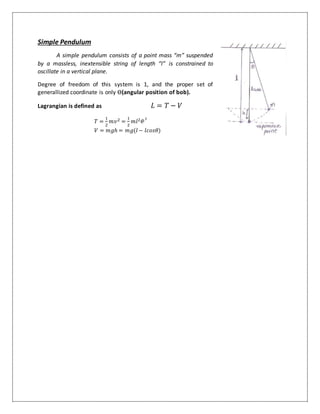
A simple pendulum consists of a point mass “m” suspended
by a massless, inextensible string of length “l” is constrained to
oscillate in a vertical plane.
Degree of freedom of this system is 1, and the proper set of
generallized coordinate is only Ө(angular position of bob).
Lagrangian is defined as 𝐿 = 𝑇 − 𝑉
𝑇 =
1
2
𝑚𝑣2 =
1
2
𝑚𝑙2 𝜃.2
𝑉 = 𝑚𝑔ℎ = 𝑚𝑔(𝑙 − 𝑙𝑐𝑜𝑠𝜃)
Atwood Machine
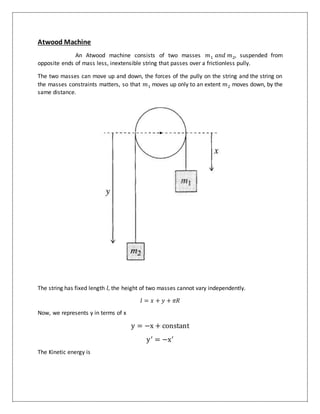
An Atwood machine consists of two masses 𝑚1 𝑎𝑛𝑑 𝑚2, suspended from
opposite ends of mass less, inextensible string that passes over a frictionless pully.
The two masses can move up and down, the forces of the pully on the string and the string on
the masses constraints matters, so that 𝑚1 moves up only to an extent 𝑚2 moves down, by the
same distance.
The string has fixed length 𝑙, the height of two masses cannot vary independently.
𝑙 = 𝑥 + 𝑦 + 𝜋𝑅
Now, we represents y in terms of x
y = −x + constant
y′
= −x′
The Kinetic energy is
The potential Energy is
Lagrangian is defined as
ℒ = 𝑇 − 𝑉
Lagrangian Equation of motion is
Newtonian Solution
Force on particle of mass 𝑚1 =
Force on particle of mass 𝑚2 =
Adding both equations
Newtonian Solution is same as Lagrangian Solution.
Double Pendulum:
A double pendulum consists of two point masses 𝑚1 𝑎𝑛𝑑 𝑚2, attached to mass
less, rigid, extensible rods of length 𝑙1 𝑎𝑛𝑑 𝑙2. The upper rod is pivoted at point “O” which
constrained him to oscillate in a vertical plane.
Let 𝑚1 𝑎𝑛𝑑 𝑚2 be the masses of pendulum bob of length 𝑙1 𝑎𝑛𝑑 𝑙2 respectively, ( 𝑥1, 𝑦1) and
(𝑥2, 𝑦2) be the coordinates of the pendulum. Degree of freedom of this system is 2. The proper
set of generallized coordinates 𝜃1 𝑎𝑛𝑑 𝜃2.
As we know that there are two independent coordinate, so there are two Lagrangian Equations.

Lagrangian Mechanics

  • 1.
    Lagrangian Mechanics Lagrangian Mechanicsis the reformulation of Classical Mechanics introduced by Italian French Mathematician and Astronomer “Joseph-Louis Lagrange” in 1788. Lagrangian is a function of generallized coordinate, their time derivative and time and contains the information about the dynamics of the system. Generallized Coordinates Minimum no. of coordinates to specify the system. Any set of variables which are used to specify the configuration of a system (of particles) are called Generallized Coordinates. Degree of Freedom: Degree of freedom of a mechanical system is “ The number of independent parameters that defines its configuration.” For Example i) Particle in a plane of two coordinates can be specified by its location, and has 2 degree of freedom. ii) A single particle in space has degree of freedom of order 3. iii) Two particles in space have combined degree of freedom of order 6. iv) Two particles in space constrained to maintain a constant distance between them have degree of freedom of order 5. General Lagrangian Equation 𝑑 𝑑𝑡 ( Ձ𝑇 Ձ𝑞 𝑘 ′ ) − ( Ձ𝑇 Ձ𝑞 𝑘 ) = 𝑄 𝑘 Standard Form of Lagrangian Equation 𝑑 𝑑𝑡 ( Ձ𝑇 Ձ𝑞 𝑘 ′ ) − ( Ձ𝐿 Ձ𝑞 𝑘 ) = 0 Where 𝐿 = 𝑇 − 𝑉
  • 2.
    Mass Spring System Sincethe particle is constrained to move along x-axis. So degree of freedom of this system is 1. Proper set of generallized coordinate is “x” only, which is independent variable. Equation of Motion by Classical Mechanics From Hook’s Law 𝑭 = −𝑘𝑥 From Newton’s 2nd Law 𝑭 = 𝑚𝑎 Comparing above equations we have 𝑚𝑥′′ = −𝑘𝑥 𝑥′′ + 𝑘 𝑚 𝑥 = 0 𝑥′′ + 𝜔2 𝑥 = 0 The solution of this differential equation is 𝑥( 𝑡) = 𝐴𝑐𝑜𝑠(𝜔𝑡 + 𝜑) Equation of motion by Lagrangian Mechanics. Lagrangian is defined as ℒ = 𝑇 − 𝑉 𝑇 = 1 2 𝑚𝑣2 𝑉 = 1 2 𝑘𝑥2 ℒ = 1 2 𝑚𝑣2 − 1 2 𝑘𝑥2 As degree of freedom of this system is 1, so there is only 1 Lagrangian Equation, which is 𝑑 𝑑𝑡 ( Ձ𝑇 Ձ𝑥′ )− ( Ձ𝐿 Ձ𝑥 ) = 0 𝑑 𝑑𝑡 ( 𝑚𝑥′)− (−𝑘𝑥) = 0 𝑚𝑥′′ + 𝑘𝑥 = 0 𝑥′′ + 𝑘 𝑚 𝑥 = 0 𝑥′′ + 𝑘 𝑚 𝑥 = 0
  • 3.
    Simple Pendulum A simplependulum consists of a point mass “m” suspended by a massless, inextensible string of length “l” is constrained to oscillate in a vertical plane. Degree of freedom of this system is 1, and the proper set of generallized coordinate is only Ө(angular position of bob). Lagrangian is defined as 𝐿 = 𝑇 − 𝑉 𝑇 = 1 2 𝑚𝑣2 = 1 2 𝑚𝑙2 𝜃.2 𝑉 = 𝑚𝑔ℎ = 𝑚𝑔(𝑙 − 𝑙𝑐𝑜𝑠𝜃)
  • 4.
    Atwood Machine An Atwoodmachine consists of two masses 𝑚1 𝑎𝑛𝑑 𝑚2, suspended from opposite ends of mass less, inextensible string that passes over a frictionless pully. The two masses can move up and down, the forces of the pully on the string and the string on the masses constraints matters, so that 𝑚1 moves up only to an extent 𝑚2 moves down, by the same distance. The string has fixed length 𝑙, the height of two masses cannot vary independently. 𝑙 = 𝑥 + 𝑦 + 𝜋𝑅 Now, we represents y in terms of x y = −x + constant y′ = −x′ The Kinetic energy is
  • 5.
    The potential Energyis Lagrangian is defined as ℒ = 𝑇 − 𝑉 Lagrangian Equation of motion is Newtonian Solution Force on particle of mass 𝑚1 = Force on particle of mass 𝑚2 = Adding both equations Newtonian Solution is same as Lagrangian Solution.
  • 6.
    Double Pendulum: A doublependulum consists of two point masses 𝑚1 𝑎𝑛𝑑 𝑚2, attached to mass less, rigid, extensible rods of length 𝑙1 𝑎𝑛𝑑 𝑙2. The upper rod is pivoted at point “O” which constrained him to oscillate in a vertical plane. Let 𝑚1 𝑎𝑛𝑑 𝑚2 be the masses of pendulum bob of length 𝑙1 𝑎𝑛𝑑 𝑙2 respectively, ( 𝑥1, 𝑦1) and (𝑥2, 𝑦2) be the coordinates of the pendulum. Degree of freedom of this system is 2. The proper set of generallized coordinates 𝜃1 𝑎𝑛𝑑 𝜃2. As we know that there are two independent coordinate, so there are two Lagrangian Equations.