DATA WAREHOUSING
Multi Dimensional
OLAP
Usando el
DW


            2
3
   Example of two-dimensional query.
         ▪ What is the total revenue generated by property sales in
           each city, in each quarter of 2004?’

       Choice of representation is based on types of
        queries end-user may ask.


4
Compare representation - three-field relational table versus two-
    dimensional matrix.
5
   Example of three-dimensional query.
         ‘What is the total revenue generated by property
         sales for each type of property (Flat or House) in
         each city, in each quarter of 2004?’


6
Data Cube
Compare representation - four-field relational table versus three-dimensional cube.
7
   A subset of highly interrelated data that is
        organized to allow users to combine any
        attributes in a cube (e.g., stores, products,
        customers, suppliers) with any metrics in the
        cube (e.g., sales, profit, units, age) to create
        various two-dimensional views, or slices, that
        can be displayed on a computer screen


8
   Cube represents data as cells in an array.

       Relational table only represents multi-
        dimensional data in two dimensions.


9
   Use multi-dimensional structures to store
     data and relationships between data.

    Multi-dimensional structures are best
     visualized as cubes of data, and cubes within
     cubes of data. Each side of a cube is a
     dimension.

    A cube can be expanded to include other
     dimensions.
10
   A cube supports matrix arithmetic.

    Multi-dimensional query response time
     depends on how many cells have to be added
     ‘on the fly’.

    As number of dimensions increases, number
     of the cube’s cells increases exponentially.

11
    However, majority of multi-dimensional
     queries use summarized, high-level data.

    Solution is to pre-aggregate (consolidate) all
     logical subtotals and totals along all
     dimensions.


12
   Pre-aggregation is valuable, as typical
     dimensions are hierarchical in nature.
      (e.g. Time dimension hierarchy - years, quarters,
      months, weeks, and days)

    Predefined hierarchy allows logical pre-
     aggregation and, conversely, allows for a
     logical ‘drill-down’.

13
   Supports common analytical operations
      Consolidation
      Drill-down
      Slicing and dicing
      Pivoting


14
    Consolidation - aggregation of data such as
     simple ‘roll-ups’ or complex expressions
     involving inter-related data.
    Drill-Down - is the reverse of consolidation and
     involves displaying the detailed data that
     comprises the consolidated data.
      The investigation of information in detail (e.g.,
       finding not only total sales but also sales by region, by
       product, or by salesperson). Finding the detailed
       sources.

15
16
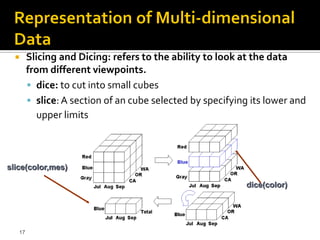
     Slicing and Dicing: refers to the ability to look at the data
        from different viewpoints.
         dice: to cut into small cubes
         slice: A section of an cube selected by specifying its lower and
           upper limits


slice(color,mes)

                                                           dice(color)


   17
   Pivoting:
      Pivot deals with presentation
      Choose some dimensions X1, . . . ,Xi to appear
       on x and some dims Y1, . . . ,Yj to appear on y.


18
   Can store data in a compressed form by dynamically
     selecting physical storage organizations and compression
     techniques that maximize space utilization.
    Dense data (that is, data that exists for a high percentage of
     cells) can be stored separately from sparse data (that is, a
     significant percentage of cells are empty).


19
   Ability to omit empty or repetitive cells can
     greatly reduce the size of the cube and the
     amount of processing.

    Allows analysis of exceptionally large
     amounts of data.


20
   In summary, pre-aggregation, dimensional
     hierarchy, and sparse data management can
     significantly reduce the size of the cube and
     the need to calculate values ‘on-the-fly’.

    Removes need for multi-table joins and
     provides quick and direct access to arrays of
     data, thus significantly speeding up
     execution of multi-dimensional queries.
21
   Efraim Turban. Business Intelligence. Prentice
    Hall.2008.

2 olap operaciones

  • 1.
  • 2.
  • 3.
  • 4.
    Example of two-dimensional query. ▪ What is the total revenue generated by property sales in each city, in each quarter of 2004?’  Choice of representation is based on types of queries end-user may ask. 4
  • 5.
    Compare representation -three-field relational table versus two- dimensional matrix. 5
  • 6.
    Example of three-dimensional query.  ‘What is the total revenue generated by property sales for each type of property (Flat or House) in each city, in each quarter of 2004?’ 6
  • 7.
    Data Cube Compare representation- four-field relational table versus three-dimensional cube. 7
  • 8.
    A subset of highly interrelated data that is organized to allow users to combine any attributes in a cube (e.g., stores, products, customers, suppliers) with any metrics in the cube (e.g., sales, profit, units, age) to create various two-dimensional views, or slices, that can be displayed on a computer screen 8
  • 9.
    Cube represents data as cells in an array.  Relational table only represents multi- dimensional data in two dimensions. 9
  • 10.
    Use multi-dimensional structures to store data and relationships between data.  Multi-dimensional structures are best visualized as cubes of data, and cubes within cubes of data. Each side of a cube is a dimension.  A cube can be expanded to include other dimensions. 10
  • 11.
    A cube supports matrix arithmetic.  Multi-dimensional query response time depends on how many cells have to be added ‘on the fly’.  As number of dimensions increases, number of the cube’s cells increases exponentially. 11
  • 12.
    However, majority of multi-dimensional queries use summarized, high-level data.  Solution is to pre-aggregate (consolidate) all logical subtotals and totals along all dimensions. 12
  • 13.
    Pre-aggregation is valuable, as typical dimensions are hierarchical in nature.  (e.g. Time dimension hierarchy - years, quarters, months, weeks, and days)  Predefined hierarchy allows logical pre- aggregation and, conversely, allows for a logical ‘drill-down’. 13
  • 14.
    Supports common analytical operations  Consolidation  Drill-down  Slicing and dicing  Pivoting 14
  • 15.
    Consolidation - aggregation of data such as simple ‘roll-ups’ or complex expressions involving inter-related data.  Drill-Down - is the reverse of consolidation and involves displaying the detailed data that comprises the consolidated data.  The investigation of information in detail (e.g., finding not only total sales but also sales by region, by product, or by salesperson). Finding the detailed sources. 15
  • 16.
  • 17.
    Slicing and Dicing: refers to the ability to look at the data from different viewpoints.  dice: to cut into small cubes  slice: A section of an cube selected by specifying its lower and upper limits slice(color,mes) dice(color) 17
  • 18.
    Pivoting:  Pivot deals with presentation  Choose some dimensions X1, . . . ,Xi to appear on x and some dims Y1, . . . ,Yj to appear on y. 18
  • 19.
    Can store data in a compressed form by dynamically selecting physical storage organizations and compression techniques that maximize space utilization.  Dense data (that is, data that exists for a high percentage of cells) can be stored separately from sparse data (that is, a significant percentage of cells are empty). 19
  • 20.
    Ability to omit empty or repetitive cells can greatly reduce the size of the cube and the amount of processing.  Allows analysis of exceptionally large amounts of data. 20
  • 21.
    In summary, pre-aggregation, dimensional hierarchy, and sparse data management can significantly reduce the size of the cube and the need to calculate values ‘on-the-fly’.  Removes need for multi-table joins and provides quick and direct access to arrays of data, thus significantly speeding up execution of multi-dimensional queries. 21
  • 22.
    Efraim Turban. Business Intelligence. Prentice Hall.2008.