OLAP Categories
   OLAP tools are categorized according to the
    architecture used to store and process multi-
    dimensional data.

   There are four main categories:
     Multi-dimensional OLAP (MOLAP)
     Relational OLAP (ROLAP)
     Hybrid OLAP (HOLAP)
     Desktop OLAP (DOLAP)
2
   Use specialized data structures and multi-
        dimensional Database Management Systems
        (MDDBMSs) to organize, navigate, and
        analyze data.

       Data is typically aggregated and stored
        according to predicted usage to enhance
        query performance.
3
   Use array technology and efficient storage
    techniques that minimize the disk space
    requirements through sparse data
    management.

   Provides excellent performance when data is
    used as designed, and the focus is on data for
    a specific decision-support application.

4
   Traditionally, require a tight coupling with the
    application layer and presentation layer.

   Recent trends segregate the OLAP from the
    data structures through the use of published
    application programming interfaces (APIs).


5
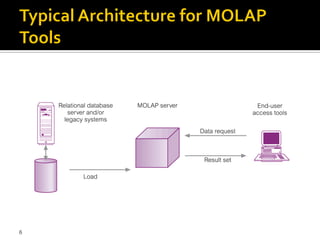
6
   MOLAP products require a different set of
        skills and tools to build and maintain the
        database, thus increasing the cost and
        complexity of support.


7
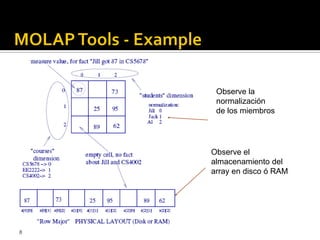
Observe la
     normalización
     de los miembros


    Observe el
    almacenamiento del
    array en disco ó RAM


8
   Fastest-growing style of OLAP technology
    due to requirements to analyze ever-
    increasing amounts of data and the
    realization that users cannot store all the
    data they require in MOLAP databases.


9
   Supports RDBMS products using a metadata
     layer - avoids need to create a static multi-
     dimensional data structure - facilitates the
     creation of multiple multi-dimensional views
     of the two-dimensional relation.


10
   To improve performance, some products use
     SQL engines to support the complexity of
     multi-dimensional analysis, while others
     recommend, or require, the use of highly
     denormalized database designs such as the
     star schema.


11
12
    Performance problems associated with the
     processing of complex queries that require
     multiple passes through the relational data.

    Middleware to facilitate the development of
     multi-dimensional applications. (Software
     that converts the two-dimensional relation
     into a multi-dimensional structure).
13
   Provide limited analysis capability, either
     directly against RDBMS products, or by using
     an intermediate MOLAP server.

    Deliver selected data directly from the DBMS
     or via a MOLAP server to the desktop (or
     local server) in the form of a datacube, where
     it is stored, analyzed, and maintained locally.

14
    Promoted as being relatively simple to install
     and administer with reduced cost and
     maintenance.


15
16
   Architecture results in significant data
     redundancy and may cause problems for
     networks that support many users.

    Ability of each user to build a custom
     datacube may cause a lack of data
     consistency among users.

    Only a limited amount of data can be
     efficiently maintained.
17
    Store the OLAP data in client-based files and
     support multi-dimensional processing using a
     client multi-dimensional engine.

    Requires that relatively small extracts of data
     are held on client machines. They may be
     distributed in advance, or created on demand
     (possibly through the Web).
18
    As with multi-dimensional databases on the
     server, OLAP data may be held on disk or in
     RAM, however, some DOLAP products allow
     only read access.

    Most vendors of DOLAP exploit the power of
     desktop PC to perform some, if not most,
     multi-dimensional calculations.

19
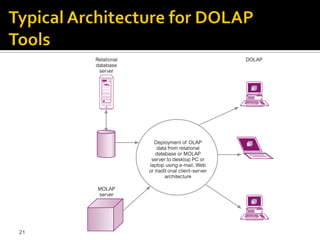
    The administration of a DOLAP database is
     typically performed by a central server or
     processing routine that prepares data cubes
     or sets of data for each user.

    Once the basic processing is done, each user
     can then access their portion of the data.


20
21
    Provision of appropriate security controls to
     support all parts of the DOLAP environment.
     Since the data is physically extracted from
     the system, security is generally
     implemented by limiting the information
     compiled into each cube. Once each cube is
     uploaded to the user's desktop, all additional
     meta data becomes the property of the local
     user.
22
   Reduction in the effort involved in deploying
     and maintaining the DOLAP tools. Some
     DOLAP vendors now provide a range of
     alternative ways of deploying OLAP data
     such as through e-mail, the Web or using
     traditional client/server architecture.

    Current trends are towards thin client
     machines.
23
   Efraim Turban. Business Intelligence. Prentice
    Hall.2008.

3 olap storage

  • 1.
  • 2.
    OLAP tools are categorized according to the architecture used to store and process multi- dimensional data.  There are four main categories:  Multi-dimensional OLAP (MOLAP)  Relational OLAP (ROLAP)  Hybrid OLAP (HOLAP)  Desktop OLAP (DOLAP) 2
  • 3.
    Use specialized data structures and multi- dimensional Database Management Systems (MDDBMSs) to organize, navigate, and analyze data.  Data is typically aggregated and stored according to predicted usage to enhance query performance. 3
  • 4.
    Use array technology and efficient storage techniques that minimize the disk space requirements through sparse data management.  Provides excellent performance when data is used as designed, and the focus is on data for a specific decision-support application. 4
  • 5.
    Traditionally, require a tight coupling with the application layer and presentation layer.  Recent trends segregate the OLAP from the data structures through the use of published application programming interfaces (APIs). 5
  • 6.
  • 7.
    MOLAP products require a different set of skills and tools to build and maintain the database, thus increasing the cost and complexity of support. 7
  • 8.
    Observe la normalización de los miembros Observe el almacenamiento del array en disco ó RAM 8
  • 9.
    Fastest-growing style of OLAP technology due to requirements to analyze ever- increasing amounts of data and the realization that users cannot store all the data they require in MOLAP databases. 9
  • 10.
    Supports RDBMS products using a metadata layer - avoids need to create a static multi- dimensional data structure - facilitates the creation of multiple multi-dimensional views of the two-dimensional relation. 10
  • 11.
    To improve performance, some products use SQL engines to support the complexity of multi-dimensional analysis, while others recommend, or require, the use of highly denormalized database designs such as the star schema. 11
  • 12.
  • 13.
    Performance problems associated with the processing of complex queries that require multiple passes through the relational data.  Middleware to facilitate the development of multi-dimensional applications. (Software that converts the two-dimensional relation into a multi-dimensional structure). 13
  • 14.
    Provide limited analysis capability, either directly against RDBMS products, or by using an intermediate MOLAP server.  Deliver selected data directly from the DBMS or via a MOLAP server to the desktop (or local server) in the form of a datacube, where it is stored, analyzed, and maintained locally. 14
  • 15.
    Promoted as being relatively simple to install and administer with reduced cost and maintenance. 15
  • 16.
  • 17.
    Architecture results in significant data redundancy and may cause problems for networks that support many users.  Ability of each user to build a custom datacube may cause a lack of data consistency among users.  Only a limited amount of data can be efficiently maintained. 17
  • 18.
    Store the OLAP data in client-based files and support multi-dimensional processing using a client multi-dimensional engine.  Requires that relatively small extracts of data are held on client machines. They may be distributed in advance, or created on demand (possibly through the Web). 18
  • 19.
    As with multi-dimensional databases on the server, OLAP data may be held on disk or in RAM, however, some DOLAP products allow only read access.  Most vendors of DOLAP exploit the power of desktop PC to perform some, if not most, multi-dimensional calculations. 19
  • 20.
    The administration of a DOLAP database is typically performed by a central server or processing routine that prepares data cubes or sets of data for each user.  Once the basic processing is done, each user can then access their portion of the data. 20
  • 21.
  • 22.
    Provision of appropriate security controls to support all parts of the DOLAP environment. Since the data is physically extracted from the system, security is generally implemented by limiting the information compiled into each cube. Once each cube is uploaded to the user's desktop, all additional meta data becomes the property of the local user. 22
  • 23.
    Reduction in the effort involved in deploying and maintaining the DOLAP tools. Some DOLAP vendors now provide a range of alternative ways of deploying OLAP data such as through e-mail, the Web or using traditional client/server architecture.  Current trends are towards thin client machines. 23
  • 24.
    Efraim Turban. Business Intelligence. Prentice Hall.2008.