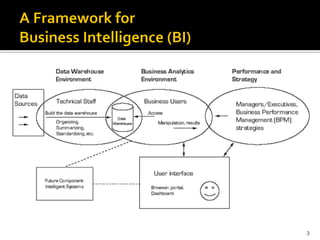
   BI’s Architecture and Components
     Data Warehouse
     Business Analytics
      ▪ Automated decision systems
     Performance and Strategy


                                       2
3
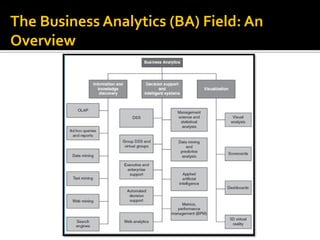
The Business Analytics (BA) Field: An
Overview

    The Essentials of BA
      Analytics
       The science of analysis.
      Business analytics (BA)
       The application of models directly to business data.
       ▪ BA involves using MSS (Management Support System)
         tools, especially models, in assisting decision makers;
         essentially a form of OLAP decision support
The Business Analytics (BA) Field: An
Overview
Online Analytical Processing (OLAP)

   Online analytical processing (OLAP)
    Online analytical processing technology that
    creates new business information through a
    robust set of business transformation and
    calculations executed upon existing data
Online Analytical Processing (OLAP)

   Online analytical processing (OLAP)
    The use of a set of graphical tools that
    provides users with multidimensional views
    of their data and allows them to analyze the
    data using simple windowing techniques
Online Analytical Processing (OLAP)

       OLAP versus OLTP
        OLTP concentrates on processing repetitive
         transactions in large quantities and conducting
         simple manipulations
        OLAP involves examining many data items
         complex relationships
        OLAP may analyze relationships and look for
         patterns, trends, and exceptions
        OLAP is a direct decision support method
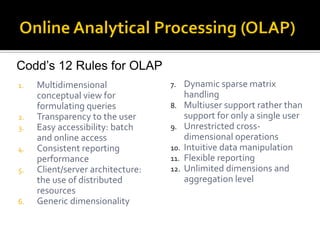
Codd’s 12 Rules for OLAP
1.   Multidimensional              7.    Dynamic sparse matrix
     conceptual view for                 handling
     formulating queries           8.    Multiuser support rather than
2.   Transparency to the user            support for only a single user
3.   Easy accessibility: batch     9.    Unrestricted cross-
     and online access                   dimensional operations
4.   Consistent reporting          10.   Intuitive data manipulation
     performance                   11.   Flexible reporting
5.   Client/server architecture:   12.   Unlimited dimensions and
     the use of distributed              aggregation level
     resources
6.   Generic dimensionality
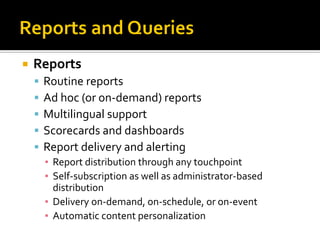
   Reports
       Routine reports
       Ad hoc (or on-demand) reports
       Multilingual support
       Scorecards and dashboards
       Report delivery and alerting
        ▪ Report distribution through any touchpoint
        ▪ Self-subscription as well as administrator-based
          distribution
        ▪ Delivery on-demand, on-schedule, or on-event
        ▪ Automatic content personalization
   Ad hoc query
    A query that cannot be determined prior to
    the moment the query is issued
   Structured Query Language (SQL)
    A data definition and management language
    for relational databases. SQL front ends most
    relational DBMS
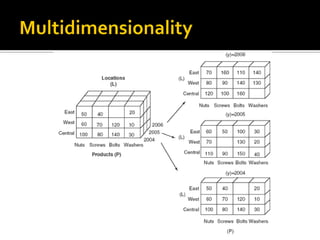
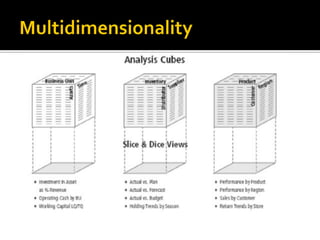
   Multidimensionality
    The ability to organize, present, and analyze
    data by several dimensions, such as sales by
    region, by product, by salesperson, and by
    time (four dimensions)
   Multidimensional presentation
     Dimensions
     Measures
     Time
   Multidimensional tools and vendors
     Tools with multidimensional capabilities often
     work in conjunction with database query systems
     and other OLAP tools
   Limitations of dimensionality
     The multidimensional database can take up significantly
      more computer storage room than a summarized
      relational database
     Multidimensional products cost significantly more than
      standard relational products
     Database loading consumes significant system resources
      and time, depending on data volume and the number of
      dimensions
     Interfaces and maintenance are more complex in
      multidimensional databases than in relational databases
   Efraim Turban. Business Intelligence. Prentice
    Hall.2008.

1 introba

  • 2.
    BI’s Architecture and Components  Data Warehouse  Business Analytics ▪ Automated decision systems  Performance and Strategy 2
  • 3.
  • 4.
    The Business Analytics(BA) Field: An Overview  The Essentials of BA  Analytics The science of analysis.  Business analytics (BA) The application of models directly to business data. ▪ BA involves using MSS (Management Support System) tools, especially models, in assisting decision makers; essentially a form of OLAP decision support
  • 5.
    The Business Analytics(BA) Field: An Overview
  • 6.
    Online Analytical Processing(OLAP)  Online analytical processing (OLAP) Online analytical processing technology that creates new business information through a robust set of business transformation and calculations executed upon existing data
  • 7.
    Online Analytical Processing(OLAP)  Online analytical processing (OLAP) The use of a set of graphical tools that provides users with multidimensional views of their data and allows them to analyze the data using simple windowing techniques
  • 8.
    Online Analytical Processing(OLAP)  OLAP versus OLTP  OLTP concentrates on processing repetitive transactions in large quantities and conducting simple manipulations  OLAP involves examining many data items complex relationships  OLAP may analyze relationships and look for patterns, trends, and exceptions  OLAP is a direct decision support method
  • 9.
    Codd’s 12 Rulesfor OLAP 1. Multidimensional 7. Dynamic sparse matrix conceptual view for handling formulating queries 8. Multiuser support rather than 2. Transparency to the user support for only a single user 3. Easy accessibility: batch 9. Unrestricted cross- and online access dimensional operations 4. Consistent reporting 10. Intuitive data manipulation performance 11. Flexible reporting 5. Client/server architecture: 12. Unlimited dimensions and the use of distributed aggregation level resources 6. Generic dimensionality
  • 10.
    Reports  Routine reports  Ad hoc (or on-demand) reports  Multilingual support  Scorecards and dashboards  Report delivery and alerting ▪ Report distribution through any touchpoint ▪ Self-subscription as well as administrator-based distribution ▪ Delivery on-demand, on-schedule, or on-event ▪ Automatic content personalization
  • 11.
    Ad hoc query A query that cannot be determined prior to the moment the query is issued  Structured Query Language (SQL) A data definition and management language for relational databases. SQL front ends most relational DBMS
  • 12.
    Multidimensionality The ability to organize, present, and analyze data by several dimensions, such as sales by region, by product, by salesperson, and by time (four dimensions)  Multidimensional presentation  Dimensions  Measures  Time
  • 15.
    Multidimensional tools and vendors  Tools with multidimensional capabilities often work in conjunction with database query systems and other OLAP tools
  • 16.
    Limitations of dimensionality  The multidimensional database can take up significantly more computer storage room than a summarized relational database  Multidimensional products cost significantly more than standard relational products  Database loading consumes significant system resources and time, depending on data volume and the number of dimensions  Interfaces and maintenance are more complex in multidimensional databases than in relational databases
  • 17.
    Efraim Turban. Business Intelligence. Prentice Hall.2008.