Introduction toIntroduction to
DataData
WarehousingWarehousing
What is Data Warehouse?What is Data Warehouse?
• “A data warehouse is a subject-oriented, integrated,
time-variant, and nonvolatile collection of data in
support of management’s decision-making
process.”—W. H. Inmon
• A Data Warehouse is used for On-Line-Analytical-
Processing:
“Class of tools that enables the user to gain insight into data through interactive
access to a wide variety of possible views of the information”
• 3 Billion market worldwide [1999 figure,
olapreport.com]
o Retail industries: user profiling, inventory management
o Financial services: credit card analysis, fraud detection
o Telecommunications: call analysis, fraud detection
Data Warehouse InitiativesData Warehouse Initiatives
• Organized around major subjects, such as customer, product,
sales
o integrate multiple, heterogeneous data sources
o exclude data that are not useful in the decision support process
• Focusing on the modeling and analysis of data for decision
makers, not on daily operations or transaction processing
o emphasis is on complex, exploratory analysis not day-to-day operations
• Large time horizon for trend analysis (current and past data)
• Non-Volatile store
o physically separate store from the operational environment
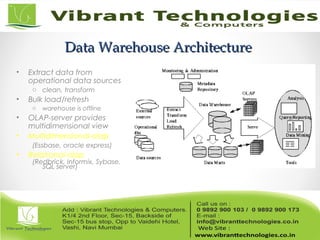
Data Warehouse ArchitectureData Warehouse Architecture
• Extract data from
operational data sources
o clean, transform
• Bulk load/refresh
o warehouse is offline
• OLAP-server provides
multidimensional view
• Multidimensional-olap
(Essbase, oracle express)
• Relational-olap
(Redbrick, Informix, Sybase,
SQL server)
Why do we need all that?Why do we need all that?
• Operational databases are for On Line Transaction Processing
o automate day-to-day operations (purchasing, banking etc)
o transactions access (and modify!) a few records at a time
o database design is application oriented
o metric: transactions/sec
• Data Warehouse is for On Line Analytical Processing (OLAP)
o complex queries that access millions of records
o need historical data for trend analysis
o long scans would interfere with normal operations
o synchronizing data-intensive queries among physically separated
databases would be a nightmare!
o metric: query response time
Examples of OLAPExamples of OLAP
• Comparisons (this period v.s. last period)
o Show me the sales per region for this year and compare it to that of the
previous year to identify discrepancies
• Multidimensional ratios (percent to total)
o Show me the contribution to weekly profit made by all items sold in the
northeast stores between may 1 and may 7
• Ranking and statistical profiles (top N/bottom N)
o Show me sales, profit and average call volume per day for my 10 most
profitable salespeople
• Custom consolidation (market segments, ad hoc groups)
o Show me an abbreviated income statement by quarter for the last four
quarters for my northeast region operations
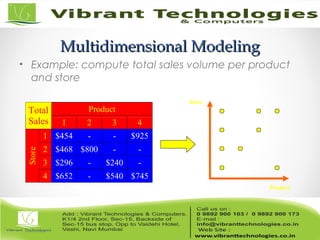
Multidimensional ModelingMultidimensional Modeling
• Example: compute total sales volume per product
and store
ProductTotal
Sales 1 2 3 4
1 $454 - - $925
2 $468 $800 - -
3 $296 - $240 -
Store
4 $652 - $540 $745
Product
Store
800
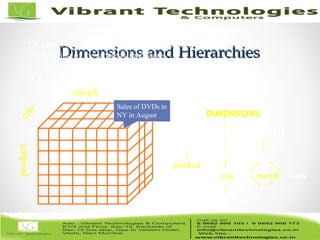
Dimensions and HierarchiesDimensions and Hierarchies
DIMENSIONS
month
NY
category region year
product country quarter
city month week
day
store
PRODUCT LOCATION TIME
productcity
DVD
August
Sales of DVDs in
NY in August
• A cell in the cube may store values (measurements) relative to the
combination of the labeled dimensions
• A cell in the cube may store values (measurements) relative to the
combination of the labeled dimensions• A cell in the cube may store values (measurements) relative to the
combination of the labeled dimensions
• A cell in the cube may store values (measurements) relative to the
combination of the labeled dimensions
• A cell in the cube may store values (measurements) relative to the
combination of the labeled dimensions
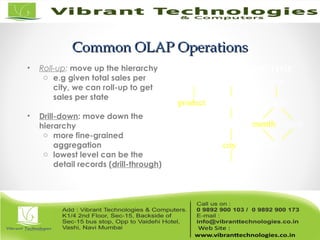
Common OLAP OperationsCommon OLAP Operations
• Roll-up: move up the hierarchy
o e.g given total sales per
city, we can roll-up to get
sales per state
• Drill-down: move down the
hierarchy
o more fine-grained
aggregation
o lowest level can be the
detail records (drill-through)
category region year
product country quarter
state month week
city day
store
PRODUCT LOCATION TIME
PivotingPivoting
• Pivoting: aggregate on selected dimensions
o usually 2 dims (cross-tabulation)
Product
Sales
1 2 3 4 ALL
1 454 - - 925 1379
2 468 800 - - 1268
3 296 - 240 - 536
4 652 - 540 745 1937
Store
ALL 1870 800 780 1670 5120
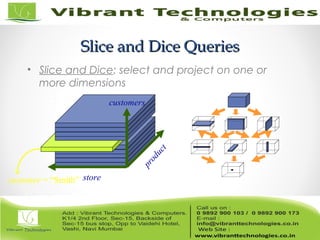
Slice and Dice QueriesSlice and Dice Queries
• Slice and Dice: select and project on one or
more dimensions
product
customers
storecustomer = “Smith”
RoadmapRoadmap
• What is a data warehouse and what it is for
• What are the differences between OLTP and OLAP
• Multi-dimensional data modeling
• Data warehouse design
o the star schema, bitmap indexes
• The Data Cube operator
o semantics and computation
• Aggregate View Selection
• Other Issues
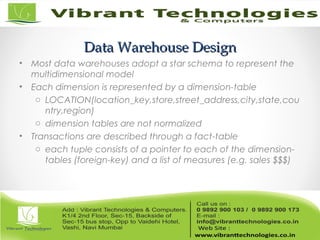
Data Warehouse DesignData Warehouse Design
• Most data warehouses adopt a star schema to represent the
multidimensional model
• Each dimension is represented by a dimension-table
o LOCATION(location_key,store,street_address,city,state,cou
ntry,region)
o dimension tables are not normalized
• Transactions are described through a fact-table
o each tuple consists of a pointer to each of the dimension-
tables (foreign-key) and a list of measures (e.g. sales $$$)
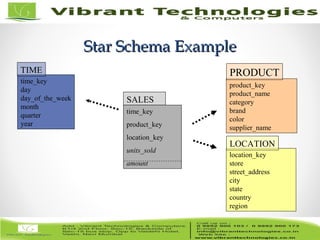
Star Schema ExampleStar Schema Example
time_key
day
day_of_the_week
month
quarter
year
TIME
location_key
store
street_address
city
state
country
region
LOCATION
SALES
product_key
product_name
category
brand
color
supplier_name
PRODUCT
time_key
product_key
location_key
units_sold
amount
{measures
Advantages of Star SchemaAdvantages of Star Schema
• Facts and dimensions are clearly depicted
o dimension tables are relatively static, data is loaded (append
mostly) into fact table(s)
o easy to comprehend (and write queries)
“Find total sales per product-category in our stores in Europe”
SELECT PRODUCT.category, SUM(SALES.amount)
FROM SALES, PRODUCT,LOCATION
WHERE SALES.product_key = PRODUCT.product_key
AND SALES.location_key = LOCATION.location_key
AND LOCATION.region=“Europe”
GROUP BY PRODUCT.category
Star Schema Query ProcessingStar Schema Query Processing
{measures
JOIN
time_key
day
day_of_the_week
month
quarter
year
TIME
location_key
store
street_address
city
state
country
region
LOCATION
SALES
product_key
product_name
category
brand
color
supplier_name
PRODUCT
time_key
product_key
location_key
units_sold
amount
JOIN
Sregion=“Europe”
Pcategory
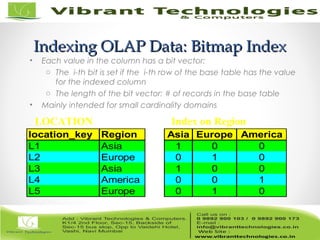
Indexing OLAP Data: Bitmap IndexIndexing OLAP Data: Bitmap Index
• Each value in the column has a bit vector:
o The i-th bit is set if the i-th row of the base table has the value
for the indexed column
o The length of the bit vector: # of records in the base table
• Mainly intended for small cardinality domains
location_key Region
L1 Asia
L2 Europe
L3 Asia
L4 America
L5 Europe
Asia Europe America
1 0 0
0 1 0
1 0 0
0 0 1
0 1 0
LOCATION Index on Region
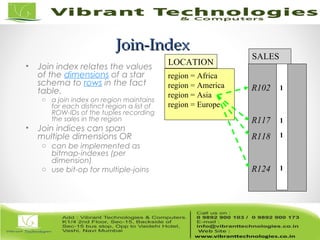
Join-IndexJoin-Index
• Join index relates the values
of the dimensions of a star
schema to rows in the fact
table.
o a join index on region maintains
for each distinct region a list of
ROW-IDs of the tuples recording
the sales in the region
• Join indices can span
multiple dimensions OR
o can be implemented as
bitmap-indexes (per
dimension)
o use bit-op for multiple-joins
R102
R117
R118
R124
SALES
region = Africa
region = America
region = Asia
region = Europe
LOCATION
1
1
1
1
Problem Solved?Problem Solved?
• “Find total sales per product-category in our stores in Europe”
o Join-index will prune ¾ of the data (uniform sales), but the remaining ¼ is
still large (several millions transactions)
• Index is unclustered
• High level aggregations are expensive!!!!!
o long scans to get the data
o hashing or sorting necessary for group-bys region
country
state
city
store
LOCATON
⇒Long Query Response Times
⇒Pre-computation is necessary
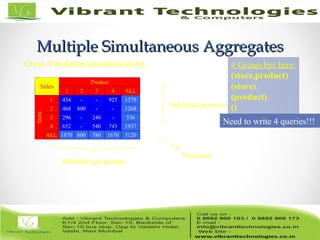
Multiple Simultaneous AggregatesMultiple Simultaneous Aggregates
Product
Sales
1 2 3 4 ALL
1 454 - - 925 1379
2 468 800 - - 1268
3 296 - 240 - 536
4 652 - 540 745 1937
Store
ALL 1870 800 780 1670 5120
Cross-Tabulation (products/store)
Sub-totals per store
Sub-totals per product
Total sales
4 Group-bys here:
(store,product)
(store)
(product)
()
Need to write 4 queries!!!
The Data Cube Operator (Gray et al)The Data Cube Operator (Gray et al)
• All previous aggregates in a single query:
SELECT LOCATION.store, SALES.product_key, SUM (amount)
FROM SALES, LOCATION
WHERE SALES.location_key=LOCATION.location_key
CUBE BY SALES.product_key, LOCATION.store
Challenge: Optimize Aggregate Computation
Store Product_key sum(amout)
1 1 454
1 4 925
2 1 468
2 2 800
3 1 296
3 3 240
4 1 625
4 3 240
4 4 745
1 ALL 1379
1 ALL 1268
1 ALL 536
1 ALL 1937
ALL 1 1870
ALL 2 800
ALL 3 780
ALL 4 1670
ALL ALL 5120
Relational View of Data CubeRelational View of Data Cube
Product
Sales
1 2 3 4 ALL
1 454 - - 925 1379
2 468 800 - - 1268
3 296 - 240 - 536
4 652 - 540 745 1937
Store
ALL 1870 800 780 1670 5120
SELECT LOCATION.store, SALES.product_key, SUM (amount)
FROM SALES, LOCATION
WHERE SALES.location_key=LOCATION.location_key
CUBE BY SALES.product_key, LOCATION.store
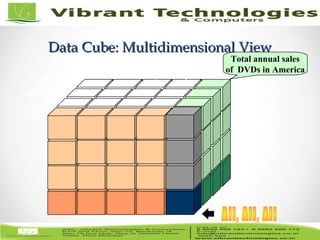
Data Cube: Multidimensional ViewData Cube: Multidimensional View
Total annual sales
of DVDs in America
Quarter
Product
Region
sum
sum
DVD
VCR
PC
1Qtr 2Qtr 3Qtr 4Qtr
America
Europe
Asia
sum
Other Extensions to SQLOther Extensions to SQL
• Complex aggregation at multiple granularities (Ross et. all 1998)
o Compute multiple dependent aggregates
• Other proposals: the MD-join operator (Chatziantoniou et. all 1999]
SELECT LOCATION.store, SALES.product_key, SUM (amount)
FROM SALES, LOCATION
WHERE SALES.location_key=LOCATION.location_key
CUBE BY SALES.product_key, LOCATION.store: R
SUCH THAT R.amount = max(amount)
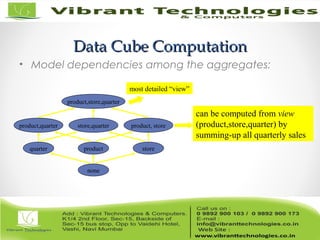
Data Cube ComputationData Cube Computation
• Model dependencies among the aggregates:
most detailed “view”
can be computed from view
(product,store,quarter) by
summing-up all quarterly sales
product,store,quarter
product storequarter
none
store,quarterproduct,quarter product, store
Computation DirectivesComputation Directives
• Hash/sort based methods (Agrawal et. al. VLDB’96)
1. Smallest-parent
2. Cache-results
3. Amortize-scans
4. Share-sorts
5. Share-partitions
product,store,quarter
product storequarter
none
store,quarterproduct,quarter product, store
Alternative Array-based ApproachAlternative Array-based Approach
• Model data as a sparse multidimensional array
o partition array into chunks (a small sub-cube which fits in
memory).
o fast addressing based on (chunk_id, offset)
• Compute aggregates in “multi-way” by visiting cube cells in
the order which minimizes the # of times to visit each cell, and
reduces memory access and storage cost.
B
What is the best
traversing order to do
multi-way aggregation?
Reality check:too many views!Reality check:too many views!
• 2n
views for n
dimensions
(no-
hierarchies)
• Storage/upd
ate-time
explosion
• More pre-
computation
doesn’t mean
better
performance!
!!!
How to choose among the views?How to choose among the views?
• Use some notion of benefit per view
• Limit: disk space or maintenance-time
product,store,quarter
product storequarter
none
store,quarterproduct,quarter product, store
Hanarayan et al SIGMOD’96:
Pick views greedily until space is
filled
∑
<≤
−=
)()(,:
))()((),(
uCuCvuu
vS
Sv
uCuCSvB
Catch: quadratic in the number
of views, which is exponential!!!
View Selection ProblemView Selection Problem
• Selection is based on a workload estimate (e.g. logs) and a
given constraint (disk space or update window)
• NP-hard, optimal selection can not be computed > 4-5
dimensions
o greedy algorithms (e.g. [Harinarayan96]) run at least in polynomial
time in the number of views i.e exponential in the number of
dimensions!!!
• Optimal selection can not be approximated [Karloff99]
o greedy view selection can behave arbitrary bad
• Lack of good models for a cost-based optimization!
Other IssuesOther Issues
• Fact+Dimension tables in the DW are views of tables stored in the
sources
• Lots of view maintenance problems
o correctly reflect asynchronous changes at the sources
o making views self-maintainable
• Interactive queries (on-line aggregation)
o e.g. show running-estimates + confidence intervals
• Computing Iceberg queries efficiently
• Approximation
o rough-estimates for hi-level aggregates are often good-enough
o histogram, wavelet, sampling based techniques (e.g. AQUA)
ThankThank You !!!You !!!
For More Information click below link:
Follow Us on:
http://vibranttechnologies.co.in/datawarehousing-classes-in-mumbai.html

Data ware housing- Introduction to olap .

  • 2.
  • 3.
    What is DataWarehouse?What is Data Warehouse? • “A data warehouse is a subject-oriented, integrated, time-variant, and nonvolatile collection of data in support of management’s decision-making process.”—W. H. Inmon • A Data Warehouse is used for On-Line-Analytical- Processing: “Class of tools that enables the user to gain insight into data through interactive access to a wide variety of possible views of the information” • 3 Billion market worldwide [1999 figure, olapreport.com] o Retail industries: user profiling, inventory management o Financial services: credit card analysis, fraud detection o Telecommunications: call analysis, fraud detection
  • 4.
    Data Warehouse InitiativesDataWarehouse Initiatives • Organized around major subjects, such as customer, product, sales o integrate multiple, heterogeneous data sources o exclude data that are not useful in the decision support process • Focusing on the modeling and analysis of data for decision makers, not on daily operations or transaction processing o emphasis is on complex, exploratory analysis not day-to-day operations • Large time horizon for trend analysis (current and past data) • Non-Volatile store o physically separate store from the operational environment
  • 5.
    Data Warehouse ArchitectureDataWarehouse Architecture • Extract data from operational data sources o clean, transform • Bulk load/refresh o warehouse is offline • OLAP-server provides multidimensional view • Multidimensional-olap (Essbase, oracle express) • Relational-olap (Redbrick, Informix, Sybase, SQL server)
  • 6.
    Why do weneed all that?Why do we need all that? • Operational databases are for On Line Transaction Processing o automate day-to-day operations (purchasing, banking etc) o transactions access (and modify!) a few records at a time o database design is application oriented o metric: transactions/sec • Data Warehouse is for On Line Analytical Processing (OLAP) o complex queries that access millions of records o need historical data for trend analysis o long scans would interfere with normal operations o synchronizing data-intensive queries among physically separated databases would be a nightmare! o metric: query response time
  • 7.
    Examples of OLAPExamplesof OLAP • Comparisons (this period v.s. last period) o Show me the sales per region for this year and compare it to that of the previous year to identify discrepancies • Multidimensional ratios (percent to total) o Show me the contribution to weekly profit made by all items sold in the northeast stores between may 1 and may 7 • Ranking and statistical profiles (top N/bottom N) o Show me sales, profit and average call volume per day for my 10 most profitable salespeople • Custom consolidation (market segments, ad hoc groups) o Show me an abbreviated income statement by quarter for the last four quarters for my northeast region operations
  • 8.
    Multidimensional ModelingMultidimensional Modeling •Example: compute total sales volume per product and store ProductTotal Sales 1 2 3 4 1 $454 - - $925 2 $468 $800 - - 3 $296 - $240 - Store 4 $652 - $540 $745 Product Store 800
  • 9.
    Dimensions and HierarchiesDimensionsand Hierarchies DIMENSIONS month NY category region year product country quarter city month week day store PRODUCT LOCATION TIME productcity DVD August Sales of DVDs in NY in August • A cell in the cube may store values (measurements) relative to the combination of the labeled dimensions • A cell in the cube may store values (measurements) relative to the combination of the labeled dimensions• A cell in the cube may store values (measurements) relative to the combination of the labeled dimensions • A cell in the cube may store values (measurements) relative to the combination of the labeled dimensions • A cell in the cube may store values (measurements) relative to the combination of the labeled dimensions
  • 10.
    Common OLAP OperationsCommonOLAP Operations • Roll-up: move up the hierarchy o e.g given total sales per city, we can roll-up to get sales per state • Drill-down: move down the hierarchy o more fine-grained aggregation o lowest level can be the detail records (drill-through) category region year product country quarter state month week city day store PRODUCT LOCATION TIME
  • 11.
    PivotingPivoting • Pivoting: aggregateon selected dimensions o usually 2 dims (cross-tabulation) Product Sales 1 2 3 4 ALL 1 454 - - 925 1379 2 468 800 - - 1268 3 296 - 240 - 536 4 652 - 540 745 1937 Store ALL 1870 800 780 1670 5120
  • 12.
    Slice and DiceQueriesSlice and Dice Queries • Slice and Dice: select and project on one or more dimensions product customers storecustomer = “Smith”
  • 13.
    RoadmapRoadmap • What isa data warehouse and what it is for • What are the differences between OLTP and OLAP • Multi-dimensional data modeling • Data warehouse design o the star schema, bitmap indexes • The Data Cube operator o semantics and computation • Aggregate View Selection • Other Issues
  • 14.
    Data Warehouse DesignDataWarehouse Design • Most data warehouses adopt a star schema to represent the multidimensional model • Each dimension is represented by a dimension-table o LOCATION(location_key,store,street_address,city,state,cou ntry,region) o dimension tables are not normalized • Transactions are described through a fact-table o each tuple consists of a pointer to each of the dimension- tables (foreign-key) and a list of measures (e.g. sales $$$)
  • 15.
    Star Schema ExampleStarSchema Example time_key day day_of_the_week month quarter year TIME location_key store street_address city state country region LOCATION SALES product_key product_name category brand color supplier_name PRODUCT time_key product_key location_key units_sold amount {measures
  • 16.
    Advantages of StarSchemaAdvantages of Star Schema • Facts and dimensions are clearly depicted o dimension tables are relatively static, data is loaded (append mostly) into fact table(s) o easy to comprehend (and write queries) “Find total sales per product-category in our stores in Europe” SELECT PRODUCT.category, SUM(SALES.amount) FROM SALES, PRODUCT,LOCATION WHERE SALES.product_key = PRODUCT.product_key AND SALES.location_key = LOCATION.location_key AND LOCATION.region=“Europe” GROUP BY PRODUCT.category
  • 17.
    Star Schema QueryProcessingStar Schema Query Processing {measures JOIN time_key day day_of_the_week month quarter year TIME location_key store street_address city state country region LOCATION SALES product_key product_name category brand color supplier_name PRODUCT time_key product_key location_key units_sold amount JOIN Sregion=“Europe” Pcategory
  • 18.
    Indexing OLAP Data:Bitmap IndexIndexing OLAP Data: Bitmap Index • Each value in the column has a bit vector: o The i-th bit is set if the i-th row of the base table has the value for the indexed column o The length of the bit vector: # of records in the base table • Mainly intended for small cardinality domains location_key Region L1 Asia L2 Europe L3 Asia L4 America L5 Europe Asia Europe America 1 0 0 0 1 0 1 0 0 0 0 1 0 1 0 LOCATION Index on Region
  • 19.
    Join-IndexJoin-Index • Join indexrelates the values of the dimensions of a star schema to rows in the fact table. o a join index on region maintains for each distinct region a list of ROW-IDs of the tuples recording the sales in the region • Join indices can span multiple dimensions OR o can be implemented as bitmap-indexes (per dimension) o use bit-op for multiple-joins R102 R117 R118 R124 SALES region = Africa region = America region = Asia region = Europe LOCATION 1 1 1 1
  • 20.
    Problem Solved?Problem Solved? •“Find total sales per product-category in our stores in Europe” o Join-index will prune ¾ of the data (uniform sales), but the remaining ¼ is still large (several millions transactions) • Index is unclustered • High level aggregations are expensive!!!!! o long scans to get the data o hashing or sorting necessary for group-bys region country state city store LOCATON ⇒Long Query Response Times ⇒Pre-computation is necessary
  • 21.
    Multiple Simultaneous AggregatesMultipleSimultaneous Aggregates Product Sales 1 2 3 4 ALL 1 454 - - 925 1379 2 468 800 - - 1268 3 296 - 240 - 536 4 652 - 540 745 1937 Store ALL 1870 800 780 1670 5120 Cross-Tabulation (products/store) Sub-totals per store Sub-totals per product Total sales 4 Group-bys here: (store,product) (store) (product) () Need to write 4 queries!!!
  • 22.
    The Data CubeOperator (Gray et al)The Data Cube Operator (Gray et al) • All previous aggregates in a single query: SELECT LOCATION.store, SALES.product_key, SUM (amount) FROM SALES, LOCATION WHERE SALES.location_key=LOCATION.location_key CUBE BY SALES.product_key, LOCATION.store Challenge: Optimize Aggregate Computation
  • 23.
    Store Product_key sum(amout) 11 454 1 4 925 2 1 468 2 2 800 3 1 296 3 3 240 4 1 625 4 3 240 4 4 745 1 ALL 1379 1 ALL 1268 1 ALL 536 1 ALL 1937 ALL 1 1870 ALL 2 800 ALL 3 780 ALL 4 1670 ALL ALL 5120 Relational View of Data CubeRelational View of Data Cube Product Sales 1 2 3 4 ALL 1 454 - - 925 1379 2 468 800 - - 1268 3 296 - 240 - 536 4 652 - 540 745 1937 Store ALL 1870 800 780 1670 5120 SELECT LOCATION.store, SALES.product_key, SUM (amount) FROM SALES, LOCATION WHERE SALES.location_key=LOCATION.location_key CUBE BY SALES.product_key, LOCATION.store
  • 24.
    Data Cube: MultidimensionalViewData Cube: Multidimensional View Total annual sales of DVDs in America Quarter Product Region sum sum DVD VCR PC 1Qtr 2Qtr 3Qtr 4Qtr America Europe Asia sum
  • 25.
    Other Extensions toSQLOther Extensions to SQL • Complex aggregation at multiple granularities (Ross et. all 1998) o Compute multiple dependent aggregates • Other proposals: the MD-join operator (Chatziantoniou et. all 1999] SELECT LOCATION.store, SALES.product_key, SUM (amount) FROM SALES, LOCATION WHERE SALES.location_key=LOCATION.location_key CUBE BY SALES.product_key, LOCATION.store: R SUCH THAT R.amount = max(amount)
  • 26.
    Data Cube ComputationDataCube Computation • Model dependencies among the aggregates: most detailed “view” can be computed from view (product,store,quarter) by summing-up all quarterly sales product,store,quarter product storequarter none store,quarterproduct,quarter product, store
  • 27.
    Computation DirectivesComputation Directives •Hash/sort based methods (Agrawal et. al. VLDB’96) 1. Smallest-parent 2. Cache-results 3. Amortize-scans 4. Share-sorts 5. Share-partitions product,store,quarter product storequarter none store,quarterproduct,quarter product, store
  • 28.
    Alternative Array-based ApproachAlternativeArray-based Approach • Model data as a sparse multidimensional array o partition array into chunks (a small sub-cube which fits in memory). o fast addressing based on (chunk_id, offset) • Compute aggregates in “multi-way” by visiting cube cells in the order which minimizes the # of times to visit each cell, and reduces memory access and storage cost. B What is the best traversing order to do multi-way aggregation?
  • 29.
    Reality check:too manyviews!Reality check:too many views! • 2n views for n dimensions (no- hierarchies) • Storage/upd ate-time explosion • More pre- computation doesn’t mean better performance! !!!
  • 30.
    How to chooseamong the views?How to choose among the views? • Use some notion of benefit per view • Limit: disk space or maintenance-time product,store,quarter product storequarter none store,quarterproduct,quarter product, store Hanarayan et al SIGMOD’96: Pick views greedily until space is filled ∑ <≤ −= )()(,: ))()((),( uCuCvuu vS Sv uCuCSvB Catch: quadratic in the number of views, which is exponential!!!
  • 31.
    View Selection ProblemViewSelection Problem • Selection is based on a workload estimate (e.g. logs) and a given constraint (disk space or update window) • NP-hard, optimal selection can not be computed > 4-5 dimensions o greedy algorithms (e.g. [Harinarayan96]) run at least in polynomial time in the number of views i.e exponential in the number of dimensions!!! • Optimal selection can not be approximated [Karloff99] o greedy view selection can behave arbitrary bad • Lack of good models for a cost-based optimization!
  • 32.
    Other IssuesOther Issues •Fact+Dimension tables in the DW are views of tables stored in the sources • Lots of view maintenance problems o correctly reflect asynchronous changes at the sources o making views self-maintainable • Interactive queries (on-line aggregation) o e.g. show running-estimates + confidence intervals • Computing Iceberg queries efficiently • Approximation o rough-estimates for hi-level aggregates are often good-enough o histogram, wavelet, sampling based techniques (e.g. AQUA)
  • 33.
    ThankThank You !!!You!!! For More Information click below link: Follow Us on: http://vibranttechnologies.co.in/datawarehousing-classes-in-mumbai.html