OLAP and Data Mining
Chapter 17
2
OLTP Compared With OLAP
• On Line Transaction Processing – OLTP
– Maintains a database that is an accurate model of some real-
world enterprise. Supports day-to-day operations.
Characteristics:
• Short simple transactions
• Relatively frequent updates
• Transactions access only a small fraction of the database
• On Line Analytic Processing – OLAP
– Uses information in database to guide strategic decisions.
Characteristics:
• Complex queries
• Infrequent updates
• Transactions access a large fraction of the database
• Data need not be up-to-date
3
The Internet Grocer
• OLTP-style transaction:
– John Smith, from Schenectady, N.Y., just bought a box
of tomatoes; charge his account; deliver the tomatoes
from our Schenectady warehouse; decrease our
inventory of tomatoes from that warehouse
• OLAP-style transaction:
– How many cases of tomatoes were sold in all northeast
warehouses in the years 2000 and 2001?
4
OLAP: Traditional Compared
with Newer Applications
• Traditional OLAP queries
– Uses data the enterprise gathers in its usual activities,
perhaps in its OLTP system
– Queries are ad hoc, perhaps designed and carried out
by non-professionals (managers)
• Newer Applications (e.g., Internet companies)
– Enterprise actively gathers data it wants, perhaps
purchasing it
– Queries are sophisticated, designed by professionals,
and used in more sophisticated ways
5
The Internet Grocer
• Traditional
– How many cases of tomatoes were sold in all
northeast warehouses in the years 2000 and
2001?
• Newer
– Prepare a profile of the grocery purchases of
John Smith for the years 2000 and 2001 (so that
we can customize our marketing to him and get
more of his business)
6
Data Mining
• Data Mining is an attempt at knowledge discovery
– to extract knowledge from a database
• Comparison with OLAP
– OLAP:
• What percentage of people who make over $50,000 defaulted
on their mortgage in the year 2000?
– Data Mining:
• How can information about salary, net worth, and other
historical data be used to predict who will default on their
mortgage?
7
Data Warehouses
• OLAP and data mining databases are frequently
stored on special servers called data
warehouses:
– Can accommodate the huge amount of data
generated by OLTP systems
– Allow OLAP queries and data mining to be run off-
line so as not to impact the performance of OLTP
8
OLAP, Data Mining, and
Analysis
• The “A” in OLAP stands for “Analytical”
• Many OLAP and Data Mining applications
involve sophisticated analysis methods from
the fields of mathematics, statistical
analysis, and artificial intelligence
• Our main interest is in the database aspects
of these fields, not the sophisticated analysis
techniques
9
Fact Tables
• Many OLAP applications are based on a fact table
• For example, a supermarket application might be
based on a table
Sales (Market_Id, Product_Id, Time_Id, Sales_Amt)
• The table can be viewed as multidimensional
– Market_Id, Product_Id, Time_Id are the dimensions that
represent specific supermarkets, products, and time
intervals
– Sales_Amt is a function of the other three
10
A Data Cube
• Fact tables can be viewed as an N-dimensional data cube
(3-dimensional in our example)
– The entries in the cube are the values for Sales_Amts
11
Dimension Tables
• The dimensions of the fact table are further
described with dimension tables
• Fact table:
Sales (Market_id, Product_Id, Time_Id, Sales_Amt)
• Dimension Tables:
Market (Market_Id, City, State, Region)
Product (Product_Id, Name, Category, Price)
Time (Time_Id, Week, Month, Quarter)
12
• The fact and dimension relations can be
displayed in an E-R diagram, which looks
like a star and is called a star schema
Star Schema
13
Aggregation
• Many OLAP queries involve aggregation of the
data in the fact table
• For example, to find the total sales (over time) of
each product in each market, we might use
SELECT S.Market_Id, S.Product_Id, SUM (S.Sales_Amt)
FROM Sales S
GROUP BY S.Market_Id, S.Product_Id
• The aggregation is over the entire time dimension
and thus produces a two-dimensional view of the
data
14
Aggregation over Time
• The output of the previous query
SUM(Sales_Amt)
M1 M2 M3 M4
P1 3003 1503 …
P2 6003 2402 …
P3 4503 3 …
P4 7503 7000 …
P5 … … …
Market_Id
Product_Id
15
Drilling Down and Rolling Up
• Some dimension tables form an aggregation hierarchy
Market_Id  City  State  Region
• Executing a series of queries that moves down a
hierarchy (e.g., from aggregation over regions to that
over states) is called drilling down
– Requires the use of the fact table or information more specific
than the requested aggregation (e.g., cities)
• Executing a series of queries that moves up the hierarchy
(e.g., from states to regions) is called rolling up
– Note: In a rollup, coarser aggregations can be computed using
prior queries for finer aggregations
16
• Drilling down on market: from Region to State
Sales (Market_Id, Product_Id, Time_Id, Sales_Amt)
Market (Market_Id, City, State, Region)
1. SELECT S.Product_Id, M.Region, SUM (S.Sales_Amt)
FROM Sales S, Market M
WHERE M.Market_Id = S.Market_Id
GROUP BY S.Product_Id, M.Region
2. SELECT S.Product_Id, M.State, SUM (S.Sales_Amt)
FROM Sales S, Market M
WHERE M.Market_Id = S.Market_Id
GROUP BY S.Product_Id, M.State,
Drilling Down
17
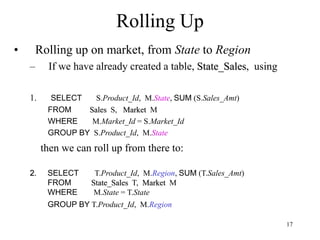
Rolling Up
• Rolling up on market, from State to Region
– If we have already created a table, State_Sales, using
1. SELECT S.Product_Id, M.State, SUM (S.Sales_Amt)
FROM Sales S, Market M
WHERE M.Market_Id = S.Market_Id
GROUP BY S.Product_Id, M.State
then we can roll up from there to:
2. SELECT T.Product_Id, M.Region, SUM (T.Sales_Amt)
FROM State_Sales T, Market M
WHERE M.State = T.State
GROUP BY T.Product_Id, M.Region
18
Pivoting
• When we view the data as a multi-dimensional
cube and group on a subset of the axes, we are said
to be performing a pivot on those axes
– Pivoting on dimensions D1,…,Dk in a data cube
D1,…,Dk,Dk+1,…,Dn means that we use GROUP BY
A1,…,Ak and aggregate over Ak+1,…An, where Ai is an
attribute of the dimension Di
– Example: Pivoting on Product and Time corresponds to
grouping on Product_id and Quarter and aggregating
Sales_Amt over Market_id:
SELECT S.Product_Id, T.Quarter, SUM (S.Sales_Amt)
FROM Sales S, Time T
WHERE T.Time_Id = S.Time_Id
GROUP BY S.Product_Id, T.Quarter
Pivot
19
Time Hierarchy as a Lattice
• Not all aggregation
hierarchies are linear
– The time hierarchy is a lattice
• Weeks are not contained in
months
• We can roll up days into weeks
or months, but we can only roll
up weeks into quarters
20
Slicing-and-Dicing
• When we use WHERE to specify a particular
value for an axis (or several axes), we are
performing a slice
– Slicing the data cube in the Time dimension
(choosing sales only in week 12) then pivoting to
Product_id (aggregating over Market_id)
SELECT S.Product_Id, SUM (Sales_Amt)
FROM Sales S, Time T
WHERE T.Time_Id = S.Time_Id AND T.Week = ‘Wk-12’
GROUP BY S. Product_Id
Slice
Pivot
21
Slicing-and-Dicing
• Typically slicing and dicing involves several queries to
find the “right slice.”
For instance, change the slice and the axes:
• Slicing on Time and Market dimensions then pivoting to Product_id
and Week (in the time dimension)
SELECT S.Product_Id, T.Quarter, SUM (Sales_Amt)
FROM Sales S, Time T
WHERE T.Time_Id = S.Time_Id
AND T.Quarter = 4
AND S.Market_id = 12345
GROUP BY S.Product_Id, T.Week
Slice
Pivot
22
The CUBE Operator
• To construct the following table, would take 3
queries (next slide)
SUM(Sales_Amt)
M1 M2 M3 Total
P1 3003 1503 … …
P2 6003 2402 … …
P3 4503 3 … …
P4 7503 7000 … …
Total … … … …
Market_Id
Product_Id
23
The Three Queries
• For the table entries, without the totals (aggregation on time)
SELECT S.Market_Id, S.Product_Id, SUM
(S.Sales_Amt)
FROM Sales S
GROUP BY S.Market_Id, S.Product_Id
• For the row totals (aggregation on time and supermarkets)
SELECT S.Product_Id, SUM (S.Sales_Amt)
FROM Sales S
GROUP BY S.Product_Id
• For the column totals (aggregation on time and products)
SELECT S.Market_Id, SUM (S.Sales)
FROM Sales S
GROUP BY S.Market_Id
24
Definition of the CUBE Operator
• Doing these three queries is wasteful
– The first does much of the work of the other two: if
we could save that result and aggregate over
Market_Id and Product_Id, we could compute the
other queries more efficiently
• The CUBE clause is part of SQL:1999
– GROUP BY CUBE (v1, v2, …, vn)
– Equivalent to a collection of GROUP BYs, one for
each of the 2n subsets of v1, v2, …, vn
25
Example of CUBE Operator
• The following query returns all the information
needed to make the previous products/markets
table:
SELECT S.Market_Id, S.Product_Id, SUM
(S.Sales_Amt)
FROM Sales S
GROUP BY CUBE (S.Market_Id, S.Product_Id)
26
ROLLUP
• ROLLUP is similar to CUBE except that instead
of aggregating over all subsets of the arguments, it
creates subsets moving from right to left
• GROUP BY ROLLUP (A1,A2,…,An) is a series of
these aggregations:
– GROUP BY A1 ,…, An-1 ,An
– GROUP BY A1 ,…, An-1
– … … …
– GROUP BY A1, A2
– GROUP BY A1
– No GROUP BY
• ROLLUP is also in SQL:1999
27
Example of ROLLUP Operator
SELECT S.Market_Id, S.Product_Id, SUM (S.Sales_Amt)
FROM Sales S
GROUP BY ROLLUP (S.Market_Id, S. Product_Id)
– first aggregates with the finest granularity:
GROUP BY S.Market_Id, S.Product_Id
– then with the next level of granularity:
GROUP BY S.Market_Id
– then the grand total is computed with no GROUP
BY clause
28
ROLLUP vs. CUBE
• The same query with CUBE:
- first aggregates with the finest granularity:
GROUP BY S.Market_Id, S.Product_Id
- then with the next level of granularity:
GROUP BY S.Market_Id
and
GROUP BY S.Product_Id
- then the grand total with no GROUP BY
29
Materialized Views
The CUBE operator is often used to
precompute aggregations on all dimensions of
a fact table and then save them as a
materialized views to speed up future queries
30
ROLAP and MOLAP
• Relational OLAP: ROLAP
– OLAP data is stored in a relational database as
previously described. Data cube is a conceptual
view – way to think about a fact table
• Multidimensional OLAP: MOLAP
– Vendor provides an OLAP server that
implements a fact table as a data cube using a
special multi-dimensional (non-relational) data
structure
31
MOLAP
- No standard query language for MOLAP
databases
- Many MOLAP vendors (and many ROLAP
vendors) provide proprietary visual
languages that allow casual users to make
queries that involve pivots, drilling down,
or rolling up
32
Implementation Issues
• OLAP applications are characterized by a very
large amount of data that is relatively static, with
infrequent updates
– Thus, various aggregations can be precomputed and
stored in the database
– Star joins, join indices, and bitmap indices can be used
to improve efficiency (recall the methods to compute
star joins in Chapter 14)
– Since updates are infrequent, the inefficiencies
associated with updates are minimized
33
Data Mining
• An attempt at knowledge discovery
• Searching for patterns and structure in a sea
of data
• Uses techniques from many disciplines,
such as statistical analysis and machine
learning
– These techniques are not our main interest
34
Associations
• An association is a correlation between certain
values in a database (in the same or different
columns)
– In a convenience store in the early evening, a large
percentage of customers who bought diapers also
bought beer
• This association can be described using the
notation
Purchase_diapers => Purchase_beer
35
Confidence and Support
• To determine whether an association exists, the system
computes the confidence and support for that
association
• Confidence in A => B
– The percentage of transactions (recorded in the database)
that contain B among those that contain A
• Diapers => Beer:
The percentage of customers who bought beer among those who bought
diapers
• Support
– The percentage of transactions that contain both items
among all transactions
• 100* (customers who bought both Diapers and Beer)/(all customers)
36
Ascertain an Association
• To ascertain that an association exists, both
the confidence and the support must be
above a certain threshold
– Confidence states that there is a high
probability, given the data, that someone who
purchased diapers also bought beer
– Support states that the data shows a large
percentage of people who purchased both
diapers and beer (so that the confidence
measure is not an accident)
37
A Priori Algorithm for Computing Associations
• Based on this observation:
– If the support for A => B is larger than T, then the
support for A and B must separately be larger than T
• Find all items whose support is larger than T
– Requires checking n items
– If there are m items with support > T, find all pairs of
such items whose support is larger than T
– Requires checking m(m-1) pairs
• If there are p pairs with support > T, compute the
confidence for each pair
– Requires checking p pairs
38
Other Types of Information
• In addition to association rules, data mining is
used to uncover other types of information
– Sequential Patterns
• Associations over time: Is a customer who purchased a
garbage can likely to purchase fillers for that can later?
– Classification Rules
• Associations based on ranges of values: Can ranges of income
be used to classify individuals into groups which predict their
likelihood of defaulting on their mortgage?
– Time Series
• Similarities between sequences: Is the pattern of temperature
fluctuation in the Pacific Ocean similar to the pattern of
climate variation over the west coast of the US?
39
Another Data Mining Approach
• Machine Learning
– A mortgage broker believes that several factors might
affect whether or not a customer is likely to default on
mortgage, but does now know how to weight these factors
– Use data from past customers to “learn” a set of weights to
be used in the decision for future customers
• Neural networks, a technique studied in the context of Artificial
Intelligence, provides a model for analyzing this problem
40
Data Warehouse
• Data (often derived from OLTP) for both OLAP
and data mining applications is usually stored in a
special database called a data warehouse
• Data warehouses are generally large and contain
data that has been gathered at different times from
DBMSs provided by different vendors and with
different schemas
• Populating such a data warehouse is not trivial
41
Issues Involved in Populating a
Data Warehouse
• Transformations
– Syntactic: syntax used in different DMBSs for the same
data might be different
• Attribute names: SSN vs. Ssnum
• Attribute domains: Integer vs. String
– Semantic: semantics might be different
• Summarizing sales on a daily basis vs. summarizing sales on a
monthly basis
• Data Cleaning
– Removing errors and inconsistencies in data
42
Metadata
• As with other databases, a warehouse must
include a metadata repository
– Information about physical and logical organization
of data
– Information about the source of each data item and
the dates on which it was loaded and refreshed
43
Incremental Updates
• The large volume of data in a data warehouse
makes loading and updating a significant task
• For efficiency, updating is usually incremental
– Different parts are updated at different times
• Incremental updates might result in the database
being in an inconsistent state
– Usually not important because queries involve only
statistical summaries of data, which are not greatly
affected by such inconsistencies
44
Loading Data into A Data
Warehouse

ch19.ppt

  • 1.
    OLAP and DataMining Chapter 17
  • 2.
    2 OLTP Compared WithOLAP • On Line Transaction Processing – OLTP – Maintains a database that is an accurate model of some real- world enterprise. Supports day-to-day operations. Characteristics: • Short simple transactions • Relatively frequent updates • Transactions access only a small fraction of the database • On Line Analytic Processing – OLAP – Uses information in database to guide strategic decisions. Characteristics: • Complex queries • Infrequent updates • Transactions access a large fraction of the database • Data need not be up-to-date
  • 3.
    3 The Internet Grocer •OLTP-style transaction: – John Smith, from Schenectady, N.Y., just bought a box of tomatoes; charge his account; deliver the tomatoes from our Schenectady warehouse; decrease our inventory of tomatoes from that warehouse • OLAP-style transaction: – How many cases of tomatoes were sold in all northeast warehouses in the years 2000 and 2001?
  • 4.
    4 OLAP: Traditional Compared withNewer Applications • Traditional OLAP queries – Uses data the enterprise gathers in its usual activities, perhaps in its OLTP system – Queries are ad hoc, perhaps designed and carried out by non-professionals (managers) • Newer Applications (e.g., Internet companies) – Enterprise actively gathers data it wants, perhaps purchasing it – Queries are sophisticated, designed by professionals, and used in more sophisticated ways
  • 5.
    5 The Internet Grocer •Traditional – How many cases of tomatoes were sold in all northeast warehouses in the years 2000 and 2001? • Newer – Prepare a profile of the grocery purchases of John Smith for the years 2000 and 2001 (so that we can customize our marketing to him and get more of his business)
  • 6.
    6 Data Mining • DataMining is an attempt at knowledge discovery – to extract knowledge from a database • Comparison with OLAP – OLAP: • What percentage of people who make over $50,000 defaulted on their mortgage in the year 2000? – Data Mining: • How can information about salary, net worth, and other historical data be used to predict who will default on their mortgage?
  • 7.
    7 Data Warehouses • OLAPand data mining databases are frequently stored on special servers called data warehouses: – Can accommodate the huge amount of data generated by OLTP systems – Allow OLAP queries and data mining to be run off- line so as not to impact the performance of OLTP
  • 8.
    8 OLAP, Data Mining,and Analysis • The “A” in OLAP stands for “Analytical” • Many OLAP and Data Mining applications involve sophisticated analysis methods from the fields of mathematics, statistical analysis, and artificial intelligence • Our main interest is in the database aspects of these fields, not the sophisticated analysis techniques
  • 9.
    9 Fact Tables • ManyOLAP applications are based on a fact table • For example, a supermarket application might be based on a table Sales (Market_Id, Product_Id, Time_Id, Sales_Amt) • The table can be viewed as multidimensional – Market_Id, Product_Id, Time_Id are the dimensions that represent specific supermarkets, products, and time intervals – Sales_Amt is a function of the other three
  • 10.
    10 A Data Cube •Fact tables can be viewed as an N-dimensional data cube (3-dimensional in our example) – The entries in the cube are the values for Sales_Amts
  • 11.
    11 Dimension Tables • Thedimensions of the fact table are further described with dimension tables • Fact table: Sales (Market_id, Product_Id, Time_Id, Sales_Amt) • Dimension Tables: Market (Market_Id, City, State, Region) Product (Product_Id, Name, Category, Price) Time (Time_Id, Week, Month, Quarter)
  • 12.
    12 • The factand dimension relations can be displayed in an E-R diagram, which looks like a star and is called a star schema Star Schema
  • 13.
    13 Aggregation • Many OLAPqueries involve aggregation of the data in the fact table • For example, to find the total sales (over time) of each product in each market, we might use SELECT S.Market_Id, S.Product_Id, SUM (S.Sales_Amt) FROM Sales S GROUP BY S.Market_Id, S.Product_Id • The aggregation is over the entire time dimension and thus produces a two-dimensional view of the data
  • 14.
    14 Aggregation over Time •The output of the previous query SUM(Sales_Amt) M1 M2 M3 M4 P1 3003 1503 … P2 6003 2402 … P3 4503 3 … P4 7503 7000 … P5 … … … Market_Id Product_Id
  • 15.
    15 Drilling Down andRolling Up • Some dimension tables form an aggregation hierarchy Market_Id  City  State  Region • Executing a series of queries that moves down a hierarchy (e.g., from aggregation over regions to that over states) is called drilling down – Requires the use of the fact table or information more specific than the requested aggregation (e.g., cities) • Executing a series of queries that moves up the hierarchy (e.g., from states to regions) is called rolling up – Note: In a rollup, coarser aggregations can be computed using prior queries for finer aggregations
  • 16.
    16 • Drilling downon market: from Region to State Sales (Market_Id, Product_Id, Time_Id, Sales_Amt) Market (Market_Id, City, State, Region) 1. SELECT S.Product_Id, M.Region, SUM (S.Sales_Amt) FROM Sales S, Market M WHERE M.Market_Id = S.Market_Id GROUP BY S.Product_Id, M.Region 2. SELECT S.Product_Id, M.State, SUM (S.Sales_Amt) FROM Sales S, Market M WHERE M.Market_Id = S.Market_Id GROUP BY S.Product_Id, M.State, Drilling Down
  • 17.
    17 Rolling Up • Rollingup on market, from State to Region – If we have already created a table, State_Sales, using 1. SELECT S.Product_Id, M.State, SUM (S.Sales_Amt) FROM Sales S, Market M WHERE M.Market_Id = S.Market_Id GROUP BY S.Product_Id, M.State then we can roll up from there to: 2. SELECT T.Product_Id, M.Region, SUM (T.Sales_Amt) FROM State_Sales T, Market M WHERE M.State = T.State GROUP BY T.Product_Id, M.Region
  • 18.
    18 Pivoting • When weview the data as a multi-dimensional cube and group on a subset of the axes, we are said to be performing a pivot on those axes – Pivoting on dimensions D1,…,Dk in a data cube D1,…,Dk,Dk+1,…,Dn means that we use GROUP BY A1,…,Ak and aggregate over Ak+1,…An, where Ai is an attribute of the dimension Di – Example: Pivoting on Product and Time corresponds to grouping on Product_id and Quarter and aggregating Sales_Amt over Market_id: SELECT S.Product_Id, T.Quarter, SUM (S.Sales_Amt) FROM Sales S, Time T WHERE T.Time_Id = S.Time_Id GROUP BY S.Product_Id, T.Quarter Pivot
  • 19.
    19 Time Hierarchy asa Lattice • Not all aggregation hierarchies are linear – The time hierarchy is a lattice • Weeks are not contained in months • We can roll up days into weeks or months, but we can only roll up weeks into quarters
  • 20.
    20 Slicing-and-Dicing • When weuse WHERE to specify a particular value for an axis (or several axes), we are performing a slice – Slicing the data cube in the Time dimension (choosing sales only in week 12) then pivoting to Product_id (aggregating over Market_id) SELECT S.Product_Id, SUM (Sales_Amt) FROM Sales S, Time T WHERE T.Time_Id = S.Time_Id AND T.Week = ‘Wk-12’ GROUP BY S. Product_Id Slice Pivot
  • 21.
    21 Slicing-and-Dicing • Typically slicingand dicing involves several queries to find the “right slice.” For instance, change the slice and the axes: • Slicing on Time and Market dimensions then pivoting to Product_id and Week (in the time dimension) SELECT S.Product_Id, T.Quarter, SUM (Sales_Amt) FROM Sales S, Time T WHERE T.Time_Id = S.Time_Id AND T.Quarter = 4 AND S.Market_id = 12345 GROUP BY S.Product_Id, T.Week Slice Pivot
  • 22.
    22 The CUBE Operator •To construct the following table, would take 3 queries (next slide) SUM(Sales_Amt) M1 M2 M3 Total P1 3003 1503 … … P2 6003 2402 … … P3 4503 3 … … P4 7503 7000 … … Total … … … … Market_Id Product_Id
  • 23.
    23 The Three Queries •For the table entries, without the totals (aggregation on time) SELECT S.Market_Id, S.Product_Id, SUM (S.Sales_Amt) FROM Sales S GROUP BY S.Market_Id, S.Product_Id • For the row totals (aggregation on time and supermarkets) SELECT S.Product_Id, SUM (S.Sales_Amt) FROM Sales S GROUP BY S.Product_Id • For the column totals (aggregation on time and products) SELECT S.Market_Id, SUM (S.Sales) FROM Sales S GROUP BY S.Market_Id
  • 24.
    24 Definition of theCUBE Operator • Doing these three queries is wasteful – The first does much of the work of the other two: if we could save that result and aggregate over Market_Id and Product_Id, we could compute the other queries more efficiently • The CUBE clause is part of SQL:1999 – GROUP BY CUBE (v1, v2, …, vn) – Equivalent to a collection of GROUP BYs, one for each of the 2n subsets of v1, v2, …, vn
  • 25.
    25 Example of CUBEOperator • The following query returns all the information needed to make the previous products/markets table: SELECT S.Market_Id, S.Product_Id, SUM (S.Sales_Amt) FROM Sales S GROUP BY CUBE (S.Market_Id, S.Product_Id)
  • 26.
    26 ROLLUP • ROLLUP issimilar to CUBE except that instead of aggregating over all subsets of the arguments, it creates subsets moving from right to left • GROUP BY ROLLUP (A1,A2,…,An) is a series of these aggregations: – GROUP BY A1 ,…, An-1 ,An – GROUP BY A1 ,…, An-1 – … … … – GROUP BY A1, A2 – GROUP BY A1 – No GROUP BY • ROLLUP is also in SQL:1999
  • 27.
    27 Example of ROLLUPOperator SELECT S.Market_Id, S.Product_Id, SUM (S.Sales_Amt) FROM Sales S GROUP BY ROLLUP (S.Market_Id, S. Product_Id) – first aggregates with the finest granularity: GROUP BY S.Market_Id, S.Product_Id – then with the next level of granularity: GROUP BY S.Market_Id – then the grand total is computed with no GROUP BY clause
  • 28.
    28 ROLLUP vs. CUBE •The same query with CUBE: - first aggregates with the finest granularity: GROUP BY S.Market_Id, S.Product_Id - then with the next level of granularity: GROUP BY S.Market_Id and GROUP BY S.Product_Id - then the grand total with no GROUP BY
  • 29.
    29 Materialized Views The CUBEoperator is often used to precompute aggregations on all dimensions of a fact table and then save them as a materialized views to speed up future queries
  • 30.
    30 ROLAP and MOLAP •Relational OLAP: ROLAP – OLAP data is stored in a relational database as previously described. Data cube is a conceptual view – way to think about a fact table • Multidimensional OLAP: MOLAP – Vendor provides an OLAP server that implements a fact table as a data cube using a special multi-dimensional (non-relational) data structure
  • 31.
    31 MOLAP - No standardquery language for MOLAP databases - Many MOLAP vendors (and many ROLAP vendors) provide proprietary visual languages that allow casual users to make queries that involve pivots, drilling down, or rolling up
  • 32.
    32 Implementation Issues • OLAPapplications are characterized by a very large amount of data that is relatively static, with infrequent updates – Thus, various aggregations can be precomputed and stored in the database – Star joins, join indices, and bitmap indices can be used to improve efficiency (recall the methods to compute star joins in Chapter 14) – Since updates are infrequent, the inefficiencies associated with updates are minimized
  • 33.
    33 Data Mining • Anattempt at knowledge discovery • Searching for patterns and structure in a sea of data • Uses techniques from many disciplines, such as statistical analysis and machine learning – These techniques are not our main interest
  • 34.
    34 Associations • An associationis a correlation between certain values in a database (in the same or different columns) – In a convenience store in the early evening, a large percentage of customers who bought diapers also bought beer • This association can be described using the notation Purchase_diapers => Purchase_beer
  • 35.
    35 Confidence and Support •To determine whether an association exists, the system computes the confidence and support for that association • Confidence in A => B – The percentage of transactions (recorded in the database) that contain B among those that contain A • Diapers => Beer: The percentage of customers who bought beer among those who bought diapers • Support – The percentage of transactions that contain both items among all transactions • 100* (customers who bought both Diapers and Beer)/(all customers)
  • 36.
    36 Ascertain an Association •To ascertain that an association exists, both the confidence and the support must be above a certain threshold – Confidence states that there is a high probability, given the data, that someone who purchased diapers also bought beer – Support states that the data shows a large percentage of people who purchased both diapers and beer (so that the confidence measure is not an accident)
  • 37.
    37 A Priori Algorithmfor Computing Associations • Based on this observation: – If the support for A => B is larger than T, then the support for A and B must separately be larger than T • Find all items whose support is larger than T – Requires checking n items – If there are m items with support > T, find all pairs of such items whose support is larger than T – Requires checking m(m-1) pairs • If there are p pairs with support > T, compute the confidence for each pair – Requires checking p pairs
  • 38.
    38 Other Types ofInformation • In addition to association rules, data mining is used to uncover other types of information – Sequential Patterns • Associations over time: Is a customer who purchased a garbage can likely to purchase fillers for that can later? – Classification Rules • Associations based on ranges of values: Can ranges of income be used to classify individuals into groups which predict their likelihood of defaulting on their mortgage? – Time Series • Similarities between sequences: Is the pattern of temperature fluctuation in the Pacific Ocean similar to the pattern of climate variation over the west coast of the US?
  • 39.
    39 Another Data MiningApproach • Machine Learning – A mortgage broker believes that several factors might affect whether or not a customer is likely to default on mortgage, but does now know how to weight these factors – Use data from past customers to “learn” a set of weights to be used in the decision for future customers • Neural networks, a technique studied in the context of Artificial Intelligence, provides a model for analyzing this problem
  • 40.
    40 Data Warehouse • Data(often derived from OLTP) for both OLAP and data mining applications is usually stored in a special database called a data warehouse • Data warehouses are generally large and contain data that has been gathered at different times from DBMSs provided by different vendors and with different schemas • Populating such a data warehouse is not trivial
  • 41.
    41 Issues Involved inPopulating a Data Warehouse • Transformations – Syntactic: syntax used in different DMBSs for the same data might be different • Attribute names: SSN vs. Ssnum • Attribute domains: Integer vs. String – Semantic: semantics might be different • Summarizing sales on a daily basis vs. summarizing sales on a monthly basis • Data Cleaning – Removing errors and inconsistencies in data
  • 42.
    42 Metadata • As withother databases, a warehouse must include a metadata repository – Information about physical and logical organization of data – Information about the source of each data item and the dates on which it was loaded and refreshed
  • 43.
    43 Incremental Updates • Thelarge volume of data in a data warehouse makes loading and updating a significant task • For efficiency, updating is usually incremental – Different parts are updated at different times • Incremental updates might result in the database being in an inconsistent state – Usually not important because queries involve only statistical summaries of data, which are not greatly affected by such inconsistencies
  • 44.
    44 Loading Data intoA Data Warehouse