October 15, 2020
Data Models
1
Lecture 5- GIS
Lecture # 05 Dated:15/10/2020
Course(502) Introduction
to GIS and RS
Data used in GIS/Spatial data Models
Topic
Presented by
Rehana Jamal (Geometiciation, GIS Specialist & Geographer)
Visiting lecturer
studentsdatafiles@gmail.com
Faculty of Agricultural Engineering, Arid Agriculture University,
Rawalpindi
2
October 15, 2020
1. Raster data
2. Vector data
3
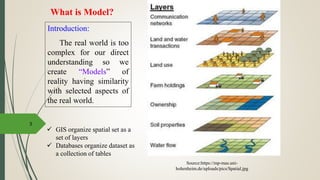
What is Model?
Introduction:
The real world is too
complex for our direct
understanding so we
create “Models” of
reality having similarity
with selected aspects of
the real world.
Source:https://mp-mas.uni-
hohenheim.de/uploads/pics/Spatial.jpg
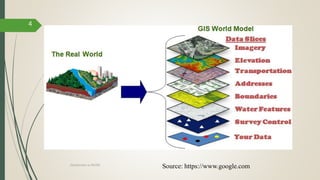
 GIS organize spatial set as a
set of layers
 Databases organize dataset as
a collection of tables
Source: https://www.google.com
Introduction to RS/GIS
4
5
What is Spatial data Model?
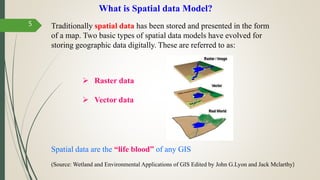
Traditionally spatial data has been stored and presented in the form
of a map. Two basic types of spatial data models have evolved for
storing geographic data digitally. These are referred to as:
Spatial data are the “life blood” of any GIS
(Source: Wetland and Environmental Applications of GIS Edited by John G.Lyon and Jack Mclarthy)
 Raster data
 Vector data
6
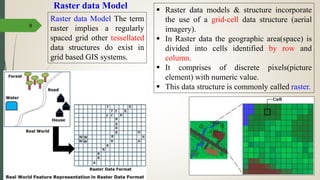
 Raster data models & structure incorporate
the use of a grid-cell data structure (aerial
imagery).
 In Raster data the geographic area(space) is
divided into cells identified by row and
column.
 It comprises of discrete pixels(picture
element) with numeric value.
 This data structure is commonly called raster.
Raster data Model The term
raster implies a regularly
spaced grid other tessellated
data structures do exist in
grid based GIS systems.
October 15, 2020
Data Models
Raster data Model
7
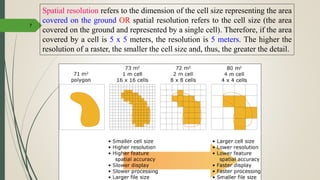
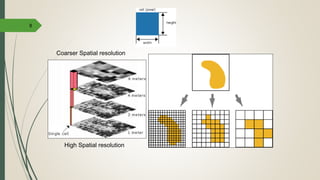
Spatial resolution refers to the dimension of the cell size representing the area
covered on the ground OR spatial resolution refers to the cell size (the area
covered on the ground and represented by a single cell). Therefore, if the area
covered by a cell is 5 x 5 meters, the resolution is 5 meters. The higher the
resolution of a raster, the smaller the cell size and, thus, the greater the detail.
8
Coarser Spatial resolution
High Spatial resolution
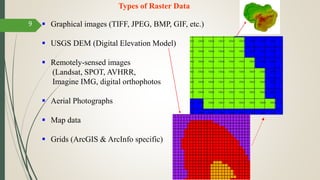
 Graphical images (TIFF, JPEG, BMP, GIF, etc.)
 USGS DEM (Digital Elevation Model)
 Remotely-sensed images
(Landsat, SPOT, AVHRR,
Imagine IMG, digital orthophotos
 Aerial Photographs
 Map data
 Grids (ArcGIS & ArcInfo specific)
Types of Raster Data
9
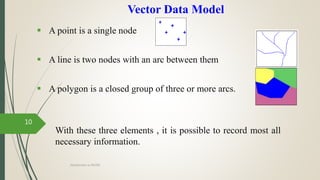
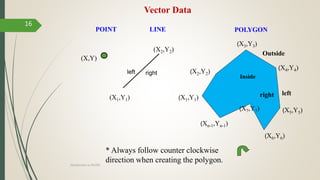
 A point is a single node
 A line is two nodes with an arc between them
 A polygon is a closed group of three or more arcs.
Vector Data Model
With these three elements , it is possible to record most all
necessary information.
Introduction to RS/GIS
10
October 15, 2020
Data Models
11
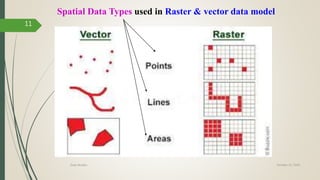
Spatial Data Types used in Raster & vector data model
12
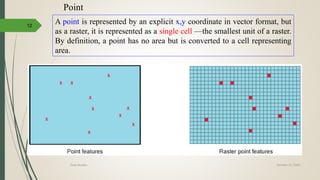
A point is represented by an explicit x,y coordinate in vector format, but
as a raster, it is represented as a single cell —the smallest unit of a raster.
By definition, a point has no area but is converted to a cell representing
area.
Point
October 15, 2020
Data Models
13
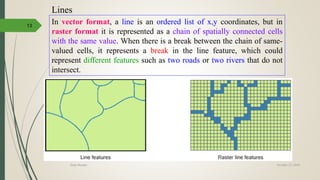
In vector format, a line is an ordered list of x,y coordinates, but in
raster format it is represented as a chain of spatially connected cells
with the same value. When there is a break between the chain of same-
valued cells, it represents a break in the line feature, which could
represent different features such as two roads or two rivers that do not
intersect.
Lines
October 15, 2020
Data Models
14
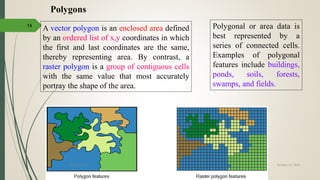
A vector polygon is an enclosed area defined
by an ordered list of x,y coordinates in which
the first and last coordinates are the same,
thereby representing area. By contrast, a
raster polygon is a group of contiguous cells
with the same value that most accurately
portray the shape of the area.
Polygons
October 15, 2020
Data Models
Polygonal or area data is
best represented by a
series of connected cells.
Examples of polygonal
features include buildings,
ponds, soils, forests,
swamps, and fields.
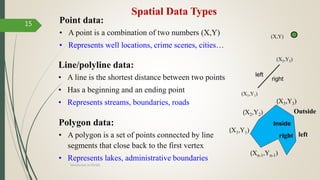
Point data:
• A point is a combination of two numbers (X,Y)
• Represents well locations, crime scenes, cities…
Line/polyline data:
• A line is the shortest distance between two points
• Has a beginning and an ending point
• Represents streams, boundaries, roads
Polygon data:
• A polygon is a set of points connected by line
segments that close back to the first vertex
• Represents lakes, administrative boundaries
Spatial Data Types
(X,Y)
(X1,Y1)
(X2,Y2)
left
right
(X1,Y1)
(Xn-1,Yn-1)
(X2,Y2)
Inside
Outside
left
right
(X3,Y3)
Introduction to RS/GIS
15
POINT LINE POLYGON
(X,Y)
(X1,Y1)
(Xn-1,Yn-1)
(X1,Y1)
(X2,Y2)
(X2,Y2)
left right
Inside
Outside
* Always follow counter clockwise
direction when creating the polygon.
left
right
Vector Data
(X4,Y4)
(X3,Y3)
(X5,Y5)
(X6,Y6)
(X7,Y7)
Introduction to RS/GIS
16
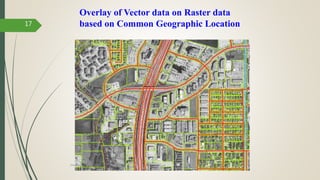
Overlay of Vector data on Raster data
based on Common Geographic Location
Introduction to RS/GIS
17
October 15, 2020
Data Models
18
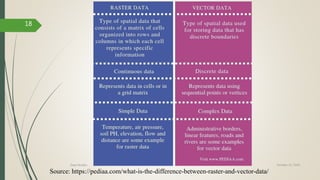
Source: https://pediaa.com/what-is-the-difference-between-raster-and-vector-data/
19
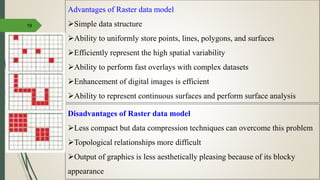
Advantages of Raster data model
Simple data structure
Ability to uniformly store points, lines, polygons, and surfaces
Efficiently represent the high spatial variability
Ability to perform fast overlays with complex datasets
Enhancement of digital images is efficient
Ability to represent continuous surfaces and perform surface analysis
Disadvantages of Raster data model
Less compact but data compression techniques can overcome this problem
Topological relationships more difficult
Output of graphics is less aesthetically pleasing because of its blocky
appearance
20
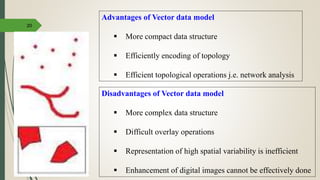
Advantages of Vector data model
 More compact data structure
 Efficiently encoding of topology
 Efficient topological operations j.e. network analysis
Disadvantages of Vector data model
 More complex data structure
 Difficult overlay operations
 Representation of high spatial variability is inefficient
 Enhancement of digital images cannot be effectively done
21
Summary
Data used in GIS/Spatial data Models
(Raster &Vector data)
Spatial data types:
Point, Line, Polygon
References:
 www.google.com----------------(Maps)
 www.yahoo.com
 www.esri.com
 (http://www.olemiss.edu/depts/geology/courses/ge4
70/RasterDataModel.htm#8b.1)
 Book: An Introduction to geographical information system
by Hay Wood I, Carnelius, S & Carver, S
 Book: Geographic Information System: A Management Perspective
by Stan Aronoff
 Book: Principles of Geographic Information Systems
By Otto Huisman and Rolf A.de By
Introduction to RS/GIS
22

Lect 5 data models-gis

  • 1.
    October 15, 2020 DataModels 1 Lecture 5- GIS
  • 2.
    Lecture # 05Dated:15/10/2020 Course(502) Introduction to GIS and RS Data used in GIS/Spatial data Models Topic Presented by Rehana Jamal (Geometiciation, GIS Specialist & Geographer) Visiting lecturer studentsdatafiles@gmail.com Faculty of Agricultural Engineering, Arid Agriculture University, Rawalpindi 2 October 15, 2020 1. Raster data 2. Vector data
  • 3.
    3 What is Model? Introduction: Thereal world is too complex for our direct understanding so we create “Models” of reality having similarity with selected aspects of the real world. Source:https://mp-mas.uni- hohenheim.de/uploads/pics/Spatial.jpg  GIS organize spatial set as a set of layers  Databases organize dataset as a collection of tables
  • 4.
  • 5.
    5 What is Spatialdata Model? Traditionally spatial data has been stored and presented in the form of a map. Two basic types of spatial data models have evolved for storing geographic data digitally. These are referred to as: Spatial data are the “life blood” of any GIS (Source: Wetland and Environmental Applications of GIS Edited by John G.Lyon and Jack Mclarthy)  Raster data  Vector data
  • 6.
    6  Raster datamodels & structure incorporate the use of a grid-cell data structure (aerial imagery).  In Raster data the geographic area(space) is divided into cells identified by row and column.  It comprises of discrete pixels(picture element) with numeric value.  This data structure is commonly called raster. Raster data Model The term raster implies a regularly spaced grid other tessellated data structures do exist in grid based GIS systems. October 15, 2020 Data Models Raster data Model
  • 7.
    7 Spatial resolution refersto the dimension of the cell size representing the area covered on the ground OR spatial resolution refers to the cell size (the area covered on the ground and represented by a single cell). Therefore, if the area covered by a cell is 5 x 5 meters, the resolution is 5 meters. The higher the resolution of a raster, the smaller the cell size and, thus, the greater the detail.
  • 8.
  • 9.
     Graphical images(TIFF, JPEG, BMP, GIF, etc.)  USGS DEM (Digital Elevation Model)  Remotely-sensed images (Landsat, SPOT, AVHRR, Imagine IMG, digital orthophotos  Aerial Photographs  Map data  Grids (ArcGIS & ArcInfo specific) Types of Raster Data 9
  • 10.
     A pointis a single node  A line is two nodes with an arc between them  A polygon is a closed group of three or more arcs. Vector Data Model With these three elements , it is possible to record most all necessary information. Introduction to RS/GIS 10
  • 11.
    October 15, 2020 DataModels 11 Spatial Data Types used in Raster & vector data model
  • 12.
    12 A point isrepresented by an explicit x,y coordinate in vector format, but as a raster, it is represented as a single cell —the smallest unit of a raster. By definition, a point has no area but is converted to a cell representing area. Point October 15, 2020 Data Models
  • 13.
    13 In vector format,a line is an ordered list of x,y coordinates, but in raster format it is represented as a chain of spatially connected cells with the same value. When there is a break between the chain of same- valued cells, it represents a break in the line feature, which could represent different features such as two roads or two rivers that do not intersect. Lines October 15, 2020 Data Models
  • 14.
    14 A vector polygonis an enclosed area defined by an ordered list of x,y coordinates in which the first and last coordinates are the same, thereby representing area. By contrast, a raster polygon is a group of contiguous cells with the same value that most accurately portray the shape of the area. Polygons October 15, 2020 Data Models Polygonal or area data is best represented by a series of connected cells. Examples of polygonal features include buildings, ponds, soils, forests, swamps, and fields.
  • 15.
    Point data: • Apoint is a combination of two numbers (X,Y) • Represents well locations, crime scenes, cities… Line/polyline data: • A line is the shortest distance between two points • Has a beginning and an ending point • Represents streams, boundaries, roads Polygon data: • A polygon is a set of points connected by line segments that close back to the first vertex • Represents lakes, administrative boundaries Spatial Data Types (X,Y) (X1,Y1) (X2,Y2) left right (X1,Y1) (Xn-1,Yn-1) (X2,Y2) Inside Outside left right (X3,Y3) Introduction to RS/GIS 15
  • 16.
    POINT LINE POLYGON (X,Y) (X1,Y1) (Xn-1,Yn-1) (X1,Y1) (X2,Y2) (X2,Y2) leftright Inside Outside * Always follow counter clockwise direction when creating the polygon. left right Vector Data (X4,Y4) (X3,Y3) (X5,Y5) (X6,Y6) (X7,Y7) Introduction to RS/GIS 16
  • 17.
    Overlay of Vectordata on Raster data based on Common Geographic Location Introduction to RS/GIS 17
  • 18.
    October 15, 2020 DataModels 18 Source: https://pediaa.com/what-is-the-difference-between-raster-and-vector-data/
  • 19.
    19 Advantages of Rasterdata model Simple data structure Ability to uniformly store points, lines, polygons, and surfaces Efficiently represent the high spatial variability Ability to perform fast overlays with complex datasets Enhancement of digital images is efficient Ability to represent continuous surfaces and perform surface analysis Disadvantages of Raster data model Less compact but data compression techniques can overcome this problem Topological relationships more difficult Output of graphics is less aesthetically pleasing because of its blocky appearance
  • 20.
    20 Advantages of Vectordata model  More compact data structure  Efficiently encoding of topology  Efficient topological operations j.e. network analysis Disadvantages of Vector data model  More complex data structure  Difficult overlay operations  Representation of high spatial variability is inefficient  Enhancement of digital images cannot be effectively done
  • 21.
    21 Summary Data used inGIS/Spatial data Models (Raster &Vector data) Spatial data types: Point, Line, Polygon
  • 22.
    References:  www.google.com----------------(Maps)  www.yahoo.com www.esri.com  (http://www.olemiss.edu/depts/geology/courses/ge4 70/RasterDataModel.htm#8b.1)  Book: An Introduction to geographical information system by Hay Wood I, Carnelius, S & Carver, S  Book: Geographic Information System: A Management Perspective by Stan Aronoff  Book: Principles of Geographic Information Systems By Otto Huisman and Rolf A.de By Introduction to RS/GIS 22