Potential Across The Cell Membrane
By Dr. Vani Gupta
2
“Polarity” of the membrane
Na+
K+
Mg2+
Ca2+
H+
HCO3
-
Cl-
SO4
2-
PO3
-
protein
inside
(in mM)
14
140
0.5
10-4
(pH 7.2)
10
5-15
2
75
40
outside
(in mM)
142
4
1-2
1-2
(pH 7.4)
28
110
1
4
5
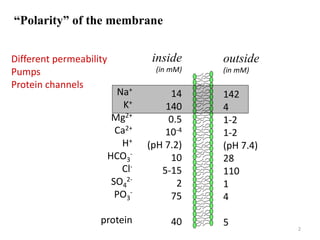
Different permeability
Pumps
Protein channels
• The Resting Potential in cells are normally
more negative inside than outside. This varies
from -9mV to -100mV. This is just the opposite
of osmolarity.
• Excitable tissues of nerves and muscles cells
have higher potentials than other cells
(epithelial cells and connective tissue cells).
• Dead cells do not have membrane potentials.
The membrane potential is due to the sodium ions found in
the extracellular matrix and the potassium ions found in the
intracellular matrix
• Membrane potentials are due to the diffusion
of ions down their concentration gradients, the
electric charge of the ion, and any membrane
pumps for that ion.
• Influx is the net movement of ions into the cell
from the ECF.
• Efflux is the net movement of ions out of the cell
to the ECF.
• Flux (the movement of charges) is always
measured in millivolts (mV).
–Is the membrane permeable to it?
–Does it have a concentration gradient?
If the answer is yes to both questions, then
the species will diffuse (Which way? Down it’s
gradient)
Inside of cell is more negative:
• Proteins are abundant inside cell, and are
negatively charged at your normal pH.
• Na+/K+ ATPase -Two K are pulled in while 3
Na go out., so net loss of one positive charge
(net loss of positive charges~ 4mV)
• potassium leak -integral proteins. Potassium
leaves by leak channels, contributing to
negativity. Memb. are 100 time more
permeable to K.
• Nerve cells-70 mV
• Heart cells – 90 mV
• some are - 50-60 mV.
9
Electricity
• Current: the flow of charge
• Voltage: separation of opposite charges (mV)
– Voltage
– Voltage difference
– Potential difference
– Potential
• Resistance: opposition to charge
movement (friction)
• Conductance: allowing a charge to move
(permeability)
+
+
+
+
+
-
-
-
-
-
-
-
- +
What are the charged things that
run through our body fluids?
Electrolytes!
ions: Na+ K+ Cl-
Ca++
10
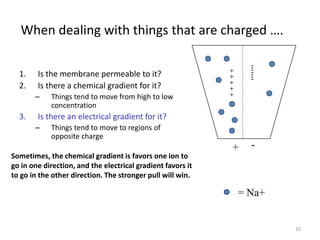
When dealing with things that are charged ….
1. Is the membrane permeable to it?
2. Is there a chemical gradient for it?
– Things tend to move from high to low
concentration
3. Is there an electrical gradient for it?
– Things tend to move to regions of
opposite charge
+
+
+
+
+
-
-
-
-
-
-
-
-
+
= Na+
Sometimes, the chemical gradient is favors one ion to
go in one direction, and the electrical gradient favors it
to go in the other direction. The stronger pull will win.
11
-
So, we have a battle: diffusion of a chemical gradient
and the diffusion of the charges (Electrical potential )
The Nernst potential (equilibrium potential) is the theoretical intracellular
electrical potential that would be equal in magnitude but opposite in direction to
the concentration force.
In other words: when does the attraction between opposite charges oppose the
diffusion of a chemical gradient?
-
-
-
- -
-
-
-
- -
-
- -
-
-
-
-
-
-
-
-
-
-
-
- -
-
-
-
-
-
-
-
-
-
+
-
-
-
-
-
-
-
-
- -
-
-
-
-
-
- -
+ When will the
negatively charged
molecules stop
entering the cell?
-
• When the electrical and chemical gradient is
equally powerful (in opposite directions)- Nernst
potential: No net gain or loss. Cells with resting
membrane potential are at - 70mV. They are not
at their resting K potential. If more K channels
are open , there will be more movement of K out
of the cell, and the potential will get closer to-94
mV (at which time, the cell will reach equilibrium,
and the cell will die; but the body does not let it
get that far).
• The electrical potential that counters net
diffusion of K+ is called the K+ equilibrium
potential (EK).
• The equilibrium potential of K is - 94 mV
• So, if the membrane were permeable only to
K+, mV would be -94 mV (cell death from
equilibrium
14
Simplest Case Scenario:
K+ K+
If a membrane were permeable to only
K+ then…
The electrical potential that
counters net diffusion of K+ is
called the K+ equilibrium potential
(EK).
inside outside
So, if the membrane were permeable only
to K+, Vm would be -94 mV
15
Simplest Case Scenario:
Na+
Na+
If a membrane were permeable
to only Na+ then…
The electrical potential that counters net
diffusion of Na+ is called the Na+ equilibrium
potential (ENa).
inside outside
Na+ would diffuse down its concentration
gradient until potential across the membrane
countered diffusion.
So, if the membrane were permeable only
to Na+, mV would be +61 mV
Nernst Equation
• Vm = RT/ZF In (X)o / (x)I
Vm= Voltage Equlibrium
R= Gas Constant
T = Temprature
Z= Charge
F= Faraday Constant
X0= Concentration of the ion out side
Xi= Concentration of the ion inside
i
cl
i
Na
i
K
o
cl
o
Na
o
K
m
Cl
P
Na
P
K
P
Cl
P
Na
P
K
P
F
RT
V
]
[
]
[
]
[
]
[
]
[
]
[
log -
+
+
-
+
+
+
+
+
+

Membrane Potential:
Goldman Equation
• P = permeability
– at rest: PK: PNa: PCl = 1.0 : 0.04 : 0.45
• Net potential movement for all ions
• known Vm:Can predict direction of movement of any ion ~
Resting Membrane Potential
Membrane
outside
inside
Na+
Na+
Cl-
Cl-
K+
K+
A-
+ + + + + + + + + + +
-
-
-
-
-
-
-
-
-
-
-
+ + + + + + + + + + +
-
-
-
-
-
-
-
-
-
-
-
• At resting membrane potential, cell voltage is at - 70 mV.
• Since potassium’s chemical equilibrium is - 94, potassium’s chemical equilibrium is
not met yet.
• That means that it will WANT to flow out of the cell.
• But the difference between the voltage of where it is (-70) and where it wants to
be (- 94), is only 24 mV.
• This is not a very strong difference.
• Since sodium’s chemical equilibrium is + 61 mV, sodium’s chemical equilibrium is
not met yet.
• That means that it will WANT to flow into of the cell.
• The difference between the voltage of where it is (- 70) and where it wants to be
(+ 61), is 131 mV.
• This is a much stronger difference, compared to potassium. Therefore, the ion
with the strongest driving force is sodium because its equilibrium potential is
much different from the resting membrane potential.
• the sodium driving force instead of potassium.
19
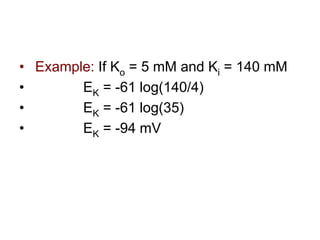
• Example: If Ko = 5 mM and Ki = 140 mM
• EK = -61 log(140/4)
• EK = -61 log(35)
• EK = -94 mV
How the Resting Membrane Potential
is Measured
22
mV
0
ENa+61
Vm -74
EK -94
Normal conditions
20 mV 135 mV
What is the net driving force on K+ ions?
What is the net driving force on Na+ ions?
Which way do the ions diffuse?
What effect does increasing Na+ or K+
permeability (or extracellular concn) have on Vm?
Why is Vm so close to EK?
Ans. The membrane is far more permeable to K+ than Na+.
The resting membrane
potential is closest to the
equilibrium potential for
the ion with the highest
permeability!
Definitions:
• There is a potential difference (pd) across the
cell membrane
• (-70 mV) is called the “Resting Membrane
Potential”
• Because a charge is present (it is not zero),
we say the membrane is “polarized”
23
• If it becomes less negative, it is called
depolarization (happens when sodium is
entering the cell).
• If it becomes more negative than - 70, it is
hyperpolarization. (happens when K leaves the
cell)
• In either case, when you go back towards - 70, it
is repolarization.
• Threshold is the point at which the first voltage-
regulated sodium channel opens.
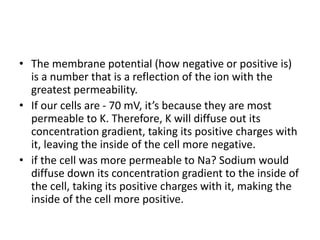
• The membrane potential (how negative or positive is)
is a number that is a reflection of the ion with the
greatest permeability.
• If our cells are - 70 mV, it’s because they are most
permeable to K. Therefore, K will diffuse out its
concentration gradient, taking its positive charges with
it, leaving the inside of the cell more negative.
• if the cell was more permeable to Na? Sodium would
diffuse down its concentration gradient to the inside of
the cell, taking its positive charges with it, making the
inside of the cell more positive.
• If you want more electrical current, open the
sodium channels first (instead of the potassium
channels). When sodium conductance
(permeability) invreases, sodium can move down
its electrical gradient as well as its chemical
gradient.
• Sodium’s equilibrium potential (+61), will make
inside of the cell very positive, which is the
opposite of the resting membrane potential
(-70). The reversal of the membrane potential is
called the ACTION POTENTIAL.
• But you cannot let sodium continue on into the cell until it reaches
equilibrium, or the cell will not be able to metabolize, and it will die.
• To prevent too much sodium from entering the cell, you have to open
the K channel to allow K to diffuse out by its chemical and electrical
gradients. This is called the dance of the gates.
• During an action potential, the sodium gate opens first, the potassium
gate opens second.
• Something needs to push K back into the cell and Na out: Na-K ATPase
(the mother protein, or housekeeping protein).
• During action or resting potential, Na-K ATPase is active all the time,
constantly trying to reestablish the gradients.
27
• Excitable cells (neurons and muscles) are those that
want this large electrical current to use for work.
• They have proteins that are sodium channels. Not all
cells have these proteins. All cells have the genes to
make these proteins, but only the excitable cells
EXPRESS these genes, and actually make the proteins
that fuse with the cell membrane and form a sodium
channel.
• Muscle cells use the electrical force to contract, and
neurons use it to excite the neurons touching them.
• Cells that can experience a momentary change
in membrane voltage are “excitable” cells
• That temporary change in voltage is due to a
momentary change in permeability
• The membrane, for only a moment, becomes
more permeable to Na+ than to K+
• an Action Potential-it is a reversal of the
membrane potential!
• Cell becomes positive inside!!!
30
ATP
3 Na+
2 K+
ADP
K+ Na+
Na+ K+
inside outside
Remember: sodium is
pumped out of the cell,
potassium is pumped in...
This pump is electrogenic, it
contributes slightly to RMP
What keeps the ion gradients from running down? The
sodium/potassium ATPase
Integral membrane protein found in all
cells which “pumps” (against their
gradients across the membrane) Na
and K.
Fueled by ATP
ATP ADP + Pi + energy
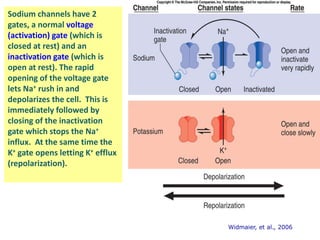
Sodium channels have 2
gates, a normal voltage
(activation) gate (which is
closed at rest) and an
inactivation gate (which is
open at rest). The rapid
opening of the voltage gate
lets Na+ rush in and
depolarizes the cell. This is
immediately followed by
closing of the inactivation
gate which stops the Na+
influx. At the same time the
K+ gate opens letting K+ efflux
(repolarization).
Widmaier, et al., 2006
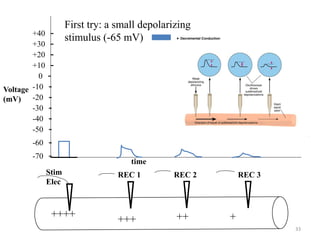
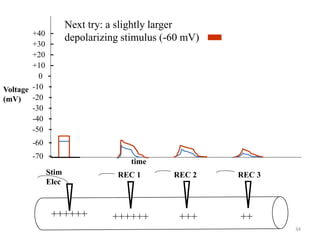
• Hodgekin and Huxley put one of these
neurons in an isosmotic solution and inserted
four wires along the axon, distal to the hillock.
The first wire was attached to an instrument
that can inject a positive charge into the cell
(increasing its membrane potential). The next
three wires (R1, R2, R3) received the signal
and measured the resulting charge.
33
time
Voltage
(mV)
Stim
Elec
REC 1 REC 2 REC 3
++++
First try: a small depolarizing
stimulus (-65 mV)
-70 -
-60 -
-50 -
-40 -
-30 -
-20 -
-10 -
0 -
+10 -
+20 -
+30 -
+40 -
+++ ++ +
34
time
Voltage
(mV)
Stim
Elec
REC 1 REC 2 REC 3
++++++
Next try: a slightly larger
depolarizing stimulus (-60 mV)
-70 -
-60 -
-50 -
-40 -
-30 -
-20 -
-10 -
0 -
+10 -
+20 -
+30 -
+40 -
++++++ +++ ++
35
time
Voltage
(mV)
Stim
Elec
REC 1 REC 2 REC 3
+++++++++
-70 -
-60 -
-50 -
-40 -
-30 -
-20 -
-10 -
0 -
+10 -
+20 -
+30 -
+40 -
++++++++++++++++++ +++++++++
Next try: a slightly larger depolarizing stimulus (-55 mV)
RMP
Local
Potentials
Action
Potentials
36
time
Voltage
(mV)
Stim
Elec
REC 1 REC 2 REC 3
- - - - -
-70 -
-60 -
-50 -
-40 -
-30 -
-20 -
-10 -
0 -
+10 -
+20 -
+30 -
+40 -
Local
Potentials
RMP
Action
Potentials
Can we get even larger
Action Potentials?
Try an even larger depolarizing
stimulus (-50 mV)
37
Note the
timeframe for one
AP
Definition:
Threshold voltage is
the minimum voltage
needed to trigger an
AP. to open
voltage operated
channels
Parts to an action potential:
• Upstroke: Na is more permeable, cell
becomes less negative
• Downstroke: K permeability is greater, cell
returns toward negative, repolarization.
• Hyperpolarization: Dips below line
38
39
Compare LP to AP
Local Potentials
• Generally, they reflect
shape, size of voltage
stimulus (similar to
stimulus pulse)
• They are graded in size
(ie. bigger stimuli give
bigger depolarizations)
• They “die out” (voltage
grows smaller) as they
move from site of
stimulation (resistance!)
Action Potentials
• They don’t reflect the shape,
size of the stimulus, rather they
are uniform in size, shape;
always identical
• They are “all-or-none” (ie. either
you trigger an AP if you reach
threshold – or if subthreshold,
you don’t get an AP – get local
potential.)
• They do not diminish in size no
matter how far from the
stimulus; regenerate anew at
each point along the axon
• As sodium channels open, it is recorded on a machine as an
upstroke.
• The peak of the curve shows that Na channels are
deactivated, so K channels open, recorded on the machine as
a downstroke.
• Na- Channel have three gated properties, like a stop light:
red, yellow, green. If a light is green, you are conducted
through intersection. When the light is yellow, you should
slow down and not go through the intersection. Likewise, in
the middle position, the sodium voltage channel prohibits
further sodium from crossing the channel.
40
• Yellow lights do not turn green. It has to turn red first. There
are 2 amino acid lids (gates); an external and internal gate.
Together, they are shaped like a ball and chain. When the
voltage becomes positives, the AA’s change their charge, and
their ball and chain will rock over and cover up the channel.
This state (yellow light) means inactivation. The amino acids
have to change their charge to move back out of the way (red
light), meaning deactivation. Then the channel can become
active again. It is a safely mechanism, insuring that another
neuron cannot fire another action pot before it is ready to
receive one.
41
• When the gated channel is yellow, it is in absolute refractory
period. This means that it cannot go from yellow to green.
When enough channels are deactivated (red light), they can
open again. Then neuron can fire again. if you need neurons
to fire quickly, you need greater stimulus.
42
Sodium channels have 2
gates, a normal voltage
(activation) gate (which is
closed at rest) and an
inactivation gate (which is
open at rest). The rapid
opening of the voltage gate
lets Na+ rush in and
depolarizes the cell. This is
immediately followed by
closing of the inactivation
gate which stops the Na+
influx. At the same time the
K+ gate opens letting K+ efflux
(repolarization).
Widmaier, et al., 2006
44
Na+
in
out
Na+ and other
ions
1) Allow simple diffusion
2) Can open and close
3) Are selective
VGC (Voltage-gated channels): Open/close depending on the voltage across the
membrane
Na+ VGC, K+ VGC, Ca++VGC
Located on the axon, at hillock and beyond
LGC (Ligand-gated channels): are not dependent on membrane potential but binding
of ligands (e.g. neurotransmitters)
Neurotransmitter receptors
Located on dendrites and cell body, above hillock
Gated Ion Channels
• The occurrence of action potentials means the
gated channels are open. When they are open, ATP
is not used, it is simple diffusion. But resting
membrane potential requires ATP to keep it at
steady state. Homeostasis (steady state) requires a
lot of energy (ATP). Homeostasis is the opposite of
equilibrium. If the cell voltage reaches - 94, it is at
equilibrium, no driving force is present, cell death.
45
Properties of action potentials
• Action potentials:
 are all-or-none events
 threshold voltage (usually 15 mV positive to
resting potential) threshold
-70
+60
mV
0
non-myelinated
(squid)
0 800
400
 have constant conduction velocity
 True for given fiber. Fibers with large diameter
conduct faster than small fibers. As a general
rule:
 myelinated fiber diameter (in mm) x 4.5 =
velocity in m/s.
 Square root of unmyelinated fiber diameter
= velocity in m/s Fiber diameter (mm)
0 3 6 9
Myelinated
(cat)
12
75
15
50
25
0
 are initiated by depolarization
 action potentials can be induced in nerve and
muscle by extrinsic (percutaneous) stimulation
 have constant amplitude
 APs do not summate - information is coded by
frequency not amplitude.
The AP - membrane permeability
• During the upstroke of an action potential:
 Na permeability increases
 due to opening of Na+ channels
 memb. potential approaches ENa
Na+ channels
 K permeability increases
 due to opening of K+ channels
 mem. potential approaches EK
• After hyperpolarization of membrane following an
action potential:
Membrane
hyperpolarized
resting potential
K+ channels
 not always seen!
 There is increased K+ conductance
 due to delayed closure of K+ channels
• During the downstroke of an action potential:
 Na permeability decreases
 due to inactivation of Na+ channels
1 ms
+61
0
(mV)
-90
ENa
EK
Copyright © 2006 by Elsevier, Inc.
Saltatory Conduction
• AP’s only occur at the nodes (Na
channels concentrated here!)
• increased velocity
• energy conservation
Figure 5-17; Guyton & Hall
- MS is an immune-mediated
inflammatory demyelinating
disease of the CNS -
Multiple Sclerosis
- About 1 person per 1000 in
US is thought to have the
disease - The female-to-male
ratio is 2:1 - whites of northern
European descent have the
highest incidence
Patients have a difficult time
describing their symptoms. Patients
may present with paresthesias of a
hand that resolves, followed in a
couple of months by weakness in a leg
or visual disturbances. Patients
frequently do not bring these
complaints to their doctors because
they resolve. Eventually, the resolution
of the neurologic deficits is incomplete
or their occurrence is too frequent, and
the diagnostic dilemma begins.
http://www.emedicine.com/pmr/topic82.htm
Copyright © 2006 by Elsevier, Inc.
• Q.1 Inside the cell are more negative because
of-
a. Slow Na Channel
b. Na-K ATPase
c. Leaky K channel
d. Fast K channel.
Q.2 Resting Membrane potential is –
a). Equal to Nernst Equilibrium for K+
b). Equal to Nernst Equilibrium for Na+
c). Much more near to Nernst Equilibrium for K+
d). Much more near to Nernst Equilibrium for
Na+
• Q.3) Resting membrane potential for Cardiac
Cell Is-
a). -60 mv
b). -90 mv
c). -80 mv
d).-70 mv.
• Q.4. The depolarization of a cell membrane is
due to-
a). Entry of more K+
b). Entry of more Na+
c). Entry of more Ca++
d). Entry of more Cl-
q.5. Cell death occurs when membrane potential
for K+ became equal to-
a). Nernst equilibrium potential for Na.
b). Nernst equilibrium potential for K.
c). Nernst equilibrium potential for Ca.
d). Nernst equilibrium potential for Cl.
• Q.6. ATP is required
a). Opening of Na+ channel
b). Closing of Na+ Channel
c). Maintenance of steady state of membrane
potential.
d). Opening of K+ channel.
• Q.7. During Hyper polarization –
a). Increase permeability of K+
b). Decrease permeability of K+
c). Increase permeability of Na+
d). Decrease permeability of Na+
• Q.8. Action potential travel through –
a). Nodes of Ranveir
b). Over the myelin sheath.
c). Under the myelin sheath.
d). Across the cell membrane of mylinated
nerve.
• Q.9. Conductance of nerve impulse is faster
at-
a). Mylinated nerve
b). Non mylinated nerve
c). Thin nerve
d). Thick Nerve
• Q.10. Nernst equilibrium for Na+ is
a). - 61 mv
b). –94 mv.
c).+94 mv
d). + 61mV.
Q-11.Why are neuronal cells and muscle cells
able to change their membrane potential?
a). They have gene for Na-K ATPase protein.
b). They have expressible gene for Na-K ATPase.
c). They have high permeability for K
d). They have high permeability for Na.
• Q.12 Action potential only travels on node of
ranveir because-
a). Nodes of ranveir are unmylenated.
b). Na-K ATPase are more concentrated at nodes
of ranveir.
C). Na-K ATPase are only present at nodes of
ranveir.
d). Conductance of K is high at Nodes of ranveir>
Q.13 Threshold voltage is define as-
a). Voltage at which Na-K ATPase starts opening.
b). Voltage at which Action Potential starts .
C). Voltage at which depolarization starts .
d). Voltage at which nerve became excitable.
• Q.14 Action potential have-
a). Property of summation
b). Constant amplitude
c). Variable amplitude
d). Can not propogate.
• Q-15 Na- K ATPase have-
a). Activated and deactivated stage
b). Activated , Inactivate and deactivated stage.
c). Allows only Na to Pass.
d). Need energy during open
Q-16- Which of the fallowing experiment shows
that AP develop when potential reaches to
thresh hold potential-
a). Goldman
b). Godbin Galbin
c). Hodgkin Huxley
d). Nernst Huxley.

Potential_Across_The_Cell_Membrane.pptx

  • 1.
    Potential Across TheCell Membrane By Dr. Vani Gupta
  • 2.
    2 “Polarity” of themembrane Na+ K+ Mg2+ Ca2+ H+ HCO3 - Cl- SO4 2- PO3 - protein inside (in mM) 14 140 0.5 10-4 (pH 7.2) 10 5-15 2 75 40 outside (in mM) 142 4 1-2 1-2 (pH 7.4) 28 110 1 4 5 Different permeability Pumps Protein channels
  • 3.
    • The RestingPotential in cells are normally more negative inside than outside. This varies from -9mV to -100mV. This is just the opposite of osmolarity. • Excitable tissues of nerves and muscles cells have higher potentials than other cells (epithelial cells and connective tissue cells). • Dead cells do not have membrane potentials.
  • 4.
    The membrane potentialis due to the sodium ions found in the extracellular matrix and the potassium ions found in the intracellular matrix
  • 5.
    • Membrane potentialsare due to the diffusion of ions down their concentration gradients, the electric charge of the ion, and any membrane pumps for that ion. • Influx is the net movement of ions into the cell from the ECF. • Efflux is the net movement of ions out of the cell to the ECF. • Flux (the movement of charges) is always measured in millivolts (mV).
  • 6.
    –Is the membranepermeable to it? –Does it have a concentration gradient? If the answer is yes to both questions, then the species will diffuse (Which way? Down it’s gradient)
  • 7.
    Inside of cellis more negative: • Proteins are abundant inside cell, and are negatively charged at your normal pH. • Na+/K+ ATPase -Two K are pulled in while 3 Na go out., so net loss of one positive charge (net loss of positive charges~ 4mV) • potassium leak -integral proteins. Potassium leaves by leak channels, contributing to negativity. Memb. are 100 time more permeable to K.
  • 8.
    • Nerve cells-70mV • Heart cells – 90 mV • some are - 50-60 mV.
  • 9.
    9 Electricity • Current: theflow of charge • Voltage: separation of opposite charges (mV) – Voltage – Voltage difference – Potential difference – Potential • Resistance: opposition to charge movement (friction) • Conductance: allowing a charge to move (permeability) + + + + + - - - - - - - - + What are the charged things that run through our body fluids? Electrolytes! ions: Na+ K+ Cl- Ca++
  • 10.
    10 When dealing withthings that are charged …. 1. Is the membrane permeable to it? 2. Is there a chemical gradient for it? – Things tend to move from high to low concentration 3. Is there an electrical gradient for it? – Things tend to move to regions of opposite charge + + + + + - - - - - - - - + = Na+ Sometimes, the chemical gradient is favors one ion to go in one direction, and the electrical gradient favors it to go in the other direction. The stronger pull will win.
  • 11.
    11 - So, we havea battle: diffusion of a chemical gradient and the diffusion of the charges (Electrical potential ) The Nernst potential (equilibrium potential) is the theoretical intracellular electrical potential that would be equal in magnitude but opposite in direction to the concentration force. In other words: when does the attraction between opposite charges oppose the diffusion of a chemical gradient? - - - - - - - - - - - - - - - - - - - - - - - - - - - - - - - - - - - + - - - - - - - - - - - - - - - - - + When will the negatively charged molecules stop entering the cell? -
  • 12.
    • When theelectrical and chemical gradient is equally powerful (in opposite directions)- Nernst potential: No net gain or loss. Cells with resting membrane potential are at - 70mV. They are not at their resting K potential. If more K channels are open , there will be more movement of K out of the cell, and the potential will get closer to-94 mV (at which time, the cell will reach equilibrium, and the cell will die; but the body does not let it get that far).
  • 13.
    • The electricalpotential that counters net diffusion of K+ is called the K+ equilibrium potential (EK). • The equilibrium potential of K is - 94 mV • So, if the membrane were permeable only to K+, mV would be -94 mV (cell death from equilibrium
  • 14.
    14 Simplest Case Scenario: K+K+ If a membrane were permeable to only K+ then… The electrical potential that counters net diffusion of K+ is called the K+ equilibrium potential (EK). inside outside So, if the membrane were permeable only to K+, Vm would be -94 mV
  • 15.
    15 Simplest Case Scenario: Na+ Na+ Ifa membrane were permeable to only Na+ then… The electrical potential that counters net diffusion of Na+ is called the Na+ equilibrium potential (ENa). inside outside Na+ would diffuse down its concentration gradient until potential across the membrane countered diffusion. So, if the membrane were permeable only to Na+, mV would be +61 mV
  • 16.
    Nernst Equation • Vm= RT/ZF In (X)o / (x)I Vm= Voltage Equlibrium R= Gas Constant T = Temprature Z= Charge F= Faraday Constant X0= Concentration of the ion out side Xi= Concentration of the ion inside
  • 17.
    i cl i Na i K o cl o Na o K m Cl P Na P K P Cl P Na P K P F RT V ] [ ] [ ] [ ] [ ] [ ] [ log - + + - + + + + + +  Membrane Potential: GoldmanEquation • P = permeability – at rest: PK: PNa: PCl = 1.0 : 0.04 : 0.45 • Net potential movement for all ions • known Vm:Can predict direction of movement of any ion ~
  • 18.
    Resting Membrane Potential Membrane outside inside Na+ Na+ Cl- Cl- K+ K+ A- ++ + + + + + + + + + - - - - - - - - - - - + + + + + + + + + + + - - - - - - - - - - -
  • 19.
    • At restingmembrane potential, cell voltage is at - 70 mV. • Since potassium’s chemical equilibrium is - 94, potassium’s chemical equilibrium is not met yet. • That means that it will WANT to flow out of the cell. • But the difference between the voltage of where it is (-70) and where it wants to be (- 94), is only 24 mV. • This is not a very strong difference. • Since sodium’s chemical equilibrium is + 61 mV, sodium’s chemical equilibrium is not met yet. • That means that it will WANT to flow into of the cell. • The difference between the voltage of where it is (- 70) and where it wants to be (+ 61), is 131 mV. • This is a much stronger difference, compared to potassium. Therefore, the ion with the strongest driving force is sodium because its equilibrium potential is much different from the resting membrane potential. • the sodium driving force instead of potassium. 19
  • 20.
    • Example: IfKo = 5 mM and Ki = 140 mM • EK = -61 log(140/4) • EK = -61 log(35) • EK = -94 mV
  • 21.
    How the RestingMembrane Potential is Measured
  • 22.
    22 mV 0 ENa+61 Vm -74 EK -94 Normalconditions 20 mV 135 mV What is the net driving force on K+ ions? What is the net driving force on Na+ ions? Which way do the ions diffuse? What effect does increasing Na+ or K+ permeability (or extracellular concn) have on Vm? Why is Vm so close to EK? Ans. The membrane is far more permeable to K+ than Na+. The resting membrane potential is closest to the equilibrium potential for the ion with the highest permeability!
  • 23.
    Definitions: • There isa potential difference (pd) across the cell membrane • (-70 mV) is called the “Resting Membrane Potential” • Because a charge is present (it is not zero), we say the membrane is “polarized” 23
  • 24.
    • If itbecomes less negative, it is called depolarization (happens when sodium is entering the cell). • If it becomes more negative than - 70, it is hyperpolarization. (happens when K leaves the cell) • In either case, when you go back towards - 70, it is repolarization. • Threshold is the point at which the first voltage- regulated sodium channel opens.
  • 25.
    • The membranepotential (how negative or positive is) is a number that is a reflection of the ion with the greatest permeability. • If our cells are - 70 mV, it’s because they are most permeable to K. Therefore, K will diffuse out its concentration gradient, taking its positive charges with it, leaving the inside of the cell more negative. • if the cell was more permeable to Na? Sodium would diffuse down its concentration gradient to the inside of the cell, taking its positive charges with it, making the inside of the cell more positive.
  • 26.
    • If youwant more electrical current, open the sodium channels first (instead of the potassium channels). When sodium conductance (permeability) invreases, sodium can move down its electrical gradient as well as its chemical gradient. • Sodium’s equilibrium potential (+61), will make inside of the cell very positive, which is the opposite of the resting membrane potential (-70). The reversal of the membrane potential is called the ACTION POTENTIAL.
  • 27.
    • But youcannot let sodium continue on into the cell until it reaches equilibrium, or the cell will not be able to metabolize, and it will die. • To prevent too much sodium from entering the cell, you have to open the K channel to allow K to diffuse out by its chemical and electrical gradients. This is called the dance of the gates. • During an action potential, the sodium gate opens first, the potassium gate opens second. • Something needs to push K back into the cell and Na out: Na-K ATPase (the mother protein, or housekeeping protein). • During action or resting potential, Na-K ATPase is active all the time, constantly trying to reestablish the gradients. 27
  • 28.
    • Excitable cells(neurons and muscles) are those that want this large electrical current to use for work. • They have proteins that are sodium channels. Not all cells have these proteins. All cells have the genes to make these proteins, but only the excitable cells EXPRESS these genes, and actually make the proteins that fuse with the cell membrane and form a sodium channel. • Muscle cells use the electrical force to contract, and neurons use it to excite the neurons touching them.
  • 29.
    • Cells thatcan experience a momentary change in membrane voltage are “excitable” cells • That temporary change in voltage is due to a momentary change in permeability • The membrane, for only a moment, becomes more permeable to Na+ than to K+ • an Action Potential-it is a reversal of the membrane potential! • Cell becomes positive inside!!!
  • 30.
    30 ATP 3 Na+ 2 K+ ADP K+Na+ Na+ K+ inside outside Remember: sodium is pumped out of the cell, potassium is pumped in... This pump is electrogenic, it contributes slightly to RMP What keeps the ion gradients from running down? The sodium/potassium ATPase Integral membrane protein found in all cells which “pumps” (against their gradients across the membrane) Na and K. Fueled by ATP ATP ADP + Pi + energy
  • 31.
    Sodium channels have2 gates, a normal voltage (activation) gate (which is closed at rest) and an inactivation gate (which is open at rest). The rapid opening of the voltage gate lets Na+ rush in and depolarizes the cell. This is immediately followed by closing of the inactivation gate which stops the Na+ influx. At the same time the K+ gate opens letting K+ efflux (repolarization). Widmaier, et al., 2006
  • 32.
    • Hodgekin andHuxley put one of these neurons in an isosmotic solution and inserted four wires along the axon, distal to the hillock. The first wire was attached to an instrument that can inject a positive charge into the cell (increasing its membrane potential). The next three wires (R1, R2, R3) received the signal and measured the resulting charge.
  • 33.
    33 time Voltage (mV) Stim Elec REC 1 REC2 REC 3 ++++ First try: a small depolarizing stimulus (-65 mV) -70 - -60 - -50 - -40 - -30 - -20 - -10 - 0 - +10 - +20 - +30 - +40 - +++ ++ +
  • 34.
    34 time Voltage (mV) Stim Elec REC 1 REC2 REC 3 ++++++ Next try: a slightly larger depolarizing stimulus (-60 mV) -70 - -60 - -50 - -40 - -30 - -20 - -10 - 0 - +10 - +20 - +30 - +40 - ++++++ +++ ++
  • 35.
    35 time Voltage (mV) Stim Elec REC 1 REC2 REC 3 +++++++++ -70 - -60 - -50 - -40 - -30 - -20 - -10 - 0 - +10 - +20 - +30 - +40 - ++++++++++++++++++ +++++++++ Next try: a slightly larger depolarizing stimulus (-55 mV) RMP Local Potentials Action Potentials
  • 36.
    36 time Voltage (mV) Stim Elec REC 1 REC2 REC 3 - - - - - -70 - -60 - -50 - -40 - -30 - -20 - -10 - 0 - +10 - +20 - +30 - +40 - Local Potentials RMP Action Potentials Can we get even larger Action Potentials? Try an even larger depolarizing stimulus (-50 mV)
  • 37.
    37 Note the timeframe forone AP Definition: Threshold voltage is the minimum voltage needed to trigger an AP. to open voltage operated channels
  • 38.
    Parts to anaction potential: • Upstroke: Na is more permeable, cell becomes less negative • Downstroke: K permeability is greater, cell returns toward negative, repolarization. • Hyperpolarization: Dips below line 38
  • 39.
    39 Compare LP toAP Local Potentials • Generally, they reflect shape, size of voltage stimulus (similar to stimulus pulse) • They are graded in size (ie. bigger stimuli give bigger depolarizations) • They “die out” (voltage grows smaller) as they move from site of stimulation (resistance!) Action Potentials • They don’t reflect the shape, size of the stimulus, rather they are uniform in size, shape; always identical • They are “all-or-none” (ie. either you trigger an AP if you reach threshold – or if subthreshold, you don’t get an AP – get local potential.) • They do not diminish in size no matter how far from the stimulus; regenerate anew at each point along the axon
  • 40.
    • As sodiumchannels open, it is recorded on a machine as an upstroke. • The peak of the curve shows that Na channels are deactivated, so K channels open, recorded on the machine as a downstroke. • Na- Channel have three gated properties, like a stop light: red, yellow, green. If a light is green, you are conducted through intersection. When the light is yellow, you should slow down and not go through the intersection. Likewise, in the middle position, the sodium voltage channel prohibits further sodium from crossing the channel. 40
  • 41.
    • Yellow lightsdo not turn green. It has to turn red first. There are 2 amino acid lids (gates); an external and internal gate. Together, they are shaped like a ball and chain. When the voltage becomes positives, the AA’s change their charge, and their ball and chain will rock over and cover up the channel. This state (yellow light) means inactivation. The amino acids have to change their charge to move back out of the way (red light), meaning deactivation. Then the channel can become active again. It is a safely mechanism, insuring that another neuron cannot fire another action pot before it is ready to receive one. 41
  • 42.
    • When thegated channel is yellow, it is in absolute refractory period. This means that it cannot go from yellow to green. When enough channels are deactivated (red light), they can open again. Then neuron can fire again. if you need neurons to fire quickly, you need greater stimulus. 42
  • 43.
    Sodium channels have2 gates, a normal voltage (activation) gate (which is closed at rest) and an inactivation gate (which is open at rest). The rapid opening of the voltage gate lets Na+ rush in and depolarizes the cell. This is immediately followed by closing of the inactivation gate which stops the Na+ influx. At the same time the K+ gate opens letting K+ efflux (repolarization). Widmaier, et al., 2006
  • 44.
    44 Na+ in out Na+ and other ions 1)Allow simple diffusion 2) Can open and close 3) Are selective VGC (Voltage-gated channels): Open/close depending on the voltage across the membrane Na+ VGC, K+ VGC, Ca++VGC Located on the axon, at hillock and beyond LGC (Ligand-gated channels): are not dependent on membrane potential but binding of ligands (e.g. neurotransmitters) Neurotransmitter receptors Located on dendrites and cell body, above hillock Gated Ion Channels
  • 45.
    • The occurrenceof action potentials means the gated channels are open. When they are open, ATP is not used, it is simple diffusion. But resting membrane potential requires ATP to keep it at steady state. Homeostasis (steady state) requires a lot of energy (ATP). Homeostasis is the opposite of equilibrium. If the cell voltage reaches - 94, it is at equilibrium, no driving force is present, cell death. 45
  • 46.
    Properties of actionpotentials • Action potentials:  are all-or-none events  threshold voltage (usually 15 mV positive to resting potential) threshold -70 +60 mV 0 non-myelinated (squid) 0 800 400  have constant conduction velocity  True for given fiber. Fibers with large diameter conduct faster than small fibers. As a general rule:  myelinated fiber diameter (in mm) x 4.5 = velocity in m/s.  Square root of unmyelinated fiber diameter = velocity in m/s Fiber diameter (mm) 0 3 6 9 Myelinated (cat) 12 75 15 50 25 0  are initiated by depolarization  action potentials can be induced in nerve and muscle by extrinsic (percutaneous) stimulation  have constant amplitude  APs do not summate - information is coded by frequency not amplitude.
  • 47.
    The AP -membrane permeability • During the upstroke of an action potential:  Na permeability increases  due to opening of Na+ channels  memb. potential approaches ENa Na+ channels  K permeability increases  due to opening of K+ channels  mem. potential approaches EK • After hyperpolarization of membrane following an action potential: Membrane hyperpolarized resting potential K+ channels  not always seen!  There is increased K+ conductance  due to delayed closure of K+ channels • During the downstroke of an action potential:  Na permeability decreases  due to inactivation of Na+ channels 1 ms +61 0 (mV) -90 ENa EK Copyright © 2006 by Elsevier, Inc.
  • 48.
    Saltatory Conduction • AP’sonly occur at the nodes (Na channels concentrated here!) • increased velocity • energy conservation Figure 5-17; Guyton & Hall
  • 49.
    - MS isan immune-mediated inflammatory demyelinating disease of the CNS - Multiple Sclerosis - About 1 person per 1000 in US is thought to have the disease - The female-to-male ratio is 2:1 - whites of northern European descent have the highest incidence Patients have a difficult time describing their symptoms. Patients may present with paresthesias of a hand that resolves, followed in a couple of months by weakness in a leg or visual disturbances. Patients frequently do not bring these complaints to their doctors because they resolve. Eventually, the resolution of the neurologic deficits is incomplete or their occurrence is too frequent, and the diagnostic dilemma begins. http://www.emedicine.com/pmr/topic82.htm Copyright © 2006 by Elsevier, Inc.
  • 50.
    • Q.1 Insidethe cell are more negative because of- a. Slow Na Channel b. Na-K ATPase c. Leaky K channel d. Fast K channel.
  • 51.
    Q.2 Resting Membranepotential is – a). Equal to Nernst Equilibrium for K+ b). Equal to Nernst Equilibrium for Na+ c). Much more near to Nernst Equilibrium for K+ d). Much more near to Nernst Equilibrium for Na+
  • 52.
    • Q.3) Restingmembrane potential for Cardiac Cell Is- a). -60 mv b). -90 mv c). -80 mv d).-70 mv.
  • 53.
    • Q.4. Thedepolarization of a cell membrane is due to- a). Entry of more K+ b). Entry of more Na+ c). Entry of more Ca++ d). Entry of more Cl-
  • 54.
    q.5. Cell deathoccurs when membrane potential for K+ became equal to- a). Nernst equilibrium potential for Na. b). Nernst equilibrium potential for K. c). Nernst equilibrium potential for Ca. d). Nernst equilibrium potential for Cl.
  • 55.
    • Q.6. ATPis required a). Opening of Na+ channel b). Closing of Na+ Channel c). Maintenance of steady state of membrane potential. d). Opening of K+ channel.
  • 56.
    • Q.7. DuringHyper polarization – a). Increase permeability of K+ b). Decrease permeability of K+ c). Increase permeability of Na+ d). Decrease permeability of Na+
  • 57.
    • Q.8. Actionpotential travel through – a). Nodes of Ranveir b). Over the myelin sheath. c). Under the myelin sheath. d). Across the cell membrane of mylinated nerve.
  • 58.
    • Q.9. Conductanceof nerve impulse is faster at- a). Mylinated nerve b). Non mylinated nerve c). Thin nerve d). Thick Nerve
  • 59.
    • Q.10. Nernstequilibrium for Na+ is a). - 61 mv b). –94 mv. c).+94 mv d). + 61mV.
  • 60.
    Q-11.Why are neuronalcells and muscle cells able to change their membrane potential? a). They have gene for Na-K ATPase protein. b). They have expressible gene for Na-K ATPase. c). They have high permeability for K d). They have high permeability for Na.
  • 61.
    • Q.12 Actionpotential only travels on node of ranveir because- a). Nodes of ranveir are unmylenated. b). Na-K ATPase are more concentrated at nodes of ranveir. C). Na-K ATPase are only present at nodes of ranveir. d). Conductance of K is high at Nodes of ranveir>
  • 62.
    Q.13 Threshold voltageis define as- a). Voltage at which Na-K ATPase starts opening. b). Voltage at which Action Potential starts . C). Voltage at which depolarization starts . d). Voltage at which nerve became excitable.
  • 63.
    • Q.14 Actionpotential have- a). Property of summation b). Constant amplitude c). Variable amplitude d). Can not propogate.
  • 64.
    • Q-15 Na-K ATPase have- a). Activated and deactivated stage b). Activated , Inactivate and deactivated stage. c). Allows only Na to Pass. d). Need energy during open
  • 65.
    Q-16- Which ofthe fallowing experiment shows that AP develop when potential reaches to thresh hold potential- a). Goldman b). Godbin Galbin c). Hodgkin Huxley d). Nernst Huxley.