Govt. M.H. College of Home Science & Science
For Women, Autonomous, Jabalpur , M.P.
Presentation On
Membrane Channels And Pump
Submitted to: Submitted by:
Dr. Sadhana Kesharwani Samiksha
Department of zoology M.sc. 1st Sem.
2022-2023
●SYNOPSIS 》MEMBRANE CHANNELS AND PUMPS
1) INTRODUCTION:
2) MEMBRANE (COMPOSITION,STRUCTURE,SIGNIFICANCE )
3) TRANSPORT ACROSS MEMBRANE (SIMPLE DIFFUSION,
PASSIVE,ACTIVE)
4) MEMBRANE CHANNELS AND TYPES
5) MEMBRANE PUMP AND TYPES
6) COTRANSPORT: ●UNIPORT
●SYMPORT
●ANTIPORT
7) BULK TRANSPORT:●EXOCYTOSIS
●ENDOSMOSIS
●PINOCYTOSIS
1. INTRODUCTION》
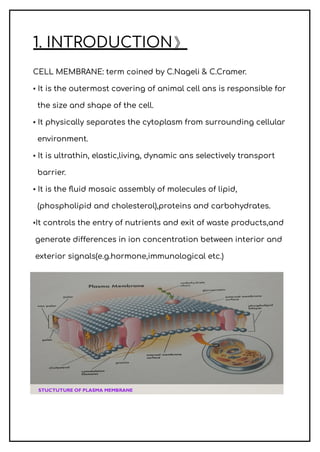
CELL MEMBRANE: term coined by C.Nageli & C.Cramer.
▪︎ It is the outermost covering of animal cell ans is responsible for
the size and shape of the cell.
▪︎ It physically separates the cytoplasm from surrounding cellular
environment.
▪︎ It is ultrathin, elastic,living, dynamic ans selectively transport
barrier.
▪︎ It is the fluid mosaic assembly of molecules of lipid,
(phospholipid and cholesterol),proteins and carbohydrates.
▪︎It controls the entry of nutrients and exit of waste products,and
generate differences in ion concentration between interior and
exterior signals(e.g.hormone,immunological etc.)
COMPOSITION AND STRUCTURE OF PLASMA MEMBRANE:
Chemically Plasma membrane and membrane of other
organelles are found to contain protein, lipid and
carbohydrates in different ratios.
For e.g. in the Plasma membrane of human , red blood cells
Protein represents 50%,Lipid40%,carbohydrates 8%.
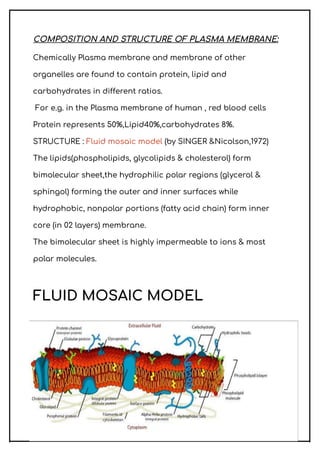
STRUCTURE : Fluid mosaic model (by SINGER &Nicolson,1972)
The lipids(phospholipids, glycolipids & cholesterol) form
bimolecular sheet,the hydrophilic polar regions (glycerol &
sphingol) forming the outer and inner surfaces while
hydrophobic, nonpolar portions (fatty acid chain) form inner
core (in 02 layers) membrane.
The bimolecular sheet is highly impermeable to ions & most
polar molecules.
FLUID MOSAIC MODEL
FUNCTIONS OF PLASMA MEMBRANE 》
1) PERMEABILITY : The Plasma membrane is a thin ,elastic
membrane around the cell which usually allows the movement of
small ions and molecules of various substances through it. This
nature of Plasma membrane is termed as permeability.
According to permeability following types of Plasma membrane
have been recognized:
i) IMPERMEABLE PLASMA MEMBRANE: eg. Unfertilised eggs of
certain fishes allows nothing to pass through it except the
gasses.
ii) SEMI-PERMEABLE PLASMA MEMBRANE: eg. Such a membrane
which allows only Water but no solute particles to pass through
them.
iii) SELECTIVELY PERMEABLE PLASMA MEMBRANE: eg. Such
membrane allows only certain selected ions and small molecules
to pass through them( plasma membrane and intracellular
membrane)
iv) DIALYSING PLASMA MEMBRANE: this type of membrane
having extraneous coat around it, acts as a dialyser. Eg.
Basement membrane of endothelial cell . In these membrane the
water molecules and crystalloids are forced through them by the
hydrostatic pressure forces.
SIGNIFICANCE :
Membranes are not just walls surrounding the cell but very
important function for :
●BIOMEDICAL IMPORTANCE
•Separate cells from one another and help each cell to
maintain
individual characteristics.
•Selectively permeable and help to maintain difference in
the
composition of the intracellular and extracellular fluids.
•Selectively permeable is made possible on account of
CHANNELS AND PUMPS present in the membrane.
•Adjacent cells exchange materials between themselves by
areas
in the membrane called GAP JUNCTION
MODE OF TRANSPORT ACROSS PLASMA MEMBRANE
The plasma membrane acts as a semipermeable barrier
between the cell and the extracellular environment. This
permeability is highly SELECTIVE if it is to ensure that essential
molecules such as glucose, amino acids, and lipids can readily
enter the cell ,that these molecules and metabolic intermediate
remains in the cell, and that waste compound leaves the cell.
The selective permeability of plasma membrane allows the cell
to maintain a constant internal environment (HOMEOSTASIS).
In consequence, in all types of cell there exists a difference in
ionic concentration with the extracellular medium. Similarly,the
organelles within the cell often have a different internal
environment from that of the Surrounding cytosol and organelle
membrane maintain this difference.
TRANSPORT ACROSS-THE-MEMBRANE MAY BE : PASSIVE OR
ACTIVE.
IT MAY OCCUR VIA PHOSPHOLIPID BILAYER OR BY THE HELP OF
SPECIFIC MEMBRANE PROTEINS , CALLED PERMEASES OR
TRANSPORT PROTEINS.
TRANSPORT ACROSS THE MEMBRANE:
PASSIVE TRANSPORT :
•Type of diffusion in which an ion or molecule crossing a
membrane moves down its electrochemical or concentration
gradient.
>no metabolic energy is consumed in passive transport.
1)OSMOSIS
2)SIMPLE DIFFUSION
3)FACILITATED DIFFUSION
ACTIVE TRANSPORT :
•Active transport uses a specific transport protein, called
PUMPS.,Which uses metabolic energy (ATP) to move ions or
molecules against their concentration gradient.
For eg. In both vertebrates and invertebrates,the concentration
of sodium ions is about 10 to 20 times higher in blood than
within the cell.
The concentration of potassium ion is reserved, generally 20 to
40 times higher inside the cell. Such a LOW Sodium
concentration inside the cell is maintained by the
SODIUM –POTASSIUM PUMP.
● Phagocytosis
• Endosmosis
•Exocytosi
1)OSMOSIS:
• The Plasma meem is permeable to water.
• The process by which the water molex passes through a
membrane, from a region of higher concentration to lower
water concentration is known as OSMOSIS .
• ENDO-OSMOSIS: The process in which water molecules enter
into a cell while its reverse is called EXO-OSMOSIS.
2)SIMPLE DIFFUSION:
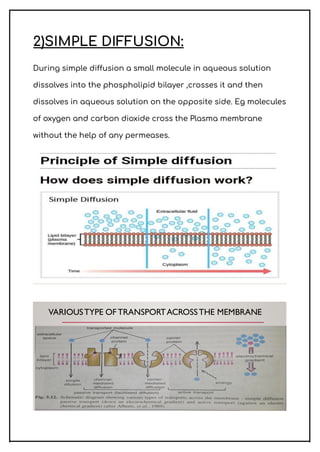
During simple diffusion a small molecule in aqueous solution
dissolves into the phospholipid bilayer ,crosses it and then
dissolves in aqueous solution on the opposite side. Eg molecules
of oxygen and carbon dioxide cross the Plasma membrane
without the help of any permeases.
3)FACILITATED DIFFUSION:
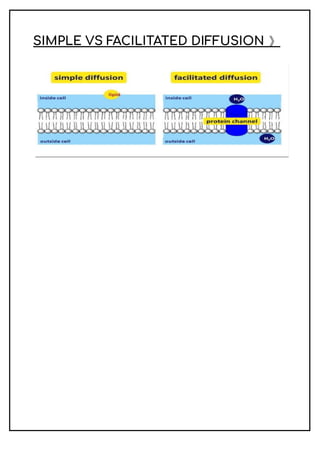
•A special type of passive transport in which the molecules and
ions cross the membrane rapidly because specific permeases in
the membrane facilitate their crossing.
•like simple diffusion, facilitated diffusion doesn’t require
metabolic energy and it occurs only in the direction of a
concentration gradient.
●Facilitated diffusion is characterized by the following features:
1)Rate of transport of molecules is far greater than would be
expected from simple diffusion.
2)This process is specific; EACH FACILITATED DIFFUSION
PROTEIN( CALLED protein Channels) transports only a single
species of ions or molecules.
FACILITATED DIFFUSION >
SIMPLE VS FACILITATED DIFFUSION 》
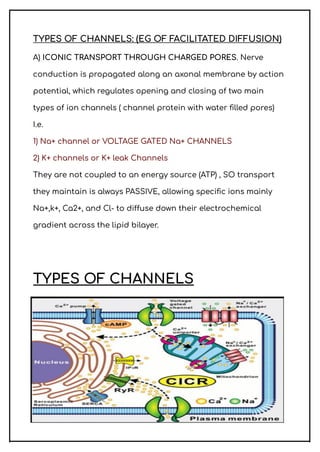
TYPES OF CHANNELS: (EG OF FACILITATED DIFFUSION)
A) ICONIC TRANSPORT THROUGH CHARGED PORES. Nerve
conduction is propagated along an axonal membrane by action
potential, which regulates opening and closing of two main
types of ion channels ( channel protein with water filled pores)
I.e.
1) Na+ channel or VOLTAGE GATED Na+ CHANNELS
2) K+ channels or K+ leak Channels
They are not coupled to an energy source (ATP) , SO transport
they maintain is always PASSIVE, allowing specific ions mainly
Na+,k+, Ca2+, and Cl- to diffuse down their electrochemical
gradient across the lipid bilayer.
TYPES OF CHANNELS
• THIS PROTEIN HAS TWO FUNCTIONAL ELEMENTS:
• 1) A SELECTIVE FILTER which determines the kind of ion that
will be transported ;
• 2) A GATE which by opening and closing the channel, regulates
the ion flow,
• In both Na+ and K+ Channels, the gating mechanism is
electrically driven and is controlled by the membrane potential,
without the need of other energy sources.
• In resting condition, (steady state) both Na+ and K+ Channels
are closed.
• With depolarization, the Na+ Channel is opened and during
repolarization ,it closes again and K+ channel open
CALCIUM ion channels ( Ca2+ channels)
occur in atonal membranes and other membrane for the
entrance of Ca2+ ion in the cell. Ca2+ ion have a fundamental
role in many cellular activities such as Exocytosis, endocytosis
secretion, cell motility, cell growth, fertilization and cell division.
In the neuronal membrane, there are a number of Ca2+
channels that are driven by the membrane potential and are
essential in release of neurotransmitters (acetylcholine)
2) D-hexose permease of erythrocytes.
The Plasma membrane of mammalian erythrocytes and other
body cells contain specific channel proteins for the FACILITATED
DIFFUSION of glucose into cells.
They are called glucose transport, glucose permease or
D-hexose permease.
3) Anion exchange permeases of erythrocytes.
Band 3 polypeptide of Plasmamembran of the erythrocytes and
other cells is an ion exchange permease protein which catalyze
one for one exchange of anion such as chloride (Cl-) and
bicarbonate (HCO3-) across the membrane ( called chloride
shift)
EXAMPLES OF ACTIVE TRANSPORT》
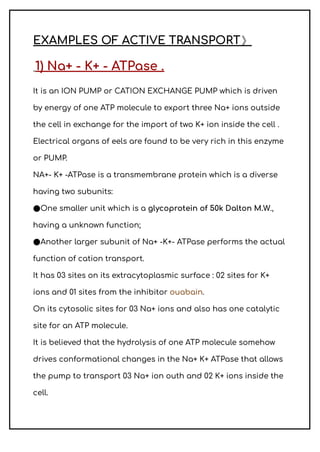
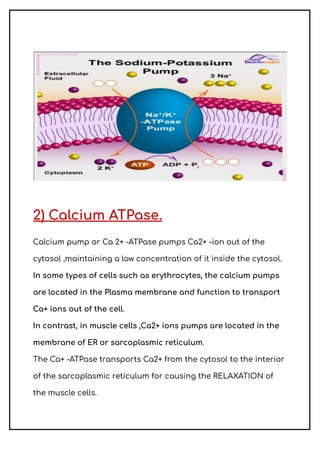
1) Na+ - K+ - ATPase .
It is an ION PUMP or CATION EXCHANGE PUMP which is driven
by energy of one ATP molecule to export three Na+ ions outside
the cell in exchange for the import of two K+ ion inside the cell .
Electrical organs of eels are found to be very rich in this enzyme
or PUMP.
NA+- K+ -ATPase is a transmembrane protein which is a diverse
having two subunits:
●One smaller unit which is a glycoprotein of 50k Dalton M.W.,
having a unknown function;
●Another larger subunit of Na+ -K+- ATPase performs the actual
function of cation transport.
It has 03 sites on its extracytoplasmic surface : 02 sites for K+
ions and 01 sites from the inhibitor ouabain.
On its cytosolic sites for 03 Na+ ions and also has one catalytic
site for an ATP molecule.
It is believed that the hydrolysis of one ATP molecule somehow
drives conformational changes in the Na+ K+ ATPase that allows
the pump to transport 03 Na+ ion outh and 02 K+ ions inside the
cell.
2) Calcium ATPase.
Calcium pump or Ca 2+ -ATPase pumps Ca2+ -ion out of the
cytosol ,maintaining a low concentration of it inside the cytosol.
In some types of cells such as erythrocytes, the calcium pumps
are located in the Plasma membrane and function to transport
Ca+ ions out of the cell.
In contrast, in muscle cells ,Ca2+ ions pumps are located in the
membrane of ER or sarcoplasmic reticulum.
The Ca+ -ATPase transports Ca2+ from the cytosol to the interior
of the sarcoplasmic reticulum for causing the RELAXATION of
the muscle cells.
Release of Ca2+ ions from the sarcoplasmic reticulum tends to
concentrate and store Ca2+ ions by the help of the following two
types of reservoir protein:
1) Calsequestrin (44k Dalton M.W. ; highly acidic protein) which
tebs to bind up to 43 Ca 2+ ions with it.
2) Highly affinity Ca2+ - binding protein which binds Ca2+ ions
and also reduces the conc of free Ca2+ ions inside the
sarcoplasmic reticulum vesicles and dec the amount of energy
needed to pump Ca2+ ions into the cytosol.
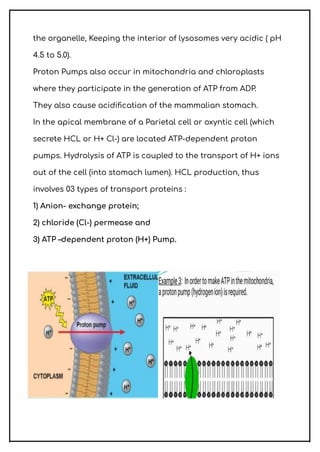
3) Proton Pump or H+ -pump.
The lysosomal membrane contains the ATP- dependent proton
pump that transports protons from the cytosol into the lumen of
the organelle, Keeping the interior of lysosomes very acidic ( pH
4.5 to 5.0).
Proton Pumps also occur in mitochondria and chloroplasts
where they participate in the generation of ATP from ADP.
They also cause acidification of the mammalian stomach.
In the apical membrane of a Parietal cell or oxyntic cell (which
secrete HCL or H+ Cl-) are located ATP-dependent proton
pumps. Hydrolysis of ATP is coupled to the transport of H+ ions
out of the cell (into stomach lumen). HCL production, thus
involves 03 types of transport proteins :
1) Anion- exchange protein;
2) chloride (Cl-) permease and
3) ATP –dependent proton (H+) Pump.
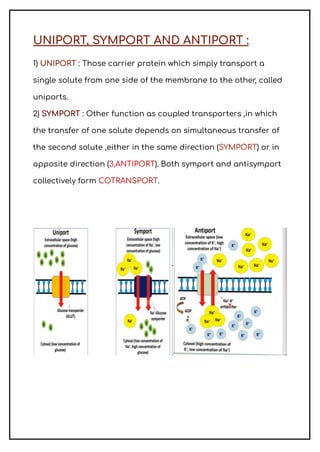
UNIPORT, SYMPORT AND ANTIPORT :
1) UNIPORT : Those carrier protein which simply transport a
single solute from one side of the membrane to the other, called
uniports.
2) SYMPORT : Other function as coupled transporters ,in which
the transfer of one solute depends on simultaneous transfer of
the second solute ,either in the same direction (SYMPORT) or in
opposite direction (3,ANTIPORT). Both symport and antisymport
collectively form COTRANSPORT.
BULK TRANSPORT BY PLASMA MEMBRANE :
1) EXOCYTOSIS:
●also called emiocytosis and CELL VOMITING .
EG : secretory vesicles secretes such as proteins ,lipids ,
carbohydrates (eg cellulose) from golgi apparatus to Plasma
membrane or to the cell exterior.
2) PHAGOCYTOSIS: ( phagein: to eat,, kytos: cell)
● Sometimes large –sized solid food or foreign particles are take
in by the cell through the Plasma membrane. The process of
ingestion of large sized solid substances (eg. Bacteria and part
of broken cells ) by the cells is known as phagocytosis.
3) Endocytosis :
In endocytosis, small regions of Plasma membrane fold inwards
or inveginate, until it has formed new intracellular membrane
limited vehicles.
In Eukaryotes, the following two types of endocytosis can occurs:
i) Pinocytosis (pinyin =to drink,, cell drinking) : 1st observed by
Edward in amoeba and by Lewis in cultured cells .
ii) Receptor- mediated endocytosis : in this type, a specific on the
surface of the Plasma membrane “recognizes “ an extracellular
macromolecule and binds with it. The substance with the
receptor is called the ligand. Eg ligand includes insulin,
vitellogenin,transferring etc.).
SUMMARY:
THE LIPID BILAYER MEMBRANE IS HIGHLY IMPERMEABLE TO
MOST WATER SOLUBLE MOLECULES AND ALL IONS. THE
TRANSFER OF NUTRIENTS METABOLITES AND IONS ACROSS
THE PLASMA MEMBRANE AND INTERNAL CELL MEMBRANE IS
CARRIED OUT BY “MEMBRANE TRANSPORT SYSTEM”.
》Cell membranes contain a variety of transport proteins each
of which is responsible for transferring a particular type of
solute across the membrane. There are two classes of
membrane transport protein carrier protein and channel
proteins.
》The electrochemical gradient represents the net driving force
on an iron due to the concentration gradient and the electric
field.
》In passive transport an uncharged solute moves
spontaneously down into concentration gradient and a charged
solute and iron spontaneously down its electrochemical
Radiant.In active transport an Uncharged solute or an iron is
transported against its concentration or electrochemical
Radiant in an energy requiring process.
》Carrier protein binds with specific solute inorganic ions (small
organic molecules or both) and transfers them across the lipid
bi- layer by undergoing conformational changes that expose the
solute binding sites first on one side of the membrane and then
on the other.
》CarrierProteins act as pumps to transport a solute uphill
against its Electrochemical gradient using energy provided by
ATP hydrolysis by Downhill flow of any plus or h+ iron or by light.
》Na+-K+ pump in the plasma membrane of an animal cell is an
ATPase that actively transports Na+ out of the cell and K+in
maintaining the streep Na+ gradient across the plasma
membrane that is used to drive other active transport process
and to convey electrical signals.
》Channel protein forms Aqua S4 across the bilated layer
through which the solute can defuse whereas transport by
carrier protein can be active or passive transport by channel
protein is always passive.
REFERENCE 》
• Cell biology : PS VERMA
• TEXT F BIOCHEMISTRY: Dr. A.V.S.S..RAMA RAO.
• NCERT 11 and 12th
• Unified Zoology :VK TIWARI And Vk agarwal .
• Biochemistry : U. Satyanatayan And V. Chakrapani.
• Biochemistry : Lehninger
• Fundamental of biochemistry: S. CHAND.
• Internet
M.C.Q.
1) Gasses such as Oxygen and Carbon dioxide across the cell
membrane by:
a) Passive diffusion through the lipid bilayer.
b) Primary active transport
c) Specific gas transport protein
d) Secondary active transport
2) Career protein take part in:
a) Water transport
b) Active transport of ions
c) Passive transport of ions
d) None
3) Which of the following is an e.g. of primary Active transport:
a) Cl- -HCO3- exchange
b) Na+K+ ATPase
c) Na+-H+ exchange
d) Na+- Ca2+ exchange
4) The Principal intracellular cation is :
a) Na+
b) Ca+
c) K+
d) Cl
5) Which of the following values is closest to the resting
membrane potential of mammalian cells:
a) +20mv
b) -20mv
c) -60mv
d) +60mv
6) Which Of the following statements regarding the exercise is
correct?
a) It always employed by sales of secretion
b) Take large molecule from extracellular space
c) Always the retrieval of elements of cell membrane
d) Is used to deliver material into the extracellular space
7) Exocytosis is used by cells to :
a) Ingest bacteria and cell
b) Retrieve elements of the cell membrane after Exocytosis
c) Secrete large molecules into the extracellular space
d) None
8) Pinacocytes :
a) At sites of membrane called coated pits
b) For large protein molecule
c) Bh formation of the Pinocytosis of vehicles
d) All
9) The resting membrane potential is mainly determined by ;
a) k+ gradient
b) Cl- gradient
c) Ca2+ gradient
d) Na+gradient
10) which of the following process requires membrane protein:
a)Pinacocytes
b) Exocytosis
c) Pinacocytosis
d) Receptor-mediated endocytosis
Membrane Channels And Pump

Membrane Channels And Pump

  • 1.
    Govt. M.H. Collegeof Home Science & Science For Women, Autonomous, Jabalpur , M.P. Presentation On Membrane Channels And Pump Submitted to: Submitted by: Dr. Sadhana Kesharwani Samiksha Department of zoology M.sc. 1st Sem. 2022-2023
  • 2.
    ●SYNOPSIS 》MEMBRANE CHANNELSAND PUMPS 1) INTRODUCTION: 2) MEMBRANE (COMPOSITION,STRUCTURE,SIGNIFICANCE ) 3) TRANSPORT ACROSS MEMBRANE (SIMPLE DIFFUSION, PASSIVE,ACTIVE) 4) MEMBRANE CHANNELS AND TYPES 5) MEMBRANE PUMP AND TYPES 6) COTRANSPORT: ●UNIPORT ●SYMPORT ●ANTIPORT 7) BULK TRANSPORT:●EXOCYTOSIS ●ENDOSMOSIS ●PINOCYTOSIS
  • 3.
    1. INTRODUCTION》 CELL MEMBRANE:term coined by C.Nageli & C.Cramer. ▪︎ It is the outermost covering of animal cell ans is responsible for the size and shape of the cell. ▪︎ It physically separates the cytoplasm from surrounding cellular environment. ▪︎ It is ultrathin, elastic,living, dynamic ans selectively transport barrier. ▪︎ It is the fluid mosaic assembly of molecules of lipid, (phospholipid and cholesterol),proteins and carbohydrates. ▪︎It controls the entry of nutrients and exit of waste products,and generate differences in ion concentration between interior and exterior signals(e.g.hormone,immunological etc.)
  • 4.
    COMPOSITION AND STRUCTUREOF PLASMA MEMBRANE: Chemically Plasma membrane and membrane of other organelles are found to contain protein, lipid and carbohydrates in different ratios. For e.g. in the Plasma membrane of human , red blood cells Protein represents 50%,Lipid40%,carbohydrates 8%. STRUCTURE : Fluid mosaic model (by SINGER &Nicolson,1972) The lipids(phospholipids, glycolipids & cholesterol) form bimolecular sheet,the hydrophilic polar regions (glycerol & sphingol) forming the outer and inner surfaces while hydrophobic, nonpolar portions (fatty acid chain) form inner core (in 02 layers) membrane. The bimolecular sheet is highly impermeable to ions & most polar molecules. FLUID MOSAIC MODEL
  • 5.
    FUNCTIONS OF PLASMAMEMBRANE 》 1) PERMEABILITY : The Plasma membrane is a thin ,elastic membrane around the cell which usually allows the movement of small ions and molecules of various substances through it. This nature of Plasma membrane is termed as permeability. According to permeability following types of Plasma membrane have been recognized: i) IMPERMEABLE PLASMA MEMBRANE: eg. Unfertilised eggs of certain fishes allows nothing to pass through it except the gasses. ii) SEMI-PERMEABLE PLASMA MEMBRANE: eg. Such a membrane which allows only Water but no solute particles to pass through them. iii) SELECTIVELY PERMEABLE PLASMA MEMBRANE: eg. Such membrane allows only certain selected ions and small molecules to pass through them( plasma membrane and intracellular membrane) iv) DIALYSING PLASMA MEMBRANE: this type of membrane having extraneous coat around it, acts as a dialyser. Eg. Basement membrane of endothelial cell . In these membrane the water molecules and crystalloids are forced through them by the hydrostatic pressure forces.
  • 6.
    SIGNIFICANCE : Membranes arenot just walls surrounding the cell but very important function for : ●BIOMEDICAL IMPORTANCE •Separate cells from one another and help each cell to maintain individual characteristics. •Selectively permeable and help to maintain difference in the composition of the intracellular and extracellular fluids. •Selectively permeable is made possible on account of CHANNELS AND PUMPS present in the membrane. •Adjacent cells exchange materials between themselves by areas in the membrane called GAP JUNCTION
  • 7.
    MODE OF TRANSPORTACROSS PLASMA MEMBRANE The plasma membrane acts as a semipermeable barrier between the cell and the extracellular environment. This permeability is highly SELECTIVE if it is to ensure that essential molecules such as glucose, amino acids, and lipids can readily enter the cell ,that these molecules and metabolic intermediate remains in the cell, and that waste compound leaves the cell. The selective permeability of plasma membrane allows the cell to maintain a constant internal environment (HOMEOSTASIS). In consequence, in all types of cell there exists a difference in ionic concentration with the extracellular medium. Similarly,the organelles within the cell often have a different internal environment from that of the Surrounding cytosol and organelle membrane maintain this difference. TRANSPORT ACROSS-THE-MEMBRANE MAY BE : PASSIVE OR ACTIVE. IT MAY OCCUR VIA PHOSPHOLIPID BILAYER OR BY THE HELP OF SPECIFIC MEMBRANE PROTEINS , CALLED PERMEASES OR TRANSPORT PROTEINS.
  • 8.
    TRANSPORT ACROSS THEMEMBRANE: PASSIVE TRANSPORT : •Type of diffusion in which an ion or molecule crossing a membrane moves down its electrochemical or concentration gradient. >no metabolic energy is consumed in passive transport. 1)OSMOSIS 2)SIMPLE DIFFUSION 3)FACILITATED DIFFUSION ACTIVE TRANSPORT : •Active transport uses a specific transport protein, called PUMPS.,Which uses metabolic energy (ATP) to move ions or molecules against their concentration gradient. For eg. In both vertebrates and invertebrates,the concentration of sodium ions is about 10 to 20 times higher in blood than within the cell. The concentration of potassium ion is reserved, generally 20 to 40 times higher inside the cell. Such a LOW Sodium concentration inside the cell is maintained by the SODIUM –POTASSIUM PUMP. ● Phagocytosis • Endosmosis
  • 9.
  • 10.
    1)OSMOSIS: • The Plasmameem is permeable to water. • The process by which the water molex passes through a membrane, from a region of higher concentration to lower water concentration is known as OSMOSIS . • ENDO-OSMOSIS: The process in which water molecules enter into a cell while its reverse is called EXO-OSMOSIS.
  • 11.
    2)SIMPLE DIFFUSION: During simplediffusion a small molecule in aqueous solution dissolves into the phospholipid bilayer ,crosses it and then dissolves in aqueous solution on the opposite side. Eg molecules of oxygen and carbon dioxide cross the Plasma membrane without the help of any permeases.
  • 12.
    3)FACILITATED DIFFUSION: •A specialtype of passive transport in which the molecules and ions cross the membrane rapidly because specific permeases in the membrane facilitate their crossing. •like simple diffusion, facilitated diffusion doesn’t require metabolic energy and it occurs only in the direction of a concentration gradient. ●Facilitated diffusion is characterized by the following features: 1)Rate of transport of molecules is far greater than would be expected from simple diffusion. 2)This process is specific; EACH FACILITATED DIFFUSION PROTEIN( CALLED protein Channels) transports only a single species of ions or molecules. FACILITATED DIFFUSION >
  • 13.
    SIMPLE VS FACILITATEDDIFFUSION 》
  • 14.
    TYPES OF CHANNELS:(EG OF FACILITATED DIFFUSION) A) ICONIC TRANSPORT THROUGH CHARGED PORES. Nerve conduction is propagated along an axonal membrane by action potential, which regulates opening and closing of two main types of ion channels ( channel protein with water filled pores) I.e. 1) Na+ channel or VOLTAGE GATED Na+ CHANNELS 2) K+ channels or K+ leak Channels They are not coupled to an energy source (ATP) , SO transport they maintain is always PASSIVE, allowing specific ions mainly Na+,k+, Ca2+, and Cl- to diffuse down their electrochemical gradient across the lipid bilayer. TYPES OF CHANNELS
  • 15.
    • THIS PROTEINHAS TWO FUNCTIONAL ELEMENTS: • 1) A SELECTIVE FILTER which determines the kind of ion that will be transported ; • 2) A GATE which by opening and closing the channel, regulates the ion flow, • In both Na+ and K+ Channels, the gating mechanism is electrically driven and is controlled by the membrane potential, without the need of other energy sources. • In resting condition, (steady state) both Na+ and K+ Channels are closed. • With depolarization, the Na+ Channel is opened and during repolarization ,it closes again and K+ channel open CALCIUM ion channels ( Ca2+ channels) occur in atonal membranes and other membrane for the entrance of Ca2+ ion in the cell. Ca2+ ion have a fundamental role in many cellular activities such as Exocytosis, endocytosis secretion, cell motility, cell growth, fertilization and cell division. In the neuronal membrane, there are a number of Ca2+ channels that are driven by the membrane potential and are essential in release of neurotransmitters (acetylcholine)
  • 16.
    2) D-hexose permeaseof erythrocytes. The Plasma membrane of mammalian erythrocytes and other body cells contain specific channel proteins for the FACILITATED DIFFUSION of glucose into cells. They are called glucose transport, glucose permease or D-hexose permease. 3) Anion exchange permeases of erythrocytes. Band 3 polypeptide of Plasmamembran of the erythrocytes and other cells is an ion exchange permease protein which catalyze one for one exchange of anion such as chloride (Cl-) and bicarbonate (HCO3-) across the membrane ( called chloride shift)
  • 17.
    EXAMPLES OF ACTIVETRANSPORT》 1) Na+ - K+ - ATPase . It is an ION PUMP or CATION EXCHANGE PUMP which is driven by energy of one ATP molecule to export three Na+ ions outside the cell in exchange for the import of two K+ ion inside the cell . Electrical organs of eels are found to be very rich in this enzyme or PUMP. NA+- K+ -ATPase is a transmembrane protein which is a diverse having two subunits: ●One smaller unit which is a glycoprotein of 50k Dalton M.W., having a unknown function; ●Another larger subunit of Na+ -K+- ATPase performs the actual function of cation transport. It has 03 sites on its extracytoplasmic surface : 02 sites for K+ ions and 01 sites from the inhibitor ouabain. On its cytosolic sites for 03 Na+ ions and also has one catalytic site for an ATP molecule. It is believed that the hydrolysis of one ATP molecule somehow drives conformational changes in the Na+ K+ ATPase that allows the pump to transport 03 Na+ ion outh and 02 K+ ions inside the cell.
  • 18.
    2) Calcium ATPase. Calciumpump or Ca 2+ -ATPase pumps Ca2+ -ion out of the cytosol ,maintaining a low concentration of it inside the cytosol. In some types of cells such as erythrocytes, the calcium pumps are located in the Plasma membrane and function to transport Ca+ ions out of the cell. In contrast, in muscle cells ,Ca2+ ions pumps are located in the membrane of ER or sarcoplasmic reticulum. The Ca+ -ATPase transports Ca2+ from the cytosol to the interior of the sarcoplasmic reticulum for causing the RELAXATION of the muscle cells.
  • 19.
    Release of Ca2+ions from the sarcoplasmic reticulum tends to concentrate and store Ca2+ ions by the help of the following two types of reservoir protein: 1) Calsequestrin (44k Dalton M.W. ; highly acidic protein) which tebs to bind up to 43 Ca 2+ ions with it. 2) Highly affinity Ca2+ - binding protein which binds Ca2+ ions and also reduces the conc of free Ca2+ ions inside the sarcoplasmic reticulum vesicles and dec the amount of energy needed to pump Ca2+ ions into the cytosol. 3) Proton Pump or H+ -pump. The lysosomal membrane contains the ATP- dependent proton pump that transports protons from the cytosol into the lumen of
  • 20.
    the organelle, Keepingthe interior of lysosomes very acidic ( pH 4.5 to 5.0). Proton Pumps also occur in mitochondria and chloroplasts where they participate in the generation of ATP from ADP. They also cause acidification of the mammalian stomach. In the apical membrane of a Parietal cell or oxyntic cell (which secrete HCL or H+ Cl-) are located ATP-dependent proton pumps. Hydrolysis of ATP is coupled to the transport of H+ ions out of the cell (into stomach lumen). HCL production, thus involves 03 types of transport proteins : 1) Anion- exchange protein; 2) chloride (Cl-) permease and 3) ATP –dependent proton (H+) Pump.
  • 21.
    UNIPORT, SYMPORT ANDANTIPORT : 1) UNIPORT : Those carrier protein which simply transport a single solute from one side of the membrane to the other, called uniports. 2) SYMPORT : Other function as coupled transporters ,in which the transfer of one solute depends on simultaneous transfer of the second solute ,either in the same direction (SYMPORT) or in opposite direction (3,ANTIPORT). Both symport and antisymport collectively form COTRANSPORT.
  • 22.
    BULK TRANSPORT BYPLASMA MEMBRANE : 1) EXOCYTOSIS: ●also called emiocytosis and CELL VOMITING . EG : secretory vesicles secretes such as proteins ,lipids , carbohydrates (eg cellulose) from golgi apparatus to Plasma membrane or to the cell exterior. 2) PHAGOCYTOSIS: ( phagein: to eat,, kytos: cell) ● Sometimes large –sized solid food or foreign particles are take in by the cell through the Plasma membrane. The process of ingestion of large sized solid substances (eg. Bacteria and part of broken cells ) by the cells is known as phagocytosis.
  • 23.
    3) Endocytosis : Inendocytosis, small regions of Plasma membrane fold inwards or inveginate, until it has formed new intracellular membrane limited vehicles. In Eukaryotes, the following two types of endocytosis can occurs: i) Pinocytosis (pinyin =to drink,, cell drinking) : 1st observed by Edward in amoeba and by Lewis in cultured cells . ii) Receptor- mediated endocytosis : in this type, a specific on the surface of the Plasma membrane “recognizes “ an extracellular macromolecule and binds with it. The substance with the receptor is called the ligand. Eg ligand includes insulin, vitellogenin,transferring etc.).
  • 24.
    SUMMARY: THE LIPID BILAYERMEMBRANE IS HIGHLY IMPERMEABLE TO MOST WATER SOLUBLE MOLECULES AND ALL IONS. THE TRANSFER OF NUTRIENTS METABOLITES AND IONS ACROSS THE PLASMA MEMBRANE AND INTERNAL CELL MEMBRANE IS CARRIED OUT BY “MEMBRANE TRANSPORT SYSTEM”. 》Cell membranes contain a variety of transport proteins each of which is responsible for transferring a particular type of solute across the membrane. There are two classes of membrane transport protein carrier protein and channel proteins. 》The electrochemical gradient represents the net driving force on an iron due to the concentration gradient and the electric field. 》In passive transport an uncharged solute moves spontaneously down into concentration gradient and a charged solute and iron spontaneously down its electrochemical Radiant.In active transport an Uncharged solute or an iron is transported against its concentration or electrochemical Radiant in an energy requiring process. 》Carrier protein binds with specific solute inorganic ions (small
  • 25.
    organic molecules orboth) and transfers them across the lipid bi- layer by undergoing conformational changes that expose the solute binding sites first on one side of the membrane and then on the other. 》CarrierProteins act as pumps to transport a solute uphill against its Electrochemical gradient using energy provided by ATP hydrolysis by Downhill flow of any plus or h+ iron or by light. 》Na+-K+ pump in the plasma membrane of an animal cell is an ATPase that actively transports Na+ out of the cell and K+in maintaining the streep Na+ gradient across the plasma membrane that is used to drive other active transport process and to convey electrical signals. 》Channel protein forms Aqua S4 across the bilated layer through which the solute can defuse whereas transport by carrier protein can be active or passive transport by channel protein is always passive.
  • 26.
    REFERENCE 》 • Cellbiology : PS VERMA • TEXT F BIOCHEMISTRY: Dr. A.V.S.S..RAMA RAO. • NCERT 11 and 12th • Unified Zoology :VK TIWARI And Vk agarwal . • Biochemistry : U. Satyanatayan And V. Chakrapani. • Biochemistry : Lehninger • Fundamental of biochemistry: S. CHAND. • Internet
  • 27.
    M.C.Q. 1) Gasses suchas Oxygen and Carbon dioxide across the cell membrane by: a) Passive diffusion through the lipid bilayer. b) Primary active transport c) Specific gas transport protein d) Secondary active transport 2) Career protein take part in: a) Water transport b) Active transport of ions c) Passive transport of ions d) None 3) Which of the following is an e.g. of primary Active transport: a) Cl- -HCO3- exchange b) Na+K+ ATPase c) Na+-H+ exchange d) Na+- Ca2+ exchange 4) The Principal intracellular cation is : a) Na+
  • 28.
    b) Ca+ c) K+ d)Cl 5) Which of the following values is closest to the resting membrane potential of mammalian cells: a) +20mv b) -20mv c) -60mv d) +60mv 6) Which Of the following statements regarding the exercise is correct? a) It always employed by sales of secretion b) Take large molecule from extracellular space c) Always the retrieval of elements of cell membrane d) Is used to deliver material into the extracellular space 7) Exocytosis is used by cells to : a) Ingest bacteria and cell b) Retrieve elements of the cell membrane after Exocytosis c) Secrete large molecules into the extracellular space
  • 29.
    d) None 8) Pinacocytes: a) At sites of membrane called coated pits b) For large protein molecule c) Bh formation of the Pinocytosis of vehicles d) All 9) The resting membrane potential is mainly determined by ; a) k+ gradient b) Cl- gradient c) Ca2+ gradient d) Na+gradient 10) which of the following process requires membrane protein: a)Pinacocytes b) Exocytosis c) Pinacocytosis d) Receptor-mediated endocytosis