BIOELECTRIC POTENTIAL
By:-
DR. ANJU JHA
MBBS. MD. PGDMCH
 The existence of electrical potentials at
rest and during excitation in experimental
animals- proved by Dubois Reymond in
later half of 19th century.
 Recording of electric potentials from the
biological fluid:
 string galvanometer,
 microelectrodes and
 cathode ray oscilloscope (CRO).
 Communication within neuron
 electrical signal.
 Electric current: Movement of electrons.
 Bioelectric potential : movement of ions.
Significance
The electric potentials generated
in human tissues are widely used
for diagnostic purposes.
Clinicians utilizes them for the diagnosis
of nerve, muscle, cardiac, brain, visual and
auditory functions.
ION DISTRIBUTION
 Particles / molecules
 electrically charged
 Anions
 negatively charged
 Cations
 positively charged
 Anions (-)
 Large intracellular proteins
 Chloride ions Cl-
 Cations (+)
 Sodium Na+
 Potassium K+
ION DISTRIBUTION
The cell membrane separates the
intracellular fluid from extracellular fluid.
Both the compartments having widely
different ionic compositions.
 All living cells have an electrical potential
difference across their surface membranes
 All the bioelectric potentials are basically
generated due to diffusion of ions across
the membrane either during resting or at
any moment of excitation.
 Concentration gradients of ions across the
membrane are the immediate supplier of
the energy to create and maintain the
resting potential.
 Bioelectric potentials exist between interior
and exterior of all cell membranes of the
living body.
 Generated by the charged ions that line on
either side of the cell membrane.
 Neurons have an electrical potential
(voltage) across the cell membrane.
 The inside of the cell is more negative
than the outside at rest
called the Resting Membrane Potential
 The resting potential is necessary for:
 Electrical excitability of nerve and muscle
cells.
 Sensory reception.
 CNS computation.
 To help regulate transfer of ions across the
membrane.
The generation of the resting potential
and all of the changes in potential
depend on:
The concentration gradients of ions
across the cell membrane.
RESTING MEMBRANE POTENTIAL
Membrane
outside
inside
Na+
Na+
Cl-
Cl-
K+
K+
A-
+ + + + + + + + + + +
-----------
+ + + + + + + + + + +
-----------
 RMP is primarily due to difference in
concentration of ions between intracellular
and extracellular fluid.
 A potential is so generated is called a
diffusion potential.
 RMP is dependent on equilibrium potential
for each ion present inside and outside the
cell.
RESTING MEMBRANE POTENTIAL
 How is it generated?
1. Differential distribution of ions
inside and outside the cell.
2. Selective permeability of the
membrane to some ions.
Equilibrium potential is the potential when diffusion
of an ion is in equilibrium. It means that diffusion due
to concentration gradient will be equal to diffusion
due to electrical gradient.
Why this ionic differences in the ionic composition
of ICF and ECF?
1)Resting cell membrane is moderately permeable to
Na+.
2)Resting cell membrane is freely permeable to K+ &
Cl-.
3)Cell membrane is practically impermeable to most of
the intracellular anions like Proteins & organic
phosphate ions.
Why are there difference in the permeability of
cell membrane to various Small ions?
The ions in the body are hydrated.
Atomic wt of K+ is greater than Na+ but hydrated Na+
ion is larger then hydrated K+ ion.
SUMMARY OF GENESIS OF RMP
 Difference between intracellular and
extracellular K+ concentration.
 Impermeability of membrane to protein
anions.
 Poor permeability of membrane to Na+.
 Sodium pumps.
GIBBS- DONNAN MEMBRANE EQUILIBRIUM
Solution
A
Solution
B
Each solution is electrically neutral ie
Cations A = Anions A
Cations B = Anions B
The product of diffusible ions on one side of the membrane
will be equal to product of diffusible ions on other side. SO
Cations A X Anions A = Cations B X Anions B.
Cations A Anions B
------------------ = ---------------------
Cations B Anions A
But if there is one or more non diffusible ions also present
in one solution what will be the result?
BA
K+
Cl-
X-
K+
Cl-
The penetrating ions K+ and Cl- diffuse until equilibrium is attained
So electrical neutrality of both ion will be
(K+) A= (Cl-)A + (X-)A
(K+)B =(Cl-)B
AND
products of diffusible ions and ratio of diffusible ions will be
(K+)A X (Cl-)A = (K+)B X (Cl-)B
(K+)A (Cl-)B
----------- = -----------------
(K+)B (Cl-)A
 As there is more excess Anion in solution A
thus K+ will be more than Cl- ie more diffusible Cation
than diffusible Anion to maintain neutrality.
(K+)A > (Cl-)A
Hence
(K+)A > (K+)B
And
(Cl-)A < (Cl-)B
i) If the diffusible cation concentration on the side
of membrane containing non- diffusible anions is
greater than diffusible cation concentration on
other side.
ii) The diffusible anion concentration will be
greater on the side without diffusible anions.
This is GIBBS DONNAN EQUILIBRIUM
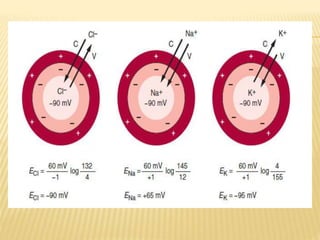
 The magnitude of equilibrium potential for
an ion may be predicted from the Nernst
equation.
 Diffusion potential of each ion can be
calculated by this equation.
NERNST EQUATION
[ ]
ln
[ ]
I
II
RT X
Ex
zF X

Equilibrium Potential
of X ion (eg. K+) in Volts
Valence of
ion (-1, +1, +2) Faraday constant
Gas Constant
Temp (K) Ion Concentration I
Ion Concentration II
At normal body temperature at 37oC the
Nernst equation can be simplified by
substituting the constants (R, T & F) and
converting to common logarithms, then
C in
E ion = - 61.5 log -------------
C out
 In a mammalian muscle cell, the K+conc. is
155mEq/L in intracellular fluid and 4mEq/L
extracellular fluid.
 The equilibrium potential for Potassium may
be calculated as:
E
= -61log 38.75
= - 61 X 1.5883
= -97mV.
Equilibrium potential for important ions in a neuron
ENa+ = +60mV EK+ = -90mV
ECa+ = +130mV EH+ = -25mV
ECl- = - 70mV EHCO3-= -25mV
GOLDMAN- HODGKIN-KATZ EQUATION
The magnitude of the membrane potential at
any given time depends upon-
The distribution of Na+, K+ and Cl-
and
The permeability of the membrane to each
of these ions.
Equation that describes relationship of
membrane potential with ion distribution
across the cell membrane is Goldman-
Hodgkin-Katz equation.
CNa+i PNa+ + CK+i PK+ + CCl-o
PCl-
EMF = -61log
CNa+o PNa+ + CK+oPK+ + CCl-i
PCl-
The genesis and the ionic basis of these
potentials were clearly elucidated by using
–
 Voltage clamp techniues.
 Channel blockers
 Patch clamp techniques.
 Resting membrane potential.
 Local potential
 Genesis of action potential.
 Summated potentials.
 Conduction & transmission of nerve
impulse.
 A resting nerve or muscle cell become
active as a result of a stimulus.
 Irrespective of the nature of stimulus the
response is in terms of a change in
membrane potential.
 It could be graded potential or action
potential.
 Graded means that its magnitude depends
on intensity of stimulus.
 If magnitude of the depolarization
exceeds the threshold value, it leads to a
well defined electrical change known as
ACTION POTENTIAL.
 The sequence of changes which occur in
the membrane potential following
excitation is called Action potential.
 Action potentials are also referred to as
‘impulses’ or ‘spikes’.
 The exact duration and to some extent ,
magnitude of action potential depend on
the tissue.
 Action potential(in nerves) is the signal that is
conducted along the axon over along
distance without change in amplitude.
 Except the action potential, all other signals
fade out after travelling short distance.
All-or-none law:
 An action potential is usually full sized with
fixed amplitude of about 110mV( from -70
to +40mV).
 Sub-threshold stimuli can not trigger action
potential.
 Once triggered, an action potential runs its
entire course producing a full fledged
spike.
 This is known as the all-or-none law.
Phases of action potential
 Resting phase.
 Prepotential
 Depolarization
 Repolarization.
 After-depolarization
 Hyperpolarization/after-potential
+40
0
Millivolt
Time in
Millisec
-55
-70
+40
0
Millivolt
Time in
Millisec
-55
-70 Pre potential
Threshold potential
Depolarizatio
n
Repolarization
After
depolarization
Hyperpolarization
+40
0
Millivolt
Time in
Millisec
-55
-70
Pre potential
Threshold potential
Depolarizatio
n
Repolarization
After
depolarization
Hyperpolarization
Overshoot
(+20 to +30mV)
Pre-potential-
 Also k/as foot of action potential.
 Slow drift of local membrane potential
towards -55mV.
 Up to firing level of action potential.
 Not a part of action potential (it may be
present in other potentials too.)
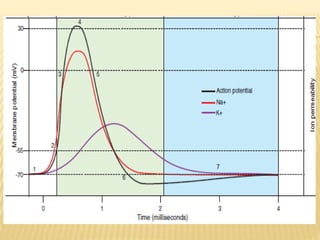
Depolarization – the potential shoots
up to + 40mV in less than a
millisecond.
Repolarization – during this phase
potential drops to about -40mV in less
than a millisecond.
 After-depolarization- the rate of
repolarization slows down and gradually
returns to RMP in 2ms.
 After-hyperpolarization - intracellular
negativity overshoots the resting value -
70mV to -75mV. It takes 40msec before
returning to RMP.
Ionic basis of action potential
 Na+ permeability.
 K+ permeability.
 Na K ATPase pump
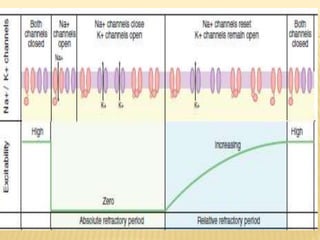
Refractory period:
 Absolute refractory period.
 Relative refractory period.
DIFFERENCES BETWEEN GRADED POTENTIAL AND ACTION POTENTIAL
Graded potential Action potential
Amplitude proportionate to
stimulus strength and can
get summated.
Amplitude constant for all
suprathreshold stimuli and
can not be summated.
Can be a depolarization or
hyperpolrization.
Always depolarization
Conduction is associated
with reduction in magnitude.
Conducted without
reduction in magnitude.
Can be generated
spontaneously in response
to physical or chemical
stimuli.
Generated only response to
membrane depolarization.
Does not obey all-or-none
law.
Obeys all-or-none law.
Summary:
 Phases of action potential
 Ionic basis of action potential.
 Refractory period.
 Differences between graded potential and
action potential.
REFERANCES
 Text book of medical physiology. Guyton&
hall.
 Ganong’s review of medical Physiology.
 Principles of medical physiology by S. Sircar.
 Understanding medical physiology by RL
Bijlani & S. Manjunatha.
Bioelectric potential

Bioelectric potential

  • 1.
  • 2.
     The existenceof electrical potentials at rest and during excitation in experimental animals- proved by Dubois Reymond in later half of 19th century.  Recording of electric potentials from the biological fluid:  string galvanometer,  microelectrodes and  cathode ray oscilloscope (CRO).
  • 6.
     Communication withinneuron  electrical signal.  Electric current: Movement of electrons.  Bioelectric potential : movement of ions.
  • 7.
    Significance The electric potentialsgenerated in human tissues are widely used for diagnostic purposes. Clinicians utilizes them for the diagnosis of nerve, muscle, cardiac, brain, visual and auditory functions.
  • 8.
    ION DISTRIBUTION  Particles/ molecules  electrically charged  Anions  negatively charged  Cations  positively charged
  • 9.
     Anions (-) Large intracellular proteins  Chloride ions Cl-  Cations (+)  Sodium Na+  Potassium K+ ION DISTRIBUTION
  • 10.
    The cell membraneseparates the intracellular fluid from extracellular fluid. Both the compartments having widely different ionic compositions.
  • 12.
     All livingcells have an electrical potential difference across their surface membranes  All the bioelectric potentials are basically generated due to diffusion of ions across the membrane either during resting or at any moment of excitation.
  • 13.
     Concentration gradientsof ions across the membrane are the immediate supplier of the energy to create and maintain the resting potential.  Bioelectric potentials exist between interior and exterior of all cell membranes of the living body.  Generated by the charged ions that line on either side of the cell membrane.
  • 14.
     Neurons havean electrical potential (voltage) across the cell membrane.  The inside of the cell is more negative than the outside at rest called the Resting Membrane Potential
  • 15.
     The restingpotential is necessary for:  Electrical excitability of nerve and muscle cells.  Sensory reception.  CNS computation.  To help regulate transfer of ions across the membrane.
  • 16.
    The generation ofthe resting potential and all of the changes in potential depend on: The concentration gradients of ions across the cell membrane.
  • 17.
    RESTING MEMBRANE POTENTIAL Membrane outside inside Na+ Na+ Cl- Cl- K+ K+ A- ++ + + + + + + + + + ----------- + + + + + + + + + + + -----------
  • 18.
     RMP isprimarily due to difference in concentration of ions between intracellular and extracellular fluid.  A potential is so generated is called a diffusion potential.  RMP is dependent on equilibrium potential for each ion present inside and outside the cell.
  • 19.
    RESTING MEMBRANE POTENTIAL How is it generated? 1. Differential distribution of ions inside and outside the cell. 2. Selective permeability of the membrane to some ions. Equilibrium potential is the potential when diffusion of an ion is in equilibrium. It means that diffusion due to concentration gradient will be equal to diffusion due to electrical gradient.
  • 20.
    Why this ionicdifferences in the ionic composition of ICF and ECF? 1)Resting cell membrane is moderately permeable to Na+. 2)Resting cell membrane is freely permeable to K+ & Cl-. 3)Cell membrane is practically impermeable to most of the intracellular anions like Proteins & organic phosphate ions.
  • 21.
    Why are theredifference in the permeability of cell membrane to various Small ions? The ions in the body are hydrated. Atomic wt of K+ is greater than Na+ but hydrated Na+ ion is larger then hydrated K+ ion.
  • 22.
    SUMMARY OF GENESISOF RMP  Difference between intracellular and extracellular K+ concentration.  Impermeability of membrane to protein anions.  Poor permeability of membrane to Na+.  Sodium pumps.
  • 23.
    GIBBS- DONNAN MEMBRANEEQUILIBRIUM Solution A Solution B Each solution is electrically neutral ie Cations A = Anions A Cations B = Anions B The product of diffusible ions on one side of the membrane will be equal to product of diffusible ions on other side. SO Cations A X Anions A = Cations B X Anions B. Cations A Anions B ------------------ = --------------------- Cations B Anions A
  • 24.
    But if thereis one or more non diffusible ions also present in one solution what will be the result? BA K+ Cl- X- K+ Cl- The penetrating ions K+ and Cl- diffuse until equilibrium is attained So electrical neutrality of both ion will be (K+) A= (Cl-)A + (X-)A (K+)B =(Cl-)B AND products of diffusible ions and ratio of diffusible ions will be (K+)A X (Cl-)A = (K+)B X (Cl-)B (K+)A (Cl-)B ----------- = ----------------- (K+)B (Cl-)A
  • 25.
     As thereis more excess Anion in solution A thus K+ will be more than Cl- ie more diffusible Cation than diffusible Anion to maintain neutrality. (K+)A > (Cl-)A Hence (K+)A > (K+)B And (Cl-)A < (Cl-)B
  • 26.
    i) If thediffusible cation concentration on the side of membrane containing non- diffusible anions is greater than diffusible cation concentration on other side. ii) The diffusible anion concentration will be greater on the side without diffusible anions. This is GIBBS DONNAN EQUILIBRIUM
  • 27.
     The magnitudeof equilibrium potential for an ion may be predicted from the Nernst equation.  Diffusion potential of each ion can be calculated by this equation.
  • 28.
    NERNST EQUATION [ ] ln [] I II RT X Ex zF X  Equilibrium Potential of X ion (eg. K+) in Volts Valence of ion (-1, +1, +2) Faraday constant Gas Constant Temp (K) Ion Concentration I Ion Concentration II
  • 29.
    At normal bodytemperature at 37oC the Nernst equation can be simplified by substituting the constants (R, T & F) and converting to common logarithms, then C in E ion = - 61.5 log ------------- C out
  • 30.
     In amammalian muscle cell, the K+conc. is 155mEq/L in intracellular fluid and 4mEq/L extracellular fluid.  The equilibrium potential for Potassium may be calculated as: E = -61log 38.75 = - 61 X 1.5883 = -97mV.
  • 32.
    Equilibrium potential forimportant ions in a neuron ENa+ = +60mV EK+ = -90mV ECa+ = +130mV EH+ = -25mV ECl- = - 70mV EHCO3-= -25mV
  • 34.
    GOLDMAN- HODGKIN-KATZ EQUATION Themagnitude of the membrane potential at any given time depends upon- The distribution of Na+, K+ and Cl- and The permeability of the membrane to each of these ions.
  • 35.
    Equation that describesrelationship of membrane potential with ion distribution across the cell membrane is Goldman- Hodgkin-Katz equation. CNa+i PNa+ + CK+i PK+ + CCl-o PCl- EMF = -61log CNa+o PNa+ + CK+oPK+ + CCl-i PCl-
  • 36.
    The genesis andthe ionic basis of these potentials were clearly elucidated by using –  Voltage clamp techniues.  Channel blockers  Patch clamp techniques.
  • 37.
     Resting membranepotential.  Local potential  Genesis of action potential.  Summated potentials.  Conduction & transmission of nerve impulse.
  • 38.
     A restingnerve or muscle cell become active as a result of a stimulus.  Irrespective of the nature of stimulus the response is in terms of a change in membrane potential.
  • 39.
     It couldbe graded potential or action potential.  Graded means that its magnitude depends on intensity of stimulus.  If magnitude of the depolarization exceeds the threshold value, it leads to a well defined electrical change known as ACTION POTENTIAL.
  • 40.
     The sequenceof changes which occur in the membrane potential following excitation is called Action potential.  Action potentials are also referred to as ‘impulses’ or ‘spikes’.  The exact duration and to some extent , magnitude of action potential depend on the tissue.
  • 41.
     Action potential(innerves) is the signal that is conducted along the axon over along distance without change in amplitude.  Except the action potential, all other signals fade out after travelling short distance.
  • 42.
    All-or-none law:  Anaction potential is usually full sized with fixed amplitude of about 110mV( from -70 to +40mV).  Sub-threshold stimuli can not trigger action potential.  Once triggered, an action potential runs its entire course producing a full fledged spike.  This is known as the all-or-none law.
  • 45.
    Phases of actionpotential  Resting phase.  Prepotential  Depolarization  Repolarization.  After-depolarization  Hyperpolarization/after-potential
  • 46.
  • 47.
    +40 0 Millivolt Time in Millisec -55 -70 Prepotential Threshold potential Depolarizatio n Repolarization After depolarization Hyperpolarization
  • 48.
    +40 0 Millivolt Time in Millisec -55 -70 Pre potential Thresholdpotential Depolarizatio n Repolarization After depolarization Hyperpolarization
  • 49.
  • 50.
    Pre-potential-  Also k/asfoot of action potential.  Slow drift of local membrane potential towards -55mV.  Up to firing level of action potential.  Not a part of action potential (it may be present in other potentials too.)
  • 51.
    Depolarization – thepotential shoots up to + 40mV in less than a millisecond. Repolarization – during this phase potential drops to about -40mV in less than a millisecond.
  • 52.
     After-depolarization- therate of repolarization slows down and gradually returns to RMP in 2ms.  After-hyperpolarization - intracellular negativity overshoots the resting value - 70mV to -75mV. It takes 40msec before returning to RMP.
  • 53.
    Ionic basis ofaction potential  Na+ permeability.  K+ permeability.  Na K ATPase pump
  • 59.
    Refractory period:  Absoluterefractory period.  Relative refractory period.
  • 60.
    DIFFERENCES BETWEEN GRADEDPOTENTIAL AND ACTION POTENTIAL Graded potential Action potential Amplitude proportionate to stimulus strength and can get summated. Amplitude constant for all suprathreshold stimuli and can not be summated. Can be a depolarization or hyperpolrization. Always depolarization Conduction is associated with reduction in magnitude. Conducted without reduction in magnitude. Can be generated spontaneously in response to physical or chemical stimuli. Generated only response to membrane depolarization. Does not obey all-or-none law. Obeys all-or-none law.
  • 61.
    Summary:  Phases ofaction potential  Ionic basis of action potential.  Refractory period.  Differences between graded potential and action potential.
  • 62.
    REFERANCES  Text bookof medical physiology. Guyton& hall.  Ganong’s review of medical Physiology.  Principles of medical physiology by S. Sircar.  Understanding medical physiology by RL Bijlani & S. Manjunatha.