Structureandfunactionof
mitochondria
By
KAUSHAL KUMAR SAHU
Assistant Professor (Ad Hoc)
Department of Biotechnology
Govt. Digvijay Autonomous P. G. College
Raj-Nandgaon ( C. G. )
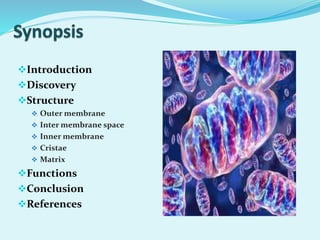
Introduction
Discovery
Structure
 Outer membrane
 Inter membrane space
 Inner membrane
 Cristae
 Matrix
Functions
Conclusion
References
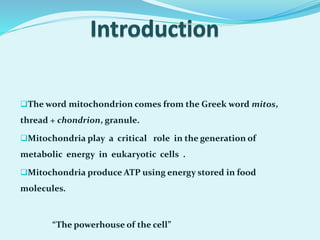
The word mitochondrion comes from the Greek word mitos,
thread + chondrion, granule.
Mitochondria play a critical role in the generation of
metabolic energy in eukaryotic cells .
Mitochondria produce ATP using energy stored in food
molecules.
“The powerhouse of the cell”
Kolliker (1850) first seen mitochondria in muscle cell.
Flaming (1882) described this organelles fillia.
Richard Almann in 1894 established them as cell organelles’
and called them bioblast.
Benda (1898) stained these organelles’ with crystal violet and
renamed them mitochondria.
Friedrich Meves in 1904 made the first recorded observation of
mitochondria in plant (Nymphyaea alba)
The popular term “power house of the cell” was coined by
Philip Siekevitz in 1957.
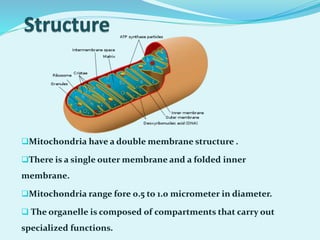
Mitochondria have a double membrane structure .
There is a single outer membrane and a folded inner
membrane.
Mitochondria range fore 0.5 to 1.0 micrometer in diameter.
 The organelle is composed of compartments that carry out
specialized functions.
Mitochondria are the primary energy producers in cells.
Uniqueness- mitochondria are the very unique is several regards
Have their own DNA
Have their own Ribosome’( the DNA in the nucleus does not code for
the construction mitochondria )
All the mitochondria your body comes from the mother.
Mitochondria are not part of the genetic code in the nucleus of cell.
Father only gives genes to their children.
Mother gives genes and cytoplasm in their egg cell.
Since mitochondria are the cytoplasm a reproduced reproduce
themselves they only are inherited from mothers.
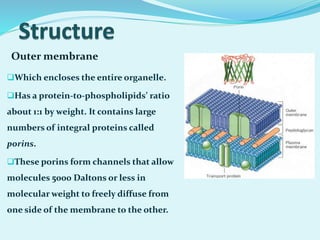
Which encloses the entire organelle.
Has a protein-to-phospholipids’ ratio
about 1:1 by weight. It contains large
numbers of integral proteins called
porins.
These porins form channels that allow
molecules 5000 Daltons or less in
molecular weight to freely diffuse from
one side of the membrane to the other.
Outer membrane
The intermembrane space – is the space between
the outer membrane and the inner membrane.
Is also known as Perimitocondrial space. Because
the outer membrane is freely permeable to small
molecules, the concentration of small molecule such
as ions and sugars in the intermembrane space is the
same as the cytosol.
It contains more than 151 different polypeptides, and has
a very high protein-to-phospholipids’ ratio (more than 3:1
by weight, which is about 1 protein for 15 phospholipids).
The inner membrane is home to around 1/5 of the total
protein in a mitochondria.
 In addition inner membrane is rich in unusual
phospholipids’, cardiolipin.
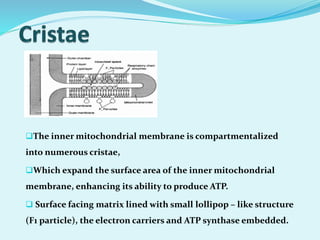
The inner mitochondrial membrane is compartmentalized
into numerous cristae,
Which expand the surface area of the inner mitochondrial
membrane, enhancing its ability to produce ATP.
 Surface facing matrix lined with small lollipop – like structure
(F1 particle), the electron carriers and ATP synthase embedded.
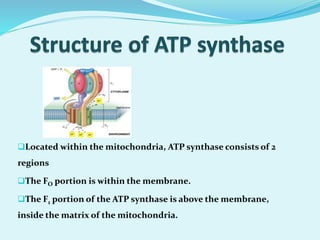
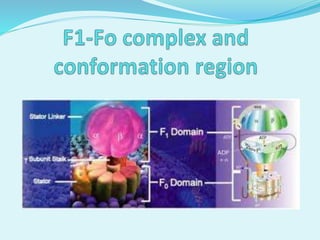
Located within the mitochondria, ATP synthase consists of 2
regions
The FO portion is within the membrane.
The F1 portion of the ATP synthase is above the membrane,
inside the matrix of the mitochondria.
The F1 particle is large and can be seen in the
transmission electron microscope by negative
staining.
These are particles of 9 nm diameter that pepper
the inner mitochondrial membrane.
The number of F1 particle 10000 to 100000 per
mitochondria.
They are present with stoichiometry a3, b3, g, d, e.
The FO region of ATP Synthase is a proton pore that is
embedded in the mitochondrial membrane.
The stoichiometry of these subunits in 1 a, b2, c10-12.
Six additional subunits, d, e, f, g, F6, and 8 (or A6L).
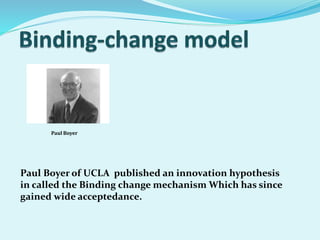
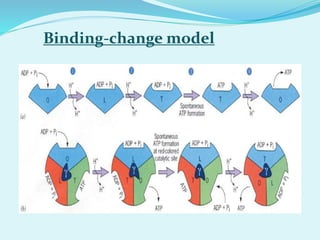
Paul Boyer of UCLA published an innovation hypothesis
in called the Binding change mechanism Which has since
gained wide acceptedance.
Paul Boyer
Binding-change model
The matrix is the space enclosed by the inner
membrane.
It contains about 2/3 of the total protein in a
mitochondrion.
The matrix contains a highly concentrated mixture
of hundreds of enzymes, special mitochondrial
ribosome’s, tRNA, and several copies of the
mitochondrial DNA genome.
A dominant role for the mitochondria is the production of ATP, as
reflected by the large number of proteins in the inner membrane for this
task.
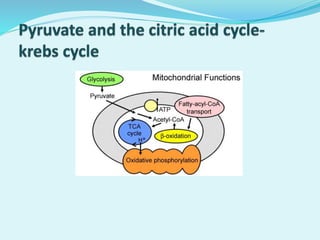
This is done by oxidizing the major products of glucose, pyruvate, and
NADH, which are produced in the cytosol. This process of cellular
respiration, also known as aerobic respiration, is dependent on the
presence of oxygen
When oxygen is limited, the glycolytic products will be metabolized by
anaerobic fermentation,a process that is independent of the
mitochondria.
Energy conversion
Under certain conditions, protons can re-enter the
mitochondrial matrix without contributing to ATP
synthesis.
This process is known as proton leak or mitochondrial
uncoupling and is due to the facilitated diffusion of
protons into the matrix.
 The process results in the unharnessed potential energy
of the proton electrochemical gradient being released as
heat.
Mitochondria play a critical role in the generation of
metabolic energy.
Outer membrane is freely permeable to small molecules.
The inner membrane contain protein complex involved in
electron transport and oxidative phosphorylation.
Matrix contain to enzymes to citric acid cycle.
 Mitochondria have their own DNA.
The cell-A molecular approach,Geoffrey M.Cooper, Robert E.
Hausman,(5th edition)
Gerald Karp-Cell and molecular Biology (4th edition)
Websites-
 www.rpi.edu/ (2.30pm)
 Iosporquesdelanaturaleza.com (2.35 pm)
 www.wikipedia.org/(2.45 pm)

Mitochondria By KK Sahu Sir

  • 1.
    Structureandfunactionof mitochondria By KAUSHAL KUMAR SAHU AssistantProfessor (Ad Hoc) Department of Biotechnology Govt. Digvijay Autonomous P. G. College Raj-Nandgaon ( C. G. )
  • 2.
    Introduction Discovery Structure  Outer membrane Inter membrane space  Inner membrane  Cristae  Matrix Functions Conclusion References
  • 3.
    The word mitochondrioncomes from the Greek word mitos, thread + chondrion, granule. Mitochondria play a critical role in the generation of metabolic energy in eukaryotic cells . Mitochondria produce ATP using energy stored in food molecules. “The powerhouse of the cell”
  • 4.
    Kolliker (1850) firstseen mitochondria in muscle cell. Flaming (1882) described this organelles fillia. Richard Almann in 1894 established them as cell organelles’ and called them bioblast. Benda (1898) stained these organelles’ with crystal violet and renamed them mitochondria. Friedrich Meves in 1904 made the first recorded observation of mitochondria in plant (Nymphyaea alba) The popular term “power house of the cell” was coined by Philip Siekevitz in 1957.
  • 5.
    Mitochondria have adouble membrane structure . There is a single outer membrane and a folded inner membrane. Mitochondria range fore 0.5 to 1.0 micrometer in diameter.  The organelle is composed of compartments that carry out specialized functions.
  • 6.
    Mitochondria are theprimary energy producers in cells. Uniqueness- mitochondria are the very unique is several regards Have their own DNA Have their own Ribosome’( the DNA in the nucleus does not code for the construction mitochondria ) All the mitochondria your body comes from the mother. Mitochondria are not part of the genetic code in the nucleus of cell. Father only gives genes to their children. Mother gives genes and cytoplasm in their egg cell. Since mitochondria are the cytoplasm a reproduced reproduce themselves they only are inherited from mothers.
  • 7.
    Which encloses theentire organelle. Has a protein-to-phospholipids’ ratio about 1:1 by weight. It contains large numbers of integral proteins called porins. These porins form channels that allow molecules 5000 Daltons or less in molecular weight to freely diffuse from one side of the membrane to the other. Outer membrane
  • 8.
    The intermembrane space– is the space between the outer membrane and the inner membrane. Is also known as Perimitocondrial space. Because the outer membrane is freely permeable to small molecules, the concentration of small molecule such as ions and sugars in the intermembrane space is the same as the cytosol.
  • 9.
    It contains morethan 151 different polypeptides, and has a very high protein-to-phospholipids’ ratio (more than 3:1 by weight, which is about 1 protein for 15 phospholipids). The inner membrane is home to around 1/5 of the total protein in a mitochondria.  In addition inner membrane is rich in unusual phospholipids’, cardiolipin.
  • 10.
    The inner mitochondrialmembrane is compartmentalized into numerous cristae, Which expand the surface area of the inner mitochondrial membrane, enhancing its ability to produce ATP.  Surface facing matrix lined with small lollipop – like structure (F1 particle), the electron carriers and ATP synthase embedded.
  • 11.
    Located within themitochondria, ATP synthase consists of 2 regions The FO portion is within the membrane. The F1 portion of the ATP synthase is above the membrane, inside the matrix of the mitochondria.
  • 12.
    The F1 particleis large and can be seen in the transmission electron microscope by negative staining. These are particles of 9 nm diameter that pepper the inner mitochondrial membrane. The number of F1 particle 10000 to 100000 per mitochondria. They are present with stoichiometry a3, b3, g, d, e.
  • 13.
    The FO regionof ATP Synthase is a proton pore that is embedded in the mitochondrial membrane. The stoichiometry of these subunits in 1 a, b2, c10-12. Six additional subunits, d, e, f, g, F6, and 8 (or A6L).
  • 14.
    Paul Boyer ofUCLA published an innovation hypothesis in called the Binding change mechanism Which has since gained wide acceptedance. Paul Boyer
  • 16.
  • 17.
    The matrix isthe space enclosed by the inner membrane. It contains about 2/3 of the total protein in a mitochondrion. The matrix contains a highly concentrated mixture of hundreds of enzymes, special mitochondrial ribosome’s, tRNA, and several copies of the mitochondrial DNA genome.
  • 18.
    A dominant rolefor the mitochondria is the production of ATP, as reflected by the large number of proteins in the inner membrane for this task. This is done by oxidizing the major products of glucose, pyruvate, and NADH, which are produced in the cytosol. This process of cellular respiration, also known as aerobic respiration, is dependent on the presence of oxygen When oxygen is limited, the glycolytic products will be metabolized by anaerobic fermentation,a process that is independent of the mitochondria. Energy conversion
  • 20.
    Under certain conditions,protons can re-enter the mitochondrial matrix without contributing to ATP synthesis. This process is known as proton leak or mitochondrial uncoupling and is due to the facilitated diffusion of protons into the matrix.  The process results in the unharnessed potential energy of the proton electrochemical gradient being released as heat.
  • 21.
    Mitochondria play acritical role in the generation of metabolic energy. Outer membrane is freely permeable to small molecules. The inner membrane contain protein complex involved in electron transport and oxidative phosphorylation. Matrix contain to enzymes to citric acid cycle.  Mitochondria have their own DNA.
  • 22.
    The cell-A molecularapproach,Geoffrey M.Cooper, Robert E. Hausman,(5th edition) Gerald Karp-Cell and molecular Biology (4th edition) Websites-  www.rpi.edu/ (2.30pm)  Iosporquesdelanaturaleza.com (2.35 pm)  www.wikipedia.org/(2.45 pm)