NERNST EQUATIONBYDR.S.RAJYALAKSHMI
INTRODUCTIONElectric potential difference existing across the cell membrane of all living cells is called membrane potential, with the inside of the cell being negative in relation to the outside.The magnitude of membrane potential varies from cell to cell and in a particular cell according to its functional status. For example, a nerve cell has a membrane potential of          -70 mv at rest, but when it gets exited the membrane potential becomes about +30mv.
The membrane potential at rest is called resting potential.			RMP in nerve cell             -70mvin smooth muscle            -50mvRMP is basically due to 	1) Unequal distribution of ions across the cell membrane because of its selective permeability.		2) Due to combined effect of forces acting on ions.Thus genesis of RMP is dependant on	1) Selective permeability of cell membrane,	2) Gibbs’- Donnan equilibrium,	3) Nernst equation,	4)Constant field Goldmann equation, and	5) Sodium potassium ATPase pump.
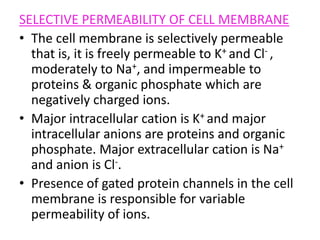
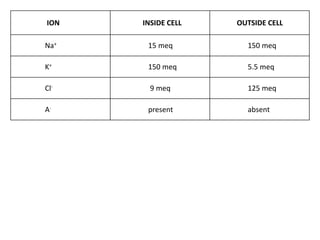
SELECTIVE PERMEABILITY OF CELL MEMBRANE The cell membrane is selectively permeable that is, it is freely permeable to K+ and Cl- , moderately to Na+, and impermeable to proteins & organic phosphate which are negatively charged ions.Major intracellular cation is K+ and major intracellular anions are proteins and organic phosphate. Major extracellular cation is Na+ and anion is Cl-.Presence of gated protein channels in the cell membrane is responsible for variable permeability of ions.
GIBBS’-DONNAN EQUILIBRIUMGDE or Donnan effect states that when an ion on one side of a membrane, cannot diffuse through the membrane, the distribution of other permeable ions across the cell membrane is affected in a permeable way.NERNST EQUATIONWalther H Nernst was a  German physical chemist, received noble prize in chemistry 1920,  in recognition of his work in thermo chemistry. His contribution to  chemical thermodynamics led to the  well known Nernst equation correlating  chemical energy and electric potential.
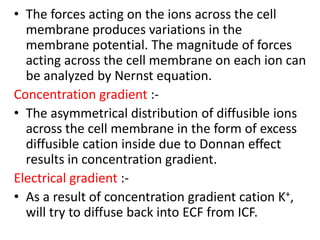
The forces acting on the ions across the cell membrane produces variations in the membrane potential. The magnitude of forces acting across the cell membrane on each ion can be analyzed by Nernst equation.Concentration gradient :-The asymmetrical distribution of diffusible ions across the cell membrane in the form of excess diffusible cation inside due to Donnan effect results in concentration gradient.Electrical gradient :-As a result of concentration gradient cation K+, will try to diffuse back into ECF from ICF.
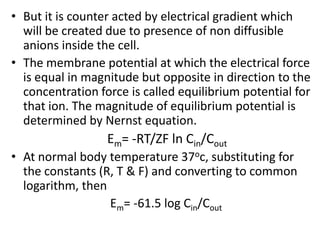
But it is counter acted by electrical gradient which will be created due to presence of non diffusible anions inside the cell.The membrane potential at which the electrical force is equal in magnitude but opposite in direction to the concentration force is called equilibrium potential for that ion. The magnitude of equilibrium potential is determined by Nernst equation. 				Em= -RT/ZF ln Cin/Cout At normal body temperature 37oc, substituting for the constants (R, T & F) and converting to common logarithm, then			 Em= -61.5 log Cin/Cout
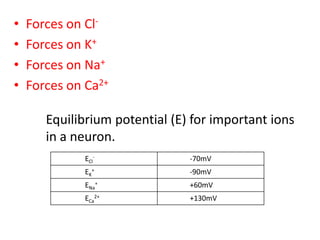
Forces on Cl-Forces on K+Forces on Na+Forces on Ca2+Equilibrium potential (E) for important ions 	in a neuron.
GOLDMANN-HODGKIN-KATZ (GHK) EQUATIONThe Nernst equation helps in calculating the equilibrium potential for each ion individually.However, the magnitude of membrane potential at any given time depends on distribution and permeability of Na+, K+ and Cl- ions.The integrated role of different ions in the generation of membrane potential can be described accurately by the GHK equation.RT    ln   PK[K+]in + PNa[Na+]in +PCl[Cl-]out	                           F             PK[K+]out+ PNa[Na+]out+PCl[Cl-]in
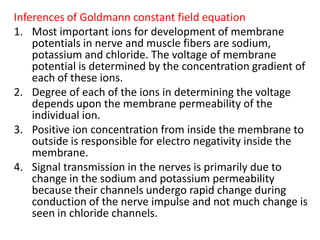
Inferences of Goldmann constant field equationMost important ions for development of membrane potentials in nerve and muscle fibers are sodium, potassium and chloride. The voltage of membrane potential is determined by the concentration gradient of each of these ions.  Degree of each of the ions in determining the voltage depends upon the membrane permeability of the individual ion.Positive ion concentration from inside the membrane to outside is responsible for electro negativity inside the membrane.Signal transmission in the nerves is primarily due to change in the sodium and potassium permeability because their channels undergo rapid change during conduction of the nerve impulse and not much change is seen in chloride channels.
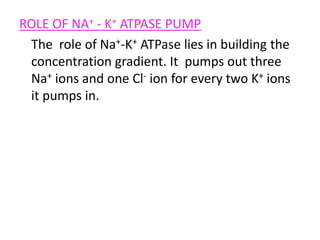
ROLE OF NA+ - K+ ATPASE PUMPThe  role of Na+-K+ ATPase lies in building the concentration gradient. It  pumps out three Na+ ions and one Cl- ion for every two K+ ions it pumps in.

Nernst Equation

  • 1.
  • 2.
    INTRODUCTIONElectric potential differenceexisting across the cell membrane of all living cells is called membrane potential, with the inside of the cell being negative in relation to the outside.The magnitude of membrane potential varies from cell to cell and in a particular cell according to its functional status. For example, a nerve cell has a membrane potential of -70 mv at rest, but when it gets exited the membrane potential becomes about +30mv.
  • 3.
    The membrane potentialat rest is called resting potential. RMP in nerve cell -70mvin smooth muscle -50mvRMP is basically due to 1) Unequal distribution of ions across the cell membrane because of its selective permeability. 2) Due to combined effect of forces acting on ions.Thus genesis of RMP is dependant on 1) Selective permeability of cell membrane, 2) Gibbs’- Donnan equilibrium, 3) Nernst equation, 4)Constant field Goldmann equation, and 5) Sodium potassium ATPase pump.
  • 4.
    SELECTIVE PERMEABILITY OFCELL MEMBRANE The cell membrane is selectively permeable that is, it is freely permeable to K+ and Cl- , moderately to Na+, and impermeable to proteins & organic phosphate which are negatively charged ions.Major intracellular cation is K+ and major intracellular anions are proteins and organic phosphate. Major extracellular cation is Na+ and anion is Cl-.Presence of gated protein channels in the cell membrane is responsible for variable permeability of ions.
  • 6.
    GIBBS’-DONNAN EQUILIBRIUMGDE orDonnan effect states that when an ion on one side of a membrane, cannot diffuse through the membrane, the distribution of other permeable ions across the cell membrane is affected in a permeable way.NERNST EQUATIONWalther H Nernst was a German physical chemist, received noble prize in chemistry 1920, in recognition of his work in thermo chemistry. His contribution to chemical thermodynamics led to the well known Nernst equation correlating chemical energy and electric potential.
  • 7.
    The forces actingon the ions across the cell membrane produces variations in the membrane potential. The magnitude of forces acting across the cell membrane on each ion can be analyzed by Nernst equation.Concentration gradient :-The asymmetrical distribution of diffusible ions across the cell membrane in the form of excess diffusible cation inside due to Donnan effect results in concentration gradient.Electrical gradient :-As a result of concentration gradient cation K+, will try to diffuse back into ECF from ICF.
  • 8.
    But it iscounter acted by electrical gradient which will be created due to presence of non diffusible anions inside the cell.The membrane potential at which the electrical force is equal in magnitude but opposite in direction to the concentration force is called equilibrium potential for that ion. The magnitude of equilibrium potential is determined by Nernst equation. Em= -RT/ZF ln Cin/Cout At normal body temperature 37oc, substituting for the constants (R, T & F) and converting to common logarithm, then Em= -61.5 log Cin/Cout
  • 9.
    Forces on Cl-Forceson K+Forces on Na+Forces on Ca2+Equilibrium potential (E) for important ions in a neuron.
  • 10.
    GOLDMANN-HODGKIN-KATZ (GHK) EQUATIONTheNernst equation helps in calculating the equilibrium potential for each ion individually.However, the magnitude of membrane potential at any given time depends on distribution and permeability of Na+, K+ and Cl- ions.The integrated role of different ions in the generation of membrane potential can be described accurately by the GHK equation.RT ln PK[K+]in + PNa[Na+]in +PCl[Cl-]out F PK[K+]out+ PNa[Na+]out+PCl[Cl-]in
  • 11.
    Inferences of Goldmannconstant field equationMost important ions for development of membrane potentials in nerve and muscle fibers are sodium, potassium and chloride. The voltage of membrane potential is determined by the concentration gradient of each of these ions. Degree of each of the ions in determining the voltage depends upon the membrane permeability of the individual ion.Positive ion concentration from inside the membrane to outside is responsible for electro negativity inside the membrane.Signal transmission in the nerves is primarily due to change in the sodium and potassium permeability because their channels undergo rapid change during conduction of the nerve impulse and not much change is seen in chloride channels.
  • 12.
    ROLE OF NA+- K+ ATPASE PUMPThe role of Na+-K+ ATPase lies in building the concentration gradient. It pumps out three Na+ ions and one Cl- ion for every two K+ ions it pumps in.