INTRODUCTION TO
FINANCIAL ENGINEERING


                        1
Introduction
• What is Finance?
• What is Financial Engineering?


                                   2
What is Finance
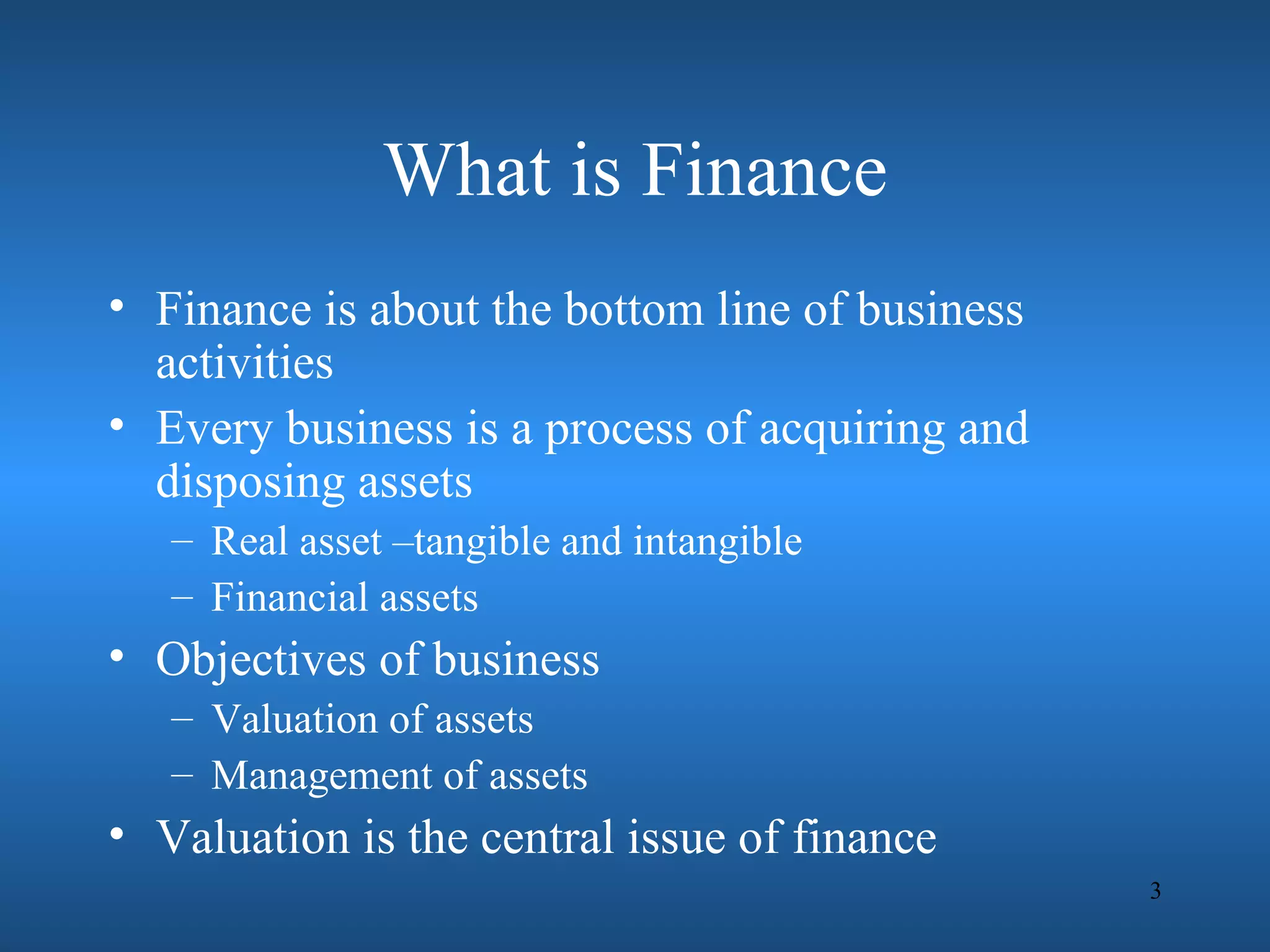
• Finance is about the bottom line of business
  activities
• Every business is a process of acquiring and
  disposing assets
   – Real asset –tangible and intangible
   – Financial assets
• Objectives of business
   – Valuation of assets
   – Management of assets
• Valuation is the central issue of finance
                                                 3
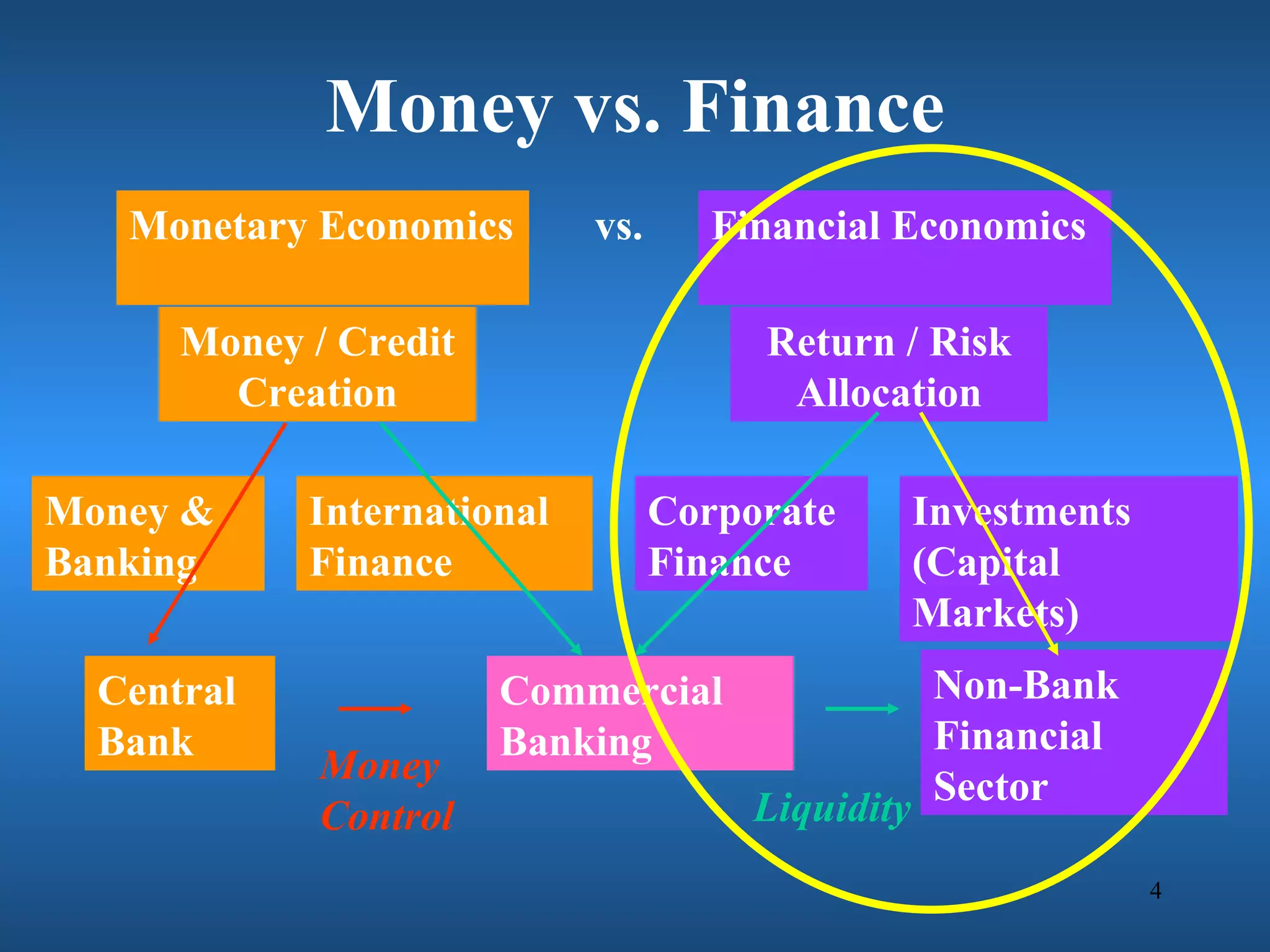
Money vs. Finance
   Monetary Economics       vs.      Financial Economics

      Money / Credit                   Return / Risk
        Creation                        Allocation

Money &     International         Corporate    Investments
Banking     Finance               Finance      (Capital
                                               Markets)
  Central              Commercial                Non-Bank
  Bank                 Banking                   Financial
             Money
             Control                   Liquidity Sector
                                                             4
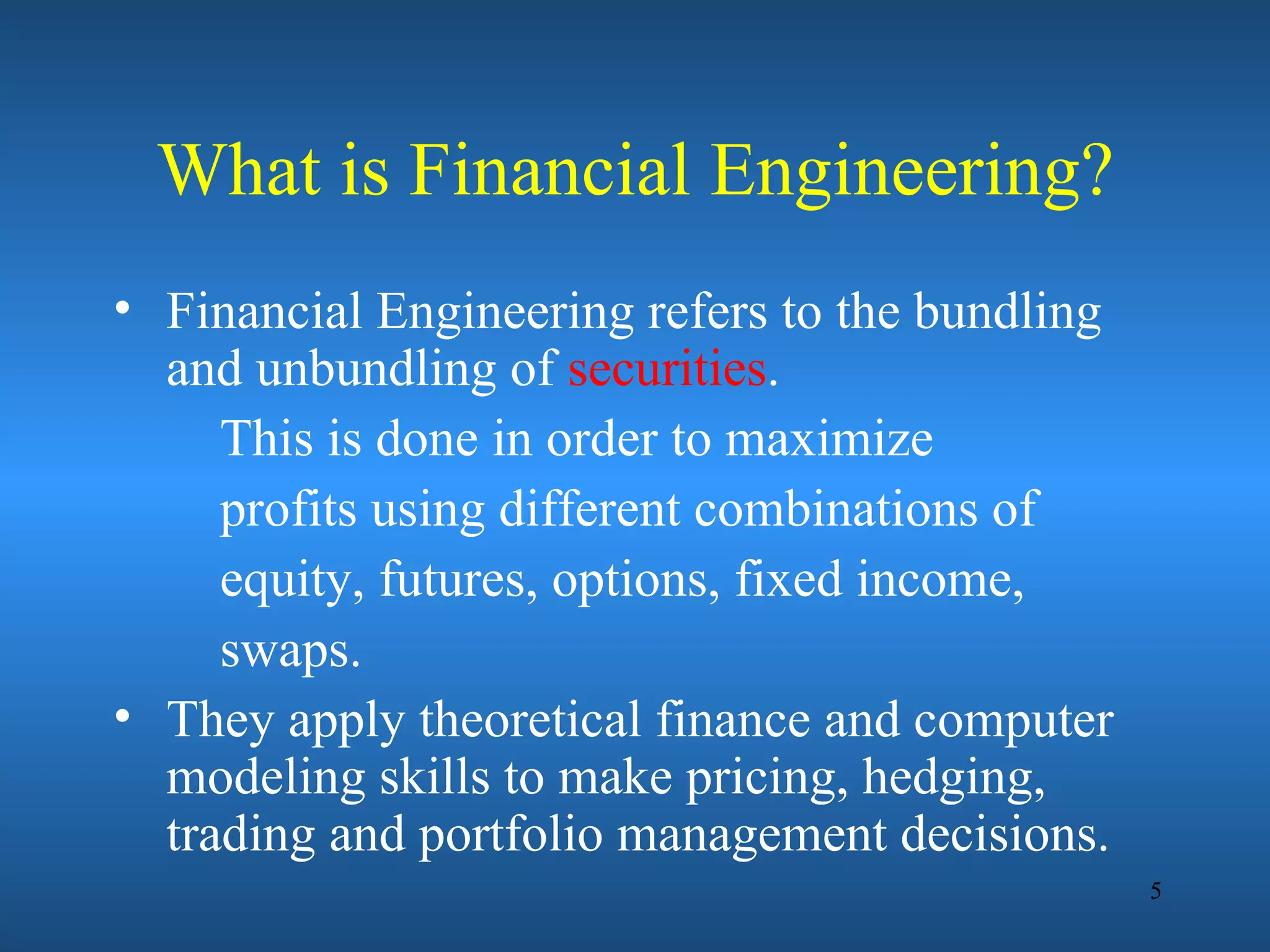
What is Financial Engineering?
• Financial Engineering refers to the bundling
  and unbundling of securities.
     This is done in order to maximize
     profits using different combinations of
     equity, futures, options, fixed income,
     swaps.
• They apply theoretical finance and computer
  modeling skills to make pricing, hedging,
  trading and portfolio management decisions.
                                                 5
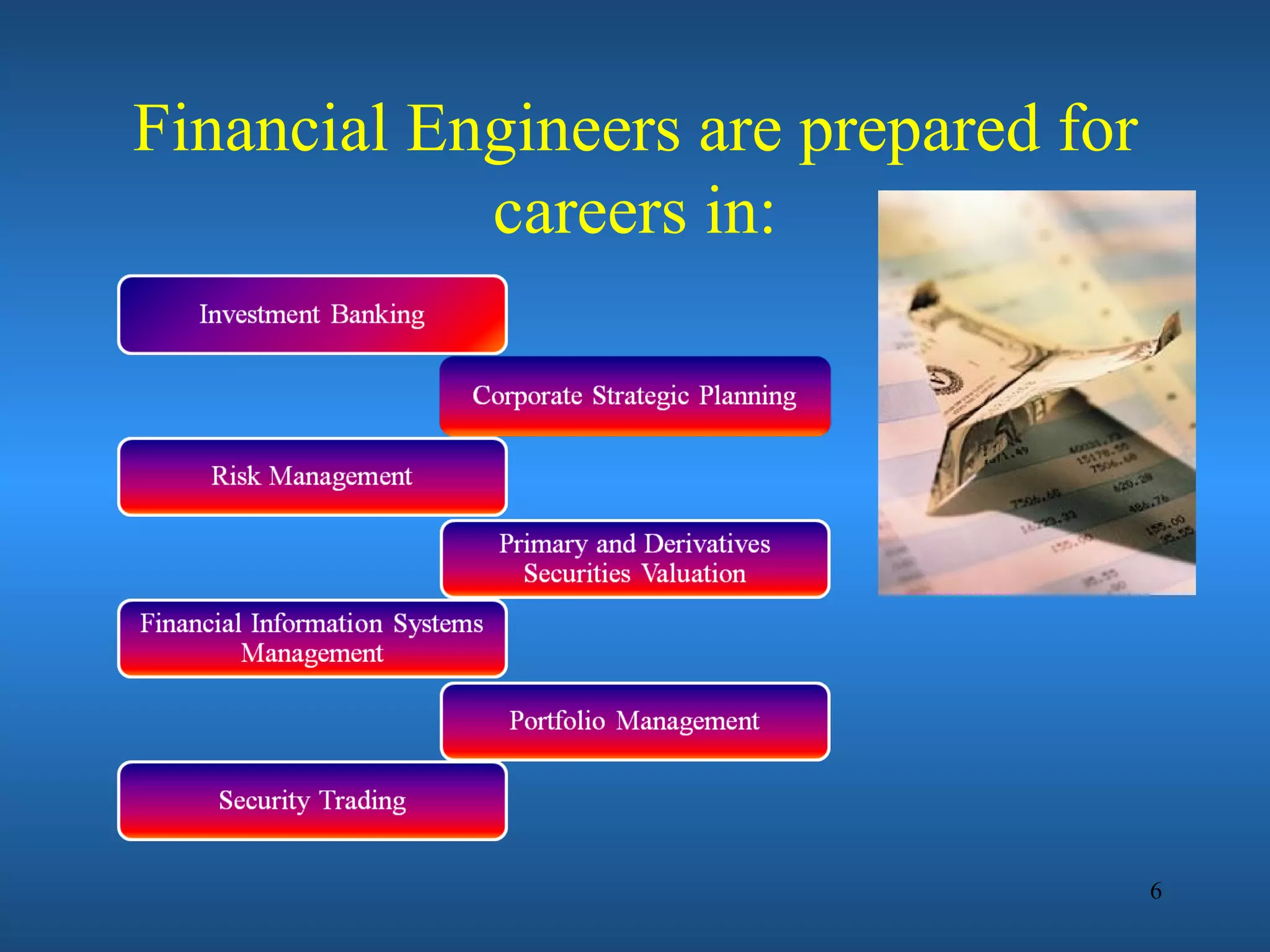
Financial Engineers are prepared for
            careers in:


                                       6
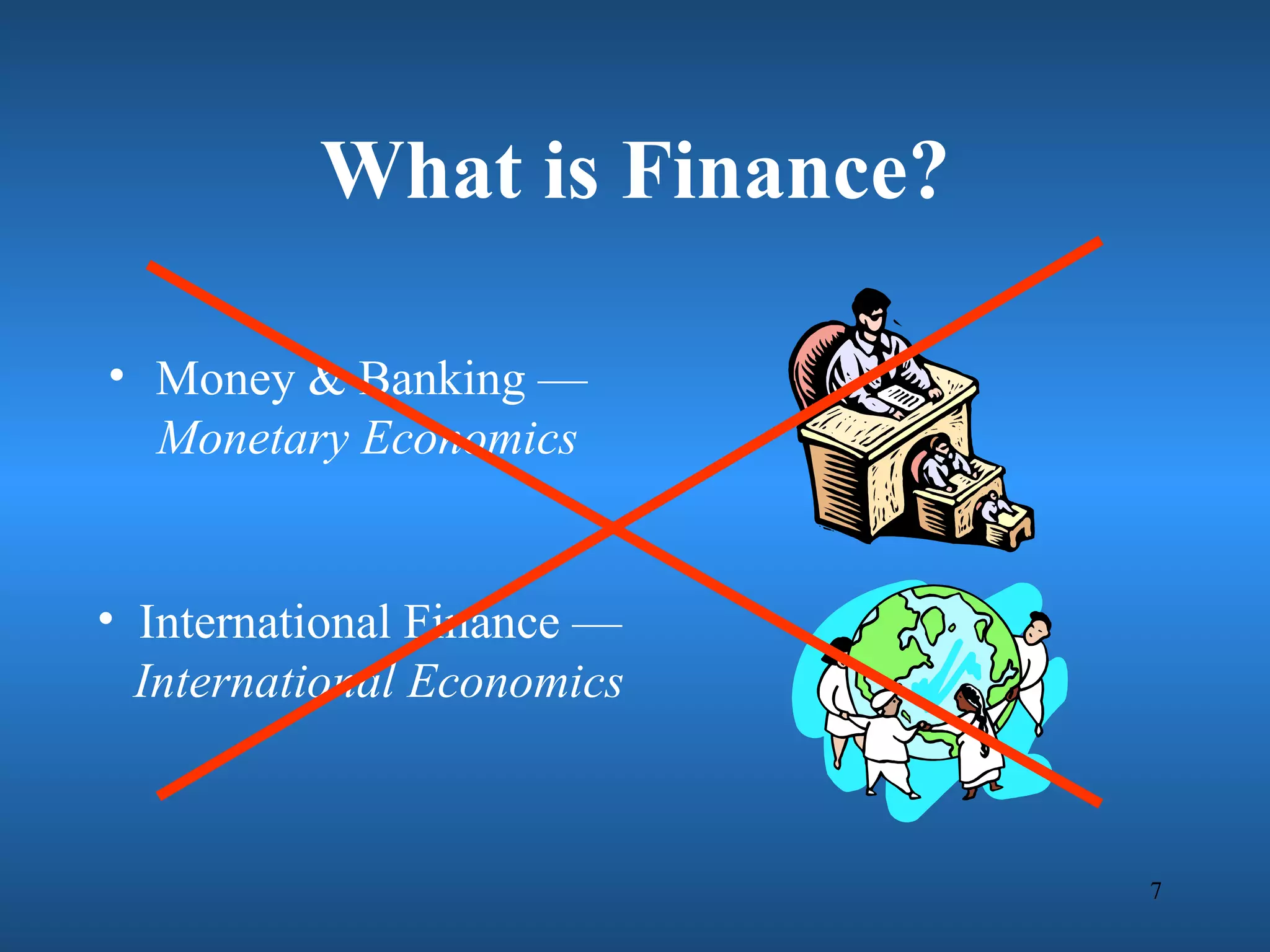
What is Finance?

• Money & Banking —
  Monetary Economics


• International Finance —
  International Economics


                             7
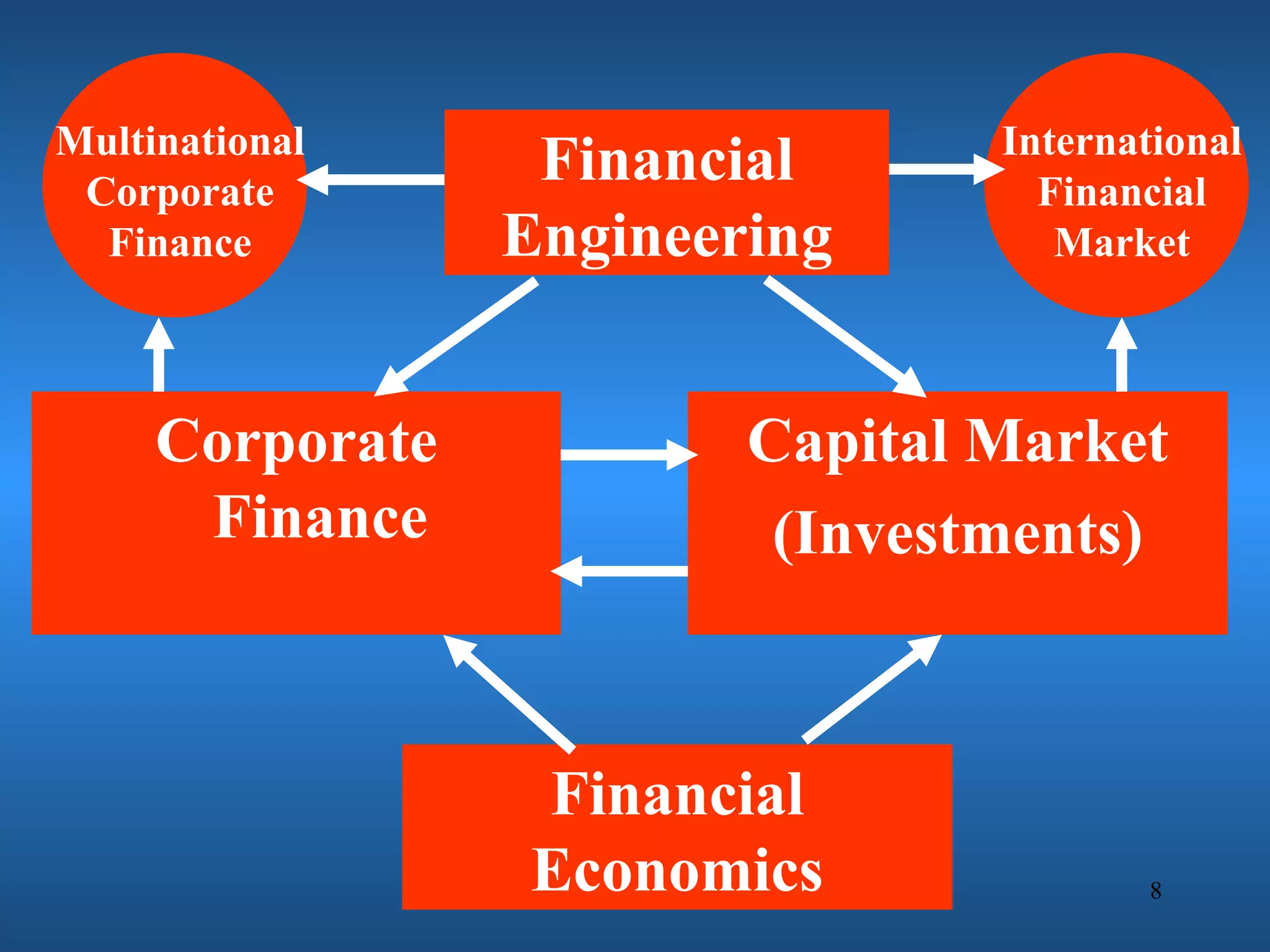
Multinational                    International
 Corporate
                  Financial        Financial
  Finance        Engineering        Market


     Corporate           Capital Market
      Finance             (Investments)


                 Financial
                 Economics               8
What is Financial Engineering?
• Generalizing: Financial Engineering involves
  the design, the development, and the
  implementation of innovative financial
  instruments and processes, and the
  formulation of creative solutions to problems
  in finance.
• Specializing: Financial Engineering is risk
  management via creative structural tools.
                                             9
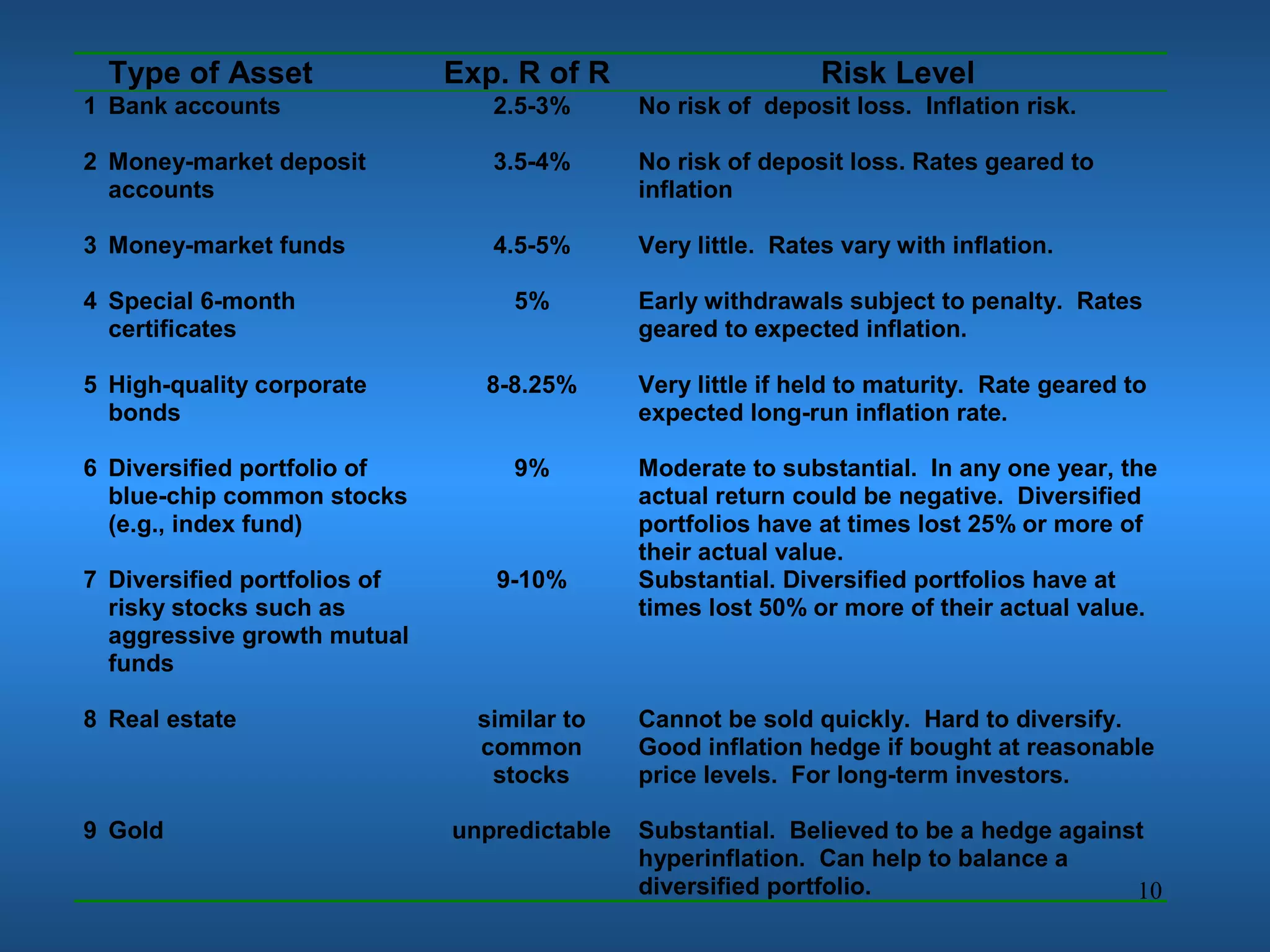
Type of Asset               Exp. R of R                      Risk Level
1 Bank accounts                  2.5-3%       No risk of deposit loss. Inflation risk.

2 Money-market deposit           3.5-4%       No risk of deposit loss. Rates geared to
  accounts                                    inflation

3 Money-market funds             4.5-5%       Very little. Rates vary with inflation.

4 Special 6-month                  5%         Early withdrawals subject to penalty. Rates
  certificates                                geared to expected inflation.

5 High-quality corporate        8-8.25%       Very little if held to maturity. Rate geared to
  bonds                                       expected long-run inflation rate.

6 Diversified portfolio of         9%         Moderate to substantial. In any one year, the
  blue-chip common stocks                     actual return could be negative. Diversified
  (e.g., index fund)                          portfolios have at times lost 25% or more of
                                              their actual value.
7 Diversified portfolios of      9-10%        Substantial. Diversified portfolios have at
  risky stocks such as                        times lost 50% or more of their actual value.
  aggressive growth mutual
  funds

8 Real estate                   similar to    Cannot be sold quickly. Hard to diversify.
                                common        Good inflation hedge if bought at reasonable
                                 stocks       price levels. For long-term investors.

9 Gold                        unpredictable   Substantial. Believed to be a hedge against
                                              hyperinflation. Can help to balance a
                                              diversified portfolio.                    10
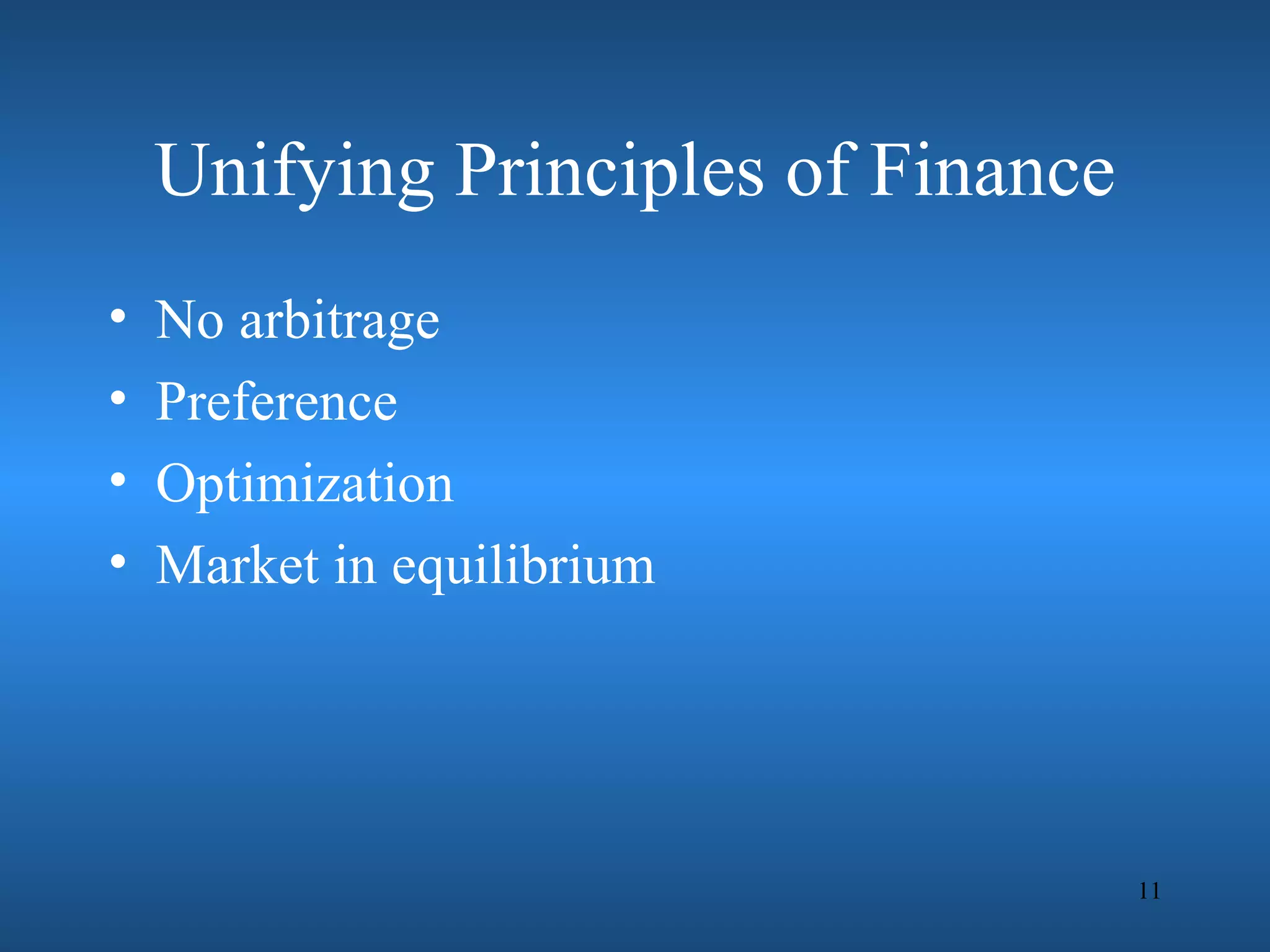
Unifying Principles of Finance
•   No arbitrage
•   Preference
•   Optimization
•   Market in equilibrium


                                     11
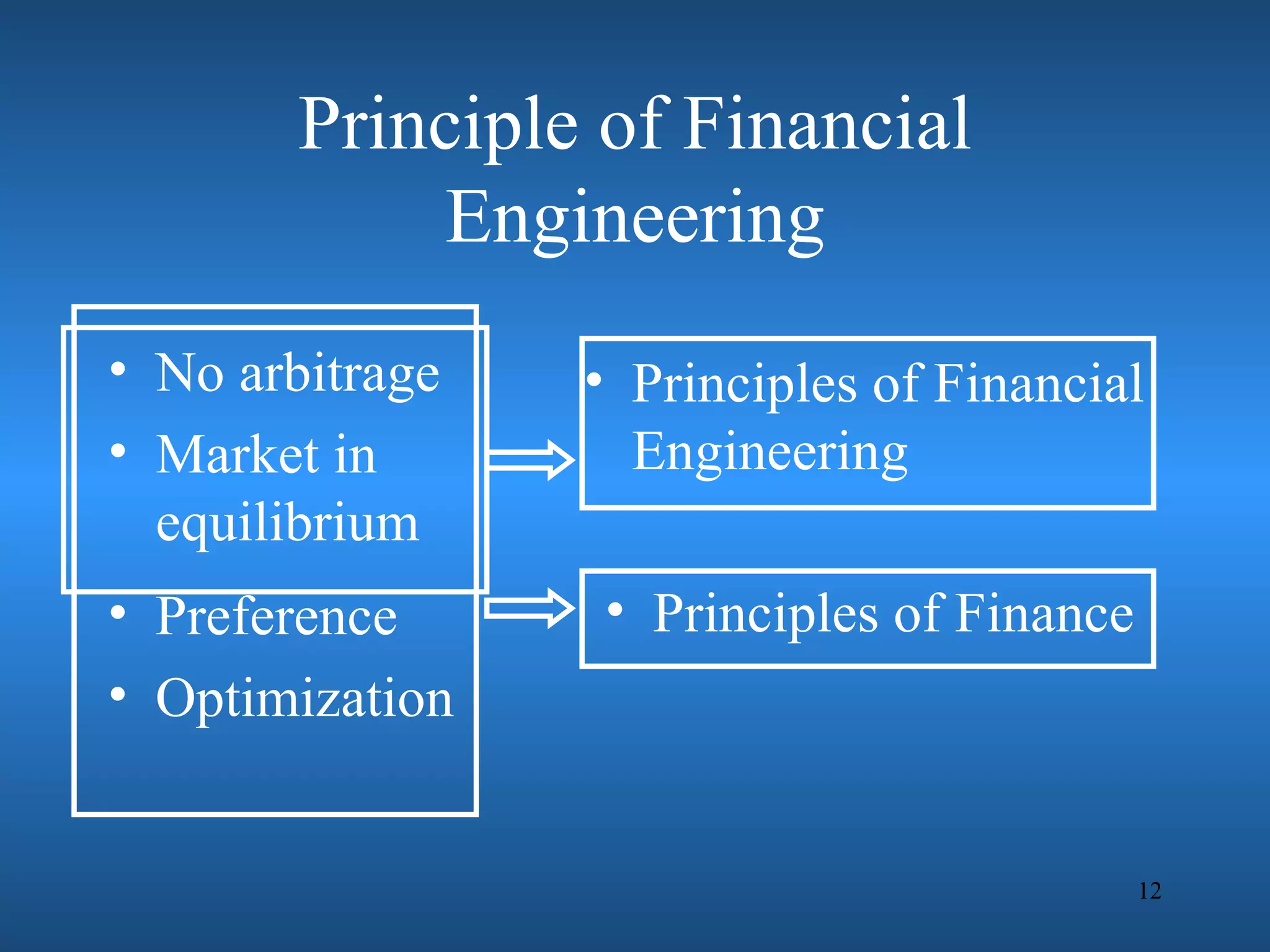
Principle of Financial
             Engineering
• No arbitrage   • Principles of Financial
• Market in        Engineering
  equilibrium
• Preference      • Principles of Finance
• Optimization


                                            12
Unifying Equation of Valuation
• P=E(mx)
  – Where m is state-dependent discount factor
  – X is the state dependent payoff (cash flow)
• Consequence of no arbitrage equilibrium
  – Conservation law of value of cash flow: the
    whole is equal to the sum of components
  – Composition and de-composition of cash flow

                                                  13
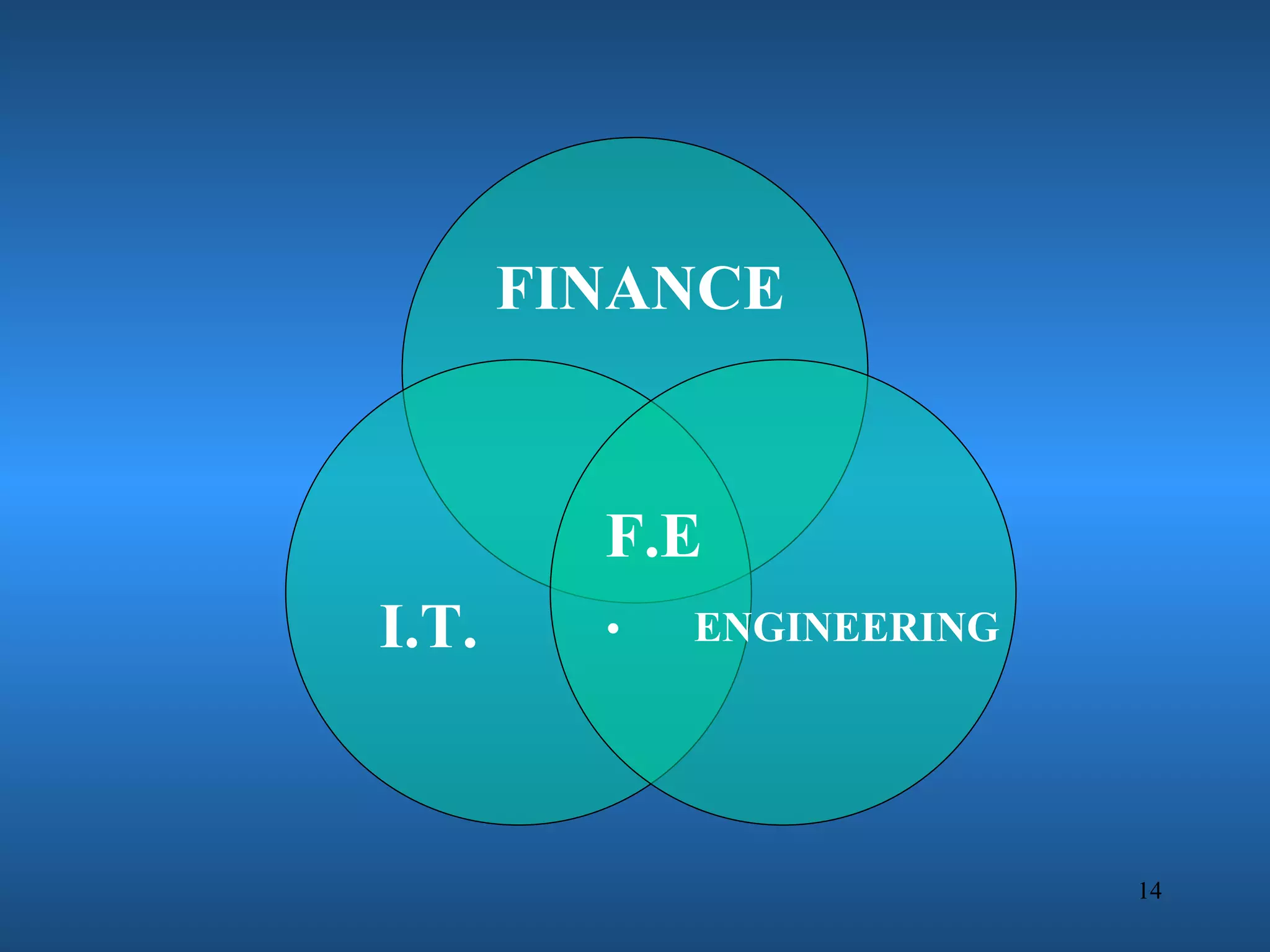
FINANCE


         F.E
I.T.     . ENGINEERING


                         14
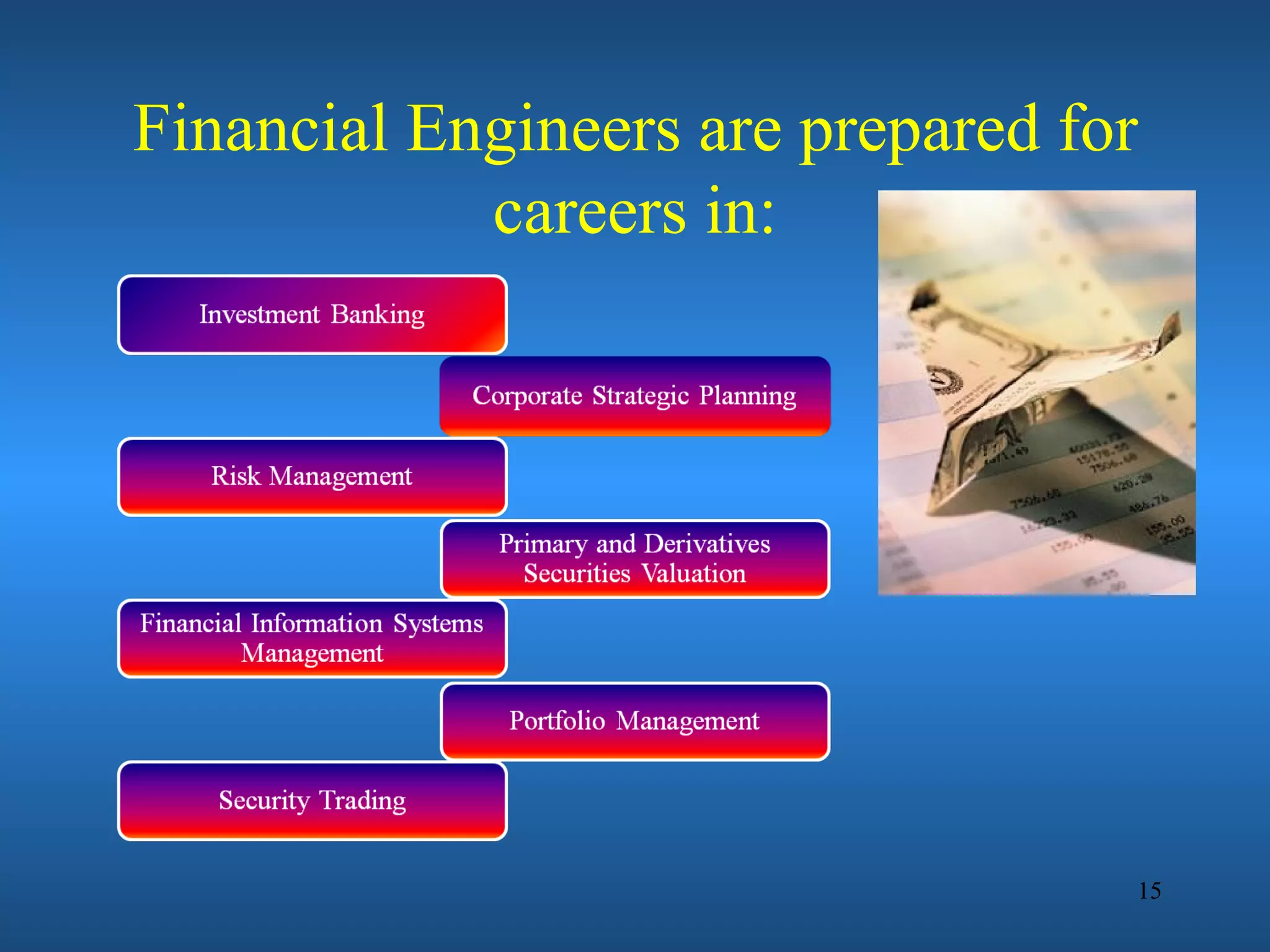
Financial Engineers are prepared for
            careers in:


                                   15
Suggested Background
Generally, Financial Engineers are strong on
             the following fields:

• Statistics/Probability
• C++ Programming
• Basic Business Finance Theory


                                           16
What is a security?
A security is a fungible, negotiable
instrument representing financial value.

Securities are broadly categorized into
debt and equity securities
such as bonds and
common stocks,
respectively.
                                           17
What’s the purpose of securities?
For the Issuer


                                18
What’s the purpose of securities?
For the Holder


                                19
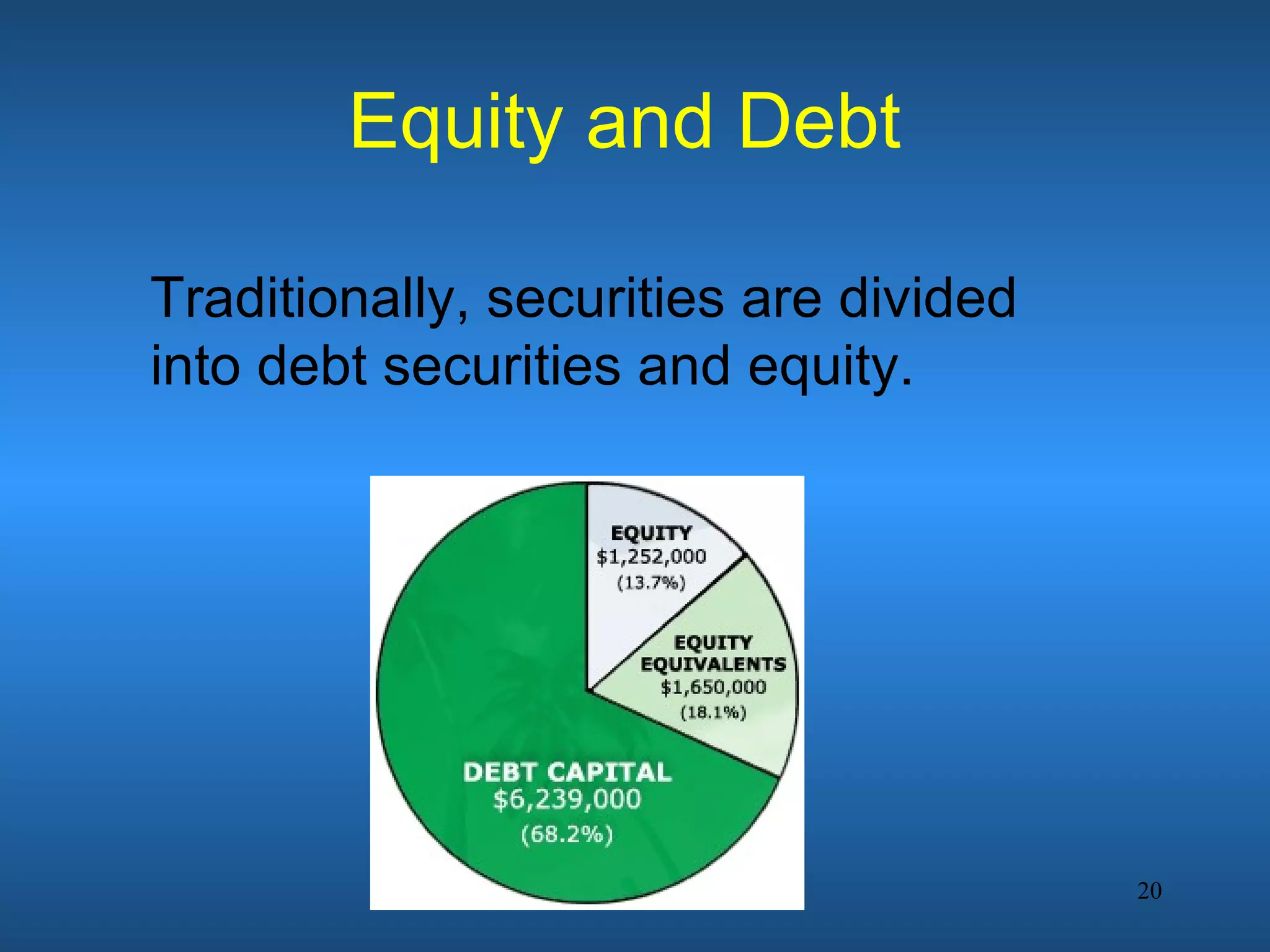
Equity and Debt

Traditionally, securities are divided
into debt securities and equity.


                                        20
Debt
Debt securities may be called debentures, bonds,
notes or commercial paper depending on their
maturity and certain other characteristics.

The holder of a debt security is typically entitled to
the payment of principal and interest, together with
other contractual rights under the terms of the issue,
such as the right to receive certain information.

Debt securities are generally issued for a fixed term
and redeemable by the issuer at the end of that term.

                                                   21
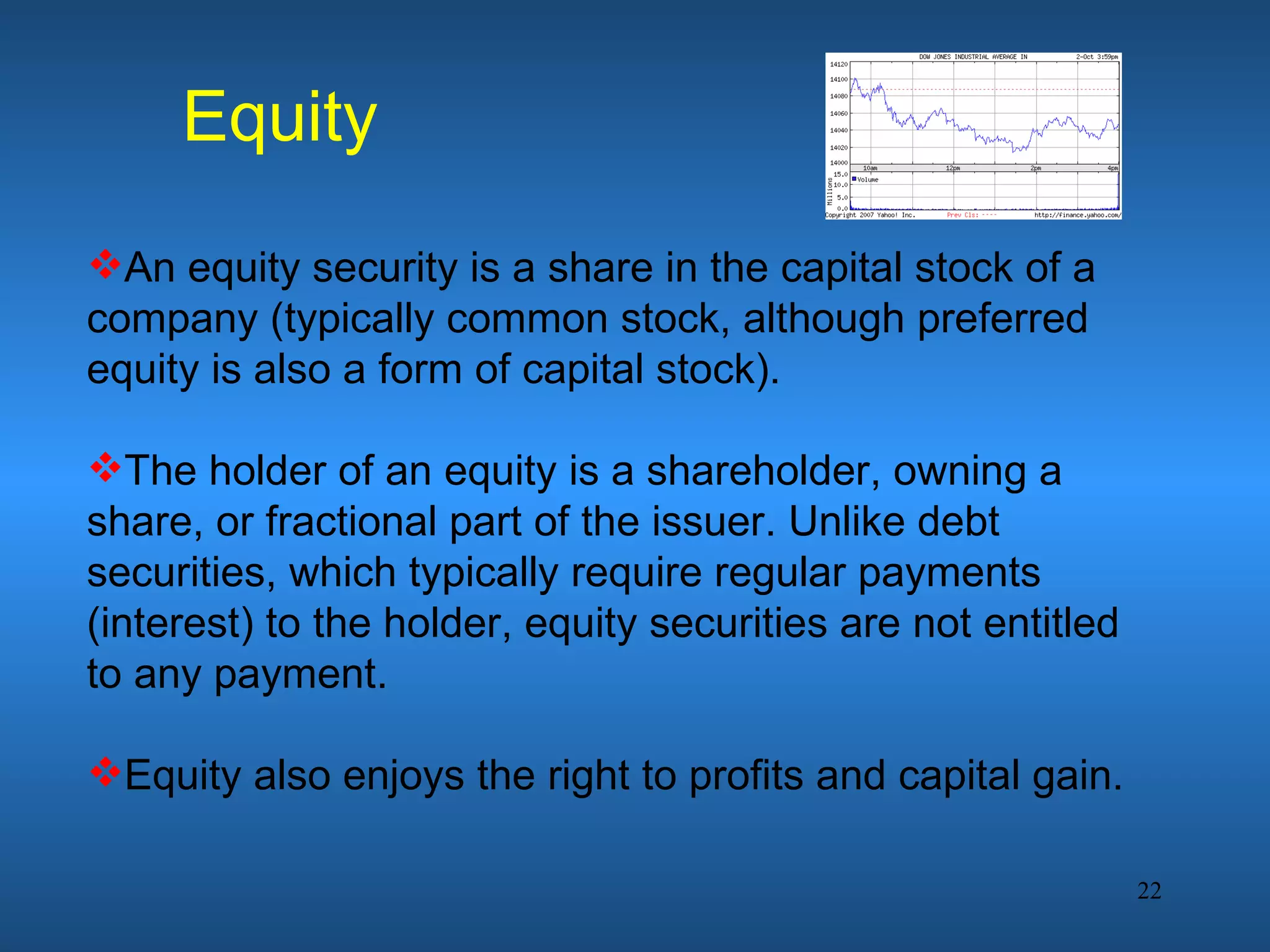
Equity
An equity security is a share in the capital stock of a
company (typically common stock, although preferred
equity is also a form of capital stock).

The holder of an equity is a shareholder, owning a
share, or fractional part of the issuer. Unlike debt
securities, which typically require regular payments
(interest) to the holder, equity securities are not entitled
to any payment.

Equity also enjoys the right to profits and capital gain.

                                                               22
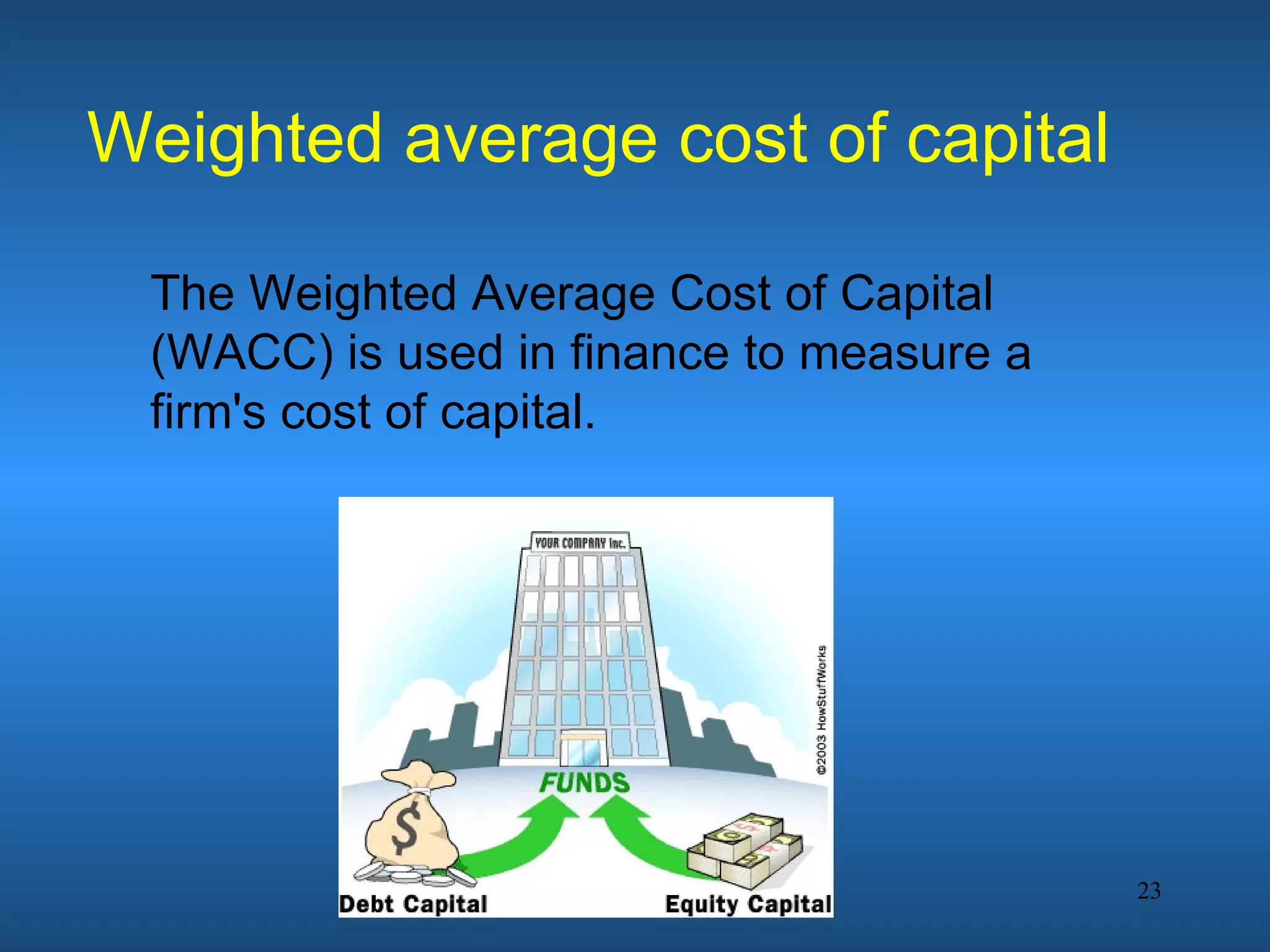
Weighted average cost of capital

 The Weighted Average Cost of Capital
 (WACC) is used in finance to measure a
 firm's cost of capital.


                                          23
Formula
The cost of capital is then given as:
Kc = (1-δ) Ke + δ Kd

Where:
Kc The weighted cost of capital for the firm
δ     The debt to capital ratio, D / (D + E)
Ke     The cost of equity
Kd     The after tax cost of debt
D      The market value of the firm's debt, including bank loans and leases
E      The market value of all equity (including warrants, options, and the equity
portion of convertible securities)
In writing:
   WACC = (1 - debt to capital ratio) * cost of equity + debt to capital ratio * cost
of debt

                                                                                24
The Modigliani-Miller Theorem
The basic theorem states that, in the absence of
taxes, bankruptcy costs, and asymmetric
information, and in an efficient market, the value
of a firm is unaffected by how that firm is
financed. It does not matter if the firm's capital is
raised by issuing stock or selling debt. It does
not matter what the firm's dividend policy is.
Therefore, the Modigliani-Miller theorem is also
often called the capital structure irrelevance
principle.
                                                        25
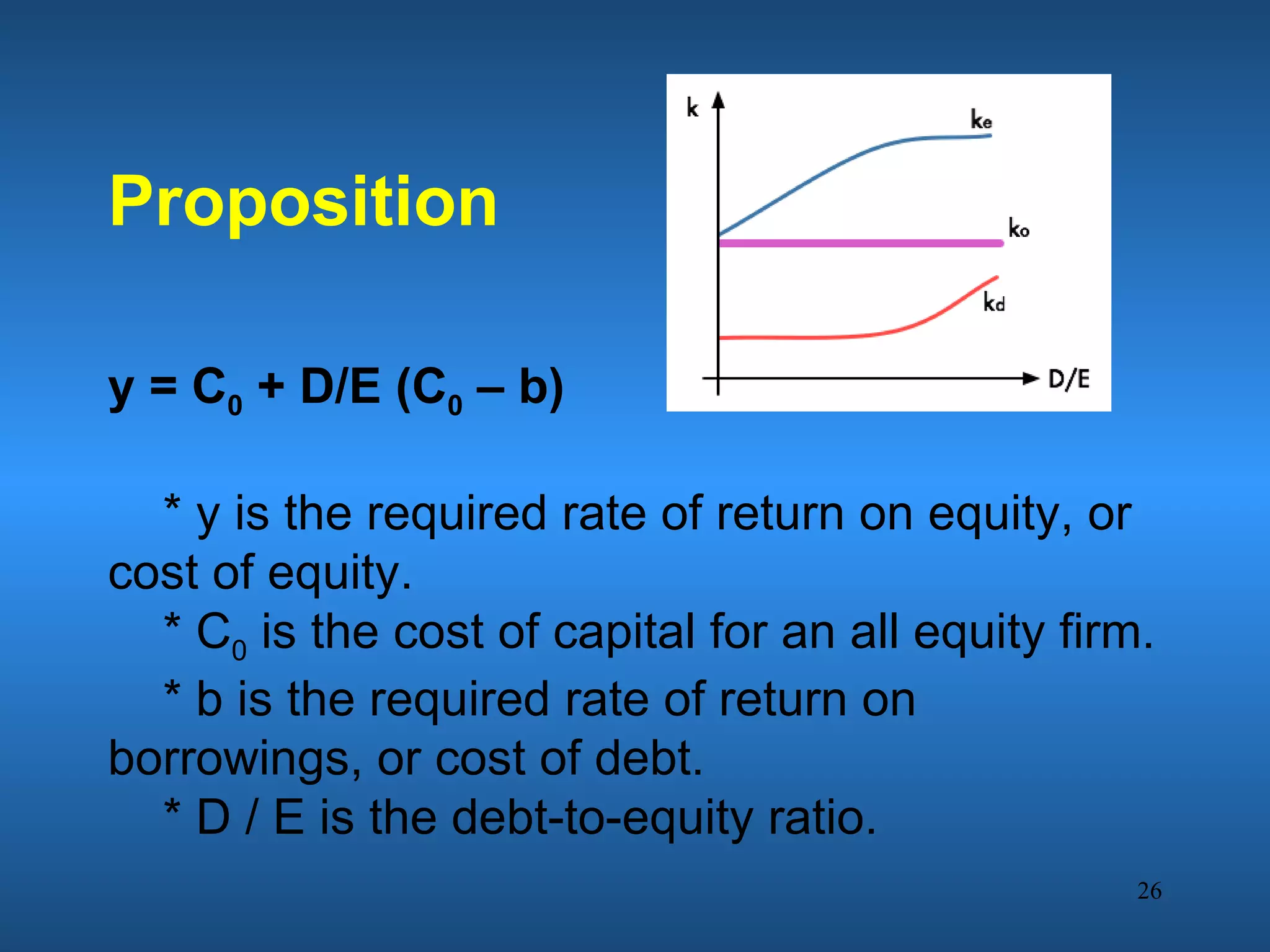
Proposition

y = C0 + D/E (C0 – b)

  * y is the required rate of return on equity, or
cost of equity.
  * C0 is the cost of capital for an all equity firm.
  * b is the required rate of return on
borrowings, or cost of debt.
  * D / E is the debt-to-equity ratio.
                                                    26

1st Unit: Financial Engineering

  • 1.
  • 2.
    Introduction • What isFinance? • What is Financial Engineering? 2
  • 3.
    What is Finance •Finance is about the bottom line of business activities • Every business is a process of acquiring and disposing assets – Real asset –tangible and intangible – Financial assets • Objectives of business – Valuation of assets – Management of assets • Valuation is the central issue of finance 3
  • 4.
    Money vs. Finance Monetary Economics vs. Financial Economics Money / Credit Return / Risk Creation Allocation Money & International Corporate Investments Banking Finance Finance (Capital Markets) Central Commercial Non-Bank Bank Banking Financial Money Control Liquidity Sector 4
  • 5.
    What is FinancialEngineering? • Financial Engineering refers to the bundling and unbundling of securities. This is done in order to maximize profits using different combinations of equity, futures, options, fixed income, swaps. • They apply theoretical finance and computer modeling skills to make pricing, hedging, trading and portfolio management decisions. 5
  • 6.
    Financial Engineers areprepared for careers in: 6
  • 7.
    What is Finance? •Money & Banking — Monetary Economics • International Finance — International Economics 7
  • 8.
    Multinational International Corporate Financial Financial Finance Engineering Market Corporate Capital Market Finance (Investments) Financial Economics 8
  • 9.
    What is FinancialEngineering? • Generalizing: Financial Engineering involves the design, the development, and the implementation of innovative financial instruments and processes, and the formulation of creative solutions to problems in finance. • Specializing: Financial Engineering is risk management via creative structural tools. 9
  • 10.
    Type of Asset Exp. R of R Risk Level 1 Bank accounts 2.5-3% No risk of deposit loss. Inflation risk. 2 Money-market deposit 3.5-4% No risk of deposit loss. Rates geared to accounts inflation 3 Money-market funds 4.5-5% Very little. Rates vary with inflation. 4 Special 6-month 5% Early withdrawals subject to penalty. Rates certificates geared to expected inflation. 5 High-quality corporate 8-8.25% Very little if held to maturity. Rate geared to bonds expected long-run inflation rate. 6 Diversified portfolio of 9% Moderate to substantial. In any one year, the blue-chip common stocks actual return could be negative. Diversified (e.g., index fund) portfolios have at times lost 25% or more of their actual value. 7 Diversified portfolios of 9-10% Substantial. Diversified portfolios have at risky stocks such as times lost 50% or more of their actual value. aggressive growth mutual funds 8 Real estate similar to Cannot be sold quickly. Hard to diversify. common Good inflation hedge if bought at reasonable stocks price levels. For long-term investors. 9 Gold unpredictable Substantial. Believed to be a hedge against hyperinflation. Can help to balance a diversified portfolio. 10
  • 11.
    Unifying Principles ofFinance • No arbitrage • Preference • Optimization • Market in equilibrium 11
  • 12.
    Principle of Financial Engineering • No arbitrage • Principles of Financial • Market in Engineering equilibrium • Preference • Principles of Finance • Optimization 12
  • 13.
    Unifying Equation ofValuation • P=E(mx) – Where m is state-dependent discount factor – X is the state dependent payoff (cash flow) • Consequence of no arbitrage equilibrium – Conservation law of value of cash flow: the whole is equal to the sum of components – Composition and de-composition of cash flow 13
  • 14.
    FINANCE F.E I.T. . ENGINEERING 14
  • 15.
    Financial Engineers areprepared for careers in: 15
  • 16.
    Suggested Background Generally, FinancialEngineers are strong on the following fields: • Statistics/Probability • C++ Programming • Basic Business Finance Theory 16
  • 17.
    What is asecurity? A security is a fungible, negotiable instrument representing financial value. Securities are broadly categorized into debt and equity securities such as bonds and common stocks, respectively. 17
  • 18.
    What’s the purposeof securities? For the Issuer 18
  • 19.
    What’s the purposeof securities? For the Holder 19
  • 20.
    Equity and Debt Traditionally,securities are divided into debt securities and equity. 20
  • 21.
    Debt Debt securities maybe called debentures, bonds, notes or commercial paper depending on their maturity and certain other characteristics. The holder of a debt security is typically entitled to the payment of principal and interest, together with other contractual rights under the terms of the issue, such as the right to receive certain information. Debt securities are generally issued for a fixed term and redeemable by the issuer at the end of that term. 21
  • 22.
    Equity An equity securityis a share in the capital stock of a company (typically common stock, although preferred equity is also a form of capital stock). The holder of an equity is a shareholder, owning a share, or fractional part of the issuer. Unlike debt securities, which typically require regular payments (interest) to the holder, equity securities are not entitled to any payment. Equity also enjoys the right to profits and capital gain. 22
  • 23.
    Weighted average costof capital The Weighted Average Cost of Capital (WACC) is used in finance to measure a firm's cost of capital. 23
  • 24.
    Formula The cost ofcapital is then given as: Kc = (1-δ) Ke + δ Kd Where: Kc The weighted cost of capital for the firm δ The debt to capital ratio, D / (D + E) Ke The cost of equity Kd The after tax cost of debt D The market value of the firm's debt, including bank loans and leases E The market value of all equity (including warrants, options, and the equity portion of convertible securities) In writing: WACC = (1 - debt to capital ratio) * cost of equity + debt to capital ratio * cost of debt 24
  • 25.
    The Modigliani-Miller Theorem Thebasic theorem states that, in the absence of taxes, bankruptcy costs, and asymmetric information, and in an efficient market, the value of a firm is unaffected by how that firm is financed. It does not matter if the firm's capital is raised by issuing stock or selling debt. It does not matter what the firm's dividend policy is. Therefore, the Modigliani-Miller theorem is also often called the capital structure irrelevance principle. 25
  • 26.
    Proposition y = C0+ D/E (C0 – b) * y is the required rate of return on equity, or cost of equity. * C0 is the cost of capital for an all equity firm. * b is the required rate of return on borrowings, or cost of debt. * D / E is the debt-to-equity ratio. 26