Finance Management
     Lecture 2
   By: Noor ul hadi (Lecturer)


Govt College of Management Sciences
              Peshawar
An Overview of Financial
            Management
•   Financial management plays vital role in
    modern business organization. It raised
    fund and managed their fund. It
    supplement performance of employees,
    financial manage adapt changes, raised
    fund, invest in assets and manage wisely
    the firm resources, maximize the profit
    and grow the value of the firm.
Scope/Elements of FM
• Investment decisions includes investment in fixed assets
  (called as capital budgeting). Investment in current
  assets is also a part of investment decisions called as
  working capital decisions.
• Financial decisions - They relate to the raising of finance
  from various resources which will depend upon decision
  on type of source, period of financing, cost of financing
  and the returns thereby.
• Dividend decision - The finance manager has to take
  decision with regards to the net profit distribution. Net
  profits are generally divided into two:
   – Dividend for shareholders- Dividend and the rate of it has to be
     decided.
   – Retained profits- Amount of retained profits has to be finalized
     which will depend upon expansion and diversification plans of
     the enterprise
Finance
• Finance is the art of to raise fund and best
  allocation or utilization to achieve
  organizational goal.
• A branch of economics concerned with
  resource allocation as well as resource
  management, acquisition and investment.
  Simply, finance deals with matters related
  to money and the markets.
Finance Vs Financing
Finance:
  Finance is a branch of economics that deals with
  the management of funds, financial resources
  and other assets. In broader terms, finance is
  raising or investing money either as equity or
  debt.
  Financing:
• The process or means of acquiring capital
  necessary to conduct a business activity. Two of
  the most common forms of financing are debt
  financing and equity financing.
FINANCIAL MANAGEMENT

Definition:
a. Financial Management means planning,
  organizing, directing and controlling the financial
  activities such as procurement and utilization of
  funds of the enterprise. It means applying
  general management principles to financial
  resources of the enterprise.
b. Financial Management concerns the acquisition,
  financing, and management of assets with some
  overall goal in mind.
Careers in Finance
Finance or knowledge of finance is important for two
   reasons.
• First you need the knowledge of finance to make
   personal decision i.e. investment your saving,
   buying and selling of building, car etc or planning
   your future (fund and pension)
• Secondly organization needs the backing of
   finance in each function and departments,
• The career of finance students may be exercise in:
1. Capital market and institutions 2. investment
3. Financial management
Institutions and capital markets
Money & Capital markets, which deals with
  securities markets & financial institutions.
• Bank
• Insurance companies,
• Mutual fund
• Investment baking
Financial manager needs knowledge of valuation
  techniques to determine interest rate, and a
  person with finance knowledge knows about
  stock, bond, mortgages, auto loan and certificate
  of deposit.
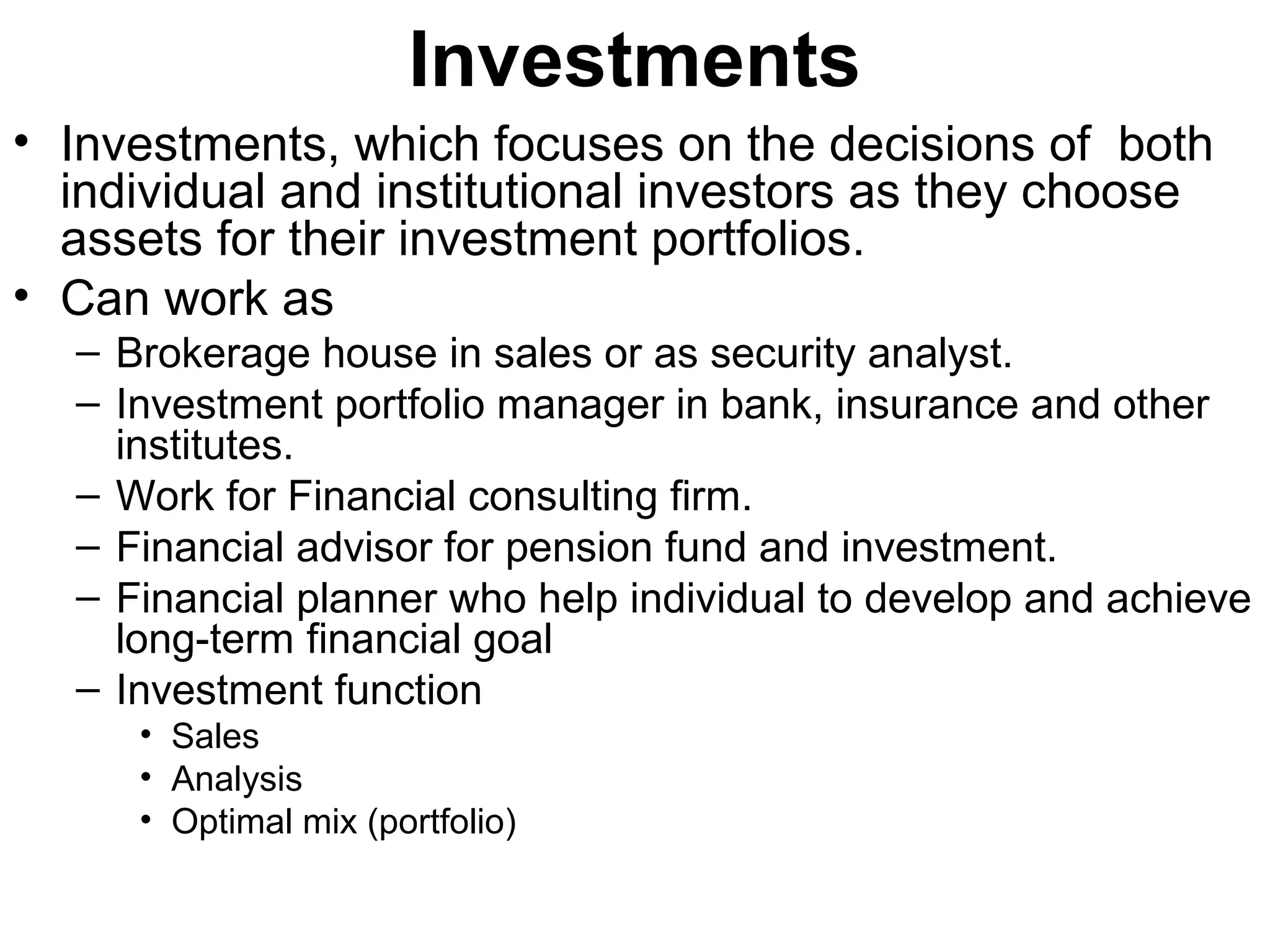
Investments
• Investments, which focuses on the decisions of both
  individual and institutional investors as they choose
  assets for their investment portfolios.
• Can work as
  – Brokerage house in sales or as security analyst.
  – Investment portfolio manager in bank, insurance and other
    institutes.
  – Work for Financial consulting firm.
  – Financial advisor for pension fund and investment.
  – Financial planner who help individual to develop and achieve
    long-term financial goal
  – Investment function
     • Sales
     • Analysis
     • Optimal mix (portfolio)
Financial management
• Financial Management, or business finance
  which involves the actual management of firms.
• Financial management is important for all type of
  business including public and private sector.
  –   Banks
  –   Financial institutes
  –   Government operation
  –   Because FM includes decision making, selection of
      securities
Responsibility of the Financial
              Staff
• Maximize stock value by:
  – Forecasting and planning
  – Investment and financing decisions
  – Coordination and control
  – Transactions in the financial markets
  – Managing risk
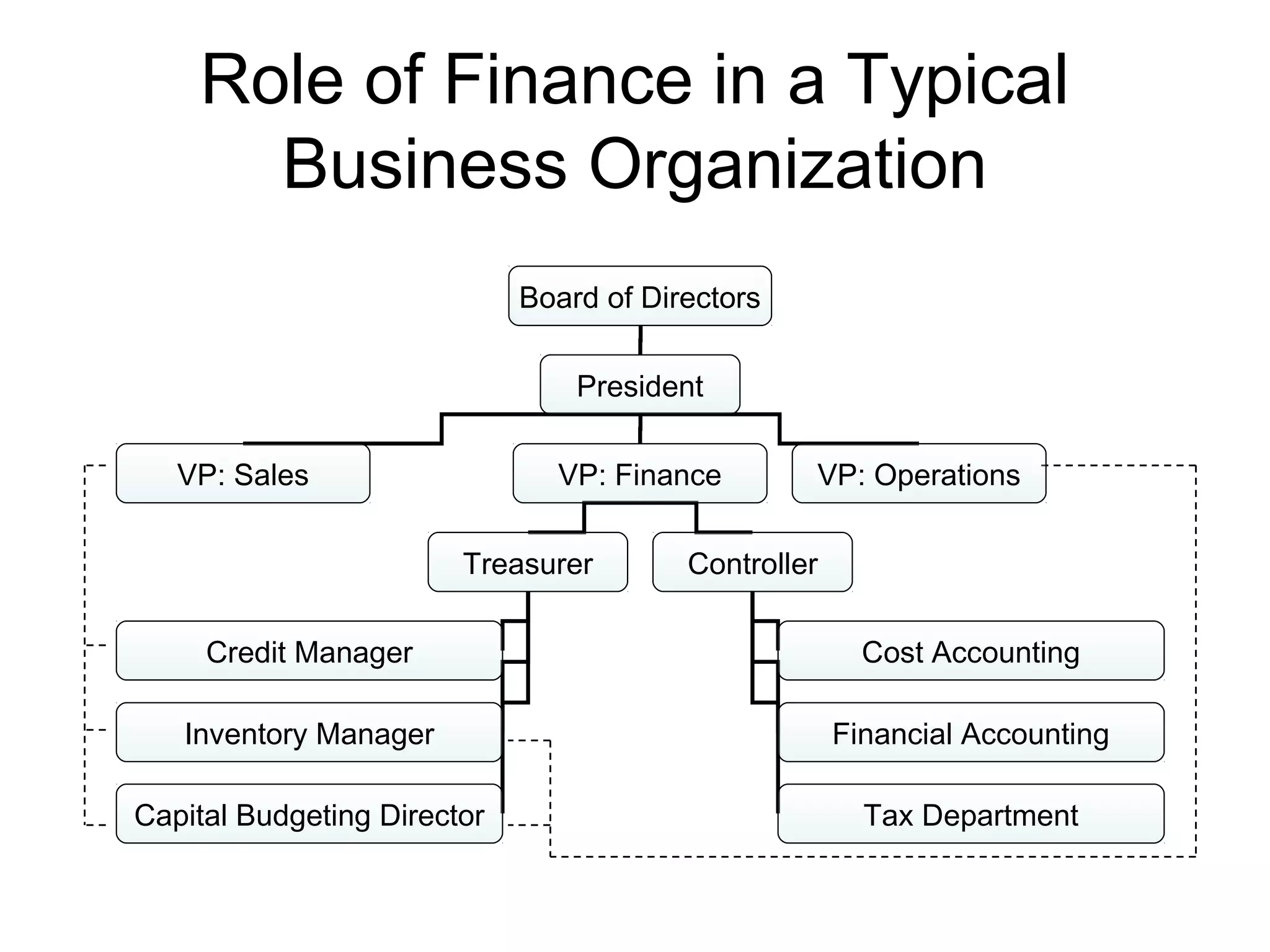
Role of Finance in a Typical
      Business Organization
                             Board of Directors

                                 President

   VP: Sales                   VP: Finance        VP: Operations

                        Treasurer        Controller

     Credit Manager                                     Cost Accounting

   Inventory Manager                                  Financial Accounting

Capital Budgeting Director                              Tax Department
Financial Management Issues
     of the New Millennium
• The effect of
  changing
  technology
• The globalization of
  business
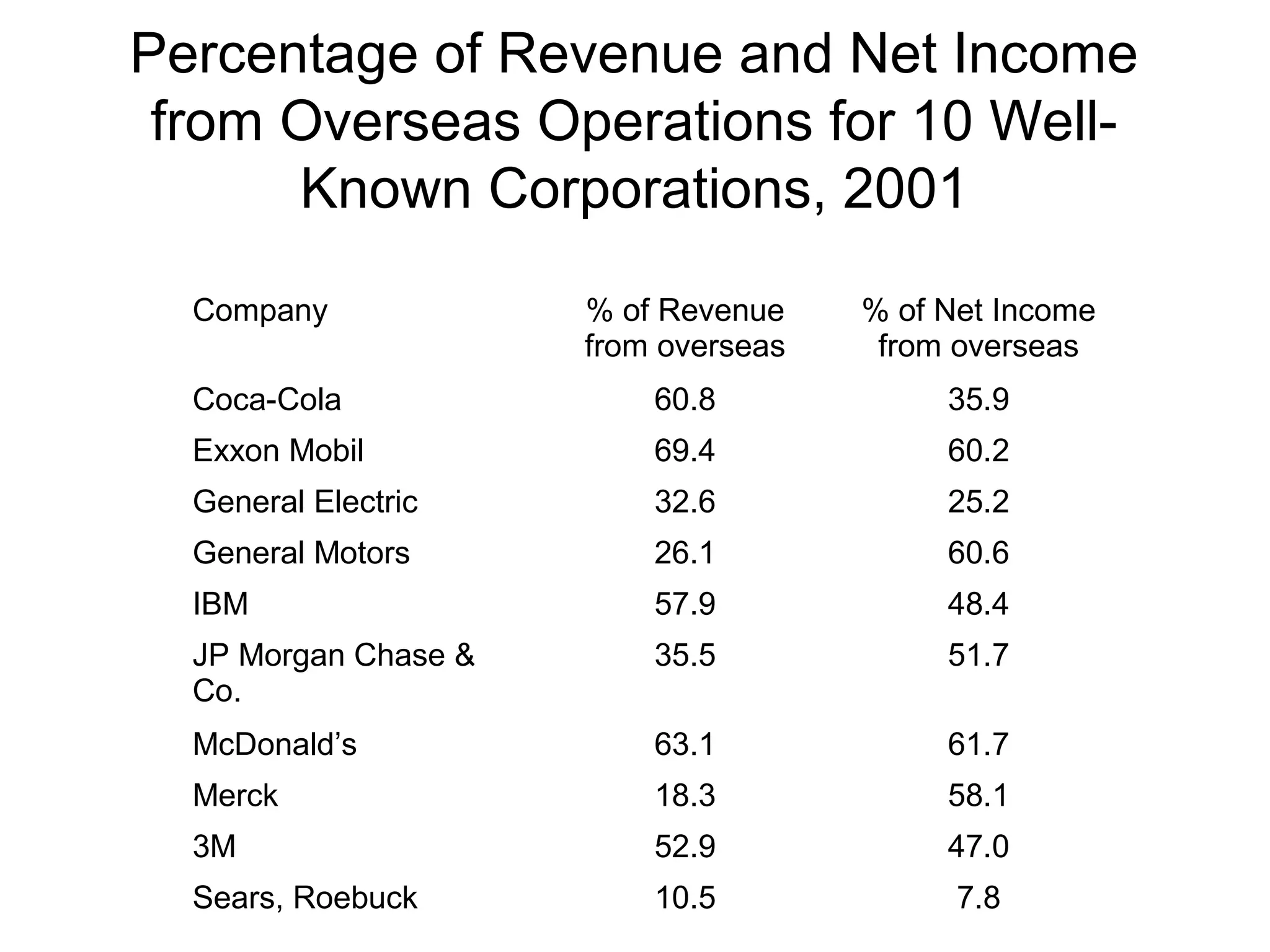
Percentage of Revenue and Net Income
 from Overseas Operations for 10 Well-
      Known Corporations, 2001

  Company             % of Revenue    % of Net Income
                      from overseas    from overseas
  Coca-Cola               60.8             35.9
  Exxon Mobil             69.4             60.2
  General Electric        32.6             25.2
  General Motors          26.1             60.6
  IBM                     57.9             48.4
  JP Morgan Chase &       35.5             51.7
  Co.
  McDonald’s              63.1             61.7
  Merck                   18.3             58.1
  3M                      52.9             47.0
  Sears, Roebuck          10.5              7.8
Alternative Forms of Business
          Organization
• Sole proprietorship
• Partnership
• Corporation
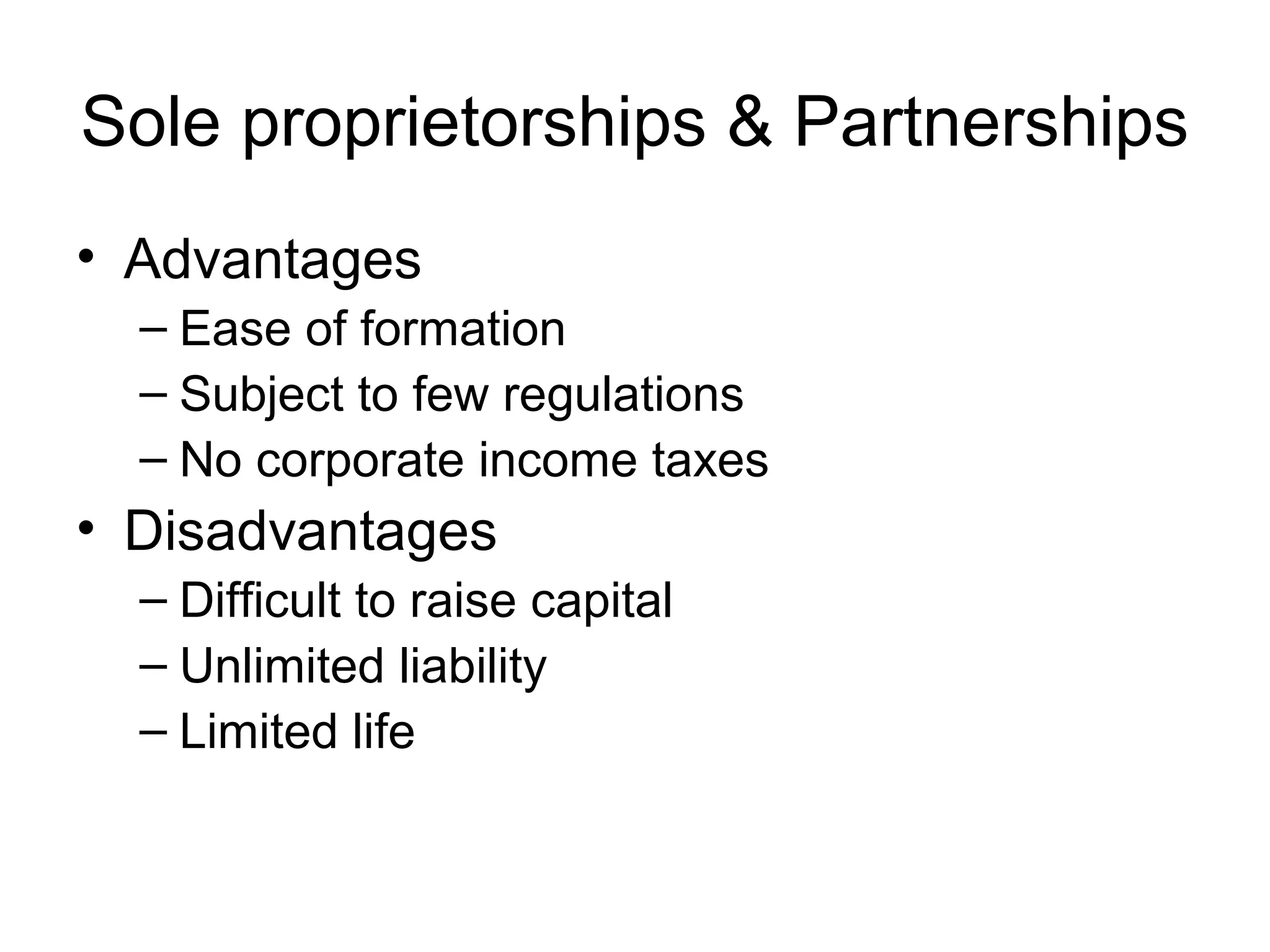
Sole proprietorships & Partnerships
• Advantages
  – Ease of formation
  – Subject to few regulations
  – No corporate income taxes
• Disadvantages
  – Difficult to raise capital
  – Unlimited liability
  – Limited life
Corporation
• Advantages
  – Unlimited life
  – Easy transfer of ownership
  – Limited liability
  – Ease of raising capital
• Disadvantages
  – Double taxation
  – Cost of set-up and report filing
Financial Goals of the Corporation
• The primary financial goal is shareholder
  wealth maximization, which translates to
  maximizing stock price.
  – Do firms have any responsibilities to society
    at large?
  – Is stock price maximization good or bad for
    society?
  – Should firms behave ethically?
Is stock price maximization the
 same as profit maximization?

• No, despite a generally high correlation
  amongst stock price, EPS, and cash
  flow.
• Current stock price relies upon current
  earnings, as well as future earnings and
  cash flow.
• Some actions may cause an increase in
  earnings, yet cause the stock price to
  decrease (and vice versa).
Agency relationships
• An agency relationship exists whenever a
  principal hires an agent to act on their
  behalf.
• Within a corporation, agency relationships
  exist between:
  – Shareholders and managers
  – Shareholders and creditors
Shareholders versus Managers
• Managers are naturally inclined to act in
  their own best interests.
• But the following factors affect managerial
  behavior:
  – Managerial compensation plans
  – Direct intervention by shareholders
  – The threat of firing
  – The threat of takeover
Shareholders versus Creditors
• Shareholders (through managers) could
  take actions to maximize stock price that
  are detrimental to creditors.
• In the long run, such actions will raise the
  cost of debt and ultimately lower stock
  price.
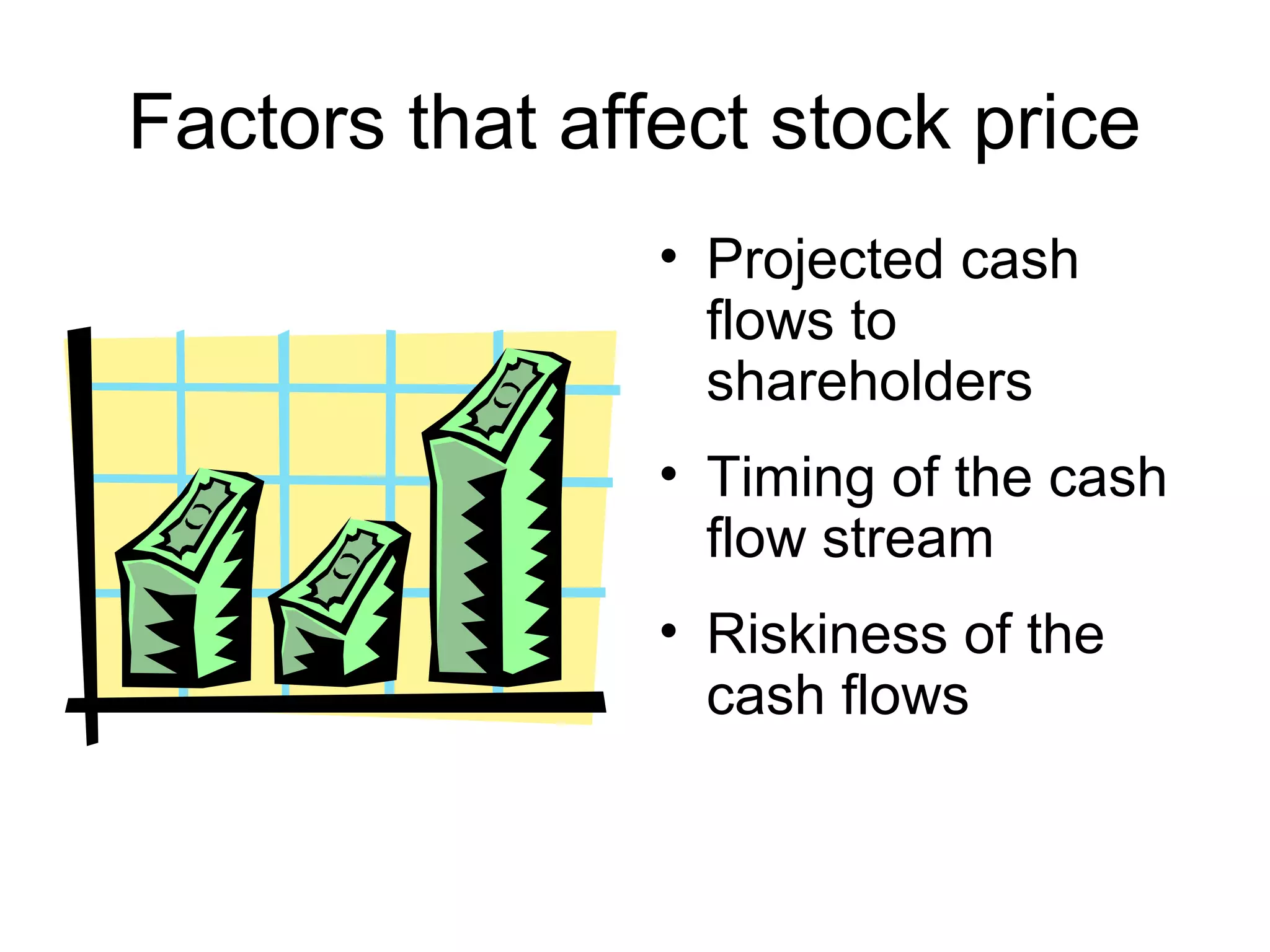
Factors that affect stock price
                • Projected cash
                  flows to
                  shareholders
                • Timing of the cash
                  flow stream
                • Riskiness of the
                  cash flows
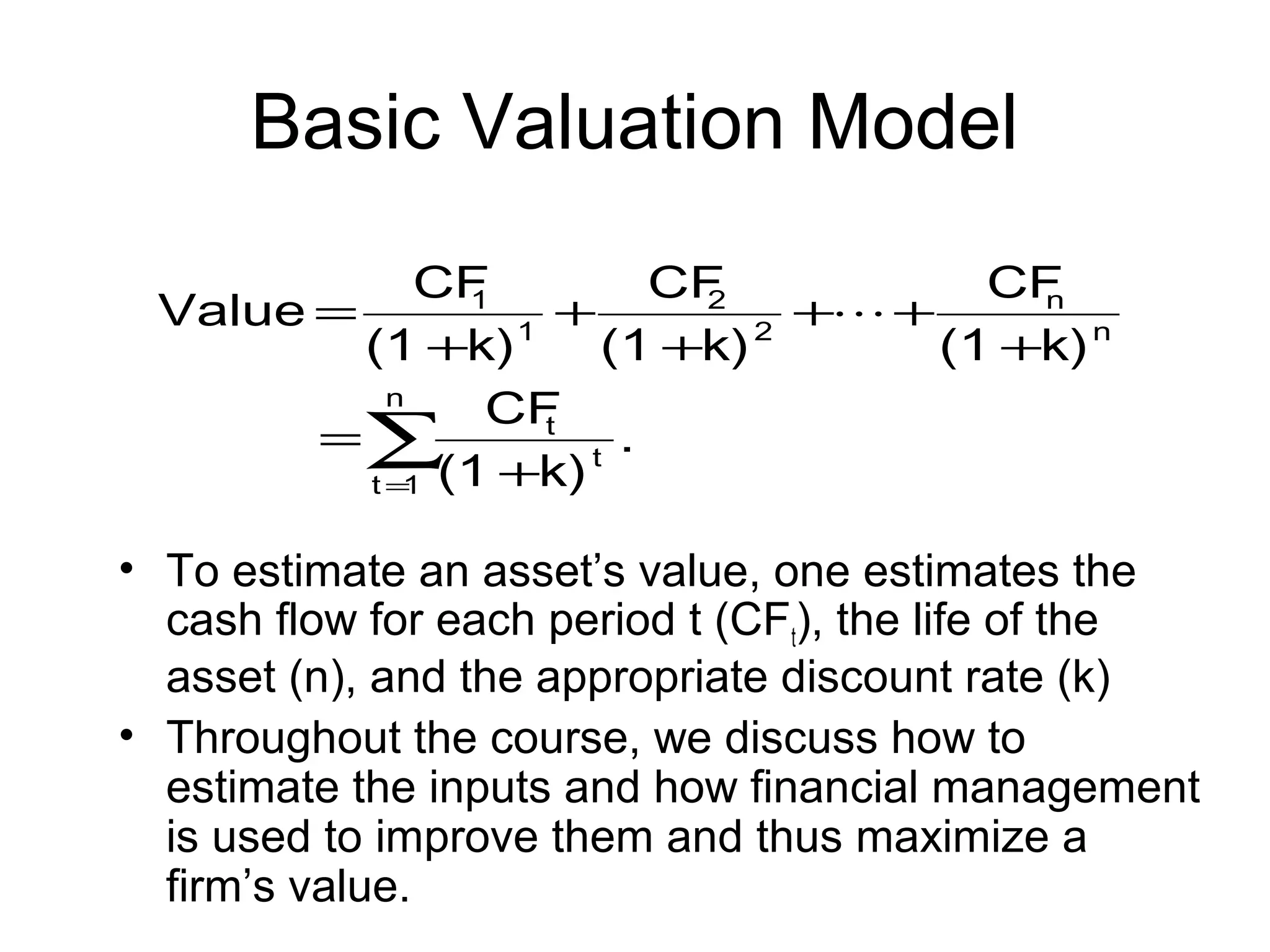
Basic Valuation Model
             CF         CF         CF
 Value =      1
                  +       2
                            + +     n
         (1 +k) 1 (1 +k) 2       (1 +k) n
           n
               CF
       =∑        t
                    t
                      .
         t = (1 +k)
            1


• To estimate an asset’s value, one estimates the
  cash flow for each period t (CFt), the life of the
  asset (n), and the appropriate discount rate (k)
• Throughout the course, we discuss how to
  estimate the inputs and how financial management
  is used to improve them and thus maximize a
  firm’s value.
Factors that Affect the Level
   and Riskiness of Cash Flows
• Decisions made by financial managers:
  – Investment decisions
  – Financing decisions (the relative use of debt
    financing)
  – Dividend policy decisions
• The external environment

L02 definition of fm

  • 1.
    Finance Management Lecture 2 By: Noor ul hadi (Lecturer) Govt College of Management Sciences Peshawar
  • 2.
    An Overview ofFinancial Management • Financial management plays vital role in modern business organization. It raised fund and managed their fund. It supplement performance of employees, financial manage adapt changes, raised fund, invest in assets and manage wisely the firm resources, maximize the profit and grow the value of the firm.
  • 3.
    Scope/Elements of FM •Investment decisions includes investment in fixed assets (called as capital budgeting). Investment in current assets is also a part of investment decisions called as working capital decisions. • Financial decisions - They relate to the raising of finance from various resources which will depend upon decision on type of source, period of financing, cost of financing and the returns thereby. • Dividend decision - The finance manager has to take decision with regards to the net profit distribution. Net profits are generally divided into two: – Dividend for shareholders- Dividend and the rate of it has to be decided. – Retained profits- Amount of retained profits has to be finalized which will depend upon expansion and diversification plans of the enterprise
  • 4.
    Finance • Finance isthe art of to raise fund and best allocation or utilization to achieve organizational goal. • A branch of economics concerned with resource allocation as well as resource management, acquisition and investment. Simply, finance deals with matters related to money and the markets.
  • 5.
    Finance Vs Financing Finance: Finance is a branch of economics that deals with the management of funds, financial resources and other assets. In broader terms, finance is raising or investing money either as equity or debt. Financing: • The process or means of acquiring capital necessary to conduct a business activity. Two of the most common forms of financing are debt financing and equity financing.
  • 6.
    FINANCIAL MANAGEMENT Definition: a. FinancialManagement means planning, organizing, directing and controlling the financial activities such as procurement and utilization of funds of the enterprise. It means applying general management principles to financial resources of the enterprise. b. Financial Management concerns the acquisition, financing, and management of assets with some overall goal in mind.
  • 7.
    Careers in Finance Financeor knowledge of finance is important for two reasons. • First you need the knowledge of finance to make personal decision i.e. investment your saving, buying and selling of building, car etc or planning your future (fund and pension) • Secondly organization needs the backing of finance in each function and departments, • The career of finance students may be exercise in: 1. Capital market and institutions 2. investment 3. Financial management
  • 8.
    Institutions and capitalmarkets Money & Capital markets, which deals with securities markets & financial institutions. • Bank • Insurance companies, • Mutual fund • Investment baking Financial manager needs knowledge of valuation techniques to determine interest rate, and a person with finance knowledge knows about stock, bond, mortgages, auto loan and certificate of deposit.
  • 9.
    Investments • Investments, whichfocuses on the decisions of both individual and institutional investors as they choose assets for their investment portfolios. • Can work as – Brokerage house in sales or as security analyst. – Investment portfolio manager in bank, insurance and other institutes. – Work for Financial consulting firm. – Financial advisor for pension fund and investment. – Financial planner who help individual to develop and achieve long-term financial goal – Investment function • Sales • Analysis • Optimal mix (portfolio)
  • 10.
    Financial management • FinancialManagement, or business finance which involves the actual management of firms. • Financial management is important for all type of business including public and private sector. – Banks – Financial institutes – Government operation – Because FM includes decision making, selection of securities
  • 11.
    Responsibility of theFinancial Staff • Maximize stock value by: – Forecasting and planning – Investment and financing decisions – Coordination and control – Transactions in the financial markets – Managing risk
  • 12.
    Role of Financein a Typical Business Organization Board of Directors President VP: Sales VP: Finance VP: Operations Treasurer Controller Credit Manager Cost Accounting Inventory Manager Financial Accounting Capital Budgeting Director Tax Department
  • 13.
    Financial Management Issues of the New Millennium • The effect of changing technology • The globalization of business
  • 14.
    Percentage of Revenueand Net Income from Overseas Operations for 10 Well- Known Corporations, 2001 Company % of Revenue % of Net Income from overseas from overseas Coca-Cola 60.8 35.9 Exxon Mobil 69.4 60.2 General Electric 32.6 25.2 General Motors 26.1 60.6 IBM 57.9 48.4 JP Morgan Chase & 35.5 51.7 Co. McDonald’s 63.1 61.7 Merck 18.3 58.1 3M 52.9 47.0 Sears, Roebuck 10.5 7.8
  • 15.
    Alternative Forms ofBusiness Organization • Sole proprietorship • Partnership • Corporation
  • 16.
    Sole proprietorships &Partnerships • Advantages – Ease of formation – Subject to few regulations – No corporate income taxes • Disadvantages – Difficult to raise capital – Unlimited liability – Limited life
  • 17.
    Corporation • Advantages – Unlimited life – Easy transfer of ownership – Limited liability – Ease of raising capital • Disadvantages – Double taxation – Cost of set-up and report filing
  • 18.
    Financial Goals ofthe Corporation • The primary financial goal is shareholder wealth maximization, which translates to maximizing stock price. – Do firms have any responsibilities to society at large? – Is stock price maximization good or bad for society? – Should firms behave ethically?
  • 19.
    Is stock pricemaximization the same as profit maximization? • No, despite a generally high correlation amongst stock price, EPS, and cash flow. • Current stock price relies upon current earnings, as well as future earnings and cash flow. • Some actions may cause an increase in earnings, yet cause the stock price to decrease (and vice versa).
  • 20.
    Agency relationships • Anagency relationship exists whenever a principal hires an agent to act on their behalf. • Within a corporation, agency relationships exist between: – Shareholders and managers – Shareholders and creditors
  • 21.
    Shareholders versus Managers •Managers are naturally inclined to act in their own best interests. • But the following factors affect managerial behavior: – Managerial compensation plans – Direct intervention by shareholders – The threat of firing – The threat of takeover
  • 22.
    Shareholders versus Creditors •Shareholders (through managers) could take actions to maximize stock price that are detrimental to creditors. • In the long run, such actions will raise the cost of debt and ultimately lower stock price.
  • 23.
    Factors that affectstock price • Projected cash flows to shareholders • Timing of the cash flow stream • Riskiness of the cash flows
  • 24.
    Basic Valuation Model CF CF CF Value = 1 + 2 + + n (1 +k) 1 (1 +k) 2 (1 +k) n n CF =∑ t t . t = (1 +k) 1 • To estimate an asset’s value, one estimates the cash flow for each period t (CFt), the life of the asset (n), and the appropriate discount rate (k) • Throughout the course, we discuss how to estimate the inputs and how financial management is used to improve them and thus maximize a firm’s value.
  • 25.
    Factors that Affectthe Level and Riskiness of Cash Flows • Decisions made by financial managers: – Investment decisions – Financing decisions (the relative use of debt financing) – Dividend policy decisions • The external environment