Investments and Financial Markets


                        Introduction
Master Objectives
   Investment and Opportunity Cost
   Debt Cycle
   Financial Institutions and Intermediation
   Financial Instruments
   Portfolio Theory
   Active Investment Management
   Financial Crises
Financial System
   Purpose: bring together individuals, businesses, and
    government entities (economic units) that generate
    and spend funds.

      Surplus economic units have funds left
       over after spending all they wish to spend.
      Deficit economic units need to acquire

       additional funds to sustain their
       operations.
Financial Markets
   Classified according to characteristics of participants
    and securities
       Primary Market: deficit economic units sell securities to
        raise funds.
       Secondary market is where investors trade previously
        issued securities with each other.
   Other types of Markets, e.g. Money and Capital
    Markets
Financial Markets
   Money Market
     Trade short term (1 year or less) debt
      instruments (e.g. T-Bills, Commercial Paper)
     Major money centers in Tokyo, London and
      New York
   Capital Market
     Trades long term securities (Bonds, Stocks)
     NYSE, ASE, LSE, over-the-counter (NASDAQ
      and other OTC)
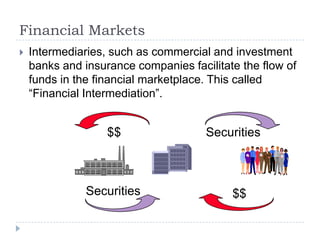
Financial Markets
   Intermediaries, such as commercial and investment
    banks and insurance companies facilitate the flow of
    funds in the financial marketplace. This called
    “Financial Intermediation”.


                   $$                 Securities


               Securities                  $$
Market Efficiency
   Market efficiency refers to the ease, speed, and
    cost of trading securities.
     The market for the securities of large
      companies is generally efficient: Trades can
      be executed in a matter of seconds and
      commissions are very low. Somewhat true: rule
      generally is still T+3.
     The real estate market is not generally efficient:
      It can take months to sell a house and the
      commission is 6-7% of the price.
Market Efficiency
   Why is market efficiency important?
       The more efficient the market, the easier it
        is to transfer idle funds to those parties that need the
        funds.
       If funds remain idle, this results in lower growth for the
        economy and higher unemployment.
       Investors can adjust their portfolios easily
        and at low cost as their needs and preferences change.
Securities in the Financial Market
   Money Market Securities
       Highly liquid, low risk
       Treasury Bills (T-Bills)
       Certificates of Deposit (CDs)
       Commercial Paper
       Eurodollars
       Banker’s Acceptances
Treasury Bills
   T-Bills are short term securities issued by the
    Federal Government [USA].
   After initial sale, there is an active secondary market.
   They are bought at discount and at maturity face
    value is paid.
Negotiable Certificate of Deposit
   Interest bearing securities issued by financial
    institutions.
   Maturities of one year or less.
Commercial Paper
   Unsecured debt issued by large corporations with
    good credit ratings.
   Usually bought only by large institutions.
Eurodollars
   They are dollar denominated deposits located in
    non-US banks.
   Buyers and sellers are large institutions.
Banker’s Acceptances
   Debt securities guaranteed by a bank.
   Used primarily to facilitate international
    transactions, e.g. International trade.
Bonds
   They are “IOUs” issued by the borrower and sold to
    investors.
   Issuer promises to pay the face amount of the bond
    on the maturity date, plus pay interest each year in
    the amount of the coupon rate times the face value.
   How many “cash flow” streams does a bond have?
   Other types
       Treasury bonds issued by Federal Government
       Municipal bonds issued by state and local governments
       Corporate bonds
Common Stock
   Shareholders own a portion of the company and
    have right to vote on major decisions
   Return on investment: dividends [if paid by company]
    and capital gain, if any.
Preferred Stock
   Hybrid instrument between bond and common stock.
   Accounting purposes, it is equity, not debt.
   Dollar value is guaranteed
       Dividends paid to preferred shareholders first under
        contract
       Rarely have voting rights
       In event of insolvency, paid off after bondholders but
        before common shareholders
Interest Rates
   Interest Rates Determined by
       Real Rate of Interest
       Expected Inflation
       Default Risk
       Maturity Risk
       Liquidity Risk
Real rate of interest
   Compensation for lender’s lost opportunity to
    consume.
Default Risk
   For most securities, there is some risk that the
    borrower will not repay the interest and/or principal
    on time, or at all.
   The greater the chance of default, the greater the
    interest rate the investor demands and the issuer
    must pay.
Expected Inflation
   Inflation erodes the purchasing power of money.
   Example: If you loan someone $1,000 and they pay it
    back one year later with 10% interest, you will have
    $1,100. But if prices have increased by 5%, then
    something that would have cost $1,000 at the outset of
    the loan will now cost $1,000(1.05) = $1,050.
Maturity Risk
   If interest rates rise, lenders may find that their
    loans are earning rates that are lower than what
    they could get on new loans.
   The risk of this occurring is higher for longer
    maturity loans.
   Lenders will adjust the premium they charge for this risk
    depending on whether they believe rates will go up or
    down.
Liquidity Risk
   Investments that are easy to sell without losing
    value are more liquid.
   Illiquid securities have a higher interest rate to
    compensate the lender for the inconvenience of
    being “stuck.”
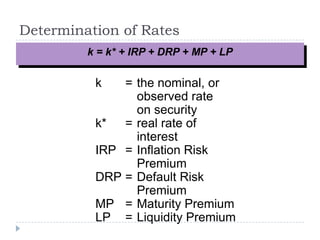
Determination of Rates
         k = k* + IRP + DRP + MP + LP

          k   = the nominal, or
                observed rate
                on security
          k*  = real rate of
                interest
          IRP = Inflation Risk
                Premium
          DRP = Default Risk
                Premium
          MP = Maturity Premium
          LP = Liquidity Premium
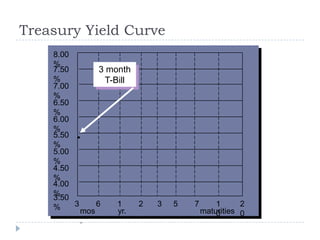
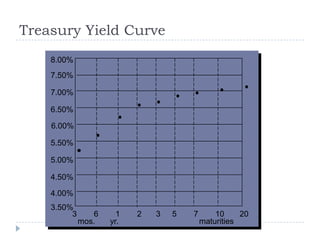
Term Structure
   Relationship between long and short
    term interest rates
   Yield curve
Treasury Yield Curve
    8.00
    %
    7.50        3 month
    %            T-Bill
    7.00
    %
    6.50
    %
    6.00
    %
    5.50
    %
    5.00
    %
    4.50
    %
    4.00
    %
    3.50
    %    3     6    1   2   3   5   7       1      2
           mos      yr.                 maturities 0
                                            0
           .
Treasury Yield Curve
    8.00%
    7.50%

    7.00%

    6.50%

    6.00%

    5.50%

    5.00%

    4.50%

    4.00%
    3.50%
         3      6     1   2   3   5   7       10     20
             mos.   yr.                   maturities
Financial versus Real Assets
   Essential nature
       Reduced current consumption
       Planned later consumption
   Real Assets
       Assets used to produce goods and services
   Financial Assets
       Claims on real assets
Investment Process
   Asset Allocation
   Security selection
   Risk-return trade-off
   Market efficiency
   Active vs. passive management
Active versus Passive Management
Active Management
 Finding undervalued securities
 Timing the market


    Passive Management
   No attempt to find undervalued securities
   No attempt to time
   Holding an efficient portfolio
Financial Engineering
Repackaging Services of Financial Intermediaries
 Bundling and unbundling of cash flows
 Slicing and dicing of cash flows
 Examples: strips, CMOs, dual purpose
  funds, principal/interest splits

Burke investments lecture_1

  • 1.
    Investments and FinancialMarkets Introduction
  • 2.
    Master Objectives  Investment and Opportunity Cost  Debt Cycle  Financial Institutions and Intermediation  Financial Instruments  Portfolio Theory  Active Investment Management  Financial Crises
  • 3.
    Financial System  Purpose: bring together individuals, businesses, and government entities (economic units) that generate and spend funds.  Surplus economic units have funds left over after spending all they wish to spend.  Deficit economic units need to acquire additional funds to sustain their operations.
  • 4.
    Financial Markets  Classified according to characteristics of participants and securities  Primary Market: deficit economic units sell securities to raise funds.  Secondary market is where investors trade previously issued securities with each other.  Other types of Markets, e.g. Money and Capital Markets
  • 5.
    Financial Markets  Money Market  Trade short term (1 year or less) debt instruments (e.g. T-Bills, Commercial Paper)  Major money centers in Tokyo, London and New York  Capital Market  Trades long term securities (Bonds, Stocks)  NYSE, ASE, LSE, over-the-counter (NASDAQ and other OTC)
  • 6.
    Financial Markets  Intermediaries, such as commercial and investment banks and insurance companies facilitate the flow of funds in the financial marketplace. This called “Financial Intermediation”. $$ Securities Securities $$
  • 7.
    Market Efficiency  Market efficiency refers to the ease, speed, and cost of trading securities.  The market for the securities of large companies is generally efficient: Trades can be executed in a matter of seconds and commissions are very low. Somewhat true: rule generally is still T+3.  The real estate market is not generally efficient: It can take months to sell a house and the commission is 6-7% of the price.
  • 8.
    Market Efficiency  Why is market efficiency important?  The more efficient the market, the easier it is to transfer idle funds to those parties that need the funds.  If funds remain idle, this results in lower growth for the economy and higher unemployment.  Investors can adjust their portfolios easily and at low cost as their needs and preferences change.
  • 9.
    Securities in theFinancial Market  Money Market Securities  Highly liquid, low risk  Treasury Bills (T-Bills)  Certificates of Deposit (CDs)  Commercial Paper  Eurodollars  Banker’s Acceptances
  • 10.
    Treasury Bills  T-Bills are short term securities issued by the Federal Government [USA].  After initial sale, there is an active secondary market.  They are bought at discount and at maturity face value is paid.
  • 11.
    Negotiable Certificate ofDeposit  Interest bearing securities issued by financial institutions.  Maturities of one year or less.
  • 12.
    Commercial Paper  Unsecured debt issued by large corporations with good credit ratings.  Usually bought only by large institutions.
  • 13.
    Eurodollars  They are dollar denominated deposits located in non-US banks.  Buyers and sellers are large institutions.
  • 14.
    Banker’s Acceptances  Debt securities guaranteed by a bank.  Used primarily to facilitate international transactions, e.g. International trade.
  • 15.
    Bonds  They are “IOUs” issued by the borrower and sold to investors.  Issuer promises to pay the face amount of the bond on the maturity date, plus pay interest each year in the amount of the coupon rate times the face value.  How many “cash flow” streams does a bond have?  Other types  Treasury bonds issued by Federal Government  Municipal bonds issued by state and local governments  Corporate bonds
  • 16.
    Common Stock  Shareholders own a portion of the company and have right to vote on major decisions  Return on investment: dividends [if paid by company] and capital gain, if any.
  • 17.
    Preferred Stock  Hybrid instrument between bond and common stock.  Accounting purposes, it is equity, not debt.  Dollar value is guaranteed  Dividends paid to preferred shareholders first under contract  Rarely have voting rights  In event of insolvency, paid off after bondholders but before common shareholders
  • 18.
    Interest Rates  Interest Rates Determined by  Real Rate of Interest  Expected Inflation  Default Risk  Maturity Risk  Liquidity Risk
  • 19.
    Real rate ofinterest  Compensation for lender’s lost opportunity to consume.
  • 20.
    Default Risk  For most securities, there is some risk that the borrower will not repay the interest and/or principal on time, or at all.  The greater the chance of default, the greater the interest rate the investor demands and the issuer must pay.
  • 21.
    Expected Inflation  Inflation erodes the purchasing power of money.  Example: If you loan someone $1,000 and they pay it back one year later with 10% interest, you will have $1,100. But if prices have increased by 5%, then something that would have cost $1,000 at the outset of the loan will now cost $1,000(1.05) = $1,050.
  • 22.
    Maturity Risk  If interest rates rise, lenders may find that their loans are earning rates that are lower than what they could get on new loans.  The risk of this occurring is higher for longer maturity loans.  Lenders will adjust the premium they charge for this risk depending on whether they believe rates will go up or down.
  • 23.
    Liquidity Risk  Investments that are easy to sell without losing value are more liquid.  Illiquid securities have a higher interest rate to compensate the lender for the inconvenience of being “stuck.”
  • 24.
    Determination of Rates k = k* + IRP + DRP + MP + LP k = the nominal, or observed rate on security k* = real rate of interest IRP = Inflation Risk Premium DRP = Default Risk Premium MP = Maturity Premium LP = Liquidity Premium
  • 25.
    Term Structure  Relationship between long and short term interest rates  Yield curve
  • 26.
    Treasury Yield Curve 8.00 % 7.50 3 month % T-Bill 7.00 % 6.50 % 6.00 % 5.50 % 5.00 % 4.50 % 4.00 % 3.50 % 3 6 1 2 3 5 7 1 2 mos yr. maturities 0 0 .
  • 27.
    Treasury Yield Curve 8.00% 7.50% 7.00% 6.50% 6.00% 5.50% 5.00% 4.50% 4.00% 3.50% 3 6 1 2 3 5 7 10 20 mos. yr. maturities
  • 28.
    Financial versus RealAssets  Essential nature  Reduced current consumption  Planned later consumption  Real Assets  Assets used to produce goods and services  Financial Assets  Claims on real assets
  • 29.
    Investment Process  Asset Allocation  Security selection  Risk-return trade-off  Market efficiency  Active vs. passive management
  • 30.
    Active versus PassiveManagement Active Management  Finding undervalued securities  Timing the market Passive Management  No attempt to find undervalued securities  No attempt to time  Holding an efficient portfolio
  • 31.
    Financial Engineering Repackaging Servicesof Financial Intermediaries  Bundling and unbundling of cash flows  Slicing and dicing of cash flows  Examples: strips, CMOs, dual purpose funds, principal/interest splits