Venture Capital
• Venture capital means funds made available for start-
up firms and small businesses with exceptional
growth potential.
• Venture capital is long term risk capital to finance
high technology projects which involve risk but at the
same time has strong potential for growth.
What is Venture Capital?
Definition
• The SEBI defined Venture Capital fund in
its regulation 1996 as ‘a fund established in
the form of a company or trust which raises
money through loans, donations, issue of
securities or units as the case may be &
makes or proposes to make investments in
accordance with the regulations’.
FEATURES OF VENTURE CAPITAL
• Long term investment
• Lack of liquidity
• High risk return
• Private equity
• Wide scope
• Equity participation
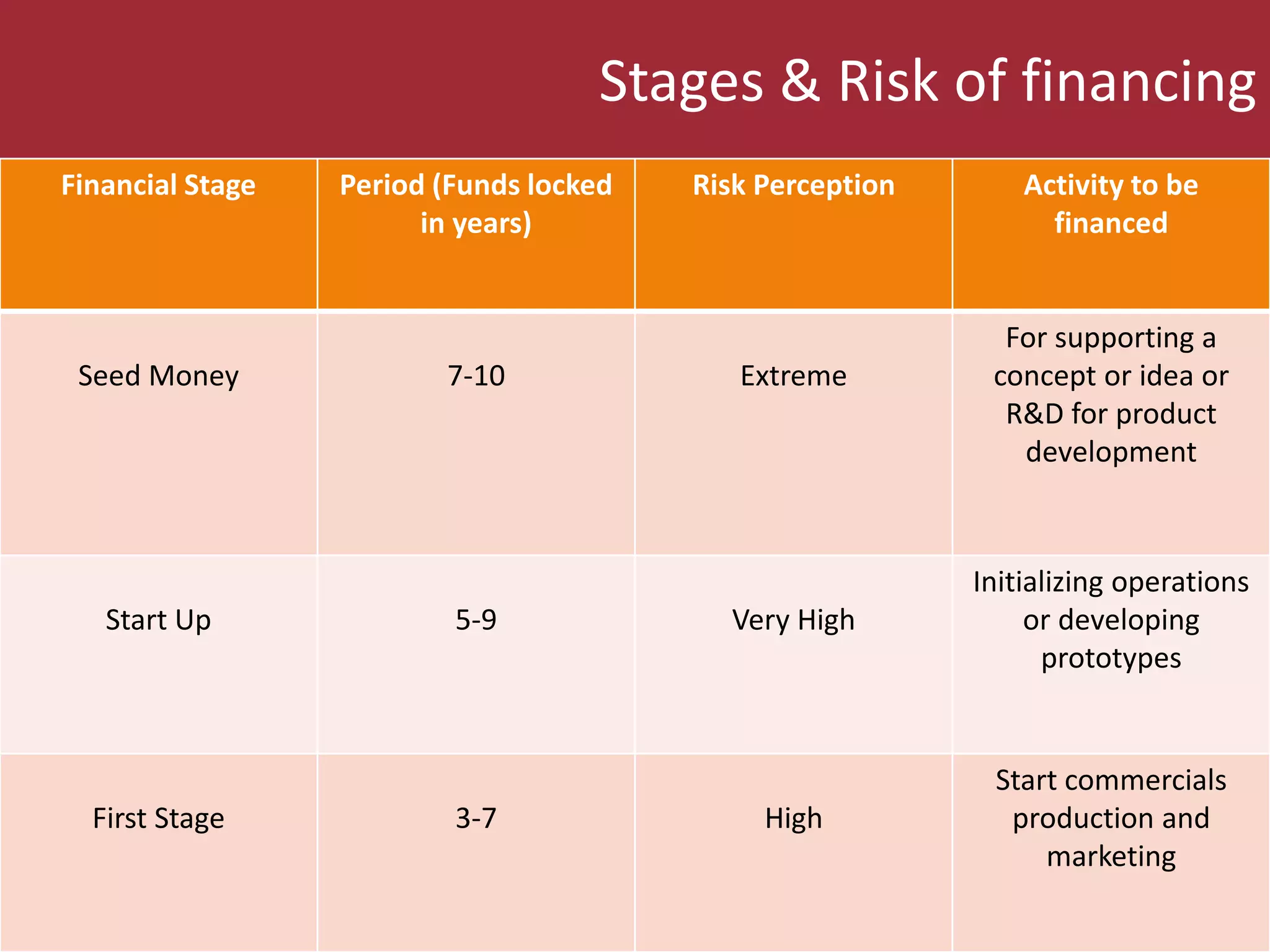
Stages & Risk of financing
Financial Stage Period (Funds locked
in years)
Risk Perception Activity to be
financed
Seed Money 7-10 Extreme
For supporting a
concept or idea or
R&D for product
development
Start Up 5-9 Very High
Initializing operations
or developing
prototypes
First Stage 3-7 High
Start commercials
production and
marketing
Financial Stage Period (Funds locked
in years)
Risk Perception Activity to be
financed
Second Stage 3-5 Sufficiently high
Expand market and
growing working
capital need
Third Stage 1-3 Medium
Market expansion,
acquisition & product
development for
profit making
company
Fourth Stage 1-3 Low Facilitating public
issue
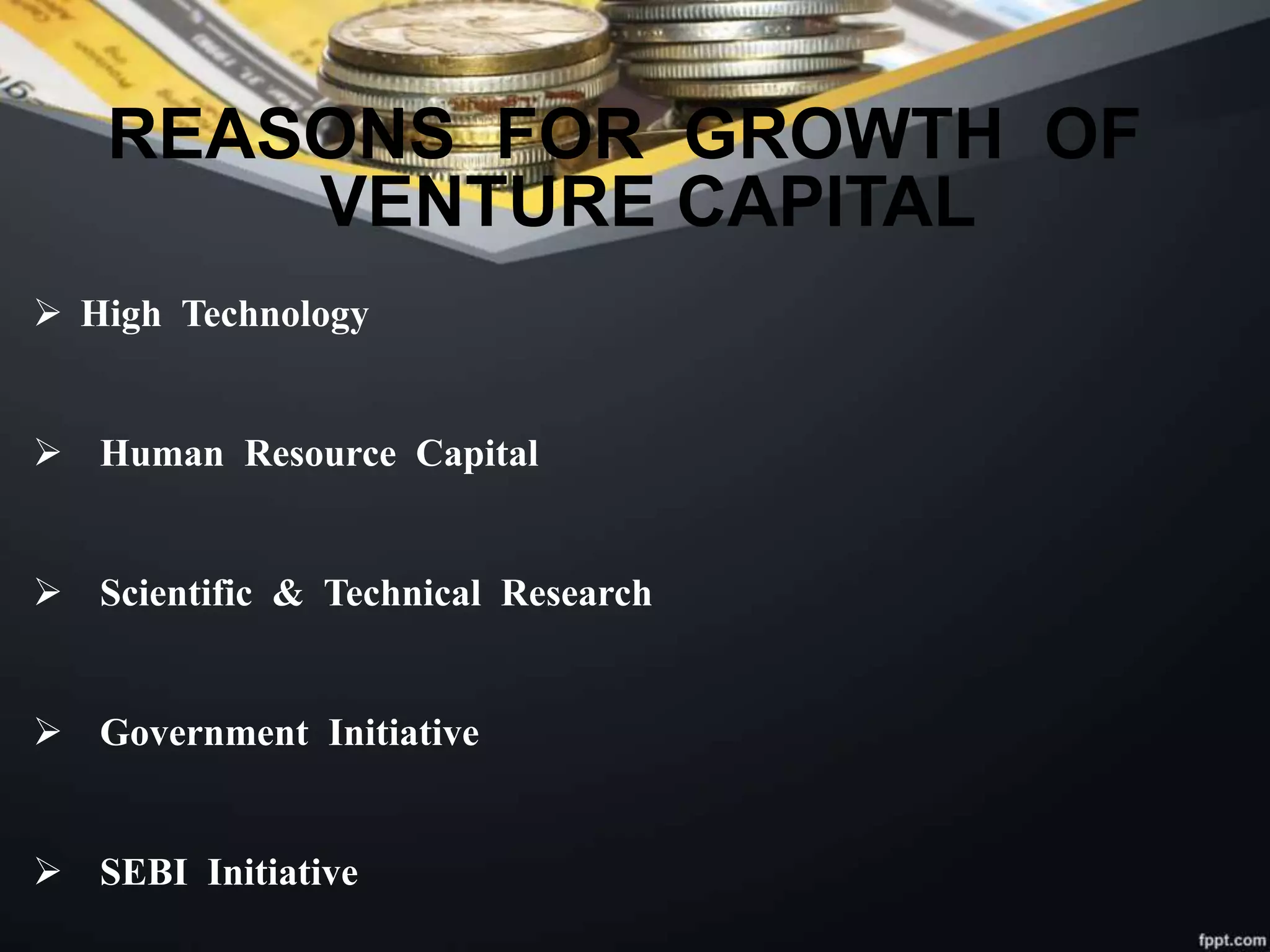
REASONS FOR GROWTH OF
VENTURE CAPITAL
 High Technology
 Human Resource Capital
 Scientific & Technical Research
 Government Initiative
 SEBI Initiative
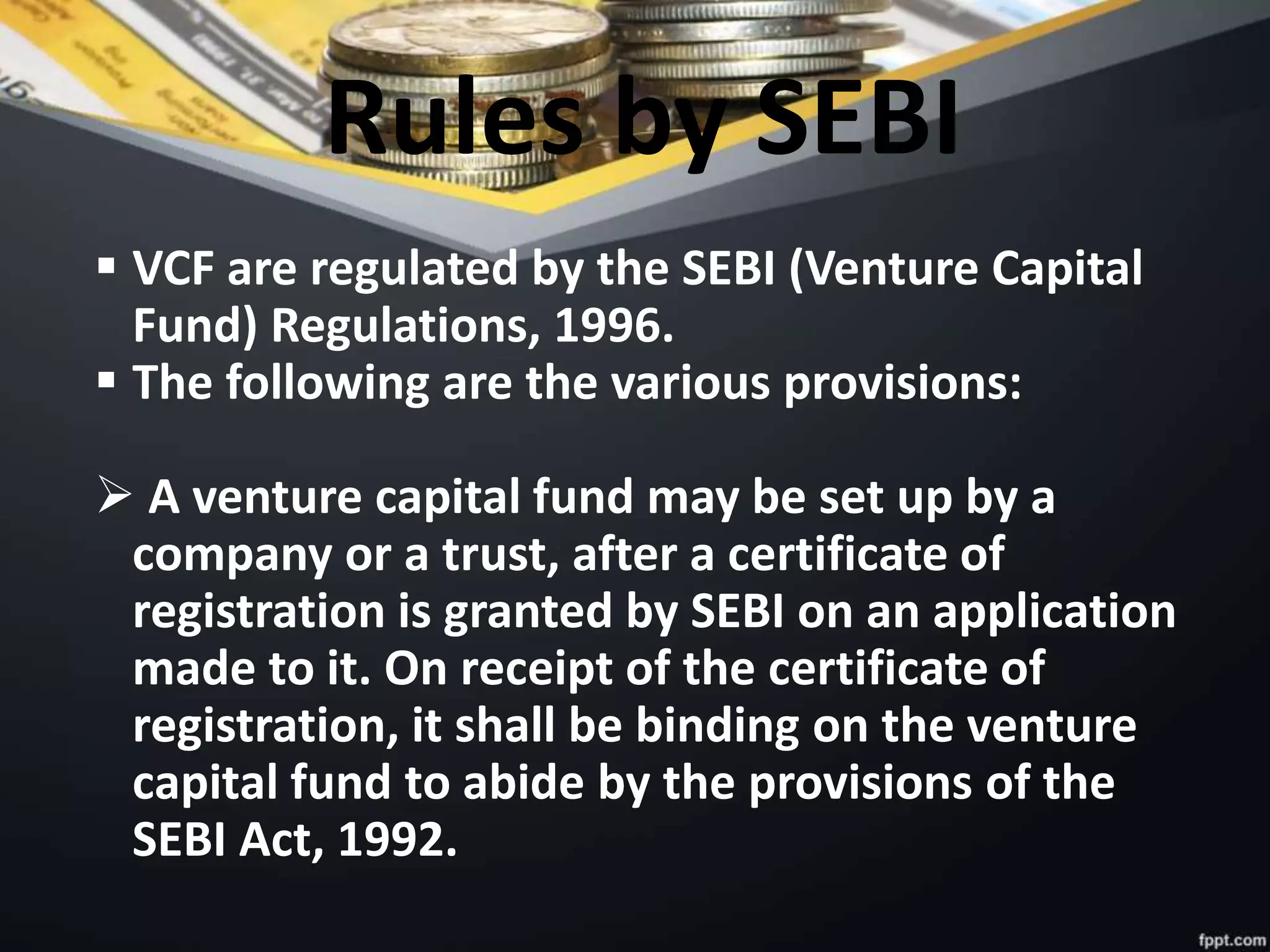
Rules by SEBI
 VCF are regulated by the SEBI (Venture Capital
Fund) Regulations, 1996.
 The following are the various provisions:
 A venture capital fund may be set up by a
company or a trust, after a certificate of
registration is granted by SEBI on an application
made to it. On receipt of the certificate of
registration, it shall be binding on the venture
capital fund to abide by the provisions of the
SEBI Act, 1992.
• A VCF may raise money from any investor, Indian,
Non-resident Indian or foreign, provided the money
accepted from any investor is not less than Rs 5
lakhs. The VCF shall not issue any document or
advertisement inviting offers from the public for
subscription of its security or units
• SEBI regulations permit investment by venture
capital funds in equity or equity related instruments
of unlisted companies and also in financially weak
and sick industries whose shares are listed or
unlisted
 At least 80% of the funds should be invested
in venture capital companies and no other
limits are prescribed.
SEBI Regulations do not provide for any
sectoral restrictions for investment except
investment in companies engaged in financial
services.
ADVANTAGES OF VENTURE CAPITAL
• Provide large sum of equity finance.
• Venture Capitalist are rewarded by business success
& the capital gain.
• Able to bring wealth and expertise to your company
• The Venture Capitalist also has a wide network of
contacts.
• Providing additional funds.
DISADVANTAGES OF VC
• Lengthy and complex process (needs detailed
business plan, financial projections and etc.)
• In the deal negotiation stage, you will have to pay for
legal and accounting fees
• Investors become part owners of your business -
founder loss of autonomy or control
Venture capital
Venture capital

Venture capital

  • 1.
  • 2.
    • Venture capitalmeans funds made available for start- up firms and small businesses with exceptional growth potential. • Venture capital is long term risk capital to finance high technology projects which involve risk but at the same time has strong potential for growth. What is Venture Capital?
  • 3.
    Definition • The SEBIdefined Venture Capital fund in its regulation 1996 as ‘a fund established in the form of a company or trust which raises money through loans, donations, issue of securities or units as the case may be & makes or proposes to make investments in accordance with the regulations’.
  • 4.
    FEATURES OF VENTURECAPITAL • Long term investment • Lack of liquidity • High risk return • Private equity • Wide scope • Equity participation
  • 5.
    Stages & Riskof financing Financial Stage Period (Funds locked in years) Risk Perception Activity to be financed Seed Money 7-10 Extreme For supporting a concept or idea or R&D for product development Start Up 5-9 Very High Initializing operations or developing prototypes First Stage 3-7 High Start commercials production and marketing
  • 6.
    Financial Stage Period(Funds locked in years) Risk Perception Activity to be financed Second Stage 3-5 Sufficiently high Expand market and growing working capital need Third Stage 1-3 Medium Market expansion, acquisition & product development for profit making company Fourth Stage 1-3 Low Facilitating public issue
  • 7.
    REASONS FOR GROWTHOF VENTURE CAPITAL  High Technology  Human Resource Capital  Scientific & Technical Research  Government Initiative  SEBI Initiative
  • 8.
    Rules by SEBI VCF are regulated by the SEBI (Venture Capital Fund) Regulations, 1996.  The following are the various provisions:  A venture capital fund may be set up by a company or a trust, after a certificate of registration is granted by SEBI on an application made to it. On receipt of the certificate of registration, it shall be binding on the venture capital fund to abide by the provisions of the SEBI Act, 1992.
  • 9.
    • A VCFmay raise money from any investor, Indian, Non-resident Indian or foreign, provided the money accepted from any investor is not less than Rs 5 lakhs. The VCF shall not issue any document or advertisement inviting offers from the public for subscription of its security or units • SEBI regulations permit investment by venture capital funds in equity or equity related instruments of unlisted companies and also in financially weak and sick industries whose shares are listed or unlisted
  • 10.
     At least80% of the funds should be invested in venture capital companies and no other limits are prescribed. SEBI Regulations do not provide for any sectoral restrictions for investment except investment in companies engaged in financial services.
  • 11.
    ADVANTAGES OF VENTURECAPITAL • Provide large sum of equity finance. • Venture Capitalist are rewarded by business success & the capital gain. • Able to bring wealth and expertise to your company • The Venture Capitalist also has a wide network of contacts. • Providing additional funds.
  • 12.
    DISADVANTAGES OF VC •Lengthy and complex process (needs detailed business plan, financial projections and etc.) • In the deal negotiation stage, you will have to pay for legal and accounting fees • Investors become part owners of your business - founder loss of autonomy or control