OVER THE COUNTER
EXCHANGE OF INDIA
(OTCEI)
CONTENTS
 Introduction
 History & Achievements
 Features
 Players in otcei market
 Types of Public Offers
 Listing RequireOTCEI
 Advantages of OTCEI
 Disadvantages of OTCEI
 Regular Stock Exchange vs OTCEI
OTCEI
 Over The Counter Exchange of India (OTCEI) can
be defined as a stock exchange without a proper
trading floor.
 All stock exchange have a specific place
for trading their securities through counters. But the
OTCEI is connected through a computer network
and the transactions are taking place through
computer operations. Thus, the development in
information technology has given scope for starting
this type of stock exchange. OTCEI is recognized
under the
INRODUCTION
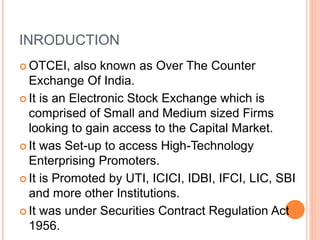
 OTCEI, also known as Over The Counter
Exchange Of India.
 It is an Electronic Stock Exchange which is
comprised of Small and Medium sized Firms
looking to gain access to the Capital Market.
 It was Set-up to access High-Technology
Enterprising Promoters.
 It is Promoted by UTI, ICICI, IDBI, IFCI, LIC, SBI
and more other Institutions.
 It was under Securities Contract Regulation Act
1956.
HISTORY & ACHIEVEMENTS
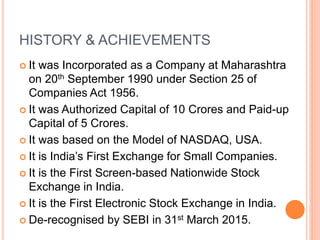
 It was Incorporated as a Company at Maharashtra
on 20th September 1990 under Section 25 of
Companies Act 1956.
 It was Authorized Capital of 10 Crores and Paid-up
Capital of 5 Crores.
 It was based on the Model of NASDAQ, USA.
 It is India’s First Exchange for Small Companies.
 It is the First Screen-based Nationwide Stock
Exchange in India.
 It is the First Electronic Stock Exchange in India.
 De-recognised by SEBI in 31st March 2015.
NEED FOR STARTING OTCEI
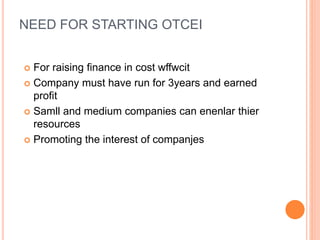
 For raising finance in cost wffwcit
 Company must have run for 3years and earned
profit
 Samll and medium companies can enenlar thier
resources
 Promoting the interest of companjes
THE PROMOTERS
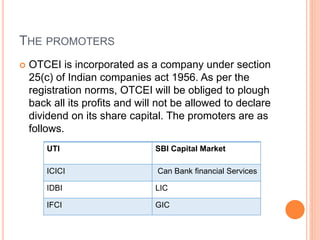
 OTCEI is incorporated as a company under section
25(c) of Indian companies act 1956. As per the
registration norms, OTCEI will be obliged to plough
back all its profits and will not be allowed to declare
dividend on its share capital. The promoters are as
follows.
UTI SBI Capital Market
ICICI Can Bank financial Services
IDBI LIC
IFCI GIC
PLAYERS IN THE OTCEI MARKET
The players on the OTCEI exchange are the
members and dealers. The activities of members and
dealers are:
 Act as broker, buy and sell securities according to
the instructions of investor.
 Market makers in securities, they quote the prices
at which members are willing to buy and sell the
specified no. of securities.
FEATURES
 Use of Modern Technology
 Restrictions for Other Stocks
 Minimum issued Capital Requirements
 Restrictions for Large Companies
 Base Capital Requirement for Members
 All India Network
 Satellite Facility
 Computerisation for Transactions
 Constituents
HOW TRANSACTIONS DONE
 The members of the OTCEI will invite companies to
list on the exchange for raising capital.
 There are dealers who perform the dual role of a
broker and market maker.
 A broker acts on behalf of buyer or seller, while a
market maker has a responsibility to make available
toe particular share in the maker for transactions
and to maintain reasonable price through supply
and demand forces.
LISTING REQUIREMENT
 It can’t be delist its Securities for a Minimum
Period of 3 Years.
 Some Certain Norms to be Fulfilled by
Companies for sale of equity shares or any other
securities
 Some Issued Capital should be retained by the
Promoters. (20%, for less than 3 yrs)
 There should be Two Market Makers as per the
Guidelines of OTCEI.
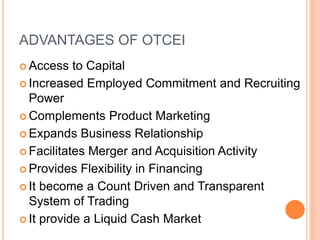
ADVANTAGES OF OTCEI
 Access to Capital
 Increased Employed Commitment and Recruiting
Power
 Complements Product Marketing
 Expands Business Relationship
 Facilitates Merger and Acquisition Activity
 Provides Flexibility in Financing
 It become a Count Driven and Transparent
System of Trading
 It provide a Liquid Cash Market
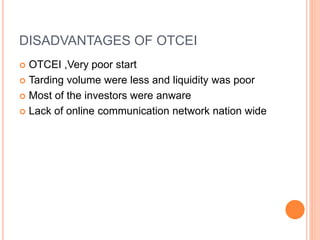
DISADVANTAGES OF OTCEI
 OTCEI ,Very poor start
 Tarding volume were less and liquidity was poor
 Most of the investors were anware
 Lack of online communication network nation wide
REGULAR STOCK EXCHANGE VS
OTCEI
 Trading Activities
 Minimum Paid-up Capital
 Membership restrictions
 Securities Traded
 Need for Market Maker
 Settlement Days
 Primary Objectives
THANK YOU

Ppt on otcei (1)

  • 1.
    OVER THE COUNTER EXCHANGEOF INDIA (OTCEI)
  • 2.
    CONTENTS  Introduction  History& Achievements  Features  Players in otcei market  Types of Public Offers  Listing RequireOTCEI  Advantages of OTCEI  Disadvantages of OTCEI  Regular Stock Exchange vs OTCEI
  • 3.
    OTCEI  Over TheCounter Exchange of India (OTCEI) can be defined as a stock exchange without a proper trading floor.  All stock exchange have a specific place for trading their securities through counters. But the OTCEI is connected through a computer network and the transactions are taking place through computer operations. Thus, the development in information technology has given scope for starting this type of stock exchange. OTCEI is recognized under the
  • 4.
    INRODUCTION  OTCEI, alsoknown as Over The Counter Exchange Of India.  It is an Electronic Stock Exchange which is comprised of Small and Medium sized Firms looking to gain access to the Capital Market.  It was Set-up to access High-Technology Enterprising Promoters.  It is Promoted by UTI, ICICI, IDBI, IFCI, LIC, SBI and more other Institutions.  It was under Securities Contract Regulation Act 1956.
  • 5.
    HISTORY & ACHIEVEMENTS It was Incorporated as a Company at Maharashtra on 20th September 1990 under Section 25 of Companies Act 1956.  It was Authorized Capital of 10 Crores and Paid-up Capital of 5 Crores.  It was based on the Model of NASDAQ, USA.  It is India’s First Exchange for Small Companies.  It is the First Screen-based Nationwide Stock Exchange in India.  It is the First Electronic Stock Exchange in India.  De-recognised by SEBI in 31st March 2015.
  • 6.
    NEED FOR STARTINGOTCEI  For raising finance in cost wffwcit  Company must have run for 3years and earned profit  Samll and medium companies can enenlar thier resources  Promoting the interest of companjes
  • 7.
    THE PROMOTERS  OTCEIis incorporated as a company under section 25(c) of Indian companies act 1956. As per the registration norms, OTCEI will be obliged to plough back all its profits and will not be allowed to declare dividend on its share capital. The promoters are as follows. UTI SBI Capital Market ICICI Can Bank financial Services IDBI LIC IFCI GIC
  • 8.
    PLAYERS IN THEOTCEI MARKET The players on the OTCEI exchange are the members and dealers. The activities of members and dealers are:  Act as broker, buy and sell securities according to the instructions of investor.  Market makers in securities, they quote the prices at which members are willing to buy and sell the specified no. of securities.
  • 9.
    FEATURES  Use ofModern Technology  Restrictions for Other Stocks  Minimum issued Capital Requirements  Restrictions for Large Companies  Base Capital Requirement for Members  All India Network  Satellite Facility  Computerisation for Transactions  Constituents
  • 10.
    HOW TRANSACTIONS DONE The members of the OTCEI will invite companies to list on the exchange for raising capital.  There are dealers who perform the dual role of a broker and market maker.  A broker acts on behalf of buyer or seller, while a market maker has a responsibility to make available toe particular share in the maker for transactions and to maintain reasonable price through supply and demand forces.
  • 11.
    LISTING REQUIREMENT  Itcan’t be delist its Securities for a Minimum Period of 3 Years.  Some Certain Norms to be Fulfilled by Companies for sale of equity shares or any other securities  Some Issued Capital should be retained by the Promoters. (20%, for less than 3 yrs)  There should be Two Market Makers as per the Guidelines of OTCEI.
  • 12.
    ADVANTAGES OF OTCEI Access to Capital  Increased Employed Commitment and Recruiting Power  Complements Product Marketing  Expands Business Relationship  Facilitates Merger and Acquisition Activity  Provides Flexibility in Financing  It become a Count Driven and Transparent System of Trading  It provide a Liquid Cash Market
  • 13.
    DISADVANTAGES OF OTCEI OTCEI ,Very poor start  Tarding volume were less and liquidity was poor  Most of the investors were anware  Lack of online communication network nation wide
  • 14.
    REGULAR STOCK EXCHANGEVS OTCEI  Trading Activities  Minimum Paid-up Capital  Membership restrictions  Securities Traded  Need for Market Maker  Settlement Days  Primary Objectives
  • 15.