Scaling Laws
Micro Intuition
• Linear extrapolation is easy but we are at a loss
when considering the implications that shrinking
of length has on surface area to volume ratios
and on the relative strength of external forces
• Micro intuition can be misleading.
• Our aim is to develop a systematic approach
about the likely behavior of downsized systems
so we do not need to rely on micro intuition
alone.
Scaling Laws
• They allow us to determine whether physical
phenomena will scale more favorably or will
scale poorly.
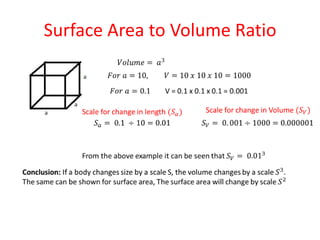
• Generally, smaller things are less effected by
volume dependent phenomena such as mass
and inertia, and are more effected by surface
area dependent phenomena such as contact
forces or heat transfer.
As you decrease the size
• Friction > inertia
• Heat dissipation > Heat storage
• Electrostatic force > Magnetic Force
Surface Area to Volume Ratio
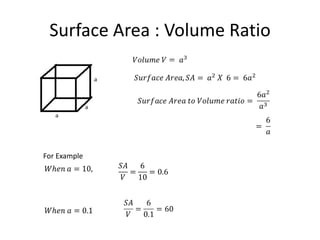
Surface Area : Volume Ratio
For Example
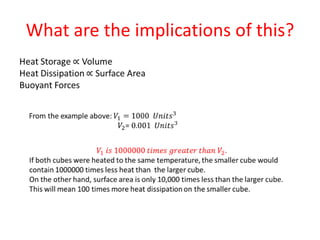
What are the implications of this?
• Volume relates, for example, to both
mechanical and thermal inertia. Thermal
inertia is a measure on how fast we can heat
or cool a solid. It is an important parameter in
the design of a thermally actuated devices.
Thermal Scaling
• Small object will loose heat rapidly, the
dissipation of waste heat is not problematic in
many cases.
Mathematical Approach
• Mathematically, a scaling law is a law that
describes the variations of physical quantities
with the size of the system.
• Use of dimensional analysis.
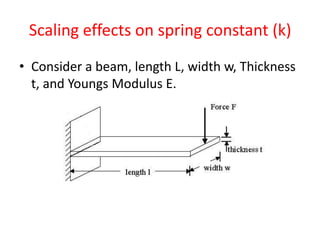
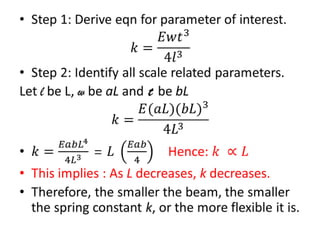
Scaling effects on spring constant (k)
• Consider a beam, length L, width w, Thickness
t, and Youngs Modulus E.
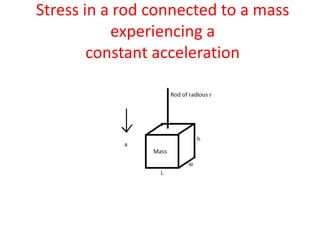
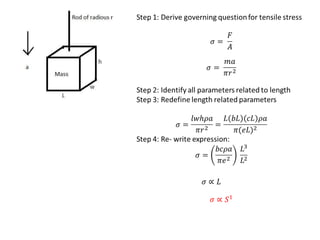
Stress in a rod connected to a mass
experiencing a
constant acceleration
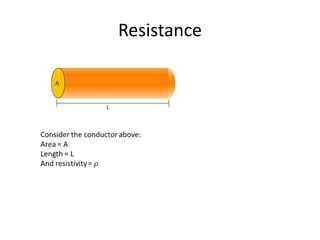
Resistance
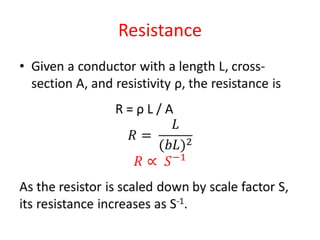
Resistance
Capacitance
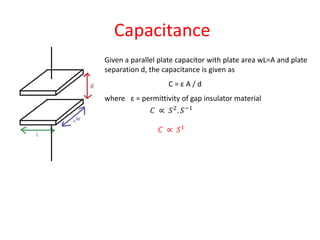
Given a parallel plate capacitor with plate area wL=A and plate
separation d, the capacitance is given as
C = ε A / d
where ε = permittivity of gap insulator material
Electrostatic Forces
Electromagnetism
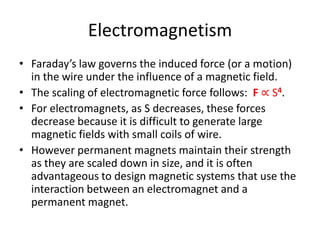
• Faraday’s law governs the induced force (or a motion)
in the wire under the influence of a magnetic field.
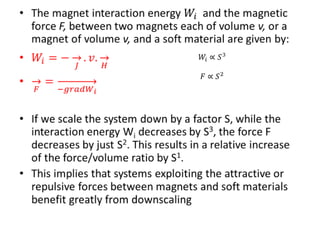
• The scaling of electromagnetic force follows: F ∝ S4.
• For electromagnets, as S decreases, these forces
decrease because it is difficult to generate large
magnetic fields with small coils of wire.
• However permanent magnets maintain their strength
as they are scaled down in size, and it is often
advantageous to design magnetic systems that use the
interaction between an electromagnet and a
permanent magnet.
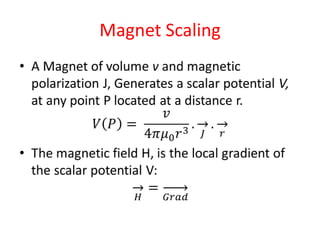
Magnet Scaling
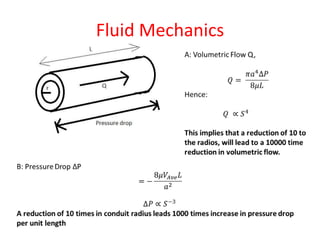
Fluid Mechanics
Use of Matrix Formalization
• To design micromechanical actuators, it is
helpful to understand how forces scale. Use of
a matrix formalism notation is very handy to
describe how different forces scale into the
small (and large) domain. It is called the
Trimmer’s vertical bracket approach.
• Formulated by William Trimmer in 1986.
Use of Matrix Formalization
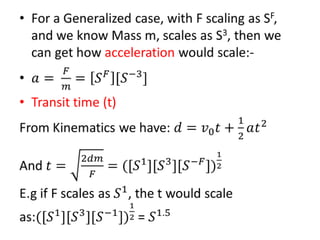
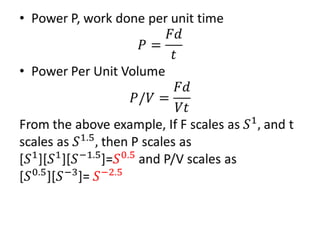
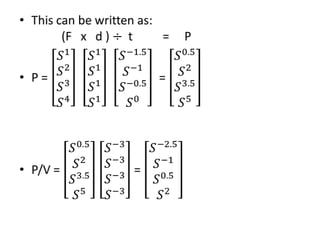
• The top element in this notation refers to the case where
the force scales as S1. The next one down refers to a case
where the force scales as S2, etc.
• If the system becomes one-tenth its original size, all the
dimensions decrease by a tenth. The mass of a
system, m, scales as (S3) and, as systems become
smaller, the scaling of the force also determines the
acceleration (a), transit time (t), and the amount of power
per unit volume (PV-1)
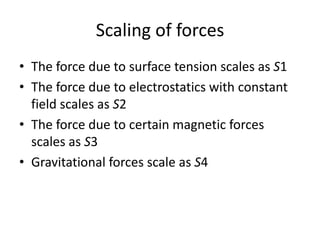
Scaling of forces
• The force due to surface tension scales as S1
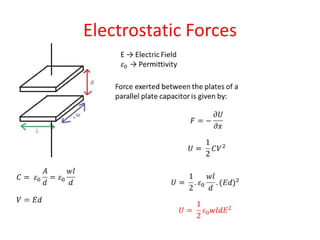
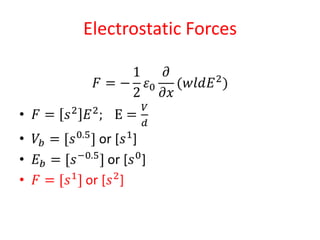
• The force due to electrostatics with constant
field scales as S2
• The force due to certain magnetic forces
scales as S3
• Gravitational forces scale as S4
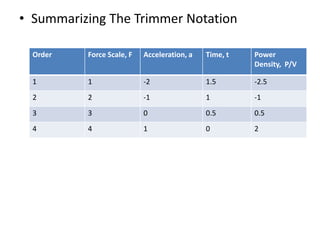
• Summarizing The Trimmer Notation
Order Force Scale, F Acceleration, a Time, t Power
Density, P/V
1 1 -2 1.5 -2.5
2 2 -1 1 -1
3 3 0 0.5 0.5
4 4 1 0 2
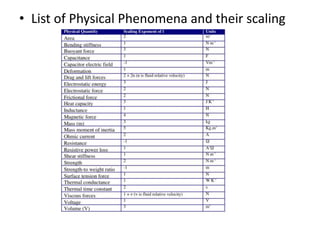
• List of Physical Phenomena and their scaling
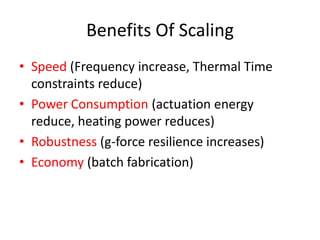
Benefits Of Scaling
• Speed (Frequency increase, Thermal Time
constraints reduce)
• Power Consumption (actuation energy
reduce, heating power reduces)
• Robustness (g-force resilience increases)
• Economy (batch fabrication)

Scaling laws in mems

  • 1.
  • 2.
    Micro Intuition • Linearextrapolation is easy but we are at a loss when considering the implications that shrinking of length has on surface area to volume ratios and on the relative strength of external forces • Micro intuition can be misleading. • Our aim is to develop a systematic approach about the likely behavior of downsized systems so we do not need to rely on micro intuition alone.
  • 3.
    Scaling Laws • Theyallow us to determine whether physical phenomena will scale more favorably or will scale poorly. • Generally, smaller things are less effected by volume dependent phenomena such as mass and inertia, and are more effected by surface area dependent phenomena such as contact forces or heat transfer.
  • 4.
    As you decreasethe size • Friction > inertia • Heat dissipation > Heat storage • Electrostatic force > Magnetic Force
  • 5.
    Surface Area toVolume Ratio
  • 6.
    Surface Area :Volume Ratio For Example
  • 7.
    What are theimplications of this?
  • 8.
    • Volume relates,for example, to both mechanical and thermal inertia. Thermal inertia is a measure on how fast we can heat or cool a solid. It is an important parameter in the design of a thermally actuated devices.
  • 9.
    Thermal Scaling • Smallobject will loose heat rapidly, the dissipation of waste heat is not problematic in many cases.
  • 10.
    Mathematical Approach • Mathematically,a scaling law is a law that describes the variations of physical quantities with the size of the system. • Use of dimensional analysis.
  • 11.
    Scaling effects onspring constant (k) • Consider a beam, length L, width w, Thickness t, and Youngs Modulus E.
  • 13.
    Stress in arod connected to a mass experiencing a constant acceleration
  • 15.
  • 16.
  • 17.
    Capacitance Given a parallelplate capacitor with plate area wL=A and plate separation d, the capacitance is given as C = ε A / d where ε = permittivity of gap insulator material
  • 18.
  • 19.
  • 20.
    Electromagnetism • Faraday’s lawgoverns the induced force (or a motion) in the wire under the influence of a magnetic field. • The scaling of electromagnetic force follows: F ∝ S4. • For electromagnets, as S decreases, these forces decrease because it is difficult to generate large magnetic fields with small coils of wire. • However permanent magnets maintain their strength as they are scaled down in size, and it is often advantageous to design magnetic systems that use the interaction between an electromagnet and a permanent magnet.
  • 21.
  • 23.
  • 24.
    Use of MatrixFormalization • To design micromechanical actuators, it is helpful to understand how forces scale. Use of a matrix formalism notation is very handy to describe how different forces scale into the small (and large) domain. It is called the Trimmer’s vertical bracket approach. • Formulated by William Trimmer in 1986.
  • 25.
    Use of MatrixFormalization • The top element in this notation refers to the case where the force scales as S1. The next one down refers to a case where the force scales as S2, etc. • If the system becomes one-tenth its original size, all the dimensions decrease by a tenth. The mass of a system, m, scales as (S3) and, as systems become smaller, the scaling of the force also determines the acceleration (a), transit time (t), and the amount of power per unit volume (PV-1)
  • 26.
    Scaling of forces •The force due to surface tension scales as S1 • The force due to electrostatics with constant field scales as S2 • The force due to certain magnetic forces scales as S3 • Gravitational forces scale as S4
  • 30.
    • Summarizing TheTrimmer Notation Order Force Scale, F Acceleration, a Time, t Power Density, P/V 1 1 -2 1.5 -2.5 2 2 -1 1 -1 3 3 0 0.5 0.5 4 4 1 0 2
  • 31.
    • List ofPhysical Phenomena and their scaling
  • 32.
    Benefits Of Scaling •Speed (Frequency increase, Thermal Time constraints reduce) • Power Consumption (actuation energy reduce, heating power reduces) • Robustness (g-force resilience increases) • Economy (batch fabrication)