EXEMPTION OF INCOME TAX
11/6/2013
Sadat Faruque
Page 2
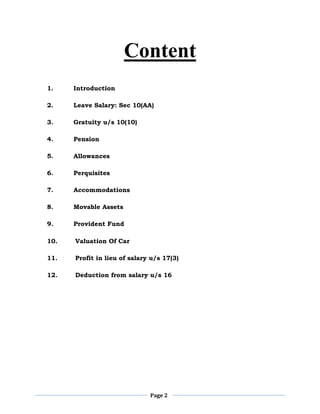
Content
1. Introduction
2. Leave Salary: Sec 10(AA)
3. Gratuity u/s 10(10)
4. Pension
5. Allowances
6. Perquisites
7. Accommodations
8. Movable Assets
9. Provident Fund
10. Valuation Of Car
11. Profit in lieu of salary u/s 17(3)
12. Deduction from salary u/s 16
Page 3
Income Exempted from Tax
In computing the total income of a previous year of any person, any income,
falling within any of the following clause, shall not be included in computing the
total income of such person. However, in order to claim exemption under this
section, it is the duty of the assessee to prove that an item of receipt falls within the
exempted category.
Different Provision:
Leave Salary: Sec 10(AA)
1. In case of Government employees – Fully tax-free. But leave salary
received during tenure of service, full taxable.
2. In case of Non- Government employees – Taxable but assessee will get
exemption u/s 10(10AA) (ii) to the extent of least of the following:
a) Actual leave salary received.
b) Cash equivalent of leave to the credit of the employee at the time of
retirement.
c) 10 months average salary.
d) Maximum Rs 3,00,000
Here salary means Basic, DA (if terms of employment so provide) and fixed
percentage commission.
Average salary is to be calculated on the basis of average salary drawn by the
employee during the period of 10 months immediately preceding his retirement.
Cash Equivalent of Leave Salary = [Earned leave – Leave availed] × Average
Salary.
As per IT Rules employees shall get maximum 30 days earned leave for each
completed year of service (ignore any fraction of year).
Page 4
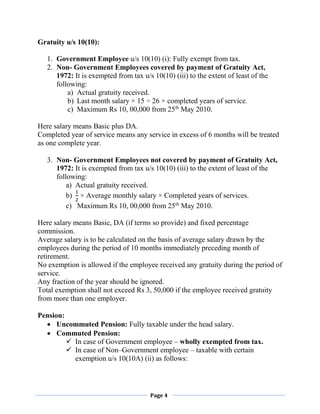
Gratuity u/s 10(10):
1. Government Employee u/s 10(10) (i): Fully exempt from tax.
2. Non- Government Employees covered by payment of Gratuity Act,
1972: It is exempted from tax u/s 10(10) (iii) to the extent of least of the
following:
a) Actual gratuity received.
b) Last month salary × 15 ÷ 26 × completed years of service.
c) Maximum Rs 10, 00,000 from 25th
May 2010.
Here salary means Basic plus DA.
Completed year of service means any service in excess of 6 months will be treated
as one complete year.
3. Non- Government Employees not covered by payment of Gratuity Act,
1972: It is exempted from tax u/s 10(10) (iii) to the extent of least of the
following:
a) Actual gratuity received.
b)
1
2
× Average monthly salary × Completed years of services.
c) Maximum Rs 10, 00,000 from 25th
May 2010.
Here salary means Basic, DA (if terms so provide) and fixed percentage
commission.
Average salary is to be calculated on the basis of average salary drawn by the
employees during the period of 10 months immediately preceding month of
retirement.
No exemption is allowed if the employee received any gratuity during the period of
service.
Any fraction of the year should be ignored.
Total exemption shall not exceed Rs 3, 50,000 if the employee received gratuity
from more than one employer.
Pension:
 Uncommuted Pension: Fully taxable under the head salary.
 Commuted Pension:
 In case of Government employee – wholly exempted from tax.
 In case of Non–Government employee – taxable with certain
exemption u/s 10(10A) (ii) as follows:
Page 5
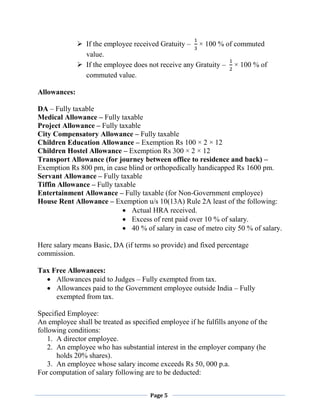
 If the employee received Gratuity –
1
3
× 100 % of commuted
value.
 If the employee does not receive any Gratuity –
1
2
× 100 % of
commuted value.
Allowances:
DA – Fully taxable
Medical Allowance – Fully taxable
Project Allowance – Fully taxable
City Compensatory Allowance – Fully taxable
Children Education Allowance – Exemption Rs 100 × 2 × 12
Children Hostel Allowance – Exemption Rs 300 × 2 × 12
Transport Allowance (for journey between office to residence and back) –
Exemption Rs 800 pm, in case blind or orthopedically handicapped Rs 1600 pm.
Servant Allowance – Fully taxable
Tiffin Allowance – Fully taxable
Entertainment Allowance – Fully taxable (for Non-Government employee)
House Rent Allowance – Exemption u/s 10(13A) Rule 2A least of the following:
 Actual HRA received.
 Excess of rent paid over 10 % of salary.
 40 % of salary in case of metro city 50 % of salary.
Here salary means Basic, DA (if terms so provide) and fixed percentage
commission.
Tax Free Allowances:
 Allowances paid to Judges – Fully exempted from tax.
 Allowances paid to the Government employee outside India – Fully
exempted from tax.
Specified Employee:
An employee shall be treated as specified employee if he fulfills anyone of the
following conditions:
1. A director employee.
2. An employee who has substantial interest in the employer company (he
holds 20% shares).
3. An employee whose salary income exceeds Rs 50, 000 p.a.
For computation of salary following are to be deducted:
Page 6
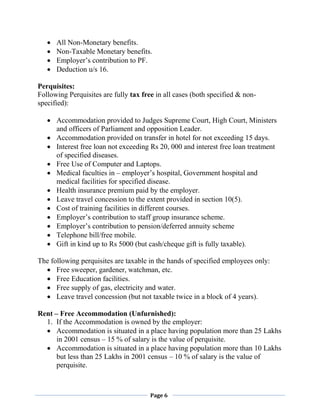
 All Non-Monetary benefits.
 Non-Taxable Monetary benefits.
 Employer’s contribution to PF.
 Deduction u/s 16.
Perquisites:
Following Perquisites are fully tax free in all cases (both specified & non-
specified):
 Accommodation provided to Judges Supreme Court, High Court, Ministers
and officers of Parliament and opposition Leader.
 Accommodation provided on transfer in hotel for not exceeding 15 days.
 Interest free loan not exceeding Rs 20, 000 and interest free loan treatment
of specified diseases.
 Free Use of Computer and Laptops.
 Medical faculties in – employer’s hospital, Government hospital and
medical facilities for specified disease.
 Health insurance premium paid by the employer.
 Leave travel concession to the extent provided in section 10(5).
 Cost of training facilities in different courses.
 Employer’s contribution to staff group insurance scheme.
 Employer’s contribution to pension/deferred annuity scheme
 Telephone bill/free mobile.
 Gift in kind up to Rs 5000 (but cash/cheque gift is fully taxable).
The following perquisites are taxable in the hands of specified employees only:
 Free sweeper, gardener, watchman, etc.
 Free Education facilities.
 Free supply of gas, electricity and water.
 Leave travel concession (but not taxable twice in a block of 4 years).
Rent – Free Accommodation (Unfurnished):
1. If the Accommodation is owned by the employer:
 Accommodation is situated in a place having population more than 25 Lakhs
in 2001 census – 15 % of salary is the value of perquisite.
 Accommodation is situated in a place having population more than 10 Lakhs
but less than 25 Lakhs in 2001 census – 10 % of salary is the value of
perquisite.
Page 7
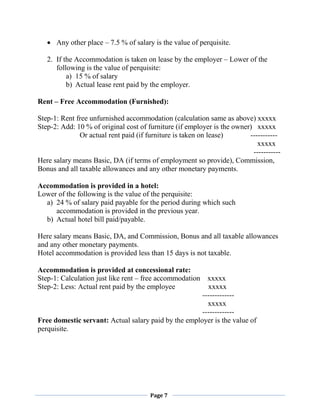
 Any other place – 7.5 % of salary is the value of perquisite.
2. If the Accommodation is taken on lease by the employer – Lower of the
following is the value of perquisite:
a) 15 % of salary
b) Actual lease rent paid by the employer.
Rent – Free Accommodation (Furnished):
Step-1: Rent free unfurnished accommodation (calculation same as above) xxxxx
Step-2: Add: 10 % of original cost of furniture (if employer is the owner) xxxxx
Or actual rent paid (if furniture is taken on lease) -----------
xxxxx
-----------
Here salary means Basic, DA (if terms of employment so provide), Commission,
Bonus and all taxable allowances and any other monetary payments.
Accommodation is provided in a hotel:
Lower of the following is the value of the perquisite:
a) 24 % of salary paid payable for the period during which such
accommodation is provided in the previous year.
b) Actual hotel bill paid/payable.
Here salary means Basic, DA, and Commission, Bonus and all taxable allowances
and any other monetary payments.
Hotel accommodation is provided less than 15 days is not taxable.
Accommodation is provided at concessional rate:
Step-1: Calculation just like rent – free accommodation xxxxx
Step-2: Less: Actual rent paid by the employee xxxxx
-------------
xxxxx
-------------
Free domestic servant: Actual salary paid by the employer is the value of
perquisite.
Page 8
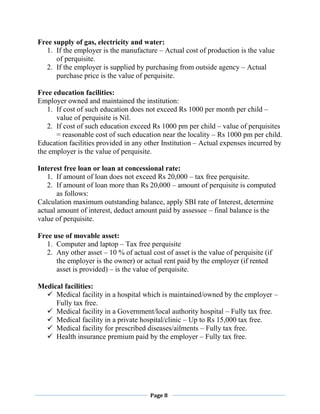
Free supply of gas, electricity and water:
1. If the employer is the manufacture – Actual cost of production is the value
of perquisite.
2. If the employer is supplied by purchasing from outside agency – Actual
purchase price is the value of perquisite.
Free education facilities:
Employer owned and maintained the institution:
1. If cost of such education does not exceed Rs 1000 per month per child –
value of perquisite is Nil.
2. If cost of such education exceed Rs 1000 pm per child – value of perquisites
= reasonable cost of such education near the locality – Rs 1000 pm per child.
Education facilities provided in any other Institution – Actual expenses incurred by
the employer is the value of perquisite.
Interest free loan or loan at concessional rate:
1. If amount of loan does not exceed Rs 20,000 – tax free perquisite.
2. If amount of loan more than Rs 20,000 – amount of perquisite is computed
as follows:
Calculation maximum outstanding balance, apply SBI rate of Interest, determine
actual amount of interest, deduct amount paid by assessee – final balance is the
value of perquisite.
Free use of movable asset:
1. Computer and laptop – Tax free perquisite
2. Any other asset – 10 % of actual cost of asset is the value of perquisite (if
the employer is the owner) or actual rent paid by the employer (if rented
asset is provided) – is the value of perquisite.
Medical facilities:
 Medical facility in a hospital which is maintained/owned by the employer –
Fully tax free.
 Medical facility in a Government/local authority hospital – Fully tax free.
 Medical facility in a private hospital/clinic – Up to Rs 15,000 tax free.
 Medical facility for prescribed diseases/ailments – Fully tax free.
 Health insurance premium paid by the employer – Fully tax free.
Page 9
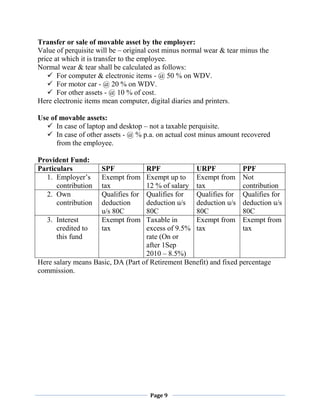
Transfer or sale of movable asset by the employer:
Value of perquisite will be – original cost minus normal wear & tear minus the
price at which it is transfer to the employee.
Normal wear & tear shall be calculated as follows:
 For computer & electronic items - @ 50 % on WDV.
 For motor car - @ 20 % on WDV.
 For other assets - @ 10 % of cost.
Here electronic items mean computer, digital diaries and printers.
Use of movable assets:
 In case of laptop and desktop – not a taxable perquisite.
 In case of other assets - @ % p.a. on actual cost minus amount recovered
from the employee.
Provident Fund:
Particulars SPF RPF URPF PPF
1. Employer’s
contribution
Exempt from
tax
Exempt up to
12 % of salary
Exempt from
tax
Not
contribution
2. Own
contribution
Qualifies for
deduction
u/s 80C
Qualifies for
deduction u/s
80C
Qualifies for
deduction u/s
80C
Qualifies for
deduction u/s
80C
3. Interest
credited to
this fund
Exempt from
tax
Taxable in
excess of 9.5%
rate (On or
after 1Sep
2010 – 8.5%)
Exempt from
tax
Exempt from
tax
Here salary means Basic, DA (Part of Retirement Benefit) and fixed percentage
commission.
Page
10
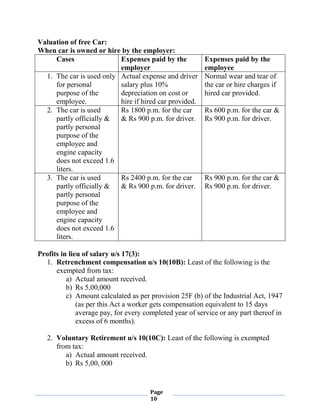
Valuation of free Car:
When car is owned or hire by the employer:
Cases Expenses paid by the
employer
Expenses paid by the
employee
1. The car is used only
for personal
purpose of the
employee.
Actual expense and driver
salary plus 10%
depreciation on cost or
hire if hired car provided.
Normal wear and tear of
the car or hire charges if
hired car provided.
2. The car is used
partly officially &
partly personal
purpose of the
employee and
engine capacity
does not exceed 1.6
liters.
Rs 1800 p.m. for the car
& Rs 900 p.m. for driver.
Rs 600 p.m. for the car &
Rs 900 p.m. for driver.
3. The car is used
partly officially &
partly personal
purpose of the
employee and
engine capacity
does not exceed 1.6
liters.
Rs 2400 p.m. for the car
& Rs 900 p.m. for driver.
Rs 900 p.m. for the car &
Rs 900 p.m. for driver.
Profits in lieu of salary u/s 17(3):
1. Retrenchment compensation u/s 10(10B): Least of the following is the
exempted from tax:
a) Actual amount received.
b) Rs 5,00,000
c) Amount calculated as per provision 25F (b) of the Industrial Act, 1947
(as per this Act a worker gets compensation equivalent to 15 days
average pay, for every completed year of service or any part thereof in
excess of 6 months).
2. Voluntary Retirement u/s 10(10C): Least of the following is exempted
from tax:
a) Actual amount received.
b) Rs 5,00, 000
Page
11
Deduction from salaries u/s 16:
 Standard deduction u/s 16(i)----Nil
 Deduction for Entertainment Allowance [Government employee] 16(ii) -
least of the following:
a) Actual amount received.
b)
1
5
Of basic salary.
c) Rs 5,000
 Deduction for Professional tax u/s 16(iii) – Actual amount paid.

Income Exempted from Tax

  • 1.
    EXEMPTION OF INCOMETAX 11/6/2013 Sadat Faruque
  • 2.
    Page 2 Content 1. Introduction 2.Leave Salary: Sec 10(AA) 3. Gratuity u/s 10(10) 4. Pension 5. Allowances 6. Perquisites 7. Accommodations 8. Movable Assets 9. Provident Fund 10. Valuation Of Car 11. Profit in lieu of salary u/s 17(3) 12. Deduction from salary u/s 16
  • 3.
    Page 3 Income Exemptedfrom Tax In computing the total income of a previous year of any person, any income, falling within any of the following clause, shall not be included in computing the total income of such person. However, in order to claim exemption under this section, it is the duty of the assessee to prove that an item of receipt falls within the exempted category. Different Provision: Leave Salary: Sec 10(AA) 1. In case of Government employees – Fully tax-free. But leave salary received during tenure of service, full taxable. 2. In case of Non- Government employees – Taxable but assessee will get exemption u/s 10(10AA) (ii) to the extent of least of the following: a) Actual leave salary received. b) Cash equivalent of leave to the credit of the employee at the time of retirement. c) 10 months average salary. d) Maximum Rs 3,00,000 Here salary means Basic, DA (if terms of employment so provide) and fixed percentage commission. Average salary is to be calculated on the basis of average salary drawn by the employee during the period of 10 months immediately preceding his retirement. Cash Equivalent of Leave Salary = [Earned leave – Leave availed] × Average Salary. As per IT Rules employees shall get maximum 30 days earned leave for each completed year of service (ignore any fraction of year).
  • 4.
    Page 4 Gratuity u/s10(10): 1. Government Employee u/s 10(10) (i): Fully exempt from tax. 2. Non- Government Employees covered by payment of Gratuity Act, 1972: It is exempted from tax u/s 10(10) (iii) to the extent of least of the following: a) Actual gratuity received. b) Last month salary × 15 ÷ 26 × completed years of service. c) Maximum Rs 10, 00,000 from 25th May 2010. Here salary means Basic plus DA. Completed year of service means any service in excess of 6 months will be treated as one complete year. 3. Non- Government Employees not covered by payment of Gratuity Act, 1972: It is exempted from tax u/s 10(10) (iii) to the extent of least of the following: a) Actual gratuity received. b) 1 2 × Average monthly salary × Completed years of services. c) Maximum Rs 10, 00,000 from 25th May 2010. Here salary means Basic, DA (if terms so provide) and fixed percentage commission. Average salary is to be calculated on the basis of average salary drawn by the employees during the period of 10 months immediately preceding month of retirement. No exemption is allowed if the employee received any gratuity during the period of service. Any fraction of the year should be ignored. Total exemption shall not exceed Rs 3, 50,000 if the employee received gratuity from more than one employer. Pension:  Uncommuted Pension: Fully taxable under the head salary.  Commuted Pension:  In case of Government employee – wholly exempted from tax.  In case of Non–Government employee – taxable with certain exemption u/s 10(10A) (ii) as follows:
  • 5.
    Page 5  Ifthe employee received Gratuity – 1 3 × 100 % of commuted value.  If the employee does not receive any Gratuity – 1 2 × 100 % of commuted value. Allowances: DA – Fully taxable Medical Allowance – Fully taxable Project Allowance – Fully taxable City Compensatory Allowance – Fully taxable Children Education Allowance – Exemption Rs 100 × 2 × 12 Children Hostel Allowance – Exemption Rs 300 × 2 × 12 Transport Allowance (for journey between office to residence and back) – Exemption Rs 800 pm, in case blind or orthopedically handicapped Rs 1600 pm. Servant Allowance – Fully taxable Tiffin Allowance – Fully taxable Entertainment Allowance – Fully taxable (for Non-Government employee) House Rent Allowance – Exemption u/s 10(13A) Rule 2A least of the following:  Actual HRA received.  Excess of rent paid over 10 % of salary.  40 % of salary in case of metro city 50 % of salary. Here salary means Basic, DA (if terms so provide) and fixed percentage commission. Tax Free Allowances:  Allowances paid to Judges – Fully exempted from tax.  Allowances paid to the Government employee outside India – Fully exempted from tax. Specified Employee: An employee shall be treated as specified employee if he fulfills anyone of the following conditions: 1. A director employee. 2. An employee who has substantial interest in the employer company (he holds 20% shares). 3. An employee whose salary income exceeds Rs 50, 000 p.a. For computation of salary following are to be deducted:
  • 6.
    Page 6  AllNon-Monetary benefits.  Non-Taxable Monetary benefits.  Employer’s contribution to PF.  Deduction u/s 16. Perquisites: Following Perquisites are fully tax free in all cases (both specified & non- specified):  Accommodation provided to Judges Supreme Court, High Court, Ministers and officers of Parliament and opposition Leader.  Accommodation provided on transfer in hotel for not exceeding 15 days.  Interest free loan not exceeding Rs 20, 000 and interest free loan treatment of specified diseases.  Free Use of Computer and Laptops.  Medical faculties in – employer’s hospital, Government hospital and medical facilities for specified disease.  Health insurance premium paid by the employer.  Leave travel concession to the extent provided in section 10(5).  Cost of training facilities in different courses.  Employer’s contribution to staff group insurance scheme.  Employer’s contribution to pension/deferred annuity scheme  Telephone bill/free mobile.  Gift in kind up to Rs 5000 (but cash/cheque gift is fully taxable). The following perquisites are taxable in the hands of specified employees only:  Free sweeper, gardener, watchman, etc.  Free Education facilities.  Free supply of gas, electricity and water.  Leave travel concession (but not taxable twice in a block of 4 years). Rent – Free Accommodation (Unfurnished): 1. If the Accommodation is owned by the employer:  Accommodation is situated in a place having population more than 25 Lakhs in 2001 census – 15 % of salary is the value of perquisite.  Accommodation is situated in a place having population more than 10 Lakhs but less than 25 Lakhs in 2001 census – 10 % of salary is the value of perquisite.
  • 7.
    Page 7  Anyother place – 7.5 % of salary is the value of perquisite. 2. If the Accommodation is taken on lease by the employer – Lower of the following is the value of perquisite: a) 15 % of salary b) Actual lease rent paid by the employer. Rent – Free Accommodation (Furnished): Step-1: Rent free unfurnished accommodation (calculation same as above) xxxxx Step-2: Add: 10 % of original cost of furniture (if employer is the owner) xxxxx Or actual rent paid (if furniture is taken on lease) ----------- xxxxx ----------- Here salary means Basic, DA (if terms of employment so provide), Commission, Bonus and all taxable allowances and any other monetary payments. Accommodation is provided in a hotel: Lower of the following is the value of the perquisite: a) 24 % of salary paid payable for the period during which such accommodation is provided in the previous year. b) Actual hotel bill paid/payable. Here salary means Basic, DA, and Commission, Bonus and all taxable allowances and any other monetary payments. Hotel accommodation is provided less than 15 days is not taxable. Accommodation is provided at concessional rate: Step-1: Calculation just like rent – free accommodation xxxxx Step-2: Less: Actual rent paid by the employee xxxxx ------------- xxxxx ------------- Free domestic servant: Actual salary paid by the employer is the value of perquisite.
  • 8.
    Page 8 Free supplyof gas, electricity and water: 1. If the employer is the manufacture – Actual cost of production is the value of perquisite. 2. If the employer is supplied by purchasing from outside agency – Actual purchase price is the value of perquisite. Free education facilities: Employer owned and maintained the institution: 1. If cost of such education does not exceed Rs 1000 per month per child – value of perquisite is Nil. 2. If cost of such education exceed Rs 1000 pm per child – value of perquisites = reasonable cost of such education near the locality – Rs 1000 pm per child. Education facilities provided in any other Institution – Actual expenses incurred by the employer is the value of perquisite. Interest free loan or loan at concessional rate: 1. If amount of loan does not exceed Rs 20,000 – tax free perquisite. 2. If amount of loan more than Rs 20,000 – amount of perquisite is computed as follows: Calculation maximum outstanding balance, apply SBI rate of Interest, determine actual amount of interest, deduct amount paid by assessee – final balance is the value of perquisite. Free use of movable asset: 1. Computer and laptop – Tax free perquisite 2. Any other asset – 10 % of actual cost of asset is the value of perquisite (if the employer is the owner) or actual rent paid by the employer (if rented asset is provided) – is the value of perquisite. Medical facilities:  Medical facility in a hospital which is maintained/owned by the employer – Fully tax free.  Medical facility in a Government/local authority hospital – Fully tax free.  Medical facility in a private hospital/clinic – Up to Rs 15,000 tax free.  Medical facility for prescribed diseases/ailments – Fully tax free.  Health insurance premium paid by the employer – Fully tax free.
  • 9.
    Page 9 Transfer orsale of movable asset by the employer: Value of perquisite will be – original cost minus normal wear & tear minus the price at which it is transfer to the employee. Normal wear & tear shall be calculated as follows:  For computer & electronic items - @ 50 % on WDV.  For motor car - @ 20 % on WDV.  For other assets - @ 10 % of cost. Here electronic items mean computer, digital diaries and printers. Use of movable assets:  In case of laptop and desktop – not a taxable perquisite.  In case of other assets - @ % p.a. on actual cost minus amount recovered from the employee. Provident Fund: Particulars SPF RPF URPF PPF 1. Employer’s contribution Exempt from tax Exempt up to 12 % of salary Exempt from tax Not contribution 2. Own contribution Qualifies for deduction u/s 80C Qualifies for deduction u/s 80C Qualifies for deduction u/s 80C Qualifies for deduction u/s 80C 3. Interest credited to this fund Exempt from tax Taxable in excess of 9.5% rate (On or after 1Sep 2010 – 8.5%) Exempt from tax Exempt from tax Here salary means Basic, DA (Part of Retirement Benefit) and fixed percentage commission.
  • 10.
    Page 10 Valuation of freeCar: When car is owned or hire by the employer: Cases Expenses paid by the employer Expenses paid by the employee 1. The car is used only for personal purpose of the employee. Actual expense and driver salary plus 10% depreciation on cost or hire if hired car provided. Normal wear and tear of the car or hire charges if hired car provided. 2. The car is used partly officially & partly personal purpose of the employee and engine capacity does not exceed 1.6 liters. Rs 1800 p.m. for the car & Rs 900 p.m. for driver. Rs 600 p.m. for the car & Rs 900 p.m. for driver. 3. The car is used partly officially & partly personal purpose of the employee and engine capacity does not exceed 1.6 liters. Rs 2400 p.m. for the car & Rs 900 p.m. for driver. Rs 900 p.m. for the car & Rs 900 p.m. for driver. Profits in lieu of salary u/s 17(3): 1. Retrenchment compensation u/s 10(10B): Least of the following is the exempted from tax: a) Actual amount received. b) Rs 5,00,000 c) Amount calculated as per provision 25F (b) of the Industrial Act, 1947 (as per this Act a worker gets compensation equivalent to 15 days average pay, for every completed year of service or any part thereof in excess of 6 months). 2. Voluntary Retirement u/s 10(10C): Least of the following is exempted from tax: a) Actual amount received. b) Rs 5,00, 000
  • 11.
    Page 11 Deduction from salariesu/s 16:  Standard deduction u/s 16(i)----Nil  Deduction for Entertainment Allowance [Government employee] 16(ii) - least of the following: a) Actual amount received. b) 1 5 Of basic salary. c) Rs 5,000  Deduction for Professional tax u/s 16(iii) – Actual amount paid.