


CAPITAL STRUCTURE ANALYSIS
OF INDIAN AUTOMOBILE
INDUSTRY
Introduction: Automobile Industry
Overview
 The automobile industry is vital to
the growth of the Indian
economy.
 In the last decade their share in
the Indian economy is around 5%
of GDP.
 Economic progress is indicated by
the amount of goods and services
produced which gives an impetus
for transportation and boost the
sale of vehicles.
 Main segment in Indian
Automobile Industry:-
 Passenger vehicles: Cars and
buses
 Commercial vehicles: Goods
carrier , MUV, SUV, Minivans,
Trucks, Tippers
 Three wheelers: Rickshaws, Trolleys,
Delivery Vans
 Two wheelers: Scooters,
Motorcycles and Mopeds
Sample Companies
 Maruti Suzuki India Limited : Subsidiary of
Suzuki Motor Corporation, Japan. Market
leader in passenger vehicles. Capability
to produce over 1.5 million vehicles
annually.
 Tata Motors Limited is India's largest
automobile company, with consolidated
revenues of INR 1,65,654 crores (USD 32.5
billion) in 2011-12. It is the leader in
commercial vehicles in each segment,
and among the top in passenger
vehicles.
 Bajaj Auto Limited : Product range
encompasses scooterettes, scooters and
motorcycles. The company’s worth is
around US$3.4 billion.
 Mahindra & Mahindra Limited (M&M) :
operations span 18 key industries that
form the foundation of every modern
economy: aerospace, aftermarket,
agribusiness, automotive, components
etc.
 Hero Motocorp Limited : Indian
motorcycle and scooter manufacturer
based in New Delhi, India. Hero Honda
started in 1984 as a joint venture between
Hero Cycles of India and Honda of
Japan. In 2010, when Honda decided to
move out of the joint venture, Hero
Group bought the shares held by Honda.
Subsequently, in August 2011 the
company was renamed Hero Moto Corp
with a new corporate identity.
Objectives of Study
 To assess the capital structure of
the selected companies.
 To know the status of capital
structure among selected
automobile industries
 To determine the long-term
profitability of the selected
companies.
 To assess the change in
proportion of debt and equity.
 To offer suitable suggestions for
framing effective capital
structure to meet the
requirement of the selected
companies.
 Period of the study:- The study
covers a period of five years from
2007-08 to 2011 -2012.
Tools Used
Following tools used:-
 Leverage analysis(Combined Leverage)
1. Operating Leverage
2. Financial Leverage
 Cost of capital analysis
1. Cost of Equity
2. Cost of Debt
 Ratio analysis
1. Debt- Equity Ratio
2. Long Term Debt- Equity Ratio
3. Interest Coverage Ratio
4. Fixed Assets Turnover Ratio
5. Return on Net Worth
6. Return on long term fund
7. Return on Capital Employed
Leverage Analysis
Operating Leverage
Year
Company
Name
2007-
08
2008-
09
2009-
10
2010-
11
2011-
12
Mean
Maruti Suzuki 0.86 1.17 0.95 0.97 0.93 0.98
Tata Motors 0.64 0.61 0.66 0.75 0.63 0.66
Bajaj Auto 0.92 1.01 0.97 0.97 0.96 0.97
Mahindra &
Mahindra
0.83 1.08 0.97 0.93 0.82 0.93
Hero Motocorp 1.01 0.98 1.00 0.99 0.97 0.99
Mean 0.85 0.97 0.91 0.92 0.86 0.90
 Operating leverage refers to the
relationship between firm’s sales
revenue and its earnings before interest
and tax.
 Where, contribution= sales-variable cost.
O.L = Contribution/Earning before
interest and tax.
 Hero Moto Corp : Ranges from 0.97
to 1.01.
 Maruti Suzuki : Ranges from 0.86 to
1.17.
 Bajaj Auto : Ranges from 0.92 to
1.01.
 Tata Motors : Ranges from 0.63 to
0.75.
 Tata Motors has low rate of operating
leverage, which indicates a low interest
outflow and consequently lower
borrowings.
Financial Leverage:
Year
Company
Name
2007-08 2008-
09
2009-
10
2010-
11
2011-12 Mean
Maruti Suzuki 1.05 1.18 1.06 1.12 1.41 1.16
Tata Motors 1.50 0.12 1.80 2.60 3.36 1.88
Bajaj Auto 0.63 1.14 1.04 0.75 0.93 0.90
Mahindra &
Mahindra
0.93 1.25 1.09 1.01 1.08 1.07
Hero Motocorp 0.97 0.98 0.97 1.08 1.27 1.05
Mean 1.02 0.93 1.19 1.31 1.61 1.21
• Financial leverage can be described as the
extent to which a business or investor is using
the borrowed money.
• Tata Motors has greater financial leverage in
terms of average for five years.
• Bajaj Auto has low financial leverage which
indicates good among all selected
companies.
Cost of capital
analysis
Cost of Equity
Year
Company
Name
2007-08 2008-09 2009-10 2010-11 2011-12 Mean
Maruti Suzuki 0.96 0.22 0.42 0.81 0.50 0.58
Tata Motors 47.15 3.78 5.74 11.21 1.28 13.83
Bajaj Auto 10.22 2.50 2.60 2.51 2.11 3.99
Mahindra &
Mahindra
8.37 1.85 1.22 1.68 1.34 2.89
Hero Motocorp 2.36 1.16 5.54 5.51 2.37 3.39
Mean 13.81 1.90 3.10 4.34 1.52 4.94
• Equity is the permanent capital for a
firm.
• Cost of equity of Maruti Suzuki was at
high level 0.96 in 2007-08 and at low
level 0.22 in 2008-09
• In Bajaj Auto cost of equity was at high
level 10.20 in 2007-08 and at low level
2.11 in 2011-12.
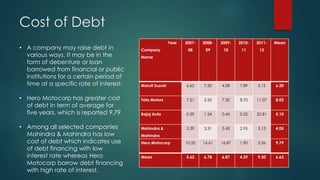
Cost of Debt
Year
Company
Name
2007-
08
2008-
09
2009-
10
2010-
11
2011-
12
Mean
Maruti Suzuki 6.62 7.30 4.08 7.89 5.12 6.20
Tata Motors 7.51 5.35 7.50 8.70 11.07 8.03
Bajaj Auto 0.39 1.34 0.45 0.52 22.81 5.10
Mahindra &
Mahindra
3.39 3.31 5.45 2.95 5.13 4.05
Hero Motocorp 10.20 16.61 16.87 1.90 3.36 9.79
Mean 5.62 6.78 6.87 4.39 9.50 6.63
• A company may raise debt in
various ways. It may be in the
form of debenture or loan
borrowed from financial or public
institutions for a certain period of
time at a specific rate of interest.
• Hero Motocorp has greater cost
of debt in term of average for
five years, which is reported 9.79
• Among all selected companies
Mahindra & Mahindra has low
cost of debt which indicates use
of debt financing with low
interest rate whereas Hero
Motocorp borrow debt financing
with high rate of interest.
Ratio analysis
Debt Equity Ratio
Years
Company
Name
2007-
08
2008-
09
2009-
10
2010-
11
2011-
12
Mean
Maruti Suzuki 0.06 0.07 0.04 0.02 - 0.04
Tata Motors 0.50 0.49 0.80 0.52 0.41 0.54
Bajaj Auto 0.84 0.71 0.45 0.03 0.02 0.46
Mahindra &
Mahindra
0.63 0.83 0.46 0.32 0.26 0.50
Hero Motocorp 0.04 0.02 0.02 0.50 0.23 0.16
Mean 0.41 0.42 0.35 0.37 0.18 0.34
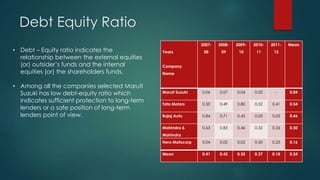
• Debt – Equity ratio indicates the
relationship between the external equities
(or) outsider’s funds and the internal
equities (or) the shareholders funds.
• Among all the companies selected Maruti
Suzuki has low debt-equity ratio which
indicates sufficient protection to long-term
lenders or a safe position of long-term
lenders point of view.
Long – Term Debt Equity Ratio
Years
Company
Name
2007-
08
2008-
09
2009-
10
2010-
11
2011-
12
Mean
Maruti Suzuki 0.06 0.07 0.04 0.02 - 0.04
Tata Motors 0.50 0.49 0.80 0.52 0.41 0.54
Bajaj Auto 0.84 0.71 0.45 0.03 0.02 0.46
Mahindra &
Mahindra
0.63 0.83 0.46 0.32 0.26 0.50
Hero Motocorp 0.04 0.02 0.02 0.50 0.23 0.16
Mean 0.41 0.42 0.35 0.37 0.18 0.34
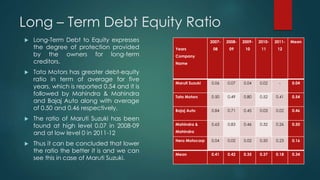
 Long-Term Debt to Equity expresses
the degree of protection provided
by the owners for long-term
creditors.
 Tata Motors has greater debt-equity
ratio in term of average for five
years, which is reported 0.54 and it is
followed by Mahindra & Mahindra
and Bajaj Auto along with average
of 0.50 and 0.46 respectively.
 The ratio of Maruti Suzuki has been
found at high level 0.07 in 2008-09
and at low level 0 in 2011-12
 Thus it can be concluded that lower
the ratio the better it is and we can
see this in case of Maruti Suzuki.
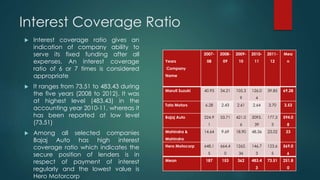
Interest Coverage Ratio
Years
Company
Name
2007-
08
2008-
09
2009-
10
2010-
11
2011-
12
Mea
n
Maruti Suzuki 40.93 34.21 105.3
9
126.0
4
39.85 69.28
Tata Motors 6.28 2.43 2.61 2.64 3.70 3.53
Bajaj Auto 224.9
1
53.71 421.0
6
2093.
39
177.3
3
594.0
8
Mahindra &
Mahindra
14.64 9.69 18.90 48.36 23.02 23
Hero Motocorp 648.1
5
664.4
0
1262.
36
146.7
3
123.6
5
569.0
6
Mean 187 153 362 483.4
3
73.51 251.8
0
 Interest coverage ratio gives an
indication of company ability to
serve its fixed funding after all
expenses. An interest coverage
ratio of 6 or 7 times is considered
appropriate
 It ranges from 73.51 to 483.43 during
the five years (2008 to 2012). It was
at highest level (483.43) in the
accounting year 2010-11, whereas it
has been reported at low level
(73.51)
 Among all selected companies
Bajaj Auto has high interest
coverage ratio which indicates the
secure position of lenders is in
respect of payment of interest
regularly and the lowest value is
Hero Motorcorp
Fixed Asset Turnover Ratio
Year
Company
Name
2007-
08
2008-
09
2009
-10
2010
-11
2011-
12
Mea
n
Maruti Suzuki 2.48 2.38 2.82 3.13 2.46 2.65
Tata Motors 2.69 1.29 1.24 1.42 1.64 1.66
Bajaj Auto 2.95 2.60 3.50 4.85 5.75 3.93
Mahindra &
Mahindra
3.22 2.84 3.85 4.08 4.32 3.66
Hero Motocorp 5.89 5.34 6.29 3.70 4.05 5.54
Mean 3.45 2.89 3.54 3.44 3.64 3.40
 The fixed assets turnover ratio
measures the efficiency with
which fixed assets are
employed.
 The ratio for all auto corps
ranges between 2.89 to 3.64 in
the study period. It was at
highest level 3.64 in the
accounting year of 2011-12,
whereas it has been reported at
low level 2.89 in 2008-09
 It can be concluded that on an
average basis Hero Motocorp
has high fixed assets turnover
ratio which indicates better
utilization of fixed assets and it is
opposite for Tata Motors
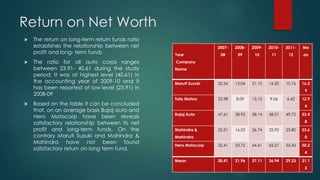
Return on Net Worth
Year
Company
Name
2007-
08
2008-
09
2009-
10
2010-
11
2011-
12
Me
an
Maruti Suzuki 20.56 13.04 21.10 16.50 10.76 16.3
9
Tata Motors 25.98 8.09 15.15 9.06 6.42 12.9
4
Bajaj Auto 47.61 38.92 58.14 68.01 49.72 52.4
8
Mahindra &
Mahindra
25.51 16.03 26.74 25.92 23.80 23.6
0
Hero Motocorp 32.41 33.72 64.41 65.21 55.43 50.2
4
Mean 30.41 21.96 37.11 36.94 29.23 31.1
3
 The return on long-term return funds ratio
establishes the relationship between net
profit and long- term funds
 The ratio for all auto corps ranges
between 23.91- 40.61 during the study
period. It was at highest level (40.61) in
the accounting year of 2009-10 and it
has been reported at low level (23.91) in
2008-09
 Based on the table it can be concluded
that, on an average basis Bajaj auto and
Hero Motocorp have been reveals
satisfactory relationship between its net
profit and long-term funds. On the
contrary Maruti Suzuki and Mahindra &
Mahindra have not been found
satisfactory return on long term fund.
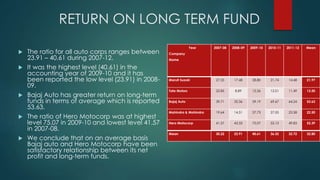
RETURN ON LONG TERM FUND
 The ratio for all auto corps ranges between
23.91 – 40.61 during 2007-12.
 It was the highest level (40.61) in the
accounting year of 2009-10 and it has
been reported the low level (23.91) in 2008-
09.
 Bajaj Auto has greater return on long-term
funds in terms of average which is reported
53.63.
 The ratio of Hero Motocorp was at highest
level 75.07 in 2009-10 and lowest level 41.57
in 2007-08.
 We conclude that on an average basis
Bajaj auto and Hero Motocorp have been
satisfactory relationship between its net
profit and long-term funds.
Year
Company
Name
2007-08 2008-09 2009-10 2010-11 2011-12 Mean
Maruti Suzuki 27.35 17.48 28.80 21.74 14.48 21.97
Tata Motors 22.85 8.89 12.26 12.01 11.49 13.50
Bajaj Auto 39.71 35.36 59.19 69.67 64.24 53.63
Mahindra & Mahindra 19.64 14.51 27.73 27.05 23.58 22.50
Hero Motocorp 41.57 43.33 75.07 52.13 49.83 52.39
Mean 30.22 23.91 40.61 36.52 32.72 32.80
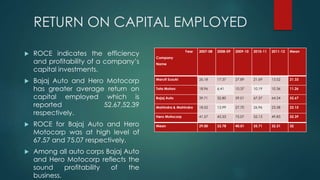
RETURN ON CAPITAL EMPLOYED
 ROCE indicates the efficiency
and profitability of a company’s
capital investments.
 Bajaj Auto and Hero Motocorp
has greater average return on
capital employed which is
reported 52.67,52.39
respectively.
 ROCE for Bajaj Auto and Hero
Motocorp was at high level of
67.57 and 75.07 respectively.
 Among all auto corps Bajaj Auto
and Hero Motocorp reflects the
sound profitability of the
business.
Year
Company
Name
2007-08 2008-09 2009-10 2010-11 2011-12 Mean
Maruti Suzuki 26.18 17.37 27.89 21.69 13.52 21.33
Tata Motors 18.96 6.41 10.37 10.19 10.36 11.26
Bajaj Auto 39.71 32.80 59.01 67.57 64.24 52.67
Mahindra & Mahindra 18.52 13.99 27.70 26.96 23.58 22.15
Hero Motocorp 41.57 43.33 75.07 52.13 49.83 52.39
Mean 29.00 22.78 40.01 35.71 32.31 32
SUGGESTION
 Tata Motors total risk was high , so it should increase its equity to
reduce the risk.
 All the selected companies should try to maintain their debt-equity
proportion at the same level.
 Bajaj Auto must give special attention to increase the earnings per
share to safeguard and improve the welfare of its shareholders.
 Tata Motors and Maruti Suzuki should try to reduce their operating
expenses and financial burden to convert revenue into actual profit.
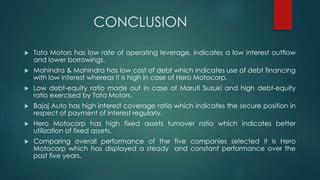
CONCLUSION
 Tata Motors has low rate of operating leverage, indicates a low interest outflow
and lower borrowings.
 Mahindra & Mahindra has low cost of debt which indicates use of debt financing
with low interest whereas it is high in case of Hero Motocorp.
 Low debt-equity ratio made out in case of Maruti Suzuki and high debt-equity
ratio exercised by Tata Motors.
 Bajaj Auto has high interest coverage ratio which indicates the secure position in
respect of payment of interest regularly.
 Hero Motocorp has high fixed assets turnover ratio which indicates better
utilization of fixed assets.
 Comparing overall performance of the five companies selected it is Hero
Motocorp which has displayed a steady and constant performance over the
past five years.
THANK YOU

Capital Structure Analysis

  • 1.
    CAPITAL STRUCTURE ANALYSIS OFINDIAN AUTOMOBILE INDUSTRY
  • 2.
    Introduction: Automobile Industry Overview The automobile industry is vital to the growth of the Indian economy.  In the last decade their share in the Indian economy is around 5% of GDP.  Economic progress is indicated by the amount of goods and services produced which gives an impetus for transportation and boost the sale of vehicles.  Main segment in Indian Automobile Industry:-  Passenger vehicles: Cars and buses  Commercial vehicles: Goods carrier , MUV, SUV, Minivans, Trucks, Tippers  Three wheelers: Rickshaws, Trolleys, Delivery Vans  Two wheelers: Scooters, Motorcycles and Mopeds
  • 3.
    Sample Companies  MarutiSuzuki India Limited : Subsidiary of Suzuki Motor Corporation, Japan. Market leader in passenger vehicles. Capability to produce over 1.5 million vehicles annually.  Tata Motors Limited is India's largest automobile company, with consolidated revenues of INR 1,65,654 crores (USD 32.5 billion) in 2011-12. It is the leader in commercial vehicles in each segment, and among the top in passenger vehicles.  Bajaj Auto Limited : Product range encompasses scooterettes, scooters and motorcycles. The company’s worth is around US$3.4 billion.  Mahindra & Mahindra Limited (M&M) : operations span 18 key industries that form the foundation of every modern economy: aerospace, aftermarket, agribusiness, automotive, components etc.  Hero Motocorp Limited : Indian motorcycle and scooter manufacturer based in New Delhi, India. Hero Honda started in 1984 as a joint venture between Hero Cycles of India and Honda of Japan. In 2010, when Honda decided to move out of the joint venture, Hero Group bought the shares held by Honda. Subsequently, in August 2011 the company was renamed Hero Moto Corp with a new corporate identity.
  • 4.
    Objectives of Study To assess the capital structure of the selected companies.  To know the status of capital structure among selected automobile industries  To determine the long-term profitability of the selected companies.  To assess the change in proportion of debt and equity.  To offer suitable suggestions for framing effective capital structure to meet the requirement of the selected companies.  Period of the study:- The study covers a period of five years from 2007-08 to 2011 -2012. Tools Used Following tools used:-  Leverage analysis(Combined Leverage) 1. Operating Leverage 2. Financial Leverage  Cost of capital analysis 1. Cost of Equity 2. Cost of Debt  Ratio analysis 1. Debt- Equity Ratio 2. Long Term Debt- Equity Ratio 3. Interest Coverage Ratio 4. Fixed Assets Turnover Ratio 5. Return on Net Worth 6. Return on long term fund 7. Return on Capital Employed
  • 5.
  • 6.
    Operating Leverage Year Company Name 2007- 08 2008- 09 2009- 10 2010- 11 2011- 12 Mean Maruti Suzuki0.86 1.17 0.95 0.97 0.93 0.98 Tata Motors 0.64 0.61 0.66 0.75 0.63 0.66 Bajaj Auto 0.92 1.01 0.97 0.97 0.96 0.97 Mahindra & Mahindra 0.83 1.08 0.97 0.93 0.82 0.93 Hero Motocorp 1.01 0.98 1.00 0.99 0.97 0.99 Mean 0.85 0.97 0.91 0.92 0.86 0.90  Operating leverage refers to the relationship between firm’s sales revenue and its earnings before interest and tax.  Where, contribution= sales-variable cost. O.L = Contribution/Earning before interest and tax.  Hero Moto Corp : Ranges from 0.97 to 1.01.  Maruti Suzuki : Ranges from 0.86 to 1.17.  Bajaj Auto : Ranges from 0.92 to 1.01.  Tata Motors : Ranges from 0.63 to 0.75.  Tata Motors has low rate of operating leverage, which indicates a low interest outflow and consequently lower borrowings.
  • 7.
    Financial Leverage: Year Company Name 2007-08 2008- 09 2009- 10 2010- 11 2011-12Mean Maruti Suzuki 1.05 1.18 1.06 1.12 1.41 1.16 Tata Motors 1.50 0.12 1.80 2.60 3.36 1.88 Bajaj Auto 0.63 1.14 1.04 0.75 0.93 0.90 Mahindra & Mahindra 0.93 1.25 1.09 1.01 1.08 1.07 Hero Motocorp 0.97 0.98 0.97 1.08 1.27 1.05 Mean 1.02 0.93 1.19 1.31 1.61 1.21 • Financial leverage can be described as the extent to which a business or investor is using the borrowed money. • Tata Motors has greater financial leverage in terms of average for five years. • Bajaj Auto has low financial leverage which indicates good among all selected companies.
  • 8.
  • 9.
    Cost of Equity Year Company Name 2007-082008-09 2009-10 2010-11 2011-12 Mean Maruti Suzuki 0.96 0.22 0.42 0.81 0.50 0.58 Tata Motors 47.15 3.78 5.74 11.21 1.28 13.83 Bajaj Auto 10.22 2.50 2.60 2.51 2.11 3.99 Mahindra & Mahindra 8.37 1.85 1.22 1.68 1.34 2.89 Hero Motocorp 2.36 1.16 5.54 5.51 2.37 3.39 Mean 13.81 1.90 3.10 4.34 1.52 4.94 • Equity is the permanent capital for a firm. • Cost of equity of Maruti Suzuki was at high level 0.96 in 2007-08 and at low level 0.22 in 2008-09 • In Bajaj Auto cost of equity was at high level 10.20 in 2007-08 and at low level 2.11 in 2011-12.
  • 10.
    Cost of Debt Year Company Name 2007- 08 2008- 09 2009- 10 2010- 11 2011- 12 Mean MarutiSuzuki 6.62 7.30 4.08 7.89 5.12 6.20 Tata Motors 7.51 5.35 7.50 8.70 11.07 8.03 Bajaj Auto 0.39 1.34 0.45 0.52 22.81 5.10 Mahindra & Mahindra 3.39 3.31 5.45 2.95 5.13 4.05 Hero Motocorp 10.20 16.61 16.87 1.90 3.36 9.79 Mean 5.62 6.78 6.87 4.39 9.50 6.63 • A company may raise debt in various ways. It may be in the form of debenture or loan borrowed from financial or public institutions for a certain period of time at a specific rate of interest. • Hero Motocorp has greater cost of debt in term of average for five years, which is reported 9.79 • Among all selected companies Mahindra & Mahindra has low cost of debt which indicates use of debt financing with low interest rate whereas Hero Motocorp borrow debt financing with high rate of interest.
  • 11.
  • 12.
    Debt Equity Ratio Years Company Name 2007- 08 2008- 09 2009- 10 2010- 11 2011- 12 Mean MarutiSuzuki 0.06 0.07 0.04 0.02 - 0.04 Tata Motors 0.50 0.49 0.80 0.52 0.41 0.54 Bajaj Auto 0.84 0.71 0.45 0.03 0.02 0.46 Mahindra & Mahindra 0.63 0.83 0.46 0.32 0.26 0.50 Hero Motocorp 0.04 0.02 0.02 0.50 0.23 0.16 Mean 0.41 0.42 0.35 0.37 0.18 0.34 • Debt – Equity ratio indicates the relationship between the external equities (or) outsider’s funds and the internal equities (or) the shareholders funds. • Among all the companies selected Maruti Suzuki has low debt-equity ratio which indicates sufficient protection to long-term lenders or a safe position of long-term lenders point of view.
  • 13.
    Long – TermDebt Equity Ratio Years Company Name 2007- 08 2008- 09 2009- 10 2010- 11 2011- 12 Mean Maruti Suzuki 0.06 0.07 0.04 0.02 - 0.04 Tata Motors 0.50 0.49 0.80 0.52 0.41 0.54 Bajaj Auto 0.84 0.71 0.45 0.03 0.02 0.46 Mahindra & Mahindra 0.63 0.83 0.46 0.32 0.26 0.50 Hero Motocorp 0.04 0.02 0.02 0.50 0.23 0.16 Mean 0.41 0.42 0.35 0.37 0.18 0.34  Long-Term Debt to Equity expresses the degree of protection provided by the owners for long-term creditors.  Tata Motors has greater debt-equity ratio in term of average for five years, which is reported 0.54 and it is followed by Mahindra & Mahindra and Bajaj Auto along with average of 0.50 and 0.46 respectively.  The ratio of Maruti Suzuki has been found at high level 0.07 in 2008-09 and at low level 0 in 2011-12  Thus it can be concluded that lower the ratio the better it is and we can see this in case of Maruti Suzuki.
  • 14.
    Interest Coverage Ratio Years Company Name 2007- 08 2008- 09 2009- 10 2010- 11 2011- 12 Mea n MarutiSuzuki 40.93 34.21 105.3 9 126.0 4 39.85 69.28 Tata Motors 6.28 2.43 2.61 2.64 3.70 3.53 Bajaj Auto 224.9 1 53.71 421.0 6 2093. 39 177.3 3 594.0 8 Mahindra & Mahindra 14.64 9.69 18.90 48.36 23.02 23 Hero Motocorp 648.1 5 664.4 0 1262. 36 146.7 3 123.6 5 569.0 6 Mean 187 153 362 483.4 3 73.51 251.8 0  Interest coverage ratio gives an indication of company ability to serve its fixed funding after all expenses. An interest coverage ratio of 6 or 7 times is considered appropriate  It ranges from 73.51 to 483.43 during the five years (2008 to 2012). It was at highest level (483.43) in the accounting year 2010-11, whereas it has been reported at low level (73.51)  Among all selected companies Bajaj Auto has high interest coverage ratio which indicates the secure position of lenders is in respect of payment of interest regularly and the lowest value is Hero Motorcorp
  • 15.
    Fixed Asset TurnoverRatio Year Company Name 2007- 08 2008- 09 2009 -10 2010 -11 2011- 12 Mea n Maruti Suzuki 2.48 2.38 2.82 3.13 2.46 2.65 Tata Motors 2.69 1.29 1.24 1.42 1.64 1.66 Bajaj Auto 2.95 2.60 3.50 4.85 5.75 3.93 Mahindra & Mahindra 3.22 2.84 3.85 4.08 4.32 3.66 Hero Motocorp 5.89 5.34 6.29 3.70 4.05 5.54 Mean 3.45 2.89 3.54 3.44 3.64 3.40  The fixed assets turnover ratio measures the efficiency with which fixed assets are employed.  The ratio for all auto corps ranges between 2.89 to 3.64 in the study period. It was at highest level 3.64 in the accounting year of 2011-12, whereas it has been reported at low level 2.89 in 2008-09  It can be concluded that on an average basis Hero Motocorp has high fixed assets turnover ratio which indicates better utilization of fixed assets and it is opposite for Tata Motors
  • 16.
    Return on NetWorth Year Company Name 2007- 08 2008- 09 2009- 10 2010- 11 2011- 12 Me an Maruti Suzuki 20.56 13.04 21.10 16.50 10.76 16.3 9 Tata Motors 25.98 8.09 15.15 9.06 6.42 12.9 4 Bajaj Auto 47.61 38.92 58.14 68.01 49.72 52.4 8 Mahindra & Mahindra 25.51 16.03 26.74 25.92 23.80 23.6 0 Hero Motocorp 32.41 33.72 64.41 65.21 55.43 50.2 4 Mean 30.41 21.96 37.11 36.94 29.23 31.1 3  The return on long-term return funds ratio establishes the relationship between net profit and long- term funds  The ratio for all auto corps ranges between 23.91- 40.61 during the study period. It was at highest level (40.61) in the accounting year of 2009-10 and it has been reported at low level (23.91) in 2008-09  Based on the table it can be concluded that, on an average basis Bajaj auto and Hero Motocorp have been reveals satisfactory relationship between its net profit and long-term funds. On the contrary Maruti Suzuki and Mahindra & Mahindra have not been found satisfactory return on long term fund.
  • 17.
    RETURN ON LONGTERM FUND  The ratio for all auto corps ranges between 23.91 – 40.61 during 2007-12.  It was the highest level (40.61) in the accounting year of 2009-10 and it has been reported the low level (23.91) in 2008- 09.  Bajaj Auto has greater return on long-term funds in terms of average which is reported 53.63.  The ratio of Hero Motocorp was at highest level 75.07 in 2009-10 and lowest level 41.57 in 2007-08.  We conclude that on an average basis Bajaj auto and Hero Motocorp have been satisfactory relationship between its net profit and long-term funds. Year Company Name 2007-08 2008-09 2009-10 2010-11 2011-12 Mean Maruti Suzuki 27.35 17.48 28.80 21.74 14.48 21.97 Tata Motors 22.85 8.89 12.26 12.01 11.49 13.50 Bajaj Auto 39.71 35.36 59.19 69.67 64.24 53.63 Mahindra & Mahindra 19.64 14.51 27.73 27.05 23.58 22.50 Hero Motocorp 41.57 43.33 75.07 52.13 49.83 52.39 Mean 30.22 23.91 40.61 36.52 32.72 32.80
  • 18.
    RETURN ON CAPITALEMPLOYED  ROCE indicates the efficiency and profitability of a company’s capital investments.  Bajaj Auto and Hero Motocorp has greater average return on capital employed which is reported 52.67,52.39 respectively.  ROCE for Bajaj Auto and Hero Motocorp was at high level of 67.57 and 75.07 respectively.  Among all auto corps Bajaj Auto and Hero Motocorp reflects the sound profitability of the business. Year Company Name 2007-08 2008-09 2009-10 2010-11 2011-12 Mean Maruti Suzuki 26.18 17.37 27.89 21.69 13.52 21.33 Tata Motors 18.96 6.41 10.37 10.19 10.36 11.26 Bajaj Auto 39.71 32.80 59.01 67.57 64.24 52.67 Mahindra & Mahindra 18.52 13.99 27.70 26.96 23.58 22.15 Hero Motocorp 41.57 43.33 75.07 52.13 49.83 52.39 Mean 29.00 22.78 40.01 35.71 32.31 32
  • 19.
    SUGGESTION  Tata Motorstotal risk was high , so it should increase its equity to reduce the risk.  All the selected companies should try to maintain their debt-equity proportion at the same level.  Bajaj Auto must give special attention to increase the earnings per share to safeguard and improve the welfare of its shareholders.  Tata Motors and Maruti Suzuki should try to reduce their operating expenses and financial burden to convert revenue into actual profit.
  • 20.
    CONCLUSION  Tata Motorshas low rate of operating leverage, indicates a low interest outflow and lower borrowings.  Mahindra & Mahindra has low cost of debt which indicates use of debt financing with low interest whereas it is high in case of Hero Motocorp.  Low debt-equity ratio made out in case of Maruti Suzuki and high debt-equity ratio exercised by Tata Motors.  Bajaj Auto has high interest coverage ratio which indicates the secure position in respect of payment of interest regularly.  Hero Motocorp has high fixed assets turnover ratio which indicates better utilization of fixed assets.  Comparing overall performance of the five companies selected it is Hero Motocorp which has displayed a steady and constant performance over the past five years.
  • 21.